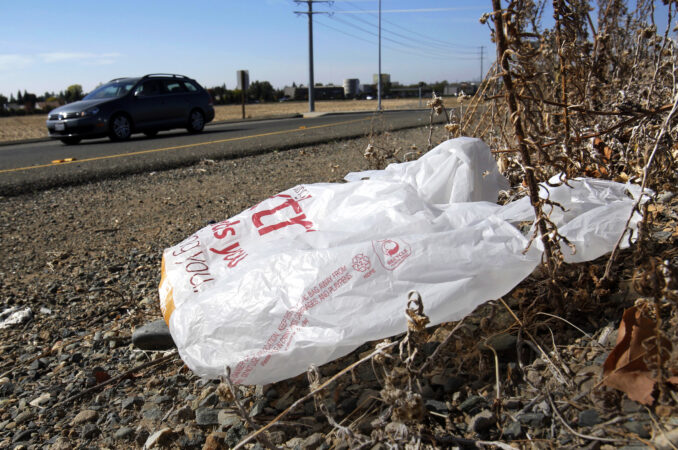
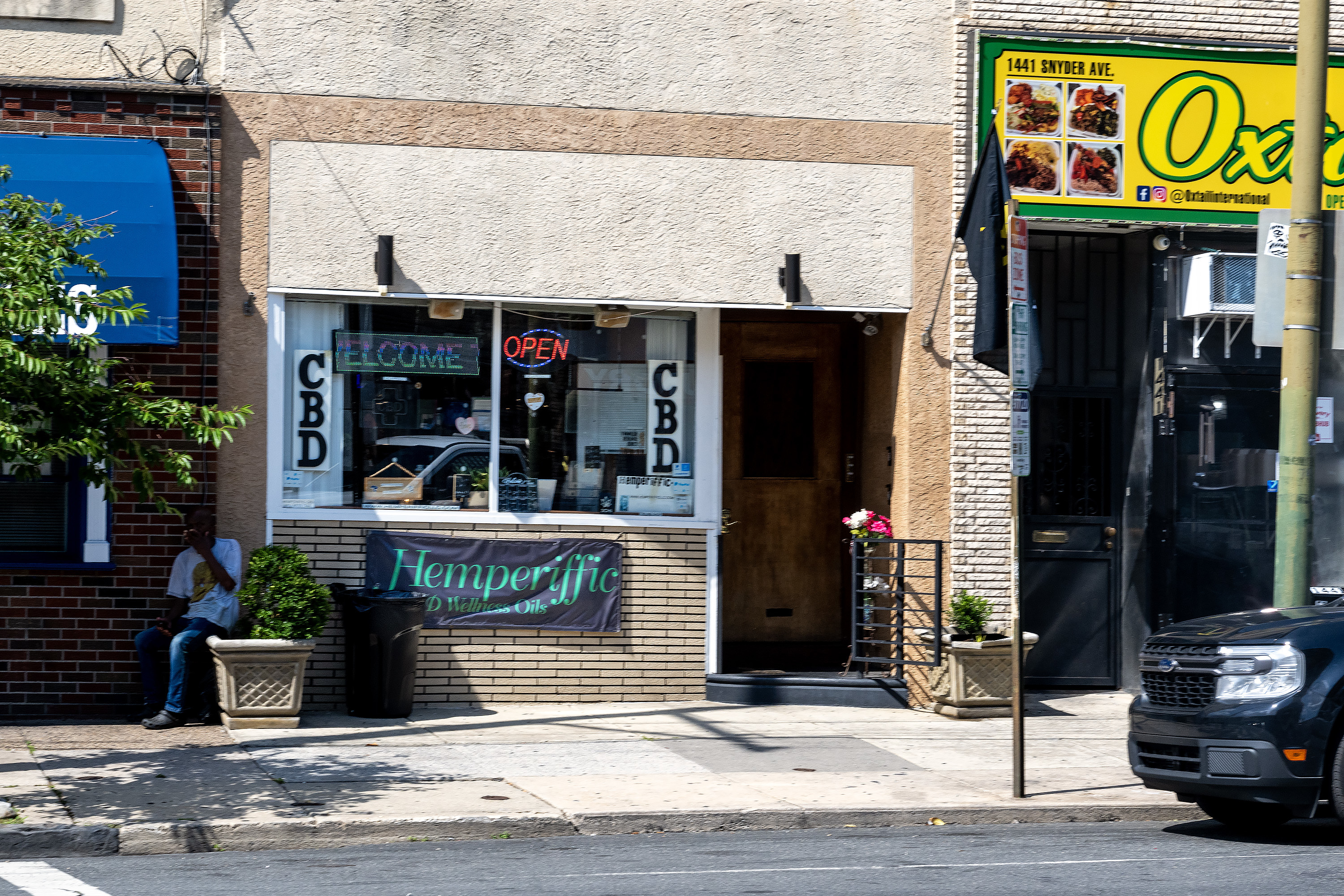
A sampling of retailers, takeout businesses, pharmacies, convenience stores, and food stores shows half are violating Philadelphia’s ordinance that bans plastic bags and requires a fee on paper bags.
That’s according to the PennEnvironment Research & Policy Center, which sent members to purchase items in 80 stores across the city and in neighborhoods with varying demographics.
The nonprofit advocacy group’s survey found:
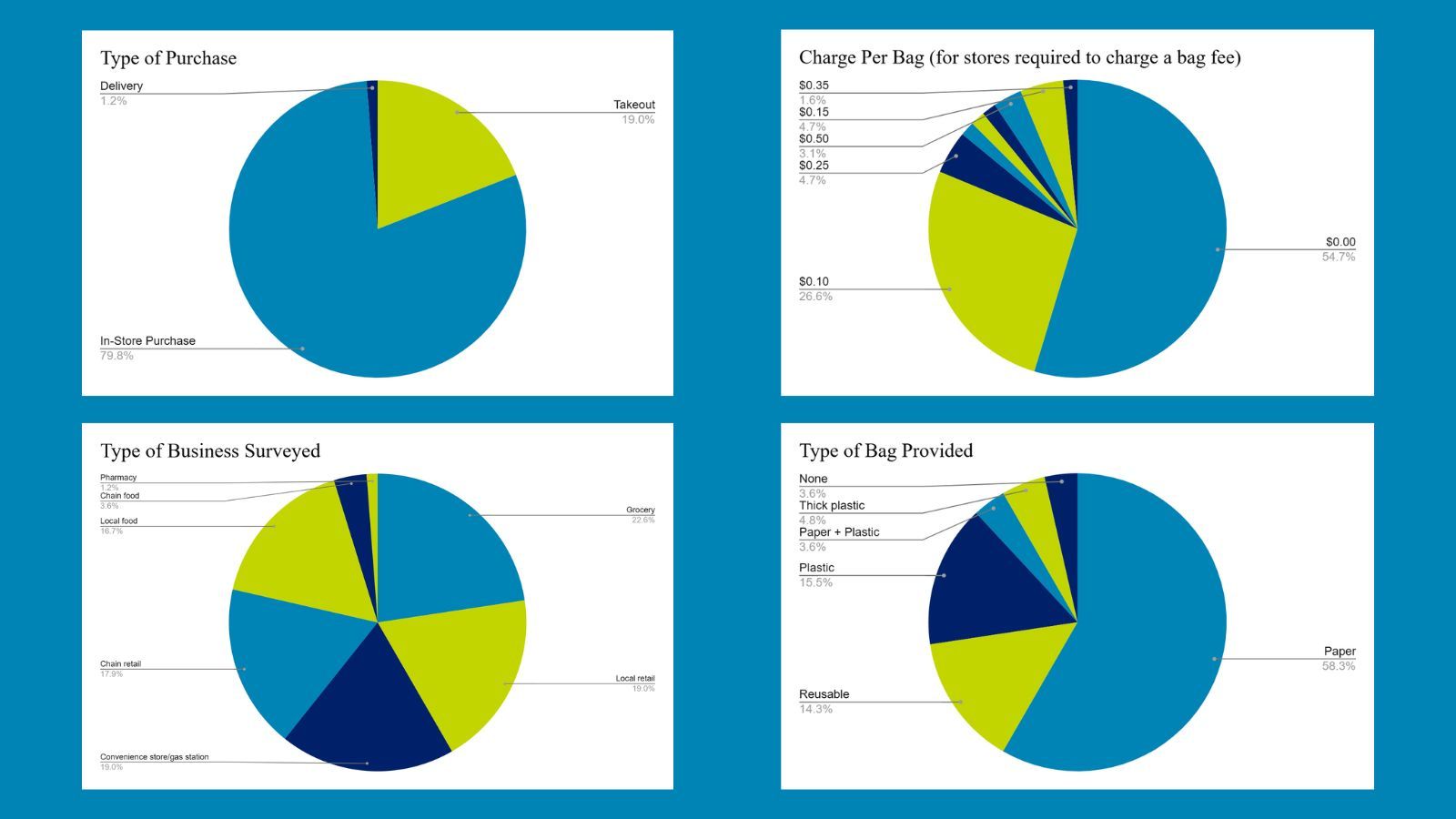
55% of businesses violated at least one key provision of the law.
50% of businesses failed to charge a 10-cent fee on paper or reusable bags.
20% of businesses provided plastic bags that have been illegal for years.
Faran Savitz, a zero-waste advocate for PennEnvironment, said during a news conference Thursday outside City Hall that the group didn’t just scrutinize chain stores like Wawa, although those larger operations were generally compliant.
He said the 80 stores surveyed were chosen to represent multiple types in all neighborhoods, although they amount to only a fraction of businesses in the city,
“We wanted to look at as many different types of businesses and hit as many different neighborhoods in the city as possible, so we could get a sense of is this concentrated on one neighborhood or is it spread geographically everywhere,” Savitz said. “We found that this is a pretty widespread problem.”
Charts from a survey of stores conducted by the nonprofit advocacy group PennEnvironment show what the report calls widespread noncompliance of Philadelphia’s revised plastic bag law that went into effect in January 2026.
Savitz said that chain stores tend to know the law and its requirements. Many small businesses remain unaware.
However, the survey did highlight some positive momentum. Currently, three-quarters of surveyed businesses no longer distribute plastic bags. That’s a significant improvement from the group’s previous investigations that caught half of all stores providing them.
The city’s updated bag ordinance
Philadelphia’s original plastic bag law, introduced by Councilmember Mark Squilla, was passed in 2019 but was phased in slowly. It went into full effect in 2021.
After that, paper bag usage skyrocketed, said Squilla, who represents the 1st District, including parts of South Philadelphia, Center City, and the River Wards. Although paper bags are biodegradable, they require more energy to produce and the cutting down of trees.
Squilla introduced an updated bag ordinance last year, which was approved by City Council, and went into effect in January. It required a 10-cent fee on paper bags.
The goal of the fee, Squilla said, is to change shoppers’ behavior and get them to bring reusable bags to the store.
Squilla called the violations found by PennEnvironment “disappointing,” but said he knew compliance would be a challenge.
“Our goal is to end single-use plastic bags in our waste stream and in the city of Philadelphia,” Squilla said.
To close the compliance gap, PennEnvironment is urging Licenses and Inspections to improve education and enforcement, and asking residents to report noncompliant businesses to the city’s 311 system.
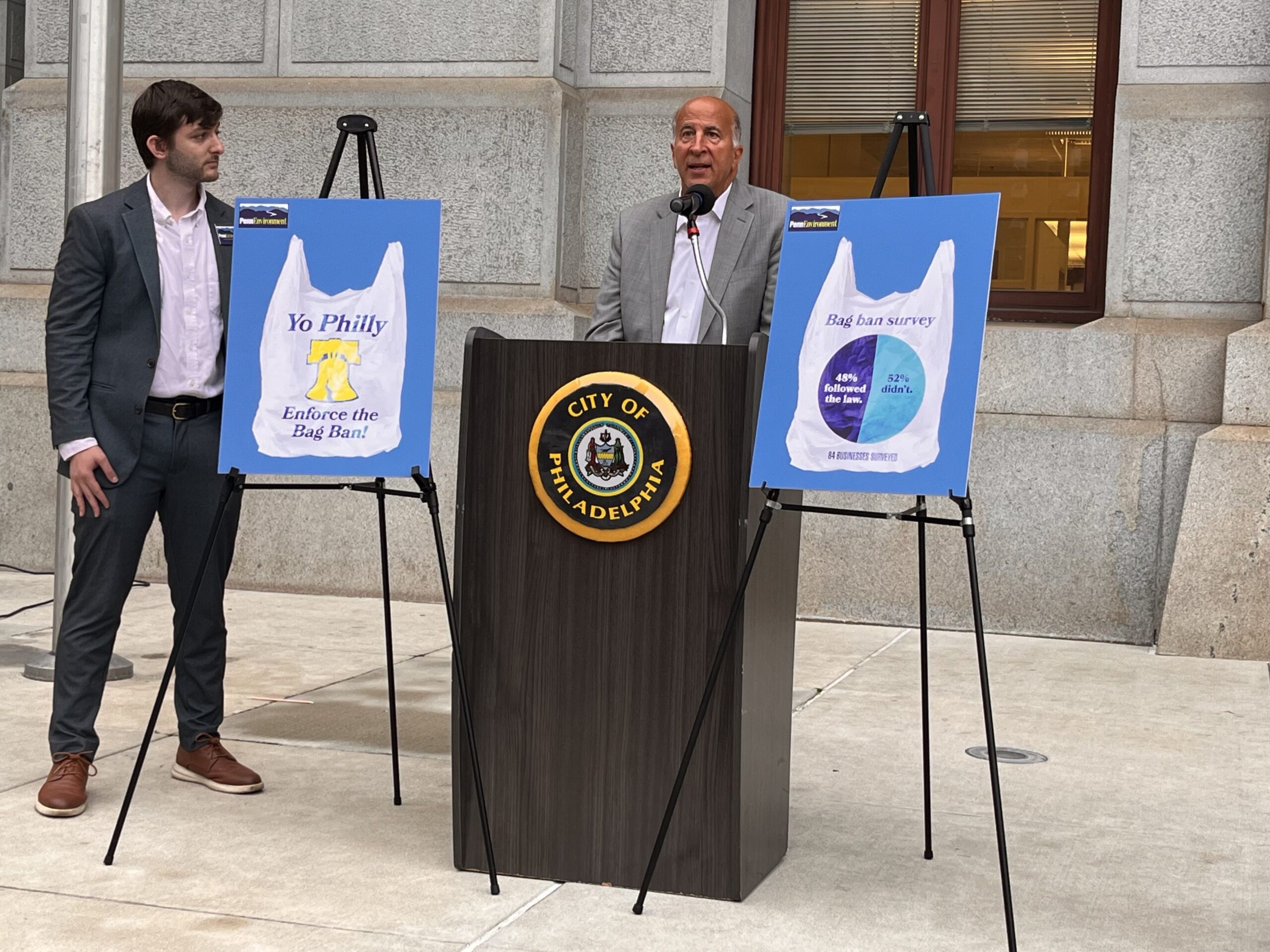
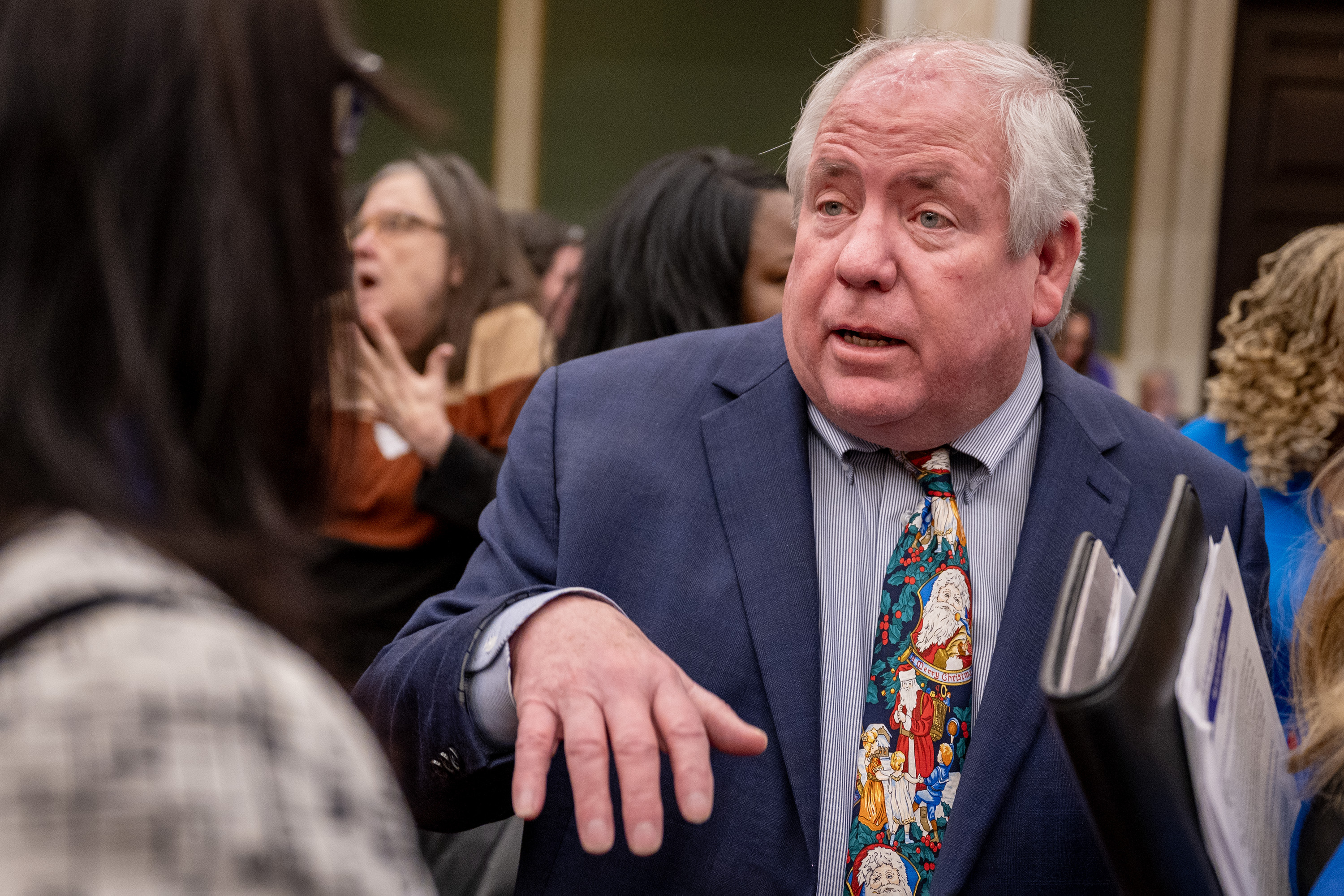
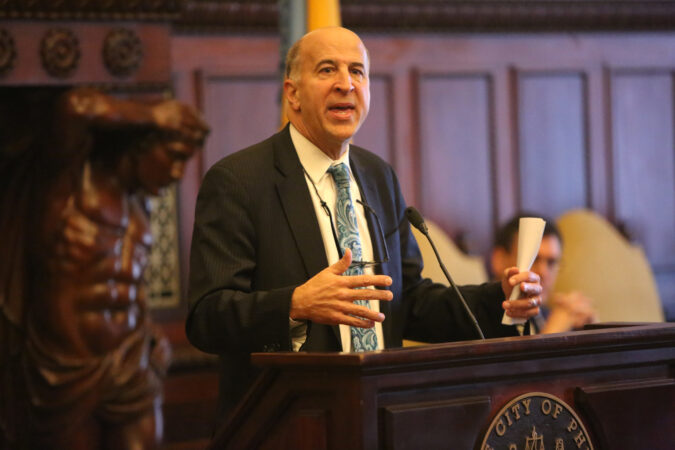
Faran Savitz (left) of PennEnvironment Research & Policy Center and Philadelphia Councilmember Mark Squilla, at lectern, discuss PennEnvironment’s findings outside City Hall on July 9.
Plastic bags
Ryan Rabenold, environmental program coordinator at the Pennsylvania Resources Council, said the city’s law is key to reducing waste, noting that most reusable plastic bags do not get recycled.
Plastic bags contribute to litter, require fossil fuels to produce, and become microplastics in the environment when they break down.
“They either get lost in the system, are contaminated with food or grease, which makes them unrecyclable, or they simply get blown away when we’re trying to collect them,” Rabenold said. “When they do end up in our recycling system … they contaminate materials that are recyclable and force them to be removed from the system.”
Rabenold noted that microplastics have been detected in human blood and tissue.
“We are feeling the impacts of something that we may not be able to see, Rabenold said.
“It’s better for our health and the environment to use one thing 1,000 times,” Rabenold said of reusable bags, “rather than use 1,000 things once.”
No matter what folks in Boston tell you, Philadelphia is America’s most historic big city. So why is architectural preservation increasingly under attack here, especially as Philadelphia gets ready for its star turn in the nation’s 250th birthday celebrations?
The movement to protect Philadelphia’s rich and varied architectural heritage was thrown into disarray Feb. 26 when a Court of Common Pleas judge invalidated the historic district created in 2024 to protect Washington Square West, a neighborhood that includes both Colonial-era masterpieces and nationally important infill buildings from the 1960s urban renewal period.
Judge Christopher R. Hall’s decision primarily focused on procedural issues and could be reversed if it’s appealed. Yet it is just one of several existential threats facing the preservation regimen that has guided the city for the last 40 years.
His decision is likely to encourage a group of developers who are challenging the Spruce Hill historic district, which also was created in 2024. It could similarly embolden Councilmember Mark Squilla, a former preservation champion who once created a controversial zoning carve-out to protect a one-story supermarket in Society Hill. Having jumped on the anti-preservation bandwagon, he’s now pushing legislation that many believe would gut the powers of the Historical Commission.
While the issues driving each of these challenges vary, it’s no accident that they’re happening at a time when people are increasingly concerned about rising housing costs. For years, pro-development activists have argued that there is a link between the city’s historic preservation laws and the scarcity of affordable housing. By adding an extra layer of regulation, they contend, those laws restrict where people can build, limit new construction, and raise maintenance costs for homeowners.
There’s no doubt that the city’s preservation laws require owners of historic properties to go through an extra step in the approval process. That takes time and can sometimes add to the cost of a project.
Yet it seems odd that pro-development activists have cast historic preservation as the main villain when so many factors influence the city’s housing supply: zoning regulations, interest rates, availability of labor, cost of construction materials. President Donald Trump’s tariffs alone sent the price of lumber soaring in the last year.
In an effort to put things in perspective, the nonprofit Preservation Alliance recently commissioned an economic analysis to explore its impact on housing prices. The report made two interesting observations: Apartments in older buildings rent for less than those in new ones. And protecting those older buildings actually helps maintain a supply of “naturally occurring affordable housing.”
The study, prepared by the Washington-based Place Economics, also examined claims that historic districts are enclaves for the wealthy and exclude renters. Data show the opposite: Historic districts continue to gain new residents long after they been designated. In fact, between 2010 and 2020, the population of Philadelphia’s historic districts grew almost five times as fast as the city as a whole, which suggests new housing is being built despite the additional oversight.
Not all that construction takes the form of new buildings, however. Even in the best of economic times, erecting a new apartment building in Philadelphia is far more expensive than fixing up an old one. As a result, the city has come to rely on older buildings to provide new housing. Without them, Philadelphia would be a much less affordable place.
In the past, the city’s obsolete offices and factories were the main targets for housing conversion. Those buildings are relatively easy to adapt because they have large, rectangular footprints.
But what about smaller, more irregularly shaped historic buildings? Are the city’s preservation and zoning laws flexible enough to allow more density in old townhouses, which, after all, constitute the bulk of Philadelphia building stock?
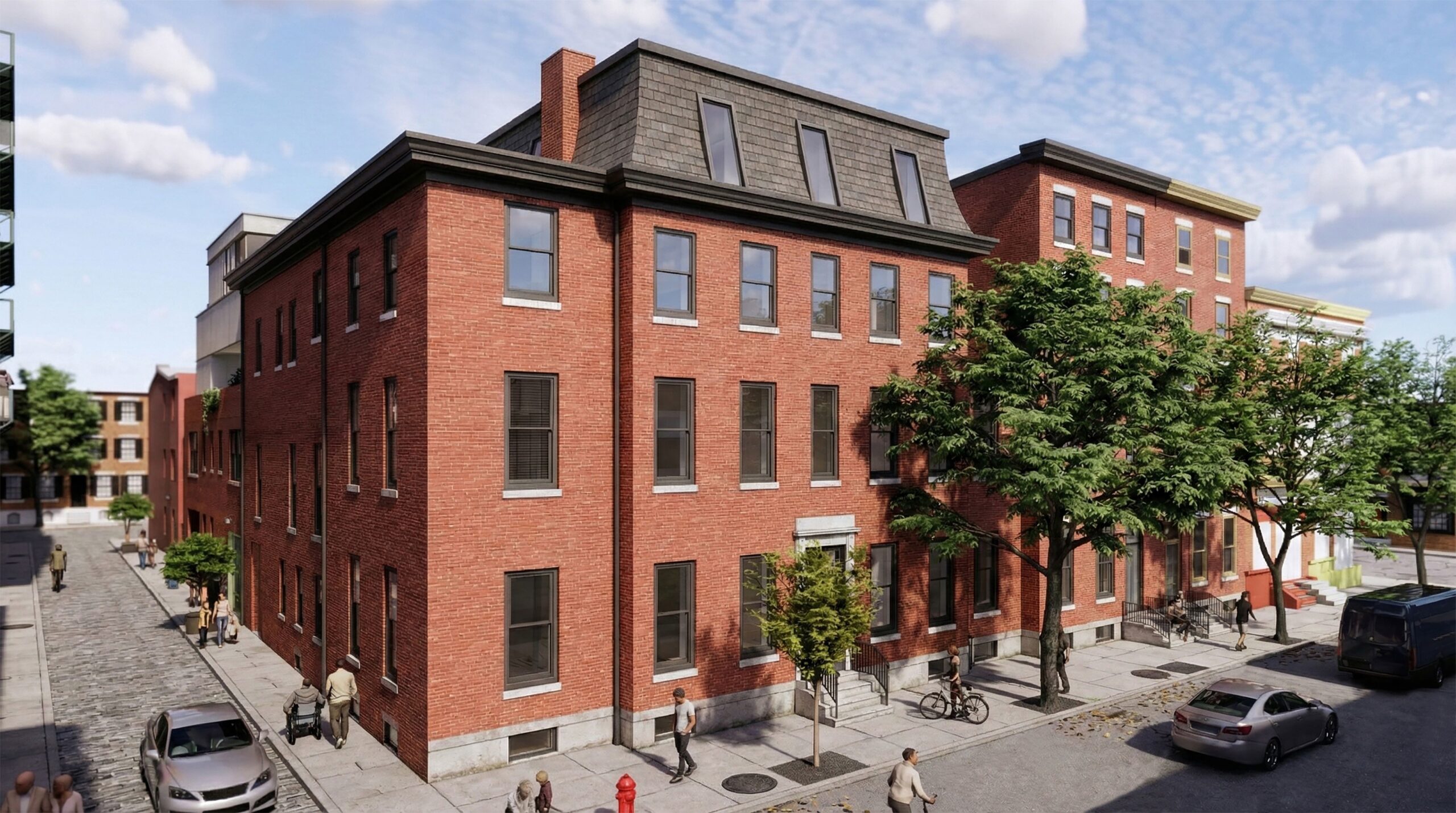
This sprawling complex of 19th-century buildings at 15th and Waverly Streets is being converted to a 32-unit apartment building by Lo Design for developer Keith Alliotts. By installing a penthouse level over the former stable (rear left), the architects will be able to improve the interior circulation and increase the density.
Converting townhouses into apartments
To understand the role those buildings can play in the great Yimby-Nimby debates, I reached out to Lea and Evan Litvin, who run Lo Design, an award-winning firm that has its offices in the Rittenhouse-Fitler historic district. Lo Design started out doing single-family homes for developers, but lately they’ve taken on commissions to turn large townhouses into apartments.
Small conversions are more labor-intensive than erecting a new townhouse on an empty site, but they allow the Litvins to do work that aligns with their architectural ideals. The conversions create more housing for less money, using fewer natural resources. “Saving an old building is the most sustainable form of construction,” Evan explained.
Since Philadelphia’s historic townhouses were never meant for multiple tenants, and often have awkward layouts, the Litvins have developed architectural tricks to make them function as apartment buildings. Sometimes that means attaching a new wing on the back. In other cases, they’ve built freestanding structures in backyards.
Their current project at 15th and Waverly Streets used a little of everything to transform a historic Greek Revival mansion into a 32-unit building.
The brick building began its life in 1860 as a private home, complete with a stable. At some point, someone popped on a mansard roof to create a fourth story and added wings on the sides. Then, in the early 20th century, the mansion, stable, and a neighboring townhouse were fused into a single building that served as offices for what was then known as the Society to Protect Children from Cruelty.
For the project’s developer, Keith Alliotts, the building’s main attraction was its size — 26,000 square feet, significantly larger than a typical townhouse, which might be 6,000 square feet. He also liked that the location, a few steps from the former University of the Arts’ Hamilton Hall, felt like part of the Rittenhouse Square neighborhood.
Yet the challenges of transforming the awkward amalgamation into a coherent, multifamily residence soon became clear. None of the floors in the different buildings lined up. The U-shaped footprint complicated the flow through the building. The interior was a mashup of Victorian and post-modern details. On top of everything else, the project would need a zoning variance and approval from the Historical Commission.
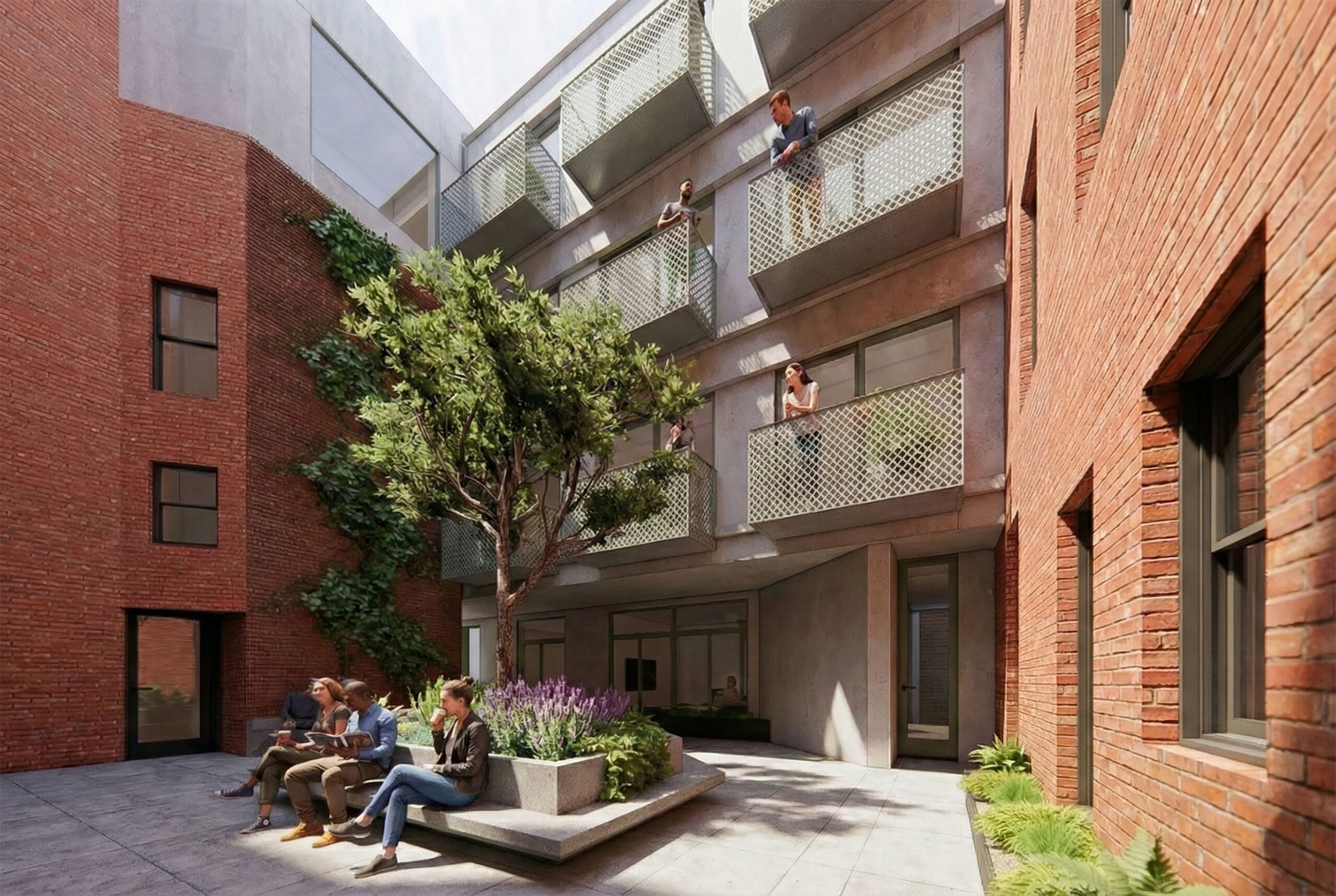
Lo Design plans to create an internal courtyard at the center of a new residential building at 15th and Waverly. The project will turn a group of historic 19th-century buildings into a 32-unit apartment building.
Getting those permits turned out to be the easy part, the Litvins said. Because the complex had been empty for years and was starting to deteriorate, the neighborhood enthusiastically embraced the idea of using it for apartments.
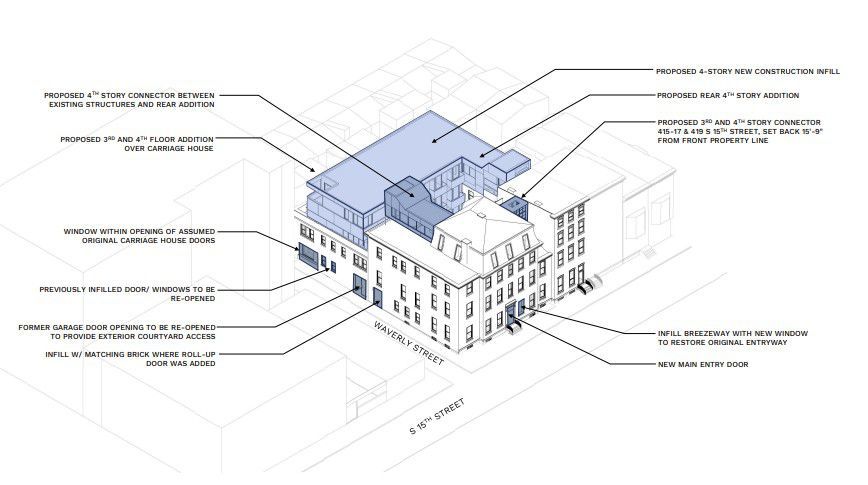
From the start, the Litvins knew they would have to expand the already sprawling complex to ensure the apartment layouts weren’t too eccentric. Fortunately, there was a large yard behind the house where they could add a new wing to turn the U into an O. They decided to install a large penthouse on top of the stable and insert several connecting passages to improve the interior circulation.
This diagram shows how LoDesign plans to turn an awkward amalgamation of 19th century buildings at 15th and Waverly Streets into a coherent, multifamily building with 32 apartments. The portions in blue will be added during construction.
While reusing these buildings was no easy feat, the project is a good example of “gentle density.” The neighborhood gets more rental housing, yet the look of the 19th-century mansion remains substantially the same.
By comparison, the first collaboration between the Litvins and Alliotts was a breeze. Alliotts had spent most of his career developing single-family housing in North Jersey before “discovering” Philadelphia during the pandemic. Coming from such a pricey environment, he said, “I was really taken aback by the city’s affordability.” After studying the market here, he fell for an early 20th-century brownstone on the 2000 block of West Girard Avenue in Francisville.
The townhouse could have been torn down
Despite the house’s impressive architecture, it wasn’t listed on the city’s historic register. That meant Alliotts could have demolished the building for something new, an approach taken by several other developers on that once-elegant stretch of Girard Avenue.
Alliotts liked the house too much to destroy it. And since the site was unusually deep, he knew he could fit the equivalent of a second house in the yard. But rather than build another stand-alone house, he asked the Litvins to fit a 12-unit condo building in the same space. Alliotts envisioned the condos — now called The Francis — as starter homes, so he wanted to keep the prices below $300,000 for a two-bedroom unit.
Still, 12 units is a lot of density, even for a generous townhouse yard that was 200 by 31 feet. By making a donation to the city’s Housing Trust Fund, Alliotts was able to get a zoning bonus that allowed him to raise the structure’s height to 45 feet, enough for a fourth story.
To avoid jamming the new, metal-clad building against the old brownstone, the Litvins decided to push the condos toward Cambridge Street, which was once a service street lined with carriage houses. That gave the architects space to create a landscaped courtyard between the two buildings.
Lo Design was able to create nine apartments in the Spring Garden neighborhood by replacing a small garage with a three-unit apartment building in the garden of an early 20th-century townhouse at 2313 Green St. The project’s density was the result of a compromise with neighbors and the Philadelphia Historical Commission.
After the success of the Francis, the Litvins had hoped to replicate the model for a new project at 2313 Green St. in the Spring Garden neighborhood. The main house there had already been divided into five apartments, but the site at 238 feet was even deeper than the Girard Avenue property. They proposed a five-unit stand-alone building in the garden, accessed from alley off Wallace Street.
But this time the Historical Commission and neighbors rejected the proposal.
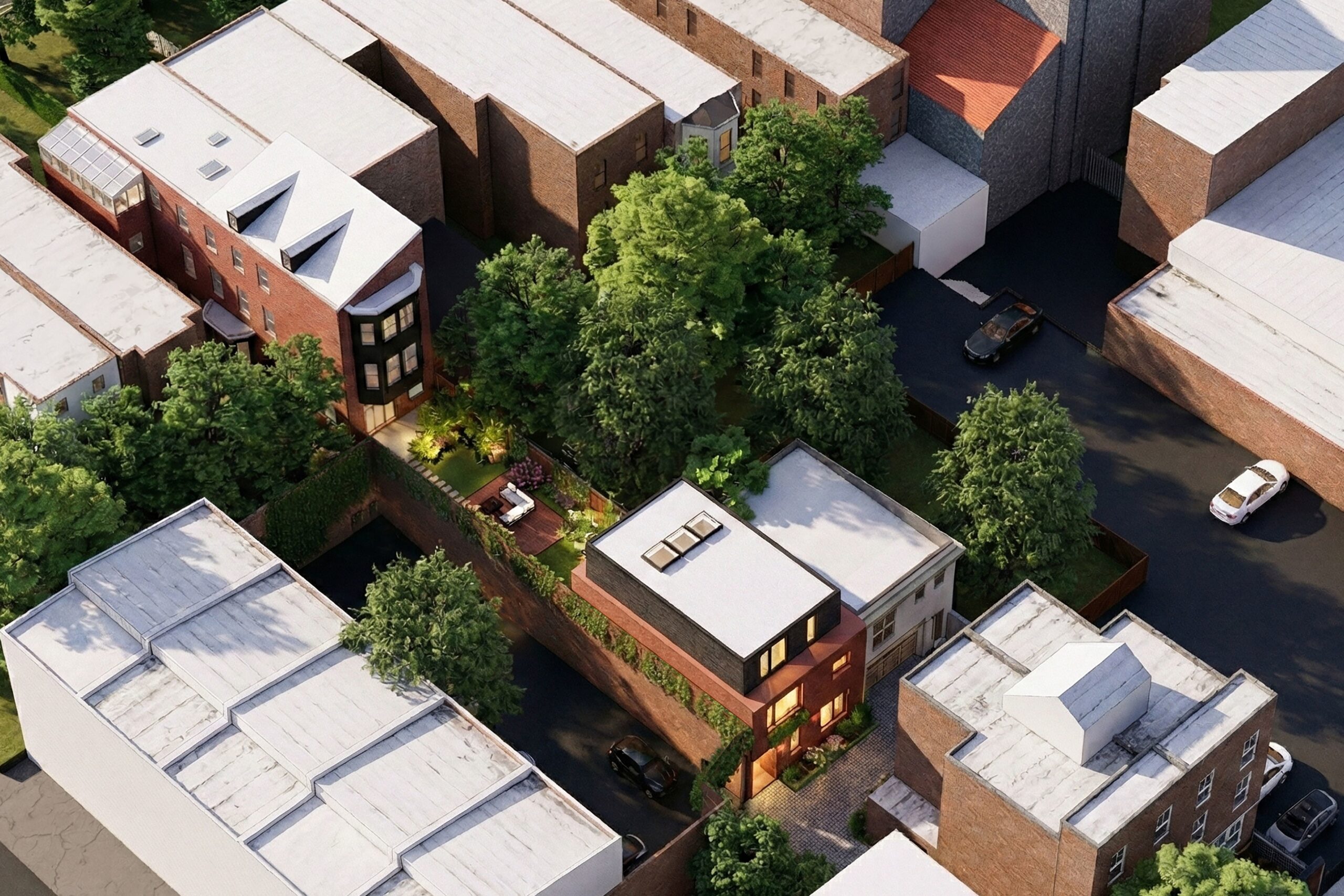
So, the Litvins reduced the size of the building and turned it into a carriage-house-sized structure with three units. They offset the loss of units by adding a sixth apartment to the main house for a total of nine units.
The garage on the right will be replaced by a three-unit building that is part of the redevelopment of 2313 Green St. It will be accessed through an alley off Wallace Street in the Spring Garden neighborhood.
Some preservation opponents may see the outcome as an example of the nickel-and-diming that occurs when developers attempt to add density to historic properties.
But the fact that a former single-family house will soon accommodate nine apartments reveals the untapped density in Philadelphia’s historic buildings. These conversions prove more housing can be created without sacrificing the city’s heritage.
Tourists arriving in Philadelphia next year may find it easier and far more inviting to stroll through what is now a tucked-away stretch of Old City.
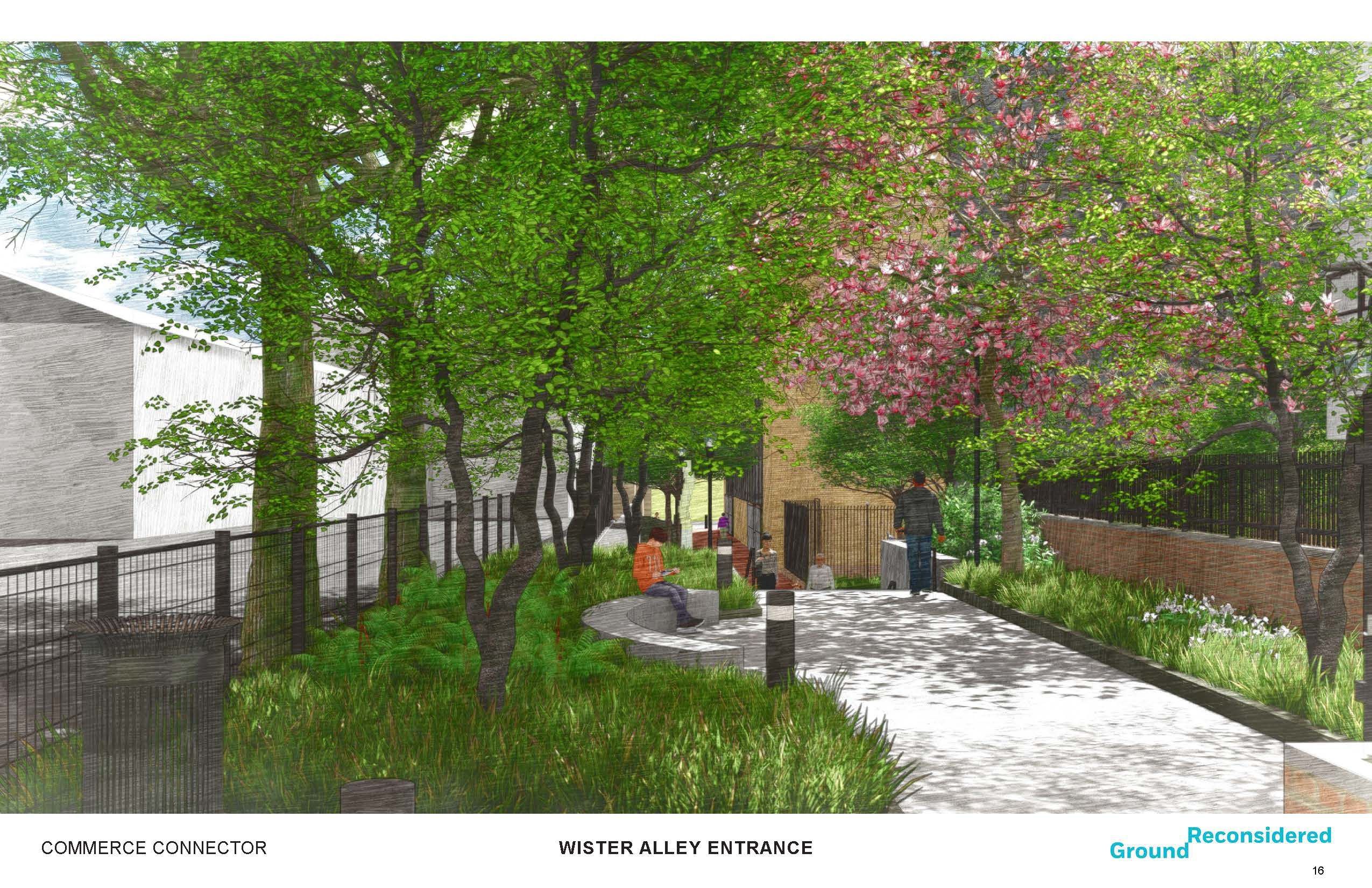
On Wednesday, the city launched construction on what officials call the Commerce Connector, a pedestrian path designed to guide visitors from the Independence Visitor Center to Carpenters Hall along a brick‑lined walkway adorned with seating and ornamental plantings, while bypassing a congested area.
The city has allocated $2.7 million toward the project.
The project is spearheaded by the nonprofit Independence Historical Trust in collaboration with the city; Old City Green, a neighborhood beautification group; and Old City District, a business support organization.
Bill Marrazzo, chair of Independence Historical Trust, called the connector “an important step forward.”
“The Commerce Connector enhances the visitor journey between some of Philadelphia’s most treasured sites while also improving everyday walkability for residents and workers,” he said in a statement.
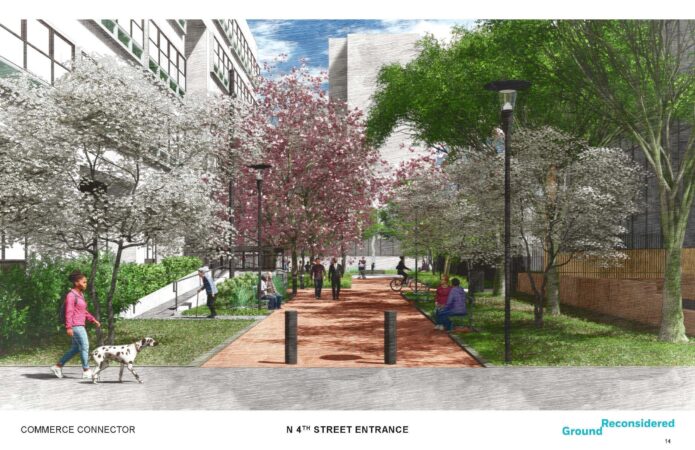
A rendering of a new connector pathway planned in Old City.
The bigger picture
The connector is part of a larger effort by the city and nonprofits, led by Independence Historical Trust, to craft a broader vision for the city’s historical area. Some will be complete by the Semiquincentennial, and others might not.
That vision, which could take $100 million to implement, calls for more walkable and bike-friendly streets, new plazas, additional green spaces, and easier navigation to cultivate a sense of cohesiveness they say is lacking.
The Historical Philadelphia Vision Framework plan aims to create ways for people to “wayfind” easy-to-follow, less car-centric routes through Independence National Historical Park, Old City, and other historic or local neighborhoods.
The current redo of Market Street in Old City, now under construction, is part of that. It will include a new Tamanend Plaza at Second and Market Streets, and a “road diet” to accommodate bike lanes. Workers were busy Thursday putting down blocks for the new plaza.
Work is also underway by the National Park Service at the Declaration House at Seventh and Market Streets, where Thomas Jefferson stayed while he wrote the famed document, and at the Benjamin Franklin Museum off Chestnut Street, both part of Independence National Historical Park. Also, the 25,000-square-foot, Greek Revival-style First Bank of the United States is undergoing $27 million in work, timed to reopen as a new park attraction for the Semiquincentennial.
What’s the route?
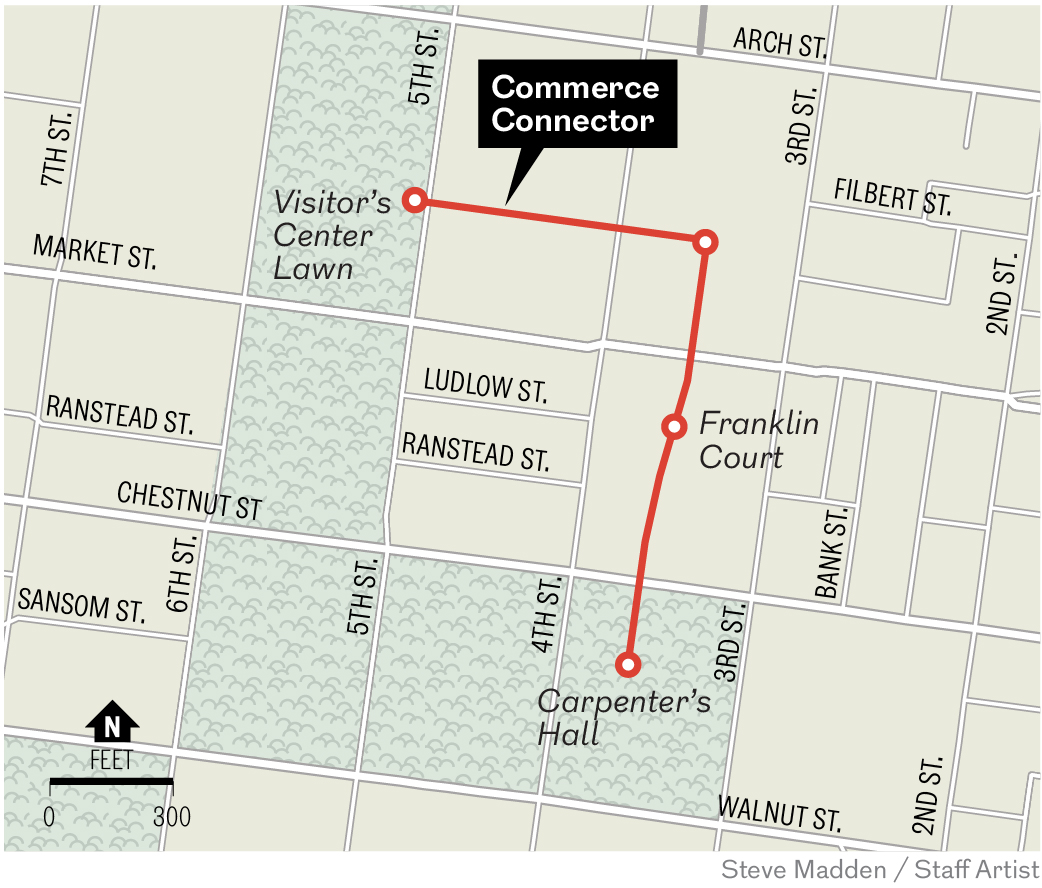
The roughly 2,000-foot-long Commerce Street foot path will lead travelers from the edge of the visitor center’s lawn at Fifth Street, east across Market Street, and onto Commerce Street, now an unmarked alley that runs parallel to Market Street. From there, they will continue east before turning right onto another alley, which leads to Market Street.
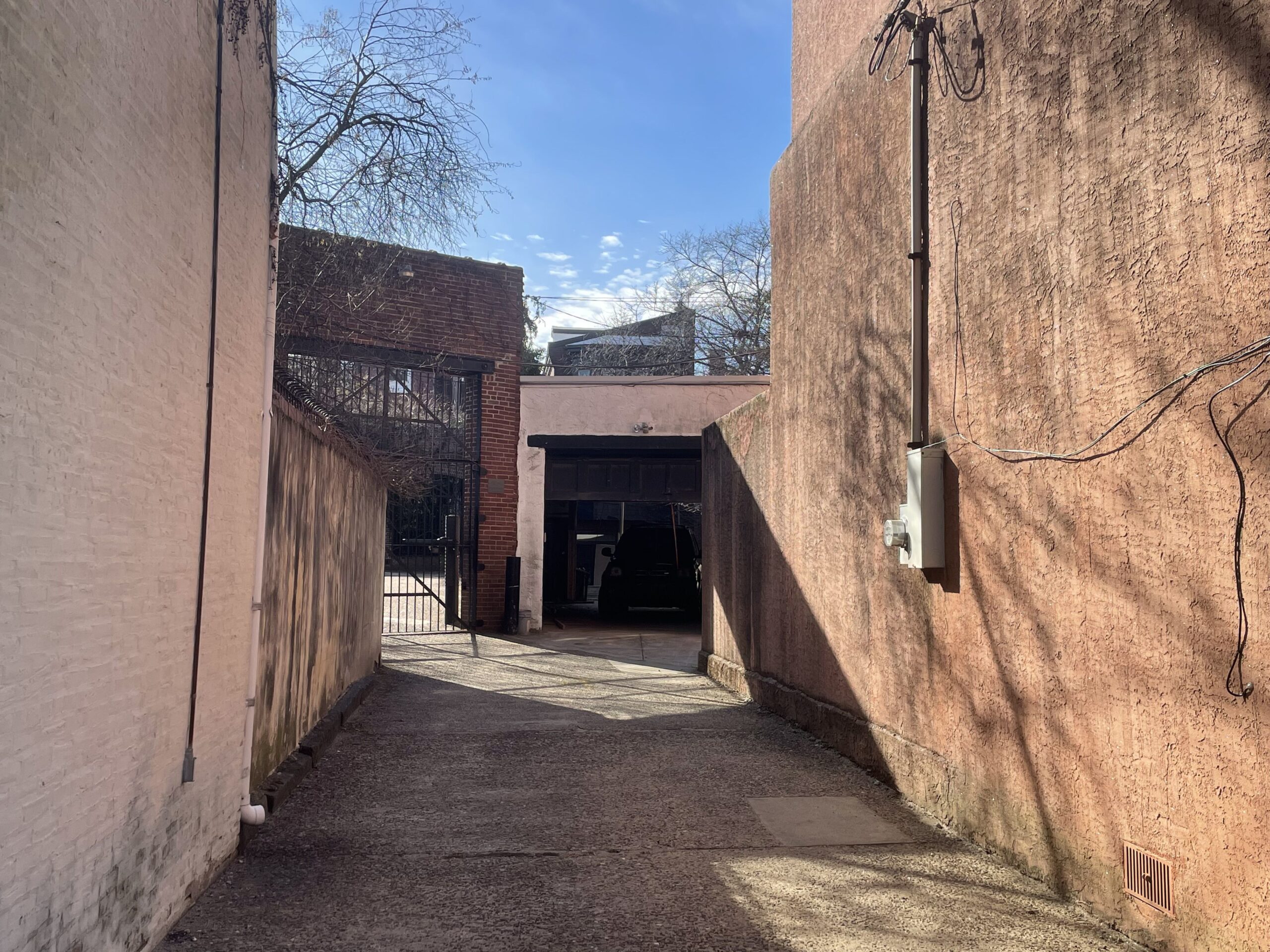
A 2024 view of Commerce Street, an alley that starts on Fifth Street, midway between Arch and Market Streets. Commerce Street would become a way to connect Independence Visitor Center with Carpenters Hall under a plan led by Independence Historical Trust.
After crossing Market, they will cut through Franklin Court, cross Chestnut Street, and arrive at Carpenters Hall.
Once at the hall, visitors can branch out into the wider Independence National Historical Park and other notable areas.
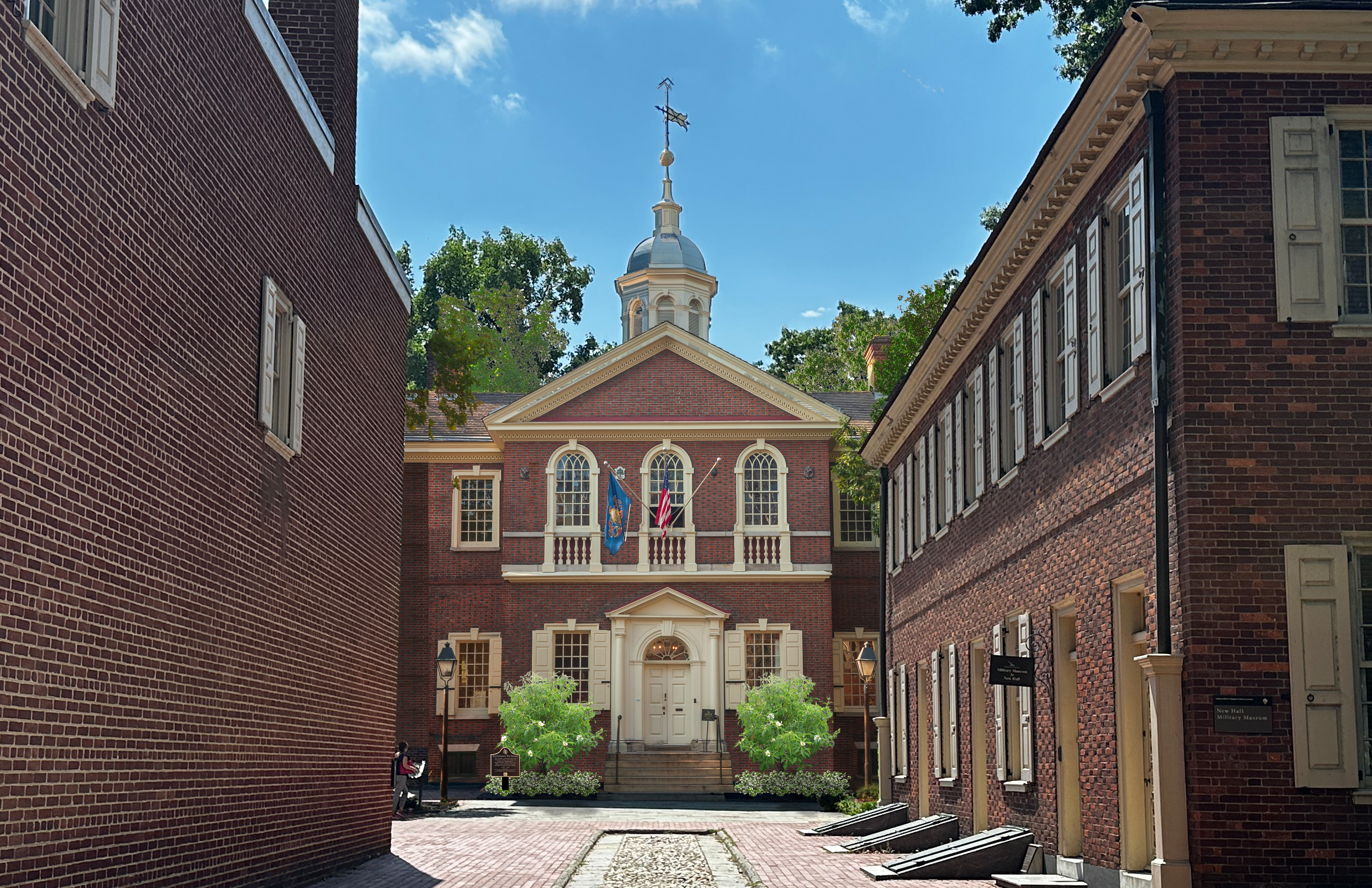
Officials emphasize that the connector will deliver a mostly traffic‑free passage to Carpenters Hall in time for an anticipated surge in tourism tied to the 250th anniversary of the Declaration of Independence. Carpenters Hall was the site of the first Continental Congress in 1774.
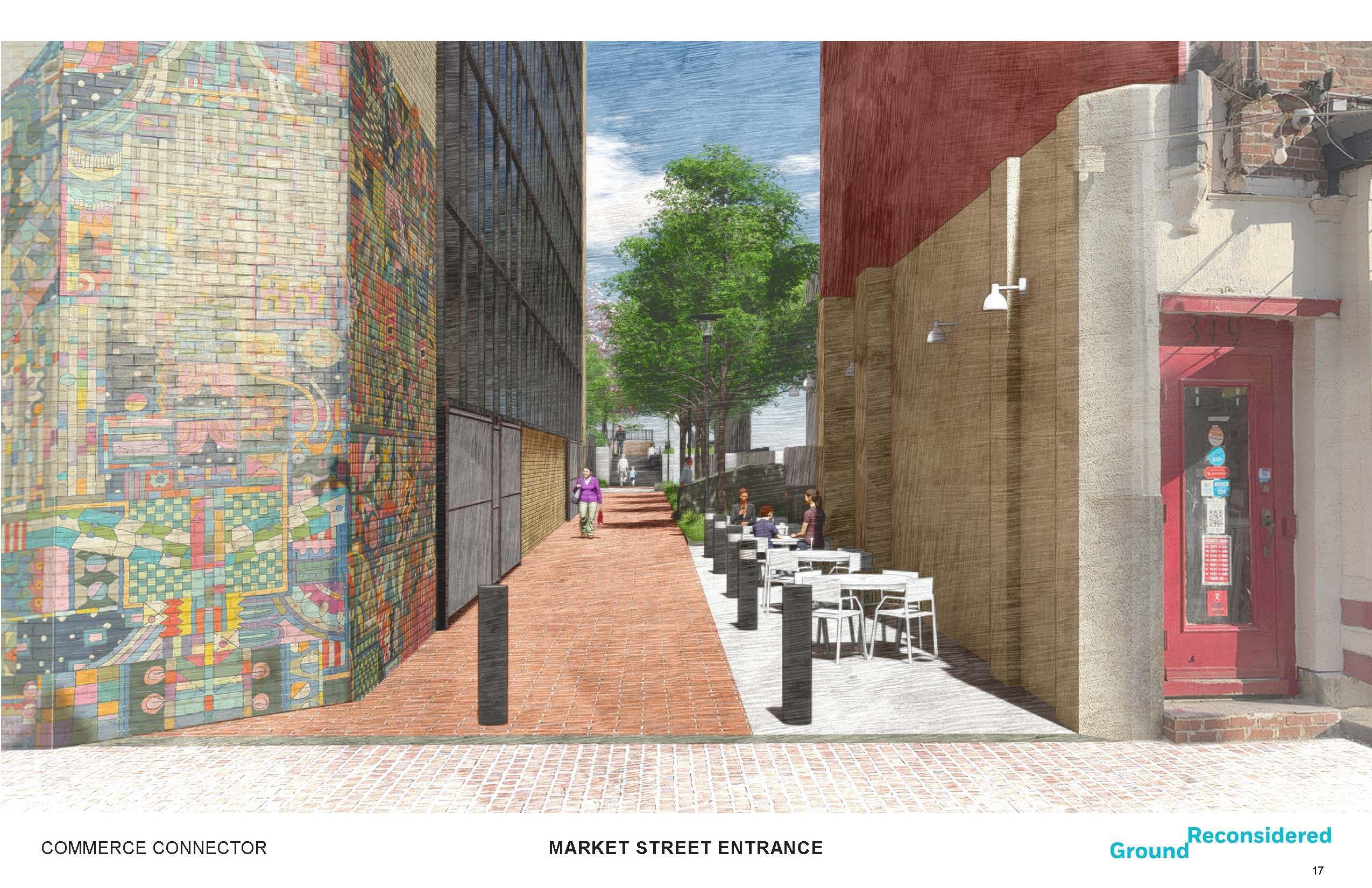
A rendering of a new connector walking path being built in Old City.Commerce Connector pedestrian route through Old City.
Other enhancements
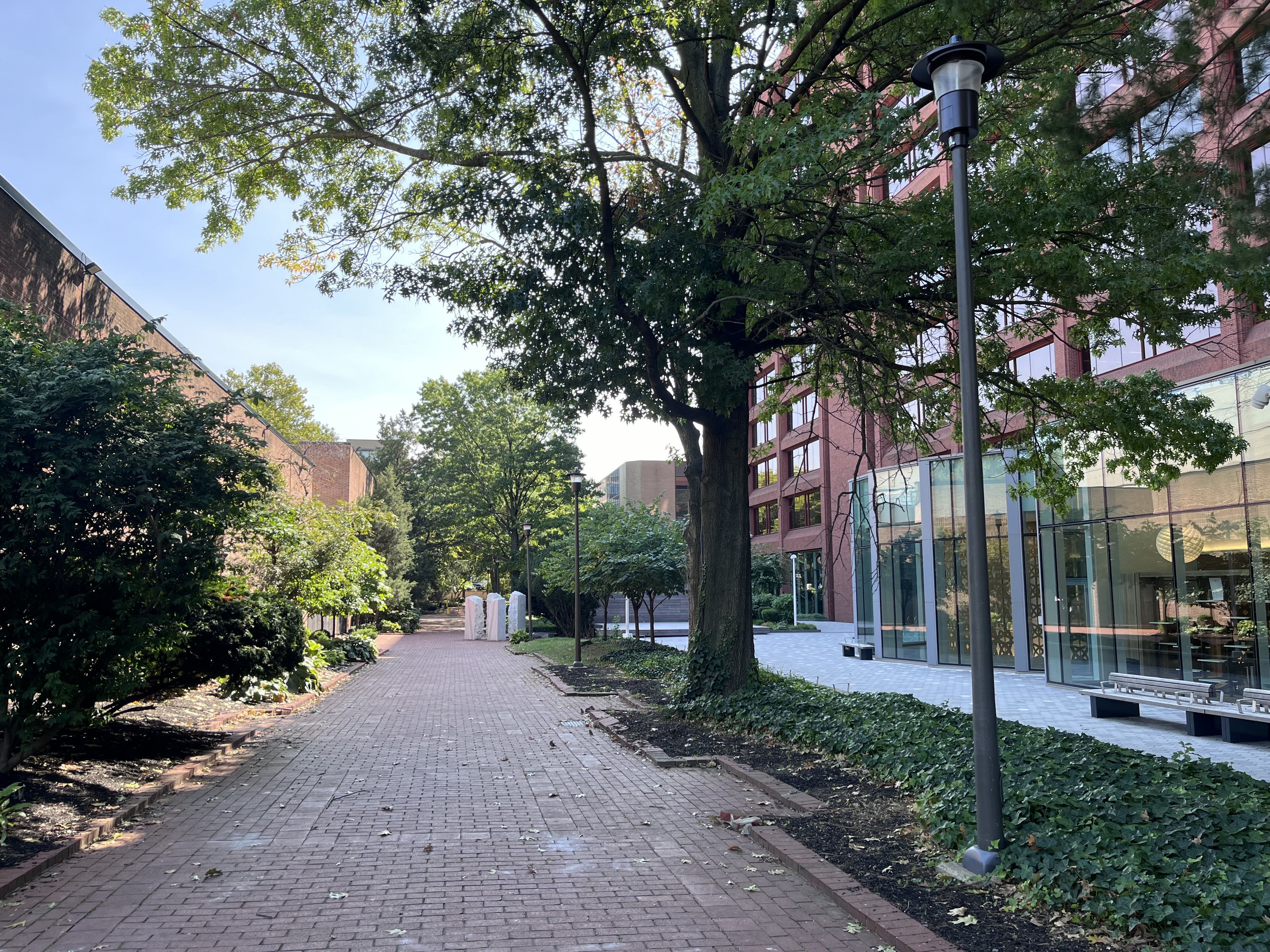
Officials say existing paving, benches, lighting, and plantings are all in poor condition.
The redesigned corridor will get new furnishings, better lighting for security, ornamental trees and bushes, and other enhancements to make it more inviting. It would include a “gathering area” and new entrances.
To slow traffic for pedestrians, a speed bump mid-block on Fifth Street would connect Independence Visitor Center and the alley. Another mid-block bump on Fourth Street would help pedestrians cross Market Street to Franklin Court.
Fourth Street would get a bike lane.
New signs would note area history.
The path would also help connect people to Christ Church Burial Ground, Commodore Uriah Phillips Levy Park, and the Faith and Liberty Discovery Center.
Construction is expected to be complete before July Fourth, ahead of the nation’s Semiquincentennial.
Carpenters Hall.
“The Commerce Connector reflects our commitment to making Old City safer and easier to navigate for everyone,” said City Councilmember Mark Squilla, who helped secure funding.
Job Itzkowitz, executive director of Old City District, said the connector “strengthens the backbone of Old City by transforming an underused passageway into a vibrant, welcoming public space” that will make it easier for residents and tourists to move between iconic city sites.
Old City Green launched the early planning efforts for the corridor and will continue to help maintain the path.
“By introducing new plantings, shade, and thoughtfully designed landscape elements, we’re creating a greener and more accessible environment for everyone who walks through this historic neighborhood,” said Joe Schiavo, vice president of Old City Green.
Philadelphia lawmakers voted Thursday to ban mobile outreach groups that provide medical care and support services to people in addiction across a swath of Kensington, the epicenter of the city’s drug crisis.
The vote came just days after the city began enforcing controversial new regulations in a different part of the neighborhood, where the same providers may operate only if they have a permit to do so and park in areas designated by the city.
Taken together, the actions spearheaded by City Council members who represent Kensington and Mayor Cherelle L. Parker’s administration amount to a major shift in how transient people who use drugs obtain medical care and basic needs like food, water, and clothing.
Many have long relied on mobile outreach services that met them on the street. Those same providers can now park only in designated areas or serve people for limited amounts of time.
Council members who support the legislation say residents in the neighborhood do not want people in addiction lining up for medical care or support services near their homes.
Councilmember Mike Driscoll authored the bill banning mobile service providers entirely from his 6th District, which includes parts of the neighborhood that are northeast of the infamous open-air drug market at the intersection of Kensington and Allegheny Avenues.
Driscoll said his bill, which passed Council 14-3 on Thursday,is not aimed at punishing providers. He said he is open to finding a location in his district where they can operate with the city’s permission.
“I just don’t want the service providers picking where they want to go at the expense of the kids and the neighbors,” he said.
Councilmember Michael Driscoll in chambers as City Council meets Thursday, Dec. 11, 2025, on the last day of the 2025 session.
But advocates for people who use drugs slammed the bill, and said reducing access to care will not help people in addiction.
“Restrictions like these will not end the opioid crisis. They will not make anyone in Kensington or District 6 safer,” said Katie Glick, a nurse who treats people in addiction and lives in the neighborhood. “These restrictions will disable and kill people.”
In Kensington, inconsistent rules for providers
If Parker — who has never issued a veto — signs Driscoll’s bill, it would result in a patchwork of rules for mobile service providers in Kensington, which is represented by three different Council members.
The western side of Kensington is in the 7th District, where Councilmember Quetcy Lozada’s legislation that required the permitting system applies. Organizations that do everything from handing out water to providing medical care now face a $1,000 fine for operating without a permit.
In the southern parts of Kensington that fall in the 1st District, represented by Councilmember Mark Squilla, no legislation applies to mobile providers.
(function() {
var l2 = function() {
new pym.Parent(‘kensington_districts’,
‘https://media.inquirer.com/storage/inquirer/projects/innovation/arcgis_iframe/kensington_districts.html’);
};
if (typeof(pym) === ‘undefined’) {
var h = document.getElementsByTagName(‘head’)[0],
s = document.createElement(‘script’);
s.type = ‘text/javascript’;
s.src = ‘https://pym.nprapps.org/pym.v1.min.js’;
s.onload = l2;
h.appendChild(s);
} else {
l2();
}
})();
The inconsistency is the result of councilmanic prerogative, the unwritten rule that gives Council members who represent geographic areas a large amount of sway over what happens in their districts. Lawmakers largely approve legislation offered by a district Council member when it affects only that member’s district.
Some of Council’s progressive members who represent the city at-large have bucked that practice several times on matters related to Kensington, where Parker and her allies in Council have placed an intense focus on improving quality of life.
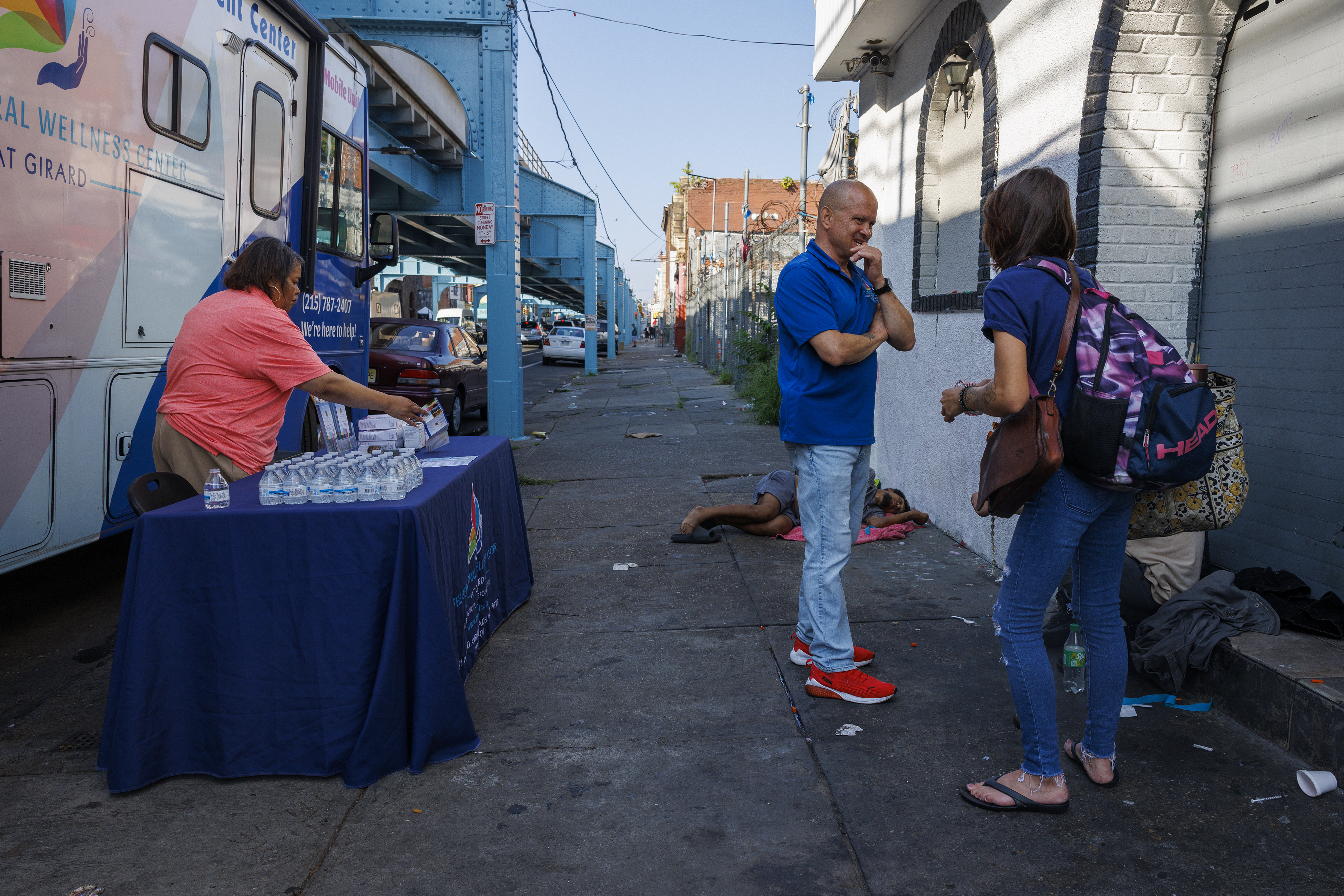
In this 2023 file photo, the mobile home belonging to the Behavioral Wellness Center at Girard parked along Kensington Avenue. It is one of the city’s so-called mobile service providers that have faced increasing regulation from City Council.
The progressives — who favor an approach to the crisis called harm reduction that aims to keep people alive until they are ready to enter treatment — argue that placing restrictions on mobile service providers will make it harder for them to reach vulnerable people in addiction and ultimately reduce the number of providers on the street.
“When human beings are trying to provide help,” said Councilmember Nicolas O’Rourke, “the attitude should never be ‘how can we limit them.’”
O’Rourke and Councilmember Kendra Brooks, both of the Working Families Party, and Democrat Rue Landau voted against Driscoll’s measure.
But Lozada said implementing new regulations was not about restricting care.
“We’re hoping that services continue,” she said. “People have just moved to other spaces to find a way to be able to continue to provide the services that people need.”
And Parker administration officials said the goal is not to reduce the number of providers, but to better coordinate them and ensure safety, especially for people receiving medical services.
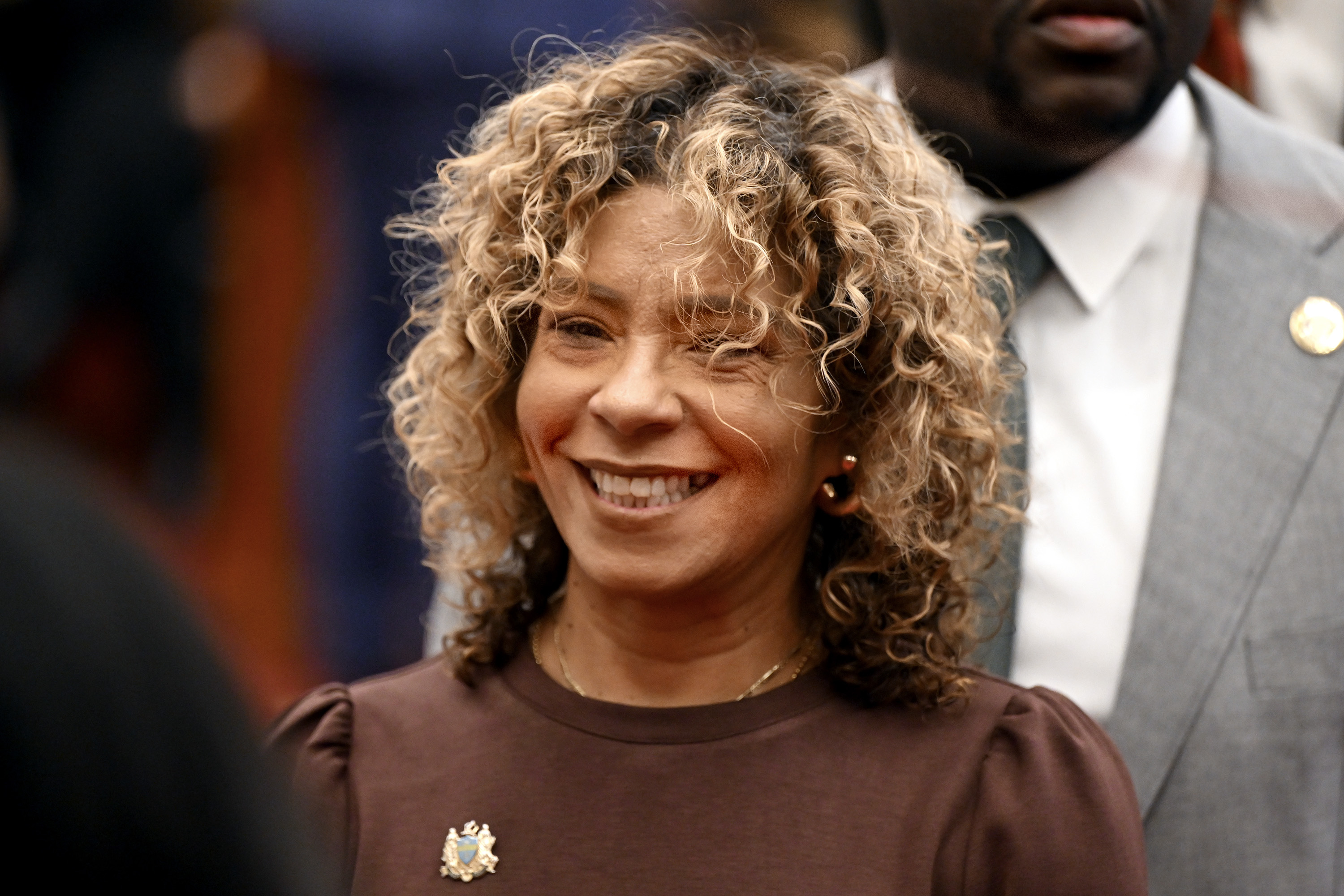
Councilmember Quetcy Lozada in chambers as City Council meets Thursday, Dec. 11, 2025, on the last day of the 2025 session.
Kensington has been a key issue for the Parker administration and Council members who have pushed for more law enforcement in the neighborhood, where sprawling homelessness, open drug use, and violent crime have been commonplace for years. There have been some signs of progress, including a reduction in the number of people living on the street.
The city has tried new tactics, including opening its own recovery house and expanding police foot patrols. The local government has also at times operated its own mobile medical services and contracts with organizations that do so.
So far, the city has issued nine permits to providers who perform mobile medical services and 40 to organizations considered “nonmedical,” like those that distribute food. Some of those organizations also operate in other neighborhoods.
“We don’t have a problem if there’s five or 500 providers,” said Crystal Yates-Gale, deputy managing director for health and human services. “As long as they’re qualified to provide the care, and as long as we can help coordinate the care.”
Despite the changes, city says ‘people are still coming’
Under the new rules, nonmedical providers are prohibited from staying in one place for more than 45 minutes. Medical providers can station on a two-block stretch of Allegheny Avenue at nighttime or at a designated parking lot at 265 E. Lehigh Ave. during the day.
That lot, which is managed by the city and addiction service provider Merakey, is connected to the city’s Wellness Support Center.
Inside, people can access first aid, showers, and food, as well as get directed to treatment, legal aid, housing assistance, and other services.
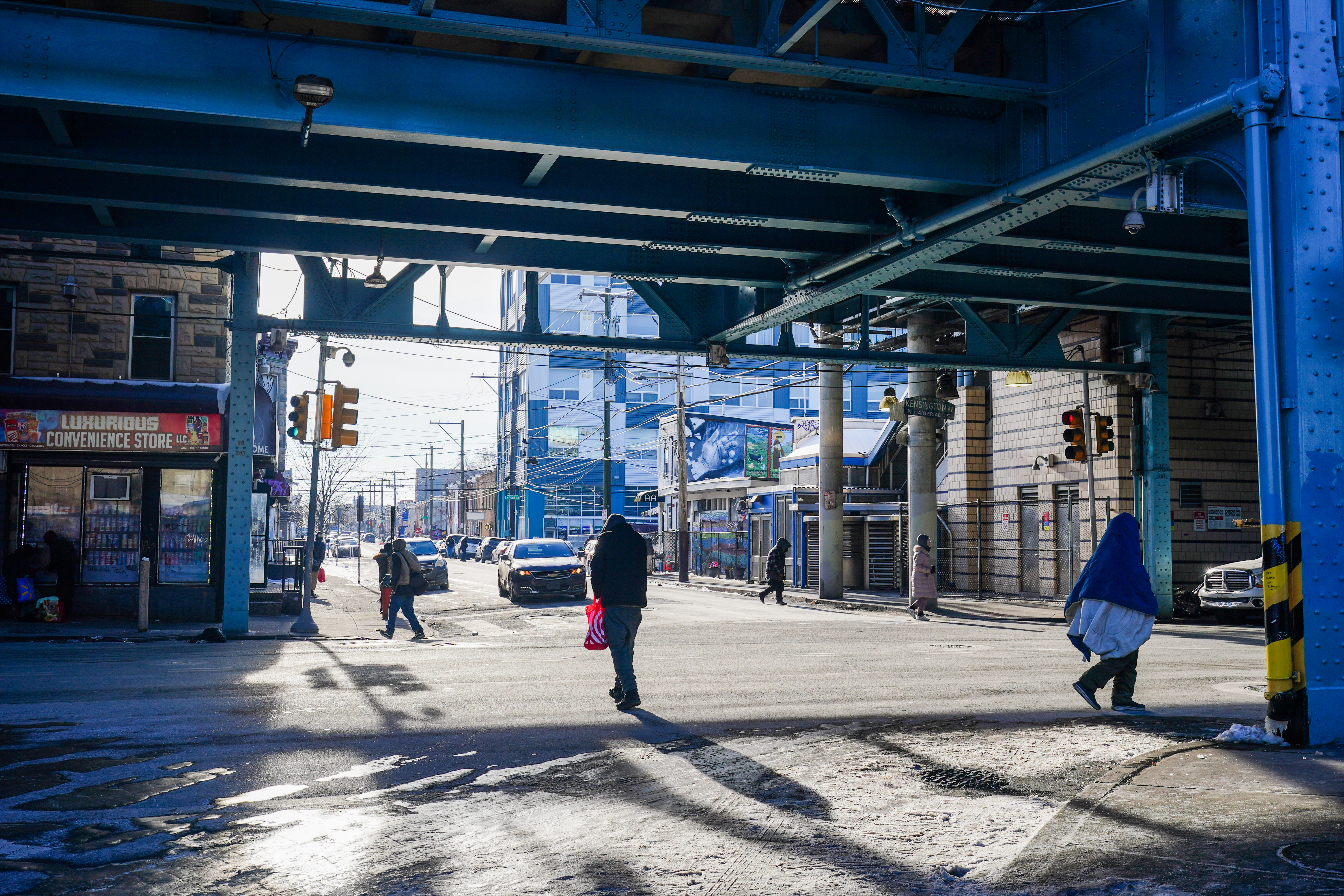
People walk near Kensington Ave. in January 2025.
In the parking lot, two mobile medical service providers run by Merakey and Kensington Hospital are currently stationed, according to Kurt August, executive director of the Philadelphia Office of Public Safety’s Criminal Justice Division. He said officials are looking to expand the number of providers that operate there.
In late October, Merakey began dispensing methadone out of an RV parked in the lot. The tightly regulated opioid medication is a popular treatment for people experiencing withdrawal because it helps stave off cravings.
Raymond Bobb, a medical director at Merakey, said he has seen promising results in just a few weeks, including starting people on methadone and getting them stable enough to transition to inpatient drug treatment. Merakey offers to transport people on the street to the RV to enroll them in medication-assisted treatment.
“We’ve been able to take everything right to the heart of the epidemic and engage people the way you would treat your brother, or your sister, or your family,” said Bobb, who is also in recovery and became emotional when speaking about the program.
“Our goal,” he added, “is to build people up and motivate them to want treatment for themselves.”
August said retention has been high, despite the police presence at the support center. The officers, he said, were “handpicked” to be stationed alongside behavioral health professionals.
“It’s not a secret that police are on site, and people are still coming,” August said.
Still, other providers have expressed concern that requiring people to travel to the lot adds an additional barrier to care, especially for those who were used to mobile services coming to them.
Sarah Laurel, who runs the addiction outreach program Savage Sisters and has a nonmedical permit, said she fears that providers who offered medication-assisted treatment on the street will now be less accessible.
However, she said, some clients greeted the news of service limits with a shrug.
“The friends we serve are so used to not being heard that when they realize that services are going away, they adjust quickly to not having things,” Laurel said. “They just say, ‘No one cares about us. They hate us anyway.’ That is how people feel seen in this city.”
Staff writer Ellie Rushing contributed to this article.
Historic preservation advocates are sounding the alarm about legislation from Councilmember Mark Squilla, which they argue would weaken existing protections in Philadelphia.
The bill, introduced Nov. 20, would institute changes to the city’s Historical Commission, which regulates properties on the Philadelphia Register of Historic Places and ensures that they cannot be demolished or their exteriors substantially altered.
“This is the first time the [preservation] ordinance has been proposed for amendment in decades,” said Paul Steinke, executive director of the Preservation Alliance for Greater Philadelphia. “This is a developer-driven proposal that does not reflect any of the priorities of the preservation community.”
Proponents of the bill argue that it is simply meant to give more notice and power to property owners before their buildings are considered by the Historical Commission.
“The bill does nothing to decrease the power of the Historical Commission to protect important historic resources,” said Matthew McClure, who served as co-chair of the regulatory committee of Mayor Jim Kenney’s preservation task force.
“It is a modest good government piece of legislation,” said McClure, a prominent zoning attorney with Ballard Spahr. He emphasized that he was not speaking on behalf of a client.
The bill was introduced too late in this year’s Council session to receive a hearing. Squilla says it will be considered next year.
Currently, the interest group most supportive of the bill is the development industry. But even some preservation opponents are displeased with Squilla’s effort, arguing that it does too little for homeowners.
“Everybody’s talking, and I think they all agree to move forward with continued conversations to maybe tweak the language a little bit so everybody feels comfortable with it,” Squilla said.
At least one more stakeholder meeting will be held in December.
Tensions over preservation
Squilla’s proposal comes in the midst of heightened debate around preservation in Philadelphia, where the majority of buildings were constructed before 1960.
Over the last decade, the number of historically protected properties doubled, although well below 5% of the city’s buildings are covered. Preservationists oppose what they see as a demolition-first approach to development in the United States’ only World Heritage City.
These have provoked backlash among some homeowner groups and pro-development advocacy organizations, which see these regulations as increasing housing costs.
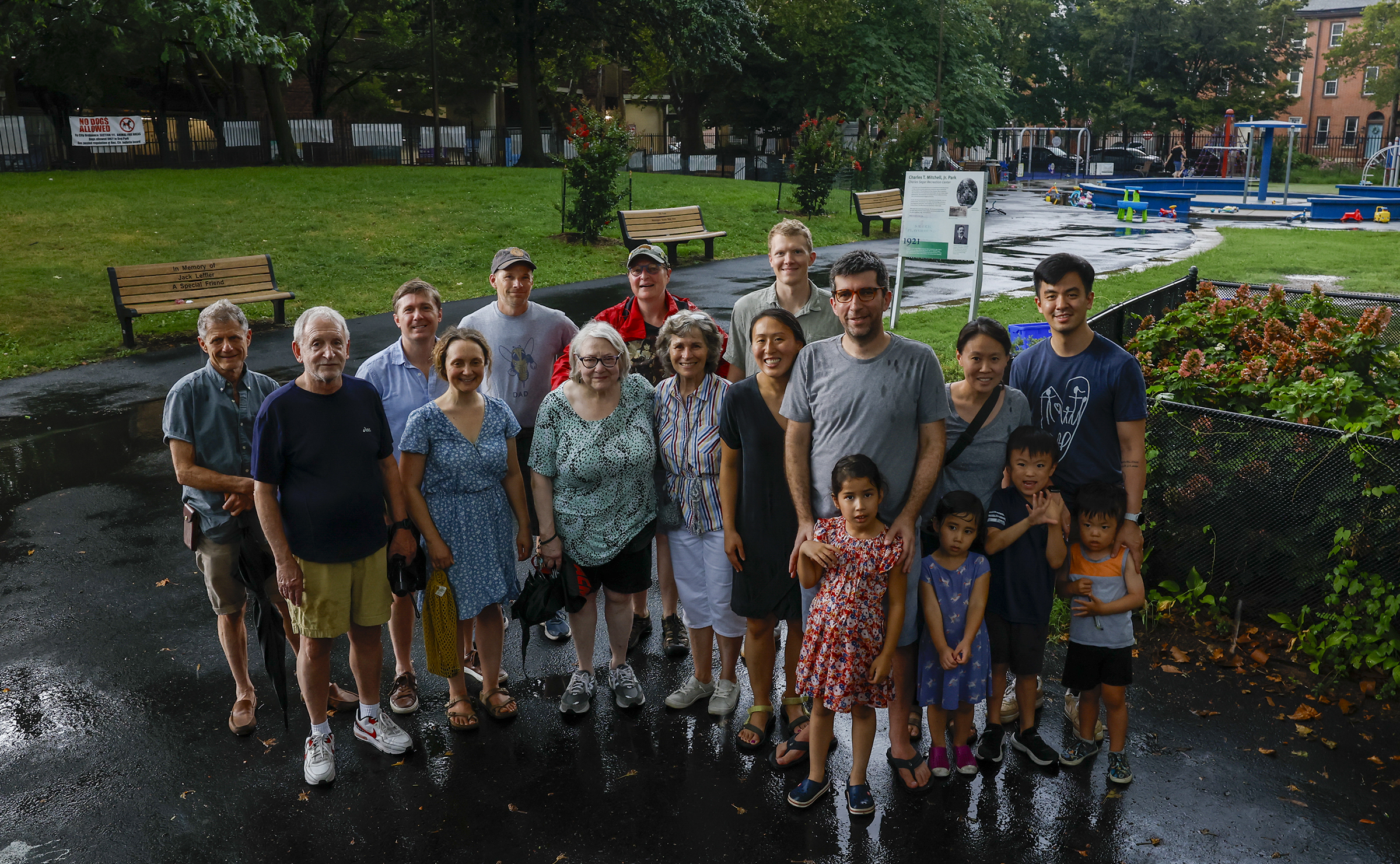
Members of the Philadelphians for Rational Preservation gathered at Seger Park in the Washington Square West neighborhood on July 27 to talk about their opposition to the Washington Square West Historic District.
Some property owners have grievances against the way the local nomination process works.
In Philadelphia, citizens are empowered to nominate buildings to the local register — giving buildings protection from demolition or exterior changes — without input from the property owner until the Historical Commission considers the case.
This practice persistently causes controversy, especially because there are few local incentives for homeowners whose properties get protected.
In some localities, preservation protections are promulgated exclusively by planners. In others, owner consent is required.
“The current historic nomination process is most often dictated by nongovernmental actors who operate without notice to property owners,” McClure said. “The administration’s bill is aimed at increasing transparency and basic fairness during the nomination process.”
Mayor Cherelle L. Parker’s administration did not respond to a request for comment.
What’s in the bill
Squilla’s bill is thick with new provisions to the local historic ordinance. A key aspect of the legislation gives property owners at least 30 days before a pending nomination of their building is considered by the commission and protections kick in.
While homeowners probably would not have time to radically alter the exterior of their house — and presumably wouldn’t demolish it — preservationists fear that developers will use the extra time to begin razing historic buildings.
“No one likes the notice provision the way it’s written; that’s freaking people out,” Steinke said. “We made clear why we think that’s a problem, and we were heard. Of course, the development community would love it to be the way it’s currently expressed in the bill.”
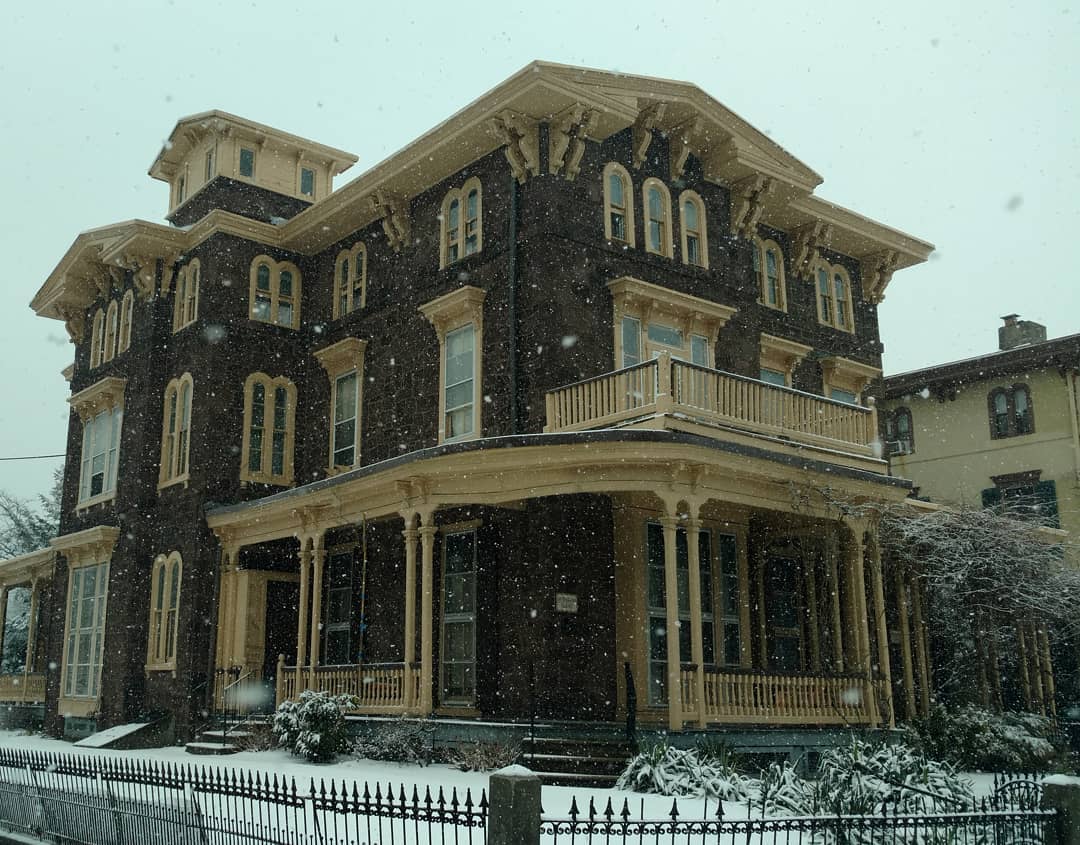
A Victorian home in the Spruce Hill historic district. Recently large new historic districts have been created to cover neighborhoods like Powelton Village, parts of Spruce Hill, and 1,441 properties in Washington Square West.
The delayed provision particularly worries preservationists in combination with a proposed requirement that the commission approve permits — including demolition or exterior design work — if “material commitments” were made to plans before the attempt to protect the historic building.
Other provisions include language to make it more difficult to protect land because it may house archaeological remains. It also limits the ability to consider a property for protection due to its relation to a landscape architect (as opposed to, say, a building designer).
Despite their animus toward existing preservation rules in the city, groups like 5th Square and Philadelphians for Rational Preservation called the legislation a sop to those who least need help.
“While this bill is a boon to developers, it doesn’t help ordinary Philadelphians,” said Jonathan Hessney of Philadelphians for Rational Preservation.
He argues that Squilla isn’t curbing historic districts that burden homeowners, “while at the same time risks allowing genuinely historic properties to be destroyed in the new 30-day race to demolish or deface it creates.”
A possible reform that some critics of the bill would like to see are flexible, tiered historic districts, where only a select group of buildings would be fully regulated. Demolition protections would still exist for many buildings, but most would not be subjected to oversight for changes like replacing a door or window.
“That was discussed as something that the preservation community would like to see that was mentioned in the original draft and then stripped out,” Steinke said.
Squilla said the pushback surprised him, given that negotiations have been held since June. He’s confident a compromise can be reached.
Beyond the Preservation Alliance — the advocacy group with the most funding and pull in City Hall — the bill has caused alarm among historic activists.
“It was a blindside to the progress that many stakeholders in the preservation community felt they were reaching with him,” said Arielle Harris, an advocate. “Squilla understands the preservation climate in the city — given that he was on the preservation task force — so this is out of left field.”
The companies that own the 76ers and Flyers earlier this year made a high-profile commitment to help transform the long-distressed East Market Street corridor.
The first development to come out of that promise? Perhaps a mini-soccer pitch. Or a pop-up beer garden.
The teams recently hired a contractor to demolish buildings they own on the 1000-block of the beleaguered thoroughfare with the goal of eventually erecting a major development that could help revitalize the area.
But, until then, City Councilmember Mark Squilla said Friday the teams and city leaders hope to “activate” the lots slated for demolition with “pop-up” opportunities related to the FIFA World Cup and the nation’s 250th birthday being hosted in Philadelphia next summer.
“The goal was: If they could demolish it by then and fill it, we could program an open space on 1000 Market Street,” Squilla said, tossing out the soccer pitch and beer garden ideas as examples. “This will give us an opportunity to try to do something special for 2026 while we’re doing a longterm plan for East Market.”
(function() { var l = function() { new pym.Parent( ‘sixersbuild__graphic’, ‘https://media.inquirer.com/storage/inquirer/ai2html/sixersbuild/index.html’); }; if(typeof(pym) === ‘undefined’) { var h = document.getElementsByTagName(‘head’)[0], s = document.createElement(‘script’); s.type = ‘text/javascript’; s.src = ‘https://pym.nprapps.org/pym.v1.min.js’; s.onload = l; h.appendChild(s); } else { l(); } })();
Jacklin Rhoads, a spokesperson for the teams’ development venture, said Friday the demolitions come as the partners “continue to make progress towards future development on East Market Street.”
“The demolition of these vacant storefronts improves the streetscape and will give us the ability to work with community partners to activate the site ahead of groundbreaking,” Rhoads said. “We are committed to working with the City to help jump start the revitalization of Market East and this is the next step in that process.”
The teams’ commitment to work together as Market East boosters stems from the controversial and since-abandoned proposal by the 76ers’ owner, Harris Blitzer Sports & Entertainment, to build an arena in Center City.
The basketball team had pitched that proposal as an opportunity to rejuvenate the blocks east of City Hall. But when the plan crumbled in January — in no small part due to opposition from the Flyers’ owner, Comcast Spectacor — the teams vowed to work as partners both on a new arena in the South Philadelphia stadium complex as well as on a joint development venture for East Market Street.
The Sixers and Flyers recently hired a joint venture of New York-based Turner Construction Co. and Indiana-based AECOM Hunt to manage construction of the arena, which will be home to the city’s NBA and NHL teams and its planned, as-yet-unnamed WNBA team.
And the teams have hired Philadelphia- and Norristown-based contractor Pride Enterprises Inc. to demolish the vacant storefronts they own on East Market Street in Center City.
Tearing down and popping up
Demolitions are so far only planned for part of the 1000-block, across the street from where the Sixers had previously envisioned building their new home.
HBSE and Comcast Spectacor — a subsidiary of the Philadelphia-based entertainment, cable television, and internet giant — bought properties on East Market Street in a series of transactions totaling $56 million earlier this year. The buildings were formerly home to Rite Aid, Reebok, and other stores totaling 112,000 square feet.
The properties currently slated for demolition are 1000-1024 E. Market St. That includes most of the former stores on the block’s south side. The teams also own 920-938 E. Market St., the western half of the adjacent block, but those properties are not currently planned for tear-downs.
The teams’ plan to flattenthe stores, making the space temporarily available for events related to the FIFA World Cup or the nation’s 250th anniversary next summer.
Squilla said an East Market task force will be announced soon, and that group would have input on what happens at the site assuming it is demolished in time for the 2026 celebrations.
After that, the teams will redevelop the properties, although plans aren’t finalized, Rhoads said. The teams declined to provide any details about the redevelopment project’s ambitions or scale.
The city Department of Planning & Development did not respond to a request on the status of the development plans.
The neighborhoods around East Market, a thriving department store district that has languished for decades, have recently begun to rebound with the development of hundreds of apartments and neighborhood retail to serve new residents.
Stadium construction vets tapped for South Philly arena
The new arena in South Philly will replace the Flyers and Sixers’ current home at the recently renamed Xfinity Mobile Arena, which was known as the Wells Fargo Center until this year.
Currently, Comcast Spectacorowns the building, and the 76ers pay rent. For the next facility, the teams will be joint owners.
The teams have tapped an outfit with ample experience in stadium and arena construction for the job. Over the past 20 years, Turner-AECOM Hunt joint ventures have built the Barclays Center in Brooklyn, the SoFi Stadium and Intuit Dome in Los Angeles, State Farm Arena in Atlanta, and Nissan Stadium in Nashville.
In Philadelphia, they built the Eagles’ Lincoln Financial Field, the FMC Tower, the One uCity Square office building in University City, and the Chubb Center in Center City, the insurance company offices set to open next year.
For the South Philly project, the partners, doing business as PACT+, have brought on Philadelphia-based union contractors to do much of the work, including Black-owned general construction company Perryman Construction, construction manager Hunter Roberts Construction Group, and Camfred Construction.
The teams haven’t said how large the arena will be. HBSE and Comcast Spectacor in June hired a design team at the firm Populous and Moody Nolan.
David Adelman, the Philadelphia student housing developer and investor who chairs the teams’ development venture, in a statementpromised “the most technologically advanced and fan-focused sports and entertainment venue.”
Adelman earlier said the new arena will open in 2030, and the WNBA team will play its first game there.
The project “is a chance to build something that becomes part of Philadelphia’s fabric,” said Turner’s Philadelphia-based vice president, Dave Kaminski, in a statement.
Jason Kopp of AECOM Hunt promised “cutting-edge amenities for athletes, performers, and visitors.”
Although the teams are making moves related to the new arena, they don’t yet appear to have shared much of their plan with City Council President Kenyatta Johnson, whose 2nd District includes the South Philadelphia stadium complex.
Building an arena at that location will likely require involve fewer legislative and bureaucratic hurdles than the 76ers’ abandoned Center City proposal. But in Philadelphia, Council members hold enormous sway over their districts, and the teams will likely need Johnson’s support if they want a smooth approval process.
Johnson was asked Thursday what the teams need to do to meet their proposed timeline for opening the arena in 2030.
“I have no idea,” Johnson told reporters. “That’s not even on my radar at the moment.”
Staff writer Mike Newall contributed to this article.
Philadelphia lawmakers are for the third time trying to pass legislation requiring that stores charge customers a fee for paper bags. And for the third time, it’s facing opposition from the mayor.
A City Council committee on Monday advanced legislation requiring all grocery stores, convenience shops, and other retailers in the city charge 10 cents per nonreusable bag. The goal is to update the city’s already existing ban on the plastic variety and encourage shoppers to bring their own bags.
The full Council could vote on the new legislation in the coming weeks. It is cosponsored by a majority of Council members, meaning it is likely to pass the chamber.
City Councilmember Mark Squilla, the architect of the plastic bag ban that first passed in 2019, said during the hearing Monday that he’s aiming to “change behavior.” The city says the use of paper bags has skyrocketed since the plastic bag ban took effect — studies show that while they are recyclable, unlike plastic, paper bags are still less energy efficient than reusable ones.
Squilla’s original plastic bag ban legislation included a required 15-cent fee on paper bags, but he stripped it from the bill after opposition from former Mayor Jim Kenney’s administration. In 2023, Council passed legislation to institute it, but Kenney issued a pocket veto, meaning he left office without taking action on the legislation, effectively killing it.
It wasn’t clear at the time if Mayor Cherelle L. Parker, who was the incoming mayor, would support the legislation if it were reintroduced. She made cleaning and greening the city a top campaign promise, and environmental advocates hoped she’d support efforts to reduce single-use bag reliance.
But one of Parker’s top officials testified in opposition to the legislation Monday.
Carlton Williams, the director of Parker’s Office of Clean and Green Initiatives, called Squilla’s effort well-intentioned. But he said charging bag fees could disproportionately impact low-income Philadelphians experiencing high grocery costs, “especially given the current economy.” He also said the fees could push shoppers out of the city and harm mom-and-pop businesses that already operate with low margins.
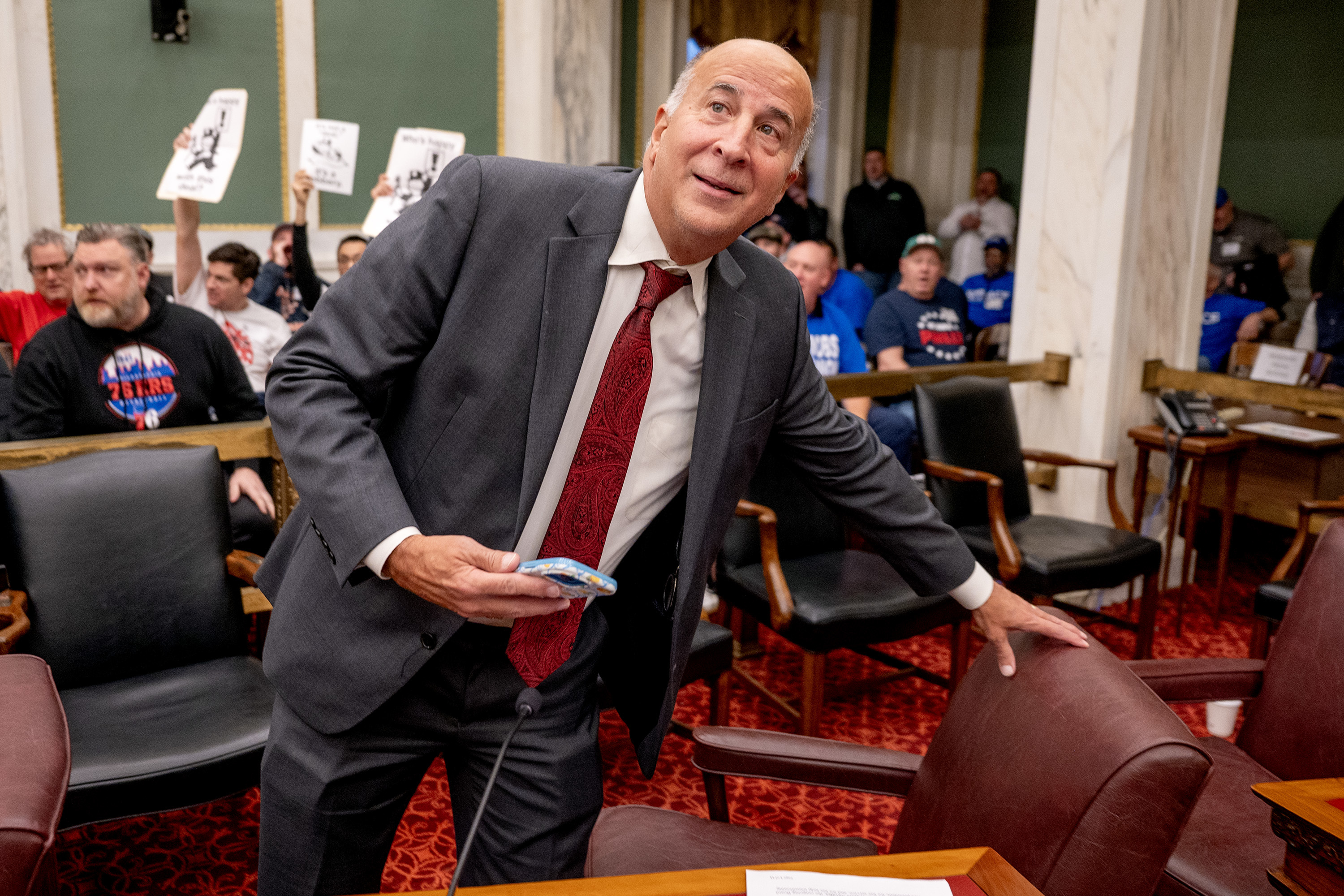
Councilmember Mark Squilla takes his seat in Council chambers on Wednesday, Dec. 11, 2024, before a scheduled committee vote. Squilla authored legislation requiring stores charge a fee for paper bags.
If the legislation passes Council, Parker could sign or veto it. She could also let it lapse into law without her signature. If she vetoed the legislation — it would be her first since taking office last year — Council could override her veto with 12 votes out of the 17-member chamber.
When the paper bag bill was introduced in 2019, members of Kenney’s administration also said at the time that they were concerned that fees on paper bags would hurt the poorest Philadelphians. Former City Councilmember Maria Quiñones Sánchez similarly described it as akin to a regressive tax.
However, proponents of the legislation said Monday that they don’t think the argument holds up.
Maurice Sampson, the eastern Pennsylvania director of the environmental group Clean Water Action, said prices on essentials such as food could rise for everyone if stores absorb the costs of paper bags.
“There is no foundation or basis,” he said, ”in the idea that fees on bags will hurt low-income people.”
There’s a smoke shop in North Philly peddling recreational drugs across the street from a daycare. A West Philly storefront that sells loose cigarettes on a residential block. A convenience store in Spring Garden that advertises urine to people looking to pass a drug test.
These are among the so-called nuisance businesses that City Council members and neighborhood association leaders cited Monday as lawmakers advanced legislation to make it easier for the city to shut down stores that sell cannabis and tobacco products without licenses.
And legislators said their next target could be the landlords who rent space to those businesses.
“We have to work with our city departments and our state partners to clamp down on these businesses,” said City Council Majority Leader Katherine Gilmore Richardson, who represents the city at-large. “We’re just being inundated.”
Members of Council’s Committee on Licenses and Inspections passed two bills Monday that city officials say seek to close loopholes store owners exploit to avoid being cited for failing to obtain proper permits.
In introducing the legislation earlier this year, Gilmore Richardson cited an Inquirer report about Pennsylvania’s unregulated hemp stores, which sell products advertised as legal hemp that are often black market cannabis or contaminated with illicit toxins.
One bill makes it easier for the city to shut down nuisance businesses by removing language that classifies some violations as criminal matters, requiring that the police investigate them as crimes rather than civil violations that are quicker to adjudicate.
The second piece of legislation makes it illegal for businesses to essentially reorganize under a new name but conduct the same operations as a means of evading enforcement.
Both pieces of legislation could come up for a full vote in the Democratic-dominated City Council in the coming weeks. Members of Mayor Cherelle L. Parker’s administration testified in favor of them, meaning the mayor is likely to sign both.
A smoke shop in South Philadelphia.
Neighborhood association leaders also testified Monday in favor of the changes, but several said more aggressive enforcement is needed. They said smoke shops in particular have popped up throughout their commercial corridors, as have convenience stores that don’t even have licenses to operate as businesses, let alone sell recreational drugs.
“We’ve seen firsthand the selling of illegal drug paraphernalia and [loose cigarettes], many of which children walk past in order to get to the candy bars and seniors walk past to get to the milk,” said Heather Miller, of the Lawncrest Community Association. “We need to address this.”
Elaine Petrossian, a Democratic ward leader in Center City and a community activist, called for “much” higher fines and penalties for landlords. She cited progress the municipal government has made in New York City, where authorities cracked down on building owners who knowingly rented space to tenants selling cannabis or tobacco without licenses to do so.
Several lawmakers said they’d support a similar approach. Councilmember Mark Squilla, who represents a district that spans from South Philadelphia to Kensington, said landlords must be held “more accountable.”
“If they had some skin in the game, maybe they’d think twice about renting to an illegal operation,” he said.
Councilmember Jamie Gauthier, who represents parts of West Philadelphia, agreed. She said she recently attempted to meet with a building owner who rents space to a problematic smoke shop in her district, but was rebuffed.
“He was like, ‘These people pay me rent, and that’s the extent to which I basically care,’” Gauthier said. “We need something that forces property owners to be more accountable than that, because neighbors are suffering.”
Staff writers Max Marin and Ryan W. Briggs contributed to this article.