Tag: Montgomery County

  • Ambler’s small businesses want to make the borough a destination

    Ambler’s small businesses want to make the borough a destination

    Maura Manzo, founder and director of yoga studio Camaraderie in Ambler, previously owned the Yoga Home studio in Conshohocken but stepped away during the pandemic.

    When she was looking to get back into the business, she chose Ambler.

    “I was looking for a vibrant, walkable downtown, rooted in community,” Manzo said.

    She was encouraged by the presence of a food co-op, Weavers Way, which “signaled to me that this is a community invested in sustainable, healthy living — values that align beautifully with a yoga community,” as well as the other businesses around.

    “There’s a balance of restaurants, arts and culture, and shopping that creates a wonderful, rich community and attracts people,” Manzo said.

    Centrally located in Montgomery County, the borough of Ambler has become home to an eclectic blend of retailers, restaurants, and services. Its downtown business district includes a spa, tuxedo rentals, a bakery, a tattoo parlor, hair salons, and restaurants from all different culinary genres.
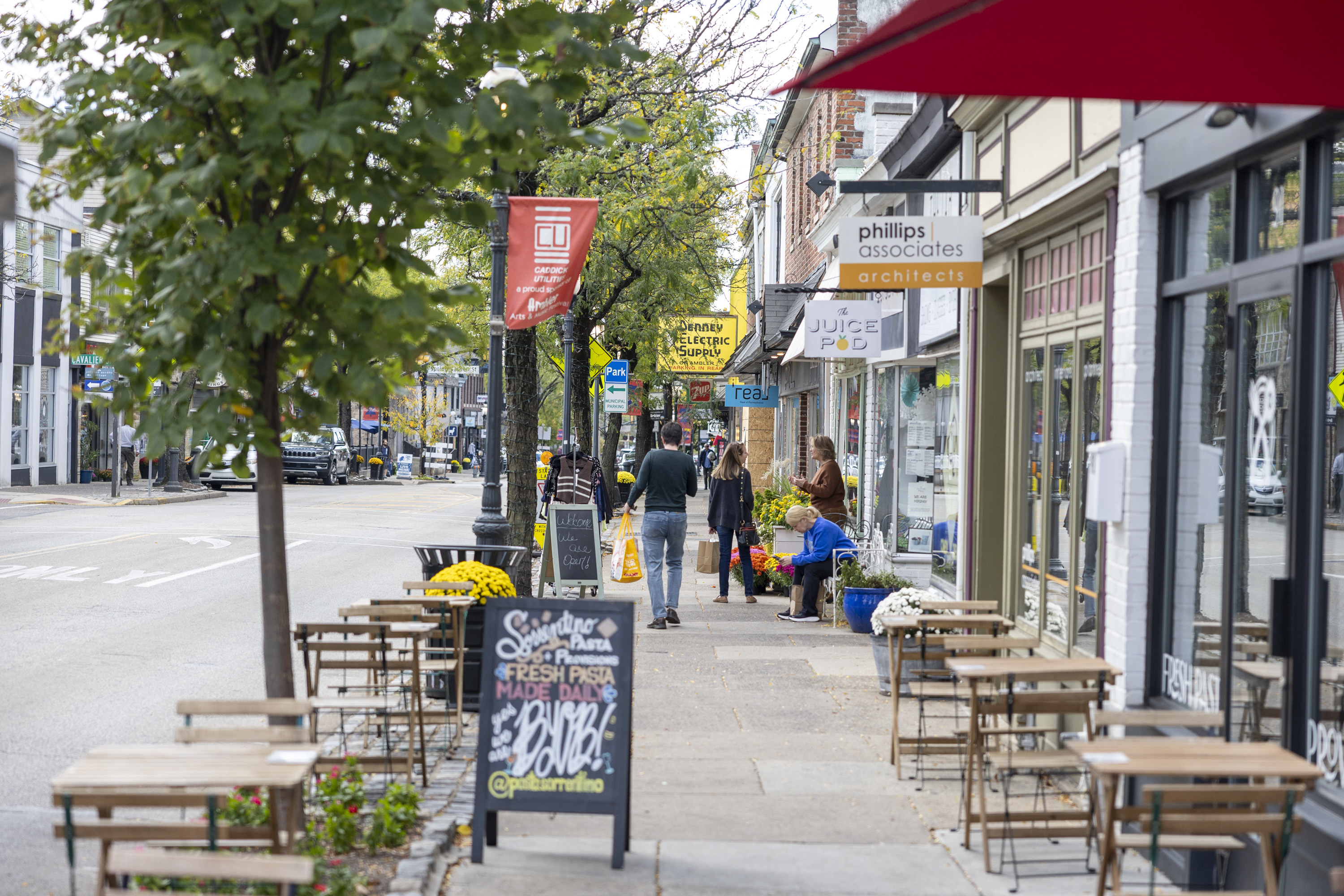
    People walk along Butler Avenue among various shops and restaurants in Ambler.

    The borough started as a mill town in the 1700s and evolved into a factory town run by the Keasbey & Mattison Co. in the 1800s. Many of the original buildings from that period still exist in the downtown district.

    The borough has been consistent in its preservation efforts. Recently an ordinance passed to be sure that any new construction reflects the existing architectural charm, said Ambler Main Street manager Elizabeth Wahl Kunzier.

    Still, the area has continued to evolve, recently adding a food hall with 10 vendors, seeing the merger of two established Ambler boutiques into one new storefront, and promoting downtown events on social media. With the holiday season approaching, business owners are looking ahead to their busiest time of year and gearing up for a number of seasonal events.

    “We have a pretty good organic social media reach,” Wahl Kunzier said. “It took a long time to get that where it is today, but given the nature of how the public gets information, it is very important to have a good following.”

    Building momentum behind the scenes
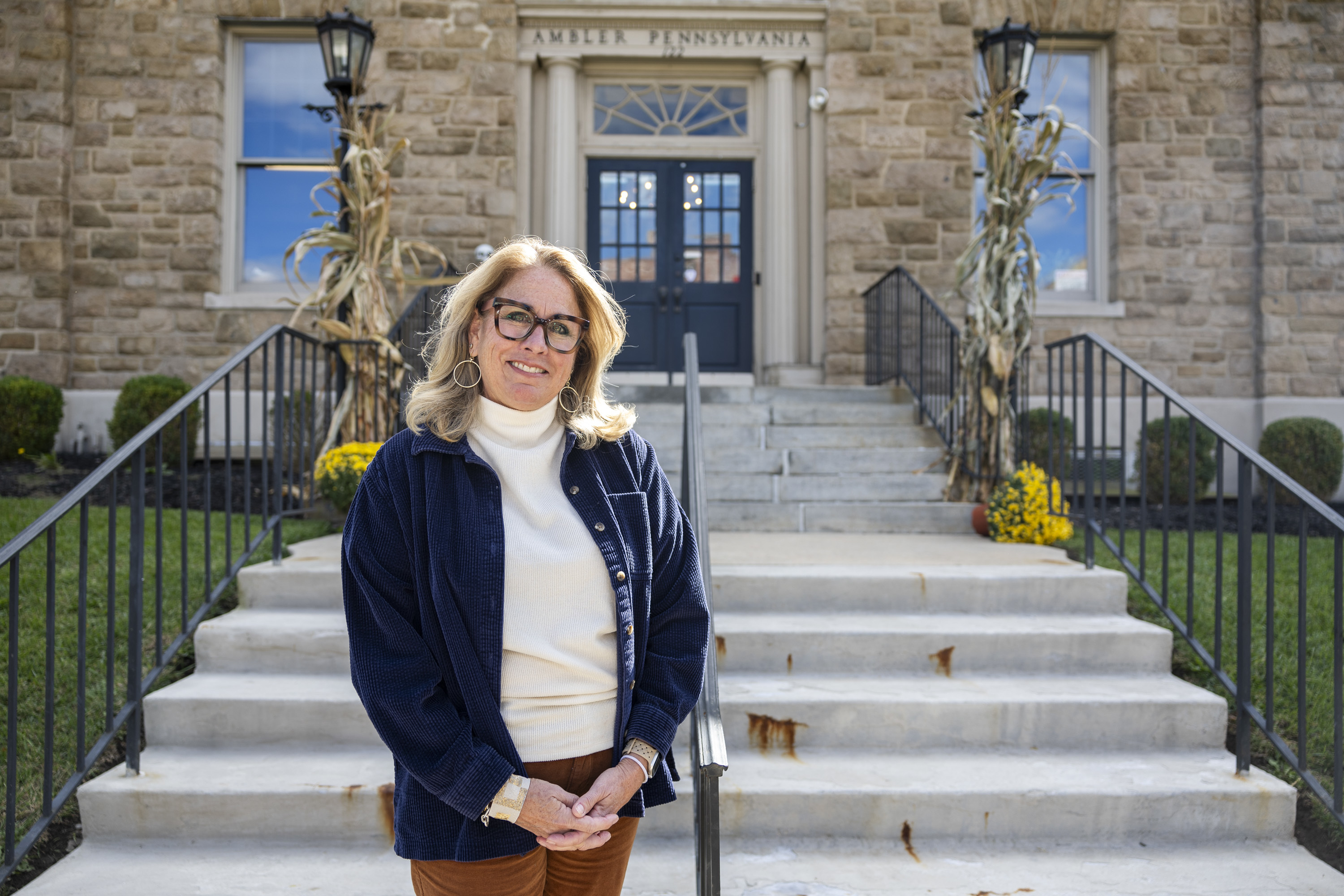
    Elizabeth Wahl Kunzier, Ambler Main Street manager.

    Wahl Kunzier serves as the marketing lead for Ambler Main Street — the name of the nonprofit that promotes downtown Ambler, even though many of its businesses are on Butler Avenue rather than Main Street. She monitors the businesses’ social media accounts daily to see what they’re advertising and share the information more broadly.

    Her office also organizes special events such as a semiannual restaurant week and a holiday shopping weekend. And the borough hosts a Farmer’s Market every Saturday from May through the weekend before Thanksgiving at the old Ambler train station.

    “I work with business owners brainstorming on everything from vacant storefronts to customized events to keep the foot traffic coming,” Wahl Kunzier said.

    The small business district and the community’s “people” are what drew Daniel J. DeCastro to Ambler, where he opened Ridge Hall last month.

    “They were a large family of small businesses that looked out for each other and supported one another while also having patrons who were cheerleaders of their businesses,” he said.

    An event board with various posters and advertisements for Ambler businesses and events.

    Located in a historic warehouse, Ridge Hall has 10 dining spots and a second-floor venue called The Mercantile.

    DeCastro is optimistic this food hall and retail concept will do well in Ambler, which he described as “on the cusp of breaking through as a destination town.”

    “Chestnut Hill, Doylestown, New Hope, and Phoenixville have become towns that you simply go to without a commitment. Unless you live in Ambler, it takes a commitment to drive into town,” DeCastro said. With Ridge Hall, “I wanted to create a destination that would entice people to stay for the day and return sooner rather than later.”

    Customers dine at Ridge Hall in front of Mary’s Chicken Strip Club.

    Some of the district’s established restaurateurs perhaps would argue that Ambler was already a destination.

    At Sorrentino Pasta + Provisions, customers find fresh pasta, house-made focaccia, and imported Italian goods for sale. The restaurant is open for lunch Wednesday through Sunday and dinner Thursday through Saturday, and it’s a BYOB.

    “Lunch is steady and a great opportunity to grab a table since it’s a little more difficult at dinner time,” proprietor Rich Sorrentino said. “We are extremely lucky to have the customers we do. Most are from the borough, but a surprising amount travel a bit to come join us.”

    Geronimo’s Peruvian Cuisine, also a BYOB, offers signature dishes such as ceviche, lomo saltado, anticucho de corazón, arroz con mariscos, pollo a la brasa, and many other authentic Peruvian dishes, said co-owner Daniel Salazar. It’s open Wednesday through Sunday.

    “Weekends are busy nights for us, we highly recommend calling the restaurant for a reservation,” she said. “Our goal here is to bring a cultural experience, to share a great cuisine that has history, flavor, and a little bit of mystery.”

    A tale of two stores
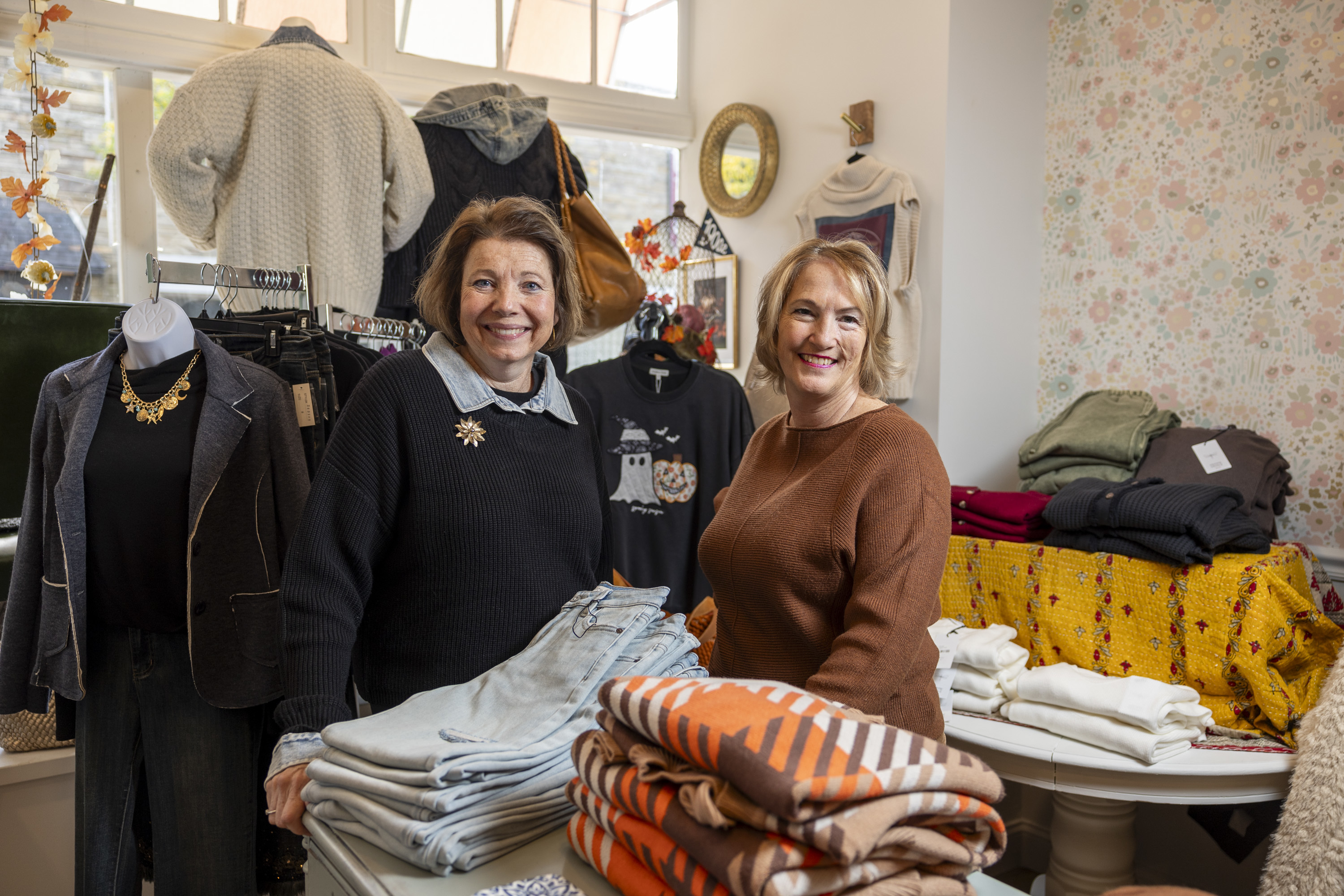
    Jeanne Cooke (left) and Barb Asman in their combined store, which opened earlier this year, bringing together XTRA Boutique and Main Street Vintage.

    Jeanne Cooke, owner of Main Street Vintage, sold painted furniture, vintage wood furniture, new and vintage home accessories, and artwork at her Butler Avenue shop for years. Just down the street, Barb Asman’s XTRA Boutique was selling women’s clothing.

    In August, they combined their businesses, merging into one larger storefront on Butler.

    “Barb and I have been looking in windows in Ambler for years. We felt we needed more square footage to take our businesses to the next level,” Cooke said. “The merge was seamless. I guess because we talked about it for quite some time.”

    The new experience is like shopping in a beautifully decorated home where you can buy all the furnishings. The two owners design the merchandising collaboratively, and the two businesses are intertwined.
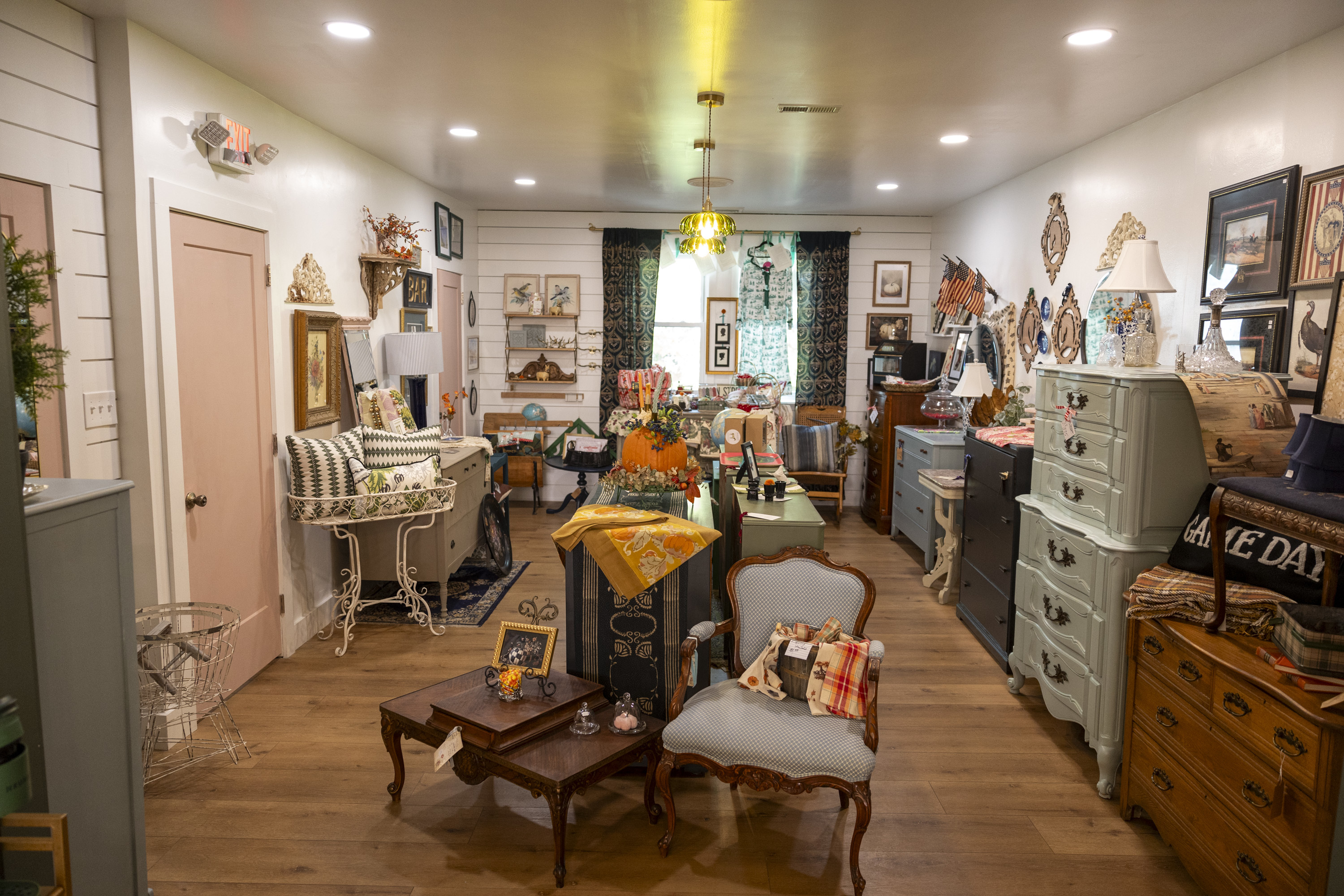
    The back of the store, where Main Street Vintage’s furniture and home decor are on display.

    Asman said they are excited for what the future holds.

    “I sometimes stand in the middle of the store and say: ‘Wow, this feels so good.’ It’s hard to put it into words,” Asman said. “It’s a really good feeling.”


  • State Sen. Sharif Street has early fundraising lead in Philly congressional race, but his competitors are close behind

    State Sen. Sharif Street has early fundraising lead in Philly congressional race, but his competitors are close behind

    State Sen. Sharif Street has an early fundraising lead over his competitors in next year’s Democratic primary for a storied Philadelphia congressional seat, according to new campaign finance reports.

    But the race is in its early stages, and candidates who entered the race after Street still have plenty of time to catch up before the May 2026 primary.

    Street, the son of former Mayor John F. Street, entered the race for Pennsylvania’s 3rd Congressional District in early July, days after U.S. Rep. Dwight Evans (D., Philadelphia) announced he would not seek reelection. Street’s campaign launch coincided with the beginning of the campaign finance reporting period, allowing him three full months to solicit contributions and seek endorsements.

    He took in about $352,000 from July 1 through Sept. 30, according to the Federal Election Commission. His campaign spent $33,000 during that time, and he finished the period with $372,000 in cash on hand, which is also the most of any candidate in the race. (Street’s cash reserves are higher than his fundraising because he carried over money from a previous campaign account.)

    “Our strong fundraising results put us in a commanding position,” Street campaign manager Josh Uretsky said in a statement. “We’re building a strong campaign that will hit every neighborhood in the Third District by leveraging our broad-based coalition.”

    window.addEventListener(“message”,function(a){if(void 0!==a.data[“datawrapper-height”]){var e=document.querySelectorAll(“iframe”);for(var t in a.data[“datawrapper-height”])for(var r,i=0;r=e[i];i++)if(r.contentWindow===a.source){var d=a.data[“datawrapper-height”][t]+”px”;r.style.height=d}}});

    State Rep. Chris Rabb, an anti-establishment progressive, who raised $257,000, also announced his campaign in July.

    Rabb’s haul was notable for a candidate with little support among Philadelphia’s established political organizations, such as the deep-pocketed building trades unions that endorsed Street this week. As he has in past runs, Rabb said he is eschewing contributions from corporate-backed political action committees, and tapping into a national network of progressive small-dollar donors.

    “This is a robust, grassroots campaign that’s fueled and funded by a growing movement of Philadelphians and citizens far & wide who want a bold, independent-minded and accountable Democrat to represent the bluest congressional district in the nation,” Rabb said in a statement.

    His campaign spent $76,000, and carried forward $181,000.

    State Rep. Morgan Cephas, a West Philly Democrat who chairs the Philadelphia delegation to the state House, collected $156,000 in contributions, a respectable sum given that she entered the race about a month before the reporting deadline. Her campaign spent $37,000 and had $119,000 in cash.

    In a statement, Cephas said “the excitement about our campaign is palpable.”

    “I understand the problems of Philadelphia because I’ve lived them for the last 41 years,” Cephas said. “Together we can deliver real results for our community.”

    Political outsiders aim to shake up race

    David Oxman, a physician who lives in South Philadelphia, brought in $107,000, spent $35,000, and had a healthy $332,000 in the bank.

    “Since day one, this campaign has been fueled by healthcare professionals, small business owners, and working families across Philadelphia who are ready to take power back from leaders bought by corporate interests,” Oxman said in a statement.

    David Oxman, an intensive care doctor and medical school professor at Thomas Jefferson University Hospital, is running for Congress. Oxman, 58, of Bella Vista, joins a race that includes State Reps. Sharif Street and Chris Rabb to replace retiring U.S. Rep. Dwight Evans.

    The campaign for Temple University professor Karl Morris raised $28,000, spent $26,000, and had $12,000 in cash on hand.

    “As a scientist, teacher, and a non-politician running an outsider campaign, my focus is on connecting with everyday Philadelphians,” Morris, a computer scientist, said in a statement. “Career politicians and the donor class want politics as usual. I’m prepared to make sure everyone in Philadelphia receives equal benefits and equal protections.”

    One notable candidate, physician Ala Stanford, entered the race after the close of the reporting period and has not yet submitted a campaign finance filing. Stanford was a founder of the Black Doctors COVID-19 Consortium and has been endorsed by Evans.

    “In just a few weeks in the race, Dr. Stanford has generated significant momentum — in contributions, volunteer engagement, and community enthusiasm,” Stanford campaign manager Aaron Carr said in a statement.

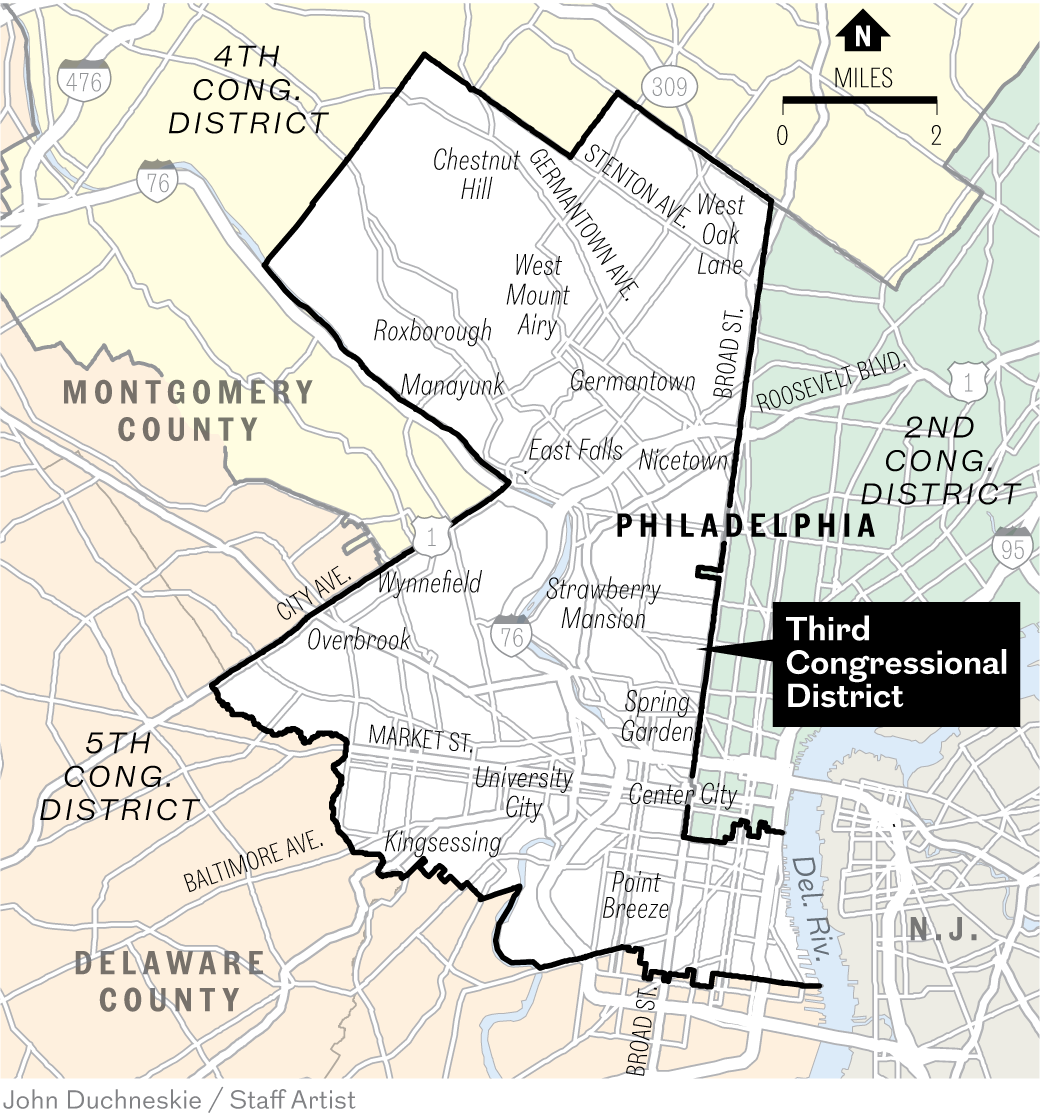
    Pennsylvania’s 3rd Congressional District, which includes parts of North, Northwest, West, and South Philadelphia, is one of the most Democratic seats in the nation. With Evans retiring from the seat he has held for nearly a decade, the field could still be in flux as more Philly politicians eye the potentially once-in-a-generation ticket to Washington.

    Map of Pennsylvania’s Third Congressional District.

    While the race remains competitive, Street’s early fundraising lead will help cement his status as the favorite of the local political establishment. Democratic City Committee chair Bob Brady said this week that party ward leaders will likely vote to endorse Street after this year’s election cycle wraps up next month.

    “We’re fully prepared to take advantage of this early lead,” Uretsky said.

    Brian Fitzpatrick outraises competitors in Bucks County congressional race

    In Pennsylvania’s 1st Congressional District, where Democrats have made ousting Republican U.S. Rep. Brian Fitzpatrick a top priority, the incumbent outraised his leading Democratic challenger by a nearly 4-1 ratio, bringing in $886,049 this quarter.

    Rep. Brian Fitzpatrick (R., Bucks and Montgomery) speaks during the opening session of the National Treasury Employees Union (NTEU) Legislative Conference in Washington in March.

    Unlike the deep-blue 3rd District, the fate of the 1st District will likely be decided in next year’s general election, and not the primary. The district, which includes all of Bucks County and a part of Montgomery County, is the only Philadelphia-area congressional seat represented by a Republican.

    Democratic County Commissioner Bob Harvie announced plans to challenge Fitzpatrick earlier this year.

    Harvie, viewed as the favorite to win the Democratic nomination, raised $217,745 last quarter. The other Democrat in the race, attorney Tracy Hunt, raised $36,692.

    This suburban content is produced with support from the Leslie Miller and Richard Worley Foundation and The Lenfest Institute for Journalism. Editorial content is created independently of the project donors. Gifts to support The Inquirer’s high-impact journalism can be made at inquirer.com/donate. A list of Lenfest Institute donors can be found at lenfestinstitute.org/supporters.

  • Pennsylvania court tells Lower Merion it can’t use zoning to regulate how gun shops do business

    Pennsylvania court tells Lower Merion it can’t use zoning to regulate how gun shops do business

    Lower Merion Township’s effort to limit where guns are sold violates state law, Commonwealth Court ruled Thursday.

    In a case that holds major implications for the power of local governments across Pennsylvania, the court threw out the township’s zoning ordinance that sought to block holders of federal firearms licenses from operating in walkable downtown areas and residential neighborhoods.

    The question at the heart of the case was whether the ordinance regulated land-use decisions, the bread and butter of local government, or the sale of firearms, which only the state can do.

    A majority opinion, signed by five judges, said the township’s ordinance violated state law that prohibits local governments from regulating guns because its requirements went beyond geographic limits.

    “The Township’s ordinance here is clearly intended to regulate the sale of firearms, rather than to regulate zoning,” wrote Judge Matthew Wolf in the opinion. “It is a gun regulation, not a zoning regulation.”

    In a statement, Todd Sinai, the Democratic president of the Lower Merion Board of Commissioners, said the township was considering its legal and legislative options.

    “We, of course, are disappointed in the Commonwealth Court’s decision today. It is a fundamental and important right of municipalities to be able to zone the location of uses to best serve their residents and property owners,” Sinai said.

    Frustrated with the lack of gun-control measures out of Harrisburg, advocates and officials have sought to use local ordinances to limit gun sales and where guns can be carried, and to ban certain firearms. Philadelphia has fought for years for the ability to enact gun laws. But ordinances passed by Philly and other cities, including Pittsburgh, have largely been struck down by courts.

    One strategy that has had limited success is the use of zoning ordinances to limit the locations of firearms-related activities, such as shooting ranges or gun stores. The Lower Merion case was seen by some as a test on how far zoning can go to bypass state preemption.

    “The Commonwealth Court has reaffirmed once again that local forms of government cannot regulate firearms and ammunition in any manner,” said Joshua Prince, an attorney with Civil Rights Defense Firm who filed the lawsuit.

    Lower Merion can appeal the decision to the Pennsylvania Supreme Court, which would have to agree to hear the case, but the ruling delivered a blow to gun-control advocates who had hoped Lower Merion’s ordinance could be replicated elsewhere in the state.

    “The decision to treat firearm operations as different within zoning than any other business is unusual and concerning,” said Adam Garber, the executive director of CeaseFire PA.

    The ruling, he said, creates a road map for how municipalities can zone firearm stores but also puts the impetus on the state to address gun regulations, something lawmakers in Harrisburg have refused to do.

    The township approved the zoning rules for firearms dealers in 2023 after the opening of Shot Tec, a gun training facility and seller in Bala Cynwyd, sparked community outrage. The zoning rules established a set of criteria for sellers to operate under and said they could open only in strip malls and industrial-use areas.

    The township argued that, while local governments are not allowed to regulate firearms, they have broad power over zoning and land use.

    Grant Schmidt, the owner of the Bala Cynwyd shop, sued after the zoning ordinance impeded his ability to open a second location in his home.

    He responded to the news of the ruling Thursday with a gif of Ric Flair cheering. His business, which offers training and education on firearms in addition to buying, selling, and storing them, has had four locations in five years. He said he hoped he could now focus on expanding his business rather than fighting local policies.

    “Now I’m looking to just grow and be normal and invest in my staff more,” Schmidt said.

    The litigation focuses on the requirements Schmidt had to adhere to for his most recent Rock Hill Road location, which is within one of the four districts that were zoned for businesses that require a federal gun license. The ordinance went beyond restricting place and imposed 12 additional requirements, such as installing smash-resistant windows, an alarm system, and internal video surveillance.

    Montgomery County Court found that all but three requirements were preempted by state law. Following Schmidt’s appeal, Commonwealth Court struck down the remaining requirements and the place restrictions.

    Lower Merion argued that other businesses, such as medical marijuana dispensaries, animal hospitals, and funeral homes, are subject to compatible conditions to operate. These types of requirements are “traditional local land use control not specific to firearms,” the township argued, according to the majority opinion.

    To make its case, Lower Merion cited a previous, non-precedential decision by Commonwealth Court that allowed Philadelphia to limit gun shops to specific zoning districts.

    The difference between the cases, Wolf wrote, is that Philadelphia limited the location of the gun shops but said nothing about how they need to operate. Lower Merion went a step further to restrict how gun shop owners “conduct their business.”

    Two judges, Renee Cohen Jubelirer and Lori Dumas, disagreed with the majority’s analysis, saying the decision “strips the Township of its traditional power over land use and zoning.”

    “Contrary to the Majority’s conclusion, none of the provisions of the ordinance at issue here regulate the ownership, transportation, or transfer of firearms, ammunition, or ammunition components,” Jubelirer wrote in the dissent.

    Correction: An original version of this story incorrectly identified the gif sent by Schmidt. It featured Ric Flair.

    This suburban content is produced with support from the Leslie Miller and Richard Worley Foundation and The Lenfest Institute for Journalism. Editorial content is created independently of the project donors. Gifts to support The Inquirer’s high-impact journalism can be made at inquirer.com/donate. A list of Lenfest Institute donors can be found at lenfestinstitute.org/supporters.

  • Josh Shapiro’s GOP opponent Stacy Garrity steps in to offer counties $500 million in loans as Pa. budget remains at an impasse

    Josh Shapiro’s GOP opponent Stacy Garrity steps in to offer counties $500 million in loans as Pa. budget remains at an impasse

    HARRISBURG — Pennsylvania Treasurer Stacy Garrity stepped in on Wednesday to offer counties and early education programs $500 million in low-interest loans to hold them over until a final state budget deal is complete, sidestepping the General Assembly and Gov. Josh Shapiro as they near the start of a third month at an impasse.

    Garrity, a Republican who last month announced her bid to challenge Shapiro in next year’s gubernatorial election, announced the unprecedented move to allow the state Treasury to offer the loans to county human service departments for the many social services they provide, as well as for early education Head Start programs, at a 4.5% interest rate.

    Counties, schools, and social service providers have pleaded for months with the legislature to finalize a budget so they can begin receiving their expected state payments, which have been on hold since the beginning of the fiscal year on July 1. Some counties have had to secure private loans to hold them over until state payments begin, while others — including those around the Philadelphia region — have relied on their reserves. Other counties have frozen hiring and spending as they await a resolution to the budget stalemate.

    The move would allow counties to access millions of dollars for early education programs serving 35,000 children across the state, as well as for county social services — all of which have been operating for months without their state appropriation, with no end to the budget impasse in sight.

    Garrity’s decision to act unilaterally without the action of the General Assembly allows her to capitalize politically on the ongoing budget crisis over Shapiro, challenging his image as a moderate Democratic governor of a politically “purple” state willing to work across the aisle in a divided legislature. That brand, which he has built nationally as he is rumored to have interest in running for president in 2028, has been tested as he has so far been unable to secure a budget deal or a recurring funding stream for the state’s beleaguered mass transit agencies, including SEPTA.

    Shapiro, for his part, has described his role in budget negotiations as being a go-between for Senate Republicans and House Democrats, who control their respective chambers, and has said that the two caucuses remain “diametrically opposed” on some issues.

    A spokesperson for Shapiro said in a statement Wednesday that the real solution to the budget impasse is for Senate Republicans, whose leaders endorsed Garrity last week, to return to work in Harrisburg to finalize a budget deal with House Democrats. A spokesperson for House Majority Leader Matt Bradford (D., Montgomery) echoed the sentiment, arguing that Senate Republicans “refuse to negotiate on a realistic budget agreement.”

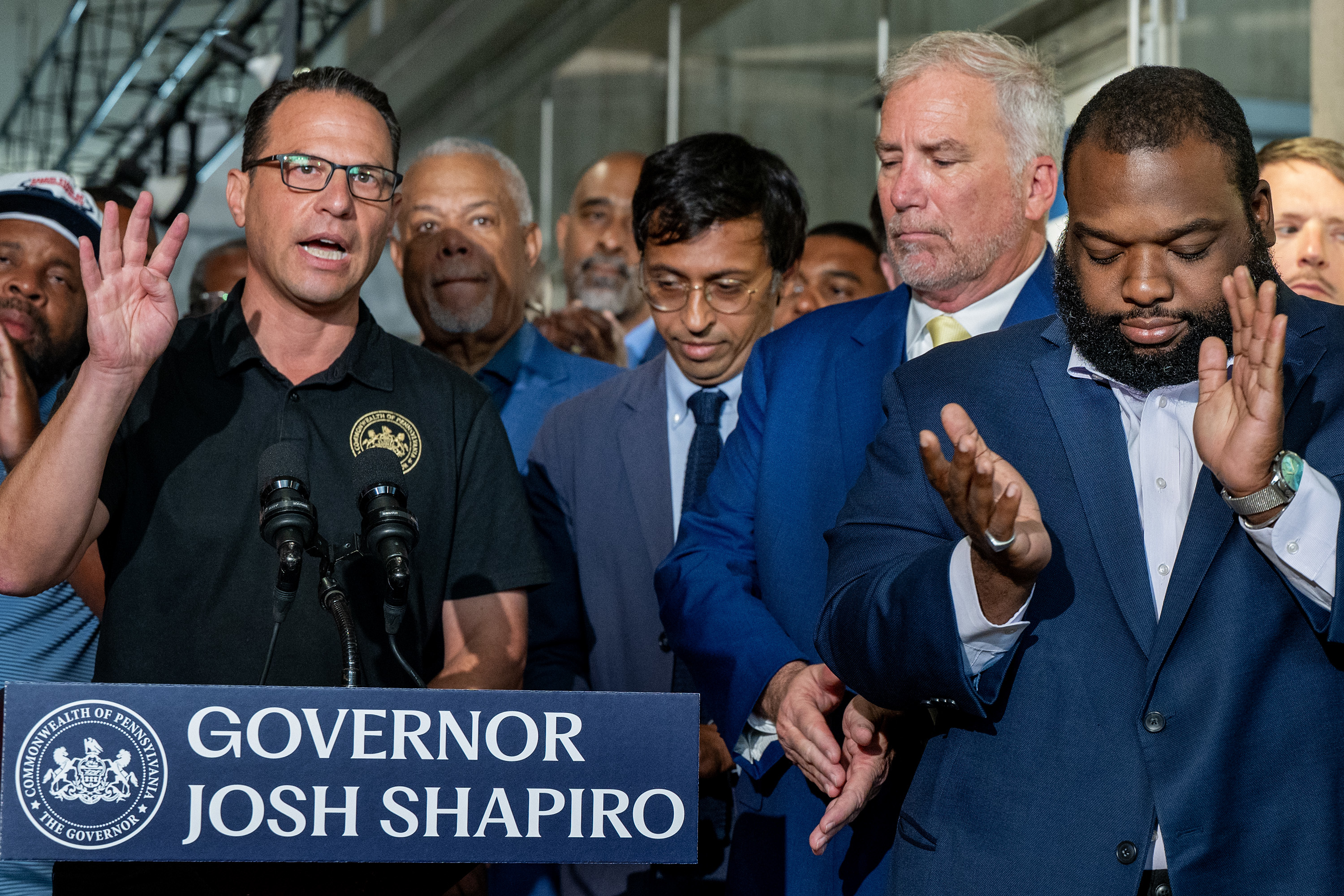
    Gov. Josh Shapiro visits SEPTA headquarters Sunday, Aug. 10, 2025 to discuss funding for the transit agency and to pressure Senate Republicans as planned service cuts are pending because of a budget shortfall. To his right, from left, are state Democratic legislators Sen. Anthony H. Williams; Sen. Nikil Saval; Rep. Ed Neilson; and Rep. Jordan Harris.

    Senate Majority Leader Joe Pittman (R., Indiana), the Senate’s top negotiator, who has met for months in closed-door budget talks with Bradford and Shapiro, said in a statement that it was Democrats who caused the prolonged impasse while demanding they include mass transit funding in the state budget. After mounting pressure as SEPTA enacted major service cuts, Shapiro ultimately sought to fund the agency on his own, and the issue will need to be revisited in two years.

    Garrity, who kicked off her “Help Is on the Way” introductory campaign tour around the state earlier this week, said Wednesday her decision to intervene in the state budget stalemate was not political, despite her burgeoning run against Shapiro. Rather, she said that she had been thinking about a way to do so for months, including ahead of her announcement of her run for governor, and that most Pennsylvanians don’t even realize the state budget is late. She argued that if she wanted to be political, she would not intervene and would “keep the pressure” on Shapiro over the late state budget.

    “I’m standing up here as Pennsylvania’s state treasurer, not as a candidate for governor,” Garrity said from a podium in the Harrisburg building that houses the state Treasury. “I think I have a responsibility to serve Pennsylvanians, that if I have something that I can do to provide some relief, then I should do it.”

    However, that didn’t stop Garrity from inviting Montgomery County Commissioner Tom DiBello — the lone Republican on the board where Shapiro once served — to the podium at the news conference to deliver some direct criticisms of Shapiro and to praise Garrity’s intervention as a “lifeline” for counties, alongside two other GOP county commissioners from south-central Pennsylvania. While Montgomery County remains one of the wealthiest counties in the state, the late budget has required Pennsylvania’s third-most-populous county to spend down its reserves, money that it usually relies upon to continue earning interest as part of its annual revenue, DiBello said.

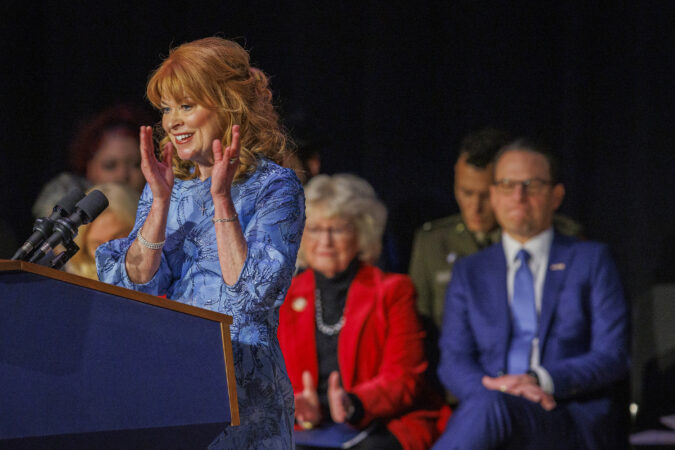
    Pennsylvania Treasurer Stacy L. Garrity gives her acceptance speech after receiving the PA GOP’s endorsement for her campaign for governor during the Republican Party of Pennsylvania’s 2025 Fall Meeting at the Penn Stater Hotel & Conference Center in State College on Sept. 20.

    “It starts at the top. The governor is responsible,” DiBello said. “He’s got to pull it together. It’s his signature at the end of the day.”

    In response to Garrity’s announcement Wednesday, Montgomery County Commissioners Neil Makhija and Jamila Winder, both Democrats, said in a statement that the county needs a final state budget instead of a short-term loan program, urging Senate Republicans to “do their job.”

    “A short-term loan at 4.5% interest is the state profiting from a problem of their own making, at the expense of the taxpayers,” the two commissioners added.

    DiBello said he did not believe his invitation to Wednesday’s event had political motivations, adding: “I didn’t even think of that.” He also noted that he has come to Harrisburg to advocate on behalf of counties multiple times before.

    Senate President Pro Tempore Kim Ward (R., Westmoreland), who has been one of Shapiro’s biggest critics since his first budget in 2023 and was quick to support Garrity’s candidacy, prodded at Shapiro’s pledge to “get stuff done” while praising Garrity’s leadership.

    “Today, Treasurer Stacy Garrity made a bold move that shows what ‘get stuff done’ actually looks like,” Ward said in a statement. “Treasurer Garrity’s leadership is on display as her solution-driven option is exactly what we need, but has been glaringly missing from the present administration.”

    Garrity said at the news conference Wednesday that she offered the loan program specifically to Head Start programs and county governments’ human service departments because both had asked her to help them get through the budget impasse. The state budget was due by July 1, and Pennsylvania is the only state besides Michigan that has not yet passed its budget. She said she is willing to offer similar loans to schools or other state-subsidized or funded programs as requested.

    The Pennsylvania General Assembly can forgive the interest accrued by counties taking out loans during the budget impasse, Garrity said, adding that she would support legislation that does so.

    This suburban content is produced with support from the Leslie Miller and Richard Worley Foundation and The Lenfest Institute for Journalism. Editorial content is created independently of the project donors. Gifts to support The Inquirer’s high-impact journalism can be made at inquirer.com/donate. A list of Lenfest Institute donors can be found at lenfestinstitute.org/supporters.

  • U.S.-Venezuela prisoner swap is a chilling reminder of Trump’s scorn for the rule of law | Editorial

    U.S.-Venezuela prisoner swap is a chilling reminder of Trump’s scorn for the rule of law | Editorial

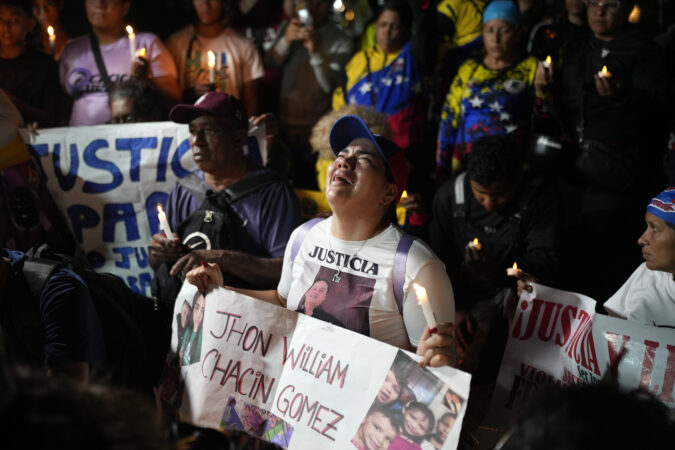
    On July 18, more than 250 Venezuelan immigrants held since March in a Salvadoran prison at the behest of the Trump administration were released in a prisoner swap for 10 U.S. citizens and permanent residents jailed by the Venezuelan government.

    For the men and their families, it could not have been a more joyous moment. It had been months since they last heard from their loved ones, not knowing if they were alive or dead.

    For the respective governments involved, it was also a time to crow.

    After all, it was President Donald Trump’s “leadership and commitment to the American people” that freed the imprisoned Americans. Venezuelan President Nicolás Maduro called it a “perfect day” for his country, and blame for the “kidnapped Venezuelan migrants” was put on his opponents “on the Venezuelan right.”

    Even self-described “world’s coolest dictator” (and apparently America’s next top jailer), Salvadoran President Nayib Bukele, got a little self-love in, boasting on X of the “months of negotiations with a tyrannical regime” that El Salvador had engaged in to help get the Americans home.

    Well, bully for authoritarianism.

    For the rest of us — for those who believe in the rule of law and still hold out hope for the American Experiment — July 18 may be remembered as a dark day.

    Unless the administration is held accountable for the blatantly illegal way it upended these immigrants’ lives, the episode will mark a new low in America’s slide toward illiberal democracy under President Trump.

    As prisoners stand looking out from a cell, Homeland Security Secretary Kristi Noem speaks during a tour of the Terrorist Confinement Center in Tecoluca, El Salvador, in March.

    Undue process

    To be sure, the release of all these men is good news. Most of the freed Americans were wrongfully detained and accused of being involved in plots to destabilize Venezuela.

    Their arrests were part of a transparent, cynical ploy by the Maduro regime to use these men like bargaining chips as the country struggles to get out from under oil sanctions that have contributed to the nation’s deep economic problems.

    The illegal detentions were also par for the course for a government where every branch is controlled by Maduro loyalists, and which routinely jails its own dissidents. (The swap included 80 political prisoners, but there are conflicting reports on whether they have all been released.)

    There is no question that Venezuela’s actions are morally and legally indefensible. But what about America’s?

    The more than 250 Venezuelans who ended up in El Salvador’s Terrorism Confinement Center, known as CECOT, were sent there by the Trump administration on March 15. They were deported with little or no due process under the 1798 Alien Enemies Act, accused of being dangerous criminals and members of the Tren de Aragua gang, which Trump declared a terrorist organization.

    In sending the men to a place notorious for its poor conditions and inhumane treatment of prisoners — in a $6 million deal with El Salvador’s Bukele — the administration called the detainees “the worst of the worst.”

    But reporting by several media organizations quickly put the lie to those claims, with ProPublica finding the government’s own records show that it knew the vast majority of the men had not been convicted of any violent crime in the U.S., and only a few had committed crimes abroad.

    Most of the men were also not very hard to find, as they were either never released from immigration custody while they pursued asylum claims or their cases were moving through the immigration system.

    Take the four Venezuelans identified as having ties to Pennsylvania before they were sent to CECOT.

    Inmates exercise under the watch of prison guards during a press tour of the Terrorism Confinement Center, or CECOT, in Tecololuca, El Salvador, Oct. 12, 2023.

    Joén Manuel Suárez Fuentes, 23, was detained during a traffic stop and charged with driving without a license. Ileis Villegas Freites, 28, had been sentenced to one year of probation for retail theft in Montgomery County.

    Miguel Gregorio Vaamondes Barrios, 32, had a series of shoplifting arrests, including an open theft case in Pennsylvania, and was convicted of petit larceny in Nassau County, N.Y. Luis Jean Pier Gualdrón, 22, had a pending asylum application when he was deported. He had pleaded guilty to harassment in Northampton County, Pa., and was sentenced to three to six months in jail.

    While some may argue that only people of unimpeachable moral character should be welcomed in America — and having a criminal record can disqualify immigrants from being granted legal status — these men were far from the “monsters” and members of a gang who the U.S. Department of Homeland Security said “rape, maim, and murder for sport.”

    And even if they had been charged with being the worst of the worst, under the Constitution, the government still has to prove its case against anyone it seeks to deprive of “life, liberty, or property.”

    In deporting the Venezuelans, the administration acted recklessly and lawlessly, ignoring not only the letter of the law but also directly disregarding an order from U.S. District Judge James Boasberg, barring the government from transferring the men to El Salvador under the Alien Enemies Act.

    That the men are now free — although it is highly likely some have been placed right back in the dangerous situations under an oppressive regime they were fleeing in the first place — does not absolve the Trump administration of wrongdoing.

    Migrants deported months before by the United States to El Salvador under the Trump administration’s immigration crackdown arrive at Simon Bolívar International Airport in Maiquetia, Venezuela, July 18, 2025.

    Test case

    Throughout the entire ordeal, the government has placed itself above the law.

    Seeking to make good on Trump’s promise of mass deportations and tall tales of criminal immigrants running rampant, administration officials engaged in the kind of abuse of power that is un-American on its face.

    The government selected a group of men under suspect criteria, identifying many of them as gang members based on the discredited belief that they had identifying tattoos. It then disappeared them, sending them to a foreign prison known for its brutal conditions, where they were unable to communicate with their families or lawyers.

    To this day, officials have not even released a full list of names of the people they sent to El Salvador. What is publicly available has been cobbled together from families speaking out and media reports. It is unclear if everyone deported has been accounted for.

    The government consistently defied court interventions, claiming that once the men were in El Salvador, they had no direct control over what would happen to them. The prisoner swap makes this particular lie only more blatant.

    Most alarming is that there is nothing stopping them from doing it again — or keeping them from doing it to whomever they want. Already, Trump has mused about sending Americans to El Salvador.

    The homegrowns are next,” he told Bukele during the Salvadoran leader’s April visit to the White House. “You gotta build about five more places. … It’s not big enough.”

    Having already violated the Fifth Amendment guaranteeing due process, it’s not much of a stretch for the administration to ignore the Eighth Amendment’s protection from cruel and unusual punishment.

    America cannot move on from what happened to the Venezuelan immigrants. Their plight cannot be swept away in the flood of scandals and outrages that regularly flow from the White House.

    The Trump administration cannot be allowed to do this to anyone ever again.