Tag: Montgomery County

  • How Philly-area outlets survive and sometimes thrive in an era of dying malls

    How Philly-area outlets survive and sometimes thrive in an era of dying malls

    For the Nowell family, the outlets are an annual tradition.

    Every Veterans Day, a dozen relatives venture to Limerick Township in Montgomery County, where they kick off their holiday shopping at the Philadelphia Premium Outlets.

    Even this year, as bitter winds whipped through the outdoor plaza, the family was undeterred.

    After a morning of shopping, the multigenerational group, which included two veterans, warmed up with their yearly food-court lunch, courtesy of matriarch Geri Nowell, 77, of Telford. Then, the men returned to the cars and dropped off dozens of shopping bags, which they’d been carting around in a wagon. The women walked on, hunting for their next find among the more than 130 shops.

    The Nowell family poses in front of a holiday backdrop during their annual outing to the Philadelphia Premium Outlets.

    “It’s super fun,” said Ann Blaney, 47, of Drexel Hill.

    “We get great deals,” added Kim Woodman, 55, of Hatboro.

    The tradition is an experience they say can’t be replicated online. The fact that the complex is open-air and contained in a 550,000-square-foot plaza somehow adds to the fun, they said.

    As Kathy Nelson, 48, of Broomall, browsed the outlets with her friends, she said she also shops at the nearly 3 million-square-foot King of Prussia Mall, less than 20 miles away. But otherwise, she said, “there aren’t many indoor malls left” with the variety of stores she prefers.

    As some indoor malls have struggled and died, leaving fewer than 1,000 left nationwide, the outlets remain alive.

    Outlets have always accounted for a fraction of the in-person retail market, which is partly why there have been few headlines about dying outlet malls. But some of the country’s roughly 200 outlet malls seem to be downright thriving, with full parking lots on weekends, few vacant stores, and relatively strong revenue.
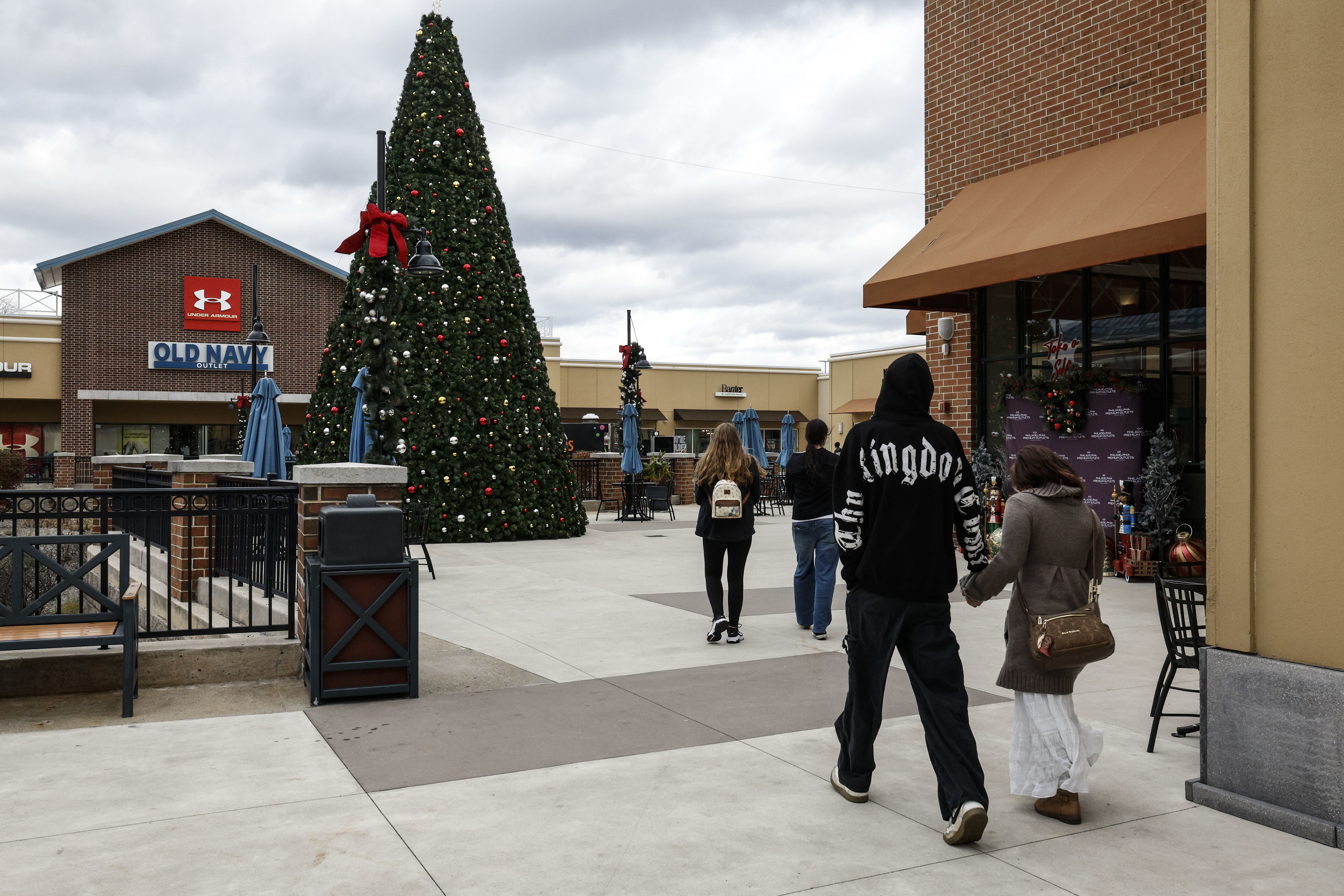
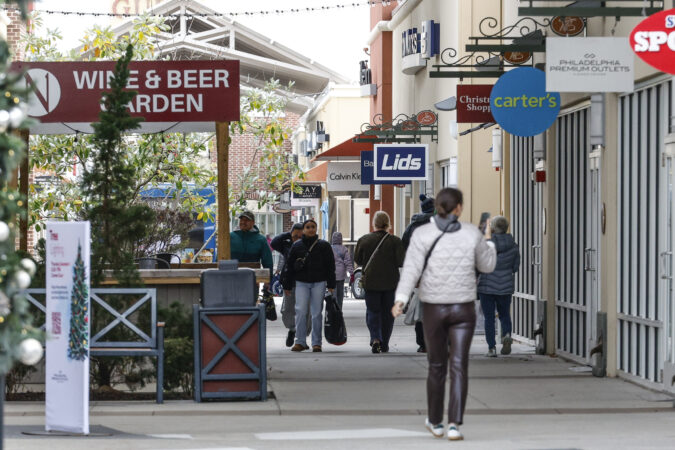
    Shoppers walk by the tree at the Philadelphia Premium Outlets on Nov. 11.

    The Philadelphia region’s two major outlet malls — the Philadelphia Premium Outlets in Limerick Township and the Gloucester Premium Outlets, both owned by Simon Property Group — are more than 92% occupied, according to a count by The Inquirer during visits to each location this month. Both outlets have found success despite being less than 20 miles from thriving indoor malls in King of Prussia and Cherry Hill.

    Tanger Outlets, which has locations in Atlantic City and Lancaster, recently reported more than 97% occupancy across its 39 open-air centers and an increase in average tenant sales per square foot.

    “Outlets do good in good times and great in bad times,” said Lisa Wagner, a longtime consultant for outlets, repeating a common refrain in the industry.

    The centers have evolved amid the broader push toward more experiential retail and most now have a mix of discount stores and full-price retailers. But they have done so while embracing their reputation as the go-to destination for snagging deals, said Wagner, a principal at the Outlet Resource Group.

    “Honestly no one knew what was going to happen after COVID, but [the outlets] came out incredibly strong,” she said. More recently, the retail industry has been rattled by tariffs and economic uncertainty. The outlets have not been immune to those challenges, but they have held strong despite them.

    “People want value right now,” Wagner said. “They need it.”
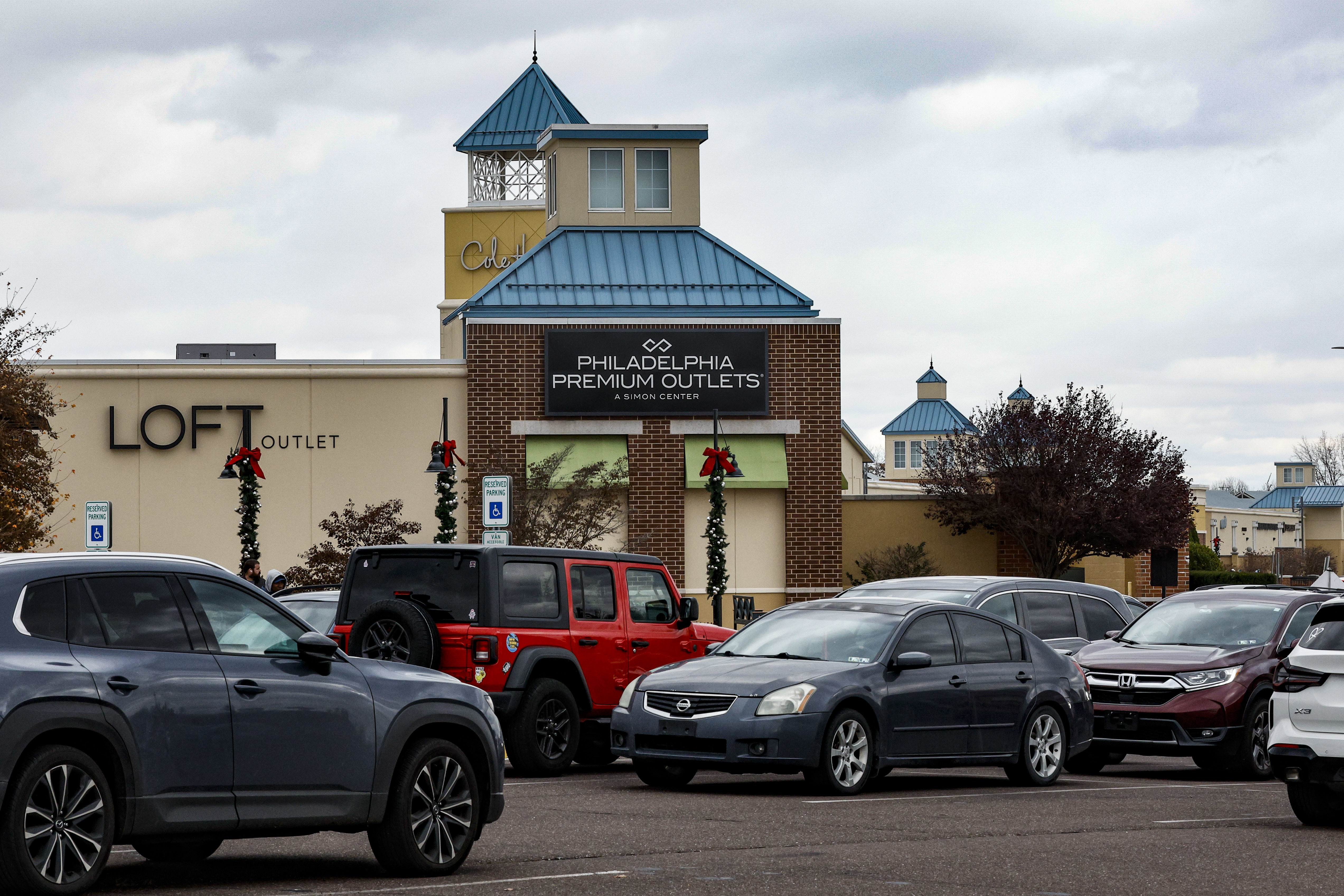
    The Philadelphia Premium Outlets has more than 130 stores in its 500,000-square-foot complex.

    Outlet malls become one-stop shops

    On a rainy, early November Sunday, hundreds of people descended on the Gloucester Premium Outlets.

    Shoppers pulled up hoods and huddled under umbrellas as they made their way from store to store. Many balanced several large bags bearing brand names like Columbia and Kate Spade, Rally House and Hey Dude shoes. Some munched on Auntie Anne’s pretzels or sipped Starbucks from holiday cups. An acoustic version of Jingle Bells played over the speakers.

    For some, the dreary, drizzly weather was even more reason to spend their afternoon at the 86-store complex in Blackwood, Camden County, about 15 miles outside Philadelphia.

    With two young children in tow, Jessica Bonsu, 30, of Sicklerville, was on a mission.

    “We came out to go to the indoor playground,” called Stay & Play, Bonsu said, pointing to her rambunctious kids. “Just to get some energy out.”

    “And then we can also get some shopping done,” added her cousin, Taneisha Laume, 30, who was visiting from D.C. She needed a gift for her uncle. “Kill two birds with one stone.”
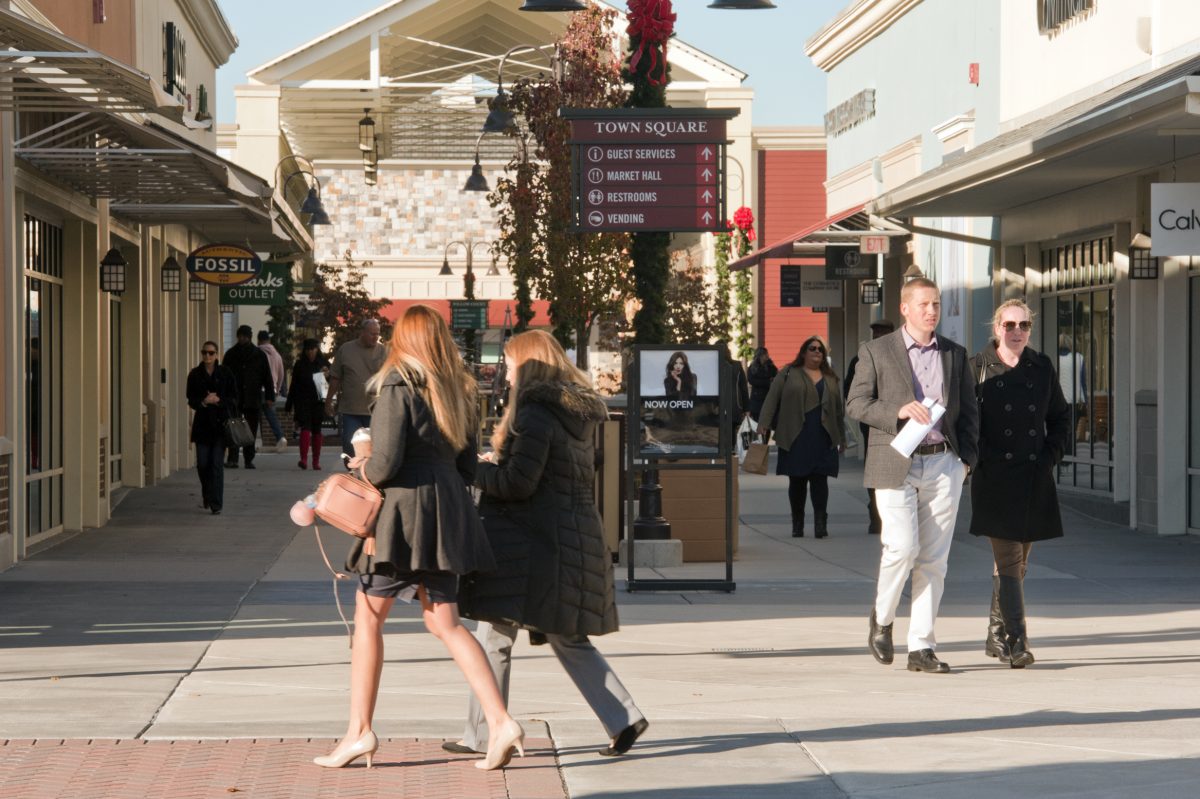
    Shoppers peruse the stores at the Gloucester Premium Outlets in this 2019 file photo.

    These kind of multipurpose visits are buoying outlet malls, which are increasingly becoming mixed-use destinations for dining, drinking, entertainment, and shopping.

    “You’re coming for a little bit of everything,” said Gerilyn Davis, director of marketing and business development at Philadelphia Premium Outlets.

    The Limerick Township complex recently welcomed a slate of new tenants, including Marc Jacobs’ first Pennsylvania outlet store, a BOSS outlet, an Ulta Beauty, and an outpost of central Pennsylvania’s Nissley Vineyards, which has an outdoor seating area.

    Shoppers walk by the Nissley Vineyards store at the Philadelphia Premium Outlets.

    New Balance, whose shoes are trendy again, is also opening stores in both the Philadelphia and Gloucester outlets.

    Justin Stein, Tanger’s executive vice president of leasing, said the North-Carolina-based company is focused on adding more food, beverage, and entertainment options.

    While overall occupancy at its Atlantic City center is lower than others, the complex has a Dave & Buster’s and a Ruth’s Chris steakhouse. The Simpson, a Caribbean restaurant and bar, is also set to open there in early 2026.

    In Lancaster, Tanger is looking to add food and beverage options, Stein said. But that center is still performing well, with a 97% occupancy rate, according to an online map, and only two vacancies.

    When there are places to eat and drink at the outlets, “people stay longer,” Stein said, “and when they stay longer, they spend more.”
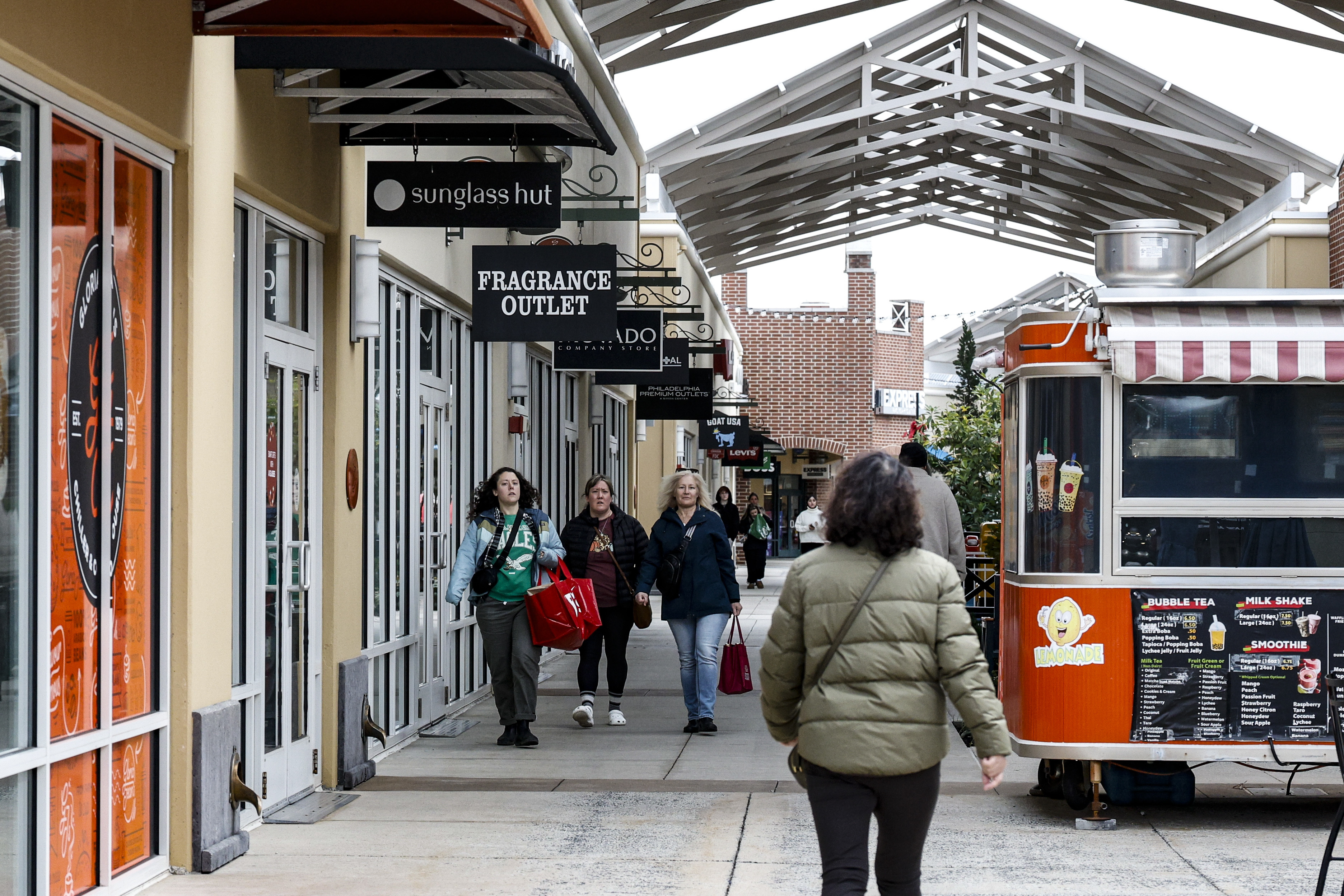
    Philadelphia Premium Outlets had a steady crowd on a bitter cold Veterans Day.

    From ‘no frills’ to outlets of the future

    Today’s outlet malls look vastly different from what Wagner calls the “no frills” complexes of the 1990s.

    At the time, an outlet mall served as “a release valve for excess goods,” Wagner said. “There were some stores that had really broken merchandise.”

    To comply with branding rules and avoid competition with department stores, outlet malls were often located along highways between two major metro areas, she said.

    “What became clear is that customers loved it,” Wagner said. Soon, brands started overproducing to supply these outlet stores with products in an array of a sizes and colors.

    This effort to bulk up outlet offerings was “a roaring success,” she said, with companies finding that more than a third of outlet customers went on to buy their products at full price at other locations.
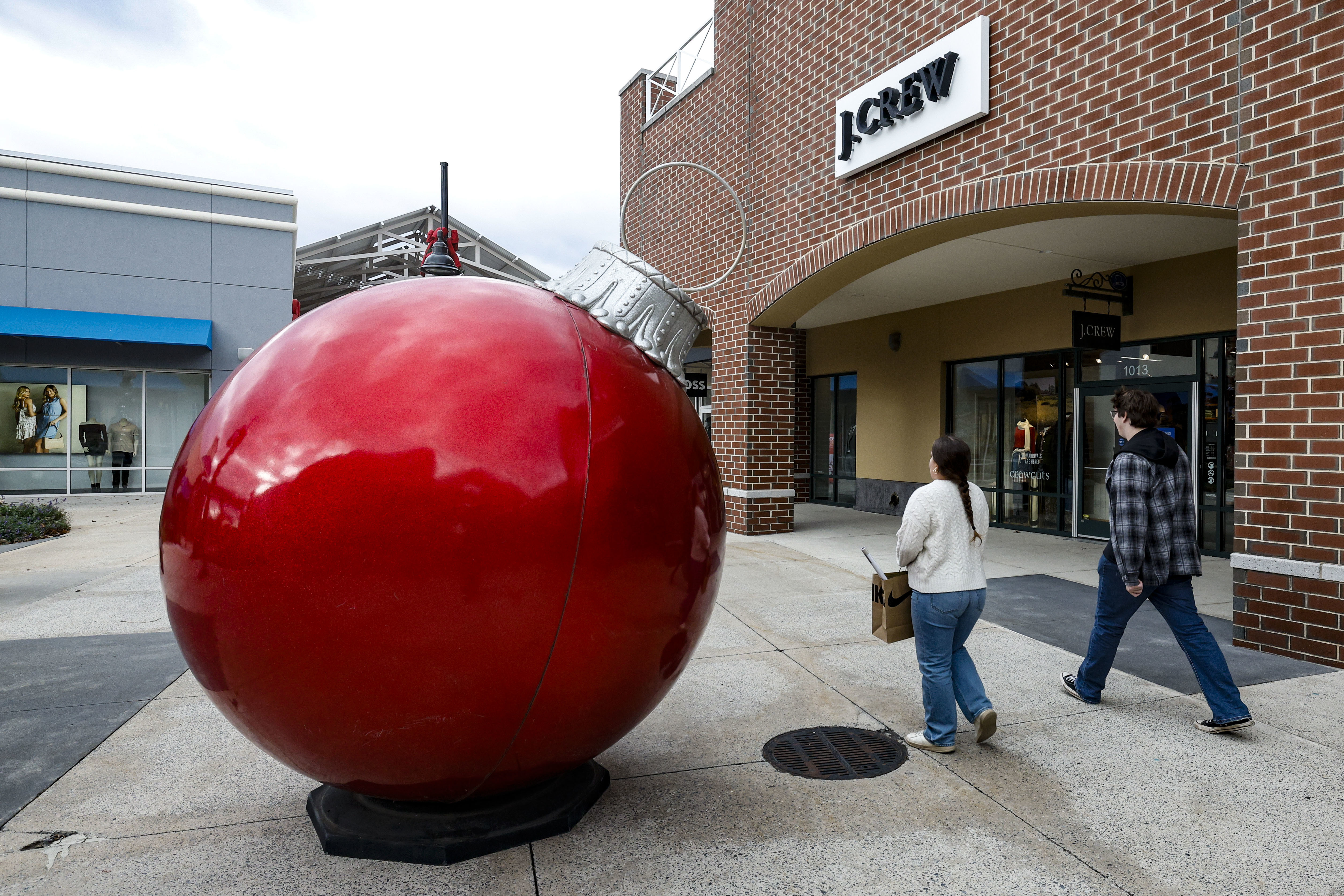
    Philadelphia Premium Outlets, which opened in 2007, has very few vacant storefronts.

    As their popularity rose, more outlet malls were built across the country.

    The Atlantic City outlets, originally called The Walk, opened in 2003, followed by the Philadelphia Premium Outlets four years later. In 2015, the Gloucester Premium Outlets opened, with local officials calling the approximately 400,000-square-foot center the largest economic development project in township history.

    As the centers look to the future, their executives are continuing to hone their identity as “not just a discount-and-clearance center,” said Deanna Pascucci, director of marketing and business development at Gloucester Premium Outlets.

    Center leaders are bringing in food trucks, leaning into rewards programs, and promoting community events, such as Gloucester’s holiday tree lighting, which took place Saturday. Starting Black Friday, the Philadelphia Premium Outlets will offer Santa photos after a successful pilot program last year.

    And the complexes are finding new ways to attract and retain shoppers, online and in real life.

    Tanger recently announced an advertising partnership with Unrivaled Sports, which operates youth sports complexes, including the Ripken Baseball Experience in Aberdeen, Md., an hour drive from its Lancaster outlets. Stein said the company hopes to attract families looking to pass the time between tournament games.

    Tanger is also using AI and data analytics to email specific deals to customers based on where they’ve previously shopped, Stein said.

    “We want you to start your experience online and end it in the store,” Stein said.
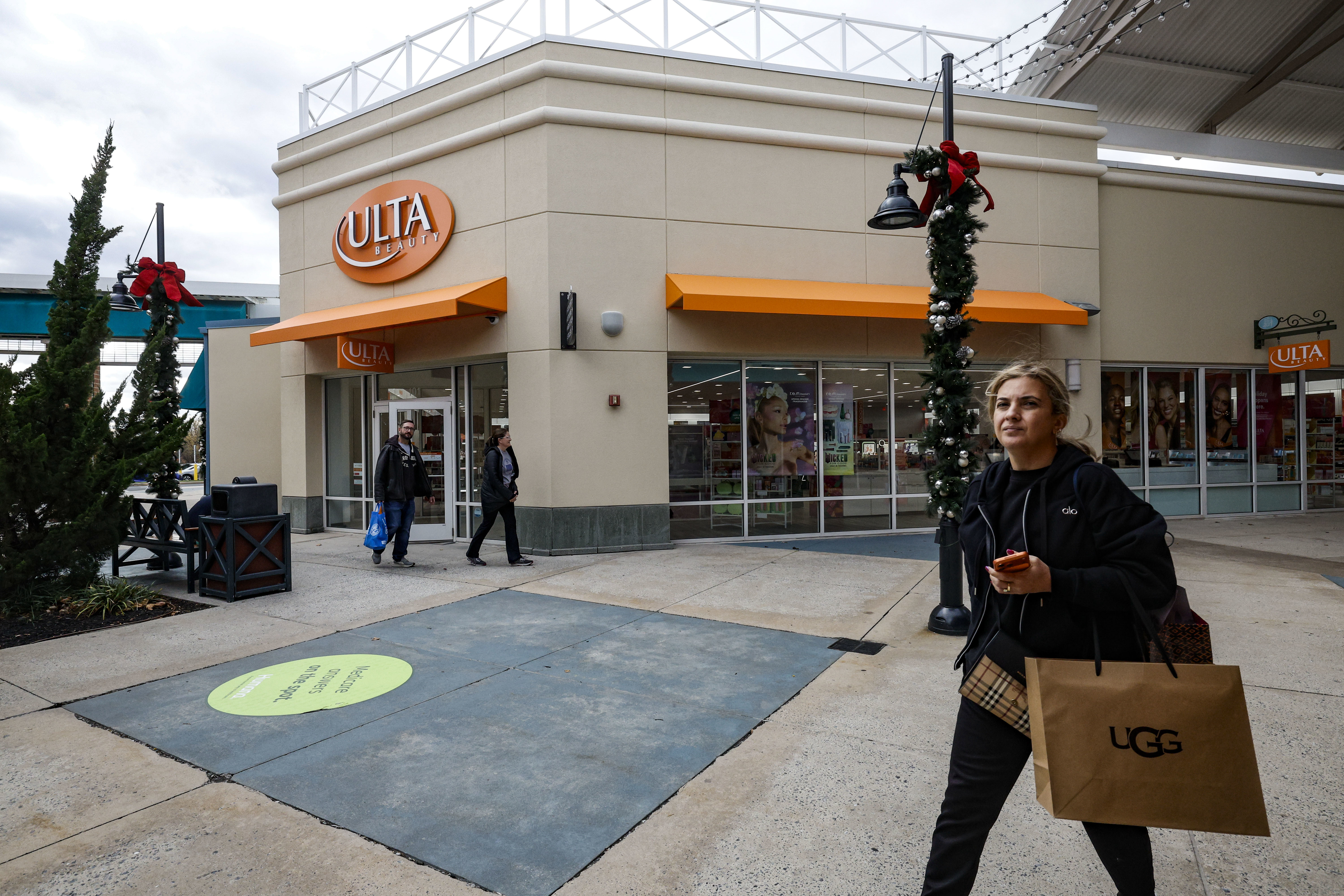
    Shoppers walk by a new Ulta store at the Philadelphia Premium Outlets.

    At Simon outlets, customers can search a store’s inventory online before they make the trip, Davis said.

    “Online shopping at this point, it’s a complement,” Davis said. “It’s not viewed as competition.”

    Wagner, the outlet consultant, said she thinks even more centers will be built in the coming years, with a focus on urban and close-in suburban locations that are accessible by public transit.

    As for existing centers, she sees them thriving for the foreseeable future.

    “As long as outlets continue to emphasize a value message and use their loyalty programs to reward customers,” Wagner said, “I think they will hold their own.”

  • After big wins Tuesday, Democrats think they can oust Brian Fitzpatrick. But the Bucks Republican is resilient.

    After big wins Tuesday, Democrats think they can oust Brian Fitzpatrick. But the Bucks Republican is resilient.

    Should last week’s election results make Brian Fitzpatrick nervous?

    Bucks County Democrats think so.

    The Republican lawmaker has been like Teflon in the 1st Congressional District, which includes all of Bucks County and a sliver of Montgomery County. He persistently outperforms the rest of his party and has survived blue wave after blue wave. First elected in 2016, he has remained the last Republican representing the Philadelphia suburbs in the U.S. House.

    But Democrats pulled something off this year that they hadn’t done in recent memory. They won each countywide office by around 10 percentage points — the largest win margin in a decade — and for the first time installed a Democrat, Joe Khan, as the county’s next top prosecutor.

    Now they are looking to next year, hopeful that County Commissioner Bob Harvie, the likely Democratic nominee, succeeds where Fitzpatrick’s past challengers have failed.

    “This year was unprecedented, and sitting here a year before the midterm, you have to believe that next year is going to be unprecedented as well,” State Sen. Steve Santarsiero, who is also the county party’s chair, said Wednesday.

    Eli Cousin, a spokesperson for the Democratic Congressional Campaign Committee, predicted a “perfect storm brewing for Democrats” to beat Fitzpatrick. “He and Trump’s Republican Party are deeply underwater with Bucks County voters; he has failed to do anything to address rising costs, and we will have a political juggernaut in Gov. Josh Shapiro at the top of the ticket,” Cousin said.

    There are several reasons Democrats may be exhibiting some premature confidence: Despite a spike in turnout for an off-year election, far fewer voters turn out in such elections than do in midterms. Fitzpatrick is extremely well-known in Bucks, where his late brother served before he was elected to the seat. He has won each of his last three elections by double digits.

    Just last year, President Donald Trump narrowly won Bucks County, becoming the first Republican presidential candidate to do so since the 1980s, and Republicans overtook Democrats in voter registrations last year.

    But Tuesday was a sizable pendulum swing in the bellwether. Some of the communities, like Bensalem, that drove Trump’s victory flipped back to blue.

    The last time Democrats had won a sheriff’s race in the county was 2017, a year after Trump was elected the first time. That year, Democrats won by smaller margins, and a Republican incumbent easily won reelection as district attorney. The following year, Fitzpatrick came the closest he has yet to losing a race, but still won his seat by 3 percentage points.

    This year’s landslide, Democrats say, is a warning sign.

    “There were Democratic surges in every place that there’s a competitive congressional seat, and that should be scaring the s— out of national Republicans,” said Democratic strategist Brendan McPhilips, who managed Democratic Sen. John Fetterman’s campaign in the state and worked on both of the last Democratic presidential campaigns here.

    “The Bucks County seat has always been the toughest, but it’s certainly on the table, and there’s a lot there for Bob Harvie to harness and take advantage of.”

    Bucks County Democratic Commissioner Bob Harvie speaks during an Oct. 5 rally outside the Middletown Township Police Department and Administrative Offices in Langhorne.

    Harvie, a high school teacher-turned-politician, leapt on the results of the election hours after races were called, putting out a statement saying, “There is undeniable hunger for change in Bucks County.”

    “The mood of the country certainly is different,” Harvie said in an interview with The Inquirer on Thursday. “What you’re seeing is definitely a referendum.”

    Lack of GOP concern

    But Republicans don’t appear worried.

    Jim Worthington, a Trump megadonor who is deeply involved in Bucks County politics, attributes GOP losses this year to a failure in mail and in-person turnout. Fitzpatrick, he said, has a track record of running robust mail voting campaigns and separating himself from the county party apparatus.

    “He’s not vulnerable,” Worthington said. “No matter who they run against him, they’re going to have their hands full.”

    Heather Roberts, a spokesperson for Fitzpatrick’s campaign, noted that the lawmaker won his last election by 13 points with strong support from independent voters in 2024 — a year after Democrats performed well in the county in another off-year election. She dismissed the notion that Harvie would present a serious challenge, contending the commissioner “has no money and no message” for his campaign.

    Fitzpatrick is also a prolific fundraiser. He brought in $886,049 last quarter, a large amount even for an incumbent, leading Harvie, who raised $217,745.

    “Bob Harvie’s not going to win this race,” said Chris Pack, spokesperson for the Defending America PAC, which is supporting Fitzpatrick. “He has no money. He’s had two dismal fundraising quarters in a row. That’s problematic.”

    Pack noted Harvie’s own internal poll, reviewed by The Inquirer, showed 57% of voters were unsure how they felt about him.

    “An off-off-year election is not the same as a midterm election,” Pack said, adding he thinks Fitzpatrick’s ranking as the most bipartisan member of Congress will continue to serve him well in Bucks County.

    “He’s obviously had well-documented breaks on policy with the Republican caucus in D.C., so for Bob Harvie to try to say Brian Fitzpatrick is super far right, no one’s gonna buy it,” Pack said. “They haven’t bought it every single election.”

    On fundraising, Harvie said he had brought in big fundraising hauls for both of his commissioner races, and said he would have the money he needed to compete.

    Of the four GOP-held House districts Democrats are targeting next year in the state, Fitzpatrick’s seat is by far the safest. That raises the question: How much money and attention are Democrats willing to invest in Pennsylvania?

    “Who’s the most vulnerable?” asked Chris Nicholas, a GOP consultant who grew up in Bucks County. The other three — U.S. Rep. Scott Perry and freshman U.S. Reps. Rob Bresnahan, in the Northeast, and Ryan Mackenzie, in the Lehigh Valley — won by extremely narrow margins last year. “If you’re ranking the four races, you have Rob Bresnahan at the top and Fitzpatrick at the bottom,” Nicholas said.

    National Democrats seldom invest as much to try to beat Fitzpatrick as they say they will, Nicholas said. And he pointed to 2018, a huge year for Democrats, when they had a candidate in Scott Wallace who was very well-funded, albeit far less known than Harvie, and still came up short.

    Democrats see Harvie as the best shot they have had — a twice-elected commissioner, with name ID from Lower Bucks County, home to many of the district’s swing voters. And the 1st District is one of just three in the country that is held by a Republican member of Congress where Vice President Kamala Harris won last year.

    And then there’s Shapiro, who Democrats think will give a boost to candidates like Harvie as he runs for reelection next year. Shapiro won the district by 20 points in 2022.

    Following the playbook used by successful candidates this year, Democrats are likely to argue to voters that Fitzpatrick has done little to push back on Trump — while placing cost-of-living concerns at the feet of the Republican Party.

    “A lot of people are, you know, upset with where we are as a nation,” Harvie said. “They grew up expecting that if you worked hard and played by the rules, you’d be able to have all the things you needed and have a good life. And that’s not happening for them.”

    The Trump effect

    Democrats won races in Bucks County, and across the country, this year by tying their opponents to Trump — a tactic that was especially effective in ousting Republican Sheriff Fred Harran, who partnered his office with U.S. Immigration and Customs Enforcement. In recent cycles, that strategy has not worked against Fitzpatrick.

    “The big thing Democrats throw against Republicans is you’re part and parcel of Trump and MAGA, and Fitzpatrick voted against Trump,” Nicholas said.

    Over nearly 10 years in Congress, Fitzpatrick has been a rare Republican who pushes back on Trump, though often subtly. Fitzpatrick, who cochairs the bipartisan Problem Solvers Caucus, was the lone Pennsylvania Republican to confirm former President Joe Biden’s electoral victory in 2020. A former FBI agent who spent a stint stationed in Ukraine, he is among the strongest voices of support for Ukraine in Congress, consistently pushing the administration to do more to aid the country as it resists a yearslong Russian invasion.

    Fitzpatrick was also one of just two House Republicans to vote against Trump’s signature domestic policy package, which passed in July. He voted for an earlier version that passed the House by just one vote, which Democrats often bring up to claim Fitzpatrick defies his party only when it has no detrimental impact.

    “He’s good at principled stances that ultimately do nothing,” said Tim Persico, an adviser with the Harvie campaign. “That is what has allowed him to defy gravity in the previous cycles. … Now the economy is doing badly. … People feel worse about everything, and Fitzpatrick isn’t doing anything to help with that. I think it makes it harder to defy gravity.”

    Trump has endorsed every Republican running for reelection in Pennsylvania next year except Fitzpatrick. While the Bucks County lawmaker has avoided direct criticism of the president, in an appearance in Pittsburgh over the summer, Trump characterized the “no” vote on the domestic bill as a betrayal.

    Fitzpatrick has faced more conservative primary challengers in the past, but no names have surfaced so far this cycle, a sign that even the more MAGA-aligned may see him as their best chance to hold onto the purple district.

    Keeping his distance from Trump, and limiting Democrats’ opportunities to tie the two together, may remain Fitzpatrick’s best path forward.

    “Anybody who wants to align themselves with an agenda of chaos and corruption and cruelty ought to be worried,” said Khan, Bucks County’s new district attorney-elect.

    This suburban content is produced with support from the Leslie Miller and Richard Worley Foundation and The Lenfest Institute for Journalism. Editorial content is created independently of the project donors. Gifts to support The Inquirer’s high-impact journalism can be made at inquirer.com/donate. A list of Lenfest Institute donors can be found at lenfestinstitute.org/supporters.

  • Party soul-searching, the Latino vote, and a South Jersey strategy: Takeaways from Tuesday’s election

    Party soul-searching, the Latino vote, and a South Jersey strategy: Takeaways from Tuesday’s election

    A Navy pilot in New Jersey. A democratic socialist in New York City. Three Pennsylvania jurists who never wanted to hit the campaign trail in the first place.

    The Democrats who scored big wins in Tuesday’s elections came from across the political spectrum and succeeded in disparate campaign environments.

    The results were momentous for a party hungry for wins in President Donald Trump’s second term. But they are also likely to revive longstanding debates on how the party should present itself to the American people going into the 2026 midterms and 2028 presidential race.

    Should Democrats embrace a bold vision and tack left? Are left-of-center candidates with bipartisan appeal still the way to win statewide races? Or could the party simply embrace the reality of being a big-tent party?

    Here are five takeaways from Tuesday’s elections, including the state of play for both parties’ soul-searching exercises.

    Democrats gained momentum, but received no clear signs about the future of the party

    The energy is clearly there.

    Turnout soared on Tuesday, despite being an off-year election, and Democrats won by surprisingly large margins up and down the ballot.

    Even Montgomery County, where there were no competitive elections for county offices, saw its highest-ever off-year turnout at 50.7% of registered voters, and Democrats flipped every contested school board race.

    At the top of the ticket, New Jersey’s Mikie Sherrill and Virginia’s Abigail Spanberger, both U.S. representatives with national security backgrounds, ran up the scores in their gubernatorial races while portraying themselves as pragmatists.

    window.addEventListener(“message”,function(a){if(void 0!==a.data[“datawrapper-height”]){var e=document.querySelectorAll(“iframe”);for(var t in a.data[“datawrapper-height”])for(var r,i=0;r=e[i];i++)if(r.contentWindow===a.source){var d=a.data[“datawrapper-height”][t]+”px”;r.style.height=d}}});

    Zohran Mamdani, meanwhile, handily defeated former Gov. Andrew Cuomo in the New York City mayor’s race by promising radical change and progressive policy solutions.

    So where does that leave Democrats as they try to find a recipe for success in next year’s congressional races?

    For Philadelphia’s progressive District Attorney Larry Krasner, who won a third term Tuesday, the answer is clear.

    “There’s a new politics,” Krasner said Wednesday. “It’s pretty clear that the American people, Philadelphians, are tired of insiders who promise them things they don’t do. They’re tired of political dynasties.”

    window.addEventListener(“message”,function(a){if(void 0!==a.data[“datawrapper-height”]){var e=document.querySelectorAll(“iframe”);for(var t in a.data[“datawrapper-height”])for(var r,i=0;r=e[i];i++)if(r.contentWindow===a.source){var d=a.data[“datawrapper-height”][t]+”px”;r.style.height=d}}});

    Democratic strategist Brendan McPhillips, who has worked for progressive candidates as well as Joe Biden’s and Kamala Harris’ campaigns in Pennsylvania, said the party should embrace the ideological diversity of its constituencies.

    “People have tried to ask this question of who represents the soul of the party, and I just think it’s a bad question,” he said. “The party is a huge tent, and last night proves you can run for Democratic office in New York City and New Jersey and Bucks County and Erie, Pa., and each of those races can look entirely different.”

    Democrats made gains with Latino voters

    One of the more worrying signs for Democrats in the Trump era has been the president’s increasing popularity among Latino voters.

    They flipped that narrative Tuesday.

    After 10 months of aggressive U.S. Immigration and Customs Enforcement raids under Trump that are seen by many in the Latino community as indiscriminate and cruel, Democrats appear to have undone some of Trump’s gains in what has long been a blue constituency.

    In New Jersey, the two counties where Sherrill made the biggest gains compared with Harris in the 2024 presidential election were Passaic and Hudson, both of which are more than 40% Hispanic, according to the U.S. Census.

    Sherrill won Hudson by 50 percentage points, which represents a 22-point swing from Harris. And she won Passaic by 15 percentage points after Trump surprisingly carried the county with a 3-point margin in 2024.

    In Philadelphia, Krasner won eight wards that the more conservative Patrick Dugan — Krasner’s opponent in both the general election and the Democratic primary — had won in their first round in May.

    All were in or near the Lower Northeast, and the biggest swing came in the heavily Latino 7th Ward, which includes parts of Fairhill and Kensington. Krasner’s share of the vote there grew from 46% in the primary to 86% in the general.

    It’s really hard to unseat Pennsylvania judges

    Only one Pennsylvania Supreme Court justice since 1968 has failed to win a retention election, in which voters face a yes-or-no decision on whether to give incumbents new 10-year terms, rather than a choice between candidates.

    Tuesday’s results will be discouraging for anyone hoping to increase that number soon.

    Hoping to break liberals’ 5-2 majority on the state’s highest court, Republicans spent big in an attempt to oust three justices who were originally elected as Democrats. Democratic groups then poured in their own money to defend the incumbents.

    In the end, Justices Christine Donohue, Kevin Dougherty, and David Wecht all won by more than 25 percentage points.

    Ciattarelli’s South Jersey strategy failed

    In his third attempt to become governor, Republican Jack Ciattarelli bet big on South Jersey, the more conservative but less populous part of the Garden State.

    It didn’t work.

    In his 2021 campaign against Democratic Gov. Phil Murphy, Ciattarelli carried Atlantic, Cape May, Cumberland, Gloucester, and Salem Counties with a combined 56.8% of the vote. Trump then went on to sweep all five counties last year.

    But on Tuesday, Ciattarelli performed 8 percentage points worse in the region, giving Sherrill a narrow lead in South Jersey, where she won three of the five counties south of Camden.

    (function() { var l = function() { new pym.Parent( ‘sj-shift__graphic’, ‘https://media.inquirer.com/storage/inquirer/ai2html/sj-shift/index.html’); }; if(typeof(pym) === ‘undefined’) { var h = document.getElementsByTagName(‘head’)[0], s = document.createElement(‘script’); s.type = ‘text/javascript’; s.src = ‘https://pym.nprapps.org/pym.v1.min.js’; s.onload = l; h.appendChild(s); } else { l(); } })();

    Republicans now face their own soul-searching question: How to win without Trump?

    In 2024, Trump’s coattails helped Republicans win control of Congress and other elected offices across the country — including in two Pennsylvania swing districts.

    With the president in his second and final term, how will the GOP win without him on the ballot?

    For Jim Worthington, the Trump megadonor and owner of the Newtown Athletic Club in Bucks County, Tuesday’s results show that the GOP needs to do more work on the ground if it wants to succeed without the man who has dominated Republican politics since 2015.

    Elections, he said, are “not about the policies as much they’re just turnout. Red team, blue team.”

    The blue team won Tuesday, he said, because the red team didn’t do enough of the legwork needed to get its voters to cast mail ballots and to drive in-person turnout on Election Day. Worthington said the results left him concerned about Republican Treasurer Stacy Garrity’s chances of unseating Democratic Gov. Josh Shapiro next year.

    “If we don’t get a robust vote-by-mail, paid-for program, it’s going to be very difficult, very difficult, if not impossible for Stacy Garrity to win,” Worthington said. “During this whole 2025 year when we could have been building this toward 2026, we lost a year because we didn’t do it.”

    Staff writer Anna Orso contributed to this article.

    This suburban content is produced with support from the Leslie Miller and Richard Worley Foundation and The Lenfest Institute for Journalism. Editorial content is created independently of the project donors. Gifts to support The Inquirer’s high-impact journalism can be made at inquirer.com/donate. A list of Lenfest Institute donors can be found at lenfestinstitute.org/supporters.

  • $1M in taxpayer money will be used to make security upgrades at Gov. Josh Shapiro’s private residence

    $1M in taxpayer money will be used to make security upgrades at Gov. Josh Shapiro’s private residence

    Spotlight PA is an independent, nonpartisan, and nonprofit newsroom producing investigative and public-service journalism that holds power to account and drives positive change in Pennsylvania. Sign up for our free newsletters.

    HARRISBURG — Taxpayers are paying for roughly $1 million in security upgrades to Gov. Josh Shapiro’s private home in Montgomery County, according to information the administration disclosed to top lawmakers about its expenditures in the aftermath of the brazen arson attack on the first family earlier this year.

    In a Friday letter to legislative leaders, administration officials said improvements include “erecting physical and visual barriers on the property, installing enhanced security technology, and other steps.” They then noted that due to safety concerns, they could not provide more details about the work being conducted at Shapiro’s private home.

    The letter, authored by Pennsylvania State Police Commissioner Christopher Paris and Department of General Services Secretary Reggie McNeill, also disclosed safety upgrades totaling $32.3 million at the governor’s official residence in Harrisburg, including $8 million to retrofit the mansion with new windows that are bullet- and shatterproof.

    The attack occurred at the 29,000-square-foot mansion this past April while the governor and his family were asleep inside.

    “The horrifying attack on the Governor, his family, and Commonwealth property, coupled with the unfortunate rise in political violence across our country, has made these updates necessary to protect the Governor and his family and ensure the continued operation of the executive branch of the Commonwealth,” Paris and McNeill wrote. “No family should have to live behind bulletproof glass or behind large walls — but the nature of the threats against elected officials today require us to take these important steps.”

    They added: “Unfortunately, the threat to a high-profile elected official like Gov. Shapiro does not end when he leaves the Governor’s Residence.”

    In a statement, Shapiro spokesperson Rosie Lapowsky said the State Police conducted a security review of the governor’s personal residence and recommended a number of improvements. Before carrying out any of those improvements, she said the administration “consulted the Ethics Commission … to ensure there is no improper private, pecuniary gain from these security improvements.”

    Last week, Harrisburg resident Cody Balmer pleaded guilty to attempted murder, aggravated arson, and other charges related to the attack in the dead of the night on April 13. That is when Balmer scaled the perimeter fence at the governor’s official residence along the banks of the Susquehanna River, broke two windows, and used crude, homemade Molotov cocktails to set fire to several rooms on the residence’s first floor.

    Shapiro, his family, and friends had celebrated Passover just hours before, and were asleep on the second floor of the residence when Balmer broke in. Balmer told authorities that he would have beaten Shapiro with a hammer he had with him if he had encountered the governor.

    The Democratic governor has said that he and his family are still struggling with the emotional toll of the attack, but stressed that he will not be deterred from continuing in public service.

    It is not clear what prompted Paris and McNeill’s letter. Earlier this week, Spotlight PA submitted a public records request for all taxpayer-funded expenditures at the governor’s private home.

    Also midweek, Republican state Sen. Jarett Coleman, who chairs the chamber’s Intergovernmental Operations Committee, fired off a letter to Paris seeking similar information about physical improvements to Shapiro’s Montgomery County home, among other items.

    Coleman told Spotlight PA on Friday that his committee will “continue to investigate” spending at the governor’s private residence “to protect taxpayers as this unprecedented project is being completed.”

    Spotlight PA last month reported that the state has spent more than $6 million to repair extensive damage from the fire at the governor’s official residence — but that the administration is shielding information about nearly a quarter of those expenses, including who was paid and exactly what the money was spent on.

    The news organization has also reported that private donors have separately contributed to a fund managed by a Harrisburg-based nonprofit to help restore the mansion. So far, neither the organization nor the administration has disclosed the donors’ identities, the amount they contributed to the fund, or provided a general description of what that money has or will be used for.

    In the letter sent to legislative leaders, the administration shed light on at least some of those questions. The officials said that to date, the state has submitted $4.5 million in expenses to one of its insurers, which in turn has so far approved $2 million in reimbursements.

    Security upgrades and improvements to the official residence, however, are not covered by the state’s insurance plans. The security improvements — recommended by a third-party review commissioned by the State Police in the wake of the attack — there include:

    • An estimated $14 million to replace the 6-foot fence that Balmer scaled with a “single material, 10-foot barrier resistant to vehicle damage or climbing.”
    • An estimated $6.3 million to install updated cameras, improve lighting, and add motion detection sensors in the residence’s yard.
    • An estimated $8 million to retrofit the residence’s existing windows with bulletproof and shatterproof glass.
    • An estimated $4 million to install a comprehensive fire suppression system in the residence, one of the largest state-owned buildings without one.

    “In addition to the visible and extensive building security enhancements outlined above, additional recommendations on things like staffing, internal systems, and other technology improvements have been implemented,” by the state, Paris and McNeill wrote. “To avoid risk of a successful security threat against the property or the Governor in the future, we cannot disclose all of those recommendations publicly.”

    The two men noted that the fire damaged multiple decorative items inside the residence, including chandeliers, china, pianos, and artwork. Most of those items, they said, do not qualify for insurance reimbursement, and their repair or replacement will be funded by private dollars.

    BEFORE YOU GO… If you learned something from this article, pay it forward and contribute to Spotlight PA at spotlightpa.org/donate. Spotlight PA is funded by foundations and readers like you who are committed to accountability journalism that gets results.

  • King of Prussia Mall is getting a real-life gaming venue with a bar-restaurant

    King of Prussia Mall is getting a real-life gaming venue with a bar-restaurant

    Another experiential retail concept is coming to the region. This time it’s a live social-gaming venue at the King of Prussia Mall.

    Massachusetts-based Level99 announced this week that it plans to bring its next “sprawling adult playground” to the Montgomery County shopping destination in 2027. The move marks the company’s first foray into the Philadelphia market.

    The 46,000-square-foot venue will include 50 “life-size mini games” geared toward adults, according to a news release, and a full-service restaurant and bar serving local craft beer.

    “Level99 goes beyond your conventional entertainment venue — it’s a place to play, explore, and actively connect,” Matthew DuPlessie, founder and CEO of Level99, said in a statement.

    The venue is moving into the ground floor of the former JCPenney, which closed in 2017.

    It will be across the mall from the 100,000-square-foot Netflix House. The immersive experience for fans of the streaming service’s shows is set to open Nov. 12 in the former Lord & Taylor department store.

    Level99 customers race through the venue’s signature “Axe Run” game, one of 50 mini-challenges set to be part of King of Prussia’s location when it opens in 2027.

    “We’re thrilled to welcome Level99 to King of Prussia, further elevating our commitment to delivering dynamic, experience-driven destinations,” Mark Silvestri, president of development for mall owner Simon Property Group, said in a statement. ”This innovative concept brings a new layer of interactive entertainment to King of Prussia and is a perfect complement to our growing lineup of immersive offerings.”

    As more consumers shop online, experiential retail has transformed malls nationwide, helping complexes fill empty spaces and attract new customers.

    In the Philadelphia region, Cherry Hill Mall is set to open a Dick’s House of Sport next year. The 120,000-square-foot space will include a climbing wall, golf simulators, a running track, and batting and soccer cages.

    At the Moorestown Mall, an empty department store is set to be filled by a massive entertainment center with axe-throwing and go-karts.

    In Center City, the Fashion District’s owners are considering adding more experiential retail after the success of nearby spots like Puttshack mini golf and F1 Arcade.

    And along with the forthcoming Netflix House, the King of Prussia Mall recently opened the Philadelphia area’s first Eataly, a 21,000-square-food Italian-centric marketplace and wine shop.

    At Level99 venues, customers can choose from 50 mini-games that test mental and physical skills.

    Level99 has been riding this experiential retail wave, opening its flagship location in 2021 at the Natick Mall in suburban Boston. The company opened another location in Providence, R.I., in January 2024, then added a third this summer in the Washington suburb of Tysons, Va. It has projects under construction in Hartford, Conn., and at Disney Springs in Orlando.

    At existing Level99 locations, pricing starts at $29.99 per person for two hours of play, according to its website. Prices increase on weekends and holidays, and if a customer wants more time.

    Level99 is supported by Act III Holdings, a $1.5 billion private-equity investment firm led by Panera Bread cofounder and Cava chairman Ron Shaich. Last month, Act III executives announced a $50 million commitment to the chain’s expansion into new markets, including Philadelphia.

    Unlike some other Philly-area malls, King of Prussia is thriving, with more than 450 stores occupying 2.9 million square feet of retail space.

  • Ursinus College suddenly removes president, citing ‘best interests of the college’s long-term success’

    Ursinus College suddenly removes president, citing ‘best interests of the college’s long-term success’

    Ursinus College president Robyn E. Hannigan, who was in her fourth year at the small liberal arts school in Collegeville, was abruptly removed from the job Thursday and her Ursinus webpage was removed.

    ”I met with the board this morning,” said Hannigan, 60, who was reached by phone. “I was let go. It’s the board’s decision. It’s not for cause. The board wanted to go in a different direction.”

    She declined to disclose what the board told her at the meeting.

    In a statement, the college said it was a board decision “made in the best interests of the college’s long-term success.”

    Joseph DeSimone, chair of the college’s board of trustees and a 1986 Ursinus grad, declined in an interview to say why the board chose to part ways with Hannigan, saying it was a personnel decision. The leadership change is happening just as the college is about to celebrate homecoming weekend.

    The move comes after the college experienced a 10% decline in first-year enrollment this fall and a 6.4% decline in overall enrollment, which stands at 1,406.

    The college also was coping with financial challenges, in part because of the enrollment decline, but also because the retention rate last year for returning freshmen was 77%, six percentage points lower than the school’s average, Hannigan told the student newspaper, the Grizzly, in an interview published Oct. 2.

    “We have a structural deficit, which means that we’re not living within our means and our revenues are not enough to cover our expenses,” she told the Grizzly. “So we have to fix that.”

    She told the student newspaper that Ursinus took steps last year to “right the ship” financially and launched APEX, a program designed to better align academics with experiential learning and career prep. That is expected to bring enrollment back up, she said.

    The college is offering students up to $2,000 for internships, team-based career coaching and advising, and a week for first-year students devoted to real world problem-solving.

    The college plans to hold a town hall for faculty and staff at noon Friday.

    “This decision should not reflect in any way on the strength of the college and its direction,” Hannigan told The Inquirer. “It is the nature of the business that we are in.”

    The news stunned the campus community.

    “I was just baffled,” said senior Renee Washart, editor in chief of the Grizzly. “I did not see this coming at all.”

    She said she met with Hannigan on Monday, as she does once every month in her role as editor, and there was no indication of the change.

    “She was talking about future plans for Ursinus,” said Washart, a chemistry and English major from Frederick, Md.

    Washart said she was in class when an email came to campus about the change in leadership and her phone “started blowing up.” Her professor, she said, was hearing it for the first time, too.

    Hannigan, an academic in the sciences who holds several patents, said that she was under a contract that goes for “another couple years” and that she would be on leave for a few weeks while a separation agreement is worked out.

    DeSimone, a professor of Translational Medicine and chemical engineering at Stanford University, said in an announcement to the campus shortly before 11:30 a.m. that Gundolf Graml, the provost, will serve as interim president.

    “The board has full confidence in Dr. Graml to ensure continuity of operations and to advance the college’s strategic priorities,” the college said in a statement. “The college’s mission, values, and commitment to our students remain unchanged.”

    In an interview, DeSimone said there were no current plans to launch a search for a new president and that Graml and the executive team were well positioned to lead the college forward. Applications and donations are up, he said.

    Hannigan came to Ursinus in July 2022 from Clarkson University in Potsdam, N.Y., where she was the provost. She was the first permanent female leader of Ursinus and the first of Native American descent.

    In a 2022 interview with The Inquirer, she said she was a first-generation college student whose parents scraped to save enough to pay for her first year of college and whose older brother chose to forgo college so that she could go.

    She grew up in New Jersey and received a bachelor’s degree in biology from the College of New Jersey, a master’s in geology from SUNY Buffalo, and a doctoral degree in earth and environmental science from the University of Rochester.

    Hannigan described her departure from Ursinus as “a friendly separation.”

    “The college has been doing great work in trying to turn around and do what it needs to do to thrive in the future,” she said.

  • Republicans could end the government shutdown tomorrow

    Republicans could end the government shutdown tomorrow

    The Republican Party controls the federal government. It holds the majority in the House and the Senate, and controls the White House, as well.

    Republicans could end the government shutdown tomorrow. A quick vote by the majority in the House and, after a rules change, by the majority in the Senate, followed by a presidential signature, would pass a budget into law and reopen the government.

    Yet, absurdly, President Donald Trump and his followers are blaming congressional Democrats for the shutdown. This is ridiculous. The Democrats have little power in Washington these days.

    Their only sway comes in the ability to filibuster in the Senate, but that can be easily taken away by a simple majority vote by the Republicans.

    No, as President Trump might say, the Republicans hold all the cards.

    The president, for months, has been openly targeting Democrats as he uses and misuses his presidential powers.

    Threatening Democrats

    He states, on the record, that he will defund what he considers Democratic programs, agencies, and communities. He brags about using federal law enforcement and even the military in American cities, even though their Democratic leaders object.

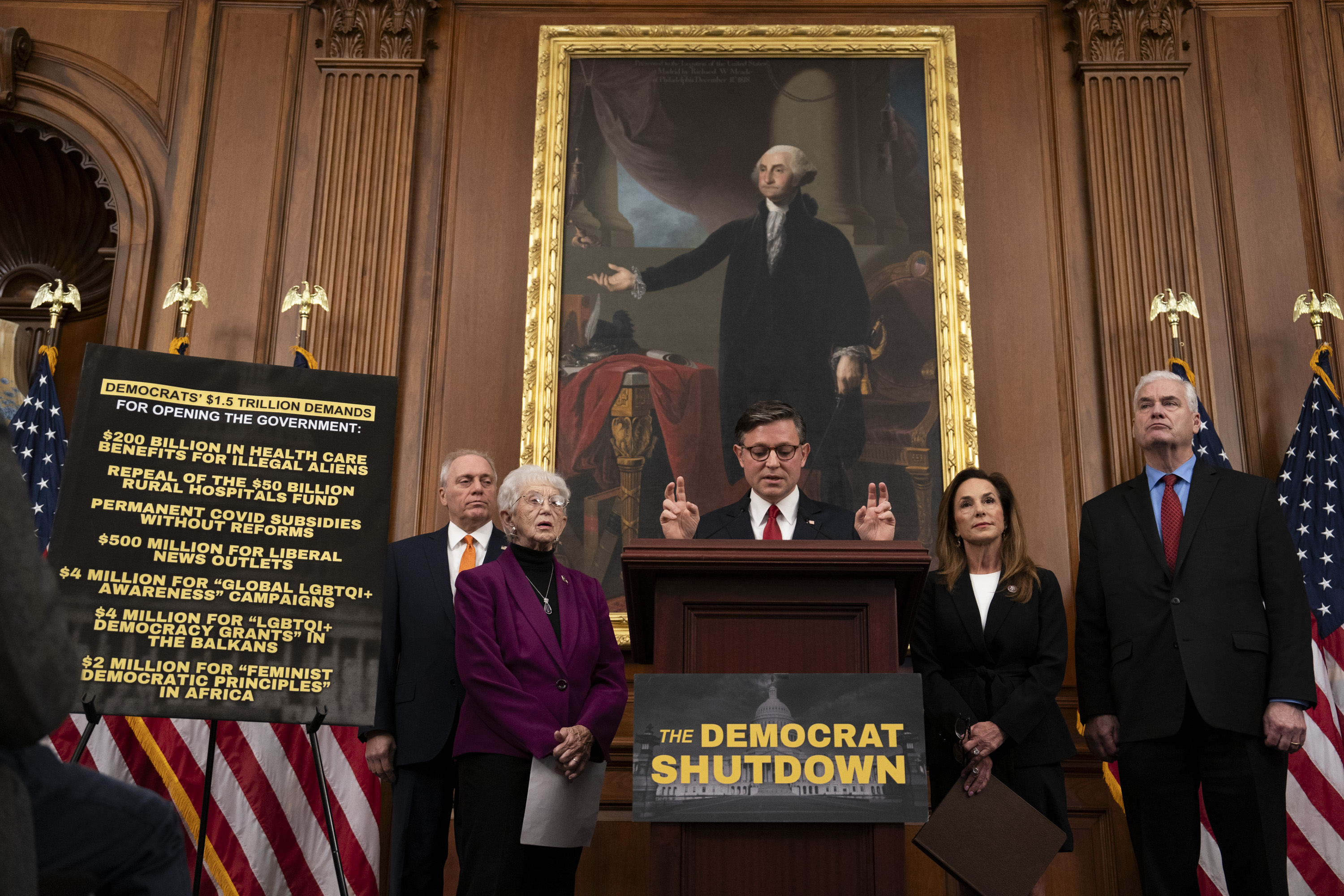
    House Speaker Mike Johnson gathers Republican leaders at a news conference last week to blame Democrats for the government shutdown. That’s ridiculous, writes Joseph Hoeffel.

    The country has never seen such presidential partisanship, overreach, and lawlessness.

    Now, Kristi Noem, the secretary of Homeland Security, is abusing her powers and playing politics regarding the shutdown.

    Last week, she produced a video for the Transportation Security Administration, which she supervises, to show at TSA security checkpoints in airports across the country. In the video, Noem blames congressional Democrats for the government shutdown and any related travel delays.

    She says, in part, “Democrats in Congress refuse to fund the federal government, and because of this, many of our operations are impacted … our hope is that Democrats will soon recognize the importance of opening the government.”

    Congress created the U.S. Department of Homeland Security in 2002 with strong majority votes in each chamber.

    No member suspected that a future secretary would so blatantly engage in partisanship on the job. Petty politics should never infect this particular department and its critical national security responsibilities.

    A number of airports around the country, including Los Angeles, Phoenix, Cleveland, and Charlotte, N.C., are refusing to run the TSA video, citing the political nature of its content.

    Any airport, public or private, that receives federal or state funding could be breaking the laws against political activity by recipients of government money if they show the video.

    I doubt this legal jeopardy Noem is creating through her avid partisanship will give her any pause. Nor will any worries about her job security.

    She is doing exactly what Trump wants her to do: Blame the Democrats at every opportunity for anything that is not working in the federal government.

    But the Republicans could pass a budget and reopen the government tomorrow.

    They need only to suspend the Senate rule that permits the Democrats to filibuster. Any Senate rule can be changed at any time by a simple majority vote.

    Elections have consequences

    In fact, the Senate Republicans just suspended such a rule last month so they could approve a large group of military and civilian appointees by a single en bloc vote, rather than the regular process of individual committee hearings and separate votes on each appointee.

    I am sure I would not like the budget priorities that unfettered congressional GOP majorities and Trump would produce.

    But elections have consequences.

    A single party controls our federal government by the will of the voters. I accept that and will fight it out at the next election.

    Why won’t the Republicans pass a budget and end the government shutdown? Do they think playing the political blame game is more important than governing?

    Let them use the power the voters gave them and accept the responsibility to govern. Let them accept the credit or the blame for the actions they take.

    And stop blaming the Democrats because the Republicans will not do their job.

    Joseph Hoeffel is a former Democratic member of Congress from Montgomery County (13th Congressional District, 1999-2004). He lives in Abington.

  • Gov. Josh Shapiro will release a memoir in 2026

    Gov. Josh Shapiro will release a memoir in 2026

    Pennsylvania Gov. Josh Shapiro will release a memoir next year detailing his career and personal life, including when a man firebombed the governor’s mansion while Shapiro and his family slept inside and his place on the short list for Kamala Harris’ vice president.

    On Tuesday, Harper — an imprint of HarperCollins Publishing — announced the release of Shapiro’s forthcoming memoir, Where We Keep the Light: Stories From a Life of Service, which will hit shelves on Jan. 27, 2026.

    Shapiro is the latest potential 2028 Democratic presidential contender to announce a book deal, another step in building and defining a national profile.

    Shapiro, 52, has worked in some level of government for his entire career: on Capitol Hill as a staffer, in Montgomery County as a commissioner, and in Harrisburg as a state representative, attorney general, and now governor. He has noted that he has never lost an election, going back to his election as student body president his freshman year at the University of Rochester. Along the way, elected officials have whispered about his talents as a politician, orator, and rumored presidential ambitions.

    The Montgomery County native has become a key player in the national Democratic Party, touting a brand as a governor of a split legislature in the most sought-after swing state. His administration’s motto is “Get Stuff Done,” which he defines as bringing Democrats and Republicans together to accomplish long-delayed reforms, or restarting residents’ trust by improving their interactions with state government. (Pennsylvania still has not finished its state budget, which was due July 1, as legislators from the Democratic-controlled House and GOP-controlled Senate cannot agree on how much they should spend this fiscal year and causing school districts, counties, and nonprofits to take out significant loans to continue offering services during the 113-day budget impasse.)

    Shapiro’s rise through the Democratic Party ranks skyrocketed last year, when he became a front-runner for vice president during Harris’ whirlwind, 107-day presidential campaign, in which she ultimately chose Minnesota Gov. Tim Walz as her running mate. Harris also released a book this year, which includes stories from her interview with Shapiro for the role.

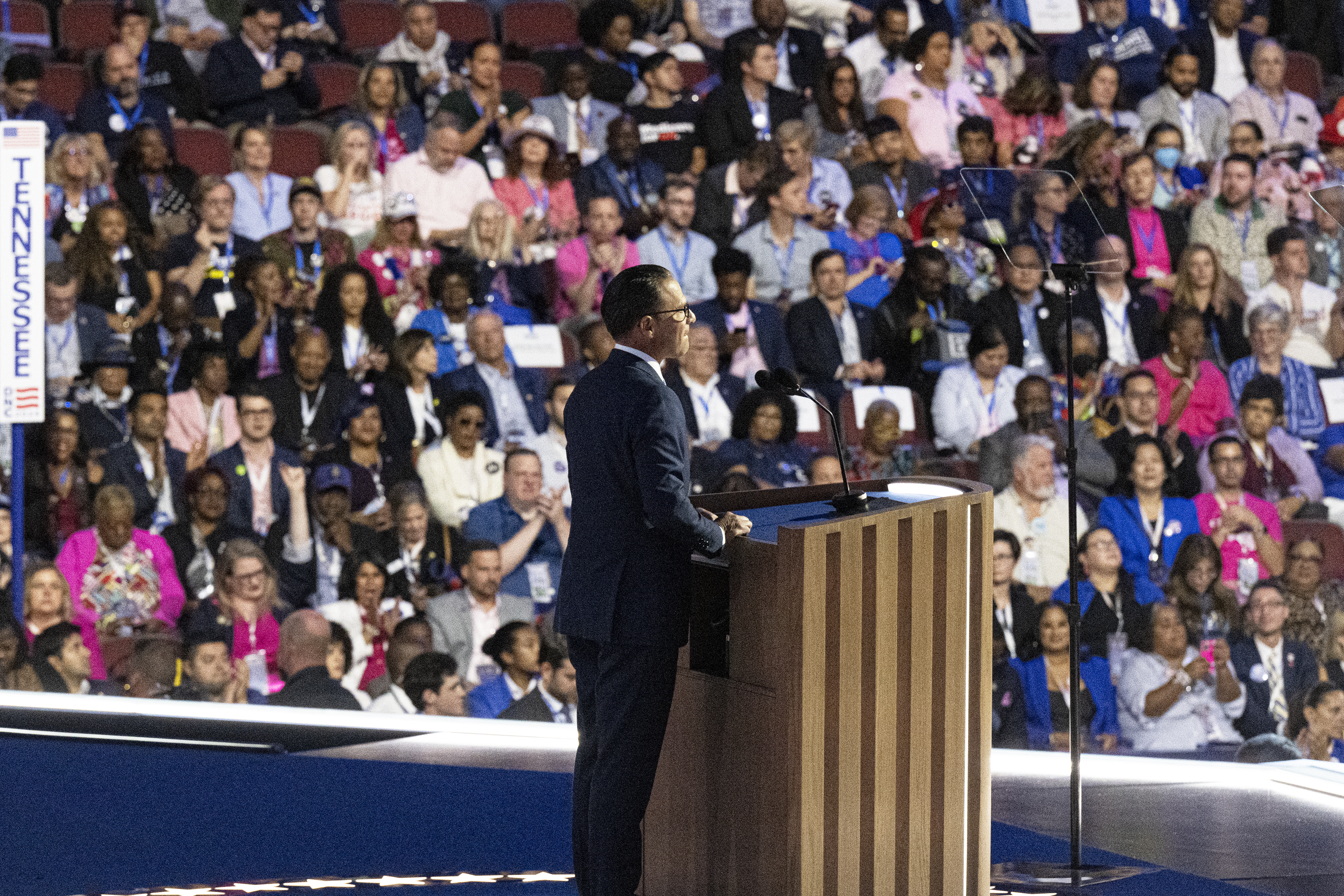
    Pennsylvania Gov. Josh Shapiro speaks during the Democratic National Convention Wednesday, Aug. 21, 2024, in Chicago.

    While book deals are often signifiers for officials hoping to take another step up in government, Shapiro still faces reelection next year. He will likely face Treasurer Stacy Garrity, a Republican who has already captured the state GOP’s endorsement. Garrity is a retired U.S. Army colonel, and has focused some of her criticisms of Shapiro thus far on his presumed eye for higher office. However, Shapiro still maintains a high approval rating in Pennsylvania, a state President Donald Trump won last year.

    Shapiro’s memoir will also detail the arson attack on the governor’s mansion, in which, just hours after Passover earlier this year, Cody Balmer set the home ablaze with incendiary devices. Balmer pleaded guilty last week to attempted murder.

    Shapiro, who was born in Kansas City, Mo., before moving to Montgomery County, has credited his upbringing by his parents — his father a pediatrician, and his mother an educator — as laying the foundation for his life in public service. Shapiro has four children and is married to his high school sweetheart, Lori. He and his family still live in Abington Township and split their time between their family home and the governor’s mansion in Harrisburg.

  • A Montco woman who let her son waste away in her apartment sentenced to decades in prison

    A Montco woman who let her son waste away in her apartment sentenced to decades in prison

    A Montgomery County judge sharply rebuked a Dresher woman Monday before sentencing her to 25 to 50 years in state prison in the murder of her son, telling her that she failed in her fundamental duties as a parent by allowing him to waste away to just 59 pounds.

    During the hearing before Judge Wendy Rothstein, Sherrilynn Hawkins, 43, wept, calling Tylim Hatchett her “first love” and best friend while pleading guilty to third-degree murder, neglect, and related crimes in his September 2024 death.

    She described how the 21-year-old fought all his life to overcome cerebral palsy, blindness and other debilitating medical issues, and required constant care to, among other things, feed himself.

    “I made Tylim a promise to keep him safe, and after 21 years, I failed and broke that promise,” Hawkins said. “And I will always be sorry for that.”

    Despite Hawkins’ professed remorse, prosecutors said, in the last three weeks of her son’s life, she frequently left him alone in her apartment, sometimes for 24 hours at a time.

    All the while, she accepted funding from Aveanna, a home healthcare agency, to work as her son’s primary caregiver. She also included Lorretta Harris, one of her friends, on that payroll to receive a portion of the money to care for him part-time.

    In reality, neither woman spent much time with Hatchett and falsified their records with the agency, despite being paid more than $48,000 combined, according to evidence presented in court Monday.

    Prosecutors said Tylim Hatchett weighed just 59 pounds when he died last September.

    Harris, 49, pleaded guilty to neglect of a care-dependent person earlier this year. Her sentencing is scheduled for December.

    In handing down Hawkins’ sentence Monday, Rothstein said Hawkins had betrayed her son’s trust and, even worse, had prioritized scamming Aveanna for financial gain.

    “You utilized state funding and let your child die,” she said, telling Hawkins that her conduct was despicable. “And you did all this while driving around in a Mercedes.

    “I’d like to say more, but I’m left speechless that a parent could do this.”

    Hatchett was found dead Sept. 18, 2024, inside his mother’s apartment at the Residences at the Promenade, according to investigators. Police were called to the apartment by the man’s father. An autopsy found that he was severely malnourished and dehydrated.

    Evidence pulled from Hawkins’ phone by detectives showed that in the weeks leading up to her son’s death, she spent the majority of her time with her younger son, whom she brought with her to her boyfriend’s house in Philadelphia, according to the affidavit or probable cause for her arrest.

    During this time, she texted Vernon Hatchett, her son’s father, telling him “this might be it” for their son, and later that she would let him know when to make funeral arrangements.

    The elder Hatchett, 40, has been charged with neglect, abuse, and conspiracy. However, he has been a fugitive from justice for more than a year and is currently being sought by the U.S. Marshals Service.

    Hawkins also lied to concerned family members, saying she had taken her son to a nearby hospital for treatment, according to prosecutors.

    But First Assistant District Attorney Ed McCann said Monday that the only time Hawkins sought medical care for her son in 2024 was at the beginning of the year, when he weighed 90 pounds.

    Hatchett, McCann said, had lost more than third of his body weight between then and his death and had been “left alone in that apartment to die.”

    “It’s horrific. It doesn’t have anything to do with being a parent; it has everything to do with being a human being,” he said. “I think the defendant failed at the fundamentals of being a human being by allowing this to happen.”

    Hawkins’ family members and friends took turns Monday imploring Rothstein to be lenient. They told the judge that Hawkins had struggled with fertility issues in her youth and that she had endeavored to keep her son healthy and happy through his many medical issues.

    They said that she had frequently asked for assistance in caring for Hatchett and that those pleas had been ignored.

    Hawkins’ attorney, Joseph Schultz, said she is a caring and loving mother that had simply become overwhelmed.

    “Today, she took responsibility, and she’s going to have to live with this the rest of her life,” Schultz said.

  • Cheltenham High’s football season canceled amid deepening hazing investigation; officials allege physical assault

    Cheltenham High’s football season canceled amid deepening hazing investigation; officials allege physical assault

    The remainder of Cheltenham High’s football season has been canceled as officials deepen an investigation into alleged hazing by team members, which the school district said involves “inappropriate physical contact.”

    Superintendent Brian Scriven told families late Sunday night in an email that officials made the call “with a deep sense of regret” as the district extends its investigation.

    “We do not condone or tolerate hazing or abuse of any kind in our sports programs or in our schools,” Scriven wrote. “It is our duty and obligation to protect and prioritize student safety and well being, even when we know that our decisions may come with consequences and disappointment.”

    Scriven canceled Friday’s home football game — the team was supposed to play Bristol Township’s Harry S. Truman High School at nearby Springfield High, as Cheltenham’s field was unavailable — hours before the game was to begin. At that time, he called it a temporary suspension of the season.

    The decision caused shock and anger. Senior Night was scheduled, with recognition ceremonies planned for athletes and members of the cheerleading, pep band, color guard, and drum line programs.

    “We are very sensitive to the emotions of those most directly impacted,” Scriven wrote.

    Only one game remained on the schedule — Friday at Quakertown.

    Officials learned of multiple incidents

    News of the alleged hazing came three weeks ago, Scriven said, when someone reported that a student was assaulted in the football locker room.

    Officials alerted ChildLine, the state’s abuse-reporting system, which they are legally mandated to notify when alleged abuse happens. They also notified Cheltenham police, which began its own investigation.

    At the time, they believed the incident to be isolated, Scriven said in the letter.

    But as the investigation developed, “additional information came to light indicating that hazing and/or inappropriate physical conduct may be occurring more broadly in the program. Last Friday, we received additional information, including reports indicating multiple team members engaged in hazing through physical contact.”

    That’s when officials decided to temporarily suspend the season and investigate further. The district began working with an external consultant over the weekend, Scriven said, and the investigation remains ongoing.

    The police investigation is also ongoing, said Scriven, who urged anyone with information to contact Cheltenham police. He said the district is cooperating with police and has also been in touch with the Montgomery County District Attorney’s Office.

    “Hazing is a very serious and significant issue in school athletic programs and can lead to criminal charges,” Scriven wrote. “We ask for continued patience and respect for our obligation to thoroughly investigate these allegations. We also ask that our school community not rush to judgment against any of our student-athletes or coaches.”

    Saving Senior Night

    Senior Night will be recreated in some ways, Scriven said — for those football players, cheerleaders, and members of the pep band, drum line, and color guard uninvolved in the alleged hazing.

    “We will do our very best to involve students as we develop new plans to honor our seniors,” Scriven said.

    “As a parent, educator, and former coach and student-athlete, I am troubled by this matter on numerous levels,” Scriven said. “This decision is not one that was made lightly. I will continue to communicate as openly as possible as we work through this in the coming days and weeks.

    “We must move forward as a district and school community committed to student safety and respect, and do all we can to uphold those values.”