
Councilmember Curtis Jones Jr. and City Representative Jazelle Jones, who are married, are poised to collect up to $752,000 in combined payouts from Philadelphia’s widely criticized Deferred Retirement Option Plan, an early retirement incentive that two decades ago sparked a major scandal in City Hall.
But neither of the city officials is actually retiring.
DROP is available to all city workers. But both of the Joneses are using the program in a way that is not available to a vast majority of municipal employees: temporarily retiring and immediately returning to their jobs, allowing them to receive their DROP payouts before the end of their city government careers.
Curtis Jones, 68, who has represented the 4th District for 18 years, is able to access that perk because he is a long-serving lawmaker. Jazelle Jones, 70, a high-ranking appointee of Mayor Cherelle L. Parker, received an exception from the mayor to be rehired after her DROP retirement.
Following her one-day retirement, Jazelle Jones also received a $97,000 payout for unused sick and vacation time, a benefit normally reserved for employees permanently departing from city government.

Lauren Cristella, president of the government watchdog group Committee of Seventy, said the administration’s handling of the situation further undermines public confidence in the DROP program.
“Rehiring an employee to the same position the day after she collects a DROP payout defeats the purpose of the program,” Cristella said. “DROP exists to manage workforce transitions, not to serve as a bonus for employees with no intention of actually leaving.”
Established in the late 1990s during Mayor Ed Rendell’s administration, DROP was originally pitched as a cost-neutral way to give the city predictability over retirements and entice high-earning employees to step down early.
But the program ended up costing the city far more than expected, and voter frustration with elected officials’ enrollment in DROP was credited with ending the political careers of several Council members.
At the height of that controversy in 2010, Curtis Jones voted to enact a law banning future elected officials from accessing DROP. But he and others already serving at that time were “grandfathered” in, Curtis Jones said.
He would be eligible to collect a $432,000 lump-sum DROP payment in August 2028. However, Curtis Jones said he plans to run for a sixth Council term in 2027, using the loophole to briefly retire to collect the payout before resuming his post.
In interviews, the Council member, who earns $165,000 annually, said he instead plans to retire in December 2027, collecting a reduced DROP payment closer to $350,000. If he is reelected, the maneuver would allow him to hang on to his Council seat for another four years by being sworn back into office the following month.
He justified his enrollment in DROP by saying that times have changed since the 2010 vote — both for the city’s finances, which have dramatically improved, and for his health. He said he is suffering from glaucoma, an incurable disease that causes vision loss.
“Over the years, I’ve had four surgeries on my eyes,” said Curtis Jones, who represents the Northwest and West Philadelphia-based Council district. “I’ve actually lost 40% of my vision.”
Curtis Jones said he enrolled in DROP “so that if I was blind, I wouldn’t have been without resources.”
A centrist Democrat, he endorsed Parker’s 2023 campaign for mayor and is viewed as her most reliable ally on Council.
His wife, Jazelle Jones — who receives a $199,000 annual salary for serving as an ambassador for the city and planning special events — temporarily retired for one day last year and was then immediately rehired by the city with a $4,000 raise.
The Philadelphia Administrative Board, which oversees personnel matters, granted her an exception to return to her job. That board is led by Parker, a staunch defender of DROP, and other top officials in her administration.
The mayor said she personally asked Jazelle Jones to return to work, and defended the decision.
Parker cited Jazelle Jones’ “lived experience” and the potential disruption her departure could cause for major events this year, like the city hosting World Cup games.
“The essential nature of her role is why I asked” Jazelle Jones to continue working, Parker said Tuesday in a phone interview. “And I’m unapologetic about asking. It’s one of the most important decisions I’ve made as mayor.”
Jazelle Jones was originally scheduled to retire in September 2024. Instead, in a departure from typical DROP procedures, she continued to work as the city representative through that date and took her one-day retirement a year later, in September 2025.
None of those changes appear to have been approved at the time they occurred by the city’s administrative board. It was not until March 2026 when the board retroactively approved exceptions allowing Jazelle Jones to receive an extra year of DROP — resulting in the 2025 retirement date — and her rehiring, according to board minutes.
Parker declared an emergency in order to approve the extra year of DROP for Jazelle Jones, the mayor’s office said. The move effectively increased her retirement payout by almost 20%, to nearly $320,000.
Parker’s office did not respond to questions about the deviation in the approval timeline.
Jazelle Jones did not respond to a request for comment through the mayor’s office.
‘Tools in the toolbox’
When city employees enroll in DROP, they select a mandatory retirement date no more than four years in the future. Between the time they sign up for the program and their selected retirement date, the city pays their regular salaries and makes pension payments as if they had already retired.
The deferred pension payments are deposited into an interest-bearing account that each city worker collects in a lump-sum payout four years after enrolling. The departing employee then begins to receive standard monthly pension checks, which are calculated based on when they entered DROP.
City workers make contributions from their salaries to the municipal pension fund. But their contributions do not cover all of the pension fund’s liabilities, let alone the added costs associated with DROP, which ultimately come out of taxpayer coffers.
Philadelphia’s original DROP law created a loophole in which elected officials, who generally serve four-year terms, can enter into the program, retire a day before their terms end, and rejoin the city workforce when they are sworn in again the following day.
The revelation that many members of Council had enrolled in DROP rocked City Hall in the early 2000s. The scandal was credited for several members’ decisions to not run for new terms in 2011 and was widely seen as the reason former Councilmember Frank Rizzo Jr. lost reelection that year.
A 2017 city controller report found that, cumulatively, the program had cost the city in excess of $277 million despite initially being projected as budget-neutral.
While DROP programs were once common in cities across the country, the Government Finance Officers Association — a national organization that Philadelphia officials regularly cite for best practices when shaping the city budget — in 2020 warned they led to unpredictable costs and detrimental impacts on municipal pension funds.
“Government defined benefit plans should not include deferred retirement option programs for a variety of reasons,” the GFOA said a statement.
Parker, however, has defended the program as a valuable recruitment and retention tool.
“Government doesn’t pay you as much as the private sector, so we offer a great benefits package,” Parker told reporters in March. “DROP, the defined-benefit pension — I’m never going to be for taking away any of the tools in the toolbox that would allow the city of Philadelphia to compete.”
‘Semi-hypocritical’
In 2008, when Council was in the early stages of considering a ban on elected officials enrolling in DROP, some wanted the prohibition to apply not just to future officeholders, but current ones as well.
Curtis Jones, a freshman legislator at the time, agreed.
“It would be semi-hypocritical if I say [end it] for only future elected officials,” he said then.
The bill that Council eventually passed did not prohibit current members from enrolling in DROP. Now, Curtis Jones is set to become the first lawmaker to benefit from the program in years.
“At the time, when I was 20/20 vision, [banning lawmakers from using DROP] was my decision. And now that I’ve had some surgeries, I’ve changed that position,” Jones said Monday. “It’s an earned benefit that I contributed to that I would like to receive.”
Cristella, of the Committee of Seventy, accused Jones of hypocrisy.
“Being grandfathered in is not the same as acting with integrity,” she said.

Curtis Jones enrolled in DROP in August 2024, meaning he is required to retire no later than August 2028. He has made no secret of his intent to run for a sixth term next year, even publicly musing about delaying bridge repairs in his district so as not to subject potential voters to traffic jams.
Were he to win reelection and collect his maximum $432,221 DROP payout, Curtis Jones’ scheduled retirement date would fall within the first year of his next four-year term.
However, the lawmaker said in an interview that he intends to complete his next Council term. To achieve that, he said he would instead resign in December 2027, after the November election but just before he would be sworn into a new term in January 2028.
“I am going to resign, then be sworn in [if], God willing, I’m reelected,” he said.
In this scenario, Curtis Jones said, he would receive a reduced DROP payout by forgoing the final nine months of payments into his interest-bearing account by taking his brief retirement early. He would be effectively rehired to his city job by being sworn back into office.
He added that he hopes State Rep. Morgan Cephas, a West Philadelphia Democrat, will succeed him in the 4th Council District after the 2031 elections.
Cephas declined to comment.
In 2023, Curtis Jones ran for Council president, but lost to Kenyatta Johnson. He said he is now relieved he did not win.
“I am functional. My staff kind of helps to keep that good,” Jones said. ”I am thankful to God that I did not get elected [Council] president. Do you know how much reading they do? I could have not kept up with all of the numbers and stuff like that, so I know my limitations.”
‘I had heard whispers’
During Jazelle Jones’ one-day retirement in 2025, the 25-year city employee earned a $319,757 DROP payout and cashed out nearly 1,000 hours of unused sick and vacation time, worth $97,000, as all city workers are entitled to do upon their last day of service.
The very next day, she was back on the job, with a small raise that brought her salary to about $199,000.
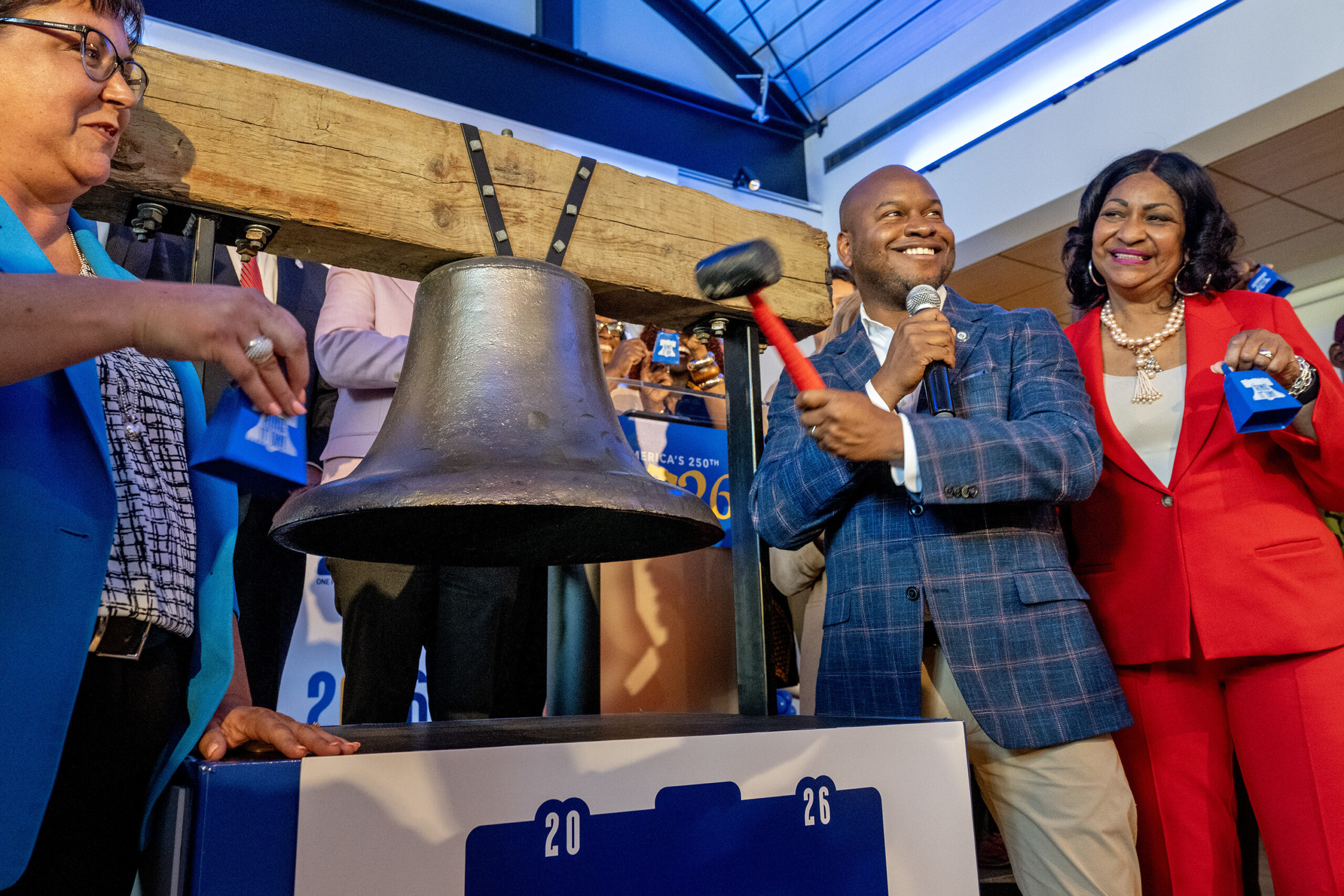
Despite saying Jazelle Jones was needed to coordinate the city’s 2026 festivities, Parker has also appointed a separate 2026 director, Michael Newmuis, to a $175,000 position to also oversee this year’s major events.
The mayor said Jazelle Jones was irreplaceable given her experience managing large events like the 2015 papal visit, the 2016 Democratic National Convention, the 2017 NFL Draft, and the Eagles’ Super Bowl wins.
“Could we have hired five to 10 people to try to do the job Jazelle does?” Parker asked. “We could have tried, but there would be no reason for me to do that when I had the best person.”
Parker indicated she was aware of the steep price tag required to keep Jazelle Jones working through 2026 when the mayor first appointed her as city representative shortly after taking office in 2024.
“I had heard whispers,” Parker said. “They said, ‘You’re going to lose Jazelle.’”
City personnel records show Jazelle Jones enrolled in DROP in September 2020, meaning her first planned retirement date was September 2024, just nine months after Parker appointed her to the role.
Jazelle Jones’ $97,000 payout for unused paid time off was deposited into her account this month, four days after The Inquirer contacted the mayor’s office about her rehiring. The mayor’s office did not respond to a question about the delay in her payment.
Unlike most newly hired city employees, who are entered into a hybrid 401(k)-style pension plan, she was granted an exception allowing her to continue paying into an older, more generous pension plan.
Cristella, from the Committee of Seventy, said the decision to hire Jazelle Jones into a vital role months prior to her mandatory retirement date was irresponsible.
“It is also deeply troubling that the city would retain a high-salaried senior official with full knowledge that a large DROP payout was imminent,” Cristella said. “If city leadership knew and proceeded anyway, that is a failure of fiscal stewardship that demands explanation.”
Staff writer Max Marin contributed to this article.