But the Rochester, N.Y.-based supermarket chain won’t say whether it’s collecting biometricdata on shoppers at eight Philly-area stores. There are Wegmans stores in Cherry Hill and Mount Laurel in New Jersey and in Glen Mills, Malvern, King of Prussia, Collegeville, Warrington, and North Wales in Pennsylvania.
Patrons at some New York City Wegmans locations learned earlier this month that the supermarket chain had begun to collect, retain, store, and share data on their faces, eyes, and voices. The information, Wegmans said, was being used for “safety purposes.”
“This is information that can be used to identify or help identify you,” a sign posted at Wegmans in New York City said, according to reporting from the online news site Gothamist. “We use facial recognition technology to protect the safety and security of our patrons and employees, and do not lease, trade or otherwise profit from the transfer of biometric identifier information.”
Wegmans does not “get into the specific measures used at each store” for “safety and security purposes,” Wegmans spokesperson Marcie Rivera said in an email.
Rivera said Wegmans has deployed cameras equipped with facial recognition technology in “a small fraction of our stores that exhibit an elevated risk.” Wegmans is using the technology in a “handful of states.” It posted mandated signage in New York City to comply with local regulations, Rivera said.
Wegmans has previously said that the surveillance software is used to help identify individuals who “pose a risk to our people, customers, or operation.”
Biometric surveillance is becoming increasingly common but is not yet widespread, said Gus Hurwitz, senior fellow and academic director of the Center for Technology, Innovation and Competition at Penn’s Carey Law School.
Companies that use biometric surveillance do so for a number of reasons, but seldom tell consumers what their data is being collected for. Data collection can help companies understand what consumers are purchasing and how they’re moving through stores, Hurwitz said. Biometric data collection can also be used for dynamic pricing, when retailers change prices in real-time depending on a number of factors, including time of day, demand, weather, and consumer behavior.
Hurwitz said it’s important to distinguish between real-time and non-real-time biometric screening. Non-real-time screening has been happening for decades in the form of security cameras and other data collection tools, often used for market research purposes.
Real-time screening, however, is a newer frontier with a far murkier regulatory landscape.
Businesses in New York City that collect biometric data are required to post signage notifying customers, per a 2021 city law, however the agency in charge of implementing the law has no enforcement mechanism for noncompliant businesses, a city official told Gothamist.
A bipartisan bill regulating biometric data collection is currently moving through the Pennsylvania legislature. A recently introduced bill in the New Jersey Legislature would require any entity collecting biometric information to post a “clear and conspicuous notice” at every entryway to their business, like in New York City.
Hurwitz said we’re “still very much in the development era of these sorts of technologies,” and that he expects more and more government entities to hone in on regulating them in the near future.
Broadway playwright, composer, and actor Shaina Taub knows the power of theater to make a political statement. As an enthusiastic teen in Vermont, Taub staged a teach-in to protest the Iraq War at her high school — a bold move inspired by the anti-war musical Hair.
About a decade later, when she was approached to write a musical about the suffrage movement, Taub recognized another meaningful opportunity to blend activism with theater.
The one challenge: She was pretty unfamiliar with the American women who fought for the right to vote.
“I really didn’t know anything,” Taub said.
She was stunned, but her feelings turned into frustration as she concluded that her American public school education had been seriously lacking. “I was blown back by the scope of this history,” she said.
That fueled her to create Suffs, the hit musical about the suffrage movement centered on South Jersey Quaker activist Alice Paul, a radical and charismatic organizer played fittingly by Taub herself in the Off-Broadway and Broadway runs.
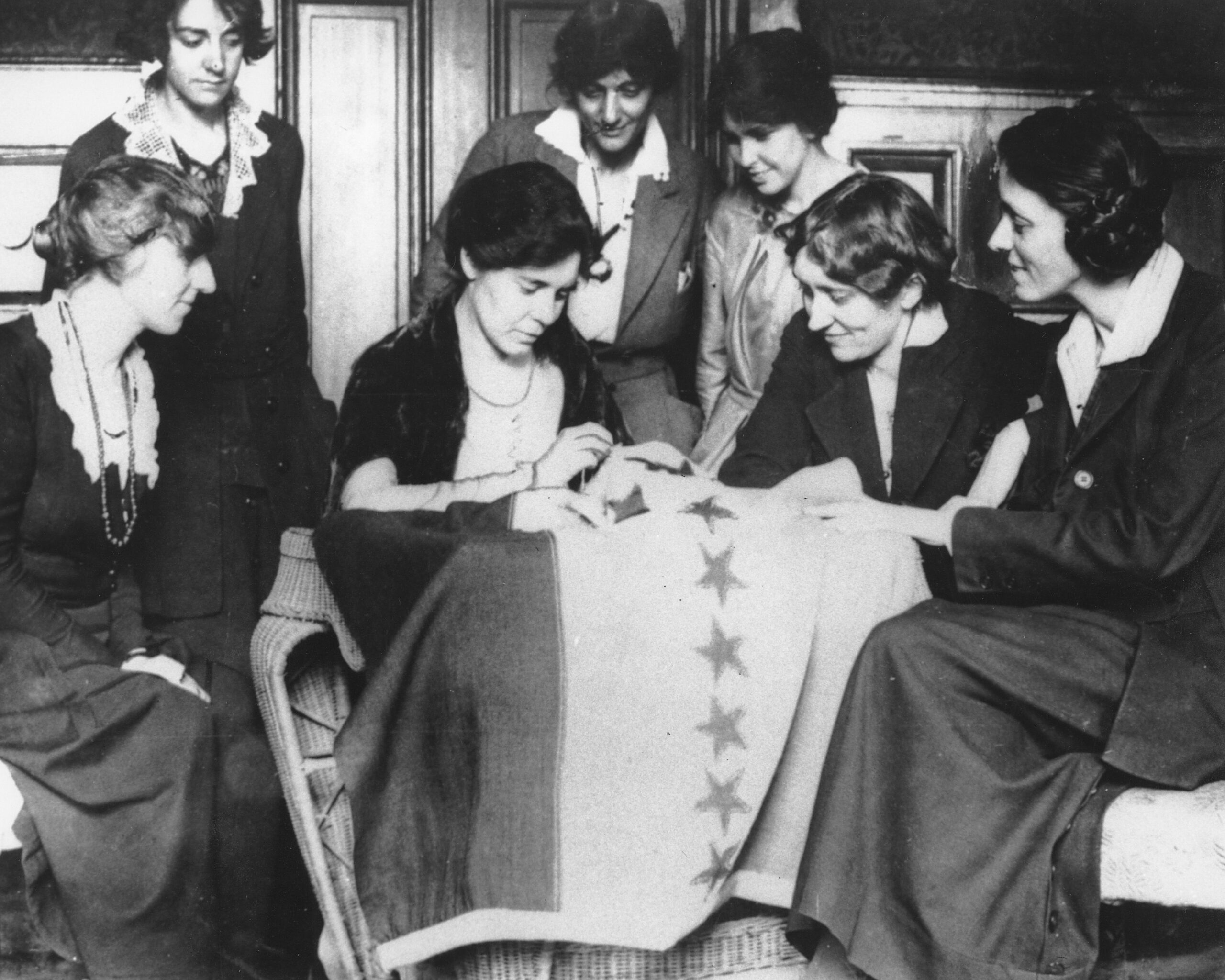
Alice Paul, seated second from left, sews the 36th star on a banner, celebrating the ratification of the women’s suffrage amendment in August 1920. The 36th star represented Tennessee, whose ratification completed the number of states needed to put the amendment in the Constitution. (AP Photo, File)
After premiering in 2022 at New York’s Public Theater for a sold-out run — following the trajectory of another history musical box-office success, Hamilton — Suffs opened on Broadway in 2024. It went on to earn six Tony Award nominations.
Taub took home two, for best book and best score, making history as the first woman to win in both categories independently on a night where Hillary Clinton, a Suffs coproducer, introduced Taub and the cast.
Now on its first North American tour, Suffs has landed at Philadelphia’s Academy of Music this week (running through Jan. 18) to help kick off a year of events commemorating the 250th anniversary of the nation’s founding. The musical graces the same stage where suffragist Susan B. Anthony once spoke some 150 years ago advocating for the right to vote.
Though mostly set in the District of Columbia, Suffs has some local shout-outs, too: The show mentions Swarthmore College, where Paul studied before pursuing her master’s at the University of Pennsylvania, and Bryn Mawr College, where President Woodrow Wilson (Suffs’ main antagonist) once taught history and politics.
“Suffs” on Broadway.
On opening night at the Academy of Music, director Leigh Silverman nodded to Philadelphia’s history in the suffrage movement, mentioning the protests Paul organized at Independence Hall, only a mile away, and across the city.
“The suffs you met tonight, and the many, many others … were here in Philadelphia, and they remind us of our collective strength and what is possible when we stand up and fight, despite how far it might seem like we have to go, or for how long we have to keep marching,” she said.
“This is the first year of Suffs being performed under this president, and [it feels like] a radical act to get together in the theater and tell these stories,” Taub said.
She added that it’s acutely meaningful to see the show in Philadelphia as the city reflects on the nation’s history for America250 this year.
Though the actor/playwright grew up in Vermont, she saw shows in Philadelphia as a kid when she visited family in South Jersey; her mother, Susan Taub, was raised in Cherry Hill, just a few miles down the road from Paul’s childhood home in Mount Laurel.
The Philadelphia region’s first snowfall of the season ended up having quite a March-like quality.
Totals generally ranged from 4 to 8 inches, but the snow literally was so heavy that the average shoveler may have had a hard time discerning the difference.
“When I was shoveling my car out, it felt rough,” said Michael Silva, meteorologist at the National Weather Service Office in Mount Holly. Silva lives in Mount Laurel, where an unofficial 7 inches was reported.
The snow was so weighty because it had a high liquid content, the result of temperatures close to the freezing mark, as so often happens in March. The borderline temperatures also would help explain the range in accumulations, he said.
The snow glommed onto the trees, weighing down branches. In fact it took down a branch outside the Mount Holly office that damaged a federal car (sorry, taxpayers).
The highest amounts, just over 8 inches, were recorded in Chester and Bucks Counties.
Officially, at Philadelphia International Airport, where temperatures didn’t get below freezing until midmorning Sunday, 4.2 inches was measured.
By contrast, Boston has measured only 3.1 inches so far.
Here are the snowfall totals posted by the weather service as of 10 a.m. Monday.
window.addEventListener(“message”,function(a){if(void 0!==a.data[“datawrapper-height”]){var e=document.querySelectorAll(“iframe”);for(var t in a.data[“datawrapper-height”])for(var r,i=0;r=e[i];i++)if(r.contentWindow===a.source){var d=a.data[“datawrapper-height”][t]+”px”;r.style.height=d}}});
“You don’t have to like the fact that merit pay was in there,” Hibbs said of his contract at the board’s most recent meeting. But, he said, he is legally entitled to the payment on top of his $215,000 annual base salary because he met the goals listed in his contract.
And he is not the only South Jersey superintendent who has negotiated merit pay or other bonuses as part of a contract. The measure is a little-known way for New Jersey superintendents to earn higher salaries.
About 54 of the state’s 600 public school chiefs, or about 9%, had perks negotiated in their contracts in the 2023-24 school year, according to data from the New Jersey Department of Education.
Here’s what to know about the practice of giving merit pay to New Jersey superintendents:
How many superintendents get merit pay and how much is it?
In South Jersey, at least eight of nearly 100superintendents had merit or bonus pay provisions in their contracts in the 2023-24 school year, the most recent available state data obtained under the Open Public Records Act. The information may be incomplete because it is compiled from self-reporting by districts, and some superintendents have left their jobs since the data were compiled.
Among the districts offering merit pay are: Barrington, Black Horse Pike Regional, Clayton, Salem County Vocational, Washington Township in Gloucester County, Woodlynne, and West Deptford. Merchantville had it also, but that superintendent has since left the position.
window.addEventListener(“message”,function(a){if(void 0!==a.data[“datawrapper-height”]){var e=document.querySelectorAll(“iframe”);for(var t in a.data[“datawrapper-height”])for(var r,i=0;r=e[i];i++)if(r.contentWindow===a.source){var d=a.data[“datawrapper-height”][t]+”px”;r.style.height=d}}});
How much money do superintendents make in bonus pay?
An Inquirer analysis of state data found that bonus compensation packages ranged from $2,000 to $56,989 for the 2023-24 school year.
They included additional pay granted for meeting performance goals or obtaining a doctorate, orlongevity bonuses for years of service.
The districts with the most lucrative merit packages were in North Jersey: $56,989 in Bergen County Vocational; $43,272 in Hudson, and $36,489 in Union.
Clayton Superintendent Nikolaos Koutsogiannis, in his ninth year as schools chief, received $4,350 in longevity pay. He joined the district in 2008 as a principal and is one of the longest-serving superintendents in Gloucester County.
“I enjoy my job here,” Koutsogiannis said. “They wanted to keep me here. I was more than willing to stay.”
The Barrington, Black Horse Pike Regional, Salem County Vocational, and West Deptford superintendents did not respond to numerous email messages.
Some South Jersey districtswhere superintendents are among the highest-paid in the region do not offer merit pay, including Winslow, Lenape Regional, Burlington City, Mount Laurel and Cherry Hill.
Because of the cap, dozens of superintendents left the state for higher salaries elsewhere and districts had difficulty recruiting educators. Others negotiated merit pay and bonuses to boost their earnings.
Gov. Phil Murphy speaks with members of the media after meeting with Gov.-elect Mikie Sherrill at the governor’s office in Trenton last month.
Superintendent salaries can vary, as boards negotiate contracts based on experience, district size, and other factors.
The New Jersey Department of Education must approve contracts,including merit pay provisions and goals. Executive county school superintendents review contracts for each district.
Purnell said his association, which provides guidance to more than 600 New Jersey school boards, generally steers them away from considering merit pay. Longevity pay, however, is encouraged as an incentive to keep quality superintendents, he said.
Many superintendents are less interested in pursuing additional goals because merit pay is not factored into pensions, Purnell said.
When merit pay is in a contract, the board and the superintendent establish merit goals at the beginning of the school year. At the end of the year, the superintendent must submit evidence that the goals were met. The executive county superintendent must sign off on the request before any bonuses are paid.
The state specifies quantitative and qualitative goals that may be included in merit pay. It also sets the value of each goal, a percentage of the superintendent’s base salary.
Based on a district’s needs, merit pay may be given for meeting goals such as reducing chronic absenteeism, increasing student achievement, setting up learning academies, or establishing a foundation.
Hibbs’ goals approved by the board include completing Google training presentations, taking online professional development courses, and beefing up security.
In September, records show, the executive county superintendent approved $9,072 in merit pay for Barrington Superintendent Anthony Arcodia for meeting two goals — improved parent communication and overhauling the parent-student handbook.
Barrington school board president Mark Correa said Arcodia waived his right to merit pay for the 2025-26 school year because of the district’s belt-tightening. He will be eligible for merit pay in future years, he said.
The district “believes in rewarding our high-achieving, long-serving superintendent when possible,” Correa wrote in an email this week.
Some school chiefs get a stipend for holding an additional administrative position, such as serving as superintendent and a school principal, typically in smaller districts.
What are the drawbacks of merit pay?
Purnell said merit goals can muddy the waters for districts because superintendents could become so focused on those goals that they lose sight of the overall strategic plan.
“The question would be why do you need to receive merit pay when it’s your responsibility to provide a thorough and efficient education,” Purnell said. “You don’t want the goal to become more important than the best interest of all children.”
“Student outcomes are the result of a whole system and are heavily influenced by factors outside one leader’s control,” Campbell said. “If a district uses merit pay at all, I recommend it be a small slice of compensation.”
West Deptford Superintendent Brian Gismondi poses for a portrait outside the West Deptford Child Development Center in West Deptford earlier this year.
How common is merit pay nationwide?
Merit pay does exist in other states.Earlier this year, the state-appointed superintendent for the Houston Independent School District received a $173,660 bonus based on his annual performance evaluation, which credited him with boosting standardized test scores. His annual base salary is $462,000.
Nationwide, the median salary for a school superintendent was $156,000 for the 2023-24 school year, according to the School Superintendents Association. The group does not track merit pay.
The median superintendent salary among 91 South Jersey school districts was $176,088 for the 2024-25 school year, an Inquirer analysis found.
In Philadelphia, Superintendent Tony B. Watlington Sr. recently received a contract extension that will keep him in the nation’s eighth-largest school district through 2030. He is paid $367,710. He does not get merit pay.
Philadelphia School District Superintendent Tony B. Watlington, Sr.
What’s happening with merit pay in Washington Township?
In Washington Township,Hibbs has the most lucrative merit package in South Jersey. He received $25,000 in bonus pay for the 2023-24 school year, according to district records obtained by The Inquirer under the state’s Open Public Records Act.
Hibbs has asked the board several times to approve $27,319 in merit pay for the 2024-25 school year, indicating he had met four of the five goals approved by the board. His contract allows an annual merit bonus of up to 14.99% of his salary, the maximum permitted by the state.
The request has been rejected by the board, failing to get five votes needed. The dispute is expected to lead to another legal showdown between Hibbs and the board.
During a heated exchange at a board meeting last month, Hibbs accused the board of retribution. He was suspended for five months earlier this year over an ethics complaint. A judge ordered his return and Hibbs was later cleared of any wrongdoing.
“My merit pay that was 100% approved and achieved has been consistently voted down by certain members,” Hibbs said at a recent school board meeting.
Hibbs was hired in 2023 with an annual base salary of $215,000, making him among the highest-paid superintendents in South Jersey. His contract runs through 2027.
Staff writer Kristen A. Graham contributed to this article.
Even after more than two decades of operating a financial advisory in the Philadelphia region, Joel Steele is inspired when clients tell him they want to donate money to charity.
“But the problem is that it’s gotten much more difficult to know if your donations are going to the people you are directly trying to help,” said Steele, co-owner and financial adviser with Steele Financial Solutions in Cherry Hill. “Charity scammers are running rampant.”
Solicitors are on the phone, at your door, in your email, and in your mailbox.
“We’re constantly inundated with people looking to take our money and put it in their pockets for the wrong reasons,” Steele said. “This has led many people to back off — in part or in full from — donating to charities.”
One way to reduce the chance of misappropriation is to contact the charity directly, Steele said. “Yes, it’s easier to put cash in a tin can or buy things from a stranger, but these are more likely to end up in that person’s pocket.”
Also, he recommends, when you donate directly to charities, get a receipt and check with your income tax preparer or review deduction guidelines to understand potential tax benefits.
Evaluating Giving Tuesday solicitations
Everyone knows about Black Friday shopping, and recent years have seen the additions of Small Business Saturday and Cyber Monday in the days after Thanksgiving.
In 2012, Giving Tuesday joined the lineup, promoted by the 92nd Street Y in New York and the United Nations Foundation. It caught on quickly, as more organizations joined in on the opportunity to fundraise.
Giving Tuesday encourages generosity, but it’s also a time for scammers to ramp up fraud tactics. Scammers may use fake charities or misuse real ones to take advantage of donors.
If you get direct mail or a call, text, email, or social media message asking you to donate to a nonprofit, pause for a moment to dig deeper.
Your heart immediately wants to say “yes,” said Katherina ‘Kat’ Rosqueta, founding executive director of the Center for High Impact Philanthropy at the University of Pennsylvania. But unless you have personally been helped by that nonprofit or know someone who was, it’s hard to know whether the nonprofit is actually making a difference.
“That’s where your head comes in,” Rosqueta said. Consider running a quick Internet search for the charity’s name, along with “scam” or “complaints” to see if there have been any negative feedback or investigations, she said.
Katherina Rosqueta is the founding executive director of the Center for High Impact Philanthropy at the University of Pennsylvania.
Of course, most donors want to do more than just avoid fraud.
“They want their donation to make a real difference,” Rosqueta said.
Her center at Penn created a “High Impact Giving Toolkit,” updated each year and available for free. It highlights vetted nonprofits and provides links to organizations like Candid, Charity Navigator, and BBB Wise Giving Alliance, where potential donors can learn about organizations’ programs, team, and finances.
“Once you feel confident about a nonprofit’s work, consider donating online through an official, secure nonprofit website that uses HTTPS encryption,” Rosqueta said.
“Avoid links in unsolicited emails or social media posts. Credit cards and checks offer better fraud protection than debit cards or wire transfers,” Rosqueta said.
How to make online donations safer
The key to understanding fraud is that most scammers prey on your emotions.
“Fear, urgency, and promise of a quick win are some elements that exist in so many scam scenarios,” said Christopher Blackmore of TD Bank in Mount Laurel, who works in customer education in financial crimes prevention.
Blackmore said most “bad actors” will reach out and provide a number to call, link to click, or instructions for payment. “The goal is to make scenarios seem so real that you feel you must reply or something will happen.”
Financial industries should never ask for login credentials, passwords, or one-time pass codes, Blackmore said. “Technology is making it very difficult to identify what is real vs. fake.”
A text, email, or phone call is a very quick and easy way to contact a lot of people quickly and ask for a donation.
“These tactics are known as phishing, vishing, and smishing,” Blackmore said. A newer tactic, known as “Quishing,” utilizes QR codes.
When a donation ask includes a request for payments using gift cards, wires, and cryptocurrency, that should immediately raise caution, Blackmore said.
Donors might want to consider a third-party platform like PayPal, which safeguards sensitive financial information.
“Donors should stay mindful online and keep an eye out for the warning signs of common scams, including being wary of unexpected messages from strangers,” said Nick Aldridge, Global CEO of PayPal Giving Fund.
“We always encourage supporting causes you care about through trusted channels like PayPal Giving Fund, the PayPal Cause Hub, and Venmo Charity Profiles,” Aldridge said.