Tag: no-latest

  • Dear Abby | Parents seem to put other family members ahead of single son

    DEAR ABBY: I am 40 and single, with no children and no girlfriend. For many years, it has become increasingly difficult to get my parents to come to my home for dinner. They live only 45 minutes away. Both are retired and healthy. As anyone who knows me can attest, my home is always clean, smells great and I love to cook.

    Abby, it’s a miracle and an act of God when they finally agree to a date and time to visit. I invite them for dinner at least three times a week (because they decline the first or second time), and it’s months before they actually accept. It appears they just don’t have the desire and it’s hurtful. I have spoken to them about this, but it has gone nowhere.

    Two weeks ago, they finally agreed to come after a month or two. I was happy and excited, only to have them cancel midday. They seem to have no issue picking up one or both of my nieces once or twice a week, going to yoga, attending concerts or festivities, coming into the city twice a week, taking trips, etc. It feels like it’s expected of me to go to their place and, if I refuse, it’s always, “Oh, why?”

    I have been the black sheep for 25 years, and I wonder if I were married and had kids, would Mom and Dad come over as they do with my brother and sister-in-law? What is your advice?

    — HOME ALONE IN NEW YORK

    DEAR HOME ALONE: If your parents are keeping up the travel schedule you have described, they are living full, busy lives. It may make more sense (in their view) for you to come to them. I detect a smidge of sibling rivalry in your letter. Because you can’t force other adults to change their behavior, it might make sense for you to change your attitude about the family dynamic if that’s possible.

    ** ** **

    DEAR ABBY: I’m 19. My father’s mother has never been a grandmother figure in my life. No healthy relationship was ever formed. My dad says it was her fault, but she has implied that the fault lies with my mother. Dad’s mother accepts close to zero responsibility for the situation.

    I recently, by accident, referred to her by her first name, and my aunt (Dad’s sister) thought it was disrespectful. How can I politely make her understand that I wasn’t being disrespectful because there is NO RELATIONSHIP? I don’t think anyone sees this from my point of view. There’s an overwhelming consensus that I need to forgive and forget because she is technically my grandmother. I don’t share this feeling. Any thoughts?

    — TECHNICALLY THE GRANDDAUGHTER

    DEAR GRANDDAUGHTER: You do not have to forgive and forget a grandmother who never tried to have a relationship with you. However, in order to keep peace in the family, you DO have to treat the woman with respect. A way to do that would be to use her honorific and refer to her as “Grandma.”

  • Trump and Mamdani go from adversaries to allies after White House meeting

    Trump and Mamdani go from adversaries to allies after White House meeting

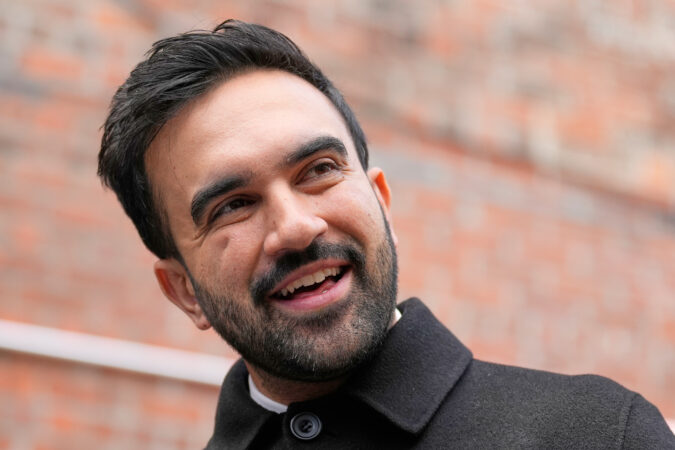
    WASHINGTON — President Donald Trump on Friday met the man who had proudly proclaimed himself “Donald Trump’s worst nightmare,” but he seemed to find the opposite.

    The Republican president and New York City’s Mayor-elect Zohran Mamdani were warm and friendly, speaking repeatedly of their shared goals to help Trump’s hometown rather than their combustible differences.

    Trump, who had in the past called Mamdani a “100% Communist Lunatic” and a “total nut job,” spoke openly of how impressed he was with the man who had called his administration “authoritarian.”

    “I think he is going to surprise some conservative people, actually,” Trump said of the democratic socialist as Mamdani stood next to him in the Oval Office.

    The meeting offered political opportunities for both men. For Mamdani, a sit-down offered the state lawmaker — who until recently was relatively unknown — the chance to go head-to-head with the most powerful person in the world.

    For Trump, it was a high-profile chance to talk about affordability at a time when he’s under increasing political pressure to show he’s addressing voter concerns about the cost of living.

    Until now, the men have been political foils who galvanized their supporters by taking on each other, and it’s unclear how those backers will react to their genial get-together and complimentary words.

    “We’re going to be helping him, to make everybody’s dream come true, having a strong and very safe New York,” the president said.

    “What I really appreciate about the president is that the meeting that we had focused not on places of disagreement, which there are many, and also focused on the shared purpose that we have in serving New Yorkers,” Mamdani said.

    ‘I’ll stick up for you’

    Mamdani and Trump said they discussed housing affordability and the cost of groceries and utilities, as Mamdani successfully used frustration over inflation to get elected, just as the president did in the 2024 election.

    “Some of his ideas are really the same ideas that I have,” the president said of Mamdani about inflationary issues.

    The president brushed aside Mamdani’s criticisms of him over his administration’s deportation raids and claims that Trump was behaving like a despot. Instead, Trump said the responsibility of holding an executive position in the government causes a person to change, saying that had been the case for him.

    He seemed at times even protective of Mamdani, jumping in on his behalf at several points. For example, when reporters asked Mamdani to clarify his past statements indicating that he thought the president was acting like a fascist, Trump said, “I’ve been called much worse than a despot.”

    When a reporter asked if Mamdani stood by his comments that Trump is a fascist, Trump interjected before the mayor-elect could fully answer the question.

    “That’s OK. You can just say yes. OK?” Trump said. “It’s easier. It’s easier than explaining it. I don’t mind.”

    Trump stepped in again when a reporter asked Mamdani why he flew to Washington instead of taking transportation that used less fossil fuels.

    “I’ll stick up for you,” Trump said.

    All about affordability

    Mamdani, who takes office in January, said he sought the meeting with Trump to talk about ways to make New York City more affordable. Trump has said he may want to help him out — although he has also falsely labeled Mamdani as a “communist” and threatened to yank federal funds from the city.

    But Trump on Friday didn’t sling that at the mayor. He acknowledged that he had said he had been prepared to cut off funding or make it harder for New York City to access federal resources if the two had failed to “get along,” only to pull back from those threats during the meeting.

    “We don’t want that to happen,” Trump said. ”I don’t think that’s going to happen.”

    Afterward, Mamdani’s former campaign manager and incoming chief of staff Elle Bisgaard-Church told NY1 that the pair clearly disagreed on some issues but were able to find common ground on things like reducing crime.

    “We discussed that we share a mutual goal of having a safe city where everyone can move around in comfort and ease,” she said, before later adding, “We know that there have been labels thrown all around that are just simply not fair and we kept it, again, at where we could find agreement on making the city affordable.”

    Trump loomed large over the mayoral race this year, and on the eve of the election, he endorsed independent candidate and former Democratic Gov. Andrew Cuomo, predicting the city has “ZERO chance of success, or even survival” if Mamdani won. He also questioned the citizenship of Mamdani, who was born in Uganda and became a naturalized American citizen after graduating from college, and said he’d have him arrested if he followed through on threats not to cooperate with immigration agents in the city.

    Mamdani beat back a challenge from Cuomo, painting him as a “puppet” for the president, and promised to be “a mayor who can stand up to Donald Trump and actually deliver.” He declared during one primary debate, “I am Donald Trump’s worst nightmare, as a progressive Muslim immigrant who actually fights for the things that I believe in.”

    The president, who has long used political opponents to fire up his backers, predicted Mamdani “will prove to be one of the best things to ever happen to our great Republican Party.” As Mamdani upended the Democratic establishment by defeating Cuomo and his far-left progressive policies provoked infighting, Trump repeatedly has cast Mamdani as the face of Democratic Party.

    Some had expected fireworks in the Oval Office meeting

    The president has had some dramatic public Oval Office faceoffs this year, including an infamously heated exchange with Ukrainian President Volodymyr Zelenskyy in March. In May, Trump dimmed the lights while meeting with South African President Cyril Ramaphosa and played a four-minute video making widely rejected claims that South Africa is violently persecuting the country’s white Afrikaner minority farmers.

    A senior Trump administration official who spoke on condition of anonymity to describe internal discussions said Trump had not put a lot of thought into planning the meeting with the incoming mayor — but said Trump’s threats to block federal dollars from flowing to New York remained on the table.

    Mamdani said Thursday that he was not concerned about the president potentially trying to use the meeting to publicly embarrass him and said he saw it as a chance to make his case, even while acknowledging “many disagreements with the president.”

    Instead, both men avoided a public confrontation in a remarkably calm and cordial series of comments in front of news reporters.

    Mamdani, who lives in Queens — where Trump was raised — has shown a cutthroat streak just as Trump has as a candidate. During his campaign, he appeared to borrow from Trump’s playbook when he noted during a televised debate with Cuomo that one of the women who had accused the former governor of sexual harassment was in the audience. Cuomo has denied wrongdoing.

    But the tensions were subdued Friday as Trump seemed sympathetic to Mamdani’s policies to want to build more housing.

    “People would be shocked, but I want to see the same thing,” the president said.

  • The Supreme Court meets to weigh Trump’s birthright citizenship restrictions, which have been blocked by lower courts

    The Supreme Court meets to weigh Trump’s birthright citizenship restrictions, which have been blocked by lower courts

    WASHINGTON — The Supreme Court is meeting in private Friday with a key issue on its agenda — President Donald Trump’s birthright citizenship order declaring that children born to parents who are in the United States illegally or temporarily are not American citizens.

    The justices could say as soon as Monday whether they will hear Trump’s appeal of lower court rulings that have uniformly struck down the citizenship restrictions. They have not taken effect anywhere in the United States.

    If the court steps in now, the case would be argued in the spring, with a definitive ruling expected by early summer.

    The birthright citizenship order, which Trump signed on the first day of his second term in the White House, is part of his administration’s broad immigration crackdown. Other actions include immigration enforcement surges in several cities and the first peacetime invocation of the 18th century Alien Enemies Act.

    The administration is facing multiple court challenges, and the high court has sent mixed signals in emergency orders it has issued. The justices effectively stopped the use of the Alien Enemies Act to rapidly deport alleged Venezuelan gang members without court hearings, while they allowed the resumption of sweeping immigration stops in the Los Angeles area after a lower court blocked the practice of stopping people solely based on their race, language, job or location.

    The justices also are weighing the administration’s emergency appeal to be allowed to deploy National Guard troops in the Chicago area for immigration enforcement actions. A lower court has indefinitely prevented the deployment.

    Birthright citizenship is the first Trump immigration-related policy to reach the court for a final ruling. Trump’s order would upend more than 125 years of understanding that the Constitution’s 14th Amendment confers citizenship on everyone born on American soil, with narrow exceptions for the children of foreign diplomats and those born to a foreign occupying force.

    In a series of decisions, lower courts have struck down the executive order as unconstitutional, or likely so, even after a Supreme Court ruling in late June that limited judges’ use of nationwide injunctions.

    While the Supreme Court curbed the use of nationwide injunctions, it did not rule out other court orders that could have nationwide effects, including in class-action lawsuits and those brought by states. The justices did not decide at that time whether the underlying citizenship order is constitutional.

    But every lower court that has looked at the issue has concluded that Trump’s order violates or most likely violates the 14th Amendment, which was intended to ensure that Black people, including former slaves, had citizenship.

    The administration is appealing two cases.

    The U.S. Court of Appeals for the 9th Circuit in San Francisco ruled in July that a group of states that sued over the order needed a nationwide injunction to prevent the problems that would be caused by birthright citizenship being in effect in some states and not others.

    Also in July, a federal judge in New Hampshire blocked the citizenship order in a class-action lawsuit including all children who would be affected.

    The American Civil Liberties Union, leading the legal team in the New Hampshire case, urged the court to reject the appeal because the administration’s “arguments are so flimsy,” ACLU lawyer Cody Wofsy said. ”But if the court decides to hear the case, we’re more than ready to take Trump on and win.”

    Birthright citizenship automatically makes anyone born in the United States an American citizen, including children born to mothers who are in the country illegally, under long-standing rules. The right was enshrined soon after the Civil War in the first sentence of the 14th Amendment.

    The administration has asserted that children of noncitizens are not “subject to the jurisdiction” of the United States and therefore not entitled to citizenship.

    “The lower court’s decisions invalidated a policy of prime importance to the president and his administration in a manner that undermines our border security,” Solicitor General D. John Sauer wrote in urging the high court’s review. “Those decisions confer, without lawful justification, the privilege of American citizenship on hundreds of thousands of unqualified people.”

  • The CEO Shaping the Health of Greater Philadelphia

    The CEO Shaping the Health of Greater Philadelphia

    “I grew up admiring my father,” Kelly Munson, the president and CEO of Independence Health Group, parent company of Independence Blue Cross (IBX), said. Thurman Munson was a major league baseball star and captain of the New York Yankees in the 1970s, and Munson said he taught her the importance of hard work, humility, and giving back: “What I loved most was his resilience.”

    Now, Munson is bringing those lessons to her own leadership position. This October, she became the first woman to lead Independence Health Group in its 87-year history. The organization, which has 14,000 employees and serves more than 7.1 million people across 32 states, including the District of Columbia, plays a vital role in shaping the health of communities across the region and nationally.

    Previously, Munson served as president and CEO of AmeriHealth Caritas, an Independence Health Group company that provides national leadership for vulnerable populations. She was named CEO of the parent company after an extensive national search for the position. Here, she reflects on the moments that shaped her career, her admiration for Philadelphia, and her vision for the future of the company.

    Why did you choose to dedicate your career to health care?

    When I was in college, I was studying political science and happened to take a nutrition class. That’s where I learned that the [national] school lunch program was, at one point, counting ketchup as a fruit. I remember being stunned by that. Around the same time, I read an article about the impact of inadequate nutrition on schoolchildren, the way missing something as simple as breakfast could lower test scores and hold kids back.

    It struck me deeply that through no fault of their own, children were starting the day at a disadvantage, unable to focus and thrive, simply because of what food they had access to. That realization lit a fire in me. I knew then that I wanted to dedicate my life to health care, to helping address these inequities.

    What excites you most about being part of Philadelphia and its surrounding communities?

    I’ve been here for two years now, and what’s struck me most is how misunderstood Philadelphia can be from the outside. People often see the passionate sports fans, or some of the stereotypes, and miss what the city is truly about. Once you’re here, you realize it’s one of the most soulful, passionate places you could imagine. There’s an energy and pride that runs through everything, from the sports teams to the neighborhoods to the people who call it home.

    Independence Blue Cross has been woven into that fabric for generations. It’s not just an employer; it’s part of the lifeblood of the region, serving police officers, teachers, families, and communities across the area. In fact, IBX was the city of Philadelphia’s first health insurer! To lead an organization so deeply rooted here, in a city that’s so alive, is incredibly exciting.

    Previously, you were CEO of AmeriHealth Caritas, a Medicaid health plan that is a subsidiary of Independence Health Group. When it comes to AmeriHealth Caritas, what are you the most proud of and what is your vision for the company’s future?

    Honestly, what I’m most proud of are the associates at AmeriHealth Caritas. They are extraordinary: mission-driven, compassionate, and deeply committed to serving vulnerable populations. That mission is exactly why I joined the company. At our core, what we do is care for those who need it most.

    All our teams go beyond traditional health care. They bring high-touch, community-centered support, with care management programs that truly change lives. For those at highest risk, we assign dedicated care managers who ensure people get the extra help they need. That hands-on approach translates directly into healthier outcomes.


    Is there a member story that has made a lasting impression?

    There are a few that stay with me, but one comes to mind immediately. I received an email from a man thanking us because, for the first time in 15 years, his elderly mother was able to enjoy a family barbeque with his brother, who had been living with serious mental illness, and they got through the event without a behavioral episode. It was a simple moment, but it meant the world to them as a family.

    Through our programs, we helped the man’s brother secure consistent therapy, proper medication management, safe housing, which he had not had, and even a job. Over the next two years, he was able to reconnect with his family, get engaged, and spend meaningful time with his mother. Sadly, he passed away from cancer two years later, but for the first time, he was healthier, happier, and able to be fully present with his loved ones.

    That experience reminded me that when we help a member, we’re often impacting an entire family. Health is rarely just one issue; it’s intertwined with many layers of social and medical needs. We consider the whole person and their loved ones.

    Independence Health Group has a history of community involvement, including employee volunteer work. How will you carry that forward in your role?

    Community engagement is at the heart of who we are. Across IBX and the AmeriHealth brand, employees have contributed more than 122,000 volunteer hours, with hundreds of nonprofits nationwide, not only to support the communities we serve but also to build trust and strengthen the networks that help our members.

    We help organizations with technology, infrastructure, and funding to ensure they can thrive. I’m committed to continuing this legacy and empowering our teams to make an even greater difference in the communities we serve.

    How is Independence Health Group addressing disparities in social determinants of health?

    Social and environmental factors often shape health outcomes even more than medical care itself, especially in Medicaid populations. Many of our members face multiple challenges at once: food insecurity, housing instability, utility needs, limited health literacy. Our goal is to identify those gaps early, connect members with the right resources, and measure whether those interventions truly make a difference. When social gaps are closed, members are up to 7% more likely to get preventive care, and hospitalizations can drop by a third. That’s powerful.

    I’m especially proud of our partnerships driving equity at a systemic level. Through the Regional Coalition to Eliminate Race-Based Medicine, IBX worked with 12 health systems to remove bias from clinical algorithms, resulting in more than 1,100 patients moving onto or up the kidney transplant list. By the end of 2024, 188 received kidney transplants. Our Accelerate Health Equity initiative brings hospitals, insurers, and community organizations together to tackle inequities across Philadelphia.

    Rising drug costs continue to be a concern for consumers. What strategies are effective for addressing affordability?

    It’s a serious challenge. Pharmacy costs have risen more than 230% over the past two decades, driven largely by high-priced specialty drugs. Many of these medications bring real value to patients, but the costs can be overwhelming.

    We’re focused on evidence-based strategies that maintain quality while improving affordability. That includes expanding access to biosimilar drugs, which offer the same effectiveness at a lower cost; ensuring members try proven, lower-cost options before moving to more expensive treatments; and helping members receive infusions or medications in lower-cost care settings when appropriate.

    We also work closely with providers to ensure members understand their options, like choosing between generics and brand names depending on what’s clinically appropriate. It’s about empowering people with choices that protect both their health and their wallet, without compromising quality of care.

    Who do you admire in your personal life or family?

    I grew up admiring my father, Thurman Munson. He was captain of the New York Yankees in the ’70s; what I loved most was his resilience. He came from very humble beginnings. They were so poor growing up that sometimes he had to go without shoes or resources, but he performed at the highest level anyway. In high school and college, he would have to mow seven lawns before showing up at the ball park for practice. Yet he achieved something extraordinarily rare while staying grounded, valuing family, and teaching us the importance of hard work and humility.

    And my mom was equally remarkable. When he passed [at the age of 32], she carried through those values. She picked right up with that same approach to raising us to be hard-working kids. Having both of them as role models shaped who I am, and I don’t take for granted the lessons they gave me about resilience, humility, and having an impact.

    What do you do with a few free hours?

    The number one way that I recharge is to do anything with any one of my kids, or all three and my husband, preferably. My favorite thing is to go hiking. So when I can, I get them to go hiking with me.

    Do you have a mantra? Any words you live by, or sayings that resonate with you?

    Actually I do. I was trying to make a big work decision one time, and I was struggling with it. A gentleman came by my office and he could tell that I had been struggling, and he just leaned in and shared a quote by Goethe: “Things that matter most must never be at the mercy of things that matter least.”

    These words helped me decide. It really boils down to knowing what matters most to you.


    PHILLY QUICK ROUND

    Favorite food: Jim’s Steaks. It’s absolutely fantastic.

    Which sports team’s shirt do you wear most often? The Yankees. I’m sorry, but no other baseball hat goes on my head. I’m the daughter of a former captain. It’s family.

    What do you love about Philadelphia? Well, of course it’s the fans. You come here, and everyone is passionate, and it’s so much fun.

    Who is the greatest Philadelphian of all time? Everyone who fought for freedom and human rights.

    I feel most Philadelphian when …. I’m in a sports bar watching an Eagles game.


    Lucy Danziger is a journalist, an author, and the former editor-in-chief of Self Magazine, Women’s Sports & Fitness, and The Beet.

  • The surprising new use for GLP-1s: Alcohol and drug addiction

    The surprising new use for GLP-1s: Alcohol and drug addiction

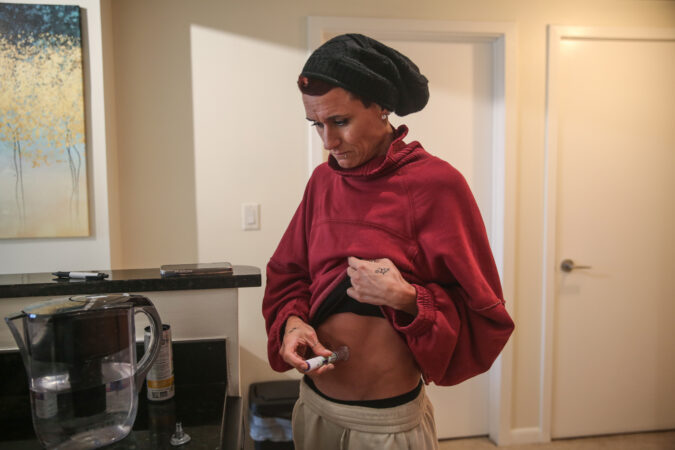
    When Susan Akin first started injecting a coveted weight-loss drug early this year, the chaos in her brain quieted. The relentless cravings subsided — only they’d never been for food.

    The medication instead dulled her urges for the cocaine and alcohol that caused her to plow her car into a tree, spiral into psychosis, and wind up admitted to a high-end addiction treatment center in Delray Beach, Fla.

    Doctors at Caron Treatment Centers tried a novel approach for the slender 41-year-old by prescribing her Zepbound, part of a blockbuster class of obesity and diabetes medications known as GLP-1s. Federal regulators have not approved the drugs for behavioral health, but doctors are already prescribing them off-label, encouraged by studies suggesting that they could reshape addiction treatment.

    Scientists caution that the research remains nascent. Health insurers do not cover the pricey drugs for that purpose. Addiction specialists say the medications might not be a cure but may work as a tool to quell addictive behaviors.

    For Akin, the weekly shot helps her endure a world full of triggers. She can visit a gas station without wanting to buy beer or see sugar without dialing a cocaine dealer. The cravings linger but are muted, she said.

    “I know when I’m due for my shot because I get a little antsy or irritable, or just kind of off,” Akin said. “But it has changed my life.”

    Emerging science

    As GLP-1 drugs for weight loss generate billions for pharmaceutical companies, researchers are exploring their potential for other purposes. Clinical trials have already shown that semaglutide, the active ingredient in Ozempic and Wegovy, can reduce the risk of heart attacks and treat liver disease.

    These drugs appear to reduce cravings for food because they mimic a natural hormone that boosts insulin production, curbs appetite, and slows stomach emptying to create a feeling of fullness. Tirzepatide, the active ingredient in Zepbound, imitates a related hormone that enhances insulin release and amplifies appetite suppression.

    The mechanism of how GLP-1s could also curb alcohol and drug cravings is not entirely understood. The medication may block release of dopamine, the chemical associated with reinforcing pleasurable activities, said Kyle Simmons, a professor of pharmacology and physiology at Oklahoma State University. The medications appear to be “turning down the gain on the reward circuitry in the brain,” Simmons said, possibly explaining why they have a broad effect on behavior.

    The potential has ushered in a wave of research that includes whether the drugs help veterans with moderate to severe drinking problems, diabetic patients who smoke, and people addicted to opioids, among others.

    Federally backed studies of patient records released since early 2024 have shown GLP-1 use in some patients who are diabetic or obese is associated with lower risks of alcohol abuse, cannabis use disorder, and opioid overdoses.

    Associations alone do not prove that the weight-loss drugs are causing those changes, but small early clinical trials have shown promise. In one study published in February in JAMA Psychiatry, researchers found that problem drinkers who received a weekly semaglutide injection drank less and had fewer cravings for alcohol and cigarettes compared with those given a placebo.

    Researchers at the National Institute on Drug Abuse and Simmons are running separate but similar double-blind clinical trials to measure whether the drugs curb alcohol cravings in patients with drinking problems. Researchers are charting brain activity to see how participants respond when exposed to alcohol cues and using virtual-reality headsets to measure how they respond to images of food. In the NIDA study, scientists have built a mock bar to observe how patients react to being near alcohol.

    A spokeswoman for Eli Lilly, which manufactures Zepbound, said the company is considering clinical trials to assess the drug as a treatment for substance use disorders, including for alcohol and tobacco. Novo Nordisk, the maker of Wegovy and Ozempic, declined to say whether it would study the drugs’ effectiveness for addiction.

    Medical treatments lacking

    The use of GLP-1s for unapproved purposes is surging, including micro-dosing to promote longevity and wellness, despite little evidence supporting these lower doses. Researchers also caution that long-term use of the drugs — which can cause unpleasant stomach side effects — remain understudied.

    Still, if GLP-1s prove effective at curbing cravings of different substances — and include behavioral addictions such as gambling and shopping — it “really opens up a whole new sort of therapeutic avenue that’s not been available before,” said Joji Suzuki, an addiction researcher at Brigham and Women’s Hospital in Boston.

    An estimated 48 million Americans had a substance use disorder last year, according to federal researchers. More than 80,000 died of drug overdoses last year while more than 47,000 died from alcohol complications, according to federal estimates.

    There are no approved medications to reduce cravings for other substances including cannabis, cocaine, or methamphetamine. For opioid addiction, medications such as buprenorphine or methadone are considered effective at staving off withdrawal and cravings, but carry stigma.

    While the FDA has approved three drugs to reduce alcohol consumption, only 2 to 4% with alcohol-use disorder get any medication treatment, said Lisa Clemans-Cope, a researcher at the Urban Institute, a nonpartisan economic and social policy research group.

    An affordability problem

    Early research and anecdotal evidence proved enough for Steven Klein, a physician who specializes in addiction at Caron, to begin prescribing GLP-1s to his patients.

    For Klein, the project is more than a professional curiosity: He is a recovering alcoholic who has long struggled with his weight. Three years ago, while in recovery and working as a pediatrician, Klein was prescribed the anti-diabetes drug Mounjaro for weight loss. He found the drug calmed his mind. “The voice that was talking to me about food was very similar to the voice that used to talk to me on drugs and alcohol,” Klein said.

    Moved by his experience, Klein switched to addiction care and joined Caron, a high-end rehab center with facilities near Reading and in Atlanta, Washington, and Delray Beach.

    He spearheads a pilot program that has prescribed GLP-1s to more than 130 patients in Pennsylvania and South Florida, most diagnosed with alcohol-use disorder and some who took stimulants.

    Klein has also partnered with Open Doors, a nonprofit in Rhode Island that helps formerly incarcerated women reenter society, to begin offering GLP-1s through its recovery program.

    “We see how hard it is for people to maintain their recovery long-term after they leave the support of our housing,” Open Doors Co-Executive Director Nick Horton said. “But with this medicine, I’m hopeful.”

    Regina Roberts, a 41-year-old alcoholic in recovery, is living at an Open Doors facility after stints in rehab and a family court program after she lost custody of her teenage son. She has been sober since 2023 with the help of 12-step programs, therapy, and life-skills classes. But she faced frequent reminders of her past: walking past a liquor store, smelling alcohol on someone’s breath, cigarette smoke wafting in the air. When Open Doors told her about the promise of GLP-1s several months ago, she agreed.

    “I figured, why not try it?” Roberts said. “I’ll take anything to help me stay on my road to sobriety.”

    With her cravings dialed back, Roberts hopes to reunite with her teenage son and move out of Open Doors in a few months. But she’s unsure whether she can keep taking the medication; she can’t afford to pay out of pocket and Medicaid might not cover it.

    At Caron’s Wernersville location, staff reduce costs by receiving semaglutides from compounding pharmacies, which can legally produce cheaper versions of name-brand mediations.

    In the Delray Beach facility, most patients receive Zepbound through their insurance by “piggybacking” under FDA-approved uses, or by paying out of pocket with manufacturer discounts, said medical director Mohammad Sarhan. Those costs add to the price of rehab programs that can cost up to $100,000.

    Akin, the Caron patient who is approaching one year sober, said she relies on her inheritance to pay nearly $1,000 every month for prefilled Zepbound shots. Akin could receive a modest discount in the coming months now that Eli Lilly, along with Novo Nordisk, announced they could lower direct-to-consumer prices as part of a deal struck with the Trump administration.

    She considers Zepbound an essential drug like insulin.

    “It’s not a cure. We have to do the work,” Akin said. “But it helps. It slows things down enough to the point where you don’t feel like you have to jump off a bridge or put your head in a cocaine plant to survive.”

  • Letters to the Editor | Nov. 21, 2025

    Letters to the Editor | Nov. 21, 2025

    Low bar

    The staggeringly vile actions of Donald Trump continue to pour out of his administration. Two recent articles highlight that.

    The ruler of Saudi Arabia, a country that supports terrorism, denies human rights, beheads its enemies in public, and has others brutally murdered on foreign soil, is welcomed by this president with open arms. Trump brushes off Mohammed bin Salman’s crimes with a wave of the hand, saying “things happen,” then considers selling him F-35s, the most advanced fighter jet in the world, in a deal that could land the plane’s technology in the hands of bin Salman’s close ally, China.

    And on Air Force One last week, Trump, who has stalled the release of the Jefferey Epstein files until it became clear even his allies in Congress were going to force his hand, responded to Bloomberg News correspondent Catherine Lucey with, “Quiet, quiet, piggy,” when she asked him about the files. It is just one in a long list of examples of Trump’s antipathy toward strong women.

    But I guess we should expect nothing less from a man who admires dictators and is a convicted sexual abuser. These are just two examples of what so saddens me, that so many in my country can support him. A common refrain from my friends who do support him is that they don’t like the man, but they like his policies. Is there no one out there among Republicans who is not amoral and lacks honor, and who can implement the same policies they support?

    Steven Barrer, Huntingdon Valley

    Pardonpalooza

    The recent editorial on Donald Trump’s abuse of presidential pardon power is so important. Everyone should read it. Trump’s Department of Injustice, under Pam Bondi, is a travesty. Trump talks about “weaponizing” the Justice Department, and that’s exactly what he has done. The Justice Department is supposed to be independent of the executive branch, not subservient to it. Bondi does whatever Trump tells her to do, whether it’s legal or not. The Injustice Department was just caught using Trump’s signature, with or without his permission, to pardon criminals.

    In a recent letter to the editor, Terry Hansen wrote about Daniel Rodriguez, one of the insurrectionists on Jan. 6, 2021, who received a pardon from Trump. He repeatedly drove a stun gun into the skull of a police officer, Michael Fanone, causing him to lose consciousness and suffer a heart attack. Rodriguez was sentenced to 12 years in prison. Trump pardoned him.

    Trump has pardoned all 1,500 of the insurrectionists from Jan. 6. Trump issued two pardons for Daniel Edwin Wilson — the first for the invasion of the U.S. Capitol Building on Jan. 6 and the second recently for gun charges. He pardoned Suzanne Kaye, who was sentenced to 18 months for threatening an FBI agent. Trump has also pardoned numerous convicted criminals for all sorts of violent crimes, fraud, embezzlement, extortion, and other felonies — all in just his first 10 months in office.

    The big question is, why? Trump never does anything that does not benefit Trump or the Trump family’s fortunes. Is he setting a new precedent? Or is he sending a message to his loyal followers: No matter what you do on my behalf, I will pardon you. Don’t you worry.

    Most presidents don’t hand out pardons until their last year in office. We have three more Trump years to go. What more can we expect?

    Patrick Thompson, Media

    Hope on the horizon

    Unexpectedly, I long for the days of George H.W. Bush’s call for “a kinder, gentler nation” and Richard Nixon’s creation of the Environmental Protection Agency and focus on energy efficiency. After decades of increasing respect for the rights of all, regardless of race, gender, and social status, we have entered a period of degradation, incivility, greed, and violent threats toward others. Earth is threatened by strident demands to stop renewable energy projects. Immigrants, even American citizens, are being ruthlessly and indiscriminately torn from families. As noted in a recent Inquirer editorial, drug runner suspects have been summarily executed without due process. The government shutdown caused needless hardship for furloughed federal employees and for the hardworking poor who rely on SNAP and affordable healthcare. This month’s election offered a glimmer of hope, but the greed of a few continues to oppress the many. Let’s hope our course changes with next year’s midterm election, if we have one.

    John Groch, West Chester

    Fatal illusion

    Trudy Rubin’s recent column correctly identifies the fundamental flaw in Donald Trump’s Gaza peace plan: its failure to address Palestinian political aspirations.

    Peace is indeed achievable, as Rubin suggests, but it requires more than clever diplomacy or economic incentives. It demands one basic ingredient that has been consistently missing: genuine recognition of Palestinian aspirations to live free from occupation.

    Rubin describes how Trump’s plan “regurgitates ideas that have previously failed” by offering economic benefits without political sovereignty. But this pattern extends far beyond the current administration. For decades, Israel has pursued a strategy of dividing the Palestinian people — separating Gaza from the West Bank, Fatah from Hamas, and creating internal rivalries — to maintain the occupation while claiming there is “no partner for peace.”

    As long as Israel continues this division strategy, violence will persist. The occupation itself breeds resistance, and Israel seems to exploit Palestinian disunity as justification for maintaining control.

    Real peace requires moral clarity: the recognition that Palestinians have the right to live free from military occupation, just as Israelis have the right to security. These rights are not mutually exclusive, but the current approach — attempting to offer economic development under permanent military control — is fundamentally wrong and will never succeed.

    Sam Kuttab, cofounder, Prayers for Peace Alliance, Philadelphia

    . . .

    “If you will it, it is no dream” was a core belief of those who defied the odds and built the great country of Israel.

    I am appalled at the treatment of Yifat Tomer-Yerushalmi, Israel’s top military prosecutor, by her own government, after she shone a light on the brutal abuse of Palestinian prisoners. Prime Minister Benjamin Netanyahu calling her a traitor, as well as his apparent indifference to violent attacks by settlers in the West Bank, further undermines his legitimate authority.

    I agree with Trudy Rubin that the only path to long-term peace is a two-state solution. I hope responsible leaders in Israel will rise and will this dream to come true.

    Rob Howard, Rosemont

    Faux surplus

    Nearly every article about the possibility of school closures in Philadelphia includes some version of this statement: The school district has 70,000 surplus seats. But the class size expectations used to calculate that number are not reported. ats.

    Citing the 70,000 number without explaining expected class sizes, estimated special education programs, and specialists’ needs (or maybe even a library one day!) creates an exaggerated sense of urgency that manipulates the public into supporting closures.

    At my child’s school, the district claims we are not at capacity, but our special education teachers are sharing classrooms, autistic students have no sensory room, there is no storage for excess materials, and if we ever got funding for a library, there would be no place to put it.

    If I have two pairs of pants, you could technically say I have a surplus of pants, but we all know two pairs of pants is still not many pants. Claiming everything beyond the bare minimum is a surplus sends a message that we have no right to expect more for our students.

    Tamara Sepe, Philadelphia

    Join the conversation: Send letters to letters@inquirer.com. Limit length to 150 words and include home address and day and evening phone number. Letters run in The Inquirer six days a week on the editorial pages and online.

  • Horoscopes: Friday, Nov. 21, 2025

    ARIES (March 21-April 19). Today it’s not just about knowing what steps to take; it’s knowing what order to take them in. Get the help of someone who’s done it, and don’t be afraid to ask lots of questions. Getting the order right is absolutely crucial to a successful outcome.

    TAURUS (April 20-May 20). You can feel deeply for what others are going through and still know that not every situation is yours to rescue. Because your first responsibility is to yourself and your inner circle. When that is taken care of, then you can extend compassion outward.

    GEMINI (May 21-June 21). Your vibe is delightfully odd today, and the right people will love it. Expect curious glances and unexpected introductions. When the universe sends kindred spirits your way, get their number. The plot thickens from here.

    CANCER (June 22-July 22). You’re skilled at weighing options, which is great for understanding but not great for momentum. When you’ve decided on a direction and are ready to progress, close off all other roads. Commit to one destination and route, and success will follow.

    LEO (July 23-Aug. 22). Tides of change are powerful and pointless to fight. Stay relaxed, and provide no resistance. Float through. Eventually, seas calm, and that’s when you can start to swim again in the direction that makes sense.

    VIRGO (Aug. 23-Sept. 22). If you reach and they run, you’re not in a relationship of reciprocity; you’re in a game. It’s better to be in a dance than a game. There’s no chasing in dance, just maintaining space to avoid stepping on toes.

    LIBRA (Sept. 23-Oct. 23). You’ll see how you’re a little different from who you were, and that’s proof of how you’ve grown and where you’re going, too. Today brings indicators you can use when you decide what stays and what goes for the new version.

    SCORPIO (Oct. 24-Nov. 21). You pay attention, notice how things work and show genuine interest in others. This way of being has you blending and contributing. It’s social savvy. It’s cultural intuition. It’s why you belong everywhere. Your curiosity, humility and respect make any environment feel like home.

    SAGITTARIUS (Nov. 22-Dec. 21). Newness is often inherently uncomfortable, which is why not everyone is an adventurer. But you know the secret. You never know where you might find belonging until you step out of the places where you already belong.

    CAPRICORN (Dec. 22-Jan. 19). The person you can be silly around is a treasure in your realm of relationships and worthy of special care. Don’t think in terms of what you need to do to keep connected; think in terms of what you can do that’s over the top. Make a memory.

    AQUARIUS (Jan. 20-Feb. 18). An eagle sees sharply from above; an owl sees in the dark — animals develop sight suited to finding their food. You, too, see what you seek. Your longings and goals determine what stands out to you in the world.

    PISCES (Feb. 19-March 20). You’re a kind of channeler today. Once the channel opens, insights will start to flow effortlessly — an abundance of ideas, phrases, plans, solutions will seem dictated from a wiser part of yourself. Grab a pen and get this down as fast as it comes to you.

    TODAY’S BIRTHDAY (Nov. 21). Welcome to your Year of Luxury. You’ll crave and manifest quality over quantity in every realm — possessions, people, plans. Elegance becomes your superpower. More highlights: There will be five significant gatherings, meaningful to your group and your legacy. Some are peaceful, some exciting. Important exploration is a theme, too — driven by intuition and curiosity. Aries and Capricorn adore you. Your lucky numbers are: 7, 18, 19, 3 and 20.

  • Dear Abby | Noble gesture puts elderly father in precarious situation

    DEAR ABBY: My 19-year-old niece didn’t finish high school and has been in and out of rehab for years. She’s about to leave a residential program and is looking for a place to live. Her parents have implemented “house rules” she doesn’t like, notably staying drug-free and away from her boyfriend.

    I have three kids at home, and I’m not able to take her in. My elderly father just offered to let her live with him. This is going to be a disaster. Financially and physically, he is barely able to keep an apartment on his own. We perform a lot of his daily tasks and have been looking for home health options for when he’s ready to accept more help.

    Dad is in no position to take in a troubled teenager. However, he thinks he is, and since he’s still independent, it’s his choice. If she could help take care of him, that would be great, but there’s no way it is going to happen. I’m not even sure it would be safe for him to have her and her friends in his place.

    My father won’t listen to reason. My niece’s social worker won’t talk to me, citing privacy issues. Her parents have warned Dad with the same result I’ve had. I want to protect my father. How do I get in front of this craziness before it gets ugly?

    — DREADING IT IN MISSOURI

    DEAR DREADING IT: I don’t think there is any way for you to prevent your father from taking the girl in. Stay in close touch so you can monitor what’s happening. Let this play out and step in if you see the situation becoming dangerous to his health and welfare, which, at that point, may require involving the authorities.

    ** ** **

    DEAR ABBY: I have a nephew and niece who are in their 20s. As teens and adults, they chose not to acknowledge gifts. I stopped sending them anything as a result.

    I have recently learned my nephew is engaged. He will be eloping and then having a family reception in a few months. Nobody in my family has met his fiancée. I do not live in the same town they do. Would it be wrong to not attend the reception? I have never said anything to their father (my brother) about his kids’ lack of acknowledgment. I know my mother will give me grief, because she did a few months ago when I didn’t attend my niece’s graduation party.

    — STAYING AWAY IN NORTH CAROLINA

    DEAR STAYING AWAY: I understand you are miffed because you weren’t thanked for gifts you gave your niece and nephew when they were younger. However, I am sorry you didn’t attend your niece’s graduation and even sorrier that you are planning not to attend your nephew’s wedding reception.

    Are you estranged from your brother? Aren’t you the least bit curious about the young woman who will be joining your extended family? By pouting and not having a conversation with your brother about your feelings, you are effectively estranging yourself from that branch of the family, which I feel is a mistake.

  • Philly’s Mo’ne Davis selected 10th overall by Los Angeles in first Women’s Pro Baseball League draft

    Philly’s Mo’ne Davis selected 10th overall by Los Angeles in first Women’s Pro Baseball League draft

    Pitcher and outfielder Kelsie Whitmore is returning to familiar surroundings after being selected by San Francisco with the first pick in the inaugural Women’s Pro Baseball League draft on Thursday night.

    Mo’ne Davis, meantime, had to wait until the 10th pick before being selected by Los Angeles. The 24-year-old Davis, who’s from Philadelphia, competed at the 2014 Little League World Series at age 13 and became the first girl to win a game and pitch a shutout.

    Whitmore is from San Diego and made her professional debut in the Bay Area with a coed team, the Sonoma Stompers, in 2016. The 27-year-old has won two silver medals representing the United States at the Women’s Baseball World Cup and won gold at the 2015 Pan-Am Games in Toronto.

    “You ask a 6-year-old version of me about this opportunity happening right now, she would, one, probably not believe you, but, two, just be so, so, so, so excited for it,” said Whitmore, who in 2022 signed with the Staten Island FerryHawks, becoming the first woman to compete in pro baseball’s Atlantic League. She played for the Savannah Bananas this season.

    Whitmore was among 120 players selected in the six-round draft that also included teams representing New York and Boston.

    Major League Baseball commissioner Rob Manfred opened the draft by congratulating the WPBL for its launch. The league is scheduled to begin play on Aug. 1.

    Each team made five picks per round, with the order of selection determined by a random draw. Teams will cut their 30-player rosters to 15 for the start of the season.

    Mo’ne Davis slides to third base during the first day of tryouts for the Women’s Professional Baseball League on Aug. 25.

    Japan’s Ayami Sato went No. 2 to Los Angeles. The 35-year-old right-hander is a five-time World Cup winner and the only player to earn three tournament MVP honors.

    New York selected U.S. infielder Kylee Lahners with the third pick. Boston chose South Korean catcher Hyeonah Kim at No. 4.

    The startup league had a four-day tryout camp in Washington this summer with more than 600 hopefuls on hand.

    The league is scheduled to play all of its games at Robin Roberts Stadium in Springville, Illinois. Teams will be based there over a seven-week season, split up into a four-week regular season, a week for all-star activities and a two-week playoff.

    The WPBL was co-founded by Justine Siegal, who became the first woman to coach for an MLB team with the Oakland Athletics in 2015. It will be the first pro baseball league for women since the All-American Girls Professional Baseball League — immortalized in the film “A League of Their Own” — dissolved in 1954.

  • Tyrese Maxey scores career-high 54 points as Sixers outlast Bucks 123-114 in overtime

    Tyrese Maxey scores career-high 54 points as Sixers outlast Bucks 123-114 in overtime

    MILWAUKEE — Tyrese Maxey scored a career-high 54 points and tied the game by hitting two free throws with seven seconds left in the fourth quarter of the 76ers’ 123-114 overtime victory over the Milwaukee Bucks on Thursday night.

    Maxey’s previous career high was a 52-point performance in a 133-126, double-overtime victory over San Antonio on April 7, 2024. He also had nine assists and played over 46½ minutes.

    Maxey, who entered Thursday averaging a league-high 40.3 minutes, had played 39 minutes one night earlier in a 121-112 home loss to the Toronto Raptors.

    Milwaukee’s Ryan Rollins scored 32 points to match a career high and also had a career-best 14 assists. The Bucks have lost four of their last five games.

    Neither team had its former league MVP available.

    Milwaukee’s Giannis Antetokounmpo, the MVP in 2019 and 2020, got hurt Monday at Cleveland and is expected to miss about two weeks. The Bucks labeled it a left groin strain Monday but have since specified that it’s a left adductor strain.

    Philadelphia’s Joel Embiid, who won the award in 2023, missed a sixth straight game due to an issue with his right knee.

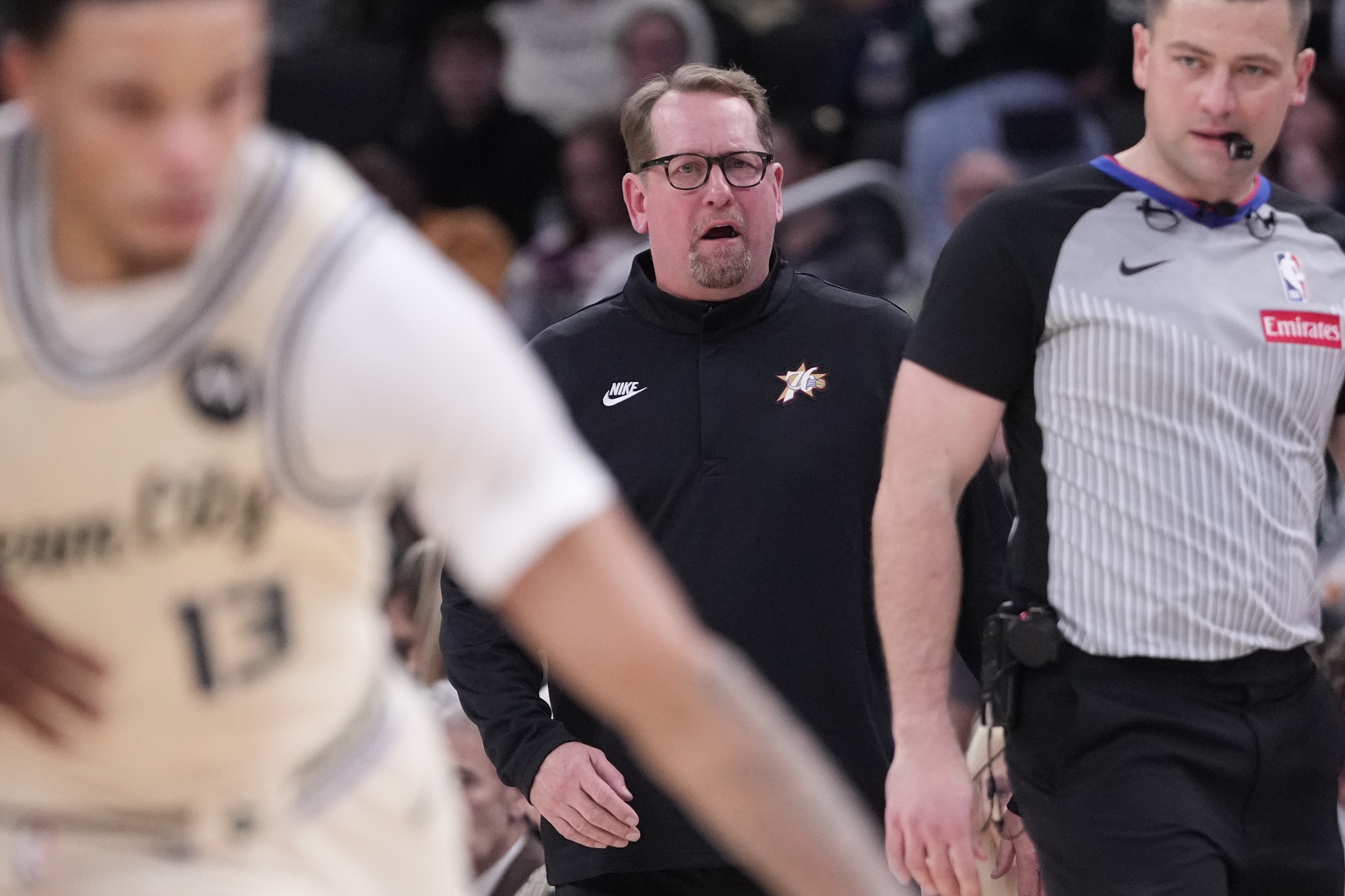
    Sixers head coach Nick Nurse watches his team during the first half of their win against the Bucks.

    The Sixers (9-6) scored the first five points in overtime on a three-pointer from Justin Edwards — who scored just two points in regulation — and a basket from Maxey.

    Milwaukee (8-8) got the margin down to 113-112 on a driving layup from Rollins with 1 minute, 43 seconds remaining, but Quentin Grimes hit a three-pointer 20 seconds later and Philadelphia stayed ahead by at least two the rest of the way.

    Milwaukee trailed 94-87 midway through the fourth quarter but rallied to take the lead on Myles Turner’s three-pointer with 14.8 seconds remaining.

    The Sixers tied the game with seven seconds left when Maxey drove into the lane, drew a foul, and hit his free throws. Rollins missed a three-pointer at the buzzer.

    Paul George added 21 points for Philadelphia. Bobby Portis had 19 and Kyle Kuzma 17 for Milwaukee.

    The Sixers return home Sunday to host the Miami Heat (1 p.m., NBCSP) at Xfinity Mobile Arena.