Tag: no-latest

  • Trump suffers several defeats in effort to punish opposing lawyers

    Trump suffers several defeats in effort to punish opposing lawyers

    Since taking office for the second time, President Donald Trump has suffered multiple losses in his efforts to strip security clearances from political opponents and prestigious Washington law firms. With several of those cases working through the courts, the issue could become one of the next Supreme Court fights over presidential power.

    The president’s latest loss came this week, when a federal judge in Washington temporarily blocked Trump’s efforts to strip a security clearance from national security attorney Mark Zaid. In 2019, Zaid represented the government whistleblower who accused Trump of trying to pressure Ukraine for damaging information about his political opponents. The accusations led to Trump’s first impeachment.

    In his Tuesday order, U.S. District Judge Amir Ali found that Zaid was likely to succeed on his claim that revoking Zaid’s security clearance violated the attorney’s constitutional free speech and due process rights. The order notes that Trump has called Zaid a “sleazeball” and said the lawyer should be sued for treason.

    “This case involves the government’s retribution against a lawyer because he represented whistleblowers and other clients who complained about the government,” wrote Ali, who was appointed by President Joe Biden.

    The case should not have been difficult, Zaid said in an interview. “But it’s surrounded by all sorts of constitutional analysis because of the assertion by the Trump administration that it has the power to do anything it wants without any oversight whatsoever.”

    He compared his situation — as well as Trump’s targeting of law firms more generally — to the line from William Shakespeare’s play Henry the VI, Part 2: “The first thing we do, let’s kill all the lawyers.” The line, spoken by one of the play’s villains, is about subverting lawyers “fighting for rule of law,” he said.

    The White House did not immediately respond to a request for comment.

    The case began with a March 22 presidential memorandum in which Trump revoked the security clearances of Zaid and 14 other individuals, saying that he had determined it was “no longer in the national interest” for the people to hold the clearances.

    The individuals included Democrats such as Biden, former vice president Kamala Harris and former secretary of state Antony Blinken. It also included New York Attorney General Letitia James (D), whom Trump’s Justice Department has tried, and so far failed, to indict in a mortgage fraud case. The administration has also revoked clearances of 37 current and former national security officials.

    This spring, Trump moved to summarily suspend the security clearances of several large Washington law firms that regularly do work for the government and have ties to his perceived political opponents. Trump argued that the law firms posed national security dangers to U.S. interests and said the firms’ diversity, equity. and inclusion policies resulted in “unlawful discrimination.”

    Though some law firms cut deals with the administration to keep their clearances, others successfully sued to block the actions.

    This year, federal judges in Washington blocked the administration’s attempts to suspend security clearances from the law firms Jenner & Block, Susman Godfrey, WilmerHale, and Perkins Coie. In each case, the judges found that the orders were retaliatory and violated the firms’ constitutional free speech rights.

    In the case of Jenner & Block, U.S. District Judge John D. Bates wrote that the president was trying “to chill legal representation the administration doesn’t like, thereby insulating the Executive Branch from the judicial check fundamental to the separation of powers.”

    The administration has appealed those cases and, depending on the outcomes in the court of appeals, the issue could be decided by the Supreme Court. The high court has heard a number of cases concerning presidential power this term, and it’s unclear how it would rule.

    Should his case reach the Supreme Court, Zaid said the issue could transcend judicial ideology. No matter which way they lean, the justices “recognize the importance and role that lawyers play in society,” he said. “And what the Trump administration is doing with clearance revocations … is a direct attack on our ability to enforce exactly what judges enforce: the rule of law.”

  • With airstrike in Nigeria, Trump inserts U.S. into long-running turmoil

    With airstrike in Nigeria, Trump inserts U.S. into long-running turmoil

    Top Nigerian officials said Friday that U.S. attacks in the country on what President Donald Trump called “ISIS Terrorist Scum” could mark the opening salvo in a campaign against militant groups there. But security analysts warned that Trump administration officials appeared to be stepping into a complex, long-running conflict that they may not fully understand.

    Trump has in recent months repeatedly warned that he would intervene in Nigeria — which is afflicted by widespread violence — if the killing of Christians does not stop. He made good on that promise Thursday, announcing “numerous perfect strikes” on Christmas night and promising more if the “slaughter of Christians continues.”

    Western and Nigerian security analysts said the attacks marked the first time in decades that the United States had launched such strikes in Nigeria, a country of more than 230 million people split about equally between Muslims and Christians. The analysts said that violence, particularly by Islamist militants in the north, has sometimes targeted Christians but that Muslims have also been affected.

    Neither Trump nor the U.S. Africa Command (AFRICOM) specified exactly who was killed in the strikes, which both the U.S. and Nigeria’s government said were conducted with the approval of Nigeria’s government. Daniel Bwala, an adviser to Nigeria’s President Bola Ahmed Tinubu, said the strikes on Thursday marked only the beginning. Nigerian Foreign Affairs Minister Yusuf Tuggar told Nigerian broadcaster Channels Television that his country provided intelligence to the U.S. for the strikes and that cooperation was ongoing.

    “There will be more, I can assure you of that,” he told the Washington Post in an interview Friday. “This is part of our struggle against insecurity.”

    Trump, as he has done repeatedly in recent months, specifically cited violence against Christians in his Christmas night post on Truth Social, declaring that he had previously warned “these terrorists that if they did not stop the slaughtering of Christians, there would be hell to pay.”

    Bwala said that while Nigeria welcomed the U.S. assistance, the government disputed Trump’s claim that Christians were being disproportionately targeted. Sokoto State, where the strikes took place, is a primarily Muslim area.

    Analysts said the violence in northwest Nigeria is carried out by a combination of Islamist militants and bandits. Much of the violence in Sokoto in recent years, according to Armed Conflict Location and Event Data Project (ACLED), is attributable to a group called Lakurawa. Some analysts, including those with ACLED, link that group to the Islamic State, while others say Lakurawa is affiliated with the rival al-Qaeda affiliate Jama’at Nusrat al-Islam wal-Muslimin (JNIM).

    Analysts said that U.S. officials seem more focused on their preferred narrative in Washington than on the complex reality on the ground.

    “It’s politically convenient,” said Mustapha Alhassan, a security analyst who has worked extensively in northwest Nigeria, referring to Trump’s framing of the strikes. He said that while it is clear there is increasing violence by Lakurawa, the group is more likely linked to al-Qaeda than the Islamic State.

    “Nigerians would welcome the help if it was hitting precise targets,” he said. “But that doesn’t seem to be what is happening. All of this is to what end?”

    James Barnett, a Nigeria specialist based between Lagos and Britain, said that much remains uncertain about the impact of the strikes and the future of military cooperation between the United States and Nigeria.

    “If this is the start of a shift in U.S. policy toward Nigeria, there are a lot of potential challenges and risks, including in terms of how these operations are framed,” he said. “The symbolism of Christmas is hard to miss … there is a clear political angle to it.”

    He said it was significant, though unsurprising, that it was Trump, rather than Nigerian officials, who first announced the strikes. Historically, he noted, Nigeria’s government has not welcomed U.S. strikes because of concerns about the country’s sovereignty.

    In the typically quiet village of Jabo in northwest Nigeria, three residents said in interviews Friday they were left confused by a strike in their area, which they said had not been especially affected by violence.

    “We don’t have any bandits’ camp near our area,” said Sama’ila Mustapha.

    He recounted seeing a light and then hearing a loud bang late on Thursday night. Mustapha said he then followed a crowd of people to an onion field just outside of town near a hospital. He and two other residents said there were no casualties.

    “We thought it’s a missile or an aircraft,” said another resident, Abdulrahman Mainasara. “God was so kind it landed on the outskirts, in an open place.”

  • States invest in child care more than ever to help parents with rising costs

    States invest in child care more than ever to help parents with rising costs

    When Raelyn Scholl returned to work after having a baby, it was with a peace of mind foreign to many parents in the United States: She knew her son had a spot in daycare, and for only $400 a month.

    That’s because Scholl’s employer, a family-owned Missouri pharmacy, runs a daycare for its workers and subsidizes the cost of childcare. It is “a huge blessing” for Scholl, 25, and her husband, who didn’t have to worry about searching for childcare — the average monthly cost of which is more than $1,200 across U.S. metropolitan areas — during the pregnancy.

    Now, more Missouri employers will be able to help their workers pay for childcare thanks to a new state-funded program, approved by lawmakers in May and launched last month. Through the initiative, employers can sign up to offer childcare benefits to workers. The cost is split among the state, parents, and employers, who can claim a tax break.

    In Missouri and elsewhere, a growing acknowledgment of the economic and labor concerns related to childcare has fueled political momentum for state-backed initiatives to help parents and providers. Lawmakers in about two dozen states passed new childcare programs this year, often backed by business leaders concerned with recruiting and retaining workers.

    Scholl’s boss in southeastern Missouri, Abe Funk, is among the business owners who argue that childcare is important for a healthy economy. Funk, who is one of the first employers taking part in the new state program, believes that others who sign up will see the same outcome he did when he began footing part of his workers’ childcare bill: better employee retention, happier families and more workers in the labor force.

    “A lack of childcare impacts every aspect of the economy,” said Funk, who owns John’s Pharmacy in Cape Girardeau with his wife, Emily, and has five children. “Think of how many people want to work and can’t because they can’t afford childcare. … If they can get childcare, then they can get off the sidelines.”

    Across the nation, rising childcare costs and a shortage of spots are squeezing families and pushing parents, especially mothers, out of the workforce. Meanwhile, providers struggle with low wages and high operating costs. Congress allocates some money to childcare annually, but advocates say a much greater investment is needed to solve the system’s problems, and federal cuts to Medicaid and other programs are poised to squeeze state budgets further.

    Tens of thousands of children are on voucher waiting lists in states such as Florida and Texas, and other states have frozen such programs. Providers have also shut down: In more than half of states, fewer childcare programs were running in 2024 compared with 2023, according to an analysis by the Century Foundation, a progressive think tank. In Indiana, 10,000 spots are projected to be lost to closures by August, according to one estimate.

    That has presented a “mixed bag” for states when it comes to childcare funding — some are in crisis while others are innovating, said Anne Hedgepeth, senior vice president of policy and research at childcare Aware, a national nonprofit.

    Though state-level initiatives are limited in scope and cannot fix the nation’s shortage of 4 million childcare spots alone, advocates hope the programs will prompt future investment.

    At least 11 states this year allocated millions to subsidy or voucher programs that give families money to pay for childcare. Others approved funding aimed at helping childcare operators, increasing the number of available spots, creating new funding streams for childcare or establishing public-private partnerships such as Missouri’s cost-sharing program.

    A $100 million project announced this month in New York will build and expand childcare facilities, aiming to create thousands of new spots. Wisconsin will use $110 million for payments to help childcare providers stay in business, while Oklahoma lawmakers created a subsidy program for childcare employees. New Mexico became the first U.S. state to enact universal childcare, using state oil and gas revenue as funding.

    “We have seen more states invest their own dollars in childcare over the last five years than ever before,” said Julie Kashen, a senior fellow at the Century Foundation. “We have seen it in red, blue, and purple states. That’s a big deal.”

    Momentum around the issue began to mount in the late 2010s, and the strain on the childcare system during the pandemic brought further attention to the need for reform, said Sarah Rittling, executive director of the First Five Years Fund, a national nonprofit. Now, “as we’re having these conversations about cost and affordability” in American life, she said, “you can’t get away from the role childcare plays in that.”

    In Ohio, an understanding of childcare as an economic issue and interest from business leaders and chambers of commerce have represented a big win, said Kara Wente, director of the Ohio Department of Children and Youth.

    Researchers there found in a May report that the state economy loses $5.48 billion per year because insufficient childcare coverage is keeping parents out of the labor force. In a 2024 statewide survey, 49% of parents said they had to cut back their work hours because of a lack of childcare, and 61% of nonworking mothers with children 5 or younger said they would work if they had access to high-quality, affordable childcare.

    “That really resonates when employers are struggling to find enough individuals to fill their positions,” Wente said. “It really changed the conversation, and we’ve had a lot of employers and chambers come to the table.”

    The legislature approved funding for a cost-sharing program, similar to Missouri’s, which is now in the process of starting up. State Republicans, touting the program launch, said supporting working families will help businesses retain employees.

    That perspective was also at work in Montana, where lawmakers this spring succeeded in adding a childcare component to an infrastructure bill. The state will use a budget surplus to seed a childcare trust with $10 million, which will grow with interest. The governor this month named an advisory board that will determine how to use the funds.

    State Sen. Laura Smith (D), who pushed for the legislation, said she saw the bill’s approval as a reflection of the growing understanding of the issue, particularly as Montana businesses suffer from an unstable workforce. As she talked to Senate colleagues about childcare “as an infrastructure issue,” she said it was “one of the first times in the last seven years” that the idea resonated.

    “I think the quiet work that caregivers do is becoming more visible,” she said. “It’s become more of a crisis and it’s touching more people — including legislators and their families.”

    In Missouri, Funk said he didn’t understand the impact of childcare on the economy until he saw it firsthand at the pharmacy. Only 3% of the state’s counties have enough childcare for infants and toddlers, meaning almost the entire state is considered a “desert” — for every spot available, there are more than three infants or toddlers who could need one.

    The cost-sharing initiative was created out of two years of meetings with communities and data analysis led by Kids Win Missouri, a nonprofit. Its success leaned heavily on collaboration between business leaders, chambers of commerce and childcare advocates, plus support from the governor, Republican Mike Kehoe, said Robin Phillips, chief executive of childcare Aware of Missouri, an early-childhood education nonprofit that is helping launch the program.

    The program uses a sliding scale based on workers’ incomes, with the employer and state pots covering the remaining costs for each enrolled child. Employers have an additional incentive to participate since a tax credit that Congress expanded this year will reimburse a larger chunk of their costs.

    Demand for the program, called childcare Works, has already outpaced the capacity of about 287 seats allowed by the $2.5 million in funding allocated by the state, said Brian Schmidt, executive director of Kids Win Missouri. Within the next month, the first employers that have signed up are slated to start offering the benefit, Schmidt said. He and other proponents hope that the program will grow over time, particularly if it becomes popular with employers, and that it could be a model for other states.

    “It’s really exciting,” Schmidt said. “It’s really cool to see something come to fruition.”

  • Delaware State Police say DMV gunman let customers leave, fired at approaching officers

    Delaware State Police say DMV gunman let customers leave, fired at approaching officers

    A man accused of fatally shooting a Delaware State Police trooper at a DMV office allowed customers to leave and then fired at approaching officers before being killed, investigators said Friday.

    State Police Cpl. Matthew Snook was working an overtime assignment at the New Castle DMV reception desk on Tuesday afternoon when Rahman Rose entered as a customer, approached him from behind, and shot him with a handgun, state police said in a news release.

    Rose, 44, of Wilmington, continued firing at the trooper, who pushed a DMV employee out of the way and told them to run, investigators said. Rose then allowed customers to leave but fired multiple rounds at law enforcement as they approached the building.

    A New Castle county police officer shot Rose through a window from outside the building. Rose later died at a hospital.

    Snook, who went by “Ty,” was a 10-year veteran of the state police force. On Wednesday, members of the community lined roadways and displayed messages of gratitude as a procession of troopers, police officers and firefighters escorted his body from the state medical examiner’s office to a funeral home.

    William Crotty, superintendent of the Delaware State Police, said the outpouring of support served as a reminder that Snook’s service and sacrifice will not be forgotten.

    The shooting remains under investigation, and authorities have asked witnesses or others with relevant information to contact detectives.

  • Zelensky: Talks will address security guarantees and reconstruction

    Zelensky: Talks will address security guarantees and reconstruction

    KYIV, Ukraine — Ukrainian President Volodymyr Zelensky said Friday that he will meet with U.S. President Donald Trump in Florida over the weekend.

    Zelensky told journalists that the two leaders will discuss security guarantees for Ukraine during Sunday’s talks, and that the 20-point plan under discussion “is about 90% ready.”

    An “economic agreement” also will be discussed, Zelensky said, but added that he was unable to confirm “whether anything will be finalized by the end.”

    The Ukrainian side will also raise “territorial issues,” he said. Moscow has insisted that Ukraine relinquish the remaining territory it still holds in the Donbas — an ultimatum that Ukraine has rejected. Russia has captured most of Luhansk and about 70% of Donetsk — the two areas that make up the Donbas.

    Zelensky said that Ukraine “would like the Europeans to be involved,” but doubted whether it would be possible at short notice.

    “We must, without doubt, find some format in the near future in which not only Ukraine and the U.S. are present, but Europe is represented as well,” he said.

    The announced meeting is the latest development in an extensive U.S.-led diplomatic push to end the nearly four-year Russia-Ukraine war, but efforts have run into sharply conflicting demands by Moscow and Kyiv.

    Zelenskyy’s comments came after he said Thursday that he had a “good conversation” with U.S. special envoy Steve Witkoff and Jared Kushner, Trump’s son-in-law.

    Kremlin spokesman Dmitry Peskov told reporters on Friday that the Kremlin had already been in contact with U.S. representatives since Russian presidential envoy Kirill Dmitriev recently met with U.S. envoys in Florida.

    “It was agreed upon to continue the dialogue,” he said.

    Trump is engaged in a diplomatic push to end Russia’s all-out war, which began on Feb. 24, 2022, but his efforts have run into sharply conflicting demands by Moscow and Kyiv.

    Zelensky said Tuesday that he would be willing to withdraw troops from Ukraine’s eastern industrial heartland as part of a plan to end the war, if Russia also pulls back and the area becomes a demilitarized zone monitored by international forces.

    Though Russian Foreign Ministry spokeswoman Maria Zakharova said Thursday that there had been “slow but steady progress” in the peace talks, Russia has given no indication that it will agree to any kind of withdrawal from land it has seized.

    On the ground, two people were killed and six more wounded Friday when a guided aerial bomb hit a busy road and set cars aflame in Ukraine’s second biggest city, Kharkiv, mayor Ihor Terekhov wrote on Telegram.

    One person was killed and three others were wounded when a guided aerial bomb hit a house in Ukraine’s Zaporizhzhia region, while six people were wounded in a missile strike on the city of Uman, local officials said Friday.

    Russian drone attacks on the city of Mykolaiv and its suburbs overnight into Friday left part of the city without power. Energy and port infrastructure were damaged by drones in the city of Odesa on the Black Sea.

    Meanwhile, Ukraine said that it struck a major Russian oil refinery on Thursday using U.K.-supplied Storm Shadow missiles.

    Ukraine’s General Staff said that its forces hit the Novoshakhtinsk refinery in Russia’s Rostov region.

    “Multiple explosions were recorded. The target was hit,” it wrote on Telegram.

    Rostov regional Gov. Yuri Slyusar said that a firefighter was wounded when extinguishing the fire.

    Ukraine’s long-range drone strikes on Russian refineries aim to deprive Moscow of the oil export revenue it needs to pursue its full-scale invasion. Russia wants to cripple the Ukraine’s power grid, seeking to deny civilians access to heat, light and running water in what Ukrainian officials say is an attempt to “weaponize winter.”

  • Hundreds of residents signed up for FEMA buyouts after Helene. Not one has been approved.

    Hundreds of residents signed up for FEMA buyouts after Helene. Not one has been approved.

    FAIRVIEW, North Carolina — A dusting of December snow had turned the mountains around her white, but Elizabeth Clark barely had time to notice.

    It had been 438 days since Hurricane Helene’s floodwaters wrecked her home’s foundation, inundated the first floor, destroyed the septic system and swallowed their belongings. Her mortgage company agreed to pause her payments for a year, but now seemed to be losing patience over the $270,000 she still owed on a house no longer safe to live in.

    “I’ve never missed a payment in my whole life,” said Clark, a neonatal nurse at a nearby hospital. “Here now, at 42 years old, I’m having to consider foreclosing.”

    In November 2024, Clark was among the first storm victims in her county to apply for a voluntary program funded by the Federal Emergency Management Agency that would enable the government to buy out her property.

    Not only can qualified homeowners get the pre-storm value of their house — and the chance to move on with their lives — but the program is meant to help at-risk communities reduce future disaster losses by getting the most vulnerable structures permanently out of harm’s way.

    After the storm, Clark and her husband, Calvin, spent weeks living in a hotel, before renting a home from friends for eight months. Finally, they moved nearly an hour away to a small house in Waynesville, N.C., that they had been leasing to tenants. It feels cramped with their three school-aged children, and each day brings hours on the road to return to the community where their kids go to school, play sports, and visit grandparents. The loss of renters has been another financial hit.

    Meanwhile, more than 13 months after applying for a buyout, Clark has heard almost nothing definitive.

    She is hardly the only one enduring another winter of uncertainty.

    More than 800 storm victims around Helene-battered western North Carolina have applied under FEMA’s Hazard Mitigation Grant Program. State officials vetted applications and began sending them up the chain to FEMA as far back as February. As of Dec. 15, they had sent nearly 600 buyout requests to Washington, with more likely to follow.

    So far, they say, not a single approval has come through.

    North Carolina Gov. Josh Stein has called the paralysis “absolutely unacceptable,” and has pushed for answers. Earlier this month, he wrote to FEMA’s acting administrator, detailing the startling number of applications that “remain without a final decision.”

    “Further delay of these approvals,” he wrote, “keeps communities and families in limbo, in some cases paying expenses on homes they cannot live in while they await word from FEMA.”

    FEMA did not comment on questions about the program.

    The situation is just one element of the sprawling and ongoing recovery, and of the palpable frustration in western North Carolina — especially given promises by President Donald Trump during a visit early this year, where he vowed to “slash through every bureaucratic barrier” and insisted that “every single inch of every property will be fully rebuilt, greater and more beautiful than it was before.”

    For homeowners such as Clark, the not knowing has become all-consuming.

    “The uncertainty has taken a heavy toll — financially, emotionally, and on my family’s sense of security,” she wrote to Stein in one August letter. “It is heartbreaking to think that, after surviving a disaster, we may lose everything because of timelines and red tape that are beyond our control.”

    Months later, she feels much the same.

    “There’s so little information,” she said. “Nobody really has any answers. We are just sitting here, waiting.”

    ‘That hope is dwindling’

    Rob Moore, who has long studied flooding risks and disaster policy for the Natural Resources Defense Council, said buyouts under FEMA’s hazard mitigation program have been an important tool for decades.

    When it works as intended, voluntary buyouts allow homeowners to receive the predisaster value for their homes so that they can relocate and start over. The program can help communities reduce overall flood risk and better prepare for future calamities, as part of the deal is that properties acquired by the government are turned into open space.

    In a 2019 study, Moore and a colleague reviewed nearly 30 years of FEMA data on buyouts — including speaking with former owners of some of the more than 43,000 properties the agency had acquired since the 1980s. Those acquisitions have taken place in 49 states and several U.S. territories, the report said.

    In short, they found that the program played a critical role in the wake of disasters, and is likely to become only more vital as rising seas and escalating flood risks displace more Americans.

    But one issue has been a constant: Buyouts are complex, and hardly ever happen quickly.

    “Under the best of circumstances, these things take more time than they should. But these are clearly not the best of circumstances,” said Moore, referring to deep staffing cuts at FEMA this year and the uncertainty about the agency’s future and its mission.

    The 2019 study found that it takes a median of about five years between a flooding disaster and the completion of a FEMA-funded buyout project. FEMA has said almost 80% of acquisitions are approved in less than two years, and 93% are approved in under three years.

    “While every buyout project is different, one thing is clear: long wait times make buyouts less accessible, less equitable, and less effective for disaster mitigation and climate adaptation,” the researchers wrote.

    Moore thinks something deeper than the normal lag times could be at play in North Carolina, where many county and state officials moved quickly to open up applications for homeowners interested in potential buyouts.

    “Typically, communities are so focused on cleaning up and recovering that they don’t even think about other risk reduction activities until a year goes by,” he said.

    But in North Carolina after Helene, many localities moved much quicker.

    Leaders in Buncombe County, home to Asheville and other municipalities, were among the local officials who tried to speed up the process in hopes of getting help to qualified residents sooner. The county began taking applications for buyouts in January, barely three months after the storm.

    “We were hoping that because we started earlier, that we would see buyouts already started and/or reconstruction already started, but we haven’t seen that,” said Avril Pinder, Buncombe’s county manager.

    Pinder said local FEMA representatives have worked tirelessly since the storm hit, and that the region would be in much worse shape without their help over the past year. Indeed, hundreds of millions of dollars have poured in from the agency for a range of recovery programs, with much more expected.

    The reality is that local governments continue to wait for large sums in federal reimbursements for debris cleanup and other projects. Roads still need repair. Renters and homeowners remain displaced. Certainly for those storm victims still awaiting a buyout, it has been a season of silence and stress.

    “What we are hearing is, ‘What do we do now? How do we pay for this, as well as [another] place to live?’” Pinder said. “There is hope, but that hope is dwindling because it’s been a year now that they’ve applied for this, and they’re still carrying a mortgage or rent someplace else. And they’re trying to move ahead with their lives.”

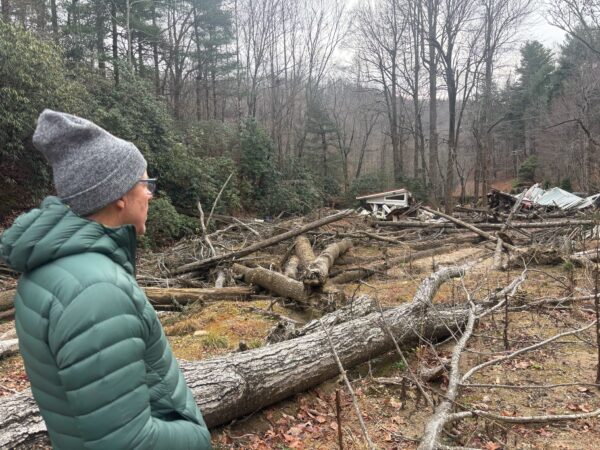
    Carey and Steve Hayo, whose home just outside Hendersonville was devoured by a landslide during Helene, are among those struggling to move ahead.

    The couple was fortunate to be out of town when a wall of mud and debris came screaming down a mountainside, knocking their home, a guesthouse and a garage clean off their foundations. But the disaster swallowed most of their life’s investment and virtually all their belongings. A pile of rubble is all that remains.

    The Hayos no longer had a mortgage, but also have no clear way of recouping their losses, as insurance doesn’t cover landslides. They are living in their third place since Helene. Both in their 70s, they are in counseling for trauma. Many weeks have passed in a blur of phone calls to insurers, bankers and lawyers, local officials, and FEMA.

    “It’s like a bad nightmare,” Carey Hayo said of the experience. As signs of recovery unfold around them, they feel stuck. “You get hopeful, and then you don’t hear anything … There’s just no information.”

    More than a year has passed since the couple applied for a buyout through the federal hazard mitigation program. But as with everyone else who did the same, that prospect remains uncertain. Recently, the couple spoke at a Henderson County commission meeting, pushing local officials to help secure funding — and answers.

    “We’re just frustrated,” Steve Hayo told panel. “This doesn’t seem to have an end. And that’s what we are searching for.”

    ‘Unfinished business’

    For their part, North Carolina officials insist they are doing all they can.

    The state has overseen hundreds of millions of dollars in hazard mitigation across multiple disasters beginning with Hurricane Floyd in 1999, and prides itself on ensuring that each hazard mitigation application “meets or exceeds federal guidelines,” said Justin Graney, a spokesperson for N.C. Emergency Management.

    “North Carolina is unfortunately no stranger to disasters and has become a national leader in the hazard mitigation space,” Graney said, saying the state “is not a novice” when it comes to implementing such projects as buyouts and elevations. In addition, he said, the state “moved at a rapid pace” after Helene to process applications from affected homeowners.

    Graney said officials had worked with FEMA to resolve issues with a small number of buyout applications where portions of the property might be needed for nearby road reconstruction or repair projects, which are subject to review by another agency. But he said the vast majority of applications under review should not be impacted by such issues, and that the state is confident it had addressed concerns “with projects caught in this federal quagmire.”

    Don Campbell, chief of staff to North Carolina’s emergency manager, recently told members of a state task force on Helene recovery that overall, officials had been given little guidance from FEMA on why no buyouts had been approved since Helene.

    “We understand that many of those applications are sitting on the desk of the secretary of homeland security,” Campbell said, adding that state and local officials are acutely aware of the real-world implications for homeowners struggling to hang on in the meantime.

    Matt Calabria, the head of the Governor’s Recovery Office for Western North Carolina, said there is reason for cautious optimism. The state received notice shortly after the first anniversary of Helene that it will be eligible for up to about $1.5 billion in hazard mitigation funding, depending on the size and number of qualified projects.

    But those dollars are not guaranteed, and changes in criteria have made it tougher for some projects to qualify, he said. Either way, nothing is likely to happen as quickly as anyone would like.

    “The folks who are seeking buyouts, in a lot of cases, have been displaced from their homes. They are in some cases paying mortgages on damaged or destroyed homes,” Calabria said. “And so, these delays are very acutely felt by so many of these families.”

    Unlike some other FEMA programs that are reimbursement-based, buyouts require an up-front approval from the agency, Calabria said.

    “That’s why we are seeking word from FEMA, so that we can begin proceeding with these projects,” he said. “These delays have been outsized, and we know that for hundreds of families, this is going to make a tremendous difference. So, we continue to push every day.”

    In Fairview, Elizabeth Clark is wrestling with what to do when the next mortgage payment comes due.

    “At this point, we have decided we are not going to pay a dime on a house we can’t even live in,” at least until she has clarity about whether FEMA is likely to approve a buyout, she said.

    Clark worries about losing the home, which sits within sight of her parents’ house, to foreclosure. She worries about wrecking her credit. But, she said, “We had to spend so much money replacing things. We don’t have money to throw away.”

    A 45-minute drive to the south, Carey and Steve Hayo are also fighting against cynicism and weariness as they figure out what comes next. On a cold December afternoon, they returned once more to the place that gave them more than a decade of happy memories.

    The garden where they once lovingly tended to vegetables. The rooms where they welcomed family and friends. The hillsides blanketed in rhododendrons.

    “People would drive up and say, ‘You live in paradise,’” Carey said.

    “It was a nice little oasis,” said Steve, looking out over the heap of twisted metal and glass and insulation buried amid a sea of mud and fallen trees.

    Whether a federal buyout ultimately comes through has significant financial implications for the couple, of course. But it is clear they are seeking something more than just a check. They crave closure.

    “It’s unfinished business,” Carey Hayo said. “It’s like if your mother died and you couldn’t bury her. You can’t complete the mourning.

    “That’s what this is: mourning.”
  • New science points to 4 distinct types of autism

    New science points to 4 distinct types of autism

    When Marc and Cristina Easton’s son was diagnosed with autism at 20 months, the Baltimore couple left the doctor’s appointment in confusion. Their toddler — who was very social — didn’t resemble the picture of the condition they thought they knew. And the specialists could offer little clarity about why or what lay ahead.

    It wasn’t until four years after their child’s diagnosis that the Eastons finally began to get answers that offered them a glimmer of understanding. This summer, a team from Princeton and the Flatiron Institute released a paper showing evidence for four distinct autism phenotypes, each defined by its own constellation of behaviors and genetic traits. The dense, data-heavy paper was published with little fanfare. But to the Eastons, who are among the thousands of families who volunteered their medical information for the study, the findings felt seismic.

    “This idea that we’re seeing not one but many stories of autism made a lot of sense to me,” Cristina said.

    For decades, autism has been described as a spectrum — an elastic term that stretches from nonverbal children to adults with doctorates. Beneath that vast range lies a shared pattern of social communication and behavioral differences, long resistant to neat explanations.

    Now, advances in brain imaging, genetics and computational science are revealing discreet biological subtypes. The discoveries could one day lead to more accurate diagnoses and treatments — raising profound questions about whether autism should be seen as something to cure or as an essential facet of human diversity.

    There are a few high-impact mutations that alone appear to lead to autism. But researchers now suspect that the majority of cases arise from a subtler genetic architecture — common variants scattered throughout the population that, in certain combinations and under certain environmental conditions, can alter development.

    And while recent public discourse has been clouded by misinformation about the role vaccines play in autism, Tylenol and what factors cause the condition, the new analysis is gradually illuminating the science of autism’s beginnings. It suggests that some children may have genetic mutations when they’re born that activate at different times in life — a reflection of varying paths that emerge at different moments.

    Natalie Sauerwald is one of the lead authors of the subtypes study and a computational biologist at the Flatiron Institute, part of the Simons Foundation, which funds scientific research. She compared earlier autism research to assembling a jigsaw puzzle, only to find that the pieces didn’t quite fit — not because the image was unclear but because “the box had always contained several puzzles, shuffled together.”

    There isn’t just one autism, Sauerwald said: “There are many autisms.”

    Genetic roots

    Pinning down who counts as autistic has always been complicated. The condition manifests in an extraordinary range of ways — across genders, abilities, and life experiences — defying any single definition. Boys are far more likely to receive a diagnosis than girls, though many researchers suspect that girls are frequently overlooked because their symptoms may appear less disruptive or more easily masked.

    In recent years, as diagnostic criteria have broadened, the number of people identified as having autism has risen sharply. Most of the growth has been in those who have more mild symptoms as opposed to those who are profoundly impacted and have minimal or no language or have an intellectual disability, according to Centers for Disease Control and Prevention data. About 1 in 150 children were diagnosed with autism in 2000 in U.S. communities examined by the Centers for Disease Control and Prevention; by 2022, that figure had climbed to 1 in 31. The increase may look staggering, but many experts say it reflects not an epidemic of autism itself but a greater understanding of its many forms — and a society becoming more attuned to recognizing them.

    A computational biologist, Sauerwald’s lifework has been about studying genes and their relationship with human health. She had previously published research on COVID-19 and cancer, but she had read a lot about how the significant variability of autism made it so difficult to treat and reached out to researchers at Princeton.

    When Sauerwald began analyzing the autism database managed by the Simons Foundation, a science nonprofit, and housing information on over 5,000 children, she expected the results to be messy. The spectrum spans such a wide range that she assumed the categories would blur together, like overlapping circles in a Venn diagram. Instead, the data resolved into four groups with their own genetic and behavioral signatures.

    “That level of distinctiveness was really surprising,” she said.

    The work published in July in Nature Genetics detailed the four categories.

    Broadly affected

    The smallest group — about 10 percent of participants — faced the steepest challenges, marked by developmental delays, difficulties with communication and social interaction, and repetitive behaviors that touched nearly every part of life.

    Mixed autism with developmental delay

    Roughly 19% showed early developmental delays but few signs of anxiety, depression, or disruptive behavior. Researchers call this group “mixed” because its members vary widely in how strongly they display social or repetitive behaviors.

    Moderate challenges

    About a third of participants fell into this group, showing the hallmark traits of autism — social and communication differences and repetitive habits — but in subtler ways and without developmental delays.

    Social and/or behavioral

    The largest group, around 37%, met early developmental milestones on time yet often grappled with other conditions later on, including ADHD, anxiety, depression, or obsessive-compulsive disorder.

    One of Sauerwald’s co-authors, Olga Troyanskaya, director of Princeton Precision Health, said she was stunned that in the social and/or behavioral group, individuals tended to be diagnosed later — 6 to 8 years of age — whereas most children exhibit noticeable symptoms before the age of 3 and are diagnosed at that time.

    The new analysis study showed the delay may stem from genetic mutations that are present when a child is born — but activate later in life.

    “To me, this was the most fascinating part,” Troyanskaya said. “We’ve always thought of autism as a disorder of fetal development — but that may be true only for some children.”

    That breakthrough idea was given another boost in October when a second study — published in Nature by an entirely different team using separate data — arrived at essentially the same conclusion: Genetically distinct forms of autism may unfold on different life timelines. The new analysis, based on data from the United States, Europe, and Australia, suggested that children diagnosed after age 6 carried distinct genetic profiles and that their form of autism looked strikingly different from the early-childhood type — less like a developmental delay and more akin to conditions such as depression, ADHD, or post-traumatic stress disorder.

    “These findings provide further support for the hypothesis that the umbrella term ‘autism’ describes multiple phenomena with differing [causes], developmental trajectories, and correlations with mental-health conditions,” the authors wrote.

    Tracing outside forces

    Understanding that autism may encompass multiple distinct conditions naturally leads to another question: What, exactly, drives these differences at the biological level?

    In totality, hundreds of genetic mutations have been identified as being linked to autism.

    Roughly half appear to be inherited — but the rest arise spontaneously, and it is these that are perhaps the most mysterious. These mutations come from random copying errors in DNA or from outside influences. The list of suspects impacting autism is long: air pollution, paternal age, maternal diabetes, prenatal infections — all supported by some evidence, though none yet definitive.

    Sauerwald and Troyanskaya’s work illuminates the genetic blueprint of autism. But genes don’t act in isolation. Across laboratories, scientists are probing external forces, particularly the prenatal environment, to find out what might nudge those genes to switch on or off.

    That curiosity has, at times, collided with politics. In recent months, scientists have been baffled by the Trump administration’s decision to single out Tylenol use in pregnancy as a possible cause. “There are other exposures with similarly not very strong statistical associations,” said Catherine Lord, a professor of psychiatry at UCLA and one of the field’s foremost experts, referring to work on SSRI antidepressants, fever, heavy metals, and other possible prenatal and environmental associations. “Across these studies, the effect sizes are small.”

    Zeyan Liew, an environmental epidemiologist at Yale, has spent years studying PFAS, also knows as “forever chemicals,” the synthetic compounds used in products like Teflon that now pervade food and drinking water. His National Institutes of Health-funded research, drawing on data from millions of children across three European countries, found no direct link between maternal PFAS levels and autism diagnoses. But the data hinted at something subtler: Children whose mothers had higher exposure tended to show more social and behavioral difficulties — hyperactivity, anxiety, trouble forming friendships.

    “It shows that a mother’s PFAS level is correlated with a child’s social developmental functioning,” Liew said. The chemicals, he suspects, may act on the developing brain, disrupt hormonal balance or trigger oxidative stress — “unwanted biological interference,” he said, “during a period of rapid brain development.”

    David Mandell, a professor of psychiatry at the University of Pennsylvania and part of a newly funded NIH team, is developing a predictive model to examine a wider range of exposures: medications, air quality, access to green space, the built environment. The goal, he said, is to understand not just which factors matter, but when. Timing may prove decisive. He pointed to the infamous case of thalidomide, a morning-sickness drug withdrawn in the 1960s after causing birth defects. Autism risk rose only among women who took it between the 20th and 24th day after conception.

    “We need to look in detail at what specific part of pregnancy,” Mandell said.

    A brain wired differently

    If multiple types of autism arise from the interplay of genetics and environment, then the brain is the place where those varied influences converge and become visible.

    One promising but still early line of research centers on biochemical pathways in the brain: In some children, autoantibodies appear to block folate transport into the brain, and early trials of leucovorin, a form of vitamin B, suggest it may restore function in some cases. The findings are preliminary, but this is the medication the Trump administration fast-tracked for approval in September.

    While that work points to chemistry at the molecular level, another line of inquiry looks at the brain’s architecture itself. Two decades ago, scientists noticed that some young children with autism had brains that grew unusually fast in infancy. The overgrowth, often linked to more severe symptoms, seemed to reach across regions responsible for both higher reasoning and basic sensory perception — the midbrain, hippocampus, parahippocampal gyrus, superior temporal gyrus and beyond.

    The newest insights into autism have less to do with differences in brain regions but rather the connections that link them.

    For decades, Yale researcher James McPartland has been peering into people’s brains, searching for clues about autism. His work has involved painstakingly cataloguing scans and measuring subtle changes over time. Then, a few years ago, a pattern emerged.

    Adults with autism, McPartland noticed, seemed to have fewer synapses — the tiny junctions where nerve cells exchange information — than their neurotypical peers. And within the autism group, those with the sparsest connections often struggled most with the social demands of daily life. The findings were presented this year at the American Neuropsychiatric Association’s annual conference.

    “We saw a very strong correlation between synaptic density and the kinds of challenges people faced,” McPartland, director of the Center for Brain and Mind Health at the Yale School of Medicine, said. “We were very excited.”

    Ellis

    The Eastons’ autism journey began in 2021.

    Both Marc (who works in quality assurance in New York City) and Cristina (at the time a teacher) were still working from home following the pandemic closures, and they noticed little things that seemed off about their son Ellis.

    Marc, now 55, observed that Ellis no longer repeated words the way he once did, and Cristina, now 42, found herself puzzled by the way he played. When she set out bowls of quinoa and lentils, hoping he’d scoop or pour, he would only sprinkle.

    Ellis’s parents didn’t think much of the referral for a developmental evaluation — until it came back as autism. A diagnosis relies on behavioral checklists, not scans or lab tests, and on criteria many clinicians see as vague.

    Now 6 years old, Ellis is a nonspeaking kindergartner who communicates through music. When he’s been upset and is calm again, he sings a melody from a Batwheels clip. When he wants fruit, there’s a fruit salad song he hums and a weather song when he wants to go outside. He’s also a Taylor Swift fan, and each of her songs is associated with an emotion or want.

    The diagnostic shorthand — calling someone profoundly affected, or assigning a “Level 1, 2 or 3” label based on support needs — feels too blunt to them. Cristina worries that the familiar linear framing of autism, from mild to severe, often becomes “a way to write people off.” The couple has seen how hard it is to categorize people who defy simple descriptions such as an adult who is academically gifted but struggles to tie their shoes.

    Participants in Sauerwald’s research study haven’t been given individual results, but the Eastons say they have been debating what category Ellis falls into, hoping it will illuminate the roots of his diagnosis and hint at the trajectory ahead.

    “When you have a child like ours, your natural inclination is to reverse time and look at your childhood and entire family tree and every experience,” to try to figure out what might have led to the diagnosis, Cristina said.

    Cristina believes Ellis belongs to the “broadly affected” category — his delayed milestones and trouble communicating fit that profile. Marc, though, sees him in the mixed group, where symptoms are milder and more variable, because he is able to communicate his needs outside of speech. Still, both parents agree that the study’s new framework captures a complexity long missing from the way autism is typically described.

    “It’s dangerous to put people into boxes based on what they appear to do,” Cristina said. “That’s why this new study feels so promising — it sees people with the complexity as they actually are.”

  • Trump’s farmer bailout caps tough year for loyal constituency

    Trump’s farmer bailout caps tough year for loyal constituency

    Mike Phillips has spent the past year reconciling his vote for Donald Trump with the uncertain future of his farm in central Iowa.

    The 72-year-old has been farming for five decades and tills 2,000 acres of soybeans and corn. Trump’s tough talk on trade has always appealed to Phillips, who thinks China’s relationship with American farmers desperately needs a reset. He voted for Trump in each of the past three presidential elections. He believes in GOP farming policies because “we’ve been burned so bad by the Democrats.”

    But the tariff war Trump started has been eating into Phillips’s bottom line and clouding his decisions about the best path forward. Thirteen months after Trump won a second term with wide support in farm-dependent parts of the country, Phillips wonders what will come first: Trump’s promised farm resurgence or his own retirement.

    “For the most part, farmers — we’ve been willing to kind of go along. But I don’t know about now,” Phillips said. “I know [Trump is] a more practical person. He’s trying to do something. I’m not sure the tariffs were a good idea. I guess I still support him but hope he can get something done.”

    Trump announced this month that he will use $11 billion to bail out farmers from “trade market disruptions and increased production costs that are still impacting farmers.” For farmers, trade groups, and industry advocates, however, the bailout marked a tacit admission that a year’s worth of Trump policies have upended their industry and threatened their livelihoods. Still unclear is whether policies that have hurt farmers will also sour the relationship between the president and one of his most loyal and politically symbolic constituencies.

    Trump won farm-dependent counties with an average of nearly 78% of the vote in 2024, according to Investigate Midwest. Discouraged by rising inflation during Joe Biden’s presidency, farmers hoped a second Trump term would usher in a more favorable climate, said Chad Hart, an agricultural economics professor at Iowa State University.

    But Trump’s far-reaching tariffs on imports — and reciprocal levies against some U.S. products — have blunted those hopes. Tariffs on countries including Canada and China, and on specific goods such as steel and aluminum, translated into rising costs for tractors, combines, and fertilizer. Even more damaging for Phillips and farmers like him was the escalating trade war with China, a country American soybean producers have relied on to import the bulk of their crops. Reciprocal tariffs swelled well into the triple digits.

    At the same time, Chinese leaders have worked to reduce their country’s reliance on American soybeans. China accounted for half — about $12.6 billion — of all U.S. soybean exports in 2024. In September, the country did not import American soybeans at all.

    “For soybean farmers, market losses due to the ongoing trade conflict with China are only exacerbating financial problems,” Caleb Ragland, the president of the American Soybean Association, said during testimony before Congress in October. He pointed to estimates that soybean producers would lose $109 per acre on their crops this year. “It is likely that a quarter of U.S. soy production will need to find new customers.”

    Aaron Lehman, a fifth-generation farmer who grows soybeans, corn, oats, and hay in Iowa’s Polk County and heads the Iowa Farmers Union, said farmers have “a big dissatisfaction with how this has gone.”

    “What we’re seeing right now is we’ve broken all of the trade structures without a real plan to put it back together in the right way,” Lehman said. “Farmers are willing to be a part of the solution, but I don’t think they’re willing just to be a pawn in a trade war that has no path or plan to get to true reform. That’s the disappointing part, because we’re not getting close to a fairer path.”

    For some farmers, the White House aid package may come too late. About 181 farmers filed for bankruptcy protection in the first half of the year, the Washington Post reported in October, a 60% increase from 2024. It was the highest six-month reading since 2020, court records show. And some of the shifts may be permanent, Phillips and other soybean farmers fear. Chinese importers have strengthened relationships with crop competitors like Argentina, Uruguay, Russia, and especially Brazil, the world’s largest exporter of soybeans.

    “The hope for a quick turnaround is now gone,” said Hart, the economics professor. “If you’re holding out hope, that hope is now, at best, looking like it won’t come until a year to three years down the road.”

    Sen. Chuck Grassley (R., Iowa) said farmers in his home state are experiencing a “not-so-perfect storm” of low grain prices, high input costs, industry consolidation and tariff uncertainty that mirrors the tumult of the 1980s, when more than 900 farmers killed themselves across six Midwestern states during what was dubbed the worst agricultural economic crisis since the Great Depression.

    “It kind of crept up on us at that particular time,” he said. “And, Congress didn’t see it coming soon enough. Congress waited too long to act.”

    During a roundtable announcing the package, Trump blamed the agricultural tumult on inflation linked to Biden — an assertion that industry leaders said is true. But Trump also said that “a small portion of the hundreds of billions of dollars we receive in tariffs” is helping to pay for the relief, a statement that many in the industry question.

    Trump did not appear to be concerned about his standing with U.S. farmers.

    “And, as you know, the farmers like me, because you know, based on — based on voting trends, you could call it voting trends or anything else, but they’re great people. They’re the backbone of our country,” Trump said.

    He seemed confident that his supporters in agriculture would blame Biden, not him, for their woes.

    “Biden turned that surplus into a gaping agricultural deficit that continues to this day, but we’re knocking it down,” Trump said. “It’s starting to go very good. In fact, China, as you know, is buying a tremendous amount of soybeans.” Trump did not say that China’s soybean imports have actually fallen.

    The economic policies that have put farmers in dire straits have been bipartisan in nature, said Tom Adam, the president of the Iowa Soybean Association. Inflation ate into crop profits in the latter portion of Biden’s tenure and has continued, he said, but tariffs have tacked on additional harm.

    “Expenses have been very high. Things just keep going up. Everything is getting higher, I don’t care if you’re buying groceries or buying fertilizers, and we just don’t have increasing crop prices,” he said. “We were pretty certain that there would be reciprocal tariffs when this happened. I think farmers support a lot of the things that Trump is doing on tariffs. But at the same time it’s getting pretty painful.”

    Adam said the aid is helpful, but “it’s probably not going to be enough. It’s not going to make a farmer wealthy by any means. And there will be some farms that may not make it through. Everyone’s in a little different financial situation, but you can’t rescue everyone. I’ve heard from many that are saying this could be their last year. Whether it’s bankruptcy or whether they want to just try something else.”

    Modern farms historically have relied on government assistance to stay afloat. The legislation Trump has called the One Big Beautiful Bill locked in more than $65 billion over 10 years in agricultural support programs. And during his first term, Trump released $16 billion in aid to farmers amid Chinese retaliation for tariffs. Corn and soybean advocacy groups have long pushed for policies that would force or encourage ethanol use in gasoline to increase demand for the two products.

    Speaking from his farm on a blustery December day, a few months before another round of difficult decisions about how to eke out the most profit from his land, Phillips said he’s also trying to determine how much of the promised government relief might end up in his pockets — even though he knows it won’t be there for long.

    “That money is not to the farmers. That money is going to go to their bankers or their machinery dealers or their chemical [fertilizer] companies to pay them,” he said.

    He said he understands the infusion is meant as a bridge to a better day, but he would prefer smarter trade policies over a government handout.

  • China sanctions 20 U.S. defense companies and 10 executives over massive arms sales to Taiwan

    China sanctions 20 U.S. defense companies and 10 executives over massive arms sales to Taiwan

    BEIJING — Beijing imposed sanctions on Friday against 20 U.S. defense-related companies and 10 executives, a week after Washington annoucned large-scale arms sales to Taiwan.

    The sanctions entail freezing the companies’ assets in China and banning individuals and organizations from dealing with them, according to the Chinese foreign ministry.

    The companies include Northrop Grumman Systems Corporation, L3Harris Maritime Services and Boeing in St. Louis, while defense firm Anduril Industries founder Palmer Luckey is one of the executives sanctioned, who can no longer do business in China and are barred from entering the country. Their assets in the East Asian country have also been frozen.

    The announcement of the U.S. arms-sale package, valued at more than $10 billion, has drawn an angry response from China, which claims Taiwan as its own and says it must come under its control.

    If approved by the American Congress, it would be the largest-ever U.S. weapons package to the self-ruled territory.

    “We stress once again that the Taiwan question is at the very core of China’s core interests and the first red line that must not be crossed in China-U.S. relations,” the Chinese foreign ministry said in a statement on Friday. “Any company or individual who engages in arms sales to Taiwan will pay the price for the wrongdoing.”

    The ministry also urged the U.S. to stop what it called “the dangerous moves of arming Taiwan.”

    Taiwan is a major flashpoint in U.S.-China relations that analysts worry could explode into military conflict between the two powers. China says that the U.S. arms sales to Taiwan would violate diplomatic agreements between China and the U.S.

    China’s military has increased its presence in Taiwan’s skies and waters in the past few years, holding joint drills with its warships and fighter jets on a near-daily basis near the island.

    Under the American federal law, the U.S. is obligated to assist Taiwan with its self-defense, a point that has become increasingly contentious with China. Beijing already has strained ties with Washington over trade, technology and other human rights issues.

  • Want a younger, healthier brain? This type of exercise can help.

    Want a younger, healthier brain? This type of exercise can help.

    If you need another reason to visit the gym this winter, a new study of almost 1,200 healthy, middle-aged men and women found that those with more muscle mass tended to have younger brains than those with less muscle.

    The findings, which were presented in Chicago this month at the annual meeting of the Radiological Society of North America, add to growing evidence that building and maintaining muscle mass as we age could be key to building and maintaining brain health, too.

    The researchers also found that those with high levels of deep belly fat had older brains, raising questions about the potentially negative effects of some types of body fat on the brain and how important it may be to combine weight training with weight loss, if we would like our brains to stay youthful.

    Why exercise is good for brains

    The idea that exercise is good for our brains is hardly new. Past studies in rodents have shown that after exercise, the animals’ brains teem with a neurochemical called brain-derived neurotrophic factor, or BDNF. Sometimes referred to as “Miracle-Gro for the brain,” BDNF helps spark the creation of new neurons. So it’s not surprising that after exercise, mouse and rat brains typically sprout two or three times as many new brain cells as the brains of sedentary animals. The exercising animals also ace rodent intelligence tests.

    People who exercise also show large increases in BDNF in their bloodstreams afterward.

    Other studies have shown that as few as 25 minutes a week of walking, cycling, swimming, or similar exercise can be strongly linked to greater brain volume in older people, while taking as few as 3,000 steps a day helps slow cognitive decline in people at high risk for Alzheimer’s disease.

    But most of this research involved aerobic exercise and the brain effects of endurance. Fewer studies have looked at the role of muscle mass. Many questions also remain about the role of body fat on brain health, especially the deep, interior fat around our bellies known as visceral fat, which can increase inflammation throughout the body, including, potentially, in the brain.

    Is your brain young or old?

    For the new study, scientists at Washington University School of Medicine in St. Louis and other institutions decided to look deep inside people’s body tissues and brains with magnetic resonance imaging.

    They turned to existing whole-body scans of 1,164 healthy men and women in their 40s, 50s, or early 60s. “To understand dementia risk, we’ve got to focus on midlife,” said Cyrus Raji, an associate professor of radiology and neurology at Washington University School of Medicine and the study’s senior author. It’s in middle age that we typically start to develop — or avoid — most of the common risk factors for later dementia, he said, making it a critical time period to study.

    The scientists used artificial intelligence to analyze the scans and determine people’s total muscle mass and body fat. The body fat was characterized as either visceral or subcutaneous, a different type of fat found just beneath our skin.

    The researchers figured out the apparent age of people’s brains using algorithms based on scans of tens of thousands of other brains. These provided benchmarks of typical brain structure and volume for someone of any age. People’s brains could either match the benchmarks for their chronological age, or look like those of people younger or older. Older-looking brains face heightened risks for early cognitive decline.

    More muscle means younger brains

    The researchers found that the amounts of people’s muscle mass and their visceral fat were both strongly linked to their apparent brain age, though in opposing ways.

    “The larger the muscle bulk, the younger-looking the brain,” Raji said. “And the more visceral fat that was present, the older-looking the brain.” People whose ratio of visceral fat to muscle mass was especially high — meaning they had a relatively large level of visceral fat and low muscle mass — tended to have the oldest-looking brains. (Subcutaneous fat was not linked to brain age in any way.)

    The study didn’t look at how muscle and fat affect brains, but both tissues release a variety of biochemicals that can travel to the brain and jump-start various processes there, Raji said. The substances from muscles tend to promote the creation and integration of brain cells and neuronal connections; those from visceral fat do the reverse.

    On a practical level, the findings underscore that resistance exercise “is super important” for healthy brain aging, Raji said. Most of us begin losing muscle mass in middle age, but strength training can slow or even reverse that decline.

    Shedding visceral fat is likewise a good idea for our brains, he said. Both aerobic and resistance exercise will target visceral fat. Using weight-loss drugs such as Wegovy and other GLP-1 drugs can also substantially reduce visceral fat. But many people taking the drugs will drop muscle mass, Raji said — unless they also lift weights.

    The study has limitations. It hasn’t been published or peer-reviewed. Because it’s not an experiment, it also can’t show that more muscle and less belly fat cause brains to age more slowly — only that those conditions are all linked to each other.

    But its findings are plausible and align with those of a growing number of other studies, said Fang Yu, director of the Roybal Center for Older Adults Living Alone with Cognitive Decline at Arizona State University in Phoenix. She studies exercise and aging but was not involved with the new study.

    Essentially, the study’s message is simple, actionable and even rhymes: If you want a younger, healthier brain, Raji said, “strength train.”