Tag: no-latest

  • Trump’s handling of the economy is at its lowest point, according to new AP-NORC polling

    Trump’s handling of the economy is at its lowest point, according to new AP-NORC polling

    WASHINGTON — President Donald Trump’s approval on the economy and immigration have fallen substantially since March, according to a new AP-NORC poll, the latest indication that two signature issues that got him elected barely a year ago could be turning into liabilities as his party begins to gear up for the 2026 midterms.

    Only 31% of U.S. adults now approve of how Trump is handling the economy, the poll from The Associated Press-NORC Center for Public Affairs Research finds. That is down from 40% in March and marks the lowest economic approval he’s registered in an AP-NORC poll in his first or second term. The Republican president also has struggled to recover from public blowback on other issues, such as his management of the federal government, and has not seen an approval bump even after congressional Democrats effectively capitulated to end a record-long government shutdown last month.

    Perhaps most worryingly for Trump, who’s become increasingly synonymous with his party, he’s slipped on issues that were major strengths. Just a few months ago, 53% of Americans approved of Trump’s handling of crime, but that’s fallen to 43% in the new poll. There’s been a similar decline on immigration, from 49% approval in March to 38% now.

    The new poll starkly illustrates how Trump has struggled to hold onto political wins since his return to office. Even border security — an issue on which his approval remains relatively high — has declined slightly in recent months.

    The good news for Trump is that his overall approval hasn’t fallen as steeply. The new poll found that 36% of Americans approve of the way he’s handling his job as president, which is down slightly from 42% in March. That signals that even if some people aren’t happy with elements of his approach, they might not be ready to say he’s doing a bad job as president. And while discontent is increasing among Republicans on certain issues, they’re largely still behind him.

    Declining approval on the economy, even among Republicans

    Republicans are more unhappy with Trump’s performance on the economy than they were in the first few months of his term. About 7 in 10 Republicans, 69%, approve of how Trump is handling the economy in the December poll, a decline from 78% in March.

    Larry Reynolds, a 74-year-old retiree and Republican voter from Wadsworth, Ohio, said he believes in Trump’s plan to impose import duties on U.S. trading partners but thinks rates have spiraled too high, creating a “vicious circle now where they aren’t really justifying the tariffs.”

    Reynolds said he also believes that inflation became a problem during the coronavirus pandemic and that the economy won’t quickly recover, regardless of what Trump does. “I don’t think it’ll be anything really soon. I think it’s just going to take time,” he said.

    Trump’s base is still largely behind him, which was not always the case for his predecessor, President Joe Biden, a Democrat. In the summer of 2022, only about half of Democrats approved of how Biden was handling the economy. Shortly before he withdrew from the 2024 presidential race two years later, that had risen to about two-thirds of Democrats.

    More broadly, though, there’s no sign that Americans think the economy has improved since Trump took over. About two-thirds of U.S. adults, 68%, continue to say the country’s economy is “poor.” That’s unchanged from the last time the question was asked in October, and it’s broadly in line with views throughout Biden’s last year in office.

    Why Trump gets higher approval on border security than immigration

    Trump’s approval ratings on immigration have declined since March, but border security remains a relatively strong issue for him. Half of U.S. adults, 50%, approve of how Trump is handling border security, which is just slightly lower than the 55% who approved in September.

    Trump’s relative strength on border security is partially driven by Democrats and independents. About one-third of independents, 36%, approve of Trump on the border, while 26% approve on immigration.

    Jim Rollins, an 82-year-old independent in Macon, Georgia, said he believes that when it comes to closing the border, Trump has done “a good job,” but he hopes the administration will rethink its mass deportation efforts.

    “Taking people out of kindergarten, and people going home for Thanksgiving, taking them off a plane. If they are criminals, sure,” said Rollins, who said he supported Trump in his first election but not since then. “But the percentages — based on the government’s own statistics — say that they’re not criminals. They just didn’t register, and maybe they sneaked across the border, and they’ve been here for 15 years.”

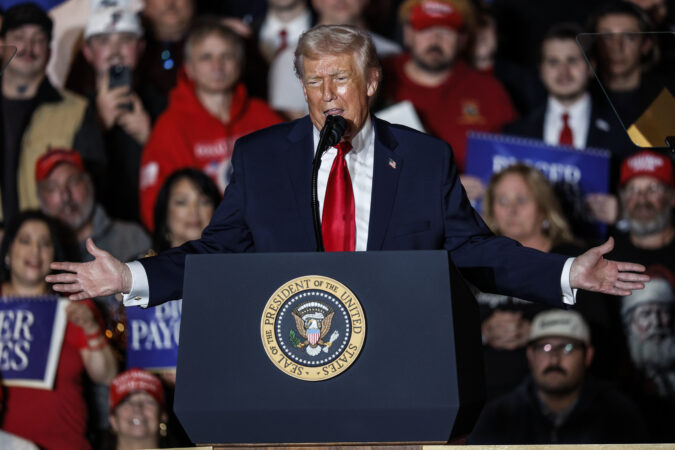
    President Donald Trump made his first stop on an “economic tour” in Mt. Pocono, Pa., on Tuesday, Dec. 9.

    Other polls have shown it’s more popular to increase border security than to deport immigrants, even those who are living in the country illegally. Nearly half of Americans said increasing security at the U.S.-Mexico border should be “a high priority” for the government in AP-NORC polling from September. Only about 3 in 10 said the same about deporting immigrants in the U.S. illegally.

    Shaniqwa Copeland, a 30-year-old independent and home health aide in St. Augustine, Florida, said she approves of Trump’s overall handling of the presidency but believes his immigration actions have gone too far, especially when it comes to masked federal agents leading large raids.

    “Now they’re just picking up anybody,” Copeland said. “They just like, pick up people, grabbing anybody. It’s crazy.”

    Health care and government management remain thorns for Trump

    About 3 in 10 U.S. adults approve of how Trump is handling health care, down slightly from November. The new poll was conducted in early December, as Trump and Congress struggled to find a bipartisan deal for extending the Affordable Care Act subsidies that will expire at the end of this month.

    That health care fight was also the source of the recent government shutdown. About one-third of U.S. adults, 35%, approve of how Trump is managing the federal government, down from 43% in March.

    But some Americans may see others at fault for the country’s problems, in addition to Trump. Copeland is unhappy with the country’s health care system and thinks things are getting worse but is not sure of whether to blame Trump or Biden.

    “A couple years ago, I could find a dentist and it would be easy. Now, I have a different health care provider, and it’s like so hard to find a dental (plan) with them,” she said. “And the people that do take that insurance, they have so many scheduled out far, far appointments because it’s so many people on it.”

    The AP-NORC poll of 1,146 adults was conducted Dec. 4-8 using a sample drawn from NORC’s probability-based AmeriSpeak Panel, which is designed to be representative of the U.S. population. The margin of sampling error for adults overall is plus or minus 4 percentage points.

  • Time magazine names ‘Architects of AI’ as its person of the year for 2025

    Time magazine names ‘Architects of AI’ as its person of the year for 2025

    The “Architects of AI” were named Time’s person of the year for 2025 on Thursday, with the magazine citing this year as when the potential of artificial intelligence “roared into view” with no turning back.

    “For delivering the age of thinking machines, for wowing and worrying humanity, for transforming the present and transcending the possible, the Architects of AI are TIME’s 2025 Person of the Year,” Time said in a social media post.

    The magazine was deliberate in selecting people — the “individuals who imagined, designed, and built AI” — rather than the technology itself, though there would have been some precedent for that.

    “We’ve named not just individuals but also groups, more women than our founders could have imagined (though still not enough), and, on rare occasions, a concept: the endangered Earth, in 1988, or the personal computer, in 1982,” wrote Sam Jacobs, the editor-in-chief, in an explanation of the choice. “The drama surrounding the selection of the PC over Apple’s Steve Jobs later became the stuff of books and a movie.”

    One of the cover images resembling the “Lunch Atop a Skyscraper” photograph from the 1930s shows eight tech leaders sitting on the beam: Meta CEO Mark Zuckerberg, AMD CEO Lisa Su, Tesla CEO Elon Musk, Nvidia CEO Jensen Huang, OpenAI CEO Sam Altman, the CEO of Google’s DeepMind division Demis Hassabis, Anthropic CEO Dario Amodei and AI pioneer Fei-Fei Li, who launched her own startup World Labs last year.

    Another cover image shows scaffolding surrounding the giant letters “AI” made to look like computer componentry.

    It made sense for Time to anoint AI because 2025 was the year that it shifted from “a novel technology explored by early adopters to one where a critical mass of consumers see it as part of their mainstream lives,” Thomas Husson, principal analyst at research firm Forrester, said by email.

    The magazine noted AI company CEOs’ attendance at President Donald Trump’s inauguration this year at the Capitol as a herald for the prominence of the sector.

    “This was the year when artificial intelligence’s full potential roared into view, and when it became clear that there will be no turning back or opting out,” Jacobs wrote.

    AI was a leading contender for the top slot, according to prediction markets, along with Huang and Altman. Pope Leo XIV, the first American pope whose election this year followed the death of Pope Francis, was also considered a contender, with Trump, Israeli Prime Minister Benjamin Netanyahu and New York Mayor-elect Zohran Mamdani topping lists as well.

    Trump was named the 2024 person of the year by the magazine after his winning his second bid for the White House, succeeding Taylor Swift, who was the 2023 person of the year.

    The magazine’s selection dates from 1927, when its editors have picked the person they say most shaped headlines over the previous 12 months.

  • Can zinc shorten your cold? Here’s how to take it the right way.

    Can zinc shorten your cold? Here’s how to take it the right way.

    The question: Can zinc cure a cold?

    The science: Everyone loves a good cold remedy — vitamins, homemade concoctions, nasal irrigation systems. And zinc, a mineral, is a popular one, sold over the counter as lozenges, quick-dissolve tablets, and nasal sprays.

    While there’s no conclusive evidence that zinc can prevent a cold, there is research suggesting it might help shave a little time off the duration of a cold, which usually runs for seven to 10 days.

    “If you’re trying to get better, say, before you go see your brand-new grandchild or because you have a big presentation coming up at work, it may cut a day or two off your cold but you might still have persistent symptoms,” said Rebecca Andrews, a professor at the University of Connecticut School of Medicine and chair of the Board of Regents for the American College of Physicians.

    Scientists have hypothesized that zinc may prevent rhinoviruses — which are common viruses that cause about 50% of colds — from infecting our cells, said Roy Gulick, the chief of the Division of Infectious Diseases at Weill Cornell Medicine and attending physician at New York Presbyterian Hospital in New York City.

    The mineral also enhances immune function and responses to infection, among other things, he said.

    In a 2024 Cochrane review, researchers analyzed 34 trials using zinc to prevent and treat colds. The authors found little to no evidence that zinc, when taken proactively, can prevent a cold or reduce the number of colds a person gets.

    For people who already have a cold, the reviewers found some evidence that zinc might shorten the duration of symptoms by about two days compared with a placebo. However, they also found that zinc was associated with mild side effects such as nasal and oral irritation, problems with taste, stomach pain, constipation, diarrhea, and vomiting, among others.

    Outside those trials, some people who use certain zinc nasal products have reported a loss of smell. It prompted the Food and Drug Administration to issue a public health advisory in 2009, warning people about the link between some zinc nasal products and long-lasting or permanent loss of smell.

    Our bodies don’t produce zinc, which we need for proper immune system and metabolism functioning and wound healing. Adult women should get 8 milligrams of zinc from their diets each day and men 11 mg, according to federal health authorities. Zinc-rich foods include meat, fish, and seafood such as oysters.

    The optimal zinc dose for the treatment of colds is uncertain because researchers conduct studies in different ways, and test different forms of zinc and different doses. However, a number of studies on zinc as cold treatments use doses of 80 mg or more per day. Many over-the-counter zinc lozenges are supposed to be taken every few hours, which amounts to about 80 mg.

    But Andrews said that if you exceed 50 mg of zinc per day, you increase your likelihood of side effects. And don’t use it to prevent a cold — only to treat an ongoing one, she said.

    “When you supplement, you’re going to get a lot more than what you need in your diet, which is more likely to cause stomach upset and send you either into my office or an urgent care, where you might get treated for something that you don’t have because the symptom could be from the zinc,” she said.

    What else you should know

    Before taking zinc, speak with your healthcare provider, as the mineral can interact with some medications. For instance, high zinc intake may make certain chemotherapy drugs less effective, Andrews said.

    If you want to try zinc to treat a cold, consider these suggestions:

    • Don’t use zinc supplements as a preventive, only a treatment. Because there’s little to no evidence that zinc can prevent a cold and it’s associated with a number of side effects, use it only when you have symptoms of a cold.
    • Try lozenges, but in moderation. Most studies have evaluated the effectiveness of zinc lozenges over other formulations, probably because they are easy to take and may help ease sore throats, a common symptom of a cold, Andrews said. But don’t overdo it. If you exceed 50 mg daily, you increase your risk of stomach upset and other side effects, she said.
    • Don’t take zinc with certain foods. High-fiber foods, legumes, and grains, foods rich in calcium and iron, and excessive alcohol, among other things, can reduce zinc absorption.
    • Zinc aside, build up your immune system. Eating a healthy, well-balanced diet, drinking plenty of water, and getting enough sleep are key for ensuring your immune system “is top-notch from a cold-fighting perspective,” Andrews said.

    The bottom line: While zinc is unlikely to prevent a cold, it may help reduce the duration of a cold by a day or two. But potential benefits of zinc, particularly at higher levels, may be offset by adverse reactions, including irritation in the nose and mouth, an upset stomach, and other side effects.

  • U.S data agencies need ‘immediate’ help to do their job, report says

    U.S data agencies need ‘immediate’ help to do their job, report says

    U.S. data agencies need urgent help from the Trump administration and Congress to ensure they can carry out their basic duties and restore public confidence amid a deepening crisis, according to a new report by some of the country’s top statistics experts.

    The agencies are struggling with fragile capacity and eroding trust — as well as diminished safeguards for data integrity — and need more money and staff, says the study led by the American Statistical Association. It cites challenges that have grown more acute since last year’s inaugural version of the report, published before President Donald Trump returned to office.

    Government departments such as the Bureau of Labor Statistics, Bureau of Economic Analysis, and Census Bureau are tasked with publishing all kinds of data, which cover the economy and many other topics, and are key to decisions by policymakers, investors, and companies as well as the wider public. Their work has been made harder by longstanding problems such as shrinking budgets and falling response rates for surveys — as well as more recent threats to their independence and integrity.

    “Immediate action must be taken to halt the severe decline in the federal statistical agencies’ ability to meet their basic mission and be positioned to keep up with increasing information needs and to address uncertainty in the trustworthiness of federal statistics,” says the report, which was published Wednesday.

    In Trump’s second term, the strain on federal statistics has intensified. His administration’s campaign to downsize the government left gaping holes in many agencies, with data products becoming collateral damage of the staffing cuts. Organizations such as the ASA have created dashboards to keep an eye on changes to datasets and highlight any that disappear.

    Headcount at the BLS was down 20% last fiscal year compared with the previous one, and the BEA has seen a 25% drop since 2019, the report says. Trump has proposed further cuts in his 2026 budget.

    Trump’s most drastic action so far on the data front came when he fired the head of the BLS in August after a weak jobs report — accusing her, without providing evidence, of rigging the numbers to make him look bad. Economists and statisticians have lined up to reject that claim. The administration pointed to large revisions in employment data and said the numbers needed to be “fair and accurate.”

    Just a day before all this drama unfolded, the statistics experts behind Wednesday’s study had published an interim report saying they were confident that data could be trusted and there were no signs of meddling by the executive branch. Trump’s move against the BLS forced a rapid rethink. The document was amended to say that the president’s actions “undermine trust in the future by accusing statistical agency heads of past political manipulation.”

    The group’s new report cites a survey which found the share of the public expressing trust in federal data had declined to 52% in September, from 57% in June.

    It calls out other administration actions this year that undermined official statistics, like the termination of advisory committees, failure to fill leadership roles, and elimination of datasets without consulting Congress or the public. It notes that the positions of chief statistician and Census director have been staffed with political appointees who already held other full-time positions, and argues this could further erode trust.

    The report urges the Trump administration to exempt key data-agency positions from the federal hiring freeze, and calls on Congress to fund research and enhancements in IT infrastructure that can help improve the quality of statistics. Such measures would “begin to restore the system’s capacity to deliver the timely, relevant, and trustworthy statistics the nation depends upon,” it says.

  • Letters to the Editor | Dec. 11, 2025

    Letters to the Editor | Dec. 11, 2025

    Well-meaning policy

    If you walk into any nursing home in the southeastern corner of the commonwealth, you’ll find a highly choreographed system of long-term care (LTC) pharmacies humming along that help keep older Pennsylvanians safe and are the backbone of patient care.

    But this system is just months away from a potential collapse. Unless the Trump administration or Congress takes action now, on Jan. 1, a new policy will devastate LTC pharmacies that serve senior living facilities and nursing homes.

    Passed during the Biden administration, the Inflation Reduction Act allowed the federal government to negotiate with drug companies to determine “maximum fair prices” on certain expensive brand-name drugs for Medicare Part D beneficiaries — a policy designed to help seniors afford medications.

    But there’s a problem: The law is about to bankrupt the very pharmacies these seniors depend on to stay alive.

    By setting “maximum fair prices” on certain brand-name drugs, the policy significantly reduces the reimbursement rates LTC pharmacies receive.

    This price change will have rippling effects on all facilities that depend on the services of LTC pharmacies, including the 200,000 Medicare Part D beneficiaries over age 65 who have long-term care needs.

    The Trump administration can act via an executive order to keep LTC pharmacies operational by delaying or modifying the new drug pricing until a sustainable payment model is identified.

    Simultaneously, Congress must pass the bipartisan Preserving Patient Access to Long-Term Care Pharmacies Act (HR 5031). This legislation would establish a temporary $30 supply fee for each prescription filled under the new negotiated prices — a modest investment that would keep pharmacies solvent through 2027.

    We can’t afford to look the other way — our seniors deserve a system that supports them, not one that collapses under the weight of well-meaning policy.

    Rob Frankil, executive director, Philadelphia Association of Retail Druggists

    Risks vs. benefits

    The loss of a child is always a profound tragedy, and any parent would take extraordinary measures to avoid that possible outcome. Potentially saving their child, though, would not justify the certain death of thousands of other children as a result of their actions, which is what would happen without the timely availability of vaccines. The risk-vs.-benefit consideration is the foundation of effective public health decisions. The Food and Drug Administration even has a reporting system for adverse effects after a vaccine comes on the market to ensure the blessings of getting a jab far outweigh the harms.

    If every vaccine were evaluated solely on the occurrence of any adverse event, it would be regulated out of existence, and the death rate for the diseases the vaccines were meant to address would be catastrophic. While every death is devastating, the 10 deaths Vinay Prasad of the FDA has attributed to COVID-19 vaccinations would not statistically justify impeding the timely development of new vaccines. It is puzzling that President Donald Trump would allow a reversal of his greatest achievement: the timely development of vaccines.

    Jo-Ann Maguire, Norristown

    Join the conversation: Send letters to letters@inquirer.com. Limit length to 150 words and include home address and day and evening phone number. Letters run in The Inquirer six days a week on the editorial pages and online.

  • Horoscopes: Thursday, Dec. 11, 2025

    ARIES (March 21-April 19). Willpower is like a battery that drains over the course of the day. Make it easy for yourself to make good choices by anticipating what you’ll need in low-motivation moments. Don’t rely on willpower; rely on setup.

    TAURUS (April 20-May 20). The right phrasing can inspire confidence. Precision communicates competence. People sense when you mean what you say. Put thought and practice into your word choices. It will be the difference between closing a deal or not.

    GEMINI (May 21-June 21). Perfection can never fully be achieved. There’s always one more improvement, one more detail, one more layer of refinement. Even though absolute perfection is an impossibility, the pursuit itself leads you to the sublime.

    CANCER (June 22-July 22). Feelings are power sources. Strong feelings such as anger, fear or the elation of love can make your heart pound and your body spring alive. Think of them as huge power plants. There’s no need to shut them down; direct the energy instead.

    LEO (July 23-Aug. 22). Boredom is a signal to pursue something different. When you’re truly interested in something (or someone), curiosity flows naturally and opens attention. Attention is love in motion. Follow fascination instead of trying to lead it.

    VIRGO (Aug. 23-Sept. 22). Closure is efficiency. You’ve gathered all the lessons this situation can offer. Stop rereading old chapters and put that focus to better use. Reinvest the same energy in people and projects that give something back.

    LIBRA (Sept. 23-Oct. 23). A stumble teaches you where you need to build up strength. Start with one steadying habit: move your body, pay a bill, call a friend. Do it again tomorrow. Small consistencies become the structure that keeps your world from wobbling.

    SCORPIO (Oct. 24-Nov. 21). You used to see a situation and think, “This shouldn’t be happening.” But now, you’re more effective. You see the futility in resisting what is. By accepting it all, you waste no energy. You simply commit wholly to a solution.

    SAGITTARIUS (Nov. 22-Dec. 21). You carry both fire and tenderness in the same vessel: You’re tough enough to follow through, but kind enough to let go when you need to. You have the discipline to meet goals and the softness to forgive the unmet ones.

    CAPRICORN (Dec. 22-Jan. 19). In business, retention means keeping what’s valuable: customers, employees and assets. Today it applies to your own life: Keep the value and cancel what drains you. Whether a subscription or a relationship, stop paying for anything that no longer enriches your spirit.

    AQUARIUS (Jan. 20-Feb. 18). Someone pays attention to where you go and how you get there. They watch to see if you travel directly or wander perilously. Don’t forget that the witnessing is a form of love. Sometimes you’re the shepherd; sometimes you’re the sheep.

    PISCES (Feb. 19-March 20). You have habits you notice and ones you don’t. The invisible ones run the show. Step back for a clearer view. You need feedback, journaling and other honest mirrors to help you see what’s really driving you.

    TODAY’S BIRTHDAY (Dec. 11). Welcome to your Year of the Triumphant Return. Something you gave up on gets resurrected, and this time it works brilliantly. It will fortify you to finally see the stellar results that match your years of acquired and well-applied knowledge. More highlights: promotions, publishing, property and proof in loving, fun relationships that your consistency wins. Cancer and Capricorn adore you. Your lucky numbers are: 7, 14, 22, 39 and 4.

  • Dear Abby | Date change of funeral leads to death of friendship

    DEAR ABBY: I had a friend, “Mylene,” for many years. We swapped dog-sitting to offset the cost for each other. I helped her when she was sick and broke her foot. I walked her dog whenever she needed me. If a funeral, wedding or family emergency came up, I was always there for her.

    An aunt of mine in another state passed away. I would have had to drive there, but her daughter was making the funeral arrangements while in the hospital herself. The funeral was delayed until the next week because my aunt’s body had to be shipped to another state for the funeral.

    When I told Mylene, she said she’d keep my dog, but when the date changed, she said she couldn’t do it. “I have to work,” she said. Abby, her dog stays at home while she works, so why is there a problem? I reminded her of everything that I have done to help her out when she needed it, but she didn’t want to help me. (This was two days before I was to travel for the funeral.)

    I have tried many times to apologize to Mylene, but she refuses to make amends with me. All she does is send emojis, which I find disgusting. Can’t she call and talk to me like a grown adult to straighten this out? I paid her several times to help her, and this is what I get? What do you think about this?

    — DISAPPOINTED IN NORTH CAROLINA

    DEAR DISAPPOINTED: You have done plenty for Mylene, but the time to remind her wasn’t when she said she couldn’t take care of your dog. (Is this why you “have tried many times to apologize”?) Mylene may have sent emojis instead of calling because you embarrassed her. When we do favors for others, we shouldn’t do them with the expectation that we will be paid back. What do I think about this? I think you should find another dog-sitter immediately.

    ** ** **

    DEAR ABBY: Our daughter and her family live an hour from us. We are both in fair health. Our daughter got a late start on marriage and children. Their girls are 10 and 8. The little one is sweet and shy, but the 10-year-old is a nightmare to be around. She’s very smart but also manipulative. She lies, cheats and steals. She is rude and seems to always do exactly the opposite of what an adult tells her to do. If her parents see her being sassy or ugly, they will put her in timeout for 10 minutes, but nothing ever changes.

    None of their neighbors wants this child at their home. To make matters worse, she has begun early puberty. We can’t stand being around this 10-year-old because it wears us out. We love our daughter and would like to have a good relationship with the whole family. Please advise on how we could help or what we should do.

    — EXHAUSTED GRANDPARENTS IN OHIO

    DEAR GRANDPARENTS: A 10-minute timeout is not enough discipline for a 10-year-old’s consistent bad behavior. Without further intervention, that girl is headed for big trouble. Please suggest to your daughter that she consult a child psychologist about how to get her obviously troubled daughter heading in the right direction before things become worse.

  • Scientists discover oldest evidence of human-made fire in a 400,000-year-old hearth

    Scientists discover oldest evidence of human-made fire in a 400,000-year-old hearth

    Scientists have discovered the oldest evidence of ancient humans igniting fires: a 400,000-year-old open-air hearth buried in an old clay pit in southern England.

    The study, published in the journal Nature, is based on a years-long examination of a reddish patch of sediment excavated at a site in Barnham. It pushes back the timeline on fire-making by about 350,000 years.

    The nebulous question of how far back human ancestors conjured fire is deeply intertwined with some of the biggest outstanding mysteries about human evolution. The ability to reliably set fires would have allowed humans to cook food, expanding the range of what they could eat and making meals more digestible. That, in turn, could have supported bigger brains that consumed more energy, catalyzing new social behaviors as humans gathered around campfires.

    But campfires don’t leave fossils. It takes painstaking work to reconstruct these ephemeral uses of technology. And what remains unclear is who set them. No telltale bones have been recovered at Barnham, but researchers think it was Neanderthals, close cousins of our species who interbred with our ancestors.

    “The evidence of fire is incredibly difficult to preserve. If you get to ash and charcoal, it can wash away. Sediment can get washed away,” said Nicholas Ashton, curator of Paleolithic collections at the British Museum and one of the leaders of the work. “We just found this one pocket — quite a large site — where it happens to be preserved.”

    Even when traces of fire remain, the task of distinguishing incidental flames sparked by lightning strikes or wildfires from those set by people is difficult. Perhaps most challenging is distinguishing between fires ignited by humans with the know-how from those produced by scavenging embers from wildfires.

    The study could spark more debate.

    “The authors did an excellent job with their analysis of the Barnham data, but they seem to be stretching the evidence with their claim that this constitutes the ‘earliest evidence of fire making,’” Wil Roebroeks, an archaeologist at Leiden University, said in an email, calling the evidence “circumstantial.”

    Ségolène Vandevelde, an archaeologist and adjunct professor at the University of Quebec at Chicoutimi, praised the multidisciplinary approaches the authors used and said the finding was “solid.”

    Pyroarchaeology

    In the Paleolithic era, the Barnham site would have been a woodland with a seasonal pond — set away from the main river valley, where predators might have roamed, according to Robert Davis, an archaeologist at the British Museum and one of the authors of the study. The wildlife would have included elephants, lions, deer, fish and other small mammals.

    Despite the fleeting nature of fire, it can leave traces under the right conditions. At the site in Barnham, where artifacts such as heat-shattered flint hand axes were also found, researchers were intrigued by a layer of reddish sediment — a result of iron-rich sediments being heated to produce a mineral called hematite. For four years, they studied it, trying to determine whether it was the result of a wildfire or deliberate human activity.

    One of the first questions they asked was whether this was a one-time blaze or something closer to a fireplace that was lit and relit many times.

    To deconstruct this question, scientists studied the magnetism of the sediment, which is altered by heating. They conducted modern experiments, to see if they could come up with an estimate of how many heating events might have resulted in the magnetic profile of the sediment — and found that after about a dozen heating events, each one four hours long, their modern samples mimicked the archaeological one.

    Then they examined the chemistry of the site — scrutinizing particular chemical compounds left behind. The patterns they found suggested humans had been using these fires.

    The last element was small pieces of cracked flint scattered about the site — as well as two bits of pyrite, which can create a spark when struck together. A geological study of the area showed that pyrite was scarce in the local landscape, leading the authors to argue that the inhabitants had carried it there for the specific purpose of making fire.

    Scavenging sparks vs. setting fires

    The archaeological record with examples of fires used by hominins — the ancestors of humans — stretches back more than a million years ago in Africa.

    But what interests scientists is not just the ability to successfully scavenge sparks from wildfires or lightning strikes, but also the ability to reliably create it — possibly by striking flint and pyrite together to create sparks.

    The oldest accepted evidence of fires purposefully set are from a Neanderthal site dated to 50,000 years ago in France. That evidence is considered convincing in part because there are chunks of flint showing “microwear traces of having been struck” to create sparks, Roebroeks said. But at Barnham, there are no microwear traces, leaving room for disagreement.

    “It’s a very contentious debate that’s been going on for some time,” Davis said.

    Early hominins would have learned to harvest fire by collecting embers, harvesting the right fuel and tending the fire. And eventually, they had to learn how to make it on demand — which would allow them to live in colder places, cook, fend off predators and socialize after dark.

    The study does not suggest that Barnham was where fire originated; it was probably widespread across the ancient world. But it does offer a rare, preserved snapshot of prehistoric life.

    “The maintenance of fire requires social cooperation, cultural rules and work coupled with knowledge of wood types, and means that a complicated tradition is at play,” said John Hawks, a paleoanthropologist at the University of Wisconsin at Madison.

  • House passes defense bill to raise troop pay and overhaul weapons purchases

    House passes defense bill to raise troop pay and overhaul weapons purchases

    WASHINGTON — The House voted to pass a sweeping defense policy bill Wednesday that authorizes $900 billion in military programs, including a pay raise for troops and an overhaul of how the Department of Defense buys weapons.

    The bill’s passage comes at a time of increasing friction between the Republican-controlled Congress and President Donald Trump’s administration over the management of the military.

    The annual National Defense Authorization Act typically gained bipartisan backing, and the White House has signaled “strong support” for the must-pass legislation, saying it is in line with Trump’s national security agenda. Yet tucked into the more than-3,000-page bill are several measures that push back against the Department of Defense, including a demand for more information on boat strikes in the Caribbean and support for allies in Europe, such as Ukraine.

    Overall, the sweeping bill calls for a 3.8% pay raise for many military members as well as housing and facility improvements on military bases. It also strikes a compromise between the political parties — cutting climate and diversity efforts in line with Trump’s agenda, while also boosting congressional oversight of the Pentagon and repealing several old war authorizations. Still, hard-line conservatives said they were frustrated that the bill does not do more to cut U.S. commitments overseas.

    “We need a ready, capable and lethal fighting force because the threats to our nation, especially those from China, are more complex and challenging than at any point in the last 40 years,” said Rep. Mike Rogers, the GOP chair of the House Armed Services Committee.

    Lawmakers overseeing the military said the bill would change how the Pentagon buys weapons, with an emphasis on speed after years of delay by the defense industry. It’s also a key priority for Defense Secretary Pete Hegseth. Rep. Adam Smith, the top Democrat on the armed services panel, called the bill “the most ambitious swing at acquisition reform that we’ve taken.”

    Still, Smith lamented that the bill does not do as much as Democrats would like to rein in the Trump administration but called it “a step in the right direction towards reasserting the authority of Congress.”

    “The biggest concern I have is that the Pentagon, being run by Secretary Hegseth and by President Trump, is simply not accountable to Congress or accountable to the law,” he said.

    The legislation next heads to the Senate, where leaders are working to pass the bill before lawmakers depart Washington for a holiday break.

    Several senators on both sides of the aisle have criticized the bill for not doing enough to restrict military flights over Washington. They had pushed for reforms after a midair collision this year between an Army helicopter and a jetliner killed all 67 people aboard the two aircraft near Washington’s Ronald Reagan National Airport. The National Transportation Safety Board has also voiced opposition to that section of the bill.

    Here’s what the defense bill does as it makes its way through Congress:

    Boat strike videos and congressional oversight

    Lawmakers included a provision that would cut Hegseth’s travel budget by a quarter until the Pentagon provides Congress with unedited video of the strikes against alleged drug boats near Venezuela. Lawmakers are asserting their oversight role after a Sept. 2 strike where the U.S. military fired on two survivors who were holding on to a boat that had partially been destroyed.

    The bill also demands that Hegseth allow Congress to review the orders for the strikes.

    Reaffirm commitments to Europe, Korea

    Trump’s ongoing support for Ukraine and other allies in Eastern Europe has been under doubt over the last year, but lawmakers included several positions meant to keep up U.S. support for countering Russian aggression in the region.

    The defense bill requires the Pentagon to keep at least 76,000 troops and major equipment stationed in Europe unless NATO allies are consulted and there is a determination that such a withdrawal is in U.S. interests. Around 80,000 to 100,000 U.S. troops are usually present on European soil. It also authorizes $400 million for each of the next two years to manufacture weapons to be sent to Ukraine.

    Additionally, there is a provision to keep U.S. troops stationed in South Korea, setting the minimum requirement at 28,500.

    Cuts to climate and diversity initiatives

    The bill makes $1.6 billion in cuts to climate change-related spending, the House Armed Services Committee said. U.S. military assessments have long found that climate change is a threat to national security, with bases being pummeled by hurricanes or routinely flooded.

    The bill also would save $40 million by repealing diversity, equity and inclusion offices, programs and trainings, the committee said. The position of chief diversity officer would be cut, for example.

    Iraq War resolution repeal

    Congress is putting an official end to the war in Iraq by repealing the authorization for the 2003 invasion. Supporters in both the House and Senate say the repeal is crucial to prevent future abuses and to reinforce that Iraq is now a strategic partner of the U.S.

    The 2002 resolution has been rarely used in recent years. But the first Trump administration cited it as part of its legal justification for a 2020 U.S. drone strike that killed Iranian Gen. Qassim Suleimani.

    Lifting final Syria sanctions

    Congress would permanently remove U.S. sanctions put on Syria after the Trump administration temporarily lifted many penalties.

    Lawmakers imposed economically crippling sanctions on the country in 2019 to punish former leader Bashar Assad for human rights abuses during the nearly 14-year civil war. After Syrian President Ahmed al-Sharaa led a successful insurgency to depose Assad, he is seeking to rebuild his nation’s economy.

    Advocates of a permanent repeal have said international companies are unlikely to invest in projects needed for the country’s reconstruction as long as there is a threat of sanctions returning.

    Lack of IVF coverage

    Democrats criticized House Speaker Mike Johnson (R., La.) for stripping a provision from the bill to expand coverage of in vitro fertilization for active duty personnel. An earlier version covered the medical procedure, known as IVF, which helps people facing infertility have children.

  • Foreigners allowed to travel to the U.S. without a visa could soon face new social media screening

    Foreigners allowed to travel to the U.S. without a visa could soon face new social media screening

    WASHINGTON — Foreigners who are allowed to come to the United States without a visa could soon be required to submit information about their social media, email accounts and extensive family history to the Department of Homeland Security before being approved for travel.

    The notice published Wednesday in the Federal Register said Customs and Border Protection is proposing collecting five years’ worth of social media information from travelers from select countries who do not have to get visas to come to the U.S. The Trump administration has been stepping up monitoring of international travelers and immigrants.

    The announcement refers to travelers from more than three dozen countries who take part in the Visa Waiver Program and submit their information to the Electronic System for Travel Authorization (ESTA), which automatically screens them and then approves them for travel to the U.S. Unlike visa applicants, they generally do not have to go into an embassy or consulate for an interview.

    DHS administers the program, which currently allows citizens of roughly 40 mostly European and Asian countries to travel to the U.S. for tourism or business for three months without visas.

    The announcement also said that CBP would start requesting a list of other information, including telephone numbers the person has used over the past five years or email addresses used over the past decade. Also sought would be metadata from electronically submitted photos, as well as extensive information from the applicant’s family members, including their places of birth and their telephone numbers.

    The application that people are now required to fill out to take part in ESTA asks for a more limited set of questions such as parents’ names and current email address.

    Asked at a White House event whether he was concerned the measure might affect tourism to the U.S., President Donald Trump said no.

    “We want safety, we want security, we want to make sure we’re not letting the wrong people come into our country,” Trump said.

    The public has 60 days to comment on the proposed changes before they go into effect, the notice said.

    CBP officials did not immediately respond to questions about the new rules.

    The announcement did not say what the administration was looking for in the social media accounts or why it was asking for more information.

    But the agency said it was complying with an executive order that Trump signed in January that called for more screening of people coming to the U.S. to prevent the entry of possible national security threats.

    Travelers from countries that are not part of the Visa Waiver Program system are already required to submit their social media information, a policy that dates back to the first Trump administration. The policy remained during Democratic President Joe Biden’s administration.

    But citizens from visa waiver countries were not obligated to do so.

    Since January, the Trump administration has stepped up checks of immigrants and travelers, both those trying to enter the U.S. as well as those already in the country. Officials have tightened visa rules by requiring that applicants set all of their social media accounts to public so that they can be more easily scrutinized and checked for what authorities view as potential derogatory information. Refusing to set an account to public can be considered grounds for visa denial, according to guidelines provided by the State Department.

    U.S. Citizenship and Immigration Services now considers whether an applicant for benefits, such as a green card, “endorsed, promoted, supported, or otherwise espoused” anti-American, terrorist or antisemitic views.

    The heightened interest in social media screening has drawn concern from immigration and free speech advocates about what the Trump administration is looking for and whether the measures target people critical of the administration in an infringement of free speech rights.