The United Auto Workers union has thrown its support behind a Ford Motor Co. factory worker who was suspended for heckling President Donald Trump during a plant tour in Michigan.
“The autoworker at the Dearborn Truck Plant is a proud member of a strong and fighting union-the UAW,” Laura Dickerson, the UAW vice president over the union’s Ford Department, said in a statement Wednesday. “He believes in freedom of speech, a principle we wholeheartedly embrace, and we stand with our membership in protecting their voice on the job.”
The worker, TJ Sabula, told the Washington Post he had “definitely no regrets” about shouting at Trump as the president toured Ford’s F-150 pickup truck factory in Dearborn, Michigan, on Tuesday. In a video of the incident, a person could be heard shouting “pedophile protector,” to which the president responded with an expletive and by holding up his middle finger.
“Workers should never be subjected to vulgar language or behavior by anyone — including the President of the United States,” Dickerson said. “The UAW will ensure that our member receives the full protection of all negotiated contract language safeguarding his job and his rights as a union member.”
White House spokesman Steven Cheung defended the president’s reaction to the heckler.
“A lunatic was wildly screaming expletives in a complete fit of rage, and the President gave an appropriate and unambiguous response,” Cheung said in a statement.
Sabula told the Post he had been suspended by Ford, pending an investigation. The automaker declined to confirm the suspension, but condemned the heckling.
“One of our core values is respect and we don’t condone anyone saying anything inappropriate like that within our facilities,” Ford said in a statement. “When that happens, we have a process to deal with it but we don’t get into specific personnel matters.”
Following the suspension, supporters started a GoFundMe campaign titled “TJ Sabula is a patriot!!” to raise money for the worker. As of midday Wednesday, about 14,700 donations had been made totaling more than $325,000.
NEW YORK — The Trump administration has made abrupt and sweeping cuts to substance abuse and mental health programs across the country in a move that advocates said will jeopardize the lives of some of the country’s most vulnerable.
The Substance Abuse and Mental Health Services Administration on Tuesday night canceled some 2,000 grants representing nearly $2 billion in funding, according to an administration official with knowledge of the cuts who was not authorized to discuss them publicly.
The move pulls back funding for a wide swath of discretionary grants and represents about a quarter of SAMHSA’s overall budget. It builds on other, wide-ranging cuts that have been made at the Department of Health and Human Services, including the elimination of thousands of jobs and the freezing or canceling of billions of dollars for scientific research.
The latest funding cuts immediately jeopardize programs that give direct mental health services, opioid treatment, drug prevention resources, peer support and more to communities affected by addiction, mental illness and homelessness.
“Without that funding, people are going to lose access to lifesaving services,” said Yngvild Olsen, former director of SAMHSA’s Center for Substance Abuse Treatment and a national adviser at Manatt Health. “Providers are going to really need to look at potentially laying off staff and not being able to continue.”
Funding tied to agency’s priorities
SAMHSA, a sub-agency of HHS, notified grant recipients that their funding would be canceled effective immediately in emailed letters on Tuesday evening, according to several copies received by organizations and reviewed by The Associated Press.
The letters, signed by SAMHSA Principal Deputy Assistant Secretary Christopher Carroll, justified the terminations using a regulation that says the agency may terminate any federal award that “no longer effectuates the program goals or agency priorities.”
Grant recipients who were notified of the cancellations said they were confused by that explanation and didn’t get any further detail about why the agency felt their work didn’t match up with SAMHSA’s priorities.
“The goal of our grants is entirely in line with the priorities listed in that letter,” said Jamie Ross, CEO of the Las Vegas-based PACT Coalition, a community organization focused on substance use issues that lost funding from three grants totaling $560,000.
HHS didn’t respond to a request for comment on the funding cancellations, which were first reported by NPR. Two sources within SAMHSA who were not authorized to speak to media said staff weren’t widely notified of the agency’s action.
Programs at risk after funding is slashed
Organizations reeling from the news on Wednesday told the AP they had already been forced to cut staff and cancel trainings. In the long term, many were considering whether they could keep programs alive by shuffling them to different funding sources or whether they’d need to stop the services altogether.
Robert Franks, CEO of the Boston-based mental health provider the Baker Center for Children and Families, which lost two federal grants totaling $1 million, said the loss of funding will force his organization to lay off staff and put care in jeopardy for some 600 families receiving it. One of the canceled grants had been awarded through the National Child Traumatic Stress Initiative, a more than 20-year-old program supporting specialized care for children who have been through traumatic events ranging from sexual abuse to school violence.
Franks said his organization’s work directly advances SAMHSA’s goals to address mental illness. He said trauma care provided to children through his organization helps people from all walks of life and reduces burdens on other parts of society.
“The reality is these programs are probably our most effective tool in addressing the issues that they identify as being critical to them,” he said. “Honestly, I don’t understand it.”
The National Association of County Behavioral Health and Developmental Disability Directors, a group that represents local organizations that deliver safety net services, sent a letter to its members on Wednesday noting that many of its partners estimated the funding pullbacks were focused on grants classified as Programs of Regional and National Significance. They also said the grants totaled around 2,000 and likely amounted to some $2 billion.
The group said it believed certain block grants, 988 suicide and crisis lifeline funding and Certified Community Behavioral Health Clinics were spared from the cuts.
For Honesty Liller, CEO of the peer support organization the McShin Foundation in Richmond, Va., the loss of about $1.4 million in funding is personal. She said the foundation she leads saved her life 18 years ago when she was struggling with a heroin addiction.
The terminated grant has already forced Liller to lay off five staff members. It will mean fewer peers are available to go into local jails and visit incarcerated people who are recovering from substance abuse disorder.
“They need hope dealers like us, they need people that have lived experience in recovery and they need this funding,” Liller said. “I’ve just never felt so gut punched.”
WASHINGTON — The United States said Wednesday that it is moving into the next phase of a Gaza ceasefire plan that involves disarming Hamas, rebuilding the war-ravaged territory and establishing the group of Palestinian experts that will administer daily affairs in Gaza under American supervision.
President Donald Trump’s envoy Steve Witkoff said in a post on X that the deal that the Republican president helped broker was entering its second phase following two years of war between Israel and Hamas, including the establishment of a technocratic government in Gaza.
While Wednesday’s announcement indicates a key step forward, a new government in Gaza and the ceasefire agreement face a number of huge challenges — including the deployment of an international security force to supervise the deal and the difficult process of disarming Hamas.
Witkoff did not offer any details about who would serve on the new transitional Palestinian administration that would govern Gaza. The White House did not immediately offer any more information, either.
The other mediators of the ceasefire deal — Egypt, Turkey and Qatar — welcomed the establishment of the Palestinian technocratic committee and said it would be led by Ali Shaath, a former deputy minister in the Palestinian Authority.
In a joint statement, the three countries called it an “important development … aimed at consolidating stability and improving the humanitarian situation in the Gaza Strip.”
Shaath is a Gaza native who served as a deputy minister for transportation with the internationally recognized Palestinian Authority. Shaath, an engineer, is an expert in economic development and reconstruction, according to his biography on the Palestine Economic Policy Research Institute’s website.
Witkoff said the U.S. expects Hamas to immediately return the final Israeli hostage as part of its obligations under the deal, noting that “failure to do so will bring serious consequences.”
A Hamas spokesperson, Hazem Qassem, told Al-Jazeera Live on Wednesday that Witkoff’s announcement is an important and positive development, adding that the group is ready to hand over the administration of Gaza to the independent technocratic committee and facilitate its work.
“Hamas is ready to engage in internal Palestinian approaches to discuss the issue of the resistance weapons,” said Qassem in the statements that he shared on his Telegram channel.
Israeli Prime Minister Benjamin Netanyahu spoke Wednesday evening to Gvili’s parents, Tali and Itzik Gvili, and told them that the return of their son’s remains a top priority, his office said in a statement.
“The declarative move to establish a technocratic committee will not affect efforts to return Ran to Israel’s grave,” the statement said.
The statement added that Israel will act on any information the mediators receive and said Hamas is required under the ceasefire agreement to do all it can to return each and every hostage.
The ceasefire reached under Trump’s 20-point plan took effect in October and stopped much of the fighting. Under the first phase of the three-phase deal, Hamas released all but one hostage it was holding in exchange for hundreds of Palestinians who were held by Israel.
Appointees to a technocratic committee that Witkoff said would be established under the second phase are part of a broader plan to end Hamas’ 18-year rule of Gaza. The appointees will run day-to-day affairs in Gaza, under the oversight of a Trump-led “Board of Peace,” whose members have also not yet been named.
The technocratic committee will be tasked with providing public services to the more than 2 million Palestinians in Gaza, but it faces towering challenges and unanswered questions, including about its operations and financing.
There also is the more immediate challenge of figuring out how to take over basic services after nearly two decades of Hamas-led rule in Gaza and repeated rounds of conflict with Israel.
Days before protests erupted in Iran in late December, Israeli officials notified the Iranian leadership via Russia that they would not launch strikes against Iran if Israel were not attacked first. Iran responded through the Russian channel that it would also refrain from a preemptive attack, diplomats and regional officials with knowledge of the exchange said.
The communications between Israel and Iran — and the role Russia played as the intermediary — were unusual given the hostility between the two Middle Eastern rivals, which engaged in a 12-day war in June.
But the contacts reflected Israel’s desire to avoid being perceived as escalating tensions toward Iran or spearheading any new attacks against it at a time when Israel was preparing a significant military campaign against Hezbollah, the Iran-aligned militia in Lebanon, according to the diplomats and regional officials. The private reassurances contrasted with Israel’s public rhetoric late last year, when its officials openly hinted at the possibility of carrying out renewed strikes on Iran to roll back what they said was the country’s rapidly replenishing ballistic missile stockpile.
Although Iranian officials responded positively to the Israeli outreach, they were wary of Israel’s intentions, said two officials with knowledge of the message exchange. Iran believed that even if the Israeli assurances were genuine, they left open the possibility that the U.S. military would carry out attacks on Iran as part of a campaign coordinated by the two allies, while Israel was training its firepower strictly on Hezbollah, the officials said.
Still, “for Iran, it was a good deal” to stay out of any Israel-Hezbollah clash, said a senior official in the region who, like others interviewed for this report, spoke on the condition of anonymity to discuss sensitive communications. U.S. officials have said that Iran’s substantive support for Hezbollah, in any case, has already decreased as Tehran grapples with domestic upheaval.
It’s not clear now how the furious protests in Iran in recent weeks, which have challenged the government’s grip on power, have changed Israel’s and Iran’s calculations and whether the two countries will still abide by their private agreement. President Donald Trump has been weighing attacks against Iranian regime targets in response to the crackdown on the protest movement, and any strikes could provoke Iran to retaliate against Israel, a U.S. ally, analysts say.
A senior Iranian official told Reuters that if attacked, Iran would retaliate against U.S. military bases in the Middle East, the news agency reported Wednesday, without mentioning Israel as among the potential targets.
Nor is it clear whether Israeli officials would renege on their December reassurances and join in a U.S.-led attack if they sensed an opportunity to topple the Iranian government. As protests flared in Iran, Israeli officials described their military preparations as defensive in nature, and Israeli government and security officials have avoided overtly bellicose language. In June, Israel launched an elaborate surprise attack against Iran even as nuclear negotiations between the United States and Iran were underway.
“Israel is giving the U.S. the leading role [in any potential strikes against Iran], but there is no question Israel would love to see regime change because that would change the Middle East — as well as Hezbollah,” said Sima Shine, a senior researcher at the Institute for National Security Studies in Tel Aviv and a former head of research at the Israeli intelligence agency Mossad. “But Israel could be a target for the Iranian response, and therefore Israel has already taken a lot of steps to be better defended and prepared.”
For Israel, the outreach to Iran was designed to keep Tehran on the sidelines and leave Hezbollah isolated if Israel were to attack. The “same logic” may hold today, with Israel seeking to prevent the two countries from trading direct blows, at least initially, an Israeli official said. The official added that a military campaign against Hezbollah was not off the table, regardless of what transpires with Iran. Israel has warned that it continues to face a threat from Hezbollah because the group has not disarmed.
“The [Lebanon] campaign will take place, and Hezbollah will be heavily targeted,” the official added. “The question is if it’s during or after the Iran war.”
The most recent exchange of messages between Israel and Iran came in late December, shortly after Iranian Foreign Minister Abbas Araghchi visited Moscow, the senior regional official said. It was not the first time that Russia has sought to serve as an intermediary between the two countries or bolster its standing with Trump as a mediator to win concessions in negotiations over the war in Ukraine.
The Kremlin previously raised to Trump the idea of serving as an intermediary between Israel and Iran, according to a Russian academic close to senior Russian diplomats. Trump declined the offer, this person said, telling the Russians “to deal with Ukraine first.” It’s not clear whether the December exchanges took place with Washington’s knowledge or participation.
The Israeli public broadcaster KAN reported last week that Prime Minister Benjamin Netanyahu had recently asked Russian President Vladimir Putin to relay messages to Iran that Israel did not intend to attack it.
A spokesman in Netanyahu’s office and Kremlin spokesman Dmitry Peskov did not respond to requests for comment.
BOSTON — The Trump administration apologized in court for a “mistake” in the deportation of a Massachusetts college student who was detained trying to fly home to surprise her family for Thanksgiving, but still argued the error should not affect her case.
Any Lucia Lopez Belloza, 19, a Babson College freshman, was detained at Boston’s airport on Nov. 20 and flown to Honduras two days later. Her removal came despite an emergency court order on Nov. 21 directing the government to keep her in Massachusetts or elsewhere in the United States for at least 72 hours.
Lopez Belloza, whose family emigrated from Honduras to the U.S. in 2014, is currently staying with grandparents and studying remotely. She is not detained and was recently visiting an aunt in El Salvador.
Her case is the latest involving a deportation carried out despite a court order. Kilmar Abrego Garcia was deported to El Salvador despite a ruling that should have prevented it. The Trump administration initially fought efforts to bring him back to the U.S. but eventually complied after the U.S. Supreme Court weighed in. And last June, a Guatemalan man identified as O.C.G. was returned to the U.S. after a judge found his removal from Mexico likely “lacked any semblance of due process.”
At a federal court hearing Tuesday in Boston, the government argued the court lacks jurisdiction because lawyers for Lopez Belloza filed their action several hours after she arrived in Texas while en route out of the country. But the government also acknowledged it violated the judge’s order.
In court filings and in open court, government lawyers said an Immigration and Customs Enforcement deportation officer mistakenly believed the order no longer applied because Lopez Belloza had already left Massachusetts. The officer failed to activate a system that alerts other ICE officers that a case is subject to judicial review and that removal should be halted.
“On behalf of the government, we want to sincerely apologize,” Assistant U.S. Attorney Mark Sauter told the judge, saying the employee understands “he made a mistake.” The violation, Sauter added, was “an inadvertent mistake by one individual, not a willful act of violating a court order.”
In a declaration filed with the court Jan. 2, the ICE officer also admitted he did not notify ICE’s enforcement office in Port Isabel, Texas, that the removal mission needed to be canceled. He said he believed the judge’s order did not apply once Lopez Belloza was no longer in the state.
The government maintains her deportation was lawful because an immigration judge ordered the removal of Lopez Belloza and her mother in 2016, and the Board of Immigration Appeals dismissed their appeal in 2017. Prosecutors said she could have pursued additional appeals or sought a stay of removal.
Her lawyer, Todd Pomerleau, countered that she was deported in clear violation of the Nov. 21 order and said the government’s actions deprived her of due process. “I was hoping the government would show some leniency and bring her back,” he said. “They violated a court order.”
U.S. District Judge Richard Stearns said he appreciated the government acknowledging the error, calling it a “tragic” bureaucratic mistake. But appeared to rule out holding the government in contempt, noting the violation did not appear intentional. He also questioned whether he has jurisdiction over the case, appearing to side with the government in concluding the court order had been filed several hours after she had been sent to Texas.
“It might not be anybody’s fault, but she was the victim of it,” Stearns said, adding at one point that Lopez Belloza could explore applying for a student visa.
Pomerleau said one possible resolution would be allowing Lopez Belloza to return to finish her studies while he works to reopen the underlying removal order.
WASHINGTON — President Donald Trump said Wednesday that he’s been told “on good authority” that plans for executions in Iran have stopped, even as Tehran has indicated fast trials and executions ahead in its crackdown on protesters.
The president’s claims, which were made with few details, come as he’s told protesting Iranians in recent days that “help is on the way” and that his administration would “act accordingly” to respond to the Iranian government. But Trump has not offered any details about how the U.S. might respond and it wasn’t clear if his comments Wednesday indicated he would hold off on action.
“We’ve been told that the killing in Iran is stopping — it’s stopped — it’s stopping,” Trump said at the White House while signing executive orders and legislation. “And there’s no plan for executions, or an execution, or executions — so I’ve been told that on good authority.”
The president on Tuesday consulted with his national security team about next steps after telling reporters he believed the killing in Iran was “significant.”
Vice President JD Vance, Secretary of State Marco Rubio, and key White House National Security Council officials began meeting last Friday to develop options for Trump, ranging from a diplomatic approach to military strikes.
The Iranian security force crackdown on the demonstrations has killed at least 2,586, the U.S.-based Human Rights Activists News Agency reported.
On Wednesday, Iranian officials signaled that suspects detained in nationwide protests would face fast trials and executions while the Islamic Republic promised a “decisive response” if the U.S. or Israel intervene in the domestic unrest.
The threats emerged as some personnel at a key U.S. military base in Qatar were advised to evacuate by Wednesday evening following Trump’s escalated warnings of potential military action over the killing of peaceful demonstrators.
Mohammad Pakpour, commander of Iran’s paramilitary Revolutionary Guard, reiterated Iranian claims, without providing evidence, that the U.S. and Israel have instigated the protests and that they are the real killers of protesters and security forces who have died in the turmoil, according to Iran’s semiofficial Tasnim news agency.
He added that those countries will “receive the response in the appropriate time.”
Earlier Wednesday, Gholamhossein Mohseni-Ejei, Iran’s judiciary chief, said the government must act quickly to punish more than 18,000 people who have been detained through rapid trials and executions. Mohseni-Ejei’s comments about rapid trials and executions were made in a video shared by Iranian state television online.
“If we want to do a job, we should do it now. If we want to do something, we have to do it quickly,” he said. “If it becomes late, two months, three months later, it doesn’t have the same effect. If we want to do something, we have to do that fast.”
The comments stand as a direct challenge to Trump, who warned Iran about executions in an interview with CBS aired Tuesday. “If they do such a thing, we will take very strong action,” Trump said.
“We don’t want to see what’s happening in Iran happen. And you know, if they want to have protests, that’s one thing. When they start killing thousands of people, and now you’re telling me about hanging — we’ll see how that works out for them. It’s not going to work out good.”
One Arab Gulf diplomat told the AP that major Mideast governments had been discouraging the Trump administration from launching a war with Iran, fearing “unprecedented consequences” for the region that could explode into a “full-blown war.” The diplomat spoke on condition of anonymity because he wasn’t authorized to speak to journalists.
Satellite internet service offer
Iran’s government cut off the country from the internet and international telephone calls on Jan. 8.
Activists said Wednesday that Starlink was offering free service in Iran. The satellite internet service has been key in getting around the internet shutdown. Iran began allowing people to call out internationally on Tuesday via mobile phones, but calls from people outside the country into Iran remain blocked.
“We can confirm that the free subscription for Starlink terminals is fully functional,” said Mehdi Yahyanejad, a Los Angeles-based activist who has helped get the units into Iran. “We tested it using a newly activated Starlink terminal inside Iran.”
Starlink itself did not immediately acknowledge the decision.
Security service personnel apparently were searching for Starlink dishes, as people in northern Tehran reported authorities raiding apartment buildings with satellite dishes. While satellite television dishes are illegal, many in the capital have them in homes, and officials broadly gave up on enforcing the law in recent years.
Death toll continues to rise
The Human Rights Activists News Agency said 2,417 of the dead were protesters and 147 were government-affiliated. Twelve children were killed, along with 10 civilians it said were not taking part in protests.
More than 18,400 people have been detained, the group said.
Gauging the demonstrations from abroad has grown more difficult, and the AP has been unable to independently assess the toll given the communications being disrupted in the country.
WASHINGTON — A top Danish official said Wednesday that a “fundamental disagreement” over Greenland remains with President Donald Trump after talks in Washington with Vice President JD Vance and Secretary of State Marco Rubio.
The two sides, however, agreed to create a working group to discuss ways to work through differences as Trump continues to call for a U.S. takeover of the Denmark’s Arctic territory of Greenland.
“The group, in our view, should focus on how to address the American security concerns, while at the same time respecting the red lines of the Kingdom of Denmark,” Danish Foreign Minister Lars Løkke Rasmussen told reporters after joining Greenland’s foreign minister, Vivian Motzfeldt, for the talks.
Trump is trying to make the case that NATO should help the U.S. acquire the world’s largest island and says anything less than it being under American control is unacceptable.
Denmark has announced plans to boost the country’s military presence in the Arctic and North Atlantic as Trump tries to justify his calls for a U.S. takeover of the vast territory by repeatedly claiming that China and Russia have their designs on Greenland.
Vance and Rubio met with Løkke Rasmussen and Greenlandic Foreign Minister Vivian Motzfeldt for roughly an hour to discuss Greenland, a semiautonomous territory of NATO ally Denmark.
But a few hours before the officials sat down, Trump reiterated on his social media site that the U.S. “needs Greenland for the purpose of National Security.” He added that “NATO should be leading the way for us to get it” and that otherwise Russia or China would — “AND THAT IS NOT GOING TO HAPPEN!”
“NATO becomes far more formidable and effective with Greenland in the hands of the UNITED STATES,” Trump wrote. “Anything less than that is unacceptable.”
Løkke Rasmussen told reporters that it remains “clear that the president has this wish of conquering over Greenland.”
“And we made it very, very clear that this is not in the interest of the kingdom,” he said after the meeting, citing a “fundamental disagreement” with the Trump administration but willing to keep talking.
Both Løkke Rasmussen and Motzfeldt offered measured hope that the talks were beginning a conversation that would lead to Trump dropping his demand of acquiring the territory and create a path for tighter cooperation with the U.S.
“We have shown where our limits are and from there, I think that it will be very good to look forward,” Motzfeldt said.
Denmark bolstering presence in Arctic
In Copenhagen, Danish Defense Minister Troels Lund Poulsen announced an increase in Denmark’s “military presence and exercise activity” in the Arctic and the North Atlantic, “in close cooperation with our allies”.
Poulsen said at a news conference the stepped-up military presence was necessary in a security environment in which “no one can predict what will happen tomorrow.”
“This means that from today and in the coming time there will be an increased military presence in and around Greenland of aircraft, ships and soldiers, including from other NATO allies,” Poulsen said.
Other NATO allies were arriving in Greenland along with Danish personnel, he said. Poulsen declined to name the other countries contributing to increased Arctic presence, saying that it is up to the allies to announce their own participation.
Earlier, Swedish Prime Minister Ulf Kristersson wrote on X that “some officers from the Swedish Armed Forces are arriving in Greenland today” as part of a group from several allied countries. “Together, they will prepare events within the framework of the Danish exercise Operation Arctic Endurance,” Kristersson said. Two Norwegian military personnel also will be sent to Greenland to map out further cooperation with allies, the country’s Defense Minister Tore O. Sandvik told newspaper VG.
Greenlanders want the U.S. to back off
Greenland’s prime minister, Jens-Frederik Nielsen, said Tuesday that “if we have to choose between the United States and Denmark here and now, we choose Denmark. We choose NATO. We choose the Kingdom of Denmark. We choose the EU.”
Asked about those comments, Trump replied: “I disagree with him. I don’t know who he is. I don’t know anything about him. But, that’s going to be a big problem for him.”
Greenland is strategically important because, as climate change causes the ice to melt, it opens up the possibility of shorter trade routes to Asia. That also could make it easier to extract and transport untapped deposits of critical minerals which are needed for computers and phones.
Trump says Greenland is also “vital” to the United States’ Golden Dome missile defense program. He also has said he wants the island to expand America’s security and has repeatedly cited what he says is the threat from Russian and Chinese ships as a reason to control it.
“The only Chinese I see is when I go to the fast food market,” heating engineer Lars Vintner said. He said he frequently goes sailing and hunting and has never seen Russian or Chinese ships.
His friend, Hans Nørgaard, agreed, adding “what has come out of the mouth of Donald Trump about all these ships is just fantasy.”
Denmark has said the U.S, which already has a military presence, can boost its bases on Greenland. The U.S. is party to a 1951 treaty that gives it broad rights to set up military bases there with the consent of Denmark and Greenland.
For that reason, “security is just a cover,” Vintner said, suggesting Trump actually wants to own the island to make money from its untapped natural resources.
Mikaelsen, the student, said Greenlanders benefit from being part of Denmark, which provides free health care, education and payments during study, and “I don’t want the U.S. to take that away from us.”
Løkke Rasmussen and Motzfeldt, along with Denmark’s ambassador to the U.S., met Wednesday with senators from the Arctic Caucus, a bipartisan delegation of U.S. lawmakers is also heading to Copenhagen this week to see Danish and Greenlandic officials.
Melanie Smith pulled grueling hours alongside FBI agents and other prosecutors as she prepped dozens of witnesses to prove that a Virginia sheriff had accepted $75,000 in bribes from wealthy business owners and undercover agents. Just over a year ago, the jury returned a guilty verdict against former Culpeper County sheriff Scott Jenkins in an astounding 90 minutes.
V. Grady O’Malley built one of the most complicated cases of his 47-year Justice Department career to prove that a New York businessman who owned a chain of nursing homes had failed to pay more than $38 million in employment taxes, then laundered the money by bouncing it from account to account. The defendant, Joseph Schwartz, pleaded guilty.
Just months after the defendants were sentenced, President Donald Trump pardoned them as he wielded his executive power to grant clemency to a host of convicts — many of them politically connected — outside of the traditional pardon-application process.
Jenkins was pardoned the day before he was set to begin his prison sentence, his entire punishment erased and the restitution he owed taxpayers wiped out.
“The president has the authority to grant a pardon, but when you have a strong case, and it is a good case, and you are holding elected officials accountable for wrongdoing, it is frustrating,” Smith said in an interview. “You put a lot of time and energy into these cases. It was a righteous case. The fact that the pardon happened before he went to prison, it undermines one of the purposes of the criminal justice system.”
White-collar and public corruption cases are among the most resource-intensive for the Justice Department to pursue. Prosecutors, FBI agents, and other specialists often work for years to build such cases, following money trails and interviewing scores of witnesses before they even file an indictment.
More than half a dozen experienced prosecutors interviewed for this story, some of whom spoke on the condition of anonymity because they feared retaliation, said Trump’s clemency acts have eroded faith among current and former Justice Department employees that the cases they devote years to prosecuting will lead to accountability.
Calculating the amount of government resources poured into prosecuting a single case is next to impossible. But the cost can often run to millions of dollars when factoring in salaries and travel expenses, prosecutors said. On top of that, witnesses might require transportation to court and accommodation for the duration of the trial, paid for by taxpayers, the prosecutors noted.
Some complex cases can take years to investigate before charges are filed, with prosecutors interviewing dozens of witnesses before grand juries to build their cases. Years typically pass before those cases reach a trial date.
And once the trial arrives, prosecutors can spend upward of 80 hours a week preparing witnesses and getting exhibits ready. A long trial can involve more than 1,000 exhibits that need to be prepped and reviewed.
“To bring a case to trial is just an incredible effort and use of department resources,” said John Keller, the former acting head of the Justice Department’s Public Integrity Section. “There’s an intensity of experience and effort and emotion that doesn’t come at any other stage of the case. It’s the pinnacle of the practice.”
During Trump’s two terms, multiple defendants whose cases Keller has tried and supervised have received pardons. He said the pardons sting, but prosecutors are focused on their cases and trials, and do not allow a potential presidential act of clemency to influence how they approach a case.
“There’s a feeling that, if a jury or judge has reached a verdict after hearing all the evidence, it’s even more of a slap in the face to have clemency handed down,” he said.
During the first year of his second term, Trump has pardoned some of the most high-profile public corruption and white-collar defendants prosecuted during President Joe Biden’s administration, as well as some prosecuted during his own first term and some under earlier administrations.
Among them: former Republican congressman George Santos of New York, Democratic Rep. Henry Cuellar of Texas, former Tennessee state senator Brian Kelsey, and Trevor Milton, the former executive chairman of electric trucking company Nikola. One of the defining acts of Trump’s return to office has been his sweeping pardons of more than 1,500 people convicted in connection with the riot at the U.S. Capitol on Jan. 6, 2021, including those who assaulted police officers.
Trump has defended his use of the pardons, saying the people to whom he granted clemency had been pursued by what he considers a corrupt and overzealous Justice Department under Biden. But the attorneys interviewed said they investigated each case scrupulously and apolitically to ensure a fair prosecution.
“It’s personally upsetting because of how much time I invested in this case — the time traveling, the late nights looking through documents and prepping for witness interviews,” said Jacob Steiner, a former Justice Department employee who prosecuted the Santos case. “Beyond and more important than the personal aspect, it’s really disheartening that someone who lied to the public and stole a lot of money just gets to walk free and not have to pay back his victims.”
Reality television star Todd Chrisley speaks as his daughter Savannah Chrisley looks on during a news conference on May 30, 2025, in Nashville. Todd Chrisley and his wife, Julie, were pardoned in May after being convicted in 2022 of bank fraud and tax evasion.
In Atlanta, prosecutors and federal agents spent years investigating reality stars Todd and Julie Chrisley. The couple were found guilty of bank fraud and tax evasion in 2022 after a nearly three-week jury trial. The Justice Department then defended the conviction during appeals. But after a public campaign from the Chrisleys’ daughter, who spoke at the Republican National Convention and socialized at Trump’s Mar-a-Lago Club, the president granted the reality stars a pardon in May.
In New York, prosecutors and federal agents spent roughly two years investigating the online black market Silk Road before indicting its creator, Ross Ulbricht, on charges related to the sale of drugs and other illegal goods on the platform. It took another two years before the case went to trial in 2015, resulting in convictions on seven counts and a sentence of life in prison. Trump pardoned Ulbricht on his first full day in office.
“I couldn’t believe it was a complete and total pardon,” said one law enforcement official who worked on the Silk Road case.
Santos, the Chrisleys, Ulbricht, and others who received pardons from Trump have said they deserved forgiveness because they were prosecuted at the hands of a corrupt Justice Department or were innocent and wrongly convicted.
Every recent president has exercised the pardon power to benefit his allies, but legal experts say that Trump’s use of clemency has bucked every norm of a largely undefined process. Typically, Justice Department employees vet tens of thousands of applications, only recommending to the president people who have completed their sentences and showed contrition. Trump, however, has pardoned criminals without any such vetting, people familiar with the process said, sometimes granting clemency to convicts who have not started their sentences or admitted wrongdoing. Trump and his allies have pointed to Biden’s pardoning of his son Hunter as an example of how Trump’s predecessors politicized the pardon.
O’Malley, who retired in 2023 and described himself as a supporter of the president, said he was flummoxed over Trump’s pardoning of Schwartz, the nursing home magnate. He said that sifting through the more than 100 accounts Schwartz set up to evade taxes had required a lot of effort, and that the prosecutors and agents assigned to the case did “yeoman’s work.”
The Washington Post reported that Schwartz paid two lobbyists, right-wing provocateurs Jack Burkman and Jacob Wohl, $960,000 to help secure a pardon from Trump. (Schwartz must still complete a sentence on state charges in an Arkansas prison.)
“I think the president was misled as to the reasons why [Schwartz] should be pardoned,” O’Malley said. “I can’t see anyone accepting an application and alleging that he somehow deserves to be pardoned unconditionally and completely in this case. Something had to be said to the president. Whether he was paying attention to it or not, I don’t know.”
O’Malley continued: “I was stunned and angered. The $5 million in restitution was vacated. It was a strong case. I do not indict cases on a wing and a prayer.”
In December — less than a month after Trump pardoned Schwartz — the Internal Revenue Service decided to present O’Malley with an award for his work on the Schwartz case. O’Malley said he declined to attend.
Raquel Pacheco began recording on her phone Monday as she opened her front door to the pair of police officers standing outside.
They told her they had questions about a Facebook comment she had written.
“Is that your account?” one officer asked. The other held out his phone, showing a message Pacheco had written days earlier about the mayor of Miami Beach, where she lives.
Pacheco had left the comment about a post from Mayor Steven Meiner, calling his city a “safe haven for everyone.” Meiner, who is Jewish, contrasted Miami Beachwith “places like New York City,” where he accused officials of discriminating against Jews and “promoting boycotts” of Jewish and Israeli-owned businesses.
In a series of replies, Pacheco called him racist and criticized his actions toward a number of communities, including Palestinians and LGBTQ people. She said she felt his words of welcome were superficial.
At her door, the officers told Pacheco they were looking for the commenter because that person’s words could “probably incite somebody to do something bad,” her video shows. Pacheco refused to answer their questions without an attorney present, and the officers left within minutes.
Heart racing, Pacheco shut her door and texted her recording of the exchange to three friends who practice law. She struggled to comprehend why the officers were sent to question her – a private citizen who once ran for elected office, knew the mayor and other local officials, and had deep faith in American values. Where the officers saw a comment that could incite violence, Pacheco saw an expression of her right to free speech, she said.
“If we can’t hold this line, we are screwed,” Pacheco, 51, told The Washington Post.
The Miami Beach Police Department on Tuesday evening told The Post that detectives had “conducted a brief, consensual encounter” to make sure there was no safety threat to the mayor or the community. They assessed the social media posting, the department said, to be cautious, citing “recent national concerns regarding antisemitism.”
Meiner said in a statement Tuesday evening that the situation was “a police matter,” adding that he was “a strong supporter of the State of Israel” and its “right to defend its citizens.”
“Others might have a different view and that is their right,” Meiner wrote. “In this situation, our police department believed that inflammatory language that is false and without any factual basis was justification for follow-up to assess the level of threat and to protect the safety of all involved.”
The now-public tussle over Pacheco’s Facebook comment, which was first reported by the Miami Herald, is another salvo in a battle between activists across the country and authorities whom they accuse of stifling speech about divisive political topics, all against the backdrop of political violence that has rocked the country. In recent years, people have faced suspensions, firings and other punishments for social media posts about the Israel-Gaza war, the assassination attempts against President Donald Trump and the killing of Charlie Kirk.
Pacheco, who has lived in Miami Beach since 2004 and has run for local elected office three times as a Democrat, said she voted for Meiner in 2023. But she started speaking out against the mayor when he began addressing issues such as crime and homelessness by taking a page from “the Trump playbook,” using measures that she saw as laden with cruelty, Pacheco said. Her criticism often took the form of Facebook posts and comments, alongside advocacy work in the community.
Miami Beach voters elected Meiner to his office, which is nonpartisan, a month after the Oct. 7, 2023, Hamas-led attack on Israel in which about 1,200 people were killed. Since then, the city has experienced a deepening rift among residents, including between Meiner and his constituents.
In March, the mayor tried to end the lease of a local cinema after it screened “No Other Land,” a movie made by Palestinian and Israeli filmmakers that shows Israelis bulldozing a town in the West Bank. Meiner described the documentary at the time as a “false one-sided propaganda attack on the Jewish people.” He backpedaled his efforts against the theater after a fraught, nine-hour city commission meeting.
Pacheco referenced the incident in the comment that led police to her doorstep.
On Jan. 6, Meiner’s official Facebook account published the post about Miami Beach being a welcoming place. It featured a photo of the mayor with the following text: “Miami Beach is a safe haven for everyone. We will always stand firm against any discrimination.”
Pacheco replied: “‘We will stand firm against any discrimination’ – unless you’re Palestinian, or Muslim or you think those people have a right to live.” She added: “Careful your racism is showing.”
The next day, the mayor’s post was shared on a community Facebook page, where Pacheco again responded.
“The guy who consistently calls for the death of all Palestinians, tried to shut down a theater for showing a movie that hurt his feelings, and REFUSES to stand up for the LGBTQ community in any way (even leaves the room when they vote on related matters) wants you to know that you’re all welcome here,” she wrote, alongside three clown emojis.
It was this comment that police showed her when she opened her door Monday, Pacheco said.
“This is freedom of speech, this is America, right? I’m a veteran,” she told the officers, according to her recording of the two-minute conversation.
“And I agree with you 100 percent,” one officer responded. “We’re just trying to see if it’s you, because if we’re not talking to the right person, we want to go see who the right person is.”
Pacheco, who said she served in Connecticut’s Army National Guard from 1993 to 1999, said the officers told her she was not going to jail and that they were “just here to have a conversation.” Later in the video, anofficer tells Pacheco: “I would think to refrain from posting things like that, because that can get something incited.”
After the brief exchange, Pacheco sat in disbelief.
“There were cops at my door because of something I said,” Pacheco told The Post on Tuesday. “It felt like such a foreign, alien feeling.”
In the day since the officers’ visit, she has retained an attorney and made public records requests about the situation. Should it escalate, she said she was “prepared to sue.” While she described herself as progressive, she said she is “conservative when it comes to the Constitution,” a document she had come to revere since moving to the United Statesfrom Portugal in the 1980s. She said she strongly sees Monday’s interaction at her home as a violation of the rights guaranteed by it.
“I’m not one to stand down,” Pacheco said. “I don’t do well with bullies.”
And the next time she sees a social media post from her mayor, or other elected officials for that matter, Pacheco said she knows what she will do: open the comment section, type her thoughts and hit send.
As the September evening inched along, the line of residents waiting their turn for the microphone held steady. Filing down the auditorium aisles at the Indiana University of Pennsylvania, they were armed with questions about a new gas plant slated for their community.
Sitting quietly in the audience was John Dudash. For decades he’s lived in Homer City, a southwestern Pennsylvania town that was once home to the largest coal-fired power plant in the state. The plant, which shares its name with the town, closed nearly three years ago after years of financial distress.
Dudash, 89, has lived in the shadow of its smokestacks — said to be the tallest in the country before they were demolished — for much of his life. At its peak, the Homer City power plant employed hundreds of people and could deploy about 2 gigawatts of energy, enough to power 2 million homes.
It was also a major source of air pollution, spewing sulfur dioxide and mercury, both of which pose serious health risks. Today, Dudash wonders if the pollution might have exacerbated the lung issues that claimed his wife’s life six years ago.
The proposed gas plant, expected to be up and running in 2027, will replace the old coal-fired power station, but with more than double the energy output — 4.5 gigawatts of energy. The new plant also will have the potential to emit 17.5 million tons of planet-heating greenhouse gasses per year, the equivalent of putting millions of cars on the road.
And it will serve a new purpose: Rather than primarily sending electrons to the regional grid to power homes or businesses, the new power plant will exist mainly to feed data centers planned on the site.
As the hearing wore on that September night, Dudash, a conservationist, did not stand to speak; instead, he sat quietly, taking mental notes. The next morning, he emailed two staffers at the Pennsylvania Department of Environmental Protection.
“First of all, the project will not be stopped,” he began, with resignation. He went on to offer a few caveats — among them, advice about air monitoring.
His letter reached the agency alongside more than 550 comments on a key air permit for the proposed plant, a testament to the project’s complexity. After the permit was approved Nov. 18, Dudash’s prediction began to look remarkably accurate — though the Homer City plant still has about a dozen additional permits awaiting approval before the project can be completed, including one that would impact several acres of wetlands and hundreds of feet of a local stream.
Though it is among many energy sites popping up to power the artificial-intelligence boom across Pennsylvania, the Homer City facility is unique for its size, its advertised economic potential — the owners have promised the project will generate more than 10,000 construction-related jobs — and for its likely environmental impact. It has earned the backing of President Donald Trump, who called it “the largest plant of its kind in the world,” a distinction its owners could not verify. There was a buzz in town in late October when Jared Kushner, Trump’s son-in-law, visited, though it was unclear what drew him to Homer City.
“I don’t really trust the people who are coming in to build and run the place,” Dudash said. “I do not agree with the artificial-intelligence portion of it.”
“They’re going to have to sacrifice the environment for these jobs,” he added. “In Appalachia, we’ve been doing that for years.”
The Homer City proposal
When the old plant sputtered to a close in 2023, it left the surrounding community — which was built on the local abundance of coal — in search of an economic lifeline. Now, the data center boom sweeping the country brings promise of such a rebirth for communities like Homer City — though this promise is one that some experts say may be less than billed. And, it comes with risks.
The new power plant will be much larger than its predecessor and is permitted to emit more than twice as much of some pollutants as its predecessor did. The data center, or centers, it powers would also consume a tremendous amount of water — perhaps more than its host townships can spare, some fear.
Homer City, Pa., once a vibrant thoroughfare during coal’s heyday, was completely empty of pedestrians on an afternoon in 2024.
Artificial intelligence requires vast amounts of electricity and has the potential to offer a lifeline to the fossil fuel industry. Though some in the community are sanguine about the promise of jobs, expertssay the reality for many living around data centers may fall short. Some are left wondering exactly who the new plant is for — them or some faraway tech companies.
The Homer City project is far from alone in its emergence: The nonprofit Fractracker has identified 39 planned data centers in the works across Pennsylvania. Tech companies like Microsoft and Amazon are moving in, alongside others intrigued by the state’s rich legacy of power production, deep natural gas reserves, and generous subsidies. In July, Republican U.S. Sen. Dave McCormick, from eastern Pennsylvania, held a conference in Pittsburgh during which companies announced more than $90 billion in data center investments and related energy infrastructure.
This tech boom largely has bipartisan support, including from Gov. Josh Shapiro, a Democrat who said at a June press conference that he is committed to “ensuring the future of AI runs right through Pennsylvania.” Legislators in Harrisburg, meanwhile, are introducing bills that would both spur the burgeoning industry and give it guardrails.
The extent to which the Homer City facility’s owners have lobbied for supportive legislation is not clear. The company’s lobbying registration with the Pennsylvania Department of State goes back only to January 2025. It has, however, spent at the local level. In November, for instance, the company gave a community nonprofit $25,000 for a holiday food drive. It also urged state utility regulators, who are drafting a policy on data centers, to issue one that does not saddle data centers with costs that might “push” them out of state.
The Homer City proposal is the brainchild of the same private equity owners that closed the plant in 2023 — after years of financial difficulty and two bankruptcies. Two firms own close to 90% of the plant, with New York City-based Knighthead Capital Management holding the vast majority of that. It’s part of a wave of private equity investment in the data center industry. In March, the owners, operating under an LLC called Homer City Redevelopment, toppled the plant’s signature smokestacks. A few weeks later, they announced that the plant would reopen with a data center customer, or suite of customers, to be announced as soon as 2026.
Critics fear the new plant will require a lot more water than its predecessor. The supercomputers that data centers house whirr away around the clock, and need to be routinely cooled down. Some data center companies have introduced recycled water into their systems. Homer City Redevelopment has not said if their data center clients will be among them.
How to handle the water
In 2014, U.S. data centers used 21.2 billion liters of water, enough to fill nearly 9,000 Olympic-size swimming pools. That number tripled by 2023, with the vast majority of the water consumed by “hyperscale,” or large, facilities like Homer City. In states like Colorado, where water use has, for decades, been meticulously planned and negotiated, data centers are threatening to strain such finely tuned systems.
Dudash, the longtime Homer City resident, is concerned about a similar fate. “I’m not sure how they’re going to handle the water,” he told Capital & Main after the September hearing.
The power plant has, since 1968, been allotted an uncapped amount of water from Two Lick Reservoir, a 5 billion gallon, dammed-off portion of a creek that the plant’s former owners built explicitly for its use.
The power plant shares the water with a utility that serves two local communities — Indiana Borough and the broader White Township — as part of a 1988 drought management plan to prevent and respond to catastrophic weather conditions. The borough of Homer City gets its water from Yellow Creek, a tributary of Two Lick Creek, which serves the reservoir and picks up the slack in the event of a drought.
“Should the Two Lick Creek Reservoir be emptied, [the water utility] would not be able to provide sufficient water to protect public health and safety in their service area,” the drought management plan reads.
In 1985, the delicate system between Two Lick and Yellow Creek was strained when the then-Homer City plant drew so much water from the reservoir that it led to a drought. “Had a significant rainfall not occurred … the reservoir may have faced total depletion,” the drought management plan reads.
A report from the Pennsylvania Department of Environmental Protection shows that the water utility drawing from Two Lick has, in recent years, routinely used nearly half its allotted amount. But critics fear that allocation could be at risk once a data center opens and starts drawing water.
Robin Gorman, a spokesperson for Homer City Redevelopment, told Capital & Main that it plans to leave cooling and water-use decisions to its data center clients, making it unclear how much water will be needed to keep all the computers running, or where that water would come from.
Rob Nymick, Homer City’s former borough manager, who serves as manager of the Central Indiana County Water Authority, told Capital & Main that he is confident local municipalities can share water resources with the planned gas plant. But the data centers could be a different story.
“I do know that data centers do require a tremendous amount of water,” Nymick said. “That’s something we probably cannot provide.”
Nymick said that community officials are operating with “limited knowledge,” and that during the handful of meetings they have held with Homer City Redevelopment, “The only thing that they wanted to discuss is the actual power plant.”
Eric Barker, who grew up in Homer City, attended the September hearing with restrained optimism. “The power plant was a source of pride and is a source of pride for the community,” he said. “There’s not too many large employers in Indiana County,” he added.
But he found little comfort at the September hearing.
The Department of Environmental Protection “seemed woefully, woefully, comically underprepared,” Barker said, citing a response he received to a question about the types of pollutants that would increase under the new Homer City proposal, compared to what was emitted by the old plant. Barker was told the agency would look into it and get back to him.
“Some questions and concerns were raised at the public meeting regarding the plan approval about matters beyond the limited scope of the meeting,” said Pennsylvania Department of Environmental Protection spokesperson Tom Decker in a statement. “Interested parties are encouraged to look to the DEP’s extensive website, including its community page dedicated to the Homer City project, for resources addressing such questions and concerns.”
Despite the questions that followed, the department, on the whole, signaled satisfaction with the Homer City plant’s air permit application at the hearing. “What’s being proposed is what we consider state-of-the-art emission controls,” said Dave Balog, environmental engineering manager at the department’s northwest regional office.
Environmental nonprofits Citizens for Pennsylvania’s Future, Clean Air Council, the Sierra Club, and Earthjustice countered in a 44-page comment on a draft of the key air permit that the application does not incorporate the best tools for mitigating pollutants such as ammonia, which is known to cause respiratory issues and other health risks. The Department of Environmental Protection agreed with Homer City Redevelopment’s analyses of its best available technology, and the permit was granted.
‘We’re fighting for our survival’
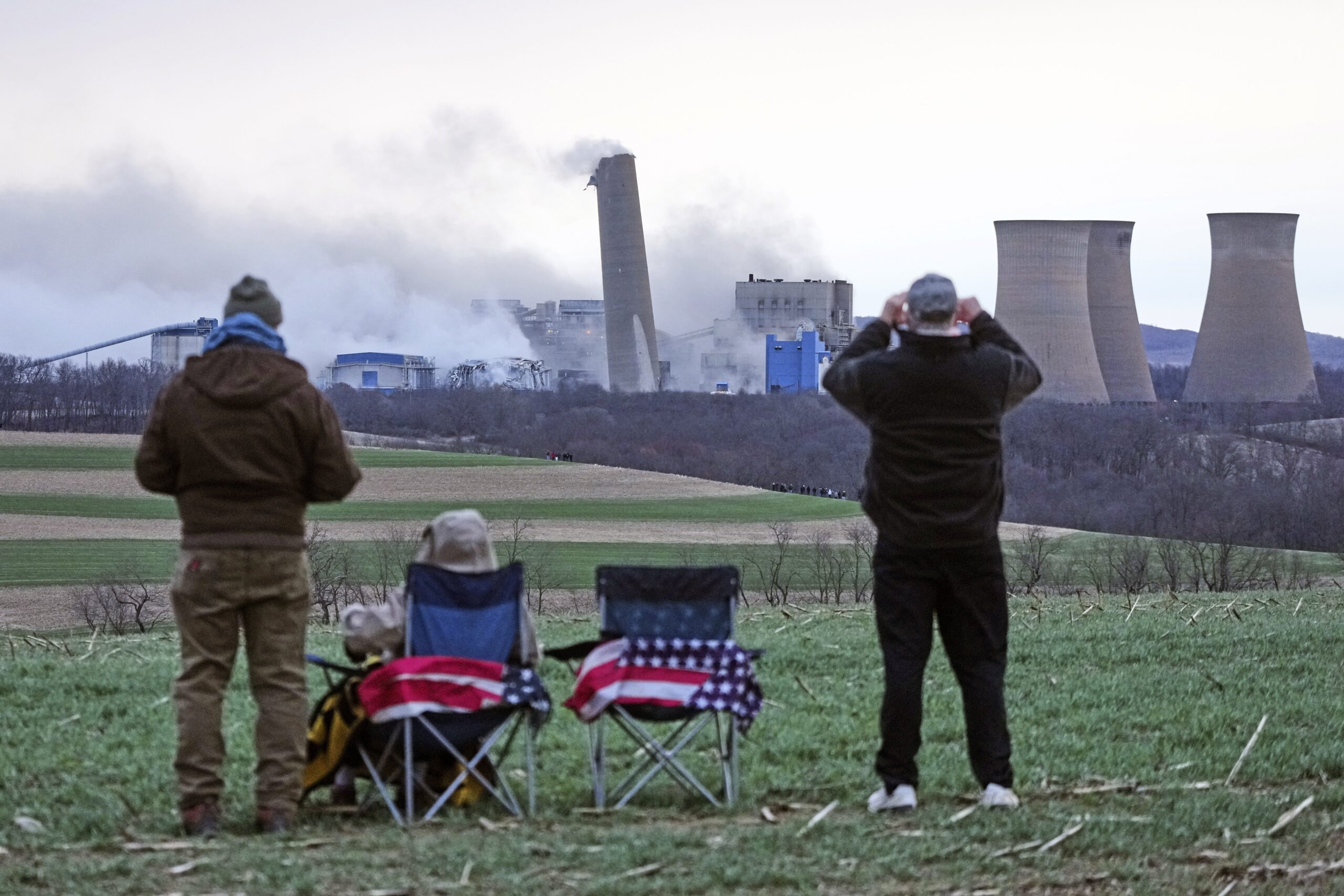
As Homer City’s smokestacks imploded and fell to the ground last March, leaving only a gray cloud, Dudash wondered what particulates might be in the dusty mix. While there were rumors in town that asbestos might be among them, the Department of Environmental Protection told Capital & Main that the site was inspected for the substance before it was demolished and none was found.
Still, coal dust, fly ash, and silica particulates are all possible during such implosions, an agency representative said. In the months since, residents have complained of repeated blasts from the site rattling their houses. As of January, the blasts occurred daily.
But the particulates that drift from the old plant during the blasts may pale in comparison to the carbon dioxide emissions the new power plant is predicted to release. The key air permit the Department of Environmental Protection issued to the facility allows it to release up to 17.5 million tons of the heat-trapping gas per year — the equivalent of putting 3.6 million gas-powered vehicles on the road annually. In 2010, according to federal data, the plant emitted just over 11 million tons of greenhouse gasses. In 2023, when it was operating at a fraction of its capacity, it emitted 1.3 million.
In their comment to regulators, the nonprofit environmental groups said that the carbon dioxide emissions would be triple those of any polluting facility in the state, representing 6% of Pennsylvania’s total emissions. The new plant will also emit sulfur oxides and nitrogen oxides, two classes of respiratory irritants, but at rates lower than the old plant. The nonprofit Clean Air Council condemned regulators’ issuance of the air permit, calling it a “death sentence.” Along with PennFuture and the Sierra Club, the council appealed the permit in December.
The owners said the emissions from the new plant will result in a 35%-40% reduction in carbon dioxide compared to the old plant, but the calculation does not account for the new plant’s larger size. Instead, it is per-megawatt hour, meaning per unit of energy generated. Natural gas is less emissions-intensive than coal when burned, but because the Homer City plant will generate more than double the energy of its predecessor, its overall emissions profile is expected to be higher.
As the state grapples with extreme weather events such as flooding due to global warming, locking in carbon emissions is the wrong direction to go, the environmental nonprofits argue. On an annual basis, the plant will be permitted to emit hundreds of tons of respiratory irritants like particulate matter and nitrogen oxides, and dozens of tons of formaldehyde, a carcinogen. It will also emit health-harming compounds like toluene, xylene, and ethylbenzene.
Additional emissions are likely to come from the natural gas drilling that will be required to power the site.
In 2024, Nymick told Capital & Main that the borough was struggling to find a new economic engine. “We’re fighting for our survival,” he said at the time. Data center industry advocates contend that the data center gold rush will be a boon for communities like Homer City, where boarded-up storefronts line the main street.
“For every one job in a data center, six jobs are supported elsewhere in the economy,” said Dan Diorio, vice president of state policy for the Data Center Coalition, an industry trade group, at a hearing in the state Capitol in October.
The smokestacks of the former coal-fired Homer City Generating Station crumble in a planned demolition to make way for a new natural gas-fired power plant in Homer City, Pa., in early 2025.
Sean O’Leary, senior researcher at nonprofit think tank the Ohio River Valley Institute, said the reality isn’t that rosy. The average data center employs as few as 10 people and as many as 110, per his own calculations based in part on data from the Bureau of Labor Statistics. The computers inside them can generally run on their own with limited maintenance.
Even in a rural county like Indiana, O’Leary said, “One hundred is a rounding error. It just doesn’t matter. It doesn’t matter if they’re paid $200,000 a year. It’s not enough to make a significant change in the status of the local economy.”
In a recent report on the data center boom in natural gas economies in Appalachia, O’Leary said gas-powered data centers represent the combination of “three non-labor-intensive industries” — fracking, power plants, and data centers. “Stacking [them] on top of each other does not alter the underlying dynamic which ties them together.”
Ron Airhart, a former coal miner and executive assistant to the secretary-treasurer of the United Mine Workers of America, is more optimistic about the economic potential of the new Homer City facility.
Still, he concedes that it will never be what the old plant was. “Yes, building a gas-fired power plant is going to create a lot of construction jobs, there’s no doubt about that,” he said. “But once it’s done, how many actual employees are you going to have working there?”
He quickly added, “But, I’m glad they are doing something with the old power plant there.”
Gorman told Capital & Main that Homer City Redevelopment and its construction partner, Kiewit, are planning to hire from local unions and building trades. They foresee 10,000 construction jobs. They also anticipate the site will create 1,000 “direct and indirect” permanent jobs, including those hired at the facility itself and those brought aboard for supportive positions, such as suppliers.
“From start to finish, the Homer City Energy Campus will be developed in partnership with skilled local craftsmen and will bring quality, good-paying jobs back to the Homer City community,” Gorman said.
O’Leary said the jobs numbers such as those projected by the Data Center Coalition are inflated, similar to the employment projections made before the fracking boom in rural Appalachia. He said such projections are a detriment to communities, in part because taxpayers shoulder the cost of subsidies to attract the industry to the state, such as a sales and use tax exemption for data centers that Pennsylvania codified in 2021. Gov. Shapiro has estimated that the credit will expand to about $50 million per year for the next five years.
Local residents are also burdened with rising utility bills. The surging demand for electricity is straining the region’s power supplies, increasing what utilities pay for electricity. New power plants coming onto the grid must install transmission equipment, the costs of which they share with consumers. These economic factors, in sum, could outweigh the benefits of the new jobs the data center creates, O’Leary said.
Earlier this year, the grid operator for the region that encompasses Pennsylvania, PJM, saw electricity prices surge by roughly 1,000% from two years ago. Some of that cost is expected to be passed onto customers.
“We have a problem, and that problem is real, and it is exponential electricity load growth causing exponential price increases for consumers,” said Patrick Cicero, former consumer advocate for the state of Pennsylvania and now an attorney for the Pennsylvania Utility Law Project, at the October hearing in Harrisburg.
“In the context of Grandma vs. Google,” Cicero said, referring to older residents faced with high bills, “Grandma should win every day. That should be the policy statement of the Commonwealth of Pennsylvania.”
Federal and state lawmakers are still determining how and whether to regulate the additional costs that data centers pass onto consumers, including for fees associated with transmission throughout the grid. A bill that would create such a process while establishing renewable energy mandates for data centers is now being weighed by Pennsylvania representatives.
Dennis Wamsted, energy analyst at the Institute for Energy Economics and Financial Analysis, predicts such costs add complications for data centers, and has argued that their demand as a whole is overblown. Supply chain delays spurred by surging demand for turbines, including those that Homer City will be using, could also create additional costs and lag times, he said.
“If there is an AI bubble and it bursts,” he said, “you would have built all this capacity that wasn’t needed.”
Homer City’s owners said the plant is better positioned than others in the industry since it isn’t starting from scratch.
“Much of the critical infrastructure for the project is already in place from the legacy Homer City coal plant, including transmission lines connected to the PJM and NYISO power grids, substations, and water access,” Gorman, the spokesperson, said.
Communities on the front lines of these projects would be the first hurt by a project that fails to materialize.
But in Homer City, it’s clear that there’s an appetite for the promise of a new, job-producing industry, regardless of hurdles.
At the September hearing, many in the crowd wore neon shirts with union logos — a signal of the region’s fierce pride in its industrial past, and deep thirst for an economic boon. After an evening peppered with skepticism over the plant, Shawn Steffee, a business agent at the International Brotherhood of Boilermakers, stepped to the microphone.
“Everybody speaking about jobs,” he cried, “there will be jobs, and there will be local jobs.”
As he walked away, the room filled with applause — the loudest of the night.