Tag: no-latest

  • Will an old Pennsylvania coal town get a reboot from AI?

    Will an old Pennsylvania coal town get a reboot from AI?

    This article was produced by Capital & Main. It is published here with permission.

    As the September evening inched along, the line of residents waiting their turn for the microphone held steady. Filing down the auditorium aisles at the Indiana University of Pennsylvania, they were armed with questions about a new gas plant slated for their community.

    Sitting quietly in the audience was John Dudash. For decades he’s lived in Homer City, a southwestern Pennsylvania town that was once home to the largest coal-fired power plant in the state. The plant, which shares its name with the town, closed nearly three years ago after years of financial distress.

    Dudash, 89, has lived in the shadow of its smokestacks — said to be the tallest in the country before they were demolished — for much of his life. At its peak, the Homer City power plant employed hundreds of people and could deploy about 2 gigawatts of energy, enough to power 2 million homes.

    It was also a major source of air pollution, spewing sulfur dioxide and mercury, both of which pose serious health risks. Today, Dudash wonders if the pollution might have exacerbated the lung issues that claimed his wife’s life six years ago.

    The proposed gas plant, expected to be up and running in 2027, will replace the old coal-fired power station, but with more than double the energy output — 4.5 gigawatts of energy. The new plant also will have the potential to emit 17.5 million tons of planet-heating greenhouse gasses per year, the equivalent of putting millions of cars on the road.

    And it will serve a new purpose: Rather than primarily sending electrons to the regional grid to power homes or businesses, the new power plant will exist mainly to feed data centers planned on the site.

    As the hearing wore on that September night, Dudash, a conservationist, did not stand to speak; instead, he sat quietly, taking mental notes. The next morning, he emailed two staffers at the Pennsylvania Department of Environmental Protection.

    “First of all, the project will not be stopped,” he began, with resignation. He went on to offer a few caveats — among them, advice about air monitoring.

    His letter reached the agency alongside more than 550 comments on a key air permit for the proposed plant, a testament to the project’s complexity. After the permit was approved Nov. 18, Dudash’s prediction began to look remarkably accurate — though the Homer City plant still has about a dozen additional permits awaiting approval before the project can be completed, including one that would impact several acres of wetlands and hundreds of feet of a local stream.

    Though it is among many energy sites popping up to power the artificial-intelligence boom across Pennsylvania, the Homer City facility is unique for its size, its advertised economic potential — the owners have promised the project will generate more than 10,000 construction-related jobs — and for its likely environmental impact. It has earned the backing of President Donald Trump, who called it “the largest plant of its kind in the world,” a distinction its owners could not verify. There was a buzz in town in late October when Jared Kushner, Trump’s son-in-law, visited, though it was unclear what drew him to Homer City.

    “I don’t really trust the people who are coming in to build and run the place,” Dudash said. “I do not agree with the artificial-intelligence portion of it.”

    “They’re going to have to sacrifice the environment for these jobs,” he added. “In Appalachia, we’ve been doing that for years.”

    The Homer City proposal

    When the old plant sputtered to a close in 2023, it left the surrounding community — which was built on the local abundance of coal — in search of an economic lifeline. Now, the data center boom sweeping the country brings promise of such a rebirth for communities like Homer City — though this promise is one that some experts say may be less than billed. And, it comes with risks.

    The new power plant will be much larger than its predecessor and is permitted to emit more than twice as much of some pollutants as its predecessor did. The data center, or centers, it powers would also consume a tremendous amount of water — perhaps more than its host townships can spare, some fear.

    Homer City, Pa., once a vibrant thoroughfare during coal’s heyday, was completely empty of pedestrians on an afternoon in 2024.

    Artificial intelligence requires vast amounts of electricity and has the potential to offer a lifeline to the fossil fuel industry. Though some in the community are sanguine about the promise of jobs, experts say the reality for many living around data centers may fall short. Some are left wondering exactly who the new plant is for — them or some faraway tech companies.

    The Homer City project is far from alone in its emergence: The nonprofit Fractracker has identified 39 planned data centers in the works across Pennsylvania. Tech companies like Microsoft and Amazon are moving in, alongside others intrigued by the state’s rich legacy of power production, deep natural gas reserves, and generous subsidies. In July, Republican U.S. Sen. Dave McCormick, from eastern Pennsylvania, held a conference in Pittsburgh during which companies announced more than $90 billion in data center investments and related energy infrastructure.

    This tech boom largely has bipartisan support, including from Gov. Josh Shapiro, a Democrat who said at a June press conference that he is committed to “ensuring the future of AI runs right through Pennsylvania.” Legislators in Harrisburg, meanwhile, are introducing bills that would both spur the burgeoning industry and give it guardrails.

    The extent to which the Homer City facility’s owners have lobbied for supportive legislation is not clear. The company’s lobbying registration with the Pennsylvania Department of State goes back only to January 2025. It has, however, spent at the local level. In November, for instance, the company gave a community nonprofit $25,000 for a holiday food drive. It also urged state utility regulators, who are drafting a policy on data centers, to issue one that does not saddle data centers with costs that might “push” them out of state.

    Meanwhile, communities are pushing back, and the environmental nonprofit Food & Water Watch recently called for a nationwide moratorium on new data center construction. More than 200 other groups later joined them in making such a plea to Congress. On the ground in Homer City, a coalition of neighbors have formed Concerned Residents of Western Pennsylvania to oppose the project.

    The Homer City proposal is the brainchild of the same private equity owners that closed the plant in 2023 — after years of financial difficulty and two bankruptcies. Two firms own close to 90% of the plant, with New York City-based Knighthead Capital Management holding the vast majority of that. It’s part of a wave of private equity investment in the data center industry. In March, the owners, operating under an LLC called Homer City Redevelopment, toppled the plant’s signature smokestacks. A few weeks later, they announced that the plant would reopen with a data center customer, or suite of customers, to be announced as soon as 2026.

    Critics fear the new plant will require a lot more water than its predecessor. The supercomputers that data centers house whirr away around the clock, and need to be routinely cooled down. Some data center companies have introduced recycled water into their systems. Homer City Redevelopment has not said if their data center clients will be among them.

    How to handle the water

    In 2014, U.S. data centers used 21.2 billion liters of water, enough to fill nearly 9,000 Olympic-size swimming pools. That number tripled by 2023, with the vast majority of the water consumed by “hyperscale,” or large, facilities like Homer City. In states like Colorado, where water use has, for decades, been meticulously planned and negotiated, data centers are threatening to strain such finely tuned systems.

    Dudash, the longtime Homer City resident, is concerned about a similar fate. “I’m not sure how they’re going to handle the water,” he told Capital & Main after the September hearing.

    The power plant has, since 1968, been allotted an uncapped amount of water from Two Lick Reservoir, a 5 billion gallon, dammed-off portion of a creek that the plant’s former owners built explicitly for its use.

    The power plant shares the water with a utility that serves two local communities — Indiana Borough and the broader White Township — as part of a 1988 drought management plan to prevent and respond to catastrophic weather conditions. The borough of Homer City gets its water from Yellow Creek, a tributary of Two Lick Creek, which serves the reservoir and picks up the slack in the event of a drought.

    “Should the Two Lick Creek Reservoir be emptied, [the water utility] would not be able to provide sufficient water to protect public health and safety in their service area,” the drought management plan reads.

    In 1985, the delicate system between Two Lick and Yellow Creek was strained when the then-Homer City plant drew so much water from the reservoir that it led to a drought. “Had a significant rainfall not occurred … the reservoir may have faced total depletion,” the drought management plan reads.

    A report from the Pennsylvania Department of Environmental Protection shows that the water utility drawing from Two Lick has, in recent years, routinely used nearly half its allotted amount. But critics fear that allocation could be at risk once a data center opens and starts drawing water.

    Robin Gorman, a spokesperson for Homer City Redevelopment, told Capital & Main that it plans to leave cooling and water-use decisions to its data center clients, making it unclear how much water will be needed to keep all the computers running, or where that water would come from.

    Rob Nymick, Homer City’s former borough manager, who serves as manager of the Central Indiana County Water Authority, told Capital & Main that he is confident local municipalities can share water resources with the planned gas plant. But the data centers could be a different story.

    “I do know that data centers do require a tremendous amount of water,” Nymick said. “That’s something we probably cannot provide.”

    Nymick said that community officials are operating with “limited knowledge,” and that during the handful of meetings they have held with Homer City Redevelopment, “The only thing that they wanted to discuss is the actual power plant.”

    Eric Barker, who grew up in Homer City, attended the September hearing with restrained optimism. “The power plant was a source of pride and is a source of pride for the community,” he said. “There’s not too many large employers in Indiana County,” he added.

    But he found little comfort at the September hearing.

    The Department of Environmental Protection “seemed woefully, woefully, comically underprepared,” Barker said, citing a response he received to a question about the types of pollutants that would increase under the new Homer City proposal, compared to what was emitted by the old plant. Barker was told the agency would look into it and get back to him.

    “Some questions and concerns were raised at the public meeting regarding the plan approval about matters beyond the limited scope of the meeting,” said Pennsylvania Department of Environmental Protection spokesperson Tom Decker in a statement. “Interested parties are encouraged to look to the DEP’s extensive website, including its community page dedicated to the Homer City project, for resources addressing such questions and concerns.”

    Despite the questions that followed, the department, on the whole, signaled satisfaction with the Homer City plant’s air permit application at the hearing. “What’s being proposed is what we consider state-of-the-art emission controls,” said Dave Balog, environmental engineering manager at the department’s northwest regional office.

    Environmental nonprofits Citizens for Pennsylvania’s Future, Clean Air Council, the Sierra Club, and Earthjustice countered in a 44-page comment on a draft of the key air permit that the application does not incorporate the best tools for mitigating pollutants such as ammonia, which is known to cause respiratory issues and other health risks. The Department of Environmental Protection agreed with Homer City Redevelopment’s analyses of its best available technology, and the permit was granted.

    ‘We’re fighting for our survival’

    As Homer City’s smokestacks imploded and fell to the ground last March, leaving only a gray cloud, Dudash wondered what particulates might be in the dusty mix. While there were rumors in town that asbestos might be among them, the Department of Environmental Protection told Capital & Main that the site was inspected for the substance before it was demolished and none was found.

    Still, coal dust, fly ash, and silica particulates are all possible during such implosions, an agency representative said. In the months since, residents have complained of repeated blasts from the site rattling their houses. As of January, the blasts occurred daily.

    But the particulates that drift from the old plant during the blasts may pale in comparison to the carbon dioxide emissions the new power plant is predicted to release. The key air permit the Department of Environmental Protection issued to the facility allows it to release up to 17.5 million tons of the heat-trapping gas per year — the equivalent of putting 3.6 million gas-powered vehicles on the road annually. In 2010, according to federal data, the plant emitted just over 11 million tons of greenhouse gasses. In 2023, when it was operating at a fraction of its capacity, it emitted 1.3 million.

    In their comment to regulators, the nonprofit environmental groups said that the carbon dioxide emissions would be triple those of any polluting facility in the state, representing 6% of Pennsylvania’s total emissions. The new plant will also emit sulfur oxides and nitrogen oxides, two classes of respiratory irritants, but at rates lower than the old plant. The nonprofit Clean Air Council condemned regulators’ issuance of the air permit, calling it a “death sentence.” Along with PennFuture and the Sierra Club, the council appealed the permit in December.

    The owners said the emissions from the new plant will result in a 35%-40% reduction in carbon dioxide compared to the old plant, but the calculation does not account for the new plant’s larger size. Instead, it is per-megawatt hour, meaning per unit of energy generated. Natural gas is less emissions-intensive than coal when burned, but because the Homer City plant will generate more than double the energy of its predecessor, its overall emissions profile is expected to be higher.

    As the state grapples with extreme weather events such as flooding due to global warming, locking in carbon emissions is the wrong direction to go, the environmental nonprofits argue. On an annual basis, the plant will be permitted to emit hundreds of tons of respiratory irritants like particulate matter and nitrogen oxides, and dozens of tons of formaldehyde, a carcinogen. It will also emit health-harming compounds like toluene, xylene, and ethylbenzene.

    Additional emissions are likely to come from the natural gas drilling that will be required to power the site.

    In 2024, Nymick told Capital & Main that the borough was struggling to find a new economic engine. “We’re fighting for our survival,” he said at the time. Data center industry advocates contend that the data center gold rush will be a boon for communities like Homer City, where boarded-up storefronts line the main street.

    “For every one job in a data center, six jobs are supported elsewhere in the economy,” said Dan Diorio, vice president of state policy for the Data Center Coalition, an industry trade group, at a hearing in the state Capitol in October.
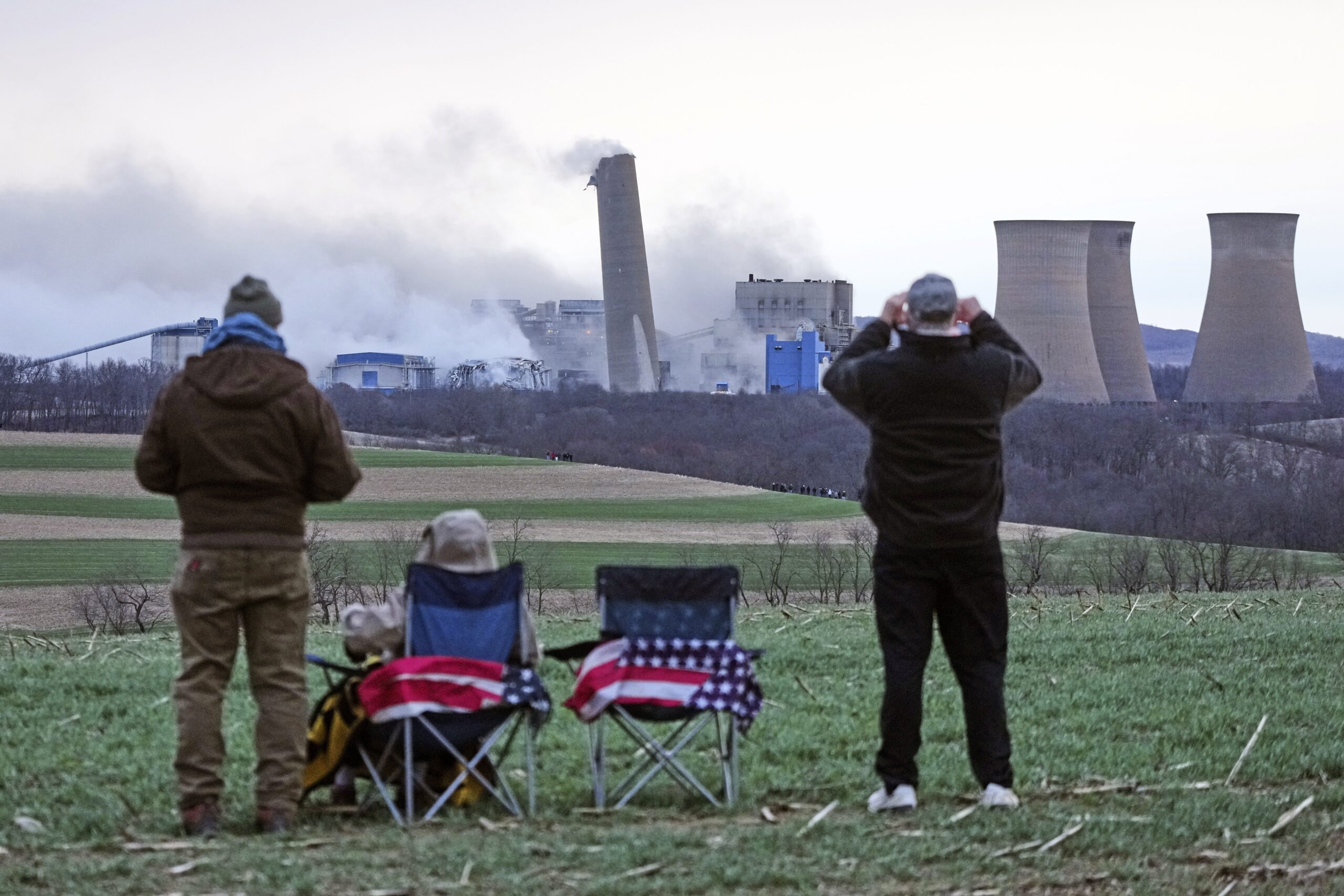
    The smokestacks of the former coal-fired Homer City Generating Station crumble in a planned demolition to make way for a new natural gas-fired power plant in Homer City, Pa., in early 2025.

    Sean O’Leary, senior researcher at nonprofit think tank the Ohio River Valley Institute, said the reality isn’t that rosy. The average data center employs as few as 10 people and as many as 110, per his own calculations based in part on data from the Bureau of Labor Statistics. The computers inside them can generally run on their own with limited maintenance.

    Even in a rural county like Indiana, O’Leary said, “One hundred is a rounding error. It just doesn’t matter. It doesn’t matter if they’re paid $200,000 a year. It’s not enough to make a significant change in the status of the local economy.”

    In a recent report on the data center boom in natural gas economies in Appalachia, O’Leary said gas-powered data centers represent the combination of “three non-labor-intensive industries” — fracking, power plants, and data centers. “Stacking [them] on top of each other does not alter the underlying dynamic which ties them together.”

    Ron Airhart, a former coal miner and executive assistant to the secretary-treasurer of the United Mine Workers of America, is more optimistic about the economic potential of the new Homer City facility.

    Still, he concedes that it will never be what the old plant was. “Yes, building a gas-fired power plant is going to create a lot of construction jobs, there’s no doubt about that,” he said. “But once it’s done, how many actual employees are you going to have working there?”

    He quickly added, “But, I’m glad they are doing something with the old power plant there.”

    Gorman told Capital & Main that Homer City Redevelopment and its construction partner, Kiewit, are planning to hire from local unions and building trades. They foresee 10,000 construction jobs. They also anticipate the site will create 1,000 “direct and indirect” permanent jobs, including those hired at the facility itself and those brought aboard for supportive positions, such as suppliers.

    “From start to finish, the Homer City Energy Campus will be developed in partnership with skilled local craftsmen and will bring quality, good-paying jobs back to the Homer City community,” Gorman said.

    O’Leary said the jobs numbers such as those projected by the Data Center Coalition are inflated, similar to the employment projections made before the fracking boom in rural Appalachia. He said such projections are a detriment to communities, in part because taxpayers shoulder the cost of subsidies to attract the industry to the state, such as a sales and use tax exemption for data centers that Pennsylvania codified in 2021. Gov. Shapiro has estimated that the credit will expand to about $50 million per year for the next five years.

    Local residents are also burdened with rising utility bills. The surging demand for electricity is straining the region’s power supplies, increasing what utilities pay for electricity. New power plants coming onto the grid must install transmission equipment, the costs of which they share with consumers. These economic factors, in sum, could outweigh the benefits of the new jobs the data center creates, O’Leary said.

    Earlier this year, the grid operator for the region that encompasses Pennsylvania, PJM, saw electricity prices surge by roughly 1,000% from two years ago. Some of that cost is expected to be passed onto customers.

    “We have a problem, and that problem is real, and it is exponential electricity load growth causing exponential price increases for consumers,” said Patrick Cicero, former consumer advocate for the state of Pennsylvania and now an attorney for the Pennsylvania Utility Law Project, at the October hearing in Harrisburg.

    “In the context of Grandma vs. Google,” Cicero said, referring to older residents faced with high bills, “Grandma should win every day. That should be the policy statement of the Commonwealth of Pennsylvania.”

    Federal and state lawmakers are still determining how and whether to regulate the additional costs that data centers pass onto consumers, including for fees associated with transmission throughout the grid. A bill that would create such a process while establishing renewable energy mandates for data centers is now being weighed by Pennsylvania representatives.

    Dennis Wamsted, energy analyst at the Institute for Energy Economics and Financial Analysis, predicts such costs add complications for data centers, and has argued that their demand as a whole is overblown. Supply chain delays spurred by surging demand for turbines, including those that Homer City will be using, could also create additional costs and lag times, he said.

    “If there is an AI bubble and it bursts,” he said, “you would have built all this capacity that wasn’t needed.”

    Homer City’s owners said the plant is better positioned than others in the industry since it isn’t starting from scratch.

    “Much of the critical infrastructure for the project is already in place from the legacy Homer City coal plant, including transmission lines connected to the PJM and NYISO power grids, substations, and water access,” Gorman, the spokesperson, said.

    Communities on the front lines of these projects would be the first hurt by a project that fails to materialize.

    But in Homer City, it’s clear that there’s an appetite for the promise of a new, job-producing industry, regardless of hurdles.

    At the September hearing, many in the crowd wore neon shirts with union logos — a signal of the region’s fierce pride in its industrial past, and deep thirst for an economic boon. After an evening peppered with skepticism over the plant, Shawn Steffee, a business agent at the International Brotherhood of Boilermakers, stepped to the microphone.

    “Everybody speaking about jobs,” he cried, “there will be jobs, and there will be local jobs.”

    As he walked away, the room filled with applause — the loudest of the night.

    Copyright 2026 Capital & Main

  • Scientists are inventing treatments for devastating diseases. There’s just one problem.

    Scientists are inventing treatments for devastating diseases. There’s just one problem.

    This past spring, a biotech company announced the first use of a new gene-editing technology in people to fix an errant gene that causes a severe immune disorder. In June, a baby born with a life-threatening metabolic disorder was allowed to leave the hospital after a six-month sprint by scientists to create a bespoke treatment for him. And increasingly, a generation of “bubble babies” born without immune defenses are nearing their teenage years after receiving a one-time experimental gene therapy in early childhood.

    Therapies that target genetic illnesses at their root are no longer on the horizon. They are here. More are coming. But even as a growing suite of gene therapy tools are changing individual patients’ lives, many are getting stuck in a medical purgatory because they don’t fit the model for turning breakthroughs into accessible treatments.

    Donald Kohn, a pediatric bone marrow transplant physician at the University of California at Los Angeles, has successfully rebuilt children’s immune systems with gene therapy in the clinic for over a decade, but it has not yet become a medicine.

    “There are several dozen rare diseases in a similar situation, where there is a therapy that looks good in academic clinical trials. But getting to the end zone of an approved drug is very challenging,” Kohn said.

    The potential public health impact may appear small individually, but it is massive collectively. Rare diseases are estimated to afflict 300 million people globally, and around 70% of them trace to genetic causes.

    Typically, drug development is a relay race. Academic labs, backed by federal funding, often do the early, basic research. Companies run the next leg to turn those insights into drugs. While scientists can now utilize an expanding arsenal of gene therapy technologies to start the race against potentially thousands of diseases, finding someone to pick up the baton is challenging when any individual therapy may help a handful of patients ― or even just one.

    That limbo has led scientists to experiment with new business models and more efficient ways of testing new therapies to fill a market gap. They are building biotech companies that don’t rely on maximizing profits, launching nonprofits, and fashioning new kinds of clinical trials. The Trump administration has also weighed in to help.

    In November, the Food and Drug Administration outlined a path forward for getting certain treatments of rare diseases with a clear biological cause to market.

    “Unfortunately, FDA has heard from patients, parents, researchers, clinicians, and developers, that current regulations are onerous, unnecessarily demanding, provide unclear patient protection, and stifle innovation. We share this view,” top FDA officials wrote in the New England Journal of Medicine. “Nearly 30 years after the sequencing of the human genome, bespoke therapies are close to reality.”

    Lifesaving cures that ‘ebb and flow’

    For several decades, scientists have tried to use cell and gene therapies to fix illnesses at their roots. A few dozen have been approved for diseases, such as sickle cell anemia and spinal muscular atrophy. Even as new tools have expanded this potential over the last decade, risks also exist. Patients have died after receiving gene therapies, showing the tension between encouraging innovation and guarding patient safety.

    Perhaps no case highlights the opportunity — and the challenge — better than an experimental gene therapy designed to rebuild the immune systems of babies who were born without one. The disease, called severe combined immunodeficiency (SCID), has more than a dozen different genetic causes, but the same result: Babies are born without immune defenses.

    The condition is rare, affecting 40 to 80 children in the United States each year, but was popularized by the story of David Vetter, featured in the 1976 movie The Boy in the Plastic Bubble.

    In 2014, Jeffrey and Caroline Nachem’s newborn daughter, Eliana, developed a cough that wouldn’t go away. A blood test delivered a shocking result — a white blood cell count so low that the doctor ordered it to be run again, thinking it might be a fluke.

    It wasn’t. The Nachems learned their daughter had a subtype called adenosine deaminase deficiency-SCID (ADA-SCID). They lived in Fredericksburg, Va., near the woods, but couldn’t open the windows because mold spores could float in. They found new homes for their pets. They wiped down every surface and changed clothes after coming home from the outside world, to protect Eliana from germs.

    With a matched bone marrow transplant, the disease can be effectively treated, but the best option is from a sibling, and Eliana was the Nachem’s first child. Scientists had been developing gene therapies that turn a patient’s own cells into a possible cure, requiring a lower dose of chemotherapy and fewer immune-related complications.

    Researchers remove bone marrow cells, use a harmless virus to insert a corrected version of the ADA gene, and then reinfuse the cells. At 10 months old, Eliana received an experimental gene therapy — and it worked. As her immune system rebuilt itself, doctors gave her parents the clearance to give her a kiss or bring her outside. When she was 18 months, the Nachems pushed her around in a shopping cart at the grocery store.

    In a recent study in the New England Journal of Medicine, Kohn and colleagues reported the long-term follow-up of 62 children with ADA-SCID who were treated with a one-time gene therapy, including Eliana. Nearly all of them have had their immune systems fully rebuilt, going strong after an average of nearly eight years.

    Eliana is now in sixth grade. “She is incredible. She has attitude, she is artistic, she is the commander of the world. Nothing gets in her way,” Caroline Nachem said.

    The therapy, however, has been stuck.

    A biotechnology company, Orchard Therapeutics launched a plan to develop the therapy in 2016, but stopped investing in it a few years later. Orchard returned the therapy to its academic inventors in 2022.

    Researchers in Kohn’s lab spun out Rarity Public Benefit Corporation to turn it into a medicine. Now the bottleneck is developing the commercial manufacturing.

    “I saw the ebb and flow of this therapy,” said Paul Ayoub, chief executive of Rarity. “The therapies work, but they stop at this academic stage … We wanted to put it in our own hands — take the proven science to the finish line.”

    Meanwhile, families are waiting. Maria Thianthong, who lives in Los Angeles, is one of them. Her 3-year-old daughter, Eliyah, has been on the waiting list for the therapy since birth. Children with this form of SCID can live with injections of a replacement enzyme therapy, though it is considered a stopgap.

    “Three years is a lot of time for them to figure out something with the funding,” Maria said. “We’re just a little impatient.”

    A new era of ‘genetic surgery’

    For scientists, the SCID example is a gold standard, but also a cautionary tale.

    Cardiologist Kiran Musunuru and pediatric geneticist Rebecca Ahrens-Nicklas hold KJ Muldoon after he received an infusion of a drug custom-made for him. MUST CREDIT: Children’s Hospital of Philadelphia

    Running a trial with dozens of patients for a decade is a “Herculean effort” said Kiran Musunuru, a cardiologist at the University of Pennsylvania’s Perelman School of Medicine. He hopes that federal rules can be streamlined to speed up the process. Otherwise, many cures may never be made.

    The beauty of modern gene-editing tools, many of which build off the Nobel Prize-winning CRISPR technology, is that cures become programmable. Instead of inventing a new medicine for each disease, scientists in theory can write a bit of code to address a patient’s unique mutation for multiple diseases.

    David Liu, a biochemist at the Broad Institute and one of the field’s leaders, recently showed that a one-size-fits-all therapy could, with a single edit, treat multiple diseases in human cell and mouse models of disease. He’s also working with colleagues to create a nonprofit Center for Genetic Surgery to advance cures “that are not likely to be served by industry anytime soon, because their disease is so rare.”

    A company he co-founded, Prime Medicine, announced promising early results last year in treating two patients with a rare, inherited immune deficiency called chronic granulomatous disease. But it announced that it would deprioritize the program to focus on other diseases.

    The company is continuing to explore possible paths to federal approval with the current data set, rather than treating more patients.

    Paving the way for the future is the case of “Baby KJ” Muldoon, an infant who received a custom gene-editing therapy for a rare metabolic disorder last year at Children’s Hospital of Philadelphia.

    KJ celebrated his first birthday at home this summer, is learning to walk and is meeting developmental milestones. But he is one patient. Other children also suffer from similar disorders, called urea cycle disorders, that are caused by different mutations in multiple different genes. KJ’s treatment team is working on an “umbrella” clinical trial, in which five other children will be treated. They’ll use the same basic approach they used for KJ, but tailor the treatment to different genes and mutations.

    The hope is the evidence, pooled together, could be used to support the treatment’s approval. Musunuru’s team recently published a step-by-step guide to their interactions with regulators in the American Journal of Human Genetics. He and other researchers, who have been encouraged by the FDA’s recent announcement about a new pathway, await more specific guidance on how it would operate.

    “We’re kind of taking the stance, there are many patients like KJ who need therapies now,” Musunuru said. “The clock is ticking and we know we can do it now.”

  • Wall Street CEOs warn Trump: Stop attacking the Fed and credit card industry

    Wall Street CEOs warn Trump: Stop attacking the Fed and credit card industry

    NEW YORK — Up until this week, Wall Street has generally benefited from the Trump administration’s policies and has been supportive of the president. That relationship has suddenly soured.

    When President Donald Trump signed the One Big Beautiful Bill into law in July, it pushed another significant round of tax cuts and also cut the budget of the Consumer Financial Protection Bureau, at times the banking industry’s nemesis, by nearly half. Trump’s bank regulators have also been pushing a deregulatory agenda that both banks and large corporations have embraced.

    But now the president has proposed a one-year, 10% cap on the interest rate on credit cards, a lucrative business for many financial institutions, and his Department of Justice has launched an investigation into Federal Reserve Chair Jerome Powell that many say threatens the institution that is supposed to set interest rates free of political interference.

    Bank CEOs warned the White House on Tuesday that Trump’s actions will do more harm than good to the American economy.

    BNY CEO Robin Vince told reporters that going after the Fed’s independence “doesn’t seem, to us, to be accomplishing the administration’s primary objectives for things like affordability, reducing the cost of borrowing, reducing the cost of mortgages, reducing the cost of everyday living for Americans.”

    “Let’s not shake the foundation of the bond market and potentially do something that could cause interest rates to actually get pushed up, because somehow there’s lack of confidence in the Fed’s independence,” Vince added.

    The Federal Reserve’s independence is sacrosanct among the big banks. While banks may have wanted Powell and other Fed policymakers to move interest rates one way or another more quickly, they have generally understood why Powell has done what he’s done.

    “I don’t agree with everything the Fed has done. I do have enormous respect for Jay Powell, the man,” JPMorgan Chase CEO Jamie Dimon told reporters Tuesday.

    Dimon’s message did not seem to resonate with President Trump, who told journalists that Dimon is wrong in saying it’s not a great idea to chip away at the Federal Reserve’s independence by going after Powell.

    “Yeah, I think it’s fine what I’m doing,” Trump said Tuesday in response to a reporter’s question at Joint Base Andrews after returning from a day trip to Michigan. He called Powell “a bad Fed person” who has “done a bad job.”

    Along with the attacks on the Fed, President Trump is going after the credit card industry. With “affordability” likely to be a key issue in this year’s midterm elections, Trump wants to lower costs for consumers and says he wants a 10% cap on credit card interest rates in place by Jan. 20. Whether he hopes to accomplish this by bullying the credit card industry into just capping interest rates voluntarily, or through some sort of executive action, is unclear.

    The average interest rate on credit cards is between 19.65% and 21.5%, according to the Federal Reserve and other industry tracking sources. A cap of 10% would likely cost banks roughly $100 billion in lost revenue per year, researchers at Vanderbilt University found. Shares of credit card companies like American Express, JPMorgan, Citigroup, Capital One, and others fell sharply Monday as investors worried about the potential hit to profits these banks may face if an interest rate cap were implemented.

    In a call with reporters, JPMorgan’s chief financial officer, Jeffrey Barnum, indicated the industry was willing to fight with all resources at its disposal to stop the Trump administration from capping those rates.

    “Our belief is that actions like this will have the exact opposite consequence to what the administration wants in terms of helping consumers,” Barnum said. “Instead of lowering the price of credit, it will simply reduce the supply of credit, and that will be bad for everyone: consumers, the broader economy, and yes, for us, also.”

    Trump seemed to double down on his attacks on the credit card industry overnight. In a post on his social media platform Truth Social, he said he endorsed a bill introduced by Sen. Roger Marshall (R., Kansas) that would likely cut into the revenue banks earn from merchants whenever they accept a credit card at point-of-sale.

    “Everyone should support great Republican Senator Roger Marshall’s Credit Card Competition Act, in order to stop the out of control Swipe Fee ripoff,” Trump wrote.

    The comments from Wall Street are coming as the major banks report their quarterly results. JPMorgan, the nation’s largest consumer and investment bank, and The Bank of New York Mellon Corp., one of the world’s largest custodial banks, both reported their results Tuesday with Citigroup, Bank of America, Wells Fargo, and others to report later this week.

  • Letters to the Editor | Jan. 14, 2026

    Letters to the Editor | Jan. 14, 2026

    No restraint

    Donald Trump said the only restriction on his power is his own morality. The law, the courts, the Constitution, and the Congress cannot limit his authority or power. This is what a dictator believes. What does Trump’s moral restraint look like? It permits him to have adulterous affairs. It allows him to brag about being able to grab women’s private parts with no consequences. Falsifying financial statements for financial gain is fine. Creating the Big Lie that the 2020 election was stolen is justified by his need to stay in power. Sending a violent mob to assault the U.S. Capitol and Congress is necessary. Asking his vice president to ignore the Constitution and refuse to certify the vote is just his interpretation of the law. Watching as the mob beats law enforcement officers and then praises them as great patriots and finally pardons them is the right thing to do.

    In his second term, Trump has increased his power immensely, thanks to a GOP-controlled Congress that has allowed him to select a cabinet of largely unqualified individuals who are willing to accept his every order. He has eliminated the agency that provided food and medical assistance to those in need around the world and severely limited medical research. He has used the U.S. Department of Justice to persecute officials who previously performed their duties by seeking to prosecute Trump for his crimes. Trump has no morals and no shame. His malicious actions are too numerous to list and too un-American to believe.

    William J. Owens, Hammonton

    Two shootings

    On Jan. 6, 2021, Ashli Babbitt entered the U.S. Capitol as part of a mob and tried to break into the room where members of Congress were trying to be kept safe. She was shot and killed. In May, the Trump administration paid a $5 million settlement to her family, and some consider Babbitt a hero. Judicial Watch has filed a $30 million lawsuit over the killing. On Jan. 7, Renee Nicole Good tried to drive away from U.S. Immigration and Customs Enforcement agents and was shot dead. Vice President JD Vance says she brought it upon herself. That really is all one needs to know.

    Robert Franz, Plymouth Meeting

    Rush to judgment

    For most of my four decades as a lawyer, I have practiced criminal defense. Spontaneous shootings in the street demand the most searching, rigorous analysis of distances, angles, location of shooter and target, time intervals between actions and reactions, and a host of other variables, including motives, agendas, and personal histories. Video helps, but the investigative necessities remain the same. Any conclusion as to the shooter’s culpability depends on such work. No political leader or agency chief can fairly exonerate the shooter without such painstaking analysis, much less blame the victim.

    Justin T. Loughry, Haddonfield

    Rules of engagement

    No warrants. No Miranda rights. No due process. No phone call. No legal representation. No accountability. U.S. Immigration and Customs Enforcement bars government representatives from visiting detention facilities. Basically, ICE just disappears you. Separates families. Incarcerates children. And now they shoot you without cause.

    Patrick Thompson, Media, pthompson612@gmail.com

    Stand for freedom

    At an “ICE Out for Good” protest in Philadelphia this weekend, I found myself surrounded by a diverse group of peaceful, patriotic people. Some signs made me laugh; some chants brought me to tears. Outside in the rain, I felt at home. I served for 14 years as a foreign service officer, a role that limited personal political activities. As a diplomat to a kingdom during the 2016 election, I was congratulated by locals; Donald Trump’s disregard for human rights resonated there.

    I felt a sense of homesickness for the freedoms of my citizenship, which grew as I moved to countries that were more dangerous and less free. From one U.S. embassy compound, I could hear the government keeping protesters at bay with water cannons and live fire. I’ve seen masked security forces, abductions, communication blackouts, crowds tear-gassed, shipping container piles blocking roadways. To protect and expand our freedoms, we need to keep hold of our democratic experiment and fight for this country to live up to its promises. I know what state-sponsored repression looks like; we’re at a precipice, and we have everything to lose.

    Maura O’Brien, Ardmore

    Free pass

    The Inquirer is to be commended for keeping the spotlight on the corruption, dishonesty, divisiveness, and authoritarianism of the Trump administration. However, the resulting destruction of our democracy, social stability, and relationships with the rest of the world would not occur were it not for the abdication of responsibility by U.S. Sen. Dave McCormick and his Republican colleagues in Congress. On every issue, McCormick is either silent or supportive, never critical. As such, he is complicit in all the madness that is going on. The Inquirer should not let the senator get a pass on his failure to live up to his constitutional responsibility to be a check against this runaway presidency.

    Donald Kelly, Havertown

    Factually speaking

    I write in response to the recent letter to the editor in which the writer reprimands those of us who are not appropriately celebrating the invasion of Venezuela by crafting an argument devoid of a basis in facts. I doubt there are many, if any, people who view Nicolás Maduro as a legitimate leader who gives a whit about the Venezuelan people. He is a dictator who rigged his supposed election and is an alleged drug trafficker. We (as the writer called us) “pearl-clutching and bedwetting” Democrats, independents, and likely a fair number of Republicans, can all agree that any country deserves to be out of the clutches of a fascist, corrupt president. Many of us are feeling some kinship with the Venezuelan people and other oppressed citizens as we watch our own democracy being taken over by a similarly disturbing authoritarian regime.

    To address the factual disinformation in this letter, the author states that Maduro is “responsible for magnitudes more American deaths than Osama bin Laden.” Really? Venezuela’s impact on drug deaths in the U.S. has been minimal. According to the Drug Enforcement Administration, fentanyl, the primary cause of overdose deaths, does not come from Venezuela at all. Fentanyl is almost entirely produced by and transported to the U.S. by Mexican criminal cartels, which get needed chemicals primarily from China. Venezuela is used as a transit region for cocaine from Colombia headed for Europe.

    As for the comparison between Maduro and bin Laden, the latter founded the violent terrorist group al-Qaeda and launched attacks in multiple countries to further his goal of destroying America. From the late 1990s, al-Qaeda carried out attacks on American interests, including our embassies in Kenya and Tanzania. His reign of terror reached an apex of horror with the Sept. 11, 2001, attacks that killed thousands of men, women, and children going about their ordinary lives. The attempt to paint Maduro as more dangerous to America than bin Laden is utterly fallacious, especially since Donald Trump has openly acknowledged that this was all about oil, which he intends to keep. The letter writer says we need to “get with the program” and applaud an imperialistic anti-constitutional invasion and a violation of international law. Isn’t this exactly what Russian President Vladimir Putin has done to Ukraine?

    Diane C. Lucente, Delran

    Join the conversation: Send letters to letters@inquirer.com. Limit length to 150 words and include home address and day and evening phone number. Letters run in The Inquirer six days a week on the editorial pages and online.

  • Horoscopes: Wednesday, Jan. 14, 2026

    ARIES (March 21-April 19). You don’t waste time envying what a friend has when you can simply go out and get your own. It’s when you see something in the world that is not accessible to you that the pangs persist and then turn into something else entirely — motivation, then pure drive.

    TAURUS (April 20-May 20). A daily ritual is so much a part of feeling like yourself that if you were to skip it, all else would feel slightly askew. This is your ideal moment to level up the practice with a small improvement. It ripples out to the rest of your life.

    GEMINI (May 21-June 21). If you thought the gray areas were complex, wait until you get into the rest of the crayon box. But you’re the artist of this life. You know that every color can have its place and use in the picture — some you use a lot, some just a dot. You can make this work.

    CANCER (June 22-July 22). There’s little to do but plenty to adjust to, which is the harder task. Flexibility is its own form of strength. Give yourself credit for your ability to adapt and settle in.

    LEO (July 23-Aug. 22). Just as nutritional needs vary from person to person, so do other needs such as novelty, social interaction, creative generation and physical exertion. So, don’t go by anyone else’s prescription. Only you know what feels right.

    VIRGO (Aug. 23-Sept. 22). Knowledge is as bright as sunbeams and just as tricky to deliver. You can’t hand someone a sunbeam. When you organize your ideas around what lights you up, others come closer to absorb what you know.

    LIBRA (Sept. 23-Oct. 23). You have an instinct about who you can trust, and it’s not always the one who is the right pick on paper. How you feel around people is more important than how their profile reads.

    SCORPIO (Oct. 24-Nov. 21). In the echo chamber of the internet, with its crowdsourced consensus and recycled takes, you have a chance to offer something that wasn’t there before. People are hungry for what isn’t being said. You’re well positioned to say it.

    SAGITTARIUS (Nov. 22-Dec. 21). A well-supported idea in both therapy and relationship research is this: Psychological safety shows up as not having to perform your mood. In other words, the people who let you be you no matter what it looks like at the moment are treasures, and you really feel that today.

    CAPRICORN (Dec. 22-Jan. 19). Your vitality makes you courageous, and your courage fills you with vitality, so the cycle keeps looping until your head hits the pillow tonight. By then, you’ll have a few stories to tell about this day, which is the happy consequence of your daring.

    AQUARIUS (Jan. 20-Feb. 18). Maybe you’ll notice that you are the thing that is “not like the others” today, but that’s a good thing. Everything that is different about you is an asset, not a liability. You’ll elevate the scene you’re in just by being you, with minimal filtering.

    PISCES (Feb. 19-March 20). As spiritual awareness expands, the ego naturally contracts. Perspective grows and self-importance fades, replaced by curiosity, humility and connection. Today, there will be less of a need to prove, protect or perform, and yet you are more fully yourself.

    TODAY’S BIRTHDAY (Jan. 14). This is your Year of Beauty Gone Wild in which you revel in the natural gifts around you. It manifests in enhanced vitality, in profoundly peaceful moments in travel, hobbies and habits. You were never more aware that you, too, are nature’s child empowered to accept what grows and flows through your world. More highlights: You’ll accomplish award-winning feats in a diverse team, you’ll do business all over the globe, and a special relationship will glow up your days. Leo and Libra adore you. Your lucky numbers are: 30, 2, 21, 14 and 8.

  • Dear Abby | Relatives take sides as accusations and denials pile up

    DEAR ABBY: I’m a 51-year-old mother and grandmother whose kids don’t talk to me. The reason: My son, “Aaron,” was sexually assaulted by his friend, “Eli,” and I told him his friend was no longer allowed to come over. I spoke to Eli’s mother. She told me she’d take care of it and agreed the two shouldn’t hang out. They were both underage at the time. (Aaron was 10, and Eli was 13.)

    A few months later, Aaron told me that it wasn’t Eli but his own uncle “Joe” who sexually assaulted him. I knew better. I talked to Joe and, of course, he knew nothing. I told Aaron to stop lying about his uncle and that Eli still couldn’t come over.

    Aaron is an adult now, and he’s got his siblings believing him about his uncle, and he’s still friends with Eli. My husband and I moved next door to Joe, and now all the kids have blocked me from their and their kids’ lives. When I tried to talk to Aaron about the situation, he blocked me completely. Joe knows nothing about what’s going on. How do I get back into my children’s and grandkids’ lives?

    — TURNED UPSIDE DOWN

    DEAR TURNED: Could the boys have been experimenting with getting familiar with their bodies when all this occurred? Did you see something and confront your son and he admitted it? Aaron may have blamed Uncle Joe because he wanted to continue seeing Eli. Or … was his accusation TRUE? You will not be able to heal the schism in your family until everyone is in agreement about what really happened when Aaron was 10.

    ** ** **

    DEAR ABBY: My older brother, age 70, is making his estate plans with his partner. We have no other siblings or children. I told him I’m financially secure and don’t need him to leave me anything, but he insisted on having my Social Security number, saying it’s needed for beneficiary bequests. I called him back before disclosing the information, because I wanted to make sure it was really him.

    He later called me and asked for my passport number because his partner has assets in China, and the paperwork required more information. That was too much information for me, and I asked him to take me out of his bequests entirely. He fussed about having to contact the lawyer and change the trust information but said he would take care of it. Now, he’s no longer speaking to me.

    Abby, my brother never disclosed that he would need anything beyond a Social Security number. Should I feel guilty about the added expense of editing his trust?

    — TROUBLEMAKER SIS IN TEXAS

    DEAR SIS: You should absolutely NOT feel guilty for refusing to reveal the information your brother was requesting! Are you SURE it was your brother calling and asking for this highly personal information and not a scammer? I ask because a beneficiary’s Social Security number and/or passport number is NOT REQUIRED when someone is being mentioned in a will, and I think you may have dodged a bullet.

  • Tensions flare in Minnesota as protesters and federal agents repeatedly square off

    Tensions flare in Minnesota as protesters and federal agents repeatedly square off

    MINNEAPOLIS — Federal officers dropped tear gas and sprayed eye irritant at activists Tuesday during another day of confrontations in Minneapolis, while students miles away walked out of a suburban school to protest the Trump administration’s bold immigration sweeps.

    Meanwhile, the fallout from the fatal shooting of a Minneapolis woman by an immigration agent reached the local U.S. Attorney’s Office: At least five prosecutors have resigned amid controversy over how the U.S. Justice Department is handling the investigation, according to people familiar with the matter.

    Separately, a Justice Department official said Wednesday there’s no basis for a criminal civil rights investigation. An FBI probe of Renee Good’s death is ongoing.

    Strife between federal agents and the public continues to boil, six days since Good was shot in the head while driving off in her Honda Pilot. At one scene, gas clouds filled a Minneapolis street near where she died. A man scrubbed his eyes with snow and screamed for help after agents in a Jeep sprayed an orange irritant and drove off.

    It’s common for people to boo, taunt and blow orange whistles when they spot heavily armed immigration agents passing through in unmarked vehicles or walking the streets, all part of a grassroots effort to warn the neighborhood and remind the government that they’re watching.

    “Who doesn’t have a whistle?” a man with a bag of them yelled.

    Brita Anderson, who lives nearby and came to support neighborhood friends, said she was “incensed” to see agents in tactical gear and gas masks, and wondered about their purpose.

    “It felt like the only reason they’d come here is to harass people,” Anderson said.

    In Brooklyn Park, Minn., students protesting the immigration enforcement operation walked out of school, as students in other communities have done this week.

    Good’s death has ripple effect

    The departures in the U.S. Attorney’s Office include First Assistant U.S. Attorney Joe Thompson, who had been leading the sprawling prosecution of public fraud schemes in the state, according to people who spoke to The Associated Press on the condition of anonymity to discuss personnel matters.

    With the Department of Homeland Security pledging to send more than 2,000 immigration officers into Minnesota, the state, joined by Minneapolis and St. Paul, sued President Donald Trump’s administration Monday to halt or limit the surge.

    The lawsuit says Homeland Security is violating the First Amendment and other constitutional protections by focusing on a progressive state that favors Democrats and welcomes immigrants.

    “What we are seeing is thousands — plural — thousands of federal agents coming into our city. And, yeah, they’re having a tremendous impact on day-to-day life,” Minneapolis Mayor Jacob Frey said.

    A judge set a status conference for Wednesday.

    Homeland Security says it has made more than 2,000 arrests in the state since early December and is vowing to not back down. Spokesperson Tricia McLaughlin, responding to the lawsuit, accused Minnesota officials of ignoring public safety.

    Trump defiant

    In a social media post, Trump defended the aggressive immigration enforcement actions being carried out across Minneapolis as part of his deportation agenda.

    The president asserted in the post that the anti-ICE activity is also shifting the spotlight away from alleged fraud in the state and said, “FEAR NOT, GREAT PEOPLE OF MINNESOTA, THE DAY OF RECKONING & RETRIBUTION IS COMING!”

    Trump blames what he calls “professional agitators” for the widespread protests. He has not provided evidence to support his claims.

    In response, Minnesota Gov. Tim Walz posted on X: “Trump admits that this is nothing but political retribution. Minnesota voted against him three times and now he’s punishing us – putting lives at risk and wasting enormous resources in the process.”

    ICE tactics on docket

    In a different lawsuit, a judge said she would rule by Thursday or Friday on a request to restrict the use of force, such as chemical irritants, on people who are observing and recording agents’ activities. Government attorneys argued that officers must protect themselves.

    The Trump administration has repeatedly defended the immigration agent who shot Good, a 37-year-old mother of three, saying he acted in self-defense. But that explanation has been widely panned by Frey, Walz, and others based on videos of the confrontation.

    State and local authorities are urging the public to share video and any other evidence as they seek to separately investigate Good’s death after federal authorities insisted they would approach it alone and not share information.

    In Wisconsin, Lt. Gov. Sara Rodriguez is proposing that the state ban civil immigration enforcement around courthouses, hospitals, health clinics, schools, churches and other places. She is hoping to succeed Gov. Tony Evers, a fellow Democrat, who is not running for a third term.

    “We can take a look at that, but I think banning things absolutely will ramp up the actions of our folks in Washington, D.C.,” Evers said, referring to the Trump administration. “They don’t tend to approach those things appropriately.”

  • Claudette Colvin, who refused to move seats on a bus at start of civil rights movement, dies at 86

    Claudette Colvin, who refused to move seats on a bus at start of civil rights movement, dies at 86

    On March 2, 1955, a 15-year-old Black high school junior named Claudette Colvin boarded a segregated city bus in Montgomery, Ala., taking a window seat near the back. When the driver ordered her to give up her seat so a white woman could be more comfortable, Ms. Colvin — who had been studying Black history in class, learning about abolitionists like Harriet Tubman and Sojourner Truth — did not budge.

    “History had me glued to the seat,” she said later, recalling how it felt as though Tubman and Truth had their hands on her shoulders, giving her “the courage to remain seated.”

    History would record that it was Rosa Parks, the longtime secretary of the local NAACP, who helped kick-start the modern civil rights movement by refusing to give up her seat on a crowded Montgomery bus.

    Yet it was Ms. Colvin, nine months earlier, who engaged in one of the first defiant challenges to the city’s Jim Crow transit system, remaining in her seat until police dragged her backward off the bus.

    While Parks’ stand proved far more consequential, leading to a year-long bus boycott that thrust the Rev. Dr. Martin Luther King Jr. to national prominence, Ms. Colvin’s arrest inaugurated what King described as a pivotal period for Black people in Montgomery. Community leaders formed a committee to meet with city and bus company officials, calling for improved treatment for Black passengers. Those discussions proved fruitless, King recalled in a memoir, but “fear and apathy” gradually gave way to “a new spirit of courage and self-respect.”

    Historian David Garrow said in an interview for this obituary that “Colvin’s experience proved a major motivating force for adult Black activists” including Jo Ann Robinson, who helped launch and sustain the bus boycott. Another leading figure in the boycott, lawyer Fred Gray, brought the federal lawsuit that overturned bus segregation, with Ms. Colvin serving as a plaintiff and star witness.

    “I don’t mean to take anything away from Mrs. Parks,” Gray said, “but Claudette gave all of us the moral courage to do what we did.”

    Ms. Colvin, who died Jan. 13 at 86, was almost forgotten in the annals of civil rights. Overshadowed by Parks and other activists, she spent decades in obscurity, caring for elderly patients as a nurse’s aide before gaining late-in-life recognition through the efforts of historians and writers such as Phillip Hoose, whose 2009 biography, Claudette Colvin: Twice Toward Justice, won the National Book Award for young people’s literature.

    “Young people think Rosa Parks just sat down on a bus and ended segregation, but that wasn’t the case at all,” Ms. Colvin told the New York Times in 2009. “Maybe by telling my story — something I was afraid to do for a long time — kids will have a better understanding about what the civil rights movement was about.”

    A movie based on her life, Spark, was announced in 2022, with actor Anthony Mackie lined up to make his directorial debut, and Saniyya Sidney slated to star.

    In the days after Ms. Colvin’s arrest, civil rights leaders in Montgomery wondered if her case might offer a chance to put segregation itself on trial. But, as Robinson later wrote in a memoir, “opinions differed where Claudette was concerned.”

    Some deemed her too young and immature, saying she was prone to profane outbursts. (Ms. Colvin said she never cursed.) There were also concerns about her class and background: She was looked down upon, Montgomery activist Gwen Patton once recalled with frustration, because she “lived in a little shack.”

    The deciding factor was the discovery by labor organizer E.D. Nixon, the local NAACP president, that Ms. Colvin was expecting a child. She later said that she became pregnant in the months after the bus standoff as a result of an encounter with a married man, which she described as statutory rape.

    “Even if Montgomery Negroes were willing to rally behind an unwed pregnant teenager — which they were not — her circumstances would make her an extremely vulnerable standard-bearer,” author Taylor Branch observed in Parting the Waters, a Pulitzer Prize-winning civil rights history.

    Ms. Colvin often said Nixon and other organizers were right to rally around Parks, who exuded a quiet authority, was familiar to activists from her work in the NAACP, and had an appeal that crossed class divisions through her job as a department-store seamstress.

    But Ms. Colvin remained frustrated by what she described as a lack of support and recognition in the years after she was arrested, when she struggled as a single mother to find work and eventually left Alabama for New York.

    “They wanted someone, I believe, who would be impressive to white people. … You know what I mean? Like the main star,” she told the Guardian in 2021. “And they didn’t think that a dark-skinned teenager, low income without a degree, could contribute. It’s like reading an old English novel when you’re the peasant, and you’re not recognized.”

    ‘I had had enough’

    Claudette Austin, as she was then known, was born in Birmingham, Ala., on Sept. 5, 1939. Her father, C.P. Austin, left the family when she was young.

    Her mother, Mary Jane Gadson, was unable to support Ms. Colvin and her younger sister by herself, and turned the children over to her aunt and uncle, Mary Ann and Q.P. Colvin. The older couple lived on a farm in Pine Level — the rural Alabama community where, by chance, Parks had gone to elementary school — and gave the girls their last name.

    When Ms. Colvin was 8, the family moved to nearby Montgomery, where her adoptive parents were hired by white families to do home and yard work. Her sister died of polio in 1952, shortly before Ms. Colvin started her first year at Booker T. Washington High School.

    Ms. Colvin was still grieving her sister’s death when her neighbor Jeremiah Reeves, an older schoolmate, was arrested and charged with raping a white woman. Following a confession he gave under duress and later retracted, he was convicted by an all-white jury, sentenced to death, and executed in 1958, at age 22.

    His arrest “was the turning point of my life,” Ms. Colvin said. As she saw it, the case embodied the hypocrisies of the legal system: Reeves was sent to death row as a juvenile because of a false confession, but when a white man raped a Black girl, “it was just his word against hers, and no one would ever believe her.”

    Ms. Colvin told Hoose that on the day the bus driver asked her to give up her seat, “rebellion was on my mind.”

    She was sitting in a row near the rear exit, joined by three schoolmates as the bus started filling up, and passengers stood in the aisle. Before long, a white woman was standing over Ms. Colvin and her peers. The driver asked for all four of their seats, so that the woman wouldn’t have to sit in the same row as a Black passenger.

    “I might have considered getting up if the woman had been elderly, but she wasn’t,” Ms. Colvin recalled. “She looked about 40. The other three girls in my row got up and moved back, but I didn’t. I just couldn’t.”

    Ms. Colvin remained seated as the driver grew exasperated — “Gimme that seat! Get up, gal!” — and hailed a transit policeman, who in turn summoned a squad car. Ms. Colvin said that as the police arrived, she began crying but remained defiant, telling the officers, “It’s my constitutional right to sit here as much as that lady. I paid my fare, it’s my constitutional right!”

    By her account, one of the officers kicked her as she was pulled off the bus. (One of the officers alleged that it was the other way around.) She was placed in handcuffs and put in a squad car, where, according to Ms. Colvin, the officers took turns trying to guess her bra size.

    Bailed out of jail by her minister, she returned home to fears of retaliation. Her adoptive father didn’t sleep that night, staying awake with a shotgun in case the Ku Klux Klan arrived. At school, classmates began to consider her a troublemaker, describing her as “that crazy girl off the bus.”

    Ms. Colvin was charged with assault and disorderly conduct in addition to violating the segregation law. Tried in juvenile court because of her age, she was found guilty of assault (a judge dismissed the other two charges), placed on indefinite probation and ordered to pay a small fine.

    Over the next few months, other Black women defied Montgomery’s segregated bus policy. The group included Lucille Times, who staged a one-woman boycott after an altercation with a driver, and 18-year-old Mary Louise Smith, who was arrested, convicted and fined after refusing to give up her seat.

    As with Ms. Colvin, organizers worried that Smith wasn’t right for a marquee case: Her father was said to be an alcoholic, and the family was deemed too low-class. It wasn’t until Parks’s arrest on Dec. 1, 1955, that a citywide bus boycott was organized.

    As the boycott progressed, Ms. Colvin became one of several plaintiffs in Browder v. Gayle, a federal lawsuit brought by Gray that challenged the city and state laws enforcing bus segregation in Montgomery. The case reached the U.S. Supreme Court, which ordered an end to bus segregation in late 1956.

    Ms. Colvin gave birth to her first son, Raymond, earlier that year. She never publicly identified the father and said she was expelled from high school as a result of her pregnancy.

    After passing a high school equivalency exam, she briefly attended Alabama State College in Montgomery and then moved in 1958 to New York, where she got a job as a live-in caregiver.

    She had a second son in 1960 and moved back and forth between New York and Montgomery — where her adoptive mother helped care for her children — before settling in New York City in 1968 and receiving training as a nurse’s aide.

    “The only thing I am still angry about is that I should have seen a psychiatrist,” she told The Washington Post in 1998, reflecting on her life after the movement. “I needed help. I didn’t get any support. I had to get well on my own.”

    Ms. Colvin’s death was confirmed by Ashley D. Roseboro, a spokesman for the family and for the Claudette Colvin Foundation. He said she died in hospice in Texas but did not share additional details.

    Her son Raymond died in 1993. Her younger son, Randy, worked as an accountant. He survives her, as do several sisters and grandchildren.

    In 2021, Ms. Colvin successfully petitioned to have her juvenile arrest record expunged, a symbolic act recognizing the injustice of the segregation laws.

    “I’m not doing it for me, I’m 82 years old,” she explained to the Times. “But I wanted my grandchildren and my great-grandchildren to understand that their grandmother stood up for something very important, and that it changed our lives a lot, changed attitudes.”

  • Trump is ending protected immigration status for Somalis, long a target of his anti-immigrant barbs

    Trump is ending protected immigration status for Somalis, long a target of his anti-immigrant barbs

    Donald Trump’s administration said Tuesday it will end temporary protected status for immigrants from Somalia, the latest move in the president’s mass deportation agenda.

    The move affects hundreds of people who are a small subset of immigrants with TPS protections in the United States. It comes during Trump’s immigration crackdown in Minneapolis, where many native Somalis live and where street protests have intensified since a U.S. Immigration and Customs Enforcement agent killed a U.S citizen who was demonstrating against federal presence in the city.

    The Department of Homeland Security said in a statement that affected Somalis must leave the U.S. by March 17, when existing protections, last extended by former President Joe Biden, will expire.

    “Temporary means temporary,” said Homeland Security Secretary Kristi Noem, adding that the decision puts “Americans first.”

    The Congressional Research Service last spring said the Somali TPS population was 705 out of nearly 1.3 million TPS immigrants. But Trump has rolled back protections across multiple countries in his second presidency.

    Congress established the Temporary Protected Status program in 1990 to help foreign nationals attempting to leave unstable, threatening conditions in their home countries. It allows the executive branch to designate a country so that its citizens are eligible to enter the U.S. and receive status.

    Somalia first received the designation under President George H.W. Bush amid a civil war in 1991. The status has been extended for decades, most recently by Biden in July 2024.

    Noem insisted circumstances in Somalia “have improved to the point that it no longer meets the law’s requirement for Temporary Protected Status.”

    Located in the horn of Africa, Somalia is one of the world’s poorest nations and has for decades been beset by chronic strife exacerbated by multiple natural disasters, including severe droughts.

    The 2025 congressional report stated that Somalis had received more than two dozen extensions because of perpetual “insecurity and ongoing armed conflict that present serious threats to the safety of returnees.”

    Trump has targeted Somali immigrants with racist rhetoric and accused those in Minneapolis of massively defrauding federal programs.

    In December, Trump said he did not want Somalis in the U.S., saying they “come from hell” and “contribute nothing.” He made no distinction between citizens and non-citizens or offered any opinion on immigration status.

    He has had especially harsh words for Rep. Ilhan Omar, a Minnesota Democrat who emigrated from Somalia as a child. Trump has repeatedly suggested she should be deported, despite her being a U.S. citizen, and in his rant last fall he called her “garbage.”

    Omar, who has been an outspoken critic of the ICE deployment in Minneapolis, has called Trump’s “obsession” with her and Somali-Americans “creepy and unhealthy.”

  • Trump visits a Ford pickup truck factory, aiming to promote his efforts to boost manufacturing

    Trump visits a Ford pickup truck factory, aiming to promote his efforts to boost manufacturing

    DETROIT — President Donald Trump offered a full-throated defense of his sweeping tariffs on Tuesday, traveling to swing-state Michigan to push the case that he’s boosted domestic manufacturing in hopes of countering fears about a weakening job market and still-rising prices that have squeezed American pocketbooks.

    Trump visited the factory floor of a Ford plant in Dearborn, where he viewed F-150s — the bestselling domestic vehicle in the U.S. — at various stages of production. That included seeing how gas and hybrid models were built, as well as the all-gas Raptor model, designed for off-road use.

    The president chatted with assembly line workers as well as the automaker’s executive chairman, Bill Ford, a descendent of Henry Ford. “All U.S. automakers are doing great,” Trump said.

    He later gave a speech to the Detroit Economic Club that was meant to be focused on his economic policies but veered heavily to other topics as well. Those included falsely claiming to have won Michigan three times (he lost the state in 2020 to Joe Biden) and recalling the snakes that felled workers during U.S. efforts to build the Panama Canal more than a century ago.

    “The results are in, and the Trump economic boom has officially begun,” the president said at the MotorCity Casino. He argued that “one of the biggest reasons for this unbelievable success has been our historic use of tariffs.”

    Trump insists tariffs haven’t increased costs

    The president said that tariffs were “overwhelmingly” paid by “foreign nations and middlemen” — even as economists say steep import taxes are simply passed from overseas manufactures to U.S. consumers, helping exacerbate fears about the rising cost of living.

    “It’s tariffs that are making money for Michigan and the entire country,” the president said, insisting that “every prediction the critics made about our tariff policy has failed to materialize.”

    But voters remain worried about the state of the economy. Tuesday’s visit — his third trip to a swing state since last month to talk about his economic policies — followed a poor showing for Republicans in November’s off-year elections in Virginia, New Jersey, and elsewhere amid persistent concerns about kitchen table issues.

    The White House pledged after Election Day that Trump would hit the road more frequently to talk directly to the public about what he is doing to ease their financial fears. The president tried to drive that home on Tuesday, but only amid lengthy asides.

    “I go off teleprompter about 80% of the time, but isn’t it nice to have a president who can go off teleprompter?” he said, before mocking Biden, suggesting his predecessor gave short speeches and doing an impression that included a dramatic clearing of his throat.

    Trump promised to unveil a new “health care affordability framework” later this week that he promised would lower the cost of care. He also pledged to soon offer more plans to help with affordability nationwide — even as he blamed Democrats for hyping up the issue.

    “One of our top priorities of this mission is promoting greater affordability. Now, that’s a word used by the Democrats,” Trump said. “They’re the ones who caused the problem.”

    Trump eased some auto tariffs

    Despite cheering tariffs, Trump has actually backed off the import taxes when it comes to the automobile sector. The president originally announced 25% tariffs on automobiles and auto parts, only to later relax those, seeking to provide domestic automakers some relief from seeing their production costs rise.

    Ford nonetheless announced in December that it was scrapping plans to make an electric F-150, despite pouring billions of dollars into broader electrification. That followed the Trump administration slashing targets to have half of all new vehicle sales be electric by 2030, eliminated EV tax credits and proposed weakening the emissions and gas mileage rules.

    While touring the assembly line, Trump suggested that a major North American trade agreement he negotiated during his first term, the United States-Mexico-Canada trade pact, was irrelevant and no longer necessary for the United States — though he provided few details.

    The pact, known as the USMCA, is up for review this year.

    Trump largely sidesteps Powell probe

    The president’s attempt to shift national attention to his efforts to spur the economy comes as his Department of Justice has launched a criminal investigation into Federal Reserve Chair Jerome Powell, a move that Powell says is a blatant endeavor to undermine the central bank’s independence in setting interest rates.

    Critics of the move include former Fed chairs, economic officials and even some Republican lawmakers. During the Michigan visit, Trump lobbed his often-repeated criticisms of Powell but offered little mention of the investigation.

    Some good economic news for Trump arrived, though, before he left Washington, with new data from December showing inflation declined a bit last month as prices for gas and used cars fell — a sign that cost pressures are slowly easing. Consumer prices rose 0.3% in December from the prior month, the Labor Department said, the same as in November.

    “We have quickly achieved the exact opposite of stagflation, almost no inflation and super-high growth,” he said in his speech.

    Other economic policy speeches

    The Michigan stop follows speeches Trump gave last month in Pennsylvania — where his gripes about immigrants arriving to the U.S. from “filthy” countries got more attention than his pledges to fight inflation — and North Carolina, where he also insisted his tariffs have spurred the economy, despite residents noting the sting of higher prices.

    Like in Michigan, Trump also used a casino as a backdrop to talk about the economy in Pennsylvania, giving his speech there at Mount Airy Casino Resort in Mount Pocono.

    Trump carried Michigan in 2016 and 2024, after it swung Democratic and backed Biden in 2020. He marked his first 100 days in office with a rally-style April speech outside Detroit, where he focused more on past campaign grudges than his administration’s economic or policy plans.

    Democrats seized on Trump’s latest visit to the state to recall his visit in October 2024, when Trump, then also addressing the Detroit Economic Club, said that Democrats’ retaining the White House would mean “our whole country will end up being like Detroit.”

    “You’re going to have a mess on your hands,” Trump said during a campaign stop back then.

    Michigan Democratic Party Curtis Hertel said in a statement that “Trump’s speech showed just how out-of-touch he is with reality, claiming that affordability is ‘fake’ as Michiganders have less money in their pocketbooks because of the Republicans’ price-hiking agenda.”