Tag: no-latest

  • Dear Abby | Family still chooses a side amid amicable divorce

    DEAR ABBY: My wife’s nephew is getting divorced. The process seems to be amicable; there was no cheating or abuse. They have two children. Even though the soon-to-be-ex, “Michelle,” has always been welcoming and nice, my wife’s family has circled the wagons. They no longer talk to her and have made clear I can’t either. I don’t think that’s right.

    Michelle has done nothing wrong and has been cordial to us. My wife says to stay out of it and never contact her. I think that’s immature. I realize my thoughts don’t matter. However, I’m thinking about contacting Michelle to say I feel bad about being in that position and apologize.

    I think if I did, I’d feel better about myself, and she’d know that everyone doesn’t hate her. Should something happen to my wife’s nephew, I would have some basis for connection to the children. What do you think?

    — NAVIGATING CHANGE IN ILLINOIS

    DEAR NAVIGATING: I think you are more mature than your wife’s family. You are an adult, and you should do what you feel is right.

    ** ** **

    DEAR ABBY: My father left our family when I was in sixth grade. Because he had cheated on our mom numerous times, he was removed from his ministry and went into education. I tried to resolve my feelings with him, but he would never admit his faults. When I finally asked him to tell me the truth, he refused.

    I am now in my 60s and still angry at him. I have a wonderful wife and two beautiful kids he has never met. Before he dies, I’d like to tell him how I feel about him and ask him one more time to tell the truth. Is this worth the effort? He is 92, so I don’t have much time.

    — ANGRY STILL IN PENNSYLVANIA

    DEAR ANGRY: Your efforts will be better spent if you meet with your father and tell him you forgive him for his transgressions. Do this not for him but for yourself, to free you from the burden of anger you have carried for all these years — and will continue to carry after his demise.

    ** ** **

    DEAR ABBY: How does one approach, by phone, email or in person, a couple — close friends of many years — whose husband is slipping into dementia? Do we acknowledge and commiserate, pretend nothing is amiss, stop communicating and seeing them? Or … WHAT, exactly?

    The profound tragedy is that the husband has been an intellectual and executive giant of immense quality, with abundant gifts and skills. Watching this slow-motion tragedy unfold is agonizing. Not knowing what to say or do compounds the pain.

    — DELIVERING PAINFUL NEWS

    DEAR DELIVERING: Social isolation is a killer. People in the early to middle stages of dementia are capable of being social. What you should continue to do is be the friend to this couple that you always have been and take your guidance from the wife. She will appreciate your kindness and support during this difficult time.

  • Horoscopes: Tuesday, Jan. 6, 2026

    ARIES (March 21-April 19). Feeling behind? It’s just an illusion caused by comparison. Stay on your own path. Someone else’s timeline is irrelevant to the terrain you’re walking. Your pace has its own logic. Trust it. Rushing won’t get you there faster.

    TAURUS (April 20-May 20). How could you make yourself 10% happier, more comfortable or more excited to be where you need to be? Your mood sets the tone. If you’re having fun, everyone else will feel it, too. That’s how influential you are today.

    GEMINI (May 21-June 21). If you could read minds, you’d sense that someone is smitten with you and wishing for your charming attention. No need to act on it. Simply enjoy the dynamic that will make interactions sweeter and keep the mood buoyant for everyone.

    CANCER (June 22-July 22). In unfamiliar settings, the basic instinct may be a classic defensive posture, but that’s not the only way to go. More sophisticated defenses include postures of friendliness, charm, usefulness, observation or simply openness. Not every new scene requires armor.

    LEO (July 23-Aug. 22). It does seem like the situation won’t change anytime soon. When a circumstance won’t budge, there’s no use in trying to shove it. Shift your stance instead. Frustration is just energy with nowhere to go, and you can redirect it.

    VIRGO (Aug. 23-Sept. 22). Yes, there will be obstacles, but you’re alert and nimble today. You’ll swerve, leap or knock down whatever shows up. The secret? You expect surprises instead of pretending life should run perfectly.

    LIBRA (Sept. 23-Oct. 23). Success is not objective. There is no universal standard; every definition is invented by someone. So you might as well invent one that suits you. When you define success generously, you feel successful sooner, which energizes the mission.

    SCORPIO (Oct. 24-Nov. 21). You will be in a position to lead people who don’t want to be led. Some people won’t follow orders, but they’ll follow momentum. Create a current. Show them where you’re going and why it’s exciting.

    SAGITTARIUS (Nov. 22-Dec. 21). You’re responsible. Nothing falls apart on your watch. When life slows down, you’re still busy keeping up the maintenance such as chores, commitments, relationships, obligations and more. Today, that will be your success secret and saving grace.

    CAPRICORN (Dec. 22-Jan. 19). Some people take on a lot, others very little. As for you, the luxury of choosing wasn’t offered. You were pushed to handle more, so now you can — and you do. People admire your strength and are inspired by your resilience.

    AQUARIUS (Jan. 20-Feb. 18). You’re not aiming to uncover some secret of the moment or do anything groundbreaking. Even though your intent is to show up in a low-key way, the thing is, you’re bringing your whole self, heart, soul and attention, which makes extraordinary things happen.

    PISCES (Feb. 19-March 20). A fear keeps circling back, but just because it’s recurring doesn’t mean it’s valid. This is just a story you haven’t updated. You’re no longer the version of you who first believed that script. Edit accordingly.

    TODAY’S BIRTHDAY (Jan. 6). Enter your Year of Golden Connections. It’s all about the people who lift you higher — collaborators, friends, clients and allies who catalyze and appreciate your magic. Relationship upgrades abound — some deepen, some begin and some heal. More highlights: You’ll quickly launch a lucrative idea. You’ll travel for a reunion of sorts. A domestic improvement brings comfort and beauty. Virgo and Aries adore you. Your lucky numbers are: 16, 2, 5, 30 and 42.

  • Bruce Brown’s goaltended layup in OT lifts short-handed Nuggets over Sixers

    Bruce Brown’s goaltended layup in OT lifts short-handed Nuggets over Sixers

    Bruce Brown scored 19 points and got the winning bucket in overtime off a goaltending call on Joel Embiid, and Jalen Pickett had 29 points to lead the short-handed Denver Nuggets to a 125-124 win over the 76ers on Monday night.

    Embiid was whistled for the decisive goaltend when he tried to block Brown’s running layup with 5.3 seconds left. Tyrese Maxey missed a winning floater for the Sixers at the horn.

    Embiid scored 32 points — the fourth time in his last eight games he has scored 30 — and Maxey had 28.

    The Nuggets played without three-time MVP Nikola Jokic — out at least until the end of the month with a with a hyperextended left knee — Jamal Murray, Aaron Gordon, Christian Braun and others a night after a loss at Brooklyn.

    The entire regular starting lineup sat out, and the Nuggets had only nine available players.

    Sixers guard VJ Edgecombe drives to the basket against Denver Nuggets forward Zeke Nnaji (right) during the second quarter on Monday.

    Peyton Watson added 24 points for Denver.

    The Nuggets refused to use their lighter roster as an excuse to pack it in against the Sixers.

    Hunter Tyson converted a four-point play that gave Denver a 102-100 lead in the fourth and Pickett followed with a two-footer that forced the Sixers into a timeout and served as the highlights of a 14-0 run.

    Brown snapped a tie game with a three-pointer and made 2 of 3 free throws for a 120-115 lead when he was fouled on a three-pointer on the next possession. That miss in the middle doomed Denver in regulation.

    VJ Edgecombe hit a three that made it 120-118 and Maxey tied the game on a driving layup with 49 seconds left that sent the game into overtime tied at 120. Edgecombe, the No. 3 pick of the draft who’s having a sensational rookie season, also gave the Sixers their last lead in overtime on a dunk just before Brown’s goaltended winner.

    The Sixers returned from a 3-2 road trip — that included all three wins on the back end.

    The Sixers host the Washington Wizards next on Wednesday (7 p.m., NBCSP).

  • Their homes survived the historic LA area wildfires, but a year later they fear living in them

    Their homes survived the historic LA area wildfires, but a year later they fear living in them

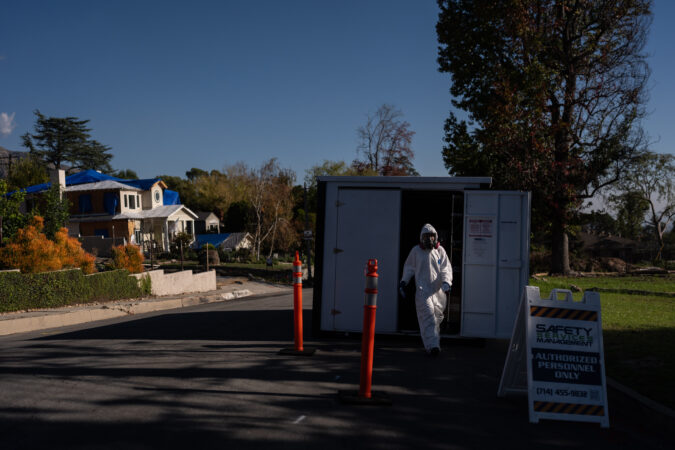
    ALTADENA, Calif. — “DANGER: Lead Work Area” reads a sign on a front door of an Altadena home. “May damage fertility or the unborn child. Causes damage to the central nervous system.”

    Block after block, there are reminders that contaminants still linger.

    House cleaners, hazardous waste workers, and homeowners alike come and go wearing masks, respirators, gloves, and hazmat suits as they wipe, vacuum, and power-wash homes that weren’t burnt to ash.

    It’s been a year of heartbreak and worry since the most destructive wildfires in the Los Angeles area’s history scorched neighborhoods and displaced tens of thousands of people. Two wind-whipped blazes that ignited on Jan. 7, 2025, killed at least 31 people and destroyed nearly 17,000 structures, including homes, schools, businesses, and places of worship. Rebuilding will take years.

    The disaster has brought another wave of trauma for people afraid of what still lurks inside their homes.

    Indoor air quality after wildfires remains understudied, and scientists still don’t know the long-term health impacts of exposure to massive urban fires like last year’s in Los Angeles. But some chemicals released are known to be linked to heart disease and lung issues, and exposure to minerals like magnetite has been associated with Alzheimer’s disease.

    Ash in the area is a toxic soup of incinerated cars, electronics, paints, furniture, and every other kind of personal belonging. It can contain pesticides, asbestos, plastics, lead, or other heavy metals.

    Many people with homes still standing are now living with the hazards left by the fires.

    People forced back into their Altadena homes

    Nina and Billy Malone considered their home of 20 years a safe haven before smoke, ash, and soot seeped inside, leaving behind harmful levels of lead even after professional cleaning. Recent testing found the toxin is still on the wooden floors of their living room and bedroom.

    They were forced to move back home in August anyway, after insurance cut off their rental assistance.

    Since then, Nina wakes up almost daily with a sore throat and headaches. Billy had to get an inhaler for his worsening wheezing and congestion. And their bedroom, Nina said, smells “like an ashtray has been sitting around for a long time.” She worries most about exposure to unregulated contaminants that insurance companies aren’t required to test.

    “I don’t feel comfortable in the space,” said Nina, whose neighbors’ homes burned down across the street.

    They’re not alone.

    Data shows dangerous lead levels still in homes

    According to a report released in November by the Eaton Fire Residents United, a volunteer group formed by residents, six out of 10 homes damaged from smoke from the Eaton Fire still have dangerous levels of cancer-causing asbestos, brain-damaging lead, or both. That’s based on self-submitted data from 50 homeowners who have cleaned their homes, with 78% hiring professional cleaners.

    Of the 50 homes, 63% have lead levels above the Environmental Protection Agency’s standard, according to the report. The average lead levels were almost 60 times higher than the EPA’s rule.

    Even after fires were extinguished, volatile organic compounds from smoke, some known to cause cancer, lingered inside of people’s homes, according to a recent study. To mitigate these risks, residents returning home should ventilate and filter indoor air by opening windows or running high-efficiency particulate air (HEPA) purifiers with charcoal filters.

    Zoe Gonzalez Izquierdo said she can’t get her insurance company to pay for an adequate cleanup of her family’s Altadena home, which tested positive for dangerous levels of lead and other toxic compounds.

    “They can’t just send a company that’s not certified to just wipe things down so that then we can go back to a still contaminated home,” Gonzalez said, who has children ages 2 and 4.

    Experts believe the lead, which can linger in dust on floors and windowsills, comes from burned lead paint. The University of Southern California reported that more than 70% of homes within the Eaton Fire were built before 1979, when lead paint was common.

    “For individuals that are pregnant, for young children, it’s particularly important that we do everything we can to eliminate exposure to lead,” said pediatrician Lisa Patel, executive director for the Medical Society Consortium on Climate and Health and a member of the climate group Science Moms.

    The same goes for asbestos, she added, because there is no safe level of exposure.

    “We have to live in the scar”

    People who lived in the Pacific Palisades, which was also scorched, face similar challenges.

    Residents are at the mercy of their insurance companies, who decide on what they cover and how much. It’s a grueling, constant battle for many. The state’s insurer of last resort, known as the California Fair Access to Insurance Requirements Plan, has been scrutinized for years over its handling of fire damage claims.

    Homeowners want state agencies to enforce a requirement that insurance companies return a property to prefire condition.

    Julie Lawson won’t take any risks. Her family paid about $7,000 out of pocket to test the soil in their Altadena home, even though their insurance company had already agreed to pay to replace the grass in their front yard. They planned to test for contaminants again once they finished remediating the inside, the process of making a home contaminant-free after a fire. If insurance won’t cover it, they’ll pay for it themselves.

    Even if their home is livable again, they still face other losses — including equity and the community they once had.

    “We have to live in the scar,” she said. “We’re all still really struggling.”

    They will be living in a construction zone for years. “This isn’t over for us.”

    Challenges and mental health toll

    Annie Barbour with the nonprofit United Policyholders has been helping people navigate the challenges, which include insurance companies that resist paying for contamination testing and industrial hygienists disagreeing on what to test for.

    She sees the mental health toll it’s having on people — and as a survivor herself of the 2017 Tubbs Fire in Northern California, she understands it.

    Many were at first joyful to see their houses still standing.

    “But they’ve been in their own special kind of hell ever since,” Barbour said.

    Now residents like the Malones are inspecting their belongings, one by one, fearing they may have absorbed toxins.

    Boxes, bags, and bins stuffed with clothes, chinaware, and everything in between fill the couple’s car, basement, garage, and home.

    They have been painstakingly going through their things, assessing what they think can be adequately cleaned. In the process, Nina is cleaning cabinets, drawers, and floors and still finding soot and ash. She wears gloves and a respirator, or sometimes just an N95 mask.

    Their insurance won’t pay to retest their home, Billy said, so they’re considering paying the $10,000 themselves. And if results show there’s still contamination, their insurance company told them they will only pay to clean up toxins that are federally regulated, like lead and asbestos.

    “I don’t know how you fight that,” said Nina, who is considering therapy to cope with her anxiety. “How do you find that argument to compel an insurance company to pay for something to make yourself safe?”

  • Democrats look primed to win the House, but a wave might be harder

    Democrats look primed to win the House, but a wave might be harder

    Democrats are celebrating signs that the tide is turning their way for the 2026 midterms. But translating dissatisfaction with President Donald Trump into an electoral tsunami, or even a wave election, will be much harder to achieve than in years past.

    History, polling, a narrow Republican majority, a string of off-year victories, and voter anxiety over the economy favor the Democrats, who lead in support for control of Congress by five percentage points in a Post average of November and December national polls.

    It’s unclear what effect the Trump administration’s recent intervention in Venezuela will have, if any, and will probably depend on how deeply the U.S. involves itself in running that country’s affairs. Democrats hope it further splits Trump’s MAGA coalition.

    But the battlefield in the House is smaller than ever, according to political analysts, experts, and operatives, meaning Democrats will need to compete in districts that Trump won by large margins to pick up a significant number of seats.

    Of the 39 seats Democrats are competing for, 28 are in districts that Trump won by five or more percentage points.

    A gerrymandering spree instigated by Trump has narrowed the number of truly competitive seats, furthering a trend that was already underway in recent elections as the nation has become more polarized. That has not affected the race for the Senate, which Republicans are favored to hold.

    Just 36 races in this year’s election are rated competitive by the Cook Political Report, compared with 49 races at the same point in the 2018 cycle. Half of the seats rated competitive by Cook this year are already held by Democrats, leaving the party even less room to gain ground.

    “Democrats will have a very narrow but viable path to the majority. That’s a different scenario than 2006 or 2018, when Democrats put a ton of Republican-held seats in play,” said David Wasserman, senior editor and elections analyst at the Cook Political Report. “There’s so little elasticity in U.S. House elections these days compared to prior eras.”

    Democrats won 40 House seats in the “blue wave” of 2018 during Trump’s first term, easily erasing the Republicans’ then 23-seat governing margin.

    The good news for Democrats this year: They need only three seats to regain control of the House.

    That is achievable, but 2018-sized “waves” are harder now given increasingly partisan maps and a more divided electorate that has become more rigidly partisan, according to Wasserman and other analysts.

    Party leaders, however, argue they are well positioned to compete in heavily Trump districts. Trump’s 2024 victory was powered by a historic realignment of the electorate that upended decades of traditional coalitions. He made inroads with Latinos, young voters, first-time voters, and middle- and lower-income households. Democrats say they can unwind many of those gains with a slate of less traditional, and in some cases less partisan, candidates.

    One of them is Paige Cognetti, the mayor of Scranton, Pa., who won her current seat by running as an independent in a campaign called “Paige Against the Machine.” Even though Trump won her district by about eight percentage points, voters are open to her because they still cannot afford basic necessities like housing and groceries and are not “bleeding Democrats or hardcore Republicans,” she said in an interview. She noted that Gov. Josh Shapiro (D) won the same district by eight percentage points in 2022.

    Cognetti is challenging Rep. Rob Bresnahan (R., Pa.), who has faced scrutiny for stock trades while he was in Congress after campaigning on a ban on stock trading for members of Congress.

    “This is the exact type of public corruption and cynical behavior that people here really, really loathe,” Cognetti said. “Government should work and people want to see it at their local level and federal level, too.”

    Bresnahan supported an effort last year that would restrict members of Congress from trading stocks and has said lawmakers should not profit off the information that they have. Bresnahan’s stocks are in an institutionally managed fund that is run by financial advisers, spokesperson Hannah Pope said.

    In a statement, Bresnahan’s campaign attacked Cognetti’s record as mayor and as “a former Goldman Sachs banker who made the richest Americans even richer.”

    Democrats have coalesced around a midterm message focused on the cost of living and healthcare, hammering Republicans for passing a $4 trillion budget bill that includes steep cuts to Medicaid and food stamps. They have also highlighted Republicans’ failure to extend pandemic-era Obamacare subsidies that expired Dec. 31 that will drive up premiums for millions of Americans this year.

    Democratic Party leaders have been energized by off-year and special elections in which Democrats performed above expectations. In a Tennessee special election last month in a district Trump won by 22 points, Republican Matt Van Epps won by about nine percentage points.

    Some Republicans have urged the party to focus more on affordability, rather than solely focusing on issues such as crime or immigration that played a significant role in their 2024 sweep. Trump kicked off a tour last month in Pennsylvania to focus on Americans’ struggles with rising prices, but veered off-script, mocking the word “affordability,” touting the stock market, and disparaging Somalia.

    Republicans say they also have a slate of strong candidates in the country’s most competitive districts, including Kevin Lincoln, a former mayor and pastor running against incumbent Adam Gray (D., Calif.) in a central California district, and Eric Flores, a Republican army veteran and lawyer challenging Rep. Vicente Gonzalez (D., Texas) in Texas’s 34th Congressional District, near the state’s southern Gulf Coast and the border with Mexico.

    Mike Marinella, spokesperson for the National Republican Campaign Committee, agreed the battlefield is smaller than in past midterm elections. But he said Republicans hold the advantage, pointing to about a dozen Democratic incumbents who are fending off challenges in districts that Trump won narrowly.

    “Fundamentally, we have the upper hand just by looking at the pure numbers, and Democrats are certainly on defense in a lot more districts than we are,” Marinella said.

    Rep. Suzan DelBene (D., Wash.), chairperson of the Democratic Congressional Campaign Committee, said in an interview that many candidates competing in Trump districts are closely connected to their communities and “independent-minded.”

    “Authenticity matters a ton because you’re talking to folks across the political spectrum,” DelBene said.

    Democrats believe they have effectively neutralized Republican efforts to pick up additional seats through gerrymandering in Texas, Ohio, and North Carolina by gaining seats of their own in California and Utah. The Indiana Senate rejected a partisan gerrymander last month, and Democrats are still exploring whether they could pick up seats in Virginia, Illinois, and Maryland. Wasserman said the post-gerrymandering landscape remains “pretty equitable to both parties.”

    As Trump’s approval ratings fall — 39% of voters approve of the job he is doing, according to a Washington Post average of polls in early December — Democrats are working to wipe out some of the gains he made with voter groups that are traditionally aligned with them.

    In South Texas, Tejano music star Bobby Pulido is competing in one of the new districts Republicans drew to try to maintain the House majority.

    Key to Trump’s victory in Texas’ 15th District, which includes the Rio Grande Valley, was an unprecedented rightward swing among Latino voters. Pulido has broad name recognition in the Southwest and in Mexico in large part because of his 1995 debut single “Desvelado.” Trump’s immigration crackdown is devastating tourism and the rest of the economy in South Texas, Pulido said, creating an opening among those who supported him.

    “These immigration raids are hurting a lot of these small business owners or builders where their workforce they’ve had for years is no longer either there or afraid to go to work,” Pulido said in an interview. “I understand that a lot of Democrats don’t want to get labeled open borders. I’m sure as heck not open borders. … But due in large part to the immigration policies this administration has taken, we need to fix it.”

    There are still myriad questions about where the final map for 2026 will end up. In addition to ongoing gerrymandering efforts by both parties, the Supreme Court is expected to decide whether to strike down the last major pillar of the Voting Rights Act, a provision that has bolstered the power of minority voters and candidates for more than 50 years.

    If the court issues a ruling early enough and sides with Louisiana and the Trump administration — which has argued that race played too large a role in the decision to create a second Black-majority congressional district in the state — some states might scramble to redraw their maps and add Republican seats.

    Chris Warshaw, professor of political science at the McCourt School of Public Policy at Georgetown University, said it’s not clear how aggressively Republican states will respond, if at all, if the Supreme Court strikes down Section 2 of the Voting Rights Act. Even if Republican states try to redraw their maps, he said, Democrats have shown they are willing to respond.

    But the cost of last year’s redistricting fights is the health of American democracy, particularly as the country had previously made progress toward less partisan maps, he said.

    “The unwinding of that progress is really sad, and there’s no reason to think this genie is going to go back into the bottle,” Warshaw said.


  • Trump revives an old vision of American power, with global implications

    Trump revives an old vision of American power, with global implications

    The nighttime raid that ousted Venezuelan President Nicolás Maduro this weekend was the most dramatic demonstration of President Donald Trump’s vow to focus U.S. might on the Americas, as the White House re-creates a stance toward the Western Hemisphere that more resembles its 19th century empire-building era than the laissez-faire attitude of recent generations.

    Trump and his top allies suggested that the Venezuelan operation could be the start of efforts to remake the region, warning the governments of Cuba and Colombia that they might be next. Trump and some backers have also brought up Mexico as a potential target, and they are reviving talk of attempting to acquire Greenland, a Danish territory.

    After announcing Maduro’s capture, Trump boasted of the “Donroe Doctrine,” a twist on the strategy articulated by President James Monroe in 1823 that European powers should stop interfering in the Western Hemisphere. The national security strategy released by the White House in December noted a “Trump Corollary” to the Monroe Doctrine that promised “to protect our homeland and our access to key geographies throughout the region.”

    The effort carries significant risks. Washington could get pulled into the nation-building invasions that Trump has long sworn to avoid if the Venezuelan military or people are unwilling to go along with his plans. It also makes it harder for the United States to argue to Russia and China that they should steer clear of their neighbors. And it may reshape global affairs more broadly, as smaller nations that were long dependent on Washington’s guarantees for global trade and stability hedge their bets by building ties elsewhere.

    Backers of Trump’s strategy downplay the drawbacks and say a narrower focus on U.S. regional interests is long overdue.

    “The goal of the policy is to see changes in Venezuela that are beneficial to the United States first and foremost, because that’s who we work for, but also, we believe, beneficial for the people of Venezuela, who have suffered tremendously,” Secretary of State Marco Rubio told NBC’s Meet the Press on Sunday, a day after Trump said U.S. forces were ready to reinvade Venezuela if Maduro’s de facto successor, Delcy Rodríguez, did not comply with his wishes.

    Rubio — the son of Cuban immigrants to the United States — has long backed efforts to oust Venezuela’s leaders, who have presided over a decline in their country’s economy, ignored election results, and built ties to U.S. adversaries including Russia and China. Deposing Venezuela’s government would probably weaken the Communist leaders of Cuba as well, since they have long depended on Caracas for energy and other economic support.

    “This emphasis on the Western Hemisphere should not come as a surprise to anybody. It matters more to American security than any other part of the world,” said Nick Solheim, chief executive of American Moment, a group that backs Trump’s policies and trains junior staffers.

    But he said advocates of a more robust focus on the Western Hemisphere were not saying Washington should abandon global affairs entirely.

    “It’s making sure that our neighbors are not doing anything that is, that would adversely affect the United States, and then focused on our greatest geopolitical challenge right now, which is China,” he said. “That is not a retreat from the world of foreign policy. It is an accurate prioritization of what actually matters the most, what poses the biggest threats to the United States.”

    The move against Venezuela drew criticism from both the center and the right, as some influential “America First” advocates said that military conflicts and expanded foreign opportunities for U.S. oil companies weren’t why voters backed Trump.

    “This is the same Washington playbook that we are so sick and tired of that doesn’t serve the American people, but actually serves the big corporations, the banks, and the oil executives,” Marjorie Taylor Greene, a longtime Trump ally who is retiring from Congress after breaking with the president, said on NBC’s Meet the Press on Sunday. “We don’t consider Venezuela our neighborhood. Our neighborhood is right here in the 50 United States, not in the Southern Hemisphere.”

    Washington has a long history of efforts to back friendly leaders in Latin America, including at times intervening with force to do so. But it has not done so directly since the 1991 end of the Cold War, and Venezuela — with 30 million residents and a territory double the size of Iraq’s — is an especially large nation to take on.

    “I understand how we got here, but there’s been no forethought to the difficulties of the plan or the ideas that they seem to have adopted as the way ahead, and there definitely is no plan to the level of detail that’s required,” said Jennifer Kavanagh, a senior fellow at Defense Priorities, a think tank that advocates a more limited role for the U.S. military in the world.

    She said she wasn’t sure that China and Russia would be emboldened by Trump’s actions, since they already appear to feel unconstrained toward their neighbors. But she noted that Trump appears to be cautious about tangling with militaries that can inflict serious damage on the United States.

    “This sort of spectacular operation is very consistent. He likes to hit adversaries that can’t hit back, whether it’s small drug-smuggling boats, or Iran with no air defenses, or Venezuela, which is also weak,” she said. “And to me, that explains the more accommodating approach to Russia and China, in the sense that his view of military power is kind of go big or go home. But that model doesn’t work against Russia and China.”

    Some of Trump’s former advisers warn that the world the president is building may turn out to be more dangerous than the era of the 1990s and 2000s, when the United States was the preeminent global power and backed a broad effort to strip barriers to trade.

    “It just seems to be back to the 18th and 19th centuries,” said Fiona Hill, an expert at the Brookings Institution who was Trump’s top Russia adviser in his first term. “If you’ve bought into the idea of competition among the great powers and that Russia is another great power that’s inevitably going to dominate in its region, just as China is in its region, then this is the logical conclusion from this.”

    Hill said countries that have deep, allied ties to the United States but are threatened by Trump may seek to protect themselves by building trade and security relationships elsewhere, a move that will ultimately weaken Washington, not strengthen it.

    The raid has sparked fears elsewhere that Trump could act on other threats toward U.S. neighbors, which have included demands to take over the Panama Canal, to turn Canada into the 51st state, to annex Greenland, and to overthrow Cuba’s government.

    Trump on Sunday said he didn’t plan action against Havana, but offered tough language nevertheless.

    “I think it’s just going to fall. I don’t think we need any action,” he told reporters on Air Force One. “You ever watch a fight, they go down for the count, and Cuba looks like it’s going down.”

    He was sharper toward Greenland.

    “We need Greenland from a national security situation,” Trump said. “It’s so strategic. Right now, Greenland is covered with Russian and Chinese ships all over the place. … Denmark is not going to be able to do it.” On Saturday, an influential former White House aide, Katie Miller, posted on social media an image of Greenland with the U.S. flag superimposed on top of it.

    The president’s repeated statements about Greenland drew a sharp response earlier Sunday from Danish Prime Minister Mette Frederiksen. “I have to say this very directly to the United States: It makes absolutely no sense to talk about the need for the United States to take over Greenland,” she said.

    In a statement, she said Denmark is a U.S. military ally and that the United States has extensive access to Greenland.

    “I would therefore strongly urge the United States to stop the threats against a historically close ally and against another country and another people who have said very clearly that they are not for sale,” she said.

  • Zelensky replaces Ukraine’s security chief and hires a Canadian economic adviser

    Zelensky replaces Ukraine’s security chief and hires a Canadian economic adviser

    KYIV, Ukraine — President Volodymyr Zelensky replaced the head of Ukraine’s security service Monday, continuing a top-level reshuffle ahead of a trip to Paris where he hoped to finalize agreements with allies on how to ensure that Russia doesn’t repeat its invasion if a peace agreement is signed.

    Zelensky is trying to revamp his administration as the grinding war of attrition with Russia marks its fourth anniversary next month. He is keen to keep up the momentum of U.S.-led peace talks as well as sharpen Ukraine’s focus on defense if those efforts collapse.

    The Paris talks are expected to include the leaders of about 30 countries, dubbed the “coalition of the willing,” which are ready to provide security guarantees to keep Ukraine safe in the future.

    Key issues include whether countries are prepared to deploy troops inside or close to Ukraine and what the remit of any force overseeing a ceasefire might be. Russia has said it won’t accept troops from NATO countries on Ukrainian soil.

    Zelensky’s changes at the top

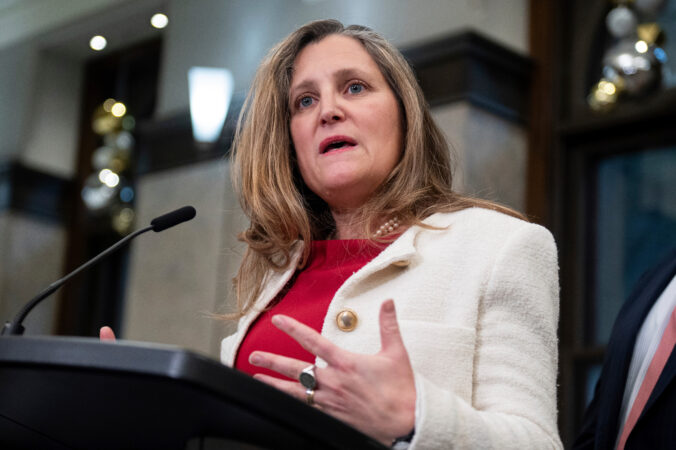
    Zelensky also announced the appointment of Canada’s former Deputy Prime Minister Chrystia Freeland as Ukraine’s economic development adviser, describing her as an expert on the issues with “significant experience in attracting investment and carrying out economic transformations.”

    Amid Ukraine’s biggest top-level reshuffle in about six months, Lt. Gen. Vasyl Maliuk, the head of the Security Service, or SBU, announced his resignation on the agency’s website.

    Zelensky published a decree on the presidential website appointing Ievhen Khmara, former head of the “A” Special Operations Center of the Security Service, as the agency’s acting head.

    Under Maliuk, the SBU produced some stunning successes against Russia, including Operation Spiderweb, which Ukraine said damaged or destroyed 41 Russian military aircraft in coordinated strikes on four air bases.

    On Friday, Zelensky appointed the head of Ukraine’s military intelligence as his new chief of staff.

    Announcing the appointment of Lt. Gen. Kyrylo Budanov, Zelensky said Ukraine needs to focus on security issues, developing its defense and security forces, and peace talks — areas that are overseen by the office of the president.

    New adviser has been a staunch critic of Putin

    Zelensky also is looking to strengthen the war-battered economy, including through projects in partnership with the U.S. and other countries. Freeland, who is of Ukrainian heritage and is a strong critic of Russian President Vladimir Putin, is a former journalist and Canadian lawmaker.

    Besides being a former deputy prime minister, she also served as Canada’s minister of international trade, foreign minister, and finance minister, and helped negotiate trade agreements with both Europe and the U.S.

    The Harvard University graduate has served as Canada’s special representative for the reconstruction of Ukraine — a position outside the Cabinet — in addition to her responsibilities as a lawmaker.

    Freeland and U.S. President Donald Trump have had a sometimes-fraught relationship that could work against Ukraine. In Trump’s first term, Freeland played a key role in negotiating the U.S.-Mexico-Canada Trade Agreement, and occasionally frustrated Trump aides with her tactics.

    During Trump’s first meeting with Canadian Prime Minister Mark Carney in the Oval Office, the president recalled his own antipathy for Freeland. “She was terrible, actually — she was a terrible person,” Trump said.

    When Freeland left former Prime Minister Justin Trudeau’s Cabinet, Trump said on social media that “her behavior was totally toxic.”

    One opposition lawmaker in Canada argued that Freeland could not be a member of the country’s parliament and at the same time work as an adviser to a foreign government.

    Ukraine seeks to counter size of Russian forces

    In his New Year’s address, Zelensky said a proposed U.S.-brokered peace deal was “90% ready” but warned that the remaining 10%, believed to include issues such as the future of disputed territory, would determine the outcome of the push for peace.

    Moscow hasn’t been forthcoming about details of the negotiations. Officials have, however, restated Russia’s demands and insist there can be no ceasefire until a comprehensive settlement is agreed.

    The fighting has not subsided along the roughly 600-mile front line that snakes along southern and eastern Ukraine.

    Zelensky said he met with Budanov on Monday to look at ways to reduce Russia’s edge in larger armed forces.

    “Russia has one significant advantage in this war, namely the ability to put pressure on Ukraine with the scale of strikes, the scale of assaults,” he said on social media. “We have and must respond with more active use of technology, faster development of new types of weapons, new tactics.”

    An overnight Russian drone strike at a private clinic in Kyiv’s Obolon district killed a 30-year-old old patient and injured three others, the capital’s prosecutor’s office said Monday.

    Energy workers and repair crews worked across the country after Russian drones damaged energy infrastructure, causing more power disruptions for civilians in the bitter winter, Zelensky said. Russia fired nine ballistic missiles and 165 long-range drones at Ukraine overnight, the air force said Monday.

    Meanwhile, a Ukrainian drone sparked a fire at an industrial facility in Yelets, in Russia’s western Lipetsk region, according to regional Gov. Igor Artamonov. There were no casualties, he said.

    The Russian airports of Ivanovo, Nizhny Novgorod, and Yaroslavl briefly suspended flights because of Ukrainian drone attacks, authorities said.The Russian Defense Ministry reported downing another 50 Ukrainian drones later Monday over the Belgorod, Kursk and Lipetsk regions.

  • Maduro says ‘I was captured’ as he pleads not guilty to drug trafficking charges

    Maduro says ‘I was captured’ as he pleads not guilty to drug trafficking charges

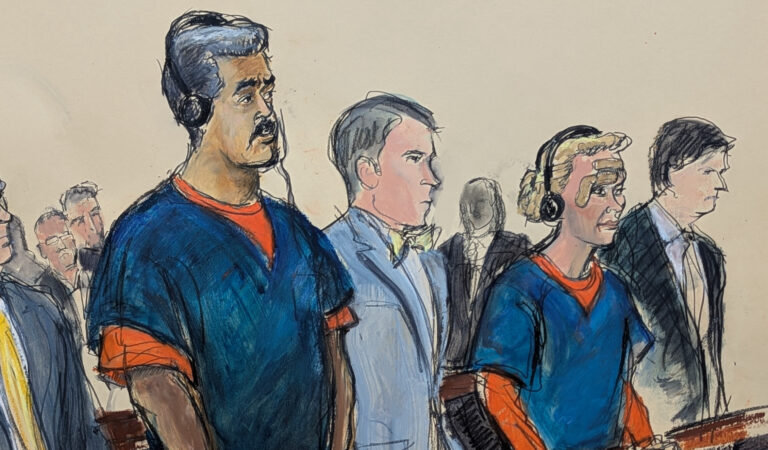
    NEW YORK — A defiant Nicolás Maduro declared himself “the president of my country” as he protested his capture and pleaded not guilty Monday to federal drug trafficking charges that the Trump administration used to justify removing him from power in Venezuela.

    “I was captured,” Maduro said in Spanish as translated by a courtroom reporter before being cut off by the judge. Asked later for his plea to the charges, he stated: “I’m innocent. I am not guilty. I am a decent man, the president of my country.”

    The courtroom appearance, Maduro’s first since he and his wife were seized from their home in a stunning middle-of-the-night military operation, kicked off the U.S. government’s most consequential prosecution in decades of a foreign head of state. The criminal case in Manhattan is unfolding against a broader diplomatic backdrop of an audacious U.S.-engineered regime change that President Donald Trump has said will enable his administration to “run” the South American country.

    Maduro was led into court along with his co-defendant wife just before noon for the brief legal proceeding. Both put on headsets to hear the English-language proceeding as it was translated into Spanish.

    The couple was transported to the Manhattan courthouse under armed guard early Monday from the Brooklyn jail where they’ve been detained since arriving in the U.S. on Saturday.

    A legal fight begins

    As a criminal defendant in the U.S. legal system, Maduro will have the same rights as any other person accused of a crime — including the right to a trial by a jury of regular New Yorkers. But he’ll also be nearly — but not quite — unique.

    The stakes were made clear from the outset as Maduro, who took copious notes throughout the proceedings and wished a Happy New Year to reporters in court, repeatedly pressed his case that he had been unlawfully abducted.

    “I am here kidnapped,” Maduro said. “I was captured at my home in Caracas.”

    U.S. District Judge Alvin Hellerstein, a 92-year-old jurist who was appointed to the federal bench in 1998 by Bill Clinton, interrupted him, saying: “There will be time and place to go through all of this.” Hellerstein added that Maduro’s attorney could do so later.

    “At this time, I just want to know if you are Nicolás Maduro Moros,” which Maduro confirmed that he was.

    Maduro’s lawyers are expected to contest the legality of his arrest, arguing that he is immune from prosecution as a head of state. Barry Pollack, a prominent Washington lawyer whose clients have included WikiLeaks founder Julian Assange, said Maduro is “head of a sovereign state and entitled to the privilege” that the status ensures. He also said the defense would raise “questions about the legality of his military abduction.”

    Panamanian strongman Manuel Noriega unsuccessfully tried the same immunity defense after the U.S. captured him in a similar military invasion in 1990. But the U.S. doesn’t recognize Maduro as Venezuela’s legitimate head of state — particularly after a much-disputed 2024 reelection.

    Maduro’s wife, Cilia Flores, also pleaded not guilty on Monday. She had bandages on her forehead and right temple, and her lawyer said had she suffered “significant injuries” during her capture.

    A 25-page indictment accuses Maduro and others of working with drug cartels to facilitate the shipment of thousands of tons of cocaine into the U.S. They could face life in prison if convicted.

    Among other things, the indictment accuses Maduro and his wife of ordering kidnappings, beatings, and murders of those who owed them drug money or undermined their drug trafficking operation. That included a local drug boss’ killing in Caracas, the indictment said.

    Outside the courthouse, police separated protesters of the U.S. military action from prointervention demonstrators. Inside the courtroom, as Maduro stood to leave with federal officers, a man in the audience stood and began speaking forcefully at him in Spanish, calling him an “illegitimate” president.

    The man, 33-year-old Pedro Rojas, said later that he had been imprisoned by the Venezuelan regime. As deputy U.S. marshals led Maduro from the courtroom, the deposed leader looked directly at the man and shot back in Spanish: “I am a kidnapped president. I am a prisoner of war.”

    Trump reiterates U.S. will ‘run it’

    The U.S. seized Maduro and his wife in a military operation early Saturday, capturing them in their home on a military base. Trump said Saturday the U.S. would “run” Venezuela temporarily and reiterated Sunday night that “we’re in charge,” telling reporters aboard Air Force One that “we’re going to run it, fix it.”

    Secretary of State Marco Rubio had tried to strike a more cautious tone on Sunday morning talk shows, saying the U.S. would not govern the country day to day other than enforcing an existing “oil quarantine.”

    But on Monday, NBC’s Kristen Welker reported that in a phone interview Trump insisted that top administration officials, including Rubio, Vice President JD Vance, Defense Secretary Pete Hegseth, and deputy chief of staff Stephen Miller would be in charge of Venezuela.

    When Welker asked who the top person in charge would be, Trump responded, “Me.”

    Before his capture, Maduro and his allies claimed U.S. hostility was motivated by lust for Venezuela’s rich oil and mineral resources.

    Trump has suggested that removing Maduro would enable more oil to flow out of Venezuela, but oil prices rose a bit more than 1% in Monday morning trading to roughly $58 a barrel. There are uncertainties about how fast oil production can be ramped up in Venezuela after years of neglect of the industry, as well as questions about governance and oversight of the sector.

    Venezuela’s new interim leader, Delcy Rodríguez, has demanded that the U.S. return Maduro, who long denied any involvement in drug trafficking — although late Sunday she also struck a more conciliatory tone in a social media post, inviting collaboration with Trump and “respectful relations” with the U.S.

    Rodríguez was sworn in on Monday by her brother, National Assembly leader Jorge Rodríguez.

    “I come with sorrow for the suffering inflicted upon the Venezuelan people following an illegitimate military aggression against our homeland,” she said with her right hand up. “I come with sorrow for the kidnapping of two heroes.”

    Maduro’s son and Venezuelan congressman Nicolás Maduro Guerra warned on Monday that his father’s capture could set a dangerous precedent globally and demanded that his parents be returned.

    “If we normalize the kidnapping of a head of state, no country is safe. Today it’s Venezuela. Tomorrow it could be any nation that refuses to submit. This is not a regional problem. It is a direct threat to global political stability,” Maduro Guerra said.

    Hegseth, Rubio brief congressional leaders

    Congressional leaders expected to hear more about the U.S. government’s plans for the future of Venezuela, as top officials from Trump’s administration headed to Capitol Hill to brief select lawmakers Monday evening.

    Rubio, Hegseth, and other officials were to discuss Venezuela with House and Senate leadership, as well as top members of the intelligence committees and national security committees.

    The top Republican and Democrat on the Senate Judiciary Committee say they should have been included.

    The briefing Monday was for members of the “gang of eight,” which include the four congressional leaders and the heads of the House and Senate Intelligence Committees. It also included leaders from the various national security committees.

    But the Judiciary Committee, which oversees the Justice Department, is not among those committees, said Sen. Chuck Grassley (R., Iowa) and Illinois Sen. Dick Durbin, the top Democrat on the committee. That is not all right, they say, because the administration has said this was a law enforcement operation involving key DOJ entities.

    “There is no legitimate basis for excluding the Senate Judiciary Committee from this briefing,” Grassley and Durbin said in a joint statement. “The administration’s refusal to acknowledge our Committee’s indisputable jurisdiction in this matter is unacceptable and we are following up to ensure the Committee receives warranted information regarding Maduro’s arrest.”

  • Who is Delcy Rodriguez, Venezuela‘s new leader?

    Who is Delcy Rodriguez, Venezuela‘s new leader?

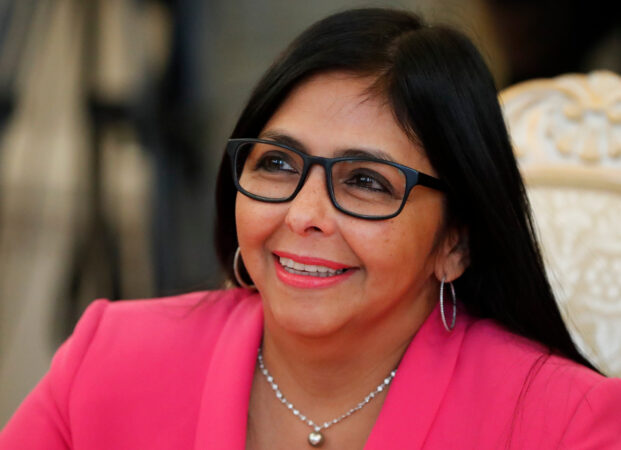
    Venezuela’s vice president, Delcy Rodríguez, has taken over as acting leader in the wake of a U.S. raid that deposed President Nicolás Maduro over the weekend.

    Rodríguez, 56, is a veteran politician, lawyer, and diplomat who had served as Maduro’s vice president since 2018. She has deep family ties to leftist politics in Venezuela, though she was generally viewed as more pragmatic than other members of Maduro’s government. While Rodríguez played a key role in overhauling Venezuela’s economic policy, developing close ties with the business community, she has also been accused of corruption and human rights abuses as part of Maduro’s inner circle.

    Venezuela’s Supreme Court ordered Rodríguez late Saturday to assume the presidency in Maduro’s absence, a position she would hold on an interim basis. On Sunday, Defense Minister Vladimir Padrino López also recognized Rodríguez as acting president, saying in televised remarks that the nation’s forces must be unified in “the mission of confronting imperial aggression.”

    Rodríguez’s first public comments came Saturday when, in an address to the nation, she denounced the U.S. operation to take Maduro and said he is the country’s only president.

    But in a Sunday night statement, Rodríguez offered a more conciliatory message, calling for “peaceful coexistence.”

    “President Donald Trump, our peoples and our region deserve peace and dialogue, not war,” Rodríguez said. “This has always been President Nicolás Maduro’s message, and it is the message of all of Venezuela right now.”

    Earlier, Trump suggested Rodríguez was willing to work with the United States, which he said would “run” Venezuela. But on Sunday, he threatened the vice president in an interview with the Atlantic, saying that “if she doesn’t do what’s right, she is going to pay a very big price, probably bigger than Maduro.”

    On Monday, lawmakers aligned with the ruling party, including Maduro’s son, gathered in the capital, Caracas, to follow through with a scheduled swearing-in ceremony of the National Assembly for a term that will last until 2031.

    Rodríguez was sworn in as interim president by her brother, Jorge Rodríguez, who was reelected as speaker.

    “I come with sorrow for the suffering inflicted upon the Venezuelan people following an illegitimate military aggression against our homeland,” she said with her right hand up.

    Here’s what we know about the interim Venezuelan leader.

    Who is Delcy Rodríguez?

    Rodríguez is a Caracas native and was born in the Venezuelan capital in 1969.

    She was 7 years old when her father, leftist political leader and guerrilla fighter Jorge Antonio Rodríguez, was killed while under interrogation by counterintelligence agents for his alleged role in the abduction of an American executive in Caracas.

    His death left an indelible mark on Rodríguez and her brother, Jorge Rodríguez Gómez, 60, who is president of Venezuela’s National Assembly, according to a 2020 profile in Vanity Fair España.

    After growing up in a deeply socialist family and hearing tales about their father, the siblings embarked on lifelong political careers, embedding themselves in the country’s leftist politics and serving in key roles under Venezuela’s former firebrand president and socialist icon, Hugo Chávez, and his handpicked successor, Maduro.

    Rodríguez, who often wears black-rimmed glasses and bright-colored fabrics, was educated in Caracas, Paris, and London, studying law at the Central University of Venezuela, where she later worked as a professor. She started her professional career as a labor lawyer and joined the Chávez administration in 2003.

    What political role has Rodríguez played in government?

    Rodríguez’s political resumé stretches back over two decades, during which she held positions that led her to the upper echelons of power.

    She started in the office of the general coordinator for the vice president in 2003, moving then to the Ministry of Energy and Mines, where she served as director of international affairs.

    Later, she became minister of presidential affairs under Chávez in 2006.

    She was a fierce defender of Chávez’s Bolivarian Revolution — named after 19th century Venezuelan revolutionary Simón Bolívar — which envisioned social and political reforms that would lift millions out of poverty and build a Latin America free of U.S. influence.

    “She has defended Venezuelan sovereignty, peace and independence like a tiger,” Maduro said of Rodríguez in 2017.

    But even as Chávez sought to fund social welfare programs, he let the country’s strategic petroleum reserves dwindle and made authoritarian moves that stifled the press and gutted the nation’s stable of experts.

    After Chavez died in 2013, Maduro elevated Rodríguez to minister of popular power for communication and information — and appointed her as his top diplomat and foreign minister the next year.

    When the price of oil plummeted in 2014, it set off economic chaos in Venezuela, characterized by severe food shortages, runaway inflation and an exodus from the country.

    On the heels of that collapse, in 2018, Rodríguez became Maduro’s vice president (while serving later as finance minister and minister of oil). A few months afterward, the U.S. placed sanctions on Rodríguez, her brother and other members of Maduro’s inner circle, accusing them of corruption and human rights abuses.

    “The revolution is our revenge for the death of our father and his executioners,” Rodríguez said in an interview that year with Venezuelan journalist José Vicente Rangel.

    What’s next for Rodríguez?

    With her broad portfolio, Rodríguez sought to implement economic changes while maintaining state control over key sectors and continuing to prioritize social spending.

    She has been viewed generally as more pragmatic and willing to oversee a limited opening of Venezuela’s economy than hard-line government officials, including the defense and interior ministers.

    Trump said Saturday that Rodríguez had spoken to Secretary of State Marco Rubio. “She said, ‘We’ll do whatever you need,’” he added. “I think she was quite gracious,” Trump said. “But she really doesn’t have a choice.”

    In some of her first actions as acting president, Rodríguez announced the creation of two commissions in a statement published by Communications Minister Freddy Ñáñez. The first is a high-level panel dedicated to the release of Maduro and his wife, Cilia Flores. The second will focus on guaranteeing and consolidating “food sovereignty and supply projects” in Venezuela, the statement said.

    Rodríguez also visited people who were injured in the U.S. attacks that deposed Maduro, according to the statement, referring to them as “brave and heroic young people who stood up to defend our sovereignty and the integrity of our President, Nicolás Maduro Moros.”

    Rodríguez and her brother are seen as modernizers who want a semiopen country and economy and warmer relations with the broader world, Tulane University sociologist David Smilde said.

    The siblings, however, “don’t have guns,” said Phil Gunson, a senior analyst for the Andes region with the International Crisis Group. And even with Delcy Rodríguez as interim president, the interior and defense ministers could still hold most of the power, given their control of the military and security forces.

    “If it comes to a fight, they’re left hanging because they don’t have anyone to back them,” Gunson said. “What I suspect is going to happen is, she will occupy the presidency, but the powers will be the defense and interior ministers, and that’s not good.”

    Information from the Associated Press was used in this report.

  • U.S. allies and adversaries use U.N. meeting to critique Venezuela intervention as America defends it

    U.S. allies and adversaries use U.N. meeting to critique Venezuela intervention as America defends it

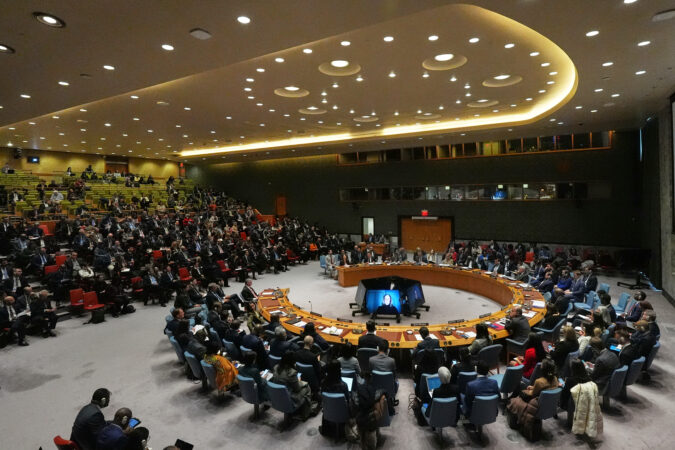
    UNITED NATIONS — Both allies and adversaries of the United States on Monday used an emergency meeting of the U.N. Security Council to voice opposition to the audacious U.S. military operation in Venezuela that captured leader Nicolás Maduro.

    Before the U.N.’s most powerful body, countries critiqued — if sometimes obliquely — President Donald Trump’s intervention in the South American country and his recent comments signaling the possibility of expanding military action to countries like Colombia and Mexico over drug trafficking accusations. The Republican president also has reupped his threat to take over the Danish territory of Greenland for the sake of U.S. security interests.

    Denmark, which has jurisdiction over the mineral-rich island, carefully denounced U.S. prospects for taking over Greenland without mentioning its NATO ally by name.

    “The inviolability of borders is not up for negotiation,” said Christina Markus Lassen, Danish ambassador to the U.N.

    She also defended Venezuela’s sovereignty, saying “no state should seek to influence political outcomes in Venezuela through the use of threat of force or through other means inconsistent with international law.”

    U.S. allies push back on Venezuela

    While French President Emmanuel Macron recently endorsed Maduro’s capture, its U.N. envoy was slightly more critical Monday, saying any violations of international law by the five permanent members of the U.N. Security Council, which include the U.S., erodes “the very foundation of the international order.”

    “The military operation that has led to the capture of Maduro runs counter to the principle of peace dispute resolution and runs counter to the principle of nonuse of force,” said Jay Dharmadhikari, deputy French ambassador to the U.N.

    U.S. envoy Mike Waltz defended the operation in Venezuela as a justified and “surgical law enforcement operation,” calling out the 15-member council for criticizing the targeting of Maduro.

    “If the United Nations in this body confers legitimacy on an illegitimate narco-terrorist with the same treatment in this charter of a democratically elected president or head of state, what kind of organization is this?” said Waltz, who is Trump’s former national security adviser.

    Maduro’s 2024 reelection was widely disputed.

    U.N. Secretary-General Antonio Guterres said in a statement that he is “deeply concerned that rules of international law have not been respected with regard to the 3 January military action.” He said the “grave” action by the U.S. could set a precedent for how future relations between nations unfold.

    Venezuela calls on the U.N. to take action

    Even with the strong support for Venezuela’s sovereignty, its envoy called on the U.N. to go beyond veiled comments and condemnation. Ambassador Samuel Moncada urged the Security Council to demand that Washington release Maduro and his wife.

    “If the kidnapping of a head of state, the bombing of a sovereign country, and the open threat of further armed action are tolerated or downplayed, the message sent to the world is a devastating one: namely that the law is optional, and that force is the true arbiter of international relations,” Moncada said.

    He warned that other countries can’t afford to look away: “Accepting such a logic would mean to open the door to a deeply unstable world.”

    Neighboring Colombia described the raid as reminiscent of “the worst interference in our area in the past.”

    “Democracy cannot be defended or promoted through violence and coercion, and it cannot be superseded, either, by economic interests,” Ambassador Leonor Zalabata said.

    China, Russia are expectedly critical

    The biggest critics of U.S. foreign policy, China and Russia, which are also permanent members of the Security Council, called for the U.N. body to unite in rejecting America turning back to an “era of lawlessness.”

    Maduro, like his predecessor, forged a close relationship with Russia, while China was the main destination for most Venezuelan oil.

    “We cannot allow the United States to proclaim itself as some kind of a supreme judge, which alone bears the right to invade any country, to label culprits, to hand down and to enforce punishments irrespective of notions of international law, sovereignty, and nonintervention,” Russian ambassador Vassily Nebenzia said.

    His own country’s 2022 invasion of Ukraine has drawn widespread condemnation within the U.N. and from the U.S., although the Trump administration is engaging with Russia in hopes of brokering an end to the fighting.

    The U.S. seized Maduro and his wife early Saturday from their home on a military base and put them aboard a U.S. warship to face prosecution in New York in a Justice Department indictment accusing them of participating in a narco-terrorism conspiracy. Maduro declared his innocence during his first appearance in a Manhattan courthouse Monday.

    His stunning removal came after months of the U.S. amassing a military presence off Venezuela’s coast and blowing up alleged drug trafficking boats. Trump has insisted that the U.S. would run Venezuela at least temporarily and tap its vast oil reserves to sell to other nations.

    Secretary of State Marco Rubio, however, says the U.S. would enforce an oil quarantine that was already in place on sanctioned tankers and use that leverage to press policy changes in Venezuela.