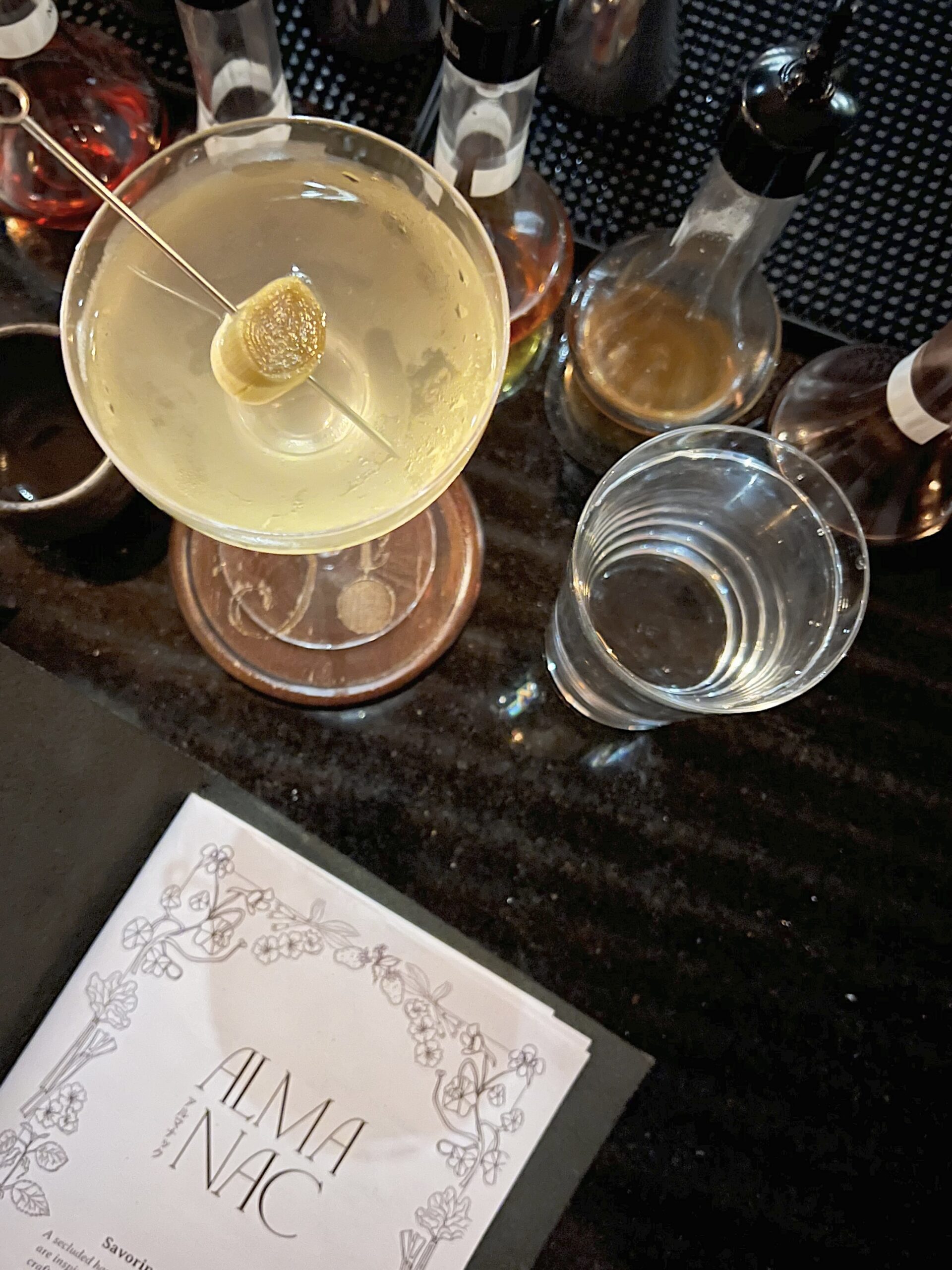
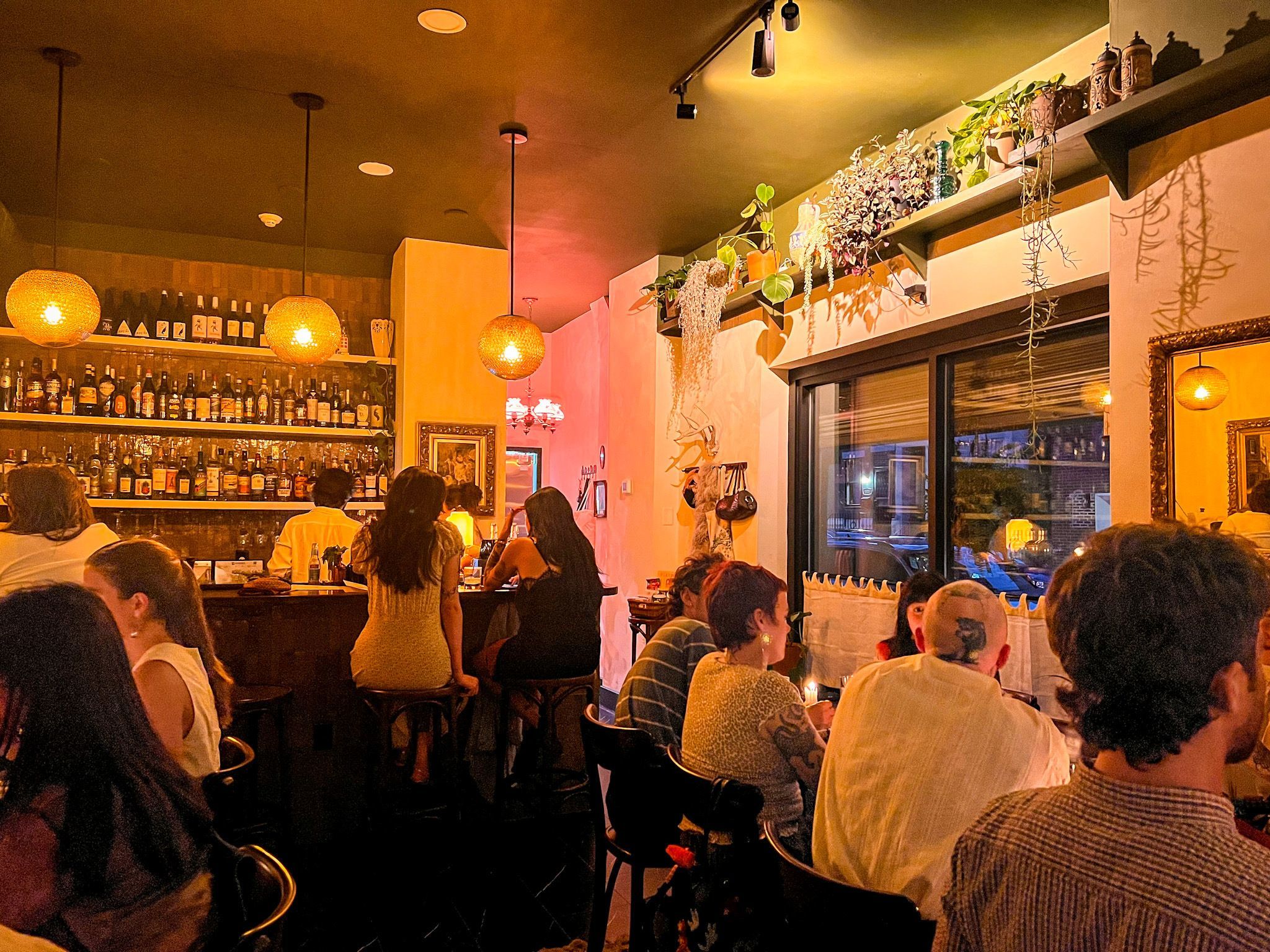
Unless you’re paying close attention while flipping through the extensive menu at Almanac, Old City’s Japanese American cocktail bar, you might overlook some of the painstaking work that went into it. The leather-bound book’s deep green color is meant to evoke the interior of the bar. The borders of the pages hint at the seasonal ingredients that go into each cocktail, and the thin newsprint pages depicting glassware illustrations of Almanac’s complex cocktails are meant to both be a guide and evoke opening an old book.
“Design is part of the holy trinity in the food service industry,” Silvestri said. “There’s the food. There’s the hospitality, and then there’s the design.”
Almanac’s menu, designed by Kylie Silvestri.
Menus help set the stage for each customer’s meal, and play a big role in bringing the restaurant’s story to life.
“The second a customer sits down — before they even taste the food/beverage — they are holding a menu in hand,” she explained. “How does the menu feel, tactilely? How does it look? It all adds to the experience and helps to tell that story. So, for me, designing them is about building the puzzle pieces together in a way that connects and relays the message eloquently, from chef-owner to customer.”
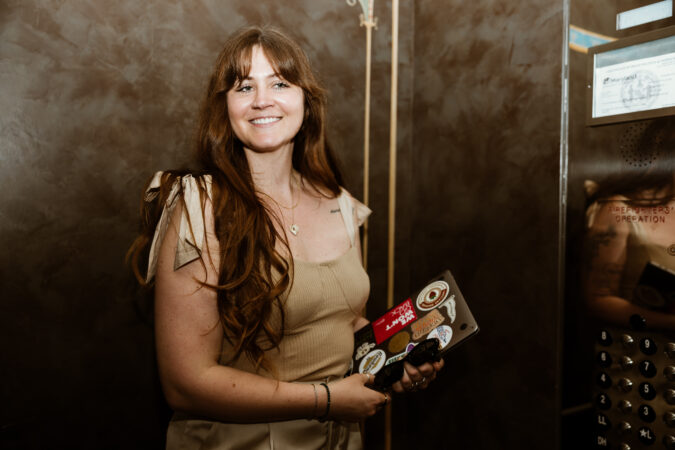
Silvestri didn’t begin her career with a roster of small hospitality clients. She previously worked for startup groups and larger hospitality companies. In 2021, she started freelancing to build her own company, called Kylie Creative, where she developed branding for predominantly women-owned entrepreneurial businesses in the wellness industry.
As her clientele grew, she would pick up serving shifts at restaurants in the city, including Osteria, and build connections with industry folks. Soon, a friend at the restaurant introduced Silvestri to Amanda Rucker (River Twice, Little Water), who commissioned her to design flyers for a 2022 fundraising event to support abortion access. The following year, Rucker reached out to Silvestri for branding and menu development for Little Water.
“I naturally pivoted my design work to focus on the hospitality industry — because once you start, you never leave,” she said.
While designing menus is just a part of her restaurant branding business, the process can take up to a month for each restaurant. There are five key steps to ensure a final product that owners are happy with.
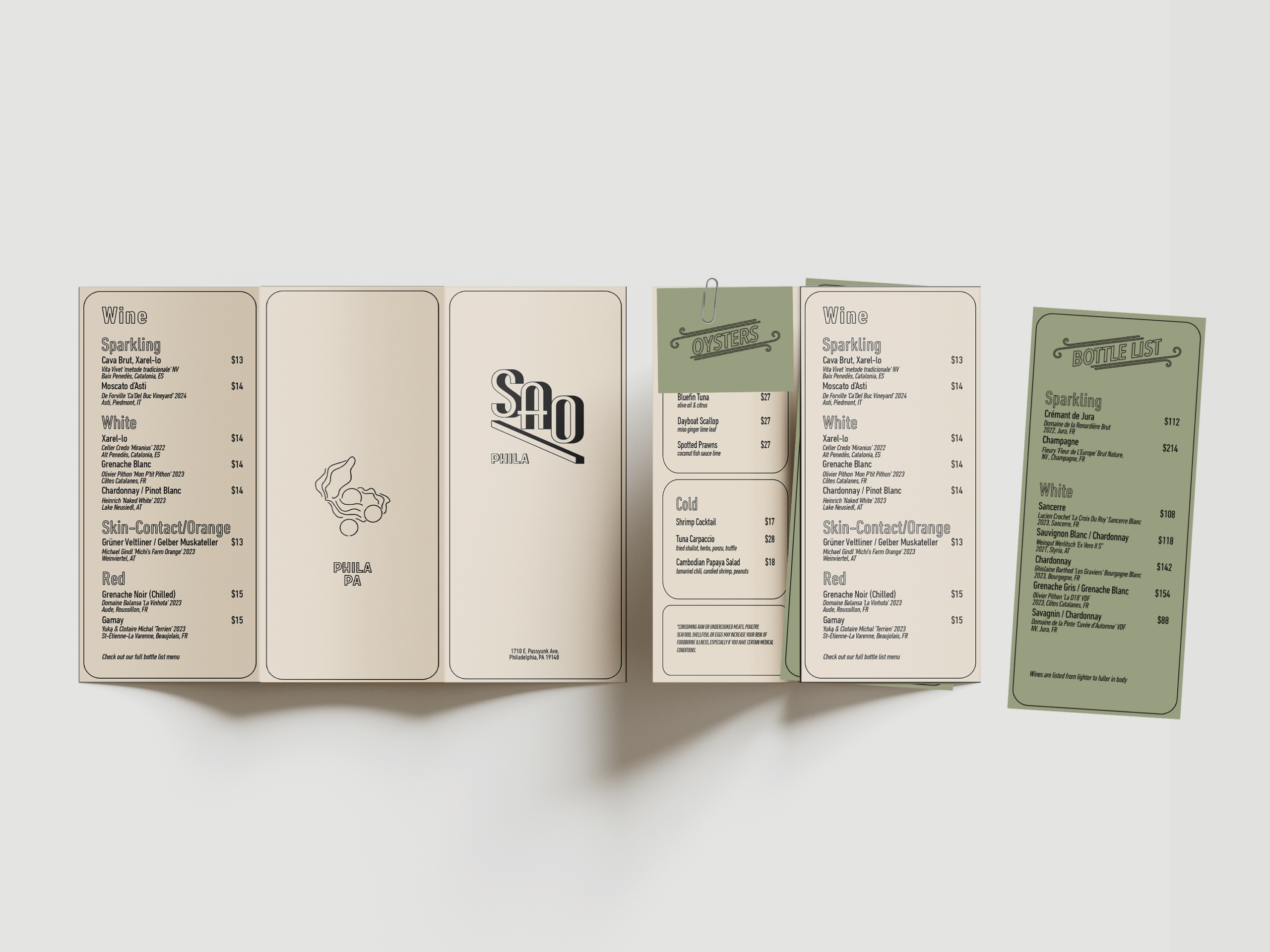
Sao menu, by Kylie Silvestri.
First, Silvestri takes time to understand the owners/chefs’ vision for the menu. Then, she determines a menu system and layout with brand fonts and drawings. Walk-throughs of the restaurant/bar (in person or via renderings if it’s not built yet) help her connect the menu design to the physical space. Once the vision is mapped out, Silvestri likes to settle down at a local coffee shop to create the menus on Adobe Illustrator and InDesign. The final step is sharing paper stock samples with owners/chefs for feedback on design and tactility.
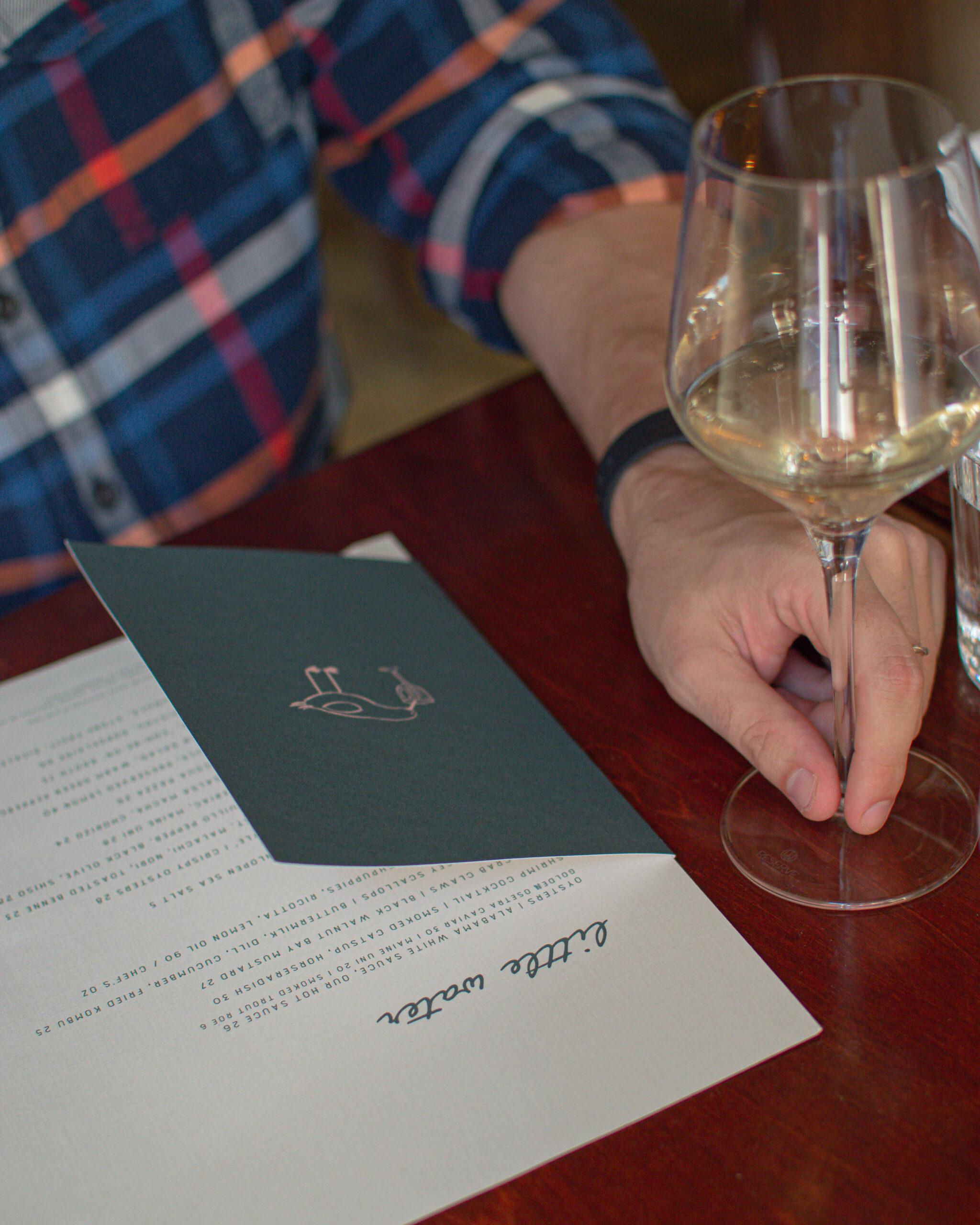
At Little Water, the linen-textured menu was the answer to conversations surrounding technique and locale, reinforcing the feeling of the coast with dishes offering the breadth of the Gulf to Cape Cod. An illustration of a little sandpiper sipping out of a cocktail on the drinks menu showcases the personality of restaurant owners Randy and Amanda Rucker. “We tied the design to that nautical experience and having this playfulness — Randy always says that ‘We don’t take ourselves seriously; we take our food seriously,’“ Silvestri said.
At Sao, the menu was inspired by Rachel Lorn’s family’s business down the Shore, featuring a takeout menu style that sections off the dishes in categories. There are outlines of vintage signage by Philly-based artist Darin Rowland.
Little Water menu, by Kylie Silvestri.
For Habibi Supper Club and Field Day, the menus — like the restaurants — are still in development. On a recent Wednesday, Silvestri visited Field Day to chat with co-owner Katie Childs about the new bar’s branding and later chatted on the phone with Miled Finianos of Habibi Supper Club for his new cafe’s menu design.
The menus, Silvestri explained, are “time capsules of culture, time, and space,” so every choice, from paper stock to illustration style, is made to capture that particular restaurant’s moment.
Philly’s aim lately is on chef-owned restaurants, “or rather a focus on who is behind what,” she said, which means storytelling is more important than ever.
“Philly’s food scene is incredibly versatile. … Each story is unique to the chef/beverage professional at the heart of the concept, making it an incredible city to work in,” she said. “I will never get tired of exploring new design styles and never feel pigeonholed to follow a specific one.”
🍦 Stella’s Ice Cream out of Idaho (yes, Idaho) just opened on Front Street in Fishtown/Kensington, and Bea has the early scoop.
🍦 Winners, rocking a feel-good message, is new on South Street in Graduate Hospital. As Kiki Aranita says, Winners’ appeal is more than just the flavors, like Sweet Success S’mores.
🍦Our guide to our favorite ice cream is right here.
Critic Craig LaBan is back from his annual Jersey Shore exploration, and he’s shaking the sand out of his notebook. In Part One of his roundup, he heads to the mainland to find some gems. Read that here.
Looking ahead: Part Two, Craig’s reviews from Long Beach Island and thereabouts, will be online this weekend. On July 11, he’ll share his discoveries from points farther south in Part Three.
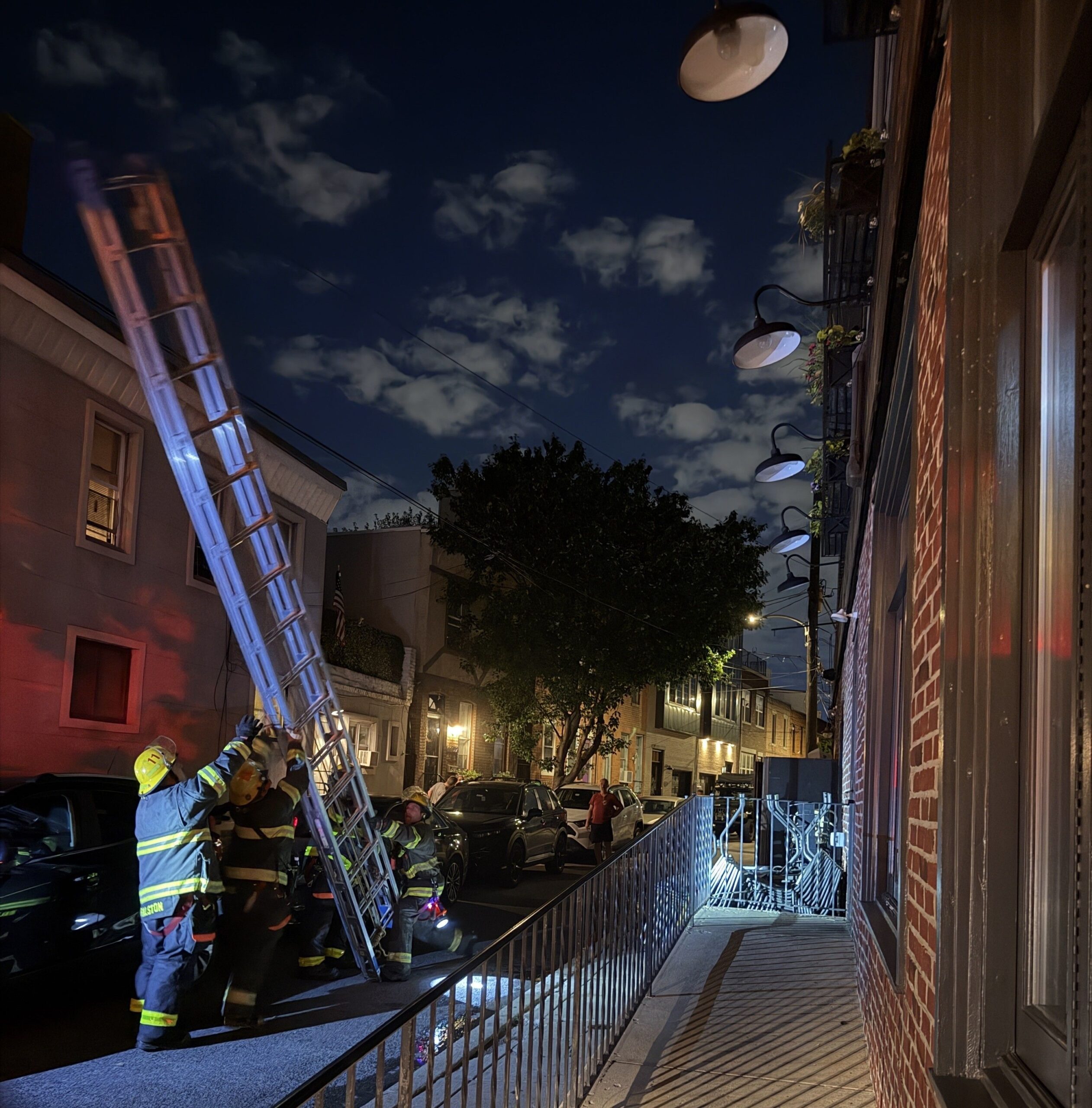
Ember & Ash on East Passyunk Avenue will be closed for an undetermined period after smoke and flames shot up through the ventilation last week just after closing time. No injuries were reported.
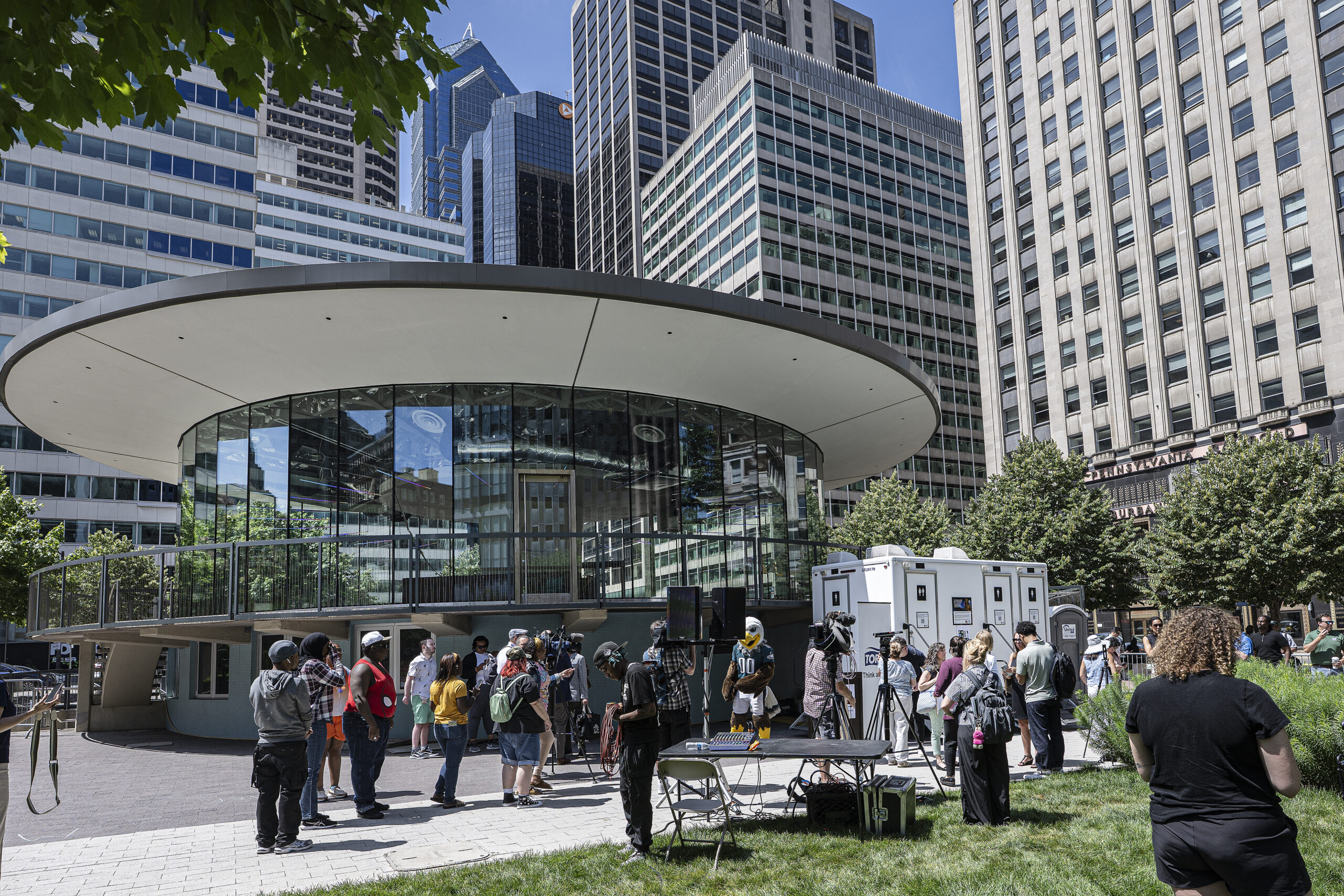
This weekend will see the debut of Broad Street Beer Garden at LOVE Park, the first phase of a planning reuse of the so-called flying saucer building at 16th and JFK. Here’s the long history of the city landmark.
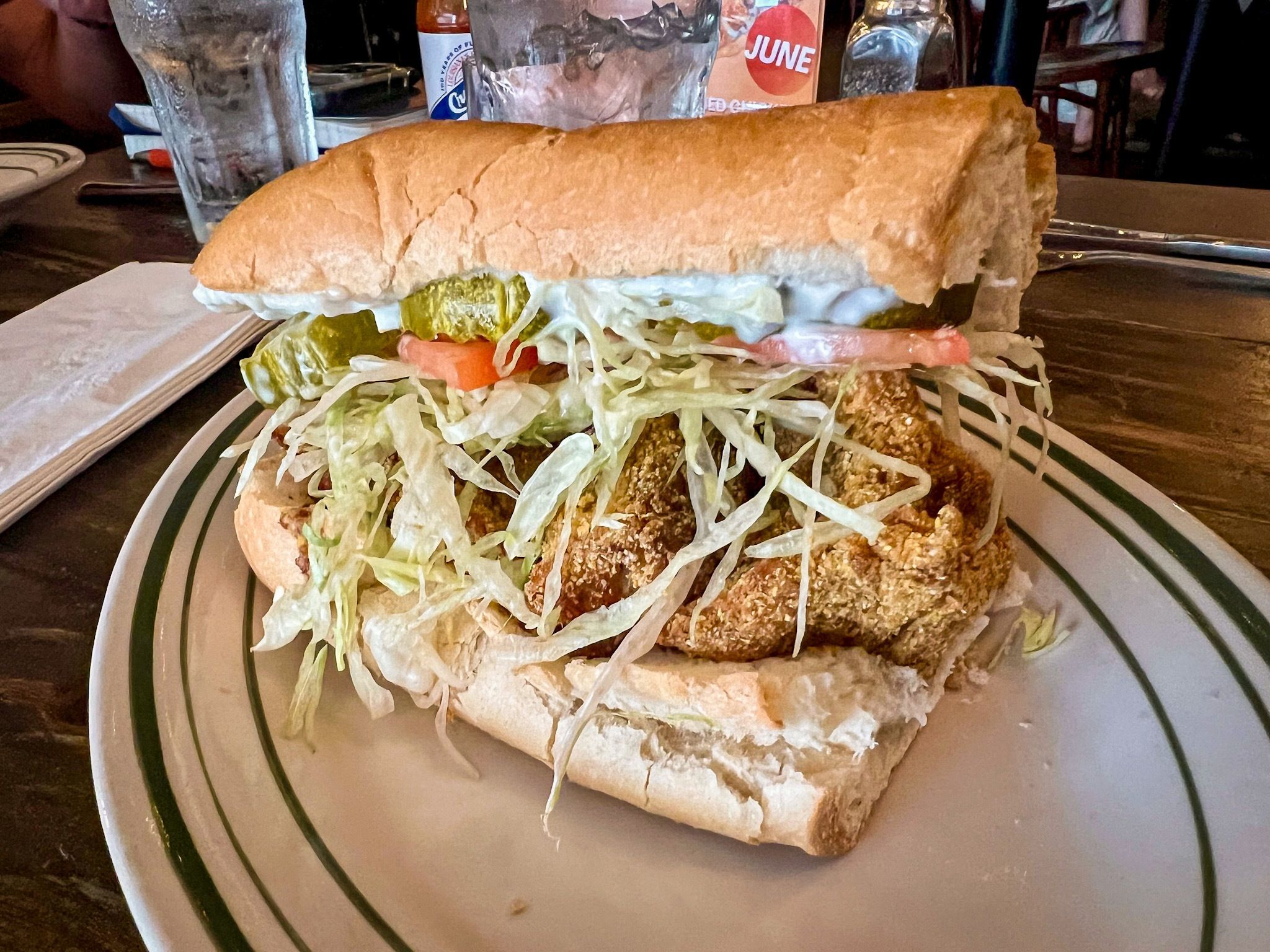
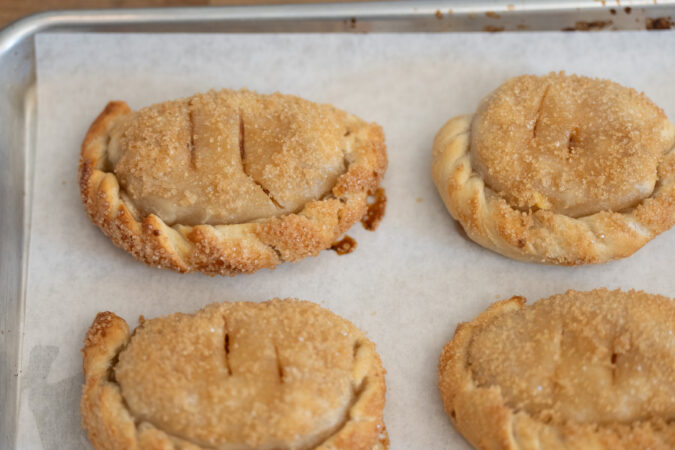
We munched on fried silverfish that reminded us of French fries in Little Saigon, Argentine empanadas in West Philly, and a vegan po’ boy in Old City that tasted like the original.
Scoops
Intrigue! Albert Zheng, whose holdings include Javelin in Fairmount, is backing a yet-to be-named dual concept on the way to 808 Chestnut St., formerly a Dunkin’ Donuts. In front, the feature will be wagyu omakase, while the rear will be what he calls a Cambodian speakeasy. He says it’s six or seven months out.
Mylar Bar, a cocktail bar inspired by the spirit of South Philly’s Dino’s Party Center, is expected to open later this summer from hospitality veterans Liv Arterbridge and Gina Piccari. They bought the former building at Ninth and Morris Streets where Dino’s sold balloons, decorations, and party supplies for decades before it moved across the street. “We want the whole thing to feel like a party,” Arterbridge said. “Nostalgic, fun, a little silly, intentionally unserious — but not a theme bar,” Piccari said. Cocktails will include martinis, punches, and classic drinks, alongside draft beer and familiar favorites. A full kitchen, led by chef Colin White, formerly of Sally and Emmett, will serve shareable “party snacks” and larger plates. They plan to offer late-night desserts, so food will be available until 1 a.m. with the bar wrapping at 2. Arterbridge, whose resume includes Cry Baby, Poison Heart, and a.bar, met Piccari while working at Boot & Saddle, where Piccari was manager. Piccari is now behind the bar at Le Virtù.
Restaurant report
Sixteen restaurants, bakeries, cafes, and bars — including Lillian’s, shown above — are opening in July. Read on for the rundown.
Penny’s Bagels, on its way (for the last two years) to 212 Kings Highway East in Haddonfield, will hand out 250 red, white, and blue bagels on July 3 at the borough’s parade. The shop is eyeing an August opening, says owner Chris Fetfatzes.
Maru, a fast-casual Korean-inspired restaurant from David Backhus and the team behind the now-closed Oori, is expected to open in August in what is now Collective Coffee & Bakery, which Backhus also owns, at 2922 Conestoga Rd. in Glenmoore. Maru’s menu will feature Korean fried chicken sandwiches, wings, tenders, house-made mochi doughnuts, and specialty coffee, while continuing to serve Collective Coffee and honor existing coffee subscriptions.
Briefly noted
Ota-Ya in Newtown has announced that Friday will be its last day after 30 years with the retirement of owners Jeff Wong and Cindy Tam.
PETA is launching its “Nice Cream Trail,” highlighting 10 shops across the state serving vegan ice cream, and there are five local spots on the list: Dreams Ice Cream Factory in Glenside, Lu & Aug’s in Ardmore, the Main Freeze in Lansdale, Milk Jawn in South Philadelphia and Northern Liberties, and Scoop DeVille in Center City and Queen Village. The first Pennsylvania resident to complete the trail by visiting all 10 participating shops through August will win a vegan ice cream party with PETA’s “iScream” truck for themselves and up to 50 guests. Details are here.
Two local BBQ chefs, Matt Groark (Medford Lakes, N.J.) and Maxwell McGibbon (Newark, Del.), are competing on Food Networks’ Pitmasters, premiering July 13 at 9 p.m.
Diner en Blanc registration is still open. This year’s version of the pop-up picnic is Aug. 20.
Miller’s Ale House, in the shopping center next to the Home Depot in Springfield, Delaware County, closed this week after 13 years, while Fishtown is abuzz with speculation that Bottle Bar East, which opened at 1308 Frankford Ave. around the same time in late 2012, has closed. The phone is down, and owners could not be reached for comment
When is Adda ever going to open in Fishtown? — Rich C.
True, Adda has been a long time coming, since I initially wrote about it in June 2025 with an end-of-2025 target. Adda — from New York City’s Unapologetic Foods, whose establishments are acclaimed for their bold, no-holds-barred approach to Indian cooking — is now looking at a late-fall opening at 1700 Frankford Ave., the new building across from the Fishtown post office.
Corrigendum: Reader Stephanie points out that Kalaya is the third Philadelphia restaurant, not the second, to win the James Beard Award for outstanding restaurant, as I wrote two weeks ago. Zahav was the first in 2019, while Friday Saturday Sunday won in 2023.
📮 Have a question about food in Philly? Email your questions to me at mklein@inquirer.com for a chance to be featured in my newsletter.
By submitting your written, visual, and/or audio contributions, you agree to The Inquirer’s Terms of Use, including the grant of rights in Section 10.
Daniel Martino didn’t set out to build an empire of pie shops. He just wanted somewhere to get coffee without leaving the neighborhood.
When he bought his home in Port Richmond in 2013, the closest coffee shop was an hour round trip, he said. “Selfishly, I thought, I can put a little coffee shop here.”
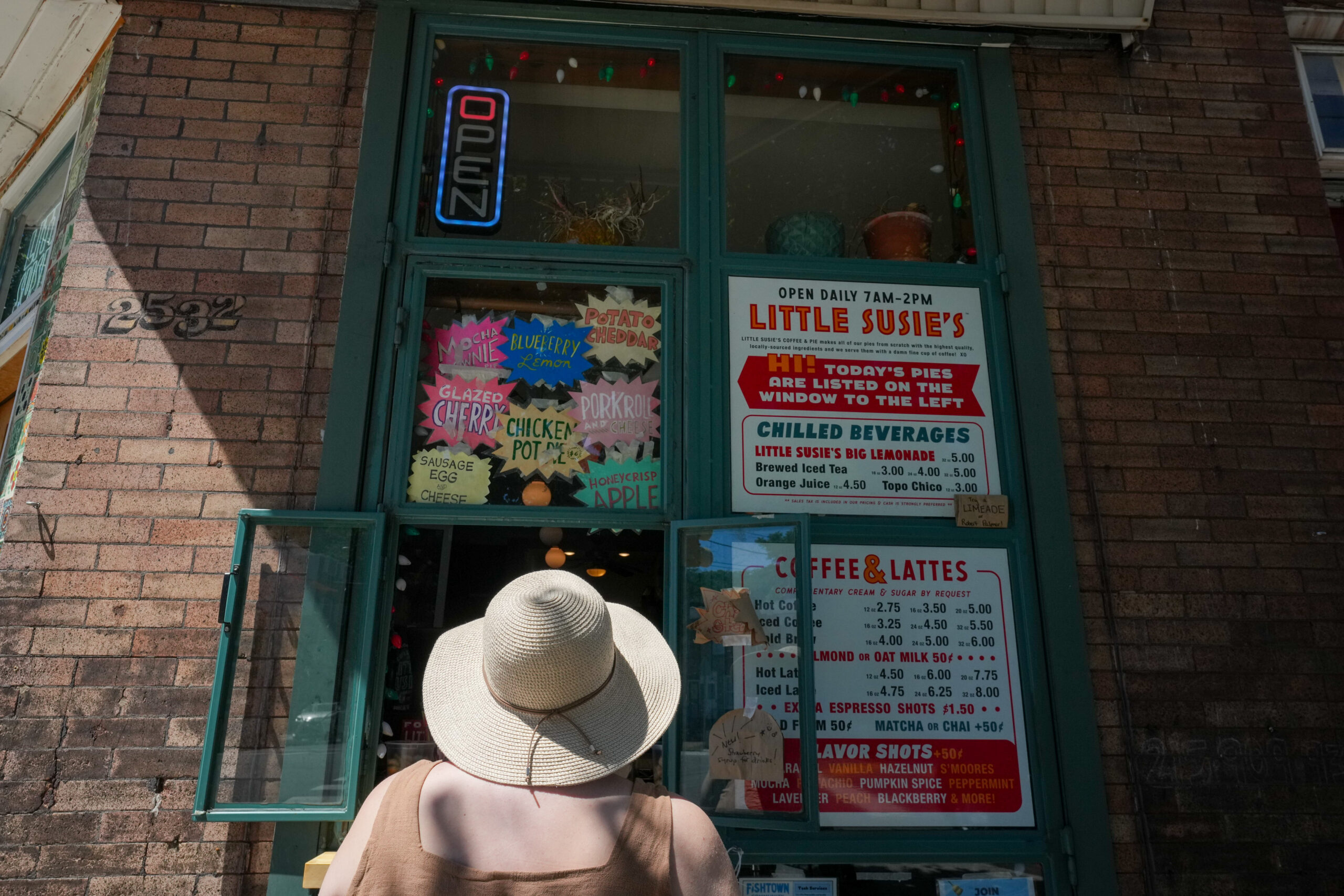
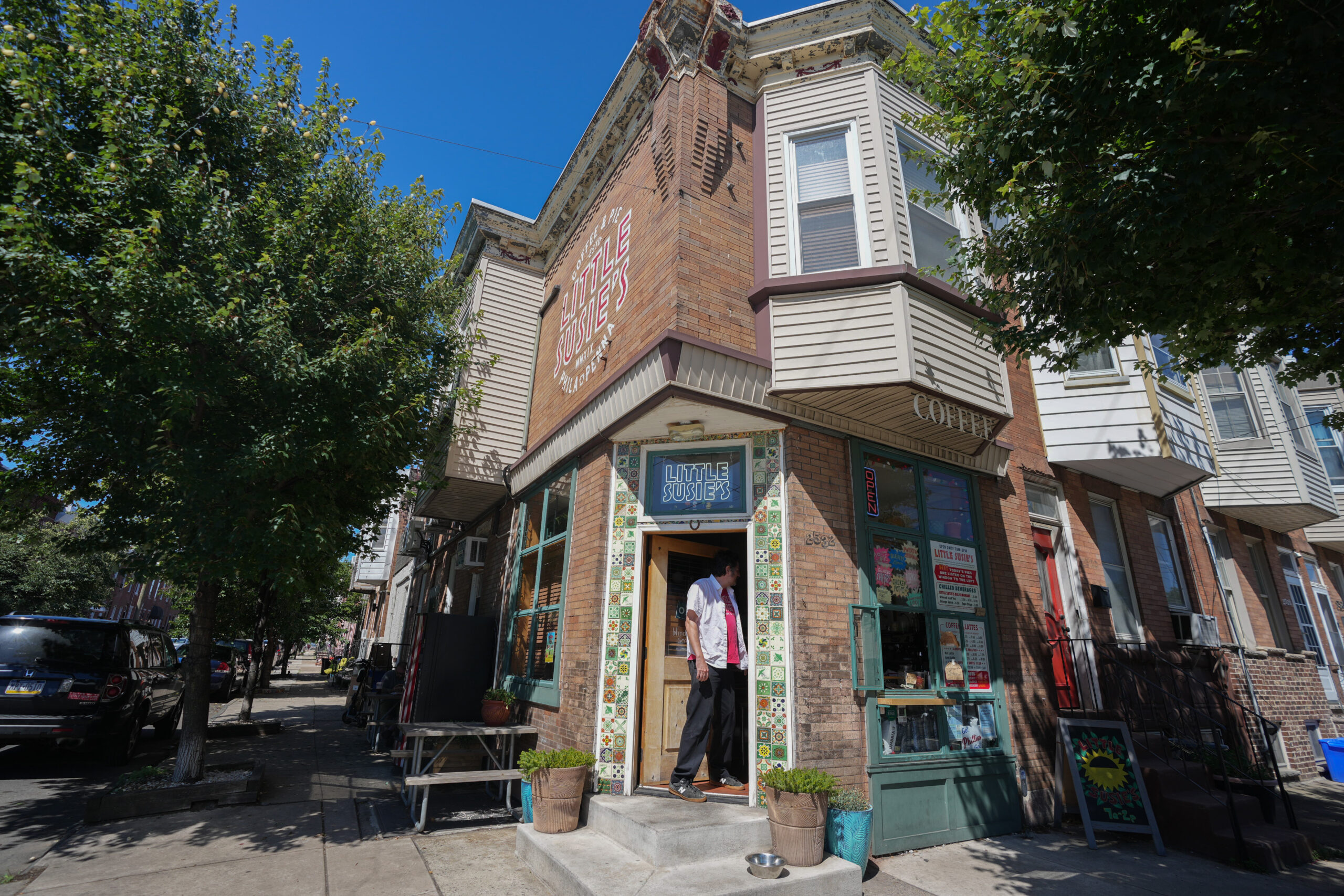
The takeout window at Little Susie’s flagship location at 2532 E. Lehigh Ave.
And what goes better with a cup of coffee than pie? He had a recipe he’d been baking for family get-togethers.
Seven years after Martino opened Little Susie’s Coffee & Pie in the building next door to his house, his modest idea has grown into four Philadelphia locations, with a fifth expected to open Friday at the former Pop’s Bun Shop in Bella Vista, a franchise headed to Milwaukee, and plans for additional shops in Fairmount and Northern Liberties. All his stores run from takeout windows, requiring little more than coffee stations and electric ovens.
Today, the company employs 28 people and turns out about 1,200 pies a day from a bakery occupying two cramped rooms in the corner rowhouse on Lehigh Avenue.
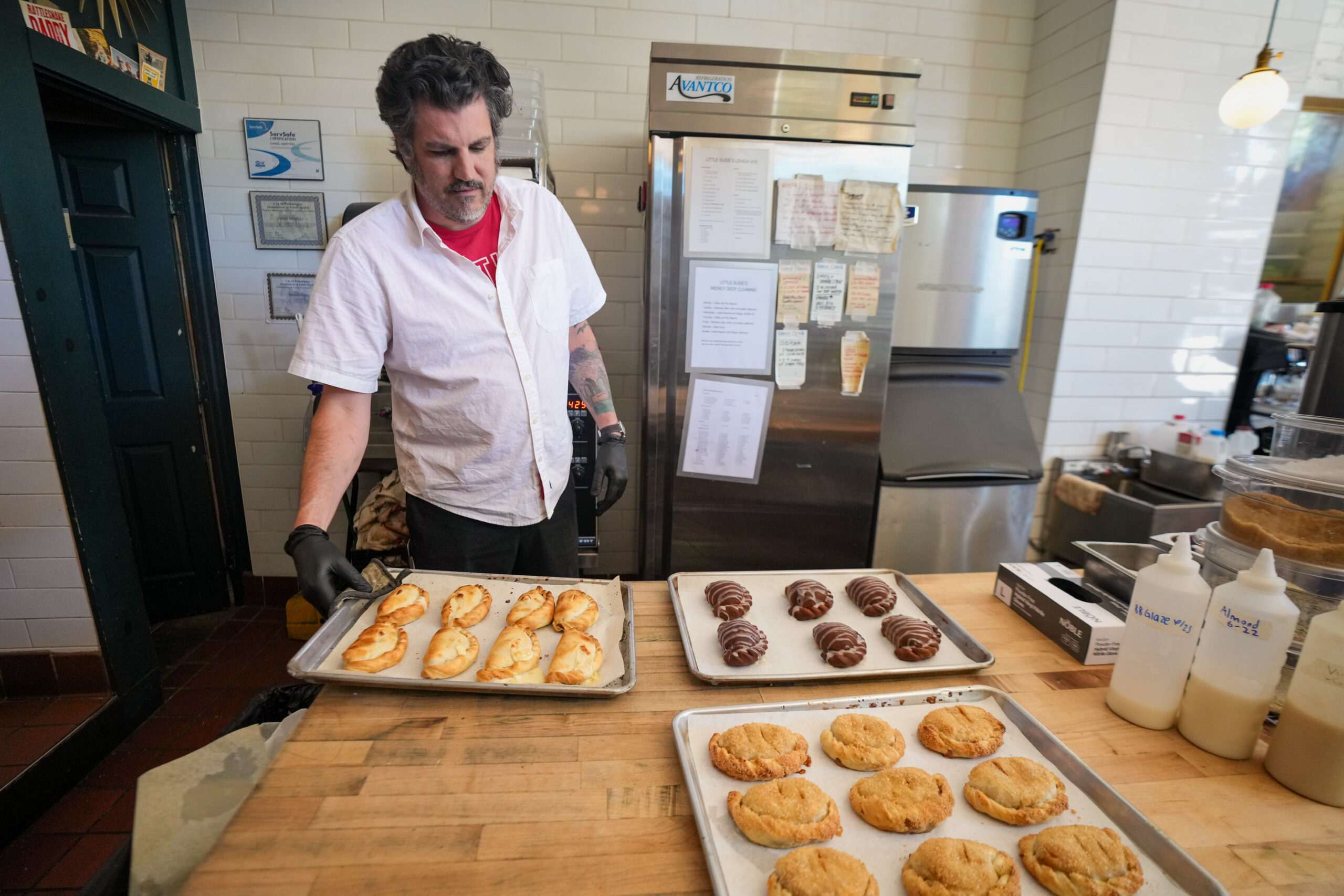
Owner Daniel Martino with trays of pies at Little Susie’s.
Martino, 46, who grew up in Northeast Philadelphia, has spent much of his working life around food. As a teenager, he worked at a swim club snack bar before taking a kitchen job at what is now Jefferson Torresdale Hospital.
After studying film at Temple University, he joined Public House Investments, which ran City Tap House, as a DJ before becoming the hospitality company’s creative director, designing menus, logos, ads, and marketing material.
When the property next door to his house became available, Martino said he used a home-equity line of credit to buy it before securing a Small Business Administration loan to renovate it.
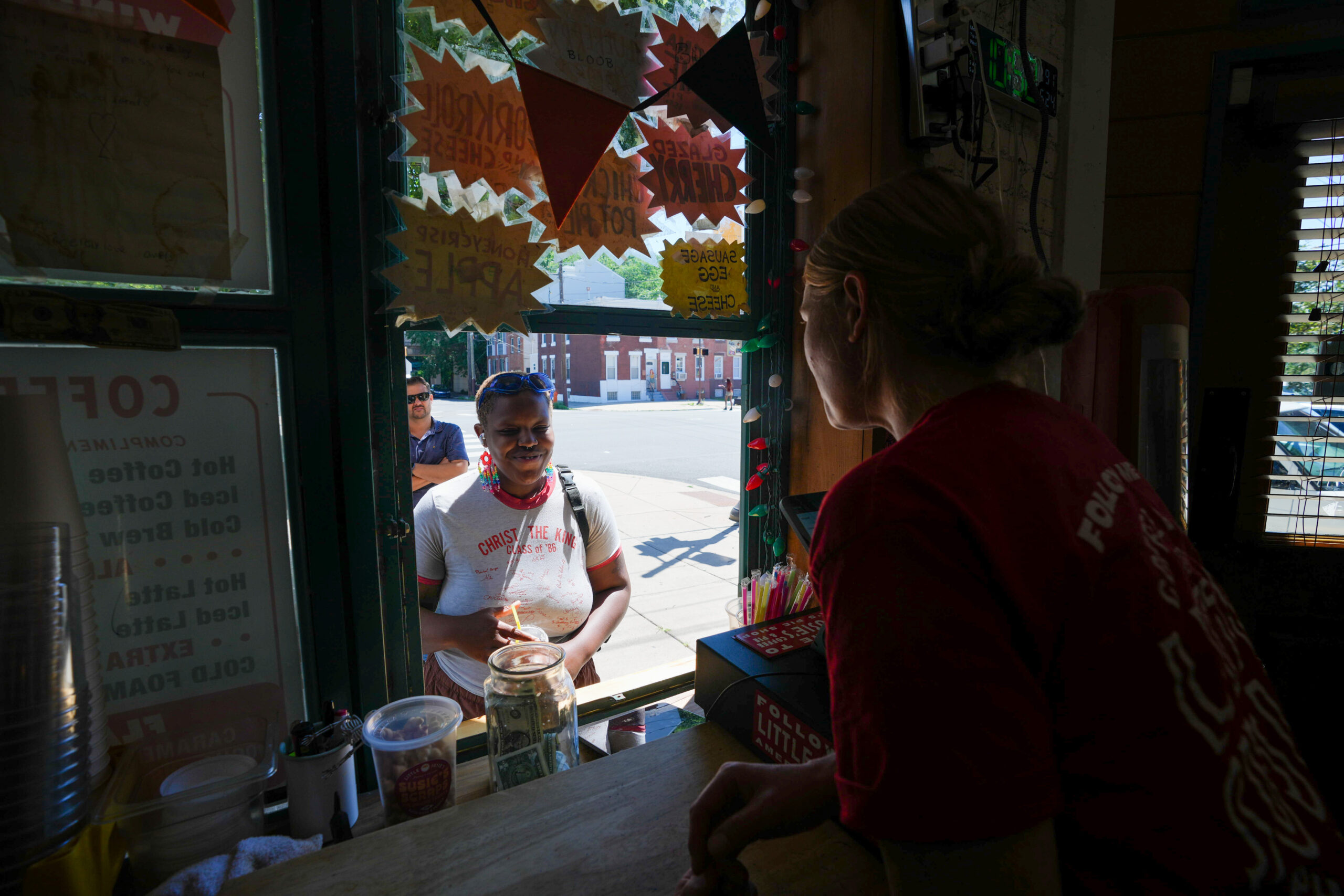
The takeout window at Little Susie’s. Hand-lettered signs advertise the specials.
By the time Little Susie’s opened in December 2019, he said, “I had maxed out every credit card I had. I even had to go to the bank, hat in hand, and sign a signature loan for the last $10,000 just to get it open.”
His shop offered a simple menu, little more than coffees and lattes and four kinds of pies. There was a counter for seating. The first day brought in about $180, and “it was the greatest day of my life,” Martino said.
Then the pandemic arrived. When COVID-19 restrictions shut down indoor dining, Little Susie’s shifted to window service. Customers called in orders, paid over the phone, and picked up coffee and pies outside. Even after restrictions were lifted, the shop never reopened indoors.
It wasn’t what Martino had imagined. His idea was ”Cheers with coffee — the neighbors and the mailman talking about the weather,” he said.
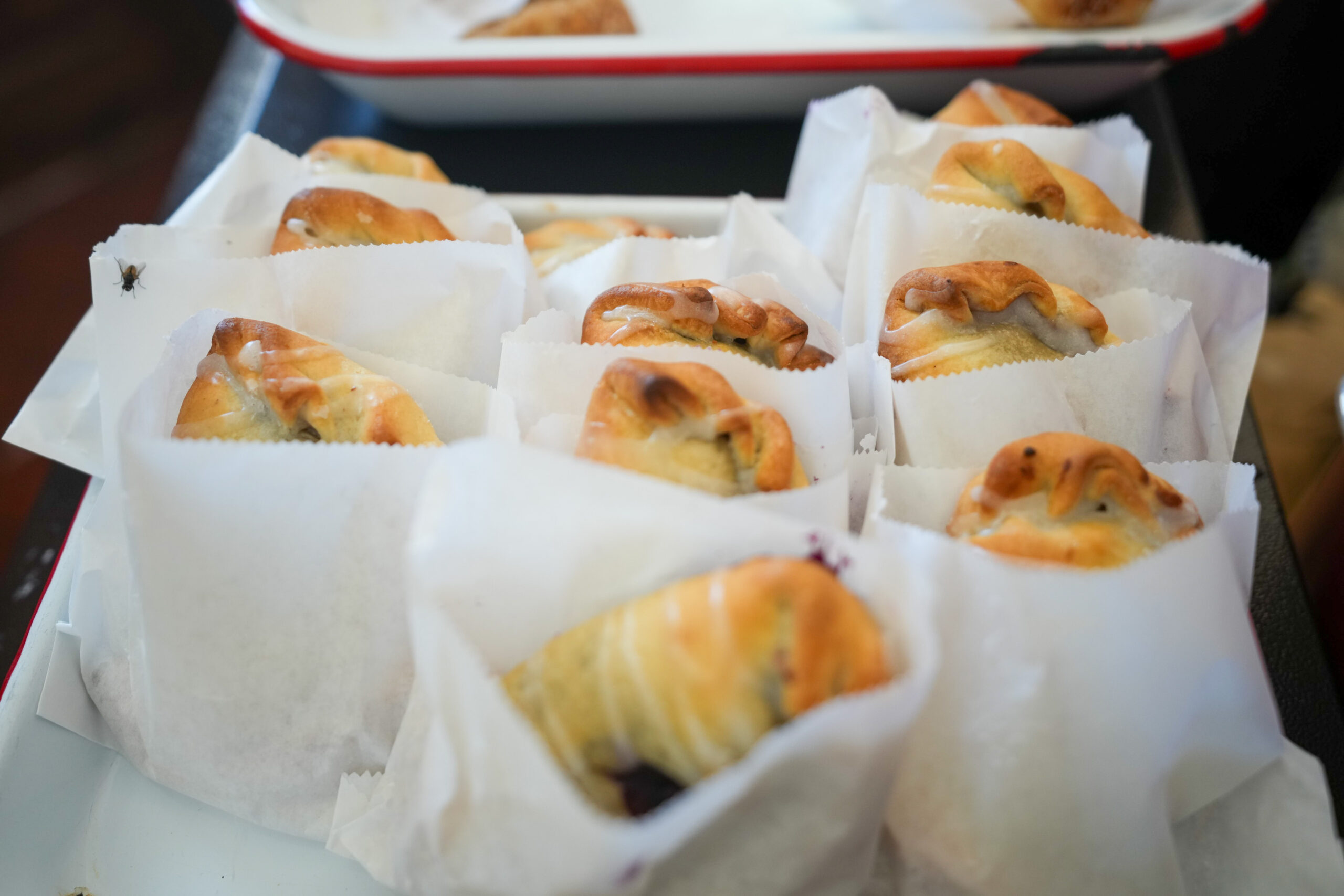
Instead, customers embraced the walk-up model and the seating at a picnic table beneath a maple tree. The pies especially quickly caught on. The signature is the crust. Rather than trimming away the excess dough, workers twist it around each pie by hand, creating what Martino calls “a fluffiness that the fork doesn’t provide — that flaky tenderness you want in a pie crust. The twist is its own special treat in and of itself.”
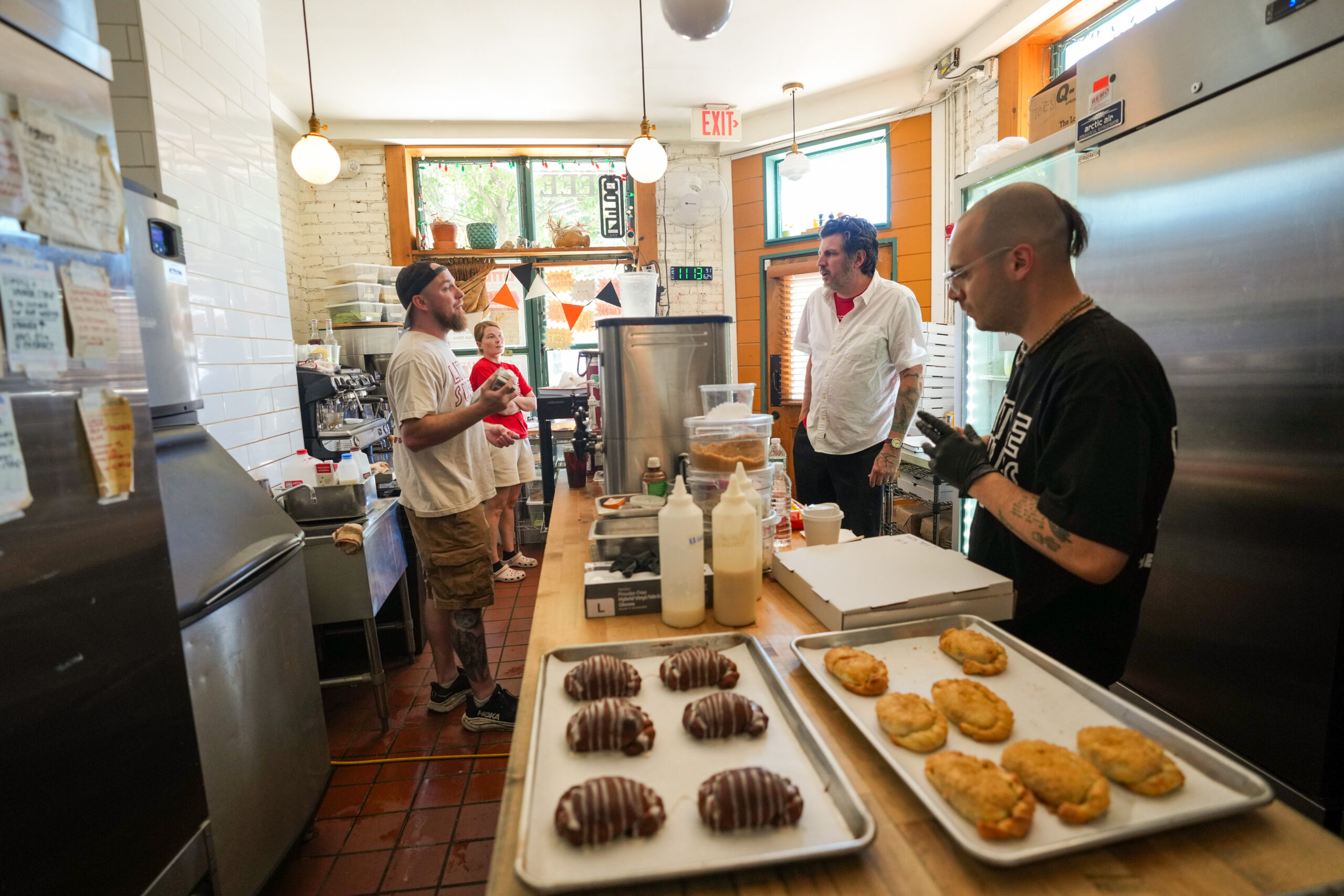
Owner Daniel Martino (rear, right) with staff and pies at Little Susie’s, set up in a rowhouse.
The pies, which are baked and not fried, are made with a simple crust of flour, butter, sugar, and salt. It’s a 48-hour process. Dough is mixed at the company’s Kensington location, where a 20-quart mixer runs nearly all day. The dough rests for 24 hours before it is brought to Port Richmond, where it is sheeted, filled, twisted, frozen, and delivered to the other stores to be baked to order.
Little Susie’s first menu included only blueberry, pork roll, apple, and mushroom Swiss fillings. Today, it offers about a dozen varieties, with eight available year-round and others rotating seasonally. “You can practically throw anything in this pie crust,” Martino said. “I haven’t been disappointed yet.”
Pies at Little Susie’s.
Pork roll remains the top seller, followed by apple, and a sausage, egg, and cheese breakfast pie encrusted with everything bagel seasoning. Seasonal flavors have included ham and Brie, chocolate-covered strawberry, and Cajun crab and corn. None are gluten-free because of the shop’s limitations, he said.
Not every idea works. “We tried to make a cannoli pie, but the cream just melted right out,” he said.
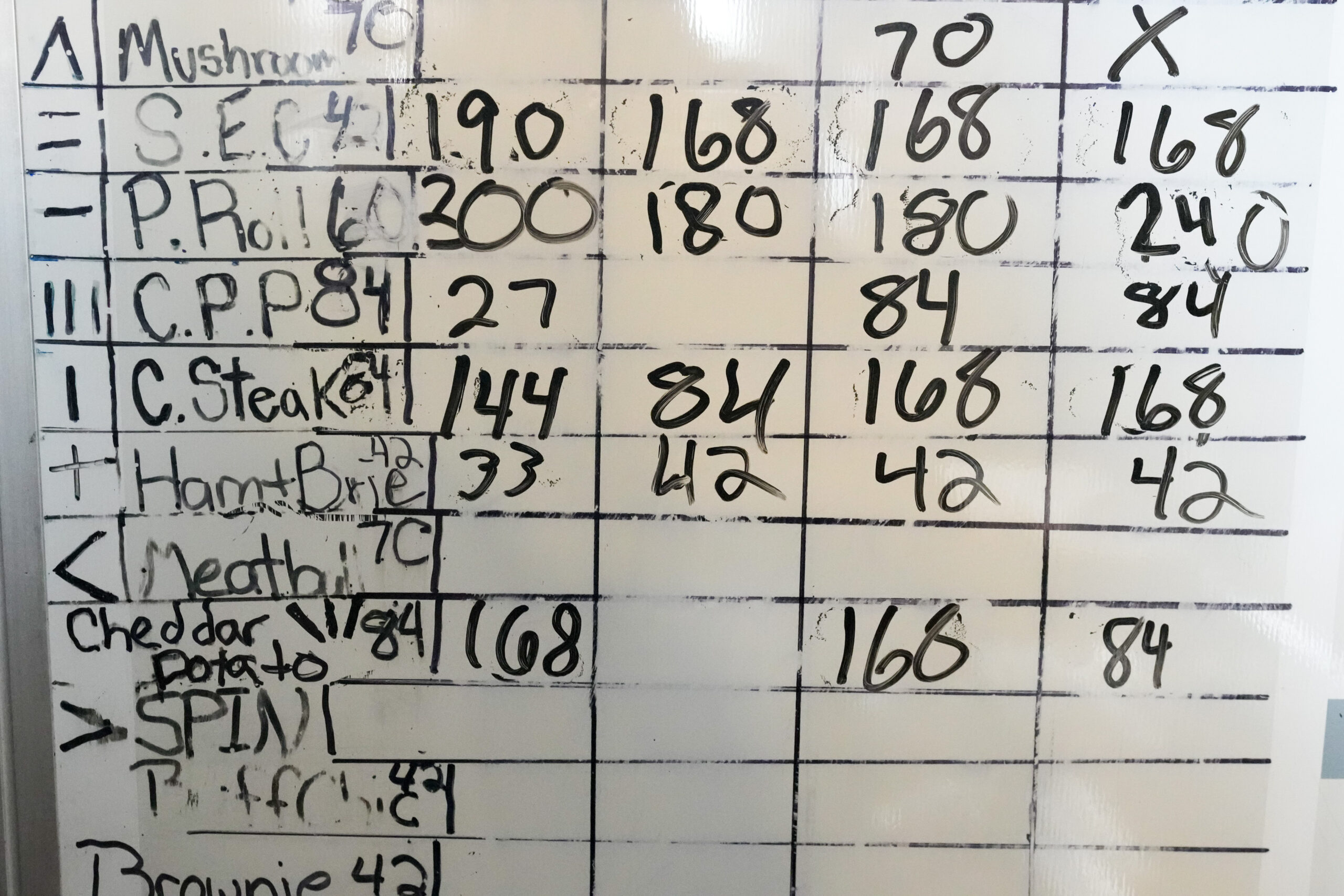
Each shop sells 200 to 300 pies a day. The production kitchen now employs 11 bakers, who track production on a whiteboard nicknamed “the Pieble.” Each variety get its own knife mark on top; an inverted V, for example, denotes mushroom Swiss.
The “Pieble” at Little Susie’s, the flagship pie takeout place located at 2532 E. Lehigh Ave., in Philadelphia, June 24, 2026.
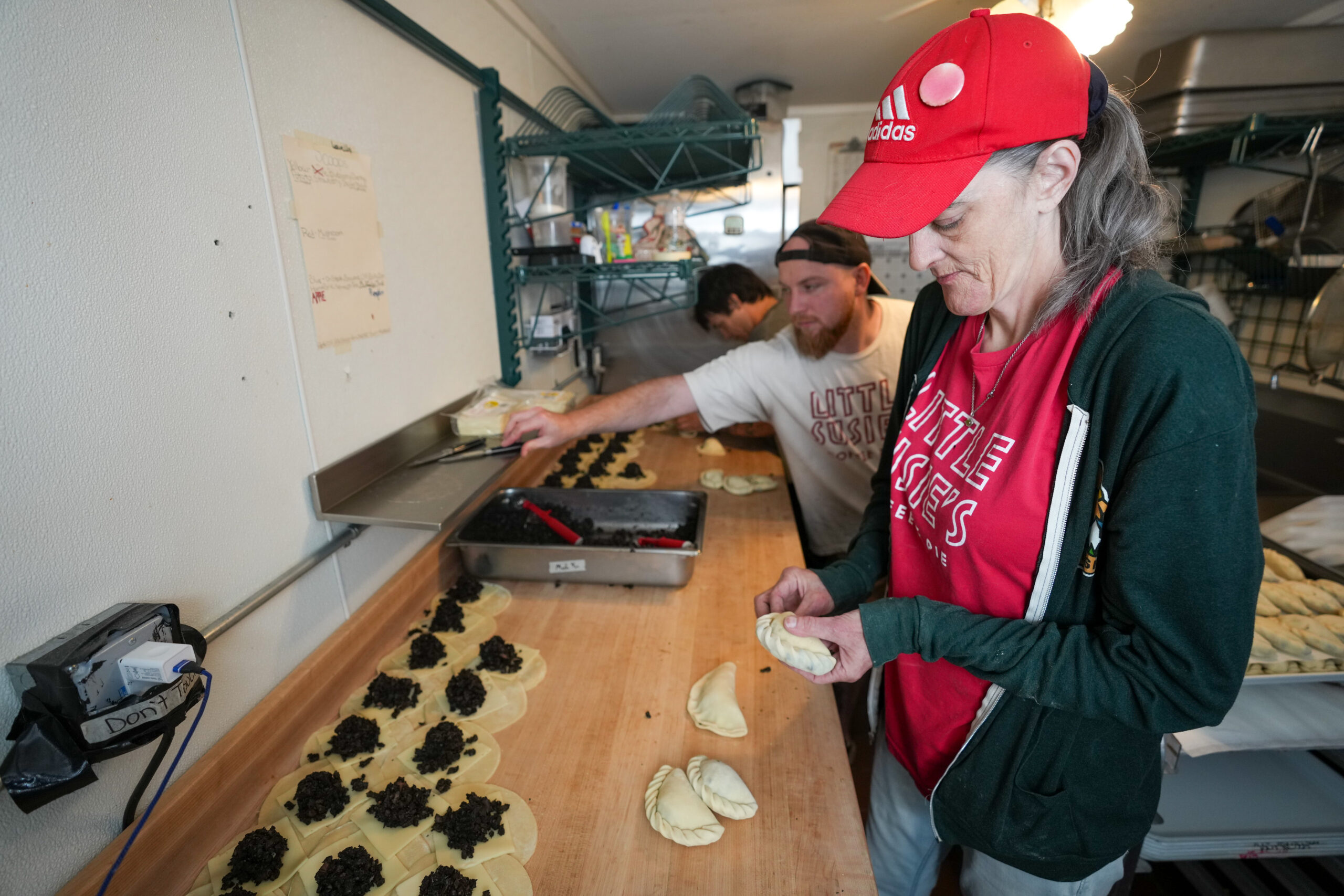
Lena Hurchick, who has worked at Little Susie’s for three years, said she enjoys “the competition of filling all the shops” and watching customers eat pies she helped make.
“Susie” was the name of the dog that belonged to the former owner of the building. “When we had the community meeting here, I said, ‘I’m thinking Little Susie’s,’ and people started crying,” he said.
Lena Hurchick crimps mushroom pies at Little Susie’s.
Expansion has brought complications. A planned Fairmount location was nearly ready to open before the city determined that the property required zoning approval for food sales. “The city does not make it easy,” he said, adding that it will take months to get onto the zoning board’s calendar.
Even so, he expects the company to keep growing. He has a handshake deal for a spot in Northern Liberties. Milwaukee is planned as the first franchise — operated by a friend — while Martino has begun thinking about a larger bakery in Philadelphia.
“We’re basically bursting at the seams,” he said. “We’re probably going to need a 10,000-square-foot facility.”
Owner Daniel Martino at Little Susie’s.
He wants that growth to remain slow enough that the pies are still made fresh every day. “I don’t want to get too far away from making them every day, because then it just becomes some frozen-food empire,” he said.
Little Susie’s Coffee & Pies’ locations are at 2532 E. Lehigh Ave. in Port Richmond, Second and Chestnut Streets in Old City, 1772 N. Front St. in Kensington, and 1754 S. Chadwick St. in Point Breeze. A fifth, at 800 S. Ninth St. in Bella Vista, is due to open Friday. Hours are 7 a.m. to 2 p.m. daily.
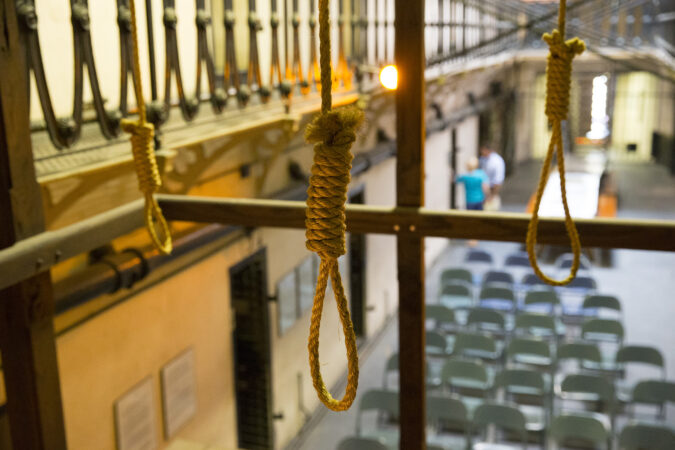
Ten Irish Catholics from the hard coal region went to the gallows, convicted of murder in a long-running labor war against the all-powerful coal companies. Another 10 would be hanged over the next few years, for a total of 20. Their trials made a mockery of justice, with a coal company president as prosecutor, a Pinkerton detective hired by the company as the star witness, and Irish Catholics excluded from the jury.
The hanged men were called Molly Maguires, a name straight out of Ireland, where a secret society using that moniker battled the landlords on behalf of starving peasants during the horror of the 1840s potato famine. These Mollies disguised themselves in women’s clothing, or straw clothing, or whiteface or blackface. And they timed their killings around major holidays.
That’s because the Molly Maguires were merely the flip side of a group quite familiar to Philadelphians — the mummers. The connection explains many of the mysteries about the Mollies — where the name came from, why the Mollies wore odd disguises, why they did their killing around high points of the calendar, and why they were revived in Pennsylvania amid resistance to the Civil War draft.
In Ireland, mummers were more actors than musicians. They visited every home in a district around New Year’s and collected money by putting on a skit that always featured a killing. The money paid for a party for the whole community. Groups like the mummers performed this kind of trick or treat around other big holidays — St. Brigid’s Day on Feb. 1, Easter, the summer solstice and Halloween.
During the potato famine, small bands of men — dressed in the women’s clothes or the straw of the mummers — began going from house to house, collecting money for the hungry. But these men weren’t mummers. They were Molly Maguires. And when they didn’t get what they wanted, or when landlords evicted tenant farmers, the mock killing of the mummers became the very real violence of the Molly Maguires.
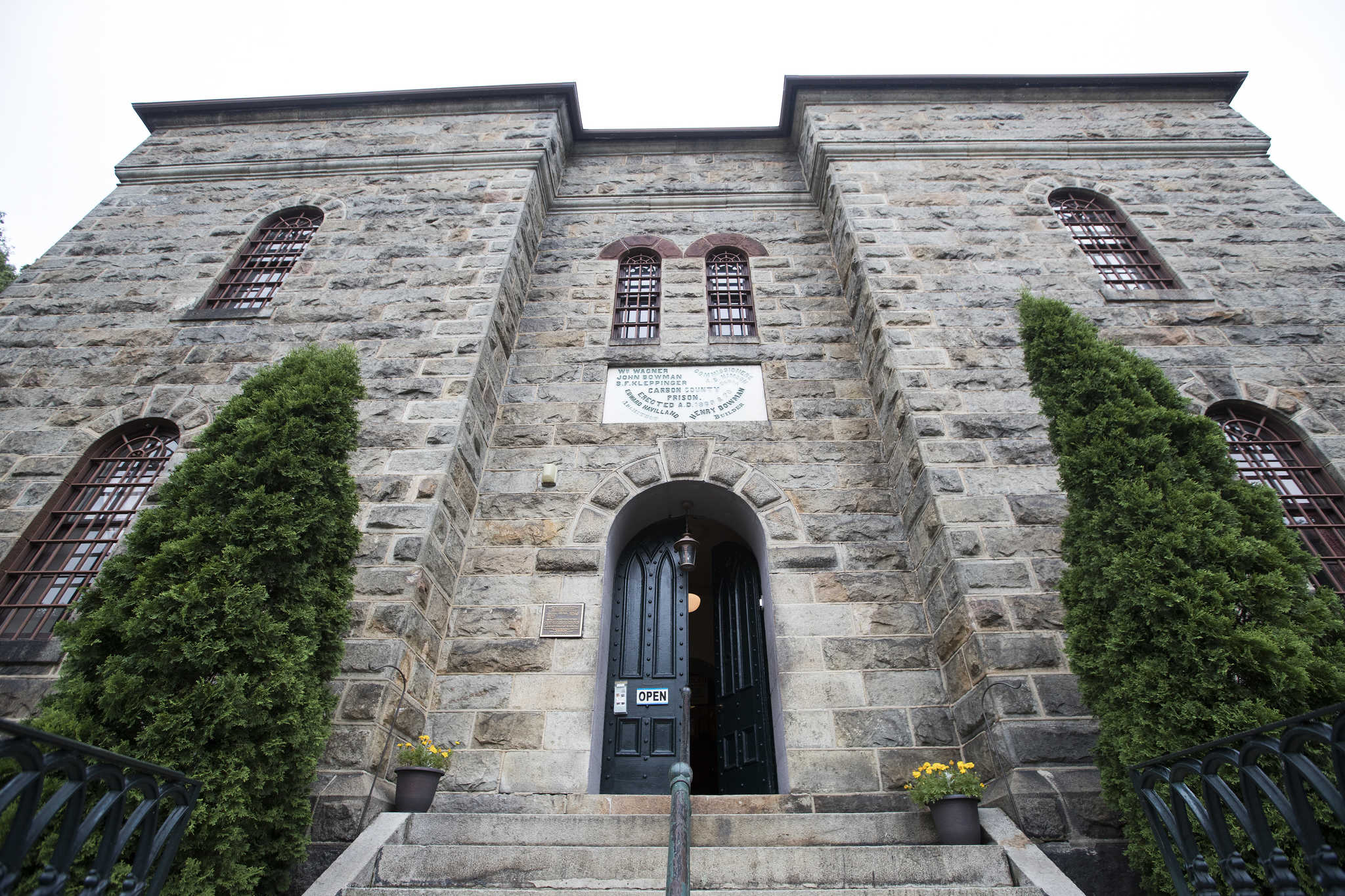
The entrance to the former Carbon County Jail in Jim Thorpe, Pa., where seven Irish coal miners were hanged in 1877.
The killings often took place around the days that the mummers celebrated, to signal that the Mollies were acting on behalf of the community. The three most celebrated Molly murders in Ireland came within a day or two of St. Brigid’s Day, the summer solstice, and Halloween.
The name itself sounds like something from the mummers’ play. A female character often had names that began with the letter M — Molly Masket or Mary Ann McMonagle. And, curiously, Molly Maguire wasn’t always Molly — a number of death threats were signed “Mary Ann Maguire.” The similarity between “Mary Ann McMonagle” and “Mary Anne Maguire” underlined the links between the mummers and the Mollies.
Famine emigration led many from the Molly Maguire heartland to the booming anthracite industry in Northeastern Pennsylvania. It was one of the few rural places in the United States where famine immigrants settled in such concentrated numbers that the folkways of the Irish countryside were transplanted wholesale, including mummery — and its associated pattern of violence. In 1848, a man acquitted of killing an Irishman was murdered in Schuylkill County, on Dec. 30. The killer, an Irishman, had whitened his face like a mime or a mummer.
Mummery had long been established in Philadelphia, but a peculiar offshoot, called the fantasticals, emerged in Northern Liberties before the Civil War, as a protest against mandatory militia service. At the time, able-bodied men between ages 21 and 45 were regularly required to muster for militia drill. This meant a day without pay — and the fantasticals protested by making a mockery of it.
They showed up for drill in ridiculous costumes, with giant wooden swords, or in some cases the leg of a deer. This mockery widened from muster day to mummers parades around Christmas and the Fourth of July and Halloween, and spread beyond Philadelphia.
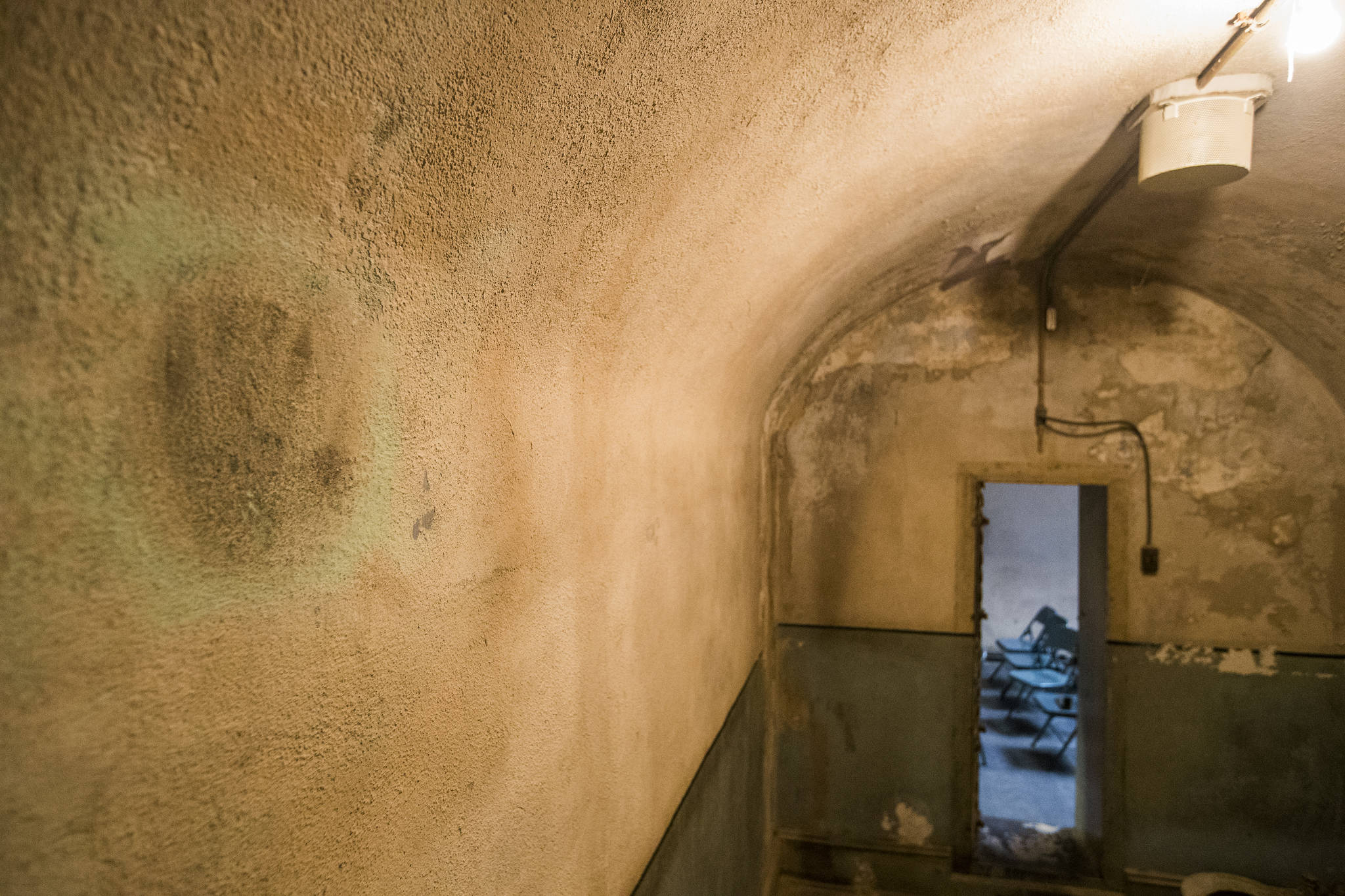
Before one of the Molly Maguires was hanged, he put his hand on the dirty floor of his cell in the former Carbon County Jail and then placed it firmly on the wall proclaiming, “This handprint will remain as proof of my innocence.”
In 1855, the Pottsville militia was called out after a mine boss was beaten in Branchdale, Schuylkill County. Though just four men attacked him, the militia rounded up 28 Irish Catholics. Adding insult to arrest, the militia then played a Protestant anthem from Ulster, “The Boyne Water,” which celebrated the defeat of Catholic Ireland.
It just so happened that the fantasticals made their first appearance in Schuylkill County that very year, marching in Pottsville on Christmas Day. The whole performance mocked the Pottsville militia and its music. The captain wielded a giant wooden sword, the rest were dressed in “every imaginable burlesque costume,” and the band was drunk — and played that way. In 1857, when the militia was used to break a strike by largely Irish mine workers in Cass Township, the fantasticals appeared in Schuylkill Haven on the Fourth of July and in Cressona on Dec. 26.
A few short years after those anti-militia mummers parades, opposition to compulsory militia service in the Civil War led to the revival of the Molly Maguires. The man who administered the 1862 militia draft in Schuylkill County was a nativist Republican who saw conscription as a way to sweep large numbers of Irish Catholic Democrats into the maw of a bloody war. He set unfairly high conscription quotas for heavily Irish Cass Township, then urged that the draftees be shipped out before a crucial election.
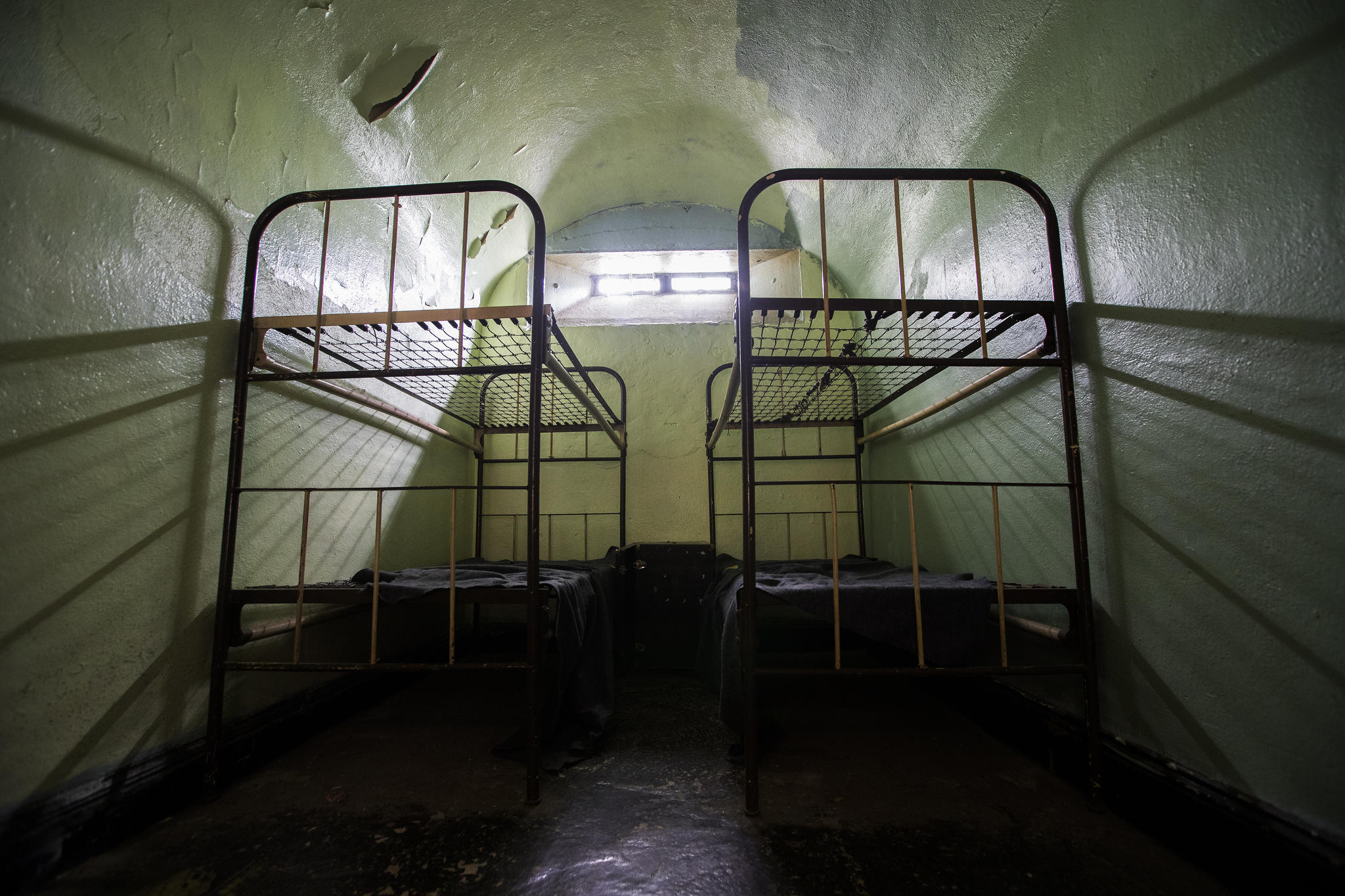
A cell in the former Carbon County Jail in Jim Thorpe, Pa.
In response, Irish mine workers went out on strike, marching under arms with a fife and drum from mine to mine. Two months later, they went out on strike again, calling themselves Molly Maguires. When a government crackdown appeared imminent, the Mollies targeted residents who had shown government sympathies by volunteering for the military.
On Jan. 2, 1863, five men fatally shot an Irish mine worker home wounded from the Union Army, then cheered for the Confederate president. Over the next nine days, two former militia men were attacked in Cass Township. A few days after Halloween, gunmen with false whiskers and blackened faces killed a mine owner who had been helping to enforce conscription.
Note the progression. In the last half of the 1850s, some Schuylkill County residents were making fun of the militia, but by 1862, they were on strike to oppose the militia draft, and as 1862 edged into 1863, they were shooting former militia members around New Year’s. As in Ireland, what started as mummer revelry ended as Molly Maguire rebellion.
The Molly troubles raged for another 15 years, ending only when a Pinkerton infiltrated the organization. The ensuing executions showed that the Mollies were no match for the coal companies and the state of Pennsylvania when it came to dealing death at high points of the calendar. The biggest killing — the hanging of 10 men on June 21, 1877 — came on the summer solstice.
Brian and Robyn Emmons can’t sell their 12-year-old, $900,000 rowhouse in Northern Liberties in its current state.
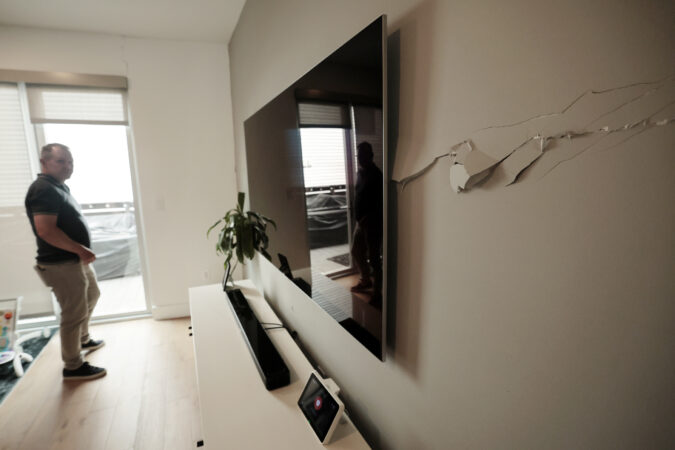
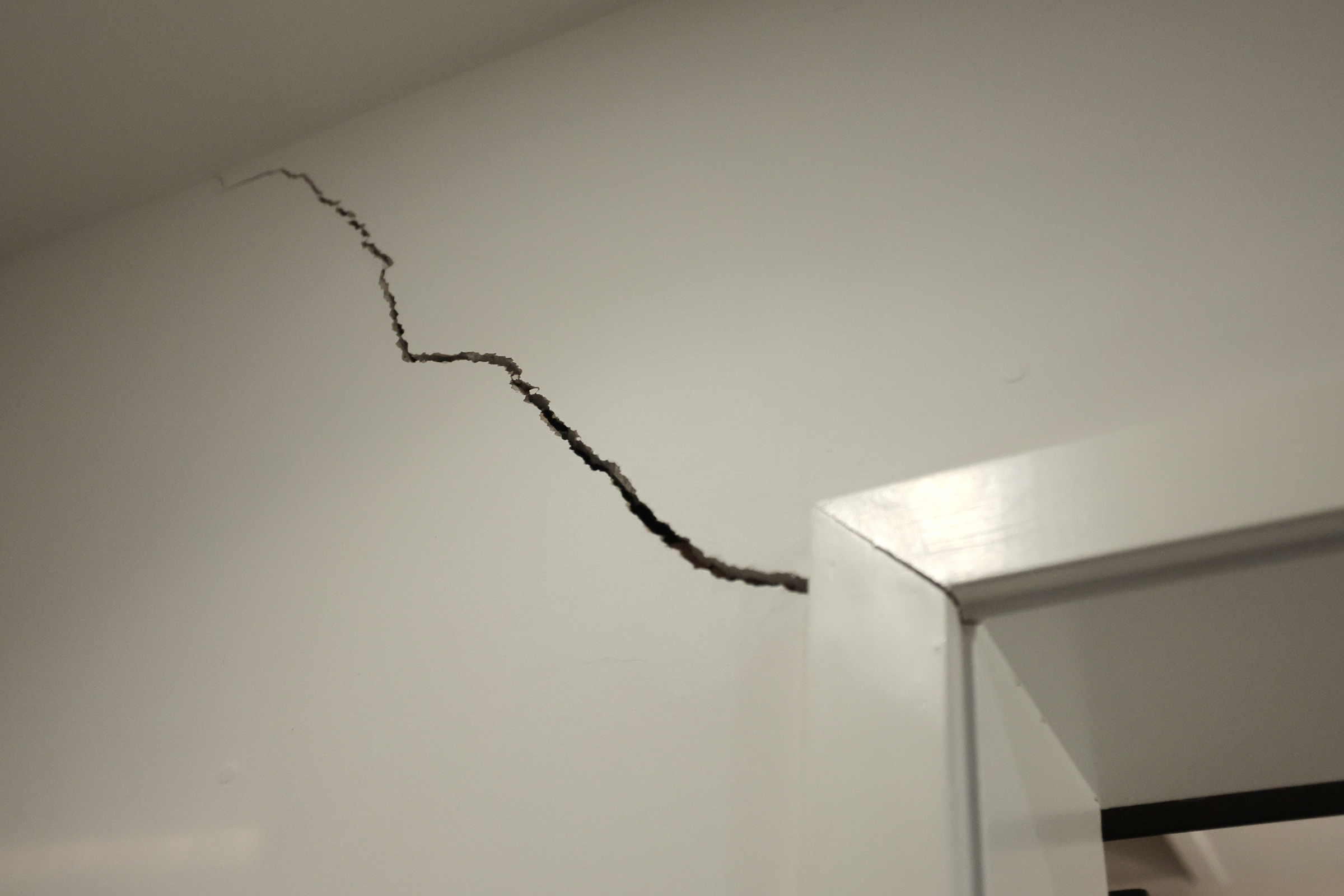
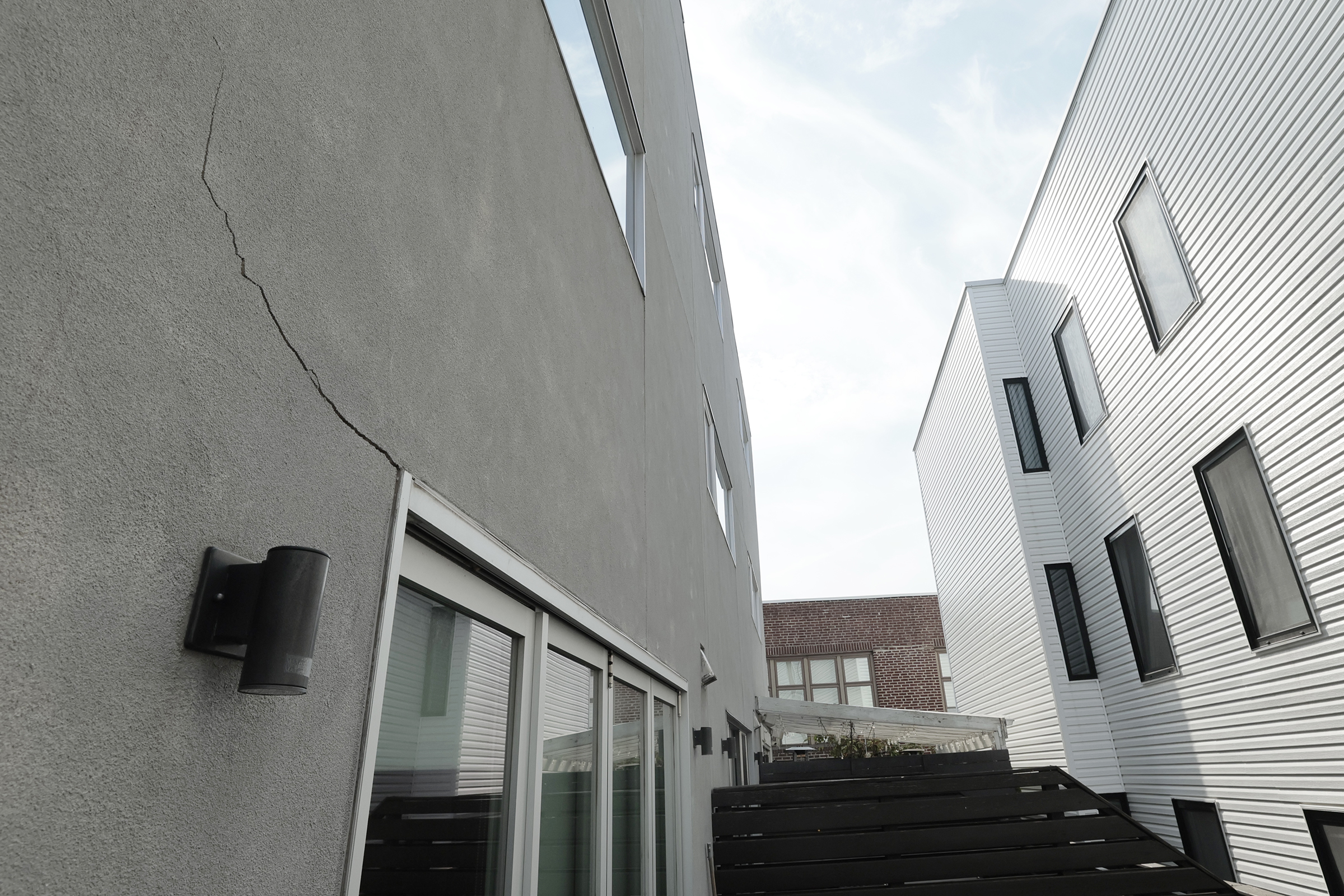
Fissures have spread across some of the walls in their home — which was built in 2014 — and cracks radiate from many doors and windows.
Three of their neighbors on Brown Street face similar issues. They say their homes were damaged by an apartment building constructed in 2023 that’s so close to the rear of their house they can almost touch it.
One family moved out after the city Department of Licenses and Inspections declared their home unsafe in 2024.
The Emmonses want to move to South Jersey, closer to family. Instead, as they wait for their second child to be born, they feel trapped.
“The fact that my neighbor was issued an order not to occupy the house, and it’s attached to our house, it’s just really scary,” said Brian Emmons, who has been a real estate developer in Philadelphia for almost 20 years. “We are stuck.”
Along with two neighbors, the Emmonses are suing the developer of the apartment building: Brian Zoubek, president and CEO of Zoubek Properties, who has built 250 houses in Philadelphia over his roughly decade-long career.
Since graduating from Duke University in 2010, where he played basketball for the Blue Devils, including on the national champion team that year, Zoubek tried his hand at a few occupations before settling on development. He has expanded his business to the Jersey Shore, recently debuting 10 almost million-dollar townhouses at a news conference with New Jersey Gov. Mikie Sherrill.
“I’m extremely proud of what we’ve built in Philadelphia,” Zoubek said in an email. “I put my own name on my work because I stand behind every project we build.”
Zoubek faces lawsuits from the owners of three properties, all alleging that he damaged their Brown Street homes. An Inquirer review of court records found that Zoubek’s companies were similarly taken to court over allegations of sloppy construction practices by their contractors in at least three prior development projects.
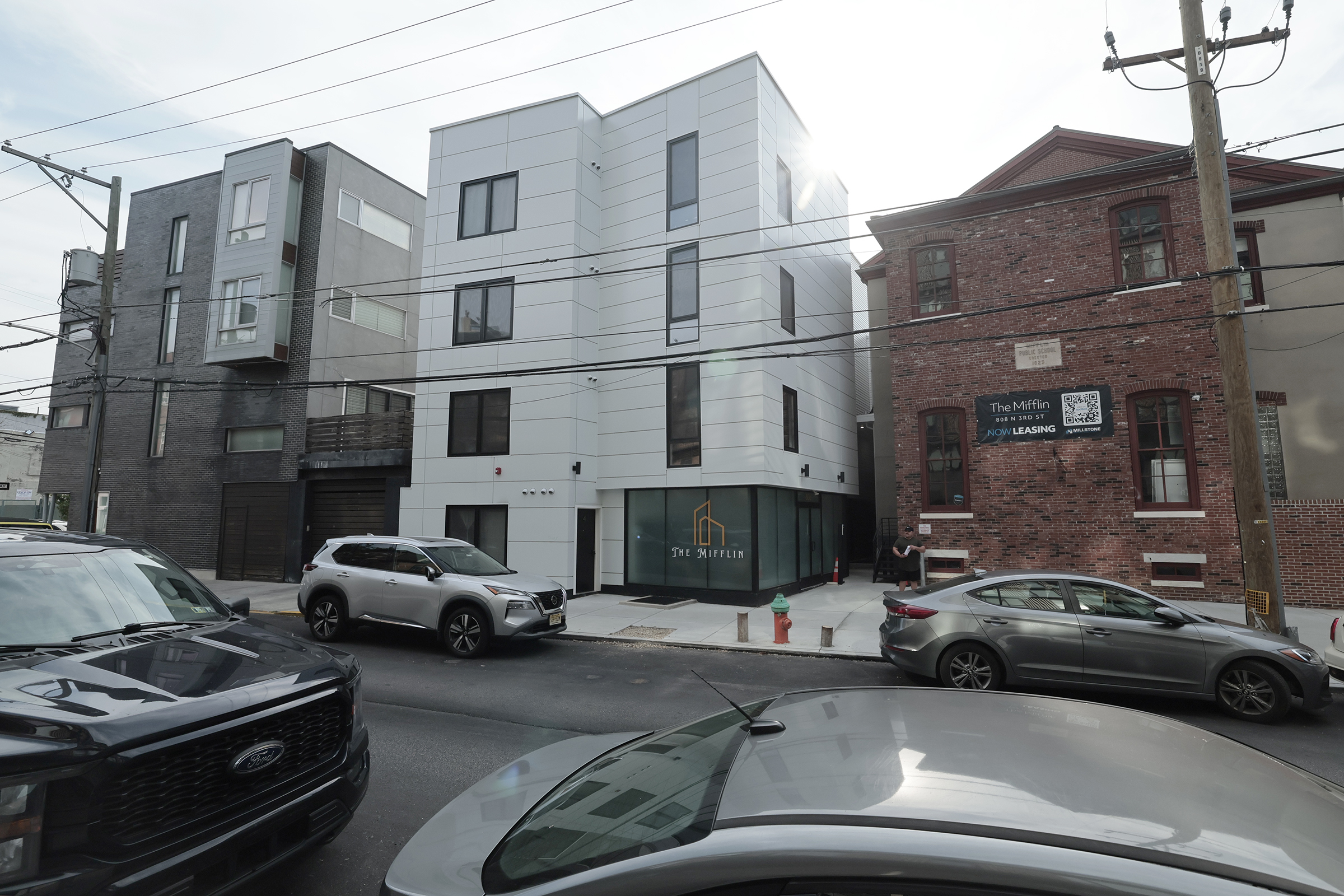
The eastern end of Brown Street with rowhouses (gray), the new apartment building Zoubek built next door (white), and the former school he transformed into apartments (red brick).
The Northern Liberties rowhouses
Emmons and his neighbors sued last year alleging that the damage to their homes is the direct result of Zoubek’s redevelopment of the Mifflin School, built in 1825, just to the north of their homes.
In mid-2021, Zoubek purchased the property — the oldest surviving public school building in Philadelphia — and carved it into 15 apartments with 14 more wedged into a four-story addition on a small lot between the Brown Street homes and the historic structure.
The recent lawsuits contend that the developer dug too deep while excavating the basement of the new building and damaged their adjacent foundations. Within the three homes — which The Inquirer toured with Emmons — cracks grow in walls, floors slant, the shared garage leaks, and residents have struggled to open some windows and doorways.
The other two homeowners declined to speak on the record, citing the ongoing lawsuits. The residents of a fourth house have resolved their case against Zoubek.
“We are aware of the pending litigation and are actively defending these claims,” Zoubek said in an email. “Given the involvement of multiple parties, we are engaged in ongoing discovery and investigation and are confident the process will bear out the facts.”
Zoubek was named in two earlier lawsuits that accused his construction crews of slapdash work that damaged neighboring properties. A third suit alleged that his company’s work triggered a floor collapse that injured two deliverymen.
Zoubek said in a statement that all prior suits have been resolved.
For Emmons, the experience on Brown Street has an irony to it. Ten years ago, he was the face of development in Philadelphia as president of the Building Industry Association (BIA) — a real estate advocacy group — and vice president of a development firm Toll Brothers runs in the city.
Usually in the position of advocating for new development, Emmons counseled his neighbors when the project was announced that it was allowed by the property’s zoning and not worth resisting. But he did ask his fellow developer about his plans for the new apartment addition to the Mifflin School.
A gaping crack in a first-floor wall in a home at 301B Brown St. in Philadelphia.
“He clearly was doing things the wrong way,” Emmons said. “And I know that because I’m in the construction industry.”
Zoubek contests Emmons’ assertion. He argues that many of his 30 building projects in Philadelphia involve basement excavation next to existing properties and that the Mifflin School project was fully permitted and supervised by skilled professionals.
“That experience, combined with the engineering oversight on this project, reflects how seriously we take this work,” Zoubek said in an email. “After concerns were raised, the project was reviewed by L&I, which did not issue violations or take enforcement action.”
A trail of lawsuits
Zoubek has been building in the Philadelphia area for more than 10 years, mostly developing small apartment buildings or a handful of rowhouses in the city’s booming river ward neighborhoods.
Zoubek, at 7-foot-1-inch, was a basketball star at Haddonfield Memorial High School and got into real estate after a stint running a cream puffery and, later, as a real estate agent for Cushman Wakefield.
He started his own firm, Zoubek Properties, in 2014 and a related construction management company called Z Builds. He also cofounded another company, Catalyst City Development, with childhood friend Tyler McNeil.
As his construction business grew, his enterprises were drawn into complex litigation alleging property damage or injury caused during construction.
Brian Zoubek in his now defunct cream puff shop Dream Puffz, a pre-development venture, in 2012.
According to one lawsuit, Catalyst, the company Zoubek cofounded, and Manayunk-based Grit Construction worked together on a small development on Hope Street in Northern Liberties in 2019. During construction, Grit ruptured a lateral pipe connecting a sewer main to a strip of nearby businessesfacing an adjacent block of Front Street.
Exhibits from that lawsuit show Zoubek proactively contacted the neighboring property owner, reassuring him that his crews had quickly rerouted the noxious flow by splicing in PVC piping until a more permanent fix could be made.
“Broke some sort of line,” Zoubek texted to the adjacent property owner, along with a photo of the messy scene. “So we put in a temp one.”
But a week later, business owners next door were complaining about chronic plumbing issues. The temporary line had become clogged with rubble and other debris from the ongoing construction.
According to the suit, in June, the toilets and sinks at a packing business on Front Street erupted as sewage backed up and flooded into the commercial unit. The next day, a barbershop next door was inundated with filth.
A plumber came out to snake out the line but discovered that Zoubek’s crews had capped the severed line. Eventually, tenants fled.
“Our tenants cannot continue with sewage backed up into their space,” a property manager for the commercial units next door wrote to Zoubek, in a 2020 email.
Zoubek said that the case had settled but offered few other details: “The matter was ultimately resolved between the parties.”
Zoubek Properties had also hired Grit and contractor All-State Services to demolish a building under the El in Fishtown in 2019 and build several new apartments.
In 2021, the owner of a neighboring apartment complex sued, saying that during teardown crews punched holes in the side of the adjacent building, damaging its roof, framing, and supports.
According to that complaint, tenants told a property manager about “a big noise and shaking in the building” during the demolition process.
After arriving on the scene a short time later, the manager “observed All-State Services employees drinking alcohol while on the job and stumbling down off of heavy equipment,” the complaint said.
Zoubek said that his contractor eventually repaired the wall and that a claim for further damages was handled by the two insurance carriers.
“The matter is fully resolved,” he said.
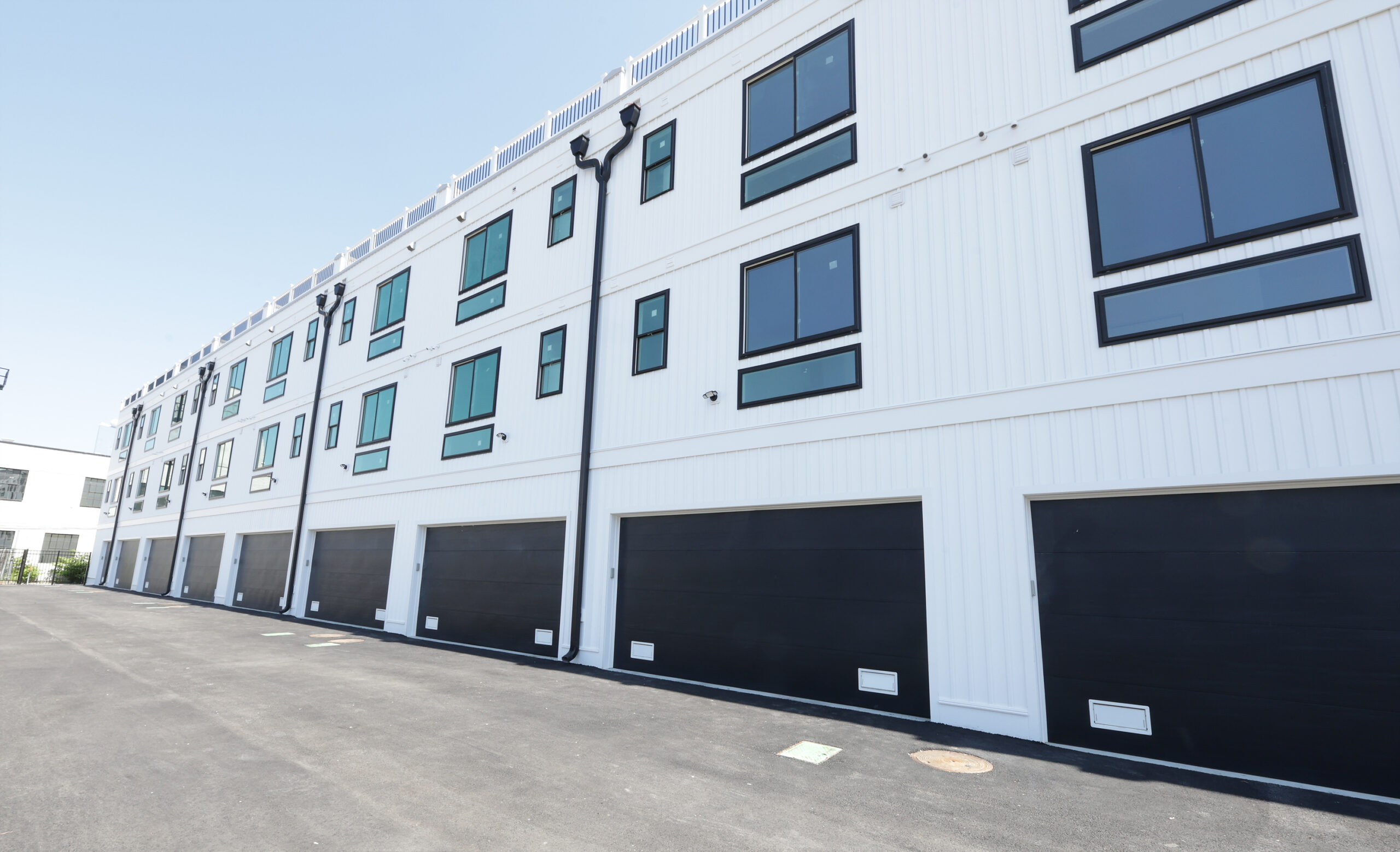
The new luxury townhouses on Kentucky Avenue known as the Residences at Orange Loop in Atlantic City, which Zoubek revealed with New Jersey politicians earlier this year.
As that suit unfolded, Zoubek had another project underway in Old City, again for a small apartment complex on the 100 block of North Third Street.
In 2021, two deliverymen bringing in elevator counterweights for the construction project were told to use a rear entrance to deposit their cargo, according to a personal injury lawsuit filed the next year.
The suit contends that both the delivery company and the workers quizzed Zoubek’s crews about whether the rear entrance of the partially constructed building was structurally sound enough to handle the extreme weight of their load. They were assured that it had been inspected and was safe.
Instead, the floor collapsed, sending the men and their equipment crashing into the basement, injuring both delivery workers.
The suit was later settled for $6.5 million default judgment against the subcontractor.
“That matter was resolved through the appropriate legal and insurance processes,” Zoubek said.
Construction damages 50 rowhouses a year
Lawsuits and claims of construction damage are endemic to the real estate industry. And building in the tight confines of Philadelphia’s dense rowhouse neighborhoods can be especially contentious.
In the case of Brown Street, a spokesperson for Zoubek pointed The Inquirer to the website of Fortis Construction & Design, which built the five rowhouses there in 2014 and is now suspended by the city for “unpermitted, potentially dangerous underpinning and excavation.”
Cracks on the exterior of a home at 303A Brown St. in Philadelphia (left) on June 9.
Emmons, however, argues that the fault lies with Zoubek: The extensive damage to the Brown Street homes appeared only after the basement was dug out for the expansion of the Mifflin in 2023.
“He can point the finger all he wants, but I hope he lies awake at night praying nobody gets injured or killed,” Emmons said in an email.
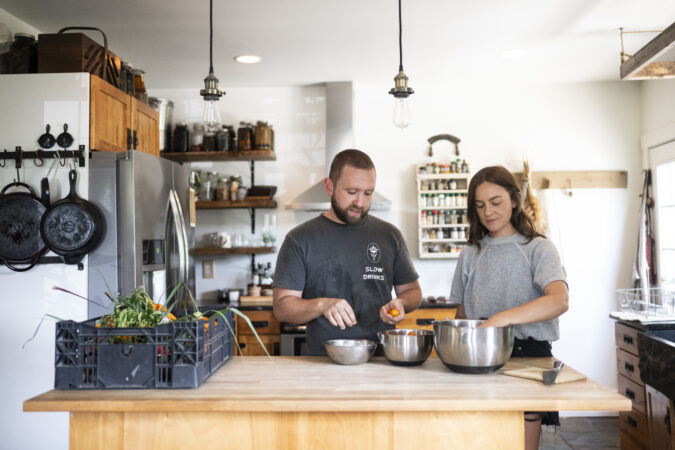
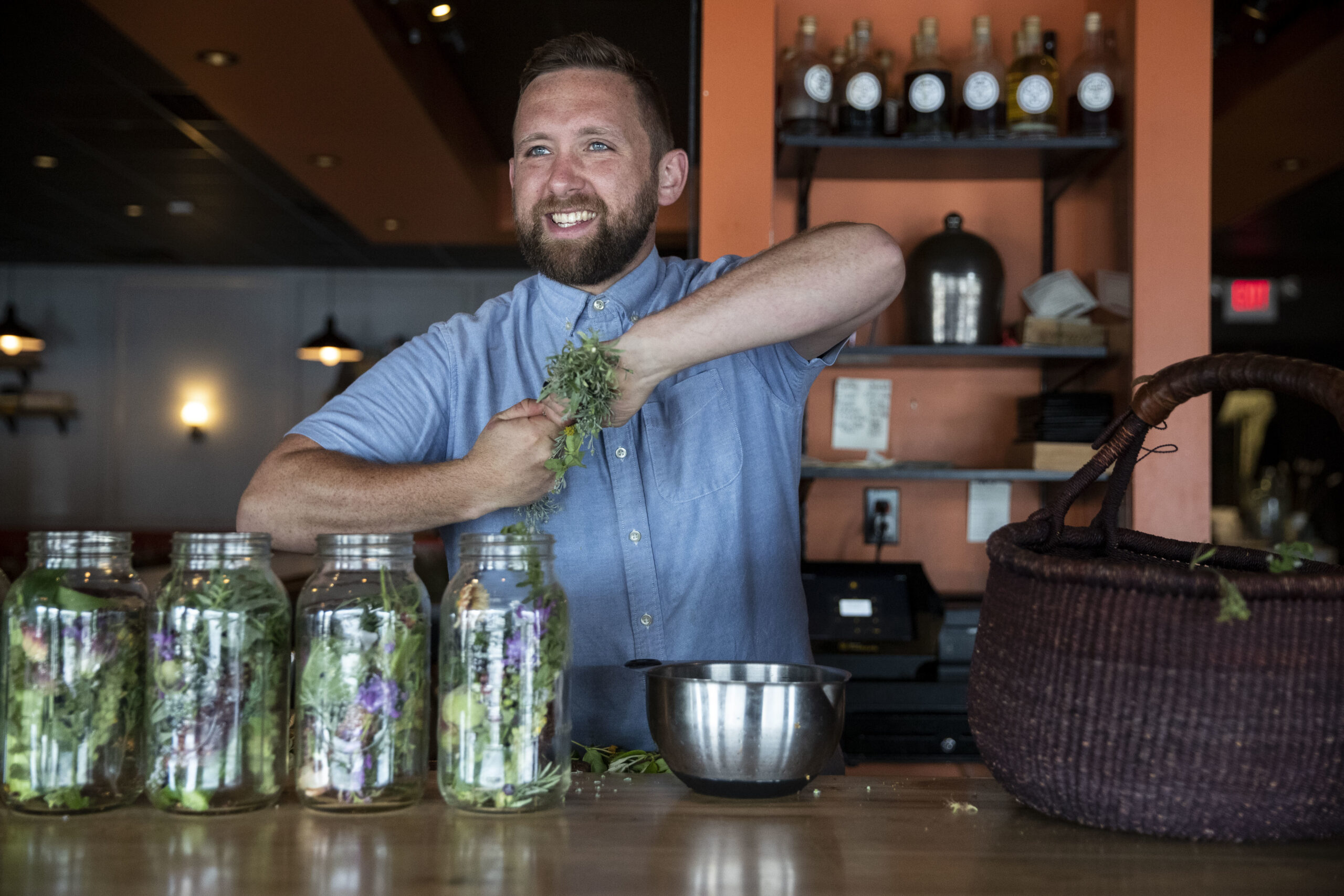
For more than a decade, South Jersey bartender Danny Childs has been developing “Slow Drinks,” an award-winning bartending approach that uses locally farmed and foraged ingredients for boozy and booze-free beverages, resulting in drinks that are essentially liquid snapshots of a place and a season.
Now Childs and his wife, Katie, are turning that philosophy into a bar of their own. Work is underway on Field Day, set to open in September in a street-facing space at 923 N. Second Street, inside the Cescaphe Ballroom in Northern Liberties. (Cescaphe will continue to operate in the rear of the building.)
Field Day will be a showcase for Slow Drinks-style cocktails, sodas, and ferments, complemented by a food menu from Sweet Amalia chef Melissa McGrath, a consulting partner.
Danny Childs, former bar manager at Cherry Hill’s Farm and Fisherman Tavern, fills jars with foraged botanicals in 2021. Childs invented the “Slow Drinks” method of bartending.
The Childses envision Field Day as a neighborhood bar with a family-friendly vibe. More than half of the 68-seat, 1,250-square-foot-space and the entirety of the bar will be held for walk-ins. “We want it to be super-casual,” Katie Childs said. The couple hopes that the bar — the entryway to a former movie theater — becomes a go-to for locals to drop in; there’s capacity for 100 when you factor in standing room plus Cescaphe’s patio, which they’ll be able to use when events allow.
But the Childses are also framing Field Day as a “regional cocktail bar” that tells the story of the various (agri)culturally rich pockets around the Philly area: “We’re talking Poconos, Lehigh Valley, Delaware River Valley, Chesapeake, Pine Barrens, Jersey Shore, South Jersey farmland. We’re going to really try to tell that story on the menu,” Danny Childs said.
Ingredients from those areas will inform not only the drinks but also the food from McGrath, who became a fan of Danny’s work after frequenting the bar at Farm & Fisherman. The intention is for Field Day to be “a bar with good food,” McGrath said.
The planned menu includes house-made soft pretzels, fried olives, and Pennsylvania Dutch-driven sandwiches featuring the likes of red beet eggs and custom-made Lebanon bologna. McGrath plans to weave various Slow Drinks ferments, such as pickled mushrooms, into the food menu and snack plates, which are odes to Katie Childs’ hometown of Hanover, aka “the snack food capital of the world.” They also plan to use tomato pie as a format to riff on other area specialties (think hoagie pie).
Danny Childs (left) and his wife Katie sift through tomatoes picked from their garden at their home in Pennsauken. Field Day — the couple’s first bar — will feature ingredients found across Philly, South Jersey, and the Jersey Shore.
Highballs, boozy gelati, and the occasional F&F favorite
Another anchor of the Field Day menu: year-round boozy gelati. They’re planning to marry John’s Water Ice with Lancaster-sourced soft serve from 1-900-Ice-Cream. (There will be soft-serve cones for kids, too.) Danny, a Delco native, looks forward to recreating a treat he grew up with: “When I would go to John’s or Pop’s as a kid, you would get a soft pretzel and use it as a spoon.”
The cocktail menu will go heavy on highballs that will mix booze with Danny’s seasonal, house-made sodas (many of which will be available for takeout). He’s envisioning approachable combos like bourbon and birch beer, rum and clarified cream soda, and sherry and black cherry wishniak. More offbeat pairings will include Fernet and root beer, tequila with chicory-corn cola, and mezcal with celery soda. (That last one, the Cel Rey, will be familiar to patrons of Farm & Fisherman; a few other classics from the F&F menu — the black walnut Old Fashioned, La Poblanita — will grace the Field Day menu on occasion.)
Besides highballs, Danny promises several other drinks, including freezer martinis, citywides, natural wines, and a few draft beers, namely Guinness and Slow Drinks’ collaborations with South Jersey’s Tonewood Brewing.
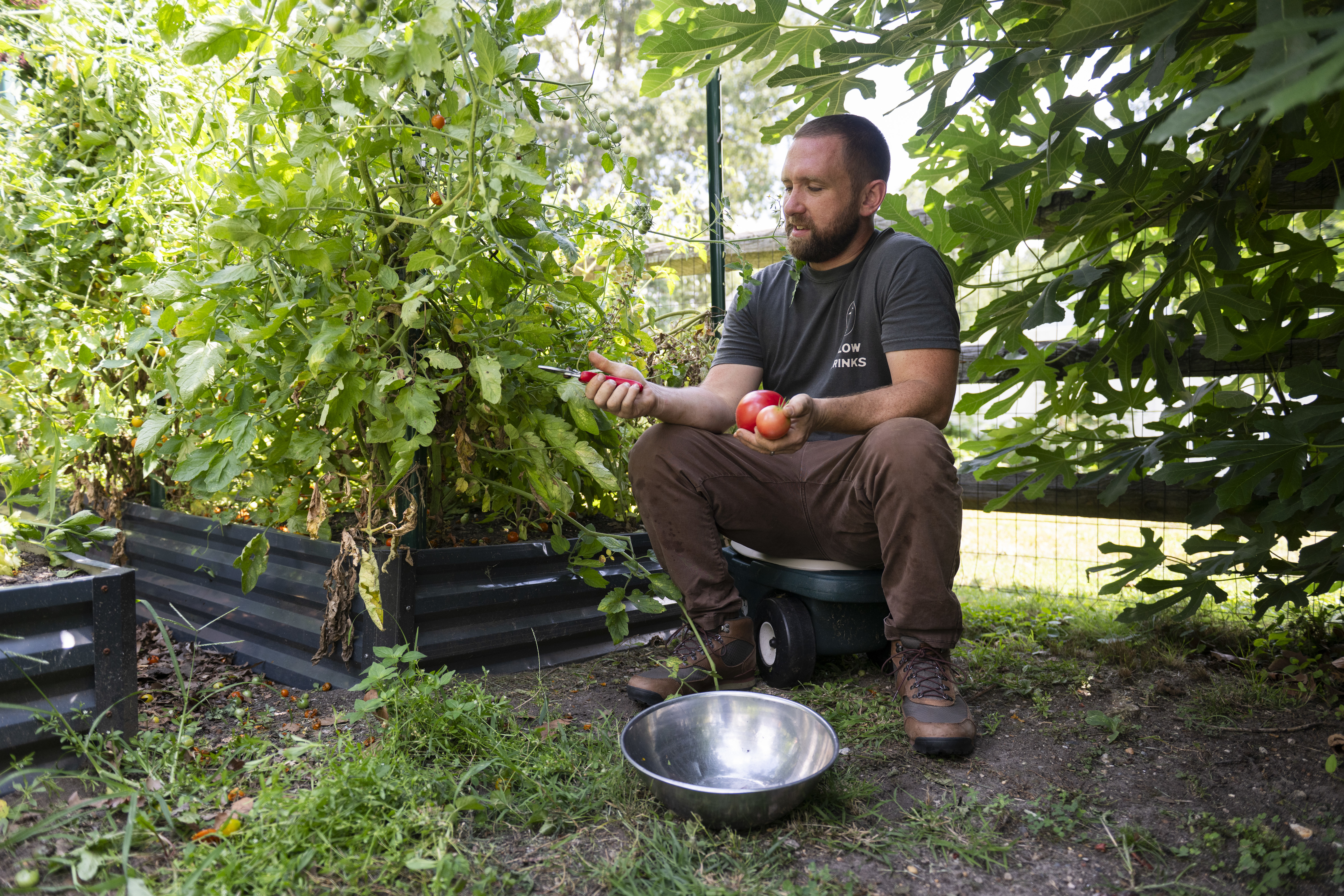
Danny Childs picks tomatoes from his garden at his home in Pennsauken, N.J. on Tuesday, Aug. 13, 2025. A Delco native, Childs plans to include boozy gelati on the menu at Field Days.
For all the emphasis on beverages, the Childses don’t want Field Day to read entirely like a cocktail bar. They’re designing it to be warm and welcoming. At night, the sunny, high-ceilinged space will be illuminated by vintage pendant lights and small table lamps. Designer Laura Weiszer, of Kensington-based Betsu Studio, “loves a strip light,” Katie said, “so every little ledge that you see is going to basically glow.” (Weiszer’s previous projects include Middle Child Clubhouse and Sacred Vice’s taproom.) Wood banquettes, booths, and a modular back bar with hidden TVs — to be revealed for Eagles games — will come from North Philadelphia furniture maker Loubier Design (Le Cavalier, Gabi).
A partially enclosed hutch in the front of the space will be stocked with Slow Drinks merchandise, house-made soda and kombucha, and wine. The mini outpost is inspired by Sullivan’s Fish Camp in Charleston, S.C., one of a long list of cities the Childses have traveled to since Danny left Farm & Fisherman in 2023 and started working as a beverage consultant.
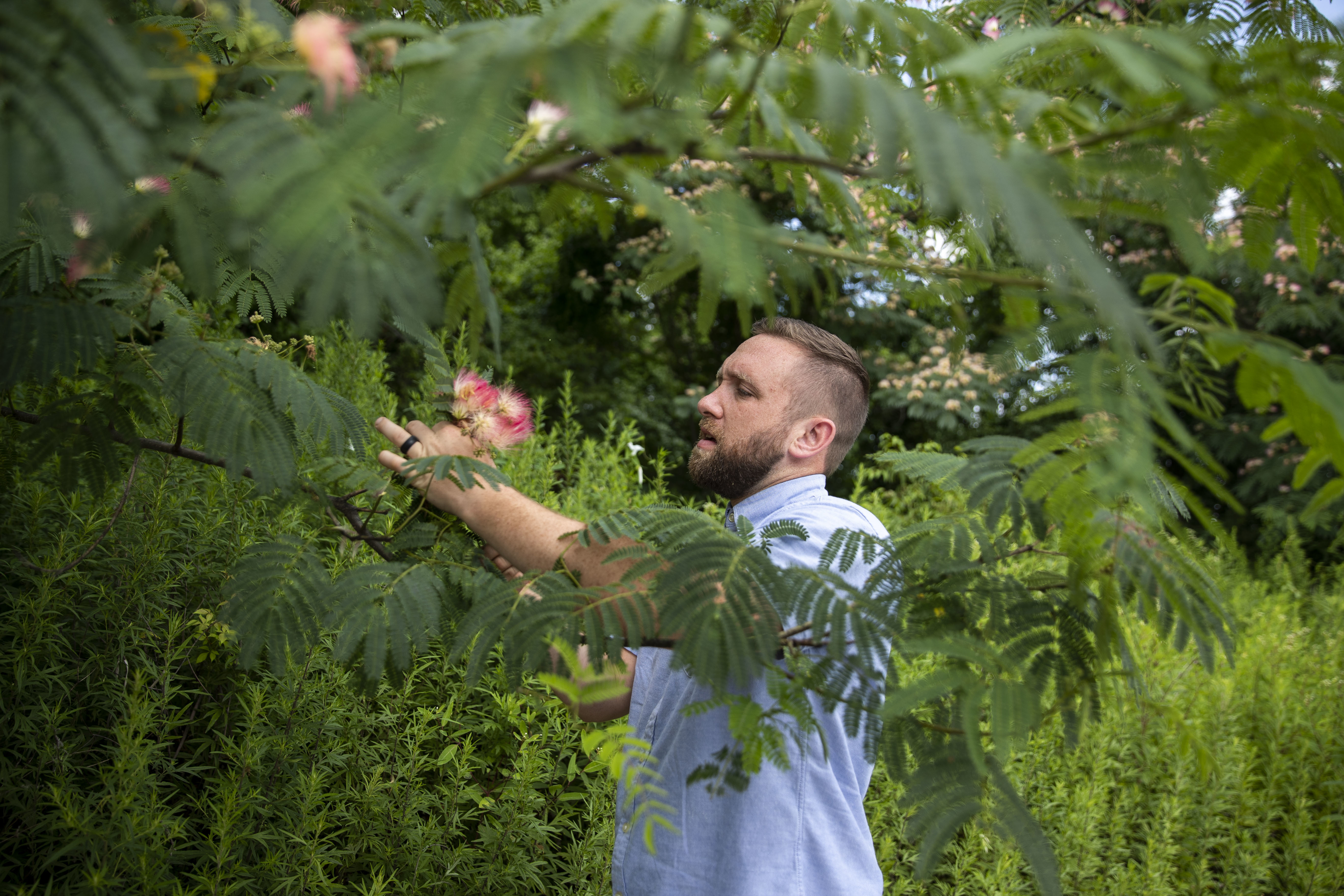
Danny Childs forages for mimosa tree blooms in Cherry Hill in 2021. The menu at his cocktail bar Future Days will include highballs, freezer martinis, and citywides, among other drinks.
In that time, he and Katie, a former events stylist for Terrain, have been building the Slow Drinks brand on social media and through classes, pop-ups, and beverages conferences. (Slow Drinks will have a headquarters and R&D lab on the second floor of Cescaphe’s building.) They’re weaving in their favorite takeaways at Field Day: nostalgia-driven aesthetics similar to Tina’s in Tulsa, house-canned cocktails like at Semiprecious in Denver, and a zero-waste program between the bar and kitchen inspired by Mexico City’s Baldio. Likewise, the bar will draw on globally sourced spirits made by producers who value “good, clean, and fair values,” Danny said.
“It’s very personal for us,” he said. “It’s the Slow Drinks bar that we’ve wanted to build forever.”
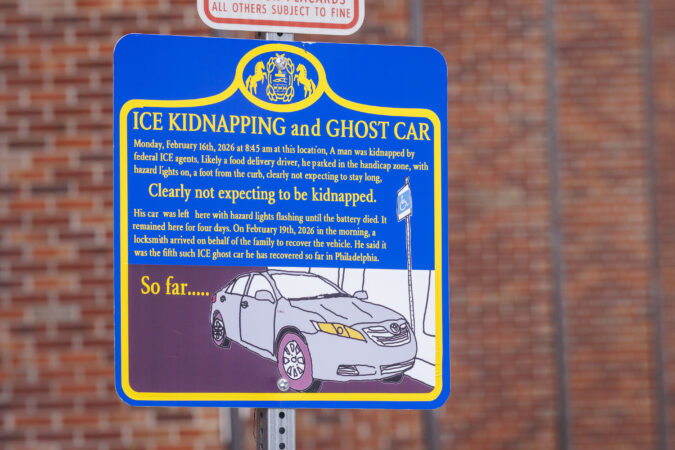
The fake but authentic-looking Pennsylvania historic marker, erected by two artists who sought to ruefully commemorate a local immigration arrest, disappeared from its post in Philadelphia sometime Monday.
Huston West, one of the artists, said he was walking his dog around 1 p.m. when he noticed that the sign was absent from its spot on Fairmount Avenue near Fifth Street. A neighbor told him the plaque had been there earlier in the day.
“It’s lame,” West said of the sign being removed. “But it got a lot of coverage while it was up.”
West said he could only speculate on who may have taken the marker ― he suspected conservative opponents, people who had criticized the sign on social media, or maybe even the city government.
A city spokesperson said he would check.
This particular, familiar-looking blue-and-yellow marker, similar to the ones that commemorate important people, places, and events in communities across Pennsylvania, was put up at the site of a Feb. 16 ICE arrest.
That morning, masked agents descended on a Gopuff delivery driver who had pulled over to make a quick drop-off in Northern Liberties. After he was taken into custody, the car remained behind for days, set two feet from the curb in an accessible parking space, its hazard lights blinking until the battery died.
West and a fellow artist who goes by the name Emeyewhisky wondered what had happened to the driver, and created a plaque bearing the header “ICE Kidnapping and Ghost Car.”
The ghost car terminology borrows from ghost bikes, the roadside memorials where a bicycle is painted white and placed at the site where a cyclist was hit and killed by a motorist.
Federal immigration authorities say the use of such terms as kidnapping is inaccurate and unfair, that they lawfully arrest migrants who have no permission to be in the United States and who in some cases have committed criminal and even violent offenses.
Immigration and Customs Enforcement officials in Philadelphia said that on Feb. 16, officers conducted a targeted action and arrested Abdulasen Nazarkhudoev. They said he was unlawfully in the U.S., and told them that he was a Russian citizen.
He was taken to the Federal Detention Center in Center City and later released by order of a judge, pending further immigration proceedings, records show.
ICE earlier referred questions about the sign to city officials.
As word of the art project spread on social media, some disapproved. Some suggested on a Northern Liberties Facebook group that the delivery driver was rightfully arrested.
West said Monday that he and his art partner had conferred about what to do next. Emeyewhisky is known for projects that place signs with fake wording on Philadelphia streets, and some have been removed.
Don’t be too surprised, Huston said, if an ICE marker should reappear.
At some Philadelphia Parks and Recreation centers, a grim tradition has developed over the years amid the winter scramble to secure some sort of summer programming for kids: Parents wait in line hours before enrollment even begins to snag a first-come, first-served camp spot.
This year, the city hopes to remedy that with the introduction of a lottery system at a handful of the most in-demand camps.
“We’re just learning from past years, trying to be flexible and give parents more time to come in,” said Rob Jackson, the department’s deputy commissioner of programs.
Yet some parents bemoaned what they described as a poorly communicated change, hearing about it a week before enrollment began with no explanation as to why, becoming just one more logistical quirk to navigate in the summer camp enrollment chaos.
That’s because, as with daycare, snagging a spot in any daylong summer program can feel like building a plane midflight. Applying to multiple summer camps is a must, setting aside a pool of money for application fees is necessary, and, oh, you’ll likely have to make a quick decision on whether to accept a spot despite not having heard back from everyone.
Even applying to the Philadelphia Parks and Recreation-run summer camps, one of the most affordable options in the city for kids ages 6 to 12, has its quirks. Because weekly rates start at $90, compared with the hundreds some other camps charge, spots in the department-run programs are some of the most coveted in the city.
Some rec centers are so popular that parents have resorted to waiting in line for hours on enrollment day to secure a spot. It’s a system that the city has heard feels unfair to families that cannot afford to take a morning off from work to do that.
In an attempt to make the registration process more equitable, the city rolled out a lottery system this week for potential first-time campers at some of the hardest-to-get-in sites: Fishtown, Northern Liberties, Shissler, Hancock, and Towey Recreation Centers. These sites are in the Fishtown, Northern Liberties, and South Kensington sections of the city.
Jackson said the change was inspired by staff, who described coming into work with long lines of parents already formed. If a parent could not make it on that day, it was one less summer camp option. And because younger siblings were given priority in an attempt to keep siblings together, one family could take up multiple camp spots in one go. Withthe lottery system, younger siblings have the same odds as other new registrants. Jackson recognized that might mean multiple camp drop-offs for some families, but he said the change was to “accommodate as many families in the community as possible.”
The lottery system has allowed sites like Hancock and Shissler to extend registration for new campers over the course of four days, giving all kids the same chance of snagging whatever few spots are available within the program as children age out or choose to go elsewhere.
One Fishtown parent this week, who asked to remain anonymous so as not to hamper their kid’s chances of snagging a spot, described the change as poorly communicated. The parent was left deflated by submitting applications at various locations, paying $50 per application, unsure what the odds were for getting into any of these camps.
Asked if the city has ever considered moving the applications online, Jackson said the city has not gotten to that point. So for now, the in-person site-by-site registration is the best the department can do for the more than 7,000 kids who attend camps across 120 to 130 host recreation centers.
The city could not say just how many camp spots would be freeing up this year, as it depends on how many children from what are considered “returning families” claim spots.
The summer childcare scramble
Even if a child can secure a spot in a city-run summer camp, it does not fully solve summer childcare needs for families.
The camps run for six weeks and have age restrictions. Parents often have to shell out hundreds more to fill in gaps in care.
Other summer camp operators have issues of their own. This year, the Academy of Natural Sciences of Drexel University and the Penn Museum announced they will not host their popular summer camps, citing budget constraints.
Dena Ferrara Driscoll, a mother of two who lives in South Philadelphia, has been a public advocate for more investment in summer camps and after-care programs. Her children attended city-run camps and now her son works at one in the summer.
Driscoll was not surprised by the continued demand for camp spots. The programs are “affordable, safe, and deeply loved,” she said.
“A lottery might change who gets a spot, but it doesn’t address the real issue: Families need more affordable camp options provided by the city, not just a new system to distribute the ones we already have,” she said.
Superintendent Tony B. Watlington Sr. on Thursday presented the Philadelphia School District’s long-awaited facilities master plan to board members, with revisions leaving two fewer schools slated to close than initially proposed.
Plans now included 18 closures and six other co-locations, as well as one new school building and other investments.
Of the district’s 307 buildings, most schools — 159 in all — would be modernized under the proposed plan. The district in January pointed to Frankford High, which closed for two years because of asbestos issues and just reopened in the fall with $30 million worth of work to spruce it up, as an example of modernization.
An additional 122 schools would fall into a “maintain” category, meaning they would receive regular upkeep. And six facilities would be co-located, meaning two separate schools would be housed under one roof, each with its own principal and team.
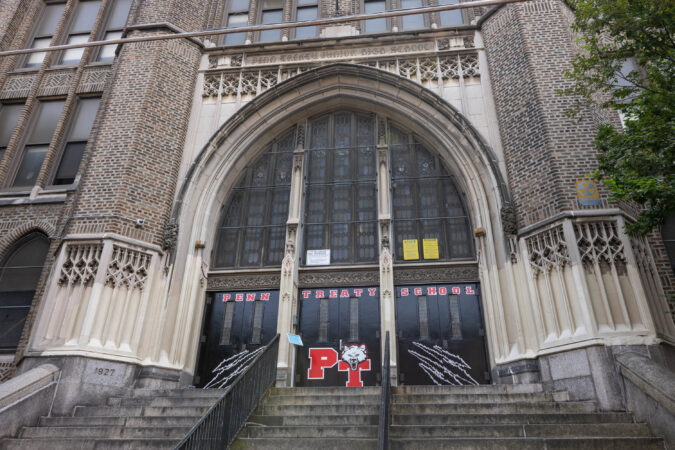
Finally, 18 schools would be recommended for closure. Among them is Penn Treaty, now a 6-12 school, which would close in its current form, but go on to house the current Bodine High School, a magnet in Northern Liberties. Bodine’s building would become the home of Constitution High, which now occupies a rented space in Center City.
As proposed, Watlington’s plan would cost $2.8 billion over 10 years. The district would put up $1 billion via capital borrowing during that time — leaving $1.8 billion unaccounted for that the superintendent said would need to be covered by state money or philanthropic support. If the district doesn’t get all or some of that amount, the plan would have to be amended.
Will some schools definitely close? Which ones?
Right now, the closures are just a proposal, and the school board is slated to have the final say. They could adopt all, some, or none of Watlington’s recommendations.
If the closures are approved, no school would be shuttered before the 2027-28 school year. And should some schools close, no job losses are expected, Watlington said last month.
Initially targeted for closure were Conwell Middle School in Kensington and Motivation High in Southwest Philadelphia, but both have since been spared. Both magnet schools accept students citywide, and their proposed closures saw opposition from powerful allies including several City Council members and Pennsylvania House Speaker Joanna McClinton.
That change, Watlington said, was not due to politics, and came after the district “poured through thousands of feedback loops from a number of Philadelphians.”
The board, meanwhile, is expected to vote in the coming weeks, though no date has been set.
What will happen to students who attend closing schools?
Every affected student would be routed to a new school. A new transition office would work closely with impacted communities to make sure academics, attendance, and social-emotional needs don’t suffer, Watlington said.
“These families will get gold-standard, red-carpet treatment directly from the superintendent’s office,” he pledged.
Why are these changes necessary?
The district hasn’t had a facilities master plan in more than a decade. It has 70,000 empty seats citywide, with some schools overcrowded and others with entire unused floors. It’s also got a lot of aging buildings — the average district school is nearly 75 years old — and many have environmental and/or significant systems issues.
Officials said they want to solve district-wide disparities: Some schools have art, music, and ample space for physical education, plus extracurricular activities, and some have few of those things.
How were school buildings’ fates determined?
Watlington said there was no formula to determine his recommendations. But four factors entered into the decision: building condition, utilization, the school’s ability to offer robust programming, and neighborhood vulnerability — a new measure that considers things like poverty and whether the area has lived through prior school closings.
The district formally launched the final phase of its facilities master planning process in late 2024. Since then, officials have hosted 47 community conversations and received 13,700 survey responses from people in every zip code in the city. Officials heard from a project team of 30 members and received feedback from nine advisory groups composed of more than 170 members.
The district later launched surveys to gain more input, with the topline result being that Philadelphians didn’t want their local schools closed. Many respondents outlined fears about potential hardships that closing schools could create, such as longer walks to school or tough bus rides in unfamiliar or unsafe areas.
And they flagged worries about merging schools and having large grade spans in a single building.
When did the district last close schools?
Mass school closures last happened in 2012 and 2013, when 30 schools shut.
That process hit economically disadvantaged neighborhoods disproportionately, did not yield substantial savings, and generally led to worse academic outcomes and attendance for students.
The mistakes of 2012 informed this go-round, officials said. They have promised better services for schools, students and families affected by any coming transitions.
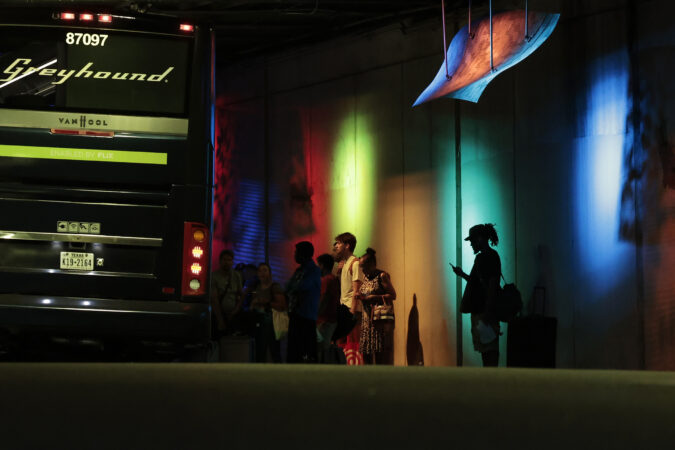
Lights shine from a window of the abandoned Greyhound intercity bus terminal on Filbert Street as construction crews demolish fixtures and begin renovations ahead of a May reopening.
While the old depot is ready for crowds of travelers attending high-profile special events this year, the city Department of Planning and Development has identified three possible locations for a permanent intercity bus station.
Officials sifted through 208 possible locations over the past two years before zeroing in on the three sites:
Eighth and Arch Streets: A pair of parking lots on Arch Street near Eighth Street next to the African American Museum. The lots, at 701-709 and 721-737 Arch St., are owned by the city and Parkway Corp.
15th and Vine Streets: The Philadelphia Gateway Garage at 1540 VineSt. along with an adjoining parking lot. They are owned by the Pennsylvania Department of Transportation and the Philadelphia Parking Authority.
Near 30th Street Station: A parking lot just north of 30th Street Station, at 2931 ArchSt., near the Cira Centre office tower.
On Wednesday, the city Planning Commission is holding a public open house at Independence Visitors Center from 6to8 p.m. People can learn about the sites, share their ideas, and ask questions about the future home of an intercity bus facility.
There’s also an online survey collecting opinionsaboutwhat the intercity bus station needs andwhere it should go, due March 13.
The former Greyhound terminal at 1001 FilbertSt. “is not a long-term solution for the city’s intercity bus needs,” city officials say, though it will provide a safe and comfortable indoor station for travelers, as opposed to the current, haphazard outdoor curbside loading zones along Spring Garden Street near Columbus Boulevard.
It is scheduled to reopen in plenty of time for eventscelebrating America’s 250th birthday and World Cup soccer tournament matches in the summer.
The city says its goal is a modern “transportation hub” with amenities for travelers and bus operators and, ideally, some development built around the facility. It would be owned by the city.
“Public ownership means it won’t be closed down by a landlord or private bus company,” the planning department said in a statement. In addition, the forever depot “could be designed to have housing in the floors above the station or retail spaces within the station. These uses could help support … construction and operation.”
Why was Philly’s Greyhound terminal moved?
Greyhound ran the terminal at 10th and Filbert for more than three decades but pulled out in June 2023, ending its lease with the owners amid the bus company’s push to cut costs by shedding real estate it owned or rented nationwide.
Other intercity bus carriers have done the same, operating from curbsides in a number of cities.
When those plans fell through, the building was empty again, while Greyhound, its parent company FlixBus, and family-owned Peter Pan Bus Lines were operating at curbside on the 600 block of Market Street. That site, chosen by city officials, lacked benches, bathrooms, or shelter for customers.
Traffic was a mess, and SEPTA had to reroute some of its metro bus routes for a time.
In November 2023, Greyhound and the other carriers moved operations to a corner in Northern Liberties along Spring Garden Street with more space than the Market Street block. City officials promised it was temporary, but the “station” is still there, with attendant trash and disruptions to local business.
Consultants and city planners picked 35 potential sites for closer analysis. They were looking for places that could accommodate a multistory, mixed-used development in addition to a station and that were close to Center City or University City, transit, and highway ramps.
Strengths: Proximity to several transit stops and to I-676 and I-95, as well as the potential to build public parking above the station and to use the African American Museum building when that entity moves to the Parkway.
Challenges: The ownership, split between the city and a private corporation, could require coordinating with the Federal Detention Center there on the southwest corner, and buses may need to be routed through Chinatown.
Challenges: Amtrak owns the property, however, and the city would have to coordinate with the company to develop over the railroad tracks and the structural work needed to strengthen the lot and ramps for heavy bus traffic. PennDot also has said there would have to be substantial work to the entrance and exit ramps to the Schuylkill Expressway.
What’s next?
The city plans to consider the feedback it gets Wednesday, update the schematics, and then hold another public event later in the year. It hopes to have a final report by the end of 2026 that names the site.
And then begins the long process of acquiring the site, designing the project, and figuring out how to pay for it.