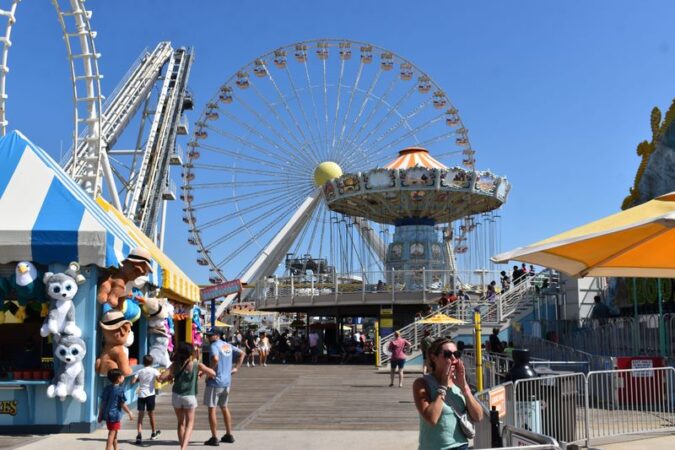
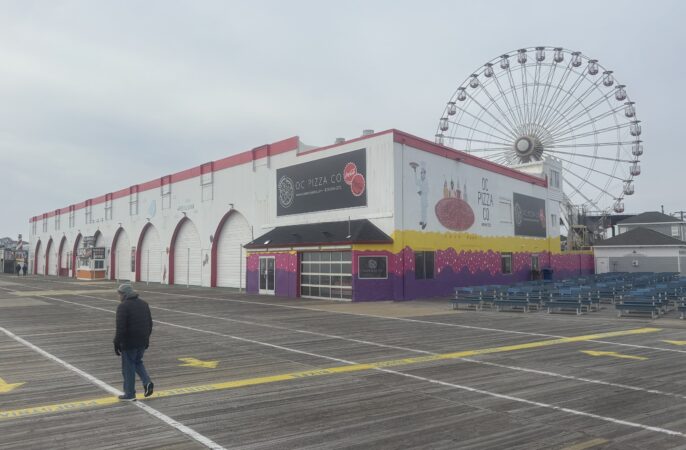
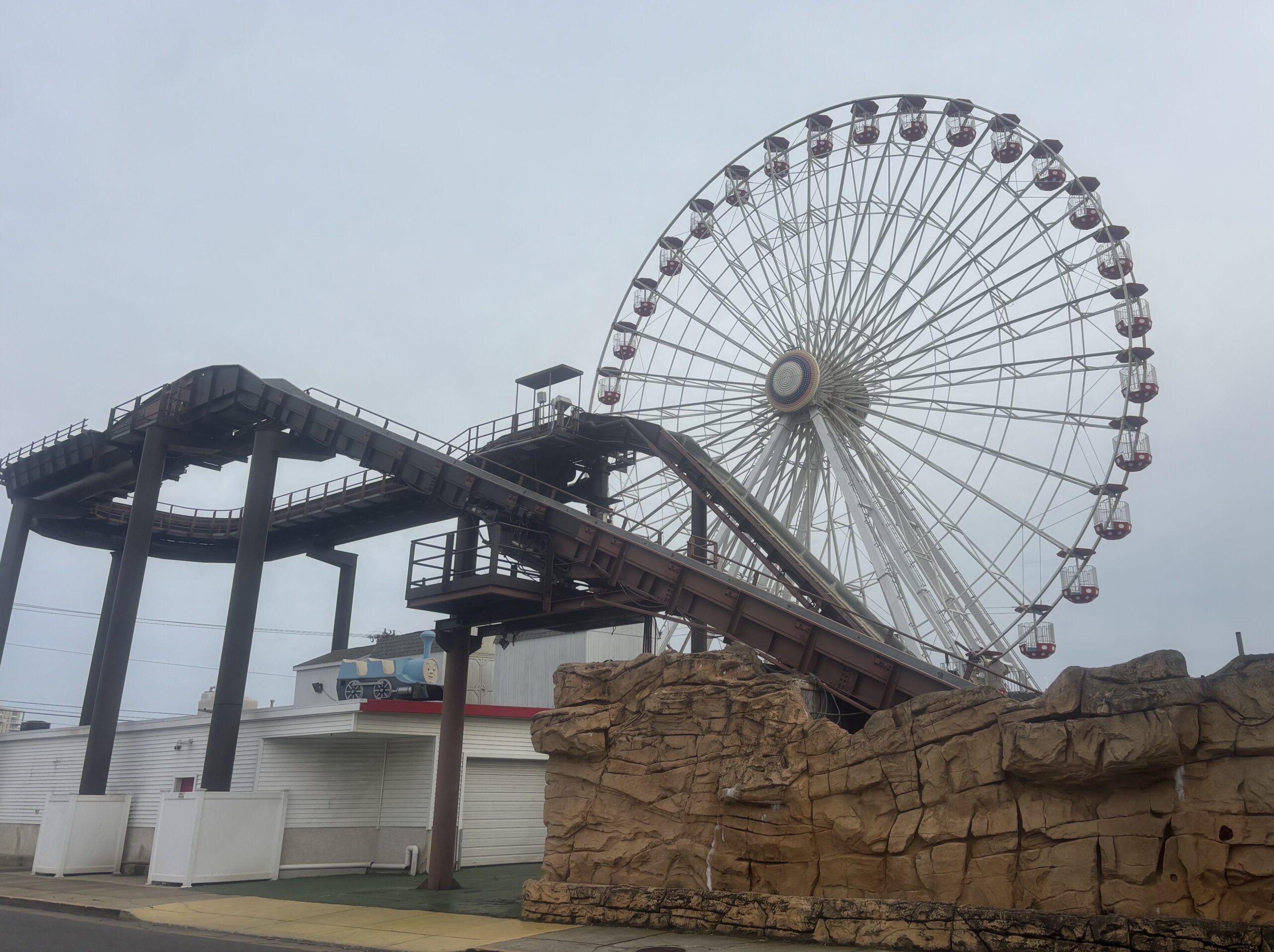
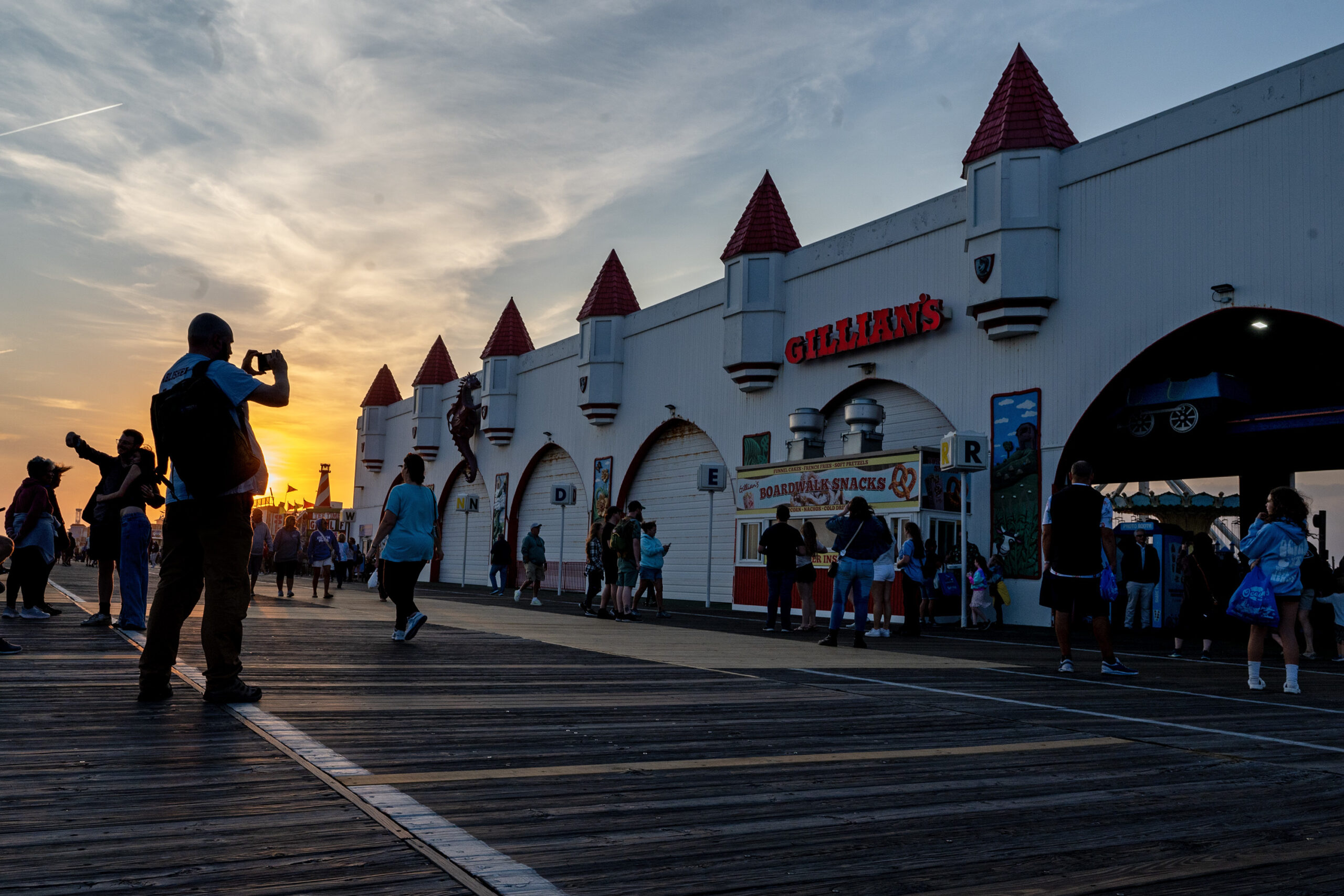
A man has been arrested in the theft of more than $175,000 worth of metal and mechanical components from the iconic Jersey Shore theme park Morey’s Piers.
Wildwood police said they arrested William Morelli, 67, of Wildwood Crest. Police first became aware of the heist, which occurred over several days, on Feb. 4. The reporting party provided police with a suspect and vehicle description after reviewing surveillance video.
Upon investigation, police said they identified Morelli, as the suspect who removed a large amount of metal from Morey’s temporary work site on the beach.
Morelli allegedly removed metal from the beach before selling it to an unidentified scrapyard business, according to Wildwood police. Morelli was charged with theft of movable property and later released from custody.
The theft comes at a time when the iconic Morey’s Ferris wheel is undergoing much-needed renovations at the South Philadelphia Navy Yard.
Geoff Rogers, chief operating officer at Morey’s Piers, said although work crews remain optimistic, the stolen materials bring an “unexpected and disappointing setback” to the project.
“We are heartbroken by this incident,” Rogers said. “The Giant Wheel holds deep sentimental value for not only the company and our team members, but the generations of families who have made memories on it.”
Despite the theft, Rogers said that the planned Ferris wheel renovation should be complete by the start of the 2026 summer season, as originally planned.
The Giant Wheel, a 156-foot LED-lit Ferris wheel and one of the tallest at the Jersey Shore, is disassembled, repaired, and repainted regularly, but this year’s renovation required transportation to the Navy Yard to work on its 16,000-pound centerpiece.
Designed by Dutch ride manufacturer Vekoma Rides and installed in 1985, the Giant Wheel has been a recognizable symbol of the Wildwood skyline for decades. In 2012, they upgraded it with an LED light system.
After last year’s closures of Gillian’s Wonderland in Ocean City and Wildwood’s Splash Zone Water Park, Morey’s Piers are the last beachside water parks and one of the Jersey Shore’s remaining large-scale Ferris wheels.
The federal official in charge of the U.S. Army Corps of Engineers visited Ocean City and other Jersey Shore communities Friday, along with U.S. Rep. Jeff Van Drew, pledging that beach replenishment help is on its way.
Adam Telle, assistant secretary of the Army for civil works, came to New Jersey for a tour hosted by Van Drew. The Army Corps manages beach projects and puts up the majority of money. States and municipalities contribute the rest.
“There’s emergency funding that’s available,” Telle said from Fifth Street on Ocean City’s boardwalk, adding that some beaches would see repairs by summer.
Telle said the money does not hinge on legislation and has President Donald Trump’s support.
The Army Corps will evaluate which beaches are in the most severe condition, he said, including Ocean City, which is among the top of the list. Telle and Van Drew did not cite a specific amount of money but indicated millions could be available.
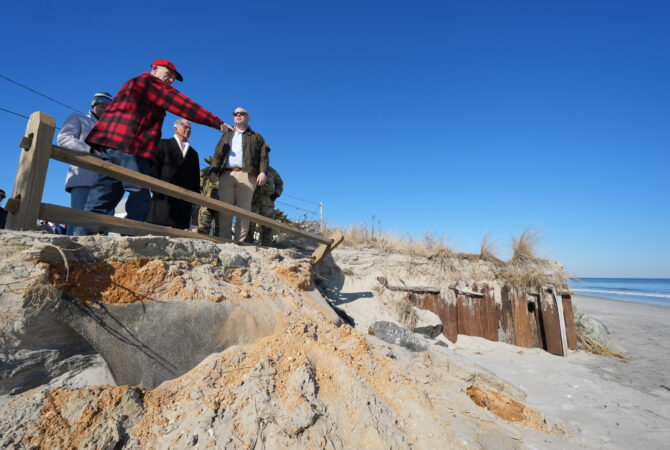
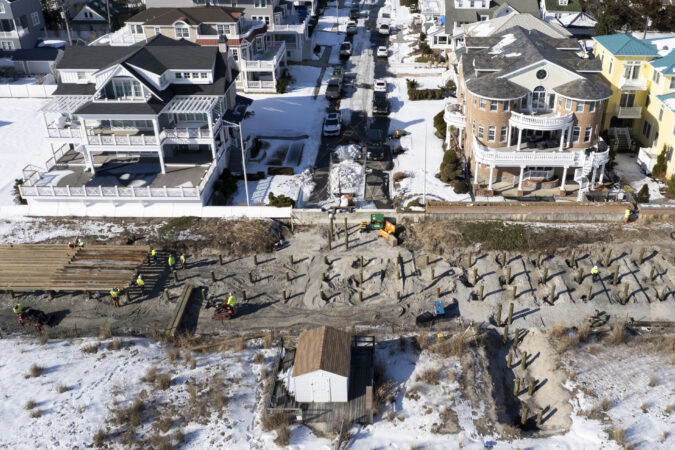
Telle, Van Drew, and other officials visited Strathmere, Avalon, and North Wildwood, which have all been heavily impacted by storm erosion over the last year. The short-term goal this year would be to take spoils from Army Corps projects and spread that on beaches.
They said they plan to draw on a mix of funding, including money still remaining from Hurricane Sandy in 2012, other supplemental funds, and earmarks — language in appropriations bills to direct federal funds to state and local projects.
Van Drew, a Republican, represents multiple Shore towns on the southern tip of New Jersey.
Friday’s tour came on the heels of zero dollars earmarked for beach replenishment in 2025 — the first time that had happened since 1996. Up to $200 million annually has typically been awarded for beach erosion control projects.
Van Drew also introduced a bill last week to establish a new source of continuous beach replenishment money through the Coastal Trust Fund Act.
The bill would pay for ongoing coastal storm risk management by the Army Corps. U.S. Rep. Laura Gillen, a Democrat from New York, is a cosponsor.
According to Van Drew, the legislation would use revenue from offshore energy leases to fund $1 billion a year into Army Corps of Engineers coastal storm management projects.
He said his bill, if approved, would create a permanent source of funding so that it would not depend on yearly appropriations from Congress.
“We need to get a permanent system in place so we aren’t riding this roller coaster,” Van Drew said.
However, he acknowledged that getting any bill approved in Congress right now is difficult.
“It’s going to be a labor of love,” Van Drew said, adding that he is gathering “support from all around the country.”
There is no date for a vote on the bill.
U.S. Rep. Jeff Van Drew (center), Assistant Secretary of the Army for Civil Works Adam Telle (right) and Upper Township Mayor Curtis Corson Jr. discuss shore erosion and beach replenishment in Strathmere.
A measure has been introduced by U.S. Rep. Chuck Fleischmann, a Republican from Tennessee, for $23 million to fund coastal replenishment projects this year. That would be supplemented by a Senate bill introduced by U.S. Sen. John Kennedy, a Republican from Louisiana, that would allocate $62.2 million. However, neither bill is scheduled for a vote.
In 2025, multiple New Jersey Shore towns found themselves in a crisis over erosion as Congress and Trump pushed for a huge reduction in the federal budget.
No money was made available for crucial beach nourishment projects. The lack of funding became a political issue in New Jersey, which depends heavily on its beaches for tourism revenue.
For decades, beach projects have been a staple of coastal management in the United States. In 2025, projects were paused in New Jersey, Maryland, and Delaware.
Projects set for Cape May, Stone Harbor, Avalon, Sea Isle, Strathmere, Ocean City, and Long Beach Islandwerestalled because of the lack of funding. Georgia and Florida also were affected.
In October, Ocean City declared a local emergency over the severe erosion exacerbated by storms like Hurricane Erin and a potent nor’easter in October. The city was left grappling with sand cliffs upward of five feet high after the storms scoured its beaches.
Mayor Jay Gillian and others pushed for urgent state and federal intervention, citing the difficulty of managing large-scale beach replenishments and dune restoration with city resources alone.
Gillian said Friday at the tour stop in Ocean City that he welcomed any help from the Army Corps and Van Drew.
“They’re working for a solution,” Gillian said of Telle and Van Drew. “The permanent funding, that’s huge because it stops the games, and it stops the politics.”
Van Drew represents the largely conservative 2nd District, which spans mostly rural and Shore communities in South Jersey, including all of Atlantic, Cape May, Cumberland, and Salem Counties, plus parts of Gloucester and Ocean Counties. He remains optimistic for funding.
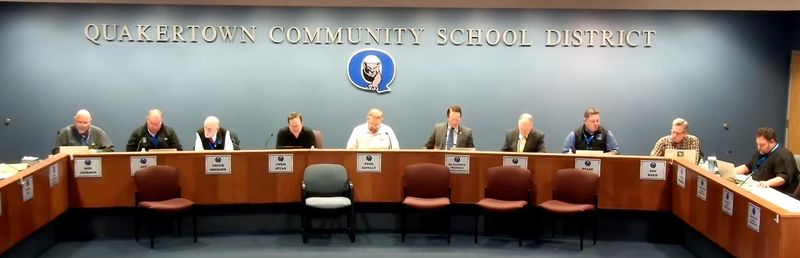
Quakertown Community School District Superintendent Matthew Friedman is on leave effective immediately, a district spokesperson said Friday.
The spokesperson, Melissa Hartney, said the district’s school board could not comment further.
“Because this is a personnel matter, the board is limited in the amount of information it can share at this time,” Hartney said in a statement.
Friedman did not return a request for comment.
Friedman took over the 4,600-student district in Upper Bucks County in 2023, after serving as superintendent of the Ocean City School District in New Jersey.
The Quakertown school board in November granted him a $10,000 raise, bringing his salary to $233,000, and extended his contract until June 30, 2028.
Assistant Superintendent Lisa Hoffman is taking over day-to-day operations of the district, Hartney said.
“The board is confident that district operations, instructional programs, and student services will continue without interruption,” Hartney said, adding that it “remains committed to transparency, accountability, and maintaining the trust of our students, staff, families, and community.”
Shareholders of Camden-based American Water Works and Bryn Mawr-based Essential Utilities, which owns the Aqua water and sewer companies, voted overwhelmingly Tuesday to merge and create a combined company with nearly $30 billion in yearly water and sewer sales.
More than 99% of the 161 million American Water shares that were voted were cast in favor of the deal, the company told the Securities & Exchange Commission. Essential’s online proposal to merge was approved by around 95% of voting shareholders.
The planned combination of these rivals, which have competed for more than 100 years to manage water and sewer for the small number of U.S. communities that allow for-profit operators, still needs approval from state public utility commissions.
The combined companies’ sales are concentrated in Pennsylvania and New Jersey. In suburban Philadelphia, Aqua serves West Chester, northern Delaware County, parts of Lower Bucks, and Main Line communities. American Water serves Abington, King of Prussia, Norristown, Phoenixville, and nearby towns.
New Jersey American Water serves towns along the PATCO rail line in Camden County, in northern and central Burlington County, and in Shore communities such as Absecon and Ocean City. Aqua New Jersey has customers in the three suburban South Jersey counties and at the Shore.
American Water’s 14 million U.S. customers include systems in 12 other states, and on 18 U.S. military bases. Essential has around 3 million customers, including systems in six other states,and Pittsburgh-based Peoples Gas, which serves 750,000 in western Pennsylvania and Kentucky.
American Water is already the nation’s largest private operator of water and sewer systems, and the deal will make it a larger player in competition with Florida-based NextEra Water Group and France-based Veolia’s U.S. operations, among other private systems that have been seeking to expand.
A separate vote on an Essential executive pay package drew some opposition, with 85%approving.
That package included more than $17 million in severance compensation and stock grants for departing Essential CEO Christopher H. Franklin, plus medical benefits and up to three years’ professional assistance helping him land another job, plus millions more for his four top deputies.
The merged company’s larger size, as big as many of the leading natural-gas companies that dominate utility stock-index funds, will boost its visibility to investors, John C. Griffith, the American Water chief executive who will run the combined companies, said in announcing the deal last fall.
The companies disclosed the approvals Tuesday afternoon and said more details on the vote and their plans would come later this week.
Deal backers say the combination should enable Griffith to cut management costs, boost profits, drive up the share price, and could ease pressure to keep raising water rates.
Regulators in New Jersey and Pennsylvania are weighing the company’s latest rate increase requests. American Water’s New Jersey affiliate is asking the state Board of Public Utilities for an average 10% water and 8% sewer rate hike on Jan. 16 for 2.9 million customers, which it said would fund improvements to aging water and sewer systems. Customers would pay an average of $18 more a month.
Pennsylvania’s Public Utility Commission said last month that it would consider the company’s request to boost water and sewer rates on 2.4 million customers by an average 15%, or $20 a month.
Critics had urged Essential to seek rival buyers to drive up the share price and shareholder profits from the sale, noting that both stocks had dropped after the merger was proposed last year.
Tim Quast, founder of Colorado-based ModernIR, a consultant the companies hired to help explain the merger, said share price declines are now typical, even for merger-target companies like Essential whose shares command a premium from buyers like American Water because index-fund investors such as Vanguard and BlackRock tend not to buy more shares of merging companies until a deal is completed.
Even after long competition from U.S. and foreign utility owners, private water companies serve only about one in six Americans. In recent years, customers of public utilities serving parts of Chester, Delaware, and Bucks Counties have defeated privatization campaigns, though some towns in Pennsylvania and New Jersey have signed on. Pennsylvania also has asked private operators to take over small, troubled public systems.
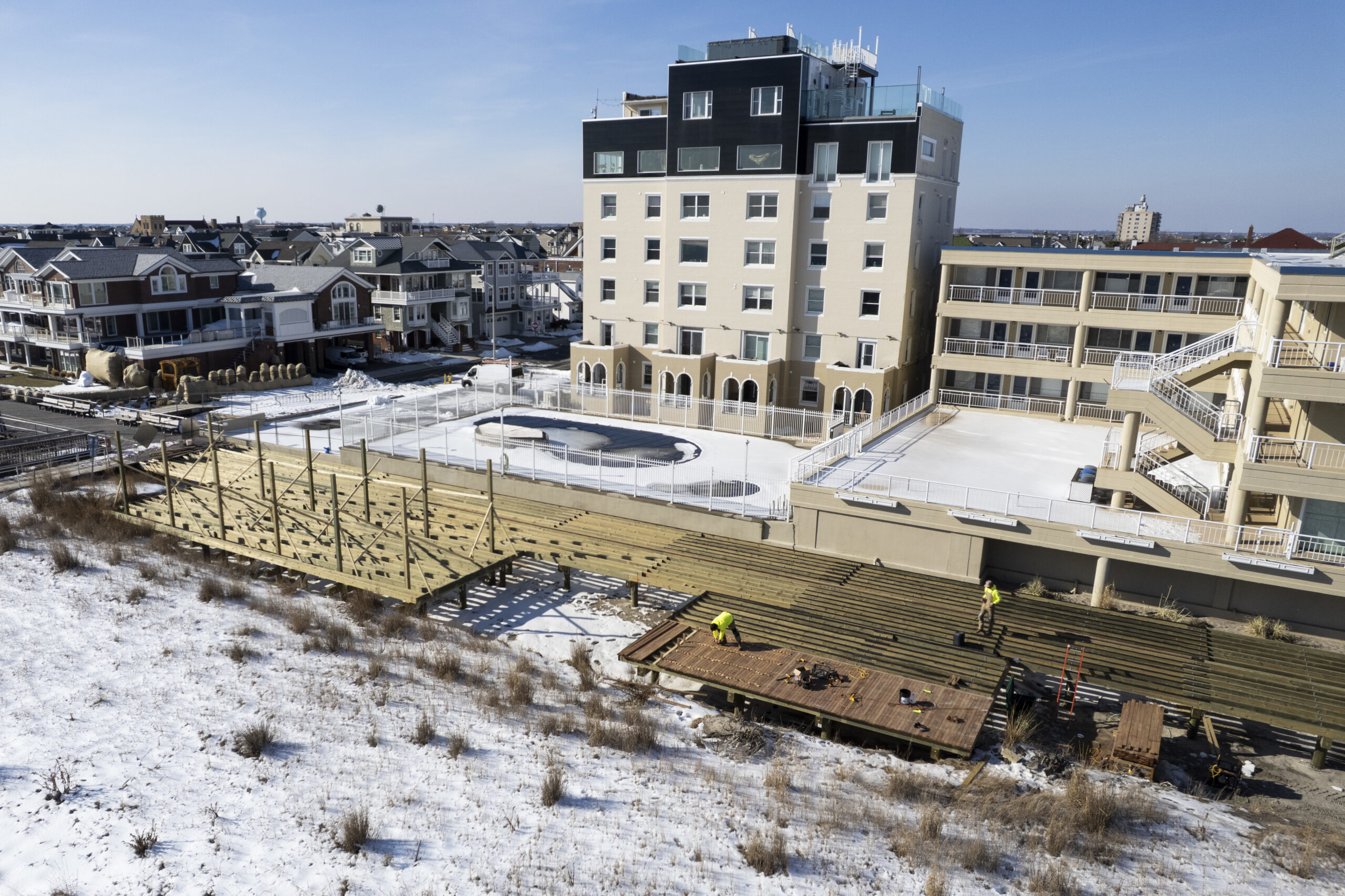
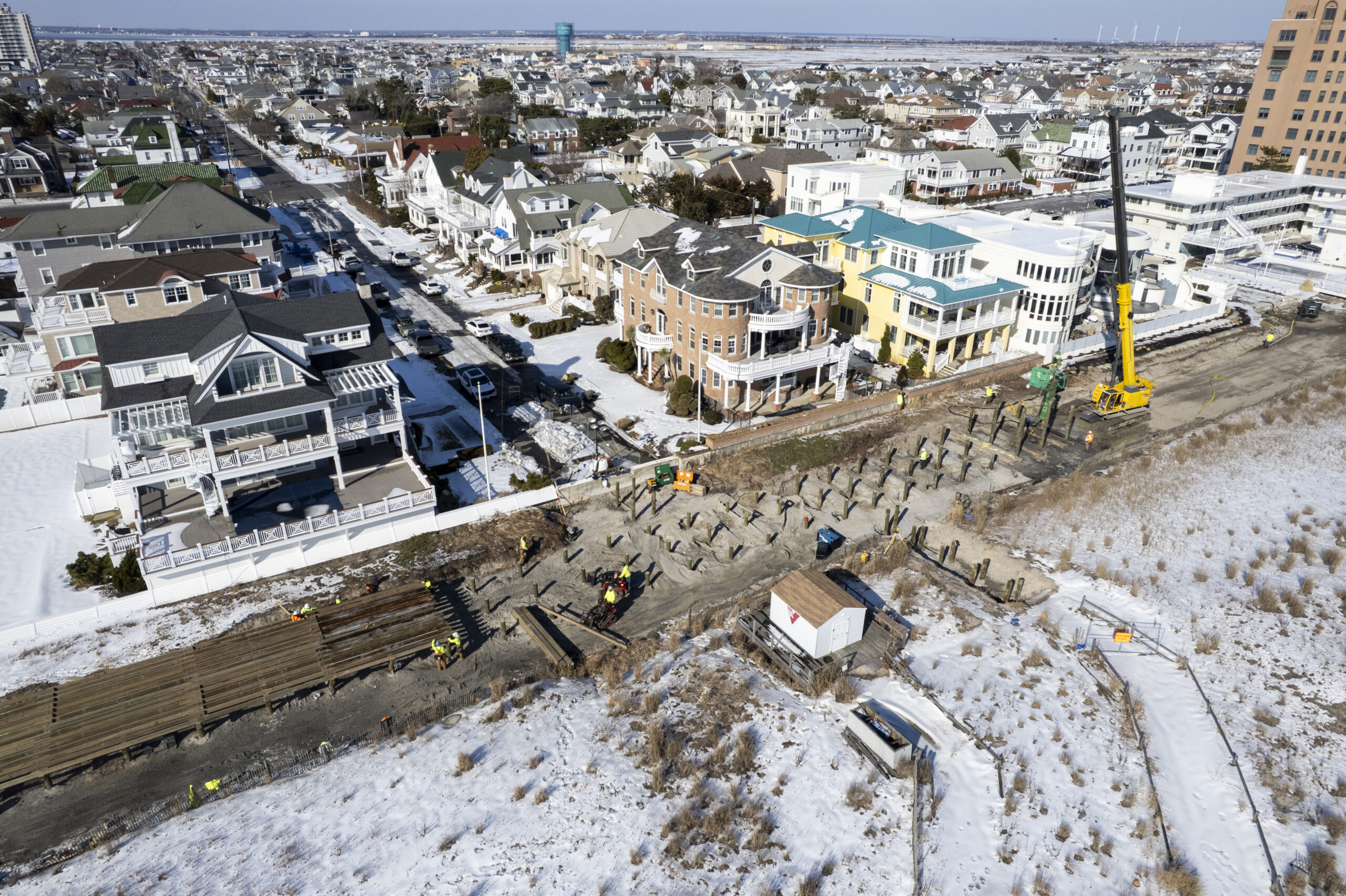
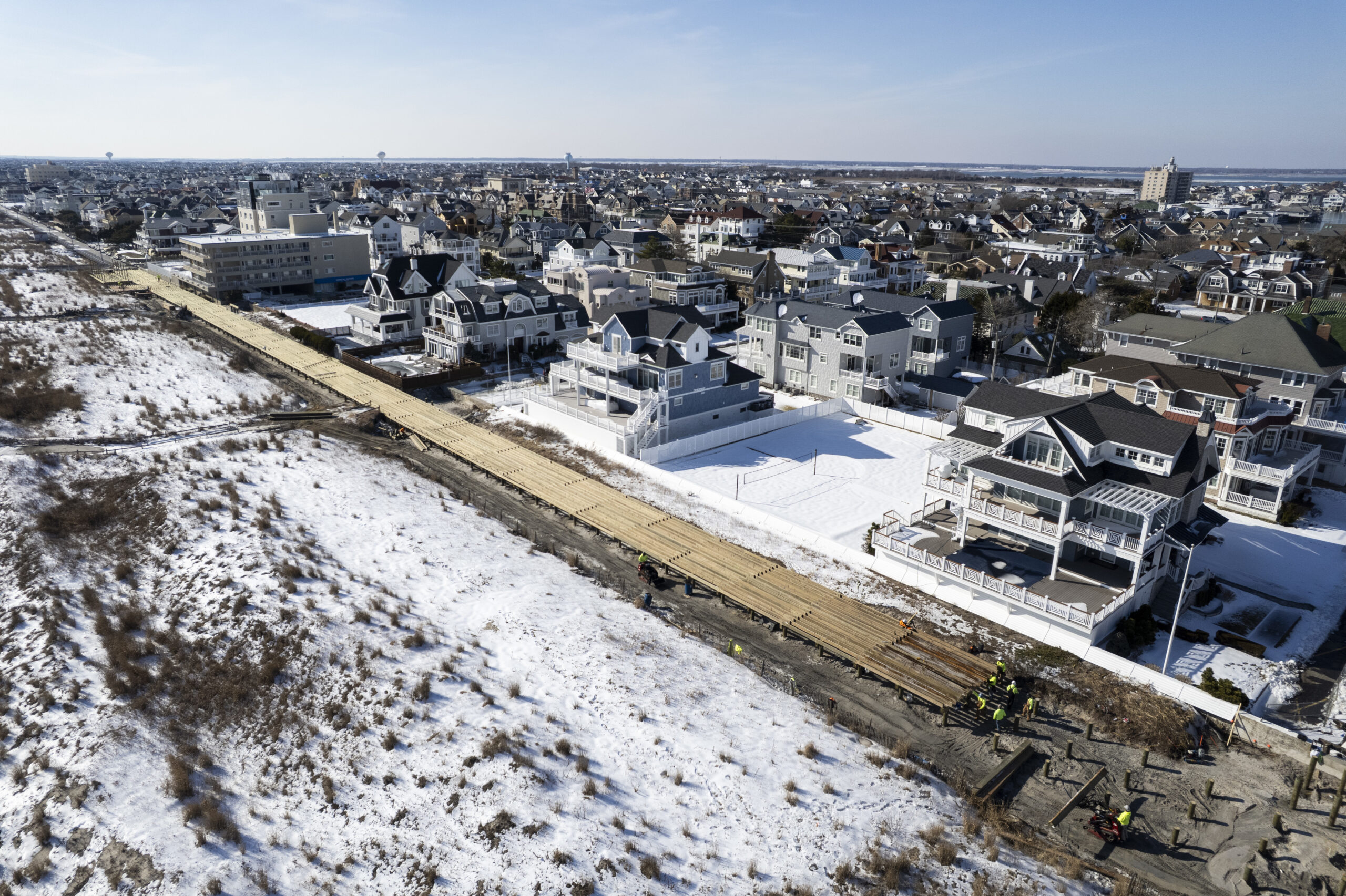
VENTNOR, N.J. — They demolished the existing boardwalk from the tennis courts to the fishing pier, north to south, and now they are building their way back up.
Financed mostly with federal funds granted to New Jersey from the COVID American Rescue Plan, Ventnor and other Shore towns like Ocean City, North Wildwood, Atlantic City, and Wildwood have set out to redo or upgrade their iconic pathways.
Ventnor is using $7 million in federal funds and bonded for about $4 million more, officials said.
Will this stretch of boardwalk reconstruction be done by Memorial Day?
Construction continues on the boardwalk on Wednesday, Feb. 4, 2026, in Ventnor City, N.J.
“It’s always a worry,” Ed Stinson, the Ventnor city engineer, said in an interview late last month. “We’ve had multiple meetings with the contractor [Schiavone Construction], one as recent as three weeks ago. In all the meetings, he’s said it’ll be complete and open before Memorial Day.”
The reconstruction has delivered a seven-block offseason interruption in a walkway that is popular year-round.
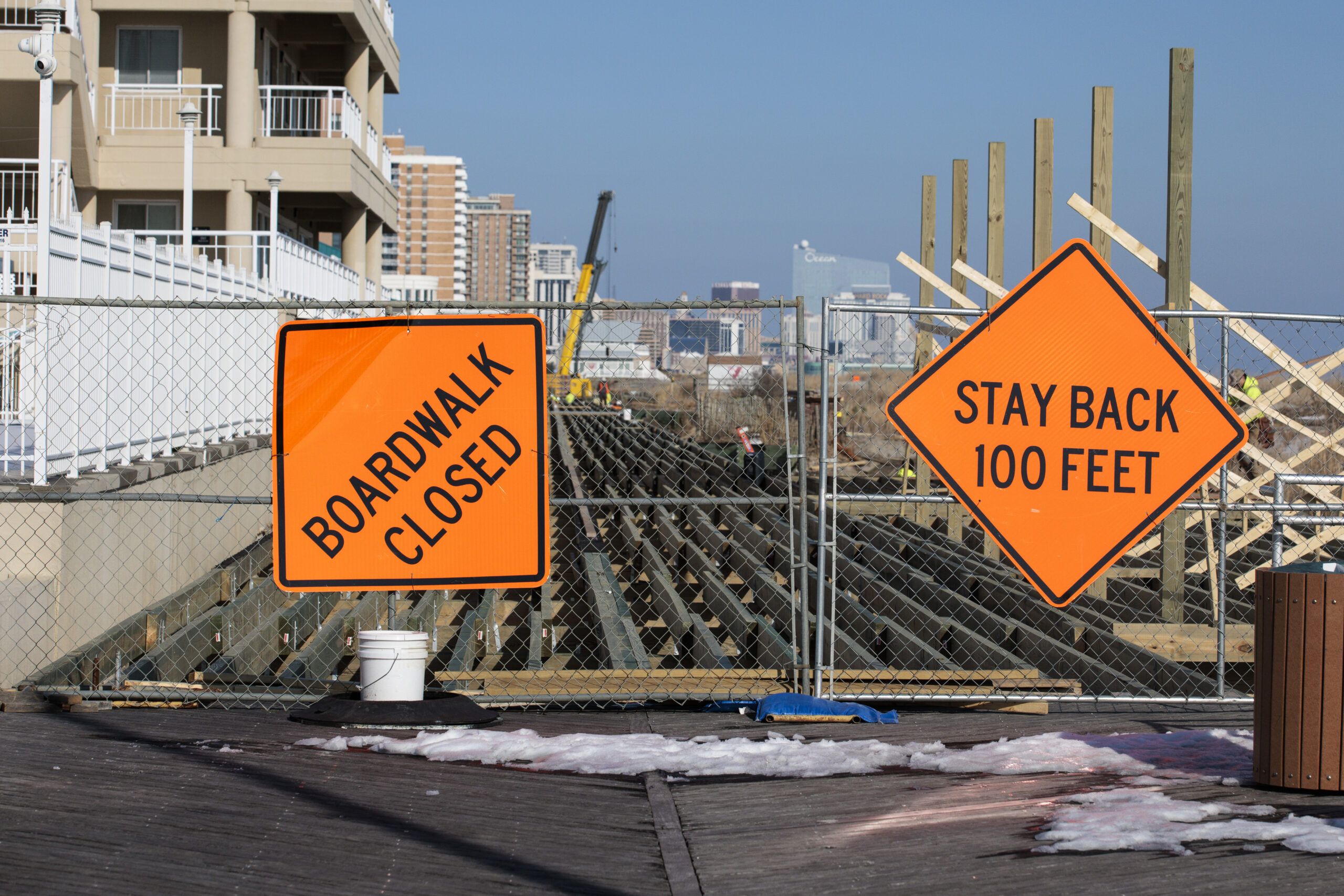
Work will stop for the summer, city officials say. In the fall, a second 13-block section, from Suffolk Avenue to the Atlantic City border at Jackson Avenue, will begin. There is currently no funding or plan for the boardwalk from Cambridge south to the Margate border, said Stinson.
The biggest change people will notice is that the original and distinctive angled herringbone decking pattern of the boardwalk is being replaced with a straight board decking. Ultimately, it came down to cost over tradition.
“There was discussion about it,” said Stinson. “There’s additional lumber that’s wasted when you do the herringbone, and the labor to cut that material. The additional material costs were significant. It’s a waste of tropical lumber. The only reason to go herringbone is tradition and appearance.”
The reconstruction has delivered a seven-block offseason interruption in a walkway that is popular year-round. Work will stop for the summer, city officials say.
Other differences are changes in lighting (lower, more frequent light poles) and some enhancements of accessible ramps. The existing benches, with their memorial plaques, will be back.
To demolish the boardwalk, the contractor cut the joist and the decking in 14-foot sections, “swung it around, carried it over to the volleyball court,” Stinson said, on Suffolk Avenue.
“That’s where they did their crushing and loading into the dumpsters. They worked their way down and followed that with the pile removing.”
The original herringbone pattern can be seen on the left, compared with the new straight decking pattern on the new construction side.
The other massive job was excavating the sand that had accumulated under the boardwalk. “They screened it, cleaned it, and put it down there,” on the beach in piles. It will be spread around above the tide line, Stinson said.
Once the excavation was down, the pile driving crew set out beginning at the south end and working their way toward Suffolk Avenue. “Then the framing crew came in and started framing,” Stinson said. On Feb. 2, the third team began its work: the decking crew.
The weather has slowed the pace, Stinson said. “They were doing about 20 to 24 piles a day,” he said, a pace that dropped to about nine piles a day after the snowstorm and ice buildup.
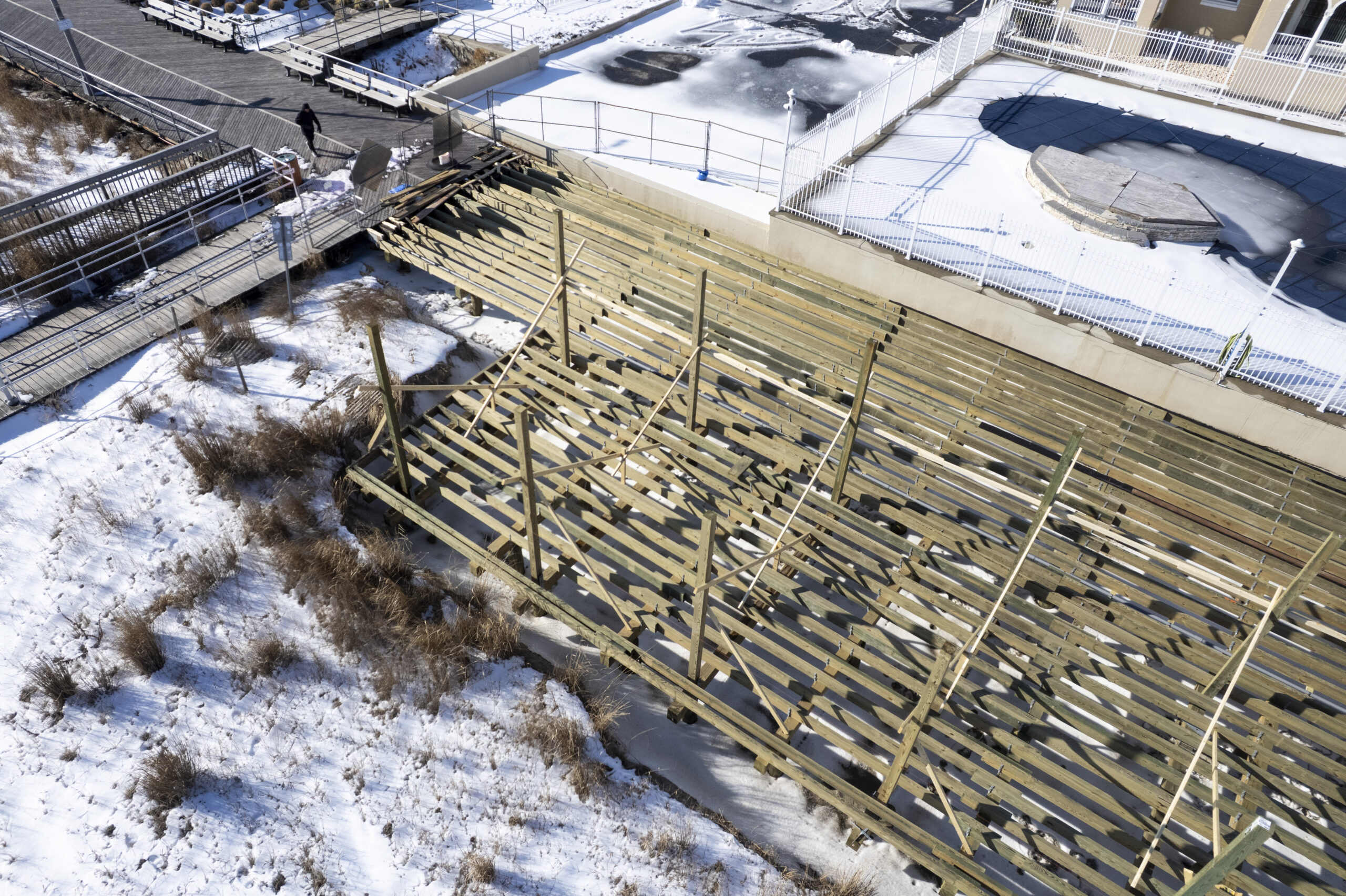
The framing crew installs pile caps, 8-by-14 beams that run across the boardwalk atop the pilings. The decking crew follows behind them, installing the wood, a tropical wood known as Cumaru. The use of Brazilian rainforest lumber at one time inspired protests, but that has not been an issue this time.
Construction continues on the boardwalk on Wednesday, Feb. 4, 2026, in Ventnor City, N.J.
Ventnor’s boardwalk, which links to Atlantic City’s famous walkway, dates to 1910. It was rebuilt twice before: once after the hurricane of 1944 and again after the March storm of 1962. Margate, on the southern end, never rebuilt its boardwalk after 1944.
Stinson said the tropical wood is noted for its “denseness and durability. It does not last forever.”
In all, $100 million of American Rescue funds was set aside by Gov. Phil Murphy for a Boardwalk Fund and awarded to 18 municipalities, including, as Stinson said, “anybody who has anything close to a boardwalk.”
Brigantine, with its promenade, received $1.18 million. Ocean City, in the process of rebuilding a portion of its north end boardwalk, received $4.85 million.
The two biggest recipients were Asbury Park and Atlantic City, each receiving $20 million. Atlantic City has completed a rebuilding of its Boardwalk to stretch all the way around the inlet to Gardner’s Basin. Wildwood, with $8.2 million, has undertaken a boardwalk reconstruction project, and North Wildwood, receiving $10.2 million, is rebuilding its boardwalk between 24th and 26th Streets, combining the herringbone pattern with a straight board lane for the tram car.
Although the timing of the reconstruction was no doubt prompted by the availability of the federal funds, Stinson said Ventnor’s boardwalk had shown signs of age.
“We’ve been into some significant repairs on the boardwalk,” Stinson said. “Those have increased every year. We were getting into pile failures. It was due. I don’t know if the city would have tackled it without the [federal] money.”
Ventnor’s boardwalk, which links to Atlantic City’s famous walkway, dates to 1910. It was rebuilt twice before: once after the hurricane of 1944 and again after the March storm of 1962.
OCEAN CITY, N.J. — Marie Crawford was immediately charmed in 2021 when she and her soon-to-be-surfer husband Rich moved into their historic house in the literal shadow of Gillian’s Wonderland Pier.
They’d come from Blue Bell, Pa., to live year-round by the ocean, and landed with an amusement park right up the street.
“The ball drop, that was what we heard from my house,” she said, referring to the 130-foot-high Drop Tower ride. “It was, ‘Ah, ah, ahhhhhhhh,‘” she said, imitating the screams she would sometimes hear.
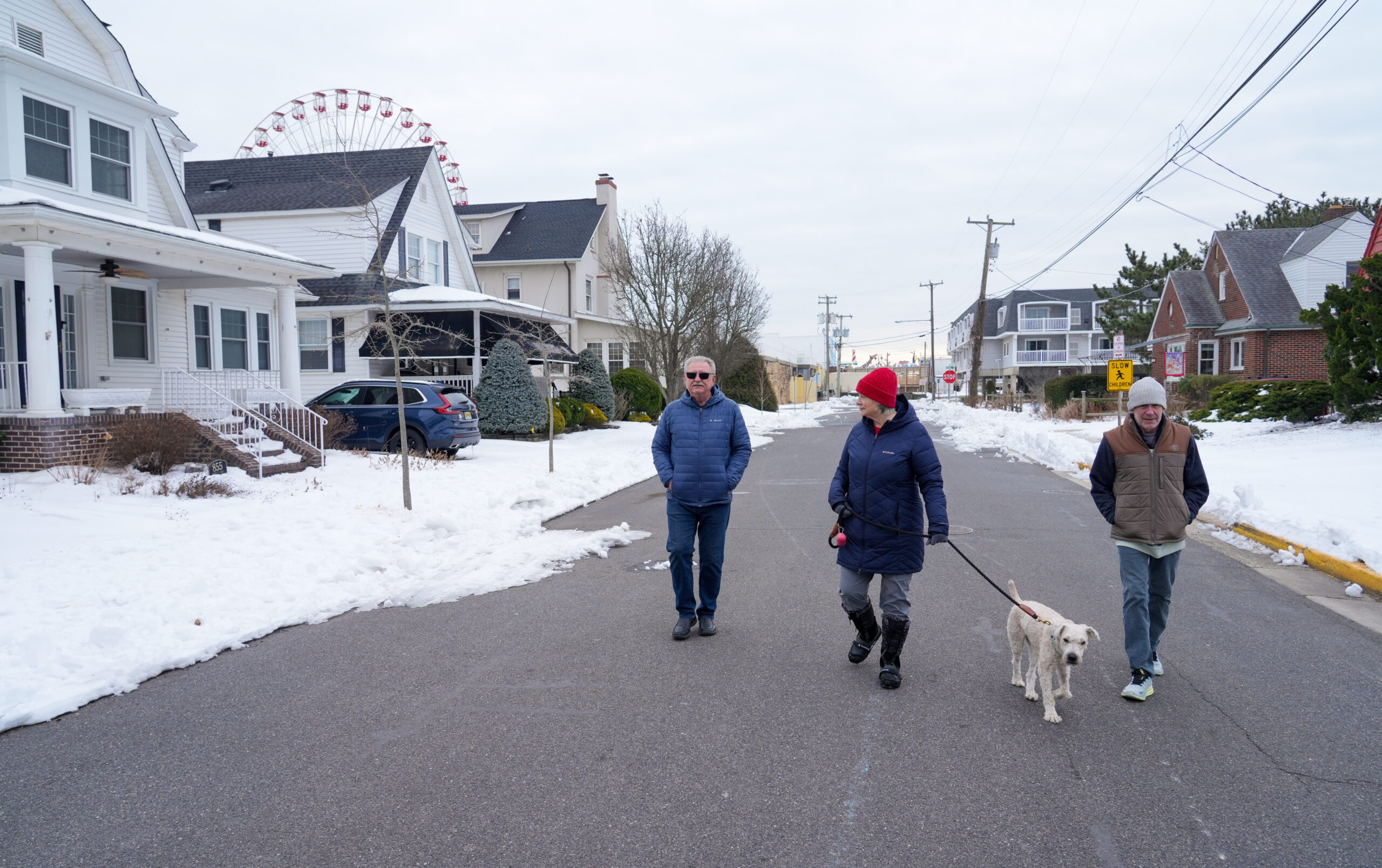
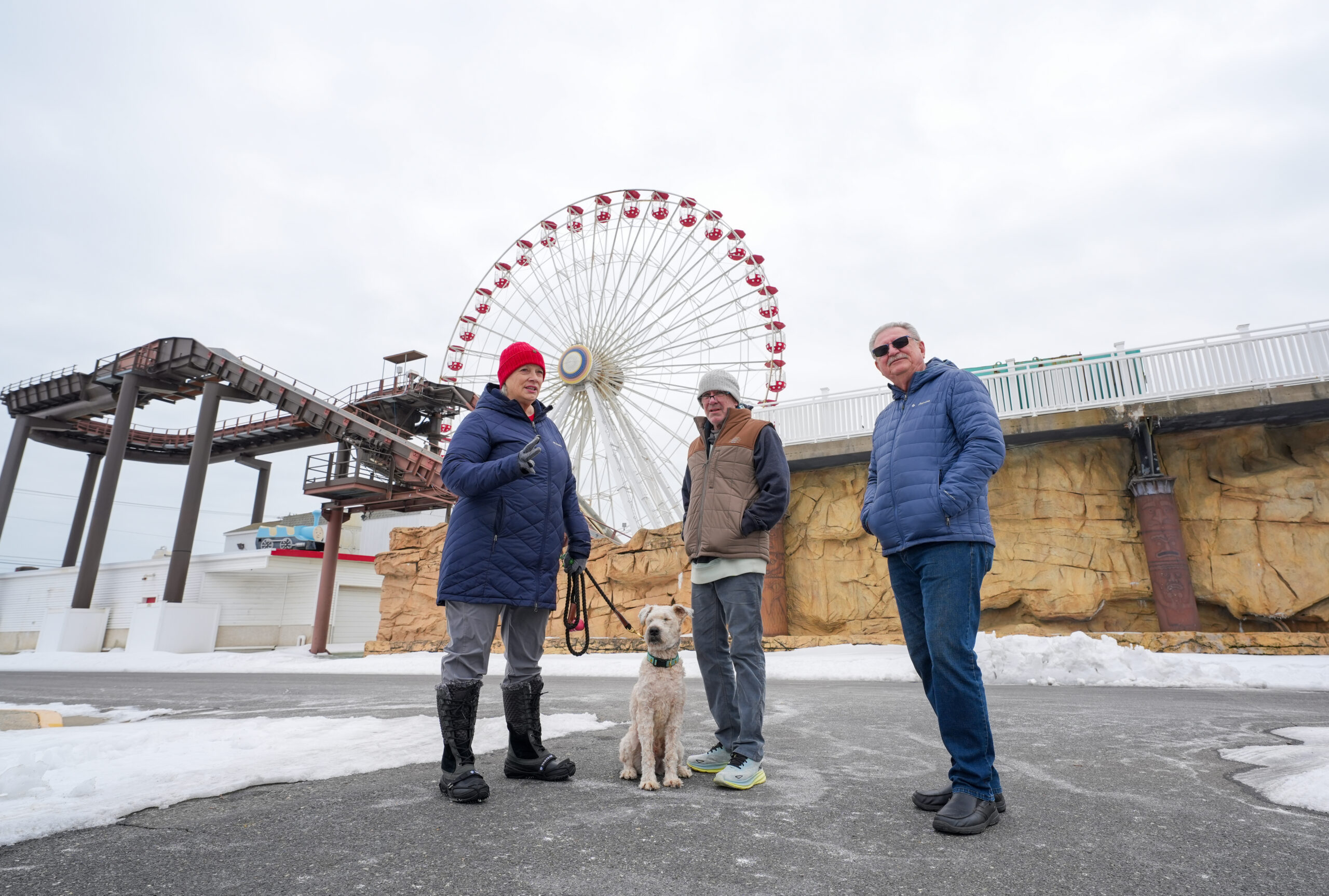
Jack Gutenkunst, left, Marie Crawford and her husband Richard with Shiloh, a 9-year-old soft coated wheaten terrier, walk along Plaza Place, in Ocean City, Tuesday, Feb. 3, 2026.
“It was so beautiful and romantic. On our porches, we would hear the ocean, not the amusement park. There were families, babies in strollers, coming up the street, flowing up to Wonderland. We were kind of ambassadors.”
Now, more than a year after the closing of Gillian’s, the residents are faced with the possibility of a seven-story hotel they fear will block their sun, bring traffic to their streets, and threaten the small-town charm they found in their little pocket of Ocean City.
“It’s just another example of maximizing, pushing,” said Rich Crawford, Marie’s husband, who programs music for his family’s Christian radio station, WDAC, located in Lancaster, Pa. In his 60s, Rich fell in with Ocean City’s surfing crowd and unexpectedly grew to love his little community.
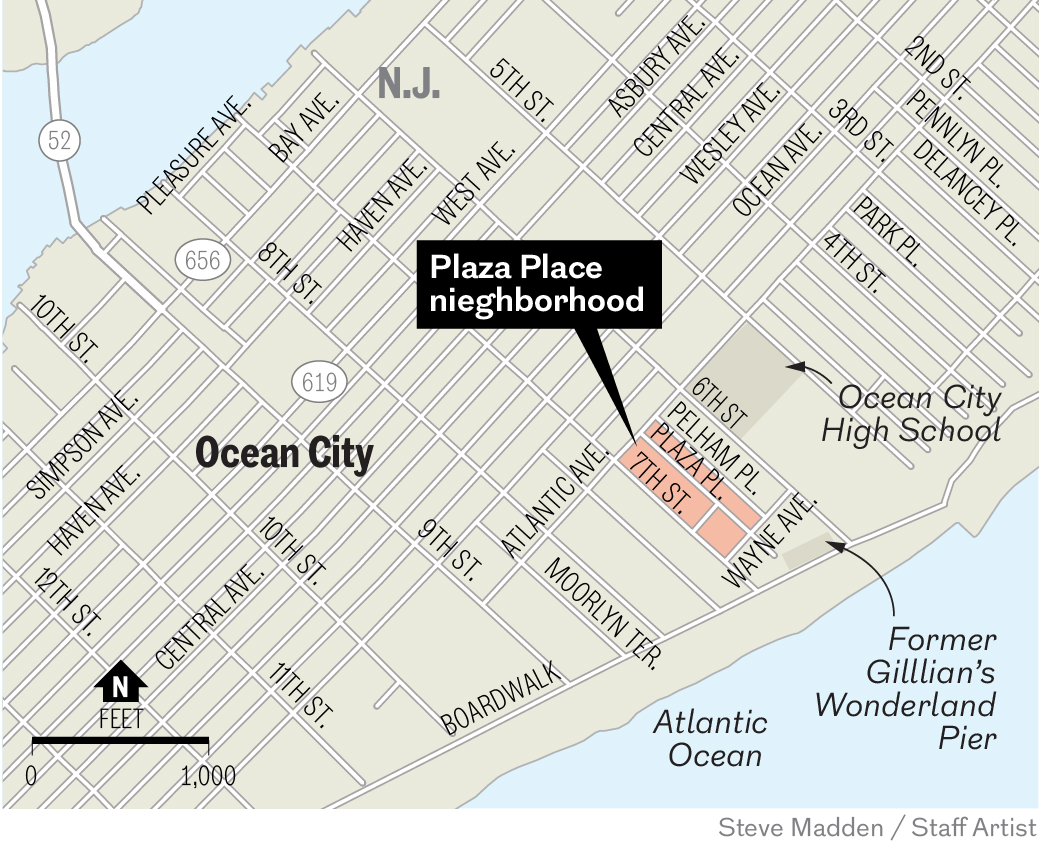
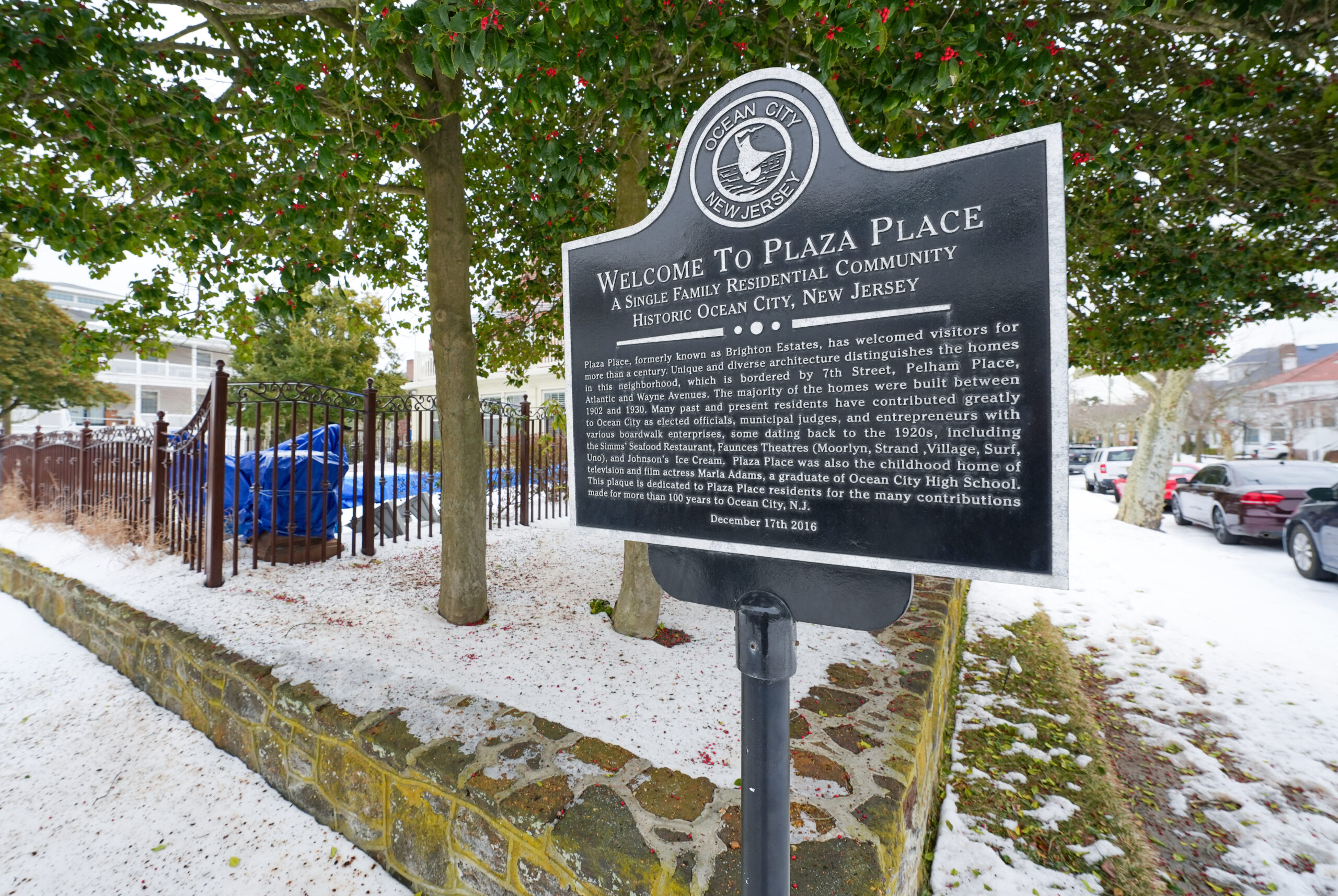
The Crawfords’ neighborhood of 100-year-old homes and 153 trees is called Plaza Place, which is one block each of Pelham Place, Plaza Place, and the north side of Seventh Street, between Wayne Avenue and Atlantic.
Across Wayne Avenue, toward the ocean, was Wonderland. On a clear day, a red ball of sun creeps up above the boardwalk and peeks into their little neighborhood.
On Pelham Place, residents each also own a two-foot- wide stretch of land across the street from their houses, a quirk of their deeds originally designed to prevent the rooming houses on Plaza Place that backed up against Pelham Place from using Pelham as an alleyway for their trash. There are dedicated gardeners on the streets who turn those strips into showpieces.
The sun sets behind the Ferris wheel on the final day for the beloved Wonderland Pier in Ocean City Sunday, Oct. 13, 2024.
Neighbor Barb Doctorman, whose family owns the Islander store on the boardwalk, said she used to take her children up on the Ferris wheel and peer down at their neighborhood. So lush, it looked like a forest, she said.
“I looked up the impact of a high-rise,” said Doctorman. “We’re going to lose some sun. The airflow is going to be totally changed from what it was. There’s a heat radiant that comes off it.”
Her husband, Doc, said: “We want something up there, but we know there could be more of a draw to that boardwalk than just the hotel.”
Marie Crawford (left) holds the leash of Shiloh, a 9-year-old soft-coated wheaten terrier, while standing with her husband Richard (center) and neighbor Jack Gutenkunst at the end of Pelham Place in Ocean City.
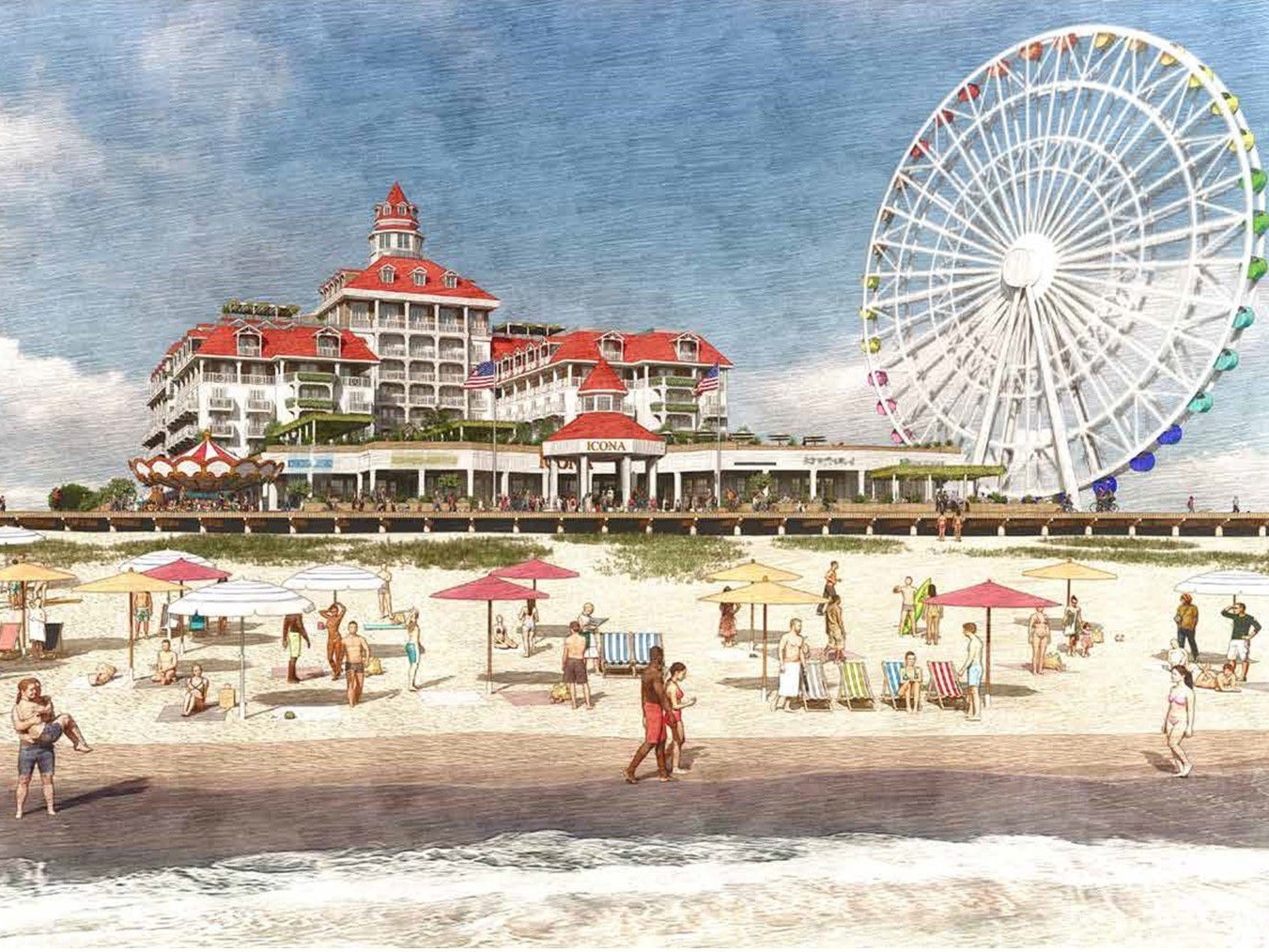
The land is owned by developer Eustace Mita, who has proposed Icona in Wonderland, a 252-room hotel that would preserve the Ferris wheel, carousel, and some kiddie rides.
So far, the city has not declared the site in need of rehabilitation, as Mita has requested, or otherwise moved to rezone the area to allow a hotel.
Merchants have begged the city to allow the hotel, and described how their businesses have suffered since the closure of Wonderland. Some residents have clung to the idea that an amusement park can return, though those numbers are dwindling.
Marie Crawford, her husband Richard, right, along with Shiloh, a 9-year-old soft coated wheaten terrier, and their neighbor Jack Gutenkunst, walk past a sign against the development of a hotel at the site of the old Wonderland Pier on the boardwalk in Ocean City, Tuesday, Feb. 3, 2026.
In Plaza Place, the opposition is less sentimental, more practical. They fear traffic, and the shadow from a neighboring seven-story hotel. Like residents in other towns who fought dunes, they fear the loss of the ocean breeze, or a shift in wind patterns that will affect surfing at the popular Seventh Street Beach.
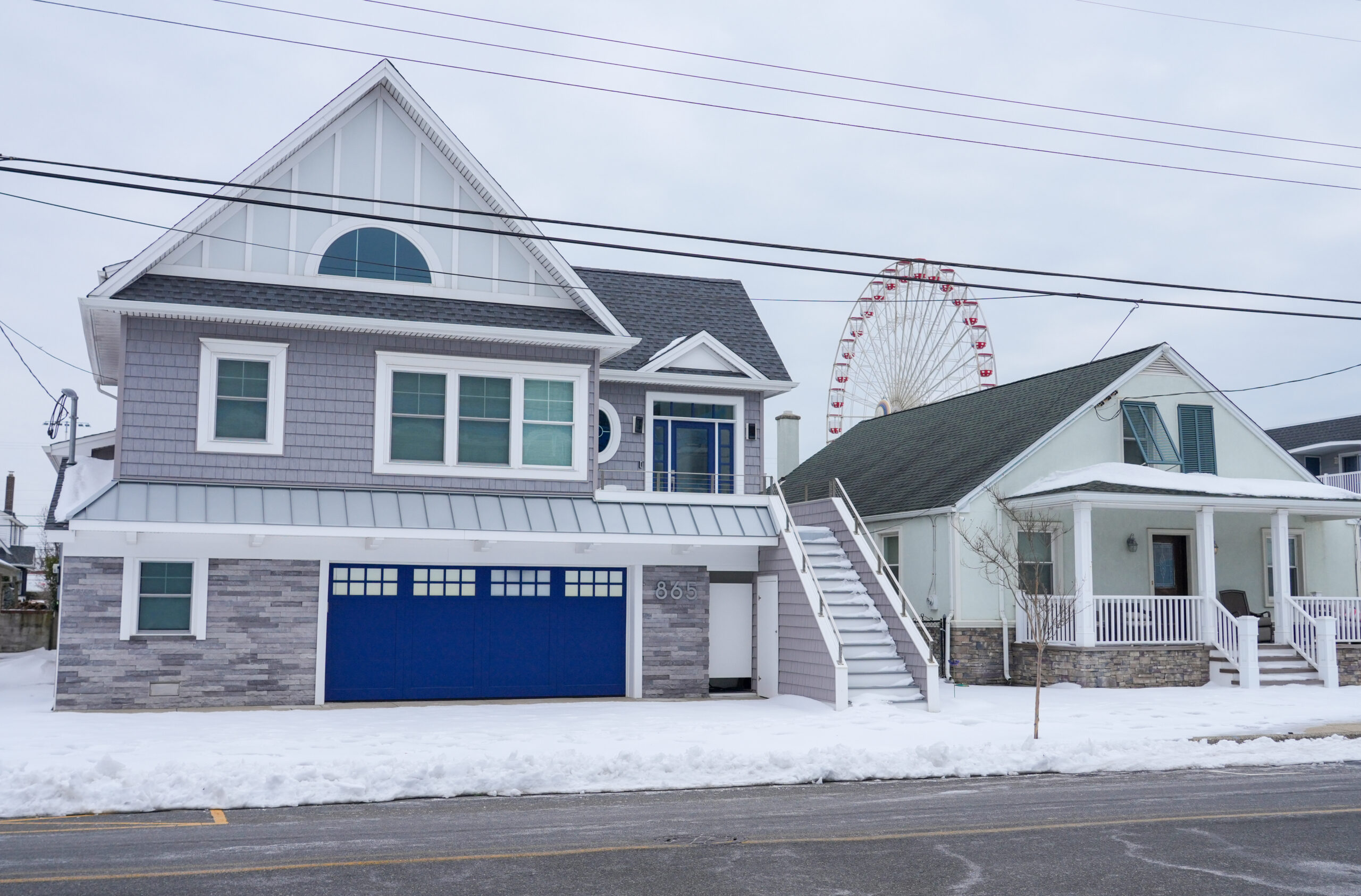
“It’s got that old feel to it, and everybody’s house is different,” said Marie Crawford, who bought her Craftsman Colonial on the north side of Pelham for $905,000 in 2021. She estimates it’s worth $2.5 million now. There are about 60 homes in the Plaza Place civic association.
The association is one of several groups that are prepared to go to court if the city tries to change the zoning to allow a hotel, without going through a thorough master plan process, said Jack Gutenkunst, the Plaza Place Association president.
While Wonderland brought thousands of people on a summer night, the pier itself had no parking. So people parked elsewhere and excitedly walked through their neighborhood on their way to the rides. People on their porches called out, “Have a blessed evening,” and chatted the night away, said Crawford. The hotel proposal calls for parking underneath the structure.
A sign stands near the historic neighborhood behind the old site of the Wonderland Pier in Ocean City, Tuesday, Feb. 3, 2026. Residents are against the development of a hotel at the boardwalk site.
Crawford stressed that it’s not a case of selfish NIMBY, Not In My Backyard. Despite Ocean City’s decades-old pattern of replacing single-family homes with duplexes, there are nearly 1,400 homes over 100 years old still left in Ocean City, said Bill Merritt, president of Friends of OCNJ History & Culture.
Being a block from the boardwalk, and living in a beach town, does not mean the neighborhood’s purpose is primarily hospitality, said Crawford. Its distinct, increasingly rare Jersey Shore character deserves to be valued, she said.
“It’s height. It’s chaos. It’s the change in culture,” she said, when asked what specifically worries her about the hotel. “It’s a transient population coming through here for three nights at a time. That’s in the hospitality district. We are not the hospitality district.”
The neighborhood behind the old Wonderland Pier site on the boardwalk in Ocean City, Tuesday, Feb. 3, 2026. Residents are against the development of a hotel at the boardwalk site.
The demolish-and-rebuild mania that took over a lot of the rest of the island has mostly left Plaza Place alone, though residents acknowledge that is also a threat to their way of life. They also fear a hotel will prompt Plaza Placeans to sell.
“It’s a Norman Rockwell painting, it just is,” Councilman Keith Hartzell says in the documentaryPlaza Place: The Enigmatic Street, a locally made short film about the neighborhood. “It’s right here in Ocean City, and you kind of don’t expect it, when there’s two streets away a bunch of duplexes.”
Hartzell, who is running for mayor against incumbent Jay Gillian, the former owner of Wonderland who sold to Mita, says he hopes to negotiate with Mita over height, parking, and other issues before considering any kind of zoning allowance or rehabilitation designation. A city council-appointed subcommittee tasked with assessing the boardwalk’s usage as a whole is holding a public meeting at 10 a.m. on Feb. 7 at the city’s library.
The residents of Plaza Place worry about the survival of the hidden little neighborhood by the beach they fell in love with. “The neighborhood is so beautiful and so old,” said Marie Crawford. “If the hotel goes in, the dramatic change that will be for all of us with the traffic, the tone of the neighborhood — you’re going to see people sell. That threatens the neighborhood. The people won’t want to stay.”
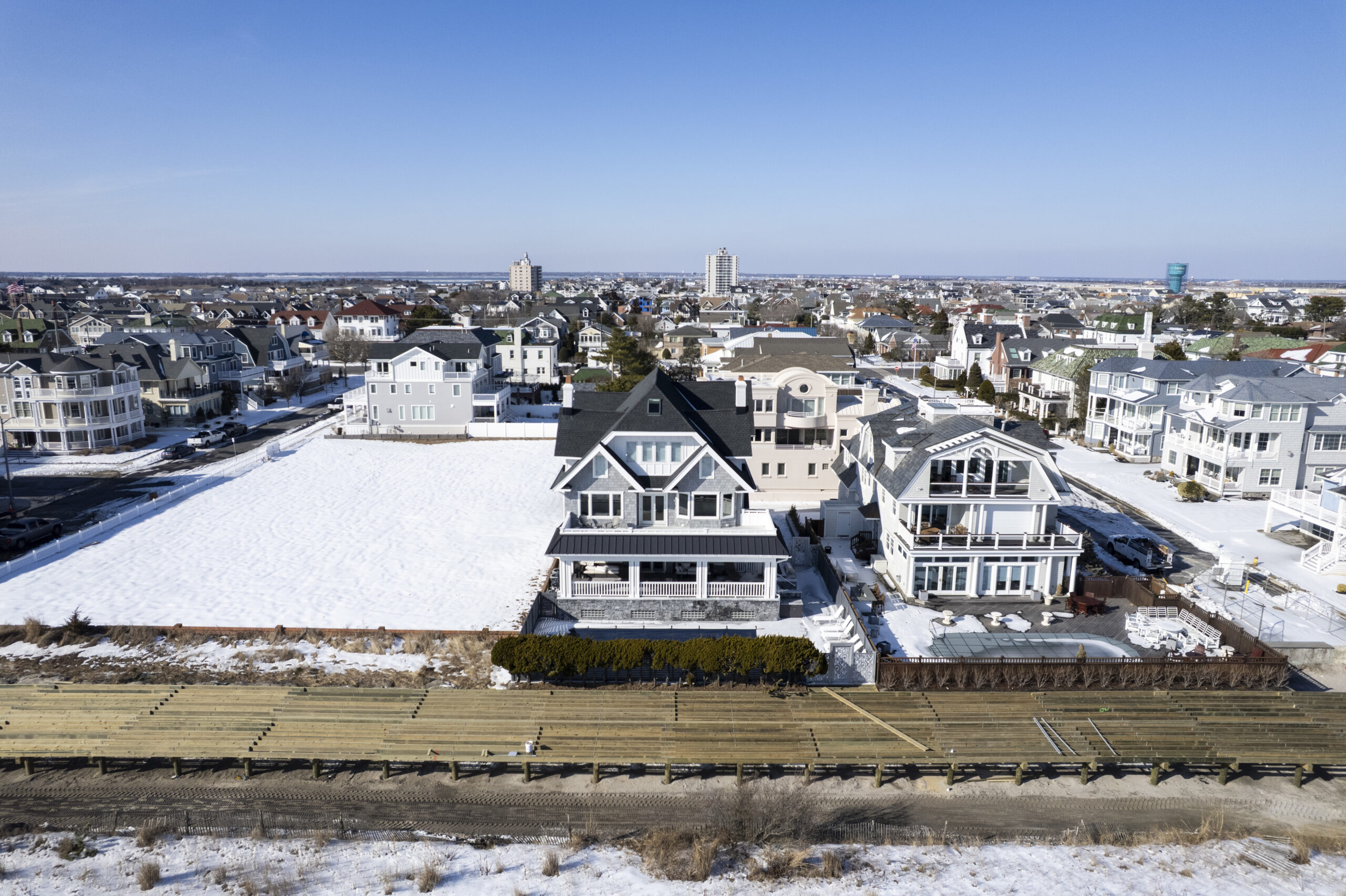
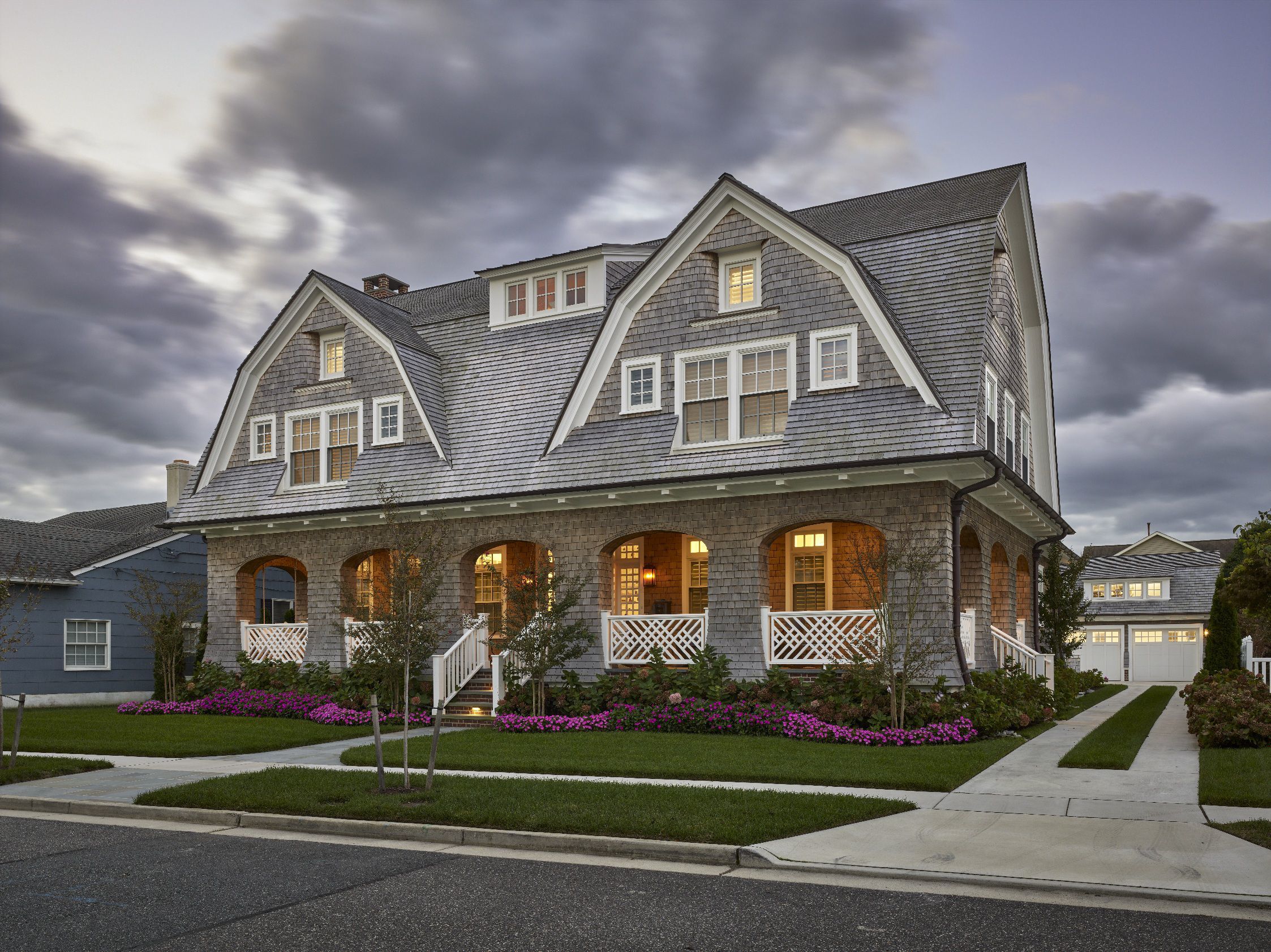
Coastal homes featuring wooden gambrel roofs, cedar siding, covered porches, and inside spaces that flow out to patios and pools are mainstays of Jersey Shore properties. The architect who brought that look to the area, arguably, is Mark Asher.
For more than four decades, Asher has left his imprint on homes from Cape May to Rumson to the Philly suburbs, everything from 1,200-square-foot cottages to 15,000-square-foot mansions.
Now principal of Asher Slaunwhite + Partners in Jenkintown, Asher has come a long way since designing his first house in 1986: an 1,800-square-foot Cape Cod in Ocean City for his parents.
“I suppose my parents were looking for a return on their investment,” Asher said. “The house was serviceable. It stood up and didn’t leak, which puts me well ahead of most architects’ first-house experience.”
Architectural blueprints in Asher’s office.
That first solo experience taught him many lessons, mostly “that there was a lot to learn,” he said.
One of those lessons he acquired along the way was that many cultural myths about architects exist, beginning with the notion that architects are generalists who know a little bit about a lot of things. In fact, he said, the reality is that you have to become very, very good at many, many things.
“We are balancing the skills in land use, regulatory environment, technology, budget, and design,” Asher said. “And of course, client relationships. The house — the finished product — is the tip of an enormous iceberg.”
Those relationships have been the cornerstone of his business. He has a long list of repeat customers and takes pride in designing homes for the children of former clients.
Early in his career, Shore homes on Seven Mile Island, home to Avalon and Stone Harbor, were his bread and butter. Today, about 60% of his work comes from the Shore, and the rest from coastal clients who hire him for their inland homes.
Steve and Nancy Graham had Asher design two homes: their Avalon beach house in 2003, and their primary home in Wayne a year later. Nancy had worked for a builder at the time, and was a true collaborator during the design process.
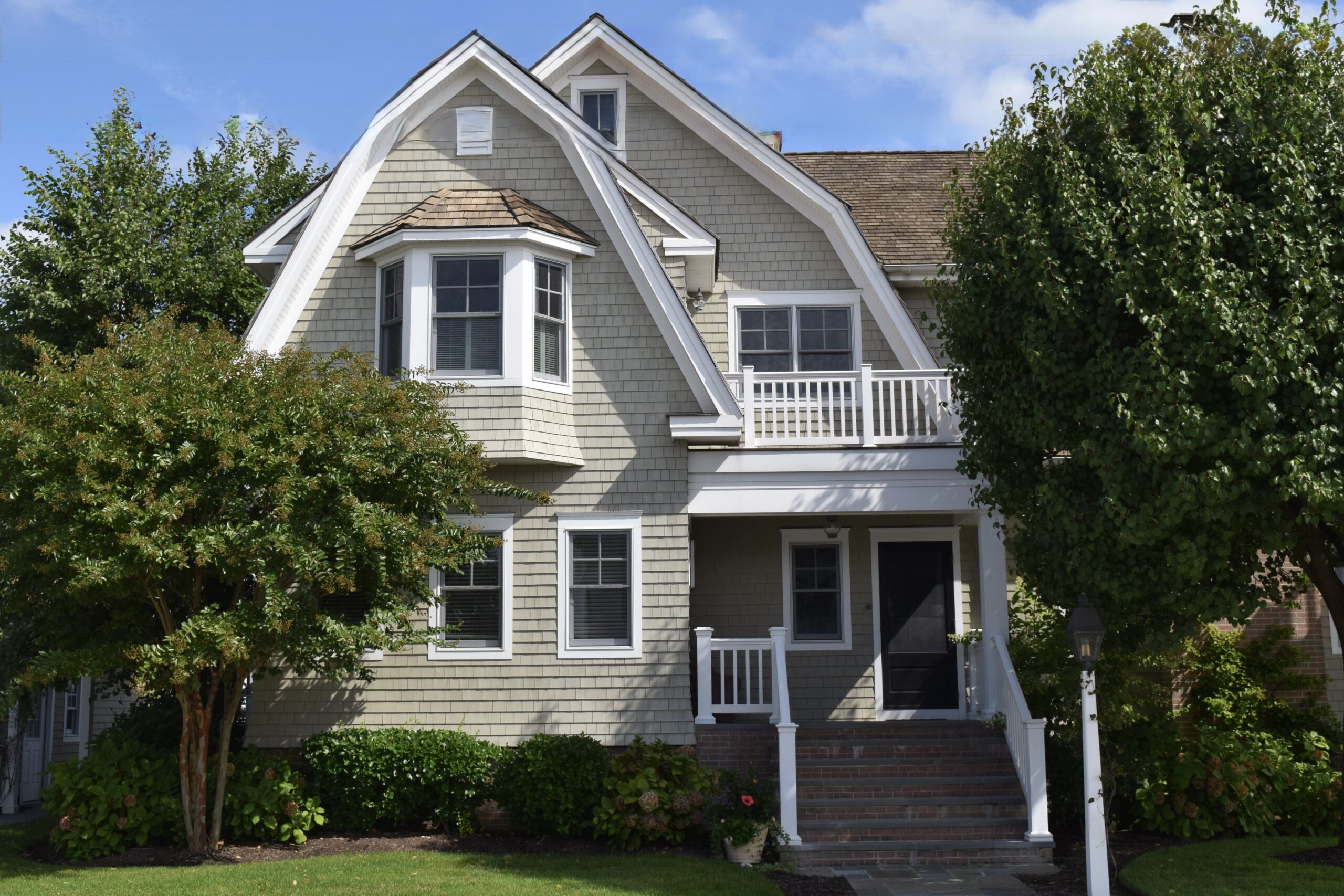
The house of Steve and Nancy Graham in Avalon, which architect Mark Asher designed for the family in 2003.
They razed an existing cottage, replacing it with a two-story, 4,000-square-foot, six-bedroom vacation home for their family, which at the time included their three children. Now, eight grandchildren make memories there.
The Graham’s Shore house was nothing like the Wayne house he designed for them, which replicated that house’s traditional, historical neighbors. Their Avalon property was Asher’s first foray into designing Shore homes and included a gambrel roof, cedar siding, and a covered porch.
“I had designed many houses like this before anyone built one, but I kept getting shot down,” Asher said. “Once it was done, it was like a hit song, and it was all people wanted.”
A childhood passion
As early as he can remember, Asher loved to sail. Spending his summers at the Shore, he’d tool around in a small dinghy, hugging the Jersey coast from Brigantine to Cape May.
“The sights and sounds, the feel, and even the smells of these coastal towns became etched in my memory,” Asher said. “So when I started to work in the various beach towns, it was really just going back to a place I’d already been.”
He had a similar passion for architecture at an early age, curious about old houses. He’d park himself on the curb, sketch pad in hand, and draw the houses he found most interesting. Those were his Architecture 101 lessons.
(From left) Laura Glantz, Jeanine Snyder, Mark Asher, and Deborah Slaunwhite chat in the office of Asher Slaunwhite + Partners in Jenkintown.
“I grew up in old houses, warts and all,” he recalled. “They were constantly being worked on. Saturday mornings invariably meant a trip to the lumberyard or the hardware store. And I love old houses still — their history and their stories.”
After graduating from Virginia Tech School of Architecture in 1982, he worked at various architecture firms, learning the subtleties of his profession. In 1992, the Ocean City Yacht Club hired Asher for a redesign, and in 1995 the Avalon Yacht Club followed suit.
“This was pre-computer, pre-Internet, so the OCYC project was drawn by hand,” he recalled. “Hard work and passion will cover the sins of inexperience.”
Building for today’s family dynamic
Asher’s first home design came in 2000, a relatively small two-coastal cottage that cost about $125 per square foot to build. Today, that same house would cost about eight times that, outpacing the inflation rate by 1,200%, Asher said.
His designs have evolved along with the needs of his clients. Shore houses today are often designed for three generations of living.
“Now you need areas for people to come together, but also to separate under the same roof,” said Michael Buck, president of Buck Custom Homes in Avalon and Ocean City, who has worked with Asher on about 30 projects.
A home in Ocean City designed by architect Mark Asher.
Although homes previously housed multiple generations, they weren’t purposefully designed to accommodate the needs of extended families. In many cases, homes are shifting to a more contemporary style, with five en-suite bedrooms, an elevator, and dedicated HVAC closet.
“Mark’s plans capture a certain simplicity of the coastal environment of the home,” Buck said. “His architecture speaks to a classic, thoughtful approach to how a house blends in with its environment on a micro and macro level.”
Asher’s entry into coastal building brought a greater emphasis on the home’s exterior, both in beauty and function.
“When Mark came to town, the shift toward second homes from purely rental properties had already begun,” said Jack Binder Sr., broker at Ferguson Dechert Real Estate in Avalon. “The affluent, personal-use buyer wanted to express themselves through custom housing that stood apart from the rest and featured high-end amenities.”
“Mark married functional interior space that flowed to exterior entertaining areas allowing his clients to enjoy their home to the max,” Binder said.
One of the homes designed by Mark Asher in Avalon.
Asher’s home interiors are thoughtfully designed, said Allison Valtri, principal of Allison Valtri Interiors in Avalon.
“His windows are very carefully placed so that the light comes in in a way that is unexpected,” Valtri said. “Some of my favorite windows are ones that are capturing the sky. That fulfilling moment of peace is very thoughtful.”
Asher also brought a desire for lush, green lawns to replace the stones that had previously filled the yards. “The stones were hot in the summer, cold in the winter, and ugly all year round,” he said.
“When I began, I was working in a very traditional architectural palette,” he said. “The ’70s and ’80s were not very kind to beach architecture — think big hair and shoulder pads or stucco and a fondness for inexplicable round windows. So I was on a sort of reclamation project.”
If it’s true that imitation is the sincerest form of flattery, Asher should feel quite proud.
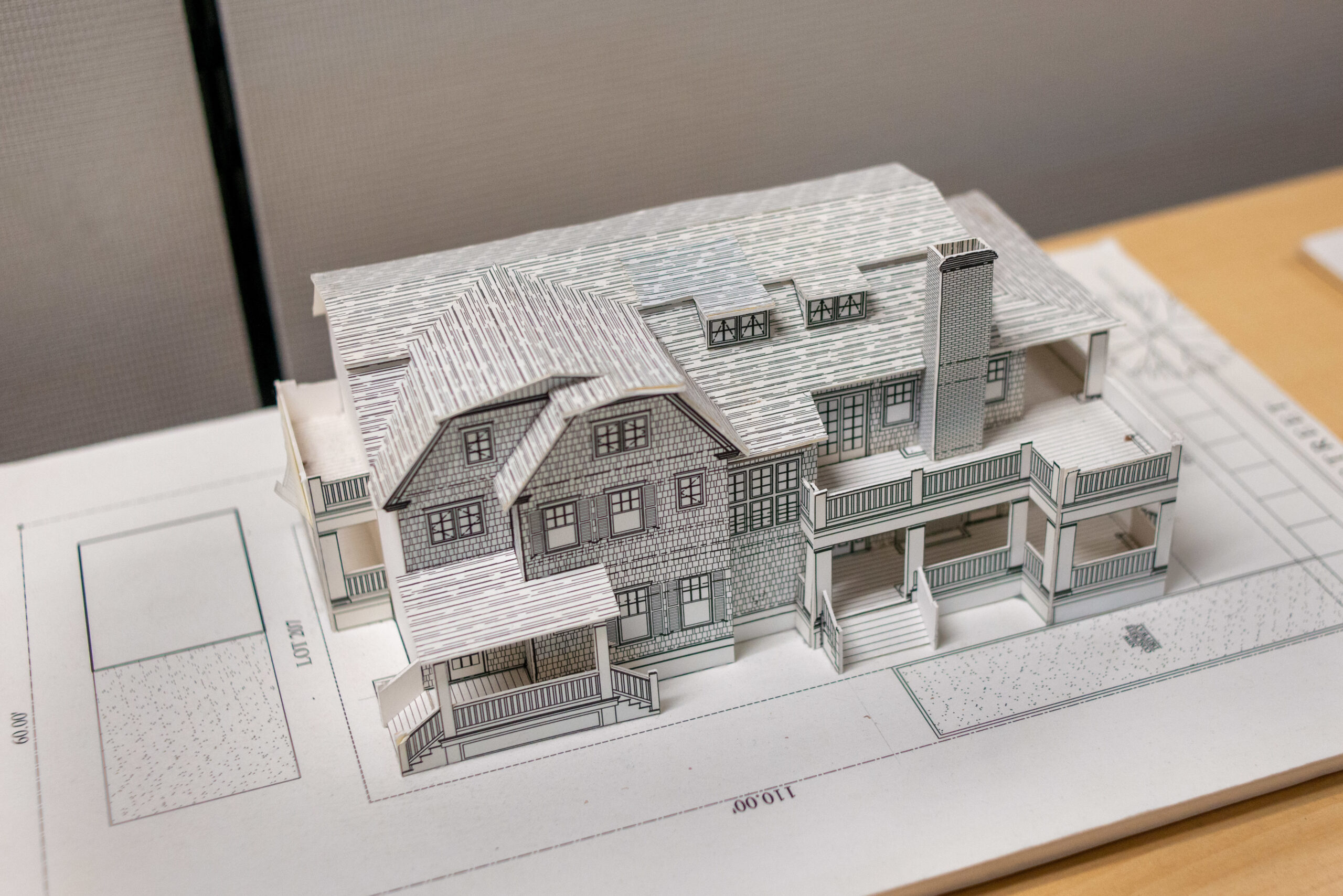
An architectural model at the offices of Asher Slaunwhite + Partners.
“He elevates and then watches everyone else catch up,” Buck said. “For example, not long ago, a wood roof was an anomaly, but now it’s mainstream.”
But Asher sees it differently. Imitation just means he needs to challenge himself to find something better.
He shares credit for his successes with those who have helped and inspired him, including his wife and longtime collaborator, Susan Asher, as well as his architect partners, Deborah Slaunwhite and Laura Glantz, and his business partner Jeanine Snyder. He also enjoys mentoring young architects.
“Any profession has a responsibility for the generation that comes after it,” Asher said. “And I’ve often believed that my own start was a little rockier than it might have been. Some early guidance would have been helpful. So you pay it forward.”
This week’s Philly music options include 1990s R&B hitmakers 112, newsman-turned-singer Ari Shapiro, pop-punks Say Anything and Motion City Soundtrack, K-pop girl group Unis, and Philly hip-hop blues band G. Love & Special Sauce. Plus, some terrific folk tandem with Loudon Wainwright III and Chris Smither. And the kick off for Black History Month programming at the Fallser Club.
Wednesday, Jan. 28
Tashi Dorji
Bhutan-born, Asheville, N.C., guitarist Tashi Dorji makes alternately tuned instrumental music that never settles for being merely pretty. Sometimes it reads as politically defiant, as on songs like “And the State Sank into the Abyss” and “Meet Me Under the Ruins” on his most recent album on the Drag City label, We Will Be Wherever the Fires Are Lit. 8 p.m., Asian Arts Initiative, 1219 Vine St., r5productions.com
Thursday, Jan. 29
Sunny Day Real Estate
1990s Seattle emo band Sunny Day Real Estate re-formed in 2022 and has stayed busy since with a lineup that included original members Jeremy Enigk, Dan Horne, and William Goldsmith. 8 p.m., Brooklyn Bowl, 1009 Canal St., brooklynbowl.com/philadelphia
Atlanta R&B vocal group 112 play the Met Philly on Friday.
Friday, Jan. 30
Dave P.’s Juntos benefit
Making Time impresario David Pianka is DJing an all-night “All I Want for 2026 is PLURT” party for Juntos, the South Philadelphia organization “fighting for the human rights of the Latine community as workers, parents, youth, and immigrants.” PLURT takes “Peace, Love, Unity, and Respect” and adds a Dave P. favorite word: “Transcendence.” 8 p.m., The Dolphin, 1539 S. Broad St, ra.co/events/2351165
Ari Shapiro
Former NPR host Ari Shapiro’s “Thank You for Listening” is a cabaret show adapted from his memoir, The Best Strangers in the World. He’ll flex the musical muscles previously put to use in collaborations with Alan Cumming and Pink Martini. 7:30 p.m., City Winery, 990 Filbert St., citywinery.com/philadelphia
112
R&B’s 112 — pronounced “one twelve” — is the Atlanta group that signed to now-disgraced music executive Sean Combs’ Bad Boy label in the 1990s. In addition to hits like “Cupid” and “It’s Over Now,” the band joined Combs on vocals on “I’ll Be Missing You,” the 1997 megahit that eulogized the Notorious B.I.G. 8 p.m., Met Philly, 858 N. Broad St., themetphilly.com
Unis
K-pop girl group octet Unis comes to South Street, supporting 2025’s album Swicy. The band fronted by lead singer Hyeonju triumphed on the Seoul Broadcasting System reality show Universe Ticket in 2024. 8 p.m., Theatre of Living Arts, 332 South St, tlaphilly.com
Jobi Riccio plays Free at Noon at the World Cafe Live on Friday.
Jobi Riccio
Colorado songwriter Jobi Riccio won praise for her 2023 debut album, Whiplash. That same year, she was awarded the John Prine Fellowship at the Newport Folk Festival. She has a new single, “Buzzkill,”which along with the previously released protest song “Wildfire Season” will be on a forthcoming album. Noon, World Cafe Live, 3025 Walnut St., xpn.org
The Naked Sun
Philly rock quintet the Naked Sun will celebrate a new album, Mirror in the Hallway. It was produced by Brian McTear and Amy Morrissey at Miner Street Recordings. McTear’s Bitter, Bitter Weeks plays a rare full band set as openers. 8 p.m., Fallser Club, 3721 Midvale Ave., thefallserclub.org
Saturday, Jan. 31
Wild Pink
Brooklyn indie outfit Wild Pink comes through for an early show, still touring behind the excellent 2024 album Dulling the Horns. The band then needs to make way for a Taylor Swift DJ night that follows. 6 p.m., MilkBoy Philly, 110 Chestnut St., milkboyphilly.com
G. Love plays the Sellersville Theater on Saturday with his band, Special Sauce.
G. Love & Special Sauce
G. Love’s 2006 album Lemonade was a solo affair, but he’s celebrating its 20th anniversary with Special Sauce, the band with whom he recorded 215-proud staples such as “Philadelphonic” and “I-76.” Hawaiian surfer Makua opens. 8 p.m. Sellersville Theater, 24 W. Temple Ave., Sellersville, st94.com
Pine Barons
KC Abrams’ Philly experimental rock trio Pine Barons released its fourth album TV Movie in September. This week, the band headlines a show in Fishtown, with Special World and Rentboy. 9 p.m. Johnny Brenda’s, 1201 N. Frankford Ave. johnnybrendas.com
Dave P. will DJ all night long in a benefit for Juntos on Friday at the Dolphin in South Philly.
Say Anything / Motion City Soundtrack
Two emo-adjacent bands that emerged in the early 00s are touring together. Los Angeles’ Say Anything’s latest is The Noise of Say Anything’s Room Without …, while Minneapolis’ Motion City Soundtrack recently returned after a decade with The Same Old Wasted Wonderful World. 7:30 p.m., Fillmore Philly, 29 Allen St., thefillmorephilly.com
Riverside / My Favorite / Polaroid Fade
A top-notch trio of indie bands, headlined by 1990s Philly veterans Riverside. Also on the bill are Brooklyn’s My Favorite and Ocean City, N.J.’s, Polaroid Fade, fronted by 20-year-old singer Nicoletta Giuliani, whose sounds draw from shimmery ‘90s bands like the Sundays and the Ocean Blue. 8:30 p.m., PhilaMoca, 531 N. 12th St., PhilaMoca.org
Loudon Wainwright III plays the Zellerbach Theatre at the Annenberg Center with Chris Smither on Sunday.
Sunday, Feb. 1
Loudon Wainwright / Chris Smither
From his 1970 self-titled debut to Lifetime Achievement in 2022, Loudon Wainwright III has always been an unflinching and unfailingly funny songwriter whose acute observations never spare himself or his family members. Pairing him with ever-soulful folk blues guitarist and songwriter Chris Smither, who has had a fruitful career of equal length, is a masterstroke. Hopefully, they’ll play together. 8 p.m., Zellerbach Theatre, 3680 Walnut St., pennlivearts.org
Reef the Lost Cauze
West Philly rapper Reef the Lost Cauze is first up at “A Month of Black Excellence at the Fallser Club,” with an afternoon event featuring “vendors, food, art, community actions.” The series includes African Friends: Bakithi Kumalo, Tanyaradzwa Tawengwa, and Youba Cissokho on Feb. 6 and V. Shane Frederick and Rev. Chris on Feb 17. 4 p.m., Fallser Club, 3721 Midvale Ave., thefallserclub.org
Jon Spencer
Jon Spencer has been playing high-volume blues with exaggerated gusto for three decades. Along with a recent show by Richard Lloyd and Lenny Kaye, this booking is another sign that Nikki Lopez, the South Street venue on the site of the former JC Dobbs, is becoming a welcome home for veteran acts who can still kick out the jams as well as young punk and metal bands. 8 p.m., Nikki Lopez, 304 South St., instagram.com/nikkilopez/philly
Monday, Feb. 2
Ye Vagabonds
Full-on Irish music season doesn’t arrive until March, when Emerald Isle musicians will blanket the Philly region. Get a head start with this stellar band, led by brothers Brian and Diarmuid Mac Gloinn who make haunting music that sounds ancient and brand new at the same time. Philly bluegrass songwriter Daphne Ellen opens. 8 p.m., Johnny Brenda’s, 1201 Frankford Ave., johnnybrendas.com
Concert Announcements
Shows that announced in the past week include a number of enticing double bills.
We’ve asked where South Philly starts, and about the Eagles-Steelers divide, but now it's time to answer an even more controversial question: Where does South Jersey end and North Jersey begin?
It’s a toughie, even entire movies have tried to answer this question. Is it just Eagles country vs. Giants country? Or maybe area code based? Turnpike exits? Or just simple geography of towns and counties? We want to hear from you.
story continues after advertisement
Use the sliders below to draw the dividing line. Submit your pick and see how other Inquirer readers voted.
The Rest of New Jersey
Central Jersey
South Jersey
You think South Jersey includes south_city_marker.
If we averaged out the votes from Inquirer readers, South Jersey would include south_city_average.
We’re not done yet, though. Now you’ve told us where South Jersey starts, we have another question for you: If it exists, where does Central Jersey start?
selection_answer
Of those that voted, central_votes believe there is a Central Jersey. The average Inquirer reader placed north_city_average in North Jersey and central_city_avg in Central Jersey.
Thank you for taking our quiz. If you want to weigh in more (like Pork Roll or Taylor Ham) let us know!
Staff Contributors
Design, Development, and Reporting: Garland Fordice
Editing: Sam Morris
Copy Editing: Brian Leighton
Illustration: Julia Duarte
(()=>{var Ft=(t,e)=>()=>(e||t((e={exports:{}}).exports,e),e.exports);var at=Ft(p=>{var Ot={0:”Jan.”,1:”Feb.”,2:”March”,3:”April”,4:”May”,5:”June”,6:”July”,7:”Aug.”,8:”Sept.”,9:”Oct.”,10:”Nov.”,11:”Dec.”};function rt(t){return t===void 0&&(t=new Date),Ot[t.getMonth()]}var Ct={0:”Jan”,1:”Feb”,2:”Mar”,3:”Apr”,4:”May”,5:”Jun”,6:”Jul”,7:”Aug”,8:”Sep”,9:”Oct”,10:”Nov”,11:”Dec”};function ot(t){return t===void 0&&(t=new Date),Ct[t.getMonth()]}function S(t){return t==null}function lt(t){return typeof t==”number”&&isFinite(t)}function O(t){return lt(t)&&Math.floor(t)===t}var Nt=[“one”,”two”,”three”,”four”,”five”,”six”,”seven”,”eight”,”nine”],It=[“million”,”billion”,”trillion”,”quadrillion”,”quintillion”,”sextillion”,”septillion”,”octillion”,”nonillion”,”decillion”],it=[“th”,”st”,”nd”,”rd”,”th”,”th”,”th”,”th”,”th”,”th”],Dt=[11,12,13];function ct(t){if(S(t))return””;var e=+t;return O(e)?Dt.indexOf(e%100)>-1?it[0]:it[e%10]:””}var Bt=[“first”,”second”,”third”,”fourth”,”fifth”,”sixth”,”seventh”,”eighth”,”ninth”],Ht=new RegExp(/s+([^s]*)s*$/);p.apdate=function(t){return t===void 0&&(t=new Date),rt(t)+” “+t.getDate()+”, “+t.getFullYear()},p.apdatetab=function(t){return t===void 0&&(t=new Date),ot(t)+” “+t.getDate()+”, “+t.getFullYear()},p.apmonth=rt,p.apmonthtab=ot,p.apnumber=function(t){if(S(t))return””;var e=+t;return O(e)?e=10?t.toString():Nt[e-1]:t.toString()},p.aptime=function(t){t===void 0&&(t=new Date);var e,s,n=t.getHours(),r=t.getMinutes(),i=r===0;if(i){if(n===0)return”midnight”;if(n===12)return”noon”}return n0?n:12):(e=”p.m.”,s=n===12?n:n-12),i?s+” “+e:s+”:”+(r<10?"0"+r:r)+" "+e},p.capfirst=function(t){if(S(t))return"";var e=String(t);return""+e.charAt(0).toUpperCase()+e.slice(1)},p.intcomma=function(t){if(S(t))return"";var e,s=+t;return lt(s)?((e=s.toString().split("."))[0]=e[0].replace(/B(?=(d{3})+(?!d))/g,","),e.join(".")):t.toString()},p.intword=function(t){if(S(t))return"";var e=+t;if(!O(e))return t.toString();var s=Math.abs(e);if(s<1e6)return t.toString();var n=Math.ceil(Math.log(s+1)/Math.LN10)-1,r=n-n%3,i=e/Math.pow(10,r);return(i=Math.round(10*i)/10)+" "+It[Math.floor(r/3)-2]},p.ordinal=function(t,e){if(e===void 0&&(e=!1),S(t))return"";var s=+t;return O(s)?e&&s{F=F||window.PMNdataLayer,F?F.push({event:”misc_event”,eventAction:t,eventLabel:e}):window.location.hostname.includes(“localhost”)?console.log(“Analytics event:”,t,e,”(not actually being sent due to localhost)”):console.log(“Failed to push analytics event”,t,e)},E={event:(t,e)=>{$t(t,e)}};var et=async(t,e)=>(await fetch(`https://inq-junto.herokuapp.com/${t}`,{method:”POST”,headers:{“Content-Type”:”application/json”},mode:”cors”,body:JSON.stringify(e)})).json(),H=()=>{let e=document.querySelector(“.js-inno”).dataset.junto;if(e)return e;throw new Error(“no junto id found”)},v={getDefaultId:()=>H(),vote:(t,e=H())=>{et(“vote”,{poll:e,ballot:t})},results:async(t=H())=>await et(“results”,{poll:t})};var nt=1,st=[],R=class{constructor(e){this.el=e,this.contentPosition=”default”,this.possibleSteps=new Array,this.currentStep=null,this.offset=window.innerHeight*.9,this.instanceOfSteps=nt,nt++,this.setPossibleSteps()}start(){this.el.classList.add(“is-visible”),this.updateContent(),this.bindings()}setPossibleSteps(){this.el.querySelectorAll(“.js-steps-step”).forEach(e=>{e.dataset.step&&this.possibleSteps.push(e.dataset.step)})}bindings(){window.addEventListener(“scroll”,()=>{this.updateContent()}),window.addEventListener(“resize”,()=>{this.updateContent()})}updateContent(){this.updateCurrentStep()}updateCurrentStep(){let e;if(this.el.querySelectorAll(“.js-steps-step”).forEach((n,r)=>{n.getBoundingClientRect().top{let o=”is-“+r,c=”is-“+i;this.possibleSteps.indexOf(r){document.querySelectorAll(“.js-steps”).forEach(t=>{st.push(new R(t))})},start:()=>{st.forEach(t=>t.start())}};var je=at();var ut=()=>/Android|webOS|iPhone|iPad|iPod|BlackBerry|IEMobile|Opera Mini/i.test(navigator.userAgent);var Y=(t,e=null,s=null)=>{s||(s=document.querySelector(“head”));let n=document.createElement(“script”);n.type=”text/javascript”,n.src=t,e&&(n.onload=e),s.appendChild(n)},dt=()=>(window.PMNdataLayer?.[0]!==void 0&&window.PMNdataLayer[0])?.analytics?.user?.state===”Subscribed”,pt=()=>{let e=(window.PMNdataLayer?.[0]!==void 0&&window.PMNdataLayer[0])?.analytics?.user?.state;return window.location.host.includes(“zzz-systest”)||window.location.host.includes(“pmn.arcpublishing.com”)||window.location.host.includes(“stage.fusion.inquirer.com”)||typeof e>”u”},ht=()=>{let e=(window.PMNdataLayer?.[0]!==void 0&&window.PMNdataLayer[0])?.analytics?.user?.hasAdsFreeReading;return!!(e&&e==1)},V=()=>window.location.host.includes(“localhost”);var C=(t,e)=>{let s=[…t.querySelectorAll(“[data-populate]”)];t.dataset.populate&&s.unshift(t);let n=s.filter(r=>{let i=r.closest(“[data-populate-context]”);return!i||i==t});for(let r of n){let o=r.dataset.populate.trim().split(/s*,s*/).map(c=>c.split(/s*:s*/));for(let[c,d]of o){let l=c.split(“.”).reduce((u,b)=>u?.[b],e),f=l==null||l==null,m=d?.split(/s+/)||[“innerHTML”];for(let u of m)u.startsWith(“.”)&&r.classList.toggle(u.substring(1),f?!1:l),!f&&(u==”innerHTML”?r.innerHTML=l:u.startsWith(“@”)?r.setAttribute(u.substring(1),l):u.startsWith(“–“)&&r.style.setProperty(u,l))}}};var Rt=(t,e)=>{let s=[];return e.forEach(n=>{let r=new DOMPoint(n.getAttribute(“cx”),n.getAttribute(“cy”));if(t.isPointInFill(r))s.push(n);else return}),s},Yt=(t,e)=>{let s=[];return e.forEach(n=>{let r=new DOMPoint(n.getAttribute(“cx”),n.getAttribute(“cy”));if(!t.isPointInFill(r))s.push(n);else return}),s},g=(t,e,s)=>Rt(t,e).sort((o,c)=>s===”north”?o.getAttribute(“cy”)-c.getAttribute(“cy”):c.getAttribute(“cy”)-o.getAttribute(“cy”)).slice(0,2).map(o=>o.getAttribute(“data-name”)).join(” and “),k=(t,e,s)=>Yt(t,e).sort((o,c)=>s===”north”?o.getAttribute(“cy”)-c.getAttribute(“cy”):c.getAttribute(“cy”)-o.getAttribute(“cy”)).slice(0,2).map(o=>o.getAttribute(“data-name”)).join(” and “),G=(t,e,s)=>{let n=document.createElementNS(“http://www.w3.org/2000/svg”,”line”);return n.setAttribute(“class”,s),n.setAttribute(“x1”,0),n.setAttribute(“y1”,t),n.setAttribute(“x2”,531.5),n.setAttribute(“y2″,e),n},J={behavior:”auto”,block:”center”,inline:”center”},z=(t,e,s,n)=>{let r=(h,l)=>{let f=”http://www.w3.org/2000/svg”,m=document.createElementNS(f,h);for(let u in l)u===”href”||u===”xlink:href”?m.setAttributeNS(“http://www.w3.org/1999/xlink”,”xlink:href”,l[u]):m.setAttribute(u,l[u]);return m},i=t.querySelector(“defs”),o=r(“path”,{id:`${n}Path`,d:`M -20,${e} L 551.5,${s}`,stroke:”transparent”,fill:”none”});i.appendChild(o);let c=r(“text”,{class:`average-line-label average-line-label-${n}`});t.appendChild(c);let d=r(“textPath”,{href:`#${n}Path`,startOffset:”50%”,”text-anchor”:”middle”});d.textContent=`${n===”south”?”South”:”Central”} Average`,c.appendChild(d)};var x=document.querySelector(“.js-slider-section-wrapper”),T=document.querySelector(“.js-slider”),N=document.querySelector(“.inno-slider__map”),A=document.querySelector(“.js-slider-jersey-test-line”),D=document.querySelectorAll(“.js-slider-grabber”),y=document.querySelector(“.js-slider-jersey”),Vt=””,mt=””,X=”south”,I=!1,a=new Object,Gt=()=>{let t=!1,e=!1,s,n,r=515.91,i=700;D.forEach(o=>{let c=o.dataset.type;o.addEventListener(“mousedown”,d=>{I=!0,document.querySelector(“.js-slider-instructions”).classList.add(“is-hidden”);let h=()=>{t=!1,e=!1,o.style.cursor=”grab”,document.removeEventListener(“mousemove”,l),document.removeEventListener(“mouseup”,h)},l=f=>{if(!t)return;let m=f.clientY-n,u=12,b=950,j=w=>w>=u&&w<=b?w:w{document.querySelector(“.js-slider-instructions”).classList.add(“is-hidden”);let h=d.touches[0],l=()=>{t=!1,e=!1,o.style.cursor=”grab”,document.removeEventListener(“mousemove”,f),document.removeEventListener(“mouseup”,l)},f=m=>{if(!t)return;let b=m.touches[0].clientY-n,j=12,w=950,tt=M=>M>=j&&M<=w?M:M{document.querySelector(“.js-slider-instructions”).classList.add(“is-hidden”),Vt=y,X=”north”;let o={south_city_marker:g(y,document.querySelectorAll(“.inno-slider__city-points”),”north”),south_city_average:g(document.querySelector(“.js-slider-south-avg”),document.querySelectorAll(“.inno-slider__city-points”),”north”)};C(document.querySelector(“.step-group-0 .js-steps-steps”),o),W({area:”south”}),x.classList.remove(“is-picking”)}),T?.querySelector(“.js-slider-north-submit”)?.addEventListener(“click”,()=>{mt=y,X=”north”;let o=document.querySelector(“[data-step=’central_choice’]”).getAttribute(“data-central-pick”),c={north_city_marker:g(y,document.querySelectorAll(“.inno-slider__city-points”),”south”),north_city_average:g(document.querySelector(“.js-slider-north-avg”),document.querySelectorAll(“.inno-slider__city-points”),”south”),selection_answer:o.replace(“%%north_city_marker%%”,`${g(y,document.querySelectorAll(“.inno-slider__city-points”),”south”)}`).replace(“%%central_city_average%%”,`${k(document.querySelector(“.js-slider-north-avg”),document.querySelectorAll(“.inno-slider__city-points”),”north”)}`),central_votes:`${a.centralPercentage?a.centralPercentage?.toFixed():0}%`,central_city_avg:k(document.querySelector(“.js-slider-north-avg”),document.querySelectorAll(“.inno-slider__city-points”),”north”)};C(document.querySelector(“.step-group-1 .js-steps-steps”),c),W({area:”north”,central:!0}),document.querySelector(“body”).style.overflow=””,x.classList.remove(“is-picking”)}),document.querySelector(“.js-slider-north-start”)?.addEventListener(“click”,()=>{x.classList.add(“is-picking”),document.querySelector(“body”).style.overflow=”hidden”,Z(),document.querySelector(“.js-central-label”).classList.remove(“is-hidden”),T.scrollIntoView({behavior:”instant”})}),document.querySelector(“.js-slider-north-skip”)?.addEventListener(“click”,()=>{Z(“skip”);let o=document.querySelector(“[data-step=’central_choice’]”).getAttribute(“data-no-central-pick”),c={north_city_marker:g(y,document.querySelectorAll(“.inno-slider__city-points”),”south”),north_city_average:g(document.querySelector(“.js-slider-north-avg”),document.querySelectorAll(“.inno-slider__city-points”),”south”),selection_answer:o.replace(“%%north_city_marker%%”,g(y,document.querySelectorAll(“.inno-slider__city-points”),”south”)).replace(“%%central_city_average”,k(document.querySelector(“.js-slider-north-avg”),document.querySelectorAll(“.inno-slider__city-points”),”north”)),central_votes:`${a.centralPercentage?a.centralPercentage?.toFixed():0}%`,central_city_avg:k(document.querySelector(“.js-slider-north-avg”),document.querySelectorAll(“.inno-slider__city-points”),”north”)};C(document.querySelector(“.step-group-1 .js-steps-steps”),c),W({area:”north”,skipped:”skipped”,central:!1}),x.classList.add(“is-central-skipped”)})},U=()=>{A.setAttribute(“y1”,document.querySelector(“.inno-slider__circle-grabbers-left”).getAttribute(“cy”)),A.setAttribute(“y2”,document.querySelector(“.inno-slider__circle-grabbers-right”).getAttribute(“cy”)),ft()},ft=()=>{let e=y.getAttribute(“points”).split(” “).map(r=>{let i=r.split(“,”);return{x:parseFloat(i[0]),y:parseFloat(i[1])}}),s=[];X===”south”?s=[0,1]:s=[3,2],e[s[0]].x=A.getAttribute(“x1”),e[s[1]].x=A.getAttribute(“x2”),e[s[0]].y=A.getAttribute(“y1”),e[s[1]].y=A.getAttribute(“y2″);let n=e.map(r=>`${r.x},${r.y}`).join(” “);y.setAttribute(“points”,n)},W=({area:t,skipped:e,central:s})=>{T?.classList.add(“is-answered”),x.classList.add(`is-picked-${t}`),yt(),document.querySelector(“.js-south-slider-submit”).classList.add(“is-hidden”),document.querySelector(“.js-north-slider-submit”).classList.add(“is-hidden”),document.querySelector(“.js-slider-jersey”).classList.add(“is-set”);let n=[],r={};if(e||D.forEach(i=>{let o=i.dataset.type;n.push(i.getAttribute(“cy”)),I&&(r={…r,[`${t}-${o}`]:parseFloat(i.getAttribute(“cy”))})}),t===”south”)$.start(),document.querySelector(“.step-group-0”).querySelector(“[data-step=’south_choice’]”)?.scrollIntoView(J),I&&(v.vote({…r}),v.vote({[`${t}-line`]:n.toString()},”2025-south-jersey-line-tbd–STARTER-COMBINED”));else{let i=document.querySelector(“.step-group-1″);i.style.display=”block”,document.querySelector(“.step-group-0”).classList.remove(“is-hidden”),i.querySelector(“[data-step=’central_choice’]”)?.scrollIntoView(J),I&&(v.vote({…r,central:s}),v.vote({[`${t}-line`]:n.toString()},”2025-south-jersey-line-tbd–STARTER-COMBINED”))}},Z=t=>{mt||(x.classList.add(“is-picking-north”),document.querySelector(“.js-jersey-label”).innerHTML=”North Jersey”,T?.classList.remove(“is-answered”),yt(“restart”),document.querySelector(“.js-slider-north-jersey”)?.classList.remove(“is-hidden”),y=document.querySelector(“.js-slider-north-jersey”),t||D.forEach(e=>{currentY=e.getAttribute(“cy”),e.setAttribute(“cy”,Number(currentY)-50)}),U(),document.querySelector(“.js-north-slider-submit”).classList.remove(“is-hidden”))},yt=()=>{A.classList.toggle(“is-hidden”),D.forEach(t=>t.classList.toggle(“is-hidden”))},Jt=async()=>{let t=await v.results();a.results=t;let e={northLeft:Object.entries(t.ballot[“north-left”]),northRight:Object.entries(t.ballot[“north-right”]),southLeft:Object.entries(t.ballot[“south-left”]),southRight:Object.entries(t.ballot[“south-right”])},s=Object.entries(t.ballot.central).reduce((c,d)=>{let h=d[0],l=d[1];return{…c,total:c.total+l,central:h==”true”?c.central+l:c.central}},{total:0,central:0}),n=s.central/s.total*100;a.centralPercentage=n,Object.keys(e).map(c=>{let h=e[c].reduce((l,[f,m])=>({countNum:l.countNum+m,sum:l.sum+Number(f)*m}),{countNum:0,sum:0});return h.sum/h.countNum}).map((c,d)=>{a[Object.keys(e)[d]]||(a[Object.keys(e)[d]]={}),a[Object.keys(e)[d]].avg=c});let i=G(a.southLeft.avg,a.southRight.avg,”inno-slider__south-avg”);N.append(i),z(N,a.southLeft.avg,a.southRight.avg,”south”),document.querySelector(“.js-slider-south-avg”).setAttribute(“points”,`0,${a.southLeft.avg} 531.5,${a.southRight.avg} 531.5,1031.82 0,1031.82`);let o=G(a.northLeft.avg,a.northRight.avg,”inno-slider__north-avg”);N.append(o),z(N,a.northLeft.avg,a.northRight.avg,”north”),document.querySelector(“.js-slider-north-avg”).setAttribute(“points”,`0,0 531.5,0 531.5,${a.northRight.avg} 0,${a.northLeft.avg}`)},gt={init:()=>{Gt(),ft(),Jt()},restartCentral:()=>{Z()}};var zt=()=>{},vt={init:()=>{zt()}};var Wt=()=>{ht()&&document.querySelectorAll(“.js-adbox”).forEach(e=>{e.classList.add(“is-hidden”)})},St={init:()=>{Wt()}};var Xt=()=>{document.querySelectorAll(“.js-form”).forEach(t=>{t.addEventListener(“submit”,e=>{e.preventDefault(),Ut(t)})})},Ut=t=>{let e=t.dataset.id,s=new FormData(t),n=new Object;for(let r of s)n[`form-${e}-${r[0]}`]=r[1];v.vote({…n,[`form-${e}`]:Object.values(n).join(“///”)}),t.classList.add(“has-submitted”),t.querySelector(“.js-button-label”).textContent=”Form submitted!”,setTimeout(()=>{t.querySelector(“.js-form-button”).disabled=!0},500)},bt={init:()=>{Xt()}};var L,wt,Zt=()=>{L=document.getElementById(“js-inno-toast”)},Kt=t=>{if(!L)return;L.innerHTML=t,L.classList.add(“is-active”);let e=()=>{L.addEventListener(“transitionend”,Qt,{once:!0}),L.classList.remove(“is-active”)};clearTimeout(wt),wt=setTimeout(e,5e3)},Qt=()=>{L.innerHTML=””},q={init:()=>{Zt()},showToast:Kt};var B,At=!1,te=async()=>new Promise(t=>{setTimeout(()=>{console.log(“simulating createShareLink for localhost”),t(“https://inquirer.com/interactives”),ee()},100)}),ee=()=>{let t=document.querySelector(“.js-gift-toast-receiver”);!t||!(t instanceof HTMLElement)||setTimeout(()=>{let e=t?.querySelector(“span”);e&&(e.innerHTML=”Gift link copied to clipboard“)},20)},ne=()=>{let t=window.services?.createShareLink;t&&(B=t),V()&&(B=te),B&&re()},se=async t=>{let e=”text/plain”,s=async()=>{try{return await B(window.location.pathname)}catch{t.dataset.state=”error”,q.showToast(“Hmm, we couldn’t generate a gift link…”)}},n=new ClipboardItem({[e]:s()});await navigator.clipboard.write([n]).catch(r=>{console.log(r),q.showToast(“Couldn’t copy to clipboard, try again?”),t.dataset.state=”error”}),q.showToast(“Gift link copied to clipboard!”),t.dataset.state=”complete”},re=()=>{document.querySelectorAll(“.js-gift”).forEach(e=>{(dt()||V()||pt())&&e.classList.add(“is-available”)}),document.querySelectorAll(“.js-gift-button”).forEach(e=>{e instanceof HTMLButtonElement&&e.addEventListener(“click”,()=>{e.classList.contains(“disabled”)||(e.dataset.state=”loading”,At=!0,se(e),setTimeout(()=>{e.dataset.state=”ready”},2e3))})});let t=document.querySelector(“.js-gift-toast-receiver”);!t||!(t instanceof HTMLElement)||oe(t)},oe=t=>{new MutationObserver(s=>{for(let n of s){let r=[…n.addedNodes].at(0);if(!(r instanceof HTMLElement))return;At&&q.showToast(r.outerHTML)}}).observe(t,{subtree:!0,childList:!0})},Lt={init:()=>{ne()}};var ie=()=>{window.addEventListener(“message”,t=>{if(t.data[“datawrapper-height”]){let e=t.data[“datawrapper-height”];for(let s in e)document.querySelector(`#datawrapper-chart-${s}`).setAttribute(“height”,e[s])}})},ce=()=>{document.querySelectorAll(“.js-datawrapper-graphic”).forEach(t=>{Y(`https://datawrapper.dwcdn.net/${t.dataset.id}/embed.js`,null,t)})},le=()=>{window.addEventListener(“message”,t=>{let e=t.data;document.querySelectorAll(`iframe[src*=”${e.id}”]`).forEach(n=>{n.style.height=`${e.height}px`})},!1)},ae=()=>{document.querySelectorAll(“.js-pym-graphic”).forEach(t=>{if(typeof window{new window.pym.Parent(t.id,t.dataset.iframe)};typeof window.pym>”u”?Y(“https://pym.nprapps.org/pym.v1.min.js”,e):e()}})},qt={init:()=>{ie(),ce(),ae(),le()}};var P,ue=()=>{document.querySelectorAll(“.js-hover”).forEach(t=>{t.addEventListener(“click”,()=>{jt(t)}),t.addEventListener(“mouseenter”,()=>{jt(t)}),t.addEventListener(“mouseout”,()=>{xt(t)})}),window.addEventListener(“scroll”,()=>{P!==null&&de()})},de=()=>{(P>window.scrollY+100||P{xt(t)})},jt=t=>{t.classList.add(“is-visible”),P=window.scrollY},xt=t=>{t.classList.remove(“is-visible”),P=null},_t={init:()=>{ue()}};var _,K,Q=!0,pe=()=>{_=document.querySelectorAll(“.js-video-autoplay”)},he=()=>{window.addEventListener(“resize”,()=>{Et()}),window.addEventListener(“scroll”,()=>{Et()}),_.forEach(t=>{t.addEventListener(“volumechange”,e=>{t.muted!==Q&&!ut()&&(Q=t.muted,me())})})},Et=()=>{let t;_.forEach((e,s)=>{let n=e.getBoundingClientRect(),r=n.height/2;n.y-r&&(t=e)}),t!==K&&(K=t,_.forEach(e=>{e.pause()}),t?t.play():K=null)},me=()=>{_.forEach(t=>{t.muted=Q})},kt={init:()=>{pe(),_&&he()}};var Tt={init:()=>{gt.init?.(),vt.init?.(),St.init?.(),bt.init?.(),Lt.init?.(),qt.init?.(),_t.init?.(),$.init?.(),kt.init?.(),q.init?.()}};var fe=()=>{},Pt={init:()=>{fe()}};var ye=document.querySelector(“.js-inno”),Mt=()=>{Tt.init(),Pt.init()};ye?Mt():new MutationObserver((e,s)=>{if(document.querySelector(“.js-inno”)){s.disconnect(),Mt();return}}).observe(document,{attributes:!0,childList:!0,subtree:!0});})();
OCEAN CITY, N.J. — Once again, the football was yanked away from would-be Ocean City boardwalk hotel developer Eustace Mita just as he was about to kick it.
Ocean City’s planning board unexpectedly deadlocked Wednesday night on a request to declare the old Wonderland Pier site “in need of rehabilitation,” dealing a significant setback to Mita’s plan to build a luxury hotel on the boardwalk property.
The vote is the second time Ocean City has thwarted Mita’s attempts to move his project forward (though, in loop-the-loop fashion, an earlier no vote by City Council was later reversed.)
Mita, who has proposed turning the property into Icona in Wonderland, called Wednesday’s vote an “incredibly serious roadblock.” He said he indeed felt a bit like Charlie Brown to the city government’s Lucy, and revived thoughts of selling the property.
A rendering of the proposed new Icona in Wonderland Resort, to be built on the site of the old Wonderland Pier. The proposal for a 252-room resort includes saving the iconic Ferris wheel and carousel.
The board was split 4-4 with half the members agreeing that the property was significantly deteriorated and underutilized, two legal criteria needed for the designation.
But half the board, including chair John Loeper, said they did not believe the criteria had been met, and noted some businesses were open last summer at the front of the property.
The matter still will go back to City Council for a final vote on the designation, but Mita said if Council waits too long, he will unload the property.
The “in need of rehabilitation” designation has been long sought by Mita, who wants to build a $150 million luxury hotel at 600 Boardwalk.
The designation would allow site-specific zoning changes and possible tax breaks. The site is currently zoned for amusements.
After the meeting, Mita said he was shocked by the failure of the board to recommend the designation. “It’s been deteriorated for decades before I bought it,” he said. “I’m very very disappointed. This is the poster child for rehabilitation. ”
Gillian’s Wonderland Pier closed in October 2024, ending nearly a century of amusement ride ownership by the Gillian family in Ocean City. Mayor Jay Gillian had sold the property to Mita and leased it back from him, but said he could not make the enterprise profitable.
Gillian recently declared Chapter 11 personal bankruptcy, listing nearly $6 million in debt.
Wednesday’s vote brought about 150 people out to another iconic boardwalk structure, the Music Pier, on a pleasantly warm January evening.
About three dozen members of the public spoke, including Mita himself, who said the city would benefit “tenfold” from his development plans. The speakers were evenly divided in their views.
A visit from Will Morey
Will Morey came up from Wildwood to lay bare what many in Ocean City did not want to hear — reviving Wonderland Pier as an amusement park would be next to impossible.
“Starting from the ground up, it is not financially feasible,” Morey, the CEO of Morey’s Piers, told the city’s planning board. “It’s a very challenging lift.”
The board could not agree that the property met the legal criteria for the designation: that it was significantly deteriorated and showed a pattern of vacancy and underutilization.
“It’s an enormous piece of property that’s literally falling apart on the oceanfront,” said board member Dean Adams.
But Loeper, the chair, called the abandonment “self-inflicted” and said he would need more proof of the deterioration.
Engineering and other studies put the cost of repairing the carousel, Ferris wheel, and log flume at $6.5 million, and the cost of fixing the site’s concrete foundation and pilings at $3.9 million.
The matter will still go back to Ocean City’s City Council, which is also awaiting a report from a boardwalk subcommittee.
Eustace Mita arriving at the Ocean City Music Pier for a city planning board meeting on Wednesday. He was seeking a recommendation that the old Wonderland Pier site he owns be declared “in need of rehabilitation,” which he described as “Step 2” in his plan to build a luxury hotel.
‘The boardwalk is not thriving.’
Opponents asked board members to deny the “in need of rehabilitation” designation. They scoffed when Jody Arena, a construction expert who testified about the property’s deteriorated state, acknowledged that Mita was a partner in his firm, Caritas Construction.
They surmised that similar photos of deterioration could be taken of the Music Pier, where the meeting was held. One resident, Jim Tweed, said the designation would threaten “decades of restraint.”
Business owners, including the owners of Manco’s, George’s Candies, Cousin’s Restaurant, Barefoot Trading, and Ocean City Bikes, asked the board to approve the designation to avoid further closures of businesses. They described a devastating impact from the closure of Wonderland Pier.
Boardwalk property owner Mark Raab said three of his tenants had decided to close their shops. “People don’t know what’s been going on,” he told the board. “The boardwalk is not thriving. It’s going down piece by piece.”
“We are a city based on tourism,” said Cousin’s Restaurant owner Bill McGinnity. “We’d appreciate a vote of ‘yes’ tonight so that we can move forward quickly,”
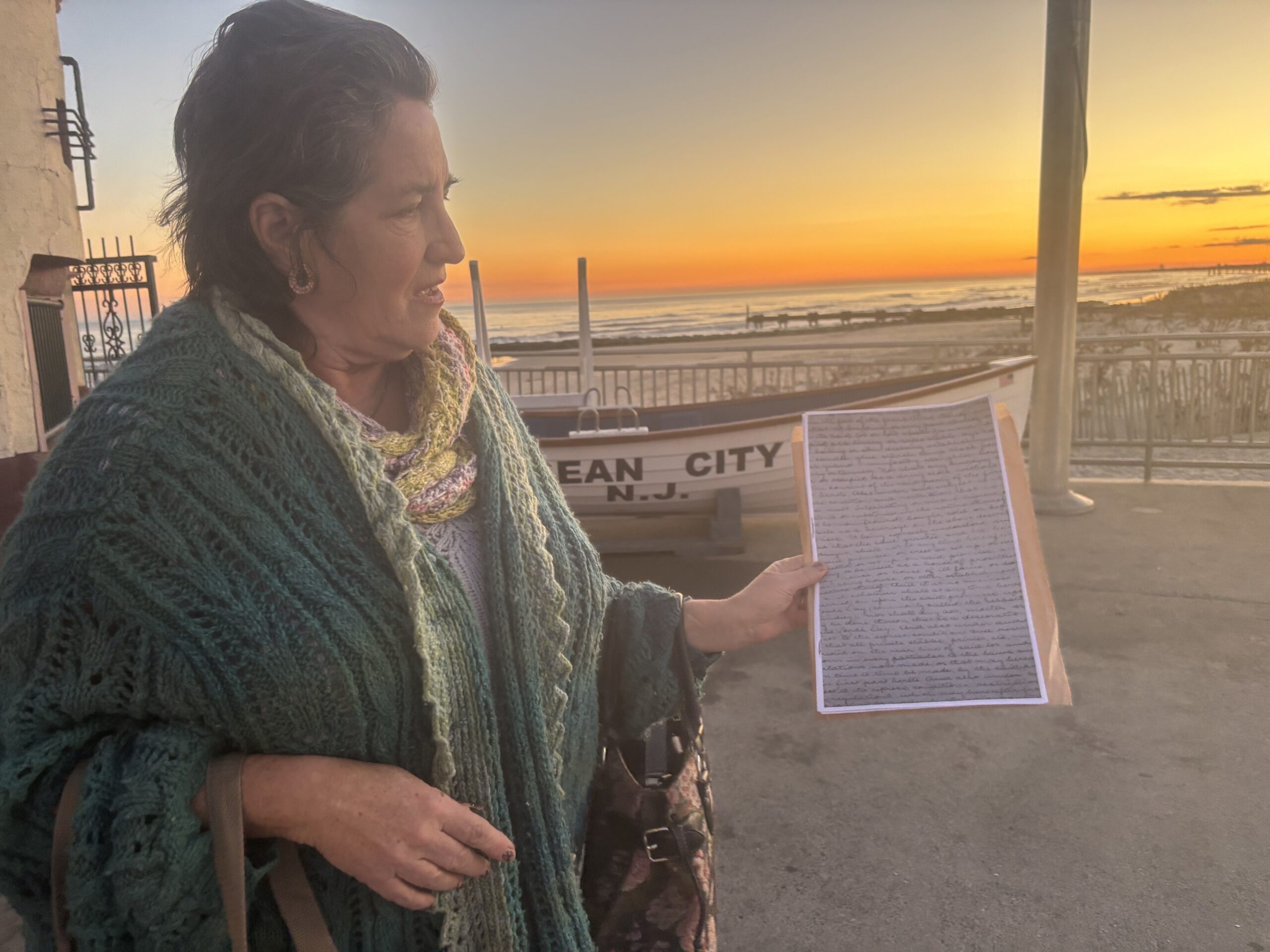
Others resisted any fast-tracking of development. Donna Saber, owner of Here Comes the Bride shop, brought along a copy of the original 1881 deed that she said sought to preserve its original intent as a place for child amusements.
“It was deeded as an amusement park,” she said.
Donna Saber, owner of Here Comes the Bride bridal shop in Ocean City, holds a copy of the original 1881 deed to the property that was the Wonderland Pier. She’s opposed to a plan to build a luxury hotel.
Marie Hayes, a full-time resident for 22 years, worried the designation would set a “dangerous precedent,” that would result in the town resembling Ocean City, Md., with high-rises along its oceanfront.
The planning board was given reports submitted by Mita back in August, when council stunned some, especially Mita, by voting not to ask the board to study the site’s future. Mita immediately said he would sell the property.
John Loeper, chair of Ocean City’s planning board, on stage at the Ocean City Music Pier. The planning board was set to vote on whether to recommend that the old Wonderland Pier site be declared in need of rehabilitation, a designation that could lead to a luxury hotel on the site.
Sean Barnes, the city councilman liaison to the planning board, questioned Wednesday whether the rides should even be considered part of the property.
“Amusement rides are not structures,” said Helen Struckmann, a resident who has opposed the hotel idea and vowed to save Wonderland Pier. She said the historic carousel was in better shape than the reports stated. “They don’t justify the need for rehabilitation designation for the property. Different amusement rides have been swapped out.”
She and others questioned why Mita had not addressed deterioration of the property since purchasing it in 2021. Mita is “now requesting a benefit from his purposeful underutilization of the property,” said resident Bob Duffy.
But Mita said he’d waived rent on the property so that Jay Gillian could try to make a go of the amusement pier. He said he’d put in $500,000 last summer to open the front portion of the property as an arcade, coffee and pizza shop, and bike shop.
Engineer Matt Mowrer told the planning board the property was “heavily deteriorated,” with “concrete spalling” — chunks of concrete breaking off from the foundation. He said corrosion from salt air would get only worse.
Board planner Randall Scheule told the board Wednesday he believed the structural deterioration of the property itself and the underutilization of the property met the standards. There was some debate as to whether the rides themselves should be included in any analysis.
The board looked at whether the site met the legal criteria needed for the designation, which will allow City Council to rezone the site for a hotel and grant tax abatements.
Will Morey, president and CEO of Wildwood’s Morey’s Piers, testifies in Ocean City at a planning board meeting to determine the future of the old Wonderland Pier.
The board did not discuss Mita’s specific hotel plans, which have included the carousel and Ferris wheel and some kiddie rides.
The old Wonderland Pier site on the boardwalk in Ocean City, N.J., as seen from Wayne Avenue on Jan. 6. The beloved amusement pier shut down in October 2024. A developer wants to build a luxury hotel. A report put the cost of repairing the Ferris wheel, carousel, and log flume at as much as $6.5 million.Five minutes before the 6 p.m. scheduled closing all but one of the gates are shut on the Boardwalk, on the final day for the beloved Wonderland Pier in Ocean City Sunday, Oct. 13, 2024.
Last summer, four businesses operated on the site: Ocean City Pizza Company, Dead End Bakehouse, Wonderland Pier Arcade, and OC Bikes and Rentals. Mita entertained several offers to sell, including one from the Norcross brothers, who envisioned residential development.
Planner Tiffany Morrissey told the planning board that showed the property was underutilized.
The property is assessed at $15.8 million, which translates to an estimated market value of about $29 million.
Saving the site as an amusement park has been the focus of much despair among community members and others with generations of memories at Wonderland Pier.
But the reports lay out the deterioration of the pier’s marquee attractions.
The report states that the carousel, which dates to the 1920s, would require as much as $1.5 million in repairs, including a new electrical system and repair or replacement of the telescopes, the poles that support the horses.
The Ferris wheel is also in need of substantial repair, costing as much as $2.5 million, including replacing or repairing the lights, and rebuilding the spokes and “spreader bars,” which connect the spokes and form the arc.
The Log Flume Ride, built in 1992, would need substantial repairs estimated at between $2.5 and $4 million, including rebuilding the upper troughs.
No company has stepped forward with a plan to keep the site solely an amusement park.