Tag: Ocean City

  • Ocean City’s Dollhouse Row was her dream. Now it’s her winter wonderland.

    Ocean City’s Dollhouse Row was her dream. Now it’s her winter wonderland.

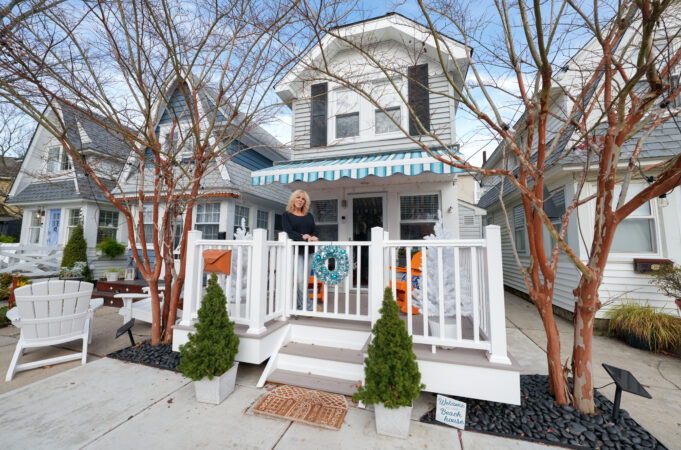
    Driving up Wovern Place in Ocean City feels like entering a Hallmark movie set.

    It’s where nine homes — 800 square feet or smaller — stand shoulder to shoulder on a winding road known as Dollhouse Row, all decked out in holiday cheer. Ginny Chappell’s house, decorated in blue and white, combines holiday tradition with a classy beach vibe.

    “Christmas has always been my favorite time of year,” said Chappell.

    Since randomly discovering Dollhouse Row as a twentysomething visiting the Shore, Chappell dreamed of owning a home on this historic street, where the houses were built in 1927.
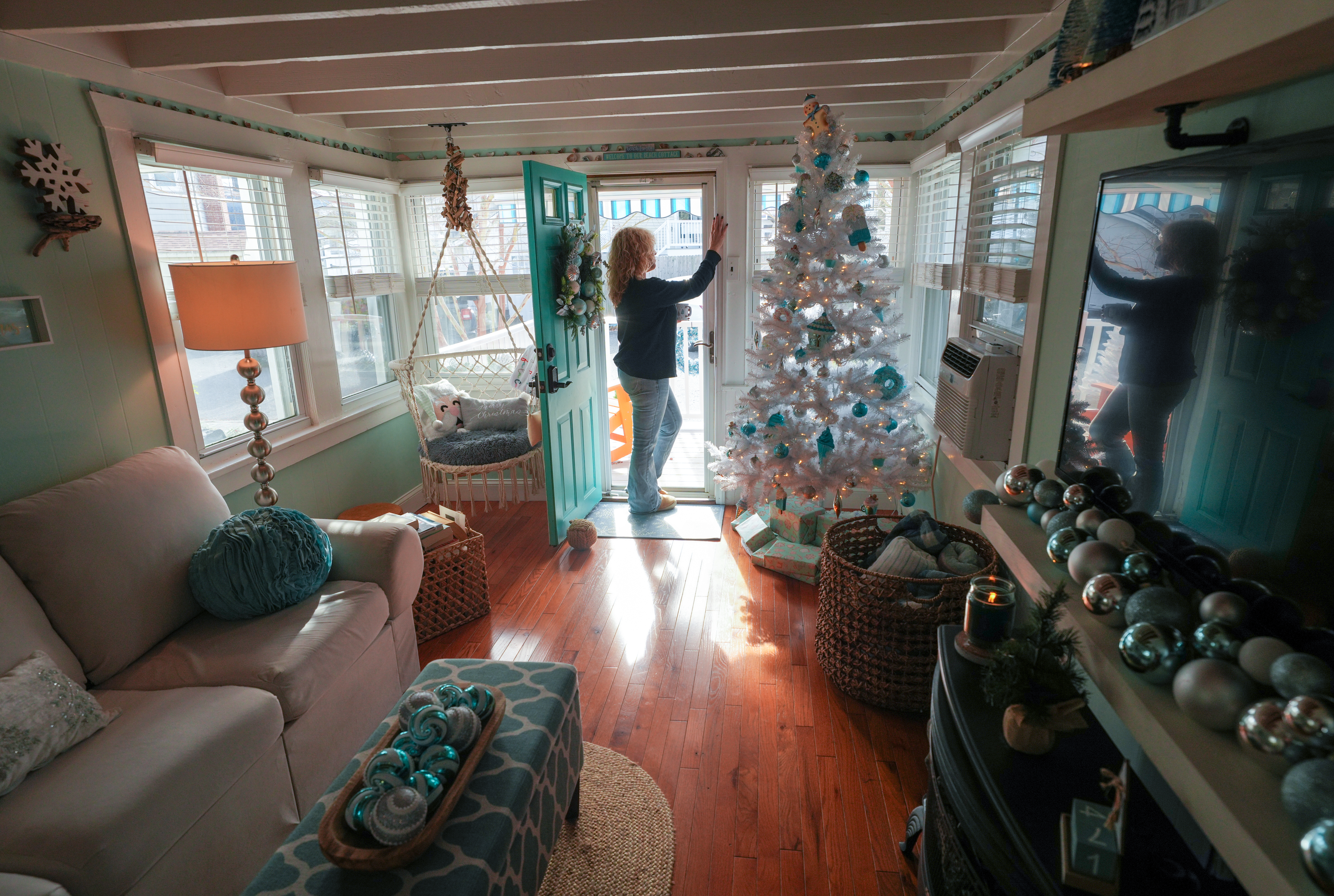
    Ginny Chappell looks out the front door from the living room of her Ocean City house.

    “I was obsessed with the street and followed it ever since,” recalled Chappell, a retired nurse with two part-time jobs in Ocean City. She’s a salesperson at Artisan Body Products and a part-time assistant innkeeper at the historic Coastal Chateau.

    In 2015, when she was living in Franklinville and looking to buy a vacation home, there weren’t any houses for sale on Dollhouse Row.

    “My Realtor told me to dream on, that they stay in families and almost never sell,” said Chappell, who instead bought an even tinier home — 400 square feet — in the south end of Ocean City.

    Five years later, looking for more space, she set out to buy a larger house, but just days before closing, the deal fell through. Chappell was devastated.
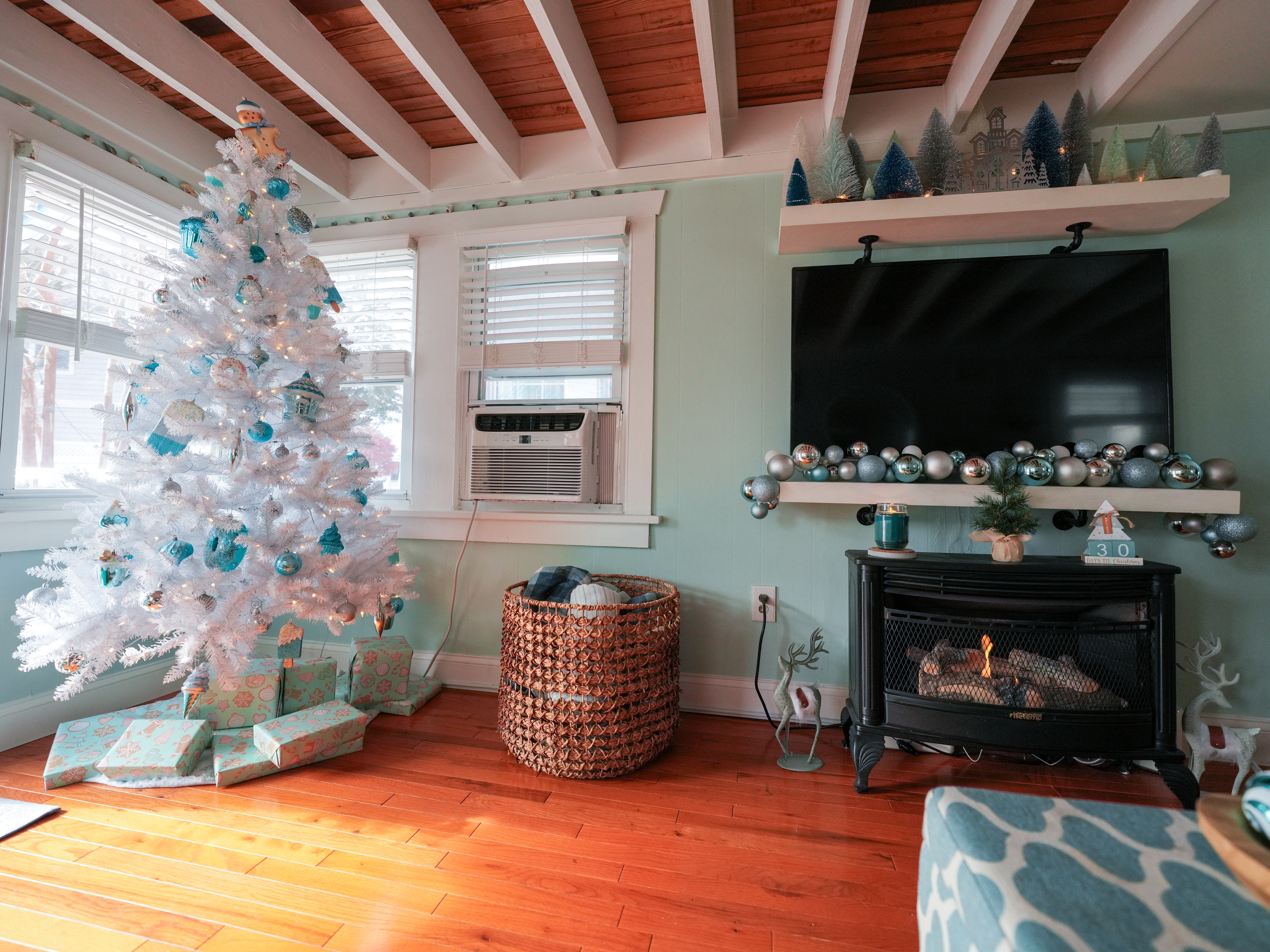

    A white and blue Christmas tree, festive ornaments and a toasty fireplace bring holiday cheer to the home.
    Chappell sits on the steps just off the galley kitchen.

    But her luck changed two months later when she got the call she had long dreamed of: an 800-square-foot Dollhouse Row house was about to go on the market.

    “I’m someone who very much believes in manifestation,” Chappell said.

    She now shares the house, named Grayce by previous owners, with her two long haired mini-Dachshunds, Liliana, 17, and Romeo, 6 months. She has a comfortable primary bedroom and a spare bedroom for visitors, which often include her daughter Kayla, 22.

    The first floor is open space with a cozy family room, kitchen, and dining area. Upstairs, a full bathroom sits between the two bedrooms, with a stacked washer and dryer hidden behind a curtain. The primary bedroom includes a small electric fireplace that doubles as a heater.
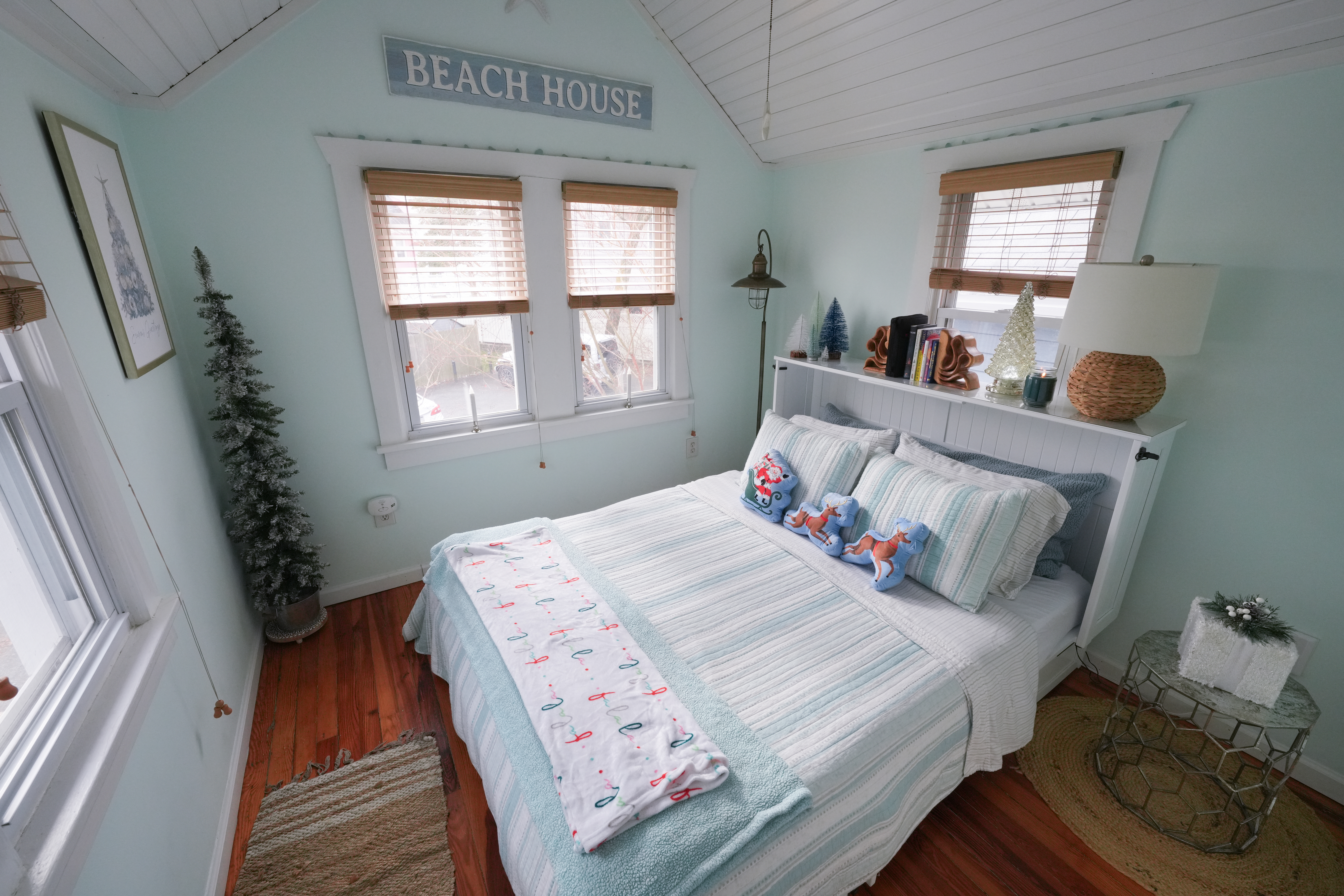

    Chappell’s holiday decor, with blue details throughout, doesn’t compete with the beachy theme of her primary bedroom.
    In a comfortable chair in the primary bedroom, Chappell is surrounded by blue, teal, and silver Christmas and winter accessories.

    Despite the small space, Chappell’s home is not cluttered. She has thoughtfully arranged each piece of furniture, artwork, and knickknack, with storage invisibly tucked away. She also rents a storage unit for offseason clothing and other items.

    Each year, she envisions her holiday theme, then sets out to perfect it.

    For her coffee and hot chocolate station, complete with marshmallows and candy cane sprinkles, she wanted Christmas-themed mugs in blue and white and searched until she found them.

    “I spent four days finding these mugs,” she recalled, hitting three Home Goods stores, Hobby Lobby, and Dollar General on her search.

    Ginny Chappell makes a warm beverage at her coffee and hot chocolate bar, complete with festive mugs.

    It isn’t about what something costs but how it makes her feel, she said. Her pre-lit frosted white tree, adorned with blue and silver ornaments and a Gingerbread Man tree topper, came from Walmart. She also supports local crafters and businesses whenever possible.

    For home design details she keeps year-round, she loves to scour the beach for beautiful broken seashells, where the iridescent pinks and beiges can be seen through the cracks in the shells. Shells line each window frame throughout the house.

    “If they weren’t broken you would never be able to see just how beautiful they are inside,” she said. “The message is broken is beautiful.”

    She also has dozens of small one-of-a-kind driftwood shelves hanging on her walls, and at this time of year each holds a small snowflake, tree, or other decoration. Her mantle is filled with artistic Christmas trees in shades of blue, white, silver, and gray. Vintage Christmas decor, including tin post cards, can be found throughout the cottage.

    Given its small size, Chappell’s home can’t host large parties, but it can be shared with friends, neighbors, and even strangers. Her home has been featured in Ocean City’s Holiday House Tour for the last three years, drawing as many as 500 visitors each year.

    Ginny Chappell sits on the porch of her 800-square-foot home that is decorated for Christmas.

    A house close to 100 years old does come with challenges.

    “I’m always fixing things,” Chappell said. “But, people are drawn to its charm and history.”

    A small group of friends share the holidays with charcuterie boards, wine, and lots of laughs. Her front porch is the perfect perch for watching visitors stroll down the street, enamored with the tiny houses.

    “I believe this street is very special because of its history,” Chappell said. “The people on this street call ourselves the cottage keepers. We want people to restore rather than tear down.”

    Is your house a Haven? Nominate your home by email (and send some digital photographs) at properties@inquirer.com.


  • Eroded Jersey Shore beaches could soon get federal money for replenishment. Will it be enough?

    Eroded Jersey Shore beaches could soon get federal money for replenishment. Will it be enough?

    Congress appears poised to spend money in 2026 on beach replenishment projects in wake of the zero dollars it allocated this year.

    But bills proposed in the House by U.S. Rep. Chuck Fleischmann (R., Tenn.) and in the Senate by U.S. Sen. John Kennedy (R., La.) appear to still fall woefully short of what is needed, a coastal advocacy group says. U.S. House Rep. Jeff Van Drew, however, believes there will be adequate funding.

    Dan Ginolfi, executive director of the American Coastal Coalition, an advocacy group for coastal communities and beaches, said the current best case would be the Senate bill, which proposes to spend $62.2 million. The House bill proposes $23 million.

    However, both proposals fall short of the approximately $200 million needed to fund approved projects in various states that received no money last year, he said.

    Any approved money would go to the U.S. Army Corps of Engineers, which would choose which beach erosion projects to manage.

    In New Jersey, projects set for Cape May, Stone Harbor, Avalon, Sea Isle, Strathmere, Ocean City, and Long Beach Island have been stalled because of the lack of funding. So, too, have projects in Maryland, Delaware, Georgia, and Florida.

    That means “the level of risk in New Jersey right now is unacceptable,” Ginolfi said.

    He noted that it’s not only beaches at risk, but homes, businesses, public property, and infrastructure.

    “It really is imperative that the federal and state government work together to achieve a solution,” he said.

    Ginolfi noted that coastal communities in the U.S. generate $36 billion in federal and state tax revenue. So he sees $200 million as a good return on investment.

    He said his numbers for potential beach replenishment projects in the bills were confirmed with appropriations committees in both the House and Senate.

    However, the office of Van Drew, a Republican who represents many New Jersey beach communities, said the coalition’s numbers “misrepresent the true amount of funding available.”

    Paxton Antonucci, a spokesperson for Van Drew, said there is actually $166 million available in the House bill “for costs associated with shore protection like beach replenishment, which is the typical amount.”

    He said that number will come close to $200 million “after we compromise with the Senate.”

    In reality, Van Drew said, most beach replenishment funding comes from outside the regular budget process. He has actively sought such money.

    In October, Van Drew wrote to the Army Corps, requesting that it “activate disaster recovery authorities … to repair shore protection projects at the Jersey Shore, in response to damages caused by Hurricane Erin and by the recent nor’easter over the weekend of Oct. 10-12.”

    And he wrote to Gov. Phil Murphy and Gov.-elect Mikie Sherrill this week urging that New Jersey declare a state of emergency to secure federal money “for the severe coastal erosion and storm damage affecting the Jersey Shore.”

    Van Drew said the Shore has been battered since July by “intense wind, wave, and water impacts from storm events including Hurricane Erin, Hurricane Imelda, offshore Hurricane Humberto, and a succession of destructive nor’easters.”

    He said the result has been “significant dune loss, beach profile collapse, and damage to public infrastructure in multiple municipalities.”

    Indeed, the Ocean City Council declared a local emergency over beach erosion from the storms and urged state and federal officials to help.

    The American Coastal Coalition has faulted Murphy’s office for failing to request disaster repair projects from the Army Corps in the wake of the storms.

    However, Murphy’s office said the storms this year did not meet financial thresholds needed to qualify for major federal disaster declarations.

    In addition, the office said that, even if they did, replenishment projects at Army Corps-engineered beaches are not routinely eligible for Federal Emergency Management Agency reimbursement.

    Rather, the office blamed Congress for putting forth a budget that cut beach replenishment projects, and said that blue states are a target of the Trump administration.

  • Ocean City’s mayor files for personal bankruptcy but he plans to stay in office

    Ocean City’s mayor files for personal bankruptcy but he plans to stay in office

    Ocean City Mayor Jay A. Gillian has filed for personal bankruptcy.

    The “extraordinarily difficult decision” was made after a combination of business decisions he made, personal financial obligations, and outside circumstances led to “serious financial strain” on his family, Gillian said in a statement shared on Ocean City’s government website.

    “Like many individuals and families across our nation who encounter unexpected hardship, I found myself in a position where traditional methods were no longer viable,” Gillian said. “It is my hope that by being transparent and direct, others facing similar hardships will feel empowered to seek help, take responsible action, and work toward rebuilding.”

    Despite this personal challenge, Gillian said his leadership of Ocean City remained “unwavering,” and he would stay in his role as mayor. In the statement, the mayor assured residents that his personal financial issues had no impact on city finances and operations were uninterrupted.

    “Safeguards, oversight, and the structure of municipal government ensure that personal finances and public finances remain entirely separate,” Gillian said.

    Gillian referred to his public statement when asked for additional comment.

    A sign welcomes visitors to Gillian’s Wonderland Pier in Ocean City on Tuesday, August 20, 2024.

    While the mayor, who has been in office since 2010, did not specify what led to the bankruptcy beyond his statement, the Gillian family, which owned Gillian’s Wonderland Pier since 1965, sold the property to developer Eustace Mita, of Icona Resorts, in 2021. At the time, the Gillian family had defaulted on $8 million in loans, with the pier as collateral.

    Mita has since embarked on plans to transform the site, first into a $150 million luxury hotel, and later, into townhomes. After a City Council vote Thursday, the property is now under review by the Ocean City Planning Board to determine whether the property should be rehabilitated or rezoned for new development.

  • Ocean City declares emergency over beach erosion, urges state and federal help

    Ocean City declares emergency over beach erosion, urges state and federal help

    Ocean City Council on Thursday night declared a local emergency over beach erosion, and urged state and federal officials to help.

    The resolution comes after the community suffered severe erosion during two recent storms. Hurricane Erin in August and a nor’easter in October battered the city’s beaches, scouring out cliffs of sand.

    “This could be a tool to help our legislators who are fighting to fund a U.S. Army Corps of Engineers beach replenishment project,” Mayor Jay Gillian explained.

    Gillian said city officials spoke with Republican U.S. Rep. Jeff Van Drew and shared ideas to deal with the erosion. This year marked the first year since 1996 that Congress approved zero federal dollars for beach projects in New Jersey.

    A New Jersey Department of Environmental Protection (DEP) assessment of the damage from the October nor’easter found that the city experienced erosion between 1st and 11th streets, with new dune scarping or loss in that entire stretch.

    Some of the scarping — vertical sandy cliffs caused by storms exceeded five feet in height.

    High waves caused additional damage under the boardwalk at 5th and 6th Streets, according to the DEP.

    “Ocean City is currently experiencing critical and accelerating beach erosion, including significant dune loss, destruction of protective berms, and threats to both public and private property,” the resolution states, “placing the city in an emergency state of vulnerability ahead of the winter storm season.”

    The resolution said beach width and height had already been compromised before the storms.

    Further, it said, the city “lacks the financial resources to independently implement large-scale beach replenishment, dune restoration, or long-term protective measures, and requires urgent and immediate assistance and funding,” from state and federal sources.

    Officials say Army Corps replenishment efforts have already been delayed without any clear timeline to continue.

    The resolution was sent to Gov. Phil Murphy, and multiple U.S. and state legislators, as well as multiple county, state, and federal departments.

    “Ocean City stands ready to work collaboratively with all levels of government to protect the lives, homes, economy, and natural resources of its residents,” the resolution states, “and requests that this growing crisis be met with the urgency and seriousness it warrants.”

    Ocean City is not alone in having felt the wrath of the storms without any funding help in site. The continued federal shutdown has only resulted in more delays in seeking money.

    Coming after Hurricane Erin, the October nor’easter erased sand and seriously compromised dune systems, the DEP said in its preliminary assessment of the storm.

    “Moderate to major erosion” was reported on Long Beach Island and from Strathmere to Cape May, and “moderate to minor” erosion from Brigantine through Ocean City, according to that assessment.

    Although Erin stayed well offshore when it struck in August, the winds and waves it generated caused at least minor erosion on 85% of all Jersey beaches, according to the department’s analysis.

    That included “moderate” sand losses in Avalon, Ocean City, Strathmere, and North Wildwood.

    Contributing to the sand losses resulting from the nor’easter was the fact that the beaches already had endured consecutive days of onshore winds on four occasions since Aug. 18.

    That left beaches without much time for recovery.