The 2026 Winter Olympics in Milan may be over, but the political storm and protests stirred by the presence of U.S. Immigration and Customs Enforcement have not faded. With the FIFA World Cup set to bring millions of international fans to North America next, the Milan backlash now feels less like an isolated controversy and more like a warning of what could lie ahead.
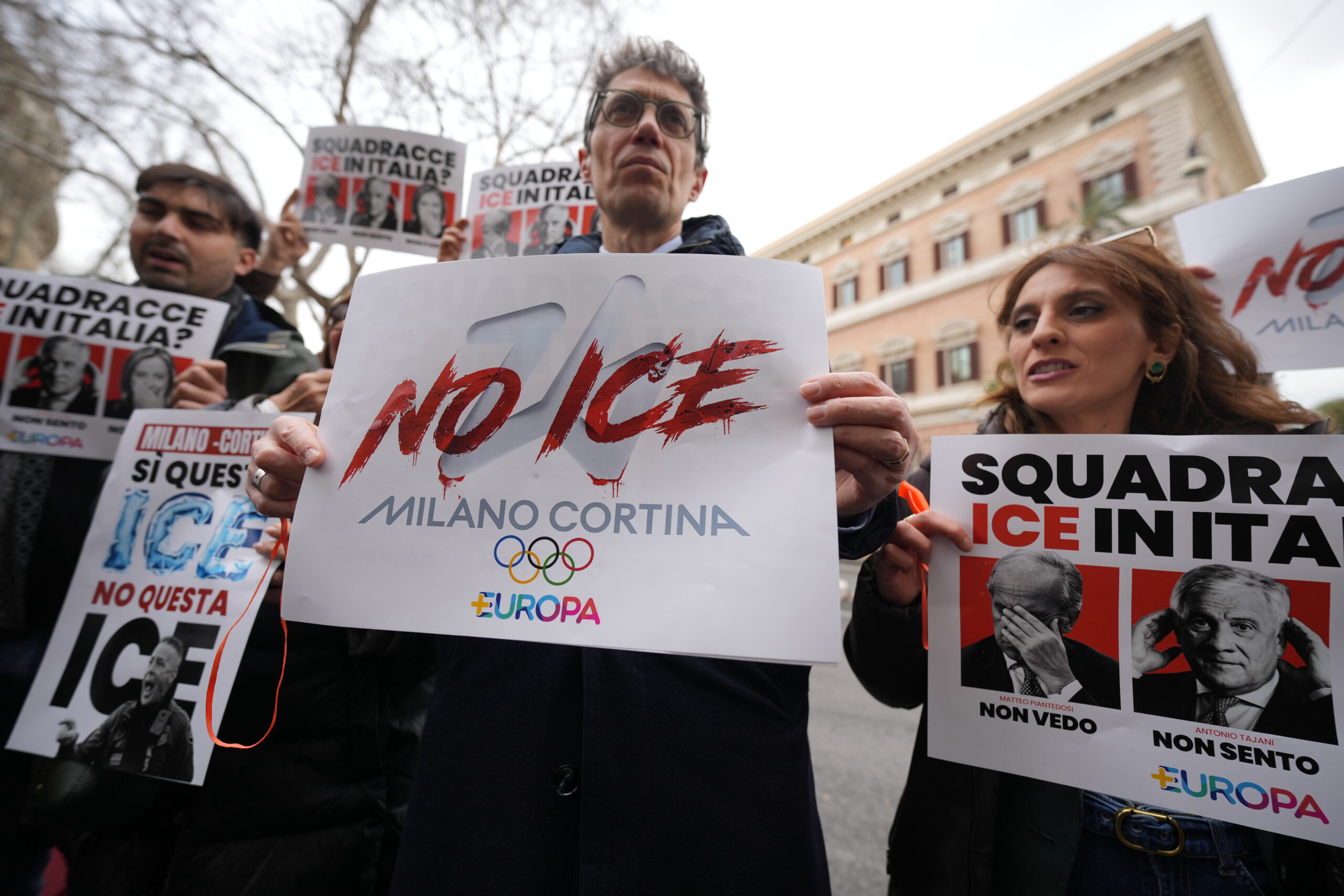
Italian lawmaker Riccardo Magi (center) shows a placard demanding that U.S. Immigration and Customs Enforcement (ICE) agents not be allowed at the Milan Cortina Olympics, during a protest staged outside the U.S. Embassy in Rome in January.
The last World Cup in Qatar drew about one million international visitors. The 2026 tournament — hosted across the United States, Canada, and Mexico — is expected to attract several times that number, making it the largest in soccer’s history. Its success will hinge not only on logistics and policing, but on whether teams and supporters feel welcome, safe, and able to move across borders within tight time frames.
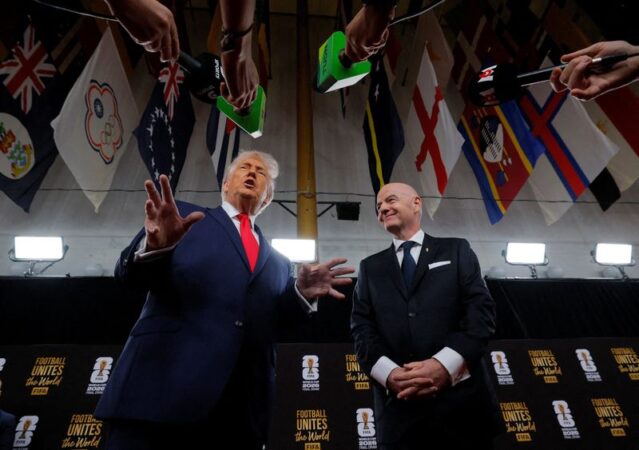
That confidence is now under scrutiny. ICE acting Director Todd Lyons has said the agency will be a “key part of the overall security apparatus” for the World Cup. Yet, when immigration enforcement becomes visibly woven into the staging of a global tournament, it ceases to look like routine security and instead risks appearing as a projection of domestic policy onto an international stage.
Already, there are increasing calls to boycott the event for safety reasons, with fan groups like Football Supporters Europe expressing concern about the “ongoing militarization of police forces in the U.S.”
Meanwhile, supporters from Latin America, Africa, and the Middle East are already asking whether a valid visa will be enough. Could minor paperwork errors lead to detention? For mixed-status families living in the United States, the anxiety is sharper still. A major German team has reportedly canceled a U.S. tour, and online fan forums openly debate boycotts.
Sport has always intersected with politics. The 1936 Berlin Olympics were carefully orchestrated by the Nazi regime to project ideological confidence and international legitimacy, even as discriminatory policies continued at home. Decades later, the global boycott of apartheid South Africa — leading to the country being barred from the 1964 Olympic Games — showed that tournaments can reflect moral choices.
But there is a difference between holding regimes accountable and turning sporting events into stages for domestic enforcement policy. This point carries particular weight in the U.S., a country whose global appeal has long rested on openness and pluralism.
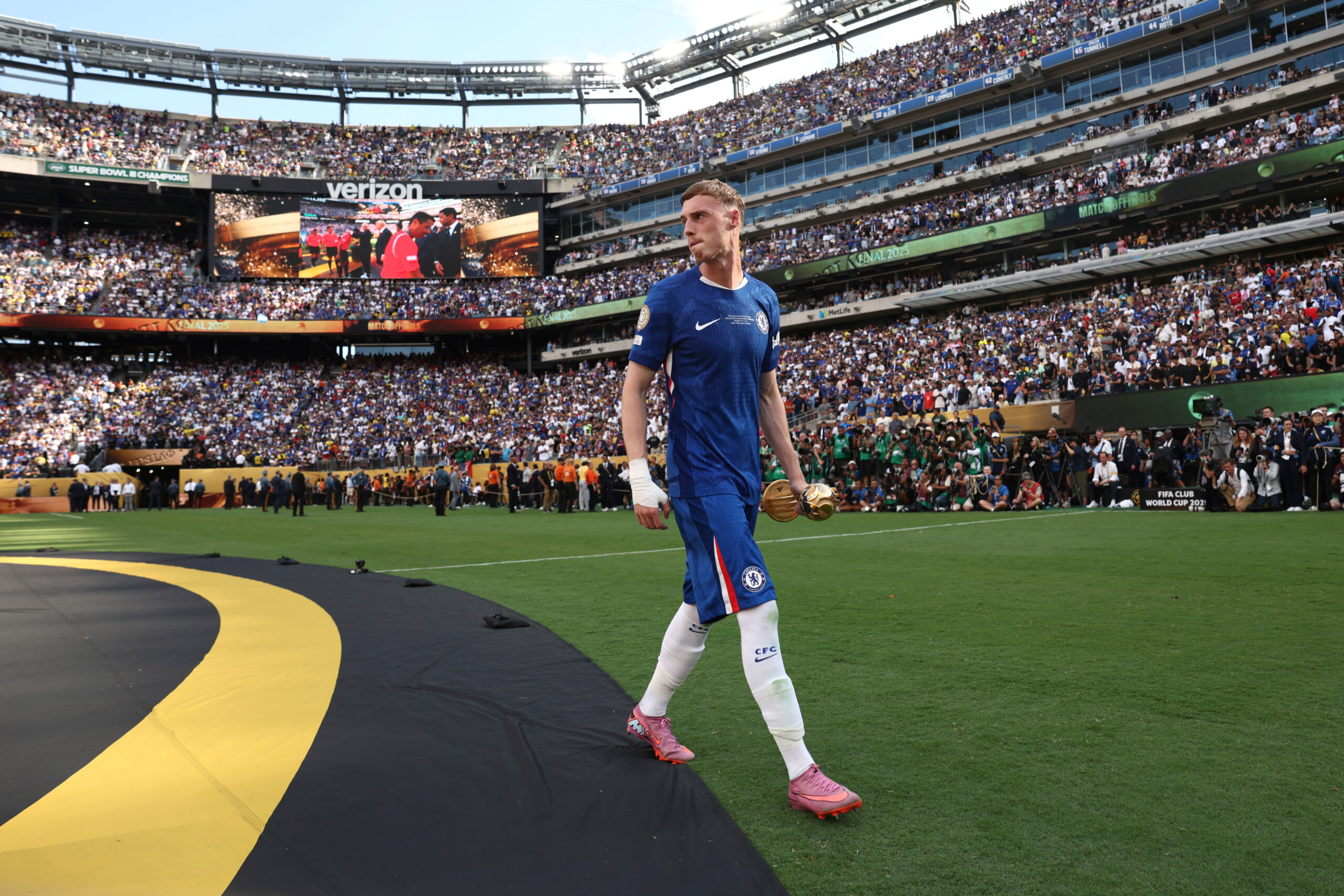
Chelsea’s Cole Palmer walks with the golden ball trophy after Chelsea won against Paris St. Germain in the Club World Cup final, at MetLife Stadium in East Rutherford, N.J., in July.
The World Cup is a soft-power moment. For one month, North America will present itself to billions of viewers not just as a host, but as a harmonious society — a rare global moment when rival nations share rules, rituals, and space on equal terms.
That is precisely why international bodies have treated soccer as a tool for cohesion rather than division. The United Nations has repeatedly promoted sport as a mechanism for refugee integration and social stability, while organizations working on counter-extremism and discrimination, including the Muslim World League, have similarly highlighted how athletics can cultivate “understanding, empathy and respect” across communities.
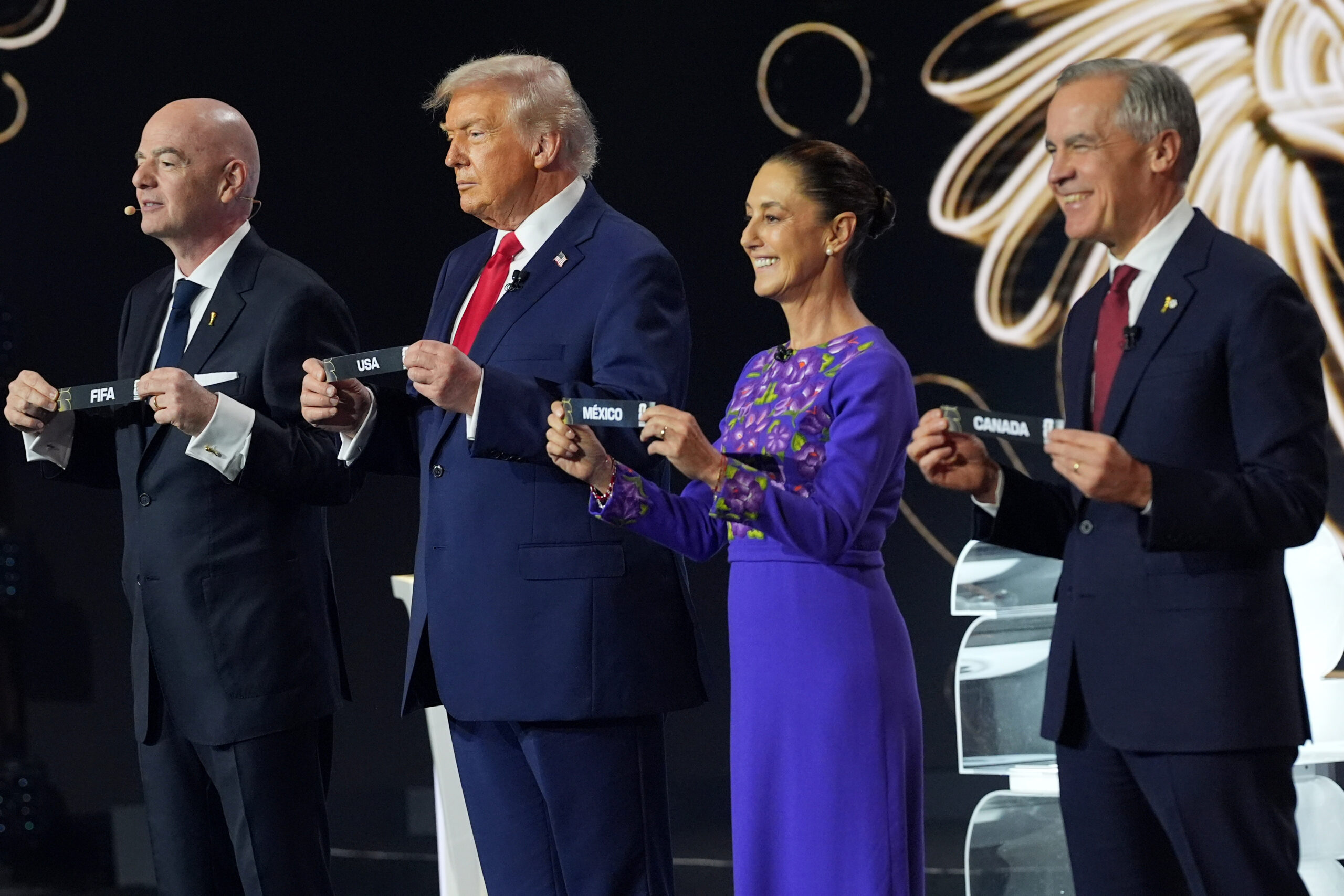
Canadian Prime Minister Mark Carney, Mexican President Claudia Sheinbaum, President Donald Trump, and FIFA President Gianni Infantino hold up country names during the draw for the 2026 FIFA World Cup at the Kennedy Center in Washington in December.
MWL’s secretary general, Mohammad bin Abdulkarim Al-Issa — who was recently recognized in the United States for his efforts to combat hate — has repeatedly warned that weak integration and social division are the biggest threats facing humanity today. Global sporting events, by contrast, offer rare shared civic spaces where diverse societies meet on equal terms, reinforcing inclusion rather than suspicion.
If enforcement spectacle overshadows the 2026 World Cup, the consequences will be economic as well as social. Travel hesitancy, empty seats, and reduced tourism would be immediate effects.
But the deeper risk is political: Visible exclusion at a global event reinforces narratives of division and grievance that extremists on all sides are quick to exploit. When people feel unwelcome in shared civic spaces, mistrust grows — and the integrative power that sport is meant to provide begins to erode.
That makes clarity from federal authorities essential. The U.S. Departments of Homeland Security and State and host city governments should coordinate to publish tournament-specific guidance covering visa processing timelines, entry procedures for ticket holders, and the scope of enforcement activity around official venues.
Clear assurances that immigration sweeps will not be conducted at stadiums, accredited fan zones, or public watch sites would reduce uncertainty without compromising border security.
For a country that prides itself on being a nation of immigrants — and for a president who places great stock in ratings, turnout, and global spectacle — the 2026 tournament presents an extraordinary opportunity to show that security and openness can coexist. Full stadiums and strong international attendance would reinforce the image of a confident, welcoming host nation.
If instead, travel hesitancy, empty seats, and visible enforcement dominate the optics, the tournament risks projecting exclusion rather than unity.
That outcome would not only diminish the World Cup’s global appeal but squander a rare moment of soft power that no amount of security planning alone can restore.
Khalid Sayed is the leader of the opposition for the African National Congress in the Western Cape Provincial Parliament in South Africa, now serving his second term. A former provincial leader of the ANC Youth League, he is an activist committed to social cohesion and democratic renewal in a postapartheid society.
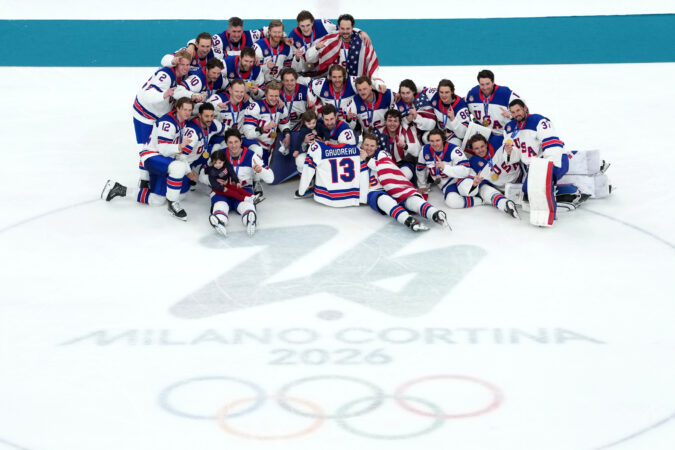
As the U.S. men’s hockey team skated around with Johnny Gaudreau’s Team USA jersey after its 2-1 overtime win over Canada in the gold-medal game of the Milan Cortina Olympics, Meredith Gaudreau looked on from the stands.
Meredith knew her late husband’s jersey had a place in the USA Hockey locker room in Milan, Italy, just as it had at the 4 Nations Face-Off in 2025. But she didn’t expect the team to bring the jersey to the ice as it celebrated USA Hockey’s first men’s Olympic gold since 1980.
As the team celebrated on the ice, Meredith’s phone rang. It was Matthew Tkachuk, asking if the team could get Meredith and Johnny’s two oldest children, Noa and Johnny Jr., onto the ice for a picture.
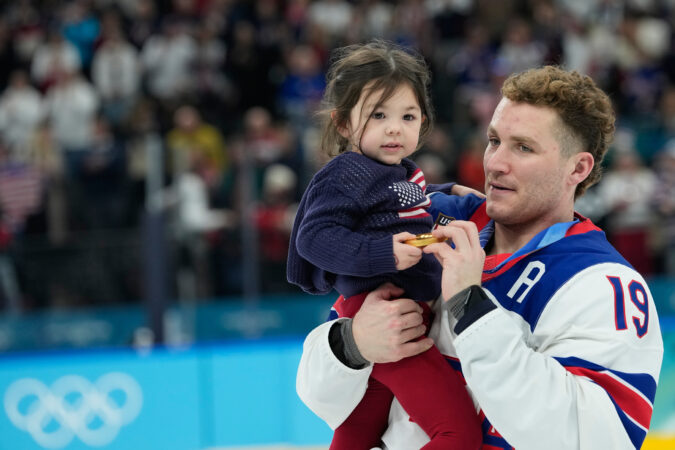
Johnny Gaudreau’s former Calgary Flames teammate, Matthew Tkachuk, skates with Gaudreau’s daughter, Noa, after the United States won Olympic gold on Sunday in Milan.
“I just was blown away that they wanted to do all that,” Meredith said. “They were really thinking of John. I was just very blown away by John’s impact, the way they want to honor him and have a lot of respect for him as a hockey player, a friend, an American hockey player. I was very, very proud of him for that.”
Johnny Gaudreau, who spent 11 seasons in the NHL and likely would have been on the team’s Olympic roster, and his younger brother, Matthew, died after being hit by an alleged drunk driver while riding bicycles near their South Jersey hometown on the eve of their sister Katie’s scheduled wedding in August 2024. Johnny was 31, and Matthew was 29.
Team USA honoring Johnny Gaudreau and his family was one of the most impactful moments of the Winter Olympics.
But the Gaudreau family might not have made it to Milan without the efforts of Brian Roberts, the chairman and CEO of Comcast.
Before the Olympics, Roberts read that the U.S. hockey team was planning to honor Gaudreau at the Games the same way it had during the 4 Nations Face-Off, by including a No. 13 Gaudreau jersey in the team’s locker room. Once the U.S. won its group, Roberts thought the Gaudreau family should have the opportunity to be at the Games in Milan.
Roberts first called Keith Jones, the president of hockey operations for the Flyers, to see if he knew how to get in contact with the Gaudreau family. Jones recommended that Roberts call Gary Zenkel, the president of NBC Olympics, and coordinate the Gaudreau family’s travel with USA Hockey.
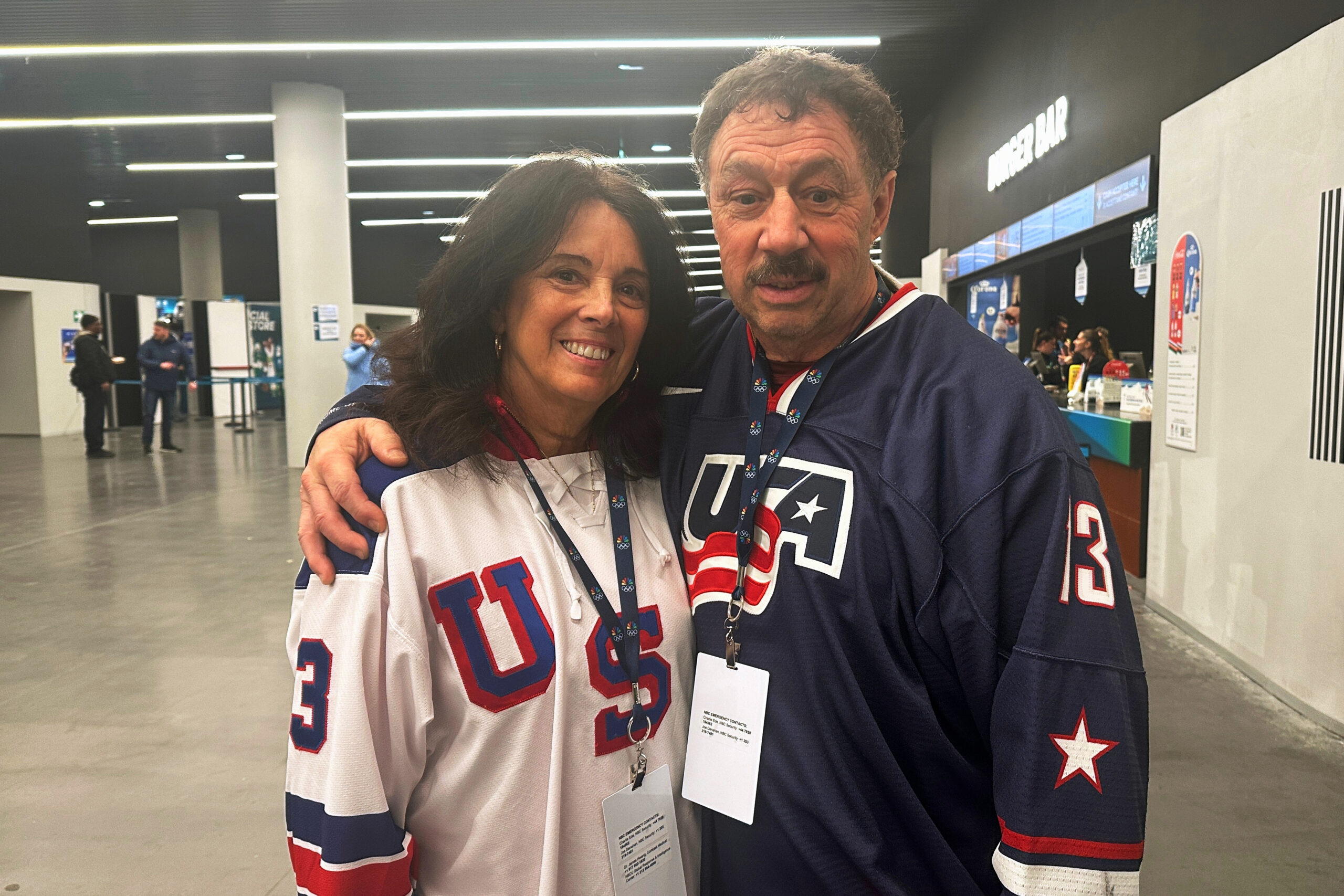
After some hesitation, Jane and Guy Gaudreau made the trip to Italy to honor their son and root on his former U.S. teammates.
”In the wake of an unthinkable loss, witnessing the Gaudreau family find a moment of pure joy at the men’s hockey final was a profound honor — that’s the magic of the Olympics,” Roberts said in a statement to The Inquirer.
Meredith said she got a call from her in-laws, Jane and Guy Gaudreau, on Feb. 17. They told her that USA Hockey had offered to take them to Milan. Johnny’s parents were hesitant, but Meredith knew immediately that she had to go.
“I have, kind of, two roles right now I want to focus on,” Meredith said. “That’s giving my kids a special life and honoring my husband. When those two things can overlap, it’s more than I can ask for right now. It just means everything to me.”
Meredith’s in-laws changed their minds, canceled a trip to Las Vegas with friends, and boarded a plane to Milan on Feb. 19. The family arrived in time to see the U.S. beat Slovakia, 6-2, in the semifinals the following day.
As the gold-medal game against Canada approached, Meredith couldn’t help but feel the U.S. was destined to win gold. The game was on Feb. 22, which happened to be Johnny Jr.’s second birthday.
“I just was like, ‘This is going to happen,’” Meredith said. “I just was reflecting on everything, and it was just the ultimate gift from John, the ultimate birthday present he gave to us for Johnny.”
‘We were really hoping for this together’
Johnny and Matthew Gaudreau grew up in Carneys Point Township in Salem County and played youth hockey for the Little Flyers and Team Comcast.
Meredith also is a Philly-area native and grew up with five siblings in Malvern. She and her sisters went to the Academy of Notre Dame de Namur in Villanova, while her brothers went to St. Joseph’s Prep in North Philly.
Meredith was a nurse in the neonatal intensive care unit at the Children’s Hospital of Philadelphia when she met Johnny in 2018 at her sister’s birthday party in Avalon, N.J. The pair got married in September 2021.
Johnny, a forward, played nine seasons with the Calgary Flames and two with the Columbus Blue Jackets and was hoping for a spot on Team USA’s Olympic roster.
“We weren’t getting too ahead of ourselves, but we were talking about planning our pregnancies around it,” Meredith said. “I was like, ‘It’d be hard to be out there with a newborn; it would be kind of hard to be out there pregnant, at the end of a pregnancy.’ … All those memories flushed into my mind thinking, ‘We were really hoping for this together.’”
Photographic memories
While the trip to Milan was a bittersweet moment for the Gaudreaus, Meredith said she’s glad that her children have the photos on the ice with Team USA to look back on.
Meredith’s 11-month-old, Carter, did not make the trip to Milan, but 3-year-old Noa and Johnny Jr. got a chance to celebrate with “the team that is all of Daddy’s friends,” which is how Meredith described Team USA to her children.
“I said, ‘They want to take a picture with you. It’s for Daddy,” Meredith said. “[Noa] was smiling really hard, and I was really proud of her for that because I think she’s at a stage right now where she’s starting to piece things together, and she’s very, very proud of her father.
“We look at pictures every single day, and she’s still super young and wasn’t even 2 when he passed. I try to tell her stories with the photos that she sees. I think she remembers pictures more than the actual memories.”
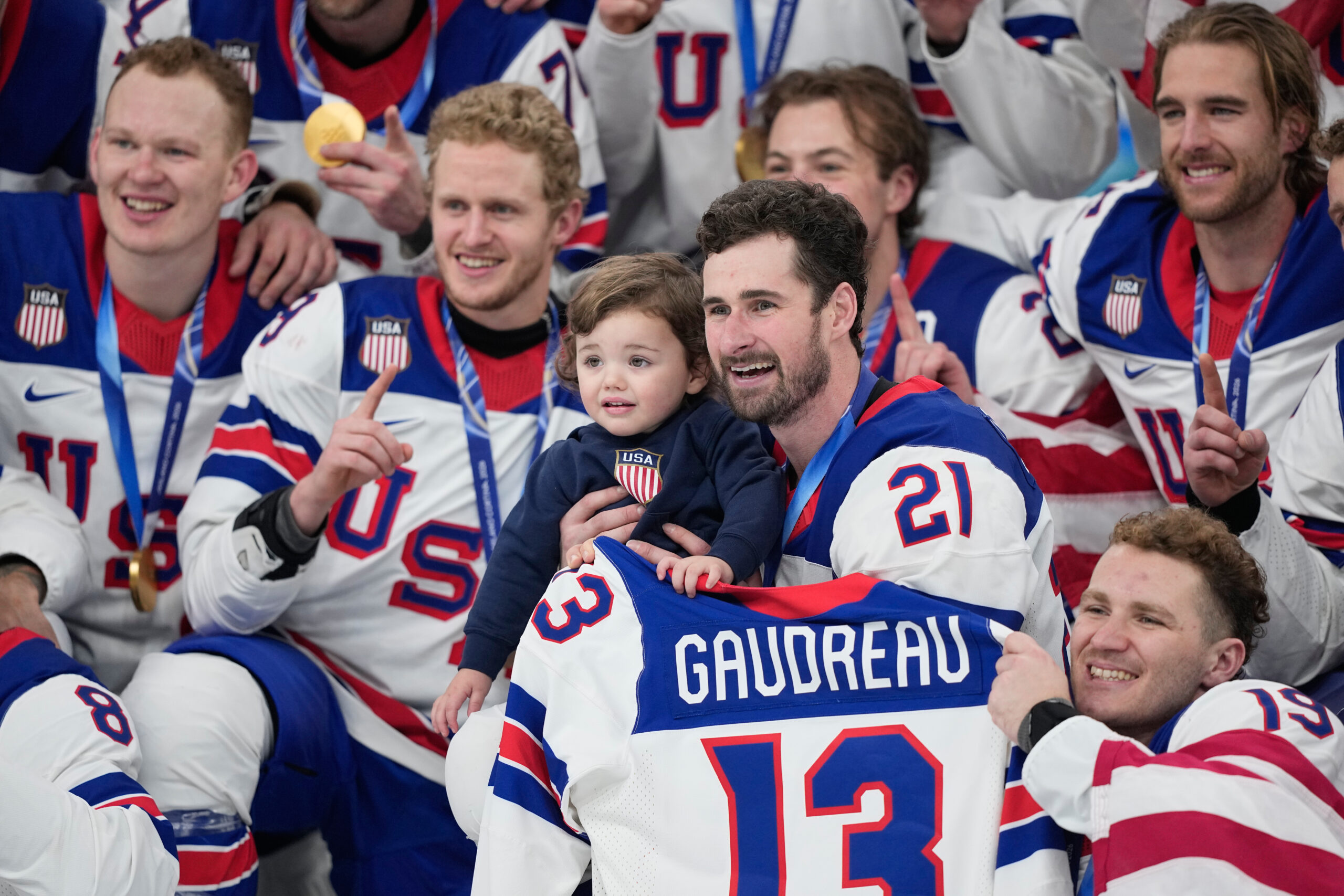
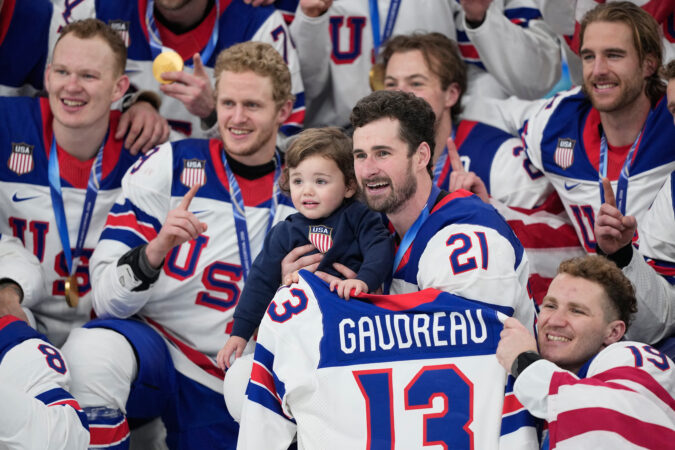
Dylan Larkin (21) holds Johnny, the son of the late Johnny Gaudreau after Team USA beat Canada in the gold-medal game in Milan.
Meredith hopes the pictures that came after the team’s win will be something Noa, Johnny Jr., and Carter can look back on as they grow up to help them remember and connect with their father.
“I was thinking into the future, too,” Meredith said. “That they’re going to look back on this and hopefully be blown away.”
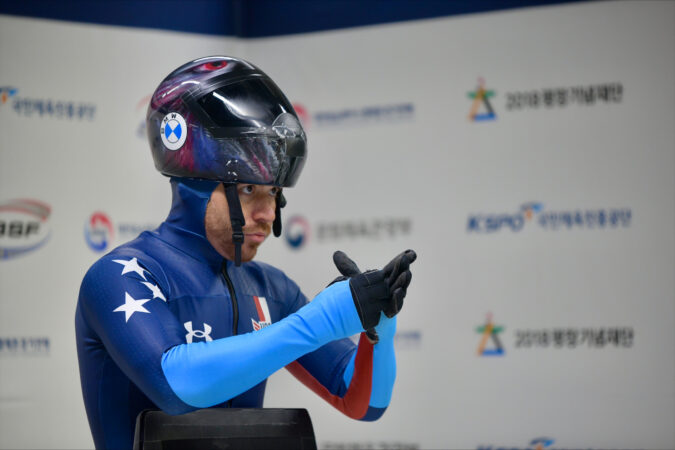
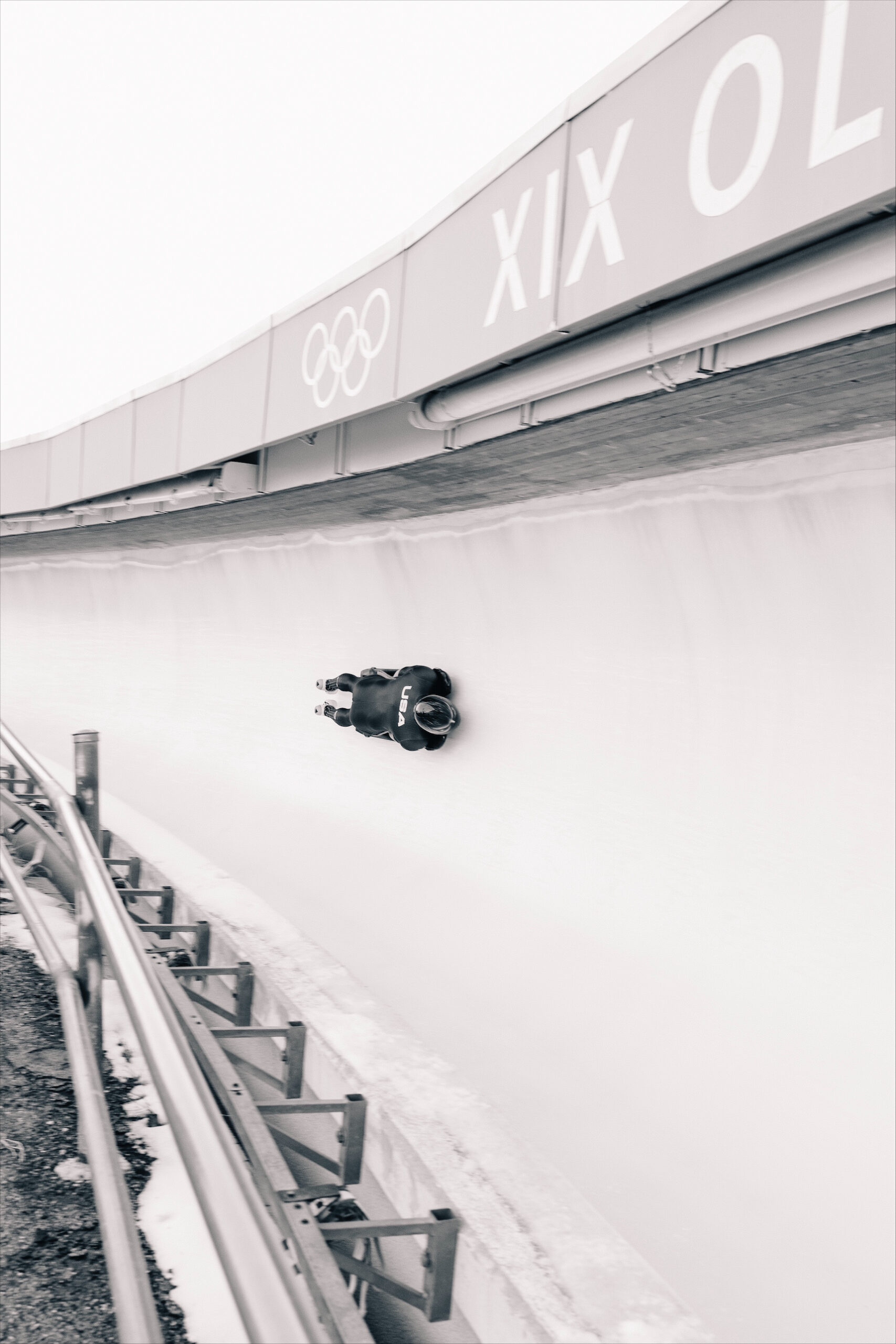
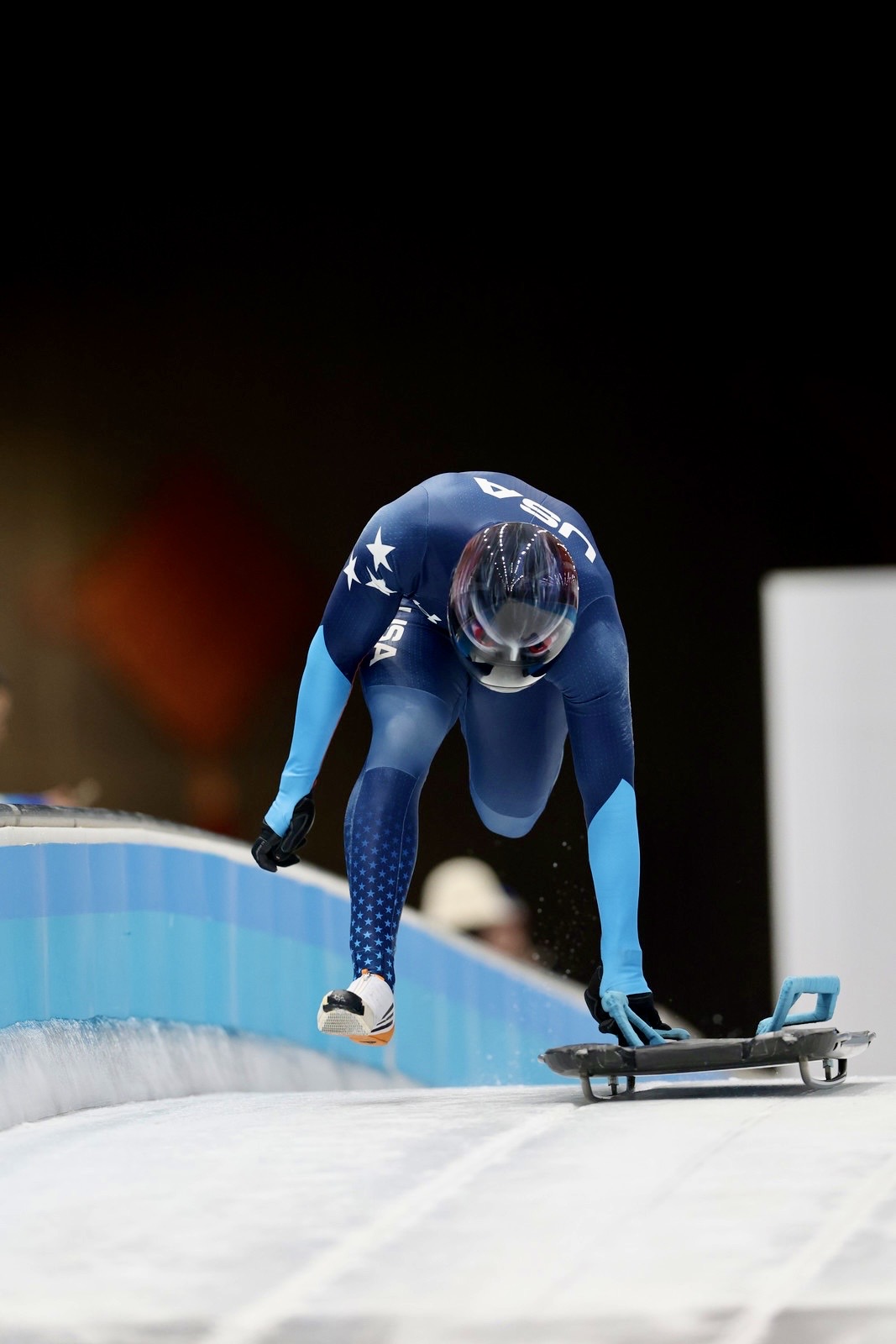
Penn State alumnus Dan Barefoot adjusted to a new full-time career when a winter in West Chester, Pa., left him searching for something more. A Google search at age 26 introduced him to skeleton, a sport he would quietly pursue before it carried him to the Olympic stage.
The 2026 Milan-Cortina Winter Games were Barefoot’s first time competing at the Olympics, and it was an unprecedented road. He had recently graduated from an intensive five-year landscape architecture program, often resulting in him spending six to eight hours in the studio per day. The transition to post-graduate life in West Chester provided Barefoot with more free time, leading to his discovery of skeleton.
“I started looking up winter sports, and thank you to bobsled for being alphabetically at the top. I clicked on that, and I read about it, and I was like, ‘Man, I think I could try out for this,’” Barefoot said.
And what began as curiosity quickly became a personal challenge, one he chose to pursue quietly.
“I wasn’t telling anybody,” said Barefoot, who competed in the first week of the Games but did not medal. “I wasn’t telling my friends, co-workers, or family.”
Much of what Barefoot relied on in skeleton, he traces back to the habits formed long before he ever touched a sled. The sport rewards sustained focus after the visible action ends, traits he learned through years of detail-heavy academic work.
“You have to have attention to detail and interest the whole time,” said Barefoot, a native of Johnstown, Pa. “We only go down the track for like a minute, but to get good at that, it’s like hours and hours and hours of mentally doing it. Pretending you’re doing it, lying on a sled, watching YouTube videos from past races, working on your equipment, which is way more time than a lot of people prefer.”
This progress brought unexpected pressures, and confidence became something to manage as carefully as speed or technique.
“You can quickly lose confidence in what you’re doing,” Barefoot said. “You can be the same guy, no issues physically, exactly the same, and play completely different from day to day, because it’s all in your head. So it’s balancing all those small pieces [that] is actually the hardest thing.”
As his training progressed, the idea became reality. Barefoot earned enough points to qualify for a tryout at the Olympic Training Center in Lake Placid, N.Y., marking the first moment he felt compelled to share what he had been working toward.
“I just witnessed, I encouraged, and I was amazed the whole time,” said David, Dan’s brother, on his journey toward the Olympics.
“We only go down the track for like a minute, but to get good at that, it’s like hours and hours and hours of mentally doing it,” Dan Barefoot said.
For much of his career, that balance was driven internally. But this season, Barefoot noticed a change.
“This year, the external motivation has ramped up, and I wasn’t really expecting it,” he said. “When I showed up here, it felt more like a win for my community than it was for me.”
Penn State overseas
While his family played a central role, the support behind Barefoot extended far beyond them. Two Penn State students express what it means to have Dan Barefoot compete in the Olympics
“As part of the Penn State community, sports are a huge part of our campus culture. It’s truly inspiring to see an alum compete in the Olympics and watch the community rally in support.” shared Lucas Conlon, a senior. “ It’s thrilling to see a Nittany Lion on the big screen.”
Nick Harrison, a junior, added “It’s so amazing to see Penn State represented 4,000 miles away from home. I do triathlons, so seeing Dan accomplish this after college is really motivating.”
For Barefoot, those reactions underscored his unconventional path. He didn’t discover skeleton until after college, a fact he says he hopes resonates with people watching from afar.
“Oh, I love that,” Barefoot said. “I didn’t even try out until I was 26. It’s never too late.”
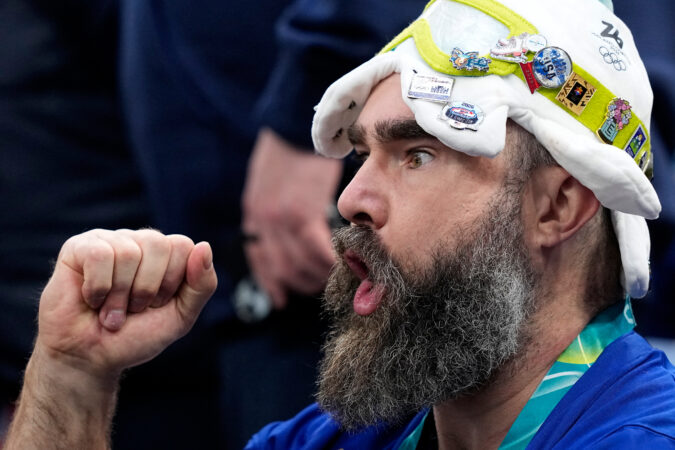
The support extends further. Barefoot’s social media has been filled with messages from co-workers, friends, and even celebrities, including Jason Kelce and Flavor Flav.
“We’re talking to celebrities, people that you watch growing up, people you see on TV and now they’re dapping you up every time you see them,” Barefoot said.
Penn State, Dan Barefoot’s alma mater, was well-represented at these Games to watch him compete.
Beyond the Olympics, Barefoot said he is looking forward to rebalancing time between his work and the people closest to him. The conversation eventually turned lighter, touching on his last name and the unexpected ways it has followed him onto a much larger stage.
“I feel like it’s one of those names that really would connect,” Barefoot said. “I’ve reached out to a couple partnerships. It’d be awesome.”
The idea made him laugh, but it also reflected how much his world has expanded through a few minutes of competition built on years of preparation.
Barefoot arrived at the Olympics expecting to compete only in the men’s skeleton event, where he finished 20th with a combined time of 3 minutes, 49.86 seconds. The result marked the culmination of a journey that began quietly years earlier, far from Olympic ice.
Then, a day before the mixed skeleton event, his Games unexpectedly continued.
Paired with Kelly Curtis, Barefoot returned to the track for the mixed competition, where each athlete completed one run and their times were combined. The duo finished 10th, with Curtis recording a 1:01.30 and Barefoot posting a 1:00.13 for Team USA.
For Barefoot, the extra run offered another marker of how far an unplanned path had taken him.
WASHINGTON ― It feels like it’s been 84 years since the Flyers last played an NHL game.
On Wednesday night against the Washington Capitals, they kicked off the final 26 games of the season. Entering the night, Philly sat four points back of Washington — with three games in hand — and eight points back of a playoff spot.
By the end of the night, the Flyers were six points back of Washington, after losing 3-1 at the Capital One Arena. They remain eight points back of the idle New York Islanders and Boston Bruins, and have a game in hand on the Islanders.
Trevor van Riemsdyk scored the decisive goal, giving the Capitals a 2-1 lead with 5 minutes, 52 seconds left in regulation. Off the rush, Declan Chisholm dropped the puck to Aliaksei Protas and got it back near the left post. He then hit van Riemsdyk, the brother of former Flyers forward James van Riemsdyk, as he crashed the net.
As coach Rick Tocchet noted postgame, the Flyers came out with some pep in their step to start the game. “The first nine minutes we were dominating,” he said. But they were unable to capitalize until the third period, when Noah Cates deflected a shot by Travis Sanheim 29 seconds in.
Rasmus Ristolainen applied pressure, creating a turnover to Matvei Michkov, who found Bobby Brink. The winger carried it down into the left face-off circle before hitting Sanheim for the quick shot, which Cates deflected past goalie Logan Thompson. Cates tied the game at one — and ended an 18-game goal drought.
“I didn’t like my January,” said Cates, whose last goal came Dec. 30. “I thought the team struggled as well, and I feel like when I struggle, the team struggles. You just want to get out of it and get going.
“So to get that goal and feel good about our line, we were making some plays and just playing the right way, playing how we can play with Bobby [Brink] and [Michkov]. So, yeah, good to get going.”
The trio had several other chances, notably in the third period when Brink, while under pressure, sent a cross-crease pass to Michkov alone at the right post. Thompson robbed him of a sure goal as he stretched across and made a toe save. According to Natural Stat Trick, when they were on the ice at five-on-five, the Flyers had 10 shot attempts, a game-high 1.05 expected Goals For, and nine scoring chances.
Philly did put 24 shots on Thompson, with 18 coming in the first two periods, but couldn’t find the back of the net. Dan Vladař kept them in the game all night.
The goaltender told The Inquirer on Sunday that he “wasn’t the best” in his one game at the 2026 Milan Cortina Olympics, a 6-3 win against France, when he allowed the trio of goals on 12 shots for Czechia. So maybe he had something to prove.
Vladař faced seven shots in the first period, and robbed the owner of 919 NHL goals, Alex Ovechkin, of his 920th. “The Great 8″ was left wide-open in front after Ristolainen had the puck poked away from him in the corner by Dylan Strome, who fed Ovechkin. Vladař then stopped Strome’s point shot as Travis Konecny’s clearing attempt went right to him.
“He gives us a lot of confidence. He was making huge saves out there for us,” center Christian Dvorak said. “He’s been doing that all year, and it would have been nice to get him a win tonight. He definitely deserved it. He’s been big for us, and we just got to work on being better for our goalies.”
In the second period, the Capitals outshot the Flyers 12-9 and seemed to have the ice tilted their way. Although they broke through once — and missed the net a few more times — Vladař came up big again to keep the score close.
He stopped a point shot by Ethan Frank off a face-off win, kicked out a Ryan Leonard shot to the boards, and then seconds later made a masterful stop on another shot by Leonard.
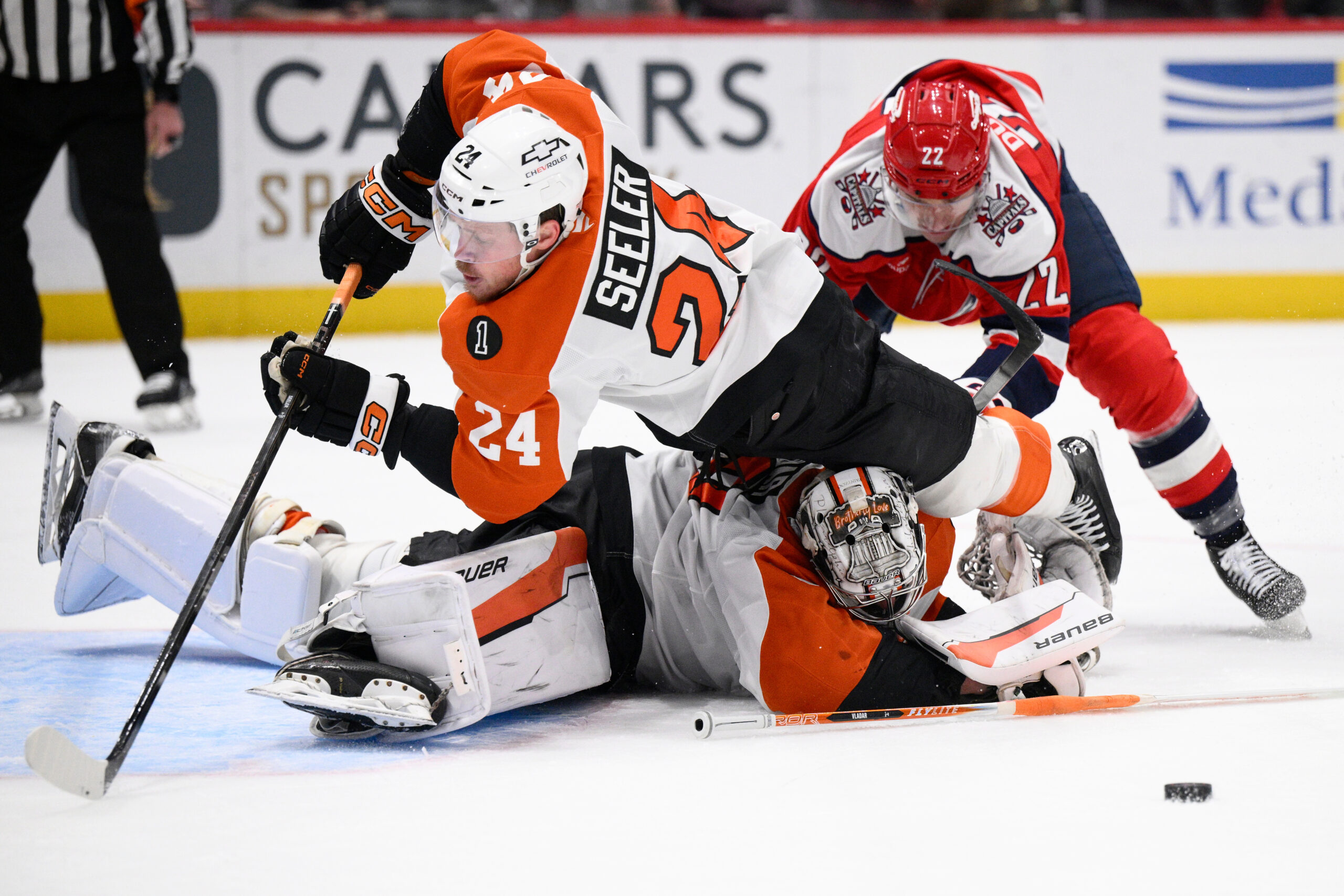
Philadelphia Flyers goaltender Dan Vladar (bottom) was a bit shaken up after defenseman Nick Seeler (24) fell over him late in the second period.
Later, Vladař made a save on a Brandon Duhaime shot from nine feet out, and Nick Seeler pushed it back for him to cover. But there was a bit of a scramble, and Seeler fell over him, and the goalie seemed a bit stung. He flexed his right arm at the next whistle but stayed in the game.
Capitals defenseman Rasmus Sandin scored the Capitals’ opening goal in the period. Philly regrouped and reset after a three-on-two by Washington — and Michkov broke up a pass in front, but then allowed the blueliner to skate down from the point behind him. Hendrix Lapierre found him for the 1-0 goal.
And while he again allowed a goal in the third period, Vladař kept his team in the game. With the Flyers on the penalty kill, Pierre-Luc Dubois got the puck near the net and turned to take a shot, but Vladař was aggressive with the stick and poked it away. He was tracking the puck well all night and seconds later squared up to snare a Strome tip-in attempt on a point shot.
With the game tied, he robbed Lapierre, who got a return touch pass from Duhaime in the slot after the Flyers couldn’t break out of their own end.
“He’s a battler,” Tocchet said. “He’s done it all year for us. But the lateral goals are the tough ones; we don’t want to give those up. That’s the one thing. Vladdy’s played really well for us, but if we eliminate those that will really help. It’ll help Vladdy, too, [because] those laterals are tough to save.”
Protas added a short-handed empty-net goal with 25.6 seconds left in the game. … Defenseman Emil Andrae and forward Nic Deslauriers were the Flyers’ healthy scratches. What does Andrae, who hasn’t played since Jan. 26, need to do to get back into the lineup? “He’s not a PK guy,” said Tocchet pregame. “So actually, this week, he’s worked on his penalty killing. That’s really what it’s going to come down to.“ … Forward Carl Grundström, who has been playing wing all season, centered the fourth line. … The Flyers went 1-for-1 on the penalty kill and 0-for-2 on the power play.
Up next
The Flyers’ restart is already grinding away as they face the New York Rangers on Thursday at Madison Square Garden (8 p.m., ESPN).
WASHINGTON ― Once again, Travis Sanheim was on the outside looking in.
And as in the 4 Nations Face-Off tournament a year ago, the Flyers defenseman was inserted into Canada’s lineup in Game 2 at the Milan Cortina Olympics and never left.
Maybe the doubters need to stop doubting.
Across his five games, the silver-medal-winning Sanheim averaged 13 minutes, 14 seconds, as he crept up coach Jon Cooper’s depth chart as the tournament progressed. Although it was fewer minutes than he’s used to in Philly — he plays more than 24 a night — the blueliner made the most of his ice time.
Sanheim finished the tournament tied for the fourth-best plus-minus (plus-6) among all players, despite averaging fewer minutes than 10 of the 12 players who were either tied with him or above him; only forwards Jack Hughes and Joel Armia played fewer minutes among that group.
He was not on the ice for any of the 10 goals Canada allowed in his five games and his plus-minus was up there with some of the game’s best defensemen — Brock Faber and Cale Makar (plus-6), Zach Werenski (plus-8), and Niko Mikkola, Devon Toews, and his Flyers teammate and, based on Wednesday’s morning skate, his current defensive partner, Rasmus Ristolainen (plus-9).
“I think that’s kind of why I was brought over, was the ability to kind of be a utility guy and be able to play in different situations,” he said Wednesday at Capital One Arena. “Didn’t get in the first game, and have the ability to step right in and play and give them good minutes.
“And I just thought as the tournament went along, just gained more confidence with playing each game and gained the trust of the coaching staff to earn more minutes, and was happy with how I performed.”
Sanheim also had one assist, and it was an important one. He set up Shea Theodore for the game-tying goal with under 10 minutes to go in the semifinals against Finland after receiving a pass from Tom Wilson, whom the Flyers will see with the Capitals on Wednesday (7 p.m., NBCSP). Nathan MacKinnon scored the game-winner with 36 seconds left in regulation.
He was robbed of a goal by Czech goalie Lukáš Dostál in the quarterfinals, but Sanheim’s name was mentioned over and over again during the gold-medal game by NBC play-by-play man Kenny Albert. A versatile defenseman who can play on the right or the left, he skated more than 15 minutes and had three shots on goal in the finale.
Defenseman Travis Sanheim believes being around some of the league’s best players and playing such high-level hockey can help him as he returns to the Flyers.
But while he won a medal, it was obviously not the one he wanted.
“I’m sure I’ll appreciate the silver years down the road and looking back on it, but obviously right now, disappointment. Thought we did a good job of playing in that tournament and thought that we deserved better,” said Sanheim, who told Unfiltered With Ricky Bo & Bill Colarulo on Tuesday that the medal is currently in his safe.
“So, it’s hard to enjoy the silver when you think that you had a chance to take gold and you come up short. So, like I said, grateful for the opportunity and the experience and what it all entailed, and yet disappointment that comes with it.”
The experience was special nonetheless for Sanheim. He took in speedskating with his Canadian teammates, and traded pins, including swapping with Japan and Italy; however, he didn’t realize how big the pin swapping was at the Olympics and was unable to get a few he had his eye on.
And he was able to spend time with his family. As his mother, Shelly, told The Inquirer on New Year’s Eve, the whole family was headed to Italy to watch Sanheim don the maple leaf.
“Just appreciative of the support that I get. Everyone that came over has been with me from when I was a kid, and happy to be able to share that experience with them,” he said, also mentioning that it meant the world to him that his hometown, Elkhorn, Manitoba, showed its support too.
“ … And, at the end of it, showing them the medal, and them putting it on and getting pictures, you get to see the joy and what it meant for them to experience what I was going through and fortunate to have those guys.”
But while the Olympics are over and he is back with the Flyers as they begin their final 26-game sprint to the end of the season, that doesn’t mean he won’t take what he learned and experienced to the Orange and Black.
“I think how hard you have to play each and every night, the style of play that you need to play, the willingness to do anything to win a hockey game, and different roles that come up throughout the tournament, that guys have to sacrifice for the better good of the team,” he said.
“And then just the skill level that these guys all play with, and how they play, how hard they work, their off-ice training, and what they do, their preparation. There’s a reason they’re the best in their sport and lucky to share the ice with them.
“If I can bring any of that back and share that with our team and try and help the guys … and obviously, we want to continue to grow and take the next step, and being able to see that firsthand is going to benefit me.”
Breakaways
Dan Vladař (17-8-6, .905 save percentage) was the first goalie off at morning skate and is expected to be the starter against Washington. … The Flyers officially loaned defenseman Adam Ginning back to Lehigh Valley of the American Hockey League on Wednesday.
The Winter Olympics were full of exciting moments for Team USA — from the men’s and women’s hockey teams winning gold to Alysa Liu stunning fans every time she took the ice. And one man was there to witness it all: Jason Kelce.
The former Eagles center joined his wife, Kylie Kelce, who attended on behalf of NBC and YouTube. While Kylie was there on business, Jason enjoyed his time as a spectator and had no problem with CBC Olympics labeling him as Kylie Kelce’s husband.
“I really was just there to have fun and enjoy the Olympics,” Kelce said on the latest episode of New Heights. “So, I was 100% — this was the correct way to say it. I wanted to tell them I prefer ‘ball and chain.’”
During his time in Milan, Kelce got some bobsledding experience and attended four Olympic hockey games, the short program for figure skating and short-track speedskating. Here’s everything he had to say about his experience at the Winter Olympics:
Bobsledding experience
Ahead of the games, Kelce had the chance to get some hands-on experience with Team USA’s bobsledding team at their headquarters in Park City, Utah, where he learned about their training and got to see what it feels like going down the track with Team USA member Frank Del Duca.
“The ride itself, way more intense than I imagined,” Kelce said. “Like I thought it would be like a roller coaster. I really did. The energy that you are moving down this thing at over 80 mph. And when you go into these bank turns, it pushes you into the bottom of this thing.
“And on the bottom of the sled, there’s like these metal rails and my [expletive] is so [expletive] wide, they’re sitting on those metal rails. I’m being pinched down onto these metal beams. I’m trying to keep my head up so I can see. [Expletive] is flying by. I have no [expletive] idea how [Frank] was even knowing when to do the turns and everything. Like, you have to memorize it.”
‘The most fun sport to watch on the planet’
After the men’s U.S. hockey team made history, winning the gold medal for the first time in 46 years, Kelce went to social media to express his feelings with a simple, “Let’s [expletive] go!”
“There is just something about hockey, whether it’s playoff hockey or national hockey,” Kelce said. “When guys are like going all out, it’s just the most fun sport to watch on the planet. USA, hockey capital of the world. Men’s and women’s gold medal. Best country on the planet in hockey. I don’t want to hear any arguments.”
Kelce supported both teams in Milan, attending two women’s hockey games and two men’s games — including the men’s dominant 6-2 win over Slovakia in the semifinals, and the women’s gold medal victory over Canada.
“Canada got out to a quick lead and it made it very stressful,” Kelce said. “It was an electric game and then obviously we got to see USA men’s dismantle Slovakia. And I was sitting with the Tkachuk family. Keith Tkachuk was over there on the end of it. Got to shake the hand of a [expletive] legend … We were right by the Hughes family, too. Jack Hughes, who had the golden goal for the U.S. in the gold medal game.”
“After talking to her, you realize she is from the Heights,” Kelce said. “There’s just like this humbleness but also she’s a great person and it comes across very apparent when you speak to her. … They’re a great team, man. They’re tightknit. They’re playing jokes on one another. Just so proud for all of them. It’s an incredible moment to win a gold medal, especially in a team sport like that.”
Speed skating vs. figure skating
Kelce attended the short program for figure skating and he had just one recommendation when it comes to watching in the arena.
“I would have liked to have heard Tara Lipinski and Johnny Weir announcing it live,” Kelce said. “When you don’t have that, especially for someone newer to the sport, you like to hear the excitement in the announcer’s voice that they just did something difficult or they just nailed a routine or they just missed something.”
But when it came to speed skating, Kelce had no notes.
“In speed skating, it is a [expletive] party in that speed skating arena,” Kelce said. “There’s DJ’s playing music. It’s fast paced, there’s bells ringing, it is high-stakes action in the speed skating short track.”
Kelce even had the chance to meet Apolo Ohno, a speed skating legend and eight-time medalist.
“Apolo, we watched him all growing up,” Kelce said. “Unbelievable speed skater. … Speed skating was electric as [expletive]. … These things were fast paced, they were moving. They’re doing Tush Pushes because we saw the relay version where they get in there and push the [expletive] of the guy in front of them.”
Does Donald Trump have to ruin everything? The answer is obviously yes, but this one was heartbreaking. Sunday’s overtime thriller over Canada, which gave U.S. men’s hockey its first gold medal since this senior citizen was a college junior, was a howl of joy in what’s been a dire year for America. But then (taxpayer-)Ka$h Patel showed up to party, and soon Trump was on the phone, egging on the boys with misogynistic trash talk about their gold medal compatriots, the women’s hockey team. Now the men are invited to Trump’s State of the Union address, the women “had other plans,” and I almost wish our Canadian friends had won the game.
How Indiana University won a football crown and lost the plot
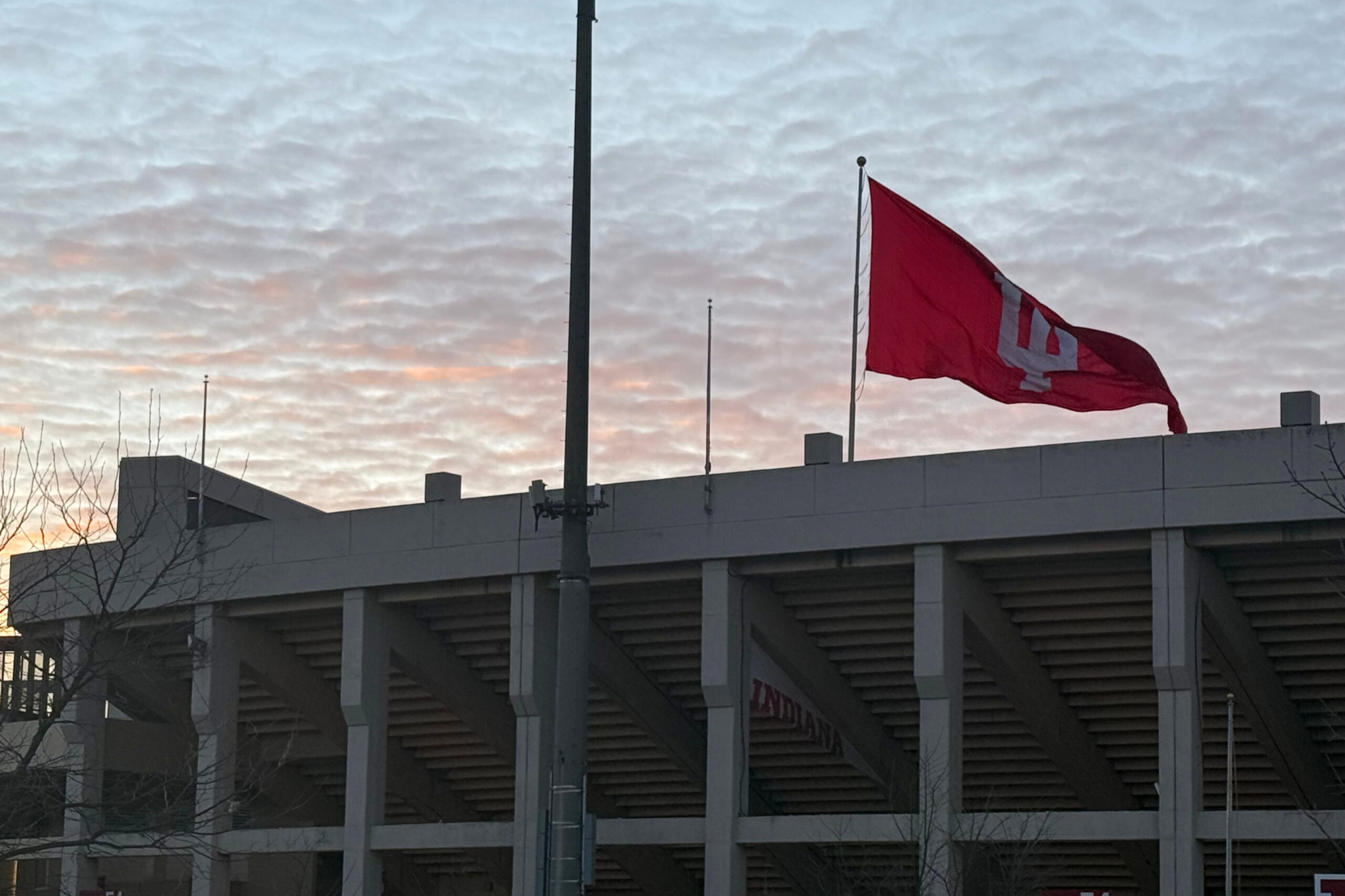
Indiana University’s victory flag flies over Memorial Stadium in January in Bloomington, Ind.
Even in a state where the sports miracles, from Rudy and The Knute Rockne Story to Hoosiers, are so big they tend to make it to Hollywood, there’s never been a feel-good script quite like Indiana University — with the most losses in college football history until this season, when it went 16-0 and won the national championship.
“The energy is just absolutely insane,” Katie Shin, a recent Indiana alumna, told the Athletic as thousands of fans went wild on the Bloomington campus that night, saluting Heisman Trophy quarterback Fernando Mendoza and their unsmiling genius head coach Curt Cignetti. “The whole state is just rallying around IU.”
But there’s a huge irony for anyone who’s a big fan of America’s colleges for more than just what happens on the gridiron. In the same season Indiana was slowly climbing to the top of the football polls, the flagship public university was also ranked dead last in the nation.
For something arguably more important: free speech.
The Foundation for Individual Rights and Expression (FIRE), the national campus speech group based here in Philadelphia, last fall ranked IU 255th on its 2026 ranking of universities over freedom of expression — the lowest-rated public institution in America, and only higher than the controversy-wracked private sister schools, Columbia University and Barnard College.
Interestingly, the FIRE low-ranking came after a slew of campus controversies in which the silenced speakers or protesters were all over the map ideologically — a canceled Jewish speaker and a shout down of right-wing speakers, but also draconian moves against pro-Palestinian protesters, including harsh penalties for a 2024 encampment. Last month, a federal court ruled that IU’s punishments of the Gaza campers and its anti-protest policies were unconstitutional.
FIRE’s lambasting of IU’s free speech transgressions was reported upon last Sept. 9 in the student paper, the Indiana Daily Student. The following month, school administrators ousted the faculty adviser to the IDS and told the student journalists they could no longer print the paper, and that news could only be published online. The university’s insistence that this was purely an economic move was a surprise to the ex-adviser, who sued and said he was fired “after he refused to censor the students’ work.”
It ought to go without saying that curbing the free exchange of ideas is antithetical to the most sacred values of American higher education. But the free speech mess at IU is but one controversy at an iconic heartland university that has become a poster child for the moral crisis of U.S. universities, even as it celebrates football glory.
Clearly, the leadership at IU — and this includes its board of trustees, with three new conservative, pro-MAGA members that GOP Gov. Mike Braun named in June under a law that also allowed him to boot three trustees elected by IU’s alumni — is eager to keep its pigskin prowess as the main thing America knows about the university.
The school just signed its field general, Cignetti, to a contract extension that will pay him $13.2 million a year through 2033, making him one of the three highest-paid coaches in the nation. But his new deal flabbergasted a growing number of critics, who note the big raise came as IU — just days after the new conservative trustees were named — either eliminated or made deep cuts in nearly 250 academic programs such as French, art history, geography, and East Asian studies.
Meanwhile, Cignetti isn’t the only high-profile figure at IU to see a big raise. Also this weekend, the trustees gave Whitten a $100,000 pay hike, to an even $1 million a year — citing her willingness to work with industry.
At least 250 IU alums, joined by current faculty and students, have signed on so far to an open letter and donation freeze demanding that, instead, Whitten step down. They also want the university to restore both its diversity programs and robust free speech protections, as well as the reinstatement of the three alumni trustee positions. But they are swimming against a red tide of conservatism that’s polluted the public college universe in Indiana.
Cross-state public rival Purdue University is reeling from a recent report in its hometown newspaper that the school, under pressure from conservative lawmakers, has informally banned the admission of international students from China and a slew of other countries. Students and faculty have complained of an unwritten “soft ban” on many overseas applicants, although Purdue has denied that such a policy exists.
Meanwhile, the regional campus of IU Indianapolis caused a stir and triggered a protest when it abruptly canceled the 57-year tradition of an annual Rev. Dr. Martin Luther King Jr. dinner — a move that was undertaken not long after the school removed campus signs that read “Black Lives Matter” and “Discrimination has no place here.”
Indiana is hardly alone. The 2025-26 academic year has been marked by similar outrages against unfettered speech and racial inclusion, especially in the most pro-Trump red states. To cite just one of many examples, the University of Texas System just adopted a new policy aimed at limiting discussion of “controversial topics” in the classroom. Isn’t that the whole point of the college experience?
The erosion of freedom at the American university has happened gradually and then suddenly, and it needs to be getting a lot more attention. That’s hard when the president is sending aircraft carriers to threaten Iran, imposing steep taxes for no reason, and generally acting and talking like the mad king he is.
Yet, nothing is more important for MAGA’s authoritarian project than what is happening at Indiana University and other college campuses right now. As I wrote in my 2022 book, After the Ivory Tower Falls, higher ed is the fulcrum of America’s political divide, now more than ever.
Every tactic — murdering the humanities and the social sciences, making campuses more white, ensuring our future elites aren’t exposed to “controversial topics” while entertaining them with the beer and circuses (a phrase, ironically, coined by an IU English professor) of big-time football — is another step toward MAGA’s strategic goal of an American electorate that cannot think critically.
The fight for the soul of Indiana University is the fight for the soul of the United States, and it’s not what’s happening inside Memorial Stadium against Ohio State or Michigan.
“We know that IU alums are smart enough to celebrate the success of the Football Hoosiers and condemn what Pamela Whitten is doing to degrade the prestige of our degrees,” the university dissidents write in their open letter. “Please help us take a stand against the debasement of our university and restore the glory of old IU.”
Yo, do this!
You might have noticed that the late Jeffrey Epstein and his randy U.K. royal pal, the artist formerly known as Prince Andrew, have been in the news a lot lately. But did you know there’s an excellent 2024 Netflix movie called Scoop about the drama behind the disastrous 2019 BBC interview that started the long downfall of Andrew Mountbatten-Windsor, now arrested and under a British police investigation? I watched Scoop over the weekend, and it’s both an entertaining and highly relevant journalism thriller.
Since this space is devoted to my weird entertainment choices, and not what normal people are doing, I have to share that I’ve been escaping today’s banality of evil with a deep dive into the musical world of … mass murderer Charles Manson. My all-time favorite podcast, Andrew Hickey’s A History of Rock Music in 500 Songs, did a remarkable four-parter a couple of years ago about Manson and his shockingly close ties to the Beach Boys (and others like, sigh, Neil Young) that resulted in the murder mastermind’s uncredited cowriting of their 1968 song, “Never Learn Not to Love.” There’s also a compelling detour into the life of Black music pioneer Huddie “Lead Belly” Ledbetter, and a book recommendation that sounds equally incredible: Bring Judgment Day: Reclaiming Lead Belly’s Truth from Jim Crow’s Lies by Sheila Curran Bernard.
Ask me anything
Question: Update us on what is and what should be happening in Quakertown [please]. — @marco2751.bsky.social via Bluesky
Answer: Thanks for this, Marco, because if readers aren’t up to speed on what’s been happening in Quakertown, an exurb nearly an hour’s drive north of Philadelphia, then they need to learn. Quick version: A peaceful Friday walkout by Quakertown High School students protesting U.S. Immigration and Customs Enforcement raids turned shockingly violent, highlighted by a grown man placing a teen girl in what appeared on video to be a dangerous choke hold. It turned out this man was the Quakertown police chief and interim borough manager, Scott McElree. Adding insult to injury, five students were arrested and spent the entire weekend in jail before they could see a judge. What should be done? Quakertown can’t fire McElree quickly enough. The right to peacefully assemble and protest the government is the heart of the First Amendment, and what makes America a democracy. A police chief who can’t honor the U.S. Constitution should not have a job.
What you’re saying about …
Last week’s take-a-step-back-from-the-madness question about who is the greatest living American (inspired by the passing of the Rev. Jesse Jackson) didn’t get a large response, but brought some compelling arguments. Two men were named twice: Pope Leo XIV, the Villanova alum who has shone as an advocate for immigrants and for peace on the world’s stage since last summer, and Sen. Bernie Sanders, who has never wavered in fighting for progressive values. Other suggestions included Bob Dylan, Edward Snowden, Barack Obama, and — in a show of respect for science under siege — the health experts Anthony Fauci and Peter Hotez, who, wrote Pat Eisenberg, “is trying to improve the health of Americans despite all the things the Trump administration is doing to ruin our health.”
📮 This week’s question: I’m hopefully going to be writing soon about the scourge of prediction markets like Kalshi, and more broadly, the problem of sports betting. Should these forms of gambling be banned, or at least more strictly regulated? Please email me your answer and put the exact phrase “Betting bans” in the subject line.
Backstory on what pundits don’t get about ‘28
This photo combo shows Illinois Gov. JB Pritzker, left, speaking during the McIntyre-Shaheen 100 Club Dinner, April 27, 2025, in Manchester, N.H., and U.S. Rep. Alexandria Ocasio-Cortez (D., N.Y.) speaking during a “Fighting Oligarchy” tour event at Arizona State University, March 20, 2025, in Tempe, Ariz.
Get 13 Democratic and left-leaning independent voters together in the same chat — as the New York Times did with a recent focus group, the latest in its running series — and you’d surely hear some harsh words about Donald Trump and the GOP. But ask them what they think about the Democratic Party, and you might want to cover your ears.
“Spineless.” “More complacent than I thought they would be.” “Paralyzed.” “Afraid.” “Incompetent.” “I guess suffocated, or given up …” “Sold out.” I’m not leaving out the positive responses, because there weren’t any. You also won’t be surprised that these 13 Democratic or aligned voters — very diverse across racial, class, and age lines — want more radical leaders who will take the party, and hopefully the nation, in a bold new direction. There was positive buzz for the likes of new New York Mayor Zohran Mamdani and Texas Rep. Jasmine Crockett — anyone with fresh ideas and a willingness to mix it up with Trump. Said a 36-year-old independent woman from Washington state: “I still don’t agree with everything she’s doing, but Alexandria Ocasio-Cortez is a well-known name and seems to be fighting against Trump.”
I thought a lot about the Times’ focus group last week as I heard or read two veteran pundits try, at this relatively early date, to handicap the 2028 presidential race. Mark Halperin (who’s somehow still around despite this) went on POTUS radio with Michael Smerconish to defend his picks: He included ex-Chicago mayor Rahm Emanuel, a center-right figure who is passionately hated by any real Democrat I’ve ever spoken with, and also overrated Kamala Harris (floating on the fumes of her name ID), as well as his No. 1 pick, California Gov. Gavin Newsom, with Pennsylvania Gov. Josh Shapiro at No. 2. He said he included AOC and upgraded Illinois Gov. JB Pritzker only because his “sources” told him to — because his sources understand the Democrats while the clueless Halperin does not.
Ditto Nate Silver, who has magically reappeared in the Times, which first made him a star in 2012. Although Silver did place AOC in second, behind Newsom, he also — much like Halperin — uprated tired conventional wisdom candidates like Shapiro (No. 6) and Michigan Gov. Gretchen Whitmer (No. 4, despite being invisible recently), and grossly downrated progressive favorites like Pritzker (14) and Connecticut Sen. Chris Murphy (18), as well as more interesting and unorthodox names like Arizona Sen. Mark Kelly (12) and Kentucky Gov. Andy Beshear (15). He sees Newsom as the darling of “Resistance Libs,” the Trump-hating MS Now watchers who controversially get tagged as heavily “wine moms.” Said Silver of Newsom: “They want a fighter. And Newsom plays expertly into that.”
True, but I expect Newsom’s standing among Democratic primary voters will crumble once voters learn more about his ties to Silicon Valley billionaires, or his verbal sellouts of the transgender community, or his “meh” popularity among the Californians who know him best. Readers of this newsletter were unanimous earlier this month in not wanting Shapiro to run. I’m not going to do a numerical ranking, but I would place Pritzker, who’s made all the right moves against Trump without Newsom’s train car of baggage, and AOC, who’s making all the right enemies, including the worst Beltway journalists, as my top two. I’ve covered presidential races since 1984, and I’ve learned the only thing that matters two years out is to listen to the people. The pundits know nothing right now.
What I wrote on this date in 2019
It’s impossible to top this anniversary: The day I appeared in the Epstein files. In February 2019, with the walls closing in, Epstein’s close adviser and quasi-journalist friend, Michael Wolff, wanted to make sure he saw my Feb. 24, 2019, column about elite male impunity that mentioned him and two billionaires in his orbit: Donald Trump and New England Patriots owner Robert Kraft. What did Epstein read, assuming he clicked on it? I wrote that “this isn’t really ‘a sex scandal.’ The real scandal here is the gross imbalance of power involving women who were held in a form of human bondage to serve as objects of gratification for powerful men intoxicated by their belief they can get away with anything.”
I took a short break from the relentless anti-Trump, anti-ICE beat last week to write about the other threat to the American way of life: artificial intelligence. Rapid advances in AI technology make it clear that robots and chatbots and the like are going to upend the economy — most importantly, the job market — sooner rather than later. Can wary voters find politicians who are willing to regulate AI and its threats to employment, education, and the environment, or will pols continue to prefer Silicon Valley’s campaign donations? Over the weekend, I highlighted the recently leaked ICE blueprint for an American concentration camp in Georgia, and what that document tells us about the moral depravity of mass deportation.
In a city as large and as history-bound as Philadelphia, all big stories are inevitably local. That was never truer than at the Winter Olympics in northern Italy, especially for the most-watched event on these shores: the U.S. men’s hockey’s thrilling overtime victory over Canada. The on-ice celebration blended with copious tears as Team USA teammates went into the stands and skated back with Johnny Jr. and Noa Gaudreau, the young children of late South Jersey NHL hockey icon Johnny Gaudreau. Their dad and their uncle Matty were killed by an alleged drunk driver while cycling on a South Jersey road in August 2024, as Gaudreau was training to hopefully make this Olympic squad. The players centered the Gaudreau family and his No. 13 jersey during the gold-medal celebration, and The Inquirer’s Alex Coffey captured the whole emotional story — one you won’t read anywhere else. “This is a history book [moment] that there will be a movie about,“ sister Katie Gaudreau told Coffey. ”And in that movie, Noa and Johnny will be on the ice.” You get the big, moving stories like this, and allow us to keep covering them, when you subscribe to The Inquirer.
By submitting your written, visual, and/or audio contributions, you agree to The Inquirer’s Terms of Use, including the grant of rights in Section 10.
The Milan Cortina Olympics averaged 23.5 million viewers in the United States, making them the most-watched Winter Games since 2014 with a 96% larger audience than the Beijing Games four years ago.
NBCUniversal said the average includes combined audiences on NBC, Peacock, CNBC, USA Network and other digital platforms. It covered the live afternoon (2-5 p.m. EST) and prime-time (8-11 p.m. EST/PST) windows.
The figures are based on Nielsen’s Big Data + Panel ratings (through Feb. 19), Nielsen’s early figures for the final three days (Feb. 20-22) and digital data from Adobe Analytics.
Viewership numbers for the United States’ 2-1 overtime victory over Canada in men’s hockey on Sunday morning were not expected until Tuesday. The Canadian Broadcasting Corporation said on Monday that 8.7 million were watching in Canada when Jack Hughes scored the golden goal in overtime. The celebration that followed included American players carrying the jersey (and eventually the children) of late South Jersey hockey star Johnny Gaudreau, who was killed along with his brother by an alleged drunk driver while biking near their family home in Salem County.
“I feel in so many ways that these Winter Olympics exceeded our expectations. We were reminded that the Olympics are the most exciting, unpredictable and biggest stage in sports,” said Molly Solomon, the executive producer of NBC’s Olympics coverage. “And what I think came together in Italy was that the settings were stunningly beautiful, the access we had to the athletes and their lives was unprecedented. And then you take the technology, the first-person view drones, the audio, and it took the audience inside the stories in fresh, meaningful ways.
“And Team USA, I mean, the results, you’ve seen the numbers for the medals and things. America wants to see how their team’s performing, and it’s the best performance in an overseas Olympics. Everything lived up to the billing, and some of the superstars had riveting, dramatic performances. Not all of them gold, but that’s the Olympics, right?”
Dylan Larkin (21) holds Johnny, the son of the Johnny Gaudreau while posing with teammates after Team USA beat Canada in overtime to claim its first men’s hockey gold medal since 1980.
NBC broadcast the Super Bowl, the Olympics, and the NBA All-Star Game in February, the first time a network had all three in one month. It also premiered “Sunday Night Basketball” on Feb. 1.
According to Nielsen, 215.6 million U.S. viewers tuned in for at least one of those events. Audience reach numbers have been higher under Nielsen’s new rating system since the minimum viewing requirement was reduced from 5 to 3 minutes.
Super Bowl 60 averaged 125.6 million viewers across NBC, Peacock, and Telemundo, the second-most-watched program in U.S. history. The All-Star Game had its highest audience in 15 years, averaging 8.8 million, and the Lakers-Knicks game on Feb. 1 averaged 4.5 million.
“I have to say it’s probably better than we expected. This doesn’t happen through luck or happenstance. This happens through just really good planning and then execution across the month. So really happy overall and I don’t think it could have gone better, honestly,” NBC Sports President Rick Cordella said.
In May 2024, Johnny Gaudreau reached out to his father, Guy. He’d recently wrapped up his 10th full NHL season, with the Columbus Blue Jackets, but he had a bigger goal in mind.
For the first time since 2014, NHL players would be allowed to compete in the 2026 Winter Olympics.
Gaudreau had already started conditioning, and wanted to do more. So, he went to his first coach.
“He said, ‘Dad when I come home, we really have to push it,’” Gaudreau’s sister, Katie, recalled Sunday. “‘I really want to make the Olympics.’”
From May through August, Johnny and Guy drove from their Shore house in Avalon — where their family spent the summer — to any rink in the area that would give them an hour of ice time.
These weren’t always quick trips. Hollydell Ice Arena was about 60 miles away. Pennsauken Skate Zone was a little farther than that.
But Gaudreau knew this was his chance to achieve a lifelong dream. So he put in the extra work, sometimes getting additional conditioning in before his father arrived to the rink.
He was, by his own admission, “not impressed” with what shape he was in at the start. But by the end of the summer, he’d improved.
Guy saw it himself. In August, he turned to his wife, Jane.
“I think he might make the team,” he told her. “He’s in the best shape of his life.”
The Gaudreaus started thinking about a future trip to Milan, where the Olympics would take place.
Katie, who was set to get married in late August 2024, was already planning a honeymoon there, and joked that it wouldn’t make sense to go twice in a short span.
She began sketching out the conversation with her supervisors at Oldmans Township School, where she works as a first-grade teacher.
But all of this excitement and hope came to an unceremonious halt on Aug. 29, 2024.
Johnny and his brother, Matty, were at home in Oldmans Township for Katie’s wedding the following day.
They were hit by an alleged drunk driver while riding bicycles on County Route 551. The brothers were severely wounded and both died at the scene. Johnny was 31 years old, and Matty was 29.
Ever since they died, their family has been trying to honor their legacy. Jane and Guy have attended multiple ceremonies to honor their late sons.
After some initial hesitation, Jane and Guy Gaudreau made the trip to Italy to honor their son and root on his former Team USA teammates.
In 2025, they started the annual Gaudreau Family 5K, an in-person and virtual road race to raise money for the Gaudreau Family Foundation.
But last week, they received a special opportunity to celebrate Johnny’s ultimate goal.
On Tuesday, a representative for USA Hockey asked the Gaudreau family if they’d want to attend the semifinal game against Slovakia on Friday. They were also invited to Sunday’s gold-medal game, if the Americans qualified.
Initially, Guy and Jane said no. Katie and her sister Kristen weren’t able to make it, and they didn’t want to travel without them.
It also seemed bittersweet to attend an Olympic semifinal or final without their late son.
But on Wednesday morning, Jane had a change of heart.
“My mom was like, ‘I really didn’t sleep,’” Katie said. “‘I think John would want us to go. I think we should go.’”
A staple of Team USA
Throughout his career, Gaudreau was a staple of USA Hockey. He’d been involved in development camps since he was a teenager.
He’d competed in international tournaments since 2010, when he was a member of the Under-18 select team.
In the 2013 World Junior Championship, Gaudreau led the tournament with seven goals en route to a gold medal.
The forward continued to establish himself as a key player on the senior team, setting a number of offensive records despite never competing at an Olympics.
He still holds the mark for the most points (43) and assists (30) by any American in IIHF men’s World Championship history.
“He does his best, I swear, in a Team USA jersey,” Katie said.
His Olympic enthusiasm went beyond tournament play. The Gaudreau family watched the movie Miracle, about the 1980 U.S. Olympic hockey team, so many times, they could recite it by heart.
It was always playing in their minivan, as they traveled up and down the East Coast for Johnny and Matty’s hockey tournaments.
As the years passed, and Gaudreau continued to solidify himself as an NHL star, the idea of him making an Olympic team seemed less of a dream and more a reality.
Team USA confirmed as much after Johnny passed. Last year, at the Four Nations Face-Off, an official told Guy that “John would have had a spot on the team.”
“Any hockey player growing up, of course they want to make it to the NHL, but the Olympics is really the big thing,” said Katie. “And it’s always been a dream of John and Matthew’s. And we knew it was a tangible dream.”
So, when Team USA made the initial offer to fly the family out to Milan, Jane and Guy were hesitant.
They knew going to a game or two would be an emotional experience. Katie knew this, too. But she encouraged her parents to at least try.
Guy Gaudreau, a longtime coach in South Jersey, has spent time on the ice as a guest of Team USA over the past two years.
“I said, ‘If you get there, and you go to the first game, and it’s entirely too hard, you don’t have to go back,’” Katie said. “‘You don’t have to go. You can leave. But if you’re watching the game at home, you can’t be there.’
“‘So this is a once-in-a-lifetime opportunity to honor the boys. And keep their legacy alive. And that’s what we do, every day. We wake up and we just want to honor the boys’ legacy.’”
Jane and Guy decided to go. They met Johnny’s widow, Meredith, in Atlanta, with her two oldest children, Noa and Johnny Jr.
Together, they flew to Milan, where they attended Friday’s game against Slovakia and Sunday’s gold-medal game against Canada.
Katie and Kristen watched from their parents’ house in South Jersey with family and close friends. They knew that the players had hung up Johnny’s USA jersey in their locker room, and hoped that he would be celebrated if they won.
But they weren’t sure what would happen when the United States beat Canada, 2-1, in overtime. Katie and her sister were “in tears” when Auston Matthews, Matthew Tkachuk, and Zach Werenski carried Gaudreau’s No. 13 jersey as they glided across the ice.
The next few moments exceeded the family’s expectations. Meredith, who was watching in the stands with her two oldest kids and in-laws, received a call from a Team USA official.
He put her in touch with Tkachuk, who asked if she could bring Noa and Johnny Jr. down to the ice.
Two players, Dylan Larkin and Werenski, skated off the rink, with gold medals hanging around their necks.
They met Meredith at the bottom of the stands, scooped up Noa and Johnny Jr., and carried them back out for a team photo.
Noa sat on Werenski’s lap. Johnny Jr. — who was celebrating his second birthday — sat on Larkin’s.
“I was like, ‘There’s no way they’re going to do that. There’s no way,’” Katie said. “When they did that, I lost it. I’m so proud. I’m so happy that the kids got to experience that, because this is what John wanted. The team did an amazing job.”
United States forward Dylan Larkin (21) holds Johnny Jr., the son of the late player Johnny Gaudreau, in the team photo after the gold-medal game.
It’s a memory the Gaudreaus will hold close. They know that tomorrow, people will go to work, and get on about their days, and a fresh news cycle will take hold.
But a year and a half later, Team USA still hasn’t forgotten about Johnny and Matty Gaudreau. And for that, their family is grateful.
“Every time I think, ‘All right, now it’s time to move on, we’re not going to have all this support’ — they don’t [move] on,” said Katie. “This is a history book [moment] that there will be a movie about.
“And in that movie, Noa and Johnny will be on the ice.”
Bob Nark made certain to go to Mass on Saturday night. That way, he would be free Sunday morning to turn on his television to NBC, to United States vs. Canada in Milan, to an unforgettable hockey game with an unforgettable finish, to a celebration that moved him and hundreds more people throughout South Jersey to tears.
Nark taught chemistry at Gloucester Catholic High School for 48 years, and one of those years, he happened to have Johnny Gaudreau in class. Before Gaudreau was a seven-time All-Star with the Calgary Flames and Columbus Blue Jackets, before he won a national championship at Boston College, while he was forging his legend as the star of stars within the South Jersey hockey community, he was to Nark just a conscientious student who would raise his hand to answer a question when no one would. “Besides being a great hockey player,” Nark, whose son Jason is an Inquirer staff writer, said by phone Sunday afternoon, “he was a great kid. I loved him.”
So Nark made certain to watch not just the United States’ thrilling 2-1 victory but its emotional aftermath. Jack Hughes scored 101 seconds into overtime. The Americans won their first gold medal since the “Miracle on Ice” 46 years ago. And now three players — Auston Matthews, Zach Werenski, and Matthew Tkachuk — had lifted a Team USA jersey over their heads and were carrying it around the Milano Santagiulia Ice Hockey Arena like a flag.
U.S. star Matthew Tkachuk carries Noa Gaudreau, the daughter of the late Johnny Gaudreau, on the ice after the gold medal win.
A Gaudreau jersey, with his No. 13 on the back, for the teammate who would have been, for the friend they had lost in August 2024, when an allegedly drunken driver struck and killed Johnny, 31, and his brother, Matt, 29 — on the night before their sister, Katie, was to be married — as they rode bicycles along County Route 551.
“I was so proud they remembered him for how great he was,” Nark said. “Today brought back a lot of memories, seeing them march his jersey around the ice.”
That entire postgame sequence — from the players’ gesture with the jersey to their scurrying into the stands to make sure Johnny’s two eldest children, 3-year-old Noa and 2-year-old Johnny Jr., joined them for the team picture — sent a quiver across a region that the Gaudreau family turned into a hockey hotbed years ago. Guy Gaudreau, Johnny’s father, had helped to form the program at Gloucester Catholic, forging it into a powerhouse before Matt eventually coached there, too. All the while, Johnny was the example that every youth coach could hold up to every youngster who was wobbling on skates but dreaming big dreams.
“Just an inspiration,” former Gloucester Catholic coach Tom Bunting once said. “As a parent, you could tell your players or your kid, ‘Hey, anything’s possible.’”
The days and weeks immediately after Johnny and Matt’s deaths had been nothing but a trauma for the entire community, a collective mourning that still hasn’t ended. “You never get past something like that,” said Tom Iacovone, Gloucester Catholic’s principal. “Johnny’s and Matt’s impact on us, it’ll never leave.” The challenge since has been to embrace what Ed Beckett, one of Iacavone’s predecessors as principal, called “the deeper Catholic tradition of remembrance, of the living memory of those who have gone before us.”
Jane and Guy Gaudreau, the parents of the late Matthew and Johnny Gaudreau, at the U.S. team’s semifinal against Slovakia on Friday.
So there are a golf tournament and fundraisers. There are photos and hockey sweaters hanging on the walls inside Hollydell Ice Arena in Sewell, where the brothers played and coached. And on Sunday, in a city more than 4,000 miles away, across an ocean, there was a moment when Johnny Gaudreau’s jersey and spirit were there for the world to see, a moment that choked the breath of everyone who knew and loved him.
He never had the chance to compete for Team USA on this stage. These Olympics were the first since the 2014 Games in Sochi, Russia, to include NHL players. But with his family in the arena for the gold-medal game, with the United States’ players clearly keeping him at the front of their minds and the bottom of their hearts, with so many joyous and tender phone calls and text messages traveling among those connected to Gloucester Catholic and South Jersey hockey, Johnny Gaudreau was as alive Sunday as he has ever been since that dark night on County Route 551. After the game, Tom Iacovone took a picture of his daughter, Nora, who is 7 years old. She was wearing a Team USA scarf with the No. 13 on it. He texted the photo to Katie Gaudreau. A great and unforgettable day to remember a great and unforgettable kid, gone too soon.