Her contract, the brief states, contained “an explicit exception” to the arbitration called for.
Much of the brief repeats the narrative laid out in the initial lawsuit filing, like her struggle to modernize the museum and her friction with former board chair Leslie Anne Miller and current board chair Ellen T. Caplan.
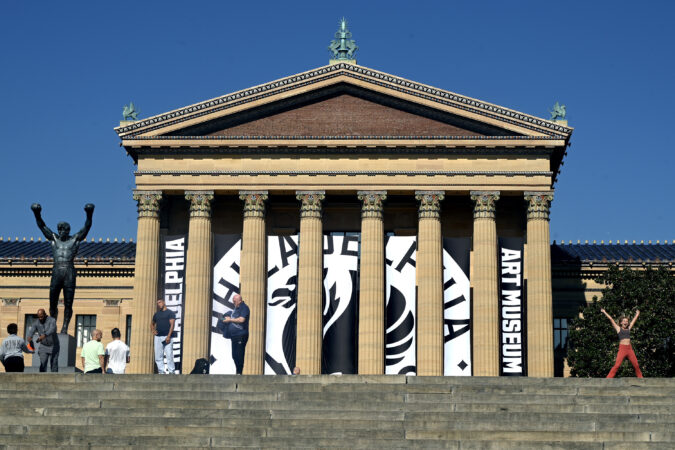
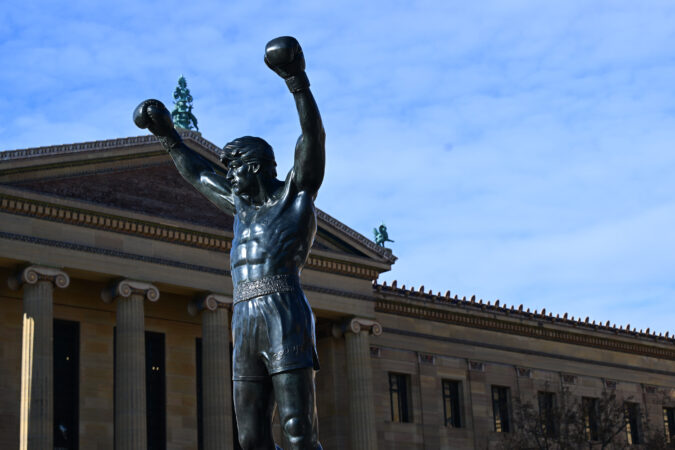
And, in perhaps bigger news to supporters, if the plan goes through, the screen-used statue that sits at the bottom of the Art Museum steps would be moved to the top thanks to what appears to be a change of heart from the Italian Stallion himself, Sylvester Stallone. Initially, the city planned to give the original statue back to Stallone, who gifted it to Philadelphia decades ago, and keep the other casting that now sits at the top of the Art Museum steps.
“In response to the strong and heartfelt feedback from the public, Mr. Stallone has graciously decided that we will no longer move forward with the proposed statue swap,” chief cultural officer Valerie V. Gay said at Wednesday’s meeting. “This outcome reflects our shared commitment to listening deeply to the community and doing what is best for both the art and the people who cherish it.”
Now, the city would keep the original, commissioned by Stallone for 1982’s Rocky III, while the second casting — reportedly purchased for about $403,000 at an auction in 2017 — would go back into the actor’s private collection. The second casting has been on (supposedly temporary) display at the top of the Art Museum’s iconic steps since last December, when Stallone lent it to the city for the inaugural RockyFest, which celebrates the Rocky franchise.
What will happen, however, remained up in the air following Wednesday’s meeting. Commission members largely cited concerns over accessibility and feasibility with moving the Rocky statue to the top of the Art Museum steps, but ultimately approved the concept on the condition that Creative Philadelphia present further information before a future vote for final approval. The art commission is next slated to meet Jan. 14, members said Wednesday.
The goal, Gay said, is to have only one Rocky statue at the Art Museum, and install another, as-yet-unannounced, city-owned statue at the bottom of the building’s steps where the original Rocky statue now stands.
If approved, the plan would get underway next year. As part of “Rising Up: Rocky and the Making of Monuments,” an Art Museum exhibit slated to run from April to August, the original Rocky statue would be displayed inside the museum for the first time, while the loaner remains outside. At the conclusion of that exhibit, the original would be moved outside to the top of the Art Museum’s steps for its permanent installation, and the loaner would go back to Stallone, officials said Wednesday.
Years of moves and debate
Wednesday’s meeting marked yet another chapter in the Rocky statue’s controversial history in town. It arrived for the filming of Rocky III, but when the shoot wrapped in 1981, a permanent location had not been approved, causing it to be shipped back to Los Angeles. It ultimately came back and was temporarily exhibited again at the top of the Art Museum steps before being moved back and forth several times between that location and the Spectrum at the stadium complex in South Philly.
Over the years, the statue has ignited public debate about whether it should be displayed at the Art Museum, and whether it is art in the first place. Still, it has been on display at the foot of the museum’s steps since 2006, where it has served as a draw for tourists and residents alike, attracting an estimated 4 million visitors per year, Creative Philadelphia officials said.
Inquirer readers largely said in September that the statue temporarily installed at the top has overstayed its welcome, with about 46% of respondents to one poll saying no Rocky statue belongs at the top of the steps, but the one at the bottom should stay. Roughly 20% said the city should not have a Rocky statue at all.
Gay, however, said Wednesday that the proposed permanent Rocky statue installation offers a chance to “allow art to bring our community together” and encourage visitors to the statue to take in the art on display inside the museum.
“This is absolutely an amazing opportunity to expand our connection, our community’s connection, with art,” she said.
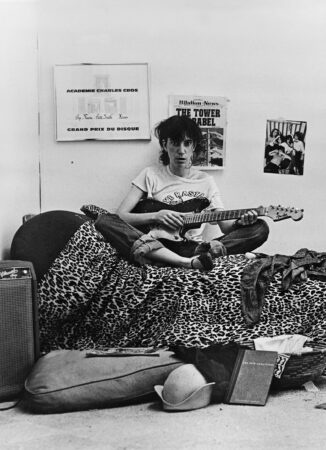
Patti Smith has been associated with New York for her entire public life.
In 1971, her first poetry and music performance was at St. Mark’s Church in-the-Bowery with Lenny Kaye on the guitar. Along with the Ramones, Talking Heads, Television, and Blondie, she was a vital force in the mid-1970s CBGB music scene.
And in 1975, she recorded Horses at Electric Lady Studios. That galvanic debut album made her an instant punk rock and feminist hero. On Saturday, she’ll celebrate its 50th anniversary at the Met Philly, with a band that includes Kaye, drummer Jay Dee Daugherty, bassist Tony Shanahan, and her son Jackson Smith on guitar.
“People think of me as a New Yorker,” Smith said, in an interview with The Inquirer from her home in New York.
“Well, I’ve lived in New York. But I was pretty much formed by the time I got to New York. The places that helped form me were Philadelphia and rural South Jersey.”
At the Met, Smith and her band will perform Horses in its entirety, starting with the take on Van Morrison’s “Gloria” that introduced her as a brash, provocative artist with one of the most memorable opening lines in rock and roll history: “Jesus died for somebody’s sins … but not mine.”
“It’s going to be a special night, because I hardly ever get to play with my son and daughter,” said Smith, who turns 79 on Dec. 30. “So I’m really, really happy about that, bringing my kids to Philadelphia.”
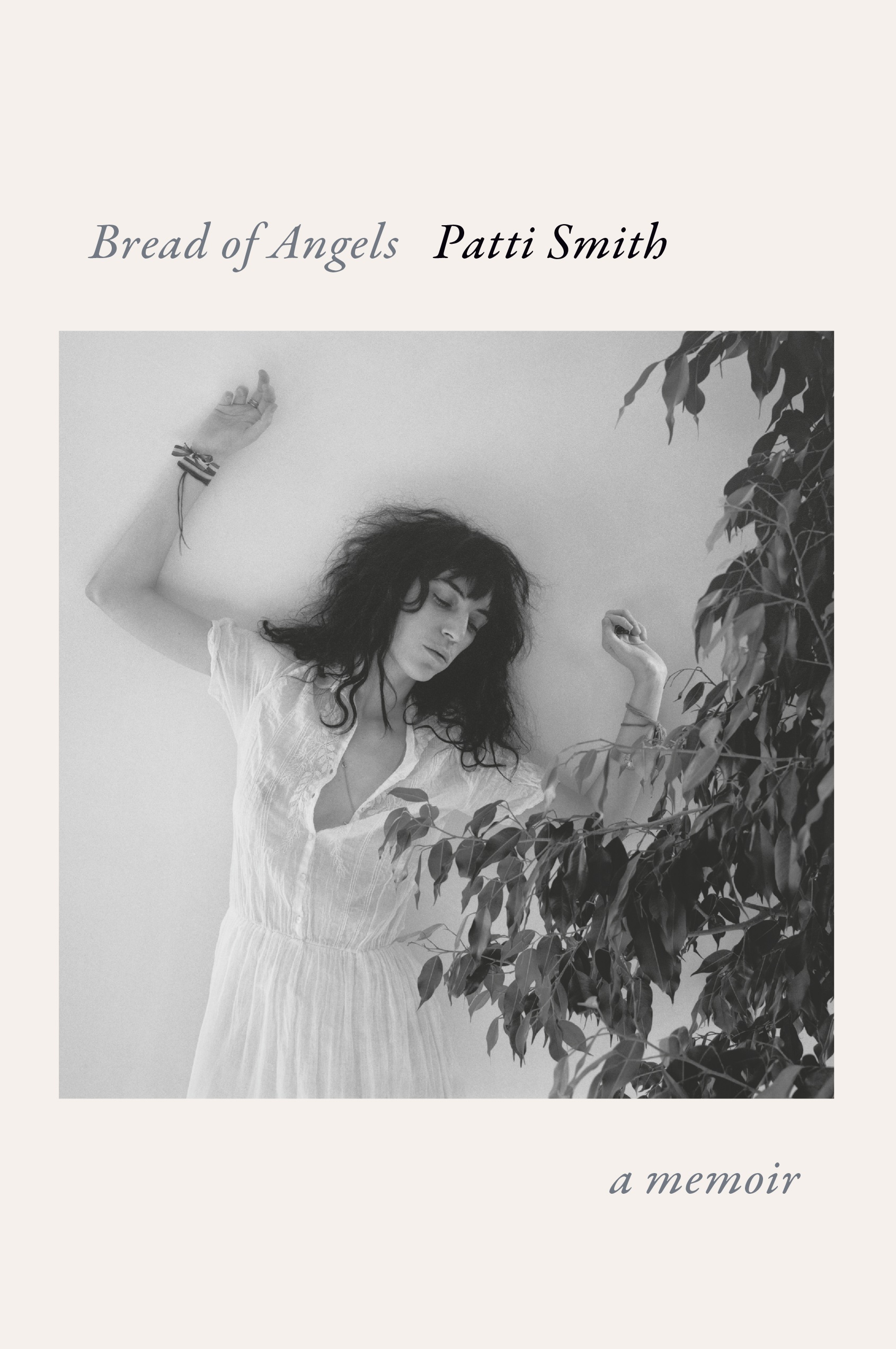
Bread of Angels, unlike her 2010 National Book Award-winning Just Kids, doesn’t zero in on a particular episode in the storied career of the enduring punk icon.
“Bread of Angels: A Memoir” by Patti Smith. MUST CREDIT: Random House
Instead, Bread takes the full measure of her life. It begins in Chicago where she was born before her parents moved back to Philadelphia while she was a toddler, and turns on a late-in-life DNA revelation that shakes up her conception of her own identity.
“I didn’t plan to do this book,“ Smith said. “Truthfully, it came to me in a dream.”
In her dream, she had written a book telling the story of her life in four sections. She wore a white dress, just as she does on the cover of Bread of Angels, in a 1979 photo taken by Robert Mapplethorpe.
“It was so specific, this dream, that it sort of haunted me. And I felt like it was a sign that perhaps it was a book I should write. …. It took quite a while.”
Bread of Angels is “a love letter to certain places.”
“Philadelphia when I was young,” she said. “I love Philly. And then down in rural South Jersey, and the places in Michigan I lived with my husband.”
Summaries of Smith’s life typically cite that she lived in Germantown before moving first to Pitman and then Deptford Heights in South Jersey, before moving to New York in 1967.
But Smith’s childhood was actually much more peripatetic.
“I think we moved nine times while we were in Philly,” she recalled, including stops in Upper Darby and South Philadelphia.
“My mother had three of us in rapid succession,” said Smith. It was after the war, and a lot of the rooming houses we stayed in absolutely didn’t allow infants, so my mother was always hiding the pregnancy or hiding the baby. And then we’d get found out and have to move again.”
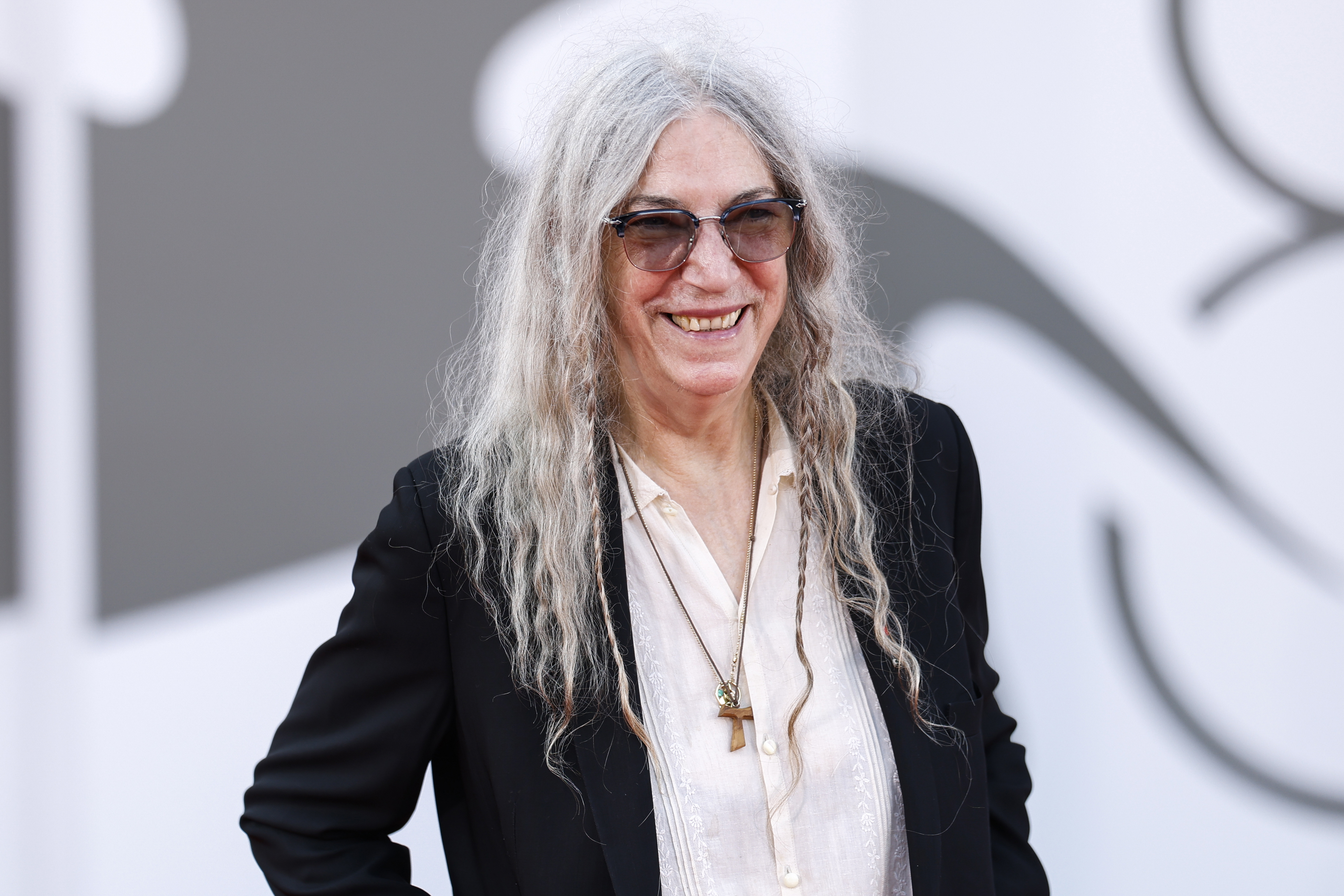
Patti Smith at the Venice Film Festival in Venice, Italy in 2024.
Her coming of age Philadelphia stories in the book evoke a happy, lower middle class childhood.
Living in a converted soldier’s barracks in Germantown she calls “the Patch,” she once beat all the boys and girls in a running race, but tripped and landed on a piece of glass, leaving blood rushing down her face. She was treated at Children’s Hospital, and rode a bicycle for the first time the following week.
“I left the perimeter of the Patch, pedaled up toward Wayne Avenue,” she writes. “I was six and half years old with seven stitches, and for that one hour, on that two-wheeler, I was a champion.”
On her seventh birthday, her mother, who then worked at the Strawbridge & Clothier department store at Eighth and Market, took her to Leary’s, the Center City bookshop that closed in 1968.
“Oh my gosh it was a wonderful bookshop,” she said. “On your birthday, you had to show your birth certificate and pay $1, and you could fill your shopping bag.”
Her bag, she said, was filled “with some very good books that I still own.”
A copy each of Pinocchio, The Little Lame Prince, an Uncle Wiggily book.
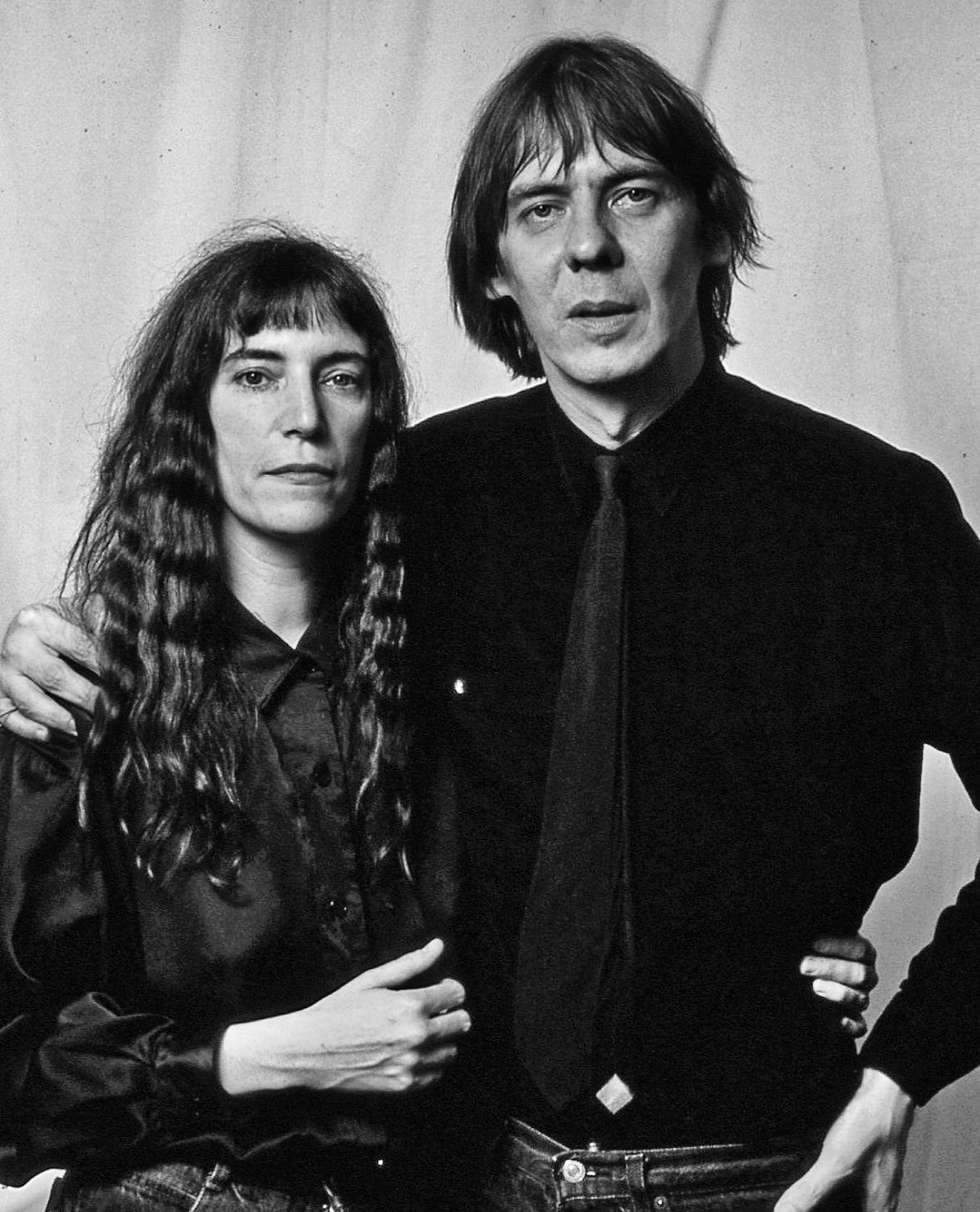
Patti Smith and her late husband Fred “Sonic” Smith, as pictured in “Bread of Angels,” her new memoir. Smith and her band will play the Met Philly on Nov. 29 on the final date of their tour celebrating the 50th anniversary of her 1975 debut album “Horses.” She will also appear on Dec. 1 at Marian Anderson Hall at the Kimmel Center in a Songs & Stories event on her Bread of Angels book tour.
As a Jersey teenager in the early 1960s, she had a crush on a South Philly boy named Butchy Magic. She once got stung by a hornet outside a dance, she writes in the book, and he looked deep into her eyes and pulled the stinger out from her neck.
“This is what the writer craves,” she writes. “A sudden shaft of brightness containing the vibration of a particular moment … Butchy Magic’s fingers extracting the stinger. The unsullied memory of unpremeditated gestures of kindness. These are the bread of angels.”
As in the book, Philadelphia loomed large over Smith’s childhood, well after the family moved to Gloucester County.
“It was our big city. It was where I discovered rock and roll,” she said.
She discovered art when her father Grant and mother Beverly took her and her younger siblings Linda, Kimberly, and Todd to the Philadelphia Museum of Art (now Philadelphia Art Museum). There, she fell for Pablo Picasso, John Singer Sargent, and Amedeo Modigliani.
“Culturally, it was the city that helped form me,” she said.
“It amazes me that half a century has gone by and people are still greatly interested in the material,” she said. “It’s a culmination of a period in my life.”
In 2012, when Smith and her sister Linda took DNA tests, Smith had already begun writing Bread of Angels. The result of the test was a shock: Grant Smith was not her biological father.
Her birth was actually the result of a relationship between Beverly Smith and a handsome Jewish pilot named Sidney who had returned to Philadelphia from World War II.
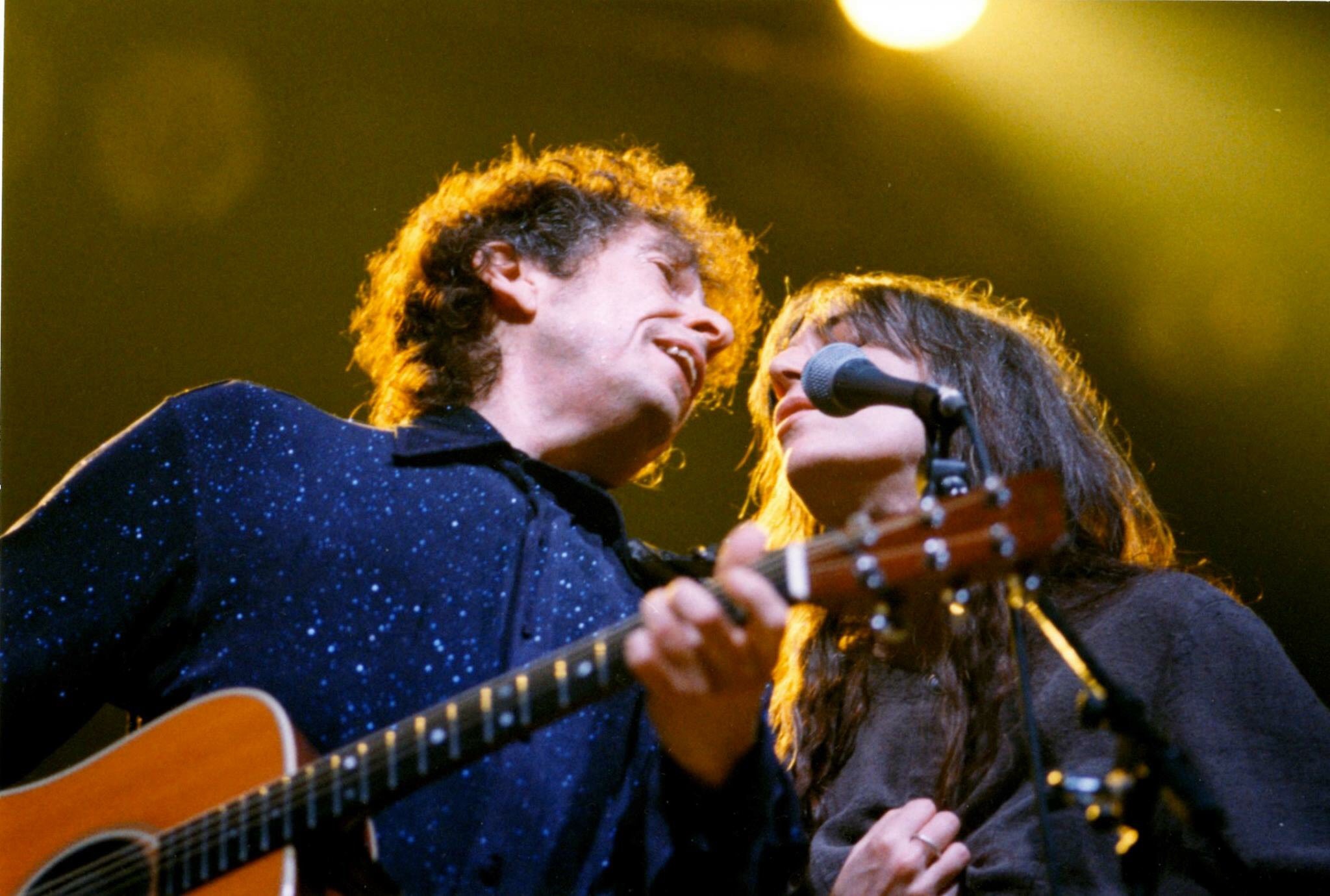
Bob Dylan and Patti Smith at the Electric Factory in Philadelphia in 1995.
“It was completely unexpected,” Smith said. “My mother was a great oral storyteller, but none of her stories gave any indication that I was fathered by a different man. … She certainly kept that a secret from everyone.”
Of the emotions Smith felt, one was “some sorrow,” she said. “Because I loved and admired my father. I felt sad because I didn’t have his blood. But I modeled myself after him so much. All of those things remain.”
She stopped work on Bread of Angels for two years.
“I didn’t know how to deal with it. Is this book false? Do I have to rewrite everything? And then I realized I didn’t have to rewrite anything. My father is still my father. But you can also show gratitude to the man who conceived with my mother. Who gave me life. So I figured it out. I have two fathers.”
Her mother, father, and biological father had all died by the time she learned the news of her parentage.
Some of Smith’s self-confidence — evident in the way she spells out “G-L-O-R-I-A!” — “might have come from the biological father I never knew,” she said. “He was a pilot. When he was young, he had this tough job. I’ve met a few people who knew him. They said he was very kind and good-hearted. He loved art, he loved to travel. He had not a conceited, but a self-confident air.
“I’ve always had that, and wondered where it came from,” she said. “I’ve always possessed that kind of self-confidence. I’ve never had trouble going on stage. So I think I have to salute my blood father, right?”
In Bread of Angels, Smith recalls her early life in Philly, and writes: “I did not want to grow up. I wanted to be free to roam, to construct room by room the architecture of my own world.”
Seven decades later, she’s still doing that, as she continues to create and perform for adoring audiences around the world.
“I have stayed in contact with my 10-year-old self, always,” she said. “I still carry around the girl that had her dog, and slept in the forest, and read [her] books, and got in trouble, and didn’t want to grow up.”
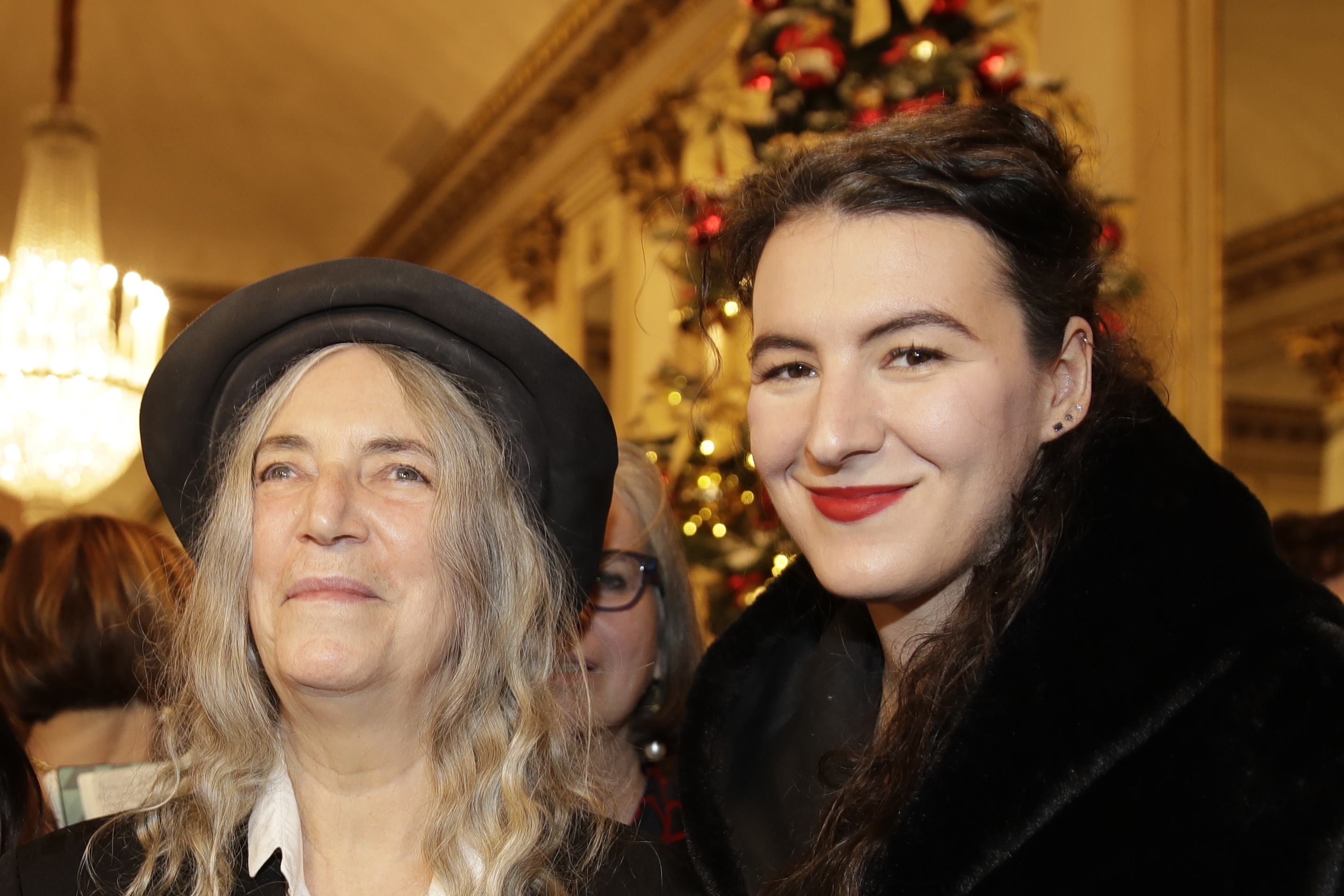
Patti Smith and daughter Jesse Paris Smith in Milan, Italy, in 2019.
She turns 80 next year.
“My hair is gray to platinum. I understand my age. I’ve had my children, and have gone through a lot of different things. But I still know where my 10-year-old self is. I still know how to find her.”
Patti Smith and Her Band perform “Horses” on its 50th anniversary at the Met Philly, 858 N. Broad St. at 8 p.m. Saturday, themetphilly.com.
“Patti Smith: Songs & Stories” at Marian Anderson Hall, 300 S. Broad St., at 7 p.m. Monday, ensembleartsphilly.org
Since 1920, Philadelphia has gone without a Thanksgiving Day parade only twice — once because of poor weather, and once because of a global pandemic. But nearly four decades ago, another formidable foe — corporate sponsorship — threatened the city’s beloved holiday tradition.
That’s not a bad record for the country’s oldest Thanksgiving Day parade, which Gimbel Brothers Department Store launched with a humble procession through Center City. For more than 60 years, the festivities ended with Santa Claus climbing a ladder into the window of the Gimbels store at Ninth and Market Streets, signaling the start of the holiday season.
Until 1986, that is. Gimbels by then had fallen on hard times and, following its sale to the highest bidder, was liquidated. Its Philadelphia-area locations were to be converted into Stern’s department stores, and Gimbels hoped to pass the baton to that chain to keep the Thanksgiving Day tradition alive.
The problem was that Stern’s and its parent company, Allied Stores Corp., were not interested.
“I think the best we could do this fast is to buy the Mummers some T-shirts,” Allied Stores chairman Thomas Macioce told the Daily News in 1986.
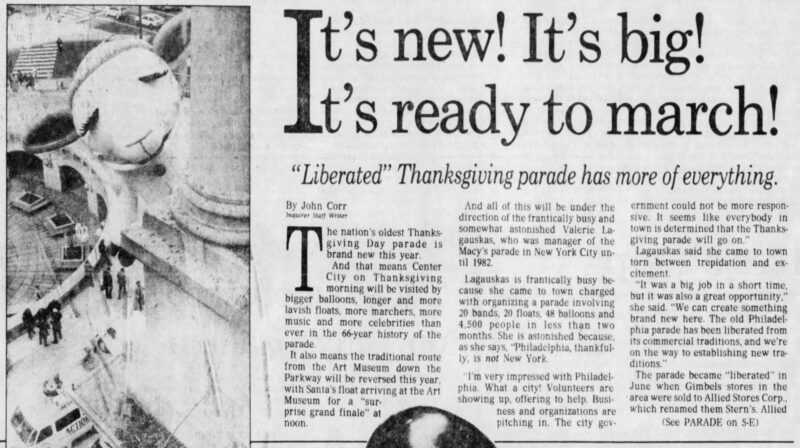
The parade that year, however, became bigger and better than it had ever been. Here is how The Inquirer and Daily News covered it:
Article from Jun 18, 1986 Philadelphia Daily News (Philadelphia, Pennsylvania) <!— –>
‘We can’t be ready in time’
A deal in the Gimbels sale emerged in June 1986 and, right away, the Thanksgiving Day parade was on the chopping block, at least for that year. Allied officials claimed no planning had yet been done and there was no way to put it together in time.
That, it turns out, wasn’t true. Ann Stuart, a Gimbels executive, told the Daily News that parade organizers had been proceeding as though the parade would be held as scheduled. And Barbara Fenhagen, the city’s special events coordinator, said planning was going ahead as usual.
Either way, Stern’s and Allied’s lack of interest left the city in a tight spot. Aug. 15 was the last day orders could go in for the floats to be ready on time, marking a hard deadline to find a sponsor. Whoever took up the role would be expected to spend hundreds of thousands of dollars.
“We will do everything we can to make sure that [the parade’s] appearance is not interrupted, even for one year,” Fenhagen said at the time.
Article from Jul 16, 1986 Philadelphia Daily News (Philadelphia, Pennsylvania) <!— –>
‘Don’t rain on our parade’
As the controversy wore on, Philadelphians and the local press grieved and snarled at the potential loss of a holiday tradition. The Daily News seemed to plead for Stern’s to reconsider.
“Please don’t rain on our parade,” the People Paper wrote in an editorial. “To Philadelphians of all ages, it launches the holiday season in a special and heartwarming way.”
Business columnist Jack Roberts struck a more combative tone, likening Stern’s to a houseguest who begins a conversation “by spitting in your face.” He later suggested that readers send back Stern’s junk mail to the company’s “Scrooge” executives with the phrase “I want the parade” scrawled across it.
Special events professionals, meanwhile, warned that forgoing the sponsorship might create a bad name for Stern’s that would be difficult to overcome.
“Philadelphians have a way of remembering,” special events consultant Shelly Picker said.
Article from Nov 21, 1986 Philadelphia Daily News (Philadelphia, Pennsylvania) <!— –>
‘We’re delighted’
The search for a new lead sponsor was arduous, with city officials approaching “most every local company that breathes,” according to a Daily News report. A number of bigger local outfits — ranging from Meridian Bancorp to Kiddie City — bowed out over cost and branding concerns.
Then, after 56 days of limbo, the Thanksgiving Day parade was back on. And it was thanks to WPVI (Channel 6), better known today as 6abc.
“When it became clear that because of the time frame and other commitments most were unable to assume that mantle, we decided to do it — and we’re delighted,” said the station’s general manager, Rick Spinner.
The station had been airing the parade locally for 19 years and seemed to be a natural fit to take over. And, as the Daily News reported, the city had been pressuring Channel 6 to come up with a plan, seeing as the station benefited significantly from broadcasting the day’s festivities.
The parade would go on to be known as the “Channel 6 Thanksgiving Day Parade.” But that was not the only — or even the biggest — change afoot.
Article from Sep 24, 1986 Philadelphia Daily News (Philadelphia, Pennsylvania) <!— –>
‘Establishing new traditions’
Channel 6 brought in the big guns straight away. Namely, by hiring a parade coordinator named Valerie Lagauskas, who previously managed the Macy’s parade in New York and wrote a book on parade planning.
A number of changes came under Lagauskas’ leadership, including a new route. Instead of starting at the Philadelphia Art Museum and marching toward City Hall, as had been tradition, the parade would reverse direction and end at the Art Museum. The route would allow for the use of larger balloons, bigger floats, and better camera angles for the parade’s telecast.
The full parade that year would also be broadcast nationally for the first time, appearing on the Lifetime network, in which ABC was part owner.
In total, there would be 20 bands, 20 floats, 8 gigantic balloons, and 40 other balloons that were merely very large, The Inquirer reported. A massive balloon of the cartoon cat Heathcliff would make its debut. The theme, fittingly, would be “We Love a Parade.” And leading it all as parade marshal would be Sixers legend Julius “Dr. J” Erving,
“The old Philadelphia parade has been liberated from its commercial traditions and we’re on the way to establishing new traditions,” Lagauskas said.
Article from Nov 28, 1986 The Philadelphia Inquirer (Philadelphia, Pennsylvania) <!— –>
‘The best ever’
On parade day, more than 500,000 spectators were expected to attend. And, according to reports from the time, they were not disappointed.
Not only were there better floats and a more picturesque route, but paradegoers also were met with unseasonably warm temperatures.
“It’s the first time we’ve been to a Thanksgiving Day parade where you could get a sunburn,” one attendee joked.
The parade itself seemingly went off without a hitch, concluding on the steps of the Art Museum as Santa Claus pulled up to a rendition of “Happy Holidays.” Musicians and dancers let go of green and white balloons that drifted out over the Benjamin Franklin Parkway to cheers.
And at least one Philadelphian didn’t forget who saved the day. Donna Harris, 30, of Audubon, who had attended the parade yearly since she was 5, was spotted holding a sign that read “Thank You WPVI.”
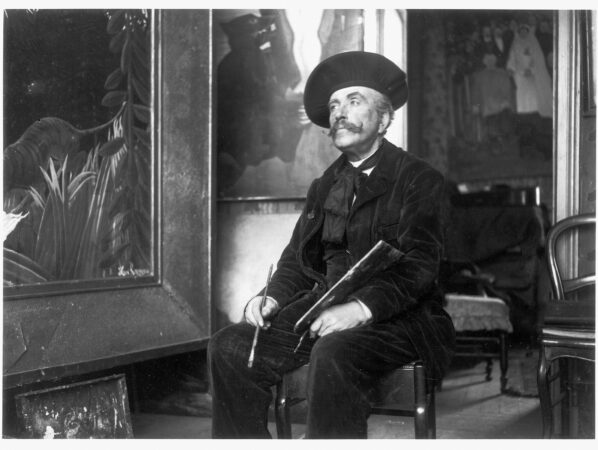
These are some of the figures in the iconic jungle pictures by Henri Rousseau (1844-1910), a self-taught French artist who strove to realize financial and critical success as a professional painter.
He also had a criminal record of embezzlement and bank fraud.
Despite a lack of formal art training, Rousseau was confident he was a significant artist who deserved official recognition. Nicknamed “Le Douanier” (the customs officer) by Alfred Jarry, a playwright who was also a family friend, Rousseau did collect tariffs on goods coming into Paris.
In 1893 at age 49, he retired early with a modest pension to devote himself to full-time painting.
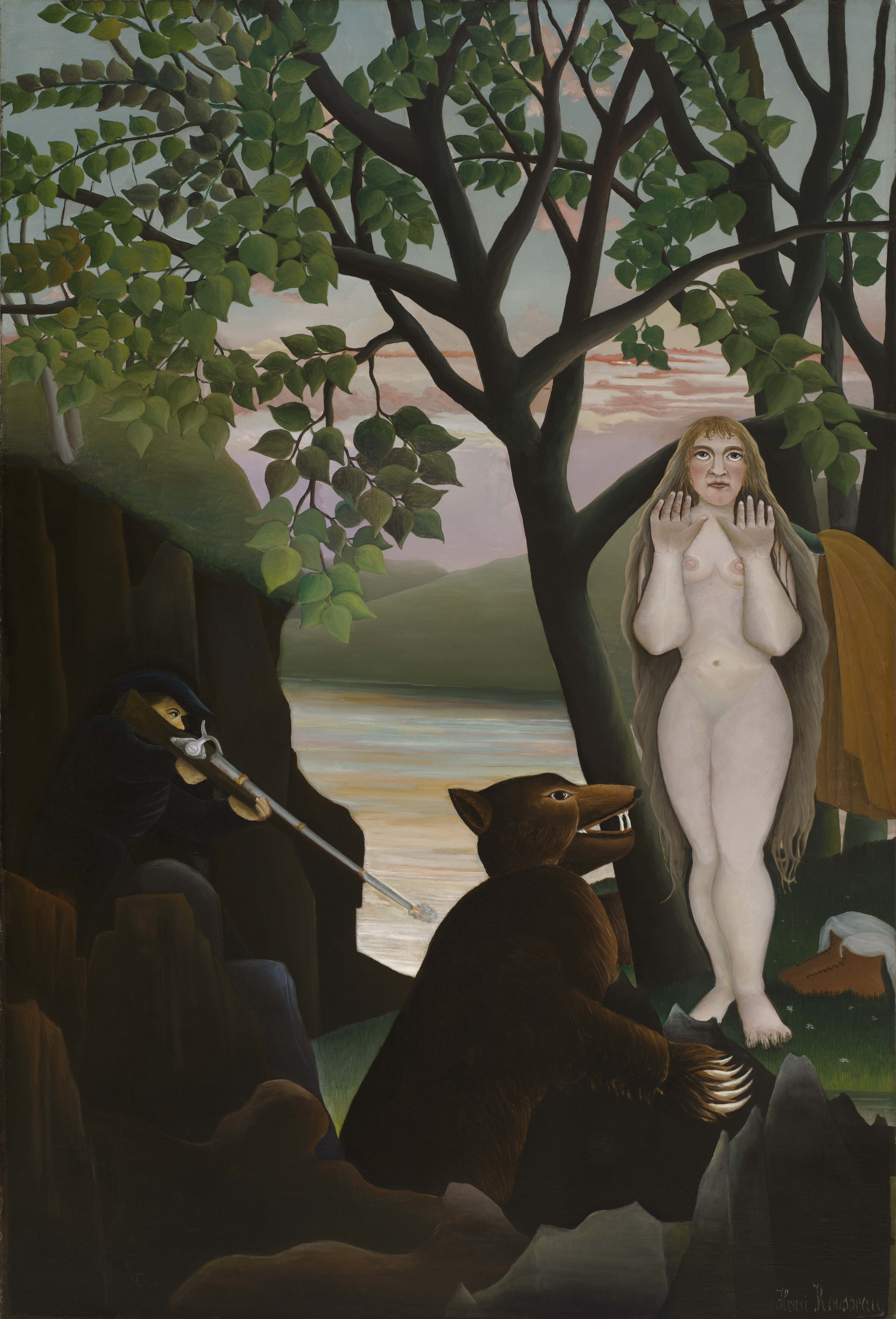
Henri Rousseau. Unpleasant Surprise, 1899–1901. Oil on canvas.
Whether portraits, landscapes, or the uniquely imagined jungle scenes, Rousseau’s pictures reveal features common to an artist with no academic art instruction: anatomical inaccuracies, flatness, scale distortion, outlined forms, and repetitive patterning. Some of his canvases defy logic, mixing fact and fantasy like Tropical Landscape — An American Indian Struggling with a Gorilla (1910).
At the Barnes’ ongoing “Henri Rousseau: A Painter’s Secrets,” Rosseau’s art is arranged in seven thematic sections.
The curators — Nancy Ireson, the deputy director of collections and chief curator at the Barnes, and Christopher Green, professor emeritus at the Courtauld Institute of Art in London — have assembled 56 works including major loans from museums around Paris, to showcase an artist with “entrepreneurial energy in marketing,” as Green put it in a recent press preview.
The compact exhibition offers a glimpse at Rousseau’s journey from an outsider artist to a modern master, revealing, as the exhibition notes say, “the thoughts and intentionality behind some of his most famous works.”
Henri Rousseau. Fight between a Tiger and a Buffalo, 1908. Oil on canvas.
Interestingly, an ongoing show at the Philadelphia Art Museum is titled “Dreamworld: Surrealism at 100.” Rousseau’s visionary work was admired by Andre Breton, who wrote the Manifesto of Surrealism in 1924. Although Rousseau deals with such similar matters as childlike imagination, eroticism, and dreamy scenarios, no recognition of his role as an inspirational precursor is presented in this survey of about 180 artworks up the Parkway.
Yet, Le Douanier was certainly on that road to surrealism.
Between 1923 and 1929, Albert C. Barnes, the voracious collector of modern art, acquired 18 paintings to form the world’s largest group of Rousseau canvases under one roof. (Eleven are displayed in this show, nine of which will travel overseas for the first time in 40 years when the show goes to the Musée de l’Orangerie in Paris next year.) Barnes admired Rousseau’s “honesty” of approach, saying, in 1925, “his pictures have the charm of a child’s fairy-tale.”
“But there is nothing childish or untutored in the skill with which they are executed,” he maintained.
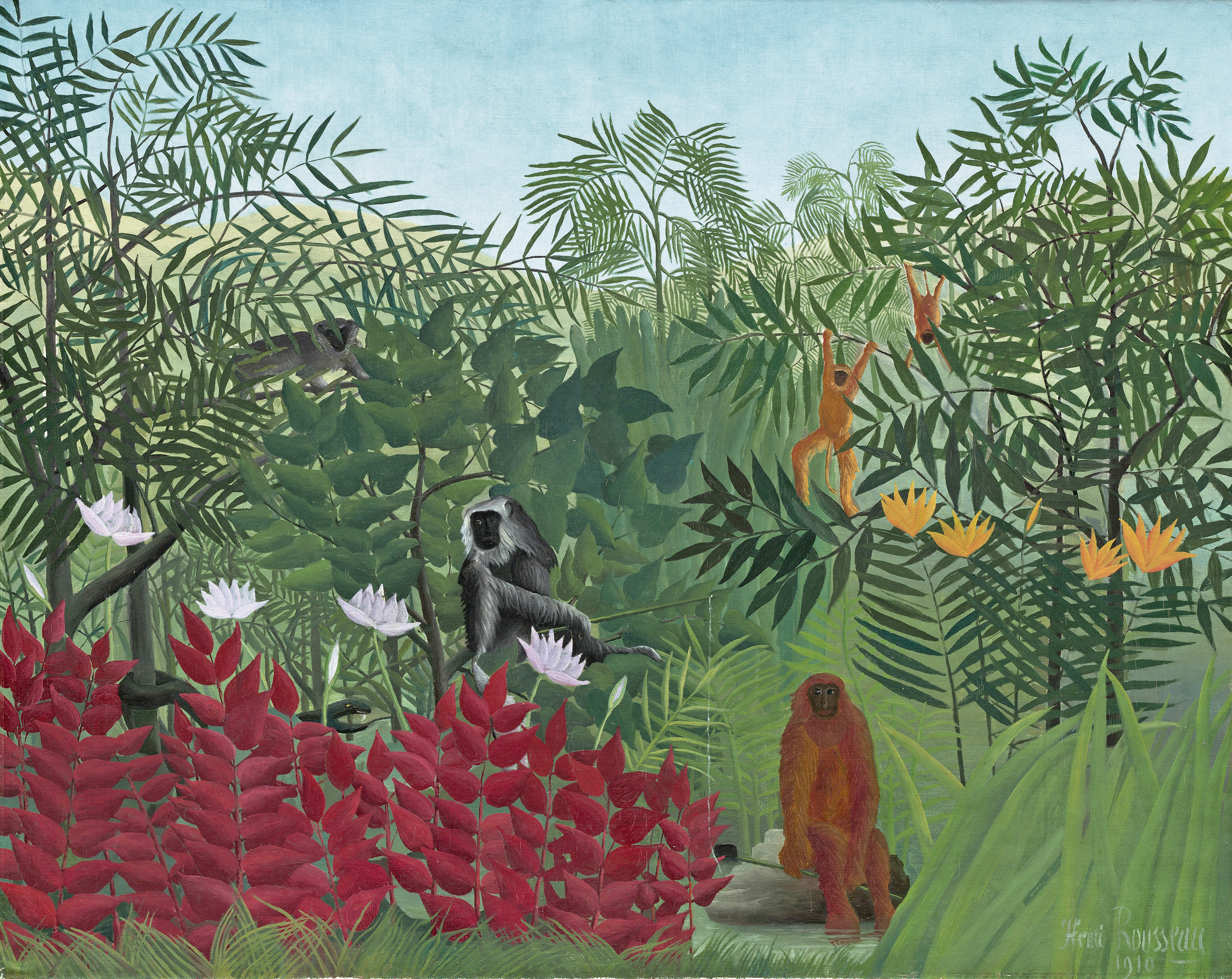
Henri Rousseau. Tropical Forest with Monkeys, 1910. Oil on canvas.
Rousseau did not begin painting until he was in his 40s. He submitted work to the recently established Salon des Indépendents, the nonjuried annuals that required only a modest fee and provided a venue to anybody to have work on public display.
The 1894 painting TheWar, an allegorical image, raised his profile and elicited enthusiastic as well as derisive responses. The central figure is strangely positioned not on but in front of the galloping horse as it leaps across a battlefield strewn with bodies and scavenging black crows.
Henri Rousseau. Scouts Attacked by a Tiger (Éclaireurs attaqués par un tigre), 1904, Oil on canvas.
A decade later, Scouts Attacked by a Tiger (1904), a large jungle picture of impending danger, attracted considerable notice. Rousseau’s rather novel tropical scenes like this one began to gain some notoriety among a circle of talented bohemian personalities that included Pablo Picasso.
Louis Vauxcelles, the young art critic who coined the terms fauvism and cubism, acknowledged that Rousseau was becoming “a celebrity in his own way.”
The artist, however, never left France.
His jungle paintings are pure fantastic compositions of faraway places created in his Parisian studio. For visual reference, he used sundry postcards and photographs and made repeated visits to the Jardins des Plantes with its botanical gardens and zoo. Rousseau found his niche painting such “imaginative voyages” during the late years of his career.
When the artist was on trial for participation in a bank fraud scheme in late 1907, his lawyer brought to court a tropical painting depicting monkeys (the exact canvas is not known). Based on the visual evidence of the picture, the defense maintained that Rousseau was too naive to know that he was committing a crime.
It worked. The artist only received a suspended sentence.
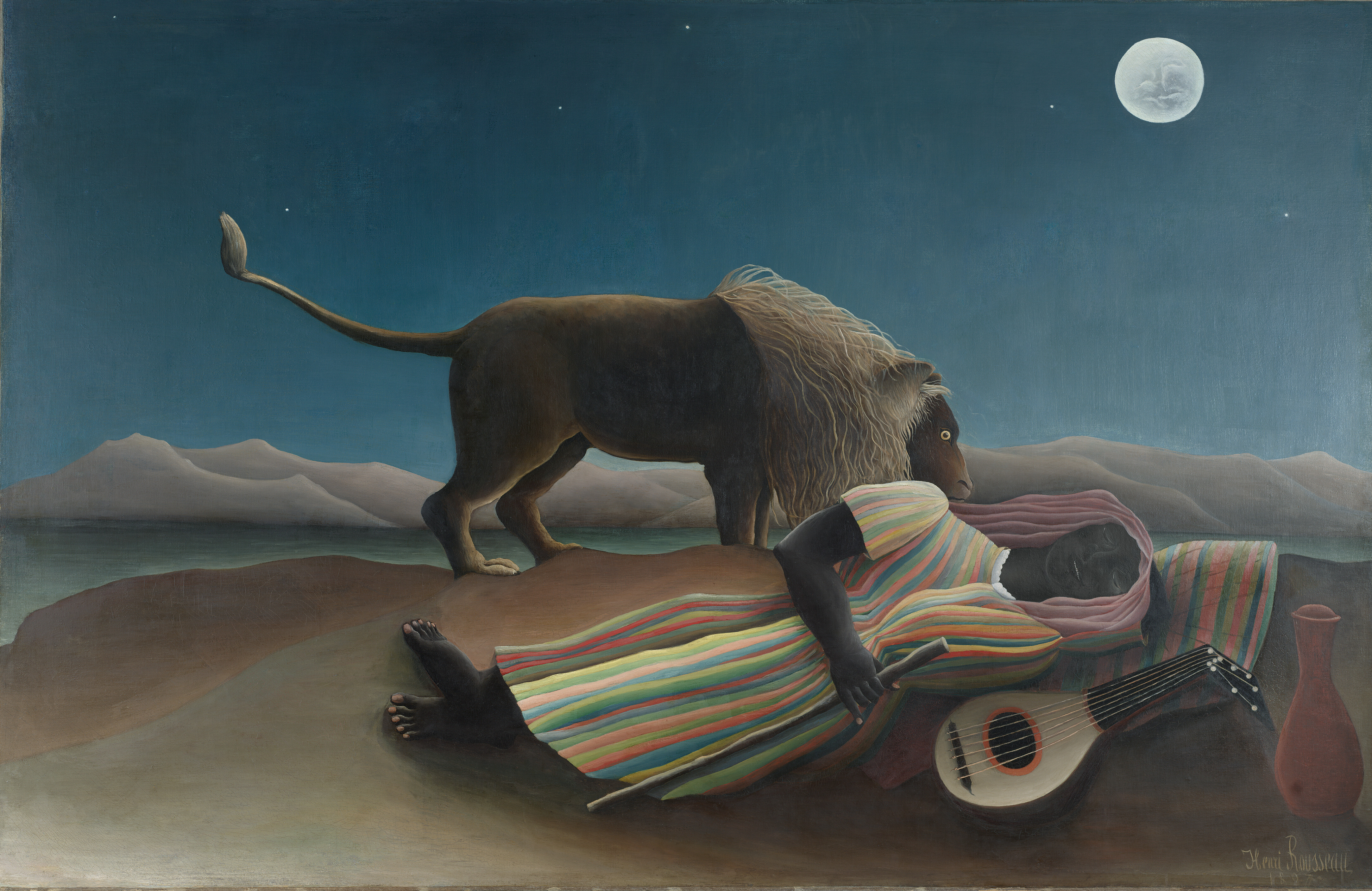
Henri Rousseau. The Sleeping Gypsy, 1897. Oil on canvas.
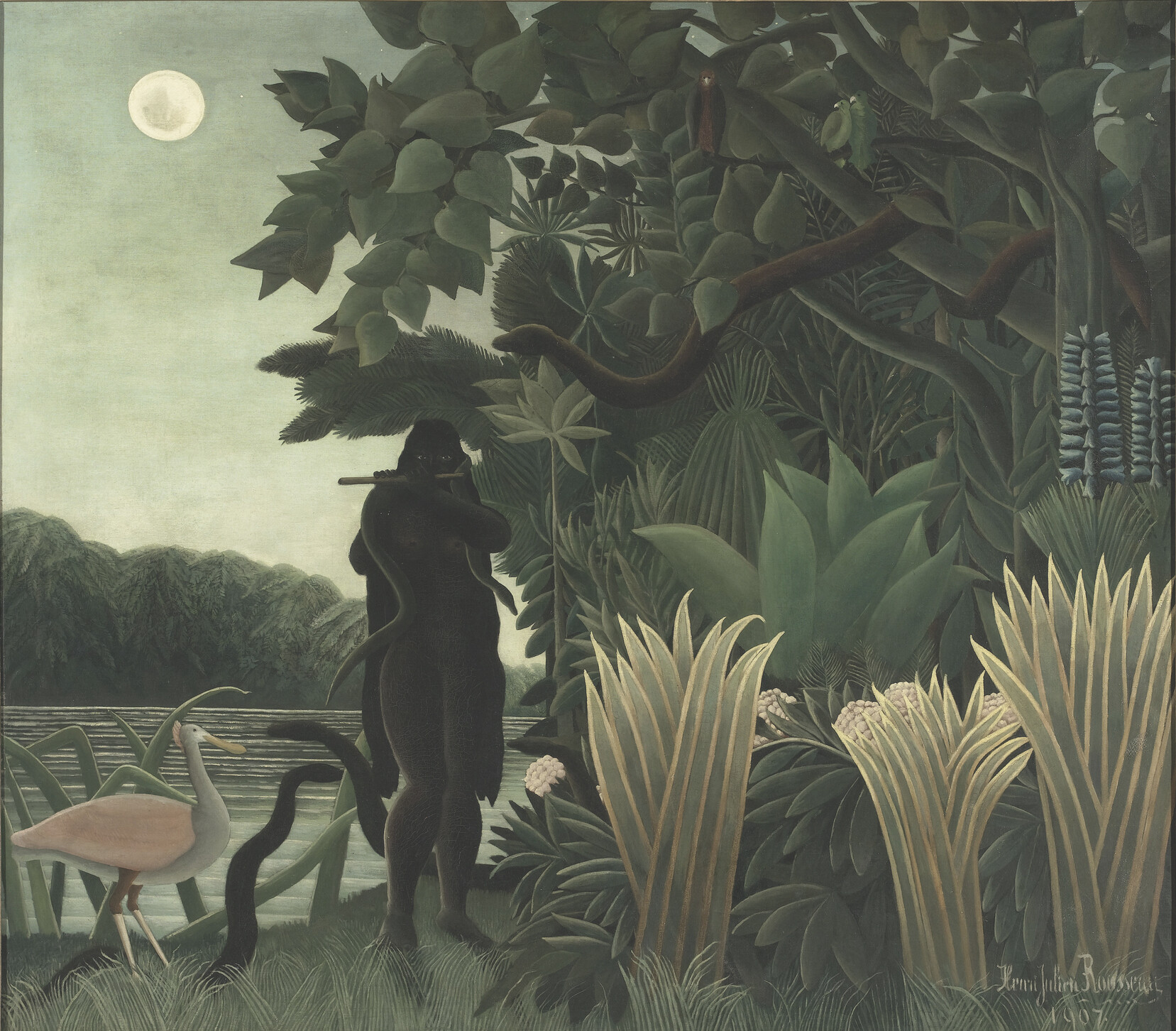
The piece de resistance of the Barnes exhibition is the last gallery where three key works by Rousseau have been brought together for the first time: The Sleeping Gypsy (1897), from the Museum of Modern Art in New York; Unpleasant Surprise (1899-1901), in the Barnes collection; and The Snake Charmer (1907), from the Musée d’Orsay, which entered the Louvre in 1936, giving Rousseau the official state recognition he had hoped to realize in life.
With striking light effects and subtle tonalities, these fantasy scenes remain poetic, mysterious, and beguiling. They certainly raise more questions than answers. It is understandable why Green described Rousseau as a “story giver not a storyteller.”
Henri Rousseau. The Snake Charmer, 1907. Oil on canvas.
In 1908, Picasso shined a spotlight on Rousseau when he bought The Portrait of a Woman (1895) for a few francs. The formidable portrait depicts a woman (believed to be a Polish lover of Rousseau), who stands in front of a balcony and curiously holds an upside-down branch like a cane. Though it came from a secondhand dealer who was selling the canvas for reuse, Picasso always spoke “movingly about this picture, keeping it with him all his life,” said Green.
That large Rousseau picture is here on loan from the Musée National Picasso-Paris.
To celebrate his newly acquired Rousseau, Picasso organized a dinner party with the painting as the centerpiece in his Montmartre studio. In front of an illustrious circle of Picasso’s avant-garde artist friends as well as Gertrude and Leo Stein, Rousseau toasted with unabashed chutzpah his host: “We are the great painters of our time, you in the Egyptian style, I, in the modern style.”
Guillaume Apollinaire, an influential figure of the Parisian avant-garde who was also invited to that Picasso party, prophetically saluted the guest of honor: “Vive, Vive, Rousseau!”
“Henri Rousseau: A Painter’s Secrets” through Feb. 22, Barnes Foundation, 2025 Benjamin Franklin Parkway, barnesfoundation.org
“Dreamworld: Surrealism at 100″ through Feb. 16, Philadelphia Art Museum, 2600 Benjamin Franklin Parkway, visitpham.org
The former head of human resources and diversity initiatives for the Philadelphia Art Museum was charged with theft earlier this year. The police said she racked up more than $58,000 in personal expenses on a company credit card, then failed to pay back the funds, court records show.
Latasha Harling, 43, was arrested in July and charged with theft by unlawful taking, theft by deception, and related crimes about six months after she quietly resigned from her job as the chief people and diversity officer for the museum.
The charges against Harling — which had not previously been reported or made public by the museum — are the latest chapter in a six-week stretch of turbulence for the prominent institution, and raise new questions about the financial oversight and controls of its senior executives.
On Nov. 4, the museum fired its director and CEO, Sasha Suda, after an investigation by an outside law firm flagged the handling of her compensation. Suda filed a lawsuit on Nov. 10 against her former employer claiming that she was the victim of a “small cabal” from the board that commissioned a “sham investigation” as a “pretext” for her “unlawful dismissal.”
The Art Museum on Thursday responded to the lawsuit in Philadelphia Court of Common Pleas with a petition saying Suda was dismissed after an investigation determined that she “misappropriated funds from the museum and lied to cover up her theft.” Her lawyer, Luke Nikas of Quinn Emanuel Urquhart & Sullivan, called the museum’s accusations false.
“These are the same recycled allegations from the sham investigation that the museum manufactured as a pretext for Suda’s wrongful termination,” he said.
A sign shows the recent rebranding of the Philadelphia Art Museum.
Harling declined to comment on the charges filed against her Friday, as did her lawyers at the Defender Association. A spokesperson for the Philadelphia Art Museum also declined to comment on the matter.
Harling was hired by the museum as a senior member of its executive staff in November 2023, according to her LinkedIn profile. In that role, she oversaw human resources for the museum, implemented policies to promote diversity, equity, and inclusion, and managed budgetary responsibilities, among other duties, per her profile.
As part of her job, Harling had access to a corporate credit card for business-related expenses, according to the affidavit of probable cause for her arrest.
In January 2025, museum staff noticed that Harling’s December credit card statement contained “several large, and apparently personal expenses,” the affidavit said.
The museum’s chief financial officer conducted an audit and found that, over the course of Harling’s tenure, she charged $58,885.98 in personal expenses to the company’s credit card, the document said. She had not filed an expense report since July 2024, according to the affidavit.
Museum officials confronted Harling about the charges in January, the filing said, and proposed that she repay $32,565.42. She resigned from her role soon after “without resolution,” according to the affidavit.
The museum continued to negotiate with Harling, and in February, she signed a promissory note agreeing to pay back $19,380.21 over the course of three months that spring, the record said.
But in April, per the filing, a lawyer for the museum contacted the police to say that two months had passed and Harling had not repaid any of the funds. They said that, according to their agreement, she should have paid back about $13,000 by then.
After the museum provided investigators with copies of their emails with Harling, her expenses, and its travel and expense policy, prosecutors agreed to charge her with theft.
The case remains ongoing in Philadelphia’s criminal court.
Staff writer Jillian Kramer contributed to this article.
The Philadelphia Art Museum, seeking to calm the waters after a turbulent six-week stretch, has named an experienced hand, Daniel H. Weiss, as director and CEO.
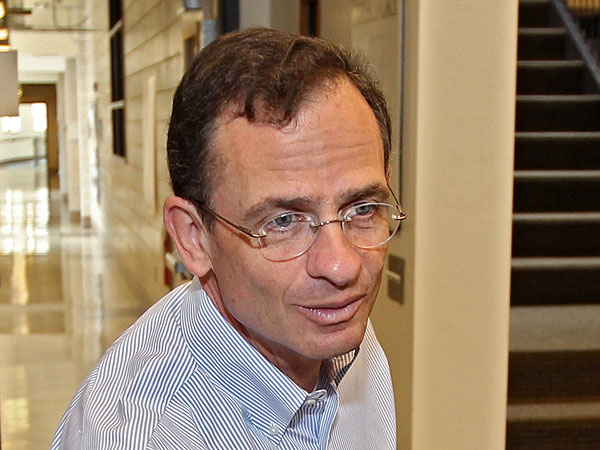
Weiss, 68, was president of Haverford College starting in 2013 and left the post in 2015 to lead the Metropolitan Museum of Art in New York, staying eight years. Prior to Haverford, he was president of Lafayette College.
The decision was approved Friday morning by the Art Museum’s trustees with a unanimous vote, a spokesperson said.
Weiss’ appointment comes as something of a surprise. The museum had been expected to name an interim director while it searched for a permanent one. Right now, Weiss is set to remain in the post only through the end of 2028, though his tenure could be extended.
Weiss said Friday that despite the recent turmoil, the museum had all of the important required ingredients it needed for its future — a great collection, staff, buildings, and mission.
“What we have to do is clean things up and reaffirm our commitment to that mission,” he said. “I don’t think the challenges are so steep. They have to be addressed, they are real, but they are not overwhelming.”
The first thing he will do, he said, is to sit down with the staff, board, donors, and other constituents, and through these conversations the museum’s priorities would emerge.
“I know less about these issues than anybody else does at this point, so I need to listen and to learn,” he said.
Art Museum board chair Ellen T. Caplan was not available for comment, a spokesperson said, but she said in a statement that the museum was “extraordinarily fortunate to have someone of Dan Weiss’s caliber and experience step into this critical role.”
His proven track record of museum leadership, along with his “deep understanding of the field, and his ability to navigate complex institutional challenges,” she said, “make him ideally suited to provide stability and strategic direction during this critical period for the art museum.”
Weiss comes to his new post with both substantial art and business credentials. An art historian, he holds a master’s degree in medieval and modern art and a Ph.D. in western medieval and Byzantine art, both from Johns Hopkins University. He previously earned an MBA from Yale School of Management and worked for consulting giant Booz Allen Hamilton.
Daniel Weiss at Haverford College after being named the college’s president in 2013.
He was at Haverford College for a little less than two years before being hired away to lead the Met along with director Thomas P. Campbell. With Campbell’s departure in 2017, he took on the title of chief executive. He worked alongside Max Hollein after Hollein became director in 2018. Weiss left the Met in 2023.
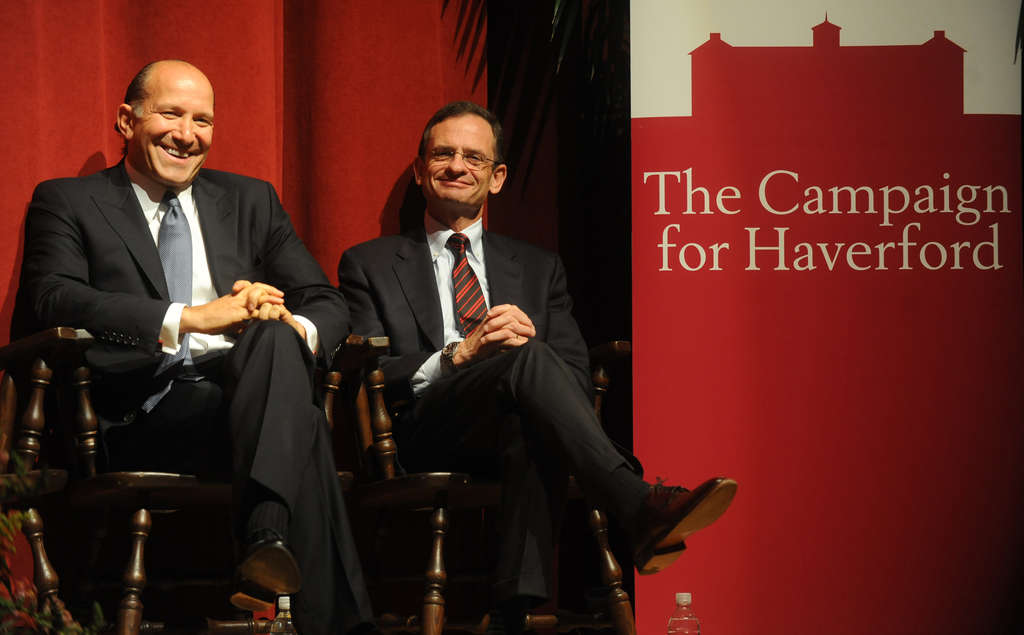
He was the head of Haverford College in 2014 when it received its largest single gift to date at the time — $25 million from Howard Lutnick, then-chairman of the college’s board of managers and a Haverford graduate. (Lutnick is currently U.S. secretary of commerce.)
Weiss brings to the Art Museum another storehouse of knowledge. He recently worked as a consultant to the museum’s board, a museum spokesperson said.
He is no stranger to controversy. At the Met, he helped the museum grapple with decisions such as the end of its longtime pay-as-you-wish admission policy, as well as the question of whether to cut ties with the Sackler family, whose company, Purdue Pharma, manufactured and marketed the opioid painkiller OxyContin.
Weiss was also at the Met when the museum faced a set of circumstances not unlike some of those the Philadelphia Art Museum is facing now. In 2017, struggling with a deficit, the Met decided to pause plans for a $600 million expansion. Instead, it focused on more mundane, if important, projects, like work on the roof and skylights.
Howard Lutnick (left) with Haverford College then-president Daniel Weiss for the 2014 announcement of Lutnick’s $25 million gift to the school.
Most recently, for the past two years, Weiss has been a humanities professor and senior advisor to the provost for the arts at Johns Hopkins University.
Suda filed a lawsuit on Nov. 10 against her former employer. Her lawyer said that she was the victim of a “small cabal” from the board that commissioned a “sham investigation” as a “pretext” for her “unlawful dismissal.”
The Art Museum on Thursday responded to the lawsuit in Philadelphia Court of Common Pleas with a petition saying Suda was dismissed after an investigation determined that she “misappropriated funds from the museum and lied to cover up her theft.” Her lawyer called the museum’s accusations false. “These are the same recycled allegations from the sham investigation that the museum manufactured as a pretext for Suda’s wrongful termination,” he said.
The Art Museum has a list of short- and long-term challenges with which it must grapple. Among them is the question of whether to roll back the recent name change and rebrand, which have been widely mocked and disliked.
It also has several big pieces of the operational, facilities, and financial puzzle to prioritize. The Perelman annex was closed to the public during the pandemic and has not reopened; a planned expansion of gallery space beneath the museum’s east steps is in limbo; deferred maintenance on the main building awaits attention; the endowment is considered inadequate for an institution of its size.
In addition, the museum is challenged by an operating deficit and visitorship numbers that have not recovered post-pandemic.
Weiss — who is expected to take over the museum Dec. 1 — is the author of several books, including a recent one that explores the place of the art museum in society throughout history and examines its challenges today in the larger culture. Its title suggests the case he will need to make as the museum’s 15th director: Why the Museum Matters.
“This is a great museum with a bright, important future,” said Weiss, “and our ability to fulfill our mission requires everyone’s involvement.”
 –>
–>  –>
–>  –>
–>  –>
–>  –>
–>