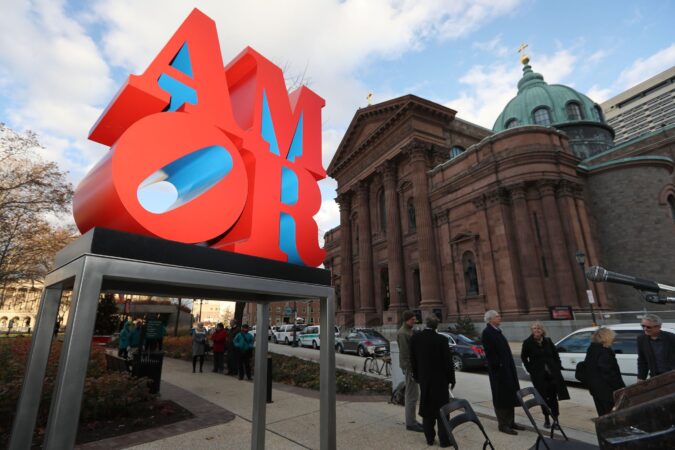
Those around Logan Circle might notice something missing today: Robert Indiana’s bright red AMOR sculpture.
On Wednesday morning, Philadelphia officials removed the artwork — a companion piece to Indiana’s iconic LOVE sculpture at nearby John F. Kennedy Plaza — from its perch at Sister Cities Park on 18th Street and Benjamin Franklin Parkway for conservation and restoration.
Creative Philadelphia, the city’s arts office, said AMOR is scheduled to return on May 1.
“Over the years, the paint on AMOR has naturally faded due to exposure to UV rays and weather,” said Marguerite Anglin, Creative Philadelphia’s public art director. “We are excited to give the sculpture a full restoration treatment, and look forward to its return back to Sister Cities Park in time for the city’s largest celebrations of America’s 250th.”
The removal was overseen by Philadelphia Parks and Recreation and Heritage Conservation Collective. The sculpture was transported to Fine Finishes Painting Studio in Peekskill, N.Y., where conservators approved by the Robert Indiana Foundation will strip and repaint it.
Indiana created AMOR in 1998 “in response to the changing demographics of the U.S. and his desire to speak to his fellow citizens,” according to the Association for Public Art.
AMOR, meaning love in Spanish and Latin, came to Philadelphia in 2015 to mark Pope Francis’ visit, thanks to the aPA and the Philadelphia Museum of Art. On loan from the New York-based Morgan Art Foundation, it was displayed at the top of the museum steps, where it overlooked the papal Mass held on the Parkway.
In 2016, it was permanently installed at Sister Cities Park with funding and support from the city, PMA, aPA, the Morgan Art Foundation, and Edith R. Dixon.
“Smokin’” Joe Frazier is heading to the Philadelphia Museum of Art.
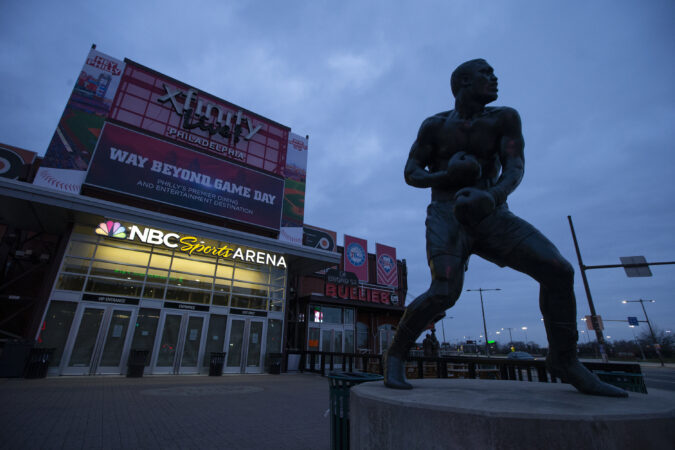
Philly’s statue of the famed heavyweight boxing champion is slated to be installed at the base of the museum’s steps later this year following a Philadelphia Art Commission vote Wednesday that approved the move. All five commissioners present Wednesday voted in favor of the statue’s relocation from its longtime home at the sports complex in South Philadelphia.
The proposal, presented by Creative Philadelphia, the city’s office for the creative sector, will see the Frazier statue installed where Philly’s original Rocky statue stands today. The Rocky statue, meanwhile, will be installed at the top of the museum’s steps.
“Placing the Joe Frazier statue at the Art Museum allows us to share a more complete history about Philadelphia’s spirit,” Marguerite Anglin, the city’s public art director, said Wednesday. “One rooted in real people, real work, and real pride in this city.”
The Frazier statue should move to the Art Museum sometime this spring, Anglin said. That relocation coincides with the move of the Rocky statue currently at the base of the steps, which is slated to be temporarily installed inside the museum for the first time as part of the forthcoming exhibition “Rising Up: Rocky and the Making of Monuments.” That Rocky statue will then be installed at the top of the museum’s steps in the fall, while the Rocky statue now at the top of the steps will go back into actor Sylvester Stallone’s private collection.
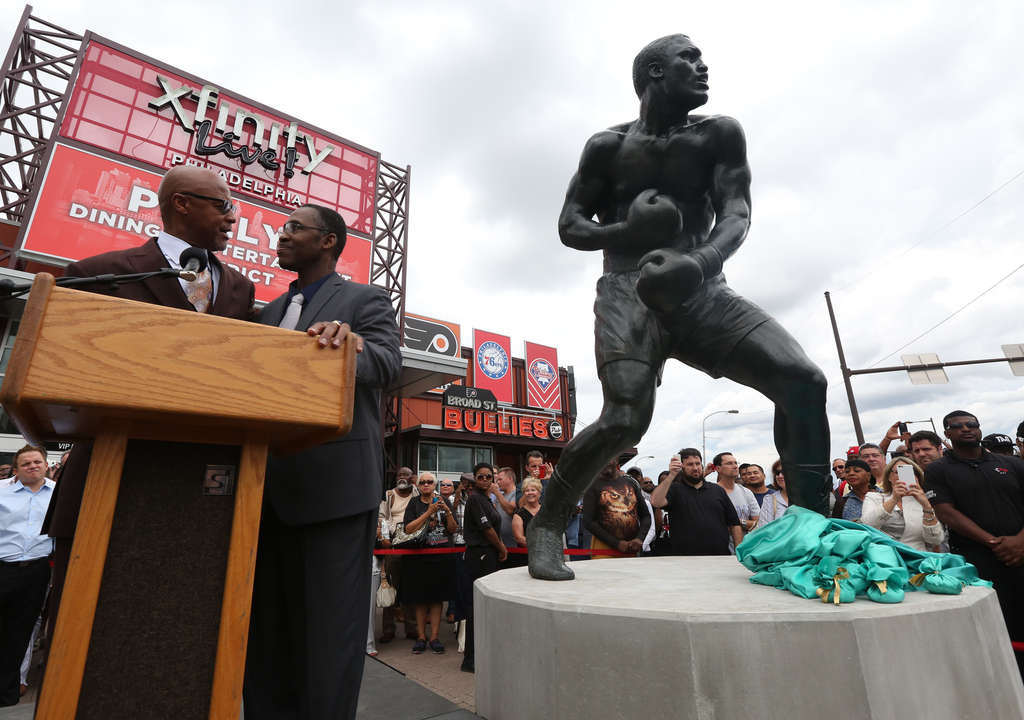
Created by sculptor Stephen Layne, the Frazier statue was unveiled in 2015 at what is now Stateside Live! at the sports complex in South Philadelphia. Its debut came years after Frazier’s death in 2011, which kicked off a campaign to erect the statue in his memory. Standing at 12 feet tall, it depicts the boxer moments after knocking down Muhammad Ali during the “Fight of the Century” — a famed March 1971 bout in which Ali suffered his first professional loss after a brutal 15-round skirmish.
For years before its creation, Frazier’s supporters lamented the fact that Philadelphia had long had a Rocky statue, but lacked one showing its own real-life champion. Our Rocky statue, in fact, has been around for more than 40 years, and has stood outside the Art Museum for two decades — about twice as long as the Frazier statue has even existed.
Creative Philadelphia’s plan featured widespread support from leaders including Mayor Cherelle L. Parker, as well as Frazier’s family and friends. It received little pushback at Wednesday’s meeting, with Gabrielle Gibson, a granddaughter of Frazier’s, asking what is perhaps the most obvious question about the placement: Shouldn’t the Frazier statue be at the top?
He was, after all, a real person, a real Philadelphian, and a real champion. Rocky, meanwhile, is a fictional character who appears to be an amalgamation of several real-life boxers’ stories — Frazier included, according to Creative Philadelphia. Many speakers Wednesday noted that, like Rocky, Frazier was known to run up the Art Museum’s steps and was said to have boxed sides of beef during his training, among other parallels.
And then there is the symbolism of where the Rocky and Frazier statues will stand.
“During Black History Month, I think we need to understand the new placement,” Gibson said. “A real boxer and a Black man’s image and likeness would be placed at a lower position beneath the fictional white character whose story was inspired by real boxers.”
The Frazier statue’s placement at the bottom of the steps, Anglin said, was for two main reasons. First, she said, having Frazier at the bottom makes it the first statue visitors will encounter at the Art Museum — even if they are there expressly to see Rocky — which will provide “an opportunity to be grounded in history.”
Second, the Rocky statue’s footprint is roughly half the size of the Frazier statue, which would not be “safe or feasible” to install on high, Anglin said. Putting Rocky at the top, Anglin said, allows for better circulation around the monument, and avoids the potential logistical and code-related issues putting Frazier there could present.
His son, and former heavyweight boxer Marvis Frazier (right), and Rev. Blane Newberry from Enon Tabernacle Baptist Church bless a 12-foot-tall 1,800-pound bronze statue of “Smokin’ Joe” Frazier after it was unveiled in 2015.
Jacqueline Frazier-Lyde, Frazier’s daughter, a retired professional boxing champion and a Municipal Court judge, expressed support for the move Wednesday, calling the statue a reminder that “we can overcome any obstacle and achieve.” She also recounted her father’s feelings on the Rocky statue, specifically when he would see tourists taking photos with Stallone’s character.
“At times,” she said, “he would say, ‘Don’t they understand that I’m the heavyweight champion?’”
Two more Philadelphia Museum of Art senior staffers are departing as the museum continues to plot out its path after a period of institutional turmoil.
Maggie Fairs, who was promoted to chief of staff last year by former director and CEO Sasha Suda, will leave the museum at the end of the month. CFO Valarie McDuffie has also resigned, with her last day this Friday.
Previously, the museum parted ways with its marketing chief Paul Dien as of Feb. 1. Days later, the museum announced that it was reversing course on a renaming while keeping its new logo. Both changes were unveiled four months earlier in a rebranding overseen by Suda and Dien.
No other immediate departures are expected, though the museum is working on an “organizational review,” with more changes possible later, a spokesperson said.
Suda announced the arrival of both Fairs and McDuffie in May 2023, saying that “these two colleagues reflect the future of the institution.” Fairs was hired as vice president of communications after having worked in the United States, United Kingdom, and Canada. McDuffie had previously held several senior financial posts in secondary education.
Fairs was promoted by Suda to chief of staff in May 2025. A replacement will not be hired, as the museum is restructuring the director’s office without that position.
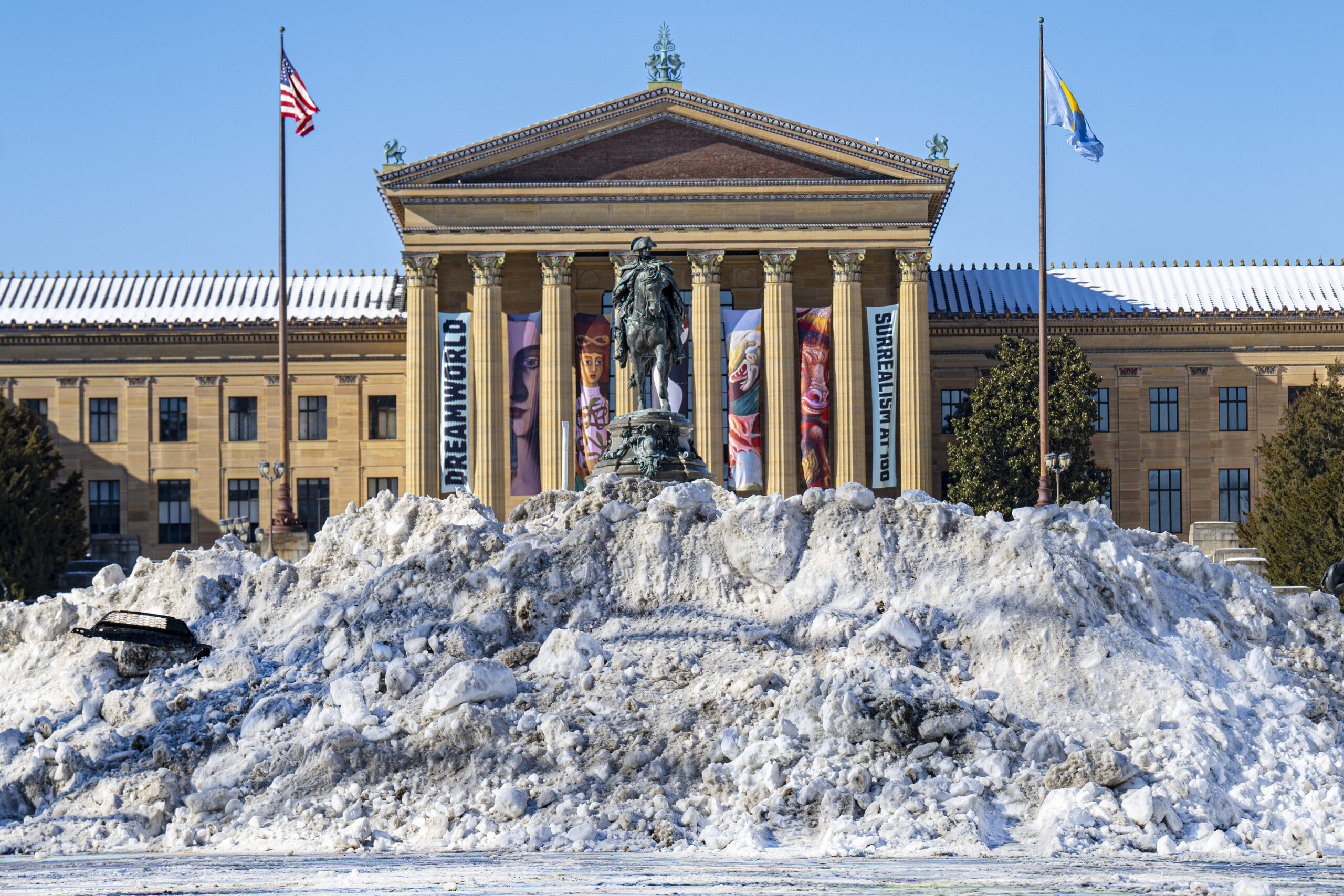
A pile of snow and ice sits on Eakins Oval in front of the Philadelphia Museum of Art on Feb. 2.
Director and CEO Daniel H. Weiss, who took over in December, said in January that the staff of the museum was “the heart and soul of the place and they need to be treasured and supported and also held accountable,” and that the museum needed “a senior management team that is available to them and transparent in its processes and also accountable.”
Asked at the time whether there would be a reorganization, he said:
“With our ambition and our mission, and as that evolves a little bit under each new leader, there needs to be careful review of how the organization serves the needs of the moment. So that’s underway.”
The museum on Monday also announced Katherine Anne Paul as new curator of Indian and Himalayan art. Paul was most recently curator of Asian Art at the Birmingham Museum of Art since 2019, and held earlier positions at the Newark Museum, the American Museum of Natural History, and the Textile Museum in Washington, D.C. She holds a Ph.D. in languages and cultures of Asia from the University of Wisconsin–Madison.
Weiss, in Monday’s announcement, singled out Paul’s scholarship and her extensive knowledge of the Philadelphia Museum of Art’s collection. She was assistant and associate curator of Indian and Himalayan art at the museum from 2002 to 2008.
A previous version of the headline misrepresented the terms of the employees’ work termination. They resigned.
The world’s most-visited museum was closed Monday following a professional heist that resulted in the theft of priceless jewels. Within minutes, thieves entered and exited the Louvre on Sunday, taking eight treasures.
The result? One of the highest-profile museum thefts in living memory amid a climate where museum staffs — worldwide, not just at the Louvre — are complaining about crowding, thin staffing, high turnover, and strained security.
Here’s what we know so far.
How did the Louvre heist happen?
Within minutes, thieves rode up a basket lift outside the Louvre’s facade, forced open a window, smashed display cases, and fled with priceless Napoleonic jewels, officials said.
The heist took place on Sunday, only 30 minutes after opening, with visitors already inside.
The theft took four minutes inside the building and less than eight in total, according to French Culture Minister Rachida Dati, who called it a “professional” operation.
“They went straight to the display windows,” Dati said. “They knew exactly what they wanted. They were very efficient.”
Sunday’s theft focused on the gilded Apollo Gallery, where the crown jewels are displayed. Alarms brought Louvre agents to the room, forcing the intruders to bolt on motorbikes, but the robbery was already over.
It’s unclear how many people took part in the theft and whether they had inside assistance. French media reported there were four perpetrators, including two dressed as construction workers. Authorities have not commented on the specifics.
What was taken from the Louvre?
Eight pieces of “priceless” jewels were stolen from the Louvre in Paris. Here is what they were.
Eight objects were taken, according to officials:
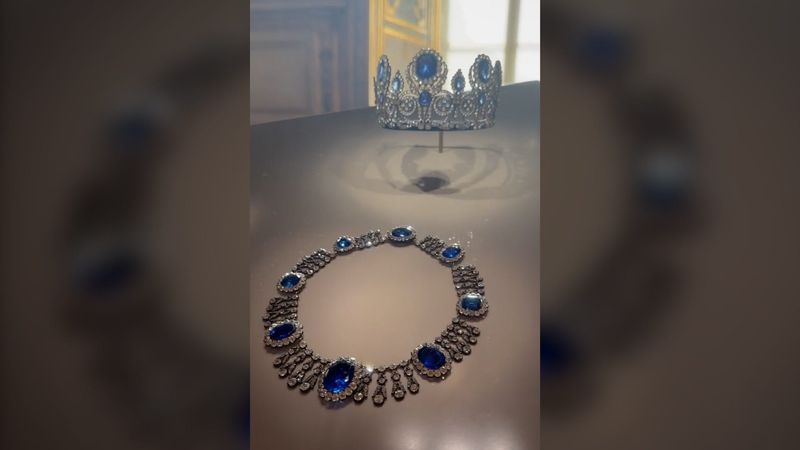
A sapphire diadem, necklace, and single earring from a matching set linked to 19th-century French queens Marie-Amélie and Hortense.
An emerald necklace and earrings from the matching set of Empress Marie-Louise, Napoleon Bonaparte’s second wife.
A reliquary brooch.
Empress Eugénie’s diadem and her large corsage-bow brooch, a prized 19th-century imperial ensemble.
A ninth object, the emerald-set imperial crown of Napoleon III’s wife, Empress Eugénie, was also taken but apparently dropped by the thieves. The crown, with more than 1,300 diamonds, was damaged but recovered outside the museum.
All of the items are considered priceless, though officials have not disclosed an overall estimate.
What will happen to the stolen jewels?
The Louvre has been closed since the robbery on Sunday morning for the investigation.
Experts say the initial hours after a heist are critical before the scent grows colder and thieves have more time to dispose of the jewels.
The big concern is that the thieves are motivated by commodity vs. art, and will scrap the priceless works for sale on the black market, breaking the pieces for their stones and melting down the precious metals. In doing so, the thieves can make more high-ticket sales while remaining undetected.
Has this ever happened before at the Louvre?
According to National Geographic, the Louvre has a long history of bold heists — but it’s been a while until now.
In 1911, the Mona Lisa — then a lesser-known piece by Leonardo da Vinci — was taken by Vincenzo Peruggia, a former employee dressed in his old work uniform. No one noticed it was missing for over 24 hours. The painting was recovered two years later after Peruggia tried to sell it to another museum.
In 1940, a portion of the Louvre’s collection was looted by occupying Nazis, though the museum’s director had already hidden most of its collection in a safe house off-site.
There was the 1966 theft of antique jewelry, which was being transported back to France from a loan to a Virginia museum. Those jewels were recovered after being found in New York inside a grocery bag. A decade later, one group of thieves stole a Flemish painting, and months after that, another group stole French King Charles X’s jeweled sword. The sword is still missing.
The most recent string of heists occurred in the 1990s. In 1990, thieves cut a Renoir painting from its frame in broad daylight and also took ancient Roman jewelry and other paintings. In 1995, two pieces — a painting and a battle ax from a 17th-century bronze sculpture — were stolen. Finally, in 1998, a Camille Corot painting was cut from its frame and taken. It hasn’t been recovered.
What about in Philly? Any heists?
Yep. Philly-area museums have seen their fair share of art thefts over the years.
Dating back to the 1980s, several thefts or alleged thefts have occurred across the Philadelphia Art Museum, Rodin Museum, Penn Museum, and more, according to Inquirer archives.
Various thefts include a gold saw from Iraq and a 19th-century Chinese crystal ball taken from the Penn Museum in 1981 and 1988, a painting taken during a Philadelphia Art Museum after-hours party in 1984, and a bronze sculpture from the Rodin Museum in 1988 during a gunpoint robbery. The sculpture was recovered shortly afterward, and the alleged robber was arrested and charged. The crystal ball was also recovered.
There’s also Frank Waxman, the Philly-based doctor who authorities said secretly amassed the largest known private collection of stolen art: about 150 pieces worth more than $2 million. The FBI raided his Rittenhouse condo in 1982 to find Rodins, Picassos, and more. Due to the statute of limitations surrounding his thefts, he was only convicted of taking eight pieces and served eight months in prison.
In 2003, the Barnes Foundation said hundreds of items were missing from its collection, including a piece by Henri Matisse, a Jean Renoir ceramic vase, a mahogany Steinway piano, and historic recordings. It’s unclear whether the items were stolen or simply unaccounted for. No formal large-scale investigation took place.
There was also an incident in 2017 where Michael Rohana, who was attending an after-hours ugly sweater party at the Franklin Institute, broke the thumb off a life-size Chinese terracotta warrior statue.
Rohana described the incident as a “drunken mistake” and returned the thumb, which he had taken home. Still, it caused international turmoil, with Chinese officials accusing the Franklin Institute of carelessness with the artifact. The statue, which is called “The Cavalryman,” is insured for $4.5 million. Rohana went to court in 2019, eventually pleading guilty to a misdemeanor charge in 2023. He was sentenced to five years’ probation, a $5,000 fine, and community service.
Thomas Gavin admitted to targeting dozens of museums up and down the East Coast, taking valuable artifacts sometimes unnoticed for years. The Hershey Museum and Pennsylvania Farm Museum in Landis, Lancaster County, were among some of the museums impacted. Gavin’s crimeswent cold for so long that the statute of limitations expired for many, leading him to only serve a day in prison for trying to sell a historic rifle.
What does the jewel heist mean for museums’ futures?
The latest Louvre heist comes amid a tense time for museums worldwide.
Following the height of the COVID-19 pandemic, museums have been working to balance mass tourism, stretched-thin staff, and security upgrades.
Locally, the Philadelphia Art Museum and its employees reached a settlement last year after a yearlong dispute over pay raises called for in their 2022 labor contract and a nearly three-week strike.
At the Louvre, a June staff walkout over frustrations with overcrowding and chronic understaffing led to a delayed opening. Unions say mass tourism leaves too few eyes on too many rooms and creates pressure points where construction zones, freight routes, and visitor flows meet.
Officials say security updates are underway at the Louvre as part of an $800 million modernization plan. But critics say the measures are too little, too late.