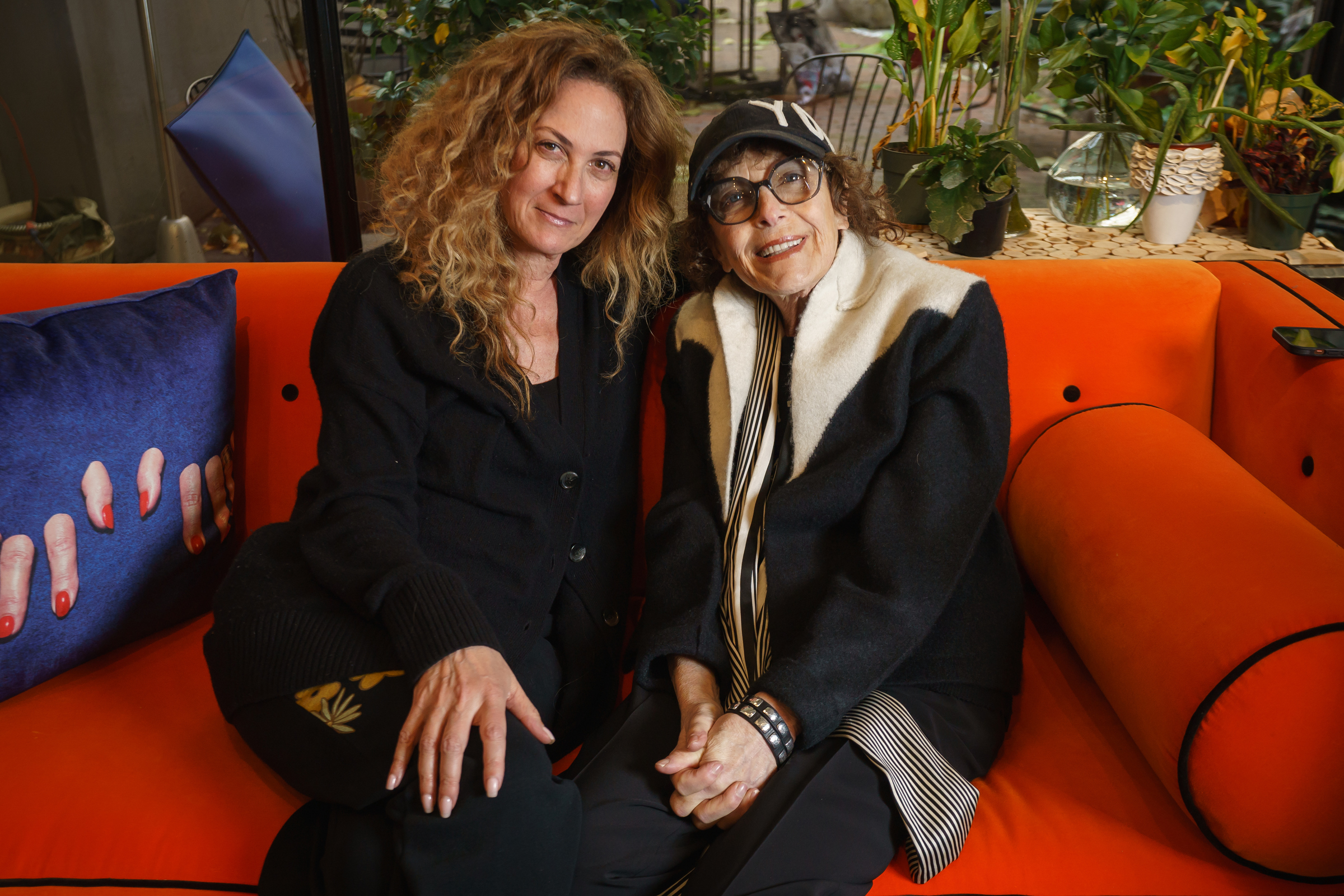
When Christina Vassallo was head of the Fabric Workshop and Museum, she landed several substantial grants from the Pew Center for Arts & Heritage.
Now she is moving to the other side of that donor-recipient relationship.
Vassallo is the newly named executive director of the Pew Center for Arts & Heritage, starting Jan. 5, Pew announced Monday.
“The center embodies everything I value about arts leadership — intellectual curiosity, rigorous support for artists and arts organizations, and a true commitment to public life,” said Vassallo. “So for the center, I’m drawn to its dual identity as a grantmaker and as a hub for ideas, and for the opportunity to connect the arts with civic purpose.”
Leadership and operational changes at the Pew arts center are closely watched in Philadelphia’s arts and culture community since the center, along with the William Penn Foundation, accounts for some of the largest foundation giving in the area.
Pew’s center, for instance, also announced on Monday that it has awarded $8.6 million to 44 Philadelphia-area groups — nearly $180,000 to the Black Pearl Chamber Orchestra for a project on Black women composers, $360,000 to Monument Lab for the creation of environmental soundworks as a “living monument to Philadelphia’s birds,” and to projects by Mural Arts Philadelphia, Philadanco, Philadelphia’s Magic Gardens, theater companies, dance troupes, and museums.
After leaving the Fabric Workshop in 2023, Vassallo became director of the Contemporary Arts Center in Cincinnati. Before the Fabric Workshop, she was executive and artistic director of the alternative art gallery SPACES, in Cleveland. She was born in the Bronx and grew up in New York City and northern New Jersey, and holds two degrees from New York University — a bachelor’s in art history and a master’s in nonprofit visual arts management.
Vassallo arrives as Philadelphia’s arts scene grapples with a number of challenges. Many groups are facing the double whammy of attendance numbers that are still lower than pre-COVID levels, and cuts in federal funding under the Trump administration.
The Pew arts center specifically has undergone a significant change with the 2024 collapse of the University of the Arts, which had been its operational partner. In June, Pew announced that the Barnes Foundation would take UArts’ place, and Vassallo suggested that the Barnes — which also had a hand in her hiring — could take on a more significant role.
“I think there is tremendous potential there programmatically beyond their administrative role,” said Vassallo, who called the relationship between the Pew center and the Barnes an “evolving” one.
Dancers from Philadanco, which received a grant from the Pew Center for Arts & Heritage.
One significant change has already occurred. Vassallo will report to Barnes Foundation executive director and president Thomas Collins, whereas Marincola reported directly to Pew. The Barnes isn’t seen as getting involved with the Pew center’s grant-making process, but, rather, could work with the center on creating new programming.
“We could imagine partnerships between the [Pew Fellowships in the Arts] fellows … being able to engage in the collection at the Barnes, for example, we can imagine the center and the Barnes partnering on community conversations,” said Elinor Haider, senior director of Pew’s Philadelphia Program.
The Pew Center for Arts & Heritage will continue to be based in its offices on Walnut Street, Haider said.
Vassallo called Philadelphia’s arts scene “incredibly rich and vital.” About its challenges, she said — while noting that she needs to relearn Philadelphia’s arts and culture community — that “we are having to find new ways to fund our work. I have seen this in the form of creating new business models, coming up with innovative ways to increase ticket sales and engage current and new audiences to create new revenue streams.”
She said she has “always been a strong believer in nurturing the next generation of art enthusiasts, ensuring that kids have access to the arts across disciplines.”
As for future funding priorities, the center has not yet determined whether it will undertake a strategic planning process, she said.
“Not only are we assessing feedback from grantees and external parties, but we’re also understanding the state of the city, and then you have the various partners involved — you have Pew, you have the center staff, and now you have the Barnes. So I think within that there’s going to be a very special alchemy that starts to further determine the future of center funding decisions.”
For more than an hour, one domestic violence survivor after another stepped up to the microphone with tales of pain and resilience.
“When people get close to me, I flinch because I’m afraid they are going to abuse me,” said one woman, speaking in Spanish, her words translated into English by a staffer at Congreso de Latinos Unidos, a nonprofit social services agency in North Philadelphia that provides help with housing, education, medical needs, workforce training, and after-school activities for youngsters.
Congreso is celebrating its 48th year in operation, and for 30 of those years, it has maintained a program to support people dealing with, and trying to escape from, domestic violence.
“I was never allowed to go outside. He would show up at my job,” the woman continued in a room decorated with purple balloons, the color symbolizing domestic violence. Each year, Congreso honors survivors and mourns, in a few moments of poignant silence, the people who lost their lives to domestic violence. Last year, in Pennsylvania, there were 102.
“He would bruise my face so I couldn’t see my family. I worked in a nightclub, and he would drag me out … No one wanted to get involved,” she said.
No one, until Congreso did and helped relocate her to a new home.
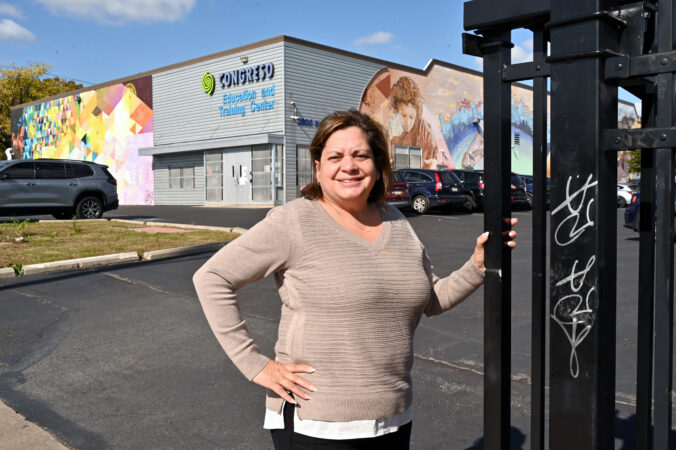
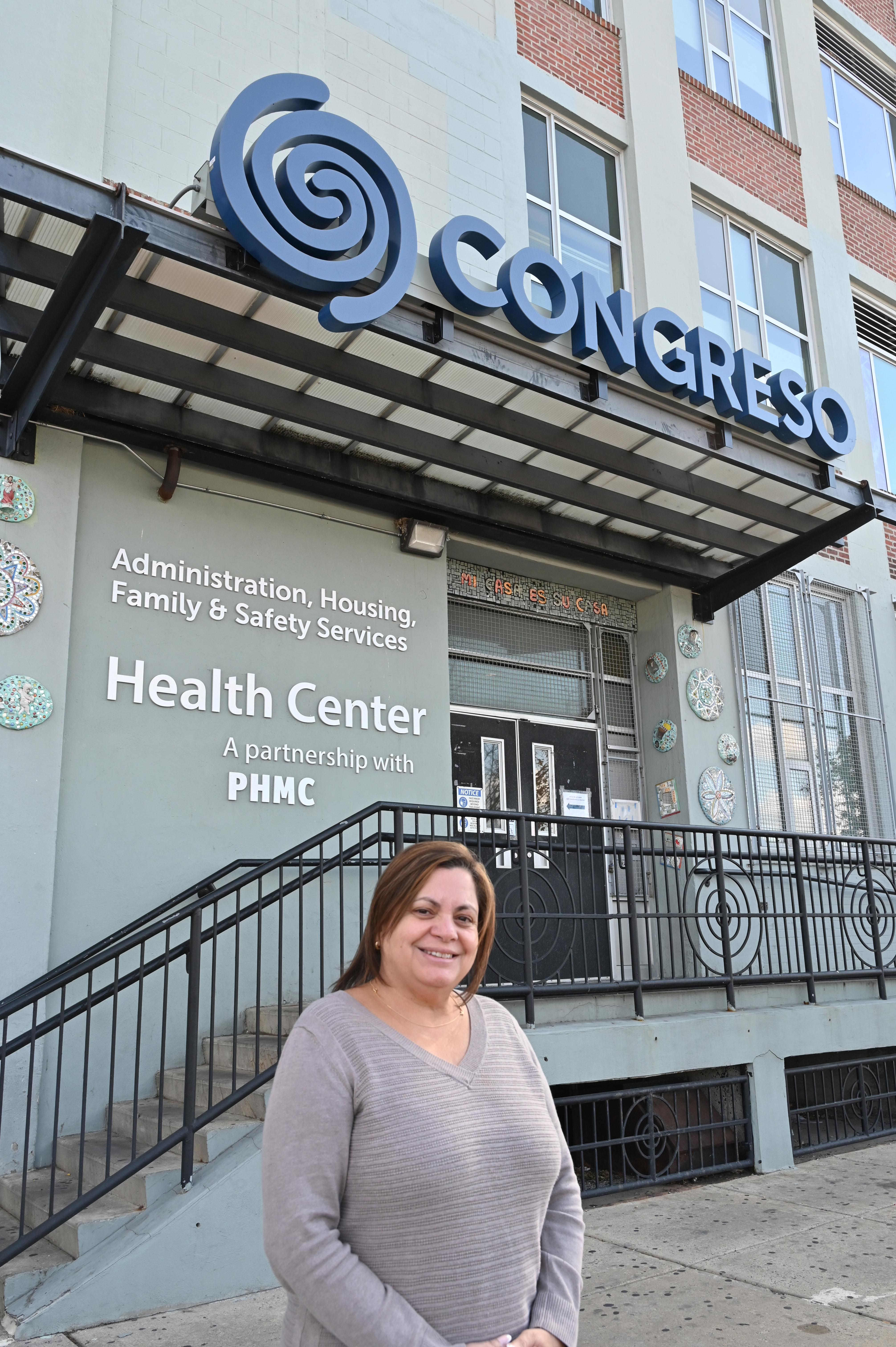
Jannette Diaz, president and CEO of Congreso, outside the group’s offices in North Philadelphia.“We’re all feeling the crunch,” she said of recent funding challenges.
“It takes a lot of courage to come up here and share your story,” Ramona Peralta, Congreso’s director of family wellness, said as the woman finished speaking. “We’re very proud of you, and we are here for you all the way.”
In the main room, the mood vacillated between the heavy silence of shared pain and the cheerful clamoring of babies. Later, there was music, and before, a friendly lunch of rice with pork and chicken.
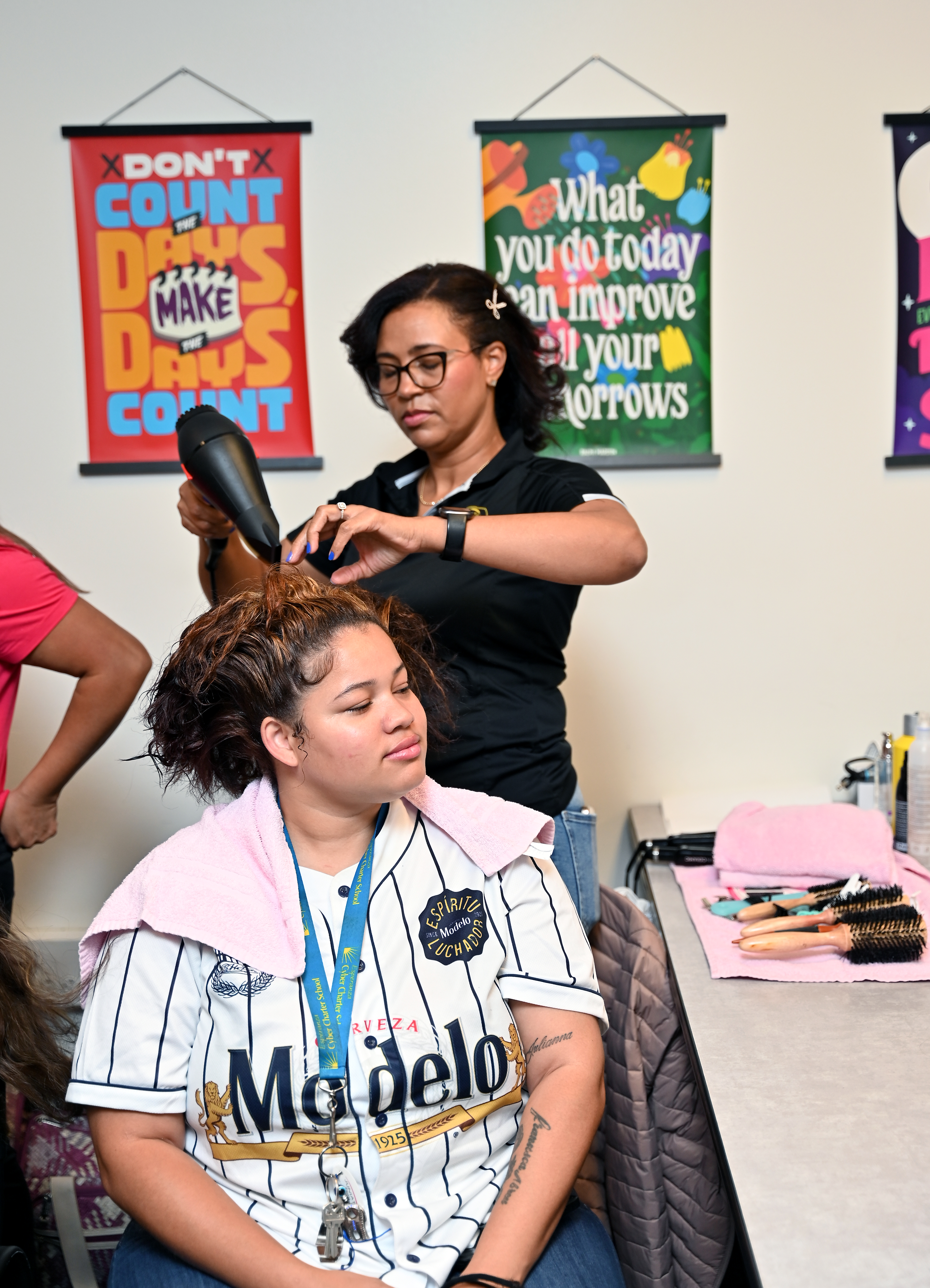
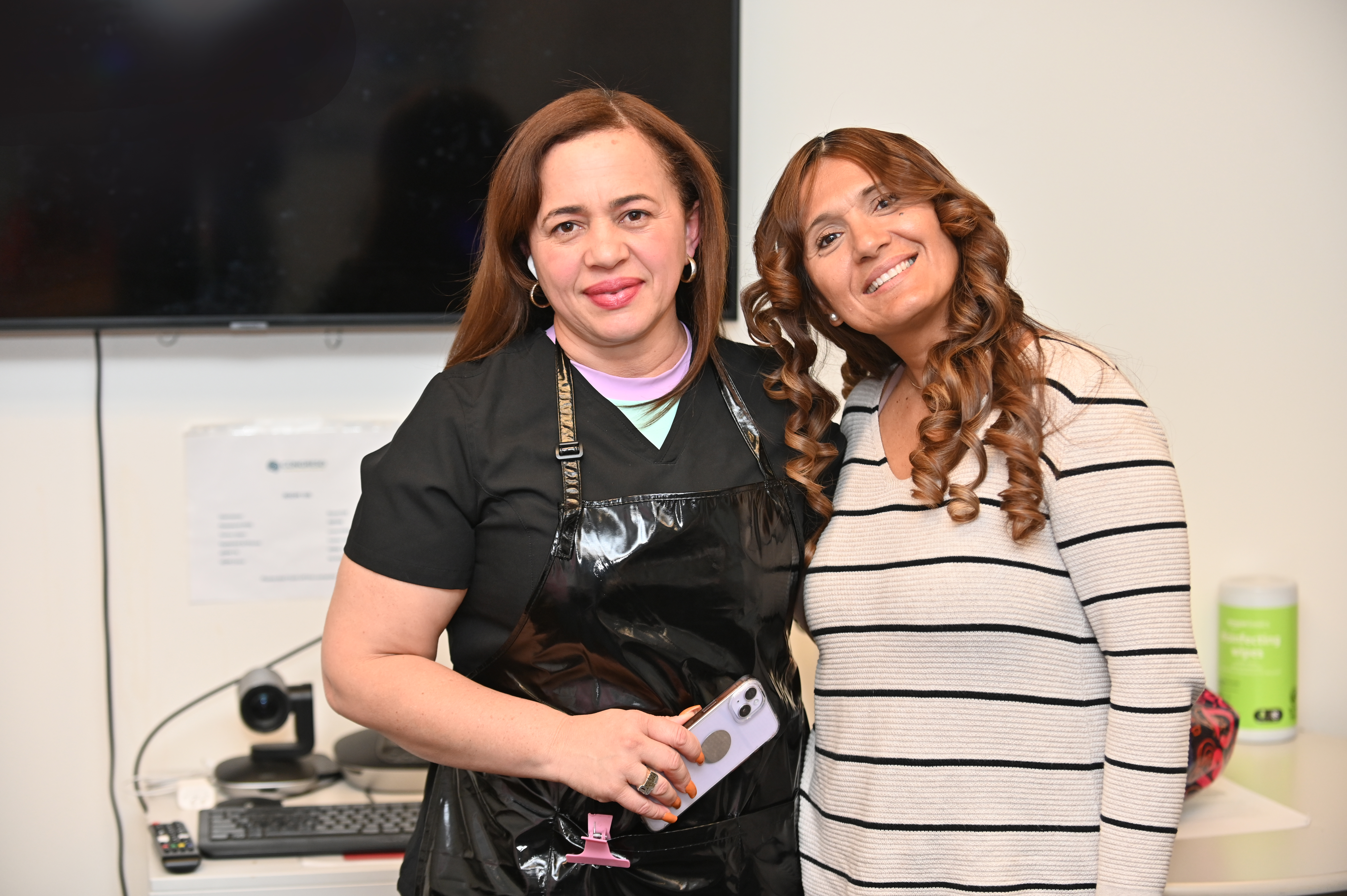
Across the hall, members of the Asociación de Cosmetologas de Pennsylvania offered free hairstyling to the women who attended the celebration.
Congreso, as part of its program to teach police, educators, social workers, and others to recognize signs of domestic abuse, had trained this group, as well, and because of the intimacy of their work, the stylists were uniquely positioned to do so. More than most, beauty salon operators could readily see the bruises hidden under hair and makeup. They could feel the cuts and scars on the scalp. And then there were the confidences confessed during shampoos and stylings.
Wanda Gómez, of the Blessings of God beauty salon, styles Franyeimi Abreu’s hair at Congreso’s offices.
Among the volunteers was Wanda Gómez, owner of the Blessings of God beauty salon in Northeast Philadelphia. “Thank God, I’m no longer in that situation,” she said, speaking through a translator. But because she survived domestic violence, she said she’s in a better position to help others. She tells them about Congreso.
Elisa Zaro Doran, owner of Dominican Divas Beauty Salon in Olney, twisted a strand of hair around a curling iron as she styled Maria Rodriguez’s long, dark hair. Like Gómez, Doran survived domestic abuse. “The first time, when he hit me, we were having a lot of problems, so I thought it was normal,” Doran said.
He’d even come into her beauty salon and hit her. “My clients would try to defend me,” she said. Eventually, when her son tried to protect her, she knew she had to take the necessary steps to get away and be safe — for herself and her children.
Rodriguez was there yesterday to support her daughter, who survived domestic violence, but still lives in fear — which is the reason she would only agree to be interviewed if her name was not used. “He told me that it doesn’t matter how many years — he will come and burn down my house with me in it,” she said.
Hairdresser Domaris Rodriguez shows her artistry on Raquel Mendez’s hair.
Rodriguez’s daughterturned to Congreso for help after Thanksgiving a few years ago. Her oldest son told her that day that he would no longer live with her, because every night he dreamed of killing his father. He couldn’t stay and watch the beatings or watch his father, in a rage, destroy the furniture in their home.
“I don’t know how many dining room tables I bought,” the daughter said.
On that Thanksgiving, she told her husband he had to leave. It was the end of the relationship, but the beginning of a new nightmare. He followed her to work and even stood in the pharmacy, watching her as she managed the office.
Counseling at Congreso helped her name her situation for what it was — abuse. “They made me see that I was in danger,” and that what she thought was normal was anything but. In group sessions, she learned a critical lesson: “I understood that I wasn’t the only one. They made me know it wasn’t my fault.”
She’s still afraid to leave her home. “I’m going through anxiety, PTSD. It still affects me.”
As she watched her mother get her hair styled, Rodriguez’s daughter hoped her mother would absorb a lesson from the stories she would hear. The daughter wanted her mother to understand the intergenerational legacy of abuse because she believes her mother also suffered from domestic violence.
That abuse, Rodriguez’s daughter believes, impacted both her and her sister, whose abuser stopped hitting her only when he thought she was dead. She teaches her sister lessons learned from counseling at Congreso. Counseling includes helping women develop a safety plan.
Rodriguez’s daughter brings her own little girl, 13, to Congreso’s counseling groups for children impacted by domestic violence. “I’m saving my sister’s life, and I’m saving my daughter’s life,” she said. As for her sons, “I’m not raising abusers,” as she reminds them to respect their girlfriends.
Last month’s celebration in honor of the survivors of domestic abuse took center stage that day at Congreso, but Congreso’s programming benefits many more people in the community, 75% of whom are Latino, said Jannette Diaz, president and chief executive.
Diaz grew up a few blocks from Congreso, and her father relied on the nonprofit for help with the family’s utility bills.
These days, she spends time working on strengthening relationships with fellow nonprofit agencies and with Congreso’s friends in the donor community.
“We’re all feeling the crunch,” Diaz said, describing a double whammy in mid-October of the state’s failure to pass a budget as the national government moved into another week of shutdown. Congreso gets much of its funding from government reimbursements for services provided.
At Congreso, “we’re very mindful of our spending. So far, we’re continuing to provide services at 100%, but there’s only so much we can do, tapping into our reserves and our line of credit.”
“Sometimes it’s heavy, but I’m also hopeful,” Diaz said, explaining that the twin state and federal budget crises required a sharper focus even as demand for services increases. Changes in Medicaid regulations may impact finances at Congreso’s health center, for example.
But, she said, donors can be confident their dollars are being spent wisely.
Why? Because as nonprofits come and go, Congreso has survived, thanks to providing trauma-informed and culturally responsive services that are informed by data to its clients, Diaz said.
“We’ve been around for 48 years, and there’s a reason for that. And that is how we operate within our community,” she said. “We forge a trusting relationship, and we try our best to do what they need. It’s important that we make sure our programs have impact.”
And that impact, Diaz said, goes beyond help given directly to clients. When Congreso assists a first-time home buyer in qualifying for and landing a mortgage, that homeowner becomes a Philadelphia taxpayer, benefiting the community.
When someone like Gary DeJesus-Walker earns a CDL truck-driving license through Congreso’s workforce training program, he can go on to build a trucking business. Now he employs three people.
“Congreso — they changed my life,” he said. “From trucking, I started two other companies.” With Congreso’s CDL program, “if you need a second chance, you can have one for the rest of your life. This is a way you can provide for and feed your family, forever.”
The stories are an inspiration to Diaz.
“Even in this season,” she said, “we can strategize and design services that our community needs. We’re not paralyzed by this crisis, and in terms of moving the needle forward, we’re progressing.”
This article is part of a series about Philly Gives — a community fund to support nonprofits through end-of-year giving. To learn more about Philly Gives, including how to donate, visit phillygives.org.
For more information about Philly Gives, including how to donate, visit phillygives.org.
About Congreso de Latinos Unidos
Mission: To enable individuals and families in predominantly Latino neighborhoods to achieve economic self-sufficiency and well-being.
People served: 13,435 unique clients served in fiscal year 2025.
Annual Spending: $30 million
Point of Pride: Trademarked Primary Client Model that drives Congreso’s bilingual and bicultural approach to delivering services in a client-centered, data-informed, and culturally responsive way, whether a community member is receiving support in education, workforce development, housing, health, or family services.
You can help: Become a monthly donor, a member of Congreso’s Corporate Advisory Council, or a volunteer in the Congreso Cares Program. Volunteers help with participating in program initiatives like Congreso’s free tax preparation, supporting program and agency events, and assisting with fundraising.
MacKenzie Scott, one of the world’s richest women through her Amazon shares, has donated $25 million to Lincoln University, the college announced Friday.
The money — part of the billionaire philanthropist’s series of multimillion-dollar, unrestricted donations to historically Black colleges and universities — will support scholarships and initiatives, according to a news release.
Lincoln University officials said the no-strings-attached gift “exemplifies her confidence in the university’s mission, vision, and leadership.”
“Lincoln University was founded to break barriers and create pathways for African Americans to thrive,” president Brenda A. Allen said in a statement. “This investment honors that legacy and propels us forward, enabling us to build on 171 years of excellence and innovation.
“It is a powerful affirmation of the enduring value of Historically Black Colleges and Universities.”
A spokesperson for the university and the board of trustees could not immediately be reached Saturday for additional comment.
This is Scott’s second donation to the southern Chester County university, the first degree-granting HBCU in the nation. The ex-wife of Amazon founder Jeff Bezos gave $20 million in 2020 — then the school’s largest gift from a single donor in its history. As of June 2023, the school’s endowment was $54 million.
A number of other historically Black colleges also received money from Scott in recent weeks, including Maryland’s Bowie State and Morgan State Universities and University of Maryland Eastern Shore. Scott’s total donations to higher education institutions this year have topped $1 billion, Forbes reported.
Quinta Brunson wants you to dig into your pocket to make free field trips possible for Philadelphia students.
The actor, writer, and comedian — along with Philadelphia School District officials and the leader of the district’s nonprofit arm — announced the “Quinta Brunson Field Trip Fund” on Tuesday.
District teachers and administrators will be able to apply for money for field trips by completing a short application subject to evaluation by an independent, internal group of educators. Field trip grants will be made twice a year.
“They opened my world, sparked my creativity, and helped me imagine a future beyond what I saw every day,” Brunson said. “Going somewhere new shows you that the world is bigger and more exciting than you believe, and it can shape what you come to see as achievable. I’m proud to support Philadelphia students with experiences that remind them their dreams are valid and their futures are bright.”
“Abbott Elementary” star Quinta Brunson watches the Phillies play the Atlanta Braves during a taping of the show in Philadelphia in August.
Every Abbott Elementary season has featured a field trip episode, including visits toSmith Playground, the Franklin Institute, and the Philadelphia Zoo. Brunson’s fund “will remove the financial barriers that too often limit our children’s access to these enrichment opportunities,” officials for the Fund for the School District of Philadelphia said.
The GivingTuesday launch kicked off with an unspecified donation from Brunson herself.
Kathryn Epps, president and CEO of the Fund for the School District of Philadelphia, said getting students out of their classrooms is crucial.
“We are honored to partner with Quinta to expand these experiences for children in Philadelphia’s public schools, helping them to envision and realize any future they desire,” Epps said.
Tony B. Watlington Sr., Philadelphia School District superintendent, said he was grateful to Brunson.
“We want our students to venture out and bridge what they’re learning in the classroom to engaging, real-world learning experiences,” Watlington said. “This commitment to equitably expanding opportunities for students to have experiences outside of their classroom will help accelerate student achievement and we are becoming the fastest improving, large urban school district in the nation.”
Talk about a great kick off to the holiday shopping season.
“I’m honored, proud, and excited,” Ellen Shepp said Monday morning. “I mean … I’m really over the moon.”z
Walking into a great clothing store, New York Times cultural trend reporter Steven Kurutz said, is like being “transported to a different world.” It “will make you think about who you are — and may change that perspective in real time.”
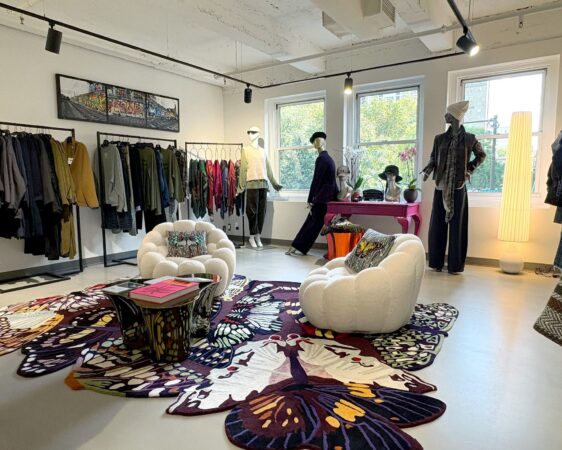
The interior of Joan Shepp at 1905 Walnut St. The 53-year-old store made the New York Times’ list of “50 Best Clothing Stores in America.”
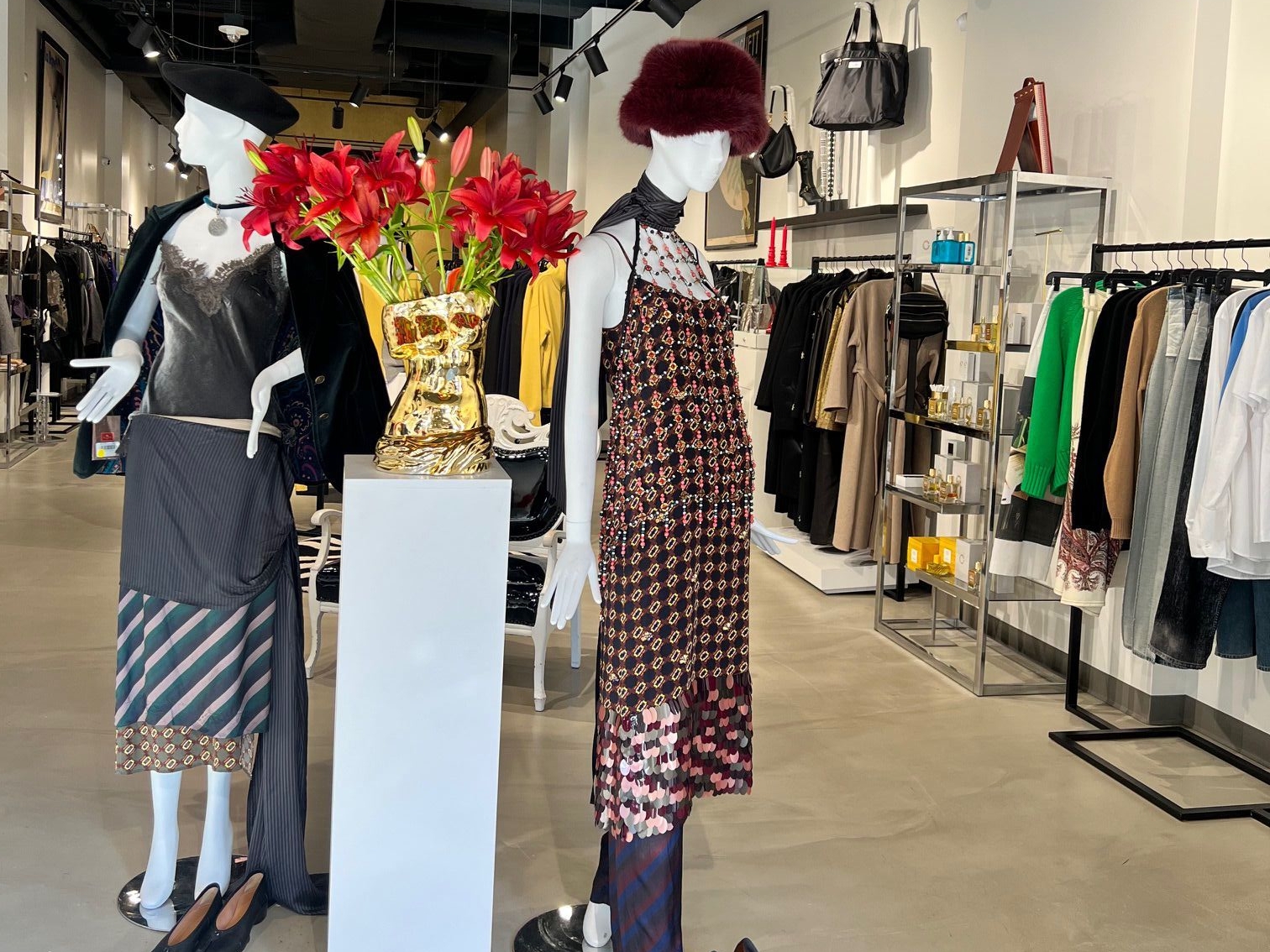
And yes, walking into Rittenhouse Square’s Joan Shepp does feel like stepping into a sartorial fairytale, which you can leave holding a Yohji Yamamoto hoodie that doubles as a dress, or a perfectly tailored asymmetrical shirt dress from Sacai New York.
Everything is dreamy, but nothing comes cheap.
Back in the 1970s, Shepp opened her store to challenge the way the suburban career woman dressed in Philly and introduced her to designer wear, from Yohji Yamamoto to Maison Margiela. One of the earliest entrepreneurs to embrace the store-within-a-store approach to retail, Shepp made space for collections like Yamamoto’s Y-3 and Donna Karan’s Urban Zen.
The clothing sold alongside furniture, bedding, and candles, making Joan Shepp one of the region’s earliest concept boutiques.
Joan Shepp founded the store in 1971. She was a 30-year-old single mother of two young children in need of a flexible work schedule that allowed her time for school pickup and drops, to help her daughters with homework, and make them dinner.
Joan Shepp and her daughter Ellen Shepp, shown here in their Center City store.
“I have so much fun finding things that are new,” she said to The Inquirer in 2022. “I listen to everyone who comes into my store. I watch them go through the racks. And whether/if they are a customer or a person who wants to open a store down the street, I can pick up on it.”
Hers is the only store on the Times list from the Philly region.
The closest is 7017 Reign in Fort Lee, N.J., described by the Times as an “under the radar, street and high fashion” specialty store. There are a handful of stores from downtown New York, but most are in the Midwest and California.
To produce the list, the Times team selected 120 stores, and then sent reporters, editors, and contributors to visit each of them, sometimes more than once.
A videographer visited Joan Shepp in early fall, shortly after the store moved to its new home at 1905 Walnut St.
Noting that Joan Shepp has been in business for more than 50 years — the specialty boutique is in the midst of celebrating its 53rd year — Kurutz wrote “Shepp has flavors of Barneys New York in its heyday.”
The Barney comparison wowed Ellen Shepp. Christmas had no doubt arrived early for the boutique owner and her team.
“The whole time they were like, ‘Listen we don’t know whether/if you made this list,’” she said. “They kept it a mystery until right this second.”
At lunchtime on a Thursday, a week before Thanksgiving, Chestnut Hill was buzzing.
Inside the newly expanded Matines Café, almost every table was full. People sipped warm drinks from large mugs and ate Parisian croissants and quiche. Bottles of prosecco sat on ice by one large table adorned with Happy Birthday balloons.
McNally’s Tavern was bustling, too, with regulars sitting at the bar and at tables inside the cozy, nearly 125-year-old establishment atop the hill. Multiple generations gathered — a son taking a father out to lunch, a mother with a baby in a stroller, and two sisters, Anne and Meg McNally, running the place.
Behind the storefronts along Germantown Avenue’s main drag, some people perused the boutiques, while others typed away on laptops in coffee shops.
In the northwest Philadelphia neighborhood known for its wealth and postcard-picturesque aesthetic, the small-town charm of longstanding establishments — four are more than 100 years old — is now complemented by the shine of some newer shops and restaurants. Several Chestnut Hill business owners said the variety has helped both old and new spots succeed despite broader economic challenges, including inflation and tariffs, and the loss of a few restaurants.
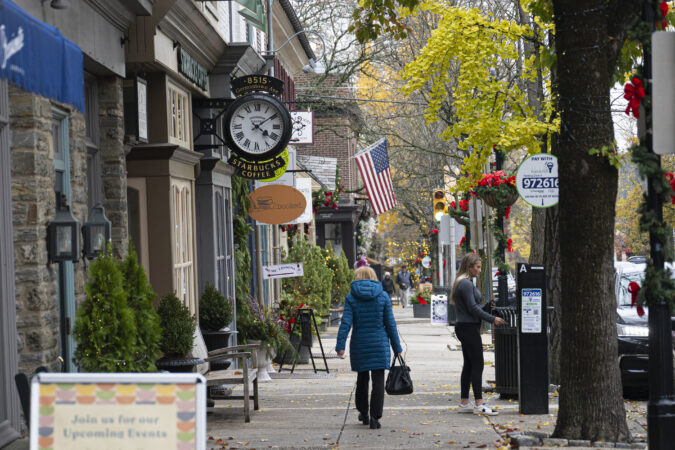
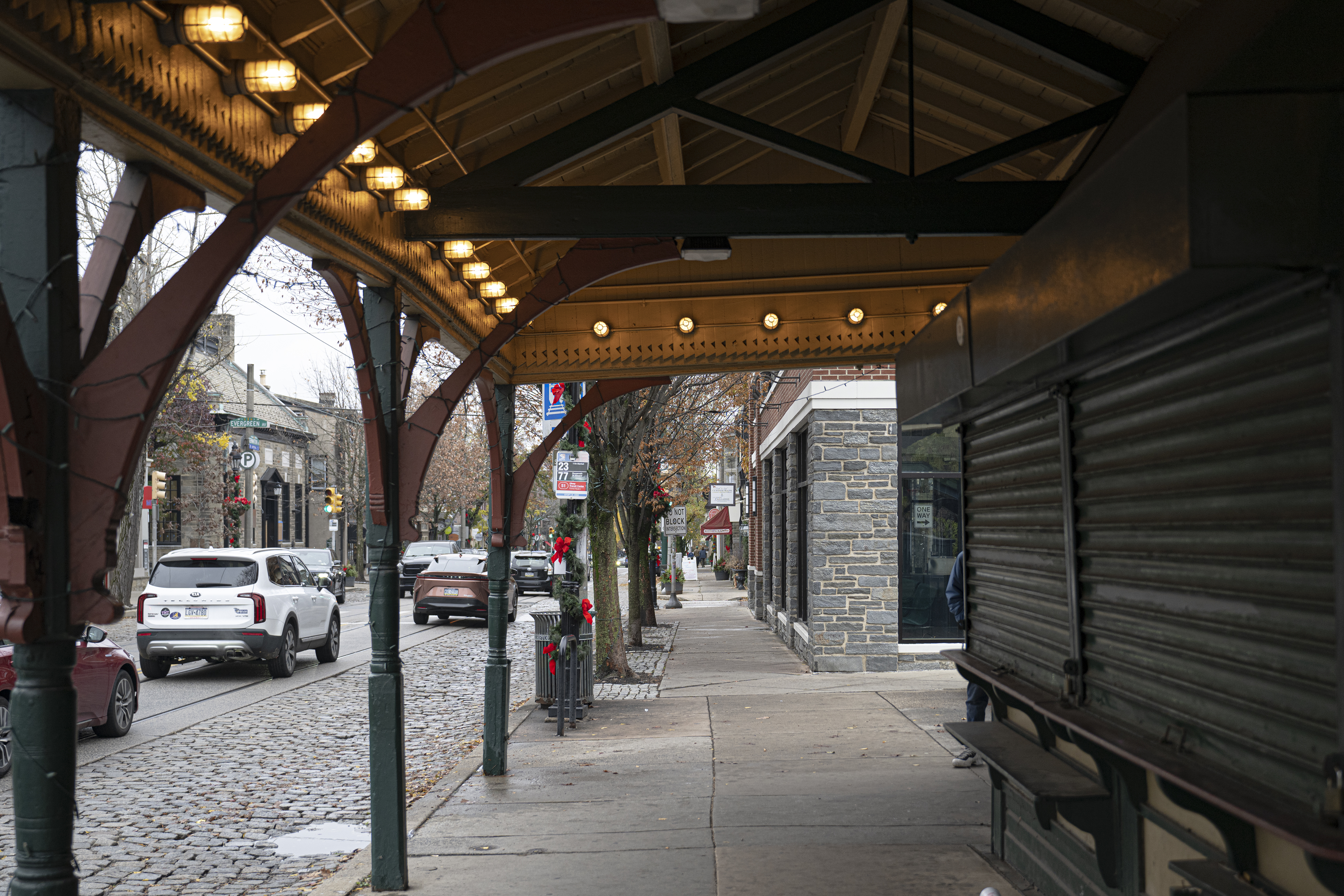
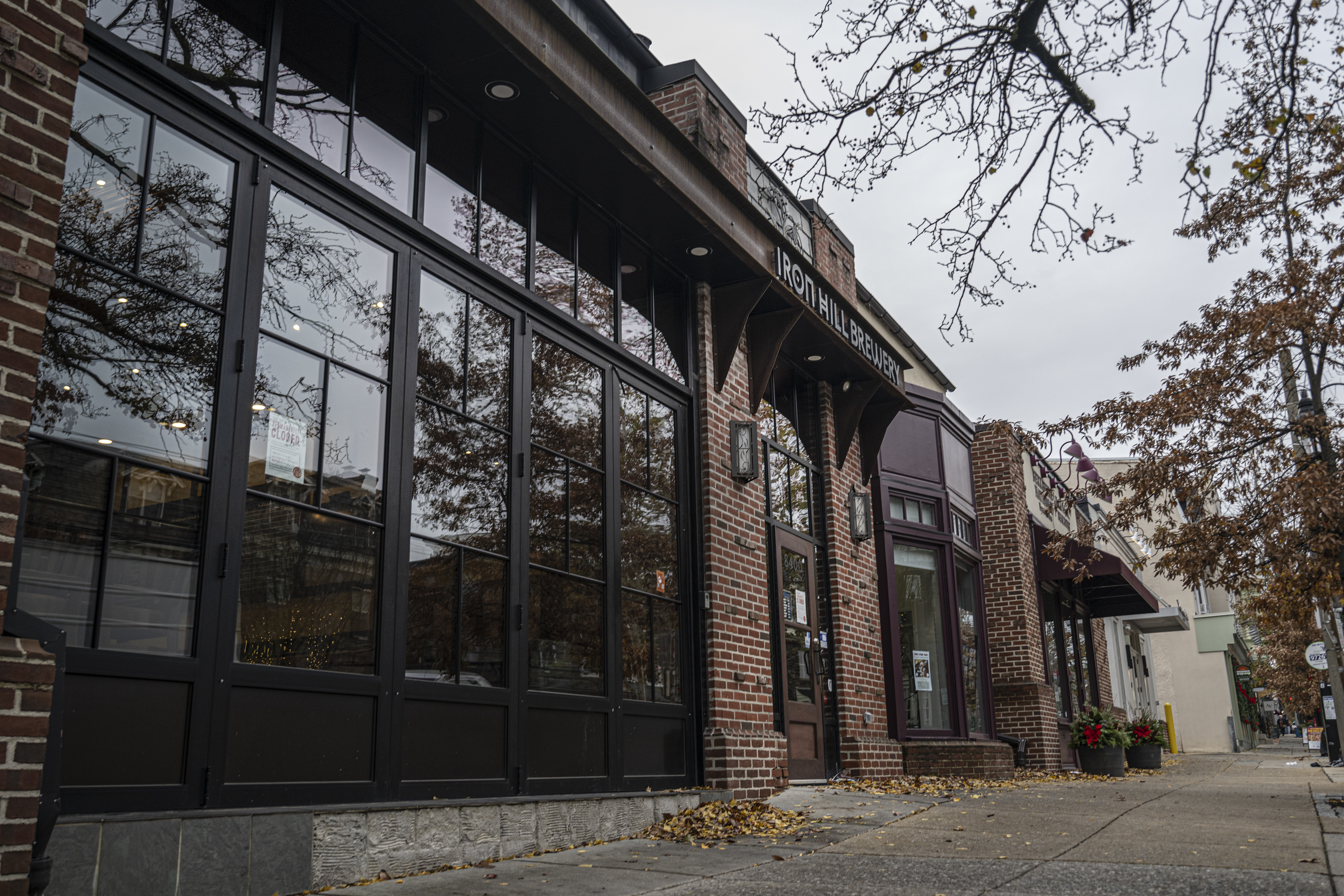
A view down Germantown Avenue from the Chestnut Hill SEPTA Regional Rail station.The closed Iron Hill Brewery is shown in downtown Chestnut Hill on Nov. 19.
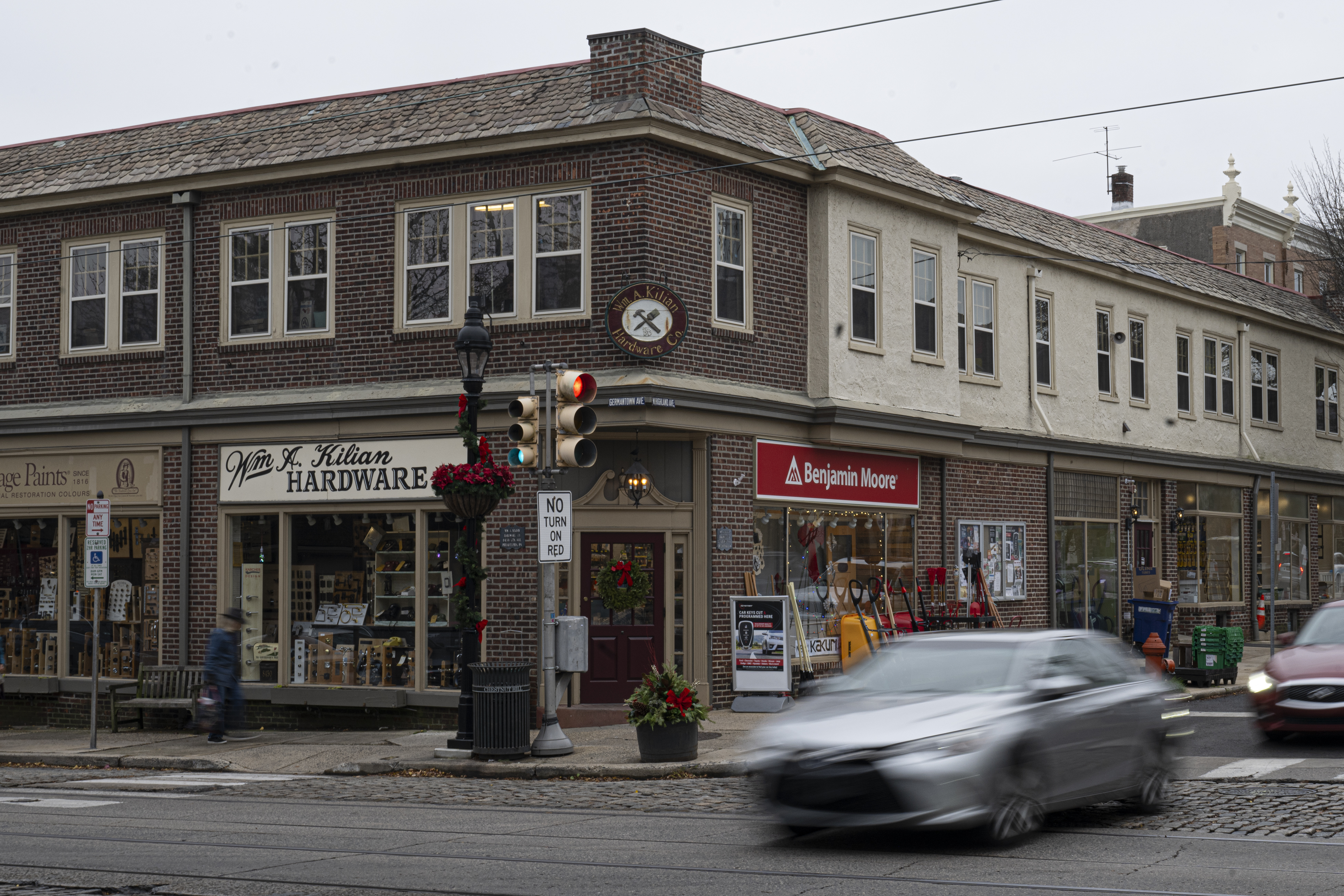
As the owner of Kilian Hardware, which has been in business for 112 years, Russell Goudy Jr. has watched the avenue change. Fifty years ago, he said it was “basically like a shopping mall,” a one-stop shop for everyday needs.
In recent years, however, the neighborhood has focused on attracting and retaining unique food and beverage businesses, “quaint, specialty shops,” and service-oriented businesses, which Goudy said offer experiences Amazon and other e-commerce platforms can’t replicate.
“If you’re not giving people an experience in today’s economy, it’s very tough to compete,” said Nicole Beltz, co-owner of Serendipity Shops, which for a decade has had an expansive store on Germantown Avenue. And providing a memorable experience is never more important than during the lucrative last few months of the year.
“When you come to Chestnut Hill over the holidays, you get what you came for,” Beltz said. “You get that charming feeling of being somewhere special for the holiday.”
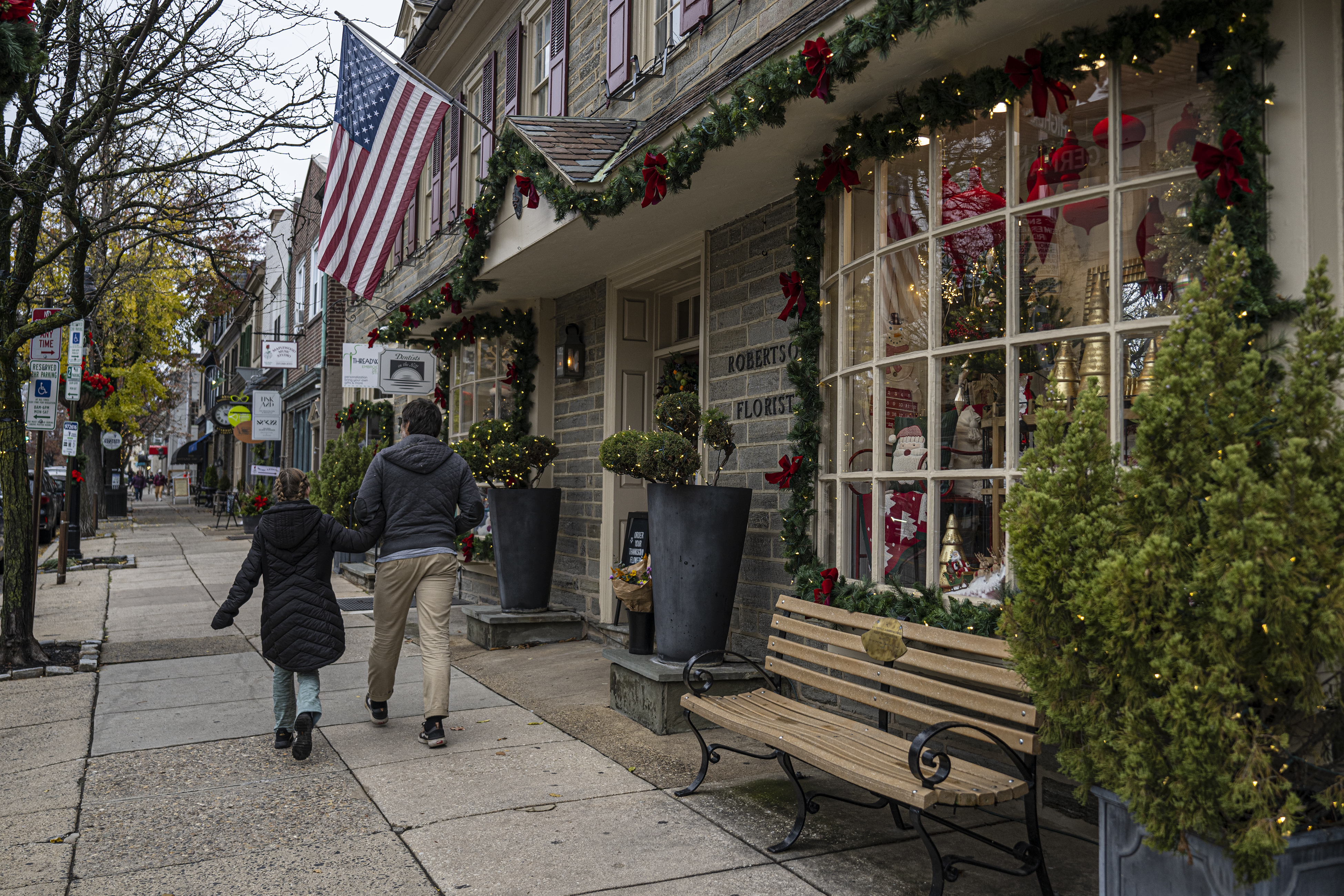
People walk by holiday decor outside Robertson’s Flowers & Events in Chestnut Hill earlier this month.
‘New vitality’ coming to the Chestnut Hill restaurant scene
During the holidays and all year long, Chestnut Hill business owners said they’re grateful that the neighborhood has held onto its charm despite recent challenges.
During the pandemic, “it definitely felt a little grim and dark,” said Ann Nevel, retail advocate for the Chestnut Hill Business District. “The impressive thing is the old-timers, the iconic businesses, and some of the newer restaurants … pretty much all were agile enough to tough it out.”
And a slew of other businesses have moved into the community since then. In the last four years, 20 retail shops, 20 service businesses, and 10 food and beverage spots opened in Chestnut Hill, Nevel said, while several existing establishments expanded.
Among them was Matines Café, which opened a small spot on Bethlehem Pike in 2022 and expanded this fall to a second, much larger location on Highland Avenue. The café serves 500 people or more on weekdays, according to its owners, and even more on weekends.
Sitting inside their original location, which is now a cozy children’s café, Paris natives Amanda and Arthur de Bruc recalled that they originally thought they’d open a café in Center City, where they lived at time. Then, they visited Chestnut Hill and fell in love, despite “a lot of empty spots” there around 2022, Amanda de Bruc said.
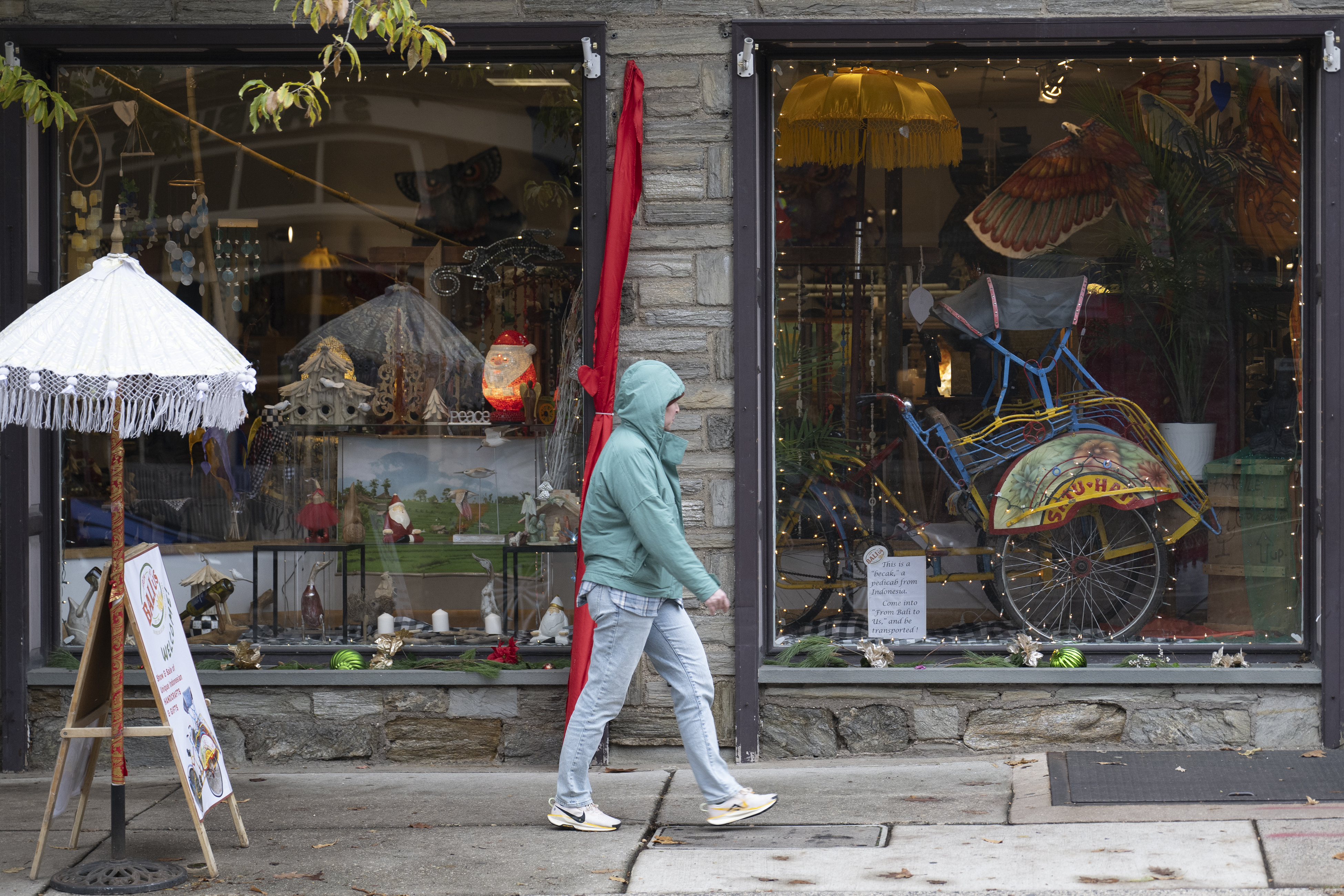
A colorful storefront along Germantown Avenue in Chestnut Hill.
“We liked the idea of living in the suburbs, which technically Chestnut Hill is not the suburbs, because it’s still Philly,” she said. But “we were looking for something that we were more used to, like Paris. There are so many boutiques in such a small area,” and everything is walkable.
The opening of shops and cafés like Matines became a “catalyst for this new vitality, a new, more contemporary energy that has taken hold in Chestnut Hill,” Nevel said. Soon, “we’re going to see that new vitality in the restaurant scene,” including in some long-vacant storefronts.
In 2026, former Four Seasons sommelier Damien Graef is set to open a wine bar, retail store, and fine-dining spot called Lovat Square off Germantown Avenue, Nevel said. On the avenue, a café-diner-pub concept called the Blue Warbler is under construction and also slated to open sometime next year.
Kilian Hardware in Chestnut Hill has been in business for 112 years.
In downtown Chestnut Hill, there are still a few empty spots, including those left by Campbell’s Place, a popular restaurant that closed this summer; Diamond Spa, which closed this fall; Iron Hill Brewery, which closed in September (right before the regional chain filed for bankruptcy); and Fiesta Pizza III, which closed last year.
Kismet Bagels, a popular local chain, was set to fill one of the spots this summer, but its deal fell through, co-owner Jacob Cohen said in a statement. He said they could “revisit the Chestnut Hill neighborhood” in the future.
While the future of Iron Hill will be dictated by bankruptcy proceedings — which include an auction of assets set for next month — stakeholders say conversations are ongoing about some of the other vacancies.
Steve Jeffries, who is selling the Campbell’s building for $1.5 million, said he’s gotten a lot of interest from people who want to revive the nearly 3,000-square-foot space as a neighborhood pub, but one that is “more cutting edge.” Perhaps, he said, one that is not focused on craft beer, which has decreased in popularity, especially among younger generations.
“The town is just screaming for other opportunities for nightlife and sports bars,” said Jeffries, executive vice president of Equity CRE. “There has been a connotation in the market that Chestnut Hill was kind of older, stuffy, that it wasn’t a nightlife town.”
But that’s changing, Jeffries said.
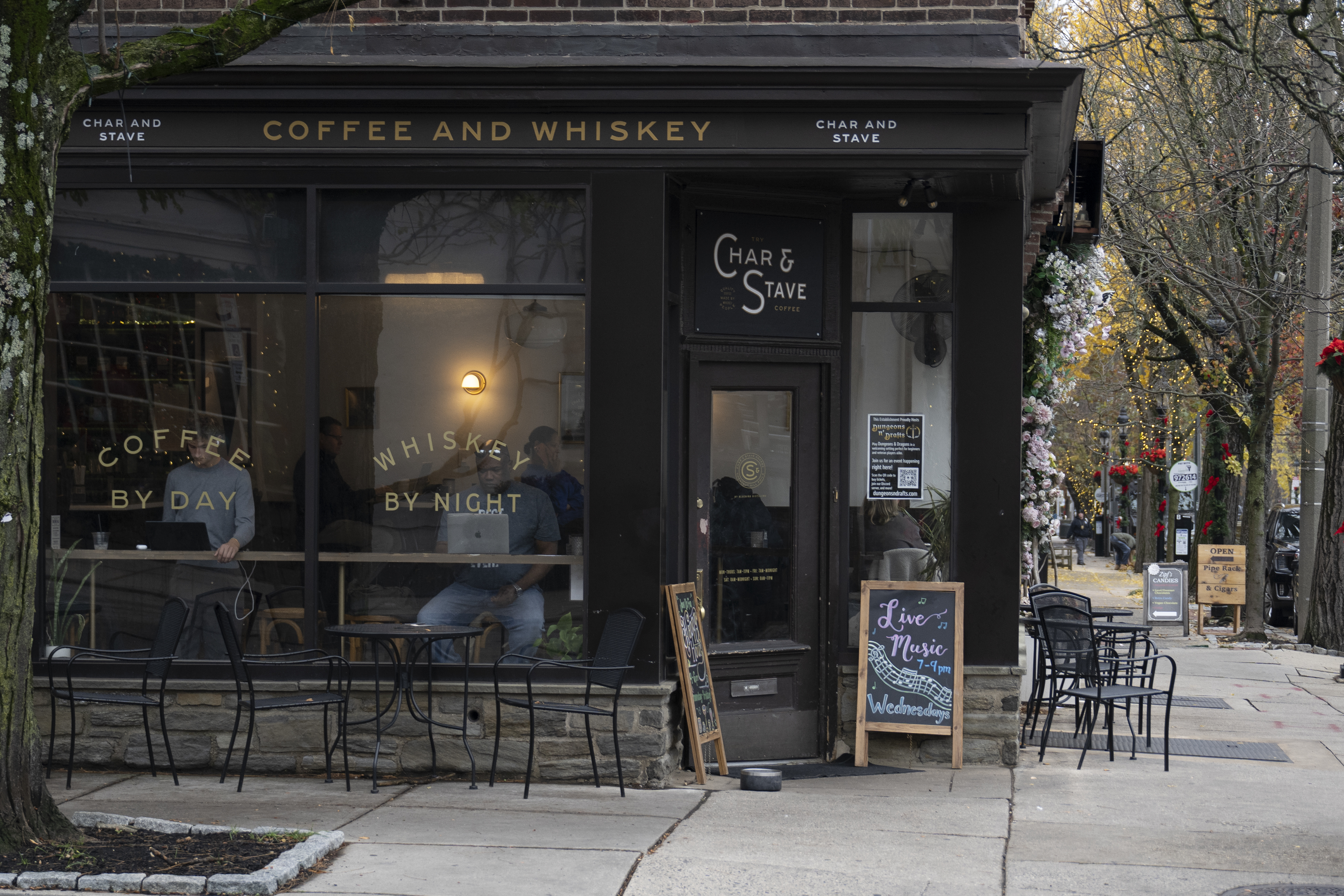
Char & Stave, an all-day coffee and cocktail bar, has done great business since moving into Chestnut Hill, its owner, Jared Adkins, said.
Just ask Jared Adkins, owner of Char & Stave, an all-day coffee and cocktail bar at the corner of Germantown and Highland Avenues.
After Nevel visited Ardmore and saw the success of Adkins’ original Char & Stave, she recruited him to open a Chestnut Hill location. It started as a holiday pop-up in 2022, then became a permanent presence the next year.Since he moved into town, Adkins said, business has been booming.
“We’re really just busy all day long,” said Adkins. The café is open until 11 p.m. during the week, midnight on the weekends, and it often brings in musicians and hosts events.
Adkins describes Char & Stave as a place where drinkers and nondrinkers alike can spend time together, and where people can get work done with coffee or a cocktail beside them: “It’s really a gathering place that fills a niche of a nice cocktail place.”
More changes to come for Chestnut Hill
Businesses along Germantown Avenue in Chestnut Hill are decorated for the holidays.
Chestnut Hill business leaders and community members say they’re optimistic about the neighborhood’s continued evolution.
As Brien Tilley, a longtime resident and community volunteer, ate lunch inside Cosimo’s Pizza Cafe, he said the community is doing well. But, he added, “it could always do better. It’s always in transition.”
Nevel noted that restaurants require more capital to open than other businesses, so it can take awhile to fill those larger holes downtown.
“The economy is tough,” said Anne McNally, a fourth-generation owner of McNally’s, as she sat by the tavern’s front window overlooking Germantown Avenue. But in Chestnut Hill, she gets the vibe that the community “wants us to be successful.”
McNally and Goudy, of Kilian’s, both noted that their families bought their buildings decades ago. That has contributed to their longevity, both said, as has evolving with the customer base.
For the McNally family, that meant transitioning from a “bar-bar,” with no clock or phone, to a bar-restaurant that closes at 10 p.m. For Goudy, it meant soliciting online orders and walk-in business from out-of-town and even out-of-state customers whose older homes require unique hardware.
“Everything is changing,” Goudy said. “It’s important to keep changing and not to try to go back to where you were before.”
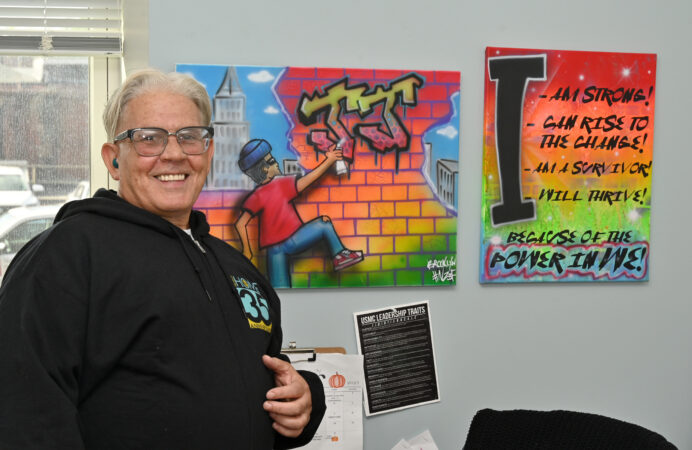
As charming and ebullient as Nephtali Andujar is (lots of hugs, compliments, and gifts of his homemade pottery), the 61-year-old is also pretty blunt about why people should give to Project HOME, one of the city’s largest nonprofit housing agencies.
Because of Project HOME, said Andujar, who spent years living on the streets, he is no longer desperate — desperate to get money to feed a heroin addiction, desperate to scrape $5 together to pay someone to let him drag a discarded mattress into an abandoned house for a night’s sleep out of the rain.
“It’s not just giving someone an apartment,” said Andujar, who sheepishly described a past that included stealing cars and selling drugs. “It’s the snowball effect.
“You are not just helping the homeless,” he said. “You are helping the city. You are helping humanity.”
In the agency’s name, the letters HOME are capitalized, because each letter stands for part of the multipronged approach that Project HOME takes in addressing homelessness and combating poverty for the 15,000-plus people it serves each year.
There’s H, for Housing — not only housing in the literal sense, but also in the teams of outreach workers who comb through the city’s neighborhoods looking for people like Andujar. One outreach worker found Andujar in 2021 at a critical moment in his life — clean, just out of the hospital for liver treatment, and back on the streets of Kensington ready to begin anew.
“We know we have to do the most we can to preserve these resources that we’ve come to rely on,” says Donna Bullock, president and CEO of Project Home.
For Andujar, it was a race. What would find him first?
Would it be heroin, as it had so often been in the past? It was tempting. It’s painful being on the street — cold, hungry and dirty, ashamed and alone. “When you do heroin, you don’t feel the cold. It kills the hunger,” he said. “When you use the drugs, you don’t have to suffer for hours. Heroin numbs you.”
Instead, though, it was the outreach worker — someone who had been through Project HOME’s recovery program — who plucked Andujar off the street in the nick of time and took him to a shelter.
A year later, that same outreach worker helped Andujar move to his own room at Project HOME’s Hope Haven shelter in North Philadelphia.
“You get tired of the streets. They were killing me,” Andujar said.
Next Andujar found Project HOME manager JJ Fox, who helped him get a birth certificate and other documents, and arranged for him to stay. But he needed more than a warm bed.
The problem with getting straight after a heroin addiction, Andujar explained, is finding a new purpose and direction. For so long, life was focused on a repeat cycle of getting the next fix and then becoming numb to pain while it was working.
So when he got to Project HOME, he needed a new direction, which is where both the O and E in HOME came in for Andujar.
“JJ Fox gave me direction,” he said, and so did Project HOME employment specialist Jamie Deni.
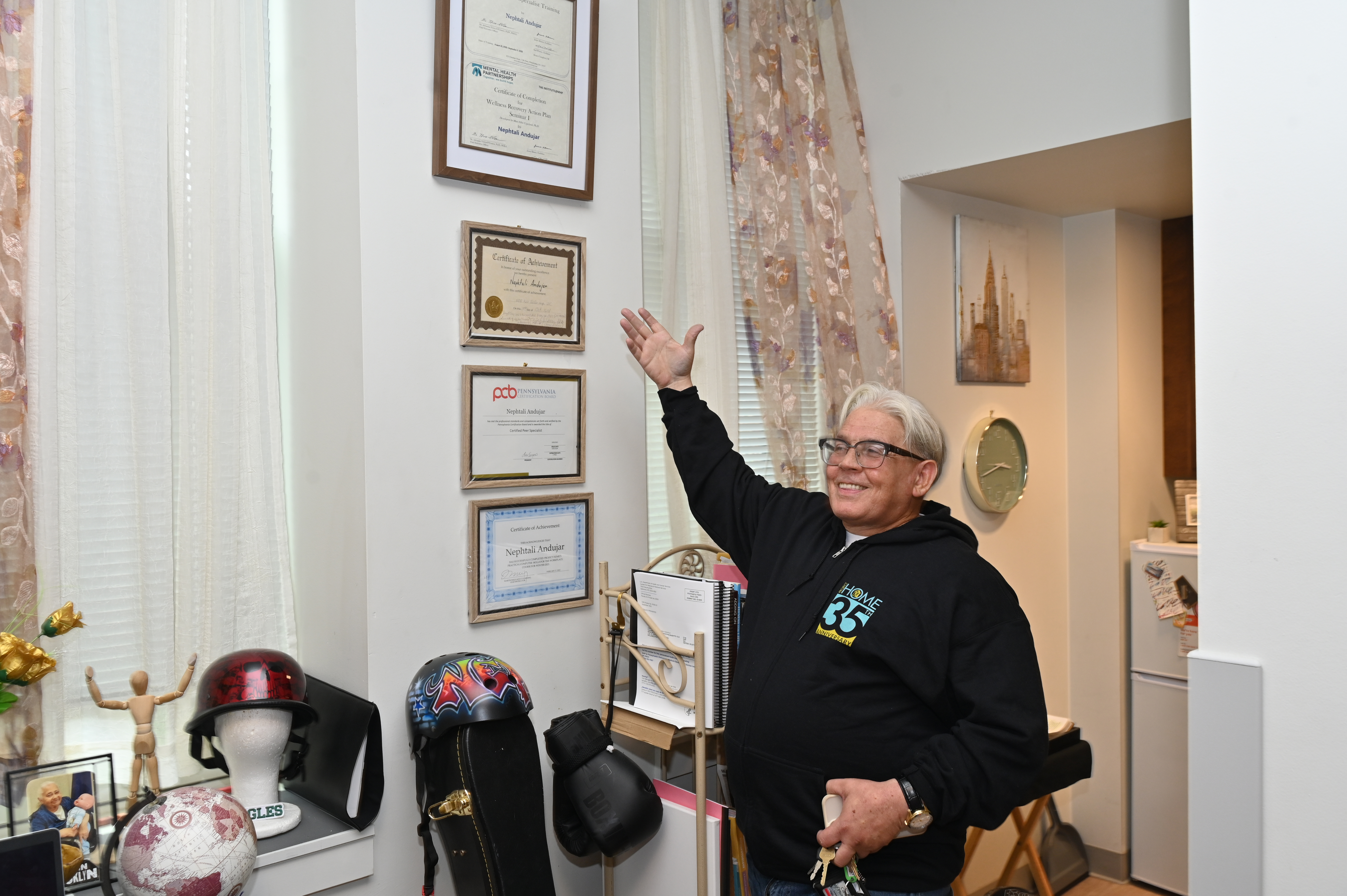
Training certificates cover a wall in Nephtali Andujar’s studio apartment in Project HOME’s Inn of Amazing Mercy in Kensington.
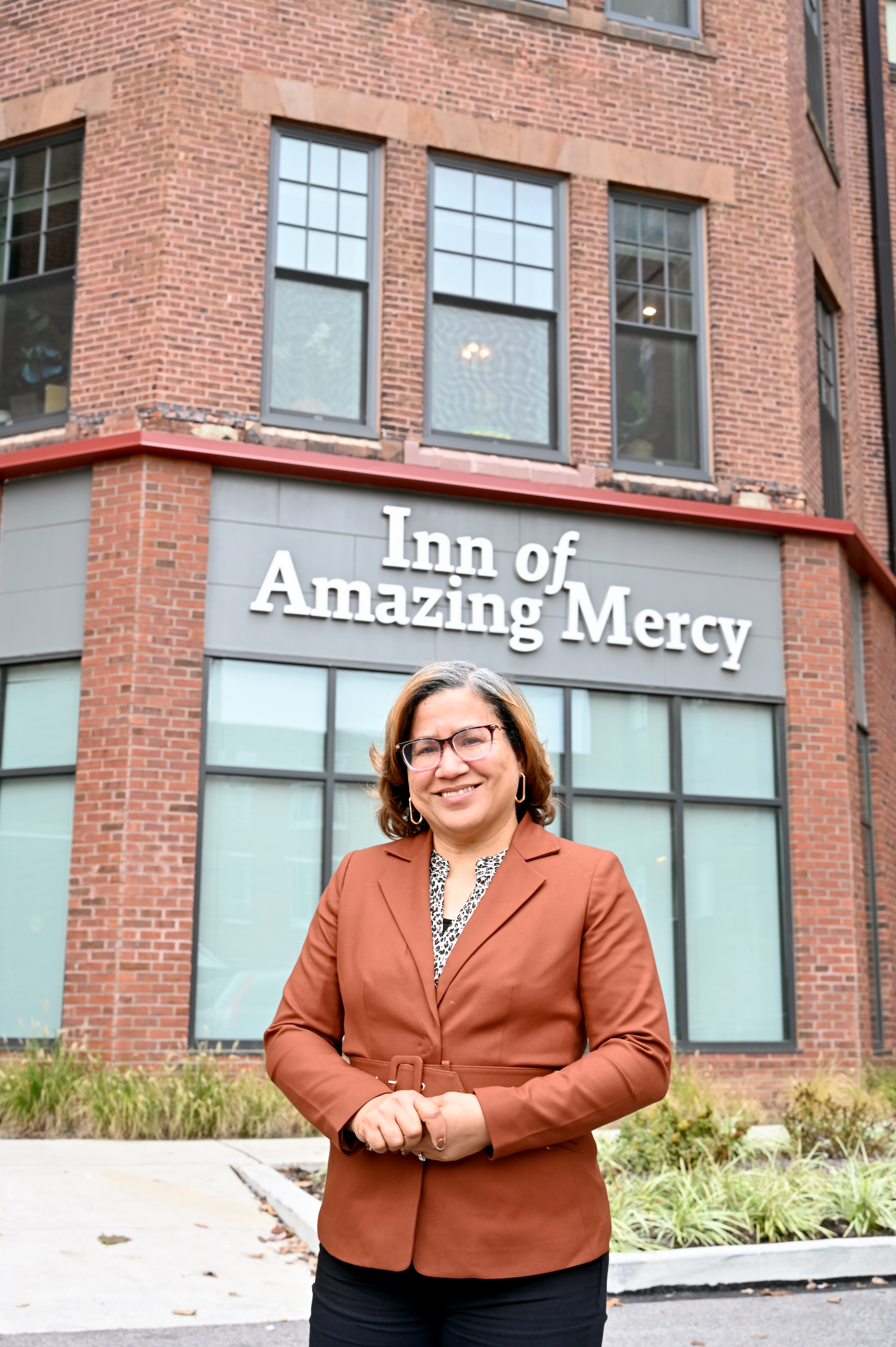
The “O” in HOME has to do with Opportunities for employment. Certificates cover one wall in Andujar’s studio apartment in Project HOME’s Inn of Amazing Mercy, a 62-unit apartment building and offices in a former nursing school dormitory in Kensington. He can point to his accomplishments in computer skills, barbering, and training as a peer specialist to help others the way the outreach worker helped him.
But Andujar is not in good health, as vigorous as he appears. His addictions will someday exact their price, even though with cirrhosis of the liver, he is already living years beyond what his doctor predicted.
Full-time work is not an option. So Andujar is part of the “E,” as in Education. Deni helped him get a grant to take art classes at Community College of Philadelphia. She helped him understand CCP’s education software so he could turn in his homework.
Project HOME offers classes in graphic design, music production training, ServSafe food handling, forklift and powered industrial trucks certification, and website building, among other courses.
The M stands for Medical. Project HOME doctors, nurses, and other health practitioners treat 5,000 people a year, both in a fully equipped health center and by sending medical teams into the streets, caring for people, literally, where they live.
“My dad always told me that you need three things — housing, food, and love. You get all that here,” Andujar said.
And for him, it goes beyond that. During a stable period in his life, Andujar had a partner and a child. His daughter is now 14 and living with her aunt in New Jersey. Her mother, who was also stable for many years, fell into addiction but is clean now. She is living in another Project HOME apartment.
Like Andujar, Omayru Villanueva, 49, another resident at the Inn of Amazing Mercy, recalls her first night of homelessness.
She remembered a cold slushy rain.
She remembered sweeping every corner of her house, determined to leave it clean, no matter what. Her husband had been convicted and jailed for a federal crime. She couldn’t make the payments on the house, so she sold or stored all of her belongings and prepared to leave.
On her last morning at home, she and her school-age twin sons walked out the door before the sheriff came. Her older daughter was able to find a place in a shelter. Her second daughter, just under 18, said she was living with a boyfriend, but it turned out that she had been trafficked.
“There’s a sense of dignity and respect when you have your own place,” says Omayra Villanueva, another resident of the Inn of Amazing Mercy.
By that evening, Villanueva was desperate. She took her boys to a hospital emergency room. At least they could sit indoors while she figured out something. “I was crying inside.” Finally, she called a friend from church who took her and her sons in.
From there, they moved from shelter to shelter, and ultimately to a Project HOME apartment with two bedrooms.
“That night we had a pizza party. We were so happy,” she said. “There’s a sense of dignity and respect when you have your own place. You can take your worries away from having a place to live, and you can focus on other things.”
She remembered lying in her new bed, “thanking God and rubbing my feet against the mattress.” The next day, she woke up, opened the window, and listened to the birds. Then she asked her sons what they wanted for breakfast. “When you are in a shelter, you eat what they give you.”
Three of her four children, scarred from the experience, have also been homeless and living on the street. Her two sons, now 23, are in Project HOME apartments. Both daughters are now fairly well-established.
Villanueva appreciates the medical help she has been given at Project HOME, particularly for mental illness stemming from the trauma she has experienced with her ex-husband’s arrest and homelessness.
“Anybody can end up being homeless,” she said. “I wasn’t a drug addict. I wasn’t an alcoholic. It can happen to anybody.”
She thinks of her daughter, who has a house, a job, and a car. But if something happens to the car, her daughter won’t be able to get to work. She won’t be able to pay her mortgage, and she could wind up homeless. It’s that simple.
“It’s important to donate because people can help break the cycle of homelessness,” Villanueva said.
“It’s about housing and education. It’s about medical help. It’s about employment,” she said. “Project HOME helped me a lot.”
The truth is that every person in Project HOME has a story. Those stories keep Donna Bullock, president and chief executive, motivated to preserve and protect the agency founded just over 35 years ago by Sister Mary Scullion and Joan Dawson McConnon.
She worries about how the city will respond to federal executive orders amounting to the criminalization of homelessness. Will there be tightened requirements for agencies that provide shelter?
Project HOME is reimbursed for some of the medical care it provides, but Bullock worries that new rules involving Medicaid reimbursement will impact the agency’s budget, while cutbacks in services increase demand.
“It’s terrifying,” she said. “We know we have to do the most we can to preserve these resources that we’ve come to rely on.
“In this job, I’ve learned to appreciate the humanity of folks — the residents and the stories they tell and the contributions they make to our community.”
Sometimes, she said, Project HOME residents walking the path of recovery slip and fall away. Sometimes the results are tragic, the losses devastating.
“We’re experiencing all these moments — communal grief and communal celebrations as well. We talk a lot about how every journey of recovery is unique. Everyone walks their own journey. We can’t do the walk for you, but we can walk with you,” she said.
Bullock invites others to the journey, promising that when people give to Project HOME, they can be assured that their money is carefully managed. “We’re good stewards of the resources entrusted in our care. We know how to leverage the resources given to us.
“Folks expect a return on their investment, and the return is the difference in individual lives and also building a community,” she said. “Your investment is magnified 10 times over.”
This article is part of a series about Philly Gives — a community fund to support nonprofits through end-of-year giving. To learn more about Philly Gives, including how to donate, visit phillygives.org.
For more information about Philly Gives, including how to donate, visit phillygives.org.
About Project HOME
Mission: To empower adults, children, and families to break the cycle of homelessness and poverty, to alleviate the underlying causes of poverty, and to enable all of us to attain our fullest potential.
People served: More than 15,000 annually — with street outreach, housing, opportunities for employment, medical care, and education.
Annual spend: $49.06 million
Point of pride: Project HOME, which operates 1,038 housing units, broke ground in October for construction of 45 new apartments; also under construction are 20 respite beds. In the pipeline are an additional 44 apartments. Project HOME also operates the Honickman Learning Center Comcast Technology Labs, Stephen Klein Wellness Center, Helen Brown Community Center, and Hub of Hope.
You can help: Volunteers tutor students, serve meals, participate in neighborhood cleanups, and organize donation drives at their organizations for household items or other items useful to families or people still experiencing street homelessness.
Here are some ways that a gift can help the people we serve:
$25 provides warm clothing and new socks for a visitor at the Hub of Hope.
$50 supports a behavioral health counseling visit.
$100 provides a month’s worth of hygiene products and toiletries for a family.
$250 provides a welcome basket for a new resident complete with sheets, towels, and cooking supplies.
$500 supports five dental visits at the Stephen Klein Wellness Center.
$1,000 funds six weeks of summer camp at the Honickman Learning Center Comcast Technology Labs, keeping a child’s mind active during the summer and supporting moms who work.
$1,500 funds a certification program through the Adult Education and Employment program leading to employment readiness.
More out-of-towners and fewer locals are searching for rental homes in the Philadelphia region, with New Yorkers leading the way. No word on whether they plan to become Eagles fans.
In an analysis of the country’s 50 largest metropolitan areas, Philadelphia had the second-largest drop in local rental demand since before the pandemic, as measured by listing views on Realtor.com.
In fall 2019, about 68% of the Philadelphia metro’s rental traffic on the website came from local residents. By this fall, that share had dropped to about 45%, according to a Realtor.com report published this month.
This fall, most of the Philadelphia metro’s out-of-town rental traffic — 48% — came from the New York metro, which includes some North Jersey cities. The share of listing views coming from the New York metro grew from almost 7% of all traffic before the pandemic to more than 25% this fall.
window.addEventListener(“message”,function(a){if(void 0!==a.data[“datawrapper-height”]){var e=document.querySelectorAll(“iframe”);for(var t in a.data[“datawrapper-height”])for(var r,i=0;r=e[i];i++)if(r.contentWindow===a.source){var d=a.data[“datawrapper-height”][t]+”px”;r.style.height=d}}});
In the Philadelphia region, the median asking rent for rentals with zero to two bedrooms was $1,743 in October, according to Realtor.com. The area’s affordability compared to New York and other large nearby metros attracts out-of-town renters. That’s also the case in such metros as San Francisco and Charlotte, N.C.
“Shifting affordability across regions is reshaping renter behavior, with a growing share of demand coming from outside local markets,” Danielle Hale, chief economist at Realtor.com, said in a statement.
“Data show that more renters are willing to look farther afield, in some cases to entirely new markets, for homes that better align with their budgets,” Hale said.
Although New York renters are among those eyeing the Philadelphia region, many are looking to stay put. The New York metro had the highest share of local rental demand this fall. About three in four online views for rentals in that metro came from inside the metro, about the same share as in 2019.
window.addEventListener(“message”,function(a){if(void 0!==a.data[“datawrapper-height”]){var e=document.querySelectorAll(“iframe”);for(var t in a.data[“datawrapper-height”])for(var r,i=0;r=e[i];i++)if(r.contentWindow===a.source){var d=a.data[“datawrapper-height”][t]+”px”;r.style.height=d}}});
Nationwide, the rental market has continued to cool, Hale said. From January to October of this year, the median asking rent stayed roughly flat, falling by 0.1%. Over the same period of 2024, the median asking rent increased by 1.1%.
As chef Nicholas Bazik climbed into bed late Tuesday night, he checked the reservations at Provenance, his posh restaurant in Society Hill. Business at Provenance, with its 25 seats and $225 French-meets-Korean tasting menu, had been respectable especially since September, when it appeared on Bon Appétit’s list of the country’s best new restaurants.
Bazik discovered that Provenance was fully booked, 30 days out. The next day at noon, the next round of tables was snapped up in six minutes, he said.
Chef Nicholas Bazik of Provenance, with wife Eunbin Whang, accepts a star at the Nov. 18 Michelin Guide ceremony.
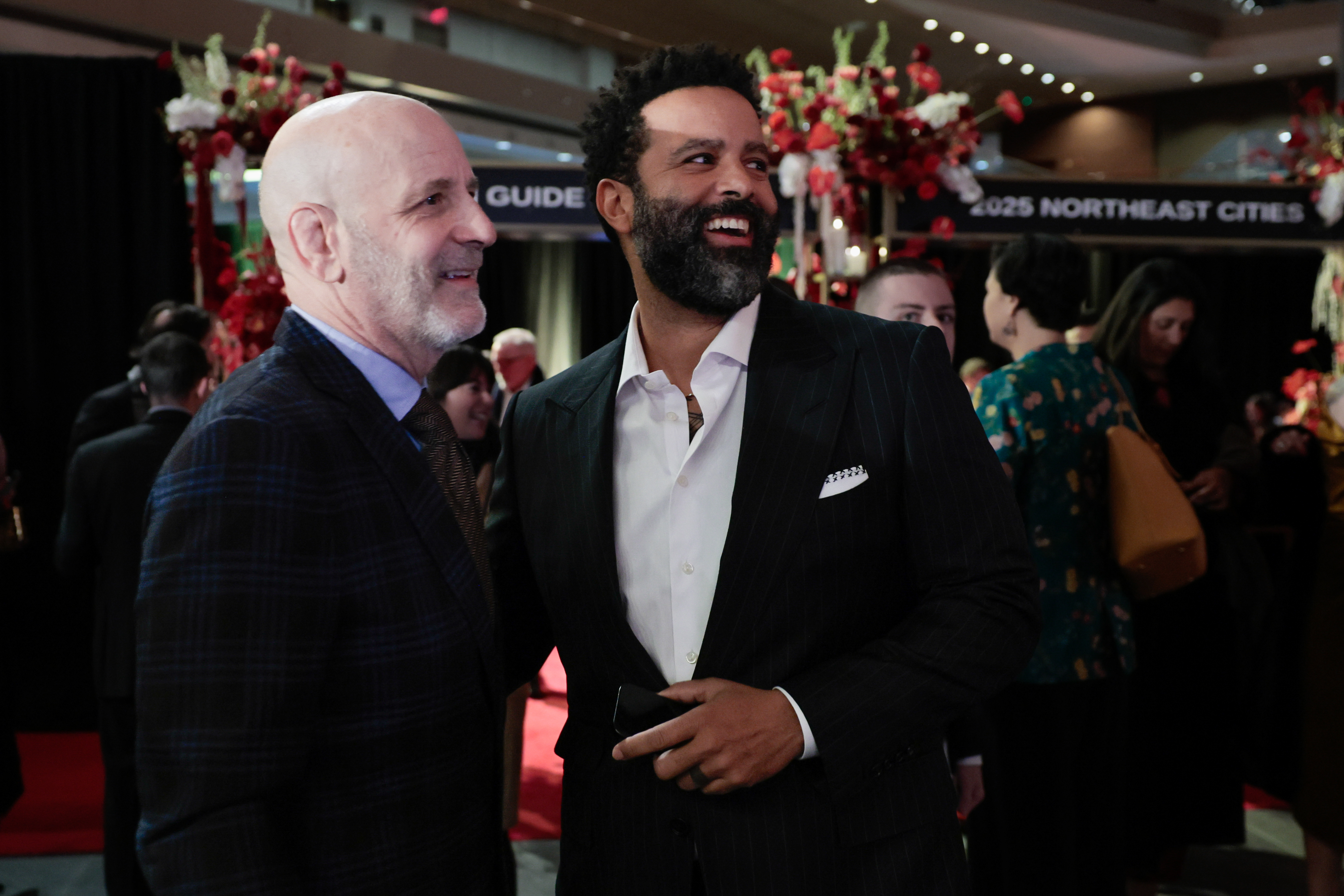
The so-called Michelin effect was at work. Provenance — as well as Her Place Supper Club and Friday Saturday Sunday, both in Rittenhouse — received one star from the Michelin Guide at Tuesday’s Northeast Cities ceremony, placing them in a rarefied league of 280 so-honored U.S. restaurants.
In city after city since Michelin’s arrival in the United States two decades ago, newly starred restaurants report full books, wait lists stretching weeks or months, and in some cases double- or triple-digit growth in reservations. Winning a Michelin star — one or especially two or three — is no small task, and customers are known to travel to dine at a starred restaurant.
Her Place Supper Club chef Amanda Shulman (left) and husband Alex Kemp take a photo at the Sixers game Wednesday. Shulman rang the bell at the start of the game.
At Her Place, where it’s been what chef-owner Amanda Shulman called “a whirlwind of a week,” it’s difficult to determine Michelin’s impact. “We’re a small restaurant to begin with, but we’ve definitely seen a jump in email inquiries that are keeping our reservationist/administrative queen Natalie busy, along with a bump in social following. Truly a surreal experience and we’re just excited to welcome in more new faces.” (The Sixers invited Shulman to ring the bell before Wednesday’s game.)
Friday Saturday Sunday already was one of Philadelphia’s hardest reservations, even before it won the James Beard Award for best new restaurant in 2023, and owners Chad and Hanna Williams are planning an expansion to the rowhouse next door.
Chefs Marc Vetri (left) and Chad Williams during the cocktail hour, at the Michelin Guide announcement at the Kimmel Center.
Restaurants that were included in Michelin’s Bib Gourmand (best value) and “recommended” categories also reported an uptick in business.
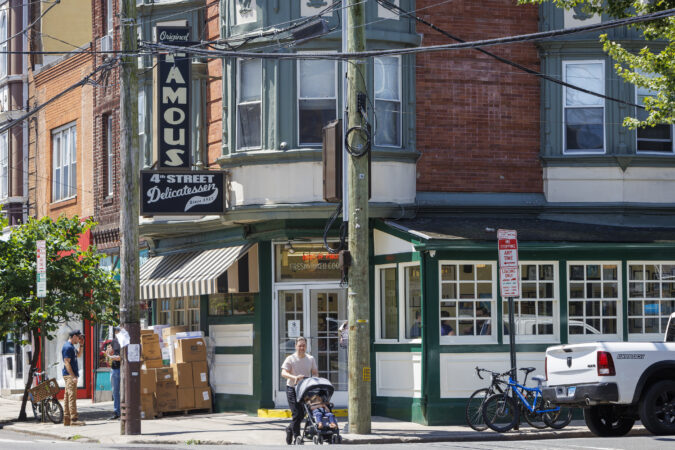
“It’s been an outpouring of positivity,” said Louis Novak, general manager at Famous 4th Street Deli in Queen Village, a Bib Gourmand recipient where all business is walk-in. He reported “exceptional” sales. “It’s also a ‘Day 1’ mentality moving forward. It’s a responsibility to live up to being a Michelin award winner.”
At chef Jesse Ito’s Royal Izakaya in Queen Village, a Bib recipient, the line is longer and the weekday wait list is growing earlier than usual, said Daisy Zeijlon, who handles the restaurant’s publicity.
At Sally (Bib), a pizzeria near Fitler Square, business was up 10% since the announcement, said owner Cary Borish.
At Mish Mish (recommended), Alex Tewfik was ebullient on Sunday: “Being in South Philly, and the Eagles being the last monoculture we have left as a city, our Sundays have been brutal. Today, they are no longer brutal, which is, in ways, a sort of godsend situation.”
Although hard numbers were hard to come by so far, the good vibes are everywhere as the restaurant industry enters its typically busy period between Thanksgiving and New Year’s.
Chef Chris Kearse of Forsythia with his wife, Lauren, at the Michelin Guide announcement.
“We have received such amazing support from the culinary community,” said Chris Kearse, chef-owner of Forsythia (recommended). “It feels like the whole city has come together to celebrate the excitement of the awards, and we’ve been touched by how many guests have stopped in to sit at the bar and share a celebratory drink with our team.”
Al Lucas — a partner at Defined Hospitality, which operates Suraya (recommended), Kalaya (recommended), and Pizzeria Beddia (Bib) — said reservations “have already been very robust so we really cannot tell the impact quite yet. We have, however, seen a lot of anecdotal positive responses through Instagram, emails, and DMs.”
Ellen Yin, who owns High Street (recommended), said it was too early to tell Michelin’s long-term recognition; “however, the energy is palpable.”
Study after study has cautioned that Michelin acclaim does not always translate to success.
A report in the Strategic Management Journal challenges the assumption that Michelin stars only help restaurants, finding that starred establishments are actually more likely to close due to increased operational pressure.
Daniel B. Sands of University College London examined New York restaurants deemed “at risk” of earning a star by tracking those that received favorable New York Times reviews and later Michelin recognition. His analysis and interviews with owners revealed that while stars boost prestige, they also intensify strain along the value chain. Landlords, suppliers, and employees often demand higher compensation, while staff may leverage the star to seek better opportunities or launch competitors.
At the same time, customer dynamics shift: New diners arrive with heightened expectations or tourist motivations, and regulars may visit less often. Some restaurants make costly adjustments to accommodate new guests without increasing revenue. Sands concludes that Michelin stars can bring mixed outcomes, with some businesses thriving but others buckling under the added pressure.
Can the good vibes last? “Having seen bumps from things like being on lists [and] getting accolades in the past, the ‘pop’ doesn’t always last,” said Tewfik, at Mish Mish. “I’m aware that we’re in uncharted territory with Michelin, but usually it dies away in a few weeks. So we’ll see, but for now, we’re so so so thrilled.”
Philadelphia chef Marc Vetri, who took Michelin nods for Fiorella (Bib Gourmand) and Vetri Cucina (recommended), tempers exuberance through experience. His first major award was in 1999, when Food & Wine named him one of its best new chefs. “These awards, while exciting and give the city a big boost, are not a magic pill,” Vetri said.
“Lists, awards, Beards, Michelin — it’s all the same,“ he said. ”Over time, they will bring more visitors, and if you have a good reputation and you are consistent, if you keep putting in the work and [are] evolving, more people will come. That’s the award: The customers who keep coming back. People are going to be very sorry if they think a nod from anyone is going to validate them and make them super busy. That’s just not how it works.”
Philadelphia is the newest destination forLilly Gateway Labs, an incubator for early-stage biotech companies backed by pharmaceutical giant Eli Lilly & Co., the companyannounced Wednesday.
The Center City incubator will be Lilly’s fifth in the United States. Biotech hotbeds Boston, South San Francisco, and San Diego already have them. (South San Francisco has two.) Companies at those locations have raised more than $3 billion from investors since the program started in 2019, Lilly said.
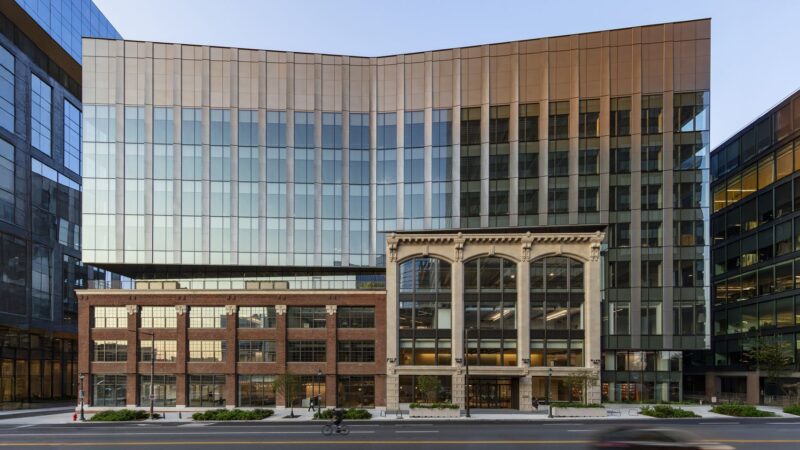
Lilly’s Philadelphia operation will occupy 44,000 square feet on the first two levels of 2300 Market St. in Center City.
Lilly expects to house six to eight companies there, aiming to welcome the first startups to the site in the first quarter of next year, said Julie Gilmore, global head of Lilly Gateway Labs. She did not identify prospects.
Typically, Gateway Labs residents are at the stage of raising their first significant round of capital from investors, called Series A, and are two or three years from clinical testing, she said.
The arrival of high-profile Lilly, which has seen resounding success with its GLP-1 drugs for diabetes and weight loss, could turn out to be a shot in the arm for a local biotech scene. Philadelphia has a growing biotech sector but has lagged places like Boston, despite the presence of world-class scientists atlocal research universities.Their work has fueled groundbreaking discoveries in cell and gene therapy, as well as vaccines.
But Lilly is interested in supporting ideas that go beyond the city’s cell and gene therapy strengths, said Gilmore. Gateway labs is part of Lilly’s Catalyze360 Portfolio Management unit, which provides broad support to fledgling biotech firms, including venture capital.
“What we like is to go after innovative science. Who are the companies trying to solve really hard problems?” Gilmore said. “And we do know that Philadelphia has had a ton of success in gene therapy and CAR-T and I hope we can find some great companies in that space, but we’re going to be open to other types of innovative science as well.”
Expanding Philly’s life sciences footprint
Indianapolis-basedLilly already has a small presence in Philadelphia with Avid Radiopharmaceuticals Inc., a company it acquired in 2010. Avid still operates in University City. Lilly’s chief scientific officer, Daniel Skovronsky, founded Avid in 2004 after receiving a doctorate in neuroscience and a medical degree from the University of Pennsylvania.
Lilly is interviewing people to lead Philadelphia’s Gateway Labs location. They like to hire people who are familiar with the local universities and venture funds for those jobs, but that’s not all that matters. “We’re also looking for somebody who’s got deep drug development expertise,” Gilmore said.
Lilly’s incubator adds to the life sciences activity at 23rd and Market Streets.
Breakthrough Properties, a Los-Angeles-based joint venture of Tishman Speyer and Bellco Capital, announced plans for the eight-story, 225,000 square-foot building in 2022. Last week, Legend Biotech, which is headquartered in Somerset, N.J., celebrated the opening of a new cell therapy research center on the building’s third floor.
Lilly Gateway Labs companies agree to stay for at least two years, and they can apply for up to another two years, Gilmore said.
“The goal is, a company moves in and they can just worry about their science, worry about their team, and moving their mission forward, and we try to take care of everything else,” she said.