Tag: Philly Gives

  • Catholic Charities’ Heather Huot on Building Stability Through Service

    Catholic Charities’ Heather Huot on Building Stability Through Service

    The legacy of Catholic Charities of Philadelphia originated in 1797 with the Catholic Church’s establishment of an orphanage during the yellow fever epidemic. This initial act of charity laid the foundation for a tradition of service that has persisted. Today, the nonprofit is an umbrella organization that offers a wide range of essential services to more than 300,000 people throughout the five-county region. “We’ve been here a long time,” Heather Huot, Catholic Charities’ secretary and executive vice president, said. “Over 200 years, but I don’t know that we’ve always done a really good job of talking about the good work that we do.” Its current mission includes providing family and senior services, foster care, adoption, and support for the homeless. Below, Huot discusses the charity’s values and what keeps her hopeful.

    How would you describe what Catholic Charities does and why it matters in Philadelphia?

    We provide food, housing, care for seniors, families, and individuals, and everything that we do is driven by faith in Jesus and rooted in the works of mercy to serve our neighbors with love and dignity. We really put the mission of the archdiocese into action every day. We provide vital support across not just Philadelphia County, but the surrounding counties as well.

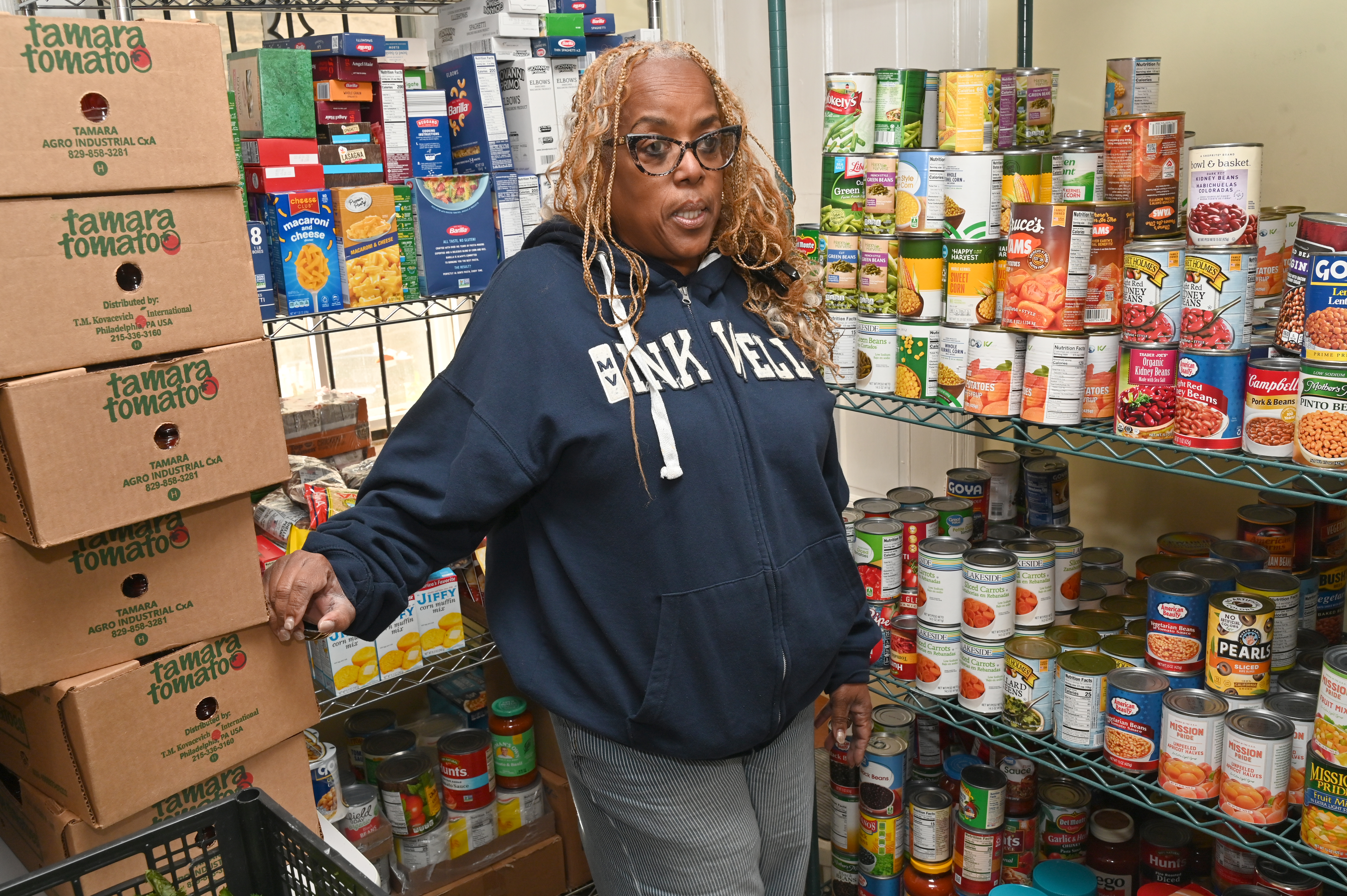
    We divide our work into four pillars. We nourish the hungry and shelter the homeless. Just this past week, we had about 1,500 individuals experiencing homelessness come right through our parking lot here by the cathedral to get essentials for winter. And we also provide shelter and we stock pantries all across the region.

    The second thing that we do is we strengthen and support at-risk children and youth. We’re talking from the time they’re toddlers all the way up through young adulthood, really trying to touch people throughout that whole spectrum of their life. [We do] some residential care, some work with DHS [Department of Human Services], [and we’re] trying to teach trades and skills. [For our third pillar], we stabilize and enrich the lives of seniors in our communities. It’s really important to think about seniors who’ve given so much to our communities.

    Then the fourth pillar of our service is empowering individuals with intellectual and developmental disabilities. We provide residential care to about 400 individuals every day that are living with intellectual and developmental disabilities. So it’s a wide range of services across the five-county region.


    What led you to social work and how did that path bring you to Catholic Charities?

    It’s actually a little bit of a roundabout journey. I grew up with a sibling with special needs, so I always thought I was going to be a special education teacher. But in my senior year of college I did student teaching where you spend a full semester in the classroom, and I hated it. So I decided, since I wasn’t quite sure what my next step would be, rather than getting a job or going to grad school, I would take a year and dedicate it to service.

    I just happened to be placed at St. Francis Inn, a soup kitchen here in Kensington, and I spent a year living and working at the soup kitchen, where I just fell in love with working with folks who were coming in every day. At St. Francis, they really take on this notion of radical solidarity with the folks who are coming for food and compassion. And I was so moved by it. I knew I had to stay in that world. I decided to move into social services and I was very blessed to find my way to Catholic Charities at that point in my life. That was 26 years ago.

    The organization serves more than 300,000 people annually through more than 40 programs. What connects all of these programs together?

    It is really interesting because we are 40 programs but also over a hundred different [service] locations. Every program that we have, no matter where it is in the five-county region, we’re living out that call to care for our neighbors. It’s driven by love.

    Our mission is person-centered, focused on wanting the best for every person we encounter. And you’re going to find that no matter what kind of program you step into, that’s the heart of what we do. It may be handing out meals, it may be caring for someone who’s aging, but that’s the foundation.

    I think the second thing that kind of unites all of our programs together is we’re also a place where the community can engage in works of charity and service. So it’s not just about our staff and my colleagues doing this work; we are a place for people to join us in that work.

    How does your clinical training in social work inform the way you approach leadership at Catholic Charities?

    Social work is a very humbling position; it’s not a position that you go into thinking you have all the answers for everyone’s problems. It’s really about meeting people where they are and walking alongside them. It’s about attentive listening and knowing that you are not the smartest person who’s going to wave the magic wand and make things better.

    And I think I’ve really brought that into my role now as executive vice president. We need to be a collective in how we solve problems. We need to ask, how do we bring in people that believe in our mission to help us solve this problem? Because we don’t necessarily have all the resources that the community’s going to need; we’ve got to be creative and find those who want to partner with us.

    How does Catholic Charities approach long-term issues like housing? How do you build that into programs?

    At the St. Francis Inn, we would see the same people every day and their lives weren’t changing. I loved [doing the work], but I also felt very frustrated. I would always ask myself the question, “Well, how’s this going to get better for them?” So I’ve come to learn that a social service agency like ours can have programs that are meeting immediate needs, but we also need to balance that with programs that provide more long-term systemic change, like creating affordable housing. We train youth on carpentry skills, giving them a real trade so that they can go into the world in a different way than maybe their parents did.

    [And] I think when you think about stability, it’s really only possible when you have a reliable base of support and trusting relationships. So if we’re giving out food at Martha’s Choice Marketplace, it’s me also learning your name and why you are coming for food, and [asking if] there’s anything else that we can help you with or if there is anyone else I connect you with.

    We build affordable housing. That’s huge. It’s a solution in and of itself. However, there’s more to it than that, right? It’s about engaging with the residents once they’re there so they can actually maintain that stability. I was visiting Guiding Star Ministries, one of our ministries that supports expectant mothers. It’s a residence where they can live as they’re preparing for the birth of their child and then they can stay with us for up to a year once their child is born. So for someone who maybe does not have the best living situation, who becomes pregnant, it gives them a safe place to prepare and then have their child.

    I asked the staff, what’s the key to a mom doing well once they leave? And they said, [it’s] always [having] someone to call when something goes wrong later.

    I think the other part that’s really important for me in my role is that I have to focus on advocacy, too. I meet with city, state, and federal leaders to talk about what our communities need. I invite them to come and see what we’re doing to engage in our work, because that’s how they’re going to understand the impact of the dollars that they’re allocating.

    This is a tough legislative environment. What gives you hope day to day as you try to gather resources to serve the community?

    Right now that hope may be hard to see. I mean, you just see so much sadness around us, but I’ll tell you what: my colleagues [make me hopeful]. Our staff is very diverse. I know we are Catholic Charities, but that doesn’t mean that everyone we serve is Catholic. That is far from the truth. And it does not mean all of our staff is Catholic. But we are united by this mission to care for our most vulnerable sisters and brothers. And you see that in action every day with them. And that’s what keeps me coming to work every day and feeling like we can do this.

    What would you like your legacy to be when people look back at your time at Catholic Charities?

    My five-year plan is to bring a lot of our different services together, talking to each other, being more collaborative. You’re really going to see that be the focus over the next five years.

    But, [longterm,] I want people to look back at my time in this role and think that it was a time of growth. I know there’s a lot of other things going on in the world around us, but I think this is the time for Catholic Charities to be on the front lines and show that we are such a force for good in the Philadelphia region. And that I bring a spirit of collaboration and hope to my organization.

    I think one of the things that’s really important to note is it’s also an important time for the Catholic Church of Philadelphia. The archbishop is taking very bold steps to bring people back to the Catholic Church. He has a strategic plan that’s out there, and I think that we, as Catholic Charities, can be the frontline for welcoming people back. People might not be comfortable walking into church, but they might be comfortable coming and serving a meal with us. And I think that’s a really important role for us to play.


    PHILLY QUICK ROUND

    What’s your favorite Philly food splurge? Sweet Lucy’s Smokehouse. It is a little barbecue joint in Northeast Philly. I love the pulled pork and the cornbread.

    Favorite Philly small business? Mueller Chocolate Company in Reading Terminal Market. Their chocolate-covered pretzels are my favorite. I have quite the sweet tooth.

    You don’t know Philly until you’ve… taken your family to a Flyers game to kick off your Christmas celebrations. There’s Gritty Santa Claus!

    Who’s the greatest Philadelphian of all time? Saint Katharine Drexel, [both] as a Philadelphian and as a woman Catholic leader. I can’t think of a better role model for myself. She took care of people that were pushed aside and oppressed, and she was a tireless advocate for their dignity.

    What do you do for fun around Philly? Well, I do love theater and the performing arts, so I’m always looking to take in a show, whether that be at the Academy of Music or the Arden.

    What’s one place in or around Philadelphia you wish everyone would visit at least once? Boathouse Row, especially during a regatta. There is just something really special about the Schuylkill River and seeing rowing in action there.


  • Catholic Charities helps those in need both surmount life’s hardships and celebrate its many little joys | Philly Gives

    Catholic Charities helps those in need both surmount life’s hardships and celebrate its many little joys | Philly Gives

    Heather Huot, the top executive at Catholic Charities, named her only daughter after Lidia, a homeless, mentally ill, and often cranky elderly woman she met as a young social worker at Women of Hope Vine, a transitional housing facility run by the organization Huot now leads.

    As “mean spirited” as Lidia was, Huot said, Lidia still celebrated forsythia.

    When their bright yellow blossoms heralded winter’s end, Lidia would drag Huot outside to marvel. “Despite all the hardships,” Huot said, “there are things to be celebrated.”

    Which brings us to the Christmas holiday season.

    Even if it were possible, which it’s not, to overlook all the troubles in our world, with wars and starvation, or even to overlook all the troubles in our nation, there would still be the troubles of the season — too much work, too much loneliness, too many struggles.

    Where’s the forsythia?

    Two weeks ago, it was outside the Archdiocesan Pastoral Center in the form of a living Nativity scene, complete with a wee baby goat named Lady, an artificial-snow machine, an actual camel, and an elementary school choir in their Catholic school uniforms singing “Joy To the World.”

    Yes, “Joy To The World,” because 500 children, some of whom live in tough circumstances, got a chance to celebrate Christmas and with it, maybe, the hope that the holiday brings. It was the 70th annual Archbishop’s Benefit for Children, a Catholic Charities of Philadelphia event funded by a grant from the Riley Family Foundation. No expense was spared.

    Heather Huot, the chief of Catholic Charities Philadelphia, pets a calf during a living Christmas scene in front of the Archdiocesan Pastoral Center in Center City Philadelphia.

    More than 60 volunteers from area high schools lunched on pizza and cookies before heading across the street to a lavishly decorated ballroom in the Sheraton Philadelphia Downtown. Balloons, banners, party favors, huge plates of cookies, a container of ice cream cups, and a bucket of all different flavors of milk awaited at each table. Kids and chaperones crowded the dance floor, only to make way for an appearance by Santa, who high-fived his way around the ballroom. At the party’s end, the volunteers sprang into action distributing bags of toys — all beautifully wrapped.

    In a way, the party is a metaphor for Catholic Charities as a whole. Both the party and the organization are big and multifaceted with lots of moving parts, involving all types of people, not only Catholics.

    Each year, Catholic Charities spends about $158 million to run about 40 different programs in four main categories — care for seniors; support for at-risk children, youth, and families; food and shelter; and its biggest category, many-pronged assistance for people with intellectual and developmental disabilities and their families.

    As an overview, there’s housing for at-risk youth in Bensalem. In Philadelphia, people may be familiar with St. John’s Hospice on Race Street, which provides food, showers, shelter, and case management to men. There are several smaller transitional housing shelters for women in the city.

    Social workers funded by Catholic Charities assist students at six Catholic high schools across the region. Other social workers handle case management under contract with the City of Philadelphia. A program teaches teenagers involved in the juvenile justice system about conflict resolution. Family navigators step in to assist families with issues ranging from employment to parenting support. There are adoption and foster-care services.

    For the elderly, Catholic Charities supports senior centers and works to help seniors stay independent through case management.

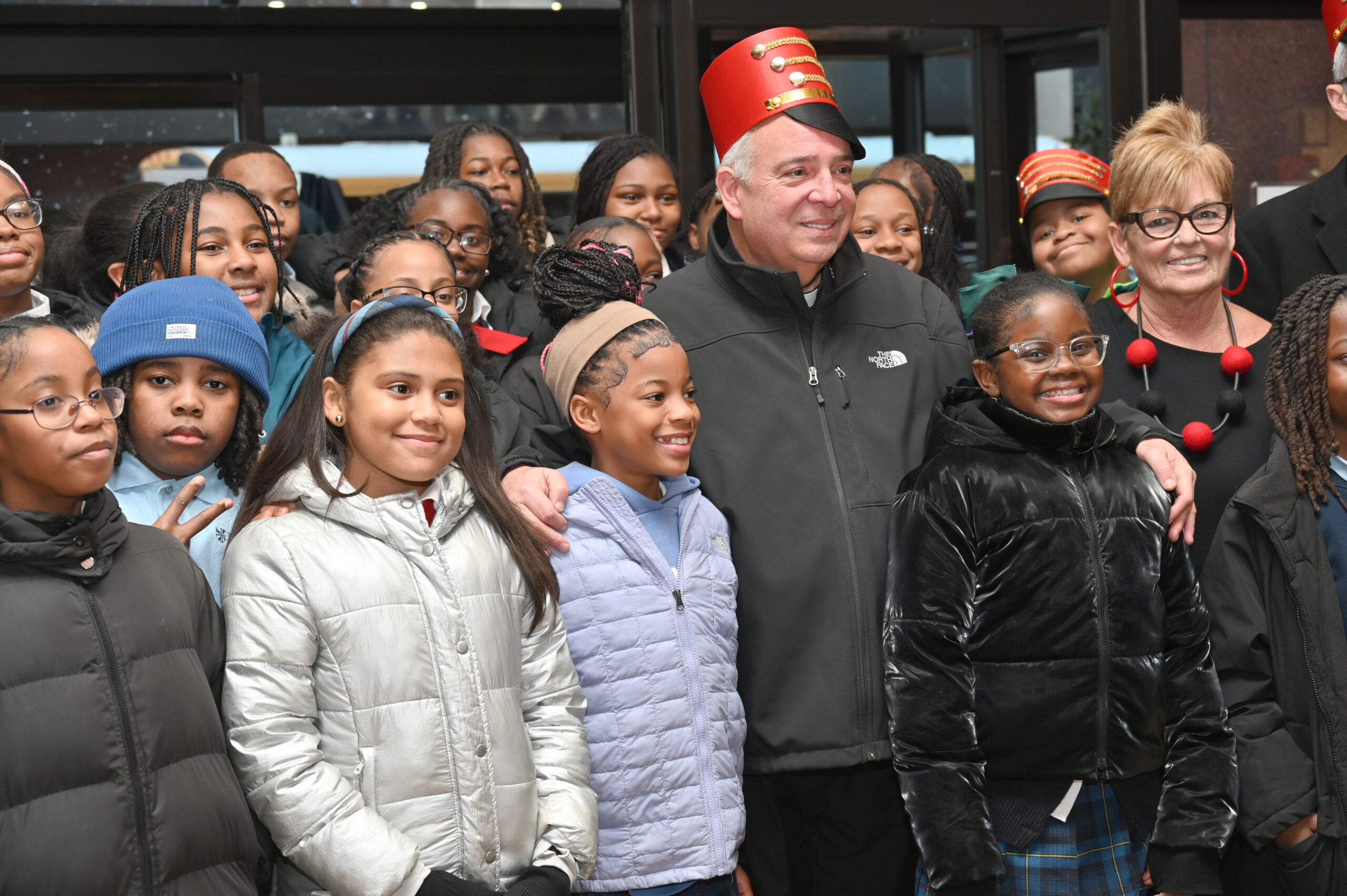
    Archbishop Nelson Pérez poses with students during a holiday party.

    Just over half of Catholic Charities’ annual budget is allocated to supporting people with intellectual or developmental disabilities. A major focus is housing for adults. For example, at the Divine Providence Village in Springfield, Delaware County, 72 women live in six cottages on a 22-acre campus with a pool, greenhouse, and picnic pavilion.

    In addition, there is employment support, a day program, field trips, a family-living program, and respite care to help families overwhelmed by caregiving responsibilities.

    Nearly 80% of Catholic Charities’ funding comes from government sources, which, these days, requires Huot to focus her prayers. “I ask God to help me get through this and to give me the strength and the people around me to get through this,” she said. “At the same time, we have to recognize that God provides in ways you don’t expect.

    “We’ve been blessed with generous benefactors who have stepped in,” she said. “The Philadelphia community is incredibly generous. We get a bad rap as the people who throw snowballs at Santa Claus, but Philadelphians will give you the shirt off their backs. They are passionate about caring for one another.”

    The generosity moved Lakisha Brown to tears as she shepherded her two children and a third to the party earlier this month. Brown, 44, lives in a three-bedroom subsidized housing apartment at Catholic Charities’ Visitation Homes in Kensington.

    “This is the best I ever lived,” she said. But, she said, just outside her door “is a constant reminder of where I came from and where I never want to go.”

    Brown’s father died when she was in elementary school and her mother struggled with alcohol addiction. Brown left home when she was 16 under the protection of a man who started their relationship with gifts and ended it with beatings.

    “He left me in a coma,” she said.

    Brown had her own struggles with addiction. She spent many nights without a roof over her head. If lucky, she could sleep in safety in an abandoned car on a quiet block. One night, she went to a party in a hotel. When she woke up, her clothes were off. Whatever happened wasn’t consensual.

    Soon after, she learned she was pregnant and, knowing that, she vowed to give her baby a clean birth. She found a drug program and a place to live. Slowly, through housing and support from Catholic Charities, she rebuilt her life.

    Erika Hollender holds up her grandchild so Layani, 3, can touch Percy the camel.

    “They help us with budgeting, with money management,” said Brown, who relies on disability, welfare, and food benefits while trying to cope with her own mental health issues. “When we get some money, we want to spend it on the children. We were parenting out of guilt and shame.”

    Those are the big things, but what Brown wants people to understand is that the level of care is deep, personal, and specific. It’s being able to ask a staff person for a roll of toilet paper and trash bags — basics that are sometimes unaffordable when money must be allocated to food and shelter.

    “A mom’s job is never done,” she said, explaining why people should donate to Catholic Charities. “It is needed for mothers who come from nothing. It is needed.”

    For more information about Philly Gives, including how to donate, visit phillygives.org.

    About Catholic Charities of Philadelphia

    People served: 294,000 annually (in the 2023-24 fiscal year)

    Annual spending: $158.6 million across four pillars of mercy and charity

    Point of pride: Catholic Charities of Philadelphia is the heart of the church’s mission in action, serving all people regardless of background. With decades of experience, nearly 40 comprehensive programs, and deep community partnerships, Catholic Charities turns compassion into action, and action into lasting and impactful change.

    You can help: By serving meals, volunteering at a food pantry or shelter, hosting a food or clothing drive, and sharing your gifts and passions with seniors.

    Support: phillygives.org

    What your Catholic Charities donation can do

    • $25 provides five nutritious lunches for children through the School Lunch Program.
    • $50 provides three hot lunches at St. John’s Hospice for individuals experiencing food insecurity.
    • $100 provides an instructor and supplies for an art or recreation class for 50 to 100 seniors at a senior community center.
    • $275 provides one week of groceries for a family of four.
    • $325 provides a mother with formula, diapers, and wipes for a month.
    • $550 provides emergency shelter and meals for a week for someone experiencing homelessness.
  • Effecting Radical Change One Life at a Time

    Effecting Radical Change One Life at a Time

    “My path from being a 9-year-old boy, a refugee from Vietnam in a family resettled in South Philadelphia, to becoming CEO of SEAMAAC [Southeast Asian Mutual Assistance Association Coalition], just seems perfectly fitting for a story of America,” Thoai Nguyen said. “But when I think more deeply upon my life and other people who faced very similar challenges, it could have gone in many different ways.” Nguyen’s sensitivity to the potential outcomes of immigrants is informed both by his personal experiences as well as his leadership of SEAMAAC. The organization’s services, which include education, health care, and community development, are crucial in this moment: In 2023, immigrants comprised 14.3% of U.S. residents, up from 11.19% in 2000. In 2024, Philadelphia’s immigrant population reached an 80-year high. And while poverty in the city is at a 25-year low, housing remains unaffordable and more people are experiencing homelessness than ever before.

    The nonprofit is also invested in changing the cultural discourse around immigration. On Jan. 22, 2026, the organization will launch “Indivisible,” a video storytelling project in collaboration with the American Swedish Historical Museum and funded by the William Penn Foundation. “Indivisible” invites Philadelphians to share their family’s immigration experience, connecting their roots to today’s political discourse. “I want people to discover themselves as they’re telling their story,” Nguyen said. “And then in doing so, inspire others to look at their own roots.”

    Here, Nguyen shares his roots as a Vietnamese refugee in Philadelphia in the 1970s, and his unique perspective on community outreach, organizing, and where SEAMAAC is headed.

    Tell me about your family’s experience coming to the United States. How does that shape the work you do now?

    My family was resettled to South Philadelphia in 1975 after uprooting everything we’d known for generations. It really shaped my very early understanding of the world around me.

    Because my father worked for the U.S. government for many years while he was in Vietnam, we were prioritized to be airlifted out. We were the first family to land in South Philly in the Seventh Street business corridor, which, at that time, was still a thriving, vibrant business district, primarily for Jewish businesses owned by Jewish families who had survived the Holocaust and I believe that experience made them more compassionate to my family’s plight. At first we were the only Asian family in the midst of working-class Irish, Polish, and Italian immigrants. So for the first four to five years, that was what I knew.

    From the late ’70s up until 1985, more Vietnamese refugees began to be resettled there, and then Cambodian, Laotian, ethnic Hmong, ethnic Chinese followed. That caused a lot of racial tension. Being one family, we may not have been a threat, but when you have hundreds of different families speaking six or seven different languages, wearing different clothing, eating different food, practicing different customs, you’re going to push up against the nativist sense of entitlement and turf.

    It impacted my understanding of who I am in the context of everything. For the first five years as a refugee, I had a very diverse friend group. I remember playing hockey, soccer, and American football, and our team was really representative of the neighborhood. My older brother and I were the only Asian guys on the team, but we were kind of embraced by the neighborhood. I should say that (and this is not a pat on the back or anything) my dad’s family was fairly wealthy and he was very well-educated and very sophisticated. He spoke four languages — Vietnamese, English, Japanese, and French — fluently. As a result, our upbringing in Vietnam was very urbane.

    But the new refugees coming in were not coming from that same sort of social environment. A lot of them came from more agrarian areas, and they had a more difficult time adjusting to the urban neighborhood in South Philly. And while I was accepted into a group of Italian- and Irish-American kids, the reality of identity really hit me. They may not have seen me as different, but I was very much an immigrant. I felt this deep sense of connection with the new refugees, and about the same time, my dad started working for one of the refugee resettlement agencies to help the new refugees entering the neighborhood. When I was 15 or 16 years old, I would start advocating for some of the new refugees when my father was busy at work. They would knock on the door, and I would go out and help them facilitate a discussion with the landlord or the neighbor to get around some sort of cultural misunderstanding.


    How would you describe what SEAMAAC does and why it matters?

    We describe the people that we serve as economically, socially, and politically vulnerable communities. The name singles out the Southeast Asian immigrants and refugees because they were part of our original mission. And while we still serve Asian communities, today, our mission statement is really an economic, social, and political-class statement. Depending on the year, 50% of the communities we serve are Black families or families with African ancestry. There have also been a lot of Ukrainians entering Philadelphia in the past five years. So we serve economically- and historically-disenfranchised or vulnerable families of all races and ethnicities. It doesn’t matter who they are, if we have programs or services they need, then they are welcomed.

    We also do advocacy, education and organizing work, which is something that was not there before I came to SEAMAAC. I would argue that the quality of our services today is a hundred times better than 20 years ago because our work today is deeply informed by a radical analysis of poverty.

    Can you tell me more about that? How do you define radical?

    When we say “radical,” we don’t mean people running around arguing to defund the police. We mean “radical” in the sense of its Latin origin, which means “root.” To me, if you boil down the problems faced by the family or community today, the cause of the problems is usually poverty. Debilitating generational poverty. Some of our services are just a band-aid on certain issues. We’re plugging leaks here and there. But to get to the root cause of these issues, we need to get people to think and act strategically, to really think more about who they’re voting for.

    How does SEAMAAC engage in community empowerment?

    I would say that we don’t do any “empowerment” work because that creates a presumption that we have power to give to people. We really try, instead, to build an environment in which people can find their own voice and agency, then have self-determination in their future. To me that is less about traditional social services than it is about movement building and community organizing. And we’re trying to build really slowly, but steadily.

    I’ll give you an example: I sometimes guest lecture at Penn, Jefferson, or Temple. And students are generally really interested in my organizing background and what I did prior to SEAMAAC. And on the surface, that’s the sexy stuff. I was organizing against the police brutality, getting arrested for civil disobedience, and taking over buildings, taking over bridges and tunnels in New York City. But a lot of students will say, “Oh, Mr. Thoai, tell us the most radical thing that you’ve ever done.” And they think that I’m going to talk about the time that I scaled this building to drop a protest banner.

    But in reality, the most radical thing that I’ve ever done is finding livable wage jobs for 20 families at one time, where mom and dad got jobs at a hospital system in Philadelphia. And they are now getting paid better than minimum wage and receiving health care coverage for their family from a 40-hour work week. What more radical way can you change a person’s life than doing that? Mom and dad now don’t have to work two jobs, 12 hours a day. They have Saturdays and Sundays free to spend with their family. What is fundamentally better than that?

    What gives you hope about the work? What keeps you up at night?

    What keeps me up at night is the crisis that’s been building in our democracy over the last 10 months and the fact that working-class Americans are being disenfranchised through the defunding of our public benefits. I’m concerned specifically with how defunding impacts the families SEAMAAC serves. We’ve already taken an $800,000 loss over the previous nine to 12 months. And that affects the lives of the people whom we serve but also the livelihood of our team. In that period, we also lost 15 staff members. So we went from a team of 50 to now 35. Clearly we need more people because requests for service have increased, not decreased.

    Our ability to meet the demand is stable for now, but that requires the remaining 35 staffers to work extra hard. And as the CEO, I have to be really careful about them burning out, or worse, for them to say, “I’m done. I can’t do this anymore.” So it’s a real fine line for the nonprofit sector. That’s what keeps me up at night, thinking about the 12 people that I had to lay off over the last six months, I feel terrible. But you can’t sustain this work without hope. I’m sure you’re familiar with Mariame Kaba’s concept that hope is a discipline?

    Actually, I’m not.

    Her concept is that hope has to be an active verb. When you only hope for something, it does not mean that it will automatically happen, you have to take action day by day to make that hope into a reality.

    After more than 20 years leading this organization, what are you most proud of?

    I’ve been here long enough, 21 years now, that people are asking me about my legacy. Is my legacy going to be the Wyss Wellness Center that we opened up in collaboration with Jefferson Health? Or is it going to be the South Philly East Community Center that’s scheduled to open in December of 2026? I would say that it’s nothing structural like that, even though I love talking about tangibility.

    I think the legacy that I leave for SEAMAAC is the dozens of young activists and organizers that I have the honor of mentoring right now and the dozens that I’ve mentored in the past. If I can instill a sense of compassion and integrity in a quarter of the people who we’ve developed at SEAMAAC, the things that I’ve done in life will have been worth it. Over the past 40 years, I’ve mentored a lot of great people and some have started their own organizations. Some are still doing anti-prison work, anti-death penalty work. I was mentored by some great community organizers, so I am just passing on their knowledge to the next generation of organizers.


    PHILLY QUICK ROUND

    What’s your favorite Philly food splurge? The pizza steak at Lazaro’s Pizza.

    Favorite Philly small business? I always have to say Stina Pizzeria. It is not just the pizza — it’s the owner and their mission. And he named the restaurant after his wife, Christina. I mean, that’s just lovely.

    What do you wish people knew about the people who call Philly home? We are rough around the edges, but we’re for real.

    Who’s the greatest Philadelphian of all time? John Coltrane, a genius musician, an amazing civil rights leader. A jazz icon.

  • At SEAMAAC, long-settled immigrants devote themselves to helping new arrivals | Philly Gives

    At SEAMAAC, long-settled immigrants devote themselves to helping new arrivals | Philly Gives

    To escape the soldiers, Mai Ngoc Nguyen swam across the Mekong River as Laotian snipers on the riverbank fired into the water. She and four others fled Laos together, but only Nguyen made it to safety in Thailand. The rest drowned before they could reach the opposite shore.

    On her first night in Philadelphia, Kahina Guenfoud, an Algerian immigrant eight months pregnant with her first child, was exhausted. When it was time to sleep, she pulled what she could out of her single suitcase and tried to get comfortable on the floor of an empty house.

    To this day, Thoai Nguyen remembers how he, his parents, and seven siblings were airlifted from South Vietnam to an aircraft carrier in the ocean. As the North Vietnamese moved into the area at the end of the Vietnam War, there would have been no mercy for his father, who had worked for the American government.

    Every immigrant has a story and SEAMAAC can hold them all, serving the city’s low-income and immigrant community in more than 55 languages from its headquarters in South Philadelphia — just blocks from where Guenfoud spent her first night. Thoai Nguyen, the chief executive officer, still lives nearby in the South Philadelphia house where his family found refuge in 1975.

    The majority of people who work for SEAMAAC (Southeast Asian Mutual Assistance Associations Coalition) are immigrants in an organization that began in 1984 by serving people from countries like Vietnam and Cambodia and now assists all low-income and marginalized people, including immigrants from Asia, Africa, Europe, and South and Central America.

    A half century ago, Thoai Nguyen, his parents, and seven siblings were airlifted from South Vietnam to an aircraft carrier in the Pacific. Today, he is SEAMAAC’s chief executive officer.

    “It’s about the feelings,” Guenfoud, SEAMAAC’s adult literacy and access coordinator, said. “We feel what they feel. We have all left our families. We still have that emptiness inside.”

    It’s why staffer Biak Cuai, SEAMAAC’s outreach worker to Philadelphia’s Burmese community, keeps her phone next to her bed at night. Everyone has Cuai’s number and they call when there is an emergency. “They call me and ask me to call 911: `My stomach hurts and I can’t breathe.’”

    The hour doesn’t matter, she said, because she understands.

    Many of the people who come to Philadelphia from what is now known as Myanmar are illiterate in their own language because education is no longer readily available back home, Cuai said. Here, even the basics, like opening a bank account, using email, or dealing with paperwork from their children’s schools, seem insurmountable.

    “They come here because they feel America is the top country in the world, but the problem is that everything is new and unfamiliar,” she said. “They have fear. They are scared.

    “I feel the same way because I am an immigrant,” she said.

    Biak Cuai, SEAMAAC’s outreach worker to Philadelphia’s Burmese community, works with a client.

    “I prayed to my God to guide me to my dream job, so I can serve my people,” she said. “They knock on my door. I tell them, ‘if you have any problem, you can reach out at any time.’”

    The stories are dramatic and the help is real.

    In broad strokes, SEAMAAC provides education with classes in digital literacy and English as a second language (although for most immigrants, it’s English as a third, fourth, or fifth language).

    “It’s about feeling and belonging,” Guenfoud said. “When you learn English you learn the culture, and if you learn the culture, you belong in this country. You’ll find your place here.”

    There’s social work and legal assistance to help people obtain benefits or apply for citizenship. A separate stream of funding finances SEAMAAC’s support for children who are missing school due to difficult family situations.

    SEAMAAC works with domestic violence survivors and has co-produced a short, animated film offering hope and support in 10 languages — Lao, Cantonese, Hakha Chin, Nepali, Bahasa Indonesia, and Khmer, among others.

    Laura Rodriguez, from Colombia, discusses food for the Thanksgiving holiday during an English as a second language class at SEAMAAC. Seated behind her is Leo Boumaza, from Algeria.

    Art therapy helps survivors cope with trauma. A domestic violence survivors group produced a collection of mosaics, each with a teacup, surrounded by shards of glass. What was broken, explained Christa Loffelman, health and social services director, can become something beautiful.

    Many of the people who come to SEAMAAC have experienced trauma. “Everyone’s been through multiple layers of trauma,” she said. “You are displaced from your home country — not by choice — and you are going to a refugee camp in a different country. Their entire system has been disrupted.”

    Traditional Western-style talk therapy doesn’t help. For one thing, the language isn’t there, and secondly, it’s not part of many cultures. What has worked, Loffelman said, is expressing feelings through art, and being together while doing it.

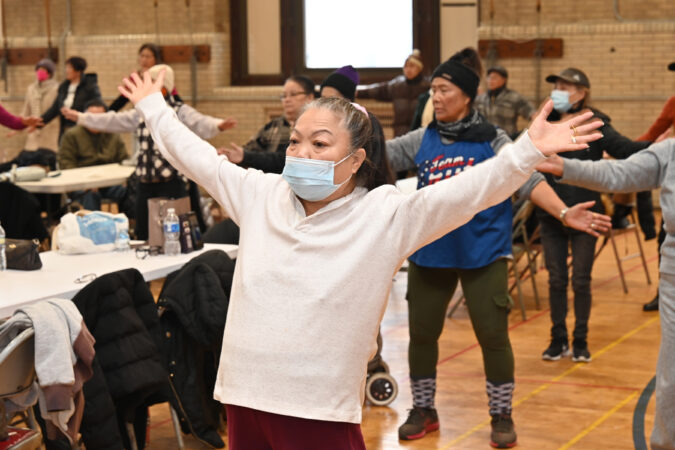
    To counter the social isolation of seniors, SEAMAAC organizes meetings of “the Council of Elders.” They gather in a drafty gym at the Bok building, a former high school in South Philadelphia where SEAMAAC offers classes and counseling.

    Often, the elders practice qigong, a form of movement meditation, or on a less esoteric level, enjoy multicultural bingo. Languages may be different, but when someone holds up a G-32 poster, everyone understands. If they don’t, Mai Ngoc Nguyen, a volunteer who can speak Laotian, Thai, Vietnamese, and English can help.

    She has experienced plenty of trauma and heard plenty of traumatic stories. She’ll never forget the mother who gave her baby medicine so it wouldn’t cry in a boat carrying refugees away from their country. The boat capsized. The baby drowned.

    “She comes into the refugee camp and she became crazy, yelling `Where is my baby?’ Her brain got messed up” and she never recovered.

    Luckily for Mai Ngoc Nguyen, then age 12, she was a strong swimmer and ready to cross the Mekong as she made her escape. But she had to kick away a friend who was clinging to her, dragging her under. Her friend never made it to the opposite shore.

    “If you ask me, I’ll talk about it,” she said. “But if you don’t ask, I won’t talk.”

    But she will joke, saying that she knows the Mekong alligators didn’t get her because they knew she needed to help her family back home.

    It’s a lot of trauma, but every day at SEAMAAC isn’t full of anxiety. The elders coming out of the gym after bingo were smiling. And in a nearby classroom, students practicing their English last month traded jokes as they learned about Thanksgiving.

    Fatma Amara, from Algeria, has been here long enough that she’ll serve a turkey on Thanksgiving, but the apple pie she makes will be Algerian, with seasoned apples layered among thin sheets of dough.

    For her, SEAMAAC is more than a language class.

    “At first, you feel lonely. You’re anxious. It’s stressful,” said Amara, who works in a hospital and is getting better and more confident with her English. “I take the classes, and we talk together and I feel better.

    “Thanksgiving is my favorite holiday in America. It’s an international holiday. It’s about food and God and family,” she said. “You thank God for all you have.”

    For all the blessings SEAMAAC provides, these days, funding is a struggle.

    In 2024, SEAMAAC learned that the federal government had approved its application for a $400,000 multiyear federal grant to improve digital “equity.” But after President Donald Trump took office, federal staffers targeted “equity” programs. “That’s $400,000 we’ll never see,” said Thoai Nguyen, the executive director. “We would have had some of that money by now.”

    Federal cuts since Trump took office have slashed SEAMAAC’s budget by 20%, he said. Hunger relief programs had to be curtailed, with 1,500 families who relied on SEAMAAC for food losing that lifeline.

    “We’re in a moment,” he said, “where intentional cruelty is considered an acceptable form of political discourse.”

    This article is part of a series about Philly Gives — a community fund to support nonprofits through end-of-year giving. To learn more about Philly Gives, including how to donate, visit phillygives.org.

    For more information about Philly Gives, including how to donate, visit phillygives.org.

    About SEAMAAC

    Mission: To support and serve immigrants and refugees and other politically, socially, and economically vulnerable communities as they seek to advance the condition of their lives in the United States. Services include ESL classes, job readiness, domestic violence survivor support, services for low-income elders, food assistance, public benefit counseling, health and nutrition education, and civic engagement.

    People served: 8,000 families

    Annual spend: $3,360,401 in fiscal year 2024

    Point of pride: SEAMAAC plans to increase our impact to serve even more Philadelphians at its new South Philly East (SoPhiE) Community Center on Sixth Street and Snyder Avenue, scheduled to open in December 2026. In January, SEAMAAC, partnering with the American Swedish Historical Museum, will welcome visitors to “Indivisible: Stories of Strength,” an art exhibition showcasing the art and stories of South Philadelphians.

    You can help: SEAMAAC provides many volunteer opportunities through our work in beautifying and improving Philadelphia’s neighborhoods through our work in urban gardening, tree planting, neighborhood and public park cleanings, and beautification of public schools and places of worship. Additional opportunities are available through our civic engagement and neighborhood unity events as well as by delivering groceries in our hunger relief efforts.

    Support: phillygives.org

    What your SEAMAAC donation can do

    • $40 provides shelf stable foods for a family impacted by the SNAP shutoffs for one week.
    • $50 provides holiday presents for two children.
    • $100 helps maintain one plot in SEAMAAC’s community garden for an entire growing season, providing tools, culturally appropriate seedlings, and soil.
    • $100 covers the full cost of supplies for one youth participant in SEAMAAC’s summer programs — giving young people the tools they need for career and college readiness.
    • $200 covers four hours of ESL instruction.
    • $250 provides 50 elders with a freshly made breakfast.
    • $250 provides a family with emergency food, hygiene items, diapers, and social service support for one month.
    • $300 supports a domestic violence survivor moving into safe housing, by covering the cost of utility hookups and household supplies.
    • $300 provides ingredients and cooking supplies for a nutrition education workshop.
    • $1,000 covers the full cost for one high school student to participate in SEAMAAC’s eight-week summer career exploration program.
  • Repairing the World Through Compassionate Care

    Repairing the World Through Compassionate Care

    Robin Brandies, 56, left a career in international law more than 20 years ago to find purpose and meaning in work that would impact individuals’ lives. Now, as the CEO and president of Jewish Family and Children’s Service (JFCS), she is dedicated to ensuring that vulnerable Philadelphians facing challenges get the help they need with dignity and care. “JFCS is rooted in Jewish values, especially tikkun olam, which is the idea of repairing the world,” Brandies said. “Being a Jewish organization means leading with compassion, inclusion, and service for all.”

    With decades of leadership experience in mission-driven organizations, including serving at St. Jude’s Children’s Research Hospital and guiding services at Abramson Senior Care, Brandies brings authenticity and pragmatism to her work. Under her stewardship, JFCS serves as a lifeline for individuals and families facing challenges. The organization offers counseling, care management, financial assistance, as well as food, clothing, housing, and social connectivity. JFCS is founded on Jewish values of giving and caring for others and is open to individuals of all faiths.

    Here, Brandies shares the experiences that drew her to this work, the people who inspire her daily, and the stories that reveal how JFCS transforms everyday lives.

    What experiences led you to dedicate your career to social services?

    My background is actually in international law. I spent several years in Washington working at the intersection of law, human rights, and foreign policy. I was drawn to that world because I wanted to make an impact on a large scale. I believed the political realm was where real change could happen.

    Over time, I realized that doing good in that context was often buried under layers of politics. I remember sitting in a law firm conference room surrounded by stacks of documents, representing the United Nations in a contract dispute, and thinking: This isn’t it. I wasn’t using the best parts of myself, which are my ability to connect with people, my propensity to build relationships, and to care deeply and personally.

    That realization sparked a lot of soul searching. I came to understand that meaningful change doesn’t always have to happen on a global scale. Sometimes it’s just as powerful, maybe even more so, to make a difference close to home. That’s what ultimately led me to this work.

    How did you find your way to the organization?

    Before joining JFCS, I was the President and Executive Director of Abramson Senior Care, another mission-driven nonprofit that had served low-income seniors for more than 160 years. The former CEO of JFCS and I began discussing the idea of a merger between our two organizations, something that could truly strengthen services for older adults in our community.

    I knew pursuing that merger might ultimately mean talking myself out of a job, but I believed it was the right thing to do for the people we serve. A few months into those discussions, [then JFCS’s CEO] Paula Goldstein, announced her retirement from JFCS. The organization launched a national search, and I decided to throw my hat in the ring.

    How has your own family, faith, or upbringing influenced the way you lead and serve?

    I’ve had close family members face a range of challenges, from LGBTQ+ discrimination to mental health struggles, addiction, and developmental disabilities. Watching people I love navigate such complex systems gave me a very personal understanding of what it means to feel unseen or unsupported.

    That perspective has deeply shaped how I lead. It reinforced my belief in the importance of dignity, empathy, and access — the idea that everyone deserves to be met with compassion and respect. Even back in law school, before I knew where my career would lead, I wrote my law review paper on gay adoption. Looking back, the thread of advocacy and inclusion has always been there.

    When the work feels heavy, what keeps you grounded and motivated?

    It might sound simple, but my family, meditation, and time in nature keep me centered. Being in nature helps me recharge and reminds me of the bigger picture.

    What personal values guide your decision-making as a leader?

    Authenticity is a big one for me. I’d much rather work with someone who’s direct and real than someone who’s polished but insincere. I also deeply value courage. In past leadership roles, I’ve had to make tough, often unpopular decisions that required doing what was right rather than what was easy. I admire and try to be the kind of leader who leads with both honesty and bravery.

    Who are the people who inspire you most?

    I’ve been fortunate to have mentors who encouraged me to find my own path. Early in my career, I wasn’t loving my work in international securities law, and my boss — former SEC Chairman Harvey Pitt — gave me incredible support. He allowed me to spend a couple of afternoons a week exploring other interests while keeping up with my responsibilities. That generosity and trust taught me the value of caring mentorship and the courage to explore new directions.

    Later, Carol Irvine, the former CEO at Abramson Senior Care, inspired me in a different way. After stepping away from work for several years to focus on my family, I returned to a vice president role. Carol saw my potential and supported me without judgment, valuing commitment and authenticity over my time away. Both of them modeled courage, integrity, and belief in people, values I carry into my own leadership.

    How do you define success in your role, for the organization and for yourself?

    For me, success has a few dimensions. Professionally, I hope to grow more leaders. True leaders don’t create followers; they create more leaders. I also measure success by how well the organization embraces collaboration and partnership within the community, making the most of limited resources. And finally, I define success by ensuring long-term sustainability, setting JFCS up to serve generations to come.


    What does JFCS provide for families in need that they can’t easily find elsewhere?

    JFCS serves as a gateway to a wide range of integrated services, many under one roof. We address mental health, food insecurity, housing, parenting support, school-based programs, and robust older adult services. Often, a client’s challenge isn’t just one thing — it’s interconnected. Our ability to see the full picture and coordinate care in a holistic way is what truly sets us apart. Human beings are complex, and we acknowledge that and take care of their needs in an integrated way.

    Can you share a story that captures the spirit or impact of JFCS’s work?

    A few weeks ago, I visited JFCS’ mobile basic needs program, Our Closet In Your Neighborhood. What began as a clothing distribution service has grown to offer food and social work support. At each pop-up shop, clients can select clothing in a respectful, dignified way, while a social worker is on hand to address other needs: housing, health care, or guidance. That seamless integration of care really captures what makes JFCS unique.

    How does JFCS balance honoring Jewish values with serving a diverse community?

    JFCS is rooted in Jewish values, especially tikkun olam, which is the idea of repairing the world. It serves as a call to action, encouraging individuals to address social and economic inequality, and other injustices through acts of kindness and service. But we see that as a universal human value. While we provide a safety net for vulnerable members of the Jewish community, we serve everyone, regardless of belief or background. Being a Jewish organization means leading with compassion, inclusion, and service for all.

    What are you most proud of when you look at JFCS today?

    I’m proud that JFCS is a trusted gateway organization, a safety net for people in need with a long history of service. I also admire how nimble we’ve been, adapting to changing community needs. Whether facing food insecurity, benefit disruptions, or other challenges, I’m confident this organization will continue to find solutions and support those who rely on us.

    What is the biggest challenge on your desk? What is the biggest opportunity?

    The biggest challenge is navigating strategic and financial planning in an uncertain funding environment. The biggest opportunity is the JFCS-Abramson merger. By combining our expertise, we can offer a full spectrum of health care, social services, and community support, creating something truly transformative for seniors in need.

    What do you wish people understood better about the families and children you serve?

    These families aren’t so different from anyone else. They’re just facing different challenges. No one is free of challenges at one time or another. Anyone can find themselves in a tough situation. What matters is how we respond, and the resilience and courage I see every day in the people we serve is remarkable.

    When you think about the future, what do you hope your legacy — and JFCS’s legacy — will be?

    I hope my legacy is setting JFCS up for longevity and sustainability so the organization can keep helping people for decades to come. I also want to build lasting partnerships and foster a sense that social services transcend political divides. No matter our opinions on politics or policy, almost everyone agrees we should help people in need. That belief that helping others can unite us is really important to me, and I hope it becomes a defining part of JFCS’s identity.

    What have you read recently that has been impactful in your thinking?

    I recently read David and Goliath: Underdogs, Misfits, and the Art of Battling Giants, by Malcolm Gladwell, and it really stuck with me. I loved how it highlights the strength and grit people develop when they face challenges. It reminded me that overcoming obstacles can be a source of resilience, and that underdogs often have hidden advantages. It’s a powerful reminder not to underestimate anyone based on appearances or circumstances.

    Do you have a mantra you live by?

    I’m inspired by Billy Joel’s song, “Vienna.” The idea is simple: Go for what you want, give it your all, and make the most of life’s experiences. But I also love the idea that it’s good to just be here today.

    Of course it’s good to strive, to grow, and to have goals. But also balance that with a real appreciation and enjoyment of where you are right now.


    PHILLY QUICK ROUND

    What’s your favorite Philly food splurge? Philly pizza! And Philly water ice, especially root beer and vanilla.

    Biggest misconception non-locals have about Philly? That it’s all toughness and no softness.

    What sports team shirt do you wear most often? The Phillies.

    Favorite Philly restaurant? I love the Israeli restaurant Zahav. Especially their hummus!

    Favorite Philadelphia-born artist? I am a huge Walt Whitman fan.

    When you think of the great Philadelphians in history, who is your GOAT? The signers of the Declaration of Independence.

    I feel most like a Philadelphian when… I’m at the Phillies game.


    Lucy Danziger is a journalist, an author, and the former editor-in-chief of Self Magazine, Women’s Sports & Fitness, and The Beet.

  • With roots stretching back 170 years, the Jewish Family and Children’s Service strives ‘to make the world a better place’ | Philly Gives

    With roots stretching back 170 years, the Jewish Family and Children’s Service strives ‘to make the world a better place’ | Philly Gives

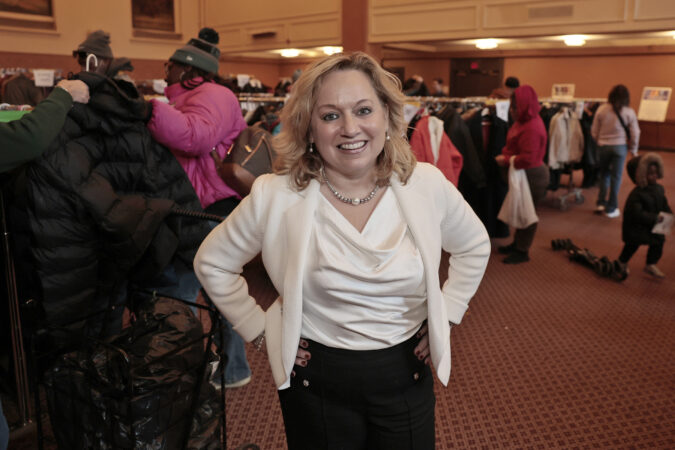
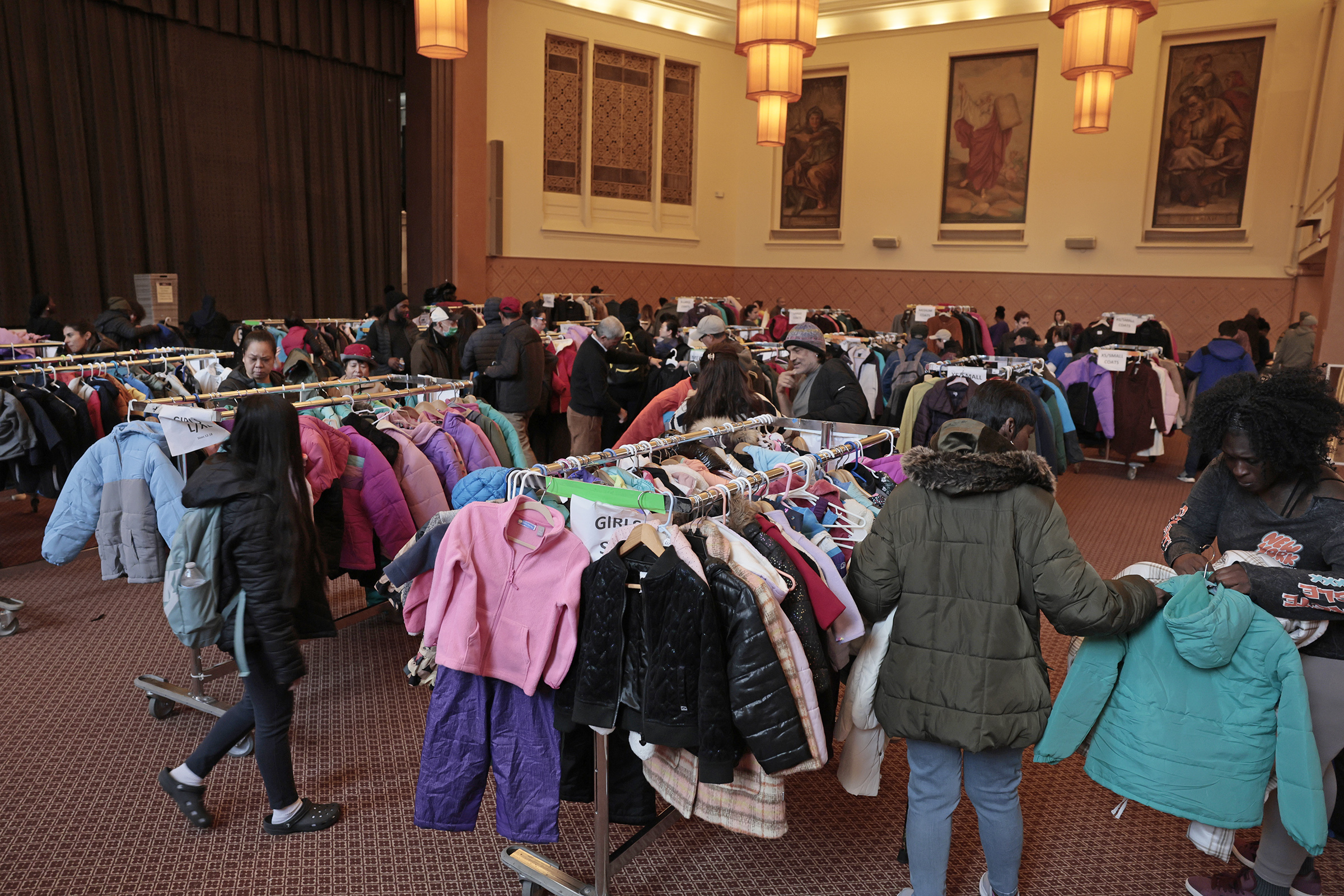
    By the time more than 700 people had found coats at the Jewish Family and Children’s Service of Greater Philadelphia’s annual coat drive last month, JFCS volunteer manager Brianna Torres should have been exhausted.

    Instead, she was exhilarated.

    “Honestly, this is one of our most favorite days of the year,” she said, taking a break from shepherding the 60 volunteers helping hundreds of folks choose free winter jackets and coats for themselves and their children at Congregation Rodeph Shalom.

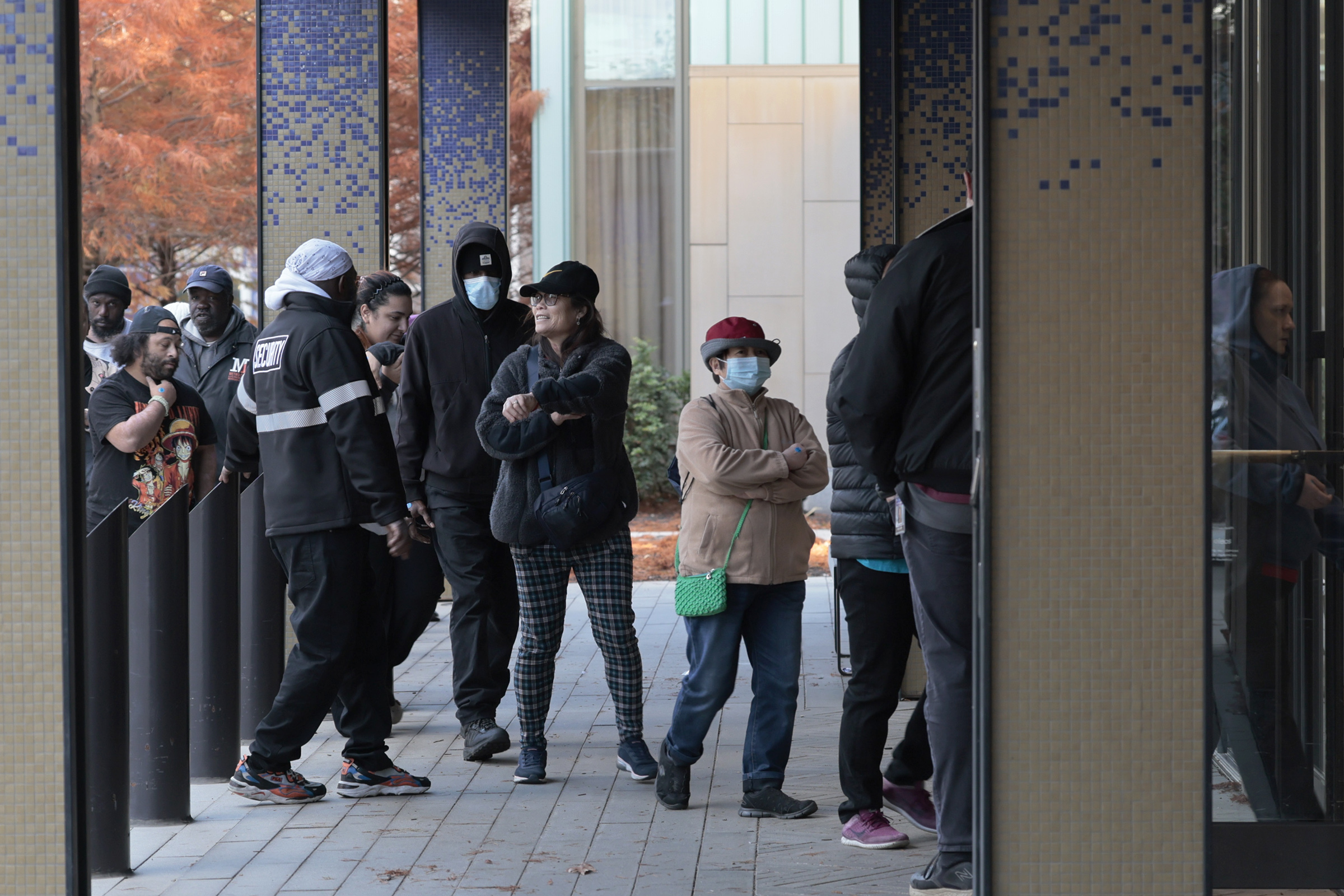
    Sometimes the line stretched around the historic synagogue on North Broad Street.

    “It’s all hands on deck,” Torres said, with a smile. “We feel good — giving and receiving.”

    JFCS’s roots date to 1855, when philanthropist and Jewish educator Rebecca Gratz founded the Jewish Foster Home, and to 1869, when United Hebrew Charities was organized.

    These days, JFCS’s client base has grown beyond the Jewish population it once primarily served. It offers a multitude of services, including help with basic needs, mental health and wellness, support for Holocaust survivors, older adults and their families, help for children and families, and for people living with disabilities, as well as an LGBTQ initiative.

    “We’re an organization that is very focused on the equal value of every human being,” said Robin Brandies, JFCS’s new president and chief executive.

    When the giveaway ended, 900 of those human beings had chosen 1,200 coats out of 1,600 donated.

    “It is our responsibility to make the world a better place,” Torres said. “Our main forefront is dignity.”

    That’s why, she explained, the coat drive, while massive, didn’t resemble a rummage sale. “We’re trying to create a boutique type of atmosphere.”

    People look for coats during the winter coat drive at Rodeph Shalom synagogue last month.

    Volunteers hung coats neatly on racks by size, not piled in heaps. While many people were served, only 35 at a time were allowed in to “shop” in the synagogue’s huge community room. They could look at and try on coats at leisure without jostling for room.

    Volunteers helped them choose their coats while other friendly volunteers packed their coats into bags along with flyers describing more of JFCS’s services.

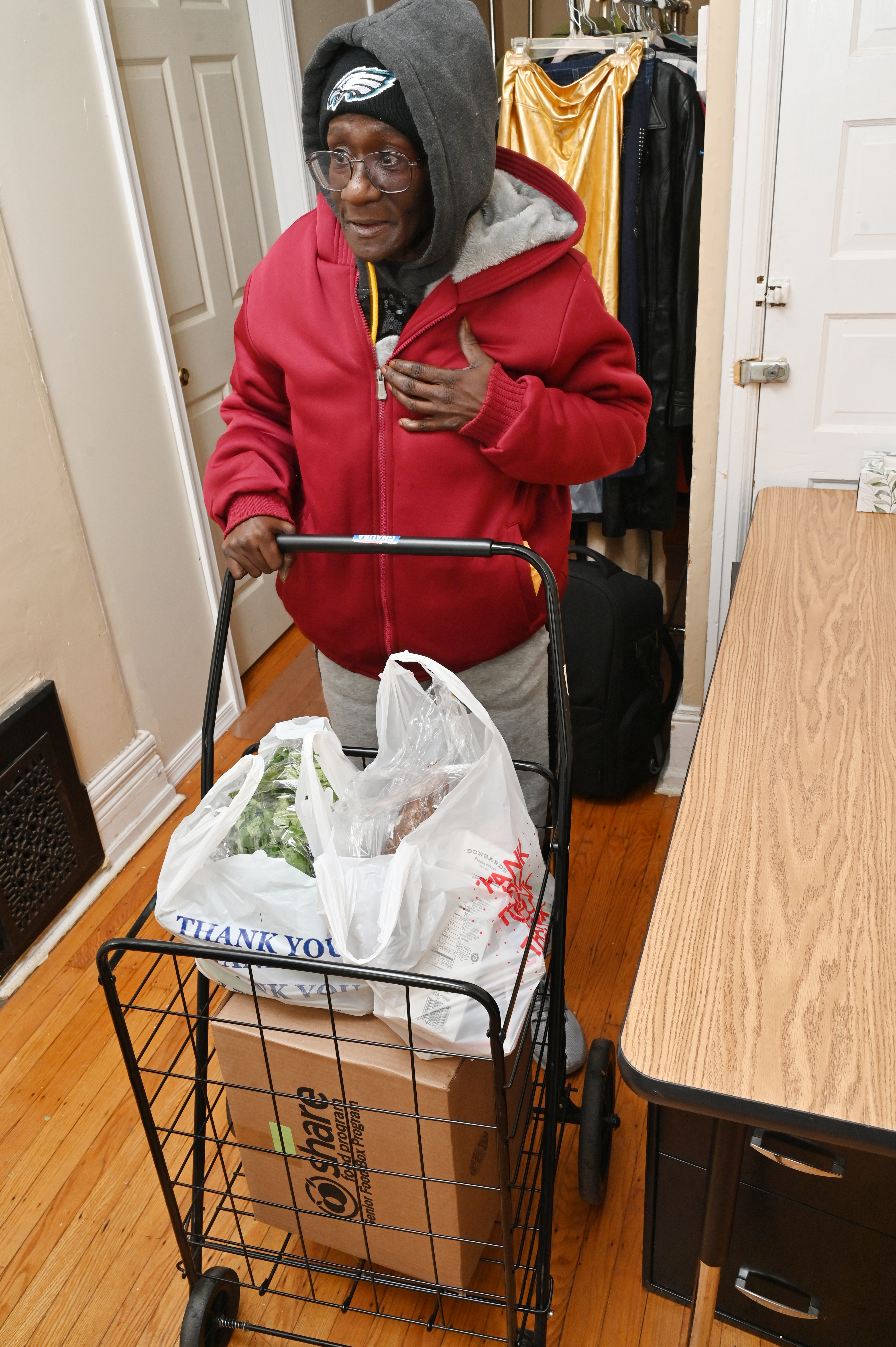
    Leftover coats wind up in JFCS’s mobile pop-up, “Our Closet in Your Neighborhood.” The agency brings a truck loaded with all kinds of clothing, from shoes to coats, and sets up mini boutiques in synagogues, churches, and community centers around the region. Fresh produce is also often available.

    Last month’s coat drive was Brandies’ first as JFCS’s new president and chief executive. She replaces JFCS’s longtime executive Paula Goldstein, who retired Sept. 1 after more than 40 years of service.

    “I’m blown away,” Brandies said. She walked into the synagogue’s community room and almost immediately ended up helping little King James, 3, get zipped into his new jacket.

    His mother, Jessel Huggins, of Strawberry Mansion, brought five of her 13 children to the coat drive.

    As they waited to choose, three of the boys, Shar, 6, Boaz, 7, and Prince Jedidiah, 8, said they hoped for winter jackets themed with Sonic the Hedgehog characters — Sonic and Tails, the fox.

    Sadly, they weren’t available, but at least Boaz and Prince Jedidiah got blue coats — the same color as the hedgehog. Shar landed a gray camouflage one. Their older sister, Shaly, 13, managed to snag her dream coat, a jacket with fur around the hood.

    “This is my first time coming,” Huggins said. “Buying coats for 13 kids is a lot.”

    LaToya Adams, of West Philly, stood in line, hoping she’d find a coat for herself, her daughter, 20, and her son, 7. “We can’t afford coats with food stamps being cut off — and right at Thanksgiving.”

    People wait in line to get into the winter coat drive at Rodeph Shalom synagogue last month.

    “The money I do make has to go to the bills,” she said. “I’m just trying to find a good-paying job. It’s a burden. It feels like you have a weight on your shoulders and you can’t get out of it. We’re trying to survive, and them giving a coat today helps.”

    Brandies came to JFCS after serving as the leader of Abramson Senior Care. The two organizations joined on Oct. 1 to provide more seamless care for older adults and their families in a program now known as Abramson Senior Care of JFCS.

    Abramson had offered more health-based care with JFCS, providing other types of services to seniors, including help with housing and food. “A family can make one phone call” on a 24-hour hotline to access services, Brandies said.

    Sometimes there are emergencies, like a person calling late at night after noticing an elderly neighbor had tried to cook herself a meal and ended up having a minor fire. Usually, though, Brandies said, the calls are from people seeking advice on how to care for an aging relative.

    Brandies, who had earlier careers in law and fundraising, said she became a fierce advocate for older adults in the 10 years she spent at Abramson.

    “People don’t like to think about aging,” she said. “It’s possibly the most universal and least sexy of causes. It’s not as sexy in fundraising circles as donating” to programs for children.

    “Everybody ages and needs help at some point,” she said. “But we’re not educated [as a society] as to the best way to be there.

    “As the percentage of the population that’s aging increases, we have fewer people going into senior care professions,” and there are fewer resources available to help the elderly. Many are aging alone, with no families nearby to help.

    “Seniors don’t want to be infantilized,” she said. “They want to continue to live their lives with as much dignity as possible.”

    This article is part of a series about Philly Gives — a community fund to support nonprofits through end-of-year giving. To learn more about Philly Gives, including how to donate, visit phillygives.org.

    For more information about Philly Gives, including how to donate, visit phillygives.org.

    Jewish Family and Children’s Service of Greater Philadelphia

    Mission: Jewish Family and Children’s Service (JFCS) of Greater Philadelphia strengthens families and individuals across generations and cultures to achieve stability, independence, and community.

    People served: Over 30,000 annually

    Annual spending: $14,899,000 for 2024-2025

    Point of pride: The recent merger of JFCS and Abramson Senior Care (now Abramson Senior Care of JFCS) expands access to comprehensive social and healthcare services for older adults and their caregivers across Greater Philadelphia.

    You can help: We invite individuals, families, groups, corporations, and more to contribute their time and skills to a variety of community-based volunteer opportunities.

    Support: phillygives.org

    What your JFCS donation can do

    • $25 buys a warm winter coat for a child.
    • $50 purchases a grocery store gift card for a family.
    • $100 pays the heating bill for an individual with a disability.
    • $360 subsidizes the cost of therapy for an individual experiencing a mental health crisis.
    • $500 covers medical bills for an older adult.
    • $1,000 helps a family of four pay their rent.
    • $2,500 installs a chair lift in the home of a Holocaust survivor.
  • Empowering Philadelphia’s Latino Communities

    Empowering Philadelphia’s Latino Communities

    The youngest of seven children, Jannette Diaz, 59, grew up a few blocks from Congreso de Latinos Unidos, whose mission is “to enable individuals and families in predominantly Latino neighborhoods to achieve economic self-sufficiency and well-being.” Her professional journey within Congreso spans more than a decade. Before her promotion to chief executive in March 2023, she served for two years as chief experience officer, a role created “to boost the organization’s culture.” Diaz also led the organization’s Health Promotion & Wellness division from 2015 to 2021, overseeing the Congreso Health Center, Esfuerzo HIV/AIDS Program, Latina Domestic Violence Program, East Division Crime Victims Services, and Breastfeeding Program.

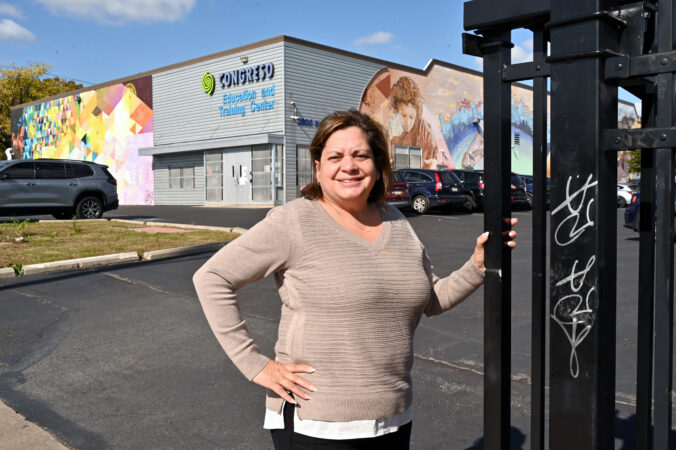
    Diaz leans into the words “Mi casa es su casa” that appear on a mural near the front door of the nonprofit’s office. “We want folks who come in to feel like they’re coming home,” she said. Her forward-thinking leadership of Congreso’s 200-plus staffers is evident in the organization’s achievements. In the past year, the nonprofit has served nearly 14,000 individuals across education, health, workplace, housing, and parenting and family services. Congreso has been recognized with a Top Workplace Award for seven years running.

    Diaz recently served on Gov. Josh Shapiro’s Advisory Commission on Women, where she helped identify and advance solutions for aging with dignity across the Commonwealth. Here, Diaz discusses her upbringing and her advice for young leaders.

    What experiences led you to dedicate your career to social services?

    Growing up, I was always surrounded by family … the essence of learning what community is, the values of giving back, being compassionate — that all shaped me. I got a degree in sociology with a concentration in juvenile and criminal justice.

    I have a soft spot for youth, especially those who are challenged or are either in a dependent or delinquent stream in the court system. That sparked my work. It ties back to leading with heart and knowing I’m helping someone else along the way.

    How has your upbringing influenced the way you lead Congreso?

    I’m the youngest of seven. There was a lot of love in our home, a lot of resilience. Sometimes it was challenging for my parents, but my father was really good at budgeting and ensuring that he tapped into any available services that were in the community if we needed support.

    Education was first and foremost, for all of us. This was a requirement. We didn’t know if we could afford college. We had this saying in Spanish, “Todo se resuelve.” We resolve everything. I was able to learn about opportunities to go to school, and I ended up going to college.

    I’m still working in the very community we grew up in. Congreso has been around for 48 years. My father knew that he could tap into whatever Congreso was offering for services, but he was also really good at being a connector. In the community, [if] someone came into the grocery store [where he worked] and needed something, he would say, “Hey, there’s that program where they offer this. Hey, go down here — they’ll offer you assistance with your LIHEAP [Low Income Home Energy Assistance].” Those are some of the things I learned from him just by listening to the conversations.

    What qualities do you admire in your staffers?

    They’re caring individuals. It doesn’t matter where they sit in the organization. They want to help, whether it’s direct services [to clients] or their colleagues. I work really hard with our executive team to create spaces where they feel they have a voice of influence, that we are all leaders in our own right.

    We host resource seminars, and sometimes those are just [about] understanding ourselves and [learning about] self-care, [and] psychological safety. The work they do is really heavy. Sometimes it could be triggering. We do hire people from our community. There are folks in the community who know [the] people who are coming in to get service. So we try to be mindful and make sure that we invest in them.

    I say to new hires, “Thank you for saying yes to Congreso.”


    Are there particular areas you’re hoping to address in the coming years?

    Economic self-sufficiency [and] mobility [are] key for all of us. When we designed our services we wanted to make sure that we took a holistic approach. We have five core pillars [for] programming: education, workforce development, family parenting services, health, and housing.

    In the housing space, the team supports individuals with preventing [the] loss of homes, like foreclosures, and also supports them in [what] we call “vital living.” [For instance,] we have a tax support site, and we help bring in over a million dollars back [in refunds] into the community almost every year. [The service] is free for folks on the tax site. We also support folks who want to become first-time homebuyers. We take them through counseling and credit building, and we partner with mortgage lenders and banks. Last year, we had 100 individuals purchase a home for the first time here in Philadelphia — and it’s amazing.

    We want to make sure that we are designing and integrating services for greater impact that [will then] scale. Well-being and mental health, we need to explore that. And we don’t have to recreate the wheel; it’s [about] collaboration and partnerships. We have the partnership with PHMC [Public Health Management Corporation]. So what else can we do? We want to strengthen our relationships, and then we want to scale up those programs.

    How are you addressing health and education?

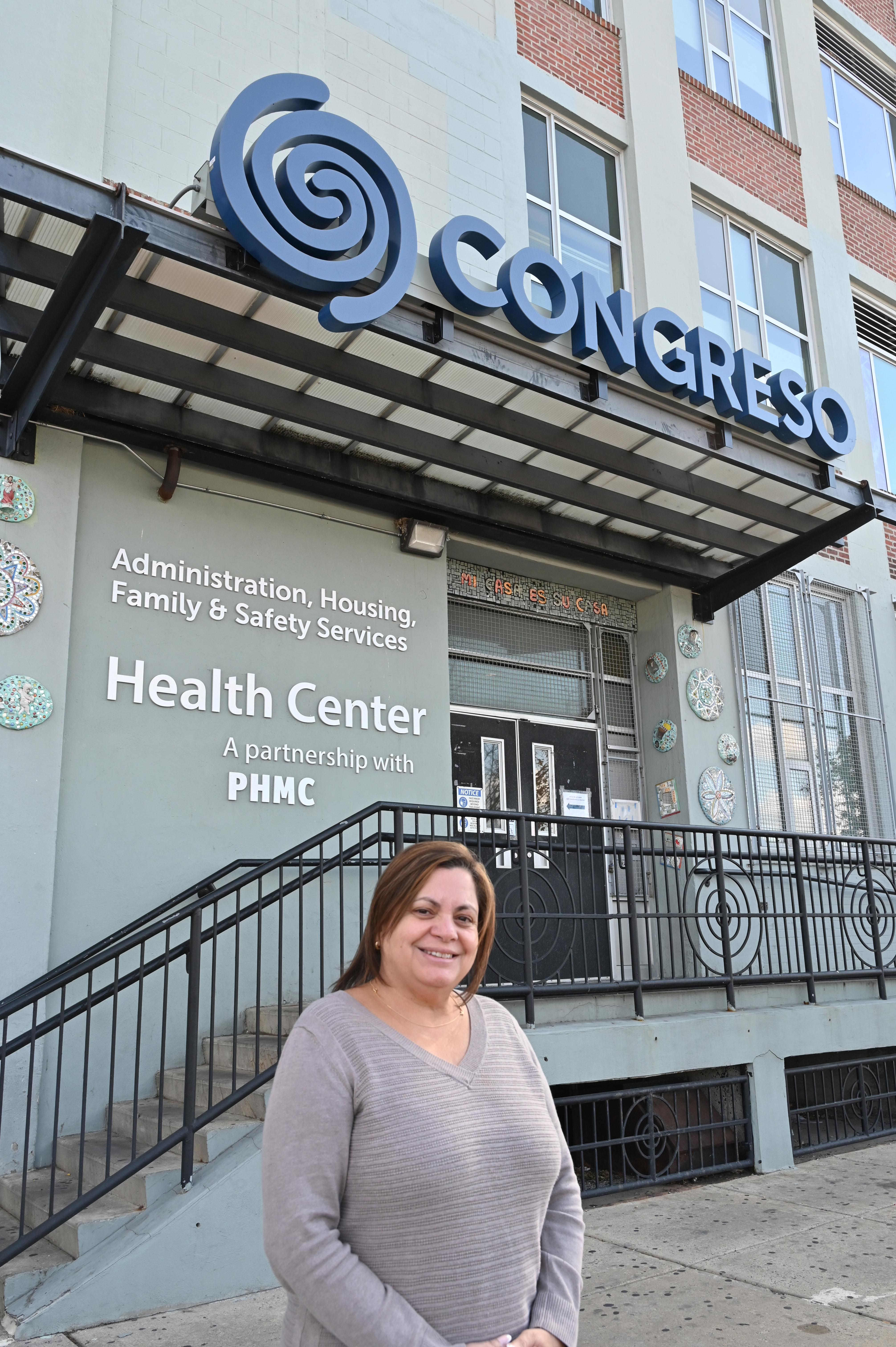
    One of the greatest assets Congreso has instituted in the past couple of years is to bring a health center on site that we operate in partnership with PHMC that serves over 3,000 patients a year in general medical care [and] preventive care. [We] do it in a way where it’s built into the community, where we’re a trusted partner, and it’s really helpful for folks to get care. We have a small panel of pediatricians, and I would like to expand that, but we’re able to provide [care for everyone] from children to adults.

    In education, we provide OST [out-of-school time] services. It’s not just, “Let’s play basketball.” There’s a bit of that, but we have STEM curriculums. We also provide their home tutoring.

    The William Penn Foundation supports our work with two schools where we are [supporting] kindergartners through the third grade with Read by 4th, a program that encourages families to read together. We’re [also] going to be [supporting] the students through a homegrown model that we call Éxito, whose goal is to reduce high school dropout rates and increase graduation rates. The data says that when a child is on track by fourth grade, the chances are better for them to succeed in school [longterm].

    Federal cuts have meant that many nonprofit organizations are losing funding. Has this affected Congreso?

    At this juncture, we are leaning into our reserves. We are heavily government-funded. So we are feeling this every day, compounded by the other [cuts] that are happening nationally with Medicaid and SNAP benefits. This is why it’s so critical to have the ability to fundraise for flexible funding that you can put in reserves and be really fiscally prudent. We did implement a hiring freeze for some roles.

    We have some funding from some of our city contracts and feel confident that as long as we are still getting paid by the city, our runway will take us through this calendar year. But we are still looking at different scenarios should this go into 2026, and I’m sure that we’re not the only nonprofit that will be making some really tough decisions at that point.

    In 2018 Congreso updated its mission, with outcomes tied to its “womb-to-work” service model. Explain the evolution of its mission since its founding 48 years ago.

    It is important that organizations remain agile, remain relevant to their community. We’re here for the community; the community is not here for us. In 2018, we took a look at our mission and a hard look at our data. At that time, we were serving over 17,000 individuals with over 30 programs, and yet only between 10-12% were accessing another service within Congreso. We went on what we now call our “Mission to Impact.” It’s focused on program design, integration, and data, because we need that data to let us know if this is truly working.

    The motivation was [someone] needing a service but having to go to five different places. That’s exhausting. We also took a look at who we were serving and how we wanted to make an impact. That’s when we started saying we need to start from [the] “womb to work” [i.e., offer a range of support to people from pre-infancy to adulthood].

    Explain Congreso’s human-centered design approach. How has it helped transform program outcomes?

    We’re working on becoming a learning institution around innovation. We brought in a consultant who taught us human-centered design [HCD] work. HCD is a problem-solving approach that prioritizes people’s needs, behaviors, and contexts. Congreso applies the technique, called “mapping,” to many of its processes, including intake. We all learned how to map problems. When there’s an issue, we start mapping.

    We’ve developed our own Congreso Human Service Design Toolkit to design our services. We use that to facilitate conversations [with] clients to ensure that what they need aligns with what we can provide. We are really, really intentional now about what we say yes to as an organization.

    For example, we have multiple workforce development programs and what we’re seeing is folks want to get a certification but sometimes what’s happening in their lives prevents them from doing that. We can have case management services support [them] … so that [they] can then focus on working to get that certification.

    What is your greatest wish for the next generation of leaders serving the Latino communities in Philly?

    There’s a lot of pressure, now more than ever. Always be rooted in your purpose, even through the most challenging times. It’s okay to adapt, but you don’t have to assimilate.


    PHILLY QUICK ROUND

    Favorite Philly restaurant? My Philly cheesesteak [place] is Steve’s and my food [place] is Tierra Colombiana.

    You don’t know Philly until you’ve… experienced a live Mummers Parade [on New Year’s Day] and had a real Philly cheesesteak.

    What do you wish people knew about the people who call Philly home? Behind our grit, we have a lot of heart and resilience, and we show up for one another.

    Favorite Philly artist, performer, musician and/or band? Boyz II Men. “A Song for Mama” was the mother-son dance at my son’s wedding.

    What’s one place in Philadelphia everyone should visit? Go up and down North Philadelphia Fifth Street on El Centro de Oro, [the] Golden Block. You will feel and hear (and if you want, taste) the richness of Puerto Rican culture.

    You grew up in the North Philadelphia area. What has changed the most and what is still the same? When I look out my window here, I’ll look to one side and see gentrification: the new buildings. When I look to the other side, I see my childhood. I see the bodegas, I hear the honking and the music. I see that richness of community.

  • In North Philly, Congreso de Latinos Unidos has spent five decades being ‘here for you’ | Philly Gives

    In North Philly, Congreso de Latinos Unidos has spent five decades being ‘here for you’ | Philly Gives

    The litany of horrors never stopped:

    For more than an hour, one domestic violence survivor after another stepped up to the microphone with tales of pain and resilience.

    “When people get close to me, I flinch because I’m afraid they are going to abuse me,” said one woman, speaking in Spanish, her words translated into English by a staffer at Congreso de Latinos Unidos, a nonprofit social services agency in North Philadelphia that provides help with housing, education, medical needs, workforce training, and after-school activities for youngsters.

    Congreso is celebrating its 48th year in operation, and for 30 of those years, it has maintained a program to support people dealing with, and trying to escape from, domestic violence.

    “I was never allowed to go outside. He would show up at my job,” the woman continued in a room decorated with purple balloons, the color symbolizing domestic violence. Each year, Congreso honors survivors and mourns, in a few moments of poignant silence, the people who lost their lives to domestic violence. Last year, in Pennsylvania, there were 102.

    “He would bruise my face so I couldn’t see my family. I worked in a nightclub, and he would drag me out … No one wanted to get involved,” she said.

    No one, until Congreso did and helped relocate her to a new home.

    Jannette Diaz, president and CEO of Congreso, outside the group’s offices in North Philadelphia.“We’re all feeling the crunch,” she said of recent funding challenges.

    “It takes a lot of courage to come up here and share your story,” Ramona Peralta, Congreso’s director of family wellness, said as the woman finished speaking. “We’re very proud of you, and we are here for you all the way.”

    In the main room, the mood vacillated between the heavy silence of shared pain and the cheerful clamoring of babies. Later, there was music, and before, a friendly lunch of rice with pork and chicken.

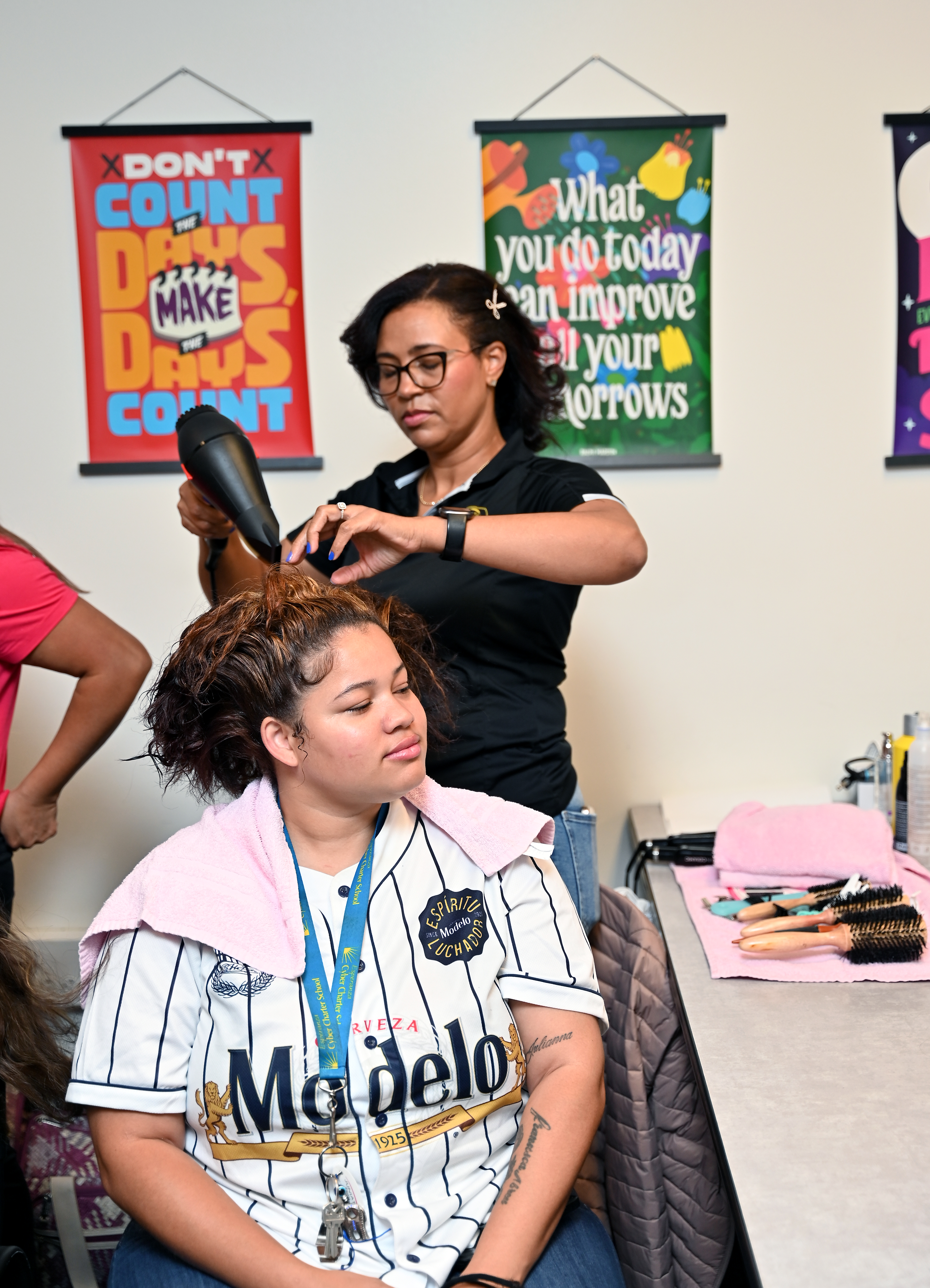
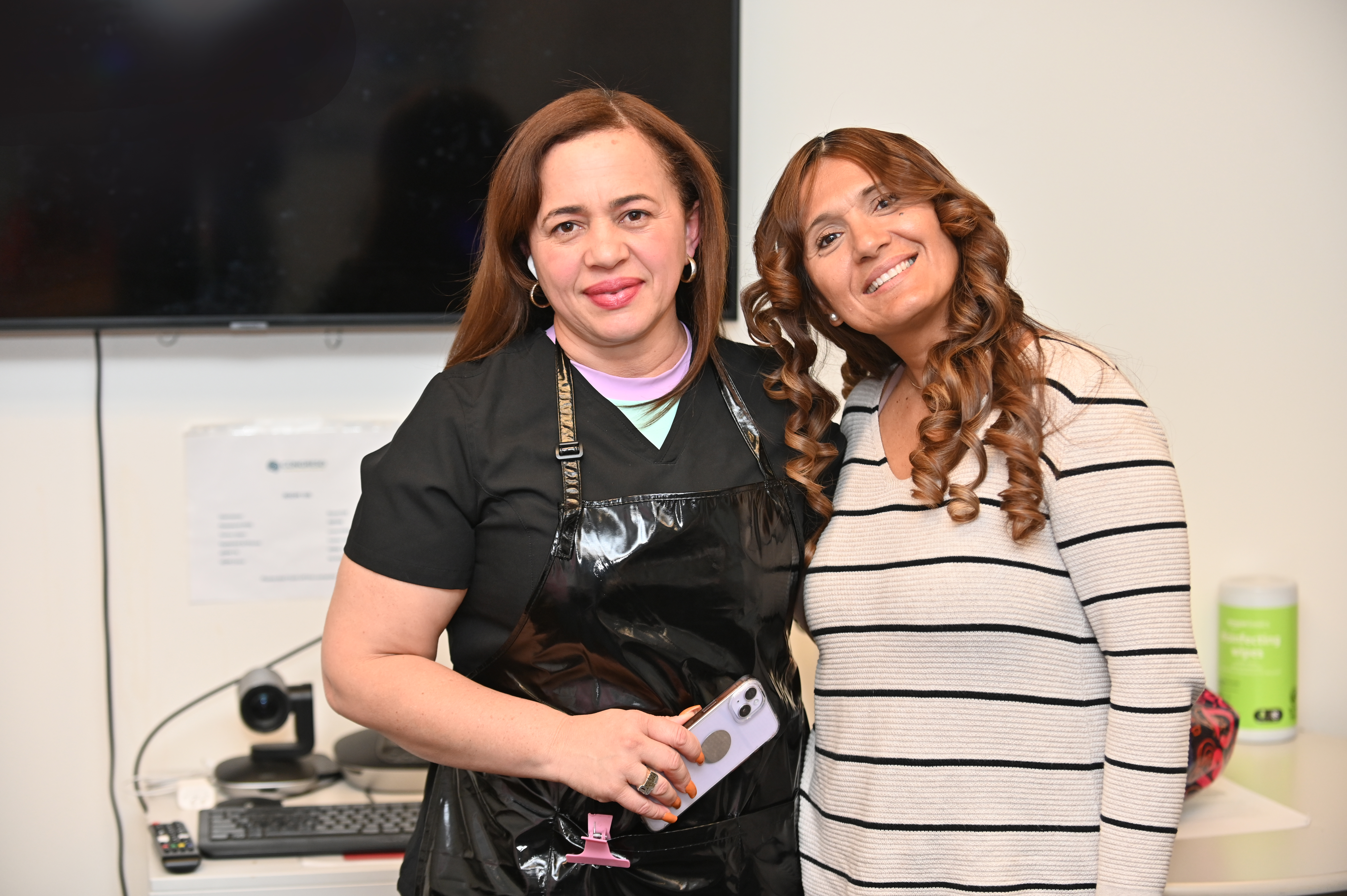
    Across the hall, members of the Asociación de Cosmetologas de Pennsylvania offered free hairstyling to the women who attended the celebration.

    Congreso, as part of its program to teach police, educators, social workers, and others to recognize signs of domestic abuse, had trained this group, as well, and because of the intimacy of their work, the stylists were uniquely positioned to do so. More than most, beauty salon operators could readily see the bruises hidden under hair and makeup. They could feel the cuts and scars on the scalp. And then there were the confidences confessed during shampoos and stylings.

    Wanda Gómez, of the Blessings of God beauty salon, styles Franyeimi Abreu’s hair at Congreso’s offices.

    Among the volunteers was Wanda Gómez, owner of the Blessings of God beauty salon in Northeast Philadelphia. “Thank God, I’m no longer in that situation,” she said, speaking through a translator. But because she survived domestic violence, she said she’s in a better position to help others. She tells them about Congreso.

    Elisa Zaro Doran, owner of Dominican Divas Beauty Salon in Olney, twisted a strand of hair around a curling iron as she styled Maria Rodriguez’s long, dark hair. Like Gómez, Doran survived domestic abuse. “The first time, when he hit me, we were having a lot of problems, so I thought it was normal,” Doran said.

    He’d even come into her beauty salon and hit her. “My clients would try to defend me,” she said. Eventually, when her son tried to protect her, she knew she had to take the necessary steps to get away and be safe — for herself and her children.

    Rodriguez was there yesterday to support her daughter, who survived domestic violence, but still lives in fear — which is the reason she would only agree to be interviewed if her name was not used. “He told me that it doesn’t matter how many years — he will come and burn down my house with me in it,” she said.

    Hairdresser Domaris Rodriguez shows her artistry on Raquel Mendez’s hair.

    Rodriguez’s daughter turned to Congreso for help after Thanksgiving a few years ago. Her oldest son told her that day that he would no longer live with her, because every night he dreamed of killing his father. He couldn’t stay and watch the beatings or watch his father, in a rage, destroy the furniture in their home.

    “I don’t know how many dining room tables I bought,” the daughter said.

    On that Thanksgiving, she told her husband he had to leave. It was the end of the relationship, but the beginning of a new nightmare. He followed her to work and even stood in the pharmacy, watching her as she managed the office.

    Counseling at Congreso helped her name her situation for what it was — abuse. “They made me see that I was in danger,” and that what she thought was normal was anything but. In group sessions, she learned a critical lesson: “I understood that I wasn’t the only one. They made me know it wasn’t my fault.”

    She’s still afraid to leave her home. “I’m going through anxiety, PTSD. It still affects me.”

    As she watched her mother get her hair styled, Rodriguez’s daughter hoped her mother would absorb a lesson from the stories she would hear. The daughter wanted her mother to understand the intergenerational legacy of abuse because she believes her mother also suffered from domestic violence.

    That abuse, Rodriguez’s daughter believes, impacted both her and her sister, whose abuser stopped hitting her only when he thought she was dead. She teaches her sister lessons learned from counseling at Congreso. Counseling includes helping women develop a safety plan.

    Rodriguez’s daughter brings her own little girl, 13, to Congreso’s counseling groups for children impacted by domestic violence. “I’m saving my sister’s life, and I’m saving my daughter’s life,” she said. As for her sons, “I’m not raising abusers,” as she reminds them to respect their girlfriends.

    Last month’s celebration in honor of the survivors of domestic abuse took center stage that day at Congreso, but Congreso’s programming benefits many more people in the community, 75% of whom are Latino, said Jannette Diaz, president and chief executive.

    Diaz grew up a few blocks from Congreso, and her father relied on the nonprofit for help with the family’s utility bills.

    These days, she spends time working on strengthening relationships with fellow nonprofit agencies and with Congreso’s friends in the donor community.

    “We’re all feeling the crunch,” Diaz said, describing a double whammy in mid-October of the state’s failure to pass a budget as the national government moved into another week of shutdown. Congreso gets much of its funding from government reimbursements for services provided.

    At Congreso, “we’re very mindful of our spending. So far, we’re continuing to provide services at 100%, but there’s only so much we can do, tapping into our reserves and our line of credit.”

    “Sometimes it’s heavy, but I’m also hopeful,” Diaz said, explaining that the twin state and federal budget crises required a sharper focus even as demand for services increases. Changes in Medicaid regulations may impact finances at Congreso’s health center, for example.

    But, she said, donors can be confident their dollars are being spent wisely.

    Why? Because as nonprofits come and go, Congreso has survived, thanks to providing trauma-informed and culturally responsive services that are informed by data to its clients, Diaz said.

    “We’ve been around for 48 years, and there’s a reason for that. And that is how we operate within our community,” she said. “We forge a trusting relationship, and we try our best to do what they need. It’s important that we make sure our programs have impact.”

    And that impact, Diaz said, goes beyond help given directly to clients. When Congreso assists a first-time home buyer in qualifying for and landing a mortgage, that homeowner becomes a Philadelphia taxpayer, benefiting the community.

    When someone like Gary DeJesus-Walker earns a CDL truck-driving license through Congreso’s workforce training program, he can go on to build a trucking business. Now he employs three people.

    “Congreso — they changed my life,” he said. “From trucking, I started two other companies.” With Congreso’s CDL program, “if you need a second chance, you can have one for the rest of your life. This is a way you can provide for and feed your family, forever.”

    The stories are an inspiration to Diaz.

    “Even in this season,” she said, “we can strategize and design services that our community needs. We’re not paralyzed by this crisis, and in terms of moving the needle forward, we’re progressing.”

    This article is part of a series about Philly Gives — a community fund to support nonprofits through end-of-year giving. To learn more about Philly Gives, including how to donate, visit phillygives.org.

    For more information about Philly Gives, including how to donate, visit phillygives.org.

    About Congreso de Latinos Unidos

    Mission: To enable individuals and families in predominantly Latino neighborhoods to achieve economic self-sufficiency and well-being.

    People served: 13,435 unique clients served in fiscal year 2025.

    Annual Spending: $30 million

    Point of Pride: Trademarked Primary Client Model that drives Congreso’s bilingual and bicultural approach to delivering services in a client-centered, data-informed, and culturally responsive way, whether a community member is receiving support in education, workforce development, housing, health, or family services.

    You can help: Become a monthly donor, a member of Congreso’s Corporate Advisory Council, or a volunteer in the Congreso Cares Program. Volunteers help with participating in program initiatives like Congreso’s free tax preparation, supporting program and agency events, and assisting with fundraising.

    Support: phillygives.org

    To get help:

    866-723-3014 (Philadelphia Domestic Violence Hotline)

    215-763-8870 (Congreso)

    What your Congreso donation can do

    • $25 can help provide food baskets to individuals living with HIV.
    • $50 can help cover past-due utility bills and prevent shutoffs for a family to stay safe in their home.
    • $100 covers an immunization visit at the Congreso Health Center for a child entering the school system.
    • $200 provides a new uniform or professional wardrobe for a community member entering the workforce.
    • $250 provides a semester of after-school programming for a high school student.
  • How Share Food Program is Leveling the Playing Field

    How Share Food Program is Leveling the Playing Field

    George Matysik, executive director of Share Food Program, paced behind a standing desk in his North Philadelphia office. In the background, the hunger relief program’s warehouse was visible through a window. “There are two slogans that we have around here. One is that food is a human right, and the other is that hunger is solvable,” he said. “It should not be a political question whether or not to feed the hungry.”

    Founded nearly 40 years ago, Share Food Program provides access to food, education, and advocacy through a partner network of community-based organizations and school districts. A native and current resident of North Philadelphia, Matysik has a long history of service in the area. Here, he talks about his roots in the city, being part of a community, and being called to service.

    Walk me through your career journey from Philabundance to the Philadelphia Parks Alliance and now, Share Food Program. What connects all of these roles for you?

    As a high school student [at Mercy Career and Technical High School], I would come over and volunteer here at Share Food, and that’s where I got to know my predecessor, Steveanna Wynn. When I graduated with a degree to be an electrician, I also graduated with a much deeper understanding of service.

    After graduation, I ended up getting a job at University of Pennsylvania as a janitor. Once I got there, I found out that I could go to school in the evenings … and get my degree in urban studies. I wanted to learn more about how cities work, what nonprofits do in that space, and politics — all of that blending together.

    After a chance meeting while cleaning a professor’s office at 6 a.m., I went to work on a congressional campaign [for Joe Sestak]. I worked for him for a couple years when he was a congressman. From there, I met the then-CEO of Philabundance and I started their government affairs department.

    I was doing that up through 2014 and then went to work at the Philadelphia Parks Alliance until my predecessor here at Share Food (a mentor from my childhood days) announced that, after 31 years, she was going to be retiring. My first [thought] when I found out was, “God bless a sucker that tries to fill her shoes.” But as I thought more about what Share Food Program means to the community, I [felt] invested in making sure it was able to move forward in an important way. [I] ended up reaching out and getting the job.

    How did these experiences shape how you approach food insecurity and your work at Share Food Program?

    I’d say I come at this work with the lens of, “How do we alleviate poverty in our city?” But using food as the gateway to be able to do that. It was so important to me to figure out how we, in the richest country in the history of the world, help relieve the poverty that we have. Not only here in Philadelphia, but across the country.

    Is it easier to bring people to the political table through food?

    Yes, but I would say that it’s bigger than that. It’s about equity and how we can close the gaps between the haves and the have nots. There are so many societal challenges that we deal with — addiction or crime or things like that — where there isn’t one single easy answer. But with our work, it’s actually really easy, and that’s the frustrating part. It’s literally just getting the resources and food to the folks who need it, and that should be an easy thing to do.

    But sadly, we are living in a time where the incredible greed within this country has prevented that from happening. And so we have this widening gulf between the haves and the have nots.

    Food is one of the great uniters of cultures and people. It’s also a gateway to communicate all of the other services we can use to help pull people out of poverty. So with many of the organizations that we provide our food to, it’s not just, “Here’s your bag of food, see you next week.” It’s more like, “Here’s your bag of food, and here’s an array of other services, education, programming.”

    Since you took over in March 2019, Share Food’s staff and cold-storage capacity has grown five-fold. What made that possible?

    It wouldn’t have happened without the foundation that my predecessors built here and within the city. In the time that I’ve been here, it’s really been about engaging the broader Share Food community, whether that’s our volunteers, our board, or our staff, who have been the ones to lead all of this. My goal is to bring some of the resources together so that we can do all of that work, but they’re the ones who really have been able to execute it.

    There have been setbacks along the way. Some of those have been external threats, like the pandemic or what we’re seeing right now with the federal government pulling resources away from aid organizations.


    Talk to me about how the pandemic changed the way Share helped the community.

    The food insecurity rate just exploded in that early part of the pandemic. There were many folks who wouldn’t present as food insecure but felt that way for the first time in their lives because they went to the grocery store and they couldn’t get exactly what they wanted. So many of the folks that we serve live that life every day. The food might be on the shelves, but they can’t afford what’s there.

    We were fortunate here at Share. We’d done a $1.5 million food buy in late February in preparation for the pandemic. So while some folks were going to the grocery store and finding empty shelves, our warehouse was bursting at the seams.

    And we were really able to quickly react to all of the logistical challenges. In normal times we served about 7,000 seniors in senior centers or senior-only high rises, but by March 2020, many of them closed their doors to the public. So we called those seniors at home, and we said, “Hey, what if we got you a home delivery?” We had our volunteers step forward and start delivering groceries. It grew so much in such a short period of time that we eventually brought DoorDash in as a partner. Now our location here at Share Food is the largest single DoorDash distribution location in the country. That really rapid scaling happened with government support.

    How did you see government support evolve?

    Throughout the early part of the shutdown, Washington started to handle the health and economic crisis in a bipartisan way: extending unemployment benefits, additional SNAP benefits, and the child tax credit. It was an inspiring example of what can happen when government and nonprofits work together toward the common goal of helping to close that gap again between the haves and the have nots. You had all of these resources go to the folks who we serve and folks that need it the most. By late 2020 and early 2021, we saw the biggest one-year reduction in poverty since 1964, when Lyndon B. Johnson launched the war on poverty.

    Sadly, just as this bipartisan unity was helping us get to the root of hunger, it was clear that the economic crisis was staying with us. Washington pulled back so many of those resources. By January 2022, we started to see [poverty] pick up again. It was maybe just a percentage or two [increase] in the first month, but now we’ve seen about 120% increase from 2022 to 2025, because many of those resources have been pulled from folks.

    And now on top of that, this year has brought additional cuts to our organization and by extension, the folks we serve. We had about $8.5 million of food and funding eliminated in March from our organization by the USDA under the Trump administration. On top of that, the so-called One Big Beautiful Bill pulled additional resources from SNAP benefits, Medicaid, and other programs. And [the] government shutdown [earlier this year] impacted WIC and SNAP. All of those compounding challenges are really what keep us from being able to do the work in the way that we know it needs to be done. And that’s why we rely so heavily on our community, on our donors to step forward to help fill those gaps at a time when the government’s investment in the working class is receding.

    Is there anything you wish people would take away from this collective experience?

    When people are using the working class as a political football, ultimately that means that our fellow humans aren’t getting food. And I do wish that we didn’t look at folks as red voters or blue voters, but as human beings. So many in every political spectrum need basic assistance to put food on their table, to put a roof over their heads.

    What do you find important about living in the community you serve?

    I live within a mile of Share Food. For me, the work that I do here in this neighborhood is all about this community and my home. It matters when one community can come together and show other communities how it can be done.

    Change doesn’t happen in Washington — it comes to Washington: it comes from Selma, it comes from Stonewall, it comes from Ferguson, it comes from small communities that folks might not have even known about until they organized.


    PHILLY QUICK ROUND

    What’s your favorite Philly food splurge, and where do you get it? Georgian Bread up in the Northeast. When I go there, I order everything on the menu.

    Favorite Philly small business? Uncle Bobbie’s is the bookshop that I frequent the most.

    What sports team do you root for? I would say the Sixers are my “live and die.” The Phillies are a very close second.

    What do you wish people knew about the people who call Philly home? I think we get a rap for being a little tough; we are actually, deep down, kindhearted people that care.

    Who’s the greatest Philadelphian of all time? I’m reading a lot about the Reconstruction Era in Philadelphia right now, and Octavius Cato was a young Black man who was an incredible athlete and political organizer who was murdered on Election Day in mid-October 1871 for [his] organizing work.

    Who is your favorite Philadelphia born artist or performer? Ram Squad was my [favorite] hip hop group growing up. They were North Philly, and that was just raw ’90s Philly hip hop, and I loved them.

    What do you do for fun around Philly? I eat a lot of food and then I try to run off the calories.

    Do you have a mental health run recommendation? Forbidden Drive in Wissahickon Trail.

    What is one place in or around Philadelphia you wish everyone would visit at least once? Independence Hall. I’m going to get emotional if I elaborate too much. I think that the two founding documents that were written in Independence Hall are more important now than they ever have been. And I think it is a wonderful opportunity for a reminder for all Americans of what this country truly was founded on.

  • As demand soars and resources dwindle, the Share Food Program stays focused on its mission | Philly Gives

    As demand soars and resources dwindle, the Share Food Program stays focused on its mission | Philly Gives

    To this day, George Matysik, executive director of Share Food Program, can’t bite into a South Indian dosa without remembering a daily act of kindness that mattered to him when he was a young man, a paycheck away from poverty.

    When he would arrive for his 6 a.m. shift as a housekeeper at the University of Pennsylvania’s engineering school building, the engineering school’s librarian would hand him a homemade dosa, a thin crepe redolent with the warm smells of curry and potatoes.

    “My stomach was growling by then,” he said, sitting in a warehouse full of food ready to be packed for the nearly three million people who rely on the Philadelphia nonprofit for food.

    “The moment of her handing me that dosa, I felt like I was going to be OK,” he said. Matysik, who graduated from Mercy Career and Technical High School across the street and down the block from Share’s main warehouses near Henry, Hunting Park, and Allegheny Avenues, went on to earn a degree in urban studies from Penn.

    “I felt supported,” he said. Now, Matysik leads an organization that supports people who are missing meals and are worried about getting their next ones.

    Look, Matysik said, society has many problems, and most are difficult to solve. Homelessness is complicated. Addiction grips its victims in its relentless stranglehold. “They don’t have simple solutions,” he said.

    “But with hunger, it is simple. It’s getting food to the people who need it,” he said, like the dosa that began his day of washing floors and cleaning toilets at Penn.

    “It’s frustrating to me that in the richest country in the world, a food program like Share has to exist at all,” Matysik said. “Food is a human right, and hunger is solvable. We have the resources in this country to eliminate food insecurity, and we can do it in Philadelphia if organizations like Share can get the resources.”

    But it’s daunting.

    Jimmette Hughes, a volunteer at the Canaan Baptist Church’s Family Life Center, which distributes food contributed by Share.

    Since the start of President Donald Trump’s second term in office in January, Share’s funding from the federal government has been cut by $8.5 million, or about 20% of the nonprofit’s annual expenses.

    Also, the cost of the food Share buys wholesale by the pallet has risen. The increase in food costs will come as no surprise to grocery shoppers around the nation, Matysik said. “We can all see our receipts.”

    Even as Share’s resources are being depleted, demand for the food it provides is increasing. Share distributes food to nearly 400 community partners — religious groups, food pantries, neighborhood organizations — and all of them are telling Share that more and more people are coming for food.

    Community partners report that the number of new families or individuals registering to receive food has increased 12-fold. For example, in the past, a community partner might register five new families or individuals a week. But in late October and early November, with the government shutdown and the delay in government SNAP food benefits, that number might have risen to 60.

    And more people than ever are coming to receive food. Organizations that served 100 people or families on their food distribution days were seeing 150 in line, Matysik explained.

    “It’s making it more and more challenging for families to get the resources they need,” he said.

    Patricia Edwards understands. When Edwards, a retired security guard, opened her refrigerator on Veterans Day in mid-November, she saw one box of powdered milk. That was it.

    Supplemental Nutrition Assistance Program benefits had provided barely enough in the past, but with all the back-and-forth during the shutdown, her benefits weren’t available. “I’m looking at a bare cabinet and a bare refrigerator,” she said.

    Patricia Edwards picks up food, including a Share box of food in her cart, at the Canaan Baptist Church’s Family Life Center.

    The only reason Edwards had anything to eat leading up to Veterans Day was that a neighbor stopped by with some prepackaged meals.

    “I didn’t know what to do. I didn’t know where to go,” she said, “but a neighbor told me about this.”

    So, on that cold November day, Edwards walked a few blocks from her home in Germantown to the Canaan Baptist Church’s Family Life Center, hoping she could get some groceries at its weekly food pantry. “I need some food in the house,” she said.

    She wound up with a box of food from Share and two bags of groceries filled with tuna, noodles, cereal, and vegetables.

    “It’s a blessing,” she said.

    Of course, those blessings cost money.

    Share pays $12,000 to $14,000 a month for electricity to keep its warehouses running. Each tractor-trailer-sized truckload of food costs $40,000. Each industrial-sized freezer costs $800,000, and Share bought three of them in the last two years.

    Three years ago, Share expanded into two warehouses, one in Ridley Park in Delaware County and the other near Lansdale in Montgomery County, the better to serve people in Philly’s surrounding communities.

    Share needs money for forklifts, for payroll, for trucks. Funding pays for food, of course, but it’s also necessary to bankroll the infrastructure required to move not just boxes of food, but tons of it, to the people who need it. Share pays drivers to deliver food to homebound seniors. Even that’s a cost.

    Share also has government contracts to provide school meals to 300,000 kids per day in public and charter schools in 70 districts, including Philadelphia’s public schools.

    It’s a source of revenue, “but we lose money on it,” Matysik said.

    Beyond that, Share runs gardens and greenhouses, which serve both as food sources and educational laboratories for young people.

    Years ago, Matysik was one of those young people crossing the street from his high school to pack boxes as a Share volunteer.

    These days, his work at Share involves budgeting and fundraising — balancing demand against resources.

    “I’ve never been more disappointed in the American government,” he said, “And yet, I’m inspired every day by the American people stepping up to support organizations like ours.”

    This article is part of a series about Philly Gives — a community fund to support nonprofits through end-of-year giving. To learn more about Philly Gives, including how to donate, visit phillygives.org.

    For more information about Philly Gives, including how to donate, visit phillygives.org.

    About Share Food Program

    Mission: Share Food Program leads the fight against food insecurity in the Philadelphia region by serving an expansive, quality partner network of community-based organizations and school districts engaged in food distribution, education, and advocacy.

    People served: 2,901,243 in 2024

    Annual spending: $42 million, including $25 million distribution of in-kind donations and $6 million to purchase food.

    Point of pride: In 2024, Share Food Program supported nearly 400 food pantry partners across the region, provided more than 6,500 30-pound senior food boxes each month, ensured over 300,000 children had access to nutritious food every day through its National School Lunch Program, and rescued and redistributed nearly six million pounds of surplus food. Altogether, Share distributed 32,214,873 pounds of food.

    You can help: Volunteer your time packing boxes, rescuing food, or make calls from home to help coordinate senior deliveries.

    Support: phillygives.org

    What your Share donation can do

    • $25 supports seeds for produce growth and upkeep at Share Food Program’s Nice Roots Farm.
    • $50 feeds a school-age child for a week.
    • $100 fuels Share’s ability to transport millions of pounds of emergency food relief a month.
    • $250 nourishes a family of four for a week.
    • $500 enables Share to deliver 30-pound boxes of healthy food to thousands of older adults each month.