Tag: Philly Gives

  • At Project HOME, providing shelter is just one link in a chain that restores dignity and offers hope | Philly Gives

    At Project HOME, providing shelter is just one link in a chain that restores dignity and offers hope | Philly Gives

    As charming and ebullient as Nephtali Andujar is (lots of hugs, compliments, and gifts of his homemade pottery), the 61-year-old is also pretty blunt about why people should give to Project HOME, one of the city’s largest nonprofit housing agencies.

    Because of Project HOME, said Andujar, who spent years living on the streets, he is no longer desperate — desperate to get money to feed a heroin addiction, desperate to scrape $5 together to pay someone to let him drag a discarded mattress into an abandoned house for a night’s sleep out of the rain.

    “It’s not just giving someone an apartment,” said Andujar, who sheepishly described a past that included stealing cars and selling drugs. “It’s the snowball effect.

    “You are not just helping the homeless,” he said. “You are helping the city. You are helping humanity.”

    In the agency’s name, the letters HOME are capitalized, because each letter stands for part of the multipronged approach that Project HOME takes in addressing homelessness and combating poverty for the 15,000-plus people it serves each year.

    There’s H, for Housing — not only housing in the literal sense, but also in the teams of outreach workers who comb through the city’s neighborhoods looking for people like Andujar. One outreach worker found Andujar in 2021 at a critical moment in his life — clean, just out of the hospital for liver treatment, and back on the streets of Kensington ready to begin anew.
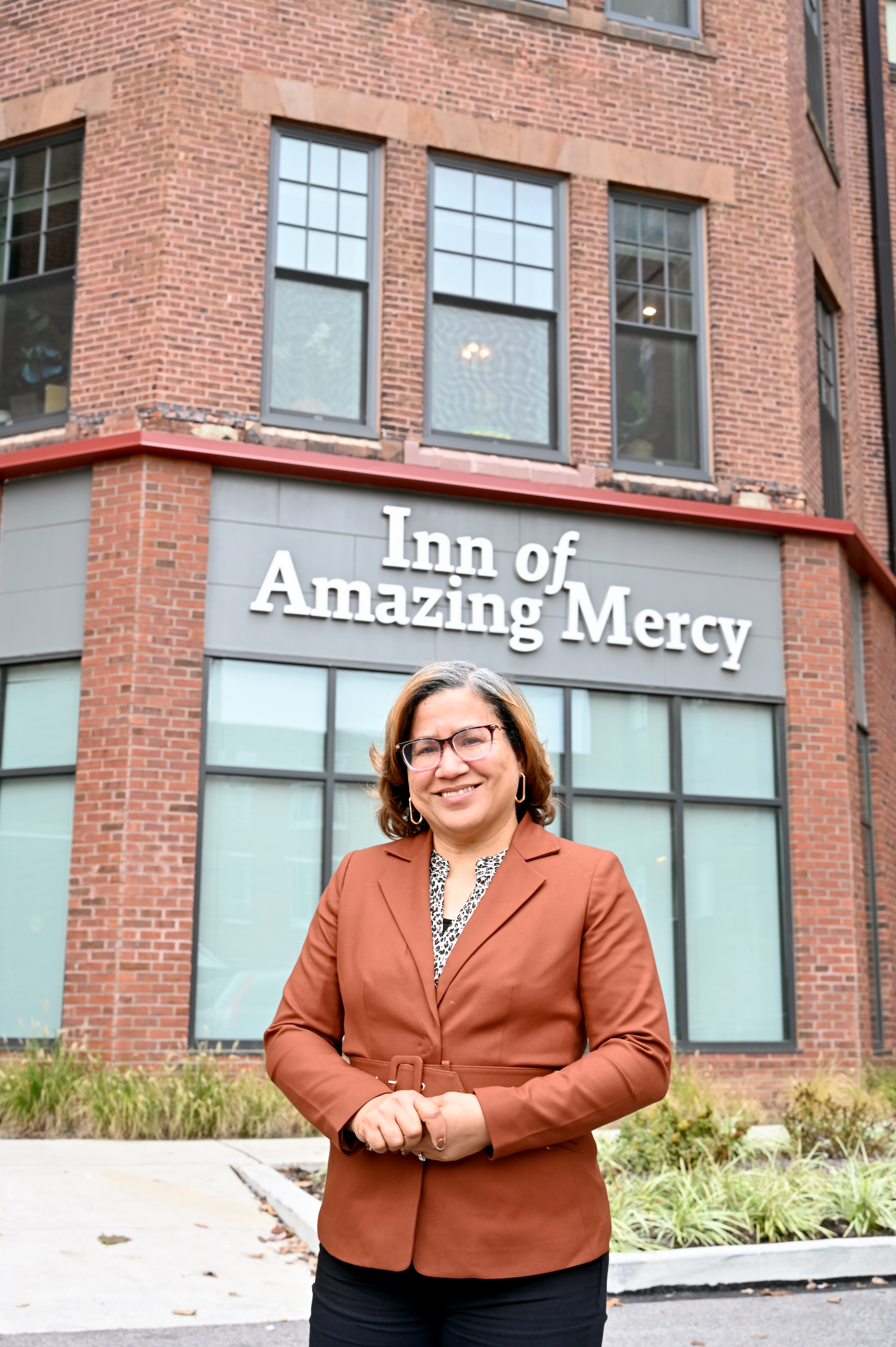
    “We know we have to do the most we can to preserve these resources that we’ve come to rely on,” says Donna Bullock, president and CEO of Project Home.

    For Andujar, it was a race. What would find him first?

    Would it be heroin, as it had so often been in the past? It was tempting. It’s painful being on the street — cold, hungry and dirty, ashamed and alone. “When you do heroin, you don’t feel the cold. It kills the hunger,” he said. “When you use the drugs, you don’t have to suffer for hours. Heroin numbs you.”

    Instead, though, it was the outreach worker — someone who had been through Project HOME’s recovery program — who plucked Andujar off the street in the nick of time and took him to a shelter.

    A year later, that same outreach worker helped Andujar move to his own room at Project HOME’s Hope Haven shelter in North Philadelphia.

    “You get tired of the streets. They were killing me,” Andujar said.

    Next Andujar found Project HOME manager JJ Fox, who helped him get a birth certificate and other documents, and arranged for him to stay. But he needed more than a warm bed.

    The problem with getting straight after a heroin addiction, Andujar explained, is finding a new purpose and direction. For so long, life was focused on a repeat cycle of getting the next fix and then becoming numb to pain while it was working.

    So when he got to Project HOME, he needed a new direction, which is where both the O and E in HOME came in for Andujar.

    “JJ Fox gave me direction,” he said, and so did Project HOME employment specialist Jamie Deni.
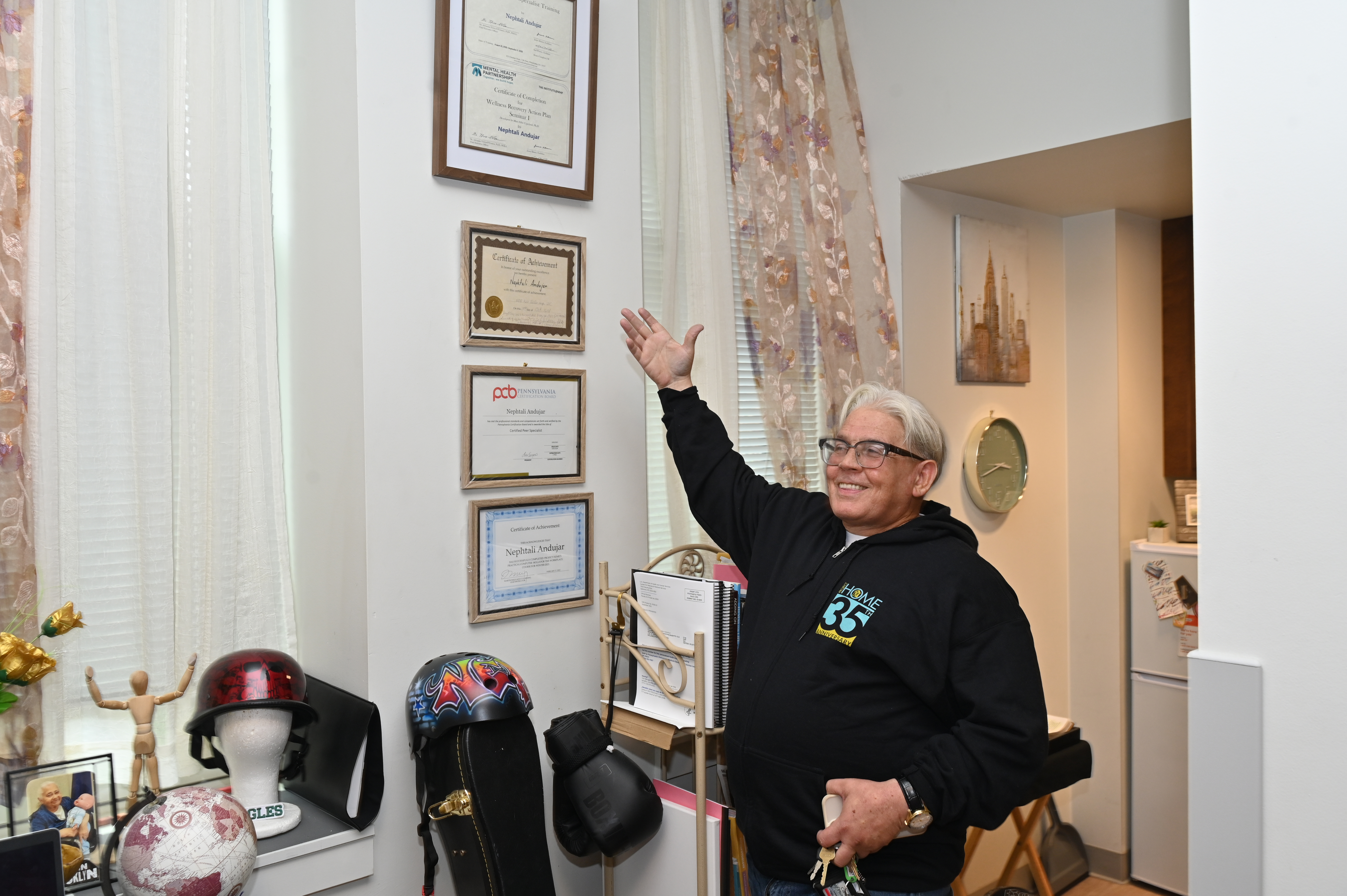
    Training certificates cover a wall in Nephtali Andujar’s studio apartment in Project HOME’s Inn of Amazing Mercy in Kensington.

    The “O” in HOME has to do with Opportunities for employment. Certificates cover one wall in Andujar’s studio apartment in Project HOME’s Inn of Amazing Mercy, a 62-unit apartment building and offices in a former nursing school dormitory in Kensington. He can point to his accomplishments in computer skills, barbering, and training as a peer specialist to help others the way the outreach worker helped him.

    But Andujar is not in good health, as vigorous as he appears. His addictions will someday exact their price, even though with cirrhosis of the liver, he is already living years beyond what his doctor predicted.

    Full-time work is not an option. So Andujar is part of the “E,” as in Education. Deni helped him get a grant to take art classes at Community College of Philadelphia. She helped him understand CCP’s education software so he could turn in his homework.

    Project HOME offers classes in graphic design, music production training, ServSafe food handling, forklift and powered industrial trucks certification, and website building, among other courses.

    The M stands for Medical. Project HOME doctors, nurses, and other health practitioners treat 5,000 people a year, both in a fully equipped health center and by sending medical teams into the streets, caring for people, literally, where they live.

    “My dad always told me that you need three things — housing, food, and love. You get all that here,” Andujar said.

    And for him, it goes beyond that. During a stable period in his life, Andujar had a partner and a child. His daughter is now 14 and living with her aunt in New Jersey. Her mother, who was also stable for many years, fell into addiction but is clean now. She is living in another Project HOME apartment.

    Like Andujar, Omayru Villanueva, 49, another resident at the Inn of Amazing Mercy, recalls her first night of homelessness.

    She remembered a cold slushy rain.

    She remembered sweeping every corner of her house, determined to leave it clean, no matter what. Her husband had been convicted and jailed for a federal crime. She couldn’t make the payments on the house, so she sold or stored all of her belongings and prepared to leave.

    On her last morning at home, she and her school-age twin sons walked out the door before the sheriff came. Her older daughter was able to find a place in a shelter. Her second daughter, just under 18, said she was living with a boyfriend, but it turned out that she had been trafficked.
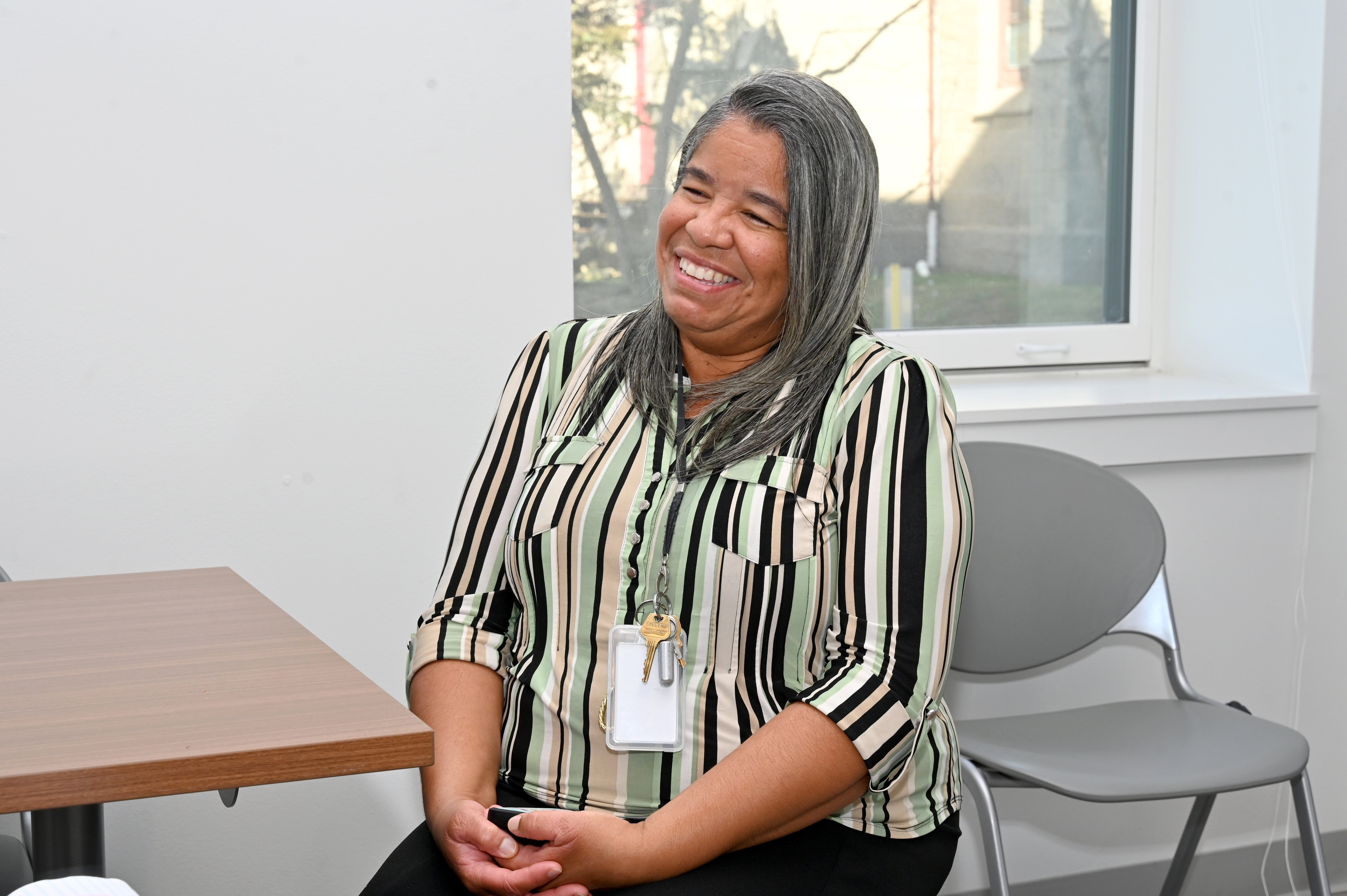
    “There’s a sense of dignity and respect when you have your own place,” says Omayra Villanueva, another resident of the Inn of Amazing Mercy.

    By that evening, Villanueva was desperate. She took her boys to a hospital emergency room. At least they could sit indoors while she figured out something. “I was crying inside.” Finally, she called a friend from church who took her and her sons in.

    From there, they moved from shelter to shelter, and ultimately to a Project HOME apartment with two bedrooms.

    “That night we had a pizza party. We were so happy,” she said. “There’s a sense of dignity and respect when you have your own place. You can take your worries away from having a place to live, and you can focus on other things.”

    She remembered lying in her new bed, “thanking God and rubbing my feet against the mattress.” The next day, she woke up, opened the window, and listened to the birds. Then she asked her sons what they wanted for breakfast. “When you are in a shelter, you eat what they give you.”

    The simple pleasures.

    Three of her four children, scarred from the experience, have also been homeless and living on the street. Her two sons, now 23, are in Project HOME apartments. Both daughters are now fairly well-established.

    Villanueva appreciates the medical help she has been given at Project HOME, particularly for mental illness stemming from the trauma she has experienced with her ex-husband’s arrest and homelessness.

    “Anybody can end up being homeless,” she said. “I wasn’t a drug addict. I wasn’t an alcoholic. It can happen to anybody.”

    She thinks of her daughter, who has a house, a job, and a car. But if something happens to the car, her daughter won’t be able to get to work. She won’t be able to pay her mortgage, and she could wind up homeless. It’s that simple.

    “It’s important to donate because people can help break the cycle of homelessness,” Villanueva said.

    “It’s about housing and education. It’s about medical help. It’s about employment,” she said. “Project HOME helped me a lot.”

    The truth is that every person in Project HOME has a story. Those stories keep Donna Bullock, president and chief executive, motivated to preserve and protect the agency founded just over 35 years ago by Sister Mary Scullion and Joan Dawson McConnon.

    She worries about how the city will respond to federal executive orders amounting to the criminalization of homelessness. Will there be tightened requirements for agencies that provide shelter?

    Project HOME is reimbursed for some of the medical care it provides, but Bullock worries that new rules involving Medicaid reimbursement will impact the agency’s budget, while cutbacks in services increase demand.

    “It’s terrifying,” she said. “We know we have to do the most we can to preserve these resources that we’ve come to rely on.

    “In this job, I’ve learned to appreciate the humanity of folks — the residents and the stories they tell and the contributions they make to our community.”

    Sometimes, she said, Project HOME residents walking the path of recovery slip and fall away. Sometimes the results are tragic, the losses devastating.

    “We’re experiencing all these moments — communal grief and communal celebrations as well. We talk a lot about how every journey of recovery is unique. Everyone walks their own journey. We can’t do the walk for you, but we can walk with you,” she said.

    Bullock invites others to the journey, promising that when people give to Project HOME, they can be assured that their money is carefully managed. “We’re good stewards of the resources entrusted in our care. We know how to leverage the resources given to us.

    “Folks expect a return on their investment, and the return is the difference in individual lives and also building a community,” she said. “Your investment is magnified 10 times over.”

    This article is part of a series about Philly Gives — a community fund to support nonprofits through end-of-year giving. To learn more about Philly Gives, including how to donate, visit phillygives.org.
    For more information about Philly Gives, including how to donate, visit phillygives.org.

    About Project HOME

    Mission: To empower adults, children, and families to break the cycle of homelessness and poverty, to alleviate the underlying causes of poverty, and to enable all of us to attain our fullest potential.

    People served: More than 15,000 annually — with street outreach, housing, opportunities for employment, medical care, and education.

    Annual spend: $49.06 million

    Point of pride: Project HOME, which operates 1,038 housing units, broke ground in October for construction of 45 new apartments; also under construction are 20 respite beds. In the pipeline are an additional 44 apartments. Project HOME also operates the Honickman Learning Center Comcast Technology Labs, Stephen Klein Wellness Center, Helen Brown Community Center, and Hub of Hope.

    You can help: Volunteers tutor students, serve meals, participate in neighborhood cleanups, and organize donation drives at their organizations for household items or other items useful to families or people still experiencing street homelessness.

    Support: phillygives.org

    What your Project HOME donation can do

    Here are some ways that a gift can help the people we serve:

    $25 provides warm clothing and new socks for a visitor at the Hub of Hope.

    $50 supports a behavioral health counseling visit.

    $100 provides a month’s worth of hygiene products and toiletries for a family.

    $250 provides a welcome basket for a new resident complete with sheets, towels, and cooking supplies.

    $500 supports five dental visits at the Stephen Klein Wellness Center.

    $1,000 funds six weeks of summer camp at the Honickman Learning Center Comcast Technology Labs, keeping a child’s mind active during the summer and supporting moms who work.

    $1,500 funds a certification program through the Adult Education and Employment program leading to employment readiness.
  • Meet Project HOME’s New President and CEO

    Meet Project HOME’s New President and CEO

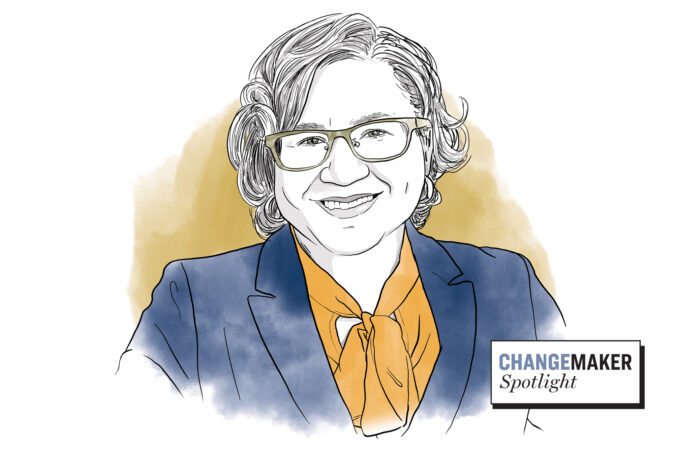
    The former state representative, lawyer, and longtime community advocate Donna Bullock is now leading one of Philadelphia’s most respected nonprofit organizations, Project HOME. Named its president and CEO in July 2024, Bullock brings lived experience and a deep sense of justice to the organization’s mission of eradicating homelessness. The child of a single mother, she grew up relying on the network of local church soup kitchens in New Brunswick, N.J. “But my mom and grandmother taught me something powerful there, not just how to receive help, but how to give back,” she said. “I may have gone there for a meal, but I also had to wash dishes, help a senior. That sense of community responsibility has always stayed with me.”

    Founded in 1989, Project HOME has built more than 1,000 units of supportive housing, manages more than $150 million in net assets, and has become a national model for holistic solutions to homelessness. In this conversation, Bullock reflects on the legacy she has inherited, the systems she hopes to shift, and the very personal stories that shape her leadership.

    Project HOME was founded in 1989. How is the landscape different than it was 36 years ago? What does the cause of ending homelessness look like now?

    We remain true to the founding vision of our co-founders [Sister Mary Scullion and Joan Dawson McConnon]: none of us are home until all of us are home. When we look at that statement, it’s really this commitment that we have to our fellow human beings, to see them as our brothers, and sisters, and neighbors, and fellow Philadelphians. Our work doesn’t end until we can really say that everybody is home and that we all have a role in the work it takes to solve homelessness.

    That also remains true: we still believe we can solve homelessness. We can do that. It will require everyone to play their part.

    The founders of Project HOME and the folks doing this work 20, 30, 40 years ago really believed we could achieve functional zero homelessness in Philadelphia. They were on track to doing that. But what they could not expect was a pandemic. They could not expect the opioid crisis. And they could not expect the scale of the affordable housing crisis. These three national, if not global, issues have deeply impacted housing and homelessness here and across the country.

    In the 1990s, Project HOME fought a four-year legal battle that culminated in a landmark Fair Housing victory, securing the right to build supportive housing at 1515 Fairmount. Over the years, the organization has also built a holistic model of care. How will the organization’s legacy continue under your leadership?

    Sister Mary and Joan, our founders, built this amazing organization with a deep understanding: to address homelessness at its roots, we have to address housing, employment opportunities, medical care, and education. We will continue that. We will continue to build supportive housing, provide services, and support individuals on their journeys, through recovery and into stability.

    We’ve also always remained on the front lines. We’ve always been an advocate, and we’ll continue to be one. I believe the skillset I bring as a legislator and as a lawyer, with experience in both city council and Harrisburg, will only amplify and support the legacy I’ve inherited. That means being a voice for those in our care, those at the core of our mission, especially now as we navigate policies from the federal government, HUD, and the Department of Health, that will impact the people we serve on a very personal level.


    You were raised by a single mom. You’ve experienced some of the very issues you’re now helping others navigate. How did your upbringing shape your worldview?

    Those lived experiences absolutely shaped my sense of justice and community obligation.

    My family relied on resources like the local soup kitchen in New Brunswick. I watched that soup kitchen evolve too. It was once just different churches offering meals on different days. But in the ’80s, around the same time Project HOME was founded, they came together, formed a nonprofit, created a central location, coordinated the schedule, and started offering meals seven days a week. That showed me the power of nonprofits when they work together in the best interests of the people they serve.

    And that’s what I want to carry forward. No matter where we go next, we keep the people we serve at the center of our decisions.

    You studied criminal justice at Rutgers and earned your law degree at Temple. You could have taken different paths. Why law?

    Honestly, I was a very naive young person who wanted to change the world. I thought, law school is how I’ll do that.

    And I did well: I got good grades in tax law, property law. But I took a class called “Law and Community,” and one of my classmates worked at Project HOME. We talked about their work in the 19121 ZIP code. I was planning to move into that same community.

    When I graduated, I asked myself, “How am I going to change the world with corporate law?” That’s when I found my niche supporting nonprofits and small businesses as a legal services attorney. I helped make sure they stayed compliant and stable, because they were providing critical resources to the community. It was a way for me to give back what I always believed didn’t belong to me: my law degree belonged to the community.

    That work exposed me to leaders like [Philadelphia city] council president [Darrell] Clarke and others, and it led me into public service. Eventually I was working with organizations like Project HOME from the outside. Now I get to work with them, and lead them, from the inside.

    In a past interview you said you “took the leap” in 2015, and ran for political office, eventually winning a special election to represent Pennsylvania’s 195th district in the state House of Representatives. What compelled you to leap?

    I’ve always answered the call to service. Did I plan to run for office? No.

    But a few people came to me and said: “You should consider this. You’re the right fit.” I gave it a lot of thought. I had been hosting a women of color leadership breakfast at my house every year, encouraging other women to run. When this opportunity came up, many of them looked at me and said, “Donna… it’s your turn.”

    What is it like to run for and hold office?

    It’s a vulnerable position to be in. But because I was led by service, it didn’t feel like I was putting myself in the spotlight. It was a shift, of course — personally for family, and professionally for my career — because it wasn’t the direction I was going. But it was an amazing detour. I was able to bring in my skillset as a lawyer and as an advocate into this legislative space, see the issues that I was passionate about on a statewide level, and advocate for those issues with folks who weren’t as aligned. Being on that stage in Harrisburg really helps you to become a stronger advocate for issues that are really important for you. You have to work a little harder to see where other folks are coming from and try to reframe those same issues so you can get buy-in.

    Yes, it becomes about consensus building.

    Yes. I spent time across the state meeting folks in their district. “What does this legislation look like in your district? Well, now I understand why you don’t support it. Let me show you what it looks like in my district, and maybe we can find a way to get to the middle.” That coalition building is so important, and I think has helped already in the work that I’m doing here at Project HOME.

    You’ve said, “There are many challenges, but you don’t overcome them. You accept them, embrace them, and use them to effectuate change.” That’s a powerful reframing. What’s a moment in your career where that philosophy took hold?

    There was a moment in Harrisburg when there had been a series of shootings in my district. Young people had lost their lives to gun violence. I stood on the House floor and talked about it, not just as a legislator, but as a mother of two Black boys in North Philadelphia.

    I talked about what it meant to walk my children past blocks with candles and teddy bears. I didn’t want to just argue the policy; I wanted them to understand the experience. My colleagues had met my boys. I wanted them to understand that these weren’t abstract lives; these were our kids. While it didn’t move the legislation, it did bring more people to the table to say, “I need to understand this.” There were a couple of colleagues who met with me separately. With one in particular, we started having regular coffee meetings to talk about the differences in our districts and in the things that our constituents wanted.

    And that’s the power of storytelling. Whether it’s on the House floor of the state capitol, through the media, social media, in a small group, or just a conversation that one of our residents may have with somebody else, storytelling can really move people. It can move legislation, policy, and resources.


    PHILLY QUICK ROUND

    Favorite Philly food indulgence: It’s got to be water ice, right? My favorite water ice is the neighborhood spot called King’s in Strawberry Mansion.

    Favorite Philly small business: Everybody needs a spa day. My favorite is a Black woman-owned spa in Brewerytown called Remedy Spa & Wellness. I’ve been going to [owner Cari Young’s] spa for years. Back when I was a state representative, she would host Black women’s business roundtables there. Even when I didn’t have a spa appointment, she would let me just sit in the space. Even her lobby had that sense of relaxation, Zen, and getaway, and I always appreciated that.

    Sports teams you love or root for: I’m at Project HOME, so it’s got to be the Phillies. [The Phillies are a Project HOME partner.]

    Greatest Philadelphian of all time: Marian Anderson. Just for what she stood for at the time. Standing firm in her art form, but also in advocacy and what she meant to the community, and her grace and beauty in doing it.

    What do you wish people knew about the folks who call Philly home? We got grit. But we are also just a loving group of folks. Everybody’s welcome. What I love about Philly is once you become family, they just welcome you with open arms. We may be a little aggressive with the love. But it’s love.

  • Helping Philadelphia’s Children Heal

    Helping Philadelphia’s Children Heal

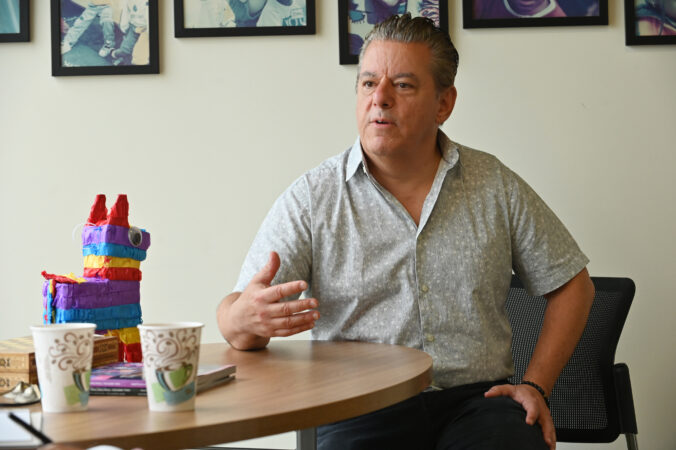
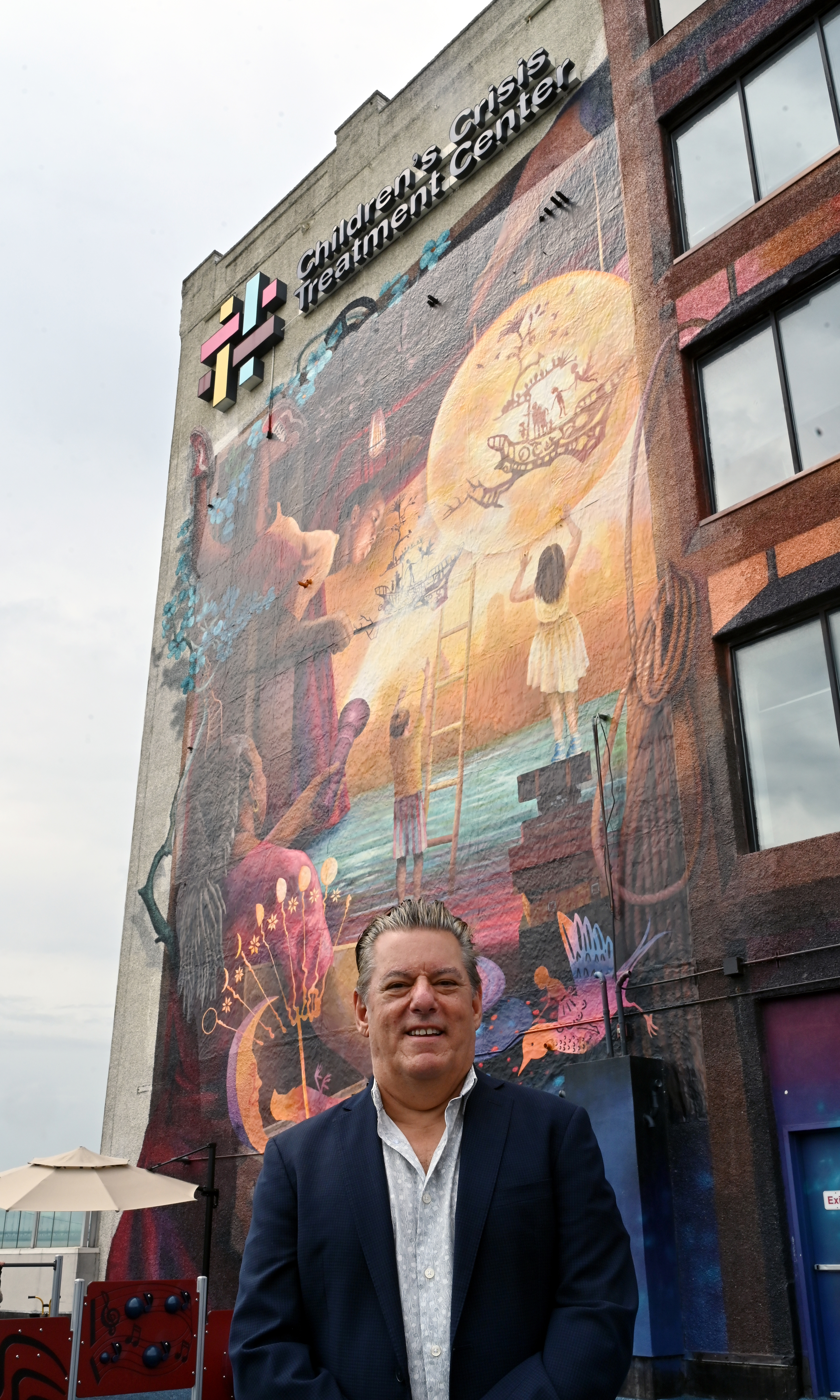
    For more than five decades, Philadelphia’s Children’s Crisis Treatment Center (CCTC) has opened its doors to vulnerable young people and families who have been impacted by violence, loss, and adversity. “Helping a child heal doesn’t just change their life. It strengthens their family, their extended network, and, in a very real way, their community,” the organization’s CEO Antonio “Tony” Valdés, 61, said. “That’s what continues to inspire me: understanding that the work we do at CCTC ripples outward, touching countless lives beyond the one child sitting in front of us.” Since taking the helm in 1997, Valdés has transformed CCTC from a small local agency into a cornerstone of children’s mental health care in the greater Philly region, helping the nonprofit expand from four programs to 15, to reach more than 3,500 young people each year.

    Valdés has spent his career focused on the guiding belief that every child, no matter their circumstances, deserves the chance to feel safe, seen, and supported. Under his leadership, CCTC has redefined what community-based care looks like, meeting families where they are, honoring their cultures and experiences, and building systems of care rooted in empathy and equity. In this Q&A, Valdés reflects on the urgent mental health needs facing Philadelphia’s children, the evolution of trauma-informed care, and how CCTC continues to offer hope where it’s needed most.

    What inspired you to do the work you do today?

    I think it has a lot to do with how I grew up. I was very fortunate as a child. My parents are immigrants, my father from Cuba, my mother from the Dominican Republic. When I was young, my dad started his own business and we moved from the States back to the Dominican Republic. Living in another country as a teenager gave me a deeper sense of perspective.

    It made me think about culture as the environment we live and grow in, the “soup,” so to speak, that shapes our narratives and defines how we experience the world. That way of seeing things naturally led me to think about systems: families, neighborhoods, schools, and how they all influence children’s lives.

    So when I began working in mental health, I was already thinking in those systemic terms. A few years later, I had the chance to work with children and it immediately clicked. I realized that the earlier you reach a child, the greater the impact you can have.

    Helping a child heal doesn’t just change their life. It strengthens their family, their extended network, and, in a very real way, their community. That’s what continues to inspire me: understanding that the work we do at CCTC ripples outward, touching countless lives beyond the one child sitting in front of us.

    What do you bring to this job that is unique?

    First, I’m very persistent. Once I decide to go down a path, I keep pushing forward. Second, I’m personable and social. I interact casually with people, which makes me approachable. Finally, I bring a practical, analytical approach to the work. Many CEOs in this field come from operations or program backgrounds, and I do too, but I also have a knack for numbers and finance. That combination allows me to manage the business side of CCTC effectively while staying deeply connected to our programs and the families we serve.

    Right now, our annual budget is about $30-35 million, and managing that while staying true to our mission requires both persistence and practicality.


    You’ve talked about the importance of early intervention. Why does that matter so much?

    The earlier you intervene and support families, the better. A lot of our work at CCTC focuses on helping parents and caregivers understand what their children are experiencing, what we call “psychoeducation.” We help them see that many behaviors, even the difficult ones, make sense in light of what a child has lived through. It’s not “bad behavior.” It’s a natural response to trauma. It’s actually not normal for a child to go through terrible things and show no signs of distress.

    Science now backs this up. The landmark Adverse Childhood Experiences (ACEs) study, conducted more than 20 years ago, revealed powerful connections between early trauma and long-term health outcomes, including not only behavioral issues or substance use problems, but even higher rates of heart disease and cancer. What we’ve learned since then, through brain imaging and neuroscience, is that trauma in early childhood can actually shape how the brain develops. The brain adapts to prioritize survival, and other areas, the ones that regulate learning, relationships, and emotion, can be underdeveloped as a result.

    That’s why early, loving, consistent relationships are so crucial. The most powerful protective factor is the presence of caring, dependable adults in a child’s early life. The next is a sense of belonging and community. When those are strong, children build resilience.

    Some adversity can actually help children grow, as long as that balance tips toward safety, love, and connection.

    How has CCTC evolved since its early days?

    The people who founded CCTC in the early ’70s probably wouldn’t have used the language we use today, but they were clearly responding to a growing awareness that children’s behavior was often rooted in trauma. That early insight has shaped CCTC from the beginning. Over the years, the field has evolved, and so have we. About 18 years ago, we made a major shift by embedding trauma-informed principles into every part of the organization. It changed not only how we treat children, but how we support staff, collaborate with partners, and engage with the community. It became a core philosophy, not just a clinical model.

    That focus has kept us true to our mission. We’re not trying to be all things to all people. We’re a children’s behavioral health agency and everything we do aligns with that purpose. Staying disciplined in that way allows us to build stronger partnerships and deliver deeper impact.

    Today, we serve children from about 18 months through 18 years old, but most of the kids we work with are between three and 13. Roughly 75% are 10 or younger. That’s really where our heart is: early and elementary-age children, because that’s where we can make the greatest difference.

    What’s been the biggest challenge for CCTC over the years?

    One of the biggest challenges has been working within systems that are incredibly complex, whether that’s government, insurance, or even community and political structures. These systems often tend to move toward the least common denominator: keeping things steady, avoiding risk. Innovation doesn’t always get rewarded.

    But CCTC has always been an organization that looks ahead. We’re constantly asking: What’s next? Where do we need to be two, three, four years from now? That kind of thinking sometimes puts us at odds with the larger system, and that can be frustrating. There have been times when we knew an idea would make a real difference, but it took years before the funding or policy landscape caught up.

    A good example is care coordination, or what some call “case management.” We’ve always believed in helping families navigate all the challenges that can prevent them from engaging in treatment: housing instability, food insecurity, lost utilities, lack of transportation. For years, that kind of work wasn’t funded or even recognized as essential. But to us, it was obvious, since if a family’s basic needs aren’t met, therapy alone won’t change much.

    What’s a big goal for CCTC’s future?

    One of our biggest goals is to bring what we do directly into the natural settings where children and families already are. That’s where real access happens: in schools, recreation centers, community programs, and other places that feel familiar and safe.

    When mental health care is part of everyday life, it becomes normalized. We’re already doing some of this, placing parenting groups and educational programs in community settings, to help families better understand the roots of behavioral challenges. Many parents we meet are doing their best, but no one’s ever helped them recognize how their own childhood experiences might still be shaping their parenting today.

    What transformations have you seen in the development of children who have come to CCTC?

    I look at it on two levels: observable outcomes and how a child functions in their life. On the surface, success shows up in things like fewer suspensions or detentions, reduced fights, and improved grades.

    But real success goes beyond behavior. It’s about helping children make sense of what happened to them. Kids who’ve experienced trauma should never simply forget it. They need to learn how to live with it, understand its impact, and gain the skills to respond differently. That helps them manage triggers, regulate emotions, and gain self-awareness.

    What misconceptions about trauma or mental and behavioral health do you most want to challenge?

    There are a few. The first is one that still lingers. The idea that “kids are young, they’ll forget.” That’s just not true. When a child experiences something terrible at four years old and starts acting out at nine, those behaviors are often connected. Ignoring that link does a real disservice to the child.

    The second misconception is about resilience. People sometimes say, “She’s stronger because of what she went through.” Trauma doesn’t make you stronger; protective factors do. Maybe that person had strong family support, stable housing, or a teacher who cared. Those things build resilience, not the trauma itself.

    And the third is about the multigenerational nature of trauma. When harmful behaviors aren’t addressed, they echo through families. A parent who grew up with abuse or neglect might not repeat the same actions, but the emotional patterns of anger, control, and detachment can still carry forward. Recognizing that connection across time, generations, and communities is key to breaking the cycle.

    What is your mantra?

    I try to live by the idea of focusing on what you can actually impact. I stay focused on what makes the biggest difference.


    PHILLY QUICK ROUND

    Favorite Philly food? For Dominican food, I really like Mamajuana in Fishtown and a few spots in North Philly, like El Meson and Barú.

    Sports team you love: I’ve been a Phillies fan my whole life.

    What you wish people knew about those who call Philly home: What I wish people knew about Philadelphians is how much the city has changed over the past 20 years. Many outsiders still see Philly as it was 25-30 years ago, but today it’s far more diverse, not just in food and restaurants, but across neighborhoods.

    Greatest Philadelphian of all time? My pick for greatest Philadelphian of all time is easy: Ben Franklin.

    Favorite thing to do when you have free time in and around Philly: I love exploring new restaurants I haven’t tried yet, especially with friends.


    Lucy Danziger is a journalist, an author, and the former editor-in-chief of Self Magazine, Women’s Sports & Fitness, and The Beet.

  • A Fishtown-based nonprofit works to address the roots of trauma in children before crisis hits | Philly Gives

    A Fishtown-based nonprofit works to address the roots of trauma in children before crisis hits | Philly Gives

    Mellisa Wilson had been working hard — so, so hard — to change the trajectory of violence that marked her life and the lives of her five children when she saw something that broke her heart.

    Her youngest daughter was putting her baby doll to bed, “and she was hitting it,” Wilson said, choking back tears. “That’s when I knew it was really bad. That’s when I knew that wasn’t what I wanted them to take from me,” as a parent.

    And so, Wilson did what she had done many times before.

    She turned to the Children’s Crisis Treatment Center (CCTC) for help.

    In schools, homes, and community centers in Philadelphia, Montgomery County, and Camden, CCTC provides trauma-informed care annually to over 3,500 children, up to age 18, suffering from behavioral issues, depression, and trauma, helping their families in the process.

    “I knew I had to do something different,” Wilson said.

    Wilson, a CCTC volunteer and a member of the center’s parent advisory council, had been bringing her children to CCTC, a nonprofit children’s mental health agency, for 20 years.

    With all the counseling she and her children have received, she could easily give the same talking points as CCTC’s chief executive officer, Antonio Valdés.

    And she did.

    It may take years, she said, but when a child experiences trauma, at some point, sooner or later, there will likely be a behavioral issue.

    Wilson said she grew up in a home where she was regularly beaten with a broom handle or an extension cord. “Those were my grandmother’s favorites.” The trauma repeated itself across the generations when she became a mother.

    Mellisa Wilson, who now volunteers at the Children’s Crisis Treatment Center, said the group helped her realize she needed to end a generational legacy of corporal punishment as a parent.

    Always angry, she yelled at her children and spanked them, but only with her hands — at least she could give them that safety.

    But all of it had to end — for her own good, and for theirs. So she turned to CCTC for help.

    It’s a typical pattern, said Valdés.

    CCTC treats children who have experienced every kind of trauma and adversity — death of a parent, witnessing a parent be killed or beaten, attacks from dogs, sexual abuse, neighborhood violence.

    “We treat kids no matter what trauma they have,” he said. “For the vast majority, we’re talking about domestic violence, toward them or a family member, or maybe shootings they have witnessed.”

    But what’s just as significant, he said, is how CCTC treats everyone in its care. “It’s the lens we use,” he said, describing trauma-informed care. “We don’t ask what’s wrong with a child. We asked what happened.”

    For example, Valdés said, a young boy, maybe 5, sees his mother regularly beaten by her drunken boyfriend. “The kid may even try to intervene, but he’s only 5. What can he do?”

    Eventually, the mother gets rid of the drunken boyfriend. All seems normal until months or even years later, when she gets calls from school. Her child is fighting, destroying school property.

    “He’s still reacting to what he witnessed, and the behavior he developed at that time,” when he understood, as only a little child can, that his mother, the person who was supposed to be protecting him, couldn’t keep him, or herself, safe, Valdés said.

    Says Antonio Valdés, chief executive officer of the Children’s Crisis Treatment Center: “We don’t ask what’s wrong with a child. We asked what happened.”

    “Any moment he might feel even a little threatened evokes that response,” he said.

    “There’s a mistaken belief that young children, when they experience trauma, they’ll get over it,” Valdés said. “When trauma and adversity happen, there are normal consequences. It’s not normal for the kid to be OK.”

    Some parents bring their children to CCTC for counseling, or they get referrals from schools. More help, including a summer camp, is available at satellite community centers.

    At its headquarters on Delaware Avenue in Fishtown, CCTC runs a day treatment program for preschool-age children who have been kicked out of their preschools. There are day programs for children who have been discharged from psychiatric hospitals to help them reacclimate before returning to their schools.

    CCTC also provides behavioral health help at over 40 middle and elementary schools, where CCTC staffers work with teachers and students.

    Valdés remembered one little boy, about 10 or 11, who had been an average student — no trouble in school. His mother worked two jobs to make ends meet, and his grandfather took care of him, fed him dinner, helped with homework, and even put him to bed when his mom worked late.

    One Monday, the boy didn’t come to school — and it was so unusual that counselors reached out. On Tuesday, he did show up and, within hours, was fighting with kids and teachers. “They had already written up detention slips,” and it was so bad that harsher punishments were on the table.

    But then a counselor who had been trained by CCTC recalled what she had learned and asked the boy what happened. His grandfather had passed away on Saturday, and his mother had to go to work so she could pay the rent, leaving him to fend for himself.

    “In five minutes, they tore up the detention slips and had a different kind of conversation. It could have turned into something really bad for that boy. It’s those little moments that are critical,” Valdés said.

    In Philadelphia, he said, children in Kensington are suffering from the opioid crisis. When children leave the house, they see people shooting up and have to step carefully to avoid human feces or used needles. It’s not safe to play on the sidewalks or in the parks.

    “All of these things add up to a stressful environment,” he said. “There’s an impact of trauma and adversity on the way people start treating each other. It’s a behavior that’s adaptive to the trauma, the crisis, the ugliness,” but may not show up until later.

    “It’s highly contagious. Certain kinds of maladaptive behaviors may find themselves in families, in communities, in workplaces, or the way you might treat your girlfriend or wife,” Valdés said. “These behaviors were critical in surviving the moment,” but aren’t useful or appropriate in other situations.

    Healing comes from reframing — acknowledging realities but assuring the children that what happened was not normal and not their fault, then giving them techniques to cope positively when disturbing feelings arise, he said.

    “We’re treating kids and families, and we’re helping them heal,” he said. “Then they start to support their siblings or neighbors who have been through trauma. We see this as the counter to adversity and trauma.”

    Parenting skills Wilson learned at CCTC helped her help her children and regain control of her family, even as she was struggling to manage five youngsters under 5, including a set of twins.

    One child was inappropriately touched. Another child pushed Wilson against a wall and accused her of driving their father away. Another child, always her father’s favorite, said her father hated her. Another child hit a kitten.

    Tears filled Wilson’s eyes. “That was the trauma I put on them by hitting them and yelling at them.”

    Chaos and fatigue were constant, as was anger, yelling, and spanking. At CCTC, her kids got help, and so did she, learning new parenting techniques that led to a peaceful home with five children, now in their 20s and heading into professions to help others.

    Valdés said people should support CCTC because that healing is contagious, mending families and neighborhoods.

    Wilson agrees. “What I’ve learned, I’ve put into practice,” she said.

    Her story is so compelling, she said, that people at her overnight warehouse packing job turn to her for help. And she’s always ready to give it.

    “My favorite place is on the bus,” she said, where she’ll say hello and ask her fellow passengers about their day. “People will start talking to me. People are very honest when they think they are never going to see you again.”

    When Wilson wears her CCTC T-shirt as she often does, she wants to serve as a walking billboard for a nonprofit that has made a real difference in herself and her family. She vows to support the organization and its mission for the rest of her life.

    “We shouldn’t keep good things to ourselves.”

    This article is part of a series about Philly Gives — a community fund to support nonprofits through end-of-year giving. To learn more about Philly Gives, including how to donate, visit phillygives.org.

    For more information about Philly Gives, including how to donate, visit phillygives.org.

    About Children’s Crisis Treatment Center

    Mission: To support children and families by helping them heal from abuse, violence, and trauma by bringing mental health services to them where they are — at home, in schools, and in their communities.

    Children served: 3,500

    Point of pride: Started as a demonstration project in the basement of the Franklin Institute and is now in over 40 schools, up from 14 last year.

    Annual spending: Over $31 million in fiscal year 2024.

    You can help: Volunteers are needed to help with special events, the Holiday Toy Drive, or group day-of-service activities.

    Support: phillygives.org

    What your Children’s Crisis Treatment Center donation can do

    • $25 provides art supplies for an activity in one Therapeutic Nursery classroom (preschool-age children).
    • $40 purchases a gift for one child through our annual Holiday Toy Drive.
    • $100 provides one child attending our Summer Therapeutic Enrichment Program with educational program supplies.
    • $250 provides music therapy to one child attending our Cornerstone program (acute partial hospitalization for children ages 5 to 13).
    • $500 supplies a therapeutic counseling room with toys for play therapy.
    • $1,000 provides program activities, including field trips, for one child attending our Summer Therapeutic Enrichment Program.
  • An Infrastructure for Empowerment

    An Infrastructure for Empowerment

    A 2019 recipient of the Philadelphia Award, the Rev. Luis Cortés Jr., 67, has come a long way from working after school at his father’s grocery store, known as a “bodega” in East Harlem. The bodega is where he learned the impact of social connection. “I’ve never seen sociology papers written from the bodega perspective, but there can be,” Cortés said.

    Those early observations informed Cortés’ belief that perseverance and financial literacy can help close the gap for Latino communities. In 1986, Cortés founded the nonprofit Esperanza, which means “hope” in Spanish. The faith-based organization is guided by Jesus’ mandate in Matthew 25:40 to serve and advocate for “the least of these” around us.

    Known simply as “Rev” by members of the wider Philadelphia community, Cortés is proud of the breadth of services Esperanza offers. The organization improves the lives of those in North Philadelphia through education, housing stability, work training, civic empowerment, and the arts. Over the last 40 years, Esperanza has grown to serve more than 30,000 families annually. Cortés aspires to do more, still.

    How did your upbringing in New York City influence you?

    The first 10 years of my life were in Spanish Harlem, then we moved to Black Harlem and I attended New York City public schools. My father ran a grocery store, a bodega in the neighborhood, and I worked at the store. Working at the store teaches you a lot about life. You get to know the customers. You get to know their families. You get to know their hopes, aspirations, fears, and you begin to become part of the fabric of their lives. You learn about things that are happening in people’s lives that are very real and painful.

    It’s always the same things: the desire to have safety, and also long-term aspirations, [like to] be able to provide for their family.

    What experiences in your life or background led you to dedicate your career to social services and community support?

    I decided to go into the ministry because I could work on behalf of communities. I went from “I’m going to be a lawyer to help people,” to being a minister to help people. I became immersed in civil rights, both in my theological training as well as [in] my ministerial pursuit.

    I worked for a group called IFCO [Interreligious Foundation for Community Organization], based out of the Abyssinian Church under Rev. Lucius Walker. We [supported] self-determination for Puerto Rico. We [supported] civil rights in the U.S., [and] the National Anti-Klan Network. I’m willing to persevere for the greater good of the community. I realized I’m better at civil rights work and community development work.


    If someone were to ask you about entering the clergy today, what would you advise?

    I think that entering the clergy allows you to get into the most theoretical, philosophical, theological thoughts in the history of humankind. All areas of inquiry are open to you.

    Esperanza is a faith-based organization. How is faith woven into all that Esperanza does?

    The fact is, all human beings are equal and all human beings need to be loved and respected.

    That’s our theological and our epistemological premise. Every individual has something to share, both for the growth of their family and for the whole. If you start there, everything [is] about opportunity. Money should not inhibit your growth and your ability to serve others. At Esperanza the religious aspects will always be present as long as we maintain the theoretical framework that all human beings are created by God. And all human beings are equal, regardless of who they are in the present day, because that will not define who you will be tomorrow.

    Economics is a touchstone for you and for Esparanza. What’s behind your focus on financial literacy?

    I learned early that money is a tool. And no matter how much money you have, it is still a tool, and an important one. How do we learn to use and apply that tool?

    The example I use is this: When I worked at my family’s store, I would always take a Snickers bar and a Pepsi. The fact that I wasn’t thinking about it irritated my father. So one day he asks me four basic questions: How many are in a box? How many do I have to sell to break even? How long is the box there? And why is the box there?

    He wasn’t upset that I was eating a Snickers bar. He was upset that I didn’t know what [it] meant to the overall economics of the store, and that I was taking that tool [of money and economics] for granted. Money is a tool no matter how little you have. And you need to understand the tool and how you apply the tool.

    We need to find ways to educate people about money, about status, immediate gratification versus long-term gratification. You cannot just live for tomorrow, but you should not just live for today. That’s my philosophy.

    Is there a division of Esperanza that you hold a soft spot for?

    In our art gallery, Galéria Esperanza, we highlight Latino artists from Philadelphia who don’t get a shot anywhere else. There are great composers, [musicians, dancers, and other Latino artists] in history. And so Esperanza Art Center melds [the performing arts, including theater, film, music, and dance, to feature those artists]. And then [another] important [piece] is access: [kids] 18 and under and college students [can attend for] free, and senior citizens are free.

    We need to thank the philanthropic community because they made that access possible. We built and paid for our theater, the Teatro Esperanza. I convinced the performing groups, including Philadelphia Ballet, Philadanco and Opera Philadelphia, to come, but I still needed a way to help finance those groups.

    We have a library, which is now a community library. The businesses use it in the evenings. It’s reserved for our high school juniors, seniors, and college students during the day. It’s wonderful. We don’t get any government funding for that, but we need it. We hold community school meetings here at Esperanza as well.

    Can you share a recent success story?

    It is the opening of Esperanza Academy Charter School‘s elementary building in September. It took us almost 12 years to gain permission, raise the money to build, and open our elementary school. Once we finally got permission we had to raise money. It took five years to raise $40 million for the construction. We have a state-of-the-art facility. It is a physically beautiful space for our children. The parents see it and cry.

    There have been a lot of recent changes politically on the local, state, and national levels. How has Esperanza had to shift its focus?

    Civic rights, civic engagement have become a larger focus in the more recent months. We have an immigration division, so we put out training sessions to know your rights.

    We also have explained to staff what their rights are. We’ve explained to business owners [and] clergy. A lot of clergy thought that ICE cannot come into their church. The law is clear. ICE can walk into your church on a Sunday morning while you’re preaching. They cannot go into any space that’s private. So put “private” on every door.

    Learning the rules of engagement is important, even though the rules of engagement are not always followed by the government these days. But knowing them is important because they will affect your case as you move forward.

    We’re proceeding with our work. People need housing. People need food. People need education. Nothing changes. We have to continue to let people know that this political climate is abnormal. But you need to understand that while it’s abnormal, it may be legal. And if it is legal, you need to understand what your rights are. You need to understand where you must comply.

    What is the biggest challenge for Esperanza in the coming year?

    The biggest challenges include programming for senior citizens around heat mitigation, cuts to our college (a Hispanic-serving institution), and reductions in community development funding. We had to make tough decisions. The loss of funding meant we couldn’t hire a group of people, and hard-working people had to be let go.

    These are fundamental issues about being humane and they’re very important. I see a lot of inhumaneness by governmental structures these days.

    Esperanza turns 40 years old in 2026. Are there any special events in the works?

    We will be celebrating our 40th anniversary in April with a sponsored event. And then, we also are celebrating the 25th anniversary of [Esperanza Academy Charter School] and the 25th anniversary of [Esperanza College of Eastern University].

    We’ll be holding an event the day before our 40th anniversary event [that is] a musical celebration with a jazz orchestra band for the community [celebrating] 250 years of Latin music. We’ll have big-band-style performers with Pablo Batista heading it up. Pablo was this year’s Grand Marshal for the Puerto Rican parade. He’s one of the top percussionists and a global icon who’s been living in [Philadelphia] for his whole life.

    What do you want your legacy to be?

    That’s easy: to build Esperanza College into one of our major universities in Philly. And the institution will compete and become the mechanism by which people can become empowered.


    PHILLY QUICK ROUND

    What’s your favorite Philly food splurge? I have two: the Tres Leches cake from Vickie’s Sweets and the homemade ice cream from Helados Chupi Chupi.

    Favorite Philly restaurant? Tierra Colombiana. You can get the best Latin food in the city.

    Favorite Philly small business? Cafe Tinto and Amy’s Pastelillos, both in North Philly.

    Which sports teams do you root for? I was a Sixers fan before I came to Philadelphia. All the other teams I became a fan of after I moved to Philadelphia. They grow on you. The Flyers, Phillies, the Eagles are in a renaissance period right now.

    Favorite Philly artist, performer, musician and/or band? Percussionist Pablo Batista and the band Low Cut Connie.

    What elements of Philly remind you of your childhood neighborhood of East Harlem in NYC? Any time I walk into a bodega and I can talk in Spanish, it’s like a time warp.

    What’s one place in or around Philadelphia everyone should visit at least once? Teatro Esperanza.

    What do you wish people knew about the people who call Philly home? We always get up. We get knocked down, but we always get up. It’s part of that Rocky theme. There’s a lot of persistence in Philadelphia. It makes our city more dynamic.

  • For almost 40 years, Esperanza has served ‘the least of these’ and those who ‘just need a break’ | Philly Gives

    For almost 40 years, Esperanza has served ‘the least of these’ and those who ‘just need a break’ | Philly Gives

    Talk to most nonprofit chief executives, and they’ll be able, on cue, to recite a heartwarming story about someone their organizations helped.

    And the Rev. Luis Cortés Jr., Esperanza’s founder and chief executive, can do it, too.

    But he’d rather talk about a sin he committed as a little boy — a sin that impacted his thinking for a lifetime and allowed him to understand how to build a $111.6 million organization with 800 employees that educates, develops, uplifts, and houses 35,000 people a year in the heart of North Philadelphia’s predominantly Hispanic Hunting Park neighborhood.

    When Cortés was 12, he stole a Snickers candy bar from the bodega his father owned in New York City’s Spanish Harlem.

    Oh, his father figured it out, and quickly, too, because he began to ask little Luis some important questions:

    Did the 12-year-old know how many Snickers bars the bodega would have to sell to break even — not only on the box of Snickers, but on the taxes and utilities for the entire store? More importantly, how many Snickers bars would be required to turn a profit — a profit that could be reinvested?

    “You need to understand finance, whether it’s a box of Snickers or a multimillion-dollar bond to build a school. Where is the money coming from, and what’s the repayment structure?” Cortés said.

    Outside, as he spoke, a crane moved materials in what will soon become a new culinary school.

    “Understanding finance is important, and understanding culture is important, and you have to understand the relationship between the two.”

    So, yes, Cortés can and did tell the story about the mother who came to Esperanza to learn English skills, who got help to get a job and a house, who sent her daughter to Esperanza’s charter school and to Esperanza’s college, and now that same daughter is getting a house thanks to Esperanza’s mortgage counseling help.

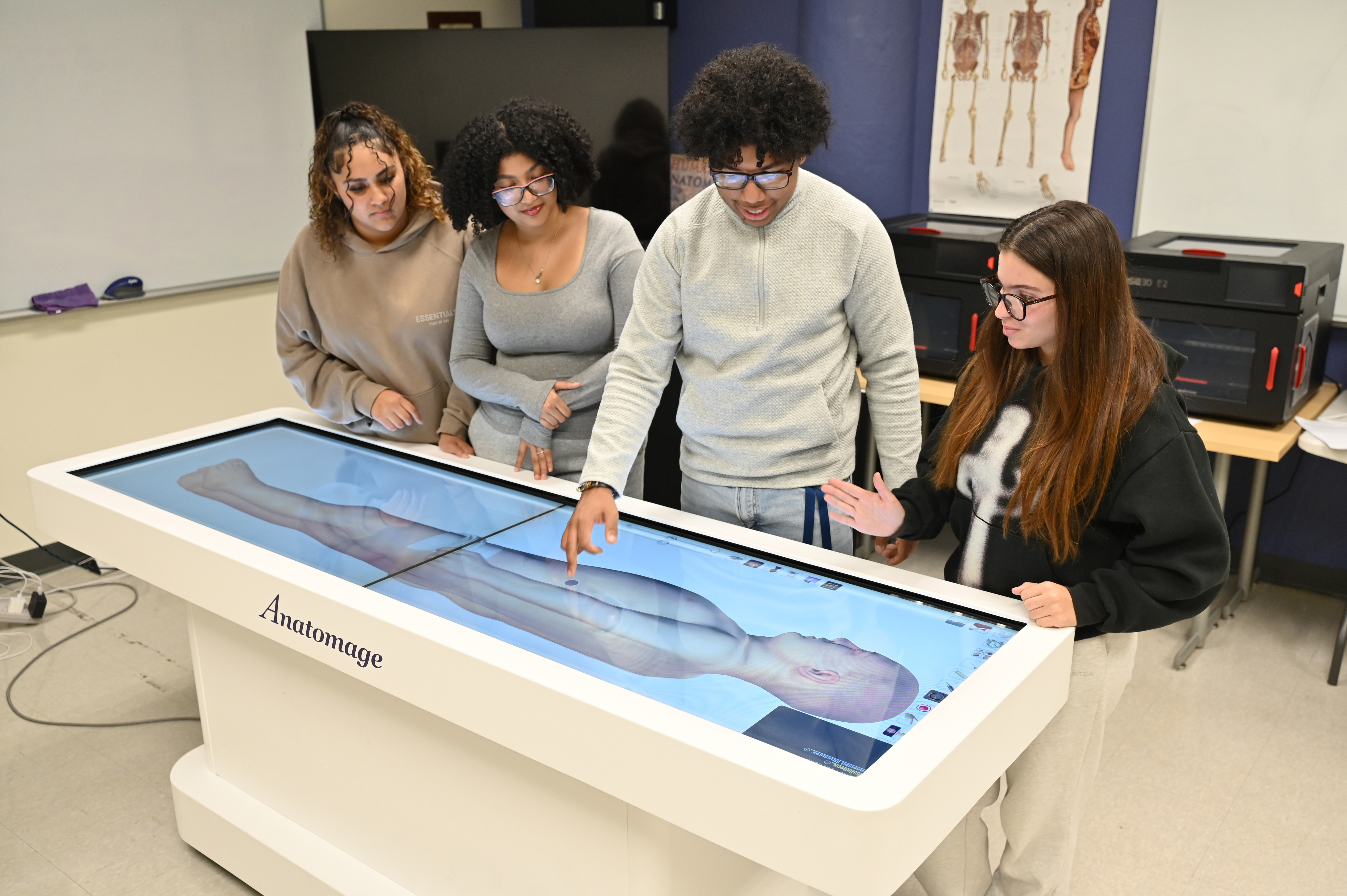
    Students Jayliani Casioano, Oryulie Andujar, Derek Medina, and Natalia Kukulski use an interactve anatomy table. The students are members of is the Health Occupations Students of America (HOSA).

    All good. But this is what Cortés really wants people to know:

    “If people trust us with their funds,” he said, “we’re putting the money into institutions, and institutions build culture.”

    That’s why Esperanza has a K-12 charter school, a cyber school, a two-year college that’s a branch campus of Eastern University, a 320-seat theater, an art gallery, computer labs, an immigration law practice, a neighborhood revitalization office, a CareerLink office for workforce development and job placement, a music program, a youth leadership institute, housing and benefit assistance, and a state-of-the-art broadcasting facility.

    Cortés even likes to brag about the basketball court. “Three inches of concrete, maple wood flooring, fiberglass backboards — NBA standards.”

    “Think about Paoli. It has a hospital, a public school, a theater. Paoli has all of that, and it’s understood that that’s the quality of life. We have to have access to those same things at a different price point,” he said. “Notice I didn’t say different quality. I said different price point.

    “We want to create an opportunity community, where people can have a good life — with arts, housing, healthcare, financial literacy, education, all those pieces — regardless of your family income,” he said.

    “What’s important here and what’s different is that in all our places, all our facilities are first class,” Cortés said.

    “I grew up in a low-income community where people were always telling you to step up, but step up to what?” he asked. “Where is the vision? What is possible to even have? How can anyone know unless they can see it?”

    So, when people from the community visit Esperanza, “you can see that you can have the best facilities with state-of-the-art equipment. As a provider of services, we have to step up,” he said, in turn always giving people the tools and resources they need to step up.

    For example, on Citizenship Day, Sept. 20, Anu Thomas, an attorney and executive director of Esperanza’s Immigration Legal Services, trained a dozen volunteer lawyers and law students on the fine points and recent pitfalls in the process of applying for citizenship.

    Soon, the room was crowded with people coming for help.

    Watching from the sidelines was Charlie Ellison, executive director of the city’s Office of Immigrant Affairs, who noted that an estimated 60,000 legal residents of Philadelphia are eligible to apply for citizenship.

    “Clinics like these are critically important to helping people who might be facing barriers,” including the cost of getting legal help. “This bridges a lot of gaps. It’s a vital mission, now more than ever,” he said.

    For Neury “Tito” Caba, a men’s fashion designer, tailor, and director of green space at Historic Fair Hill, citizenship help from Esperanza was a family affair. Through Esperanza, he, his grandmother, and his mother all became citizens.

    “Now I can vote, and that’s the most positive thing I can do,” he said. “And also, things being the way they are, it gives me some sort of protection.”

    Fashion designer Neury “Tito” Caba talks about his citizenship experience at Esperanza.

    Earlier this fall at Esperanza’s CareerLink branch, counselor Sylvia Carabillo helped Luis Rubio on the computer. He was trying to extend his unemployment benefits and looking for a job as a security guard. Agueda Mojica was being tutored in Esperanza’s most popular workforce class: Introduction to Computers.

    “I want to become more independent to be able to do anything on a computer,” she said in Spanish, speaking through a translator. “I was always working and never had time to learn.”

    Much of Esperanza’s staff is bilingual in Spanish, but to help people from the neighborhood, Esperanza also hired counselors who speak Ukrainian and Kreyòl for Haitians who live nearby.

    In Esperanza College classrooms a few weeks ago, Esperanza Academy high schoolers enrolled as college students had just finished a chemistry exam. When they graduate from high school, they’ll already have associate degrees on their résumés.

    For them, Esperanza represents a future.

    There’s Oryulie Andujar, 18, who wants to study sonography because an ultrasound technician found a cyst in her mother’s uterus. “We could have lost her. That was very impactful for me.”

    Jayliani Casiano, 17, wants to go into anesthesiology. The oldest of seven, she witnessed her mother giving birth to several younger siblings. “She was in a lot of pain. It was interesting. I want to do everything after seeing her through that process.”

    Derek Medina, 18, said the opportunity to go to college “made me rethink my whole life.” He had been getting into trouble in school, but now wants to combine a love of mathematics and a desire to help people by going into the field of biomedical engineering.

    Recently, on Nov. 14, Esperanza College hosted its Ninth Annual Minorities in Health Sciences Symposium, designed to acquaint high schoolers with medical careers.

    Construction will soon begin to convert a former warehouse space into a center to teach welding and HVAC in an apprenticeship program.

    Next month, it’ll be time for “Christmas En El Barrio” with music, food, and community in Teatro Esperanza — admission is free. In January, the Philadelphia Ballet will perform there. Tickets are $15 and free for senior citizens and students.

    “My worst seat — in Row 13 — would be $250 at the Academy of Music,” Cortés said. He wants to offer the arts at a price and a time available to a mother of three, who may not be able to afford even the cheapest seats in downtown venues, plus bus fare, “and heaven forbid the child wants a soda,” Cortés said.

    All this adds up to culture, which brings him back to the Snickers bar, and not just breaking even, but investing.

    Other groups, Cortés said, had to build their own institutions when mainstream organizations put up barriers. Howard University helped Black people, Brandeis served Jewish people, and Notre Dame provided education to the Irish.

    Building an institution is his investment goal with Esperanza, and he takes as his mentors famous Philadelphia pastors such as the Rev. Leon Sullivan, who founded Progress Plaza in North Philadelphia, and the Rev. Russell Conwell, the Baptist minister who founded Temple University.

    “Philadelphia has a tradition that its clergy don’t just do clergy things,” he said, admitting that he doesn’t have the patience for a more traditional pastor’s role. “As clergy here, it’s understood that we snoop around everything.”

    Cities sometimes brag that their poverty rates have declined, he said, when in reality, rates have declined because people with low incomes were forced to move away.

    Philadelphia, he said, has a chance to be different — to lower the poverty level both by raising people’s incomes and improving their standards of living. “There should be Esperanzas in every neighborhood,” he said.

    “How can we focus on helping the people who just need a break?” Cortés said, referencing Jesus’ admonishment to “help the least of these.”

    “This city has the opportunity to make this a win-win,” he said, “to show the rest of the country and Washington, D.C. — especially Washington, D.C. — that people who are different, and people who are `the other’ can be supported, so that they are not only part of the fabric of the city, but economic drivers of the city.”

    This article is part of a series about Philly Gives — a community fund to support nonprofits through end-of-year giving. To learn more about Philly Gives, including how to donate, visit phillygives.org.

    For more information about Philly Gives, including how to donate, visit phillygives.org.

    About Esperanza

    People Served: 35,000

    Annual Spending: $111.6 million across all divisions

    Point of Pride: Esperanza empowers clients to transform their lives and their community through a diverse array of programs, including K-14 education, job training and placement, neighborhood revitalization and greening, housing and financial counseling, immigration legal services, arts programming, and more.

    You Can Help: Esperanza welcomes volunteers for community cleanups, plantings, and other neighborhood events. Some programs also need volunteers with specific skills (lawyers, translators, etc.).

    Support: phillygives.org

    What Your Esperanza Donation Can Do

    • $25 covers the cost of one private music lesson for a young student through our Artístas y Músicos Latinoamericanos program.
    • $50 provides printing and distribution of 30 “Know Your Rights” brochures to immigrant families.
    • $100 pays for five hours of training for a new mentor fellow at the Esperanza Arts Center, preparing a young person for a career in arts production through hands-on learning.
    • $275 funds the planting of one street tree in a neighborhood that desperately needs additional tree cover to address extreme heat.
    • $350 covers tuition and books for one English as a second language student at the Esperanza English Institute.
    • $550 supports the cost of the initial work authorization for an asylum-seeker.