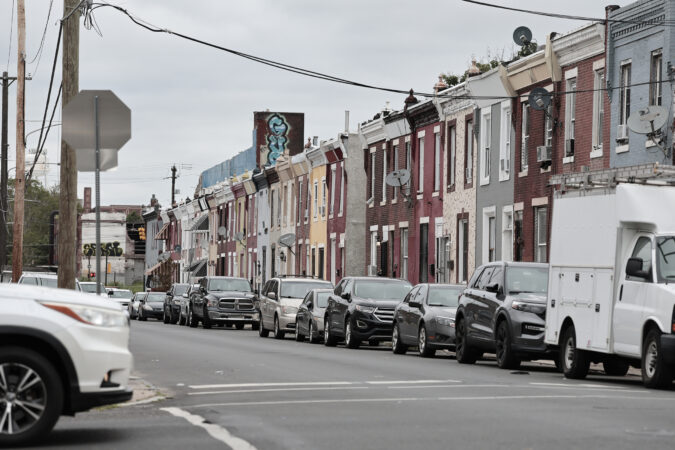
The biggest jump in Philadelphia’s property assessments this year occurred in Kensington, a measure that means many homeowners in the long-struggling neighborhood are likely to see higher taxes amid a concerted effort by the city to clean up the area.
That is according to an Inquirer analysis of recently released property assessments of single-family homes, which found that, citywide, there was a 3% median change in valuations from the 2025 tax year, the last time there was a mass reassessment.
That increase is far more modest than the widespread jump in valuations that homeowners saw two years ago, which captured multiple years of real estate growth and the volatile post-pandemic market.
What remains the same: who will be most affected.
The Inquirer’s analysis of this year’s property assessment data shows that low-income neighborhoods near gentrifying areas saw the sharpest jumps in valuations compared with the rest of the city.
The four areas that saw the largest percentage increases in median assessments — Kensington, Mantua, Grays Ferry, and Kingsessing — all border more gentrified neighborhoods like Fishtown, University City, and Point Breeze. The results of the analysis are a further sign that market pressures in higher-income areas are pushing into pockets of the city that have long been primarily home to Black and brown working-class residents.
Of the eight neighborhoods that saw the largest increases between the 2025 and 2027 tax years, five have median annual household incomes around $40,000 or less, according to an analysis of U.S. Census data. The federal poverty level is $33,000 for a family of four.
(function(){function e(){window.addEventListener(`message`,function(e){if(e.data[`datawrapper-height`]!==void 0){var t=document.querySelectorAll(`iframe`);for(var n in e.data[`datawrapper-height`])for(var r=0,i;i=t[r];r++)if(i.contentWindow===e.source){var a=e.data[`datawrapper-height`][n]+`px`;i.style.height=a}}})}e()})();
In a statement, officials with Mayor Cherelle L. Parker’s administration noted that many homeowners in those five neighborhoods are benefiting from a popular city tax break. The city said that the median 2027 value in those five neighborhoods is $123,600, so for many homeowners in those areas, the median taxable assessed value is just $23,600.
That is because of the homestead exemption, a tax break for homeowners who live in their house as their primary residence that exempts the first $100,000 in home value from property taxes. Homeowners must sign up to be included in the free program.
At least 60% of homeowners in those neighborhoods have signed up for property tax relief programs, according to the city.
James Aros Jr., the chief assessor of the Philadelphia Office of Property Assessment, and Revenue Commissioner Kathleen McColgan said enrollment rates in property tax relief, including the homestead exemption and multiple tax freeze programs, are “encouraging.”
They said the city will “build on this progress through extensive targeted outreach, community partnerships, and efforts to make enrollment as simple and accessible as possible.”
The current property tax rate is 1.3998% of assessed value, which has not changed for nearly a decade. The revenue is split between the city and the Philadelphia School District.
Rising home values in Kensington
Citywide, the steepest increase in valuations was in Kensington, where the median property value jumped 15.3%, from $115,700 in the 2025 tax year to $133,400 now. That median increase would translate to a roughly $250 annual property tax hike.
That comes after Parker’s administration in 2024 launched a multipronged effort to address the long-entrenched open-air drug market in Kensington, which is the epicenter of the city’s opioid crisis and a site of sprawling homelessness.
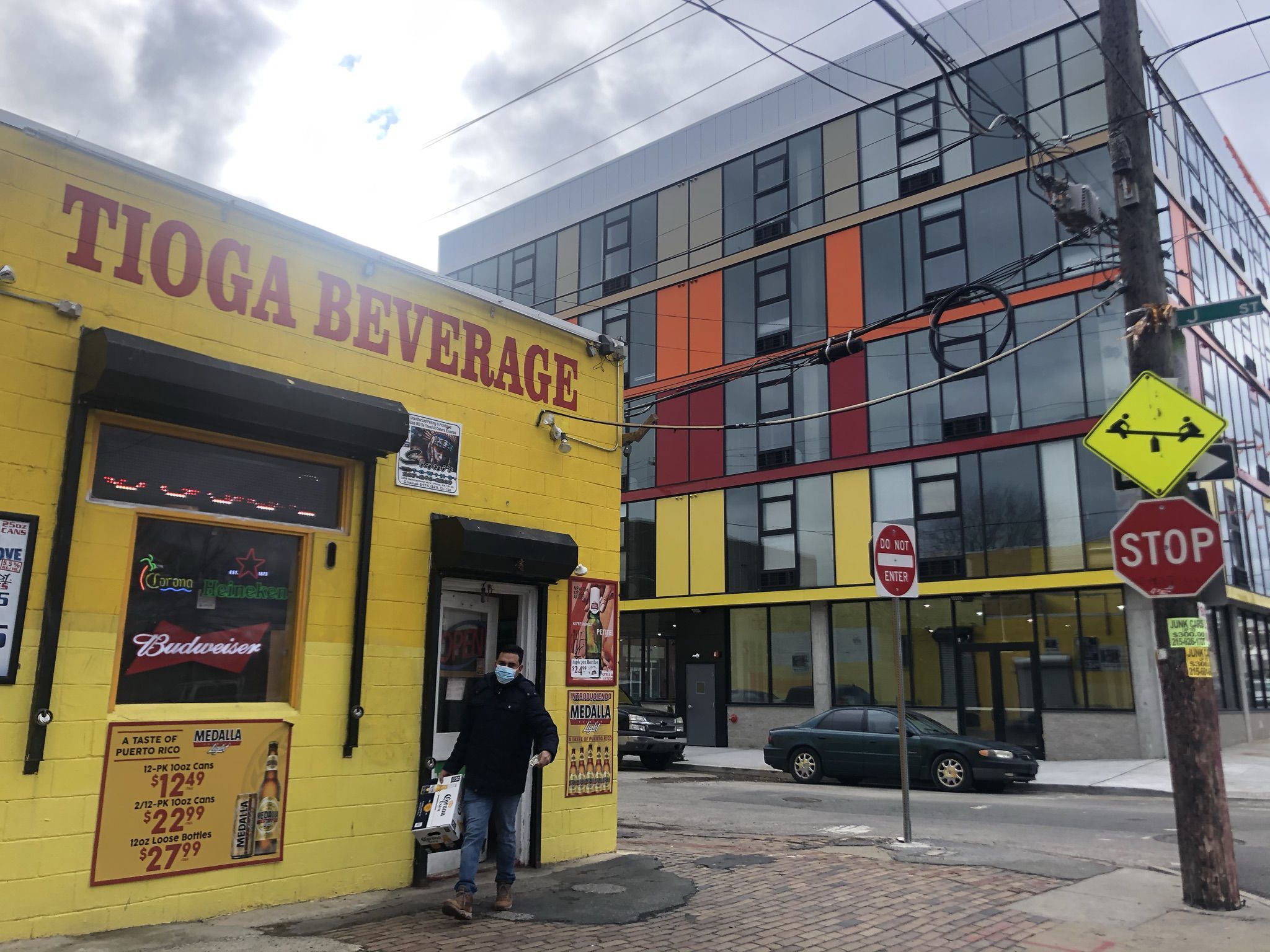
In this 2021 file photo, a glass building at J and Tioga sits near a beer store in Kensington.
Some neighborhood leaders have watched with anxiety as luxury housing developers and out-of-town investors gobbled up properties in the neighborhood, fearing that poorer residents and middle-class homebuyers may be priced out.
City Councilmember Quetcy Lozada, a Democrat who represents the 7th Council District, which includes parts of Kensington, said she knew speculators from outside the area would want to make it “the next gentrified neighborhood” once the city changed its strategy to more aggressively clean up trash and improve public safety.
But Lozada said there are not enough programs specific to Kensington aimed at preventing displacement as a result of rising property values, especially as the city is investing millions of dollars a year to improve the neighborhood. She said her office is exploring additional tax relief measures.
“I’m going to do whatever I have to do to make sure that residents who have lived in that community can stay there, can raise their families there,” Lozada said. “We have witnessed what has happened on the southern end of the district, where there has been rapid gentrification.”
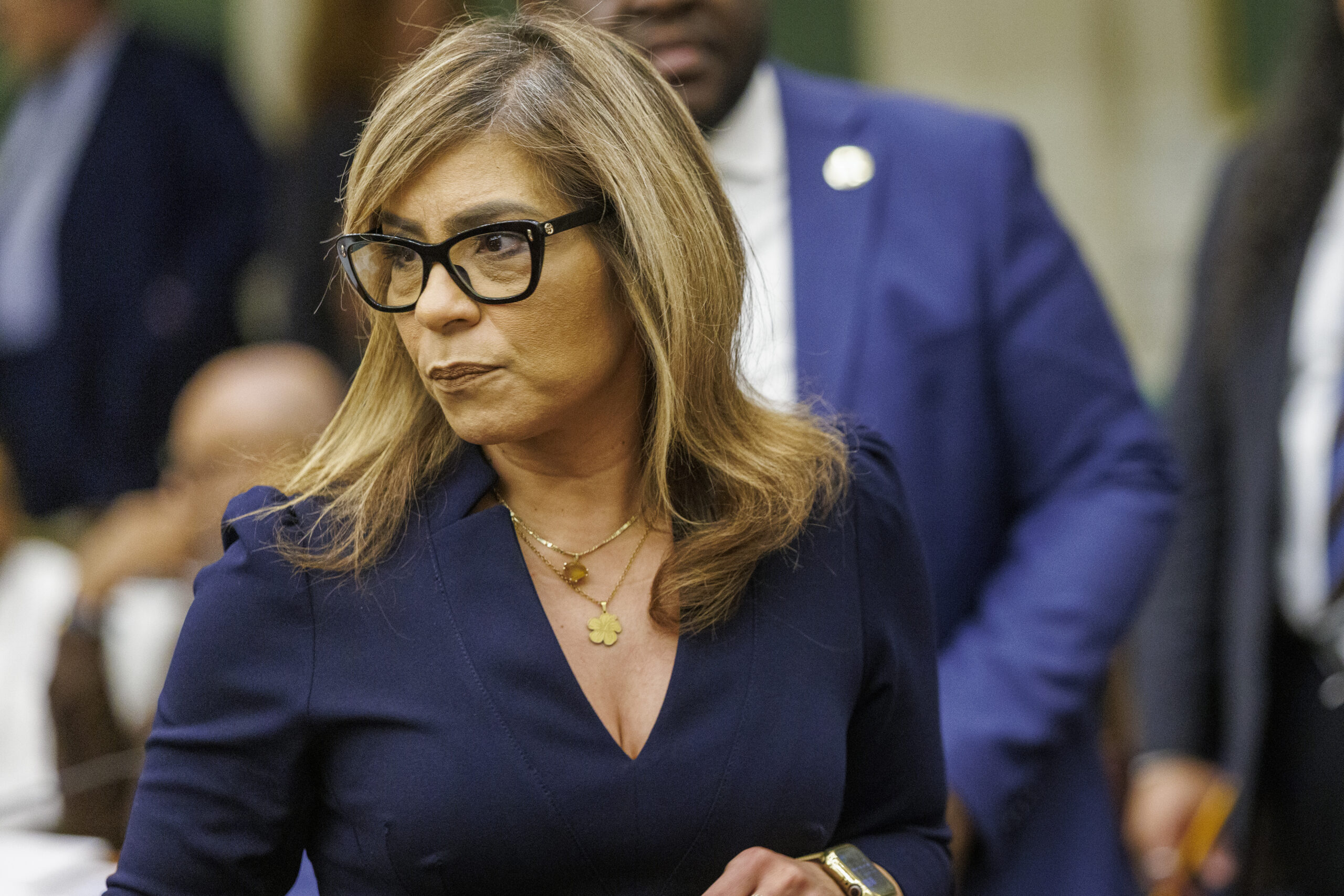
In this March file photo, City Councilmember Quetcy Lozada stands in Council chambers during Mayor Cherelle L. Parker’s budget address.
Lozada also said rising property values in Kensington are part of why she has been “so careful with projects presented to me” and has prioritized what she sees as equitable development in the neighborhood — at times to the chagrin of developers who think she has been too restrictive.
“I’m all about people making a return,” she said, “but you can’t continue to do it on the backs of poor people.”
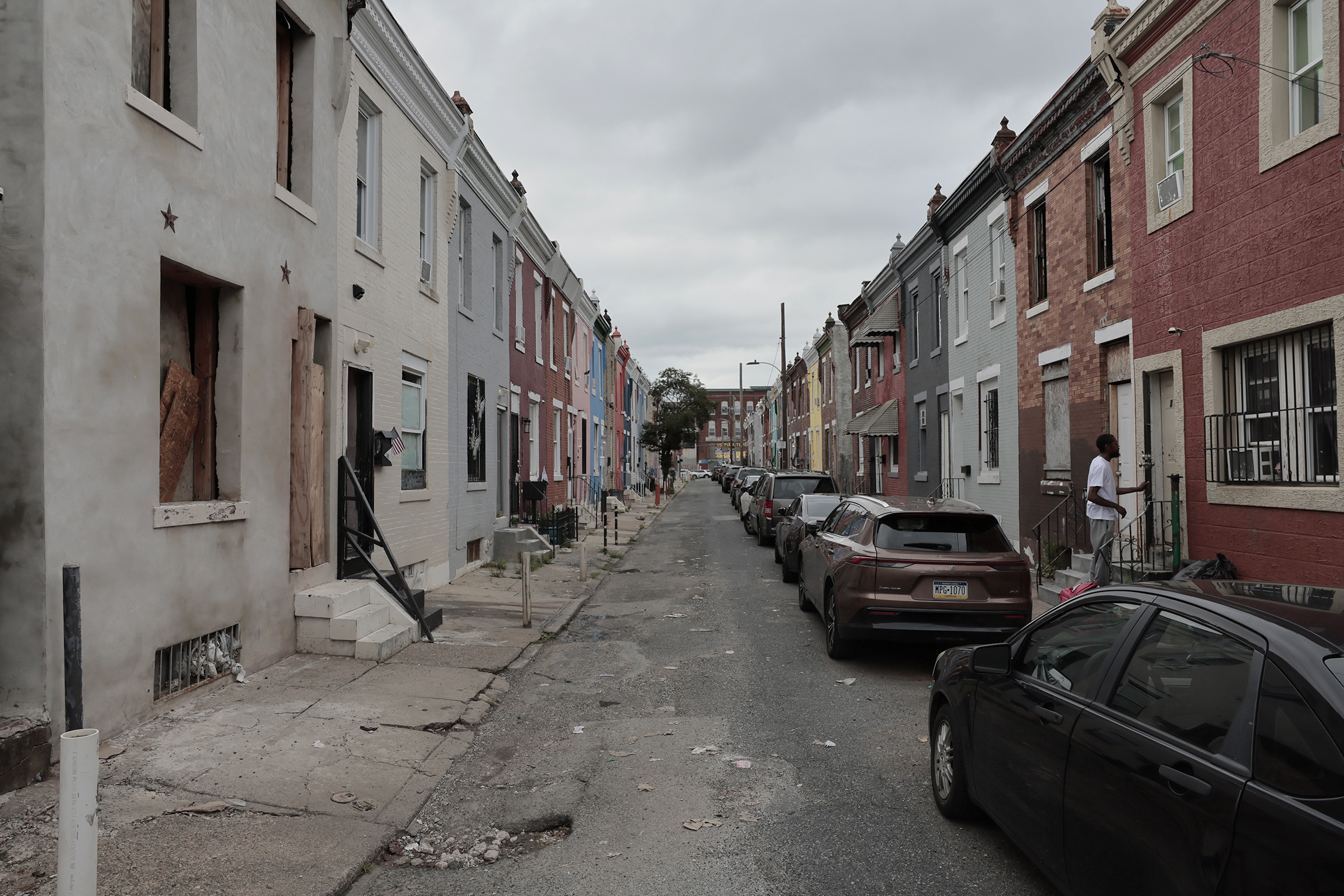
The 3100 block of Arbor Street in Philadelphia on Tuesday, July 7, 2026.
Continuing change in pockets of West Philly
There were also significant property value increases in parts of West Philadelphia.
The median increase in Mantua, the neighborhood north of University City, was the second highest in the city, at 15%, according to The Inquirer’s analysis. The median increase was 12% in Kingsessing, the neighborhood south of University City that in 2025 saw the largest jump of any neighborhood in Philadelphia.
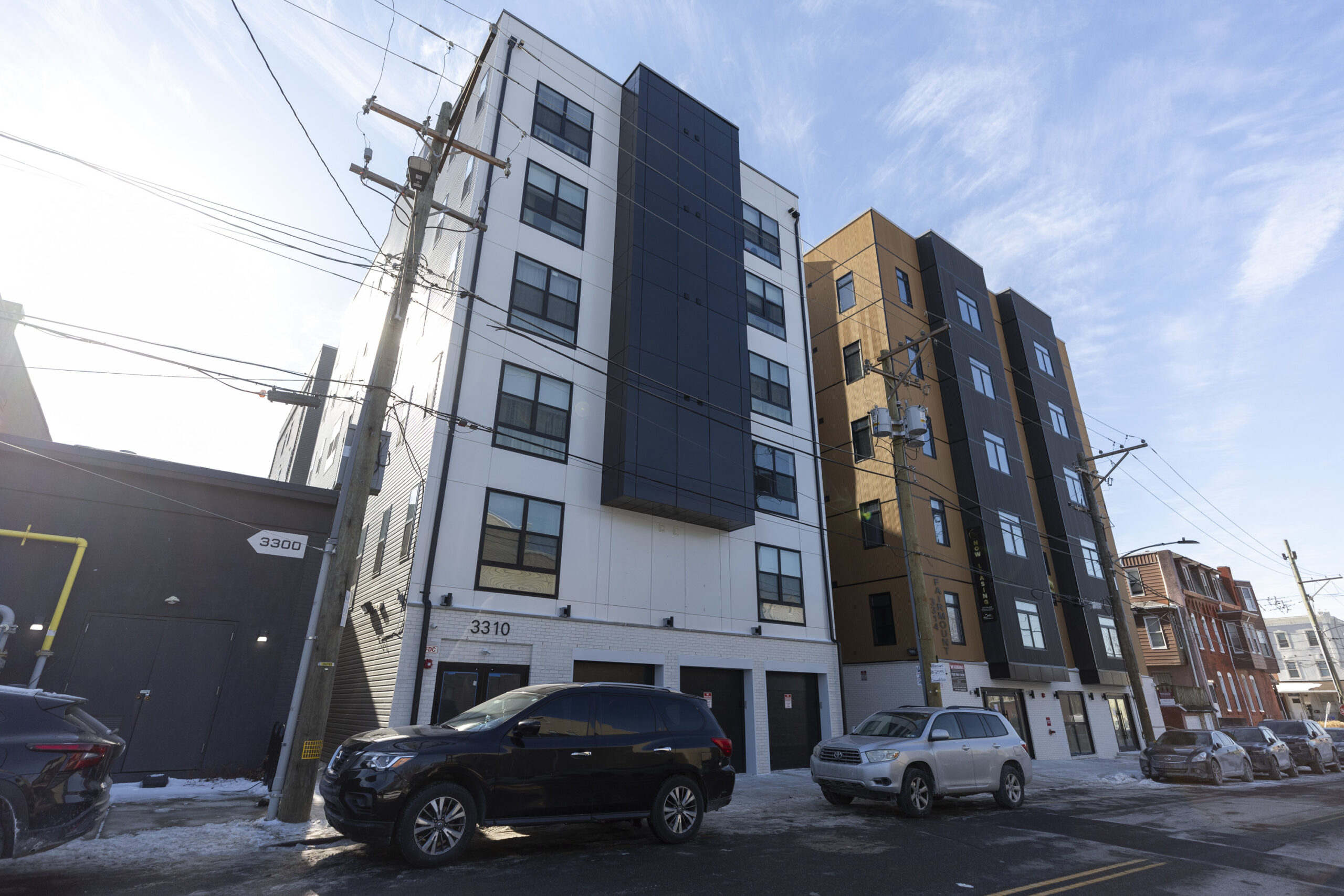
Newly developed buildings along Fairmount Avenue in the neighborhood of Mantua in Philadelphia, Pa., on Thursday, Jan. 23, 2025.
Councilmember Jamie Gauthier, a Democrat who represents West Philadelphia and has made preventing displacement a key initiative, said that there has long been racial bias in the city’s property assessments and that the city must “get serious” about protecting low-income homeowners by revamping its system.
“There has to be a higher level of urgency in making sure that the city doesn’t have a hand in pushing out all of these homeowners that make Philadelphia what it is,” Gauthier said. “It’s unconscionable for us to destabilize our neighborhoods and the longtime homeowners who live there because we didn’t take enough care to make sure that our process was fair and equitable.”
For too long, she said, city officials have said they intended to examine the property assessment practices and identify improvements. In 2024, Parker convened a task force to study the process.
Aros told Council in April that the task force’s report was “being finalized.” He said OPA would look to implement recommendations from the report, including conducting more regular reassessments and improving property-level data such as property condition.
The city is also planning to hire an outside consultant to examine its mass appraisal practices, according to city records. The analyst will be responsible for drafting a report by the end of this year.
Deputy creative director John Duchneskie contributed to this article.
For years, Sam Ahern imagined opening a place that felt less like a restaurant than a gathering spot.
Now, just a few doors from her first Philadelphia apartment, she’s done exactly that.
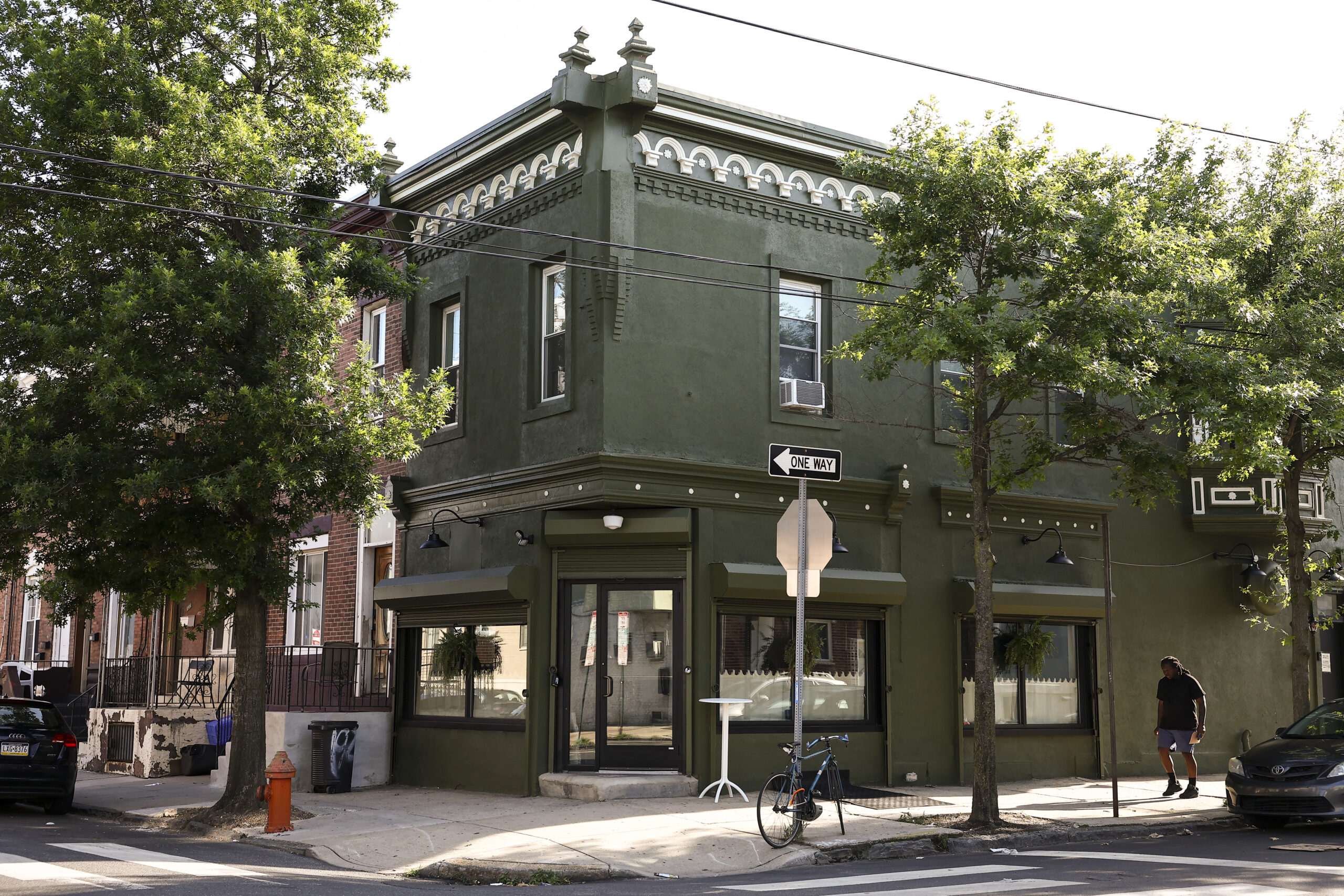
Lillian’s opened last week at 19th and Mifflin Streets in Point Breeze, transforming a onetime barbershop into a bistro and cocktail bar decorated like an old-fashioned living room parlor, complete with vintage furnishings and an evolving food program that will regularly hand over its kitchen to guest chefs.
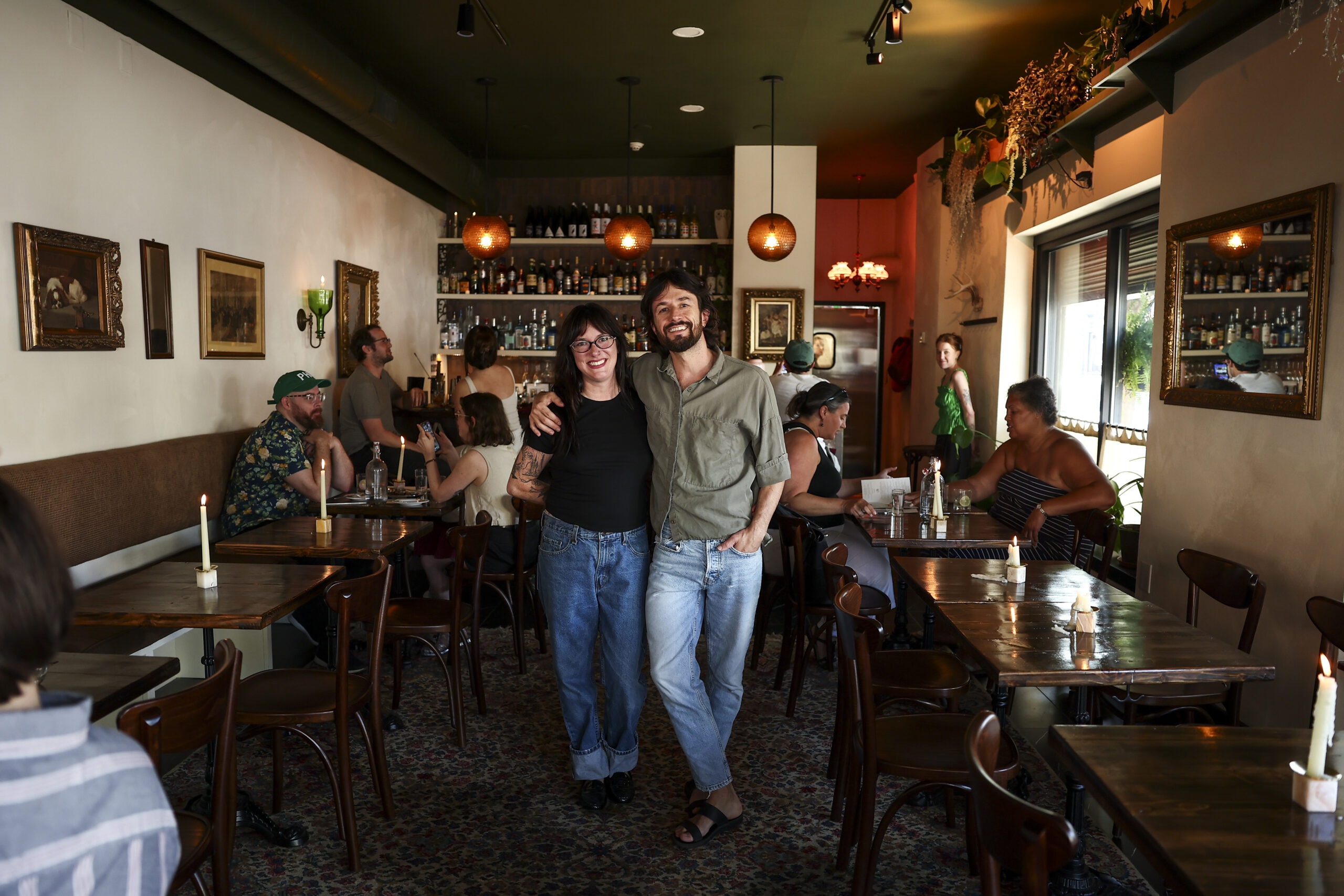
Owner Sam Ahern and bar manager Avdo Babic at Lillian’s. They met while working at Fitler Club.
“I wanted something that felt like you were hanging out in somebody’s house,” Ahern said.
Ahern took the name from her great-great-grandmother, who had a speakeasy in her basement in North Jersey and was known in the family as Diamond Lil. “The story goes that she would keep jewelry if you couldn’t pay with cash, and apparently she made her own gin,” said Ahern, who accepts cash and credit cards at Lillian’s.
The project is the culmination of a path Ahern never expected to follow. She studied graphic design and fiber arts in graduate school in Savannah, Ga., where she began helping a friend open a restaurant. Hospitality stuck.
After moving to Philadelphia in 2018, she worked behind the bar at Cicala at the Divine Lorraine, then at the private Fitler Club, before becoming bar manager at Fabrika in Fishtown.
She also put down roots in Point Breeze eight years ago. Her first apartment was three houses from where Lillian’s is now.
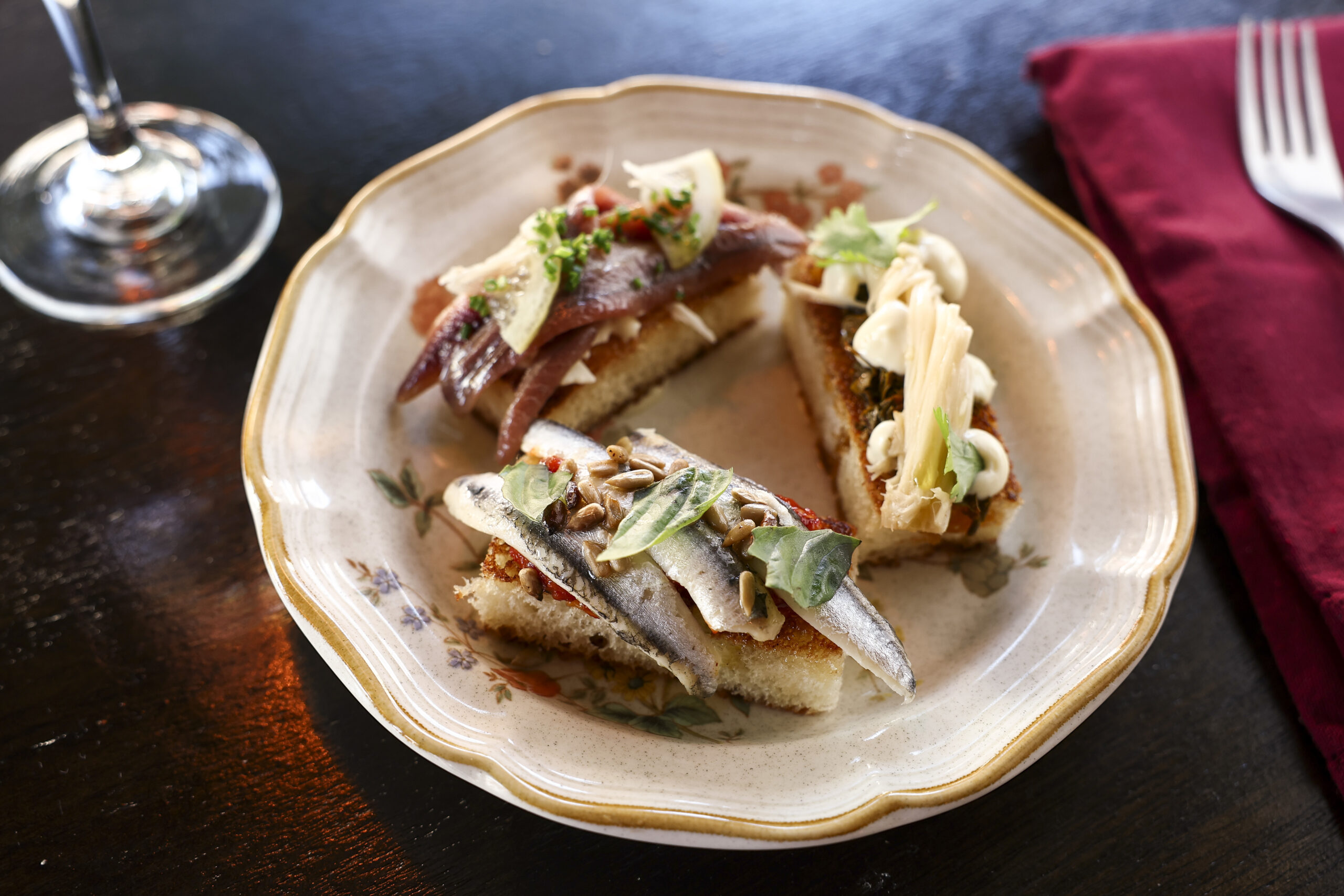
Three brioche toasts (anchovy, sardine, and enoki mushroom) at Lillian’s.
During the pandemic, Ahern and friends hosted backyard supper clubs featuring rotating chefs. The dinners proved there was an audience for intimate, chef-driven experiences outside the traditional restaurant model.
When a property around the corner from her home came on the market, “it felt meant to be,” Ahern said. “At the same time, someone I knew was selling a liquor license and it also became available, so everything just fell into place.”
Rather than hire a permanent executive chef, Ahern decided to build Lillian’s around residencies. The idea, she said, is to tie the supper-club ethos into a neighborhood bar where someone can stop in for a martini and a sandwich one night, then return weeks later to discover a different chef, menu, or cocktail.
Chef Alejandro Martín Sánchez, who is location-shopping for his fine-dining restaurant Mesona, consulted on the opening menu, kitchen layout, and operations. Kitchen operations are managed by Isobella “Izzy” Ioffreda, while guest chefs rotate through for weekend or monthlong engagements.
Panzanella salad at Lillian’s.
The opening menu is intentionally concise, built around Mediterranean-inspired snacks and light meals meant to accompany cocktails. It includes mixed pickled vegetables ($5); panzanella salad ($12) with optional toppings; brioche toasts ($6 each), topped with anchovies, sardines, or enoki mushrooms; shrimp cocktail ($15 for five); a cheese and charcuterie board ($25), and sandwiches including vegetable ($13) with whipped ricotta, roasted piquillo peppers, and confit garlic; prosciutto and Manchego ($15) with house-made fig jam; and grilled chicken salad with Calabrian tomato jam ($15), topped with arugula and Parmesan on brioche toast. Desserts include flavored shortbreads ($2 each), chocolate mousse ($11) with Marsala and pretzel streusel, and olive oil cake ($13) with orange syrup, fig jam, and Greek yogurt. The menu is expected to evolve alongside the rotating chef residencies.
The residency program begins this month with Miled Finianos’ Lebanese-focused Habibi Supper Club, which is on its way to a permanent location on Passyunk Square. On July 9-11, 17-18, and 23-25, Finianos will offer a six-course ticketed dinner at 8 p.m., preceded by a public happy hour from 5 to 7 p.m. featuring a more casual Habibi menu. August will be devoted to refining Lillian’s own operation before residencies resume in September.
Lillian’s at 19th and Mifflin Streets on June 30, 2026.
The cocktail program comes from Ahern’s former Fitler Club colleague Avdo Babic. Like Ahern, Babic came to Philadelphia through the arts, arriving to attend art school before discovering bartending under Katie Loeb at the Trestle Inn.
The menu leans on classic cocktails interpreted through house-made ingredients. Babic prepares his own tinctures, bitters, shrubs, syrups, and cordials, drawing inspiration from Prohibition-era recipes as well as the homemade herbal infusions his family made while he was growing up in Bosnia.
The Ms. Martinez ($15), for example, infuses Beefeater gin with osmanthus flowers and linden honey to lend floral, honeysuckle notes to the classic cocktail. Persephone’s Garden ($14) turns the martini savory through clarified pickle juice, dill, celery, coriander, black pepper, caraway, and Greek yogurt. La Molina ($16), a pisco sour, grew out of a recent research trip to Peru while incorporating a lime cordial recipe Babic has refined over several years.
“We built it around seasonal ingredients, but the foundation is classic cocktails,” Babic said.
Lillian’s, 1900 S. 19th St. Hours: 5 to 11 p.m. Tuesday to Thursday, 5 p.m. to midnight Friday and Saturday. Kitchen open to 10 p.m.
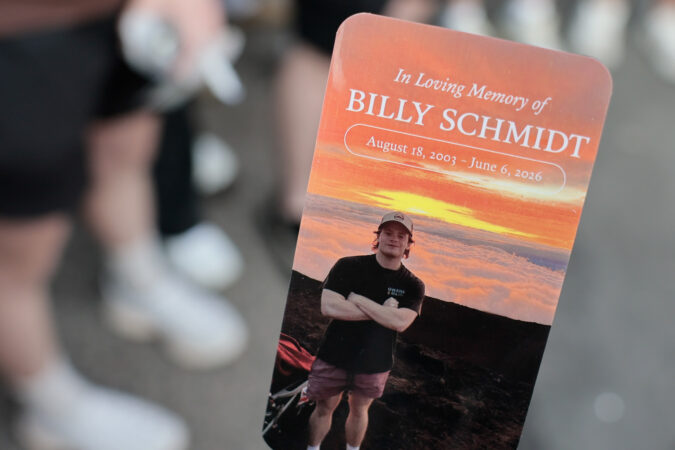
A teen wanted in the shooting death of Penn State student William “Billy” Schmidt in South Philadelphia last month was apprehended in Colorado, the U.S. Marshals Service said Wednesday night.
Azzubair Outen-Fleming, 16, was taken into custody in Colorado Springs at the home of a distant relative, the U.S. Marshals Service said. The teen was being housed at the Zebulon Pike Youth Center awaiting extradition to Philadelphia.
Earlier on Wednesday, District Attorney Larry Krasner announced the arrest of Outen-Fleming’s stepfather for allegedly hindering the police investigation into the slaying of Schmidt.
Donte Abdulmalik, 35, was charged with hindering apprehension, obstruction of justice, tampering with evidence, and related crimes, Krasner said Wednesday.
Prosecutors said Abulmalik helped his stepson leave the city. He is not accused of participating in the homicide.
The teens will face charges of murder, robbery, criminal conspiracy, illegal possession of a firearm, and related offenses, Krasner said.
He suggested that the investigation could involve others, describing the charges against the two teenagers and Abdulmalik as “a smaller part of a bigger picture.”
“I am not telling you that these are the only people involved,” Krasner said during a news conference Wednesday. “I’m not telling you that this investigation is over or that we have all the answers yet.”
Philadelphia police have said Schmidt was walking home when two masked people approached him. During what investigators say was an attempted robbery, one of the suspects — whom Krasner identified as Smith — shot Schmidt.
Surveillance camera footage shows that one suspect took Schmidt’s phone, prosecutors said Wednesday, then rifled through his pockets before knocking him to the ground.
Additional footage later shows Schmidt walking behind the suspects, before one throws a phone down the block and the other fires a bullet into Schmidt’s chest.
Krasner declined to say whether the gun used to kill Schmidt had been recovered.
Investigators say surveillance cameras captured the suspects before and after the shooting. One was wearing a gray hooded sweatshirt with a hand-drawn “KONFUSED” logo and a skull-and-crossbones sketched in black marker on the front, according to the footage. After the shooting, police said, both suspects fled wearing white T-shirts.
Philadelphia police and the U.S. Marshals Service Fugitive Task Force are searching for the remaining teenager. Both agencies have offered rewards for information leading to the arrests of both teens. Krasner said Smith has ties to Philadelphia’s Point Breeze neighborhood and Delaware.
Anyone with information may contact the U.S. Marshals Service at 1-866-865-8477 or submit a tip online through its website: usmarshals.gov. Tips can also be provided to Philadelphia police at 215-686-3334 or 215-686-8477.
Daniel Martino didn’t set out to build an empire of pie shops. He just wanted somewhere to get coffee without leaving the neighborhood.
When he bought his home in Port Richmond in 2013, the closest coffee shop was an hour round trip, he said. “Selfishly, I thought, I can put a little coffee shop here.”
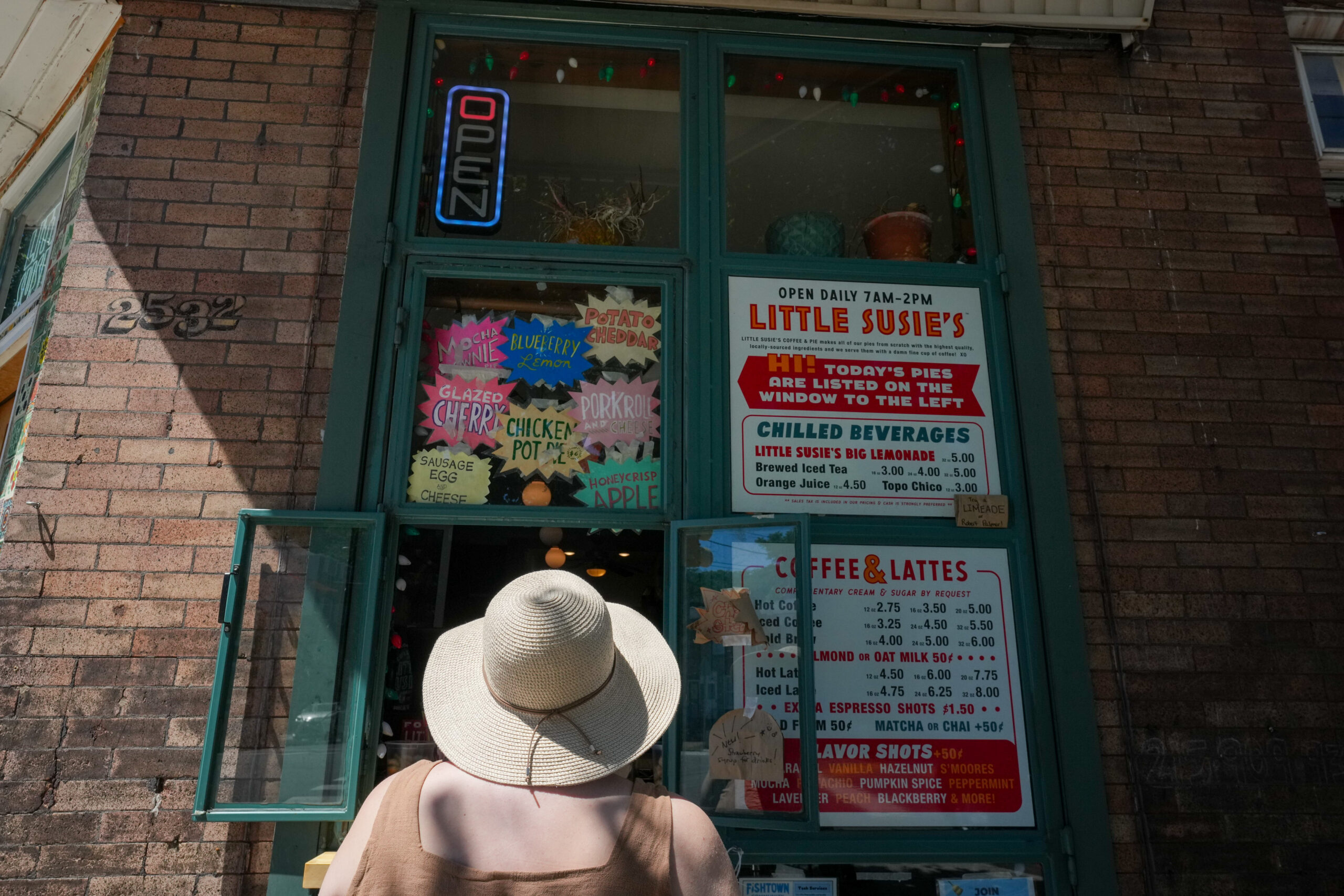
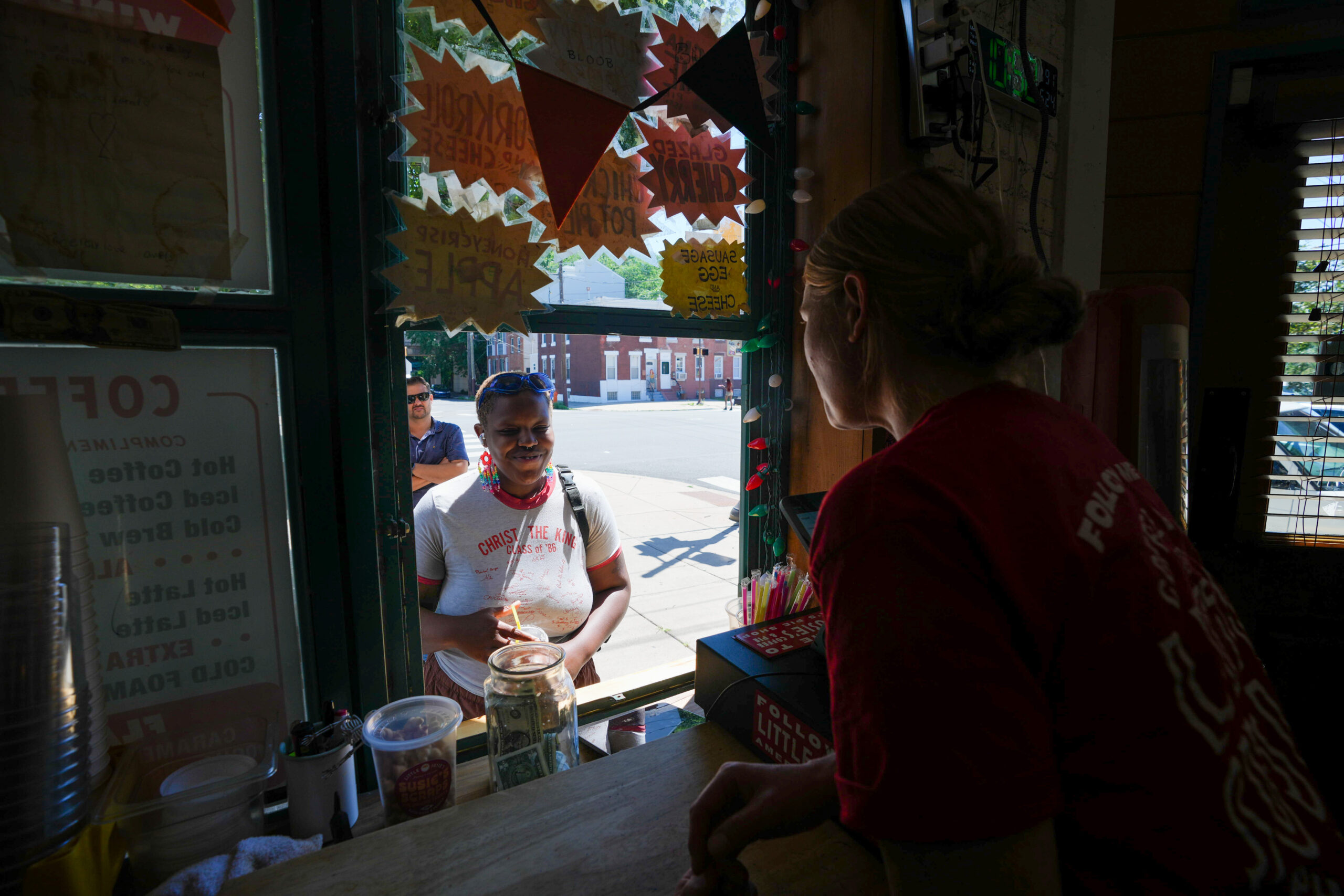
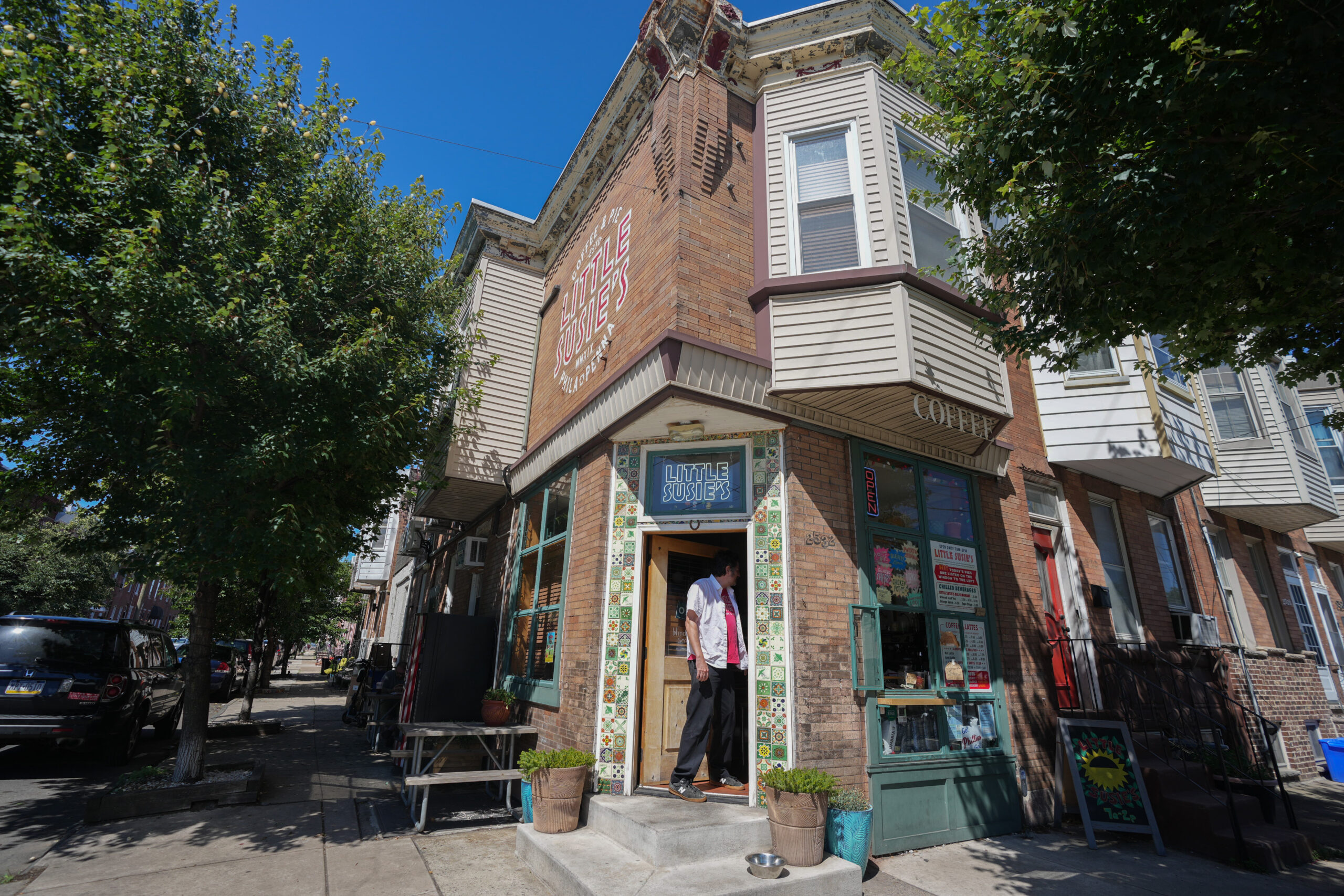
The takeout window at Little Susie’s flagship location at 2532 E. Lehigh Ave.
And what goes better with a cup of coffee than pie? He had a recipe he’d been baking for family get-togethers.
Seven years after Martino opened Little Susie’s Coffee & Pie in the building next door to his house, his modest idea has grown into four Philadelphia locations, with a fifth expected to open Friday at the former Pop’s Bun Shop in Bella Vista, a franchise headed to Milwaukee, and plans for additional shops in Fairmount and Northern Liberties. All his stores run from takeout windows, requiring little more than coffee stations and electric ovens.
Today, the company employs 28 people and turns out about 1,200 pies a day from a bakery occupying two cramped rooms in the corner rowhouse on Lehigh Avenue.
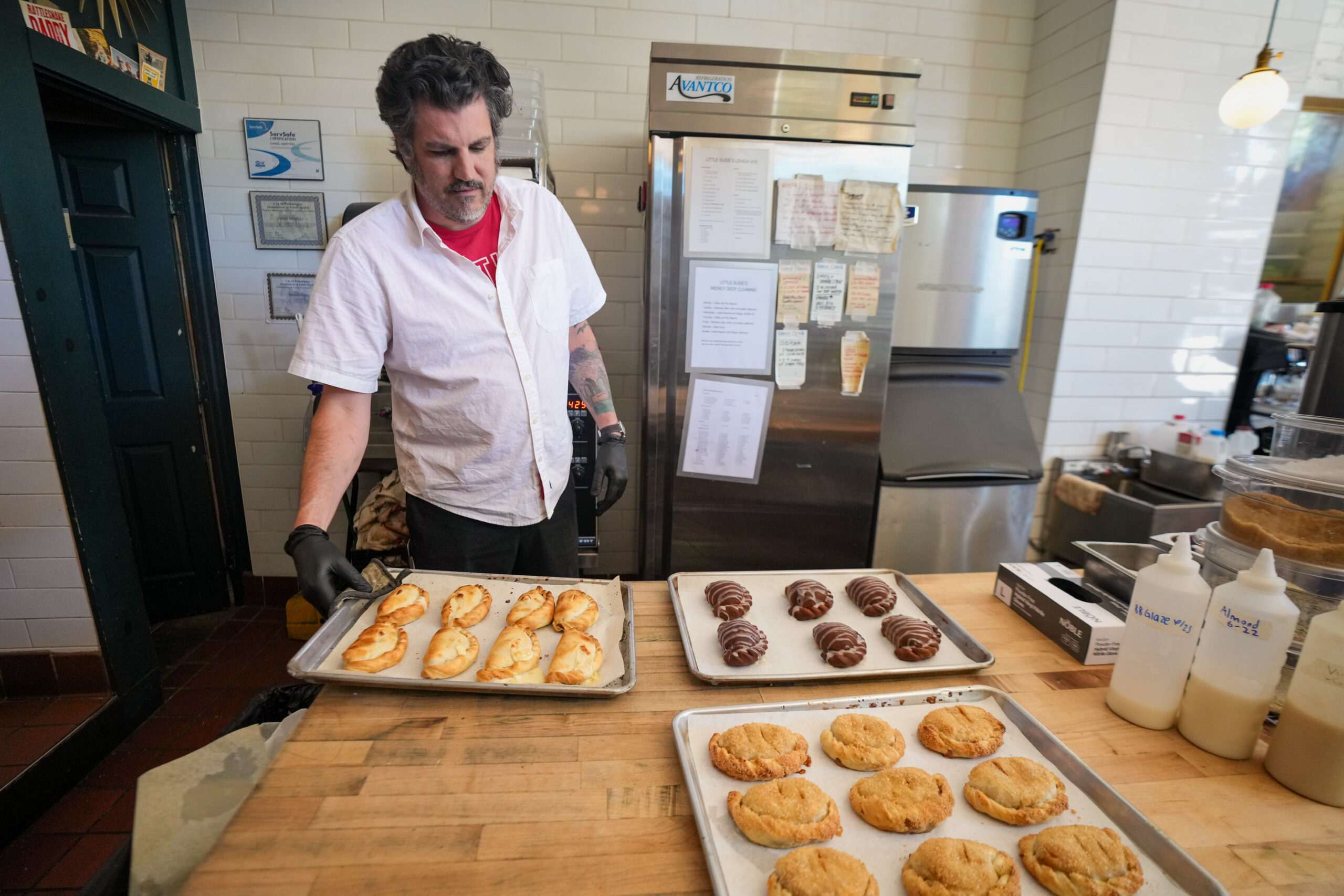
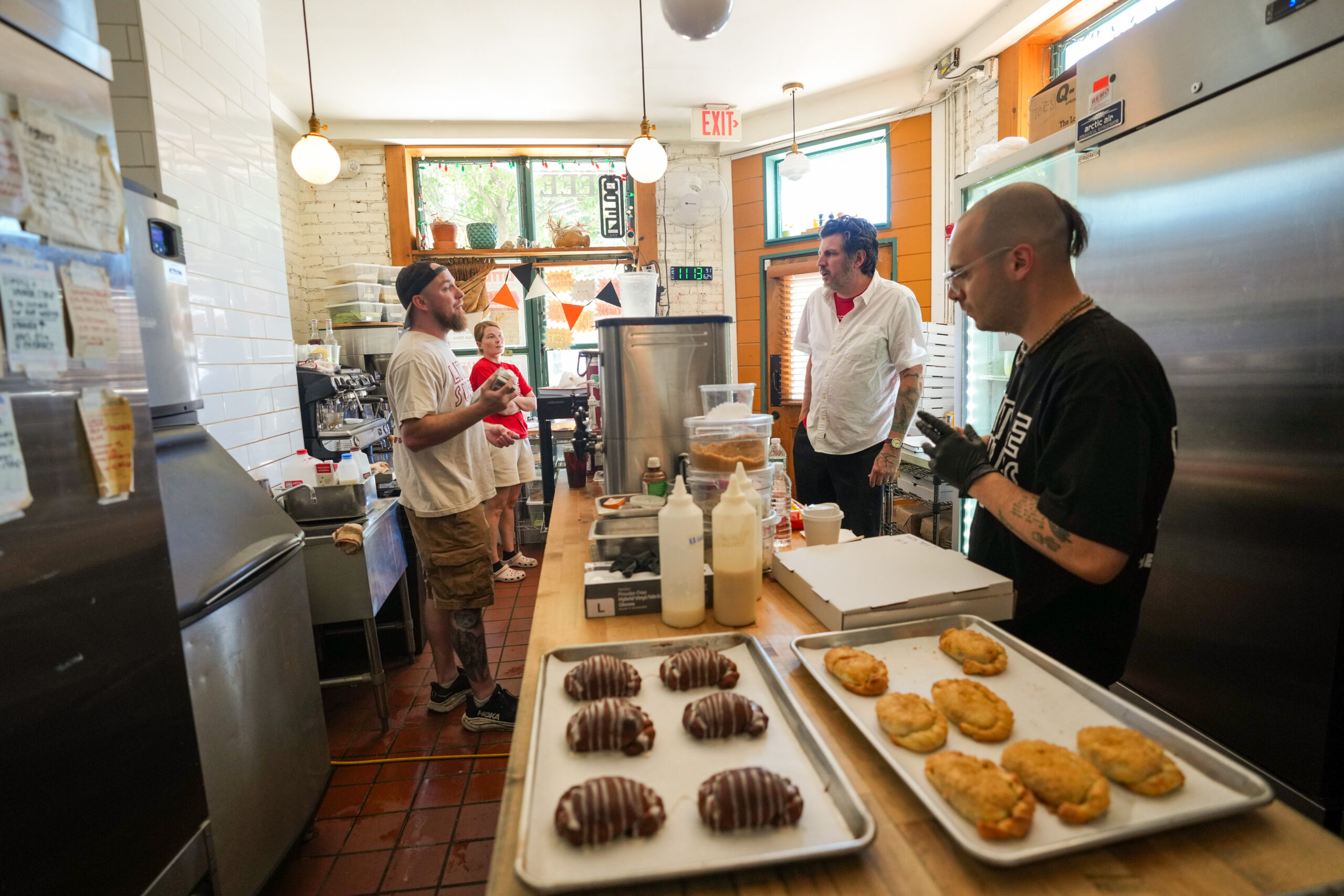
Owner Daniel Martino with trays of pies at Little Susie’s.
Martino, 46, who grew up in Northeast Philadelphia, has spent much of his working life around food. As a teenager, he worked at a swim club snack bar before taking a kitchen job at what is now Jefferson Torresdale Hospital.
After studying film at Temple University, he joined Public House Investments, which ran City Tap House, as a DJ before becoming the hospitality company’s creative director, designing menus, logos, ads, and marketing material.
When the property next door to his house became available, Martino said he used a home-equity line of credit to buy it before securing a Small Business Administration loan to renovate it.
The takeout window at Little Susie’s. Hand-lettered signs advertise the specials.
By the time Little Susie’s opened in December 2019, he said, “I had maxed out every credit card I had. I even had to go to the bank, hat in hand, and sign a signature loan for the last $10,000 just to get it open.”
His shop offered a simple menu, little more than coffees and lattes and four kinds of pies. There was a counter for seating. The first day brought in about $180, and “it was the greatest day of my life,” Martino said.
Then the pandemic arrived. When COVID-19 restrictions shut down indoor dining, Little Susie’s shifted to window service. Customers called in orders, paid over the phone, and picked up coffee and pies outside. Even after restrictions were lifted, the shop never reopened indoors.
It wasn’t what Martino had imagined. His idea was ”Cheers with coffee — the neighbors and the mailman talking about the weather,” he said.
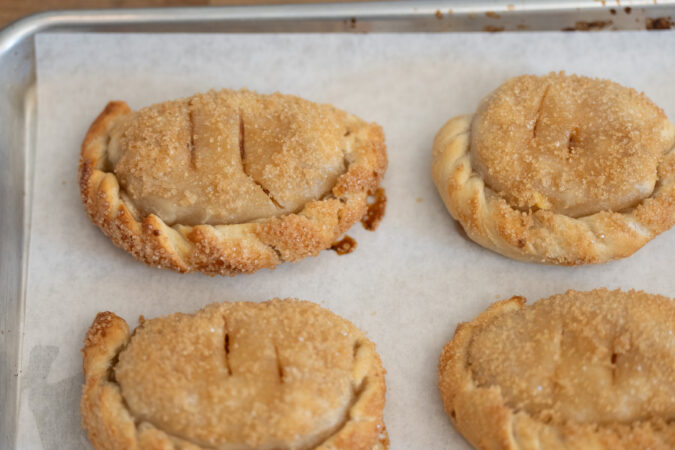
Instead, customers embraced the walk-up model and the seating at a picnic table beneath a maple tree. The pies especially quickly caught on. The signature is the crust. Rather than trimming away the excess dough, workers twist it around each pie by hand, creating what Martino calls “a fluffiness that the fork doesn’t provide — that flaky tenderness you want in a pie crust. The twist is its own special treat in and of itself.”
Owner Daniel Martino (rear, right) with staff and pies at Little Susie’s, set up in a rowhouse.
The pies, which are baked and not fried, are made with a simple crust of flour, butter, sugar, and salt. It’s a 48-hour process. Dough is mixed at the company’s Kensington location, where a 20-quart mixer runs nearly all day. The dough rests for 24 hours before it is brought to Port Richmond, where it is sheeted, filled, twisted, frozen, and delivered to the other stores to be baked to order.
Little Susie’s first menu included only blueberry, pork roll, apple, and mushroom Swiss fillings. Today, it offers about a dozen varieties, with eight available year-round and others rotating seasonally. “You can practically throw anything in this pie crust,” Martino said. “I haven’t been disappointed yet.”
Pies at Little Susie’s.
Pork roll remains the top seller, followed by apple, and a sausage, egg, and cheese breakfast pie encrusted with everything bagel seasoning. Seasonal flavors have included ham and Brie, chocolate-covered strawberry, and Cajun crab and corn. None are gluten-free because of the shop’s limitations, he said.
Not every idea works. “We tried to make a cannoli pie, but the cream just melted right out,” he said.
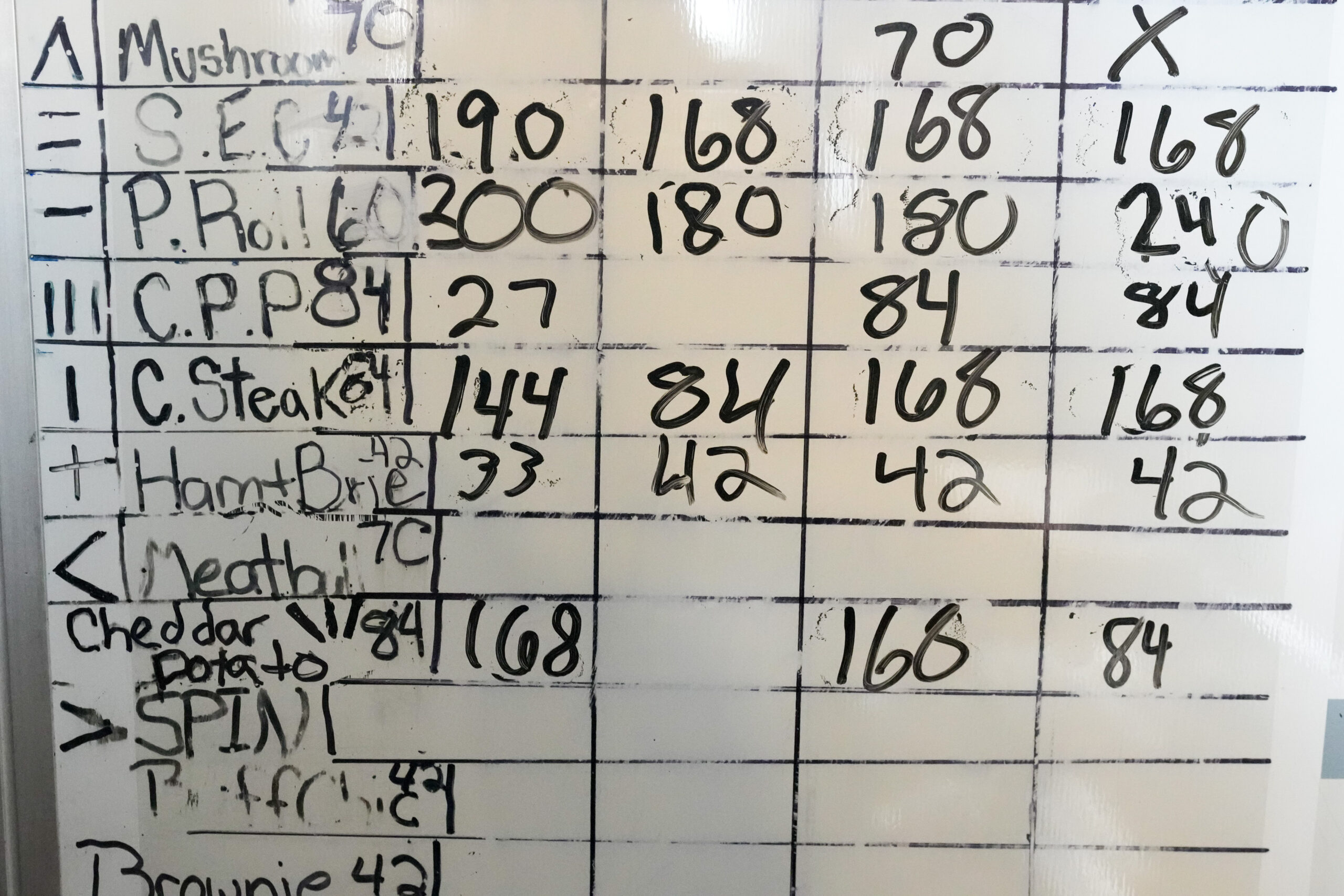
Each shop sells 200 to 300 pies a day. The production kitchen now employs 11 bakers, who track production on a whiteboard nicknamed “the Pieble.” Each variety get its own knife mark on top; an inverted V, for example, denotes mushroom Swiss.
The “Pieble” at Little Susie’s, the flagship pie takeout place located at 2532 E. Lehigh Ave., in Philadelphia, June 24, 2026.
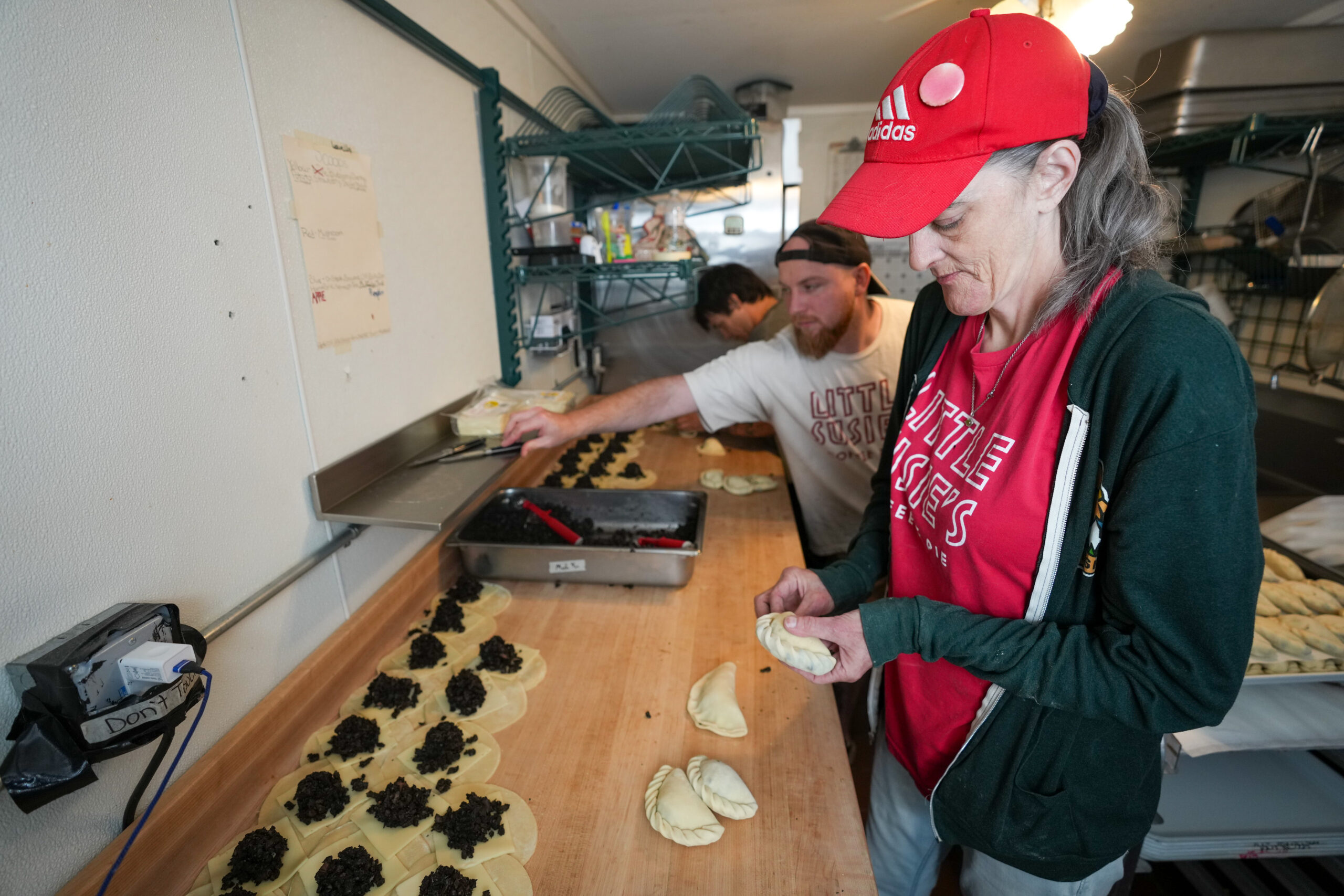
Lena Hurchick, who has worked at Little Susie’s for three years, said she enjoys “the competition of filling all the shops” and watching customers eat pies she helped make.
“Susie” was the name of the dog that belonged to the former owner of the building. “When we had the community meeting here, I said, ‘I’m thinking Little Susie’s,’ and people started crying,” he said.
Lena Hurchick crimps mushroom pies at Little Susie’s.
Expansion has brought complications. A planned Fairmount location was nearly ready to open before the city determined that the property required zoning approval for food sales. “The city does not make it easy,” he said, adding that it will take months to get onto the zoning board’s calendar.
Even so, he expects the company to keep growing. He has a handshake deal for a spot in Northern Liberties. Milwaukee is planned as the first franchise — operated by a friend — while Martino has begun thinking about a larger bakery in Philadelphia.
“We’re basically bursting at the seams,” he said. “We’re probably going to need a 10,000-square-foot facility.”
Owner Daniel Martino at Little Susie’s.
He wants that growth to remain slow enough that the pies are still made fresh every day. “I don’t want to get too far away from making them every day, because then it just becomes some frozen-food empire,” he said.
Little Susie’s Coffee & Pies’ locations are at 2532 E. Lehigh Ave. in Port Richmond, Second and Chestnut Streets in Old City, 1772 N. Front St. in Kensington, and 1754 S. Chadwick St. in Point Breeze. A fifth, at 800 S. Ninth St. in Bella Vista, is due to open Friday. Hours are 7 a.m. to 2 p.m. daily.
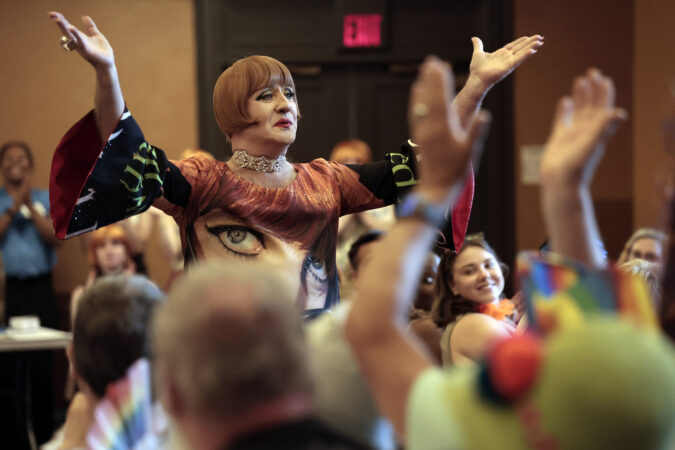
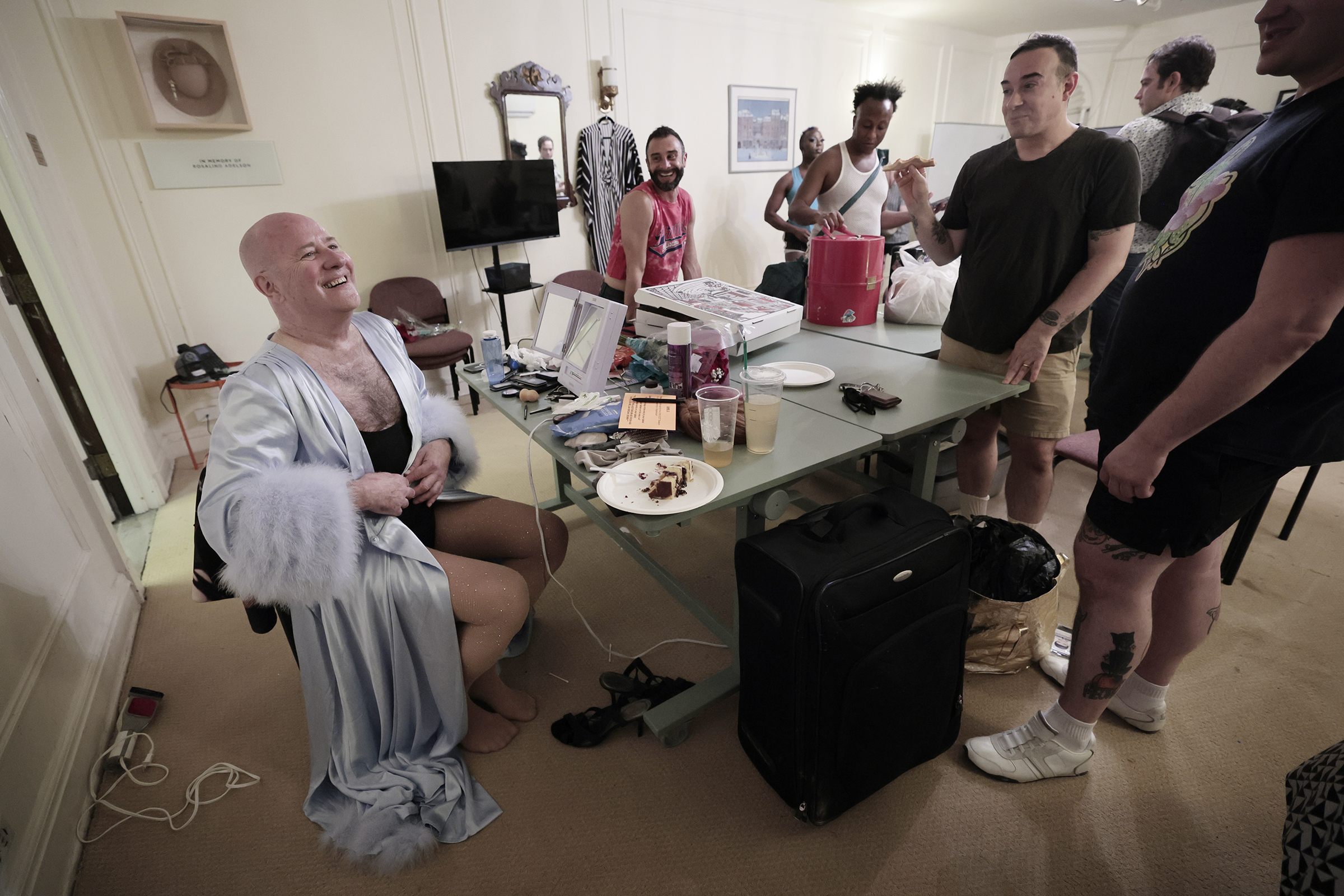
The legendary redheaded drag queen Carlota Ttendant donned a baby-blue Eva Gabor-inspired gown — its plunging neckline revealing tasteful chest hair — and sensible black heels.
At 65, arthritis stifles her strut in stilettos.
“Drag is a young girl’s game,” she said.
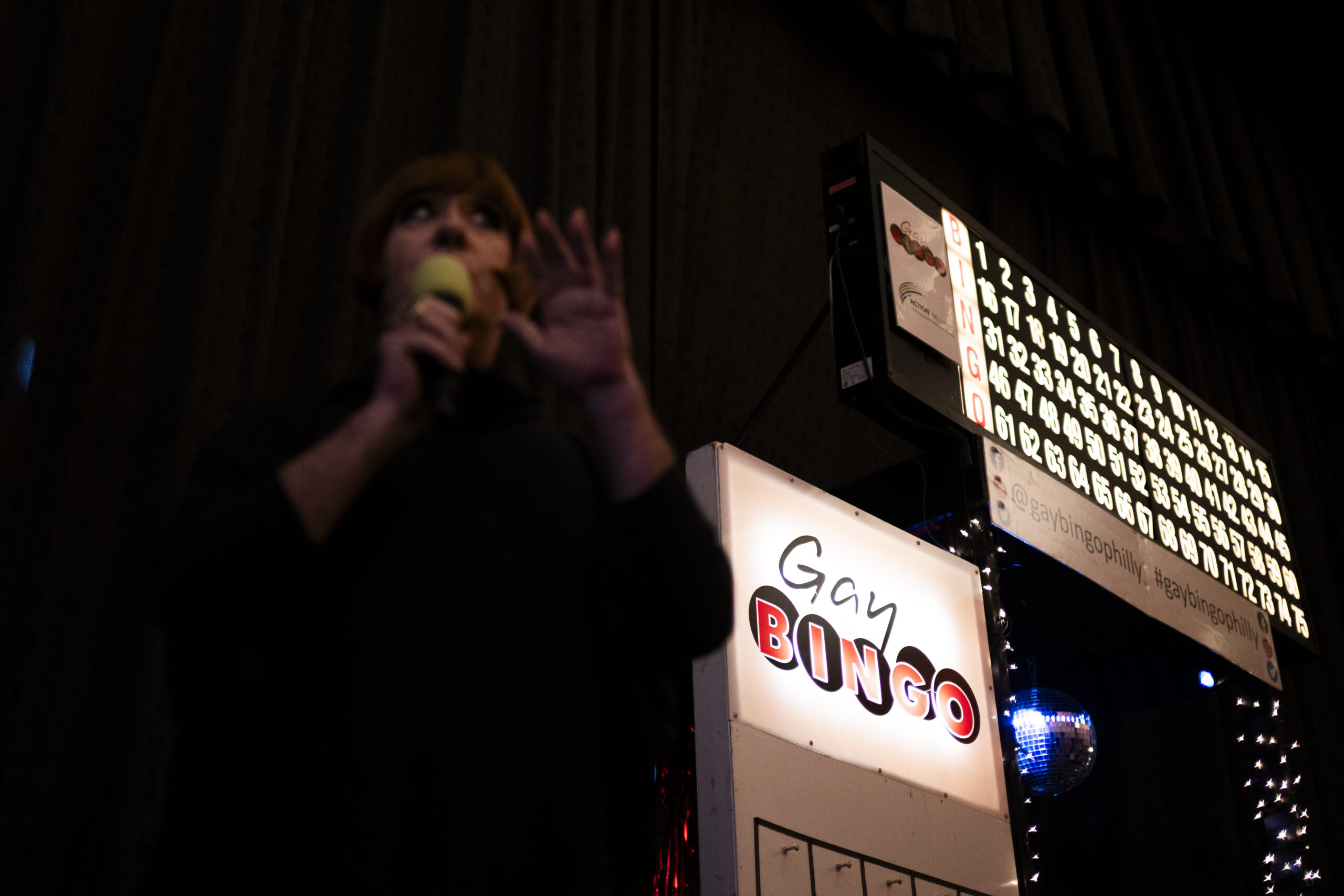
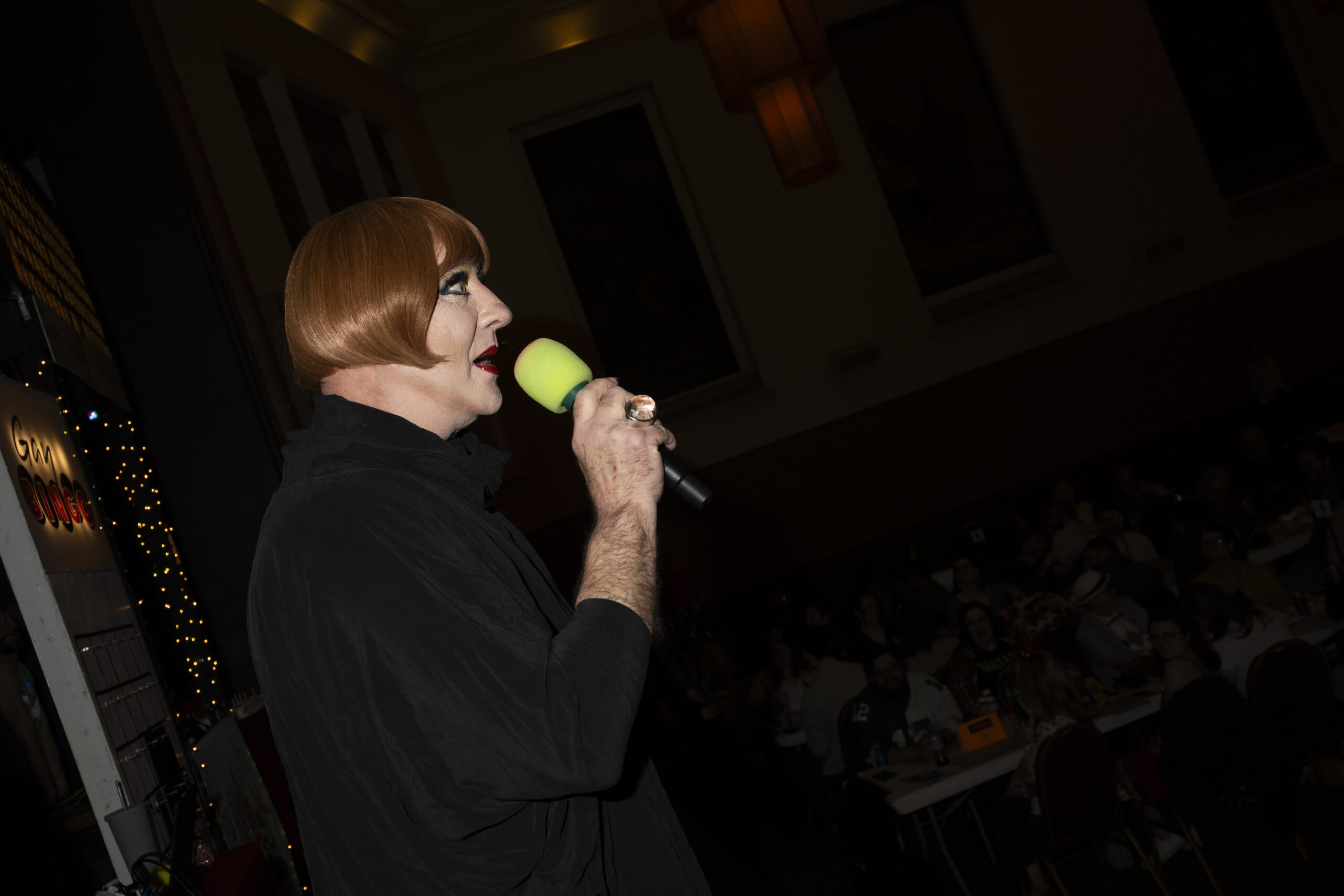
This was her swan song. At the close of its 30th season this Pride Month, the man behind the makeup, Michael Byrne, hung up his heels and bid adieu to his drag persona and his longtime gig hosting Gay Bingo, the camp, irreverent, slightly profane, and undoubtedly silly monthly HIV/AIDS fundraiser.
“I know it’s time,” Byrne said. And, “I’m excited to never wear Spanx ever again.”
Across three decades, Carlota Ttendant has called hundreds of games and elicited endless laughs, all while raising millions for people living with HIV/AIDS across the Delaware Valley. She helped steer a community through crisis, providing a respite to those experiencing immense loss and stigma. Even as medicine has advanced and HIV/AIDS has become manageable, she’s crafted a safe space for queer Philadelphians. For one night each month, she’s been an entertainer and an equalizer, responsible for uniting people — gay and straight, from Haddonfield to Phoenixville — around a common goal.
And since Carlota came into Byrne’s life, she’s taught him to lead with courage, practice gratitude, and be unabashedly unafraid. He’s gone from being the “worst waiter ever” and selling cosmetics, to being a performer, licensed clinical social worker counseling older LGBTQ+ folks through their own next phases of life, and president of Philly AIDS Thrift’s board.
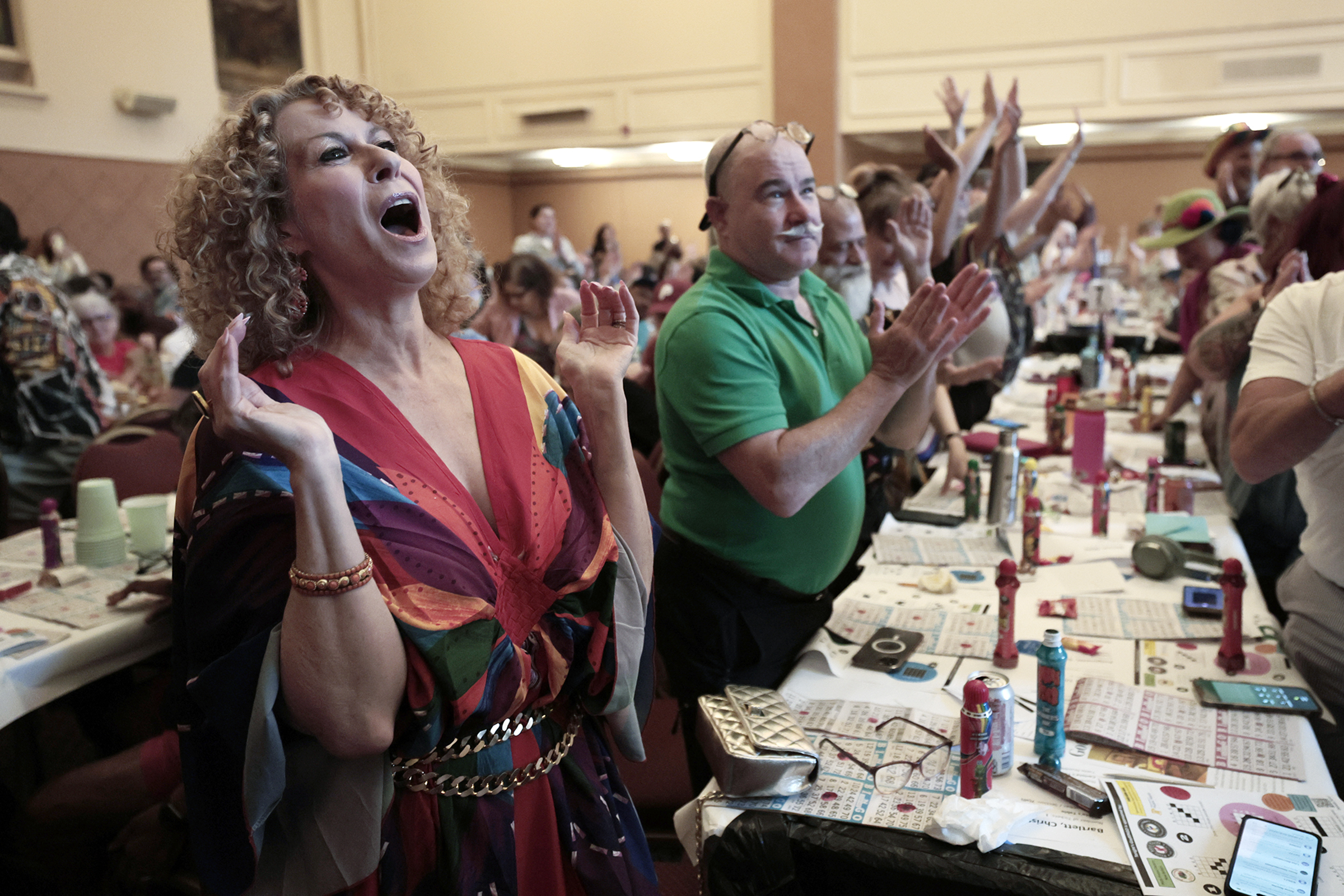
“None of it would have been possible without all of you,” Carlota told the 400-person crowd — the biggest turnout in years — at her last Gay Bingo on June 13 in the basement ballroom at Congregation Rodeph Shalom. “In the ’90s there was horror happening, and today there is horror happening.
“But please, let’s do some laughing,” Carlota said.
“Let’s play bingo!”
Michael Byrne, as his drag persona Carlota Ttendant, during Gay Bingo on Saturday, May 9, 2026, at Congregation Rodeph Shalom in Philadelphia.
Act I
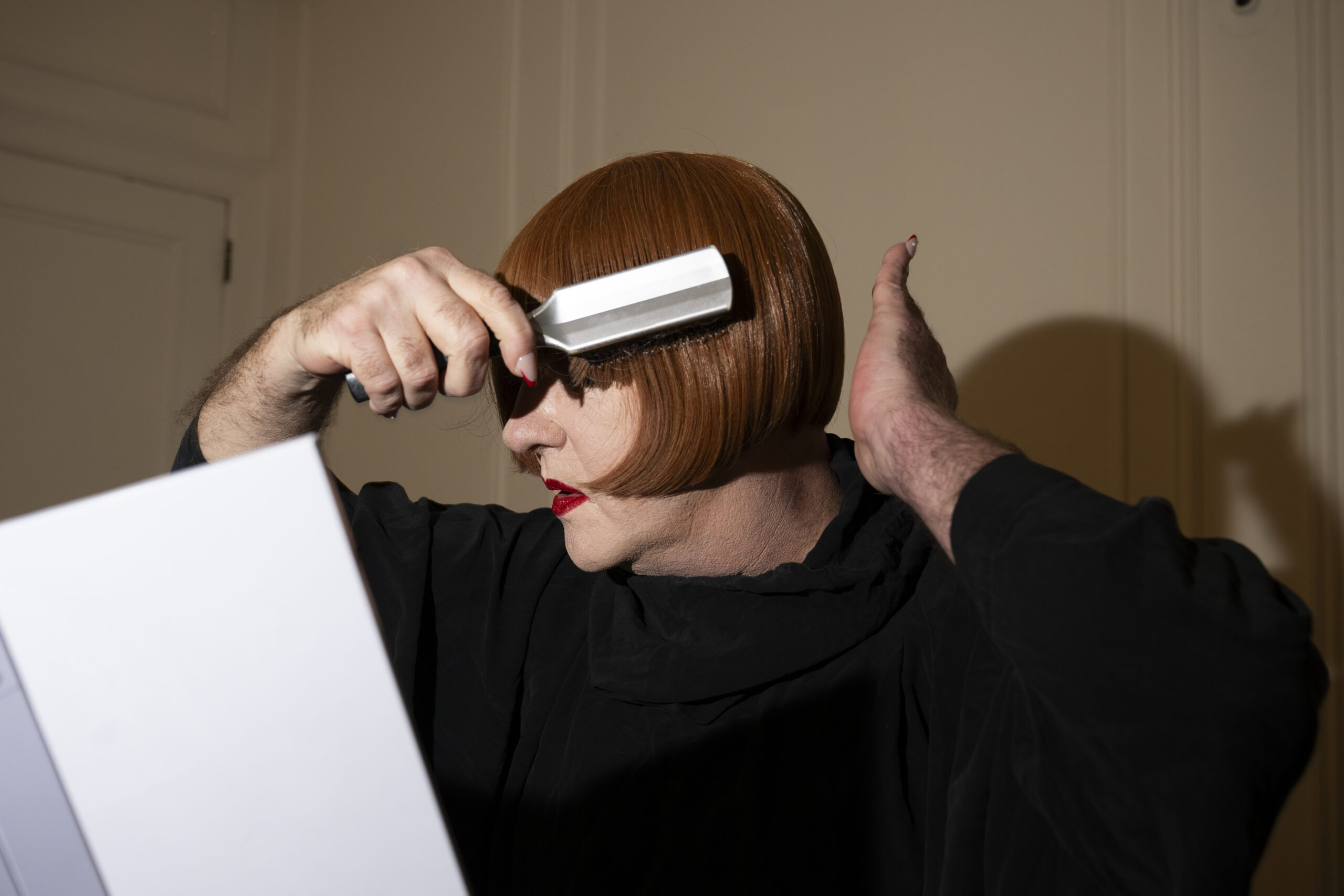
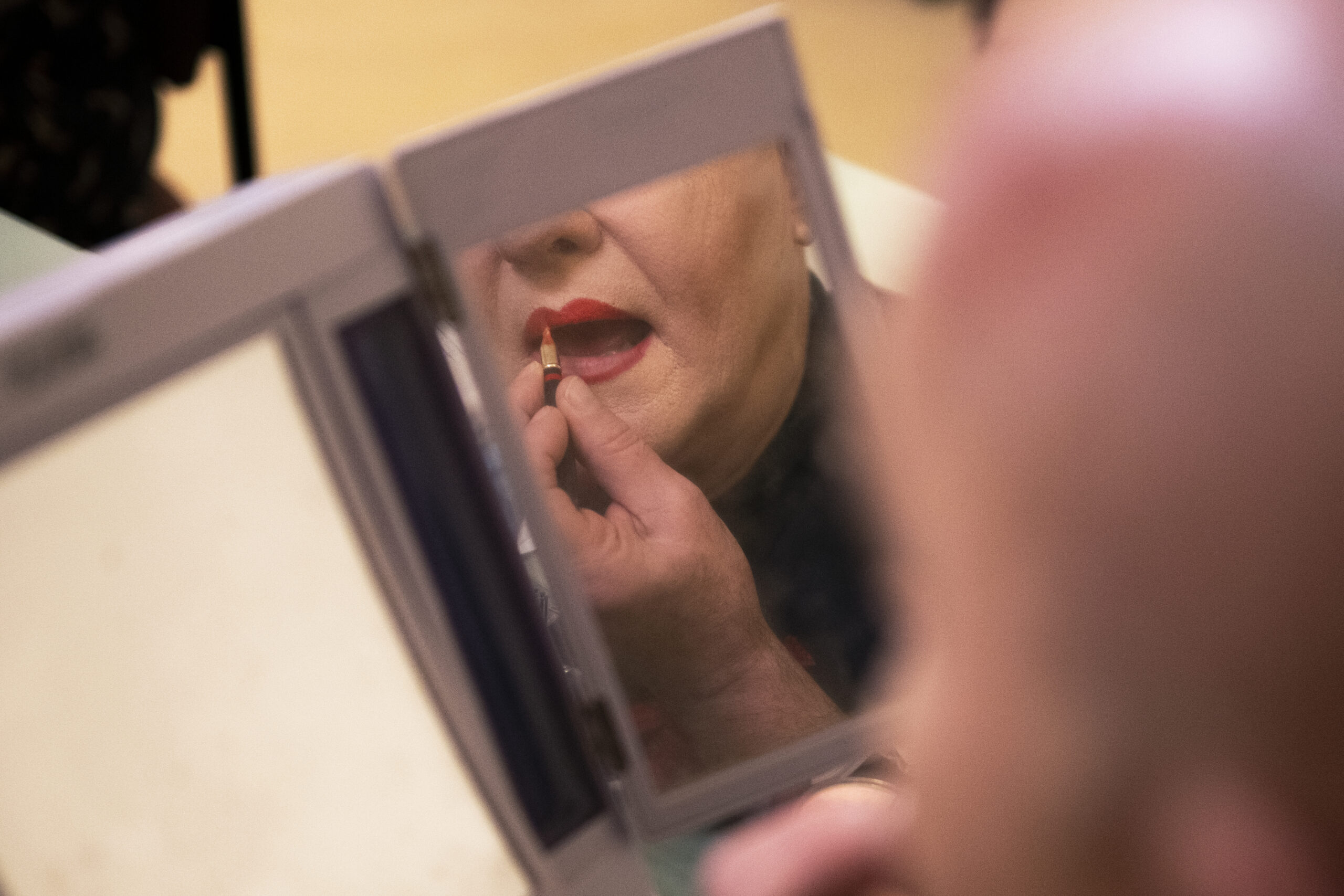
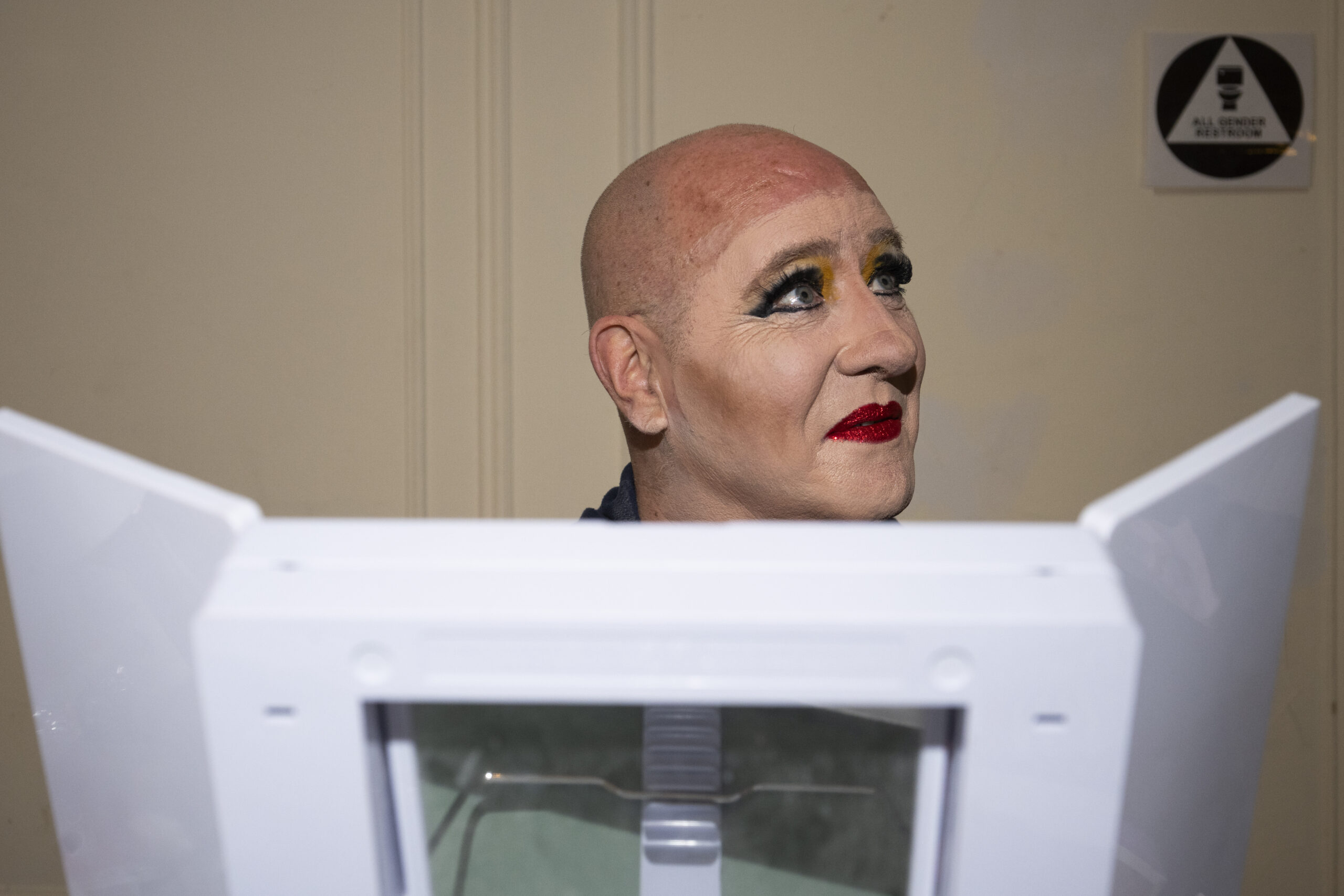
Like so many Saturdays before, Byrne, on June 13, slathered his face with foundation, carved out his cheeks, deepened his eyes, and painted on his red lip. There was haze — from the dusting of loose setting powder, bronzer, and blush — and musk — from sweat and heat and hairspray — in a Rodeph Shalom classroom, which moonlights as a bridal suite and a boudoir for the Bingo Verifying Divas or BVDs. At 10 minutes till curtain, he futzed with his press-on nails, shimmied into a mod swing dress, straightened the back seams of his tights, and dabbed on some glitter. With each gender-bending step, he transformed into his “twin sister,” Carlota.
Michael Byrne transforms into his drag persona Carlota Tendant ahead of Gay Bingo on May 9 at Congregation Rodeph Shalom in Philadelphia.
Like all classy ladies, Carlota’s exact age is lost to time. In the 1990s, Byrne was organizing a fundraiser for Big Mess Theatre, an avant-garde troupe that he helped establish as the spinning axis of Philadelphia’s alternative performance scene, complete with vaudeville acts, an oompah orchestra, and live auction with a striptease routine. Byrne was to host and make his drag debut, and Carlota Ttendant (read as car lot attendant) was conjured up over bourbon and blackjack. (He learned, years later, that there was a ’60s stripper at the famed Trocadero Theatre with the same name.)
Byrne never aimed to create a perfect, feminine illusion with Carlota. He left his chest unshaven and unstuffed, but short, thrifted dresses showed off his long and feminine legs. Carlota’s makeup was an extension of the exaggerated theater paint Byrne, who has been on stages since he was 10, knew; cheap wigs hid his sideburns. Nothing could mask his deep, raspy, anything-but-ladylike voice.
Carlota Ttendant (Michael Byrne) (at left) laughs with friends and fellow performers after Carlota’s final evening cohosting Gay Bingo at Congregation Rodeph Shalom in Philadelphia on June 13. Michael Byrne transforms into his drag persona Carlota Ttendant ahead of Gay Bingo on May 9 at Congregation Rodeph Shalom in Philadelphia.
Carlota could be bossy and profane but never vulgar; she could poke fun at audiences without being cruel. She became the “drag queen you could bring your grandma to,” Byrne said.
Around the time Carlota came to be, the number of new AIDS diagnoses and deaths peaked in Philadelphia. In 1992, new AIDS cases surpassed 1,500; in 1994, AIDS deaths topped 900, according to city data.
(function(){function e(){window.addEventListener(`message`,function(e){if(e.data[`datawrapper-height`]!==void 0){var t=document.querySelectorAll(`iframe`);for(var n in e.data[`datawrapper-height`])for(var r=0,i;i=t[r];r++)if(i.contentWindow===e.source){var a=e.data[`datawrapper-height`][n]+`px`;i.style.height=a}}})}e()})();
Misinformation about the disease, which strips the body of its natural defenses and leaves it vulnerable to life-threatening infections and ailments, was rampant. People alienated gay men, wrongly fearing HIV/AIDS could be transmitted through a handshake, a hug, or across a dinner table, The Inquirer and Philadelphia Daily News wrote. Diagnostic testing took weeks; what rudimentary treatments were available sometimes made people sicker; and HIV often progressed to AIDS within a few years.
“It was not unusual to have people dying every month,” said Kevin Burns, who as a case manager with the nonprofit ActionAIDS (now called Action Wellness) connected clients to hospice care. Burns later served as Action Wellness’ executive director.
The need for resources was rife, and in 1996, Philly’s nonprofit AIDS Fund set out to supplement the money it made from its annual AIDS Walk, according to Sandra Thompson, former chair of its board of directors. An article in City Paper about an irreverent bingo-drag night sweeping Seattle — which, by one report in the Seattle Times, raised $10,000 a night — caught the attention of Mark “Chumley” Singer, then a fledgling events producer, who pitched the idea to the AIDS Fund. (The fund folded in 2024 due to the decrease in new AIDS cases, and turned ownership of Gay Bingo over to Action Wellness.)
Singer recalled thinking at the time: “I’ve been doing sad, mopey, candlelight vigil fundraisers. … Why can’t we raise money and have fun?”
Singer and Byrne had never met before the latter was tapped to host Gay Bingo, but their chemistry was kismet.
“There was never a show where we weren’t having more fun than everybody,” said Singer, who cohosted until the early aughts. Byrne and Singer left Gay Bingo around that time, but Byrne later returned.
Byrne remembers the magic of those early years of Gay Bingo. He remembers when 600 seats would sell out in 10 minutes, and he remembers doing his glittered red lip from the floor of the Gershman Y’s mirrored dance studio. He remembers two-show Saturdays and how six hours in heels would make him catatonic on Sunday. He remembers riffing with and ribbing Singer and the laughs their off-color jokes and mild profanity elicited. He remembers the constant movement of the bold and bawdy BVDs, on Rollerblades, or the electricity when O-69 was called and hundreds stood up, shaking and shouting with the fervor of their libidos.
But Byrne also remembers the solemn moments: the steelworker who told a documentarian about watching his bodybuilder son become emaciated; the families who sponsored games on the anniversary of their loved one’s death; the pharmacist who learned all he could about HIV drugs; Byrne’s own friends who were infected.
“Our community was in crisis,” Byrne said, “while we focused on it, we also focused on being fun and laughing.
“And we all needed that at that point.”
Act II
The “Rainbow Bombshell” Gay Bingo on June 13 doubled as a Pride extravaganza and an homage to all things Carlota. Her first outfit of the night was crafted from a promotional banner from her years hosting the Philadelphia Orchestra’s Halloween Concert. Alongside her, the BVDs dressed as Big Mess-era Carlota, Norma Kamali-inspired Carlota, Phillies Carlota, and fuzzy caftan-wearing Carlota. Attendees, ushers, volunteers, and even the American Sign Language interpreter wore that signature red bob — wigs that Action Wellness bought in bulk. One wore a T-shirt that read, “Dibs on the ginger.”
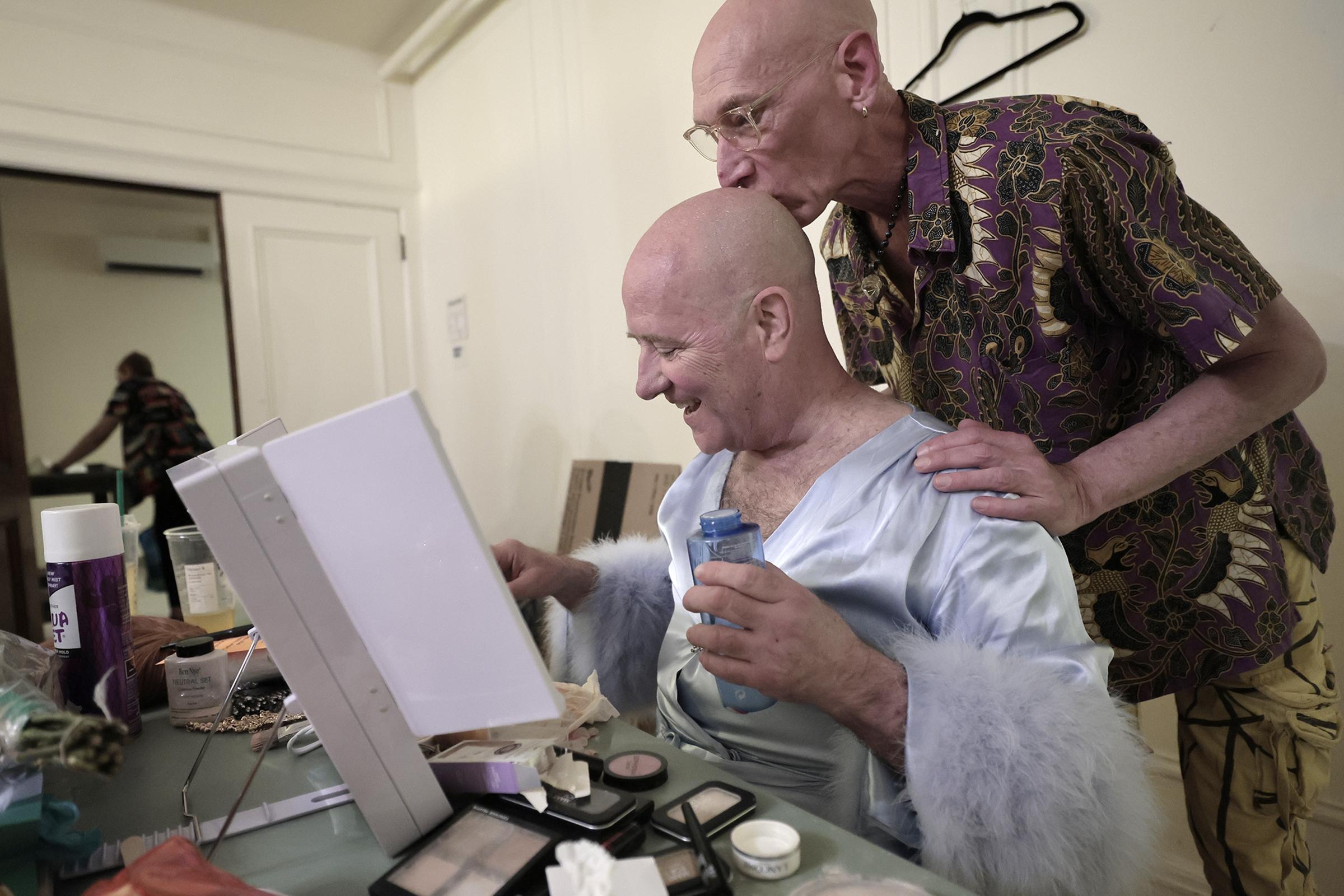
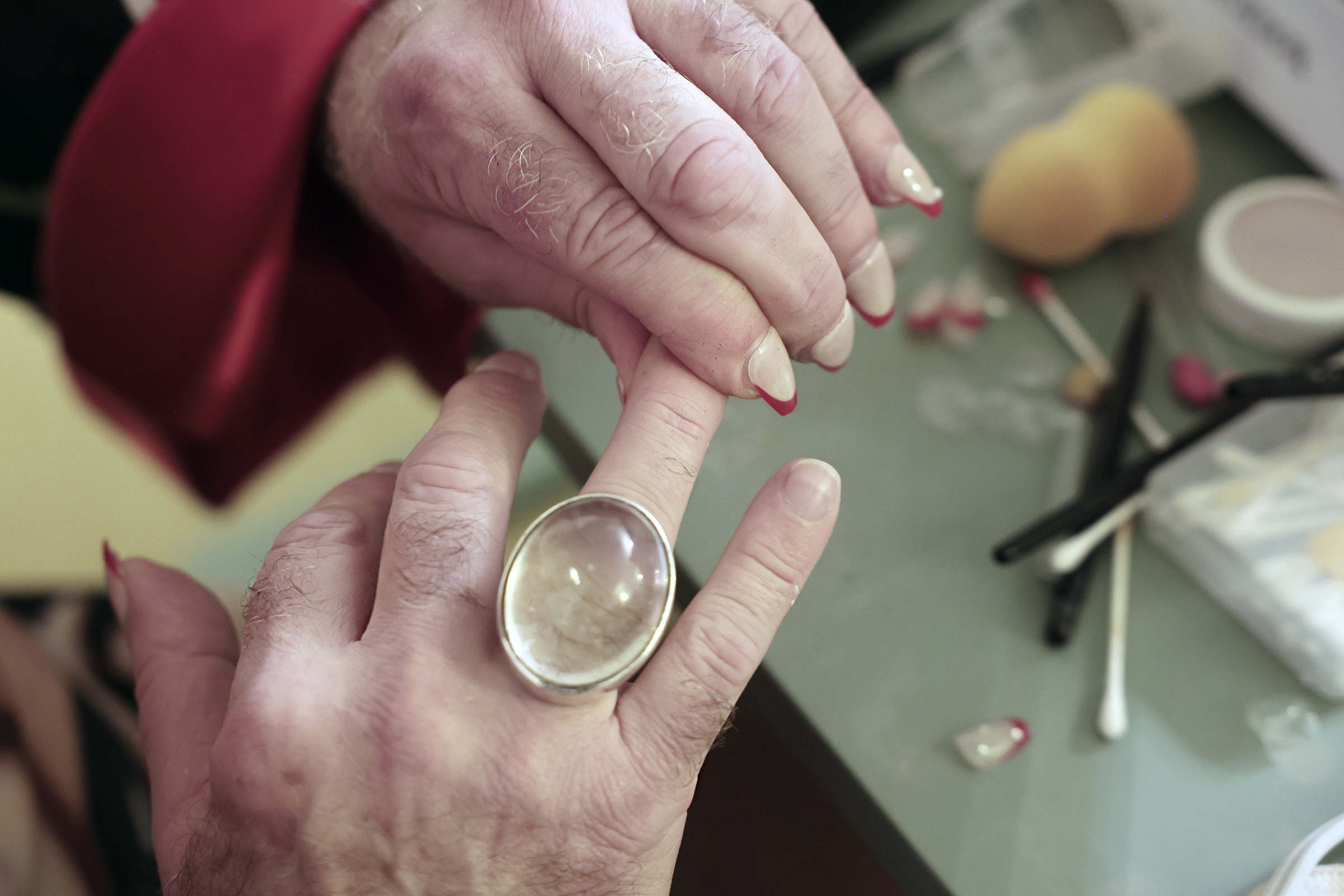
In the dressing room, Tess Tickle (Paul Struck) kisses Carlota Ttendant (Michael Byrne) on the head after Rainbow Bombshell Gay Bingo at Congregation Rodeph Shalom in Philadelphia on Saturday, June 13, 2026. “I love him” said Struck as he walked out of the dressing room.Carlota Ttendant (Michael Byrne) puts on a favorite crystal ring and fake nails before cohosting Rainbow Bombshell Gay Bingo on June 13.
“Are we ready to win some money?” Carlota said, hyping up the crowd before the first of 12 rounds of bingo. Councilmember Rue Landau, the Philadelphia City Council’s first openly LGBTQ+ member, called the first game:
I-28.
I-26.
G-52.
B-14.
O-63.
B-3.
“Bingo!” someone cried out, as the audience let out an audible wave of disappointment, exasperation, and defeat, and the BVDs rushed over to authenticate.
“Did you just get bingo, girl?” Carlota wisecracked.
For 30 years, these Gay Bingo players have pledged each month to “keep on playing Gay Bingo until this crisis is over.” And today, HIV/AIDS deaths and new diagnoses have stagnated, according to the most recently available health department data, and drug cocktails have made it so people with HIV can live long, healthy lives and may never pass the disease onto others or have their illness advance to AIDS. Preventative medications, like PrEP, can also dramatically decrease the risk of becoming infected.
Michael Byrne, as his drag persona Carlota Ttendant, on May 9 at Congregation Rodeph Shalom in Philadelphia.
But there are still obstacles to ending the epidemic. HIV/AIDS disproportionately affects Black and brown communities and low-income people who experience barriers to healthcare, according to Action Wellness executive director Mary Evelyn Torres. The geographic disparities are also stark: Current drug regimens may be readily available in well-resourced countries, like the United States, but access is scarce in the world’s vulnerable pockets. These problems have only been exacerbated by President Donald Trump’s proposed cuts to domestic and foreign HIV/AIDS programs. The withdrawal of American dollars overseas, United Nations officials warned, could lead to more than 4 million AIDS-related deaths and 6 million more HIV infections by 2029.
(function(){function e(){window.addEventListener(`message`,function(e){if(e.data[`datawrapper-height`]!==void 0){var t=document.querySelectorAll(`iframe`);for(var n in e.data[`datawrapper-height`])for(var r=0,i;i=t[r];r++)if(i.contentWindow===e.source){var a=e.data[`datawrapper-height`][n]+`px`;i.style.height=a}}})}e()})();
“We’ve come a long way, but there’s still work to be done,” Torres said, “and that work is being threatened by this administration.”
As the epidemic has changed, so has Gay Bingo: The money raised — more than $5 million since its inception — now goes toward Action Wellness’ social services and programming. The BVDs ditched their roller skates at the Gershman Y (because of the new, carpeted venue). Tickets cost $50-$60, compared to $10-$12 in May 1996, and these days, attendance averages between 150 and 200 a month.
Drag has evolved, too. Spending centuries on the periphery as proto-punk-beatniks and after-midnight acts, queens disrupted and challenged the mainstream with wit and wonder. Then, the exploding popularity of RuPaul’s Drag Race, a drag reality-TV competition, seismically changed the culture, snubbing scrappiness for silicon and kitsch for couture. The show ushered drag into the zeitgeist: Its lingo became commonplace and its contestants turned into social media stars, with businesses, makeup brands, books, and podcasts, as the art form continues to face political bans and threats nationwide.
The show “has taken everything to a whole other planet,” Byrne said, “and that’s amazing and that’s really great.
“That’s also not what I do.”
Carlota was never concerned with “affecting female mannerisms” or “trying to be this woman or this drag queen,” Singer said. To Byrne, she’s come to embody the fiercest, most unafraid, and righteous versions of himself. But “Michael was never far from Carlota,” Singer said.
Janie Lopez of Philadelphia cheers for her friend Carlota Ttendant during Gay Bingo at Congregation Rodeph Shalom.
To those who know Byrne, Carlota’s come to represent someone purer and more singular, a testament to what joyful resistance and defiant resilience can achieve amid tragedy. Her ingenuity and authenticity have made her synonymous with Gay Bingo, according to Action Wellness event planner and cohost Tim Johnson (otherwise known as Stella D’Oro); her playfulness is what’s engaging, Burns said; the safe space she’s cultivated for the queer community is what keeps people coming back season after season, said regulars Cat Johnson, 47, and Katie Dickerson, 38, of Roxborough.
“It’s going to be really different without Carlota,” Johnson said. “No one’s going to fill her shoes, but I think that the vibe and the energy is going to live on.”
“It’s a lot easier to raise money when everyone is having fun,” said Amber Schlesman, 38, of Point Breeze, who’s been coming to Gay Bingo since its Gershman Y days. “And for the shoes, I’m guessing it’s a size 12.”
All those shoes will be donated to Philly AIDS Thrift soon enough, Byrne said.
Byrne’s voice cracked as he thought of the people who made Carlota’s run possible: the AIDS Fund organizers, Singer, the original cast of BVDs, the volunteers, those who came back monthly, the victims, their families. Many sent her off June 13 with a trove of well wishes, notes that read, “thanks for the memories,” and “so proud of all you’ve done.” They told her, “I love you,” and “hang up those high heels, baby.”
At the end of the night, Byrne’s best friend gifted him a throw pillow.
“Don’t be a lady,” it said. “Be a legend.”
Michael Byrne transforms into his drag persona Carlota Ttendant ahead of Gay Bingo on Saturday, May 9, 2026, at Congregation Rodeph Shalom in Philadelphia.
A Point Breeze rowhouse, now available for rent, offers residents a chance to live with a one-of-a-kindwork of art — the only Keith Haring collaborative mural that is still intact and in its original location in the world.
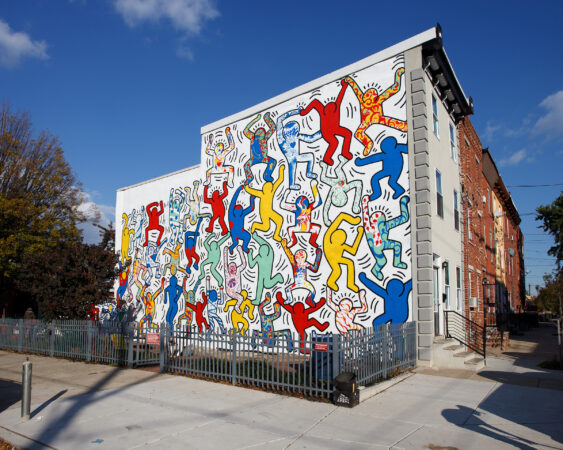
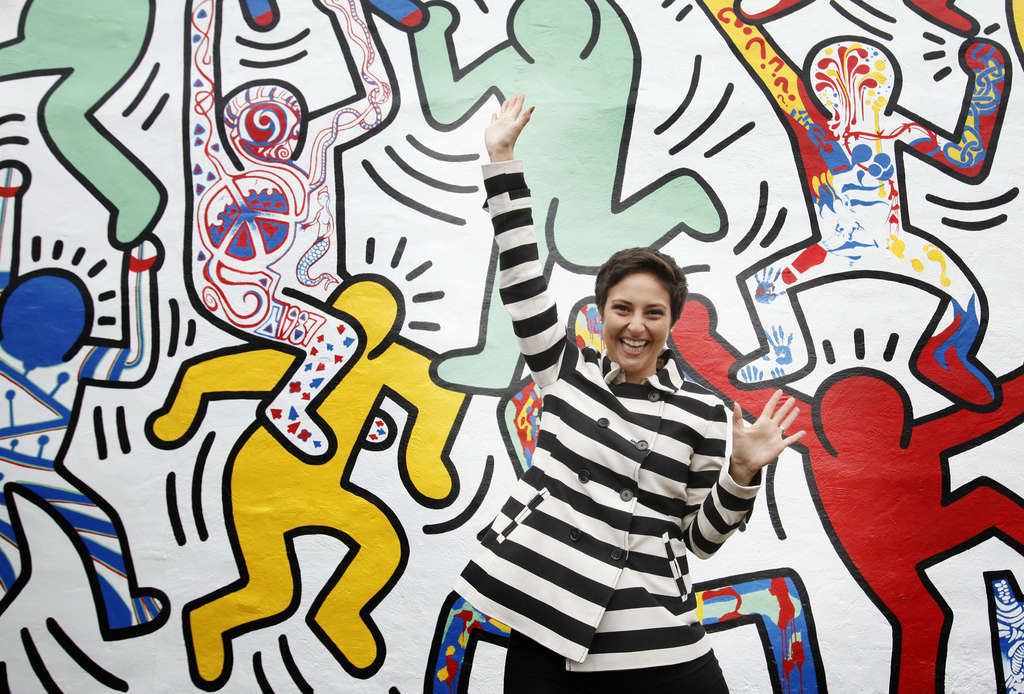
The three-bedroom home at 2147 Ellsworth St. is adorned with the acclaimed street and pop artist’s We the Youth . The mural, painted on the building’s facade, has stoodon the corner of 22nd and EllsworthStreets for almost 40 years.
“Keith believed that art was for everyone and that art should be accessible, so to have this mural still at this location for nearly 40 years is historically and culturally significant,”said Jane Golden, founder and executive director of Mural Arts Philadelphia.
The muralfeatures an array of Haring’s trademark dancing figures filled with bright colors and patterns. Italso has a small garden next to it, affectionately called “Haring Park,” which has been tended by neighborhood residents since the 1980s.
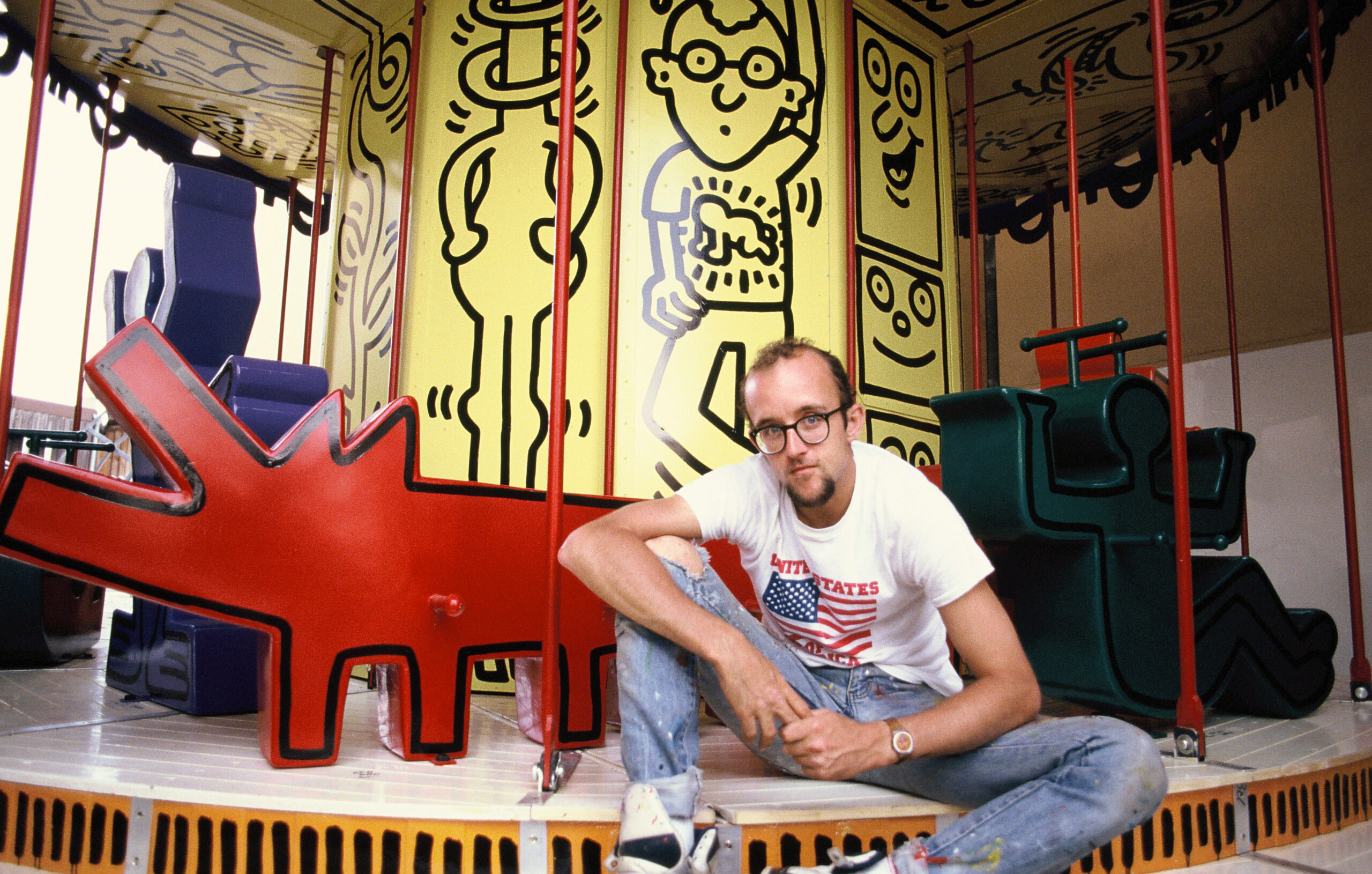
Keith Haring, who died in 1990, with his painted carousel.
Haring, who was born in Reading in 1958 and raised in Kutztown, drew the mural over a few days in September 1987, coinciding with the U.S. Constitution’s bicentennial. The title of the mural pays homage to the Constitution’s opening lines.
Its location was important to Haring.
He did not want the mural to be in a more upscale, trendy part of the city, one of the mural’s student collaborators, Rita Martello, told online art marketplaceArtsy in 2022.
“He wanted to put it in an actual urban neighborhood,” Martello said to Artsy.
Invited by two nonprofits that worked with youth, CityKids NYC and Brandywine Workshop, Haring worked with 14 students. While some of the dancing figures are solid colored, others feature unique patterns and symbols, all contributed by the students.
“Wherever [murals] are, they provide a foundation where change can begin,” said Golden. “They are a vehicle through which important stories are told, and they allow Philadelphia to maintain its status as a global leader in the arts and culture arena.”
Presently about 1,000 murals are displayed on the sides of residential homes in Philadelphia through partnerships with Mural Arts.
Erica Bryant mimics a figure from the Keith Haring mural on the Point Breeze house she and her husband own. It is the only mural Keith Haring made with community groups that is still intact.
Haring, whose preferred medium was chalk, often created works that were not meant to be permanent. We the Youth too was not immune to decay over time.
In 2013, after Erica and Lucas Bryant of St. Paul, Minn., bought the house, Mural Arts undertook a massive restoration of the piece, adding several layers of paintand a protective coating against the sun, entirely replacing damaged sections, and replacing the chain link fence.
“Philly is very proud to have a Keith Haring mural and especially one embedded in the community that was done in such a collaborative manner,” said Golden.
Haring, who started making chalk drawings in the New York subway, first wanted to paint We the Youth on a garbage truck but was refused by the Philadelphia Sanitation Department.
He diedin 1990, from AIDS-related complicationsat age 31.
“You can be the only person in the world who livesin a Keith Haring art piece!” boasts the OCF Realty listing for the three-bedroom, 2 ½ bathroom apartment.
The 1,797-square-foot, three-story rowhouse was renovated in 2020and has a backyard patio andaroof deck. The property, managed by OCF Realty, rents for $3,295/month.
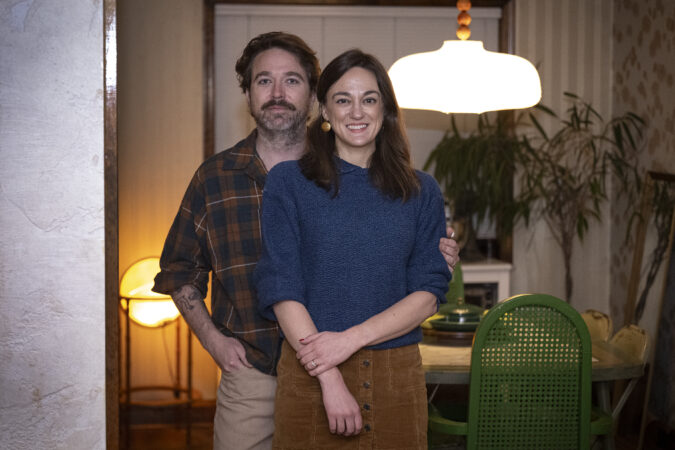
The buyers: Katherine Rumble, 38, public engagement manager; Benjamin Rumble, 39, graphic designer
The house: a 960-square-foot-home near South Philly’s Marconi Plaza with three bedrooms and one bathroom, built in 1957
The price: listed for $259,000; purchased for $259,000
The agent: Sue Liedke, Compass
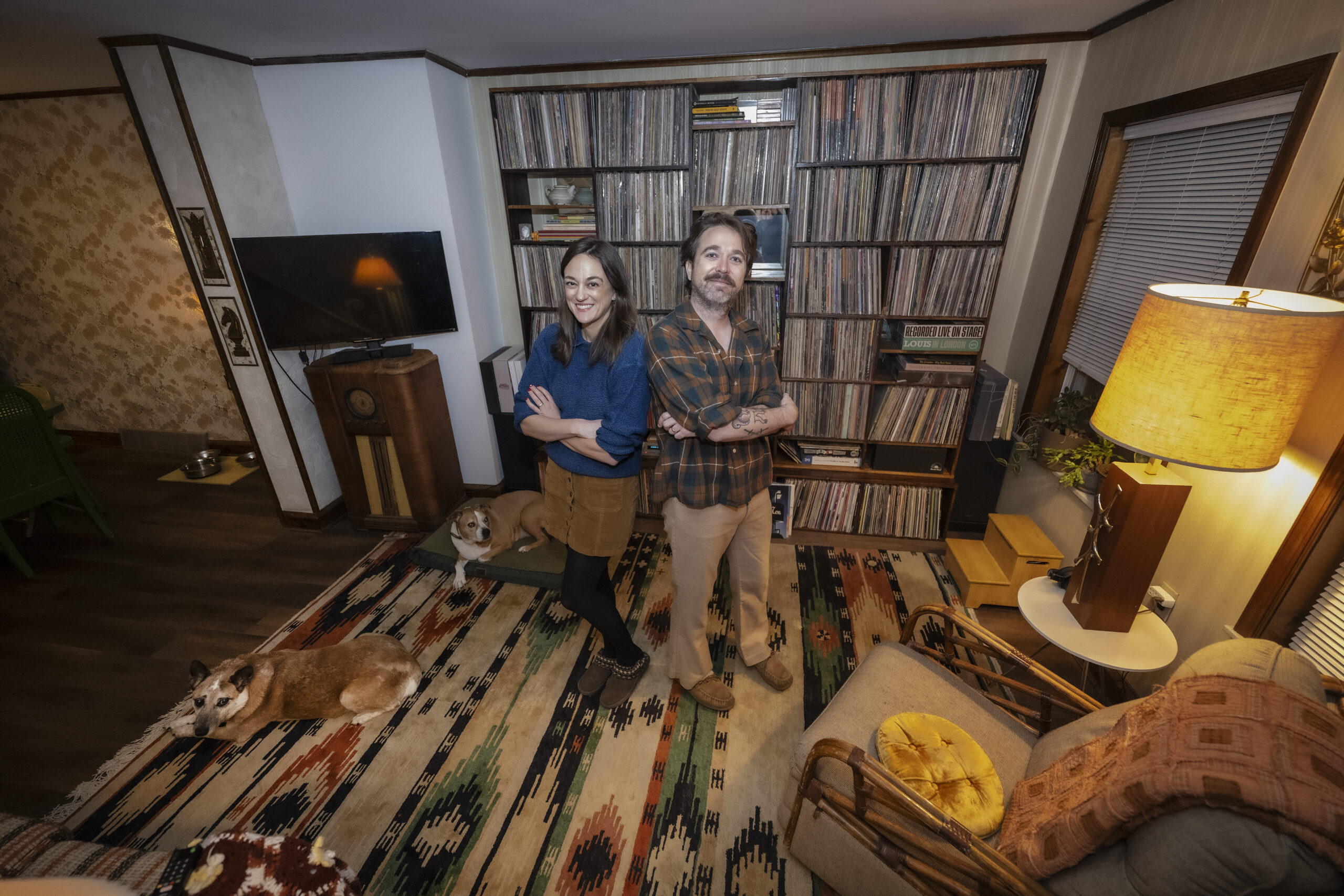
Benjamin and Katherine Rumble pin their new home in South Philadelphia.
The ask: Katherine and Benjamin Rumble were looking to leave Nashville. They wanted a city that was affordable, walkable, and had decent public transit. “Philadelphia was pretty much the only option,” said Katherine. After falling in love with South Philly, they moved in 2023 and rented a place in Point Breeze.
Two years later, they started searching for their forever home. Their wish list was specific: proximity to the Broad Street Line, central air, office space for both of them, and ideally a home that hadn’t been gutted, flipped, and turned “millennial gray.”
“We did not want to live in a doctor’s office,” Katherine said. “We wanted to live in a place that felt warm and welcoming like your grandma’s house.”
Benjamin and Katherine Rumble’s dog, Miller, relaxes in their living room.
The search: The couple already had a habit of checking Zillow regularly, but the listing that caught their attention came through Instagram.
They had long followed the account of Sue Liedke, a Philadelphia real estate agent who highlights vintage homes across the city. “We were obsessed with her account,” Katherine said. When Liedke posted a house near Oregon Station, they reached out.
The home checked many boxes. It was close to the Broad Street Line and near Marconi Plaza, which was a major plus for the couple, who have two dogs. It also had central air and enough space for both of them to work from home.
The appeal: They went to see the house immediately and loved it. “It had vibes,” Benjamin said. “The basement looked like people had been watching Eagles games down there since 1974.”
“The basement looked like someone had been watching Eagles games down their since 1974,” said Benjamin.
Upstairs, there were original wood doors, wood trim, and wallpaper that appeared decades old. The bathroom featured seafoam-green and pink tile and a skylight.
“We loved everything already in it,” Benjamin said. “I thought I wanted to buy a house so I could paint the walls. Then we bought this house and realized we didn’t want to change anything.”
At the front of the house was a small screened-in room sometimes referred to as a Florida room, a term Katherine rejected immediately. “I said, ‘We’re not calling anything Florida in this house,’” she recalled. They renamed it “the eagles’ nest.”
For all its charm, the house did still have its drawbacks. There was only one bathroom, and the kitchen was tiny. But “it had so many of the things we wanted that it felt worth it,” Katherine said.
The deal: The house had been on the market for only a few days when they saw it. The listing price was $259,000, and it was being sold as-is, meaning the seller was not required to pay for any issues uncovered during the inspection. “It was a risk,” Katherine said.
They offered the full asking price and requested a $5,500 seller’s assist to help cover closing costs. The seller agreed and even repaired a plumbing issue that came up during the inspection, despite selling the house as-is. In the end, the appraisal came in $5,000 above the asking price, which reassured the couple that the deal made financial sense.
The money: The couple put down 5%, or $12,590.
The money came from a second retirement account Katherine opened several years earlier. “It wasn’t really making any money,” she said. She decided cashing it out to buy a home was a better investment.
Benjamin and Katherine Rumble and their dogs, Miller and Bambi, in the eagle’s nest.
After the seller credit and deposit adjustments, the couple needed $24,225 in cash to close. They used almost all their personal savings to cover the remaining costs. They are rebuilding their nest egg from $2,000.
One thing boosting their savings is their low mortgage payment. They purchased mortgage points, an upfront fee paid at closing that lowers your interest rate, to get their monthly payment below $2,000. “That was our big goal,” Katherine said. “It’s a miracle.”
The move: To save money, the couple moved themselves. They couldn’t get a full-sized truck down their narrow street, so they rented a U-Haul van and shuttled their belongings back and forth across four weekends. They also had to get rid a lot of their existing furniture, requiring extra trips to 2A Thrift and Philly AIDS Thrift. “It was harder moving 10 minutes down the road in South Philly than it was moving from Nashville to Philadelphia three years ago,” Katherine said.
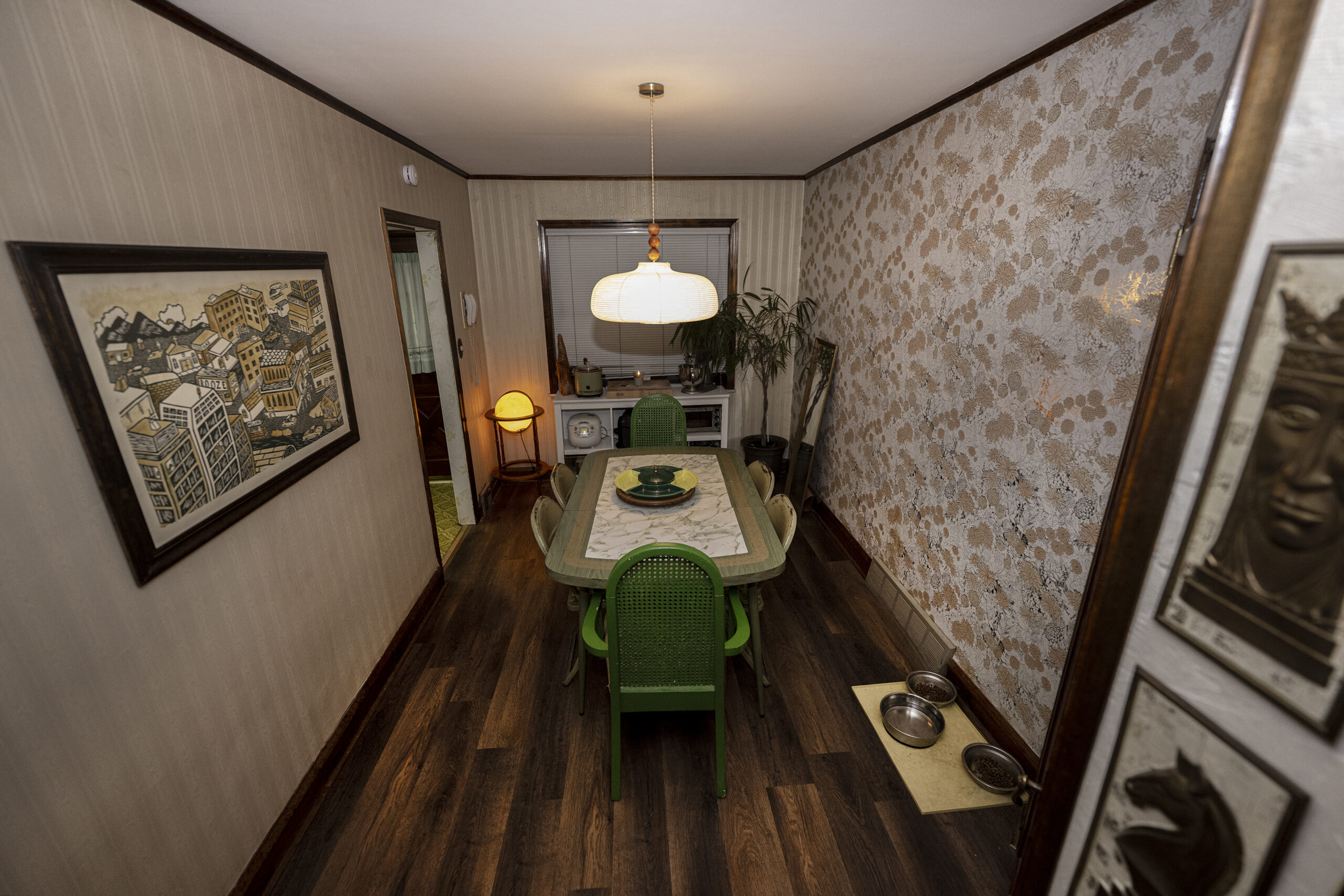
Benjamin and Katherine fell in love with the home’s original details, like the wallpaper in the dining room.
Any reservations? One thing the couple wasn’t prepared to deal with was a private neighborhood sewer line. It connects all the houses on the block before linking up with the main public sewer line. The couple both grew up in parts of the country where individual houses connect directly to the main sewer line. After moving in, neighbors explained the history of the sewer line. It hasn’t caused any major issues yet, but if something goes wrong, the neighbors will have to pay for the repairs together.
Life after close: The house has influenced their interior design choices. Because it was built in the 1950s, the couple has tried to source furniture from the 1960s and 1970s.
They regularly browse thrift stores, Facebook Marketplace, and vintage shops such as Thunderbird Salvage and Jinxed.
“We’re trying to find things that fit the character of the house,” Katherine said. “It takes time to find the things you want. But it’s really exciting when you do.”
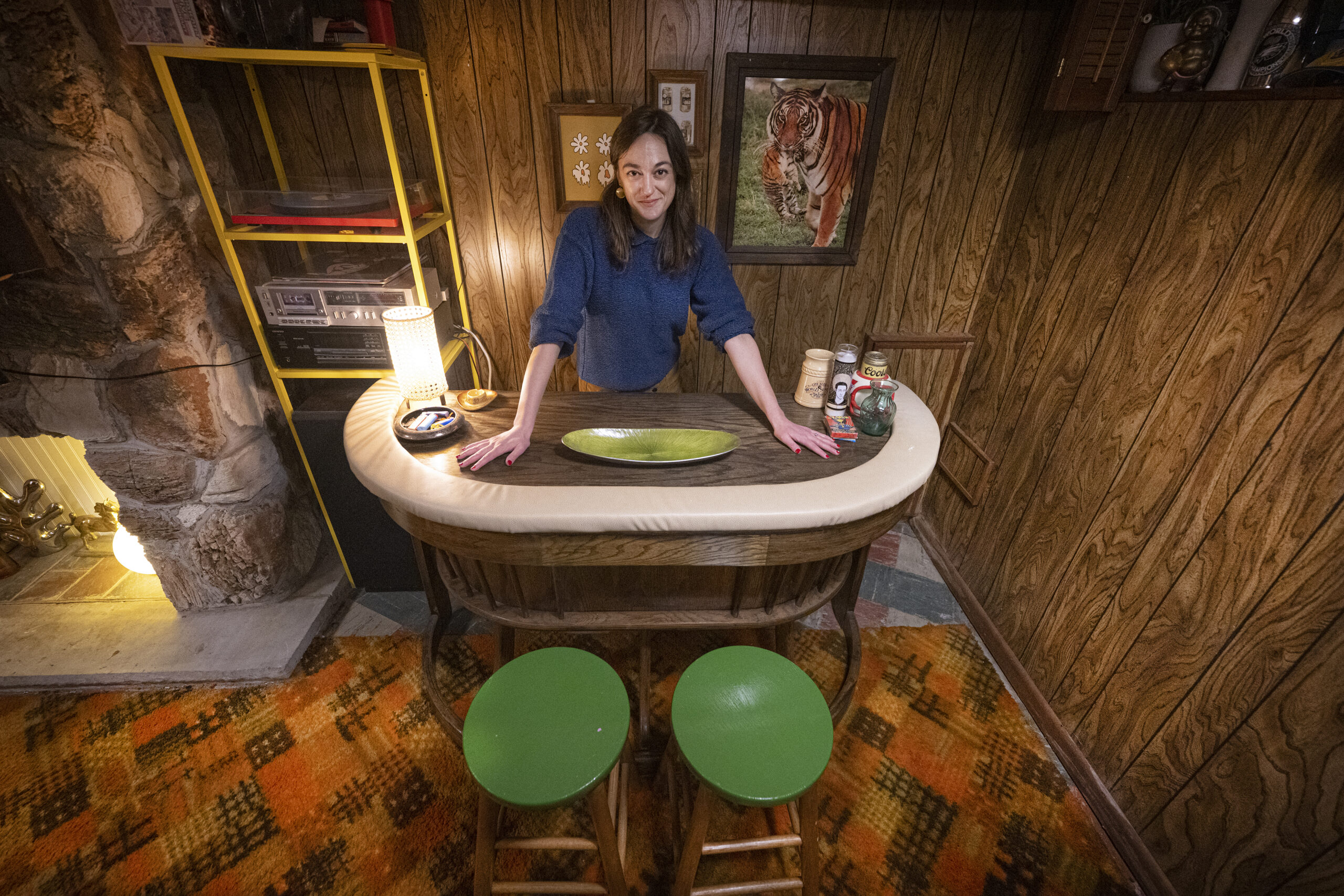
Katherine Rumble behind the bar.
It also helped that the previous owner let them keep somefurniture, including, said Benjamin, “a really rad set of couches.”
Superintendent Tony B. Watlington Sr. and the Philadelphia School District have proposed 18 school closures, six colocations, and a vague, insufficiently transparent plan to reconfigure grade levels across numerous other schools, citing the need for “more efficient use of all of our resources” to deliver high-quality academic and extracurricular programming districtwide.
The Inquirer Editorial Board has endorsed the plan, pending adjustments to several sites, including Lankenau Environmental Science Magnet High School.
The district is right to pursue a comprehensive facilities plan that addresses toxic building conditions, overcrowding, and underutilization. But it is going about it the wrong way. Facilities planning should be an annual, longitudinal process grounded in sustained community engagement, not a punctuated moment of 24 mass closures that disrupt neighborhoods and sidestep the thoughtful incorporation of public input that only time and intention can provide.
Mistakes of 2013
Without such care, the district will repeat the mistakes of the 2013 closures, which led to students disappearing from school rolls in September, overcrowded receiving schools, and the racialized erasure of neighborhood histories and place-based educational traditions.
First, significant questions remain about implementation and transparency. Ten properties are slated to be “conveyed” to the city, reportedly tied to Mayor Cherelle L. Parker’s H.O.M.E. plan. Amid speculation about a 20-year tax abatement connected to redevelopment, it is unclear what mechanisms will ensure the benefits of these transfers accrue to the communities that have borne the brunt of closure, rather than to private developers. A two-decade tax abatement would symbolically and materially reinscribe the racialized disinvestment, neglect, and manufactured crisis that have too often paved the way for school closures in the first place.
Second, the data used to inform the closures have been called into question by many, and do not take into account the nuance of mixing school populations via colocation. For example, parents at Childs Elementary have cited the district’s plan to colocate a new Academy at Palumbo based on a building capacity of 1,000. However, a significant portion of the building’s classrooms is dedicated to special-education students. A colocation would displace SPED students from these classrooms while reinforcing a bifurcated culture among the catchment-based middle school students and Palumbo students in an already rapidly gentrifying neighborhood of Point Breeze.
Third, closure and conveyance to the city for resale do not guarantee public-serving outcomes. With my collaborators — Ariel Bierbaum, Amy Bach, and Elaine Simon — I have studied how thoughtful reuse, rooted in restoring community access and public control, can begin to repair the racially inequitable legacy of past closures.
Yet, private redevelopment has repeatedly failed to stabilize these properties. Selling off public assets does not guarantee revitalization; it often perpetuates stagnation or displacement. Developers frequently “flip” former school buildings, speculating on value rather than advancing community use.
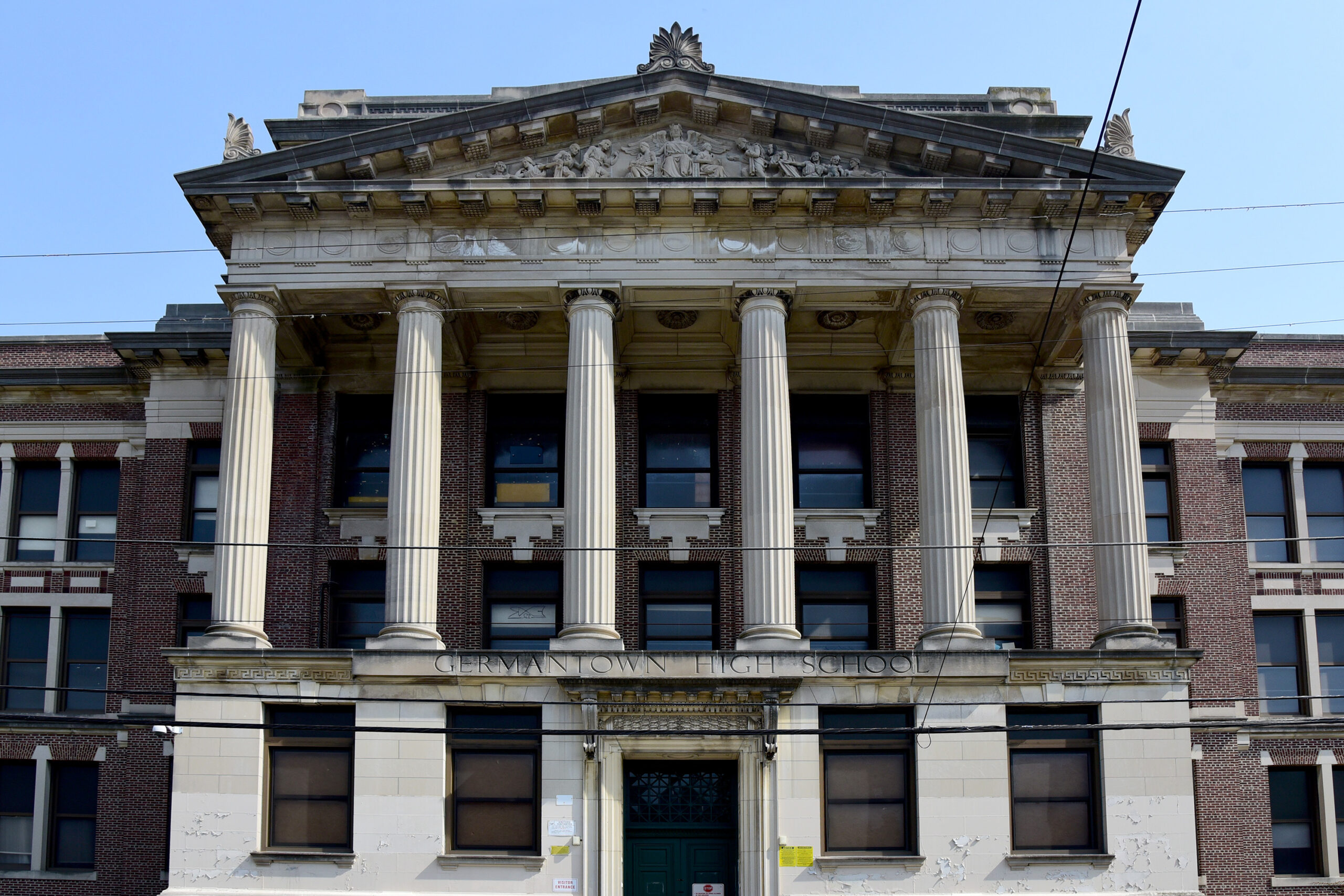
After it closed in 2013, Germantown High School fell into decay and disrepair, a fate Julia McWilliams writes could be repeated.
Take the former Germantown High School and Robert Fulton Elementary, for example. Concordia Group bought them in 2014, only to abandon its plans and resell the buildings three years later to local developer Jack Azran, whose opaque redevelopment has sparked concern.
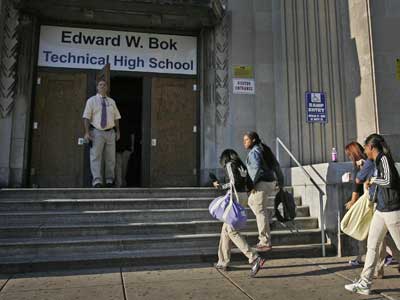
Moreover, once schools are sold to private entities, they are effectively lost to some communities and public education forever. South Philadelphia’s experience is a cautionary tale. As nearby elementary schools became overcrowded following the 2013 closures, the former Edward W. Bok Technical High School, once a public citywide admissions school, was transformed into a workspace for small-business owners, artists, and nonprofit organizations, closing classrooms forever.
This reuse no longer serves the same community of students and families as when it was a high school, and raises important questions: What does it mean for a community’s future when former schools become symbols of gentrification rather than centers of education? And what options remain when demographic shifts create new demand for neighborhood schools that no longer exist?
Had Bok remained in public hands, it could have flexibly adapted to those needs. Instead, it serves a much different population: South Philadelphia working artists, small-business owners, and local refugee-serving nonprofits, but also patrons who can afford $14 cocktails.
Slow down
Rather than defaulting to closure, the Board of Education should consider how underenrolled buildings might be repurposed for public-serving uses that retain community control. Could redevelopment proceed gradually, with clear commitments that investments in existing buildings benefit both local families and those who have chosen these schools?
Such an approach would require genuine public engagement and sustained dialogue. It would require slowing down and rejecting a disruptive, thinly deliberated plan shaped by speculative capital and instead committing to participatory, long-term facilities planning.
The district and the city face a choice. They can repeat a cycle of disinvestment and dispossession, or they can chart a more deliberative, community-rooted path. The question is whether they have the will to do so.
Julia McWilliams is the codirector of the Urban Studies Program at the University of Pennsylvania and a member of Stand Up for Philly Schools. She coauthored the forthcoming book, “Schools for Sale: Disinvestment, Dispossession, and School Building Reuse in Philadelphia,” from the University of Chicago Press.
If it wasn’t an actual blizzard, Philly’s biggest snowfall in a decade sure acted like one, and the weather the rest of this week isn’t expected to be particularly pleasant.
But in terms of disruption — not to mention aesthetics — this was in a wholly different category from the Jan. 25 siege of snow and ice. And the aftermath should not be anywhere near as punitive and burdensome.
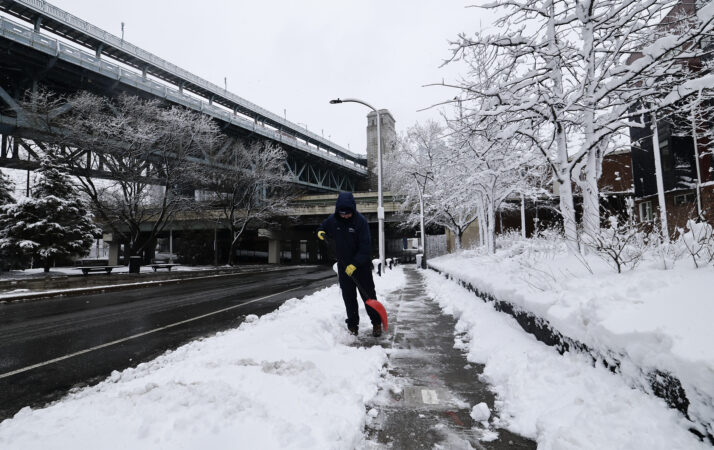
Although the 14 inches measured officially at Philadelphia International Airport, dwarfed the 9.3 inches of snow and sleet that accumulated in last month’s storm, Zach Schwartz, 33, was among those who found the picturesque snow more palatable than the attack of ice balls and an Arctic freeze.
“The last snowstorm was a tough time for everyone,” said Schwartz, who was at a Point Breeze playground helping a friend build an igloo for their kids, “and I think the city was kind of in shock a little bit.”
The most recent storm, which left as much as 20 inches of snow in parts of South Jersey and southeastern Bucks County, did cause some issues.
More than 130,000 households lost power at some point. Scores of trees came down as the snow, heavy and wet at the start, glommed onto branches that took beatings from the winds that gusted past 40 mph.
The storms closed schools to the chagrin of hundreds of thousands of learning-eager children, and museums on Monday. It disrupted SEPTA services and airport operations.
At least 87 trees across the city were downed as a result of the storm as of Monday afternoon, and the city was working to determine which ones to prioritize clearing first, Parks and Recreation commissioner Susan Slawson said.
Mayor Cherelle L. Parker advised Philadelphians to avoid unnecessary travel as crews worked to clear the streets.
Yet early fears that the snowfall would reach what the National Weather Service called “potentially historic” levels didn’t quite materialize, and it was not known if the storm had met “blizzard” criteria. Stopping short of “historic,” New Jersey Gov. Mikie Sherrill called it “a generational storm.”
This one likely won’t have the staying power of last month’s storm
While the volume of snow is formidable, road crews throughout the region now have a tremendous ally — the late-February sun.
The city did adjust its response after the prior storm cleanup left many residents chock-full of complaints. Director of Clean and Green Initiatives Carlton Williams said Monday instead of one snow melter, the city secured three, with two already on the road Monday, despite the much shorter notice of the storm.
But the big melter is in the sky.
The amount of solar energy beaming toward Philadelphia is more than 35% stronger than it was on Jan. 25, according to NASA’s figures, and blacktop is great absorber of sunlight. Plus the region now is getting an hour more of daylight.
Plus, instead of an Arctic freeze, it is forecast to be moderately cold this week, with highs in the low 30s Tuesday, and in the 40s Wednesday and Thursday.
A weak clipper could produce an inch or less of snow early Wednesday, but, sorry kids, that won’t be another school-closer. More light rain or snow or a mix is possible Thursday.
Computer models on Monday were seeing a potential for more snow early next week, but they may well sober up come Tuesday.
After the Jan. 25 storm, Philly had 18 consecutive days of at least 3 inches on the ground officially at the airport, the longest stretch in 65 years. That streak won’t be challenged this time around.
One other huge difference: Those 14 inches didn’t include a speck of ice, which, as we learned, is amazingly melt-resistant.
Why snow totals varied tremendously
The nor’easter that generated the snow did qualify as a “bomb cyclone,” said Tom Kines, senior meteorologist with AccuWeather Inc. The technical criteria aside, a bomb cyclone is particularly powerful storm.
In fact, the storm’s intensity, based on a measure of its central pressure, was equal to that of a Category 1 hurricane, he added.
Fortunately, the Shore escaped major flooding, but the winds circulating around the storm’s center over the ocean hurled back snow far inland.
window.addEventListener(“message”,function(a){if(void 0!==a.data[“datawrapper-height”]){var e=document.querySelectorAll(“iframe”);for(var t in a.data[“datawrapper-height”])for(var r,i=0;r=e[i];i++)if(r.contentWindow===a.source){var d=a.data[“datawrapper-height”][t]+”px”;r.style.height=d}}});
South Jersey locations received the most, along with areas in southeastern Bucks County. However, totals backed off precipitously to the west.
“There was a really tight gradient,” said Amanda Lee, a weather service meteorologist in Mount Holly. All areas in Philly’s neighboring Pennsylvania counties did report at least several inches of snow.
Within that broad east-west divide, however, amounts varied considerably from place to place, due in part to “banding,” in which narrow corridors of snow, caused by rapidly rising air, migrate from place depositing rapidly accumulating snow to areas underneath.
Conversely, areas on either side of the band are snow-deprived.
By the National Oceanic and Atmospheric Administration’s decree, a blizzard requires “frequent winds of 35 mph or higher with considerable falling and/or blowing snow that frequently reduces visibility to 1/4 of a mile or less. These conditions are expected to prevail for a minimum of 3 hours.”
That’s a lot to ask for a snowstorm, and it is going to take considerable forensic work of poring through observations to determine whether those conditions were met in Philadelphia or elsewhere in the region, said Nick Guzzo, a weather service meteorologist in Mount Holly.
Another big difference between this and the January storm
Whatever else it is called, this was the most spectacularly beautiful snowfall of the season, thanks to the snow’s remarkable adhesive power.
On the morning of Jan. 26 the trees were bare, as though they wanted no part of the snow and ice-ball assault.
On Monday this time around, snow enchanted the branches and uncannily worked its way into architectural details.
Cape May Mayor Zack Mullock said his town, famous for its Victorian buildings, “looks beautiful” covered in the foot of snow that had fallen.
Said Mullock, “It looks like a snow globe.”
Staff writers Ximena Conde, Kristen A. Graham, Michelle Myers, Amy S. Rosenberg, Henry Savage, and Nick Vadala contributed to this article.
The Philadelphia School District is walking away from middle schools — mostly.
Of the 20 schools Superintendent Tony B. Watlington Sr. has recommended to close, six are middle schools — AMY Northwest, Conwell, and Stetson in Kensington; Harding in Frankford; Tilden in Southwest Philadelphia; and Wagner in West Oak Lane.
The district plans to expand elementary schools to take in those students in most cases, and Conwell, a magnet middle school, would send students to AMY at James Martin.
“Our research does not say that traditional middle school children in Philadelphia perform better academically than K-8 students,” Watlington said when he rolled out his tentative plan in January. “Nationally, and in Philadelphia, there’s a mixed bag.”
While the school district says the K-8 model reduces transitions for students and helps maximize resources, critics of the district’s plan say closing middle schools will uproot their children and abandon successful schools.
Education experts, meanwhile, say instructing middle school-age students has long been a complex and controversial issue — and it’s a debate that Philadelphia district officials are reigniting with their sweeping facilities proposal.
Among the top complaints from critics of the plan: The pivot isn’t absolute. Though many middle schools are disappearing, Philadelphia will still have13 standalone middle schools and secondary-middle schools if those six close. And some will even grow.
Middle-grades students from Masterman, the popular and elite city magnet, wouldtake over the closing Laura Wheeler Waring school building in Spring Garden “to expand access” to Masterman, officials said.
The district is also adding a new Academy at Palumbo Middle School to give students a feeder pattern into the South Philadelphia high schoolmagnet. The new middle school will co-locate with Childs Elementary in Point Breeze.
And in the Northeast, where schools are bursting at the seams, two standalone middle schools — Castor Gardens and Baldi — will be untouched. Sowill a handful of others, including Roberto Clemente in North Philadelphia, Feltonville School of Arts and Sciences, Grover Washington in Olney, AMY at James Martin in Fishtown, and MYA and Science Leadership Academy Middle School in West Philadelphia.
Why is the district targeting middle schools?
Though officials said the facilities plan is not driven by finances, it’s clear that the underfunded school system needs to shrink its footprint.
With 70,000 empty seats citywide and an inequitable distribution of programs and opportunities, system officials say they need to make changes to do better for all kids.
“We can more efficiently distribute our limited resources in a K-8 model by operating 13 grade spans as opposed to six,” Watlington told City Council at a hearing on March 17. “This is an efficiency issue.”
At present, the district has 13 different grade spans throughout its schools — from a single K-2 to K-4s, K-5s, K-8s, 5-8s, 6-8s, and others. It is proposing shrinking, mostly, to six different grade bands, and emphasizing K-8 or 5-12 as preferred models.
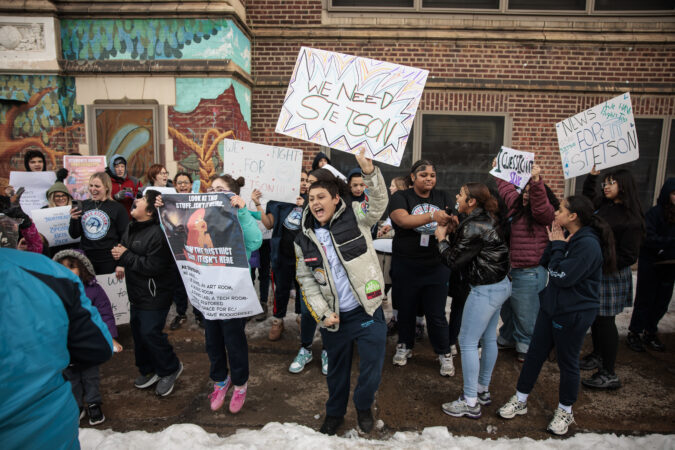
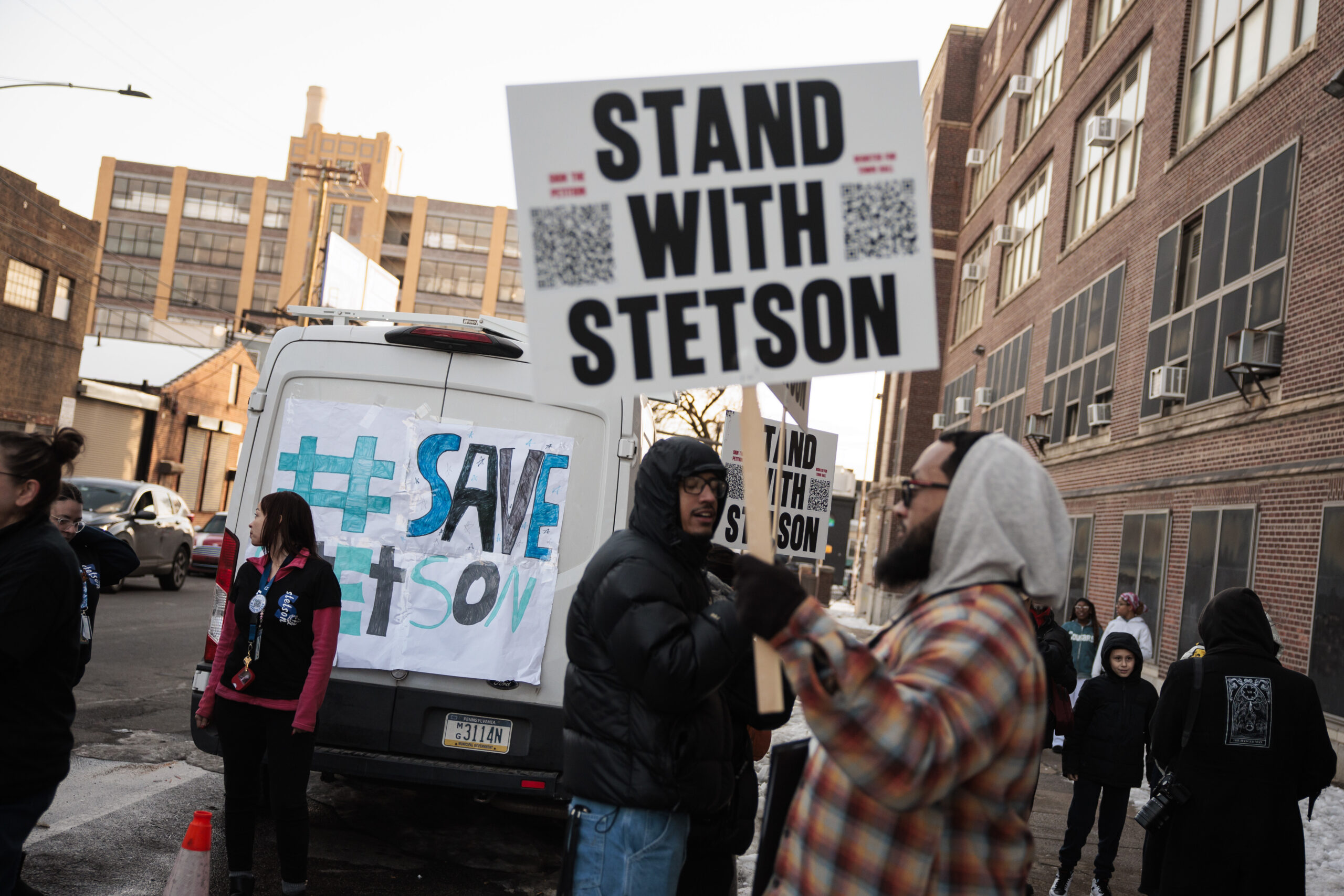
Students, teachers, and supporters rally before a community meeting at John B. Stetson Middle School this month. It’s one of six middle schools that is slated for closure.
Officials say they’re also relying on feedback received in surveys taken and meetings held prior to the plan’s release, despite critics’ worry that the feedback was crafted to give the district the answers it wanted.
Hilderbrand Pelzer III, an associate superintendent, told a crowd of more than100 people gathered at a Stetson Middle School meeting this month that in the surveys, families told the district they wanted to minimize transitions.
“Think of safety in the sense that young people should remain in one place longer, pre-K to 8,” Pelzer said. “Hence why we want to recommend some of our K-4s, K-5 schools grow to K-8. Now that may not be the answer you want to hear, but the voices that have informed that have allowed us to make that a recommendation.”
But critics of the district’s plan say they worry that the feedback was crafted to give the district the answers they wanted. And the audience at Stetson that day pushed back: Minimizing transitions is not what they want. They want their middle school to stay at their current school.
“Why can’t you inform recommendations from people at Stetson?” one person shouted.
The long and thorny history of middle schools
Wrestling with where middle-grades learners should attend school is nothing new, said Penny Bishop, dean of Boston University’s Wheelock College of Education and Human Development.
“We have been struggling to figure out how to provide appropriate schooling for this age group for well over a century,” Bishop said. “It’s a question with a long and thorny history” dating to the 1800s, she said, with much back and forth.
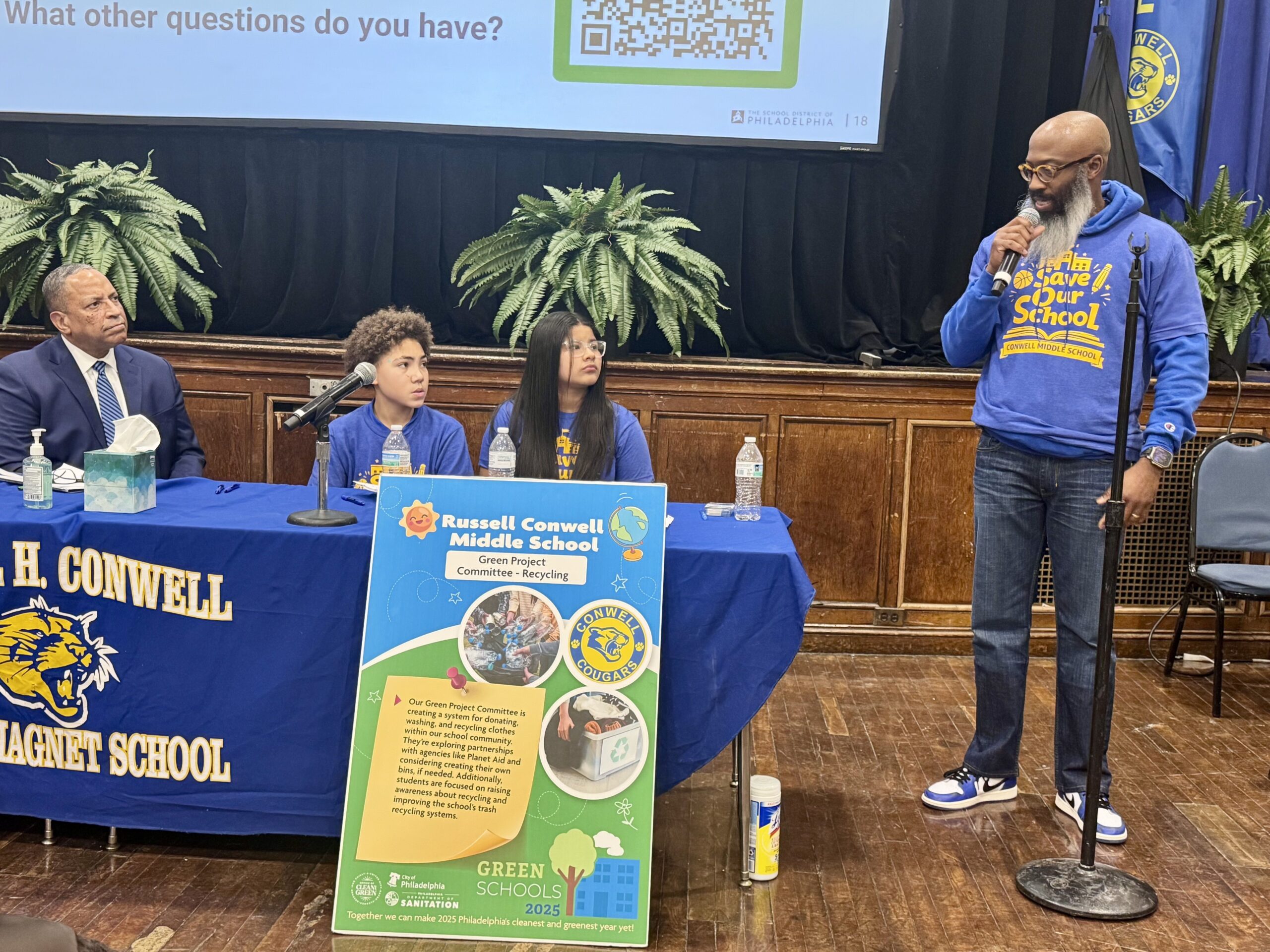
Philadelphia School District Deputy Superintendent Oz Hill (left) and student moderators listen to Andre Sanford-Adams, Conwell Middle School’s health and physical education teacher, speak during a recent community meeting about why he thinks it’s a mistake to close Conwell.
Many of Philadelphia’s middle schools began as junior highs. Middle schools as a concept first surfaced in the United States in the 1960s and took off in the 1980s as part of an explicit attempt to create schools “designed based on the developmental needs of this particular age group, as opposed to saying, they’re short high schoolers or they’re tall elementary students,” Bishop said.
But tweens and early adolescents can be a tough age group to educate well, and middle schools got a bad rap among some, said Bishop. As school choice and shifting birth rates caused belt-tightening in some places, some districts began to shift grade configurations.
Both Bishop and Katie Powell, director for middle level programs at the Association for Middle Level Education, said that research doesn’t support one kind of grade configuration or another.
“What matters most for middle school-age students is that we understand that they are going to need a different experience than their elementary counterparts in a K-8 building, and having a defined middle school, even within that K-8 school — that’s what tends to be most successful,” Powell said.
And, Bishop said, “a lot of this is tied up in the degree to which the leadership understands the developmental needs of the students.”
At a recentmeeting at slated-to-close Wagner Middle School, Kim Newman, another Philadelphia associate superintendent, vowed that the district will spend time and resources planning thoughtful transitions as grade configurations change.
Adding middle grades to elementary schools hasn’t always been done well in the district, Newman said.
“In the past, what we’ve done is said, ‘Let’s just add some furniture and books, great,’ grow a grade each year, and that’s really not what children need,” said Newman.
She said she hopes receiving schools and closing middle schools will work together on what middle-grades learners need in the newly expanded elementary schools.
Philly skepticism
Claire Andrews has taught at Wagner Middle School for 40 years — years ago, it had 1,000 students, buttoday, fewer than 300 are enrolled.
In the past, “we had opportunities for students, and as the years have gone on, they have just disappeared,” Andrews said. “Over the years, everything has just been pulled away.”
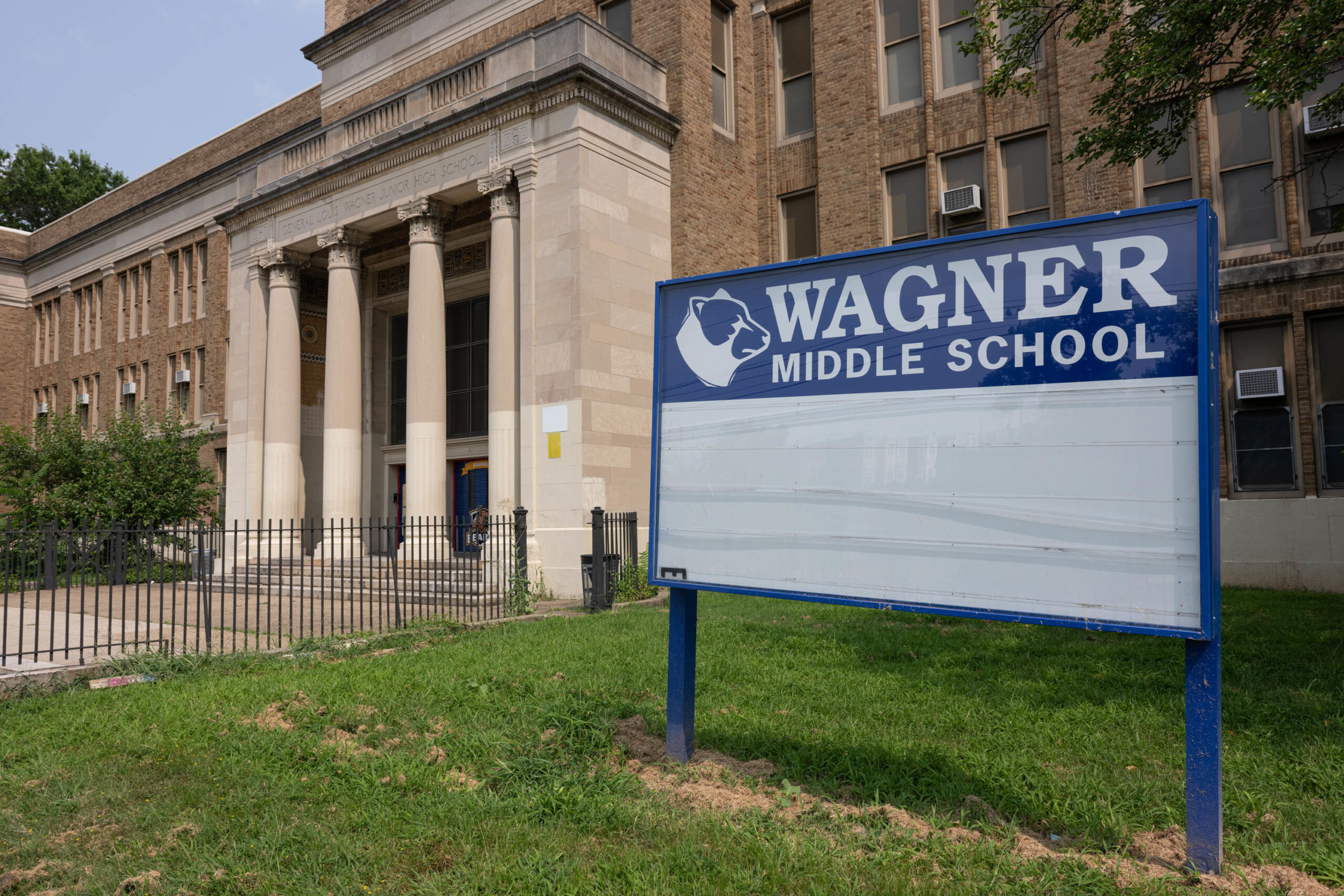
Wagner Middle School is one of six middle schools that is facing potential closure in Philadelphia.
Andrews, like others in the city, raised questions of equity.
“Are they closing schools in the Northeast?” Andrews said.
Councilmember Isaiah Thomas, chair of City Council’s education committee, highlighted Philadelphia’s complicated middle school position at a Council hearing last week.
The district’s talking points around middle school sound good,he said. But he questioned decisions to expand middle grades at magnet schools, like Masterman and Carver High School of Engineering and Science, whileclosing a number of neighborhood middle schools.
“I want us to have nuanced dialogue around where we are and what we need to do,” said Thomas, who has spoken out against closing Conwell, of which he’s an alumnus. “And I also recognize that there’s pushback on every decision you made. I understand that we have to make tough decisions somewhere else, there is no real facilities plan, and we do need a plan.
“But the reality is that we’re still not sending the right message to people, and I think our position around middle school is problematic.”
Watlington stressed the research around middle schools and the surveys.
The superintendent said the district is committed to modernizing and expanding receiving schools, where needed, and was not just focused on the Northeast.
“We absolutely will not present a plan that just pushes resources in parts of the cities that’s growing fastest,” Watlington said. “I think this is as strategic a plan as we could create.”