As a Pennsylvanian who works with immigrants on the U.S.-Mexico border, I urge people of goodwill in the Keystone State and beyond to stand up for immigrants in our country. Our democracy depends on it.
I am a Sister of Mercy of the Americas, a Catholic order that has accompanied immigrants in Pennsylvania, across the United States, and internationally since 1843. We take seriously the Gospel command to “welcome the stranger.”
On the border, I am a community worker. Part of my ministry is to help immigrants in the United States apply for citizenship or renew their legal permanent residence and DACA (Deferred Action for Childhood Arrivals) status.
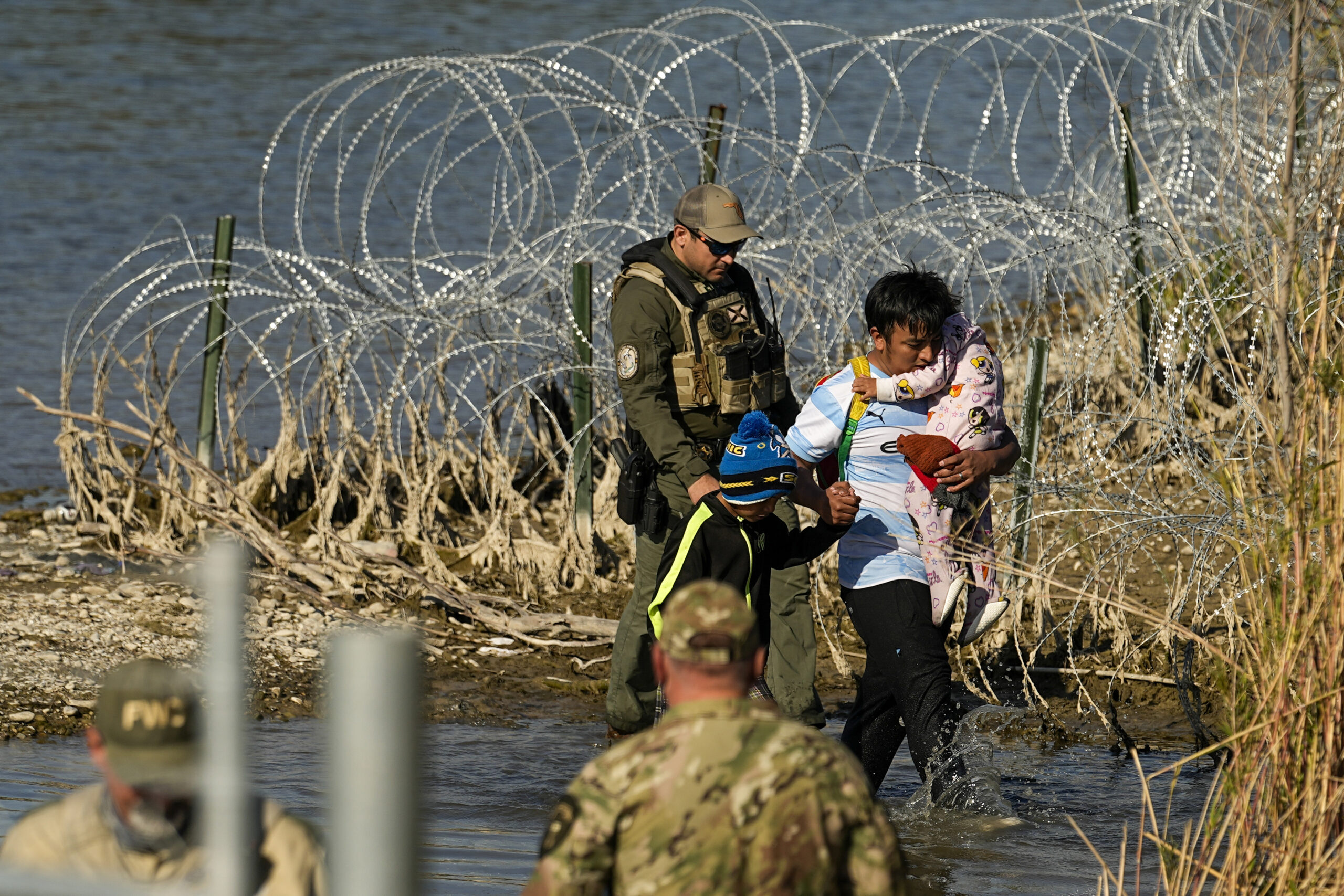
Migrants are arrested at the Texas-Mexico border in 2024. Migrants’ lives have become a nightmare, writes Sister Patricia Mulderick.
Most are doing everything they can to follow the rules, to attain or hold on to legal status. But their lives have become a living nightmare, and their plight fills me with anguish.
Migrant workers in Texas are terrified of being picked up in the fields, where they toil 12 hours a day under the hot sun to pick melons, onions, carrots, and other fresh produce destined for grocery stores and our kitchen tables around the country, anonymous but vital to our economy and way of life.
The migrants left in Mexico are in limbo, denied hearings by U.S. immigration officials and often unable to return to their home countries.
“You could send me a limousine with a marching band, and I could not return,” one man said to me. “I would be dead within 24 hours.” And a woman I know sold everything she owned to make the journey north — she has nothing to go back to.
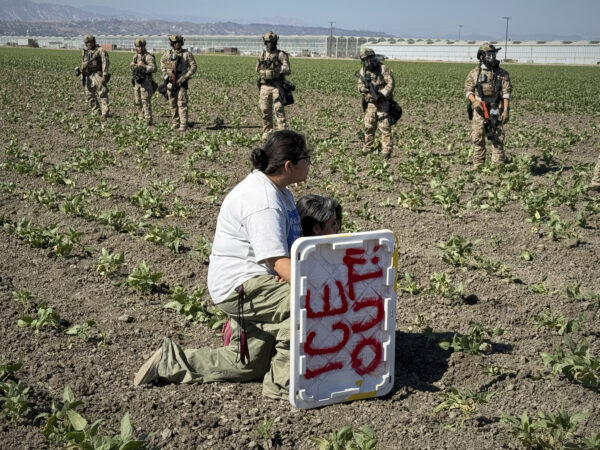
On the U.S. side of the border, people are being terrorized by masked U.S. Immigration and Customs Enforcement agents stalking our neighborhoods. One elderly woman who has worked in the fields for four decades hid in her bedroom as they pounded on her front door. Neighbors alerted a women’s group I am part of, and members asked to see the agents’ warrant. It turned out ICE was looking for someone else. I shudder to think what would have happened if those brave advocates had not stepped up.
I first learned about the bonds between democracy and our nation of immigrants at my public school in the coal regions. The brutality and terror inflicted by security forces all around our country are un-American.
When Pennsylvanians helped unite 13 colonies into one country by inviting new Americans to Philadelphia’s Independence Hall to debate and sign the Declaration of Independence and the U.S. Constitution, they knew their “experiment” in self-governance wasn’t guaranteed. Ben Franklin famously said that Americans had “a republic, if you can keep it.” We must again help lead the way.
Pennsylvanians take pride in being standard-bearers for liberty. We also value the vital contributions newcomers make in our state, in industries ranging from construction and hospitality to high-tech.
More than ever, we must stand up for immigrants and democracy together. We must hold our nation to the ideals inscribed on the Statue of Liberty: “Give me your tired, your poor, your huddled masses yearning to breathe free.”
Pope Leo and I met in the 1980s, when he was the young priest Father Robert Prevost, and we both were serving in Peru. His humility and concern for people living in poverty moved me deeply.
In Mexico recently, I held hands with a woman who wept after her immigration hearing — scheduled for the day after President Donald Trump’s inauguration — was canceled by the president on his first day in office. This woman had lived in a tent for eight months, waiting to cross legally.
“Your president says we are criminals, but I have never broken a law in my life,” she told me. “They seem to hate us, but I will not hate back. I will not let hate win.”
Will we?
Sister Patricia Mulderick is a member of the Sisters of Mercy of the Americas, the largest order of Catholic religious women in the United States. She serves in both Pennsylvania and Texas.
Way back in 2022, when Philadelphians gathered on an abandoned pier to watch a man eat a rotisserie chicken, folks on social media began to wonder: “Is Philadelphia a real place?”
Sure, that perception has a lot to do with an unbelievable event that actually happened in the suburbs (Delco never fails to carry its weight), but Philly also saw its fair share of the bizarre this year, too.
As we prepare for what may be one of the most important (and hopefully weirdest!) years in modern Philadelphia history, let’s take some time to look back on the peculiar stories from across the region that punctuated 2025.
Five uh-oh
Kevon Darden was sworn in as a part-time police officer for Collingdale Borough on Jan. 12 and hit the ground running, landing his first arrest just four days later.
The only problem? It was his own.
Pennsylvania State Police charged Darden with terroristic threats and related offenses for an alleged road rage incident in 2023 in which he’s accused of pointing a gun at a driver on the Blue Route in Ridley Township. At the time of the alleged incident Darden was employed as an officer at Cheyney University.
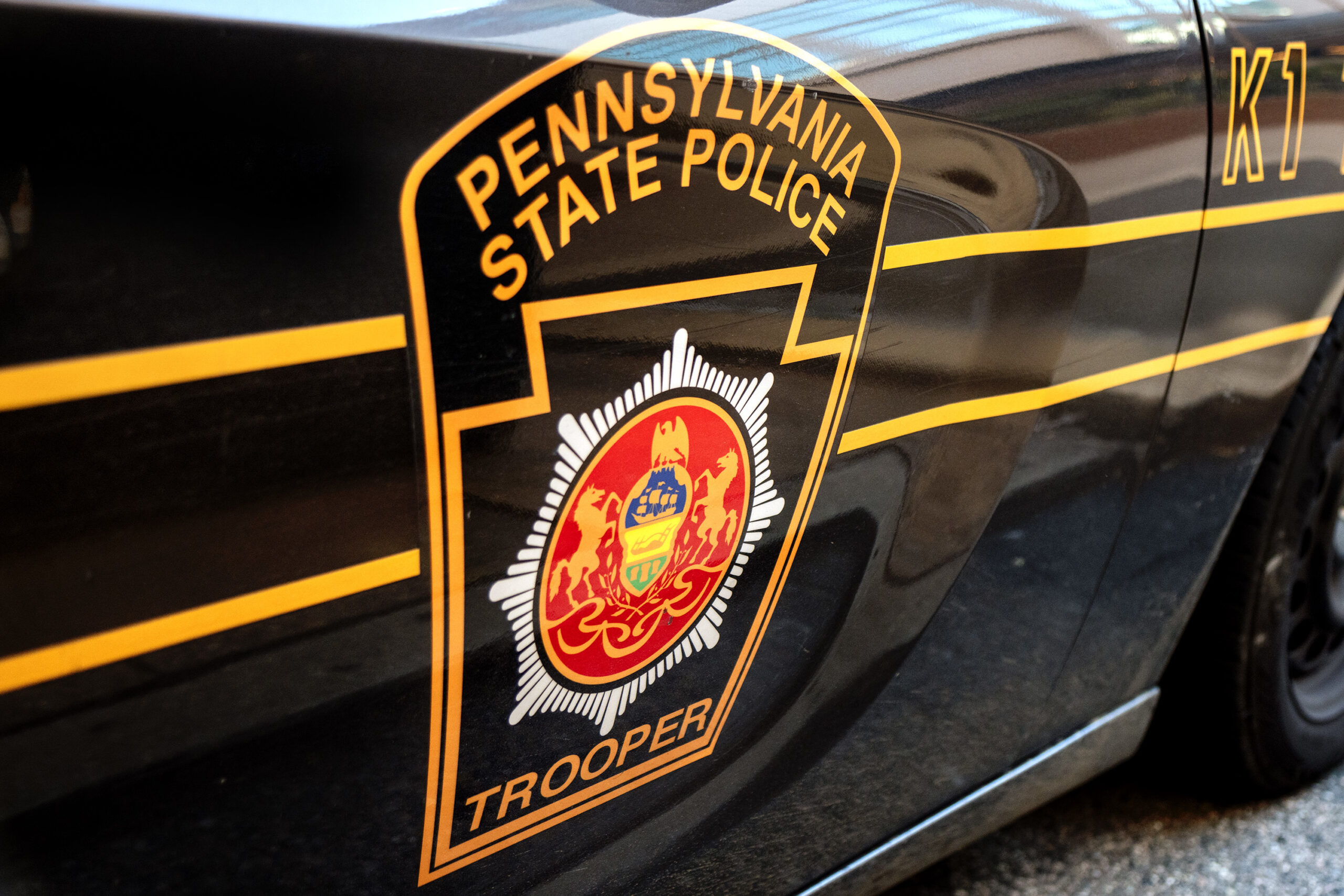
A Pennsylvania State Police vehicle. The agency provided two clean background checks for a Collingdale police officer this year, only to arrest him four days after he started the job.
Here’s the thing — it was state police who provided not one but two clean background checks on Darden to Collingdale officials before he was hired. An agency spokesperson told The Inquirer troopers had to wait on forensic evidence tests and approval from the District Attorney’s Office before filing charges.
Darden subsequently resigned and is scheduled for trial next year in Delaware County Court.
For the Birds
The Eagles’ second Super Bowl win provided a wellspring of wacky — and sometimes dicey — moments on and off the field early this year.
Mayor Cherelle L. Parker started the championship run off strong by going viral for misspelling the most popular chant in the city as “E-L-G-S-E-S” during a news conference. Her mistake made the rounds on late night talk shows and was plastered onto T-shirts, beer coozies, and even a license plate. If you think the National Spelling Bee is brutal, you’ve never met Eagles fans.
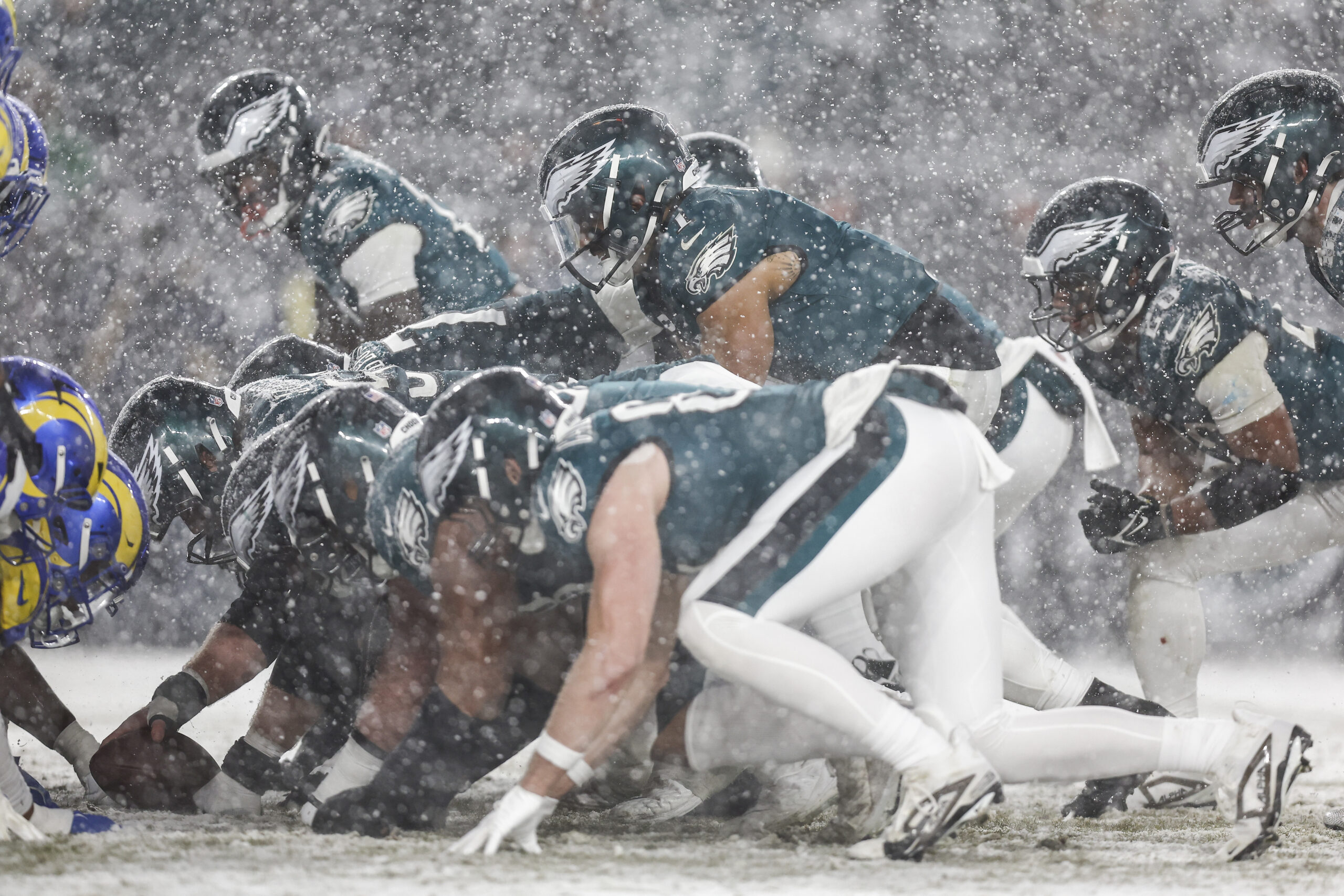
Philadelphia Eagles quarterback Jalen Hurts at the line of scrimmage during the fourth quarter of the NFC divisional playoff at Lincoln Financial Field on Jan. 19. The Philadelphia Eagles defeated the Los Angeles Rams 28 to 22.
Then there was the snowy NFC divisional playoff game against the Los Angeles Rams at Lincoln Financial Field; continued drama around the Tush Push (which resulted in Dude Wipes becoming an official sponsor of the team); and Cooper DeJean’s pick-six, a gift to himself and us on his 22nd birthday that helped the Birds trounce the Kansas City Chiefs 40-22 in Super Bowl LIX.
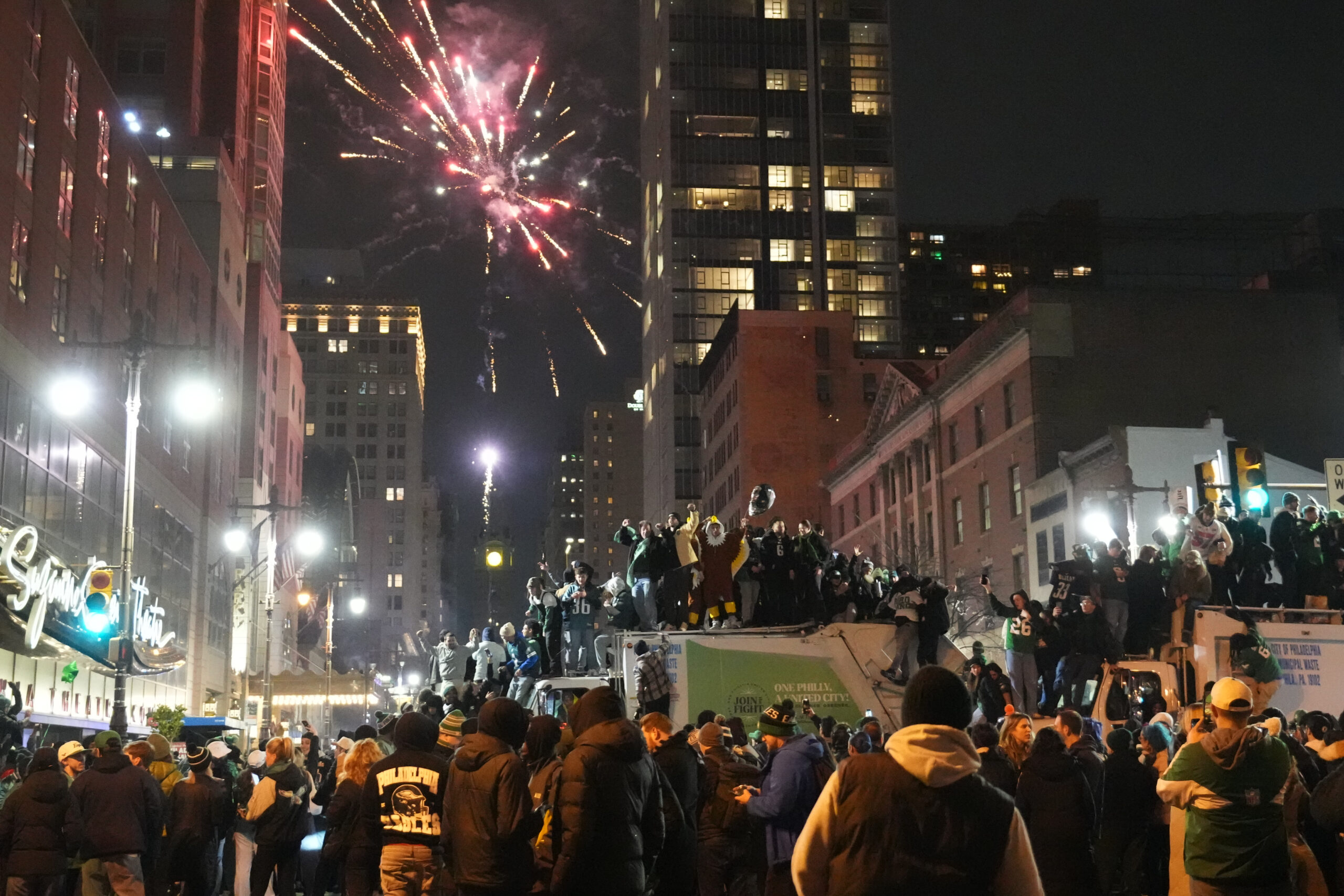
As soon as the Eagles won with Jalen Hurts as MVP, Philadelphians let loose, flooding the streets like a drunken green tsunami. Fans scaled poles and tore them down; danced on bus shelters, medic units, and trash trucks; partied with Big Foot, Ben Franklin, and Philly Elmo; and set a bonfire in the middle of Market Street.
Eagles fans party on trash trucks in the streets of Center City after the Birds win in Super Bowl LIX against the Chiefs on Feb. 9.
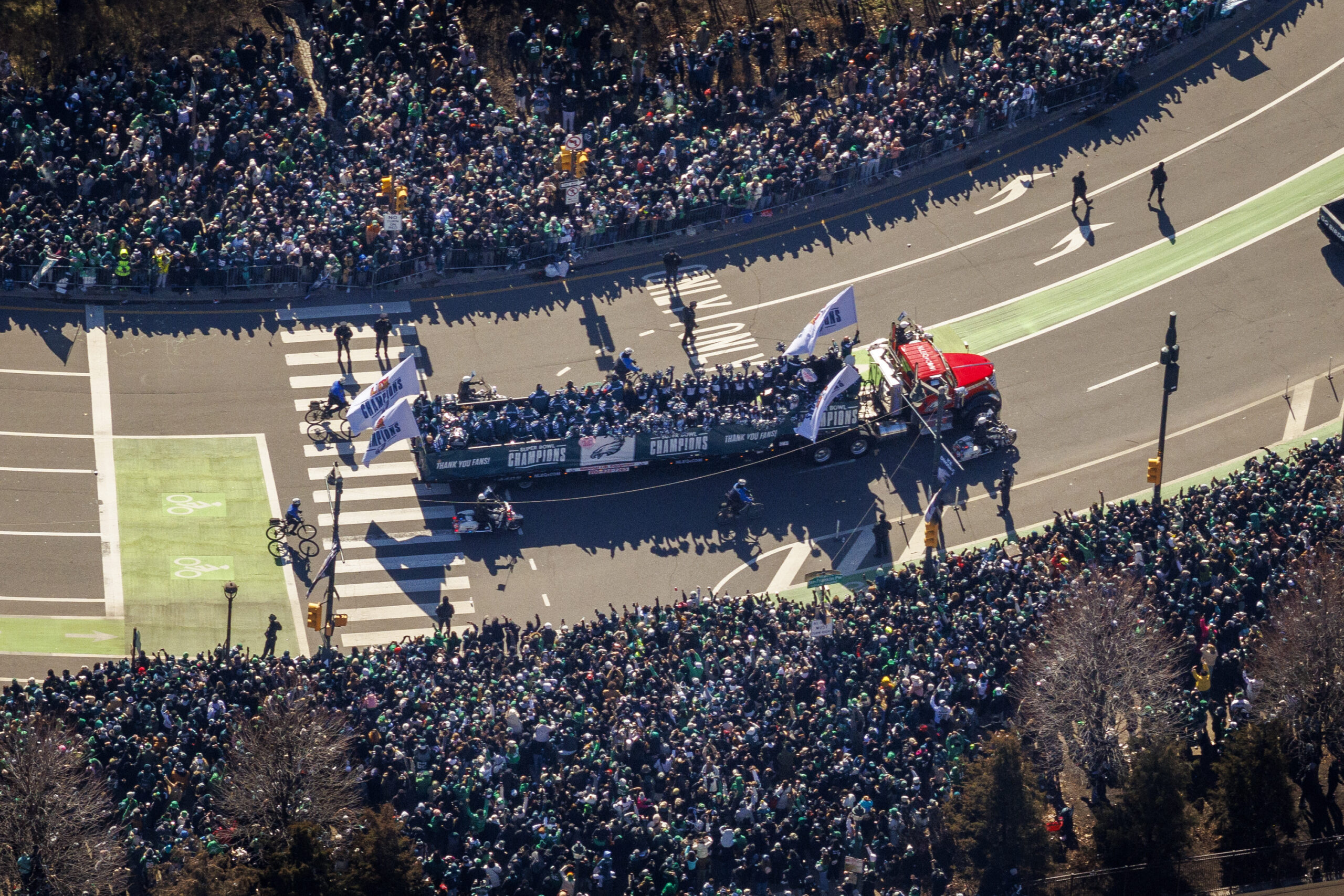
Finally, there was the parade, a Valentine’s Day love letter to the Eagles from Philadelphia. Among the more memorable moments was when Birds general manager Howie Roseman was hit in the head with a can of beer thrown from the crowd. He took his battle scar in pride, proclaiming from the steps of the Philadelphia Art Museum: “I bleed for this city.”
As we say around here, love Hurts.
Throngs of Birds fans lined the Benjamin Franklin Parkway for the Eagles Super Bowl Parade on Feb. 14.
A $40 million goodbye
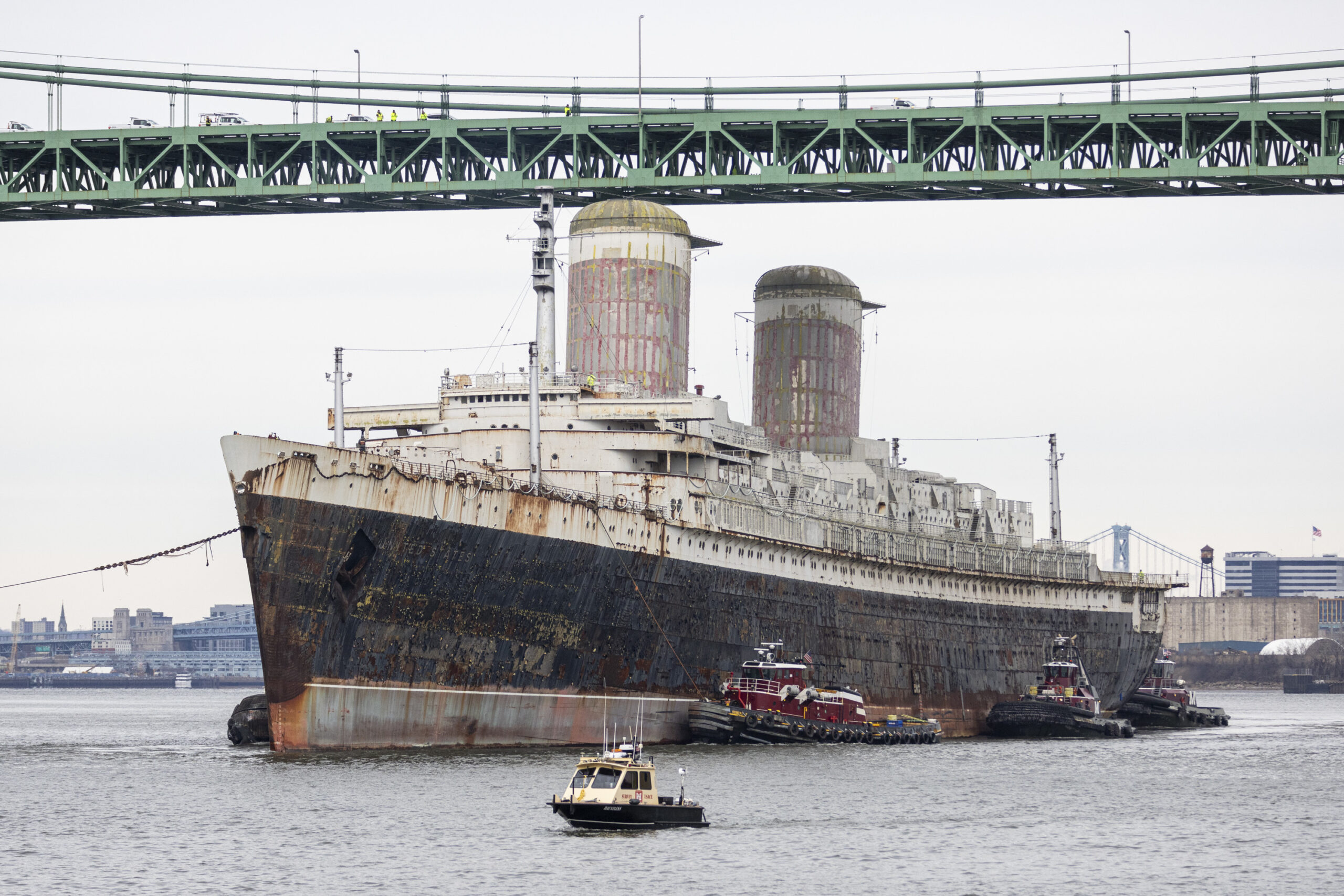
As far as inanimate objects go, few have experienced more drama in recent Philly history than the SS United States, the 73-year-old, 990-foot luxury liner that was docked for nearly three decades on the Delaware River waterfront.
Supporters spent more than $40 million on rent, insurance, and other measures to keep the ship in Philly with the hopes of returning it to service or at least turning it into a venue. But a rent dispute with the owners of the pier finally led a judge to order the SS United States Conservancy, which owned the vessel, to seek an alternate solution.
Workers on the Walt Whitman Bridge watch from above as the SS United States is pulled by tug boats on the Delaware River.
And so in February, with the help of five tugboats, the ship was hauled out of Philly to prepare it to become the world’s largest artificial reef off the coast of Okaloosa County, Fla.
If the United States has to end somewhere, Florida feels like an apt place.
The ‘Delco Pooper’
While the Eagles’ Tush Push was deemed legal by NFL owners this year, a Delaware County motorist found that another kind of tush push most definitely is not after she was arrested for rage pooping on the hood of a car during a roadway dispute in April.
Captured on video by a teen who witnessed the rear-ending, the incident quickly went viral and put a stain on Delco that won’t be wiped away anytime soon.
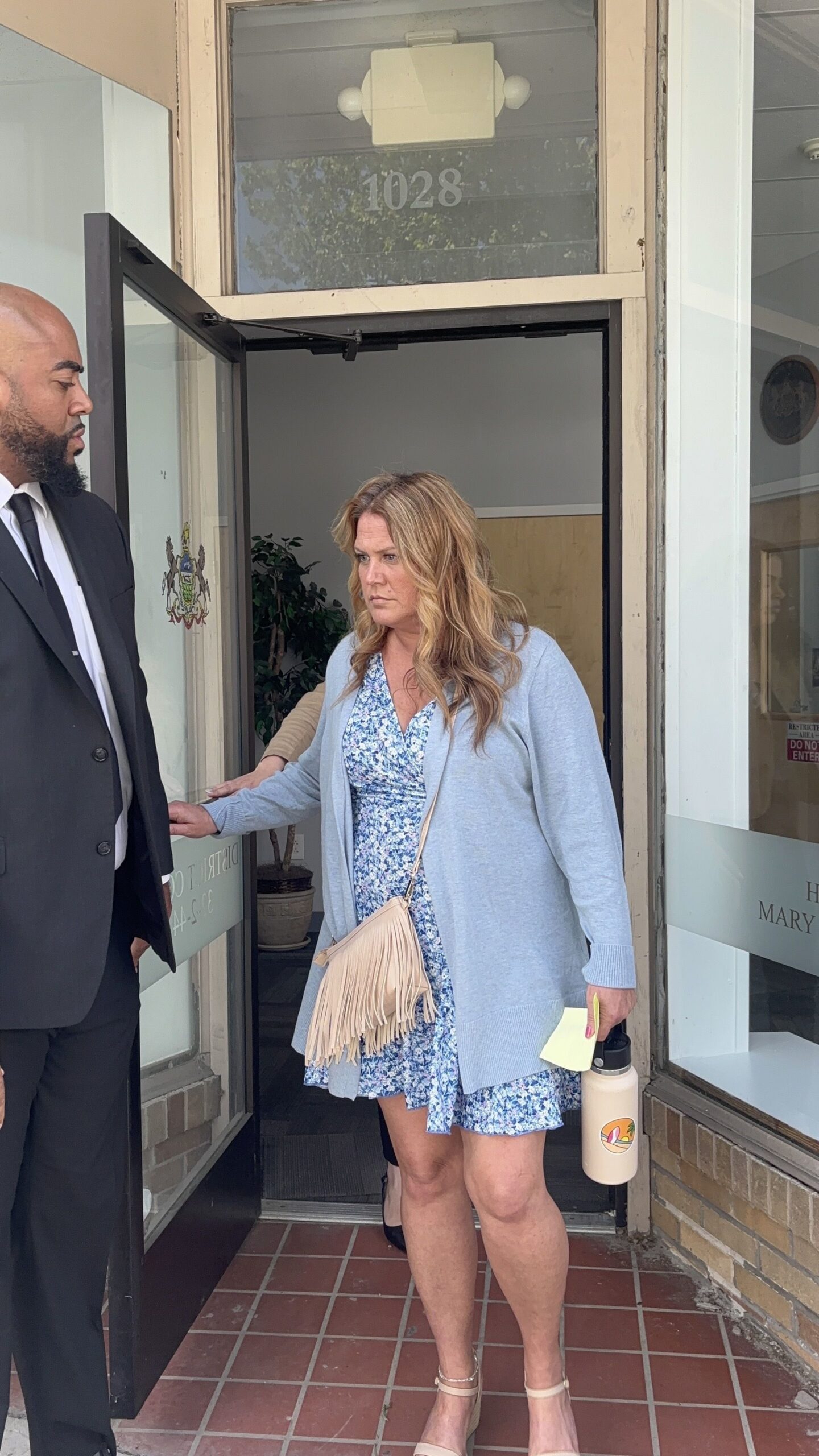
Christina Solometo, who was dubbed the “Delco Pooper” on social media, told Prospect Park Police she got into a dispute with another driver, whom she believed began following her. Solometo claimed when she got out of her car the other driver insulted her and so she decided to dump her frustrations on their hood.
A private security guard holds the door open for alleged “Delco Pooper” Christina Solometo following her preliminary hearing Monday at Prospect Park District Court.
“Solometo said, ‘I wanted to punch her in the face, but I pooped on her car instead and went home,’” according to the affidavit.
I’ve written a lot of stories about Delco in my time, but this may be the most absurd.
Hopefully, she won’t be clogging up the court system anymore.
The Delco pope
Delco is large, it contains multitudes, and never was that more clear than when two weeks after the Delco Pooper case broke, a Delco pope was elected.
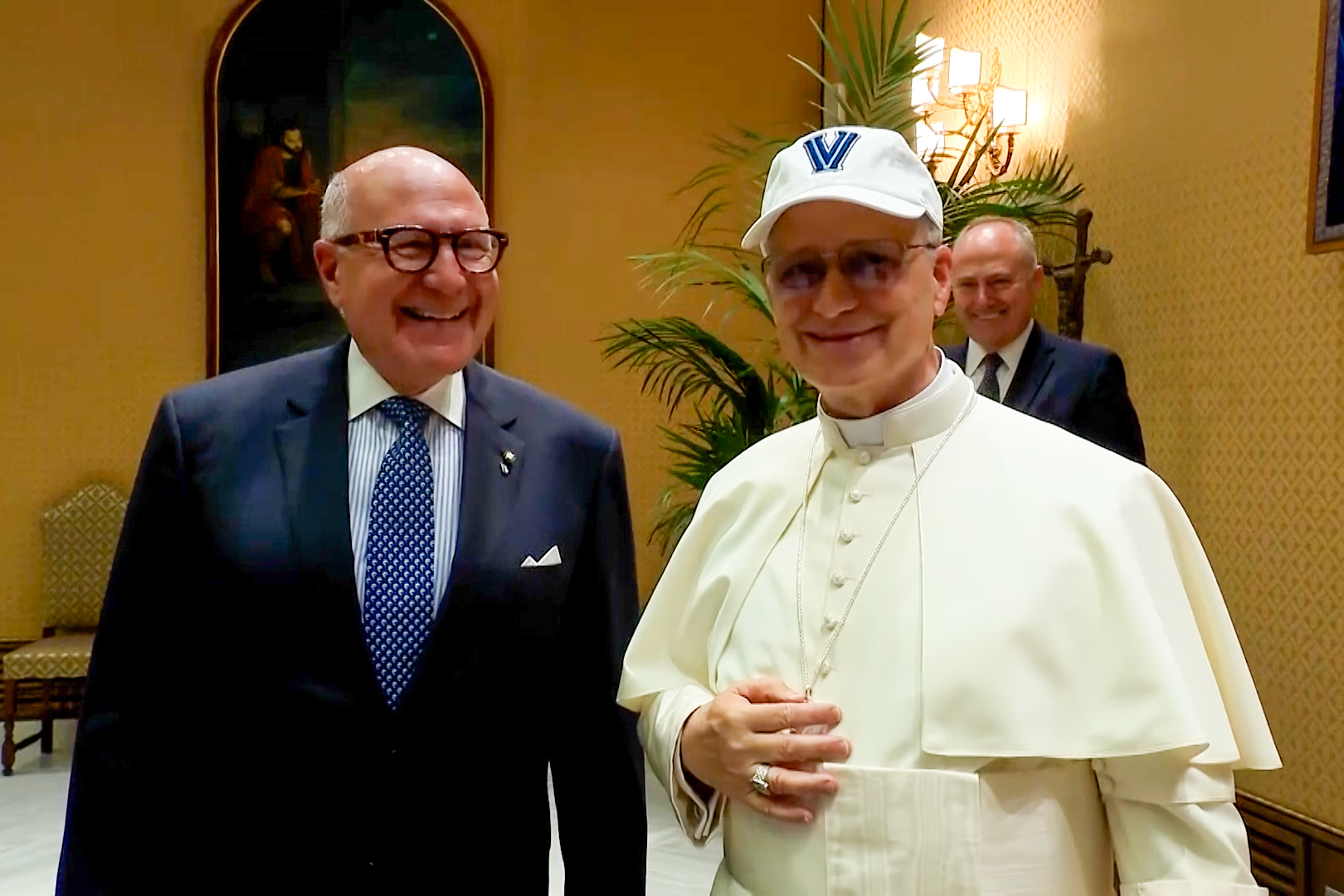
OK, so Pope Leo XIV is technically a native of Chicago, but he attended undergrad at Villanova University — which, yes, technically straddles Delco and Montgomery County — but Delco’s had a tough year so I’m gonna give it this one.
This video screen grab shows Pope Leo XIV wearing a Villanova University hat gifted to him during a meeting with an Italian heritage group.
Born Robert Prevost, Pope Leo is the first U.S. pope in history and also a citizen of Peru. He earned his bachelor’s degree in mathematics from Villanova in 1977 and an honorary doctor of humanities from the university in 2014.
Center City Sips, the Wednesday Center City happy hour program, long ago earned a reputation as a rite of passage for 20-somethings who are still figuring out how to limit their intake and want to do so in business casual attire.
Things seemed to calm down after the pandemic, but then Philadelphians took Sips to another level and a whole new place this year — the streets.
Videos showed hundreds of people partying in the streets of Midtown Village on Wednesday nights this summer. Granted, the parties look far more calm than when sports fans take over Philly after a big win, but the nearby bar owners who participate in the Sips program said their places sat empty as people brought their own alcohol to drink.
Jason Evenchik, who owns Time, Vintage, Garage, and other bars, told The Inquirer that “No one is inside, and it’s mayhem outside.”
“Instead, he claimed, people are selling alcohol out of their cars and bringing coolers to make their own cocktails. At one point on June 11,Evenchik said, a Tesla blocked a crosswalk while a man made piña coladas with a pair of blenders hooked up to the car,” my colleague Beatrice Forman wrote.
In no way am I condoning this behavior, but those two sentences above may be my among favorite this year. Who thinks to bring a blender — with a car hookup — to make piña coladas at an unauthorized Center City street party on a Wednesday night?
Philly.
Getting trashed
Philadelphians experienced a major city workers strike this summer when Mayor Cherelle L. Parker and AFSCME District Council 33 couldn’t agree on a new contract for the union’s nearly 9,000 members.
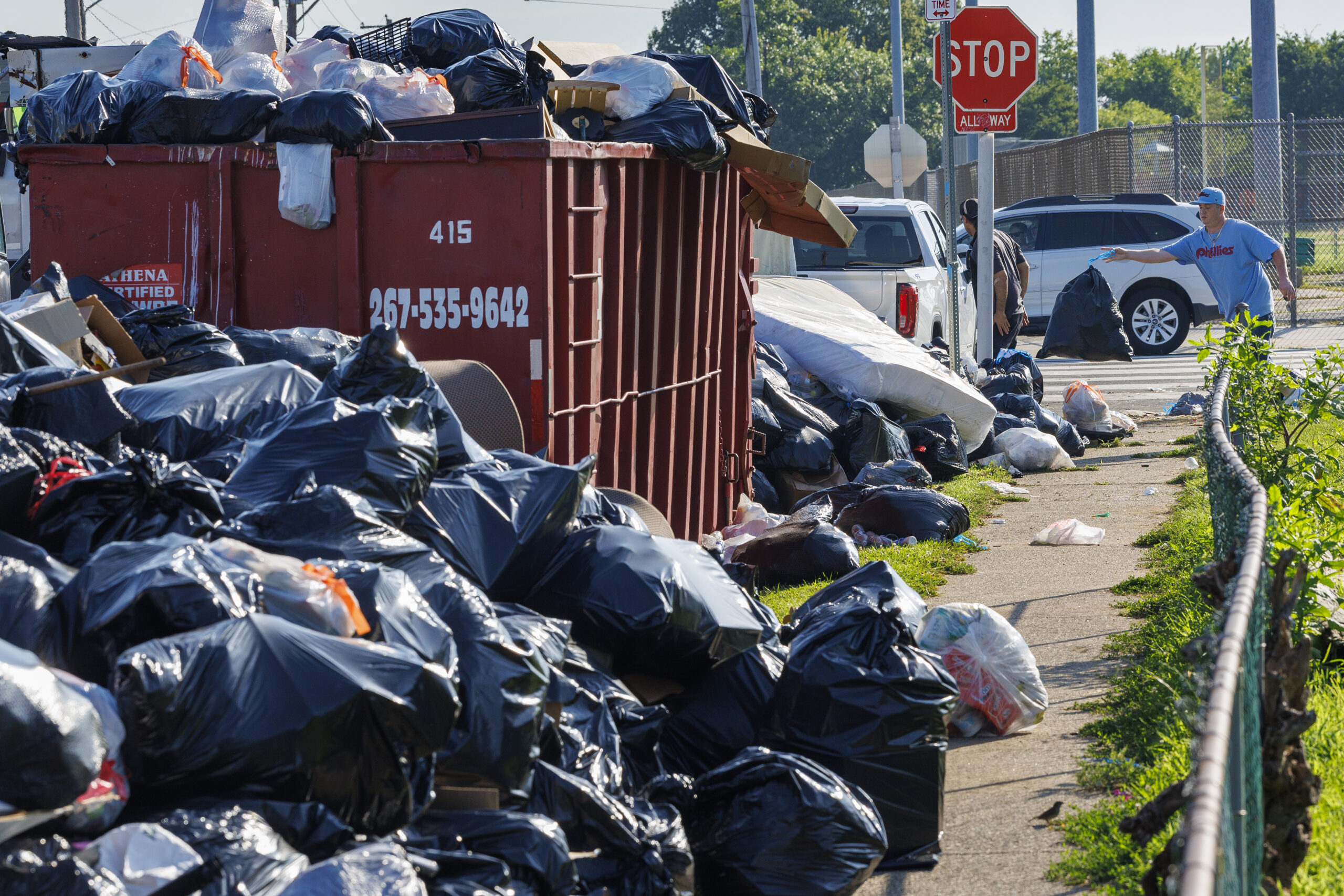
Residents with trash arrive at garbage dump site at Caldera Road and Red Lion Road in northeast Philadelphia during the AFSCME District Council 33 workers strike in July.
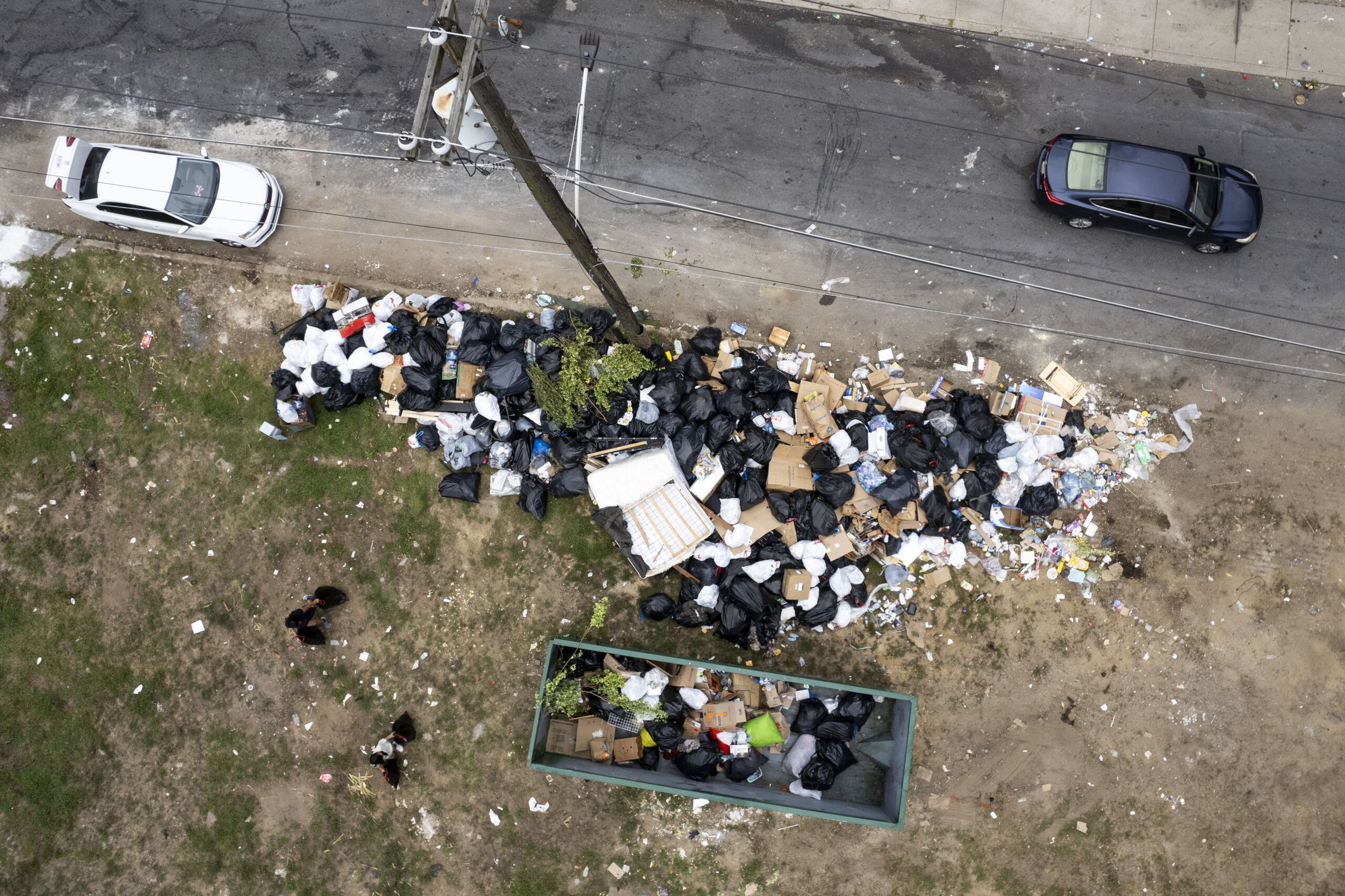
As a result, things got weird. Dead bodies piled up at the Medical Examiner’s Office; a striking union member was arrested for allegedly slashing the tires of a PGW vehicle; and for eight days in the July heat, garbage heaped up all across Philadelphia. The city set up temporary trash drop-off sites, which often overflowed into what were nicknamed “Parker piles,” but that also set off a firestorm about whether using the sites constituted crossing a picket line.
Wawa Welcome America July Fourth concert headliners LL Cool J and Jazmine Sullivan even pulled out of the show in support of striking workers, resulting in a fantastic “Labor Loves Cool J” meme.
It was all like something out of It’s Always Sunny in Philadelphia. In fact, the gang predicted a trash strike in the 2012 episode “The Gang Recycles Their Trash.”
The real strike lasted eight days before a contract was reached. In true Philly form, AFSCME District Council 33 president Greg Boulware told The Inquirer “nobody’s happy.”
A large pile of trash collects at a city drop-off site during the AFSCME workers strike this summer.
97-year-old gives birth to 16 kids
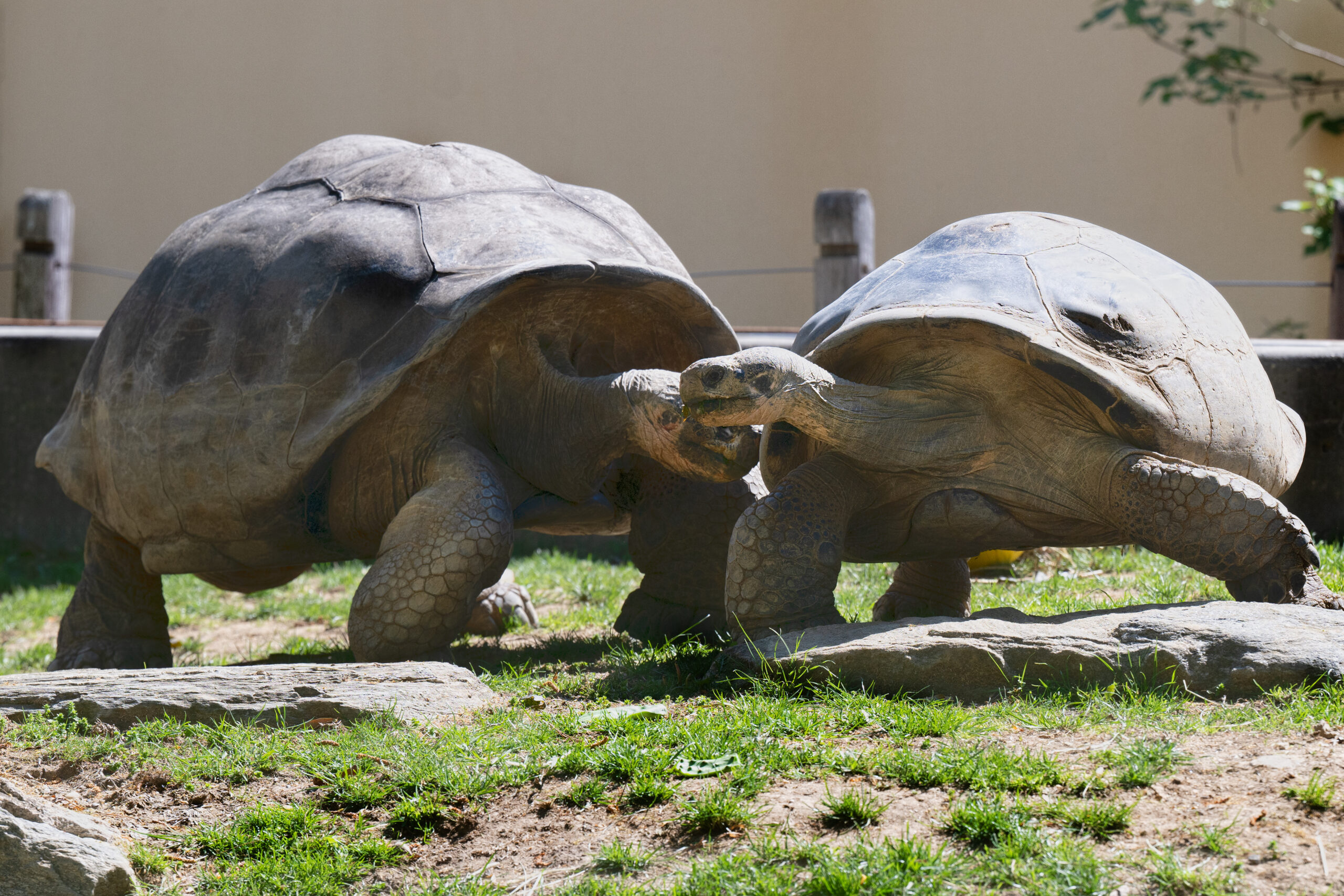
A local nonagenarian couple became national shellebrities this year for welcoming seven babies in April and nine more in August, proving that age ain’t nothing but a number, as long as you’re a tortoise.
Western Santa Cruz Galapagos tortoise Mommy, and male Abrazzo, left, are shown on Wednesday, April 23, 2025, at the Philadelphia Zoo in Philadelphia, Pa. The hatchlings’ parents, female Mommy and male Abrazzo, are the Zoo’s two oldest animals, each estimated to be around 100 years old.
Mommy and Abrazzo, Western Santa Cruz Galapagos tortoises who reside at the Philadelphia Zoo, made history with their two clutches, becoming the first pair of the critically endangered species in the zoo’s 150-year history to hatch eggs and the first to do so in any accredited zoo since 2019.
Mommy is also the oldest known first-time Galapagos tortoise mom in the world, so it’s safe to say she doesn’t have any time or patience for shenanigans. She’s got 16 heroes in a half shell to raise.
Western Santa Cruz Galapagos tortoise egg hatchling.
Phillies Karen
Taking candy from a baby is one thing — babies don’t need candy anyway — but taking a baseball from a kid at a Phillies game is a deed so foul and off base it’s almost unimaginable.
And yet, that’s exactly what happened at a Phillies-Marlins game in September, when a home run from Harrison Bader landed in the stands and a dad ran from his seat to grab it and give it to his son. A woman who was sitting near where the ball landed marched over to the dad, berated him, and demanded the ball be given her. Taken aback, the father reached into his son’s baseball glove and turned the ball over.
The entire scene was caught on camera and the woman, with her Kate Gosselin-esque hairdo, was immediately dubbed “Phillies Karen” by flabbergasted fans.
While the act technically happened at the Marlins stadium in Miami, Fla., it captured the minds and memes of Philadelphians so much that it deserves inclusion on this list. Phillies Karen has made her way onto T-shirts and coffee mugs, inspired skits at a Savannah Bananas game and the MLB Awards, and she even became a popular Halloween costume.
To this day, “Phillies Karen” remains unidentified, so it’s a safe bet she lives in Florida, where she’ll have better luck with alligators than with people here.
Institutional intrigue
Drama at area institutions this year had Philadelphians sipping tea like we were moms on Christmas morning, and sometimes, left us shaking our fists in the air like we were dads putting up tangled lights.
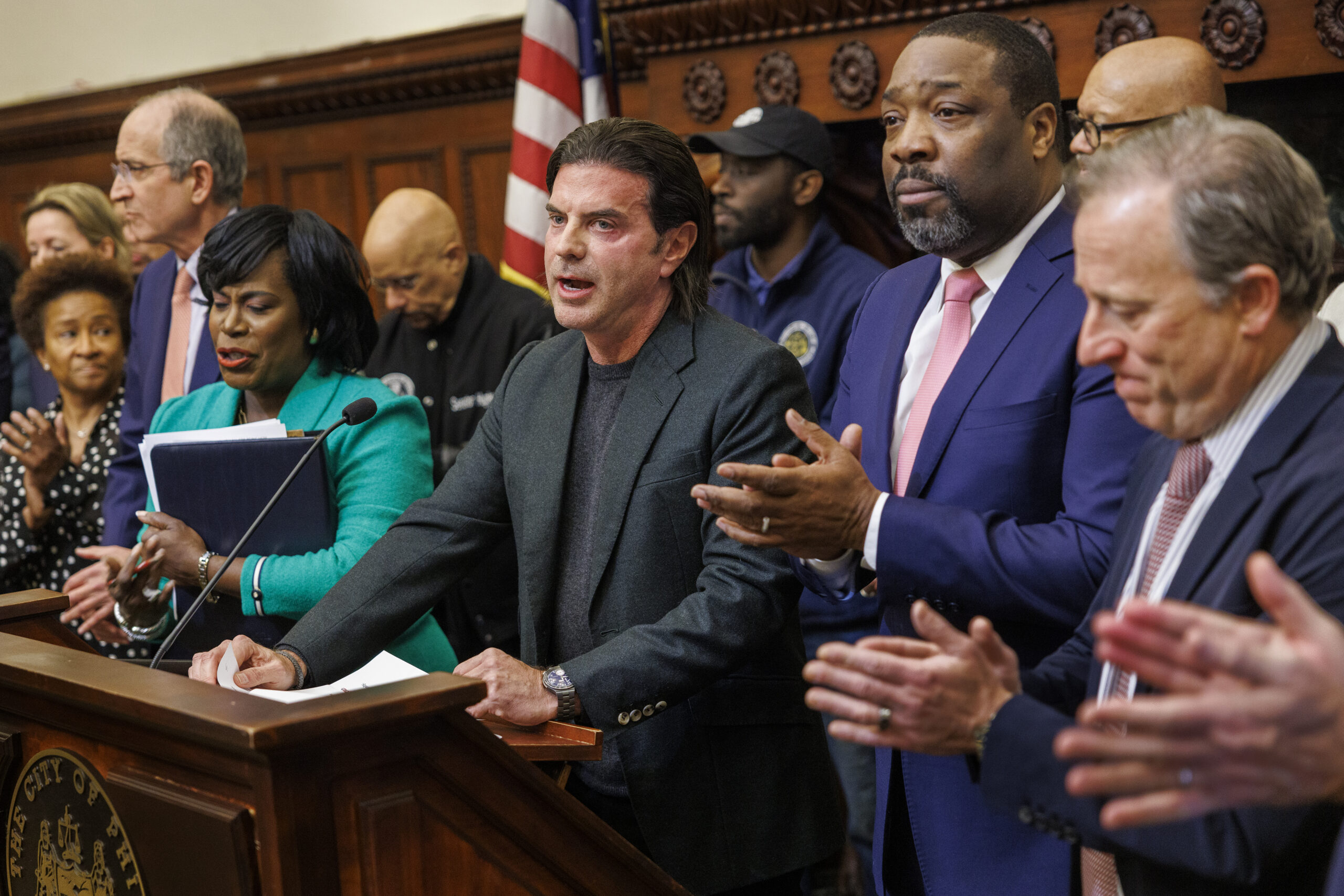
David Adelman with the Philadelphia 76ers makes a statement at a press conference in the Mayor’s Reception Room in January regarding the Sixers changing directions on the controversial Center City arena. At left is mayor Parker, at right City Council President Kenyatta Johnson and Josh Harris, Sixers owner.
It started early in January, when the billionaire owners of the Sixers surprised the entire city by announcing the team would stay at the South Philly sports complex instead of building their own arena on Market East. The decision came after two years of seemingly using the city, its politicians, and its people as pawns in their game.
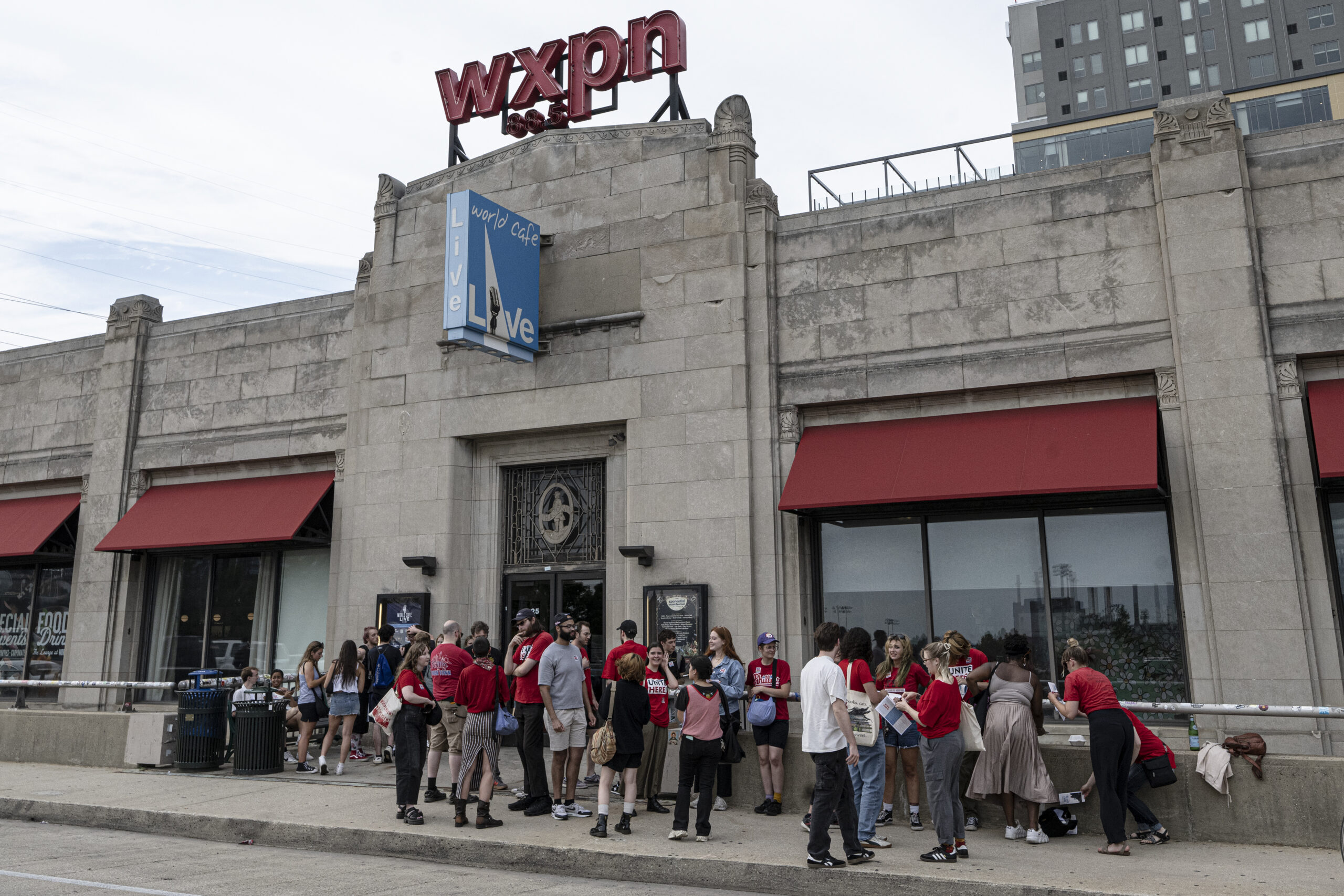
Workers gathered outside World Cafe Live before a Town Hall meeting with management in July.
In June, workers staged a walkout at World Cafe Live due to what they claimed was “an unacceptable level of hostility and mismanagement” from its new owners, including its then-CEO, Joseph Callahan. Callahan — who said the owners inherited $6 million in debt and that he wanted to use virtual reality to bolster its revenue — responded by firing some of the workers and threatening legal action. Today, the future of World Cafe Live remains unclear. Callahan stepped down as CEO in September (but remains chairman of the board), the venue’s liquor license expired, and its landlord, the University of Pennsylvania, wants to evict its tenant, with a trial scheduled for January.
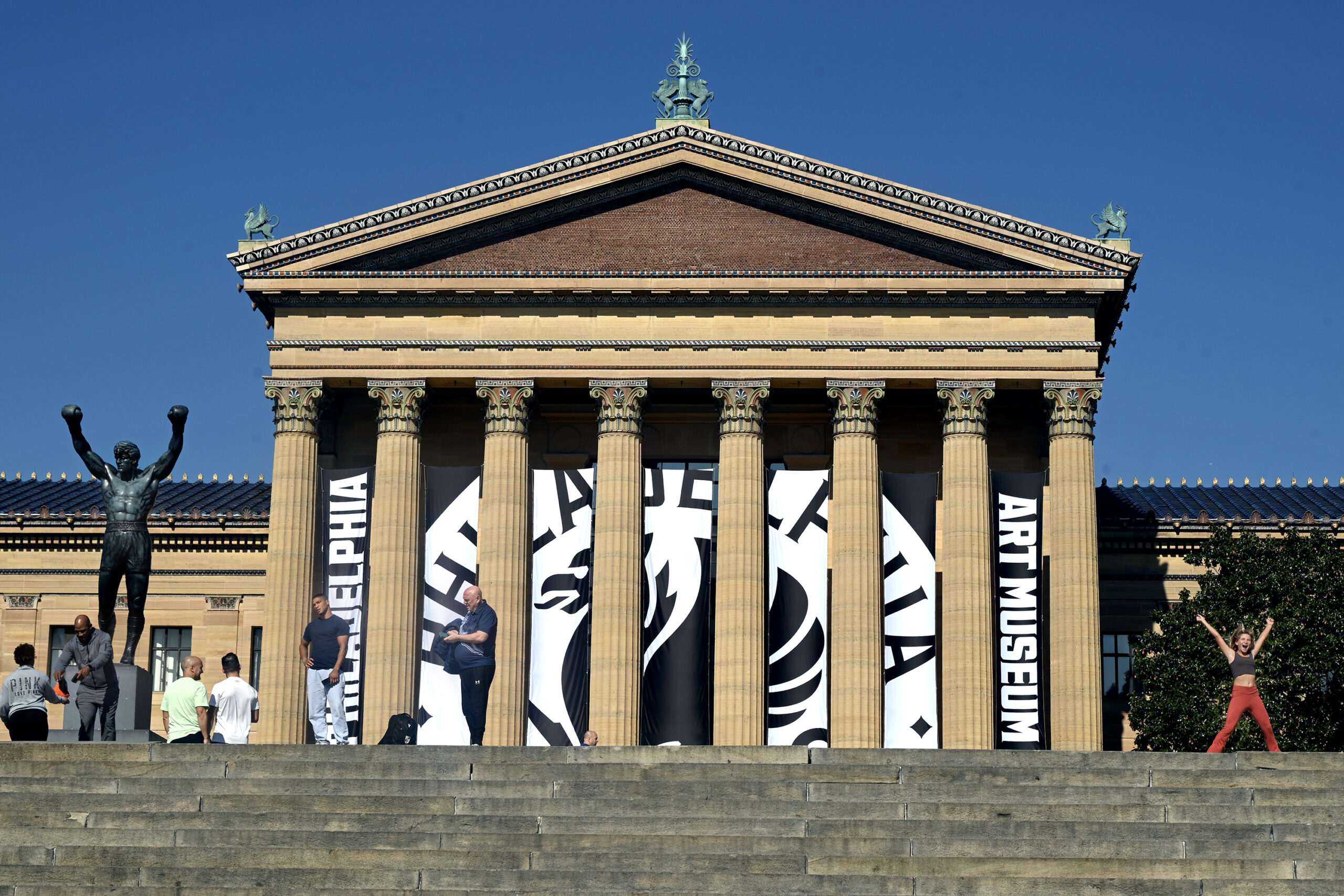
Signage at the east entrance to the Philadelphia Art Museum reflects the rebrand of the institution, which was formerly known as the Philadelphia Museum of Art.
Finally, late this year at the Philadelphia Art Museum, things got more surreal than a Salvador Dalí painting, starting with an institutional rebrand that surprised some board members, didn’t land well with the public, and resulted in a lot of PhART jokes. In November, museum CEO Sasha Suda was fired following an investigation by an outside law firm that focused, in part, on increases to her salary, a source told The Inquirer. Suda’s lawyer called it a “a sham investigation” and Suda quickly sued her former employer, claiming that “her efforts to modernize the museum clashed with a small, corrupt, and unethical faction of the board intent on preserving the status quo.”
Nobody knows where all of this will go, but it’s likely to have more drama than a Caravaggio.
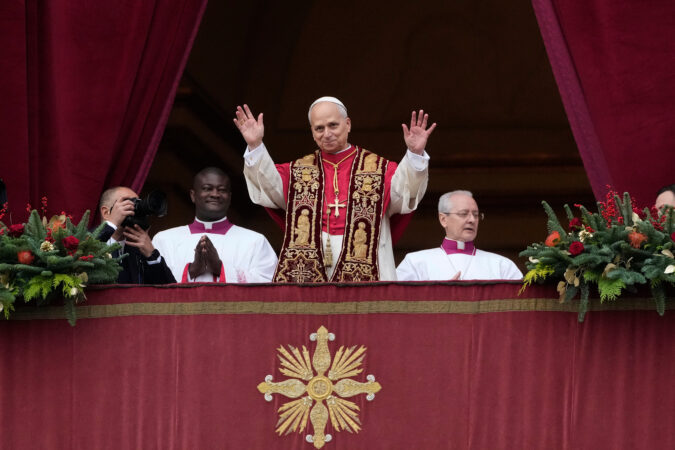
VATICAN CITY — In his first Christmas Day message, Pope Leo XIV urged the faithful to shed indifference in the face of those who have lost everything, such as in Gaza; those who are impoverished, such as in Yemen; and the many migrants who cross the Mediterranean Sea and the American continent for a better future.
The first U.S. pontiff addressed about 26,000 people from the loggia overlooking St. Peter’s Square for the traditional papal Urbi et Orbi address, Latin for “to the city and to the world,” which serves as a summary of the woes facing the world.
Though the crowd had gathered under a steady downpour during the papal Mass inside St. Peter’s Basilica, the rain had subsided by the time Leo took a brief tour of the square in the popemobile, then spoke from the loggia.
Leo revived the tradition of offering Christmas greetings in multiple languages abandoned by his predecessor, Pope Francis. He received especially warm cheers when he made his greetings in his native English and in Spanish, the language of his adopted country of Peru, where he served first as a missionary and then as archbishop.
Someone in the crowd shouted out “Viva il papa!” or ”Long live the pope!” before he retreated into the basilica. Leo took off his glasses for a final wave.
Leo surveys the world’s distress
During the traditional address, the pope emphasized that everyone could contribute to peace by acting with humility and responsibility.
“If he would truly enter into the suffering of others and stand in solidarity with the weak and the oppressed, then the world would change,” the pope said.
Leo called for “justice, peace, and stability” in Lebanon, the Palestinian territories, Israel, and Syria; prayers for “the tormented people of Ukraine”; and “peace and consolation” for victims of wars, injustice, political instability, religious persecution, and terrorism, citing Sudan, South Sudan, Mali, Burkina Faso, and Congo.
The pope also urged dialogue to address “numerous challenges” in Latin America, reconciliation in Myanmar, the restoration of “the ancient friendship between Thailand and Cambodia,” and assistance for the suffering of those hit by natural disasters in South Asia and Oceania.
“In becoming man, Jesus took upon himself our fragility, identifying with each one of us: with those who have nothing left and have lost everything, like the inhabitants of Gaza; with those who are prey to hunger and poverty, like the Yemeni people; with those who are fleeing their homeland to seek a future elsewhere, like the many refugees and migrants who cross the Mediterranean or traverse the American continent,” the pontiff said.
He also remembered those who have lost their jobs or are seeking work, especially young people, underpaid workers, and those in prison.
Peace through dialogue
Earlier, Leo led the Christmas Day Mass from the central altar beneath the balustrade of St. Peter’s Basilica, which was adorned with floral garlands and clusters of red poinsettias. White flowers were set at the feet of a statue of Mary, mother of Jesus, whose birth is celebrated on Christmas Day.
In his homily, Leo underlined that peace can emerge only through dialogue.
“There will be peace when our monologues are interrupted and, enriched by listening, we fall to our knees before the humanity of the other,” he said.
He remembered the people of Gaza, “exposed for weeks to rain, wind, and cold” and the fragility of “defenseless populations, tried by so many wars,” and of “young people forced to take up arms, who on the front lines feel the senselessness of what is asked of them, and the falsehoods that fill the pompous speeches of those who send them to their deaths.”
Thousands of people packed the basilica for the pope’s first Christmas Day Mass, holding aloft their smartphones to capture images of the opening procession.
This Christmas season marks the winding down of the Holy Year celebrations, which will close on Jan. 6, the Catholic Epiphany holiday marking the visit of the three wise men to the baby Jesus in Bethlehem.
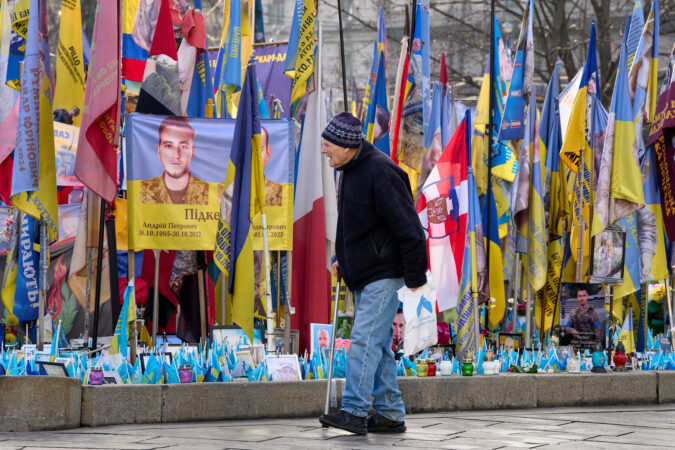
KYIV, Ukraine — Ukraine is expected to give its latest peace proposals to U.S. negotiators this week, President Volodymyr Zelensky said, ahead of his urgent talks with leaders and officials from about 30 other countries supporting Kyiv’s effort to end the war with Russia on acceptable terms.
As tension builds around a U.S. push for a settlement, German Chancellor Friedrich Merz, British Prime Minister Keir Starmer and French President Emmanuel Macron spoke to President Donald Trump by phone Wednesday, according to officials.
Negotiations are at “a critical moment,” the European leaders said in official statements.
Trump said the men discussed Ukraine “in pretty strong terms.” He also said Zelensky “has to be realistic” about the war and that European leaders would like a meeting this coming weekend with both the U.S. and Ukraine.
“We’ll make a determination depending on what they come back with,” the president told reporters during a question-and-answer session at the White House.
Washington’s goal of a swift compromise to stop the fighting that followed Russia’s full-scale invasion in 2022 is reducing Kyiv’s room for maneuvering. Zelensky is walking a tightrope between defending Ukrainian interests and showing Trump he is willing to compromise, even as Moscow shows no public sign of budging from its demands.
Ukraine’s European allies are backing Zelensky’s effort to ensure that any settlement is fair and deters future Russian attacks, as well as accommodating Europe’s defense interests.
The French government said Ukraine’s allies — dubbed the “Coalition of the Willing” — will discuss the negotiations Thursday by video. Zelensky said it would include those countries’ leaders.
“We need to bring together 30 colleagues very quickly. And it’s not easy, but nevertheless we will do it,” he said late Tuesday.
Zelensky said discussions with the U.S. were scheduled later Wednesday to focus on a document detailing plans for Ukraine’s postwar reconstruction and economic development. Also, Ukraine is finalizing work on a separate, 20-point framework for ending the war. Zelensky said Kyiv expects to submit that document to Washington soon.
Zelensky says he’s ready for an election
After Trump called for a presidential election in Ukraine, Zelensky said his country would be ready for such a vote within three months if partners can guarantee safe balloting during wartime and if its electoral law can be altered.
Zelensky’s openness to an election was a response to comments by Trump in which he questioned Ukraine’s democracy and suggested the Ukrainian leader was using the war as an excuse not to stand before voters. Those comments echo similar remarks often made by Russian President Vladimir Putin.
Zelensky said late Tuesday he is “ready” for an election but needs help from the U.S. and possibly Europe to ensure its security. He suggested Ukraine could hold balloting in 60 to 90 days if that proviso is met.
“To hold elections, two issues must be addressed: primarily, security — how to conduct them, how to do it under strikes, under missile attacks; and a question regarding our military — how they would vote,” Zelensky said. “And the second issue is the legislative framework required to ensure the legitimacy of elections.”
Zelensky pointed out previously that balloting can’t legally happen while martial law — imposed due to Russia’s invasion — is in place. He has also asked how a vote could occur when civilian areas of Ukraine are being bombarded and almost 20% of the country is under Russian occupation.
Zelensky said he has asked lawmakers from his party to draw up legislative proposals allowing for an election while Ukraine is under martial law.
Ukrainians have on the whole supported Zelensky’s arguments, and have not clamored for an election. Under the law that is in force, Zelensky’s rule is legitimate.
Putin has repeatedly complained that Zelensky can’t legitimately negotiate a peace settlement because his five-year term that began in 2019 has expired.
U.S. seeks closer ties with Russia
A new U.S. national security strategy released Dec. 5 made clear that Trump wants to improve Washington’s relationship with Moscow and “reestablish strategic stability with Russia.” The document also portrays European allies as weak.
Russian Foreign Minister Sergey Lavrov praised Trump’s role in the Ukraine peace effort, telling the upper house of parliament that Moscow appreciates his “commitment to dialogue.” Trump, Lavrov said, is “the only Western leader” who shows “an understanding of the reasons that made war in Ukraine inevitable.”
Trump’s peace efforts have run into sharply conflicting demands from Moscow and Kyiv.
The initial U.S. proposal was heavily slanted toward Russia’s demands. To counter that, Zelensky has turned to his European supporters.
Zelensky met this week with the leaders of Britain, Germany, and France in London, the heads of NATO and the European Union in Brussels, and then went to Rome to meet the Italian premier and Pope Leo XIV.
Military aid for Ukraine declines
Europe’s support is uneven, however, and that has meant a decrease in military aid since the Trump administration this year cut off supplies to Kyiv unless they were paid for by other NATO countries.
Foreign military help for Ukraine fell sharply over the summer, and that trend continued through September and October, a German body that tracks international help for Ukraine said Wednesday.
Average annual aid, mostly provided by the U.S. and Europe, was about 41.6 billion euros ($48.4 billion) between 2022–24. But so far this year Ukraine has received just 32.5 billion euros ($37.8 billion), the Kiel Institute said.
This year, Denmark, Finland, Norway, and Sweden have substantially increased their help for Ukraine, while Germany nearly tripled its average monthly allocations and France and the U.K. both more than doubled their contributions, the Kiel Institute said.
On the other hand, it said, Spain recorded no new military aid for Kyiv in 2025 while Italy reduced its low contributions by 15% compared with 2022–2024.
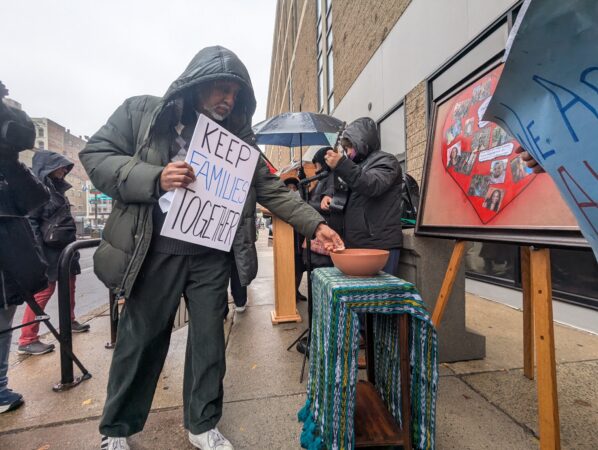
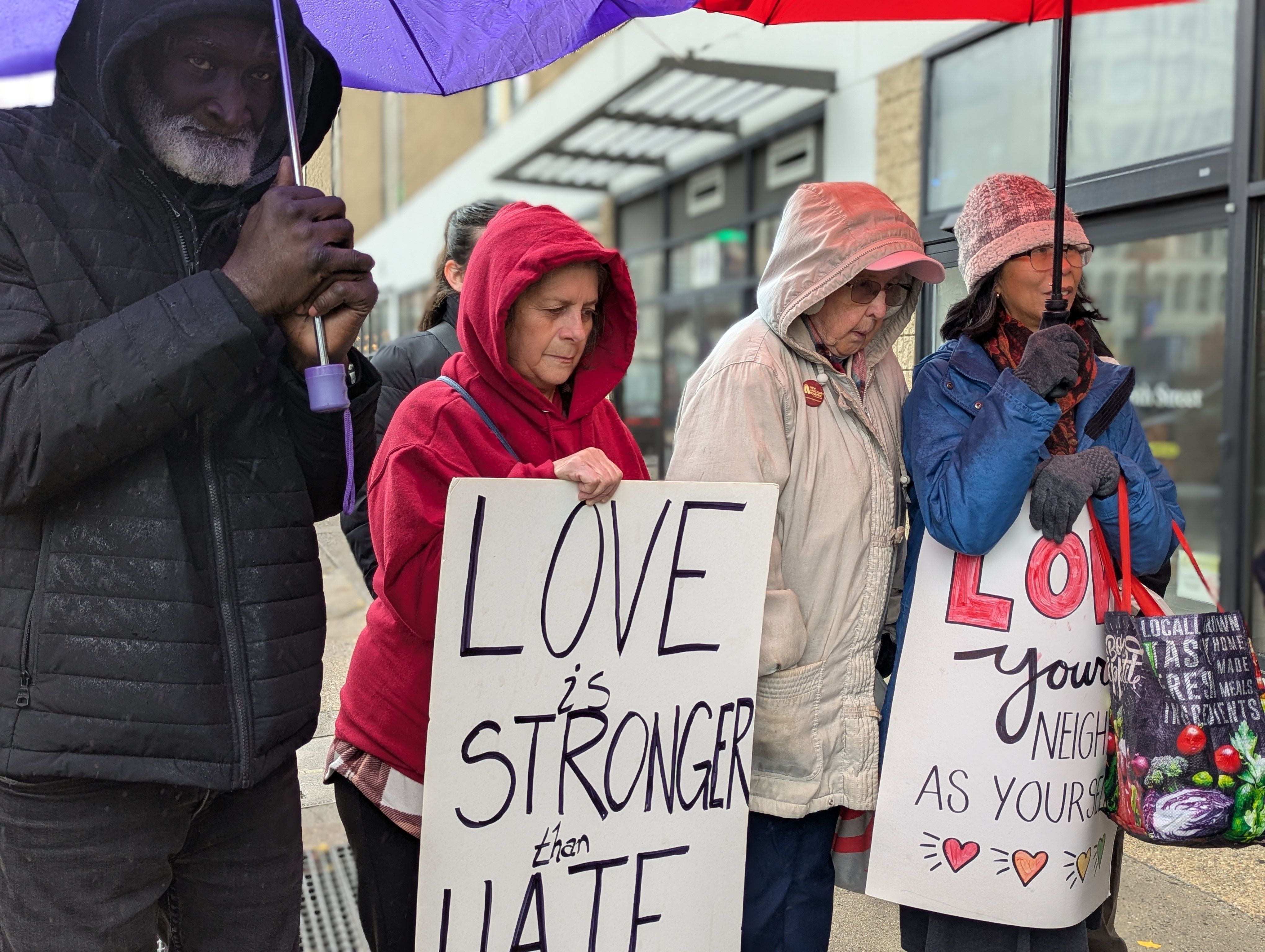
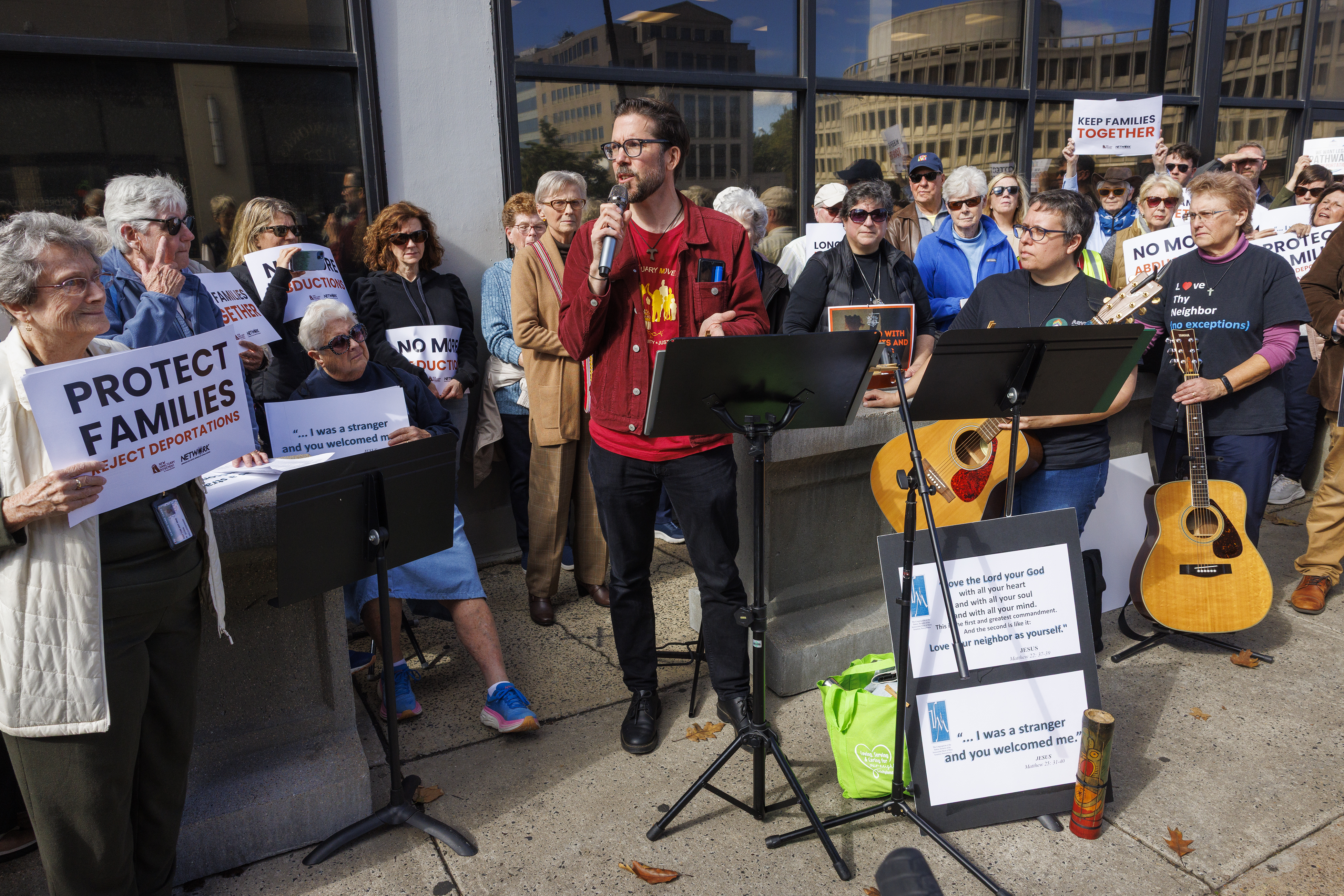
On a rainy Wednesday a week before Thanksgiving, members of the congregations of the Roman Catholic parishes of Holy Innocents and St. Joan of Arc gathered in front of the U.S. Immigration and Customs Enforcement office in Center City.
Another religious group appeared at ICE’s door near Eighth and Cherry Streets on the day before Thanksgiving. This time, it was an interfaith mix of folks led by Christianity for Living Ministries.
And there will be more. On Wednesdays to come, members of Mennonite Action, a couple of United Methodist churches, a Quaker meeting, two synagogues, a Presbyterian church, the Sisters of St. Joseph of Philadelphia and more Catholic parishes have all pledged to take part in a recurring demonstration that Neilson calls ICE Profest 40 — an ecumenical and interfaith action to oppose the government’s pitiless anti-immigrant crackdown slated to take place over 40 weeks. The word profest was coined by Neilson to mean “an amalgamation of faith expressed through proclamation, prayer, and protest.”
Members of the congregations of Holy Innocents and St. Joan of Arc parishes gathered Nov. 19 for an interfaith prayer vigil outside the ICE office in Center City. It was the kickoff of 40 weeks of vigils planned by faith communities across Philadelphia.
But organizers are hopeful that whatever their movement might lack in numbers, it more than makes up for in the power of their spiritual conviction — a conviction that is grounded in the Bible and other sacred texts.
“We proclaim God’s word of justice, mercy, and humility (Micah 6:8),” Neilson told me via email. “We pray for ICE agents and authorities (St. Matthew 5:44-45; St. Luke 3:24; 6:27-28; I Timothy 2:1-4), many of whom are conflicted and have crises of conscience. [We pray] for their courage, transformation, and turning, and for the protection and provision of the detainees and deportees, who are traumatized, from family separation and living in constant fear (Isaiah 1:17; Psalm 10:17-18; 82:3; St. Luke 4:18-19).”
“And,” he added, “we protest ICE activity, i.e., the orders ICE agents are given and the ways in which they are carried out, that dehumanizes and victimizes those created in the image and likeness of God [who] are our neighbors, and [which] disobeys and violates God’s command to welcome and love the stranger and alien (Leviticus 19:33-34; Deuteronomy 10:18-19; St. Matthew 25:31-46).”
The Rev. Christopher Neilson said that demonstrators at the protests pray for detainees and deportees who have been traumatized by family separation and are living in fear. They also pray for the safety of ICE agents and that the organization’s leaders might change their policies.
The number of weeks — 40 — during which this will happen has biblical significance, Neilson said, as a period of transition from trial to transformation. (Think of the 40 days and 40 nights Jesus traveled in the wilderness before the crucifixion.)
For me, the timing of when ICE Profest 40 is gearing up is especially resonant.
We’re moving from Thanksgiving — a secular holiday which, in good years, I get to celebrate with a family that includes foreign-born and U.S.-born folks — into Advent.
The beginning of the liturgical year is when Christians like me move from anticipation to action as we wait to celebrate the birth of Christ into a humble, migrant human family. I love the hush that precedes a world on the brink of transformation. I suspect that is why the quiet power of ICE Profest 40 actions moves me so deeply.
“The tone of these vigils is different,” Peter Pedemonti, the codirector of New Sanctuary Movement of Philadelphia, told me via email.
Peter Pedemonti, codirector of the New Sanctuary Movement, addressing Catholics gathered outside the ICE office at Eighth and Cherry Streets, in October.
“They are not as loud as a protest, but they have the potential for big impact,” he said. “We are seeing people sign up who are new to public witness, and so they serve as an entry into collective action. This is important as we fight not only the attacks on immigrant communities, but also Trump’s rapid steps toward authoritarianism. We need everyone right now, and it is really important we have paths for new people to get involved.”
“I have been doing faith-rooted organizing for nearly 20 years. These spiritual tools we have work. We can’t always see the immediate impact, but I have seen them help win campaigns. And so I believe that when we bring them to ICE, we are engaging in something powerful,” Pedemonti added. “The religious community has an important role right now. We are the moral voice, and when we see Trump trample our faith teachings and our democracy, it is critical [that] faith communities speak out.”
While my own faith tradition has long had priests, religious men and women accompanying immigrants and advocating for their rights, the United States Conference of Catholic Bishops has been pretty circumspect about commenting on the Trump administration’s policies.
But for Catholics who supported Trump — 55% overall (62% of white Catholics, 41% of Hispanic Catholics), according to the Pew Research Center — the Catholic bishops’ statement could serve as a come-to-Jesus (heh!) moment.
It is certainly a clear call for transformation during this most transformative of seasons.
I won’t speak for other people of faith, but for me, those are questions that go beyond political affiliation or temporal power, and touch on the “act justly, love mercy, and walk humbly” core requirements Neilson referenced.
On the first Sunday of Advent, one of the readings will be Isaiah’s proclamation that the people “shall beat their swords into plowshares, and their spears into pruning hooks; one nation shall not raise the sword against another, nor shall they train for war again,” and that throws me right back into the fact that both the Catholic bishops in their statement, and the Rev. Neilson in his description of the ICE Profest 40 vigils, reference ICE agents.
ICE agents aren’t wielding swords, of course, but they do carry firearms and other implements with which they smash the windows and doors of terrified immigrants. And with the proposal that military members could be “trained” by deployment to U.S. cities to support ICE and U.S. Customs and Border Protection agents, it’s not that much of a stretch to make Isaiah fit the moment.
I’m going to confess something now. I’ve prayed often for immigrants, never for ICE agents. In fact, I bristled a bit when I heard the bishops equating the vilification immigrants have experienced with the vilification of ICE agents — no one has accused ICE agents of eating pets, or separated them from their families, or turned them from legally residing to unauthorized in a moment.
But, as we saw with this week’s shooting of two National Guard members in Washington, D.C., those who have been asked to carry out the administration’s ill-conceived and oppressive policies may also be endangered by them.
The shooting reminded me of what Pedemonti told me: “If we want ICE to see the humanity of those they are persecuting, then we need to model that and see the humanity of ICE agents.”
“The religious community has an important role right now. We are the moral voice, and when we see Trump trample our faith teachings and our democracy, it is critical [that] faith communities speak out,” Peter Pedemonti said.
“We believe all people can change,” he added, “and so in the tradition of St. Óscar Romero, who called on soldiers in El Salvador’s authoritarian regime to put down their arms, we call for ICE agents to follow their conscience and refuse to follow orders, to leave people with their families, to leave the people in peace.”
I guess it’s time to broaden my prayers. Don’t get me wrong, my rosary (the one which, along with its crucifix and Our Lady of Guadalupe medallion, has monarch butterfly beads representing migrants) will still be in regular rotation with prayers for immigrant justice. But maybe the Romero quote with which I open my prayers using a niner that has his medallion will be different: I want to make a special appeal to soldiers, National Guard members, and policemen: Each of you is one of us.
The first candle we light at Advent represents hope, after all, and no matter how far away or unlikely the desired outcome appears, hope always leads to transformation.