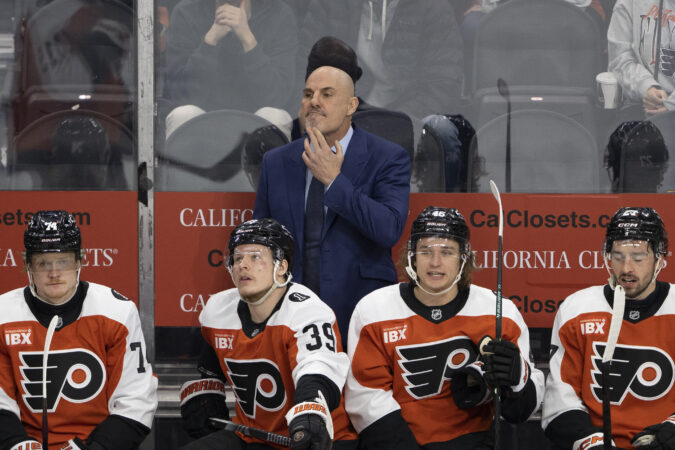
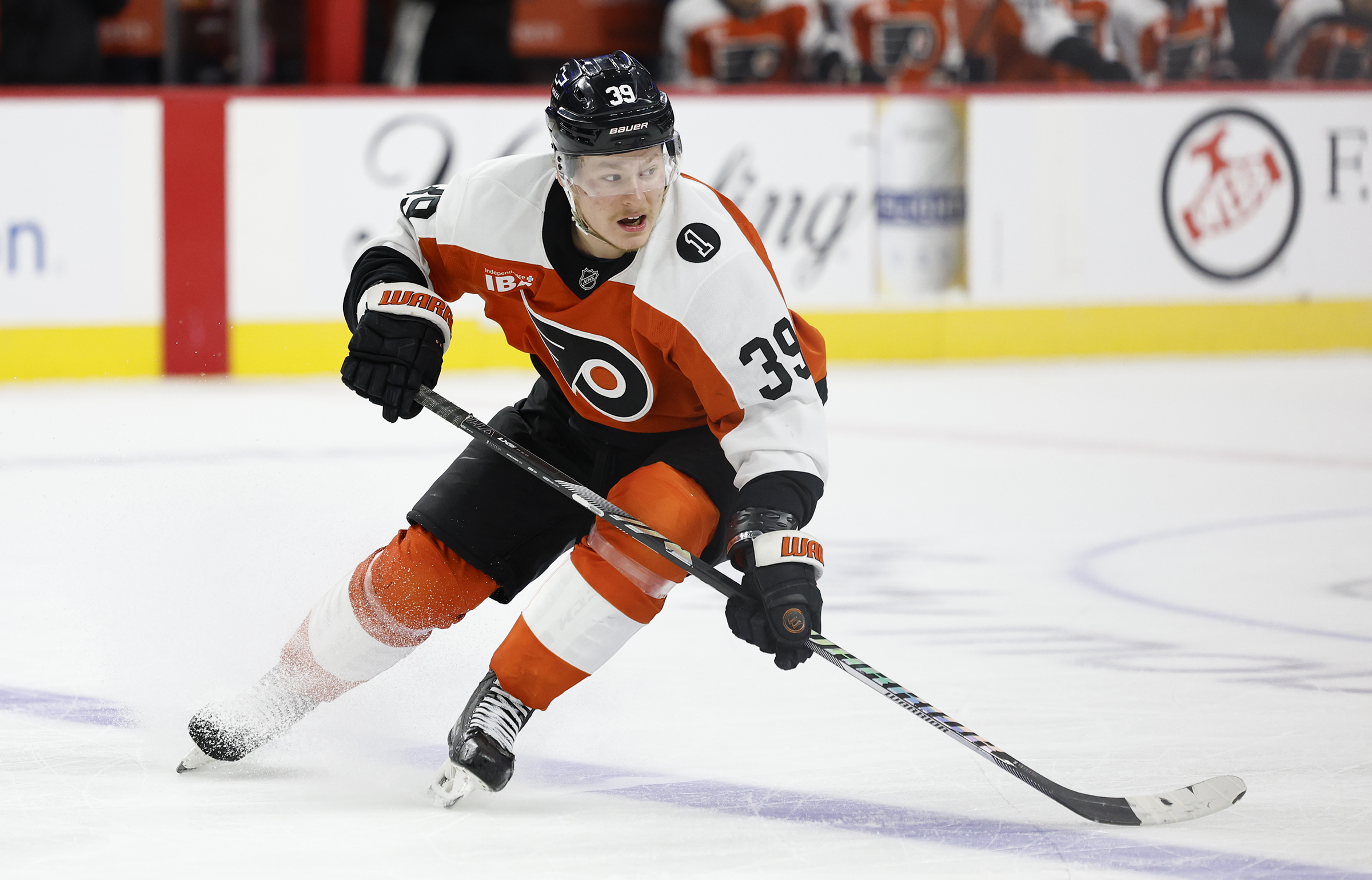
In mid-October, Flyers coach Rick Tocchet said the quiet part out loud.
“I know he’s the lightning rod for everybody around here,” he said of Matvei Michkov.
A talented offensive player, the recently turned 21-year-old Russian, who arrived in North America two years earlier than expected, led the Flyers — and all NHL rookies — with 26 goals and finished second on the team with 63 points last season. He also won the league’s rookie of the month award twice, becoming the first Flyer in 30 years to do so.
But this season, Michkov has struggled to find that spark with 19 points (eight goals, 11 assists) in 34 games. He has also taken several unnecessary penalties and seen his ice time decrease from 16 minutes, 41 seconds last season to 14:43 this year.
Although Natural Stat Trick has the Flyers with 51.74% of the shot attempts when Michkov is on the ice — tops on the team — and an expected goal-share of 53.6%, which is No. 2 among players who have played at least five games, he has struggled defensively and shown a tendency to cherry-pick at times.
As Tocchet said, he is a lightning rod, so, of course, he is often a topic of conversation.
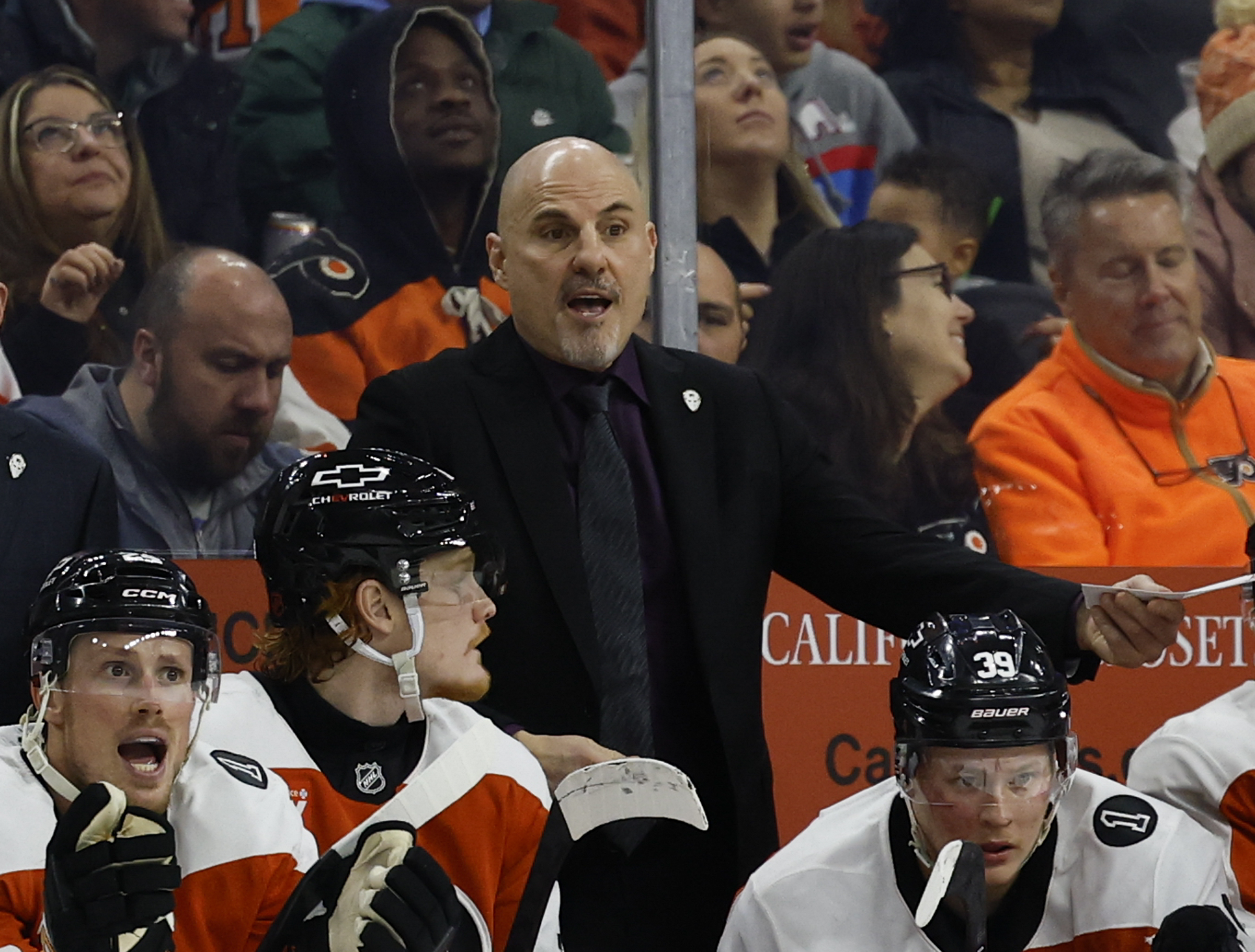
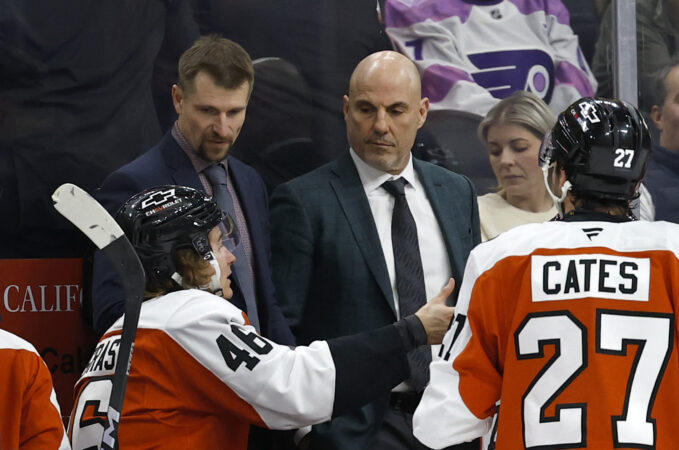
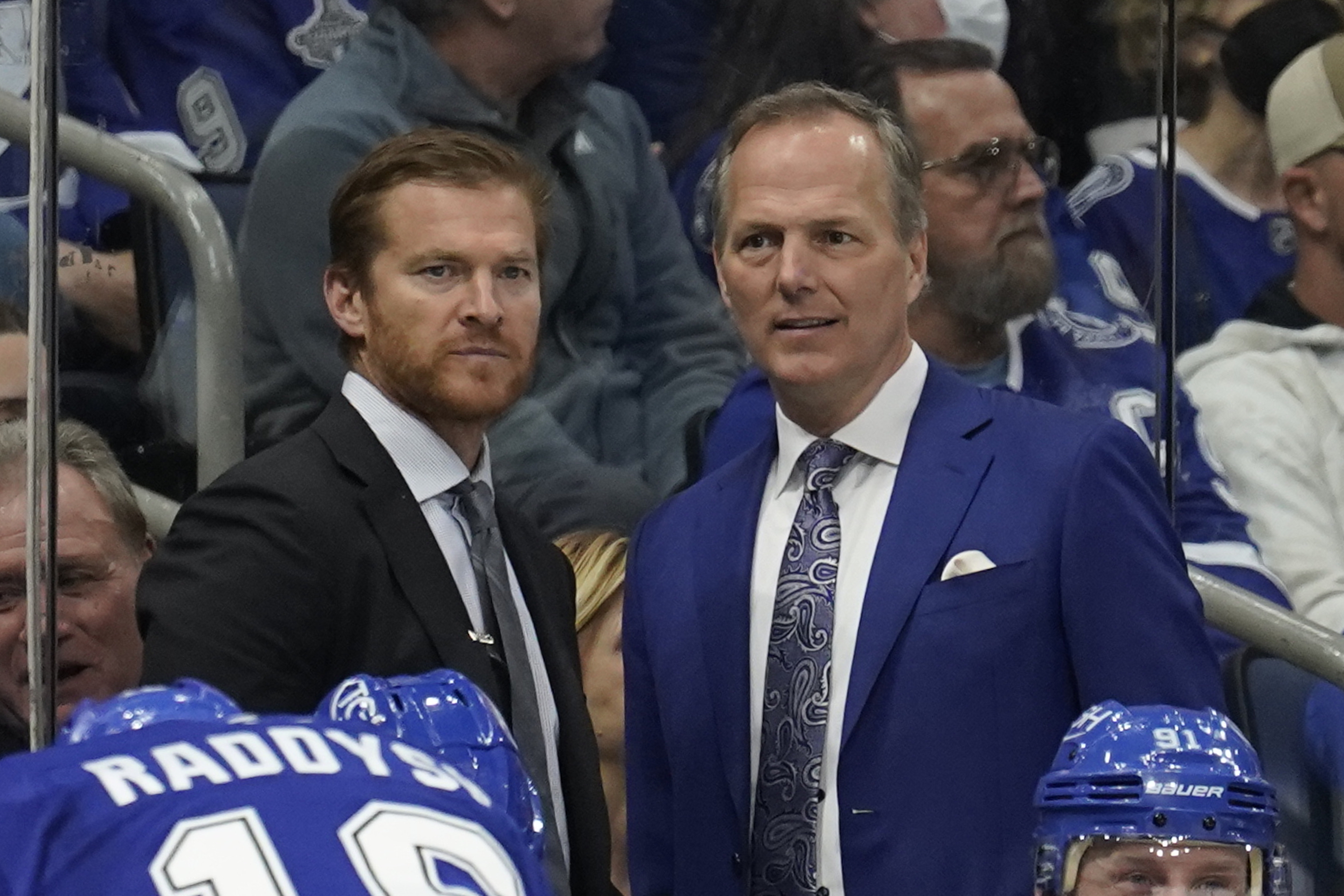
On Saturday, the television broadcast caught Michkov, Tocchet, and assistant coach Jaroslav “Yogi” Svejkovský having an animated conversation on the bench. The conversation appeared to happen right after Michkov drew a minor penalty when New York Rangers winger Will Cuylle cross-checked him from behind.
“It happens all the time. It’s not Mich, it’s just a story, because it’s Mich. It wasn’t even an argument. It was about when he should switch, and not with [Denver] Barkey. And he’s getting it, when to switch and when not to on the power play,” Tocchet said, although it’s not clear if he meant to say power play as he did appear to stop himself, and the Flyers were heading to their first power play of the game.
“But that was all. He was just getting frustrated on when to switch and when he shouldn’t switch. I know it’s a lot of media people like to let him do what he wants. But there’s a time to switch and when not to switch, and that’s really what it comes down to.”
It is worth noting that Michkov and Barkey picked up assists on Travis Sanheim’s power-play goal directly following the Russian’s animated conversation with Tocchet.
Michkov has five assists in December but does not have a goal this month. A follow-up question asked the bench boss about Michkov having the right attitude but getting frustrated when he’s not scoring.
Flyers right wing Matvei Michkov, 21, has just 19 points in 34 games this season.
“Guys who want to score goals get frustrated, but you can’t let it affect your overall game,” Tocchet said. “You’ve got to continue to go to the spots, you keep going to the middle, keep getting to that slot area when you already have two guys down low, like — don’t go behind the net — like things like that.
“He’s just got to stay with it, because he’ll get those chances. He had some chances against the Rangers. … Now he’s got [to] play a little faster and separate himself. That’s what it comes down to. You can’t get frustrated, and just keep working.”
Barkey and Michkov switched one time before the bench interaction. It came with 11:49 left in the first period, and it occurred after Rangers goalie Igor Shesterkin froze the puck. So was it about switching shifts and the short shifts by Michkov that have been discussed recently?
“We tell our players, when you’re tired, get off. So if he’s tired after 20 seconds, get off. I don’t know. I don’t know what you want me to say. Yeah, he’s getting enough shifts. He’s coming off short because sometimes he’s tired. I don’t know what the big deal of that is,” Tocchet snapped.
The fourth question about Michkov noted that Tocchet and the Russian winger were seen speaking before practice. Does the coach like that he’s willing to work on things, showing his sheer competitiveness?
“We’re 17-10[-7], we have a good record. I’ve answered six Michkov questions. I mean, enough is enough,” Tocchet said.
“We’ve got [Dan] Vladař having a great year. [Jamie] Drysdale is playing really good five-on-five for us. [Cam York’s] doing a really good job. We’ve got a lot of other players playing good and a team game.
“I mean, this is the fifth question. I appreciate it, but you’re trying to make something that it’s not. He’s got to learn to play the game, and he’s trying. He’s a lot better defensively. He’s a lot better playing a team game, and that’s how you win hockey. It’s not about catering to one person. I hate to tell you guys. That’s it.”
Breakaways
Goalie Aleksei Kolosov was sent back to Lehigh Valley of the American Hockey League on Monday morning. Vladař (upper-body injury) and Christian Dvorak (lower-body injury), who both missed Saturday’s game against the Rangers, were at the team’s morning skate. Tocchet expects Dvorak to play, but said Vladař is a game-time decision. … Barkey will make his Xfinity Mobile Arena debut on Monday against the Vancouver Canucks (7:30 p.m., NHLN, NBCSP). … Defenseman Noah Juulsen and forwards Garnet Hathaway and Nic Deslauriers are expected to be healthy scratches.
It’s the time of the year to be thankful and Flyers fans have several reasons to be overflowing with gratitude.
Or at least you would think so …
The Flyers, whose front office made clear its desire for the team to take a positive step forward in its rebuild this year and be more competitive, are 15-8-3 under new coach Rick Tocchet, and have the seventh-most points and the seventh-best points percentage in the NHL. If the season ended Thursday morning, the Flyers would occupy the third spot in the Metropolitan Division based on points percentage and be in the playoffs for the first time in five seasons.
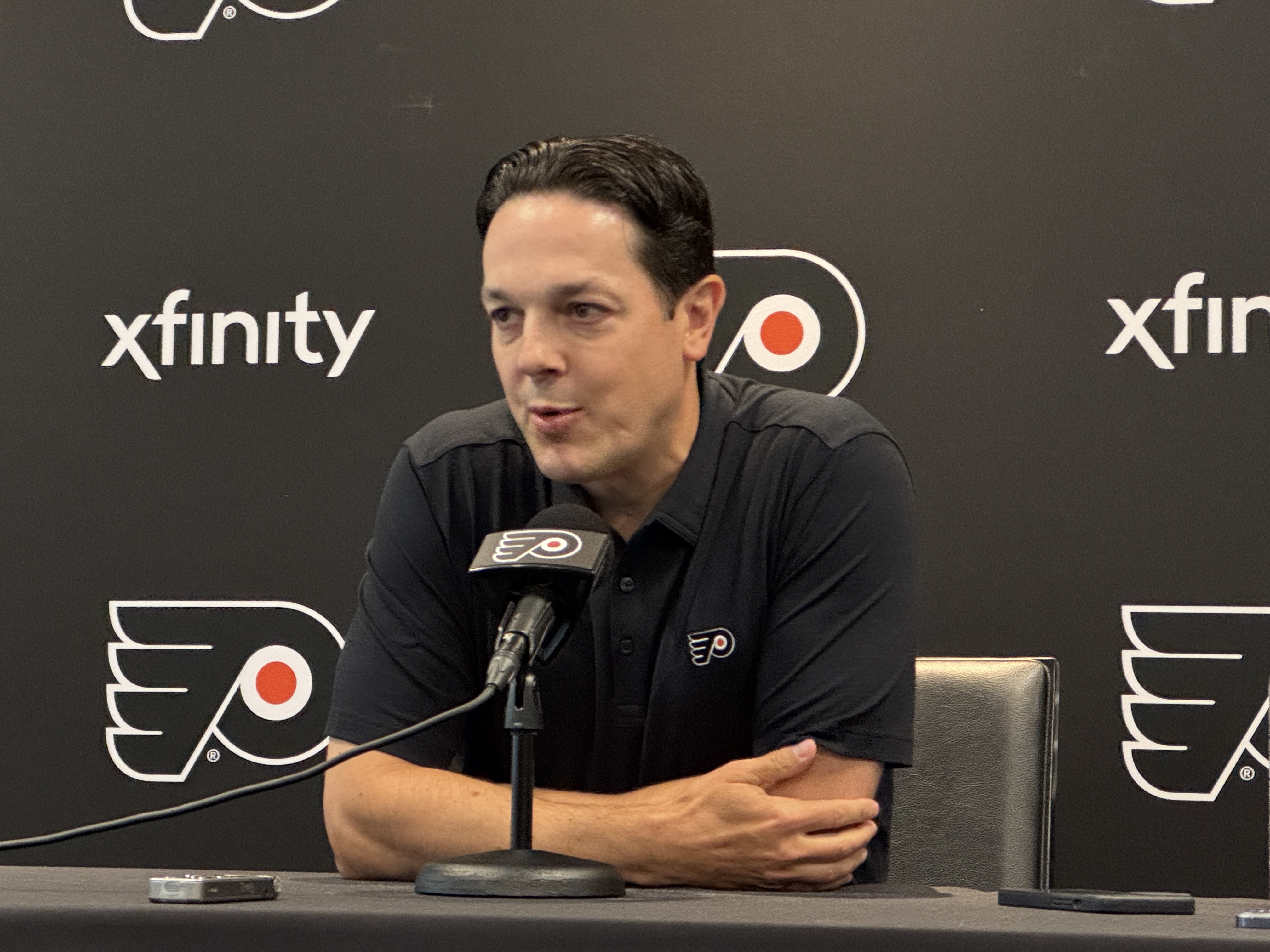
“We expect more of a fight internally, and we hope that it’s going to make us better, it’s going to hopefully make us more competitive throughout the season, and maybe push to get closer to the playoffs,” general manager Danny Brière said in September. “At the end of the day, we want to make the playoffs.”
Beyond their record, the Flyers have struck gold with inexpensive offseason acquisitions Trevor Zegras and Dan Vladař, the former flashing his puck handling wizardry and superstar potential, and the latter playing like a bona fide Vezina Trophy candidate over the first third of the season. The Flyers’ checkered history between the pipes is well documented, but maybe, just maybe, Vladař, who is 28 and signed through next year, can bring some consistency to the position for the next few seasons. And in the 24-year-old Zegras, a restricted free agent at season’s end who leads the team with 26 points, the Flyers hope they have identified part of their long-term solution down the middle.
The positives don’t end there. Zegras’ close friends Cam York (24) and Jamie Drysdale (23) have leveled up after surviving John Tortorella’s wrath, and so had fellow first-rounder Tyson Foerster (23), who had 19 goals in his last 30 games dating back to last season before suffering an upper-body injury on Monday that will sideline him for two to three months. York was banged up on Wednesday but is listed as “day-to-day.”
Owen Tippett, 26, has had more good moments than bad this season as he strives for consistency, while Matvei Michkov, who is still just 20, is coming on strong after a slow start. Noah Cates (26) and Bobby Brink (24) have also picked up where they left off last season, while the exciting Emil Andrae (23) looks to have made himself into an everyday NHL defenseman. In other words, the kids are getting better.
The Flyers have high hopes for 2025 first-round picks Porter Martone (right) and Jack Nesbitt (left).
The Flyers have more on the way as they boast a top-10 prospect pool in hockey and probably couldn’t have dreamed up better starts for their potential future stars. Porter Martone, the No. 6 overall pick in June, is dominating college hockey with Michigan State; Alex Bump and Denver Barkey are off to fast starts in their first full pro seasons with Lehigh Valley; and Egor Zavragin continues to put up historic numbers for a 20-year-old goalie in Russia. Even Jett Luchanko got the trade many felt he needed to further his development in the Ontario Hockey League. Martone, Bump, and Luchanko will all be expected to break camp with the Flyers next season.
So all is good in Flyers land, right?
Not if you scroll through X or find yourself wading through the ever dark and gloomy depths of Flyers Twitter:
“I hate Rick Tocchet hockey man…,“ tweeted @aftern_alex earlier this month.
or
“I DO NOT LIKE TOCCHET AT ALL. IF BREIRE AND JONES R ON BOARD WITH MICHKOV GETTING 13 MINUTES A GAME. FIRE THEM ALL,” wrote @Philly4everrr.
So why is a large portion of the fan base so unhappy amid the team’s surprising start? Well, it largely boils down to three things: (1) Tocchet’s style of play; (2) Michkov’s usage under Tocchet; and (3) the Flyers not tanking for a No. 1 center or No. 1 defenseman. Let’s explore those three points further.
Tocchet’s teams will never be confused with the ‘80s Edmonton Oilers, the ‘90s Pittsburgh Penguins, which he played on, or the Detroit Red Wings around the turn of the century. He’s a defensive coach first and has said as much. The Flyers are 25th in the NHL in scoring (2.85 goals per game) and are fourth-to-last in shots per game (25.2), which matches with previous Tocchet teams’ low volume of shots.
On the other hand, the Flyers are much improved defensively and have taken a lot of the “risk” out of their game. Some of that is thanks to better goaltending from Vladař, who has saved almost 11 goals above expected, per Money Puck. But the Flyers are also conceding fewer shots, high-danger chances, and rush attempts. They have allowed the eighth-fewest shots per game (26) and have surrendered the 13th-fewest high-danger shots at five-on-five (64), per Money Puck. They also rank 10th in the league in fewest expected goals against at five-on-five (54.9).
Flyers head coach Rick Tocchet has helped bring defensive stability to Broad Street.
Sure, everyone would love for the Flyers to score a few more goals and shoot a little more, but there also has to be an expected tradeoff there, as the Flyers last season were historically bad at keeping the puck out of their net (28th in goals against), and partly due to bad goalie environments had the league’s worst save percentage (.879). Tocchet’s philosophy centers around keeping opponents to the outside and allowing his goalies to see the initial shot, and the Flyers have largely executed that plan.
New coaches also tend to focus on laying a defensive foundation first and then building out from there. The Flyers, while improved, are far from a finished product offensively and weren’t this high-flying team that scored a ton of goals last year either — they averaged 2.83 goals per game. Making permanent judgments or broad assertions about Tocchet and the Flyers’ future after 26games and where the roster stands hardly seems fair.
The Michkov dilemma is probably the biggest criticism of Tocchet, as the Russian winger is ninth among Flyers in average ice time at 14 minutes, 51 seconds per game. There’s no way around saying Michkov started the season slowly — one goal in his first 13 games — as his conditioning was not up to par after an offseason ankle injury, and he made several ill-advised decisions with and without the puck. So it was hardly surprising to see him play less than other forwards.
Tocchet clearly wants the youngster to earn his ice time and kick some of his bad habits. He also wants to win games and, at times, has felt that he couldn’t trust Michkov in tight games when the team is protecting a lead. While it’s easy for fans to yell “Play Michkov more!” Tocchet has a responsibility to the rest of his players to hold everyone accountable and look out for the best interests of his team.
“I know he’s the lightning rod for everybody around here. He’s got to relax,” Tocchet said in mid-October. “He’s got to get himself into shape. He’s got to be in positions … you can’t just leave the zone. And it’s OK, he’s gotten better at it.”
Flyers right wing Matvei Michkov is coming on strong after a slow start.
Michkov has “gotten better at it” of late and has seen more ice time as a result. His better decisions with the puck and cheating less has coincided with his offensive uptick; he has four goals and seven points in his last seven games and is playing his best hockey of the season. Tocchet is rewarding Michkov’s improved play, as the Russian winger has skated at least 15:37 in three of his last four games.
While it can be frustrating to see a talent like Michkov playing less, it looks as if the message has been received and the winger will likely be better in the long run for it. That said, there needs to be a balance and Tocchet has to teach Michkov good habits without curbing his creativity or reprogramming such a talented player.
Despite what you may read online, Tocchet has no personal vendetta against Michkov or desire to see him fail. He simply wants him to play winning hockey and learn from his mistakes. While this relationship, language barrier included, remains a work in progress, don’t be surprised to see Michkov continue to get more ice time as the season wears on and for this to eventually become a whole lot of nothing.
Why aren’t they tanking?
Should the Flyers have tanked more and kept rebuilding for at least one more season, especially without obvious solutions for their future No. 1 center and No. 1 defenseman holes? This is a completely reasonable take, if not the most feasible one, considering how the roster is and was constructed.
Could the Flyers have bottomed out more and stripped their roster thinner over the past years to get more/better bites at the draft apple? I guess so, but they did largely do the latter.
Brière inherited many of the team’s salary cap problems and actually did some impressive work to get out from players like Ivan Provorov, Kevin Hayes, and Tony DeAngelo, and net high-end drafts picks and prospects in deals for Provorov, Sean Walker, Scott Laughton, Morgan Frost, Joel Farabee, and Andrei Kuzmenko. The only other three obvious and needle-moving subtractions would have been to trade well-paid veterans Sean Couturier, Travis Konecny, and Travis Sanheim. Rasmus Ristolainen is another player they might have moved, but bad injury timing has largely tied Brière’s hands there, not to mention the GM could still move him.
Flyers general manager Danny Briere has taken a patient and measured approach to rebuilding. Now, he wants the Flyers to take a step forward.
Given Couturier’s contract, which still has 4½ seasons remaining at a $7.75 million average annual value, he was and remains all but impossible to trade. Regarding Sanheim, Brière DID try to move him before his new deal kicked in but that move was nixed due to a St. Louis player opting not to waive his no-move clause. That nontrade might be the best move Brière didn’t make, as Sanheim has blossomed into a top-pairing defenseman and the Flyers’ leader on the backend. Whether the Flyers should have traded Konecny before extending him can be debated, but most teams usually try to hold onto 30-goal, almost-point-per-game players who are in their mid-20s and on an upward trajectory.
In other words, the Flyers largely carried out their rebuild the right way, they subtracted when it made sense, stockpiled assets, and didn’t jeopardize their long-term vision for short-term success, a la trading Walker amid pushing for the playoffs in 2023-24. But what about landing that all-important 1C and a 1D?
Those problems are not isolated to the Flyers, as those two holes, along with the starting goalie, are the three hardest to find. There is a shortage of true No. 1 centers across the league, and the teams that have them don’t usually like to give them up. The Flyers have also drafted centers in the top half of the past two drafts in Luchanko and Jack Nesbitt to try and address the position, and also have several young defensemen — York, Drysdale, Oliver Bonk, Spencer Gill — they believe could one day play in their top four.
Listening to Brière and president Keith Jones, the Flyers were prepared to pay up and probably envisioned finding that No. 1 center in what was once a rich 2026 free agent class. That crop has since dried up, but that doesn’t mean all hope has.
Armed with a deep prospect pool, future draft picks, including Toronto’s first in 2027, and a plethora of young wingers and defensemen, the Flyers have valuable pieces to package in a deal for a top-end center when one becomes available. Wouldn’t Tage Thompson look nice in burnt orange? Could things between William Nylander and Toronto turn sour? Might St. Louis be blown away to move on from Robert Thomas and tear it down? Is Quinton Byfield untouchable? The Flyers can bide their time for now and can feel good that they have the type of assets to compete with most offers.
Or on the backend, Norris Trophy winner Quinn Hughes, a huge fan of Tocchet from their time together in Vancouver, could soon be available. As could younger options like Bowen Byram, Brandt Clarke, and Šimon Nemec, for the right price.
The Flyers are set up well for the long term, whether they make the playoffs this season or not, so let’s just enjoy them for a while and see where this season goes. It’s been a long time since this city has had a hockey team it could be proud of. The complaining can wait.
Could Buffalo Sabres center Tage Thompson be the answer to the Flyers’ 1C conundrum?
The Flyers will be without Tyson Foerster, the team’s leading goal scorer, for the next two to three months after he suffered an upper-body injury in Monday night’s loss to the Pittsburgh Penguins and was placed on injured reserve Wednesday.
It is a major blow to a team that is averaging 2.76 goals this season, the seventh-lowest total in the NHL. But as coach Rick Tocchet said, “The poor-is-me stuff, that can’t linger in that room.”
And with that, the bench boss whipped up some new line combinations at Wednesday’s morning skate. Tocchet likes to keep pairs together, and Trevor Zegras and Christian Dvorak are a duo that is working well. They will now have Travis Konecny on their wing. According to Natural Stat Trick, they’ve played as a line for just 97 seconds at five-on-five this season.
The fourth line remained somewhat the same, with Rodrigo Ābols, Garnet Hathaway, and Nic Deslauriers skating together. Deslauriers, who started his career with Wednesday’s opponent, the Buffalo Sabres, last played Nov. 24 in Tampa Bay. Carl Grundström was recalled on Tuesday from Lehigh Valley of the American Hockey League, but it looks like he will be a healthy scratch against the Sabres (7:30 p.m., TNT).
Speedy winger Owen Tippett was moved alongside Matvei Michkov and Sean Couturier. The trio has not played together this season, but did last year, skating almost 125 minutes together. With that line on the ice, the Flyers had a 52.57% Corsi For, 56.36% of the scoring chances, 60% of the high-danger chances, outshot opponents, 76-51, and outscored their opponents, 10-8.
Not too shabby. However, there is one difference now: Tippett will be on the right wing, with Tocchet liking the speed and north-south game Michkov plays on the left.
“The last two or three years I’ve played left more consistently, so obviously I’ve gotten more comfortable with it,” Tippett said about playing the right side. “But again, I’ve played right my whole life, and even now, there’s been some shifts or some periods where I’ve had to go back to the left. I think I’m ready for it whenever it happens.”
And of course, the biggest move of the day involves Nikita Grebenkin, who — some would say, finally — has been moved into the top nine. He is playing with Bobby Brink and Noah Cates.
“Tyson [has an] injury now. It’s bad for the team [because] Tyson, big guy for Flyers. It’s bad, but now I have maybe more time [and it] is good for me,” Grebenkin said. “It’s a big chance for me, and I want to help the team every time. Let’s go Flyers.”
Acquired in the deal that sent Scott Laughton to the Toronto Maple Leafs, Grebenkin has played in 16 of the Flyers’ 25 games, mostly on the fourth line. He has one goal and three points while averaging 9 minutes, 52 seconds.
Nikita Grebenkin, 22, will get first crack at trying to replace Tyson Foerster in the Flyers’ top nine.
Some of the critiques from Tocchet have focused on Grebenkin’s decision-making. He wants him to be “sticky” and stay in piles. On Wednesday, Tocchet wants to see the 22-year-old make good decisions, play mind free — he’s mentioned in the past the Russian has told him he’s overthinking — and move his feet more.
“In practice, when he has two-on-ones, he slows down, and he tries to pass the puck. So against Pittsburgh [on Monday night], he had all day to go in and fire the puck, but he waited, and he tried to make the pass, and it got picked off,” Tocchet said.
“So we talked about it, and today his two-on-ones were outstanding. Hopefully, he can apply that in a real game. To be an NHL player, you’ve got to take that information, so hopefully he gets a two-on-one tonight and he moves his feet. I think he will because he did it today in practice.”
Grebenkin has not officially been on a line with Brink this season, but according to Natural Stat Trick, he has skated more than 25 minutes on Cates’ wing during five-on-five action this season.
Without Cates as his center, Grebenkin has been on the ice for seven goals against, to just his first career NHL goal, scored against the Montreal Canadiens in early November. But when they’re on the ice together, the Flyers have outshot opponents 16-7 and outscored them 2-1.
“Obviously, a ton of skill and some speed from him. He’s been working at his game and getting a lot of good looks,” Cates said.
“I think we can work with each other and make some good give-and-go plays or cycle plays,” said Cates, who, like Grebenkin, excels below the hash marks. “I’ll get to the net, I think that’s the biggest thing. So he makes really good plays down there, and I just have to create some space when we’re getting to the net because he’ll find me.”
Grebenkin agrees that he’s been overthinking at times during games, but he has been working at it. He is looking forward to more minutes, helping the team excel, and wants to play better consistently.
But Tocchet knows it takes time for players to develop.
“He’s got to do the process. But do I feel like he’s ready for it? Yeah, I do,” Tocchet said when asked about Grebenkin being in the top nine. “I think he’s ready for it, but there’s a process to it, the way you practice, the way you take information, that’s the way it is.”
Breakaways
Sam Ersson (4-2-2, .859 save percentage) will start against the Sabres. He is 3-1-0 with a 1.83 goals-against average, .913 save percentage, and one shutout against the Sabres in four career games. … Defenseman Egor Zamula will play in place of Noah Juulsen. … Defenseman Rasmus Ristolainen was on the ice in a non-contact jersey for morning skate. It is the first time he has skated with the group since he suffered an elbow injury in March. He underwent surgery on a right triceps tendon rupture later that month. In 2024, Ristolainen underwent two surgeries, including a repair to a ruptured triceps tendon. According to Flyers general manager Danny Brière in April 2025, the injury was similar, although he wouldn’t confirm whether he tore the tendon again. Tocchet wouldn’t put a timeline on his return to game action but said, “It’s not a month, it’s not a week. What’s that sweet spot? I don’t know.”
TAMPA — The Flyers have hit the quarter mark of the 2025-26 season.
Sporting an 11-7-3 record, they sit one point back of a wild-card spot in a tight Eastern Conference where the worst team, the Toronto Maple Leafs, are just four points back of the Flyers.
Here’s what is on the mind of the Flyers faithful as The Inquirer opens up the mailbag for the first time this season:
Q: Could you see [Christian] Kyrou as a call-up at some point this year? — Danny Matos (@danmatos_danny) on X
Never say never. Is it a little too early to determine what the season brings? Sure. But across the past two seasons, I don’t get the sense that the Flyers call up players based on merit alone. Like most teams, it always seems to be based on need. But that’s not to say he doesn’t deserve a look.
Since being acquired in the trade that sent Samu Tuomaala to Dallas, Kyrou has 12 points (three goals, nine assists) with a plus-minus of plus-12 in 10 games. Not too shabby. Now, one issue is that Kyrou is 5-foot-10 and the Flyers already have two sub-6-foot defensemen on the blue line in Jamie Drysdale and Emil Andrae. The 22-year-old, who is the younger brother of St. Louis Blues forward Jordan Kyrou, is a right-handed shot and could find a role down the road given his offensive skills.
Defenseman Christian Kyrou has been a revelation with 12 points in 10 games since being acquired from Dallas last month.
Q: Do you feel Tocchet has prioritized player development over immediate journeyman success? — Hockeygobler (@hockeygobler) on X
This question sounds like it is more asking whether Flyers coach Rick Tocchet is focused on the rebuild. And it’s a tough one to gauge where Tocchet’s thinking lies. The whole point of a game is to win, and the whole point of a season is, ideally, to make the playoffs and compete for a Stanley Cup. After all, as former coach John Tortorella always said, winning is important to building culture.
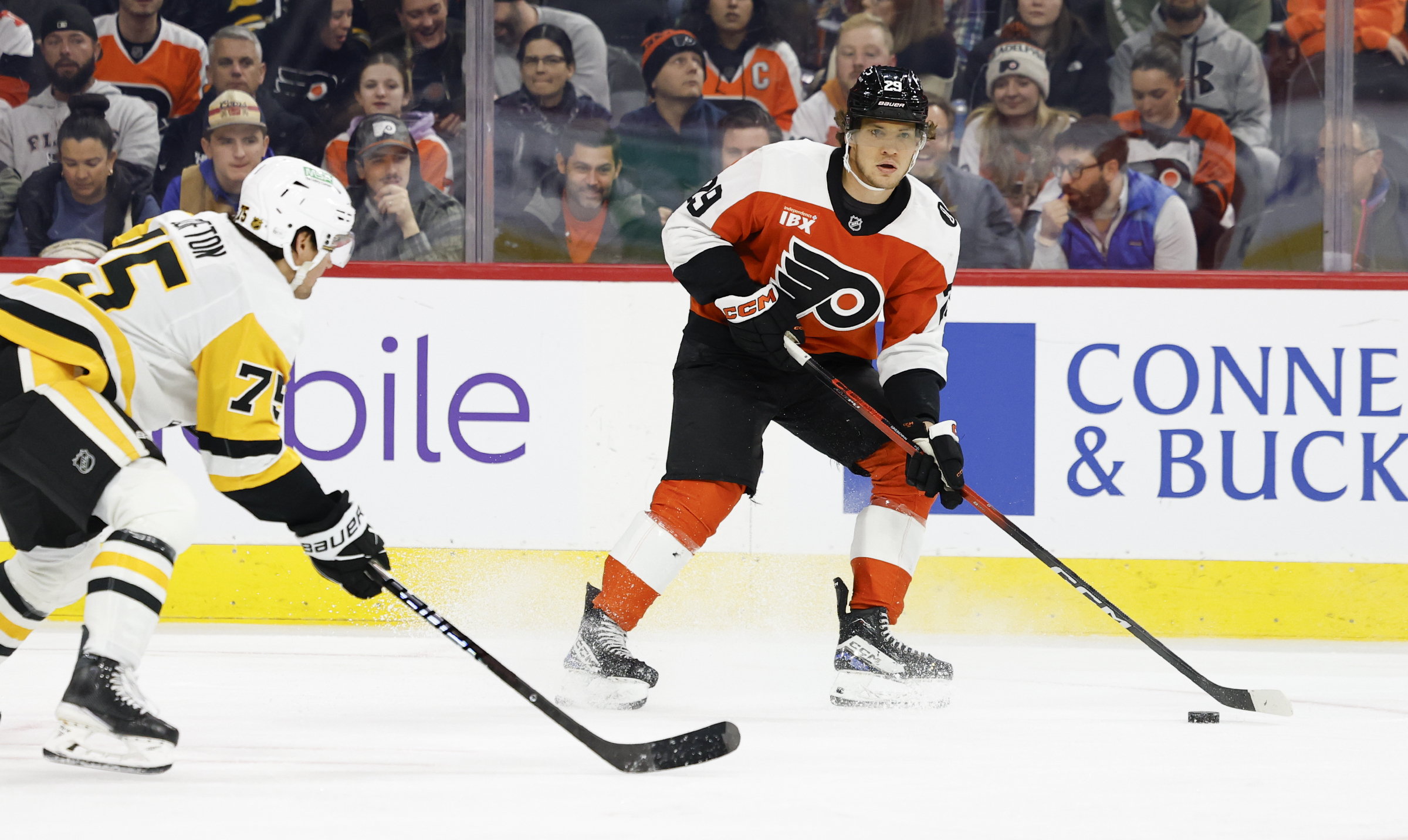
Player development needs to be a multifaceted approach. It’s not necessarily X but X, Y, and Z. Players need to develop not just their individual skills but team concepts and systems that help the team win. Someone like Matvei Michkov needs to continue to develop his individual skills, like his offense, but he also needs to learn things like how to read plays better, like when to — and when not to — leave the zone early. He took a big step in the right direction on Saturday when he played it perfectly, and Sean Couturier fed him for a breakaway goal. It’s baby steps in that regard, but do I personally think some of the younger kids, like Michkov and Nikita Grebenkin, should play more? Yes. Would they maybe benefit from more ice time to correct mistakes? I believe so. Now, if they don’t make corrections and sit, well that’s another part of player development.
Q: Why do you think Tocchet is tougher on the younger kids for making the same mistakes the vets make? — Hassan Goodman (@phillygator1986) on X
Veterans will always get a longer leash. This isn’t a Tocchet thing. It’s a tale as old as time. And there’s a reason they are veterans: They’ve played in the world’s best league for a long time, and although they’ve assuredly made mistakes along the way, they have obviously corrected them to keep playing in the NHL.
Youngsters need to learn and grow, and have mistakes corrected, too. Should they be benched for entire games, a la Joel Farabee was famously under Tortorella? No. But there do need to be consequences for not learning and making corrections, and there’s no book on the younger kids yet to say they will fix things.
Q: Why does Tocchet consistently scratch 29?? It makes absolutely no sense to me. He clearly has skill and would benefit the struggling offense, yet we continue to play 44 over him. — Rich #83 (@dangler83) on X
To start, No. 29 is Grebenkin and No. 44 is Nic Deslauriers. I don’t think it’s fair to say it’s one or the other. Or that Deslauriers should only sit to get Grebenkin in. Deslauriers is a veteran who plays a specific role. There’s a reason he was on the ice on Monday in Tampa Bay — to contain and, if needed, which did happen, fight 6-9 Lightning forward Curtis Douglas. Grebenkin wasn’t going to fight him; it wouldn’t have been fair. And it wouldn’t have been fair to ask Garnet Hathaway or Nick Seeler, who can also drop the gloves, to take on that role.
Flyers winger Nikita Grebenkin has found playing time scarce of late.
Asking why Grebenkin, 22, has only skated in 12 of the Flyers’ first 21 games is a valid question. He’s talented, can play a physical game, and can score. Tocchet wants guys to go to the net and the dirty areas, and he thrives there — a scout told The Inquirer during the preseason they were impressed by his game.
But Tocchet recently said Grebenkin needs to be more predictable — this is something he has preached about his lines, especially the fourth line, which is the only one to presumably have a spot open for the winger. It’s also valid to say that you cannot be predictable if you don’t know how to predict the game, and the only way you can predict the game is by playing in games. Something has to give soon.
TAMPA BAY — Look, a power play isn’t expected to score every single time. It would be nice, but it just doesn’t happen.
The best one in the NHL right now has a 32% effectiveness, which means the Pittsburgh Penguins roughly score every three opportunities. Currently, the Flyers’ power play sits at 17.5%. The unit’s not last in the NHL — that belongs to the New York Islanders (13.3%), who the Flyers face on Black Friday (4 p.m., NBCSP) — but it does rank in the lower-third (23rd).
And while the Flyers’ power play struggled before and during the John Tortorella era, the ranking is all-too-familiar. Although the current coach, Rick Tocchet, thinks it’s in a good spot, it can be better.
“Everybody wants plays, but sometimes it’s good old-fashioned beat pressure and then attack, and we’ve got to get that mentality, and we’re close, but we’ve got to keep working,” he said on Saturday morning, adding two days later that he wants his players to play inside more.
Entering Monday’s matchup with the Tampa Bay Lightning (7 p.m., NBCSP), the Flyers have 10 power-play goals. The last one came five games ago against the Edmonton Oilers — they are 0-for-8 since — and Tocchet said his units may be more interchangeable.
Practice on Friday had four more players involved, and on Saturday night in the Flyers’ 6-3 win against the New Jersey Devils, new power-play units were deployed.
Another tweak came on Monday in Florida.
One power play has Noah Cates, Travis Konecny, Tyson Foerster, Trevor Zegras, and Cam York. What? York and Zegras reunited? Makes a whole lot of sense that the two former USA Hockey teammates are together; York has been on the ice for eight power-play goals this season — just one without Zegras.
Konecny was also switched to that unit, and while he has played a lot on the left flank the past two seasons, he is back to his familiar bumper spot.
“I feel a little bit more comfortable in there. I feel like I can make quick little plays, be fast on loose pucks, and recovery, stuff like that. … On the power play, I got to know my strengths. And I think it’s, I don’t have the hands that Trevor has,” Konency said with a grin, alluding to Zegras’ effectiveness on the right flank to draw in defenders, create space, and find seams.
Flyers right wing Travis Konecny says he feels more comfortable in the bumper position on the power play and that he needs to play to his strengths.
The other power play has Travis Sanheim, Emil Andrae, Owen Tippett, Bobby Brink, and Matvei Michkov. No center? “It’s interchangeable,” Tocchet said.
Sean Couturier will be on the ice when there is a face-off, but when they switch units “on the run” or on the fly when play is happening, that is the unit that will be on the ice.
It’s also interesting having two defensemen, with Sanheim being more of the pointman and Andrae on a flank. Tocchet thinks Andrae is not only good with the puck but “his shot’s pretty good,” too. The Swedish defenseman, who has been moved to the second pairing, knew that he had to build up trust with the new coaching staff, and it looks like he has.
“I like to be on the power play,” Andrae said. “I like to make those plays, and like to use my vision and my passing to create chances. So obviously, it boosts my confidence to know that the coaches rely on me on that side of the game. So, yeah, just make the most of it.”
Sanheim, who hasn’t spent much time on the man advantage in his career, is looking forward to the opportunity. It’s something he’s “always wanted to add to my game.”
“I think they’ve been doing a pretty good job in trying to grasp some of the structural components of what they’re trying to get across,” said Sanheim, who has been able to watch a lot of the power plays this season from the bench.
“And I think it’s just continuing to make those reads and understanding certain situations, depending on how the penalty kill is structured. And, maybe that’s a benefit, I guess, [being on the penalty kill] so much and understanding what the other team’s doing and trying to exploit some of the weaknesses that come with that, and, in saying that, [I] just want to have an attack mentality and deliver pucks and hopefully do a good job of doing that.”
Speaking of Sanheim, the defenseman is continuing to build a strong case to be part of Canada’s team at the 2026 Milan Olympics. No pressure, but the guy on the other bench on Monday night just happens to be the one making the decisions. Lightning coach Jon Cooper will be Canada’s bench boss in Italy, but a plus for Sanheim is that they’ve already worked together, snagging a gold medal at February’s 4 Nations Face-Off.
“You see these players, you compete against these players, but you don’t really know till you have them. And I’ve always, I’ve really liked his game,” Cooper told The Inquirer about Sanheim. “I’m a big fan of big D that take up a lot of space, and can skate, and he can do all those things. But his ability to jump into plays, he’s got an offensive mind to him.”
Tampa Bay Lightning head coach Jon Cooper, who will coach Canada at the Olympics, has been impressed with Travis Sanheim’s game over the past few years.
Sanheim seemed a little nervous and wide-eyed at the first practice in Brossard, Quebec, with Hockey Canada ahead of the 4 Nations. And while he didn’t start the tournament in the lineup, by the end — half due to injury and half due to his play — he was not just skating in the championship game but got the first shift of overtime. The familiarity and his ability to play both the left and the right side will help Sanheim once decision day comes.
“Anytime that you get to coach players, and you win with players, I always think there’s a familiarity. Past performance isn’t going to predict future success, and so the guy’s got to keep working, but he’s done a heck of a job so far,” Cooper said.
There’s another familiar face for Cooper on the Flyers bench. Tocchet was his assistant coach at 4 Nations and will be beside him again in Italy, making his Olympic debut.
Tocchet did a lot of the structure, faceoff planning, and in-game adjustments; he was a jack-of-all-trades for Cooper. But what Cooper loved most was how he would often meet with players 1-on-1 or in small groups to watch videos — over a garbage can. As Tocchet explained later, he would put his laptop on a garbage can and go over things, much like he did in his days with the Penguins. His assistants on the Flyers do it now, too.
“I couldn’t have surrounded myself with a better guy,” Cooper said. “I will tell you this, because his eye for the game and what happens in real time, having that talent is a real thing. And Tocc has that. He sees it, he processes it, and then gives you the information.
“And there were countless times at the 4 Nations that he made me think of things, or I saw things in a different light, or I missed something, and he caught it. And so many little adjustments we made in between periods, because of what Tocc did.”
Standing in the hallway outside the visitors’ locker room at American Airlines Center after his team got trounced by the Dallas Stars on Saturday night, Flyers coach Rick Tocchet offered some insight about the coming week.
“We’ve got some practice time here, and we’re going to have to really work on some two-on-two and three-on-three battles I think it’s going to be the majority of the four days,” he stressed with the Flyers’ next game not until Thursday when the St. Louis Blues, who they just beat 6-5 in a shootout on Friday, visit (7 p.m., NBCSP).
That’s just what the Flyers did on Monday in Voorhees.
Behind the scenes, the team watched video,” on how we can be better and kind of just get back to how we were playing at the start of the year, plus improvements,” defenseman Jamie Drysdale said.
But for many players, like Drysdale, watching on video only takes them so far. They need to put it into action.
“Get a feel for it,” he said. “It’s all comfort. It’s all feeling, feeling your gaps, feeling the pressure, feeling your reads, things like that. So we got the best of both here, and it was a good day.”
On the ice, after splitting into two groups to focus on rush coverages, the Flyers converged onto the main sheet for five-on-five, three-on-three, and two-on-two drills.
It was physical, with Matvei Michkov getting into it with Adam Ginning and then taking a few cross-checks from Noah Juulsen as he went to the net. Captain Sean Couturier described it as “grinding” practice with a focus on winning battles.
Competitive Matvei Michkov going through a physical rep against Adam Ginning and Noah Juulsen. pic.twitter.com/Swy7hgA4SE
And it was competitive, as noted by Tyson Foerster’s reaction after scoring during a two-on-two small-area game. After colliding with his partner Travis Sanheim — they were both OK — the winger stuck with it and scored on a wraparound between the left post and the skate of goalie Dan Vladař. His teammates in the black jerseys cheered too.
“I love them,” forward Travis Konecny said about having an intense and spirited practice. “It was getting a little competitive, little chippy. I think we need it. It’s good. I think you get in that competitive mindset … [and] everyone’s bringing the intensity. Guys are leading the right way, competing, doesn’t matter who you are out there, you’re just setting a good example for the next guy, the next rep.”
The Flyers have started slowly too often this season, trailing in 12 of the 18 games they’ve played, including the last five. That has forced them to chase games pretty quickly. Tocchet said on Monday that he’s “a trend guy” and is focused on stopping a bunch of trends he’s seen from his group.
“When trends hit, that’s when you’ve got to attack it. So these three days were attacking the trend. Too much containment,” he said of his team playing too passively and not stepping up on the opposition defensively.
“Not enough support of the puck. And then, backing it at the blue line — it’s not just the defense, it’s a five-man thing — so it’s just been a trend the last three, four games, and we have to stop it.”
#Flyers coach Rick Tocchet on Saturday after losing to Dallas: "We’ve got some practice time here, and we’re going to have to really work on some two-on-two and three-on-three battles."
Juulsen thinks these types of practices can help the Flyers get “into the battle right away,” as does working on things through small-area games. USA Hockey is a big proponent of playing small-area games as they increase puck touches, competition, quickness in decision-making, and battles.
It helps the next generation focus on that while working in small spaces. It helps the older kids, too.
“I think the majority of the game is like, won and lost in those little battles,” said Konecny. “There’s the flashy open ice stuff that you get on the highlight reels, but it’s probably the play, two plays before, whatever, that actually allowed that to happen. I mean, a lot of the time, it’s kind of what is the difference for some guys to even make the NHL, is just those little battles and being good with your stick and learn[ing] how to do that stuff.
“Yeah, it’s difficult. Because that’s why the teams that win the Cup every year, they’re the best at good sticks, details, winning those little battles.”
Breakaways
Defenseman Cam York had a maintenance day, with Tocchet adding that “He’s fine to play. … He could have practiced, but I felt two days, try to help him out get over what he’s got. It’s a little minor thing, nothing major.” … Defenseman Oliver Bonk was on the ice for the start of the practice, skating with the orange team on the second sheet of ice. It is the next step for the 20-year-old, who just turned pro and is dealing with an upper-body injury that kept him from participating in both the rookie series against the New York Rangers in early September and training camp.