Consensa Francisca Silva Silva moved to Camden from Costa Rica more than two years ago knowing nobody. She lived on the street for two months, she said, and thenwas bouncing from house to house when a young man in the neighborhood told her to check out the Hispanic Women’s Resource Center in Camden, one of several such centers in the state.
She went. With help from the program, Silva received food, obtained a work permit, made a down payment for a studio apartment, and started a job at McDonald’s.
That statewide initiative is now facing detrimental cutsunder DemocraticGov. Mikie Sherrill’s budget proposal. The governor has proposed cutting nearly 80% ofits funding, and Silva worries that other immigrant women looking to improve their circumstances will not get the help she received.
“It was very hard to come here without knowing anyone, and it was really hard because at first I couldn’t find any work,” Silva, who is Nicaraguan, said in Spanish, translated by Jesselly De La Cruz, the executive director of the Latino Action Network Foundation, which funds the centers.
Sherrill and legislative leaders announced Tuesday they had come to an “agreement” on a budget totaling$60.7 billion, the same price tag Sherrill proposed in March. But it has not been made public and it is unclear how far into the details they have gotten. They have until Tuesday to figure it out.
And the process is still underway. State Sen. Nilsa Cruz-Perez, a Camden Democrat who sits on the Senate Budget and Appropriations Committee, has been a supporter of the centers.She was unable to speak Wednesday afternoon because she was in a committee budget hearing.
Client Consensa Francisca Silva Silva (right) participates in a workshop at the Hispanic Women’s Resource Center in Camden Thursday, June 11, 2026.
On a recent Thursday, Silva participated in a healthy life skills workshop in Spanish at the Camden center, where she learned about taking care of herself as summer temperatures get hotter in the city. About 20 adults clapped for one another with big smiles on their faces, and they received goody bags with sunscreen, lip balm, a towel to keep cool, and a little fan. A young girl played with magnetic tiles and a baby was kept calm, passed between women.
The governor proposed cutting funding for the center’s programs to$535,000, down from more than $2.5 million this year and more than $3 million in 2025. Murphy had proposed a similar cut last year, but the funding was restored during budget negotiations.
Hispanic Women’s Resource Centers were established through 1991 legislation to address the wage gap for Latinas. New Jersey is one of the states with the biggest wage gap for Latina workers, according to the National Women’s Law Center.
Staff members observe from back of the room during a workshop at the Hispanic Women’s Resource Center in Camden Thursday, June 11, 2026.
The Latino Action Network Foundation funds these resource centers in partnership with six nonprofits across 14 sites, including five in South Jersey. The Camden center is located at the nonprofit Healthy Families and Communities, and there are centers in Vineland in Cumberland County, Hammonton in Atlantic County, Pennsville in Salem County, and Rio Grande in Cape May County.
Sherrill’s proposal would “drastically cut” the number of resource centers, and sites in Hammonton and in Lakewood, in Ocean County, would likely be on the chopping block, De La Cruz said, adding that services would need to be cut in eight of 11 counties.
Martha Infante, 38, who lives in Pennsauken, said she was disoriented when she moved to South Jersey from the Dominican Republic. But through the Camden center, she found out how to apply for work online and learned basic English. She obtained coats for her daughters’ first U.S. winter, and a staffer accompanied her to a New Jersey Department of Motor Vehicles center to get her driver’s license.
“I came here and my mind was all over the place, I didn’t know where things were,” she said in Spanish.
She now works as a home health aide, thanks to training she got through the center, and even participated in a program where she learned about advocating for her community in Trenton.
“Don’t cut these funds, Gov. Sherrill,” she pleaded. “Don’t cut the funds! This is like a family. It’s like a home for the community.”
Client Martha Infante (left) talks with staff member Chailienisse Vega (right) after participating in a workshop at the Hispanic Women’s Resource Center in Camden Thursday, June 11, 2026.
Some of the women in the program are fleeing domestic violence and seeking financial independence. Others are struggling to get a work permit, or may have lost a family member who helped pay the bills to deportation. A lot of former “Dreamers” — undocumented immigrants who came to the U.S. as children — utilize the center as well, De La Cruz said.
The need for the centers has only escalated under President Donald Trump’s second administration, she said.
The social worker-turned-executive said she was surprised by the severity of Sherrill’s proposed cut, especially because of the governor’s efforts to push back against Trump’s immigration policies.
A 2023 Rutgers study funded by the Latino Action Network Foundation found that the most popular services at these resource centers were English-language classes and employment services, such as job referrals, assistance filling out applications, resume writing, and interview preparation.
Staff member Andreina Pardo pauses to stretch with participants as she leads a workshop at the Hispanic Women’s Resource Center in Camden Thursday, June 11, 2026.
“Aside from helping them with the technical aspects of job hunting, the assistance from the Centers seemed to provide a boost of confidence for many of the women, giving them an additional push to apply for positions even if they felt hesitant to do so at first,” the study said.
Gladys, 48, who declined to give her last name due to concerns over her safety, said in Spanish that the free English courses made her feel like she could “come up for air and breathe” after not being able to communicate.
The Camden resident had been an ecologist in Nicaragua and has gotten involved in the center’s community garden. She said she would love to pursue a career teaching children about the environment, but her plans are on hold because her work visa was canceled.
In the meantime, Gladys said, activities at the center like art classes have made her feel less alone. She has been able to connect with women in the same situation as her, and those who migrated to the U.S. earlier who can give her advice from their experiences.
“Maybe my circumstances don’t change, but my emotional well-being changes because I’m able to connect with others,” she said in Spanish.
Shelly Gaither, 51, of Cheltenham, makes sure her three sons, ages 6, 9, and 18, get their meals while she manages with whatever is left over — if anything ever is.
“Oh, my God, groceries are too expensive,” said Gaither, a former data analyst who suffers from a disability that makes working difficult. She visits a food pantry regularly to make sure her kids eat chicken when they can. Her monthly SNAP (Supplemental Nutrition Assistance Program) benefits were reduced from $400 to $200 earlier this year because of changes to the programunder President Donald Trump’s One Big Beautiful Bill Act.
“I don’t think there’s hope,” she said. “I feel guilty for bringing children into a world that doesn’t want them to exist because the government makes cuts that take away their food and their healthcare.”
For people like Gaither throughout the United States, levels of food insecurity have seen a “remarkable” rise since the pandemic in 2020, according to a national survey taken earlier this year and released in late May by the Federal Reserve Bank of New York.
Around 10% of 1,300 heads of households polled in February reported a lack of enough food and said their children were missing meals, according to the survey. Nearly 16% relied on food donations. Among families taking in less than $50,000 a year, almost 20% reported being forced to skip meals or go without.
In 2020, when the federal government stepped in to help families at the height of the pandemic, just 4% of households reported missing meals, including less than 7% of families earning less than $50,000 a year, according to the survey.
At that time, temporary supplemental unemployment benefits, expanded SNAP payments, and direct government relief payments helped stave off hunger among Americans. Food insecurity increased after COVID-19 relief expired, according to the Urban Institute.
But the recent surge in hunger has also been attributed to the sweeping law Trump signed last year, whichreduces SNAP benefits and other safety net programs to help pay for his tax cut.
Findings in the bank’sreport also reflect Gaither’s sense of despair, a pessimism about personal finances and the overall economy among people with low incomes. That same group exhibits diminished expectations for finding a job and declining levels of consumer confidence, the survey says.
(function(){function e(){window.addEventListener(`message`,function(e){if(e.data[`datawrapper-height`]!==void 0){var t=document.querySelectorAll(`iframe`);for(var n in e.data[`datawrapper-height`])for(var r=0,i;i=t[r];r++)if(i.contentWindow===e.source){var a=e.data[`datawrapper-height`][n]+`px`;i.style.height=a}}})}e()})();
According to thereserve bank’s report, non-white Americans have been especially hard hit. The number of such households that reported missing meals increased from 4% in 2020 to 19% in February. At the same time, the number of non-white people receiving SNAP benefits jumped from 14% to more than 26%.
Overall, the survey found food insecurity was particularly acute among lower-educated and lower-income households, as well as households with young children. Many families are experiencing financial stress due to the high cost of living, persistent inflation, and high interest rates, even as the stock market has been steadily rising, according to the survey.
Pantries struggle to keep up with demand
More people are flocking to food pantries, but they are not equipped to take up the slack of reduced SNAP benefits.
“Pantries across the state are in perpetual crisis mode,” said Stuart Haniff, CEO of Hunger-Free Pennsylvania in Pittsburgh. Add to that the advent of summer, when kids are no longer receiving free breakfast and lunch at school. “Families must now provide those 60 to 80 meals a month,” Haniff said.
In Norristown, “immense need” has increased the number of people frequenting Martha’s Choice Marketplace, the largest food pantry in Montgomery County, by 100% since 2022, said Patrick Walsh, director of programs. “And I don’t expect things to get better.”
Food prices are also up 3.2% this spring over last, according to U.S. Department of Agriculture figures,exacerbating the issue.
In South Jersey, “we are seeing record numbers at our food distributions,” said Jane Asselta, president and CEO of the Food Bank of South Jersey, in a statement to The Inquirer. “Life is getting harder to afford for more and more people.”
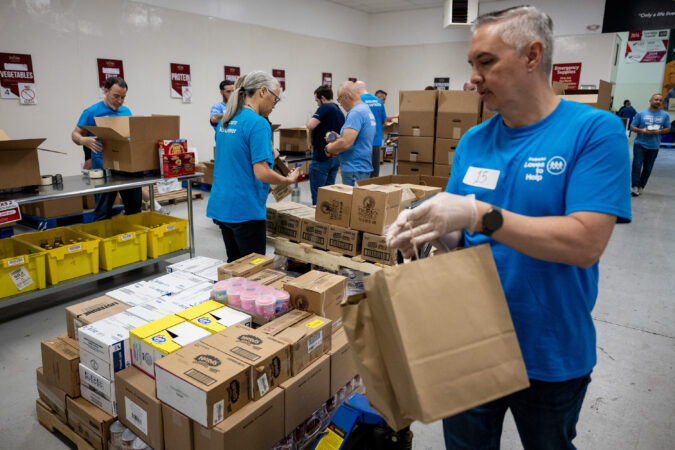
Matt McDevitt (left) and Michael Hickey load their vehicle at the Food Bank of South Jersey Thursday, June 11, 2026. The men are volunteers at the Temple Lutheran Church in Pennsauken and their food bank is open from 5-6 p.m. every Thursday.
Asselta said the Federal Reserve Bank’s report “mirrors” what her organization has observed through its network of 300 community partners.
“Hunger has never been higher,” said Pastor Sonita Johnson, who runs the food pantry at St. John’s Pentecostal Outreach Church in Salem City, Salem County. “Food prices are high, and the lines you see you would not believe — a 50% increase in people just over the last two months.”
Nationwide, between January 2025 and January 2026, SNAP rolls decreased by more than 4 million people — from 42 million to 38 million — according to USDA figures.
Between last September and April of this year, nearly 90,000 Pennsylvanians lost SNAP benefits due to new eligibility requirements stipulated by the Trump administration, according to an analysis by the Pennsylvania Department of Human Services (DHS).
And between December 2025 and last month, more than 32,000 Philadelphians lost benefits, DHS figures show.
In New Jersey, SNAP participation has fallen by more than 50,000 individuals between March 2025 and March of this year, New Jersey Department of Human Services figures show.
The Trump administration’s SNAP changes include an expansion of work requirements for people who receive SNAP benefits and increased documentation requirements “designed to make maintaining eligibility increasingly difficult,” according to the Food Research and Action Center (FRAC), the largest anti-hunger lobby in the United States.
Deputy White House press secretary Anna Kelly said in a statement that Trump signed the changes to strengthen SNAP and to ensure that it is “sustainable for future generations.” She added that Trump was “elected to eliminate runaway spending across the federal government.”
William Meo works on the loading dock at the Food Bank of South Jersey Thursday, June 11, 2026.
For people like Shelley Gaither, how her reduced SNAP benefits could be seen as part of “runaway spending” is tough for her to figure, given her needs. To survive this precarious moment, Gaither said, she will do whatever she can.
“We eat more vegetarian meals and I don’t buy my kids cookies or snacks,” she said. “If I drink enough coffee, maybe I just need one meal a day. This is our existence now. This is how we live.”
The future of a family farm in rural Salem County was at stake, and after multiple meetings and hours of presentations, questions, pleas, and complaints, a local planning board was set to vote.
Before the vote, one longtime resident of Mannington Township came to the podium with a warning. In preparation for this crowded, mid-March meeting, Alice Waddington, 98, said she’d made a list of dairy farms she remembered from her decades in the little town.
At one time, she said, there were close to a dozen.
“There’s only one farm left milking cows,” Waddington told the board, “and that’s the Cadwalladers.”
The Cadwalladers were struggling in the volatile dairy industry, though, and believed a large solar project could be a lifeline, a way to avoid shuttering and selling to developers eager to build warehouses, data centers, and housing in the nation’s most densely populated state.
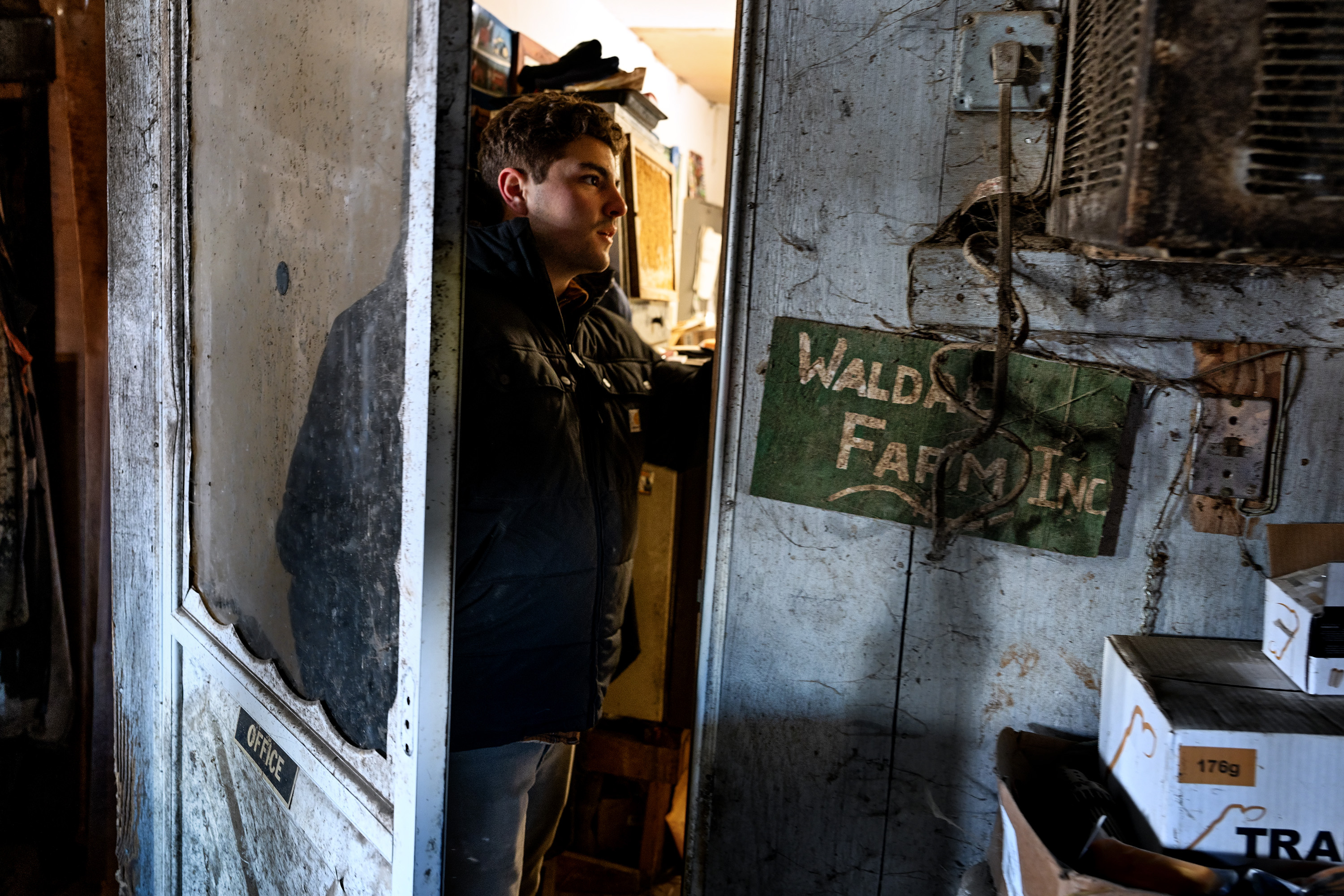
Farmer David Cadwallader at Waldac Farms in Salem, N.J., on Jan. 29.
This was the fourth Mannington Township planning board meeting for the Cadwalladers, who were seeking a variance to install 300 acres of solar panels on Waldac Farm that would, eventually, generate enough energy to power 19,000 homes annually.
Some board members and locals questioned the environmental impacts, whether it would affect the soil, injure the abundant wildlife in the area, or taint the nearby Delaware River watershed. Representatives from AES Corp., a Virginia company that would build the solar project and pay a lease to the Cadwalladers, had answers for all of them.
“Whether we all, in this room, agree with it or not, it is the state’s policy to advance these types of solar energy uses to meet the energy demands that we need,” Keith Davis, an attorney representing AES, told the planning board.
What they couldn’t seem to quell, however, were the repeating concerns about how a solar farm would look in New Jersey’s most rural county. Those concerns raised open-ended, philosophical questions: What’s a working farm supposed to look like? What exactly does rural mean?
“It will destroy property values and will be an eyesore for our township,” a neighbor of the Cadwalladers commented on a 2025 Facebook post about the project.
Similar situations have played out nationwide. A recent Associated Press story from Ohio highlighted a struggling farmer’s solar project that also faced community pushback and was ultimately blocked.
In Salem County, Mannington planning board member Joanne Wright was the most vocal at the meeting. She mentioned, often, that Mannington’s master plan called for maintaining “scenic vistas” and its rural, agricultural characteristics.
The Cadwalladers said they would plant pollinator habitats and plants on the solar farm, and introduce roughly 300 sheep to graze around and under the panels. The combination of solar and agriculture — “agrovoltaics” — is supported by the New Jersey Farm Bureau, Andrew Cadwallader pointed out.
Wright, however, thought solar panels would break up the township’s “contiguous farmland.”
“I’m just wondering how you see that the positive outweighs the negative,” Wright asked representatives from AES.
Farmer Andrew Cadwallader at Waldac Farms in Salem, N.J., on Jan. 29.
A picturesque farm
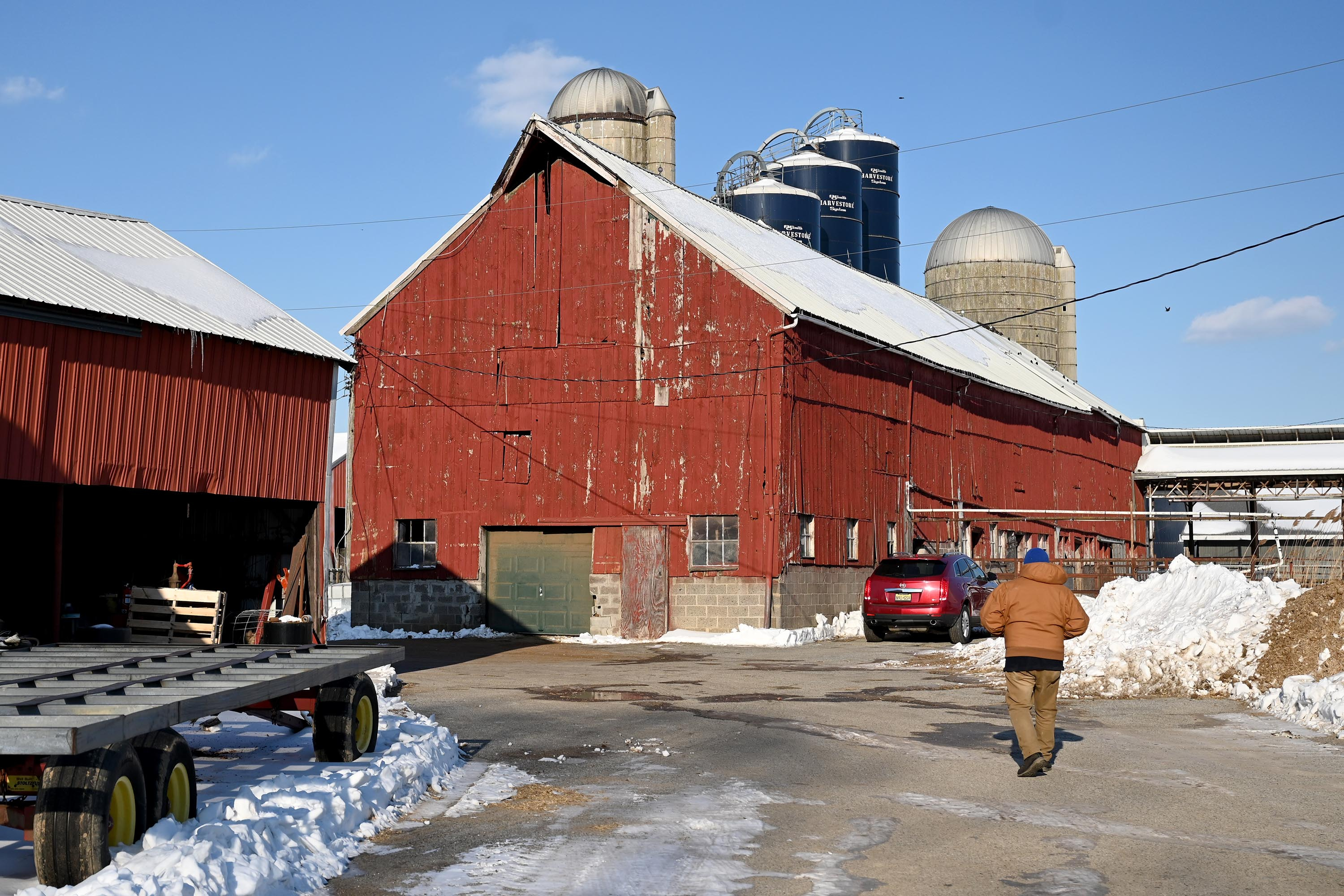
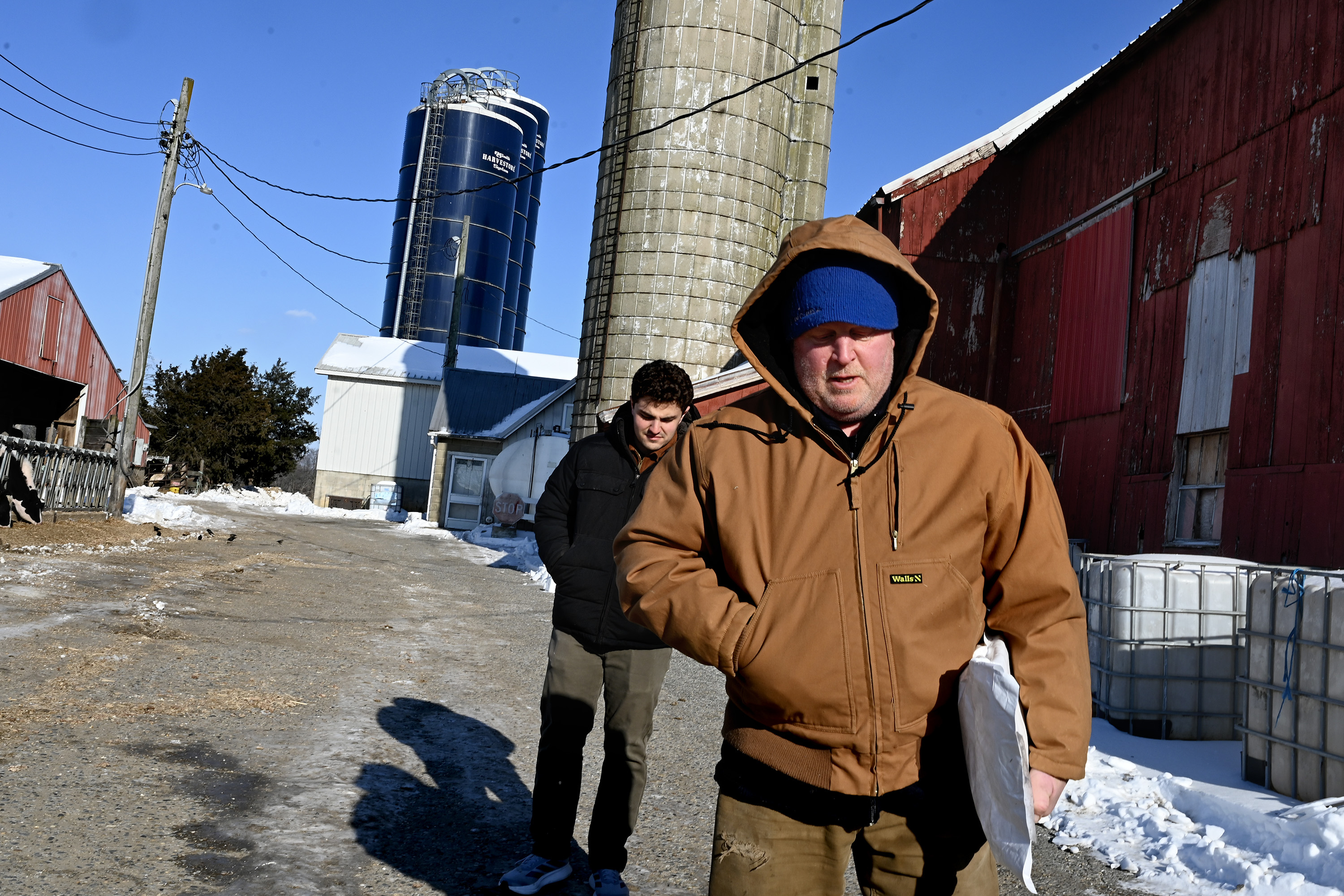
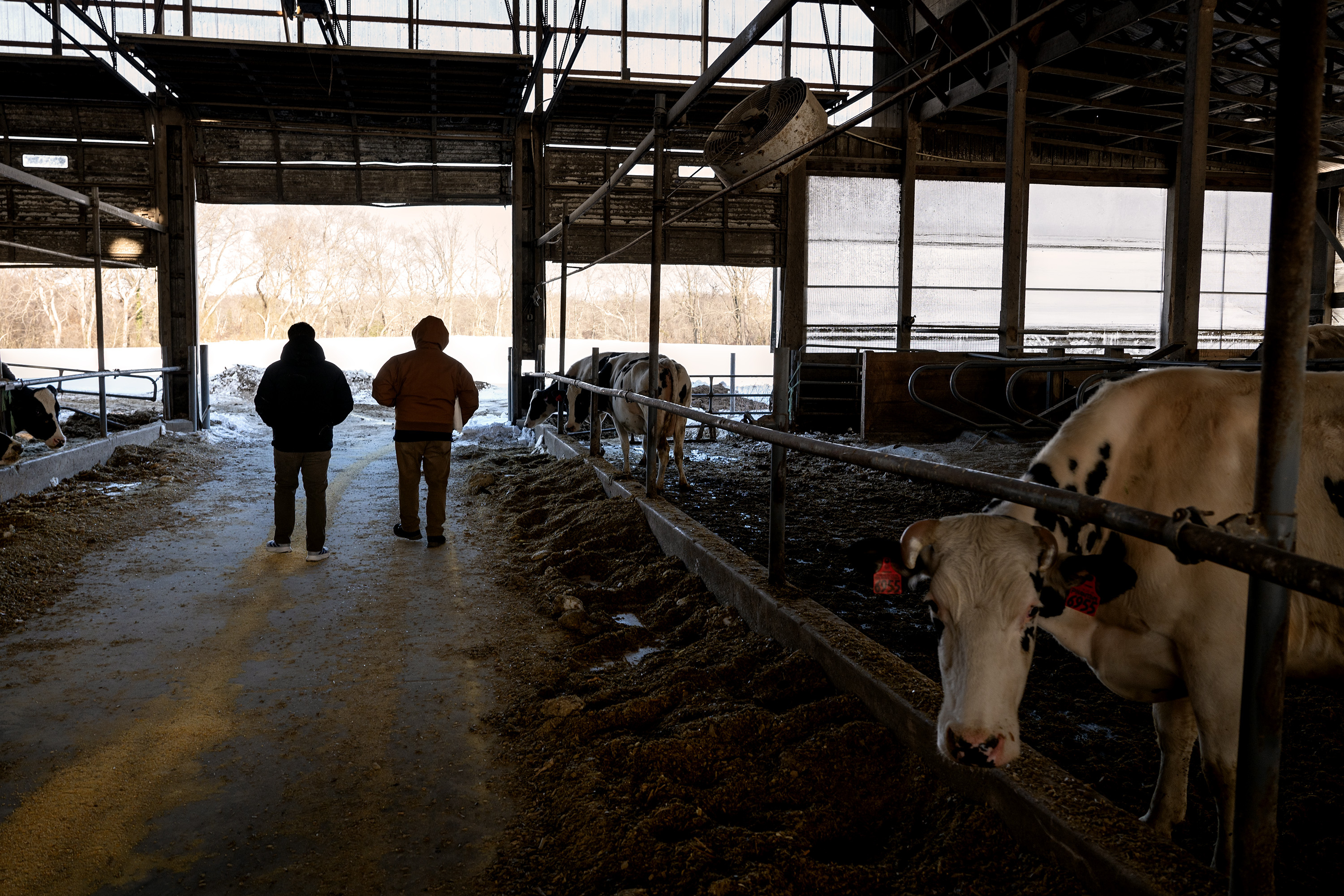
The Cadwallader family has been farming since the 1860s, and Waldac Farms certainly looks the part: There’s a circa-1790 farmhouse down a long dirt road, a slew of silos dotting the flat landscape, and big red barns, faded by time, that are full of cows and cats.It was mostly silent there, too, aside from the winter wind.
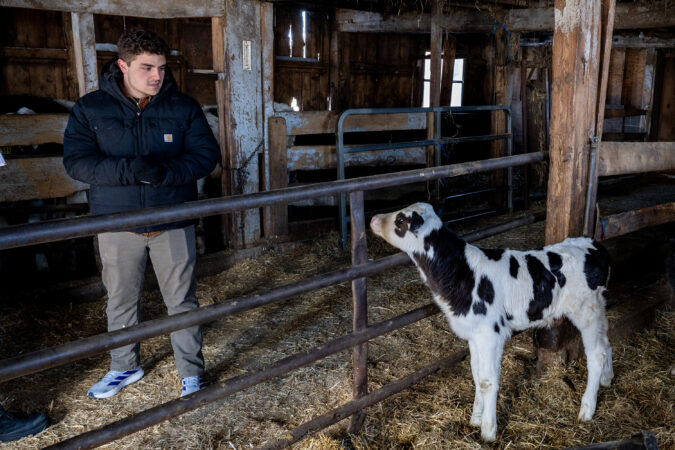
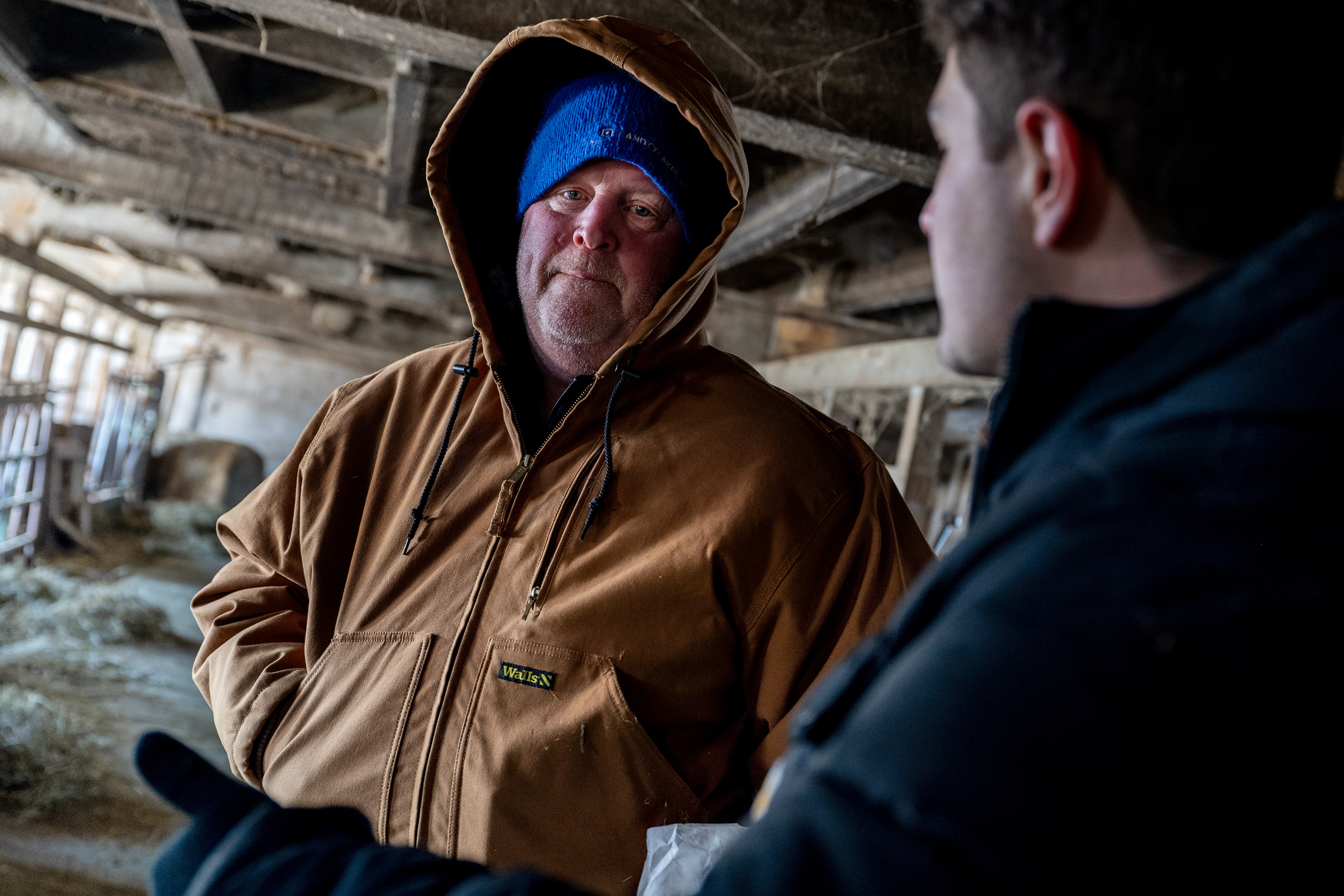
The only thing that seems out of place on the family farm on a frigid afternoon is Andrew Cadwallader. The college senior looks younger than 22, and his sneakers and pants were impeccably clean.
Andrew’s been milking cows since before his baby teeth fell out, though.
In 2007, a South Jersey newspaper visited the Cadwalladers to discuss the dismal state of dairy farming at the time. The newspaper took a picture of Andrew, then 3, surrounded by cows in a pen. His father, David, told the newspaper he’d love to pass the farm down to his son.
“If he wants it,” David Cadwallader said.
From the Press of Atlantic City on March 12, 2007: The state is trying to revitalize its dairy farm industry. With his 3-year-old son Andrew, David Cadwallader prepares his cows for their 3 p.m. milking at Waldac, his Woodstown dairy farm.
Andrew is set to graduate from Haverford College with a degree in political science. He’s merged his life history — agriculture and geology — with his interests in politics and government, and recently began an internship for CNN’s Michael Smerconish, a Bucks County native.
Andrew’s an only child, and, yes, he wants to farm, bucking a trend that’s seen the average age of farmers, 58.1, rise steadily, according to the 2022 U.S. Census of Agriculture Data.
“I’m coming back here after I graduate,” he said.
Nationwide, small dairy farms like Waldac have continued to shutter at a rapid rate since Andrew was in the local newspaper.
Overall, milk production is up in the United States. That’s because modern genetics has produced cows that make more milk than their ancestors. Those big production numbers are coming from massive farms with large herds, too.
The Cadwalladers milk about 130 dairy cows on approximately 500 acres, and small farms like theirs have been decimated. In 2005, according to the USDA, there were 78,295 dairy farms in the United States. In 2025, that number was 23,609, a 70% decrease in just 20 years.
Farmers Andrew Cadwallader and his father David Cadwallader (front) at Waldac Farms in Salem, N.J., on Jan. 29.
Andrew Cadwallader declined to go into exact figures but said the family would be “paid well” by the AES lease. Waldac Farms would pivot to sheep and the sale of their lambs, while possibly still milking cows on a smaller scale.
“We have been losing money for the last 10 years,” Andrew said of the dairy operation.
AES approached the family about “solar grazing” during the pandemic, Andrew said, and as they sought a use variance from the Mannington planning board to move forward, he became the project’s public face. Andrew made numerous, lengthy Facebook posts in local groups about the project to be transparent.
“Will we continue to hope that the price of milk goes up and risk failure, or will we pivot and change?” Andrew wrote in the Salem County Advocates group in November.
Many comments were supportive or neutral, in a libertarian “it’s your land” way. There was plenty of pushback, though, and Andrew said it was disheartening to see how many comments focused on visual impact.
“I’m glad people can worry about the look of the farm,” he said in late January. “We have to worry about making a living.”
Cadwallader said flat farmland is not a natural part of landscapes in South Jersey. People have just gotten used to seeing it. His farmland was likely cleared of trees by the native Lenni-Lenape centuries ago, he said. Barns and tractors are industrial buildings and commercial machinery, he said, not quaint antiques.
“They are prioritizing the look, and it’s not reality,” he said. “It’s not a natural feature.”
Still, Cadwallader felt confident, on a late January afternoon on his farm, that the planning board might approve the project.
Jennifer Kugler, founder of the nonprofit South Jersey Preservation, visited Andrew’s farm shortly before the planning board meeting with her children and wrote a lengthy Facebook post in support of his plan that received 573 likes.
“The Cadwalladers want to evolve,” Kugler wrote. “This means new solutions are necessary to ensure the continued viability of the farming operation. For farmers, this can be incredibly scary.”
Kugler, 42, lives in Pilesgrove, Salem County, home to America’s oldest continuously-operating rodeo. She was raised on a dairy farm in Lackawanna County. That farm closed in the 1990s and never reopened, and part of her goal with South Jersey Preservations, she said, is to prevent more small farms from folding.
“We support farmers continuing to farm,” she told The Inquirer.
Farmers Andrew Cadwallader and his father David Cadwallader (left) at Waldac Farms in Salem, N.J., on Jan. 29.
To preserve or not to preserve
While the Cadwalladers would prefer the solar project, there are other options to keep farms afloat in New Jersey. The state’s Farmland Preservation Program is a common way to ensure that housing and warehouse developers don’t buy up farms. It’s a relatively simple process.
The program uses a combination of federal, state, county, municipal, and nonprofit funds to buy a farm’s development rights. The purchase price, according to the program’s website, is “based on the difference between what a developer would pay for the land and what it is worth for agriculture.”
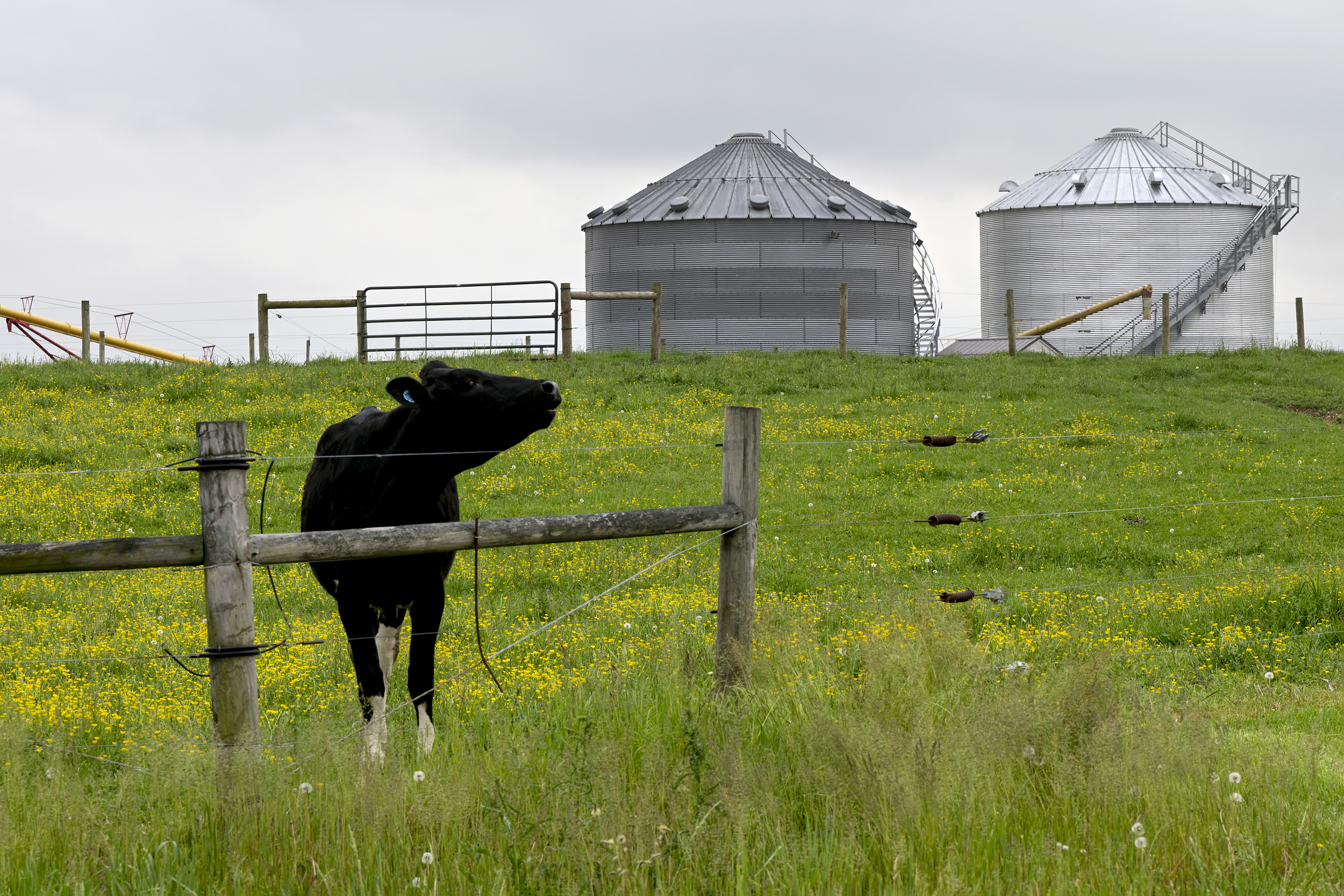
A cow at a farm along Route 49 in Salem County, N.J., on May 6, 2024.
In turn, farmers get a much-needed payout while keeping their agricultural operation running. If those farmers choose to sell their land someday, deed restrictions require the property to be used for agricultural purposes or otherwise remain undeveloped.
“You can’t do additional residential or commercial improvements. You can’t turn it into a housing development or a Walmart,” said Charles Roohr, executive director of the New Jersey State Agriculture Development Committee.
Since the program began in 1984, Roohr said New Jersey has preserved 250,000-plus acres, with a goal of 500,000 acres. Salem County leads the way among counties, with more than 43,000 preserved acres.
The family has not ruled out farmland preservation if the solar project is rejected, but they were concerned about some of the potential restrictions and complications.
“It’d be like a bailout, but we have 500 acres,” Andrew said on the farm in late January. “We need to figure out what the heck we’re going to do with the 500 acres that’s going to actually make us some money.”
Cowtown Rodeo in Pilesgrove, N.J.
A complicated farmland preservation issue played out right in Mannington in recent years, when Mannington Deputy Mayor Robert DiGregorio filed a civil rights lawsuit against local and county officials in 2021. According to the lawsuit and Transparency NJ,, DiGregorio was holding weddings, private parties, and nonprofit functions on his preserved, 78-acre farm, but was told by officials that he would need variances and site plan approvals or waivers to continue. The back-and-forth between those officials and DiGregorio, according to Transparency NJ, almost grew physical.
Farmers Andrew Cadwallader and his father David Cadwallader (left) with plans at Waldac Farms in Salem, N.J., on Jan. 29.
In April, Mannington agreed to pay DiGregorio $55,000 to end the lawsuit, according to an article in NJ.com. Neither DiGregorio, who is on the planning board, nor his attorney returned requests for comment. It’s unclear if he will continue to host events on his farm.
Roohr, commenting on farmland preservation restrictions in general, said events are allowed if “the purpose of the event is to sell the things that you’re producing on your farm.”
A tomato festival on a tomato farm would be fine, for example. A folk festival on a tomato farm would probably require a special-use permit.
“If the main purpose of the event is some other focus and your stuff ‘might’ get sold as a side benefit, then we consider that a non-agricultural use. And so the greatest example of that would be a wedding.”
Roohr said the preservation program is more important than ever, as data centers look to build in rural areas nationwide.
“We have over 200 applications [for farmland preservation] in our office right now,” he said.
The Cadwalladers said they have no plans to sell to a developer.
Farmers Andrew Cadwallader and his father David Cadwallader (right) at Waldac Farms in Salem, N.J., on Jan. 29.
The vote
Along with Alice Waddington, numerous others spoke at the March planning board meeting. Union officials said the solar project would bring jobs (AES put the number between 75 and 100). Some spoke in support of Andrew Cadwallader and his love for the ecosystem. Still, others talked about protecting Mannington’s “rural identity” and fears that the project could affect property values.
Andrew Cadwallader was the last member of the public to speak.
“As a family, we’re at a crossroads,” he said. “We can’t risk volatility anymore as a family and as a farm.”
When he was finished, Davis gave a final summation on behalf of AES and the Cadwalladers. Minutes later, the planning board made a resounding 6-1 vote, shooting down the project.
Cadwallader hung his head and gave a half-smile and some quiet “thank yous” to the attendees who patted his shoulder and shook his hand.
Laura Kellogg, a development manager for AES, said the team was disappointed but would continue to “evaluate next steps for the project.”
A week later, Andrew Cadwallader said he and the family were still dealing with the disappointment and contemplating their next move.
“People like this area so much, but we love it. No one loves this land more than my family,” he said. “People have to understand that a working farm is not a museum.”
Cadwallader’s life was getting busier at Haverford, too. He was taking geology classes and working on a senior thesis about preserving “the agricultural viability of mid-sized farming operations in the United States.”
Andrew drives the 38 miles south from college, back to Salem County, every weekend. A week or so after the meeting, though, Alice Waddington’s warning to the planning board, and the people of Mannington, proved prophetic.
Waldac still looked like a farm to neighbors and motorists passing by, but the Cadwalladers had stopped milking cows.
Correction: This article has been corrected to reflect that AES Corp. is based out of Virginia.
Gov. Josh Shapiro had a message for data center developers on Tuesday: Come to Pennsylvania, but bring your own energy — or pay up.
During his budget address, Shapiro said his proposal — the Governor’s Responsible Infrastructure Development (GRID) standards — will ensure center operators are “not saddling homeowners with added costs because of their development.”
Data centers, which house the technology to power cloud storage and other computing, have been proliferating across the country and the region due to the increasing demands of generative artificial intelligence, or AI.State and local officials are trying to keep up with the rapid pace of development, proposing new legislation — and updating existing measures — in an attempt to regulate the facilities.
Shapiro’s plan would require data centers to supply their own energy or pay for any new generation they need. It also calls on them to hire and train Pennsylvania workers and comply with “the highest standards of environmental protection,” including in water conservation, Shapiro said.
In exchange, the governor added, data center developers will get “speed and certainty” in the permitting process, as well as applicable tax credits.
The comments from Shapiro, a Democrat who has consistently encouraged data center development, come amid a flurry of legislative and executive action, as elected officials promise to keep Pennsylvania and New Jersey consumers from bearing the costs of these power-hungry facilities.
Data centers, the electric grid, and governors’ proposals
At the same time, some governors, including Shapiro, have criticized and sued PJM, the Montgomery County-based electric grid operator, over its annual capacity auction, which influences how much customers pay.
On Tuesday, Shapiro reiterated calls for PJM to speed up new power-generation projects and extend a price cap.
Separate from GRID, Shapiro also said electric companies, including Peco, should increase transparency around pricing and “rein in costs” for consumers, including low-income and vulnerable Pennsylvanians.
“These steps will save consumers money immediately,” Shapiro said. He announced an energy-affordability watchdog to monitor utility-rate requests and take legal action if necessary to prevent companies from “jacking up their rates and costing you more.”
Through several executive orders, she froze utility rates and expanded programs to spur new power generation in the state. She also ordered electric utilities to report energy requests from data centers.
“This is just the beginning,” Sherrill said in her inaugural remarks. “We are going to take on the affordability crisis, and we are going to shake up the status quo.”
In Pennsylvania, ‘Data Center Consumer Protection Bill’ advances
An Amazon data center is shown last year while under construction in front of the Susquehanna nuclear power plant in Berwick, Pa.
Meanwhile in Harrisburg and Trenton, some lawmakers have other ideas about how to keep residents from subsidizing data centers.
As of Tuesday, nearly 30 bills in the Pennsylvania and New Jersey legislatures mentioned data centers, according to online records. Many of those bills aren’t directly related to residents’ electric bills, and instead address the facilities’ energy sources, water usage, environmental impacts, and general regulation.
“Today’s vote brings us one step closer to protecting ratepayers,” Robert Matzie, the Beaver County Democrat who introduced the bill, said in a statement. “Data centers can bring jobs and expand the local tax base, but if unchecked, they can drive up utility costs. Electric bills are already too high.”
The bills were introduced by State Reps. Kyle Donahue and Kyle Mullins, both Democrats from the Scranton area, which has become a hot spot for data center development.
“There is a real concern and a sense of overwhelm among the people we represent,” Mullins said at the hearing. “The people of Pennsylvania have serious concerns about data center energy usage and water usage, especially as they see utility bills continue to rise rapidly.”
Dan Diorio, vice president of state policy for the Data Center Coalition, said he worried the bills would discourage operators from building in Pennsylvania. He said they are already incentivized to reduce energy costs, which are estimated to make up anywhere from 40% to 80% of a data center’s total operating costs.
“Data center companies strive to maximize energy efficiency to keep their costs low,” Diorio said.
Rep. Elizabeth Fiedler, the Philadelphia Democrat who chairs the energy committee, closed Monday’s hearing by reminding members of one of its main objectives: to “keep down the energy bills that are skyrocketing for people back home.”
A South Jersey lawmaker says his bill could help consumers
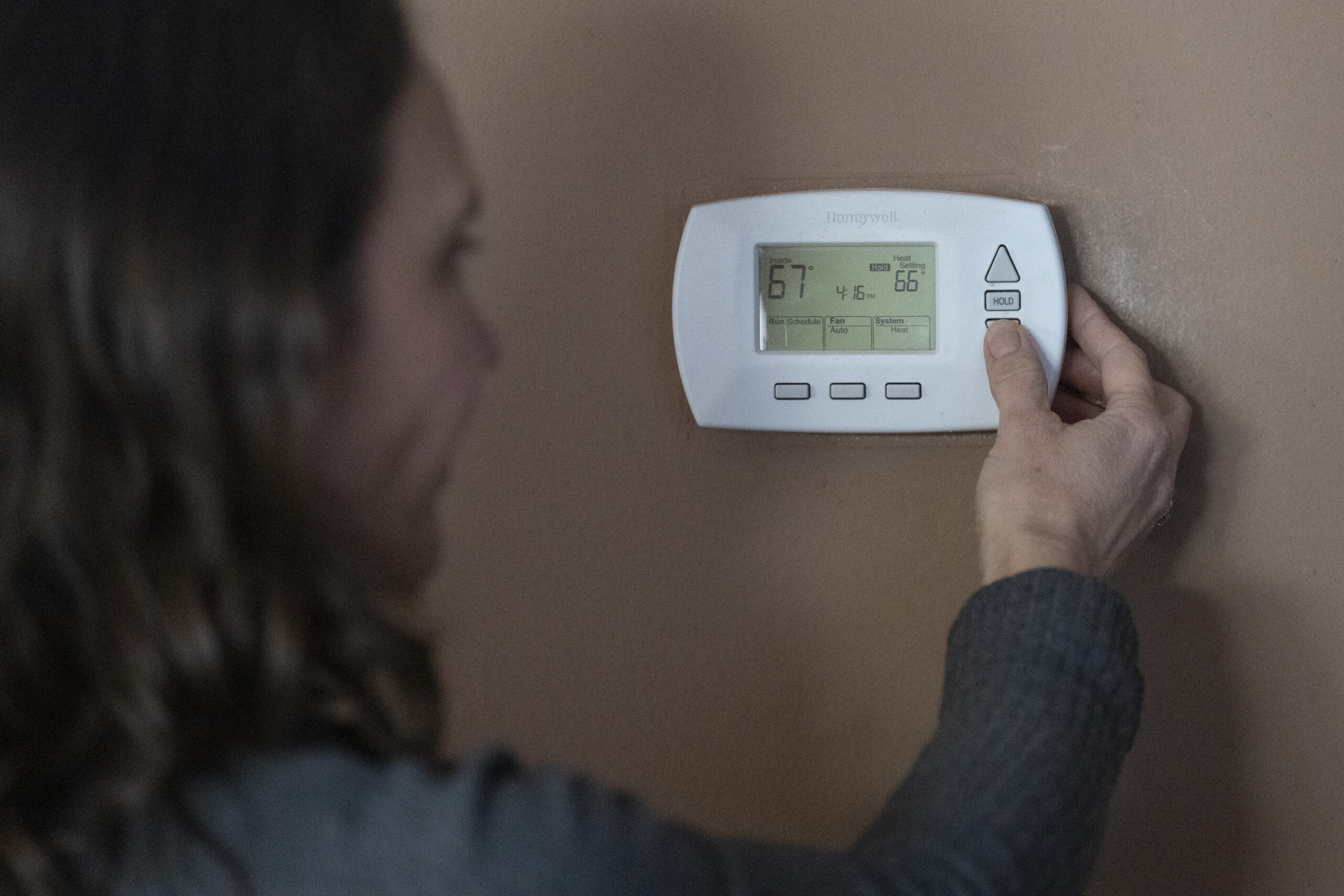
A Philadelphia-area woman woman turns down her thermostat in attempt to save on electricity in this January 2023 file photo.
The pain of skyrocketing utility bills has been felt acutely in New Jersey, which unlike Pennsylvania uses more energy than it produces.
Between 2024 and 2025, New Jersey residents’ electric bills rose more than 13% on average, the fifth steepest increase in the U.S., according to federal data analyzed by the business magazine Kiplinger. Pennsylvanians saw a nearly 10% increase during the same period, according to the data.
A bill sponsored by New Jersey State Assembly member David Bailey Jr., a Democrat from Salem County, attempts to prevent future price hikes.
The legislation would require data center developers to have “skin in the game,” as Bailey described it in a recent interview, and sign a contract to purchase at least 85% of the electric service they request for 10 years. He said it would also provide incentives for data centers to supply their own energy generation.
“I don’t want to come off as an anti-data center person,” said Bailey, who represents parts of Gloucester, Salem, and Cumberland Counties. “This is a very positive thing. We’re just saying we don’t want these big companies to come in and pass this [cost] on to our mom and pops, our neighbors, and our everyday ratepayers.”
Bailey said he was disappointed that his bill was pocket-vetoed by former Gov. Phil Murphy last month. Now, it has to restart the legislative process. But Bailey said he expects it to eventually pass with bipartisan support.
“No matter your party affiliation you understand the affordability issue,” Bailey said. “You understand your electric bill” — and how much it has risen recently.
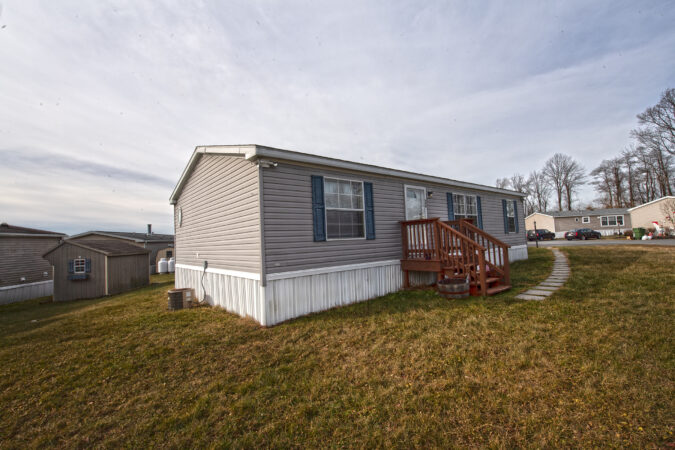
Manufactured homes — single-family dwellings often built off-site and placed on a lot — areone of the most affordable forms of homeownership. But families who live in these homes are often left vulnerable, because companies that own the land can hike rents for their lots or sell communities for redevelopment.
This type of unsubsidized affordable housing tends to be more accessible for low-income households than typically built homes.
A bill that former N.J. Gov. Phil Murphy signed last week makes it easier for manufactured home and mobile home residents to buy their communities when a landowner decides to sell or change the use of the land.
Landowners who want to sell or redevelop these communities must give notice to residents and local and state leaders. If 51% of residents agree to purchase the community, and they meet the price and conditions of the sale, they have 120 days to buy it. Previously, this action required two-thirds of residents, who had 45 days to sign a contract.
Lawmakers found that the prior parameters were too high of a bar for residents to meet.
New Jersey’s new law is based on model legislation from the National Consumer Law Center. There are more than 1,000 resident-owned mobile and manufactured home communities across the country. None are in New Jersey.
Almost 100,000 New Jersey residents live in 250 manufactured or mobile home communities, many of which are in South Jersey, said State Assembly member David Bailey Jr., a Democrat who sponsored the legislation and represents residents in Gloucester, Salem, and Cumberland Counties.
Imagine you’ve owned your home for 20 years and “somebody comes and says, ‘We’re selling this land and you either follow these new rules or you gotta move,’” Bailey said. “That would never happen in suburbia. But that’s what could happen to these people. Because they have no choice. They’re stuck.”
He said that when he took office in 2024, he immediately started getting calls from constituents in Salem County who lived in manufactured home communities. They told him about rising costs to rent the land their homes were on and deteriorating property conditions and infrastructure in their communities.
Many of the properties had been owned by local families who later sold the land to companies that hiked rents, Bailey said. In 2022, the CEO of the Lincoln Institute of Land Policy said that in the prior eight years, roughly 800,000 home sites in manufactured housing communities were bought by private equity companies and other institutional investors. Rent hikes tended to follow.
Another recent New Jersey law addresses this reality.
After an earlier version of the legislation passed the state Senate this spring, Sen. Paul Moriarty said in a statement that the usual renting setup of mobile and manufactured home communities “often leads to unfair price hikes by landlords, as they know that there is no other option besides moving the home to another site.”
Moriarty, a Democrat who represents residents in Gloucester, Camden, and Atlantic Counties, noted that moving these homes to different sites can be “incredibly difficult” because of “potential difficulties in financing a move, exclusionary zoning practices, and restrictions on the age and condition of incoming homes.”
A previous version of this story misstated the number of mobile homes purchased by private equity companies. It is roughly 800,000 manufactured home sites.
“You don’t have to like the fact that merit pay was in there,” Hibbs said of his contract at the board’s most recent meeting. But, he said, he is legally entitled to the payment on top of his $215,000 annual base salary because he met the goals listed in his contract.
And he is not the only South Jersey superintendent who has negotiated merit pay or other bonuses as part of a contract. The measure is a little-known way for New Jersey superintendents to earn higher salaries.
About 54 of the state’s 600 public school chiefs, or about 9%, had perks negotiated in their contracts in the 2023-24 school year, according to data from the New Jersey Department of Education.
Here’s what to know about the practice of giving merit pay to New Jersey superintendents:
How many superintendents get merit pay and how much is it?
In South Jersey, at least eight of nearly 100superintendents had merit or bonus pay provisions in their contracts in the 2023-24 school year, the most recent available state data obtained under the Open Public Records Act. The information may be incomplete because it is compiled from self-reporting by districts, and some superintendents have left their jobs since the data were compiled.
Among the districts offering merit pay are: Barrington, Black Horse Pike Regional, Clayton, Salem County Vocational, Washington Township in Gloucester County, Woodlynne, and West Deptford. Merchantville had it also, but that superintendent has since left the position.
window.addEventListener(“message”,function(a){if(void 0!==a.data[“datawrapper-height”]){var e=document.querySelectorAll(“iframe”);for(var t in a.data[“datawrapper-height”])for(var r,i=0;r=e[i];i++)if(r.contentWindow===a.source){var d=a.data[“datawrapper-height”][t]+”px”;r.style.height=d}}});
How much money do superintendents make in bonus pay?
An Inquirer analysis of state data found that bonus compensation packages ranged from $2,000 to $56,989 for the 2023-24 school year.
They included additional pay granted for meeting performance goals or obtaining a doctorate, orlongevity bonuses for years of service.
The districts with the most lucrative merit packages were in North Jersey: $56,989 in Bergen County Vocational; $43,272 in Hudson, and $36,489 in Union.
Clayton Superintendent Nikolaos Koutsogiannis, in his ninth year as schools chief, received $4,350 in longevity pay. He joined the district in 2008 as a principal and is one of the longest-serving superintendents in Gloucester County.
“I enjoy my job here,” Koutsogiannis said. “They wanted to keep me here. I was more than willing to stay.”
The Barrington, Black Horse Pike Regional, Salem County Vocational, and West Deptford superintendents did not respond to numerous email messages.
Some South Jersey districtswhere superintendents are among the highest-paid in the region do not offer merit pay, including Winslow, Lenape Regional, Burlington City, Mount Laurel and Cherry Hill.
Because of the cap, dozens of superintendents left the state for higher salaries elsewhere and districts had difficulty recruiting educators. Others negotiated merit pay and bonuses to boost their earnings.
Gov. Phil Murphy speaks with members of the media after meeting with Gov.-elect Mikie Sherrill at the governor’s office in Trenton last month.
Superintendent salaries can vary, as boards negotiate contracts based on experience, district size, and other factors.
The New Jersey Department of Education must approve contracts,including merit pay provisions and goals. Executive county school superintendents review contracts for each district.
Purnell said his association, which provides guidance to more than 600 New Jersey school boards, generally steers them away from considering merit pay. Longevity pay, however, is encouraged as an incentive to keep quality superintendents, he said.
Many superintendents are less interested in pursuing additional goals because merit pay is not factored into pensions, Purnell said.
When merit pay is in a contract, the board and the superintendent establish merit goals at the beginning of the school year. At the end of the year, the superintendent must submit evidence that the goals were met. The executive county superintendent must sign off on the request before any bonuses are paid.
The state specifies quantitative and qualitative goals that may be included in merit pay. It also sets the value of each goal, a percentage of the superintendent’s base salary.
Based on a district’s needs, merit pay may be given for meeting goals such as reducing chronic absenteeism, increasing student achievement, setting up learning academies, or establishing a foundation.
Hibbs’ goals approved by the board include completing Google training presentations, taking online professional development courses, and beefing up security.
In September, records show, the executive county superintendent approved $9,072 in merit pay for Barrington Superintendent Anthony Arcodia for meeting two goals — improved parent communication and overhauling the parent-student handbook.
Barrington school board president Mark Correa said Arcodia waived his right to merit pay for the 2025-26 school year because of the district’s belt-tightening. He will be eligible for merit pay in future years, he said.
The district “believes in rewarding our high-achieving, long-serving superintendent when possible,” Correa wrote in an email this week.
Some school chiefs get a stipend for holding an additional administrative position, such as serving as superintendent and a school principal, typically in smaller districts.
What are the drawbacks of merit pay?
Purnell said merit goals can muddy the waters for districts because superintendents could become so focused on those goals that they lose sight of the overall strategic plan.
“The question would be why do you need to receive merit pay when it’s your responsibility to provide a thorough and efficient education,” Purnell said. “You don’t want the goal to become more important than the best interest of all children.”
“Student outcomes are the result of a whole system and are heavily influenced by factors outside one leader’s control,” Campbell said. “If a district uses merit pay at all, I recommend it be a small slice of compensation.”
West Deptford Superintendent Brian Gismondi poses for a portrait outside the West Deptford Child Development Center in West Deptford earlier this year.
How common is merit pay nationwide?
Merit pay does exist in other states.Earlier this year, the state-appointed superintendent for the Houston Independent School District received a $173,660 bonus based on his annual performance evaluation, which credited him with boosting standardized test scores. His annual base salary is $462,000.
Nationwide, the median salary for a school superintendent was $156,000 for the 2023-24 school year, according to the School Superintendents Association. The group does not track merit pay.
The median superintendent salary among 91 South Jersey school districts was $176,088 for the 2024-25 school year, an Inquirer analysis found.
In Philadelphia, Superintendent Tony B. Watlington Sr. recently received a contract extension that will keep him in the nation’s eighth-largest school district through 2030. He is paid $367,710. He does not get merit pay.
Philadelphia School District Superintendent Tony B. Watlington, Sr.
What’s happening with merit pay in Washington Township?
In Washington Township,Hibbs has the most lucrative merit package in South Jersey. He received $25,000 in bonus pay for the 2023-24 school year, according to district records obtained by The Inquirer under the state’s Open Public Records Act.
Hibbs has asked the board several times to approve $27,319 in merit pay for the 2024-25 school year, indicating he had met four of the five goals approved by the board. His contract allows an annual merit bonus of up to 14.99% of his salary, the maximum permitted by the state.
The request has been rejected by the board, failing to get five votes needed. The dispute is expected to lead to another legal showdown between Hibbs and the board.
During a heated exchange at a board meeting last month, Hibbs accused the board of retribution. He was suspended for five months earlier this year over an ethics complaint. A judge ordered his return and Hibbs was later cleared of any wrongdoing.
“My merit pay that was 100% approved and achieved has been consistently voted down by certain members,” Hibbs said at a recent school board meeting.
Hibbs was hired in 2023 with an annual base salary of $215,000, making him among the highest-paid superintendents in South Jersey. His contract runs through 2027.
Staff writer Kristen A. Graham contributed to this article.