The contentious national discussion over the rapid expansion of ICE came to the doorstep of the Philadelphia region on Wednesday, as the Bucks County commissioners voted to oppose having any processing or detention facilities in the county.
Commissioners said they learned that the federal government had recently approached warehouse owners in two communities, Bensalem Township and Middletown Township, about possible conversions. Neither owner is going forward, they said.
The commissioners voted 3-0 ― including the board’s lone Republican ― to approve a resolution that said such a center would be harmful for county residents and the people who would be confined there.
ICE officials did not immediately reply to a request for comment.
The commissioners voted a day after U.S. Rep Brian Fitzpatrick said that he would oppose such a facility ― and that he had received federal assurances none was planned in his district, which covers Bucks County and parts of eastern Montgomery County.
Fitzpatrick, a Republican who is seeking reelection in the purple district, faces a likely November challenge from Democratic Bucks County Commissioner Bob Harvie, who also opposes ICE sites.
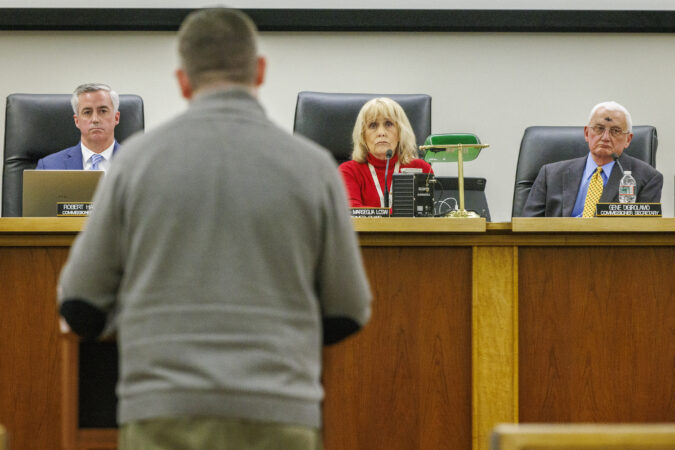
In Doylestown on Wednesday, Commissioner Gene DiGirolamo, a Republican who serves with two Democrats, said he heard about the federal interest in two local sites and strongly disapproved.
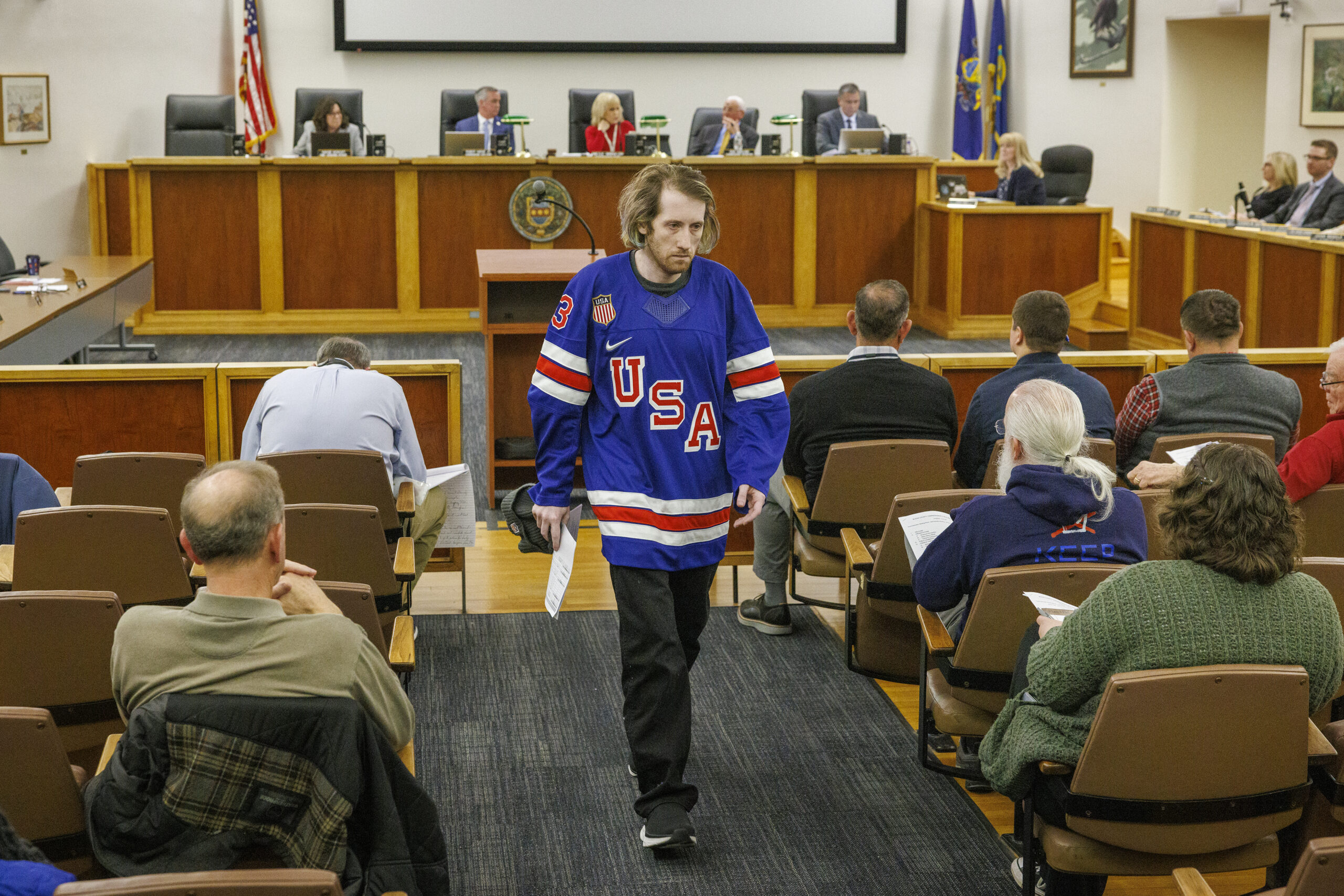
Jake Didinsky of Southampton, said he opposes ICE warehouses in his county, comparing them to Japanese interment camps.
“Bucks County is not a county that needs or wants a detention facility,” he said.
Harvie, the board’s vice chair, said Bucks County “is no place for these kinds of facilities” and cautioned: “We have been down this road before, with Japanese Americans. And with Italian Americans.”
During World War II the U.S. government forcibly incarcerated thousands of people of Japanese descent, holding them in concentration camps mostly in the western part of the country. About two-thirds of those confined were American citizens.
Some Italian Americans endured the same treatment.
A resolution conveys the opinion and wishes of the board, but holds no force of law.
The Bucks resolution said the county opposes “the use of warehouses or similar industrial facilities not intended for human occupancy as facilities to hold, jail, detain, house or otherwise store human beings.”
In addition to humanitarian concerns, the resolution says, “such facilities, being hastily erected in areas and structures not intended for human occupation, would place unanticipated demands upon water and sewer systems, creating hazards to public health, as well as heaping new strain upon public safety services.”
The vote came as the growth of ICE leasing and purchases has become contentious in Pennsylvania and across the United States.
U.S. Immigration and Customs Enforcement expects to spend $38.3 billion to acquire warehouses around the country and retrofit them into immigrant detention centers to hold tens of thousands of people, the Washington Post reported. The newspaper analyzed agency documents that were provided to New Hampshire’s governor and published on the state’s website.
ICE intends to buy and convert 16 buildings to serve as regional processing centers, each holding 1,000 to 1,500 immigrant detainees. An additional eight detention centers would hold 7,000 to 10,000 detainees and serve as primary sites for deportations.
Last week Gov. Josh Shapiro formally asked Homeland Security Secretary Kristi Noem in a letter to reconsider the conversion of the Berks and Schuylkill sites, citing “real harms” to the communities.
He questioned the legality of the facilities and hinted at a possible lawsuit, saying if DHS goes forward, his administration will “aggressively pursue every option to prevent these facilities from opening.”
DHS spokesperson Tricia McLaughlin confirmed the plans for the Pennsylvania sites, saying that they would undergo community-impact studies and a rigorous due-diligence process, and that they would bring 11,000 jobs to the two Pennsylvania communities.
The two sites would hold a combined 9,000 people.
On Tuesday, Fitzpatrick’s office said it had received assurances from DHS and ICE that they had no plans or intention to open a detention facility within the First Congressional District.
“After hearing from concerned residents, our office immediately contacted U.S. Immigration and Customs Enforcement, and we have received assurances that no such facility is planned,” Fitzpatrick said.
Erin Mooney, executive director of the Schuylkill Center for Environmental Education, slipped out of a sweltering sauna last weekend wearing only a bathing suit and strode barefoot straight into the coldest day of the winter.
“I never thought that I would find myself in a bathing suit laying down in the snow on a 15-degree day, and I found myself doing that at the Schuylkill Center,” Mooney said.
It marked the opening weekend of a new experience that the Schuylkill Center, on Hagy’s Mill Road in Philadelphia, is offering along with a local sauna company, Fiorst — one that already has had solid booking off social media views, despite having just opened Saturday.
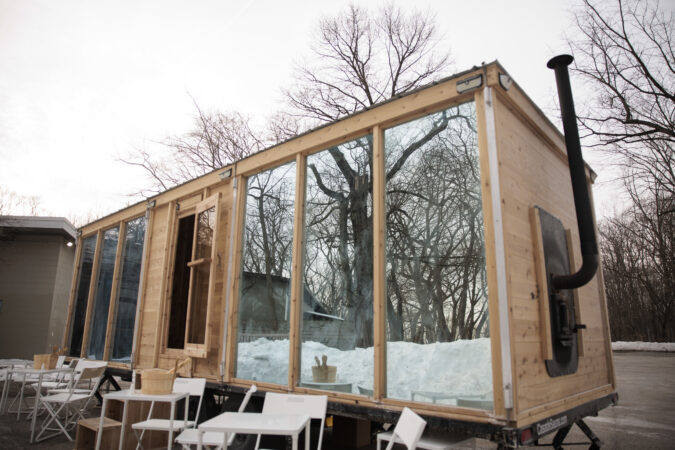
Visitors will have the chance to relax ina glass-walled, wood-fired sauna overlooking a snowy field and woods in Northwest Philly, paired witha cold plunge.
Mooney said the idea to host a mobile sauna on the preserve’s grounds grew from a desire to keep the center lively through winter and draw in new visitors. She was inspired by a sauna exhibit by the American Swedish Historical Museum in FDR Park and began looking for a way to bring that Nordic tradition of “hot and cold” to her own facility.
She spotted Fiorst, a mobile sauna venture run by Jose Ugas, on social media, reached out, and the two forged a near-instant partnership. They spoke on Jan. 30, a Friday; by the next Friday, a custom sauna unit from Toronto rolled onto the grounds.
By last Saturday, the fire was lit, and guests arrived.
“It was, you know, kind of kismet, in a way, we were able to have this shared vision,” Mooney said. “And with him doing this servicing of the saunas on site, it makes it so much easier for us.”
The interior of the Nordic-style sauna at the Schuylkill Center for Environmental Education.
How does the sauna work?
Nordic-style wood saunas are notable for their minimalist design and high heat, which participants couple with either a plunge into a cold shower, tub, or lake or a step outdoors.
Fiorst’s installation overlooks the center’s main wooded area, framing the winter landscape through a glass wall as guests sweat it out inside the sauna’s170- to 190-degree temperatures. Each 90-minute session allows participants to cycle at their own pace through intense heat and biting cold, a contrast Mooney found invigorating.
The sauna is modeled on a concept popular across Nordic countries, including Norway, Finland, Denmark, and Sweden.
Mooney said the project has already pulled in new visitors from neighborhoods like Fishtown or outside Philadelphia who might not typically visit for hiking or birdwatching.
She believes the sauna fills a niche for “clean, wholesome, healthy fun” that is alcohol-free.
However, unlike the typical Nordic experience of being nude during the sauna, the Schuylkill Center experience is strictly “bathing-suit friendly,” a choice tailored to American comfort levels.
The collaboration operates on a revenue split, with a charitable twist. During February, the center’s share of the proceeds goes to its Winterfest for Wildlife campaign to support the on-site wildlife clinic.
For now, the sauna remains a seasonal experiment, but it will stay in place as long as demand — and winter weather — holds up.
“I think it will stay seasonal,” Mooney said. “We live in a sauna already in the summer in Philadelphia.”
The sauna is open on weekends at the Schuylkill Center from 9 a.m. to 5 p.m. and is booked through the Fiorst website. The cost for a 90-minute session is $75. You can add a friend for $25. Private sessions of up to 16 cost $600. For now, bookings can be made only one week in advance.
The Schuylkill Center is expecting Valentine’s Day weekend to book quickly.
Jose Ugas (left), founder of Fiorst, and Erin Mooney, executive director of the Schuylkill Center for Environmental Education, at the sauna.
‘A moment of clarity’
Ugas, a bioengineer at Johnson & Johnson who lives in Whitemarsh Township, felt compelled to bring a Nordic-style sauna experience to the region after a triphe took to Sweden following the loss of his mother to brain cancer in 2023. There, friends introduced him to a traditional Scandinavian ritual: enduring searing dry heat inside a wooden sauna, followed by a plunge into icy water or a cold shower.
What began as a distraction soon crystallized into a moment of clarity, Ugas said.
“Just that time together and kind of going between the hot and the cold just was like a mental reset for me,” Ugas said.
Ugas, who will graduate with an MBA from Villanova University this spring, wanted to replicate the nature-immersive element that had grounded him overseas.
Hefound a Toronto company that builds portable glass-fronted wooden saunas andordered a custom unit equipped with a wood-fired stove, hot stones, steam, aromatherapy, and a cold-plunge tub. Ugas launched Fiorst in 2024, describing it as “nomadic” at first.
The venture first hosted sessions overlooking Valley Forge and at Fitzwater Station in Phoenixville. Ugas then established a more permanent site, which he calls Riverside, on River Road in Conshohocken where he still books sessions.
Ugas calls the partnership with the Schuylkill Center a natural fit given its location amid nature, merging his wellness goals with the venue’s environmental focus.
“At the core of our mission and their mission is to get people out in nature,” Ugas said.
So far, he has relied on social media to market the sauna, which has drawn hundreds of visitors to its locations.
The Nordic-style sauna at the Schuylkill Center for Environmental Education in Philadelphia.
‘Social sauna’
Serena Franchini, a nurse and founder of Healing Fawn Inner Child Work & Somatic Therapy, has taken sauna sessions at Ugas’ other locations. She sees it as a tool to help with nervous system regulation while offering an immersion in nature.
“I loved the idea that it was outside,” Franchini said.
She likes the relaxed atmosphere compared with some traditional saunas that often enforce strict time limits on heating and cooling cycles. Instead, she cycles between the sauna and cold-plunge tub at her own pace.
Franchini highlighted the mental wellness aspect of Ugas’ “social sauna” sessions, noting Friday night events as “skip the bar” alternatives that allow strangers to gather for a healthy, communal experience.
“It’s a great way for community to connect with people that are interested in the same things that you are,” Franchini said.
A Pennsylvania company has pleaded guilty to a crime stemming from its work installing hundreds of illegal video gambling devices across the state — but its owners appear to be off the hook.
Schuylkill County-based Deibler Brothers Novelty Co. pleaded guilty Friday to corrupt organizations, a first-degree felony, and was ordered by a judge to forfeit $3 million to the state in cash and assets, according to the office of Pennsylvania Attorney General Dave Sunday.
The company is owned by brothers Arthur Deibler, 34, and Donald Deibler, 33, and their friend Joel Ney, 35, each of whom was charged in 2024 with multiple felonies, including corrupt organizations and conspiracy.
Court records show the charges were withdrawn Tuesday. Sunday’s office said that was part of the plea agreement, which also required the company to pay the asset forfeiture up front.
“We expect those charges to be dismissed by the attorney general,” said defense lawyer William J. Brennan, who represents the Deibler brothers along with Michael T. van der Veen.
Prosecutors say Deibler Brothers marketed its illegal devices as legal skill games — the slot machine-style games that have proliferated across Pennsylvania — and paid kickbacks to an executive at a device vendor.
State lawmakers have repeatedly pledged, but so far failed, to tax and regulate the games. The Pennsylvania Attorney General’s Office has argued that the games are illegal slot machines — essentially unregulated casino games — but courts have thus far disagreed.
“For many years, the legal status of games of chance has been a ping-pong ball in the court system,” Brennan said. “From day to day, it’s hard to follow what the current state of the law is. This corporation has done everything it can to try to remain compliant in a changing legal landscape. This result allows all the parties to move on and put this matter behind them.”
Sunday, a Republican, said in a statement Monday that the plea resolution “secures a substantial forfeiture of assets to the commonwealth.”
“This company was warned time and time again and continued to snub its nose at state regulations by flooding Pennsylvania counties with illegal gambling machines,” he said.
A grand jury presentment accused Deibler Brothers of supplying thousands of illegal video gambling devices — modified slot machines — to convenience stores, bars, and gas stations across more than a dozen counties.
From April 2021 through November 2023, the company received more than $1 million a month from the distribution and operation of the machines, according to the presentment from the 50th Statewide Investigating Grand Jury.
In an effort to “disguise” its use of illegal slot machines, Deibler Brothers also paid $150,000 in illegal kickbacks to an executive at device vendor Pace-O-Matic, the presentment said.
The executive — Ricky Goodling, a retired Pennsylvania State Police corporal and Pace-O-Matic’s former director of national compliance — pleaded guilty last week to state money laundering charges. He also pleaded guilty to federal tax evasion charges.
Deibler Brothers sought to commingle its illegal games with legal Pace-O-Matic machines to try to “dupe” law enforcement authorities and store owners into thinking they were the same, the presentment says.
Pennsylvania courts have ruled that Pace-O-Matic games are legal games of skill, not chance, because they include a memory component that distinguishes them from casino-style slot machines. But most of the machines distributed by the Deibler Brothers had no such secondary element and were therefore illegal, the presentment said.
Goodling used his authority at Pace-O-Matic to quash complaints about Deibler Brothers and another firm that paid him kickbacks, according to the grand jury.
Maybe it’s because I’ve watched every blessed one of them, starting as a curious, nearly 8-year-old boy in 1967, but the Super Bowl has always felt like the ultimate barometer of where the American Experiment is at. Super Bowl LX (that’s 60, for those of you smart enough not to take four years of Latin in high school) was no exception. The actual game was something of a snoozefest, but the tsunami of commercials revealed us as a nation obsessed with artificial intelligence, sports betting, weight loss, and anything that can lift us from middle-class peonage without having to do any actual work. As Bad Bunny said, God bless America.
Bad Bunny’s real message: From P.R. to Minnesota, we are neighbors
Bad Bunny (center top) performs Sunday during the halftime show of the NFL Super Bowl XL football game between the Seattle Seahawks and the New England Patriots in Santa Clara, Calif.
Right-wing media prattled on for months about how Bad Bunny, the Puerto Rican reggaeton superstar who is the world’s most streamed artist, would politicize and thus ruin the NFL’s halftime extravaganza at Super Bowl LX in Santa Clara, Calif.
The babble became a scream seven days before the Big Game kicked off, when Bad Bunny won the record of the year Grammy Award and began his acceptance speech with the exhortation “ICE out!” adding, “We’re not savages, we’re not animals, we’re not aliens — we are humans, and we are Americans.”
But on the world’s biggest stage Sunday night — seen by 135 million in the United States, a Super Bowl record — Bad Bunny sang not one word about Donald Trump, not that MAGA fans even bothered to hold up a translation app. The white-suited Benito Antonio Martínez Ocasio danced his way through the history of Puerto Rico and the Americas writ large, from the plantations of yore to the exploding power lines of the hurricane-wracked 21st century. He whirled past an actual wedding, stopped for a shaved ice, and for 13 spellbinding minutes turned a cast of 400 into what his transfixed TV audience craved at home.
BadBunny built his own community — a place not torn asunder by politics, but bonded by love and music.
Without uttering one word — in Spanish or English — about the dire situation in a nation drifting from flawed democracy into wrenching authoritarianism, the planet’s reigning king of pop delivered the most powerful message of America’s six decades of Super Bowl fever. Shrouded in sugar cane and shaded by a plantain tree, Bad Bunny sang nothing about the frigid chaos 2,000 miles east in Minnesota, and yet the show was somehow very much about Minneapolis.
Bad Bunny finally gave voice to what thousands of everyday folks in the Twin Cities have been trying to say with their incessant whistles.
We are all neighbors. The undocumented Venezuelan next door who toils in the back of a restaurant and sends his kids to your kids’ school is a neighbor. But Haiti is also a neighbor, as is Cuba. We are all in this together.
The word I kept thinking about as I watched Bad Bunny’s joyous performance is a term that didn’t really exist on New Year’s Day 2026, yet has instantly provided a name to the current zeitgeist.
The great writer Adam Serwer — already up for the wordsmithing Hall of Fame after he nailed the MAGA movement in 2018 in five words: “The cruelty is the point” — leaned hard into the concept of “neighborism” after he traveled to Minneapolis last month. His goal was to understand an almost revolutionary resistance to Trump’s mass deportation raids that had residents — many of whom had not been especially political — in the streets, blowing those warning whistles, confronting armed federal agents, and tracking their movements across the city.
Serwer visited churches where volunteers packed thousands of boxes of food for immigrant families afraid to leave their homes during the U.S. Immigration and Customs Enforcement raids, and talked to stay-at-home moms, retirees, and blue-collar workers who give rides or money to those at risk, or who engaged in the riskier business of tracking the deportation raiders.
“If the Minnesota resistance has an overarching ideology,” Serwer wrote, “you could call it ‘neighborism’ — a commitment to protecting the people around you, no matter who they are or where they came from.” He contrasted the reality on the ground in Minneapolis to the twisted depictions by Trump and his vice president, JD Vance, who’ve insisted refugees are a threat to community and cohesion.
Of course, it’s not just Minneapolis, and it’s not just the many, liberal-leaning cities — from Los Angeles to Chicago to New Orleans and more — that were the incubators of the notion that concerned citizens — immigrant and nonimmigrant alike — could prevent their neighbors from getting kidnapped. Even small towns like rural Sackets Harbor, N.Y., the hometown of Trump’s border czar Tom Homan, rose up in protest to successfully block the dairy farm deportation of a mom and her three kids. It’s been like this everywhere regular folks — even the ones who narrowly elected Trump to a second term in 2024 — realize mass deportation doesn’t mean only “the worst of the worst,” but often the nice mom or dad in the house, or church pew, next to theirs.
Only now that it’s arrived is it possible to see “neighborism” as the thing Americans were looking for all along, even if we didn’t know it. It is, in every way, the opposite vibe from the things that have always fueled fascism — atomization and alienation that’s easy for a demagogue to mold into rank suspicion of The Other.
I’m pretty sure Bad Bunny wasn’t using the word neighborism when the NFL awarded him the coveted halftime gig last fall. But the concept was deeply embedded in his show. He mapped his native Puerto Rico as a place where oppression has long loomed — from the cruelty of the sugar plantations to the capitalist exploitation of the failed power grid — but where community is stronger.
Then Benito broadened the whole concept. Reclaiming the word America for its original meaning as all of the Western Hemisphere, Bad Bunny name-checked “Chile, Argentina, Uruguay, Paraguay, Bolivia, Peru, Ecuador, Brazil,” and Canada, as well as the United States. These, too, are our neighbors. “God bless America,” he shouted — his only message of the night delivered in English.
So, no, Bad Bunny never mentioned Minneapolis, but a tender moment when he seemingly handed the Grammy he’d won just aweek ago to a small Latino boy had to remind viewers of the communal fight to save children like the 5-year-old, blue bunny hat-wearing (yes, ironic) Liam Conejo Ramos, who was just arrested, detained, and released by ICE. (A false rumor that the Super Bowl boy was Ramos went viral.)
But arguably, this super performance had peaked a few moments earlier, when the singer exited the wedding scene stage with a backward trust dive, caught and held aloft by his makeshift community in the crowd below. Bad Bunny had no fear that his neighbors would not be there for him. Viva Puerto Rico. Viva Minneapolis. Viva our neighbors.
Yo, do this!
Some 63 years after he was gunned down by a white racist in his own driveway, the Mississippi civil rights icon Medgar Evers has been having a moment. A fearless World War II vet whose bold stands for civil rights as local leader of the NAACP in America’s most segregated state triggered his 1963 assassination, Evers’ fight has become the subject of a best-selling book, a controversy over how his story is told at the Jackson, Miss., home where he was killed, and now a two-hour documentary streaming on PBS.com. I’m looking forward to watching the widely praised Everlasting: Life & Legacy of Medgar Evers.
After the Super Bowl, February is the worst month for sports — three out of every four years. In 2026, we have the Winter Olympics to bridge the frigid gap while we wait for baseball’s spring training (and its own World Baseball Classic) to warm us up. Personally, I try and sometimes fail to get too jacked up around sleds careening down an icy track, but hockey is a different story. At 2:10 p.m. on Tuesday (that’s today if you read this early enough), the puck drops on USA Network for the highly anticipated match between the world’s two top women’s teams: the United States and its heated rival Canada. Look for these two border frenemies to meet again for the gold medal.
Ask me anything
Question: How is it that some towns have been able to prevent ICE from buying warehouses and turning them into concentration camps, while others say they are helpless against the federal government? What does it mean that several are planned for within a couple of hours of Philly? — @idaroo.bsky.social via Bluesky
Answer: Great question. It seems ICE and its $45 billion wad of cash are racing in near-secrecy to make this national gulag archipelago of 23 or so concentration camps a done deal. The places where they’ve been stopped, like one planned for Virginia, happened because locals were able to pressure the developer before a sale to ICE was concluded. That’s no longer an option at the two already purchased Pennsylvania sites in Schuylkill and Berks Counties. The last hope is pressure from high-ranking Republicans, which may (we’ll see) have stopped a Mississippi site. Pennsylvanians might want to focus, then, on GOP Sen. Dave McCormick. Good luck with that.
What you’re saying about …
It’s conventional wisdom that the best argument for a Gov. Josh Shapiro 2028 presidential campaign is his popularity in his home state of Pennsylvania, the battleground with the most electoral votes. So it’s fascinating that none of the dozen or so of you who responded to this Philadelphia-based newsletter wants Shapiro to seek the White House, although folks seem divided into two camps. Some of you just don’t like Josh or his mostly centrist politics. “I think he’s all ambition, all consumed with reaching that top pedestal, not as a public servant, but because he thinks he deserves it,” wrote Linda Mitala, who once campaigned for Shapiro, but soured on his views over Gaza protesters, New York Mayor Zohran Mamdani, and other issues. Yet, others think he’s an excellent governor who should remain in the job through 2030. “Stay governor of Pa. when good governance and ability to stand up to federal (authoritarian) overreach is dire,” wrote Kim Root, who’d prefer Kentucky Gov. Andy Beshear for the White House.
📮 This week’s question: A shocking, likely (though still not declared) Democratic primary win for Analilia Mejia, the Bernie Sanders-aligned left-wing candidate, in suburban North Jersey’s 11th Congressional District raises new questions for the Dems about the 2026 midterms. Should the party run more progressive candidates like Mejia, who promise a more aggressive response to Trump, or will they lose by veering too far left? Please email me your answer and put the exact phrase “Dems 2026” in the subject line.
Backstory on how the F-bomb became the word of the year
Billie Joe Armstrong of Green Day performs Sunday before the start of Super Bowl XL in Santa Clara, Calif.
I’m old enough to remember when the world’s most famous comedy riff was the late George Carlin’s “Seven Words You Can Never Say on Television” — its point driven home by Carlin’s 1972 arrest on obscenity charges that went all the way to the U.S. Supreme Court. A half century later, you still can’t say dirty words on broadcast TV — cable and streaming is a different story — but that fortress is under assault. In 2026, America is under seemingly constant attack from the F-bomb.
It is freakin’ everywhere. When the top elected Democrat in Washington, House Minority Leader Hakeem Jeffries, cut a short video to respond to the president’s shocking post of a racist video that depicted Barack and Michelle Obama as apes, he said, “[F-word] Donald Trump!” If uttered in, say, 1972, Jeffries’ attack would have been a top story for days, but this barely broke through. Maybe because that word is in the lexicon of so many of his fellow Democrats, like Mayor Jacob Frey, who famously told ICE agents to “get the [F-word] out of Minneapolis,” or Minnesota Sen. Tina Smith, who begged federal agents to “leave us the (bleep) alone.” (Smith is retiring at year’s end and seems to no longer give a you-know-what.)
The poor guys with their finger on the silence button at the TV networks, where you still can’t say Carlin’s seven words, can barely keep up. The F-bomb was dropped at this year’s Grammys, where award-winner Billie Eilish declared “(Bleep) ICE!” as she brandished her prize. The F-bomb was dropped, of course, at the Super Bowl, when the only true moment of silence during 10-plus hours of nonstop bombast came during Green Day’s pregame performance of “American Idiot,” when NBC shielded America’s tender ears from hearing Billie Joe Armstrong sing about “the subliminal mind(bleep) America.”
We’re only about six weeks into the new year, but it’s hard not to think that Merriam-Webster or the other dictionary pooh-bahs won’t declare the F-bomb as word of the year for 2026, even if I’m still not allowed to use it in The Inquirer, family newspaper that we are. So what the … heck is going on here? One study found the F-word was 28 times more likely to appear in literature nowthan in the 1950s, so in one sense it’s not surprising this would eventually break through on Capitol Hill or on the world’s biggest stages.
But the bigger problem is that America’s descent into authoritarianism and daily political outrage has devolved to such a point where, every day, permissible words no longer seem close to adequate for capturing our shock and awe at how bad things are. Only the F-bomb, it turns out, contains enough dynamite to blow out our rage over masked goons kidnapping people on America’s streets, or a racist, megalomaniac president who still has 35 months left in his term. Yet, even this (sort of) banned expletive is losing its power to express how we really feel. I have no idea what the $%&# comes next.
What I wrote on this date in 2019
What a long, strange trip for Amazon founder Jeff Bezos, one of the four richest people on the planet. Today, Bezos is in the headlines for his horrific stewardship of the Washington Post, which has bowed down on its editorial pages to the Trump regime, lost hundreds of thousands of subscribers, and laid off 300 journalists. It’s hard to recall that seven years ago, Bezos and Trump were at war, and there was evidence Team MAGA had enlisted its allies from Saudi Arabia to the National Enquirer to take down the billionaire. I wrote that “a nation founded in the ideals of democracy has increasingly fallen prey to a new dystopian regime that melds the new 21st century dark arts of illegal hacking and media manipulation with the oldest tricks in the book: blackmail and extortion.”
My first and hopefully not last journalistic road trip of 2026 took me to Pennsylvania coal country, where ICE has spent $119.5 million to buy an abandoned Big Lots warehouse on the outskirts of tiny Tremont in Schuylkill County. I spoke with both locals and a historical expert on concentration camps about their fears and the deeper meaning of a gulag archipelago for detained immigrants that is suddenly looming on U.S. soil. It can happen here. Over the weekend, I looked at the stark contrast between Europe’s reaction to the Jeffrey Epstein scandal — where ties to the late multimillionaire sex trafficker are ending careers and even threatening to topple the British government — and the United States, where truth has not led to consequences so far. The Epstein fallout shows how the utter lack of elite accountability is driving the crisis of American democracy.
One last Super Bowl reference: Now that football is over, are you ready for some FOOTBALL? Now just four months out, it’s hard to know what to make of the 2026 World Cup returning to America and coming to Philadelphia for the very first time, and whether the increasing vibe that Donald Trump’s United States is a global pariah will mar the world’s greatest sporting event (sorry, NFL). Whatever happens, The Inquirer is ready, and this past week we published our guide to soccer’s biggest-ever moment in Philly. Anchored by our world-class soccer writer Jonathan Tannenwald and Kerith Gabriel, who worked for the Philadelphia Union between his stints at the paper, the package provides not only an overview of the World Cup in Philly, but previews the dozen teams who will (or might) take the pitch at Lincoln Financial Field, with in-depth looks at the powerhouses (France) as well as the massive underdogs (Curaçao). June is just around the corner, so don’t let the paywall become your goalkeeper. Subscribe to The Inquirer before the first ball drops.
By submitting your written, visual, and/or audio contributions, you agree to The Inquirer’s Terms of Use, including the grant of rights in Section 10.
Steve Frates of Ocean View, N.J., was driving along Route 9 in Cape May County on a recent bitter cold day and noticed something strange: dead robins lying by the side of the road.
Lots of them.
Frates was even more startled when one flew into his Ford F-150 and died. The 72-year-old retired telecommunications manager wondered what was happening.
“I noticed when it was really cold that I would see flocks of birds alongside of the road as I was traveling up and down Route 9 and the Garden State Parkway,” Frates said. “I would see a lot of birds that had been hit. I’d never seen anything at that scale. This was at a level I’ve never experienced before.”
The winter has been hard on the region’s animals, wiping out 95% of the woodcocks in Cape May Point, fostering frostbite on opossums in Philadelphia, and freezing turtles in place in ponds.
Experts say the animals are well adapted to survive the cold, but this winter has been especially harsh, producing a frozen snowpack that keeps animals from digging for food, and a prolonged cold that has pushed some to the brink.
About 200 woodcocks have died in the area of Cape May Point since the Jan. 25 snowfall that froze under a prolonged cold spell. These were found likely seeking food near the edge of homes.
Woodcocks are starving
Mike Lanzone, a wildlife biologist and CEO of Cellular Tracking Technologies, has been busy the last two weeks helping to gather hundreds of dead woodcocks in Cape May Point and West Cape May. His company makes products that track birds via GPS and other technology.
He described a devastating die-off for the woodcocks, which depend on finding food by probing the ground to extract worms and invertebrates. They have been unable to penetrate the snow and ice, causing starvation.
“They were losing a lot of muscle mass, and they weren’t able to eat anything,” Lanzone said. “We started seeing them die off. First it was just a few. Then 10. Then 15. Then 40. Then almost 100 woodcocks.”
Lanzone said about 254 woodcocks had died as of Thursday.
“There was at least a 90-95% die-off,” he said. “That is what we know for sure. At least in Cape May Point and West Cape May.”
Lanzone said the woodcocks were being taken to the Academy of Natural Sciences of Drexel University in Philadelphia to be examined.
Jason D. Weckstein, associate curator of ornithology at the academy, said such die-offs have happened before. He will examine the birds and, using chemical signatures in their bodies, determine where they were born.
“They’re dying because they’re starving,” Weckstein said. “They can’t feed. Most of those birds were super emaciated and just died.”
Robins are desperate
Chris Neff, a spokesperson for New Jersey Audubon, said the robins that Frates saw along the side of the road had been driven there in search of food.
“Birds are congregating along the melted edges of roads searching for bare ground on which to find food and even meltwater to drink,“ Neff said. ”Birds are desperate to consume enough calories each day during this extreme weather, and this makes them bolder, meaning they may not fly off when a car approaches if they have found something to eat.”
American robins, he said, travel in large flocks. When their food is exhausted, a few will take off in search of the berries of American holly and Eastern red cedar. The rest will follow en masse, followinga path that might lead them across a road.
The chances of collisions with cars become much higher.
Neff advises that people should slow down if they see birds congregating along a road and keep an eye out for any that might fly across.
“Like deer,” Neff said, ”if one darts across the road, there are sure to be more following.”
A grebe that was rescued amid the harsh winter weather and taken to the Wildlife Clinic at the Schuylkill Center for Environmental Education, where it is being fed and cared for until an open water source can be found for it to be released.
Opossums and other animals
Sydney Glisan, director of wildlife rehabilitation for the Wildlife Clinic at the Schuylkill Center for Environmental Education in Northwest Philadelphia, characterizes the severe winter conditions as a critical “make it or not” period for local wildlife.
Some animals, such as deer, are well adapted to the cold and can eat fibrous bark and twigs to survive. Other species, however, struggle.
She said Virginia opossums found in Philadelphia, despite being a native species, have physical attributes that “do not really work for this type of weather.” She has treated multiple opossums for frostbite. The latest patient arrived Friday.
They are susceptible, she said, because their ears, tails, and paws have no fur for protection. Often, tails or fingers need to be amputated.
Residents often find them curled up and immobile, mistakenly believing the animals are dead when they are actually just trying to stay warm or are in a state of shock.
The weather also affects aquatic birds like grebes, which become stranded on land because they require open water to take off and cannot walk well on ice or ground.
Even squirrels struggle, as the ice prevents them from digging up cached food, Glisan said.
Glisan advises the public to be cautious about intervening for wildlife such as birds. She notes that even well-intentioned acts, such as providing heated birdbaths, can result in hypothermia if a bird’s wet feathers subsequently freeze in the air.
“As much as it might sound rude, I always say doing nothing is the best thing that you can do,” Glisan said. “I recommend helping by not helping.”
Reptiles and amphibians
Susan Slawinski, a wildlife biologist at the Schuylkill Center, said the danger for reptiles and amphibians comes as lakes and ponds freeze over. Aquatic species such as green frogs, painted turtles, and snapping turtles overwinter at the bottom of ponds.
There, the animals survive by slowing their metabolisms enough to eliminate the need to eat or surface for air. However, prolonged cold poses a specific danger as ponds freeze solid to the bottom. Those hibernating will perish.
The Schuylkill Center uses a bubbler in its Fire Pond to maintain a gap in the ice to let in oxygen.
Despite the risks, Slawinski emphasizes that native wildlife is historically resilient, though mortality is an unfortunate reality for animals that select poor hibernation spots.
For example,thegray tree frog uses glucose to create a natural “antifreeze” that prevents its cell walls from bursting in freezing temperatures.
“Native wildlife is very good at adapting to cold temperatures,” Slawinski said. “There have been colder winters, longer winters before. Unfortunately, there is always going to be a mortality risk.”
A massive 1.3 million-square-foot Schuylkill County warehouse that just 13 months ago bustled with 505 workers moving cheap overstock goods like shower curtains or pet cleaners for now-bankrupt retailer Big Lots sits utterly abandoned, its dozens of truck bays fenced off and surrounded by a silent shroud of snow.
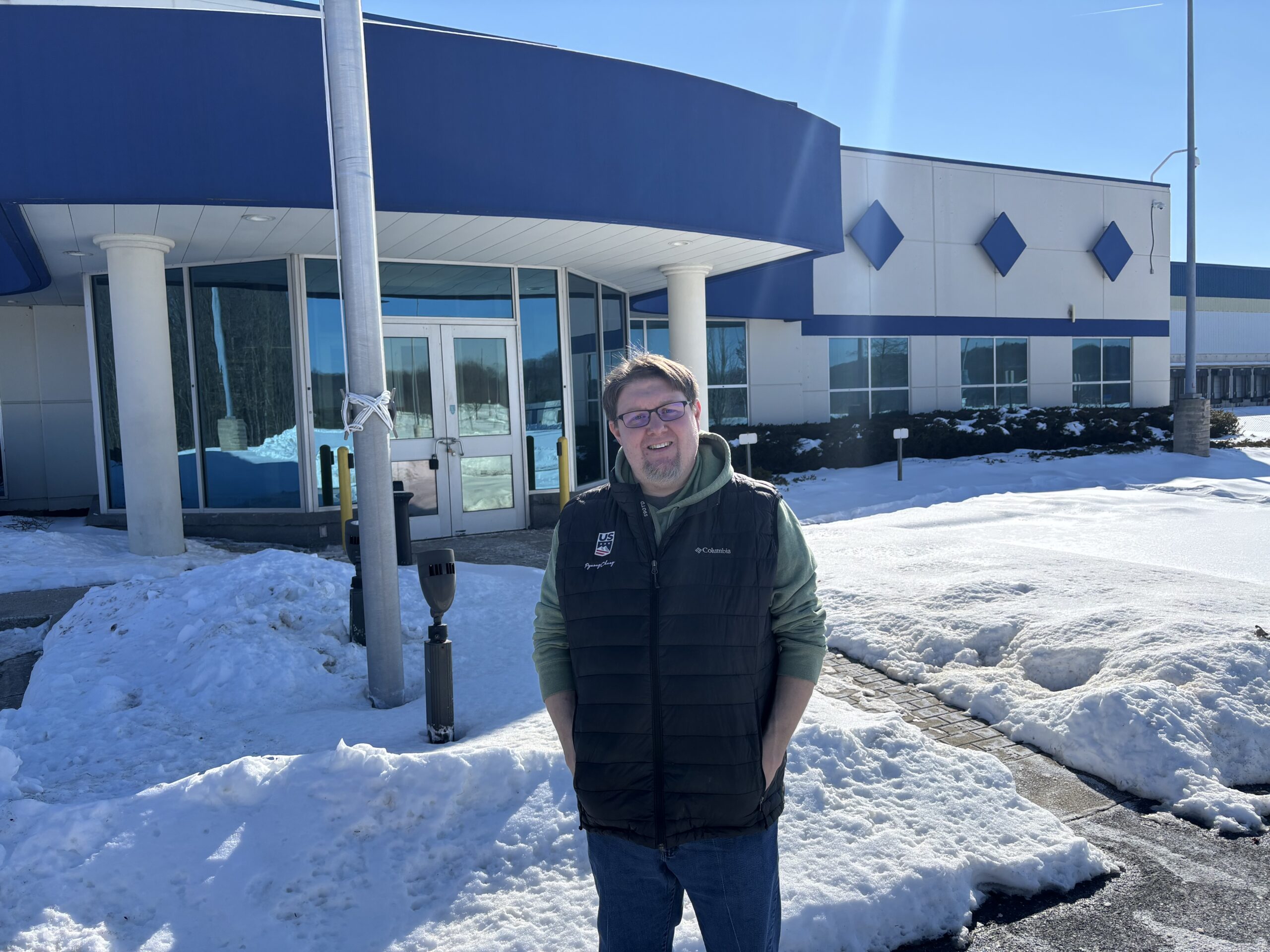
It’s hard to imagine, but in the very near future, this white behemoth could be warehousing thousands of desperate human beings behind its bland, baby blue-trimmed concrete walls. On Monday, U.S. Immigration and Customs Enforcement filed a county deed that confirmed its $119.5 million purchase of the Big Lots facility — one more island in an American gulag archipelago of detention camps for the undocumented immigrants ICE is aggressively arresting from coast to coast.
“It hurts my heart,” the Rev. Brian Beissel, pastor at Christ’s United Lutheran Church in nearby Ashland, told me, choking up a bit, as we sat in a car outside the warehouse entrance.
When I asked him to expand on the source of that pain,Beissel’s response epitomized what other local residents have been saying about the stunning ICE news — a blend of small-town fears about stressed infrastructure with spiritual unease over the images of violent immigration raids in Minneapolis and elsewhere. He invoked Schuylkill County’s deep resentment of the 20th-century coal barons who took the money and the minerals and then ran. “They’re promising jobs, but how long are they going to be here?”
But then Beissel — a Schuylkill County native who sees himself as a not very political preacher, in a county that Donald Trump won in 2024 with nearly 71% of the vote— pivoted to his moral dismay over a citizenship-seeking restaurant owner and father of a 2-year-old he knows from nearby Danville who was arrested by ICE and agreed to return to Mexico. “The Bible is pretty darn clear,” he said, “that we welcome the stranger.”
Brian Beissel, pastor at Christ’s United Lutheran Church in Ashland, Pa., stands in front of the former Big Lots warehouse in Tremont, Pa., that has been purchased by U.S. Immigration and Customs Enforcement (ICE), on Wednesday.
The Trump regime told America this day was coming. Its acting ICE director, Todd Lyons, said in an April interview that he wanted to run the agency like a business, with a deportation process “like [Amazon] Prime, but with human beings.”
Ironically, the soon-to-be ICE detention center in Schuylkill County, about 100 miles northwest of Philadelphia, is less than a mile from a massive new Amazon fulfillment center that opened in 2023. Soon, trucks carrying consumer bric-a-brac to Tremont will be jostling on Interstate 81 with buses carrying day laborers or restaurant servers in handcuffs to those reborn rows of truck portals.
ICE, flush with a whopping $45 billion in cash from Trump’s so-called Big Beautiful Bill to construct its human supply chain, is currently racing to buy sites for 23 detention centers with as many as 76,500 beds from coast to coast — often keeping communities like Tremont in the dark to thwart the inevitable opposition.
In fact, the Schuylkill County deal is the second ICE facility in east-central Pennsylvania announced just this week. A different warehouse location, which ICE envisions as a kind of feeder camp for 1,500 detainees, was also purchased for $87 million in Hamburg, Berks County — only 25 miles from Tremont.
Even if you could somehow put the morality of what many see as concentration camps on U.S. soil to the side, the government’s scenario for tiny Tremont — a coal-country hollow of two-story brick homes and faded American flags with just 2,000 residents — boggles the mind.
The Big Lots site could soon see a community of nearly 10,000 people — the 7,500 detainees and an estimated more than 2,000 workers to oversee them — that would instantly become the second-largest city in Schuylkill County (after Pottsville, the county seat). It’s just 300 yards from the largest daycare center in a township where the water and sewer system is already at capacity, with no local police force or nearby hospital to deal with the inevitable emergencies. The U.S. government won’t be paying the roughly $1 million a year in annual property taxes that propped up local schools and county and municipal services.
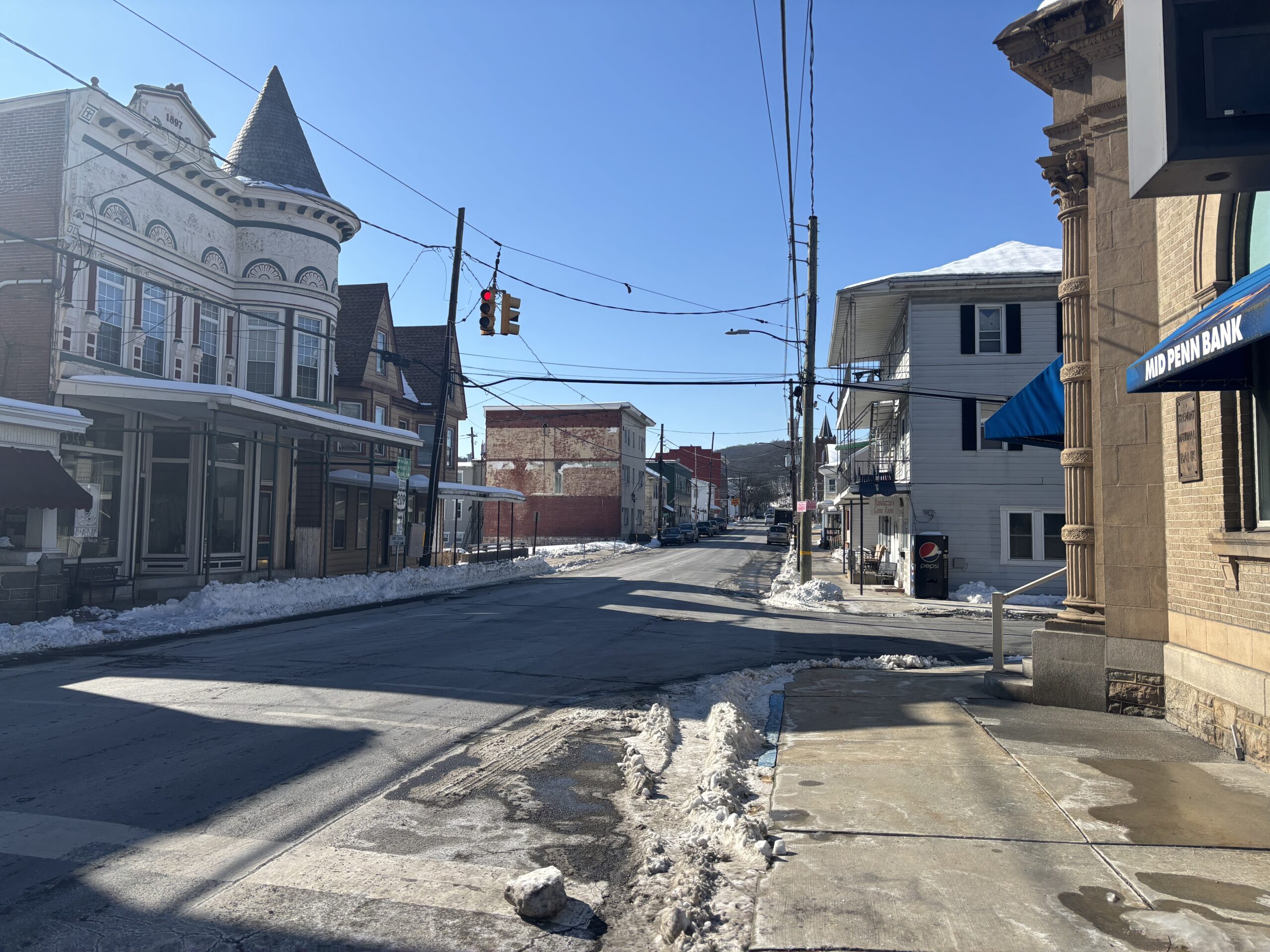
The empty streets of downtown Tremont, Pa., on Tuesday. The 2,000 people of the coal-country borough and its surrounding township would be dwarfed by 7,500 potential detainees at a planned ICE facility on the edge of town.
It’s these kinds of not-in-my-backyard worries that are driving a lot of the initial concern in Schuylkill County, especially from politicians who are cautious in talking about the fraught immigration issue in blood-red Trump country. “I am not going to get into a debate over the overarching immigration policies of the United States of America,” the GOP chair of the county commission, Larry Padora Jr., told a meeting on Wednesday, where he confirmed the ICE purchase of the warehouse.
But a growing number of neighbors do want to talk about those immigration policies, and the stench of inhumanity.
“I’m scared,” Tana Smith, a 24-year-old server at Behm’s Family Restaurant, the local wood-paneled breakfast hangout, told me about the pending ICE project. She, too, blended fears about the daycare site and possible escapees from a detention center with empathy for those same would-be detainees. “People’s families are just being, you know, ripped apart,” she said. “It’s really sad.”
Smith said she’d already gently lobbied her dad — a Republican who said, “I guess it’s just taking care of the illegal people” — against the ICE plan. “I was like, I don’t feel like that’s true at all,” she said. “I feel like they’re going after everyone.”
Andrea Pitzer, author of the definitive history of global concentration camps, One Long Night, said Tremont residents like Smith are right to be alarmed. She told me her research found that authoritarian regimes frequently rely on existing sites like abandoned warehouses or factories as they launch a growing network of gulags.
“The U.S. is clearly echoing previous history with these warehouse acquisitions,” she said. “Dachau — not a death camp, to be sure, but one of the earliest Nazi concentration camps — took over a converted factory when it began its heinous existence in 1933.”
A massive new ICE detention center is coming to Tremont Township in Schuylkill County. At full capacity, it would have a population roughly equivalent to 30 times the Township’s current population: https://t.co/Zp385ZKcjJ
Pitzer asked, “What things will they do on this new, huge scale behind barbed wire?” She noted that the warehouses are a massive expansion of a system that’s already at a record for detainees, with more than 73,000, and is already plagued by squalid conditions, a measles outbreak at the family detention site in Texas, and a death rate as much as 10 times as high as during the Biden administration.
No wonder ICE has moved to buy up new sites — including the two Pennsylvania warehouses — with a practically Soviet level of state secrecy. There are no public hearings. Top lawmakers from both parties have been left in the dark. “This was quiet,” the Democratic county commissioner, Gary Hess, told the meeting. “It was silent. And then, bango! There it was.”
“These will not be warehouses — they will be very well-structured detention facilities meeting our regular detention standards,“ the U.S. Department of Homeland Security insisted in a statement Wednesday. It added that the federal acquisitions “should not come as news,” as ICE expands its nationwide dragnet.
Yet, arguably the region’s most powerful politician, Republican U.S. Rep. Dan Meuser, who voted for the $45 billion fund, has sounded, fittingly, like TV’s fictional German prison camp guard, Sgt. Schultz: He knows nothing, nothing! His spokesperson said Meuser, with both planned facilities in his 9th Congressional District, “has requested a call with … [ICE], and our office has reached out for additional information to better understand the details of the situation. We have not yet received a response.”
Instead, it fell on Meuser’s likely Democratic opponent in November — Rachel Wallace, a former chief of staff for the U.S. Office of Management and Budget who has returned to her native Pottsville — to organize a town hall last week when the project was still rumored.
Lisa Von Ahn (left) and Josephine Kwiatkowski, members of the Schuylkill County chapter of Indivisible, attend a county commissioners meeting in Pottsville on Tuesday to speak out against a proposed ICE detention center in Tremont, Pa.
Most of the 100 or so peoplewho packed a fire hall voiced opposition, but for a variety of reasons. The local GOP state representative, Joanne Stehr, attended and agreed with the not-in-my-backyard concerns, but then drew loud boos when she reportedly said: “I’m saying ICE has a job to do, and it’s going to get done. We are taking out the trash.”
The growing uproar in Schuylkill County echoes brewing battles in many of the 21 other locations, even in areas that voted heavily for Trump in 2024. In Ashland, Va., a Canadian-based warehouse owner canceled its planned deal with ICE after economic pressure and opposition from county commissioners. Elected officials in Roxbury, N.J., and other proposed sites are also fighting to keep ICE out, but it’s unclear how much traction such an effort will get in red rural Pennsylvania.
“We want economic development, and we want good businesses that are part of the community,” Wallace, the congressional candidate, told me as she decried the process and her opponent Meuser’s silence. “And this is the opposite of that.”
And a growing number of Schuylkill County residents say their biggest alarm is less over the NIMBY concerns and more about the idea of their backyard hosting an American concentration camp.
“We have seen firsthand the brutality that government agents are using to detain American citizens, legal immigrants, and law-abiding immigrants without legal status, and the violence in our streets caused by masked, heavily armed agents,” Josephine Kwiatkowski, an Army veteran and retiree from Pottsville, told the commissioners. She said these scenes and “the civil rights violations, the lack of humanitarian conditions [in current ICE facilities], and the discounting of the Constitution are the same issues that I was willing to sacrifice my life to oppose.”
Pitzer, the concentration camp historian, said the time to act is now, before these proposed gulags are up and running.
“Those who made excuses for or ignored these kinds of camps in Russia in the 1920s or Germany in the 1930s couldn’t know how much more vast and lethal those systems would become a decade later,” she said. “But we, who have those examples and other horrors from around the world in our rearview mirror, have no excuse.”
This should be a five-alarm fire, not just for the politicians who’ve been trusted with keeping an American republic, but for citizens who are beginning to grasp a monstrous reality that was set into motion when Trump’s xenophobic demagoguery won a narrow plurality on Nov. 5, 2024. The image of our neighbors shipped in a supply chain like patio furniture and disappeared into the bowels of a Big Lots warehouse should have all of us asking a fundamental question.
Mayor Cherelle L. Parker often says she isn’t a fan of “Monday-morning quarterbacks” and “expert AOPs” — her shorthand for so-called articulators of problems who don’t offer solutions.
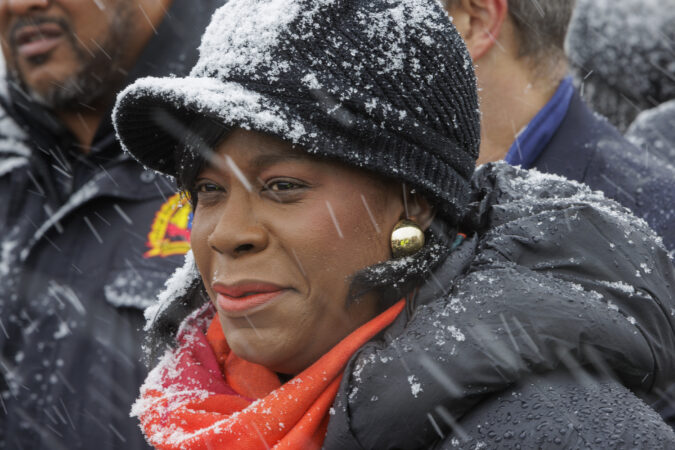
The mayor acknowledged residents’ exasperation at a news conference at the Pelbano Recreation Center in Northeast Philadelphia on Wednesday, her first appearance dedicated to the city’s snow response since Jan. 26, the day after the storm walloped the region.
“For anyone who is frustrated right now about the ice, about the ability for all of the streets to be fully cleared, I want you to know that I understand,” she said. “Everybody can Monday-morning quarterback. … That’s cool. We can’t stop people from feeling the way they feel. But let me tell you something: We were prepared.”
Parker said the city deployed 1,000 workers and 800 pieces of snow-removal equipment to deal with the emergency.
“We don’t promise to be perfect, Philadelphia,” she said. “We promise to go to war with the status quo and to fix things, to be doers. … We’re going to continue doing everything that we can to make sure all of this work is done.”
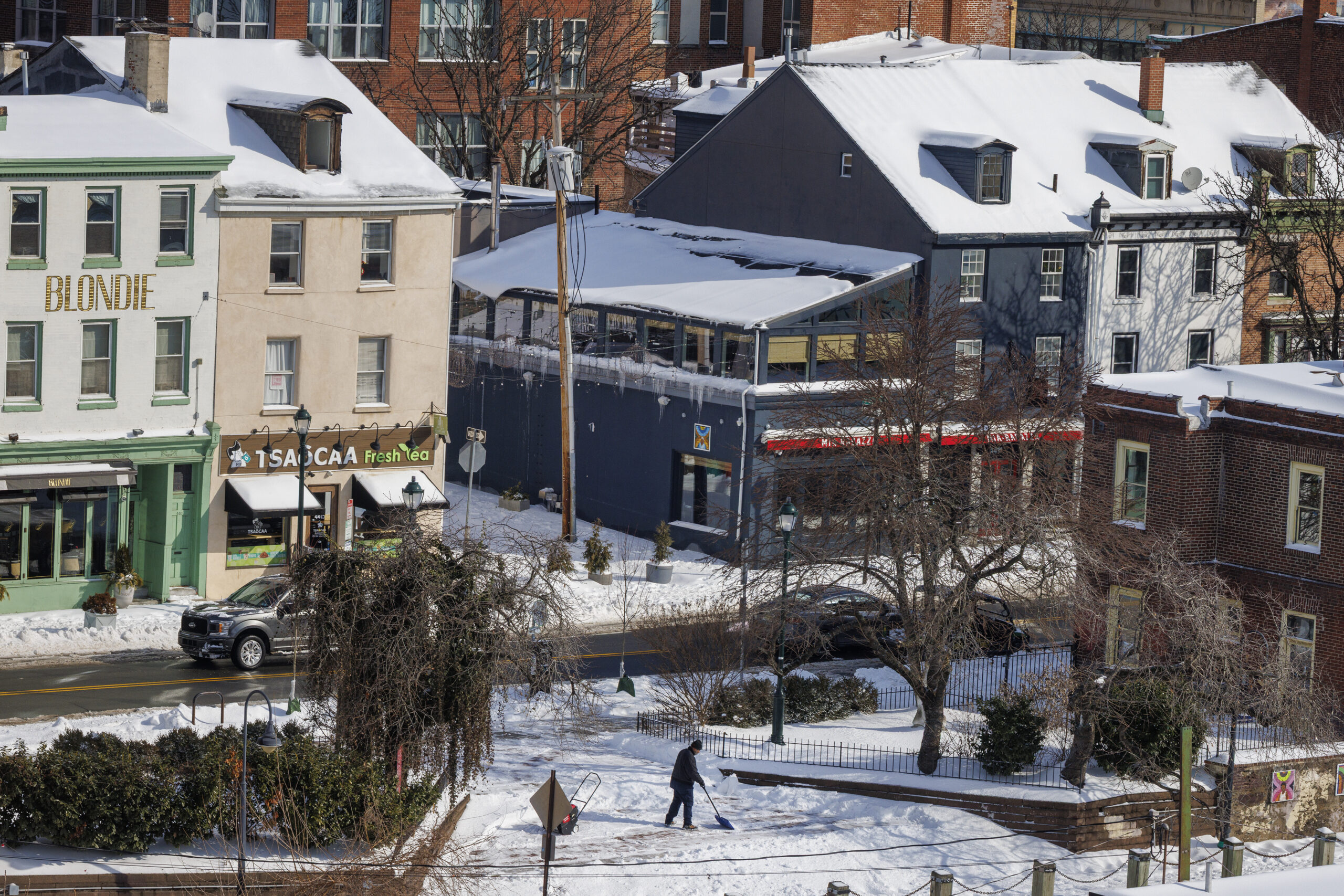
A pedestrian walks past a large pile of snow and ice along the Benjamin Franklin Parkway days after a fierce winter storm dropped up to 9 inches of snow and sleet, with freezing temperatures leaving large banks of ice and snow on streets and sidewalks in Philadelphia, Monday, Feb. 2, 2026.
Snowstorms are infamous for their ability to undermine constituents’ faith in their mayors. Over the years, they have been credited with ending political careers in Denver, New York, Chicago, and Seattle.
The risk of political fallout could be heightened for Parker, who campaigned on a promise to upgrade city services. When Parker ceremonially dropped the puck at Tuesday night’s Flyers game, she was greeted with boos from many fans at Xfinity Mobile Arena.
“Parker has pitched herself as the can-do mayor. ‘I’m not gonna deal with ideology. I’ve got principles, but I’m here to get the job done,’” said Randall M. Miller, a political historian and professor emeritus at St. Joseph’s University. “There’s that expectation you’re going to get this thing done.”
But Miller said the mobility issues associated with snow removal have unique psychological effects for constituents.
“You’re cold, you’re miserable, and you’re trapped. You’re looking around like, ‘Who is confining me?’” Miller said. “You get angry at the mayor because the mayor said, ‘I’m here to provide public services,’ and public service isn’t being provided.”
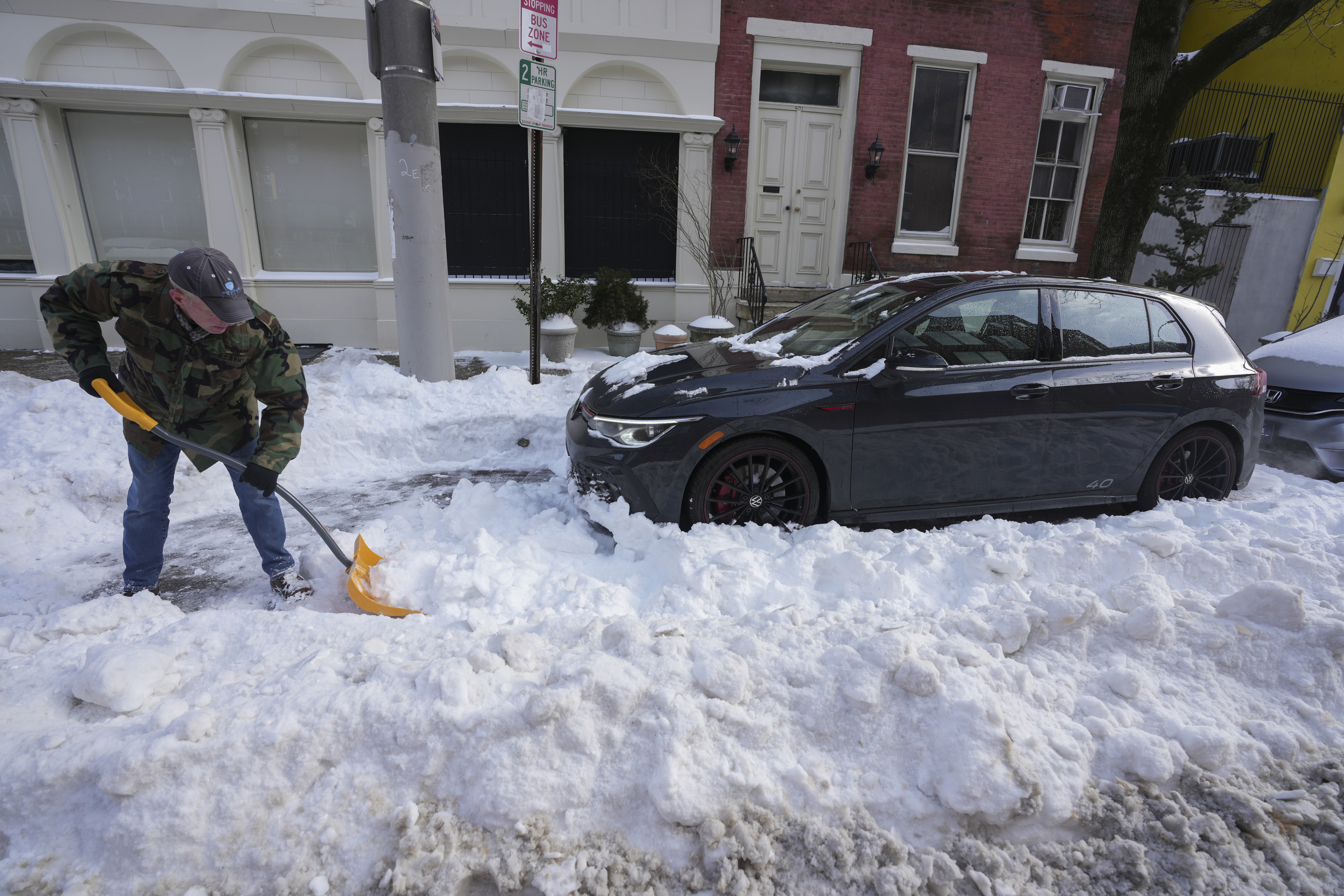
Fred Scheuren shovels snow at 12th Street, near Waverly Street, in Center City, Philadelphia, Monday, Jan. 26, 2026.
The circumstances of this year’s winter weather emergency could also give Parker some breathing room. Municipal leaders in Pittsburgh, New York, Washington, D.C., and Providence, R.I., are all feeling the heat amid the polar temperatures, thanks to an unusually persistent cold snap that has hampered snow-removal operations.
A slight reprieve in the weather this week, with highs peaking above freezing Tuesday and Wednesday, could help the city’s cleanup efforts. But officials warned Wednesday that temperatures are forecast to fall again by the end of the week.
“It’s not hyperbole to consider that we’re still under emergency conditions,” Dominick Mireles, who leads the Philadelphia Office of Emergency Management, said Wednesday.
Lessons from past Philly storms
By some measures, the city threw more resources at the latest storm than in the past, but got fewer returns.
After the legendary blizzard of Jan. 7, 1996, then-Mayor Ed Rendell deployed more than 540 snowplows, dump trucks, and other vehicles to clear away the record 30.7 inches of snow that fell over two days, according to an Inquirer report from that year. Officials bragged at the time that the fleet eclipsed the 300 vehicles marshaled by former Mayor W. Wilson Goode Sr. for the last major blizzard, in 1987.
Four days after the 1996 storm, the city said it hauled away 50,000 tons of snow, including truckloads famously dumped directly into the Delaware River and the Schuylkill. Officials also said that day that about 71% of roadways were passable, including around half of all side streets.
In February 2003, the city got walloped with 19 inches of snow, followed by days of subfreezing temperatures. Four days after that storm, the city said it had cleared 75% to 80% of city streets.
In 2016, Mayor Jim Kenney used 10,000 tons of salt and 1,600 city workers to clear away 22.5 inches of snow, clearing 92% of residential streets by day four — with a major assist from warmer temperatures a few days after the storm.
The 800 pieces of snow-removal equipment Parker cited that were used in the most recent storm are far more than even in the blizzard of 1996. She also said the city brought in a snow-melting machine from Chicago, saying workers had melted about 4.7 million pounds of snow, while scattering 30,000 tons of salt.
The result: More than a week after the end of the snowfall, about 85% of city streets had been “treated,” which includes salting, plowing, or both, according to the city.
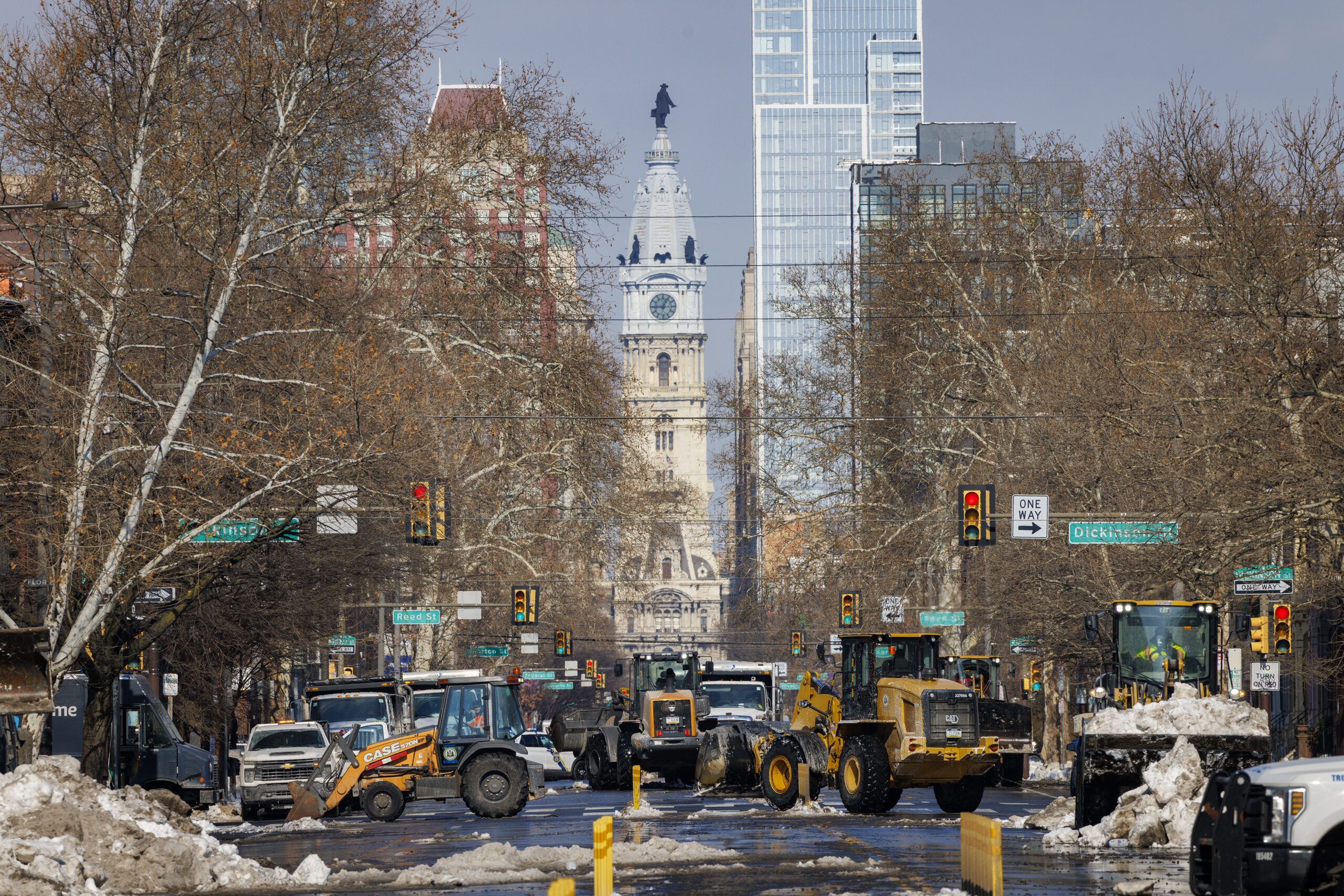
Heavy equipment clearing snow along S. Broad Street at Dickinson Street, Philadelphia, Tuesday, Feb. 3, 2026.
But mobility nonetheless remains limited in much of the city, and officials pointed to the lingering icy conditions.
The prolonged freeze is “not unheard of, but it is unusual, and that stresses and makes the potential for a lot of not-great things to happen,” Mireles said. “It’s affecting the snow-fighting operation.”
An analysis of city plowing data shows that after the conclusion of the storm on Jan. 25, vehicles reached about 70% of city streets by the end of Monday. As the snow hardened, activity slowed by about a third on Jan. 27. Some parts of the city — including neighborhood-size chunks of South Philly — saw little plowing until five days after the storm or longer.
The psychology of snow
One reason voters punish mayors more harshly for failing to remove snow than for other problems is because of its omnipresence, from getting around the city to small talk about the weather, Miller said.
Even trash-collection problems tend not to get under residents’ skin to the same degree because they don’t shut the city down, he said.
“You are furious, and it’s day in, day out,” Miller said. “You’re constantly reminded.”
Trisha Swed walks with her dog Alberta Einstein at North 30th Street and Girard Avenue in Brewerytown on Monday, Jan. 26, 2026 in Philadelphia. In Philadelphia, 9.3 inches of snow fell, the most in a decade.
Parker has turned to private contractors to help with the snow-removal operation. And at Wednesday’s news conference, she touted the city’s efforts to deploy 300 “same-day pay and work” laborers earning $25 per hour to help manually clear streets and sidewalks.
Those moves drew criticism Wednesday from the city’s largest union for municipal workers, District Council 33 of the American Federation of State, County and Municipal Workers, which went on strike for higher wages last summer.
“District Council 33 is deeply concerned by the City’s decision to bring in outside laborers for snow‐removal operations without any consultation or collaboration with our union,” DC 33 president Greg Boulware said in a statement. “Our members deserve better, and the residents of Philadelphia deserve a snow‐removal strategy rooted in safety, foresight, and respect for the workforce that keeps this city running.”
Miller said those efforts show the city is doing everything it can to clear the city’s streets and sidewalks.
“There’s been a great effort to try to deal with it, but Philadelphia is a very difficult place to manage in terms of snow because it’s got so many older streets,” he said.
Man with shovel clearing snow from small park on Main Street in Manayunk on Monday, Jan. 26, 2026.
But, he said, hearing about the city’s efforts is cold comfort to residents struggling to navigate their neighborhoods.
“The major thoroughfares, they’ve done a pretty good job. But folks are concerned with their neighborhoods. They’re not concerned with if they go down to Fourth and Market,” he said. “Once you start to hear those kinds of complaints, it’s hard to contain it.”
Parker said complaints will not deter her team. “Whenever we’ve been dealing with something challenging in government … there are some people who are expert articulators for problems,” she said.
Her staff, she said, “is not a team of expert AOPs.”
“This is a team of subject-matter experts who are doers and they are fixers, and we don’t cry,” she said. “Our job won’t be done until every street in the city of Philadelphia is walkable.”
Staff writers Ximena Conde and Anna Orso contributed to this article.
Meeting for the first time since Superintendent Tony B. Watlington presented his sweeping facilities plan, Philadelphia’s school board heard an outpouring of angst Thursday night from community members upset over 20 proposed school closures.
“Closing schools ruins families and neighborhoods, especially Black, brown, immigrant and working-class communities,” said Caren Bennicoff, a veteran teacher at Ludlow Elementary in North Philadelphia, one of the schools targeted for closure. “A facilities dashboard can’t measure what a school means to children.”
Watlington said the plan represented a “once in a lifetime, significant opportunity” for the city to modernize schools.
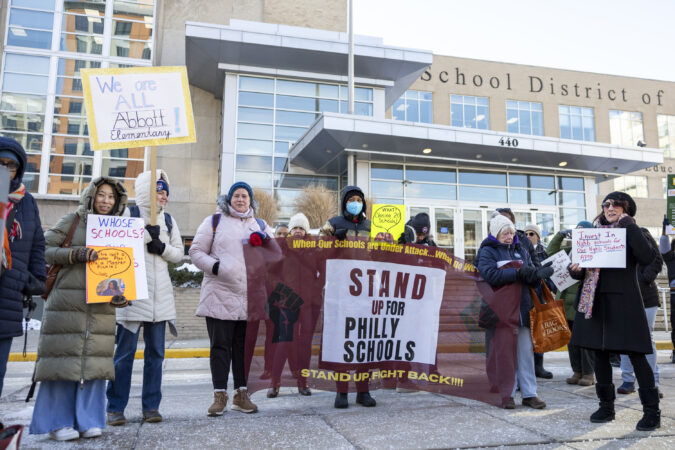
Prior to the meeting, more than 50 people gathered in the bitter cold outside Philadelphia School District headquarters, waving signs and shouting into bullhorns to show their displeasure with Watlington’s proposal.
Emily Brouder, 23, of West Philadelphia, Penn student and intern at Lankenau High School, holds a sign that says “Closing Schools Is Trash.”
Some of the demonstrators warned that removing children from their neighborhood schools would be traumatizing to already vulnerable kids.
“These schools are another home for these families,” said Margarita Davis-Boyer, president of the Lankenau High School Home & School Association. She said schools are a place where kids can get a meal, see a friendly face, and feel safe, especially when home may not offer the same reprieve.
“It’s just an injustice,” she said. Lankenau, the city’s environmental magnet school, would close under the plan, becoming an honors program inside Roxborough High School.
A strong Lankenau contingent packed both the rally and the board meeting, which happened immediately afterward.
LeeShaun Lucas, a Lankenau senior, is upset the school might close.
“To me, closing Lankenau doesn’t make sense,” Lucas said.
Lankenau’s campus is unique in the city — set against a wildlife preserve and a farm, a stream, and a forest.
Lucas has studied how to make the Schuylkill healthier by studying mussels, he said. He’s taking a dual enrollment GIS class — the only such high school in the city to offer such an opportunity, school officials believe.
That exposure has shaped Lucas, he said.
“I truly believe that voting to close Lankenau Environmental would be a mistake,” Lucas said. “Please vote to save Lank so that others may benefit from the type of learning that is only possible at Lankenau Environmental.”
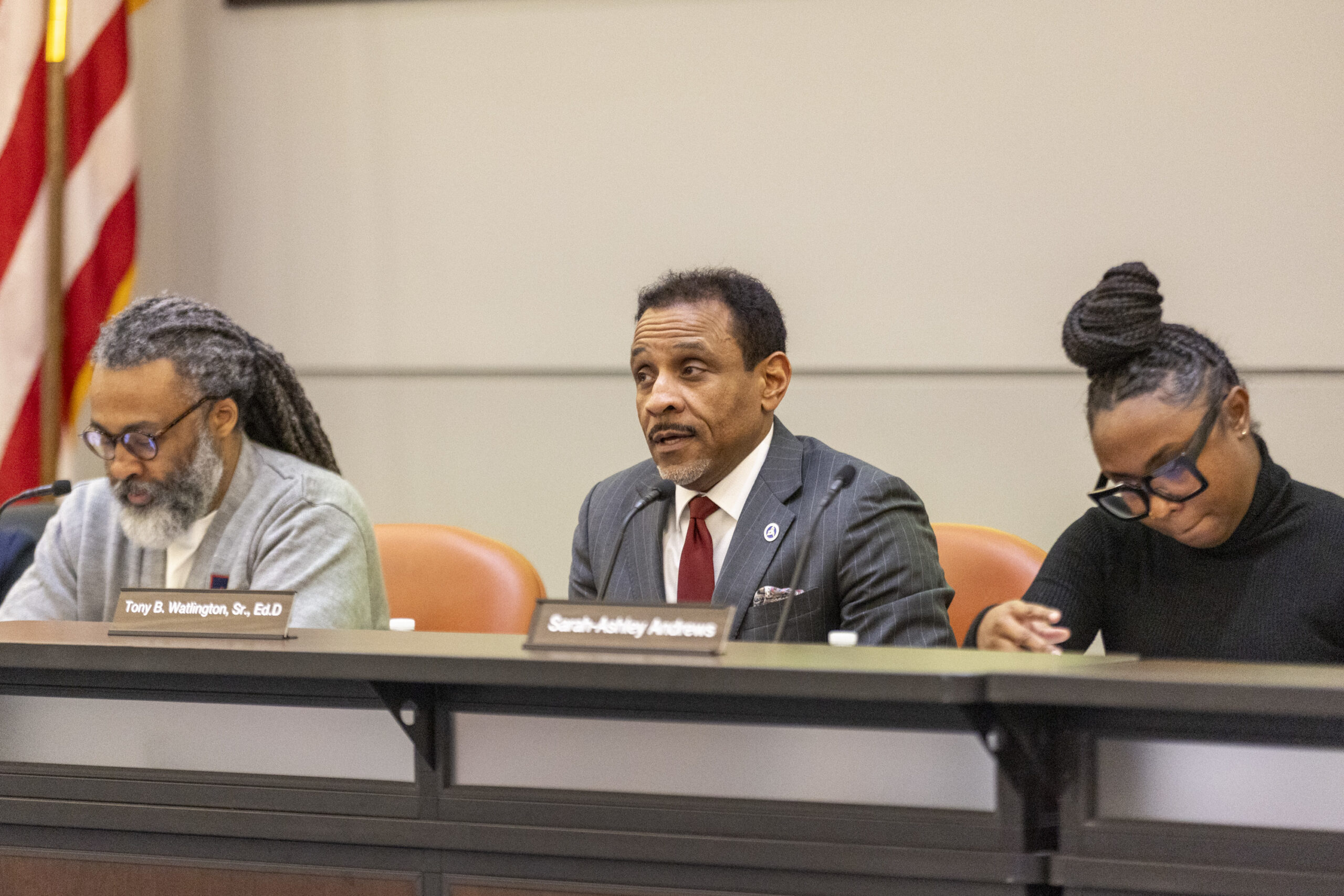
Superintendent Tony B. Watlington (center), Board President Reginald L. Streater, and Board member Sarah-Ashley Andrews at the School board meeting Jan. 29.
Disparate impact
Ryan Pfleger, an education researcher, said if underutilization and facility condition truly shaped Watlington’s recommendation, the burden of closure would fall roughly evenly across racial groups.
But that’s not the case with Watlington’s plan.
“Black students are overrepresented, roughly 1.6 times more likely to be enrolled in schools slated for closure,” Pfleger said. “Fifteen of 20 schools proposed for closure are majority Black. White students are underrepresented, about four times less exposed than expected. The schools slated for closure are also disproportionately low income.”
Pfleger’s conclusions match an Inquirer analysis of the closure data.
The plan, Pfleger concluded, “does not rectify educational injustice.”
Conwell shows up
A strong contingent of Conwell supporters also told the board they were unhappy with the plan to close their school, a magnet middle school in Kensington.
Conwell has just over 100 students in a building that can hold 500. But Erica Green, the school’s principal, said it’s worth saving.
“Conwell for many years has been the cornerstone in the Kensington community, a place where students flourish, where leaders are born; alumni included leaders in government, education, law, media, public safety, and professional sports: Living proof that diamonds truly are in our backyard,” Green said. “Times have changed, but excellence at Conwell has remained the same.”
Conwell is celebrating its 100th anniversary and has been the recipient of public and private donations to advance its building conditions and program offerings.
“Do not let the almighty dollar drive a choice to remove a beautifully designated historic school and beautifully gifted young people,” an impassioned Green said. “The essence, prestige and impact of Conwell Magnet Middle School cannot be duplicated.”
Priscilla Rodriguez, whose two sons attended Conwell, worries about the implications for families that rely on it for stability.
“When a school closes, families don’t just adjust. They struggle,” Rodriguez said. Conwell families “are already dealing with a lot. You won’t make it any better by closing Conwell.”
An incomplete plan?
Katy Egan came to the board with a long list of questions, none of which were addressed in Watlington’s plan: Which schools will be modernized? When? How? How will displaced students get to their new schools? What’s happening to students with special education plans forced to leave their schools? How do you plan to keep kids safe while merging schools?
Egan, a member of Stand Up for Philly Schools, called the blueprint “a 25% plan.”
But, she said, “we deserve more than 25%, and our students deserve everything.”
Community members can weigh in on the plan in the coming weeks at meetings around the city, and Watlington is scheduled to formally present it to the board on Feb. 26.
No vote will happen in February though, said board president Reginald Streater, who declined to weigh in on the merits of the plan until it’s handed over to the board.
In other board news
In other board matters, Watlington said he would soon ask to eliminate half days from the district’s calendar entirely.
The news came as he detailed a slip in year-over-year student attendance: in December, 54% of students attended school 90% of the time, compared to 66% in December 2024. That’s the largest drop in Watlington’s superintendency, he said.
He attributed the challenges to a two-hour delay for snow, light attendance prior to winter break — and light attendance during a half day called for professional development.
Watlington said at next month’s board meeting, he’ll propose amending the 2026-27 schedule to remove half days entirely.
“Half days in the calendar do not serve us well,” he said.
The board also installed three new student board representatives.
The non-voting members are: Brianni Carter, from the Philadelphia High School for Girls; Ramisha Karim, from Northeast High; and Semira Reyes, from the Philadelphia High School for Creative and Performing Arts.
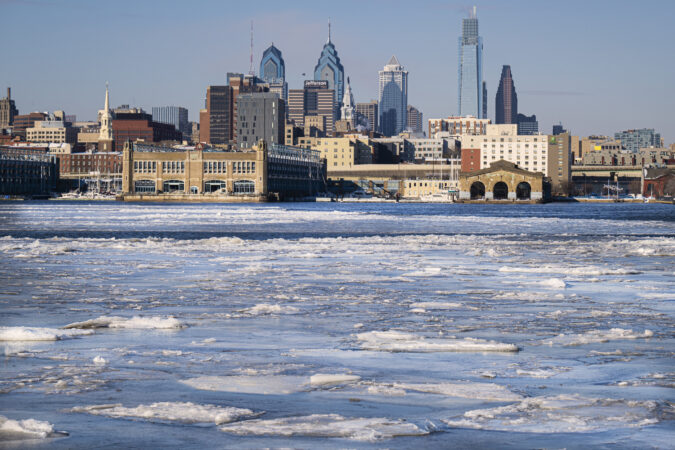
Large slate-shaped slabs of ice in the Delaware River this week have been like a floating harbinger of things to come for the Philadelphia Water Department (PWD).
PWD, which draws its drinking water from intakes along the Delaware and the Schuylkill, takes a freezing river seriously.
It has implemented emergency plans to provide for 24-hour ice patrol at its river water intake plants — and it is on high alert for freezing and bursting water mains and pipes.
The department has two intakes on the Schuylkill and one on the Delaware that help provide drinking water for about 1.6 million people.
There is no easy way to say how much of the rivers are icing. But the Middle Atlantic River Forecast Center at State College, an office of the National Weather Service, uses gauges placed in the rivers by the U.S. Geological Survey. At various times this week, officials could not get readings from some gauges because they were affected by ice.
Brian Rademaekers, a spokesperson for PWD, said the city can also pull from already stored water if ice does became a problem at an intake.
“We’re getting into a stretch where we haven’t been above freezing for days,” he said, “And I think at least through Feb. 1 it looks like we’ll remain below freezing.”
Indeed, the region has been subjected to an Arctic blast for nearly a week. Daily highs have been below freezing since Saturday. The top temperature in that stretch was 28 degrees on Monday. Wednesday hit a low of 14. Overnight Thursday into Friday is forecast to drop to 2degrees.
The National Weather Service is not forecasting a high of 32 until Tuesday. And then it’s back to below-freezing temperatures.
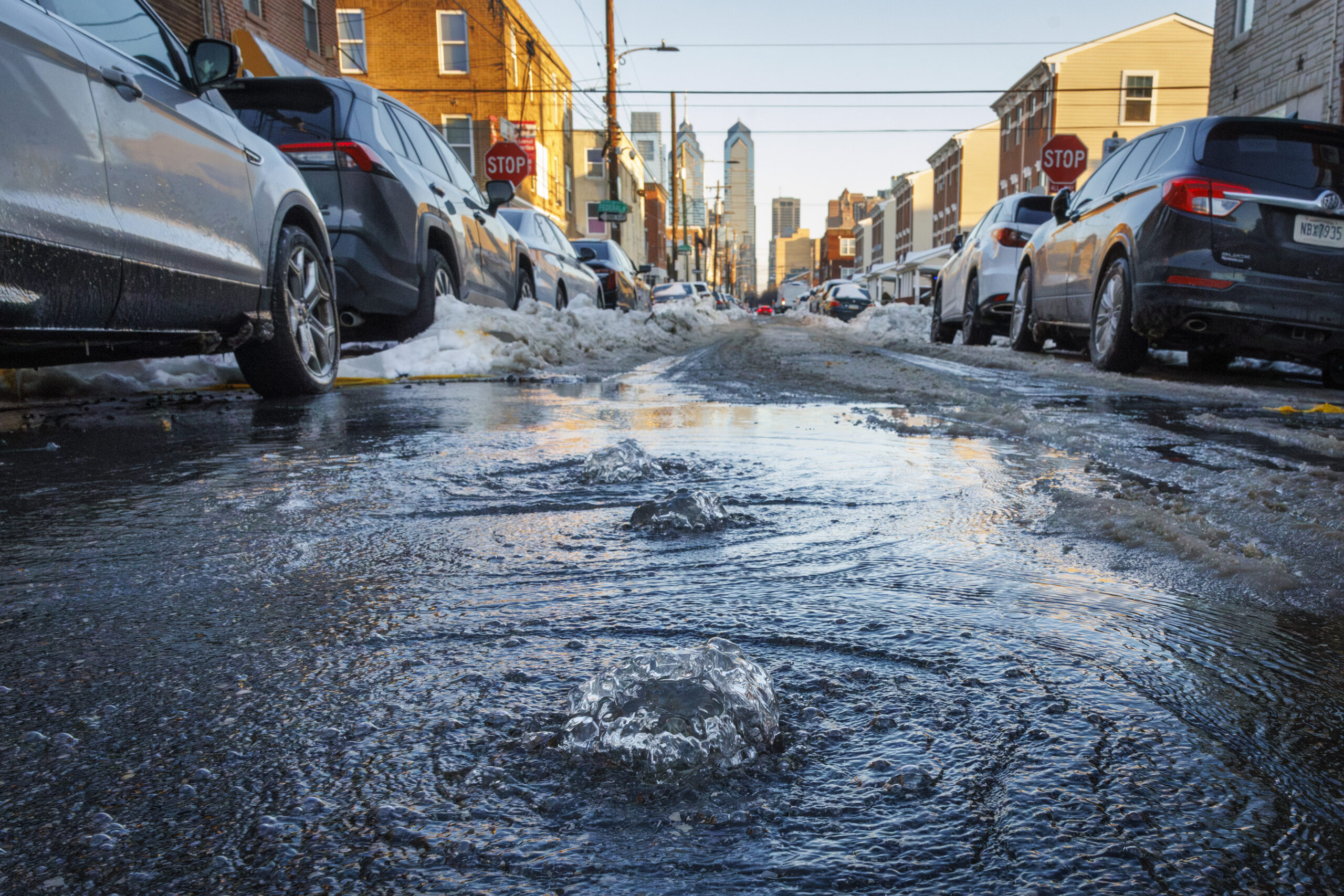
Burst water main on S. 16th Street just below Federal Street, Philadelphia, Wednesday, Jan. 28, 2026.
Bursting pipes
PWD is warning residents and businesses that the extreme cold is affecting city water mains and reminding them thatwater lines that are the responsibility of property owners.
As the city facesunbroken stretches of below-freezing temperatures, PWD knows pipes will begin to freeze or, worse, burst, Rademaekers said.
Pipes can start to be seriously affected after 72 hours, or three days, of below-freezing weather. Philadelphia is past that benchmark.
PWD’scall center is already inundated with reports of water outages and leaks. But the department cannot help people with frozen pipes because that takes away from crews responding to public water main leaks.
Rademaekers said PWD has responded to 147 water main breaks in January, but noted that is a preliminary figure.
Last year, 256 breaks were reported in January. In recent memory, he said, 2018 was the worst year, with 366 breaks.
City mains are public property and range in sizefrom 96 inches in diameter to 48 inches, 12 inches, and 6 inches.
Breaks in smaller pipes are most common. PWD is currently fixing a 6-inch main at 16th and Federal Streets.
Property owners are responsible for the lateral pipes that run from the curb into a home.
Rademaekers said residents who suddenly find themselves without water should check with a neighbor first. If the neighbor has running water, it’s likely the homeowner has a frozen pipe.
In that case, PWD suggests trying to bring the pipes near your water to 40 degrees and opening faucets so that thawing water can drip out and release pressure.
He said running a hair dryer or using another source to gently warm the pipes could help them thaw. He said residents should be cautious trying to use space heaters to warm on pipes.
The department has tips online for how to deal with frozen pipes.
Homeowners should not to wait for the department to respond to take these steps, PWD advises. Doing so could lead to burst pipes.
Rademaekers said many homes in Philadelphia have their main water meter by the wall facing the street, often in uninsulated basements, some with cracked windows.
“When it falls to 6 degrees overnight, even if the heat’s on in your house, that particular space right there might just get cold enough to freeze that pipe up, and then ice kind of spreads through the system,” Rademaekers said. “Once the freezing starts, the pressure will build.”
Rademaekers cautioned customers against calling 311 if they have a frozen pipe. Instead, he said, they should call the PWD hotline at 215-685-6300 and press 1.
“Certainly whenever we see freezing temperatures for more than two days we start to see a surge of calls into the call center,” he said. “Over the last week, the top three reports we have been getting are water in the basement, leak in the street, or no water at the tap.” Some of those could be water main problems, he said, ”but most often they are traced back to private lines.”
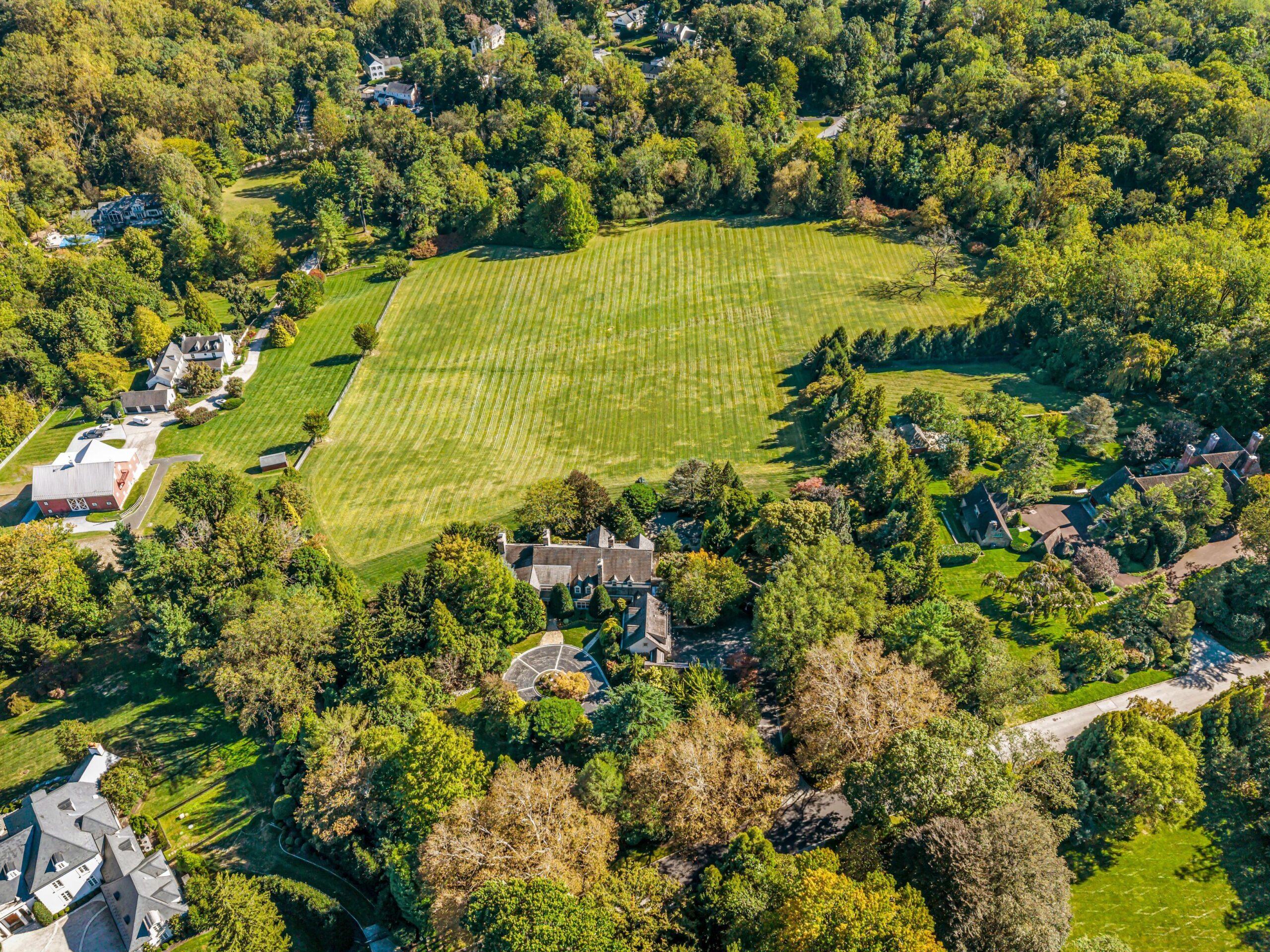
The possibilities are what make a Gladwyne estate for sale on Country Club Road “a significant property,” said listing agent Lisa Yakulis.
It spans 12.76 “very private” acres, said Yakulis, a broker associate at Kurfiss Sotheby’s International Realty. “It’s hard to find that size of a property in that area.”
The 9,166-square-foot home sits on about four acres. A future owner could subdivide the lower part of the property to create two roughly four-acre lots. An existing easement would provide access to the additional lots.
The home for sale on Country Club Road in Gladwyne sits on almost 13 acres, which can be broken into separate lots.
Yakulis said she’s seen that on the Main Line in the years since the pandemic, “desirable building lots with that kind of acreage are, No. 1, very hard to find, and No. 2, there’s a fairly large buyer pool out there that’s looking for land in that location to build exactly what they want to build vs. buying a resale home.”
The home on the property was custom built in 1993, and its floor plan is more open than homes of that time. It was designed to host the owners’ family and friends, which it has done for the last three decades.
The house has six bedrooms, eight full bathrooms, and three half bathrooms. Many large windows provide panoramic views of the property. The home has an elevator, six fireplaces, a library, two laundry rooms, and flexible living spaces.
The front door of the home opens to a chandelier and winding staircase.
The primary suite has two separate bathrooms and large dressing rooms. The main kitchen includes two ovens, a large island with a stove, bar seating, and a refrigerator that can be concealed behind sliding wooden panels.
The property has a total of three guest suites on the lower level, in a private section of the main level, and above one of two oversized two-car garages.
The home’s lower level includes another large kitchen, a sauna, entertainment space, and a walk-in safe.
The main kitchen includes three sinks, two ovens, and a large island with a stove.
The property features stone terraces, a pool, landscaped grounds, and acres of open land. A cottage-like utility building equipped with a half bathroom is where the owners cleaned their dogs. But it also could be used as a gardening shed or workshop.
Potential buyers who have toured the home said they like the privacy, views, and location. The Main Line property is near preserved open space, the Schuylkill Expressway, and Philadelphia Country Club. Yakulis said the home is on a quiet street with plenty of space between neighbors.
The property has attracted people of various ages, including empty nesters who like the elevator and the guest suites that offer spaces for visiting children and grandchildren.
“I get the comment when people come through that it’s a happy house, and it’s true,” Yakulis said. “You walk in there and the light pours in, and you can just tell that it’s a happy house. It has a good vibe.”
The property was listed for sale in October.
A gate opens to the circular driveway in front of the home.