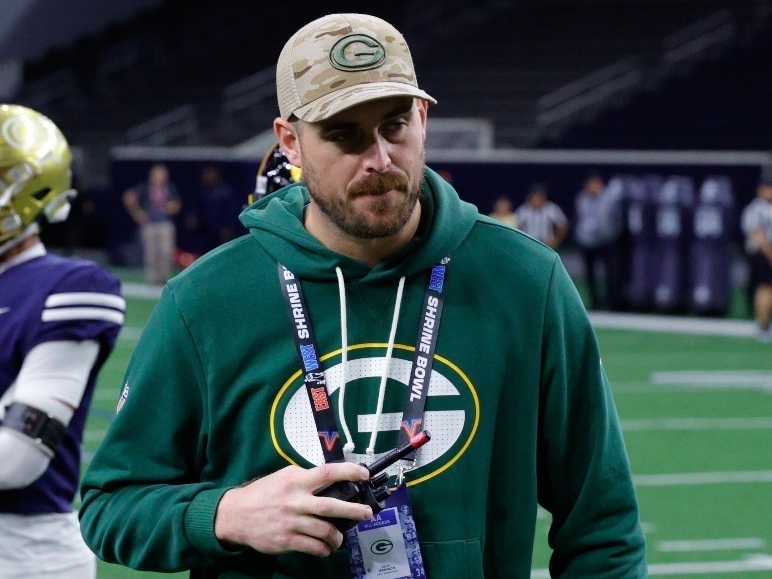
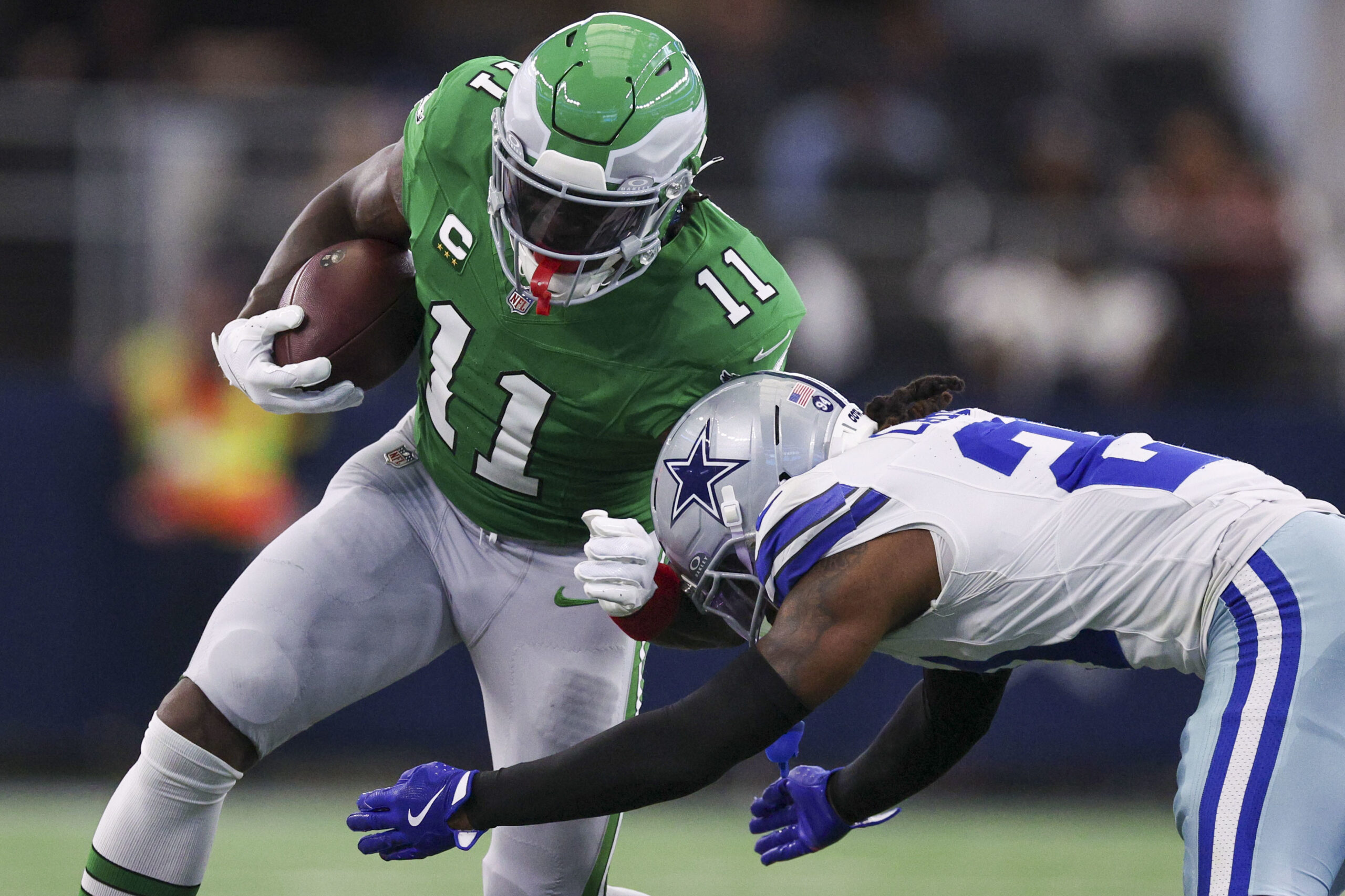
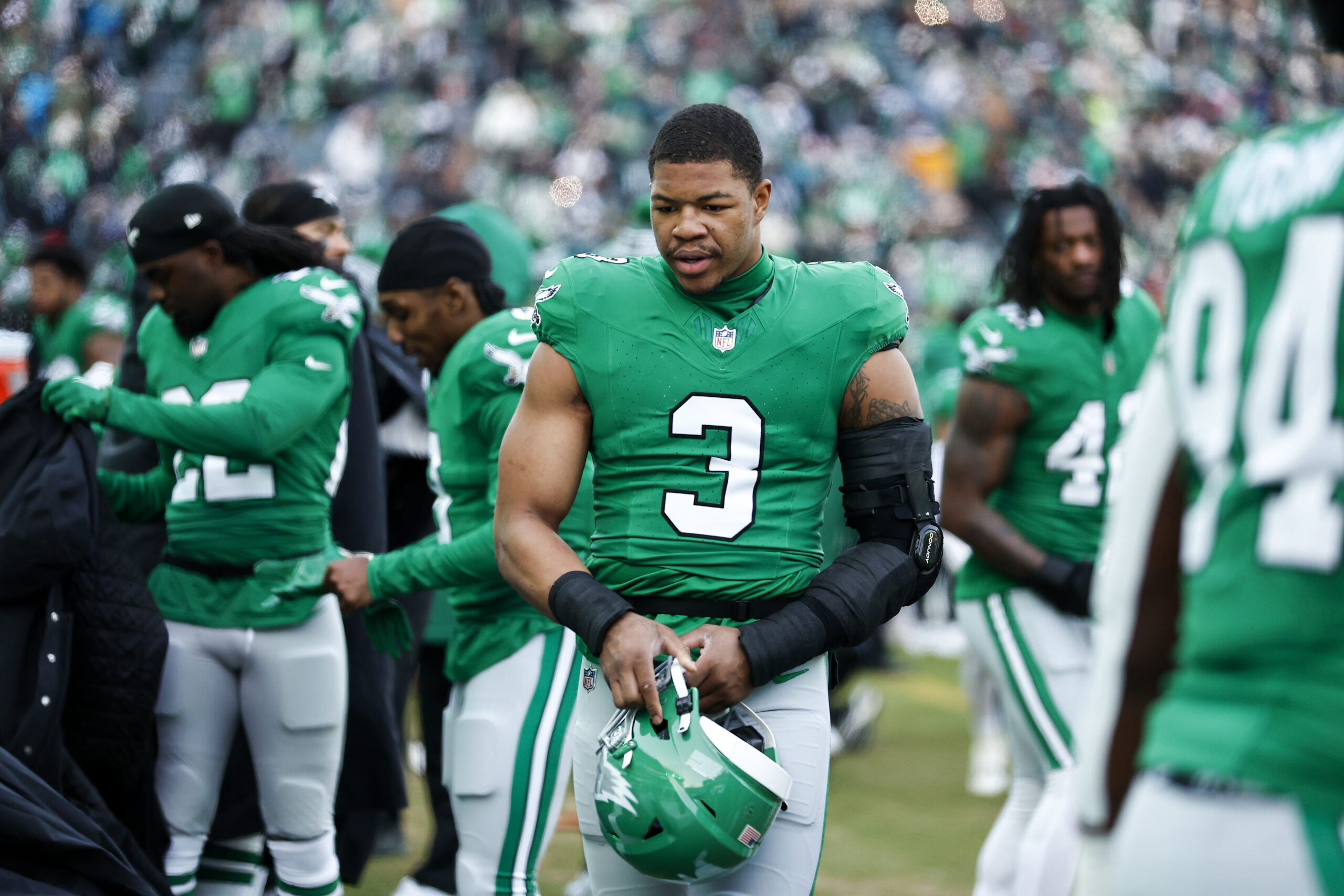
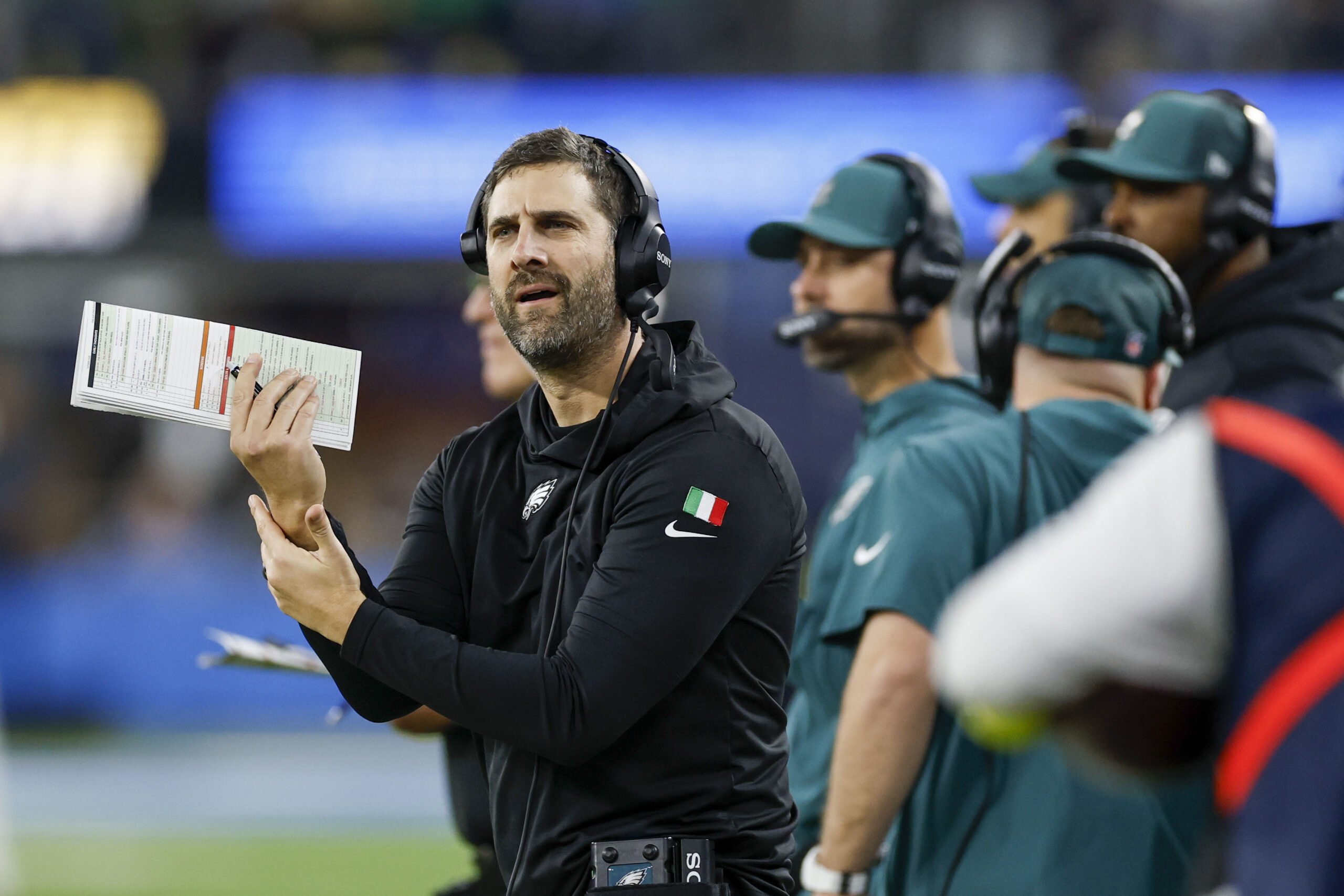
The offseason program is over, and the next time the Eagles get together at the Jefferson Health Training Complex, it will be for training camp — the official start to the 2026 NFL season.
The longest stretch of downtime around the league is right now, so it’s a good time to take stock of what we just saw during organized team activities and mandatory minicamp.
The workouts allowed for a first look at new offensive coordinator Sean Mannion’s offense and a few new key players for the Eagles, but they also left some lingering questions about the team during the break.
Here are some of the things we’re still thinking about:
How long should the probationary period be for the new-look offense?
The short answer: Longer than will probably be allowed.
Eagles fans read and watched analysis here and probably elsewhere that told them Mannion’s offense was little match for Vic Fangio’s defense during the recent practice sessions open to reporters.
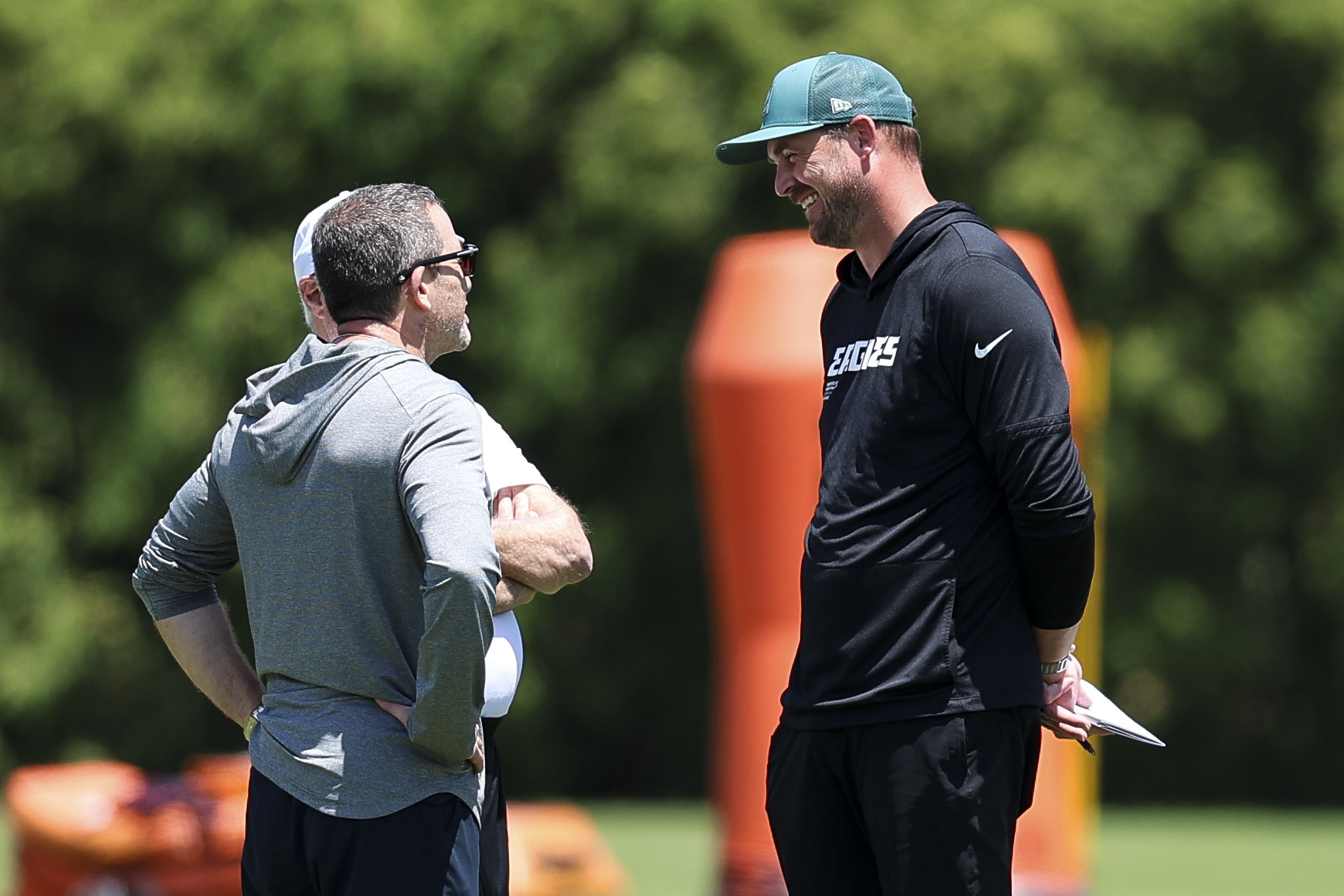
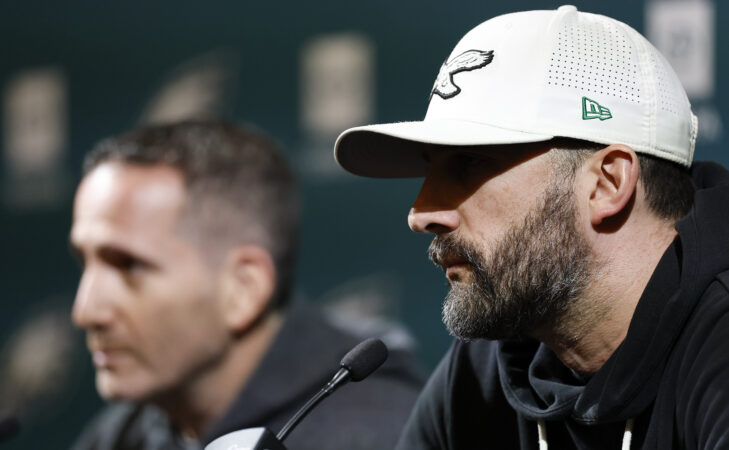
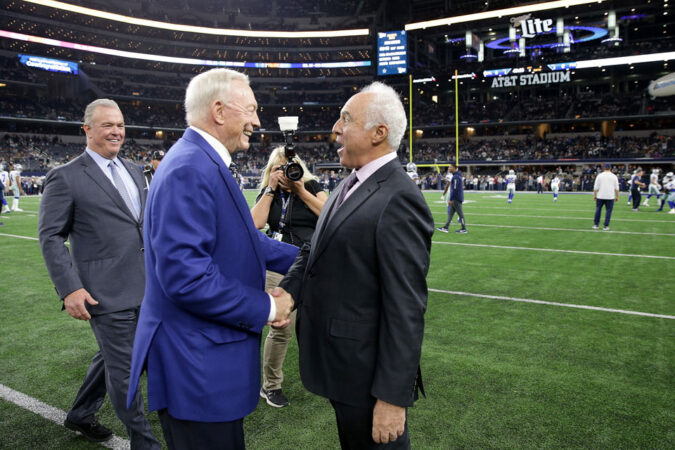
Jeffrey Lurie and Howie Roseman speak with Sean Mannion (right) during mandatory minicamp.
What’s the reaction going to be if the offense looks sloppy a few practices into camp? It’ll be an outsized one, for certain. But it shouldn’t be.
There are a few reasons why:
Fangio’s defense might be among the best in the NFL this season.
The Eagles are installing a new offense with new blocking schemes.
Jalen Hurts is taking more snaps from under center.
The Eagles are using more play action and more motion.
Football is football, and some players will say as much, but there are going to be some growing pains before the offense is firing on all cylinders.
Plus, while the focus of many will be on the play-calling and what the playbook looks like, it may all just come down to the health and force of the offensive line anyway.
That’s not what the question asked, though. How long should the probationary period be? The view here is that drawing major conclusions about Mannion’s offense won’t have enough context until at least three games into the regular season. Patience levels are personal, right?
Is it possible that the A.J. Brown trade was such a foregone conclusion that the biggest roster storyline in an otherwise pretty standard offseason program was the backup quarterback position?
Andy Dalton and Tanner McKee are splitting reps behind Hurts, Nick Sirianni says, but the coach wouldn’t commit to saying McKee is the backup quarterback, the spot on the depth chart he held last season. He doesn’t have to commit to anything in June or even July or August.
But the fact that Dalton took so many reps with the second-team offense was interesting.
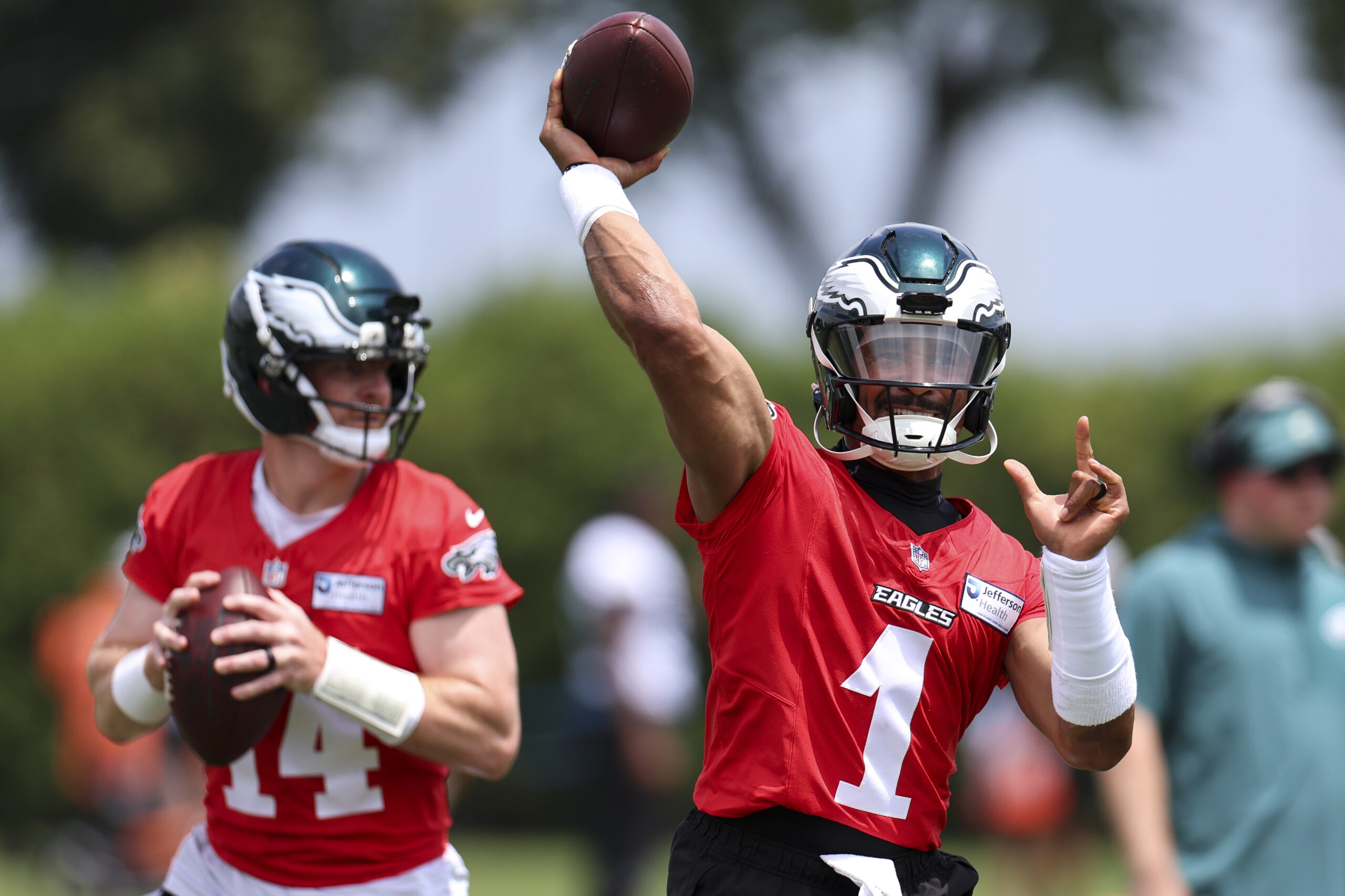
Quarterbacks Andy Dalton (left) and Jalen Hurts work out during mandatory minicamp.
It’s fair to wonder if McKee will be on the roster by the time camp breaks, and the Eagles are crunching numbers to get to their initial 53-man roster. The Eagles used a fifth-round pick on quarterback Cole Payton after sending a seventh-round pick to Carolina for Dalton.
It’s hard to imagine they will keep four quarterbacks on the roster, and it’s hard to imagine them wanting to expose a fifth-round pick to waivers unless Payton has the type of uninspiring training camp sixth-round pick Kyle McCord had last year.
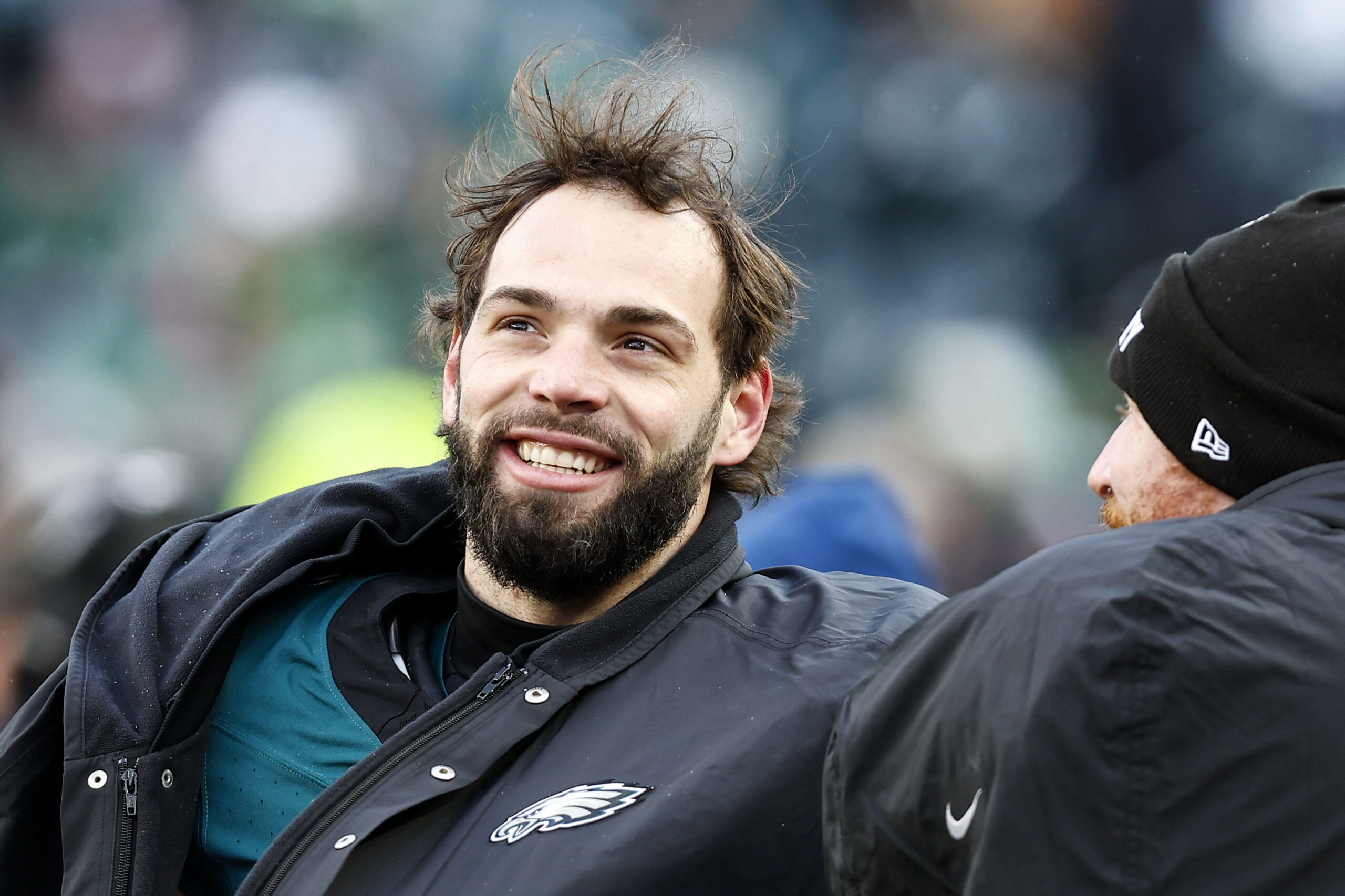
The guess here is that Howie Roseman is hopeful McKee puts some good play on tape in the preseason, and the Eagles get some draft value back in a trade for their 2023 sixth-round pick, who is entering the last year of his contract.
Is a quiet spring from top Eagles rookies concerning?
It shouldn’t be.
But their first three picks were hampered by injuries.
First-round pick Makai Lemon, who will be asked to contribute in a big way right away with Brown out of town, missed some time with a hamstring injury but is expected to be ready for camp. Sure, he didn’t get a ton of on-field reps, but it wasn’t like he was on an island somewhere while the Eagles were installing stuff in the meeting rooms.
Makai Lemon was bothered by a hamstring injury during minicamp.
Eli Stowers, the second-round pick out of Vanderbilt, did not stand out in early workouts despite the Eagles raving about his athletic traits after selecting the tight end at No. 54. He then wore a sleeve on his right leg during the final workout of minicamp and sat out some drills.
Markel Bell, the big tackle the Eagles took in the third round, also missed the last practice of minicamp.
As for Stowers, Sirianni continued to have a lot of good things to say about him on the last day of the spring session. The former college quarterback is still only a few seasons into playing tight end, and while the Eagles are high on him — “He has an unusual skill set at the tight end position with the matchups that he is going to be getting,” Sirianni said— they also know he has a lot of work to do.
It’s way too early to be alarmed about the rookie class.
Will there be any roster additions before training camp?
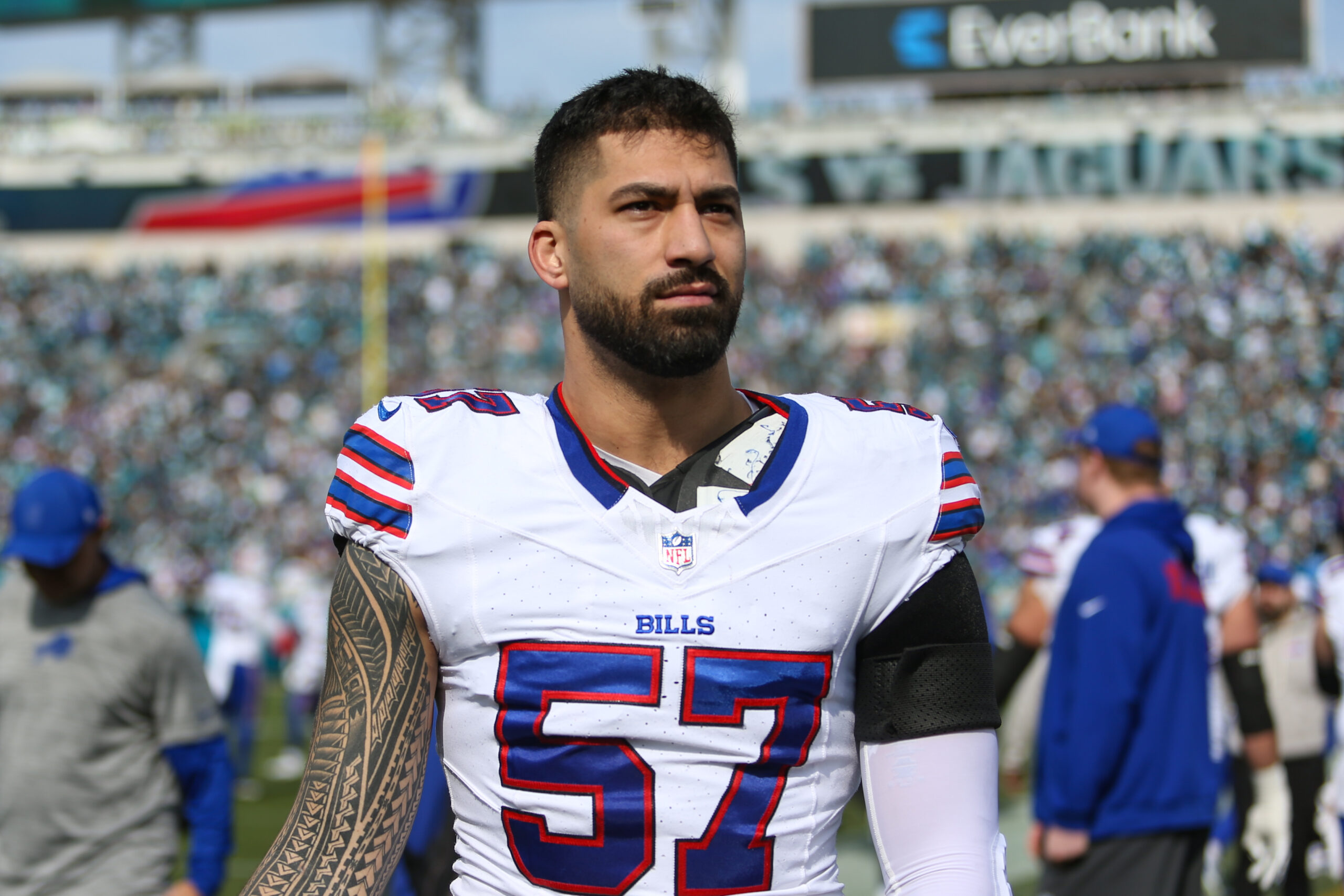
Roseman kind of answered that question just hours after the final on-field workout finished when he signed former Bills edge rusher A.J. Epenesa. That move made some more sense on Tuesday, when the Eagles placed free-agent signing Joe Tryon-Shoyinka on the reserve/retired list.
Epenesa, who was drafted one spot after Hurts in 2020, originally signed with the Browns, but that deal did not finalize after Epenesa’s physical. Edge rusher was one spot, however, where the Eagles needed some more talent for some bottom-of-the-depth-chart competition. There’s a clear trio at the top in Jonathan Greenard, Jalyx Hunt, and Nolan Smith, and then there’s Arnold Ebiketie. Epenesa, who had six-plus sacks in three consecutive seasons from 2022 to 2024, figures to be in the mix for a roster spot.
A.J. Epenesa, seen here as a member of the Bills, is a recent addition to the pass rushing depth chart.
Where else could the Eagles upgrade?
Safety might be the only position on the team that still has some question marks. The Eagles plan to use Cooper DeJean at safety in their base defense with Quinyon Mitchell and Riq Woolen manning the outside corner spots. But that leaves around 75% of the reps next to Drew Mukuba for someone not named DeJean. Right now, it’s Marcus Epps’ spot to lose. But Epps is 30 and was available as a practice-squad addition last August.
Behind Epps is Michael Carter II, who has played mostly nickel, and J.T. Gray, another 30-year-old with mostly special teams experience. Then there’s a mix of young and unproven players.
Fangio has expressed confidence in Epps, and thinks Carter has the chops to play safety, but don’t be surprised if Roseman adds some more talent to the group before camp.
The 2026 NFL free agency period begins on Monday, when “legal tampering” will give way to a number of reported deals across the league. Free agency will officially begin on Wednesday, and the Eagles will be players — though how aggressive general manager Howie Roseman and Co. will be remains to be seen. With limited available cap space and the specter of a possible A.J. Brown trade adding to the uncertainty, how the Eagles handle this period elicits a wide range of possibilities.
The Inquirer’s Eagles reporting team of Jeff McLane, Olivia Reiner, and Jeff Neiburg got together for a roundtable ahead of next week’s festivities.
What’s one practical free agent move you could see the Eagles making next week, given their cap space and personnel situation?
McLane: Dallas Goedert is slated to become an unrestricted free agent for the first time in his career, but even if he signs with another team, the Eagles won’t have a clean break from their longtime tight end. They still have an approximate $20 million dead money charge from a void year added to Goedert’s contract. That’s a lot of money to eat for a productive player they may want to keep. The Eagles, more than any other team, have been comfortable kicking cash into future years. But Roseman can’t be reckless, and if trading Brown becomes a reality, the general manager would have around $45 million more in dead money on the books.
Could franchise staple Dallas Goedert run it back in Philly after his career touchdown year?
Brown’s return, though, could warrant Goedert coming back for a ninth season. He put up solid numbers, catching 60 passes for 591 yards and a team-high 11 touchdowns, despite the Eagles’ pass offense inconsistencies.
Was Goedert as dynamic as in years past after the catch? No. But he wasn’t given as many chances to run in space. The new Shanahan-McVay parts of the offense could accentuate Goedert’s post-catch abilities. The bigger question is whether he can run block like he once did. The Eagles weren’t happy with his output there. You have to wonder if taking a $4.25 million pay cut last season affected his effort, or occasional lack thereof. Goedert will have suitors on the open market. Is he worth as much as the Ravens’ Mark Andrews, who signed a three-year, $39 million deal in December? If so, it seems unlikely the Eagles re-sign Goedert, unless he wants to end his career in Philly and takes less.
The draft is believed to be deep at the position and there are other avenues to finding a No. 1 tight end — perhaps a trade? — but there’s an argument to be made for keeping Goedert.
Reiner: Re-signing Braden Mann. This seems like the football equivalent of a layup (a check down, perhaps). Mann, 28, is coming off the single best season by an Eagles punter in franchise history. He averaged 49.9 gross yards per punt, making his Eagles career average a franchise-leading 49.5. His net yards per punt (subtracting return yardage) finished within the top 10 in the NFL (43.1; No. 9 in the NFL).
Mann often helped flip the field during a season in which he was forced to punt a lot (72 punts, tied for No. 4). He deserves an extension, which wouldn’t break the bank. The Eagles are just a few years removed from their previous punter woes and they shouldn’t go back down that path by starting over with new contenders for the gig.
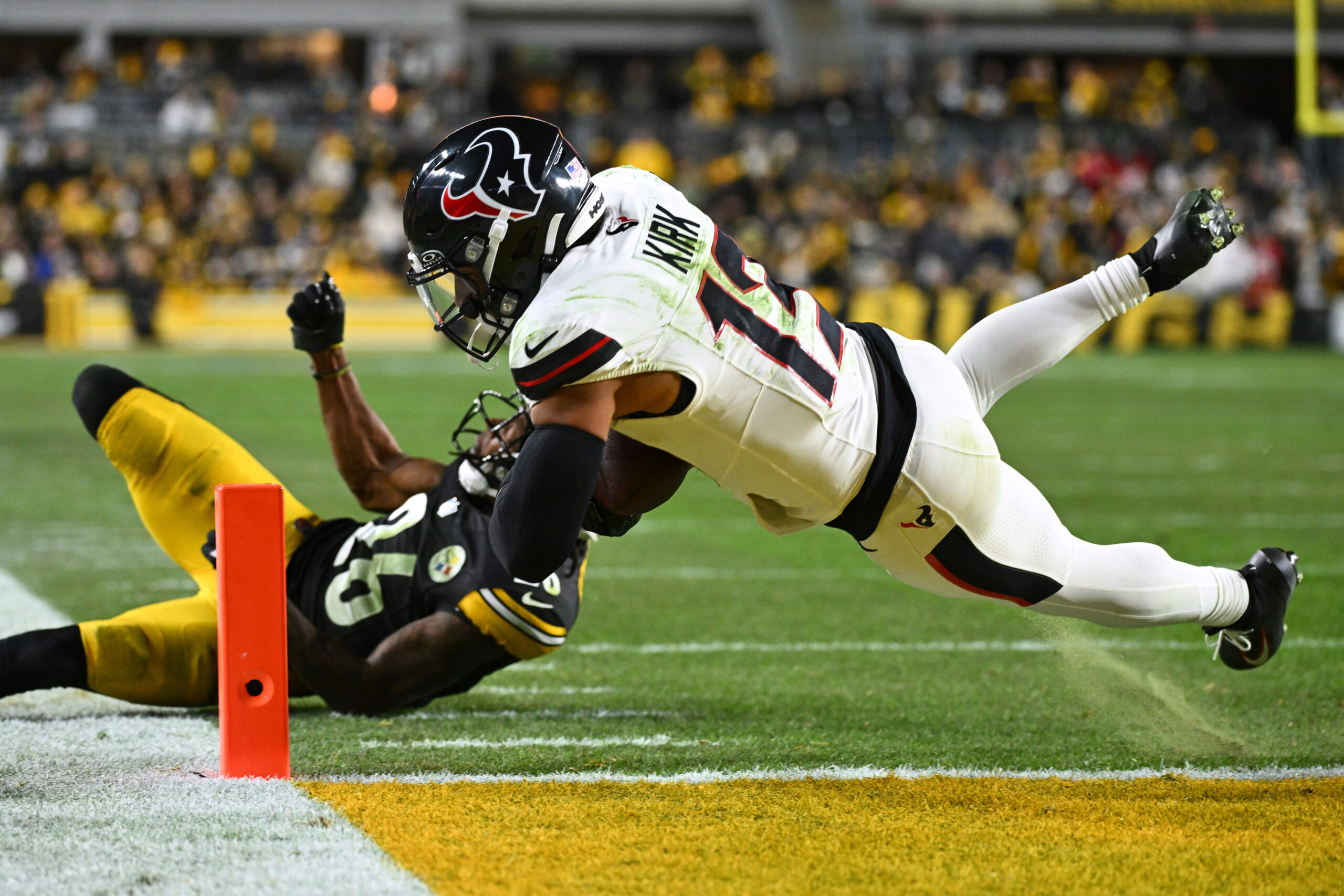
Is Christian Kirk (13) a free agent wideout possibility for the Birds?
Neiburg: Signing Christian Kirk to a relatively cheap contract given his talent. This is with or without Brown on the roster. Kirk has been limited by injuries over the last few seasons and ran routes with a crowded receiving corps in Houston. But he had a stretch of really good football from 2021 through 2023, tallying 2,877 yards on 218 catches, 16 of them for touchdowns. Kirk’s alignment favors the slot, but he has played plenty on the outside. The Eagles need to infuse the unit with more young talent, but Kirk, 29, could help bridge the gap, and if Brown is traded he would give the Eagles an experienced running mate for DeVonta Smith.
What’s a bolder, but perhaps less likely move you could see the Eagles making?
McLane: Trade for Maxx Crosby. If the Eagles decide they can’t afford Jaelan Phillips, they could be in the market for a top-end edge rusher. Crosby qualifies as a difference maker and would be an upgrade over Phillips or the returning Jalyx Hunt and Nolan Smith. It would cost a lot, of course. The Raiders are said to want two first-rounders and a player (Smith?) in return. But elite edge rushers are rarely available and Crosby’s existing contract isn’t a backbreaker. He has four remaining years at around $29 million per season, but only next season’s $30 million base salary is guaranteed. (editor’s note: Crosby was traded to the Ravens Friday night).
Crosby has made it clear he wants out of Las Vegas. He has expressed his fondness for the Eagles and Philadelphia as a sports town. Perhaps he would be willing to adjust his deal to expedite a trade. Roseman may be cautious for various reasons. Crosby turns only 29 in August, but he’s logged more snaps than almost any defensive end over the last five seasons. He’s also coming off back-to-back season-ending injuries that required surgery to repair his ankle and a torn meniscus in his left knee. That’s why I think the Raiders’ reported asking price is unrealistic.
There will be competition for Crosby, but the Eagles aren’t likely to repeat the mistake of going into another season with just Hunt and Smith on the edge. Phillips was a good trade deadline acquisition, but a tepid pass rush was an under-the-radar reason why the Eagles defense struggled in the second half of the playoff loss to the 49ers.
Jaelan Phillips is a top-5 NFL free agent who could end up with a huge deal in a location other than Philadelphia.
Reiner: Re-signing Phillips. He might be the Eagles’ top priority among their own group of pending free agents, but he isn’t a slam dunk to return. At 26 years old, he slotted in nicely to Vic Fangio’s defense in a short period of time at a premium position. He made an impact on the pass rush despite posting unassuming sack numbers (two in eight games). He stayed healthy for all 17 games in 2025, with the Eagles and the Miami Dolphins, one year removed from a partially torn ACL (and two years removed from a torn Achilles).
But the Eagles ought to be realistic about a potential extension. Phillips was a net-positive addition last season, but he was not a game-wrecker. The Eagles likely won’t be inclined to pay him as such, given their lack of cap space in 2026 and their need to extend key defensive players both this offseason and in years to come. The Eagles will likely set a walkaway number for Phillips and move on if another team outbids them.
Neiburg: Trading Brown … and trading for his replacement. Trading Brown is pretty bold in itself, but if it happens, the Eagles have a big hole to fill. There’s no doubt DeVonta Smith can handle all that comes with being the focal point of the passing game, but the roster is bereft of receiver depth, and if the Eagles aren’t thrilled with the free agent market — like, say, Kirk or someone like Romeo Doubs are more expensive than they prefer — they could go the trade route and trade from their roster or draft picks to acquire a receiver. Who could be available? Here are a couple of names to target via trade: Jacksonville’s Brian Thomas Jr. and Buffalo’s Keon Coleman.
Does Sean Mannion scheme require a tailoring of the team’s offensive personnel?
How much do you think the team’s offensive staff changes will inform their free agent and draft approaches?
McLane: Aside from the quarterback position, the offensive line is the most likely to be affected by the expected scheme changes. New offensive coordinator Sean Mannion is bringing with him a Shanahan-McVay system that will alter blocking in the run game. Will there be a complete whitewash? No. But the Eagles are likely to shift from less mid-zone to more wide-zone blocking. Those terms might not indicate how different the techniques are, but the former emphasizes more reactionary blocking and winning at the point of attack, while the latter features O-linemen firing off the ball and blocking at an angle.
Asked how the changes may affect his evaluations, Roseman conceded he may be looking for more agile O-linemen. The Eagles already have athletic freaks up front, although injury-riddled left guard Landon Dickerson may not qualify as such.
I don’t think Roseman will do much at the position in free agency. He does have decisions on reserves Fred Johnson and Brett Toth. I don’t think the scheme change rules out either for a return. But they don’t have an advocate in former offensive line coach Jeff Stoutland anymore. His replacement, Chris Kuper, won’t likely have as big a voice as Stoutland in personnel. But the Eagles are almost guaranteed to expend a high draft pick on an O-lineman with right tackle Lane Johnson closer to retirement than ever.
NFL Network’s Daniel Jeremiah recently projected seven first-round O-linemen in the 2026 draft and then a drop-off in terms of talent. Maybe one of the top guys slips into the second round and there’s a chance to pick up value, but I’d be surprised if Roseman didn’t expend the Eagles’ No. 23 overall pick — or more in a move up — to secure Lane Johnson’s expected successor.
Neiburg: It should inform the approach plenty. Especially when it comes to how they address the tight end position. Roseman knows he has long appreciated the receiving component of the tight end, but the new scheme will require a lot better blocking than the Eagles got last year and even in prior seasons from the players behind Goedert. As Jeff mentions, it’s possible Goedert returns in 2026 in free agency, but the Eagles would need to slot players behind him who block a lot better than Grant Calcaterra. One name I could see fitting in well is Jake Tonges, who doesn’t offer a ton in the pass game but was an elite blocker for the 49ers.
A.J. Brown’s situation could have an impact on the team’s free agency approach.
Reiner: Given the expected shift in run-game philosophy under Mannion, the tight end and offensive line additions could reflect those changes. I think the prospective wide receiver additions will have layered influences, especially as it relates to Brown’s future. Naturally, the Eagles’ need at receiver becomes much more pressing if (big if) they decide to move the star receiver before the start of the season.
Otherwise, aside from adding a WR3, the Eagles don’t need to overhaul their receiving corps to fit the scheme. If we’re looking to the Packers offense for clues about what the Eagles might look like in 2026, we can expect to see more under-center play action, pre-snap motion, and misdirection as a means of scheming open space in the passing game. That space helps receivers generate yards after the catch and explosive plays downfield.
The prosperity of the scheme seems to be rooted more in its design, not so much in the raw talent of its players, a departure from Eagles offenses past. That isn’t to say the Eagles aren’t looking for talented receivers, but more so that the prototype of a talented receiver isn’t likely to change dramatically.
Besides A.J. Brown, who else could the Eagles trade?
McLane: This may seem like a reach, but I could envision a world in which Nolan Smith is being floated on the trade market, assuming either Phillips, Crosby or some edge rusher equivalent is on the roster by the draft. Smith hasn’t been a bust — far from it. A shoulder injury limited him during his rookie season, but he blossomed in the second half of his sophomore year. Tricep woes sent him to injured reserve last season and he finished with just three sacks and 11 quarterback hits. He’s good at setting the edge and has a high motor, but he’s undersized and struggles to win consistently as a pass rusher.
Hunt has a higher ceiling, is one year younger and was drafted two rounds after Smith. It’s going to be tough for Roseman to pay both, especially with defensive tackles Jordan Davis and Jalen Carter slated for possible extensions this offseason.
Is Nolan Smith Jr.’s long-term future with the team set in stone?
The Eagles could pick up the fifth-year option (around $15 million) on Smith’s first-round rookie contract after the draft. That isn’t an exorbitant amount for a premium position player. He has potential he hasn’t tapped into. But I’d be worried about his durability. And there will be the occasional casualty after strong drafts on the defensive side and upcoming deals for All-Pro cornerbacks Quinyon Mitchell and Cooper DeJean.
Reiner: Tanner McKee. Ahead of the combine, Roseman expressed just how much he values the backup quarterback position and the importance of having a competent player in the role. McKee certainly fits the bill despite his limited action in his lone year as the full-time backup. But the soon-to-be-26-year-old quarterback is going into the final year of his rookie deal. If Roseman doesn’t see a future for him in Philadelphia beyond next season, would he be inclined to move McKee at the peak of his value to the team?
This offseason is a seller’s market at quarterback. The draft lacks high-end talent beyond Fernando Mendoza, who doesn’t have the cachet of other recent No. 1 overall picks. The free-agent market is led by Kyler Murray and Malik Willis. If McKee has a market among teams that want him to compete for the starting gig, the Eagles ought to entertain offers. But Roseman would need to get a strong return for McKee, all the while feeling comfortable about a replacement plan in 2026 for Jalen Hurts’ backup. Perhaps they liked what they saw from Sam Howell in practice enough to warrant a low-cost extension and make him the full-time No. 2.
Neiburg: Sydney Brown. The Eagles have a few candidates in their secondary who are due for a change of scenery, and Brown might be at the top of the list. The Eagles need help at safety, but they won’t be lining up with Drew Mukuba and Brown at the back of the secondary to start the 2026 season. Brown, who has one year left on his rookie deal, will be a backup again, and will see some work on special teams. But if you can convince a team to part with a Day 3 pick to acquire a player who isn’t part of your long-term plans, you have to do it.
Nick Sirianni sat back in a chair with his feet up in UGG slippers. The Eagles coach looked as relaxed as he has in over a year, and certainly since a tumultuous 2025 season ended with him having to oust consigliere Kevin Patullo as offensive coordinator last month.
Sirianni met with reporters at the newly named Jefferson Health Training Complex on the Friday before the scouting combine. He and general manager Howie Roseman normally answer questions with locals in Indianapolis before they hit the combine podium. But with so much change already — and more to come — the Eagles opted for the more familiar setting of their draft room to address pertinent matters about the team.
Sirianni and the more upright Roseman spoke separately, each for around 40 minutes. They tackled subjects ranging from wide receiver A.J. Brown’s uncertain future to longtime offensive line coach Jeff Stoutland’s departure. But a significant portion of their availability — especially the coach’s — was spent on new offensive coordinator Sean Mannion.
Why did Sirianni hire the inexperienced former Packers quarterbacks coach? Why was the search drawn out? How much did wanting the Shanahan-McVay offense factor into the decision? What did Sirianni like about the scheme? How much autonomy will Mannion have? How will quarterback Jalen Hurts and other returning players adapt to the new system? And how will the changes affect evaluations of Brown and future Eagles?
Sirianni was light on details — how could he not be with so many unknowns? — but he and Roseman did provide enough information to allow for informed perspective on Mannion, the new scheme, and what could be an inflection point for the coach, his quarterback, and the Eagles overall. Here are 10 takeaways about the offense from Friday’s interviews:
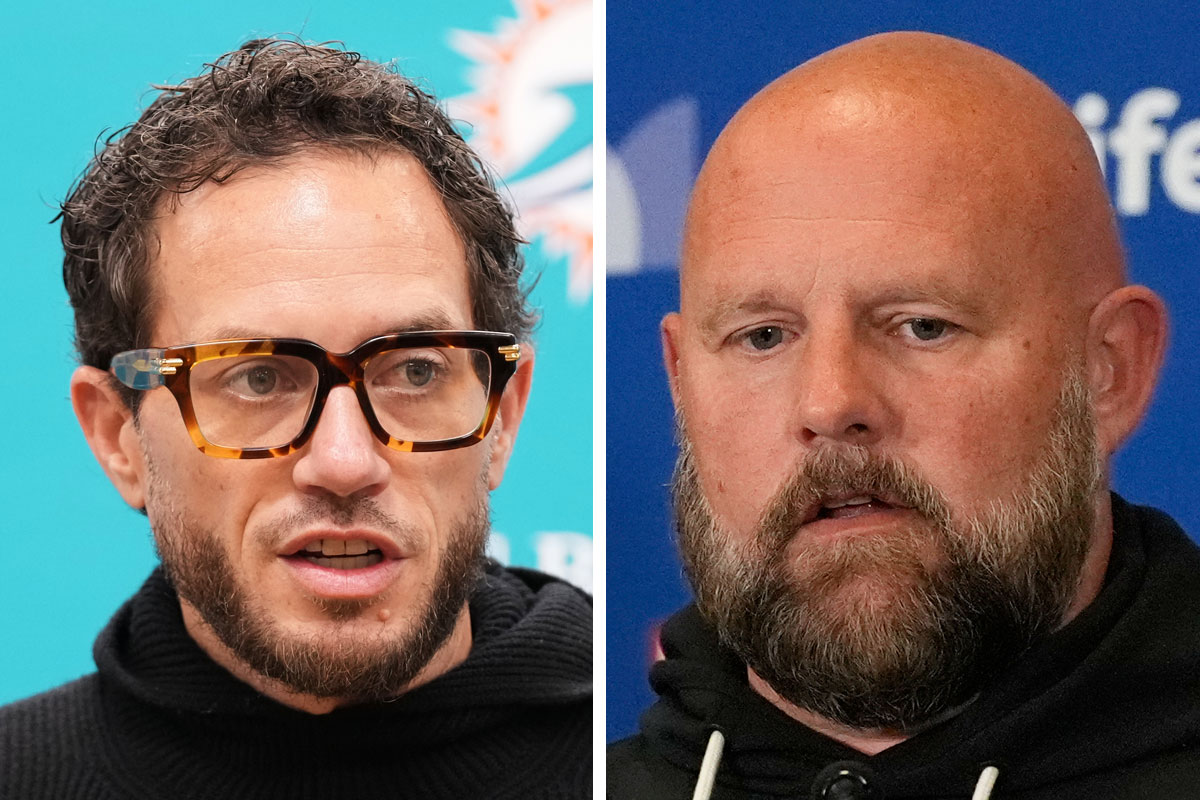
1. The Eagles pivoted in their approach to the OC search after it became obvious that Mike McDaniel and Brian Daboll wanted to explore other opportunities.
Former Dolphins coach Mike McDaniel (left) and former Giants coach Brian Daboll.
Sirianni didn’t confirm Inquirer reporting that McDaniel and Daboll were leading candidates, but he said he entered the offensive coordinator search looking for a veteran play-caller.
“I went into it … like I’d like for somebody to have some of the experience that’s done this,” Sirianni said. “Obviously, Sean has not had experience calling the plays. That, to me, was [secondary]. Like, we got into it and that kind of changed. I’m like, ‘No, this is the best guy for the job.’”
Sirianni also said he went into the process most interested in the Shanahan-McVay scheme, which would suggest that McDaniel was the primary target. Daboll comes from another system of offense, but he worked previously with Hurts at Alabama and would have checked other boxes. McDaniel went to the Chargers, while Daboll was hired by the Titans.
We’ll never know if the Eagles would have offered either McDaniel or Daboll the position, but clearly the search shifted into another phase. Sirianni said he interviewed a total of 17 candidates and that seven reached the second round. Only four of the final seven names — Josh Grizzard, Jim Bob Cooter, Jerrod Johnson, and Mannion — became public.
Mannion’s first interview was virtual, while the second was in person. Sirianni said that once he got him in the building, it confirmed his initial impression that the 33-year-old former quarterback was the guy for the job even though he had never called plays.
“What I was really looking for was the detail in which everything was explained to me, because the detail is so critical, conviction on what they believed and why they believed in it, and the vision and conviction of that how they went about it,” Sirianni said. “Like, OK, you haven’t called plays, but how do you go about thinking about calling plays in this particular area, like the vision for the offense, the vision and the conviction for how you would call it?”
2. Sirianni led the search and made the final decision — a fact that was made abundantly clear.
Eagles head coach Nick Sirianni listens to questions from media members with general manager Howie Roseman on Jan. 15.
Roseman, who touted Sirianni’s credentials as a CEO-type coach last month, made light of outside perception that he and owner Jeffrey Lurie hold strings over a powerless Sirianni when asked why he made those unprompted comments.
“Hold the strings, like during the games?” Roseman said. “Am I in his ear?”
Roseman, of course, remains one of the more entrenched figures in his position after two Super Bowl titles and 10 playoff appearances in 16 seasons as GM. He has final say over both the 90- and 53-man rosters and his influence with Lurie also can’t be overstated.
Roseman is also one of the most resourceful executives in the NFL. He helped Sirianni identify Mannion as a budding prospect.
“As you talk to people around the league, and they described him and his future, it became somebody that we really felt like we needed to talk to,” Roseman said. “It’s just his name kept coming up as we were doing things and as we were talking about the way that we were kind of moving from an offensive perspective.”
Sirianni, who spoke before Roseman, talked about a collaborative approach but identified himself as the “point man” in the search.
“The coaches that we bring in here always going to fall on me, right?” Sirianni said. “And I have to make those final decisions.”
Were the Eagles powers-that-be trying to empower their coach in giving him ownership over the coaching changes, or were they distancing themselves from the moves? Maybe only Lurie and Roseman can answer that question.
3. The Eagles are hoping Mannion will be the offensive coordinator version of Sirianni.
Nick Sirianni’s 2021 hire was an outside-the-box choice. Is Sean Mannion another diamond-in-the-rough choice?
The Eagles have had unprecedented success under Sirianni. They have a Super Bowl MVP in Hurts. They have Pro Bowl-caliber offensive players at multiple spots. And yet, there were rumblings that some OC candidates didn’t consider the job as desirable as other vacancies.
While previous coordinators Shane Steichen and Kellen Moore parlayed winning into promotions, Brian Johnson and Patullo were out after just one season at the helm. The position comes with both internal and external pressures. There’s also a question of Sirianni’s permanence in Philly and how Hurts has factored into coordinator turnover.
The Bears’ Declan Doyle, for instance, declined an interview request and reportedly told the Eagles he was staying in Chicago, even though he doesn’t call plays. Not long after, he took the offensive coordinator job with the Ravens, although it should be noted that he will work under defensive-minded coach Jesse Minter in Baltimore.
“All that really matters,” Sirianni said, “is the guy that you end up picking for the job and his excitement and willingness to be there.”
Sirianni might feel some kinship with Mannion, who didn’t interview for any of the other 14 coordinator openings this offseason. Sirianni, too, was an under-the-radar choice who surfaced late in the process when the Eagles tabbed him to be coach.
While Mannion had no other bites this offseason, like Sirianni five years ago, it doesn’t mean he won’t pan out.
4. It was the Shanahan-McVay scheme that led the Eagles to Mannion.
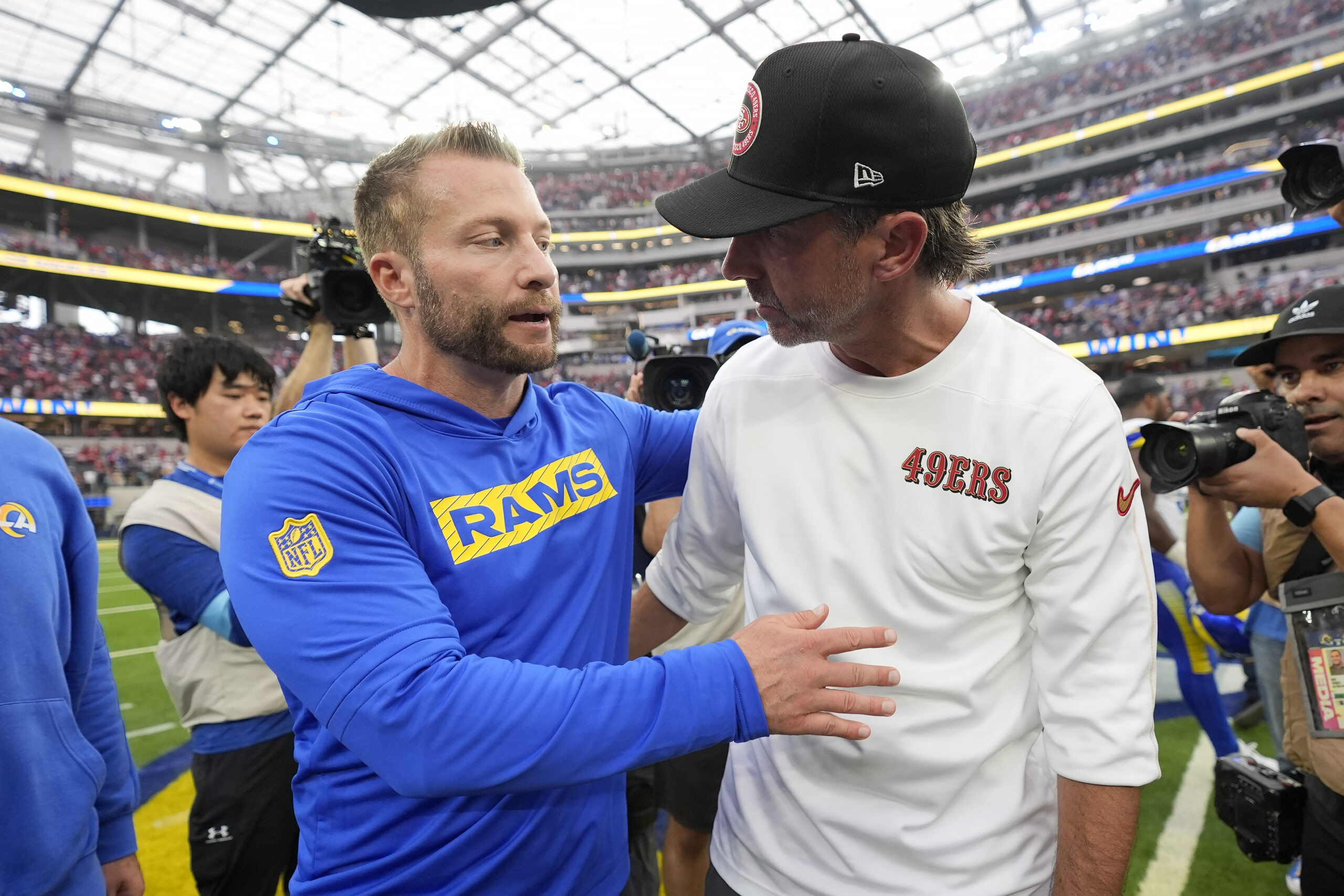
The schematic principles favored by Sean McVay (left) and Kyle Shanahan held increasing appeal for Nick Sirianni as he went through the OC process.
Sirianni interviewed coaches with backgrounds and experience in various offenses, but one scheme stood out more than others.
“It was in my forefront of my mind to say, ‘I’m interested in this,’” Sirianni said of the Kyle Shanahan-Sean McVay scheme. “But I didn’t necessarily say, ‘I have to have this.’ And then as the process went forward that’s where I kind of got to with that.”
The Shanahan-McVay system is often run-based that utilizes a wide-zone blocking scheme. It often marries the run with the pass through under-center play action. It features motion and misdirection. And it uses all the above to create space in the passing game for easy reads, yards after the catch, and explosive plays downfield.
While there were some commonalities between Sirianni’s and Moore’s schemes which allowed for a relatively easy transition, and maybe prevented the latter from fully implementing his offense, the Shanahan-McVay system is significantly different than Sirianni’s on early downs.
“Third down, red zone, backed up, four-minute [offenses] — a lot of those things are pretty similar in the thought process of people,” Sirianni said. “It’s the first- and second-down run, play action where people are a lot different and have different philosophies. And … that’s where I see just it’s going to be a little bit of a change there, but we’ve got good players.”
5. Improving the run game was paramount in choosing the new coordinator and scheme.
Could a Saquon Barkley renaissance be in store in the new Eagles offense?
There’s no question the Eagles’ passing offense was substandard and there needs to be more sophistication in the operation. But when Sirianni’s teams have had their greatest successes, it’s been behind a dominant running attack.
The Eagles were bound to face challenges after Saquon Barkley’s historic campaign in 2024. Injuries on the offensive line didn’t help matters. But when opponents devoted their efforts to stopping the run with increased numbers in the box, the Eagles struggled to adjust and make defenses pay through the air.
Sirianni equated how the Shanahan-McVay rushing offense handles defensive intricacies with how some passing offenses have adapted to modern coverages.
“You’ve seen a lot of teams that have done things where they’re reading pure progressions to handle all the junk that is being thrown at you by the defense,” he said. “This version of the run game is kind of in that mix, as well. It’s the run-game version of it.
“There’s a lot of junk that’s being thrown at you. This handles a lot of it.”
6. The run-blocking scheme changes were probably the chief reason Stoutland resigned.
Jeff Stoutland’s O-line alignment principles would not have meshed easily with Sean Mannion’s scheme.
The most significant change in the running game will come with the offensive line. The preferred wide-zone blocking scheme of the Shanahan-McVay offense is much different than the mid-zone scheme Jeff Stoutland employed with the Eagles for 13 seasons.
Stoutland was also the run game coordinator since 2018, but the alteration meant that he wouldn’t have returned in that role. Sirianni confirmed that he wanted Stoutland back, although the 64-year-old assistant would have had to teach his O-linemen a new run-blocking technique.
At its most elemental, wide-zone blocking has offensive linemen fire off the ball and block at an angle to create cutback running lanes. Mid-zone blocking has O-linemen more under control, perhaps required to win more at the point of attack and shuffle in their assignments.
One is not better than the other, they’re just different. The Eagles think their returning O-lineman can block in any scheme, but there will be an adjustment. The change could benefit an athletic center like Cam Jurgens, or it could hinder a cinder block like left guard Landon Dickerson.
“Will there be maybe a little bit more emphasis on movement and athleticism?” Roseman said. “Maybe a click. Maybe.”
Roseman was talking about how the new scheme may affect his evaluations in the upcoming draft. Right tackle Lane Johnson is returning for a 14th season, but the Eagles could be searching for his successor.
Stoutland was as involved as any coach in the pre-draft process and through his prioritization of “critical factors” helped the Eagles land Johnson, Dickerson, Jurgens, and left tackle Jordan Mailata, a former rugby player.
“We’re looking for a lot of the same things,” Roseman said, “with a lot of the same — a shout-out to Stout — critical factors that we’ve always been looking for.”
7. Hurts may actually run even less in the new offense.
Jalen Hurts might run less in the Sean Mannion scheme.
Hurts’ history with different offensive coordinators and play callers dating back to college is a fact that has been repeated so frequently at this point it’s almost not worth mentioning, especially for a quarterback entering his seventh NFL season.
He has admitted that having first-year success with Moore should give the discourse less meaning. The scheme has also been relatively similar during the Sirianni-Hurts partnership. There has been a natural progression with his coaches asking him to do a little more under center, off play action, and with motion.
“He’s shown that he can do all these things,” Sirianni said. “I think what’s awesome about Jalen is he’s shown he can do a lot of things really well. … The great thing about great players is they can usually fit to any scheme.”
And yet, the Eagles have never majored in any of the above. Was that on Sirianni and his coordinators, or was it on Hurts? How much did Stoutland’s preferred run scheme prevent the offense from evolving? All of the above were likely factors.
Whatever the answer, change is coming. Hurts should be on board, especially if he wants to run less and desires more schemed-up layups in the passing game. With less shotgun, there won’t be as many designed quarterback run opportunities.
It remains to be seen whether less of Hurts on the ground is a good thing. It wasn’t last season. There are ways to incorporate some quarterback runs into the Shanahan-McVay scheme, but there will likely be fewer zone reads and run-pass option plays.
8. Sirianni left plenty of wiggle room for carryover from the previous offense.
Nick Sirianni will continue to have a voice on offense, as he has had in all previous iterations of the attack.
While some Sirianni critics may have short attention spans, he has presided over an offense that has often been among the best in the league. And in winning a Super Bowl last year he was able to retain some of the better parts of his scheme and incorporate it with Moore’s.
He said the same will happen with Mannion.
“I think that some of the things that you can sprinkle in from the things that we’ve done, it’ll just be a good mesh of different things,” Sirianni said. “You want to have something that you can [hang] your hat, which I think that we’ve always had, but then adapt that to different things that your players do well.”
The best coaches scheme to their players’ skill sets. In 2021 and 2024, the Eagles installed pass-based offenses before switching at midseason to feature the run. Some of that had to do with Hurts’ limitations as a dropback passer, but also to emphasize his mobility, a dominant O-line, and Barkley.
It would be foolish for Sirianni to commit to anything, although the Shanahan-McVay offense will initially be the scheme the Eagles hang their hats on. But there won’t be a complete whitewash.
“Its ever-evolving,” Sirianni said. “Shoot, you might end up saying, ‘Hey, I wanted to be an outside zone team, but it looks like we’re going to be a little bit more of a gap team, or vice versa, right?’ And it could be the same with, ‘Hey, I wanted to be a little bit more play action, but it looks like we’re going to be a little bit more naked and move the pocket and stuff like that.’”
Mannion won’t have autonomy like defensive coordinator Vic Fangio. How could he with no experience? The offensive-minded Sirianni will obviously be involved at some level. But he wants Mannion to ultimately be responsible for running the offense.
“I know that the most important thing that I need to do is be the head football coach of the football team, not the offensive coordinator for the Philadelphia Eagles,” Sirianni said. “I need to be the head football coach in charge of everything. It’s setting that vision, all the different things that go into it.
“But I’ve had a lot of experience in putting together an offense, so I’m here as a resource for him in that aspect.”
9. Mannion will work closely with Hurts.
Sean Mannion’s experience as an NFL quarterback could help ease communication with Jalen Hurts.
Mannion’s pedigree as a quarterback played some role in his hiring. Hurts had his best seasons under former quarterbacks in Steichen and Moore. Mannion has been credited with assisting the development of Packers starter Jordan Love and the reclamation of backup Malik Willis.
Hurts has a strong personality, so it’s no guarantee that Mannion’s playing experience or his relative youth will translate to a harmonious relationship. That could go in any direction. But Mannion’s former teammates and coaches have been unanimous in their praise of how he comports himself.
As for Hurts’ actual position coach, the Eagles opted to move pass game coordinator Parks Frazier to quarterbacks coach and let Scot Loeffler go. Sirianni said he wanted some continuity, but also pointed to Frazier’s one season working in the Shanahan-McVay scheme with the Dolphins under McDaniel.
Grizzard offered Sirianni the chance to keep a runner-up for the job who also has experience in the system and one year of play-calling under his belt. While he could be viewed as a backup if Mannion struggles, the Eagles were likely more focused on having an in-house replacement to guard against what happened after Steichen and Moore left.
New tight ends coach/run game coordinator Ryan Mahaffey and offensive line coach Chris Kuper were Mannion hires and will be instrumental in installing the new wide zone blocking scheme.
10. The new scheme probably won’t increase the likelihood that Brown wants to stay in Philly.
Change is coming to the Eagles offense, but it’s not necessarily the kind of change that will make A.J. Brown happier.
Roseman will ultimately do what’s best for the team even if Brown no longer wants to be an Eagle. Brown has expressed his love for Philly, but that doesn’t necessarily mean he wants to return if the passing game is going to remain secondary.
Brown could envision a scenario in which the Shanahan-McVay scheme improves Hurts as a thrower and gives the receiver opportunities to use his skills after the catch. But if the running game remains the focus, he may not get the targets he desires.
Replacing Brown wouldn’t be easy, even if receiver DeVonta Smith has a more prominent role. The free-agent market is light at the position. And while the draft is said to be deep, there are few Day 1 starters at receiver. The Eagles also have other needs.
Roseman may need to replace all three of his top tight ends with Dallas Goedert, Grant Calcaterra and Kylen Granson slated for free agency. The Shanahan-McVay scheme favors hybrid tight ends who can run-block.
“I would say that the tight-end position starts with me in evolving,” Roseman said. “I think that from my perspective, I’ve always had an affinity for kind of the receiving tight ends. I think that that’s shown in my work.”
It certainly showed this past season. Goedert, Calcaterra, and Granson were detrimental to the running game. They weren’t the only ones.
The new league year is right around the corner, and it’s almost time for the 2026 Eagles roster to start coming into focus.
But first, the annual NFL Scouting Combine.
It’s the next thing on the offseason calendar, and while the focus for much of the week will be on the athletes going through performance testing, when it comes to the Eagles, it should be a big week for news related to the team.
Reporters typically get to talk to Nick Sirianni and Howie Roseman around the combine, and there are certainly plenty of questions to ask this year.
Here’s a look at five of the most pressing Eagles topics the coach and general manager may be addressing soon:
Why did the Eagles choose Sean Mannion, and why did they assemble this staff around him?
It’s been three weeks since the Eagles filled their vacancy at offensive coordinator by hiring Green Bay Packers quarterbacks coach Sean Mannion, a 33-year-old former quarterback with only two years of coaching experience. But we’ve yet to hear from Sirianni or Roseman, besides an initial statement released by the team, on why the Eagles hired Mannion, what they liked about him, and what hiring him means for the future of the scheme.
In the weeks since, the rest of the offensive coaching staff has been filled out. The Eagles hired one of their other coordinator candidates, former Tampa Bay offensive coordinator Josh Grizzard, as pass game coordinator. They hired Packers wide receivers coach Ryan Mahaffey to be the tight ends coach and run game coordinator. Longtime offensive line coach Jeff Stoutland left the team (more on that later), and he was replaced by Minnesota Vikings offensive line coach Chris Kuper.
The Eagles retained wide receivers coach Aaron Moorehead and running backs coach Jemal Singleton, sources told The Inquirer, and, according to CBS Sports, plan to shift Parks Frazier, last season’s pass game coordinator, to quarterbacks coach.
Sean Mannion will be calling plays for the first time under intense scrutiny in Philadelphia.
The new offensive coaching staff, under a first-year play-caller, is an amalgamation of coaches with different backgrounds. What will it mean for the scheme going forward?
Sirianni said after removing Kevin Patullo that the offense needed to “evolve.” He’ll soon have the chance to explain why and how this group can help it do that.
What happened with Jeff Stoutland?
The longest-tenured coach in the building, who has been widely regarded as the best offensive line coach in the sport, is no longer coaching with the Eagles.
Why?
The Eagles wanted Stoutland back as the offensive line coach, league sources said, but Stoutland, who also held the title of run game coordinator, wasn’t going to be as involved in the running game, and the Eagles are shifting schemes. Change is in the air. But Stoutland’s role in the running game decreased as last season went on, The Inquirer’s Jeff McLane reported recently on the unCovering the Birds podcast.
How did it get to this, and how much of an impact will his departure have on the offensive line moving forward?
Don’t expect Roseman to say anything that strays too far from his normal line when it comes to A.J. Brown and players like him.
Here’s what Roseman said at the end-of-year news conference on Jan. 15 when asked if he was open to trading Brown or if trading him was a nonstarter: “It is hard to find great players in the NFL, and A.J.’s a great player. I think from my perspective, that’s what we’re going out and looking for when we go out here in free agency and in the draft is trying to find great players who love football, and he’s that guy. I think that would be my answer.”
Still, Roseman likely will be asked about the star receiver’s future in Philadelphia in the coming days. It’s for good reason. Brown, of course, hasn’t been shy about his frustrations with the direction of the offense. But during Super Bowl week, Brown appeared on Micah Parsons’ podcast and spoke about his excitement for the future and the new offensive coaching staff. “Sometimes change is not a bad thing,” he said. He also called Philadelphia “home.”
Does wide receiver A.J. Brown have enough love for Philadelphia to remain an Eagle?
While he didn’t sound like someone who was about to ask for a trade, it’s still early in the offseason.
Brown’s future with the team impacts how the Eagles approach the draft and free agency, so a decision on whether the Eagles see him in their immediate plans probably is already made. It’s complicated, however, because of the salary cap implications. The cost to trade Brown before June 1 would be $48.939 million, according to Over the Cap. If the Eagles traded him after that, they would incur a dead cap charge of $22.09 million. Much more palatable, but still a lot of dead money.
It begs the question, too: Could the Eagles ever get good value in a trade for Brown?
Roseman probably won’t be showing his cards in the coming days, but it’s a topic he’ll have to address.
How much has the future outlook of the offensive line changed, and how will it impact the plans?
The offensive line took a big step back in 2025 thanks to a slew of injuries. Lane Johnson missed half the season. Landon Dickerson was never fully healthy and may never be again. Cam Jurgens played through back pain.
At the time of Stoutland’s departure, it wasn’t even a sure thing that Johnson and Dickerson would be back for the 2026 season. A unit that basically was plug-and-play has turned into a big question mark for the Eagles. How much longer will Johnson and Dickerson play? (Editor’s note: Johnson announced his return for 2026 on Thursday.)
Eagles offensive tackle Lane Johnson’s health and future were in doubt before he announced his return on Thursday.
Jurgens, meanwhile, shared a video this week on social media of him in Colombia undergoing stem cell treatments. Jurgens, via his agent, declined to comment further on what led him to go that route or how he is feeling. The center had back surgery after the Super Bowl last year and did not play to his 2024 level this past season.
This impacts how the Eagles approach the draft and free agency. They’re due to get an eventual replacement for Johnson in the door, but they now need to think about the future of the interior.
Who stays, who goes, and who could get extended or restructured?
It soon will be time for the Eagles to go shopping on the free agency market, but there are some players on the current roster in line to have their contracts extended or possibly restructured.
Let’s start with Jordan Davis, who broke out in 2025 and earned himself a new contract. The Eagles picked up Davis’ fifth-year option last year, but signing him to a new deal is almost too obvious because it would free up much-needed cap space for 2026.
Will defensive tackle Jordan Davis be first in line for a contract extension after a breakout season?
There’s also Jalen Hurts, whose cap number jumps from nearly $22 million in 2025 to nearly $32 million in 2026. It will be more than $42 million in 2027, more than $47 million in 2028, and a whopping $97.5 million in 2029. But Hurts has no guaranteed money beyond this season. A restructure or extension could be on the table sooner than later.
What about the free agents? Jaelan Phillips, for example, is one of the best edge rushers on the market, and the Eagles need some of those. Safety Reed Blankenship is slated to hit the market, and the Eagles need a safety.
Roseman may not tip his hand, but he’ll certainly be asked about all of it with free agency just a few weeks away.
With the release of ESPN’s new 30 for 30 about the Philly Special on Friday night, Doug Pederson is back on the minds of Eagles fans. And that’s not the only reason why. The former Eagles coach was also spotted this week answering fan questions in an unusual way: over the public address system of an airplane.
Pederson talked about seeing Jalen Hurts grow after they drafted him in 2020, despite already having Carson Wentz as their starter. He also offered some advice for new offensive coordinator Sean Mannion.
"You know, we drafted Jalen Hurts for a reason."
They asked Doug Pederson about the new OC hire and he spent 90 seconds waxing poetic about his QB instead. pic.twitter.com/lpgrMOkUOP
“We drafted Jalen Hurts for a reason,” Pederson said over the microphone. “And we saw something in Jalen Hurts that we felt like he was going to be the starter at some point, he was going to be in the franchise at some point. Sooner, obviously, than later. In his defense, I think this is going to be his sixth offensive coordinator in his career.”
A former quarterback and coordinator himself, Pederson said he understands how difficult that can be, and noted that the Eagles have managed to be very successful despite all the turnover.
“That’s hard,” Pederson said. “But yet you look at the success the Eagles have had over the course of, really, since he’s started. They’ve won a Super Bowl, they’ve been in another Super Bowl. They’ve been to many playoff games. They’ve won a ton of football games. And, every year they’ve had a different offensive coordinator.”
Former offensive coordinator Kevin Patullo, who was replaced this offseason by Mannion, faced heavy criticism from fans during the 2025 season due to the team’s struggles on offense.
Philadelphia Eagles quarterback Jalen Hurts will have another new offensive coordinator next year.
So Pederson’s advice to the Birds’ new OC? Work with Hurts.
“I don’t know a ton about [Mannion]. I just know he got to come in and he’s got to work with Jalen. He’s got to figure out what Jalen does best,” Pederson said. “Utilize his strengths, utilize the talent on offense get the run game going to where it was a year ago when they won the Super Bowl. If he does that then they’re going to have a lot of success moving forward.”
According to the fan on the flight who posted the viral video on Reddit, Pederson was there as part of a FanDuel Super Bowl event and took part in an interview before answering fan questions — like who he would rather have on his team, Tom Brady or Patrick Mahomes. Pederson also gave his prediction for Sunday’s Super Bowl, where he picked the Seattle Seahawks over the New England Patriots.
Pederson has not coached since the 2024 season after he was fired following a three-year stint with the Jaguars. But he’s open to returning — and according to the Redditor on the flight, Pederson said he has some interest in currently open offensive coordinator positions, but that he is also enjoying spending time with his wife.
Quarterbacks are people, too. Sometimes, like everyone else, they have tough days at work. They need support from a willing ear. Sean Clifford, the former Green Bay Packers backup quarterback, is no different.
For Clifford, the former Penn State QB now with the Cincinnati Bengals, that willing ear was once Sean Mannion, the former quarterbacks coach with the Packers who was named Eagles offensive coordinator on Jan. 29.
When Mannion took on the role with the Packers quarterbacks last summer, he had only one year of coaching experience. He had served as an offensive assistant in 2024 under Tom Clements, the legendary quarterbacks coach who worked with Brett Favre, Aaron Rodgers, and Jordan Love over a span of 14 seasons.
Sean Mannion served as the Packers’ quarterbacks coach in 2025.
Still, Mannion’s wealth of playing experience — nine years as an NFL backup — helped him relate to and resonate with his quarterbacks, according to Clifford.
“I think it’s the little moments when he had to turn off the coach lens and talk to you, man to man or player to player,” said Clifford, a fifth-round pick by the Packers in 2023. “Whether it’s a great situation or a bad one, I felt like I could always go to him and get some feedback. Always felt like I could go to him and vent to him if I needed to, which is like any other job. Sometimes it just gets tough, and you have to be able to have somebody who you can lean on.
“He’s been through it. He knows what this league’s all about. He knows it’s not easy, and he was able to switch that on, switch that off well in a way that then allows a guy like me or any of the quarterbacks to see him as one of us. Because it’s really easy, as you climb the coaching carousel … I feel like you get farther and farther away from the locker room. But I feel like Sean was always able to come back down and understand what we’re going through.”
Mannion, 33, could come back down to his players’ level because he recently stood in their cleats. After stints with the St. Louis Rams, the Minnesota Vikings, and the Seattle Seahawks, he retired from playing at the conclusion of the 2023 season. Within weeks, he joined the Packers coaching staff.
Even as he played, Mannion kept his eye on his anticipated future as a coach. He said in a news conference in May that he was “attacking his playing career” with his eventual transition to coaching in mind, absorbing as much knowledge as he could from his litany of coaches, from Sean McVay to Matt LaFleur to Klint Kubiak and beyond.
But taking the jump from offensive assistant to offensive coordinator in just two years? Who could have predicted this rapid rise?
“From the outside looking in, it’s probably the most surprising thing ever,” Clifford said. “But if you work with the guy, you know why he’s risen as fast as he’s risen. From a day-to-day perspective, it’s [a] constant commitment to excellence. It’s a never-ending pursuit to get better.”
Malik Willis (left) and Jordan Love both had quality 2025 seasons after Mannion was promoted to quarterbacks coach.
Growth in Green Bay
That commitment to excellence was reflected in the collective growth of the quarterback corps last season, according to Clifford, who was cut at the end of training camp. Clifford said he never lost his connection with his former Packers teammates, especially Malik Willis, Love’s backup last season and one of Clifford’s close friends.
Willis, 26, worked his way into becoming a more-than-capable backup behind Love in his fourth NFL season. Clifford watched from afar as Willis completed 85.7% of his passes on 35 attempts in his four games (one start) for the Packers in 2025.
“I don’t want to speak for Malik, but I know that he would probably attribute some of that to how Sean Mannion prepared him,” Clifford said.
Preparation is Mannion’s forte. He spent the 2024 season assisting Clements with the quarterbacks, “doing all the stuff that nobody wants to do,” Clifford said. That included running the scout team, drawing up play cards for the scout team, making film cutups, and doing plenty of other odd jobs required of young coaches.
He drew on all of his experiences, no matter how small, as he blossomed into his role as quarterbacks coach. Mannion had a database of film compiled throughout his playing career that he referenced with his quarterbacks, including his own practice film dating back to 2015, the year the Rams drafted him in the third round out of Oregon State.
He was invested in the overall improvement of the room, not just the starter, Clifford said. Mannion was constantly in the quarterbacks’ ears, asking them about aspects of the offense that they liked and didn’t like. In the meeting room, Mannion held open-ended discussions with his quarterbacks about the offense, ensuring that every member was engaged. On the field, he could give real-time feedback as if he were in the quarterback’s shoes, because he had been.
“You throw a pick and some coaches might be just [ticked] because you just didn’t see [the defender] or something,” Clifford said. “But there’s a guy in your lap and you’re trying to make a play, and Sean would never get too hot about anything. Never too high, never too low. Would just pretty much be the same guy. And it’s good to have consistency at the coaching position. In my personal opinion, I feel like that’s the best way to coach.”
Expect elements of the scheme favored by 49ers coach Kyle Shanahan (right) as well as Matt LaFleur of the Packers (center).
Projecting the new-look Eagles offense
Over the next 200-plus days, Mannion will be tasked with revamping an Eagles offense that floundered under ex-offensive coordinator Kevin Patullo in 2025.
But what will a revamp look like? And how much influence will Nick Sirianni have on the scheme?
Mannion’s past could be the best indicator of what lies ahead for the Eagles offense. He spent large chunks of his playing career with offshoots of the Mike and Kyle Shanahan tree, beginning with McVay when he became the Rams’ head coach in 2016. LaFleur, another branch on that tree, served as Mannion’s offensive coordinator with the Rams in 2017 before they worked together for the last two seasons with the Packers.
“I would be shocked if [the Eagles offense] came out and it was completely different than a Shanahan-style offense,” Clifford said. “But I do think that with the communication that I know he’ll have with Jalen [Hurts], it’ll be a nice blend. You’ll see things from what Jalen has ran the past, what he’s been able to do athletically, physically, with his arm talent, all of it.”
When LaFleur arrived in Green Bay in 2019, he emphasized the importance of the marriage between the run and the pass, a philosophy that harkens back to Mike Shanahan’s days with the Denver Broncos. The scheme attempts to achieve that marriage in part through the incorporation of play-action passes, especially from under center.
Sean Mannion will have a major challenge as he sorts out the Eagles’ offensive issues.
Other hallmarks of the McVay and Shanahan offense include the use of pre-snap motion and outside zone runs. Like most of those offenses, Clifford said the majority of passing plays in Green Bay included a “pure progression,” in which a quarterback goes through his reads in a fixed order instead of attempting to diagnose a defense pre-snap and determine which side of the field the ball ought to go. Clifford explained that the pure progression reads can help the quarterback get the ball out of his hands faster.
“Defenses are getting really, really good at being able to disguise,” Clifford said. “[It] used to be so easy to see certain things, like if [an edge rusher] was standing up, versus in a three-point [stance], you knew what was coming. They are super dialed in on all of that. So there’s really not those same tells. So you have to be able to just feel zones.
“I like to compare it a little bit more to basketball nowadays. It’s like you’re running motion instead of just plays. But if you’re able to adjust and just play football, you can have a lot of success. And that’s where I think Jalen will have a tremendous amount of success within this offense, because he’s a gamer. He wins. And if you have a winning quarterback, a guy who’s just going to go out there and play, I think you can have a lot of team success as well.”
The offensive scheme is just one uncertainty surrounding Mannion’s future in Philadelphia. How will he fare in an offensive play-caller role for the first time in his career? Again, given his familiarity with Mannion’s preparation, Clifford said he is ready for the undertaking.
“I feel like Sean will put himself into the game before it happens a lot throughout the week, and then, similar to how Matt does it, watch tape and just call games based on what a defense is giving them on that tape,” Clifford said. “Are they giving more one-high [safety]? Are they getting more two[-high]? Are they blitzing? … And I feel like Sean will go into his first game and it will be his, like, 100th game, because he’s probably called it so many times. And that’s [what] I think that Philly fans should feel pretty, pretty good about, even though it’s a young hire.”
While the big picture of the Eagles offense will remain a mystery until the season begins, the finer details and fundamentals that Mannion has always preached at the quarterback position likely won’t change.
According to Clifford, Mannion was big on a quarterback’s “base and balance.” Clifford worked with Mannion to improve those facets of his footwork, as they were often the keys to moving the sticks in the passing game and avoiding “GBOT” (get back on track) situations after losing yardage on early downs, something the Eagles struggled with last season.
The person behind the coach won’t change, either, Clifford said. Mannion made Clifford feel welcomed, whether he was inviting the quarterbacks to dinner at his house or balancing the preparation in the meeting room with non-football talk. Mannion may be young, Clifford said, but he knows how to connect with his players.
“I think Sean makes everybody around him better,” Clifford said. “And I think it’s not surprising in the slightest that now a team is willing to take that chance to bring him up to the OC level.”
SAN JOSE, Calif. — When Sean Mannion was a quarterback with the Minnesota Vikings, his position room would play a game called “Stumpy.”
The objective was to be the last one to be stumped when then-position coach Andrew Janocko asked each quarterback the specifics of certain plays in Minnesota’s offensive playbook. Mannion might have been a journeyman backup in the NFL, but he had the recall of a Hall of Famer, his former coaches said.
“He was always the champion of that game,” Janocko said.
Mannion was hired as the Eagles’ offensive coordinator last week. He may have only two years of coaching experience, but Klint Kubiak and Janocko, who coached him with the Vikings and are now on staff with the Seahawks at Super Bowl LX, believe the 33-year-old is ready for the job.
Kubiak was Mannion’s first quarterbacks coach in Minnesota in 2019 and 2020. When he was promoted to offensive coordinator a year later, Janocko succeeded him. In September 2021, Kubiak said Mannion was one of the smartest players “he’d ever been around” and that he was like “an extra coach” on the field.
“I still feel the same way about that,” Kubiak told The Inquirer on Monday. “Sean’s a really bright guy. He’s extremely hardworking. He just understands football at a whole other level. He was trained by [Los Angeles Rams coach] Sean McVay early. He had really great coaching at Oregon State.
“He was our backup quarterback. He was always the guy bringing things up in the game-planning process that helped us make plays better, or get rid of bad plays. He just understands the whole picture.”
Kubiak and Janocko, who called the Mannion hire “a home run,” may be biased. But if Eagles coach Nick Sirianni hadn’t tabbed him to be Kevin Patullo’s replacement, it’s possible that Kubiak, who is slated to become the Las Vegas Raiders’ head coach after Sunday’s game vs. the New England Patriots, would have recruited Mannion from the Green Bay Packers.
New Eagles offensive coordinator Sean Mannion (left) was coached by Kevin O’Connell (right), Andrew Janocko, and Klint Kubiak when he was a backup for the Minnesota Vikings.
“We always knew that someday when Sean was done playing, we would all want to hire him on our coaching staff,” Kubiak said.
Mannion likely wouldn’t have called plays in Las Vegas. But he will in Philadelphia, despite having never done it before.
“Everyone’s got to start somewhere,” said Kubiak, who’s been an offensive coordinator with three teams. “You learn on the job. When you’re the quarterback, all you do is call plays all day. You get it from the coach, but sometimes the coach screws it up, and you’ve got to fix it. It’s not your fault, but it is your problem.
“Sean will have no problem calling plays.”
Janocko, like Mannion, has never called plays. He’s the heir apparent to Kubiak in Seattle. He’s also an ex-quarterback. He said there are always growing pains for first-time play callers. But Mannion’s mind, he said, will give him an advantage over opposing defensive coordinators.
“The way he diagnoses and processes information, his internal memory is ridiculous,” Janocko said. “You could ask him things on the call sheet that maybe we hadn’t talked about since Wednesday, and he would know the little minutiae about it.
“Just his general understanding of coverages and what the defense was trying to do, in his mind he was always one step ahead. So I just see that translation to play caller going through the roof.”
Kubiak and Janocko said they can’t predict how Mannion’s offense will look. The Eagles clearly wanted to bring in someone who has had experience with the Kyle Shanahan system. Mannion spent two seasons with McVay and several others with Shanahan acolytes. But he was exposed to other schemes, too.
West Coast guy
Mannion was born in San Jose and played football at Foothill High School in nearby Pleasanton. He was a four-year starter in college for Oregon State before the Rams selected him in the third round of the 2015 draft.
He spent his rookie season in St. Louis but moved back to the West Coast when the Rams relocated to Los Angeles. Janocko, who was born in Clearfield, Pa., and played at Pittsburgh, said he teased Mannion about their geographical differences.
Seahawks offensive coordinator Klint Kubiak, soon to be the Raiders’ head coach, says new Eagles OC Sean Mannion “will have no problem calling plays.”
“Me being an East Coast guy and him being from the West Coast, I’d always rib him that he was going to open his own co-op,” Janocko said. “I’ll be interested to see how he does in Philly getting a cheesesteak.”
Kubiak said Mannion’s authenticity is one of his best traits. He said he’s built up thick skin from playing quarterback when his “back’s against the wall.” Philly’s different, of course. There might not be a job with as much scrutiny as Eagles offensive coordinator.
Shane Steichen, Kellen Moore, and Frank Reich were successful enough to become head coaches. Patullo, Brian Johnson, and Mike Groh suffered a far worse fate. Kubiak said Mannion can’t mentally shoulder all the burden.
Mannion is expected to make some changes to the offensive staff. Josh Grizzard has already been hired as pass game coordinator. Offensive line coach Jeff Stoutland is expected to stay, although he may no longer also be run game coordinator.
“Any time you’re in that role, you don’t do it by yourself. It’s all about having a great staff with you,” Kubiak said. “They have one of the best offensive line coaches in the NFL. They brought [Grizzard] from Tampa with him. Nick is an offensive coach.
“Great staffs do it together. One guy has his name on the job, but when I’m calling a game, there’s five other assistants talking to me on each play.”
Folks keep trying to compare little-known Sean Mannion with previous Eagles hires. In fact, the best comp was in Dallas.
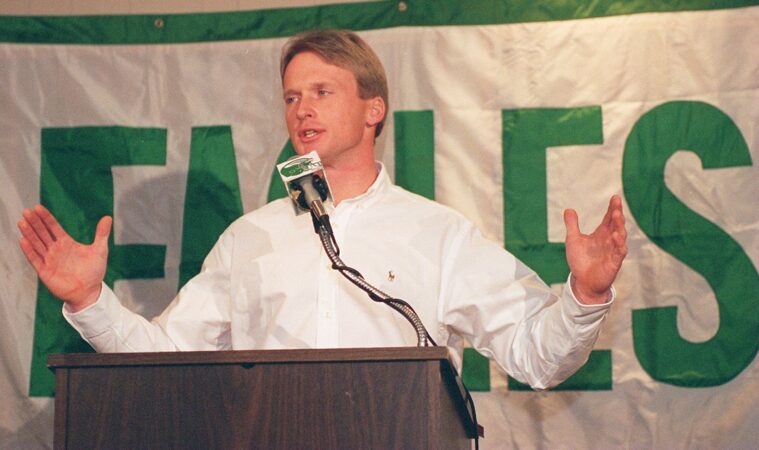
It’s true that Mannion, the new offensive coordinator, shares some characteristics with former Eagles OC Jon Gruden, a former wide receivers coach whom Jeffrey Lurie and the Eagles hired at the age of 31. Similarly, when the Eagles hired 40-year-old Packers quarterbacks coach Andy Reid to be their head coach in 1999, Reid had never called plays, established a scheme, or formulated a game plan.
But by 1999 Reid had been a coach for 17 years, and by 1995 Gruden had been a coach for nine years. Mannion, by contrast, has been a coach for just two years, both with the Packers, one of them as Matt LaFleur’s “offensive assistant,” the NFL’s equivalent of an unpaid internship.
After all, Mannion is no bigger risk for the Eagles than Kellen Moore was for the Cowboys in 2019.
When Jerry Jones named Moore the offensive coordinator in Dallas, Moore was a short-term, insignificant NFL backup with only one year of coaching experience, as the Cowboys’ quarterbacks coach. He was 29.
Mannion is a short-term, insignificant NFL backup with one year of experience as a position coach. He is 33.
He also is a consolation prize.
The Eagles wanted a Josh McDaniels-type OC like Mike McDaniel or Brian Daboll, former head coaches and accomplished coordinators. McDaniel chose the Chargers. Daboll went to Tennessee.
The Birds got Mannion. He’s not nothing.
Sean Mannion, 33, has two years of coaching experience in the NFL.
This might sound like a desperate attempt to cope with what legitimately should be cast as a repudiation of the Eagles by the best and the brightest. This also might sound like an attempt to diminish the injury concerns the Eagles have at offensive line, the commitment concerns they have with A.J. Brown, and the performance concerns they have with Jalen Hurts.
Maybe it is, a little bit.
Sometimes, though, as anyone who’s been married can tell you, your first choice isn’t your best choice.
Sometimes, you don’t get what you want. You get what you need.
A grudging admiration
Few owners keep their ear to the ground the way Lurie does. Over his three decades of ownership he routinely has attended the Senior Bowl, which serves as the NFL’s de facto job fair, where aspiring young coaches gather to distribute resumés and a place where executives meet to gossip about hot new coaching prospects.
As soon as Moore quit playing in 2017, his sixth season in the NFL and his third with Dallas, including practice squads, he was identified as a comer. In 2018, as QB coach, he corrected Dak Prescott’s slump. In 2019, when Wade Wilson retired, Jones controversially promoted Moore, who wasn’t even 30 and looked like he wasn’t even 20.
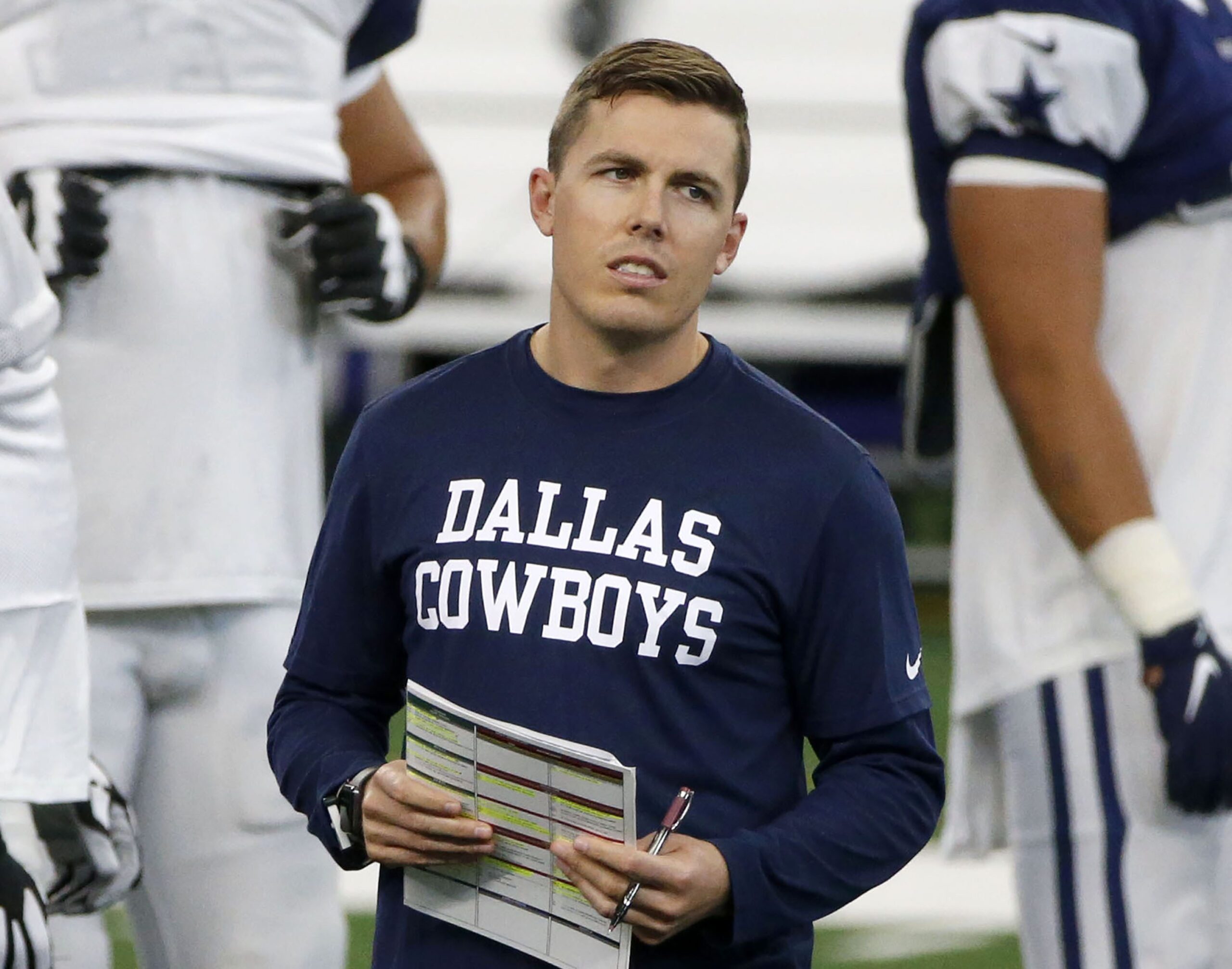
Dallas Cowboys offensive coordinator Kellen Moore watching practice in 2020.
According to an Eagles executive at the time, no one was more impressed by Jones hiring such an outside-the-box candidate than the NFL owner who spends most of his time thinking outside of the box: Jeffrey Lurie.
Jones’ gamble paid off.
In 2019, as OC, Moore pushed Dallas’ offense from 22nd to No. 1. That didn’t save the job of head coach Jason Garrett, but it did convince Jones to ask incoming head coach Mike McCarthy keep Moore as the OC. Sure enough, after a dip in 2020, Dallas was No. 1 in 2021, too.
All along, Lurie was watching Moore’s success and acknowledging the wisdom of Jones, his archrival, with grudging admiration.
The Cowboys offense then ranked No. 4 in 2022, but by the end of that seasonMcCarthy had so badly mismanaged the Cowboys that he needed a scapegoat. He chose Moore to be his fall guy, and so fired him. (Two years later, Moore was interviewing for McCarthy’s job.)
Later that winter the Eagles lost OC Shane Steichen, who became the head coach in Indianapolis. Why didn’t Lurie pounce on Moore then?
Because the Eagles were coming off a Super Bowl appearance, and, according to league sources, head coach Nick Sirianni, having gained even more authority over his staff, wanted to promote from within. Hurts, in line for a huge contract extension, had earned a seat at the hiring table, too. Quarterbacks coach Brian Johnson had been hired in 2021 in part because of Johnson’s preexisting relationship with Hurts. With Hurts’ blessing, Sirianni promoted Johnson.
Moore instead went west in 2023 as the offensive coordinator for Justin Herbert and the Chargers. A year later, as part of a purge by new head coach Jim Harbaugh, Moore was available again. Johnson had struggled in 2023, and was fired. Lurie pounced. Moore became the Eagles’ OC. The Birds won the Super Bowl after the 2024 season. Moore then got the head coaching job in New Orleans.
The Eagles won Super Bowl LIX with Kellen Moore as their offensive coordinator.
He remains the only offensive coordinator in Eagles history to win a Super Bowl calling his own plays — thereby, arguably, the greatest offensive coordinator in Eagles history.
Those are big shoes for Mannion to fill.
Déjà vu and Nick Foles
Moore declined to comment for this column, which is unfortunate, because, in 2019, he nearly was in Mannion’s exact position as an unproven coordinator in a high-pressure market. He also inherited an offensive roster full of pedigreed players, such as running back Ezekiel Elliott, offensive linemen Tyron Smith and Zack Martin, wideout Amari Cooper, and of course, Prescott, who was an overachieving, second-tier draftee who had not completely polished his game.
The same can be said of Hurts, who is surrounded by a similarly pedigreed cast: four Pro Bowl offensive linemen, two 1,000-yard receivers, and a running back halfway to the Hall of Fame.
There are differences, of course. Upon becoming OC, Moore had spent four seasons in Dallas as either a player or coach, and so was familiar with the players, coaches, and the unique culture inside The Star, the Cowboys’ training compound.
Also, Mannion won’t inherit as stable a situation as Moore, who followed Scott Linehan, who had the job for four years. Mannion will be succeeding Kevin Patullo, Sirianni’s longtime right-hand man who was removed from the job on Jan. 13 following a disastrous one-year run.
On the other hand, Mannion has more connections than Moore. Between playing and coaching, Mannion has been around accomplished offensive minds such as Packers head coach Matt LaFleur, for whom Mannion worked the last two seasons, and Rams head coach Sean McVay, for whom Mannion played in 2017 and 2018.
It’s also worth noting that, when Mannion was a rookie in the 2015, the Rams’ starting quarterback was a former Pro Bowl MVP named Nicholas Edward Foles.
Endorsements
In 2019, immediately after promoting Moore, Jones defended the move by citing Moore’s ability to communicate clearly, Moore’s high football IQ, and Moore’s strength of character.
Immediately before the promotion, Moore’s candidacy received a major endorsement from Prescott, who not only had been coached by Moore but also had been Moore’s teammate. On a Dallas radio station, Prescott called Moore a “genius phenom. … He’s special. He knows a lot about the game. Just the way he sees the game, the way he’s ahead of the game. He can bring a lot to us, a lot of creativity.”
Lurie likely won’t offer comments regarding Mannion until he speaks with the press at the owners’ meetings at the end of March in Phoenix.
Packers quarterback Jordan Love, in his third season as a starter, cut his interception total from 11 in 2023 and 2024 to six in 2025. Backup Malik Willis got better, too. Neither has called Mannion a “genius phenom.”
Neither has Sirianni, who has issued the only statement from the Eagles, who have not scheduled a media availability with Mannion and his bosses.
Eagles head coach Nick Sirianni is welcoming yet another offensive coordinator.
In a statement that defined banality, Sirianni called Mannion “a bright young coach with a tremendous future ahead of him in this league. I was impressed by his systematic views on offensive football and his strategic approach.”
The franchise’s excitement paled in comparison to the region’s fascination with this hire.
Over the last three weeks or so, the process of replacing Patullo received unprecedented media attention, considering it was the hiring of an assistant coach. That’s partly due to intensified media coverage of everything NFL, but also because the Eagles are in a window to win right now. Fairly or not, no one bore as much blame for the 2025 one-and-done playoff run as Patullo. No one will face as much pressure for 2026 as Mannion.
This is similar to the situation Moore inherited in Dallas in 2019, and he shined.
That doesn’t mean Mannion will, too, but, in Lurie, Eagles fans can take heart.
With Gruden and Reid in his history, Lurie has a wonderful track record when over-hiring position coaches from Green Bay.
However, Mannion did serve as the offensive coordinator for the West team during the East-West Shrine Bowl game earlier this week. While the play-calling and offensive structure was largely simplistic due to the environment of college players trying to showcase their skills for NFL scouts, the game film provides some clues on what Mannion’s vision for an offense may look like.
Here’s a look at some of the influences Mannion may draw from ahead of his first NFL play-calling opportunity next season, and where Grizzard’s concepts could have an impact:
Under-center runs and play-action
The Mannion-led offense in the Shrine Bowl moved up and down the field in a 21-17 win over the East team, with the majority of the 72 offensive snaps coming from under-center. One frequent play call was play-action, specifically bootlegs where the quarterback would roll to the left or right after faking the handoff, effectively moving the pocket.
The play-action bootlegs are staples for Matt LaFleur, Kyle Shanahan, and Sean McVay-led offenses. They typically give the quarterback two or three options, with a flat route from the front or backside tight end and a crossing route from the backside receiver. The tight wide receiver alignments Mannion had his Shrine Bowl receivers in are a direct comparison to LaFleur’s offense, which utilizes a lot of tight wide receiver splits. Packers quarterback Jordan Love had the fifth-highest play-action rate in the NFL in 2025.
New #Eagles OC Sean Mannion has never called plays in an NFL game, but was the OC for the West team at the Shrine Bowl earlier this week. While most of the offensive install were fairly simple, there's some Matt LaFleur and Kyle Shanahan influences in the small sample size.… pic.twitter.com/At7YvzPNkI
Beyond play-action bootlegs, Mannion also dialed up more traditional play-action passes, and incorporated a concept similar to dagger, where a deep crossing vertical route occupies the safety and allows for a deep intermediate middle-of-the-field route to be run right behind it.
Several teams run the passing concept, but the 49ers and Vikings run it from under-center and on play-action throws more frequently than the Rams or Packers. Mannion spent two seasons of his playing career being coached by McVay and his final year playing quarterback was with the Vikings in 2023, under Kevin O’Connell.
Would like to see Sean Mannion bring some of this playcalling to the #Eagles as well. Big play-action here in 12 personnel during the Shrine Bowl and Mark Gronowski hits the deep dig route with the slot receiver clearing out on a crosser.
From a running game perspective, in the limited plays from the Shrine Bowl, Mannion seemed to draw on Shanahan’s run game philosophy. The first example was the inside toss play, which allows a running back to get downhill quickly. It’s also a play Mike McDaniel took with him to Miami and will likely now implement with Chargers.
Again, this is only observations from Sean Mannion's playcalling at the East-West Shrine Bowl since he doesn't have NFL playcalling experience, but the new #Eagles OC used a run scheme staple from Kyle Shanahan, utilizing the inside run toss a few times on Tuesday night. pic.twitter.com/cge0yBr1Sj
The other example was under-center power scheme runs, which pull the backside guard across the formation with the fullback kicking out the playside edge defender. Kyle Juszczyk had the most run blocking snaps among fullbacks in 2025, according to Pro Football Focus.
The Eagles tried to do more fullback runs last season, so Cameron Latu could be an option to fill a similar role as Juszczyk should Mannion decide to utilize more fullback run-blocking schemes.
Saw more run-game influence from Kyle Shanahan when new #Eagles OC Sean Mannion called plays for the West team during the Shrine Bowl. 49ers use a lot of FB run elements, and Mannion used that from under-center during the Shrine Bowl, primarily running power run schemes during… pic.twitter.com/zm3SFeVan6
During the Shrine Bowl game, Mannion also mixed in some outside zone run schemes from under-center to keep the defense honest. Outside zone runs are big staples of the McVay and Shanahan offenses.
Mannion and Grizzard employ similar concepts
The Packers last season threw out routes at one of the highest rates in the NFL last season. Could that become a staple for the Eagles in 2026?
During the Shrine Bowl game, Mannion called at least three passing concepts that required the outside receivers to run out-breaking routes toward the sideline, and two of them were completed for first downs. Throwing such routes require timing and accuracy, because mislocating the football gives defensive backs a chance to break on the football.
In the limited sample size from the Shrine Bowl game on Tuesday, new #Eagles OC Sean Mannion dialed up out routes at least three times in the game, and two the passes were completed along the sideline. Would imagine this could be a part of the offense next season. https://t.co/8sCT4wGWGFpic.twitter.com/DU7vv0aclL
During the Shrine Bowl game, Mannion also called mesh concepts twice, an approach that has two receivers running shallow crossing routes across the field going opposite directions, and a route sitting over the ball behind the two receivers. It could also include the running back releasing from the backfield on a wheel route.
Grizzard ran mesh quite a bit as the Buccaneers’ offensive coordinator in 2025. The passing concept can beat both man and zone coverages and is difficult to defend if defenders end up chasing the crossing routes.
With Josh Grizzard as the new #Eagles PGC, I wonder if they run mesh passing concepts like he did as the #Bucs OC. During the Shrine Bowl game, Sean Mannion called Mesh twice, including mesh rail, which is shown on the Bucs TD attached to this. https://t.co/RyX6jsz8mVpic.twitter.com/Fop4oRsRff
Grizzard also utilized a lot of screens in the passing game in Tampa, getting the ball in the hands of Bucky Irving, Emeka Egbuka and others behind the line of scrimmage. The first offensive play that Mannion called in the Shrine Bowl was a tight end screen. The screen game is also a staple in LaFleur’s offense, though the Green Bay coach is far more creative in presenting them.
Tackling Bucky, never easy.
Bucs love this escort screen, having a lot of success running it for Bucky with Cade doing the dirty work pic.twitter.com/MBCbY6NgI7
While the Shrine Bowl gave a glimpse into Mannion’s influences from LaFleur, McVay, and Shanahan, how the Eagles’ offense looks in their season-opener is a mystery. Leaning into more under-center play-action and moving the pocket with Jalen Hurts seem like logical additions to an Eagles offense that struggled with their identity in 2025.
Adding in an experienced playcaller like Grizzard into the fold can help give the Eagles some formational advantages and add less predictability to the offense. More pre-snap motion seems to be in the cards too. The Packers ranked eighth in motion rate and the Buccaneers ranked ninth, according to Sharp Football Analysis.
One thing is likely: the Eagles offense will be modernized and look vastly different from the previous iterations under Nick Sirianni.
Sean Mannion, the Eagles’ new offensive coordinator, is 33 years old, has been a coach — not just an NFL coach, but a coach of any kind — for only two years, and reportedly will call plays next season even though he has never called plays before. If it sounds like the Eagles have entered uncharted territory here, if it seems they’ve brought on board a neophyte who’s too green to succeed in such an important role at such an important moment for the team, rest easy. Mannion’s youth and inexperience are nothing compared to the first OC the Eagles hired during Jeffrey Lurie’s ownership tenure.
Because that guy, in his first week in town, tried to buy a beer one night at a hotel bar. And got carded.
“I said, ‘Huh?’” Jon Gruden told the Daily News in February 1995. “I know I look young, but that young?”
Gruden was 31 when Ray Rhodes picked him to oversee and orchestrate the Eagles’ offense. The two of them had worked together in Green Bay, and though Gruden had coached in the NFL for four years — twice as long as Mannion has — he had never been a coordinator or called any plays with the Packers. Plus, Gruden was right. With his boyish face and while wearing his ever-present backward visor at practice, he looked like he might still be in college. He was younger than some of the Eagles’ offensive players, including two starting linemen — center Raleigh McKenzie and guard Guy McIntyre — and quarterback Randall Cunningham.
— Mike Lipinski | @SportsTalkPHL (@themikelipinski) January 30, 2026
“Age is not the issue,” Gruden said back in ‘95. “The issue is, ‘Can you do the job?’ … I’m not one of these guru kinds of guys who thinks he has all the answers. I’m just a guy who tried to learn as much football as he could in hopes that someday I’d get a chance to use it. And this is my shot.”
Mannion is in a similar situation — a better one, in fact. The notion that he is stepping out from under the safe cover of being the Packers’ quarterbacks coach into the tropical storm of serving as the Eagles’ OC has some truth to it, sure. The pressure that Mannion will feel from Lurie and Howie Roseman will equal or exceed any that the Eagles’ fan base might apply. But he is still accepting a plum job with an organization that won a Super Bowl last year and is coming off a season that was a disappointment by the standard that the Eagles have established for themselves.
They won 11 games. They finished first in their division. They have talent to spare on offense. “If I’m an offensive play-caller,” Fox analyst and former Pro Bowl tight end Greg Olsen said recently on the New Heights podcast, “I’m doing everything in my power to get that job.” This ain’t a bad gig.
Gruden’s was, or at least it wasn’t as good as Mannion’s. And it’s worthwhile to remind those Eagles fans and observers who either have forgotten or never bothered to familiarize themselves with the team’s history that yes, a relatively lengthy search for a new coordinator is not exactly a new low point for the franchise.
New owner Jeffrey Lurie (left) and coach Ray Rhodes were viewed with skepticism, and not just in their OC hire.
When Gruden was hired, Lurie had assumed control of the Eagles just eight months earlier. Rhodes not only had never been a head coach before, but he was the team’s first Black head coach, a distinction that in 1995 presented its own fierce set of pressures, expectations, and obstacles. The Eagles had not reached the Super Bowl in 14 years and had not yet won one. Veterans Stadium was decrepit, a dangerous place to play for its treacherous artificial turf, a horrible work environment for any coaching staff.
Cunningham’s skill set was not a fit for Gruden’s version of the West Coast Offense — a system based on three-step drops, perfect timing, and precision accuracy on short and intermediate passes — so backup Rodney Peete eventually replaced him as the starter. And still the Eagles went 10-6 in each of Gruden’s first two seasons as their OC, and in ‘96, they ranked fourth in the league in total offense and in passing yards, with Ty Detmer and Peete as their QBs. If Mannion can come close to matching that measure of productivity — even with Jalen Hurts, with Saquon Barkley, with DeVonta Smith, with (presumably) A.J. Brown — he’ll be doing just fine.