Tag: Springfield

  • Lou Capozzoli, steward of Ray’s Happy Birthday Bar in South Philly, has died at 86

    Lou Capozzoli, steward of Ray’s Happy Birthday Bar in South Philly, has died at 86

    Lou Capozzoli, 86, of Southwest Philly, a dive bar owner and band front man with a penchant for telling jokes, died Sunday, Feb. 1, after battling a brief illness at Mercy Fitzgerald Hospital while surrounded by family.

    Mr. Capozzoli, born April, 4, 1939, was just one year younger than the bar he would eventually take over at the intersection of East Passyunk Avenue and Federal Street, then called Ray’s after the nickname bestowed on his father, Anthony.

    Almost immediately, the bar became the center of Mr. Capozzoli’s life. He grew up in the apartment upstairs and as a toddler would sit quietly on the bar downstairs, eating cornflakes, while his mom poured beers. His dad, meanwhile, would wish every customer a happy birthday, even if it wasn’t theirs to celebrate.

    It was a gesture that stuck with Mr. Capozzoli, who would go on to spend the rest of his life doing whatever he could to earn smiles from strangers, whether it meant serving birthday shots of cake-flavored vodka with a candle or performing to crowds as a singer and saxophonist across Las Vegas, the Jersey Shore, and South Philly.

    Mr. Capozzoli with a drawing of his father, Anthony “Ray” Capozzoli, who opened Ray’s Happy Birthday Bar in South Philadelphia in 1938. Mr. Capozzoli took over the bar when his father died in 1997.

    “That’s all he wanted, for his father to be proud of him,” said Rose Capozzoli,Mr. Capozzoli’s wife.

    And he would be, Rose is certain. Mr. Capozzoli took over the bar when his father died in 1997, rechristening it Ray’s Happy Birthday Bar in honor of his dad’s slogan. Under his stewardship, Ray’s would go on to become the gold standard of Philly dive bars, known for $4 citywides, Friday night karaoke, staying open on Christmas, and an unwavering adherence to theme. Mr. Capozzoli would call regulars on their birthdays to wish them well and maintained a calendar of seemingly all the birthdays in the world to help his staff keep tally on the outdoor chalkboard.

    As a boss, Mr. Capozzoli was “pretty silly,” said bartender T.C. Cole, who also played guitar in Mr. Capozzoli’s band. “He would call you at 1:45 in the morning when you’re trying to close just to tell you a joke.”

    The inside of Ray’s Happy Birthday Bar. Mr. Capozzoli was known for calling regulars on the mornings of their birthdays.

    If jokes were a currency, Mr. Capozzoli was a billionaire, friends and family said. He’d fire them off incessantly — during closing shifts, band performances, family dinners — and had enough discretion to whisper the most risqué in your ear. Mr. Capozzoli’s style was modeled after that of Buddy Hackett and Rodney Dangerfield, his favorite comedians, but the punch lines didn’t matter as much his delivery.

    Mr. Capozzoli “would laugh with the person he was telling the joke to,” his son Anthony Capozzoli, 55, said. “If you weren’t laughing with the punch line, you were laughing at how much he enjoyed getting to it.”

    More recently, Anthony said, his father would call him just to workshop material, most of which isn’t fit to print. Mr. Capozzoli’s favorite jokes were set to music in 2023 for a five minute-long comedy track as part of a studio EP for the Rage Band, the seven-piece group that Mr. Cappozoli sang with for 41 years alongside a rotating cast of characters.

    Low Cut Connie front man Adam Weiner recorded the EP. He and Mr. Capozzoli grew close after Weiner played a gig at Ray’s in 2012, bonding over their shared love of captivating a crowd.

    “Not everyone is about joy when they perform … People care about their ego, people care about fashion,” Weiner said. “But Lou was always about fun, just radiating 100% joy.”

    Mr. Capozzoli started performing professionally when he was 14, sneaking into clubs to accompany bands on the alto sax. The stage was a calling that helped him fall in love. It also took him to the edge of celebrity.

    After serving in the military in the early 1960s and playing for Sophia Loren as part of an army band, Mr. Capozzoli told jokes and sang standards at the Stardust and Flamingo casinos in Las Vegas. At the peak of his fame, he opened for Diana Ross at the Riptide Club in Wildwood in 1965. That same year Mr. Capozzoli met his wife, Rose, who was charmed by his talents at another Wildwood concert. They wed three years later.

    Mr. Capozzoli bonded with Low Cut Connie’s Adam Weiner over their shared love of performing.

    Mr. Capozzoli’s steadiest gig began in 1984 with the Rage Band, once the house act for Sea Isle City’s now-shuttered Springfield Inn. There, Mr. Capozzoli settled into his larger-than-life style, commanding a crowd of roughly 1,000 people a night on summer weekends. He’d serenade Burt and Ernie puppets for a medley of Sesame Street songs and show tunes, or don outlandish masks for a Mummers tribute. Both brought down the house, but never as much as when Mr. Capozzoli would cover “Those Were The Days” or ”Sweet Caroline,” which were always punctuated with jokes.

    “I call him the showman’s showman,” said Brian Saunders, one of band’s saxophonists. Tony DiMattia, a bassist for the band, concurred: “He didn’t just entertain the crowd. He entertained us as musicians.”

    The Rage Band stopped their Sea Isle residency in 1999, only to pick up at new one at Ray’s in 2003, where they have performed on the first Saturday of every month from October through April ever since. The band never rehearsed, DiMattia said. Mr. Capozzoli’s stage presence could smooth over just about any kink.
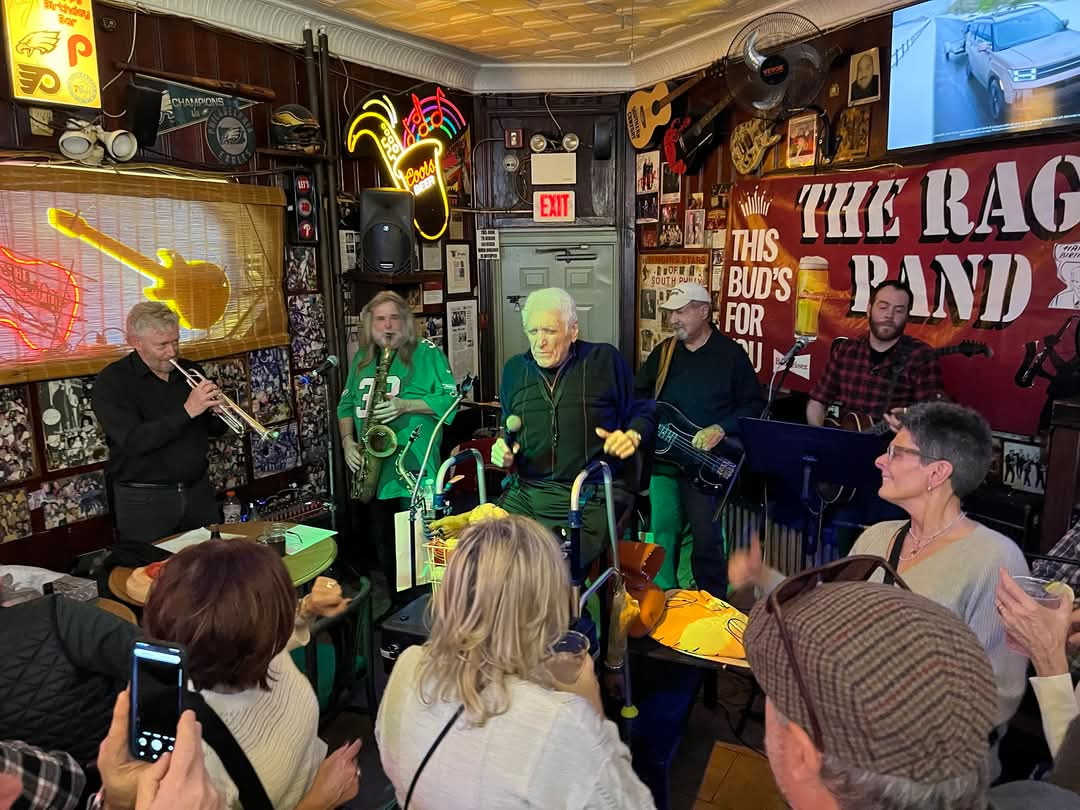
    Mr. Capozzoli played in The Rage Band for 42 years, performing for packed houses at the Springfield Inn in Sea Isle City and Ray’s Happy Birthday Bar.

    “There is no Rage Band without Lou,” Saunders said. “He was the glue that kept us together.”

    Outside of music, Mr. Capozzoli’s greatest loves were his wife and children. He was a dedicated father who enjoyed cooking large French toast breakfasts, organizing tee ball games, and ensuring the family always had a rescue dog to snuggle. Laughter — and his wife’s minding — kept Mr. Capozzoli going, even as the decades of working in a smoking bar wore on him.

    “I don’t think I’ve ever seen Lou angry,” said Saunders. “I don’t think he’d ever not had a smile on his face.”
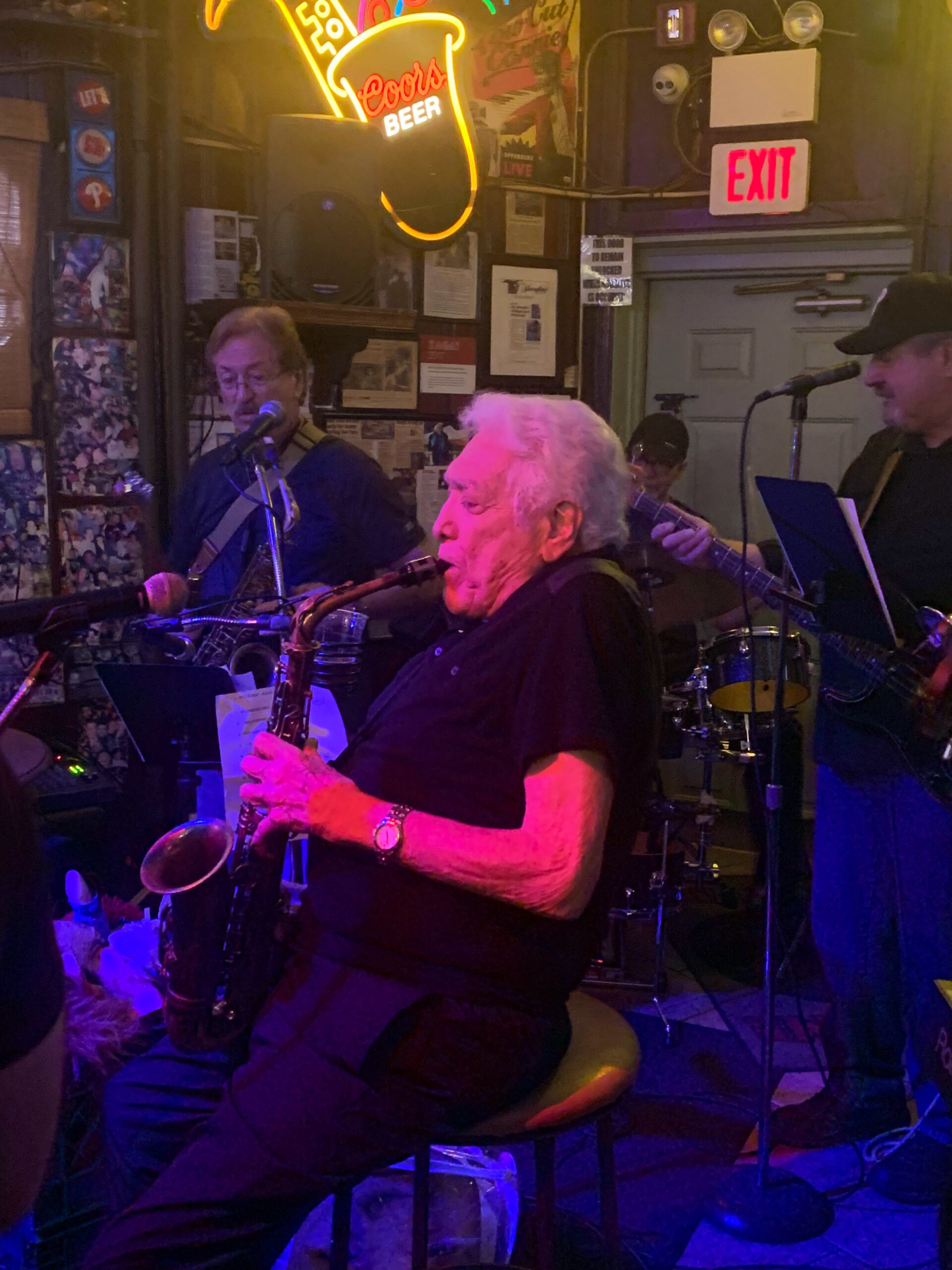
    Mr. Capozzoli was an accomplished saxophonist who started playing professionally when he was 14 years old.

    In addition to his wife, Rose, and son, Anthony, Mr. Capozzoli is survived by his daughters, Dyan Wixted and Luann Capozzoli, and three grandchildren: Louis, Daniel, and Delaney.

    Visitation with the family will be held from 6 to 9 p.m. Feb. 6, and from 9:30 to 11 a.m. Feb. 7 at Pennsylvania Burial Company, 1327-31 S. Broad St., Philadelphia, Pa., 19147. Services will follow Saturday at 11 a.m.

    Donations in Mr. Capozzoli’s name may be made to an animal shelter of your choosing or ACCT-Philly, c/o Development, 111 W. Hunting Park Ave, Philadelphia, Pa., 19140. Alternatively, his wife said, stories about Mr. Capozzoli or jokes he would’ve enjoyed can be sent to the family via email at rayshappybirthdaybar1@gmail.com.


  • Yes, Philly is most definitely a basketball city. Dating all the way back to 1898.

    Yes, Philly is most definitely a basketball city. Dating all the way back to 1898.

    On Dec. 1, 1898, about 1,000 people gathered at a court in Textile Hall — today’s Kensington neighborhood. They were there to watch the Philadelphia Hancock Athletic Association play the New Jersey Trenton Nationals in America’s first professional basketball game.

    According to an article in the following day’s Philadelphia Times, the game got a late start because referees were still ironing out the rules of the world’s newest professional sport.

    But once the game got underway, it was fast and furious.

    Hancock “started with a rush, scoring two field goals before the players had become warmed up to their work,” the story reads.

    “Throughout the entire first half, the home team had the better of the argument, taking advantage of every opportunity finishing the half in the lead by a score of 11 to [0].”

    In the end, Philadelphia lost by two points, a disappointment Philly sports fans know all too well, even in these modern times.

    The final score: 21 to 19.

    Daniel Lipschutz blended history into his love of the modern day sport for this sculpture.

    That first game of the National Basketball League will be feted this Saturday at a Firstival at Xfinity Mobile Arena. Firstivals are the Philadelphia Historic District’s weekly day parties celebrating events that happened in Philadelphia before anywhere else in America, and often the world. They are part of a yearlong celebration of America’s 250th birthday.

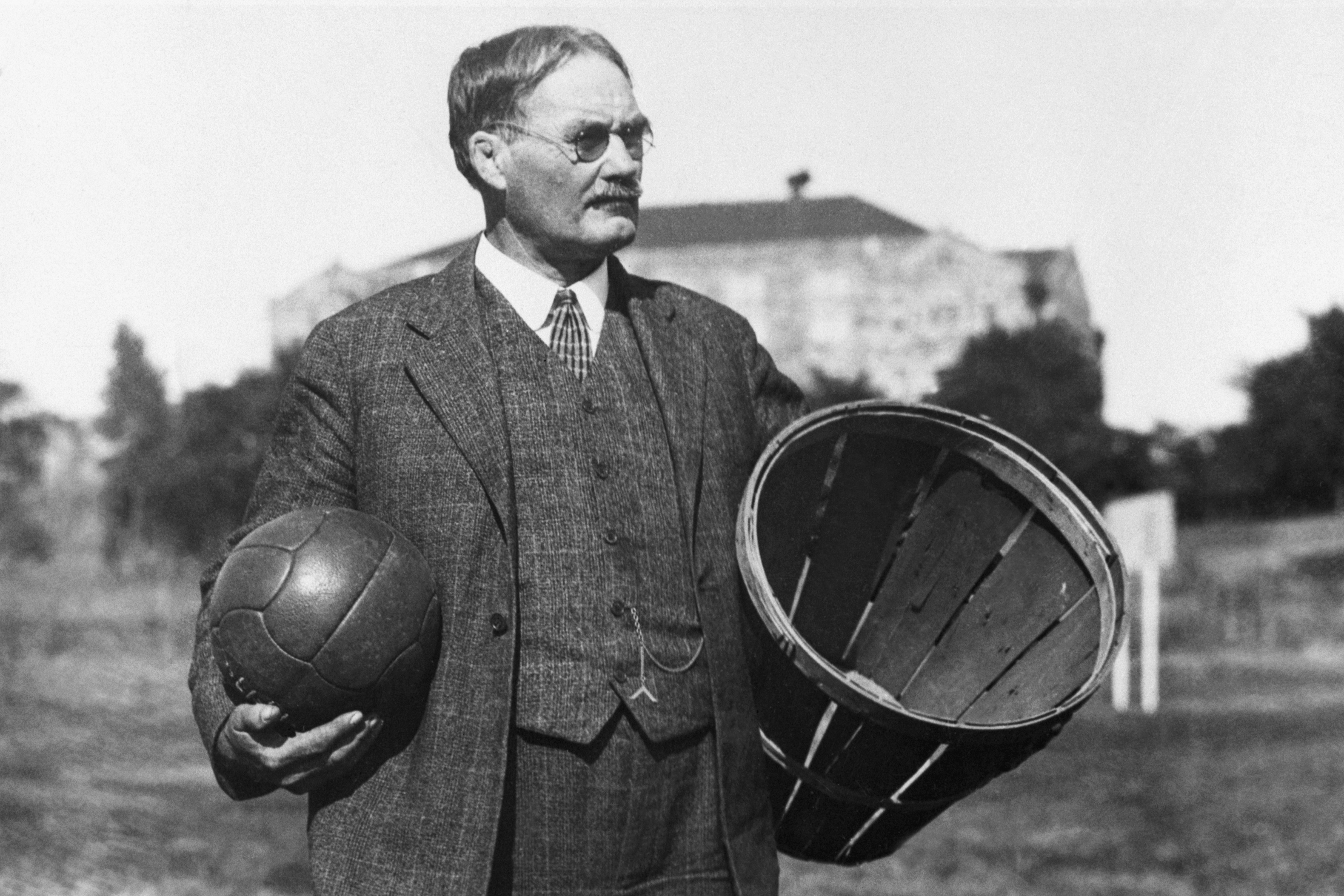
    James Naismith, a YMCA coach in Springfield, Mass., invented basketball in 1891 to keep kids active during winter months. The sport incorporated elements of rugby, lacrosse, and soccer. Instead of throwing balls into a bottomless net to score, players threw balls into peach baskets.

    (In other words, there was no such thing as a rebound.)

    James Naismith, inventor of basketball, with a ball and a basket.

    Basketball quickly became popular with college students and in 1898, Naismith was recruited to coach the University of Kansas basketball team.

    That same year, Horace Fogel, sports editor of the Philadelphia Public Ledger, organized the first professional basketball league with three teams from Philadelphia and three from South Jersey.

    A 12-foot chain-link cage separated players from the fans. Ropes replaced these iron cages in the 1920s.

    Fogel’s National Basketball League lasted just five years, folding in 1904 because of quick player turnover eating into profits. A second league was formed in 1937 and was sponsored by Goodyear. In 1946, the Basketball Association of America was established.

    And in 1949, the BAA and NBL merged to create today’s NBA.

    “This really goes to show that Philadelphia is a sports city,” said Shavonnia Corbin Johnson, vice president of civic affairs for the 76ers. “When people talk about Philadelphia sports rooted in history, tradition, and passion, it’s true, but now we know that America’s true love of sports can trace its roots right back here.”

    This week’s Firstival is Saturday, Jan. 24, 11 a.m. — 1 p.m., at Xfinity Mobile Arena, 3601 S. Broad St., Philadelphia, Pa. Premium Access Entrance on the Broad Street side, near Lot C. The Inquirer will highlight a “first” from Philadelphia Historic District’s 52 Weeks of Firsts program every week.

  • The new owner of Crozer-Chester Medical Center wants to restore hospital and emergency services

    The new owner of Crozer-Chester Medical Center wants to restore hospital and emergency services

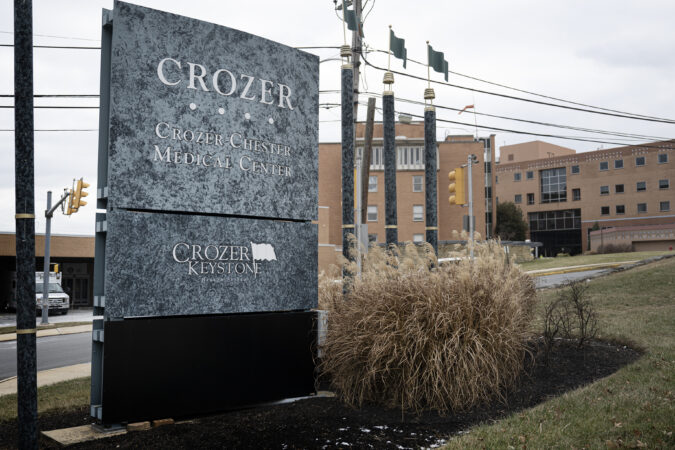
    The new owner of the defunct Crozer-Chester Medical Center wants to restore hospital and emergency services to the 64-acre campus that straddles Chester and Upland Township in Delaware County.

    Newly formed Chariot Equities completed the $10 million purchase Wednesday. The for-profit entity said it expected within six months to have an agreement with a health system that would operate a “right-sized” hospital and emergency department at the facility that had been the county’s largest provider of those services before closing last year.

    The idea is then to open the first phase within two years, Chariot said in a statement.

    Chariot did not say how much it would spend on refurbishing Crozer-Chester, which had suffered from years of neglect under its two previous owners.

    Chariot’s partner at Crozer-Chester is Allaire Health Services, a Jackson, N.J.-based for-profit operator of nursing homes.

    The partners said they are in talks with regional and national nonprofit health systems regarding an operating partnership, but provided no details. The amount of money needed for the project would likely depend on what prospective tenants would want to do at the property.

    “Our belief in Delaware County’s future, and the community’s need for sustainable healthcare access, made this an effort worth committing to well before the finish line,” said Yoel Polack, Chariot’s founder and principal.

    Little is known about the new owners. Polack worked in healthcare real estate in the New York City area before setting his sights on redeveloping Crozer-Chester.

    Federal records list Allaire’s CEO Benjamin Kurland as an owner of 20 nursing homes, including three in the Philadelphia area. Chariot’s statement said Allaire owns a total of 29 facilities in five states.

    Philadelphia-area facilities associated with Kurland are the Center For Rehab & Nursing Washington Township, which was acquired from Jefferson Health; Riverview Estates Rehab & Senior Living Center in Riverton; and West Park Rehabilitation & Nursing Center in West Philadelphia.

    Local interest?

    Main Line Health has been involved in discussions about reopening emergency services at three former Crozer hospitals — Crozer-Chester Medical Center, Springfield Hospital, and Taylor Hospital — at the request of state lawmakers and the property owners, Ed Jimenez, CEO of Main Line Health, said Wednesday at a Riddle Hospital event.

    Jimenez said he would “entertain the concept” of restoring emergency services at one of the hospitals as part of a partnership with other health systems, but only if it can be done on a break-even basis.

    All three of the former hospital buildings visited by Main Line officials are in poor condition and were stripped of medical equipment after the closures. Main Line’s experts estimated it would cost between $15 million and $20 million just to make the emergency department at Taylor functional, Jimenez said.

    ChristianaCare, Delaware’s largest health system, considered acquiring Crozer in 2022. Instead, it took a different path to expansion in Southeastern Pennsylvania. It is planning to open two micro-hospitals in Delaware County. The nonprofit system also took over five former Crozer outpatient locations. Its credit rating was recently downgraded by one notch because of lower profitability.

    The importance of Crozer-Chester

    Crozer-Chester closed in early May during the bankruptcy of owner Prospect Medical Holdings Inc., a for-profit company based in California, and after the failure of government-supported efforts to form a new nonprofit owner for Crozer-Chester and other Crozer Health facilities.

    Crozer-Chester was particularly important as a safety-net provider for a low-income area of Delaware County that has few other nearby options. The Crozer system, which had four hospitals, was the county’s largest health system and largest employer for many years.

    Two local Democratic officials, State Rep. Leanne Krueger and Delaware County Council member Monica Taylor, said they were encouraged by the approach being taken by Chariot and Allaire.

    At Taylor Hospital, the other Crozer hospital that closed last year, new owners are also looking for healthcare tenants. Local investors bought the Ridley Park facility for $1 million. It is less than four miles from Crozer-Chester.

    The same group agreed last week to pay $1 million for Springfield Hospital, another facility that had previously shut down under Prospect ownership.

  • No matter what Trump may claim, protecting civil rights doesn’t prompt reverse racism

    No matter what Trump may claim, protecting civil rights doesn’t prompt reverse racism

    The days when Black people couldn’t vote, ride on the front of public buses, be served at lunch counters, attend many schools, or sleep in hotels weren’t all that long ago. Thanks to the advocacy of the late Rev. Dr. Martin Luther King Jr. and the passage of the Civil Rights Act of 1964, discrimination based on race is now illegal.

    But President Donald Trump would try to have us believe that the implementation of civil rights policies has hurt white people, when, in actuality, they make life better for everyone because they protect women, religious groups, immigrants, the LGBTQ+ community, and people of different ethnicities and races from discrimination.

    In Trump World, though, up is down and down is up.

    News reports today often read more like satire from the Onion than real life. But journalists still have a responsibility to report on what comes out of the Oval Office, no matter how ludicrous.

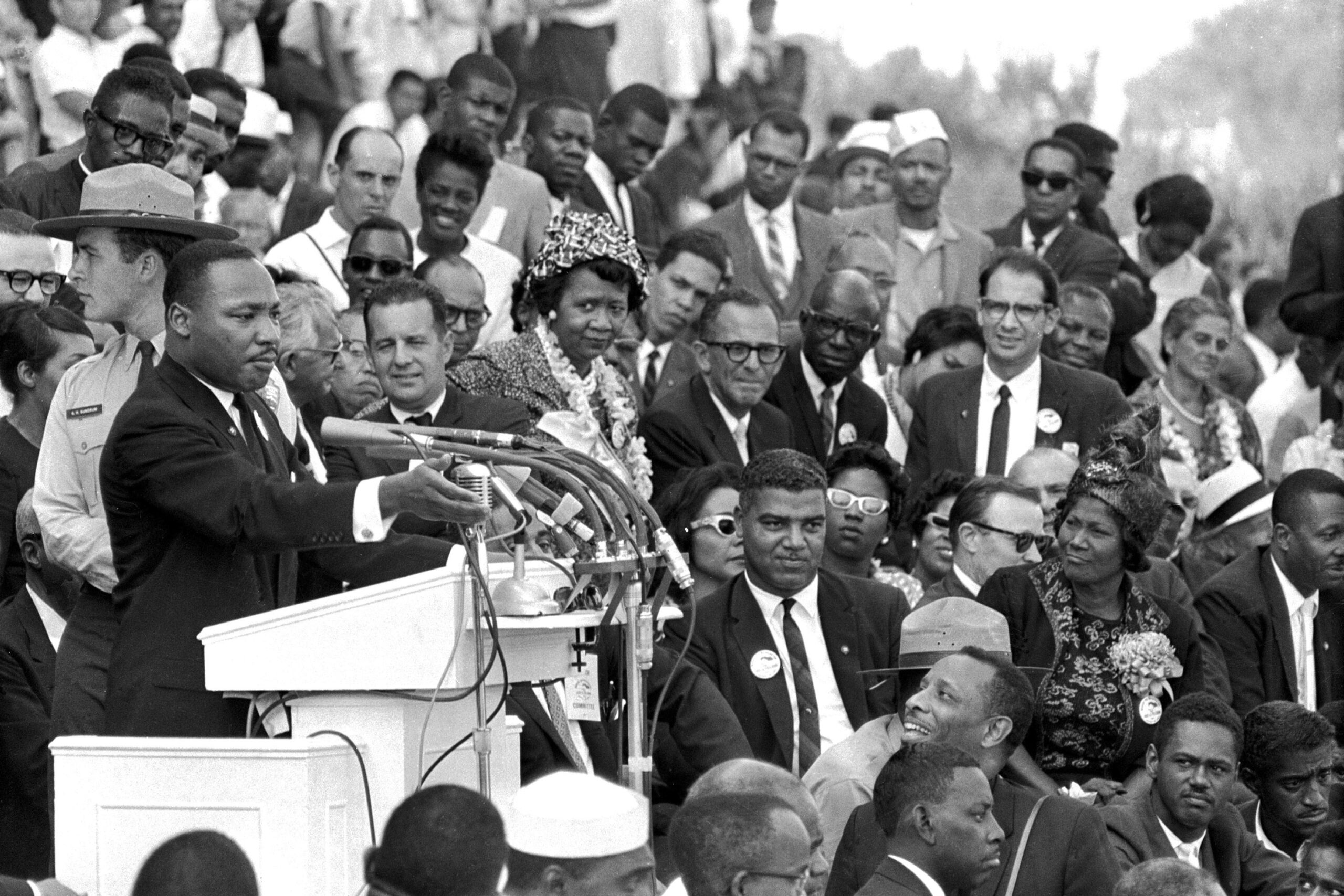
    The Rev. Dr. Martin Luther King Jr. speaks to thousands during his “I Have a Dream” speech at the Lincoln Memorial during the March on Washington for Jobs and Freedom, Aug. 28, 1963, in Washington.

    So when I read that Trump had met with a small group of New York Times journalists at the White House and told them that civil rights led to white people being “very badly treated,” my jaw dropped. I read and reread what his actual words were, which included his saying, “White people were very badly treated, where they did extremely well, and they were not invited to go into a university to college.”

    Trump reportedly added, “So I would say in that way, I think it was unfair in certain cases.”

    That’s like saying the rise of feminism and women’s rights hurt men. But wait, there’s more. Trump also is reported as having said: “I think it was also, at the same time, it accomplished some very wonderful things, but it also hurt a lot of people — people that deserve to go to a college or deserve to get a job were unable to get a job. So it was, it was a reverse discrimination.”

    He apparently was referring to affirmative action, which is rich considering white women are the largest beneficiaries of it. Same thing with diversity, equity, and inclusion initiatives, which were created to give historically marginalized workers, such as women, people with disabilities, African Americans, and veterans, better opportunities in the workplace.

    This attempt by Trump at grievance politics to rev up his base rings hollow to sensible people who recognize that white men have always held the vast majority of upper-level positions in both the private and public sectors.

    In contrast, Black people and Native Americans have always had the highest rates of unemployment. Despite advances, the wealth gap between white and Black people continues to be considerable. This past September, I wrote about how African American women have been the hardest hit by job losses since Trump returned to public office.

    MAGA is big on accusing former President Barack Obama of supposedly dividing the country, while it is Trump who continually stokes racial division.

    He kicked off his presidential campaign in 2015 by maligning Mexicans, saying: “They’re bringing drugs. They’re bringing crime. They’re rapists.” He has referred to Haiti, African nations, and El Salvador as “shithole countries,” accused Haitians in Springfield, Ohio, of eating their neighbors’ dogs and cats, and insulted Somali Americans by calling them “garbage.”

    One of the first things Trump did after being sworn into office in 2025 was to sign executive orders aimed at eliminating DEI. His remarks about civil rights supposedly hurting white people are merely his latest salvo, along with his administration’s calls for white men to file complaints with the Equal Employment Opportunity Commission.

    “There is zero evidence — none — that the civil rights movement harmed white men in any way,“ said NAACP president Derrick Johnson in a statement to the Grio. “[Trump] is hoping we swallow his lie again, so that he can continue to privatize education, cut social services, and repeal civil rights laws and enforcement mechanisms. It’s all about making more money — even if we all suffer as a result.”

    It’s sad — but not surprising — that in 2026 the president would reach for a play out of the tattered segregationist handbook to try and make white people the victims of civil rights.

    Had he lived, King would have been thoroughly disgusted — but would have countered the president’s gutter-level deception with an elevated truth: “If the inexpressible cruelties of slavery could not stop us, the opposition that we now face surely will fail.”

  • Philadelphia-area nursing homes have amassed $5.3 million in fines since 2023 for safety violations

    Philadelphia-area nursing homes have amassed $5.3 million in fines since 2023 for safety violations

    Safety violations at Philadelphia-area nursing homes have led to nearly $5.3 million in fines since 2023, an Inquirer review of federal data shows, with almost half of the region’s 182 facilities facing financial penalties.

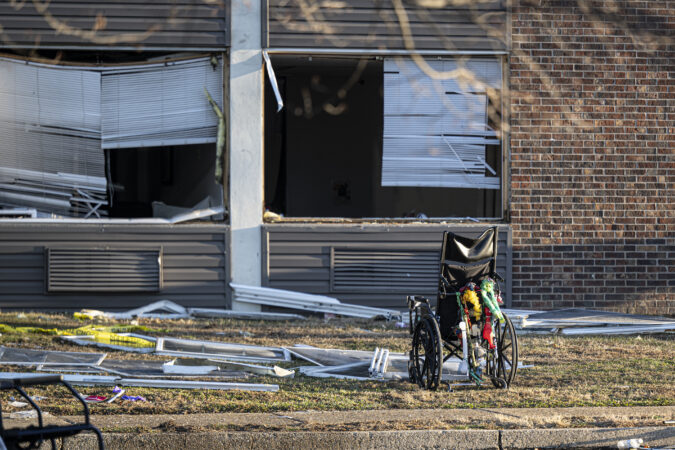
    The Bristol Township nursing home, where an explosion last month killed three people, topped a list of nursing homes fined in Philadelphia, Chester, Delaware, Montgomery and Bucks County, according to Centers for Medicare & Medicaid Services (CMS) data.

    The facility was fined a total of $418,000 for two sets of violations in 2024 when it was known as Silver Lake Healthcare Center. The nursing home was renamed Bristol Health & Rehab Center last month, following an ownership change shortly before the explosion.

    Six-figure penalties are not uncommon in the region. More than 22% of the 85 facilities fined had penalties greater than $100,000. The violations cited concerns ranging from noncompliant fire extinguishers to life-threatening hazards, such as allowing a resident to overdose on illegal narcotics.

    Accela Rehab And Care Center at Springfield in Montgomery County had the most citations for health deficiencies in the Philly-area — 122 total.

    Edenbrook of Yeadon in Delaware County had the most fire safety violations with 60.

    Pennsylvania regulators inspect nursing homes annually to ensure compliance with state requirements and once every 15 months for compliance with federal regulations, said Neil Ruhland, a spokesperson for the Pennsylvania Department of Health.

    The amount of a fine depends on the severity of a violation, with bigger fines when people are harmed; the number of residents impacted by the violation; and how long the facility was out of compliance.

    Nursing homes cited for deficiencies are required to develop a plan of correction, which is reviewed and monitored by the state. If the facility continues to be out of compliance, it may face penalties, including fines and ultimately could be terminated from Medicare and Medicaid, though that’s rare.

    Here’s a look at federal fines and citations at nursing homes across Southeastern Pennsylvania since 2023, according to CMS.

    window.addEventListener(“message”,function(a){if(void 0!==a.data[“datawrapper-height”]){var e=document.querySelectorAll(“iframe”);for(var t in a.data[“datawrapper-height”])for(var r,i=0;r=e[i];i++)if(r.contentWindow===a.source){var d=a.data[“datawrapper-height”][t]+”px”;r.style.height=d}}});

  • S&P downgraded ChristianaCare’s credit rating

    S&P downgraded ChristianaCare’s credit rating

    ChristianaCare, Delaware’s largest health system, received a one-notch credit-rating downgrade from Standard & Poor’s, to “AA” from “AA+’.

    S&P attributed the downgrade of the nonprofit health system’s rating to inconsistent operating performance in recent years and the planned addition of $350 million in debt early this year through a bond offering, according to a report Tuesday.

    In the year ended June 30, 2025, ChristianaCare’s financial results were weaker than expected because of low surgical volume related to physician turnover, S&P said. Another factor was higher-than-anticipated medical malpractice reserves, S&P said.

    One of ChrisitianaCare’s financial strengths is that it typically gets half of its revenue from private insurers, which pay higher rates and are more profitable than Medicare and Medicaid, S&P noted.

    Despite its strong financial condition, ChristianaCare has a relatively small service area, given its concentration in northern Delaware, compared to other health systems with “AA” ratings, S&P said. If ChristianaCare’s expansion into Southeastern Pennsylvania is successful, it would help alleviate that problem, the agency said.

    ChristianaCare opened a micro-hospital in western Chester County last summer and is building a second one in Aston, Delaware County. It also has plans to put one in Springfield Township. In addition, ChristianaCare spent $50 million to step into the leases that the bankrupt Crozer Health had at five outpatient facilities in Broomall, Glen Mills, Media, and Havertown.

    S&P said ChristianaCare has no plans for significant acute-care hospital expansion.

    Last month, ChristianaCare and Virtua Health, South Jersey’s largest health system, ended negotiations on a possible merger.

  • Catholic Charities helps those in need both surmount life’s hardships and celebrate its many little joys | Philly Gives

    Catholic Charities helps those in need both surmount life’s hardships and celebrate its many little joys | Philly Gives

    Heather Huot, the top executive at Catholic Charities, named her only daughter after Lidia, a homeless, mentally ill, and often cranky elderly woman she met as a young social worker at Women of Hope Vine, a transitional housing facility run by the organization Huot now leads.

    As “mean spirited” as Lidia was, Huot said, Lidia still celebrated forsythia.

    When their bright yellow blossoms heralded winter’s end, Lidia would drag Huot outside to marvel. “Despite all the hardships,” Huot said, “there are things to be celebrated.”

    Which brings us to the Christmas holiday season.

    Even if it were possible, which it’s not, to overlook all the troubles in our world, with wars and starvation, or even to overlook all the troubles in our nation, there would still be the troubles of the season — too much work, too much loneliness, too many struggles.

    Where’s the forsythia?

    Two weeks ago, it was outside the Archdiocesan Pastoral Center in the form of a living Nativity scene, complete with a wee baby goat named Lady, an artificial-snow machine, an actual camel, and an elementary school choir in their Catholic school uniforms singing “Joy To the World.”

    Yes, “Joy To The World,” because 500 children, some of whom live in tough circumstances, got a chance to celebrate Christmas and with it, maybe, the hope that the holiday brings. It was the 70th annual Archbishop’s Benefit for Children, a Catholic Charities of Philadelphia event funded by a grant from the Riley Family Foundation. No expense was spared.

    Heather Huot, the chief of Catholic Charities Philadelphia, pets a calf during a living Christmas scene in front of the Archdiocesan Pastoral Center in Center City Philadelphia.

    More than 60 volunteers from area high schools lunched on pizza and cookies before heading across the street to a lavishly decorated ballroom in the Sheraton Philadelphia Downtown. Balloons, banners, party favors, huge plates of cookies, a container of ice cream cups, and a bucket of all different flavors of milk awaited at each table. Kids and chaperones crowded the dance floor, only to make way for an appearance by Santa, who high-fived his way around the ballroom. At the party’s end, the volunteers sprang into action distributing bags of toys — all beautifully wrapped.

    In a way, the party is a metaphor for Catholic Charities as a whole. Both the party and the organization are big and multifaceted with lots of moving parts, involving all types of people, not only Catholics.

    Each year, Catholic Charities spends about $158 million to run about 40 different programs in four main categories — care for seniors; support for at-risk children, youth, and families; food and shelter; and its biggest category, many-pronged assistance for people with intellectual and developmental disabilities and their families.

    As an overview, there’s housing for at-risk youth in Bensalem. In Philadelphia, people may be familiar with St. John’s Hospice on Race Street, which provides food, showers, shelter, and case management to men. There are several smaller transitional housing shelters for women in the city.

    Social workers funded by Catholic Charities assist students at six Catholic high schools across the region. Other social workers handle case management under contract with the City of Philadelphia. A program teaches teenagers involved in the juvenile justice system about conflict resolution. Family navigators step in to assist families with issues ranging from employment to parenting support. There are adoption and foster-care services.

    For the elderly, Catholic Charities supports senior centers and works to help seniors stay independent through case management.

    Archbishop Nelson Pérez poses with students during a holiday party.

    Just over half of Catholic Charities’ annual budget is allocated to supporting people with intellectual or developmental disabilities. A major focus is housing for adults. For example, at the Divine Providence Village in Springfield, Delaware County, 72 women live in six cottages on a 22-acre campus with a pool, greenhouse, and picnic pavilion.

    In addition, there is employment support, a day program, field trips, a family-living program, and respite care to help families overwhelmed by caregiving responsibilities.

    Nearly 80% of Catholic Charities’ funding comes from government sources, which, these days, requires Huot to focus her prayers. “I ask God to help me get through this and to give me the strength and the people around me to get through this,” she said. “At the same time, we have to recognize that God provides in ways you don’t expect.

    “We’ve been blessed with generous benefactors who have stepped in,” she said. “The Philadelphia community is incredibly generous. We get a bad rap as the people who throw snowballs at Santa Claus, but Philadelphians will give you the shirt off their backs. They are passionate about caring for one another.”

    The generosity moved Lakisha Brown to tears as she shepherded her two children and a third to the party earlier this month. Brown, 44, lives in a three-bedroom subsidized housing apartment at Catholic Charities’ Visitation Homes in Kensington.

    “This is the best I ever lived,” she said. But, she said, just outside her door “is a constant reminder of where I came from and where I never want to go.”

    Brown’s father died when she was in elementary school and her mother struggled with alcohol addiction. Brown left home when she was 16 under the protection of a man who started their relationship with gifts and ended it with beatings.

    “He left me in a coma,” she said.

    Brown had her own struggles with addiction. She spent many nights without a roof over her head. If lucky, she could sleep in safety in an abandoned car on a quiet block. One night, she went to a party in a hotel. When she woke up, her clothes were off. Whatever happened wasn’t consensual.

    Soon after, she learned she was pregnant and, knowing that, she vowed to give her baby a clean birth. She found a drug program and a place to live. Slowly, through housing and support from Catholic Charities, she rebuilt her life.

    Erika Hollender holds up her grandchild so Layani, 3, can touch Percy the camel.

    “They help us with budgeting, with money management,” said Brown, who relies on disability, welfare, and food benefits while trying to cope with her own mental health issues. “When we get some money, we want to spend it on the children. We were parenting out of guilt and shame.”

    Those are the big things, but what Brown wants people to understand is that the level of care is deep, personal, and specific. It’s being able to ask a staff person for a roll of toilet paper and trash bags — basics that are sometimes unaffordable when money must be allocated to food and shelter.

    “A mom’s job is never done,” she said, explaining why people should donate to Catholic Charities. “It is needed for mothers who come from nothing. It is needed.”

    For more information about Philly Gives, including how to donate, visit phillygives.org.

    About Catholic Charities of Philadelphia

    People served: 294,000 annually (in the 2023-24 fiscal year)

    Annual spending: $158.6 million across four pillars of mercy and charity

    Point of pride: Catholic Charities of Philadelphia is the heart of the church’s mission in action, serving all people regardless of background. With decades of experience, nearly 40 comprehensive programs, and deep community partnerships, Catholic Charities turns compassion into action, and action into lasting and impactful change.

    You can help: By serving meals, volunteering at a food pantry or shelter, hosting a food or clothing drive, and sharing your gifts and passions with seniors.

    Support: phillygives.org

    What your Catholic Charities donation can do

    • $25 provides five nutritious lunches for children through the School Lunch Program.
    • $50 provides three hot lunches at St. John’s Hospice for individuals experiencing food insecurity.
    • $100 provides an instructor and supplies for an art or recreation class for 50 to 100 seniors at a senior community center.
    • $275 provides one week of groceries for a family of four.
    • $325 provides a mother with formula, diapers, and wipes for a month.
    • $550 provides emergency shelter and meals for a week for someone experiencing homelessness.
  • Middletown Township welcomes first full-service hotel ahead of major tourism events in Delco

    Middletown Township welcomes first full-service hotel ahead of major tourism events in Delco

    On a frigid Tuesday morning, stakeholders from across Delaware County toasted champagne and popped mini pastries under the roof of Middletown Township’s new Hilton Garden Inn.

    “We may be the only Hilton Garden Inn in the world that serves Wawa coffee and drinks it all the time,” quipped hotel owner Patrick J. Burns, standing before a sea of family members, hotel staffers, business associates, and elected officials.

    The 107-room, 67,000-square-foot Hilton, located off Baltimore Pike at the former Franklin Mint site, is open and welcoming guests. It’s the 42nd hotel in Delaware County and first full-service hotel in Middletown Township.

    The hotel features app-to-room device integration, mobile key and contactless check-in, meeting and banquet spaces, an outdoor patio with fire pits, a fitness center, and the Garden Grill, a restaurant serving “American cuisine with local flair” that will be open to the public.

    The hotel is long awaited, borne from a yearslong planning process and delayed by pandemic-era construction slowdowns. On Tuesday, attendees expressed gratitude that what was once an economic dream for the township was finally becoming reality.

    The Hilton marks an important expansion of the collar county’s tourism economy, according to Delaware County’s major economic stakeholders. And as far as tourism in Delco, they say, it’s only up from here.

    The bar area off of the lobby at the new Hilton Garden Inn of Middletown Township on Tuesday, Dec. 16, 2025.

    Delaware County hosted 4.5 million visitors in 2024, according to Steve Bryne, executive director of Visit Delco. Those visitors spent $860 million, generated $1.2 billion in economic impact, and sustained 13,000 jobs. In 2025, the county is on track to sell more than one million hotel room nights for the first time in its history.

    Representatives from the Hilton say it created 200 construction jobs and 40 new hospitality jobs.

    Bryne said tourism to Delaware County is a “combination of everything.” The county doesn’t have one major anchor (like Longwood Gardens in Chester County, for example). Rather, it’s home to 12 colleges and universities, major corporate employers like Wawa, and sports complexes like IceWorks and Subaru Park, home of the Philadelphia Union. That means regular tournaments, business conferences, parents weekends, homecomings, and graduations — events that, collectively, help power the county’s economy.

    Already, Penn State Brandywine, located down the road, has named the Hilton Garden Inn its host hotel.

    Delaware County also gets spillover from visitors to Philadelphia, especially those who want proximity to Philadelphia International Airport.

    The hotel is a property of Metro Philly Management, owned by Burns. Burns’ management company also owns the Courtyard by Marriott in Springfield, the Fairfield Inn & Suites in Broomall, and the Springfield Country Club, as well as numerous grocery stores and restaurants.

    Patrick J. Burns, pictured at Middletown Township’s new Hilton Garden Inn on Tuesday, Dec. 16, 2025. The hotel is owned by Burns’ company, Metro Philly Management.

    Stakeholders lauded the hotel’s location in a central, and rapidly developing, part of Middletown Township.

    The former Franklin Mint complex, now home to the Hilton, has been a hotbed of development in Middletown Township since the mint shuttered in 2004. Two newer housing developments — Pond’s Edge and Franklin Station — have added over 450 units of housing to the site. Middletown Township outpaced its neighbors — Media, Nether Providence, and Upper Providence — in population growth in 2024.

    “Middletown Township is such a vital corridor of Delaware County,” Burns said.

    The hotel’s opening coincides with major events coming to the region in the coming months: semiquincentennial celebrations in Philadelphia and in Delco, the FIFA World Cup, the PGA Championship at Aronimink Golf Club, and the MLB All-Star Game. For the PGA Championship alone, Delaware County is expecting 200,000 visitors and $125 million in economic impact.

    This suburban content is produced with support from the Leslie Miller and Richard Worley Foundation and The Lenfest Institute for Journalism. Editorial content is created independently of the project donors. Gifts to support The Inquirer’s high-impact journalism can be made at inquirer.com/donate. A list of Lenfest Institute donors can be found at lenfestinstitute.org/supporters.

  • Trump says Somalis are ‘garbage’ and wants them to leave America. No one should be surprised by his ignorance.

    Trump says Somalis are ‘garbage’ and wants them to leave America. No one should be surprised by his ignorance.

    Donald Trump let us know exactly who he is when he rode down that escalator in June 2015, declared his presidential candidacy, and said this about Mexicans: “They’re bringing drugs. They’re bringing crime. They’re rapists.”

    We’ve heard him refer to Haiti, African nations, and El Salvador as “shithole countries.” Last year, he accused Haitians in Springfield, Ohio, of eating their neighbors’ dogs and cats. Trump allows mask-wearing U.S. Immigration and Customs Enforcement agents to terrorize undocumented immigrants, most recently in New Orleans, as reported by my colleague Will Bunch.

    No one should be surprised he called Somalis “garbage” who “contribute nothing” and should leave America during a cabinet meeting last week.

    “These are people that do nothing but complain,” Trump said. “When they come from hell, and they complain and do nothing but bitch, we don’t want them in our country. Let them go back to where they came from and fix it.”

    Trump talks a really good game about putting America First, but he really means people of color last. An example of that was when he suspended refugee admissions, but then turned around and made an exception for white South Africans.

    Even knowing Trump’s agenda, it’s still upsetting to hear a sitting U.S. president denigrate the roughly 250,000 Somalis in this country.

    He’s talking about law-abiding folks like Salma Hussein. She made headlines in 2022 when she became the first female Somali principal in her school district in suburban Minneapolis, and possibly in the entire state of Minnesota.

    Hussein was born in Somalia, but has lived in America since the age of 7, and is a naturalized citizen. She’s a wife. She’s a mother of two. She’s a good person. “It’s really hurtful, and he’s giving permission to people to be hateful, and that’s really disheartening,” Hussein said.

    I stumbled across some of her social media posts about what’s been happening and decided to reach out. When I got her on the phone last week, Hussein, 37, and I talked about a lot of things, including how a stranger had emailed her saying: “Watch out. You’re not wanted. We’re taking out the trash from our country.”

    Salma Hussein, a Somali American who’s lived in the U.S. since she was 7, said the president is “giving permission to people to be hateful.”

    I shouldn’t even have to write this: Most Somalis are honest, law-abiding people. Many settled in Minnesota during the early 1990s after fleeing their war-torn country. Of the state’s foreign-born Somalis, most are naturalized U.S. citizens. They have every right to live in the Land of 10,000 Lakes. They vote. They pay taxes. Trump is their president, too. Some, oddly enough, even voted for him.

    I wish they’d thought longer and harder before voting for Trump, who posted on Truth Social that Minnesota is “a hub of fraudulent money laundering” and announced he was terminating Somalis’ Temporary Protected Status.

    Dozens of Somalis in Minnesota are facing charges in connection with a nefarious scheme to defraud the U.S. government of hundreds of millions in funding that had been set aside to feed hungry children at the height of the pandemic. Still, it’s unfair for a sitting U.S. president to stereotype an entire community for the actions of a subset. “As a Somali American, I’m just as upset about the people in my community who use fraud to make money,” Hussein told me.

    Somalis, who have built a large and influential enclave in Minnesota, are terrified that masked agents from ICE will take them into custody. Some have started carrying their passports. Others refuse to even leave their homes.

    “This kind of dangerous rhetoric and this level of dehumanizing can lead to dangerous actions by people who listen to the president,” said Rep. Ilhan Omar (D., Minn.) on CBS’s Face the Nation on Sunday.

    It’s textbook Trump — and, of course, MAGA loves it.

    Rep. Ilhan Omar (D., Minn.) speaks during a news conference, May 24, 2023, on Capitol Hill in Washington.

    In New Orleans last week, Trump sicced ICE on undocumented Hispanic immigrants. At around the same time, his agents were also targeting Somalis in Minnesota.

    Which ethnic minority Trump will single out next for harassment is anybody’s guess. The only thing we can be certain of is that they will be from a Black or brown community.

  • Pa.’s new budget has financial help for Delco’s Riddle and Mercy Fitzgerald Hospitals

    Pa.’s new budget has financial help for Delco’s Riddle and Mercy Fitzgerald Hospitals

    Pennsylvania’s new budget has $5 million in supplemental payments for the two Delaware County Hospitals that have seen significant increases in patient volumes since Crozer-Chester Medical Center and Taylor Hospital closed in the spring.

    Main Line Health’s Riddle Hospital, near Media, is getting $3 million. The amount for Trinity Health Mid-Atlantic’s Mercy Fitzgerald Hospital, in Darby, is $2 million, according to budget documents.

    The $5 million will be doubled by a federal match, said Democratic State Sen. Tim Kearney, who represents part of Delaware County. The $5 million is from a fund used to help hospitals the serve a large number of patients with Medicaid and used to go to Crozer Health, Kearney said Friday.

    Main Line said in a statement Thursday that the money will help it maintain services in the county.

    “Since Crozer’s shutdown in April, Riddle’s Emergency Department has experienced an unprecedented surge — 46% more patients than the same period last year, an increase of nearly 4,000 overall,“ the nonprofit said.

    Main Line, which also owns Lankenau Medical Center, Bryn Mawr Hospital, and Paoli Hospital, said it has seen 55,000 patients from the Crozer market — a 15% increase over the same time period last year. That figure includes 8,000 patients who went to a Main Line facility for the first time, the health system said.

    Trinity Health did not respond to a request for comment.

    Shuttered hospitals in limbo

    While Riddle and Mercy Fitzgerald have scrambled to accommodate patients who used to rely on Crozer Health, efforts are underway to bring healthcare services back to at least Taylor Hospital in Ridley.

    Local investors bought that facility in September for $1 million and are trying to entice one of the region’s nonprofit health systems to bring it back as a hospital.

    A group from New Jersey called Chariot Allaire Partners LLC has agreed to pay $10 million for the former Crozer-Chester Medical Center in Upland but has not disclosed its plans. That facility served as a key safety provider for a low-income area of Delaware County.

    A partnership of Restorative Health Foundation and Syan Investments won an auction for Springfield Hospital for $3 million, but it does not have support from township officials.

    Delaware County legislators also obtained $1 million from the state to buy emergency department equipment if one of the closed hospitals, such as Taylor, reopens, Kearney said.

    Editor’s note: This story has been updated with additional detail on the funding.

    This suburban content is produced with support from the Leslie Miller and Richard Worley Foundation and The Lenfest Institute for Journalism. Editorial content is created independently of the project donors. Gifts to support The Inquirer’s high-impact journalism can be made at inquirer.com/donate. A list of Lenfest Institute donors can be found at lenfestinstitute.org/supporters.