Tag: Stacy Garrity

  • The race between Josh Shapiro and Stacy Garrity for Pa. governor has officially begun. Here’s what you need to know.

    The race between Josh Shapiro and Stacy Garrity for Pa. governor has officially begun. Here’s what you need to know.

    Pennsylvania’s race for governor has officially begun. And 10 months before the election, the November matchup already appears to be set.

    Democratic Gov. Josh Shapiro formally announced his reelection campaign Thursday — not that anyone thought he wouldn’t run. And Republicans have rapidly coalesced behind the state party’s endorsed candidate, Pennsylvania Treasurer Stacy Garrity.

    The race will dominate Pennsylvania politics through November, but it could also have a national impact as Democrats hope Shapiro at the top of the state ticket can elevate the party’s chances in several key congressional races.

    Here’s what you need to know about the high-stakes contest.

    The candidates

    Josh Shapiro

    Shapiro is seeking a second term as Pennsylvania’s top executive as he’s rumored to be setting his sights on the presidency in 2028. Just weeks after his campaign launch, Shapiro will head to New York and Washington, D.C., as part of a multicity book tour promoting his memoir.

    Shapiro was first elected to public office in 2004 when he flipped a state House seat to represent parts of Montgomery County. As a freshman lawmaker, he quickly built a reputation of brokering deals across party lines. He went on to win a seat on the Montgomery County Board of Commissioners in 2011, flipping the board blue for the first time in decades.

    Shapiro was elected state attorney general in 2016, a year when Pennsylvania went for Republican Donald Trump in the presidential contest. The position put Shapiro in the national spotlight in 2020 when Trump sought to overturn his loss in the state that year through a series of legal challenges, which Shapiro’s office successfully battled in court.

    He went on to decisively beat Trump-backed Republican State. Sen. Doug Mastriano for the governorship in 2022. Despite an endorsement from Trump, Mastriano lacked the support of much of Pennsylvania’s Republican establishment and spent the election cycle discouraging his supporters from voting by mail.

    Throughout Shapiro’s first term as governor, he has highlighted his bipartisan bona fides and ability to “get stuff done” — his campaign motto — despite contending with a divided legislature. His launch video highlights the quick reconstruction of I-95 following a tanker explosion in 2023.

    In 2024, Shapiro was vetted as a possible running mate for then-Vice President Kamala Harris, who ultimately snubbed the Pennsylvanian in favor of Minnesota Gov. Tim Walz. Harris went on to lose the state to Trump.

    Stacy Garrity

    Garrity is Shapiro’s likely opponent in the general election. She earned an early endorsement from the Pennsylvania Republican Party in September after winning a second term to her current position in 2024 with the highest total of votes in history for a state office, breaking a record previously held by Shapiro.

    She has been quick to go on the attack against the Democratic governor in recent months. Throughout Pennsylvania’s monthslong budget impasse Garrity criticized Shapiro’s leadership style and panned the final agreement he reached with lawmakers as fiscally irresponsible.

    Garrity’s campaign has focused on contrasting her priorities with Shapiro’s, arguing the governor is more interested in higher office than he is in Pennsylvania.

    A strong supporter of Trump, Garrity is one of the only women that has been elected to statewide office in Pennsylvania history. If elected, she would be the first female governor in state history.

    Garrity is a retired U.S. Army colonel who was executive at Global Tungsten & Powders Corp. before she was elected treasurer in 2020. Running a relatively low-key state office, Garrity successfully lobbied Pennsylvania’s General Assembly to allow her to issue checks to residents whose unclaimed property was held by her office, even if they hadn’t filed claims requesting it.

    Anyone else?

    While Shapiro and Garrity are the likely nominees for their parties, candidates have until March to file petitions for the race. That theoretically leaves the possibility of a primary contest open for both candidates, but it appears unlikely at this point.

    Mastriano, who ran against Shapiro in 2022, spent months floating a potential run for governor against Garrity. He announced Wednesday that he would not be seeking the Republican nomination.

    The stakes

    Why this matters for Pennsylvanians

    The outcome of Pennsylvania’s gubernatorial race could hold wide-ranging impacts on transportation funding, election law, and education policy, among other issues.

    The state’s governor has a powerful role in issuing executing actions, setting agendas for the General Assembly, and signing or vetoing new laws. The governor also appoints the secretary of state, the top Pennsylvania election official who will oversee the administration of the next presidential election in the key swing state.

    Throughout the entirety of Shapiro’s first term, he has been forced to work across the aisle because of the split legislature. Throughout that time the balance of power in Harrisburg has tilted toward Democrats who hold the governor’s mansion and the Pennsylvania House. But many of the party’s goals — including expanded funding for SEPTA and other public transit — have been blocked by the Republican-held Senate.

    If Garrity were to win that dynamic would shift, offering Republicans more leverage as they seek to cut state spending and expand school voucher options (while Shapiro has said he supports vouchers, the policy has not made it into any budget deals under him).

    Shapiro’s ambition

    Widely rumored to have his sights set on higher office, Shapiro’s presidential ambitions may rise and fall with his performance in his reelection campaign.

    Shapiro coasted to victory against Mastriano in 2022, winning by 15 points. The 2026 election is expected to be good for Democrats with Trump becoming an increasingly unpopular president.

    But Garrity is viewed as a potentially stronger opponent to take on Shapiro than Mastriano, even though her political views have often aligned with the far-right senator.

    When the midterms conclude, the 2028 presidential cycle will begin. If Shapiro can pull off another decisive win in a state that voted for Trump in 2024, it could go a long way toward aiding his national profile. But if Garrity wins, it could end the governor’s chances of putting up a serious campaign for the presidency in 2028.

    Every other race in Pennsylvania

    The governor’s contest is the marquee race in Pennsylvania in 2026. Garrity and Shapiro have the ability to help or hurt candidates running for Pennsylvania’s statehouse and Congress.

    The momentum of these candidates, and their ability to draw voters to the polls could play a key role in determining whether Democrats can successfully flip four competitive U.S. House districts as they attempt to take back the chamber.

    Democrats also narrowly hold control of the Pennsylvania House and are hoping to flip three seats to regain control of the Pennsylvania Senate for the first time in decades. If Democrats successfully flip the state Senate blue, it would offer Shapiro a Democratic trifecta to push for long-held Democratic goals if he were to win reelection.

    Strong Democratic turnout at the statewide level could drive enthusiasm down-ballot, and vice versa. Similarly, weak turnout could aid Republican incumbents in retaining their seats.

    The dates

    The election is still months away but here are days Pennsylvanians should put on their calendars.

    • May 4: Voter registration deadline for the primary election.
    • May 19: Primary election.
    • Oct. 19: Voter registration deadline for the general election.
    • Nov. 3: General election.
  • Gov. Shapiro asks Pennsylvania voters to choose ‘getting stuff done’ over ‘chaos’ as he kicks off 2026 reelection bid

    Gov. Shapiro asks Pennsylvania voters to choose ‘getting stuff done’ over ‘chaos’ as he kicks off 2026 reelection bid

    Pennsylvania Gov. Josh Shapiro officially launched his widely expected bid for reelection Thursday, spending his first day back on the campaign trail in one of the nation’s most politically divided states by touting his achievements for workers, seniors, and schools while contrasting himself against Republicans in President Donald Trump’s Washington.

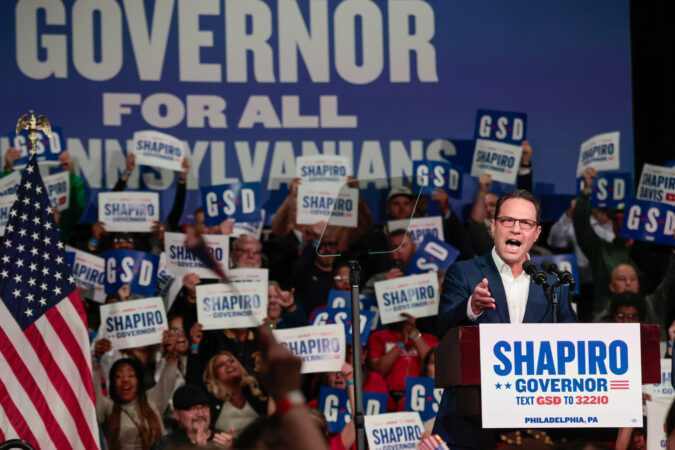
    The Montgomery County Democrat presented his opening argument to voters Thursday afternoon in a highly produced campaign rally at a Pittsburgh union hall, before appearing Thursday night before Philadelphia voters at the Alan Horwitz “Sixth Man” Center in Nicetown.

    Shapiro, 52, of Abington Township, will pursue his reelection bid by crisscrossing the state, boasting a high approval rating that Republicans hope to damage as talk of his potential 2028 candidacy continues to build.

    Shapiro took the stage in Pittsburgh and Philadelphia following speeches from Lt. Gov. Austin Davis and a parade of public officials, labor leaders, and community advocates who touted his first term accomplishments, all delivering a similar message: Shapiro shows up and delivers for residents across the commonwealth.

    At the Sixth Man Center, supporters and local leaders packed the event space in the youth sports center where Shapiro delivered a speech next to a huge mural of 76ers star Joel Embiid. Shapiro joked about his midrange jumper as he praised the center’s work.

    “I am proud to be here on today to say that Josh Shapiro as governor of the commonwealth has delivered for us in a way that some thought … was impossible,” said Philadelphia Mayor Cherelle L. Parker to an excited crowd.

    The rollout signaled Shapiro’s campaign will be anchored in his administration’s motto, “Get S— Done,” emphasizing that state government should be able to solve residents’ problems effectively.

    “You deserve someone who goes to work every day focused on you and on getting stuff done,” Shapiro said.

    He is not expected to face a primary challenger, just like in 2022, when he later cruised to victory in the general election against far-right State Sen. Doug Mastriano (R., Franklin). Mastriano, who had been teasing another run, announced Wednesday he would not join the race for governor.

    This time, Republicans hope to take a stronger swing at Shapiro by coalescing around one candidate early. The state GOP endorsed State Treasurer Stacy Garrity more than a year in advance of November’s midterm election.

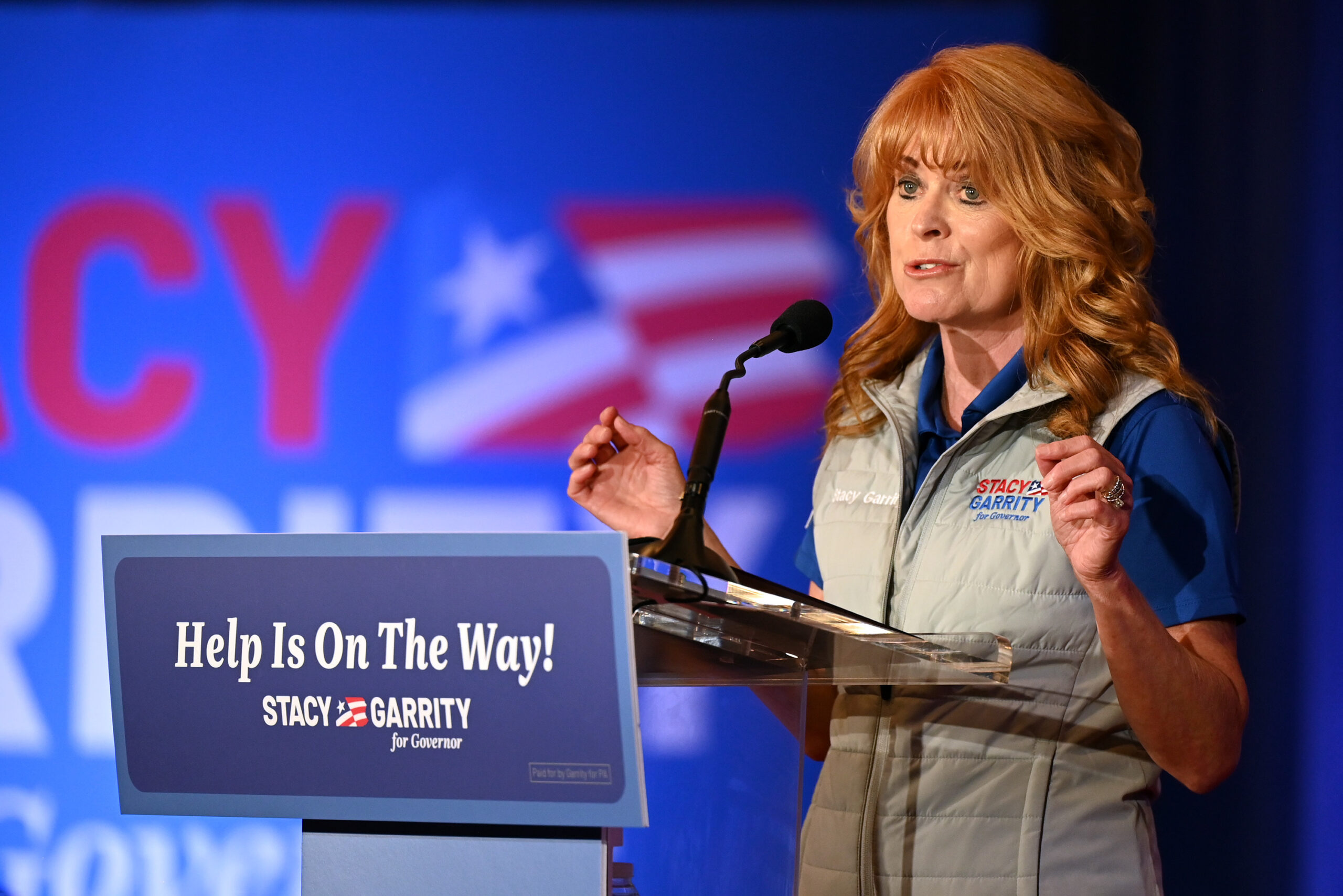
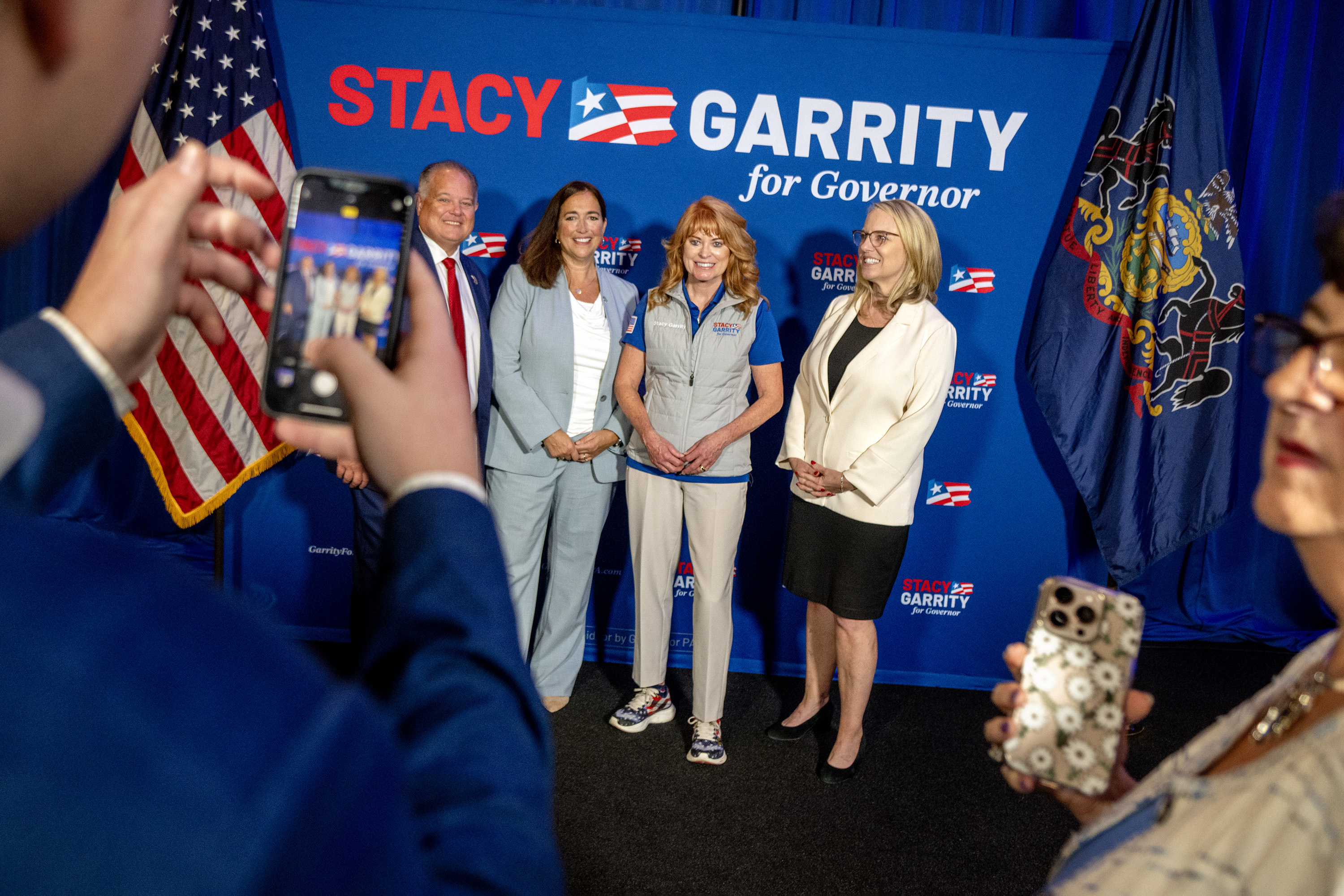
    State Treasurer and Republican candidate for governor Stacy Garrity holds a rally on Sept. 25, 2025 at the Newtown Sports & Events Center in Bucks County.

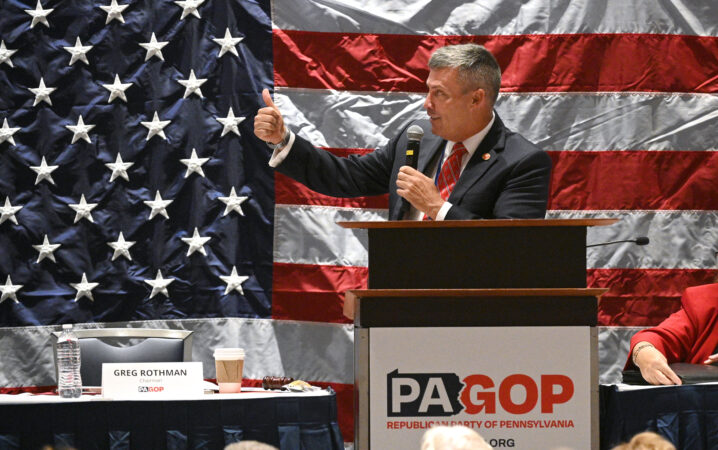
    State Republican Party Chair Greg Rothman said in a statement Thursday that Pennsylvanians have had “enough of Josh Shapiro’s lack of leadership and broken promises,” noting several of Shapiro’s missteps in his administration such as his reneging on school vouchers, a $295,000 payout over a sexual harassment claim against a former top aide, and failing to send a month’s worth of state agency mail.

    “[Garrity] actually gets stuff done, she doesn’t just talk about it on the campaign trail,” Rothman added.

    Garrity has contended that Shapiro — a former attorney general, county commissioner, and state representative — is more focused on running for president in 2028 than leading the state.

    “Josh Shapiro is more concerned with a promotion to Pennsylvania Avenue than serving hardworking Pennsylvanians,” Garrity said in a statement earlier this week, noting the state fared poorly in U.S. News and World Report rankings on the economy and education.

    But that’s part of the appeal for some of Shapiro’s supporters.

    Fernando Rodriguez, who works at Fox Chase Farm in Philadelphia, was eager to hear Shapiro’s stump speech. The 37-year-old didn’t vote for Shapiro in 2022 and had cast only one ballot for a presidential election, voting for President Barack Obama in 2008.

    But he wanted to see Shapiro win reelection and, more importantly, go on to run for president in 2028.

    “There seems to be some maturity, some presidential qualities to him,” Rodriguez said, noting that is particularly important given the direction of national politics.

    Shapiro has not publicly acknowledged any presidential ambitions and is expected to keep a local focus as he campaigns for reelection. But on Thursday at his rally, he reminded voters that they have the ability to deliver not only a resounding reelection victory for him, but also the chance to flip control of the U.S. House and state Senate as Democrats target four congressional districts in Pennsylvania and other down-ballot offices.

    Shapiro has already raised $30 million to support his reelection, which is likely to boost the entire ticket.

    State Democrats hope Shapiro will be able to leverage his popularity and growing national brand to bring more voters out to the polls, in what is already likely to be an advantageous midterm year for the party.

    “We’ve got a lot of work to do and it’s not just about reelecting the governor,” Eugene DePasquale, the chair of the state Democratic Party, said Thursday in Pittsburgh.

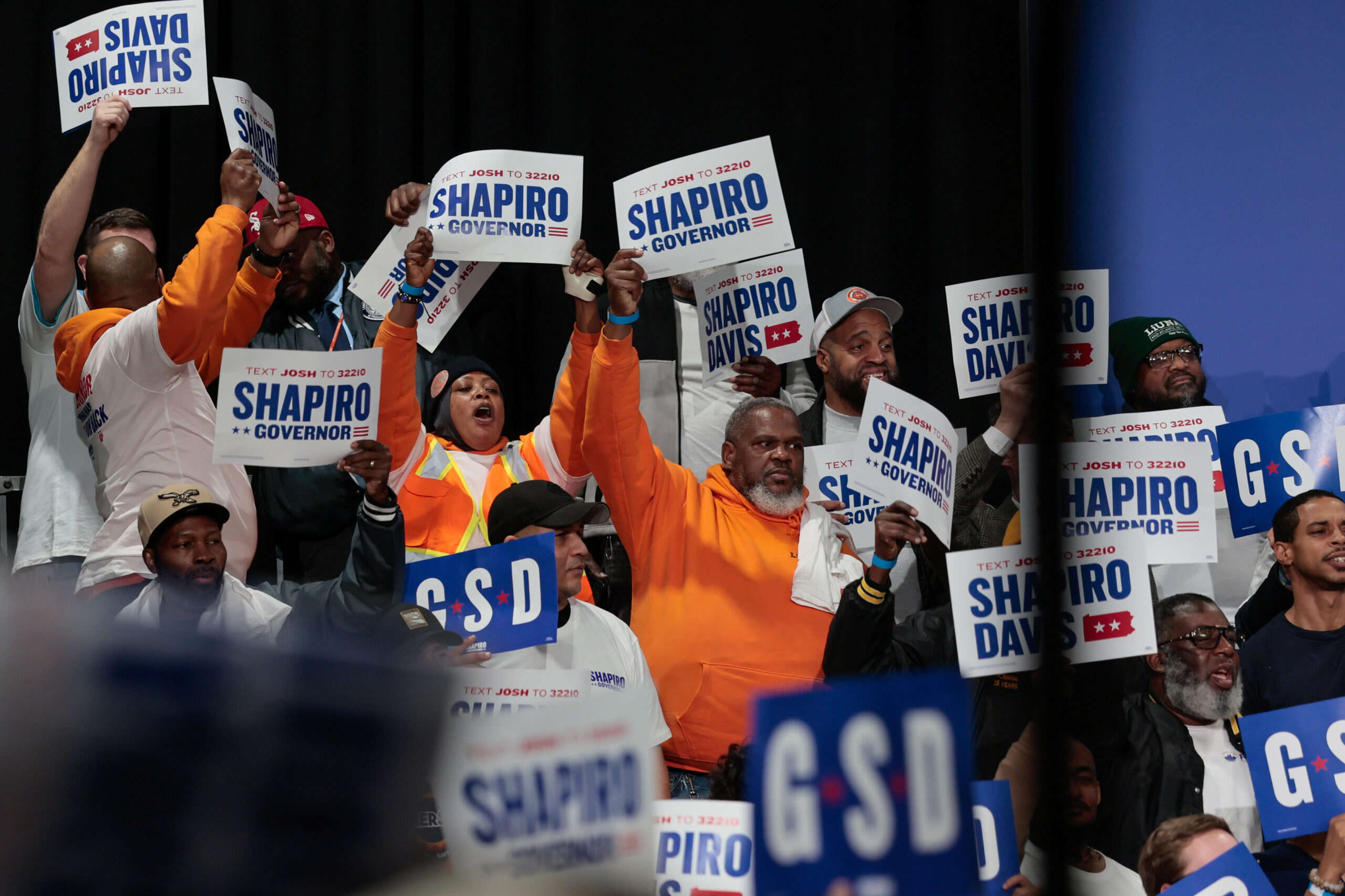
    Gov. Josh Shapiro’s supporters cheer as he makes his way to the stage during a reelection announcement event event at the Alan Horwitz “Sixth Man” Center in Philadelphia on Thursday, Jan. 8, 2026.

    ‘The hard work of bringing people together’

    Offering an opening pitch to voters, Shapiro highlighted key themes he is expected to repeat during the next 10 months on the campaign trail: He’s protected Pennsylvanians’ freedoms and created jobs, with more work to do.

    He noted several bipartisan achievements passed by the state’s divided legislature during his time in office, including a long-sought increase to the state’s rent and property tax rebate, historic funding increases for public education, and more. Pennsylvanians, he argued, have a simple choice in November.

    “Will we continue to do the hard work of bringing people together to get stuff done, or will we descend into the chaos and extremism that has gripped too many other places across our nation?” Shapiro asked in his stump speech in Pittsburgh and Philadelphia.

    In Philly, the crowd gave this question a resounding “No.”

    Shapiro’s launch drew a distinction between his style of leadership and that of Trump — whom Shapiro repeatedly called a danger to democracy prior to his reelection in 2024. Shapiro did not name the president during his announcement, but alluded to Trump — while noting his legal challenges against the Trump administration.

    The move followed Shapiro’s oft-repeated tactic since Trump took office for a second time: Criticize his policies, while not alienating Trump’s supporters in Pennsylvania, as the state swung in favor of Trump in 2024.

    In addition to his two campaign rallies, Shapiro kicked off his reelection bid in a video advertisement posted on social media. He led that off with footage from one of his biggest accomplishments from his first three years in office: rebuilding a collapsed section of I-95 in 12 days, in what was expected to take months.

    The quick rebuild also featured in his speech in Philly, where he heaped praise on organized labor for its role in the reconstruction.

    Rob Buckley with Buckley & Company, Inc., shakes hands with Gov. Josh Shapiro (right) at the end of a 2023 news conference before the reopening of I-95.

    Notably, Shapiro’s video announcement included a focus on several issues important to rural or conservative voters, such as signing a law that ended the ban on Sunday hunting, hiring 2,000 more law enforcement officers, and removing college degree requirements for most state agency jobs. He also highlighted his work in helping to reopen the lone gas pump in Germania, Potter County, following an Inquirer report about its closure.

    During his speech on the glossy basketball court in Nicetown, supporters began chanting “Four more years!”

    “I like the sound of that,” Shapiro said, with a smile.

  • Josh Shapiro’s reelection campaign in Pennsylvania starts now — but 2028 looms large

    Josh Shapiro’s reelection campaign in Pennsylvania starts now — but 2028 looms large

    He’s running.

    Gov. Josh Shapiro officially announced his widely expected reelection bid for Pennsylvania governor Thursday, as speculation over a 2028 run for president continues to build. The question now: How will the Democrat’s rumored presidential ambitions bolster or detract from his must-win election at home in 2026?

    Shapiro will kick off his reelection campaign with not one but two rallies — first stopping in Pittsburgh, then in Philadelphia. In a campaign video posted to social media Thursday morning, he touted his three years of leading a divided legislature and his bipartisan achievements in a politically split state, via a campaign that has already amassed a record $30 million war chest.

    He coasted to victory in 2022, elevating his profile within the national Democratic Party, and is not expected to face a primary challenger. In the general election, he will likely face Republican State Treasurer Stacy Garrity, who largely consolidated GOP support early.

    But that’s not the only race on the line in November.

    Shapiro, whose campaign declined to comment for this article, has been elusive when asked directly about plans to run for president. But in the last year, he’s taken bold steps to build a national profile, while quietly making moves behind the scenes that signal bigger political aspirations. He’s expanded his public affairs team, planned a book tour for the end of January, and sat for interviews with national magazines like the Atlantic, which published an extensive feature on him late last year. Last month, he and Democratic presidential candidate kingmaker U.S. Rep. Jim Clyburn (D., S.C.) discussed the pioneering Black lawmakers’s new book on a stage in Philadelphia. Earlier in December, he and Utah Gov. Spencer Cox, a Republican, discussed curbing political violence with NBC News host Savannah Guthrie, a conversation that highlighted Shapiro’s emphasis on bipartisanship.

    At home, he’s a local political celebrity, boasting approval ratings between 52% and 60%. But outside the Keystone State, he has yet to become a household name.

    As Shapiro looks to potential parallel runs, he’ll need to continue to build a national profile without outwardly focusing too much on the presidential picture.

    Gov. Josh Shapiro is interviewed by TV news in the spin room at the Convention Center following the debate between former President Donald Trump and Vice President Kamala Harris Tuesday, Sept. 10, 2024.

    “The challenge, of course, is you have to take care of your next election first,” said Christopher Borick, a pollster at Muhlenberg College. “Of anything he does, he knows this is the most important thing for his potential success in 2028 if he was to run.”

    The former Pennsylvania attorney general, Montgomery County commissioner, and state representative has never in 20 years suffered an electoral defeat. Being passed over for Vice President Kamala Harris’ running mate in 2024 kept that winning streak alive.

    In the governor’s race, Shapiro will likely face a more formidable opponent in Garrity than he did in state Sen. Doug Mastriano (R., Franklin) in 2022, but he’ll also be running in a far more favorable political atmosphere for Democrats amid souring attitudes toward President Donald Trump and the GOP. If he can retain the governor’s mansion decisively and bring a ticket of Democrats vying for the statehouse and Congress to victory with him, that’s a narrative that could be strong in a Democratic presidential primary.

    “Having a win, and maybe an impressive one in Pennsylvania, the key swing state heading into that cycle, is about as big of a boost as any that you can have,” Borick added.

    Running local

    The 2028-curious Democrats include several other sitting governors generating buzz: California’s Gavin Newsom, Kentucky’s Andy Beshear, Maryland’s Wes Moore, Michigan’s Gretchen Whitmer, and Illinois’ JB Pritzker. Shapiro has formed alliances with several of them.

    But unlike some of his peers, Shapiro hasn’t been a frequent guest on cable news or podcasts with national reach.

    That’s not to say he hasn’t made moves toward a potential presidential run.

    On Oct. 4, 2024, nearly a month before Harris lost the presidential election to Trump, Shapiro confidentially requested that the state ethics commission determine whether he would violate any state ethics laws for accepting royalties from a book about his life in public service, according to the filing.

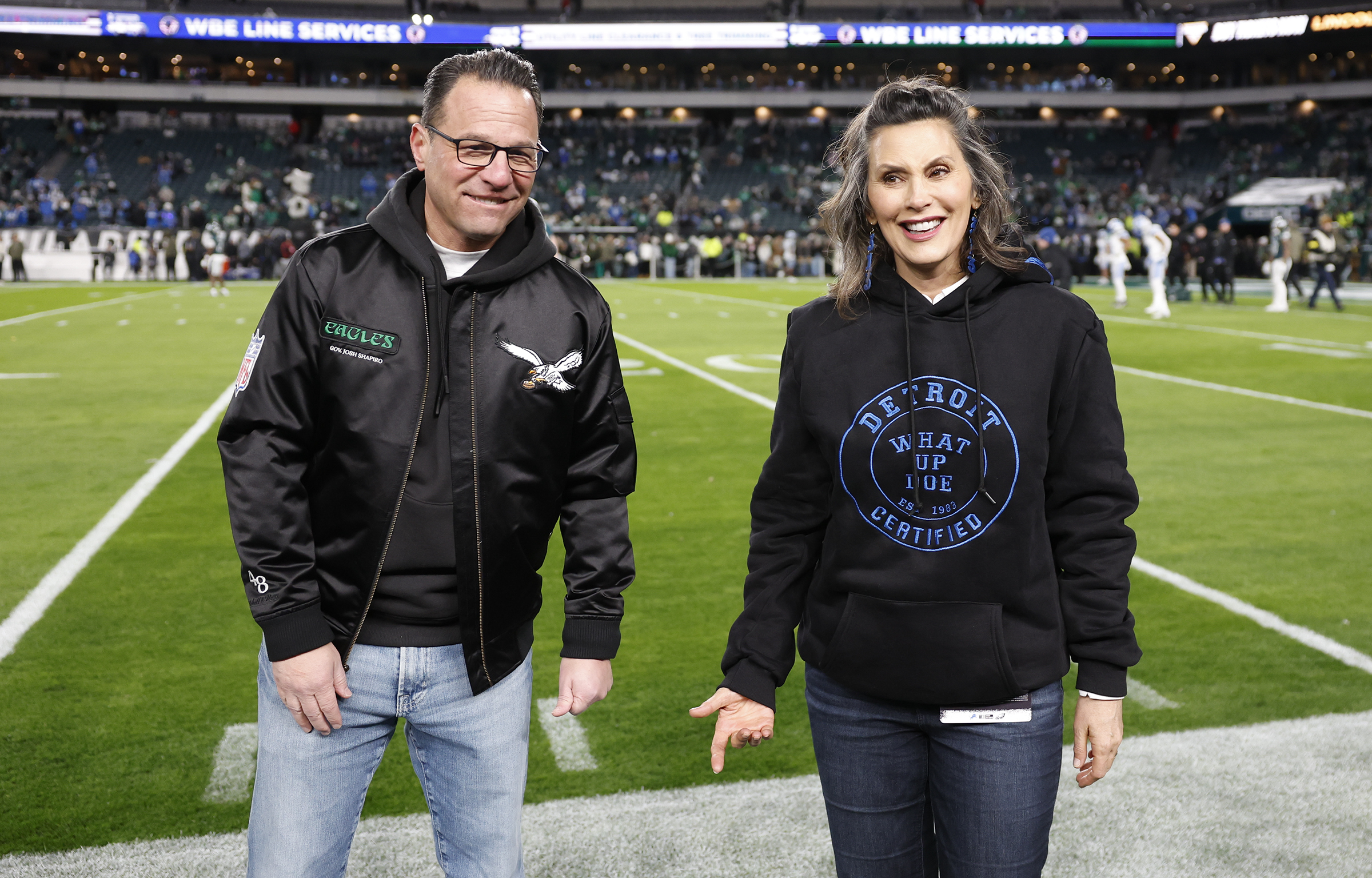
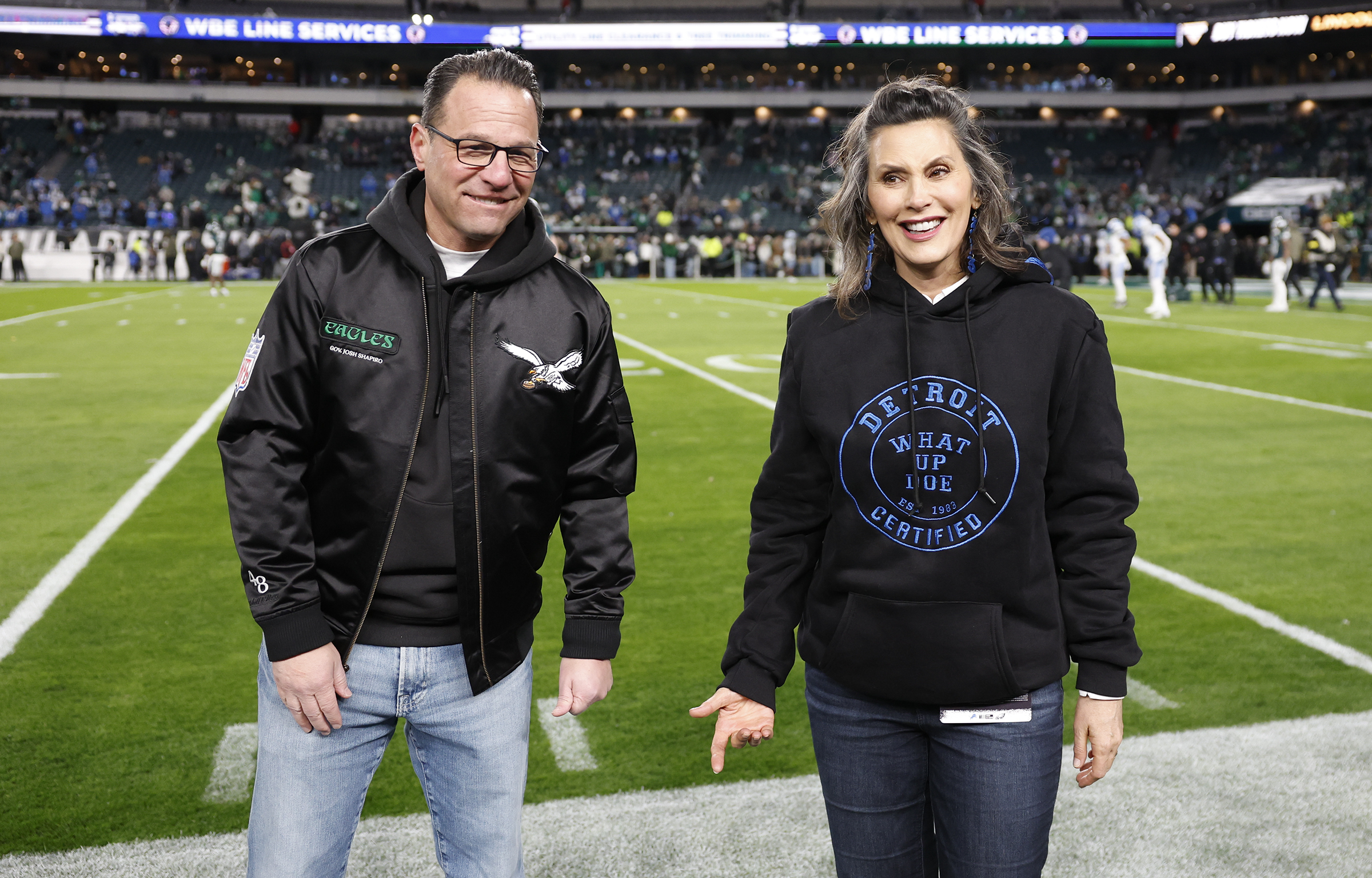
    Pennsylvania Gov. Josh Shapiro (right) and Michigan Gov. Gretchen Whitmer before the Eagles played the Detroit Lions at Lincoln Financial Field on Sunday, Nov. 16, 2025, in Philadelphia, PA.

    His book, Where We Keep the Light, will publish later this month, recounting his political upbringing, his vice presidential vetting, and the firebombing of his home last year. He’s not alone. Harris published a memoir about the 2024 election last year, and Newsom is due out with Young Man in a Hurry: A Memoir of Discovery in February.

    But in the coming months, several Democratic strategists predict Shapiro will be squarely focused on the governor’s race he has to win in Pennsylvania — simultaneously proving he has what it takes to capture the vote of the nation’s most important swing state.

    “He’s such a careful politician. He’s not taking anything for granted,” said former Gov. Ed Rendell, a Democrat who also once faced scrutiny for having potential presidential ambitions.

    Shapiro is likely to follow the same campaign playbook in Pennsylvania as he did in 2022: Stump in every region of the state, including areas where Democrats don’t usually show up. That helped him run down the margins in longtime GOP strongholds like Lancaster or Schuylkill Counties toward his resounding victory over Mastriano. Those stops in most of Pennsylvania’s 67 counties won’t give him as much time to visit South Carolina, Iowa, and New Hampshire, as the other Democratic presidential hopefuls start their sojourns.

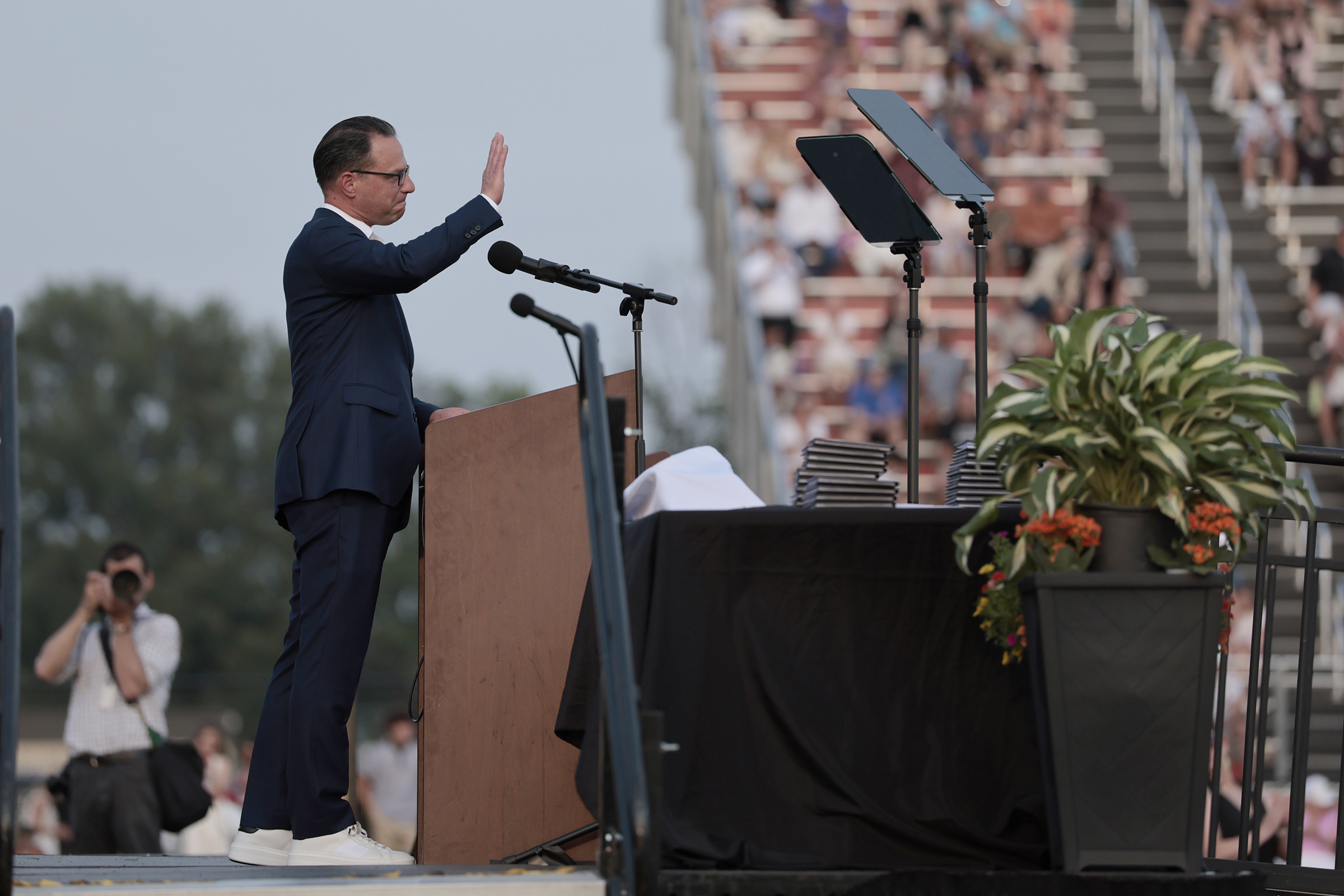
    Pennsylvania Governor Josh Shapiro waves goodbye to the crowd after speaking during graduation ceremonies at Pennsbury High School in Fairless Hills on Thursday, June 12, 2025.

    “The No. 1 caveat is stay focused on the race you’re running,” echoed Alan Kessler, a national fundraiser based in Philadelphia who has supported and fundraised for Shapiro.

    Still, the campaign is likely to generate attention beyond the Keystone State.

    Shapiro will still court donors in blue states as he fundraises for reelection, Kessler added.

    Come November, he will be the only governor with rumored 2028 aspirations up for reelection in a swing state. And his brand as a popular, moderate Democratic governor trying to restore trust in government — as well as his potential to help boost Democrats down ballot — will easily capture a wider audience and bring national media into Pennsylvania.

    As Democrats seek to flip control of the U.S. House in 2026, targeting several congressional districts in the state, the election may once again come down to Pennsylvania, and in turn, increase the spotlight on Shapiro. The governor is widely seen as someone who can boost the congressional Democratic candidates also on the ballot, having won three of the four districts that Democrats are targeting in the state by double digits in 2022.

    “Every single Democrat that I know that’s running for office in 2026 in Pennsylvania wants the governor to campaign with them,” Democratic state party chair Eugene DePasquale said.

    Preparing for an onslaught

    Republicans have targeted several weaknesses to try to erode Shapiro’s popularity in Pennsylvania and boost Garrity. They point to a lack of rigorous electoral challengers in his past. They question his record of “getting stuff done” — his oft-repeated motto — including three late state budgets. And they’ve harped on a lack of transparency as governor, including claims he used tax dollars for political benefit as well as a sexual harassment scandal involving a former top aide. They’ve also criticized his support for Minnesota Gov. Tim Walz, who recently dropped his third gubernatorial bid following a fraud scandal among the state’s Somali refugee population totaling $1 billion, according to federal prosecutors.

    Among the emerging attacks: Republicans want to highlight Shapiro’s presumed presidential ambitions, as they try to cast him as an opportunist more interested in a future White House bid than the problems of everyday Pennsylvanians.

    “Josh Shapiro is more concerned with a promotion to Pennsylvania Avenue than serving hardworking Pennsylvanians,” Garrity said in a statement, noting the state fared poorly in U.S. News and World Report rankings on the economy and education. “In the military, I learned the importance of putting service before self. Pennsylvanians are the hardest-working, most compassionate, strongest people in the nation, and together we will return Pennsylvania to our rightful place as a national and global leader.”

    State Treasurer and Republican candidate for governor Stacy Garrity holds a rally in Bucks County Sept. 25, 2025 at the Newtown Sports & Events Center.

    There are lingering missteps that could come up in a reelection campaign or afterward. He was unable to secure a long-term funding stream for mass transit, requiring him to use capital funds to keep SEPTA operating. He has yet to follow through on his support for school vouchers, a GOP-selling point for him that angered the powerful teachers’ unions in the state. And he’s faced questions over a number of actions his administration has taken, including $1.3 million in security improvements to his personal home following the attack on the governor’s residence in Harrisburg, his use of the state plane, and his transparency in open records requests, among others.

    Mastriano, the far-right Republican state senator who announced Wednesday he won’t run for governor, said in a statement earlier this week that Shapiro “owes [Pennsylvanians] straight answers” over his use of the state plane, security updates to his personal home in Abington Township, and more.

    “Pennsylvanians deserve accountability, not ambition,” he added, making a nod to Shapiro’s potential longer-term plans.

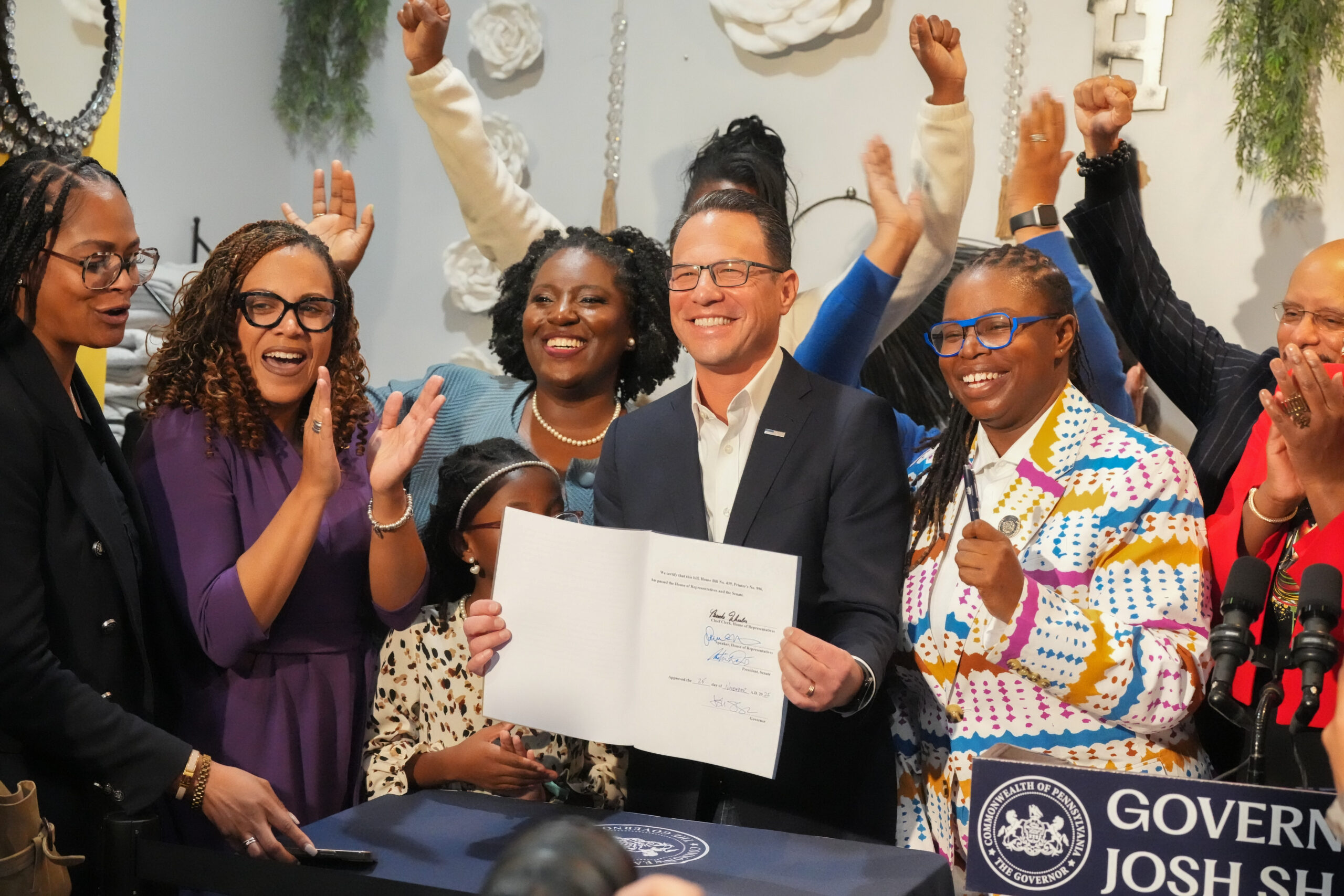
    House Speaker Joanna McClinton, back center left, Gov. Josh Shapiro, front center, and State Rep. La’Tasha D. Mayes, right, celebrate the signing of the CROWN Act, which prohibits discrimination based on a person’s hair type, during a press conference at Island Design Natural Hair Studio, in West Philadelphia, November 25, 2025.

    Borick, the pollster, was skeptical that attacks on Shapiro’s potential wider ambitions could reverse his largely positive public sentiment.

    “If that’s all they got, they don’t got a lot.”

    Republicans insist they see a path to victory for Garrity in a politically divided state with months to go until the election. But behind the scenes, some Republicans are already acknowledging the goal is to lose by less and prevent big losses in state legislature or congressional races.

    If Shapiro does look poised to cruise to victory, it might mean less media attention on the race, and it could mean he’s less vetted ahead of a much bigger stage.

    “I think Josh is better served if the [Republican Governors Association] puts $100 million into this race because then it’s nationalized,” said a Democratic political strategist based in Pennsylvania who did not want to be named speculating on Shapiro’s presidential run. “If it’s a cakewalk, CNN’s not gonna cover it …If he wants to be governor for another four years, he should pray for a cakewalk. If he wants to be president, he should pray for a difficult campaign.”

    Florida Gov. Ron DeSantis, for example, the strategist noted, cleaned up in his 2022 reelection, but failed to gain traction in the GOP presidential primary that Trump dominated.

    Beyond 2026

    Shapiro speaks Pennsylvanian very well. Raised in Montgomery County, he’s lived here almost all of his life, and has built an image as a popular moderate focused on problem-solving in a purple state. That’s earned him the support of about 30% of Trump voters in the state.

    But winning a general election in Pennsylvania is different than winning a Democratic presidential primary.

    He’s tried not to alienate the MAGA base, focusing on issues with bipartisan appeal like funding for apprenticeship and vocational-training programs. He’s taken on Trump in court, but has picked his personal battles with the president more carefully.

    But being a strategic, self-described “progressive pragmatist” can end up alienating voters on both sides.

    Gov. Josh Shapiro leaves after an event at the Port of Philadelphia Thursday, Apr. 10, 2025, the day after President Trump paused some tariffs.

    Becky Carroll, a Democratic political consultant in Chicago who has worked with Pritzker, said Shapiro seems less on the radar of voters in the Midwest. As she’s followed Shapiro’s career, she said she sees a “damn fine governor,” but someone who’s taken a more muted approach to Trump than blue state governors like Pritzker and Newsom.

    When it comes to a Democratic primary, candidates may be judged in part on their pushback to Trump, she said. “I think we’re in a moment where you can sulk in a corner and hope it’ll all go away or fight …,” Carroll said. “And if you’re gonna put yourself out there for a primary battle, you better show you have battle scars to prove you can fight for the most vulnerable in the country right now.”

    Gov. Josh Shapiro is interviewed by TV news in the spin room at the Convention Center following the debate between former President Donald Trump and Vice President Kamala Harris Tuesday, Sept. 10, 2024.

    But other national strategists see Shapiro’s moderate appeal as a potential asset in 2028. Jared Goldberg-Leopold, a former communications director for the Democratic Governors Association, thinks Shapiro’s biggest asset is his electoral track record in a state the nation knows is critical on the path to the White House. Primaries have previously been won by moderates whom the party thinks have the best chance at winning the general.

    But the first step, Goldberg-Leopold stressed, is the governor’s race ahead.

    “It would be easy for the Eagles to look past the 49ers to the next week of playoffs, but they’ve gotta focus on only one thing. And the same is true for the governor,” he said. “You can only prepare for what’s ahead of you, and the way people get in trouble in politics is planning too many steps ahead.”

    Staff writer Katie Bernard contributed to this article.

  • Pa. State Sen. Doug Mastriano won’t run for governor again in 2026, after months of teasing a potential campaign launch

    Pa. State Sen. Doug Mastriano won’t run for governor again in 2026, after months of teasing a potential campaign launch

    HARRISBURG — State Sen. Doug Mastriano will not seek the GOP nomination for Pennsylvania again this year, after months of teasing a potential run to the chagrin of establishment Republicans.

    Mastriano’s announcement Wednesday now clears the way for State Treasurer Stacy Garrity, who was endorsed by the state GOP last fall as the party’s best pick to challenge Gov. Josh Shapiro this November.

    “We believe, with full peace in our hearts, God has not called us to run for governor,” Mastriano said in a Facebook Live video stream alongside his wife, Rebbie.

    He did not endorse Garrity as part of his announcement, nor did he mention her by name.

    “For you to have a Republican governor here, the grassroots is going to have to back the candidate,” Mastriano said, referring to Garrity.

    Republicans chose Garrity early — endorsing her more than a year before the 2026 election — in an effort to avoid a crowded primary like the one that eventually led to Mastriano’s nomination in 2022. They hope that a candidate like Garrity, who has won statewide elections twice and dethroned Shapiro for receiving the most votes of any state-level candidate, will have a better chance at beating Shapiro, or at least, preventing a down-ballot blowout in an election that already is likely to favor Democrats.

    Mastriano, a two-term state senator representing Gettysburg and the surrounding area, publicly criticized the state party for endorsing Garrity so early, and has repeatedly said that their endorsement would not deter him from getting in the race.

    In a statement, Garrity said she respected Mastriano’s decision not to run, calling him a “strong voice for faith, family and freedom.”

    “I look forward to working with him to restore integrity, fiscal responsibility, and common-sense leadership in our commonwealth,” Garrity added.

    Mastriano, a former U.S. Army colonel with top-secret clearance, built a grassroots online following during the early days of the COVID-19 pandemic for his resistance to business shutdowns. That support continued to grow after the 2020 presidential election as he promoted President Donald Trump’s false claims that Pennsylvania’s election results were rigged. He has remained a staunch supporter of Trump ever since.

    Trump’s advisers, however, feared that Mastriano’s presence on the ticket would hurt Republicans up and down the ticket despite him leading Garrity in private polling by 21 points, Politico reported in July.

    Mastriano and his wife spent much of his 20-minute announcement on Wednesday reminiscing on their movement since 2020: their daily virtual fireside chats during COVID-19 closures and their other attempts to reopen the state’s businesses amid the pandemic, their efforts to overturn Pennsylvania’s 2020 election results for Trump, Mastriano’s 2022 gubernatorial run, and the GOP’s electoral successes in 2024.

    However, things are different now, the couple said. The grassroots supporters aren’t as unified as they once were, and the state party overstepped in its early endorsement.

    “Bottom line is: They don’t have the last say,” said Rebbie Mastriano, in a reminder to their supporters. “You have the last say.”

    In the 2022 primary, the state GOP declined to endorse candidates in the gubernatorial or U.S. Senate races. That led to a crowded, nine-candidate GOP primary ballot for governor that was advantageous for Mastriano, who had built name recognition through his anti-lockdown and 2020 election efforts.

    Democrats saw Mastriano and his far-right views as an easier opponent in the general election. Shapiro, who at the time was state attorney general and did not face a primary opponent, ran an ad in the GOP primary to try to ensure that he would face the right-wing senator in the general election, where he later cruised to victory.
    Shapiro is expected to announce his reelection campaign on Thursday, beginning his 2026 effort with a record-setting $30 million in his war chest and polls continuing to show him with a more than 50% approval rating.

    The state Democratic Party responded to Mastriano’s announcement with fresh attacks on Garrity, calling her a “far-right, toxic candidate” and noted some of the areas where she and Mastriano agree, including that she denied the 2020 election results and her past opposition to abortion. (She now says she would not support a state abortion ban.)

    As of Wednesday, no GOP candidate had announced their candidacy for lieutenant governor. Garrity told The Inquirer last month she was vetting candidates and planned to announce who she’d endorse as her running mate in February, ahead of the next state GOP meeting.

    Mastriano last year floated the idea of running with Garrity, though he implied he would be at the top of the ticket.

    “I’m still a state senator, still fighting in Harrisburg for you here,” Mastriano said Wednesday. “We’re still in the fight.”

    “We’re going to keep this movement together,” he added.

  • Top Pennsylvania Republicans are projecting relative calm amid 2026 national party panic

    Top Pennsylvania Republicans are projecting relative calm amid 2026 national party panic

    The same week Republican National Committee chair Joe Gruters said history predicted “almost certain defeat” for his party in the 2026 midterms, Pennsylvania Republicans partying in Midtown Manhattan projected relative calm about the election cycle.

    Gruters, President Donald Trump’s handpicked chair to run the party, said on a conservative radio station last week: “It’s not a secret. There’s no sugarcoating it. It’s a pending, looming disaster heading our way. We are facing almost certain defeat.”

    He added that the goal is to win and he “liked our chances in the midterms,” but noted “only three times in the last hundred years has the incumbent party been successful winning a midterm.”

    Pennsylvania could decide which party controls the U.S. House next year, as Democrats eye four congressional districts that Republicans recently flipped while the GOP fights to maintain its majority.

    But Pennsylvania Republicans in New York City for the annual Pennsylvania Society glitzy gathering of politicos last weekend had a less hair-on-fire view.

    “At this point when I was running [for Senate in 2024], the betting market said there was a 3% chance I was going to win,” Sen. Dave McCormick (R., Pa.) said after addressing a bipartisan audience at the Pennsylvania Manufacturer’s Association luncheon on Saturday.

    “We’re a million miles from Election Day, and we’ve got a great track record of things to talk about and a great vision for how the president’s policies are going to make life better for working families,” McCormick said. “We just got to go out and make that message happen, but also continue to make the policies that are going to make that a reality happen.”

    The political environment was, of course, far more favorable to Republicans in 2024, when Trump won Pennsylvania by a larger margin than he did in 2016. But with Republicans in power and popular Democratic Gov. Josh Shapiro on the ballot for reelection, the headwinds in 2026 in the Keystone State are different.

    Pennsylvania GOP chair Greg Rothman, in an interview outside the PMA event on Saturday, called Shapiro “one of the greatest politicians of my generation” but noted that upsets have happened across various political environments in state history.

    “Anything can happen and the voters are smart, and all I can do is prepare the party to ride the waves and ignore the crashes, but I’m optimistic,” he added.

    Shapiro will likely face a GOP challenge from State Treasurer Stacy Garrity, who is a popular politician in her own right and holds the record for receiving the most votes of any candidate for statewide office in Pennsylvania.

    Meanwhile, Rothman predicted that the four Pennsylvania congressional incumbents running for reelection in swing districts will sink or swim based on how Trump and his policies land with voters come November.

    “They will be judged by the national economy and by immigration,” he said, and by Trump’s ability to end some international conflicts.

    But U.S. Rep. Rob Bresnahan, a GOP incumbent running for reelection in Pennsylvania’s Eighth Congressional District, which includes Scranton, had a more local view of how to win in 2026.

    “Everything about our job as a member of Congress is about northeastern Pa.,” Bresnahan said.

    “Northeastern Pennsylvania has always been our North Star. We know our district. We are out in our district. We’ve done over 250 public events. Our constituency case work is, in my opinion, one of the best offices in the country.”

    Bresnahan appeared at a rally with Trump in Mount Pocono last week. He was also one of just 20 House Republicans to sign a successful discharge petition to force a vote for collective bargaining to be restored for federal workers.

    “At the end of the day that might have been going against party leadership, but it was what’s right for northeastern Pennsylvania,” he said.

    Democrats have begun a full court press. That was evident at the Pennsylvania Society, where attendees seen mingling with other politicians included: Janelle Stelson, who is running for a second time against U.S. Rep. Scott Perry in the 10th Congressional District, as well as firefighter Bob Brooks and former federal prosecutor Ryan Croswell, both of whom are running for the Democratic nomination to take on U.S. Rep. Ryan Mackenzie in the Seventh.

    Bresnahan’s challenger, Scranton Mayor Paige Cognetti, also attended the soiree and walked through the Rainbow Room atop Rockefeller Center with U.S. Sen. Chris Coons (D., Del.) on Friday night. Coons said the time is now for Democrats to get involved in these races.

    “Given the margin, if there were to be four new Democrats in the House this cycle, as there were in 2018, that’d be the difference maker for the country,” Coons added.

    Staff writer Gillian McGoldrick contributed to this article.

  • Philly is poised to launch a retirement savings program for workers without 401(k)s

    Philly is poised to launch a retirement savings program for workers without 401(k)s

    Philadelphia could soon become the first American city to establish its own retirement savings program for residents whose employers don’t offer one.

    City Council is poised to pass legislation that would enable the plan, called PhillySaves, which is modeled on similar state-facilitated “auto-IRA” programs that have been increasingly established across the country.

    The idea is that workers would be automatically enrolled in the city-managed plan and would contribute through payroll deductions at no cost to their employer. The plan would then follow employees, even as they change jobs.

    Council President Kenyatta Johnson, a Democrat, said during a committee hearing on the legislation last week that the program is an anti-poverty measure aimed at generating wealth for more than 200,000 Philadelphians who do not have access to a retirement savings plan through their job.

    “We want to make sure we are lifting all Philadelphians out of poverty, building generational wealth, and ensuring our seniors are financially stable in retirement,” Johnson said.

    A Council committee approved the legislation following a hearing last week, and the full Council is expected to pass it. Voters would have to approve the creation of an investment management board through a ballot question, which could come as early as the May primary election.

    Councilmember Cindy Bass, a Democrat who represents parts of North and Northwest Philadelphia, called the plan a “game changer.”

    “There was a time when you could retire just on Social Security alone,” she said. “That day has come and gone.”

    How would the program work?

    Workers would be automatically enrolled in the plan with a default contribution rate of 3 to 6% of their wages, however they can opt out or change their contributions at any time.

    Employers that do not offer their own retirement plans would be required to sign up. Their only responsibility would be facilitating the payroll deductions for their employees. There is no matching program for employers or the city.

    City Councilmember Mike Driscoll, a Democrat who represents parts of Northeast Philadelphia and is sponsoring the legislation, emphasized last week that there is “no cost” to employers and no fiduciary liability.

    “The goal is to make it easy for employees who want to save,” he said, “and not burden employers who are already managing their many responsibilities.”

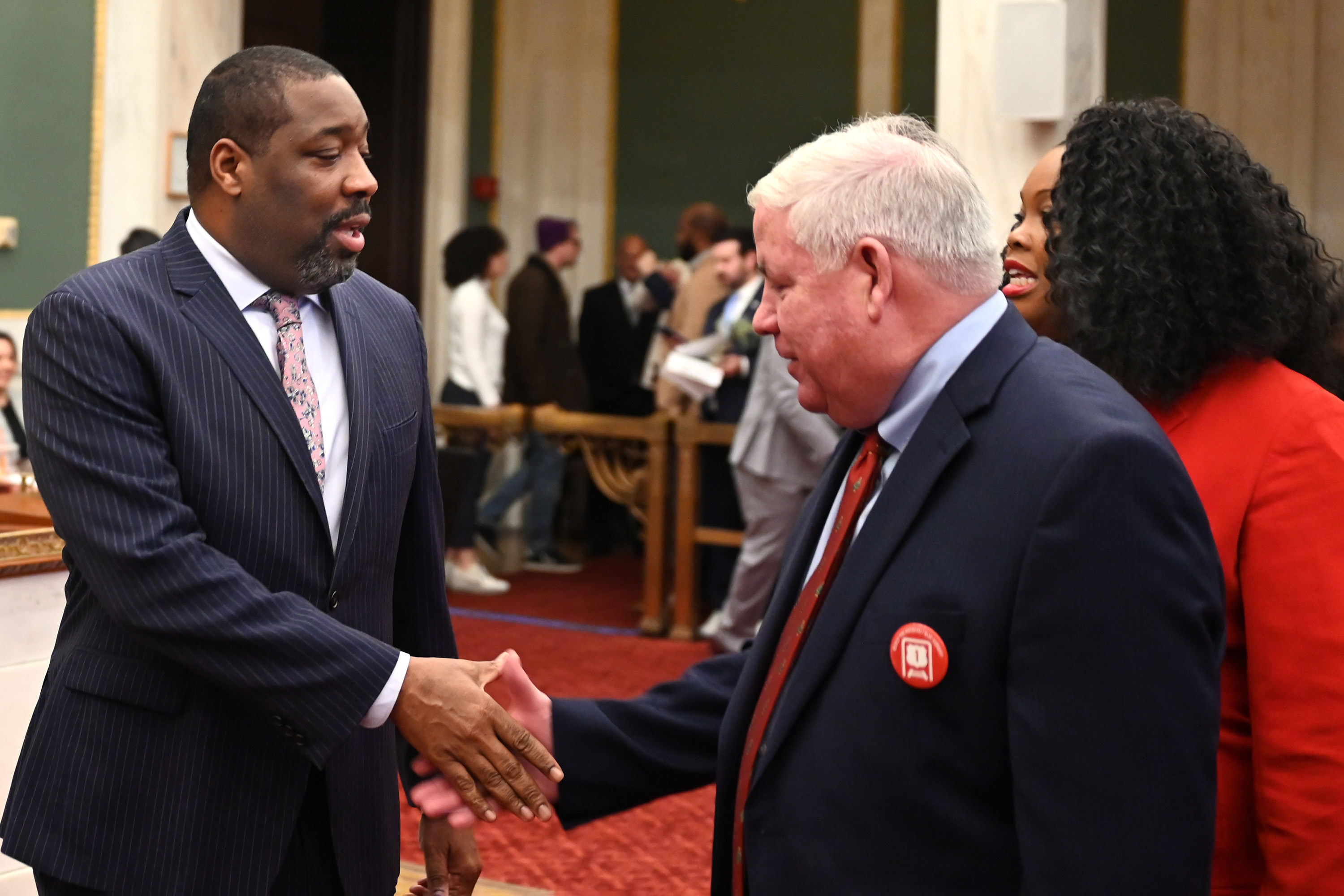
    In this 2023 file photo, Council President Kenyatta Johnson (left) greets 6th District Councilmember Michael J. Driscoll (center) and Councilmember At-Large Katherine Gilmore Richardson (right) before the last City Council meeting of the year.

    The legislation includes minimal fines for employers who don’t enroll employees. But Council members said the city will launch a significant public education and outreach campaign before levying fines.

    Who is the program for?

    Under the current version of the legislation — which could still be amended — the program applies to businesses with at least one employee. It must have been operating in Philadelphia for at least two years.

    Auto-IRA plans are especially geared toward hourly workers who generally have fewer employer-covered benefits, such as 401(k) plans, as well as people who work for small businesses that can’t afford to provide retirement benefits.

    Is this a new thing?

    Twenty states have passed legislation creating their own auto-IRA plans and 16 programs are open to participants, according to the Center for Retirement Initiatives at Georgetown University.

    Pennsylvania is not among them, but New Jersey launched a state-run retirement savings program last year. That plan, called RetireReady NJ, was first established in 2019 and signed into law by Gov. Phil Murphy, a Democrat.

    As of July, more than 18,000 workers were saving through the program, according to the state’s Department of the Treasury.

    It is more limited than Philadelphia’s would be, in that it only applies to businesses with at least 25 employees. Philadelphia’s would apply to businesses with just one.

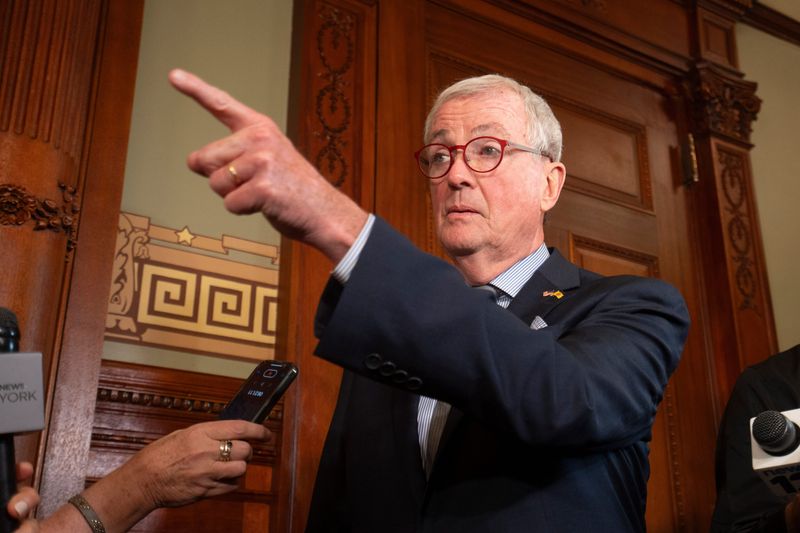
    Gov. Phil Murphy speaks with members of the media after meeting with Governor-elect Mikie Sherrill at the governor’s office in Trenton on Nov. 5.

    Two other cities — New York and Seattle — passed legislation enabling auto-IRA programs, but neither was implemented because both New York and Washington states enacted state-run programs that include the cities.

    The Democratic-controlled Pennsylvania State House passed legislation in 2023 along party lines enabling a similar program called Keystone Saves, but it stalled in the Republican-controlled Senate.

    Treasurer Stacy Garrity, a Republican now running for governor, has for years advocated for the program’s passage.

    How will the investments be managed?

    The city would create a nine-member Retirement Savings Board, which would include four appointees by the mayor, four by the City Council president, and one by the city controller.

    That board would be responsible for facilitating the program and may contract third-party consultants, financial advisers, actuaries, and other experts to manage the investments.

    Why does the money go into a Roth IRA?

    The program defaults to a Roth IRA, though people covered can elect to switch to a traditional IRA.

    John Scott, director of the retirement savings project at Pew Charitable Trust, said during the Council hearing last week that Roth IRAs are often the default in auto IRA programs because participating employees can pull money out of those accounts at any time without taxes or penalty.

    He said that’s especially appealing to workers “who sometimes have fluctuations in their work schedule or they might have a financial shock.”

    “For many of these workers in these programs, this is really the first opportunity to save money,” Scott said. “So, you know, life happens. And sometimes they do need to pull that money out, and the Roth IRA is really the best vehicle to do that.”

    When will this become reality?

    Creating the board that will oversee the investments requires a change to Philadelphia’s Home Rule Charter, the city’s governing document.

    If Council passes legislation and Mayor Cherelle L. Parker signs it — both are expected to support it — then voters could approve the change through a ballot question as early as May.

    The legislation says the program must be launched by July 2027, however there are exceptions in the case of legal challenges or a state-level program superseding the city’s.

  • Gov. Josh Shapiro says national Democrats folded in the federal shutdown, while he stayed ‘at the table’ for Pa.’s late budget deal

    Gov. Josh Shapiro says national Democrats folded in the federal shutdown, while he stayed ‘at the table’ for Pa.’s late budget deal

    The turning point in Pennsylvania’s budget impasse, by Gov. Josh Shapiro’s telling, came just before Halloween, when he and leaders in Harrisburg gathered in his stately, wood-paneled office to meet twice daily to hash out a deal to end the bitter, monthslong stalemate.

    The long grind eventually led to compromises 135 days in, and a deal Shapiro said he thinks is far better than what national Democrats, hoping to extend healthcare subsidies, got in Washington at the end of the federal shutdown.

    “Sometimes you’ve got to show that you’re willing to stay at the table and fight and bring people together in order to deliver,” Shapiro told The Inquirer in an interview Friday, touting the state budget agreement finally signed that week.

    “I think it’s a stark contrast, frankly, with what happened in D.C., where they didn’t stay at the table, they didn’t fight, and they got nothing,” he said.

    Washington is controlled by Republicans, while in Pennsylvania, Democrats control the state House and governorship, and Republicans hold a majority in the Senate.

    Both state and federal budgets were signed the same day, offering Pennsylvanians relief from more than a month of government dysfunction at two levels. But for Shapiro — an exceedingly popular Democratic governor facing reelection in 2026 as whispers swirl over his potential 2028 presidential ambitions — the moment was bigger than a procedural win. In the end, Shapiro, preaching his oft-used slogan of “getting things done,” cast the outcome as proof he can muscle through gridlock of a divided legislature, cut deals under pressure, and hold firm where others cave.

    So what if it took almost five months? Shapiro argues. At least he didn’t fold.

    “I would have hoped to have gotten this budget done, you know, 100 or so days earlier,” Shapiro said, putting pen to paper in the state Capitol building’s baroque reception room last week. “But I think what you also saw was the result of having the courage to stay at the table and keep fighting for what you believe in. And we got a lot more than we gave in this budget.”

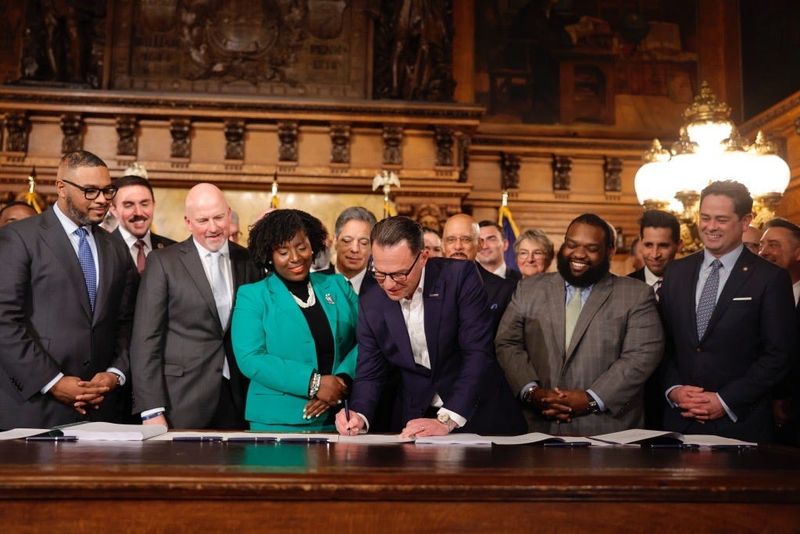
    Gov. Josh Shapiro signs the fiscal year 2025-26 budget surrounded by General Assembly members on Nov. 12 at the Capitol in Harrisburg. The state budget had been due June 30, and Pennsylvania the final state in the country to approve a funding deal.

    As Shapiro portrays the outcome of Pennsylvania’s 2025 state budget as an across-the-board victory, the path to get there was harder and messier than he would have liked: a nearly five-month slog that strained his dealmaker image and forced concessions to get the deal across the line — including no new money for mass transit. The absence of a new funding stream in the budget marked a final blow in the saga to Southeastern Pennsylvania commuters who rely on SEPTA — and who are likely to be reminded of the beleaguered agency’s funding woes as delays, staffing issues, and needed repairs persist.

    Critics are quick to note it took the self-proclaimed dealmaker so long to get a deal. Counties, school districts, and nonprofits struggled through four months without state payments while officials remained at loggerheads. Pennsylvania was the last state in the nation to pass a spending plan for the 2025-26 fiscal year.

    “He’s five months late. He’s the governor of the fifth-biggest state in the country and the last state to get a budget done,” GOP consultant Vince Galko said. “It’s not a failing grade because it got done, but it’s still a D.”

    ‘A tremendous cost’

    The $50.1 billion budget includes several key priorities for Shapiro and Democrats: significant increases in public education funding, a new tax credit for lower- and middle-income residents, continuation of a popular student-teacher stipend, and other economic and workforce development initiatives.

    House Speaker Joanna McClinton (D., Philadelphia) heaped praise on Shapiro during a Monday news conference celebrating the budget’s new Working Pennsylvanians tax credit. “I am grateful that here in Harrisburg we have a hero among us for working families, and his name is Josh Shapiro.”

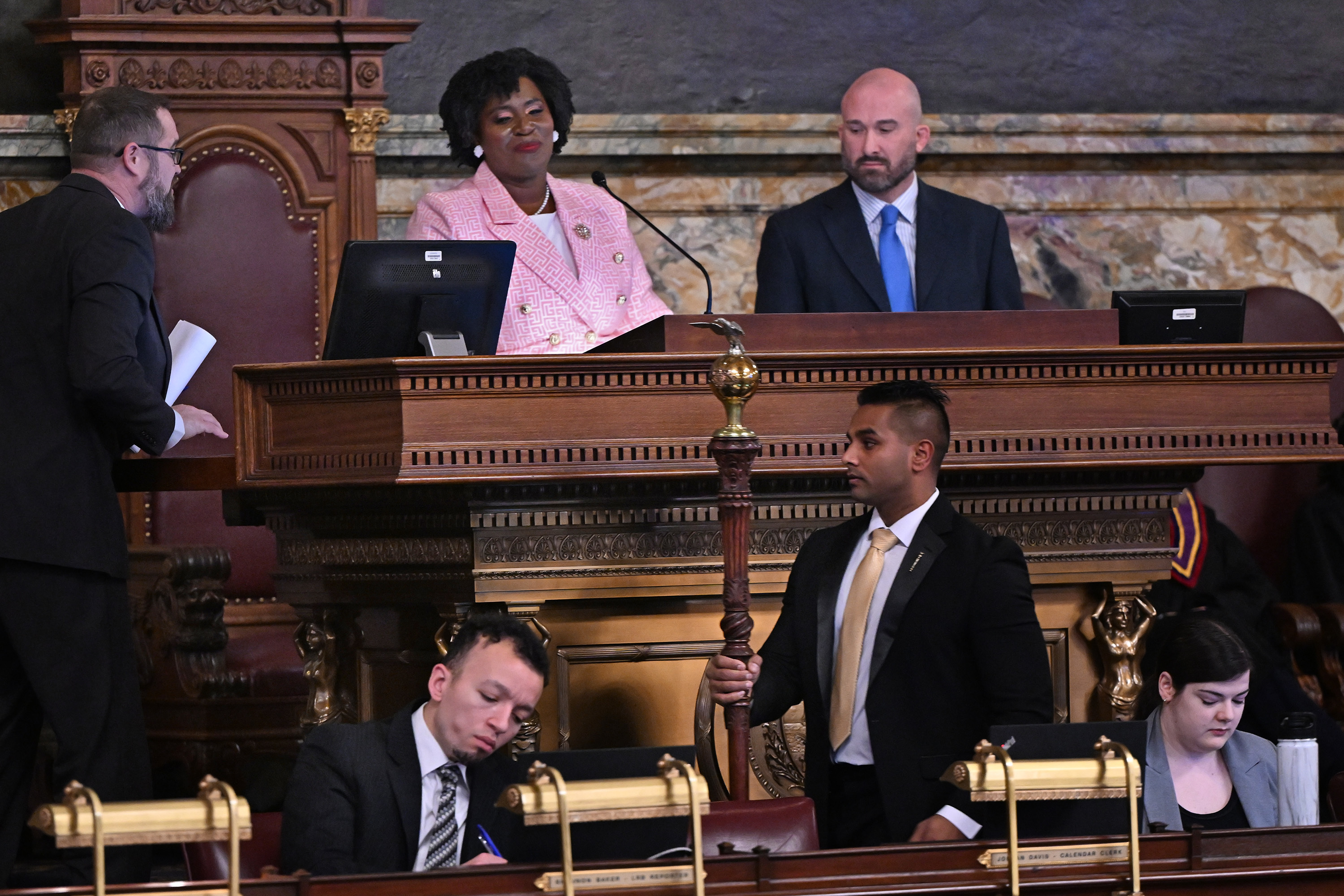
    State Rep. Joanna McClinton (D., Philadelphia) is on the rostrum in the House chamber on Jan. 7 after she was reelected speaker of the House despite an initial 101-101 tie vote along party lines.

    But the spending plan also fails to find a long-term revenue source for mass transit — a top Democratic priority that dominated debate in Harrisburg for weeks during the budget impasse and kicked up the state’s rural-urban divide. Shapiro ultimately removed mass transit from the negotiating table in September and approved his third short-term fix to keep SEPTA afloat. SEPTA and transit agencies across the state say they are still floundering.

    Shapiro last week called funding mass transit “unfinished business,” and top House Democrats maintain it’s a top priority for them heading into America’s 250th anniversary in 2026. Senate Republicans, for their part, were proud to not give in to a mass transit deal they didn’t like, even when advocates and Democrats unleashed intense political pressure on them to buckle, the two top Senate GOP leaders said in interviews.

    State Sen. Nikil Saval, a progressive lawmaker who represents part of Philadelphia, was one of a handful of Democrats to vote against the bipartisan Pennsylvania budget bill that was largely lauded by Democrats and Republicans in Harrisburg and beyond. Saval applauded the school funding, anti-violence grant funding, and childcare support but slammed the absence of transit funding and Democrats’ agreement to end their pursuit to join a key climate program.

    “Unfortunately, it comes at this tremendous cost,” he said. And ultimately, Saval said, the finished product didn’t seem to justify the time it took to get there.

    Gov. Josh Shapiro visits SEPTA headquarters on Aug. 10 to discuss funding for the transit agency. To his right, from left, are state Democratic legislators Sen. Anthony H. Williams; Sen. Nikil Saval; Rep. Ed Neilson; and Rep. Jordan Harris.

    It was not just transit funding that took a back seat to get the budget deal over the line. To the delight of Republicans — and the chagrin of some progressive Democrats and the climate-conscious — the deal also pulled the state out of the Regional Greenhouse Gas Initiative, a cooperative among states to reduce carbon emissions.

    For Shapiro, ending the state’s effort to join RGGI, a program of which he has long been skeptical, was hardly a political loss. It mirrored the path of other blue-state governors who are prioritizing economic headwinds over President Joe Biden-era climate and clean energy policies. In remarks made before signing the budget deal Wednesday, Shapiro said it also removed a hurdle in negotiations.

    “For years, the Republicans who have led the Senate have used RGGI as an excuse to stall substantive conversations about energy,” Shapiro said. “Today, that excuse is gone.”

    The powerful Pennsylvania Building and Construction Trades Council had lobbied heavily for lawmakers to walk away from the initiative, and it was a top win for state Republicans, who have long said the state should not join the multistate cap-and-trade emissions program they see as hamstringing Pennsylvania’s energy industry from accessing the state’s plentiful natural resources.

    ‘Two-a-days’

    Shapiro said he spent months “running back and forth” to broker a deal between Senate Majority Leader Joe Pittman (R., Indiana) and House Majority Leader Matt Bradford (D., Montgomery). The three met on-and-off in private talks, attempting to hammer out a compromise between the Democratic House and Republican-controlled Senate. But the week of Oct. 27, more than four months into the stalemate, Shapiro said a “breakthrough” finally came when he broadened the talks to include McClinton and Ward.

    Minority leaders Rep. Jesse Topper (R., Bedford) and Sen. Jay Costa (D., Allegheny) also joined the group, as it became clear that neither of the tightly controlled chambers would have the votes needed to pass a final budget deal.

    The group met twice daily in a conference room in Shapiro’s office. Shapiro, always a fan of the sports metaphor, called the meetings “two-a-days.”

    “We would come in the morning, go over the issues. We’d have our homework for a few hours, then come back in the afternoon and talk about, you know, the progress that we made,” Shapiro said. Coming out of that week, the governor said, leaders “had a clear direction on where we were going to go.”

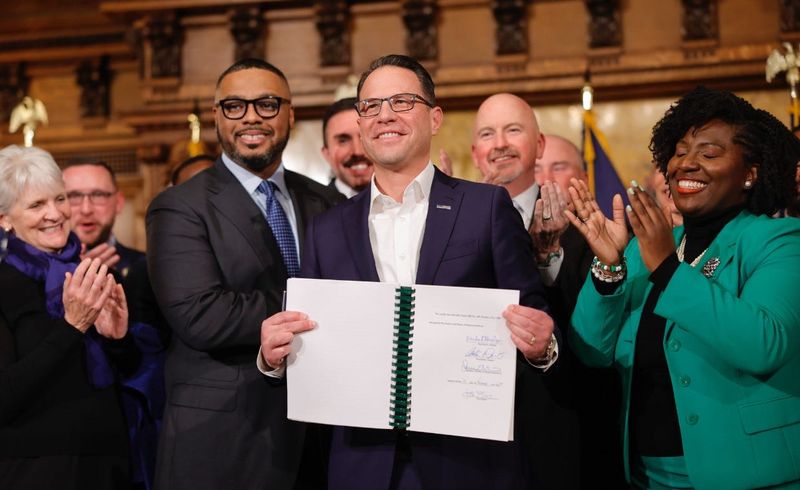
    Pennsylvania Lt. Gov. Austin Davis and Gov. Josh Shapiro show a budget document moments after it was signed Nov. 12 while surrounded by legislators at the state Capitol. A deal struck Nov. 12 ended a budget delay that lasted more than four months.

    At the negotiating table, Shapiro served as “referee and facilitator” between House Democrats and Senate Republicans, McClinton said in an interview Monday.

    “The man is nothing if not dogged and determined,” Bradford said of Shapiro last week.

    Two officials in the closed-door talks said Topper’s presence, as the House minority leader who understands House Democrats and Senate Republicans, helped change the dynamic and got leaders on track toward a deal. Other officials in negotiations noted that once the state’s two top leaders — McClinton and Ward, who are both the first women to serve in their roles — the breakthrough deal swiftly came together.

    Topper, for his part, didn’t try to take credit for striking the final budget deal, calling himself “a neutral arbiter” and “someone all sides can trust to have an honest dialogue.”

    There were other signs of tensions easing as the legislators worked through the fall. Ward, a top critic of Shapiro since he reneged on a promise he made over school vouchers during his first budget negotiations, joined the conversations. The two had not met in person since 2023, and had barely communicated. Suddenly, they were sitting across from one another.

    Kim Ward, president pro tempore of the Pennsylvania Senate, talks with her chief of staff Rob Ritson in her office Tuesday, Jan. 17, 2023, before heading out to preside over the swearing-in of Lt. Gov. Austin Davis in the Senate chambers.

    Ward said her criticisms of Shapiro still stand — she wants him to be more transparent, among other disagreements. But she described the conversations as “very cordial, very professional.” And there were moments of levity that helped, said the top Republican leader in the Senate, who is known for her wry humor.

    “He did leave me a sugar sprinkle heart [cookie] one day at my seat, and I told him, ‘You know, I’m too old for you, and we’re both married,’” she joked.

    Compromise, ‘in this day and age’

    As Shapiro looks toward reelection in 2026, his likely opponent — the GOP’s endorsed candidate, State Treasurer Stacy Garrity — is already throwing barbs at the handling of the budget.

    “I can’t understand why all these legislators think they did a great job,” she said on The Conservative Voice radio program, breaking with GOP leaders, like Ward and Pittman, who lauded the deal. “… Next year, they’re going to have to dip into the Rainy Day Fund to plug a budget, and then taxes are going to go up.”

    Because of how long this budget took to finalize, Shapiro will already need to introduce his next budget in just three months, and in proximity to the 2026 midterms and Pennsylvania governor’s election. But it’s unclear whether those negotiations will be as fraught, given budgets tend to get resolved faster in election years with both parties eager to focus on the campaign trail.

    And polling shows Pennsylvania’s governors throughout history have rarely been blamed for budget impasses.

    “In this day and age, I would not downplay the fact that there was compromise,” said Berwood Yost, a pollster with Franklin and Marshall College. “People want their problems solved. They want politicians to do things that help their everyday lives and that, for most people, means some kind of compromise. Getting this problem solved fits with his narrative.”

    Yost thinks Shapiro’s bigger challenge will be answering rumors about his national ambitions as he tries to run for reelection in Pennsylvania.

    Galko, the GOP consultant, looked further ahead to a potential 2028 presidential election. The budget impasse, he said, could provide material for Democratic rivals on the national stage. The possible field is filled with other governors, several from blue states, like Gov. JB Pritzker of Illinois and Gov. Gavin Newsom of California, where in-state dealmaking is easier among a uniform legislature.
    “If he’s unable to negotiate with the Pennsylvania Senate, what’s he gonna do when he goes up against China or Russia?” Galko asked, previewing the possible attack.

    Ultimately, history suggests Shapiro’s political success is likely to hinge less on the nuts and bolts of a budget only some Pennsylvanians — and even fewer outside Pennsylvania — are familiar with, and more on his ability to bolster his image as a bipartisan governor in a purple state.

    On Friday morning in South Philadelphia, Shapiro sported a bomber jacket while posing for selfies with Eagles fans, nodding along to a rock band’s cover of “Santeria” in a tent outside the Xfinity Mobile Arena at an event hosted by radio station WMMR.

    Casually, almost as a throwaway line, Shapiro mentioned to radio hosts Preston and Steve during an interview that he planned to bring Michigan Gov. Gretchen Whitmer — a fellow swing-state governor seen, too, as a possible 2028 Democratic contender — as his guest to the Eagles-Lions game at the Linc that Sunday.

    “She actually said, ‘Is it OK if I wear Lions stuff?’” Shapiro told the kelly green-clad crowd in Philadelphia, riffing on the friendly football rivalry — the undercurrents of national politics left unspoken. “And I’m like, ‘No problem. You’re on your own in the parking lot. I can’t protect you.’”

    Michigan Gov. Gretchen Whitmer joined Pennsylvania Gov. Josh Shapiro at Sunday’s game between the Eagles and Detroit Lions at Lincoln Financial Field.

    The event was a food drive but also served as a tribute to the station’s beloved late host, Pierre Robert. Shapiro brought along a commendation from the governor’s office for the occasion.

    “He created community, created joy, brought people together,” Shapiro said of Robert. “You think about just how divided we are as a world, there’s a few things that still bring us together, right?”

    “By the way, I’ve learned those lessons. That’s what I try and do governing with a, you know, divided legislature.”

    Music and sports, the governor mused before the crowd of Philadelphia fans, are two things that bridge the gap. “Go Birds,” he added with a grin.

    Staff writer Katie Bernard contributed to this article.

  • Party soul-searching, the Latino vote, and a South Jersey strategy: Takeaways from Tuesday’s election

    Party soul-searching, the Latino vote, and a South Jersey strategy: Takeaways from Tuesday’s election

    A Navy pilot in New Jersey. A democratic socialist in New York City. Three Pennsylvania jurists who never wanted to hit the campaign trail in the first place.

    The Democrats who scored big wins in Tuesday’s elections came from across the political spectrum and succeeded in disparate campaign environments.

    The results were momentous for a party hungry for wins in President Donald Trump’s second term. But they are also likely to revive longstanding debates on how the party should present itself to the American people going into the 2026 midterms and 2028 presidential race.

    Should Democrats embrace a bold vision and tack left? Are left-of-center candidates with bipartisan appeal still the way to win statewide races? Or could the party simply embrace the reality of being a big-tent party?

    Here are five takeaways from Tuesday’s elections, including the state of play for both parties’ soul-searching exercises.

    Democrats gained momentum, but received no clear signs about the future of the party

    The energy is clearly there.

    Turnout soared on Tuesday, despite being an off-year election, and Democrats won by surprisingly large margins up and down the ballot.

    Even Montgomery County, where there were no competitive elections for county offices, saw its highest-ever off-year turnout at 50.7% of registered voters, and Democrats flipped every contested school board race.

    At the top of the ticket, New Jersey’s Mikie Sherrill and Virginia’s Abigail Spanberger, both U.S. representatives with national security backgrounds, ran up the scores in their gubernatorial races while portraying themselves as pragmatists.

    window.addEventListener(“message”,function(a){if(void 0!==a.data[“datawrapper-height”]){var e=document.querySelectorAll(“iframe”);for(var t in a.data[“datawrapper-height”])for(var r,i=0;r=e[i];i++)if(r.contentWindow===a.source){var d=a.data[“datawrapper-height”][t]+”px”;r.style.height=d}}});

    Zohran Mamdani, meanwhile, handily defeated former Gov. Andrew Cuomo in the New York City mayor’s race by promising radical change and progressive policy solutions.

    So where does that leave Democrats as they try to find a recipe for success in next year’s congressional races?

    For Philadelphia’s progressive District Attorney Larry Krasner, who won a third term Tuesday, the answer is clear.

    “There’s a new politics,” Krasner said Wednesday. “It’s pretty clear that the American people, Philadelphians, are tired of insiders who promise them things they don’t do. They’re tired of political dynasties.”

    window.addEventListener(“message”,function(a){if(void 0!==a.data[“datawrapper-height”]){var e=document.querySelectorAll(“iframe”);for(var t in a.data[“datawrapper-height”])for(var r,i=0;r=e[i];i++)if(r.contentWindow===a.source){var d=a.data[“datawrapper-height”][t]+”px”;r.style.height=d}}});

    Democratic strategist Brendan McPhillips, who has worked for progressive candidates as well as Joe Biden’s and Kamala Harris’ campaigns in Pennsylvania, said the party should embrace the ideological diversity of its constituencies.

    “People have tried to ask this question of who represents the soul of the party, and I just think it’s a bad question,” he said. “The party is a huge tent, and last night proves you can run for Democratic office in New York City and New Jersey and Bucks County and Erie, Pa., and each of those races can look entirely different.”

    Democrats made gains with Latino voters

    One of the more worrying signs for Democrats in the Trump era has been the president’s increasing popularity among Latino voters.

    They flipped that narrative Tuesday.

    After 10 months of aggressive U.S. Immigration and Customs Enforcement raids under Trump that are seen by many in the Latino community as indiscriminate and cruel, Democrats appear to have undone some of Trump’s gains in what has long been a blue constituency.

    In New Jersey, the two counties where Sherrill made the biggest gains compared with Harris in the 2024 presidential election were Passaic and Hudson, both of which are more than 40% Hispanic, according to the U.S. Census.

    Sherrill won Hudson by 50 percentage points, which represents a 22-point swing from Harris. And she won Passaic by 15 percentage points after Trump surprisingly carried the county with a 3-point margin in 2024.

    In Philadelphia, Krasner won eight wards that the more conservative Patrick Dugan — Krasner’s opponent in both the general election and the Democratic primary — had won in their first round in May.

    All were in or near the Lower Northeast, and the biggest swing came in the heavily Latino 7th Ward, which includes parts of Fairhill and Kensington. Krasner’s share of the vote there grew from 46% in the primary to 86% in the general.

    It’s really hard to unseat Pennsylvania judges

    Only one Pennsylvania Supreme Court justice since 1968 has failed to win a retention election, in which voters face a yes-or-no decision on whether to give incumbents new 10-year terms, rather than a choice between candidates.

    Tuesday’s results will be discouraging for anyone hoping to increase that number soon.

    Hoping to break liberals’ 5-2 majority on the state’s highest court, Republicans spent big in an attempt to oust three justices who were originally elected as Democrats. Democratic groups then poured in their own money to defend the incumbents.

    In the end, Justices Christine Donohue, Kevin Dougherty, and David Wecht all won by more than 25 percentage points.

    Ciattarelli’s South Jersey strategy failed

    In his third attempt to become governor, Republican Jack Ciattarelli bet big on South Jersey, the more conservative but less populous part of the Garden State.

    It didn’t work.

    In his 2021 campaign against Democratic Gov. Phil Murphy, Ciattarelli carried Atlantic, Cape May, Cumberland, Gloucester, and Salem Counties with a combined 56.8% of the vote. Trump then went on to sweep all five counties last year.

    But on Tuesday, Ciattarelli performed 8 percentage points worse in the region, giving Sherrill a narrow lead in South Jersey, where she won three of the five counties south of Camden.

    (function() { var l = function() { new pym.Parent( ‘sj-shift__graphic’, ‘https://media.inquirer.com/storage/inquirer/ai2html/sj-shift/index.html’); }; if(typeof(pym) === ‘undefined’) { var h = document.getElementsByTagName(‘head’)[0], s = document.createElement(‘script’); s.type = ‘text/javascript’; s.src = ‘https://pym.nprapps.org/pym.v1.min.js’; s.onload = l; h.appendChild(s); } else { l(); } })();

    Republicans now face their own soul-searching question: How to win without Trump?

    In 2024, Trump’s coattails helped Republicans win control of Congress and other elected offices across the country — including in two Pennsylvania swing districts.

    With the president in his second and final term, how will the GOP win without him on the ballot?

    For Jim Worthington, the Trump megadonor and owner of the Newtown Athletic Club in Bucks County, Tuesday’s results show that the GOP needs to do more work on the ground if it wants to succeed without the man who has dominated Republican politics since 2015.

    Elections, he said, are “not about the policies as much they’re just turnout. Red team, blue team.”

    The blue team won Tuesday, he said, because the red team didn’t do enough of the legwork needed to get its voters to cast mail ballots and to drive in-person turnout on Election Day. Worthington said the results left him concerned about Republican Treasurer Stacy Garrity’s chances of unseating Democratic Gov. Josh Shapiro next year.

    “If we don’t get a robust vote-by-mail, paid-for program, it’s going to be very difficult, very difficult, if not impossible for Stacy Garrity to win,” Worthington said. “During this whole 2025 year when we could have been building this toward 2026, we lost a year because we didn’t do it.”

    Staff writer Anna Orso contributed to this article.

    This suburban content is produced with support from the Leslie Miller and Richard Worley Foundation and The Lenfest Institute for Journalism. Editorial content is created independently of the project donors. Gifts to support The Inquirer’s high-impact journalism can be made at inquirer.com/donate. A list of Lenfest Institute donors can be found at lenfestinstitute.org/supporters.

  • Gov. Josh Shapiro will release a memoir in 2026

    Gov. Josh Shapiro will release a memoir in 2026

    Pennsylvania Gov. Josh Shapiro will release a memoir next year detailing his career and personal life, including when a man firebombed the governor’s mansion while Shapiro and his family slept inside and his place on the short list for Kamala Harris’ vice president.

    On Tuesday, Harper — an imprint of HarperCollins Publishing — announced the release of Shapiro’s forthcoming memoir, Where We Keep the Light: Stories From a Life of Service, which will hit shelves on Jan. 27, 2026.

    Shapiro is the latest potential 2028 Democratic presidential contender to announce a book deal, another step in building and defining a national profile.

    Shapiro, 52, has worked in some level of government for his entire career: on Capitol Hill as a staffer, in Montgomery County as a commissioner, and in Harrisburg as a state representative, attorney general, and now governor. He has noted that he has never lost an election, going back to his election as student body president his freshman year at the University of Rochester. Along the way, elected officials have whispered about his talents as a politician, orator, and rumored presidential ambitions.

    The Montgomery County native has become a key player in the national Democratic Party, touting a brand as a governor of a split legislature in the most sought-after swing state. His administration’s motto is “Get Stuff Done,” which he defines as bringing Democrats and Republicans together to accomplish long-delayed reforms, or restarting residents’ trust by improving their interactions with state government. (Pennsylvania still has not finished its state budget, which was due July 1, as legislators from the Democratic-controlled House and GOP-controlled Senate cannot agree on how much they should spend this fiscal year and causing school districts, counties, and nonprofits to take out significant loans to continue offering services during the 113-day budget impasse.)

    Shapiro’s rise through the Democratic Party ranks skyrocketed last year, when he became a front-runner for vice president during Harris’ whirlwind, 107-day presidential campaign, in which she ultimately chose Minnesota Gov. Tim Walz as her running mate. Harris also released a book this year, which includes stories from her interview with Shapiro for the role.

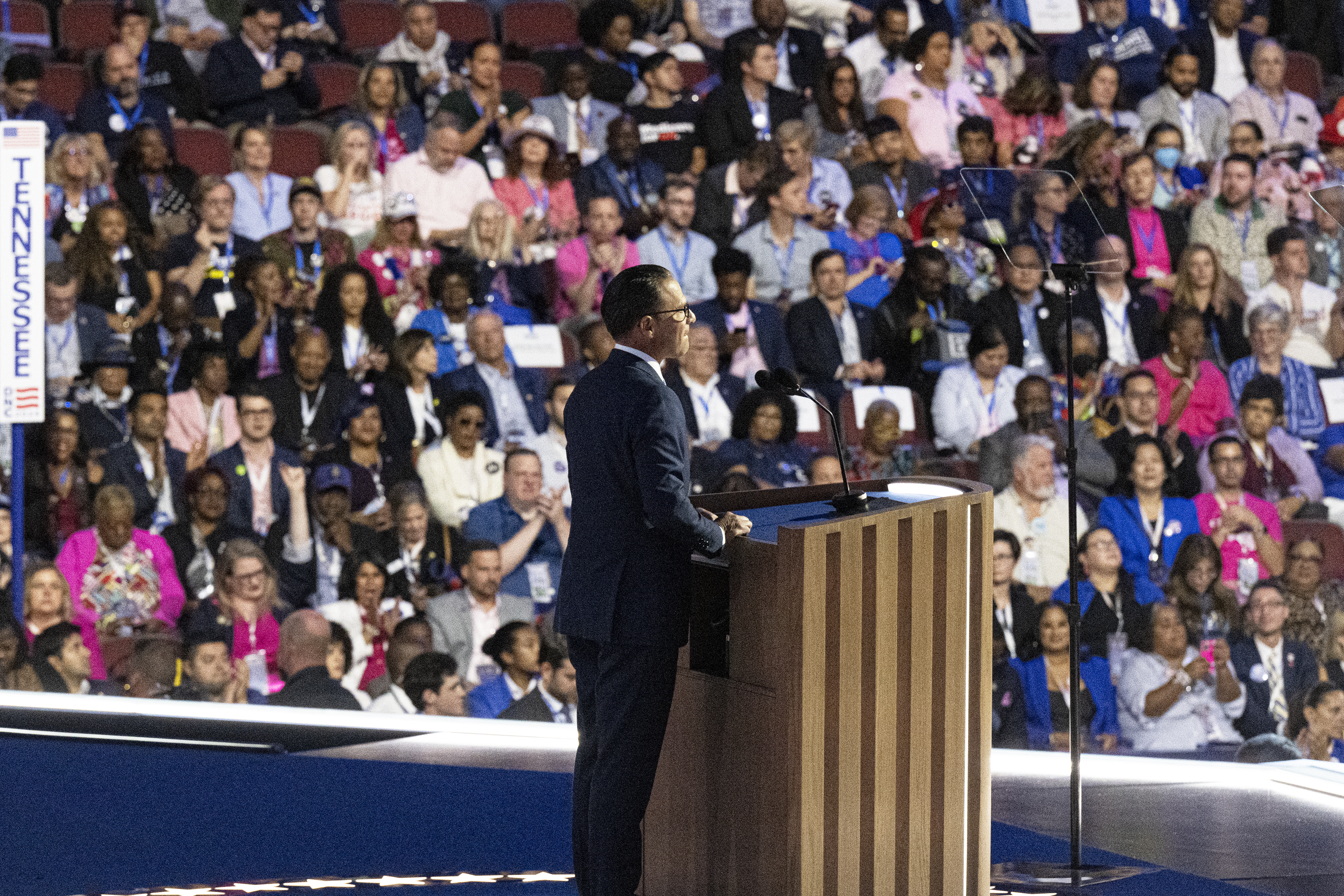
    Pennsylvania Gov. Josh Shapiro speaks during the Democratic National Convention Wednesday, Aug. 21, 2024, in Chicago.

    While book deals are often signifiers for officials hoping to take another step up in government, Shapiro still faces reelection next year. He will likely face Treasurer Stacy Garrity, a Republican who has already captured the state GOP’s endorsement. Garrity is a retired U.S. Army colonel, and has focused some of her criticisms of Shapiro thus far on his presumed eye for higher office. However, Shapiro still maintains a high approval rating in Pennsylvania, a state President Donald Trump won last year.

    Shapiro’s memoir will also detail the arson attack on the governor’s mansion, in which, just hours after Passover earlier this year, Cody Balmer set the home ablaze with incendiary devices. Balmer pleaded guilty last week to attempted murder.

    Shapiro, who was born in Kansas City, Mo., before moving to Montgomery County, has credited his upbringing by his parents — his father a pediatrician, and his mother an educator — as laying the foundation for his life in public service. Shapiro has four children and is married to his high school sweetheart, Lori. He and his family still live in Abington Township and split their time between their family home and the governor’s mansion in Harrisburg.

  • ‘Philly crime’ and the specter of Donald Trump are dominating two Bucks County law enforcement races

    ‘Philly crime’ and the specter of Donald Trump are dominating two Bucks County law enforcement races

    Bucks County Republicans are stoking fears about crime in Philadelphia even as violent crime in the city steadily drops from its high during the pandemic.

    Digital ads Republicans have circulated for the county’s sheriff and district attorney races since August tell voters to “keep Philly crime out of Bucks County,” borrowing a tactic from President Donald Trump, who regularly promotes exaggerated visions of crime-ridden liberal cities.

    Republicans in the purple collar county hope the message will boost the GOP incumbents, District Attorney Jen Schorn and Sheriff Fred Harran, as they face off this fall against their respective Democratic challengers, Joe Khan and Danny Ceisler.

    “We’re letting anarchy take over our country in certain places, and that’s not something we want in Bucks,” said Pat Poprik, the chair of the Bucks County Republican Party.

    Meanwhile, Democrats are eager to tie the GOP incumbents to Trump, portraying them as allies of a president whose nationwide approval rate is dropping.

    Khan, a former county solicitor and former federal prosecutor who unsuccessfully ran for attorney general last year, is seeking to portray himself as less politically motivated than Schorn, a veteran prosecutor who is running for a full term as district attorney after being appointed to the position last year.

    Ceisler, an Army veteran and an attorney who worked for Democratic Gov. Josh Shapiro’s administration, has taken a similar approach in his race against Harran, the outspoken Republican sheriff who has sought a controversial partnership with U.S. Immigration and Customs Enforcement.

    “Democrats are far more enthusiastic about voting precisely because they see what’s happening on the national level. They are really infuriated by what Donald Trump is doing,” State Sen. Steve Santarsiero, who chairs the Bucks County Democratic Party, said. “They’re going to make their displeasure heard by coming to the polls.”

    The local races in the key county, which Trump narrowly won last year, will be a temperature check on how swing voters are responding to Trump’s second term and will gauge their enthusiasm ahead of the 2026 midterms, when Shapiro stands for reelection.

    As the Nov. 4 election approaches, early signs indicate Democrats’ message might be working — polling conducted by a Democratic firm in September found their candidates ahead, and three weeks before Election Day, Democrats had requested more than twice as many mail ballots as Republicans.

    “I think the Republican Party has the same problem it always does. … They turn out when Trump’s on the ticket, but when he’s not, there’s less enthusiasm,” said Jim Worthington, who has run pro-Trump organizations in Bucks County. “Truth be told, the Democrats do a hell of a job just turning out their voters.”

    State Treasurer Stacy Garrity, a Republican running for Pa. governor, poses with Bucks County elected officers following her campaign rally Sat the Newtown Sports & Events Center. From left: Bucks County Sheriff Fred Harran; Bucks County District Attorney Jennifer Schorn; Garrity; and Pamela Van Blunk, Bucks County Controller.

    GOP warns of ‘dangerous’ policies

    Republican messaging in the two races focuses on the idea that Bucks County is safe, but its neighbors are not.

    GOP ads, which have run over the course of four months, suggest that Khan and Ceisler would enact “dangerous” policies in Bucks County such as “releasing criminals without bail” and “giving sanctuary to violent gang members.”

    Democrats reject these ads as scare tactics. The ads make implicit comparisons to Philly’s progressive District Attorney Larry Krasner, who is poised to win a third term in the city but remains a controversial figure in the wider region even as violent crime rates have fallen in the city.

    They frame Harran and Schorn in stark contrast to their opponents as lifelong Bucks County law enforcement officers with histories of holding criminals accountable.

    “I think it resonates beyond the Republican base,” said Guy Ciarrocchi, a Republican analyst, who contended frequent news coverage of Krasner makes the message more viable.

    Khan, a former assistant Philly district attorney who unsuccessfully ran against Krasner in the 2017 primary, has noted that he campaigned “very, very vigorously” against Krasner and challenged his ideas on how to serve the city.

    “I accept the reality that I didn’t win that election,” said Khan, whose platform in 2017 included a proposal to stop prosecuting most low-level drug offenses. “Unlike my opponent, who seems to basically enjoy the sport of scoring political points by sparring with the DA of Philadelphia.”

    Schorn, however, is adamant that politics has never played a role in her prosecutorial decisions. Her mission, she said, is “simply to get justice.”

    A lifelong Bucks County resident who has been a prosecutor in the county since 1999, Schorn handled some of the county’s most high-profile cases and spearheaded the formation of a task force for internet crimes against children.

    Bucks County District Attorney Jennifer Schorn speaks at a Republican rally at the Newtown Sports & Events Center in September.

    “This has been my life’s mission, prosecuting cases here in Bucks County, the county where I was raised,” she said. “I didn’t do it for any notoriety. I didn’t do it for self-promotion. I did it because it’s what I went to law school to do.”

    Harran spent decades as Bensalem’s public safety director before first running for sheriff in 2021. He is seeking reelection amid controversy caused by his decision to partner his agency with ICE, a move that a Bucks County judge upheld last week after a legal challenge.

    “Being Bucks County Sheriff isn’t a position you can learn on the job. For 39 years, I’ve woken up every day focused on keeping our communities safe,” Harran said in an email to The Inquirer in which he criticized Ceisler as lacking experience.

    Although Ceisler has never worked directly in law enforcement, he argues the sheriff’s job is one of leadership in public safety. That’s something he says he’s well versed in as a senior public safety official in Shapiro’s administration who previously served on the Pentagon’s COVID-19 crisis management team.

    Harran, who described his opponent as a “political strategist,” criticized “politicians” for bringing “half-baked ideas like ‘no-cash bail’” into law enforcement. The concept, which is repeatedly derided in the GOP ads, sets up a system by which defendants are either released free of charge or held without the opportunity for bail based on their risk to the community and likelihood of returning to court.

    Khan and Ceisler each voiced support for the concept in prior runs for Philadelphia district attorney and Bucks County district attorney, respectively.

    Both say they still support cashless bail. Neither, however, would have the authority to implement the policy if elected, though Khan as district attorney could establish policies preventing county prosecutors from seeking cash bail in certain cases.

    Joe Khan, a Democratic candidate running for Bucks County DA, walks from his polling place in Doylestown, Pa. in April 2024 when he was running for attorney general.

    “When a defendant is arrested and they come into court, every prosecutor answers this question: Should this person be detained or not?” Khan said. “If the answer is yes, then your position in court is that this person shouldn’t be let out, and it doesn’t matter how much money they have. And if the answer is no, then you need to figure out what conditions you need to make sure they come to court.”

    Democrats claim to ‘keep politics out’

    Even as Democrats view voter anger at Trump as a key piece of their path to victory, they are working to present themselves as apolitical.

    Democratic ads attack Schorn for not investigating a pipeline leak in Upper Makefield and Harran as caring about nothing but himself. Positive ads highlight Ceisler’s military background and Khan’s career as a federal prosecutor.

    Khan and Ceisler, the Democratic Party’s ads argue, will “stop child predators, stand up to corruption, and they’ll keep politics out of public safety.”

    Khan has described Schorn as a political actor running her office “under Trump’s blueprint.” He has focused on her decisions not to prosecute an alleged child abuse case in the Central Bucks School District or investigate the company responsible for a jet fuel leak into Upper Makefield’s drinking water.

    The jet fuel case was turned over to the environmental crimes unit in Pennsylvania Attorney General Dave Sunday’s office. And prosecutorial rules bar Schorn from discussing the alleged abuse.

    “During the last, I don’t know, 13 years when [Khan] has been pursuing politics, I’ve been a public servant,” Schorn said. “For someone accusing me of putting politics first, he seems to be using politics to further his own agenda.”

    But Schorn appears in GOP ads alongside Harran, a figure who has frequently invited political controversy in fights with the Democratic-led Bucks County Board of Commissioners, his effort to partner with federal immigration authorities, and his early endorsement of Trump last year.

    At a September rally in Newtown for Treasurer Stacy Garrity, a Republican running for governor, Harran cracked jokes about former President Joe Biden’s age as he climbed onto the stage and falsely told voters that they will “lose [their] right to vote” if they don’t vote out three Pennsylvania Supreme Court justices standing for retention.

    Harran has long contended that his decision to partner with ICE was not political.

    “I’m a cop who ran to keep being a cop. This isn’t about politics for me — it’s about doing everything I can to keep my community safe,” Harran said.

    Harran’s opponent, Ceisler, paints a different picture as he draws a direct line between the sheriff and the president.

    Danny Ceisler, a Democrat, is running for Bucks County sheriff.

    Trump, Ceisler said, has inserted politics into public safety in his second term, and he contended that Harran has done the same.

    “[Harran] used his bully pulpit to help get the president elected, so to that extent he is linked to the president for better or worse,” Ceisler said in an interview.

    Ceisler has pledged to take politics out of the office and end the department’s partnership with ICE if elected.

    At an event in Warminster last month, voters were quick to ask Ceisler which party he was running with. Ceisler asked them to hear his pitch about how he would run the office first.

    “Don’t hold it against me,” he quipped as he ultimately admitted to one voter he’s a Democrat.

    Staff writer Fallon Roth contributed to this article.

    This suburban content is produced with support from the Leslie Miller and Richard Worley Foundation and The Lenfest Institute for Journalism. Editorial content is created independently of the project donors. Gifts to support The Inquirer’s high-impact journalism can be made at inquirer.com/donate. A list of Lenfest Institute donors can be found at lenfestinstitute.org/supporters.