Tag: Super Bowl

  • Pa. and N.J. call it gambling. Trump calls it finance. A high-stakes fight over prediction markets is underway

    Pa. and N.J. call it gambling. Trump calls it finance. A high-stakes fight over prediction markets is underway

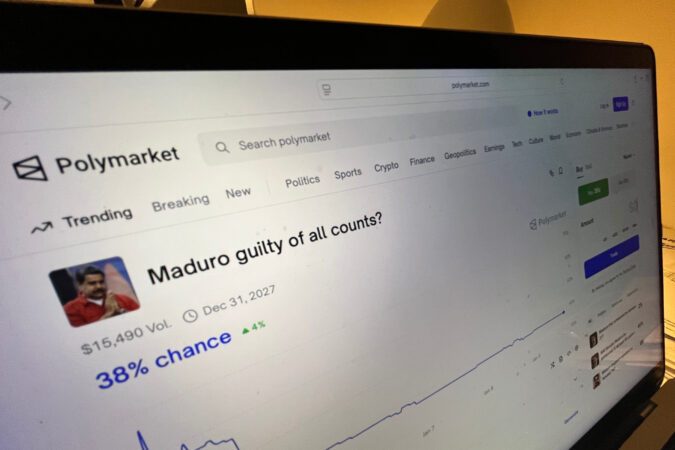
    A high-stakes fight is brewing between President Donald Trump’s administration and states such as Pennsylvania and New Jersey over the regulation of prediction markets, the online platforms that allow users to wager on everything from sports and elections to the weather.

    States that have legalized sports betting in recent years say prediction markets amount to unauthorized gambling, putting consumers at risk and threatening tax revenues generated by regulated entities like casinos.

    But the Trump administration this week said the federal government was the appropriate regulator, siding with the industry’s argument that the markets’ “event contracts” are financial derivatives that allow investors to hedge against risks.

    The chair of the federal Commodity Futures Trading Commission on Tuesday said the CFTC had filed a brief in federal court to “defend its exclusive jurisdiction” to oversee these markets, amid litigation between state governments and platforms such as Kalshi and Polymarket.

    Prediction markets “provide useful functions for society by allowing everyday Americans to hedge commercial risks like increases in temperature and energy price spikes,” CFTC Chairman Mike Selig said in a video posted on X.

    New Jersey collected more than $880 million in gaming tax revenues last year, while Pennsylvania brought in almost $3 billion, according to regulators. The revenues fund property tax relief programs and the horse racing industry, as well as programs for senior citizens and disabled residents.

    Pennsylvania’s gaming regulator has previously warned that prediction markets risk “creating a backdoor to legalized sports betting,” without strict oversight.

    The state Gaming Control Board’s Office of Chief Counsel told The Inquirer Wednesday that it sees a distinction between certain futures markets — like those for agricultural commodities, which have long been regulated by the CFTC — and “event contracts” tied to “the outcome of a random Wednesday night NBA basketball game.”

    Representatives for Gov. Josh Shapiro of Pennsylvania and Gov. Mikie Sherrill of New Jersey, both Democrats, didn’t respond to requests for comment.

    But former New Jersey Gov. Chris Christie — a Republican who worked to legalize sports betting while in office and who’s now advising the American Gaming Associationsaid Tuesday on X that the Trump administration is trying to “grow the size of the federal government & their own power while trying to crush states rights and take advantage of our citizens.”

    Beyond the courts, the GOP-led Congress could also choose to step in. Some Republican lawmakers have expressed concerns about a “Wild West” in prediction markets, notwithstanding Trump’s support for the industry.

    Sen. Dave McCormick (R., Pa.) welcomed the CFTC’s announcement, writing on X that prediction markets “offer tremendous benefits to consumers and businesses.”

    “A consistent, uniform framework for derivatives is essential to supporting U.S. markets,” he said.

    The CFTC’s action means the federal government is backing an industry in which the Trump family has a financial stake. The agency’s brief supports Crypto.com, a platform that last year partnered with the Trump family’s social media company to launch a prediction market.

    Ethics experts have said the Trump family’s ties to Crypto.com create a conflict of interest. The White House denies that and says the president’s holdings are in a trust controlled by his children.

    Winding through courts

    The U.S. Supreme Court in 2018 struck down a federal law that prohibited sports betting in most states, paving the way for states to legalize it. Pennsylvania and New Jersey both enacted laws authorizing sports gambling and imposing requirements on betting operators such as taxation on gaming revenues, consumer protection rules, and licensing fees.

    Despite state laws, prediction markets now operate nationwide — even in states that prohibit gambling altogether, like Utah.

    New York-based Kalshi launched its platform in 2021. The CFTC initially opposed Kalshi’s election-related contracts, but in the fall of 2024 the company won a case in which courts found the regulator failed to show how the platform’s “event contracts” would harm the public interest. Kalshi users proceeded to trade more than $500 million on the “Who will win the Presidential Election?” market.

    Then came sports contracts. In January 2025, following the CFTC’s protocols, Kalshi “self-certified” that its contracts tied to the outcome of sports games complied with relevant laws.

    The company has since offered event contracts on everything from the Super Bowl to Olympic Male Curling. Some established sportsbooks like Fanatics and DraftKings have also jumped into prediction markets.

    About 90% of Kalshi’s trading volume is tied to sports, the Associated Press reported.

    States have tried to intervene. In March, New Jersey’s gaming regulator ordered Kalshi to cease and desist operations in the Garden State, alleging the company issued unauthorized sports wagers in violation of the law and state Constitution.

    Kalshi filed a lawsuit, and a federal court issued an injunction prohibiting New Jersey from pursuing enforcement actions. Kalshi and other platforms have filed suits against other states, and courts have issued conflicting rulings.

    The CFTC said it filed a brief in one such suit this week.

    “To those who seek to challenge our authority in this space, let me be clear: we’ll see you in court,” Selig, the Trump-appointed CFTC chairman, said Tuesday.

    It could ultimately reach the U.S. Supreme Court.
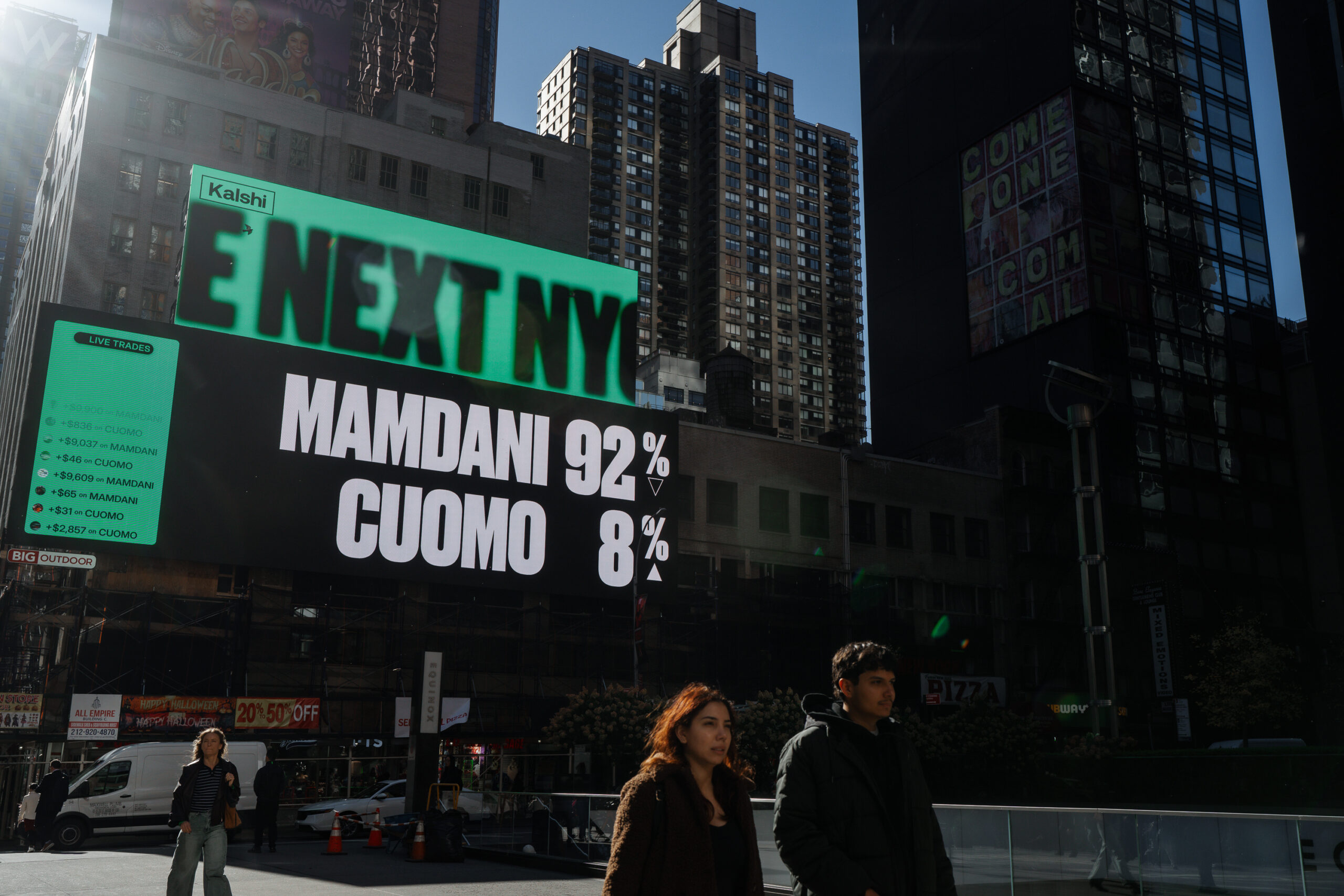
    Advertisements by the company Kalshi predict a victory for Zohran Mamdani in the New York City mayoral election before the votes are counted and polls close, Tuesday, Nov. 4, 2025, in New York.

    ‘Event contracts’

    At issue is whether the “event contracts” offered by prediction markets amount to gambling — regulated by states — or, as Selig says, financial instruments “that allow two parties to speculate on future market conditions without owning the underlying asset.”

    Platforms like Kalshi say they are similar to stock exchanges, where people on both sides of a trade can meet — and therefore subject to federal regulation of commodities. Unlike a casino, the platforms say, they don’t win when customers lose.

    Pennsylvania regulators see it differently.

    The state Gaming Control Board told The Inquirer Wednesday that it takes issue with “‘prediction markets’ allowing any consumer, age 18 years old or older, to purchase a ‘contract’ on any potential future event occurring, even when that event does not have any broad economic impact or consequence, such as the outcome of a random Wednesday night NBA basketball game.”

    (Under Pennsylvania law, gambling is limited to those who are 21 or older.)

    “The Board believes that is not what the Commodities Exchange Act contemplated when it was enacted by Congress and established the CFTC and is, in fact, gambling,” the board’s Office of Chief Counsel said in a statement.

    If the courts side with the Trump administration, states worry that tax revenues from regulated sportsbooks would fall and customers would be vulnerable to markets they say are easily exploited by insiders.

    “If prediction markets successfully carve themselves out of the ‘gaming’ definition, they risk creating a parallel wagering ecosystem where bets on sports outcomes occur with significantly less oversight regarding potential match-fixing,” Kevin F. O’Toole, executive director of the Pennsylvania Gaming Control Board, wrote in an October letter to the state’s congressional delegation.

    For example, the gaming board has the ability to penalize licensed operators if they violate state regulations, O’Toole wrote, “something that an operator who ‘self-certifies’ their contracts/wagers [under CFTC rules] would never be subjected to.”

    O’Toole said the board’s regulatory role in this area is limited to sports wagering, but he added that markets on non-sports related events — he cited examples from Polymarket such as whether there will be a civil war in the United States this year — are equally “if not more troubling.”

    The CFTC says it is capable of overseeing the industry. “America is home to the most liquid and vibrant financial markets in the world because our regulators take seriously their obligation to police fraud and institute appropriate investor safeguards,” Selig wrote in a Wall Street Journal opinion piece this week.
  • NFL to buck decades-long trend to open 2026 season; Eagles won’t lose home game to international play

    NFL to buck decades-long trend to open 2026 season; Eagles won’t lose home game to international play

    We knew that Roger Goodell was serious about pushing the NFL internationally, but we didn’t know he was this serious.

    The NFL is considering beginning the 2026 season on a Wednesday night, bucking a two-decade trend of holding the annual NFL Kickoff game on a Thursday night.

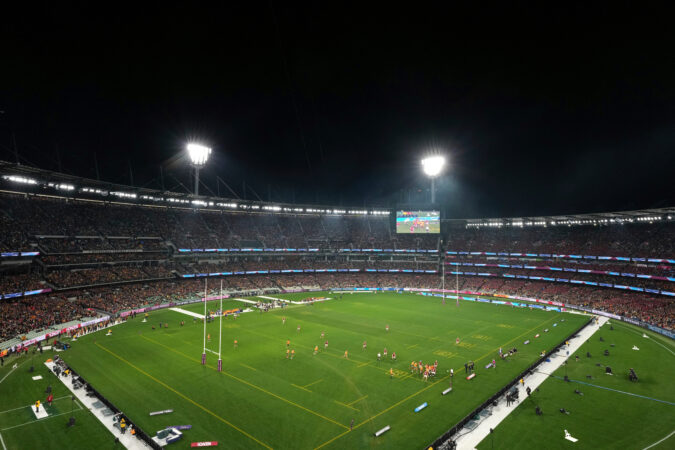
    After winning the Super Bowl, the Seattle Seahawks would traditionally host the kickoff game Thursday. But the NFL has also announced that its first game in Melbourne, Australia — featuring the San Francisco 49ers and Los Angeles Rams — will take place in Week 1, and sources confirm the report from Puck’s John Ourand that the NFL is considering having it be the first game of the season.

    The league could also decide to hold the traditional Seahawks-hosted kickoff game Wednesday and the Australia game Thursday. Either way, we’re looking at the 2026 season beginning on a Wednesday night for just the second time in nearly eight decades.

    The last time the NFL kicked the season off on a Wednesday was 2012, when the league shifted its schedule to avoid going up against President Barack Obama’s speech during the final night of the Democratic National Convention. Prior to that, the NFL hadn’t opened the season on a Wednesday since 1948.

    So why doesn’t the NFL just schedule its new Australian game on Friday, as they’ve done the past two years with their Brazil games? Because under the Sports Broadcasting Act of 1961, the NFL is prohibited from scheduling games on Friday nights from mid-September to mid-December to protect high school and college sports.

    With some help from the calendar, the NFL was able to squeeze in a Week 1 Friday night game the past two seasons. This year they league isn’t so lucky, with kickoff Thursday falling on Sept. 10.

    Whether it happens Wednesday or Thursday, the Seattle Seahawks will begin to defend their Super Bowl championship title at home to start the season, likely against the Chicago Bears.

    Two big question marks remain: The first is where will the Australia game air? The NFL is negotiating broadcast rights with streaming companies, and the favorite has to be YouTube, which streamed last year’s Kansas City Chiefs vs. Los Angeles Chargers matchup from Brazil.

    YouTube exec Christian Oestlien has said the streamer wants to carry more live NFL games, and it proved it can handle the demand with minimal tech problems.

    There’s also Netflix, which is entering the final year of streaming NFL Christmas day games and looks for big events to stream on its platform. The league’s first-ever game in Australia airing in primetime in the U.S. would certainly quality.

    But Peacock could also be a possibility. NBC’s subscription streaming service had the rights to the NFL’s first Brazilian game, and last year it had the rights to a Week 17 Saturday night game between the Green Bay Packers and Baltimore Ravens.

    Another unanswered question is when the game will air in the United States. Airing the game in prime time on the East Coast means dealing with a 16-hour time difference. An 8 p.m. kickoff time in Philadelphia on a Wednesday would mean the game was starting at noon Thursday in Melbourne.

    Eagles likely to play in an international game?

    The Eagles played in São Paulo, Brazil in Week 1 of the 2024 season.

    The expansion into Australia is one of a record nine NFL games being held outside the United States this season.

    Here’s a quick recap of what we know:

    • Melbourne, Australia: 49ers at Rams
    • Rio de Janeiro, Brazil: TBA at Dallas Cowboys
    • Paris, France: TBA at New Orleans Saints
    • Munich, Germany: TBA at TBA
    • Mexico City, Mexico: TBA at 49ers
    • Madrid, Spain: TBA at TBA
    • London, England (Tottenham Hotspur Stadium): TBA at TBA
    • London, England (Tottenham Hotspur Stadium): TBA at TBA
    • London, England (Wembley Stadium): TBA at Jaguars

    The Atlanta Falcons — who aren’t on the Eagles 2026 schedule — have announced that they are the designated home team for one of the international games. The Washington Commanders will also be the home team in one international game, according to the Athletic.

    The Eagles have a ninth home game in 2026 thanks to the NFL’s 17-week season, and season-ticket holders have been notified that all will be played at the Linc. But the Birds remain in the mix to play an international game as an away team.

    First, there’s Rio de Janeiro, where the Eagles could face the Cowboys. The Birds have marketing rights in Brazil and played there two seasons ago, but the NFL generally avoids scheduling divisional matchups in international games (though it’s already bucking that trend with 49ers-Rams in Australia, plus the Chiefs have played the Chargers, an AFC West foe, twice on foreign soil).

    Still, this year’s Brazil game will take place on a Sunday afternoon — during daylight saving time, there is a one-hour difference between the East Coast and Rio de Janeiro. While the NFL likely won’t want to move such a marquee matchup into an international venue, Eagles-Cowboys at 4:25 p.m. on a Sunday does feel right.

    Mexico City is also in play, because the Eagles face the 49ers on the road next season. So is London, because the Birds are scheduled to play a road game against the Jacksonville Jaguars and the home teams in the two remaining games have yet to be announced. But it doesn’t seem likely the NFL would want to waste the ratings potential of the Eagles on a game with a 9:30 a.m. Philly kickoff.

    The NFL also hasn’t announced which teams will host games at Allianz Arena in Munich, Germany, and Bernabéu in Madrid, Spain.

    Quick hits

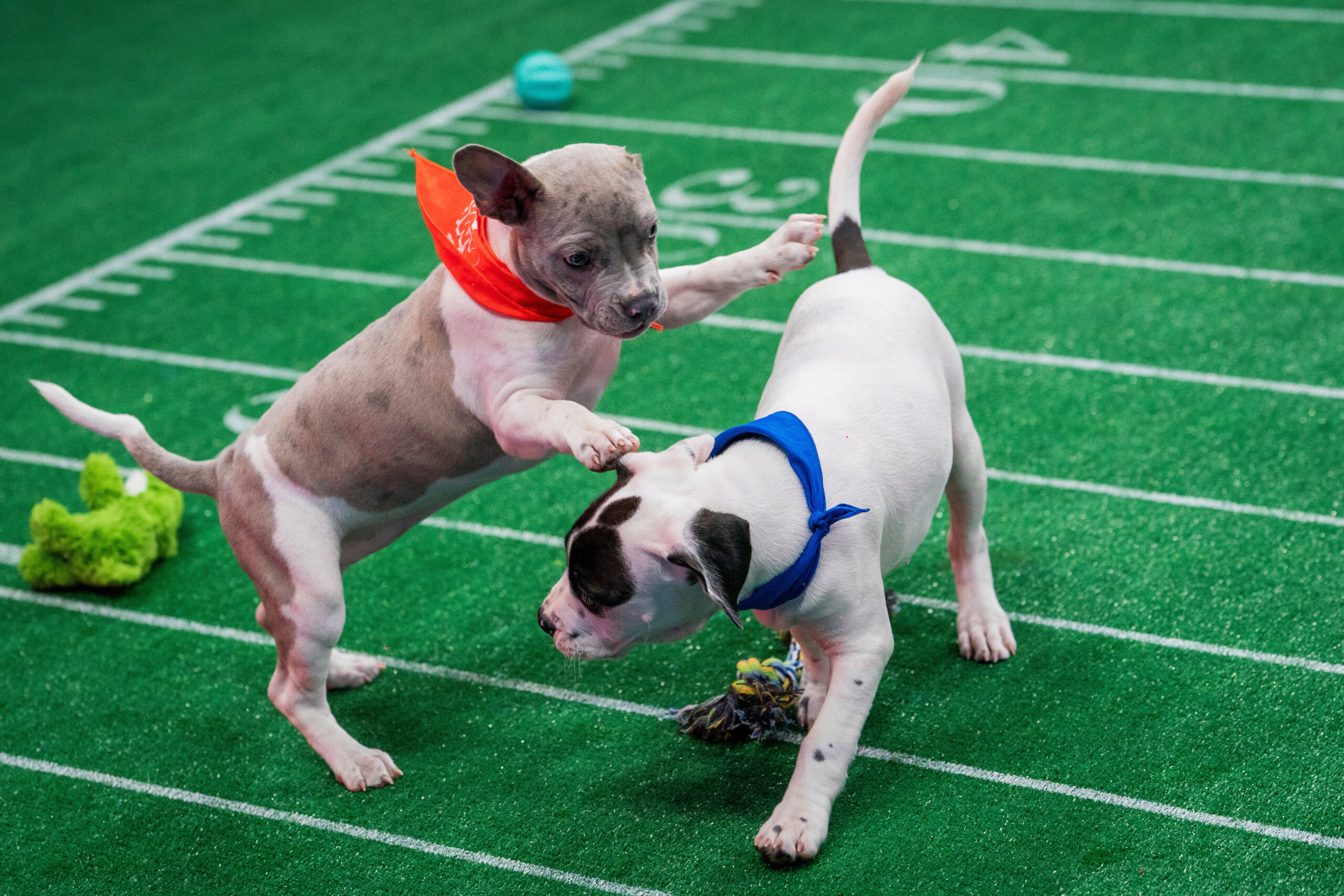
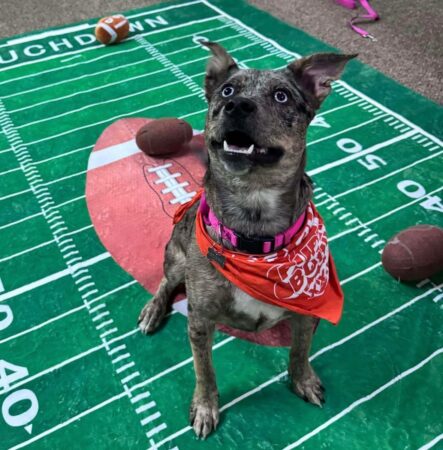
    Two puppies go at it during Puppy Bowl XXII Sunday.
    • The Super Bowl averaged 124.9 million viewers Sunday, down from last year but still good enough for the second-highest audience in the game’s history. But we should be talking about this year’s Puppy Bowl, which featured three Pennsylvania pups and drew 15.3 million viewers on Animal Planet and across Warner Bros. Discovery properties earlier in the day, the show’s biggest audience since 2018.
    • Credit where it’s due: Now former Phillies outfielder Nick Castellanos acknowledged bringing a beer into the dugout last season, but he wouldn’t have fessed up if the Athletic’s Matt Gelb hadn’t asked about the incident.
    • Kudos to the Baltimore Banner, the successful digital news start up down in Charm City, which announced plans to expand its sports coverage to Washington after the Washington Post eliminated its entire sports desk. Banner editor in chief Audrey Cooper said the outlet plans to start by hiring beat reporters to cover the Washington Nationals and Washington Commanders, calling it “part of our unwavering commitment to serve Maryland with honest, independent journalism.”
    • Sports podcaster Josh Shapiro, who also happens to be the governor of Pennsylvania, got former Sixers general manager Billy King discussing a wild, four-team trade that nearly sent Allen Iverson to the Detroit Pistons ahead of the 2000-01 season. Of course, Iverson went on to be named NBA MVP that season and led that iconic Sixers team to the NBA Finals. They haven’t been back since.
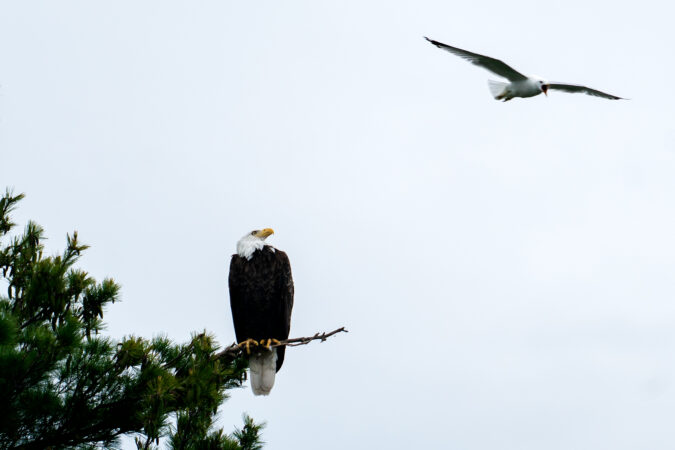
  • A bald eagle laid three eggs in Lancaster County. You can watch them hatch live online.

    A bald eagle laid three eggs in Lancaster County. You can watch them hatch live online.

    Lincoln, the 26-year-old bald eagle that performs at Eagles home games and recently starred in a heartwarming Super Bowl commercial for Budweiser, isn’t the only local bird getting prominent airtime this week.
    A pair of Lancaster County bald eagles are currently the subject of a popular livestream presented by the Pennsylvania Game Commission and HDOnTap — one of two active eagles nests being livestreamed by the state at the moment.

    E-L-G-S-E-S!

    The two eagles — nicknamed “Lisa” and “Oliver” — have captured the imagination of onlookers as they preside over three eggs expected to hatch next month.

    At mid-morning Wednesday, the livestream had more than 100 live viewers. On Facebook, commenters leave by-the-hour updates on the birds’ comings and goings (“Oliver brought a nice size fish for Lisa’s dinner,“ wrote one Facebook commenter.. Last year, the Lancaster County nest alone saw nearly 700,000 viewers over the course of the year.

    It’s a popularity that Jason Beale, the game commission’s conservation education and social science chief, attributes to the bald eagle’s mythic status, its position as a national emblem, and the animals’ history of near-extinction.

    The bald eagle, in fact, has made a stunning comeback in recent years, “one of the great wildlife conservation stories in the history of both the state and the nation,” according to the Pa. Game Commission.

    In 1990, the number of known active nests in the state had dwindled to just eight. Today, that number stands at more than 300.

    The Lancaster County eagle cam is one of two livestreams of active eagles nests in the state, the locations of which are undisclosed to protect the animals and their nests. The state also operates an elk cam (1,151,559 views in 2025) and a snow goose cam (which has been a bit of a bust this year, Beale admits).

    But the eagle cam is where the interesting stuff seems to happen, says Beale.

    Once, he said, a livestream caught an eagle carrying a cat up to the nest. Another time, a turtle.

    All of it can make for good TV.

    “Generally, if you watch it for a few minutes, you’re going to see something,” Beale said.

    As for the enduring popularity of the eagle cam?

    Said Beale, “It’s happening when people are cooped up inside, they’re ready to get out in the spring, and it’s a way to connect with nature at a time when not a lot of us are connected with nature.”

    Find the Lancaster County eagles nest livestream at bit.ly/4rdfTU1.

  • Brandi Carlile kicks off her new tour in Philadelphia, ‘the perfect place to start something this terrifying’

    Brandi Carlile kicks off her new tour in Philadelphia, ‘the perfect place to start something this terrifying’

    An arena-sized pop show isn’t the place to go if you’re hoping to be surprised.

    Big productions tend to be risk averse. The music needs to work in unison with what’s on the giant video screens, so night-to-night variation is discouraged. If a tour’s been on the road, googling the set list eliminates mystery and lets you know what’s coming next.

    But part of what made Brandi Carlile’s show on Tuesday at the Xfinity Mobile Arena such a kick is that almost none of that was in play.

    Not only was it opening night on Carlile’s “Human Tour” — named after a song on her new album, Returning To Myself — it was also the start of her first-ever arena tour.

    That kept Carlile’s intensely loyal audience in suspense on what was a career milestone night for the Seattle songwriter who had chalked up another milestone, just two days ago.

    On Sunday in Santa Clara, Calif., the Seahawks fan had sung a lovely, understated “America the Beautiful” at Super Bowl LX, opening for her hometown team and Bad Bunny. She was accompanied by SistaStrings, the cello-violin duo of Monique and Chauntee Ross who were also with her in South Philly Tuesday night.

    So you couldn’t blame Carlile for being giddy as she reveled in her dream-come-true after 20 years on the road with twin brothers Phil and Tim Hanseroth, who were on either side of her as always on Tuesday. They play guitar and bass at the core of a band that’s now swelled to eight members.

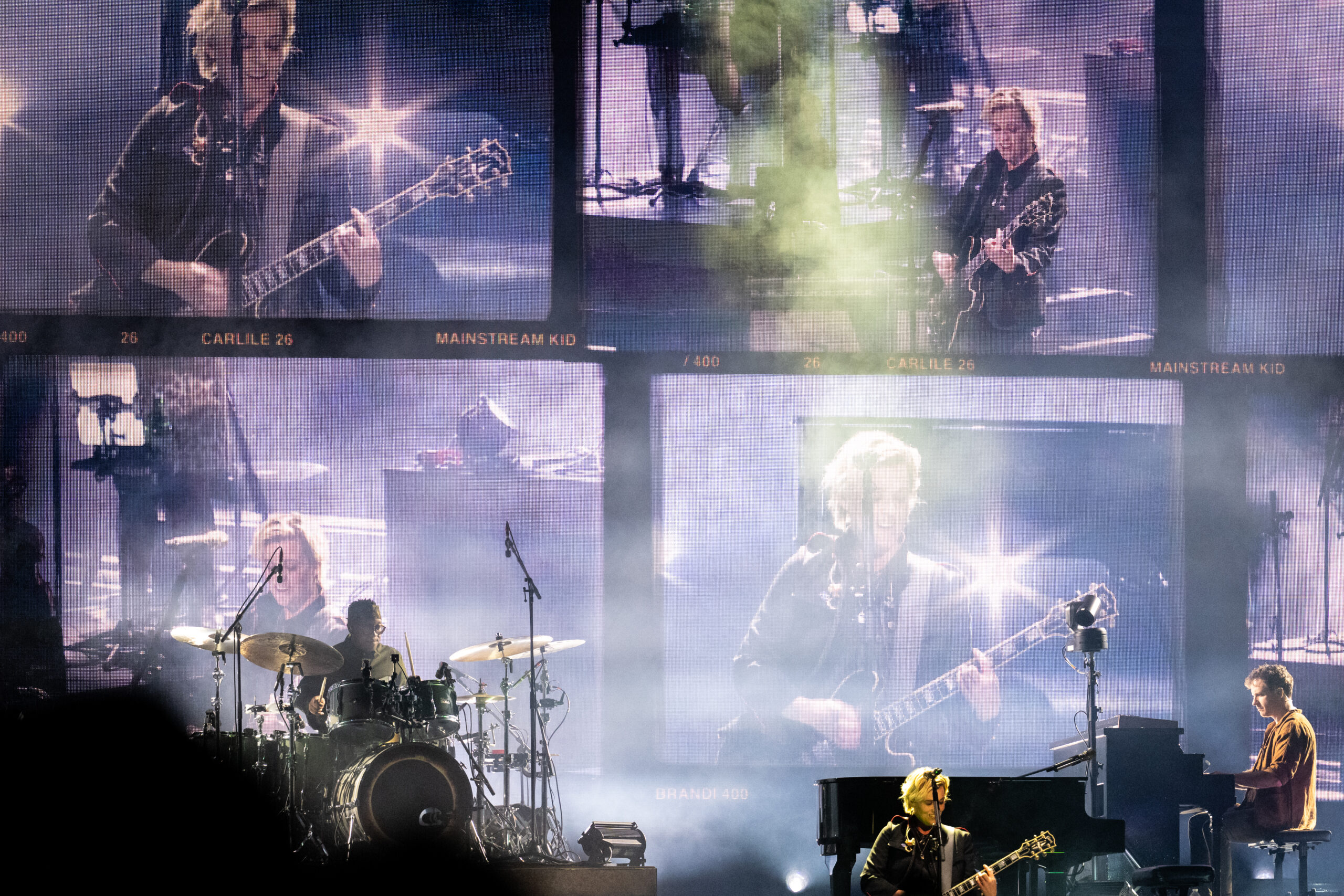
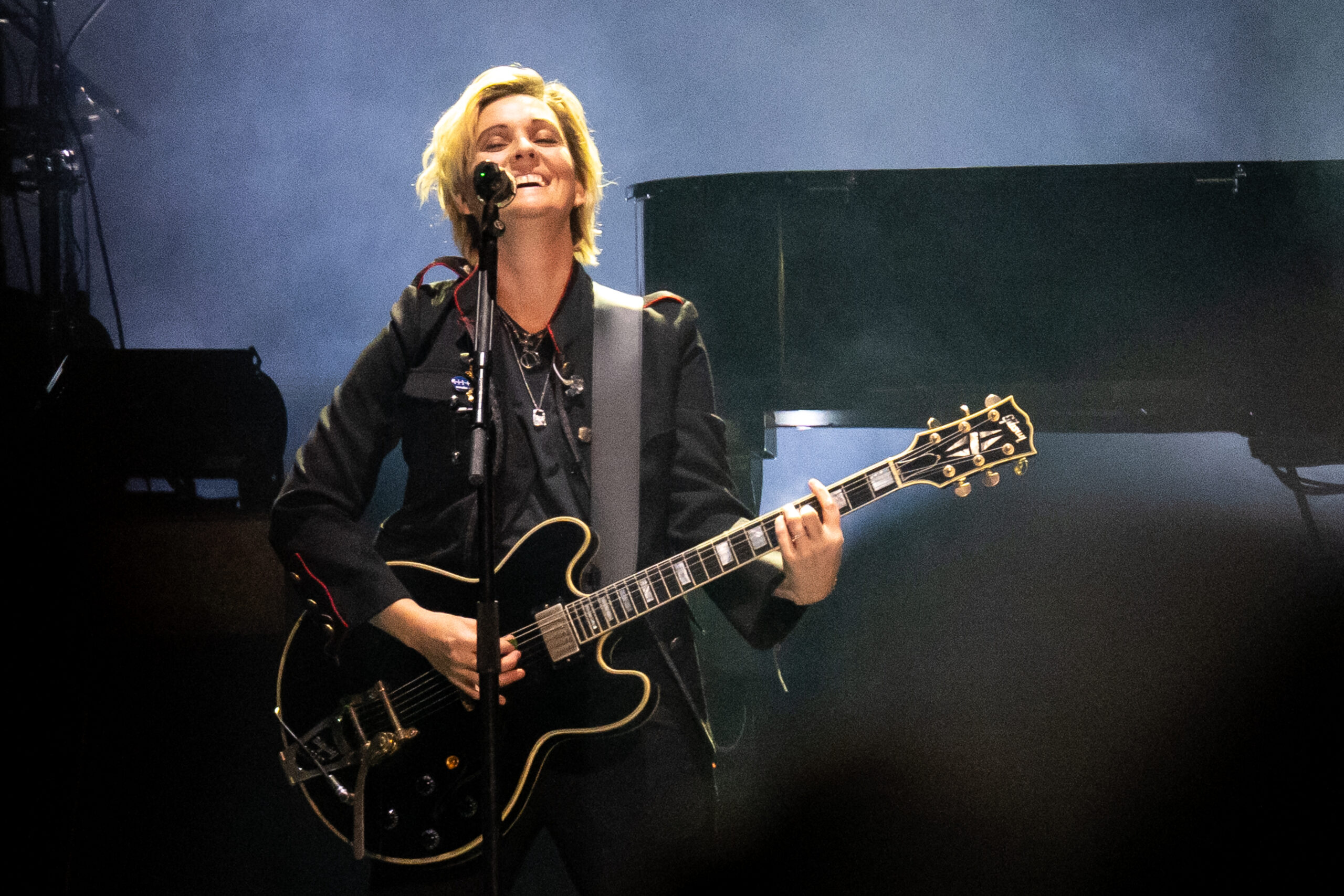
    Brandi Carlile performs at Xfinity Mobile Arena in South Philadelphia on Tuesday, Feb. 10, 2026. The Philadelphia show kicked off the singer’s first-ever arena tour.

    Carlile took the stage after the crowd got into the groove as Madonna’s “Like a Prayer” played on the sound system, following a solid well-sung set by indie-folk band and fellow Seattle music scene standouts, the Head and the Heart.

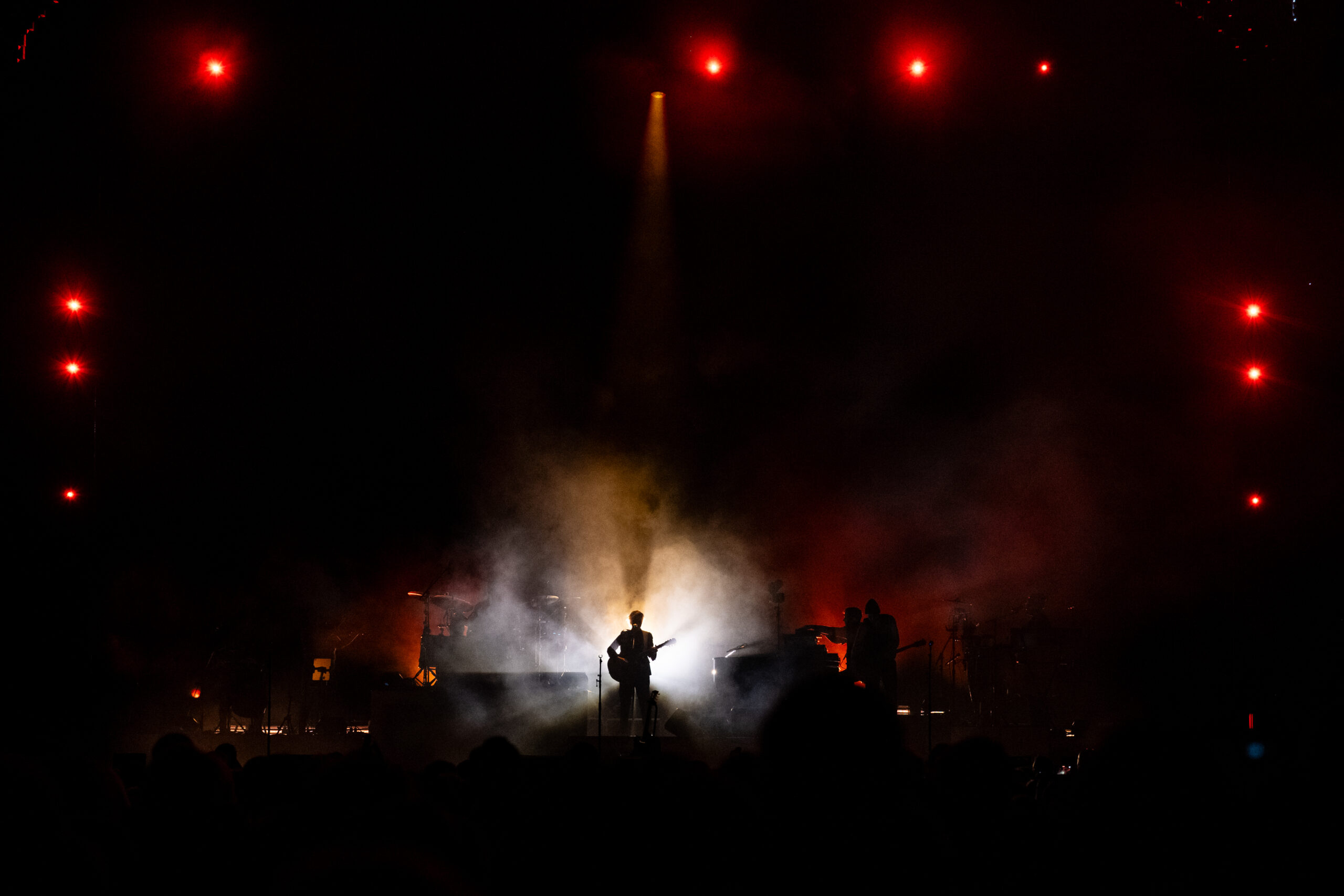
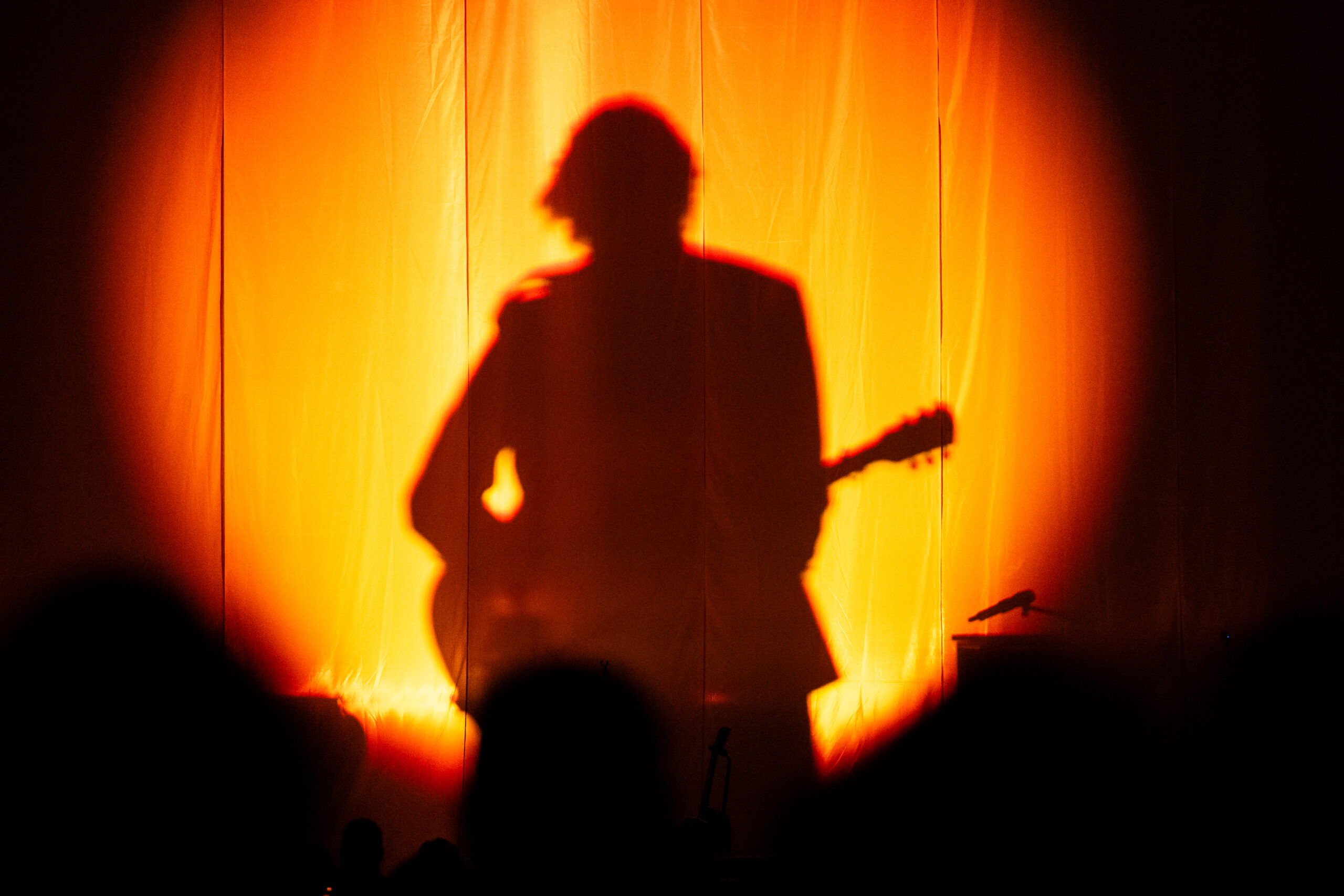
    She opened her two-hour-plus, 22-song show on acoustic guitar, silhouetted in an orange-and-yellow spotlight as she stood behind a curtain singing Returning to Myself’s title cut.

    The volume turned up gradually on the carpe diem “Human,” and full-on rocker “Mainstream Kid,” from her 2015 The Firewatcher’s Daughter, which wrestled with the implications of an outsider aiming for mass market success.

    She answered those soul-searching questions with “Swing for the Fences,” a vow to grab the brass ring from Who Believes in Angels?, her 2025 album with Elton John.

    Then she took a minute to take it all in — and to also shout-out the tiny Old City venue where she played her first Philly gig in 2005.

    “It’s an incredible feeling,” Carlile told the crowd, which skewed about a decade older than her, in the packed 21,000-seat arena.

    Brandi Carlile performs at Xfinity Mobile Arena in South Philadelphia on Tuesday, Feb. 10, 2026. Carlile sang ‘America the Beautiful’ at the Super Bowl on Sunday, Feb. 8, 2026. .

    “It reminds me of what it was like to see Celine Dion when I was a kid. You can’t really fathom it when you’ve been in a van all these years, and you first came to Philadelphia and played the Tin Angel, no one could have made me believe that we’re standing where we’re standing right now. It’s just wild.”

    Carlile is an expert community builder. Every January she hosts a “Girls Just Wanna” weekend, a woman-centric festival in Riviera Maya, Mexico. This May, she’s presenting “Echoes Through the Canyon at the Gorge” in Washington state, which will reunite The Highwomen, her country supergroup with Natalie Hemby, Maren Morris, and Amanda Shires.

    Tuesday’s show was a master class on breaking down the wall between performer and audience.

    “How did you guys like starting by listening to ‘Like a Prayer,’” she asked, taking the crowd with her behind the curtain. “We’re trying to figure out what songs do we play while people walk in? What are we gonna do with the set list?

    A fan takes a photo while Brandi Carlile performs at Xfinity Mobile Arena in South Philadelphia on Tuesday, Feb. 10, 2026.

    “Everything tonight is an experiment for us. And I don’t think there’s a crowd that’s better to do this for because everybody knows Philadelphia is gonna be honest. You’re not going to suffer in silence. And I’ve just been coming here for so long that it really does feel like the perfect place to start something this terrifying.”

    That may make the “Human Tour” opening concert sound like a dress rehearsal, but the band, which also included pianist Dave McKay, drummer Terence Clark, and multi-instrumentalist Solomon Dorsey, were in mid-tour form.

    At one point, she dismissed the band other than the Hanseroths and took requests. That resulted in charmingly casual versions of “What Can I Say” from 2005’s Brandi Carlile and “Josephine” from 2007’s The Story.

    Brandi Carlile performs at Xfinity Mobile Arena in South Philadelphia on Tuesday, Feb. 10, 2026. The Philadelphia show kicked off the singer’s first-ever arena tour

    Connecting with heroes and influences is part of Carlile’s brand. She produced a comeback record for country vet Tanya Tucker and organized the “Joni Jams” private sessions in L.A. that led Joni Mitchell to return to perform again in public in 2022 after suffering a brain aneurysm in 2015.

    “Joni” was left off the set list Tuesday; just as well as it’s one of the spottier tunes on Returning to Myself. Instead, she paid tribute to Linda Ronstadt’s 1970 Gary White-penned “Long Long Time,” which was heartfelt and delivered with plenty of power, if it lacked Ronstadt’s nuance.

    The show was quiet and rowdy. In the latter category was “Sinners, Saints and Fools,” from 2021’s In These Silent Days, about a Christian man who turns away immigrants, then is surprised to find heaven closed off to him.

    Carlile dedicated it to “the immigrants who built this country” and acknowledged talking politics in a room full of like-minded people felt “a little like an echo chamber.” But “isn’t it nice just to get together and realize we all feel the same way?” Then she sang, “as a catharsis to myself.”

    Brandi Carlile performs at Xfinity Mobile Arena in South Philadelphia on Tuesday, Feb. 10, 2026. The Philadelphia show kicked off the singer’s first-ever arena tour

    For all her affection for roots music, Carlile is a Pacific Northwest child of ’90s grunge and alt-rock who stood in for the late Chris Cornell of Soundgarden at the Rock and Roll Hall of Fame induction in 2025.

    Her Alanis Morissette fandom showed up twice during the three-song encore during which she sported a Sixers scarf. First, she offered a high-volume cover of Morissette’s “Uninvited,” with the band unleashing a blaring wall of sound.

    Then, show ended with “A Long Goodbye,” which references Morissette’s Jagged Little Pill. Carlile described the autobiographical song as “me, in 4 minutes and 48 seconds” and her hushed performance achieved what she said she saw as her job for the evening: “To be in this big room and make it seem small.”

  • Bad Bunny, MPLS, and the ‘neighborism’ saving America | Will Bunch Newsletter

    Maybe it’s because I’ve watched every blessed one of them, starting as a curious, nearly 8-year-old boy in 1967, but the Super Bowl has always felt like the ultimate barometer of where the American Experiment is at. Super Bowl LX (that’s 60, for those of you smart enough not to take four years of Latin in high school) was no exception. The actual game was something of a snoozefest, but the tsunami of commercials revealed us as a nation obsessed with artificial intelligence, sports betting, weight loss, and anything that can lift us from middle-class peonage without having to do any actual work. As Bad Bunny said, God bless America.

    If someone forwarded you this email, sign up for free here.

    Bad Bunny’s real message: From P.R. to Minnesota, we are neighbors

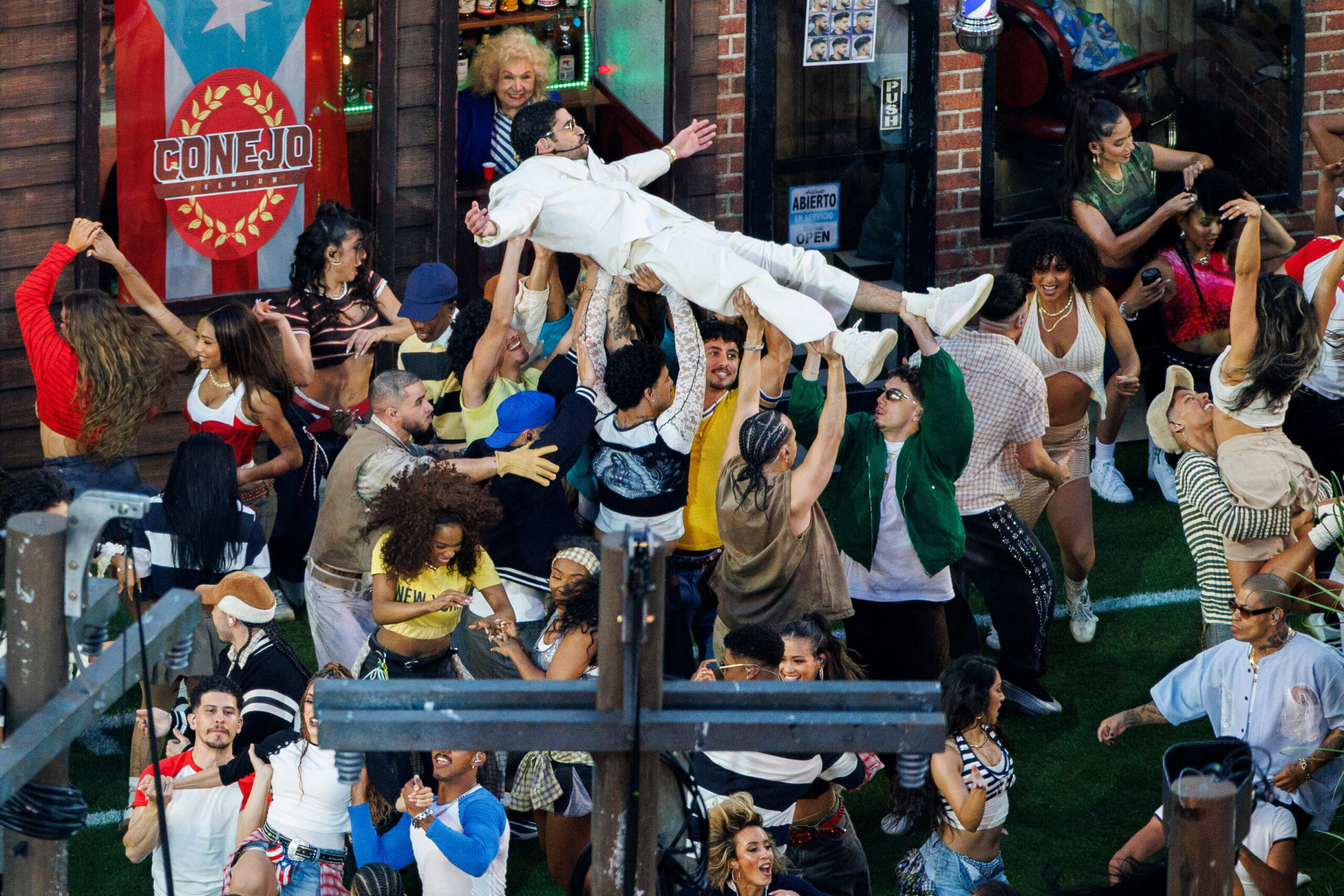
    Bad Bunny (center top) performs Sunday during the halftime show of the NFL Super Bowl XL football game between the Seattle Seahawks and the New England Patriots in Santa Clara, Calif.

    Right-wing media prattled on for months about how Bad Bunny, the Puerto Rican reggaeton superstar who is the world’s most streamed artist, would politicize and thus ruin the NFL’s halftime extravaganza at Super Bowl LX in Santa Clara, Calif.

    The babble became a scream seven days before the Big Game kicked off, when Bad Bunny won the record of the year Grammy Award and began his acceptance speech with the exhortation “ICE out!” adding, “We’re not savages, we’re not animals, we’re not aliens — we are humans, and we are Americans.”

    But on the world’s biggest stage Sunday night — seen by 135 million in the United States, a Super Bowl record — Bad Bunny sang not one word about Donald Trump, not that MAGA fans even bothered to hold up a translation app. The white-suited Benito Antonio Martínez Ocasio danced his way through the history of Puerto Rico and the Americas writ large, from the plantations of yore to the exploding power lines of the hurricane-wracked 21st century. He whirled past an actual wedding, stopped for a shaved ice, and for 13 spellbinding minutes turned a cast of 400 into what his transfixed TV audience craved at home.

    Bad Bunny built his own community — a place not torn asunder by politics, but bonded by love and music.

    Without uttering one word — in Spanish or English — about the dire situation in a nation drifting from flawed democracy into wrenching authoritarianism, the planet’s reigning king of pop delivered the most powerful message of America’s six decades of Super Bowl fever. Shrouded in sugar cane and shaded by a plantain tree, Bad Bunny sang nothing about the frigid chaos 2,000 miles east in Minnesota, and yet the show was somehow very much about Minneapolis.

    Bad Bunny finally gave voice to what thousands of everyday folks in the Twin Cities have been trying to say with their incessant whistles.

    We are all neighbors. The undocumented Venezuelan next door who toils in the back of a restaurant and sends his kids to your kids’ school is a neighbor. But Haiti is also a neighbor, as is Cuba. We are all in this together.

    The word I kept thinking about as I watched Bad Bunny’s joyous performance is a term that didn’t really exist on New Year’s Day 2026, yet has instantly provided a name to the current zeitgeist.

    Neighborism.

    The great writer Adam Serwer — already up for the wordsmithing Hall of Fame after he nailed the MAGA movement in 2018 in five words: “The cruelty is the point” — leaned hard into the concept of “neighborism” after he traveled to Minneapolis last month. His goal was to understand an almost revolutionary resistance to Trump’s mass deportation raids that had residents — many of whom had not been especially political — in the streets, blowing those warning whistles, confronting armed federal agents, and tracking their movements across the city.

    Serwer visited churches where volunteers packed thousands of boxes of food for immigrant families afraid to leave their homes during the U.S. Immigration and Customs Enforcement raids, and talked to stay-at-home moms, retirees, and blue-collar workers who give rides or money to those at risk, or who engaged in the riskier business of tracking the deportation raiders.

    “If the Minnesota resistance has an overarching ideology,” Serwer wrote, “you could call it ‘neighborism’ — a commitment to protecting the people around you, no matter who they are or where they came from.” He contrasted the reality on the ground in Minneapolis to the twisted depictions by Trump and his vice president, JD Vance, who’ve insisted refugees are a threat to community and cohesion.

    Of course, it’s not just Minneapolis, and it’s not just the many, liberal-leaning cities — from Los Angeles to Chicago to New Orleans and more — that were the incubators of the notion that concerned citizens — immigrant and nonimmigrant alike — could prevent their neighbors from getting kidnapped. Even small towns like rural Sackets Harbor, N.Y., the hometown of Trump’s border czar Tom Homan, rose up in protest to successfully block the dairy farm deportation of a mom and her three kids. It’s been like this everywhere regular folks — even the ones who narrowly elected Trump to a second term in 2024 — realize mass deportation doesn’t mean only “the worst of the worst,” but often the nice mom or dad in the house, or church pew, next to theirs.

    Only now that it’s arrived is it possible to see “neighborism” as the thing Americans were looking for all along, even if we didn’t know it. It is, in every way, the opposite vibe from the things that have always fueled fascism — atomization and alienation that’s easy for a demagogue to mold into rank suspicion of The Other.

    I’m pretty sure Bad Bunny wasn’t using the word neighborism when the NFL awarded him the coveted halftime gig last fall. But the concept was deeply embedded in his show. He mapped his native Puerto Rico as a place where oppression has long loomed — from the cruelty of the sugar plantations to the capitalist exploitation of the failed power grid — but where community is stronger.

    Then Benito broadened the whole concept. Reclaiming the word America for its original meaning as all of the Western Hemisphere, Bad Bunny name-checked “Chile, Argentina, Uruguay, Paraguay, Bolivia, Peru, Ecuador, Brazil,” and Canada, as well as the United States. These, too, are our neighbors. “God bless America,” he shouted — his only message of the night delivered in English.

    So, no, Bad Bunny never mentioned Minneapolis, but a tender moment when he seemingly handed the Grammy he’d won just a week ago to a small Latino boy had to remind viewers of the communal fight to save children like the 5-year-old, blue bunny hat-wearing (yes, ironic) Liam Conejo Ramos, who was just arrested, detained, and released by ICE. (A false rumor that the Super Bowl boy was Ramos went viral.)

    But arguably, this super performance had peaked a few moments earlier, when the singer exited the wedding scene stage with a backward trust dive, caught and held aloft by his makeshift community in the crowd below. Bad Bunny had no fear that his neighbors would not be there for him. Viva Puerto Rico. Viva Minneapolis. Viva our neighbors.

    Yo, do this!

    • Some 63 years after he was gunned down by a white racist in his own driveway, the Mississippi civil rights icon Medgar Evers has been having a moment. A fearless World War II vet whose bold stands for civil rights as local leader of the NAACP in America’s most segregated state triggered his 1963 assassination, Evers’ fight has become the subject of a best-selling book, a controversy over how his story is told at the Jackson, Miss., home where he was killed, and now a two-hour documentary streaming on PBS.com. I’m looking forward to watching the widely praised Everlasting: Life & Legacy of Medgar Evers.
    • After the Super Bowl, February is the worst month for sports — three out of every four years. In 2026, we have the Winter Olympics to bridge the frigid gap while we wait for baseball’s spring training (and its own World Baseball Classic) to warm us up. Personally, I try and sometimes fail to get too jacked up around sleds careening down an icy track, but hockey is a different story. At 2:10 p.m. on Tuesday (that’s today if you read this early enough), the puck drops on USA Network for the highly anticipated match between the world’s two top women’s teams: the United States and its heated rival Canada. Look for these two border frenemies to meet again for the gold medal.

    Ask me anything

    Question: How is it that some towns have been able to prevent ICE from buying warehouses and turning them into concentration camps, while others say they are helpless against the federal government? What does it mean that several are planned for within a couple of hours of Philly? — @idaroo.bsky.social via Bluesky

    Answer: Great question. It seems ICE and its $45 billion wad of cash are racing in near-secrecy to make this national gulag archipelago of 23 or so concentration camps a done deal. The places where they’ve been stopped, like one planned for Virginia, happened because locals were able to pressure the developer before a sale to ICE was concluded. That’s no longer an option at the two already purchased Pennsylvania sites in Schuylkill and Berks Counties. The last hope is pressure from high-ranking Republicans, which may (we’ll see) have stopped a Mississippi site. Pennsylvanians might want to focus, then, on GOP Sen. Dave McCormick. Good luck with that.

    What you’re saying about …

    It’s conventional wisdom that the best argument for a Gov. Josh Shapiro 2028 presidential campaign is his popularity in his home state of Pennsylvania, the battleground with the most electoral votes. So it’s fascinating that none of the dozen or so of you who responded to this Philadelphia-based newsletter wants Shapiro to seek the White House, although folks seem divided into two camps. Some of you just don’t like Josh or his mostly centrist politics. “I think he’s all ambition, all consumed with reaching that top pedestal, not as a public servant, but because he thinks he deserves it,” wrote Linda Mitala, who once campaigned for Shapiro, but soured on his views over Gaza protesters, New York Mayor Zohran Mamdani, and other issues. Yet, others think he’s an excellent governor who should remain in the job through 2030. “Stay governor of Pa. when good governance and ability to stand up to federal (authoritarian) overreach is dire,” wrote Kim Root, who’d prefer Kentucky Gov. Andy Beshear for the White House.

    📮 This week’s question: A shocking, likely (though still not declared) Democratic primary win for Analilia Mejia, the Bernie Sanders-aligned left-wing candidate, in suburban North Jersey’s 11th Congressional District raises new questions for the Dems about the 2026 midterms. Should the party run more progressive candidates like Mejia, who promise a more aggressive response to Trump, or will they lose by veering too far left? Please email me your answer and put the exact phrase “Dems 2026” in the subject line.

    Backstory on how the F-bomb became the word of the year

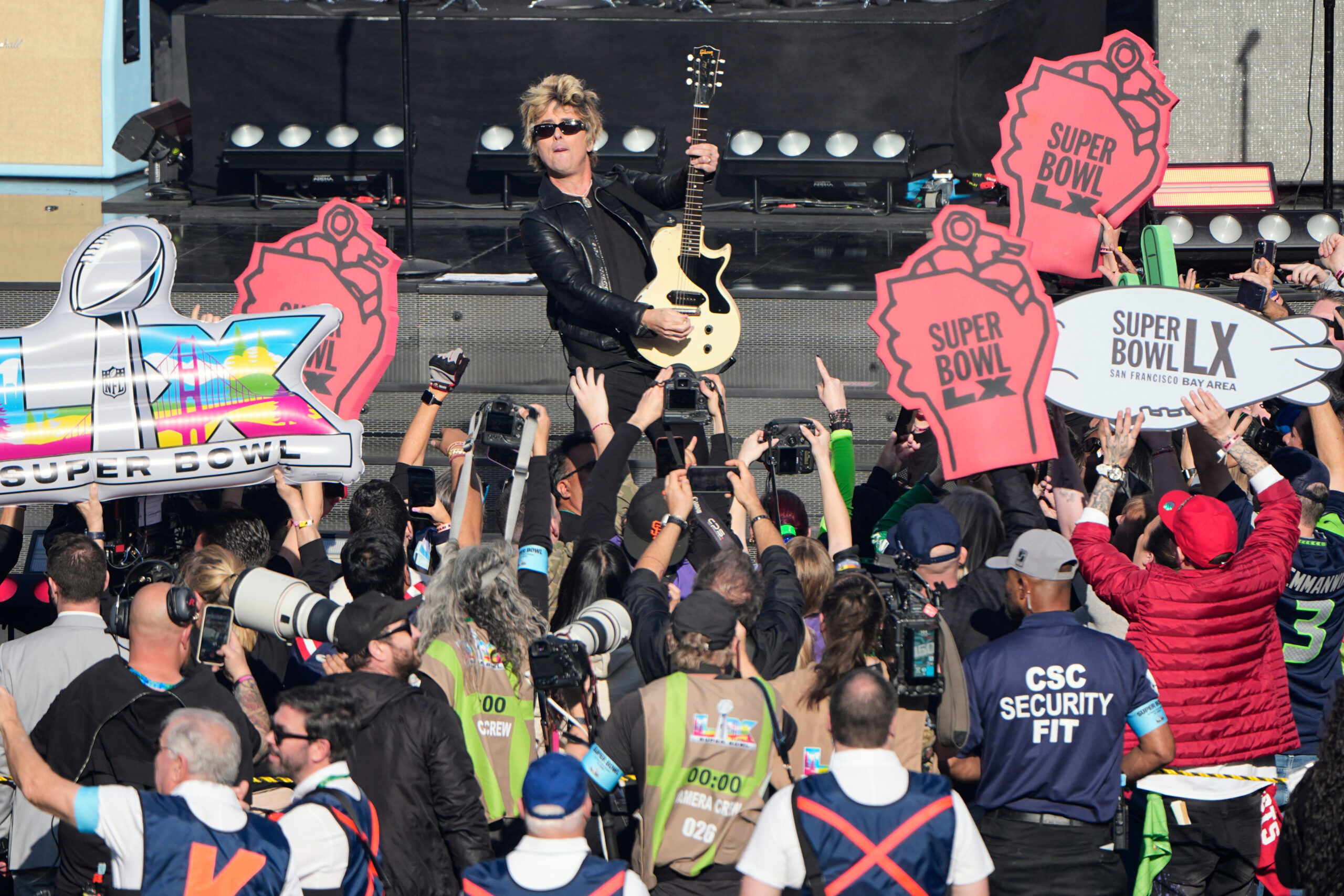
    Billie Joe Armstrong of Green Day performs Sunday before the start of Super Bowl XL in Santa Clara, Calif.

    I’m old enough to remember when the world’s most famous comedy riff was the late George Carlin’s “Seven Words You Can Never Say on Television” — its point driven home by Carlin’s 1972 arrest on obscenity charges that went all the way to the U.S. Supreme Court. A half century later, you still can’t say dirty words on broadcast TV — cable and streaming is a different story — but that fortress is under assault. In 2026, America is under seemingly constant attack from the F-bomb.

    It is freakin’ everywhere. When the top elected Democrat in Washington, House Minority Leader Hakeem Jeffries, cut a short video to respond to the president’s shocking post of a racist video that depicted Barack and Michelle Obama as apes, he said, “[F-word] Donald Trump!” If uttered in, say, 1972, Jeffries’ attack would have been a top story for days, but this barely broke through. Maybe because that word is in the lexicon of so many of his fellow Democrats, like Mayor Jacob Frey, who famously told ICE agents to “get the [F-word] out of Minneapolis,” or Minnesota Sen. Tina Smith, who begged federal agents to “leave us the (bleep) alone.” (Smith is retiring at year’s end and seems to no longer give a you-know-what.)

    The poor guys with their finger on the silence button at the TV networks, where you still can’t say Carlin’s seven words, can barely keep up. The F-bomb was dropped at this year’s Grammys, where award-winner Billie Eilish declared “(Bleep) ICE!” as she brandished her prize. The F-bomb was dropped, of course, at the Super Bowl, when the only true moment of silence during 10-plus hours of nonstop bombast came during Green Day’s pregame performance of “American Idiot,” when NBC shielded America’s tender ears from hearing Billie Joe Armstrong sing about “the subliminal mind(bleep) America.”

    We’re only about six weeks into the new year, but it’s hard not to think that Merriam-Webster or the other dictionary pooh-bahs won’t declare the F-bomb as word of the year for 2026, even if I’m still not allowed to use it in The Inquirer, family newspaper that we are. So what the … heck is going on here? One study found the F-word was 28 times more likely to appear in literature now than in the 1950s, so in one sense it’s not surprising this would eventually break through on Capitol Hill or on the world’s biggest stages.

    But the bigger problem is that America’s descent into authoritarianism and daily political outrage has devolved to such a point where, every day, permissible words no longer seem close to adequate for capturing our shock and awe at how bad things are. Only the F-bomb, it turns out, contains enough dynamite to blow out our rage over masked goons kidnapping people on America’s streets, or a racist, megalomaniac president who still has 35 months left in his term. Yet, even this (sort of) banned expletive is losing its power to express how we really feel. I have no idea what the $%&# comes next.

    What I wrote on this date in 2019

    What a long, strange trip for Amazon founder Jeff Bezos, one of the four richest people on the planet. Today, Bezos is in the headlines for his horrific stewardship of the Washington Post, which has bowed down on its editorial pages to the Trump regime, lost hundreds of thousands of subscribers, and laid off 300 journalists. It’s hard to recall that seven years ago, Bezos and Trump were at war, and there was evidence Team MAGA had enlisted its allies from Saudi Arabia to the National Enquirer to take down the billionaire. I wrote that “a nation founded in the ideals of democracy has increasingly fallen prey to a new dystopian regime that melds the new 21st century dark arts of illegal hacking and media manipulation with the oldest tricks in the book: blackmail and extortion.”

    Read how from Feb. 10, 2019: “Bezos, the National Enquirer, the Saudis, Trump, and the blackmailing of U.S. democracy.”

    Recommended Inquirer reading

    • My first and hopefully not last journalistic road trip of 2026 took me to Pennsylvania coal country, where ICE has spent $119.5 million to buy an abandoned Big Lots warehouse on the outskirts of tiny Tremont in Schuylkill County. I spoke with both locals and a historical expert on concentration camps about their fears and the deeper meaning of a gulag archipelago for detained immigrants that is suddenly looming on U.S. soil. It can happen here. Over the weekend, I looked at the stark contrast between Europe’s reaction to the Jeffrey Epstein scandal — where ties to the late multimillionaire sex trafficker are ending careers and even threatening to topple the British government — and the United States, where truth has not led to consequences so far. The Epstein fallout shows how the utter lack of elite accountability is driving the crisis of American democracy.
    • One last Super Bowl reference: Now that football is over, are you ready for some FOOTBALL? Now just four months out, it’s hard to know what to make of the 2026 World Cup returning to America and coming to Philadelphia for the very first time, and whether the increasing vibe that Donald Trump’s United States is a global pariah will mar the world’s greatest sporting event (sorry, NFL). Whatever happens, The Inquirer is ready, and this past week we published our guide to soccer’s biggest-ever moment in Philly. Anchored by our world-class soccer writer Jonathan Tannenwald and Kerith Gabriel, who worked for the Philadelphia Union between his stints at the paper, the package provides not only an overview of the World Cup in Philly, but previews the dozen teams who will (or might) take the pitch at Lincoln Financial Field, with in-depth looks at the powerhouses (France) as well as the massive underdogs (Curaçao). June is just around the corner, so don’t let the paywall become your goalkeeper. Subscribe to The Inquirer before the first ball drops.

    By submitting your written, visual, and/or audio contributions, you agree to The Inquirer’s Terms of Use, including the grant of rights in Section 10.

  • NBC Sports Philadelphia fans will soon be able to save money on YouTubeTV

    NBC Sports Philadelphia fans will soon be able to save money on YouTubeTV

    Philadelphia sports fans will soon be presented with a first — a chance to actually save money during the streaming wars.

    Beginning this week, YouTube TV is rolling out a sports-specific plan featuring channels with major sports rights that will cost $64.99 a month, $18 less than what it currently charges for a subscription.

    New subscribers can nab the deal for $54.99 a month for a year.

    The plan will include all the major broadcast networks — ABC, NBC, CBS, and Fox — and cable channels that hold sports rights, including ESPN’s networks (and full access to ESPN Unlimited beginning in the fall), FS1, TNT, TBS, TruTV (for the NCAA men’s basketball tournament), CBS Sports Network, Golf Channel, and USA Network, the U.S. home of Premier League games.

    NBC Sports Philadelphia also will be included in the slimmed-down sports bundle for those who live in the Philadelphia TV market, a YouTube spokesperson confirmed. So will NBC’s other three regional sports networks in their respective areas: Boston, the San Francisco Bay Area, and Northern California. NBC Sports Philadelphia also still will be available to stream without a cable subscription through Peacock and MLB.TV.

    YouTubeTV’s sports bundle will also include league-centric channels like the NFL Network (now owned by ESPN), the Big Ten Network, and NBA TV, which this season basically just airs a whip-around show called The Association and a handful of NBA games.

    While the plan gets sports fans the bulk of NFL, MLB, NBA, and NHL games, there are a few omissions. Amazon’s Prime Video, which features Thursday Night Football, weekly NBA games, and playoff games in both leagues, isn’t included. It also doesn’t include the handful of NFL and MLB games streamed by Netflix, or Apple TV+’s Friday Night Baseball or MLS games.

    Another notable omission is MLB Network, which hasn’t been available on YouTube TV since 2023 because of a carriage dispute.

    YouTube TV is also rolling out slimmed-down subscription offerings for entertainment fans ($54.99 a month), a sports-plus-news package ($71.99 a month), and a family-focused plan ($69.99 a month).

    Why now? Growth. YouTubeTV is the third-largest cable TV provider in the country and growing, with over 10 million subscribers, trailing just Charter (12.6 million) and Comcast (11.3 million). While Comcast has been shedding video customers, Charter has been able to stem its losses by offering its own skinny bundle, something fans and non-fans alike have been complaining about for years.

    NBC Sports Philadelphia still will be available to stream without a cable subscription on Peacock. It’s also available through MLB.TV, although because it’s now run by ESPN, you’ll need to jump through a few hoops so you’re not also charged for ESPN Unlimited.

    More NFL games coming to YouTube?

    YouTube, the free older brother of YouTube TV, hasn’t been quiet about wanting to stream more NFL games in the near future. It could get its wish as soon as next season.

    As part of its purchase of NFL Media and the NFL Network, ESPN agreed to give the league back the TV rights to four games. Those will now head to the marketplace, where YouTube is expected be among the bidders. It’s no surprise that YouTube CEO Neal Mohan was among the big names sitting with NFL commissioner Roger Goodell in his Super Bowl box on Sunday at Levi’s Stadium.

    “We really value our partnership with the NFL,” Christian Oestlien, YouTube’s vice president of subscription product, told Bloomberg.com in a recent interview. “Everything we’ve done with them so far has been really successful. And so we’re very excited about the idea that we could be doing more with them.”

    YouTube’s biggest competitor for those four games likely will be Netflix, which is entering the last year of its three-season deal to stream NFL Christmas games. Ted Sarandos, Netflix’s co-CEO, was also in Goodell’s booth.

    YouTube streamed its first NFL game last season, the Week 1 matchup between the Kansas City Chiefs and Los Angeles Chargers played in São Paulo, Brazil. The game drew 17.3 million global viewers, including 16.2 million in the United States, a big number boosting the streamer’s chances of landing more games.

    More sports media news

    • ESPN will broadcast next year’s Super Bowl in Los Angeles, and you’re going to hear a lot over the next year about it being the network’s first. But it has aired on sister network, ABC. As pointed out by Sports Media Watch’s Jon Lewis, ABC has broadcast three Super Bowls since being purchased by ESPN’s parent company, Disney, in 1996 — in 2000, 2003, and 2006, with coverage featuring Chris Berman and a number of ESPN personalities. The Super Bowl also has aired in Spanish on ESPN Deportes.
    • Happy trails to the laptop of The Athletic’s Tony Jones, which was destroyed after it was hit by a T-shirt shot by a cannon during the fourth quarter of Sunday’s Super Bowl. Jones said the rolled-up T-shirt hit his computer, which then hit him in the face, cracking the screen and preventing him from filing a story.
    • NBC will air MLB games this season for the first time since 1989 and is filling out its broadcast bench, adding studio analysts (and recent MLBers) Clayton Kershaw, Anthony Rizzo, and Joey Votto. You might not see much of them during the regular season, but all three will be part of NBC’s coverage of the wild-card series, which it’s taking over from ESPN.
    • Super Bowl viewership numbers will be out later Tuesday. If you care about such things and have seen numbers on social media, ignore them. The Eagles’ blowout win last year against the Chiefs averaged over 127 million viewers, peaking with Kendrick Lamar’s halftime show, with over 133 million people tuning in. We’ll see how Bad Bunny and Sunday’s boring Super Bowl can match that.
  • For Gopuff, Super Monday is the national holiday

    For Gopuff, Super Monday is the national holiday

    Sunday’s Super Bowl LX, featuring some 66 ads costing corporate brands an average $8 million for half a minute, shone a light on America’s snacking trends, tracked closely by Gopuff, the Philadelphia-based national delivery service.

    The game between the Seattle Seahawks and the New England Patriots, also featuring Bad Bunny’s Spanish-language halftime spectacular, was watched by nearly 40% of Americans. Their delivery orders gave marketers a broad, almost instant view of what Americans were consuming and how their ads were working — or not, said Michael Peroutka, GoPuff’s head of ads, in his Super Bowl postmortem report Monday.

    The product with the most spectacular Super Bowl increase didn’t advertise.

    Philadelphia-based Gopuff reported sharp increases in advertised snacks, but also in basic party ingredients such as limes and red party cups, during Super Bowl LX.

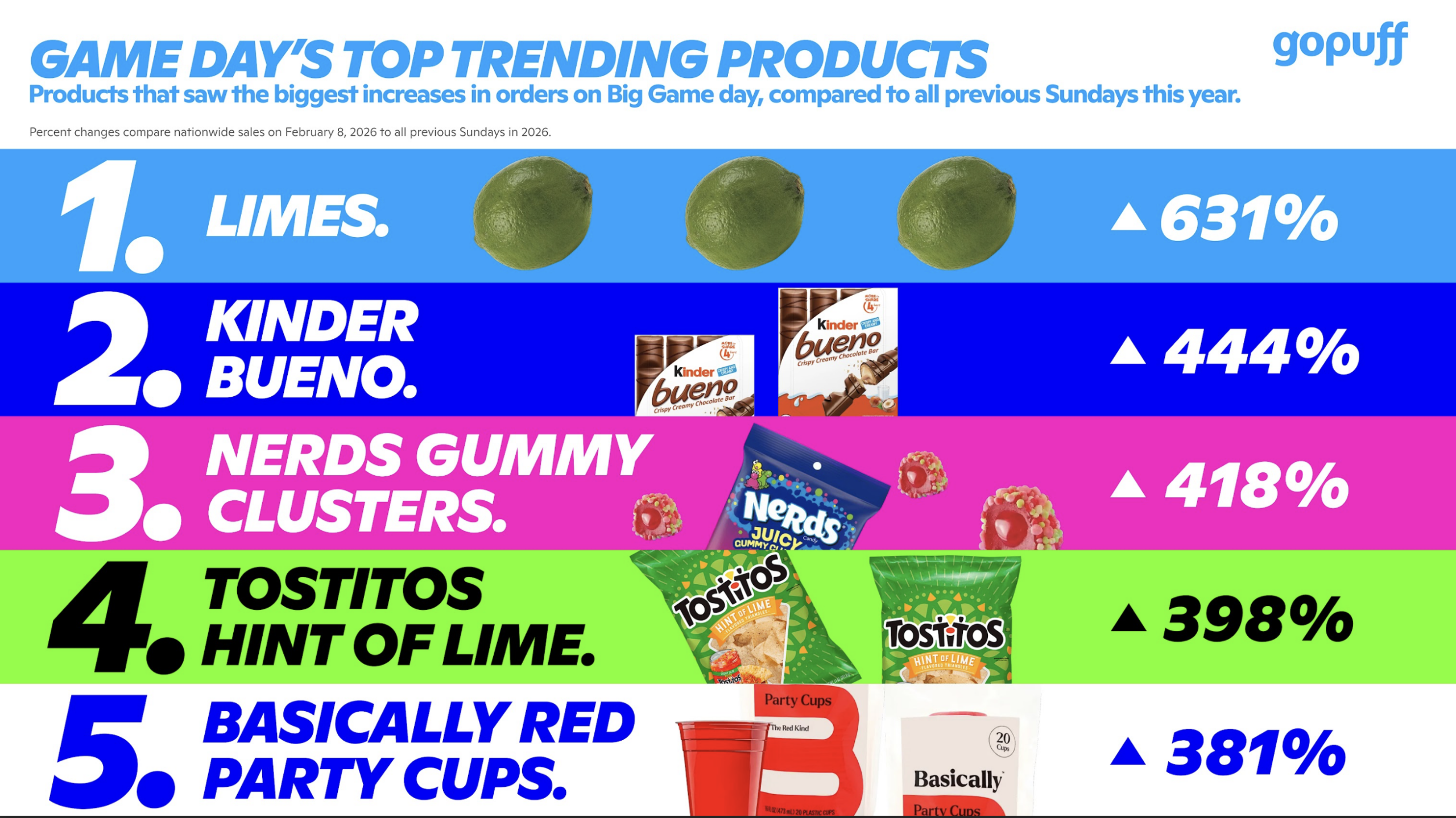
    Orders for limes during the game jumped over 600% over previous Sundays in 2026. Limes are, after all, a key ingredient in popular plates like guacamole and pico de gallo, served with Mexican beers and margaritas, and “easily forgotten at the store,” making them a natural for last-minute delivery, said Gopuff spokeswoman Brigid Gorham.

    Though lime consumption has been growing rapidly, the increase was more than four times last year’s Game Day spike, and no one could say exactly why.

    Lime sales exploded even more than Gopuff’s Basically-brand red party cups, a three-year-old in-house brand, which was up 381% on Super Bowl Sunday above recent Sunday sales.

    Overall, alcohol sales nearly doubled from recent Sundays. Soda sales were up more than one-third and salty snacks by about one-quarter. Compared to last year, when the Eagles were in the Super Bowl, the number of Philadelphia orders were up 7%.

    Other Super Bowl Sunday growth-leaders included PepsiCo’s Tostitos Hint of Lime chips, which were up 398%.

    But the top gains were two candies made by Italy-based candy maker Ferrero. Gopuff orders for Kinder Bueno, chocolates marketed heavily in Latin America and U.S. Hispanic neighborhoods, were up 444% vs. recent Sundays, and Ferrero’s Nerd Gummy Clusters, were up 418%.

    Kinder Bueno and Nerd Gummy Clusters saw sales roughly double in the hour after their Super Bowl ads ran. Liquid Death and Dunkin also saw orders rise at least 50% after ads.

    Day off?

    Gopuff also noticed well before the game that a record 13 million American workers planned to schedule Monday off; 10 million planned to call out sick, go in late, or not show up, and millions more were thinking about it, according to a Harris Poll survey funded by work software maker UKG.

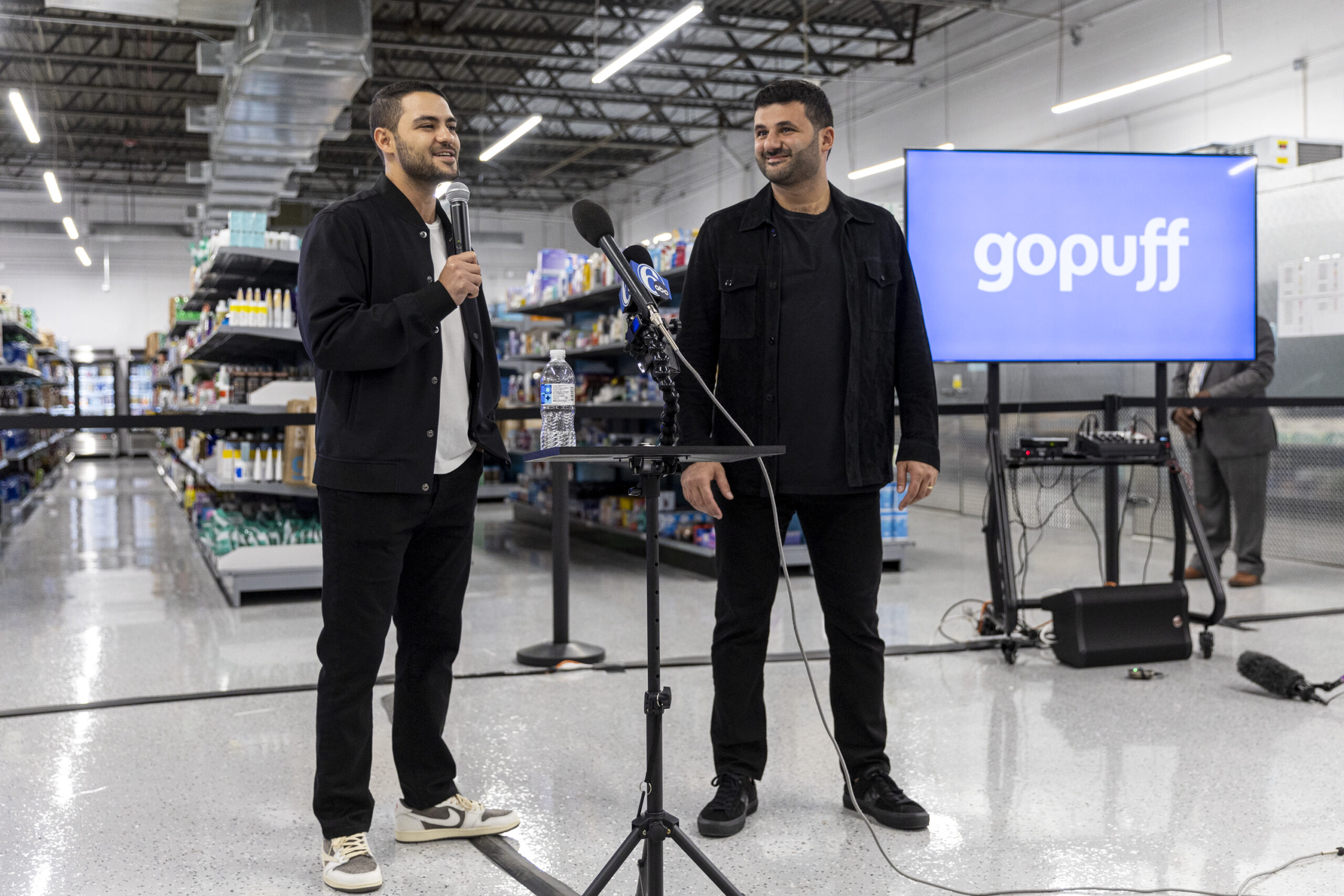
    Founders and CEO of Gopuff Yakir Gola (left) and Rafael Ilishayev speak to a room full of staff and team members of Gopuff at a recently opened center in Philadelphia in 2022.

    Cofounder Yair Gola and his colleagues saw those numbers and thought, “This ought to be a holiday.” Last fall, it set up a 501(c)4 lobbying group, the Super Monday Off Coalition, pledging at least $250,000 to get the effort rolling.

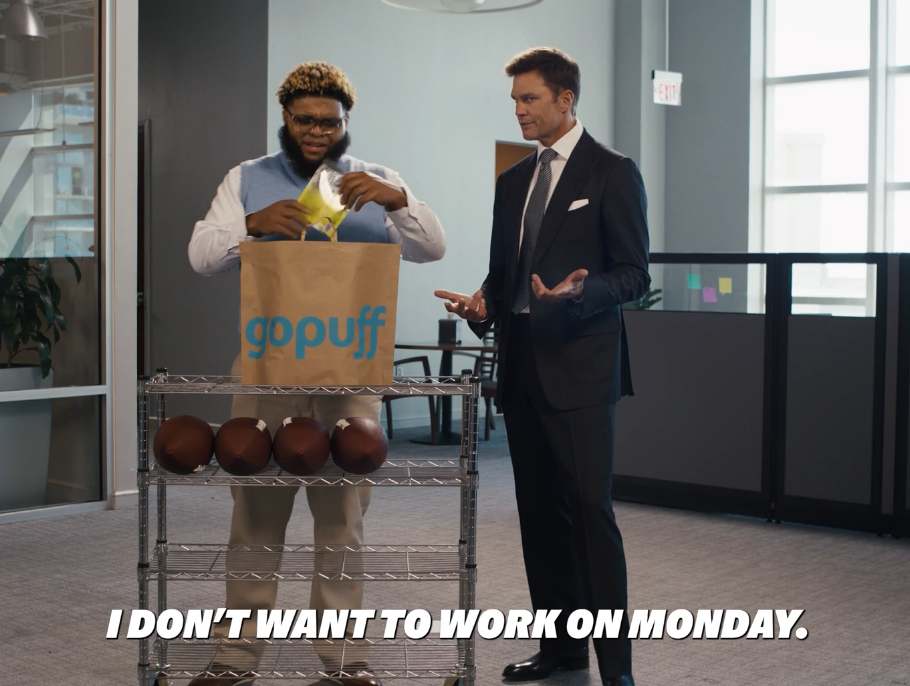
    They hired retired Patriots quarterback Tom Brady and comedian Druski to promote the cause.

    Druski (left) and former NFL quarterback Tom Brady in an ad for Philadelphia-based Gopuff promoting its campaign to designate “Super Monday” as a national holiday, since millions already take the day off.

    The company’s contribution to the lobbying would be funded by 1% of Gopuff’s profits from sales of certain boxes of beer, sugary drinks, hot dogs, and other products from Thanksgiving to game day.

    Heavy users who placed at least four $30 orders in that period would also get $20 “Gocash” discounts and receive a chance at a Birkin handbag, a Rolex watch, and other prizes.

    By Monday, Gopuff hadn’t announced its planned donation, but the campaign was declared “a winner” by Charles R. Taylor, a Villanova University marketing professor who tracks Super Bowl ads. He spotlights not just successful marketing but also ineffective efforts like Nationwide’s painful 2015 “Boy” campaign and GM’s 2021 “No Way Norway” misfire.

    Partnering with high-profile Brady and Druski gives “instant visibility and credibility” with fans and wider audiences, Taylor said. Even if the campaign costs more than Gopuff actually donates to the cause, a national holiday is “a clever hook” watchers will remember, Taylor said.

    Going public?

    Gopuff raised over $5 billion from Saudi, Japanese, and U.S. private investors during the digital-delivery investment boom that lasted into the COVID years. These big investors hoped Gopuff (officially Gobrands) founders and early investors would win them big profits by selling shares in a high-priced stock market initial public offering or selling to DoorDash, Uber, or other delivery giants.

    But app use and delivery growth slowed in the COVID recovery. Gopuff’s perceived valuation tumbled as its publicly traded rivals’ share prices fell. The company, which had expanded to hundreds of city neighborhoods and college towns, shut marginal centers and laid off staff at its Spring Garden Street headquarters to reduce losses and save investors’ capital for better times.

    Now Gopuff is showcasing efforts to win new investor attention.

    In the past year the company announced an on-screen snacks-order app targeting Disney+, ESPN, and Hulu views; a cash-with-your-order partnership with online-broker Robinhood; hot warehouse-brewed Starbucks coffees from stores in Philadelphia and some other areas; and a partnership with Amazon to speed grocery delivery in Britain, where Gopuff remained after ending its European programs.

    Gopuff has added a warehouse camera feed and local product-sales stats for fans who want to know what neighbors are buying, app-based order updates, and user product recommendations. It added over-the-counter pharmacy items and new lines of vegan organic GOAT Gummies (which Brady is also promoting).

    The company also began accepting SNAP EBT electronic food-stamp accounts and donated $5 million for SNAP when the federal shutdown threatened low-income families dependent on the program.

    New hires include economist Matt McBrady — a veteran private-equity investor, former adviser to President Bill Clinton, and sometimes Wharton instructor — as Gopuff’s new chief financial officer, noting his experience taking companies through public stock offerings.

    Last fall Gopuff raised $250 million, its first investment since a 2021 convertible-bond financing that had valued the company at a stock-market-bubble-inflated $40 billion.

    This time, the largest investors included previous Gopuff backers Eldridge Industries and Valor Equity Partners, along with Robinhood, Israeli billionaire Yakir Gabay, the cofounders, and other earlier investors. Eldridge chairman Todd L. Boehly in a statement called Gopuff “resilient.”

    Valor partner Jon Shulkin cited the company’s “focus, innovation, and substantial gains in profitability.”

    This latest capital-raise implied a valuation of $8.5 billion — a fraction of what Gopuff was worth on paper during the digital-delivery bubble, but enough for the venture capitalists to hope they may yet get their money back with at least a modest profit.

  • The Pennsylvania pups, rejected by breeders and owners, who went on to become Puppy Bowl stars and find loving homes

    The Pennsylvania pups, rejected by breeders and owners, who went on to become Puppy Bowl stars and find loving homes

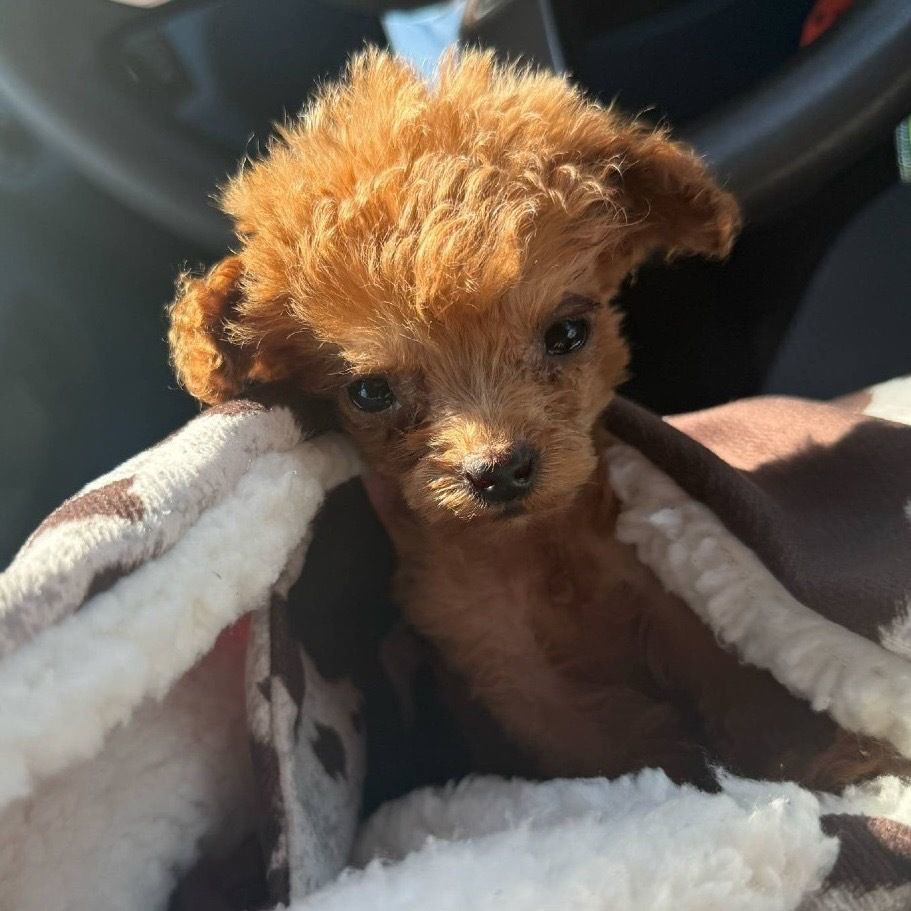
    Oscar was the ultimate underdog.

    Born in a puppy mill in Peach Bottom, Lancaster County, Oscar suffered from “failure to thrive,” his breeder said.

    By the time the breeder turned the 6-week-old toy poodle over to Phoenix Animal Rescue in Chester County, Oscar weighed just 7 ounces, according to Marta Gambone, a coordinator at the all-volunteer organization.

    “But one of our volunteers was able to turn him around, from this scraggly little hamster to this wonderful Puppy Bowl player,” Gambone said.

    When Oscar, a toy poodle, was rescued from a puppy mill in Lancaster County, he weighed just 7 ounces. After being nursed back to health, he’s playing in the 2026 Puppy Bowl.

    After being nursed back to health, Oscar traveled to Glens Falls, N.Y., to participate in the October 2025 taping of the 22nd annual Puppy Bowl, which airs today before the Super Bowl.

    Gambone said the annual event has become a wonderful way to raise awareness for animal rescues across the United States. Every one of the 150 dogs in the competition — between Team Ruff and Team Fluff — comes from a rescue.

    Oscar, a toy poodle nursed back to health in Chester County, is one of this year’s Puppy Bowl stars.

    Oscar, now 8 months old, has developed into a playful, social, and upbeat young dog who has found a loving home, Gambone said.

    Oscar is one of six puppies from Phoenix Animal Rescue in the annual TV special this year, Gambone said. Jill, an 8-month-old Cavalier, was suffering from a hernia when she was turned over by a breeder in New Holland, Lancaster County.

    The rescue also has four dogs participating in this year’s first-ever “Oldies vs. Goldies” senior dogs’ competition: Tiki, a Shiba Inu; Starlight, a Jack Russell terrier; Daisy, a Pomeranian; and Emmie, a Maltese mix.

    Tiki, a Shiba Inu, is in this year’s “Oldies vs. Goldies” senior dog competition.

    They all came from breeders in Lancaster County and were in need of care, Gambone said, “and now they’re all playing on a national stage, and getting lots of attention, and finding their forever homes.”

    Though all of this year’s stars have since been adopted, Gambone noted that the rescue gets about a dozen dogs per week, across a wide variety of breeds and mixes.

    “Anybody looking can find what they’re looking for if they have a little patience,” she said.

    Carrie Pawshaw sits for a portrait. Pawshaw, a rescue dog from the Pittsburgh region, competed in the 2026 Puppy Bowl.

    Across the state in Springdale, Allegheny County, Jacqueline Armour said it’s the third year that some of her rescue dogs are playing in the Puppy Bowl.

    She founded Paws Across Pittsburgh, a rescue that places dogs with foster parents until they find permanent homes. The dogs come from owners and shelters from as far away as West Virginia, Kentucky, and Ohio.

    This year, a playful Jack Russell mix named Meeko is their star, along with a Norwegian elkhound and American Eskimo dog mix named for Sarah Jessica Parker’s character in the TV show Sex and the City.

    “They pick some of them and rename them,” Armour explained, “so initially I thought they were going to call her Sarah Jessica Barker. And then they said Carrie Pawshaw.”

    Armour noted that, because her organization uses foster homes, their puppies are already learning how to live in a home — getting house-trained and crate-trained, and learning how to get along with children and other pets. This also gives volunteers a chance to see the dogs’ personalities, which can be helpful in matching a dog with an owner.

    Both Armour and Gambone emphasized that rescue operations offer a variety of ways for volunteers to help out.

    For those who’ve never owned a dog, Armour said the experience can be profound. The medical community consensus is that having a dog can help people get more exercise, improve mental health, and lower blood pressure, and can help children learn how to properly treat an animal.

    In Chester County, Gambone said she’s seen firsthand how dogs can add vitality to someone’s life.

    “They help with loneliness, and on the physical side, they help people stay more active,” she said. “We have so many senior citizens coming to us saying, ‘I just need something — something to love.’ And it changes their lives.”

  • Eagles fans, shots at Tom Brady (and the Cowboys), and a Bud Light conspiracy theory highlight ESPN’s ‘Philly Special’ documentary

    Eagles fans, shots at Tom Brady (and the Cowboys), and a Bud Light conspiracy theory highlight ESPN’s ‘Philly Special’ documentary

    Everybody is familiar with the Philly Special.

    Ever since that touchdown helped the Eagles beat the New England Patriots in Super Bowl LII, it’s fascinated Eagles fans — the lore, the backstory, and, of course, the confetti that followed. There have been T-shirts and murals designed to commemorate the play, food specials named after the moment, and a number of tattoos inspired by the event that now decorate the bodies of Eagles fans from all over.

    “I don’t know of any other play that people have tattooed up and down their bodies,” former Eagles center Jason Kelce says in ESPN’s new 30 for 30 documentary about the Birds’ first Super Bowl win. “I was in a stadium in Chicago, and a cook raised his sleeve and had the Philly Special X’s and O’s tattooed on his forearm. This is in the Bears’ stadium.”

    Now, fans will get a new look behind the play and the people who made it happen in The Philly Special, which premieres at 9 p.m. Friday. The iconic moment, which helped an underdog Eagles team bring the Lombardi Trophy to the city for the first time in franchise history, is told through the eyes of the five men involved — Kelce, Corey Clement, Trey Burton, Nick Foles, and Doug Pederson.

    “My wife and I sat down and watched it, and I’m not going to lie, it brought me to tears,” Pederson, the former Eagles coach, said on 94 WIP on Wednesday, the eighth anniversary of the play. “I really felt like they did an outstanding job to me catching sort of the essence and the spirit of Philadelphia, the city, the fans, the passion.”

    Helping bring the city to life during the hourlong documentary was Shannon Furman, who grew up in South Jersey and is based in Marlton. Furman, a Penn State graduate, was one of the film’s directors, along with Angela Zender.

    “For me, it’s like a dream project,” said Furman, who was also the producer behind the scenes of the Eagles segments on the recent season of HBO’s Hard Knocks. “I think I’ve been at [NFL] Films for 23 years now and I hadn’t gotten to do much with the Eagles until this year. The past six months, I got to be the producer on Saquon’s [Prime Video] documentary, spent seven weeks with the Eagles for Hard Knocks, and now finished with this.”

    ‘This city has torn grown men apart’

    Although the play is central to the film, its story begins much earlier. It briefly follows each of the five central characters’ journeys to Super Bowl LII, from the moment they were drafted (or in some cases weren’t) to the moment the Philly Special was called at U.S. Bank Stadium in Minneapolis.

    While taking a trolley ride through town, with stops at various Philly landmarks, Pederson, Foles, Kelce, Clement, and Burton discuss their first impressions of the city, while Kelce also finds a way to take a shot at Dallas in the process.

    “When I got drafted, my agent said, ‘You know, Jason, you’re going to love Philadelphia. It’s got a great spirit to it. I think you’ll fit in pretty well,’” Kelce said. “There’s a humbleness to it. There’s a cockiness to it. A city that was born on the back of blue-collar workers and manufacturing. Stetson hat factory. To all you Cowboys fans, you think cowboy hats is a [expletive] Texas thing. That was created in Philadelphia. So, [expletive] you guys.”

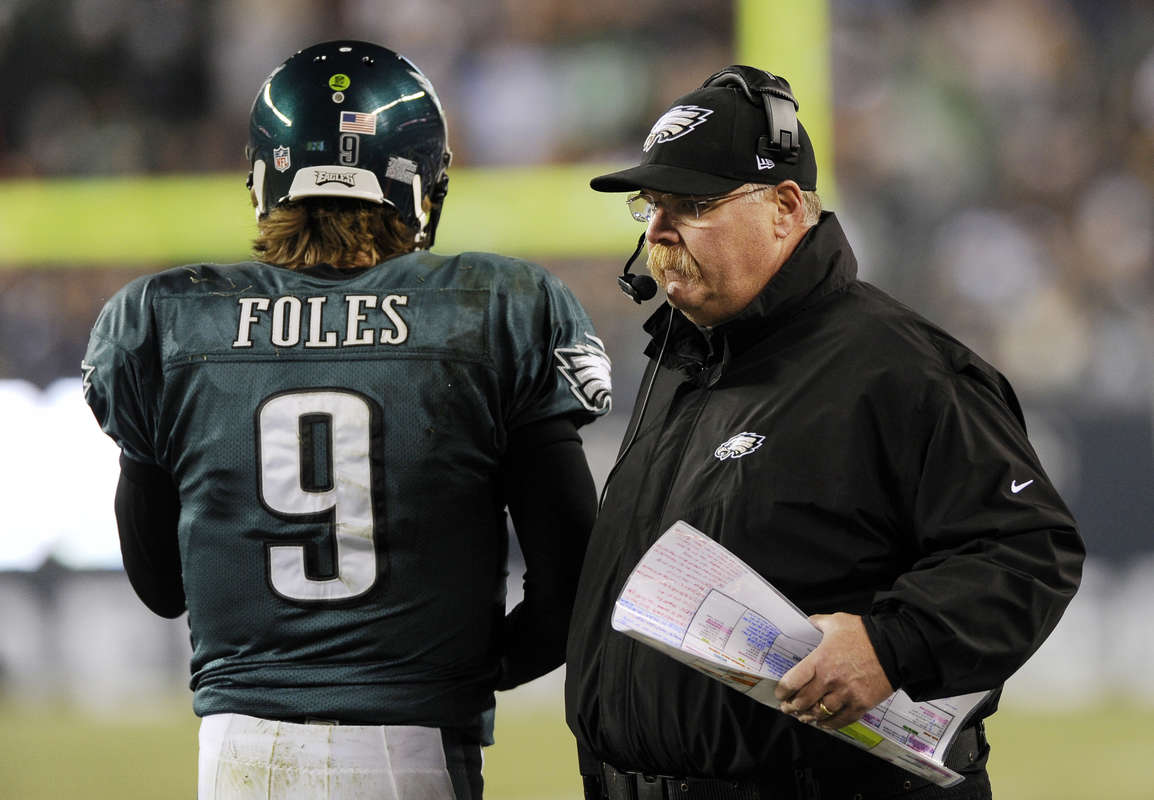
    Kelce may have received promising advice from his agent, but Foles was issued a stern warning by former Eagles head coach Andy Reid. He remembers a conversation he had with Reid as a rookie, not long after he was selected by the Birds in the third round of the 2012 NFL draft.

    Andy Reid and Nick Foles during the 2012 season.

    “I had a sit down with Andy Reid,” Foles said. “I remember he asked me poignantly, ‘Do you have faith or believe in anything?’ I was like, ‘Yeah, I’m a Christian.’ He said ‘All right, you’re going to need that, because this city has torn grown men apart.’”

    Some of that “tearing grown men apart” happens on the radio. Burton, the former Eagles tight end who threw the touchdown pass on the Philly Special, recognized that early.

    “I remember my first day in Philly,” Burton said. “My cousin picked me up, and he had the WIP radio [station] on. I was like, ‘What is this?’ People calling in from all over the place, talking crazy.”

    For Clement, meanwhile, it was a dream to sign with his hometown team. The former Eagles running back, who grew up in Glassboro, remembers telling the team he would be at the facility “in an hour.” Pederson also was familiar with the city, having played for the Eagles (1999) and been an assistant (2009 to 2012) before becoming head coach (2016 to 2020).

    “The Philadelphia hiring for me was a whirlwind of emotion,” Pederson said. “You’re a little bit scared in a way because it’s such a big step. I played here. You know the city, you know the fan base, you know exactly what you’re getting into. You’re not going to make everybody happy. You just settle in and you realize, ‘Hey, this is what you’ve been preparing yourself for.’”

    Embracing the underdog mentality

    The Eagles’ 2017 season was a whirlwind. The team got off to a 10-2 start behind Carson Wentz before the second-year quarterback and MVP favorite tore his ACL in the team’s Week 14 win over the Los Angeles Rams. With their Pro Bowl quarterback injured, Foles was forced into action.

    During one of the group’s stops, Foles asked Pederson and Kelce what their confidence level was like with him stepping in.

    “Season’s done,” Pederson said jokingly. “I started believing the media.”

    Kelce interjected: “Me and a few guys that had been there for the Chip [Kelly] years with Nick; felt confident that Nick could play really well. We had seen it before.”

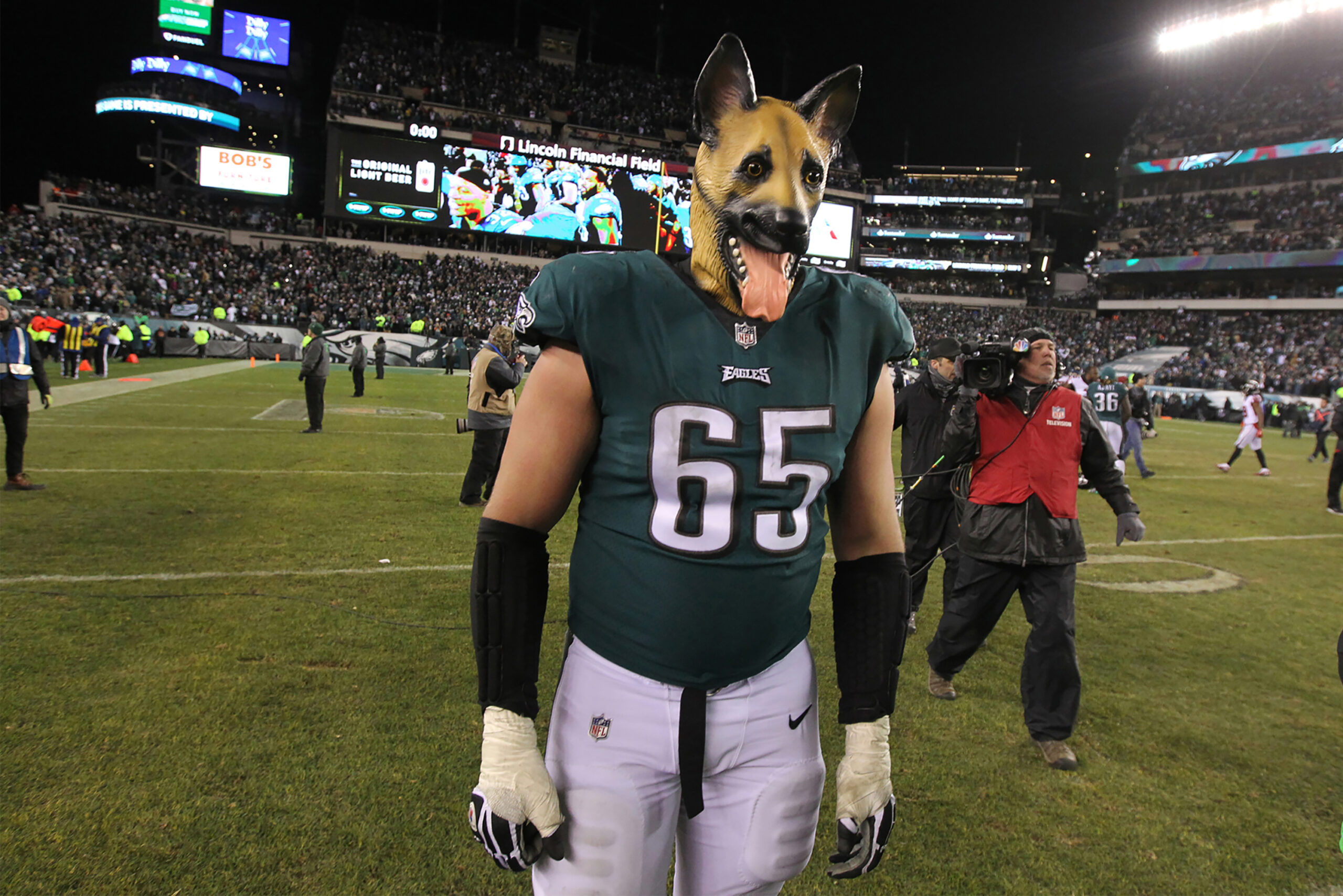
    Eagles offensive lineman Lane Johnson dons a dog mask as he walks off the field after the team’s 15-10 divisional round playoff win over the Atlanta Falcons in 2018.

    With the loss of Wentz, those outside the organization started to count the Eagles out. And that underdog mentality fueled the Eagles, who had printouts of media rankings hanging all over the facility, including in the bathroom, and donned dog masks throughout the playoffs.

    But Kelce, Foles, Clement, and Burton were used to being underdogs. It was part of the documentary Furman wishes she had more time to tell.

    “I wish we could have really gotten into everyone’s backstory a little bit more,” Furman said. “Because those five characters are really, like, real underdog stories, which is what the whole film is.”

    Clement and Burton were undrafted free agents. Kelce was a walk-on at the University of Cincinnati — and hardly a lock to stick with the Eagles after he was drafted in the sixth round. Pederson, a former backup quarterback, was heavily criticized nationally when the Eagles hired him. And then there’s Foles.

    Foles’ NFL journey was difficult. The backup-turned-starter was twice cast off, including by Kelly after his first year with the Eagles, despite the team reaching the playoffs. He played for six teams over his 11-year career. After his first stint with the Eagles, Foles found himself in St. Louis, where he began to question whether he wanted to walk away from the sport before Reid brought him to Kansas City and helped revive his career.

    “I just said, I don’t know if I can do it anymore,” Foles said. “Then it came over me, which one am I more afraid of? Am I more afraid to leave the game? No, I’m not afraid. I’m trying to leave the game. I’m afraid to go back to the game. And my spirit was like, ‘Well, that’s what you need to do.’ Ultimately, that equipped me for what was to come.”

    What was to come was a battle the film likened to Rocky vs. Apollo Creed or Ivan Drago. Cliche or not, Foles found himself standing in U.S. Bank Stadium below giant banners featuring one of the greatest quarterbacks of all time, Tom Brady, and himself in a moment one can’t help but compare to an almost identical scene in Rocky, when the title character finds himself staring up at a giant banner of Creed.

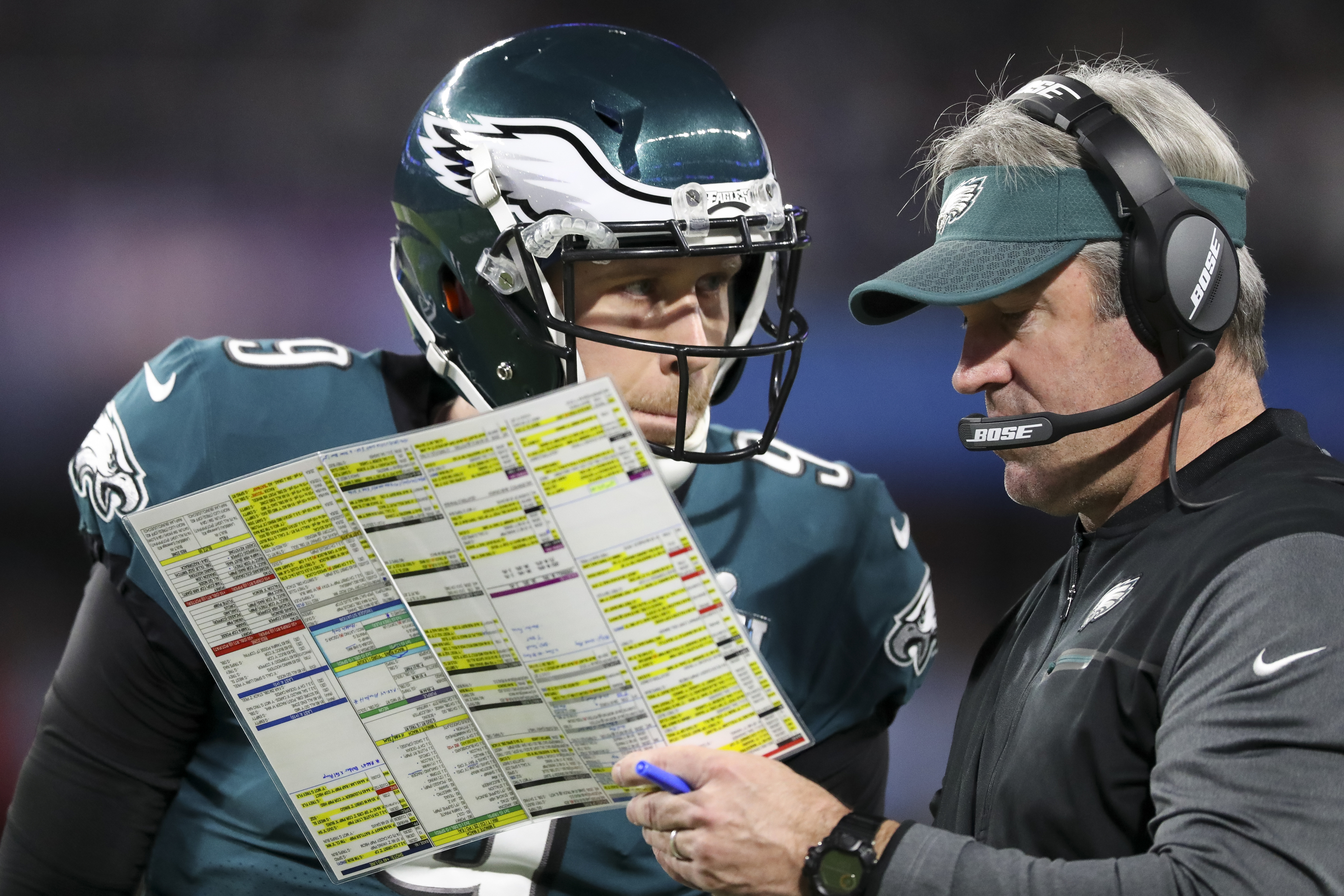
    Eagles quarterback Nick Foles and Eagles head coach Doug Pederson during the second quarter at Super Bowl LII, at U.S. Bank Stadium in Minneapolis, Minnesota, Sunday, Feb. 4, 2018.

    ‘You want Philly Philly’ — or is it dilly dilly?

    It’s fourth-and-goal with 38 seconds left to play in the first half of Super Bowl LII and Pederson sent a play to Foles — only it wasn’t the Philly Special. Players looked out of sync, confused. So the coach decided to take a minute to think things over.

    “Here we are fourth-and-goal at the 1, and I called a timeout,” Pederson says. “I’m easing back up to [the] coaches box, just looking, just searching for the right play. I’m just searching. I’m listening to the coaches. And I turn my mic off and now I’m talking face-to-face with Nick, and he just walks up and is like, ‘How about Philly Philly?’ My pause was just like ‘That’s it. That’s the play.’

    “The coaches heard it, Philly Special, and it was honestly like crickets. I could hear chirping on the headset. Nobody said a word. It was like, ‘Philly Special? In this moment?’”

    Once the play was called, everyone involved admitted they had something to be nervous about — except Foles. Clement was worried the snap would go over his head. Burton hadn’t thrown a touchdown pass since high school. And Kelce was worried how he would snap the ball, although he felt like if they could execute, the Patriots “wouldn’t see it coming.”

    Meanwhile, Foles was just trying not to smile.

    “In my mind, it was just the play that would work,” Foles recalls. “It wasn’t like a play that I thought would be famous. It was like, this will work for [messing up] the Patriots. The one thing I was thinking about when [Pederson] said, ‘Yeah, lets do it,’ when I turned around was don’t smile. Do not smile. Look serious.

    “Because I was so excited. I knew it was going to work. That was my one coaching point. Do not smile.”

    The only problem, Foles didn’t actually ask for the “Philly Special.” Instead, he asked for “Philly Philly.” And to this day, he still doesn’t know why he called it the Philly Philly. However, the directors had their own conspiracy theory as to why Foles slipped up: the popular Bud Light “dilly dilly” commercials that were being aired at the time.

    “Yes, those were on the TV, the ‘dilly dilly’ commercials,” Foles said. “And there is a very good chance that got engrained somehow into my mind. And that’s why people do commercials. Because it somehow, in your subconscious gets ingrained, even if you don’t want it to. That’s probably what it was.

    “It was probably me watching the AFC championship game and seeing commercials. I don’t know how Doug knew what I was asking for though. That’s not — he must’ve seen the commercials too. So, that worked on both of us.”

    At one point, the film even shows two Super Bowl officials enjoying a “dilly dilly” commercial on the Jumbotron during a break in the game.

    That wasn’t the only way the Philly Special snuck into Foles’ subconscious before he asked for it. He also said watching Tom Brady drop a similar pass right in front of him earlier in the game also reminded him that the play was an option.

    “Thanks, Tom,” Foles quips.

    Philadelphia landmarks

    Throughout the film, there are plenty of Philly fans, notable citizens, and local spots featured — including Reading Terminal Market, Skinny Joey’s, Termini Bros Bakery, Manco and Manco Pizza, and Zahav, where Foles recalls fans serenading him out of the restaurant with E-A-G-L-E-S chants before leaving for the Super Bowl. The group also makes stops at the Philly Special statue outside of Lincoln Financial Field, as well as atop the Art Museum steps, a location Rocky made famous just over 40 years before Kelce’s unforgettable Super Bowl parade speech that captured Philly and its underdog mentality perfectly.

    It was important to Furman for this documentary to not only retell an iconic moment in Philly sports history, but to also represent the fandom behind the team.

    “They’re just an important part of everything,” Furman said. “Philly fans get a bad rep sometimes. So we’re hoping this film shows where their passion comes from and why this story was so important to them. The first one was a moment Philly fans, some of them, thought they were never going to see it. So that’s why we wanted them to be a big part of the story.”

  • The Eagles didn’t return to the Super Bowl. But Sam Howell will be there to support his best friend, Drake Maye.

    The Eagles didn’t return to the Super Bowl. But Sam Howell will be there to support his best friend, Drake Maye.

    Long before Sam Howell became best friends with Drake Maye, he was aware of him. Maye’s parents were standout high school athletes, and his father, Mark, played quarterback at the University of North Carolina. His brothers, Luke and Beau, played basketball there (Luke hit a last-second shot that sent the Tar Heels to the Final Four in 2017, en route to an NCAA championship).

    A third brother, Cole, also won a national title in 2017, but at a different school (Florida) and in a different sport (baseball). Former UNC offensive coordinator Phil Longo called the family “the Mannings of North Carolina.”

    Drake was the youngest, and went down the football path. He and Howell, both quarterbacks, became acquainted through seven-on-seven leagues in the Charlotte area.

    In 2019, when Howell was a freshman quarterback at UNC, he attended one of his future protégé’s high school playoff games. Howell was impressed. But it wasn’t until 2021, Maye’s first season with the Tar Heels, that Howell realized how much they had in common.

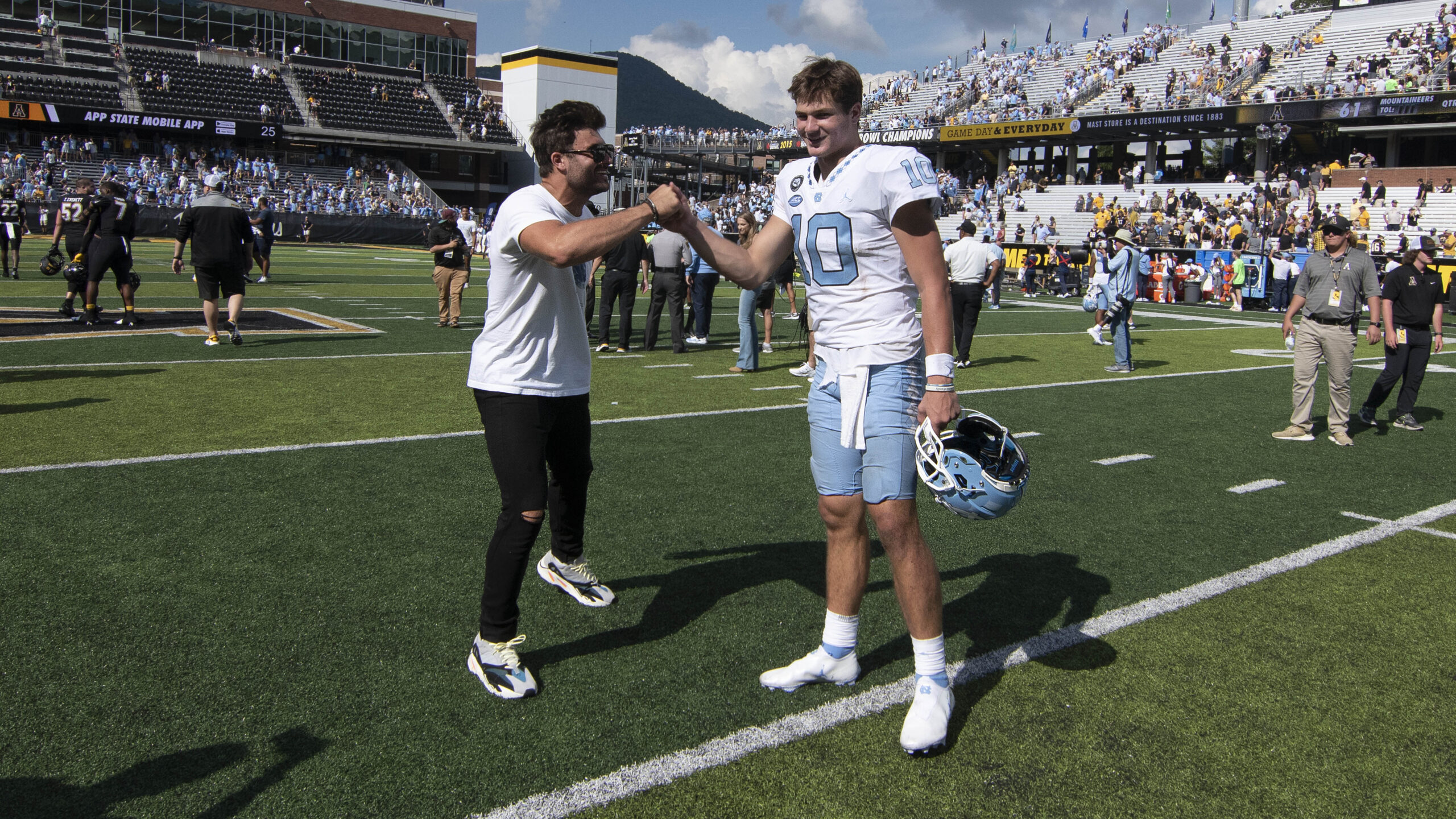
    Howell was the entrenched starter, and Maye was the backup — a situation that doesn’t always lend itself to friendship. But these two were the exception. They became “attached at the hip,” in the words of former coach Mack Brown, and not just on the field.

    The quarterbacks were fiercely competitive, and would battle each other on the golf course, at the ping-pong table, and more.

    “Drake was so competitive, if I said, ‘Hey, I’m going to get to the doorknob before you do, he would jump over a table to get there,’” Longo said. “That’s just kind of how he was. [Sam was] that way, too.”

    The two quarterbacks have stayed close, FaceTiming on a near-daily basis since Howell was drafted by Washington in 2022 and Maye was drafted by New England in 2024.

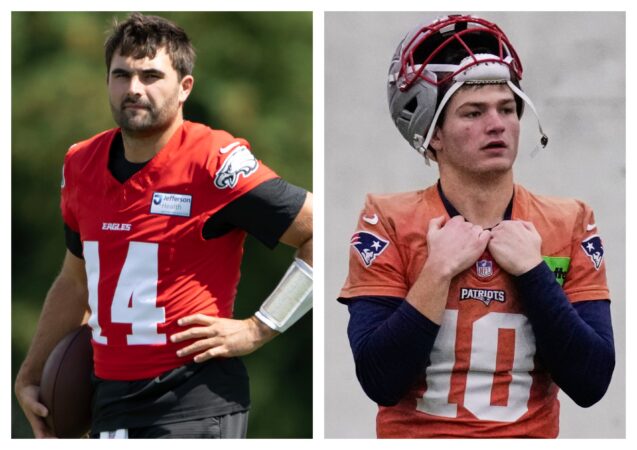
    Their careers have taken different trajectories. Howell, 25, has bounced around the league, from the Commanders to the Seattle Seahawks to the Minnesota Vikings to the Eagles, where he served as a third-string quarterback this past season.

    Maye, 23, will start in Super Bowl LX for the New England Patriots on Sunday, in just his second season in the NFL.

    Howell feels no ill will. He has attended every New England playoff game since the Eagles were eliminated, and will be in the Bay Area this weekend to support his friend.

    “[I’m] extremely proud of him,” Howell said. “He’s worked his whole life to be where he is and he’s getting what he deserves. He was made for the big moments and I have no doubt he’ll be ready to go.”

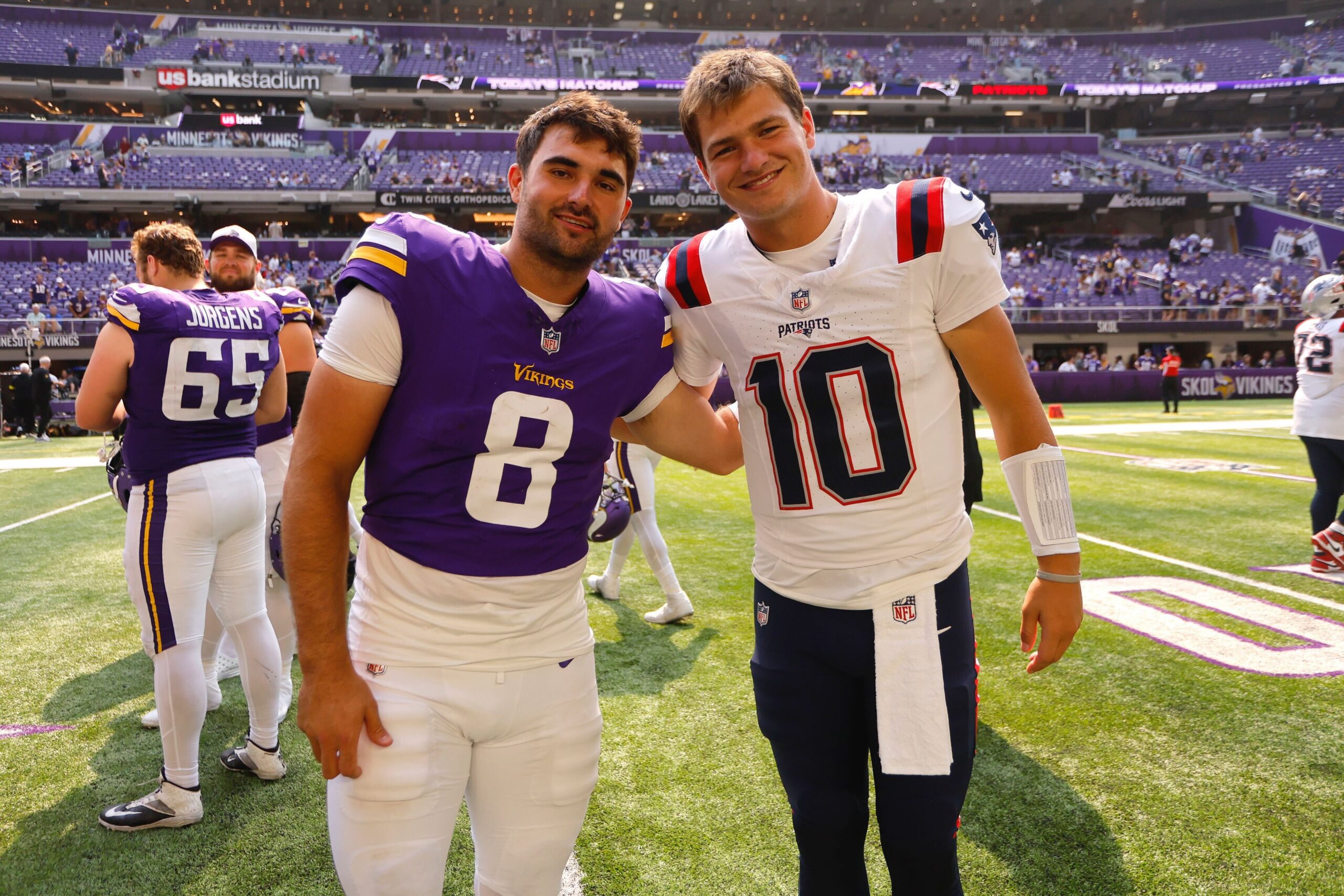
    Sam Howell (as a member of the Vikings in 2024) and Drake Maye have remained tight even as their football journeys have diverged.

    Football junkies

    Longo described Howell as a “football junkie.” He’d pore over film and challenge his coaches with tough questions. Before he’d even signed with North Carolina, in late 2018, the quarterback started asking Longo for offensive information.

    The coordinator didn’t hand it over until everything was official. But once he did, Howell began studying. Longo would send him formations, and Howell would teach them back to his coach a few hours later.

    This went on throughout Christmas break, until the start of classes.

    “By the time he showed up in mid-January, from a mental standpoint, he actually already knew the entire offense,” Longo said. “Which is rare and pretty impressive.”

    Howell would constantly bring up new routes and concepts to the coaching staff. Instead of waiting to be told what they’d run on Monday, he’d be a part of designing plays on Sunday night.

    To Longo, quizzing Howell in the quarterbacks room became an exercise in futility. The quarterback always seemed to have the right answer, not because he was winging it, but because he’d reviewed virtually everything.

    It set an example for the future Patriots QB.

    “Drake may not admit this, or remember it, but it got to a point where any time I asked an open question and didn’t direct it at one individual quarterback, Sam would always answer first,” Longo recalled. “And obviously he was correct. But Drake was competitive, and [he would] try to answer the question first, and beat Sam out.

    “My analyst and I both noticed that, and we loved it. Because it was Drake just wanting to get better.”

    Howell had been the starting quarterback since his freshman year, and Maye knew that wasn’t going to change. But neither player was threatened by the other. They started throwing after practice, bringing along wide receivers to work on routes, drop backs, and trigger times.

    They’d often give each other feedback, both good and bad. Brown said that Maye would be waiting for Howell to come off the field after every game.

    “To talk to him about what he saw,” Brown said. “So, you had two great minds that were talking about every play. And one of them, out of the action, standing over there watching, could say, ‘Here’s what I saw. Look for this.’”

    He added: “It’s very unusual to have two people competing for the same [role] that care about each other so much, respect each other so much. And that’s the reason it worked. For me, as a head coach, it was like a marriage made in heaven.”

    They had their stylistic differences. Maye’s biggest strength was his ability to make accurate throws while off-platform and off-balance, a feat Longo credited to his footwork, honed by years of youth and high school basketball.

    Howell’s was physical strength that allowed him to break tackles by running downhill.

    Their communication styles were different, too. Maye was more of a vocal leader, and Howell tended to pull guys off to the side. But the two quarterbacks complemented each other.

    “When he was backing me up at Carolina, he was really good at making me feel very confident going into games,” Howell said. “And just trying to give me that last sense of peace.

    “Before every game in college he’d tell me I was the best player on the field. Little things like that. He’s a great leader, great motivator.”

    It didn’t take long for the quarterbacks — and their coaches — to realize they shared a relentless competitive spark. Longo remembered a recruiting event when Howell and Maye played ping-pong until the lights shut off.

    In training camp, they’d have ping-pong “battles,” tacking on rounds until each side was ready to acquiesce. In 2021, Maye introduced Howell to golf, shifting their off-field rivalry to a new sport.

    It was not a relaxing endeavor.

    “I would see them afterward,” Brown said. “They’d say, ‘Oh man, he got me by four strokes.’ It was like the U.S. Open or something. It wasn’t like two quarterbacks going out to play.

    “And the other one would say, ‘Yeah, but I just missed a putt or I would have beaten him.’ It was like two little kids going at each other’s throats.”

    Added Howell: “Sometimes people invite us out to play, and they’re surprised with how the round is going. There’ll be times in the round where we’re not talking to each other and stuff like that. It’s a lot of fun.”

    After Howell graduated, he stayed in touch with his mentee. In September 2022, months after the Commanders drafted him in the fifth round, Howell attended a UNC road game against Appalachian State.

    It ended up being the highest-scoring game (including combined points) in school history. Maye had five touchdowns (four passing, one rushing) and 428 total yards in a 63-61 UNC win.

    In the third quarter, Maye scored on a 12-yard run for his fourth touchdown of the day. Howell, by coincidence, was standing just past the end zone, as if he was waiting for his best friend.

    He gave the quarterback a high five and a hug.

    “I told him, after I ran it in, I should have gotten on a knee and held the ball up to him,” Maye told local reporters. “Because what he did here [at UNC] is pretty incredible.”

    Then a member of the Commanders, Sam Howell returned to UNC to watch a vintage Drake Maye performance against Appalachian State on Sept. 3, 2022.

    An NFL friendship

    Just before Maye’s final season at UNC, he and Howell became roommates for a few months. It was Howell’s NFL offseason — January to April in 2023 — and they lived together in an apartment in Chapel Hill.

    When they weren’t working out, or at the golf course, they were playing the board game Catan and EA Sports’ PGA Tour at home.

    Maye was drafted with the third overall pick a year later. Howell, a 17-game starter with the Commanders in 2023, was traded to Seattle a month before the 2024 draft, and was subsequently dealt to the Vikings and then the Eagles in 2025.

    As Maye and Howell navigated the ups and downs of the NFL, they continued to talk every day. Howell said they’d go over defenses they were seeing that week.

    Sometimes, Maye would hype his friend up, the same way he did before Carolina games.

    “Even when I was playing in the NFL and we weren’t winning a lot, he would always still call me to instill confidence in me,” Howell said. “He’s great about that.”

    Since the Eagles lost to the San Francisco 49ers in the wild-card round on Jan. 11, Howell has attended every one of Maye’s games. He’ll be at the Super Bowl on Sunday, brimming with pride for his golf buddy.

    But before it starts, there’s one thing he’ll make sure to do.

    “I’ll definitely talk to him before the game,” Howell said. “Let him know that he was born for these moments, and he’s going to light it up.”