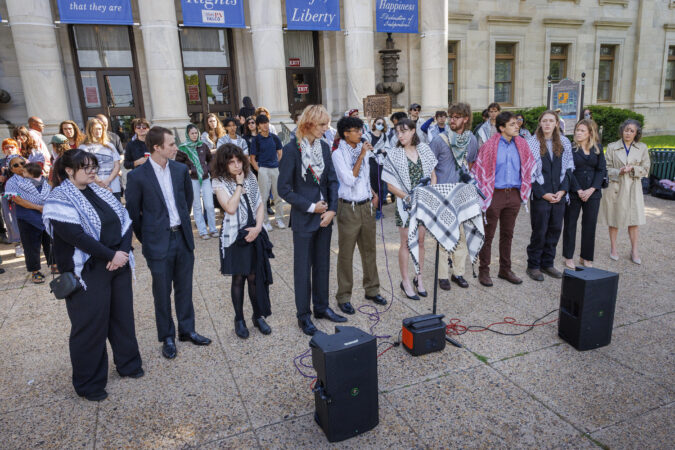
The so-called Swarthmore 9 entered the pleas late Monday, the day before their trial was expected to begin before Delaware County Court Judge Dominic Pileggi.
As part of the plea negotiation, all nine agreed to perform eight hours of community service and pay court costs.
The group had been charged with misdemeanor trespassing, and had refused to accept an earlier, similar plea offer made by District Attorney Tanner Rouse that would have had the same outcome. Doing so, they said at the time, could chill future student protests.
In a statement Tuesday, members of the group said the decision to take the plea deal was “an incredibly difficult and far from unanimous decision.” They said they felt they had “no good options” and accepted the deal to avoid probation or jail time.
“We are deeply grateful for the outpouring of support in solidarity with our case,” the statement said. “The community’s work in pressuring the DA and condemning Swarthmore’s repression and complicity only strengthens our upcoming fight for divestment and an end to the genocide.”
Rouse, for his part, said the case came to a close in “the same way that every other defiant trespass case that we have handled during my time in the office has concluded.”
“This offer had been on the table since the morning of their arrest, and in fact the case would have been withdrawn entirely, as they requested and as other protesters have had their cases withdrawn, if they had performed the same community service before formal arraignment,” he said in a statement Tuesday.
The others — Jonathan Britt, Mara Helen Cahill, Daria C. Dressler, Thomas Falcone, Colin Buckley Malcarney, Riley J. McManus, and Andrew Thomas — are not affiliated with Swarthmore.
Last week, Pileggi denied a motion to dismiss the charges against them, ruling that prosecutors had presented sufficient evidence for the case to proceed to trial.
Swarthmore issued multiple orders to protesters last spring to leave the campus, citing concerns over vandalism and public safety. Many of the protesters wore masks, refused to identify themselves, and were not affiliated with the school, according to administrators at the college.
Prosecutors noted that other protesters at the encampment avoided arrest by following an order to leave the area and were allowed to continue chanting and holding protest signs elsewhere on the campus.
Judge Dominic Pileggi ruled that prosecutors had presented sufficient evidence for the case to proceed to trial and allow a jury to decide whether the so-called Swarthmore 9 had trespassed.
Of the nine people arrested, only one, Jace Boland, is a student at the college. Another, Brendan Cook, is a former student who was suspended for participating in an earlier protest in 2024, but the rest are not affiliated with Swarthmore, according to school officials.
Members of the group — Boland, Cook, Jonathan Britt, Mara Helen Cahill, Daria C. Dressler, Thomas Falcone, Colin Buckley Malcarney, Riley J. McManus, and Andrew Thomas — have all been charged with trespassing, a third-degree misdemeanor.
District Attorney Tanner Rouse has said his office offered each member of the group a plea deal that would see those charges reduced to summary offenses, similar to traffic citations, that could be resolved by paying a fine.
The group has refused, saying pleading guilty would set a precedent on how colleges across the country could curtail students’ protest rights.
During Monday’s hearing, the group’s attorney, Marni Jo Snyder, argued that Swarthmore and county prosecutors violated the protestors’ constitutional rights by arresting them.
She noted that Swarthmore changed its policy allowing protests on its campus to explicitly outlaw encampments after a similar, monthlong demonstration in the same location in 2024.
Policing a specific type of expressive speech, she said, is illegal.
“The policy is wrong, the repeated orders to leave are wrong,” she said. “These are improper responses to constitutionally protected speech.”
Snyder said that, though Swarthmore’s campus is private property, administrators have allowed previous demonstrations to be held there, as well as other quasi-private events. The arrests in this case, she said, showed that prosecutors were specifically targeting demonstrators protesting the war in Gaza.
Samantha Door, who represented the district attorney’s office at the hearing, disputed that, saying the protestors’ conduct, and not the purpose of the encampment, was the reason criminal charges were filed.
Swarthmore issued multiple warnings to the group to disperse over the course of three days, Door said, including one final warning 10 minutes before the encampment was dismantled.
Other protestors who left the encampment and continued to chant and hold protest signs were not arrested, she said.
Also, Door said administrators raised concerns about public safety, since many of the protestors wore masks and refused to identify themselves, vandalized campus property with graffiti, and used pallets and other materials to create barricades around the encampment.
The trial in the case is scheduled to begin with jury selection on June 30.
David Tudor was born in West Philly in 1926 and, at least for a musical prodigy, his career started out conventionally enough.
He began studying the piano at age 6 before switching his focus to the pipe organ at 11. By his mid-teens he was working regularly at places where you’d expect to find an organist — churches like St. Mark’s in Center City and Trinity Episcopal in Swarthmore, or playing the famed midday concerts at John Wanamaker’s department store.
But as exemplified by a recent concert of works associated with Tudor, presented by Bowerbird earlier this month at the Community Education Center, Tudor’s music became extremely unconventional over the course of his lifetime.
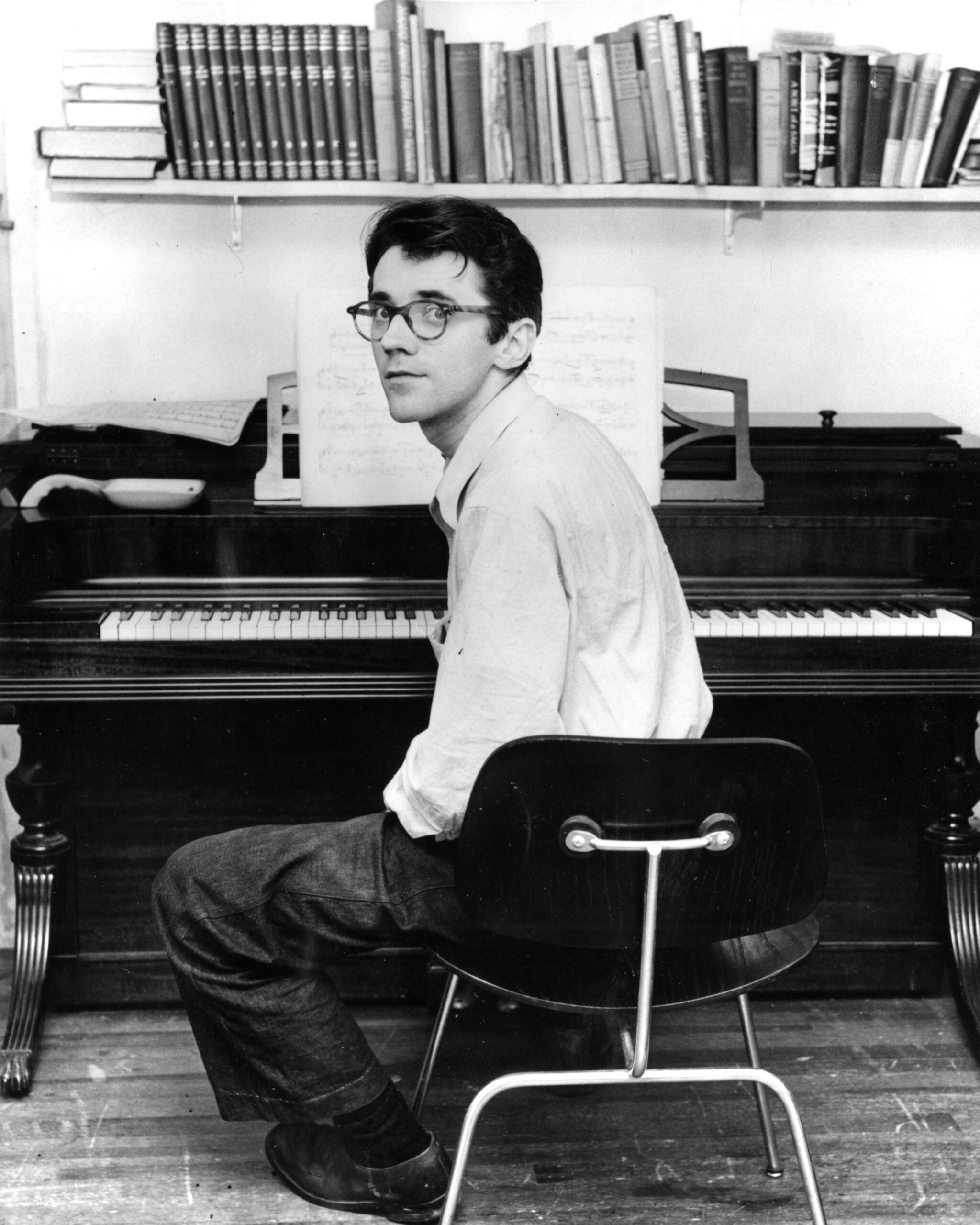
David Tudor at the piano in 1953.
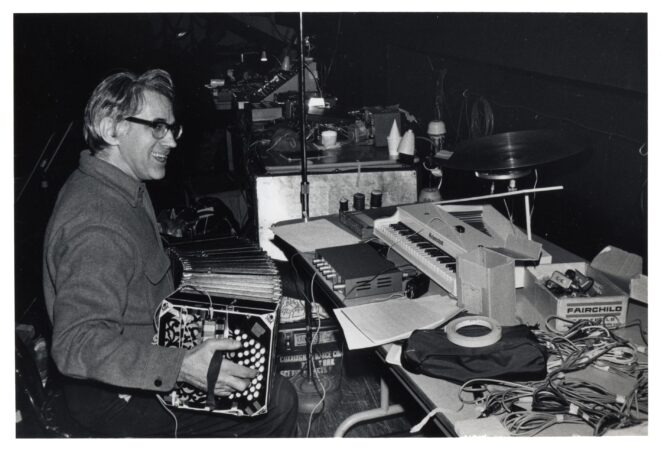
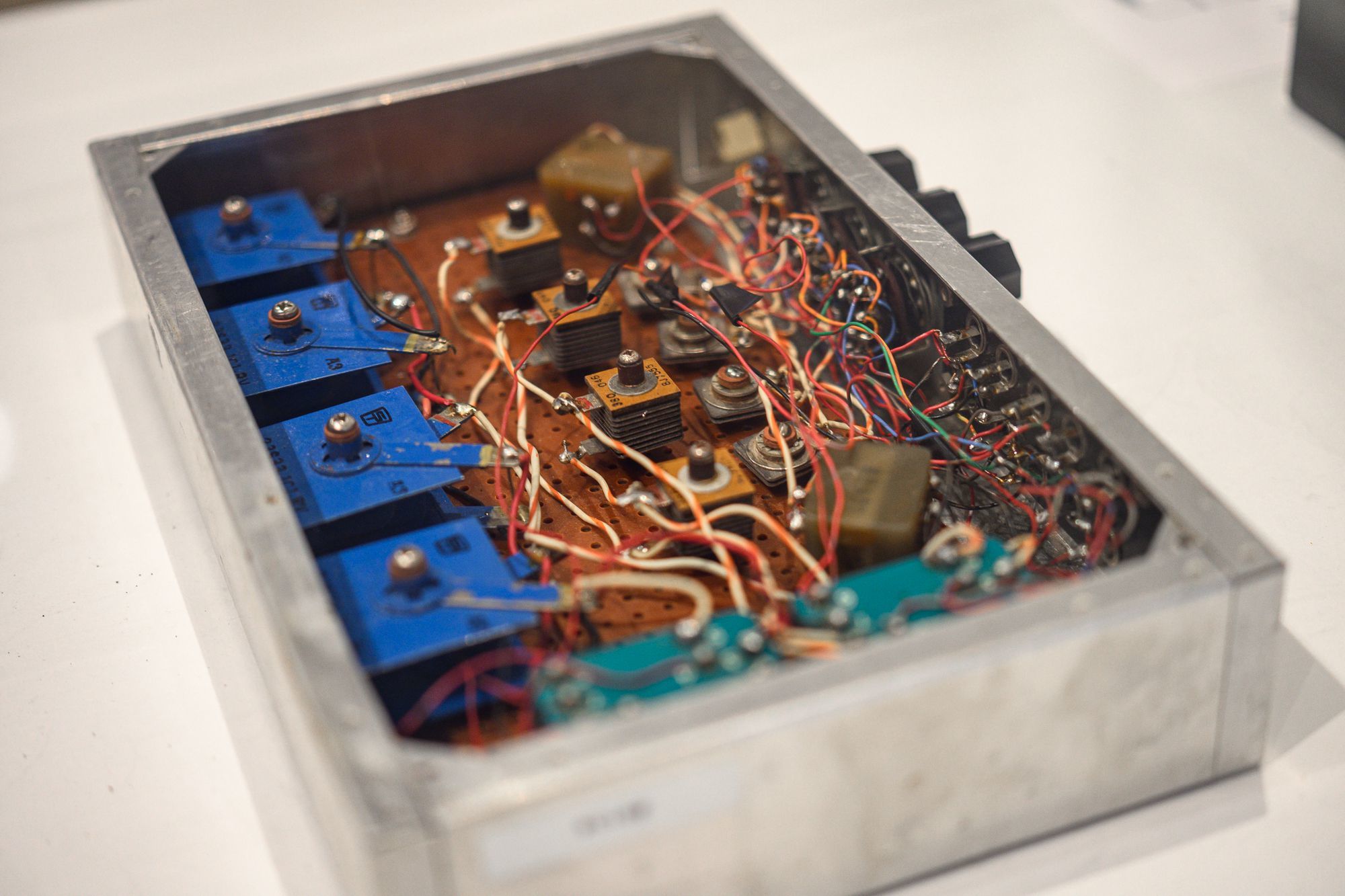
Just a few miles from the composer’s alma mater, Overbrook High, a half dozen musicians were seated emulating Tudor’s music making process, behind tables piled high with an impenetrable tangle of boxes, wires, knobs, and switches; electronic tendrils snaked from these sources to a bewildering array of objects: glass bowls, a suspended box fan, an oversized die, a copper pot still, even a tree. Each was connected to transducers that took advantage of their resonant properties, turning them into natural amplifiers.
A century after his birth and three decades since his death in August 1996, David Tudor’s music still seems like something created in a distant, if more analog, future.
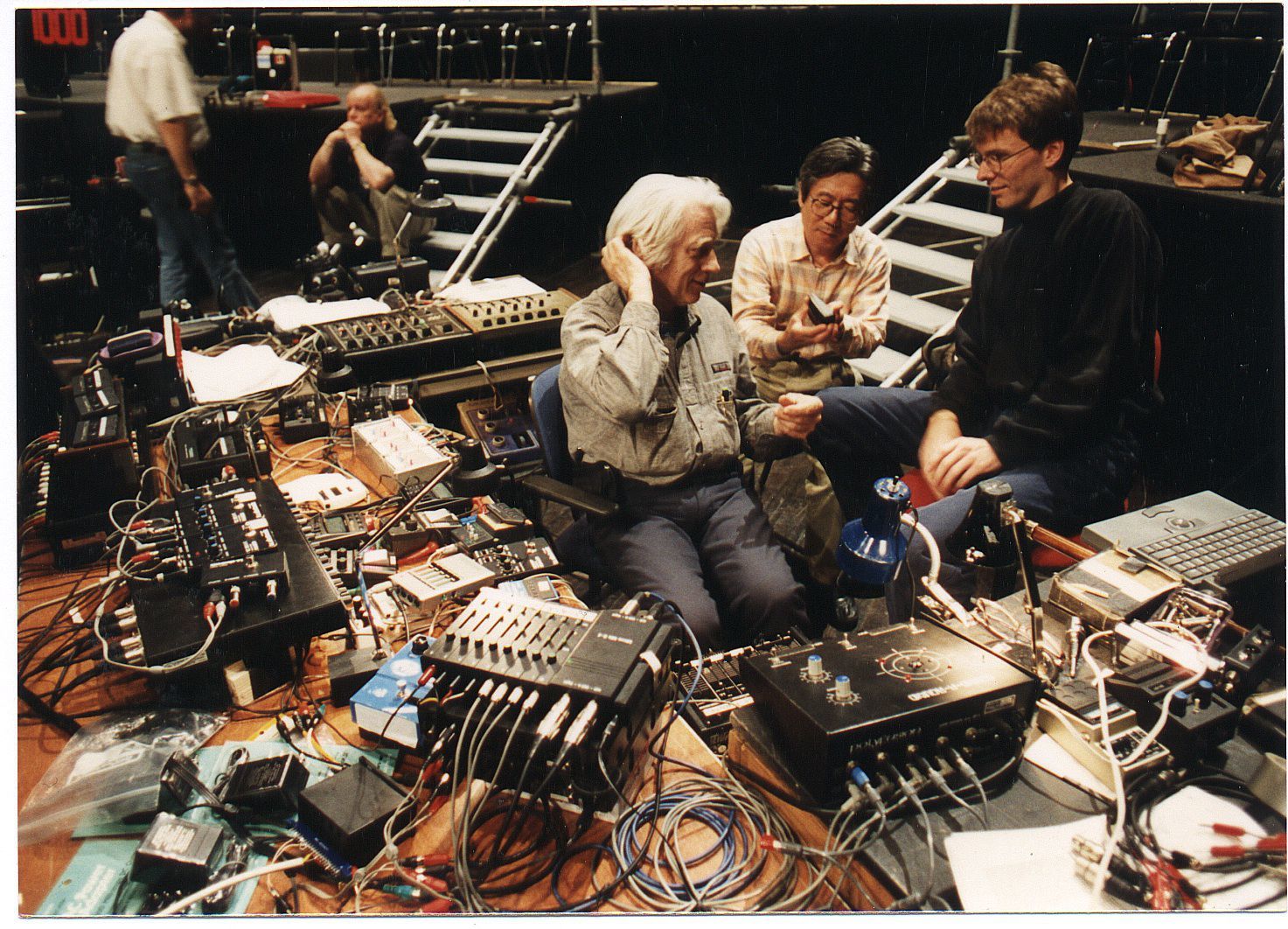
David Tudor with composer Takehisa Kosugi and musician/engineer John D.S. Adams on the set of Ocean, a collaboration with the Merce Cunningham Dance Company
Years before, the AI-generated “band” Velvet Sundown grabbed headlines by chalking up more than 1 million subscribers on streaming services and fooling journalists, Tudor was experimenting with machine-learning systems in the early ‘90s, working with engineers from Intel on a project called the Neural Network Synthesizer.
Those experiments evolved from Tudor’s work with the generation of contemporary classical composers that emerged in the decades after World War II, when he became the pianist and collaborator of choice for such groundbreaking artists as John Cage, Morton Feldman, Earle Brown, Merce Cunningham, and Robert Rauschenberg.
He was a particularly vital collaborator with Cage, who found in Tudor the ideal vehicle for the use of chance operations in his compositions.
David Tudor with composer John Cage.
The turning point for Tudor came at Settlement Music School in South Philly, where he studied with the pianist Irma Wolpe. The young pianist became close with Wolpe and her husband, the modernist composer Stefan Wolpe, and the couple introduced Tudor to new developments in modern music at the time.
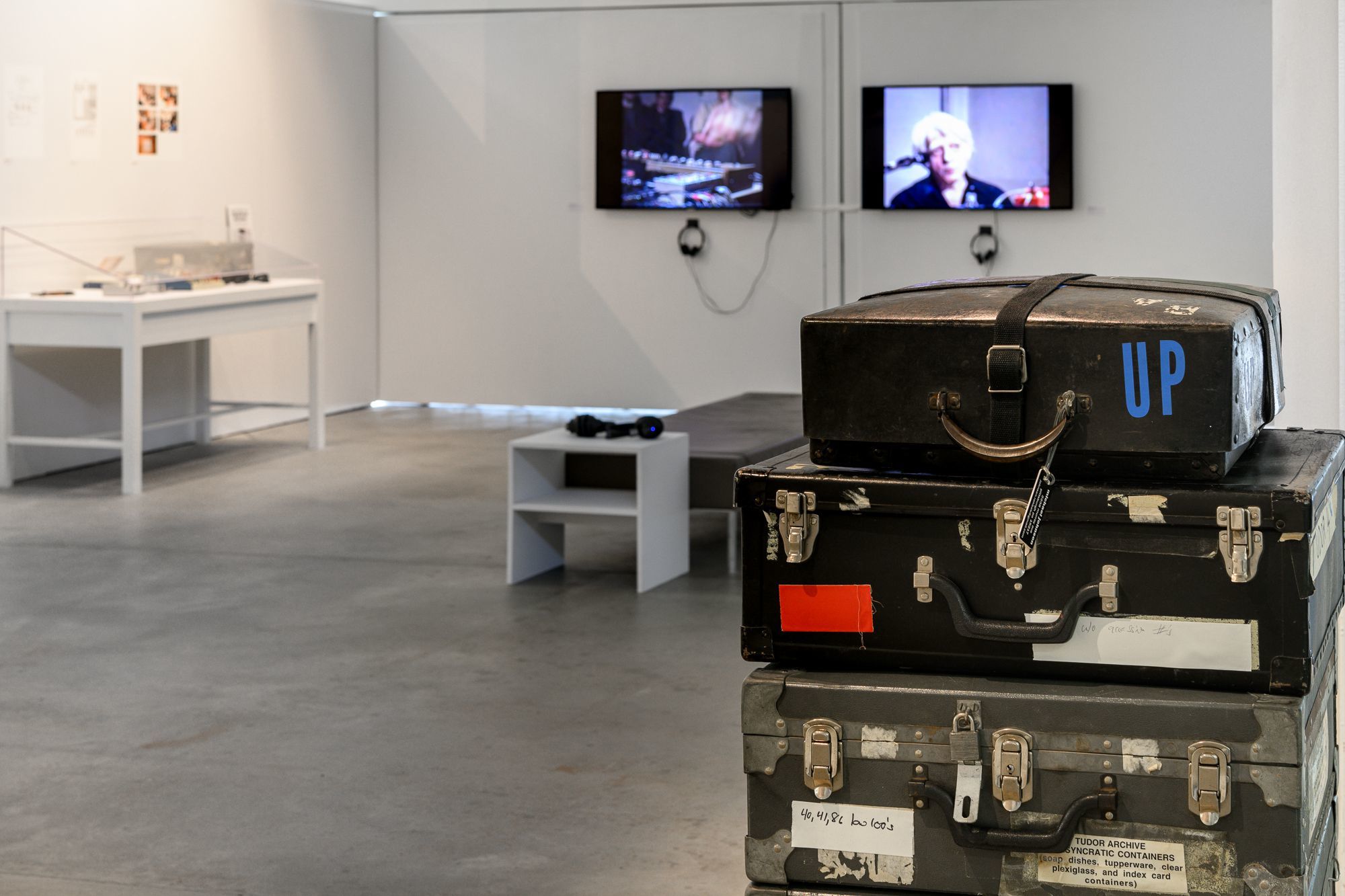
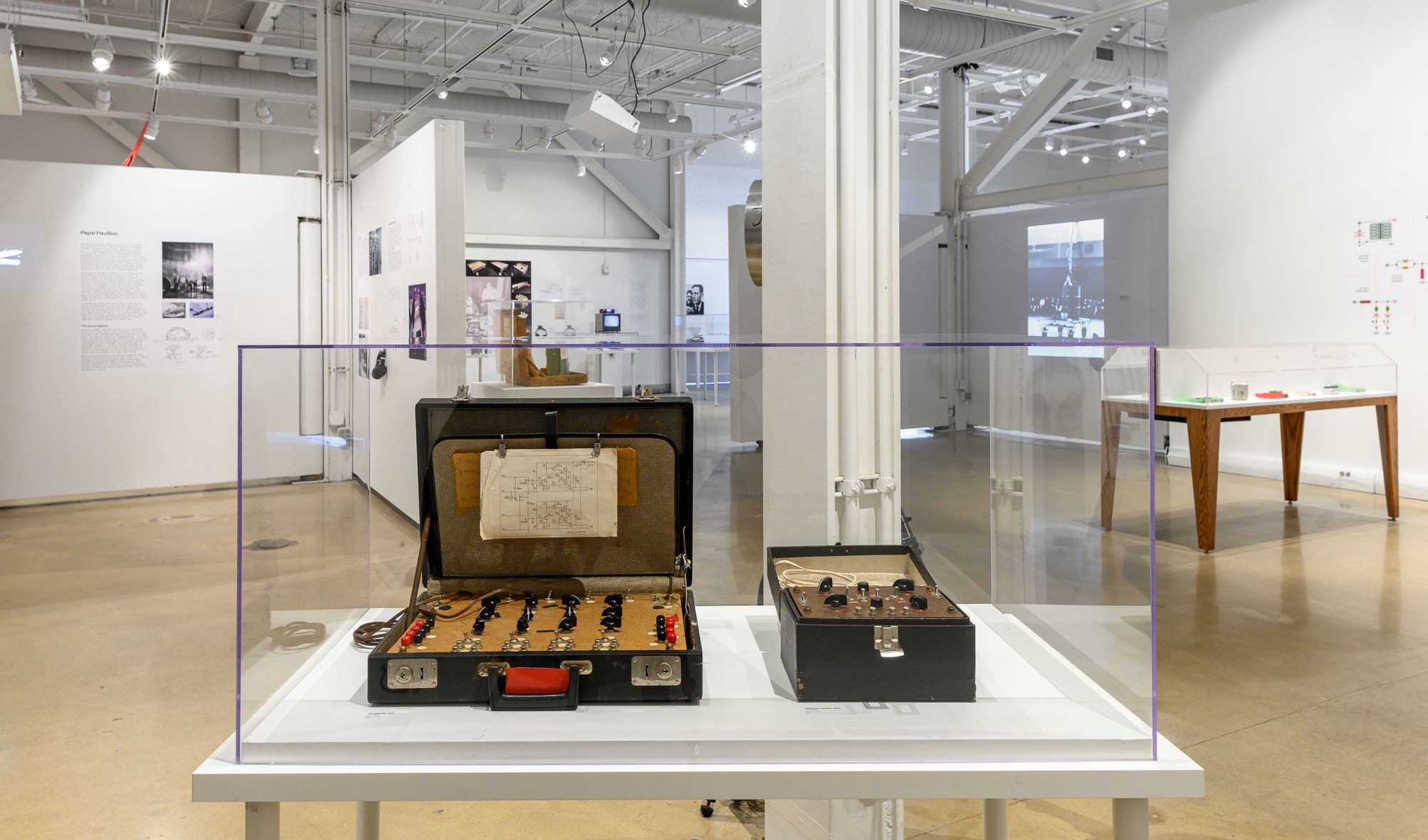
An ongoing exhibition at Drexel University’s Pearlstein Gallery, “David Tudor: A View From Inside,” traces the roots of his iconoclastic approach to performance and composition back to his early days in Philly.
The pipe organ — an instrument that literally surrounds the performer, and that they play from within — proved to be a foundational influence on Tudor’s musical philosophy for the rest of his life, said Dustin Hurt, co-curator and director of Philly presenting organization Bowerbird.
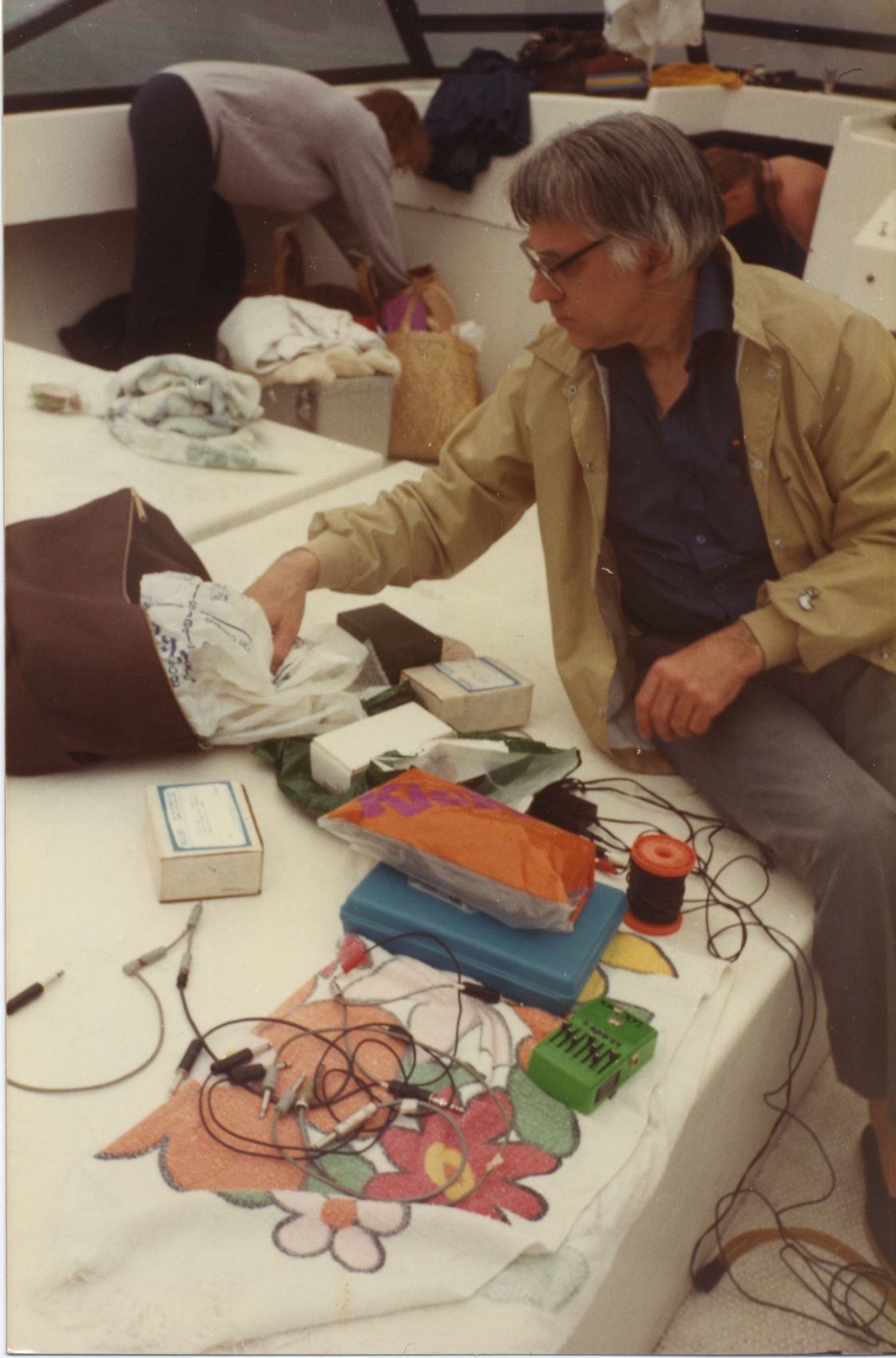
David Tudor in the Bahamas during the filming of Sea Tails, a project that included sounds collected underwater.
“That led to the more metaphorical angle of David’s music, which involved discovering what the instruments do on their own,” said Hurt. “That’s the ‘View From Inside.’ He’s not saying, ‘I want to make this music, let me find the instruments that do it.’ He’s saying, ‘This is the stuff that I have. Let’s see what it does.’”
Discovering Tudor’s fascination with puzzles, composers presented him with scores that offered problems to solve rather than music to play. The exhibition includes mind-boggling lists of calculations and measurements that the pianist meticulously assembled in preparation of performing certain pieces.
By the 1960s, he started to abandon the piano altogether, modifying small electronic devices to craft unpredictable music from feedback.
“David Tudor: A View From Inside” is on view at Drexel University’s Pearlstein Gallery through March 21
“Tudor was such a skilled virtuoso on the piano, but he showed no interest in performing the classical repertoire,” said co-curator You Nakai, a professor at the University of Tokyo and author of Reminded By the Instruments: David Tudor’s Music.
“He would only perform scores that challenged him to solve them and produce music that the composer never really thought of,” said Nakai. “So when he started making his own instruments, he strongly focused on ways to implement indeterminacy within the workings of the instruments themselves.”
Composer Stanley Lunetta includes the following instructions in his “Piece for Bandoneon and Strings”: “If you are already David Tudor, you will have no problem performing this piece; if you are not David Tudor, you must study hard, for you must be him during this performance.”
“David Tudor: A View From Inside” is on view at Drexel University’s Pearlstein Gallery through March 21.
The strings in the piece were not the expected violins and cellos, but tethers from Tudor’s limbs to a group of puppeteers who triggered him to play sections of Lunetta’s score.
Gradually, Tudor’s vision of an instrument that could be inhabited grew in scale far beyond even a department store-sized pipe organ. For Expo ‘70, the 1970 world’s fair in Osaka, Japan, he transformed an entire building into an instrument by mounting loudspeakers in the dome of the Pepsi Pavilion. A few years later, he drew up plans to convert an entire island into an instrument by recording the natural sounds of the space, manipulating them, and playing them back via speakers scattered throughout the island.
That project wasn’t realized until 2024, long after his passing, off the coasts of Japan and Norway via a collaborative project spearheaded by Nakai.
“David Tudor: A View From Inside” is on view at Drexel University’s Pearlstein Gallery through March 21.
Tudor’s pioneering experiments with electronic music seemed to make him an apt collaborator for the Intel engineers and their new neural network chip, but his interest in the technology was diametrically opposed to theirs.
For all his love of puzzles, “Tudor showed no interest in repeating his past,” said Nakai.
“He opened it up, went inside the circuitry and figured out how to let the instrument speak for itself. He didn’t understand everything, but he didn’t need to because he was making music that he liked.”
“David Tudor: A View From Inside” runs through March 21, Pearlstein Gallery in Drexel University’s URBN Annex, 3401 Filbert St. bowerbird.org
Swarthmore Borough manager Sean Halbom has been terminated from the office after just six months, the latest in a string of short employment stints he has held in recent years.
The borough council voted unanimously on the termination Monday, though Council President Jill Bennett Gaieski declined to give a reason for the decision in a phone call with The Inquirer.
Halbom did not respond to phone or email messages lefton Thursday.
He began in the borough manager role in September after holding several roles in Montgomery County, including most recently in Upper Frederick Township, where he was township manager for less than a year, according to his LinkedIn profile. Halbom resigned from his position in Upper Frederick in June 2025.
Prior to the job inUpper Frederick, Halbom was an interim human resources director in Bucks County for two months and township manager for Worcester Township for a year and a half. Halbom’s employment in Worcester Township was terminated by its board of supervisors in April 2024.
He was also thedirector of veterans affairs for Montgomery County for six years, from 2012 to 2018, his LinkedIn profile shows.
Halbom succeeded William Webb, who left the Swarthmore manager role in September to become an assistant county administrator in Isle of Wight County, Va.
Halbom’s leave came around the same time as another personnel shake-up in the small borough. On Feb. 18, Scott Schumacher vacated his position as a longtime Swarthmore Public Library employee and children’s librarian.
Swarthmore Public Library board president Elizabeth Brown said Schumacher’s departure was unrelated to Halbom’s termination.
The Swarthmore council on Monday also named David Unkovic as interim borough manager. He “came highly recommended” by Upper Providence Township, where he previously served as interim township manager, Gaieski said.
Before retiring as a practicing lawyer, Unkovic spent a decade at McNees Wallace & Nurick, a Harrisburg-based law firm with multiple offices, including in Radnor. He also briefly served as the state receiver for the City of Harrisburg in 2012.
The Swarthmore council has already begun the search for a permanent borough manager, Gaieski said, and hopes one will be in placeas early as June 1.
The search will take “until we find the right person,” Gaieski added. “We have a really good interim in place. We will do what we need to do to find the right person.”
This suburban content is produced with support from the Leslie Miller and Richard Worley Foundation and The Lenfest Institute for Journalism. Editorial content is created independently of the project donors. Gifts to support The Inquirer’s high-impact journalism can be made at inquirer.com/donate. A list of Lenfest Institute donors can be found at lenfestinstitute.org/supporters.
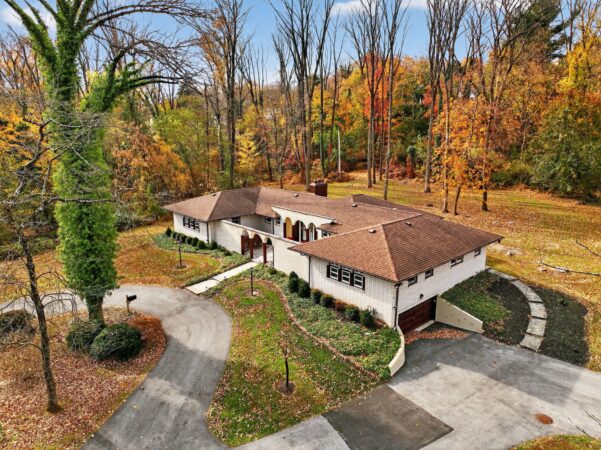
Donna Wise doesn’t know if this was on the builder’s mind in 1970, but he designed a house that combined sociability and privacy.
The four-bedroom, 2½-bathroom ranch house in Wallingford has the kitchen, living room, dining room, basement, and two-car garage on one side of the house and the living quarters on the other side.
That way, Wise said, guests “can ask to use the bathroom without passing through your bedroom. And the grounds are beautiful.”
The living room.
The builder’s other houses nearby were all Colonials, she said. Her parents, Mary and Robert Wise, bought the Spanish-style house 42 years ago. After her father died in 1995 and her mother in 2006, she and her sister, Cheryl Wise, remained there.
Now the sisters, who grew up in Folcroft, Delaware County, are moving to a nearby condo.
The kitchen has stainless steel appliances.
The approach to the 3,064-square-foot house is on a circular driveway.
Donna said the construction is so symmetrical that if one looks through a window, they can see through the whole house.
The kitchen has stainless steel appliances, and the office could be converted to a fifth bedroom.
The primary bedroom.
The family opened up the layout, knocking down a wall separating the kitchen and the dining room. The basement is unfinished.
The house is near the Commodore Barry Bridge, which provides easy access to the Jersey Shore. It is also close to the Swarthmore SEPTA Regional Rail station. It is also convenient to Tyler Memorial Arboretum and several parks.
The front entrance to the house.
The house is in the Wallingford-Swarthmore School District.
It is listed by Lindsay Wise of Coldwell Banker Realty for $699,000.
“Why would you not want to study the thing that lets you study,” said Schechtman-Taylor, a senior from New York City. “The brain, that’s our entire world.”
Neuroscience has become the most popular major on the highly selective liberal arts campus on Philadelphia’s Main Line, counting nearby Bryn Mawr College students who also take classes at Haverford. And it’s only been around since 2021 when the two colleges — which have had a minor in the discipline since 2013 — decided to administer the joint major.
At Haverford, there were 24 majors the year it started; now there are 60. Bryn Mawr saw similar growth and currently has 49. Enrollment in Haverford’s neuroscience classes including both Bryn Mawr and Haverford students grew from 154 in 2014 to nearly 800 last fall.
“We knew that neuroscience was going to be popular, but we did not anticipate this growth,” said Helen White, Haverford’s provost, who noted the school recently hired another neuroscience professor to accommodate more students.
The major’s popularity is also growing at schools around the Philadelphia region — and across the country. Students and professors say neuroscience is popular because it’s interdisciplinary, involving psychology, biology, and chemistry, and can lead to a variety of careers. It can also be personal, because it involves studying diseases like Alzheimer’s and Parkinson’s, which have no cures, and the treatment of strokes and traumatic brain injuries.
“I would say about 90% of my students are coming into my lab because they have someone in their family with one of these diseases,” said Rob Fairman, a Haverford biology professor whose research focuses on neuroscience.
Haverford senior Alina Schechtman-Taylor, 21, of New York City, works as a teacher assistant in professor Laura Been’s lab.
A growing major
In 2008, 110 colleges nationally offered neuroscience majors; now, it’s about 330, said Raddy Ramos, associate professor in the Department of Biomedical Sciences at the New York Institute of Technology. Ramos, who coauthored studies on the topic, said there were more than 2,000 neuroscience graduates in 2008; in 2019, that number had grown to more than 7,200.
window.addEventListener(“message”,function(a){if(void 0!==a.data[“datawrapper-height”]){var e=document.querySelectorAll(“iframe”);for(var t in a.data[“datawrapper-height”])for(var r,i=0;r=e[i];i++)if(r.contentWindow===a.source){var d=a.data[“datawrapper-height”][t]+”px”;r.style.height=d}}});
Pennsylvania is a hot spot, with 36 colleges having programs in 2022-23, Ramos said — more than than any other state.
Drexel University, which has had a minor since 2015, launched its undergraduate major in neuroscience in 2024.
“We have seen a 45% increase in applications over the last two years,” a university spokesperson said.
Pennsylvania State University in November announced it was launching two new undergraduate majors in neuroscience, one offered by the biology department and the other by the biobehavioral health department.
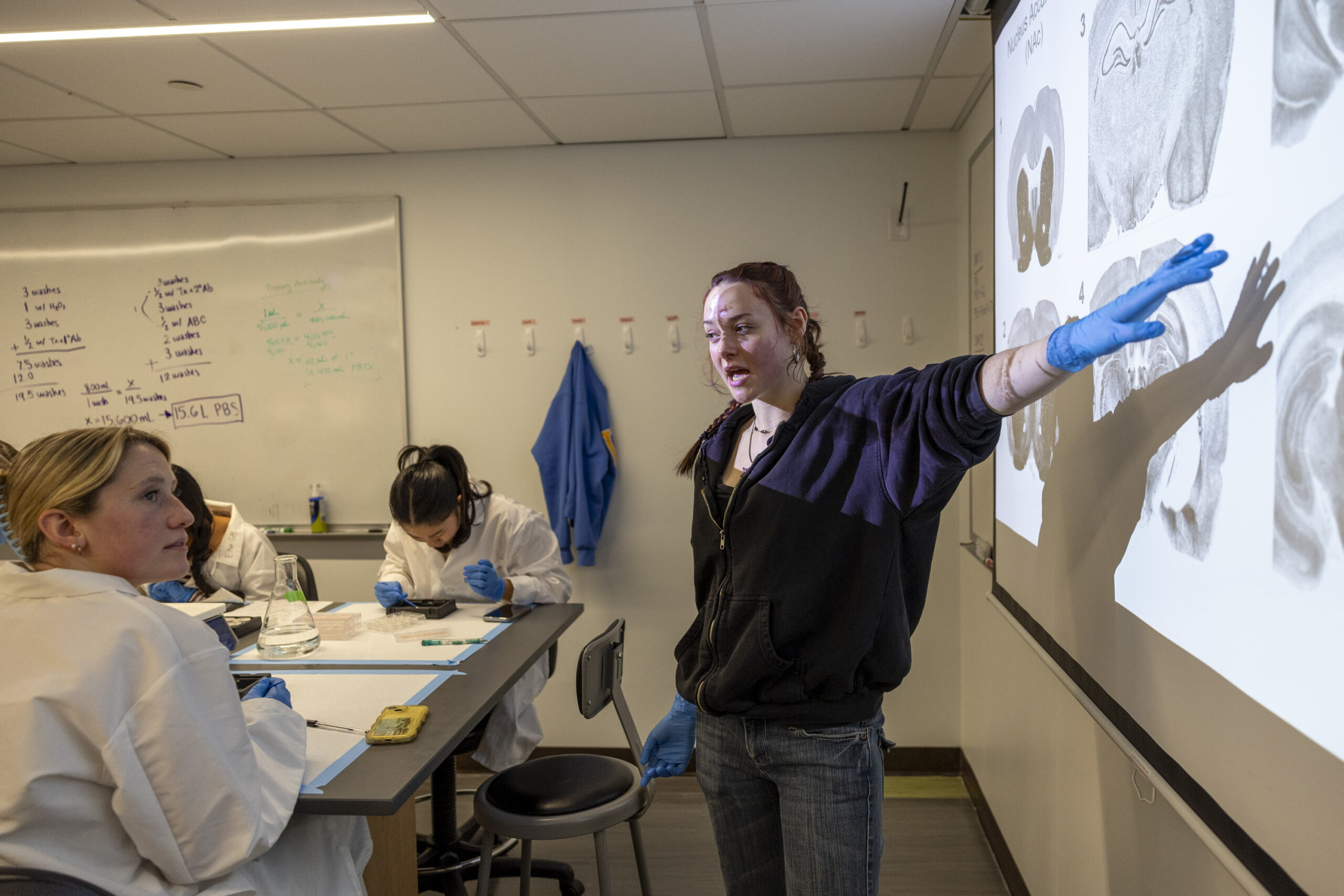
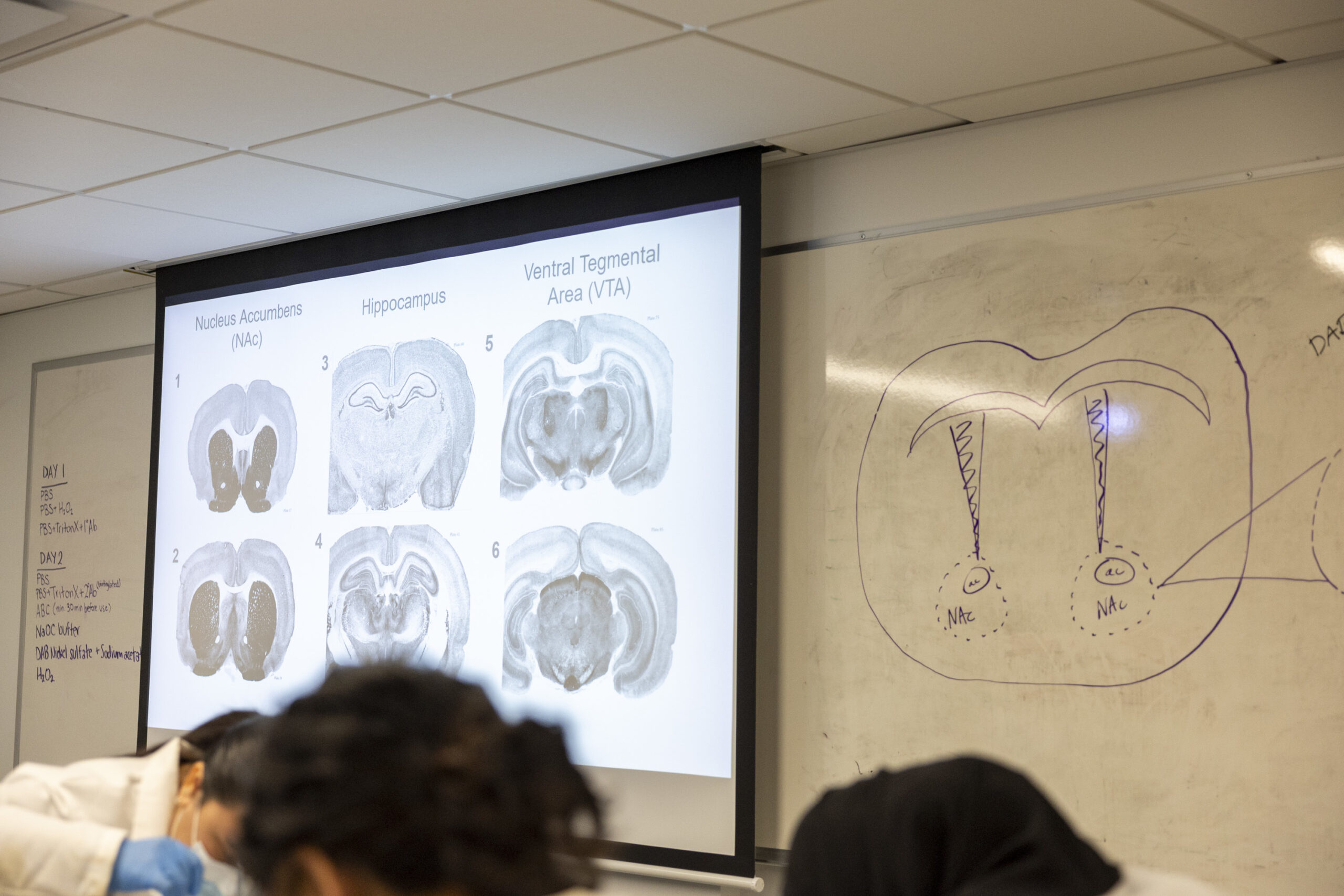
Students look for sections of rat brains that match the sections projected on the screen in a Haverford College lab.
Neuroscience has become especially popular among pre-med majors, school officials say. Otherpotential career paths include biotechnology, pharmacology, psychology, and neuroengineering, while somestudents go on to law school, business, or public policy.
“There’s a lot more awareness that mental health conditions are due to changes in the brain, and people want to understand that,” said Lisa Briand, associate professor and program director for Temple University’s neuroscience program.
At Temple, neuroscience has become the fourth largest of 30 majors in liberal arts, Briand said. The psychology department a few years ago changed its name to psychology and neuroscience, she said.
At the University of Pennsylvania a decade ago, 100 to 120 neuroscience majors graduated annually, said Lori Flanagan-Cato, associate professor of psychology and codirector of the undergraduate neuroscience program.
“Twice in the past 3 years we have had over 150,” she said.
Swarthmore College, a highly selective small liberal arts college, graduated 10 to 12 neuroscience majors a year about a decade ago, said Frank Durgin, professor of psychology who oversees the program.
“This year, we anticipate graduating 24 majors,” he said. “Next year, it’s 30.”
The college has added two professors in the last two years to accommodate growth, he said.
Why students study neuroscience
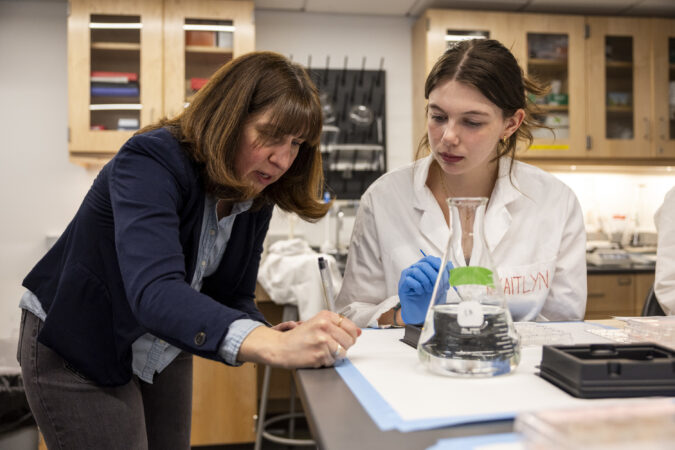
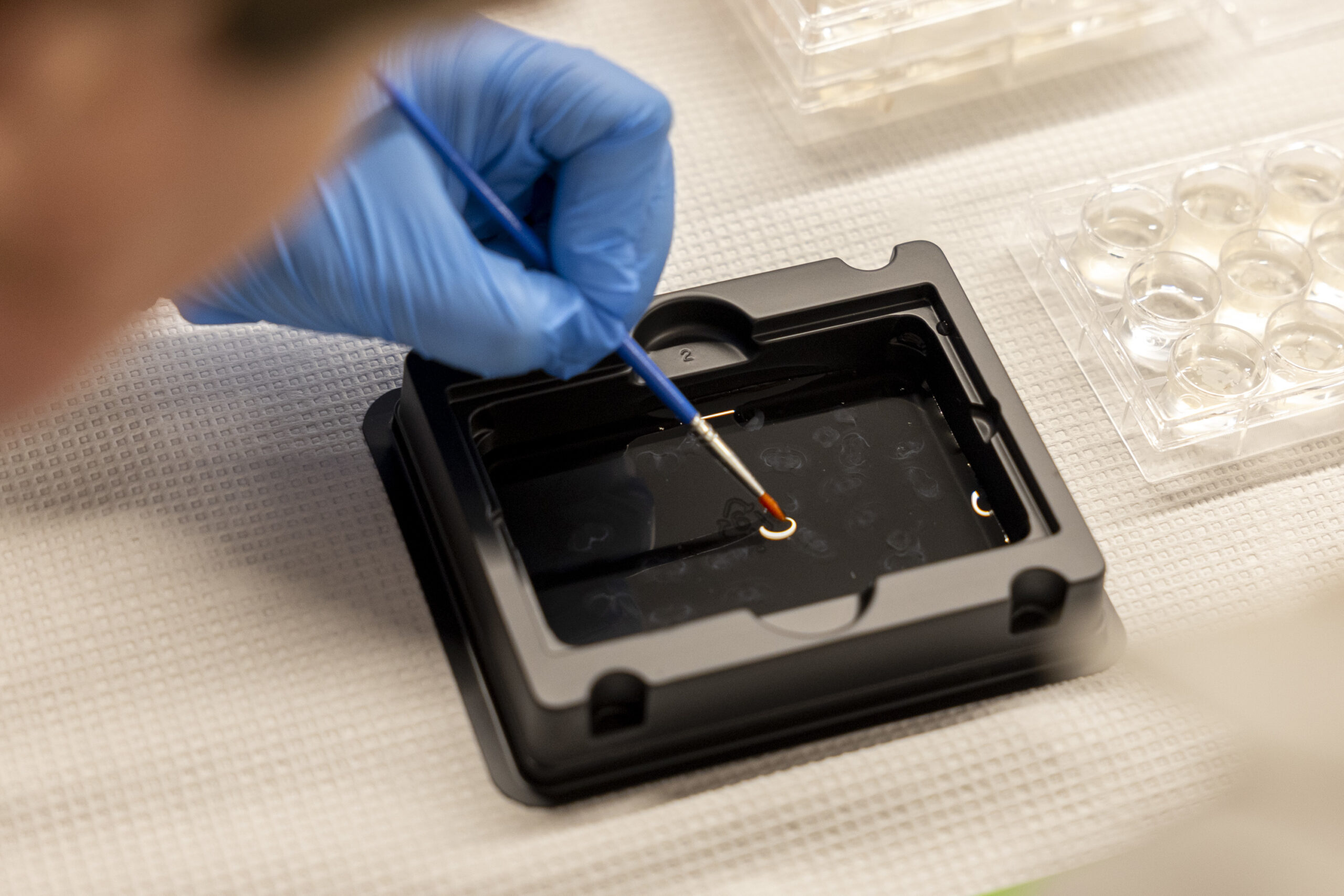
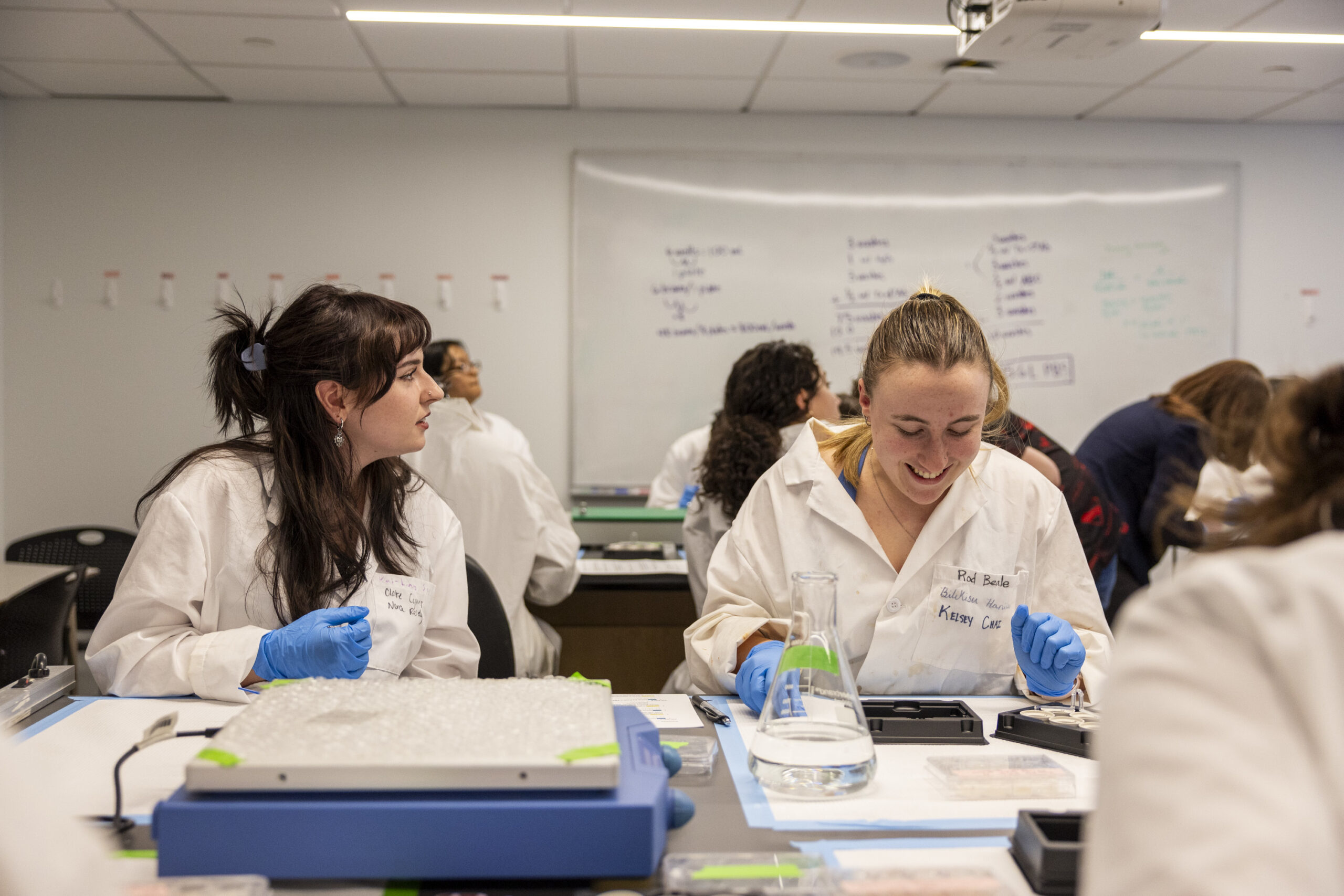
In a lab at Haverford one afternoon last month, 16 students in white lab coats poked with paintbrush tips at thin slices of rat brain in preservative fluid, preparing to stain them to look for which neurons were activated. Some of the rats received the drug Ritalin, commonly used for attention deficit disorder, while others did not. Students were trying to discern differences in their brains when they performed certain tasks, said Laura Been, associate professor of psychology and director of the bi-college neuroscience program.
A neuroscience student works with sections of rats’ brains in a lab at Haverford College.
“We can … try to learn something more about how this sort of drug treatment impacts the brain,” said Been, whose area of interest is behavioral neuroendocrinology, which looks at the relationship between hormones, the brain, and behavior.
Students in Been’s class had varied reasons for studying neuroscience.
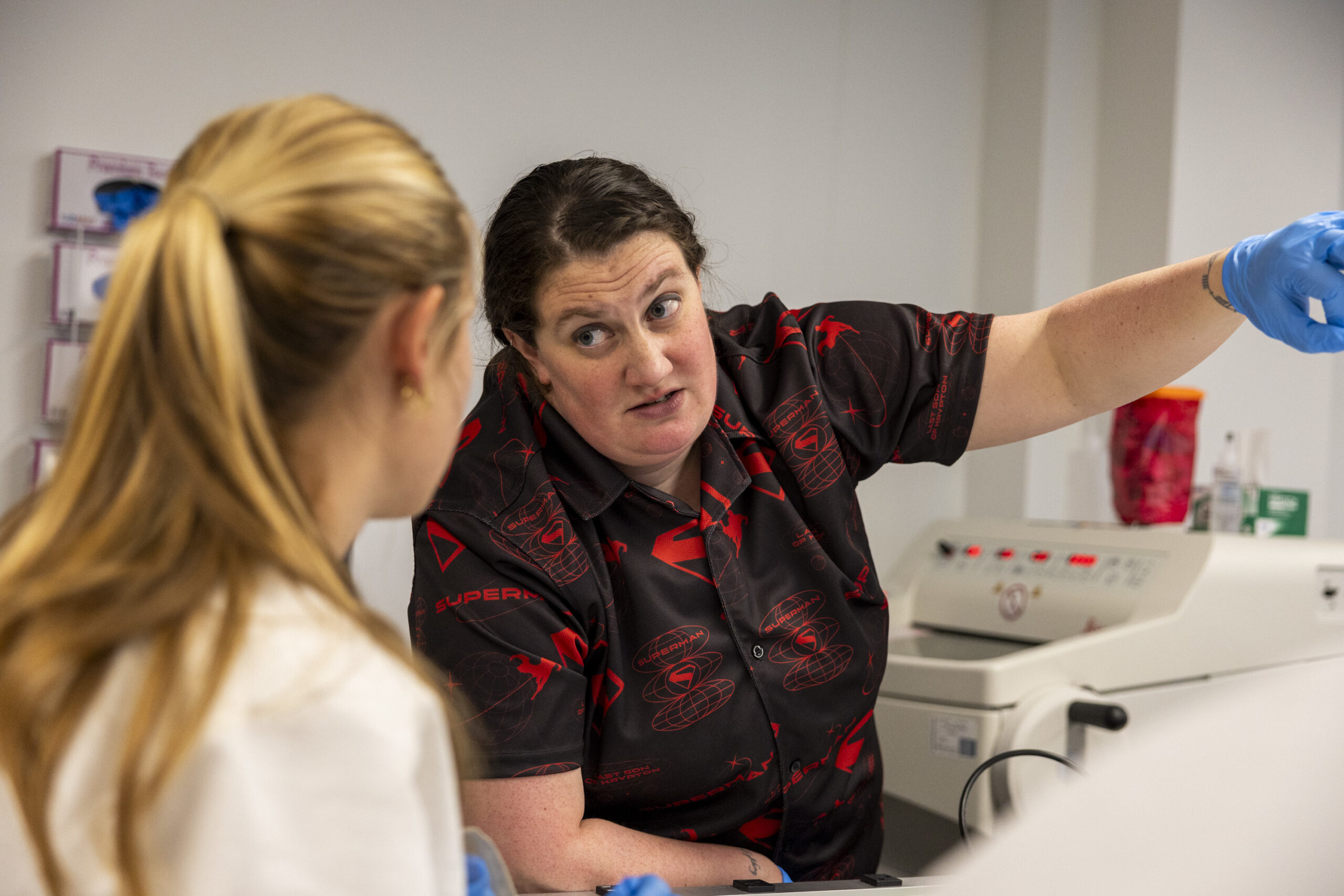
Emily Black, visiting assistant professor of neuroscience at Haverford College, helps Savannah Shaw, 22, of Downingtown, during neuroscience lab work. “I really like the variety of the classes we can take in the major,” said Shaw, a senior who plans to go to medical school, possibly to become a neurologist. “You can go more the psychology route or go more biology.”
Sophia Lipari, 21, a junior from Jacksonville, Fla., whose father is a reproductive endocrinologist, is interested in hormones and the field of fertility.
Riley Fass, 20, a junior from Claremont, Calif., wants to be a special-education teacher. She already sees the connection between neuroscience and her job as a teacher’s assistant at a school where children have traumatic brain injuries and cerebral palsy.
“The topics we discuss — an injury here will result in this — I can actually see it in my students,” she said.
Iris Goxhaj (left), 21, of Northeast Philadelphia, and Riley Fass, 20, of Claremont, Calif., work with sections of rats’ brains in a lab at Haverford College.
Deeya Abrol’s interest was stoked when she worked with a child on the autism spectrum as a swim instructor. Abrol, 22, a senior from Los Gatos, Calif., plans to go to medical school.
Schechtman-Taylor meanwhile wants to pursue biomedical engineering and specifically developing medicines for the treatment of neurodegenerative disorders.
“I want to work on the treatment side,” she said.
Fairman, the Haverford biology professor, said a recent graduate’s mother had died of Huntington’s disease, meaning she has a 50% chance of getting it, he said. She worked in his lab and wanted to be involved in hisresearchon protein clumping in the brain and its effect on diseases such as Parkinson’s and Alzheimer’s.
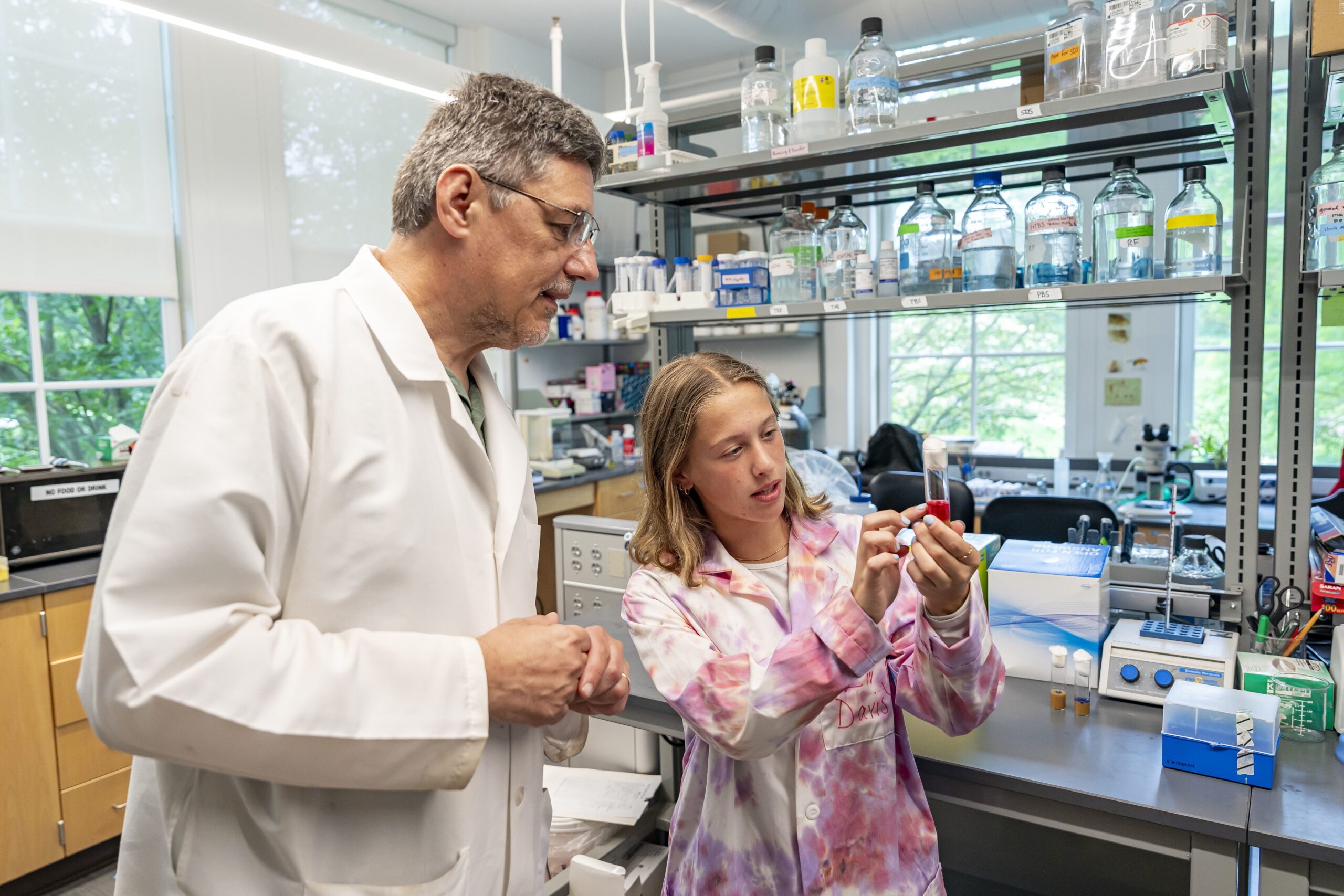
Rob Fairman, a professor of biology at Haverford College, and student Liv Davis are testing the effects of natural products on animal models with neurodegenerative diseases.
Junior Liv Davis, 21, wanted to help find a cure for Parkinson’s, which struck her grandmother in 2020.
“She’s had two falls in the last year and a half because it’s progressed pretty quickly,” said Davis, of Lanoka Harbor, N.J. “It’s hard to see someone you love so much live with it, but it makes it all the more rewarding to work toward fixing it.”
Davis, who has worked in Fairman’s lab since her freshman year, tried to get into an introduction to neuroscience class early on. But there wasn’t room. She ended up majoring in biology, which she thinks probably would have happened anyway.
About half the students working in Fairman’s lab are neuroscience majors, he said.
Davis is currently studying the effect of a chemical on sleeping fruit flies that have been genetically modified to carry the protein associated with Parkinson’s.
Last summer, she received an inaugural research fellowship funded by Shamir Khan, a Haverford alumnus and psychologist who was diagnosed with early-onset Parkinson’s.
Her grandmother was glad she could continue the research, said Davis, who plans to become a doctor.
“She always jokes with me,” Davis said. “‘Give me a spoonful of that chemical, whatever it is. If you need a test subject, you let me know.’”
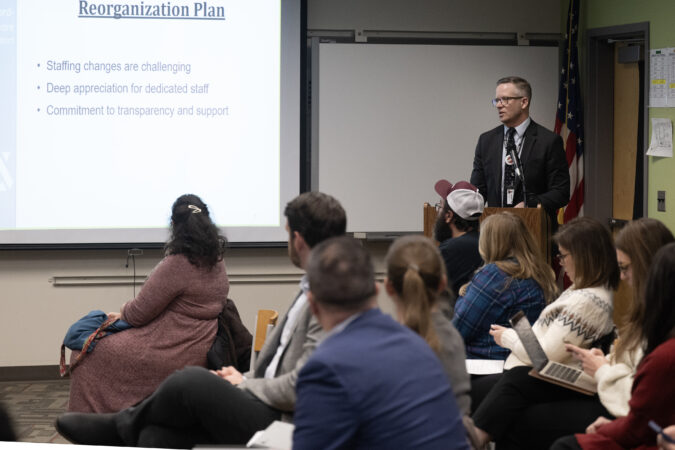
The Wallingford-Swarthmore school board on Tuesday approved a plan that would eliminate nearly 20 positions as it tries to reverse what officials have called a trend of unsustainable spending in the affluent suburban district.
The reorganization plan, which was approved by the board 8-0 and takes effect July 1, will save the district about $2 million, said Superintendent Russell Johnston. Five administrative positions will be eliminated, along with positions for instructional assistants at the middle and high schools, a high school special education teacher, high school secretary, and high school part-time guidance counselor, among other roles.
Some of those positions are currently unfilled. And not everyone whose position is being eliminated will be leaving the district: Employees with seniority will be able to bump less senior staff, Johnston said.
Overall, the changes will result in three to four layoffs, Johnston said Tuesday. Seven long-term substitutes will also no longer work in the district.
“This is not about solving a problem in this year’s budget,” but ensuring the district can sustain its programs in the future, Johnston said Tuesday.
“Bottom line: the district has a spending problem,” DeJuana Mosley, the district’s business administrator, said at a November finance committee meeting. She said there had been “considerable increases” in staffing since 2021 — and the district’s budget grew by 18%, from $89 million to $105 million — despite no increase in enrollment.
The district also lacked adequate inventory management, Mosley said — describing a “culture of just ordering stuff” — and faces other mounting pressures, including deferred maintenance and a lack of curricular investments, including some course materials not aligned to Pennsylvania or Advanced Placement standards.
Mosley described the district’s $164 million capital plan as “added pressure,” but not the source of budget troubles.
Meanwhile, the district’s tax base — which is heavily residential, with limited commercial properties — has declined, Mosley said. Taxable assessed value dropped by $6 million from 2024 to 2025, resulting in a loss of $175,000 in annual tax revenue for the district.
Even if the district raised taxes for the coming year by 3.5%, the maximum amount allowed by state law, it would still be short $2.6 million, Mosley said.
The school board parted ways with former superintendent, Wagner Marseille, in 2024, after an opposition campaign from parents that accused Marseille of excessive spending, among other allegations. Marseille, who had led the district since 2021, was replaced on an interim basis in August 2024 by Jim Scanlon, a former West Chester superintendent.
The board hiredJohnston, a former Massachusetts education commissioner, in May.
In an interview this week, Johnston said that in planning for the fiscal year starting July 1, he “began to see more and more signs that we needed to make this adjustment.”
He said that in November, “I brought the full scope of the problem before the board.”
Which positions are being cut?
Five administrative positions will be cut under the plan approved Tuesday: director of assessment, compliance, and federal programs; supervisor of counseling and wellness; safety and security coordinator; communications and community relations liaison; and supervisor of buildings and grounds.
Other cuts include: two high school and one middle school instructional support positions; a high-school part-time guidance counselor; a high school secretary; a high-school special education teacher; a middle-school safety aide; a middle-school long-term substitute; a middle-school substitute custodian; and six teachers on special assignment helping with new curriculum rollouts. (The plan also includes the creation of two new curriculum supervisor positions.)
In outlining the cuts Tuesday, Johnston said, “This is really about a change in positions, not people.” He said responsibilities from discontinued administrative positions would be shifted to other administrators.
“What’s good for students is sometimes hard for adults,” he said.
The district is also eliminating “Cultural Proficiency Equity Teacher Leader” positions, which were created in 2022-23 and gave additional money to teachers working on equity initiatives.
Johnston said at a finance committee meeting last week that “this is no way a backing off of our commitment to equity,” and responsibilities would be absorbed elsewhere.
What happens next?
The reorganization plan isn’t the only way the district is trying to save money. At last week’s finance meeting, Johnston said the district would eliminate redundant software programs and increase oversight of supply purchases. He also said he would be sending a memo to staff to cut back on snacks at after-school events.
The district, which taxes residents at a relatively high rate compared to others, will be limited in how much it can increase taxes in future years, with the Act 1 index that dictates how much they can increase taxes projected to decline, Johnston said. The board directed district officials to prepare a budget for 2026-27 with an increase between 3-3.4%, under the 3.5% state-imposed limit.
“We want to make sure what we live with next year, we can live with in future years,” he said last week.
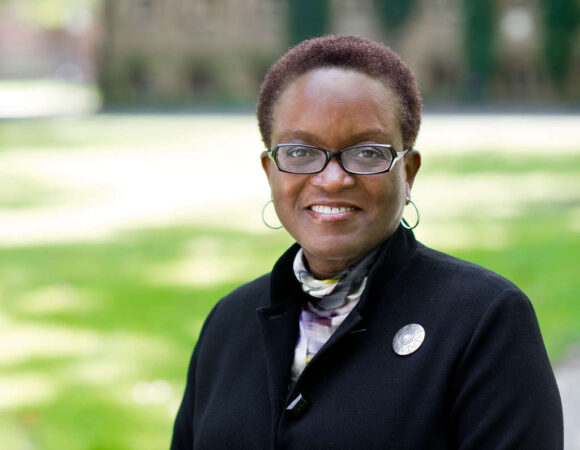
Swarthmore College President Valerie Smith will step down in June 2027 after concluding her 12th academic year in the job.
Smith, the highly selective liberal arts college’s first African American president, said in a message to campus that she decided to announce her decision now to give the school time for “a thoughtful, seamless transition.”
“Serving as Swarthmore’s 15th president has been one of the great privileges of my life,” she said.
Smith, 70, didn’t say specifically why she is choosing to leave the presidency, but it will be at the end of her current contract, which had been extended in 2024. An attempt to reach her for comment Tuesday was not successful.
“These are tumultuous times,” Smith wrote. “Like many institutions, we are navigating new pressures, including unprecedented threats to our very mission. We will continue to face these challenges together, thoughtfully and deliberately. In doing so, we reaffirm Swarthmore’s enduring value.”
The college said it would launch a search for Smith’s successor and already had chosen a search firm.
“This is a pivotal moment for the college and for higher education more broadly, and the board recognizes how consequential this search will be in shaping Swarthmore’s future,” said Harold “Koof” Kalkstein, a 1978 graduate and chair of the school’s board of managers.
A scholar of African American literature and culture, Smith came to Swarthmore in July 2015 from Princeton, where she had been dean of the college and a professor of literature and English.
Smith steered Swarthmore through COVID-19, various student protests — including a pro-Palestinian encampment that was erected on campus in 2024 — and more recently, funding threats from the federal government. Swarthmore had feared that the federal government would increase the excise tax on its endowment earnings, but the school actually ended up not having to pay at all under new rules announced last year.
In 2021, the college decided to stick with a plan to partner with an organization that places retired military personnel on campus as visiting faculty members despite pushback.
“I ultimately drew from the College’s mission and my fundamental belief that critical to the liberal arts is our ability to engage in the exchange of diverse and often opposing views, not to shut them out,” Smith wrote at the time.
When she arrived at Swarthmore, she said her plan for dealing with a student body known for its activism was to listen carefully, craft a careful and well-researched response, and communicate.
“It’s critically important to maintain open dialogue with students,” she said at the start of her presidency in 2015.
“She has modeled integrity, intellectual curiosity, compassion, and empathy, all in service of our shared mission,“ Kalkstein said. ”Swarthmore is forever stronger thanks to Val’s leadership.”
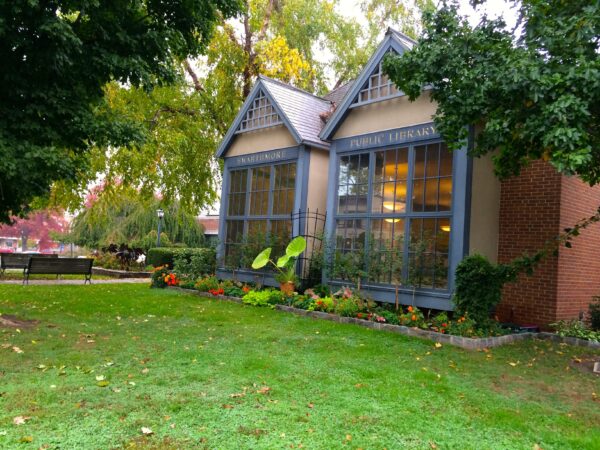
The Swarthmore Public Library has officially done away with overdue fees, joining a growing contingent of libraries that say the fines do more to drive patrons away than to get them to return their books on time.
Swarthmore’s library serves residents of Swarthmore and neighboring Rutledge and is a member of the Delaware County Public Library System. A nonprofit, the library is powered by private donations and government funding. It served around 3,100 cardholders in 2024.
Overdue fines can actually deter library use, all while bringing in marginal financial benefits, said Alec Staley, the library’s director.
Case studies have shown that library fees ultimately can discourage people from returning books. After the Chicago Public Library dropped fees in 2019, it saw a 240% increase in return of materials within three weeks. During a six-week fine-forgiveness program at the San Francisco Public Library in 2017, nearly 700,000 items were returned (the items returned were valued at $236,000).
Once late fees start accruing, many people, especially low-income library patrons, will stay away to avoid paying them, forfeiting their library access entirely. Oftentimes, late fees burden the people who need library resources the most.
Collecting fees has also become taxing for library staff, Staley said. Turning away families because of overdue fees has weighed heavily on Swarthmore’s librarians.
“We were just punishing [people] for no reason at all,” he said.
The new policy means any outstanding late fees will be wiped from cardholders’ balances.
Elizabeth Brown, president of the library’s board of trustees, said fine revenue is “not a meaningful source of our budget.”
Swarthmore Borough is set to contribute $277,000 to the library this year, up 17% from the year prior.
Late fees make up only around 1%, or $5,000, of the Swarthmore Public Library’s annual revenue. Library officials believe they can close the gap with fundraising.
Does this mean people will be able to take the books and run? Not really.
“We’ll still have a lost-item charge,” Brown said. “This is by no means a free-for-all.”
Unreturned items will be marked “lost” after three weeks and a fee will be charged. However, fees will be dropped if the “lost” book is returned.
The Swarthmore Public Library joins a growing group of Philly-area fine-free libraries.
The Free Library of Philadelphia went fine-free in 2020, a move the library system said would increase equity and bring back 88,000 cardholders who were unable to access library services due to fines.
In Delaware County, the Upper Darby Township and Sellers Memorial Free Public Library, Newtown Public Library, Media-Upper Providence Free Library, and Ridley Park Public Library are fine-free.
Ultimately, Staley said, imposing fines runs counter to the heart of what a public library is supposed to be.
“We champion that we’re one of the last free spaces in the United States,” he said. “But then we have this secret where we’re still charging fines.”
This suburban content is produced with support from the Leslie Miller and Richard Worley Foundation and The Lenfest Institute for Journalism. Editorial content is created independently of the project donors. Gifts to support The Inquirer’s high-impact journalism can be made at inquirer.com/donate. A list of Lenfest Institute donors can be found at lenfestinstitute.org/supporters.
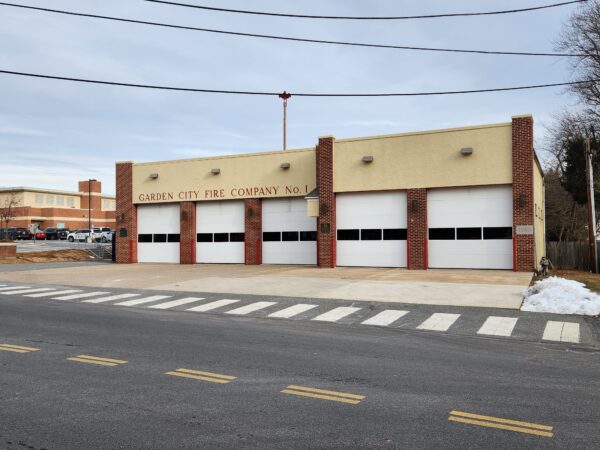
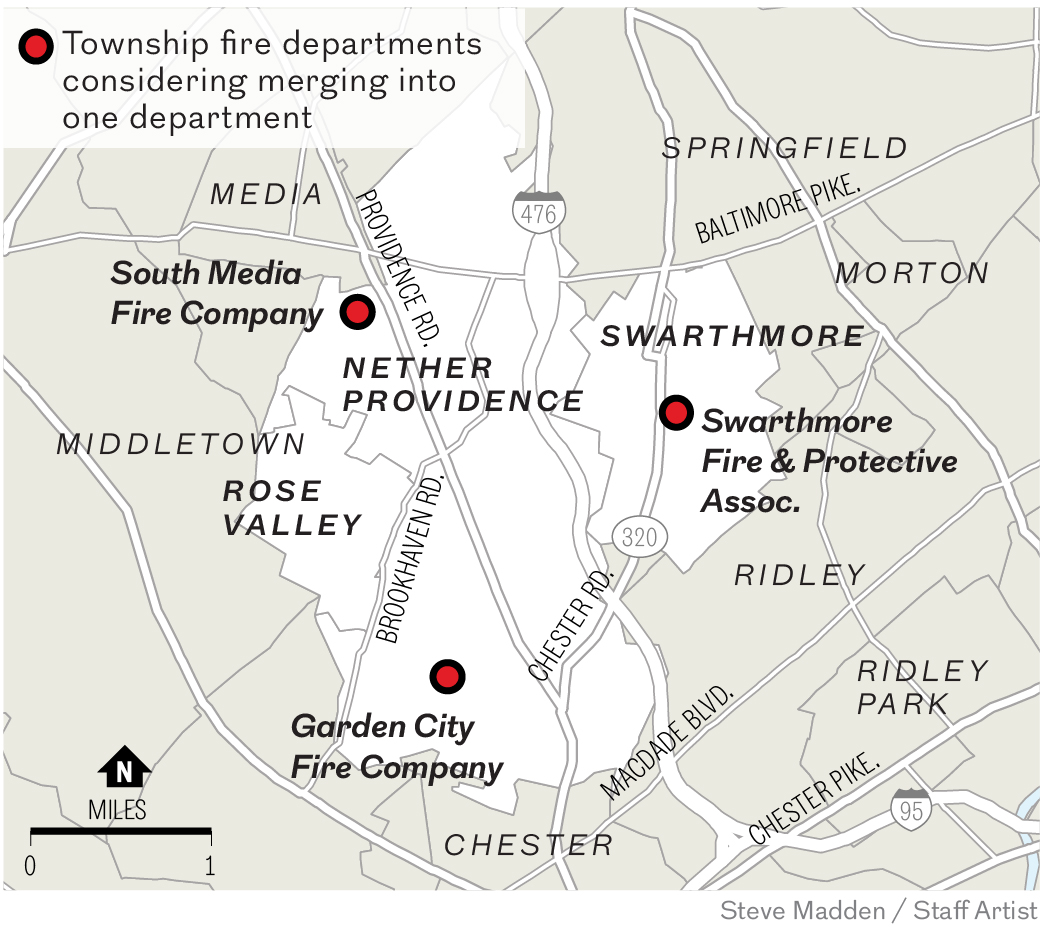
Swarthmore and Nether Providence commissioned Longwood Fire Chief A.J. McCarthy to study the challenges facing the three fire departments. He presented his report to both municipalities in early December.
The report recommended creating one regional fire department to cover the two municipalities plus Rose Valley.
McCarthy’s report highlighted a “critical” lack of volunteer firefighters and financial limitations.
“Just because you haven’t had a disastrous fire doesn’t mean it’s not going to happen,” McCarthy said during a presentation of his report to Swarthmore Borough Council on Dec. 1. “I can tell you right now you’re not prepared for it.”
Three Delaware Co. Township fire companies may merge into one.
Swarthmore Mayor and Fire Chief Conlen Booth called the report “a vital first step” toward a merger.
“The departments are going to need to sit down and look at these recommendations and then digest them,” Booth said. “And then identify ultimately what are ones that make sense for us.”
A complete merger, forming one regional fire department, could take a year and a half to three years, he said, while something less formal could be completed more quickly.
“I think there’s a very good chance that we would follow [the report’s recommendation] with maybe some nuances,” Booth said. “But there is no guarantee that happens and we could have other types of mergers, or we could start with other mergers and then evolve into that full merger.”
Booth has a history of working in emergency services. He joined Swarthmore’s fire company in 2000, eventually working his way up to department chief.
A single regional fire department would need new bylaws, a new charter, joint operation guidelines, and more. A complete merger would also require the departments to dissolve their existing nonprofit organizations and relief associations and create new ones.
“A lot of these pieces are not difficult, it’s the sheer number of pieces that can be felt to be overwhelming,” Booth said.
Nether Providence passed a resolution in support of the merger effort, but Township Manager Maureen Feyas declined to comment on the matter.
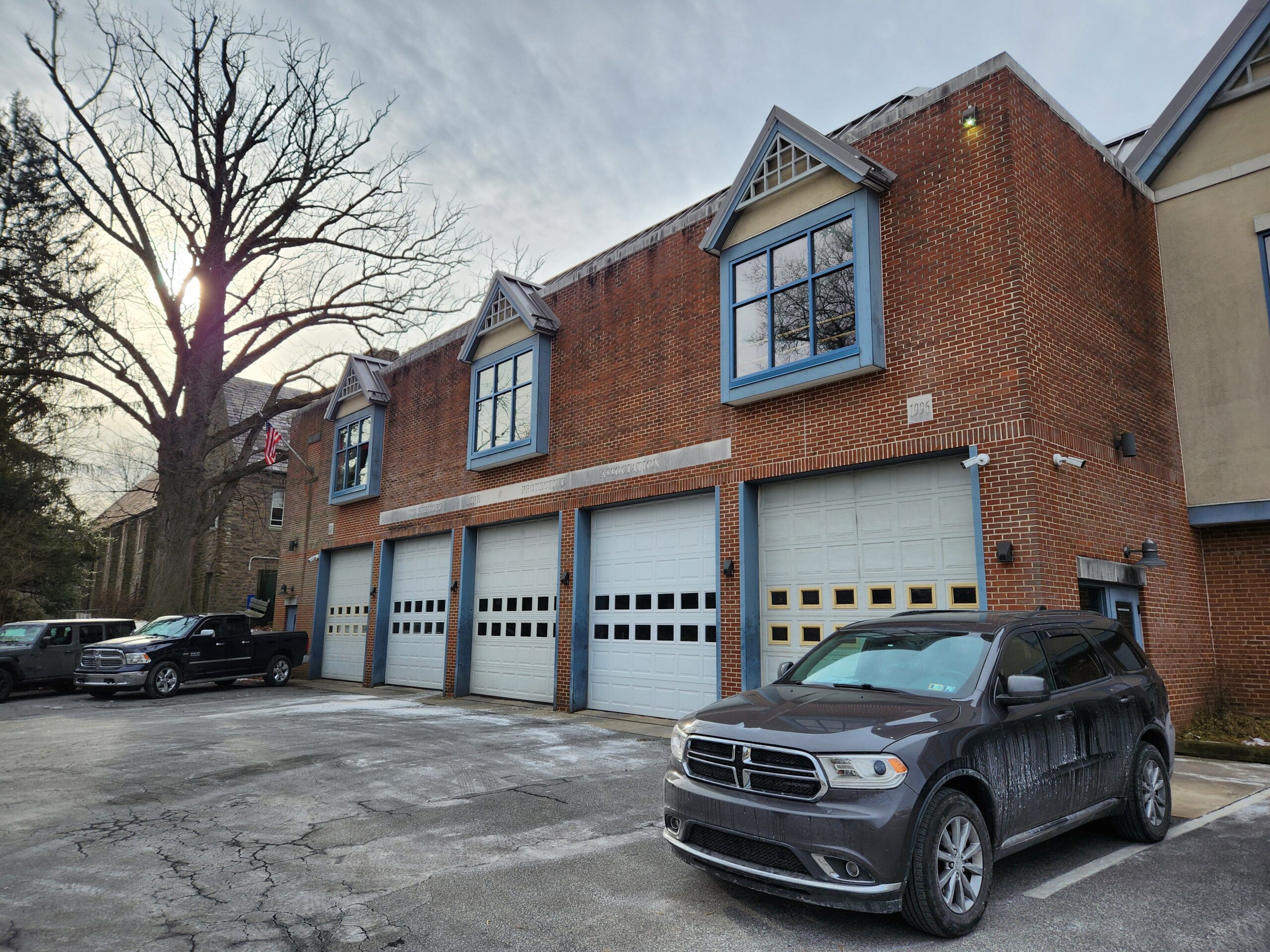
The Swarthmore Fire & Protective Association firehouse.
Lack of volunteers
The biggest challenge for the fire departments is a drop in volunteers. In a 2023 report, Pennsylvania Fire Commissioner Thomas Cook said there were about 30,000 volunteers in the state at that time, down from 300,000 in the 1970s.
South Media and Garden City operate solely with volunteers, while Swarthmore has some paid personnel.
The report, however, says the full-time staff gives the department a “false confidence,” because they respond to both fire and medical emergencies. If two employees leave in the ambulance, that leaves only one behind with little volunteer support during daytime hours.
The report also says South Media was “unable to produce a reliable and constant response” due to lack of volunteers.
Garden City has had more success with volunteers. During a meeting in which McCarthy presented his report to Swarthmore Borough Council, he praised Garden City Chief Pat O’Rourke.
“He’s doing an excellent job and is increasing volunteer numbers year-over-year, which is almost unheard of right now,” McCarthy said.
Part of the reason these fire departments struggle to find volunteers is because they are located in affluent areas, McCarthy said, something he can attest to in his experience leading Longwood Fire Company in Chester County.
“The area I protect has a very high cost of living, so I don’t have residents looking to do one of the most dangerous jobs in the world for free,” McCarthy said in the council meeting. “I have a lot of CFOs and CEOs. They’re busy in hospitals and law firms.”
In 2024, Swarthmore had a median income of $146,992 and Nether Providence’s median income was $145,254, well above the national median of $83,730.
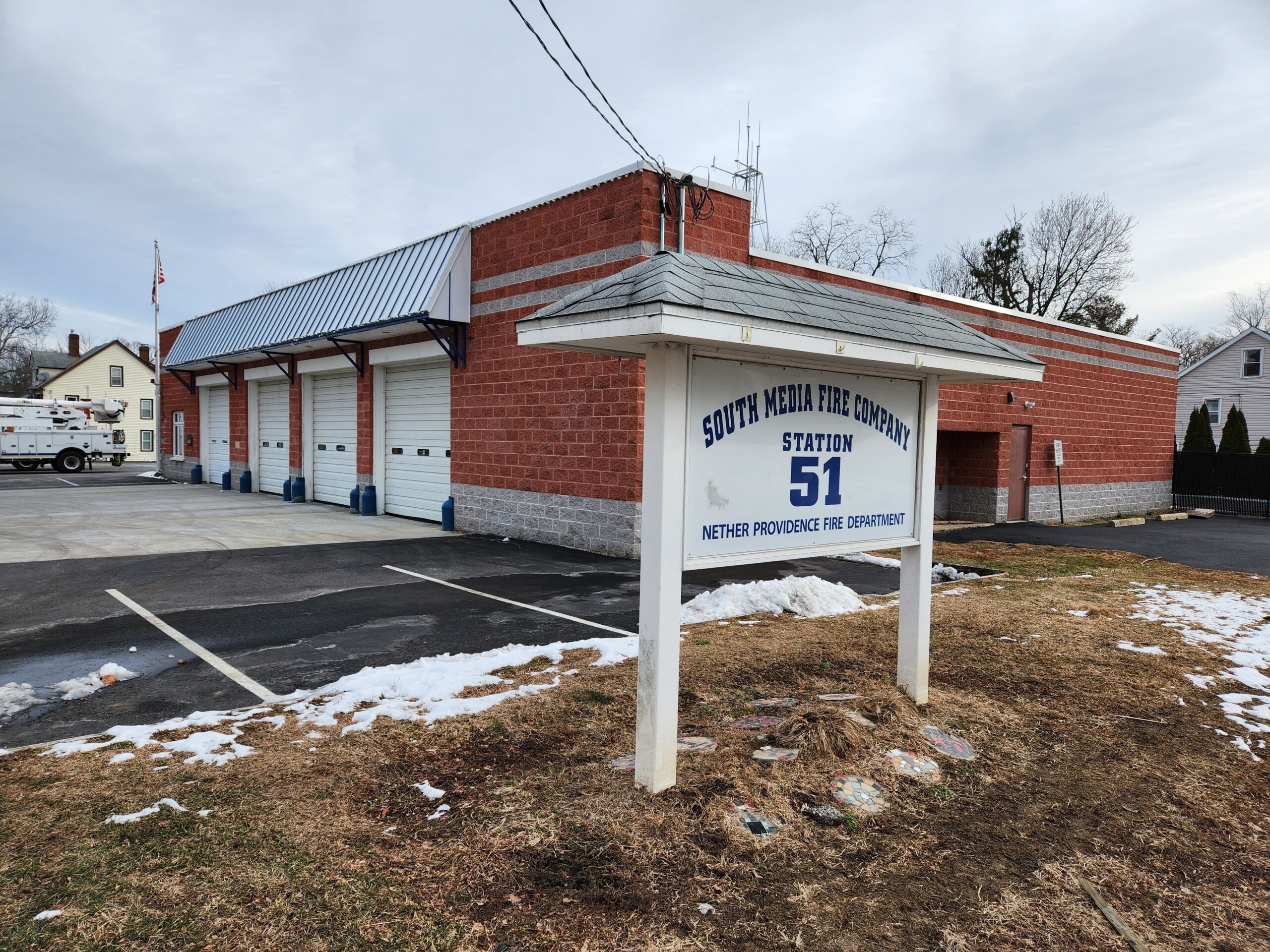
The South Media Fire Company in Nether Providence.
Equipment cost and maintenance
A capital apparatus plan is also needed for upgrading and maintaining expensive fire trucks, ambulances, and other lifesaving equipment, the report states.
Trucks have doubled in price over the last three years and take about five years to deliver, he said at the Swarthmore Borough Council meeting.
“These things have to be planned out,” McCarthy said. “You can’t spend $2.5 million to replace a ladder truck and only start talking about it four months before you order it.”
One of Swarthmore’s trucks costs more to maintain than to use, he said.
Crozer’s closing
The closing of Crozer-Chester Medical Center also put a burden on the area, with more medical emergencies to cover.
Swarthmore stood up an ambulance service that can provide advanced life support in response to the closure, and it nearly doubled the number of calls the department responds to in a month, Booth said.
The loss of Crozer’s ambulance service also means departments are being pulled further away to cover medical emergencies, causing a chain reaction where other departments are called to cover for them.
This suburban content is produced with support from the Leslie Miller and Richard Worley Foundation and The Lenfest Institute for Journalism. Editorial content is created independently of the project donors. Gifts to support The Inquirer’s high-impact journalism can be made at inquirer.com/donate. A list of Lenfest Institute donors can be found at lenfestinstitute.org/supporters.