A few months after Nike paid homage to Kobe Bryant’s Lower Merion roots with a full collection for the 30th anniversary of his state championship run, it appears more locally inspired shoes are on the way next year.
Vanessa Bryant, Kobe’s widow, gave fans a sneak preview of new Kobe releases on the horizon, and among them are Eagles-inspired Kobe 5s in Protro form.
Nike is dropping a Kobe 5 Protro "Philadelphia Eagles” color-way. They will release in January 2027 and retail at $200. pic.twitter.com/o7mZKtWh9C
The shoes — which appear to have a green suede base color — have a black Nike check, a white color lining the midsole and tongue, which features the signature green Mamba logo. According to multiple sneaker outlets, the shoe will drop next January and will retail for $200.
The “Eagles” Nike Kobe 5 is one of seven styles of shoes that Vanessa Bryant posted on her Instagram stories on Tuesday evening. The six other shoes coming in the next year are: the Nike Kobe 6 “Polka Dot White,” Nike Kobe 6 “Polka Dot Red,” Nike Kobe 6 “Bellisima,” Nike Kobe 9 Elite High “Ironman,” Nike Kobe 9 Elite Low “Dusty Pink,” and Nike Kobe 9 Elite Low “CA Mountain Snake.”
It is past time for Division I colleges and universities to recognize that their student-athletes deserve both the right to bargain collectively and recognition that they are employees because of the compensation their institutions provide to them and the control those institutions have over them.
A deluge of media coverage has been aimed at other issues in big-time college sports, particularly football and basketball, but too little attention has been given to what should be center-stage — how student-athletes should be fairly treated by the institutions that benefit from their athletic prowess.
The Senate Commerce Committee recently held a hearing on the Protect College Sports Act of 2026, sponsored by Sens. Ted Cruz (R., Texas) and Maria Cantwell (D., Wash.), to “restore order” to college sports. This 111-page legislative effort is the latest in a series of approximately 40 bills aimed at reversing judicial rulings that oblige universities to share financial gains with their players.
Like their legislative predecessors, the 2026 bill limits or ignores existing player rights and immunizes universities from antitrust liability resulting from player-initiated litigation and substitutes Congress’ judgment for the courts, players, and universities.
Thus, the 2026 bill restricts the ability of players to transfer through a “portal” from one college to another and limits player eligibility to five years beyond the day of high school graduation. The bill would preclude awarding antitrust damages to players who seek to increase their mobility and earnings. It would also preempt state laws guaranteeing players compensation for their names, images, and likenesses used, for instance, on video games and athletic clothing (this has come to be called NIL money).
Until the last decade, the unchallenged position of the National Collegiate Athletic Association was that all college players are amateurs entitled to no more than athletic scholarships and frequently inadequate reimbursement for college expenses. Post-World War II football and basketball were dominated by the Southeastern Conference and the Big Ten, and both were big businesses.
Notwithstanding this reality, the NCAA maintained that the players were amateurs who could not be paid until the U.S. Supreme Court in 2021 ruled that the NCAA and its member campuses were liable for treble damages when they conspired to deny the players “educational” compensation beyond athletic scholarships and reimbursements.
Universities became involved in class-actions brought by their players about player transfers, eligibility, and related issues following that Supreme Court ruling. The ruling recognized that the universities have always treated athletes differently from other students, sometimes providing them with preferred admissions as well as under-the-table monies and other benefits, frequently in conjunction with wealthy alumni and “boosters.”
With California leading the way, many states enacted so-called NIL laws that allow players to be compensated for use of their names, images, and likenesses.
But the NCAA continued to insist the players were amateurs. As a result, outside “booster” groups or “collectives” were created to provide business deals to attract or retain college athletes from a source other than the universities.
Meanwhile, institutions of higher learning went to war to attract coaches with multimillion-dollar salaries, often exceeding those of any other employee, and — among state universities — any other state employee, including governors.
In the wake of these developments, an immediate response was the negotiation of financially lucrative media deals by the universities and a realignment of college conferences.
Stanford University, for example, left the Pac-12 Conference to join the Atlantic Coast Conference, requiring all its varsity athletes to travel regularly across the country, increasing the separation from their classrooms.
Further, NIL procedures have become a kind of Wild West, sometimes composed of shadowy characters and “agents” who operate without any regulation as is provided in the professional leagues.
Earlier this year, President Donald Trump convened a meeting of business and university officials in connection with a new executive order to preempt state regulation. The 2026 Cruz-Cantwell bill is the most recent response. It consigns players to minority representation on an athletic “governing board” or “rulemaking committee.”
Deeply troubling, it avoids even a mention of collective bargaining or employee status for the players. The current National Labor Relations Board is unlikely to address these issues effectively. And this Congress is unlikely to act on the Cruz-Cantwell bill.
Some, we realize, claim we should go back to an earlier era when money was not center stage in every aspect of Division I college sports. But it is too late to return that genie to its bottle.
Rather than wait for voluntary recognition of the organizing power of college players, or for state legislatures to take action, Congress should amend the National Labor Relations Act to allow student-athletes to exercise their collective bargaining rights.
This step by a new Congress in 2027 could provide much-needed protections for college athletes in terms of adequate compensation, health and safety protections, as well as a reasonable measure of player mobility fashioned by both students and universities seeking a balance between freedom and a disruptive revolving door.
After all, the most appropriate forum for resolving the complex matters around modern-day college athletics isn’t through one-off legislation or the occasional court ruling, but rather at the collective bargaining table.
Thomas Ehrlich is the president emeritus of Indiana University, former provost of the University of Pennsylvania, and former dean of Stanford Law School. Currently, he is an adjunct professor at the Stanford University Graduate School of Education. William B. Gould IV is the Charles A. Beardsley Professor of Law, emeritus, at Stanford Law School. He is a member of the National Academy of Arbitrators and former chairman of both the National Labor Relations Board and the California Agricultural Labor Relations Board.
After nearly a half-century in business, Jollibee has added a fast-food staple it had long gone without: chicken nuggets.
The Filipino-rooted chain, whose lone Philadelphia-area restaurant is at Cottman and Bustleton Avenues in Great Northeast Plaza, introduced the all-white-meat nuggets nationwide last week. They are sold in five-, eight-, 15-, and 30-piece orders, starting at $4.49 for five.
For a company best known for its Chickenjoy fried chicken, Jollibee sees nuggets filling a different niche.
Luis Velasco, senior vice president at Jollibee Group North America, said the company had seen growing demand for nuggets. Rather than competing with the bone-in chicken or its chicken sandwich, which Jollibee introduced in 2021 during the height of the “chicken sandwich wars,” they’re intended as a shareable complement to the fried chicken sandwiches.
Chickenjoy, the signature fried chicken from Jollibee, gets a dunk into gravy at the location at 7340 Bustleton Ave.
Jollibee also sells burgers, fried mango-peach pies, and Filipino spaghetti, a saucy dish whose sweet-and-savory sauce is loaded with ground beef, sliced hot dogs, and melted cheese.
Like the sandwich, the nuggets borrow from the same fried-chicken playbook. They are served with its tender sauce (similar to Cane’s sauce), as well as creamy sriracha, honey mustard, ranch, pineapple BBQ, and chicken gravy, the usual accompaniment to Chickenjoy.
The nuggets drew a steady stream of orders at the Northeast Philadelphia restaurant on Friday.
First impressions: They have plenty of crunchy nubs on the thin coating and a juicy interior. They don’t have the soft, processed texture common among fast-food chains’ nuggets.
“They’re crispy and crunchy and all, but they don’t have the same hard crunch as my Chickenjoy,” said Bing Garcia of Lawndale after taking a first bite.
Paul Santos of Castor Gardens sampled his order with a fork before dunking each piece into a cup of Jollibee’s gravy, the savory sauce with a touch of sweetness.
“I ate my first one plain, and it was fine — maybe a little dry,” Santos said. “You can’t beat their gravy.”
Caleb Zimmerman needed a new place to crash, fast.
It was August 2019, and the 27-year-old was finishing a remodel with his brother, Micah, on a Strawberry Mansion house. He had purchased the property with plans to rent it out post-renovations and was living there in the meantime.
With the remodel nearing completion, Zimmerman wasn’t seeing any interesting properties to take on as his next project — and next place to live.
In desperation, he turned to Craigslist. And there, listed for $85,000, was the three-bedroom Kensington rowhouse he’s called home ever since.
“I bought it the next day” for $82,500, he said, confirming, no, that’s not hyperbole. “I knew the location was incredible and was just going to keep getting more incredible.”
Even before walking through the two-story house, Zimmerman had an idea of what he wanted this next project to look like. Though the house needed a full gut remodel, he saw that the structure could accommodate his vision of an open floor plan with a floating staircase and basement steps concealed by a trap door on a pulley system. It was, to be sure, a huge project, but Zimmerman knew he could get it done.
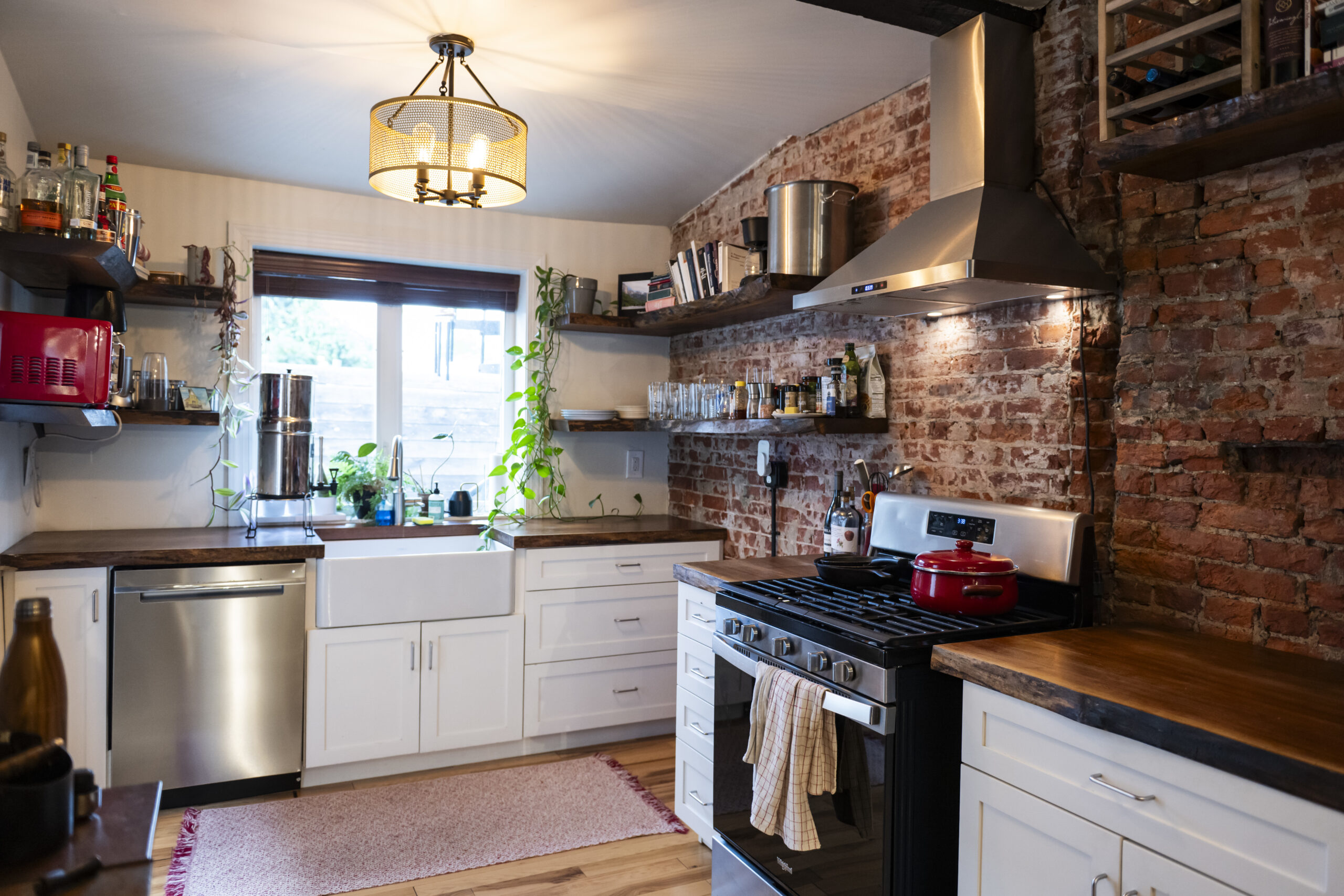
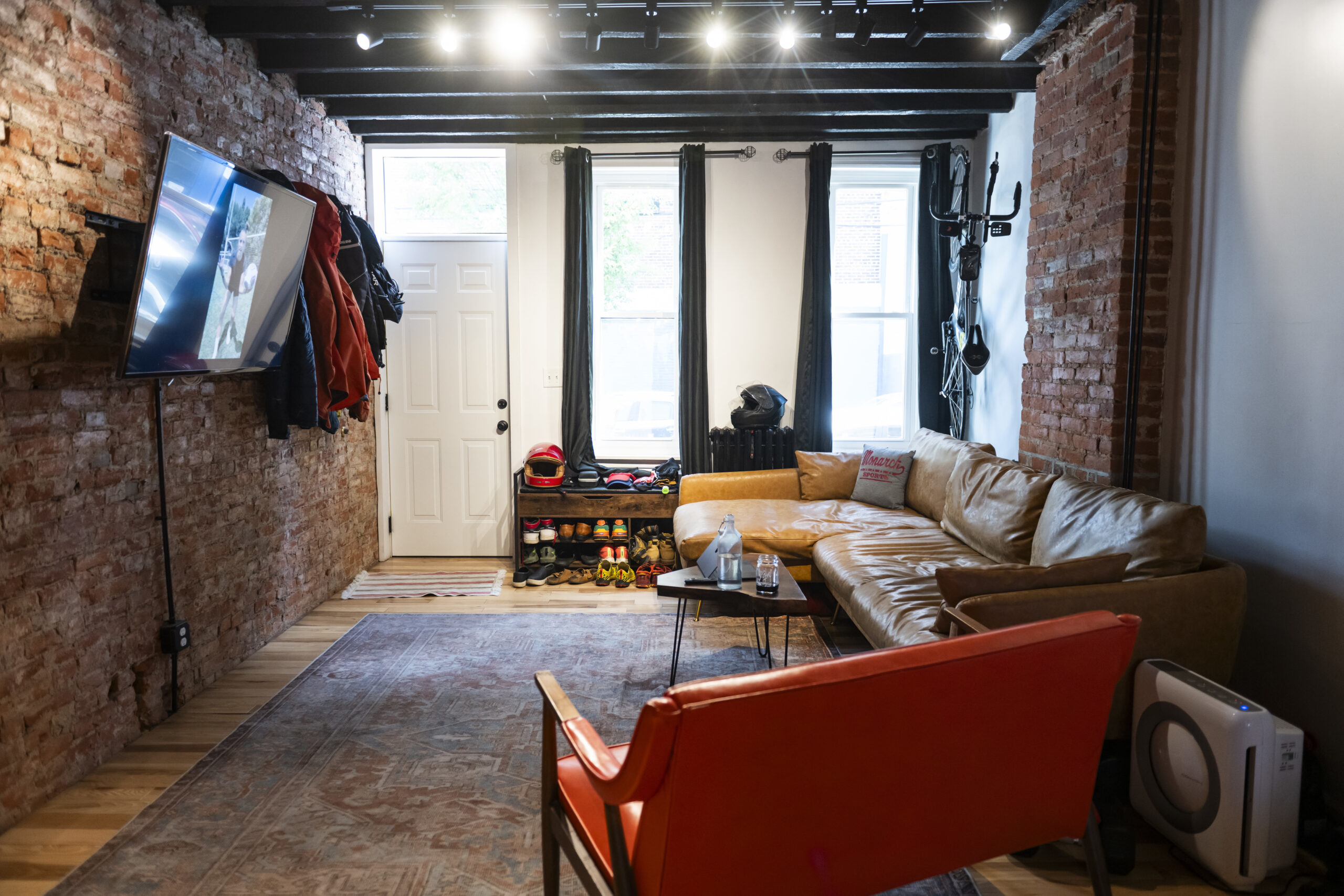
The kitchen, which was built by a family friend, Aden Stoltzfus.The entrance to the home and the living area.
“I feel like the Mennonites have it in their genes,” said Zimmerman, who’s of Mennonite heritage and who just wrapped a stint as an instructor of philosophy at the University of Pennsylvania. “I’m primarily a philosopher, but I wanted to kind of prove my chops, I guess, prove that I can also do things with my hands.”
Zimmerman and his brother moved in that summer and began work the first day of Christmas break. He took a leave of absence for a semester from Temple University, where he was working on his Ph.D. in philosophy, to see the project through.
Everything in the house needed to be replaced, so that meant everything needed to come out.
“The kitchen was an atrocity,” Zimmerman recalled. “There were mice running around.”
Custom wooden shelving is fastened to an exposed brick wall in the kitchen.
For demolition, which included removing the floors and pulling down the lathe and plaster throughout the house to reveal its underlying brick, guys in the neighborhood would often stop by to see if they could lend a hand for an hourly wage, Zimmerman said. One guy, in particular, “has so much sweat equity in the house that anytime he knocks and needs some help” Zimmerman opens his door to him to this day.
Throughout the project, the Zimmerman brothers lived in two of the three bedrooms upstairs with Micah as Zimmerman’s right-hand helper and renter. The first night he moved in, Zimmerman said, he slept on the floor. It was just the beginning of the long discomfort he’d endure living among the renovation, but it encouraged him to push to get the project done.
For rebuilding, Zimmerman drew on his Mennonite heritage and connections. He and Micah brought in wood from an Amish mill for kitchen beams and the custom staircase. A family friend, Aden Stoltzfus, made the kitchen — his daughter Hadassah Stolzfus recently spoke to The Inquirer about her own home renovation, also featuring a kitchen created by her dad.
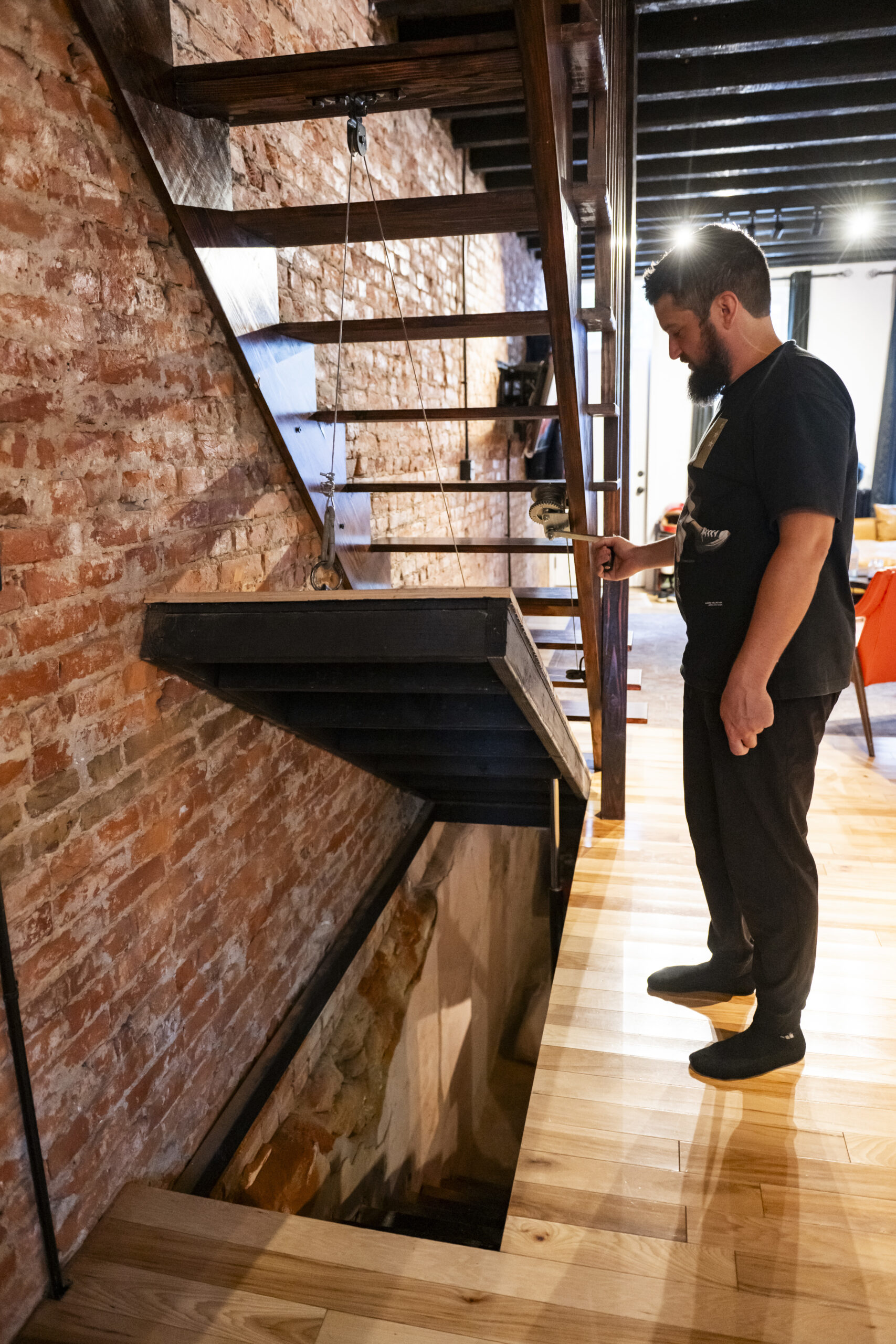
The home’s centerpiece of engineering is a trap door that conceals the basement and opens with a pulley system and remote-controlled actuator. It was built by Gabe Stoltzfus, Hadassah’s cousin. Gabe also handled the bathroom renovation, where Zimmerman planned to remove the tub and install a standing shower with a glass enclosure to make the small room feel larger.
Zimmerman opens the trap door to his basement. He removed a wall with a door to the basement and created more open space by incorporating the trap door.Zimmerman installed a glass-walled shower to make the bathroom feel more spacious.
Zimmerman had some experience laying hardwood floors, so he installed the new wood floors that run throughout the house. A friend, Kevin Bucher, helped install some trim, including, in a feat of patience, a piece that he cut to mirror the topography of the brick wall in what is now Zimmerman’s office.
Zimmerman did bring in some outside help to install drywall, seal the fireplace, and rewire the house. The renovation cost about $80,000 in total.
By the fall of 2020, “it was livable,” Zimmerman said, though he had lived there all along. His brother Micah stayed for a while, too, but moved out in 2022.
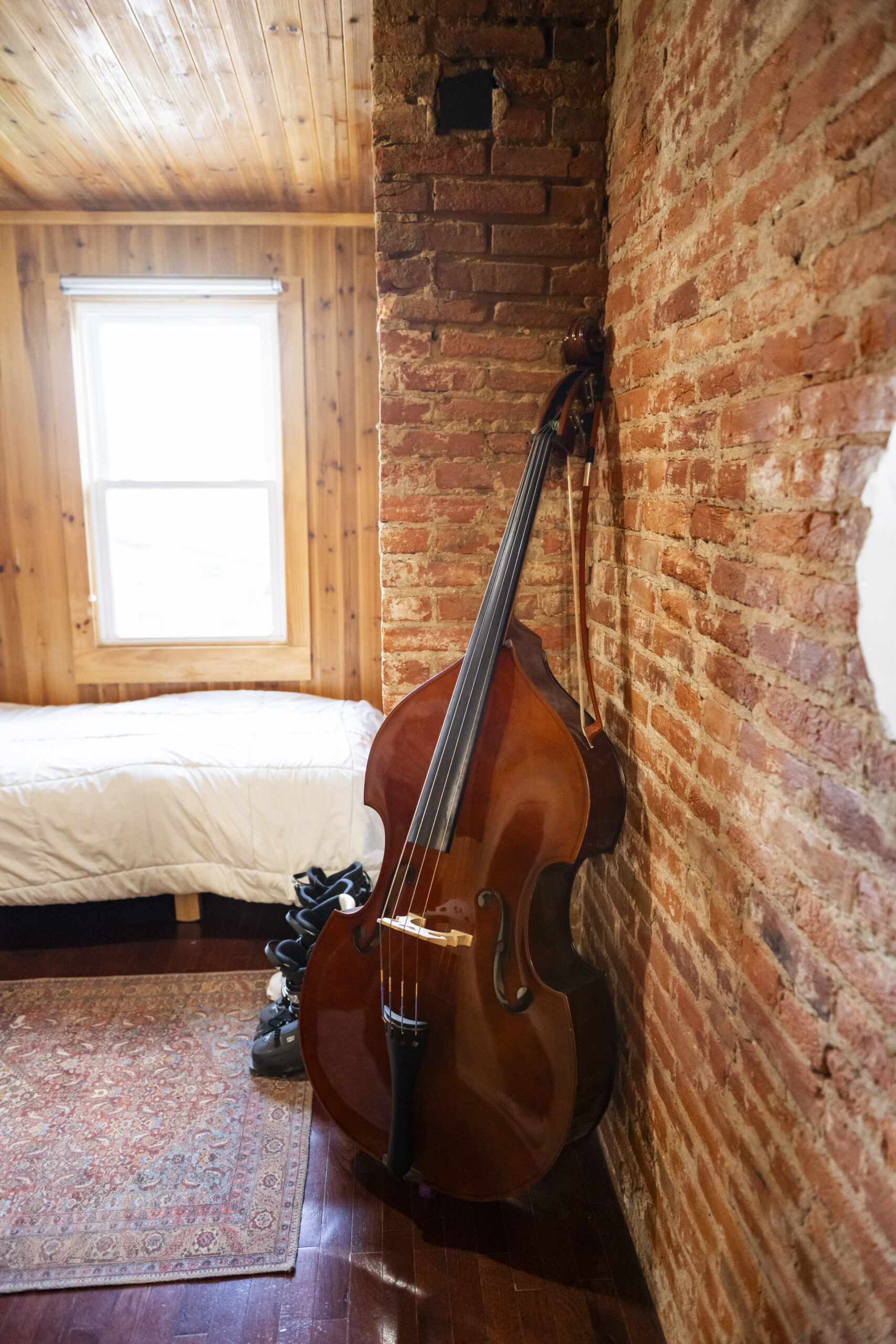
An upright bass is on display in the guest room.Exposed brick and wood paneling on the wall in the guest room.
Now Zimmerman entertains often and said people always say his red refrigerator is their favorite aspect of the house. Knowing how much custom behind-the-scenes work went into every aspect of the property, he receives that comment about a store-bought appliance with some chagrin. It’s only because he knows how much was accomplished before that final, finishing flourish.
Reflecting on the renovation, “I doubt that I will do anything like this again,” he said, “but I wanted to know I could do it.”
Is your house a Haven? Nominate your home by email (and send some digital photographs) at properties@inquirer.com.
The Justice Department sent letters to all 50 states and the District of Columbia on Tuesday threatening criminal prosecution of top election officials if ballots cast by noncitizens were counted in upcoming elections.
The letters arrived in the midst of an ongoing campaign by President Donald Trump and his allies to tighten election rules to prevent a problem that doesn’t exist: widespread noncitizen voting in American elections.
The effort has, however, continued to sow doubt and distrust in the electoral process, most notably among the president’s base of supporters. And his proposals could have the effect of making it more difficult for eligible voters to cast their ballots — an outcome that many voting-right activists say is the president’s real goal.
The letters sent Tuesday came from Harmeet Dhillon, who runs the Justice Department’s civil rights division. They are largely identical, according to multiple copies obtained by The New York Times. The seven-page letters detail a host of federal election laws that prohibit noncitizens from voting in elections — laws that have been clear for decades.
“Any election officer, including the chief election officer of the state, who knowingly retains noncitizens on the state’s” voter list “or facilitates noncitizens in receiving and casting ballots could be subject to criminal liability,” Dhillon wrote.
The letters asked the election officials to respond to the Justice Department “within five days” with details on how their states intended to comply “with these federal laws both at the state and local level and how the Department can assist in those efforts.” It is unclear what would happen if a state does not respond in five days, as the letters are not subpoenas requiring a response.
Lt. Gov. Deidre Henderson, the top election official in Utah and a Republican, expressed frustration with the Justice Department’s tenor and tactics.
“Got another love letter this morning from the DOJ sprinkled throughout with threats of criminal prosecution,” Henderson wrote on social media. “I’m sure I’m not the only chief election officer of a state who is being targeted for following state and federal laws by resisting DOJ’s demands for private voter data that have thus far been ruled illegal by at least a dozen courts. This is truly bizarre behavior by the federal agency that is supposed to be protecting civil rights.”
Adrian Fontes, the Democratic secretary of state in Arizona, criticized the efforts by the Justice Department as politically motivated.
“It is insulting to insinuate that the good people at our county recorders’ offices across the state are not doing their jobs correctly,” Fontes said. “Arizona election officials have always worked to ensure that only eligible citizens are registered to vote, and we will continue following Arizona law — not directions that come from political rhetoric or intimidation.”
Justice Department officials have said their purpose in seeking voter roll data is to ensure compliance with federal law requiring states to maintain accurate voting rolls. Some voting-rights advocates have speculated that the department’s specific aim is to look for evidence of noncitizen voting or use voter roll data to challenge future election results.
Kiersten Pels, a spokesperson for the Justice Department, confirmed that letters were sent to officials in all 50 states and the District of Columbia, seeking “voluntary compliance in a timely manner with their obligations under federal law to ensure only citizens vote in federal elections.”
David Becker, a former voting rights lawyer for the Justice Department who now runs the Center for Election Innovation and Research, a nonpartisan group that works to build confidence in elections, said that the letters from Dhillon look like a performative display by the Justice Department to show it is working aggressively on one of the president’s priorities despite little success.
“This is what panic and desperation looks like,” Becker said. “They’ve had 18 months to find evidence of a crime that was never committed, and found nothing. And now they fall back on crude and transparent bullying tactics. They sent these letter to several, perhaps all states, with no specific evidence of a crime.”
He added that “the election officials I’ve spoken with aren’t intimidated, and are seeing these empty threats for what they are.”
The Justice Department also sent letters to three cities in Michigan — Detroit, Lansing and East Lansing — stating that federal election monitors from the department would be going to the areas for the upcoming primary election. The department’s stated reasons were observations from the 2024 election, citing a lack of provisional ballots in at least one polling location and voting machines that were not operational in multiple polling locations.
Michigan election officials roundly rejected both the claims from the Justice Department and the reasons for sending monitors. Janice M. Winfrey, the city clerk in Detroit, wrote in response Tuesday that the Justice Department had made “false assertions that form a baseless conclusion that then becomes the pretext for additional monitoring of Detroit elections.”
Winfrey added that “according to our records, there were no representatives from the Department of Justice, and if so, they did not comply with regulations requiring them to identify themselves and sign in with supervisory staff at the polling place.”
For years, Trump has claimed without evidence that noncitizens voting in American elections have benefited Democrats. After the 2016 election, which he won, he claimed that as many as 3 million ballots in California had been cast by noncitizens.
Since returning to office, Trump has led a relentless effort to prove his claims using the levers of the federal government.
None of those investigations has provided any evidence of widespread noncitizen voting. An initial review in January of nearly 50 million voter registration records by the Department of Homeland Security referred roughly 0.02% of the names processed for further investigation.
I never thought I’d be writing a column that led off with an analysis of soccer.
I’d planned to write about the lessons our nation’s 250th birthday party provided for Americans about the real meaning of “patriotic values.” But as it turns out, an examination of the scandal that ensued after President Donald Trump’s shameful World Cup intervention provides the perfect example of what those values are and what they are not.
Before getting to the game, it’s important to revisit what Thomas Jefferson meant in 1776 when he wrote in the Declaration of Independence that the Creator had endowed all men equally with “the right to life, liberty and the pursuit of happiness.” Although honored in the breach when it came to slavery and women’s rights, these ideals have been the goal toward which America has gradually, but consistently, aspired — until now.
Many probably assume that “pursuit of happiness” means material success or personal pleasure. But for the Founding Fathers, educated in the philosophy of ancient Greece and Rome, the phrase reflected the classical emphasis on civic duty and character development. In other words, the concept of patriotism was tied to the pursuit of an honorable and civic-minded life.
Now back to soccer.
Until the July Fourth weekend, the World Cup matches had provided a brilliant exhibition of the best of America, with cities across the land and fans in every stadium effusively welcoming teams of every race and color. In an incredible burst of U.S. soft power, the global image of Trump’s America as overtly racist, corrupt, and violent gave way before the warmth of ordinary Americans.
But Trump could not refrain from popping that wonderful bubble. After America’s star striker, Folarin Balogun, received a red penalty card during the team’s 2-0 win over Bosnia and Herzegovina — which would force him to sit out a critical match against Belgium — POTUS phoned FIFA’s president, Gianni Infantino.
A Trump sycophant who had previously awarded him FIFA’s first medal of peace, Infantino gave the president what he wanted: a reversal of a red card ban during a World Cup game (for the first time since 1962).
In one move — based on his philosophy that only winners count — Trump cast a pall over the World Cup. He reversed all the goodwill the matches had generated for America at a time when his erratic behavior had sunk global attitudes toward the U.S. to astonishing new lows.
Yes, Balogun’s violation was accidental, and the red card undeserved, but how many times have we all witnessed wrong calls by referees or umpires that drove us insane? However, under FIFA rules, there is no appeal after a game is over. Imagine if every world leader copied Trump’s utter disdain for rules in sports as well as domestic and international laws, a disdain which is already causing global chaos.
On Monday, the U.S. team lost 4-1 to Belgium. But Trump’s interference made that defeat more painful by precipitating a wave of global scorn that poured down on an undeserving team. Nor has Trump had one word of praise for this terrific team after their loss.
However, the lesson from Trump’s soccer debacle is not all negative. Americans should take pride in the achievements of the U.S. team and be inspired by the overall atmosphere of the games before Trump’s ugly intervention.
And the country should unite in praise for the patriotic virtue displayed by Balogun.
A day after receiving his red card, the star striker told an interviewer: “It’s been surreal, to be honest. But for me, I think it was just important to stay calm. I never want to react out of anger and out of emotion.
“There’s still lots of people we’re inspiring, little kids, boys and girls who are watching, and we have to show them the correct way to handle things, even when you think it’s unjust.”
What a hero! And what an example of patriotic virtue by someone who, under Trump’s attack on birthright citizenship, wouldn’t even qualify to play for Team USA, being born in Brooklyn to Nigerian parents visiting from London.
Furthermore, the president’s negative example over the holiday — turning the Semiquincentennial into a celebration of himself, even as news broke of the incredible billions POTUS and his family have raked in off his presidency, and even as he upped his efforts to rig the midterm elections — should goad us all to revisit the meaning of “pursuit of happiness” in civic terms.
Two critiques of Trump over the weekend — one indirect, one powerfully direct — can serve as further inspiration.
The first comes from Pope Leo XIV, in his powerful livestreamed speech on July 3 at Philadelphia’s National Constitution Center while accepting the prestigious Liberty Medal. “The principles that inspired America’s founders,” he said, “brought them together in … a common dream. Unity lent strength to that dream … E pluribus unum — out of many, one. In order for a nation to flourish, it must be truly united, not by goals bound to momentary endeavors, but by ideals that do not fade with the passing of time.”
These words need to be taken to heart, to my thinking, especially by progressive Democrats. Their anger is understandable, but in the final instance, they must work together with all those who appreciate the need to curb Trump’s desecration of the founders’ values. That includes all Democrats as well as independents and moderate Republicans who appreciate the need for checks and balances on presidential power.
As Benjamin Franklin famously said at the signing of the declaration, “We must all hang together, or assuredly we will all hang separately.”
And finally, some inspiring words from Vice President JD Vance, written in 2016 for the Atlantic before he turned against the values of the founders, and republished by the site on July 4.
“What Trump offers is an easy escape from the pain,” he wrote. “To every complex problem, he promises a simple solution. He never offers details for how these plans will work, because he can’t. Trump’s promises are the needle in America’s collective vein.
“The great tragedy is that many of the problems Trump identifies are real … Yet so long as people rely on that quick high … the nation delays a necessary reckoning. There is no self-reflection in the midst of a false euphoria.
“Trump is cultural heroin. He makes some feel better for a bit. But he cannot fix what ails them, and one day they’ll realize it. And then, perhaps the nation will trade the quick high of ‘Make America Great Again’ for real medicine.”
In memory of the Founding Fathers, who pursued their principles when the struggle seemed impossible, let us hope such a realization starts this fall.
Right now, black walnuts look like small neon green tennis balls clustered on a branch. Their interiors are creamy and gelatinous.
Danny Childs, the founder of Slow Drinks — who is currently in the midst of opening his first cocktail bar, Field Day — uses black walnuts in this state for black walnut nocino, a variant of the bittersweet Italian liqueur known as amaro. “When I make amari in general, it’s always a way to showcase a certain place at a certain time,” said Childs, who forages his black walnuts from a running trail in Merchantville.
“When you’re making nocino, you pick them in June,” Childs said. “The knife can easily pierce the black walnut, as the actual nut hasn’t formed yet. It’s still a jellylike substance.”
Childs uses 151 proof vodka from Devil’s Springs in New Jersey to macerate his walnuts. His black walnut nocino is also on the menu at Almanac, featured in their cocktail the Juban District. It’s blended with Japanese whiskey, scotch, vermouth, Okinawan Kokuto brown sugar, and bitters. It’s funky and savory, and sweet without being cloying. And it has become a classic cocktail on Almanac’s menu.
And so, the Almanac team has also just gone foraging for black walnuts.
At Field Day, Childs’ black walnut repertoire will expand. “We’re going to start using the walnuts in other ways after nocino this year — to infuse wine to make nociato, and then use them to make black walnut miso.” He’s working with fermenter Jamaar Julal, previously of Honeysuckle, on these projects.
Danny Childs picks black walnuts in Merchantville.
Look closely, and you’ll start to see black walnuts everywhere, from shortbread cookies at Ellen Yin’s Bread Room to Randy Rucker’s sauces for seafood at Little Water.
Crisped up in a pan, the Heavy Metal Sausage’s mortadella, inlaid with cubes of smoked pork jowl and hard toasted black walnuts, emits a heady aroma of pork and socks. It is funky, distinctive, and heavenly; it tastes milder than its scent, like uncured bacon that had nestled next to a blue cheese for a few days in the fridge.
Pat Alfiero, Heavy Metal’s co-owner and butcher, sources shelled black walnuts from Ian Brendle of Green Meadow Farm in Gap, Pa., who has about 100 black walnut trees on his property. Brendle also functions as a middleman, shuttling nutmeats processed just south of Pennsylvania to chefs.
Jamaar Julal, Field Day’s director of fermentation, picks black walnuts in Merchantville.
“To me, black walnuts are very unique, like pawpaws. If you had a hundred people eat them, half would like them and half would hate them. Pawpaws have the same unctuous floral perfume as black walnuts,” said Brendle, who now sells five to 10 pounds of shelled black walnuts every week, twice as much as when he started selling them two decades ago.
“They’re a misunderstood tree nut, for sure. But any nut or plant that can be foraged sustainably should be consumed. Anytime you can consume something that doesn’t require immense amounts of water or makes a negative impact is a step in the right direction,” said Brendle.
Black walnut trees are found in dense thickets in Fairmount Park, and on practically every farm and expansive backyard in and around Philadelphia. They’re native to the Mid-Atlantic, like hickory nuts and pecans. They swath the East Coast, growing as far north as the border with Ontario and as far south as Florida.
Every part of the black walnut contains juglone, which is toxic to many other plants, but perfectly safe for humans and animals to consume. For many gardeners and homeowners, black walnuts are a nuisance, staining hands if you gather them without gloves on, as well as the asphalt driveways on which they fall. The nuts get caught in lawn mowers and can also be dangerous projectiles, falling from great heights — the trees can grow up to 80 feet tall — denting car roofs and unlucky heads.
If nuts could talk, black walnuts would say, “They don’t like us, we don’t care.”
For Alfiero, Brendle, and the others, there is an urgency to using black walnuts. Nut farming is water intensive, and the almond industry in California has repeatedly come under scrutiny for its groundwater consumption. The walnuts in a typical supermarket are the Persian or English variety. In the U.S., 99% of them also come from California. It takes about 26.7 gallons of water to grow an ounce of English walnuts.
“We’ve created so many problems for ourselves in the world, simply by being spoiled and being able to purchase, say, pistachios at the store. People grow almonds and other nuts in places that don’t naturally have a lot of water. We’ve created a market for things that don’t make sense,” said Jeremiah Langhorne of the Dabney in Washington D.C, one of the chefs responsible for the black walnut’s current popularity on menus up and down the Northeast Corridor.
While the nuts, shelled and toasted or raw, may not be as snackable as the more common English varieties, they have a wide range of uses among Indigenous populations.
In Braiding Sweetgrass, Robin Wall Kimmerer, a member of the Citizen Potawatomi Nation, wrote, “The hickories, black walnuts, and butternuts of our northern homelands have their own specific names. But those trees, like the homelands, were lost to my people.”
Though Native Americans carried black walnuts and other related nuts with them as they were displaced, “The federal government’s Indian Removal policies wrenched many Native peoples from our homelands. It separated us from our traditional knowledge and lifeways, the bones of our ancestors, our sustaining plants,” Kimmerer writes.
Native peoples were divorced from their trees, and now, chefs, distillers, and foragers are trying to form new bridges with the same wild trees.
How to use black walnuts throughout the year:
Early spring to summer: Gather the leaves
“Use the leaves in early spring when they’re just the size of squirrel’s ears,” said Robert Gustafson, a Virginia-based specialist in wild foods. This is when they can be blended and fermented into sauces.
“Our entire goal is to find what grows well around us, and be receptive to working with it,” said Isaiah Billington, who along with Sarah Conezio, is the co-owner of Keepwell Vinegar and White Rose Miso, based in Dover.
“Our black walnut bay sauce is like a Worcestershire sauce with a base made from our own apple cider vinegar,” said Billington. The recipe was unearthed from a cookbook first published in 1879 and adapted by Langhorne. It’s aged for a year with ginger, garlic, horseradish, and black walnut leaves, which Billington harvests himself. The leaves give the sauce a mildly bitter, herbal flavor. Billington had become enamored with the sauce while working at the Dabney, which now purchases it from Keepwell instead of making it in house.
Early fall: Recognizably walnuts
“This is harvest season for storehouse wild foods,” said forager Heather McMonnies, who collects the nuts using an apple picker. “This is the same time you’d collect chestnuts or hickory nuts.”
Late fall: Clogging up people’s driveways
Gardeners and homeowners are annoyed by them as far north as Canada. Making use of them culinarily can keep tons of them out of landfills.
Winter: Cheers!
It’s time to crack open that black walnut nocino that started in the summer and drink it.
Late winter and early spring: Tap the trees
“My kids got tired of homemade maple syrup and well, I have black walnut trees, and we may as well tap them and see what we get,” said McMonnies. After boiling 40 gallons of sap, sweet and molasseslike in color, she produced one gallon of black walnut syrup, incredibly light in structure and composition, with a tinge of the nut’s signature funk.
Black walnuts are divisive, but so is Stilton cheese, durian, fermented tofu, and any number of delicious things. Does divisiveness make black walnuts any less distinguished?
Brenda Beiser knows firsthand how difficult buying a home in the Philadelphia area can be. She’s not only a Redfin real estate agent, but she’s also an empty nester who wanted to downsize.
Her six-bedroom house in Mount Airy sold right away when she put it on the market in May. But she decided not to buy a replacement.
“I went for a rental because I didn’t really want to compete with everyone who’s trying to get into a smaller house,” Beiser said. “A lot of people who are in their 60s and would have traditionally downsized into a smaller house just aren’t doing it. They can’t find a place to go.”
Brenda Beiser, a Redfin real estate agent in the Philadelphia area, decided not to buy another home when she sold her Mount Airy house, because she didn’t want to enter the region’s competitive housing market.
The Philadelphia region has a housing supply problem, just like large swaths of the country, and that’s impeding both repeat and first-time buyers. Inventory is particularly low across the Northeastern United States, where construction has not kept up with demand. In the beginning of this year, Zillow predicted that the Philadelphia metropolitan area would be one of the country’s 10 most-competitive housing markets of 2026.
Home supply, however, has also ticked up a bit in the region compared with last year, and homes are staying on the market a bit longer before they sell. For the four weeks ending June 21, the region was in the top five markets with the highest annual increase in new home listings, according to a Redfin analysis of the 50 most-populous metropolitan areas.
“The market’s encouraging,” said Jake Markovitz, president of the board of directors for the Greater Philadelphia Association of Realtors. “It’s certainly more balanced than it has been the last four, five years.”
Erin Thompson, CEO of the Montgomeryville office with Keller Williams and leader of the Erin Thompson Team, agrees. She said buying and selling is “ebbing and flowing but trending toward a more stabilized market.”
“Although I feel like I’ve said that twice in the recent past, and then it’s gone bonkers,” she said.
The region’s market is a mixed bag.
Some homes are sitting for a while, and some owners are at risk of selling properties for less than they bought them for a few years ago. Other homes have inspired five or more buyers to compete against each other, hiking up prices, said Markovitz, an associate broker with the Karrie Gavin Group at Elfant Wissahickon Realtors.
This Graduate Hospital home went under contract last month a few weeks after it was listed for sale.
“As an example, I’m seeing more inventory in Chestnut Hill than I have in a long time, which is giving buyers a little bit of power,” he said. But if the right property hits the market, it will go fast.
He’s seen the same happen in neighborhoods such as Graduate Hospital and Fishtown.
Because of strong demand for homes in the region, “I just don’t think we’ll see any major shift in prices coming down,” he said.
‘Weird’
Markovitz and Thompson both used the same word to describe the recent real estate market: weird.
They said housing activity isn’t always following time-tested rules.
Philadelphia homes that sat on the market for months last fall, typically a busy season, suddenly went under contract in the winter, typically a slow one.
A house that sits on the market for 30 days that a buyer thinks can be theirs at a lower price can suddenly attract two other buyers at the same time. And now they all need to be ready to pay more.
Housing markets have always been hyperlocal, with buyer demand varying from neighborhood to neighborhood and block to block. But now, “it’s almost like a property-by-property basis,” even for comparable homes, Thompson said.
Owners bound by ‘golden handcuffs’
Even with recent upticks in home listings, the region’s housing supply is nowhere near enough to meet demand.
“Most people are anticipating this year will continue to be a little tough,” Thompson said, “and then next year we’ll start to see some more inventory.”
Markovitz said homeowners who bought properties five years ago with 3% or 4% mortgage interest rates are still experiencing “some sticker shock” from current rates, which lately have been averaging about 6.5% for a 30-year, fixed-rate mortgage.
“Those people, even if they’re ready to leave, are kind of bound by their golden handcuffs,” not wanting to sell and then have to buy a home at a higher interest rate, he said.
But for many homeowners, “the reality of the market has set in a little bit,” he said. “Where people were sort of hoping, wishing that rates would come back down, they’re not.” And life events such as births, deaths, and job moves mean that people need to sell their homes.
This recently sold Graduate Hospital home has skyline views from the roof deck.
And buyers show up to purchase them.
Thompson said she was nervous when she listed a Phoenixville home for sale during Memorial Day weekend,when many homebuyers might be traveling. But a lot of people came to see it, and the seller ended up with seven offers and a final price that was well over what they expected.
Buyers, however, aren’t accepting just anything. They are more selective and less likely than in past years to skip home inspections. If sellers want to get the highest price, they have to prepare their properties for sale, agents said.
Homes, and especially kitchens and bathrooms, need to be up-to-date, and central air-conditioning is a plus, said Annette Collier, owner and real estate broker at Able Real Estate, based in West Philadelphia.
“That’s what buyers are looking for, and I don’t think they’re willing to settle,” said Collier, who works in the city and surrounding areas. “I find that less buyers want to do any renovations. Most buyers want a move-in-ready situation.”
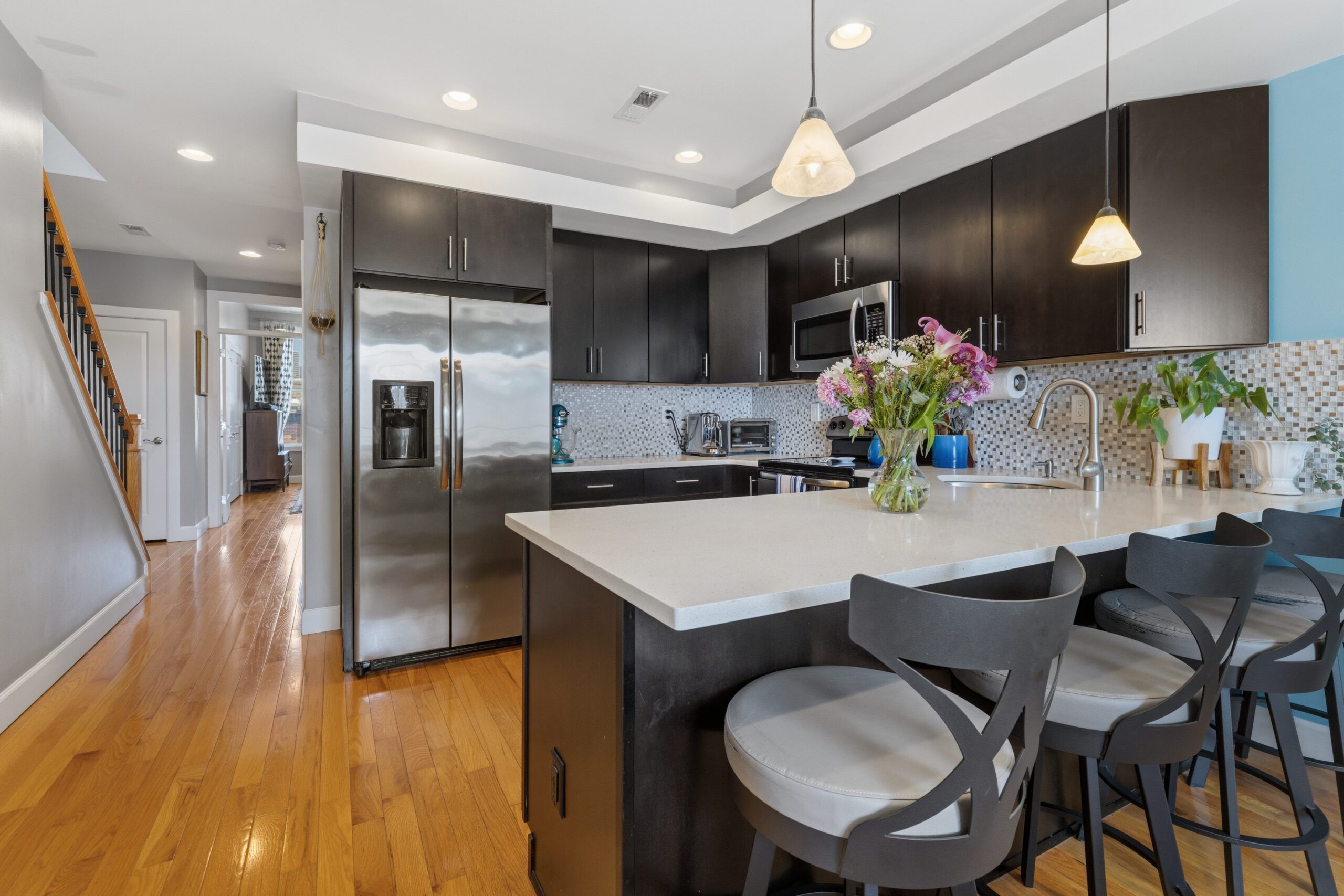
Homebuyers want updated kitchens, like this one in a Graduate Hospital home that recently sold.
And sellers need to be realistic about how much they can get for their home.
“If you overprice by even just a little bit,” Thompson said, “you’ll end up sitting.”
Buyers ‘ready to pounce’
Generally speaking, buyers now have more time to make decisions than they did last year, since homes are staying on the market longer.
But, in some submarkets, especially in Philadelphia’s collar counties, “there’s so much demand that certain houses are just going to fly off the shelves,” said Beiser, who works in Philadelphia and surrounding areas.
“I have some buyers in the suburbs, and they‘ve kind of stopped looking because it’s too challenging,” she said.
This home in Upper Merion Township is listed for sale for $699,900 by agent Erin Thompson.
Beiser has been working with a couple with children who live in Philadelphia but want to move to the suburbs. Each spring for the last three years, her clients make a plan to try to find their next home. But every year, they decide that continuing to live in the city is more convenient than facing competitive markets in which they’re expected to skip home inspections to win a property, Beiser said.
Thompson has seen a growing trend of frustrated buyers putting in offers above the asking price even when they’re not facing direct competition. One client recently went under contract on a Fishtown home they had immediately put an offer on.
“They came in aggressive, because they’d just lost out on a house, and they’d been looking for a while,” she said. “You have these buyers who are scarred and tired, so they’re coming in more aggressive.”
Thompson tells buyers to make sure they’re as prepared as possible before starting their home search.
“You have to be ready to pounce the second [a home] comes to the market,” she said.
This home on the market in Upper Merion Township spans more than 2,800 square feet and has three bedrooms.
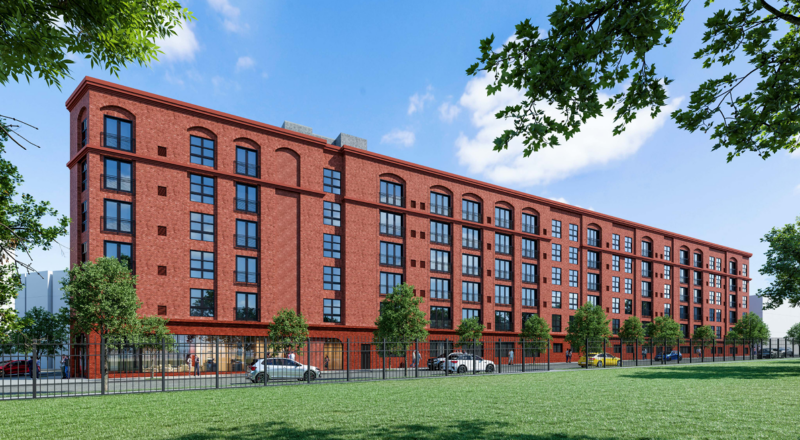
North Philadelphia’s Francisville is getting an apartment building at 801 N. 19th St. after years of delay and a complexchange in ownership.
The six-story project, clad in red brick, will include 110 apartments and 49 underground parking spaces. The foundations are built, and construction is underway.
The project sits on an oddly shaped lot between 19th Street, Cameron Street, and Wylie Street, which neighbors call “the triangle lot.”
The property used to be owned by the Exton-based Hankin Group, which secured building permits for a 115-unit apartment building during the pandemic.
Hankin sold the property in 2021. Now two different townhouse projects are being developedon the site, one by West Philadelphia-based Guy Laren.
The apartment project is being built under the name of Cameron Square Partners LLC, which is registered at a West Philadelphia property owned by Laren.
On the Department of Licenses and Inspections website, violations for “walkway not provided” and a failure to post permits are being appealed by the Philadelphia-based developer, contractor, and property manager Vicintas.
Laren did not respond to a request for comment. Vicintas confirmed it is the general contractor and future property manager for the apartment building but did not reply to an interview request.
Hankin’s building permit is old enough that the Philadelphia Planning Commission decided it has to go through an advisory-only Civic Design Review process again, five years after its first go-around.
The new iteration of the project is different from what Hankin proposed, with 110 instead of 115 apartments but larger layouts. It has a new architect, too, with Philadelphia-based Harman Deutsch Ohler Architecture replacing global firm NORR.
“The new owner wanted some bigger units, so we’re down five units, and we increased the height by five feet, and then we redid the entire facade,” said Rustin Ohler, a principal with the firm.
The new plans call for 40 one-bedroom apartments and 35 two-bedroom units, with the remainder mostly being larger studio units known in the industry as “junior one-bedrooms.”
The apartments will have “more square footage, not necessarily more bedrooms,” Ohler said. “The previous design had a lot of studios. This is more ones and twos [bedrooms], and they’re a little larger than your average new construction coming to the market.”
Parking has been reduced from 52 to 48 spaces, although the development team plans to expand the number of spaces by automating the garage.
Such a system would eliminate the need for people to enter the facility, depending on mechanical systems to distribute and receive cars and allowing for a much larger parking capacity.
The latest design for the new apartment building at 801 N. 19th St., with an articulated brick identifier spelling out “801.”
The apartment building contains no retail but will have amenities including a gymnasium and a narrow roof deck, including a dog park, that is set back from the edge so it is not visible from the street.
At a June meeting of the Civic Design Review committee, a representative of the United Francisville Civic Association criticized the amount of parking in the project, the increased height, the roof deck, and the new building materials.
“What was originally approved was a five-story building,” said the representative, whose name was obscured in a recording. “This is now a six-story building, and it really towers above. It just adds a lot more height to the building based on the surroundings.”
At the June and July meetings, however, Ohler noted that the threeprojects on the triangle lot are already under construction and that the apartment project is hemmed in by the bordering townhouse developments.
That restricts what changes could be made to the architecture and layout of the project, despite community concerns.
A new rendering of the apartment building shows the roof deck broken into smaller chunks, to cut down on large crowds making noise and separated from the edges of the building by newly proposed solar panels.
The development team increased “the garage ceiling height in order to accommodate future stacked mechanical parking, which would potentially double our number of cars that we could have,” Ohler said.
Since the June meeting, the development team also added darker brick spelling out “801,″ as an identifier on the building’s south-facing facade and entrance.
Ohler noted that the roof deck has been broken up into four separate pockets to prevent large groups of residents from congregating. It also was pushed back from the street to accommodate neighbor concerns.
“The roof decks have been designed to be centered into the building, so that nobody can get near the edge,” Ohler said. “And we did add the solar panels, there’s no way for anybody to get near the edge, so that would address their concerns of sound from the roof deck.”
A 2-month-old Bucks County infant was struggling to swallow and could hardly hold his head up.
He was diagnosed last month with infant botulism, a rare, potentially deadly infection that affects the nervous system and can lead to paralysis.
The family and their lawyer believe the baby, now recovering at home, ingested the bacteria that causes the infection from an infant formula subsequently recalled by its manufacturer, Nara Organics, over contamination concerns.
Federal legislation proposed this spring could protect babies by requiring formula manufacturers to test for more pathogens. The bill, HR 7867, is awaiting hearings in the House Committee on Energy and Commerce.
“I want responsible manufacturers, responsible industry partners, who say we know there is a risk of this and we’re going to be ahead of the game,” said U.S. Rep. Madeleine Dean, a Montgomery County Democrat and cosponsor of the bill.
When asked for comment on the proposed legislation, Nara Organics pointed to safety protocols posted on its website saying the company exceeds the U.S. Food and Drug Administration’s current requirements.
The New York-based company said it voluntarily recalled all of its infant formula on June 13 “in an abundance of caution,” after the FDA and the Centers for Disease Control and Prevention reported three cases of infant botulism in babies who had consumed Nara formula.
As of July 6, a fourth case had been confirmed, and FDA testing identified the botulism-causing bacterium C botulinum in some of the company’s formula, according to an update posted on the company’s website.
Nara Organics did not comment directly on the proposed regulations. When asked for its position on the legislation, the Infant Nutrition Council of America, which represents manufacturers, said its members “share the goal of ensuring families have access to safe, high-quality infant formula.”
“Infant formula is among the most highly regulated foods in the United States, and INCA supports science-based, risk-based improvements that strengthen infant formula safety,” the organization said in a statement.
The push to bolster regulations comes several years after federal regulators and lawmakers started looking more closely at infant formula safety in 2022, when a massive recall for a non-botulism bacterial contamination left shelves bare for months.
But two recent infant botulism outbreaks linked to formula show the inadequacy of the steps that companies are already taking, said Bill Marler, a Seattle-based food safety lawyer who is representing Erica and Micky Goldfin, the Yardley couple whose son developed botulism after being fed Nara Organics formula.
“We need to do more to protect these kids,” Marler said.
A dangerous infection
Infant botulism occurs when babies ingest C botulinum in foods or dust and dirt particles. The bacteria’s spores colonize in the large intestine and release a toxin that affects the nervous system.
Symptoms include changes in facial expressions, such as smiling less, slow feeding, constipation, and low energy. Untreated, the toxin can spread and cause paralysis, making it hard for babies to breathe and eat.
Infants are at greatest risk of illness because their digestive systems are still developing and less able to fight off infection.
The Goldfins’ baby, identified by the initials W.G. in court records,spent two nights in the intensive care unit at the Children’s Hospital of Philadelphia, where he was treated with BabyBIG, the botulism antitoxin that is manufactured by the California Department of Public Health. The medication’s antibodies bind to the toxin and neutralize it, improving symptoms within 48 hours.
On June 6, he returned home, where he is feeding well again, and regaining movement in his arms and legs. He is receiving weekly physical therapy for developmental delays in his gross and fine motor skills, according to the lawsuit.
Testing challenges
Federal regulators began looking more closely at infant formula in 2022, after Abbott Nutrition issued a massive recall over concerns of non-botulism bacterial infections.
Abbott temporarily shut down one of the largest formula manufacturing plants in the country while it investigated the cause of the contamination, leaving families scrambling to find the formulas they relied on for their infants and medically fragile children.
Pinpointing the exact source of contaminants can be challenging.
The bacteria that causes botulism, for instance, could have been present in the Nara Organics’ powdered milk formula, in dust that settled on the packages during transportation, in the water used to mix it, or on the hands of those preparing the food, said Molly Potter, a senior clinical dietitian with Nemours Children’s Health in Delaware.
According to its website, Nara Organics tests its formulas throughout the manufacturing process, first testing raw ingredients, then during production, and again with the final product.
The tests the company uses include so-called sulfite-reducing clostridia (SRC) enumeration, which a leading international food-safety group recommends for identifying spores of the bacteria that causes infant botulism.
Researchers from IEH Laboratories & Consulting Group, a Washington-based firm that specializes in laboratory testing and analysis for the food industry, worked with ByHeart to analyze its infant formulas that had been linked to at least 28 cases of infant botulism this year and last.
A bottle of milk prepared from infant formula.
Improving safety
Dean said she hopes the proposed legislation will open up more conversation about how best to improve infant formula safety.
The bill tasks the FDA with developing a list of pathogens that formula companies should test for, and working with manufacturers to begin any tests they aren’t already doing.
The FDA would also set a schedule for how often manufacturers need to test for the new list of pathogens.
Under the legislation, companies would be required to report contamination results within a day, and retain records of positive test results.
Dean is among more than two dozen lawmakers to sign on as cosponsors. Rep. Jefferson Van Drew, who represents South Jersey’s 2nd District, is one of two Republican cosponsors.
Potter, the Nemours dietitian, said she hopes increased testing will help families feel more at ease.
In the meantime, parents can reduce the risk to their children by only purchasing formula from reputable stores, checking expiration dates, and storing powdered formula canisters properly. Caregivers should make sure to mix formula in clean equipment, and wash their hands before preparing and feeding it to a baby.