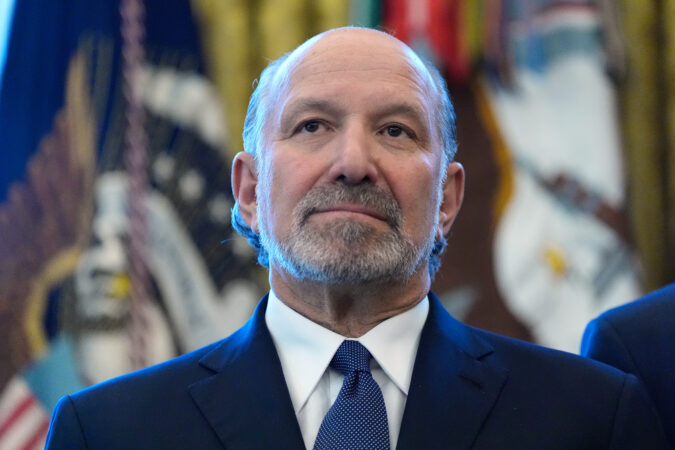
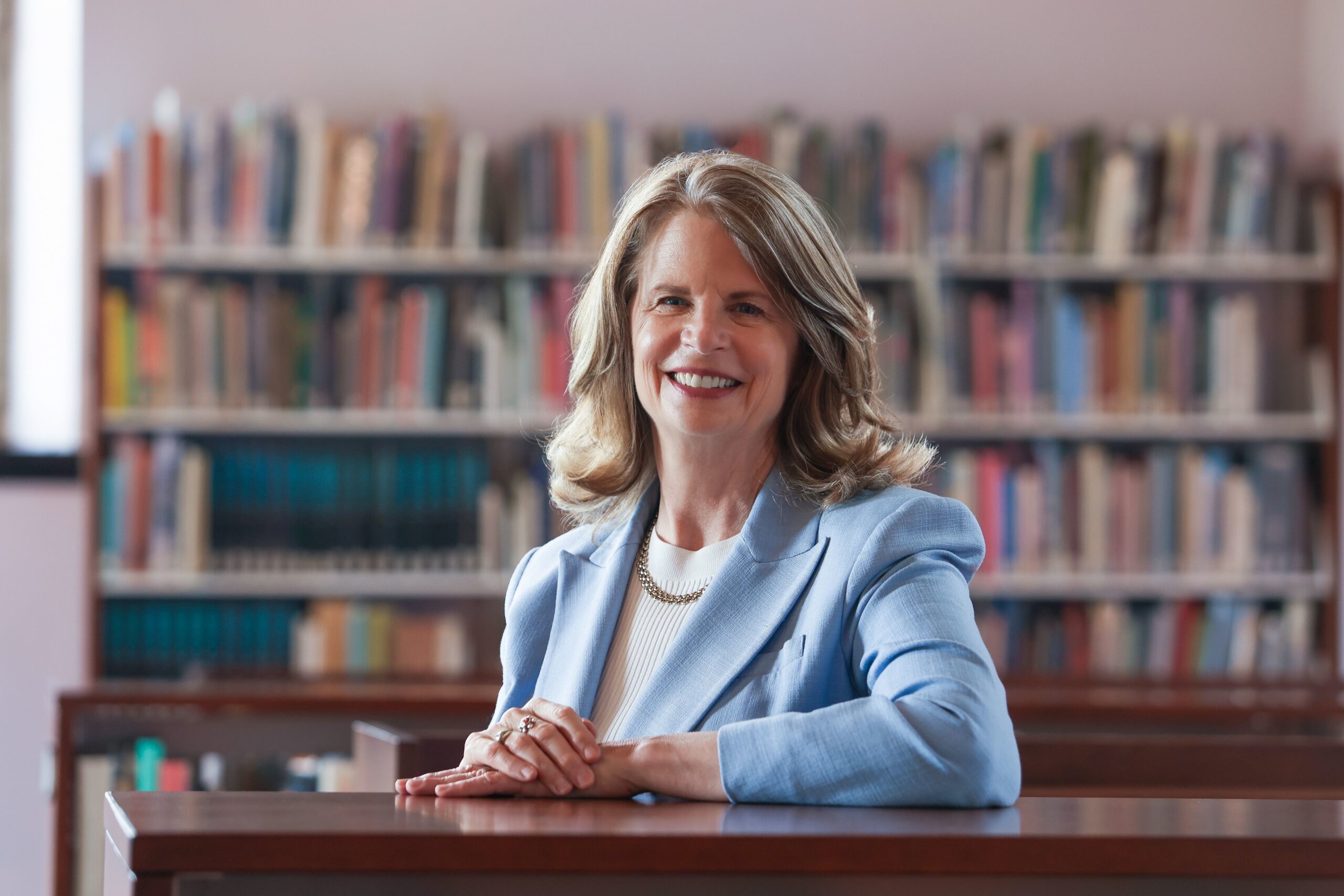
Haverford College will not consider removing U.S. Commerce Secretary and mega donor Howard Lutnick’s name from its library despite student calls to do so, the school announced Wednesday.
President Wendy Raymond’s announcement came 30 days after the student body voted by an overwhelming majority to ask that she establish a review committee to consider removing his name. But Raymond said she will not accept the student body’s resolution.
“I do not believe this matter meets the threshold necessary to move forward with a committee,” Raymond wrote in an email to the students’ council copresidents.
Haverford College President Wendy Raymond announced she would not consider removing Howard Lutnick’s name from the school’s library.
Concern has been mounting about Lutnick, the former chair of Haverford’s board of managers, since Department of Justice documents released earlier this year showed he had contact with sex offender Jeffrey Epstein as recently as 2018, long after Epstein pleaded guilty to obtaining a minor for prostitution and soliciting a prostitute.
Raymond did not elaborate on her reasons and declined to comment through a spokesperson, but the decision was immediately panned by students.
The council copresidents expressed their “deep disappointment” in an email to students.
“The committee would have been a valuable step in our college’s ongoing reckoning with sexual assault,” wrote Ben Fligelman and Sarah Weill-Jones. “We hope that in the coming weeks and months, President Raymond will reevaluate her decision and understand the profound importance of convening a review committee.”
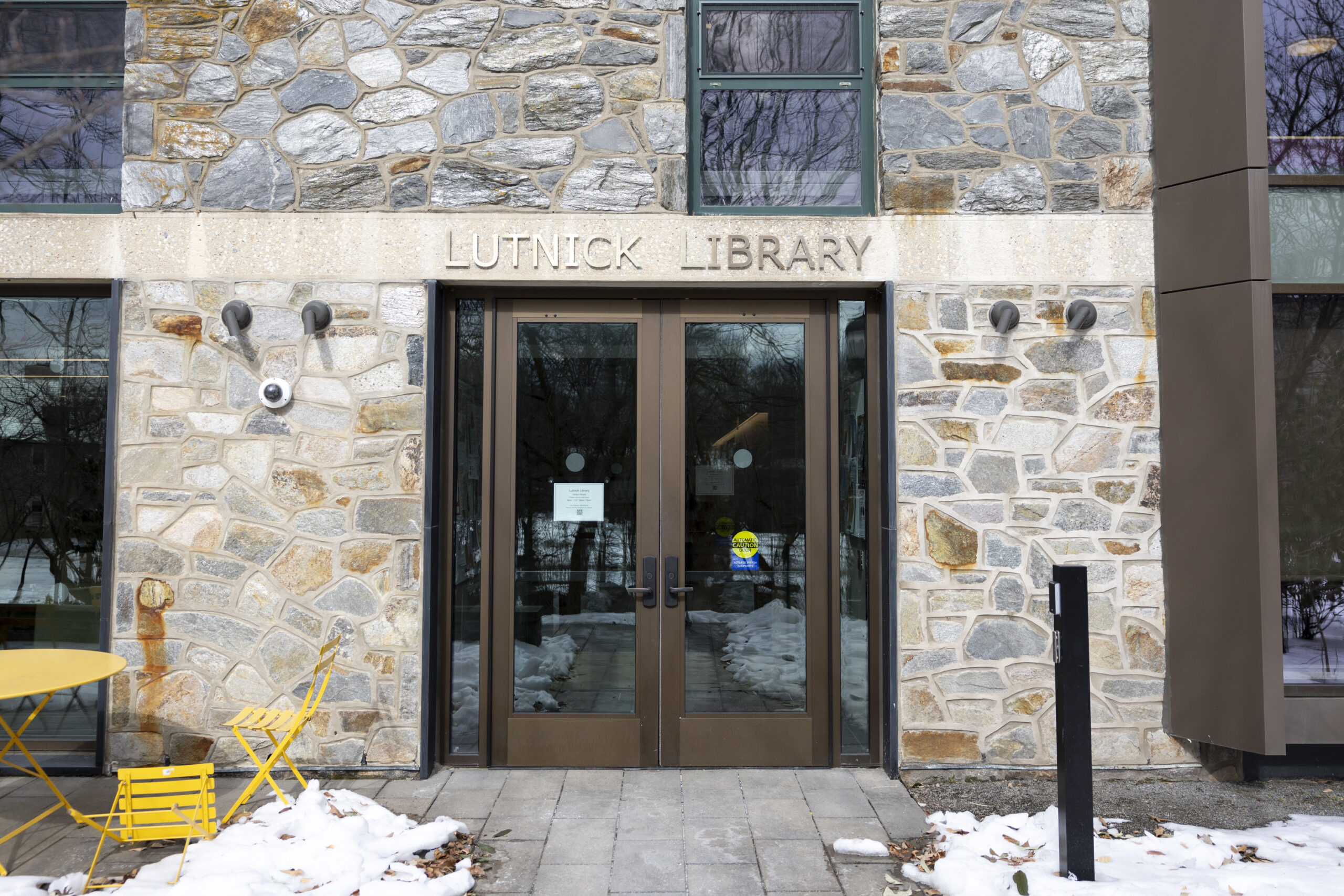
The outside of the Lutnick Library at Haverford College.
The Haverford Survivor Collective, which started in 2023 and is led by Haverford students and survivors of sexual assault, called the decision “disappointing, unsurprising and categorically insulting” in a statement. It is even more painful that the decision was released on Denim Day, an international day of support for survivors, the collective wrote.
“What should have been a meaningful day of solidarity and collective support has instead become a stinging reminder of how far Haverford still has to go,” the group wrote.
Senior English major Paeton Smith-Hiebert, co-founder of the collective, said Raymond in a meeting with some students Tuesday shared her reasoning for why the Lutnick situation did not meet the threshold.
Raymond said, according to Smith-Hiebert, there needed to be “pretty unambiguous evidence of harm being directly committed” and that “association wasn’t enough.”
Arshia Seth, another student who is a member of the collective board, said when pressed by those present, Raymond said the threshold would be if Lutnick had “direct ties to trafficking.”
The president also told students she wished she had had more time to make the decision, but plenary rules require that she respond within 30 days, Smith-Hiebert said. Whether that means she will continue to weigh the matter is unclear.
“Looking forward, … I — and future presidents — will retain the ongoing responsibility to consider the relevant facts at any given moment in time, and to act in consideration of the best interests of Haverford’s educational mission,” Raymond, who announced in November she would retire as president in June 2027, said in her statement. “…The board of managers too will remain engaged.”
Raymond’s announcement Wednesday also said she and the college “stand in solidarity with survivors of sexual violence.”
Raymond previously said she had heard from “a growing number” of Haverford alumni “who have written to express their dismay” about Lutnick’s ties to Epstein, which included a visit by Lutnick and his wife to Epstein’s private island. She said in February that she would consider forming a review committee.
Lutnick’s name was put on the library after a then-record $25 million donation he and his wife made in 2014. Lutnick, a 1983 Haverford graduate, has given the school $65 million and is one of its biggest donors.
If Raymond had established a committee, it would have kick-started a multistep process that the school follows when considering changing building names. Raymondwould have considered the committee recommendation before then making her own recommendation to the external affairs committee of the board of managers, as well as to its chair and vice chair. The external affairs committee then would have made its recommendation to the full board of managers, who ultimately decide whether a building should be renamed.
Under Haverford’s gift policy, the school can rename a building if “the continued use of the name may be deemed detrimental to the college, or if circumstances change regarding the reason for the naming.”
The students’ vote came during their plenary session on March 29. At least 66% of the student body living on campus had to be present at the session for discussion and votes to occur, and to pass, the resolution needed to win a simple majority. That 66% represents almost 900 students.
“Students feel harmed and hurt by the presence of his name and association on campus,” Milja Dann, a sophomore psychology major from Woodbury, N.J., said in March, after attending the session.
The Haverford Survivor Collective had been urging the college to form a committee even before the plenary.
“Given the gravity of this situation, survivors are among those most directly affected,” Smith-Hiebert had written to Raymond earlier this year. “Many are feeling significant harm and institutional betrayal … While I understand there are many stakeholders to consult, it is difficult to reconcile the stated commitment to engagement with the apparent absence of those most impacted.”
The student resolution asked the college to include student representation on the review committee, along with staff from several offices, including institutional diversity, equity, and access. It also called on college leadership “to stand in solidarity with victims of assault.”
And it asked the board of managers to consult directly with students before making final decisions to rename the library and or whom it would be named for.
The resolution also called into question Lutnick’s leadership at Cantor Fitzgerald, the New York City financial firm where he formerly served as chairman. The Securities and Exchange Commission charged the firm in 2024 with violating laws related to regulatory disclosure, and Cantor agreed to pay a civil penalty. Cantor Gaming in 2016 agreed to pay $16.5 million in penalties to the federal government “to resolve a criminal investigation into the company’s past involvement in illegal gambling and money laundering schemes,” according to a release from the U.S. Attorney’s Office.
During congressional testimony, Lutnick said he visited Epstein’s island with his family in 2012. Lutnick previously said he had not been in a room with Epstein, whom he found “disgusting,” since 2005.
A Commerce Department spokesperson told The Associated Press in January that Lutnick had had “limited interactions” with Epstein, with his wife in attendance, and had not been accused of “wrongdoing.” Lutnick told lawmakers during his testimony: “I did not have any relationship with him. I barely had anything to do with him.”
The outside of the Lutnick Library at Haverford College.
In addition to the library, which also bears the name of Lutnick’s wife, Allison, Haverford’s indoor tennis and track center is named for his brother Gary Lutnick, a Cantor Fitzgerald employee who was killed on 9/11, and the fine arts building carries the name of his mother, Jane Lutnick, a painter. Lutnick also funded the college’s Cantor Fitzgerald Art Gallery.
Students, however, said they were focusing on the library in the resolution because of its prominence.
Before Raymond’s decision was announced, Adam Marcello, a Haverford student, in an opinion piece for the Haverford Clerk, the student newspaper, said students needed to keep the pressure on.
“If students want the renaming to succeed, they will need to sustain visible, organized pressure,” Marcello wrote. “Epstein posters scattered across the library or letters tacked to the doors are not enough. We need to make inaction more costly than action.”
For more than a decade, South Jersey bartender Danny Childs has been developing “Slow Drinks,” an award-winning bartending approach that uses locally farmed and foraged ingredients for boozy and booze-free beverages, resulting in drinks that are essentially liquid snapshots of a place and a season.
Now Childs and his wife, Katie, are turning that philosophy into a bar of their own. Work is underway on Field Day, set to open in September in a street-facing space at 923 N. Second Street, inside the Cescaphe Ballroom in Northern Liberties. (Cescaphe will continue to operate in the rear of the building.)
Field Day will be a showcase for Slow Drinks-style cocktails, sodas, and ferments, complemented by a food menu from Sweet Amalia chef Melissa McGrath, a consulting partner.
Danny Childs, former bar manager at Cherry Hill’s Farm and Fisherman Tavern, fills jars with foraged botanicals in 2021. Childs invented the “Slow Drinks” method of bartending.
The Childses envision Field Day as a neighborhood bar with a family-friendly vibe. More than half of the 68-seat, 1,250-square-foot-space and the entirety of the bar will be held for walk-ins. “We want it to be super-casual,” Katie Childs said. The couple hopes that the bar — the entryway to a former movie theater — becomes a go-to for locals to drop in; there’s capacity for 100 when you factor in standing room plus Cescaphe’s patio, which they’ll be able to use when events allow.
But the Childses are also framing Field Day as a “regional cocktail bar” that tells the story of the various (agri)culturally rich pockets around the Philly area: “We’re talking Poconos, Lehigh Valley, Delaware River Valley, Chesapeake, Pine Barrens, Jersey Shore, South Jersey farmland. We’re going to really try to tell that story on the menu,” Danny Childs said.
Ingredients from those areas will inform not only the drinks but also the food from McGrath, who became a fan of Danny’s work after frequenting the bar at Farm & Fisherman. The intention is for Field Day to be “a bar with good food,” McGrath said.
The planned menu includes house-made soft pretzels, fried olives, and Pennsylvania Dutch-driven sandwiches featuring the likes of red beet eggs and custom-made Lebanon bologna. McGrath plans to weave various Slow Drinks ferments, such as pickled mushrooms, into the food menu and snack plates, which are odes to Katie Childs’ hometown of Hanover, aka “the snack food capital of the world.” They also plan to use tomato pie as a format to riff on other area specialties (think hoagie pie).
Danny Childs (left) and his wife Katie sift through tomatoes picked from their garden at their home in Pennsauken. Field Day — the couple’s first bar — will feature ingredients found across Philly, South Jersey, and the Jersey Shore.
Highballs, boozy gelati, and the occasional F&F favorite
Another anchor of the Field Day menu: year-round boozy gelati. They’re planning to marry John’s Water Ice with Lancaster-sourced soft serve from 1-900-Ice-Cream. (There will be soft-serve cones for kids, too.) Danny, a Delco native, looks forward to recreating a treat he grew up with: “When I would go to John’s or Pop’s as a kid, you would get a soft pretzel and use it as a spoon.”
The cocktail menu will go heavy on highballs that will mix booze with Danny’s seasonal, house-made sodas (many of which will be available for takeout). He’s envisioning approachable combos like bourbon and birch beer, rum and clarified cream soda, and sherry and black cherry wishniak. More offbeat pairings will include Fernet and root beer, tequila with chicory-corn cola, and mezcal with celery soda. (That last one, the Cel Rey, will be familiar to patrons of Farm & Fisherman; a few other classics from the F&F menu — the black walnut Old Fashioned, La Poblanita — will grace the Field Day menu on occasion.)
Besides highballs, Danny promises several other drinks, including freezer martinis, citywides, natural wines, and a few draft beers, namely Guinness and Slow Drinks’ collaborations with South Jersey’s Tonewood Brewing.
Danny Childs picks tomatoes from his garden at his home in Pennsauken, N.J. on Tuesday, Aug. 13, 2025. A Delco native, Childs plans to include boozy gelati on the menu at Field Days.
For all the emphasis on beverages, the Childses don’t want Field Day to read entirely like a cocktail bar. They’re designing it to be warm and welcoming. At night, the sunny, high-ceilinged space will be illuminated by vintage pendant lights and small table lamps. Designer Laura Weiszer, of Kensington-based Betsu Studio, “loves a strip light,” Katie said, “so every little ledge that you see is going to basically glow.” (Weiszer’s previous projects include Middle Child Clubhouse and Sacred Vice’s taproom.) Wood banquettes, booths, and a modular back bar with hidden TVs — to be revealed for Eagles games — will come from North Philadelphia furniture maker Loubier Design (Le Cavalier, Gabi).
A partially enclosed hutch in the front of the space will be stocked with Slow Drinks merchandise, house-made soda and kombucha, and wine. The mini outpost is inspired by Sullivan’s Fish Camp in Charleston, S.C., one of a long list of cities the Childses have traveled to since Danny left Farm & Fisherman in 2023 and started working as a beverage consultant.
Danny Childs forages for mimosa tree blooms in Cherry Hill in 2021. The menu at his cocktail bar Future Days will include highballs, freezer martinis, and citywides, among other drinks.
In that time, he and Katie, a former events stylist for Terrain, have been building the Slow Drinks brand on social media and through classes, pop-ups, and beverages conferences. (Slow Drinks will have a headquarters and R&D lab on the second floor of Cescaphe’s building.) They’re weaving in their favorite takeaways at Field Day: nostalgia-driven aesthetics similar to Tina’s in Tulsa, house-canned cocktails like at Semiprecious in Denver, and a zero-waste program between the bar and kitchen inspired by Mexico City’s Baldio. Likewise, the bar will draw on globally sourced spirits made by producers who value “good, clean, and fair values,” Danny said.
“It’s very personal for us,” he said. “It’s the Slow Drinks bar that we’ve wanted to build forever.”
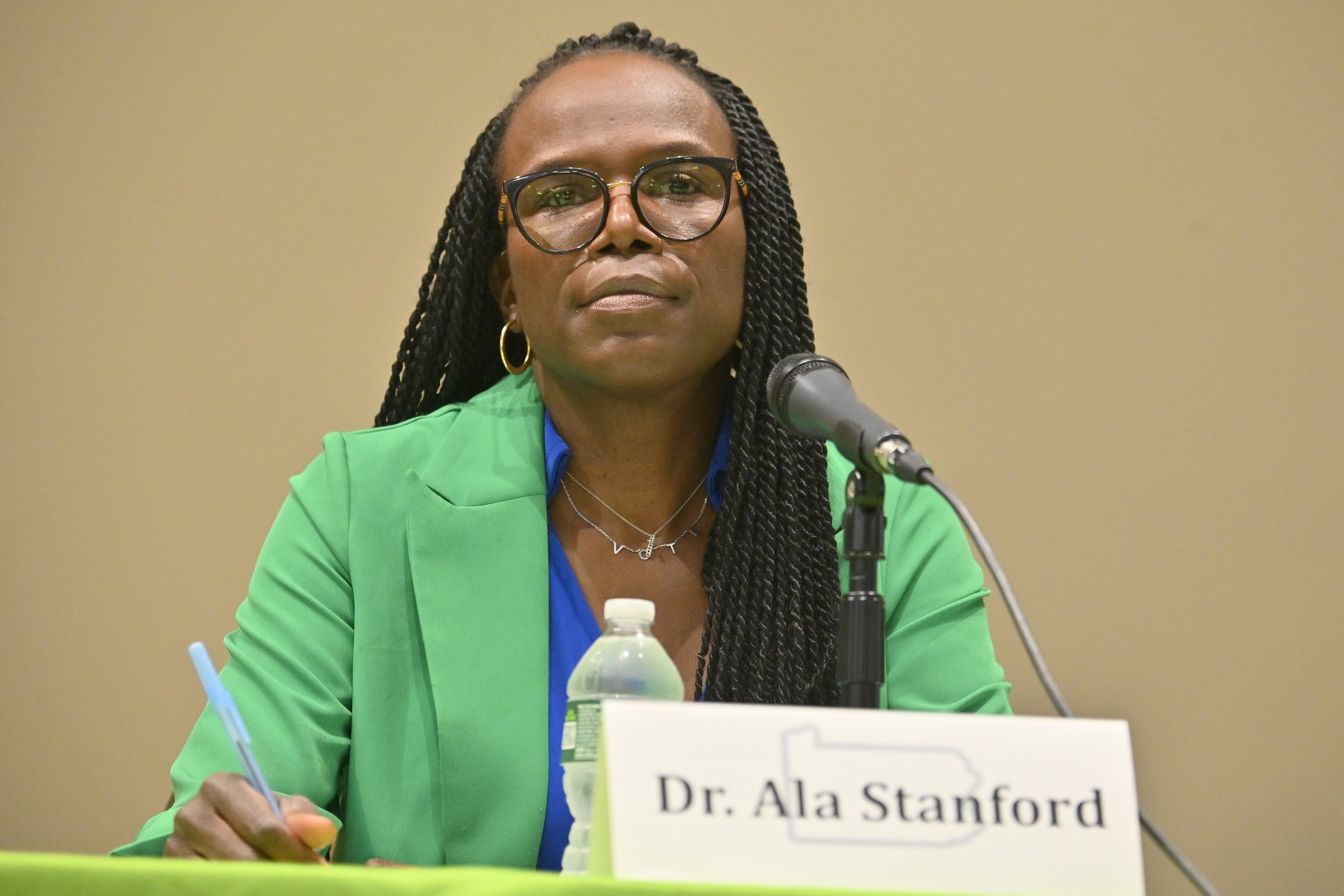
Congressional hopeful Ala Stanford on Wednesday morning announced she was dropping out of a WHYY candidates debate two hours before it was scheduled to begin, saying her campaign could not agree with the public radio station on a format for the debate and criticizing her opponents in the race for “misogynistic attacks.”
“I have never been afraid of a hard room,” Stanford said in a statement. “After engaging in good faith with WHYY, we could not reach terms on a format that would deliver the serious accountability voters in PA-03 deserve.”
Stanford’s campaign manager emailed the announcement to reporters around 10 a.m., two hours before the debate on WHYY’s Studio 2 was supposed to take place.
In her statement, Stanford did not clarify what problems she had with the debate format. She also did not provide details on any attacks from her opponents in the Democratic primary for Pennsylvania’s 3rd Congressional District.
A Stanford spokesperson declined to comment beyond her written statement.
Stanford’s surprise announcement came less than three weeks before the May 19 primary, and followed a series of missteps for her campaign, including the revelation that a staffer used artificial intelligence to help answer a candidates’ questionnaire and her stumbling through a question about immigration enforcement in an interview with NBC10.
A recent Inquirer report on her stewardship of the Black Doctors Consortium also found that the organization omitted details about her income that were required to be included on nonprofit tax forms filed with the Internal Revenue Service.
Ala Stanford, pediatric surgeon and founder of the Black Doctors Consortium, participates in the debate for Pennsylvania’s 3rd Congressional District at Center in the Park in Germantown on Tuesday, April 14, 2026.
Stanford’s exit from the Wednesday event meant the other two top contenders in the race, State Rep. Chris Rabb and State Sen. Sharif Street, were the only candidates to participate in the debate featured on WHYY’s Studio 2, the highest-profile live and on-air debate thus far.
It was a relatively subdued affair compared to some of the other more gloves-off style campaign events in the open race. Street and Rabb took questions from moderators and largely agreed on policy, with both saying they support expanding universal healthcare, abolishing U.S. Immigration and Customs Enforcement, and impeaching President Donald Trump.
The two state lawmakers sought to contrast their styles, with Street portraying himself as a more competent legislator.
“I get things done,” said Street, the former head of the state Democratic Party. “Rep. Rabb and I share a lot of value propositions. But the difference is I deliver on ideas.”
Rabb, a progressive who has been endorsed by the Working Families Party, said Street is too closely aligned with the Democratic establishment, and that his ideas are not bold enough.
“There’s so many people who think we can’t do things big and bold,” he said. “They play around the edges, because that’s what establishment politics does.”
State Sen. Sharif Street (left) and State Rep. Christopher Rabb (right) wait for the WHYY studio door to close Wednesday, April 29, 2026 before start of their debate in the Democratic primary for the 3rd Congressional District. The third leading candidate, Ala Stanford declined to attend at the last moment.
Both candidates were also asked about Stanford’s absence and her charge Wednesday that the race has been “marred by misogynistic attacks and lies from both of my opponents.”
Stanford, a first-time political candidate, is the only woman on the ballot.
Rabb said he wasn’t sure what she was referring to, but pointed out that when Stanford was recently heckled by some of his own supporters during a candidates forum, he repeatedly told them to let her speak.
And Street said he has not attacked her directly, but acknowledged that she’s faced criticisms.
“She has been attacked. I’ve been attacked. Everybody on this campaign, I’m sure, has been attacked at some point,” he said.
Rabb and Street said their campaigns did not negotiate with WHYY on the format of the event.
Kevin McCorry, an executive producer and host at the station, said WHYY engaged with Stanford’s campaign “in good faith” and acquiesced to her staff members’ requests, including allowing her to have notes on the table and bring extra staffers to sit in the audience.
He said WHYY learned that she was pulling out when Stanford’s campaign manager released a statement to reporters from multiple news outlets.
“We were flexible with her requests,” McCorry said. “At no time did they say, ‘If X doesn’t change, we’re backing out.’”
State Sen. Sharif Street (left) and State Rep. Christopher Rabb (right) appear in a debate at WHYY studios Wednesday, April 29, 2026 for the Democratic primary in the 3rd Congressional District. The third leading candidate, Ala Stanford declined to attend at the last moment.
Street spokesperson Anthony Campisi accused Stanford of dropping out to avoid tough questions,adding that “her campaign is in free fall.”
“Rather than answer these questions in a debate that’s aired on radio and television, she appears to be taking her ball and going home, which is not what Philadelphians expect from their member of Congress,” Campisi said Wednesday. “Philadelphians deserve a member of Congress who is ready to fight for them and against Donald Trump, not someone who runs from a fight.”
Rabb said that when it comes to campaign events, he and his team “don’t negotiate, we just show up.”
“Even if I didn’t like the format, which is not uncommon, I still show up,” he said, “because I’m a public servant and I’m a public candidate, and I got to reach people wherever they are.”
In her statement, Stanford, a physician, noted she has taken the Hippocratic Oath “to first do no harm.”
“I challenge everyone in this race to join me in promoting the kind of spirited, but serious and meaningful dialogue Philadelphians should expect from those asking to serve,” she said. “In the meantime, I will be where I have always been — on doorsteps, in church basements, and on the corners of the wards that built me.”
Shaun Griffith, a tax adviser and the fourth candidate in the race, did not participate in the debate because he did not meet WHYY’s criteria, which included a fundraising threshold.
He attended the event and sat in the audience, and said afterwards that it was “frustrating to be watching other people get to answer questions and not have the opportunity to do so myself.”
WASHINGTON — The Supreme Court on Wednesday sharply weakened a key provision of the landmark Voting Rights Act, a ruling that limits the consideration of race in drawing voting maps and could usher in Republican gains in the House.
The decision is expected to touch off a scramble by Republicans to redraw majority-minority districts, especially in the South. New districts could shiftthe balance of power in Congress by imperiling the reelection prospects of some Black Democrats, possibly as soon as November’s midterms in some instances. Representatives of color in state legislatures and local offices could also be redistricted out.
The court’s conservative majority found Louisiana unlawfully discriminated by race when it created a second majority-Black congressional district to comply with the VRA. But the court did not strike down the provision, known as Section 2, as unconstitutional, as many voting rights advocates had feared it would. Still, the court’s liberal justices and voting rights experts said it was effectively gutted.
The ruling carries significant symbolic weight, scaling backthe last major pillar of a 60-year-old law long considered one of the marquee achievements of the civil rights era. The Voting Rights Act bans discriminatory voting practices such as literacy tests and poll taxes, and has helped greatly increase minority representation in state and federal offices.
In an ideologically divided 6-3 ruling, the conservative justices created a higher bar for the law’s powerful provision that allows states to use race to draw maps that help minority communities elect candidates of their choice. Section 2 is aimed at combating discriminatory gerrymandering that weakens the power of Black, Latino, Native American, and Asian voters.
States must walk a careful line when drawing maps for voting districts. The Voting Rights Act directsstates to consider race to some degreewhen redistricting to ensure that racial minority groups have an opportunity to elect representatives who reflect their priorities. Maps explicitly drawn along racial lines, however, violate the equal-protection clause of the 14th Amendment and the 15th Amendment’s ban on racial discrimination in voting practices.
Justice Samuel A. Alito Jr. wrote the opinion for the majority, saying it was time to rework Section 2 given gains in ending racial discrimination, the use of VRA lawsuits for partisan purposes, and advances in technology that have made it easier to draw legislative districts that balance partisan interests and racial considerations.
Alito wrote that going forward, plaintiffs would have to show that a state intentionally discriminated against a minority group in drawing a map, rather than simply showing that members of the minority group did not have the opportunity to elect a candidate of their choice when certain circumstances are met.
“Section 2 of the Voting Rights Act … was designed to enforce the Constitution — not collide with it,” he wrote. “Unfortunately, lower courts have sometimes applied this Court’s [Section] 2 precedents in a way that forces States to engage in the very race-based discrimination that the Constitution forbids.”
The decision came over the sharp objections of the court’s three liberals. Justice Elena Kagan delivered the dissent from the bench, signaling strong disagreement. In her opinion, Kagan lamented that in rulings over the last decade, the court’s conservative justices had carried out a “demolition” of the VRA that was now complete. She predicted a precipitous decline in minority representation in political office.
“The consequences are likely to be far-reaching and grave. Today’s decision renders Section 2 all but a dead letter. In the States where that law continues to matter — the States still marked by residential segregation and racially polarized voting — minority voters can now be cracked out of the electoral process,” Kagan wrote, referring to the process of drawing maps that break up minority voting blocks.
The decision continues a trend by the court’s conservative majority to roll back race-conscious efforts to redress discriminatory practices. It comes two years after another major decision to restrict race-based affirmative action in college admissions.
The ruling lands asa nationwide redistricting war has broken out between Republicans and Democrats, both of which have taken the unusual step of redrawing district linesbetween censuses to try to secure partisan advantages in this year’s races for Congress. Republicans currently hold a slim majority.
Professor Richard L. Hasen, an election law expert at UCLA, said Section 2 of the Voting Rights Act still stands but is all but eviscerated.
“The opinion weakens application of the Voting Rights Act to make it a much weaker, and potentially toothless, law,” Hasen wrote on his blog. “It is hard to overstate how much this weakens the Voting Rights Act.”
NAACP president Derrick Johnson said in a statement that the ruling was a major strike to minority political power.
“Today’s decision is a devastating blow to what remains of the Voting Rights Act, and a license for corrupt politicians who want to rig the system by silencing entire communities,” Johnson said. “The Supreme Court betrayed Black voters, they betrayed America, and they betrayed our democracy. This ruling is a major setback for our nation and threatens to erode the hard-won victories we’ve fought, bled, and died for.”
The Trump administration hailed the ruling in a statement.
“This is a complete and total victory for American voters,” White House spokesperson Abigail Jackson wrote. “The color of one’s skin should not dictate which congressional district you belong in. We commend the court for putting an end to the unconstitutional abuse of the Voting Rights Act and protecting civil rights.”
Louisiana Attorney General Liz Murrill called the ruling “seismic” and applauded it in a statement.
“The Supreme Court has ended Louisiana’s long-running nightmare of federal courts coercing the state to draw a racially discriminatory map,” Murrill said.
The complicated dispute over the Louisiana voting district has dragged on for years and had been before the court last term.
The case began in 2022 when Black voters and civil rights groups sued Louisiana under Section 2, saying a new voting map drafted after the 2020 Census shortchanged African American voters. The map had only one Black-majority district out of six. African Americans make up one-third of the state’s population.
A federal court ruled for the plaintiffs and ordered the state to draw a new map with a second Black-majority district. After further legal wrangling, the Louisiana legislature drafted one in 2024.
The new map, which was drawn in part to protect the seats of Republican incumbents, including House Speaker Mike Johnson and House Majority Leader Steve Scalise, created a Black-majority district that meandered across the state from Baton Rouge to Shreveport.
A group of self-described “non-Black voter[s]” sued, arguing the new map was an unconstitutional racial gerrymander that violated the equal-protection clause. A federal district court panel ruled for the non-Black plaintiffs and put a hold on the redrawn map.
The Supreme Court eventually allowed the map with two Black-majority districts to go into effect for the 2024 congressional election. Voters chose Cleo Fields, a Black Democrat, for the new district.
The non-Black voters brought their case to the Supreme Court once again. Last term, the justices decided to hold off on a ruling and asked both sides to address whether creation of the second Black-majority district violated the 14th and 15th Amendments, before taking up the case again this term.
During arguments in October, Louisiana Solicitor General Benjamin Aguiñaga told the justices that any “race-based redistricting is fundamentally contradictory to our Constitution.” He also said that Louisiana had changed in recent decades, so the need for Section 2 had been obviated.
“It requires striking enough members of the majority race to sufficiently diminish their voting strength, and it requires drawing in enough members of a minority race to sufficiently augment their voting strength,” Aguiñaga said. “Embedded within these express targets are racial stereotypes that this court has long criticized.”
Kagan asked an attorney for Black voters in Louisiana what impact gutting Section 2 would have.
“The results would be pretty catastrophic,” said Janai Nelson, the president of the NAACP Legal Defense Fund.
“We only have the diversity we see across the South because of litigation” under the voting rights law, Nelson said, adding that it had been “crucial to diversifying leadership” in Louisiana and other states. She said no Black person has been elected to statewide office in Louisiana to date.
The decision follows another by the Supreme Court involving Section 2 in 2023. In that case, the justices ruled Alabama created electoral maps that unlawfully diluted the power of Black residents. That ruling surprised many court watchers because the justices have chipped away at the VRA in recent years.
In the most significant ruling in 2013, the justices struck down Section 5 of the VRA, which required states with a history of discriminating against minority voters to get changes to electoral law approved by the federal government or a judge. Most of the states covered by the provision are in the South.
The latest ruling is likely to contribute to the uncertainty surrounding the nation’s electoral maps amid the unprecedented wave of mid-decade redistricting. Ordinarily, states redraw their lines at the beginning of each decade after the U.S. Census Bureau alerts states to population shifts.
President Donald Trump, concerned Republicans could lose their fragile House majority, began pressing Republican-led states last summer to draw new lines ahead of the midterm elections. Republicans drew better lines for themselves in Ohio, Missouri, North Carolina, and Texas that could give them strong shots at picking up nine more seats.
Florida Republicans are planning to carve up their districts to give their party up to four more districts, and were debating their plan on the floor of the state House when the court released its decision. Legislators approved the plan Wednesday afternoon.
In response, voters in California approved a new map that will give Democrats up to five more House seats, andvoters in Virginia approved a plan to redraw their map. The Supreme Court turned aside a challenge to the California map in February.
The Supreme Court’s decision probably gives Republicans an opportunity to draw even more districts in their favor.
The deadlines for most states to redraw their maps before the midterms have passed, but it is possible some states push to change those rules. Either way, the ruling could set Republicans up for advantages in 2028 and beyond. In the wake of the decision, Sen. Marsha Blackburn (R., Tenn.) called on lawmakers in her state to redraw maps to create an extra Republican seat in Memphis.
This Supreme Court term is shaping up as a consequential one for election-related law.
In one major case, the court will decide the constitutionality of counting mail-in ballots that arrive after an election, provided they are postmarked by Election Day. The justices also allowed a lawsuit by a Republican congressman from Illinois who is challenging the state’s mail-in ballot law.
The justices heard arguments in December over whether to lift restrictions on parties spending money in coordination with candidates, which could be the latest chance for the court to curtail campaign finance limits.
This article contains information from the Associated Press.
Third time’s a charm. After two straight losses, the Flyers look to close out its NHL playoff series against the Pittsburgh Penguins in Game 6 tonight in South Philly. Here’s how to watch and stream.
Benching Matvei Michkov didn’t work in Game 5. Now, it looks like head coach Rick Tocchet is making some more changes, including re-inserting Michkov.
Former Flyers captain Claude Giroux takes out Sidney Crosby during “The Shift 2.0” in 2012. (Yong Kim/Staff file photo)
After winning the first three games of the series before dropping the last two, the Flyers return home Wednesday for Game 6 against the Pittsburgh Penguins at what’s sure to be a raucous but tense Xfinity Mobile Arena.
While some fans may be starting to get nervous — more like panic — the Flyers do have history on their side. Only 26 teams in 216 tries have forced a Game 6 after losing the first three games of a best-of-seven playoff series in NHL history, and only four have completed the reverse sweep, including Philly in 2010.
But the Flyers have been in this exact scenario before … and against Pittsburgh to boot.
In 2012, the Flyers won the first three games of their first-round series against the Penguins, before Pittsburgh pulled things back to 3-2. What happened next in Game 6 is etched in Flyers lore forever as “The Shift 2.0.” (The original “Shift” belongs to Mike Richards, for what he did against the Canadiens two years earlier.)
On the opening shift of the game, at the then-Wells Fargo Center, captain Claude Giroux de-skated Sidney Crosby at center ice with a massive hit just five seconds after the opening faceoff. If that didn’t set the tone enough, Giroux would open the scoring just 27 second later with a wicked wrist shot off the post and in to send the home faithful into a frenzy. The Flyers would follow their captain’s lead and destroy the Penguins 5-1 in Game 6 to close it out.
Captain Sean Couturier is the only holdover from that team to witness “G’s” heroics in person, while GM Danny Brière will also remember it well, having scored the Flyers’ fourth goal in that game. For Pittsburgh, Crosby, Evgeni Malkin, and Kris Letang were all in the lineup on that fateful date: April 22, 2012.
Despite his stellar season, Flyers goalie Dan Vladař was not named as one of three finalists for the Vezina Trophy finalists, given annually to the league’s best goaltender. Jeremy Swayman (Boston Bruins), Ilya Sorokin (New York Islanders), and Andrei Vasilevskiy (Tampa Bay Lightning) earned those honors.
Flyers right wing Matvei Michkov shoots the puck during an afternoon skate on Sunday.
After much consternation, it does appear that Matvei Michkov will return to the lineup on Wednesday for Game 6 against the Pittsburgh Penguins. The Russian winger was off the ice early at the team’s optional morning skate at Xfinity Mobile Arena. Winger Garnet Hathaway stayed on the ice late with players who normally are healthy scratches, like Garrett Wilson, Carl Grundström, and Oliver Bonk.
Where he slots in is the biggest question, as the right winger is not a fourth-line player. Could Tyson Foerster or Alex Bump — who played well together with center Noah Cates in Game 5 — or Denver Barkey move down?
Despite leading the team in points with 22 in the final 26 games of the regular season, helping the team clinch the third seed in the Metropolitan Division, Michkov posted zero points in the first four games of the postseason. The 21-year-old was a healthy scratch for Game 5 and appeared to revert to his early-season struggles with the uptick in pace and intensity.
The last time he was a healthy scratch was for a pair of games in early November of his rookie season. He returned and had a goal and an assist against the San Jose Sharks before adding three points in the following two games.
Emil Andrae also stayed on, and Noah Juulsen came off earlier, which hints that the veteran blueliner will slot in.
#Flyers on the ice for morning skate. Most guys out there. Tippett, Konecny, Couturier, Couturier or Ristolainen are not but expect that to be maintenance for tonight.
Rasmus Ristolainen and the Flyers were punished for not getting pucks out on Monday.
Rick Tocchet has long talked about the lessons that his young Flyers team needs to learn. He has often mentioned teachable moments in both losses and in wins.
They have now lost two straight games after breaking out to a three to nothing lead in their best-of-seven game series against the Pittsburgh Penguins.
The Flyers are still at the head of the class, as they hold the 3-2 advantage and have two more chances to advance. But it feels like the teacher is starting to implement a curve that could pull their grade down as the Penguins push and claw their way back into the series.
There is a saying that goes something like, “Forget the past, but never forget the lesson.” Well, the Flyers need to dig back into their old notes and cram before Game 6 on Wednesday night at Xfinity Mobile Arena because they definitely don’t want to become part of a history-making series — on the wrong side this time.
Alex Bump made his playoff debut for the Flyers during Monday’s Game 5 in Pittsburgh.
Alex Bump didn’t know whether he would play in this playoff series.
After Porter Martone signed with the Flyers out of college and Tyson Foerster returned from injury, there wasn’t an obvious place for him. As the playoffs started, Bump found himself the odd man out, watching from the press box, “itching” to get in.
On Monday, Bump’s number finally was called, and he delivered in the Flyers’ 3-2 loss in Game 5 to the Pittsburgh Penguins.
“I think I’m built for the playoffs,” Bump, 22, said postgame. “Just that hard, physical game, shooting mentality, getting pucks to the net.”
Bump stood out when the Flyers struggled to generate extended offensive zone time and execute clears. According to Natural Stat Trick, their expected goals percentage with Bump on the ice was 69.8%, the best of any Flyer.
In Game 5, Bump entered the zone cleanly with control of the puck three times and was responsible for another advance after forcing a turnover on an Anthony Mantha pass and finding Noah Cates, who entered the zone cleanly.
Even though the Flyers lost Game 5, Bump proved he’s worthy of staying in the lineup as the playoffs continue.
“[Bump and Denver Barkey], they’re holding on to pucks,” Tocchet said. “That’s why they’re making some plays out there. We’ve got to get some other guys to hold on to pucks and win some battles in the corners. That’s playoff hockey.”
Flyers-Penguins Game 6: Start time, how to watch and stream
The Flyers-Penguins series comes back to Philly for Game 6.
The Flyers-Penguins series jumps back to TNT Wednesday night for Game 6, with Kenny Albert and NBC Sports Philadelphia’s Brian Boucher on the call. Chris Mason will handle reporting duties at Xfinity Mobile Arena.
TNT Sports is averaging 1.1 million viewers for its NHL playoff broadcasts across TNT, TBS, and truTV, up 67% compared to last season and the network’s best start since landing hockey rights in 2021.
The game will also air on NBC Sports Philadelphia, with Scott Hartnell once again taking Boucher’s place alongside Jim Jackson.
Flyers Pregame Live will air at 7 p.m., featuring Ashlyn Sullivan and former 94.1 WIP host Al Morganti. They will also handle postgame coverage.
Flyers vs. Penguins: Game 6
Time: 7:30 p.m.
Location: Xfinity Mobile Arena
TV: TNT (Kenny Albert, Brian Boucher, Chris Mason), NBC Sports Philadelphia (Jim Jackson, Scott Hartnell)
Radio: 97.5 The Fanatic (Tim Saunders, Todd Fedoruk)
WASHINGTON — The Supreme Court’s conservative majority on Wednesday appeared sympathetic to the Trump administration’s arguments that it can cancel temporary humanitarian protections for Haitian and Syrian immigrants living legally in the United States, hearing a pair of cases that could let the government deport hundreds of thousands of people starting this year.
The cases test a key part of President Donald Trump’s immigration agenda, which has sought not only to deport undocumented immigrants but also to narrow the legal pathways for immigrants to reside in the United States. As he campaigned for his second presidential term, Trump vowed to revoke temporary protected status for Haitian immigrants while spreading baseless claims that Haitian residents in Springfield, Ohio, were killing and eating their neighbors’ pets.
Several of the court’s conservative justices appeared skeptical of arguments made by immigrants’ attorneys that courts have the authority to review whether Kristi Noem, who until recently was the homeland security secretary, took the proper steps to cancel the protections. The 1990 law that created TPS says there is no “judicial review” of the secretary’s “determination.”
“If we apply ordinary meaning of that term here, I really don’t understand how you can prevail,” Justice Samuel A. Alito Jr. told the lawyers.
Much of the harder questioning for the Trump administration came from the court’s liberal justices, who probed Solicitor General D. John Sauer on the TPS holders’ allegations that Noem did not take the required steps in canceling the protections. Justice Ketanji Brown Jackson asked if, under the government’s theory, Noem could make a decision using a “Ouija board.”
The liberal justices also highlighted Trump’s past comments that some immigrants were “poisoning the blood” of the United States, his favoring White South African refugees over immigrants of color, and his use of expletives to disparage countries including Haiti. Such comments suggest the administration acted from racial animus, the immigrants’ attorneys have argued.
“What about ‘poisoning the blood of Americans’?” Jackson asked, before listing other remarks.
Sauer said the statements referred to immigrants who were criminals or depend on welfare, neither of which applied to TPS holders.
The potential impact of the Supreme Court’s opinion, which is expected by June, extends well beyond Haitians to approximately 1.3 million immigrants from 17 countries who had temporary protected status when Trump took office. Since then, the Department of Homeland Security has sought to eliminate protections for 13 of those countries, including Haiti, Syria, and several others the State Department still considers highly dangerous.
Congress created TPS in 1990 to protect immigrants in the United States from being deported to countries engulfed in an armed conflict, a natural disaster, or another extraordinary crisis, allowing them to work legally in the U.S. for up to 18 months. Applicants to the program cannot have serious criminal records, and they must pay fees and pass a background check.
The U.S. government can renew the protections — and has, multiple times, drawing criticism from Trump for allowing the provisional status to last for years, even decades.
“Keep in mind, this is temporary protected status,” Sauer told the court. “The word temporary is used again and again in the statute, including its title. And we’re looking at a situation where there have been initial designations that go back to 1991 in the case of Somalia …”
Attorneys for the immigrants countered that they are entitled to a fair process.
“We’re talking about the power to mass expel people who have done nothing wrong to countries that remain unsafe,” said attorney Ahilan Arulanantham. “And our view is it is unlikely that a refugee protection statute would have given that power to the secretary.”
In February 2025, Noem made good on Trump’s promise to limit the program, kicking off the process to cancel temporary protections for more than 353,000 Haitian migrants. They had first received protections in 2010 following Haiti’s devastating 7.0-magnitude earthquake, and the protections had been extended to include those who arrived later. Haiti has faced multiple crises, including the 2021 assassination of its president and widespread gang violence.
Although conditions in Haiti remained “concerning,” Noem said last year, she argued that Haiti was largely safe for TPS holders to return to. Even if there were safety concerns, she argued, offering protections to Haitians was no longer in the “national interest” because the program was acting as a “pull factor” for illegal immigration.
In September, Noem terminated temporary protected status for a little more than 6,000 Syrian immigrants. They had received protections starting in 2012 amid the violent crackdown by Syria’s then-leader Bashar al-Assad. Because Assad’s regime fell in 2024 — and the country’s brutal civil war had subsided to “sporadic, isolated episodes of violence” — Noem said she had determined that Syrians also could return to their home country.
Lawyers for the immigrants pointed to State Department advisories that warn U.S. citizens not to travel to either country because of risks of terrorism, kidnapping, and armed conflict. The advisories recommend that visitors establish “proof of life” protocols in case they are taken hostage, “to confirm that you are being held captive and alive.”
In light of those dangers, lawyers for Haitians and Syrians sued to block the terminations, arguing that Noem did not follow requirements in the law that she assess a country’s condition before deciding whether it is safe. They said that Noem scarcely consulted with other agencies in identifying risks and that the decisions to end TPS were motivated by racial animus.
The Trump administration denies that. Moreover, it points to the Immigration Act of 1990, a bipartisan law that established the temporary protected status program, which says terminating a country’s status is entirely the secretary’s decision and cannot be challenged in court.
“‘[N]o judicial review’ means what it says,” the government wrote in its brief to the court.
The conservative justices were largely sympathetic to that argument. Justice Neil M. Gorsuch said he was “struggling” with the arguments by the immigrants’ attorneys that a court acting to postpone Noem’s determinations was not an example of the judiciary stepping in.
Geoffrey M. Pipoly, a lawyer for the Haitian TPS holders, responded, “It’s difficult for me to answer that question without pointing out —”
“It’s difficult for me to answer the question, too,” Gorsuch cut in.
In both cases, lower courts sided with the immigrants. In the case of the Haitians, a federal judge in D.C. found that the termination was probably motivated by racial animus, pointing to Trump’s comments about the migrants in Springfield eating dogs and cats.
When the Supreme Court agreed to hear the cases, the justices left the lower-court orders in effect, meaning Syrian and Haitian immigrants still have valid work permits and are protected from deportation for now.
The prospect of Haitians losing temporary protections has drawn concern from members of the caregiving industry, who say that nursing homes across the country rely heavily on nurses and nurse’s aides from that country.
In April, House Democrats and Republicans voted to restore the temporary protections for Haitian migrants, voicing similar concerns. That legislative effort faces an uncertain fate in the Senate, however, and would need Trump’s signature to go into effect.
New Eagles edge rusher Jonathan Greenard met the media Saturday.
As the newest Eagles edge rusher, Greenard expressed an understanding that he isn’t just representing the current group. He emphasized his admiration for the players of the past, including Brandon Graham, Chris Long, Derek Barnett, and Josh Sweat, who have set the standard for the newcomers.
“I respect the hell out of the guys that have come before me, and all I can do is continue to just carry that light and make sure the things they’ve done in the past doesn’t go in vain,” Greenard said. “So I love everything about it. I love the historic franchise. I’m wanting to be a part of that.
“I want to be a part of having some hardware on my finger.”
Still rehabbing, Greenard thinks he could play today
Football has been on the back burner for the last several months as new Eagles edge rusher Jonathan Greenard recovered from season-ending left shoulder surgery in December. The injury limited him to just 12 games in 2025. Greenard said he is still rehabbing, but he is making progress.
“They don’t want me to say it, but if we had to play, I could play,” Greenard said. “But ultimately, man, I feel good. I’m in a good spot, and coming here with the best trainers as well, and the best docs here, stuff like that, I know I’m in good hands.”
As he gets back on football field in 2026, Greenard will look to return to the Pro Bowl form he achieved in 2024, his first season with the Vikings. That year, he registered 12 sacks, four forced fumbles, three pass breakups, and 18 tackles for a loss.
But the Steelers may have been violating a league rule.
They weren’t on the clock until pick No. 21, and were apparently unaware the Eagles jumped in front of them and traded with Dallas for pick No. 20.
Former Eagles executive turned consultant Jake Rosenberg pointed out on X Friday that “clubs that are not ‘on the clock’ may have discussions with the representative of one or more draft-eligible players not yet selected (or discussion with the players themselves) regarding the player’s interest in playing in the League, playing with a particular club or type of club, the player’s health, or other such non-financial matters, so long as these discussions do not interfere with discussions between a player and the club that is ‘on the clock.’”
According to Pro Football Talk, that is the correct interpretation of the rule, and PFT reached out to the NFL about the rule. “The league reviews all aspects of the Draft the week after its conclusion,” the NFL told PFT in a statement.
It’s unclear of course if the league will do anything about the phone call, of course, or just chalk it up to an simple mistake. It certainly made for embarrassing opening night for Pittsburgh, the draft’s host city.
The Eagles got their guy, and the Steelers had to settle for Arizona State tackle Max Iheanachor.
Penn State Nittany Lions offensive lineman Drew Shelton is headed to the Cowboys.
Drew Shelton, a two-year starter at Penn State and a Downingtown West graduate, was drafted by the Dallas Cowboys 112th overall in the fourth round of the NFL draft.
Shelton, who succeeded Jets offensive linemen Olu Fashanu at left tackle beginning in the 2024 season, becomes the second consecutive Downingtown West graduate to get drafted. Will Howard was selected by the Steelers in the sixth round of last year’s draft.
Leading up to the draft, Shelton was training in Dallas with Duke Manyweather, the offensive line guru and the cofounder of OL Masterminds with Lane Johnson.
Now, he will have an opportunity to return at least once a year when Dallas travels to Philly for one of two matchups inside of the NFC East.
Eagles center Jason Kelce (left), offensive tackle Jordan Mailata (second from left), and running back Kenny Gainwell (right) were all Day 3 picks.
The Eagles only have three remaining picks on Saturday — for now — and they’re not on the lock until pick No. 178, but this day has historically brought them some important players.
To be sure, some not-so-good players, too. And only having three picks makes it a little less statistically likely they have a high hit rate on the Day 3 class in 2026.
But in case you need some reminding, here are some of Howie Roseman’s best Day 3 picks:
C Jason Kelce: The Eagles picked the future Hall of Fame center at No. 191 (sixth round), helping save an otherwise bad 2011 draft class that started with Danny Watkins, the first-round firefighter, and second-round pick Jaiquawn Jarrett.
LT Jordan Mailata: Mailata had never played American football before the Eagles selected him in the seventh round in 2018. He’s now one of the steadiest left tackles in football, and part of arguably the best Eagles draft class under Roseman.
DT Moro Ojomo: Ojomo is another seventh-round steal, this one in 2023. Ojomo has turned into a productive interior defensive lineman who likely will earn a nice paycheck in free agency after this season.
DE Josh Sweat: Sweat, a fourth-round pick in that 2018 class, had a strong argument for Super Bowl MVP two seasons ago.
CB Jalen Mills: Another seventh-round pick, Mills helped the Eagles win a Super Bowl.
There are some notable honorable mentions, too: Kenneth Gainwell; Tanner McKee; Avonte Maddox; Beau Allen; Grant Calcaterra; and more.
Greenard got his first taste of Philly at Sixers game: ‘It’s different up here’
Minnesota Vikings linebacker Jonathan Greenard jogs off the field after an NFL football game against the Detroit Lions in Detroit, Sunday, Nov. 2, 2025. (AP Photo/David Dermer)
New Eagles edge rusher Jonathan Greenard has never played at Lincoln Financial Field, but he got a taste of Philadelphia fans during Friday night’s Sixers playoff game at Xfinity Mobile Arena.
“They lost, but that was a crazy environment,” Greenard said. “I was just at the Hawks game back home in Georgia. Looking at that and comparing the two, I was just like, man, this environment was way, way, way better. No disrespect to them. Ultimately, man, it’s different up here. They take pride in it. They take pride in everything they do. It’s a blue collar city. When you work your tail off, everything is going to be rewarded back to you. They’re just passionate, and I love that.
“Ultimately, they want one thing. And why not? We want the same thing. I carry that chip on my shoulder. I respect the hell out of this city, respect the hell out of this [organization], and I just definitely understand what putting this jersey on, putting this helmet on, actually means to this city. And I’m going to take pride in that.”
How Jonathan Greenard sees himself fitting on Eagles defense
The Eagles introduced their new edge rusher, Jonathan Greenard, Saturday morning, just over 12 hours after acquiring him from the Vikings for a pair of third round picks.
So what does he think of the defense already in place? And how does he see himself fitting alongside the team’s current front seven?
“If you look at it across the board, they’ve got some dogs,” Greenard said of the Eagles current defensive front. “Already, you start interior-wise, [Moro] Ojomo and obviously J.C. [Jalen Carter] and J.D. [Jordan Davis], they’re going to do their things. On the edge guys, it’s such a young presence and guys who are just relentless. I feel like that’s where I can add to it, just like a vet presence. You’ve got Nolan [Smith] already doing his thing and elevating his game, and Jalyx [Hunt] as well. …
“All these guys are just hungry, and I think that adding my little expertise, and then still bringing my relentless energy and my effort to the game and polishing up my techniques — because I’m still learning too. Even though I’m a vet, I still feel like I’ve got a long way to go polishing up my technique. But just adding to what has already been put here is something I want to bring to the table. I’m not going to change anything up, change anything about what I do myself, just going to play ball and keep doing what I’ve done since I’ve been in the league.”
Former Eagles receiver coached Eli Stowers in college
As a first-year coach I had the honor of working with @eli_stowers3 every day. Coaching is easy when your players possess his level of athleticism, intelligence, and playmaking ability. AND he’s an even better person. @Eagles fans, you’re going to LOVE him! pic.twitter.com/xvsBQ8aasH
The Eagles enter the third and final day of the draft with three picks, at least for now. Here’s a look at their picks:
window.addEventListener(“message”,function(a){if(void 0!==a.data[“datawrapper-height”]){var e=document.querySelectorAll(“iframe”);for(var t in a.data[“datawrapper-height”])for(var r,i=0;r=e[i];i++)if(r.contentWindow===a.source){var d=a.data[“datawrapper-height”][t]+”px”;r.style.height=d}}});
// Timestamp 04/25/26 8:25am
With only three picks, what’s the Eagles plan for Day 3?
Eagles GM Howie Roseman has been active during the NFL draft.
On Day 3 of the draft, Howie Roseman has said in the past he is looking for players with unique traits who can develop into starters.
But as it currently stands, the Eagles are set to take fewer swings at identifying those future starters on the draft’s final day. Roseman has just three picks at his disposal — Round 5, No. 178, Round 6, No. 197, and Round 7, No. 244. He traded 2026 picks away to move up for Makai Lemon and to acquire Jonathan Greenard from the Minnesota Vikings and Dontayvion Wicks from the Green Bay Packers.
Roseman considers Greenard and Wicks to be exploits of this draft, even though they are veterans. Still, Roseman expressed a sense of longing for his since-departed Day 3 picks.
“It stinks,” Roseman said on Friday night. “We have a great meeting tomorrow morning where everyone has passion players on Day 3. Not picking in the fourth round hurts, but I think that when we look at what we’ve done and the players that we added overall, we’ll get through those couple hours and be excited about the guys we have and the opportunities that we have tomorrow to add some players.”
What are the Eagles’ remaining needs?
On Day 3, the likelihood that the Eagles will be addressing immediate roster needs are slim. Instead, as mentioned above, they’ll attempt to identify players with starting upside.
Still, the biggest question mark among the starting jobs is at safety alongside Drew Mukuba. Michael Carter and Marcus Epps are the likely contenders for the gig, but could the Eagles add a competitor to the mix, either through the draft or via trade?
While the Eagles added a tackle in the third round on Friday in Markel Bell, they likely aren’t finished adding to the offensive line. Last year, the Eagles went into training camp with 17 offensive linemen. As the roster currently stands, they have 13. One noteworthy deficiency is guard depth behind Landon Dickerson and Tyler Steen.
The Eagles will also add a quarterback at some point before training camp. Typically, the team carries four quarterbacks on the 90-man roster. The room currently stands at three with Jalen Hurts, Tanner McKee, and Andy Dalton.
Additionally, the Eagles have four running backs on the roster in Saquon Barkley, Tank Bigsby, Will Shipley, and Dameon Pierce. Last year, they went into training camp with seven.
Bowry, the 6-foot-5, 314-pounder, was a two-year starter at left tackle at Boston College. He is heralded for his athleticism at the position, as evidenced by his 5.08 40-yard dash (80th percentile) and his 34.5-inch vertical jump (96th percentile). Bowry could be better suited for guard at the next level given his size, although he did not play the position in college.
RB Nicholas Singleton, Penn State
Could the Eagles add another running back from Penn State? According to PennLive, Singleton took a pre-draft visit to the Eagles. While the top of the team’s depth chart is set with Barkley and Bigsby, Singleton could still compete for a role with Shipley and Pierce. Singleton had an underwhelming 2025 season and broke a bone in his foot at the Senior Bowl, hence his availability on Day 3. But he was stellar in 2024 as a junior, eclipsing 1,000 rushing yards.
DB Jalon Kilgore, South Carolina
Kilgore, 6-1, 210, is a versatile defensive back who primarily played at nickel throughout his three seasons at South Carolina. Over the last two seasons in particular, he had excellent ball production, combining for seven interceptions and 15 pass breakups in that span. Those skills combined with his elite athleticism (4.4 40-yard dash) should be enticing to a team like the Eagles in search of a prospective starting safety.
Howie Roseman explains Eagles’ moves on ‘eventful’ Day 2
The Eagles acquired edge rusher Jonathan Greenard from the Vikings Friday night.
Jonathan Greenard, edge rusher
Eagles general manager Howie Roseman sat at the podium Friday night after what he called an “eventful” Day 2 of the 2026 NFL draft.
The Birds made two draft picks, but the bigger move was acquiring Minnesota edge rusher Jonathan Greenard, who the Eagles signed to a four-year deal worth $100 million.
“There wasn’t a game that we didn’t watch of his, and what you see is a relentless player,” Roseman said. “We just felt like we had a really good D-line but we wanted to elevate it.
“It really made sense with where our football team was to acquire the player.”
Markel Bell, offensive lineman
Roseman called 6-foot-9 tackle Markel Bell, the Eagles’ third-round pick, a “passion player” throughout the draft process.
The Eagles selected Bell with the 68th pick. He has rare size at the position and didn’t allow a sack in 2025. Roseman said he wondered what might happen if the 21-year-old Bell went back to college for another year. As in, he probably would be a more sought-after prospect next draft cycle.
“Really, when you watch the tape, he is hard to get around in pass protection,” Roseman said. “This was a guy that’s hard to find.”
Eli Stowers, tight end
Stowers, a first-team All-American, had 62 receptions for 769 yards and four touchdowns with the Commodores. The 6-foot-4, 239-pound native of Texas is a former quarterback who has played tight end for just three seasons after beginning his college career at Texas A&M as a quarterback.
Shoulder injuries made it so that Stowers “couldn’t throw the ball the same,” he said. He transferred to New Mexico State, where he competed with Diego Pavia for the starting quarterback job. Pavia won, but Stowers went into offensive coordinator Tim Beck’s office and told him he’d do “anything” to get on the field, he said.
He transitioned to tight end, went with Pavia and the coaching staff to Vanderbilt, and has excelled.
“I think it’s exciting that he has only played the position for a short time,” Eagles coach Nick Sirianni said. “We’ve done a ton of homework on the guy, obviously. Great character guy. High football IQ having played quarterback. Those guys continue to develop, and excited to work with him because he’s got a lot of room to improve.”
The Athletic’s Dane Brugler said “Stowers will need to prove himself as a serviceable blocker at the NFL level, but he is explosive as a pass catcher, and I love the way he maximizes his catch radius. He has mismatch-creating potential and can eventually develop into an NFL starter.”
One woman said at Nicklas’ preliminary hearing that she felt compelled to work with them because they told her that her ex-wife was being targeted by “black magic” and that her life was in danger.
“As someone who loved my wife and my family, I felt like I had no choice,” she said. “I wanted to save them.”
District Judge R. Emmett Madden dismissed four charges against Nicklas, 41, including racketeering and dealing in unlawful proceeds, but held him for trial on theft and related crimes. Marks, his paramour and business partner, waived her preliminary hearing and will face a county judge on all of the charges.
Nicklas’ attorney, Elizabeth Lippy, argued that Marks, not he, was the one who ran Jenkintown Psychic Visions and directed the transfer of money and high-priced items, including designer purses and watches.
“This is not the Jenkintown mafia,” Lippy said, referencing the use of racketeering charges to disrupt organized crime rings. “This is a storefront psychic who advertised her own abilities, and giving money to Mr. Nicklas doesn’t create a corrupt organization.”
Assistant District Attorney Christian Taffe presented evidence that between 2022 and their arrest in October, Marks and Nicklas encouraged the two women to make multiple wire transfers to bank accounts and a CashApp account operated by Nicklas. Marks also instructed them to withdraw large amounts of cash and to store the money in pillowcases as part of various rituals with supposedly paranormal purposes.
One woman said she hired Marks in hopes that her ex-fiancé, who had called off their wedding, would reach out to her and come back into her life.
She said Marks initially told her to keep the money in her home, but later asked her to bring it to her and Nicklas in person as part of a “marriage ritual.”
That ritual, the woman said, also required a $6,000 Chanel purse that Marks told her to purchase after asking her to extend a higher line of credit with her bank.
Marks, she said, promised to return both the purse and money to her.
“She told me not to worry about money,” the woman said, “because ‘money comes and money goes.’”
After months of cajoling Marks, the woman received a fraction of her money and the purse, which she was able to return to the store for a partial refund.
When the women pressed for more money to be returned, she said Marks threatened to contact her ex and create fake social media accounts for her, using personal information she had shared during their psychic readings.
The other victim said Marks placed similar demands on her: In addition to a pillowcase full of money, she was directed to buy expensive Rolex and Cartier watches, again as part of a ritual.
When the woman tried to get her money back, Marks became irate, she testified. Nicklas would then join the conversation, telling her to “trust the process” and promising that everything would be returned to her if she completed the ritual.
Lippy, Nicklas’ attorney, asserted that no theft had occurred. Both women, she said, believed in the paranormal and had agreed to pay for psychic services.
“Both of these victims have free will,” she said. “When a psychic promises their services, it’s a service nonetheless.”
The accident happened in Pittsburgh on Nov. 16. Joseph Masterson, a lawyer who was just days from retiring at age 63, suffered cardiac arrest while driving, plowed into a guardrail, and lost consciousness.
Other drivers stopped, broke the car window, and pulled him to safety. A passing volunteer firefighter performed CPR until an ambulance arrived to take Masterson to UPMC Mercy hospital.
He spent 18 days in the medical intensive care unit there, 14 of them on a ventilator. He developed delirium, a common ICU condition, and needed antipsychotic drugs. Despite a feeding tube, he lost weight. “We honestly weren’t confident that he would pull through,” said Ron Dedes, his brother-in-law.
But he did. Masterson was discharged Feb. 1 and returned home with near-constant family support. Working diligently with several kinds of therapists, he has regained his ability to walk, despite lingering weakness, and to manage his personal care. His once-garbled speech has markedly improved. He can make himself a sandwich.
Now, “our biggest concern is his memory,” Dedes said. Masterson, who so recently handled complex legal matters, forgets conversations and events that happened a few hours earlier, said Patti Dedes, his sister. He can’t yet operate a microwave or place a phone call.
In an interview, he described himself, accurately, as “much, much better than I was” — but misstated his age. Screening tests after his discharge indicated cognitive impairment and depression.
Among critical-care doctors, prolonged symptoms like his are known as “post-intensive care syndrome,” or PICS. The fallout can be physical or psychological, as well as cognitive, and can persist for months or years.
Patients and families are often startled by these continuing difficulties. “The belief is that they’ll be discharged from the hospital and in two or three weeks, they’ll be back to normal,” said Brad Butcher, who was Masterson’s doctor and wrote about PICS recently in the medical journal JAMA. “That doesn’t comport with reality.”
In fact, with greater ICU use and improved treatments — the Society of Critical Care Medicine estimates that 70% to 90% of adults now survive their stays — the population likely to encounter the syndrome is growing.
“Everyone is grateful that the patient has survived,” said Lauren Ferrante, a pulmonary critical-care doctor and researcher at the Yale School of Medicine. “But that’s just the start of a long road to recovery.” In a study of patients 70 and older that she co-authored, within six months after discharge only about half had returned to their pre-ICU functional ability.
Intensive care patients face a long list of challenges. PICS symptoms range from the physical — weakness, pain, neuropathy (tingling in arms and legs), and malnutrition — to mental health concerns, primarily anxiety and depression. Cognitive difficulties like Masterson’s are commonplace, including problems with memory, attention and concentration, and language.
“For many people, surviving a critical illness is a life-altering experience,” Butcher said. Patients in intensive care after emergency or elective surgery also have high rates of new physical, mental, and cognitive problems a year later.
The same aggressive treatments that save lives contribute to the syndrome. Intensive care patients “have some sort of dramatic organ failure that requires immediate attention” and constant monitoring, explained Carla Sevin, a pulmonary critical-care doctor who directs the ICU Recovery Center at Vanderbilt University Medical Center.
That could mean a breathing tube attached to a ventilator, which in turn often requires sedating drugs. Sedation “can precipitate delirium, and delirium is the key factor in cognitive symptoms,” Butcher said.
It doesn’t help that constant beeps and alarms from monitors and round-the-clock bright lighting disrupt sleep, and that restrictive family visiting hours deprive patients of reassuring faces and voices.
Gregory Matthews, a retired accountant in St. Petersburg, Fla., spent nearly a month in an ICU after a lung transplant in 2014. He still vividly remembers his hallucinations, including mice running across the wall and someone trying to frame him for drug running.
“One day, I thought a doctor was an assassin — I could see the rifle,” said Matthews, now 80. “So I jumped out of bed,” he said, and yanked out his IVs. The staff put his arms in restraints for days.
But immobilization exacts its own toll as patients quickly lose muscle mass and strength. “Our bodies were not meant to lie in bed all day,” Ferrante said.
Psychologically, “PTSD is pretty common, similar to what’s seen in combat veterans or sexual assault survivors,” Sevin said, referring to post-traumatic stress disorder. Families can suffer anxiety and depression along with the patients.
Alarmed by such discoveries, doctors and administrators at about 35 U.S. hospitals have established post-ICU clinics, where teams of doctors, nurses, pharmacists, therapists (physical, occupational, cognitive, speech), and social workers screen for a host of conditions and help guide patients through them.
Vanderbilt’s clinic saw its first patient in 2012. The Critical Illness Recovery Center at the University of Pittsburgh Medical Center, which Butcher founded in 2018, works with about 100 patients a year, including Masterson. Yale opened its clinic in 2022.
They rely on six practices recommended by the Society of Critical Care Medicine that are shown to significantly reduce post-ICU symptoms. The measures call for changes such as using lighter sedation, getting patients up and moving earlier, testing their breathing daily to wean them from ventilators sooner, and removing restrictions on family visiting.
Clinics often offer support groups for patients and families. There’s evidence that keeping an ICU diary, in which patients and caregivers record their experiences, and engaging in exercise and physical rehabilitation improve mental health after discharge.
Also on the clinics’ agenda: discussions of what other options patients might prefer if they face another critical illness, as many do. Would they agree to undergo intensive care and risk its aftereffects again? Or choose palliative care, which emphasizes comfort rather than cure? Some post-ICU patients remain permanently impaired.
Butcher, although he said that the use of the new practices needed to expand dramatically, sounded optimistic about the future of critical care. “We’re going to find better diagnostic tools, better preventive strategies, and better therapies,” he said.
For now, though, the ICU experience remains disorienting and sometimes traumatic. When Butcher asked 117 patients in his post-ICU clinic those next-time questions, many wanted to place limits on further medical interventions.
About a third would want to lower the level of aggressive care. Of those, about a quarter would want “do not resuscitate” and “do not intubate” orders, and almost 7% said they never wanted to return to an ICU.
Masterson is working hard to further his recovery. “I haven’t been out and about much,” he said. “I’ve been kind of homebound.” He hopes to get strong enough to resume running — he used to log 3 to 4 miles several times a week.
The future for patients contending with post-ICU syndrome often depends on their physical, mental, and cognitive health before their admission. Masterson’s previous fitness and cognitively demanding work bode well for his further progress, Butcher said.
His family remains alternatively hopeful and worried. “Down the road, what’s it going to be like?” Dedes, his brother-in-law, wondered. “We just take it day by day.”
The New Old Age is produced through a partnership with The New York Times.
KFF Health News is a national newsroom that produces in-depth journalism about health issues and is one of the core operating programs at KFF — the independent source for health policy research, polling, and journalism.
Viewed from below, the scale ofthe illegal dump is daunting, spanning the length and depth of a steep ravine for at least one block, spilling along before coming to a dirty halt near a clear stream.
Viewed from above, it’s a vertiginous array of broken appliances, ratty furniture, dirty toys, old tires, used mattresses, and other detritus. The rear hatch of a white Toyota RAV4 pokes throughweeds. A boat is still hitched to a trailer loaded with rusting liquid propane tanks.
City officials don’t know how long the slope off Pennway Street in Northeast Philadelphia has been the site of illegal dumping. But they know it presents a big logistical task to clean it out.
“It’s certainly one of the larger dumps we’ve had to deal with,” said Carlton Williams, director of the city’s Clean and Green Initiatives Office.
“We’ll probably have to get cranes. And it’s going to be challenging to get equipment back there,” Williams noted. “This has been a hidden place for people to illegally dump for some time.”
window.addEventListener(“message”,function(a){if(void 0!==a.data[“datawrapper-height”]){var e=document.querySelectorAll(“iframe”);for(var t in a.data[“datawrapper-height”])for(var r,i=0;r=e[i];i++)if(r.contentWindow===a.source){var d=a.data[“datawrapper-height”][t]+”px”;r.style.height=d}}});
A treacherous location
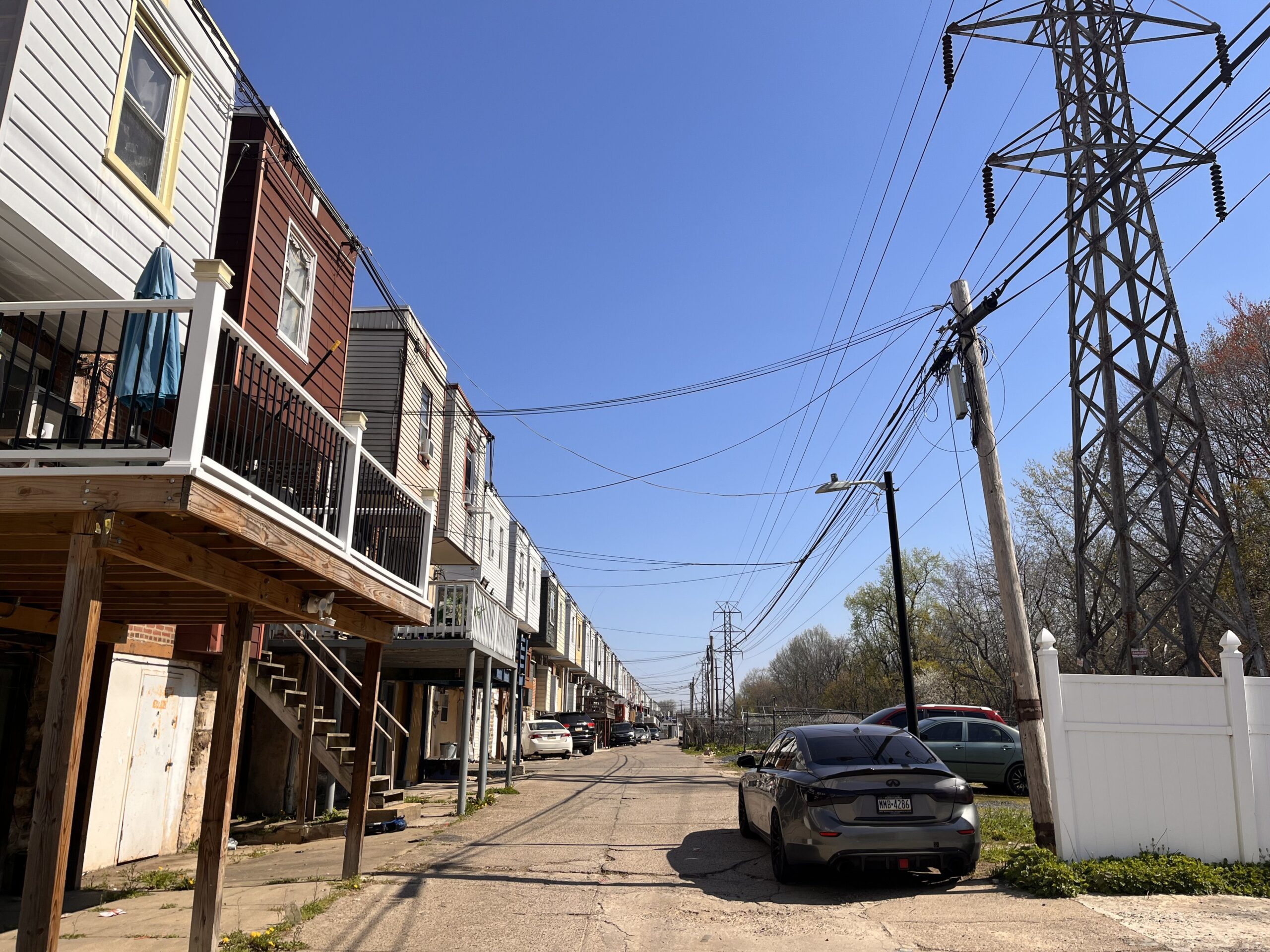
The first obstacle to cleaning out the dump is its location. It begins at the edge of an alley under high-voltage wires. Area residents park their carsin the alley and some have erected sheds.
The top of the slope is treacherous, filled with trash, chunks of concrete, and thickets of bramble that areeasy to snag or trip on.
A view of the top of the illegal dump under power lines off Pennway Street in Philadelphia.
Using volunteers to haul things out is probably not practical given the potential danger, Williams said.
From below, the dump is hidden by woods that adjoin the grounds of Friends Hospital. To view it, you have to leave a small trail, walk down a vegetation-chokedembankment, ford a spring-fed tributary of Tacony Creek, and trudge through wetlands.
There is no direct access road from the bottom.
On a recent day, a man was picking through the rubble.
“Looking for metal,” he mumbled.
The top of a ravine that serves as an illegal dump off Pennway Street in Northeast Philadelphia as viewed April 10, 2026.
Who owns the land?
The second major obstacle will be untangling ownership of the property, sorting out responsibility, and paying for it.
Williams said the city is currently tracking down ownership of whatever parcels might be involved.
Peco did not respond to an Inquirer email by deadline about whether any of the dump falls on its property or easements.
It’s not clear who is doing the dumping — construction crews, residents, or both.
“We’re still trying to figure out a plan,” Williams said. “We need to identify the property owner. Then we have to gain access.”
Williams also said it will be a challenge to prevent dumping in the future.
Philadelphia already has 400 surveillance cameras used to monitor known dump sites and can tap a broader network operated by the police department and other agencies. It anticipates purchasing an additional 100 cameras.
It has also installed bollards and gates that prevent vehicles from entering dump locations and is more aggressively pursuing and fining violators.
The rear of Pennway Street in Northeast Philadelphia as viewed April 10, 2026.
‘A huge psychological impact’
The dump was firstreported to the city by the nonprofit Tookany/Tacony Frankford Watershed Partnership (TTF), which helps manage the city-owned Tacony Creek Park.
A portion of the dump is behind a broken fence at the edge of the grounds.
The dump off Pennway Street spills to the edge of a broken fence.
“This is one of the harder ones to tackle,” said Justin DiBerardinis, executive director of TTF. “We’re at the beginning of a journey to take care of one of the biggest dumps that a lot of us have seen.”
DiBerardinis suspects contractors are dumping there, but also residents.
Cleaning it up, he says, will be “extremely complex.”
He’s also heartened by what he sees as the city’s willingness to address the logistical challenges presented by illegal landfills.
DiBerardinis said the dump mars thelandscape, and rests only yards from a tributary of Tacony Creek that serves as the edge of the 50-acre preserve.
A spring-fed tributary of Tacony Creek flows between the illegal dump off Pennway Street in Northeast Philadelphia and the grounds of Friends Hospital as viewed April 10, 2026.
“That stream is really clear, like spring-fed water coming from the earth,“ DiBerardinis said. ”To have that in our city is such a rare and special thing.“
He senses growing community support for tackling litter and a backlash against dumping. Last Saturday, about 100 volunteers came to the preserve to help clean it, though the dump remained inaccessible.
He thinks the community can play a role in the cleanup, if even for moral support and watchful eyes in the future.
“I’m seeing people getting inspired at the possibility of the restoration and the protection of those places, and to have access for them and their children,” DiBerardinis said. “Dumping like that has a huge psychological impact on a community.”