Tag: topic-link-auto

  • Philly’s Scott Bandura was teammates for a day with Bryce Harper and Kyle Schwarber. It was ‘surreal.’

    Philly’s Scott Bandura was teammates for a day with Bryce Harper and Kyle Schwarber. It was ‘surreal.’

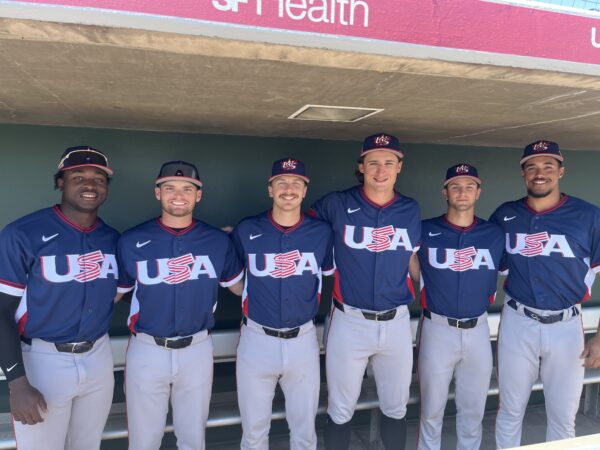
    Scott Bandura and the other San Francisco Giants minor leaguers dropped their bags Tuesday morning in the dugout of Team USA and headed for the clubhouse. They were called to be extra players, dreamers who would be part of the Dream Team for the day.

    The clubhouse doors opened, and there they were — Bryce Harper, Kyle Schwarber, Aaron Judge, and a cast of former MVPs and future Hall of Famers — preparing for an exhibition game in a cramped spring training clubhouse.

    It was a final tuneup for the stars before the World Baseball Classic. Bandura, who grew up in Mt. Airy and fell in love with the game at a rec center in South Philly, was in the same room.

    “We walked straight into every guy in there getting ready to go, and we were like a deer in headlights,” Bandura said. “It was surreal. The older guys on that team were the guys I grew up watching and were winning MVPs when I was in middle school and high school. Those are the guys who inspired me to play, and then the two Phillies are two of the top five most beloved athletes in Philly. It was unreal.”

    Bandura was the catcher for Mo’ne Davis with the Taney Dragons, a team of 12-year-olds who captured Philly’s imagination at the 2014 Little League World Series while playing in front of 40,000 people. He played youth baseball across the country with his dad’s Anderson Monarchs, had a terrific college career at Princeton, and was drafted in 2023 by San Francisco.

    Yet Bandura told his dad on Tuesday night that his hourslong stint on Team USA was the best day of his career. The back of his jersey was blank, no name or number. But Bandura was a teammate of the stars.
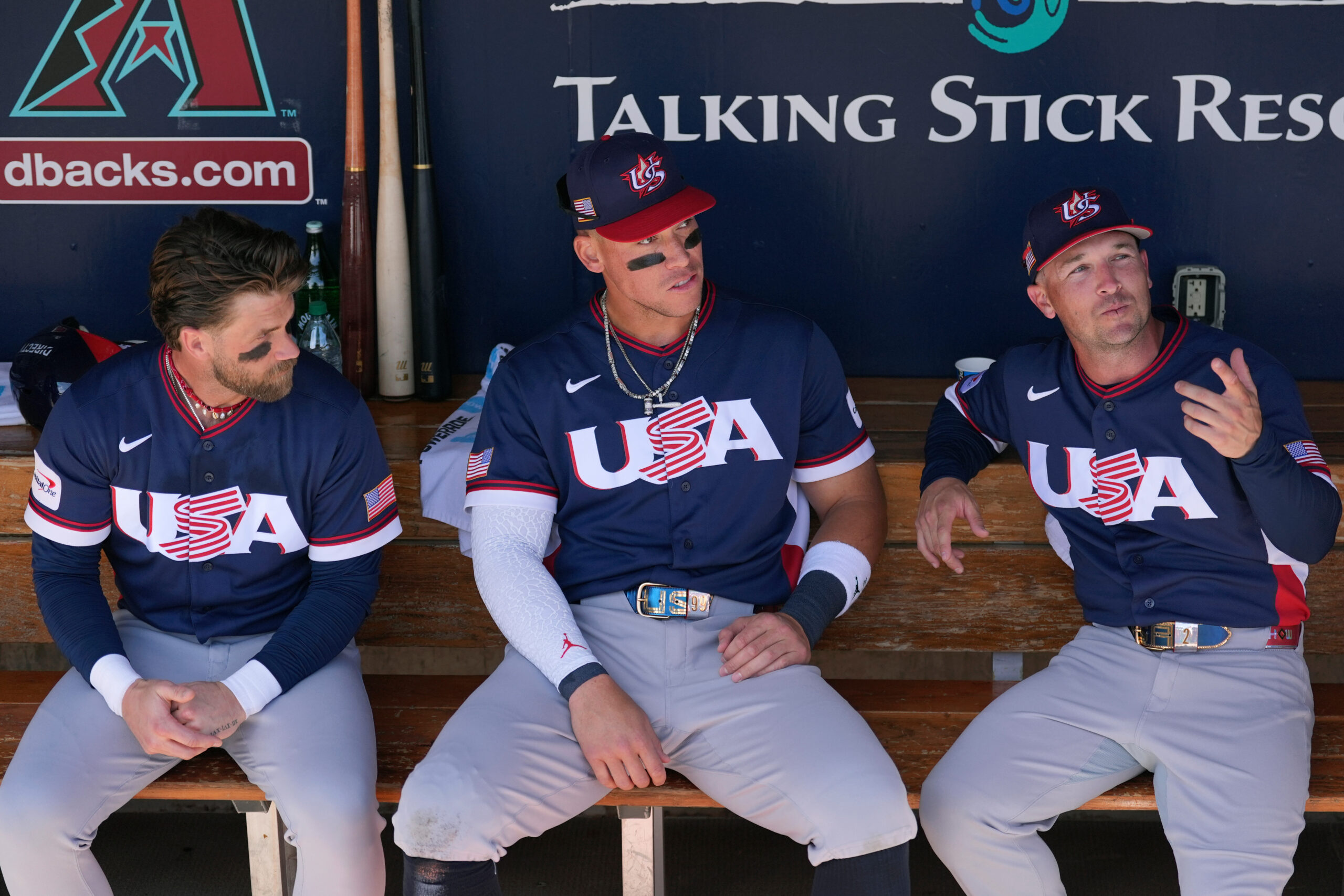
    Team USA’s Bryce Harper (left) Aaron Judge, and Alex Bregman sit in the dugout before an exhibition game against the Rockies on Wednesday.

    “Draft day in 2023 was No. 1 to start because that’s the day that dreams started to come true,” Bandura said. “But this was the next step up from that. Now, all of a sudden, I’m sharing the dugout with Hall of Famers and guys I grew up watching and feeling somewhat like I’m meant to be there. They were telling us to go show everyone something. This had to be No. 1.”

    Bandura and the other minor leaguers heard how Team USA plucked a few Giants prospects in 2023 when they played an exhibition before the World Baseball Classic. They hoped it would be their turn this year. Bandura received a text on Monday from the Giants front office: He was playing Tuesday for Team USA.

    The minor leaguers were to be late-inning substitutes as most of the Team USA players were not going to play nine innings against the Giants.

    Team USA manager Mark DeRosa welcomed the Giants minor leaguers, and Judge — “He’s way bigger than he looks on TV,” Bandura said — told them to be themselves in the dugout. They were part of the team, the reigning two-time American League MVP said.

    Bandura, a 24-year-old outfielder who finished last season in double A, has spent some time the last two springs with the Giants big-leaguers. But this was different. He entered in the sixth inning, played in the outfield next to Pete Crow-Armstrong, and hit a single in the 10th. The game was on ESPN, and his phone buzzed all night.

    “Some people thought I was actually on the team,” Bandura said. “I had to explain to them that I’m not quite there yet.”

    Bandura’s parents, Steve and Robin, were watching on TV when their son came to bat for Team USA.
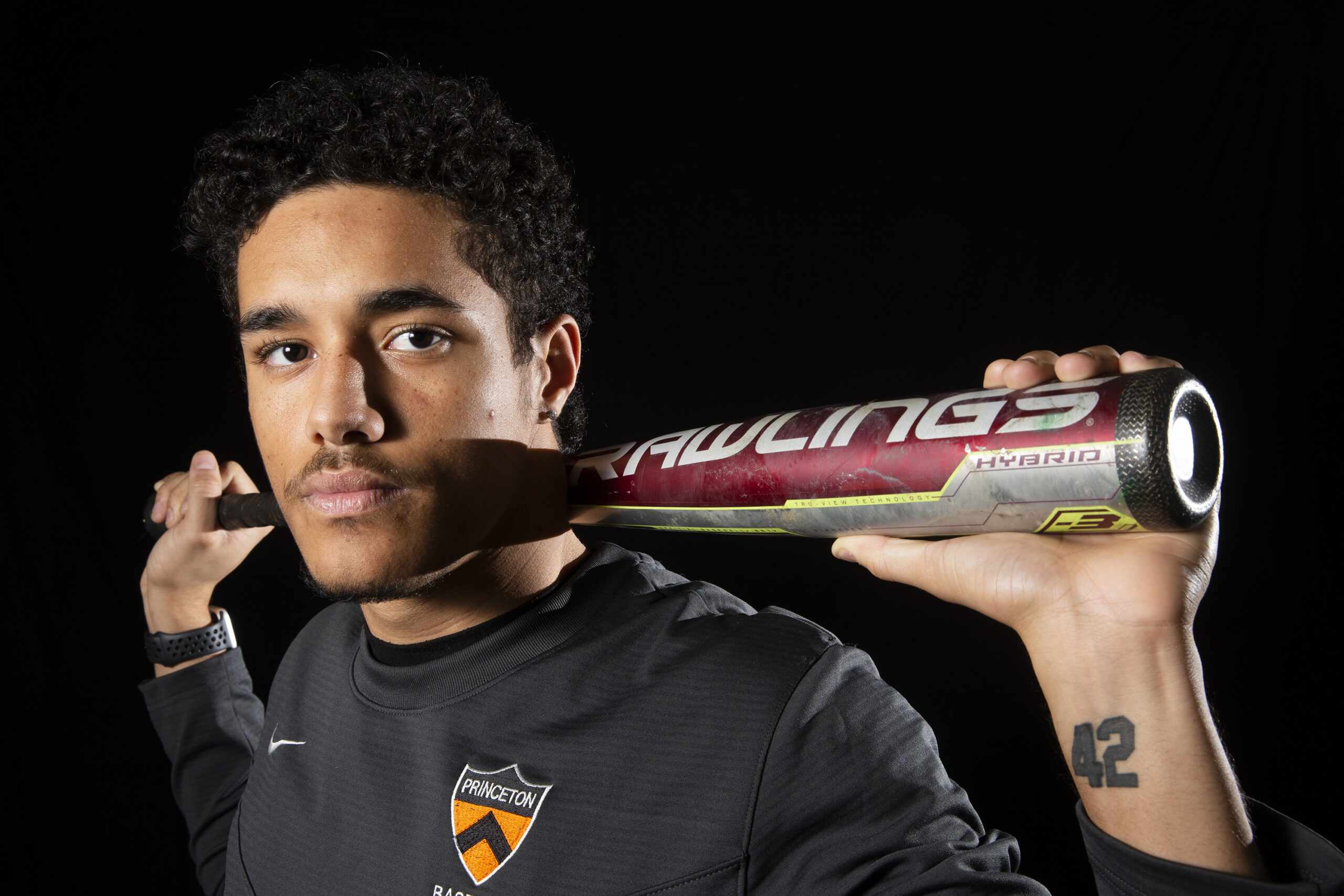
    Scott Bandura is a former Anderson Monarch and went to the Little League World Series as a member of the Taney Dragons. He’s pictured here while playing for Princeton.

    “There was a camera shot from behind the dugout just panning across all the guys who were up on the railing,” Steve Bandura said. “It panned across all those jerseys and names. [Cal] Raleigh, Harper, Schwarber, Judge, [Bobby] Witt Jr. All those guys. Then, bang. Right to him. It was like, ‘Wow.’ Oh my goodness. It was a big-time proud parent moment.”

    Bandura grew up a diehard Phillies fan and was in high school at Springside Chestnut Hill when Harper signed with the team. The 2022 World Series, which came in Schwarber’s first season with the team, was a year before Bandura was drafted by the Giants, so he still was a Phillies fan. For a few hours, he called those guys his teammates.

    “The first thing I thought about was how any of my friends from back home would think if they were in that situation,” Scott Bandura said. “I didn’t even know what to do. I wasn’t going to bother them, but these guys were huge inspirations. It was just weird. I’ve seen those guys so many times on TV. I’ve rooted for them so many times. And then to be in the dugout as somewhat equals, it was just weird.”
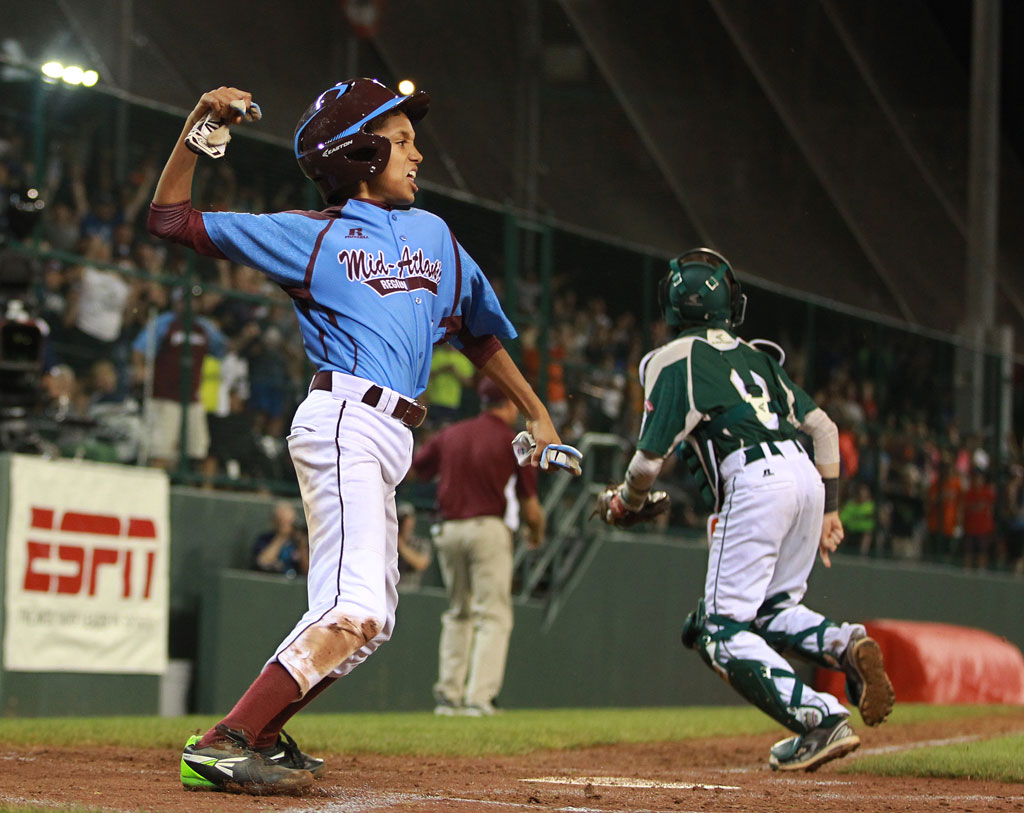
    Taney’s Scott Bandura celebrates as he slides home to score in a Little League World Series game in 2014.

    Bandura will start his season next month at a minor league outpost still a few steps from reaching the major leagues. He showed enough promise last season (Bandura hit .307 in 81 games in high A) that getting there feels tangible. He reported to spring training last month 26 pounds heavier than he was last season. This was the first fall, his father said, since he was 3 years old that Bandura did not go to school as he finished his college degree during the last two offseasons. Finally, it was just baseball.

    “I’m just so proud of him because I see how hard he works,” Steve Bandura said. “I’ve seen how hard he’s worked to get here. I saw how every morning he was up and worked on his diet, measuring everything, and following his plan.”

    For now, the No. 1 moment of Bandura’s career was being close to the guys he admired. In a few years, Bandura could have a new moment at the top of his list. Perhaps his few hours on Team USA could propel him there.

    “The goal is to have a really good big league career,” Bandura said. “And I got a taste of that with the Team USA environment. The only way to get there is to have an All-Star-caliber career. As cool as that was the other day, it definitely served as motivation to get where I want to go.”
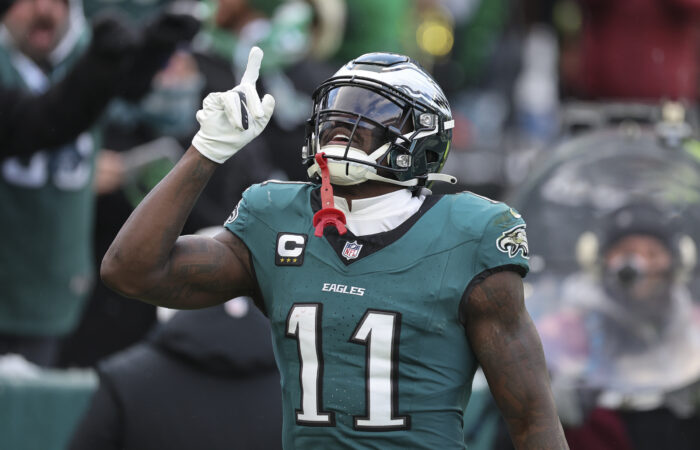
  • A.J. Brown’s pool of trade suitors is smaller after the Bills’ D.J. Moore move. The Eagles must demand a first-round pick for Brown.

    A.J. Brown’s pool of trade suitors is smaller after the Bills’ D.J. Moore move. The Eagles must demand a first-round pick for Brown.

    The biggest Eagles-related takeaway from the D.J. Moore trade?

    A lot of NFL general managers are a lot less capable than Howie Roseman.

    As for A.J. Brown, the impact of the Bills’ acquisition of Moore is being overstated.

    Roseman may get the first-round pick he reportedly is seeking in exchange for Brown, but it’s no more likely now that the Bears have somehow managed to finagle a second-round pick out of the Bills for Moore. If anything, Roseman might deserve credit for driving up the price for Moore, who was the Bears’ fourth receiving option by the end of a season in which he caught just 50 passes for 682 yards. Buffalo had a clear need for a primary receiver. Dealing a second-round pick for Moore might sound more reasonable when your other option is trading a first- and second-round pick for Brown. What we know for sure is that the small pool of teams that made obvious sense as a trade partner for the Eagles just shrunk by one.

    Here’s what else we know:

    The Trent McDuffie trade could be just as much of a harbinger in the opposite direction.

    A two-time All-Pro at a premium position (cornerback) entering his age-26 season, McDuffie is headed to the Rams for the No. 29 pick in this year’s draft, a future third, and change. I don’t think it’s accurate to say that the McDuffie deal is an indication of the elite cornerback market, at least not relative to Brown. Keep in mind, the Colts traded away two first-round picks and Adonai Mitchell for Sauce Gardner at the deadline. One of those picks ended up at No. 16 this year. Who knows what next year’s will be. That’s the elite cornerback market.

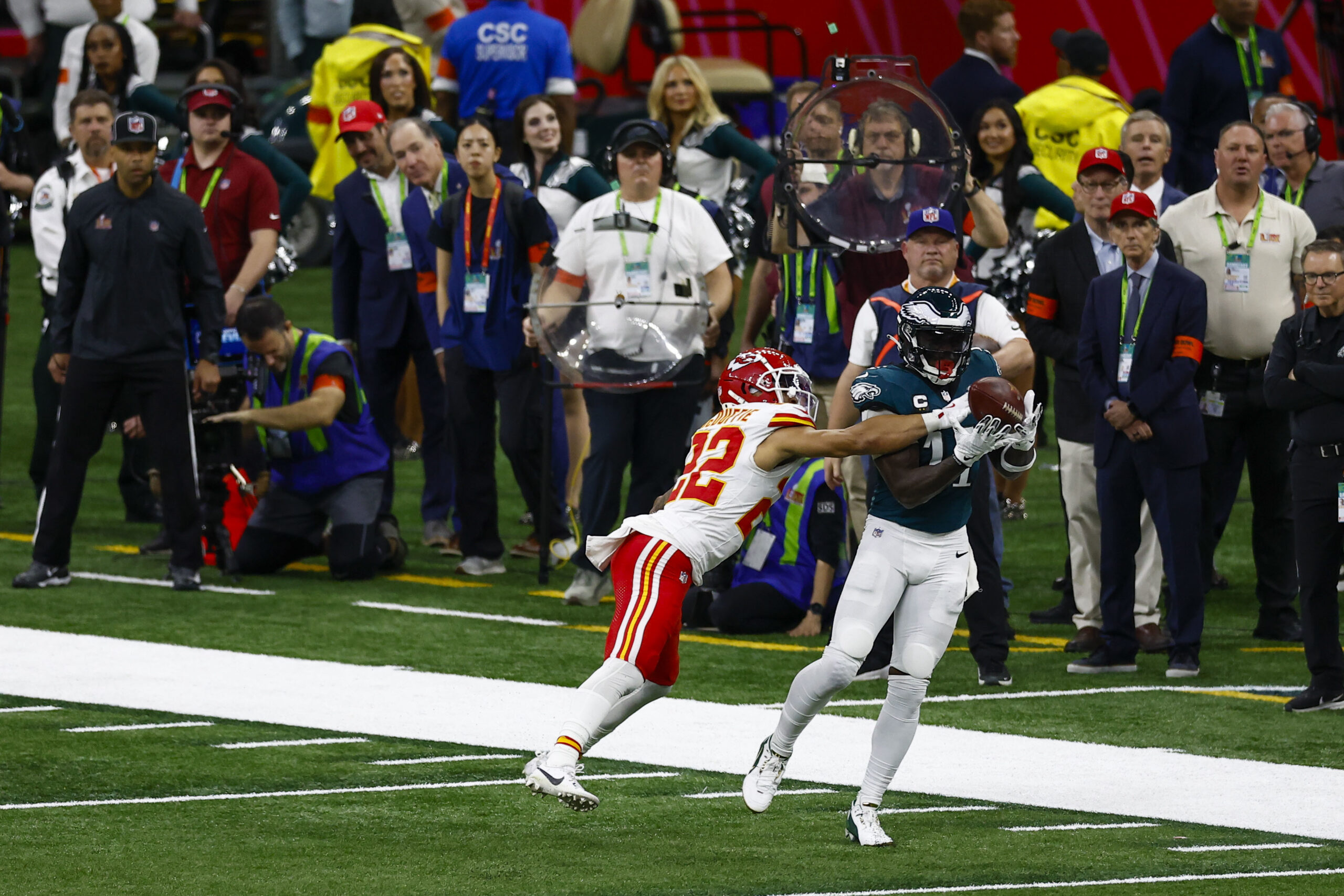
    The McDuffie trade does give us a neat and tidy for-instance. Given the sacrifice the Chiefs just made at a more premium position, would they then be willing to turn around and trade the No. 29 pick they received for McDuffie to the Eagles for Brown? Maybe they would. Hey, maybe they will. They sure do need a wide receiver. That said, it seems far more likely that they are looking at that No. 29 pick the same way the Eagles would in justifying a trade of Brown: as a chance to add another five years of well-below-market-rate production in the form of a rookie.

    The overall point is that you can talk yourself silly trying to project the market based on one deal. The Moore deal can just as easily be construed as the price a team is willing to pay to not pay the price the Eagles are asking for Brown.

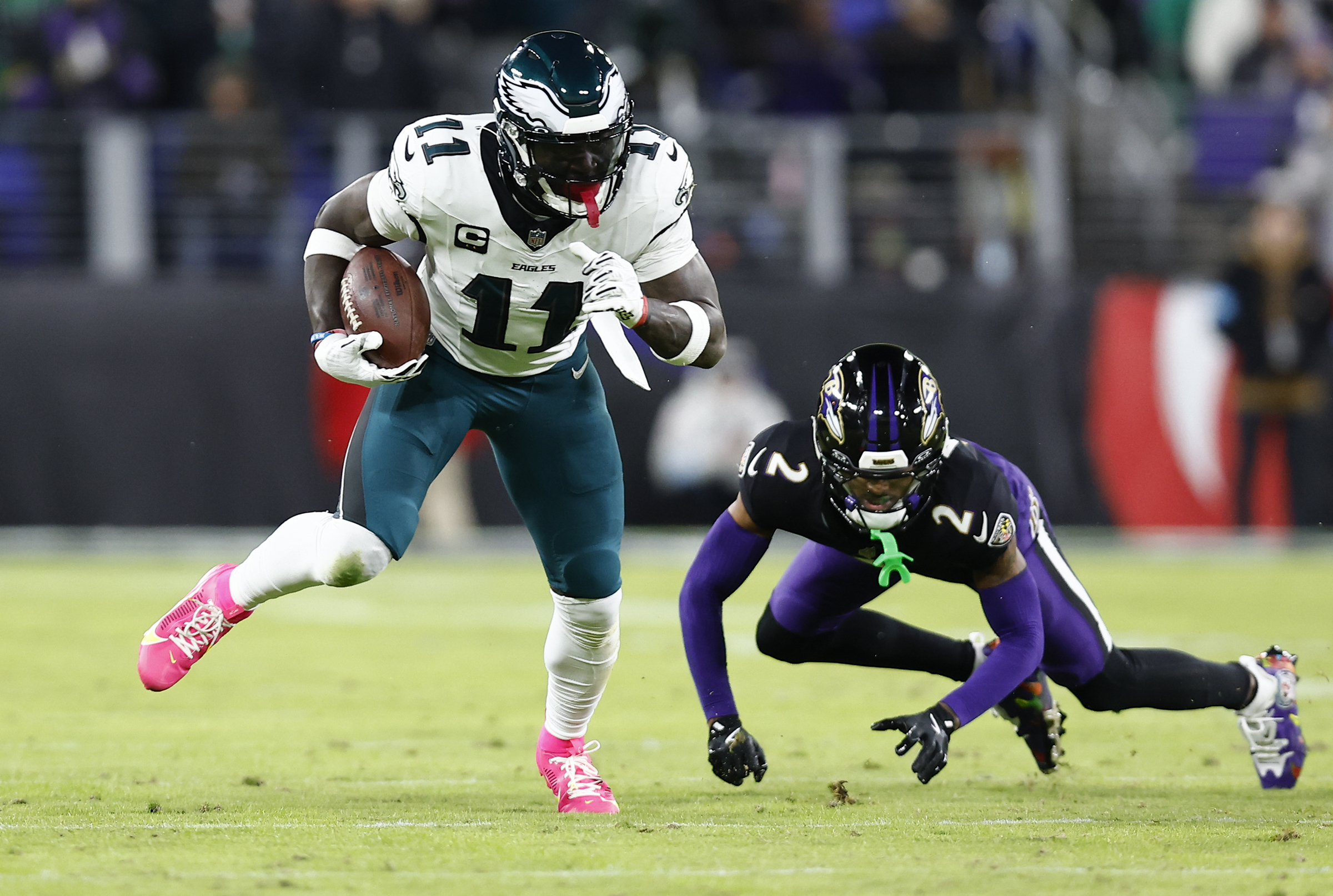
    Chiefs cornerback Trent McDuffie (left) was traded to the Rams for the 29th pick in this year’s draft. Could Eagles wide receiver A.J. Brown fetch a similar haul?

    The Eagles are justified in asking for a first- and second-rounder for Brown, assuming what they really expect is a first-rounder and an assortment of mid-to-late-round picks.

    There are plenty of comps.

    • The Raiders acquired 29-year-old Davante Adams from the Packers for No. 22 overall and No. 53 overall in 2022.
    • The Bills acquired 26-year-old Stefon Diggs for No. 22 overall and change from the Vikings in 2020.
    • The Chiefs acquired No. 29 overall, No. 50 overall and change from the Dolphins for 28-year-old Tyreek Hill in 2022.

    It’s easy to see the genesis of Roseman’s current reported asking price. It’s also easy to see why that asking price has drawn snickers.

    Consider:

    • The first-round pick the Bills traded to the Vikings turned out to be Justin Jefferson.
    • The second-rounder that the Raiders traded to the Packers turned out to be Alec Pierce (after Green Bay traded the pick to draft Christian Watson). The first-rounder was Quay Walker, a four-year starter at linebacker.
    • The Chiefs used the No. 29 pick they landed for Hill to trade up to draft McDuffie at No. 21.

    On the other side of these deals were two of the worst organizations in the NFL (Dolphins, Raiders), and the team that just traded a second-round pick for Moore and has the second-most expensive wide receiver room in the NFL without a true WR1 to show for it.

    There aren’t many other for-instances. The Texans traded away DeAndre Hopkins for No. 40 overall in 2020, but that deal included running back David Johnson in the return and was universally panned regardless. Last offseason, the Steelers traded away No. 52 overall for 27-year-old DK Metcalf, whose four-year averages were worse than Brown’s 2025.

    There aren’t many teams that can give the Eagles what they need.

    I use the word “need” for a reason. The Eagles need a first-round pick to justify trading Brown. The only way they might otherwise justify it is by landing a future first plus a 2026 second, i.e. the “Ravens Scenario.” We’ll get to that in a second. First, let’s explain what we mean when we say the Eagles “need” a first-rounder.
    This is not abstract. Concretely, the Eagles need to be able to replace Brown. The best way to do it is via the draft, where there happens to be a number of players who could help them and who are projected to be within striking distance of No. 23. But the Eagles need plenty else besides a replacement for Brown. We saw that this year, when they had Brown. To justify trading Brown, they need to at least end up with a pick that maximizes their odds of replacing him (even if they end up “replacing” him with a star at another position). Bare minimum is a top-50ish pick. But only if they feel like they need to trade him for the best offer. Right now, their best leverage is their willingness to bring him back. Which is why they are making that willingness known.

    Not many teams are in a position to give them what they need. Cross off the Bills. Presumably the Chiefs, unless Andy Reid and Brett Veach have radically changed the philosophy under which they traded away Hill to pave the way for McDuffie. Nobody is giving up a top-10 pick for Brown, so cross them off too.

    Could the Ravens be in the market to trade for Eagles wide receiver A.J. Brown?

    The Dolphins (No. 11) are more likely to trade Jaylen Waddle for a Brown-type package than to trade for Brown. The Cowboys (No. 12) don’t need a wide receiver, nor do the Rams (No. 13), who just traded their expendable first-rounder to the Chiefs for McDuffie. The Bucs (No. 15) are brimming with wide receivers, including last year’s first-rounder Emeka Egbuka. The Lions (No. 17) have a lot of needs more pressing than the skill positions. Same goes for the Vikings (No. 18). The Panthers (No. 19) spent significant draft capital on Tetairoa McMillan last year. Brown doesn’t fit their timeline.

    Next up is Dallas again at No. 20, then the Steelers, who just traded for Metcalf and like to build from within. The Chargers don’t have the luxury of trading No. 22 for Brown. Forget the Browns (No. 24). We’ve already covered the Bears (No. 25). Cross off the Texans (No. 28), who have Nico Collins and youth around him.

    That leaves us with the Ravens at No. 14, the 49ers at No. 27, the Broncos at No. 30, the Patriots at No. 31, and the Seahawks at No. 32.

    If the Eagles are reluctant to trade Brown to a fellow NFC contender, that would leave three teams: Ravens, Broncos, Patriots. Denver and New England would need to offer their first-rounder, because the next best 2026 picks are No. 62 and No. 63, which isn’t nearly good enough. The Ravens are in the opposite boat. Their No. 14 overall pick is too high. Their second-rounder (No. 45) is borderline, and would only make sense if coupled with a high future pick.

    The Eagles’ ability to land a first-rounder is contingent on the Ravens’ willingness to give up a future first or the Patriots/Broncos (or Seahawks/49ers) belief in the players who will be on the board at the end of this year’s first round.

    None of that is impacted by the cost of trading for Moore. The Ravens and the Patriots are the two obvious teams, assuming we remove the Chiefs and the NFC contenders. The Ravens aren’t going to give up No. 14 for Brown, and No. 45 is only worth it for the Eagles if they have 45 players they love on their draft board. A future first from Baltimore would give them an opportunity to move up. The Pats’ first-rounder would work if coupled with a pick that also gives the Eagles ammo to move up from No. 23 or No. 31 to draft a guy they covet.

    This is a pass-fail sort of thing. There is a bare minimum return the Eagles need in order to justify the competitive hit they’d take without Brown in 2026. It is a return where only a team’s best available draft pick is good enough. There are only a few teams that might consider it. That was the case before the Bills traded for Moore. It remains the case now.

  • Meet Huntingdon Valley-bred Erica Dambach, who built Penn State’s pipeline to the USWNT

    Meet Huntingdon Valley-bred Erica Dambach, who built Penn State’s pipeline to the USWNT

    To casual followers of the U.S. women’s soccer team, Erica Dambach’s name might not be familiar. But to many years’ worth of players and coaches, it means a lot.

    Nineteen years into her tenure as Penn State’s head women’s soccer coach, Dambach hasn’t just built one of the nation’s top college programs. She has built a pipeline from State College to the sport’s biggest stages.

    If the first name you think of is Alyssa Naeher, you’re right. But the legendary goalkeeper is far from alone. Christine Nairn arrived in Naeher’s senior year, then overlapped with Raquel Rodríguez, who won a 2015 national championship and later a NWSL title.

    Rodríguez overlapped with Marissa Sheva, who went from Bucks County to Ireland’s first-ever World Cup team in 2023. Sheva then overlapped with Kerry Abello, Kate Wiesner, and Sam Coffey, who have played for Emma Hayes’ U.S. national team.

    Wiesner later welcomed Olivia Smith, who spent just one year on campus before rocketing to the pros. Her move from Liverpool to Arsenal last year was the first in women’s soccer to earn a transfer fee of over 1 million British pounds (around $1.4 million).

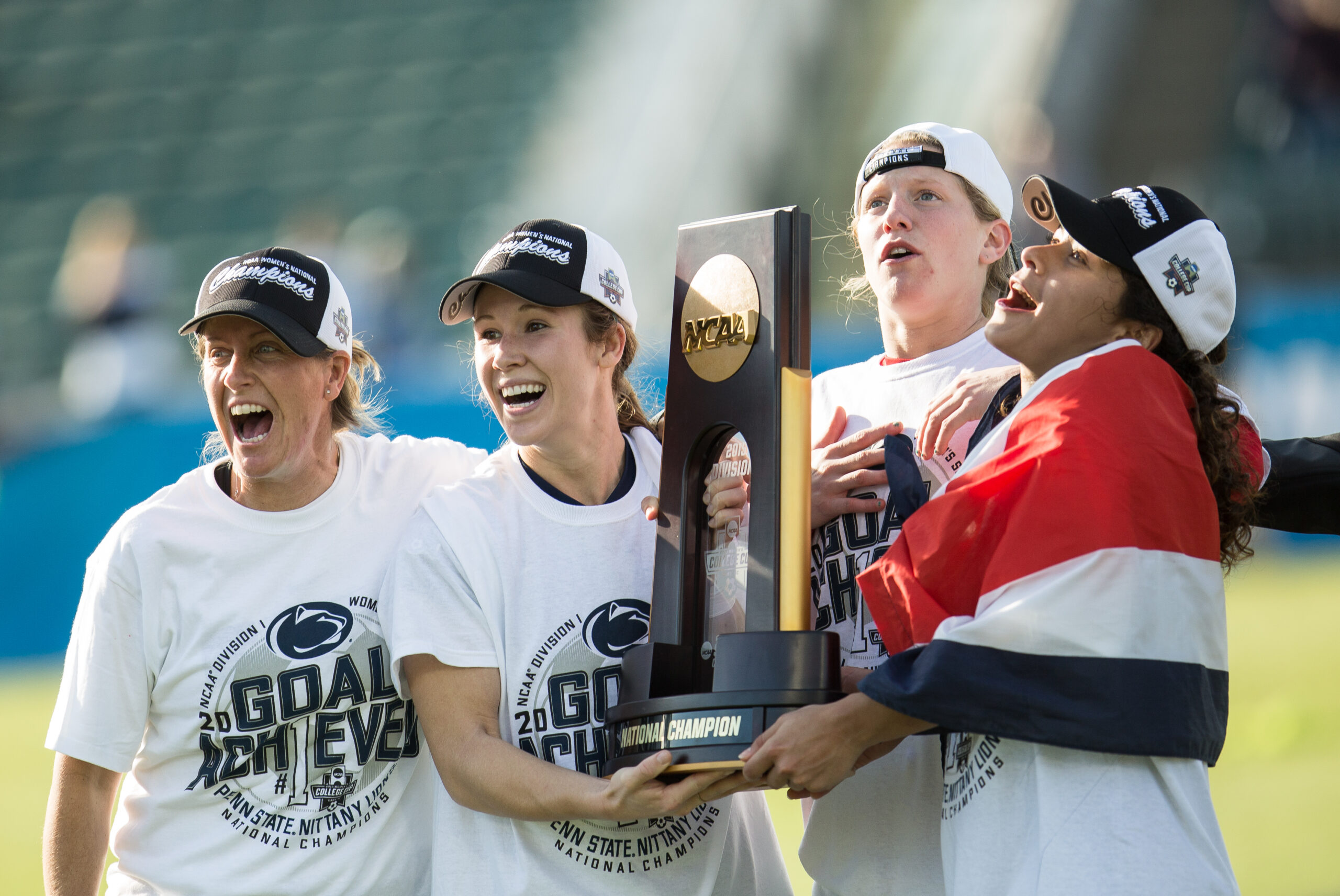
    Erica Dambach (left) with a trio of future pros who won Penn State’s 2015 national championship: Mallory Weber, Britt Eckerstrom, and Raquel Rodríguez.

    Along the way, Dambach has had her own turns with U.S. Soccer coaching staffs. She was an under-19 team assistant in 2004, the under-17 head coach from 2004 to 2007, and a senior team assistant from 2008 to 2012 and in 2020.

    It’s been quite a run for the 50-year-old, with room for plenty more to come.

    “There’s been opportunities to to look in different directions or to think about is the grass greener,” Dambach told The Inquirer. “And I think every time I’ve looked in a different direction, all it does is reaffirm that this is who I am, and this is what I enjoy.”
    But go back before all that, and you’re standing in the Philadelphia suburbs.

    ‘These women live out their dreams’

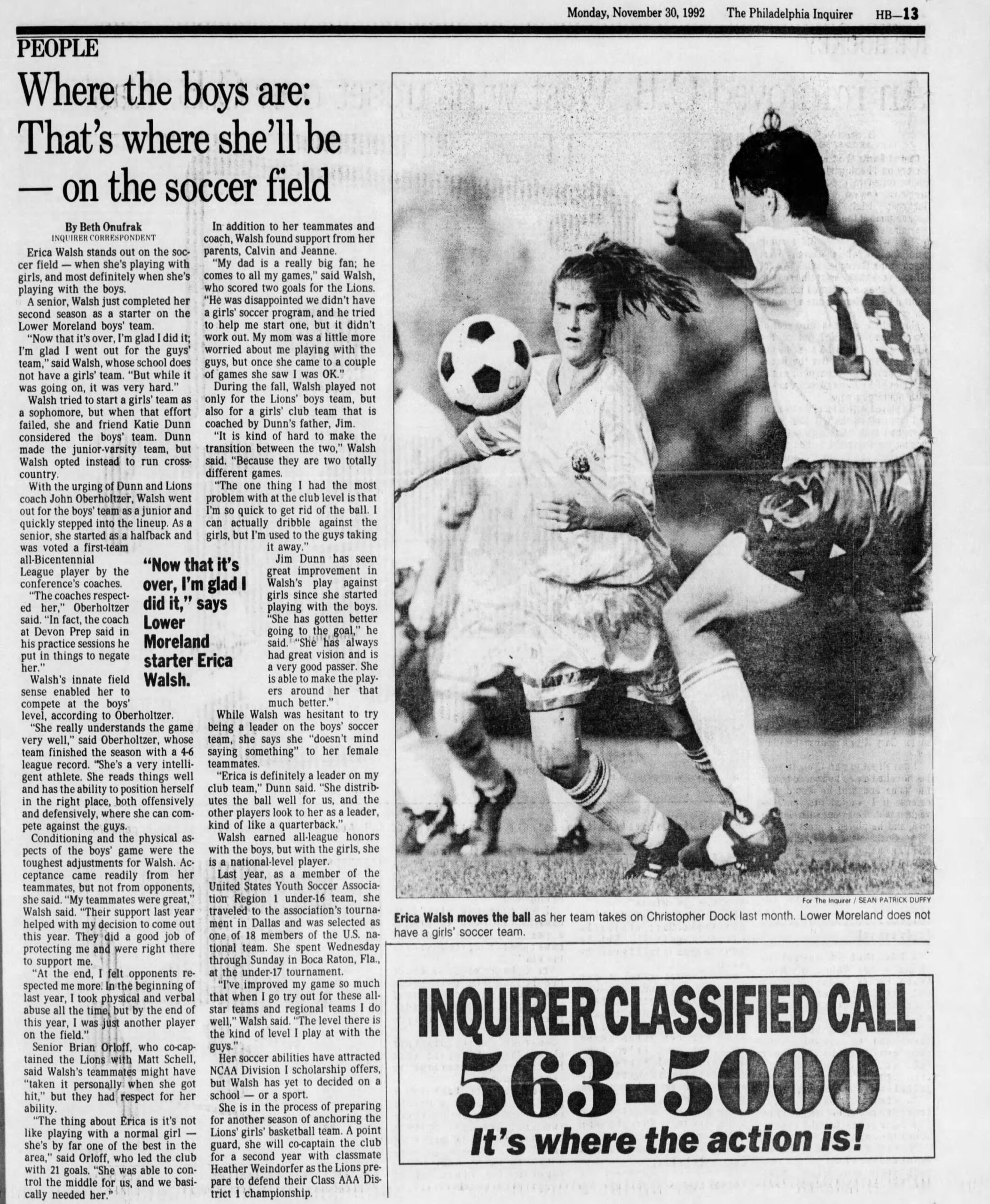
    Dambach was born in Bordentown, N.J., and moved across the Delaware River to Huntingdon Valley at a young age. She played high school soccer on the boys’ team at Lower Moreland, then was recruited to play college soccer at another historic program, William & Mary.

    A clipping from the Bucks County Neighbors High School Sports section of The Philadelphia Inquirer on November 30, 1992, featuring Erica Dambach (née Walsh) playing for Lower Moreland’s boys’ soccer team.

    Her coaching career began a year after she graduated in 1996. She started at Bucknell, then went to Dartmouth, Lehigh, Florida State, and Harvard before Penn State called in 2007.

    Now Dambach’s mantel includes 11 Big Ten regular season titles, five conference tournament crowns, that 2015 national championship, runner-up in 2012, and five more Elite Eights.

    And there have been so many players who’ve made it to the pros.

    “It’s a big reason why I’m in the college game for sure, to see these women live out their dreams,” Dambach said. “Obviously, when they sit in our office when they’re 14 years old, they talk about lifting a World Cup trophy. And now to see these players get an opportunity to wear the crest and to represent the country and watch their dreams come true, it’s certainly proud moments around here.”
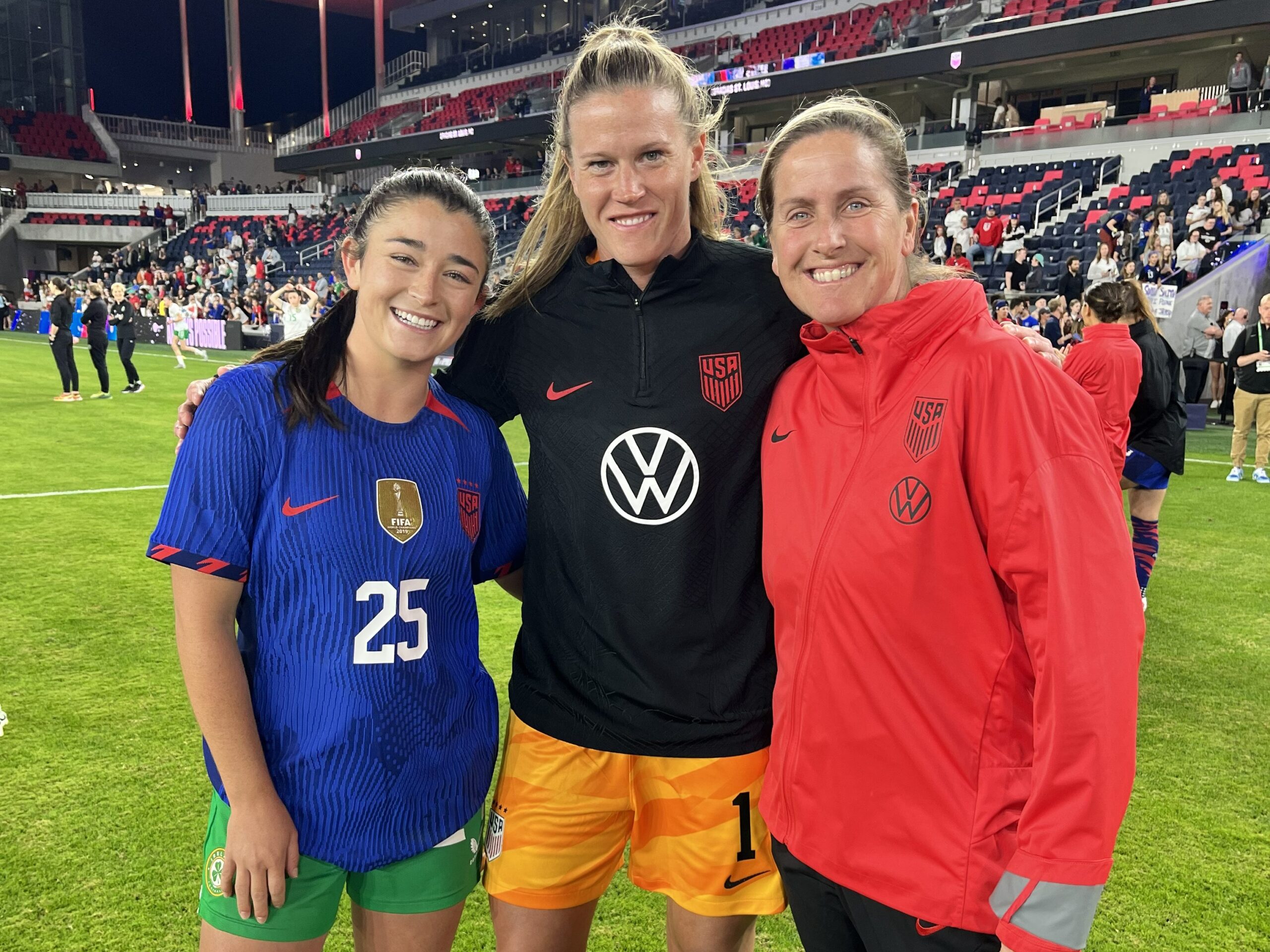
    Erica Dambach (right) with Marissa Sheva and Alyssa Naeher at the U.S.-Ireland game in April 2023, where Sheva and Naeher were on opposite sides.

    Dambach faces the same headwinds as other college coaches these days. No one bats an eye anymore when a talented teen turns pro without going to college.

    “What I’ve learned is that when a player and a family has their mindset on it when their daughter’s 16, you need to be careful because they’re going to find a way to get there [to the pros] very soon,” she said. “The generational talent of Claire Hutton? Yeah, good move.”

    But while Hutton already has 15 caps at age 20, there’s still plenty of room for college products. Dambach believes that can remain the case.

    “I would argue that our ability to help the 17-, 18-, 19-year-olds right now, that time is too valuable in their life and too precious in their life,” she said. “This is an environment where I do think that they can get to all the same points with having a little bit more guidance in their first time away from home. And having people that are educated and care about that side of the human and the player.”

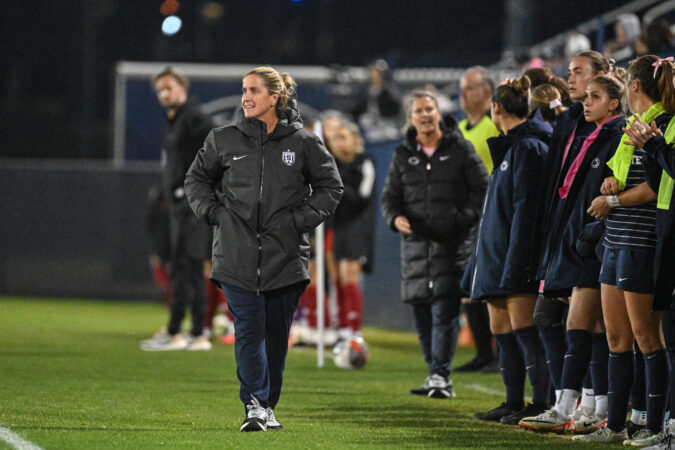
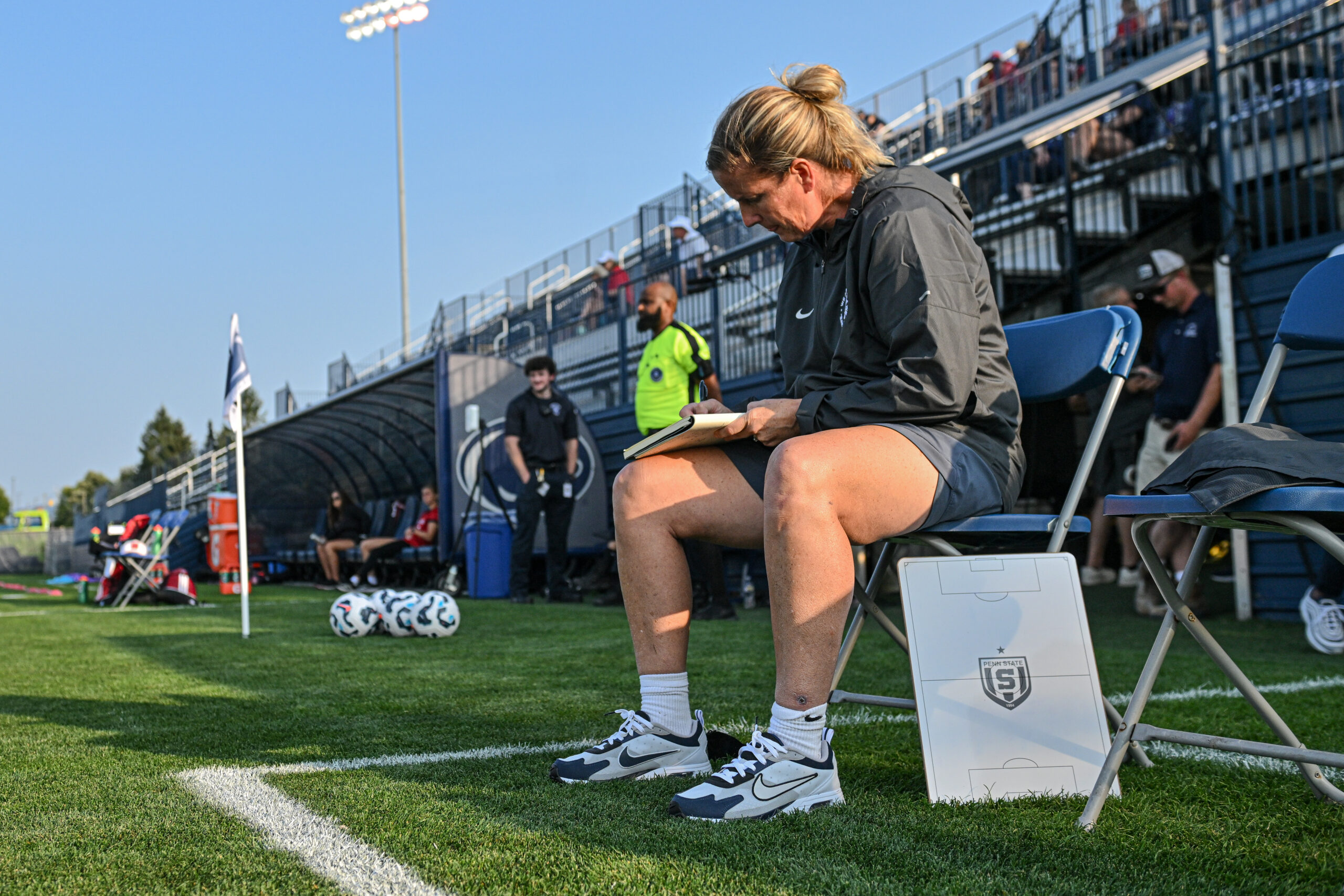
    Erica Dambach taking notes on the sideline during a Penn State game in 2024.

    Another is the fight every college coach has: to get NIL money and attract top players with it. Dambach is comfortable with where she is on that front.

    “There are 10 programs historically, five to 10 programs, that are competing for a national championship,” Dambach said. “You’ve got those teams that have seniors that bubble up and have a particularly good year. But when those programs go head to head for a player, you’re splitting hairs, and the dollars do matter.”

    It also helps that Penn State just opened a $21 million expansion of its soccer facilities a few days ago. And Dambach has the privilege of a veteran staff, including three assistants who’ve been there for 15 years or more. One of them, Ann Cook, was her roommate at William & Mary.

    “I think [players] walk in here and they know that they’re going to be coached by four head coaches, four coaches that have been sought after by so many different programs,” Dambach said, “and they look at it, and everywhere they turn it’s going to be a professional environment for them.”

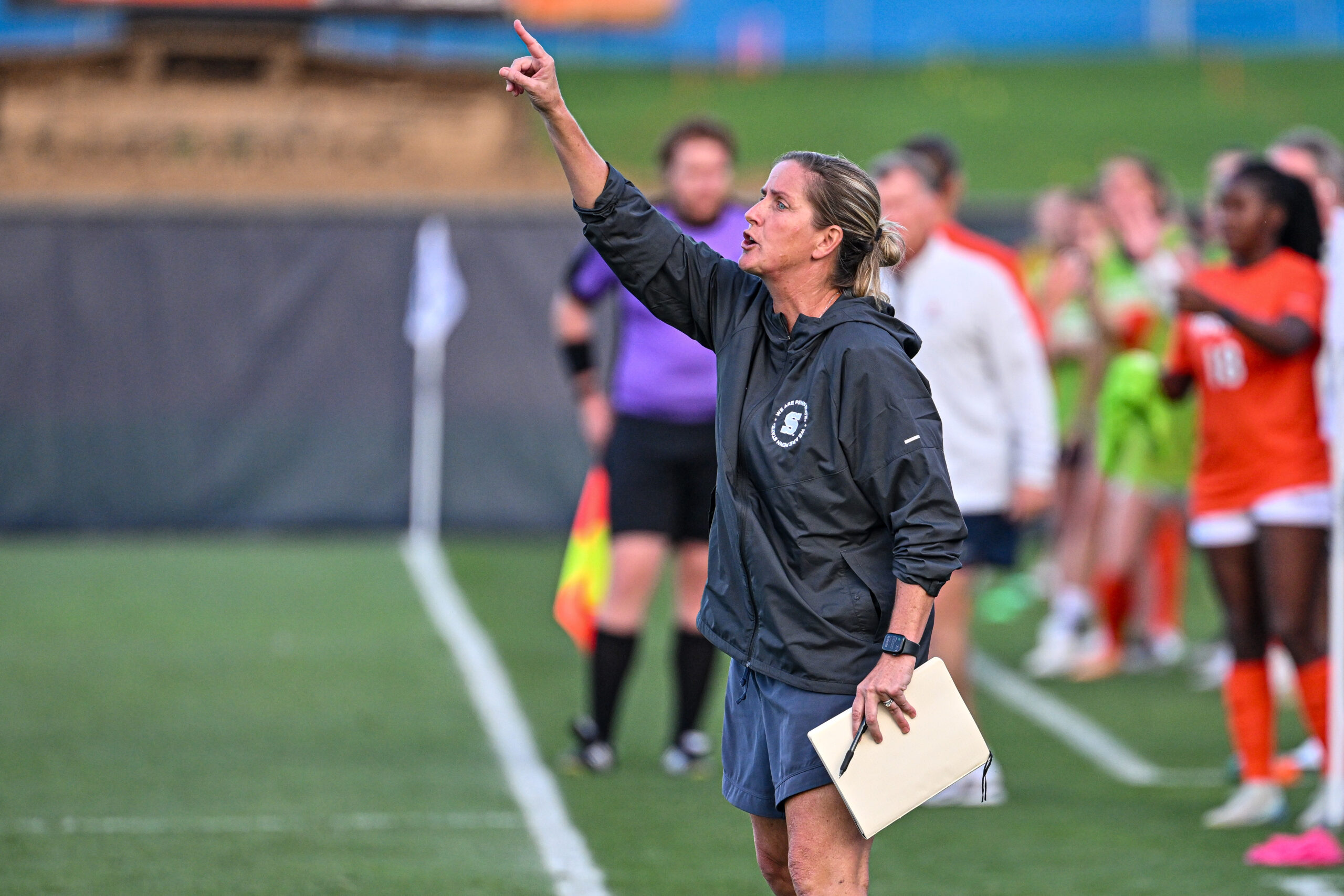
    Erica Dambach giving her players some instructions during a 2024 game.

    Tributes from the stars

    Dambach knows Hayes well and keeps in touch with Coffey and other former players. Ahead of the U.S.’s return to north Jersey for Saturday’s SheBelieves Cup against Colombia (3:30 p.m., TBS, Telemundo 62), that duo paid tributes to their friend.

    “I could, like, write a book on her just to give an answer,” said Coffey, who transferred from Boston College after her sophomore season (and could indeed write that book as a journalism major). She was an attacking midfielder at the time, and Dambach helped convert her to the ball hawk she is now.

    “I came from B.C. as a player that was so one-dimensional, and it might sound shocking, but I really had no interest in defending whatsoever,” Coffey said. “I just think that she developed me so much as a player and a person.”

    The latter still resonates.

    “She is so focused on us being this complete person,” Coffey said. “Especially when you’re at a college age, it can so easily be so much about just what you do on the field, but for her it’s all about who you are in all aspects of your life.”

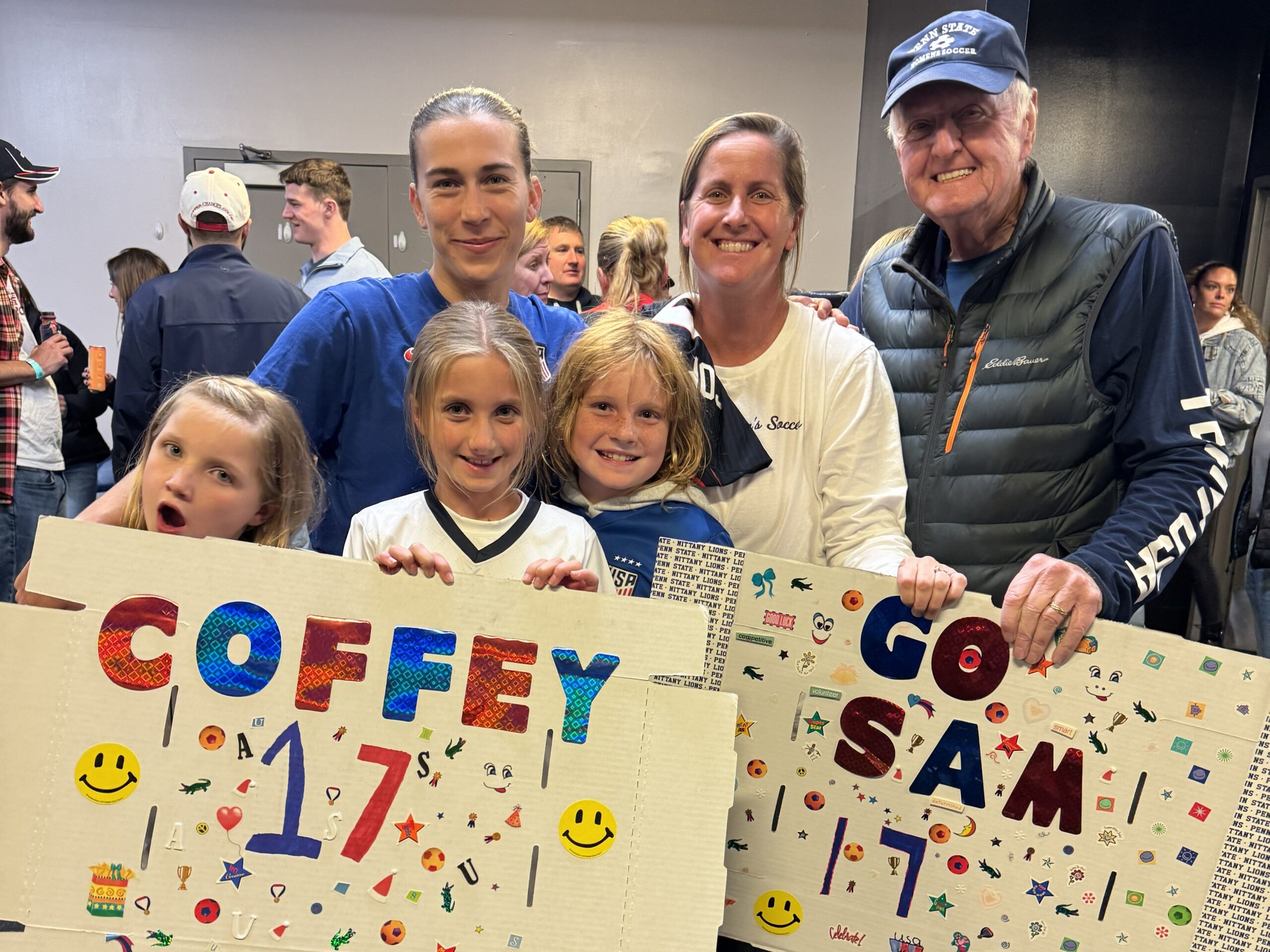
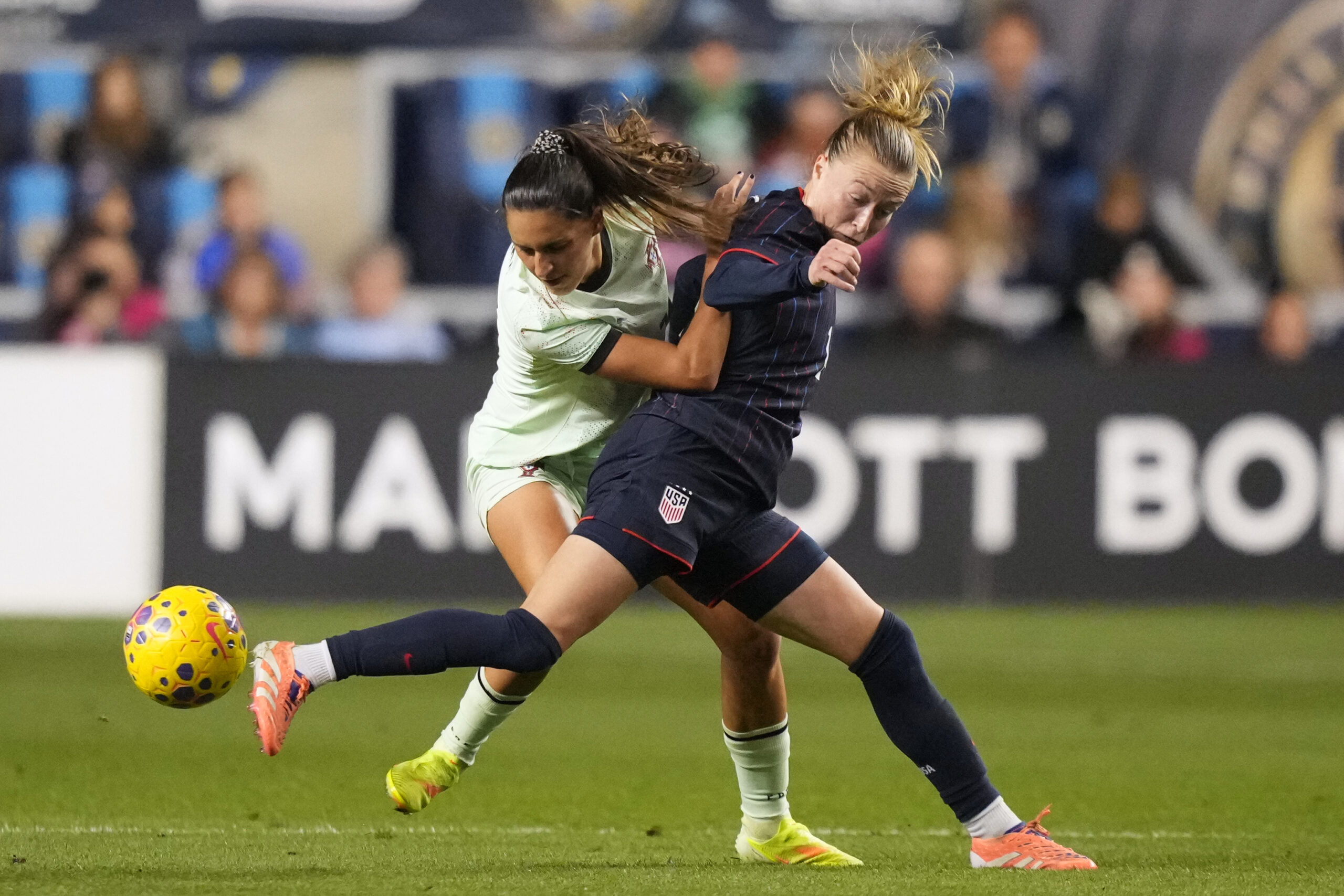
    Erica Dambach (second from right) and her family with Sam Coffey at the USWNT game vs. Portugal in October at Subaru Park.

    Hayes recalled that when she came to the U.S. from England to begin her coaching journey in the early 2000s, Dambach was “the first coach I looked at and that I was in close contact with. I thought she’s the best, and I think she’s quietly had an influence on my own career.”

    Now Hayes gets to take Dambach’s players on their next journeys. Coffey is a star, and Wiesner is a World Cup contender. (She was to be on this SheBelieves Cup squad until suffering a calf injury last month.)

    “It’s the way players speak about her, it’s the way other colleagues speak about her,” Hayes said of Dambach. “It’s a real testament to not just the quality she has, but the longevity to keep doing that, and to keep producing players whose characters you can clearly see have been well-shaped.”

    There even was praise from a U.S. player who played against Penn State back in the day and has worked with Dambach over the years since. Emily Sonnett was part of a 5-1 Virginia rout of the Nittany Lions in 2013, before earning well over 100 national team caps.

    Veteran U.S. national team defender Emily Sonnett (right) worked with Erica Dambach when Dambach was an assistant coach in the program.

    “When she was in [the national team], she led a lot of our small-group meetings in terms of defending and was] very detailed,” Sonnett said. “That short amount of time, the impact that she had on me, and the intentionality … I really enjoyed working with her, and when I see her, I remind her how much I enjoyed it.”

    Told of this, especially the players’ words, Dambach was moved.

    “Honestly, you know, that means a lot,” she said. “That’s never going to get old for me. … Those are two world-class players and world-class humans, and the fact we can play a small part in it is everything.”

  • Beloved coaching figure Bill Courtney remembered as ‘an incredible connector’

    Beloved coaching figure Bill Courtney remembered as ‘an incredible connector’

    Jimmy Polisi lived a few houses away from Bill Courtney, while the two were on the men’s basketball staff at the University of Miami. Some nights, Courtney, then an assistant coach, would call the graduate assistant to hang out.

    “Throughout time, we kind of got close,” said Polisi, who spent two years at Miami. “He was just a great guy, to be like a fly on the wall to see how he did everything.”

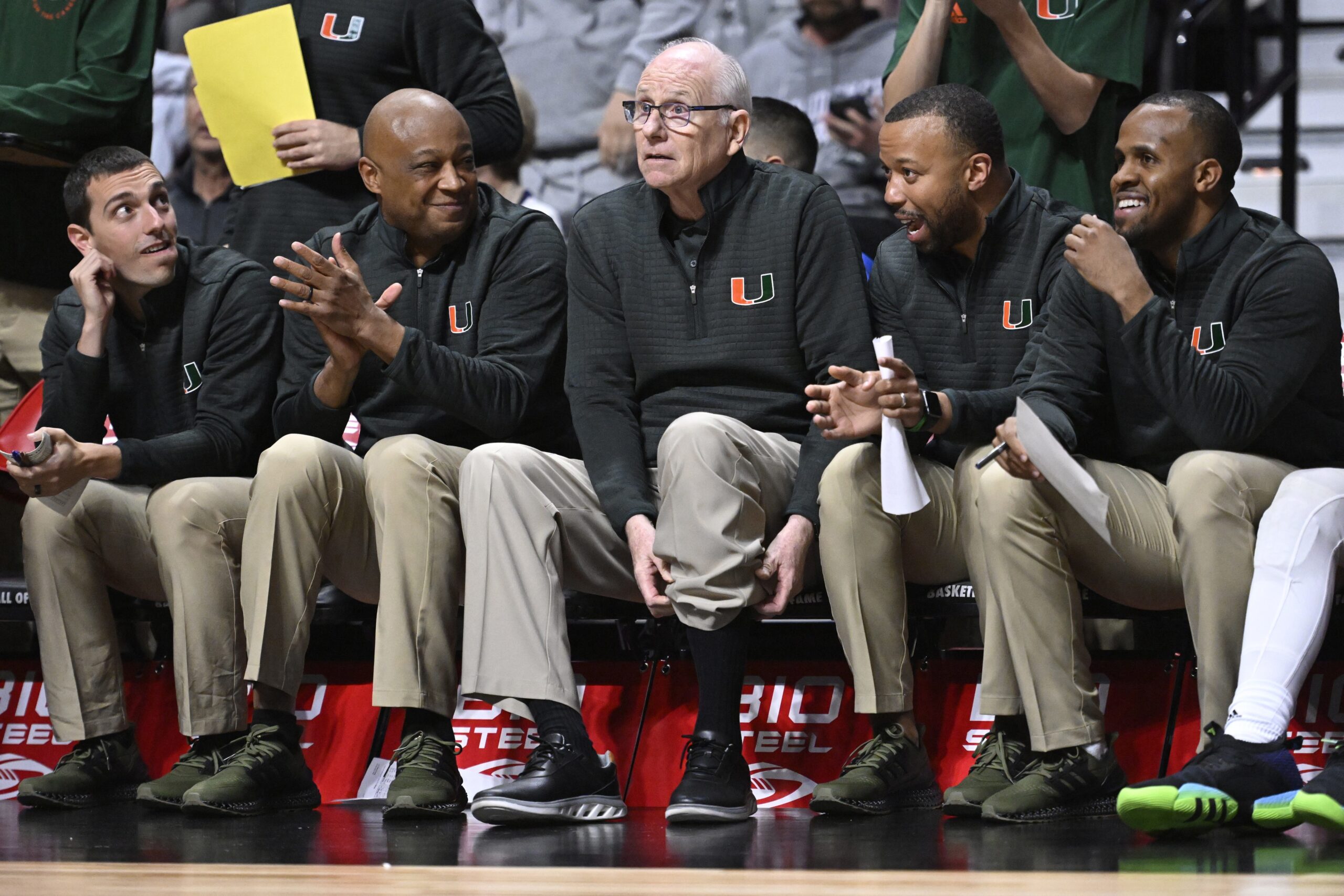
    Temple hired Courtney last summer as an assistant coach. He reunited with Adam Fisher, whom he coached with at Miami, and Polisi, the Owls’ director of player operations. The Temple head coach viewed Courtney as a mentor and knew he would be a valuable member for his team.

    On Jan. 13, Courtney unexpectedly died at age 55. He was a beloved figure, who spent 30 years in the college basketball coaching scene and “made people feel special.”

    From each of his coaching stints — which included 10 schools — he formed genuine relationships with players and staff members. Those relationships went beyond the court as many looked up to him.

    “He did such an amazing job of making everybody feel special, but it was genuine,” Fisher said. “He wanted to know that when he recruited somebody, he would know the aunt, the uncle, the mom, dad. He found every connection and then knew something about each one of them to connect things. He’s just an incredible connector of people.

    “He had this way about him. That’s why so many people are going through such pain right now, because a lot of people consider him a close friend, because he was, that’s the way he made you feel and it was genuine,” Fisher said.

    Added Polisi: “He brought such a positive light to both Miami and here that it was so needed. The way he made a difference in this program in a short amount of time is huge. In this day and age of college basketball, people come in and out, but you could really tell how much of a difference he was making this program in just a short amount of time.”

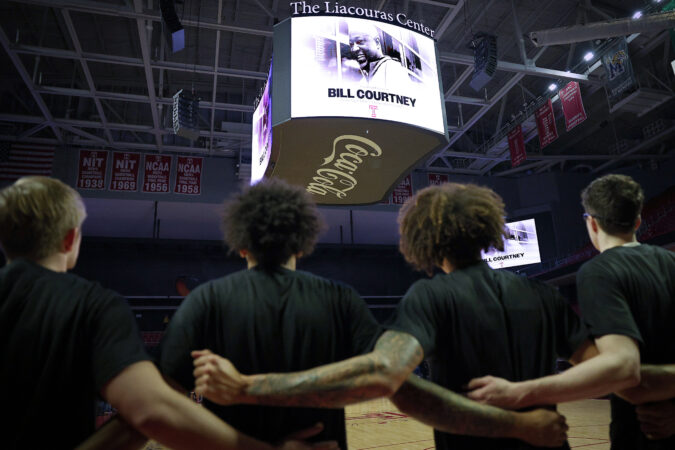
    Temple’s players voted to play its game against Memphis the next day. The Owls then got shirts to honor Courtney ahead of their game against Florida Atlantic on Jan. 18.

    The team has since worn a patch on its jerseys and warmup shirts with Courtney’s initials. They still announce Courtney as an assistant coach to honor his legacy during each game.

    Warm welcome

    Most people who met Courtney had a shared a similar phrase about him — he never had a bad day.

    That was what former American assistant coach Bruce Kelley told Jim Larrañaga, who was the head coach at Bowling Green at the time and was searching for a new assistant coach in 1996. He reached out to Courtney, and it wasn’t long till he flew out to the midwest to meet with Larrañaga.

    Courtney stayed in his future boss’s house.

    Jim Larrañaga started working with the late Billy Courtney when he hired him as an assistant at Bowling Green in 1996.

    “I got a feel for Bill, how he interacted with my sons, how he played the game,” Larrañaga said. “I said, ‘We’re going to go back to the house and my wife’s fixing [lunch], there’s going to be a few players over there.’ … I just knew from the way he behaved the whole day. How honest he was and how comfortable he was around people, around me.”

    Courtney got the job. His relationship with Larrañaga spanned over five decades. Larrañaga loved going to the movies. When his wife didn’t want to go see a particular film, she said to “ask Bill,” so Larrañaga did. That became a tradition for them as they went from Bowling Green to George Mason, where Larrañaga became the head coach in 1997.

    Courtney organized pickup basketball games and often invited his boss. Courtney would put Larrañaga on the better team to give him a quality workout. One day, the team Larrañaga played on lost, which prompted him to wonder if Courtney was upset with him.

    The next day at work, Larrañaga asked Courtney if it was true — getting laughter at the thought of that being a possibility.

    “I went into the office the next day. I said, ‘BC, are you mad at me for something?’” Larrañaga said. “He said, ‘No, why would you even suggest that.’ I said, ‘You put me on a terrible team last night. We lost the first game.’ He started laughing ‘You got to be kidding me.’ That’s just our relationship, the way we were.”

    A helping hand

    Courtney landed his first head coaching position at Cornell in 2011, a team fresh off a Sweet 16 appearance.

    During games he cracked jokes to Jeremy Hartigan, Cornell’s senior associate athletic director. Courtney made an effort to get everyone on staff a gift for Christmas during his first season with the Big Red, and he didn’t expect anything in return.

    “We were all kind of embarrassed that Bill had gotten us something and that we didn’t get him anything,” Hartigan said. “I just remember he said, ‘I don’t care if you ever get me anything. I just wanted to show how much I appreciate you guys.’”

    During his time in upstate New York, he met David Metzendorf, who was then at Ithaca College. Injuries spoiled Metzendorf’s playing career, but Courtney brought him on as a manager. When Metzendorf graduated in 2013, a role on staff opened for him.

    He became Courtney’s right hand man.

    “The amount of people in my life who reached out about him afterward, not just because they knew how close we were, but because he had touched them was unbelievable, in terms of, my friends from back home who would come visit me in Ithaca, he would make them feel like part of the crew,” Metzendorf said. “My college buddies who he got to know well because they were at Ithaca College and were right there, they’d come around and he made them feel part of the crew and loved and welcomed.”

    Reuniting with an old friend

    Eventually both went their separate ways as Metzendorf climbed up the coaching ranks. Cornell fired Courtney in 2016. He went to DePaul before reuniting with a familiar face in 2019; Larrañaga, who was the head coach at Miami.

    There, he met Fisher, who had gone from director of player operations in 2013 to assistant coach by the time Courtney joined the staff. They immediately clicked.

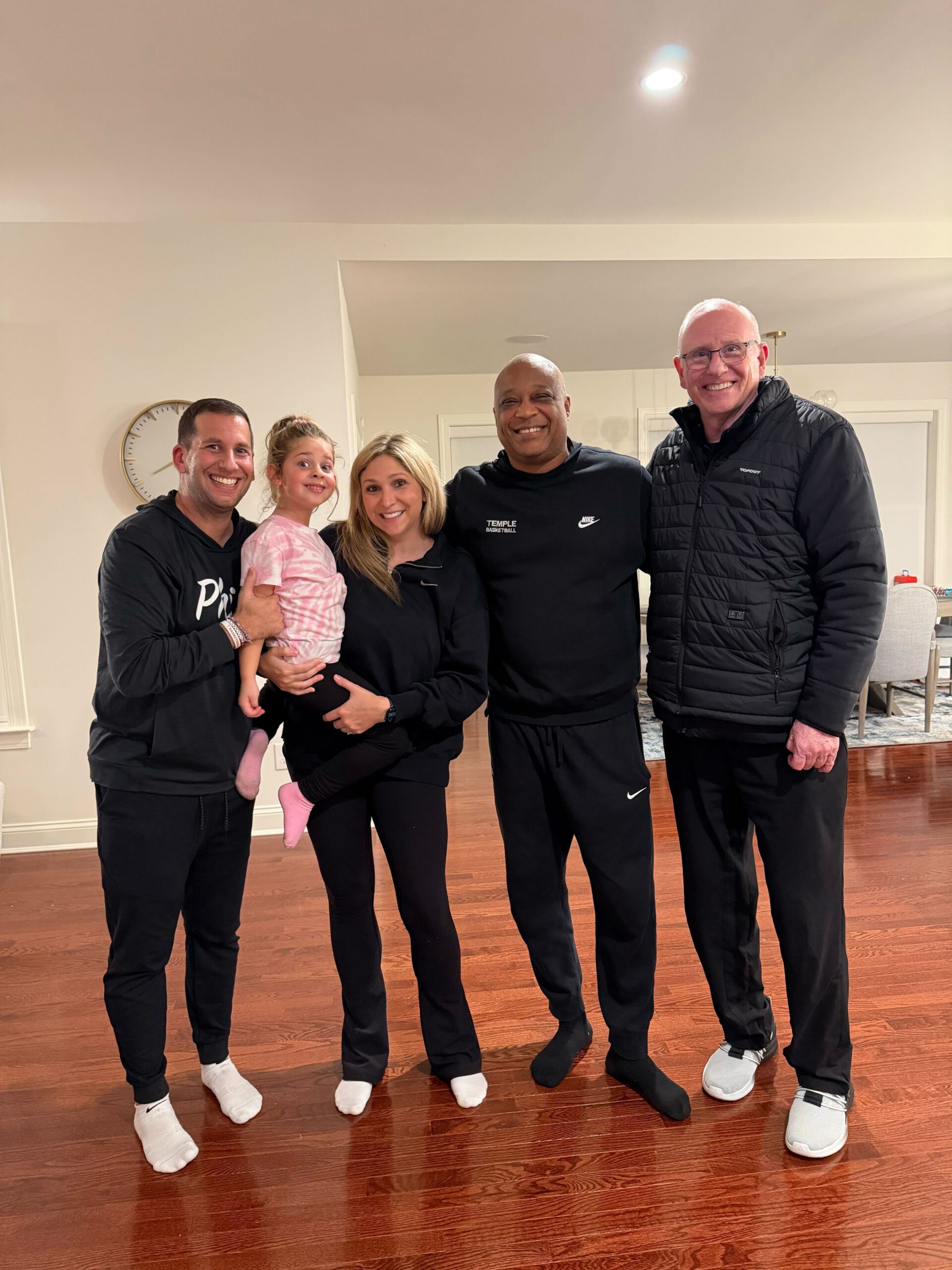
    Adam Fisher with his wife and daughter, with the late Bill Courtney and Jim Larrañaga.

    Fisher and Courtney became close friends. They often got lunch together, and Fisher went to Courtney for advice. When his wife, Rebecca, gave birth to their daughter, Fisher asked Courtney how to balance being a father and coach. Courtney was one of the people who met Fisher’s daughter during Thanksgiving, a month after she was born.

    When Courtney joined the staff this summer all the coaches were at the practice facility. As Fisher and Rebecca watched from the window, their daughter, Alivia, organized all the coaches to play duck-duck-goose.

    “I’m looking through the window thinking, ‘Are they playing duck duck goose?’” Fisher said. “BC came in, he’s exhausted. She chased him down the hallway ‘Get back here, BC.’ He goes, ‘I got to go play.’”

    Courtney was at Temple for seven months, but made his presence felt on the team, and it meant a lot for Fisher to work with his friend again.

    “Just being able to work alongside him was an honor,” Fisher said. “I loved every second of it.”

  • Stroke survivors can counterintuitively improve recovery by strengthening their stronger arm | Expert Opinion

    Stroke survivors often face substantial and long-lasting problems with their arms. Both arms often decline together: When one arm is more severely affected by the stroke, the other becomes more difficult to use as well. Compared with a healthy person’s dominant hand, a stroke survivor may take up to three times longer to complete everyday tasks using their less-impaired arm.

    This creates a frustrating reality. People with severe impairment in one arm must rely almost entirely on their other arm for daily activities, such as eating, dressing, and household tasks. When that “good” arm works slowly or awkwardly, even simple activities become tiring and discouraging, and some people may begin to avoid them altogether.

    But that good arm can be strengthened. In our newly published research in the journal JAMA Neurology, we found that training the less-impaired arm in people living with chronic stroke can improve everyday hand function, in some cases even better than focusing only on the most impaired arm.

    What is a stroke?

    A stroke occurs when the flow of oxygen-carrying blood to part of the brain is interrupted by a blockage in a blood vessel or by bleeding. Without oxygen, brain cells begin to die.

    Because each side of the brain mainly controls the opposite side of the body, a stroke often causes movement problems on the side of the body opposite the brain injury. For this reason, stroke rehabilitation has traditionally focused on restoring movement in the most impaired arm.

    If someone’s face is drooping, their arm is weak or they’re having difficulty with speech, it’s time to call 911.

    However, research over the past few decades has shown that both sides of the brain contribute to controlling movements for both arms, although they play different roles. As a result, damage to one side of the brain can affect movement on both sides of the body.

    As expected, the arm opposite the brain injury often has major problems with weakness, stiffness, and voluntary control, limiting its use for reaching, grasping, and manipulating objects. But the other arm, usually thought to be unaffected from the stroke, is frequently not normal either. Many stroke survivors experience reduced strength, slower movements, and poorer coordination in the less-impaired arm.

    Training the less-impaired arm

    As neuroscientists who study how the brain controls movement after stroke, these findings led us to a simple question: Could training the less-impaired arm help it work better?

    In a clinical trial of over 50 patients, we studied people living with chronic stroke who had severe impairments in one arm, making it unusable for everyday tasks. These individuals depended almost entirely on their less-impaired arm to manage daily life.

    Participants were randomly assigned to one of two rehabilitation groups: one that trained their most-impaired arm, and one that trained their less-impaired arm. Both received five weeks of therapy that involved challenging, goal-directed hand movements, including virtual reality tasks designed to improve coordination and timing.

    Compared to those who trained their most-impaired arm, we found that participants who conditioned their less-impaired arm became faster and more efficient at everyday hand tasks, such as picking up small objects or lifting a cup. These improvements remained six months after training ended.

    We believe the lasting benefit of training the less-impaired arm may come from a simple feedback loop: When their arm works better, people naturally use it more, and that extra practice in daily life helps lock in those gains.

    Strengthening what remains

    Stroke rehabilitation has long focused on the arm that is most visibly impaired. But for many people, full function in that arm never returns. They adapt and rely on their less-impaired arm to get through the day.

    “Less-impaired,” however, does not mean unaffected. When this arm becomes the sole tool for daily activities, even mild problems can have major consequences for independence and quality of life. Improving how well this arm works could make everyday tasks faster, easier, and less exhausting, even years after a stroke.

    Future work will focus on how best to combine training of the less-impaired arm with standard therapy for the more-impaired arm, and how these approaches translate into everyday life at home.

    For many survivors, recovery may not mean restoring what was lost but strengthening what remains.

    Candice Maenza is a research project manager and associate director of the Center for Translational Neuromechanics in Rehabilitation at Penn State; Robert Sainburg is a professor of kinesiology and neurology at Penn State.

    Reprinted from The Conversation

  • Breaking down Sixers’ final 20 games: Paul George’s (and Jared McCain’s) return, Joel Embiid’s injury, and more

    Breaking down Sixers’ final 20 games: Paul George’s (and Jared McCain’s) return, Joel Embiid’s injury, and more

    Nick Nurse recently described the teams in the middle of the Eastern Conference standings, including his 76ers, as “tightly squeezed.” And even though veteran guard Cameron Payne vows to go 1-0 every day rather than looking too far ahead, he acknowledged that the Sixers “need to win every game we possibly can.”

    “That’s kind of the situation we’re in,” Payne said. “We need wins.”

    Such is life with the 34-28 Sixers clinging to the East’s sixth seed — which avoids the play-in tournament — with 20 games remaining, starting with Saturday’s road contest at the Atlanta Hawks. The Sixers enter Friday a half-game ahead of the seventh-seeded Orlando Magic (33-28) and eighth-seeded Miami Heat (34-29), and one game behind the fifth-seeded Toronto Raptors (35-27). The Sixers rank 17th in remaining strength of schedule, per Tankathon, though the next week includes challenging road games at the Cleveland Cavaliers and Detroit Pistons.

    While attempting to maintain their positioning (or move up) during the stretch run, the Sixers will be tasked with rapidly reacclimating the suspended Paul George with 10 games to go. They will deal with uncertainty regarding Joel Embiid, who enjoyed a dominant month but is now hobbled again by shin and oblique injuries. And will they ever reach circumstances that allow some rest for All-Star point guard Tyrese Maxey, who entered Friday leading the NBA in minutes played?

    Here is a breakdown of Sixers’ final 20 games:

    March 9 at Cleveland Cavaliers

    The Cavaliers made arguably the most impactful deadline trade, acquiring former Sixer James Harden to boost the backcourt anchored by All-NBA contender Donovan Mitchell. That automatically adds spice to the final regular-season clash between these teams. But Harden’s addition has fueled a Cleveland turnaround from a disappointing start to the season. The Cavaliers have ascended to the East’s fourth seed and enter Friday one game back of the third-seeded New York Knicks, making Cleveland a potential first-round matchup for the Sixers.

    March 12 and April 4 against Detroit Pistons

    The Sixers have two games remaining against the East’s bona fide top seed, including a visit to Detroit on Thursday. The Sixers must be ready for the Pistons’ rugged playing style, along with MVP contender Cade Cunningham. These matchups always have Philly ties, with former Sixers Tobias Harris and Paul Reed now in Detroit and Sharon Hill native Jalen Duren, who became a first-time All-Star this season. That April 4 home matchup is the second game of a challenging back-to-back, which also includes an intriguing rematch with the Minnesota Timberwolves.

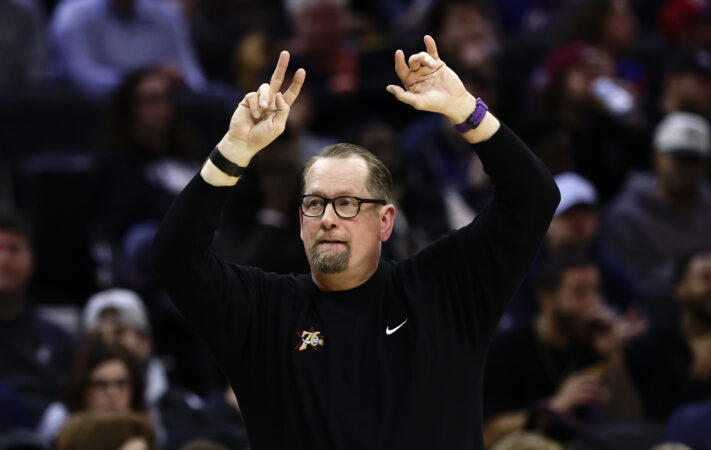
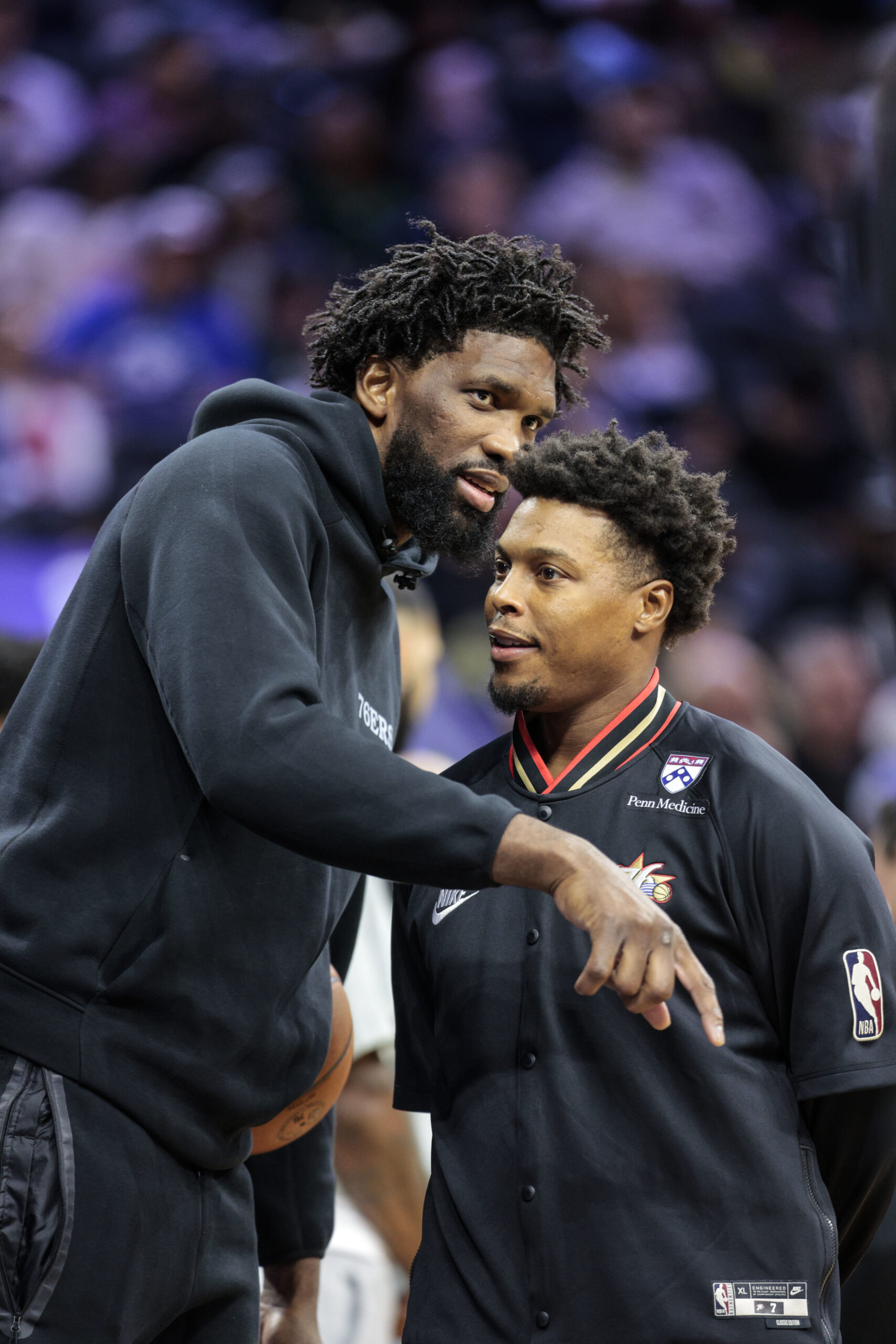
    Sixers center Joel Embiid has missed time recently for shin and oblique injuries.

    March 17 at Denver Nuggets

    Will we finally get another matchup between Embiid and Nikola Jokić, who previously jostled for MVP awards? Embiid has not played in Denver since 2019, including a 2024 absence when he was an extremely late scratch with a knee issue days before Jonathan Kuminga inadvertently fell on that knee, which prompted multiple surgeries. Jokić, meanwhile, remains a basketball wizard but has not quite looked like himself since returning from a knee injury. Still, the Nuggets are viewed as a primary playoff threat to the Oklahoma City Thunder’s title defense.

    March 23 vs. Oklahoma City Thunder

    The Thunder’s lone visit to Philly this season was always going to be a high-profile matchup. But it also will be the return of Jared McCain, whom the Sixers dealt to the Thunder at the deadline, a move that has become wildly unpopular with Philly fans. McCain has thrived with the Thunder so far, averaging 11.9 points and shooting 41.1% on 4.7 three-point attempts in 12 games entering Friday.

    March 25 vs. Chicago Bulls

    This will be George’s first game back following a 25-game suspension for violating the NBA’s antidrug policy. Nurse and teammates have raved about George’s work as an individual and teammate during this time, when he is permitted to be around the Sixers for all practices and shootarounds but must be away from the arena during games. But how quickly he reintegrates on both ends of the floor will be crucial to the Sixers’ postseason outlook.

    March 28 at Charlotte Hornets

    Remember when the Hornets absolutely obliterated the Sixers in late January? Turns out they were just one victim of the Hornets’ surge into the playoff contention while becoming arguably the NBA’s most entertaining team. Though it would be foolish for the Sixers to overlook this opponent again if they want to stay out of the play-in tournament, they must win games like this. This game will also pit two of the NBA’s top rookies in VJ Edgecombe and Kon Knueppel, now the front-runner for Rookie of the Year.

    March 30 at Miami Heat

    After the Sixers and Heat split their first two meetings this season, this matchup will decide what could be a crucial tiebreaker. A scheduling advantage for the Sixers? The Heat will be on the second night of a back-to-back and coming off a three-game road trip.

    April 6 at San Antonio Spurs

    After the Spurs embarrassed the Sixers at home earlier this week, they get another crack at the West contender and superstar Victor Wembanyama about a month later. Will Embiid, who missed Tuesday’s matchup, be healthy for this one? One potential silver lining for the Sixers: This could be late enough in the season that if the Spurs’ seeding is locked up, they could begin resting their top players. Ditto for the Sixers’ visit to the Houston Rockets three days later.

    April 12 vs. Milwaukee Bucks

    This is the regular-season finale, against a Bucks team that could be desperate to keep its postseason hopes alive. Every NBA team plays on this day, which could cause some last-minute seeding shifts.

    Games against the ‘tankers’

    Wednesday’s closer-than-expected win over the Utah Jazz underscored how crucial it is for the Sixers to take advantage of all perceived “gimmie” wins.

    Those games are:

    March 10 vs. Memphis Grizzlies

    March 14 vs. Brooklyn Nets

    March 19 at Sacramento Kings

    March 21 at Utah Jazz

    March 25 vs. Chicago Bulls

    April 1 at Washington Wizards

    April 10 at Indiana Pacers

  • A leaner Andrew Painter is moving better than ever. One reason is ‘fewer trips to the Dairy Queen’

    A leaner Andrew Painter is moving better than ever. One reason is ‘fewer trips to the Dairy Queen’

    CLEARWATER, Fla. — Andrew Painter likes to eat. It has never been much of an issue. The Phillies’ top prospect has a fast metabolism and stands 6 feet, 7 inches.

    If anything, it is hard for him to add weight. So, the occasional — or frequent — ice cream cone doesn’t hurt. But this offseason, while training at Cressey Sports Performance in Florida, the lanky pitcher noticed something.

    It was early November, and Painter was reviewing video of his 2025 triple-A season with coach Spencer Stockton. He hadn’t felt a difference on the mound, but could see one on the screen.

    The prospect had put on some extra pounds — topping out at 240 at one point — and was moving slower. He’d get fatigued by the fourth or fifth inning.

    His delivery was impacted, too. Instead of driving off the mound, Painter was “falling” off it.

    Stockton and Painter looked back at his delivery in 2022, before he got Tommy John elbow surgery. It was quicker and more up-tempo.

    They decided they’d try to get back to that. The coach and the pitcher made some slight changes to Painter’s offseason program, adding more “movement days” of sprints and agility work.

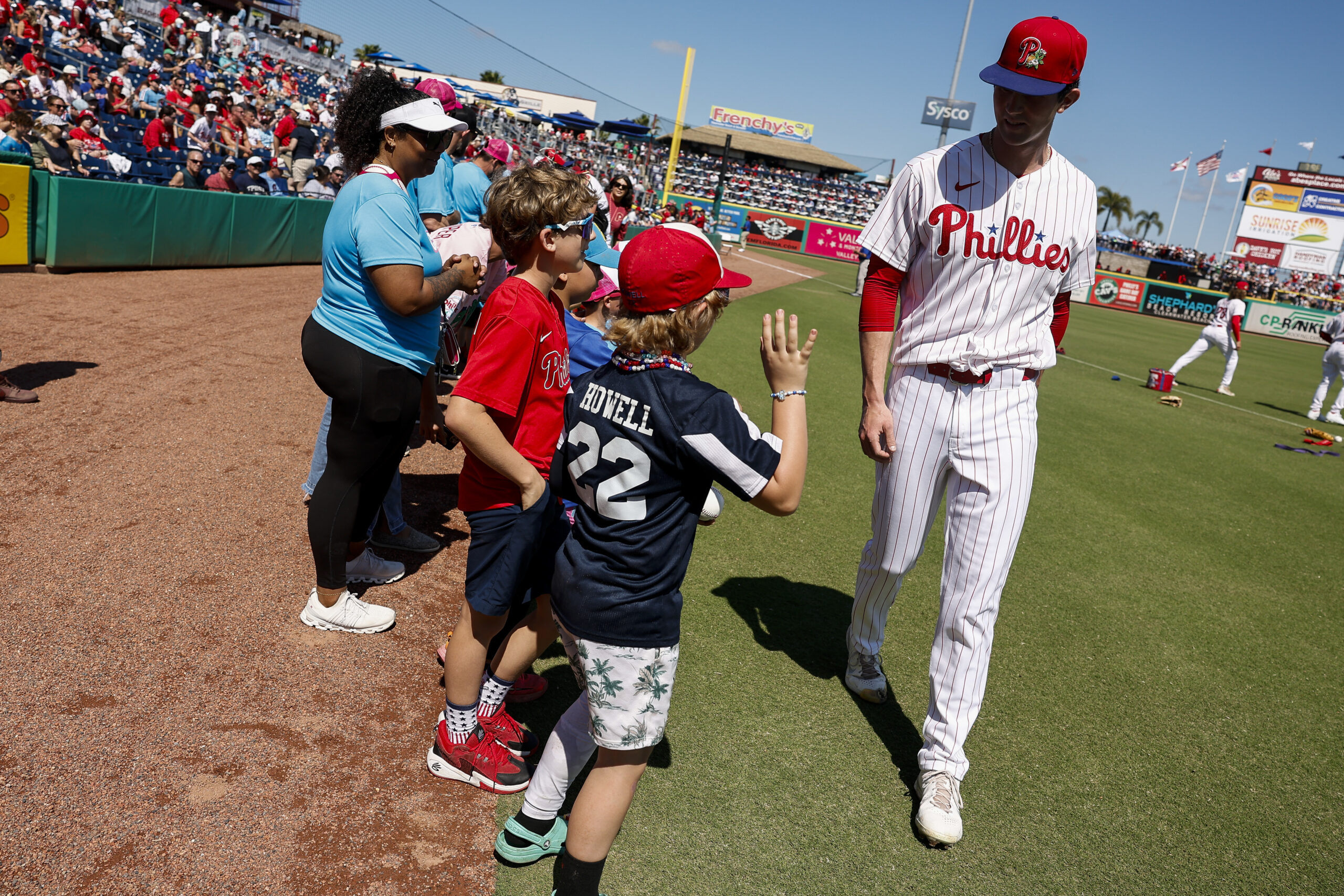
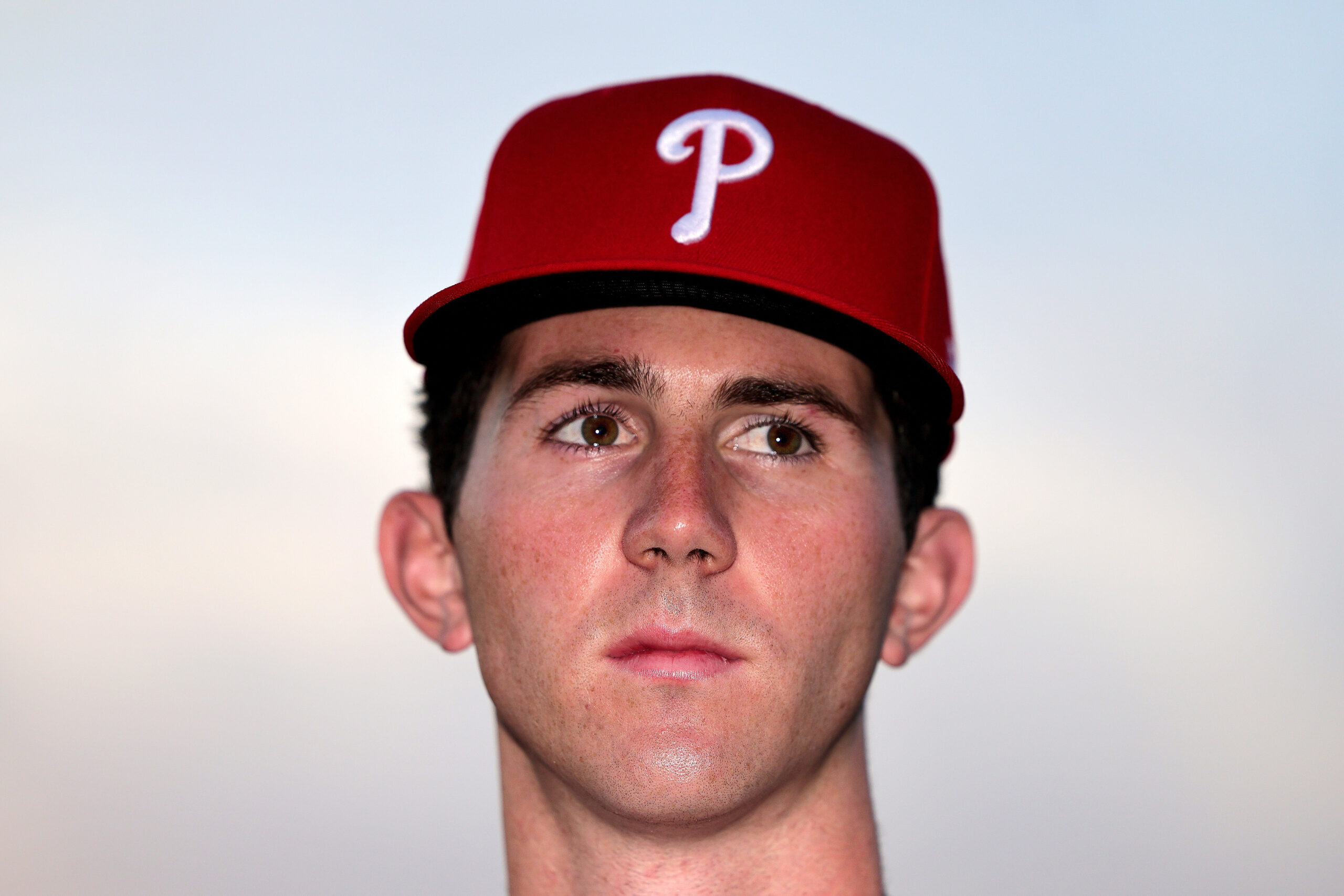
    Phillies pitcher Andrew Painter greets Little Leaguers before a game against the Yankees on Sunday at BayCare Ballpark in Clearwater, Fla.

    They also made some tweaks to his diet. Painter’s weight in 2022 was 225 pounds.

    To get back to that number, he’d have to make some sacrifices.

    “Fewer trips to the Dairy Queen,” he said with a laugh.

    This would be a challenge. Painter’s house in Pompano Beach, Fla., was a block away from the fast-food restaurant. It was easy — perhaps too easy — to order an Oreo Blizzard or milkshake.

    His teammate and longtime friend, Phillies lefthander Jesús Luzardo, described Painter’s eating habits as “notorious.” Former Phillies minor league pitching coordinator Vic Díaz recalled that he had a “big sweet tooth.”

    “I’m almost positive he would go to Publix and just pick up a pie,” Díaz said.

    But nevertheless, Painter got it done. He’s at 225 pounds, his “ideal weight.” His leaner physique is part of the reason he showed dominance in his one game so far this spring — no hits, no walks, no runs in two innings — as he prepares for a starting job on the big league club. He is scheduled to pitch on Saturday.

    “All offseason he’s looked great,” Luzardo said. “He looks strong, he looks athletic, the way he’s pitching, moving down the mound. His body is moving cleaner, is the way I would describe it.”

    ‘Sorry, I ate a whole pumpkin pie’

    Painter has never been shy about his proclivity for dessert. In September 2021, months after he was drafted in the first round, he was sitting alongside Díaz at the Bobby Mattick Complex in Dunedin, Fla.

    The highly-touted prospect was minutes away from his final start of the year, against the FCL Blue Jays. But there was one problem.

    His stomach hurt.

    Díaz asked what was wrong.

    “He just looked at me and said, ‘Sorry, I ate a whole pumpkin pie last night,’” Díaz said.

    Painter ended up having his best FCL outing to date. He pitched two innings, struck out five, and allowed just one hit.

    But Díaz wasn’t about to let him off the hook.

    “He called me out at the end of the [pitchers] meeting,” Painter said. “We were wrapping up and he says my name. And I’m like, ‘What did I do?’

    “And he’s like, ‘Just wanted to let you all know, Painter ate a whole pumpkin pie.’”

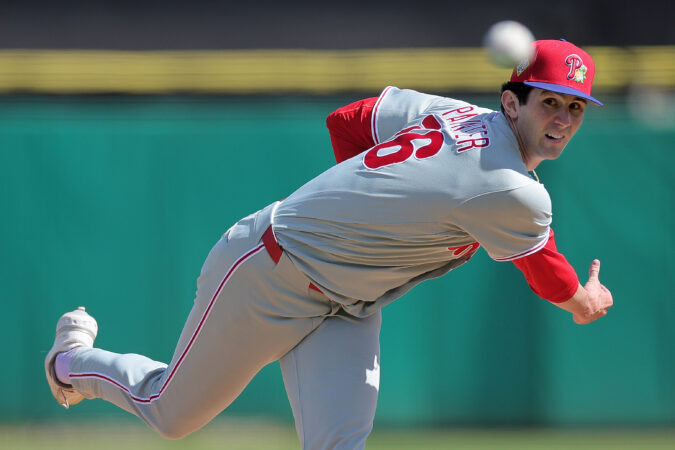
    Andrew Painter pitched two scoreless innings in his spring debut on Sunday.

    The minor league coordinator started regularly asking the prospect what he’d eaten the night before. And Painter was happy to divulge.

    Even as a teenager, he was unapologetically himself. Painter would shag fly balls left-handed in the outfield during batting practice. He relished Beach Dog Fridays at single-A Clearwater, picking out his favorite mutts in the crowd.

    So, it was no surprise to Díaz that Painter also had a light-hearted approach to his diet.

    “In Clearwater, he and Alex Garbrick had a thing where they would go to BJ’s Restaurant once a week,” Díaz recalled. “When it was two-for-one Pizookies.”

    (For those unfamiliar, a Pizookie is a cookie skillet with ice cream on top).

    Luzardo, who also has a sweet tooth, was not familiar with the pumpkin-pie fiasco or the weekly Pizookies. But he was aware that his friend liked to eat.

    “I didn’t know about that,” Luzardo said. “But I saw him do a — he did do a hot dog eating contest here last year.”

    Of course, there is a balance to all of this. Painter doesn’t want to reach 240 pounds again, but he also doesn’t want to dip below 220, which was where he was in 2023, before he got Tommy John.

    “It’s trying to find that middle spot of where I’m light, but I’m not injured, too,” he said. “Because you get to a certain point where you’re too skinny and there’s not enough fat in your body to stay healthy.

    “And everyone always says, ‘You can’t tear fat.’ So, it’s trying to find that middle point.”

    Around 225 seems to be it. Painter feels great. He isn’t as sluggish as he was last year. He’s fluid and agile.

    Coupled with a higher arm slot, and a lengthier long toss routine, it’s just another reason why he’s looked — and felt — so good this spring.

    And as long as he isn’t anywhere near a pumpkin patch come October, it should stay that way.

    “I’d say, probably less sweet treats,” he said.

  • The Big Picture: Fists — and home runs — fly in our best Philly sports photos of the week

    The Big Picture: Fists — and home runs — fly in our best Philly sports photos of the week

    Each Friday, Inquirer photo editors pick the best Philly sports images from the last seven days. As the calendar flips to March, we’ve got nearly every sport covered, with the exception of football — but don’t worry, NFL free agency starts next week. From the Sixers and Flyers getting physical in Philly to the Phillies heating up in Clearwater, here’s a look at our best shots of the week.

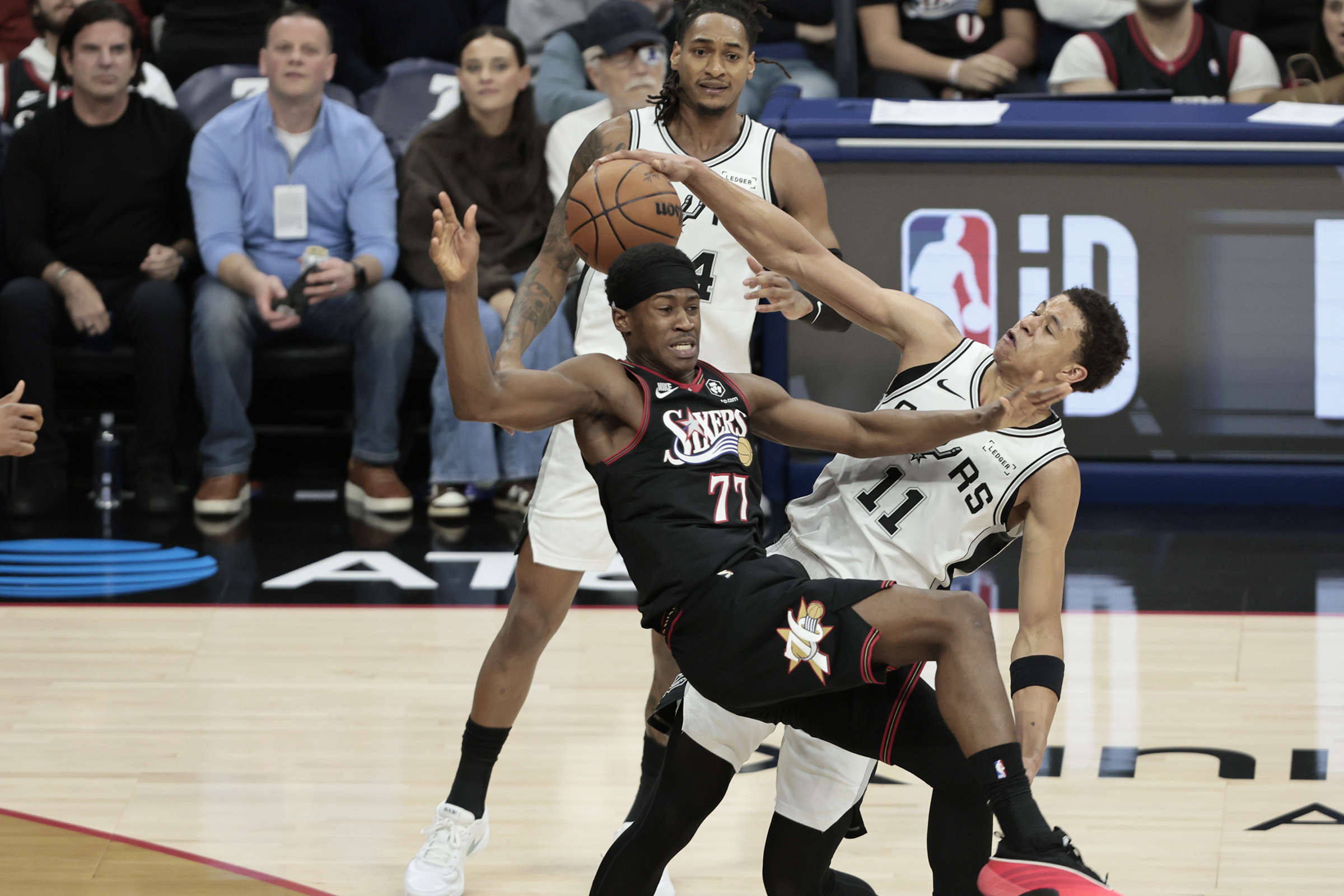
    Sixers guard VJ Edgecombe falls hard and injures his back after being fouled by Spurs forward Carter Bryant on Tuesday. Edgecombe missed Wednesday’s game against the Jazz with a lumbar contusion.
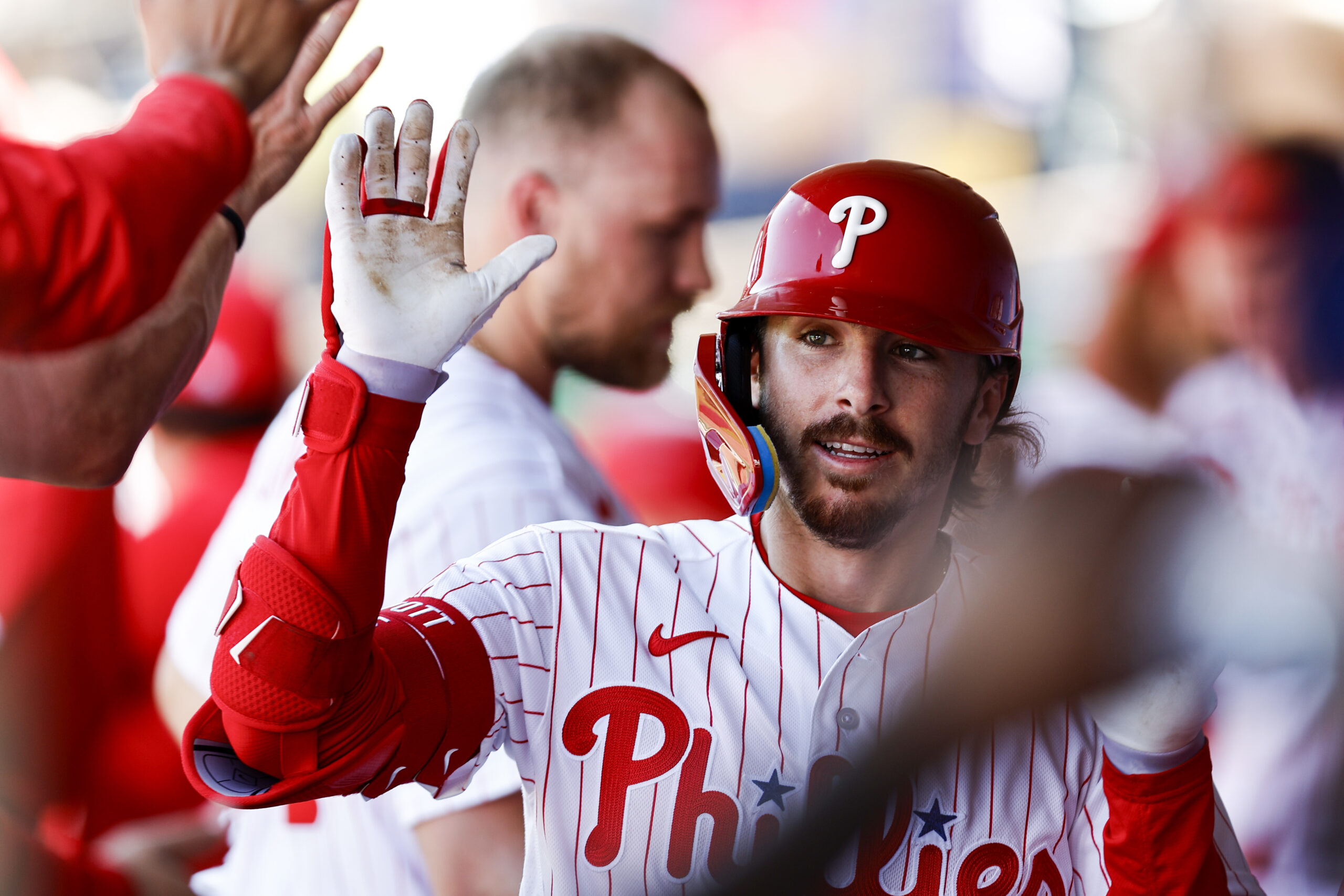
    Phillies second baseman Bryson Stott is 7-for-10 with two home runs through his first six spring training games.
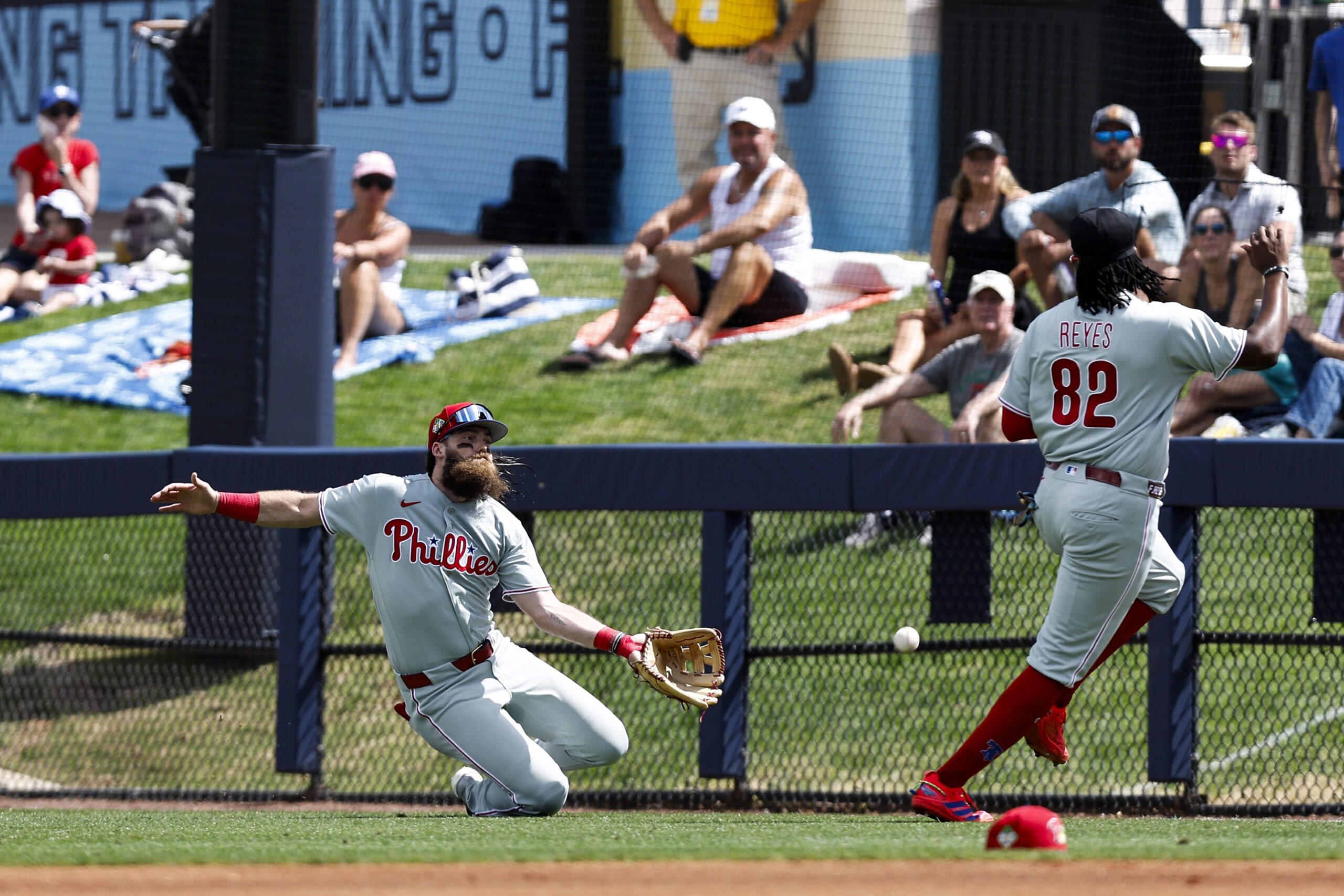
    Phillies right fielder Brandon Marsh misses a foul ball during the second inning of Tuesday’s spring training game against the Tampa Bay Rays in Port Charlotte, Fla.
    Phillies pitcher Andrew Painter greets Little Leaguers before Sunday’s game against the New York Yankees at BayCare Ballpark in Clearwater, Fla.
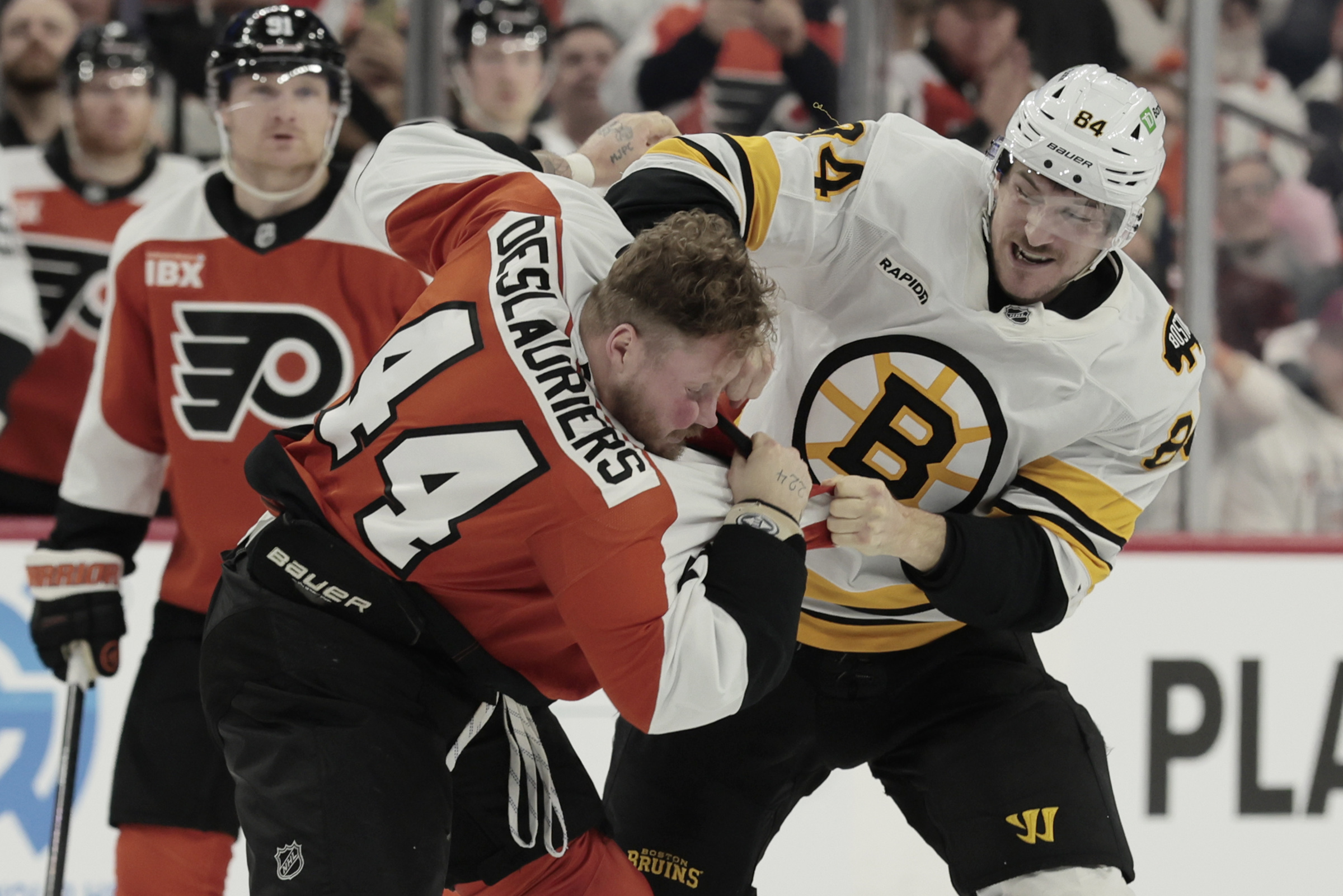
    Flyers winger Nic Deslauriers and Bruins forward Tanner Jeannot tangle during the Flyers’ 3-1 win over Boston on Sunday.
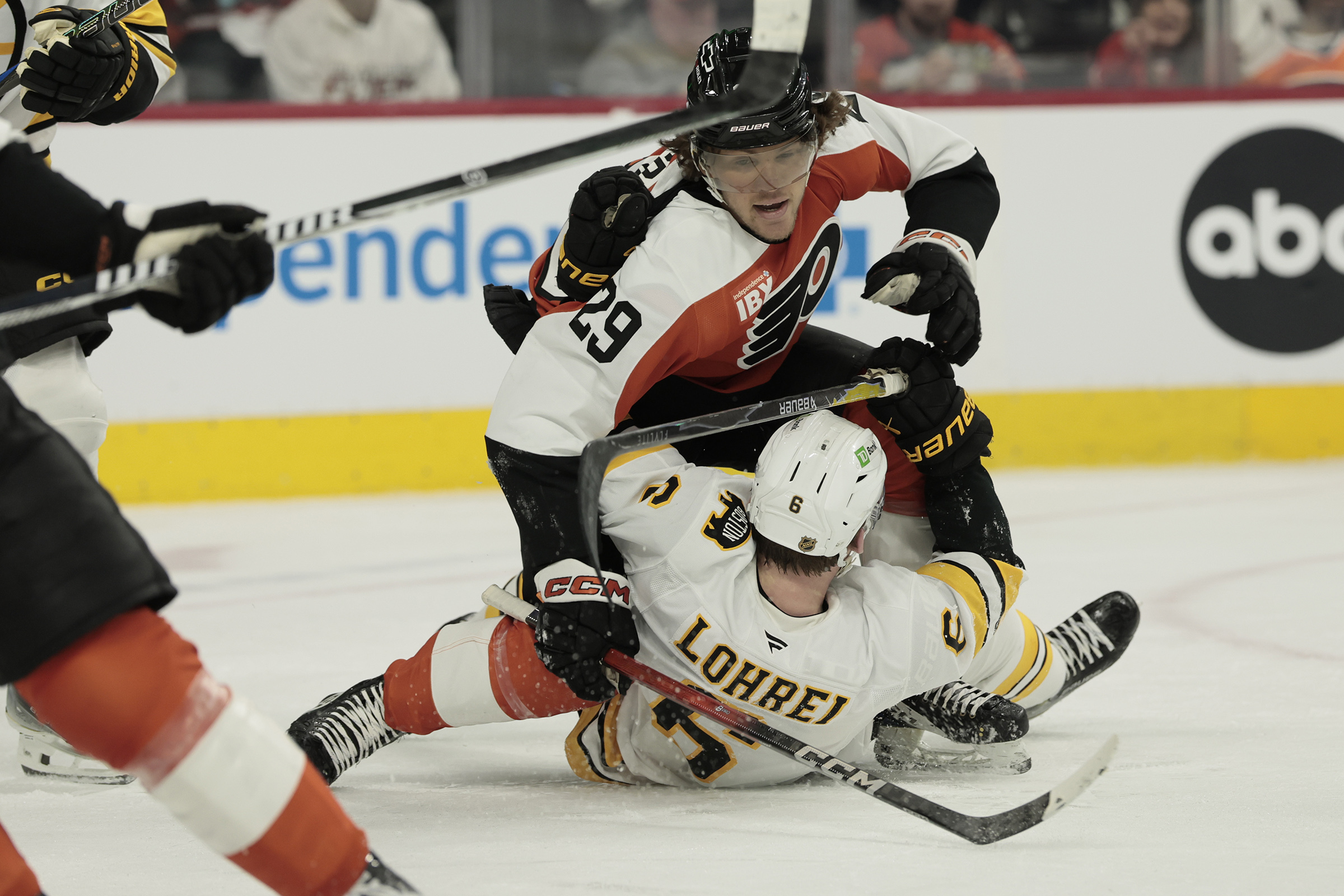
    Bruins defenseman Mason Lohrei takes down Flyers forward Nikita Grebenkin, drawing a holding penalty in the first period of Saturday’s game.
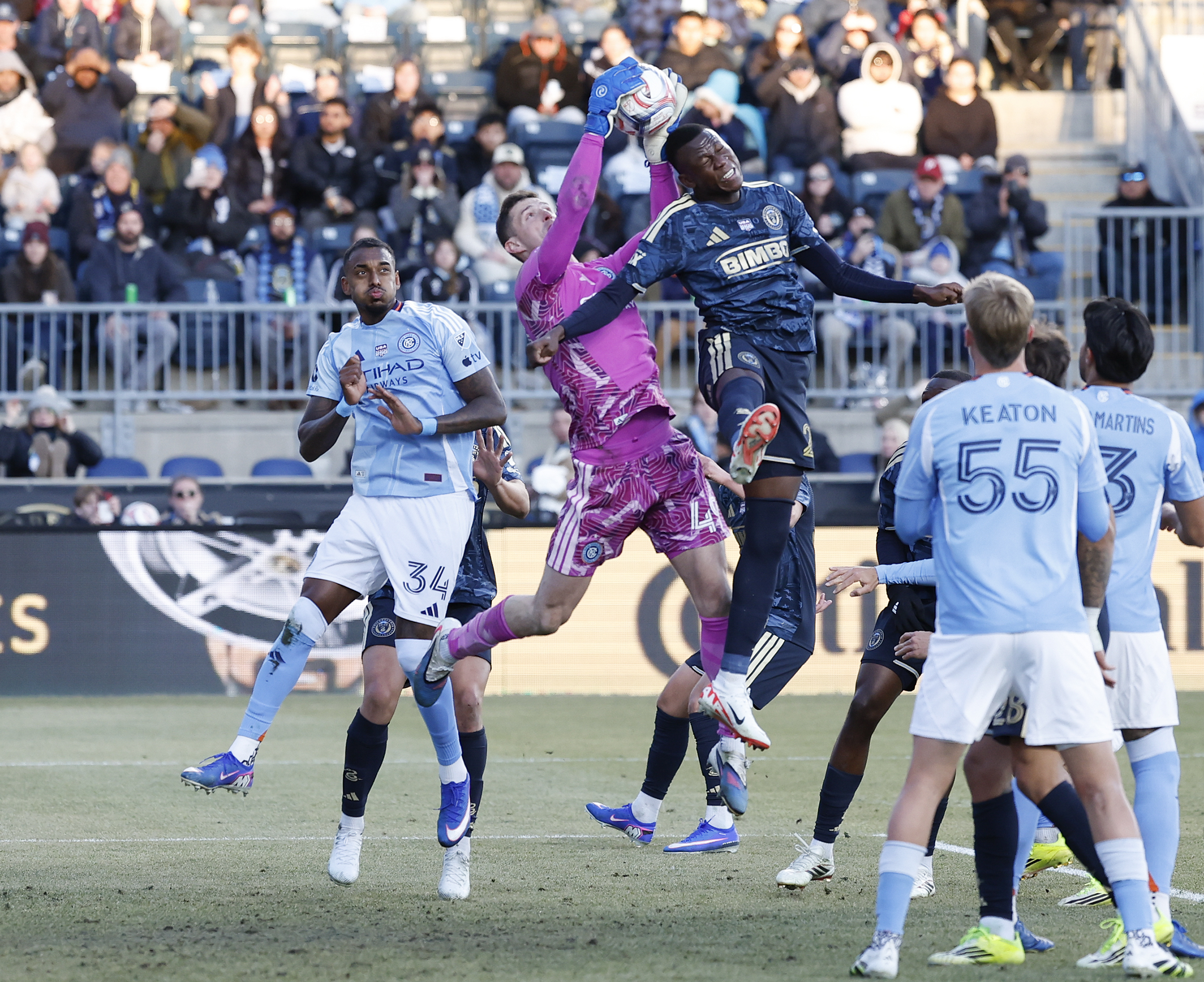
    New York City FC goalkeeper Matt Freese catches a corner over Union midfielder Danley Jean Jacques during the first half Sunday’s loss at Subaru Park.
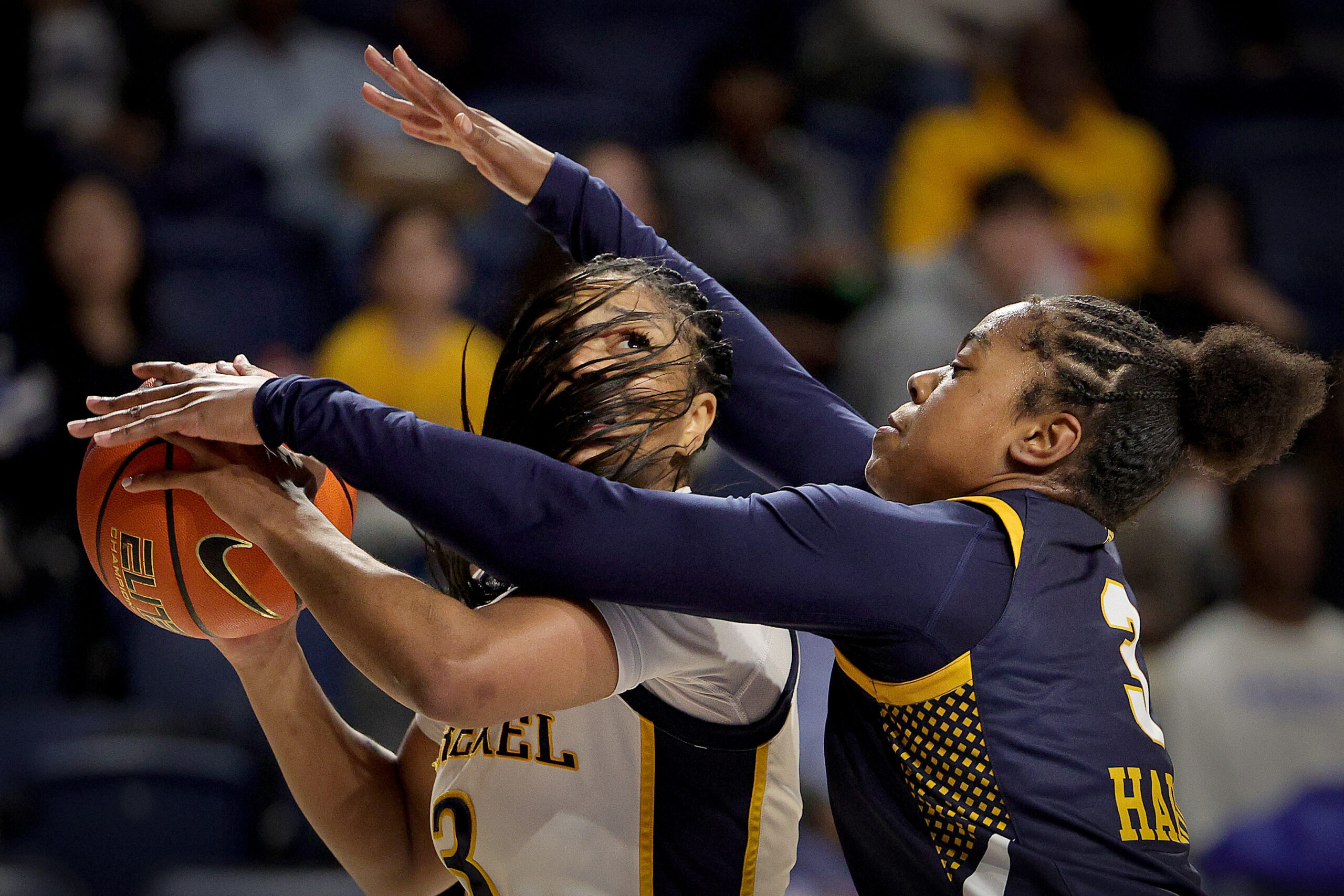
    Drexel guard Amaris Baker (left) is fouled by North Carolina A&T Aggies guard Crystal Hardy (right) during the Dragons’ 65-63 overtime win at the Daskalakis Athletic Center Sunday.
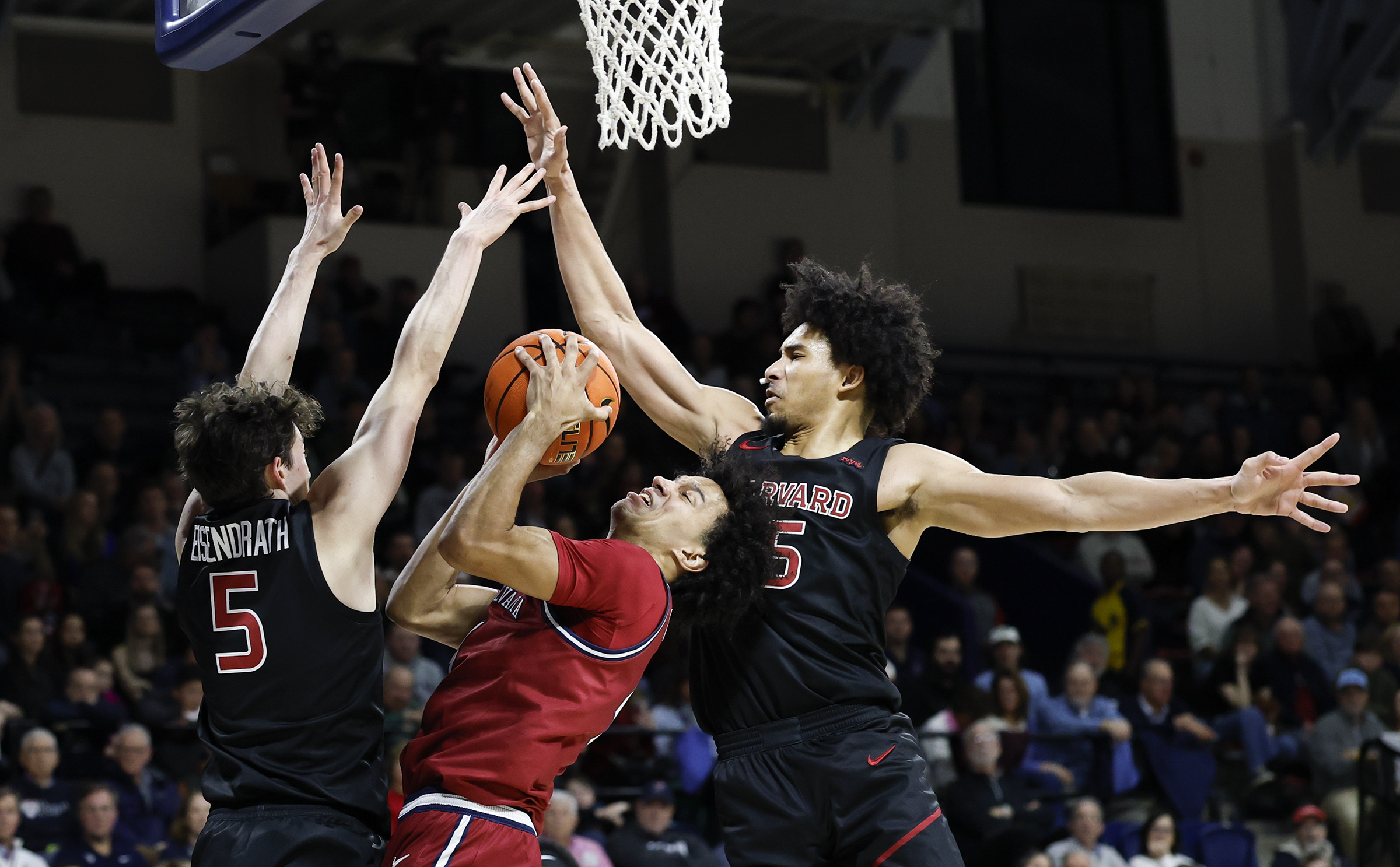
    Penn guard Jay Jones is fouled while driving to the basket against Harvard guard Ben Eisendrath (left) and forward Thomas Batties III in the first half Saturday. Penn won, 64-61, and will face Harvard again in the first round of the Ivy League Tournament.
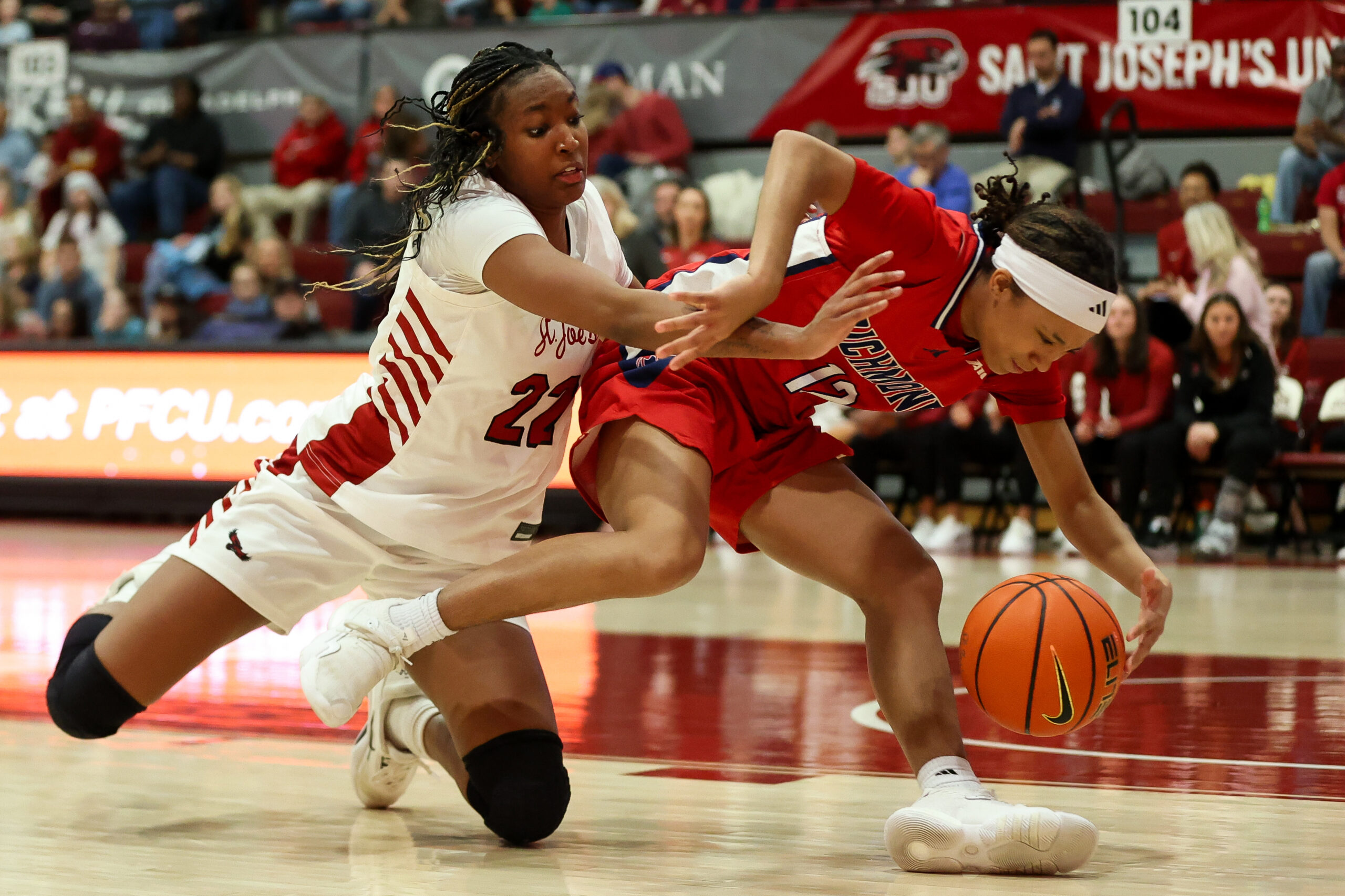
    Saint Joseph’s Hawks guard Kaylinn Bethea (left) and Richmond Spiders guard Aneisha Scott (right) scramble for the ball during the fourth quarter at Hagan Arena on Saturday. Richmond won, 72-61,
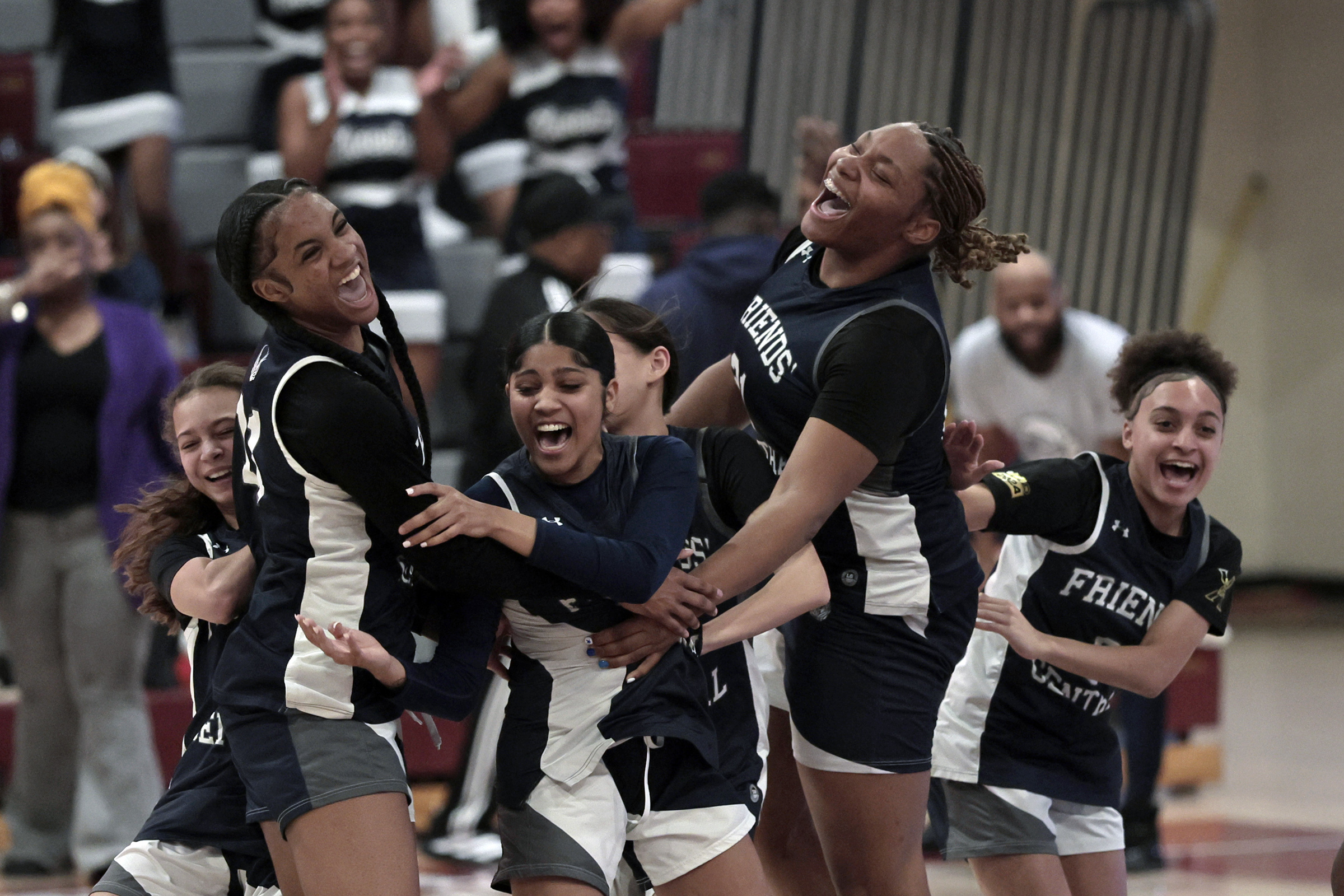
    The Friends Central girls celebrate winning the PAISAA girls’ basketball final over Westtown.
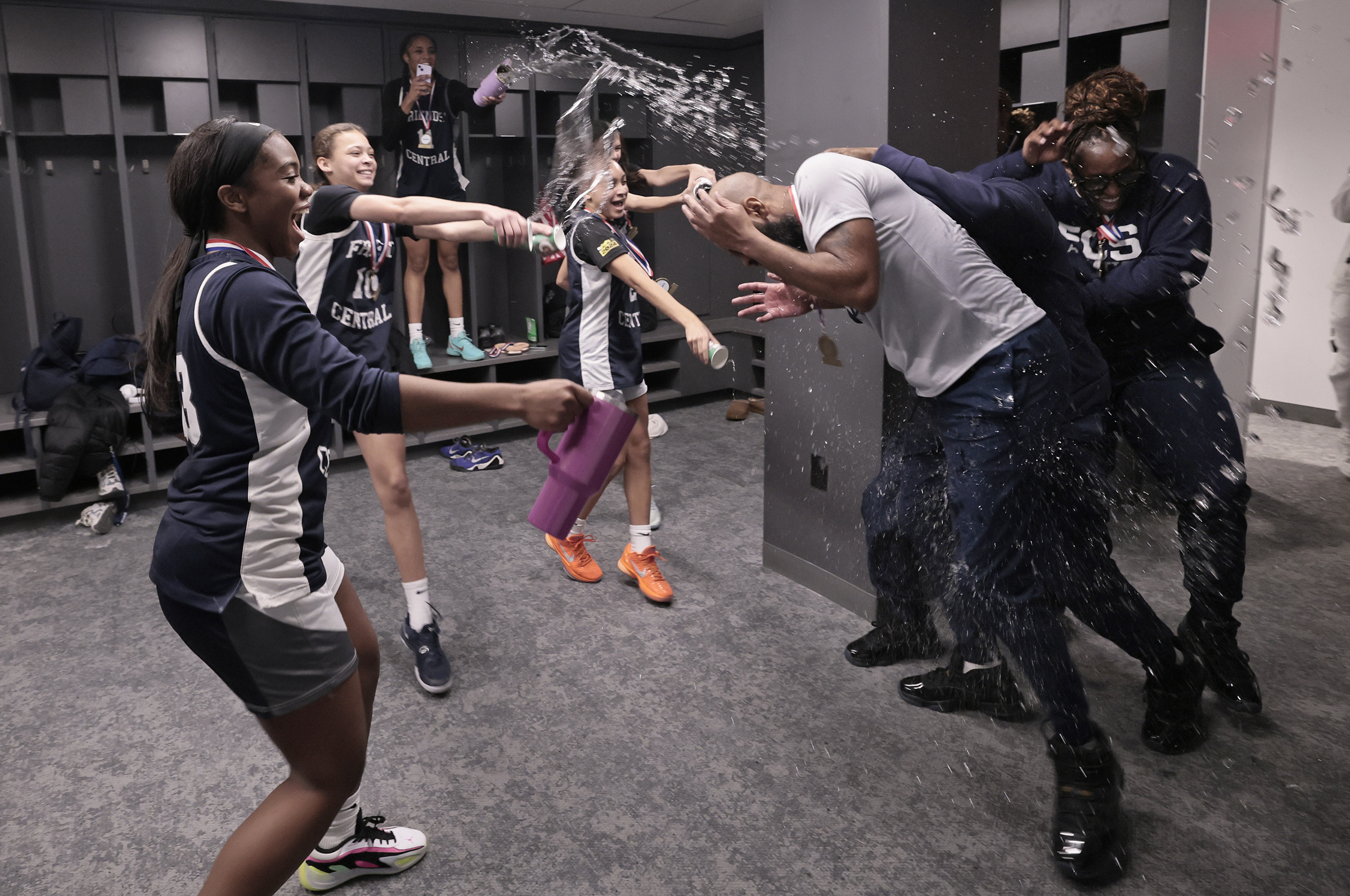
    Friends Central head coach Vincent Simpson and assistant coach Joy Morton (far right) get a celebratory water bath after the team won the PAISAA girls’ basketball final last Friday night.
  • The swing of things

    The swing of things

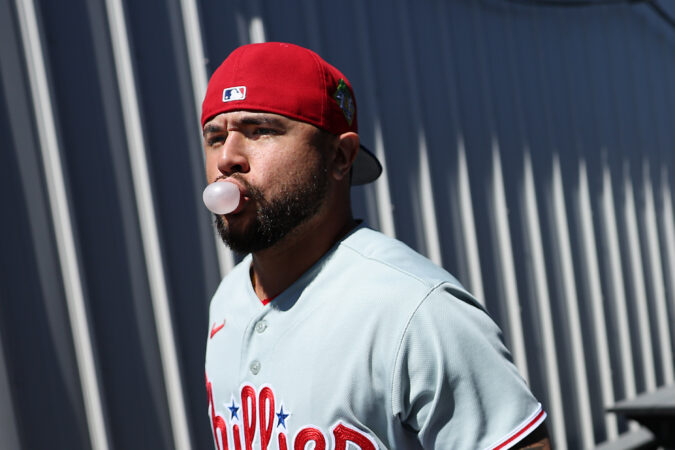
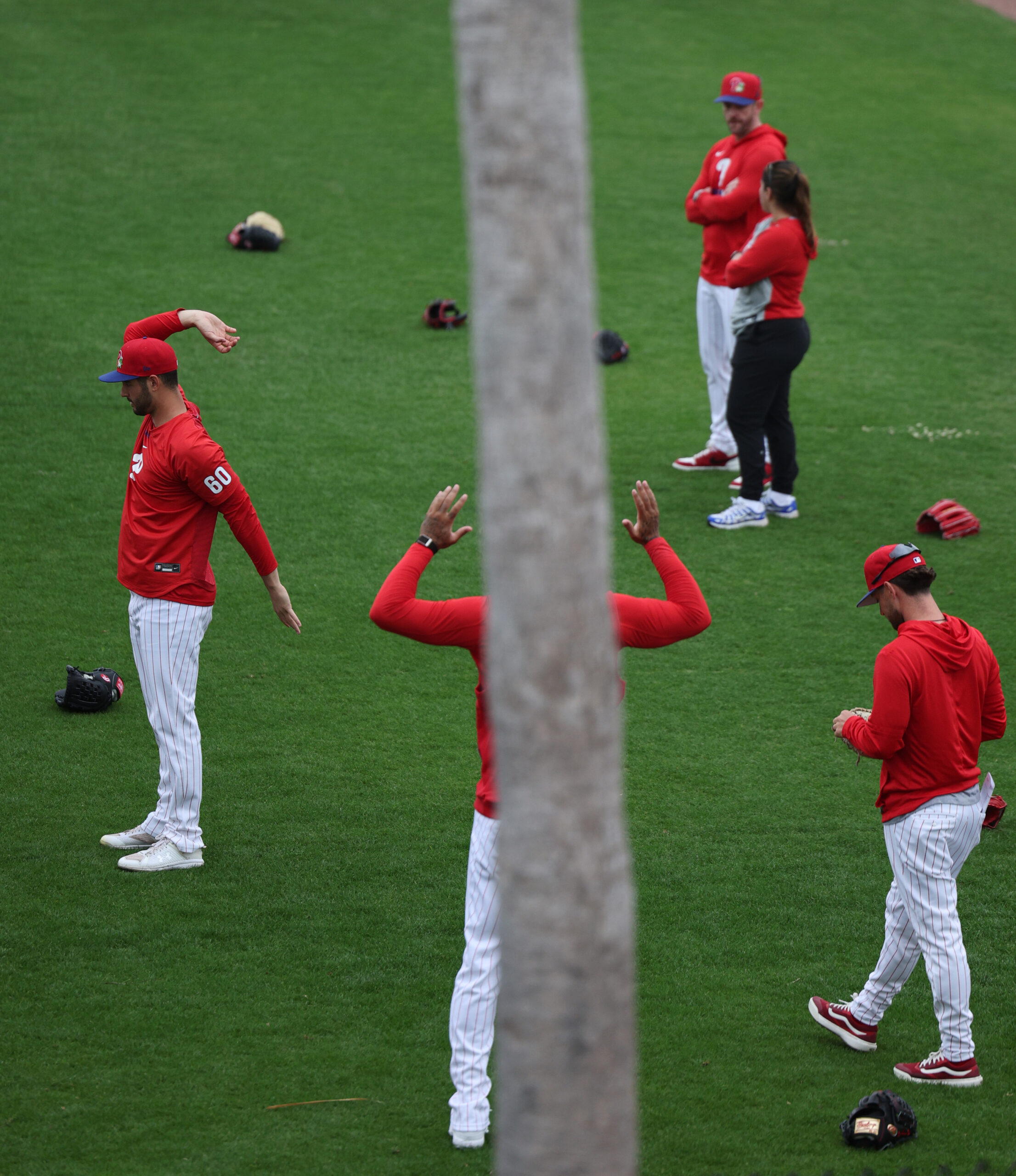
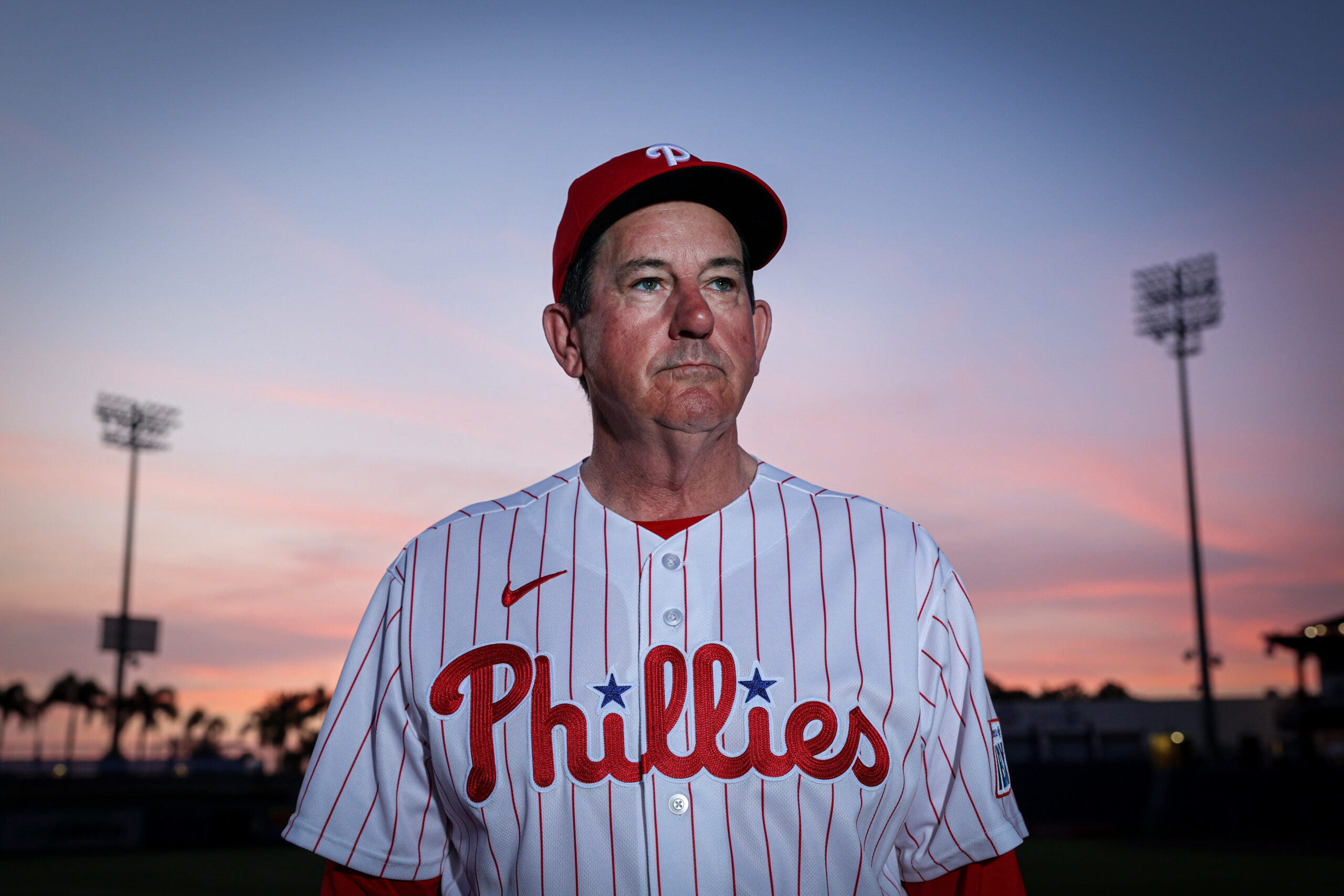
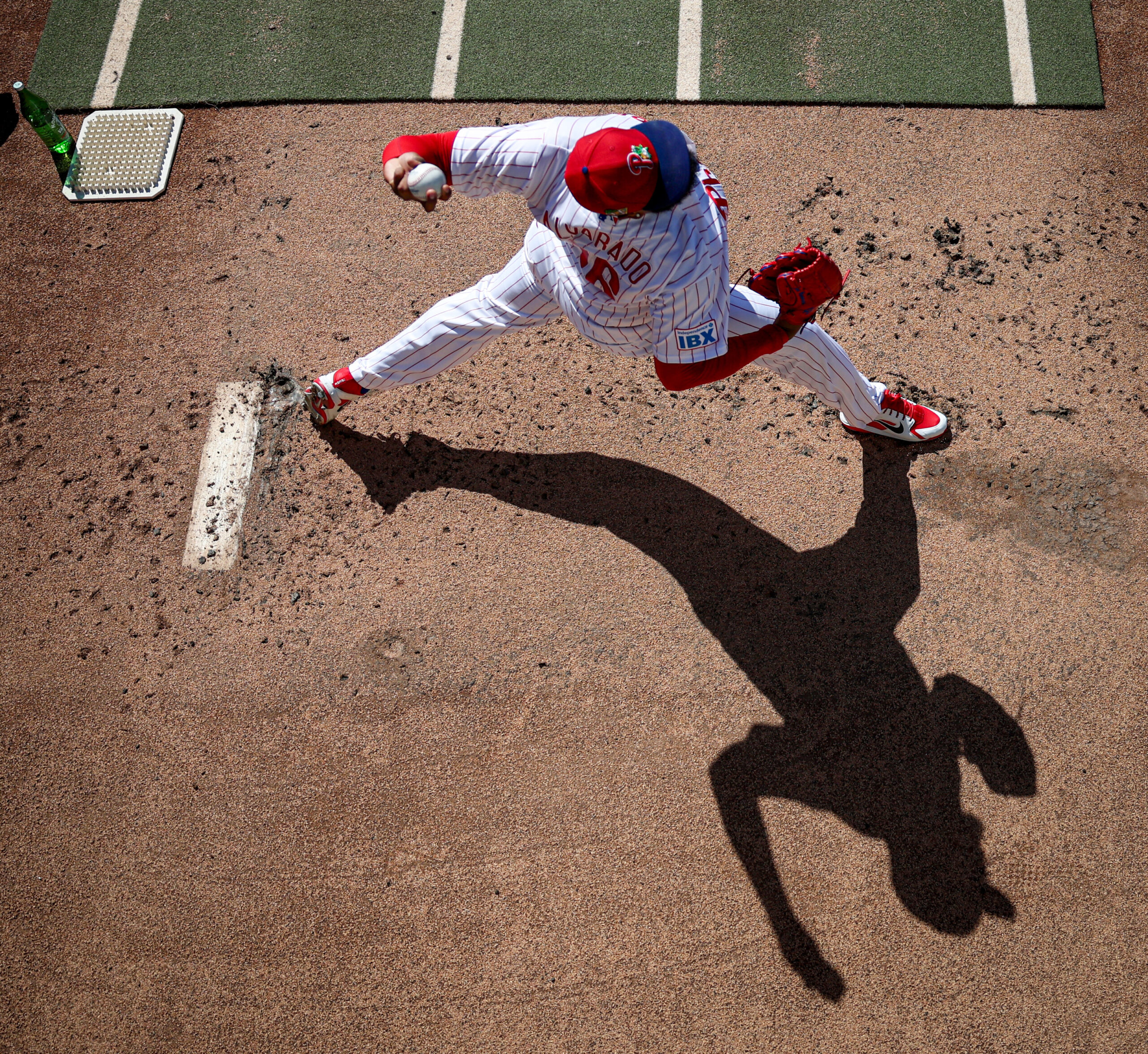
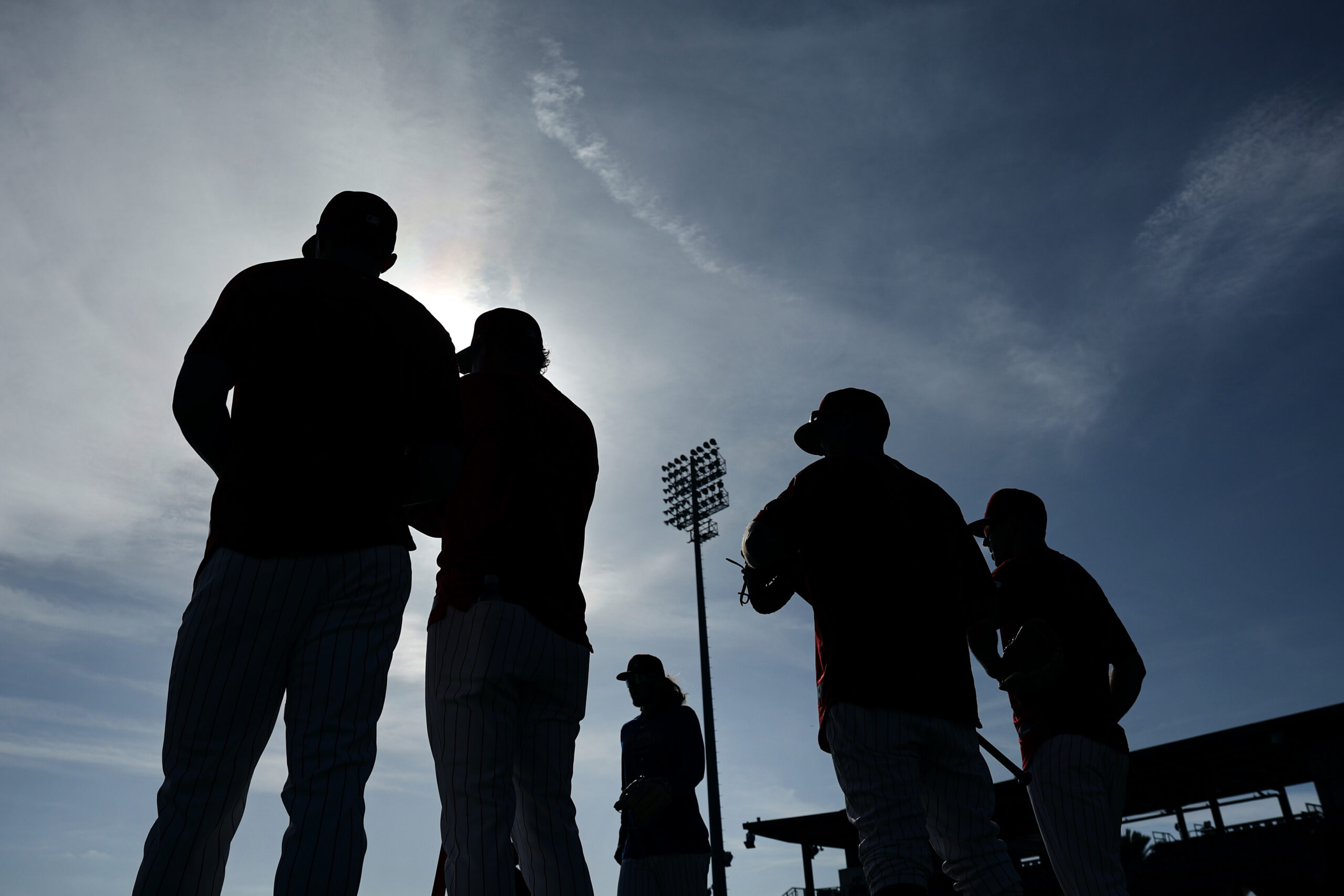
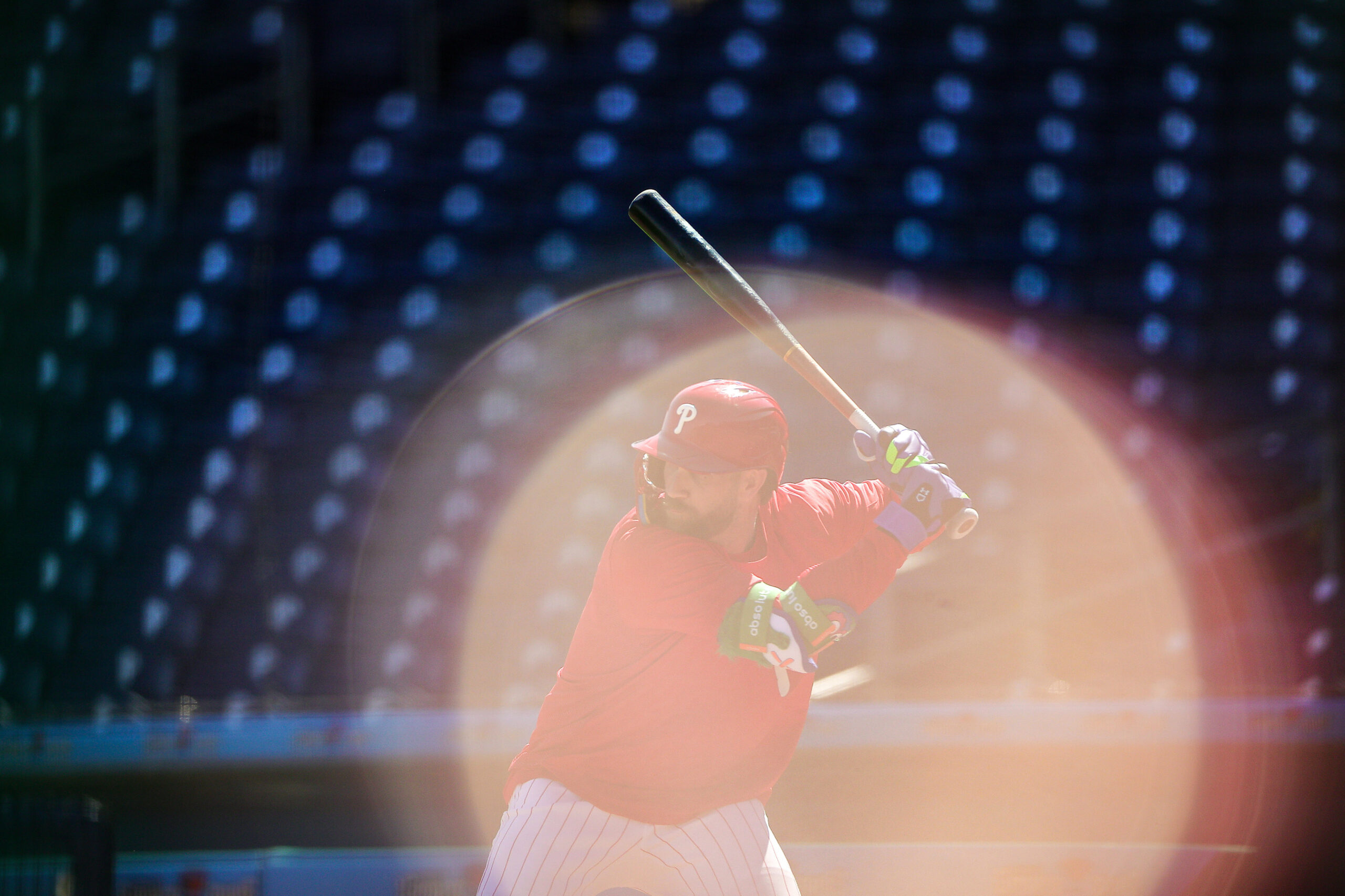
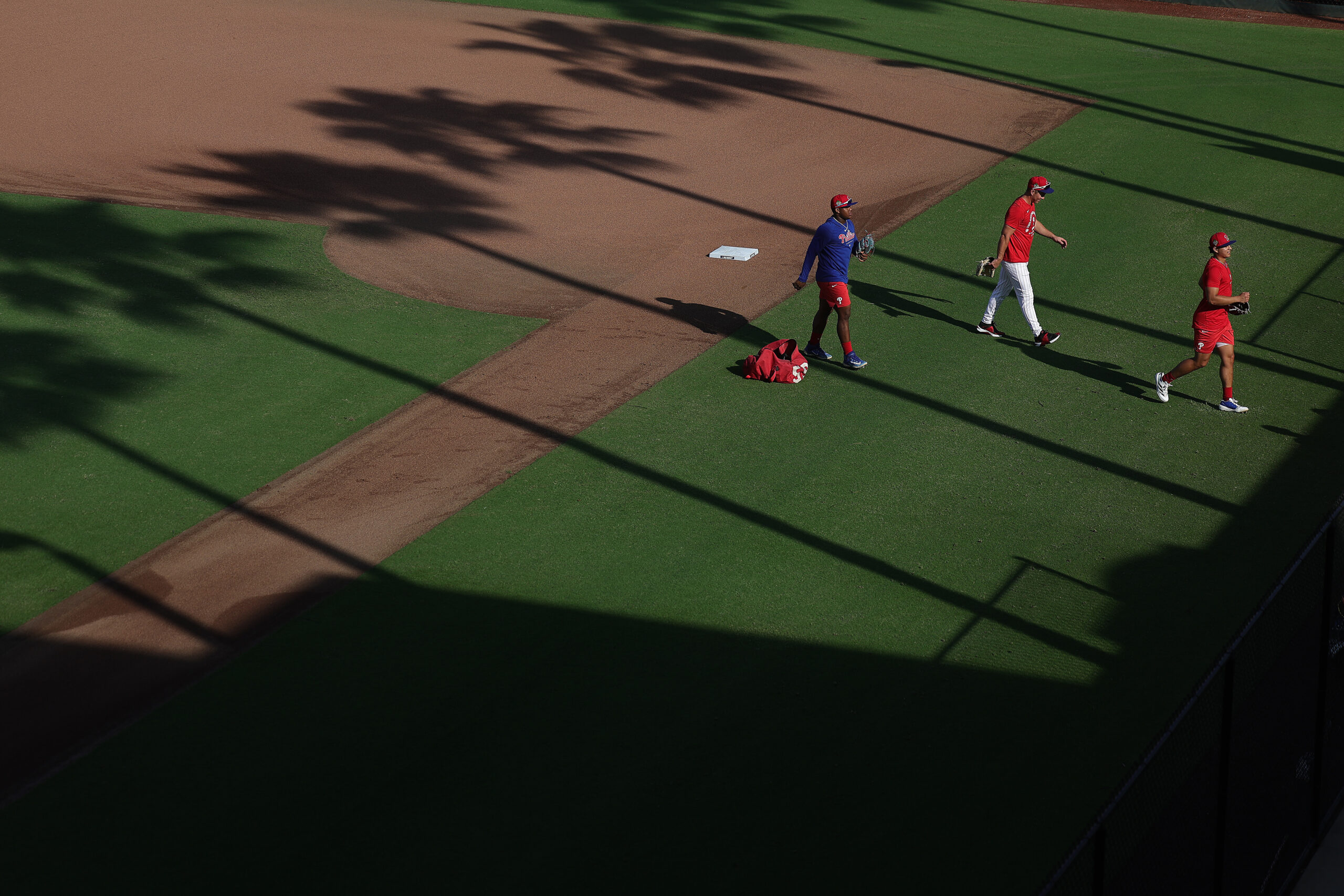
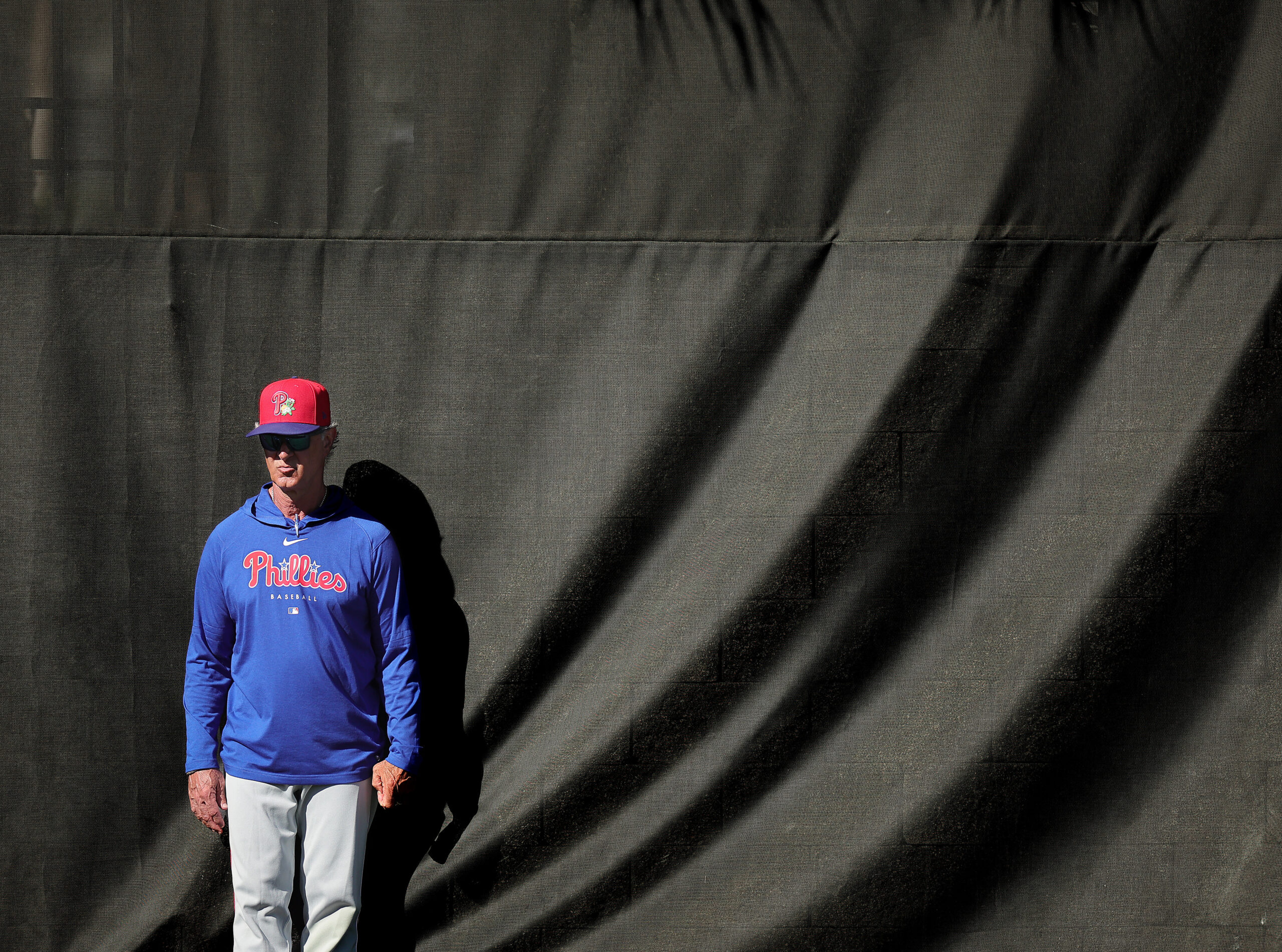
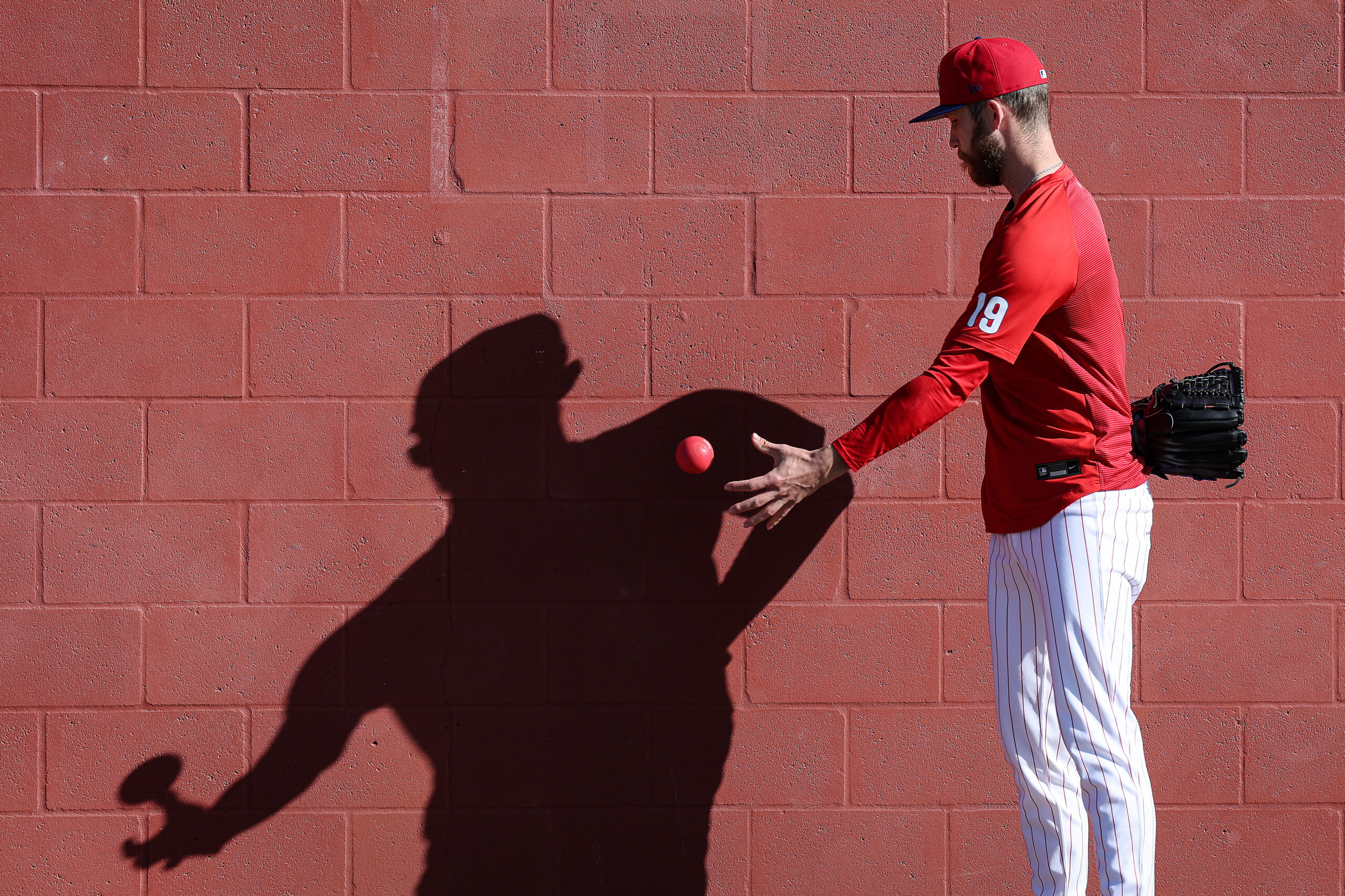
    Covering Phillies spring training offers sports photographers an opportunity to stretch beyond everyday game coverage. On one of my first mornings at the training facility in Clearwater, Fla., I noticed pitcher Taijuan Walker stretching behind a palm tree. I knew it could make a picture, but it didn’t line up naturally. Every morning, he stretched. Every morning, I tried again. Finally, I made the picture on my last day in the Sunshine State. When I made the photo of bench coach Don Mattingly, I looked for a way to eliminate all other visual distractions. The morning light created a unique pattern on the tarp that put the attention on Mattingly. Using red as the dominant color holds the image of pitcher Kyle Backhus together. I again took advantage of the morning light to capture the shadow and fill the negative space. The portrait of manager Rob Thomson was a combination of a little planning and a lot of luck. I knew there would be a small window at sunrise when the sky would add some visual drama. Luckily, it was when Thomson was ready for his photo. The Phillies outfielders are seen through palm fronds during a game. The contrast of the mostly green palette with the red in the Phillies uniforms encourages the viewer to search into the image. For the photo of catcher Rafael Marchán jogging from the clubhouse, the pattern on the background caught my eye first. I then waited for someone to come into the space. The bubble gum gave the photo an extra pop.

    On Feb. 22, pitcher Tijuan Walker warms up behind the truck of a palm tree.
    Outfielders Dante Nori (from left), Dylan Campbell, and Pedro León are seen through a palm tree during a spring training game against the Pittsburgh Pirates on Feb. 22.
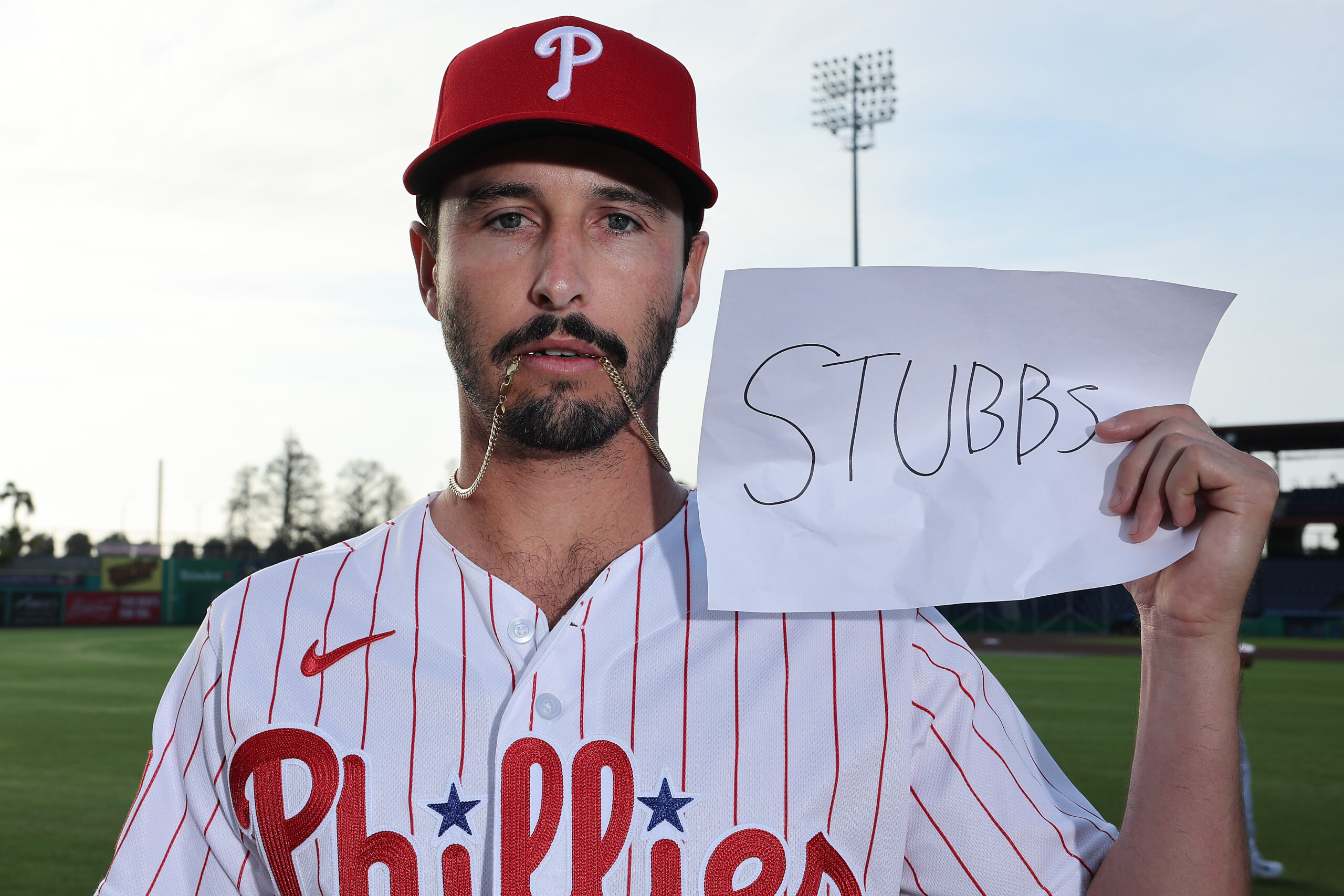
    Catcher Garrett Stubbs with a playful pose on photo day.
    Manager Rob Thomson poses as the sun rises on photo day Feb. 19.
    Pitcher Andrew Painter poses on Feb. 19 for photo day.
    On Feb. 21, bench coach Don Mattingly watches as players warm up.
    Pitcher Kyle Backhus warms up on Feb. 17.
    Pitcher José Alvarado warms up Feb. 20.
    Alec Bohm (center) is silhouetted with teammates as they watch a drill Feb. 18.
    A light refection from a bat in the dugout casts a glow around first baseman Bryce Harper at batting practice Feb. 20.
    Aroon Escobar (from left), Dylan Moore, and Bryan Rincon leave after completing a drill Feb. 19.
  • 🏒 Making moves? | Sports Daily Newsletter

    🏒 Making moves? | Sports Daily Newsletter

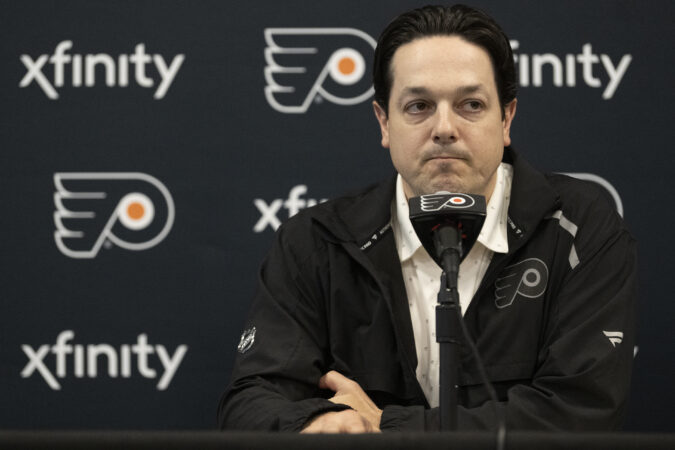
    If this year is anything like the previous two, expect the Flyers to make some noise ahead of Friday’s 3 p.m. deadline.

    General manager Danny Brière has a history of making trades in the hours leading up to the deadline, and this year could be a similar case, with players such as Rasmus Ristolainen rumored to be on the move.

    Jackie Spiegel takes a look back at the last two years and what Brière did in the week leading up to the previous trade deadlines.

    But let’s evaluate where this team currently stands. Entering Thursday’s game against Utah, Rick Tocchet’s club was on a sudden upswing and just six points out of a playoff spot with 22 games to play.

    Their playoff odds was 11%, but dropped to 7.7% after a 3-0 shut out loss to the Mammoth. So, how are Brière and Keith Jones approaching the deadline? Are they still taking the long-view approach to rebuilding or has patience worn thin?

    While the Flyers are desperate to reach the playoffs for the first time in six seasons, they should avoid the temptation and sell off, writes Gustav Elvin.

    — Isabella DiAmore, @phillysport, sports.daily@inquirer.com.

    If someone forwarded you this email, sign up for free here.

    ❓What moves would you like to see the Flyers make ahead of the deadline? Email us back for a chance to be featured in the newsletter.

    Free agency roundtable

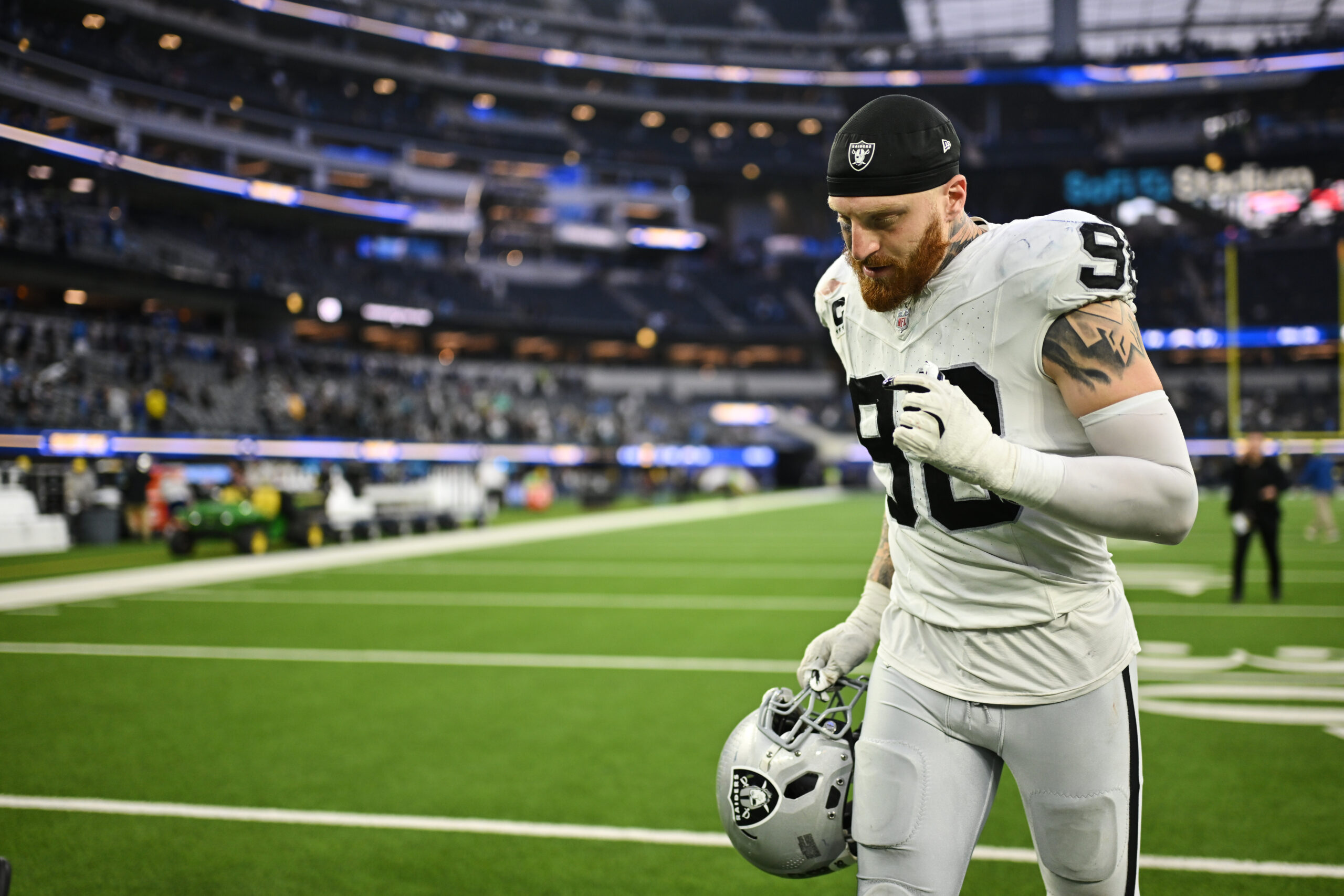
    Trading for Raiders defensive end Maxx Crosby would be a bold move for the Eagles, but Vegas is said to want two first-rounders and a player in return.

    The 2026 NFL free agency period begins on Monday when “legal tampering” negotiation window opens. The Eagles are not expected to be among the NFL’s most active teams — but big things could happen nonetheless.

    The Inquirer’s Jeff McLane, Olivia Reiner, and Jeff Neiburg got together for a roundtable ahead of next week’s festivities and weighed in on some of the realistic targets and moves we could see the Birds make.

    What we’re …

    🔍 Following: A woman hit in the face by a foul ball at Little League Classic field is suing MLB, Williamsport, and the Crosscutters for carelessness and recklessness.

    🤔 Wondering: Twenty-four Iowa State players transferred to Penn State. Why did so many follow coach Matt Campbell to Happy Valley?

    🎉 Celebrating: After more than six months of searching, The Stoop Pigeon, a women’s sports hub and cafe, has a new location with plans to open in June.

    📰 Reading: TJ Power never found a home on the court at Duke and Virginia. At Penn, he’s tougher, more mature, and has rekindled his love for the game.

    Crawford gets helping hand

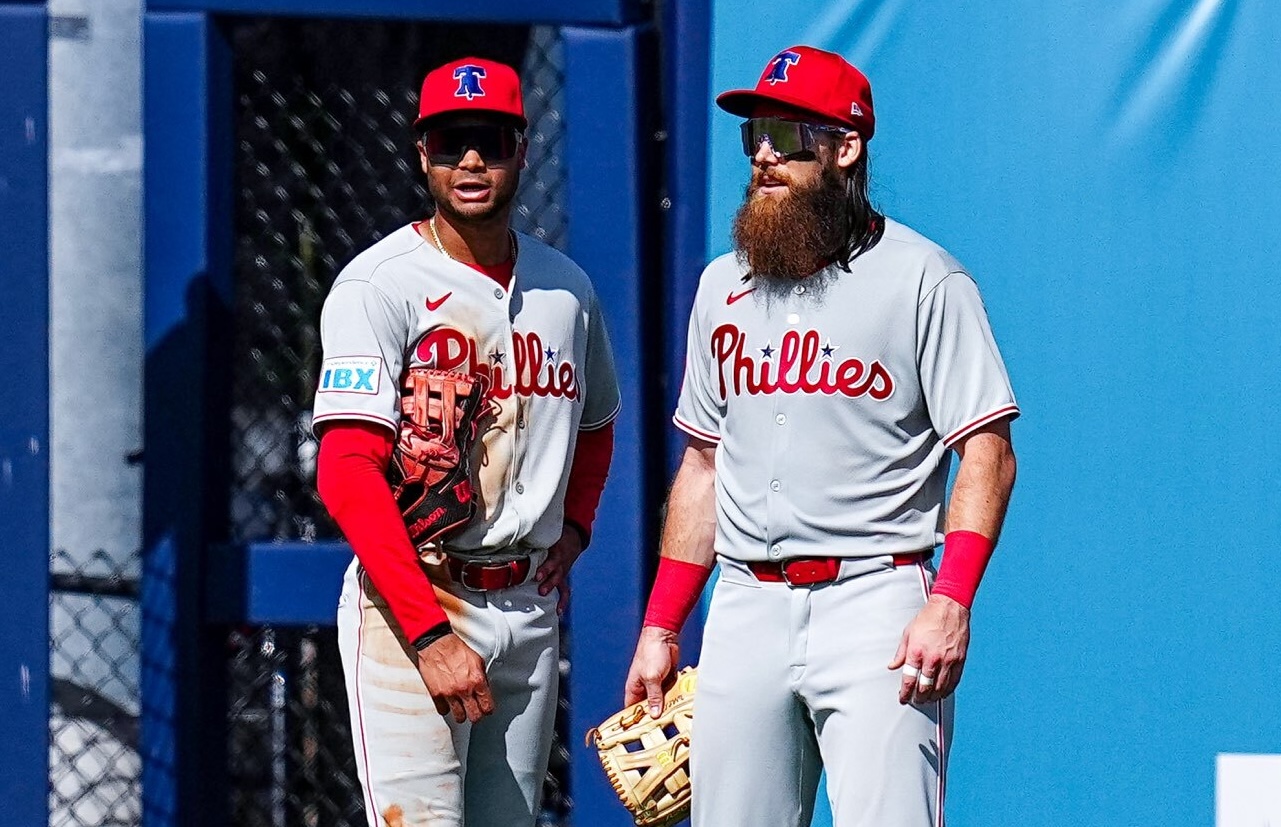
    Phillies outfielders Justin Crawford (left) and Brandon Marsh during spring training.

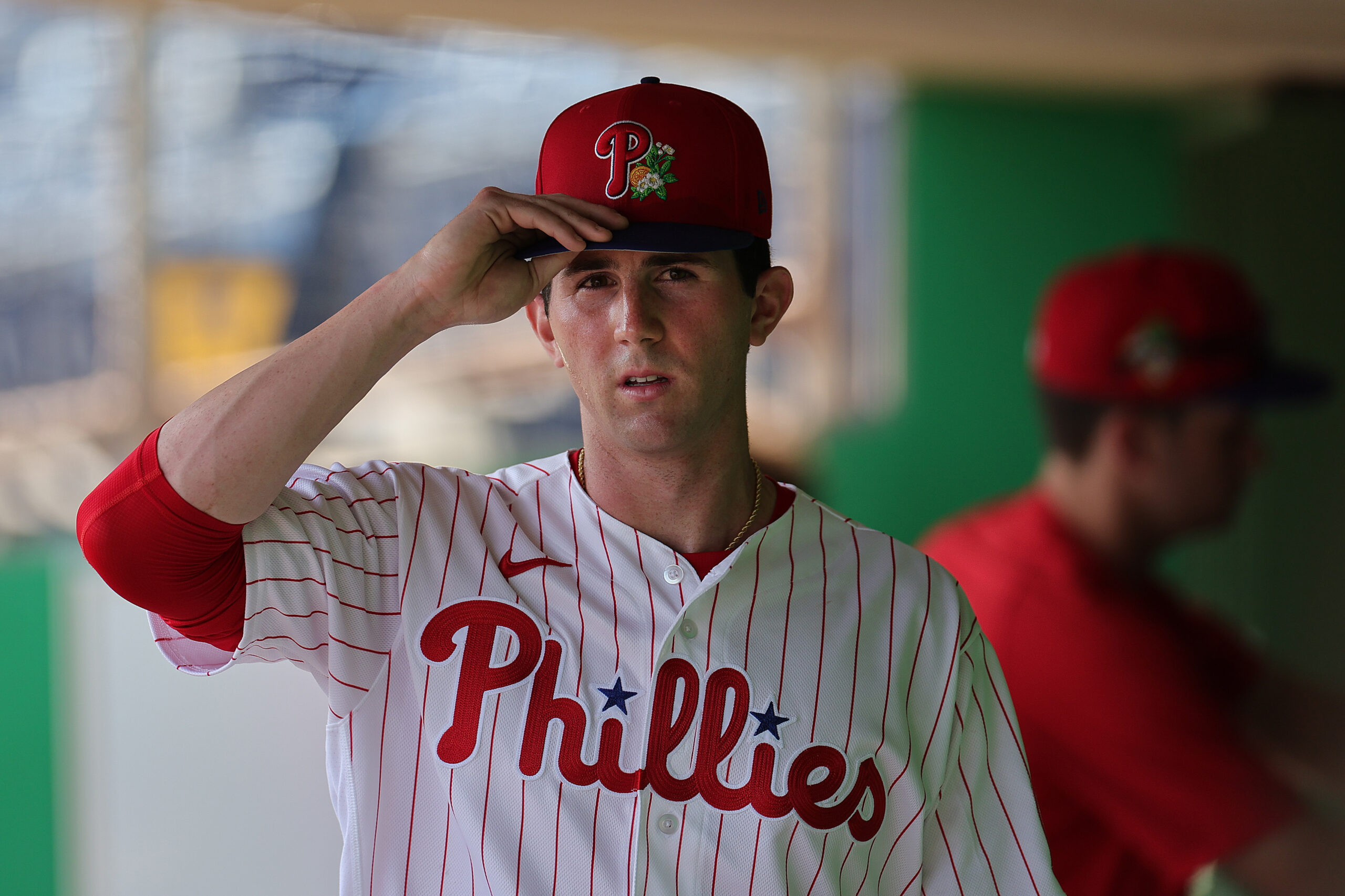
    The Phillies have done their best to make 22-year-old center fielder Justin Crawford feel comfortable. It started with manager Rob Thomson calling him this winter to encourage Crawford to “be himself” and to get ready to compete for a starting job. And it has continued during spring training with 28-year-old left fielder Brandon Marsh, who has tried to pay it forward by offering advice, friendship, and springing for a custom made black suit so the rookie can “look good” for a playoff run this fall.

    Jesús Luzardo said “maybe a little bit of adrenaline” contributed to an uptick in his velocity, but he was pleased with his first spring start.

    Next: The Phillies will play a split-squad game against the Pirates in Bradenton, Fla., at 1:05 p.m. Friday. Jean Cabrera will start for the Phillies.

    Breaking down final 20 games

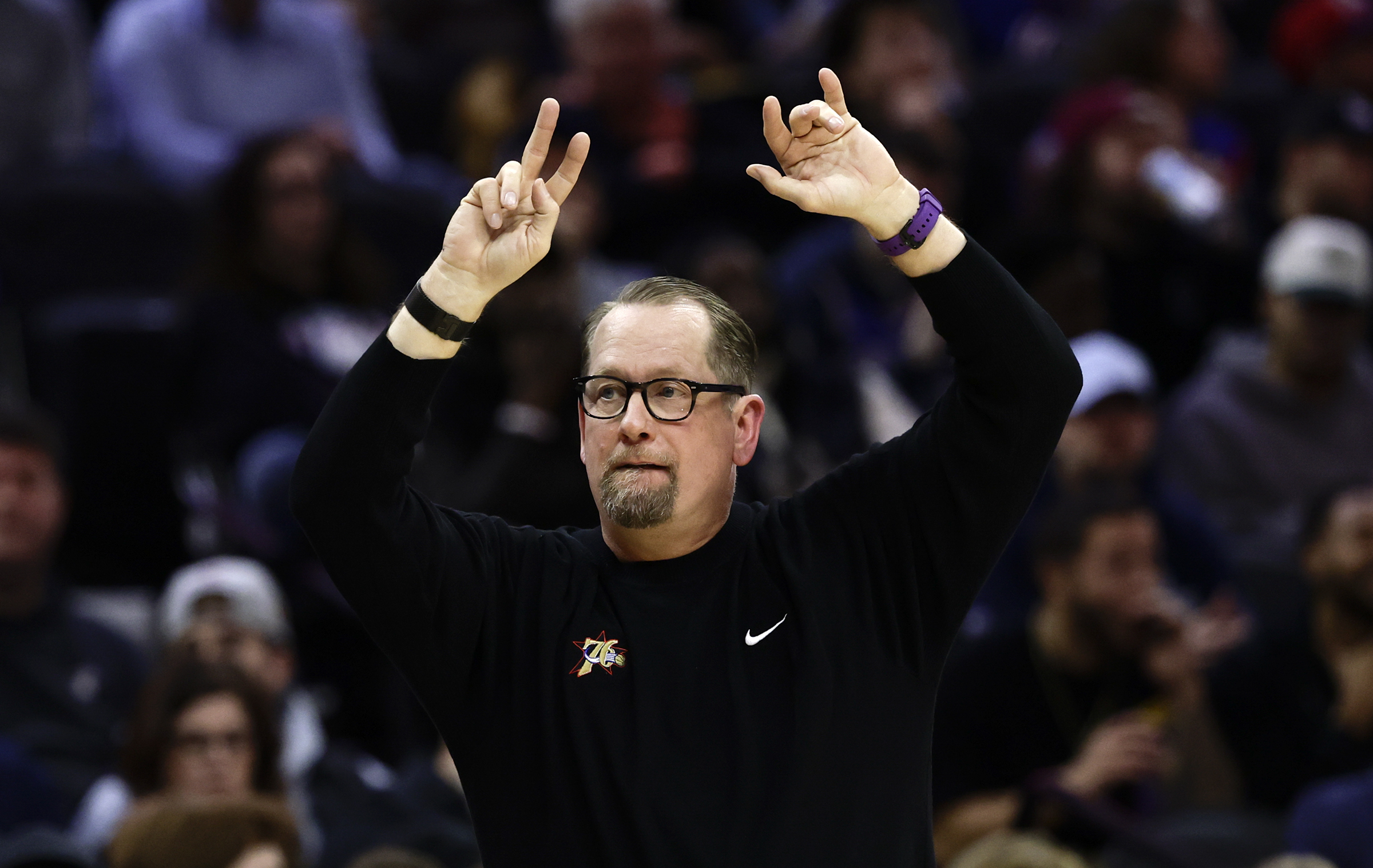
    Sixers head coach Nick Nurse called the middle of the Eastern Conference “tightly squeezed.”

    Jabari Walker was one of the 76ers’ lone standouts in their 40-point loss to the San Antonio Spurs. The next night he starred again in the Sixers’ win over the Utah Jazz. They’ll need those types of performances down the stretch of the final 20 games of the season. The Inquirer’s Gina Mizell took a look at that stretch, focusing on Paul George’s return, Joel Embiid’s injury management, and playoff positioning.

    Overwhelmed by the moment

    “We’ve expected more out of ourselves in terms of being sharp, mentally and cognitively,” Union manager Bradley Carnell said.

    With no midweek game this week, Bradley Carnell had time to reflect on the Union’s loss to New York City FC on Sunday. He suggested that “sometimes the moment gets to us a little bit.”

    His club is off to a 0-2 start in Major League Soccer. Carnell is looking address that and make adjustments, starting at the attacking end of the field.

    Sports snapshot

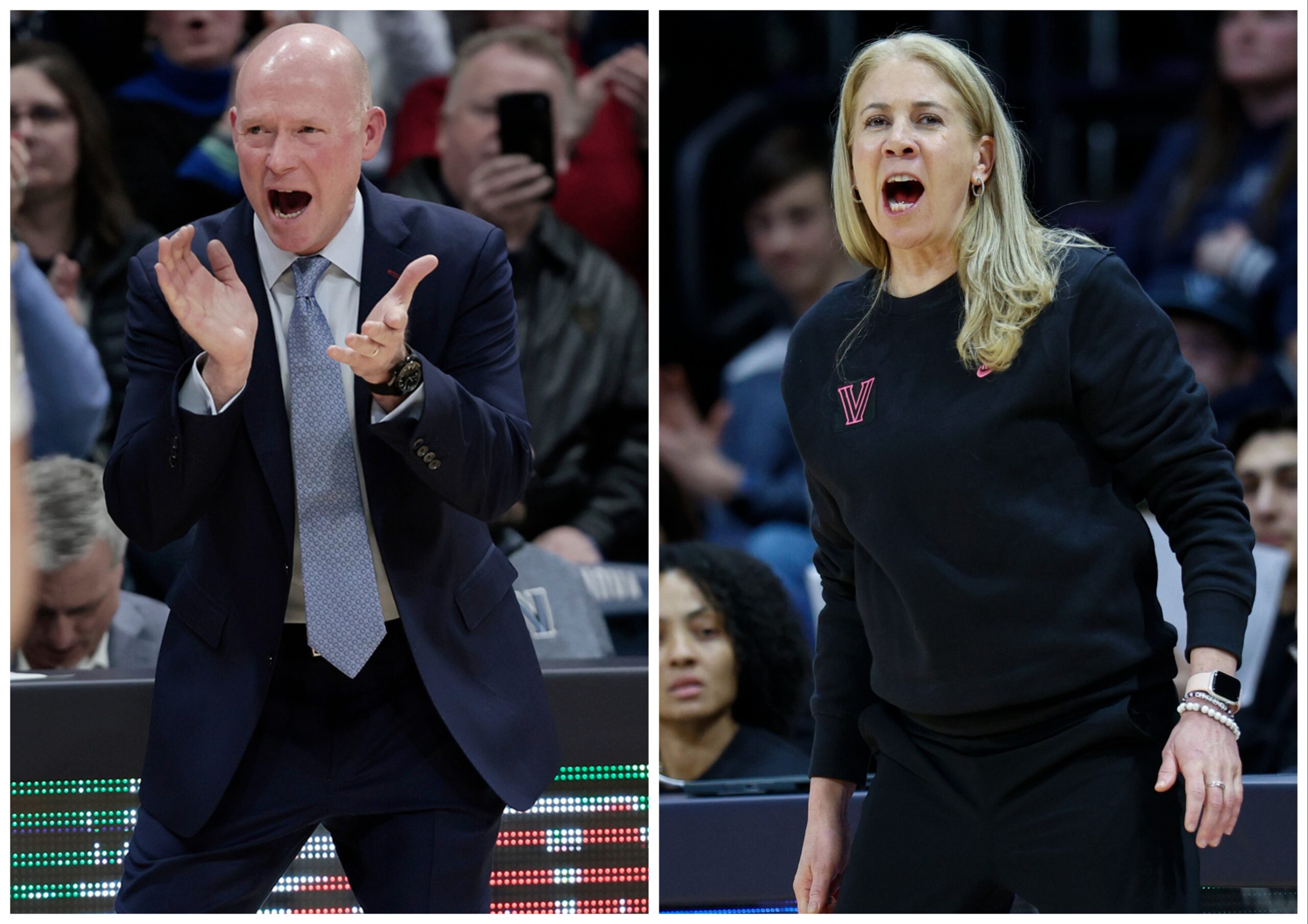
    Kevin Willard and Denise Dillon are leading Villanova men and women to the NCAA Tournament.

    The Big Picture

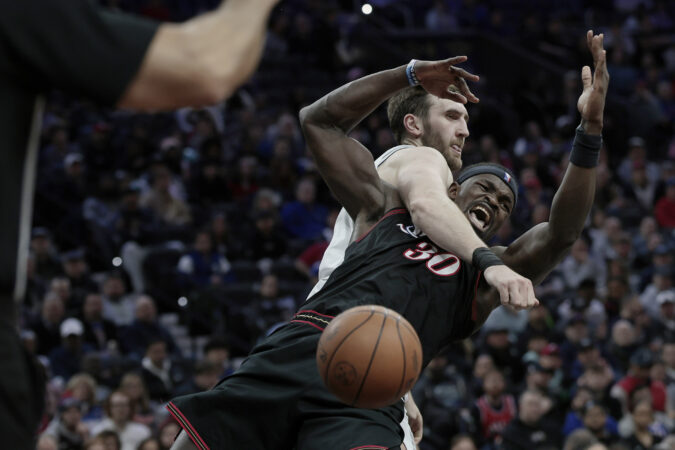
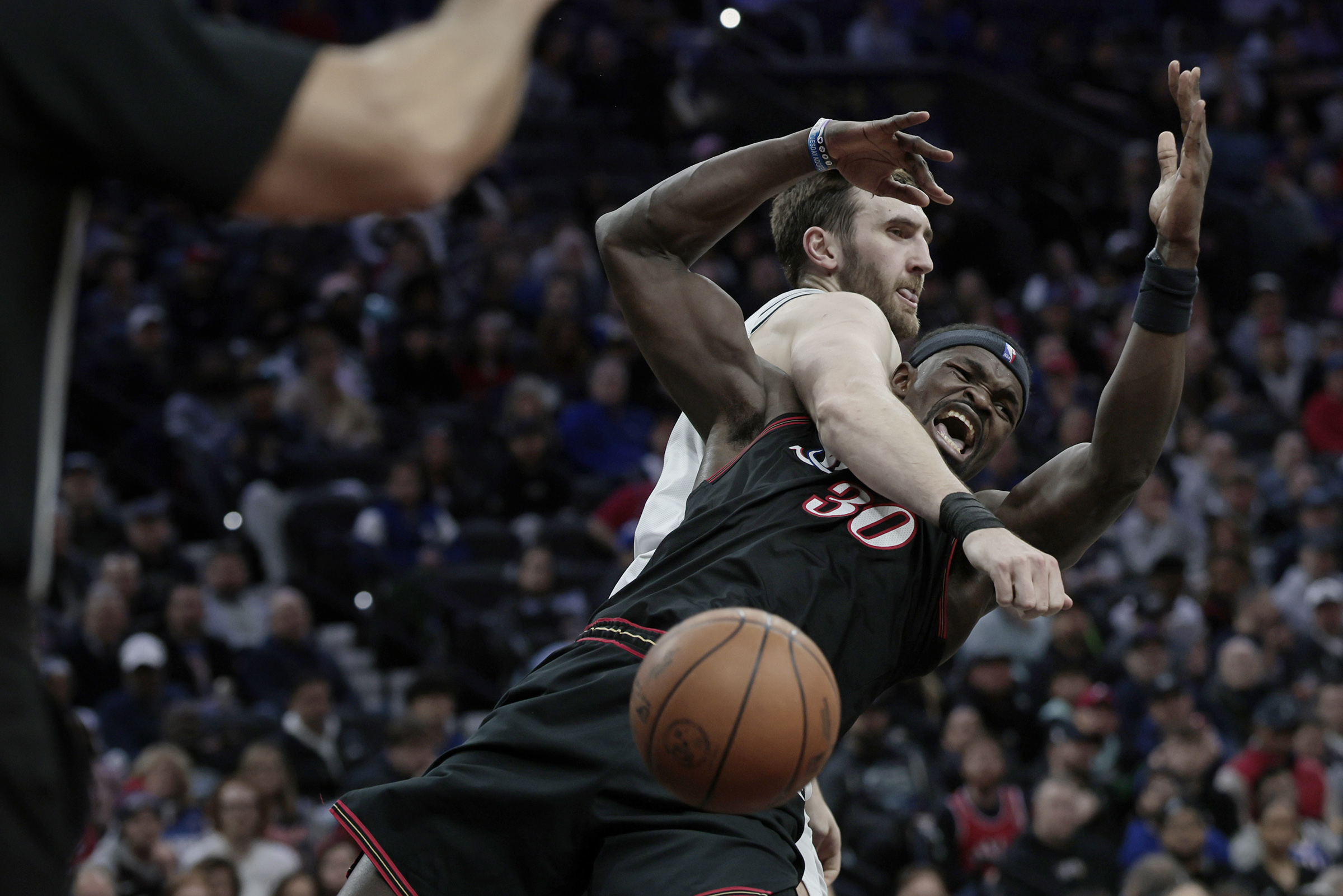
    Adem Bona falls to the floor after being fouled by Spurs’ Luke Kornet on Tuesday.

    Each Friday, Inquirer photo editors pick the best Philly sports images from the last seven days. As the calendar flips to March, we’ve got nearly every sport covered, with the exception of football — but don’t worry, NFL free agency starts next week. From the Sixers and Flyers getting physical in Philly to the Phillies heating up in Clearwater, here’s a look at our best shots of the week.

    What you’re saying about the Big 5

    We asked: Do you have a Big 5 hoops memory? Among your responses:

    The La Salle University Explorers were NCAA national champions in 1954, with Tom Gola being named the MVP. I was in 9th grade back in the days and basketball was the “In Sport” in Philly. The entire sporting world knew about Overbrook High School with Wilt and this small LaSalle College now a University at Broad & Olney. Waiting for the Evening Bulletin & Daily News newspapers to be delivered was always exciting so we could read the stories. Guess I’m one of the lucky ones that at 86 my memory immediately flashed back to Tom Gola & Wilt. — Ronald R.

    I am a Temple University graduate. I remember going to lots of “big 5” games at the palestra. It was an outstanding venue. Win/loss records did not matter for big 5 games. They were always hard fought. One game stands out because my future wife and I were photographed and appeared in the Inquirer sports page. — Richard P.

    It’s always the streamers, the rolls of toilet paper thrown after first basket score and the drums. We’re talking the 1960’s. Villanova – St Joe’s always the best. — Charlene C.

    Grew up loving the Big 5 and going almost every Sat night in the late 60’s. I say the Palestra had charisma! Best memory was in 1969 (?) when LaSalle played Villanova in game 2 and Penn v Columbia in game 1. The nightcap featured Ken Durrett (L) vs Howard Porter (V) but LaSalle also had future NBA /ABA players Larry Cannon (my Lincoln HS), Roland Taylor and Bernie Williams. Columbia had Jim McMillan who played for the Lakers. Amazing talent in the building that night. LaSalle was ranked #2 in the polls, but couldn’t go to the NCAA’s because of probation. The crowd noise, streamers, rollout banners are still great memories. Now I suffer in a basketball coma in State College with Penn State. — Gary P.

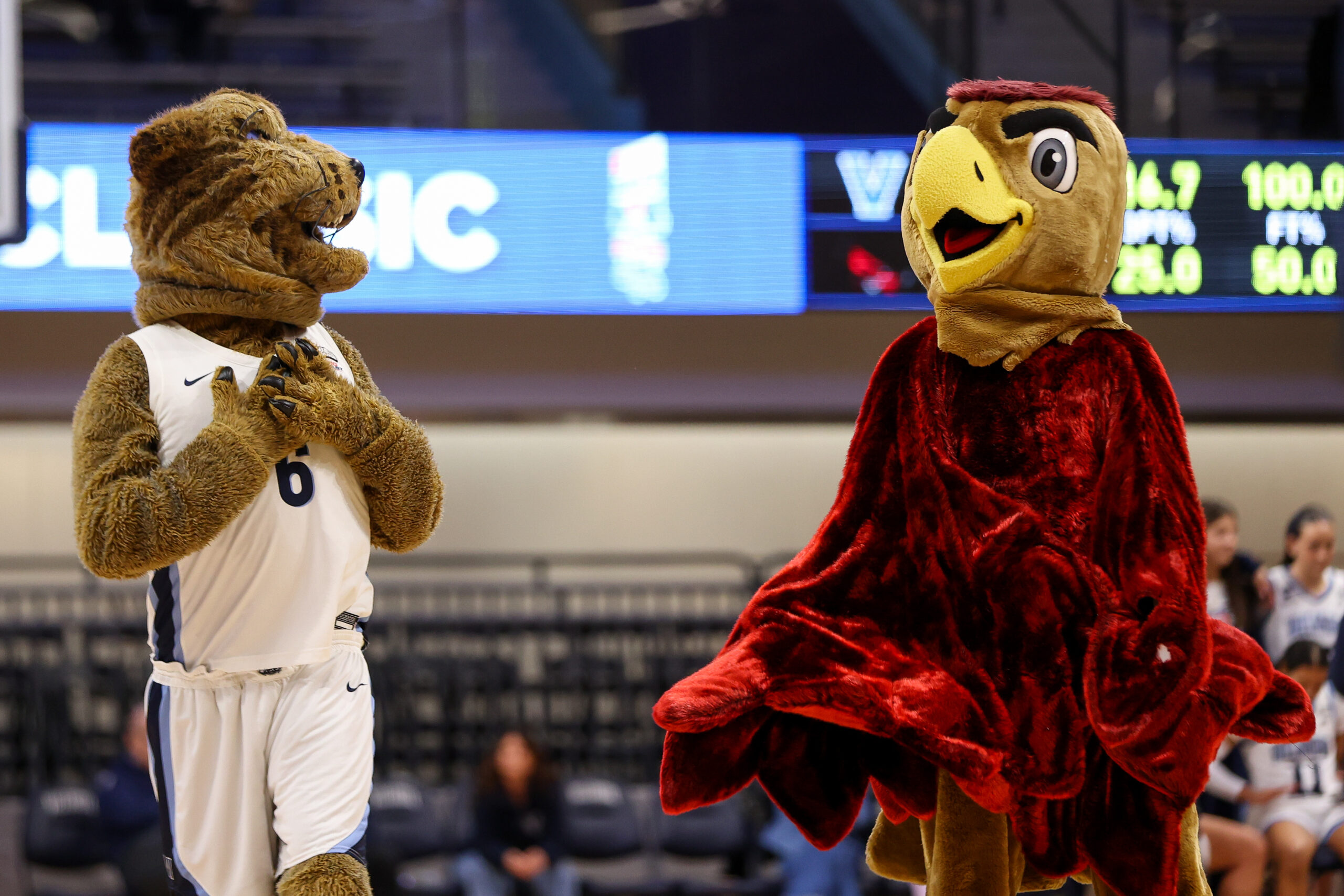
    Villanova Wildcats mascot and St. Joe’s Hawks mascot stand on court during this year’s Big 5 women’s basketball championship.

    Saturday afternoon doubleheaders at the Palestra. The first game would be a Big 5 match and second game involved another Big 5 team. Good times. Really miss the streamers. — Brad L.

    My favorite Big 5 memories are many Villanova/St. Joe’s games. This has always been a special rivalry resulting in memorable games. Unfortunately, these games have lost something in intensity and just overall atmosphere since they have moved from the Palestra. — Tom E.

    Used to love the Palestra. Penn would win the first game, then the Big 5 game would go. Got in on a St Joe’s ID for years. All games were competitive. Seems to me Rollie Massimino screwed it up, because the other Big 5 teams were as good as Villanova and he was such a big baby he didn’t want to lose to any of them. Bill M.

    Mike Sielski’s story about the decline of the Big 5 was very interesting and the reasons very logical. When growing up in the Philly area I was always a big fan of the Big 5 teams, but rarely ever saw them in person. I was much more interested in going to see the Philadelphia Warriors first and later the 76ers. Of course many of the Philly pros came from the Big 5 including Arizin, Gola, Wali Jones, Guy Rodgers, Melchonni, Goukas, Mike Bantum and more. — Everett S.

    Loved the Palestra doubleheaders along with the creative signs that were rolled open, passes down the student section and shredded by the first few rows. The best times were when Penn made the Final 4, Temple made it to several elite 8s and St Joe’s was #1 for part of a season. — Bob C.

    We compiled today’s newsletter using reporting from Jackie Spiegel, Gustav Elvin, Olivia Reiner, Jeff McLane, Jeff Neiburg, Jonathan Tannenwald, Ariel Simpson, Sean McKeown, Greg Finberg, Owen Hewitt, Dylan Johnson, Alex Coffey, Colin Schofield, Inquirer Staff Photograpers, and Gina Mizell.

    By submitting your written, visual, and/or audio contributions, you agree to The Inquirer’s Terms of Use, including the grant of rights in Section 10.

    As always, thanks for reading. Have a wonderful weekend, we’ll be back in your inbox on Monday. — Bella