For Jennifer Rodier, it was “a wonderful place to grow up.”
The six-bedroom, 2½-bathroom stone house is on a wide Upper Roxborough street, perched high above a valley.
Her father, Walter D’Alessio, bought the house in 1969, and “he never wanted to let go of it,” Rodier said.
The formal living room has a working wood-burning fireplace.
D’Alessio headed the Philadelphia Redevelopment Authority and Philadelphia Industrial Development Corp. and served under five Philadelphia mayors. He died in 2024.
Rodier, a nonprofit executive who lives in Lafayette Hill, is selling the place where she and her friends played hide-and-seek or cavorted in the large yard.
Window seat off the grand staircase.
She said the D’Alessios did extensive renovations on the house in their time there.
It is 4,406 square feet, and Rodier says it was built around 1910, with her parents only the second owners.
The house has a center-hall Colonial foyer, its original wide entry door with a leaded glass transom, original exposed ribboned hardwood floors, a grand staircase with a window seat, original wall light sconces and pocket doors, and a wraparound front porch.
The foyer’s original wide entry door has a leaded glass transom.
The formal living room has a working wood-burning fireplace, and the first floor includes the kitchen, breakfast room, powder room, and pantry.
The second floor has four bedrooms with large closets and a hall bath.
The third floor has the other bedrooms, including a large front bedroom that could be used for a primary suite, and bath with a claw-foot tub.
Reading nook with pocket doors.
The house has a full basement with a workshop and a storm door to the rear yard.
The sale could include some of the original furnishings, Rodier said.
The house is minutes from the Ivy Ridge Regional Rail station, Route 309, and the Schuylkill Expressway.
It is listed by Dennis McGuinn of Realty Broker Direct for $725,000.
You just finished watching Back to the Future with your parents and cousins at the multiplex, and now it’s time to pile into the Chevy Caprice wagon with faux wood-paneled sides. You beg your dad to put in the Wham! cassette, one more time.
You’re going to Pizza Hut, of course, and the parking lot is packed. Inside, there are stained-glass lamps hanging over the checkerboard tables, a salad bar, and those red plastic cups.
The server brings out your deep-dish pies. They smell almost buttery. You grab your fork and knife because, well, that’s how you eat at Pizza Hut.
Can you smell it? Taste it? Ah, nostalgia.
A Pizza Hut location in Wyoming County, Pennsylvania, was remodeled into a “classic” location, featuring the salad bar, red, plastic cups and other vintage touches.
If you’re hankering for Pizza Huts of bygone days or places like the “birthday room” at McDonald’s, you often have to travel back into your memory. Not anymore.
Pizza Hut has tapped into the power of nostalgia across the United States by resurrecting some “classic” restaurants. There’s one in Tunkhannock, a small town in the Endless Mountains of Wyoming County, about 140 miles northeast of Philadelphia.
The Pizza Hut, which has been in a shopping center parking lot for decades but was totally revamped — restored? — into a classic location, complete with the red, angled roof.
A Pizza Hut location in Wyoming County, Pennsylvania, was remodeled into a “classic” location, featuring the salad bar, red, plastic cups and other vintage touches.
“No touchscreen kiosks, no sleek redesign, just the classic dine-in Hut experience you thought was gone forever. It’s more than pizza. It’s a full-blown childhood flashback served with breadsticks and a plastic red cup!” the Just Pennsylvania Facebook page wrote in May in a post that received 7,500 shares.
It’s not clear how many Pizza Hut Classic locations exist in the United States, and, oddly, the company did not return multiple requests for comment. According to the Retrologist website, the Tunkhannock location is the only one in Pennsylvania. There appears to be about two dozen in the United States, according to the site, though none in New Jersey or Delaware. The only New York location is in Potsdam, which is closer to Canada than to Pennsylvania.
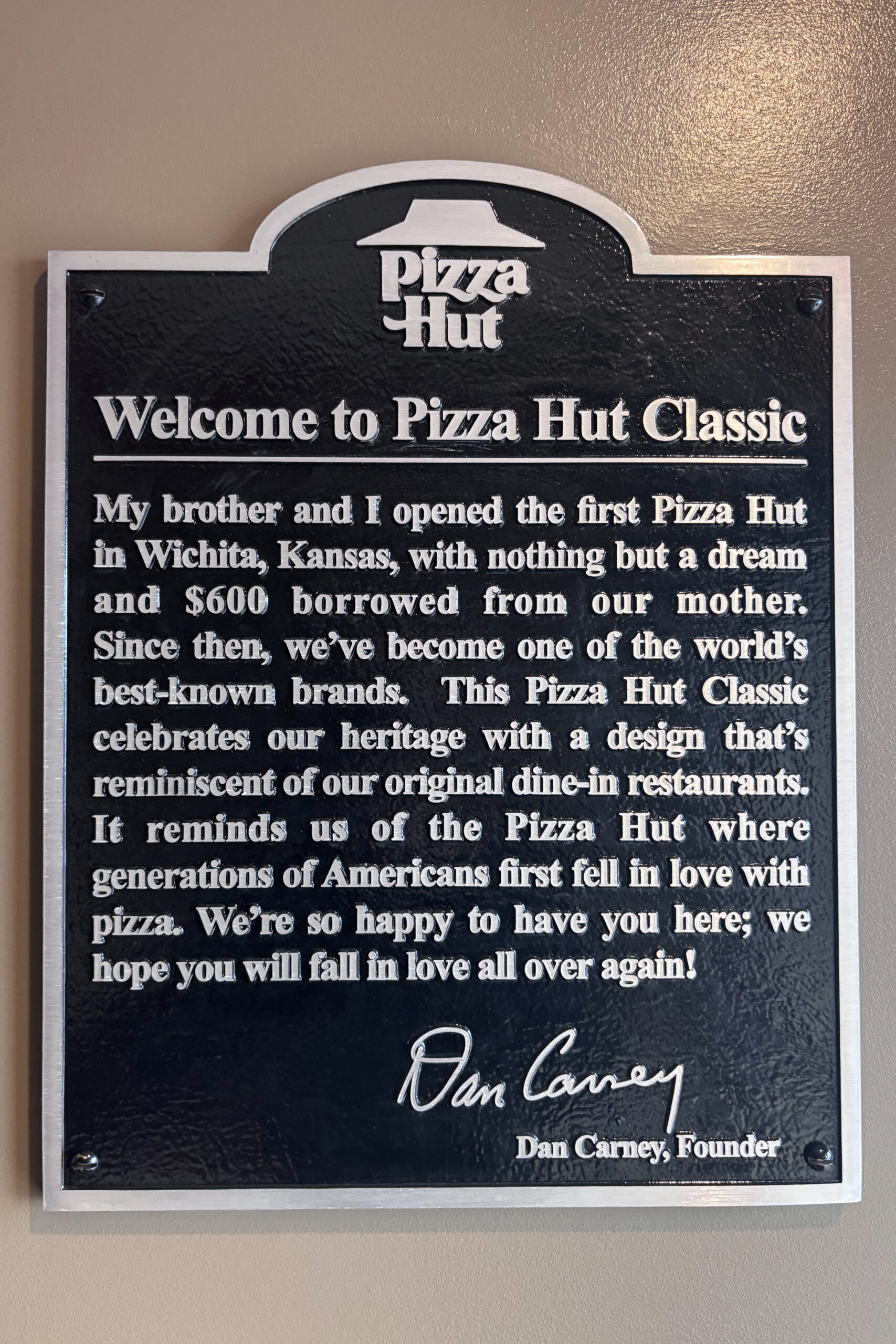
A plaque on the wall of the Tunkhannock location, written by Pizza Hut founder Dan Carney, explains the concept.
“It reminds us of the Pizza Hut where generations of Americans first fell in love with pizza,” Carney wrote.
When The Inquirer visited early on a recent Monday, a lunch crowd was beginning to file in.
“It was probably 10 years ago that they turned it into a classic, and our business has really exploded in the last year,” said Paul Bender, a shift leader at the Tunkhannock location. “I don’t know how it happened, but people really began to notice. I’ve had customers come in from Wisconsin, Oregon, Michigan, and, obviously, Pennsylvania and New Jersey. We get a lot of people in the parking lot making videos.
Bender said the Tunkhannock location is still hoping for a jukebox and old-style video games, like the tabletop Ms. PAC-MAN.
“That would seal the deal,” Bender said.
Bender has wondered why more iconic chains haven’t created throwback locations, like Pizza Hut. He’s seen the power of nostalgia firsthand.
“Instead, it seems like more and more are getting rid of dine-in altogether, ” Bender said. “But I’ve seen grown men, in tears here, saying they came here with their father and mother.”
Last year, it was reported that a Pittsburgh-area Pizza Hut was bringing back dine-in service, though videos show that it’s only gone half-classic so far.
A Pizza Hut location in Wyoming County, Pennsylvania, was remodeled into a “classic” location, featuring the salad bar, red, plastic cups and other vintage touches.
For most of last summer, observers of the Phillies wondered impatiently about when they would call up outfield prospect Justin Crawford.
But Crawford stayed put in triple A.
Now, with president of baseball operations Dave Dombrowski signaling that Crawford has the inside track on being the opening-day center fielder, many of those same observers are nervous about the Phillies turning over the keys to a 22-year-old rookie.
It felt timely, then, to invite Crawford’s triple-A hitting coach as a guest on Phillies Extra, The Inquirer’s baseball podcast. Adam Lind obliged, and discussed Crawford’s approach at the plate, which has yielded a .322 batting average in the minor leagues but also a high ground ball rate that leaves critics wondering about his ability to hit major league pitching.
Lind, 42, had a 12-year major league career, mostly with the Blue Jays, and finished with 200 home runs and a 112 OPS-plus. In 2017, his last season in the majors, he played with Bryce Harper and Trea Turner with the Nationals. Lind recalled the experience of teaming with Harper, in particular.
Watch the full interview below and subscribe to the Phillies Extra podcaston Spotify or Apple Podcasts.
Q: What was it like in 2017 to be teammates with a 24-year-old Harper at that stage of his career?
A: It was interesting to be around. Even with José Bautista and Félix Hernández, Ryan Braun — those were superstars — but Bryce takes it to another level. So, it was wild to be in his environment. The talent immediately was like, I’ve never seen a player like that. And then I thought his personality was really interesting. He was actually very funny, a very funny character. I enjoyed being around him. It was a good experience, and it was a great year, a great way to end my career, that 2017 summer with the Washington Nationals.
Q: What did Aidan Miller look like when he got to you at [single-A] Jersey Shore two years ago, and then what did he look like when he left Lehigh Valley after spending the last week of the season with you there last year?
A: The first thing I want to compliment Aidan on is his character. It was a tough stretch [in 2024]. We had some deep talks. I learned about him; he learned about me. But the thing is, he worked hard. He gave 110% every single day, and I think more than his hitting or his approach or what I saw, what I witnessed was the type of kid he is and the character he has. And I think that will benefit him hopefully for as many years as he can play. But again, more so than his hitting, his character stands above his work ethic. They’re second to none.
Q: What do you see as the biggest growth for Miller as a hitter?
A: His physicality. He looks the part. He has the size, he has the tools. But one thing that happened to him was, my older players, when they were on deck, or when he was hitting or whatever the case might be, they were complimenting him to me. And when you have 29-, 31-year-olds noticing his talent, that means he’s got a real future in the game. Because a lot of times there’s doubt from those types of players. They don’t believe it until they see it. Day 1, he ignited our team. I know it’s triple A, the minor leagues. We had a big series against Scranton, and without him in our lineup that week, we probably wouldn’t have won that series. And he just ignited our lineup for what we needed at that moment in that part of the season.
Q: Where do you come down on the question of whether Justin Crawford hits enough balls in the air to be successful in the big leagues? And with his speed, does it even really matter?
A: Hopefully it doesn’t matter. I have to give a big shout-out to player acquisition and our amateur scouting. Between Aidan and between Justin, the type of kids they are, the type of adults they will be, their work ethic, they’re second to none. So, in terms of how [Crawford] is going to succeed in the major leagues, you can never forecast the future, but he’s got the right mentality. He’s got the right work ethic. He’s even-keeled. As far as hitting too many balls on the ground, his approach works right now. He’s super fast. His swing works to where he can hit the ball all over the yard. And when you’re left-handed, it’s a big asset to be able to hit the ball on the ground to the left side of the infield. And whenever a defender has to take one step away from first base, that usually means he’ll be safe.
Gabriel Rincones Jr. hit 18 home runs with a .799 OPS in 506 plate appearances at triple-A Lehigh Valley in 2025.
Q: Where did you leave things with Gabriel Rincones Jr., in terms of what he needs to do to take that next step this season?
A: Well, I think the first two months were good for Gabriel. It forced him to learn about himself and learn about the game. We had discussions about, what have you learned so far in your career? And there weren’t really great answers yet. But through the struggle, he matured a lot. He learned a lot about his swing. He learned a lot about approach, and I think it was just the level. And I say this a lot, baseball will tell you when you need to make an adjustment, and that was his calling. Triple A was another level for him. He hadn’t played a whole lot even at double A, so it was a good challenge for him, and he responded well in the second half.
As far as left-handed pitching, I tried to give him some tools. We worked a lot, somewhat a lot, with him in [high-performance] camp [in the fall] on left-handed pitching. But again, his calling card will be to do well against right-handed pitching. He’s immensely talented. In my heart, I think he can hit left-handed pitching, but he just needed some tools and some approach adjustment and just some outside-the-box thinking. Because I had to try and do it — how to survive against left-handed pitching. And you look at Kyle Schwarber, he wasn’t very good [against lefties] at the beginning of his career. He made adjustments. And it’s not usually [about the] swing; it’s an approach thing, and hopefully he will improve. The numbers are kind of low against lefties, so it should be easy to make improvements with just simple approach adjustments.
It seems that Philadelphia’s reputation as a good place to start a business got a boost this past year.
The city ranked 13th among 350 “start-up ecosystems” worldwide in Startup Genome‘s 2025 Global Startup Ecosystem Report, which considers educational resources, labor, taxes, and funding opportunities.
The region attracted over $900 million in equity funding and acquisitions in 2024-25, according to the Greater Philadelphia Chamber of Commerce; expanded biotech and robotics facilities; and launched AI education initiatives — all supported by public-private partnerships and university-led R&D.
Chamber CEO Chellie Cameron said the Startup Genome ranking “affirms our region’s emergence as a global destination for innovation, business, and opportunity.”
From 2019 to 2024, the U.S. saw more than 21 million new business applications, marking the largest-ever spike.
Software giant Intuit recently reported that and “33% of U.S. adults plan to start a business or side hustle next year — a 94% year-over-year increase.” LinkedIn says the number of “founders” listed on the platform grew 69% last year.
Are you thinking of starting a business this year? Before you quit your job, here’s some practical advice.
Get your finances in order
When I started my business, I did so while having a full-time job. I worked a lot of hours. But that’s because I needed to build up an income stream to support me for when I eventually left the corporate world.
Smart entrepreneurs know their finances. They’re good at math or have advisers that help them. They recognize the importance of accounting.
“I got a freshman finance textbook, learned the terms, and then learned from other founders’ experiences,” Daltoso said. “I found mentors and professors who would help me at Penn. People can be incredibly helpful when you reach out.”
Sonura founders Gabriella Daltoso (left) and Sophie Ishiwari at the Hospital of the University of Pennsylvania in November.
Start-ups need capital, and for financing, it’s important to have a solid business plan with realistic projections of revenues and expenses. You need to establish relationships with banks, investors, family members, friends, venture capitalists, or anyone else that could be a source of financing. You should have enough money in the bank to support yourself and your family for at least two years because it will likely take that long to get your business cash positive.
James Massaquoi, a board member at the Seybert Foundation and former analyst at Philadelphia venture capital firm Osage Partners, emphasizes planning capital needs early, ideally before launching. Massaquoi urges founders to deeply understand their cost structure and assumptions before getting in too deep.
“Talk to bankers and other sources of capital before you really start the business, so it’s a conversation — not another checklist,” he said. “Spend more time modeling out costs than forecasting profits because costs fluctuate dramatically, especially in the first two years.”
Make sure your family is on board
Think you’re busy now? Wait until you start a business.
You will spend much more time launching, running, and growing your enterprise than you expect. You will work nights, weekends, and crazy hours. People will be happy for you and supportive, but in the end, it’s all on your shoulders.
This kind of stress could put a strain on your personal life. You will not succeed unless your family members understand this and are ready to support you.
“Work-life balance is really about how much work you need to do for this to be successful — and how much pressure you feel to make it succeed,” Massaquoi said.
Be realistic
Passion for your business venture is important, but profits are just as important. Your model needs to be satisfying a market need if it’s going to have a legitimate chance.
The typical life span of a start-up is two to five years, with 70% going out of business before reaching their fifth year. The odds are against you.
The ones that do survive fix problems and do so better than their competitors. They watch their pennies and are open to change based on what their customers need.
Take your business seriously
Talk to a tax and legal adviser and form a company — maybe a corporation, partnership, or limited liability company. Use these advisers to help you register your business with the state and the federal government.
Create a professional website. Establish a commercial mailing address (not your home) and a toll-free phone number.
Pay in your estimated taxes, and file your tax returns on time.
As you hire employees, create policies and procedures and try to offer the types of benefits that established businesses provide like health insurance, retirement plans, and flexible time off.
If you are truly running a business (and not just a hobby), you need to act like a business.
Lean on local resources
As a start-up founder in Philadelphia, you’re not alone. The area has a number of great resources to help your small business get funding and grow.
Also, surround yourself with as many experts as you can afford. Have a good accountant, lawyer, coach, and advisers on hand to help you make decisions. Build these costs into your business plan and projections because these people are critical for your business success.
“Your expertise isn’t having all the answers; it’s learning from anyone who’s willing to share,” Daltoso said. “It’s really important to hear everyone, synthesize what’s useful, and move forward with confidence.”
A Montgomery County office — which one county commissioner described as a far less controversial version of Elon Musk’s Department of Government Efficiency — has helped the county find $14 million in savings within the past year and reduce the deficit by half.
Montgomery County’s Office of Innovation, Strategy, and Performance (OISP), announced in February 2025, spent the last year meeting with department heads to identify areas for cost cutting and streamlining services, such as eliminating almost a dozen vacant positions worth hundreds of thousands of dollars, saving $1.5 million on a prescription benefits provider, and conserving half a million dollars by bringing some county legal services in house.
In 2026, the office could consider integrating artificial intelligence into county services, with the support of all three commissioners, aimed at cutting red tape for residents and county employees.
“It’s kind of like DOGE,” said Commissioner Vice Chair Neil Makhija, a Democrat, noting that the office has “outlived” DOGE’s period of high activity when Musk was in charge before he stepped away last spring.
“We didn’t just take the richest person in the county and tell them to cut, you know, benefits for poor people, which is what the federal DOGE was,” Makhija said.
The office’s work comes on the heels of the county’s $632.7 million operating budget and a roughly $25.5 million deficit, resulting in a 4% property tax increase for residents.
Republicans have made looking for inefficiencies in government part of their brand. But Democratic leaders in Pennsylvania have also started taking on streamlining government.Gov. Josh Shapiro has touted how he’s cut processing time for licensesand accelerated the permitting process for building projects.
And in blue Montgomery County, a bipartisan group of leaders says that responsible government efficiency should be a pillar of good government, regardless of political party.
“What happened with DOGE at the federal level was hard to watch and certainly not the approach that we’re going to take in Montgomery County, but, any leader … has to go through this exercise of are we optimizing our resources? Are we leaving money on the table? Are there opportunities to improve the performance of our people?” said County Commissioner Chair Jamila Winder, a Democrat.
“Like all of those are just disciplines that are industry agnostic, and so I don’t think it’s a Republican or a Democrat thing,” Winder added.
Commissioner Tom DiBello, the only Republican on the board, agrees, saying that he has high expectations for the office and its ability to oversee the adequate spending of taxpayer dollars.
“I mean, that’s our job. It has nothing to do with Republican or Democrat. My feeling, it has to do with taxpayer money,” DiBello said. “We’re supposed to be stewards of taxpayer money.”
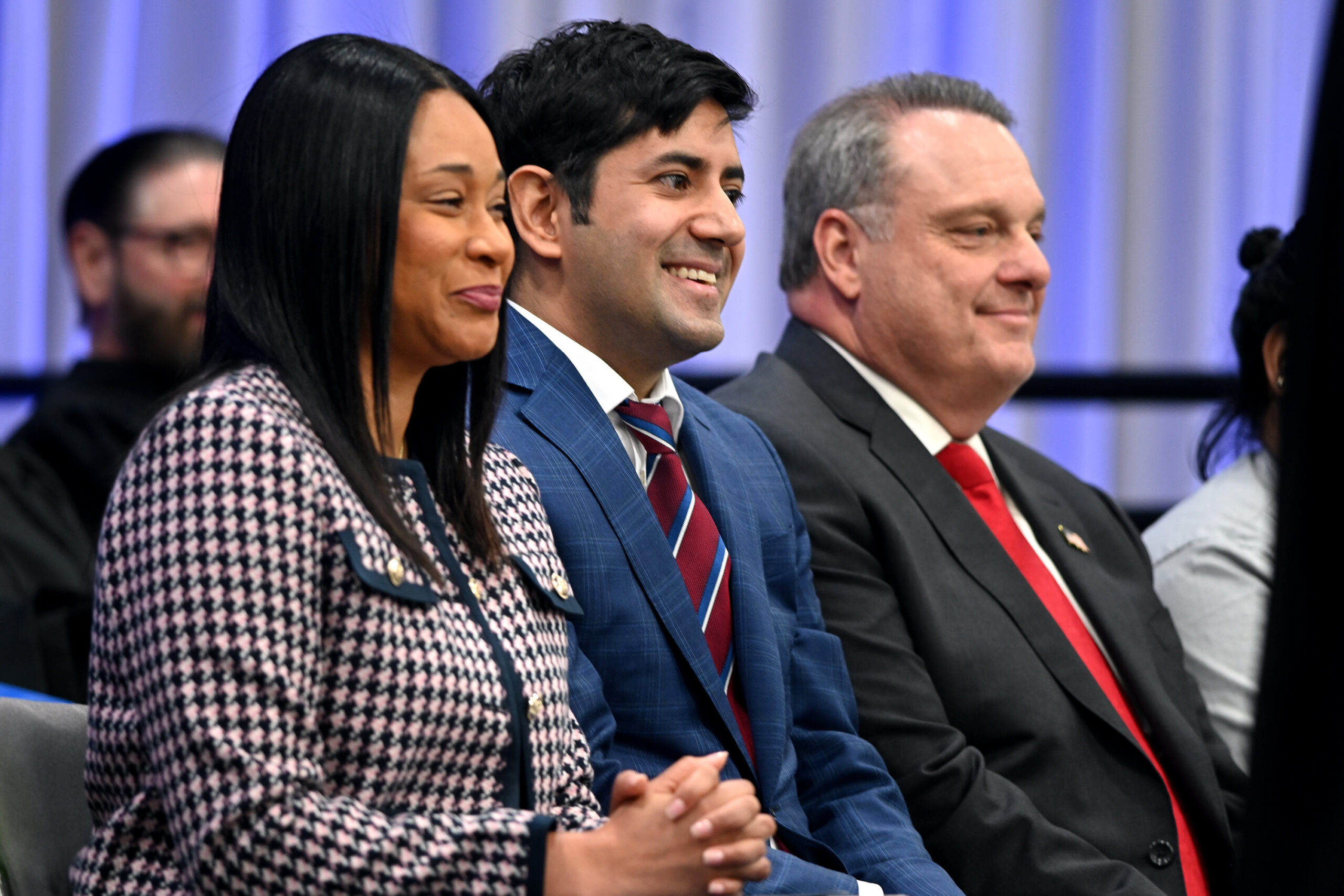
Jamila H. Winder (from left), Neil Makhija, and Thomas DiBello are seated together on stage at the Montgomery County Community College gymnasium Wednesday, Jan. 3, 2024, during ceremonies before they were sworn in as Montgomery County’s new Board of Commissioners.
Is artificial intelligence the next step?
The OISP was launched in February 2025 after the office previously served as the county COVID-19 pandemic “Recovery Office,” ensuring approximately $161 million in funds from the American Rescue Plan Act were being used appropriately.
When Stephanie Tipton, deputy chief operating officer, was hired in Montgomery County in September 2024 after more than 16 years in leadership in Philadelphia, county officials started discussing how to translate that oversight practice at the “Recovery Office” to every facet of county spending and performance.
That mentality helped the OISP cut the county deficit in half and focus on ways to reduce it in the long term, such as eliminating longstanding vacant positions around the county, including on the board of assessment, which does real estate evaluations. The office also helped develop performance management standards for departments.
“What we were really interested in is finding things that we could make repeatable year after year, and that would move forward, whether that was restructuring positions and eliminating vacancies that we don’t carry forward” to doing a trend analysis on spending, said Eli Gilman, project director of the 11-person office.He noted that the team was “kind of building a plane while we were flying.”
County governments are always trying to be efficient with taxpayer dollars, said Kyle Kopko, executive director of the County Commissioners Association of Pennsylvania, especially in the aftermath of last year’s state budget impasse. But Montgomery County’s decision to have a dedicated office for efficiency is fairly unique, he said.
“This is something that has become more and more of a focus of counties everywhere just because we’re not sure if we’re going to have the consistency of on-time state funds,” Kopko said.
The next phase for the office? Cutting red tape for residents. And part of that may be through enlisting artificial intelligence, something the county has been examining through the commissioners’ “Advisory Council on Artificial Intelligence for Public Good” established in April 2025.
“The goal here is like, how can we leverage this new and emerging technology to help us make it easier for residents to access services,” Tipton said. “Make it easier, reduce the burden on our frontline staff, so they can spend more time in sort of customer-facing, client-facing activities.”
AI will be something that many counties across Pennsylvania will be grappling with moving forward, Kopko said. Though some counties are wary of using it for sensitive information.
Everyone has a different idea as to what they would want to see AI used for in Montgomery County.
Makhija wants to make court documents accessible by chatbot. Winder says she wants to see AI help county employees be more efficient in their roles. And DiBello, who worked in tech software, said as long as accuracy is prioritized, AI could one day be used in situations where residents don’t have to speak directly to someone.
But first, Tipton said, the county wants to internally test AI tools to “make sure that we have the right sort of governance and guardrails” before launching it to the public.
When Tipton joined Montgomery County she said she had a “clear mandate from the commissioners” to look at department spending. She also wants it to be a transparent process for residents and the office plans to launch an open data site to the public in the second half of 2026.
“We want to make sure that moving forward, when we are making investments in the budget we can really understand more clearly how that is impacting service delivery, so we can tie that more directly to work that we’re doing,” Tipton said.
From left to right: Daquan Brown, Nyshyia Thomas, Tyejuan Brown, and Nesiyah Thomas-Brown, at the funeral for 15-year-old DaJuan Brown in July 2023.
This week, she will return, but to sit on the other side of the room — to see her eldest son in shackles, seated behind plexiglass, charged with three counts of murder, nine counts of attempted murder, and causing a catastrophe and riot.
She said her 21-year-old son feared for his life when he fired his legally owned gun twice down Etting Street the night of July 7, and that prosecutors have charged him with killings he didn’t commit.
But she also feels for the families of the victims — one of them her son’s close friend — and imagines that, if she were in their shoes, she would want everyone who fired a gun to face consequences.
“From being on both sides of this, it’s overwhelming, it’s unfair,” she said. “But I understand.”
Nyshyia Thomas (right) with Tyejuan Brown and Nesiyah Thomas-Brown inside their South Philadelphia home.
The July 7 party on Etting Street was one of two on the block that weekend celebrating the July Fourth holiday and the lives of some young men from the neighborhood who had been killed in recent years. Daquan Brown grew up about a block away and went to see childhood friends, his mother said.
Shortly after 1 a.m., police said, gunfire erupted. Officers responded to find that more than 120 bullets had been fired down the street in nearly all directions, striking neighbors’ homes and cars — and 13 partygoers.
Initially, police thought someone had shot up the party in a targeted attack. But after reviewing video footage, interviewing witnesses, and analyzing ballistics, detectives now believe the partygoers may have unintentionally shot each other.
Police investigate a mass shooting on the 1500 block of South Etting Street on July 7, 2025.
After people heard what they thought was the sound of gunfire — someone at the gathering may have shot once into the air or a car passing by may have backfired — at least 15 people pulled out their weapons and sprayed dozens of shots down the block, police said.
Brown, police said, was among them. As gunfire erupted, he took cover between cars and fired two shots down the block, according to two law enforcement sources who asked not to be named to discuss an ongoing investigation.
Investigators don’t know whether any of the shots Brown fired struck or killed anyone, the sources said. A full ballistics report is still pending, though it may never be able to determine whose bullets struck each victim.
Thomas has tried to come to terms with the police narrative. She is adamant that her son, having fired only two shots, shouldn’t be charged with three counts of murder and 10 counts of attempted murder. He feared for his life and acted in self-defense, she said.
At the same time, she said, had it been her son who was shot and killed that night, she would not want to hear from anyone trying to make sense of it.
Tyejuan Brown and a family member hold Nyshyia Thomas at the funeral of their son, DaJuan Brown, on July 15, 2023. DaJuan’s brother, Daquan, stands to right of Tyejuan.
Still, she finds herself doing that. Brown, who worked as a security guard and has no criminal record, only started carrying the 9mm handgun because of what happened to his brother, she said.
She remembered talking to him before he bought the weapon last year.
“Mom, I lost my brother,” Thomas said he told her. “Y’all not burying me.”
“I kissed him,” she said. “I told him I respect it.”
Brown’s father, Tyejuan, is also jailed with him.
On the night of July 7, she and Tyejuan, the father of her three children, were talking on the porch of her home when they heard dozens of gunshots coming from Etting Street. Tyejuan Brown, she said, took off running toward the party where his son was gathered.
When Thomas reached the block, she said, she found Tyejuan and Daquan covered in blood from carrying bodies to police cruisers.
But police said that when they reviewed surveillance footage from that night, they saw Tyejuan Brown rushing down the street holding a gun, which he is barred from owning because of drug, gun, and assault convictions.
He was arrested in early August and charged with illegal gun possession.
Nyshyia Thomas holds Tyejuan Brown during an interview in 2023 about the loss of their youngest son, DaJuan.
Four days later, they came for his son.
Until recently, Daquan Brown and his father were housed in the same block at Curran-Fromhold Correctional Facility and would speak to each other through a shared cell wall.
Brown is held without bail. Thomas said her family has gathered the $25,000 necessary for the father’s bail, but he has told them not to post it.
“I’m not coming out without my son,” Thomas said he told her.
On the outside, Thomas and her 15-year-old daughter, Nesiyah, are left to grapple with the absence of the three men in their lives they love most.
“I lost one son to gun violence,” Thomas said. “I’ll be damned if I let the system take my other one from me.”
Nyshyia Thomas hugs a photo of her son, DaJuan Brown, on what would have been his 18th birthday in September. Brown was shot and killed in a random mass shooting in July 2023.
In short, many of Trump’s policies are making people sicker, poorer, and less safe. In that context comes Trump’s latest attack on the Federal Reserve, which will ultimately hurt all Americans.
Since returning to office last year, Trump has pressured Federal Reserve Chairman Jerome Powell to speed up interest rate cuts in an effort to boost the economy. But the Fed has moved cautiously to avoid further inflation.
Trump’s economic approach has been reckless and shortsighted.
In July, he threatened to fire Powell. Last month, Trump said he may sue Powell for “gross incompetence.”
On Friday, the U.S. Department of Justice opened a criminal investigation into Powell involving his testimony before the Senate Banking Committee regarding the increased costs of renovations to the Fed’s headquarters in Washington.
Trump claimed not to know anything about the investigation, but he had previously criticized the renovation costs. Let’s be clear: Trump’s long-running attacks on the Fed chair are the only reason Powell faces any legal trouble.
The Powell investigation shows yet again how Trump continues to pervert the once-independent Justice Department, using it as a political tool to go after his perceived enemies.
Attorney General Pam Bondi continues to do Trump’s bidding. She has launched bogus investigations into other public officials, including former FBI Director James Comey and New York Attorney General Letitia James.
Add Powell to the political hit list that is making a mockery of American justice.
President Donald Trump shakes hands with Federal Reserve board member Jerome Powell after announcing him as his nominee for the next chair of the Federal Reserve, in the Rose Garden of the White House in 2017.
In a rare sign of political courage, some Republican lawmakers mustered the nerve to criticize Trump’s attack on Powell.
Sen. Lisa Murkowski (R., Alaska) said that “the administration’s investigation is nothing more than an attempt at coercion.”
Sen. Thom Tillis (R., N.C.) said the “independence and credibility” of the Department of Justice “are in question.” He promised to oppose the nomination of a new Fed chair until the legal issues are resolved.
But until more Republicans stand up to the president, expect more abuses of power.
Trump’s attack is especially petty, since Powell’s term as Fed chair ends in May, though he can remain on the board through January 2028.
Trump actually nominated Powell to be chairman during his first term in the White House. In a sign of Powell’s independence, former President Joe Biden renominated him to a second term.
By most accounts, Powell has done an impressive job steering monetary policy through uncharted territory involving the pandemic, followed by inflation brought on by increased government spending.
Trump’s pressure campaign on Powell has broader repercussions on America’s financial system.
The Fed’s independence is a cornerstone of U.S. financial markets, as it instills trust in investors, business leaders, economists, and other governments around the world that U.S. monetary policy is set without regard to political pressure.
Without that firewall, presidents could push for rate cuts to boost the economy before an election, potentially causing higher inflation and instability down the road just for short-term political gains.
In this instance, Trump clearly has his eye on revving up the economy before the midterms. (Trump would likely blame any subsequent inflation on Biden.)
Politicizing the Fed creates instability and will harm investors and consumers in the long run. Reports of the Powell investigation already rattled financial markets, prompting investors to sell American stocks and bonds.
To his credit, Powell has remained steadfast and made clear that the stakes surrounding the investigation are much bigger. “This is about whether the Fed will be able to continue to set interest rates based on evidence and economic conditions — or whether instead monetary policy will be directed by political pressure or intimidation.”
But the damage to the Fed is already done, as Trump continues to place his political and financial interests ahead of those of the American people.
Many households that are cost-burdened are not high-income earners paying for luxury housing — they are low-income residents with limited affordable housing options. As a result, many low-income families spend more than half of their income on rent, making other necessities like food and healthcare difficult to support. High demand, low inventory, and rising costs have created an affordable housing crisis and a growing unmet demand for quality affordable housing.
In Philadelphia, there is a deep, structural gap between the number of very low-income households and the supply of housing they can afford. As in many American cities, housing affordability is a significant issue in Philadelphia, and the Philadelphia Housing Authority, in partnership with the city, is boldly addressing this issue head-on with its plan to preserve housing for its current housing stock that provides housing to nearly 80,000 Philadelphians while creating new opportunities for the tens of thousands of residents who are waiting far too long for a home.
The benefits of preserving and expanding affordable housing extend well beyond simply providing a place to live. Affordable housing investments support wage growth by creating quality jobs in construction and related industries while also giving families more financial stability to advance in the workforce.
Every dollar invested in affordable housing generates construction jobs, supports local contractors, and strengthens the tax base. PHA’s $6.8 billion Opening Doors Initiative is preserving existing housing and creating new affordable housing communities that generate widespread economic benefits. A recent economic impact study by Econsult Solutions Inc. demonstrates that PHA’s efforts are providing a significant boost to Philadelphia’s economy.
PHA is working to renew 5404 Gibson Dr., an old public housing development. It’s among many projects the agency is investing in.
PHA’s completed and anticipated investments to preserve, acquire, or build 20,000 affordable housing units from 2023 to 2030 will generate a significant cumulative impact on the local and state economies. Locally, capital investments from PHA’s planned developments are estimated to produce almost $10 billion in cumulative economic impact, supporting more than 3,700 full-time jobs, generating $2.7 billion in employee compensation in Philadelphia. Statewide, these investments are projected to produce a total of $11.3 billion in cumulative economic impact, supporting 4,700 full-time equivalent job years and $3.2 billion in employee compensation during the period of construction.
Creating opportunities
These capital investments are also creating new opportunities for PHA’s skilled labor partners who help build high-quality, professionally managed housing communities. Those workers, in turn, will spend a portion of their salaries and wages within our local economy, catalyzing the procurement of a wide range of goods and services, as well as new economic opportunities for local vendors. Along with expanding the labor workforce, the maintenance and operation of new and rehabbed developments will generate more than $100 million in new tax revenue for the city of Philadelphia.
To complete all these investments, PHA must reduce operating expenses in line with lender and bond issuance requirements, potential federal public housing funding reductions, and multifamily industry staffing norms. In addition, PHA must also take action to streamline its property management functions to better service residents on-site while also decentralizing some management operations to procure qualified third-party property managers to realize millions of dollars in annual savings.
PHA’s recently announced restructuring and rightsizing plan achieves these requirements. Through engaging the Building and Construction Trades Council to modify its collective bargaining agreement, PHA will be better able to sustain and preserve its newly developed and repositioned housing portfolio. Once fully implemented, PHA will generate an estimated $28 million in annual operating savings, which will be redirected to preserve its housing stock, provide enhanced services to residents, and expand housing opportunities to the tens of thousands of Philadelphians on its waiting list.
This is a proactive approach to repositioning and strengthening PHA’s housing portfolio for the benefit of the families who depend on PHA. Decisions like this are never easy, but they are necessary to protect residents’ needs and to ensure the financial sustainability of PHA’s new and repositioned housing assets.
PHA remains committed to opening doors to new affordable housing opportunities and creating a sustainable future for Philadelphia’s housing needs.
Kelvin A. Jeremiah is the president and CEO of the Philadelphia Housing Authority.
We see the picture of the car with the bloody airbag and the stuffed animals in the glove compartment. We have viewed the crime on video in slow motion and from a few different angles. We think about or remember those mornings of getting our kids or grandkids to school, and we are brought to deep sadness and even tears. That is what we feel when we are human and part of a community. Vice President JD Vance has called the killing of Renee Good by a U.S. Immigration and Customs Enforcement agent “a tragedy of her own making.”
Similarly, President Donald Trump and Homeland Security Secretary Kristi Noem are working hard to make sure the ICE agent doesn’t face accountability for his disgusting overreaction. There has been no apology. They have shown no remorse. Not even thoughts and prayers. Leaders do not lose their jobs over policy differences. They are removed from office because their behavior and lack of morality are unbecoming of their positions. This time it was Renee Good. She did not deserve this. The next time, it could be someone we know and love.
Elliott Miller,Bala Cynwyd
Predatory interest
Regarding Donald Trump’s call to cap credit card interest rates, it is time for the federal government to intervene and regulate the predatory interest rates these companies have charged consumers for years. Between 2008 and 2015, while the prime rate remained at a historical low of approximately 3.25% and U.S. Treasury yields were near 1%, credit card companies continued to charge interest rates exceeding 20%, and in some cases, 30%. This disparity is unacceptable. There is an old saying: “Those who control the debt, control the debtor.” This is particularly evident when consumers making only minimum payments see their outstanding balances actually increase each month due to excessive interest. I urge Congress to take action to protect consumers from these practices.
Paul Benedict, Broomall
Might makes right?
This country was born in war, in defiance of a king. We would do well to remember our origins. None of our ancestors wished to kneel before a throne and the tyranny it embodied. We were founded on resistance and should expect other peoples and other nations to react similarly. The aspirations of our forefathers are shared by others around the world, and none want to exchange one tyrant for another. The “might makes right” approach we have embarked on fails to recognize the human condition we all share: stiff necks and a yearning for freedom and self-determination. Subservience is not peace; it is a slow boil that will require cycles of war to contain, if it can be contained at all.
War is death and always represents failure in human advancement, particularly when it is chosen. Often at the center of war is an ambitious man, a “man who would be king” who sends the precious youth of a society into harm’s way. The weight of war is etched on headstones and carried in the psyches of veterans. It is no way to live. This chapter of our evolution has been written so many times before in human history. How does this end?
Kevin Deeny,Levittown
. . .
U.S. Sen. John Fetterman said on Fox & Friends: “I don’t know why we can’t just acknowledge that it’s been a good thing what’s happened … We all wanted this man gone, and now he is gone.” Respectfully, senator: “Good” doesn’t mean much if the United States broke the rules to get there. I won’t defend Nicolás Maduro. I want accountability for corruption and political violence. But the U.S. can’t claim to stand for democracy while it seizes a foreign leader by force and calls it justice. Supporters point to Panama, but even then, we handed power to the democratic opposition. Trump sidelined María Corina Machado — whose coalition won Venezuela’s 2024 election — and installed a Maduro loyalist instead. Democracy isn’t restored if you ignore the vote or refuse new elections. Two wrongs don’t make a right. Pennsylvania deserves leaders who remember that.
Lauren Steinmeyer, Ardmore
Join the conversation: Send letters to letters@inquirer.com. Limit length to 150 words and include home address and day and evening phone number. Letters run in The Inquirer six days a week on the editorial pages and online.
ARIES (March 21-April 19). You’re in charge of the crew today. The less you say, the more likely they are to listen and obey. And if you can get away with saying nothing except that which can be said with action, even better!
TAURUS (April 20-May 20). Remember when you didn’t want to express your thoughts and opinions because you honestly weren’t having any? Some subjects just fail to capture your imagination, and that’s good to know. There are hotter topics out there for you, so keep moving.
GEMINI (May 21-June 21). Everyone wants love, attention and credit for what they do. Some want the whole circus — passion, applause and bragging rights — whether they earned it or not. So, sprinkle your effort where it bounces back. Stop tossing it into black holes.
CANCER (June 22-July 22). You made a few habits without realizing what you were doing, and now every time you enact a certain behavior, a string of other (possibly unwanted) behaviors follows. The easiest way to break this pattern is to change environments entirely.
LEO (July 23-Aug. 22). You know it’s love by what you’re willing to pay for it. In addition to time, thought and energy, inconvenience and discomfort may be part of the price. And if that seems expensive and not quite worth it, that’s good information, too.
VIRGO (Aug. 23-Sept. 22). It’s a classic scenario: the subject falls in love with the biographer, the patient projects romance onto the therapist, the model adores the photographer. You may notice a similar dynamic today. Few things are more seductive than genuine interest.
LIBRA (Sept. 23-Oct. 23). There’s something you enjoy simply for the sake of it, and it’s calling you back. What would it take to get absorbed in this again? A change of venue? A guard against interruption? Do it. Pure enjoyment restores you.
SCORPIO (Oct. 24-Nov. 21). However much attention you need, that’s the amount of attention you need. It is, arguably, out of your control. So, there’s no benefit from feeling ashamed or proud of the amount. But there’s a lot of benefit to finding a way to fulfill the order.
SAGITTARIUS (Nov. 22-Dec. 21). Perhaps the way you look has little bearing on the outcome today, but the way you feel about the way you look has a definite impact. Taking time to put a little extra thought into presentation will make a big difference in your attitude.
CAPRICORN (Dec. 22-Jan. 19). Your work is developing in a remarkably layered, generous and meaningful way. Each step forward reveals new insights that enrich the whole and make the journey a pleasure in itself. It hasn’t always gone like this, so you cherish the moment.
AQUARIUS (Jan. 20-Feb. 18). Emotions are the fire that forges relationships. Too much heat and things can bend in ways you don’t quite understand until it has all cooled off. You may return to a relationship as an armored person with wisdom in your arsenal.
PISCES (Feb. 19-March 20). While having fewer possessions means more freedom, fewer relationships can be confining. Every friendship is a world. Your experience will be limited to the worlds open to you. Making new friends doesn’t take a lot of time now, though it does take initiative.
TODAY’SBIRTHDAY (Jan. 13). This is your Year of Cosmic Connections, in which the right people find you at the right moments. Conversations open doors. Introductions ripple outward. You’re reminded that chemistry isn’t accidental, but, boy, is it fortuitous. More highlights: Travel invites you somewhere thrilling. Love grows easier, warmer and wonderfully mutual. A financial upgrade is tied to your reputation. Taurus and Sagittarius adore you. Your lucky numbers are: 41, 4, 44, 3 and 13.