CLEARWATER, Fla. — Bryce Harper touched down in Phillies camp, pulled on a black T-shirt — no, not the black T-shirt that went viral over the holidays — and summarized one of the weirdest weeks in an offseason of his career.
“For Dave [Dombrowski] to come out and say those things,“ Harper said, ”it’s kind of wild to me still.”
Key word: Still. Because this was Sunday, 122 days after the Phillies’ highest-ranking baseball official gave a 90-second answer 34 minutes into a 54-minute news conference about whether Harper’s good-but-not-great 2025 season was a one-off or the start of a downward trend.
Pardon the rehashed sound bite, but well, here goes: “Of course he’s still a quality player,” Dombrowski said, “still an All-Star-caliber player. He didn’t have an elite season like he has had in the past. And I guess we only find out if he becomes elite [again], or if he continues to be good.”
Bryce Harper missed 22 games for the Phillies last season because of an inflamed right wrist.
Cue the hysteria, fomented by sports-talk radio and social media. And a candid answer to a good question exploded into unfounded speculation that the Phillies would consider trading Harper. (For what it’s worth, John Middleton is clear about wanting Harper to go into the Hall of Fame with a “P” on his plaque.)
Harper is self-aware. He wasn’t satisfied with last season. There were factors, including an inflamed right wrist that caused him to miss 22 games. But he also swung at a career-high rate of pitches out of the zone, a problem given that Harper saw fewer strikes than any hitter in baseball. He also delivered fewer hits in the clutch than ever before.
“Obviously,” he said after digesting it for four months, “not the best year of my career.”
But the substance of Dombrowski’s comments didn’t bother Harper as much as the forum.
“The big thing for me was, when we first met with this organization [in 2019] it was, ‘Hey, we’re always going to keep things in-house, and we expect you to do the same thing,’” Harper said. “So, when that didn’t happen, it kind of took me for a run a little bit. I don’t know.
“It’s kind of a wild situation, that even happening.”
Dombrowski reached out to Harper about 10 days later. The whole affair seemed to be over. Then, in December, a video posted to Harper’s TikTok account showing him working out while wearing a T-shirt with two words across the chest: “NOT ELITE.”
Is Harper using Dombrowski’s critique as motivation?
“I don’t need to be motivated to be great in my career or anything else,“ Harper said. ”That’s just not a motivating factor for me.”
So, why the T-shirt?
“They made the shirts for me and I wore them,” he said. “If they’re going to make them, I’m going to wear them.”
OK then. Just don’t be surprised if Harper channels all of this into an MVP-worthy season. Because elite athletes have a way of turning more innocuous slights into fuel. Michael Jordan was notorious for it. Tom Brady, too.
Bryce Harper says it was kind of “wild” the way Phillies President Dave Dombrowski made his comments about Bryce’s season and that it was not elite.
Bryce says he is always available to anyone with the team and he had an understanding that everything would be kept “in house”… pic.twitter.com/MdzkjVII0l
“I just know his mindset is he wants to perform,“ manager Rob Thomson said. “He loves playing the game. He wants to perform for himself, for his teammates, for the organization, for the city of Philadelphia. With the way he’s come into camp, the shape that he’s in, we’ve got to keep him healthy and I think he’s going to have a huge year.”
Harper does appear to have bulked up since last season. Other than hiring a new trainer, he said he didn’t change much about his offseason program at home in Nashville.
The wrist, which hitting coach Kevin Long said bothered Harper before he went on the injured list last season, is fully healed. Harper said he hasn’t felt pain since June.
“Really happy about that,” he said. “My offseason was pretty similar to what I do each offseason. Just trying to make sure my body is where it needs to be. Just pretty much all the same stuff, getting in and making sure I’m ready to go.”
Maybe the stakes of the WBC will be invigorating for Harper, never a fan of the tedium of spring training.
“I feel like I’m pretty excited to play,” Harper said. “My face might not look it a lot of times. But I’m excited to be out there. I love being part of the culture and the group and Philly baseball. I don’t want that to ever not be the notion. I don’t smile all the time or I don’t laugh all the time, but I enjoy playing this game.”
With baseball returning to the Olympics in 2028 in Los Angeles, MLB is considering allowing players to compete, a scenario for which Harper has long lobbied.
In that case, the WBC would be a precursor. And Team USA is loaded. For years, many of the sport’s top starting pitchers resisted the WBC. But Tarik Skubal and Paul Skenes are at the top of the U.S. team’s rotation.
“Being able to take a step back and act like you are 16, 17, 18 years old again playing with your buddies,” Harper said, “really looking forward to it.
“And having Aaron Judge hitting behind me is going to be a lot of fun as well.”
Which brings up another question that looms over Harper this spring: How will the Phillies protect him in the lineup?
Thomson has considered putting Kyle Schwarber behind Harper. It was the other way around for most of last season. But then who will protect Schwarber? Alec Bohm and new right fielder Adolis García are the leading cleanup-hitter candidates.
“The four spot has a huge impact,” Harper said. “I think the numbers in the four spot weren’t very good last year for our whole team. Whoever’s in that four spot is going to have a big job to do.”
As far as his relationship with Dombrowski?
“We keep things in-house, that’s just how it’s always been, and in that moment, it just didn’t happen,” Harper said. “I think my locker is always open for them to come and talk to me, and vice versa. It is what it is right now.”
A 9-year-old boy remains hospitalized after being hit by a car in West Philadelphia that fled the scene, police said.
The child was walking in the 800 block of South 56th Street, around 12:22 p.m. Saturday, when a driver in a 2010–2013 Honda Crosstour struck him, police said.
He sustained several injuries and was transported to Children’s Hospital of Philadelphia, where he was in stable condition as of Sunday afternoon.
Police are now looking for the driver — a man they describe has having short hair and a beard, around the ages of 25 to 35 — in a burgundy Honda Crosstour with a black passenger-side fender, a green passenger-side front door, a white passenger-side rear door, and a bicycle rack on the roof.
Anyone with information can contact the police Crash Investigation Division.
It was understandable and probably justified when a surge of roughly 3,000 masked and gun-toting federal agents into Greater Minneapolis was described in martial terms, as a kind of modern-day Battle of Stalingrad fought in a snowbound U.S. prairie metropolis.
Watching the icy slips of the clumsy U.S. Immigration and Customs Enforcement (ICE) officers, and the remarkable pushback from whistle-blowing neighbors braving subzero cold, the writer Margaret Killjoy quoted a friend: “ICE made a classic Nazi mistake: they invaded a winter people in winter.” So when border czar Tom Homan stood at a Minneapolis podium last week and declared an end to “Operation Metro Surge,” many in the media raced to cast the move as a major pullback.
“The Occupying Army Retreats,” proclaimed the American Prospect, in a tone that was echoed across numerous outlets. “The announcement of ICE’s withdrawal from Minnesota, like that of the British from Boston 250 years ago, marks a victory for people power.”
But the smell of victory didn’t travel the nearly 1,200 miles east to the South Jersey suburb of Lindenwold, where on the very same morning Homan announced the end of the Minnesota surge, residents were shocked by an ICE raid that targeted a bus stop for an elementary school in a district that is 60% Latino.
A Ring video from the Woodland Village Apartments, where about 44 kids were waiting for the bus, captured the alarming scene as fourth and fifth graders — some screaming “ICE! ICE!” — ran away from the masked agents in tactical gear who’d pulled up in unmarked vehicles. School officials believe no child was apprehended, although there were conflicting reports on whether any adult was arrested. But the suburban community, some 15 miles southeast of Philadelphia, was shaken to its core.
Thursday morning kids were sent running from their bus stop in panic because ICE showed up. This guy at yesterday's ICE Out of Lindenwold, NJ protest is a must watch
“I never protested before in my entire life but …,” he said, choking back tears. “I watched fourth- and fifth-grade kids run away from our own government. I never want to see that again.”
Unfortunately, America is all but certain to see this again. While Homan’s public proclamation of a drawdown in Minnesota seemed a small concession to crumbling political support for ICE, what happened in Lindenwold was a window into a dystopian near-future of more immigration raids — not fewer. This would allow an undeterred authoritarian Donald Trump regime to fill a $38 billion gulag archipelago of coast-to-coast warehouses with newly handcuffed human beings.
Even Homan said as much last Thursday, if you listened closely. “And let me be clear, mass deportations will continue, and we’re not rolling back,” he said. “President Trump promised mass deportations, and that’s exactly what the American people are going to get.”
Let’s also be clear. What happened in Minneapolis since the start of the year really was a landmark victory for democracy, and the notion that everyday Americans can defend their neighbors. At the cost of two lives, the great personal risks taken by Minnesota’s ICE resisters ended in both an unforgettable moral triumph and some real tangible gains.
The actions taken by ICE watchers — who blew their alert whistles, recorded the government’s maneuvers on their phones, or volunteered food and rides to help immigrants stay safe indoors — prevented the arrests of scores and maybe hundreds of law-abiding neighbors. The courage of their resistance drove a huge shift in public opinion against the immigration raids, forcing rare concessions from the Trump regime. This heroism probably did cause ICE to scale back its Minnesota operations sooner than planned, and even pressured the U.S. Department of Justice to investigate two agents whose version of a shooting didn’t fit reality.
But Trump’s mass deportation drive — with an inexorable inertia created when Congress threw a whopping $170 billion toward this effort last year — refuses to obey the normal laws of political gravity.
U.S. Border Patrol officers walk along a street in Minneapolis last month.
For starters, the U.S. Department of Homeland Security has lied repeatedly to the American people, which means there’s no way of truly knowing to what extent the Minnesota surge has even ended. The day after Homan’s announcement, a St. Paul-based journalist noted 100 reports of ICE activity, still more than any other state.
But even more importantly, a flurry of reports last week about a massive ICE expansion for the rest of the year with many more agents in the field, more offices to support them, and more detention camps to hold thousands of new arrestees showed that what happened on the streets of Minneapolis was not the beginning of the end.
The fact that ICE is ending its surge in Minneapolis — similar to what happened in 2025 in Los Angeles, Chicago, Charlotte, N.C., and New Orleans, albeit on a smaller scale — seems less significant than the fact that the agency has, under Trump, more than doubled the number of field agents from 10,000 to 22,000, with many just hitting the streets.
Indeed, the drive to recruit new agents isn’t letting up. A Times of London reporter described the push as “a breakneck operation” as he watched officers from U.S. Customs and Border Protection — which also had its biggest hiring year in a decade — work the crowd with promises of a $50,000 bonus at a sold-out professional bull-riding event in Salt Lake City.
Can we really celebrate a “retreat” from Minneapolis when WIRED reported last week that ICE is also rushing to close leases on as many as 150 new offices — an average of three in every single state — to house its growing roster of agents and the attorneys and other back-office staffers needed to process the thousands of new arrestees?
Barricades block a drive outside a warehouse as federal officials tour the facility to consider repurposing it as an ICE detention facility on Jan. 15.
For example, multiple outlets confirmed last week that Homeland Security just inked a lease for high-end office space in the Westlakes Office Park in Berwyn, in Philadelphia’s Main Line suburbs, reportedly to house ICE attorneys and related personnel. A planned office in Philadelphia’s Chinatown, at 801 Arch St., is also listed by WIRED.
Experts say the logistics of converting these rectangular behemoths — like the 1.3 million-square-foot warehouse in Schuylkill County, Pa., that used to distribute cheap consumer goods for Big Lots that DHS claims can house up to7,500 detained immigrants — into even remotely humane facilities is daunting, if not impossible. Yet, DHS is plowing ahead with stunning speed, clearly expecting a pending spike in arrests.
In rural Social Circle, Ga., ICE is claiming it will convert a one million-square-foot warehouse into a detention site for as many as 10,000 people — double the town’s population — as soon as two months from now. Project Salt Box, which is tracking the rapid gulag expansion, says DHS is using a legal maneuver to fast-track bidding to allow large private firms like the Geo Group to run these detention centers.
Neither Trump’s plunging approval rating, nor the rapidly rising level of ICE resistance from everyday citizens like that flag-waver in Lindenwold, nor the Democratic demands for major reforms that have caused a DHS shutdown (with, ironically, no impact on ICE or Border Patrol) has put a dent in this unyielding drive toward rank inhumanity.
A newly bloated ICE wants to create a Minneapolis in every state, even as more and more Americans are willing to take considerable risks to stop them. What we are witnessing just over one year into the Trump regime is less a retreat and more an escalating game of chicken — with the forces of democracy and fascism headed for a dangerous collision.
If you’re part of the growing American majority who is disgusted with what ICE is doing in our streets, now is the time to get your whistle, attend a training session on what to do when the secret police arrive at your kid’s bus stop, attend a protest like the next “No Kings” event on March 28, and join the movement to protect your neighbors.
In the spirit of John Paul Jones and the revolutionary American founders, we have not yet begun to fight.
Menthol Newports. A stray shoe. Child-sized mittens. Rotten apples. A crushed pineapple White Claw.
These were a smattering of the artifacts emerging from Philadelphia’s permafrost this weekend, when temperatures neared a balmy 50 degrees on Saturday and the last vestiges of a bleak, bleak winter — feet-tall snowpack on sidewalks, in bike lanes, and smooshed between cars — were slowly, but surely, melting away.
The thawing out has left behind a Philly trash special, relics from a bygone era, before the city was buried under historic snowfall and its inhabitants were forced inside. A buffet of Wawa, Starbucks, Dunkin’, and McDonald’s cups once trapped under 9.3 inches of snow and ice have broken free. The littered receipts and Backwoods cigar wrappers sprinkled outside Fishtown bars have been reborn, soggier and muddied. The neighborhood dogs’ poop, bagged or not, has been preserved in subfreezing temperatures.
And for the people of Philadelphia who are stirring from their hibernation, the collective cabin fever is finally breaking. On Saturday afternoon, some ventured into the open air of North Philadelphia to bask in an uninhibited sun. They wore considerably fewer layers, bared arms and legs, and voluntarily gallivanted about in February.
“We celebrate it not freezing,” said Uchenna Ezeokoli, 26, of Northern Liberties, who was seen skateboarding near Johnny Brenda’s. His “coat” was a mere flannel. “If it’s not freezing, it’s a good time.”
Lori Sanchez’s narrow, one-way Fishtown street was never plowed, she said, rendering it inaccessible and shutting her in for a week. But Saturday, strolling down Fishtown’s main throughway with sister-in-law Katherine, she felt the buzz of spring.
“That’s our hope — that it stays warm,” Sanchez, 27, said.
A streak of days when the temperature eclipsed freezing made Bala Cynwyd resident Nicholas Beck, 46, feel like he’d overcome the winter blues: “When the sun comes out, that always helps. … This is probably the turning point, I think.”
Some light rain and snow is expected for tonight, producing minor accumulations over the northern half of the area. Further south towards Philly, more of a rain/snow mix cuts into any accumulation. Areas of South Jersey and Delmarva likely stay all rain. #NJwx#PAwx#MDwx#DEwxpic.twitter.com/oLgmvhpS3T
For the fourth-straight season, the NBA All-Star Game will have a new format when players take the court Sunday night. This year it’s U.S. players versus the world, a debut perfectly timed with the 2026 Milan Cortina Winter Olympics.
Like the Olympics, tonight’s All-Star Game will air on NBC, with tipoff at the Intuit Dome in Los Angeles expected around 5 p.m. Philly time. The early start time will give NBC plenty to time to air its prime-time Olympics coverage at 8 p.m.
It’s the first time NBC has aired the All-Star game since 2002, moving over from TNT as part of the league’s 11-year, $76 billion media rights deal that began this season.
One notable omission tonight is seven-time All-Star Joel Embiid. Despite a turnaround season, the 2023 MVP didn’t make the cut for this year’s All-Star roster. But at least he’ll have extra time to rest his sore right knee, which forced him out of two consecutive games heading into All-Star weekend.
“He might not be going to the All-Star Game this weekend, but he’s playing at an All-Star level,” wrote columnist Marcus Hayes.
Sixers rookie phenom VJ Edgecombe also isn’t playing tonight, but put on a show during the league’s Rising Stars competition Friday night. Edgecombe. who was named the evening’s MVP, won both tournament games for Vince Carter’s team, at one point racking up 10 straight points and sinking a game winner in the two-game mini tournament.
“I just wanted to go out there and show everyone that I can hoop — regardless of stage,” Edgecombe said.
Here’s everything you need to know to watch or stream this year’s NBA All-Star game:
What time does the NBA All-Star Game start?
The Intuit Dome in Inglewood, Calif., the home of the 2026 NBA All-Star Game.
The 2026 NBA All-Star Game is scheduled to begin at 5 p.m. Eastern Standard Time, and will air live on NBC from the Intuit Dome, home of the Los Angeles Clippers.
The All-Star Game will stream live on Peacock, NBC’s subscription streaming platform. It can also be streamed on all the digital services offering NBC, including Hulu With Live TV, DirecTV Stream, Sling TV, or YouTube TV.
In and around Philadelphia, you can also stream NBC10 for free with a digital antenna, though signal strength will vary by your location.
Calling his first-ever All-Star Game is 29-year-old Noah Eagle, already one of NBC’s top announcers and the son of veteran play-by-play announcer Ian Eagle. He’ll be joined on the broadcast by former NBA stars turned broadcasters Carmelo Anthony and Reggie Miller.
Zora Stephenson and Ashley ShahAhmadi will report courtside.
The new NBA All-Star Game format, explained
This year’s All-Star Game would more accurately be described as an All-Star tournament.
Three different squads — USA Stars, USA Stripes, and World — will face off in a round robin series. Each team will play at least two 12-minute games, and the best two will face off in a finale at 7:10 p.m.
“One of the things that didn’t happen last year, there was not enough basketball in the All-Star Weekend because of the format,” Sam Flood, NBC’s Sports’ president of production, said in a conference call earlier this week. “This game and this All-Star Sunday will have a full 48 minutes. If we’re lucky, we might get some overtime as well, so fun times await.”
Here’s the full schedule. If all three teams end up tied 1-1, the tiebreaker will be decided by point differential:
Game 1: Stars vs. World, 5 p.m.
Game 2: Stripes vs. Game 1 winner, 5:55 p.m.
Game 3: Stripes vs. Game 1 loser, 6:25 p.m.
Game 4: Championship, 7:10 p.m.
How many people actually watch the NBA All-Star Game?
Despite lackluster effort and nonexistent defense, million of fans tune in each year to watch the NBA’s top stars face off. But the audience has steadily declined in recent years, much like everything else on TV.
Last year’s All-Star game, which aired on TNT, averaged 4.72 million viewers. That’s down from 7.614 million viewers from a decade ago, mirroring a trend across all television as more people turn to streaming services.
Expect a bump in the ratings this year, thanks to the return to broadcast television. Over 13 million viewers tuned in the last time the All-Star game air on NBC, way back in 2002 in Philadelphia. Doubtful we’ll hit that mark this time around, but anything north of 6 million viewers would be welcome news for the league.
The decline also isn’t exclusive to the NBA. All-Star games across different leagues have lost their allure as well-paid players don’t have much incentive to play hard and cross-conference play is the norm.
Even the all-powerful NFL has struggled to bring fans back to the Pro Bowl, which a decade ago regularly averaged over 10 million viewers. 2026’s version of the reimagined flag football contest drew just 2 million fans on ESPN, second-lowest in the game’s history behind 2021’s tape-delayed COVID game (1.9 million).
NBA All-Star game rosters
USA Stars
Scottie Barnes, frontcourt, Toronto Raptors
Devin Booker, guard, Phoenix Suns
Cade Cunningham, guard, Detroit Pistons
Jalen Duren, frontcourt, Detroit Pistons
Anthony Edwards, guard, Minnesota Timberwolves
Chet Holmgren, frontcourt, Oklahoma City Thunder
Jalen Hohnson, frontcourt, Atlanta Hawks
Tyrese Maxey, guard, Philadelphia 76ers
USA Stripes
Jaylen Brown, guard, Boston Celtics
Jalen Brunson, guard, New York Knicks
Kevin Durant, frontcourt, Houston Rockets
De’Aaron Fox, guard, San Antonio Spurs (injury replacement for Giannis Antetokounmpo)
Brandon Ingram, frontcourt, Toronto Raptors (injury replacement for Steph Curry)
LeBron James, frontcourt, Los Angeles Lakers
Kawhi Leonard, frontcourt, Los Angeles Clippers
Donovan Mitchell, guard, Cleveland Cavaliers
World
Deni Avdija, frontcourt, Portland Trail Blazers
Luka Dončić, frontcourt, Los Angeles Lakers
Nikola Jokić, frontcourt, Denver Nuggets
Jamal Murray, guard, Denver Nuggets
Norman Powell, guard, Miami Heat
Alperen Senguin, frontcourt, Houston Rockets (injury replacement for Shai Gilgeous-Alexander)
Pascal Siakam, frontcourt, Indiana Pacers
Karl-Anthony Towns, frontcourt, New York Knicks
Victor Wembanyama, frontcourt, San Antonio Spurs
Sixers NBA standings
Despite two consecutive losses against the Portland Trail Blazers and New York Knicks, the Sixers entered the All-Star break in sixth-place in the Eastern Conference and solidly in a playoff spot one season removed from missing the postseason entirely.
window.addEventListener(“message”,function(a){if(void 0!==a.data[“datawrapper-height”]){var e=document.querySelectorAll(“iframe”);for(var t in a.data[“datawrapper-height”])for(var r,i=0;r=e[i];i++)if(r.contentWindow===a.source){var d=a.data[“datawrapper-height”][t]+”px”;r.style.height=d}}});
Upcoming Sixers TV schedule
Hawks at Sixers: Thursday, Feb. 19, 7 p.m. (NBC Sports Philadelphia, 97.5 The Fanatic)
Sixers at Pelicans: Saturday, Feb. 21, 7 p.m. (NBC Sports Philadelphia, 97.5 The Fanatic)
Sixers at Timberwolves: Sunday, Feb. 22, 7 p.m. (NBC Sports Philadelphia, 97.5 The Fanatic)
Sixers at Pacers: Tuesday, Feb. 24, 7 p.m. (NBC Sports Philadelphia, 97.5 The Fanatic)
Heat at Sixers: Thursday, Feb. 26, 7 p.m. (NBC Sports Philadelphia, 97.5 The Fanatic)
Sixers at Celtics: Sunday, March 1, 6 p.m. (NBC Sports Philadelphia, 97.5 The Fanatic)
Spurs at Sixers: Tuesday, March 3, 8 p.m. (NBC, 97.5 The Fanatic)
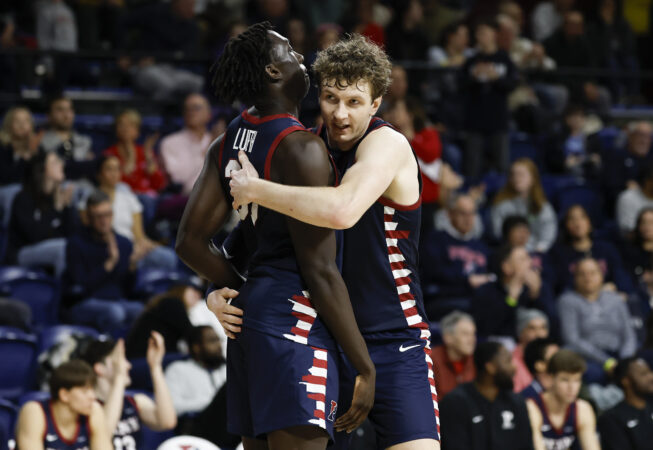
Fran McCaffery’s Penn team has not lost this month.
Behind a second-half surge, the Quakers extended their winning streak to four with an 82-76 victory over Cornell at the Palestra on Saturday evening.
The Quakers win is a boon to the team’s hopes of qualifying for the four-team Ivy League tournament. Penn (13-10, 6-4 Ivy) now holds sole possession of third place and the head-to-head tiebreaker over Cornell (12-11, 5-5).
TJ Power and Jay Jones led the Quakers with 17 points each. Five Quakers scored in double figures.
Jones and Lucas Lueth both set new career highs in scoring to help seal the win. Jones, a freshman guard, reached double-figure scoring for the first time in his Penn career. He was instrumental in the game’s closing minutes as Cornell extended the game with fouls. Jones shot 9-of-11 from the line, with seven of those makes coming in the final two minutes.
“The coaching staff has done a great job, and they give me a bunch of confidence,” Jones said. “[If] you look, you’ll see me look at the coaching staff after I shoot my first [free throw] all the time. I’ve got a lot of trust in them.”
Lueth went on a 6-0 run by himself in the second half to build the Quakers’ lead from three points to nine with 9 minutes, 35 seconds remaining.
The sophomore forward, who transferred to Penn from Kirkwood Community College in Iowa, finished with 11 points on 4-of-5 shooting.
“They’re new to our program,” McCaffery said. “They’re new to our system. But they’re both really smart. They both prioritize winning. They do the things that are necessary for the team to win.”
Penn’s bench outscored Cornell’s reserves, 30-16. Jones and Lueth combined for 19 points in the second half as the Quakers pulled away.
“They earned the opportunity to play at crunch time tonight in a very meaningful game,” McCaffery said. ”So, as a coach, you’re proud of that character.”
Defense clamps down
Penn had a poor shooting night, hitting 42.6% of its shots from the field and shooting 3-of-20 from three-point range. But the Quakers were able to lean on their defense to contain Cornell. Penn held Cornell to its third-lowest point total of the season. The Big Red shot 47.6% from the field against Penn’s defense and were 6-of-23 from distance.
Penn guard AJ Levine drives to the basket against Cornell guard Jake Fiegen (left) and guard Cooper Noard during the second half on Saturday.
Cornell also struggled from the free throw line, making 10-of-21 shots. Penn converted 16 Cornell turnovers into 23 points while allowing nine giveaways of its own.
“All throughout practice we were talking about heating them up,” Lueth said. “So that’s what we did.”
Method to the Ivy madness
After a 76-67 win over Columbia at the Palestra on Friday, the Quakers picked up two Ivy victories in as many days. Penn gained some distance on the rest of the pack in its bid for a league tournament berth. Dartmouth and Princeton, who are tied for fifth place in the Ivy standings, both lost on Saturday. Their losses give Penn a two-game cushion over the Ivy tournament cut line.
The Quakers are one game behind Harvard for second and two games behind first-place Yale. Penn will travel to face the Bulldogs for its next game on Saturday (2 p.m., ESPN+).
“We stay pretty consistent in our approach,” McCaffery said. “We don’t look at, ‘OK, we have to win two this weekend.’ We focus on the next game. We did some things well when we played Yale, some things we didn’t do well. So you work on that, you try to get better, and you prepare to win that game.”
After Yale, Penn’s remaining schedule will include games against Dartmouth and Harvard at the Palestra and a season finale contest at Brown. The Ivy League tournament will begin March 14 at Cornell.
Rebekah Stewart, a nurse at the U.S. Public Health Service, got a call last April that brought her to tears. She had been selected for deployment to the Trump administration’s new immigration detention operation at Guantánamo Bay, Cuba.
This posting combined Donald Trump’s longtime passion to use the offshore base to move “some bad dudes” out of the United States with a promise made shortly after his inauguration last year to hold thousands of noncitizens there. The naval base is known for the torture and inhumanetreatment of men suspected of terrorism in the wake of 9/11.
“Deployments are typically not something you can say no to,” Stewart said. She pleaded with the coordinating office, which found another nurse to go in her place.
Other public health officers who worked at Guantánamo in the past year described conditions there for the detainees, some of whom learned they were in Cuba from the nurses and doctors sent to care for them. They treated immigrants detained in a dark prison called Camp 6, where no sunlight filters in, said the officers, whom KFF Health News agreed not to name because they fear retaliation for speaking publicly. It previously held people with suspected ties to al-Qaeda. The officers said they were not briefed ahead of time on the details of their potential duties at the base.
Although the Public Health Service is not a branch of the U.S. armed forces, its uniformed officers — roughly 5,000 doctors, nurses, and other health workers — act like stethoscope-wearing soldiers in emergencies. The government deploys them during hurricanes, wildfires, mass shootings, and measles outbreaks. In the interim, they fill gaps at an alphabet soup of government agencies.
The Trump administration’s mass arrests to curb immigration have created a new type of health emergency as the number of people detained reaches record highs. About 71,000 immigrants are currently imprisoned, according to Immigration and Customs Enforcement data, which show that most have no criminal record.
Homeland Security Secretary Kristi Noem has said: “President Donald Trump has been very clear: Guantánamo Bay will hold the worst of the worst.” However, several news organizationshave reported that many of the men shipped to the base had no criminal convictions. As many as 90% of them were described as “low-risk” in a May progress report from ICE.
In fits and starts, the Trump administration has sent about 780 noncitizens to Guantánamo Bay, according to the New York Times. Numbers fluctuate as new detainees arrive and others are returned to the U.S. or deported.
While some Public Health Service officers have provided medical care to detained immigrants in the past, this is the first time in American history that Guantánamo has been used to house immigrants who had been living in the U.S. Officers said ICE postings are getting more common. After dodging Guantánamo, Stewart was instructed to report to an ICE detention center in Texas.
“Public health officers are being asked to facilitate a man-made humanitarian crisis,” she said.
Seeing no option to refuse deployments that she found objectionable, Stewart resigned after a decade of service. She would give up the prospect of a pension offered after 20 years.
“It was one of the hardest decisions I ever had to make,” she said. “It was my dream job.”
One of her PHS colleagues, nurse Dena Bushman, grappled with a similar moral dilemma when she got a notice to report to Guantánamo a few weeks after the shooting at the Centers for Disease Control and Prevention in August. Bushman, who was posted with the CDC, got a medical waiver delaying her deployment on account of stress and grief. She considered resigning, then did.
“This may sound extreme,” Bushman said. “But when I was making this decision, I couldn’t help but think about how the people who fed those imprisoned in concentration camps were still part of the Nazi regime.”
Others have resigned, but many officers remain. While they are alarmed by Trump’s tactics, detained people need care, multiple PHS officers told KFF Health News.
“I respect people and treat them like humans,” said a PHS nurse who worked in detention facilities last year. “I try to be a light in the darkness, the one person that makes someone smile in this horrible mess.”
The PHS officers conceded that their power to protect people was limited in a detention system fraught with overcrowding, disorganization, and the psychological trauma of uncertainty, family separations, and sleep deprivation.
“Ensuring the safety, security, and well-being of individuals in our custody is a top priority at ICE,” said Tricia McLaughlin, chief spokesperson for the Department of Homeland Security, in an emailed statement to KFF Health News.
Adm. Brian Christine, assistant secretary for health at the Department of Health and Human Services (HHS), which oversees the Public Health Service, said in an email: “Our duty is clear: say ‘Yes Sir!’, salute smartly, and execute the mission: show up, provide humane care, and protect health.” Christine is a recent appointee who, until recently, was a urologist specializing in testosterone and male fertility issues.
“In pursuit of subjective morality or public displays of virtue,” he added, “we risk abandoning the very individuals we pledged to serve.”
Into the unknown
In the months before Stewart resigned, she reflected on her previous deployments, during Trump’s first term, to immigration processing centers run by Customs and Border Protection. Fifty women were held in a single concrete cell in Texas, she recalled.
“The most impactful thing I could do was to convince the guards to allow the women, who had been in there for a week, to shower,” she said. “I witnessed suffering without having much ability to address it.”
Stewart spoke with Bushman and other PHS officers who were embedded at the CDC last year. They assisted with the agency’s response to ongoing measles outbreaks, with sexually transmitted infection research, and more. Their roles became crucial last year as the Trump administration laid off droves of CDC staffers.
Stewart, Bushman, and a few other PHS officers at the CDC said they met with middle managers to ask for details about the deployments: If they went to Guantánamo and ICE facilities, how much power would they have to provide what they considered medically necessary care? If they saw anything unethical, how could they report it? Would it be investigated? Would they be protected from reprisal?
Stewart and Bushman said they were given a PHS office phone number they could call if they had a complaint while on assignment. Otherwise, they said, their questions went unanswered. They resigned and so never went to Guantánamo.
PHS officers who were deployed to the base told KFF Health News they weren’t given details about their potential duties — or the standard operating procedure for medical care — before they arrived.
Stephen Xenakis, a retired Army general and a psychiatrist who has advised on medical care at Guantánamo for two decades, said that was troubling. Before health workers deploy, he said, they should understand what they’ll be expected to do.
The consequences of insufficient preparation can be severe. In 2014, the Navy threatened tocourt-martial one of its nurses at Guantánamo who refused to force-feed prisoners on hunger strike, who were protesting inhumane treatment and indefinite detention. The protocol was brutal: A person was shackled to a five-point restraint chair as nurses shoved a tube for liquid food into their stomach through their nostrils.
“He wasn’t given clear guidance in advance on how these procedures would be conducted at Guantánamo,” Xenakis said of the nurse. “Until he saw it, he didn’t understand how painful it was for detainees.”
The American Nurses Association and Physicians for Human Rights sided with the nurse, saying his objection was guided by professional ethics. After a year, the military dropped the charges.
A uniformed doctor or nurse’s power tends to depend on their rank, their supervisor, and chains of command, Xenakis said. He helped put an end to some inhumane practices at Guantánamo more than a decade ago, when he and other retired generals and admirals publicly objected to certain interrogation techniques, such as one called “walling,” in which interrogators slammed the heads of detainees suspected of terrorism against a wall, causing slight concussions. Xenakis argued that science didn’t support “walling” as an effective means of interrogation, and that it was unethical, amounting to torture.
Medics practice evacuating a detained immigrant in a simulated exercise at Guantánamo in April 2025.
Torture hasn’t been reported from Guantánamo’s immigration operation, but ICE shift reports obtained through a Freedom of Information Act request by the government watchdog group American Oversight note concerns about detainees resorting to hunger strikes and self-harm.
“Welfare checks with potential hunger strike IA’s,” short for illegal aliens, says an April 30 note from a contractor working with ICE. “In case of a hunger strike or other emergencies,” the report adds, the PHS and ICE are “coordinating policies and procedures.”
“De-escalation of potential pod wide hunger strike/potential riot,” says an entry from July 8. “Speak with alien on suicide watch regarding well being.”
Inmates and investigations have reported delayed medical care at immigration detention facilities and dangerous conditions, including overcrowding and a lack of sanitation. Thirty-two people died in ICE custody in 2025, making it the deadliest year in two decades.
“They are arresting and detaining more people than their facilities can support,” one PHS officer told KFF Health News. The most prevalent problem the officer saw among imprisoned immigrants was psychological. They worried about never seeing their families again or being sent back to a country where they feared they’d be killed. “People are scared out of their minds,” the officer said.
U.S. service members stand by during an April 2025 simulated medical evacuation of immigrants detained at Guantánamo.
No sunlight
The PHS officers who were at Guantánamo told KFF Health News that the men they saw were detained in either low-security barracks, with a handful of people per room, or in Camp 6, a dark, high-security facility without natural light. The ICE shift reports describe the two stations by their position on the island, Leeward for the barracks and Windward for Camp 6. About 50 Cuban men sent to Guantánamo in December and January have languished at Camp 6.
A Navy hospital on the base mainly serves the military and other residents who aren’t locked up — and in any case, its capabilities are limited, the officers said. To reduce the chance of expensive medical evacuations back to the U.S. to see specialists quickly, they said, the immigrants were screened before being shipped to Guantánamo. People over age 60 or who needed daily drugs to manage diabetes and high blood pressure, for example, were generally excluded. Still, the officers said, some detainees have had to be evacuated back to Florida.
PHS nurses and doctors said they screened immigrants again when they arrived and provided ongoing care, fielding complaints including about gastrointestinal distress and depression. One ICE monthly progress report says, “The USPHS psychologist started an exercise group” for detainees.
Doctors’ requests for lab work were often turned down because of logistical hurdles, partly due to the number of agencies working together on the base, the officers said. Even a routine test, a complete blood count, took weeks to process, vs. hours in the U.S.
DHS and the Department of Defense, which have coordinated on the Guantánamo immigration operation, did not respond to requests for comment about their work there.
One PHS officer who helped medically screen new detainees said they were often surprised to learn they were at Guantánamo.
“I’d tell them, ‘I’m sorry you are here,’” the officer said. “No one freaked out. It was like the ten-millionth time they had been transferred.” Some of the men had been detained in various facilities for five or six months and said they wanted to return to their home countries, according to the officer. Health workers had neither an answer nor a fix.
Unlike ICE detention facilities in the U.S., Guantánamo hasn’t been overcrowded. “I have never been so not busy at work,” one officer said. A military base on a tropical island, Guantánamo offers activities such as snorkeling, paddleboard yoga, and kickboxing to those who aren’t imprisoned. Even so, the officer said they would rather be home than on this assignment on the taxpayer’s dime.
Transporting staff and supplies to the island and maintaining them on-base is enormously expensive. The government paid an estimated $16,500 per day, per detainee at Guantánamo, to hold those accused of terrorism, according to a 2025 Washington Post analysis of Department of Defense data. (The average cost to detain immigrants in ICE facilities in the U.S. is $157 a day.)
Even so, the funding has skyrocketed: Congress granted ICE a record $78 billion for fiscal year 2026, a staggering increase from $9.9 billion in 2024 and $6.5 billion nearly a decade ago.
Last year, the Trump administration also diverted more than $2 billion from the national defense budget to immigration operations, according to a report from congressional Democrats. About $60 million of it went to Guantánamo.
“Detaining noncitizens at Guantánamo is far more costly and logistically burdensome than holding them in ICE detention facilities within the United States,” wrote Deborah Fleischaker, a former assistant director at ICE, in a declaration submitted as part of a lawsuit brought by the American Civil Liberties Union early last year. In December, a federal judge rejected the Trump administration’s request to dismiss a separate ACLU case questioning the legality of detaining immigrants outside the U.S.
Anne Schuchat, who served with the PHS for 30 years before retiring in 2018, said PHS deployments to detention centers may cost the nation in terms of security, too. “A key concern has always been to have enough of these officers available for public health emergencies,” she said.
Andrew Nixon, an HHS spokesperson, said the immigration deployments don’t affect the public health service’s potential response to other emergencies.
In the past, PHS officers have stood up medical shelters during hurricanes in Louisiana and Texas, rolled out COVID testing in the earliest months of the pandemic, and provided crisis support after the deadly shooting at Sandy Hook Elementary School and the Boston Marathon bombing.
“It’s important for the public to be aware of how many government resources are being used so that the current administration can carry out this one agenda,” said Stewart, one of the nurses who resigned. “This one thing that’s probably turning us into the types of countries we have fought wars against.”
KFF Health News is a national newsroom that produces in-depth journalism about health issues and is one of the core operating programs at KFF — the independent source for health policy research, polling, and journalism.
We like to think that big-time athletes are superhuman, and in a lot of ways they are.
They’re still humans, though, capable of feeling emotions and pressure just like the rest of us.
It happened to Ilia Malinin in figure skating on Friday. He said point-blank after his falls on the ice that “the pressure of the Olympics really gets you.” And it happened to another American, skiing star Mikaela Shiffrin, in the team event last Tuesday.
“I didn’t find a comfort level that allows me to produce full speed,” she said after an unusually slow slalom run that left her team off the medal stand.
But both of those moments were just single points in each athlete’s career — and in these Olympics, too. Malinin helped the U.S. win gold in the team event, and on Sunday Shiffrin gets a second shot in the giant slalom.
Ilia Malinin is a pleasure to talk with, uniformly gracious to his competitors, and his frankness after the worst mental collapse of his young career was a credit to him. He said straight out that the pressure got to him. The Olympics is not like anything else. https://t.co/EpMWwE2mKN
Unfortunately for TV viewers here, the event is early in the morning Philadelphia time. (Alpine skiing events are always held during the day wherever they are.) The first run is at 4 a.m. on USA Network, and the second is at 7:30 a.m. on NBC.
But as with all the events at these Olympics, you can catch a replay on Peacock whenever you want afterward. There will also be highlights on NBC’s prime time show.
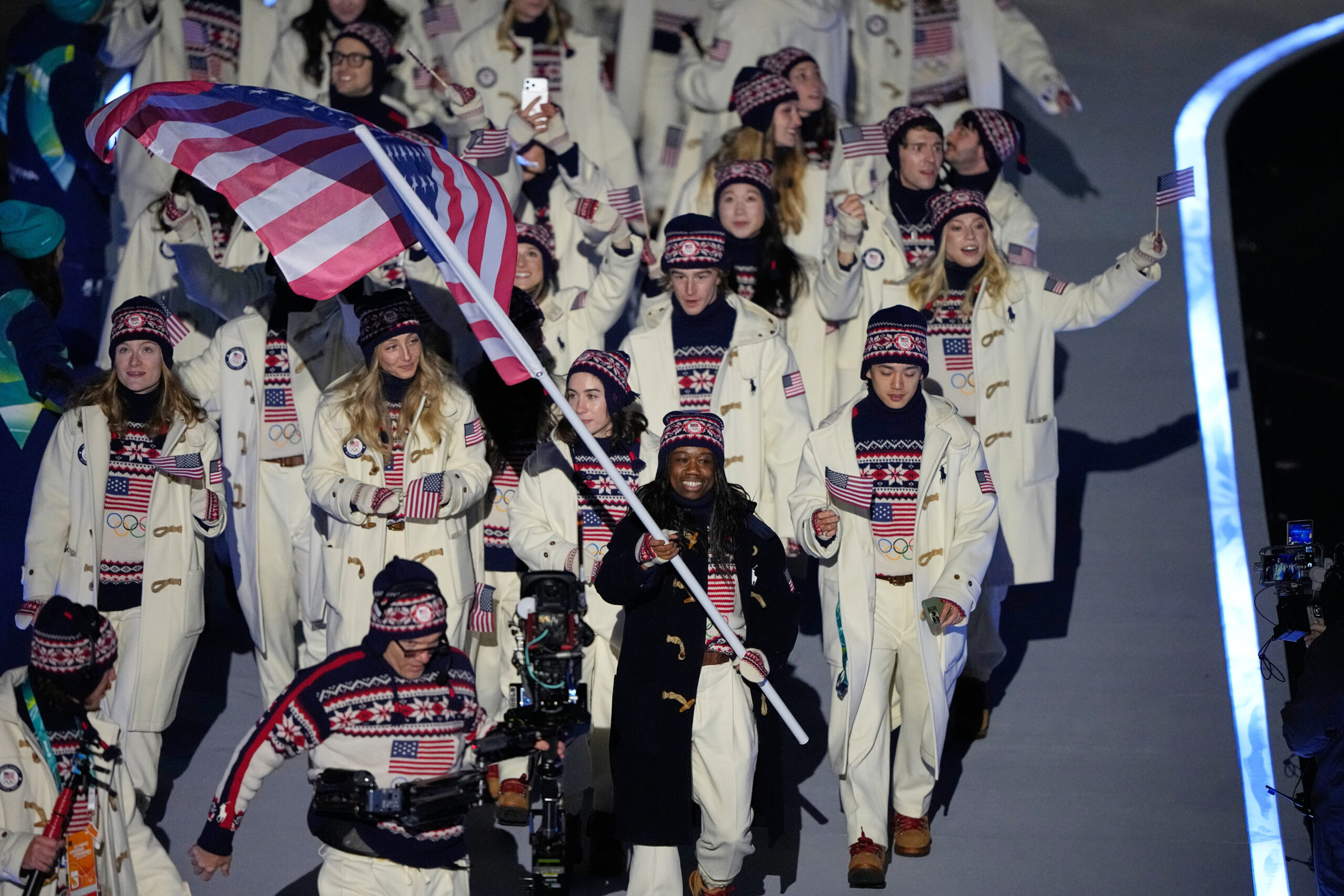
Elsewhere on Sunday, American speedskater Erin Jackson goes for her second straight gold medal in the women’s 500 meters. You might remember that the Florida native was the U.S. flag bearer in the opening ceremony.
There might also be a moment of Olympic history on Sunday. Norway’s Johannes Høsflot Klæbo can break the record for the most Winter Games golds won by an individual, in cross-country skiing’s 4×7.5km relay. It’s live at 6 a.m. on USA, and the last bit will be simulcast on NBC when the network comes on air at 7.
Erin Jackson was a flag bearer for the U.S. at the opening ceremony in Milan.
NBC will have coverage from 7 a.m. to 5 p.m., then it will head to the NBA All-Star Game. The prime time show will start after that.
How to watch the Olympics on TV and stream online
NBC’s TV coverage will have live events from noon to 5 p.m. Philadelphia time on weekdays and starting in the mornings on the weekends. There’s a six-hour time difference between Italy and here. The traditional prime-time coverage will have highlights of the day and storytelling features.
As far as the TV channels, the Olympics are airing on NBC, USA, CNBC, and NBCSN. Spanish coverage can be found on Telemundo and Universo.
NBCSN is carrying the Gold Zone whip-around show that was so popular during the Summer Olympics in 2024, with hosts including Scott Hanson of NFL RedZone. It used to be just on Peacock, NBC’s online streaming service, but now is on TV, too.
Norway’s Johannes Høsflot Klæbo can set an Olympic record for the most gold medals won by an individual on Sunday.
Every event is available to stream live on NBCOlympics.com and the NBC Sports app. You’ll have to log in with your pay-TV provider, whether cable, satellite, or streaming platforms including YouTube TV, FuboTV, and Sling TV.
On Peacock, the events are on the platform’s premium subscription tier, which starts at $10.99 per month or $109.99 per year.
The Union had the opportunity to show off the club’s new WSFS Bank Sportsplex facility to teams from a wide range of nations last week, as it hosted the inaugural “Snow Bowl,” a tournament showcasing some of the world’s best youth academies.
Clubs from across Europe and North America were represented in the tournament, which included divisions for under-15, under-16, and under-18 teams. The tournament drew 10 major soccer clubs, including England’s Manchester United and Newcastle United, and Germany’s Borussia Dortmund and Borussia Mönchengladbach.
Jon Scheer, the Union’s director of academy and professional development, said the Union’s ability to draw in European clubs of this caliber speaks to the club’s global reputation. .
“To get Manchester United, PSV, Dortmund, some of the best European clubs, to come, I think it says something about the brand of the Philadelphia Union now,” Scheer said. “Certainly our facility was a big reason why they agreed to come, but also because of the level of competition that we brought in.”
The Union boasted two teams in the Feb. 14 final of the inaugural Snow Bowl tournament, showcasing some of the top youth academies from around the world at the WSFS Sportsplex.
The Union also invited the Netherlands’ PSV Eindhoven, Mexico’s Monterrey, Denmark’s Lyngby, Portugal’s Benfica, and Major League Soccer’s Chicago Fire academies.
“We really wanted to target clubs that we felt would bring over academy-level talent that would really push ourselves,” Scheer said. “And they would, in turn, benefit from the opportunity for their players.”
The Generation Adidas Cup, which started as MLS’s top academy tournament in 2007 and expanded to include clubs from outside MLS in 2014, served as a common meeting place for many of the academies that attended this year’s Snow Bowl in Chester.
The Union’s U-17 team won the GA Cup in 2023 and 2024. PSV, Monterrey, and Manchester United have also competed in the tournament, hosted in the spring at IMG Academy in Bradenton, Fla.
“Through things like Aspire Conference and through our relationship with U.S. Soccer and success at the GA Cup level and success at the MLS level, I think that’s starting to make our reputation a bit stronger globally,” Scheer said.
The U-15s capped off their Snow Bowl campaign with a 1-0 win against the Chicago Fire!
While the Union’s reputation convinced teams to come, the WSFS Bank Sportsplex made hosting the tournament a possibility. Teams competed on the indoor turf field at the facility, which the club opened last July.
Scheer said the visiting clubs were surprised by the quality of the facility.
“When they came over here, they said this is truly a world-class facility,” Scheer said. “There’s nothing like this in Europe, from what they’ve talked about.”
Aloys Wijnker, the academy head at PSV Eindhoven, was particularly impressed with the Union’s campus. Wijnker, who worked for U.S. Soccer from 2016-18 before returning to his native Netherlands, remembered when the club’s first team, second team, and academy were spread apart. Now, the Union host all of their operations on the waterfront in Chester.
The Union’s under-16 and under-18 academy teams advanced to the finals of the inaugural Snow Bowl tournament.
“This is amazing,” Wijnker said. “We heard about the dome, but then you see, oh, what kind of dome is it? This is a real building with all the facilities inside, with the gym. I [haven’t seen] everything so far, but it’s impressive.”
For the Union, hosting the Snow Bowl not only allows academy players to play against high-level talent from Europe and North America, but it also allows the Union’s academy staff to compare notes on development with their counterparts from around the world.
“We have such a growth mindset and a passion for learning,” Scheer said. “We want to get better. We think we do a good job but we know we can get better. And if we can take one piece of information here or there, selfishly, by interacting with some of the best clubs in the world, we’re certainly going to be able to do that.”
Wijnker, who served as director of the U.S. Soccer Boys’ Development Academy for three years, said he was impressed with the Union’s focus on developing first-team players from their academy.
“I think they are on top in the U.S., top three with the academy,” Wijnker said. “They do a big investment with money, but also with resources, with the energy they put in. Also the whole philosophy in the club, not buying expensive players, they’ve really invested in the youth. If you ask me the question, I think that this is what every club should do.”
The club hopes to make the Snow Bowl an annual tradition. This year’s tournament was sponsored by The SWAG, a no-cost youth soccer organization philanthropically funded by members of the Union’s ownership group, and YSC Academy, the club’s school.
“We want to do a really good job this year, and hopefully have others, in addition to SWAG and YSC Academy, help sponsor the event,” Scheer said. “I do think it’ll be one of the best developmental opportunities our academy kids could have with the competition they’re facing.”
The Union’s U-15, U-16 and U-18 teams were unbeaten in the group stage of the tournament, picking up wins over Newcastle’s U-15 squad, Borussia Mönchengladbach’s U-16 team and Benfica’s U-18 team.
“We are probably further along, not only at the Union, but in our country, than we think we are sometimes, in terms of development and the game of football,” Scheer said. “[Other clubs] are not only commenting on our facility, but they’re commenting on some of the quality of our individual players, our success at the team level. Ultimately, that’s what it’s about.”