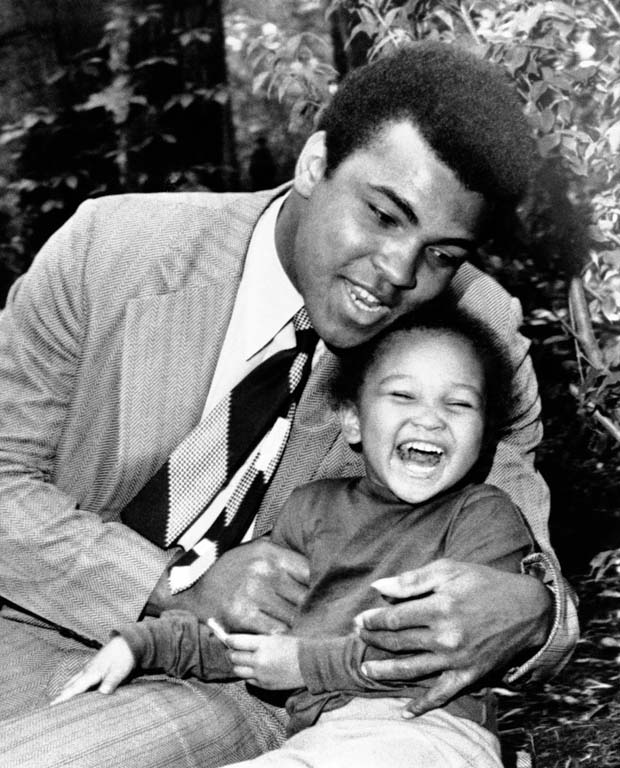
Muhammad Ali plays with his 3-year-old daughter Maryum at his home in Cherry Hill, N.J., on Monday, June 14, 1971.
Sitting on 1.5 acres, the six-bedroom, five-bathroom estate features a kitchen with a large center island and custom cabinetry, a sun-filled greenhouse room, a spacious living area, and an in-ground pool and hot tub, with adjacent basketball and tennis courts. On the lower level of the home is a personal gym and a 12-foot wet bar.
Muhammad Ali, who was defeated by heavyweight champion Joe Frazier, leans back in a reclining chair in his new home in Cherry Hill, N.J., March 10, 1971, as he answered Frazier’s promise to fight Ali again. “Good, we got a rematch, maybe in seven months, might be sooner,” Ali said.
The Champion bought the home for $103,000 in 1971. He moved to Chicago a few years later, according to the New York Times, after his friend, Camden power broker Major Coxson, was shot and killed in his home down the road from Ali’s. A major franchisee of local McDonald’s bought the home from Ali for $175,000.
The backyard and pool area of 1121 Winding Dr. in Cherry Hill, the former home of prizefighter Muhammad Ali from 1970 to 1973. It’s now up for sale for $1.9 million in 2026.
The current owners, who purchased the Cherry Hill homein 2014, traded in the 1970s decor and design for a modern look, converting Ali’s koi pond intoacenterpiece courtyard and fire pit. However, the home retains Ali’s prayer room, which can be found in the lower level, lined with bookshelves.
The main draw is the ample entertainment spaces, includingthe basement bar.
The downstairs bar area at 1121 Winding Dr. in Cherry Hill, the former home of Muhammad Ali from 1970 to 1973. It’s now up for sale for $1.9 million in 2026.
“There’s a spiral staircase from the main level to downstairs and you walk right into this large bar area, with tables, chairs, and a large TV setup,” Nicholas Alvini of Keller Williams said. “It really is a great entertaining house.”
The kitchen, including a large island, at 1121 Winding Dr. in Cherry Hill, the former home of prizefighter Muhammad Ali from 1970 to 1973. It’s now up for sale for $1.9 million.
In recent years, the home has been used for short-term rentals, and“wild parties” led police to visit the home 97 timesbetween 2018 and 2019, according to an Inquirer report. In response, Cherry Hill township councilalmost adopted a ban on Airbnb rentals before eventually tabling the idea after community members spoke against it.
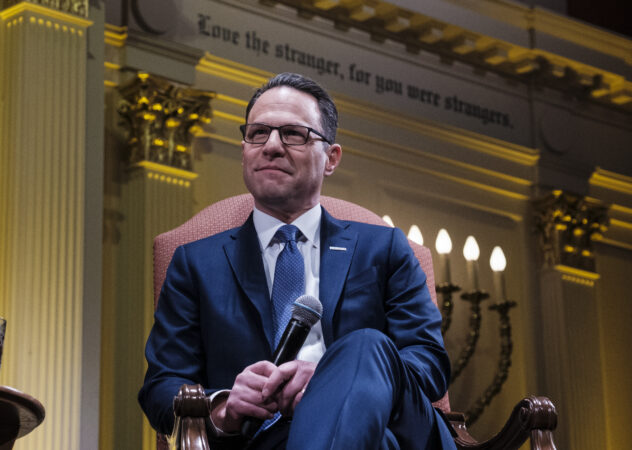
Gov. Josh Shapiro is backing a proposal to ban cell phones from Pennsylvania classrooms, joining a growing chorus of parents, teachers, and officials seeking to curb school disruptions and detach kids from addictive devices.
“It’s time for us to get distractions out of the classroom and create a healthier environment in our schools,” Shapiro said in a post on X on Thursday.
He called on Pennsylvania lawmakers to pass a bill that would require schools to ban the use of cell phones during the school day, “from the time they start class until the time they leave for home.”
The endorsement from the Democratic governor — who could promote the issue during his budget address Tuesday — comes as school cell phone bans have increasingly become the norm: 31 states have restrictions of some kind on phones, including 23 states with “bell-to-bell” bans barring the use of phones the entire school day, according to Education Week.
Pennsylvania currently lets schools set their own cell phone policies — and districts have taken a patchwork of approaches. Pennsylvania in 2024 implemented a pilot program allowing schools to access funding for lockable pouches that students could place their phones in during the day, but few districts took the state up on the money.
Some schools have banned cell phones during classes, including by asking students to place their phones in hanging shoe organizers on the backs of classroom doors.
Advocates for entirely phone-free school days say such measures aren’t sufficient. Phones are still buzzing, and if class ends early, “kids are constantly looking at it,” said Kristen Beddard, a parent from the Pittsburgh suburb of Sewickley and leader in the PA Unplugged coalition seeking to curb children’s reliance on phones and screens, in and out of school.
Barring phones only during class time is “not enough to truly break the dopamine feedback loop these kids are exposed to, and inundated with constantly,” Beddard said.
Since PA Unplugged began advocating for a bell-to-bell ban a year ago, “the landscape has changed so much,” including more states moving to restrict phones, Beddard said.
In Pennsylvania, the state’s largest teachers’ union came out in favor of a ban, and legislation that would require school districts to adopt bell-to-bell cell phone policies was unanimously approved in December by the Senate Education Committee. The bill would grant exceptions for students with special needs.
The Pennsylvania State Education Association “supports legislation like Senate Bill 1014 that would establish a consistent, statewide expectation that public schools will restrict the possession and prohibit use of mobile devices for all students during the school day,” said spokesperson Chris Lilienthal.
“Think about how disruptive those notifications are during the course of the school day when students should be focused on learning,” Lilienthal said.
In a divided Harrisburg, the proposal has bipartisan support. Beddard called banning cell phones in schools “maybe one of the few bipartisan issues left.”
In the Philadelphia area, groups of parents have mobilized against cell phone use, circulating pledges such as a commitment to not give children phones before eighth grade. Delco Unplugged, an offshoot of PA Unplugged, has advocated for cell phone bans in school districts and encourages parents to not give children access to phones before high school.
There has been opposition to strict bans, including from school leaders who think kids need to learn how to live with technology, rather than avoid it. Some administrators have also questioned the logistics, and some parents say they want their children to have phones in the case of emergencies, like a school shooting.
Advocates like Beddard say kids are safer during emergencies if they pay attention to the adults in their school, rather than their phones. They also argue that the logistics aren’t so daunting and that there are many ways to enact a ban besides lockable pouches.
Some schools require kids to put their phones in a locker or simply keep them in their backpacks, Beddard said, noting that the legislation advancing in Harrisburg would allow districts to decide how to enact a ban.
Schools that have implemented bans “describe the experience as transformational,” going beyond academic improvements to better socializing among kids, Beddard said. “Awkward conversations in the lunchroom make you a better human being,” she said.
At this point, “Pennsylvania isn’t a pioneer on the issue,” Beddard said. “We need to get with the program.”
What will the 76ers do before Thursday’s 3 p.m. NBA trade deadline?
Will Daryl Morey, the president of basketball operations, continue his trend of making a trade even if it’s just to get under the luxury tax threshold? Or will he decide to keep intact the Sixers’ deepest team since the 2018-19 season?
We’ll learn more in the coming days. In the meantime, I’ll answer a few of your mailbag questions.
Missed out on the party? No worries. Submit questions for next time by tweeting @PompeyOnSixers on X with the hashtag #PompeysMailbagFlow.
Q: Can the Sixers void any of Paul George’s guarantees in his contract due to the suspension? — @MyAmbition_3
A: Thanks for starting the mailbag. This is a great question that many people have been asking me. Now, if George had a bonus for games played or point totals, he wouldn’t receive it if the 25-game suspension prevented him from reaching the required numbers. But overall, the Sixers cannot void his contract.
For a contract to be voided, there must be cause. The team could argue that this fits the definition of cause to void a deal, but it would lose.
To void a contract, the infraction would have to be something that impacts a player’s ability to continue his career. For instance, a team can void a contract if a player commits a serious crime and could face jail time. Another example would be if he sustained a career-ending injury away from basketball or training.
Miami Heat point guard Terry Rozier was placed on unpaid leave following October’s arrest for his alleged involvement in an illegal sports gambling scheme. However, his contract was never voided. And, on Monday, Rozier won his grievance with the NBA and will be paid his $26.6 million salary for this season.
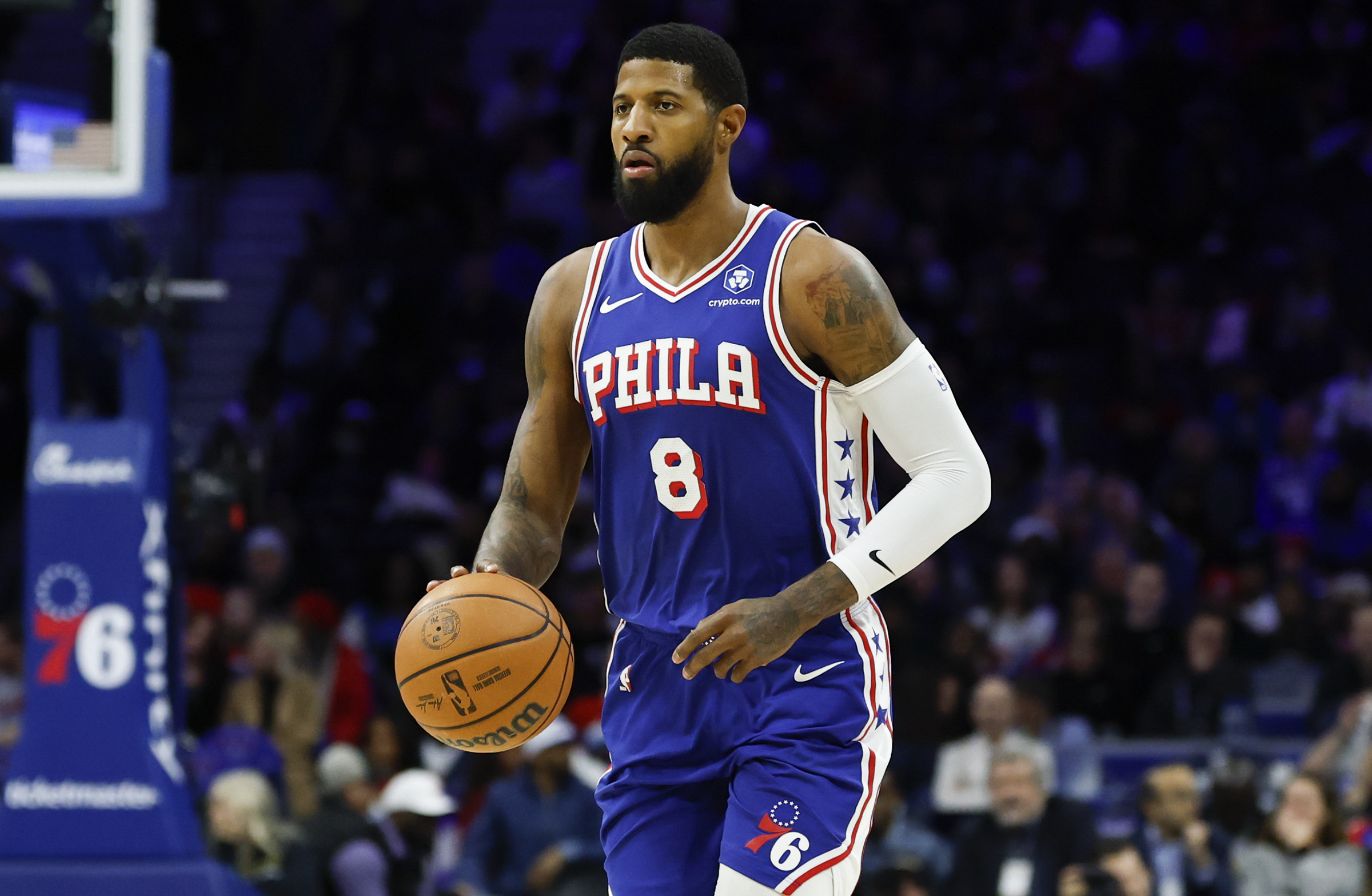
Sixers forward Paul George is serving a 25-game suspension for violating the NBA anti-drug policy.
Q: Is the George suspension a blessing in disguise as it relates to the Sixers’ cap situation? — @bsmallg1
A: Yes, it has been a blessing in disguise as it relates to the salary cap, especially the luxury tax threshold to avoid being taxed. The 35-year-old will lose $11.7 million during his suspension. As a result, the Sixers will have around $5.8 million in tax variance credit. It leaves the team about $1.2 million above the tax threshold.
If not for the suspension, the Sixers would be $7 million above the allowable threshold. In that instance, the expiring contracts of Quentin Grimes ($8.7 million), Kelly Oubre Jr. ($8.3 million), and Andre Drummond ($5 million) would have potentially helped them duck the tax.
The problem is, all three are major contributors for a squad that headed into Monday’s game against the Los Angeles Clippers in sixth place in the Eastern Conference.
Oubre is the starting small forward and has been the team’s X factor. Grimes, a reserve shooting guard, was an early-season candidate for the Sixth Man of the Year. And Drummond, a reserve center, is the Sixers’ leading rebounder.
Now, the Sixers can avoid the tax by making a trade on the margins and avoid parting ways with any of their key rotation players.
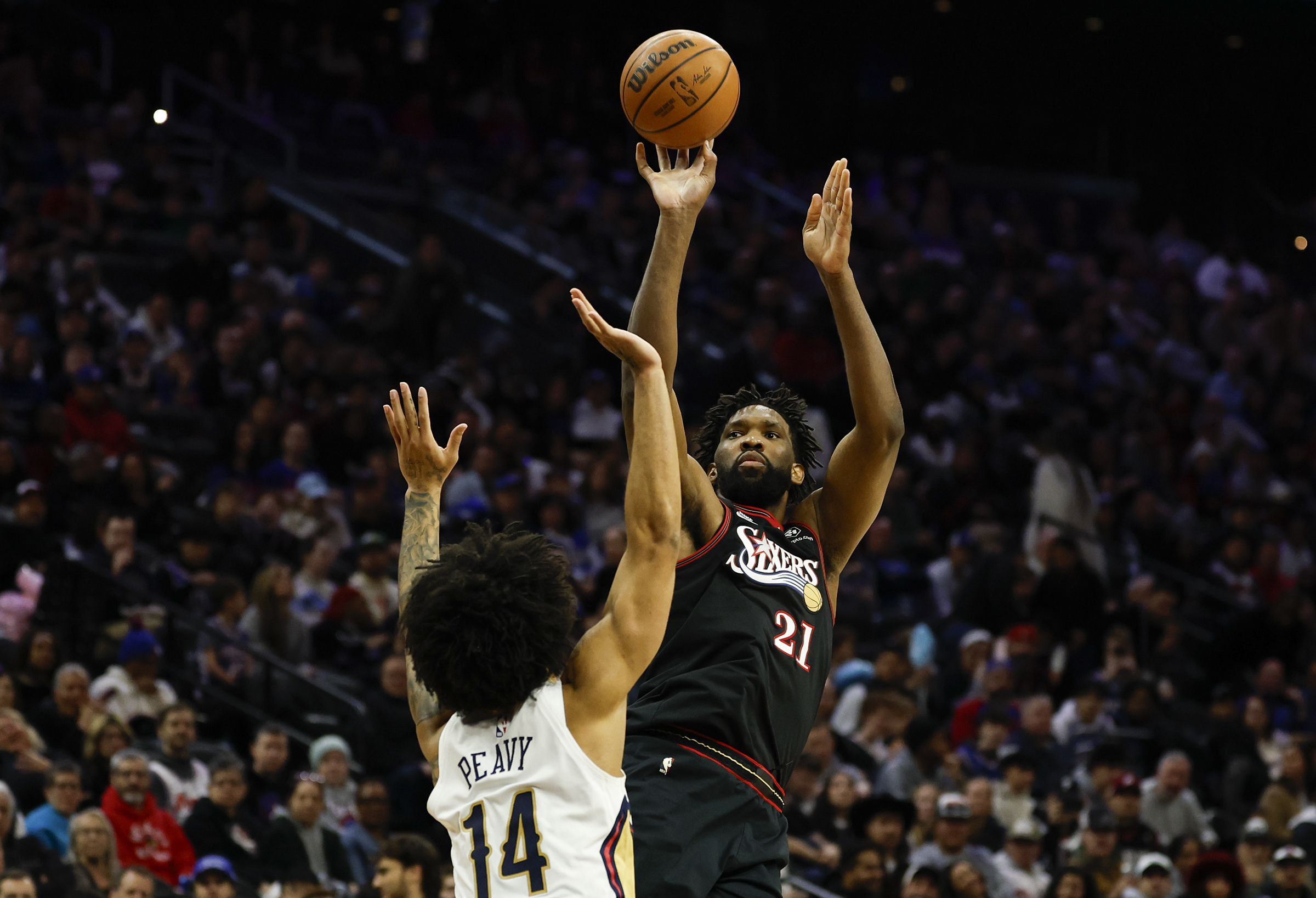
In January, Sixers center Joel Embiid averaged 29.7 points, 8.4 rebounds, and 4.6 assists in 14 games.
Q: Is Joel Embiid’s recent scoring surge fact or fiction? — @wheat
A: There’s nothing fake about Embiid’s recent scoring surge. I do think the Sixers will always have their fingers crossed that he won’t suffer another injury. And that makes sense considering the 7-foot-2, 280-pound center’s injury history. But his recent stint has been the best stretch of his career since he suffered a torn meniscus in his left knee on Jan. 30, 2024.
Back to playing at an All-NBA level, the 2023 MVP finished with a season-high 40 points along with 11 rebounds, four assists, and two blocks against the New Orleans Pelicans on Saturday. Embiid averaged 29.7 points, 8.4 rebounds, and 4.6 assists in 14 games in January. His scoring average for that month ranked fourth in the NBA behind Los Angeles Lakers point guard Luka Dončić (34.0 points per game), Oklahoma City Thunder point guard Shai Gilgeous-Alexander (31.7), Denver Nuggets center Nikola Jokić (31.0), and Minnesota Timberwolves shooting guard Anthony Edwards (30.1). Even that’s misleading because Jokić played only one game.
So it’s hard to say Embiid’s scoring surge is fiction.
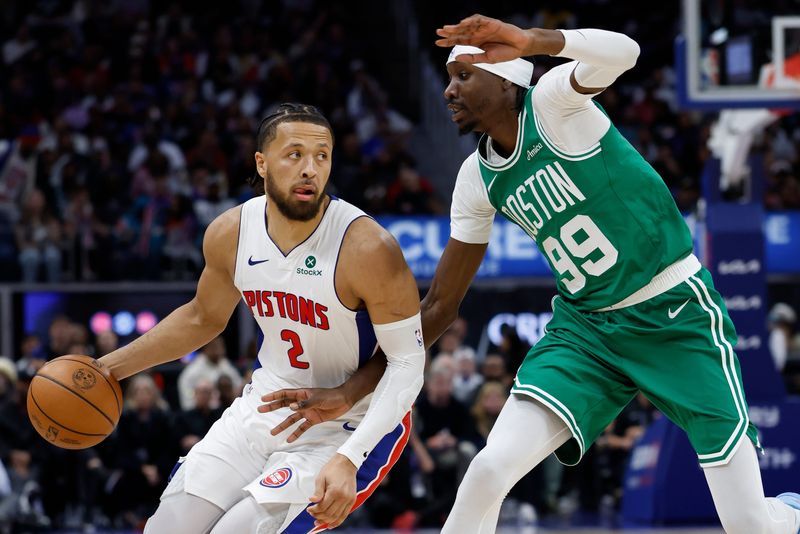
Boston Celtics forward Chris Boucher (99) was a solid glue guy for Sixers coach Nick Nurse during their time together with the Toronto Raptors.
Q: What power forward could the Sixers target at the deadline? — @emkahe12
A: Boston Celtics post player Chris Boucher is a player the Sixers are reported to have some “exploratory” interest in, according to a HoopsHype report. A source downplayed the interest in the reserve power forward/center, who has appeared in only nine games this season with the Boston Celtics, averaging just 2.3 points and 2.0 rebounds in 10.4 minutes.
However, he flourished in the last seven seasons as a reserve glue guy for the Toronto Raptors. Sixers coach Nick Nurse was Raptors coach during Boucher’s first five seasons in Toronto. Nurse was able to get the best out of the undersized post player, who averaged 8.9 points and 5.1 rebounds in 406 games as a Raptor.
Boucher signed a one-year, veteran minimum contract with Boston for $3.2 million, with a cap hit of $2.2 million.
Lydia Romero strained to hear her husband’s feeble voice through the phone.
A week earlier, immigration agents had grabbed Julio César Peña from his front yard in Glendale, Calif. Now, he was in a hospital after suffering a ministroke. He was shackled to the bed by his hand and foot, he told Romero, and agents were in the room, listening to the call. He was scared he would die and wanted his wife there.
“What hospital are you at?” Romero asked.
“I can’t tell you,” he replied.
Viridiana Chabolla, Peña’s attorney, couldn’t get an answer to that question, either. Peña’s deportation officer and the medical contractor at the Adelanto ICE Processing Center refused to tell her. Exasperated, she tried calling a nearby hospital, Providence St. Mary Medical Center.
“They said even if they had a person in ICE custody under their care, they wouldn’t be able to confirm whether he’s there or not, that only ICE can give me the information,” Chabolla said. The hospital confirmed this policy to KFF Health News.
Family members and attorneys for patients hospitalized after being detained by federal immigration officials said they are facing extreme difficulty trying to locate patients, get information about their well-being, and provide them emotional and legal support. They say many hospitals refuse to provide information or allow contact with these patients. Instead, hospitals allow immigration officers to call the shots on how much — if any — contact is allowed, which can deprive patients of their constitutional right to seek legal advice and leave them vulnerable to abuse, attorneys said.
Hospitals say they are trying to protect the safety and privacy of patients, staff, and law enforcement officials, even while hospital employees in Los Angeles, Minneapolis, and Portland, Ore., cities where Immigration and Customs Enforcement has conducted immigration raids, say it’s made their jobs difficult. Hospitals have used what are sometimes called blackout procedures, which can include registering a patient under a pseudonym, removing their name from the hospital directory, or prohibiting staff from even confirming that a patient is in the hospital.
“We’ve heard incidences of this blackout process being used at multiple hospitals across the state, and it’s very concerning,” said Shiu-Ming Cheer, the deputy director of immigrant and racial justice at the California Immigrant Policy Center, an advocacy group.
Some Democratic-led states, including California, Colorado, and Maryland, have enacted legislation that seeks to protect patients from immigration enforcement in hospitals. However, those policies do not address protections for people already in ICE custody.
Julio Cesar Peña, who has terminal kidney disease, sits on his bike in the backyard of his home in Glendale, Calif. His family had a hard time locating him when he was hospitalized after being detained by Immigration and Customs Enforcement.
More detainees hospitalized
Peña is among more than 350,000 people arrested by federal immigration authorities since President Donald Trump returned to the White House. As arrests and detentions have climbed, so too have reports of people taken to hospitals by immigration agents because of illness or injury — due to preexisting conditions or problems stemming from their arrest or detention.
ICE has faced criticism for using aggressive and deadly tactics, as well as for reports of mistreatment and inadequate medical care at its facilities. Sen. Adam Schiff (D., Calif.) told reporters at a Jan. 20 news conference outside a detention center he visited in California City that he spoke to a diabetic woman held there who had not received treatment in two months.
While there are no publicly available statistics on the number of people sick or injured in ICE detention, the agency’s news releases point to 32 people who died in immigration custody in 2025. Six more have died this year.
The Department of Homeland Security, which oversees ICE, did not respond to a request for information about its policies or Peña’s case.
According to ICE’s guidelines, people in custody should be given access to a telephone, visits from family and friends, and private consultation with legal counsel. The agency can make administrative decisions, including about visitation, when a patient is in the hospital, but should defer to hospital policies on contacting next of kin when a patient is seriously ill, the guidelines state.
Asked in detail about hospital practices related to patients in immigration custody and whether there are best practices that hospitals should follow, Ben Teicher, a spokesperson for the American Hospital Association, declined to comment.
David Simon, a spokesperson for the California Hospital Association, said that “there are times when hospitals will — at the request of law enforcement — maintain confidentiality of patients’ names and other identifying characteristics.”
Although policies vary, members of the public can typically call a hospital and ask for a patient by name to find out whether they’re there, and often be transferred to the patient’s room, said William Weber, an emergency physician in Minneapolis and medical director for the Medical Justice Alliance, which advocates for the medical needs of people in law enforcement custody. Family members and others authorized by the patient can visit. And medical staff routinely call relatives to let them know a loved one is in the hospital, or to ask for information that could help with their care.
But when a patient is in law enforcement custody, hospitals frequently agree to restrict this kind of information sharing and access, Weber said. The rationale is that these measures prevent unauthorized outsiders from threatening the patient or law enforcement personnel, given that hospitals lack the security infrastructure of a prison or detention center. High-profile patients such as celebrities sometimes also request this type of protection.
Several attorneys and healthcare providers questioned the need for such restrictions. Immigration detention is civil, not criminal, detention. The Trump administration says it’s focused on arresting and deporting criminals, yet most of those arrested have no criminal conviction, according to data compiled by the Transactional Records Access Clearinghouse and several news outlets.
Taken outside his home
According to Peña’s wife, Romero, he has no criminal record. Peña came to the United States from Mexico in sixth grade and has an adult son in the U.S. military. The 43-year-old has terminal kidney disease and survived a heart attack in November. He has trouble walking and is partially blind, his wife said. He was detained Dec. 8 while resting outside after coming home from dialysis treatment.
Initially, Romero was able to find her husband through the ICE Online Detainee Locator System. She visited him at a temporary holding facility in downtown Los Angeles, bringing him his medicines and a sweater. She then saw he’d been moved to the Adelanto detention center. But the locator did not show where he was after he was hospitalized.
When she and other relatives drove to the detention facility to find him, they were turned away, she said. Romero received occasional calls from her husband in the hospital but said they were less than 10 minutes long and took place under ICE surveillance. She wanted to know where he was so she could be at the hospital to hold his hand, make sure he was well cared for, and encourage him to stay strong, she said.
Shackling him and preventing him from seeing his family was unfair and unnecessary, she said.
“He’s weak,” Romero said. “It’s not like he’s going to run away.”
ICE guidelines say contact and visits from family and friends should be allowed “within security and operational constraints.” Detainees have a constitutional right to speak confidentially with an attorney. Weber said immigration authorities should tell attorneys where their clients are and allow them to talk in person or use an unmonitored phone line.
Hospitals, though, fall into a gray area on enforcing these rights, since they are primarily focused on treating medical needs, Weber said. Still, he added, hospitals should ensure their policies align with the law.
Family denied access
Numerous immigration attorneys have spent weeks trying to locate clients detained by ICE, with their efforts sometimes thwarted by hospitals.
Nicolas Thompson-Lleras, a Los Angeles attorney who counsels immigrants facing deportation, said two of his clients were registered under aliases at different hospitals in Los Angeles County last year. Initially, the hospitals denied the clients were there and refused to let Thompson-Lleras meet with them, he said. Family members were also denied access, he said.
One of his clients was Bayron Rovidio Marin, a car wash worker injured during a raid in August. Immigration agents surveilled him for over a month at Harbor-UCLA Medical Center, a county-run facility, without charging him.
In November, the Los Angeles County Board of Supervisors voted to curb the use of blackout policies for patients under civil immigration custody at county-run hospitals. In a statement, Arun Patel, the chief patient safety and clinical risk management officer for the Los Angeles County Department of Health Services, said the policies are designed to reduce safety risks for patients, doctors, nurses, and custody officers.
“In some situations, there may be concerns about threats to the patient, attempts to interfere with medical care, unauthorized visitors, or the introduction of contraband,” Patel said. “Our goal is not to restrict care but to allow care to happen safely and without disruption.”
Leaving patients vulnerable
Thompson-Lleras said he’s concerned that hospitals are cooperating with federal immigration authorities at the expense of patients and their families and leaving patients vulnerable to abuse.
“It allows people to be treated suboptimally,” Thompson-Lleras said. “It allows people to be treated on abbreviated timelines, without supervision, without family intervention or advocacy. These people are alone, disoriented, being interrogated, at least in Bayron’s case, under pain and influence of medication.”
Such incidents are alarming to hospital workers. In Los Angeles, two healthcare professionals who asked not to be identified by KFF Health News, out of concern for their livelihoods, said that ICE and hospital administrators, at public and private hospitals, frequently block staff from contacting family members for people in custody, even to find out about their health conditions or what medications they’re on. That violates medical ethics, they said.
Blackout procedures are another concern.
“They help facilitate, whether intentionally or not, the disappearance of patients,” said one worker, a physician for the county’s Department of Health Services and part of a coalition of concerned health workers from across the region.
At Legacy Emanuel Medical Center in Portland, nurses publicly expressed outrage over what they saw as hospital cooperation with ICE and the flouting of patient rights. Legacy Health has sent a cease and desist letter to the nurses’ union, accusing it of making “false or misleading statements.”
“I was really disgusted,” said Blaire Glennon, a nurse who quit her job at the hospital in December. She said numerous patients were brought to the hospital by ICE with serious injuries they sustained while being detained. “I felt like Legacy was doing massive human rights violations.”
Handcuffed while unconscious
Two days before Christmas, Chabolla, Peña’s attorney, received a call from ICE with the answer she and Romero had been waiting for. Peña was at Victor Valley Global Medical Center, about 10 miles from Adelanto, and about to be released.
Excited, Romero and her family made the two-hour-plus drive from Glendale to the hospital to take him home.
When they got there, they found Peña intubated and unconscious, his arm and leg still handcuffed to the hospital bed. He’d had a severe seizure on Dec. 20, but no one had told his family or legal team, his attorney said.
Tim Lineberger, a spokesperson for Victor Valley Global Medical Center’s parent company, KPC Health, said he could not comment on specific patient cases, because of privacy protections. He said the hospital’s policies on patient information disclosure comply with state and federal law.
Peña was finally cleared to go home on Jan. 5. No court date has been set, and his family is filing a petition to adjust his legal status based on his son’s military service. For now, he still faces deportation proceedings.
KFF Health News is a national newsroom that produces in-depth journalism about health issues and is one of the core operating programs at KFF — the independent source for health policy research, polling, and journalism.
I don’t believe the Trump administration removed the slavery memorial at the President’s House at Sixth and Market Streets to protect the reputations of the dead. I believe they did it to crush the spirits of the living.
Perhaps, for those too demoralized by Donald Trump’s chaotic presidency, the instinct to resist has faded. But Trump doesn’t know Philadelphians. We are a stubborn sort, reared in well-worn streets that are older than America itself. You cannot take crowbars to our history and pry it from the walls. Nor can you silence us when we rise up to tell the story of what you’ve done.
That’s why Friday’s arrest of Don Lemon, a journalist who toiled in Philadelphia before moving to the national stage, will only sharpen the focus on the Trump administration’s push to deport Black and brown immigrants. It’s why the arrest of Georgia Fort, a vice president of the National Association of Black Journalists, which has its roots in Philadelphia, will only shed light on this administration’s troubling strain of anti-Blackness.
Pretending that Lemon and Fort committed a crime by covering a protest in a mostly white Minnesota church is ludicrous. Yet, that’s what the Trump administration would have us believe. They want us to think that reporting on protesters who were seeking to confront a pastor said to have ties to U.S. Immigration and Customs Enforcement is a criminal act. That interviewing people is enough to be charged with conspiracy against the rights of religious freedom and an attempt to injure while exercising religious freedom.
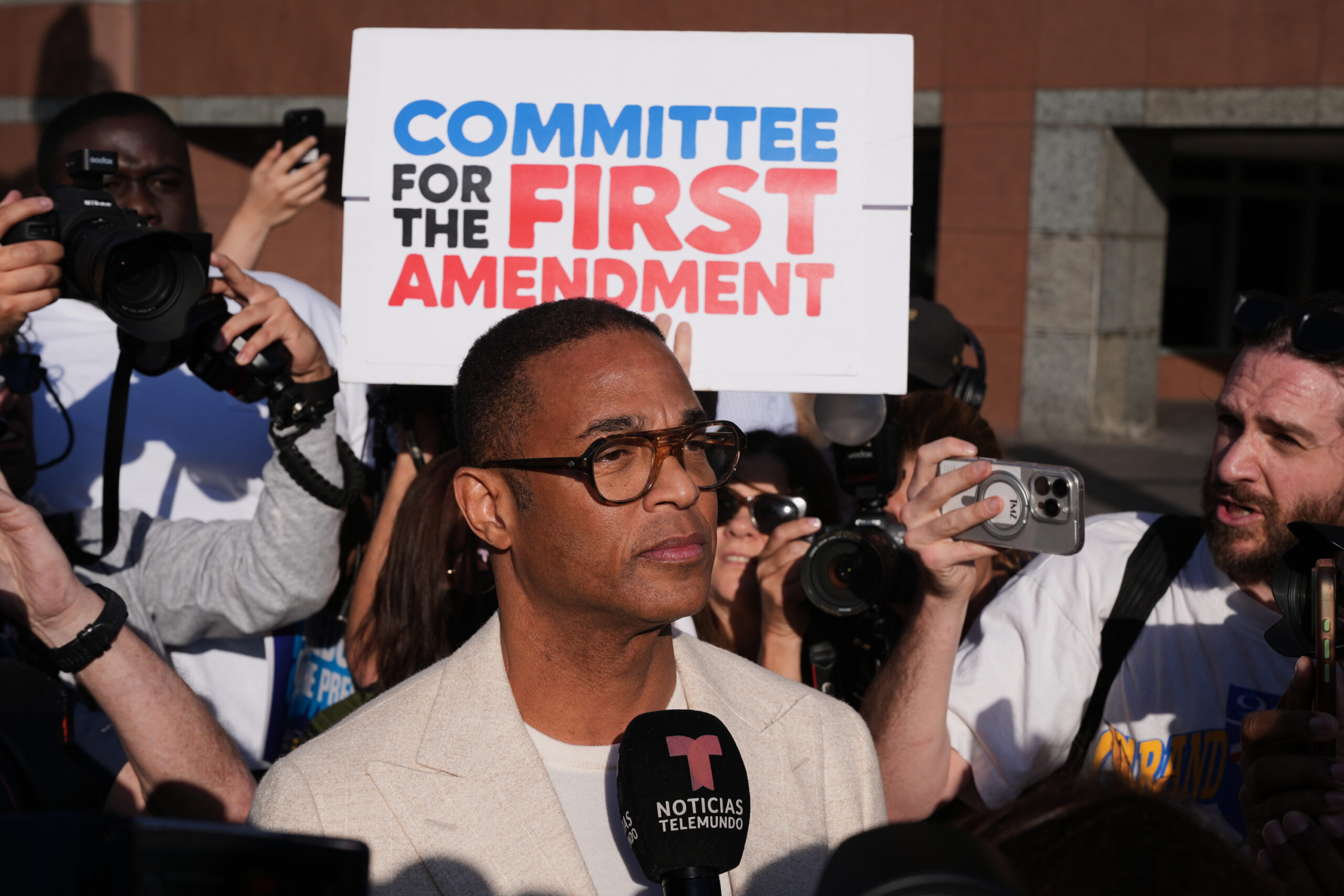
The journalist Don Lemon addresses reporters outside the Edward R. Roybal Federal Building in Los Angeles on Friday.
Don’t bother to try to make sense of it. You can’t, because the Trump administration is not seeking fairness. Nor is it seeking truth. Instead, it is attempting to reshape reality in the image of Donald Trump.
I doubt that it’ll succeed, because there’s a strange thing about truth. No matter what you do to it, truth does not cease to exist. It simply waits to be uncovered.
Prying Black history from the walls at Sixth and Market Streets will never erase truth. Instead, the truth will be amplified. Not only by Michael Coard and the Avenging the Ancestors Coalition, the activists fighting to preserve our history. This truth will be told by all of us.
George Washington enslaved nine Africans in Philadelphia. He returned them to Virginia nearly every six months, thus avoiding the requirement to free them under Pennsylvania law. One of the enslaved, Oney Judge, managed to escape from Washington and his wife, and America’s first president spent years trying to return her to slavery.
That is the truth of what happened here in Philadelphia, and on Friday, when I went to the site of the exhibit and saw the rusted, glue-stained frames that once held depictions of that history, I was angry. But the tale of the President’s House is not the only truth the Trump administration is trying to obscure.
Shootings by federal immigration agents in Minnesota cost Renee Good and Alex Pretti their lives. We know their names and mourn their deaths, not just because they were American citizens, but also because they were white. However, they aren’t the only ones to fall victim to the violence linked to the president’s anti-immigrant push.
In total, at least four people have been killed and eight others wounded by gunfire during immigration enforcement operations since Trump returned to office a year ago. Most of the other victims appear to be people of color. But when state-sanctioned violence hides behind the darkness of masks, the only thing that can expose it is light.
Journalism is that light, and quite often, when journalists begin to look for one truth, another is exposed. That’s what happened when Don Lemon and Georgia Fort walked into that mostly white church to report on a protest in St. Paul, Minn.
Lemon and Fort discovered that in America, where history is pried from walls and Black journalists are arrested, truth does not play out in color. Too often, it’s in Black and White.
As Train 9710 pulled out of the Trenton Transit Center at 7:25 a.m. Monday, something looked out of place.
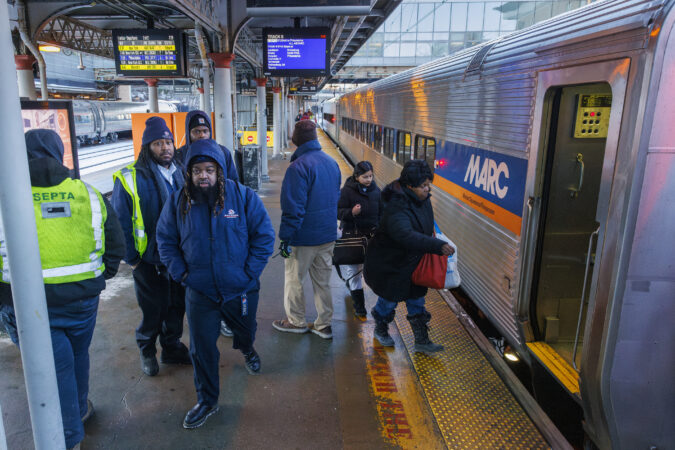
Five passenger coaches in the Philadelphia-bound Regional Rail train bore foreign “MARC” logos and orange-and-blue markings, all pulled by a properly labeled SEPTA electric locomotive.
The substitute cars initially will be running on the Trenton and West Trenton lines, where riders for months have endured packed trains due to a shortage of available 50-year-old Silverliner IVs.
The transit agency is paying $2.6 million to lease the new coaches for a year.
SEPTA’s records show it canceled at least 2,544 Regional Rail trips in the last three months of 2025. Delays and skipped stops also have plagued commuters for months.
SEPTA is using its ACS-64 electric locomotives, which it bought in 2019, to pull the MARC coaches and its own fleet of 45 coaches.
Silverliner cars do double duty; they carry passengers and have motors that provide their own locomotion through electricity drawn from overhead wires.
SEPTA said in a statement that the schedules will add trips on the Wilmington, Trenton, and Chestnut Hill East lines and increase the frequency of service from Wayne Junction directly to the Philadelphia International Airport on the Airport line.
In a bid to see what all the commotion was about, I attended a matinee in a classic New Jersey swing county.
I worried the audience would reflect the country’s polarization and be at each other’s throats by the time the closing credits rolled.
I needn’t have worried. At my weekend show, the audience of about 80 people laughed appreciatively at every word the president uttered. Those closing credits were met with robust applause.
First, however, a bit of housekeeping: I admit to having what the president’s supporters would contemptuously describe as “Trump Derangement Syndrome.” I’m a cancer survivor who literally burst into tears when he appointed Robert F. Kennedy Jr. because I knew they would kneecap cancer research.
As for Melania, my pre-movie impression was that she’s savvy, very guarded, and focused on being a good mother. Having read a biography of her and learned almost nothing from it, I was looking forward to gaining insights about our first lady.
An hour and 44 minutes later, I know she’s savvy, very guarded, and her favorite singer is Michael Jackson. And that you can see the George Washington Bridge from their Trump Tower penthouse.
Beyond that, it’s as riveting as one of those videos you get stuck watching at a Florida time-share. Sappy music. Happy people. Everything is awesome.
The director made not the slightest attempt to find drama when chronicling the 20 days Melania Trump has to prepare for her husband’s second term. There is a lot of focus on clothes and table settings, but armed with the heft of the U.S. government and the deep pockets of corporate donors, there is almost zero chance of anything going wrong.
First lady Melania Trump stands for a benediction during the presidential inauguration in January 2025. Her new film documents the 20 days preceding the ceremony.
That makes for a beautiful inaugural ball, but a lousy story arc.
As a result, the TikTok laments of your cousin Bethany planning her wedding would be more compelling.
Nothing in this documentary has a true “behind the scenes” feeling to it. Melania is never shown getting ready for her day. On camera, she appears only in full makeup, with not a hair out of place.
As a result, the movie is as meticulously curated as she is.
This all makes perfect sense when you watch Melania at the fitting for the coat she will wear to the swearing-in ceremony. She critiques the lapel with the eye of both a dressmaker’s daughter and a fashion model. Her requests are precise: the collar should be a quarter inch lower; the hat band a half inch narrower.
There is a funny exchange when Donald Trump is shown practicing his inaugural address. He says he wants to be a peacemaker, and she interjects, “And a unifier.” He orders his aides to ignore the suggestion. She tells them to keep it.
The movie then cuts to his speech on the U.S. Capitol steps. He includes her phrase, then pointedly turns to her with a look that says: “You win. You were right.” It’s a look every married person understands.
Toward the movie’s close, when Melania moves back into the White House, her voice-over mentions the historic importance of the mansion. In this, she joins previous first ladies who gave the public an inside look at the White House: Jackie Kennedy’s groundbreaking tour was televised in prime time, and Nancy Reagan’s massive renovation was featured in Architectural Digest.
The key difference is that those two weren’t paid a reported $28 million by Amazon — more than twice the paycheck Margot Robbie earned as the star of Barbie, by the way — for their participation. By contrast, Melania is a thinly disguised pay-to-play vehicle.
The movie shows a White House untouched by the changes yet to come. My audience laughed when the official portrait of Barack Obama briefly appeared in the background; it has since been relegated to an off-limits stairwell.
In fact, the main problem with the movie is that it’s already out of date: It depicts the calm before the storm. It’s from a simpler time that now seems a long, long time ago — before the National Guard troops, before the DOGE cuts, before the whole Tylenol-autism thing, the demolition of the East Wing, the U.S. Immigration and Customs Enforcement raids, the measles outbreaks, the tariffs, and Greenland.
All of that has happened, yet 80 of my neighbors chose to give up two precious hours of daylight on a short winter’s day to see this movie. And then applaud. It was a discouraging reminder of how deeply divided we remain.
Kathleen O’Brien is a retired newspaper columnist who lives in northwest New Jersey.
The racism in education worked through politics. After all, schools were run by the government and funded by tax dollars, and while the students were segregated by race, the lessons were unified in their promotion of white supremacy.
As Woodson would later write in his book, The Mis-Education Of The Negro: “It is strange, then, that the friends of truth and the promoters of freedom have not risen up against the present propaganda in the schools and crushed it. This crusade is much more important than the anti-lynching movement, because there would be no lynching if it did not start in the schoolroom. Why not exploit, enslave, or exterminate a class that everybody is taught to regard as inferior?”
Woodson had a point. The politics of American education meant the stories of America’s wars were told from a Eurocentric perspective. America’s economic rise ignored the role of racism. The country’s cultural norms formed a tapestry of whiteness, and at the root of it all was an underlying theme that Black people were something less than human.
That was the prevailing attitude, but Black Americans kept proving their own nation wrong.
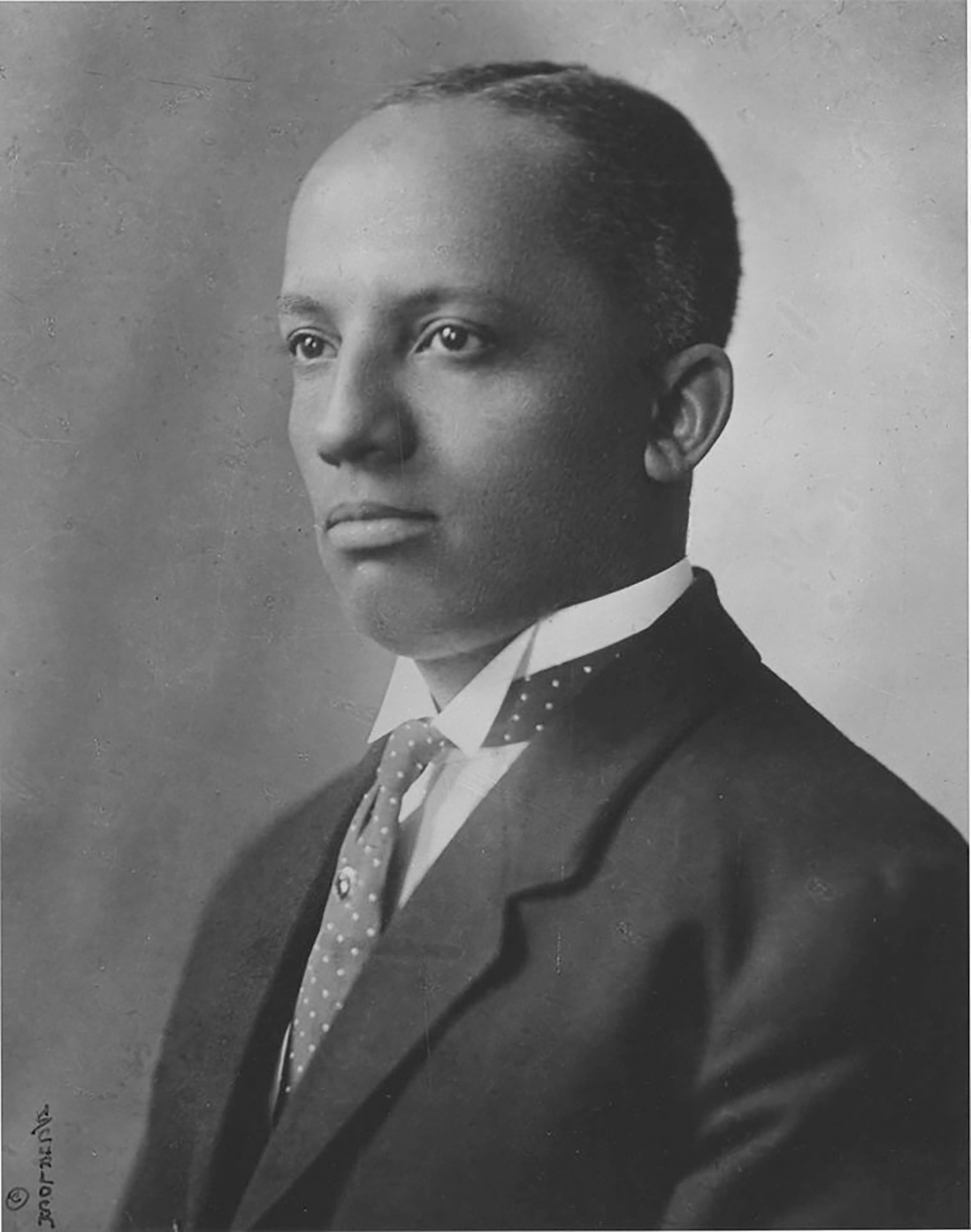
A mural in Washington, D.C., pays tribute to historian Carter G. Woodson, who in 1926 created what became Black History Month.
Sharing such history is inconvenient because it unravels the narrative that white America acquired everything through hard work and sacrifice, while Black America lost everything through laziness and incompetence.
Maintaining such historical lies requires political will and a story people want to believe. In 1915, America got both.
D.W. Griffith released a film called The Birth of a Nation. Its racist narrative portrayed Black men as savages, while depicting the Ku Klux Klan as heroes.
President Woodrow Wilson, who screened the film in the White House, said The Birth of a Nation was “like writing history with lightning.”
In truth, the film was not history. It was racist propaganda, and it helped to fuel the resurgence of the Ku Klux Klan. By 1921, African Americans were facing a full-on assault. In Tulsa, Okla., they endured what the U.S. Department of Justice later called a “coordinated, military-style attack” on a prosperous Black community. It was an assault that destroyed property worth millions of dollars, and it happened with the cooperation of the police and National Guard.
In 1923, the political leadership changed. Republican President Calvin Coolidge, in his first congressional address, said that under the Constitution, Black people’s rights “are just as sacred as those of any other citizen,” while calling on Congress “to exercise all its powers of prevention and punishment against the hideous crime of lynching.”
However, the president was only willing to go so far. He said racial issues should be worked out locally, and ultimately chose not to endorse an anti-lynching bill because he feared that in doing so, he would jeopardize tax legislation he was trying to push through the Senate. Black people weren’t his priority.
Carter G. Woodson created Negro History Week in 1926 largely because he believed the nation’s educational system sought to enslave Black minds, Solomon Jones writes.
It was against that political backdrop that Woodson founded Negro History Week — a celebration that wasn’t officially sanctioned by the federal government until 1976, when President Gerald Ford recognized Black History Month. A decade later, Congress passed it into law.
Between then and now, as political winds have shifted, we are once again facing backlash against Black progress.
In this moment, when the weight of Black history both strengthens and comforts us, I am reminded that Woodson, in his seminal work, The Mis-Education of the Negro, warned Black people against staking our hopes solely on politics.
“History does not show that any race, especially a minority group, has ever solved an important problem by relying altogether on one thing, certainly not by parking its political strength on one side of the fence because of empty promises,” he wrote.
In other words, if the past has taught Black people anything, it has shown us how to look beyond the rhetoric of politics and seek out each other for strength.
Paul George’s shocking suspension for violating the NBA’s anti-drug policy does not necessarily upend the 76ers’ trade deadline approach. But it does change their situation heading into Thursday.
On one hand, the Sixers are now in more need of an immediate boost — particularly at the wing or frontcourt positions — to keep pace in a tightly packed Eastern Conference during George’s 25-game absence. On the other, it has become significantly easier for the Sixers to get under the luxury tax because George’s unpaid suspension will give the team a tax variance credit of nearly $5.9 million.
The Sixers’ roster construction remains top-heavy, with three players on long-term max deals in George, Joel Embiid, and Tyrese Maxey. But it is always reasonable to expect the team’s president of basketball operations, Daryl Morey, to pull off something at the deadline.
Here is a look at the Sixers’ most movable contracts, either to tinker with the roster or hit financial goals.
Kelly Oubre Jr. is averaging 14.2 points this season for the Sixers. It seems highly unlikely that he could be traded.
Expiring contracts
Kelly Oubre Jr.
Salary: $8.4 million
Before the George situation emerged, Oubre’s was viewed as the Sixers’ most tradable contract — especially if the front office was instructed to get under the luxury tax. Now he is vital to the current roster as a tenacious wing defender and offensive player who can slash to the basket — and he has upped his three-point percentage.
Oubre, who earlier this season missed seven weeks with a knee sprain, has been looking more and more like the player who was enjoying the best basketball of his 11-year career before his injury. He is back in the starting lineup and is averaging 14.2 points on nearly 50% shooting from the floor (36.9% from three-point range) along with 4.7 rebounds and 1.1 steals. He is also often tasked with a challenging perimeter defensive assignment.
Oubre’s skill set and production this season could have been attractive to win-now teams looking for that always-coveted wing spot. Rebuilding ones might have been enticed by a short-term commitment to Oubre. His name surfaced in trade rumors before the start of training camp, and was percolating in early deadline chatter in recent weeks.
Now it feels like a near certainty that Oubre will remain with the Sixers through the end of the season.
Quentin Grimes
Salary: $8.7 million
This comes with a massive asterisk because Grimes has the power to veto any trade after signing a one-year qualifying offer in October.
Additionally, any trade approved by Grimes would relinquish his’ “Bird” rights, which allow teams to offer their own players a higher salary in free agency. So unless the new destination appears to be an ideal long-term fit, it is unlikely Grimes would sign off on any trade-deadline move and instead enter unrestricted free agency this summer.
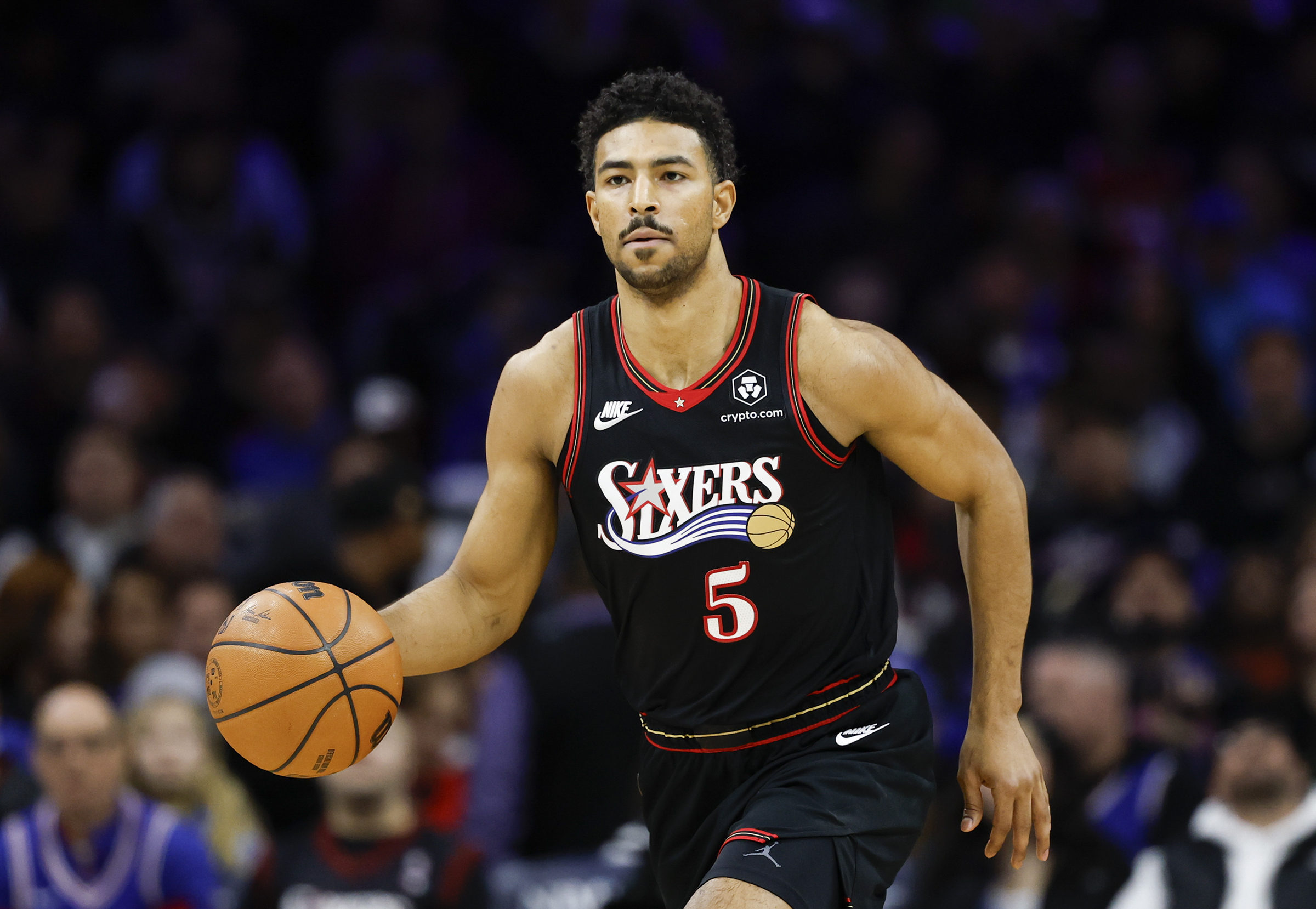
Grimes spent chunks of December and January in a rut, shooting 23.1% from three-point range in his last 12 games. Coach Nick Nurse recently said he was considering moving Grimes to the starting lineup in an effort to spark his production, although so far that has not transpired. He is another player who could see increased opportunity in George’s absence.
At his best, Grimes provides scoring punch at all three levels and is a tough perimeter defender. Even with a lesser role than during last season’s tank after arriving in Philly, Grimes should be one of the NBA’s better sixth men and a contender to play in closing lineups.
Sixers guard Quentin Grimes can veto any possible trade.
Andre Drummond
Salary: $5 million
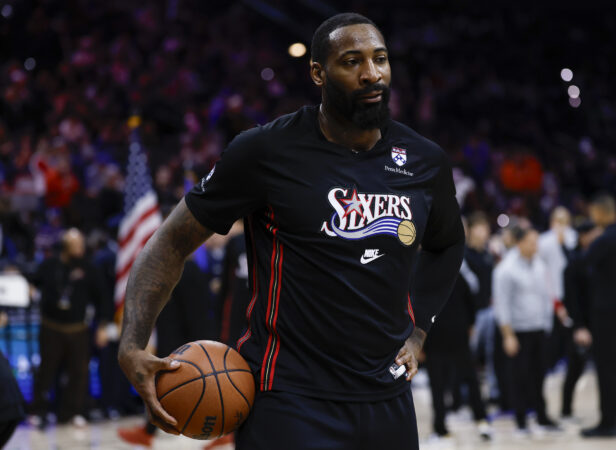
What once looked like a resurgent Drummond season has turned into an odd role for the 14-year veteran. He starts whenever Embiid sits out for injury or load-management reasons, and does not play at all when Embiid is in the lineup. Drummond is averaging 6.8 points and 8.7 rebounds in 37 games with 17 starts this season.
That theoretically makes Drummond expendable — and perhaps the most likely (fringe) rotation player to depart at the deadline.
The Sixers could try to move Drummond to acquire a cheaper traditional center, or to land a player at a different position. That latter option would put a lot of trust in second-year big man Adem Bona to remain the consistent backup and become the spot starter when Embiid rests.
Bona is a high-energy rim protector and lob threat, but he still needs development as a rebounder and offensive player. The Sixers’ other center options would be of the small-ball variety in Dominick Barlow and Jabari Walker, assuming both get converted to standard contracts.
Eric Gordon
Salary: $3.6 million
Gordon, on the tail end of a successful career, has played in only six games in his second season as a Sixer. Trading the 37-year-old in a salary-dump move would open up an additional roster spot that could be used to sign Walker or Barlow to a standard NBA contract.
One wrinkle: Gordon is close with rookie standout VJ Edgecombe, who played with Gordon on the Bahamian national team.
Sixers veteran Kyle Lowry paid an emotional visit last month to Toronto, where he won an NBA title.
Kyle Lowry
Salary: $3.6 million
Lowry is in his 20th NBA season. Like Gordon, he is on a veteran minimum contract. It feels less likely that the Sixers would let go of the Philly native and former Villanova star, given his primarily off-the-court role as a respected leader in the locker room and on the bench.
Worth keeping an eye on
Jared McCain
Salary: $4.2 million
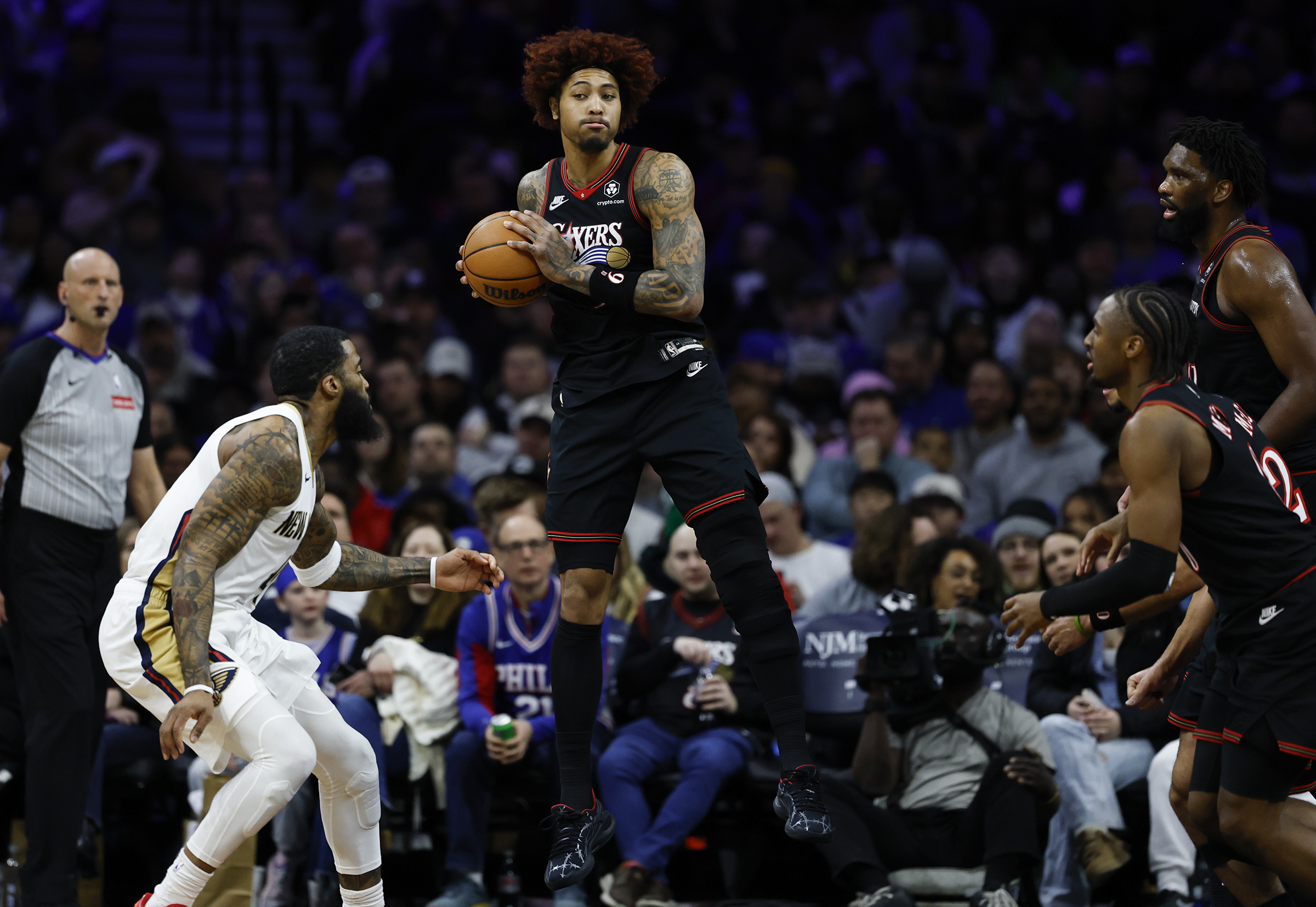
Putting McCain on such a list seemed unfathomable early last season, when he was a Rookie of the Year front-runner. And perhaps his breakout shooting week has restabilized him as a contributor to the Sixers’ present and future.
Before that, McCain’s return from knee and thumb surgeries had been an immense struggle. He could not find his shot — making just 36.1% of his attempts from the floor and 33.7% from beyond the arc before going 13-of-20 from deep in his last four games — and had fallen out of the rotation.
Still, last season’s immediate flash, and the expectation that, with time, that rediscovered rhythm continues for extended stretches, still make McCain a valuable young player. He would be the type to be included in a blockbuster trade. But it does not make much sense to give him up in any other scenario, given that the Sixers could lose Grimes in free agency this summer.
Trendon Watford
Salary: $2.5 million (team option for 2026-27)
Watford is another lower-salary player who could be traded to get under the luxury tax. Although his minutes have been inconsistent throughout an injury-riddled start to his first season in Philly, he could become increasingly valuable in George’s absence because of his unique ballhandling and playmaking skills as a point forward. He has a triple-double this season, and totaled four assists in 17 minutes as a reserve small forward in Thursday’s win over New Orleans.
Moving Watford also could be a tricky topic to broach with Maxey, one of Watford’s close friends.
Trendon Watford gives the Sixers a versatile option at forward.
Justin Edwards
Salary: $2 million
Edwards was another feel-good story last season as the local kid who went from going undrafted to earning a standard NBA contract and significant minutes. But although Nurse has reiterated that he still “loves” Edwards’ game, he often gets squeezed out of the rotation when the Sixers are at relatively full strength. His contract is the type that could be used as salary-filler in a deal.
Johni Broome
Salary: $1.3 million
The rookie big man, who has spent the bulk of this season with the G League’s Delaware Blue Coats, is another lower-salary player who could be moved to get under the luxury tax.
Steve Donahue sat back in his chair, a smile stretched across his face. St. Joseph’s had just beaten La Salle, 67-58, on Saturday, the Hawks’ sixth win in their last seven, and Dasear Haskins, who made six three-pointers and tied a career high with 20 points, was talking about the “A to B mentality” Donahue has drilled into his team.
“I told my mom I will A to B to practice the other day,” said Haskins, a redshirt sophomore who played at Camden High. “It’s like a lifestyle to me now. I think the guys are treating it like that.”
The motto is simple enough: “Whatever A is, you have to get to B,” Donahue said later. A can be something good. A can be something bad. St. Joe’s has just gotten a lot better at the getting to B, and it’s not surprising that it took a couple of months for that to happen, for the Hawks to look like the sum of all their parts, considering all that has happened since September.
Former coach Billy Lange abruptly left for the NBA. The roster that he worked hard to build would be playing for a new coach, Donahue, whom Lange brought on as his top assistant after the Delaware County native was fired following his ninth season at Penn. New coach, new roster, awkward timing. The Hawks started 2-3, had some ups and downs, then by mid-December their leading scorer, Deuce Jones, was no longer with the program.
They started Atlantic 10 play by losing their first two games. Then came a team meeting. Then came six wins in seven tries, a stretch that could be a perfect 7-for-7 if not for late-game execution on the road against a good VCU team.
Zoom out a little bit, and on a macro level this version of the Hawks is the B to whatever A was after they allowed Davidson to leave Hagan Arena with a 62-56 win on Jan. 3. The season could have gone sideways then, but it hasn’t. St. Joe’s is 14-8 overall and 6-3 in the A-10 and in fourth place in the conference.
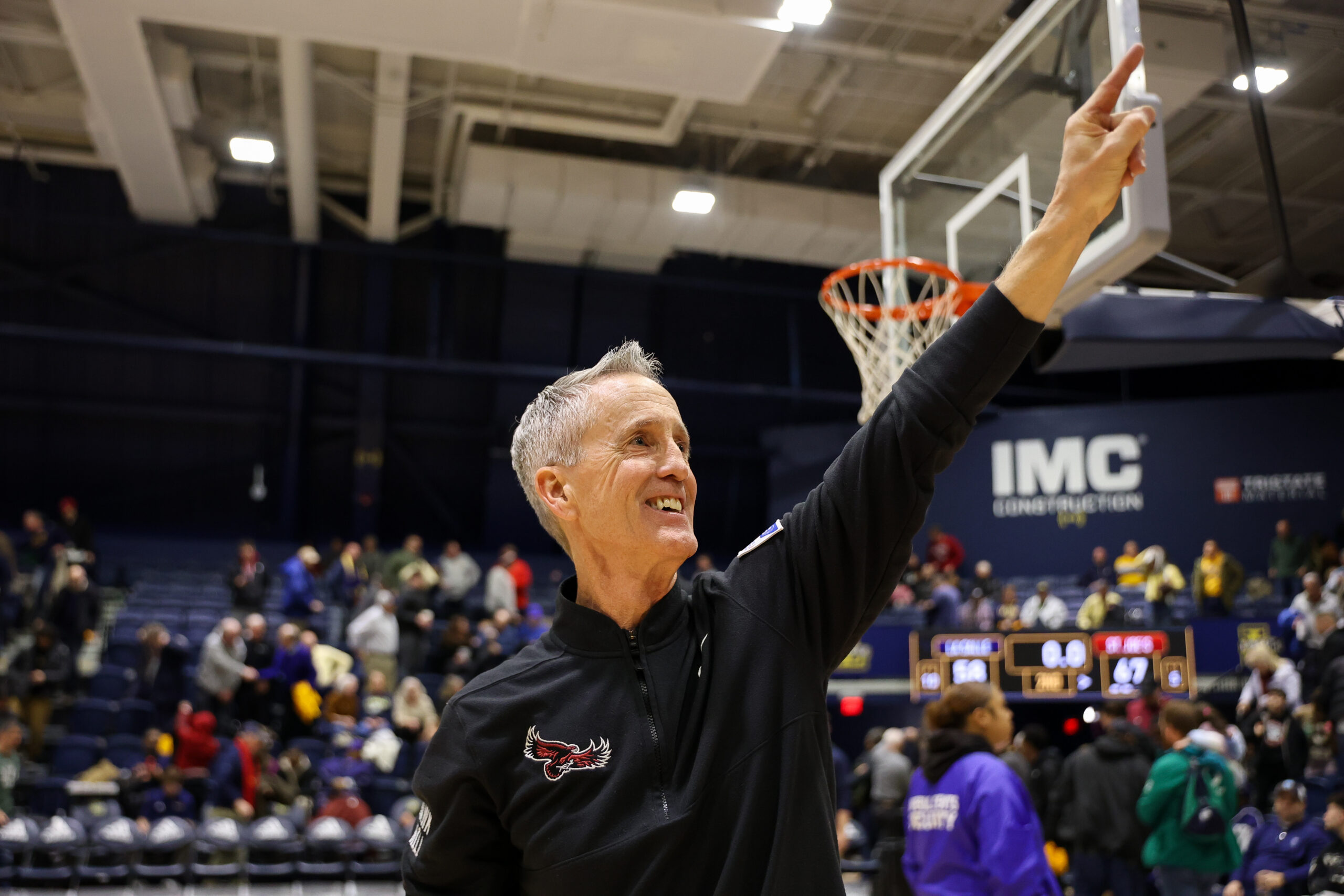
St. Joseph’s coach Steve Donahue points to the student section after a 67-58 win against La Salle.
Perhaps, finally, Donahue’s team is taking on a little bit of his own personality, playing the way Donahue wants the Hawks to play.
“I like to think that,” Donahue said Saturday. But he also wanted to credit Lange for laying a foundation. Lange, Donahue said, “built a really good program here with really good people.” He pointed to the consecutive 20-win seasons and the program’s footing in the A-10.
“I’m grateful that I walked into this and have guys like [Haskins],” Donahue said. “That being said, I saw things that bothered me.”
“We lost three games where we were tied or up against good opponents with eight minutes left, and we didn’t get from A to B,” Donahue said. “We allowed the circumstances to change who we are. We’ve been through a lot, and since then I just see their ability to forget about personal expectations and figure out what needs to be done in that game.”
Saturday, Donahue said, was living proof.
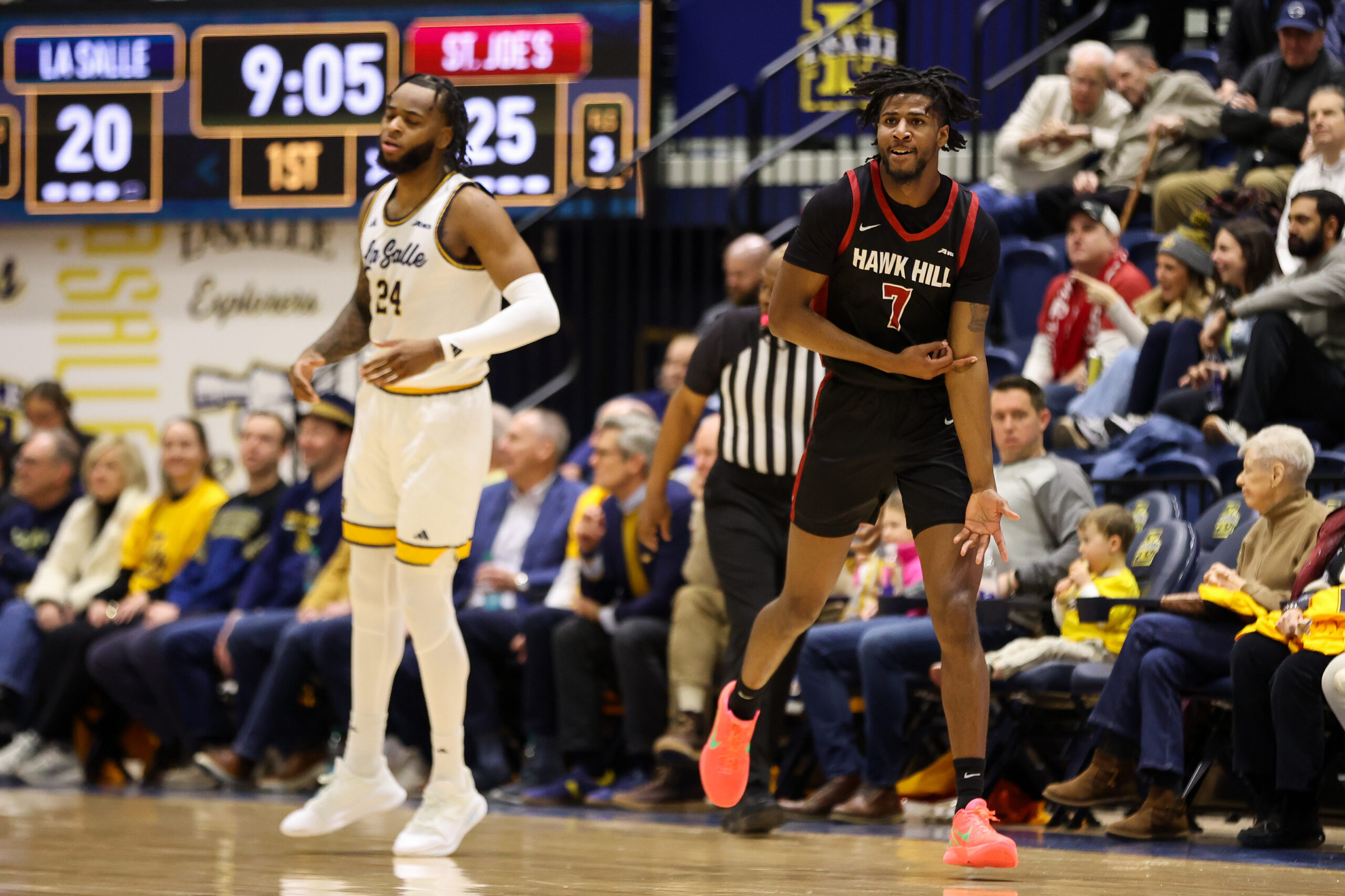
La Salle did everything it could to take Derek Simpson out of the game. Simpson has been on a tear during this recent run, but the shooting lanes weren’t there, so the Hawks found Haskins on the weak side and the lefty made La Salle pay with six threes on seven attempts. Simpson still more than made his mark on the game with 13 points, six rebounds, and seven assists.
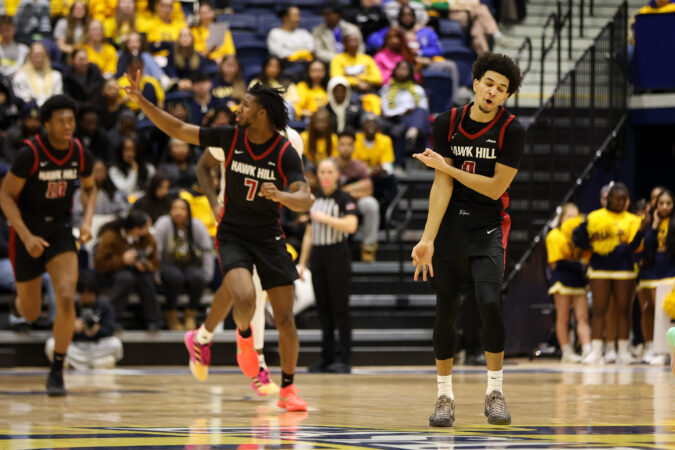
Hawks guard Dasear Haskins (7) reacts after a made three-pointer against Jerome Brewer and La Salle.
The feisty Explorers used an 11-0 run to make the game interesting late, but St. Joe’s battled through a couple of turnovers and closed the game with its free-throw shooting.
“When a game gets closer, we just want to get closer,” Haskins said. “We just come together, listen to our coaches, trust in our game plan, and just come together as a unit.”
Words that make Donahue smile.
“There’s a mentality now that we’re not going to be affected if something is going right for the other team and wrong for us,” Donahue said. “We’re going to move on and figure out how to win this game.”
Some of this recent success has a simpler explanation. It’s just a natural part of a team growing together. Simpson and Justice Ajogbor, both seniors, have been steady. Simpson, Donahue said, is the “heart and soul” of the team, and is no longer looking over his shoulder. But the other components of the team needed time. Jaiden Glover-Toscano barely played at St. John’s last season. Haskins is playing his second season of college basketball. The Hawks rely a lot on two freshmen, Austin Williford and Khaafiq Myers, and a backup center, sophomore Jaden Smith, who had a limited role at Fordham last year.
“The youth is catching up to the older guys and we’re blending,” Donahue said.
It’s the right time for it, considering the calendar just flipped to February. The Hawks have nine games left before the conference tournament in Pittsburgh. They have shown the ability to play with and beat some of the conference’s best, like Dayton and Virginia Commonwealth. There will, of course, be no trip to the NCAA Tournament without running the table in Pittsburgh, and doing so means getting through those teams and the juggernauts, St. Louis, which beat St. Joe’s by 23, and a George Mason squad the Hawks play on the road on Saturday.
That stuff will sort itself out when it’s supposed to. For now, the Hawks can just enjoy the ride.
“Winning is so fun,” Haskins said. “I love winning so much.”