The Flyers announced they have reached the end of their rebuild on Friday, when they tendered an offer sheet to Anaheim Ducks center Leo Carlsson for five years and $90 million. The average annual value would be an NHL-record $18 million, at least for a while. Carlsson is a restricted free agent, so Anaheim has a week to match the offer. If they do not, the Flyers would send them their next four first-round draft picks as compensation.
Carlsson would fill the massive hole in the Flyers’ lineup at the first-line center spot that has existed since they traded Claude Giroux in March 2022 and announced the first real rebuild in franchise history. Coincidentally, Giroux, now a 38-year-old free agent, apparently is the consolation prize if the Ducks match the Carlsson offer.
This is a marked departure from the Flyers’ behavior since Danny Brière became general manager in March 2023. His moves have been conservative. His strategy has been patience. Brière, president Keith Jones, and governor Dan Hilferty have resisted adding pricey veterans and have moved on from aging players to allow younger players the ice time to blossom.
However, with every move, Brière has said:
“If something makes too much sense for the future of this organization, we’re going to take it.”
They took it.
They had to after this past season.
They discovered a franchise goalie, they saw their young core overachieve under first-year coach Rick Tocchet, they saw defenseman Travis Sanheim, 30, round into one of the best blueliners in the game, and they realized that their window was opening a year or two earlier than they expected.
They dabbled in discussions to add other completion pieces, but in the end, going all-in for a 21-year-old budding star in Carlsson just made too much sense.
They made the playoffs on the backs of some of those younger players, such as 21-year-old winger Matvei Michkov, in his second season, and 19-year-old winger Porter Martone, who joined the team straight from the NCAA Tournament, as well as the emergence of late-bloomer goalie Dan Vladař.
Then they beat the Pittsburgh Penguins on the backs of some of those same players and, again, Vladař. He just agreed to a five-year extension and will be under contract for the next six seasons. Tyson Foerster, a 24-year-old winger, also had a year left on his contract when, on Wednesday, he signed an eight-year, $56.8 million extension.
Leo Carlsson, 21, is one of the NHL’s top rising stars. Last year, he averaged just under a point per game for the Anaheim Ducks.
Now, the Flyers have offered Carlsson the moon.
Rebuild over.
This comes on the back of the Sixers’ surprise trade with the Celtics, in which Boston sent star swingman Jaylen Brown, 29, to Philly in exchange for broken-down Paul George, 36, and the crippling contract he carries, as well as two first-round picks and two second-round picks.
And don’t forget that the Eagles traded disgruntled franchise receiver A.J. Brown to the New England Patriots last month.
Oh, yeah: LeBron James is considering signing with the Sixers, too.
Perplexingly, the news about Carlsson might have a larger impact than any of the others — and it could have the least impact as well.
Four firsts and $90 million is a massive overpayment for a player who, after three seasons, sits firmly in the second tier of NHL stars. But prying a restricted free agent from his team always requires overpayment, and that’s why it happens so seldom.
That said, Carlsson’s goals and points totals have steadily increased, though his 67 points last season were tied with three other players, including potential new teammate Trevor Zegras, for 57th in the league. The Flyers are banking on the ever-improving Carlsson, who possesses a tantalizing combination of size (6-foot-3, 208 pounds), speed, skill, and goal-scoring ability, growing into one of the league’s top players.
This (pending) move is sort of a bookend to the trade of Giroux to the Florida Panthers. Part of the return from that deal was cornerstone winger Owen Tippett and a third-round pick that became promising forward Denver Barkey.
More than anything, though, this move is a recognition that the Flyers believe they are much closer to winning their first title in five decades than they’d previously advertised.
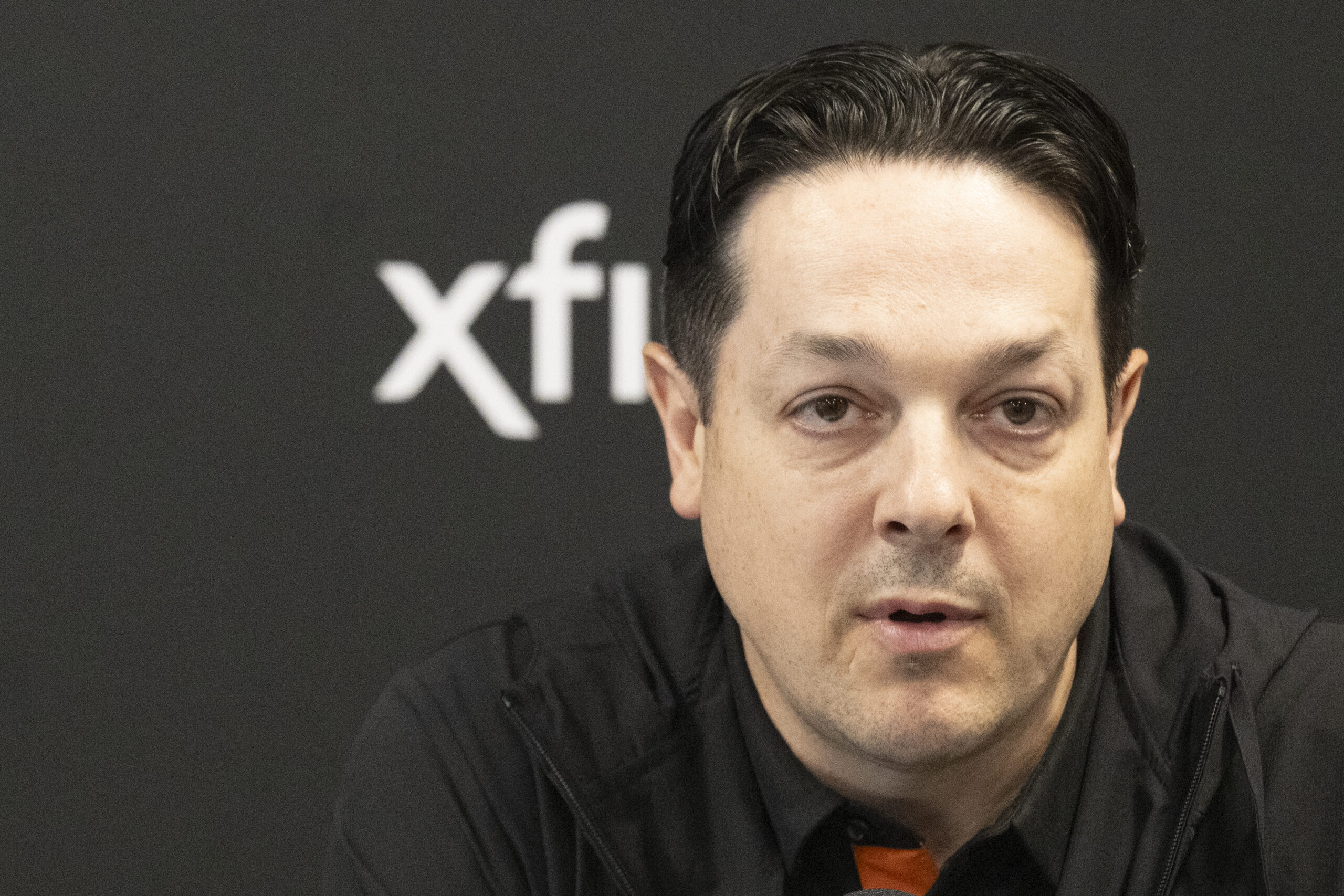
Flyers general manager Danny Briere’s offer sheet sends a clear signal that he believes the Flyers can win now.
Between Vladař, Sanheim, 29-year-old All-Star wing Travis Konecny, and 33-year-old captain Sean Couturier, a former first-line center now serving as a fourth-line defensive specialist, the Flyers have a productive veteran core. Couturier has four years left on his deal. Konecny has seven years left.
What that means is there is a five- or six-year window in which the Flyers, scanning the landscape of the NHL, believe they can win it all. And, apparently, it just made too much sense to add Carlsson to this roster, regardless of the absurd price.
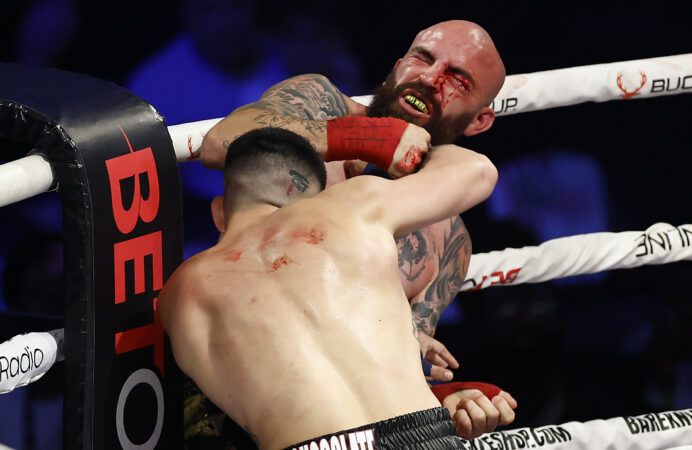
Less than 24 hours before Philadelphia Stadium (aka Lincoln Financial Field) celebrates America’s 250th birthday with the city’s final FIFA World Cup match, fighting fans made their way across the street to Xfinity Mobile Arena to celebrate a day early with Bare Knuckle Fighting Championship’s Liberty Brawl.
Liberty Brawl, a fight card dedicated to the celebration of America, gave the fans in attendance early fireworks with seven knockouts, which resulted in a big night for Philly fighters.
Here’s everything you missed:
Local Philly fighters star
Eight local fighters decorated the BKFC Liberty Brawl card: Philly natives Maxiono Griffin, Johnny Garbarino, Cody Russell, Zedekiah Montanez, Matthew Turnbull, and Pat Sullivan, Levittown native Lex Ludlow, and Chester native Anthony Pagan.
“I’m a big Lex Ludlow guy,” said 37-year-old New Jersey native Michael Barbour. “He’s a good dude. He’s got a good story. We came to support Lex.
“I’m from Jersey, but I appreciate the energy at any event. So when the local guys come out, like Lex, [Johnny] Garbarino, seeing the crowd go wild, it’s awesome. Say what you want about Philly, they love their sports. They love their local guys, and they really support them. So, as a fight fan, I really appreciate that.”
All eight of the local fighters walked out victorious, including fan favorites Garbarino and Ludlow. Garbarino remained undefeated after defeating Mike Richman by unanimous decision, which led to some boos from the crowd.
Afterward, Garbarino revealed he couldn’t get the knockout after injuring his right hand.
Johnny Garbarino defeats Mike Richman by unanimous decision. Reveals he couldn’t get the knockout after injuring his right hand pic.twitter.com/IDhBWQ2nQy
Meanwhile, Ludlow stole the show — finishing his opponent in nine seconds before cutting a wrestling-inspired promo calling out Mike Perry and Darren Till.
The fight was over so quickly my phone didn’t even focus in time. 😬 Lex Ludlow ends things in nine seconds pic.twitter.com/mpD6foxMLt
On the precipice of Independence Day, Livi Pack, 16, and Maddox Hoefler, 16, wandered through the concourse in American flag overalls with their faces painted in stars and stripes.
“We wanted to do something that shows our pride in our country,” Hoefler said. “So, we decided to … paint our faces. Obviously, we’re not artists but we had a fun time doing it. We just love our country.”
Pack added: “It’s America’s 250th birthday. So we got to do our big one. I’m very American. I love to show my pride, even if politics are a mess right now. I’m still true to who I am. So I just wanted to do the most.”
For the country’s 250th birthday, it was only fitting that the card’s main event featured a USA vs. the United Kingdom matchup. Austin Trout, a Texas native and former World Boxing Association light middleweight champion, faced the U.K.’s Ben Bonner.
To get the crowd going, Trout made quite the entrance with a walkout inspired by Apollo’s entrance in Rocky IV. But he had some help from the Sixers Stixers and the tune of James Brown’s “Living in America,” before ultimately suffering a similar fate — getting knocked out in the second round.
Liberty Brawl was the promotion’s third event at Xfinity Mobile Arena — it made its debut at the stadium in January 2025 with KnuckleMania V, where it set a local modern day combat sports record with 17,762 people in attendance. Since then, it’s continued to bring Philly fight fans more action.
“I’ve been a fan of BKFC for a couple years now,” Pack said. “I went to Knucklemania last year, so I had to come back to Philly because everybody’s here. We got to support Cannoli. We got to support Brit. … I think the BKFC is absolutely amazing. I think it can be bigger than the UFC, no doubt. Dave Feldman, keep doing what you do. Thank you for putting on these amazing shows for us.”
The action in Philly continues next month when the UFC makes its highly anticipated return to the city for its first major championship event in the city in 15 years.
“The [UFC and BKFC] crowds are a little different. UFC fans are very hardcore,” Barbour said. “Bare knuckle people, people of Philly streets, will come here, and they’ll just fight people in the stands while they’re watching these fights. So that’s a big difference. UFC has some good fans, but there’s different types of caliber fans for Bare knuckle.”
Two title fights already have been announced — Islam Makhachev will defend his welterweight title against Ian Machado Garry, and Mackenzie Dern will defend her women’s strawweight title for the first time against Gillian Robertson.
The last time the UFC was in town, there wasn’t a local fighter on the card, despite the city’s deep roster of talent, although Philly fighter-turned-broadcaster Paul Felder was in the booth. This time around, Eddie Alvarez, a former UFC champion and Kensington native, hopes it will be different.
“We need our hometown guys,” Alvarez said. “We need Sean Brady. We need Joe Pyfer. We need Pat Sabatini. We need Philadelphia’s best, Philadelphia’s own on those UFC cards. And, sadly they’re not. I don’t know why they do it that way, but they’re not. I don’t know if anybody Philadelphia homegrown is on that Aug. 15 card.”
BKFC made history on Friday night, hosting the promotion’s first one-round war, in which two fighters battle it out in one two-minute round. Chester’s Pagan walked out victorious over Zach Pannell.
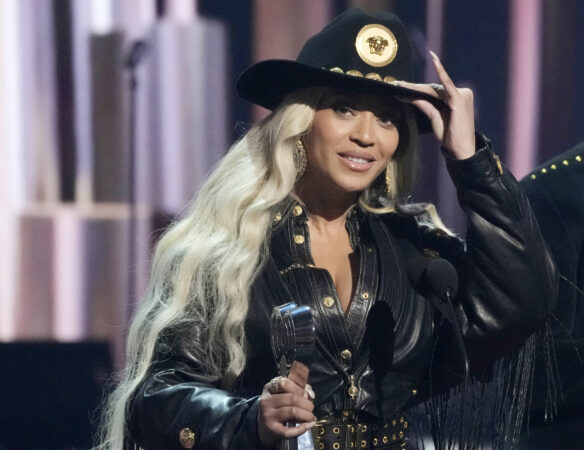
We have something else to celebrate this Independence Day: a new Beyoncé song.
The iconic singer released “Morning Dew (Donk),” a sultry, ‘90s-coded R&B track, Saturday morning with no warning.
It’s a special Fourth of July holiday gift to her fans, according to a news release about the song — and Queen Bey’s first piece of new music in two years.
The single starts the clock on a 60-day countdown to the singer’s 45th birthday and the reissue of B’Day, her hit sophomore album that first dropped 20 years ago, on Sept. 4, 2006.
Sorry, BeyHive, no word on Act III, the highly anticipated, unnamed, and unreleased final chapter of Beyoncé’s three-part album project. The Today show reported that fans shouldn’t expect any sort of Act III announcement this week.
Act II, aka Cowboy Carter, Beyoncé’s award-winning foray into country music, was another example of the singer’s use of the Fourth of July holiday as a means to explore and challenge themes surrounding American identity, especially the Black and Southern experience. Last year, Beyoncé’s Cowboy Carter D.C. tour stop took place on the Fourth of July.
View on Threads
The show highlighted Black empowerment as Beyoncé opened the show wrapped in a large American flag, just a few miles from the U.S. Capitol.
While it’s not the Act III fans have been waiting for, “Morning Dew (Donk)” is an exciting new portfolio addition.
It was written by Beyoncé, Pharrell Williams, The-Dream and Darius Dixon, and produced by Beyoncé and Pharrell Williams. The song features Williams’ signature four-count producer tag.
Whatever brutally hot designs the weather gods had in store Friday for Philadelphia’s Independence Day celebrations, by 8 p.m. the temperature fell below 90 degrees, and the music on Independence Mall arrived like a balm.
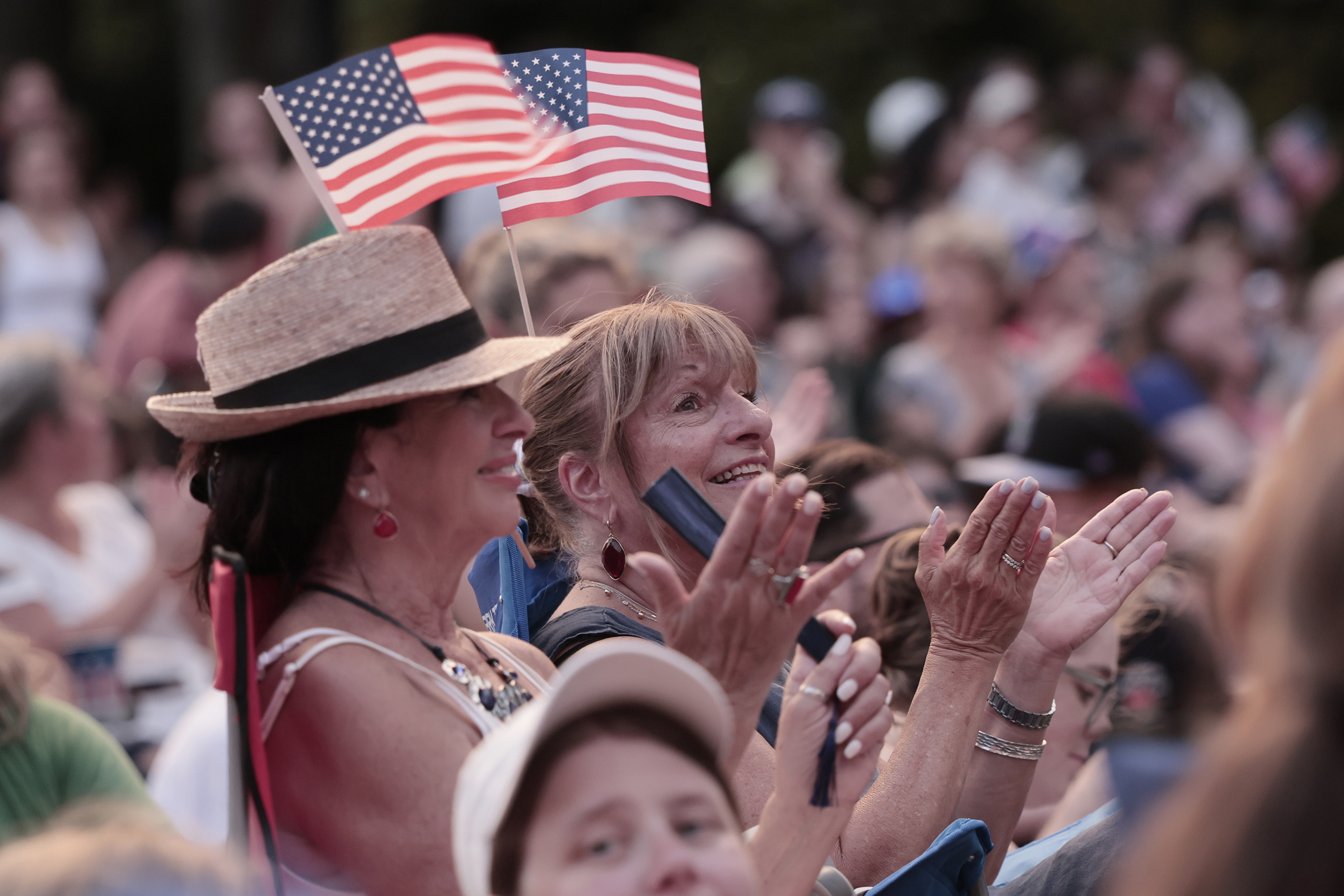
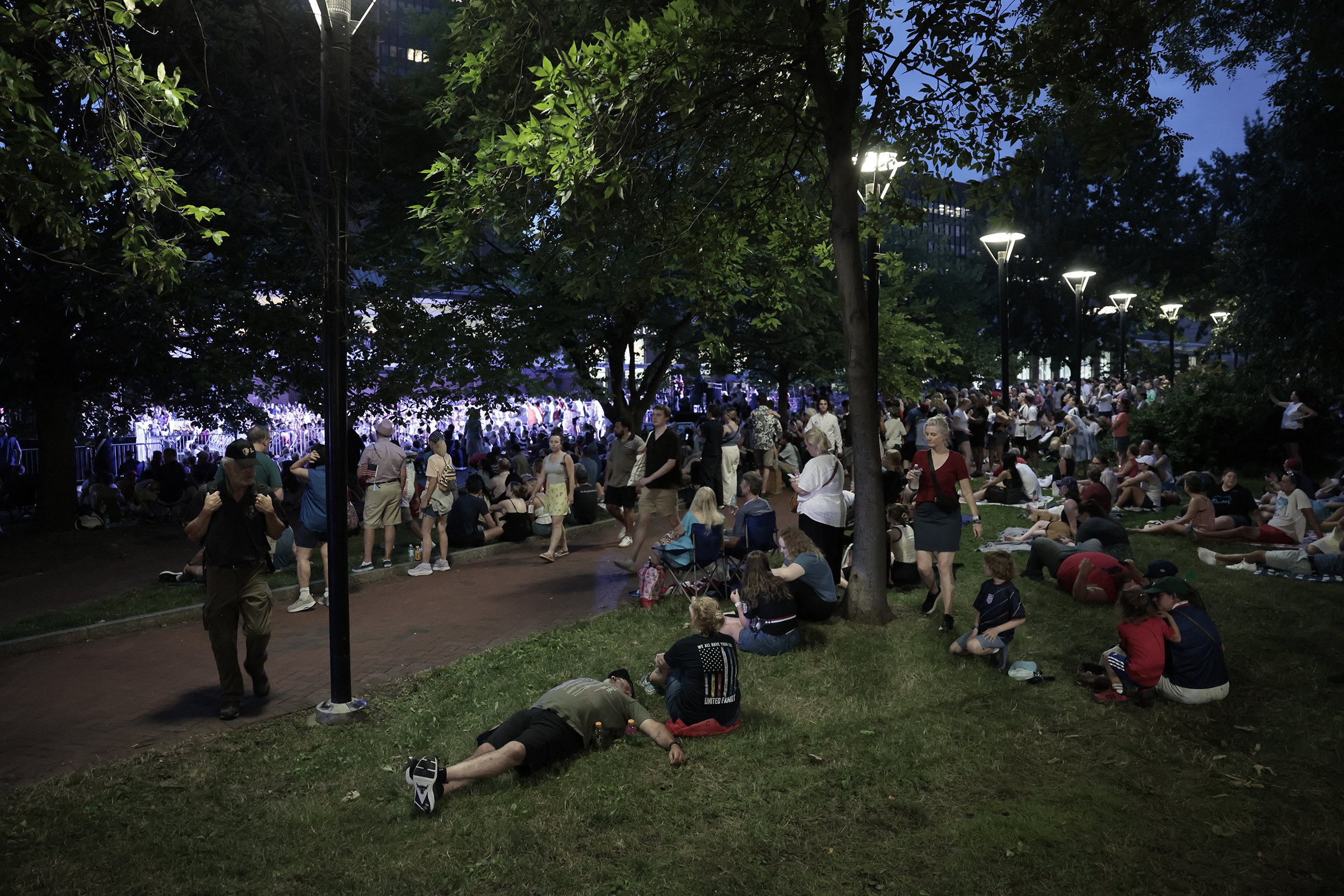
Listeners were stretched across the lawn of the mall fairly solidly from Independence Hall to Arch Street — an estimated 12,000 attendees, according to a Wawa Welcome America spokesperson. Whether drawn by the Philly Pops with tunes patriotic or stirring, or by popular actress-singer Idina Menzel, the crowd was in a mood at once celebratory and relaxed.
The weather posed no threat, at least for the first hour or so.
At Friday night’s Philly Pops concert on Independence Mall.
This annual tradition of “Pops on Independence,” a free Philly Pops concert on the mall, has become a way of taking the national temperature. Last year, a few months into the new presidential administration, there were subtle references to the political moment, with the acting superintendent of Independence National Historical Park speaking to the audience about equal rights of all kinds, including marriage rights, and referencing a nation “built on the struggle for freedom from tyranny, and the principle of liberty for all under the just rule of law.”
Friday night, park superintendent Steven Sims struck a more anodyne note, speaking of the historic setting, the city’s events this week commemorating the 250th anniversary of the nation, and of celebrating with “one of our most universal languages — music.”
The audience seemed only too happy to live inside of this bubble for a while, though to the woman holding up a “Striving for Democracy” sign, you were seen.
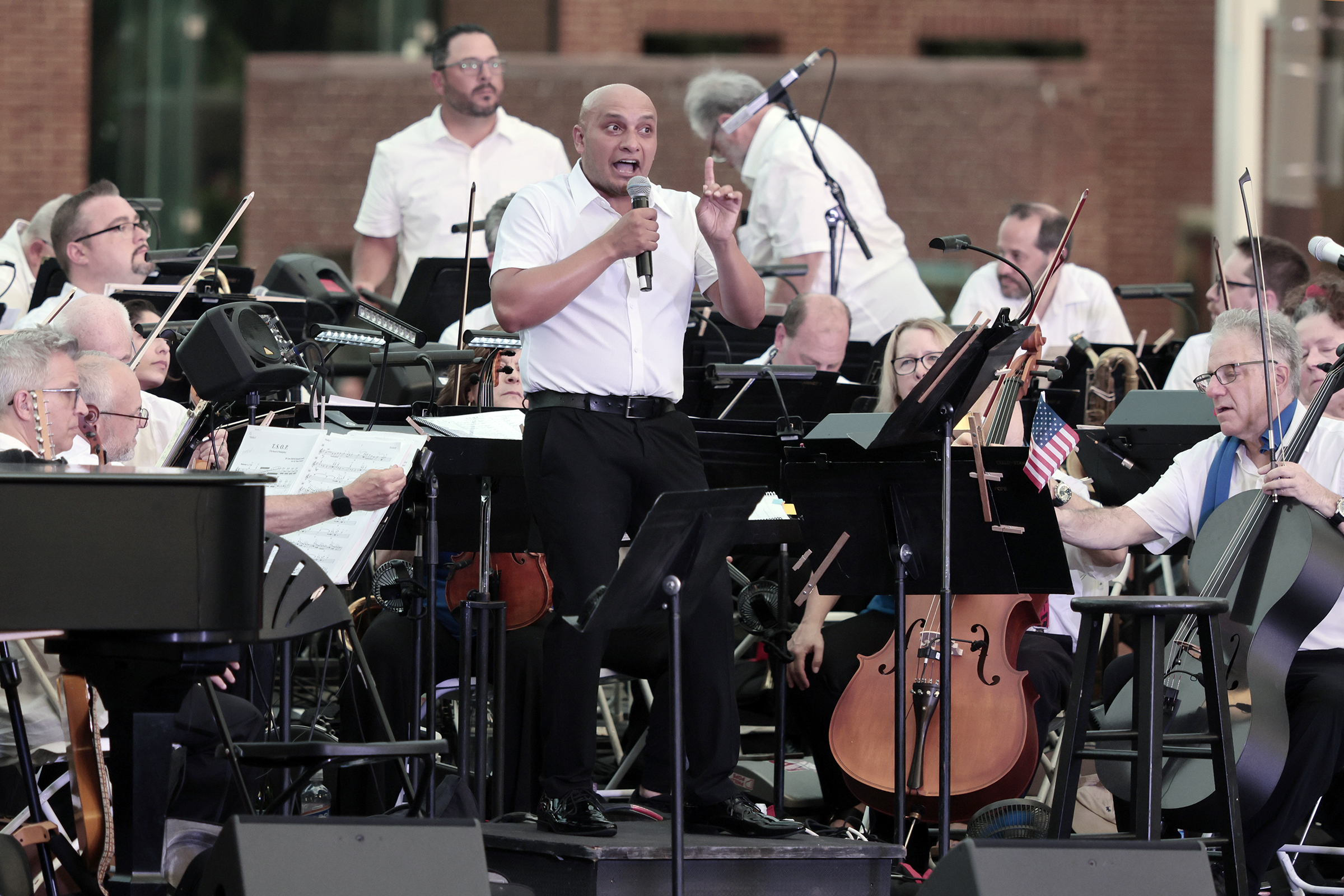
Philly Pops music director Chris Dragon speaking to the crowd during Friday’s “Pops on Independence” concert on Independence Mall.
No one should take for granted the fact that this concert endures. The group performing Friday under the Philly Pops name is a band of survivors, emerging after the demise of the original Philly Pops and much organizational and legal drama. Had the orchestra not reorganized, a 4 ½-decade tradition of hearing music with no less a backdrop than Independence Hall might be gone.
Listening and strolling on Independence Mall Friday night at the Philly Pops concert.
How many other cities can boast as powerful and authentic a resonance between art and setting? When the Pops performed its Armed Forces Salute — having audience members stand as the respective song of the military branch in which they served was played — it made real and human the idea of such service to the nation.
A section has been added to the medley to recognize the U.S. Space Force, established during the first Trump administration; I could be mistaken, but no service member from that branch who might have been in Friday’s audience appears to have stood for this song, called “Semper Supra.”
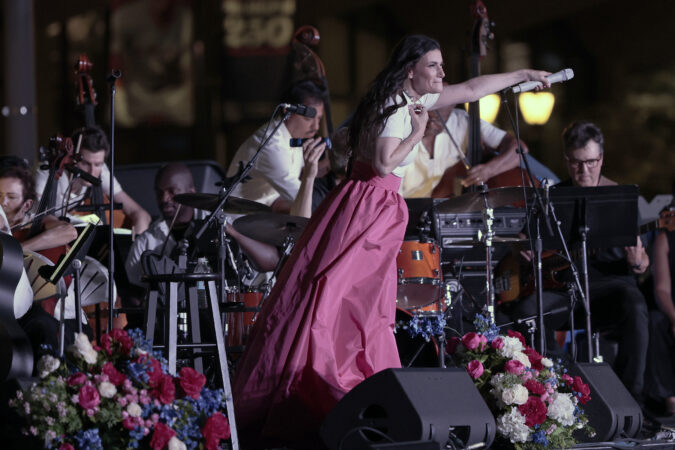
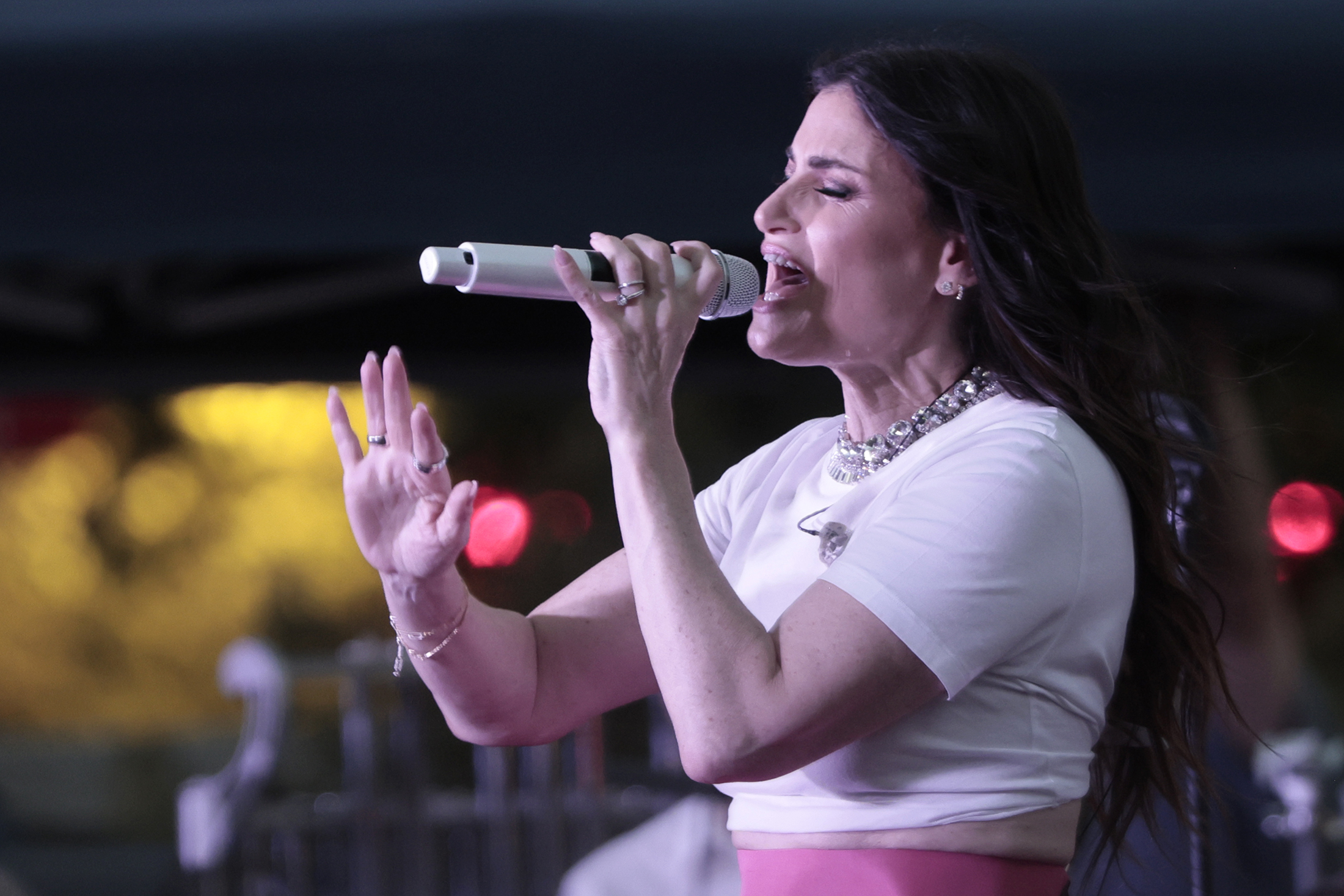
Idina Menzel performing with the Philly Pops Friday night.
Judging by the number of families with young children in attendance, the main attraction was Menzel, and if they came to hear “Let It Go” from Frozen, they were not disappointed. Menzel was a canny choice for this occasion; she is a singer who knows how to send sound and charisma back to the farthest reaches of the audience.
It was not necessarily the best night to appreciate the talents of the Pops and conductor Chris Dragon. The sound system near me, fairly far back from the stage, cut in and out. No sound check had been possible because of the heat, a Pops spokesperson said. And the concert ended earlier than planned after organizers grew concerned by gathering dark clouds and flashes of lightning. The last few pieces that might have showcased the ensemble weren’t played. A loss, for sure.
But the event succeeded on so many other levels, that it didn’t matter.
As the crowd headed off with the music fresh in their ears, downtown buildings were aglow red, white, and blue; young families lingered and took selfies; and Market Street on a Friday night seemed like the lively urban stretch it once was and could be again.
Independence Day is one of my favorite holidays. Not for the parades, pageantry, and fireworks, though I love those, too — even more so in the year of the nation’s Semiquincentennial.
I love the day for what it celebrates: the birth of an audacious experiment. The idea that a nation could be built not on shared race, religion, or ancestry, but on a shared belief in human dignity, and the right to pursue a life of your own making. E pluribus unum. Out of many, one.
That idea is how my family became Americans. My parents came to the United States as exchange students from Iran, intending to return home. The Iranian Revolution happened the day my dad was defending his doctoral dissertation. It extinguished the future my parents had imagined, especially for me. His Jewish dissertation advisers wrapped their arms around our young Muslim family, and America took us in.
I have spent my career seeking to be worthy of that welcome, serving my country — the United States — at some of the highest levels of government. My diplomatic counterparts in the Middle East thought I was a unicorn: How could the first-generation daughter of a country that is the sworn enemy of the United States be seen as so American as to represent it? My experience is not unique — just ask the many first-generation troops who serve in our military. I’m not the unicorn. Our country is.
President RonaldReagan said it best, in his final speech as president: “A man wrote me and said: ‘You can go to live in France, but you cannot become a Frenchman. You can go to live in Germany or Turkey or Japan, but you cannot become a German, a Turk, or a Japanese. But anyone, from any corner of the Earth, can come to live in America and become an American.’ … We lead the world because, unique among nations, we draw our people — our strength — from every country and every corner of the world. And by doing so, we continuously renew and enrich our nation.”
Our founders knew that their radical idea would take work from all of us. George Washington spelled out the covenant of citizenship when, writing to a Jewish congregation in 1790, he said that America “gives to bigotry no sanction, to persecution no assistance” — and in return “requires only that they who live under its protection should demean themselves as good citizens, in giving it on all occasions their effectual support.” Welcome extended. Citizenship expected.
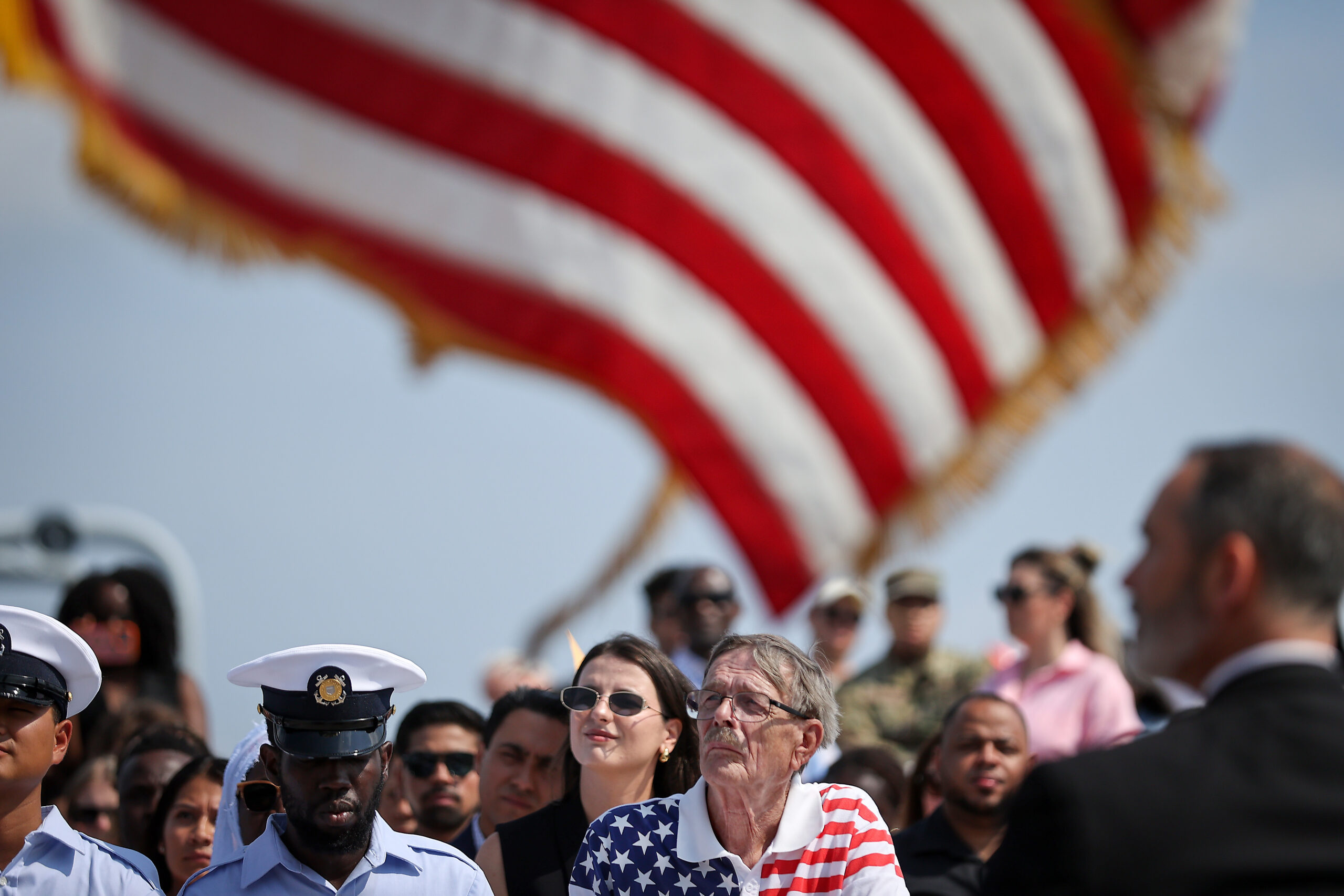
Bjorn Bedersen (right), who was one of the 42 soon-to-be U.S. citizens, listens to a speech during an Independence Day naturalization ceremony on Battleship New Jersey in Camden on July 4, 2024.
So every Fourth of July, I find myself thinking about what citizenship should demand of us today. This year, with our 250th upon us and citizenship debated in courts and in the press, the question is more urgent than ever.
Right now, hundreds of thousands of aspiring Americans are studying for the naturalization exam — 128 questions on the history, values, and structure of the country they have chosen. They are doing it after working long hours, after putting their kids to bed, in their second or third language. They chose this country on purpose, and they are earning their place in it the hard way.
Which raises a humbling question for the rest of us: Could we pass the same test?
Most of us — native-born Americans, myself included — would struggle to keep up with them. Two-thirds of Americans can’t pass the civics test that new citizens are required to pass, and this year, it got twice as hard.
The path these aspiring Americans walk has seldom been more fraught. In recent years, families have been separated by enforcement actions, legal pathways to citizenship are increasingly unclear, and communities that once felt settled now live in a persistent state of uncertainty. The people studying those 128 questions are doing so under a shadow most of us will never know. They wonder: Are they still even welcome here?
That is the full truth of this moment: that the people studying the hardest — who perhaps know the most about our country and what makes it extraordinary, who are perhaps the most committed to it — face an uphill battle for a prize most of us simply inherit and often fail to value.
Citizenship cannot be something we take for granted. It is something we practice by learning our history, contributing to our communities, and strengthening them for the next generation.
That’s why I find so much hope in the many Americans who have stepped forward in recent years to help newcomers build their lives in this country. Veterans who know what civilians suffer in war. Pastors in small towns who organized their congregations. Neighbors who decided that the covenant Washington described was theirs to keep.
Now, many of those people are stepping up again to help newcomers succeed in their dreams of becoming American citizens. I lead a nonprofit, Welcome.US, that has created a new citizen guide program, through which Americans can help aspiring citizens study for the civics exam, practice English, and prepare for the live interview that many newcomers find most daunting. One neighbor and one aspiring American at a time, sitting down together over the questions that define this country.
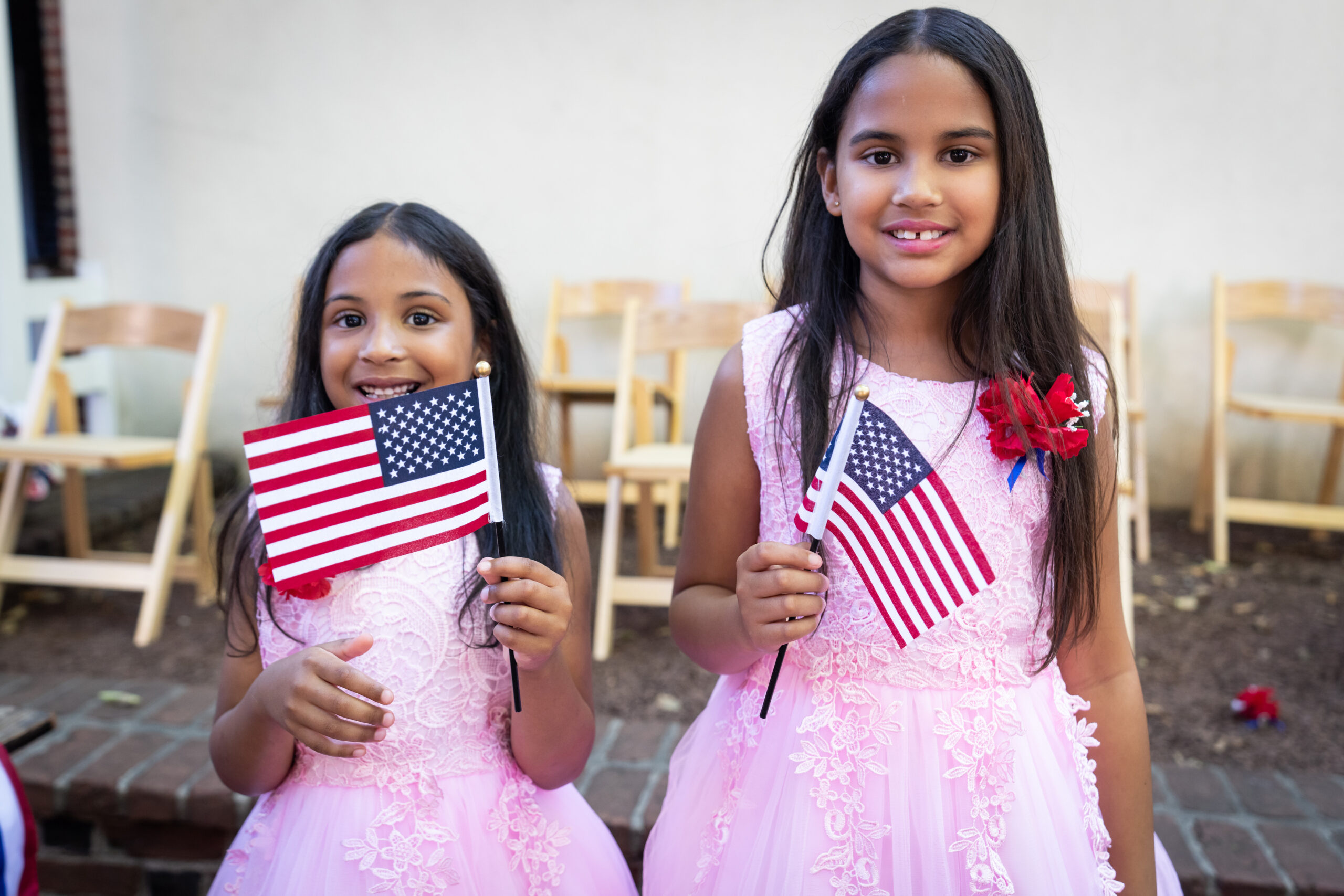
Elianny Torres Rodriguez (left) and Edwanny Torres Rodriguez at the children’s naturalization ceremony at the Betsy Ross House in Center City in July 2024.
Through our organization’s work with more than two million volunteers, I’ve seen that the learning goes both ways.
When Americans help someone prepare for the citizenship test, they don’t just teach. They remember. They are reminded why the First Amendment matters, what the Civil War settled, how generations of Americans — from suffrage to the Civil Rights Movement to American tribes — made our Constitution more real for more people. Welcoming someone into citizenship turns out to be one of the most reliable ways to renew your own.
So here is my invitation on America’s 250th birthday: Take the test.Welcome.US has put the civics questions online. See how you do. Let yourself be surprised by what you know and humbled by what you’ve forgotten.
And if you find that mix of humility and renewed awe that I find every time I try my hand at the test — consider doing something with it. Become a citizen guide and help someone else prepare for it. Spend a few hours with someone who has chosen America on purpose, and let them remind you why it was worth choosing.
Two hundred and fifty years after our founding, the American Experiment remains unfinished. That’s not a failure; that’s the design. The founders left it to us — all of us, newcomers and native-born alike — to keep working on that ever more perfect union. On this momentous national anniversary, let’s renew that charge.
Nazanin Ash is the CEO of Welcome.US, a nonpartisan nonprofit that has mobilized more than two million American volunteers across 26,000 zip codes to welcome and support newcomers.
Take the test
Here are a few sample questions from the U.S. citizenship test. See more examples at interact.welcome.us/civics:
1. How many voting members are in the House of Representatives?
2. There are four amendments to the U.S. Constitution about who can vote. Describe one of them.
3. How many amendments does the U.S. Constitution have?
4. The Federalist Papers supported the passage of the U.S. Constitution. Name one of the writers.
5. The Nation’s first motto was “E Pluribus Unum.” What does that mean?
Answers
1. Four hundred thirty-five (435).
2. Citizens eighteen (18) and older (can vote). You don’t have to pay (a poll tax) to vote. Any citizen can vote. (Women and men can vote.) A male citizen of any race (can vote).
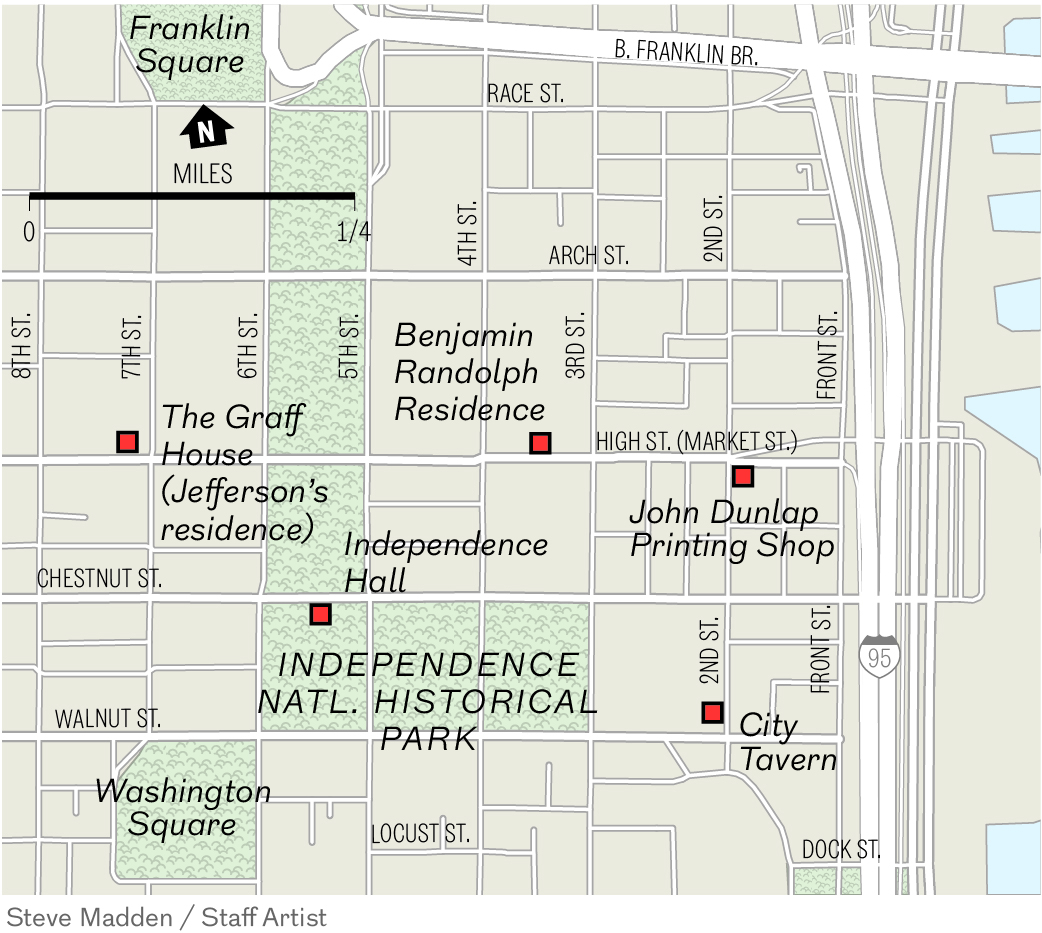
John Dunlap, 29, an immigrant from Northern Ireland who operates a printing shop at Second and High Streets, a short stroll from the Pennsylvania State House, where the rebels conspire, has watched with keen attention the epochal events of the preceding days.
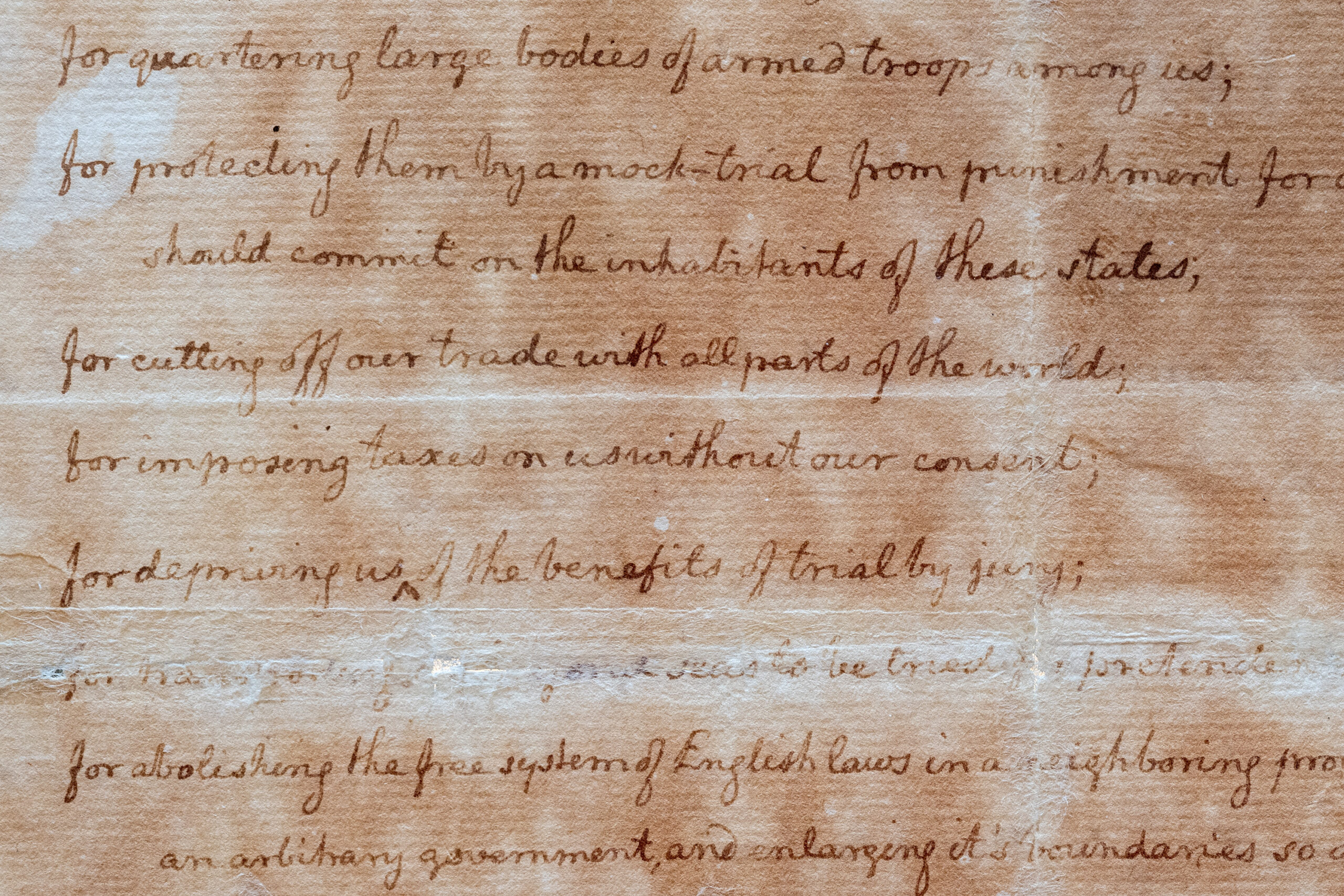
A faded copy of a draft of the Declaration of Independence handwritten by Thomas Jefferson.
The exultant patriots and curiosity seekers who braved suffocating summer heat to stand watch outside the State House on July 1, when the 56 delegates of the Second Continental Congress finally commence their locked-door debate on independence. The rapture that seems to ring out from every Philly tavern and tippling joint, coffee house, and street corner on July 2, when word that Congress voted to sever ties with King George III spreads through America’s largest and wealthiest city, like a bolt from one of Dr. Franklin’s electricity experiments. The joy. Hope.
And now, as an unusually mild morning gives way to rain-laden clouds, Philadelphia holds its breath upon the brink of a mighty happening.
Cloistered inside their chambers, the delegates fiercely debate and painstakingly parse Thomas Jefferson’s draft of America’s founding creed. Its passage will formalize independence.
The ink-stained Irishman with the whipcord build of a jockey prepares the shop for the Herculean task he knows is coming. The delegates will desire to thunder out the news of American independence before the iron gall ink even dries on the Dutch paper. John Hancock, 40, charismatic president of the Congress, will want as many broadsides as Dunlap can muster by dawn. Printing broadsides by hand in sweltering, trembling candlelight — meticulously setting the type, carefully rolling the ink, and pulling the heavy presses — is messy, demanding work, the hardened printer knows. He’ll plan to toil until morning’s light.
Outside, citizens collect in High Street. Soon, the print shop door pushes open. A man, his face obscured by the sun, darkens the doorway. He holds something close. A rag paper manuscript written in fine hand, still wet from fresh changes, and borne by delicate hand to the expectant printer. Words upon which a nation now rests. A declaration.
At the Second Street boarding house of Mrs. Sarah Yard, John Adams, 40, awakes before dawn. The unyielding lawyer and farmer from Massachusetts has become accustomed to the city’s morning clarion cry of crowing roosters, ringing bells, clanking ships, and cursing sailors. But not its heat.
Behold this atlas of independence at his breaking point. Exhausted. Homesick. Hot. Beyond cantankerous that any rational being could yet flinch at the surety and necessity of American independence. For weeks, Adams answers angry letters from citizens demanding to know why Congress stalls.
“The only question is concerning the proper time for making a specific declaration in words,” Adams writes, barely concealing his own impatience. “But remember you can’t make thirteen clocks strike precisely alike at the same second.”
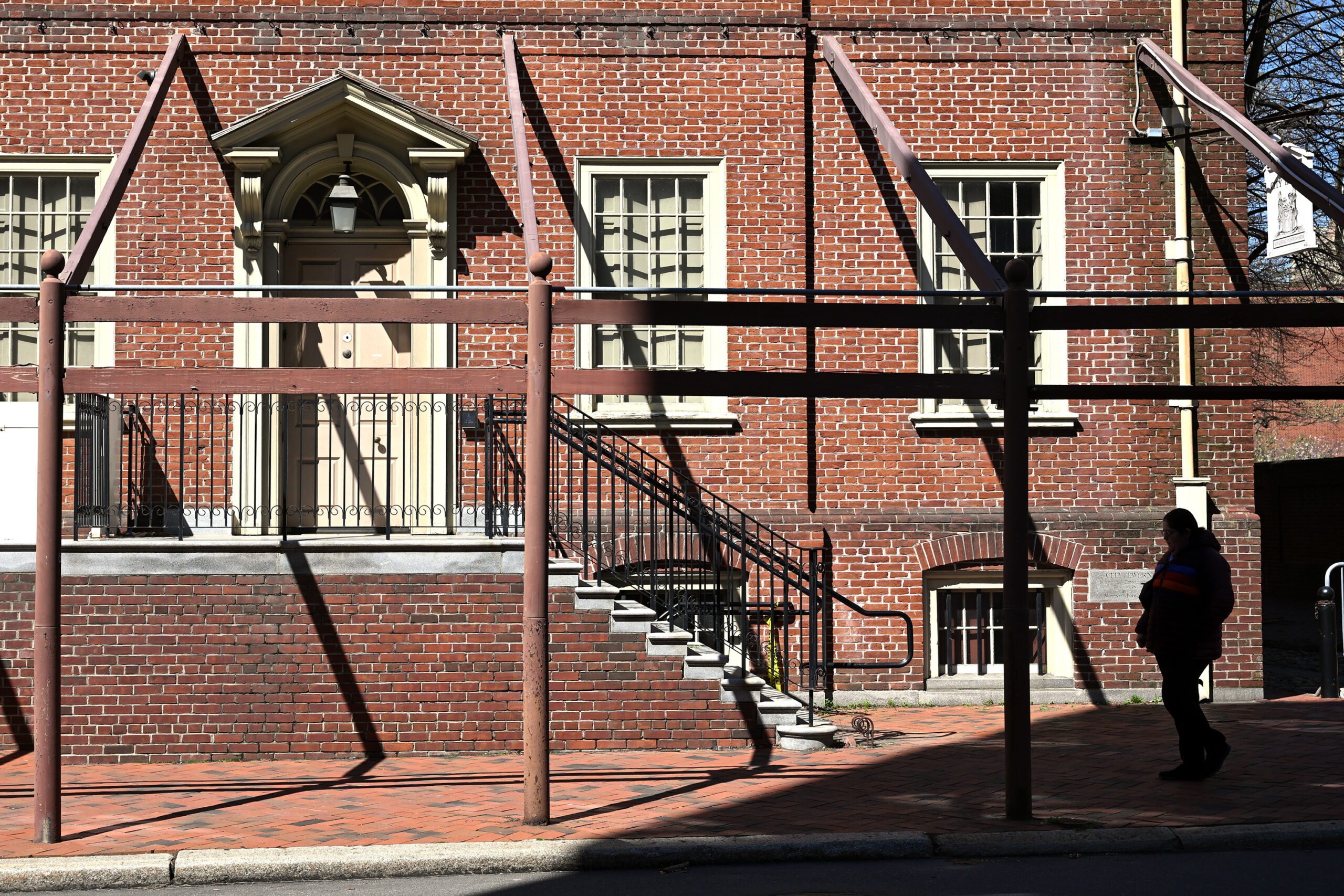
John Adams and his cousin, Samuel, shared a boarding house near the City Tavern in July 1776. This reconstruction of the original tavern was built in 1975.
For nearly two years, John Adams has fought for liberty like a bruising prizefighter, while his less refined older cousin, Samuel, 53, conducts a campaign of persuasion in the shadows. No one has done more than John Adams for independence. On this morning, John Adams dresses in the twilight, wishing that he had been blessed with the graces and gifts of ancient orators.
“This morning is assigned the greatest debate of all,” Adams writes before leaving for the State House. “A declaration, that these colonies are free and independent states, has been reported by a committee some weeks ago for that purpose, and this day or tomorrow is to determine its fate. May heaven prosper this newborn republic.”
At 9 a.m. on July 1, 1776, Andrew McNair, old and gray bellman of the State House, pulls shut the chamber’s heavy doors. Hancock gavels history to order.
In the silence, rises Pennsylvania’s reluctant rebel, John Dickinson. His writings once rallied American farmers against British taxes. Now, ghostly and gaunt from illness, he remains a dogged dissenter against independence. Summoning his strength, he abides his conscience, arguing America is not yet ready.
To proceed with a declaration during an uncertain struggle would be “to brave the storm in a skiff made of paper,” he tells his colleagues, before sitting.
Outside, the heat breaks. Rain beats against the chamber’s tall windows. Thunder booms. Lightning flashes.
Adams stands. He speaks over the stormy din. His precise words are lost to posterity. He speaks for two hours. John Adams moves men.
Adams speaks “with a power of thought and expression that moves us from our seats,” Jefferson, remaining characteristically mum at his table, will later recall.
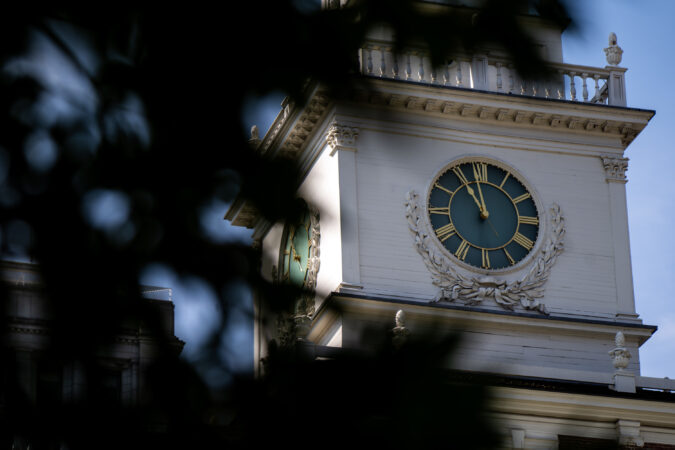
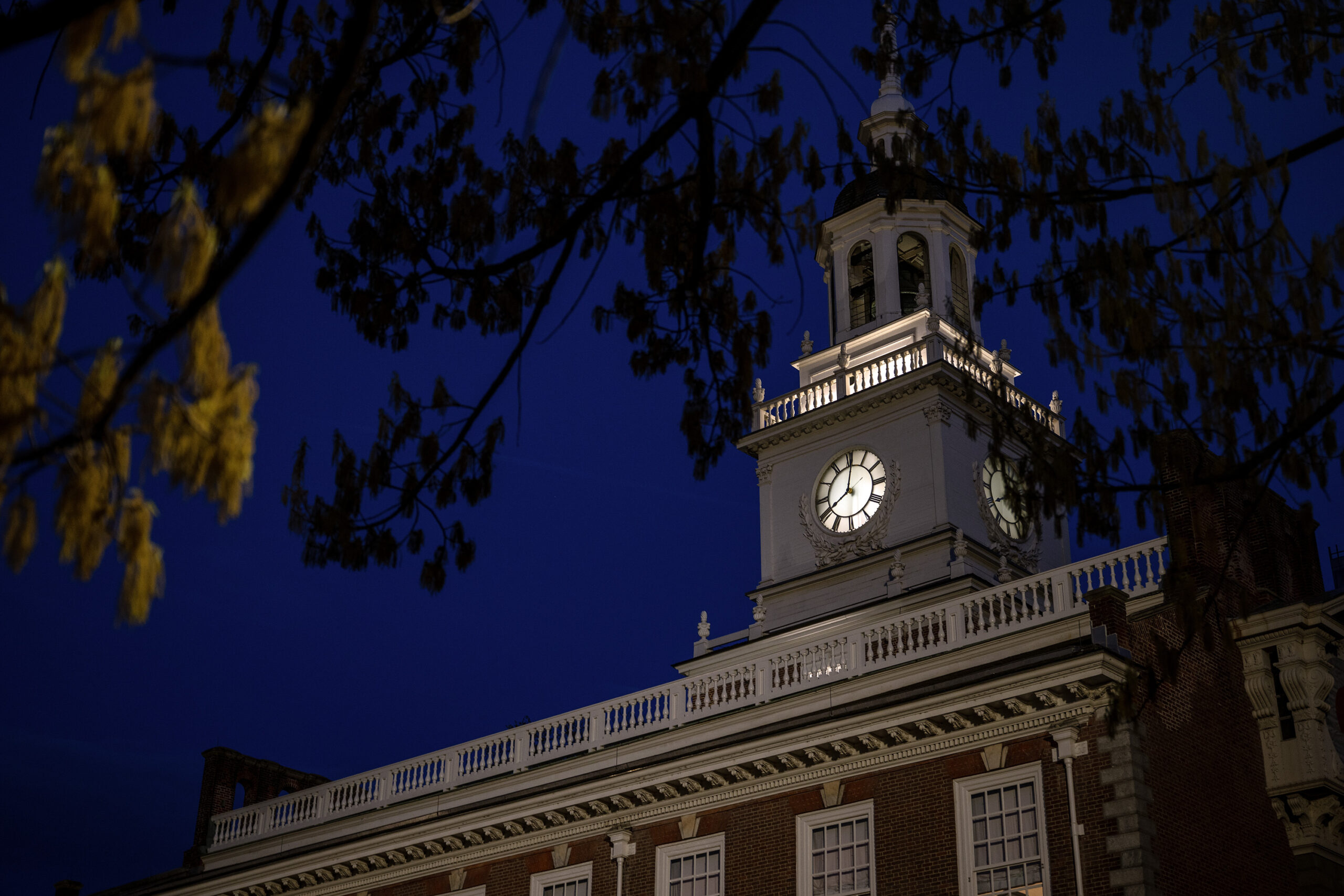
Recreating the daily hub of the Revolutionary City in 1776. You can hear the cannons from the bell tower of the Pennsylvania State House at Sixth and Chestnut Streets, where the rebels conspire. Now, it’s Independence Hall, photographed April 14, 2026.
A preliminary vote is taken by candlelight. Despite popular opinion, four colonies — including four members of Pennsylvania’s critical seven-man delegation — vote no.
Late into the night, at the City Tavern, the delegates drink upon tenterhooks.
July 2, 1776
The second day of debate begins with a prosperous portent. Caesar Rodney, of Delaware, mud-splattered boots and spurs, arms akimbo, bursts in before the doors to Congress close. The gravely ill delegate rode 80 miles through the tempest to cast his vote for independence.
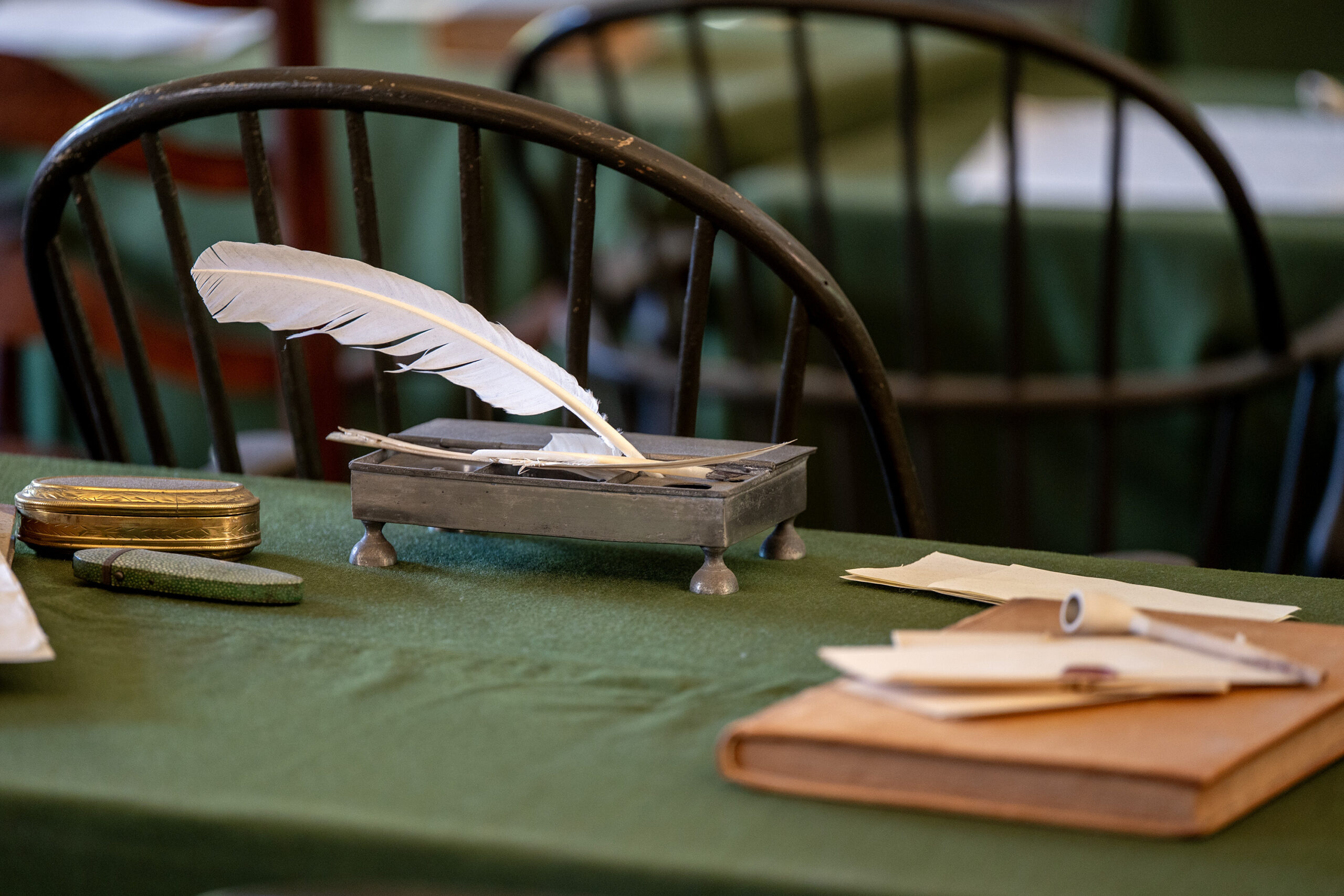
Replica desks in the Assembly Room in Independence Hall, known as the Pennsylvania State House in 1776. This is the exact space where the Second Continental Congress met and the Declaration of Independence was adopted.
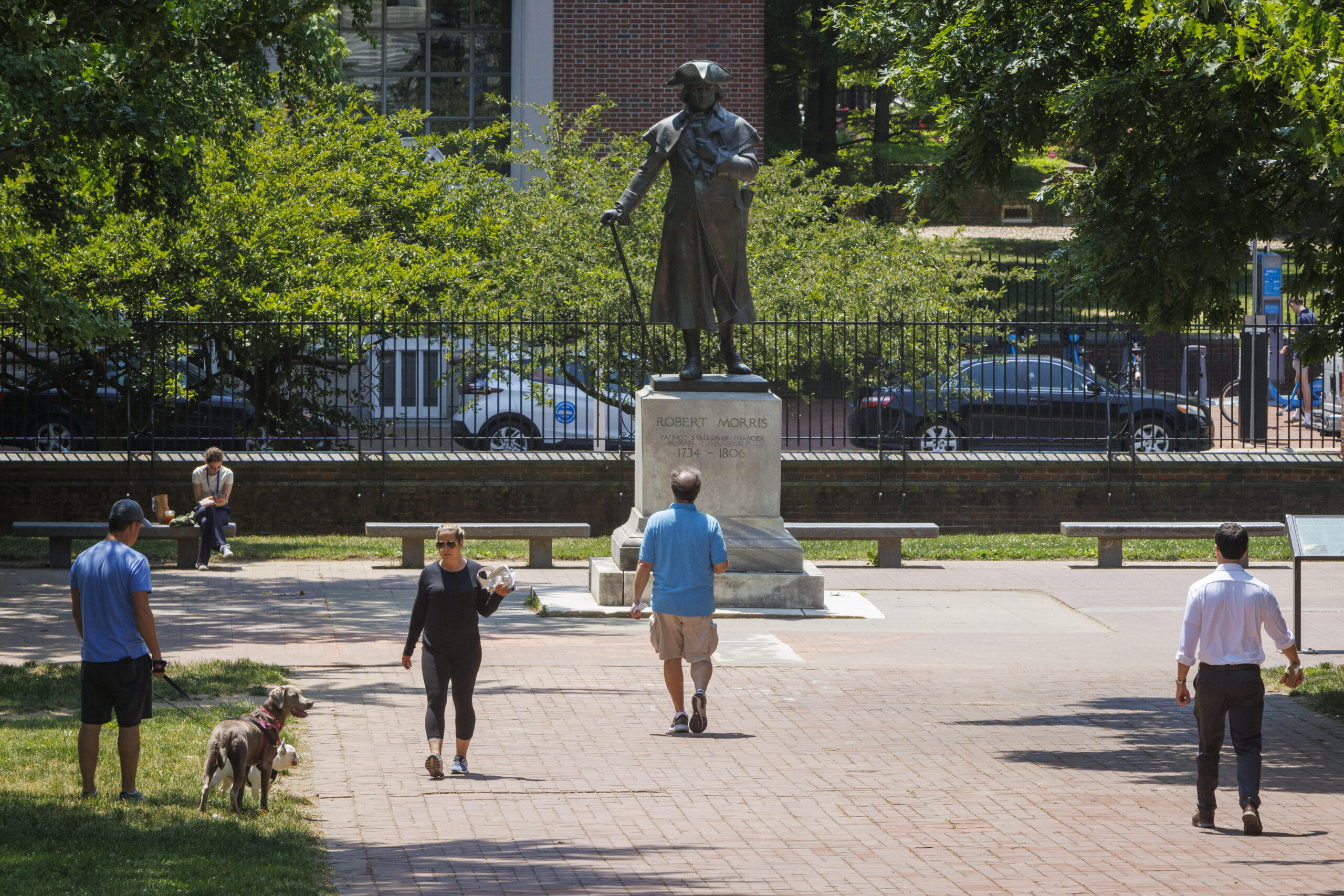
Better still are the two conspicuously empty chairs at the Pennsylvania table. Unable to vote for independence, but unwilling to thwart unanimity, Dickinson and fellow delegate, Robert Morris, voluntarily abstain. Despite his feelings, Dickinson will soon join the rebel militia — to fight for his country.
The statue of Robert Morris in Independence National Historical Park on May 31, 2023.
Again, the skies open up, raindrops drumming upon the glass.
With New York abstaining — and Pennsylvania swinging toward independence — the vote goes quick.
It is done.
Independence.
July 3, 1776
The Congress continues without a break.
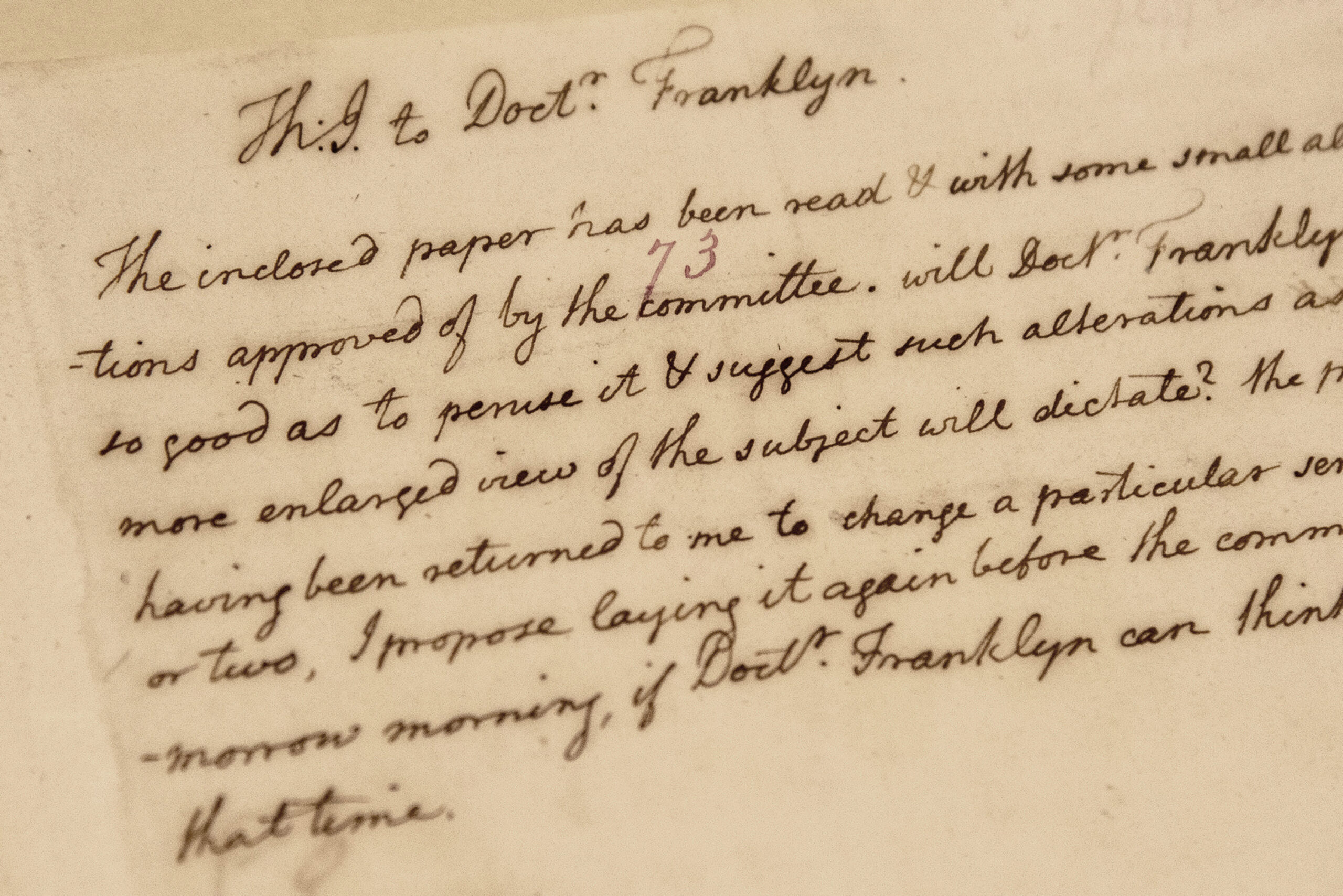
Days earlier, before handing in his draft of the Declaration of Independence, Thomas Jefferson turned to Benjamin Franklin for one last look.
A letter from Thomas Jefferson to “Doct. Franklyn” (Benjamin Franklin) in June 1776 asking for suggestions on the Declaration of Independence.
“Will Doctr. Franklyn be so good as to peruse it and suggest such alterations as his more enlarged view of the subject will dictate?” Jefferson inquires, in a note delivered to the silver-haired statesman’s High Street home.
It’s Franklin, sly satirist, homespun philosopher — grand auteur of America’s self-made aura — who possibly suggests, the inspiring “self-evident” phrasing, replacing Jefferson’s initial “sacred and undeniable truths.”
And it is Franklin, 70, spectacled lion of liberty, sage of Philadelphia, tamer of lightning, dean of American charm and wit, wooer of women, broad of bow and frame, portly of paunch and plain of coat, a winsome spark dancing across his gray-blue eyes, who comforts the young writer as delegates slash away at his declaration. The winking newspaperman unspools a tale about an enterprising hatmaker who wishes to advertise his wares. By the time the hatter’s friends finish their edits, all that remains is the man’s name, and a photo of a hat, Franklin jokes.
The delegates trim Jefferson’s harsher language about King George. They excise completely his evisceration of the slave trade. Jefferson does not publicly protest.
July 4, 1776
At 11 a.m., debate is closed.
The moment will eventually be memorialized in painting. The towering trio — Adams, Jefferson, Franklin — presenting America’s credo for approval. Imagine them, these Founding Fathers. These imperfect men for the ages who hazard everything to chance a republic, and change a world.
There is little ceremony. Horseflies from a nearby stable buzz. One after another, a chorus of “Ayes.”
Delegates break the tension with gallows humor about whose necks will snap the swiftest.
History does not record the face of the man who darkens the doorway of John Dunlap’s print shop. Perhaps it was Adams, unable to yield his obsession even in its ultimate realization. Perhaps, it was Franklin, delivering the declaration with a deliciously wry aphorism. Or Jefferson, solemn and silent with the weight of his words.
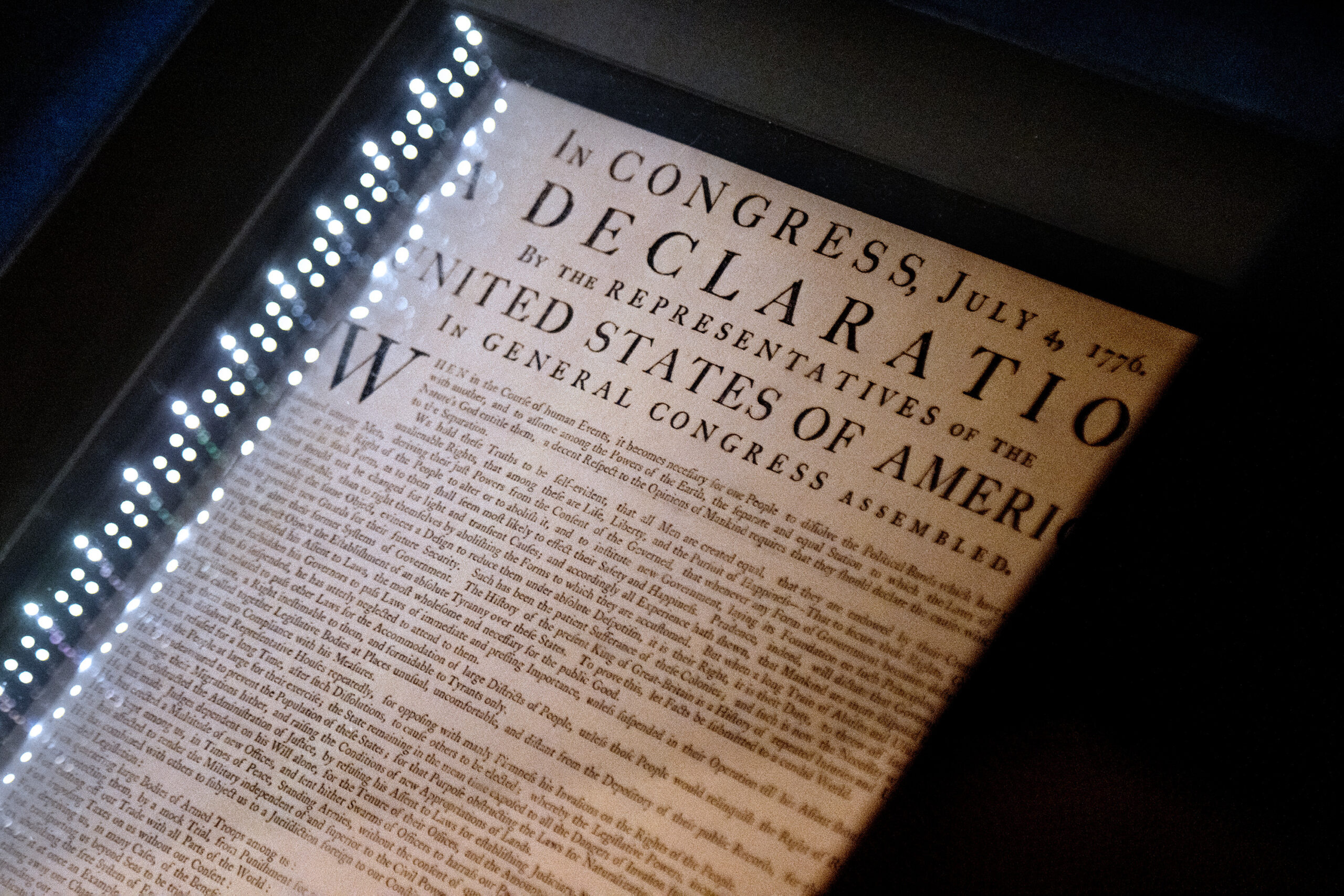
Dunlap works all night to the thumping groan of the presses. By morning, roughly 200 broadsides start to spread America’s newly minted founding document far beyond Philadelphia. Breathless riders herald the news in town squares.
In the trenches in New York, Washington orders the declaration read aloud. Bells ring. Troops parade. Bonfires alight. Candles burn. Prayers are whispered, for those sons and fathers who will die in the bloody conflict ahead.
By July 6, the Pennsylvania Evening Post, a paper published near Dunlap’s shop, prints the declaration word for word. Its previous issue had been put to press too early to capture the momentous events.
Instead, the July 4, 1776 edition included usual fare.
“To be sold,” read one back-page ad. “A NEGRO BOY, about four or five years of age.”
Crowds pack the State House yard, where the rebels had long conspired. A military officer reads the manifesto to the hushed masses.
Words that birth the American experiment on an ideal — and the sin of slavery. Words that will endure Civil War and oppression. Words that beckon centuries of American promise and possibility, triumph and failure. Words that inspire new revolutions, new freedoms, new fights. Words that transform. Words that twist. Words that promise a pursuit of happiness — but withhold so much from so many. Words that stand tested still.
Words written in Philadelphia.
An original broadside copy of the Declaration of Independence printed by John Dunlap on display in the “Great Essentials” exhibit in the West Wing of Independence Hall on July 29, 2025.
Jaylen Brown loves attention, which is why he went on Twitch to talk about his feelings just hours after releasing a statement on social media expressing his feelings about being traded from the Celtics to the Sixers for a PED cheat and four speculative draft picks.
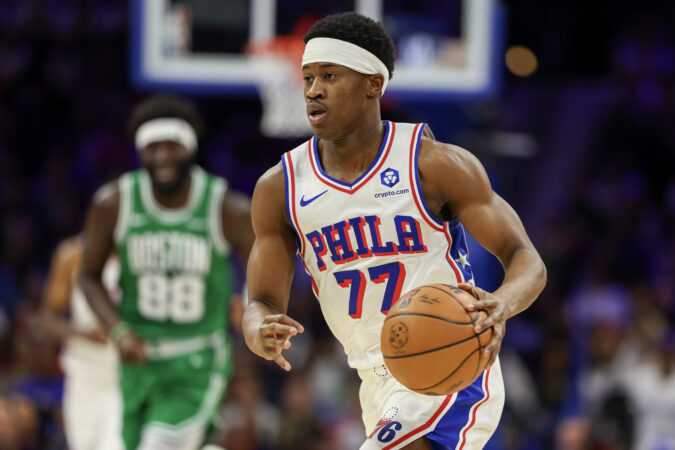
While Twitch-ing, or whatever it’s called, Brown got a phone call from the coworker who probably is happiest to have him aboard: VJ Edgecombe.
It was just 30 seconds of Gen Z acknowledgment and ego stroking, but there was a real vibe of Thank God you’re on my team so now I don’t have to play every minute of every game.
V.J. Edgecombe calls into Jaylen Brown’s stream. 🤣🤣🤣
"You on stream gang, it's JB…I know it's JB bruh. I got your number."
Call it Process 2.0, and understand that Edgecombe, properly nurtured, will be as important to its success as anyone.
That nurturing process got a lot smoother when the Celtics gave Brown away on Wednesday.
It could get even smoother if King James arrives.
On Thursday, LeBron James’ camp let it be known that he would consider playing next season in Philadelphia now that Brown has joined Joel Embiid, Tyrese Maxey, and Edgecombe. The King, now 41, is hunting a fifth NBA title, and Philly has become a viable contender within the last few days, even though the Sixers currently can pay him only the veteran minimum, just under $4 million. This would be a $48 million pay cut from last season with the Lakers.
Don’t hold your breath.
As insane as landing LeBron would be, shedding a bad contract and landing a superstar is even nuttier. And fishier.
Something is amiss when the smartest organization in basketball gives away a top-10 player and asks in return for a broken-down PED cheater and two first-round picks that probably aren’t going to be that good anyway.
At any rate, the Celtics on Wednesday traded Brown, a five-time All-Star, who is 29, to the Sixers for Paul George, who is 36, and who has had just one good season since he was 29. The Sixers also sent first-round picks in 2028 and 2031 and two second-round picks to Boston. The most significant aspect of the deal is that it erased the worst contract in the history of the franchise; George has two more seasons left on a four-year, $211 million deal, and he hasn’t been worth one-tenth of it.
The move also made the Sixers an immediate NBA title contender, since Brown is everything the Sixers wanted George to be: a shot-creating athlete at all three levels who can play and defend multiple positions.
The deal also delivers an invaluable byproduct.
It gives Edgecombe time.
Time to develop.
Time to learn.
Time to rest.
Edgecombe not only led rookies at 35 minutes per game, he ranked 11th in the entire league and averaged the eighth-most minutes for a rookie guard in the last 17 seasons. As the Sixers dealt with injury absences of Joel Embiid as well as the early load-management strategies and the late PED suspension of George, Edgecombe proved himself too good to not protect.
“VJ is going to be a lot better in the long run with J.B. around,” said an NBA source who is intimately familiar with the 76ers. “At the end of last season, he was pretty worn out.”
Outside of a diminished three-point shooting percentage, the wear and tear didn’t really show up in his other raw stats. They dipped in the playoffs, but then, Embiid and George were back on the court for much of the late season and postseason. But his decision-making became errant, his shot selection more questionable, and he tended to disappear. He needed help that his big-money vets were not there to provide.
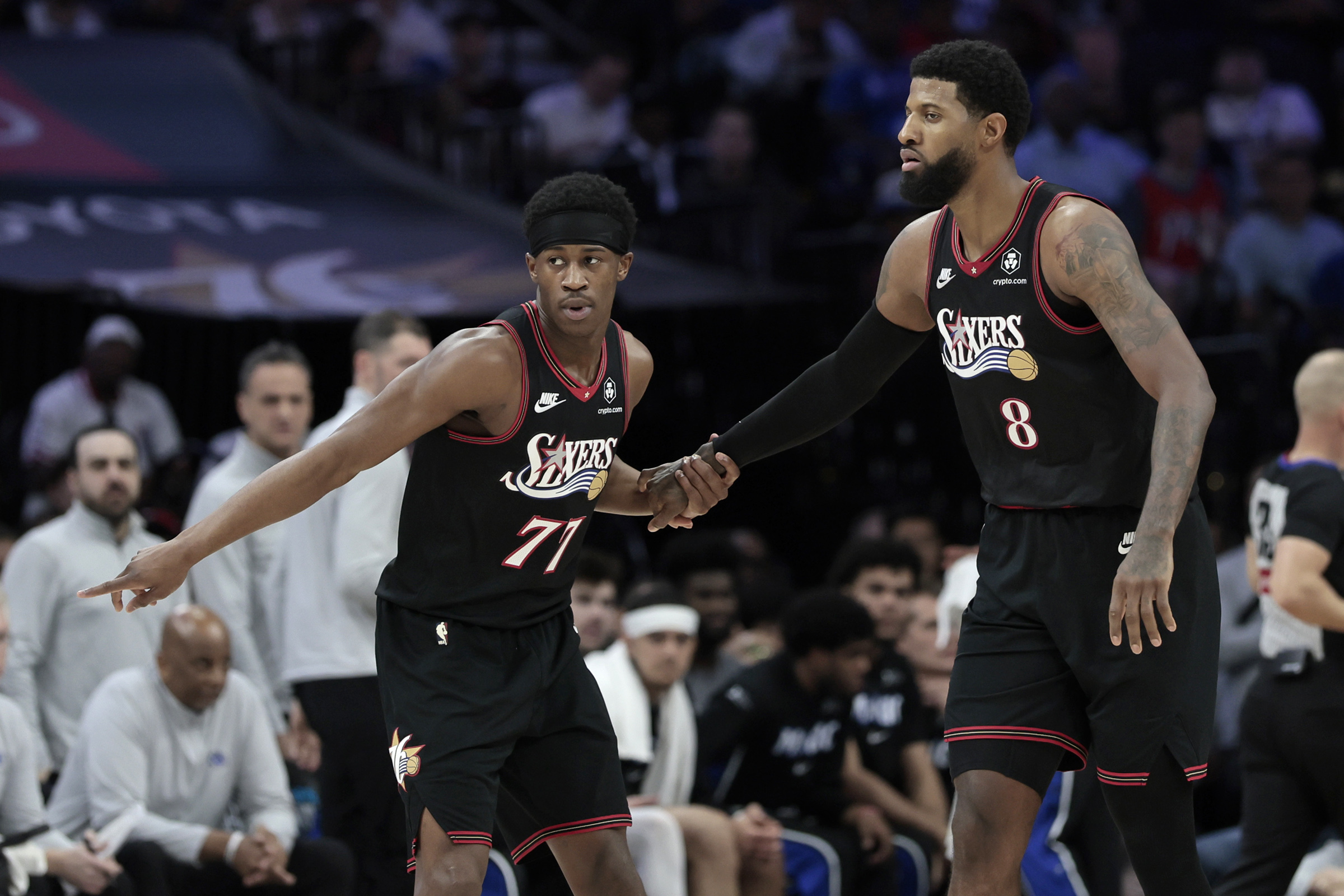
The absence of Paul George (8) had a trickle-down effect at times on VJ Edgecombe.
Combined, they missed 89 of 164 games, more than half. This has been the norm for both of them for the past few seasons.
Brown plays about 20 more games a season than Embiid and George.
That means that when Embiid misses his 30 or 35 games this season, Brown will be there to carry the load, whereas George was not.
That also means that when Embiid plays, Edgecombe will not have to serve as the second or third offensive option, using moves he shouldn’t be making and taking shots he shouldn’t be taking for at least another season or two. When the Sixers drafted him third overall, most projections cast him as a superior athlete with unlimited defensive potential but with limited plug-and-play offensive ability. He learned fast, averaged 16 points per game, and made the All-Rookie team, but, man, there were some ugly nights and some ugly shots.
Brown will also help Maxey get off his feet a little more. Maxey led the NBA at 38.0 minutes per game in an MVP-caliber season, but he wore down, too. Both were affected by the early injury absence of Jared McCain, and then by McCain’s exit at the trade deadline, as well as the lack of consistent contributions from guard Quentin Grimes.
Edgecombe and Brown don’t play the same position, exactly, but they will combine with Maxey, and possibly rookie Labaron Philon Jr., to manage the primary backcourt duties.
Brown will arrive motivated to make the best impression possible.
He’s in line for a two-year, $140 million extension that will put him under contract for the next five seasons. He will be a more focused defender and rebounder, play-make with more alacrity, and, inevitably, he will assume the role of mentor to Edgecombe that George served last year.
He said in Thursday‘s social media post that he was “Excited and disappointed at the same time” to be leaving Boston, where he won a title, and coming to the Sixers, who bounced him from the playoffs this spring.
It was delivered with Brown’s typical class and polish.
The Twitch stuff? Less classy, less polished, but just as real.
The Celtics, meanwhile, immediately started planting narratives about how zero-time All-Star guard Derrick White is a more valuable player than Brown. ESPN insider Brian Windhorst also reported that the Celtics, after consulting their analytics, considered it imperative to get backup center Mitchell Robinson off the court when they played the Knicks. Then, on Wednesday, they signed Robinson to a three-year, $47.4 million deal.
No wonder the Sixers knocked them out in the first round.
There is always the possibility that this trade is not as lopsided as it seems. The Celtics certainly didn’t see the value in retaining a guy who can make more than $320 million if he’s offered an extension.
The pocket protector crowd loves to cite and manipulate undependable metrics that diminish Brown’s obvious talent, skill, value, and performance. They insist that his playmaking fluctuates, his defense is overrated, and his shot diet doesn’t regularly generate the most efficient looks for him or his teammates.
Remember, analytics is an industry, and it has to feed itself and convince its consumers of its necessity.
Therein lies an irony. As much as analytics have torpedoed the Sixers’ plans, execution, and hopes over the past 14 years of “The Process,” it appears that analytics now have delivered an unexpected reward — in the form of Jaylen Brown.
O little town of Bethlehem, how we see thee as just a place to visit during the holidays.
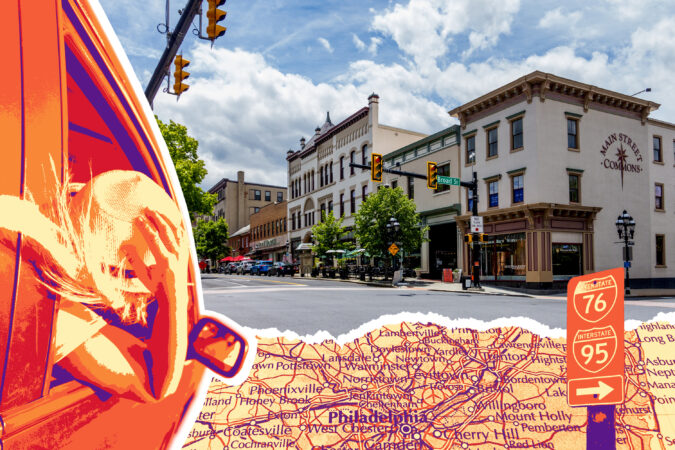
It’s true that the former steel city, tucked between Allentown and Easton along the Lehigh River, leans into — and has built a whole tourism industry around — its Christmas-themed name and roots, but there’s much more to Bethlehem than carols and holly.
The forest and river beckon in summer, and the city’s position along the Delaware and Lehigh Trail, which parallels the Lehigh Canal, puts visitors within easy access of both.
There’s an old-fashioned ice cream parlor, a grand historic hotel, a blueberry festival, even a UNESCO World Heritage Site. And if you really, really need a dose of holiday spirit, Christmas in July is right around the corner.
Bethlehem’s main street (literally, Main Street) twists up from the Lehigh River and stretches like taffy into a long straightaway lined in shops and cafes. At the foot of this drag is Hotel Bethlehem, built atop the 1741 foundation of the First House of Bethlehem and later the 1823 Golden Eagle Hotel. It has operated as Hotel Bethlehem — through periods of both glamour and neglect — for more than a century. Today, its crimson neon sign glows above the brick facade, while its rooms blend industrial touches with classic historic design. Across the street, a collection of modern suites houses the hotel’s spa. The property has been named the nation’s best historic hotel by USA Today, for five years running.
Cross the river to the South Side Historic District for breakfast — think vanilla-cinnamon French toast or loaded home fries bowls — or lunch, with options like a Cuban sandwich or cheddar-jalapeño burger. Cafe the Lodge is more than a charming cafe with a courtyard garden and art gallery. Since opening in 2012, it has provided transitional employment and housing opportunities for adults living with mental health diagnoses.
📍 427 E. Fourth St., Bethlehem, Pa. 18015
See: Moravian Church Settlements
Long before the Protestant Reformation, the Moravians were establishing a religious movement in Central Europe. Fast-forward a few centuries, and the Moravian church established an American foothold in Bethlehem whose well-preserved 18th-century buildings, cemetery, and museum now form part of the only transnational UNESCO World Heritage Site in the U.S. (sister settlements in Ireland, Denmark, and Germany comprise the collective). The Moravian Church Settlements tour explores this fascinating history, whether you’re interested in religion or simply great storytelling.
You gotta love a small-town summer fruit festival, and Bethlehem goes all in on blueberries every July. The 39th annual Bethlehem Blueberry Festival returns to Burnside Plantation the weekend of July 18 with blueberry pie, ice cream, coffee cake, lemonade, doughnuts, strudel, and just about every other indigo-colored treat imaginable. There are also live musicians, blacksmithing demonstrations, baby-goat snuggling and, naturally, a pie-eating contest. Resist the urge to yell, “Violet, you’re turning violet, Violet.”
📍 1461 Schoenersville Rd., Bethlehem, Pa. 18018
Move: Historic Bethlehem River Tours
There’s no need to decide between a paddle down the Lehigh River or bike along the Delaware and Lehigh Trail with Historic Bethlehem River Tours. Their Glendon Dam Discovery package, which launches from the Nagy’s Landing trailhead just east of downtown, pairs a peaceful two-mile downstream paddle with a six-mile bike ride to the dam’s overlook. It’s beginner-friendly and unguided, meaning you can go at your own pace, with HBRT providing all the equipment (and a shuttle back if you’re feeling lazy).
Named after a wild mushroom, Bolete isn’t just one of Bethlehem’s best restaurants. It’s one of Pennsylvania’s best restaurants. Chef-owner Lee Chizmar serves an exactingly prepared, terroir-driven menu in a stone-walled former country inn dressed with maximalist wallpaper and antique lighting. Depending on the season, you might find smoked pork chop with cherries and shiitakes, or foie gras paired with funnel cake, blueberries, and Valley Milkhouse fromage blanc.
If a town has a historic ice cream stand, and it’s summer, you should proceed immediately there for dessert. Bethlehem’s is the Bethlehem Dairy Store, a low-slung diner with neon sundaes and hot dogs in the windows that’s giving Nifty Fiftys. But “The Cup,” as locals call it, far predates Nifty, opening way back in 1927. Hand-dipped ice cream, soft serve, frozen yogurt, and sherbet comprise the roster of frosty treats, coming in flavors like dulce de leche, lemon cookie crunch, chocolate raspberry truffle, and mint Oreo.
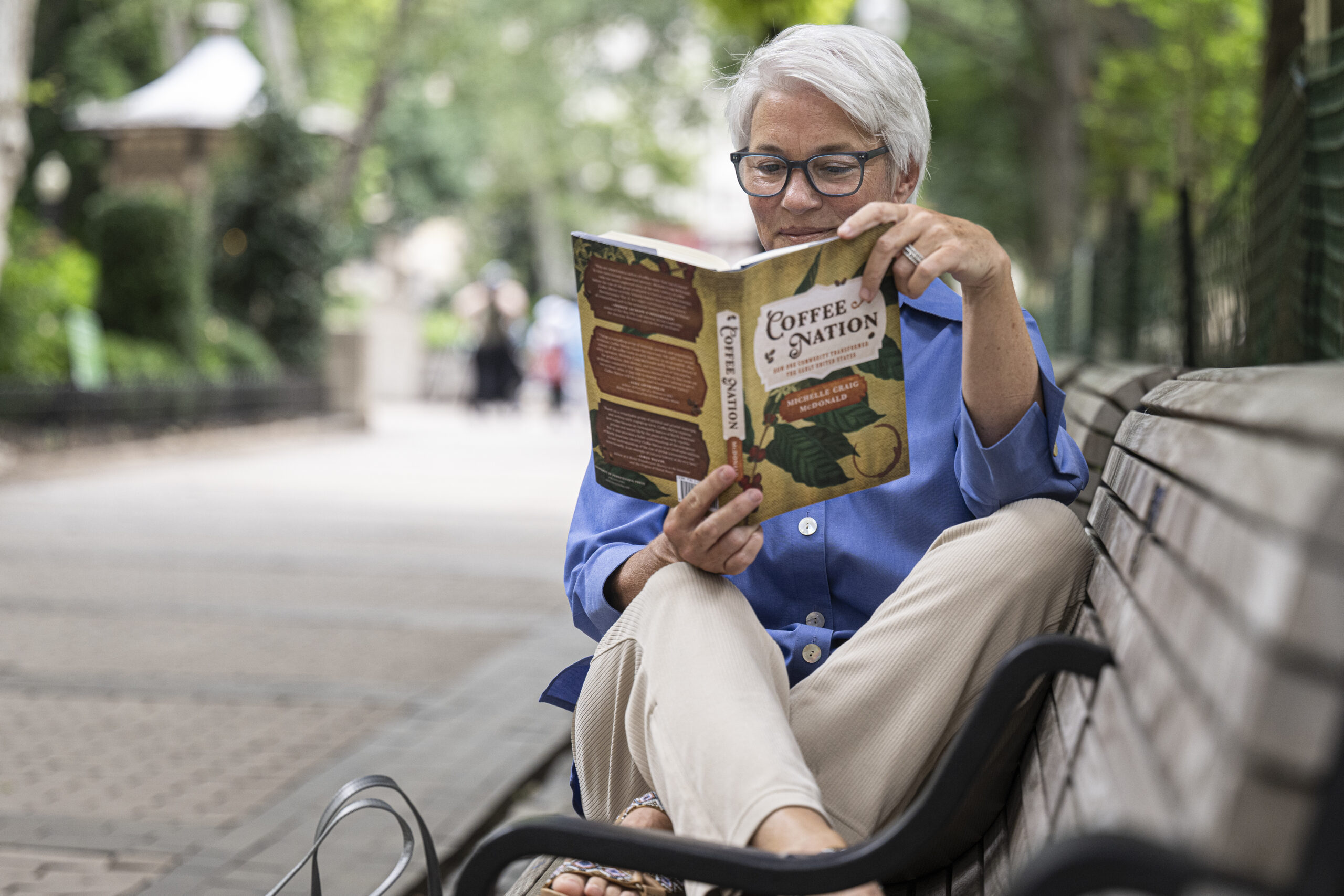
Philadelphia historian, author, and educator Michelle Craig McDonald knows her coffee. Especially the revolutionary kind.
McDonald, who serves as an academic adviser for PBS’s series Drive By History, is the author of the new book, Coffee Nation: How One Commodity Transformed the Early United States.
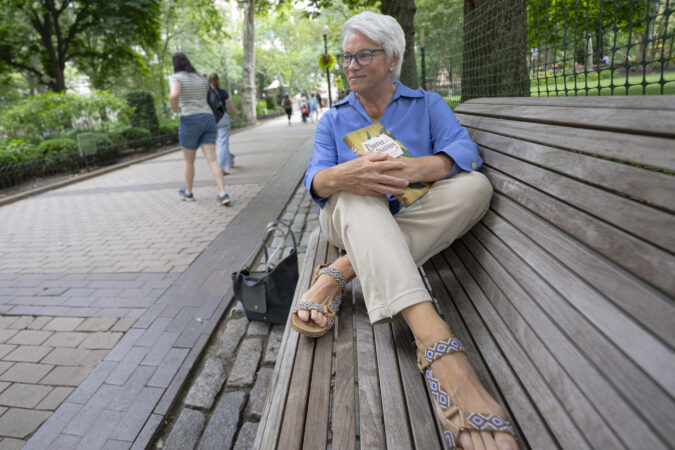
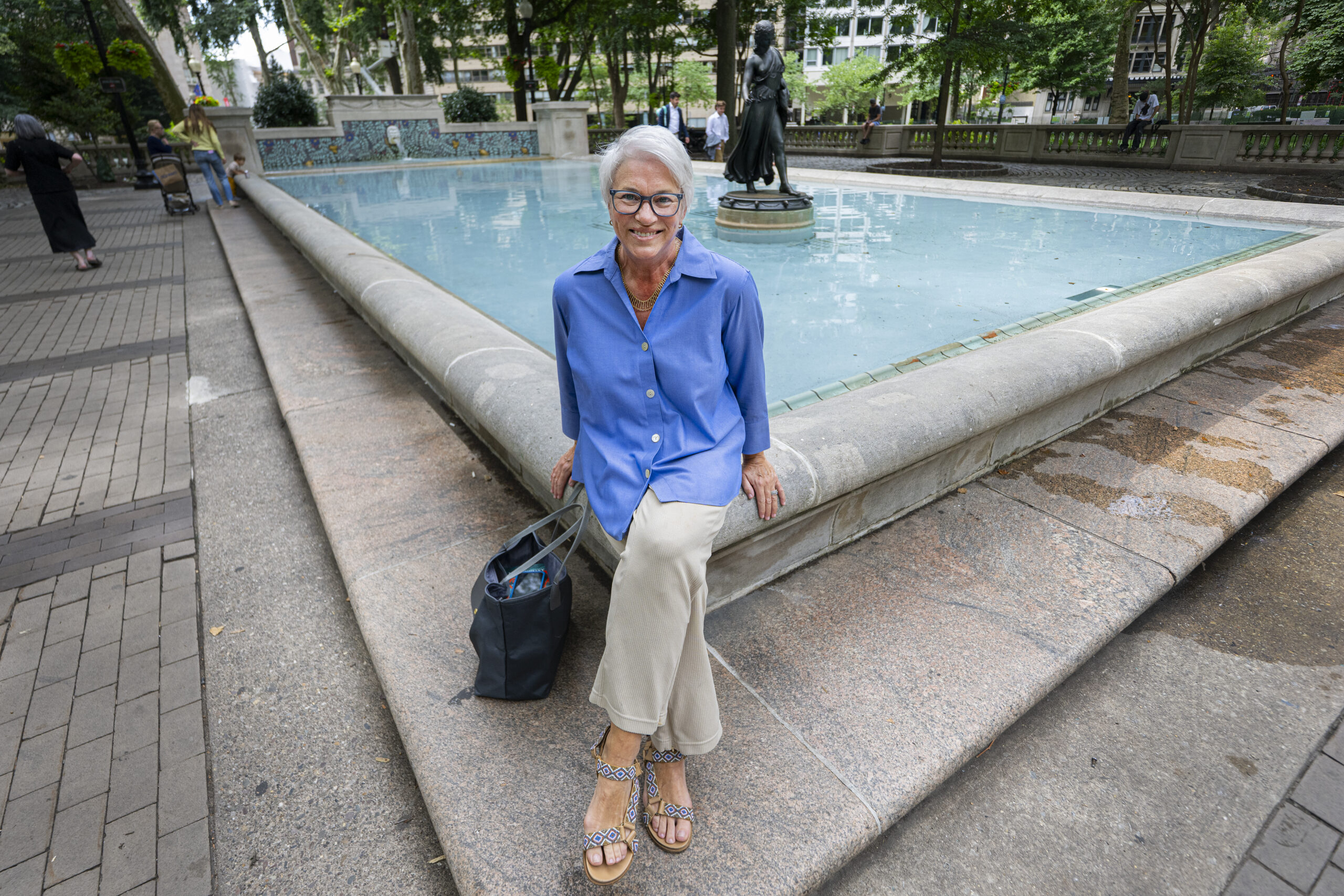
Philly historian and educator Michelle Craig McDonald enjoys reading in Rittenhouse Square Park. She is the author of “Coffee Nation: How One Commodity Transformed the Early United States.”
Telling the story of America and coffee, McDonald traces the bean’s beginnings from slavery-based plantations of the Caribbean and South America in the early 1700s through its prominence in Colonial life to the rebranding of the exotic good as an American staple. McDonald details the emergence of coffee shops, like the Old London Coffee House at Front and Market Streets, as critical Revolutionary-era hubs for politics and business.
“Within 50 years of our independence, the United States becomes one of the largest suppliers of coffee to the world — but we can never grow it,” said McDonald. So in this moment, when we think about independence, coffee really reminds us that the United States remains deeply tied and deeply embedded with the economies of the region. It was not just a self-sustaining nation that looked inward.”
Given the nature of her research, it’s no surprise that McDonald’s Perfect Philly Day revolves around food and drink. McDonald, a Southern California native who lives in Rittenhouse Square with her husband and fellow historian, Roderick A. McDonald, said her perfect day includes lots of coffee and cooking, a great Philly workout, and reading crime novels in Rittenhouse Square.
6:30 a.m.
My coffee pot is my first spot. I’m going to need fortification if I’m going to tackle the day’s news. I just go with the tried and true Colombian roast from Trader Joe’s.
When we are down the Shore, my favorite comes from Remedee Coffee, started by two sisters who source their beans from Colombia. It’s a great small business.
On a perfect day, this is when we do our New York Times games — like Connections or Wordle — which we do together. My sister says it’s cheating. I like to say it’s “collaborating.”
8:30 a.m.
I love cooking of all kinds, but baking is my first love. My go-to on a perfect day is a batch of scones. I have a recipe that I got online from a website called Love and Lemons. It’s a base recipe. You can make anything you want. Cranberry, orange walnut, apricot, ginger almond, or my brother-in-law’s favorite, which I know because he buys the ingredients every time I visit, blueberry lemon.
I used to head over to Metropolitan Bakery on 19th Street, which I am still mourning the loss of.
I loved their Millet Muffins and raisin walnut bread. My freezer is stuffed with both because I bought as many as I could before they closed. And I’m slowly rationing them so I don’t lose them quickly.
9:30 a.m.
We have a solid division of labor in the household. I do the cooking. But my husband does the shopping. While the scones are in the oven, he may well be on his way down to the Italian Market on his vintage 1962 Schwinn bicycle — expertly serviced by Curtis at Via Bicycle on Broad Street. He’s a fan favorite!
My husband is the provisioner of the house. I get to take what he brings back from the list — and sometimes not from the list. It feels like my own personal version of Chopped. He comes home with five ingredients and says, “What can you do with this?’”
10 a.m.
I’m hitting the gym. I do love eating, which means I need to pay the piper. I go to Pure Barrein Center City. It’s wonderful. It’s a class — a core-based workout that does weightlifting, planks, pushups. An hour there, any day I can get it, gives me enough brownie points for the rest of the day’s culinary adventures.
If the weather is nice, we might substitute a bike ride down the Schuylkill River Trail. Manayunk is a great destination.
Noon
That’s when Small World Seafood is in the area with deliveries. It’s an Old City business that was born out of necessity. The owner provided fresh seafood to restaurants during the COVID-19 pandemic. Then he began an online business selling directly to customers. You can get anything — halibut, skate steaks, steelhead trout, oysters, clams — for a lazy cooking night.
Michelle Craig McDonald’s perfect Philly day includes lots of coffee and cooking, a great Philly workout, and reading crime fiction in Rittenhouse Square.
1 p.m.
I’ve got the fish and I’m marinating it for dinner. Steelhead trout is one of my favorites, so super easy, a little bit of soy, a little bit of orange, a little bit of brown sugar, a little bit of maple, and garlic.
2 p.m.
On a perfect day, when I can while my time away, you will find me reading in Rittenhouse Square. I have an abiding passion for crime fiction. Ann Cleeves. Donna Leon.
And if it’s not great weather, you could still find me reading, but probably in one of any of a dozen coffee shops that are within walking distance of my house.
There was a great article that just ran recently in The Inquirer about the rise of Yemeni coffee shops in the city, such as Moka & Co.
3 p.m.
This is where it’s going to get busy. I would be remiss if I didn’t bring a little history and culture into this day. The American Philosophical Society has a wonderful project called “The Revolutionary City: A Portal to the Nation’s Founding.” It’s a partnership where five Philadelphia historical institutions — the APS, the Library Company of Philadelphia, the Historical Society of Pennsylvania, the Kislak Center at Penn Libraries, and the Museum of the American Revolution — came together to plan for 2026, and all their exhibits build on each other. Now I know that’s a long afternoon. Readers can pick and choose and see the others on their second favorite perfect Philly day [laughter].
6 p.m.
My husband and I cook together. If it’s Saturday, the compulsory listen is “The Many Moods of Ben Vaughn.” Cooking is my way to unwind and my husband is an excellent sous chef.
8 p.m.
We tend to have a leisurely meal with a glass of wine or two, and review the day’s exploits. An episode of television in the evening is a good escape. We are huge PBS fans. We love British crime dramas. We are huge fans of Shetland, a Scottish crime drama, and Vera, an old British crime drama with a curmudgeonly police detective.
10 p.m.
I am not a night owl. But I will confess to a wee dram of bourbon most evenings. Then, a little more light reading. And it’s time for lights out.
This interview has been edited for length and clarity.
The house: A 1,150-square-foot townhouse in Southwest Philly with two bedrooms and two bathrooms built in 1925.
The price: Listed for $180,000; purchased for $165,000.
The agent: Kristie Bergey, Coldwell Banker
The ask: Dylan Foglesong felt like he was overpaying for his apartment. He was spending $2,600 a month, plus utilities, for a two-bedroom place in Manayunk, and the money was going toward a place he would never own.
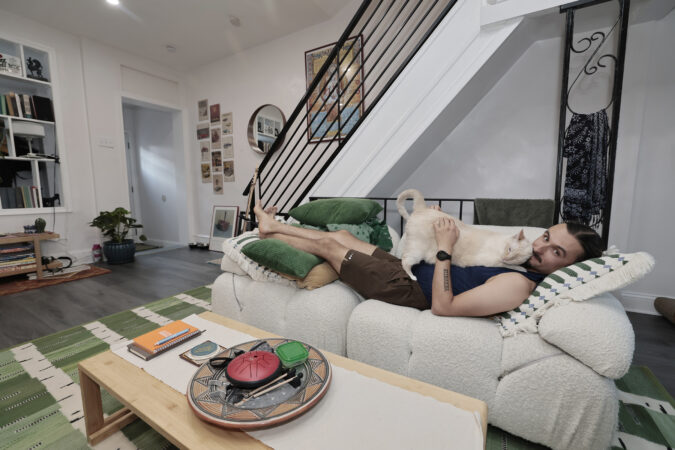
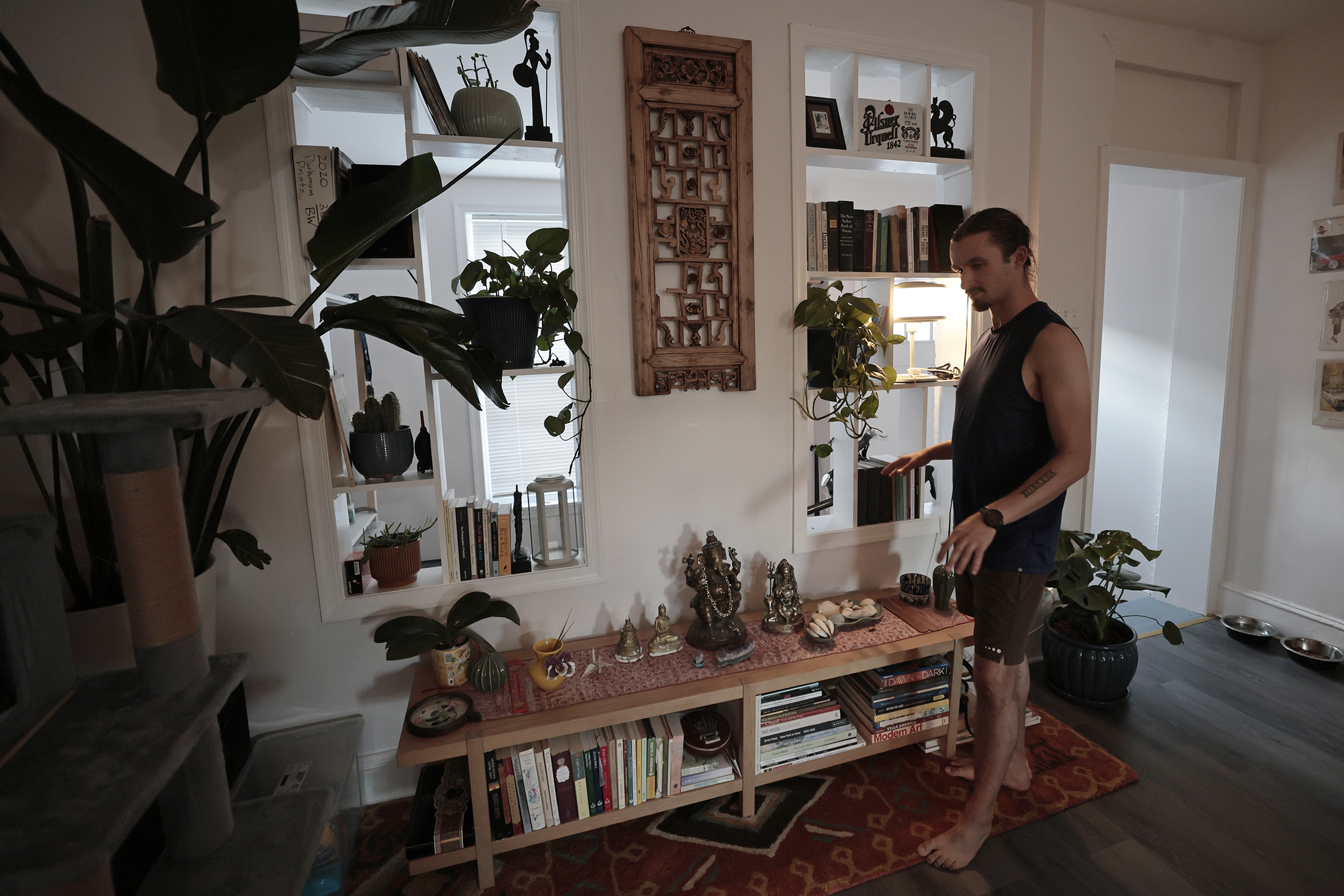
Dylan Foglesong tends to an area he calls the shrine in his home.
After six months, he paid the fee to break his lease and moved into a house with friends. His rent dropped to $600 a month, and because he was subletting month-to-month, he could leave whenever he wanted. He was saving more than $2,000 a month, and he realized he could put that money toward buying a house.
Foglesong had a simple wish list. As an avid cyclist, he wanted to be near multiple bike paths. He also wanted outdoor space, two usable bedrooms, and a low price. He did not care about central air or polished finishes. “I just wanted a cheap place that worked,” he said.
The search: Foglesong started searching in January,focusing on a small section of Southwest Philadelphia near Bartram’s Garden and the trail network along the Schuylkill. He wanted to remain close to Center City so he could bike to work.
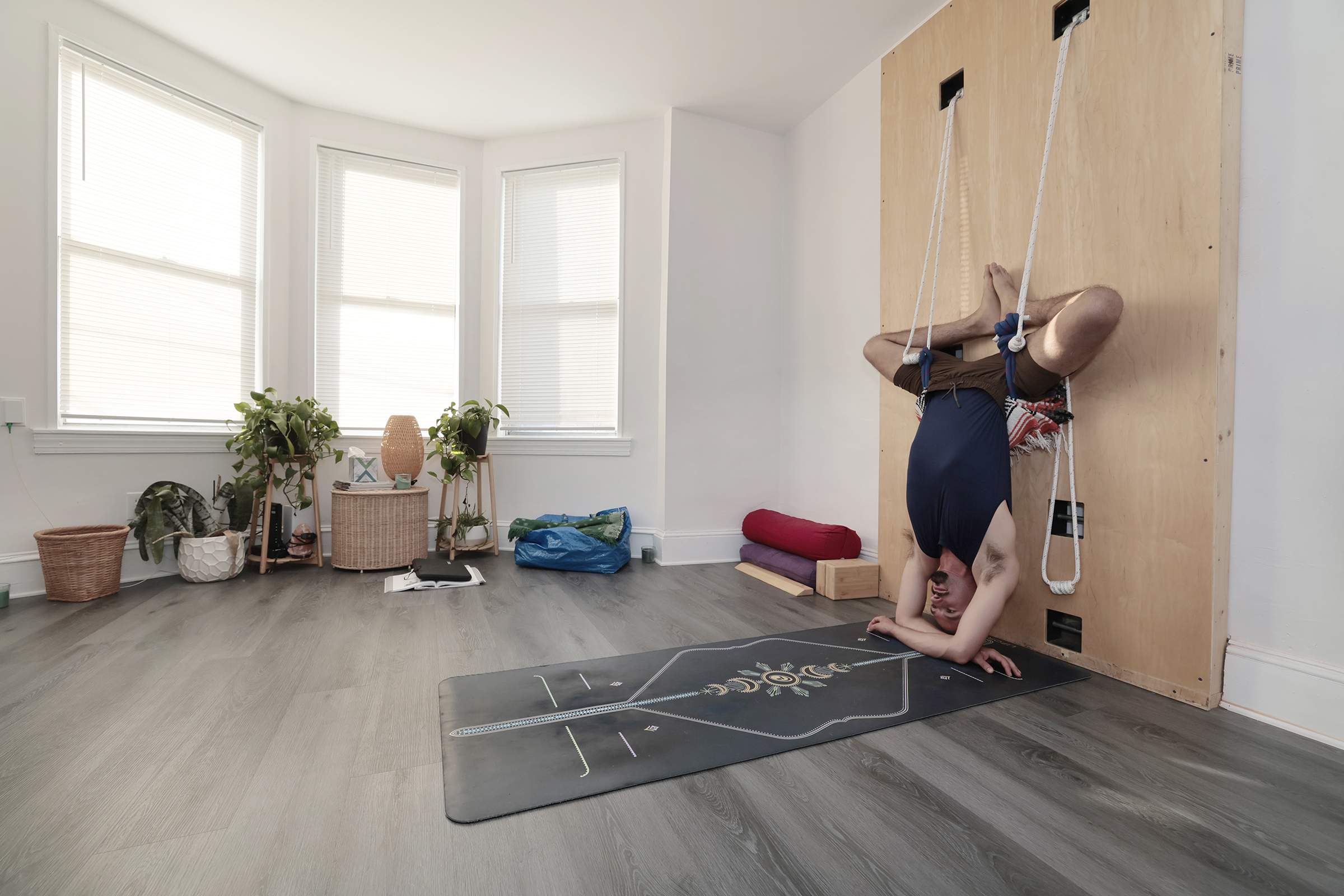
Foglesong uses the rope wall to work out in the studio of his home.
He saw five houses. The first one was in his ideal location, but the floors were scratched and coming up, the kitchen looked decades out of date, and the upstairs had the cramped three-bedroom layout he wanted to avoid. It would have taken too much work to reach a point where he was not “barfing every morning at how much of an eyesore it was,” he said.
The only other serious contender had a large backyard, a clean basement, and an updated kitchen. But a quarter of the ceiling in one upstairs room appeared to be collapsing because of a leak. The house was listed for about $212,000. Foglesong offered $190,000, figuring he could use the difference to repair the roof, but the seller rejected the offer.
The appeal: The fifth and final house had a great layout. Both rooms upstairs were large. It also recently had “a really thoughtful renovation,” Foglesong said. The updates included a new HVAC system and appliances, while the house also had a finished basement with high ceilings, outdoor space, and an enclosed front porch where he could store his bikes.
Foglesong also liked the location on a quiet side street with little through traffic. “It’s on the kind of street that you wouldn’t drive down unless you lived there or you knew someone who lived there,” Foglesong said. Most of the houses on the block were occupied, which made the neighborhood feel established.
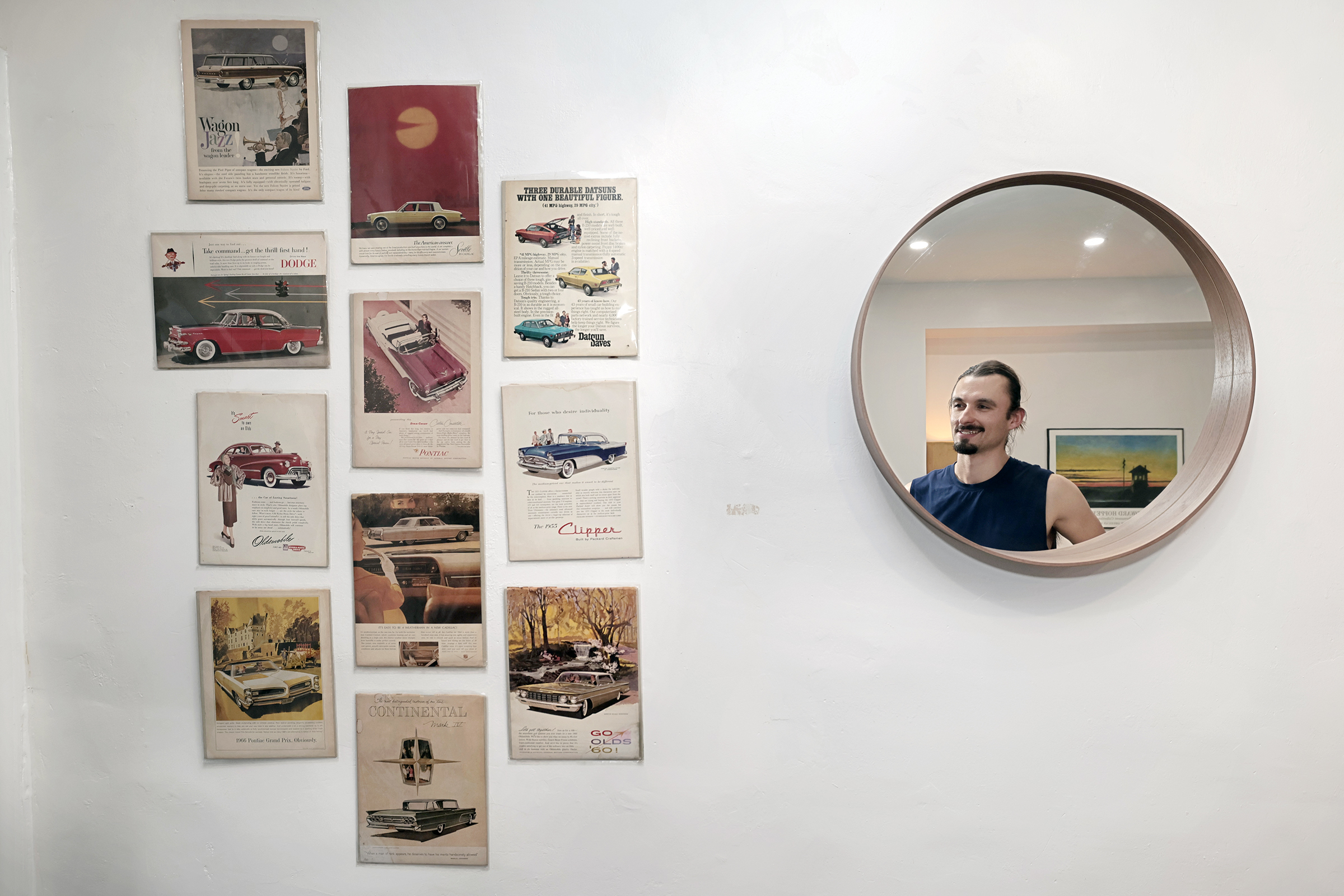
Dylan Foglesong is reflected in a mirror that hangs, next to classic car ads, in the foyer of his home.
The deal: The house had initially been listed for a little more than $181,000 before the seller lowered the price to $180,000. It had been on the market for roughly five months by the time Foglesong saw it.
He offered $170,000 and asked the seller to contribute 3% toward closing costs. They declined the closing assistance but countered at $165,000. The lower price ended up saving Foglesong the same amount of money, so he accepted.
The inspection was clean, save for one issue with the electrical. When Foglesong called Peco to arrange service, he learned that the house was not legally connected, even though the power was on. An electrical inspection found that the breaker box needed work, and the seller hired an electrician to set it up properly. But Foglesong still could not transfer the service into his name until the seller paid thousands of dollars in outstanding utility balances. The whole thing “seemed a little sus,” Foglesong said, but it worked out.
The money: Foglesong put 3% down, or $4,950. Including his closing costs, he paid about $11,600 out of pocket to buy the $165,000 house. His mortgage rate is 6.25%. Today, his monthly payment, including property taxes, is $1,300.
He already had some savings when he moved in with roommates, but the drop in rent allowed him to build the rest quickly. He estimates that he was saving nearly $3,000 a month. Within 3½ months, he had accumulated enough to cover the down payment and closing costs. “You take that little compromise for a couple of months,” Foglesong said about moving in with friends, “and all of a sudden you have $11,000 in your bank account.”
The move: Foglesong closed in April and moved his belongings from the shared house into a 10-foot U-Haul. Everything fit in one load, and he completed the move over two days without hiring movers or asking friends to help.
He managed it alone because he did not own much heavy furniture. His couch comes apart into sections, and he sleeps on a futon that he could fold and carry over his shoulders. For everything else, he improvised. “You put a blanket on the stairs, slide the furniture down,” Foglesong said. “You figure it out.”
Life after close: At first, buying the house felt less momentous than Foglesong expected. He had imagined “a really grand, movie-montage sequence,” he said, but moving in felt much like any of the other moves he had made during his 10 years in Philadelphia.
But as the weeks passed, the difference between his new home and the others became clearer. He was no longer paying rent for a place that belonged to someone else. He owned the house, and the monthly payment was within his budget. “It’s very grounding to wake up in a place that you can afford,” Fogelson said.
The experience also reinforced his belief that young buyers may need to reconsider what they expect from their first home. “You have to be realistic about what you can access right now,” Foglesong said. “Your first house doesn’t have to be your dream home.”
Editor’s note: This article has been updated to correct real estate agent Kristie Bergey’s name.
Did you recently buy a home in the Philadelphia area or South Jersey? Share the story of how you did it. Email Inquirer real estate reporters at properties@inquirer.com.