Tag: topic-link-auto

  • Par Funding salesman Dean Vagnozzi sues, accusing feds of ruining his business

    Par Funding salesman Dean Vagnozzi sues, accusing feds of ruining his business

    Dean J. Vagnozzi, whose King of Prussia insurance and investment business was taken over by a court-ordered receiver in the federal investigation of the Par Funding Ponzi scheme, has sued the U.S. government, accusing federal officials of abuse of process, negligence, and unconstitutional search and seizure.

    In the lawsuit, Vagnozzi says he was a Par victim, his business wrongfully destroyed amid the investigation that led to criminal charges that have sent eight former Par Funding officials, debt collectors, and accountants to prison after they pleaded guilty to ripping off 1,600 people. Those clients included hundreds of Vagnozzi’s customers and members of his family, and the scheme ended up owing them $240 million.

    Vagnozzi attracted customers with radio ads urging investors to consider alternatives to the stock market. He paid civil settlements totaling $5.7 million to the U.S. Securities and Exchange Commission (SEC) and smaller amounts to state securities agencies to settle complaints for selling unregistered securities, including those of Par Funding, a cash-advance lender to businesses that had trouble qualifying for bank loans and others. Vagnozzi blamed the failure to register on bad advice from his longtime lawyer, whose insurers agreed to pay investors, Vagnozzi, and others $47 million to settle their claims.

    In contrast with the Par Funding operators, Vagnozzi has not been charged with crimes.

    The complaint

    Vagnozzi’s lawyer, George Bochetto, argued in the complaint filed Dec. 8 in federal court in Philadelphia that it was “egregious government overreach” for the SEC to allege illegal acts in a petition that convinced U.S. District Judge Rodolfo Ruiz to include Vagnozzi’s former business, A Better Financial Plan, alongside Par-related assets seized in a 2020 court order,

    The complaint contends that the SEC should have known the investment funds it initially accused Vagnozzi of setting up for Par founder Joseph LaForte to evade Pennsylvania investigators were actually started by Vagnozzi on his then-lawyer’s advice when Vagnozzi was unaware of the state’s investigation.

    The suit adds that Vagnozzi could have shown this, if the SEC had asked before acting, by citing correspondence and records, including the SEC’s own documents, which he submitted as case exhibits.

    The court issued a sweeping order based on the SEC petition. So “on Tuesday, July 28, 2020, a court-appointed receiver arrived unannounced at Vagnozzi’s office, ordered him, his son, his sister, his father-in-law, and the rest of his staff into the conference room, and told them to leave immediately. Vagnozzi’s business, ABetterFinancialPlan.com LLC, which he had carefully built over 17 years, was effectively shut down and placed out of business,” according to the lawsuit.

    The seizure of his company and accounts left more than a dozen employees out of a job and Vagnozzi unable to earn a living. His reputation was “irreparably harmed and his assets and businesses ruined,” the suit contends.

    When the company was seized, Vagnozzi’s businesses unrelated to Par Funding were collecting revenues at the rate of $4 million a year and growing, according to Bochetto.

    At that rate, Bochetto estimates Vagnozzi’s lifetime losses as a result of the SEC’s actions at more than $50 million.

    The SEC declined to comment on the litigation.

    Vagnozzi’s suit accuses Amie Berlin, an SEC lawyer who led the case for the agency’s Florida office, and other, unnamed federal agents of “malicious” infringement on Vagnozzi’s constitutional right against unreasonable searches or seizure. Berlin didn’t respond to a request for comment.

    Vagnozzi the victim?

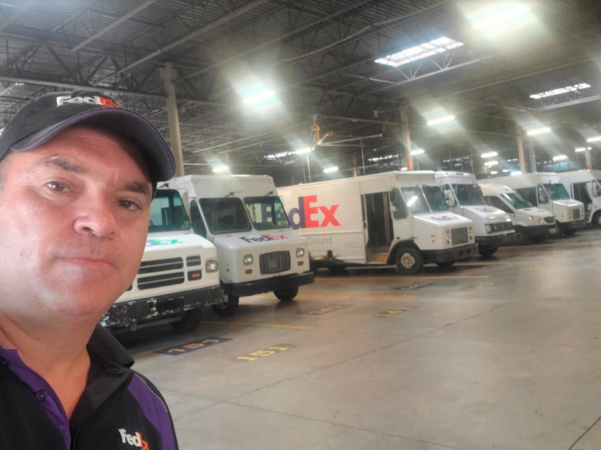
    After losing his company, Vagnozzi ran a Federal Express route for 2½ years and worked in sales for a home-improvement company. He has applied for reinstatement of his Pennsylvania insurance license, which was suspended in 2022 after his company’s seizure.

    According to the lawsuit, the SEC wrongly “assumed without legitimate basis” that Vagnozzi had been a “coconspirator” and a “criminal.” The suit also alleges that the SEC failed to give Vagnozzi “prior notice of the investigation and an opportunity to respond” before his business was shut down and his accounts frozen.

    The suit depicts Vagnozzi as a victim of Par, a firm whose associates included some that “turned out to be members of the Gambino crime family.”
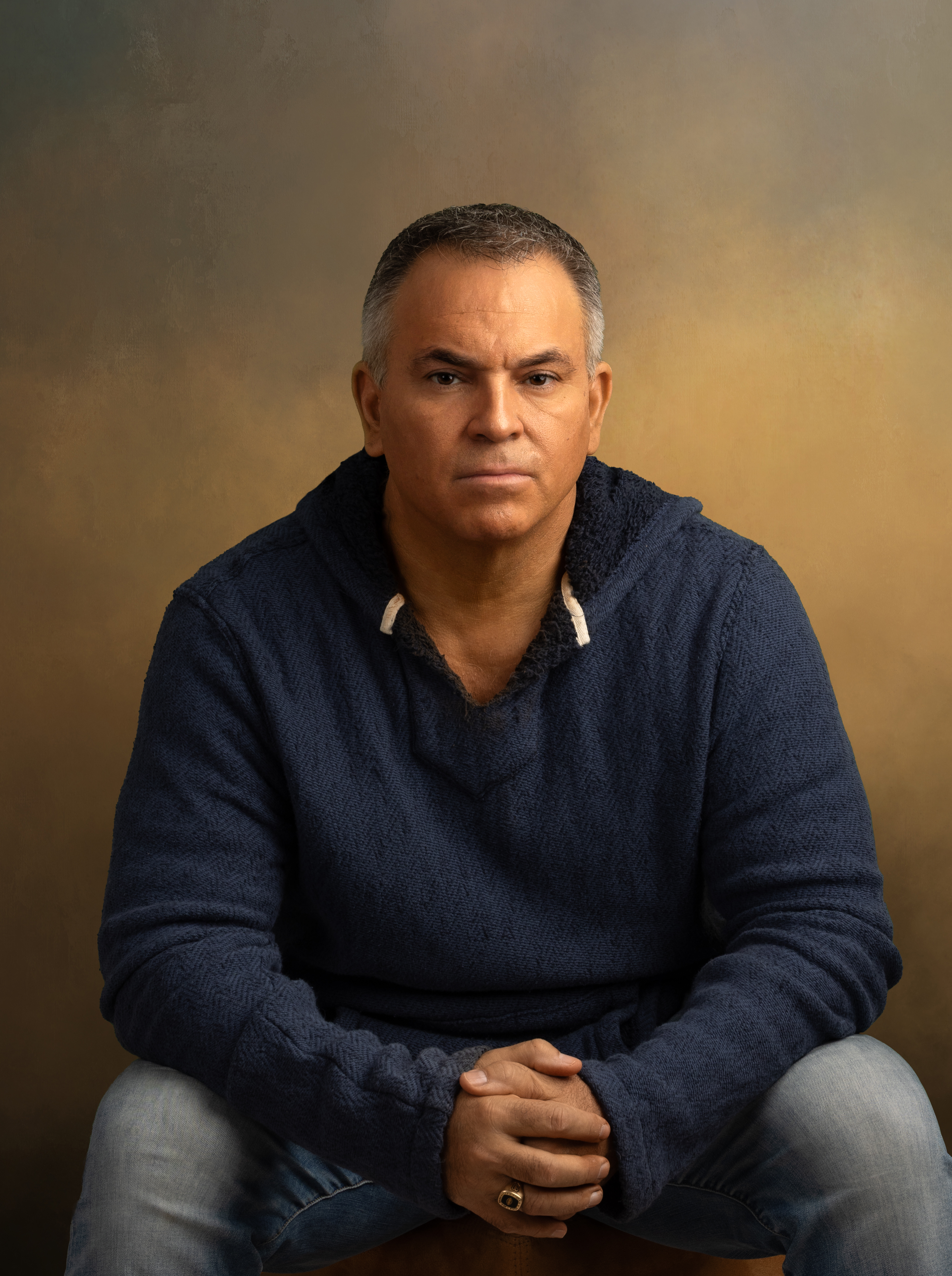
    Dean Vagnozzi had this photo taken in 2025 for use in a book he says he’s writing about his business and its closure by a court-ordered receiver amid a federal investigation of Par Funding, whose investments he sold.

    One of the eight people sentenced in the Par case, former collections head James LaForte, was identified in a separate New York indictment as a member of a Gambino mob crew. James LaForte has denied that allegation. A collector working for James Laforte was also named as a Gambino associate.

    “Vagnozzi, apart from having an Italian surname, had nothing in common with the criminals that ran Par Funding,” who “lied to, manipulated, and duped Dean into raising funds for Par Funding’s criminal enterprise, which he genuinely thought was a legitimate business,“ according to the complaint. He ”was not a fraudster nor [a Par] insider” but “an innocent victim of government overreach,” of his lawyer, and “of Par Funding’s fraud and deceit.”

    Vagnozzi earlier accused his longtime lawyer, John Pauciulo, of giving him bad advice contributing to Vagnozzi’s failure to ensure clients’ Par investments were registered with the SEC.

    Pauciulo has denied wrongdoing. He is the subject of a disciplinary board procedure based on his representation of Vagnozzi that could affect his law license.

    Some 1,600 investors, including hundreds of Vagnozzi’s former clients, have so far received about half their investment principal back from the court-appointed receiver that collected Par assets to repay them. Judge Ruiz last week agreed to release another 40%, bringing total payback to around $210 million. A third, smaller payout is expected as additional money is collected.

    “This case is truly about runaway regulators that well exceed the boundaries of due process and constitutional fairness,” Bochetto said in an interview Tuesday. He said there have not been a lot of successful complaints against the federal government for overreach but was confident the facts in the Vagnozzi case justified a court review.
  • Man who allegedly killed 63-year-old Uber passenger has surrendered to police

    Man who allegedly killed 63-year-old Uber passenger has surrendered to police

    A man who allegedly injured an Uber driver and killed his passenger in North Philadelphia on Monday morning while fleeing sheriff’s deputies has turned himself in to police.

    Joseph Cini, 35, surrendered at police headquarters Tuesday evening, Philadelphia police said.

    Around 7:15 a.m. Monday, deputies from the Philadelphia Sheriff’s Office had attempted to serve him with a warrant on the 900 block of North Watts Street.

    Cini took off in a Nissan Maxima and crashed into a Jeep Patriot at Ninth Street and Girard Avenue, killing Uber passenger Angela Cooper, 63, of the 1100 block of West Thompson Street, police said. The high-speed collision also injured the 51-year-old Uber driver.

    The driver is being treated at Temple University Hospital.

    Cini left the scene of the crash, but turned himself in Tuesday, police said. Charges related to Monday’s events have not yet been filed.

    A spokesperson for the sheriff’s office said in an email Monday that the office was “fully cooperating with all investigative authorities” and that it was providing support services to the deputies involved.

  • SS United States set to sink, despite 11th-hour efforts to intervene

    SS United States set to sink, despite 11th-hour efforts to intervene

    The 990-foot SS United States could be making waves as an artificial reef at the bottom of the Florida Panhandle coast as early as March, according to a tentative timeline from its new owners in Florida.

    Even so, hope still springs eternal for the most ardent swath of ship enthusiasts who would rather see it restored to its former glory than swimming with the fishes.

    As tourism officials in Okaloosa County report being about 80% done with the remediation work required to meet state and federal requirements for sinking, the New York Coalition to Save the SS United States has urged the New York City Council to intervene to the best of its abilities: a move that appeared to be gaining some traction in recent weeks, until it wasn’t.

    A resolution introduced by NYC council member Gale A. Brewer last year finally got a committee hearing in late November.

    The symbolic gesture calls on Congress to pass legislation that would allocate funds for restoration and to bring the ship to New York City’s Gowanus Bay Terminal. It also appeals to President Donald Trump, a fellow New Yorker, to sign the legislation.

    Okaloosa County, respectfully, is hearing none of it.

    “We purchased the vessel specifically to become the world’s largest artificial reef,” said county spokesperson Nick Tomecek. “Anybody that thinks otherwise, that’s just pipe dreams.”

    Brewer is aware the odds are against those hoping to reacquire the ship. She acknowledged the resolution was a “Hail Mary” during last month’s committee hearing.

    Though the resolution moved to the full council, it has not been put on the calendar for a vote — the last session of the year was Thursday.

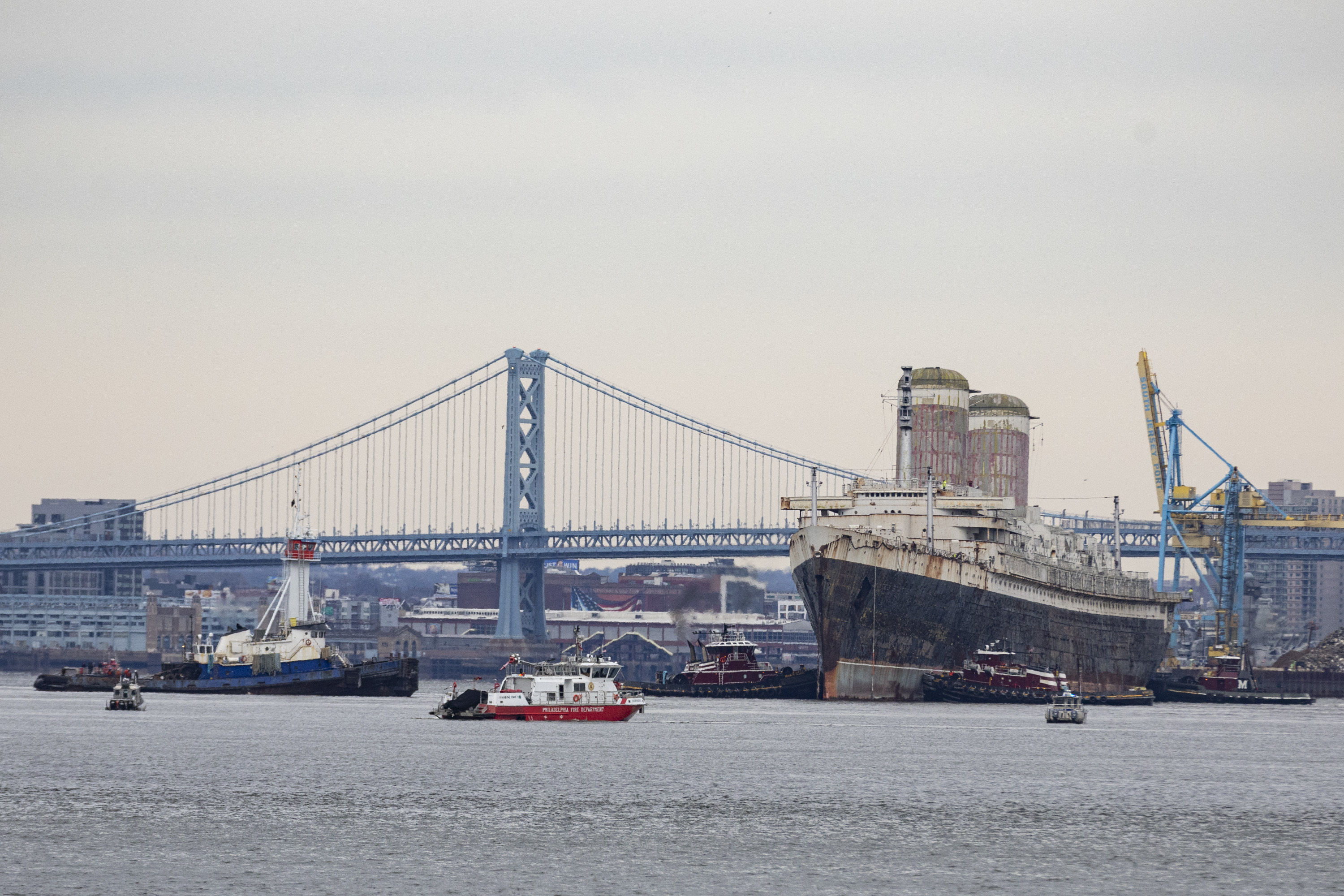
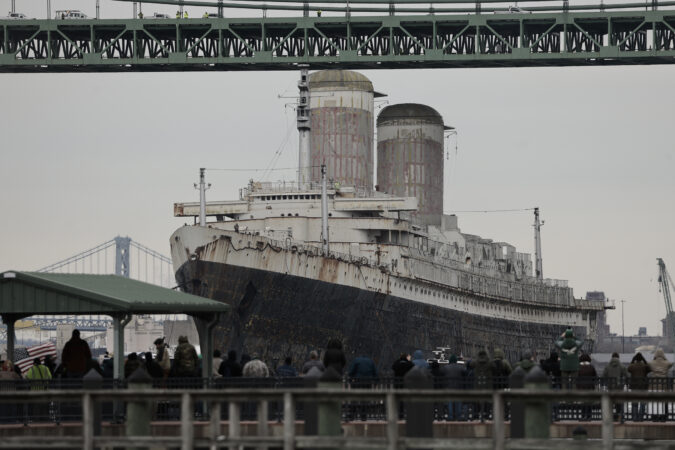
    The SS United States is pulled out into the Delaware River and ready to bid its farewell from Philadelphia as people gather to watch it leave in the Delaware River in Gloucester City, N.J., on Wednesday, Feb. 19, 2025.

    Brewer could not speak to why the resolution did not get a hearing until a year after she introduced it, but she understands how, despite support on the 51-member council, it has not been put to a vote in the full body.

    “Just like in Philly, we got everything under the sun — restaurants, small business, parking, it’s just endless,” Brewer said. “I think there’s lots of support, but it’s not like number one on anybody’s list.”

    Brewer said the priority would be to stop the sinking of the ship. Once the SS United States was in New York City, preservationists, donors, and lawmakers could figure out the best way to redevelop the ship, though she could see it as a restaurant.

    If this figure-it-out-as-we-go approach sounds familiar, it’s because that was the path the SS United States Conservancy, the ship’s previous owner, took when it bought the vessel in 2011. The conservancy aimed to save the ship from the scrapyard and spent years courting potential developers while it sat parked in Philadelphia, even publishing a 2023 feasibility study for a mixed-use development that would cost about $400 million.

    In many ways, the New York City resolution is also a tried-and-tested approach. As the SS United States faced eviction from its berth along the Delaware River, the conservancy launched public campaigns calling on Florida Gov. Ron DeSantis, New York Gov. Kathy Hochul, and Pennsylvania Gov. Josh Shapiro to step in and help the vessel find a new home.

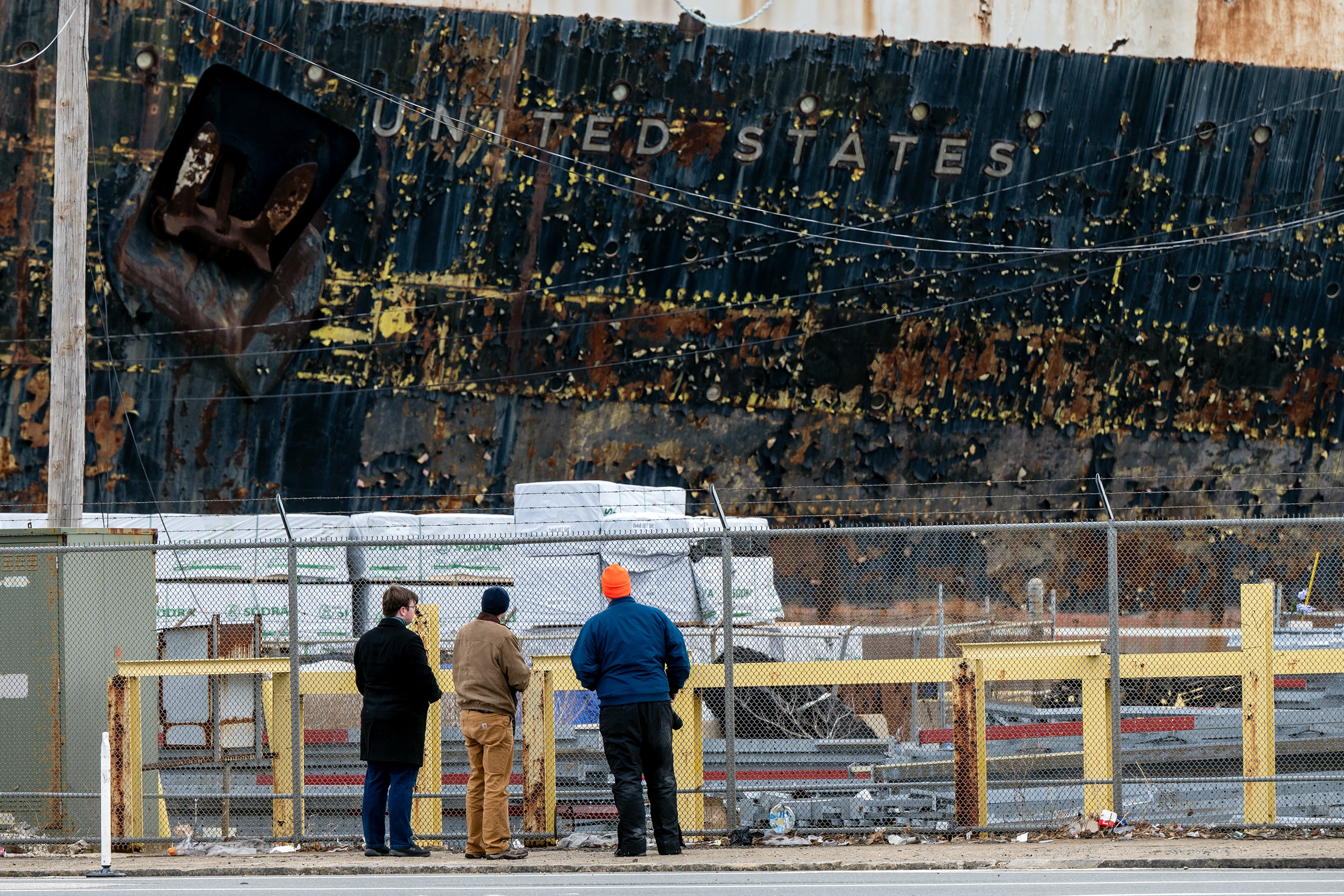
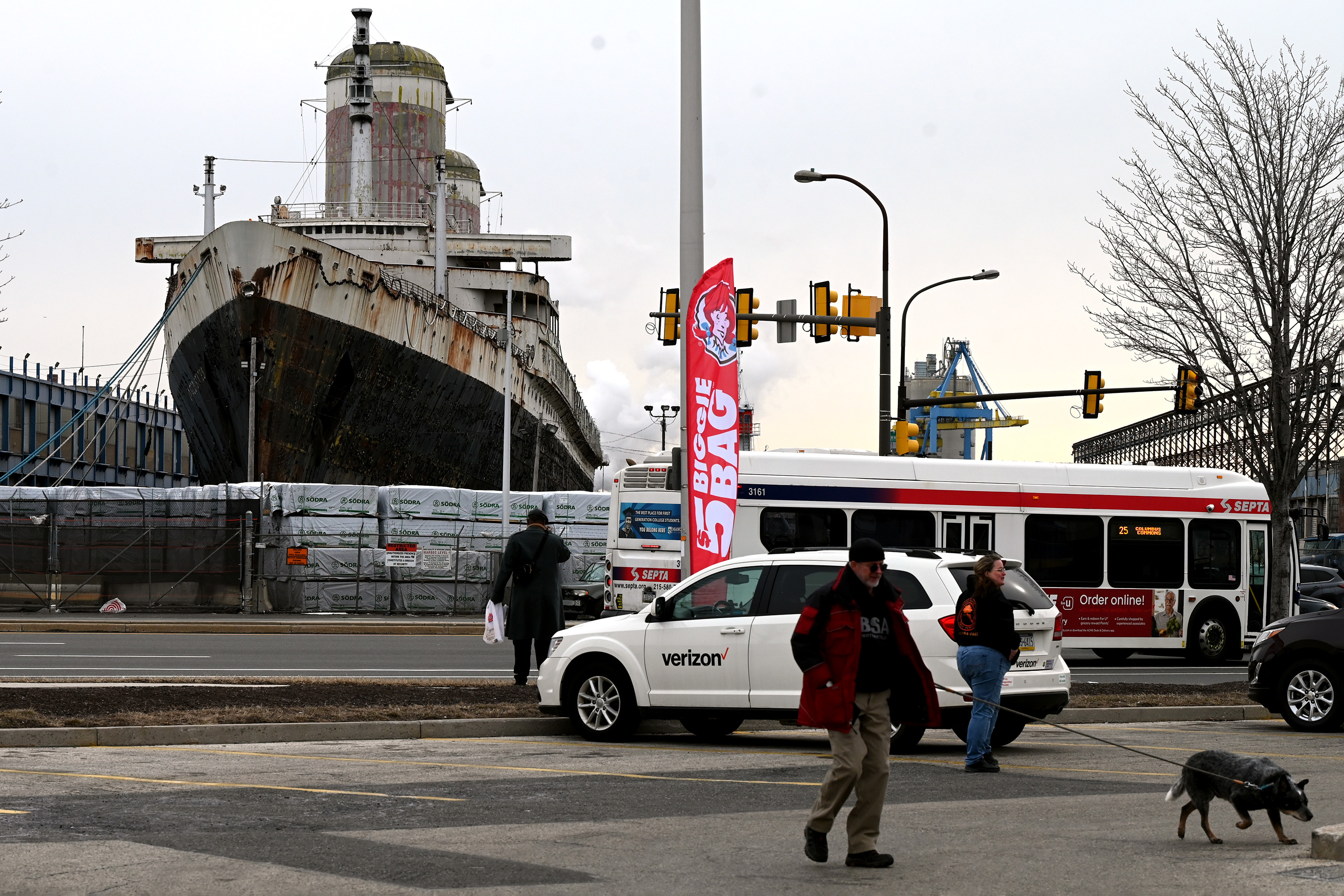
    Passenger ship aficionados take a last look at the SS United States docked at pier 80 in South Philadelphia Wednesday, Feb. 19, 2025 before it is towed away to Alabama

    The conservancy sent its pleas to then-President Joe Biden, as well as members of Congress on both sides of the aisle.

    Much to the chagrin of preservationists, no politico ever came, despite the conservancy’s assurances that whoever championed the ship would be rewarded with all the jobs redevelopment would create.

    Whether Trump, his administration, or this iteration of Congress would intervene at the eleventh hour is anyone’s guess.

    The New York Coalition to Save the SS United States, which launched as a nonprofit in October 2024, wrote to Trump this year asking him to intervene shortly before the ship left Philadelphia, to no avail.

    In a lawsuit filed in U.S. District Court in Pensacola after the ship’s departure, the coalition said it had “no means of knowing whether the Executive Branch of the United States is even aware of the Letter, let alone whether it is being considered.”

    The White House did not immediately respond to questions about whether the ship’s saga had reached Trump’s desk and if the administration would be inclined to step in.

    Either way, time is working against the coalition.

    The suit warned of how some of the prep work in Mobile, Ala., could hinder preservation efforts.

    “… the twin stacks of SSUS will be removed, as will other parts of her superstructure,” read the suit. “Once this is done, any hope of preserving the Ship afloat and intact will be lost forever.”

    Those smokestacks were indeed removed at the end of summer.

    So were all portholes and windows, along with the ship’s radar mast and propeller, according to an Okaloosa County update last week.

    Despite the coalition’s fears laid out in the suit, Dan Sweeney, who cofounded the group, hit a more optimistic note, saying it was not too late to stop a reefing.

    “The Big U remains an important symbol of America,” he said of the SS United States. “It could also prove to be a robust economic development engine. These two reasons are more than enough for us to continue the effort, and many people across the country agree. For us, it’s ‘damn the torpedoes.’”

    Okaloosa County officials, meanwhile, say the months ahead will be used to finish cleaning the ship, removing nonmetal items, cutting holes throughout the ship because the sinking will not be able to be done with explosives, and coordinating with state and local agencies on a sink date.

    Should work continue at its current pace and no delays in inspections, the SS United States could be sunk as early as March.

    Alex Fogg, the natural resources chief for Destin-Fort Walton Beach, said weather delays, of course, are always possible.

    Tomecek reiterated that the county was working with the SS United States’ previous owners to build a land-based museum, which would feature the eye-catching smokestacks and other preserved ship memorabilia and artifacts.

    He understands the renewed interest in “saving” the ship, though it would have been turned into scrap had Okaloosa officials not stepped in. In any case, Tomecek said, these efforts come too little, too late.

    “I think that when [the SS United States] was sold to the county, a lot of folks kind of woke up and realized what was going on, when, in fact, they should have been worried about her the past 30 years, when she was sitting in Philadelphia,” Tomecek said.

  • Middletown Township welcomes first full-service hotel ahead of major tourism events in Delco

    Middletown Township welcomes first full-service hotel ahead of major tourism events in Delco

    On a frigid Tuesday morning, stakeholders from across Delaware County toasted champagne and popped mini pastries under the roof of Middletown Township’s new Hilton Garden Inn.

    “We may be the only Hilton Garden Inn in the world that serves Wawa coffee and drinks it all the time,” quipped hotel owner Patrick J. Burns, standing before a sea of family members, hotel staffers, business associates, and elected officials.

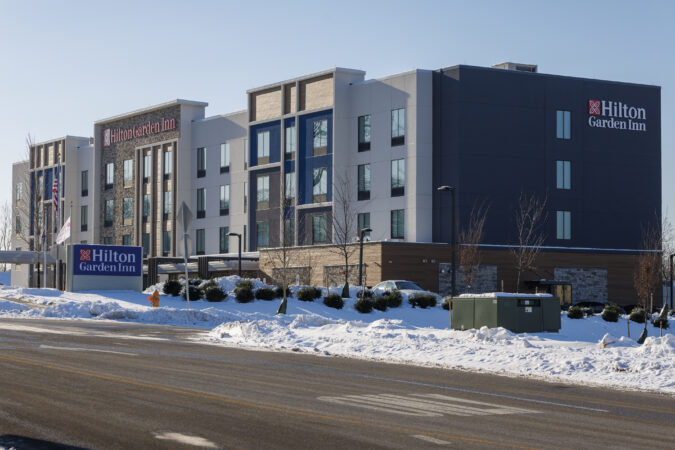
    The 107-room, 67,000-square-foot Hilton, located off Baltimore Pike at the former Franklin Mint site, is open and welcoming guests. It’s the 42nd hotel in Delaware County and first full-service hotel in Middletown Township.

    The hotel features app-to-room device integration, mobile key and contactless check-in, meeting and banquet spaces, an outdoor patio with fire pits, a fitness center, and the Garden Grill, a restaurant serving “American cuisine with local flair” that will be open to the public.

    The hotel is long awaited, borne from a yearslong planning process and delayed by pandemic-era construction slowdowns. On Tuesday, attendees expressed gratitude that what was once an economic dream for the township was finally becoming reality.

    The Hilton marks an important expansion of the collar county’s tourism economy, according to Delaware County’s major economic stakeholders. And as far as tourism in Delco, they say, it’s only up from here.

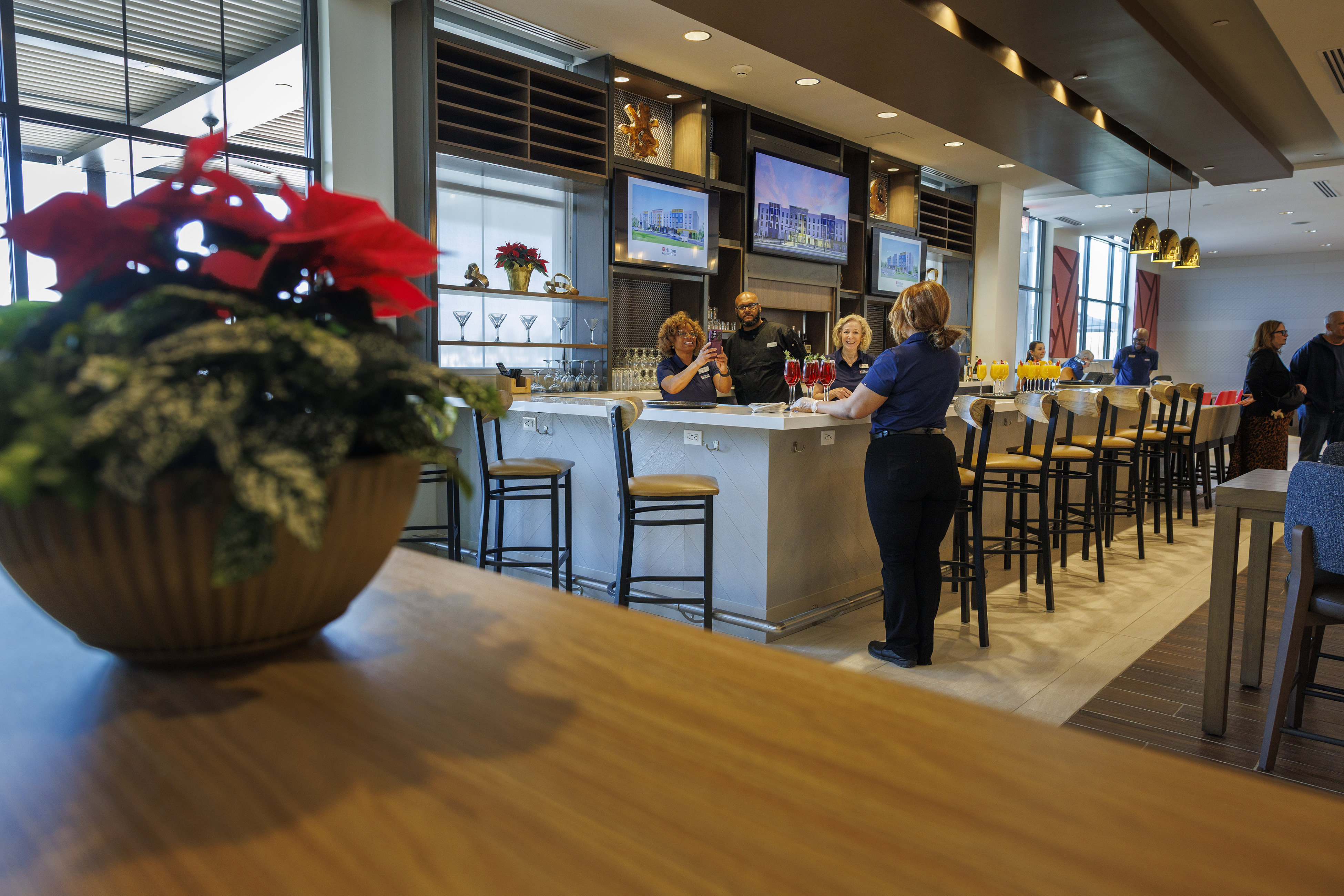
    The bar area off of the lobby at the new Hilton Garden Inn of Middletown Township on Tuesday, Dec. 16, 2025.

    Delaware County hosted 4.5 million visitors in 2024, according to Steve Bryne, executive director of Visit Delco. Those visitors spent $860 million, generated $1.2 billion in economic impact, and sustained 13,000 jobs. In 2025, the county is on track to sell more than one million hotel room nights for the first time in its history.

    Representatives from the Hilton say it created 200 construction jobs and 40 new hospitality jobs.

    Bryne said tourism to Delaware County is a “combination of everything.” The county doesn’t have one major anchor (like Longwood Gardens in Chester County, for example). Rather, it’s home to 12 colleges and universities, major corporate employers like Wawa, and sports complexes like IceWorks and Subaru Park, home of the Philadelphia Union. That means regular tournaments, business conferences, parents weekends, homecomings, and graduations — events that, collectively, help power the county’s economy.

    Already, Penn State Brandywine, located down the road, has named the Hilton Garden Inn its host hotel.

    Delaware County also gets spillover from visitors to Philadelphia, especially those who want proximity to Philadelphia International Airport.

    The hotel is a property of Metro Philly Management, owned by Burns. Burns’ management company also owns the Courtyard by Marriott in Springfield, the Fairfield Inn & Suites in Broomall, and the Springfield Country Club, as well as numerous grocery stores and restaurants.

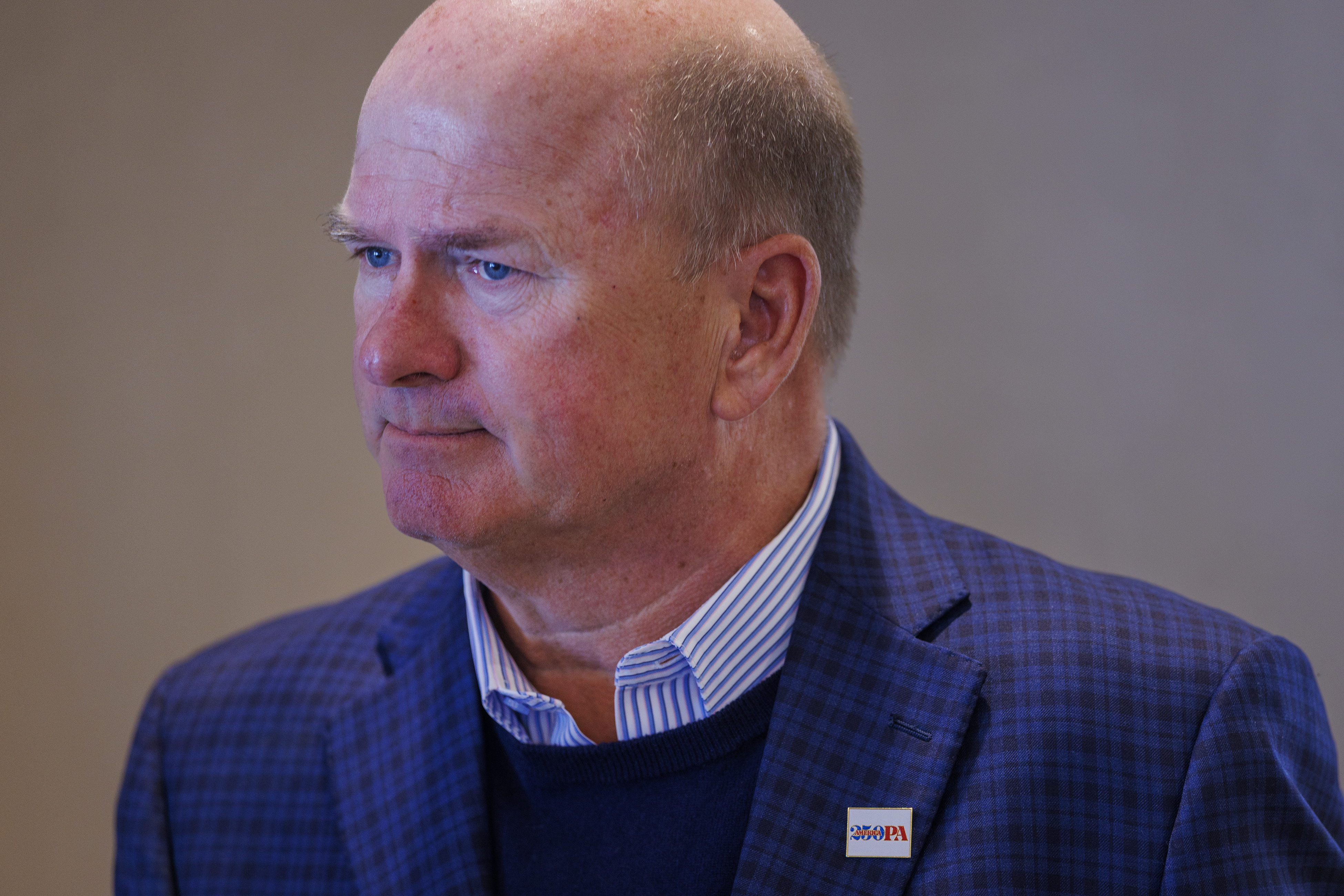
    Patrick J. Burns, pictured at Middletown Township’s new Hilton Garden Inn on Tuesday, Dec. 16, 2025. The hotel is owned by Burns’ company, Metro Philly Management.

    Stakeholders lauded the hotel’s location in a central, and rapidly developing, part of Middletown Township.

    The former Franklin Mint complex, now home to the Hilton, has been a hotbed of development in Middletown Township since the mint shuttered in 2004. Two newer housing developments — Pond’s Edge and Franklin Station — have added over 450 units of housing to the site. Middletown Township outpaced its neighbors — Media, Nether Providence, and Upper Providence — in population growth in 2024.

    “Middletown Township is such a vital corridor of Delaware County,” Burns said.

    The hotel’s opening coincides with major events coming to the region in the coming months: semiquincentennial celebrations in Philadelphia and in Delco, the FIFA World Cup, the PGA Championship at Aronimink Golf Club, and the MLB All-Star Game. For the PGA Championship alone, Delaware County is expecting 200,000 visitors and $125 million in economic impact.

    This suburban content is produced with support from the Leslie Miller and Richard Worley Foundation and The Lenfest Institute for Journalism. Editorial content is created independently of the project donors. Gifts to support The Inquirer’s high-impact journalism can be made at inquirer.com/donate. A list of Lenfest Institute donors can be found at lenfestinstitute.org/supporters.

  • Wonder opens its latest location in Media as it prepares to more than double its number of restaurants

    Wonder opens its latest location in Media as it prepares to more than double its number of restaurants

    Wonder is continuing its rapid expansion in the Philadelphia area with a new Media location formally opening Thursday.

    The ribbon-cutting starts at 4:30 p.m. at the new site at 1127 W. Baltimore Pike, with the first 100 guests getting a Wonder gift and live music.

    Part of Wonder’s sales pitch is that it offers something for everyone, from pizza and cheesesteaks to Mediterranean and steak.

    That flexibility, with parents of finicky kids in mind, is part of what drew Eddie Jefferson to Wonder.

    “The picky eater thing kind of sits with me,” said Jefferson, senior operations leader for Wonder’s Media location. “I have children who never really could settle on the same food. So it was like, ‘Oh, this makes sense.’”

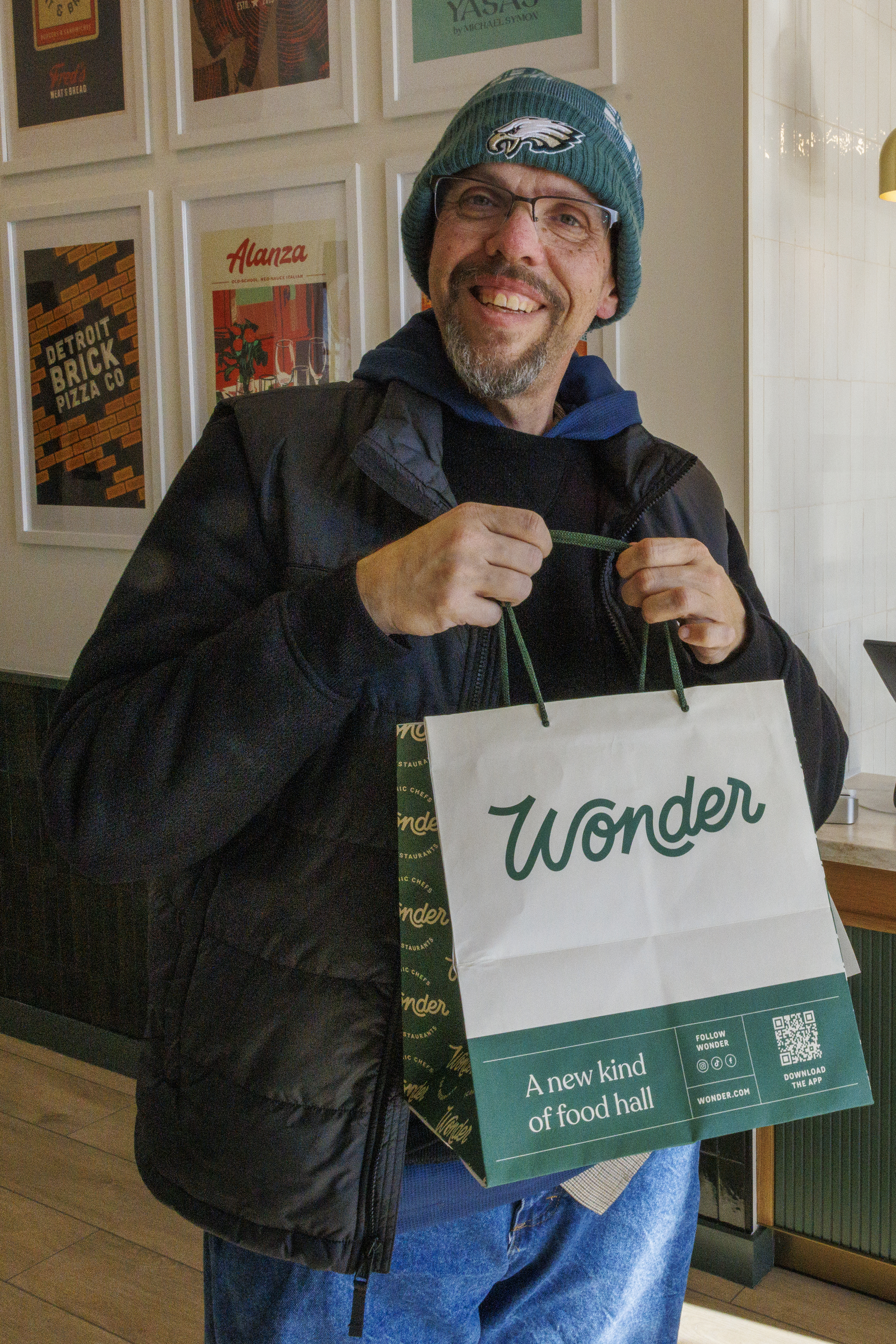
    Steve Skalis, of Springfield, picks up an oder of drunken noodles during Wonder’s soft opening in Media on Tuesday, December 16, 2025.

    Jefferson said he wants Wonder to be more than just a chain takeout restaurant.

    “I want to make sure we’re a staple of the community,” Jefferson said. “I do want to be here for a very long time.”

    Wonder is donating $1 to Philabundance for every order at the Media location this week. Jefferson said he hopes that’s just the first local partnership and he will be able to be active in the community.

    “Once we settle in to this community I’ll be able to be outside shaking hands and kissing babies.”

    Restaurants available at the Media Wonder include:

    • Alanza
    • Alanza Pizza
    • Bobby Flay Steak
    • Burger Baby
    • Detroit Brick Pizza Co.
    • Di Fara Pizza
    • Fred’s Meat & Bread
    • Hanu Poke
    • Kin House
    • Limesalt
    • Maydan
    • Royal Greens
    • SirPraPhai
    • Streetbird by Marcus Samuelsson
    • Tejas Barbecue
    • Yasas by Michael Symon
    • Bellies
    • Room for Dessert

    Wonder’s Media location brings the total to 91 sites across the Northeast, from Rhode Island to Virginia. The plan for 2026 is to more than double that, according to Jason Rusk, head of restaurant operations.

    “Our plan is to grow 110 locations, so we’ll go from 91 locations to just over 200 locations by the end of next year,” Rusk said.

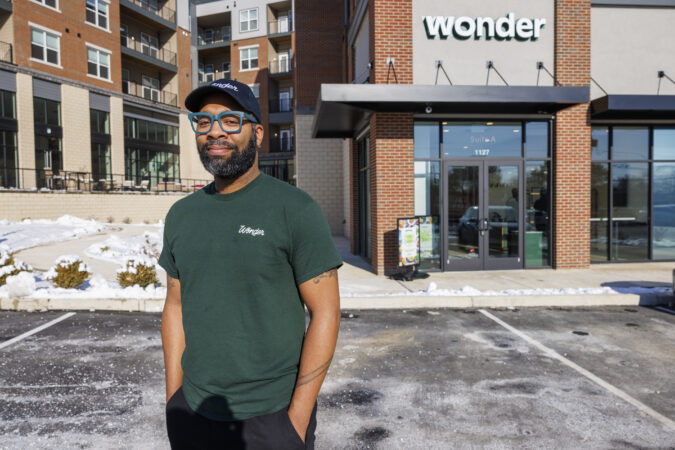
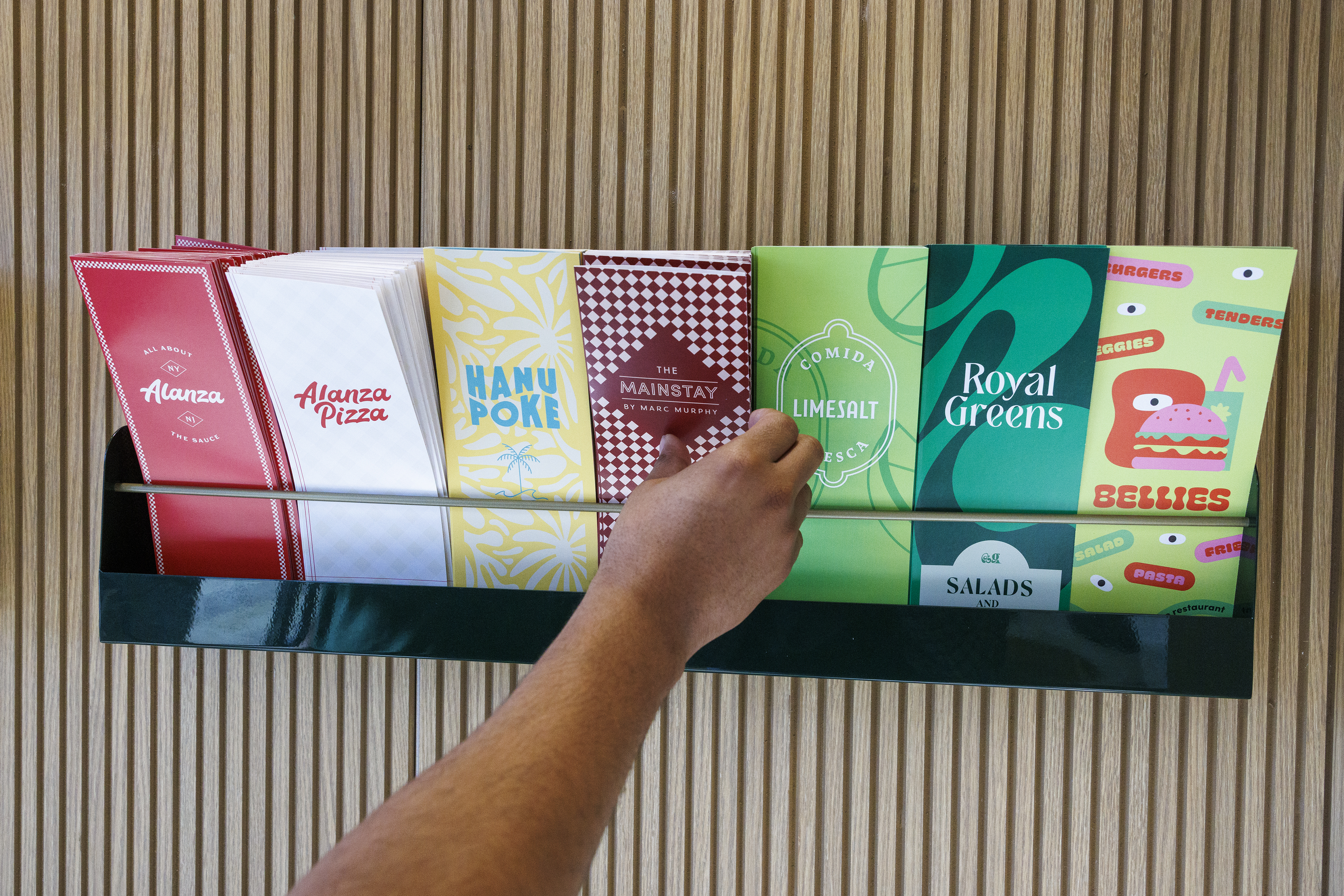
    Eddie Jefferson, senior operations leader at Wonder in Media, reaches for one of many menus Tuesday, December 16, 2025.

    Wonder plans to open locations in Drexel Hill and Roxborough in early 2026, a representative said. It is also planning a foray into Allentown and the rest of the Lehigh Valley.

    Rusk said sales have been good across the Philly area’s 20-plus stores, with Cherry Hill one of the strongest openings.

    “There is no sign of stopping,” Rusk said. ”I have no doubt in my mind that we will fully have a Wonder that services nearly every part of the broader Philly [area].”

    This suburban content is produced with support from the Leslie Miller and Richard Worley Foundation and The Lenfest Institute for Journalism. Editorial content is created independently of the project donors. Gifts to support The Inquirer’s high-impact journalism can be made at inquirer.com/donate. A list of Lenfest Institute donors can be found at lenfestinstitute.org/supporters.

  • Flyers end three-game losing streak with 4-1 rout of the Montreal Canadiens

    Flyers end three-game losing streak with 4-1 rout of the Montreal Canadiens

    MONTREAL ― Entering the small visitor’s locker room at the Bell Centre two seasons ago, every stall was filled with bodies as the Flyers were amid a disastrous ending to the 2023-24 season.

    On Tuesday night, and for the second and final time this season, smiles crossed crowded rooms as the Flyers beat the Montreal Canadiens 4-1. They also won 5-4 in a shootout on Nov. 4 in Quebec.

    It is just their third win of December, but the 3-2-3 record isn’t truly indicative of how they’ve been playing of late. Yes, the Flyers snapped a three-game losing streak, but each loss came after regulation. The win extended their point streak to five games.

    Comeback kings

    For the 22nd time in 32 games, the Flyers trailed 1-0. And for the 12th time in those 22 games, they won (12-6-4). It is also their 13th comeback win.

    How did they get into a hole this time? Travis Konecny fed a standing Christian Dvorak above the Canadiens’ blue line, and the center tried to shovel it into the offensive zone, but it hit Montreal defenseman Alexandre Carrier and went the other way.

    Montreal had a three-on-two that turned into a four-on-two with forward Alexandre Texier firing the wrister past Dan Vladař from the high slot to take a 1-0 lead.

    But, as commonly said here, the hockey Gods do giveth and taketh, and the same line gave the Flyers a 2-1 lead.

    “You make a mistake, and you don’t have your head down. And it’s happened a lot this year where we’ve kind of … you can’t make that play, but they come out, and they produce the next period, or whatever,” coach Rick Tocchet said. “So, guys have done a nice job when it comes to that.”

    Flyers’ Bobby Brink picked up his ninth goal of the season on Tuesday.

    Konecny knocked the puck away from Ivan Demidov in the Flyers’ end, and defenseman Emil Andrae got the puck and chipped it to Trevor Zegras as he and Konecny broke out two-on-one. After a give-and-go, Zegras got the puck back and fired it five-hole past Montreal goaltender Jacob Fowler.

    “If you’re going to give one up, you’ve got to get one,” Zegras said. “That’s kind of the mindset, mentality that we have. Obviously, we don’t want to be giving them goals or odd man rushes, so something we’ve got to clean up for sure.”

    Zegras leads the Flyers in goals with 14, and now has 33 points — one more than his point total in 57 games last season for the Anaheim Ducks. The New York native is on a four-game goal streak and a five-game point streak with seven points.

    New lines here

    Tocchet switched two of his lines. Winger Carl Grundström moved up to play with Owen Tippett and Sean Couturier, and Matvei Michkov shifted to the line of Noah Cates and Bobby Brink.

    “I think it was a little more balanced,” Tocchet said postgame. “I saw some more juice. I thought Tipp had a really good game tonight. Tipp was going tonight. Obviously, Grunny [had a] goal, and he skates. He can skate, and I think that helps Coots out. Yeah, I thought it was a good switch for us.”

    It paid off twofold.

    First, Grundström tied the game 1-1 just 39 seconds after the Canadiens opened the scoring with a minute remaining in the first period.

    Couturier got the puck on the right wing and sent a leading pass down to Tippett in the circle. The winger then sent the puck across to Grundström as he crashed the net backdoor.

    “I try to bring a lot of energy to the team and play physical and be direct. So I think that’s my style,” Grundström told The Inquirer after the morning skate, adding that the Flyers’ style fits his game well overall.

    Since re-entering the lineup on Dec. 9, the Swede has three-two goals and an assist in five games.

    Then in the second period, Fowler went out of his net to play a dump-in. He waited behind the goal and ended up leaving it — right for Michkov. The Russian picked up the puck and fed Brink in the slot for the easy goal.

    Brink now has nine goals on the season, three shy of his career-high set last season in 79 games.

    Ristolainen returns

    Rasmus Ristolainen returned to the lineup with authority. Playing in his first game since March 11 after undergoing surgery on a right triceps tendon rupture, he didn’t miss a beat.

    “It’s a long time, a lot of work, a lot of hours, obviously, and, you know, it’s fun to feel really good,” Ristolainen said of returning to the lineup. “Obviously, the team’s playing pretty good and excited to play with the guys.”

    Tocchet talked about Ristolainen’s big shot, and he almost scored in his first seconds of action in more than 280 days. On his first shift, the big blueliner sent a point shot on goal before sending another off the crossbar later.

    Across 19 minutes, 18 seconds of ice time, Ristolainen had three shot attempts, two blocked shots, one takeaway, and three hits. But none of the hits were bigger than the one that sent Montreal’s Juraj Slafkovský flying at center ice in the first period. And for the record, he wasn’t searching out the physicality early in the game.

    “Phenomenal. Double nickels,” Zegras said of Ristolainen, who wears 55. “He’s an absolute moose out there. And that was an awesome hit that he had.”

    Demidov took exception to the hit, and Ristolainen drew a penalty as the Russian winger kept cross-checking him away from the play.

    Tocchet thought the defensive corps as a whole played well, but pointed out that Ristolainen “was really good for us.”

    “Yeah, he brought some physicality, especially in the first period, that big hit,” Couturier said. “Made his presence felt, and it’s nice to see. He played well, and he jumped right back into it, playing his physical style of play, simple. [He] just brings a little more size to, I think, on the backend there. So it’s nice to see he’s doing well.”

    Flyers’ Trevor Zegras (right) scores his 14th goal of the season in the second period on Tuesday.

    Breakaways

    Konecny added an empty-netter for his ninth of the season. … Defenseman Ty Murchison was loaned back to Lehigh Valley of the American Hockey League to make room for Ristolainen on the roster. … Zegras played in his 300th NHL game. … Vladař was masterful, especially in the third period with the Canadiens pushing. He made a toe save on Slafkovský from the right circle and then slid across to stop Lane Hutson on the rebound. The Czech netminder stopped 21 of 22 shots, including 12 in the third period. … The Flyers went 0-for-3 on the power play.

    Up next

    The Flyers head to Buffalo, N.Y., to take on the Sabres on Thursday (7:30 p.m., ESPN+, Hulu).

  • After more icy mornings in the Philly region, the snow may disappear in a hurry Thursday

    After more icy mornings in the Philly region, the snow may disappear in a hurry Thursday

    That icy glaze that has appeared on streets, sidewalks, and driveways this week reappeared Wednesday and will make an encore Thursday morning as water continues to ooze from the snowpack by day and freeze at night.

    So-called black ice — ice that masquerades as harmless wetness — is especially dangerous, officials warn, and conditions are ripe for a harvest, given the generous snowpacks.

    “Refreezing and black ice are definitely a concern,” said PennDOT spokesperson Brad Rudolph. “We will continue to treat areas as needed.”

    SEPTA advised commuter to watch out for ice on platforms, walkways, and in parking lots.

    Temperatures early Wednesday fell into the teens throughout the region — save for Philadelphia International Airport where the low was 26 — and on Thursday are due to drop into the 20s region-wide.

    But along with that winter landscape, the atmosphere over the region is going to undergo radical changes by the end of the workweek, forecasters say, with a rapid but short-lived warmup, and something that’s been missing around here lately — a soaking rain.

    As for more snow, the atmospheric scientists are saying it’s probably safe to put away the shovels for a while, and not just in the Philly region.

    “In my opinion, cold looks hard to come by for most of the United States through the remainder of December,” said Amy Butler, research scientist at the NOAA Chemical Sciences Laboratory.

    In short, prepare for a more typical Philadelphia December.

    “With the pattern changing, we’re kind of getting closer to where we should be this time of year,” said Mike Lee, a lead meteorologist at the National Weather Service Office in Mount Holly.

    The forecast for the rest of the week

    Wednesday should be at least partially sunny with some substantial melting as temperatures are due to crack 40 degrees by early afternoon.

    Then after one more overnight with readings dropping into the melt-freezing 20s, Thursday is forecast to become the first day with above-normal temperatures in Philadelphia since the Wednesday before Thanksgiving.

    As temperatures rise through the 40s, several hours of soaking rain are forecast to begin in the early evening with the potential for up to an inch.

    Throughout the region the snowpack contains about a half inch of water that will be heading to local storm sewers and local waterways, said the weather service’s Lee.

    In addition to the rain, the high moisture content of the air is one of nature’s most-efficient snow-removal tools. When warm, moist air comes in contact with snow, it gives off a latent heating effect that accelerates melting.

    “We’ll have to watch for the possibility of some localized flooding,” said Paul Dorian, a meteorologist with Arcfield Weather.

    For now, Lee said, the weather service isn’t contemplating flood advisories. Precipitation the last 90 days has been substantially below normal throughout the region, and a drought warning remains in effect for New Jersey.

    The outlook for the weekend and beyond

    Friday’s forecast high in the mid-50s is likely to occur in the early morning hours, and then temperatures are forecast to crash, with wind gusts to 40 mph possible.

    Saturday is expected to be dry but chilly, with readings in the low 40s, warmer than it’s been but still several degrees below normal, and in the mid-40s Sunday, closer to the long-term averages.

    The polar vortex, the persistent low pressure system that spins around the Arctic and confines the cold air to the ice box of the planet, has been strengthening, said Butler.

    It’s possible that it would undergo “stretching” and allow cold air to sink into parts of the contiguous United States, but “it’s not a signal that is very robust,” she said.

    For now, she said no obvious dominant feature is emerging that would define the winter.

    La Niña conditions continue in the tropical Pacific, where vast expanses of the sea surfaces are about a degree below normal. La Niña can have powerful effects on west-to-east winds that ferry weather to the United States.

    In this case, however, La Niña is currently weak, meaning that its influence over global seasonal patterns is also weak, said Emily Becker, scientist with the University of Miami/Cooperative Institute for Marine & Atmospheric Studies.

    For now, it would be prudent to savor what’s left of the snow cover, and it wouldn’t hurt to spread a little sand or gravel on the driveway or the front steps before going to bed.

  • This hut at the Christmas Village sells 300 to 500 packages a day. Nobody knows what’s inside of them.

    This hut at the Christmas Village sells 300 to 500 packages a day. Nobody knows what’s inside of them.

    Emma Zielinski wasn’t sure how her business selling unclaimed mystery mail would fare at the Christmas Village in Philadelphia this year, or if she’d even be accepted into the holiday market at all.

    “I didn’t think they’d take us because we’re not handmade, but when I picked up my vendor badge, they were like, ‘We’ve been waiting for you to apply!’” she said.

    As it turns out, thousands of people from across the region have also been waiting for the chance to buy orphaned packages that never found their way home and nobody went to look for — the contents of which remain shrouded to both Zielinski and the buyers until after they are purchased.

    “The Christmas Village has really turned my business upside down,” she told me. “I don’t think anyone realized this was going to happen.”

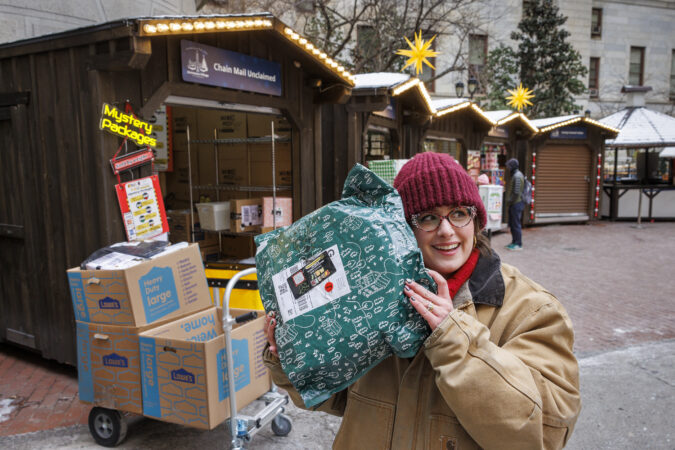
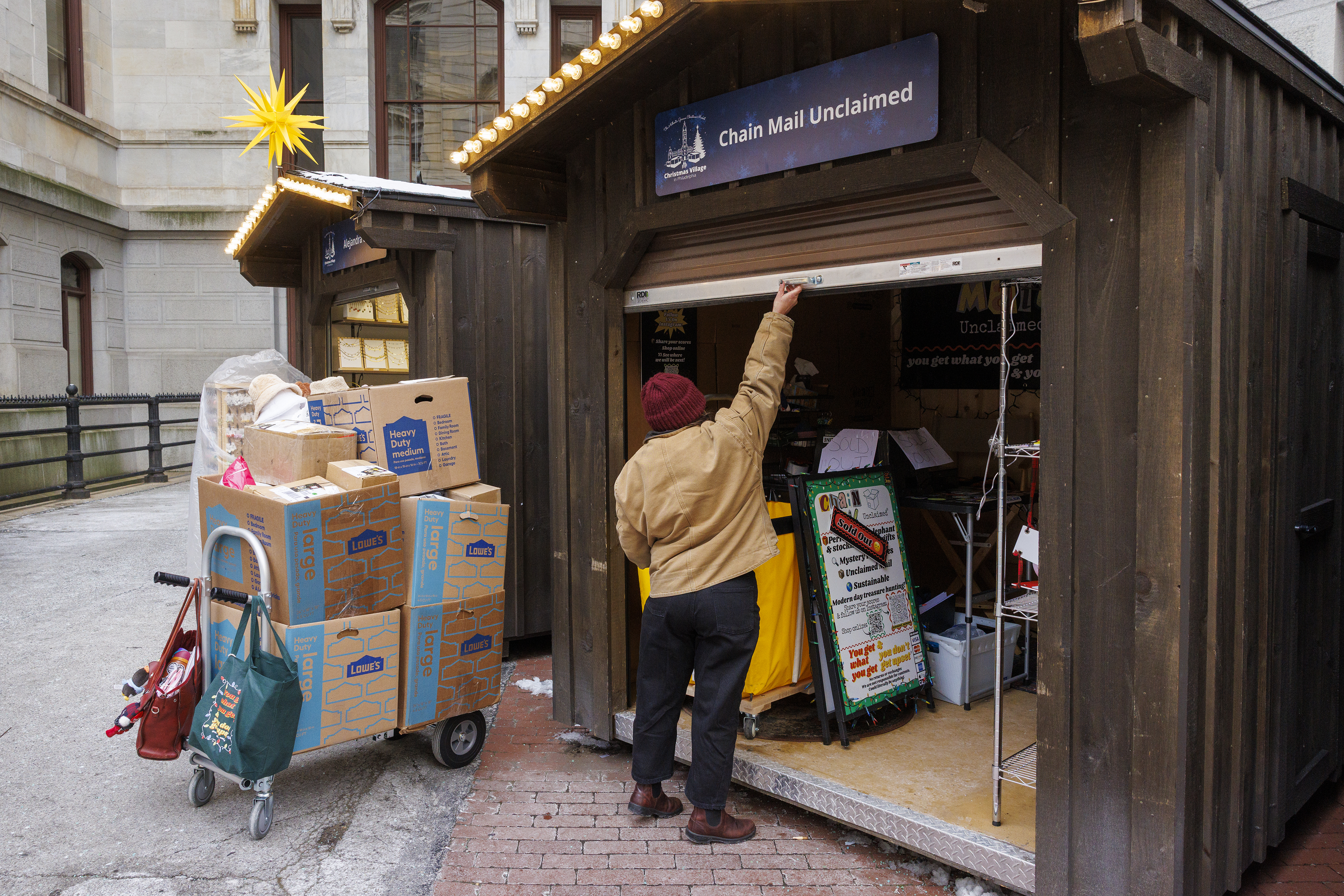
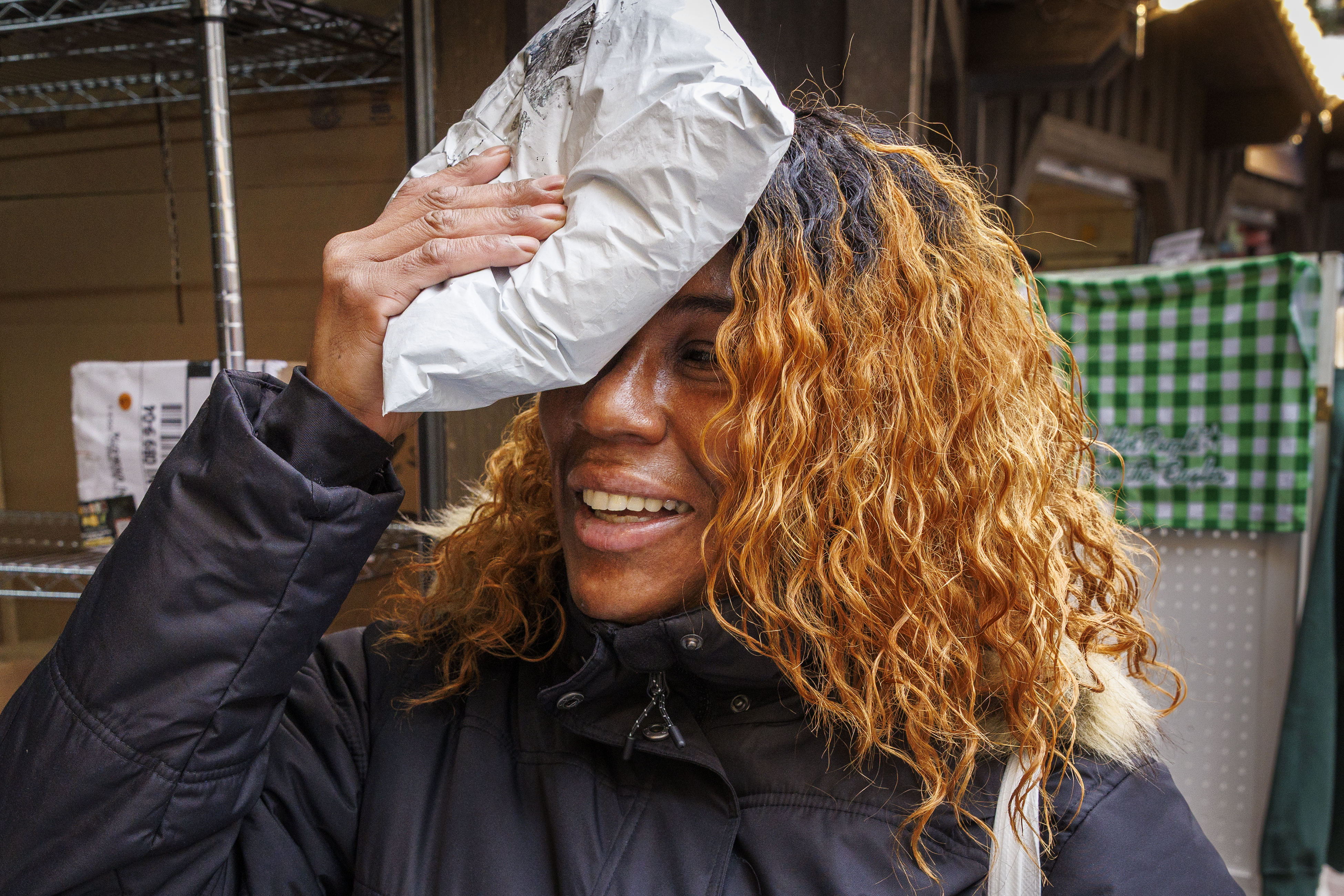
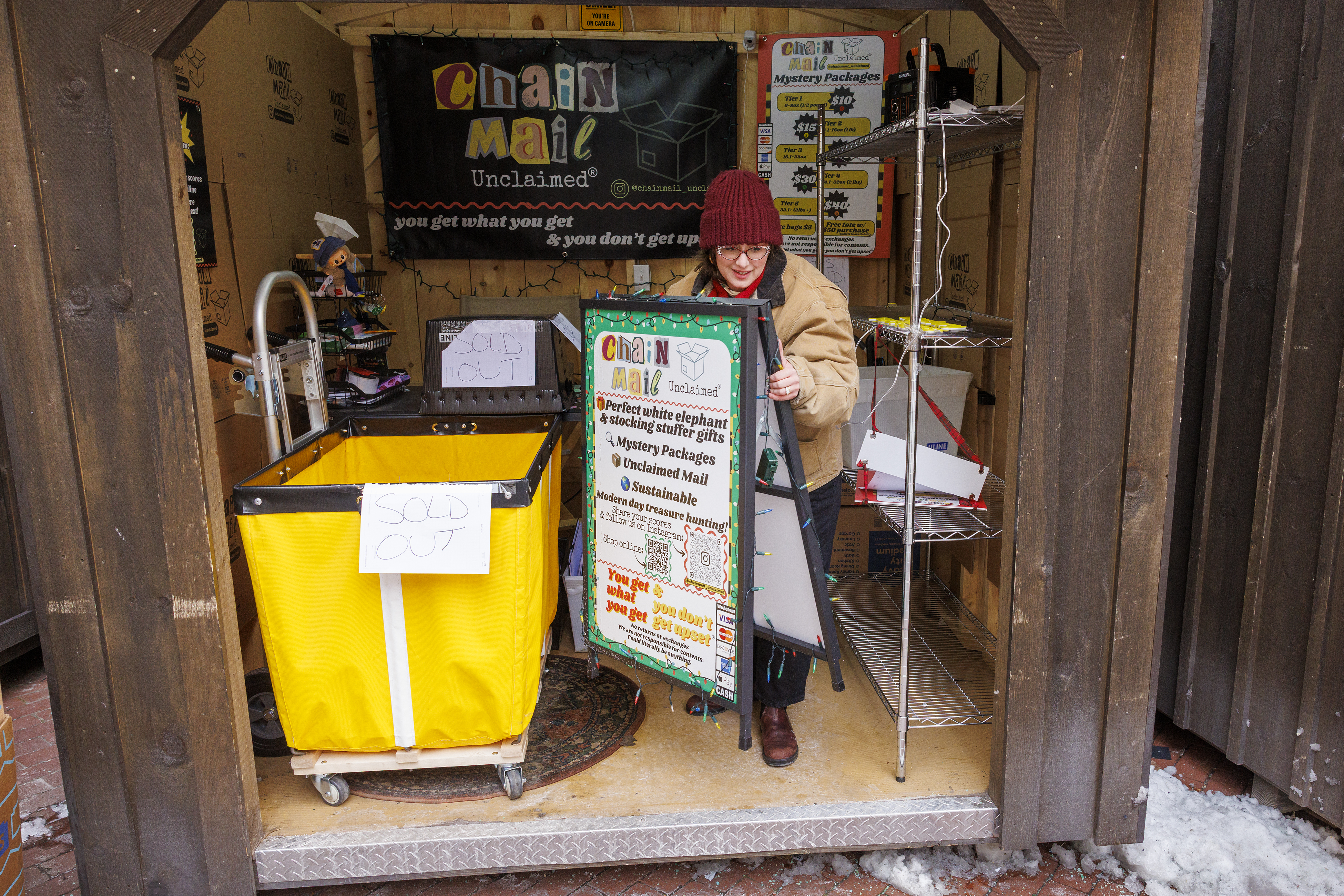
    Emma Zielinski, owner of Chain Mail Unclaimed, opens for business at the Christmas Village at City Hall.

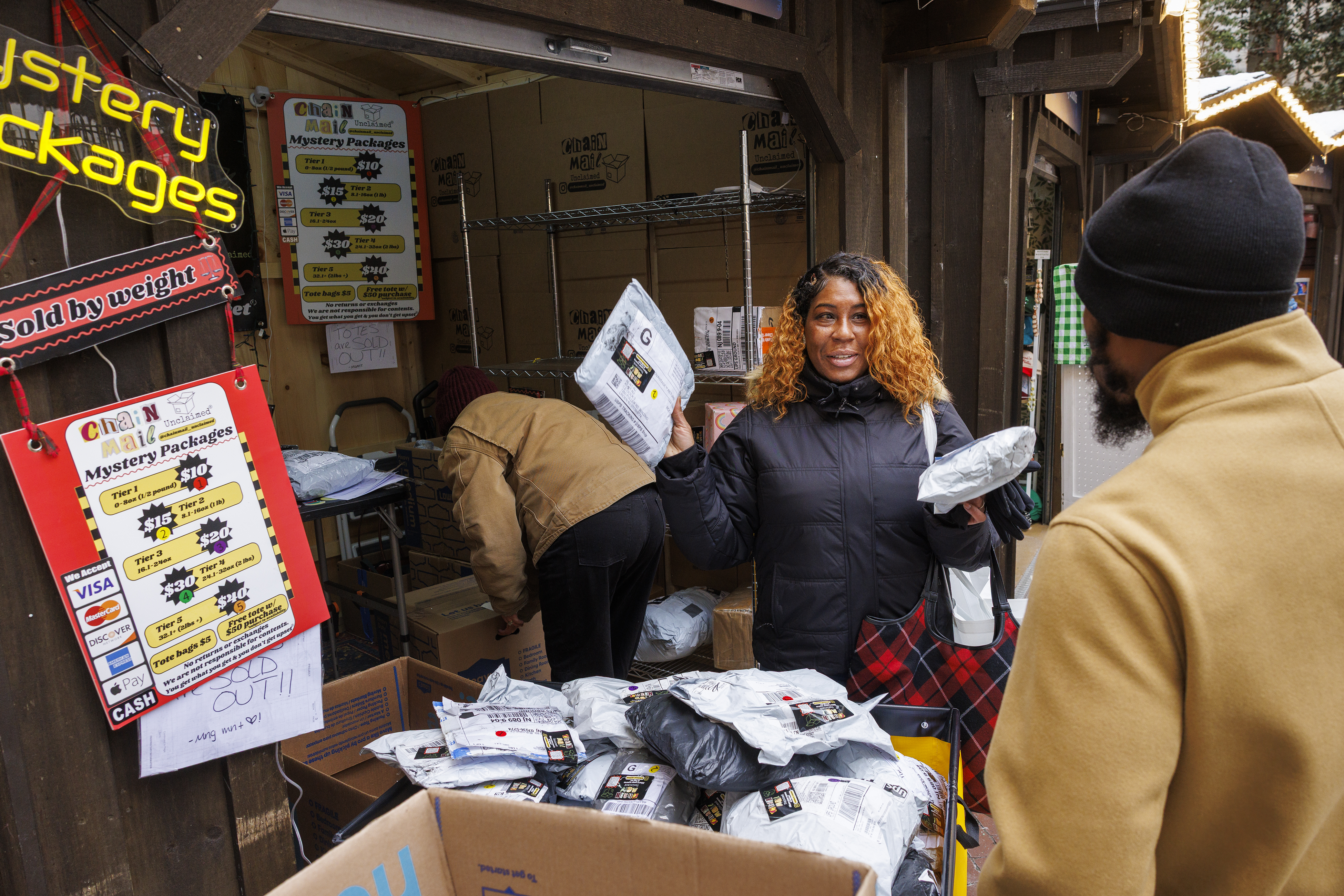
    From boxes to heavily-taped-up opaque bags, Zielinski is selling about 300 to 500 items a day, each between $10 and $40 a pop, based on weight. On the opening weekend for her Chain Mail Unclaimed hut, which is located in the interior courtyard of City Hall, she sold two weeks of inventory in just two days — and business hasn’t slowed down since.

    Philadelphians, she’s found, are always up for a good surprise.

    “They are down to party and see what’s going on,” Zielinski said. ”It’s a really good vibe in Philly when we do events, people are a lot of fun and up for trying something new and playing along.”

    The element of surprise

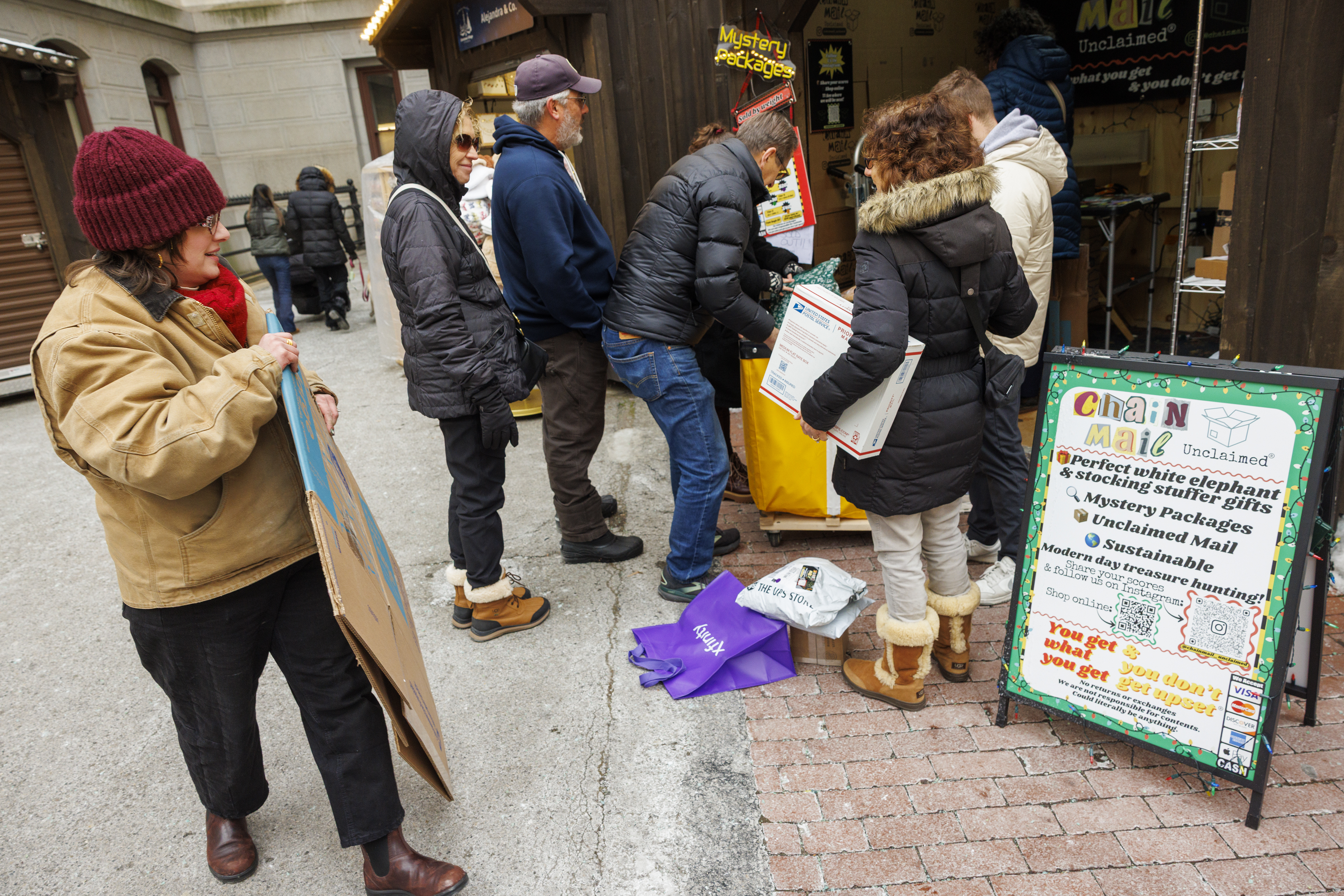
    When I arrived around 1 p.m. on Thursday, I was shocked to find Chain Mail Unclaimed had one of the only lines at the Christmas Village, aside from the ever-popular raclette cheese stand.

    “To be compared to the raclette stand is quite an honor,” Zielinski said.

    As I was waiting in line, a young man who’d just purchased a package opened it on the spot and pulled out what appeared to be a spandex elf suit — in a women’s medium.

    “At least it’s seasonally appropriate,” I said.

    When my turn came, I dug in a large bin and rustled through a couple shelves with the crowd, massaging the bags and shaking the boxes to see if I could prognosticate what was inside of them. Unlike Christmas at home, these tactics are totally fair game at Chain Mail Unclaimed.

    Mayumi Burgess takes a guess at what’s inside a package for sale at Chain Mail Unclaimed.

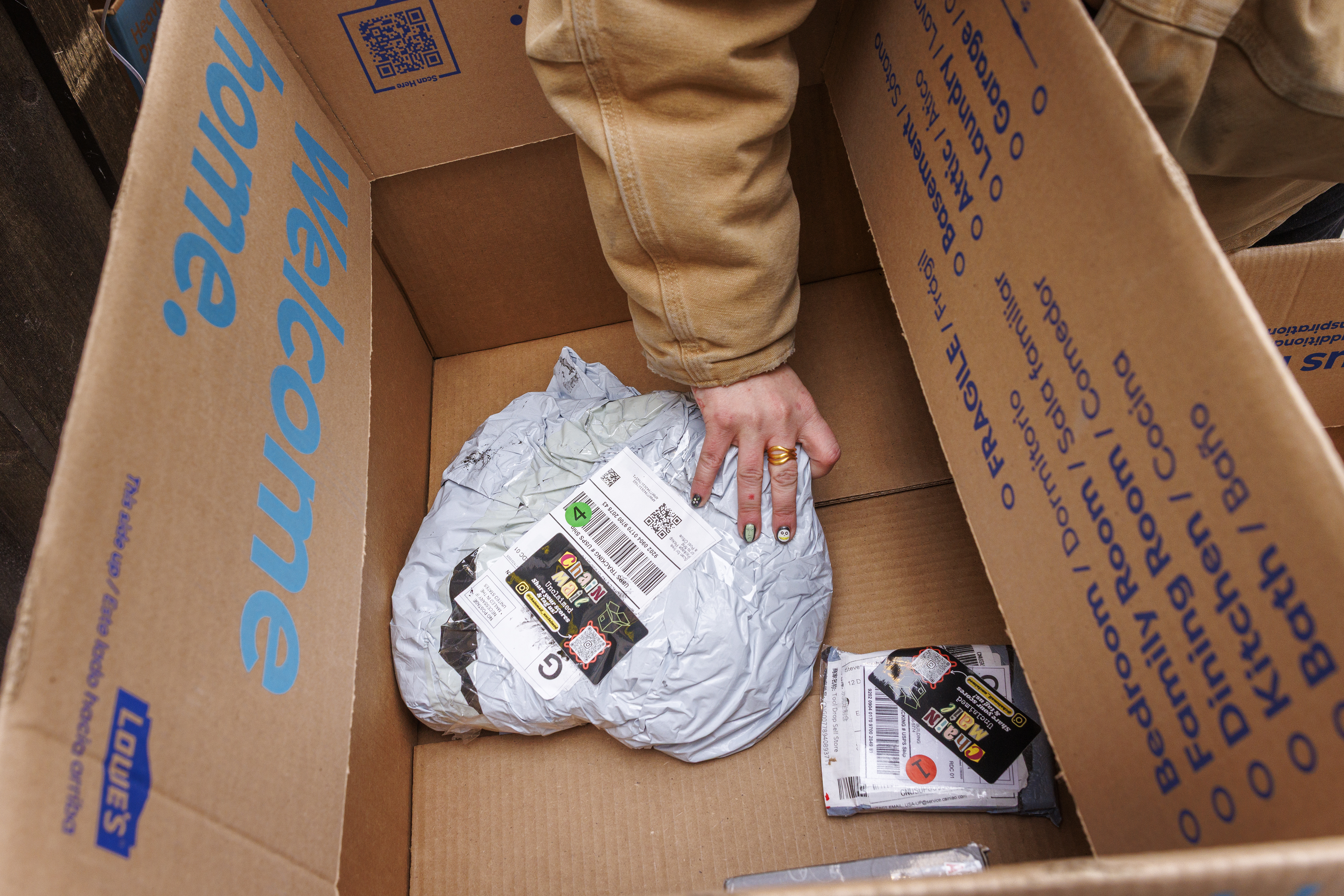
    I was pretty sure one of the packages had wicker baskets in it, and another, a pair of shoes, but beyond that it was hard to decipher the contents. All of the $10 items were gone, so I settled on two $15 packages and one for $20. All three are soft goods in opaque bags secured with clear tape, two of which came from the U.S. Postal Service and one from the UPS Store.

    Beyond that, I know nothing about them. Even the sender and intended recipient’s names have been artfully covered up with Chain Mail Unclaimed stickers by Zielinski and her crew.

    I intend to give one package to my husband (he signed up to deal with the consequences of marrying a total rando) and one each to my Secret Santa recipients at our respective family gatherings.

    I can’t wait to see what’s inside. I’m getting older and by the time Christmas rolls around, sometimes I forget what I’ve bought people anyway, but with this it’s guaranteed to be a surprise for the recipients and for me.

    I mean, these gifts could literally be anything! They could contain lost Inca gold, the French crown jewels stolen from the Louvre, or a heretofore unknown Dunlap broadside printing of the Declaration of Independence.

    Emma Zielinski, owner of Chain Mail Unclaimed, unloads merchandise at her booth at the Christmas Village at City Hall.

    Of course, they could be total rubbish or completely embarrassing. I hope my beloved, self-proclaimed “spinster aunt” isn’t going to open a gift of lacy red lingerie before our entire family this Christmas, but sometimes, these are the chances we take in life, and actually, that would be pretty entertaining.

    Because part of the fun of giving a gift like this is getting to tell the story behind it, which is why I pshawed a fellow customer in line who requested that I open my packages on the spot.

    “Ma’am, these are gifts,” I said, before walking away with my treasures.

    ‘The tip of the iceberg’

    Zielinski, of Lawrenceville, N.J., said she was inspired to create her business after seeing a video of someone on social media visiting a similar pop-up shop at a farmers market in Paris.

    She was already attending vendor events in the region for her permanent jewelry business, Off the Chain Studios, and thought this could be a good companion to it.

    “It’s exciting, it builds a crowd, and it’s also an entirely different crowd,” Zielinski said. “The person who gets a bracelet welded on won’t necessarily buy an unclaimed package.”

    Chain Mail Unclaimed — a name that’s a nod to both her original business and the archaic tradition of chain mail letters — opened in April 2024. Zielinski started with pop-up shops at area weekend events like the Trenton Punk Rock Flea Market and the Northern Liberties Night Market before leveling up to the multiweek Christmas Village in Philadelphia this year.

    At left is Emma Zielinski, owner of Chain Mail Unclaimed, a business in the City Hall courtyard of the Christmas Village, looks on as customers sort through packages.

    She works with a broker who deals with warehouses across the country where mail sits unclaimed, overstocked, or returned and then gets auctioned off.

    “The amount of unclaimed packages is insane. This is the tip of the iceberg, if they don’t get bought, they get incinerated,” she said. “I think we’ve all returned something, but you don’t think what the next step is.”

    Zielinksi said she was already aware of human overconsumption as a whole, having been a fashion school student, but she told me this business gives her a whole new perspective.

    “People question the legality — yes, it’s legal. Where do you think it goes? It doesn’t just go somewhere and live a happy life, it gets thrown out,” she said.

    And suddenly, I was transported to the Island of Misfit Toys from Rudolph the Red-Nosed Reindeer, and my heart ached. Charlie-in-the-box deserves a happy life too, darn it, especially around the holidays!

    ‘Who ordered these?’

    Zielinski usually orders six months of stock, or 24 pallets, at a time, but the Christmas Village has upended her business and she’s ordered three times that in the last two weeks alone. Her broker is now on stand-by for the remainder of the season and her staffing has tripled to match the demand.

    “People are excited this is here. It also fills a great white elephant gift niche,” she said. “It takes the responsibility off of you if you don’t know what to get someone and it’s a fun talking point.”

    Mayumi Burgess and her husband, Alfonso Burgess, of Philadelphia, look for mystery packages sold by weight at the Chain Mail Unclaimed business at the Christmas Village at City Hall.

    Packages are typically sold through her website as well, but right now that’s on pause as she tries to keep the Christmas Village stocked. Sometimes she’ll get big items she can’t sell in a palette, like furniture, and she works with Habitat for Humanity and local nonprofits to give those things away.

    Zielinski swears she doesn’t open any package before she sells it, nor does she keep any for herself (“I am a total maximalist so once I get started, I could not stop”), but she does love hearing about what her customers received.

    So far, the most impressive find was an 18-karat gold diamond bracelet that retails for $4,000.

    And the strangest?

    “It was a set of animal pregnancy tests, which really took me back,” she said. “Who ordered these? What are the circumstances? I need to know the backstory. That part drives me crazy.”

    Emma Zielinski, owner of Chain Mail Unclaimed, opens for business at the Christmas Village at City Hall.

    Zielinski said what’s considered a good find is also very subjective. The other day, a woman opened a package and discovered a deadbolt inside. She told Zielinski her door’s been blowing open and it was just what she needed.

    “Once, a girl got the perfume she wears,” Zielinski said. “It’s bizarre, but sometimes these items find their way back to where they’re supposed to be.”

  • The Eagles are about to win the NFC East again, as usual. Here’s how they’ve done it.

    The Eagles are about to win the NFC East again, as usual. Here’s how they’ve done it.

    The Eagles are going to win their division. They need just one victory to clinch first place, and they’re likely to get that victory Saturday night against the Washington Commanders. And even if, by some minor miracle, they manage to lose to a 4-10 team that will be quarterbacked by Marcus Mariota, they can still just wait until the Dallas Cowboys lose again, which would bring its own kind of satisfaction.

    One way or another, the Eagles will end up atop the NFC East, becoming the first team to repeat as the division’s champion since they won it four straight times from 2001 through 2004. That statistic makes the last quarter-century of NFC East history sound more competitive and equitable among the Eagles, Cowboys, New York Giants, and Washington than it has actually been. In 2001, the Eagles won their first division title and reached their first NFC championship game with Andy Reid as their head coach and Donovan McNabb as their starting quarterback. That season was, really, the start of the general dominance that has followed. Here’s the breakdown of these 25 years, assuming the Eagles finish first again this season:

    Eagles

    Overall record: 240-160-2

    Winning seasons: 18

    Playoff berths: 16

    Division titles: 12

    Conference championship games: 8

    Super Bowl appearances: 4

    Super Bowl victories: 2

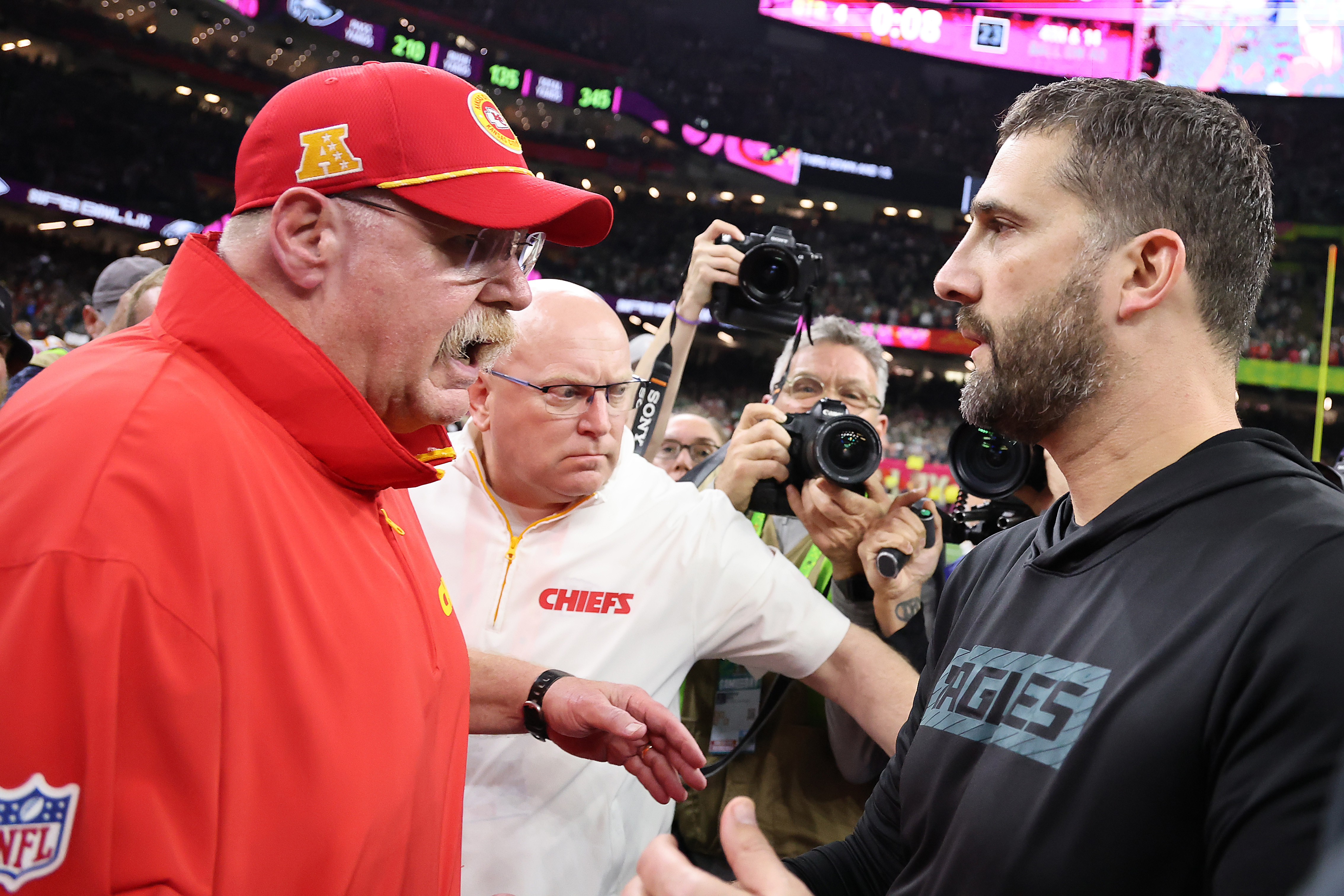
    Nick Sirianni (right) has carried on the Eagles’ winning tradition that started with Andy Reid.

    Cowboys

    Overall record: 218-183-1

    Winning seasons: 13

    Division titles: 7

    Conference championship games: 0

    Super Bowl appearances: 0

    Super Bowl victories: 0

    Giants

    Overall record: 176-225-1

    Winning seasons: 9

    Division titles: 3

    Conference championship games: 2

    Super Bowl appearances: 2

    Super Bowl victories: 2

    Washington

    Overall record: 166-234-2

    Winning seasons: 6

    Division titles: 3

    Conference championship games: 1

    Super Bowl appearances: 0

    Super Bowl victories: 0

    Whatever crises the Eagles might be undergoing are framed through a different lens from any other team in the division. They judge themselves and are judged by the answer to one question: Are we good enough to win the Super Bowl? Their divisional foes’ standard has not been quite as high: Are we good enough to keep from embarrassing ourselves again?

    Quarterback Jayden Daniels and the Commanders took a big step backward in an injury-plagued season.

    Less than a year ago, for instance, the Commanders’ appearance in the NFC championship game was supposed to augur a new rivalry between them and the Eagles at least and a new era for the division at best. That’s why the teams’ two games this season were scheduled in the season’s final three weeks. Huge head-to-head matchups to decide the division, right? Instead, the Eagles trounced the Commanders by 32 points to reach Super Bowl LIX. Jayden Daniels, Washington’s wonderful young quarterback, has played just seven games this season because of injuries, and even if Daniels had remained healthy, the Commanders might be floundering anyway; their front office built the oldest roster in the NFL around him.

    So what happened? How did the Eagles manage to create so much distance between themselves and the NFC East field? As with all big questions, there’s not just one big answer, but here are a few explanations:

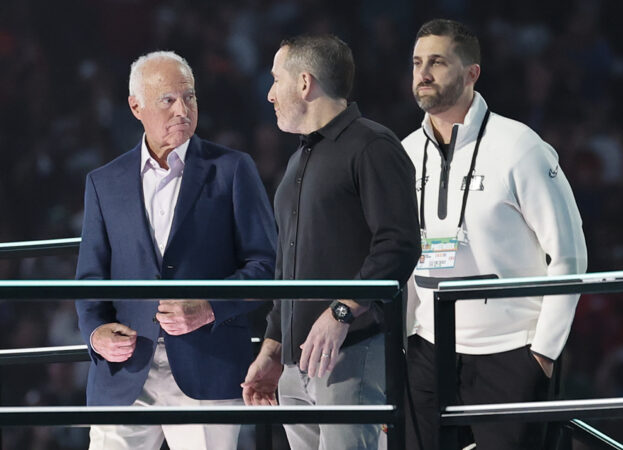
    Jeffrey Lurie, Joe Banner, and Howie Roseman have been forward-thinkers.

    From strategic massaging of the salary cap to aggressive play-calling on fourth down, Lurie has empowered his executives (and, in that middle-management position, his head coaches) to be creative, to posit how the NFL would evolve and how the Eagles might get ahead of those changes.

    Jerry Jones can’t put his ego aside for the sake of a Super Bowl.

    Jones has been a true visionary when it comes to the NFL’s growth into the pop-cultural monster it is today. He recognized America’s insatiable appetite for pro football and has built one trough after another to feed us, and he does want to win championships. But he’s not willing to sacrifice the publicity and the credit, to stand aside and let someone smarter handle the Cowboys’ football-related decision-making. It is not enough that the Cowboys win. Jones must be perceived as the reason they have won, and it’s that very thinking that keeps them from matching the Eagles’ success.

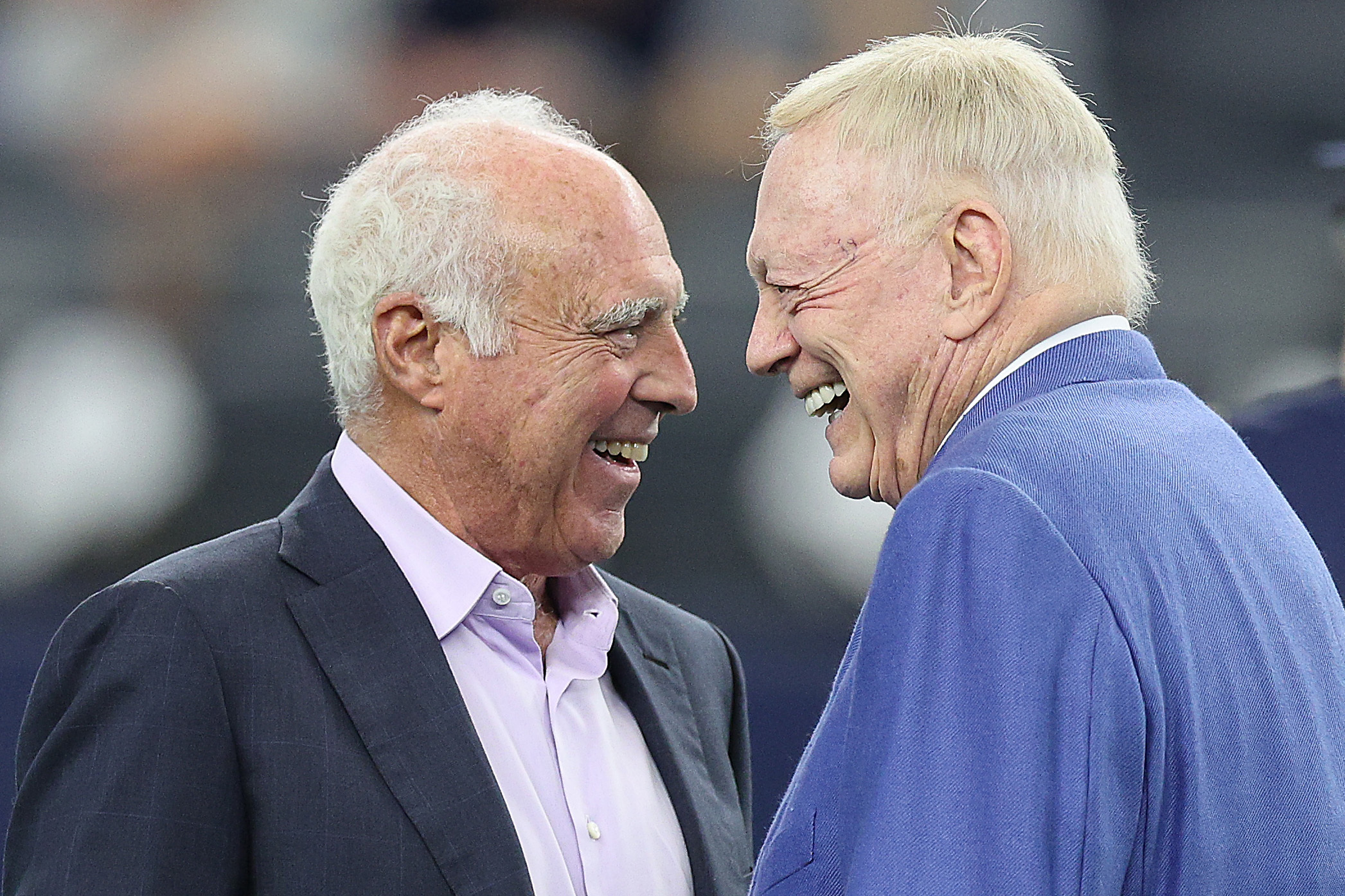
    Jerry Jones (right) and the Cowboys have not been able to keep up with Jeffrey Lurie’s Eagles.

    Daniel Snyder.

    That’s it. The man pretty much single-handedly destroyed one of the best and most popular franchises in the league. As just one example, Washington’s coaching staff in 2013, under head coach Mike Shanahan, included Sean McVay, Kyle Shanahan, Matt LaFleur, Mike McDaniel, and Raheem Morris — and Snyder let all of them get away. (Or run away, as the case may be.)

    Eli Manning retired.

    Sounds crazy, right? It’s not. When Manning was in his prime, the Giants went through an eight-year stretch in which they qualified for the postseason five times, won two Super Bowls, and never finished under .500. The Giants haven’t been able to replace him, and that has been a bigger failure even than allowing Saquon Barkley to sign with the Eagles.

    Jeff Stoutland has given the Eagles an edge in the trenches.

    Yes, the Eagles have long maintained that games are won and lost along the offensive and defensive lines. Any franchise’s coaching staff can chant that mantra, though. Few, if any, can develop linemen like the Eagles, and Stoutland’s presence and expertise are invaluable in that regard. Ask yourself if Jordan Mailata would have become an elite left tackle anywhere else.

    The Eagles value depth at quarterback.

    They won one Super Bowl with their backup quarterback (Nick Foles), won another with a player who had been drafted to be their backup quarterback (Jalen Hurts), made a season-saving run to the NFC divisional round in 2006-07 with their backup quarterback (Jeff Garcia), and have generally hired head coaches who know how to implement and oversee quarterback-friendly systems.

  • Why Philadelphia loses promising biotech firms to Boston, San Francisco, and San Diego

    Why Philadelphia loses promising biotech firms to Boston, San Francisco, and San Diego

    Capstan Therapeutics’ sale this year for $2.1 billion, the highest price paid for a private early-stage biotech company since 2022, was a triumph for its founders at the University of Pennsylvania.

    Unfortunately for Philadelphia, the company is based in San Diego. Investors wanted an executive who lives there to be CEO.

    Capstan was a miss for Philadelphia, said Jeffrey Marrazzo, who cofounded a high-profile regional biotech company, Spark Therapeutics, and is now an industry investor and consultant.

    If Philadelphia had a bigger talent pool of biotech CEOs, “it would have and should have been here,” he said.

    The company, which aims to treat autoimmune diseases by reengineering cells inside the body, most likely would have been sold wherever it was based, but keeping it here would have boosted the local biotech ecosystem, experts said.

    The Philadelphia region has lagged behind other biotech centers in landing companies and jobs, but industry experts are working to close the gap and better compete with Boston, the San Francisco Bay Area, and San Diego.

    According to Marrazzo and others, the Philadelphia region’s relatively shallow pool of top biotech management is a key challenge.

    Big investors go to managers who have proven ability to deliver big investment returns, said Fred Vogt, interim CEO of Iovance Biotherapeutics, a California company with a manufacturing facility in the Navy Yard.

    “They want the company to perform. They’ll put it in Antarctica, if that was where the performance would come from,” he said.

    A positive sign for Philadelphia is Eli Lilly & Co.’s recent decision to open an incubator for early-stage biotech companies in Center City.

    The Lilly announcement last month also reflects Philadelphia’s national biotech stature. It’s the fourth U.S. city to get a Lilly Gateway Lab, behind Boston, the San Francisco Bay Area, and San Diego.

    Those places have far outpaced Philadelphia in the creation of biotech research and development jobs, even as the sector’s growth has slowed.

    From 2014 through last year, the Boston area added four biotech research and development jobs for every one job added here, according to an Inquirer analysis of federal employment data.

    window.addEventListener(“message”,function(a){if(void 0!==a.data[“datawrapper-height”]){var e=document.querySelectorAll(“iframe”);for(var t in a.data[“datawrapper-height”])for(var r,i=0;r=e[i];i++)if(r.contentWindow===a.source){var d=a.data[“datawrapper-height”][t]+”px”;r.style.height=d}}});

    Penn’s role in Philadelphia biotech

    Philadelphia’s reputation as an innovation center — boosters like to call the region “Cellicon Valley” — starts with the University of Pennsylvania, which has long been a top recipient of National Institutes of Health grants to advance scientific discovery.

    Penn scientists’ 21st-century accomplishments include key roles in figuring out how to arm immune cells to fight cancer, fixing faulty genes, and modifying mRNA to fight disease.

    Research at Penn has contributed to the creation of 45 FDA-approved treatments since 2013, according to the university.

    “Penn discoveries help spark new biotech companies, but we can’t build the whole ecosystem in this area alone,” said John Swartley, Penn’s chief innovation officer. “Great science is just one ingredient. We also need capital, experienced leadership, real estate and manufacturing infrastructure, and strong city and state support.”

    Penn was one of two Philadelphia institutions receiving more than $100 million in NIH funding in the year that ended Sept. 30. The other was the Children’s Hospital of Philadelphia.

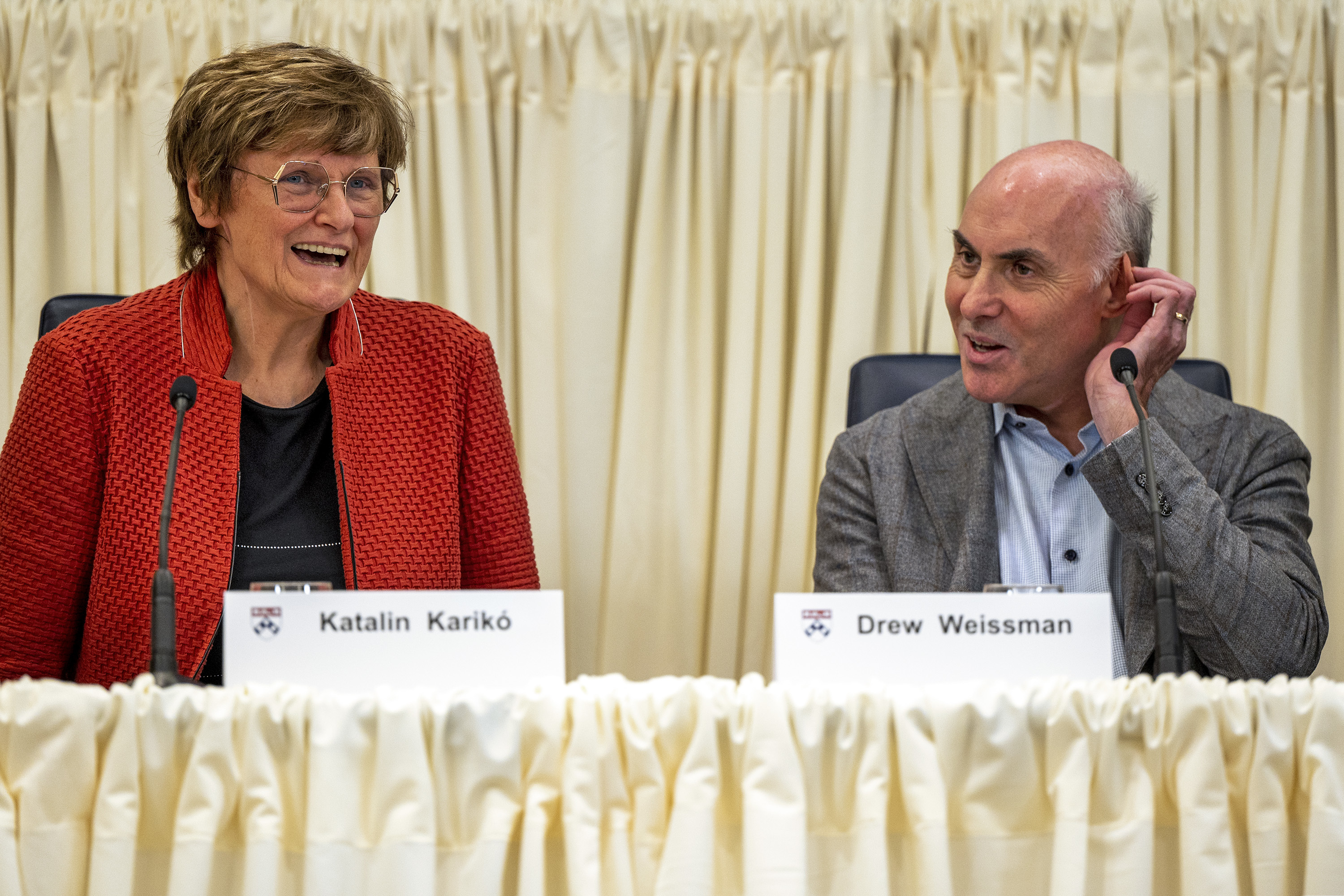
    Katalin Karikó and Drew Weissman spoke at a University of Pennsylvania news conference after they were named winners of a 2023 Nobel Prize in medicine. Their work was instrumental to modifying mRNA for therapeutic uses, such as the rapid development of lifesaving vaccines during the COVID-19 pandemic.

    By contrast, the Boston area was home to 10 institutions with at least $100 million in NIH grants, generating more spinoffs and jobs.

    The Philadelphia region has a healthy number of biotech spinouts, but the biggest markets have more from a larger number of research institutions, said Robert Adelson, founder Osage University Partners, a venture capital firm in Bala Cynwyd.

    That concentration of jobs and companies in the Boston area — where nearly 60,000 people worked in biotech R&D last year — makes it easier to attract people. By comparison, there were 13,800 such jobs in Philadelphia and Montgomery County, home to the bulk of the regional sector.

    If a startup fails, which happens commonly in biotech, “there’ll be another startup or another company for me to go to” in a place like Boston, said Matt Cohen, a managing partner for life science at Osage.

    Another challenge for Philadelphia: It specializes in cell and gene therapy, a relatively small segment of the biotech industry, whose allure to investors has faded in the last few years.

    Such market forces shaped the trajectory of Spark, a 2013 Children’s Hospital of Philadelphia spinout that developed Luxterna, the first FDA-approved gene therapy, used to treat an inherited form of blindness. The promise of Spark’s gene therapy work for a form of hemophilia spurred its 2019 acquisition by Swiss pharmaceutical titan Roche for $4.8 billion.

    This year, Roche laid off more than half the company’s workforce as part of a restructuring and a rethinking of treatments for blood diseases that it had been developing.

    The company still employs about 300 in the city, a spokesperson said, and work continues on its $575 million Gene Therapy Innovation Center at 30th and Chestnut Streets in University City.

    The long arc of biotech

    A handful of companies dominated the early days of U.S. biotech. Boston had Biogen and Genzyme, San Francisco had Genentech, San Diego had Hybritech, and Philadelphia had Centocor. All of them started between 1976 and 1981.

    Centocor started in the University City Science Center because one of its founders, virologist Hilary Koprowski, was the longtime director of the Wistar Institute. Centocor’s first CEO, Hubert Schoemaker, moved here from the Boston area, where he had gotten his doctorate at the Massachusetts Institute of Technology.

    Centocor was one of the nation’s largest biotech companies when Johnson & Johnson bought it for $4.9 billion in 1999. Its portfolio included an anticlotting drug called Reopro and Remicade for Crohn’s disease.

    Another drug still under development at the time of the sale, Stelara, went on to become J&J’s top-selling drug as recently as 2023 with $10.9 billion in revenue. Stelara, approved to treat several autoimmune disorders, remains a testament to Centocor’s legacy.

    Despite its product success, Centocor didn’t have the same flywheel effect of creating new companies and a pipeline of CEOs as peer companies did in regions outside of Philadelphia.

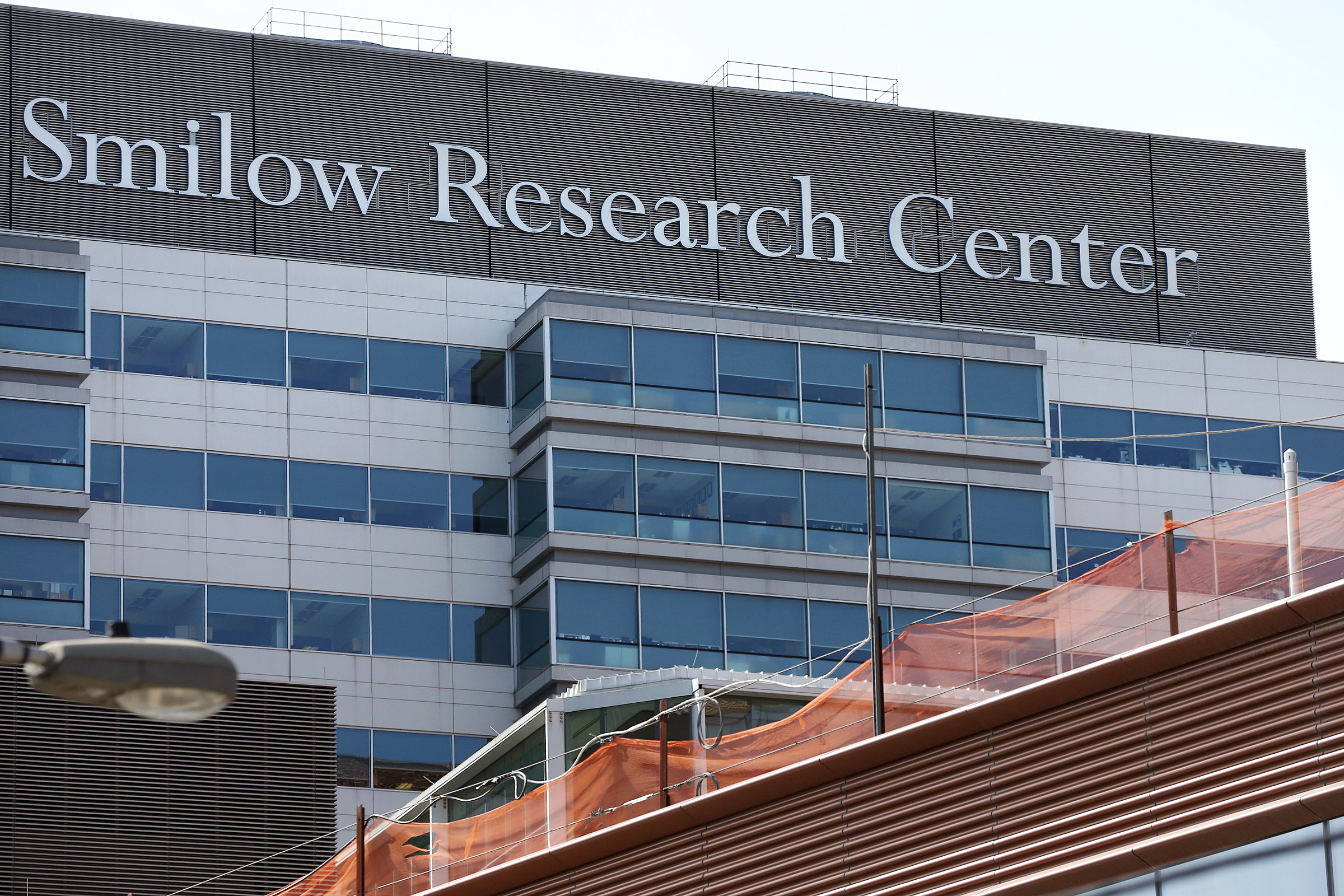
    The University of Pennsylvania’s Smilow Center for Translational Research, shown in 2020, is one of the school’s major laboratory buildings.

    “There are a lot of alums of Centocor that are really impressive, but they seem to have wound up elsewhere,” said Bill Holodnak, CEO and founder of Occam Global, a New York life science executive recruitment firm.

    Among the Centocor executives who left the region was Harvey Berger, Centocor’s head of research and development from 1986 to 1991. He started a new company in Cambridge, Mass.

    At the time, the Philadelphia area didn’t have the infrastructure, range of scientists, or management talent needed for biotech startups, he said.

    Since then, he thinks the regional market has matured.

    “Now, there’s nothing holding the Philadelphia ecosystem back. The universities, obviously Penn, and others have figured this out,” Berger said.

    Conditions have changed

    Penn’s strategy for helping faculty members commercialize their inventions has evolved significantly over the last 15 years.

    It previously licensed the rights to develop its research to companies outside of the area, such as Jim Wilson’s gene therapy discoveries and biochemist Katalin Karikó and immunologist Drew Weissman’s mRNA patents. Now it takes a more active role in creating companies.

    Among Penn’s latest spinouts is Dispatch Bio, which came out of stealth mode earlier this year after raising $216 million from investors led by Chicago-based Arch Venture Partners and San Francisco-based Parker Institute for Cancer Immunotherapy.

    Dispatch, chaired by Marrazzo, is developing a cell therapy approach that uses a virus to attach what it calls a “flare” onto the cells it wants the immune system to attack.

    Marrazzo said in July that he wasn’t going to be involved in Dispatch if it wasn’t based largely in Philadelphia. As of July, 75% of its 60 employees were working in Philadelphia. Still, Dispatch’s CEO is in the San Francisco Bay Area.

    The Philadelphia region is increasingly well-positioned for the current biotech era, said Audrey Greenberg, who played a key role in launching King of Prussia’s Center for Breakthrough Medicines about five years ago. The center is a contract developer and manufacturer for cell and gene therapies.

    “You no longer need to move to Kendall Square to get a company funded,” she said, referring to Cambridge’s biotech epicenter. “You need good data, a credible translational plan, experienced advisers, and access to patient capital, all of which can increasingly be built here.”

    Greenberg now works as a venture partner for the Mayo Clinic, with the goal of commercializing research discoveries within the health system’s network of hospitals in Minnesota, Arizona, and Florida.

    She plans to bring that biotech business to the Philadelphia region.

    “I’m going to be starting my companies all here in Philadelphia, because that’s where I am. And I know everybody here, and everybody I’m going to hire in these startups that are going to be based here,” she said.