Another former religious building is being redeveloped into apartments, with an assist from a law City Council passed in 2019 to preserve large, neighborhood-scale historic buildings like churches.
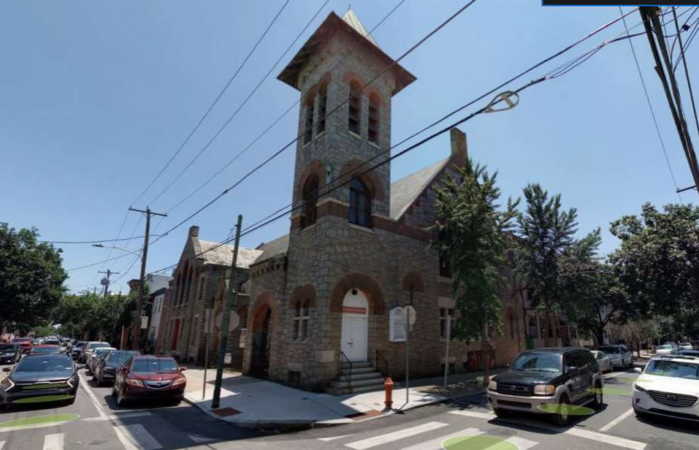
The former St. John’s Baptist Church at 13th and Tasker Streets is slated to house 26 rental units. The church dates to 1892 and is currently vacant.
The developer is Annex Investments II, owned by Drew Palmer, and the design of the remodel is by Philadelphia-based Toner Architects.
The church, which sits at the northeastern corner of the Miracle on 13th Street block, is zoned for single-family residential.
But the 2019 law passed by district Councilmember Mark Squilla makes it easier to convert “special use properties” — such as churches or theaters — to new uses no matter their underlying zoning, if the building is historically protected.
St. John’s Baptist Church was added to the local Register of Historic Places in 2020 after the advocacy group Preservation Alliance of Greater Philadelphia nominated it.
The bill was passed following the St. Laurentius debacle in Fishtown, where a handful of neighbors managed to delay a redevelopment project with lawsuits until the building was in poor enough shape that it had to be razed.
The 2019 law makes such legal warfare more difficult to wage.
These new zoning laws are “facilitating an increasing number of adaptive reuse projects of historically designated properties, preserving them while returning them to productive, taxpaying use and strengthening their surrounding neighborhoods,” said Paul Steinke, who leads the Preservation Alliance.
On Tuesday the project was given a preliminary review by the Architectural Committee, which advises the Historical Commission.
As part of the conversion, the developer wants to insert additional floors to the church building, which is beyond the Historical Commission’s jurisdiction. The plan also includes adding large dormers to the roof to allow more light into the future residences and replacing the dilapidated slate roof with asphalt.
The proposed new dormers can be seen in this rendering, lining the church’s roof.
The Architectural Committee objected to both of those exterior changes.
“The dormers are pretty significant on this, and we’re looking to find a way to make those more subtle,” said Nan Gutterman, who sits on the committee.
Sara Shonk Pochedly of Toner Architects noted the dormers are the same size as those added to other redeveloped churches reviewed by the Architectural Committee, but this building is smaller in size so the new additions look larger.
Because this was a preliminary review meeting, the committee did not indicate how it would vote to advise the larger commission.
“We always appreciate when a church is given another life,” said Justin Detwiler, who sits on the Architectural Committee. “Thank you and your applicant for doing that and being sensitive. These are not easy projects.”
Palmer did not attend the committee meeting and did not immediately respond to a request for comment. Ian Toner of Toner Architects declined an interview request at this early stage in the development process.
Restaurants are not around forever, so it is special when a signature dish takes on new life well after last call.
Take the Milan salad, essentially a deconstructed BLT with shrimp dressed in a distinctive Italian-Russian dressing, popularized by Jimmy’s Milan. Three decades after the Rittenhouse supper club’s closing, it lives on two blocks away at D’Angelo’s. (Cofounder Tony D’Angelo was Milan’s chef.) Order the D’Angelo’s salad, take a bite, and enjoy the time warp.
Restaurateur Jeffrey Chodorow, who will open the swank Mr. Edison at the Bellevue next year, told me that he plans to revive other Philly classics, including Georges Perrier’s galette de crabe, the Le Bec-Fin chef’s take on a Maryland crab cake.
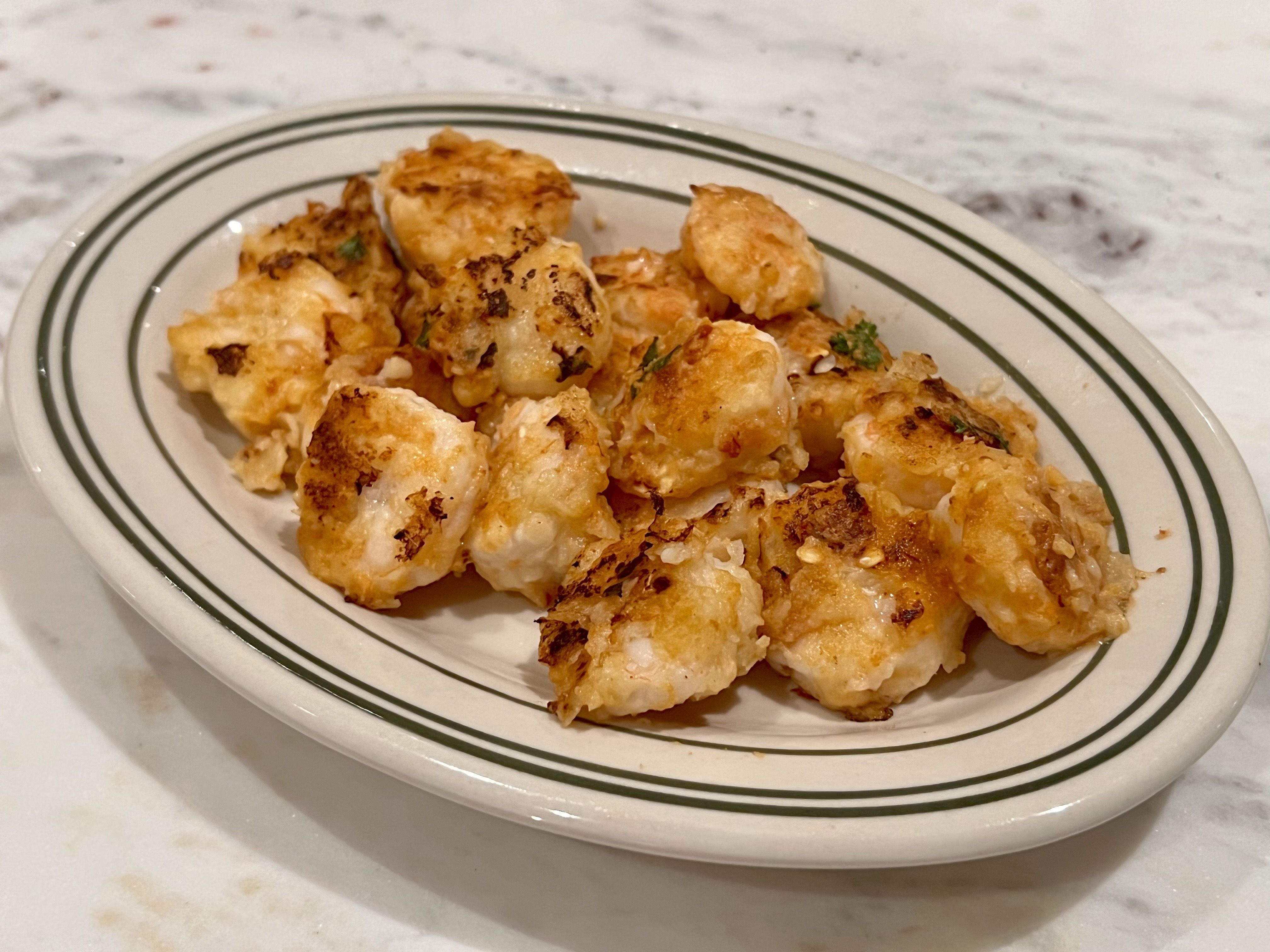
Now let’s consider shrimp pil pil, which restaurateur Dmitri Chimes introduced in the mid-1990s at Pamplona, his Washington Square West tapas bar, and later served at all of the locations of Dmitri’s, his no-frills Greek taverna. The appetizer delivered a one-two punch of chili and garlic with a burst of lemon to prep you for your entrée — perhaps the smoky chargrilled octopus or a rich bowl of cioppino.
When chefs Amanda Shulman and Alex Kemp were planning their new Pine Street Grill at 23rd and Pine Streets — which housed a Dmitri’s from 1999 to 2014 — they asked their Fitler Square neighbors what they wanted in a restaurant. “They all kept referring back to Dmitri’s,” Shulman said.
Kemp said he called Chimes, who still lives in the neighborhood. “He hand delivered us the recipe,” he said. “We’re just super-excited to keep a part of his legacy going. I will say that ours is more of an homage since we know it could never be exactly the same. We started with Dmitri’s recipe as a base and then iterated it a bit, but inherently, it has [the] same ethos and qualities.”
Kemp and Shulman have done justice to this classic.
Pamplona/Dmitri’s recipe called for large shrimp. At Pine Street, they’re going big with six jumbo shrimp, topping them with an abundant sauce that is far creamier and more herbaceous than I remember. They’re also thoughtfully adding grilled bread to ensure plate-cleaning.
Now perhaps they’ll consider adding spanakopita or baklava to the menu …
On Sunday afternoon following the Eagles’ blowout win over the Las Vegas Raiders, Landon Dickerson didn’t have the patience to entertain an iota of criticism about his quarterback.
Jalen Hurts, the Eagles’ fifth-year starter, was fresh off a near-perfect performance. He went 12-for-15 for 175 yards and three touchdowns in the passing game, plus he added 39 yards on seven carries.
It was a stark improvement over his performance in the previous two games of the Eagles’ losing streak, in which Hurts didn’t complete more than 56% of his passing attempts and turned the ball over seven times. When a reporter asked about Hurts’ showing against the Raiders in the aftermath of a “rough ride” during the losing streak, Dickerson bristled at the nature of the question.
“Oh, y’all just, like, dog him,” the Eagles left guard said.
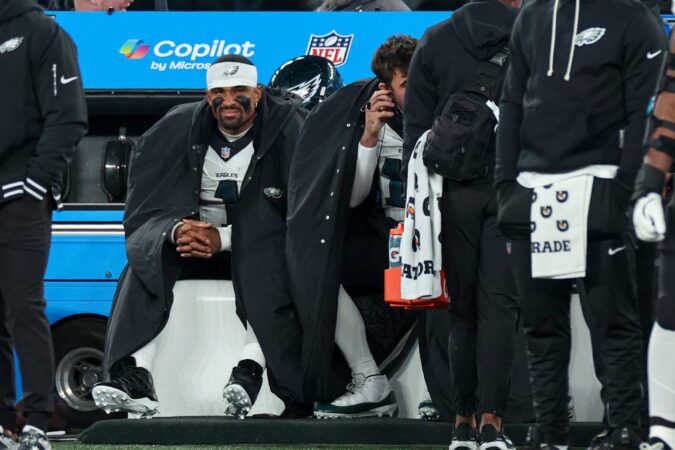
But Hurts wouldn’t know that, or so he claims. The 27-year-old quarterback emphasized Tuesday that he tunes out the external criticism, making him impervious to the many opinions about his play that crop up in the media, locally and nationally.
His teammates, though, are more plugged into the discussions about Hurts that percolate online, especially during their string of losses. A reporter told Hurts on Tuesday that Nakobe Dean had said after the Raiders game that if hehad been seeing the criticism about the quarterback, then he would bet that Hurts had seen it, too.
“He’d be a broke man if we made that bet,” Hurts said.
Evidently, he didn’t tune into Nick Sirianni’s weekly radio appearance on 94-WIP, when the coach was asked whether Hurts would remain the starting quarterback. (“I think that’s ridiculous,” Sirianni responded). That Hurts didn’t hear a snippet on the radio or catch a glimpse of a chyron on a talking-heads debate show on one of the TVs at the NovaCare Complex over the last three weeks is an impressive feat.
How was he able to drown out the scrutiny?
“It’s who I am,” Hurts said. “It’s my focus. This isn’t my first rodeo, you know? So very unprecedented journey to be here. But unprecedented is unprecedented.”
Hurts has been here before. He often points to his benching at Alabama as one of the pivotal moments of his football career, one that taught him lessons of perseverance and determination.
He responded emphatically to that low point, leading Alabama to victory in the SEC title game the following season and finishing as the runner-up for the Heisman Trophy after transferring to Oklahoma. Hurts was the fifth quarterback taken in the 2020 draft — and the first to win a Super Bowl.
The past month was a microcosm of Hurts’ football journey — you can doubt him, but you can’t underestimate his ability to respond, especially when the stakes are high. That’s part of the “clutch gene” that Jeffrey Lurie has said he identifies within Hurts. It’s a trait that the quarterback values, too.
“You work really hard to show up when your team needs you the most,” Hurts said. “All of the perceived pressure, whatever that is, just really preparing for a moment, preparing for an opportunity and knowing that resilience, determination, and perseverance can bring it home for the group. I’d say that’s pretty valuable for me, to take pride in showing up when my team needs me to the most.”
Eagles tight end Dallas Goedert celebrates his first-quarter touchdown with Jalen Hurts against the Las Vegas Raiders on Sunday.
Soon enough, the stakes will be as high as they’ve been all season. The Eagles have a chance to clinch the NFC East on Saturday with a win over the Washington Commanders. They could be playing to improve their seeding in the NFC, too, depending on how the conference’s front-runners fare for the rest of the season.
Then, the playoffs will begin, providing Hurts with the stage to flaunt that “clutch gene” he has channeled throughout his career.
“I see it as an opportunity,” Hurts said. “That’s it. September, October [are] important games, kind of finding yourself. It’s a new team, you find your groove. But new things are found in December, January, and February. I think just being built off of perseverance, being built off of learning from all of my experiences and learning from everything, you definitely look forward to those moments.”
In those moments, the Eagles will try to build off the strides they took in the win against the Raiders. As the player with the ball in his hands on every offensive snap, Hurts will incur plenty more scrutiny. He is well-equipped to handle that job responsibility, according to Sirianni.
“I think that playing quarterback in the NFL, you’re going to get a lot of attention,” Sirianni said. “Positive, negative, all attention. When that happens — we talk about this a lot as a team — any little thing [that] distracts you [or] what can distract you, you need to block out.
“I think that why Jalen can handle it so well is because he’s so locked in and focused and not distracted by things to be able to lock in onto what he needs to do to get himself ready to play.”
Despite some turbulence, the Eagles could celebrate a second consecutive NFC East title Saturday when they travel to Landover, Md., to play the first of two games against the Commanders over the final three weeks of the NFL season.
When the NFL schedule came out, the expectation was that these two games between division rivals who met in last season’s NFC championship game would be critical for playoff positioning. Instead, the Eagles are tracking toward becoming the first repeat NFC East champion since 2004 and Washington is desperately trying to get to the finish line of a miserable season.
But the games must go on, and the Commanders would probably like nothing more than to be an annoying speed bump on the Eagles’ road to the playoffs.
Here’s a look at some numbers that could be important Saturday evening at Northwest Stadium:
45.4%
The Eagles, in need of an offensive jolt, emerged from their mini-bye after Week 6 utilizing more under-center sets and found success vs. the Vikings and Giants. But after the bye week, their success rate declined vs. the Packers and Lions. Then, in games vs. the Bears and Chargers, they seemed to get away from having Jalen Hurts take snaps from under center almost entirely.
Eagles quarterback Jalen Hurts throws the football in the first quarter against the Las Vegas Raiders on Sunday.
But in their 31-0 victory over the Raiders on Sunday, the Eagles went under center a season-high 30 times in 66 snaps (45.4%). The Eagles ran the ball out of those looks plenty, but they also worked in some play-action. Hurts completed all four of his play-action passes from under center for 66 yards.
Against a weak defense, perhaps Kevin Patullo will continue to take a look at what the Eagles can do from under center compared to their typical shotgun and pistol looks.
Only the Cincinnati Bengals, who give up a whopping 403.8 yards per game, allow more yards on average than the Commanders’ 382.6 yards.
Washington’s defensive corps has been decimated by injuries, and the oldest defense in the NFL has not held up well. Both phases have struggled. The Commanders allow 136.3 rushing yards per game and 246.3 passing yards. The Eagles, even with their Jekyll and Hyde offense, should be able to do whatever they want. Their improved running game should find plenty of holes, which should open up play-action passes against a beat-up secondary.
Eagles running back Saquon Barkley hurdles into the end zone for a touchdown in the fourth quarter of the NFC championship against the Commanders in January.
Veteran Von Miller, 36, is still a dangerous pass rusher. He has seven sacks on the season while playing just 38.3% of the snaps. And 35-year-old Bobby Wagner is still an impactful linebacker. But the Commanders don’t have enough playmakers. Cornerback Mike Sainristil had a good rookie season in 2024, but like much of his team, he has taken a step back in 2025. Sainristil has four interceptions, but he’s allowing a passer rating of 109.2 when targeted, according to Next Gen Stats. That’s up from 97.7 last season. Sainristil is allowing a reception on 68.6% of his targets, up from 59.8% last season.
Washington is without cornerback Marshon Lattimore, who suffered a season-ending ACL injury in November.
If all goes as planned, expect more Tanner McKee snaps in the fourth quarter.
329
If there’s one area the Eagles should be concerned about defensively, it’s containing Marcus Mariota. Sure, that’s an easier task than containing Jayden Daniels, but Mariota is a veteran quarterback who knows how to play the position and knows when to tuck it and run.
That’s been a problem for the Eagles, who have given up 329 rushing yards this season to opposing quarterbacks. Only the Giants, at 357, haven given up more rushing yards to opposing QBs.
Commanders quarterback Marcus Mariota runs with the ball as Broncos defensive end John Franklin-Myers (98) and linebacker Nik Bonitto attempt a tackle.
Mariota, 32, used his legs and his arm in helping Washington earn its first win since Oct. 5 on Sunday. He rushed 10 times for 43 yards. And with Terry McLaurin back in action, Mariota found some success with the deep ball. He completed 10 of 19 passes overall, but he went 7-for-11 for 181 yards and a touchdown on throws greater than 10 air yards, according to Next Gen Stats.
Washington has done a decent job protecting its quarterbacks. Its pressure rate allowed is just 33%, good for 12th in the NFL. The Eagles have done a much better job getting after quarterbacks since Jaelan Phillips arrived at the trade deadline. They’ll need to home in on stopping Mariota’s scrambles, though, to prevent Washington from extending drives.
82.9%
The playoff picture is starting to take shape for the Eagles.
They could wrap up the division Saturday, and even if they don’t, it’s still unlikely they lose out and Dallas wins out. There’s just a 0.8% chance that happens, according to FTN Fantasy.
The Eagles are also inching closer to being locked into the No. 3 seed in the NFC. They remain two games behind the two NFC West teams (Rams, Seahawks) tied for the No. 1 seed and are a game back of the NFC North-leading Bears, who own the tiebreaker over the Eagles.
According to FTN, the likelihood the Eagles finish the season as the third seed in the NFC is up to 82.9%.
The scariest day of the offseason is always the one when Dave Dombrowski looks at his Phillies roster, smiles, and says, “Yep, that’ll do.”
On Tuesday, Christmas came earlier than usual for next year’s trade-deadline sellers.
“We feel very good,” said Dombrowski. “I guess we’d look for arms in the bullpen. But we’ve also got five solid guys out there that are of veteran status. Sometimes, you have to give some young guys an opportunity. We have some guys that we like. So that’s really where it stands. And maybe depth at different positions. We’re dealing with that. But I think as far as our everyday positional players — other than catcher — we’re pretty well set.”
[JUMP CUT TO MAY 2026, THE CITIZENS BANK PARK SCOREBOARD]
VISITOR — 000 000 03X | 3 5 0
HOME — 100 000 0XX | 1 2 0
[THE CAMERA ZOOMS OUT SLOWLY, REVEALING A PLAYER IN A GRAY JERSEY CIRCLING THE BASES AS A PHILLIES RELIEVER STANDS ON THE MOUND WITH HIS SHOULDERS SLUMPED, STARING BLANKLY INTO THE MIDDLE DISTANCE]
NARRATOR: (gravely) As it turned out, they weren’t pretty well set.
It goes like this every year, doesn’t it? Opening day arrives and a month or two later the Phillies realize they could really use one more right-handed bat and another reliever or two. Maybe this will be the year that breaks the cycle.
Or, hey, maybe we’ve been looking at the offseason wrong this whole time. Maybe the whole point of the thing is to remind us what it feels like to believe. That Adolis García will be the player he was at 30 years old instead of the player he was at 31 and 32. That Justin Crawford will go from being a player who didn’t deserve a big league roster spot over Max Kepler to one who will be an impactful piece of the Phillies lineup and play a good center field to boot. That the bullpen will transform into a dominant unit instead of one that has allowed 25 runs and 21 of 26 inherited runners to score in the Phillies’ last eight postseason games.
It’s a magical time of year, isn’t it? Maybe we are the grinches.
There’s some truth to it. As Dombrowski has said before, there is no such thing as a perfect roster. The team you bring into opening day is much more the sum of all previous offseasons than it is the product of the most recent one. The Phillies have spent a lot of money in the five years since they hired Dombrowski as president of baseball operations. Most of those expenditures are still on the books and occupying roster spots in the lineup, rotation, and bullpen. It’s easy to watch the Dodgers drop $69 million on Edwin Díaz and wonder why the Phillies can’t do the same. But there are 20-plus teams saying the same about the Phillies as they watch Kyle Schwarber re-up for five years and $150 million.
Dave Dombrowski says the Phillies’ roster is “pretty well set.”
Using the Dodgers as a benchmark can skew reality. The Phillies have improved their regular-season win total in each of Dombrowski’s first five seasons at the helm. Not only did they win 96 games last season, but they scored 31 more runs and allowed 37 fewer than they did in 2022, when they went to the World Series. Those results don’t necessarily align with the narrative that says the Phillies are a team in the midst of a steady decline.
As long as we assume that the Phillies eventually come to terms with J.T. Realmuto and fill their gaping void at catcher, they will enter 2026 with a sensible roster that is well within the range of outcomes we should have expected heading into the offseason. García is a decent bet to be an improvement over Nick Castellanos, pairing good defense, decent speed, and better power with his free-swinging approach. In left field, the Phillies will presumably begin the season with Brandon Marsh and perhaps Otto Kemp and keep an open mind from there. A little bit of flux can be a good thing, perhaps preserving an opening to get a look at a prospect like the lefty-hitting Gabriel Rincones at some point down the road.
The biggest potential weakness in the Phillies’ approach is the extent to which they will be counting on Crawford, whom Dombrowski indicated would report to spring training as the leading candidate to man center field. Nobody is expecting Crawford, who will be 22 in January, to hit .334 with a .411 on-base percentage, as he did last season in 506 plate appearances at triple-A Lehigh Valley. He won’t even need to come close to those marks to warrant an everyday role. But he will need to warrant that role, or else the Phillies’ outfield situation will look a lot closer to what it did during the first half of last season vs. the competent unit it became as Kepler emerged and Harrison Bader joined up.
The big risk the Phillies are taking is in moving on from Bader. The center fielder was such an obvious fit after his trade-deadline acquisition from the Twins that you can’t help but think that they will enter next July looking for another similar player. The obvious question: Why not just do it now?
The first answer is money. Bader is reportedly looking for a three-year deal at $10 million to $15 million annually. That’s a steep price to pay a 31-year-old player with an injury history who is coming off his first season of 500-plus plate appearances.
The second answer is Crawford.
“If you’re going to give Crawford an opportunity, you’ve got to give it to him,” Dombrowski said. “And that’s where we are. We’re going to give him an opportunity to go out there and have a chance to play a lot.”
Where they are is the place they usually are, and one that is the fate of most teams when pitchers and catchers report.
When the U.S. Department of Health and Human Services quietly altered the nameplate on Rachel Levine’s official portrait during the recent government shutdown — replacing her legal first name with the one assigned to her at birth — it might have seemed to some like an insignificant gesture.
But symbols matter. Names matter. And, as we are constantly reminded by the pioneering example of Levine — the first openly transgender person confirmed for a government role by the U.S. Senate — identity matters.
And the deliberate act of using a transgender or nonbinary person’s birth name (or a previous name) after they’ve chosen a new one — a demeaning practice known as “deadnaming” — is more than just an insult to one nationally recognized medical leader. It’s a signal about what our health system is becoming.
It tells every transgender clinician, trainee, staff member, and patient: Your identity is provisional here. Your legitimacy is negotiable. Your name can be taken from you. For a profession that depends on psychological safety, this is no small thing.
Imagine training as a transgender medical resident and watching the federal government manipulate the image of one of the country’s most illustrious physicians — someone who helped lead Pennsylvania through the opioid epidemic, someone who oversaw critical COVID-19 responses, and someone so accomplished that they hold the rank of admiral in the U.S. Public Health Service.
Then-Pennsylvania Secretary of Health Rachel Levine meets with the media at The Pennsylvania Emergency Management Agency headquarters in Harrisburg in May 2020.
Imagine treating transgender youth in a climate where federal agencies publicly invalidate the very concept of gender identity.
Imagine being a transgender patient, already vulnerable, and seeing your government insist that who you are is, at best, a clerical preference and, at worst, a threat to national security.
We sometimes tell ourselves that culture wars don’t reach the clinic. They do.
They show up when patients avoid care because they fear being misgendered or judged.
They show up when medical students stay closeted to avoid being targeted, derailing careers before they begin.
They show up when clinicians feel pressured to hide their families or their own identities in order to survive training environments already marked by burnout, moral injury, and hierarchy.
They show up in public health, where trust is essential — whether in vaccines, harm-reduction programs, or pandemic response. When government institutions themselves engage in targeted stigmatization, entire communities disengage.
And they show up in professional integrity. A health system that claims to uphold evidence yet endorses policies contradicted by every major medical association — including the treatment of gender dysphoria — erodes its credibility. When science is invoked only when politically convenient, clinicians feel the ground shift under their feet.
Levine showed grace by calling the deadnaming “petty.” In a sense, she’s right: The act is juvenile. But if the rest of us don’t call it out, we risk missing the larger threat.
Professional erasure begins with symbolic gestures — the removal of names, the reclassification of identities, the retelling of who someone “really” is. History is rife with examples of how stripping titles, credentials, or names precedes efforts to diminish authority and restrict participation.
A physician’s portrait is not just a piece of decor. It is a public acknowledgment of service, expertise, and contribution. Altering it is an attempt to rewrite not only identity but legacy.
If medicine is to retain its moral center, clinicians must resist the temptation to disengage. This is not “politics” in the partisan sense. It is professional ethics.
We can start by naming the harm clearly. Deadnaming is not a clerical correction; it is a form of psychological violence aimed at delegitimizing identity.
We must also educate our colleagues, many of whom underestimate the downstream effects of identity-based policies on patient trust, engagement, and health outcomes.
At the same time, we have an obligation to actively support trainees and colleagues — especially those who are transgender or gender-expansive — who may feel newly unsafe or exposed within training environments and workplaces.
Defending evidence-based care is essential: Transgender medicine is medicine. Period. And we must insist that federal agencies speak truthfully about science.
A selective invocation of “scientific reality” is not reality at all; it is ideology masquerading as evidence. Medicine is facing a pivotal question: Are we willing to let political ideology dictate whose identities are valid within our clinics, hospitals, and public health institutions?
Rachel Levine’s portrait matters because deleting her name is an invitation to delete others. It is an attempt to redefine professional legitimacy by biology rather than biography — by chromosomes rather than contributions.
Yet her life is proof that gender identity neither diminishes competence nor negates service.
When a government tries to rewrite that narrative, the medical profession must ask itself: If we do not stand up for the integrity of our colleagues, who will stand up for the integrity of our patients?
Arthur Lazarus is an adjunct professor of psychiatry at the Lewis Katz School of Medicine at Temple University.
Maya Nazareth was 17, living in Malaysia, when she started training in Brazilian jiujitsu and discovered the discomfort and limitations of women’s fightwear.
She kept adjusting her sports bra, fixing her rash guard and pants while trying to focus on the martial art that demands immense discipline and control. Nazareth, who struggled with body image issues, said the feeling of discomfort and frustration affected how she moved in the gym and in the world.
Back in the U.S, as a “naive” college student with $2,000 to her name, she dreamed of building Alchemize Fightwear, an apparel brand to empower women fighters across the world.
She founded the brand in 2020. Five years later, she won $300,000 on ABC’s Shark Tank, backed by Reddit founder Alexis Ohanian, Lori Greiner, and Kendra Scott in exchange for a 15% stake.
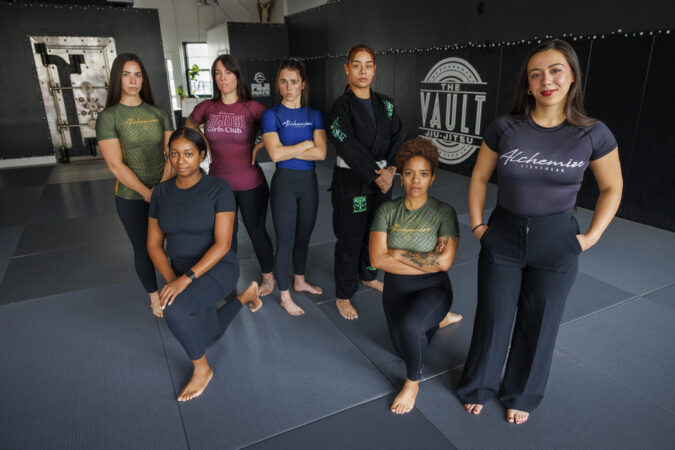
Maya Nazareth at the Vault Jiu Jitsu, Morton, PA., is the founder and CEO of Alchemize Fightwear, Friday, December 5, 2025.
“I was having my chest exposed, my stomach exposed, and my pants fell during training,” she said. “That’s a huge barrier for women to train in these sports, especially in front of 50-plus men in a training room. I just thought I could create something better.”
Nazareth, who grew up in Malaysia and all over New Jersey, realized that she shared her reality with many women in male-dominated gyms and martial arts academies, who are often led to quit before they experience the confidence and power martial arts brought to Nazareth.
“Jiujitsu transformed me into someone who felt strong, powerful, and confident, but the gear I was training in didn’t make me feel that way,” she said.
While studying international business at the University of Delaware, Nazareth placed her first purchase order of rash guards from a manufacturer, trying them out herself and putting them to test.
Her college apartment was Alchemize’s first headquarters, and her car was amobile sales office.
She started by surveying 1,500 fighters, from amateur athletes to professional competitors, asking them what elements would make their apparel more comfortable and functional for their specific disciplines.
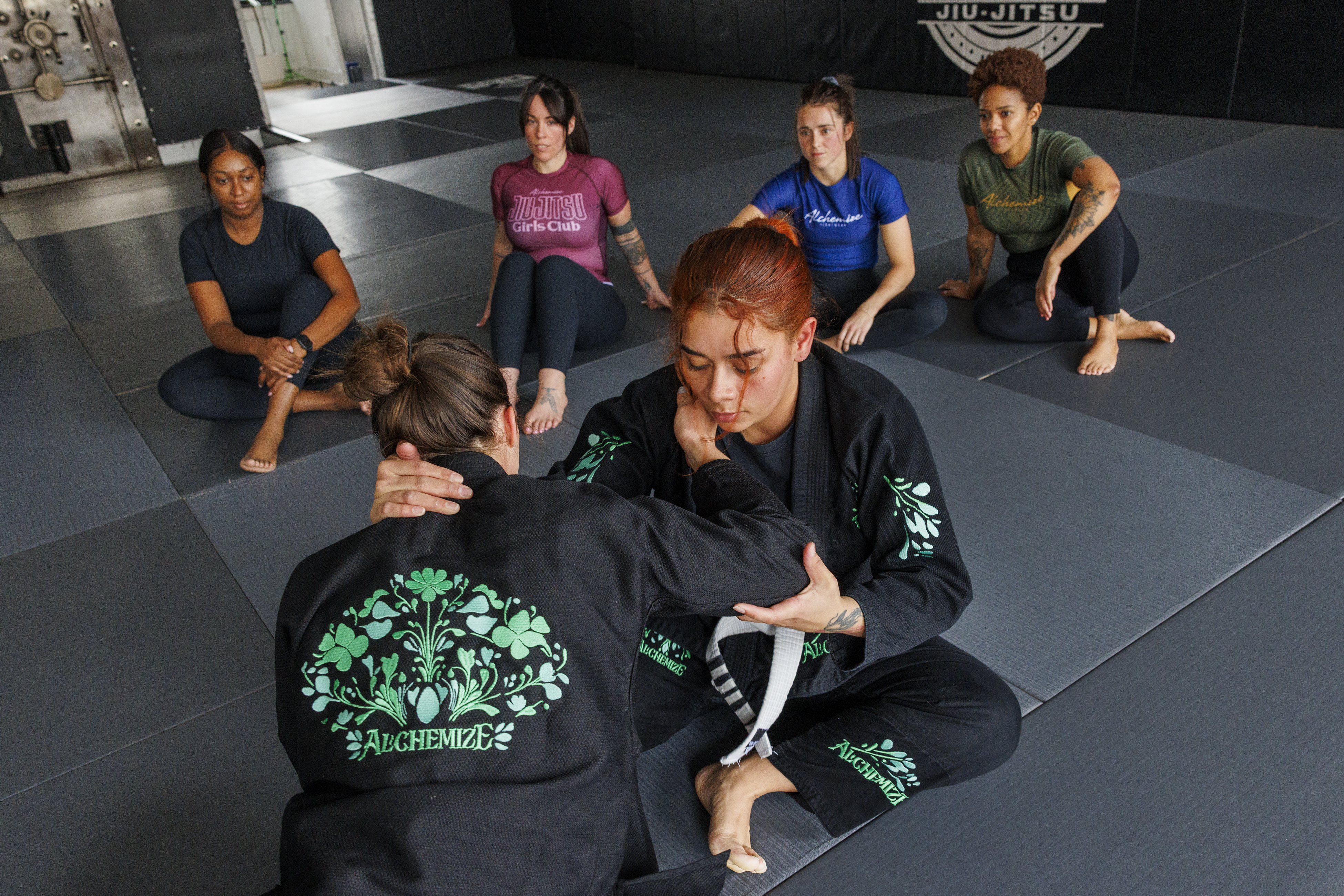
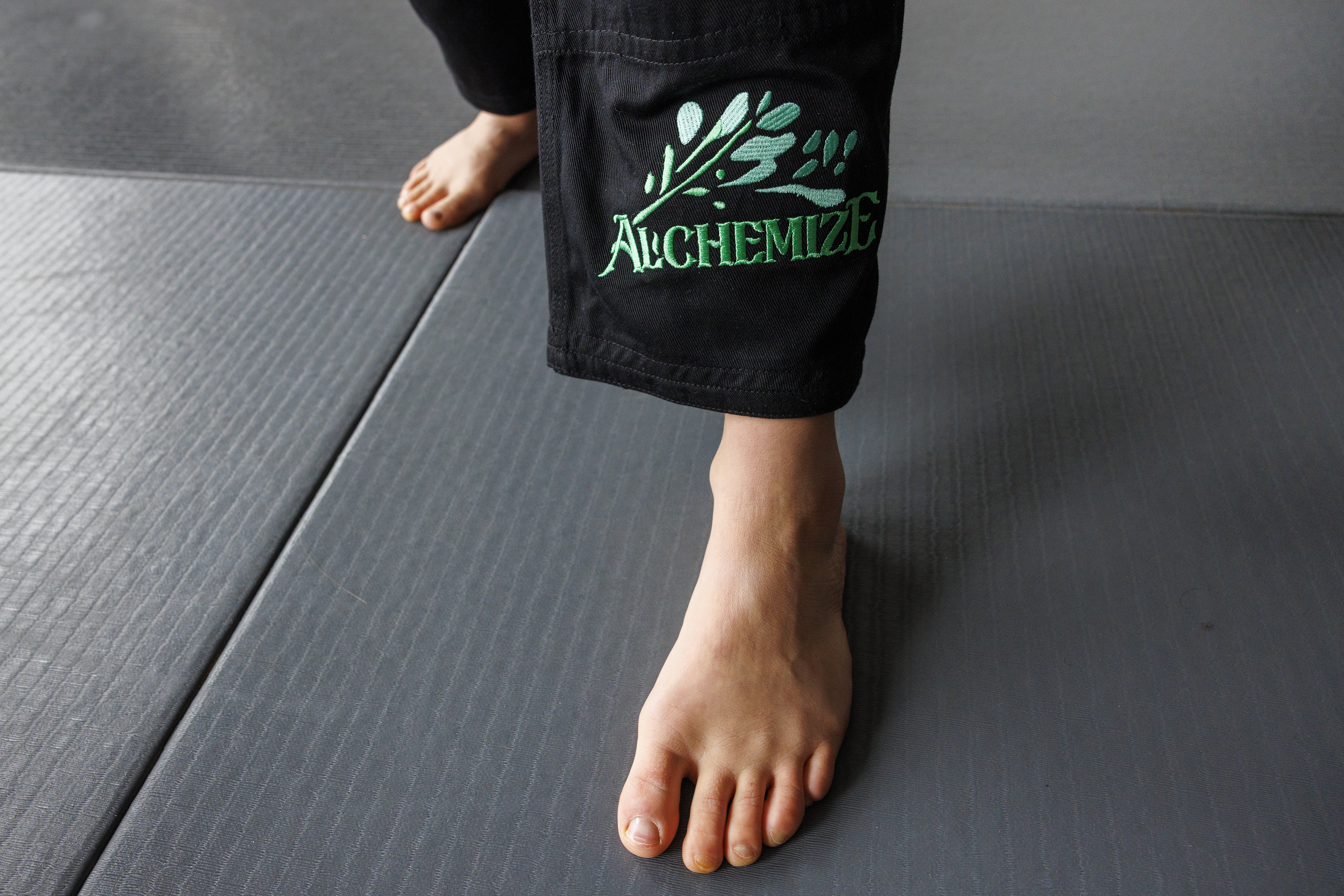
At left is Ashley Razzano with Genisis Medina-Arce in embroidered Gi’s by Alchemize Fightwear. They are shown at the Vault Jiu Jitsu, Morton, PA, Friday, December 5, 2025.
Nazareth reshaped necklines in the tops, removed center seams from the bottoms, inserted silicone waistbands, and built in sports bras for added support and comfort.
What she offered was both stylish and functional for women fighters in jiujitsu, wrestling, and later boxing, Muay Thai, and other disciplines. They were all “customer-centric designs,” she said, that made for a more fluid and functional fit for martial arts practitioners. She even tapped MMA fighter Michelle Waterson to design a collection of her own.
“It’s nothing revolutionary,” Nazareth, 27, said, “but it’s really just thinking about the customer first and what they need from their fight wear.”
When she formed the brand in 2020, she built a company for every woman, in and outside the gym.
“Moms are fighters. People going through medical diagnosis are fighters. People trying to push through in their careers are fighters. And I think fighting is just a natural human movement that we all innately know how to do, want to do, and need training around,” Nazareth said.
“I really love that we have created an avenue for more women to step into that. I think it’s really powerful to say, ‘Hey, it’s safe to show up and express yourself in this way.’”
Ashley Razzano with embroidered gi from Alchemize Fightwear, Friday, Dec. 5, 2025.
Under the Alchemize brand, Nazareth hosts free self-defense classes for survivors of domestic and sexual assault. She also organizes grappling camps in gyms and martial arts academies throughout the region to increase accessibility for women athletes.
“I’m personally passionate about what fight sports can offer survivors of assault and of domestic violence,” Nazareth said. “Just being able to make fight sports accessible to the everyday woman who may think, ‘I’m not a fighter,’ or who doesn’t see themselves rolling on the mat with a bunch of sweaty men. I think that’s something I’m really proud of and something I would like to continue doing.”
Maya Nazareth at the Vault Jiu Jitsu, Morton, PA. She is the founder and CEO of Alchemize Fightwear, Friday, December 5, 2025.
Her work and advocacy haven’t gone unnoticed. In December 2024, the Fairmount resident was named to the Forbes 30 Under 30 list for groundbreaking work in women’s sportswear and retail.
Less than a year later, she was pitching on Shark Tank.
She received an email from the Shark Tank production team in March 2025 and immediately questioned its legitimacy.
“I try not to overcommit to an opportunity before it happens,” Nazareth said.
Despite her initial suspicion, she filled out the application and took the phone screening. Two months later, she flew out to California to compete on the show.
”You never know if you’re going to actually air on the show or what’s going to happen,“ she said. ”But I started my business for the love of the sport and because I wanted to do something cool for women’s jiujitsu. So, every single opportunity that comes up, I try to do my best. It was really exciting.”
As she practiced her script, Nazareth took a moment to reflect on her journey. “I kept saying to myself, this is not the time to play small,” she said. “This is the time to be courageous.”
When she walked out to present, Nazareth said she “blacked out.” But her proposal sparked immediate interest from Ohanian.
She started out seeking a $250,000 investment in exchange for a 5% stake in Alchemize, and ended with $300,000 and a shared deal with Ohanian, Greiner, and Scott.
“It was really emotional and really, really cool,” she said.
In the months since the episode’s airing Oct. 22, Nazareth said the company has seen increased sales and a growing list of new customers. Having weathered the chaos of Black Friday, she looks forward to the slower Christmas season before things pick back up at the top of the year.
Genesis Medina-Arce wears an embroidered gi from Alchemize Fightwear, Friday, December 5, 2025.
She’s excited about the new developments at Alchemize. In 2026, Nazareth and her business partner, Suzette “Suliy” Melendez, will launch the flagship Alchemize Fightwear Athlete Program.
The online program will support athletes as they scale their current and future businesses in and outside of combat sports. Melendez said the move aligns with Nazareth’s mission to empower women in sports and business.
“We want to give other women opportunities outside of jiujitsu and give them a platform to scale,” Melendez said. “Being able to have shoulders to lean on, on the mats or off the mats, helps create community with our events.”
Nazareth also plans to expand Alchemize’s sports camps, making it the “South by Southwest” of women’s combat.
Through all these ventures, the goal remains the same, she says: creating pathways for women to enter martial arts and encouraging them to “own their inner ferocity.”
’Twas a few days before Christmas, and all through Cherry Hill, children were running outside with no jackets to chase Santa, and sometimes with no shoes.
Strapped to the top of a Cherry Hill fire truck, Santa Claus made his rounds through the South Jersey community on Sunday, waving as he passed through condominiums decorated for Christmas and snow-dusted cul-de-sacs. Santa’s firefighter escorts handed out candy canes and holiday greetings as Christmas cheer warmed the frigid township.
“There’s nothing better than when you pull around the block with Santa on the roof,” said Jim Aleski, a Cherry Hill Fire Department lieutenant.
Each December, Santa makes a special trip to Cherry Hill, meticulously visiting every street in the township over the course of the department’s multiday Santa Tour. A fresh coat of rare December snow made for a particularly picturesque scene over the weekend, when kids, parents, and dogs chased down the fire truck to get a coveted glimpse of St. Nick.
Mark Yakovich, 3, and his dad, Ed Yakovich, 44, flagged down the fire truck from their driveway as if they were hailing a cab. Mark, the toddler, is very into trains at the moment. Luckily, fire trucks remain pretty high on his list (specifically when they’re associated with Marshall, the Dalmatian puppy fire marshal in PAW Patrol). Holding two candy canes and a toy train, Mark eyed the fire truck with glee, and a healthy skepticism, from the comfort of his dad’s arms.
Though Ed Yakovich said they are still “figuring out the family traditions with the new little guy,” seeing Santa was at the top of their December to-do list.
At the Burrough’s Mill subdivision, Andrew Lee said he and his family wait for Santa every year. A bit of Christmas light amid so much darkness in the world was a welcome respite this time around, he said.
“Santa brings the spirit,” Lee said.
What is Lee’s son, Makai, 10, asking for this Christmas? An Xbox, Roblox, and more Roblox.
Ed Yakovich takes a photo of his wife Kendra McGarvey with their son Mark Yakovich, 3, as Santa, leaves after stopping at their home.
As the firefighting crew and its guest of honor wound through the township, delighted residents waved and cheered, stopped for selfies, and honked in appreciation. One resident ran out to gift a box of brownies to the firefighters.
Aleski said no one can quite pinpoint when the Santa Tour began, but residents say they remember the tradition happening as far back as the 1960s.
Archives show Santa visiting South Jersey via fire truck as early as 1931, when he distributed gifts to the children of Barrington on Christmas Day.
Sandy Chase, 54, said she remembers a Santa Tour from her childhood in northern New Jersey.
“This is a big Jersey thing,” she said.
Nicole Gaunt, 31, has lived in Cherry Hill her whole life. She and her daughter Khaos, 8, were out playing in the snow when Santa rounded the corner.
Gaunt said the duo were prepared to see the big guy.
“We’ve chased him down before,” she added.
Three-year-old Michele Peruffo pauses as firefighter Sam Harrison (left) walks behind a fire truck with Santa through the neighborhood.
Aleski said nothing drives community engagement like the Santa Tour. Each year, his department gets dozens of calls, emails, and social media inquiries about when Santa will pass by each house.
Though the department is meticulous in hitting every block, it’s a fire department first, and emergency operations supersede Santa. Santa has shown up at more than a few unexpected emergencies during tours past.
The Santa Tour in Cherry Hill will continue over the next few days. To see when Santa is visiting each neighborhood, explore this interactive map.
Firefighter Lt. Jim Aleski gives candy canes to a driver “stuck” behind the Santa fire truck.
This suburban content is produced with support from the Leslie Miller and Richard Worley Foundation and The Lenfest Institute for Journalism. Editorial content is created independently of the project donors. Gifts to support The Inquirer’s high-impact journalism can be made at inquirer.com/donate. A list of Lenfest Institute donors can be found at lenfestinstitute.org/supporters.
Driving up Wovern Place in Ocean City feels like entering a Hallmark movie set.
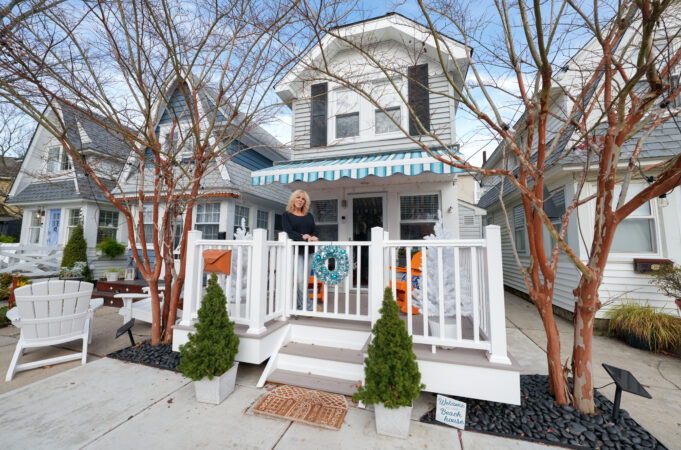
It’s where nine homes — 800 square feet or smaller — stand shoulder to shoulder on a winding road known as Dollhouse Row, all decked out in holiday cheer. Ginny Chappell’s house, decorated in blue and white, combines holiday tradition with a classy beach vibe.
“Christmas has always been my favorite time of year,” said Chappell.
Since randomly discovering Dollhouse Row as a twentysomething visiting the Shore, Chappell dreamed of owning a home on this historic street, where the houses were built in 1927.
Ginny Chappell looks out the front door from the living room of her Ocean City house.
“I was obsessed with the street and followed it ever since,” recalled Chappell, a retired nurse with two part-time jobs in Ocean City. She’s a salesperson at Artisan Body Products and a part-time assistant innkeeper at the historic Coastal Chateau.
In 2015, when she was living in Franklinville and looking to buy a vacation home, there weren’t any houses for sale on Dollhouse Row.
“My Realtor told me to dream on, that they stay in families and almost never sell,” said Chappell, who instead bought an even tinier home — 400 square feet — in the south end of Ocean City.
Five years later, looking for more space, she set out to buy a larger house, but just days before closing, the deal fell through. Chappell was devastated.
A white and blue Christmas tree, festive ornaments and a toasty fireplace bring holiday cheer to the home.Chappell sits on the steps just off the galley kitchen.
But her luck changed two months later when she got the call she had long dreamed of: an 800-square-foot Dollhouse Row house was about to go on the market.
“I’m someone who very much believes in manifestation,” Chappell said.
She now shares the house, named Grayce by previous owners, with her two long haired mini-Dachshunds, Liliana, 17, and Romeo, 6 months. She has a comfortable primary bedroom and a spare bedroom for visitors, which often include her daughter Kayla, 22.
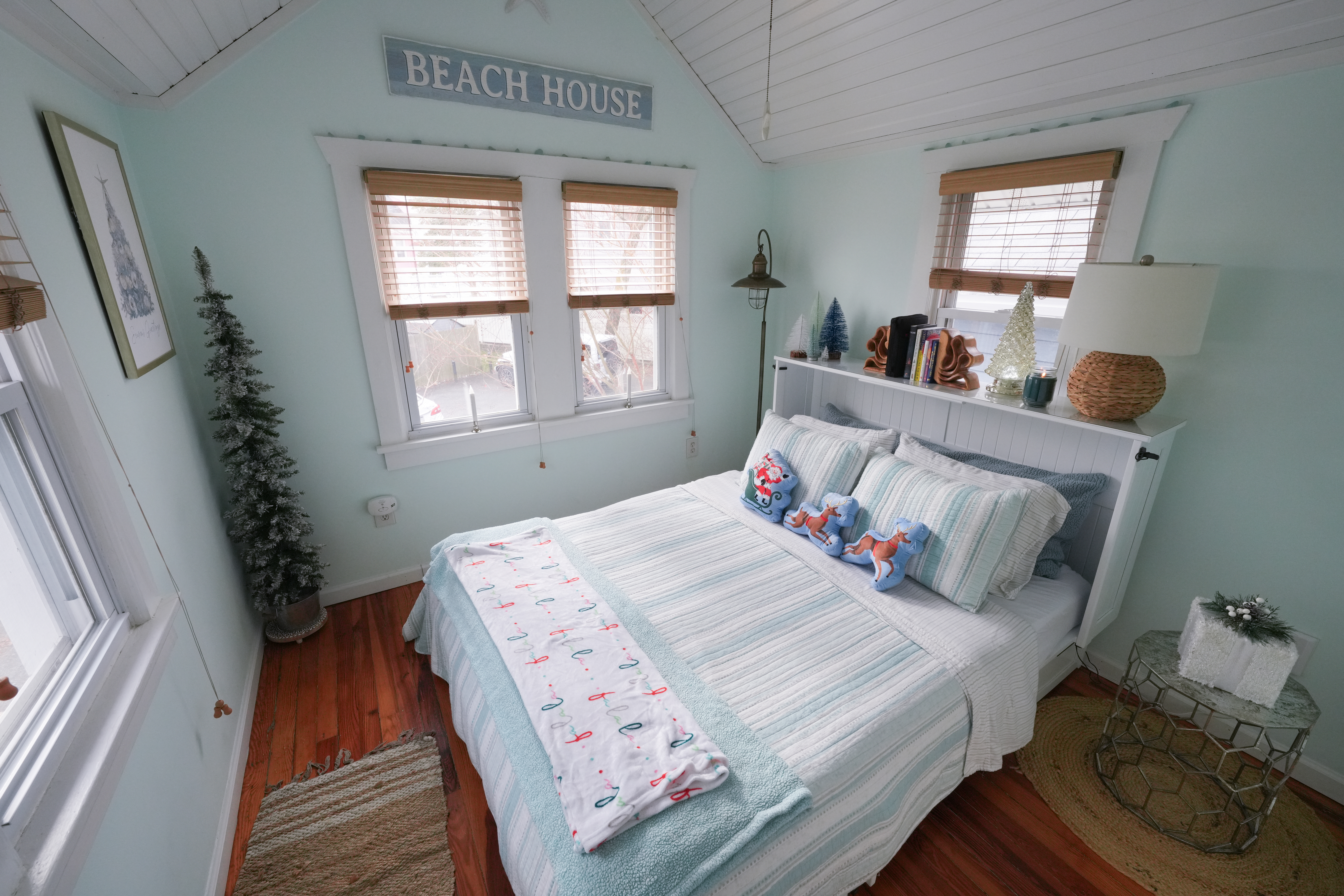
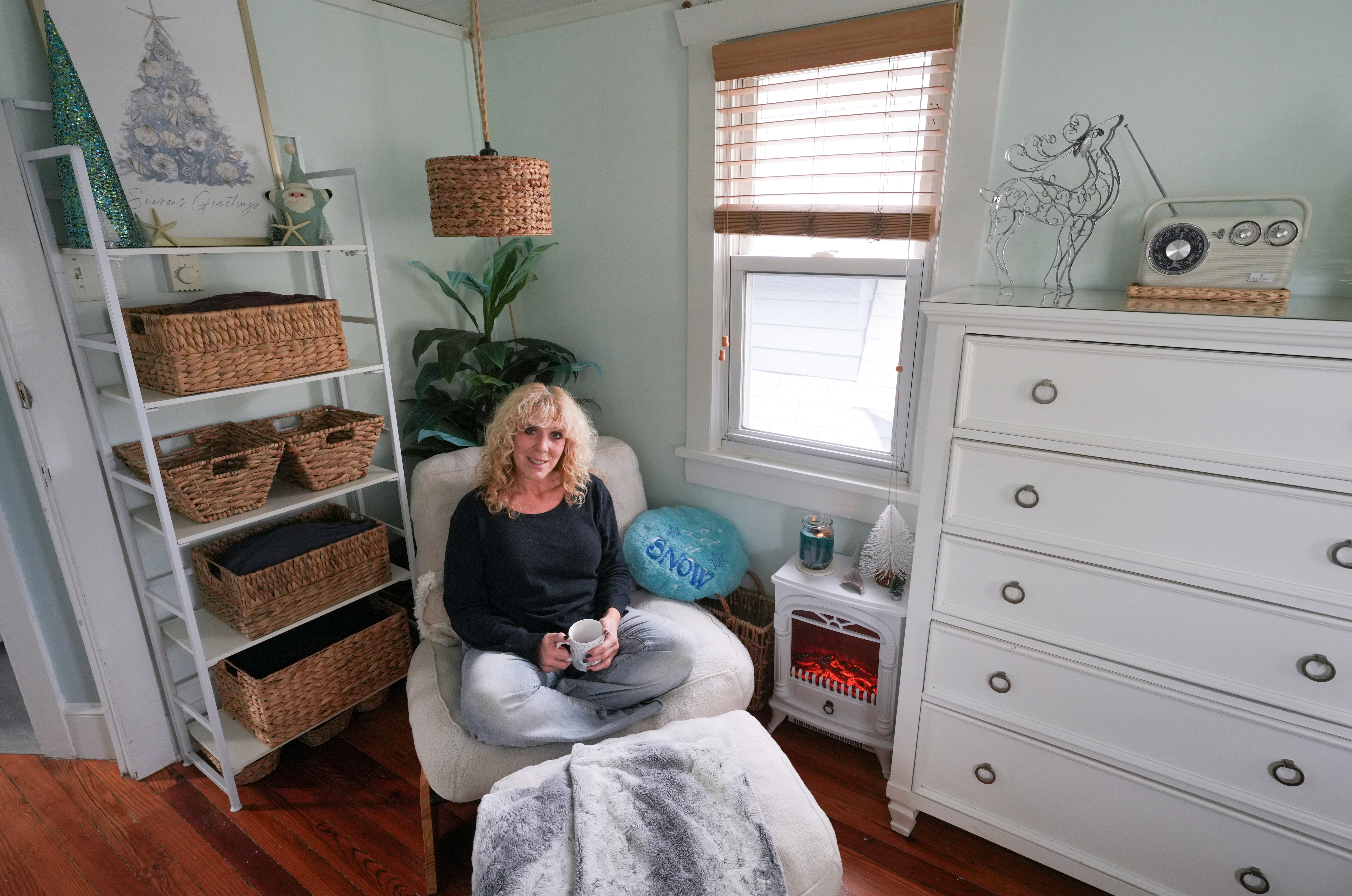
The first floor is open space with a cozy family room, kitchen, and dining area. Upstairs, a full bathroom sits between the two bedrooms, with a stacked washer and dryer hidden behind a curtain. The primary bedroom includes a small electric fireplace that doubles as a heater.
Chappell’s holiday decor, with blue details throughout, doesn’t compete with the beachy theme of her primary bedroom.In a comfortable chair in the primary bedroom, Chappell is surrounded by blue, teal, and silver Christmas and winter accessories.
Despite the small space, Chappell’s home is not cluttered. She has thoughtfully arranged each piece of furniture, artwork, and knickknack, with storage invisibly tucked away. She also rents a storage unit for offseason clothing and other items.
Each year, she envisions her holiday theme, then sets out to perfect it.
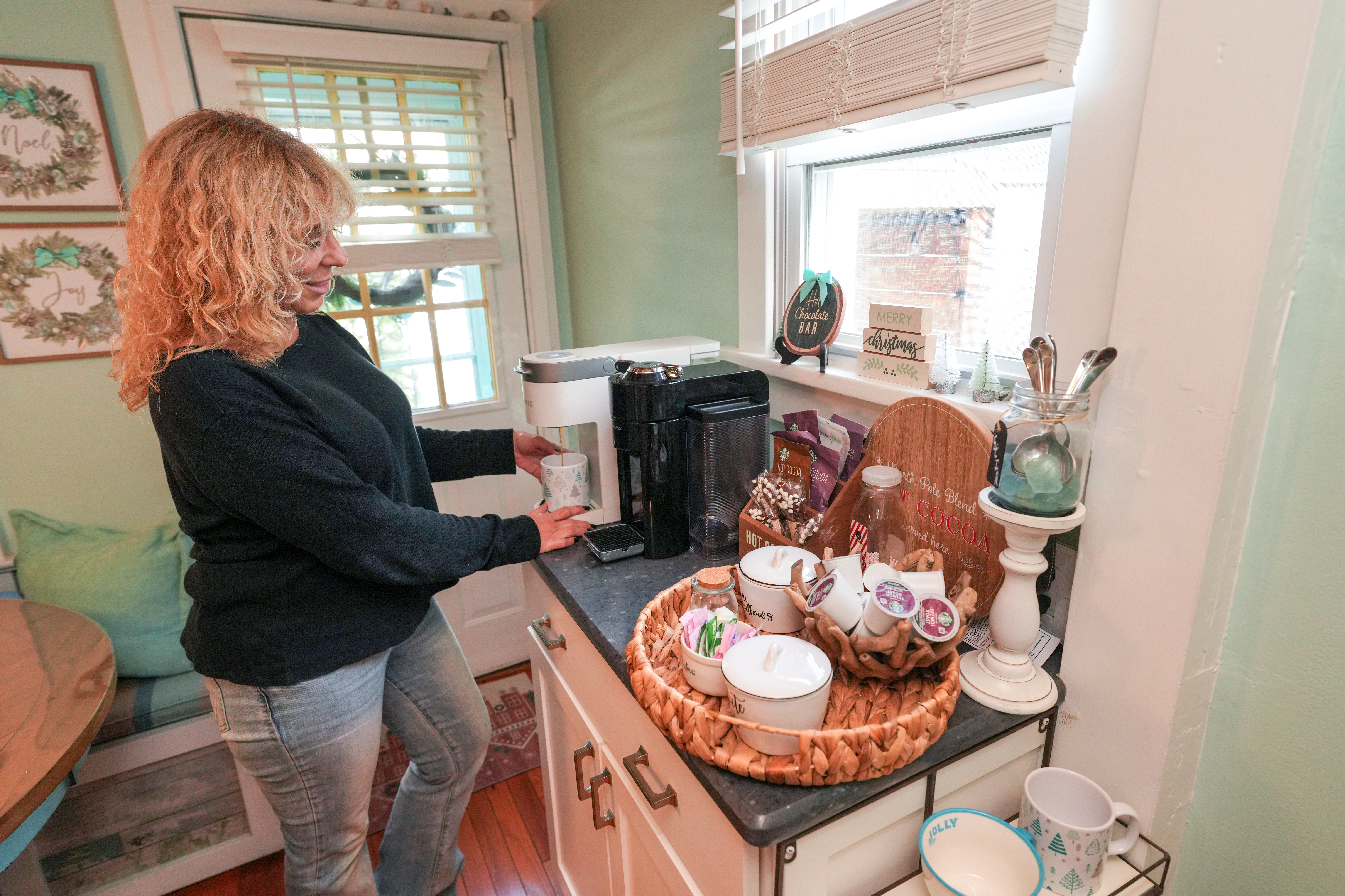
For her coffee and hot chocolate station, complete with marshmallows and candy cane sprinkles, she wanted Christmas-themed mugs in blue and white and searched until she found them.
“I spent four days finding these mugs,” she recalled, hitting three Home Goods stores, Hobby Lobby, and Dollar General on her search.
Ginny Chappell makes a warm beverage at her coffee and hot chocolate bar, complete with festive mugs.
It isn’t about what something costs but how it makes her feel, she said. Her pre-lit frosted white tree, adorned with blue and silver ornaments and a Gingerbread Man tree topper, came from Walmart. She also supports local crafters and businesses whenever possible.
For home design details she keeps year-round, she loves to scour the beach for beautiful broken seashells, where the iridescent pinks and beiges can be seen through the cracks in the shells. Shells line each window frame throughout the house.
“If they weren’t broken you would never be able to see just how beautiful they are inside,” she said. “The message is broken is beautiful.”
She also has dozens of small one-of-a-kind driftwood shelves hanging on her walls, and at this time of year each holds a small snowflake, tree, or other decoration. Her mantle is filled with artistic Christmas trees in shades of blue, white, silver, and gray. Vintage Christmas decor, including tin post cards, can be found throughout the cottage.
Given its small size, Chappell’s home can’t host large parties, but it can be shared with friends, neighbors, and even strangers. Her home has been featured in Ocean City’s Holiday House Tour for the last three years, drawing as many as 500 visitors each year.
Ginny Chappell sits on the porch of her 800-square-foot home that is decorated for Christmas.
A house close to 100 years old does come with challenges.
“I’m always fixing things,” Chappell said. “But, people are drawn to its charm and history.”
A small group of friends share the holidays with charcuterie boards, wine, and lots of laughs. Her front porch is the perfect perch for watching visitors stroll down the street, enamored with the tiny houses.
“I believe this street is very special because of its history,” Chappell said. “The people on this street call ourselves the cottage keepers. We want people to restore rather than tear down.”
Is your house a Haven? Nominate your home by email (and send some digital photographs) at properties@inquirer.com.
In the aftermath of the shocking killing of Rob Reiner and his wife, it’s clear that only person in this horrible scenario who has Trump Derangement Syndrome is Donald Trump himself. The president’s unhinged rant after the couple’s death, blaming this terrible family tragedy (their son, who has a history of drug addiction, has been arrested) on alleged “Trump Derangement Syndrome” (his made-up term for alleged “obsession” with Donald Trump) should be the final proof that the president needs to be removed from office under the 25th Amendment. His incredible personal insults (calling female reporters “piggy,” “stupid,” a “terrible person” etc.), his rambling and incoherent comments on “affordability” at the Mount Airy Casino last week, his tearing down part of the White House to build a party room — these actions are proof of his inability to perform the functions of the job.
This is the man who has his finger on the nuclear button. For the love of God, somebody please invoke the 25th Amendment already. While we still can.
Linda Falcao, Esq., Baltimore
Gridlocked
The Pennsylvania-New Jersey-Maryland Interconnection, the powerful but little-known operator of our region’s electric grid, is currently tasked with managing the increased energy demand from data centers. Just last month, PJM’s own watchdog filed a complaint saying it will not be able to manage all of the proposed data centers without restrictions.
Later this month, PJM’s board will vote to decide how and whether to accept these electricity-hungry data centers into our grid, and what (if any) restrictions will be put in place. One option is that the Big Tech companies behind many of these sites could be asked to dial back their power use for a few dozen hours a year.
This would mean that at the rare moments when our grid is peaking, data centers could slow down, preventing blackouts for everyday ratepayers. It would also save Pennsylvanians on our energy bills if fewer of these expensive “peaker” plants had to be built. Finally, this proposal would be better for our lungs and the planet, as the energy sources that data centers bring online are usually gas plants. PJM should prioritize people over data centers and decide on some restrictions before it welcomes them to our grid.
The September 2025 unemployment rate was 4.4%. A year prior in September 2024, it stood at 4.1%. The inflation rate for this September was 3.0%, while exactly a year earlier it was 2.4%. Although Trump likes to claim that gas prices are down, they are in fact little changed from a year ago. On the other hand, healthcare costs are skyrocketing, and the Republicans in Congress are deliberately making the problem worse. The stock market indexes are doing well this year, but they rose by a greater percentage in both 2023 and 2024.
If Trump really believes that he deserves an A+++++ for the economy, then he should add a few more pluses for Joe Biden.
Bill Fanshel, Bryn Mawr
Profits over safety
For every tragic shooting, a profit has been made, on both the gun and the bullet. When a person’s life is taken, whether a targeted individual or a bystander, a profit was made. When a child is shot, a law enforcement officer is gunned down, an individual is slain in a domestic violence related incident, or a mass shooting occurs at a school, college, or religious gathering, at some point, a profit was made on the sale of the gun and the sale of the ammunition.
The issue is not about Second Amendment rights or gun rights, but about profits. There is too much money to be made to stop the traumas, the disabling injuries, and the killings. The National Rifle Association, gun and ammunition manufacturers, and retailers lobby lawmakers to keep the cash flowing. Legislators must put public safety above profits and pass gun safety legislation for assault weapons, require background checks for all gun purchases and more. We need to do whatever we can to stop this needless slaughter.
Gerald Koren, Exton
A ceasefire resonates
I would like to express my enthusiastic appreciation for the powerful opinion piece by Rabbi Linda Holtzman, which I found both deeply moving and thought-provoking. It strikes a perfect balance between principled passion and rational, fact-based arguments.
The issues need to be brought out into the open, as Rabbi Holtzman does masterfully.
Our family members are longtime subscribers who greatly appreciate your commitment to the highest quality journalism.
Helene Pollock, Philadelphia
…
For 75 years, the idea of safety for the Israeli people has been tried in one way and has not succeeded. Rabbi Linda Holtzman recognizes this and argues that the world desperately needs another model. We need to hear more nonviolent proposals for how this sacred land can be a home for all of the people who live there — a home defined by safety and peace. And it requires us all to support that process and not allow violence and hatred from either side to prevail.
Joan Gunn Broadfield, Chester, broadfieldje@gmail.com
Who owns public schools?
The School District of Philadelphia recently approved a resolution authorizing its superintendent to negotiate the transfer of up to 20 vacant school buildings to the City of Philadelphia, potentially at no cost. Philadelphia has a reputation for property thefts in which law enforcement threatens severe penalties. However, it is essential to note that neither private nor public properties can be sold by individuals who do not hold ownership. Ultimately, the people retain ownership of the schools, which are funded through the capital budget using taxpayer monies. The public allows the board to lease those buildings, and when they are finished with them, they should be required to return them.
Leon Williams, Philadelphia
Drowning in medical debt
Congressional Republicans are having trouble coming up with a coherent proposal as an alternative to the Affordable Care Act. One reason for their difficulty is that the act itself is modeled after the Republican plan that was enacted in Massachusetts after the Universal Care Act of 1993 was defeated by a coalition of conservatives in Congress and lobbyists for the healthcare and insurance industries. As costs continue to spiral out of control and national health metrics decline, there is now, more than ever, a need for comprehensive universal healthcare in this country. Nations with such plans have lower costs and better healthcare outcomes, compared to the United States. There is no nation in the world other than ours in which hundreds of thousands of people are bankrupted by the cost of their medical treatments. Increasingly, many Americans simply choose to decline medical care because they can’t afford it. It is time for our elected representatives to act for the benefit of the people, for a change.
Patrick J. Ream, Millville
Join the conversation: Send letters to letters@inquirer.com. Limit length to 150 words and include home address and day and evening phone number. Letters run in The Inquirer six days a week on the editorial pages and online.