The federal commission seeking personal contact information for faculty and staff at the University of Pennsylvania has accused the school of engaging in an “intensive and relentless public relations campaign” to avoid complying with the subpoena.
The U.S. Equal Employment Opportunity Commission, in a court filing Monday, defended its subpoena seeking potential witnesses and victims of antisemitism at the university and said therequest is not unusual forsuch investigations. The commission is seekingemployees’ names, home addresses, phone numbers, and email addresses to further an investigation it began in 2023 over the school’s treatment of Jewish faculty and other employees regarding antisemitism complaints following Hamas’ attack on Israel.
The commission’s request has spurred a backlash from student and faculty groups, including Penn’s chapter of the American Association of University Professors and the Penn Faculty Alliance to Combat Antisemitism, arguing that the information should not be turned over. Penn has refused to provide the information, prompting the EEOC to file the lawsuit in November.
Penn’s response to the lawsuit, along with filings by other groups,“forecast highly speculative and deeply nefarious outcomes should the EEOC’s subpoena be enforced,” the commission said. “This dark prognosticating has been predictably (and immediately) reported in national, local, and campus outlets.”
The university, in a filing earlier this month, said the commission’s request was “disconcerting” and “unnecessary” and could pose a threat to employees.
“The EEOC insists that Penn produce this information without the consent — and indeed, over the objections — of the employees impacted while entirely disregarding the frightening and well-documented history of governmental entities that undertook efforts to identify and assemble information regarding persons of Jewish ancestry,” the university wrote in its filing.
The commission argued in response that Penn’s assertion of potential danger to employees is “untethered from both the law and the reality of these proceedings.”
“The EEOC seeks only to investigate allegations of serious, widespread antisemitic harassment in Respondent’s workplace,” the commission argued.
The commission, the group said, is only seeking information on faculty and staff “who complained of antisemitic harassment, who belonged to Jewish affinity organizations, or who worked in the Jewish Studies Program.” They could have knowledge of potential problems, the commission said.
Penn can provide the contact information without listing the employees’ organizational affiliations, the commission said.
Penn did not immediately comment on the latest EEOC filing.
Penn has said it provided over 900 pages of materials to the commission and offered to send notices to all employees about the EEOC’s request to hear of antisemitism concerns with the commission’s contact information, so they could reach out themselves if interested in participating.
But the commission called that offer “unworkable” and said it “would undermine the integrity of the agency’s investigation.”
“Messages from EEOC to employees filtered through an employer always risk creating confusion, fear, and mistrust among recipients,” the commission said.
That path could increase the possibility of retaliation against employees for cooperating with the investigation, the commission argued.
The university has challenged the validity of the EEOC’s charge, asserting that the commission has not identified a “single allegedly unlawful employment practice or incident involving employees.” It also “does not refer to any employee complaint the agency has received, any allegation made by or concerning employees, or any specific workplace incident(s) contemplated by the EEOC,” the university said.
While EEOC complaints typically come from those who allege they were aggrieved, this one was launched by EEOC Commissioner Andrea Lucas, now chair of the body, on Dec. 8, 2023, two months after Hamas’ attack on Israel that led to unrest on college campuses, including Penn’s, and charges of antisemitism. It was also just three days after Penn’s then-president, Liz Magill, had testified before a Republican-led congressional committee on the school’s handling of antisemitism complaints; the testimony drew a bipartisan backlash and led to Magill’s resignation days later.
Lucas, according to the EEOC complaint, made the charge in Penn’s case because of “probable reluctance of Jewish faculty and staff to complain of harassing environment due to fear of hostility and potential violence directed against them.“
The commission in its filing Monday said its practice is within itsregulations.
“This charge alleges a time frame, an unlawful employment practice (hostile work environment), the individuals potentially affected by that alleged unlawful employment practice (Jewish employees), and the publicly available sources,” the commission said.
The commission also criticized Penn’s concerns about potential leaks of employees’ contact information through the EEOC, noting the data breach that occurred at Penn last year, exposing employees’ information.
“Its concerns about the security of EEOC’s IT systems are disingenuous,” the commission said.
In the month since Philadelphia Councilmember Jeffery Young introduced a bill banning residential development around the former Hahnemann University Hospital, 824 apartments have been permitted in the area.
The latest zoning permits include 163 units at 1501-11 Race St., which were issued Monday. Brandywine Realty Trust purchased the former Bellet Building office tower in 2021 for $9.7 million.
Brandywine did not immediately respond to a request for comment. It is not clear whether Brandywine is seeking to develop the apartments or to just secure permits to preserve the option for a future buyer.
Last week, zoning permits were issued for 300 units at 300-304 N. Broad St., known as Martinelli Park, the last piece of the former Hahnemann Hospital site that has yet to be sold. The last bid for the site came from the HOW Group, which offered $5.5 million and planned multifamily housing there. But the sale did not go through.
Attempts to reach Hahnemann’s representatives were unsuccessful. It is likely the permits are being secured to preserve the property’s value.
A City Council Rules Committee hearing on Young’s bill is scheduled for Feb. 3.
The rush for permits began on Dec. 24, two weeks after Young introduced his bill, when the Dwight City Group received a zoning permit for 222-48 N. Broad St. to builda 361-unit apartment building.
When “an overlay is placed like this … even though we have our zoning permit already from one of the buildings, the message that it sends is that this area is closed for business,” Judah Angster, CEO of Dwight City Group, said at a January meeting of the Philadelphia Planning Commission.
He said the project now includes 90,000 square feet for commercial use, which would be dedicated to local small businesses.
Why does Young want to ban housing?
Young’s bill would create a new zoning overlay covering the area “bounded by the north side of Race Street, the east side of North 16th Street, the south side of Callowhill Street, and the west side of North Broad Street.”
This covers the former Hahnemann campus, which included seven medical buildings, a parking garage, and some surface lots. The hospital dated to the 19th century and had been operating from this location for 90 years before its bankruptcy.
A handful of other buildings are in the proposed overlay as well, including a PHA apartment building and a homeless shelter.
What once was the Hahnemann campus sprawls over nearly six acres, centered on Broad Street along the Vine Street Expressway, comprising seven medical buildings, a parking garage, and surface lots.
Young said that he wanted to ban new homes from the site to preserve job opportunities in the city, hopefully prompting the reuse of the site for office, medical, or educational use.
At the Planning Commission meeting, the bill was largely discussed as Young’s effort to force developers to meet with him over their plans. The Hahnemann site is zoned with Philadelphia’s most flexible land use rules, which means that under normal circumstances, residential conversions would not require neighborhood meetings or political approvals.
“I look forward to continuing dialogue that brings community stakeholders to the table for this important section of Center City,” Young said in an email Tuesday.
Dwight Group has said that it is having productive conversations with Young.
The legislation is considered by some legal experts as a blatant use of spot zoning, when a change in land use rules is targeted to a limited geography. Such legislation is often introduced to help or hurt a particular project.
“In my time as a zoning lawyer for 27 years, I don’t think I’ve seen a greater example of illegal spot zoning,” Matt McClure, head of law firm Ballard Spahr’s land use practice and a lawyer for developer Dwight City, said the January meeting. “It is targeted at a particular property, targeted around a certain transaction that was talked about. It’s just illegal.”
Hahnemann University Hospital has been closed for more than six years, and attempts to preserve medical and educational uses in its former buildings so far have faltered. Most are still vacant.
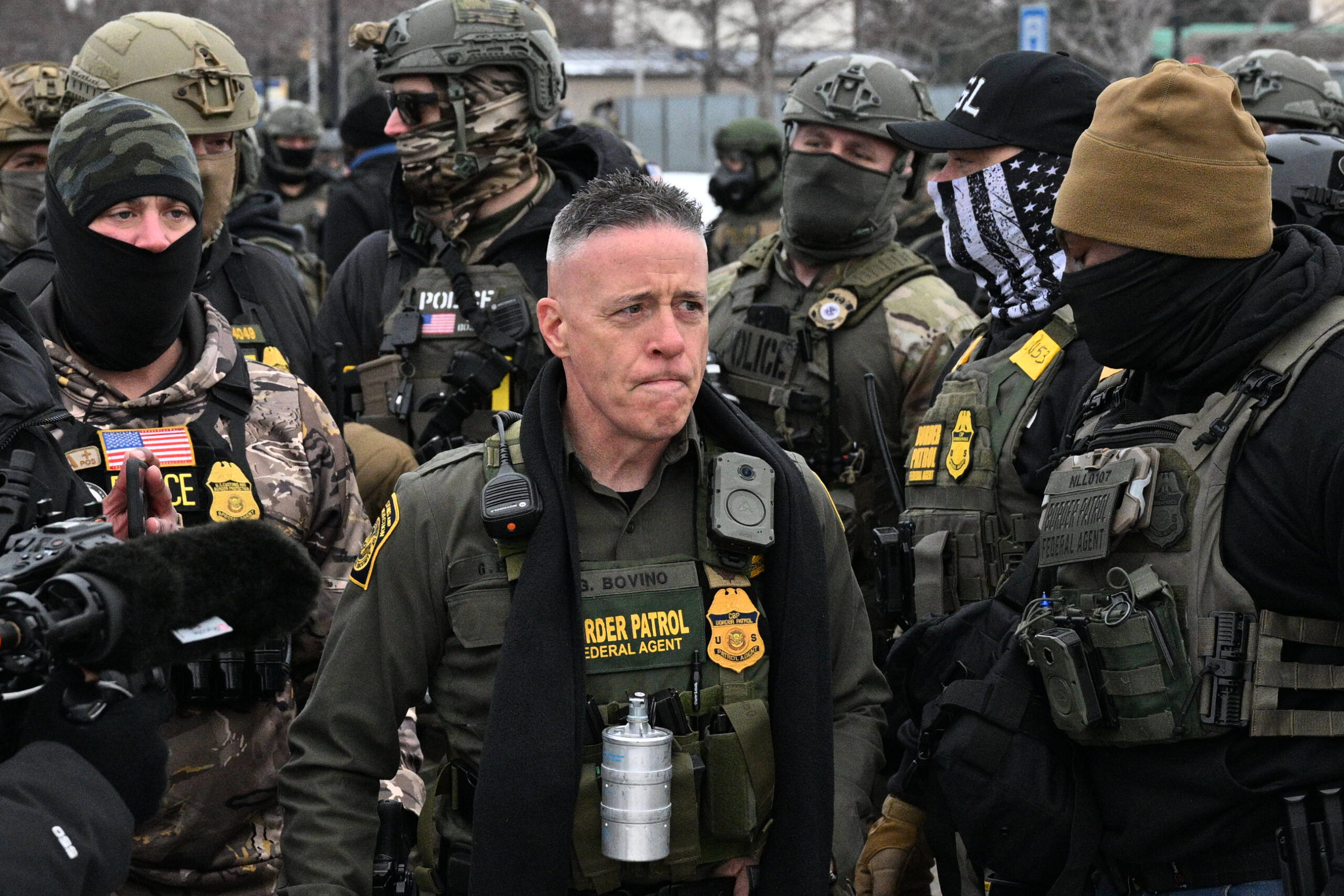
Is this actually an honest-to-goodness turning point in the war for the soul of America? Monday night, the deny-everything-admit-nothing Trump regime surprised observers by revealing that violence-provoking Border Patrol commander Greg Bovino has been sent home from Minneapolis and may even be retiring. That’s a giant win for the power of everyday people resisting, but turning around the battleship of tyranny will still take much more work.
Corporate America may pay a steep price for its cowardly ICE neutrality
Protesters gather Friday at Target’s corporate headquarters in Minneapolis.
One of the many remarkable and lasting ideas the Rev. Dr. Martin Luther King Jr. placed into the national conversation was the concept of something he called “negative peace.”
Although the phrase began appearing in the writings of the civil rights leader in the late 1950s, King made the idea famous in his 1963 “Letter From Birmingham Jail,” where he was locked up for fighting segregation in Alabama’s largest city. He was annoyed by a letter from eight local white clergymen, titled a “Call for Unity,” that begged King to end a civil disobedience crusade for racial integration and seek progress through negotiations and the courts.
When an aide smuggled the newspaper into King’s cell, he began furiously scribbling his response in the margins of the ad before writing more on any scrap of paper he could find. His key passage argues that the white moderate was a greater threat to Black freedom than the KKK, because he was someone “more devoted to ‘order’ than to justice; who prefers a negative peace which is the absence of tension to a positive peace which is the presence of justice,” and who wants African Americans to wait for a “more convenient season.”
Flash-forward 63 years, and the grand pooh-bahs of U.S. capitalism have learned nothing from this. On Sunday, 60 major corporations based in Minnesota — feeling caught in the crossfire of the federal immigration raids tearing apart Greater Minneapolis and the growing resistance movement — issued a cowardly and pathetic call for a negative peace to reduce the tensions.
The open letter that was released through the Minnesota Chamber of Commerce was signed by the CEOs or equivalents of almost every major Gopher State brand that you could think of — including Target, 3M, General Mills, Hormel, UnitedHealth (yes, that UnitedHealth), and all five major sports franchises. Some of these firms are beginning to see real economic fallout from the U.S. Immigration and Customs Enforcement raids and protest activities, which have kept some frightened Black and brown workers at home and triggered a large general strike last Friday.
The letter reads little differently from the Birmingham ministers’ “Call for Unity.”
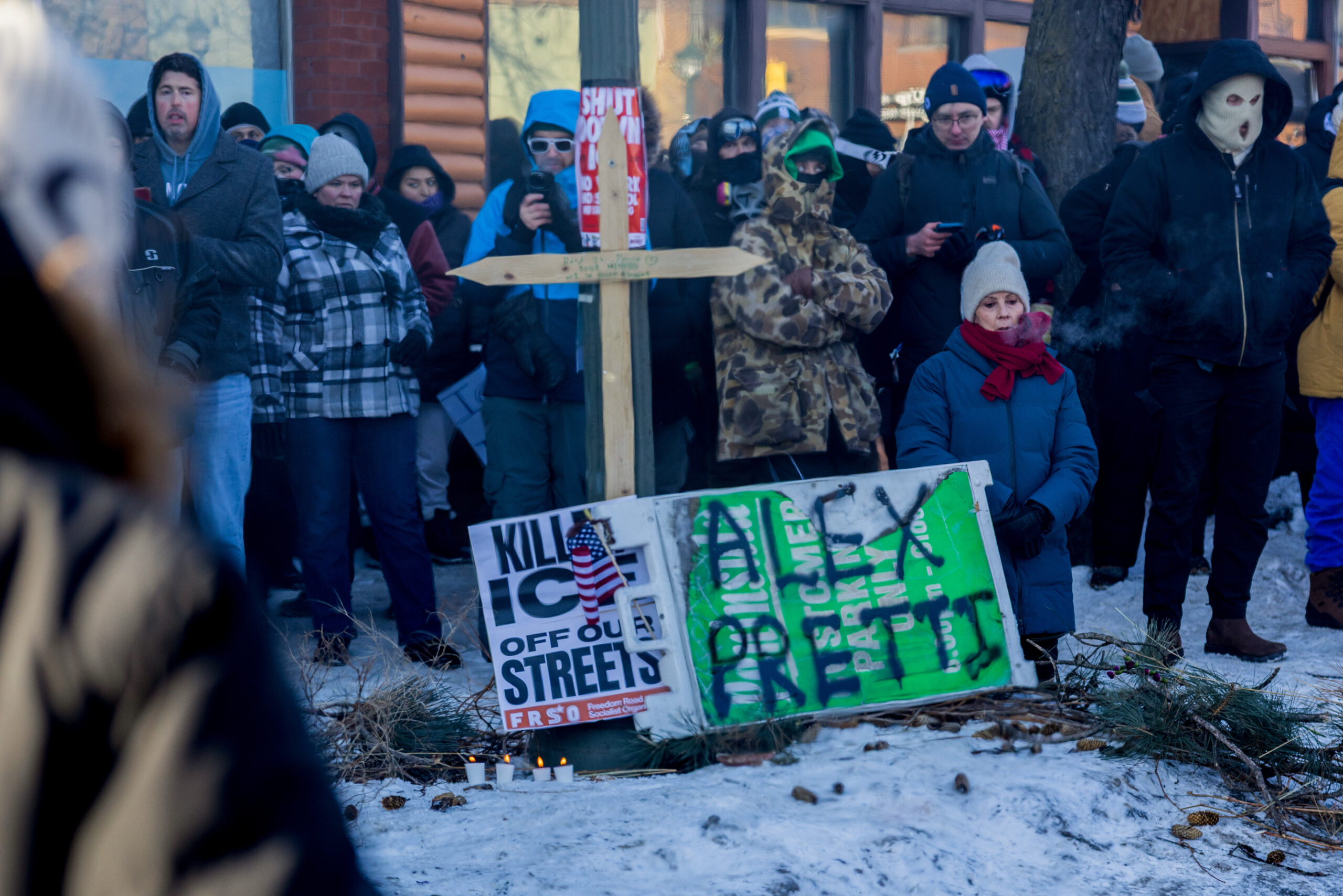
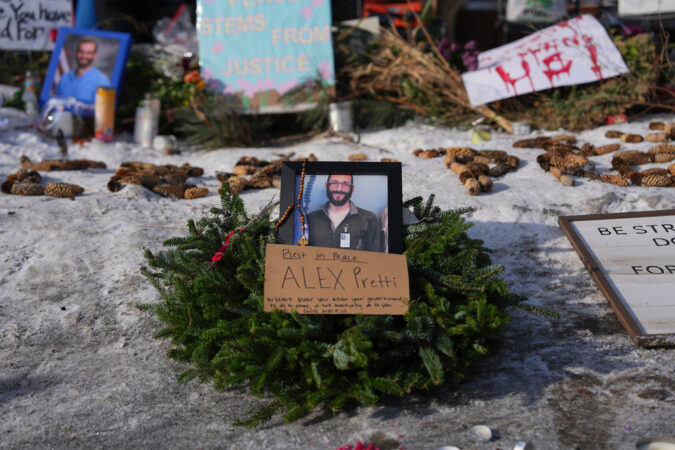
“With yesterday’s tragic news” — a vague, bloodless reference to the 10 shots fired by federal officers into a 37-year-old intensive care nurse named Alex Pretti — “we are calling for an immediate deescalation of tensions and for state, local and federal officials to work together to find real solutions,” the letter states. It notes that Minnesota business leaders have been in touch with Gov. Tim Walz, the Donald Trump White House, and others in pleading for what it hopes would be a solution to the state’s crisis.
Pretti is never mentioned in the letter. Neither is Renee Nicole Good, the 37-year-old mother of three who was gunned down behind the wheel of her family SUV by an ICE agent as she attempted to drive away from a confrontation. In fact, ICE is never mentioned, nor are the federal agency’s most outrageous tactics, such as the seizure of a 5-year-old boy as “bait” to detain him and his father, or dragging a barely dressed Hmong refugee who is a U.S. citizen out of his home in frigid weather.
The entire letter is remarkable not for what it says — since it says very little beyond praying this whole mess somehow goes away so they can go back to making money without thinking about such dreadful things — than for what it doesn’t say.
There is no condemnation of the murders of two U.S. citizens who did nothing beyond legally monitoring the federal officers and their activities while on public streets. There is no condemnation of the ICE tactics in seizing hardworking migrants with no criminal records who are the backbone of the Minnesota community. There is nothing about what MLK would have called “positive peace” — a desire for real justice.
That’s probably because positive peace requires bold choices and displays of real courage — qualities that modern corporate America seems to have misplaced in a giant warehouse somewhere.
Exhibit A would have to be Target, the large national retailer that, with its hundreds of stores and its name slapped on the NBA’s Timberwolves’ arena, is now to many Americans the corporate face of Minnesota. Under pressure from demonstrators, including more than 100 clergy who protested outside Target’s Minneapolis headquarters on Friday, the retailer still said nothing — before the tepid group letter — about the ongoing ICE raids, or why agents have been allowed to stage operations in its parking lots and even inside stores.
There’s a bleak history here. In 2020, Minnesota became the epicenter of the fight for racial justice when the Minneapolis police murder of George Floyd was captured on video. That time, the state’s CEOs not only expressed moral outrage but pledged to spend heavily on diversity initiatives. Five years later, the local news site Racket reported many of these firms had backtracked, and that barely a third of the pledged $550 million had been spent.
This time, the business leaders just want the “tension” to disappear. That’s not so easy. Just ask Target. Its early 2025 move to end its diversity initiatives as Trump took office sparked calls from Black leaders for a boycott that has cut into store traffic and lowered Target’s stock price. It seems that moral surrender actually does have a price.
Also on Sunday, the team chaplain for the Timberwolves — ironically, one of the teams that signed onto the corporate letter — issued a personal statement with loud echoes of the “Letter from Birmingham Jail,” calling out any churches that had prayed that morning for peace and unity but not for justice.
“Peace is what the powerful ask for when they don’t want to be interrupted,” Matt Moberg wrote in a short piece that went viral on social media, adding, “Unity that refuses to name violence is just loyalty to the ones holding the weapons.”
This wouldn’t be the first time corporate America misread the room. Sunday’s statement suggested a continued deer-in-the-headlights reaction from the shock of Trump’s return to office — even as the CEOs ignore not just the power of the Target boycotts but the recent success of economic justice campaigns against firms from Disney to Avelo Airlines, not to mention the solidarity that drove the Minneapolis general strike.
Already, there is growing talk of a national general strike or expanded boycotts by millions of citizens who are also consumers, and who are both furious over the Good and Pretti murders and now flabbergasted by the corporate cone of silence. America’s business leaders don’t understand that cowardice has a steep cost attached.
Yo, do this!
There’s no better writer about the long fight for social justice in America than historian Heather Ann Thompson. Her searing 2016 book about the 1971 Attica prison uprising — Blood in the Water — won a well-deserved Pulitzer Prize, and locals were thrilled when it was reported that the next book from Thompson, who taught for a while at Temple, would be on the 1985 MOVE bombing. Instead, she has taken a detour. Her Fear and Fury: The Reagan Eighties, the Bernie Goetz Shootings, and the Rebirth of White Rage is out today. I just downloaded the audiobook, and cannot wait to listen.
It’s Academy Award season, and so — hopelessly snowed in on Sunday — I took a family break from football (!) to rent a movie … from 2009. Given my obsession with 1960s rock and roll radio, it’s weird that I’d never seen Pirate Radio, a fictional homage to the U.K.’s government-defying offshore radio stations of the British Invasion era that stars the late Philip Seymour Hoffman. The plot can be muddled at times, but it’s maybe the best movie soundtrack ever!
Ask me anything
Question: Why do Dem Leaders want to save ICE, when nobody really else does? What’s the motivation? — @keynesaddiction.bsky.social via Bluesky
Answer: I wonder this, too. Both ICE and the current crew at U.S. Customs and Border Protection have been simmering for far too long in a toxic, unredeemable culture that cannot be reformed. What’s more, the shocking abuses on display in Minnesota and two killings have now convinced a plurality of U.S. voters that ICE should be abolished. Still, I can understand the Democrats’ bind, since at the moment the party has no other political leverage beyond the ability to block most Senate legislation with the filibuster. It might be best to push hard for as much as can be done in 2026, while running in the midterms on a platform of abolishing ICE when they gain power on Capitol Hill.
What you’re saying about …
LOL — remember that whole Greenland thing? It feels like that was five years ago, but some of you had some good responses on dealing with Trump’s bluster about an American takeover, even if things have temporarily cooled down. Tom Desmond said the Europeans “need to quit pretending that they can ‘manage’ him through flattery and soft words. Instead, they need to apply threats — i.e., whatever tariffs he imposes on Europe over Greenland they will return against the U.S. three-fold.” Jo Parker said Congress needs to reassert its powers over tariffs and declaring war, but “With the spineless [Dave] McCormick and [John] Fetterman representing us, I’m not sanguine that such actions will take place, however.”
📮 This week’s question: Things are coming to a head in Congress over funding for ICE and the U.S. Department of Homeland Security. Should Democrats make a deal for ICE reforms, such as unmasking and requiring arrest warrants, or must they push for bigger concessions, or even abolishing ICE? Please email me your answer and put the exact phrase “ICE funding” in the subject line.
Backstory on the day (a) Fetterman spoke out
U.S. Sen. John Fetterman and his wife, Gisele Barreto Fetterman, await the arrival of President Joe Biden at Philadelphia International Airport in July 2024.
I must confess that keeping up with the downward spiral of Pennsylvania’s Democratic Sen. John Fetterman since he took office in 2023 can get tiresome. At first, Fetterman’s rightward tack seemed largely a function of his zealous support for Israel, which caused him to wave off allegations of war crimes by Benjamin Netanyahu’s right-wing government. Soon, others pointed to his health woes — hospitalizations for a stroke and depression, among other things — as he endorsed more and more Trump-flavored ideas.
Amid mounting outrage over Trump’s aggressive immigration raids, Fetterman made some comments that had his growing legion of critics wonder if the senator’s real heart issue was whether he had one. “ICE performs an important job for our country,” the Democrat posted on X last July, adding that any calls to abolish the agency were “inappropriate and outrageous.” Even after the Jan. 7 ICE killing of Renee Nicole Good in Minneapolis, Fetterman’s middle-of-the-road stance was this: “Secure the border. Deport all the criminals. Stop targeting the hardworking migrants in our nation.” In the immediate aftermath of Saturday’s killing of Alex Pretti by federal agents, even Pennsylvania’s GOP Sen. Dave McCormick had called for a congressional investigation before Fetterman said anything.
On Sunday night, though, Fetterman issued a heartfelt and moving statement. Well, a Fetterman did.
“For more than a decade, I lived undocumented in the US,” the senator’s wife, Gisele Barreto Fetterman, a native of Brazil, posted on X. “Every day carried the same uncertainty and fear lived in my body — a tight chest, shallow breaths, racing heart. What I thought was my private, chronic dread has now become a shared national wound. This now-daily violence is not ‘law and order.’ It is terror inflicted on people who contribute, love, and build their lives here. It’s devastatingly cruel and unAmerican.” Her post ended with an emoji of a broken heart.
Sen. Fetterman finally issued a statement nearly a day later. He called for “an immediate end” to the ICE operations in Minnesota, adding, “It has become an ungovernable and dangerous urban theatre for civilians and law enforcement that is incompatible with the American spirit.” But Fetterman still disappointed critics of Trump’s immigration policy, insisting that while he wants ICE reforms, he still supports the embattled agency, and won’t join other Democrats in shutting down the federal government if those reforms aren’t happening.
Pennsylvanians thought they were getting a progressive voice and a moral leader when they elected Fetterman in 2022. It feels now like we elected the wrong Fetterman.
What I wrote on this date in 2010
It was only 16 years ago, but at the dawn of the 2010s, there was still a robust conversation about how to save the traditional journalism outlets— especially newspapers — that had flourished in the 20th century. On Jan. 27, 2010, I criticized an idea coming from Apple that a new kind of $1,000 iPad, nicknamed “the Jesus tablet,” would fix everything. I wrote: “To survive, we need to change our whole worldview — finding ways to encourage more dialogue with readers and more community involvement so that local readers feel they have a stake in this thing. And we also need to do a better job at the thing we claim to be already good at — real journalism that makes a difference.”
On the national beat, there’s no bigger story than the fallout from the inhumanity of the Trump regime’s mass deportation policies. In my Sunday column, I looked at the other way people are dying in ICE’s reign of terror: inside the growing network of squalid and overcrowded jails and detention camps. The death rate in these facilities so far in 2026 is already 10 times higher than it was in the last year of the Biden administration. Over the weekend, I quickly shifted gears and turned a planned column about faith leaders in Minneapolis and an America yearning for morality into a lament over the shocking ICE murder of a 37-year-old observer, Alex Pretti. The contrast between good and evil in America has never been more stark.
The many tentacles of the mass deportation story stretch well beyond Minneapolis and other hot spots like Maine, including stepped-up ICE enforcement activity here in Philadelphia since Trump returned to office. The Inquirer’s veteran immigration reporter, Jeff Gammage, has drilled deeply into the human stories on the front lines here. Written with colleague Michelle Myers, this week’s installment was both poignant and infuriating. A local family of four is returning to Bolivia after the dad — the prime caregiver for his 5-year-old son, being treated at Children’s Hospital of Philadelphia for brain cancer — has stopped fighting his deportation after five months in ICE detention. As his family prepares to leave, the child’s future in a South American country with substandard medical care is highly uncertain. Old-school beat reporting like this is what local community journalism is all about. You support this vital work when you subscribe to The Inquirer.
By submitting your written, visual, and/or audio contributions, you agree to The Inquirer’s Terms of Use, including the grant of rights in Section 10.
Milton Williams, Jason Peters, and more Philly connections to Super Bowl LX
While the Eagles’ playoff run has long concluded, Philadelphians may notice a number of familiar faces on each team competing on Super Bowl Sunday.
From former Eagles players and coaches to Philly-area natives, both teams feature local connections. Here are the names and faces that may ring a bell when they pop up on TV …
New England Patriots wide receiver Mack Hollins (13) celebrates with teammates after scoring a touchdown against the Carolina Panthers during the second half of an NFL football game, Sunday, Sept. 28, 2025, in Foxborough, Mass. (AP Photo/Steven Senne)
Seahawks cornerback Josh Jobe
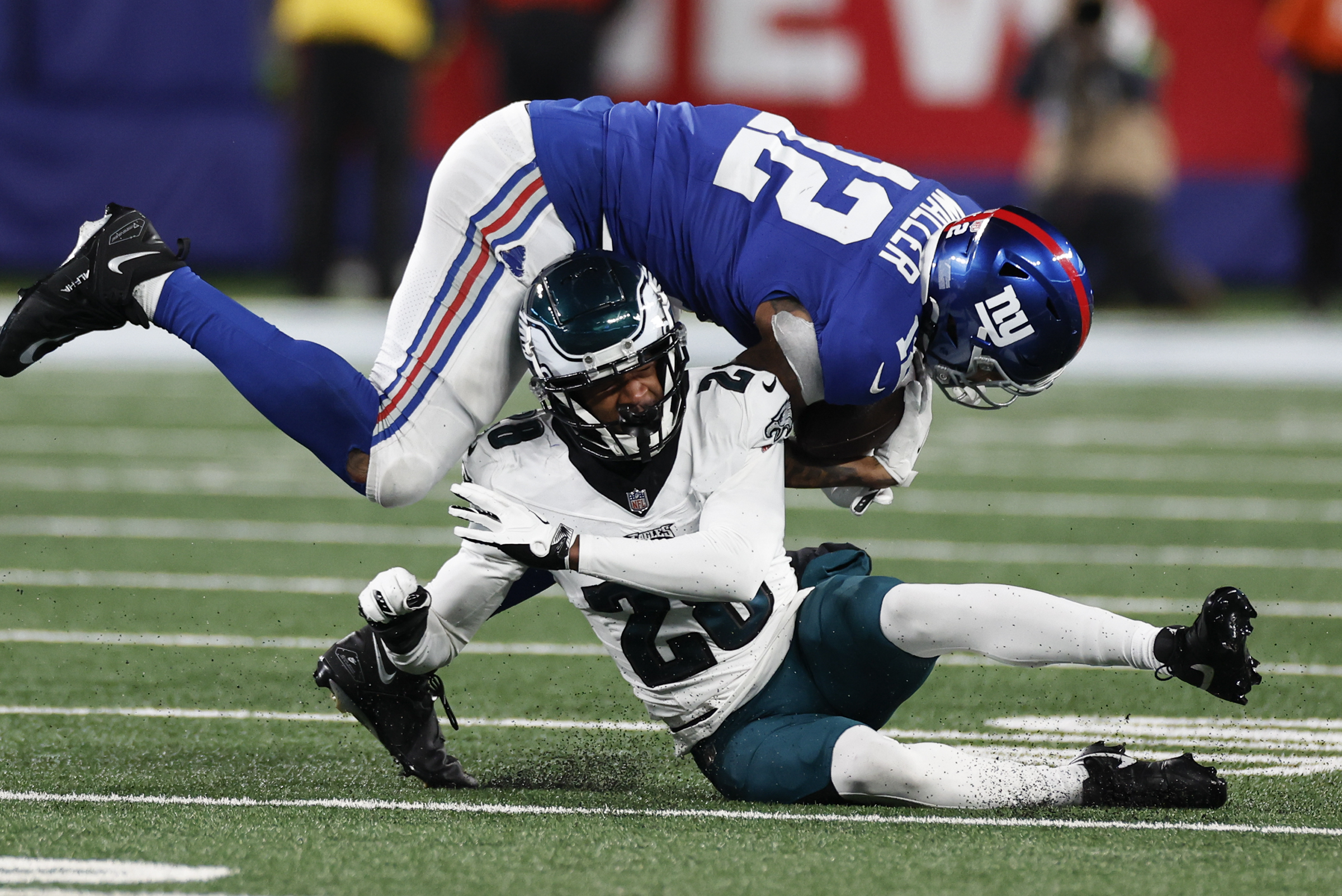
Eagles cornerback Josh Jobe stops New York Giants tight end Darren Waller at MetLife Stadium in East Rutherford, NJ on Sunday, January 7, 2024.
Josh Jobe spent two seasons with the Eagles from 2022 to 2023 and appeared in 28 games, primarily on special teams. The 2022 undrafted free agent out of Alabama served as a depth cornerback behind Darius Slay and James Bradberry.
He got buried on the Eagles depth chart and was released at the end of training camp in 2024. Jobe, now 27, signed with the Seahawks two days later and earned a starting job this season in Mike Macdonald’s defense.
Seattle Seahawks cornerback Josh Jobe, left, celebrates after stopping a pass intended for Los Angeles Rams wide receiver Puka Nacua during the second half of an NFL football game Sunday, Nov. 16, 2025, in Inglewood, Calif. (AP Photo/Katie Chin)
Seahawks long snapper Chris Stoll
Penn State place kicker Jordan Stout (98) celebrates with Chris Stoll (91) after kicking a 50-yard field goal in the fourth quarter of their NCAA college football game in State College, Pa., on Saturday, Oct. 2, 2021. Penn State defeated Indiana 24-0. (AP Photo/Barry Reeger)
Chris Stoll (left) spent six years at Penn State from 2017 to 2022 and played in 48 games. In 2022, he won the Patrick Mannelly Award, given to the nation’s top long snapper. Stoll signed with Seattle as an undrafted free agent in 2023.
Seahawks assistant head coach Leslie Frazier
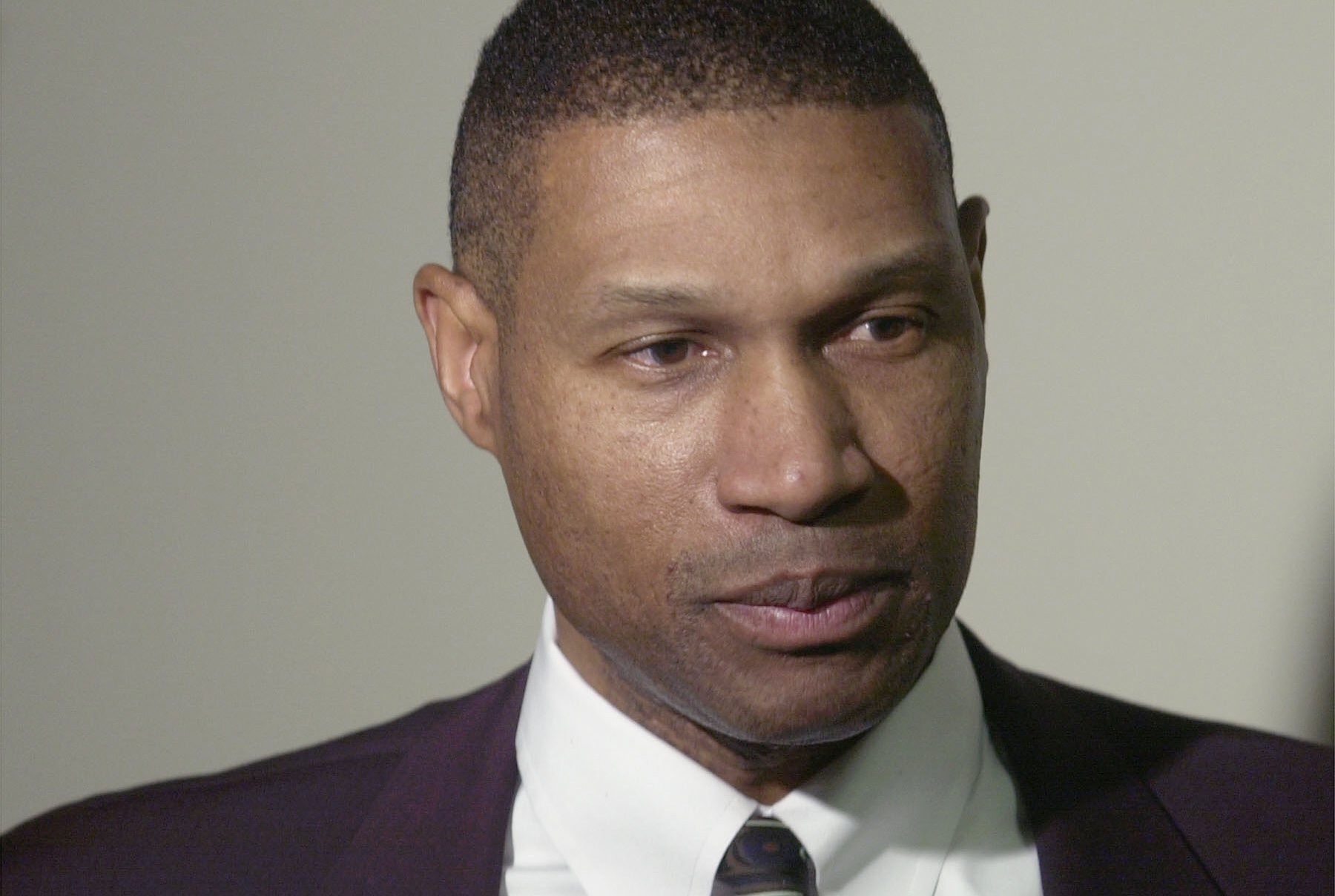
Seattle Seahawks assistant head coach Leslie Frazier looks on after practice during the NFL football team’s training camp Saturday, July 26, 2025, in Renton, Wash.
Leslie Frazier has been the Seahawks’ assistant head coach since 2024, serving as a mentor to first-time coach Mike Macdonald. Frazier, 66, was the head coach of the Vikings from 2010 to 2013 and has had multiple defensive coordinator jobs.
But the veteran coach got his NFL coaching start with the Eagles as the defensive backs coach from 1999 to 2002 under defensive coordinator Jim Johnson. Among the players Frazier coached with the Eagles were Brian Dawkins and Troy Vincent.
Cincinnati Bengals’ new defensive coordinator Leslie Frazier, former defensive backs coach for the Philadelphia Eagles, answers questions during a news conference Tuesday, Jan. 21, 2003, in Cincinnati. (AP Photo/David Kohl)
Seahawks running game specialist Justin Outten
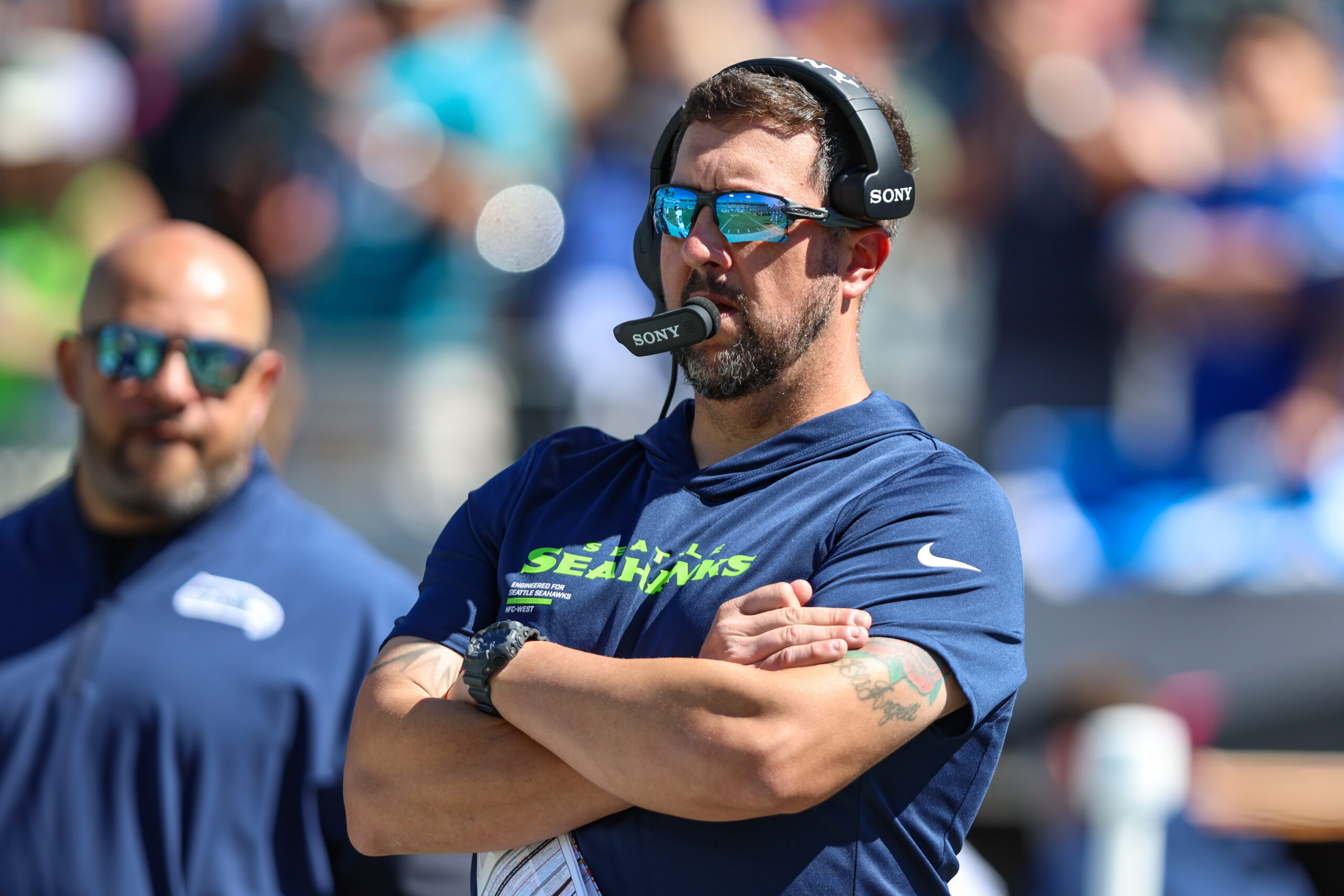
Seattle Seahawks run game specialist/assistant offensive line coach Justin Outten walks the sideline before an NFL football game against the Jacksonville Jaguars, Sunday, Oct. 12, 2025, in Jacksonville, Fla. The Seahawks defeated the Jaguars 20-12.
Justin Outten, 42, is in his first year as the Seahawks’ running game specialist and assistant offensive line coach. He hails from Doylestown and graduated in 2002 from Central Bucks West, where he won a state championship as a sophomore.
Seahawks ‘veteran mentor’ Jason Peters
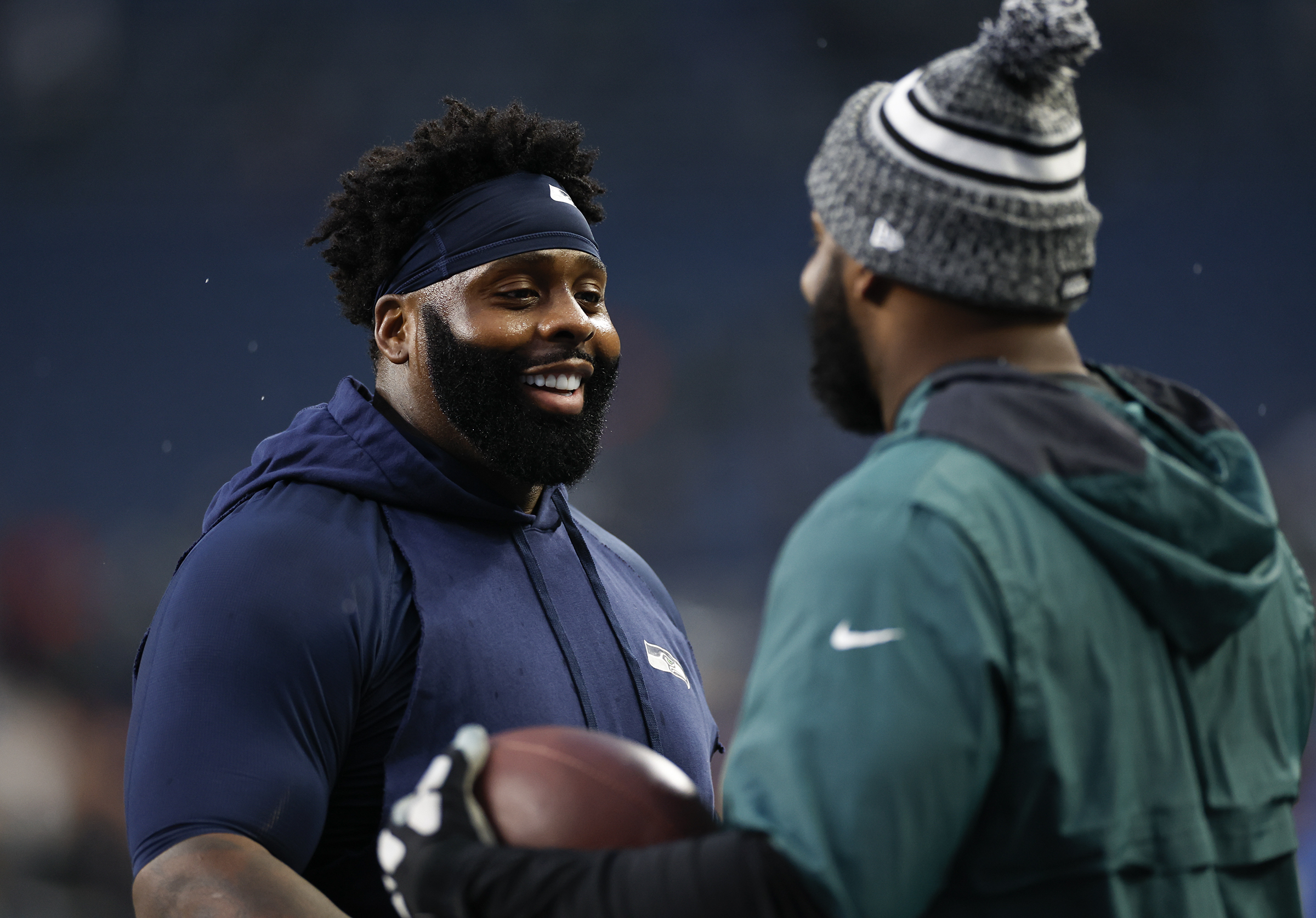
Former Eagles and current Seattle Seahawks offensive tackle Jason Peters meets with Eagles defensive tackle Fletcher Cox during warm ups before the Eagles play the Seattle Seahawks at Lumen Field in Seattle on Monday, December 18, 2023.
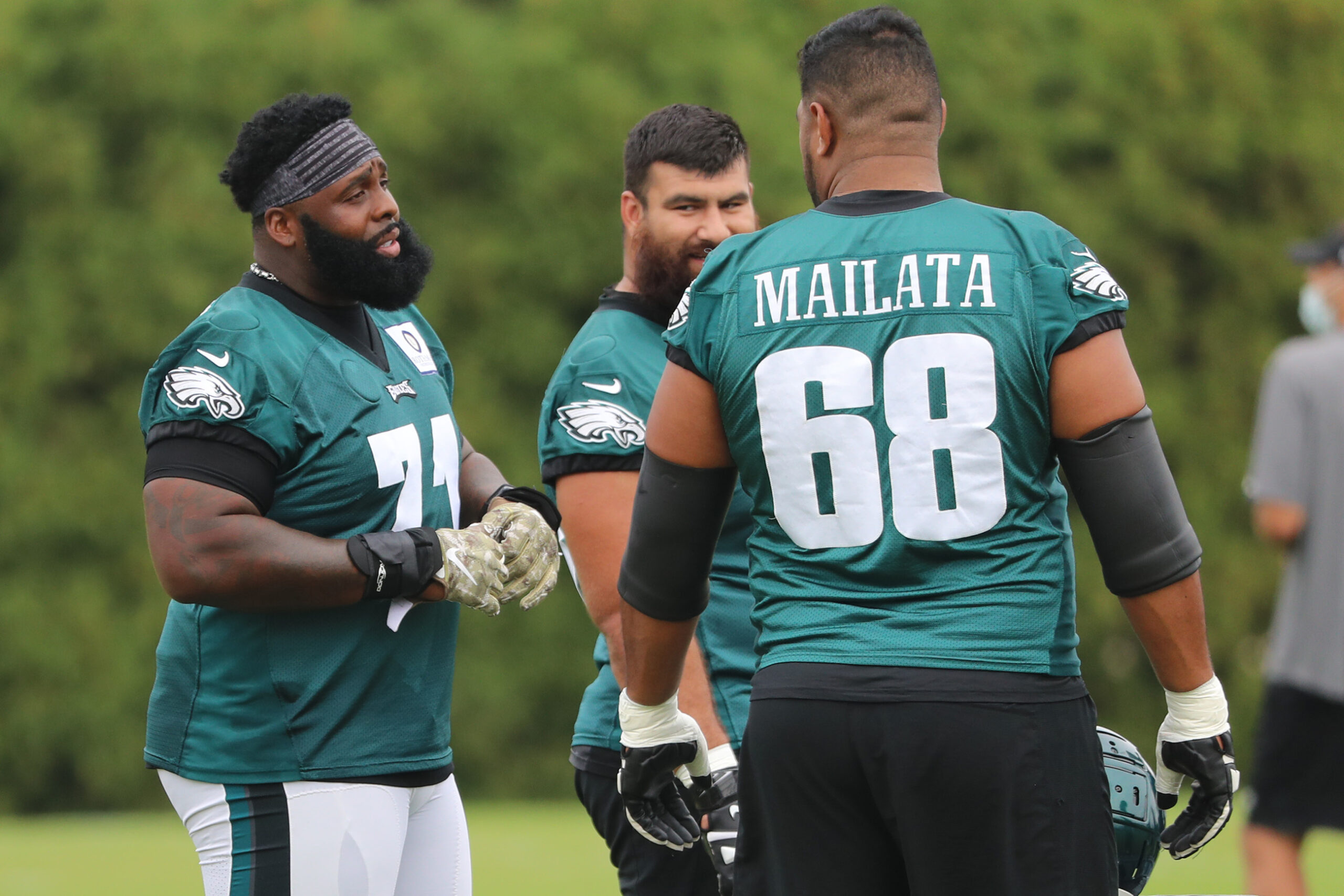
Jason Peters, the two-time All-Pro Eagles left tackle, was hired by the Seahawks front office last offseason to serve in what the organization called a “veteran mentor” role after a 19-year NFL playing career.
Peters was the oldest active NFL player (41) when he signed to Seattle’s practice squad in 2023. He was promoted to the active roster in November, and the following season, he re-signed to the practice squad to cap off his playing career. Peters spent 11 years with the Eagles (2009-2020), earning a Super Bowl ring in 2018.
Eagles offensive guard Jason Peters (left) talks to Eagles offensive tackle Jordan Mailata (right) at the Philadelphia Eagles football practice at the NovaCare Complex in Philadelphia, Pa. on September 17, 2020. The Eagles are preparing to play the Los Angeles Rams on Sunday.
Patriots defensive tackle Milton Williams
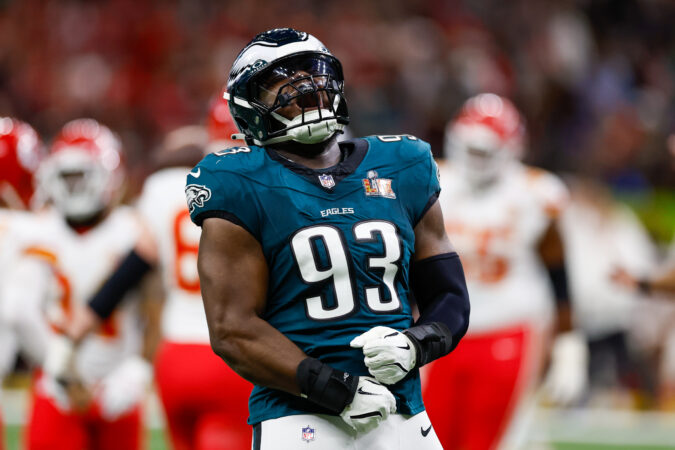
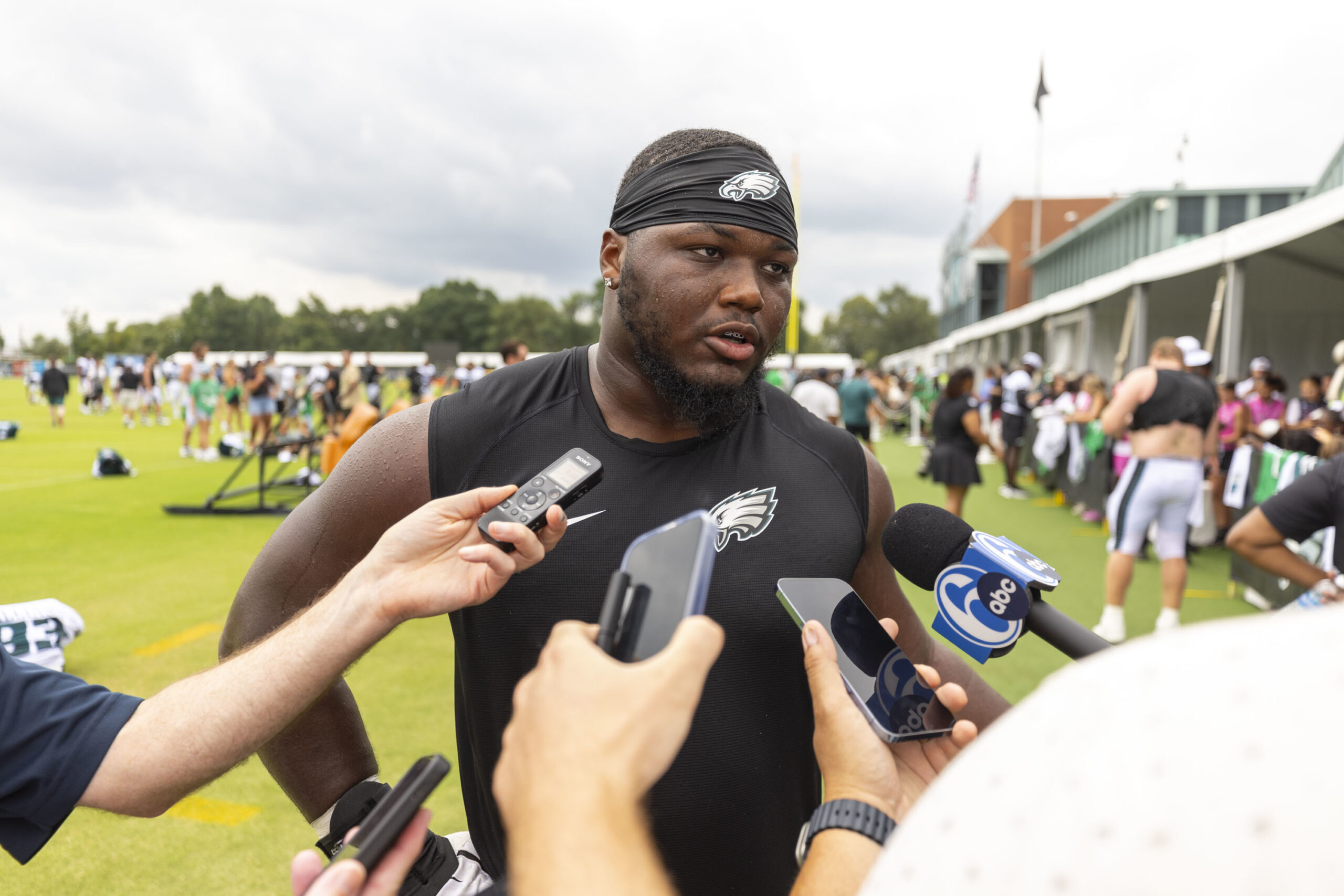
Milton Williams, (93), Defensive tackle, speaks to press after practice at the Novacare Complex in Philadelphia, Pa., on Tuesday, July 30, 2024.
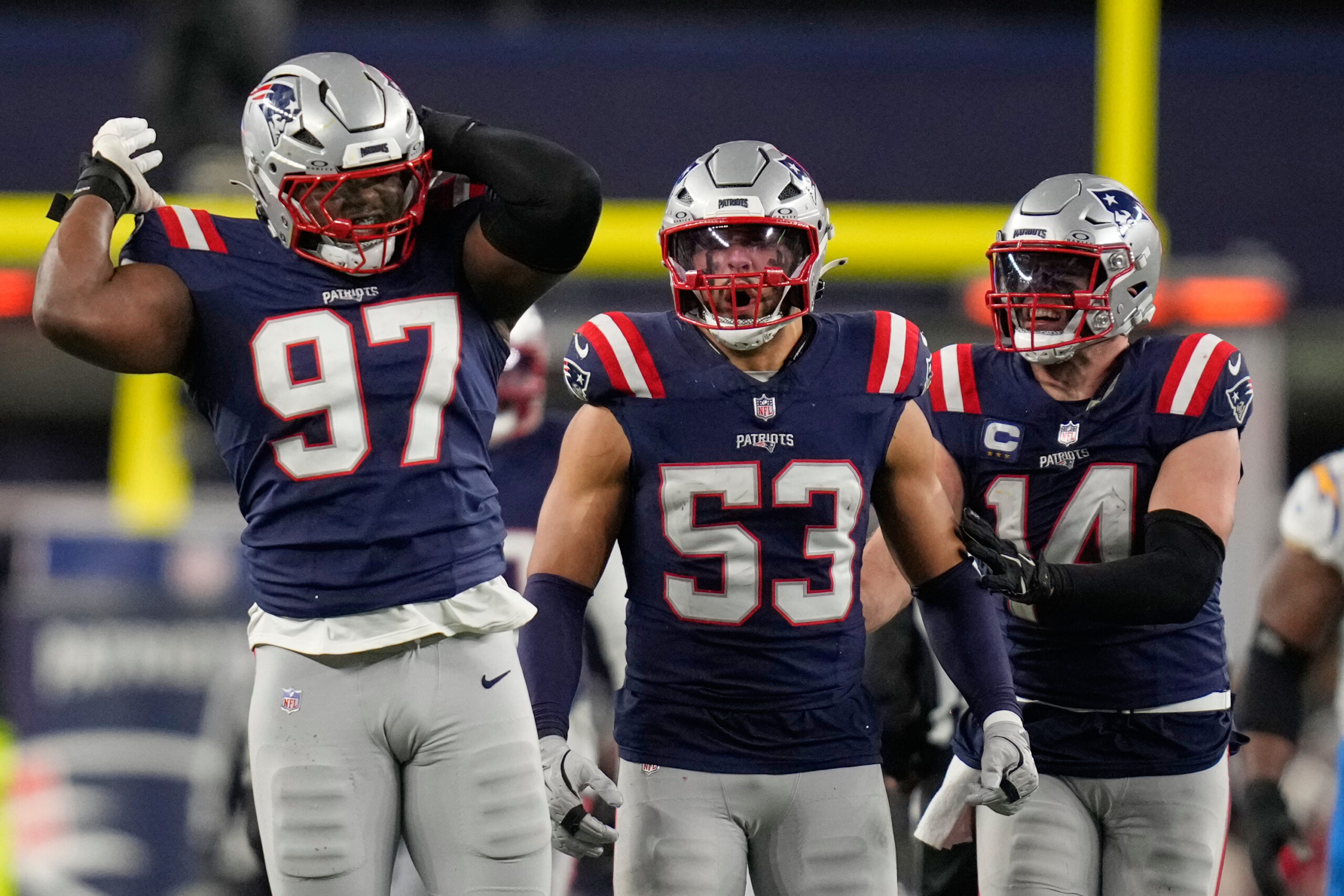
Milton Williams spent the first four years of his career with the Eagles, the team that drafted him out of Louisiana Tech in 2021. He had a breakout year in 2024, amassing a career-best five sacks and starring in the Birds’ Super Bowl win.
He signed a four-year, $104 million contract with the Patriots in free agency, making him the second-highest-paid interior defensive lineman on an average annual basis ($26 million per year). Williams, 26, missed five games late this season with an ankle injury, but returned in time for the playoffs and has made his mark.
New England Patriots defensive end Milton Williams (97), linebacker Christian Elliss (53) and linebacker Robert Spillane (14) celebrate Williams’ sack of Los Angeles Chargers quarterback Justin Herbert (10) in the second half of an NFL wild-card playoff football game in Foxborough, Mass., Sunday, Jan. 11, 2026. (AP Photo/Charles Krupa)
Patriots wide receiver Mack Hollins
Eagles wide receiver Mack Hollins stretches on the turf at Lambeau Field during warmups prior to the game against the Packers on Thursday September 26, 2019.
Mack Hollins also began his career with the Eagles, selected in the fourth round of the 2017 draft out of North Carolina. He was a member of the Eagles team that beat the Patriots in the Super Bowl that season.
Since that year, the 32-year-old Hollins has been a member of four teams and joined the Patriots on a two-year deal this season. Hollins, who came off injured reserve to lead New England with 52 yards in the AFC championship, had 550 yards and two touchdowns in 2025, the second-best receiving total of his career.
New England Patriots wide receiver Mack Hollins, top, catches a pass over Buffalo Bills cornerback Tre’Davious White (27) during the first half of an NFL football game in Foxborough, Mass., Sunday, Dec. 14, 2025. (AP Photo/Robert F. Bukaty)
Patriots linebacker Christian Elliss
Philadelphia Eagles defensive tackle Noah Elliss celebrates after tackling Cleveland Browns running back Demetric Felton Jr. in an NFL preseason football game against the Browns at Lincoln Financial Field, Thursday, Aug. 17, 2023, in Philadelphia.
Christian Elliss spent nearly three seasons with the Eagles from 2021 to 2023. He served in a depth role, even in 2023 on a struggling defense under Sean Desai, and he appeared in 19 total games, primarily on special teams.
The Eagles waived Elliss in December 2023 after signing Shaquille Leonard, and the Patriots claimed him. Elliss, 27, started 13 games this season (and played 15 games total) and ranked second on the Patriots with 94 tackles.
New England Patriots linebacker Christian Elliss celebrates after recovering a fumble by Los Angeles Chargers quarterback Justin Herbert in the second half of an NFL wild-card playoff football game in Foxborough, Mass., Sunday, Jan. 11, 2026. (AP Photo/Charles Krupa)
Patriots defensive tackle Christian Barmore
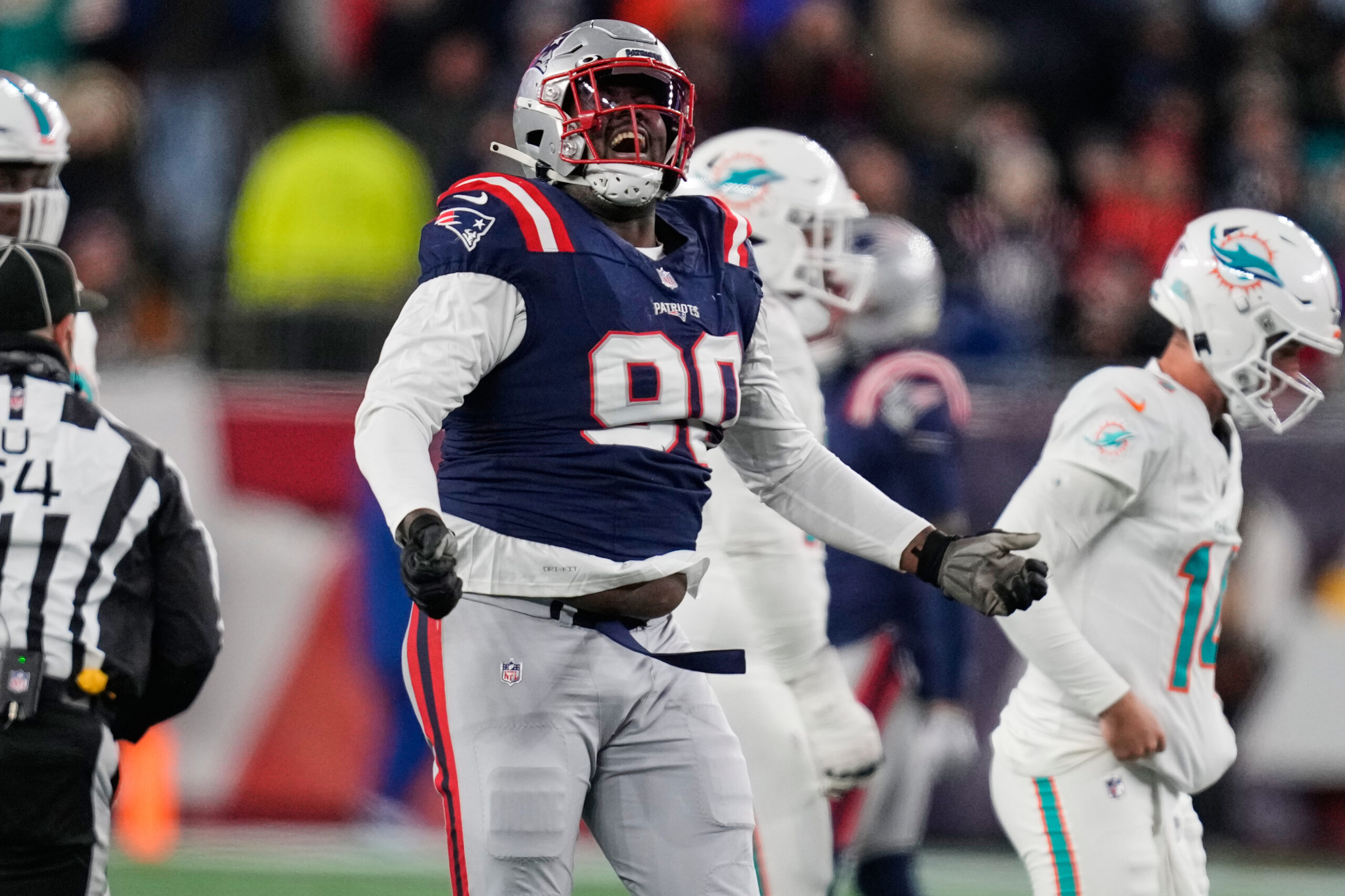
New England Patriots defensive tackle Christian Barmore (90) during an NFL football game, Sunday, Jan. 4, 2026, in Foxborough, Mass.
Christian Barmore grew up in Philly, starting in high school at Lincoln before transferring to Neumann Goretti. The 26-year-old was the Patriots’ second-round pick in 2021 and became a full-time starter this season, recording two sacks.
Patriots offensive tackle Caedan Wallace
New England Patriots offensive tackle Caedan Wallace (70) reacts after defeating the New York Giants in an NFL football game, Monday, Dec. 1, 2025, in Foxborough, Mass.
Caedan Wallace hails from Robbinsville, N.J., and won three straight prep state championships at the Hun School. Wallace, 25, played for Penn State and in 2024 was drafted by New England, where he has served in a depth role.
Philadelphia lawmakers are set to consider legislation that would make it harder for ICE to operate in the city, including limiting information sharing, restricting activity on city-owned property, and prohibiting agents from concealing their identities.
Among the package of bills set to be introduced Thursday is an ordinance that effectively makes permanent Philadelphia’s status as a so-called “sanctuary city” by barring city officials from holding undocumented immigrants at ICE’s request without a court order. Another bans discrimination based on immigration status.
Two City Council members are expected to introduce the legislation as U.S. Immigration and Customs Enforcement is facing mounting national scrutiny over its tactics in Minneapolis, where federal agents fatally shot two U.S. citizens this month.
Councilmembers Rue Landau, a Democrat, and Kendra Brooks, of the progressive Working Families Party, said in an interview that the violence in Minneapolis hardened their resolve to introduce legislation to protect a population that includes an estimated 76,000 undocumented immigrants in Philadelphia.
“It’s been very disheartening and frightening to watch ICE act with such lawlessness,” Landau said. “When they rise to the level of killing innocent civilians, unprecedented murders … this is absolutely the time to stand up and act.”
The package of a half-dozen bills is the most significant legislative effort that Council has undertaken to strengthen protections for immigrants since President Donald Trump took office last year on a promise to carry out a mass deportation campaign nationwide.
Left: City Councilmember Rue Landau. Right: City Councilmember Kendra Brooks. Landau and Brooks are introducing legislation this week to make it harder for ICE to operate in Philadelphia, including by limiting city cooperation with the agency.
ICE spokespeople did not immediately reply to a request for comment.
Jasmine Rivera, executive director of the Pennsylvania Immigration Coalition, said it’s not the job nor the jurisdiction of the city to enforce federal law.
The goal of the legislation, Rivera said, is ensuring that “not a single dime and single second of our local resources is being spent collaborating with agencies that are executing people.”
Now, the mayor could be forced to take a side. If City Council passes Landau and Brooks’ legislation this spring, Parker could either sign the bills into law, veto them, or take no action and allow them to lapse into law without her signature. She has never vetoed a bill.
Joe Grace, a spokesperson for Parker, declined to comment on the legislation.
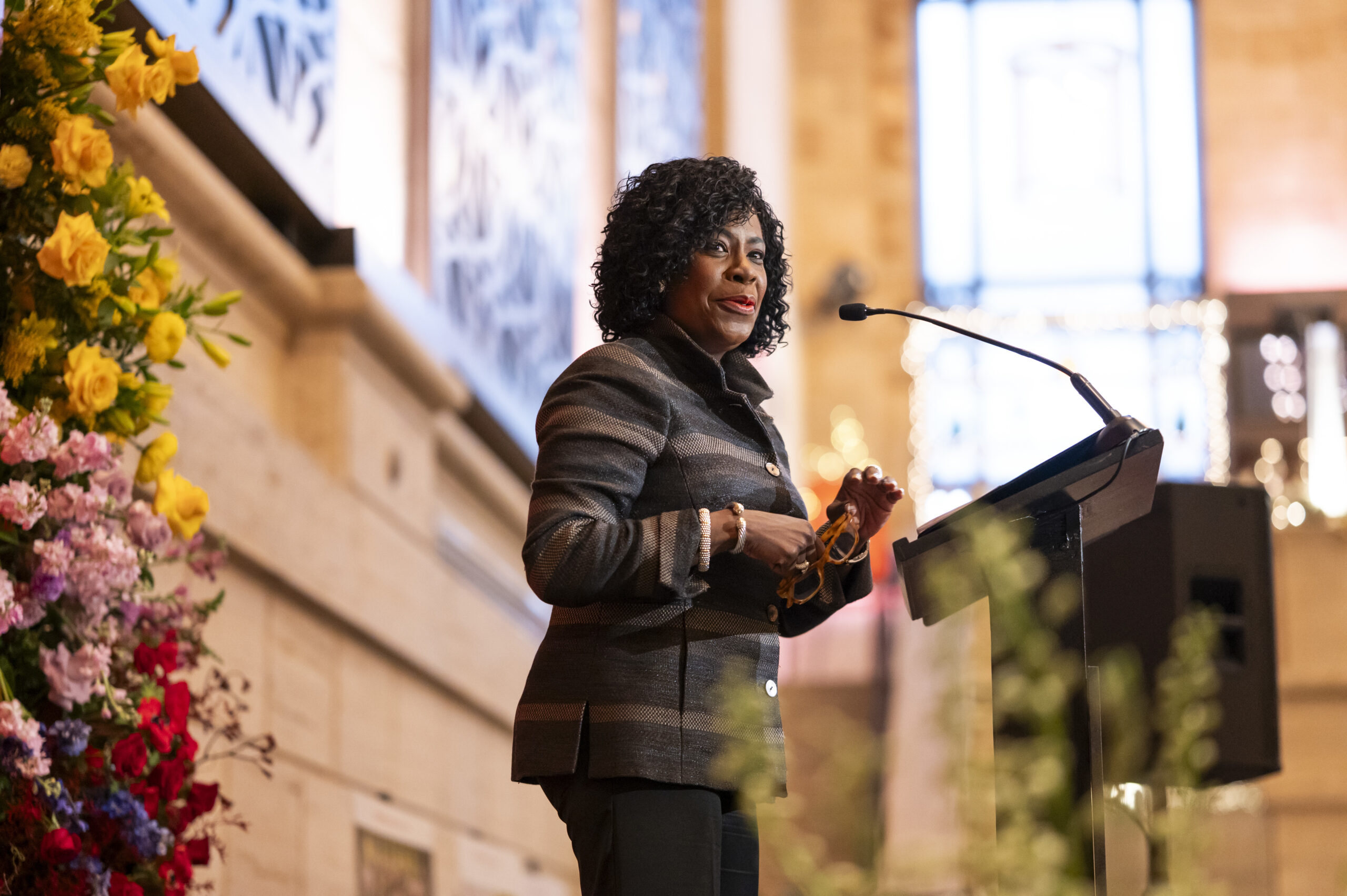
Mayor Cherelle L. Parker speaks at a news conference earlier this month. It is unclear how she will act on upcoming legislation related to ICE operations in Philadelphia.
It’s unclear what fate the ICE legislation could meet in Council. The 17-member body has just one Republican, but Parker holds influence with many of the Democrats in the chamber.
City Council President Kenyatta Johnson, a Democrat who controls the flow of legislation, has not taken a position on the package proposed by Landau and Brooks.
But he said in a statement that “Philadelphia has long positioned itself as a welcoming city that values the contributions of immigrants and strives to protect their rights and safety.”
“I have deep concerns about federal ICE actions directed by President Donald Trump’s administration that sow fear and anxiety in immigrant communities,” Johnson said, “underscoring the belief that enforcement practices should be lawful, humane, and not undermine trust in public safety.”
Making sanctuary status the law
Border Patrol and ICE are both federal immigration agencies, which are legally allowed to operate in public places and subject to federal rules and regulations. Some cities and states —not including Pennsylvania and New Jersey — actively cooperate with ICE through written agreements.
Since 2016, Philadelphia has operated under an executive order signed by former Mayor Jim Kenney, which prohibits city jails from honoring ICE “detainer requests,” in which federal agents ask the city to hold undocumented immigrants in jail for longer than they would have otherwise been in custody to facilitate their arrest by federal authorities.
Undocumented immigrants are not shielded from federal immigration enforcement, nor from being arrested and charged by local police for local offenses.
Some refer to the noncooperation arrangement as “sanctuary.” As the term “sanctuary cities” has become politically toxic, some local officials — including in Philadelphia — have backed away from it, instead declaring their jurisdictions to be “welcoming cities.”
Parker administration officials have said several times over the last year that Philadelphia remains a “welcoming city.”
Protesters march up Eighth Street, toward the immigration offices, during the Philly stands with Minneapolis Ice Out For Good protest at Philadelphia’s City Hall on Jan. 23.
But advocates for immigrants have said they want an ironclad city policy that can’t be rescinded by a mayor.
Landau and Brooks’ legislation would be that, codifying the executive order into law and adding new prohibitions on information sharing. The package includes legislation to:
Strengthen restrictions on city workers, including banning local police from carrying out federal immigration enforcement and prohibiting city workers from assisting in enforcement operations.
Prohibiting law enforcement officers from concealing their identities, including by wearing masks or covering up badges with identifying information.
Banning ICE from staging raids on city-owned property and designated community spaces such as schools, parks, libraries, and homeless shelters. (It would not apply to the Criminal Justice Center, where ICE has had a presence. The courthouse is overseen by both city and state agencies.)
Prohibiting city agencies and contractors from providing ICE access to data sets to assist in immigration enforcement.
Restricting city employees from inquiring about individuals’ immigration status unless required by a court order, or state or federal law.
Peter Pedemonti, co-director of New Sanctuary Movement of Philadelphia, an advocacy organization that partnered with the Council members to craft the package of bills, compared ICE to an octopus that has multiple arms reaching into different facets of American life.
The proposed legislation, he said, is a means to bind a few of those arms.
“The whole world can see the violence and brutality,” Pedemonti said. “This is a moment where all of us need to stand up, and Philadelphia can stand up and speak out loud and clear that we don’t want ICE here to pull our families apart, the families that make Philadelphia Philadelphia.”
An impending showdown that Parker hoped to avoid
Homeland Security officials claim that sanctuary jurisdictions protect criminal, undocumented immigrants from facing consequences while putting U.S. citizens and law enforcement officers in peril.
Last year, the Trump administration named Philadelphia as among the jurisdictions impeding federal immigration enforcement. The White House has said the federal government will cut off funding to sanctuary cities by Feb. 1.
Some of Parker’s supporters say the mayor’s conflict-averse strategy has spared Philadelphia as other cities such as Washington, New York, Los Angeles, Chicago, and Minneapolis have seen National Guard troops or waves of ICE agents arrive in force.
Residents near the scene of a shooting by a federal law enforcement agent in Minneapolis on Saturday.
Critics, including the backers of the new legislation, have for months pressed Parker to take a stronger stand.
Brooks said she “would love to have the support of the administration.”
“This should be something that we should be working collaboratively on,” she said. “Philadelphia residents are demanding us do something as elected officials, and this is our time to lead.”
But Parker has not been eager to speak about Philadelphia’s immigration policies.
For example, the city is refusing to release a September letter it sent to the U.S. Department of Justice regarding its immigration-related policies, even after the Pennsylvania Office of Open Records ruled its reasoning for keeping the document secret was invalid. The Inquirer has requested a copy of the letter under the state Right-to-Know Law.
The new Council legislation and the increasing tension over Trump’s deportation push may force Parker to take a clearer position.
Notably, the city sued the federal government last week over its removal of exhibits related to slavery from the President’s House at Independence National Historical Park, potentially signaling a new willingness by Parker to push back against the White House.
But even then, Parker declined to take a jab at Trump.
“In moments like this,” she said last week, “it requires that I be the leader that I need to be for our city, and I can’t allow my pride, ego, or emotions to dictate what my actions will be.”
Back at sea level, it looks like the Flyers left their energy in the Rocky Mountains.
Coming off a three-game road trip, with wins against two Stanley Cup contenders, the Vegas Golden Knights and Colorado Avalanche, you would have thought the Flyers would be amped to get back in front of the hometown faithful, especially since they had left town on a six-game slide.
But they came out with a lackluster effort, and the result was a 4-0 loss to the New York Islanders and goalie Ilya Sorokin. It marked the second time this season the Flyers were shut out and ended the team’s three-game point streak.
Had the Flyers won the game, they would have jumped ahead of the team from Long Island via tiebreakers into third in the Metropolitan Division, as each team would have had 59 points in 51 games.
Jean-Gabriel Pageau gave the Islanders a 1-0 lead in the first period while shorthanded against the unit with Trevor Zegras, Travis Konecny, Christian Dvorak, Bobby Brink, and Jamie Drysdale.
Off the offensive-zone faceoff to start the power play, which was won by Dvorak back to Drysdale, the puck ended up on Brink’s stick down the boards. He tried to pass it to Dvorak, but it went to Islanders defenseman Adam Pelech, and he knocked it away.
Pageau picked up the loose puck and dumped it in off Ersson, who steered it into the right corner. Islanders forward Casey Cizikas was first on the puck, despite having Brink and Drysdale there, and fed it back to Pageau, who was skating alone through the slot. It was the fifth short-handed goal the Flyers have allowed this season.
The Flyers left goalie Sam Ersson mostly hung out to dry on Monday night in a 4-0 defeat.
Philly fell into a 2-0 hole in the second period when Mathew Barzal deflected a point shot past Ersson. The line of Dvorak, Konecny, and Nikita Grebenkin got pinned in their own end with Dvorak out there for 2 minutes, 12 seconds, Konecny for 1:42, and Grebenkin for one minute.
Drysdale was also out there for 1:42, skating with Travis Sanheim for over a minute as the Islanders kept the puck to one side of the ice, with the Flyers unable to recover. In the end, Barzal pushed off Drysdale in front and moved into the slot to deflect the shot by Isaiah George.
Later in the second period, former Flyers defenseman and Sewell, N.J. native Tony DeAngelo made it 3-0 with a power-play goal.
Ahead of the goal, the Flyers had a chance to get on the board when Rasmus Ristolainen, activated before the game from injured reserve, got the puck to Owen Tippett while shorthanded. Tippett went one-on-one with DeAngelo, even making a between-the-legs move, but couldn’t get a shot off and sent it back to Emil Andrae at the point.
Andrae couldn’t control the pass, and the Islanders broke out three-on-two with Anthony Duclair carrying the puck up the ice. Duclair passed it back to Barzal on the right wing, and he found DeAngelo in the middle for the one-timer.
Pageau added another goal in the third on a pass by Maxim Tsyplakov. The forward got behind the defense after the puck came off the wall in the neutral zone, and fired one upstairs off the pass.
Philly had 21 shots, but only four from high-danger areas, according to Natural Stat Trick; two of those were on the power play. Sorokin entered the game with an 11-3-3 career record, 1.61 goals-against average, and .944 save percentage against the Flyers.
Breakaways
Ersson started his fourth straight game for the first time since Feb. 8-27, when he went 3-0-1. With Ristolainen activated, defenseman Hunter McDonald was loaned to Lehigh Valley of the American Hockey League. … The 2nd Annual Gaudreau Family 5K will be held on May 16 at Washington Lake Park in Sewell. Registration will open on Feb. 13.
Up next
The Flyers are on the road again for two games in two nights. First up, they see old teammate Egor Zamula and the Columbus Blue Jackets on Wednesday (7:30 p.m., TNT, truTV, HBO Max) before going to Boston to face the Bruins on Thursday (7 p.m., NBCSP+).
There I was, by myself late at night, manning the inspection point at a pedestrian border crossing in Nogales, Ariz., when a shifty-looking man approached. He had short-cropped hair and a good 30 pounds on me. I asked him for ID, and he failed to comply.
“I forgot my ID,” he said aggressively, coming in close. “Why you wanna do me like this? Just let me cross.”
I thought back to my training — mainly the Police Quest series of computer games — and put some distance between us as I attempted to talk him down. A few seconds later, he had stabbed me in the ribs, and I had shot him dead.
“You see what happened there?” I was asked by the U.S. Customs and Border Protection official who ran me through the scenario as part of the CBP media academy.
“I tried to engage and de-escalate the situation,” I said. In lieu of a head shake, he smiled.
“You have to exert control,” he told me.
In the 11 years since I went through my crash course on what CBP does — from officers manning the ports of entry to agents out on the border line — the mock use-of-force examples remain top of mind. It was a deadly five days, after all, as I also shot and killed a man who was throwing rocks at me in the desert. Control exerted, I guess.
It was no accident that these scenarios involved unavoidable use of lethal force. It was undoubtedly a way to show the bleeding-heart media types who participated in the academy what law enforcement could encounter in the field, day to day.
They needn’t have bothered with me. Yes, I was a bleeding-heart type, but I already knew law enforcement was dangerous. I also knew Border Patrol agents, liked them, and believed most of them were genuinely trying to do good out there.
I also knew that excessive use of force was bad, and that a desire for control can curdle.
U.S. Border Patrol Cmdr. Gregory Bovino arrives as protesters gather outside the Bishop Henry Whipple Federal Building, Jan. 8 in Minneapolis, Minn.
That’s what I see in videos of Border Patrol and of U.S. Immigration and Customs Enforcement agents who are smashing car windows or clashing with protesters. In recordings of interactions that quickly turn violent, I see the operational need for control (in theory, to ensure the safety of both civilians and law enforcement) devolve into the personal need for dominance.
It was that need to be the big man in charge that likely made ICE agents stop their vehicle and confront Renee Good almost three weeks ago — when she was neither an obstacle nor a threat inside her SUV — on a residential Minneapolis street. It was the anger and frustration at being questioned, at being disobeyed, that placed both agents and civilians in danger and ultimately cost Good her life. Shot in the head because … how dare she.
Before Alex Pretti was shot and killed Saturday by federal forces, he was defending two women who were being violently shoved after challenging Border Patrol agents. The minute that agent started pushing those women with little provocation beyond whatever words were exchanged, Border Patrol relinquished control of the situation.
The scrum that followed — as multiple agents pounded Pretti on the ground — was chaos. Chaos that eventually turned deadly, as agents saw that Pretti was carrying a gun.
Much as they did after Good’s death, administration officials tried to control the narrative of what happened, blaming the victim. Good was a “terrorist” who, according to Homeland Security head Kristi Noem, tried to run over federal agents. Pretti was a “would-be assassin,” according to Stephen Miller, Trump’s homeland security adviser, who was out to “massacre law enforcement,” according to Border Patrol operations chief Greg Bovino.
Multiple videos from the scene disprove the government’s story.
This sad quest for dominance, regardless of the consequences, comes from the top, of course. The latest example: Barely three days before Pretti was killed, Donald Trump apparently gave up on his bid to control Greenland. This came after days of speculation over whether the U.S. would invade a NATO ally over the president’s deranged demands.
In that case, Western allies came together and held firm in the face of Trump’s bullying. In Minneapolis, and whatever city is next on the White House’s hit list, Americans need to remind the administration of what it couldn’t and can’t control.
It could not control Good’s First Amendment right to speak out and stand up for what she thought was wrong, nor Pretti’s Second Amendment right to carry a firearm.
And it can’t control our Fourth Amendment right to protection from unreasonable use of force by law enforcement.
Chefs’ travels inspire their menus — for example, the konbini in Japan that Jesse Ito and Justin Bacharach visited for Dancerobot and the trattorias in Italy that Stephen Starr’s team scouted for Borromini, to name two just in the last year.
For Greg Vernick, the culinary inspiration for his first new restaurant in 6½ years — the casual Emilia, opening Tuesday in Kensington — was from a trip to Rome a few months ago with Meredith Medoway, Emilia’s chef de cuisine, and Drew Parrasio, culinary director for his restaurants.
Before they left, Vernick called chef friends like Marc Vetri, Jean-Georges Vongerichten, and Hope Cohen for recommendations: “Where do I need to eat? Street food, markets, trattorias, all of it.”
Carta di musica with butter, bottarga, and roasted chili at Emilia.
Emilia’s must-try dish came from a culinary school. Cohen’s suggestions included the American Academy in Rome. “We walked up one day thinking we’d just say hello and ended up spending the entire day there,” Vernick said. “They grow their own herbs and produce. We were eating arugula straight from the ground, picking rosemary and thyme — it felt cinematic.” Chef Sara Levi, who oversees the academy’s program, asked the three to join the students for the day’s family meal.
“One of the dishes was a simple chicken ragù pasta — hand-cut chicken, livers, hearts, very little sauce,” Vernick said. “Light, savory, a little gamey. We didn’t even talk much while we were eating it. Later, walking back into central Rome, we all realized: That was one of the best pastas we had on the trip, and we’d eaten three to five pastas a day for three days.”
Chefs Meredith Medoway and Greg Vernick at Emilia.
Back home in Vernick’s kitchen, they tweaked it to “just honor the idea,” Vernick said. It’s on the opening menu as “rigatoni, ragù bianco.” It’s also Emilia’s lone chicken dish — a somewhat daring move.
Emilia, just north of the York Street roundabout on Frankford Avenue, seats 60 in the dining room, with an additional 10 seats at the bar and 20 in a lounge area; in keeping with Vernick’s desire to make this a neighborhood place, some tables are held for walk-ins.
Canno Design’s Carey Jackson Yonce, working with California-based designer Bob Bronstein, has the lighting set to “subdued.”
“I wanted it to feel like the kind of place where you walk in and exhale and relax,” Vernick said. “Industry-friendly, not precious. We want to hit two markets from day one: the neighborhood and the industry. If you get those right, everything else falls into place.”
Arranged flowers in the dining room at Emilia.
Italian is a new turn for Vernick, who started here in 2012 with the New American Vernick Food & Drink before adding Vernick Coffee Bar in 2018 and Vernick Fish in 2019. The developers of Emilia’s building were keen on having an Italian restaurant, and Vernick’s thoughts naturally turned to Medoway, the longtime chef de cuisine at his flagship.
The bar program focuses exclusively on Italy, with low-intervention wines, amari, spritzes, and a rotating seasonal negroni, along with Italian sodas and zero-proof cocktails.
Sea scallop crudo and burrata at Emilia.
Much of the menu is coursed and priced as smaller plates (figure teens and $20s). The few entree-sized dishes, such as golden tilefish ribollita and grilled sea bream, start in the high $30s; top price is $53 for crispy veal with broccoli di ciccio.
There’s other house-made pasta on the menu, such as capellini with pesto, and radiatore in mushroom Bolognese. Much of Medoway’s cooking is centered on a 48-inch charcoal- and oak-fired grill. Each table receives complimentary breads — house-made focaccia, Mighty Bread’s sesame ciabatta, and the thin bread sticks known as grissini.
The bar area at Emilia.
Another anchor main course dish is rabbit Emiliana, a regional take on cacciatore from Emilia-Romagna that Medoway devised after a trip of her own. The braised rabbit is finished with roasted peppers, green olives, fresh orange, and vinegar, giving it a punchy, slightly sweet-sour profile.
Several smaller plates lean into texture and contrast. Carta da musica, a paper-thin Sardinian cracker, is spread with soft butter, dusted with grated bottarga, and topped with a relish of fire-roasted peppers. You crack it at the table and share the shards. “It’s about breaking bread together,” Vernick said.
A sea scallop crudo pairs raw scallop with burrata and a caper-chili vinaigrette, a combination Vernick said surprises people at first because of the similar textures. “It works, though,” he said. “It’s simple but exciting.” Grilled cabbage, blanched and then charred over the wood fire, is tossed with a colatura vinaigrette and finished with pecorino. “It reads ‘boring,’ but it eats incredibly well,” he said.
Emilia, 2406 Frankford Ave., 267-541-2360, emiliaphilly.com. Reservations open on Resy. Hours: 5 to 9:30 p.m. Sunday to Wednesday, 5 to 10 p.m. Thursday to Saturday.
Call Your Mother — the popular neighborhood bagel shop and “Jew-ish” deli from the District of Columbia — is headed to the Keystone State.
It’s part of a steady ongoing expansion, including about 25 locations across D.C., Maryland, Virginia, Colorado, and Illinois, plus more on the way.
The first Philly location will be in Fishtown, in the corner space of 1500 Frankford Ave., and is expected to open this summer, owners said.
“This will be the start of more shops in Philly,” co-owner Andrew Dana said. “But we’ve never had a master plan on how to roll out. We’ll go where people want bagels and where we’re excited to be, as long as our food quality and service stay the same.”
With colorful decor that would feel right at home in West Palm Beach and stuffed bagel sandwiches made with latkes, whitefish dips, and smoked salmon, Call Your Mother is popular across the DMV.
In the six years since Dana and his wife, co-owner Daniela Moreira, opened that first location, the shop has been praised across food publications like Bon Appétit and Eater for its vibe and sandwiches. Some critics say the menu is overpriced, but items on the D.C. menu — including sandwiches and loose bagels — appear similarly priced to most of Philly’s bagel outposts (and sometimes cheaper).
On that note, Dana says to expect the same Call Your Mother signature menu items — like its bacon, egg, and cheese sandwiches and its babka muffins. “But we’re in the lab trying to cook up some special Philly flair, too,” he said.
You can also expect a colorful buildout.
“Most of the building will be painted pink, but we’re on the hunt for a local muralist to put an extra stamp on the building,” Dana said. “We’re also looking for local Philly food products to showcase.” Locals interested in getting in on the mix are encouraged to direct message Call Your Mother on Instagram.
The expansion comes amid a bagel boom in the Philly area: Viral bagel chain PopUp Bagels is set to open its first Pennsylvania location in Ardmore with seven more locations on the way in the Philadelphia region, including Suburban Square and Center City. Bart’s Bagels of West Philly is opening its third location in Bala Cynwyd, and Penny’s Bagels is coming to Haddonfield this year, as well.
“It’s a rise of the tide situation,” Dana said. “We’re not trying to take anyone’s territory. We don’t want to threaten a local spot. People love carbs, people love bagels. There’s enough room for everyone.”
The Frankford Avenue spot is part of a surge of popular food options in the area. It’s right across the street from Marina’s Pizza and El Chingón, and down the road from the new Medium Rare location.
“The infusion of best-in-class national brands like Call Your Mother Deli represents Fishtown’s strength today,” said Stefanie Gabel of MSC, who represented both Call Your Mother and the building’s landlord in the transaction. Gabel will continue to represent Call Your Mother as the deli expands within the Philly region. “Their presence also serves as a catalyst for the continued growth and longevity of Philadelphia’s most explosive mixed-use ecosystem.”
Call Your Mother recently made national headlines when it filed a trademark lawsuit against New Jersey’s Call Your Bubbi, a beach town cafe and kosher-certified bagel shop in Long Branch. Dana and Moreira said the Jersey cafe, which also sometimes goes by Bubbi Bagels, intentionally used a “confusingly similar” name and branding at times.
The dueling shops settled outside of court in early January, according to court documents. Dana declined to comment on the terms. Bubbi Bagels owner David Mizrahi could not be reached for comment.
As for what drove the couple to come to Philly, Dana said it was a simple decision: He very literally called his mother, Mary Wilson.
Wilson’s parents lived in Mount Airy and growing up Dana would visit his maternal grandparents often. He would go to their house, venture downtown, and explore Chestnut Hill. One of his best friends attended Penn. His cousins live on the Main Line. His other best friend lives in Bryn Mawr. In many ways, Dana says Call Your Mother coming to Philly is a natural progression.
“I’ve spent an insane amount of time here. I love the culture, the food, the vibe. It’s a great place to be,” he said.
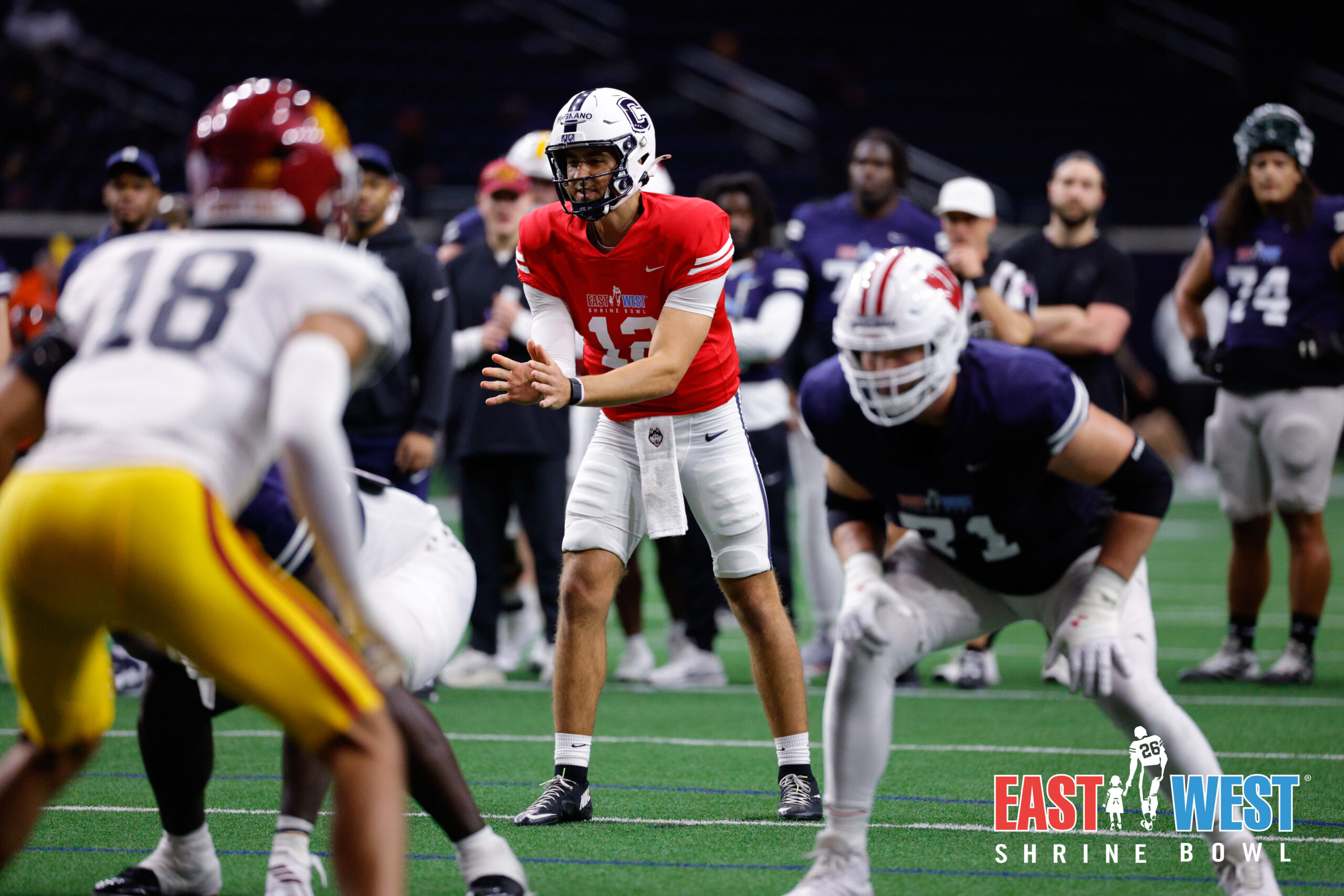
FRISCO, Texas — If there were any doubts about whether Eric Gentry belonged in the NFL with size that is often compared to an NBA wing player, he quelled those concerns by the second practice of East-West Shrine Bowl workouts, which are composed of the best draft-eligible players from across the country.
Gentry, who recently finished his college career at Southern California, sprinted downhill from his linebacker spot during the 11-on-11 period, hit the breaks two yards from the line of scrimmage when the offense ran play-action, and elevated to nearly intercept a Mark Gronowski pass over the middle of the field. The next play looked identical: Gentry flowed toward the line of scrimmage on a play-action pass, sank back a few feet, and elevated to again deflect a pass thrown his direction.
The Philadelphia native and Neumann Goretti alum used every bit of his 6-foot-6, 221-pound frame and long arms. His height and more than 35-inch arms are in the 99th percentile, while his weight is in the first percentile among linebackers. He’s a unique player who has intrigued nearly every NFL scout and media member during Shrine Bowl practices.
#USC LB Eric Gentry gets a pass deflections on back to back plays during the team session at the Shrine Bowl. pic.twitter.com/5FO98VxNHr
“We have a lot of value in guys that are really unique, and if their character matches their uniqueness on the field, those guys almost always hit the NFL,” Eric Galko, the Shrine Bowl director, told The Inquirer. “For Eric, we always saw that. He was one of our first invites at linebacker — we had no doubt he’ll play in the NFL. And I think what he’s showing this week in practice is that you can use him in a couple different ways. He can have a huge, huge impact because of how uniquely built he is.”
Gentry is used to the doubts by now, having experienced the criticism throughout his football career. Most think he’s too tall and too thin to play linebacker. Others question his durability playing such a physical position.
But through it all, he was focused on proving that the production and versatility he showed in college will follow him to the NFL. In one year at Arizona State and four at USC, he had nine forced fumbles, 26½ tackles for losses, nine sacks, and two interceptions.
“I think of just making these [scouts] come get at me, making these teams come get at me — I feel more like I am going to be in the moment and make it all happen,” Gentry said before practices began. “I feel so happy to be able to be out here and do what I’ve got to do. Every 10 years, it’s a new generation of athletes, type of athletes that come around. I know I’m one of them. So every day, just showing it, every day, having that intuition, knowing that can’t nobody tell me no but me. I’m always telling myself, ‘Yes, I can do it.’”
‘Always magical’
Football has been at the forefront for Gentry since he was 5 years old, but the journey to this weekend’s All-Star Game in Texas hasn’t been without its ups and downs.
Recently, Quan Luck, Gentry’s mother, was going through some old Pop Warner pictures from her son’s early playing days. Many of the players in those pictures with Gentry, she said, are either no longer alive or in prison.
First MVP trophy when he was 7… 😂🤣💪🏽🤷🏽♀️🤦🏽♀️✌🏽… Please leave me alone I’m from Philly and I’m clinically diagnosed Petty… You won’t win against me!! Just be a humbled fan!!! I don’t play about mine… Now #FightOnpic.twitter.com/6r75zBH7GL
The adversity that Gentry overcame to follow his dream of making the NFL still resonates with his mother.
“It’s always magical watching my son, because the things that he’s able to do, most football players are not able to do, but it’s hard,“ she said. ”He just has [faced] a lot of adversity because of his build. … Because of so many coaching changes, he’s had to prove himself over again. But every single coach that he ever played for always spoke very highly of him and stated how he was a unicorn.”
Southern California linebacker Eric Gentry prepares to rein in Utah running back Sione Vaki on Oct. 21, 2023.
His mother also noticed how Gentry was “a different character” on the football field over the years. She was a college basketball player at Rutgers-Camden and thought her son might follow in her footsteps on the court.
But Gentry wanted to be “something that nobody had ever seen” on the football field. Luck said Dwayne Thomas, Gentry’s former high school defensive coordinator, described his playing style as “playing basketball on the football field.”
“Sometimes it’s like he’s the underdog for whatever reason. I don’t know why, but he just always proves them wrong,” Luck said. “People have so many questions about him. Is he too thin? Will he not make it? Is he too weak? Is he going to get pushed back? And he just proved to them that anything he wants to do, he does his best.
“You can ask anybody from his team, they will always speak highly of him, that [football] is what he does every day.”
Before winter storms ravaged most of the country, Luck, Gentry’s father, Eric Sr., and Thomas were set to make the trip to Frisco to watch him compete at the Shrine Bowl.
Coming full circle
During his three days of participation in Shrine Bowl practices, Gentry was one of the standouts among all players. He consistently made plays in one-on-one coverage and in pass-rushing reps during the team periods.
An NFC scout, while watching Gentry, remarked that the Philly native “can be a good one” and would ideally want the linebacker to “get up to 240 pounds.” Another appreciated the “use of those long arms.”
Eric Gentry (left) during the East-West Shrine Bowl practice on Saturday
“I think Eric Gentry is kind of a choose-your-own-adventure player, like whatever he does in the draft process, whatever you care about as a team, you’re going to find value in as well,” Galko said. “I always tell NFL teams and guys, when you’re that big and long, you can make mistakes and still win the rep.
“And I think with a player like Gentry, he can make mistakes and still make that play on the running back in the B-gap, or he can make that mistake and still bat the pass down. I think his length, wingspan, his mental aptitude, can make him a guy that early on in the NFL can contribute before he’s even reached his full potential.”
One of Gentry’s agents is Chafie Fields, also a Philadelphia native, who has a close connection with his mother. Luck and Fields ran track and field together since they were 5 years old and the former Penn State and NFL wide receiver turned agent works for the Wasserman agency, which represents more than 100 NFL players.
The journey is coming full circle for Gentry, one that is coming closer to reality in a few short months. Wherever he ends up, Philly will be at the forefront of his identity.
USC Linebacker (Yes), Eric Gentry is 6'6", 221 LBs.
“To be away and have my journey go on and just hearing people support me from back home — like a mythic legend, in a sense, because nobody sees me anymore — but just hearing everything that’s going on with me,” Gentry said. “My homie texted me not that long ago, actually, and he was like, ‘You don’t [get] on social media a lot, you don’t do a lot, but you don’t realize how much you are motivation to the people in the city.’
“I never knew the true understanding of it, until you see, you hear people from back home. There’s so many people that know you back home and are talking about you. … I feel so great to be able to put on for the city and tell everybody and show everybody that Philly’s got it.”
Added his mother: “The city made him. Part of his aggression is because he was raised in the city of Philadelphia. It’s not easy. People don’t understand to make it out of Philly is an accomplishment by itself.”