Tag: topic-link-auto

  • U.S. national park gift shops ordered to purge merchandise promoting DEI

    U.S. national park gift shops ordered to purge merchandise promoting DEI

    The Trump administration is expanding its crackdown on diversity, equity and inclusion by ordering national parks to purge their gift shops of items it deems objectionable.

    The Interior Department said in a memo last month that gift shops, bookstores and concession stands have until Dec. 19 to empty their shelves of retail items that run afoul of President Donald Trump’s agenda.

    The agency said its goal is to create “neutral spaces that serve all visitors.” It’s part of a broader initiative the Trump administration has pursued over the last year to root out policies and programs it says discriminate against people based on race, gender and sexual orientation — an effort that has led some major corporations and prominent universities to roll back diversity programs.

    Conservation groups say the gift shop initiative amounts to censorship and undermines the National Park Service’s educational mission. But conservative think tanks say taxpayer-funded spaces shouldn’t be allowed to advance ideologies they say are divisive.

    Employees of the park service and groups that manage national park gift shops say it’s not clear what items will be banned. They didn’t want to speak on the record for fear of retribution.

    A debate over what’s acceptable for park gift shops

    “Our goal is to keep National Parks focused on their core mission: preserving natural and cultural resources for the benefit of all Americans,” the Interior Department said in a statement. The agency said it wants to ensure parks’ gift shops “do not promote specific viewpoints.”

    Alan Spears, the senior director for cultural resources at the National Parks Conservation Association, said removing history books and other merchandise from gift shops amounts to “silencing science and hiding history,” and does not serve the interests of park visitors.

    Other groups called the review of gift shops a waste of resources at a time of staffing shortages, maintenance backlogs and budget issues.

    Stefan Padfield, a former law professor who now works with a conservative think tank in Washington, said there is no way to defend the government’s promotion of “radical and divisive” ideologies through the sale of books and other items, though he said the challenge for the Trump administration will be in deciding what is acceptable and what isn’t.

    “Now, are there going to be instances of the correction overshooting? Are there going to be difficult line-drawing exercises in gray areas? Absolutely,” said Padfield, the executive director of the Free Enterprise Project at the National Center for Public Policy Research.

    The order is open to interpretation

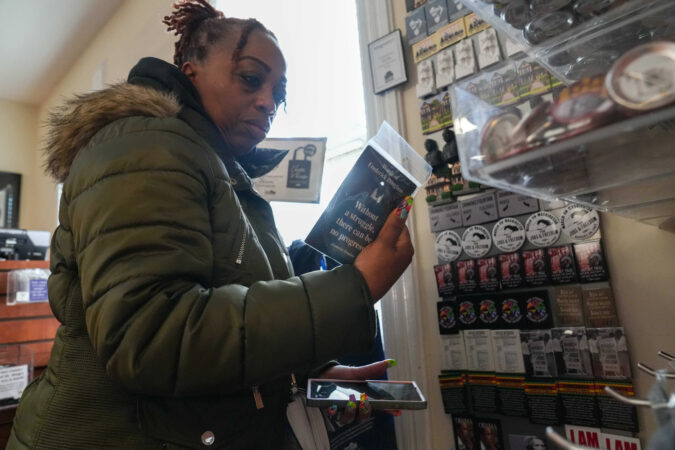
    All items for sale at parks and online are supposed to be reviewed for neutrality. That includes books, T-shirts, keychains, magnets, patches and even pens.

    But the memo issued by a senior Interior Department official didn’t give any examples of items that could no longer be sold, leaving the order open to interpretation. No training sessions have been offered to park service employees.

    Some parks had already completed their reviews, finding nothing to add to the list.

    On display this week at Independence National Historical Park in Philadelphia were items featuring Frederick Douglass. At the Martin Luther King, Jr. National Historical Park store in Atlanta, there were various books on the Civil Rights Movement and a book for children about important Black women in U.S. history. For sale online was a metal token for the Belmont-Paul Women’s Equality National Monument.

    There already is a thorough process for vendors to get merchandise into national park stores. Items are vetted for their educational value and to ensure they align with the themes of the park or historical site.

    National parks in the spotlight

    The park service in recent weeks faced criticism when it stopped offering free admission to visitors on Martin Luther King Jr. Day and Juneteenth, while extending the benefit to U.S. residents on Flag Day, which also happens to be Trump’s birthday next year.

    Earlier this year, the Interior Department’s ordered parks to flag signs, exhibits and other materials it said disparaged Americans. That order sparked debate about books related to Native American history and a photograph at a Georgia park that showed the scars of a formerly enslaved man.

    In one of his executive orders, Trump said the nation’s history was being unfairly recast through a negative lens. Instead, he wants to focus on the positive aspects of America’s achievements, along with the beauty and grandeur of its landscape.

    Mikah Meyer knows that beauty well after a three-year road trip to visit all 419 national park sites. He said part of the mission of his travels, which he shared on social media and in a documentary, was to illustrate that parks are welcoming to the LGBTQ+ community.

    That message aligns with his business, Outside Safe Space, which at its peak was selling stickers and pins featuring a tree with triangle-shaped, rainbow-colored branches to more than 20 associations that operated multiple park stores. His items started to be pulled from some stores after the executive orders were issued earlier this year.

    “How is banning these items supporting freedom of speech?” Meyer said.

  • Philly’s school board will explore giving its vacant schools to the city, though some object

    Philly’s school board will explore giving its vacant schools to the city, though some object

    Philadelphia’s school board voted Thursday night — over some objections — to explore giving its surplus buildings to the city.

    The vote does not bind the district to hand anything over, but it certainly opens the door to transferring properties in accordance with the wishes of Mayor Cherelle L. Parker, who has promised her administration will build or restore 30,000 units of housing during her first term.

    Exactly how many vacant buildings the district is contemplating giving to the city is not clear; the board did not vote on a list of schools, though officials have said in prior months the number of surplus schools is about 20. A school board spokesperson has said the list is still subject to internal discussion.

    The resolution only covers the district’s current closed buildings, not any that might be closed in the upcoming facilities master planning process expected to wrap up before the end of the school year.

    Board president Reginald Streater has said the city partnership makes sense, and would allow the district to focus on education, while relying on the city’s real estate expertise. The buildings all have carrying costs too, which the city would assume.

    Six board members voted for the resolution authorizing Superintendent Tony B. Watlington Sr. and the district’s legal department to begin talks with the city. Two board members — Crystal Cubbage and ChauWing Lam — voted no.

    Lam’s hesitation came, she said at Thursday’s special action meeting, because of the district’s budget issues.

    The vacant-building portfolio was recently valued at $80 million, Lam said.

    The mayor’s housing goals are laudable, Lam said, but “given the district’s structural budget deficit, which includes spending nearly half of our fund balance this year to balance our budget, I encourage consideration of additional opportunities before rushing into an agreement as set forth in this resolution.”

    Cubbage, too, said she worried that the resolution “limits us to exploring the conveyance of our school buildings to the city without financial compensation when we are facing a $300 million structural deficit and are constantly underresourced.”

    Instead, Cubbage said, she wished the board would delve into actions that could give short- and long-term revenue and still accomplish Parker’s housing goals by selling the properties “with deep restrictions and affordability requirements.”

    Board member Wanda Novalés supported the resolution, but noted that the district needs to get the whole picture — including enrollment projections and long-term capital priorities — before it moves forward.

    “I support the resolution as long as it calls for a thorough business plan that clearly outlines the benefit to the School District of Philadelphia,” said Novalés.

    Watlington, in a statement issued after the vote, supported the move.

    “By responsibly evaluating how to put these unused properties back into productive use, the district can stay focused on educating children while supporting broader city efforts that ultimately aim to strengthen neighborhoods,” Watlington said. “This exploration aligns with our commitment to both fiscal stewardship and community partnership.”

    Parker, in a statement issued earlier this week, said the transfer would mean the buildings would improve residents’ quality of life.

    Officials “cannot let blighted buildings in the middle of residential neighborhoods lie vacant — many of which have been vacant for many years — from two years to over 30,” Parker said in the statement. “It’s unconscionable to me that we are in the middle of a housing crisis and we have government buildings sitting vacant for years or even decades. That cannot continue.”

    Chief Deputy Mayor Vanessa Garrett Harley said in a statement that the city looks forward to working with the board on this issue.

    “This action will help the city to more effectively move blighted properties to productive use, addressing a longstanding concern of neighborhood leaders and residents across the city, and contribute to the mayor’s goal of creating or preserving 30,000 units of housing,” Garrett Harley said.

    A potential buyer for at least one vacant school

    Several speakers suggested it was a bad move to simply give buildings to the city.

    Cecilia Thompson, a former school board member, said she’s OK with selling schools to the city. But “can we sell it to the city for market value, and not a dollar or something nominal, just to say it was a sale? Just to be respectful … for the worth of the properties?”

    Several members of the community made it clear that there are potential buyers.

    Angela Case, a staffer at West Oak Lane Charter, indicated that the school wants to buy Ada Lewis Middle School in East Germantown.

    (Lewis is a prominent part of the potential portfolio — a large building on a sprawling campus and, this fall, the site where Kada Scott’s body was discovered.)

    “Our school is growing, but our current space is limited,” Case said. “Ada Lewis would give our students safe classrooms, outdoor areas and room for strong academic enrichment programs. It would also return a vacant property to a productive use, and benefit the surrounding community.”

  • Flyers, Sixers team up to deliver $15,000 worth of equipment to Kensington recreation center: ‘I love giving back’

    Flyers, Sixers team up to deliver $15,000 worth of equipment to Kensington recreation center: ‘I love giving back’

    Kids heading in for hockey practice at Scanlon Recreation Center in Kensington on Wednesday were hit with a big holiday surprise.

    Flyers defenseman Travis Sanheim and Sixers guard Quentin Grimes were both on hand to gift $15,000 worth of hockey and basketball equipment, including new skates, helmets, and basketballs, through a partnership between the two teams and Bank of America. Gritty was also on-site in a Santa costume, of course.

    “Sports is such a connector,” said Jim Dever, Bank of America Greater Philadelphia’s president. “No matter what your socio-economic level is, sports is just that. For us to make some dreams come through in an area that — certain sports are very expensive, so if we can help bridge that gap in some way, it’s just a great positive.”

    After distributing the gear, Grimes joined the prepractice pizza party, and interacted with the kids before they started their skate.

    “It’s the holiday season, I love giving back,” Grimes said. “I love being around the youth and to try to inspire them and give them some inspiration to always chase your dreams, and to give back for the holidays. It was really good, really fun.”

    Flyers defenseman Travis Sanheim hopped on the ice to skate with some of the young athletes taking part in the Ed Snider Youth Hockey & Education program at the rink on Wednesday.

    Then, Sanheim hopped on the ice to skate with some of the young athletes taking part in the Ed Snider Youth Hockey & Education program at the rink for a free skate.

    “It’s an expensive sport, so it’s hard for kids to get into, and so for us to allow them to have the gear to do it, it makes it easier for them to take it up,” Sanheim said. “I really hope that they enjoy it just as much as we do. We love the sport, and we were at their age when we started and took it up. So I hope we create hockey players out of this.”

    Wednesday’s donation was the first of a series of equipment donations across the Philadelphia area as part of the partnership between the Flyers, Sixers, and Bank of America, with equipment purchased from C&M Sporting Goods in Havertown.

  • N.J. Gov. Murphy declares emergency to ease propane delivery woes caused by Delco facility disruption

    N.J. Gov. Murphy declares emergency to ease propane delivery woes caused by Delco facility disruption

    With the region in the grips of bitter cold, New Jersey Gov. Phil Murphy on Thursday declared a state of emergency due to “anticipated impacts on the delivery of propane” for homes and businesses because of a service disruption at a Delaware County distribution facility.

    The declaration allows operators of commercial vehicles transporting propane to drive for 14 hours instead of the normal limit of 11 hours before taking the mandatory 10 hours of off-duty after a shift.

    “I am declaring a State of Emergency to ensure that the approximately 186,000 New Jerseyans who rely on propane for home heating purposes can receive it without interruption. This Executive Order expands delivery capabilities to keep homes heated and families secure,” Murphy said in a statement.

    The declaration, which takes effect 9 a.m. Friday, will remain in effect until Murphy determines that the emergency no longer exists, according to the governor’s executive order containing the declaration.

    The rules for commercial truck driving are governed by the Federal Motor Carrier Safety Administration, but a federal waiver is available during a declared state of emergency, according to the executive order.

    The National Propane Gas Association said on its website that an electric transformer at the Marcus Hook Terminal on Nov. 19 “suffered an incident which disabled the propane truck-loading rack for three days, and created lingering problems at the terminal.”

    Energy Transfer Partners, which operates the terminal, has been unable to pump propane from its storage cavern, the association said.

    “Wait times at the terminal have been increasing, and given that the terminal is loading directly from the pipeline, the time to load is taking longer than normal,” the association said, adding later that the timing for repairs is uncertain.

    A representative for Energy Transfer could not be reached for comment Thursday evening.

  • Here’s what ticket prices are looking like for World Cup games in Philly following FIFA’s latest presale

    Here’s what ticket prices are looking like for World Cup games in Philly following FIFA’s latest presale

    For those hoping to get into a World Cup game in Philly, the assumption was that obtaining a ticket, even at face value, would be costly.

    Well, that was correct, and on Thursday, fans interested in attending learned just how much.

    FIFA’s random selection presale was the third in a four-part lottery phase in which interested buyers from around the world were able to select their match by venue or by the team they’d most like to see.

    It also marked the latest opportunity to obtain tickets in the aftermath of last week’s World Cup draw.

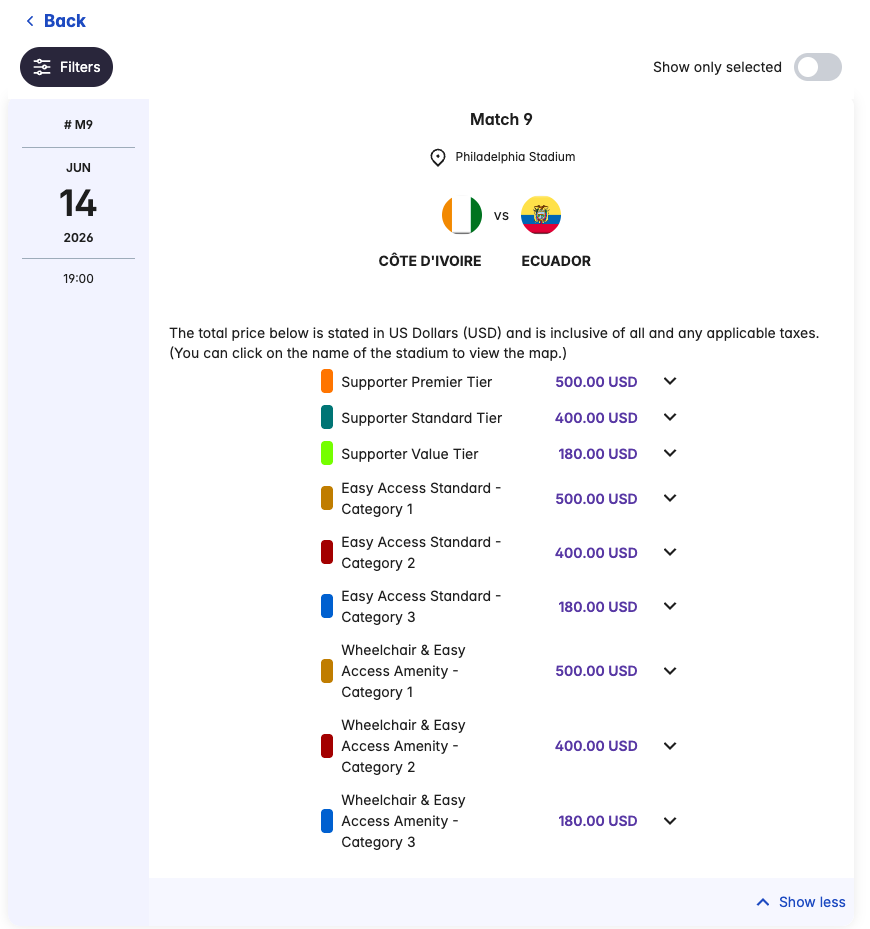
    Among the 72 group stage matches scheduled to be held in the United States, Canada, and Mexico this summer, five will take place at Lincoln Financial Field, with the Ivory Coast and Ecuador kicking off Philly’s slate of matches on June 14.

    So what’s it looking like?

    The least expensive seat for that match was $180 under Category 3 tiered pricing (which applies to upper-level seating and designated supporter sections). The most expensive ticket was $500 for a Category 1 seat (lower level, prime placement) or another section called a Supporter Premier Tier.

    The cheapest ticket price was $180 for upper deck seats at Lincoln Financial Field for the World Cup opener between the Ivory Coast and Ecuador.

    The costliest tickets were for the June 19 match between Brazil and Haiti, with the cheapest seat coming in at $265 and the priciest Category 1 tickets at $700. Even Category 2 seats, which generally are still lower- to mid-level but have corner sightlines, were $500 per seat.

    While it remains to be seen, prices for France’s game in Philly on June 22 could mimic the Brazil game as both are high-powered nations in the top 10 of the latest FIFA World Rankings, complete with rosters expected to draw a crowd. France awaits whom it will play at the Linc, as a FIFA playoff in March will determine whether it will be Iraq, Suriname, or Bolivia.

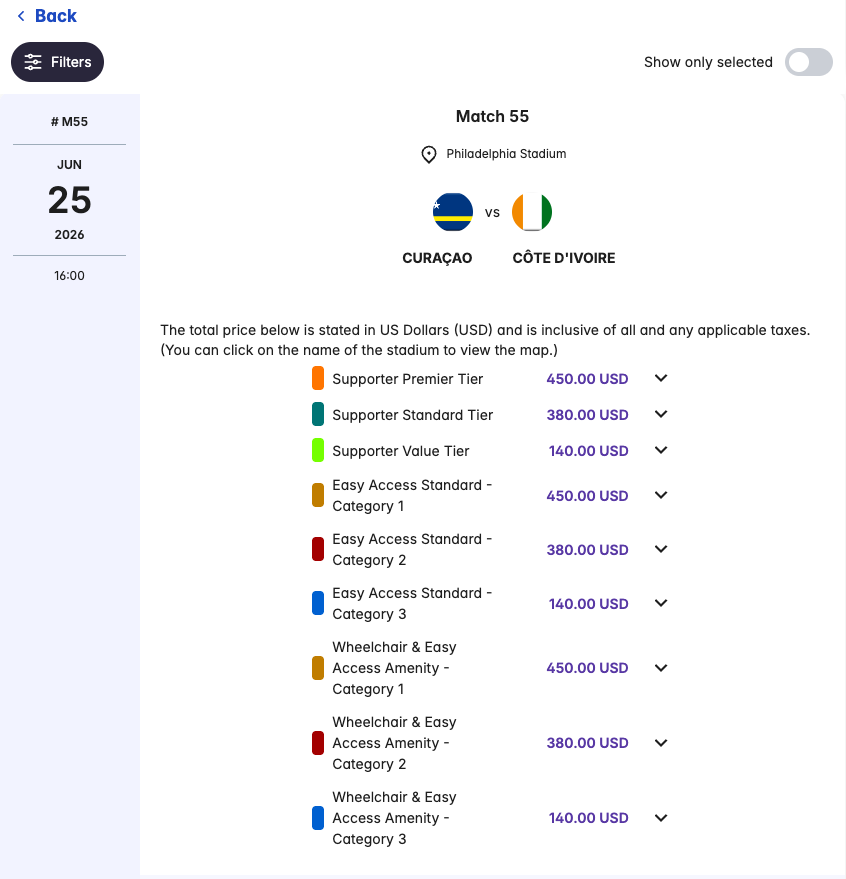
    The least expensive game in Philly as of Thursday’s presale was the June 25 match, which features Ivory Coast against Curaçao. Lower-level tickets were $450 for Category 1 and $380 for Category 2 seats. For those who don’t mind sitting in the 200-level section, the price is $140 each.

    The game between Ivory Coast and Curaçao on June 25 looked to offer the most affordable path to securing World Cup seats.

    It’s believed that with fan bases not as large as some of the other matches coming to Philly, this might be the best chance for people looking to obtain tickets, not just in the presale but perhaps when tickets officially hit the resale market.

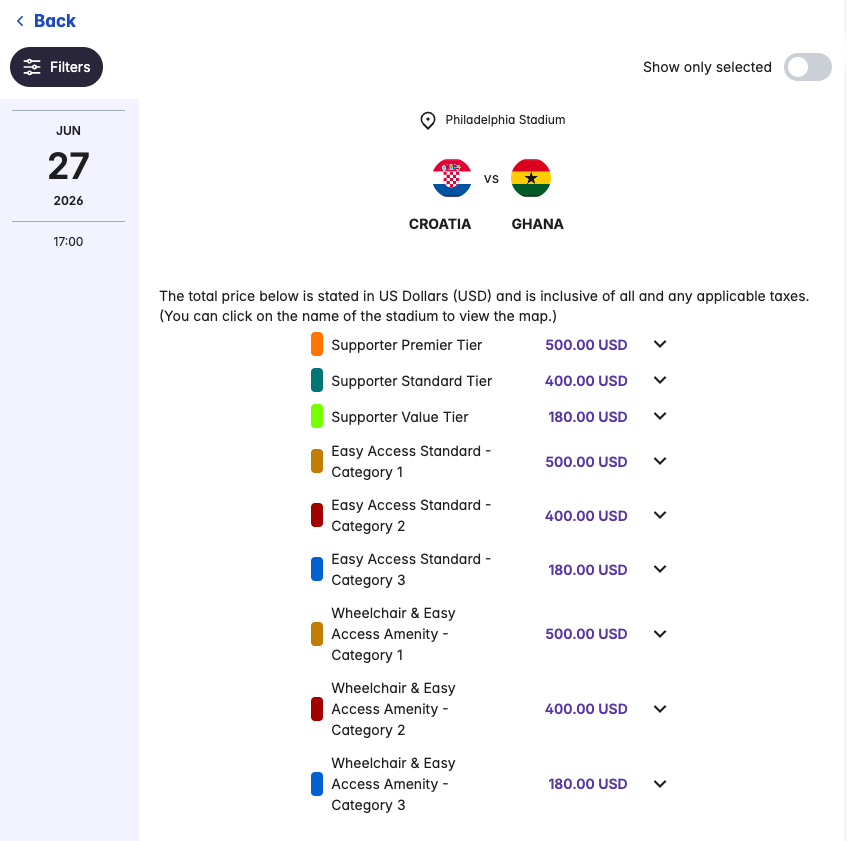
    The final group stage match at the Linc, Croatia against Ghana on June 27, offers a live look at Croatian midfield legend Luka Modric, who at age 40, will be playing in his final World Cup. Although Ghana has consistently been a strong nation in past World Cups and enters as one of the better nations throughout Confederation of African Football (CAF) qualifying, the draw is Modric — and FIFA knows that.

    Tickets for that match in the presale start at $500 for Category 1, and the least expensive ticket is $180 for a Category 3 seat.

    Croatia-Ghana on June 27 offers fans a live look at probably the last time Croatian midfield legend Luka Modric will chase World Cup glory.

    So how does it all work?

    Interested fans must create a FIFA ID. Creating one is quick, and once you do, you’ll be able to enter the lottery, which runs through 11 a.m. on Jan. 13. FIFA says it will alert people who have won by Feb. 5 if they’ve earned the right to purchase tickets.

    Still, you could find out sooner by checking your bank or credit card statement and noticing a balance decrease of hundreds or thousands of dollars.

    In the process, fans are entered into a queue to buy, which on Thursday had potential purchasers experiencing wait times of up to 30 minutes. Once there, fans can access two ticket portals: the random selection draw, which allows them to choose one game or preferred venue, and another in which fans can select a preferred team and choose from that nation’s three matches throughout the group stage.

    From there, a debit or credit card goes on file, from which, if selected, FIFA will automatically pull funds from the account beginning on Feb. 9. Incidentally, there’s no guarantee that fans will receive their full allocation, as there are options for ticket sales to be “completely successful” or “partially successful.”

    What does the latter mean? Here’s is FIFA’s explanation:

    “‘Partially successful’ means you received some, but not all, of the tickets you applied for. For example, if you requested tickets for three different matches but were allocated tickets for only one or two of them, your application is considered partially successful. If you are allocated tickets for any match, you will always receive the full quantity you requested for that match; you will never receive fewer than requested.”

    The random selection draw is the last presale before FIFA will release remaining tickets in what’s sure to be a first-come, first-served frenzy. This late sales phase is expected to launch closer to the start of the tournament.

  • Homeland Security Secretary Noem defends Trump’s hard-line immigration policies at hearing

    Homeland Security Secretary Noem defends Trump’s hard-line immigration policies at hearing

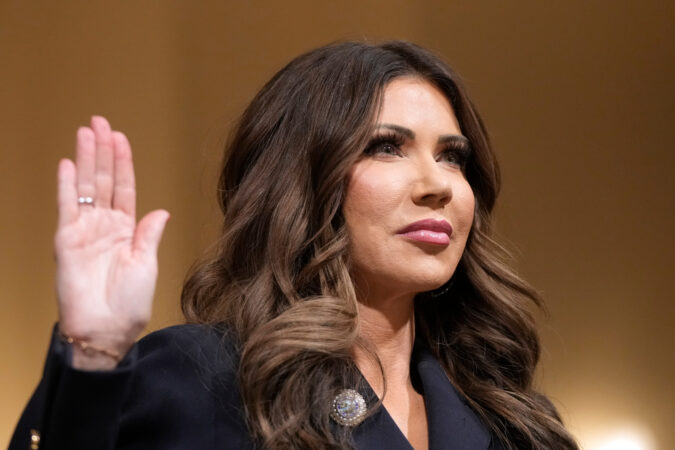
    Homeland Security Secretary Kristi Noem defiantly defended the Trump administration’s hard-line immigration policies on Thursday during a House committee hearing, portraying migrants as a major threat faced by the nation that justifies a crackdown that has seen widespread arrests, deportations and a dizzying pace of restrictions on foreigners.

    Noem, who heads the agency central to President Donald Trump’s approach to immigration, received backup from Republicans on the panel but faced fierce questioning from Democrats — including many who called for her resignation over the mass deportation agenda.

    The secretary’s testimony was immediately interrupted by protesters shouting for her to stop Immigration and Customs Enforcement raids and “end deportations.” They trailed her down the halls as she left early for another engagement, chanting, “Shame on you!”

    But she vowed she “would not back down.”

    “What keeps me up at night is that we don’t necessarily know all of the people that are in this country, who they are and what their intentions are,” Noem said.

    The hearing was Noem’s first public appearance before Congress in months, testifying at the House Committee on Homeland Security on “Worldwide Threats to the Homeland,” and it quickly grew heated as she emphasized how big a role she believed immigration played in those threats. It focused heavily on the Trump administration’s immigration policies, whereas in years past the hearing has centered on issues such as cybersecurity, terrorism, China and border security.

    Rep. Bennie Thompson, the panel’s ranking Democrat, said Noem has diverted vast taxpayer resources to carry out Trump’s “extreme” immigration agenda and failed to provide basic responses as Congress conducts its oversight.

    “I call on you to resign,” the Mississippi congressman said. “Do a real service to the country.”

    Trump returned to power with what the president says is a mandate to reshape immigration in the U.S. In the months since, the number of people in immigration detention has skyrocketed; the administration has continued to remove migrants to countries they are not from; and, in the wake of an Afghan national being accused of shooting two National Guard troops, Noem’s department has dramatically stepped up checks and screening of immigrants in the U.S.

    Tough questions from Democrats

    Several Democrats repeatedly told Noem flatly that she was “lying” to them and to the public over claims they are focused on violent criminals. They presented cases of U.S. citizens being detained in immigration operations and families of American military veterans being torn apart by deportations of loved ones who have not committed serious crimes or other violations.

    “You lie with impunity,” said Rep. Delia Rodriguez (D., Ill.) who said Noem should resign or be impeached.

    Republicans largely thanked Noem for the work the department is doing to keep the country safe and urged her to carry on.

    “Deport them all,” said Rep. Andy Ogles (R., Tenn).

    Since Noem’s last Congressional appearance in May, immigration enforcement operations, especially in Los Angeles and Chicago, have become increasingly contentious, with federal agents and activists frequently clashing over her department’s tactics.

    Noem did not address the calls to resign, but she tangled with the Democratic lawmakers — interrupting some — and suggested that she and the department she leads weren’t going anywhere.

    “We will never yield. We will never waver,” she said.

    Noem, whose own family, including an infant granddaughter, was in the audience, praised the Trump administration’s efforts when it comes to immigration, saying, “We’re ending illegal immigration, returning sanity to our immigration system.”

    During the hearing, a federal judge ordered the government to free Kilmar Abrego Garcia, whose wrongful deportation to a notorious prison in El Salvador made him a flashpoint in the Trump administration’s immigration enforcement. Noem did not address the judge’s order, nor was she asked about it during the hearing.

    Noem left early, saying she was headed to a meeting of the Federal Emergency Management Agency review council. The meeting, however, was abruptly canceled with no reason given.

    Noem, department under scrutiny

    The worldwide threats hearing, usually held annually, is an opportunity for members of Congress to question the leaders of the Department of Homeland Security, the FBI, and the National Counterterrorism Center.

    FBI Director Kash Patel did not appear, but sent Michael Glasheen, operations director of the national security branch of the FBI.

    Glasheen said the nation faces “serious and evolving” threats, and pointed to so-called antifa, and Trump’s executive order designating the group as a domestic terror organization, as the “most immediate violent threat” facing the country.

    Pressed by Thompson for details — where is antifa headquartered? How many members does it have? — the FBI’s representative appeared unable to provide answers, saying it’s “fluid” and investigations are “ongoing.”

    And, notably, he did not identify immigration as among the most pressing concerns for the homeland.

    Asked about the U.S. seizure of an oil tanker off the Venezuelan coast, Noem linked it to the Trump administration’s antidrug campaign in the region, saying cocaine had been kept from entering the U.S. as a result.

    The hearing offered lawmakers a rare opportunity to hear directly from Noem, but many members of the panel used the bulk of their allotted time to either praise or lambast her handling of immigration enforcement.

    During one sharp exchange, the secretary levied broad criticism for the program through which the man suspected of shooting two National Guard members last month came to the United States.

    “Unfortunate accident?” Noem retorted after Thompson raised the issue. She called it a “terrorist attack.”

    The program, Operation Allies Welcome, was created by then-President Joe Biden’s Democratic administration after the 2021 decision to leave Afghanistan following 20 years of American intervention and billions of dollars in aid. Thompson pointed out that the Trump administration approved the asylum claim of the suspect in the National Guard attack.

    Noem’s department is under particular scrutiny because Congress in July passed legislation giving it roughly $165 billion to carry out its mass deportations agenda and secure the border. The department is getting more money to hire 10,000 more deportation officers, complete the wall between the U.S. and Mexico and increase detention and removal of foreigners from the country.

    The secretary’s appearance also comes as a federal judge is investigating whether she should face a contempt charge over flights carrying migrants to El Salvador.

  • Indiana Republicans defy Trump and reject his House redistricting push in the states

    Indiana Republicans defy Trump and reject his House redistricting push in the states

    INDIANAPOLIS — Indiana’s Republican-led Senate decisively rejected a redrawn congressional map Thursday that would have favored their party, defying months of pressure from President Donald Trump and delivering a stark setback to the White House ahead of next year’s midterm elections.

    The vote was overwhelmingly against the proposed redistricting, with more Republicans opposing than supporting the measure, signaling the limits of Trump’s influence even in one of the country’s most conservative states.

    Trump has been urging Republicans nationwide to redraw their congressional maps in an unusual campaign to help the party maintain its thin majority in the House of Representatives. Although Texas, Missouri, Ohio, and North Carolina went along, Indiana did not — despite cajoling and insults from the president and the possibility of primary challenges.

    “The federal government should not dictate by threat or other means what should happen in our states,” said Spencer Deery, one of the Republican senators who voted no on Thursday.

    When the proposal failed, cheers could be heard inside the chamber as well as shouts of “thank you!” The debate had been shadowed by the possibility of violence, and some lawmakers have received threats.

    The proposed map was designed to give Republicans control of all nine of Indiana’s congressional seats, up from the seven they currently hold. It would have effectively erased Indiana’s two Democrat-held districts by splitting Indianapolis among four districts that extend into rural areas, reshaping U.S. Rep. André Carson’s safe district in the city. It would’ve also eliminated the northwest Indiana district held by U.S. Rep. Frank Mrvan.

    District boundaries are usually adjusted once a decade after a new census. But Trump has described redistricting as an existential issue for the party as Democrats push to regain power in Washington.

    “If Republicans will not do what is necessary to save our Country, they will eventually lose everything to the Democrats,” Trump wrote on social media the night before the vote.

    The president said anyone who voted against the plan should lose their seats. Half of Indiana senators are up for reelection next year, and the conservative organization Turning Point Action had pledged to fund campaigns against them.

    Inside the state Senate chamber, Democratic lawmakers spoke out against redistricting ahead of the vote.

    “Competition is healthy my friends,” said Sen. Fady Qaddoura. “Any political party on earth that cannot run and win based on the merits of its ideas is unworthy of governing.”

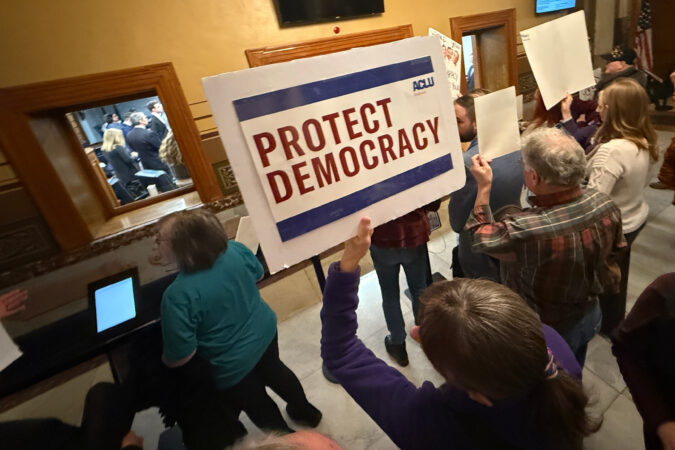
    In the hallways outside, redistricting opponents chanted “Vote no!” and “Fair maps!” while holding signs with slogans like “Losers cheat.”

    Three times over the fall Vice President JD Vance met with Republican senators — twice in Indianapolis and once in the White House — to urge their support. Trump joined a conference call with senators on Oct. 17 to make his own 15-minute pitch.

    Behind the scenes, James Blair, Trump’s deputy White House chief of staff for political affairs, was in regular touch with members, as were other groups supporting the effort such as the Heritage Foundation and Turning Point USA.

    “The administration made a full-court press,” said Republican Sen. Andy Zay, who was on the phone with White House aides sometimes multiple times per week, despite his commitment as a yes vote.

    Across the country, mid-cycle redistricting so far has resulted in nine more congressional seats that Republicans believe they can win and six more congressional seats that Democrats think they can win. However, some of the new maps are facing litigation.

    In Utah, a judge imposed new districts that could allow Democrats to win a seat, saying Republican lawmakers violated voter-backed standards against gerrymandering.

    Despite Trump’s push, support for gerrymandering in Indiana’s Senate was uncertain. A dozen of the 50 senators had not publicly committed to a stance ahead of the vote.

    Republican Sen. Greg Goode signaled his displeasure with the redistricting plan before voting no. He said some of his constituents objected to seeing their county split up or paired with Indianapolis. He expressed “love” for Trump but criticized what he called “over-the-top pressure” from inside and outside the state.

    Sen. Michael Young, another Republican, said the stakes in Washington justify redistricting, as Democrats are only a few seats away from flipping control of the U.S. House in 2026. “I know this election is going to be very close,” he said.

    Republican Sen. Mike Gaskill, the redistricting legislation’s sponsor, showed Senators maps of congressional districts around the country, including several focused on Democratic-held seats in New England and Illinois. He argued other states gerrymander and Indiana Republicans should play by the same rules.

    The bill cleared its first hurdle Monday with a 6-3 Senate committee vote, although one Republican joined Democrats in opposing it and a few others signaled they might vote against the final version. The state House passed the proposal last week, with 12 Republicans siding with Democrats in opposition.

    Among them was state Rep. Ed Clere, who said state troopers responded to a hoax message claiming a pipe bomb outside his home Wednesday evening. Indiana state police said “numerous others” received threats but wouldn’t offer details about an ongoing investigation.

    In an interview, Clere said these threats were the inevitable result of Trump’s pressure campaign and a “winner-take-all mentality.”

    “Words have consequences,” Clere said.

  • Philly Council greenlights new retirement savings program as part of year-end legislative blitz | City Council roundup

    Philly Council greenlights new retirement savings program as part of year-end legislative blitz | City Council roundup

    Philadelphians without retirement savings plans through their employers could soon have access to a plan through the city after lawmakers approved legislation Thursday to enable the novel program to move forward.

    City Council members unanimously passed legislation that creates PhillySaves, which is modeled on state-facilitated “auto-IRA” programs that allow people to invest through payroll deductions at no cost to their employers.

    Voters would have to approve the creation of an investment management board through a ballot question, which is slated to appear in the May primary election.

    The measure was part of a flurry of legislation Council considered during a marathon meeting Thursday, its last session of the year before legislators reconvene in mid-January. Lawmakers passed dozens of pieces of legislation touching on issues including housing, public health, small-business growth, and public safety.

    In addition to approving the retirement savings program, Council approved legislation to:

    Here’s a breakdown of what else happened on Thursday:

    H.O.M.E. inches forward over Parker’s objections

    City Council on Thursday approved a key piece of legislation related to Mayor Cherelle L. Parker’s Housing Opportunities Made Easy, or H.O.M.E., initiative, the latest step in the drawn-out fight over how the city should spend the proceeds from the $800 million in city bonds the administration plans to sell to support the program.

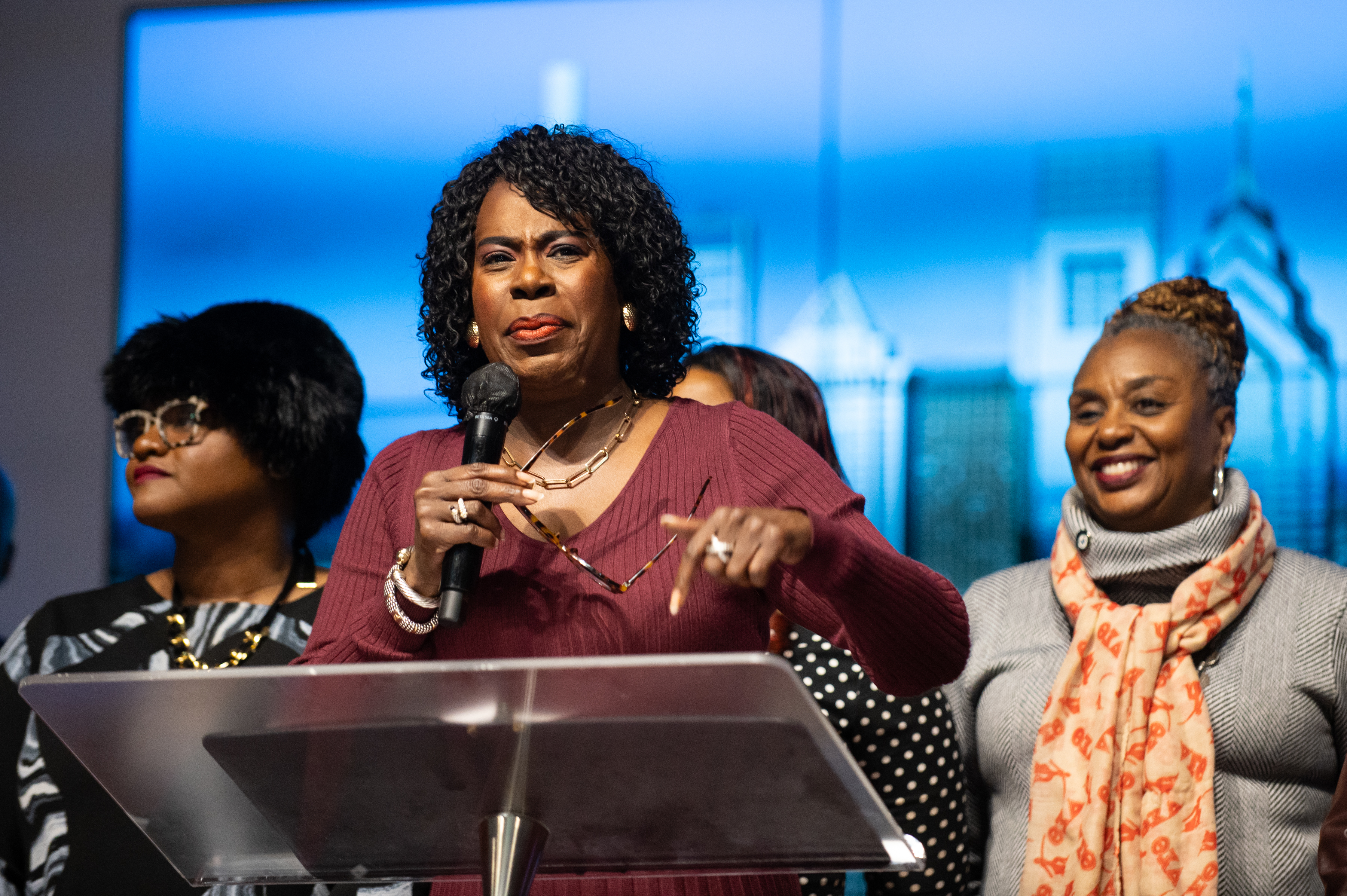
    Mayor Cherelle L. Parker speaks to the crowd at The Church of Christian Compassion in the Cobbs Creek neighborhood of West Philadelphia on Sunday, Dec. 7, 2025. Parker visited 10 churches in Philadelphia on Sunday to share details about her HOME housing plan

    The legislation — a resolution setting the first-year budget for the initiative at about $270 million — sparked a contentious showdown between lawmakers and the administration over income eligibility levels for the housing programs funded or created by H.O.M.E.

    The resolution was approved in a voice vote, with Councilmember Curtis Jones Jr. casting the lone no vote.

    Over Parker’s objections, Council successfully pushed to lower income eligibility thresholds, prioritizing poorer residents. For instance, lawmakers ensured that 90% of the bond proceeds that will be spent on the Basic Systems Repair Program will go to households making 60% of area median income, which is about $71,640 for a family of four.

    “This budget opens city housing programs to ensure that more than 200,000 low-income and working-family households have a chance to get into a program that provides housing stability and economic mobility and increases,” said Councilmember Rue Landau, who helped lead the push to lower the income thresholds. “This is a transformational investment, a win-win.”

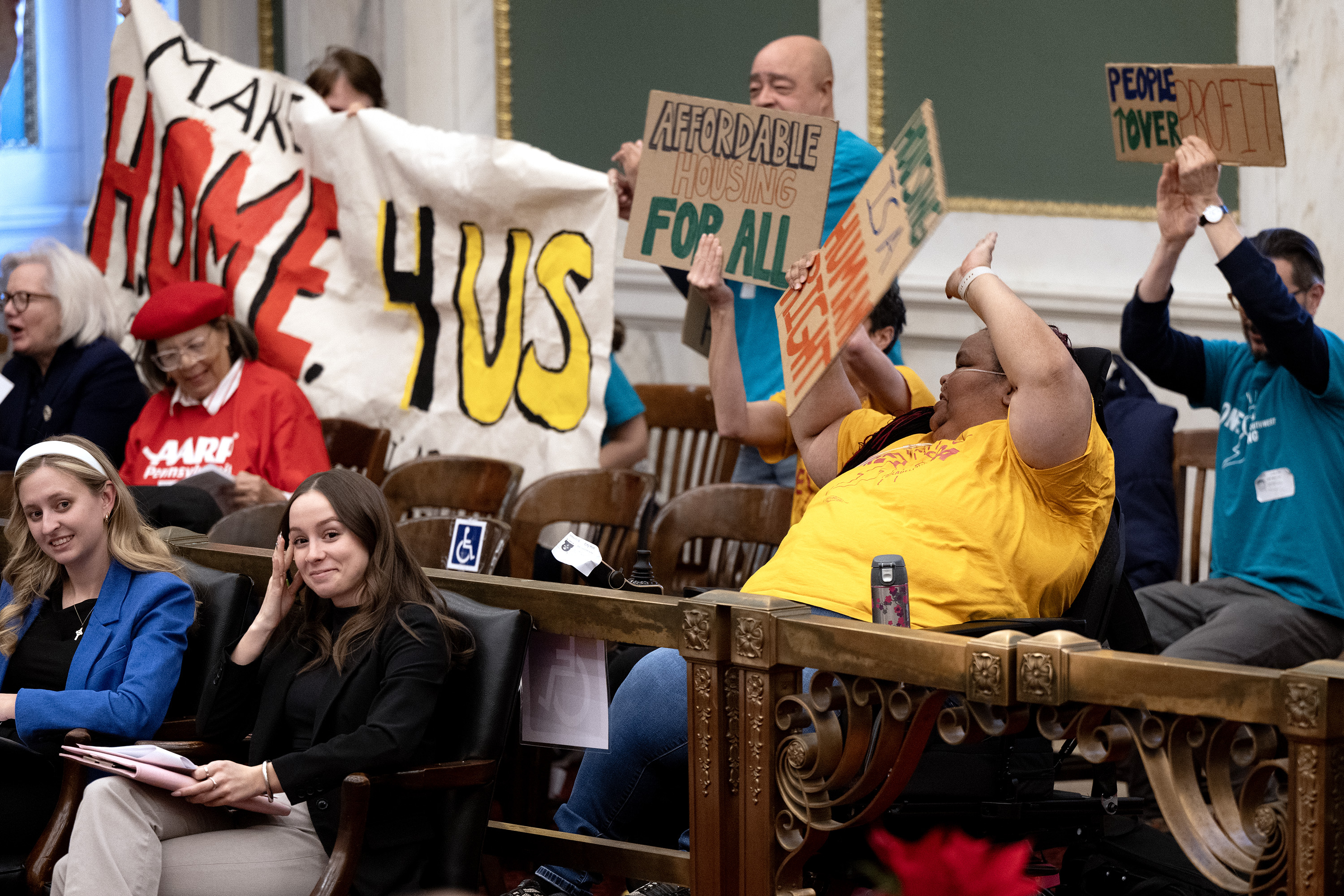
    Supporters react as City Council approves a key piece of legislation related to Mayor Cherelle L. Parker’s H.O.M.E. initiative Thursday, Dec. 11, 25 on the last day of the 2025 session.

    A separate but related piece of legislation — an ordinance authorizing the city to sell the bonds — also needs to pass before the administration can take on debt for the initiative. That proposal, which won committee approval Wednesday, is expected to come to the Council floor in January.

    In a statement Thursday, Tiffany W. Thurman, Parker’s chief of staff, thanked Council for its vote.

    “We look forward to continuing conversations with Council President Kenyatta Johnson and members of City Council in the weeks ahead, and to fulfilling Mayor Parker’s strong vision to save Philadelphia’s rowhomes,” she said.

    Council waters down a bill on training for security officers

    Council approved a bill requiring private security guards in Philadelphia to go through 12 hours of training when they are hired and an additional eight hours of training every subsequent year.

    But the final version of the bill, authored by Councilmember Isaiah Thomas, has been significantly watered down by amendments following a legislative showdown between the Service Employees International Union Local 32BJ, which championed the original version, and real estate and private security industry leaders, which said it was overly onerous and costly.

    Thomas’ original bill required security guards to receive 40 hours of training upon hiring, and it prohibited employers from conducting the training for their own workers. Instead, the instruction had to be provided by a nonprofit — potentially including a labor union. SEIU 32BJ, one of the most influential unions in the city, represents building services workers, including security guards.

    The amended version, however, allows employers to conduct the training after getting approval for their program from the Philadelphia Office of Worker Protections — a major relief for business leaders.

    The new version, which now heads to Parker’s desk, also exempts security guards for bars and restaurants from the training requirements, and pushes back the bill’s effective date from Jan. 1 to March 1.

    An inquiry into DEI contracting changes is coming next year

    City Council next year will examine Parker’s decision to end its long-standing policy of prioritizing women- and minority-owned businesses in city contracting and replace it with a system favoring “small and local” firms.

    Johnson authored a resolution allowing the Committee of the Whole, which includes all 17 members, to look at the history of minority contracting policies in the city and “the rationale, design, and anticipated effects” of Parker’s new policy. The resolution was approved in a unanimous vote, and a hearing will likely be scheduled in the first half of 2026.

    Race- and gender-conscious government policies have been targeted by conservative legal groups following a 2023 U.S. Supreme Court decision ending affirmative action in college admissions. The Inquirer revealed in November that Parker quietly ended the city’s 40-year-old contracting policy earlier this year due to the likelihood it would be challenged in court.

    The mayor has said her new “small and local” policy will accomplish many of the goals of the old system because many small Philadelphia businesses are owned by Black and brown residents and have faced roadblocks to growth.

    Attorneys hired by the city, however, had recommended a race- and gender-neutral policy of favoring “socially and economically disadvantaged” businesses, according to administration documents obtained by The Inquirer.

    Lawmakers will get the chance to weigh in on that decision next year.

    A controversial zoning change passes for University City

    Council on Thursday also approved Councilmember Jamie Gauthier’s controversial University City zoning overlay, which seeks to regulate how higher education institutions dispose of property.

    The legislation has been diluted from its original form, and it now regulates the sale of property over 5,000 square feet in University City — which would largely affect only universities themselves.

    Councilmember Jamie Gauthier in chambers as City Council meets Thursday, Dec. 11, 2025, on the last day of the 2025 session.

    Gauthier has further amended the legislation to exclude healthcare institutions. Among other things, the bill would require that property owners have building permits in hand before they are allowed to move forward on demolitions.

    A sale of land would also trigger review by the Philadelphia City Planning Commission.

    The legislation is part of Gauthier’s outraged response to St. Joseph’s University’s sale of much of its West Philadelphia campus to the Belmont Neighborhood Educational Alliance, a nonprofit that operates charter schools. The organization is led by Michael Karp, who is also one of the larger student-housing landlords in the area.

    Thomas, a Democrat who represents the city at-large, was the only member to vote against the bill. His vote was a break with the tradition of councilmanic prerogative, in which members generally approve legislation offered by Council members who represent geographic areas when the measure affects only their districts.

    Quote of the week

    Councilmember Brian J. O’Neill (left) uses his end-of-session speech in City Council Thursday, Dec. 11, 2025 to say goodbye to longtime legislative director Robert Yerkov (right), who is leaving for a job outside government.

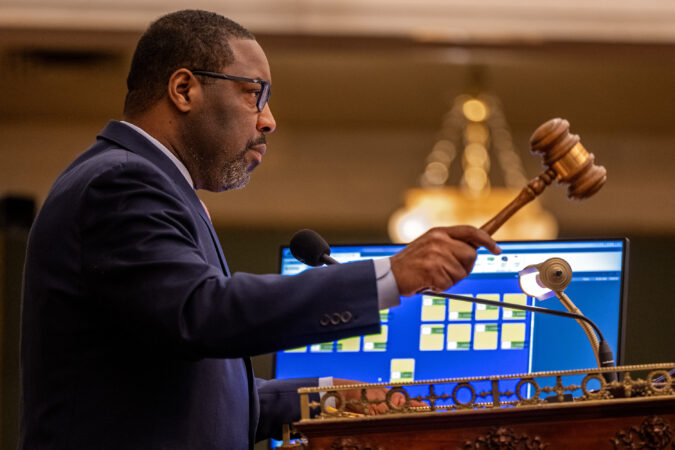
    That was Councilmember Brian J. O’Neill, Council’s longest-serving member, who is typically its shortest-winded. But on Thursday, he took his time in a speech saying goodbye to longtime legislative director Robert Yerkov, whose last day as a Council staffer is next month.

    O’Neill said he was struggling to wrap up his remarks and joked that Council should limit the amount of time that its members can speak. Public commenters are generally limited to three minutes of remarks.

    To quote Shakespeare: “Brevity is the soul of wit.”

  • What to know about Tarleton State, Villanova’s next matchup in the FCS playoffs

    What to know about Tarleton State, Villanova’s next matchup in the FCS playoffs

    Villanova football is riding a 10-game winning streak — its longest since the 1997 season — and will travel to Stephenville, Texas to take on fourth-seeded Tarleton State in the quarterfinals of the FCS playoffs on Saturday (noon ET, ESPN).

    Villanova (11-2), the No. 12 seed in the bracket, is coming off a 14-7 upset against then-undefeated Lehigh (the No. 5 seed) on the road. The Wildcats scored 14 points in the second half, including a 28-yard Braden Reed touchdown reception with just over three minutes remaining, to pull off the victory.

    Pat McQuaide led Villanova’s passing attack, throwing for 208 yards and the game-winning touchdown. The touchdown pass was the 50th of McQuaide’s career and 23rd as a Wildcat, meaning he has thrown almost half of his career touchdowns in his single season in blue and white.

    It was also his eighth game of the season with 200 or more passing yards. McQuaide isaveraging 211.1 yards per game, which is 29th in the FCS.

    Tarelton (12-1) had a first-round bye and is coming off a dominant 31-13 win over North Dakota in the second round last weekend.

    Who is Tarleton State?

    Some schools in the FCS playoffs are not the most recognizable.

    Tarleton State is located in Stephenville, about a two-hour drive from Dallas.

    The Texans are part of the United Athletic Conference. They were formerly in the Western Athletic Conference since 2021, before it merged with the Atlantic Sun Conference in 2022.

    It became an FCS football program in 2020, when the program switched from Division II to Division I.

    Tarleton State has made it to the FCS playoffs in consecutive seasons, just five years after becoming a Division I program. Last season, the Texans won their first FCS playoff game against Drake, but fell to No. 4 South Dakota in the second round. Eagles rookie wide receiver Darius Cooper starred for Tarleton State from 2020-24.

    Limit the turnovers

    Villanova has prided itself on winning the turnover battle, and it has done so consistently this season. Its five total turnovers are currently an FCS low.

    McQuaide has thrown just two interceptions, and only one in FCS play, this season. He has thrown 10 touchdowns and zero interceptions over his last five games.

    Villanova has only lost three fumbles. Over the course of its 10-game win streak, Villanova has won the turnover battle, 16-2.

    Defense needs to be near perfect

    Villanova’s defense has shut down efficient offensive teams of late. The unit held Lehigh to one touchdown and its second-lowest offensive output this season (339 total yards).

    The week before, the Wildcats held Harvard to a season-low 213 total yards.

    Tarleton State is averaging an FCS-high 44.1 points. The Texans recorded a 61-0 blowout win against North Alabama on Nov. 15 and have scored 30 or more points in each win this season.

    Wildcats linebacker Shane Hartzell has a team-high eight sacks for a loss of 49 yards this season.

    The Texans scored a season-low 28 points in their only loss against then- No. 24 Abilene Christian in early November.

    Villanova has held opponents to an average of eight points in its last three games.

    Graduate linebacker Shane Hartzell leads the Wildcats’ defense by a wide margin, with 87 total tackles (50 solo). Hartzell scooped up his first fumble recovery of the season against Lehigh and recorded six total tackles (five solo). This season, Hartzell has a team-high eight sacks.

    Villanova needs to run the football

    Villanova has some of the best running back depth in the FCS. Even with standout David Avit missing the last four games, Ja’briel Mace and Isaiah Ragland have stepped up.

    Mace and Ragland have rushed for career-high games during Avit’s absence due to a knee injury. Mace even broke Brian Westbrook’s 21-year-old single-game rushing record on Nov. 8 with 291 yards against Towson.

    Tarelton currently allows 163.6 rushing yards per game, which ranks 69th in the FCS.

    Villanova has leaned on its rushing game all season. It averages 177.8 rushing yards per contest, which is 32nd nationally. Despite rushing for a season-low 27 rushing yards last weekend, Villanova has averaged 194.4 rushing yards over the last three. Ragland rushed for a career-high 152 rushing yards against Harvard two weeks ago, when Villanova finished with a season-high 48 carries.

  • Justice Department again fails to re-indict New York Attorney General Letitia James, AP source says

    Justice Department again fails to re-indict New York Attorney General Letitia James, AP source says

    ALEXANDRIA, Va. — A grand jury declined for a second time in a week to re-indict New York Attorney General Letitia James on Thursday in another major blow to the Justice Department’s efforts to prosecute the president’s political opponents.

    The repeated failures amounted to a stunning rebuke of prosecutors’ bid to resurrect a criminal case President Donald Trump pressured them to bring, and hinted at a growing public leeriness of the administration’s retribution campaign.

    A grand jury rejection is an unusual circumstance in any case, but is especially stinging for a Justice Department that has been steadfast in its determination to seek revenge against Trump foes like James and former FBI Director James Comey. On separate occasions, citizens have heard the government’s evidence against James and have come away underwhelmed, unwilling to rubber-stamp what prosecutors have attempted to portray as a clear-cut criminal case.

    A judge threw out the original indictments against James and Comey in November, ruling that the prosecutor who presented to the grand jury, Lindsey Halligan, was illegally appointed U.S. attorney for the Eastern District of Virginia.

    The Justice Department asked a grand jury in Alexandria, Va., to return an indictment Thursday after a different grand jury in Norfolk last week refused to do so. The failure to secure an indictment was confirmed by a person familiar with the matter who was not authorized to publicly discuss the matter and spoke on the condition of anonymity.

    It was not immediately clear Thursday whether prosecutors would try for a third time to seek a new indictment. A lawyer for James, who has denied any wrongdoing, said the “unprecedented rejection makes even clearer that this case should never have seen the light of day.”

    “This case already has been a stain on this Department’s reputation and raises troubling questions about its integrity,” defense attorney Abbe Lowell said in a statement. “Any further attempt to revive these discredited charges would be a mockery of our system of justice.”

    James, a Democrat who infuriated Trump after his first term with a lawsuit alleging that he built his business empire on lies about his wealth, was initially charged with bank fraud and making false statements to a financial institution in connection with a home purchase in 2020.

    During the sale, she signed a standard document called a “second home rider” in which she agreed to keep the property primarily for her “personal use and enjoyment for at least one year,” unless the lender agreed otherwise. Rather than using the home as a second residence, prosecutors say James rented it out to a family of three, allowing her to obtain favorable loan terms not available for investment properties.

    Both the James and Comey cases were brought shortly after the administration installed Halligan, a former Trump lawyer with no prior prosecutorial experience, as U.S. attorney amid public calls from the president to take action against his political opponents.

    But U.S. District Judge Cameron McGowan Currie threw out the cases last month over the unconventional mechanism that the Trump administration employed to appoint Halligan. The judge dismissed them without prejudice, allowing the Justice Department to try to file the charges again.

    Halligan had been named as a replacement for Erik Siebert, a veteran prosecutor in the office and interim U.S. attorney who resigned in September amid Trump administration pressure to file charges against both Comey and James. He stepped aside after Trump told reporters he wanted Siebert “out.”

    James’ lawyers separately argued the case was a vindictive prosecution brought to punish the Trump critic who spent years investigating and suing the Republican president and won a staggering judgment in a lawsuit alleging he defrauded banks by overstating the value of his real estate holdings on financial statements. The fine was later tossed out by a higher court, but both sides are appealing.

    Comey was separately charged with lying to Congress in 2020. Another federal judge has complicated the Justice Department’s efforts to seek a new indictment against Comey, temporarily barring prosecutors from accessing computer files belonging to Daniel Richman, a close Comey friend and Columbia University law professor whom prosecutors see as a central player in any potential case against the former FBI director.

    Prosecutors moved Tuesday to quash that order, calling Richman’s request for the return of his files a “strategic tool to obstruct the investigation and potential prosecution.” They said the judge had overstepped her bounds by ordering Richman’s property returned to him and said the ruling had impeded their ability to proceed with a case against Comey.