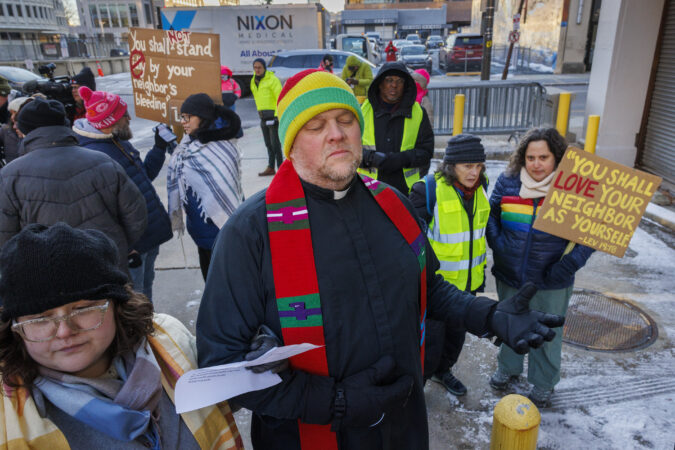
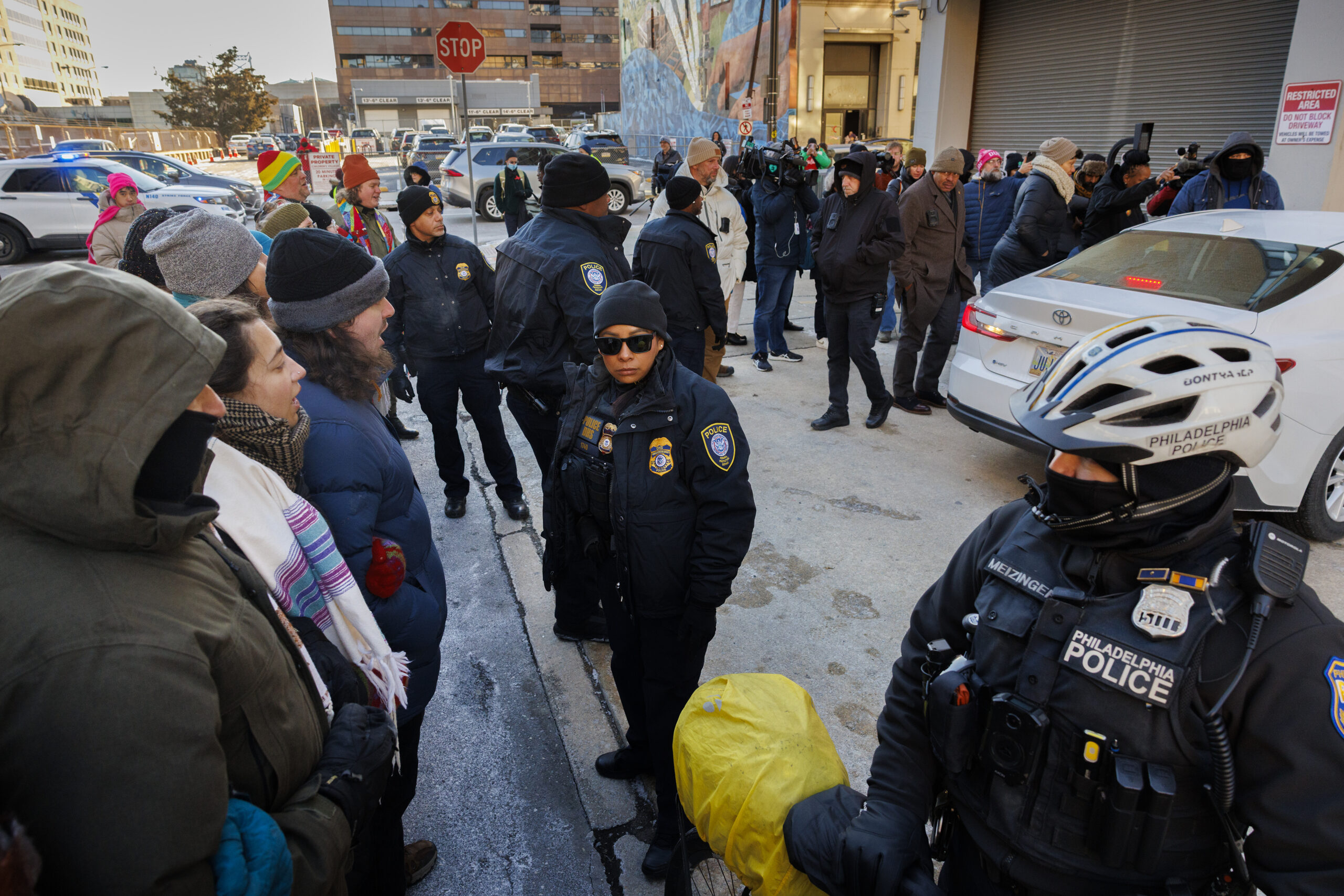
About 30 demonstrators blocked the garage doors at the Philadelphia ICE office Tuesday morning, saying they intended to stop agency vehicles from going to “terrorize” local residents.
Only one car attempted to leave, and Philadelphia police moved demonstrators aside so it could depart.
No one was arrested.
Organizers with No ICE Philly had pledged to block the garage until they were forcibly removed or arrested, but halted the protest after about two hours. They said that they had accomplished their goal, and that the bitterly cold weather was too harsh on demonstrators who are older or who have medical conditions.
Demonstrators with No ICE Philly block the garage at U.S. Immigration and Customs Enforcement at 8th and Cherry Street, Philadelphia, Tuesday, Jan. 20, 2026.
The temperature was about 15 degrees when the protest began shortly before 8 a.m.
“All of us here have proven in our song and our prayer that we can slow down the machine of authoritarianism, of fascism, that we can delay the operations that will detain and kidnap and destroy our neighbors, our families, our community,” said the Rev. Jay Bergen, a leader of No ICE Philly and pastor of the Germantown Mennonite Church.
The protest was the latest in a string of anti-ICE demonstrations and vigils in the Philadelphia region; another was planned in Norristown on Tuesday evening. In October, a No ICE Philly protest outside the agency headquarters erupted into physical confrontations with police, with several people knocked to the ground and four arrested.
Immigration and Customs Enforcement officials did not reply to a request for comment Tuesday.
The clergy-led protest was boosted by City Councilmember Nicolas O’Rourke, who is a pastor of the Living Water United Church of Christ in Oxford Circle.
O’Rourke said that it was natural for him to join fellow clergy, that Tuesday’s action was part of a long tradition of faith leaders being at the forefront of the “struggle against oppression,” as led by the Rev. Dr. Martin Luther King Jr. and others.
Philadelphia Police and Department of Homeland Security officers block demonstrators from No ICE Philly as they attempt to block vehicles from leaving the garage at U.S. Immigration and Customs Enforcement at 8th and Cherry Street, Philadelphia, Tuesday, Jan. 20, 2026.
“We are a day after King’s day, and it’s important that we don’t just wax eloquent about the nice things that King said or the image that he’s been painted of now,” he said, “but we continue in that tradition of resisting the oppression as he saw it, we’re doing in our own time.”
The group locked arms and sang, offering prayers and songs of peace and affirmation.
The Rev. Hannah Capaldi, minister at the Unitarian Society of Germantown, noted that all around her were clergy of different faiths wearing collars, tallits, and stoles.
“We’re saying, listen, we have some level of moral authority in this city, and we’re trying to tell you where to look and what to pay attention to,” she said.
The Rev. Jonny Rashid, a protest organizer, outside of U.S. Immigration and Customs Enforcement at 8th and Cherry Street, Philadelphia, Tuesday, Jan. 20, 2026.
Capaldi hoped to plant “seeds of resistance” in the broader public, encouraging people to get involved.
“We need more people every day willing to do this,” she said, “to stand between the vehicles and the work that they’re doing to kidnap our neighbors.”
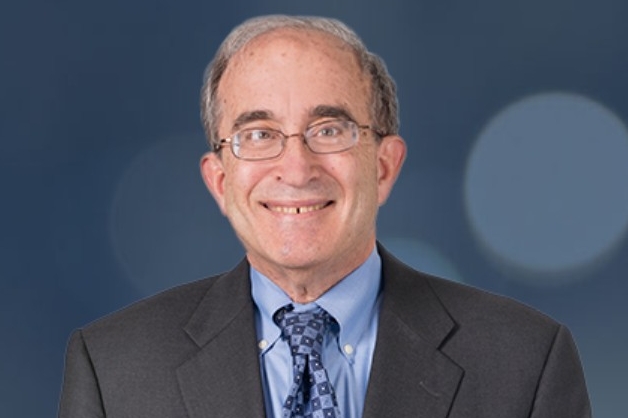
Daniel Segal, 79, of Philadelphia, cofounder and shareholder of the Hangley Aronchick Segal Pudlin & Schiller law firm, adjunct law professor at the University of Pennsylvania, former cochair of the Philadelphia Soviet Jewry Council, onetime board president at the Juvenile Law Center, mentor, and “mischievous mensch,” died Thursday, Jan. 8, of stomach cancer at his home.
Born and reared in Washington, Mr. Segal moved to Philadelphia in 1976 to teach at what is now Penn Carey Law School. He went into private law practice in 1979, became cochair of a litigation department in 1993, and joined with colleagues in 1994 to establish Hangley Aronchick Segal & Pudlin.
For more than 40 years, until his recent retirement, Mr. Segal handled all kinds of cases for all kinds of clients, including The Inquirer. He was an expert in juvenile law, defamation, the First Amendment, professional ethics, education, civil rights, and other legal issues.
He was president of the board at the Juvenile Law Center and worked pro bono for years, beginning in 2009, to help represent more than 2,400 juvenile victims and win millions of dollars in settlements in what is known as the Luzerne County “kids-for-cash” case. In that case, two judges were convicted of taking kickbacks for illegally sending juveniles to two private for-profit detention facilities.
“This is one of the worst judicial scandals in history,” Mr. Segal told The Inquirer in 2009. “The people you’re stepping on are the true, true little guys.”
Mr. Segal was honored in 2010 by the Philadelphia Bar Foundation.
Among his other notable cases are a 1985 workplace racial discrimination dispute, a 1990 libel case against The Inquirer, and a 2000 trial about the city taxing outdoor advertisers. “Dan Segal was a living testament to professional excellence,” said Mark Aronchick, his law partner and longtime friend.
Law partner and friend John Summers said: “He was a great teacher and mentor.” Marsha Levick, cofounder of the Juvenile Law Center, said: “He was a brilliant, steady partner who made us smarter and kept us laughing.”
Mr. Segal clerked for Chief Judge David Bazelon in the U.S. Court of Appeals for the District of Columbia Circuit in 1974 and for Supreme Court Associate Justice Thurgood Marshall in 1975. He was active with the Philadelphia Bar Association, Philadelphia Common Pleas Court, and the Penn Law School American Inn of Court.
He wrote articles for legal journals and letters to the editor of The Inquirer and Daily News. He spoke at panels and conferences, earned honors from legal organizations and trade publications, and was named the Thomas A. O’Boyle adjunct professor of law at Penn in 1992.
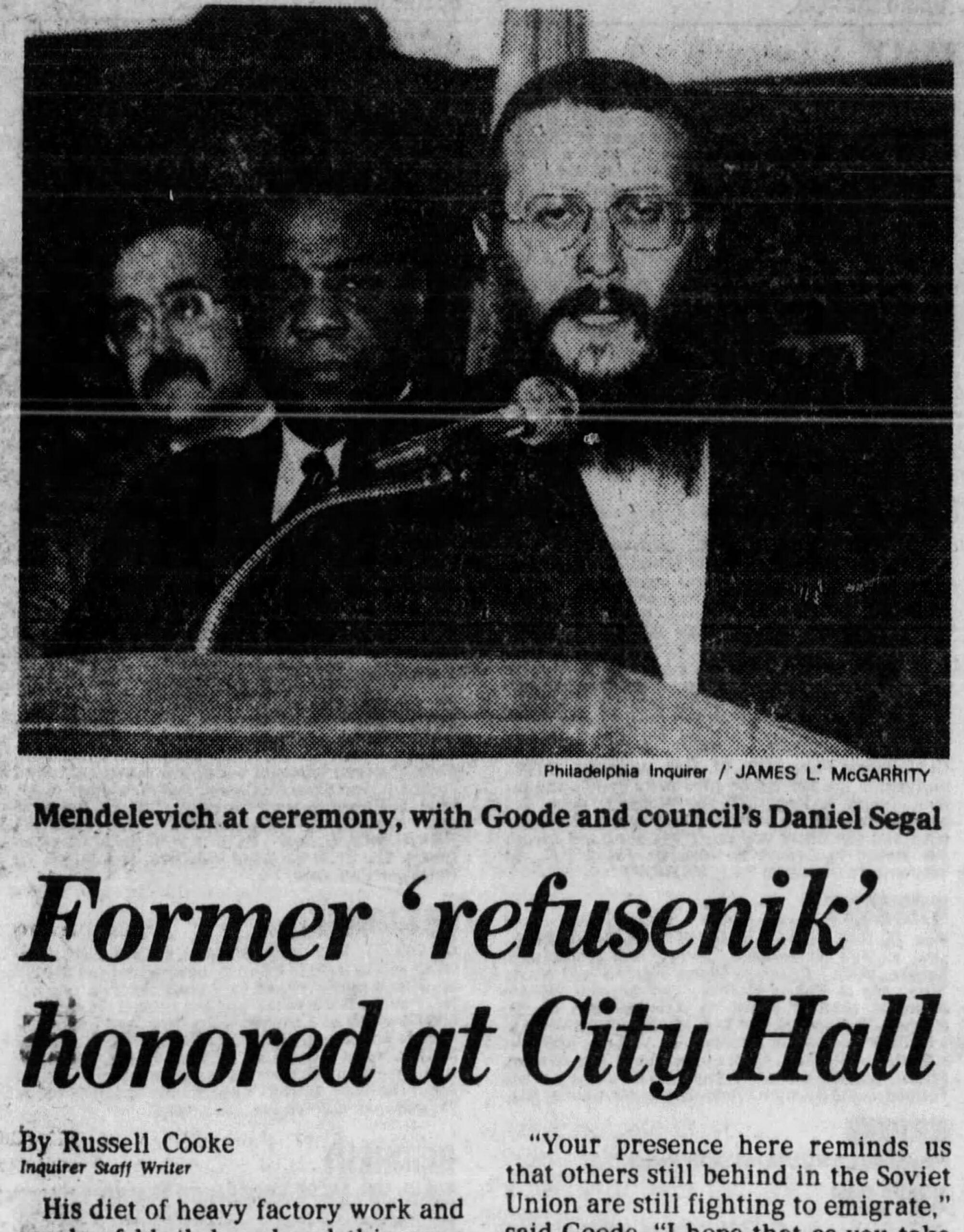
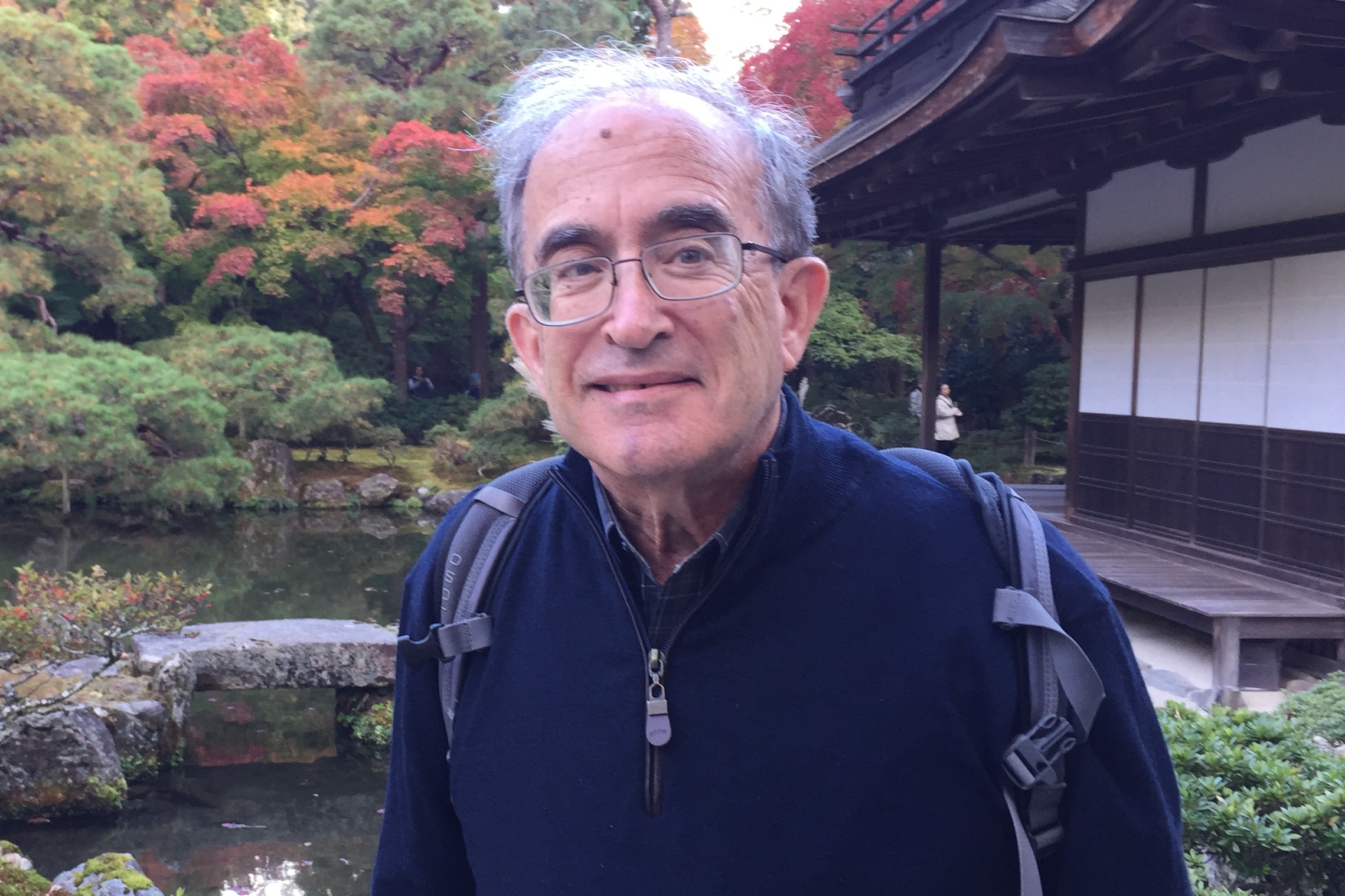
This story and photo features Mr. Segal (left) and appeared in The Inquirer in 1984.
The son of a rabbi, Mr. Segal was cochair of the Soviet Jewry Council in the 1980s, and he organized rallies and marches for social justice and human rights. He traveled to Israel often and to the old Soviet Union several times to secretly support Jews not permitted by government officials to immigrate to Israel.
“We are persuaded that the Soviet Jews are pawns in the Soviet-American relationship,” he told The Inquirer in 1985.
He served as president of the board of directors at what is now Jack M. Barrack Hebrew Academy and held leadership roles with the Jewish Community Relations Council, the New Israel Fund, Mazon: A Jewish Response to Hunger, and other organizations.
Colleagues at the New Israel Fund praised his “characteristic kindness” and “gentle and sparkling humor” in an online tribute. They said: “He was everyone’s favorite board member.”
Mr. Segal and his wife, Sheila, married in 1968.
Mr. Segal enjoyed pranks and funny jokes, even at work, and neighbors called him Silly Dan. His son Josh said: “His warmth, humor, and humility meant that he could connect with just about anyone.” A friend said he was a “mischievous mensch.”
He earned his law degree in 1973 and was executive editor of the Law Review at Harvard University Law School. He earned a bachelor’s degree in politics and economics at Yale University in 1968 and a master’s degree in international relations from the London School of Economics in 1969.
He taught elementary school for a year in Washington and spent another year in Europe before moving to Philadelphia. “He taught us just how important it is to stand up for what is right,” his son Eli said, “and to do so not only with conviction but with humility and kindness, and without a thought of getting personal credit.”
Daniel Segal was born July 4, 1946. He started dating Sheila Feinstein in ninth grade, and they married after college in 1968. They had sons Josh and Eli, and lived in Center City and Lower Merion before moving to Fairmount in 2018.
Mr. Segal’s sons said: “Our dad showed us that relationships are the heart of a life well-lived by nurturing lifelong friendships.”
Mr. Segal loved chocolate and ice cream. He recovered from a traumatic brain injury 20 years ago, and he and his wife traveled to Iceland, Peru, Vietnam, Europe, Japan, and elsewhere.
He doted on his family and friends, and he and his wife rented vacation places every summer to bring his sons and their families together. “Neither of us were surprised that our dad always made our kids feel so loved,” his son Eli said. “Because that was just how he made us feel.”
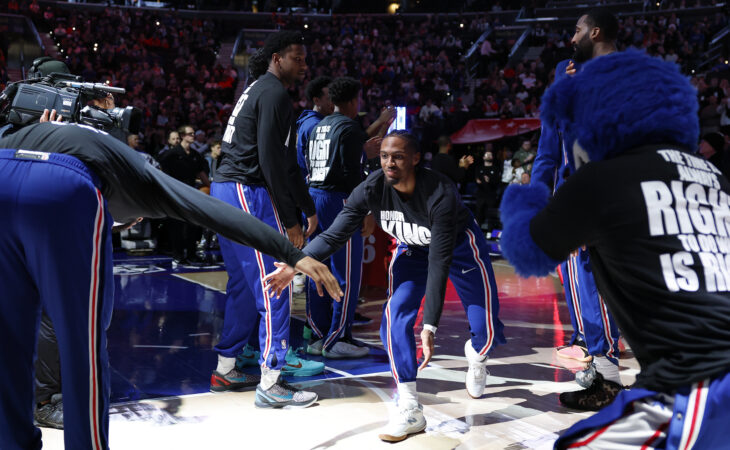
Two months ago, 76ers guard Tyrese Maxey joined Indiana Pacers guard Tyrese Haliburton in a live group chat during a Thunder-Lakers game. When the 25-year-old was asked about the possibility of getting his own signature shoe, Maxey responded: “One can only hope and pray.”
Those prayers have been answered.
Maxey will be getting his own signature shoe, set to debut later in 2026, New Balance confirmed. ESPN was the first to report Maxey’s new shoe.
“We’re so excited that Tyrese was named an All-Star starter and to get to share this moment with him,” said Naveen Lokesh, head of global sports marketing for basketball at New Balance. “He represents everything we value at New Balance — hard work, authenticity, and confidence — so working together to bring his first signature shoe to life is a natural step in celebrating who he is and where his journey is headed.”
Maxey first signed a shoe deal with New Balance in 2023, joining Kawhi Leonard, Jamal Murray, and Zach LaVine. During the 2023-24 season, which saw him earn the NBA Most Improved Player Award and his first All-Star nod, Maxey appeared on a New Balance billboard in Indianapolis during All-Star Weekend. As the brand’s roster of athletes expands, Maxey has also been involved in New Balance’s “We Got Now” ad campaign alongside stars from other sports including Shohei Ohtani and Coco Gauff.
Two years after signing with the brand, it took another step forward in its partnership. New Balance presented the Tyrese Maxey Hero Pack — a collection that included a basketball shoe (New Balance Hesi Low v2) and a lifestyle shoe (New Balance 1906R) inspired by Maxey’s love of comic books.
There hasn’t yet been any information made available on when Maxey’s shoe will release and what it will look like, so stay tuned.
It was the start of a voicemail from the president to Pennsylvania Gov. Josh Shapiro, received one week after a man firebombed the governor’s residence in Harrisburg in an attempt to kill Shapiro while his family slept inside on the first night of Passover.
Shapiro hadn’t recognized the number Trump was calling from, and at first didn’t answer.
When Shapiro called back, Trump offered well wishes to the governor’s family, his usual braggadocio, and some advice: he shouldn’t want to be president, Shapiro recalls in his new memoir, set to be released later this month.
The book, Where We Keep the Light, which comes out on Jan. 27, has attracted a flood of attention as it signals Shapiro’s potential presidential aspirations and also serves as a retort to the unflattering portrayal of the governor in former Vice President Kamala Harris’ recent memoir.
In the 257-page book, Shapiro details his early life in Montgomery County, his two decades in elected office, his connection to his faith, and his pragmatic leadership approach.
And for the political observers who have watched Shapiro’s rise: He delves into his brief consideration of whether he should run for president after Joe Biden dropped out of the race in 2024, the whirlwind experience of being vetted to be Harris’ running mate, and the unfair scrutiny he felt he faced during that process.
Here are six takeaways from Shapiro’s forthcoming memoir, obtained by The Inquirer.
Trump to Shapiro: ‘He cautioned that I shouldn’t want to be president’
When Shapiro, 52, returned Trump’s call in April 2025, he received the president’s support and some unprompted compliments from Trump, he writes.
“[Trump] said he liked the way I talked to people and approached problems,” Shapiro retells, as Trump went through the list of potential 2028 Democratic Party presidential candidates. “He cautioned that I shouldn’t want to be president, given how dangerous it had become to hold the office now.”
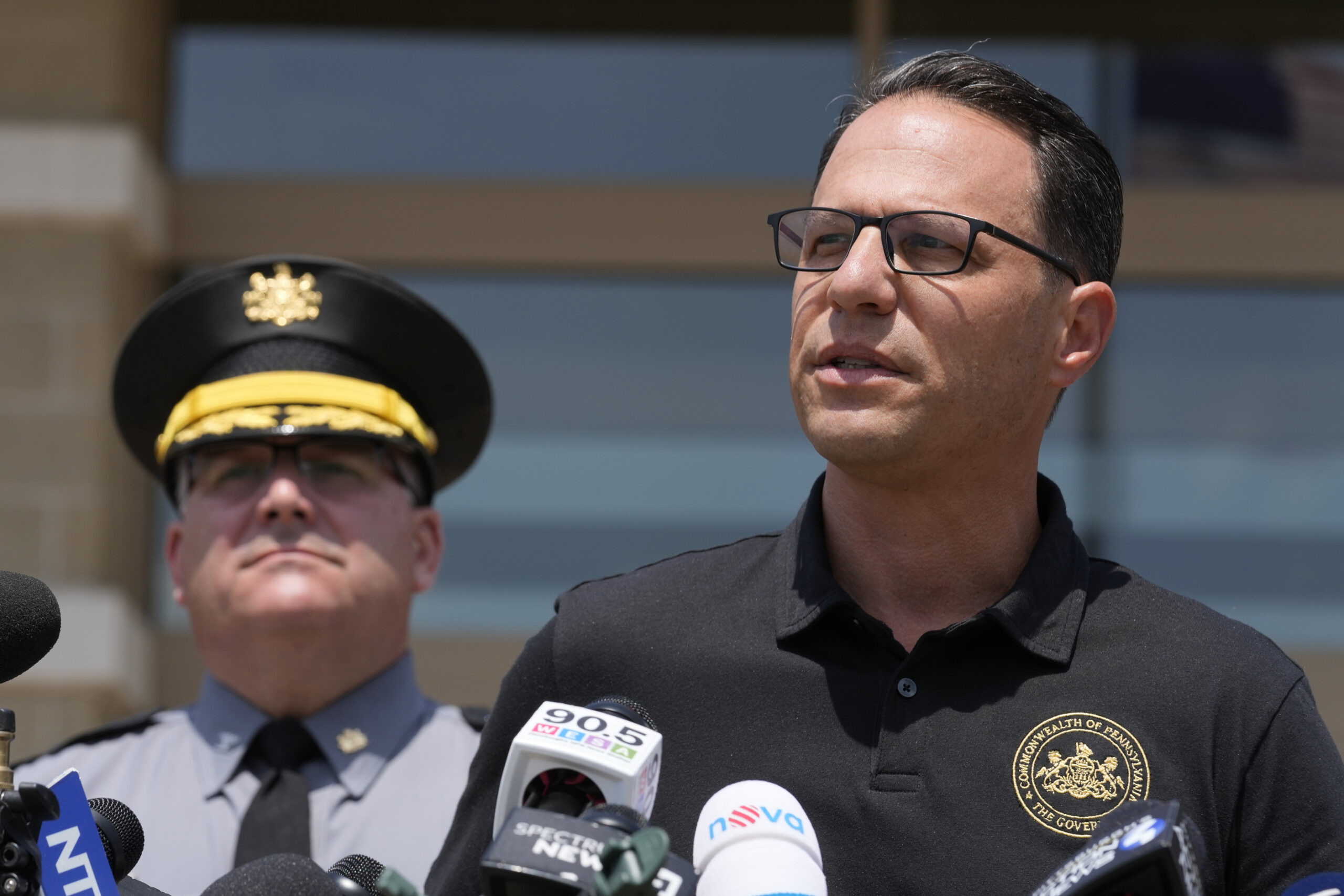
Gov. Josh Shapiro speaks during a news conference, in Butler, Pa., Sunday, July 14, 2024, following an assassination attempt on President Donald Trump.
(It is unclear whether Shapiro tried to call Trump after he experienced his own assassination attempt in Butler, Pa., the previous summer, though Shapiro publicly vehemently denounced the violence.)
Shapiro sells himself as a pragmatist and writes proudly of the times in which he has disagreed with his party or changed his positions.
For example, he recalls being asked by Harris’ vetting team about his past comments criticizing Democrats in federal, state, and local offices for how they handled COVID-19 closures. He stood by his criticism of former Gov. Tom Wolf at the time over business and school closures, and of the mask and vaccine mandates implemented by the Biden administration, he writes.
“I respectfully pushed back, asking if they believed that we had gotten everything right, to which they generally agreed that we had not,” Shapiro writes about his conversation with Harris’ vetting team. “I just had been willing to say the quiet part out loud, even if it wasn’t easy or popular or toeing the line to do so.”
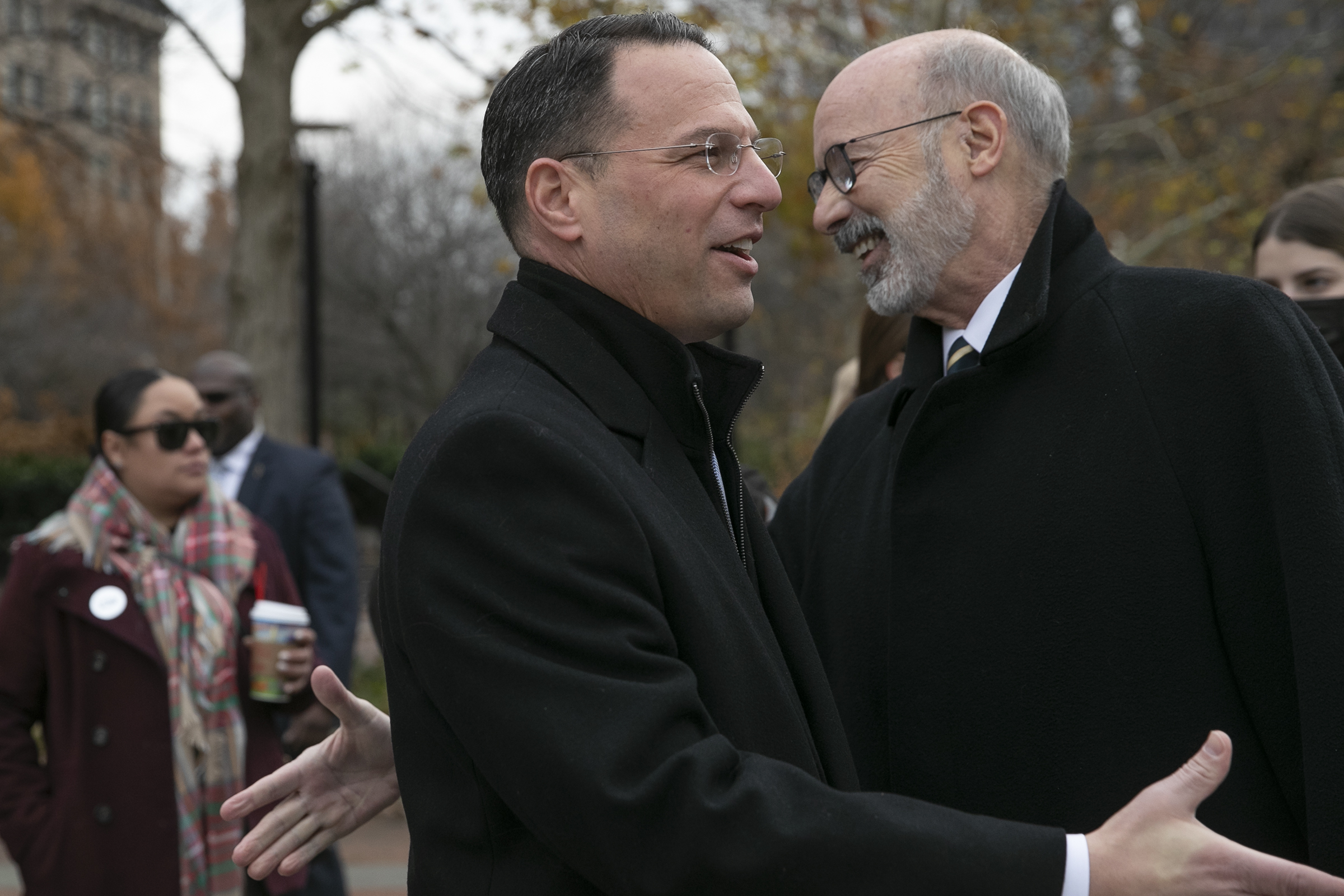
Then-Attorney General Josh Shapiro and Then-Gov. Tom Wolf both go in for handshakes before the start of a press conference on the harmful effects of anti-abortion policies at 5th and Market in Philadelphia on Thursday, Dec. 9, 2021.
He also writes about his journey to change his position on the death penalty over the years. In the days after the Tree of Life synagogue massacre in Pittsburgh, in which 11 Jewish people were killed while worshipping, he had initially supported the death penalty for the suspect. Since then, his views have evolved and he no longer supports capital punishment and called on the legislature to end the practice.
Lori Shapiro is behind most of her husband’s good ideas
Lori Shapiro, 53, mostly avoids her husband’s frequent appearances in the limelight.
But in his book, Shapiro writes that his wife has challenged him as she has supported his political rise, pushing him to question what he really wants, do the right thing, or even help him shape his messaging to voters. She discouraged him from running for U.S. Senate in 2016 after top Democrats approached him, which led him to run for attorney general instead. She was also his first call when Biden dropped out and he briefly considered whether he should run for president, and his voice of reason during the veepstakes.
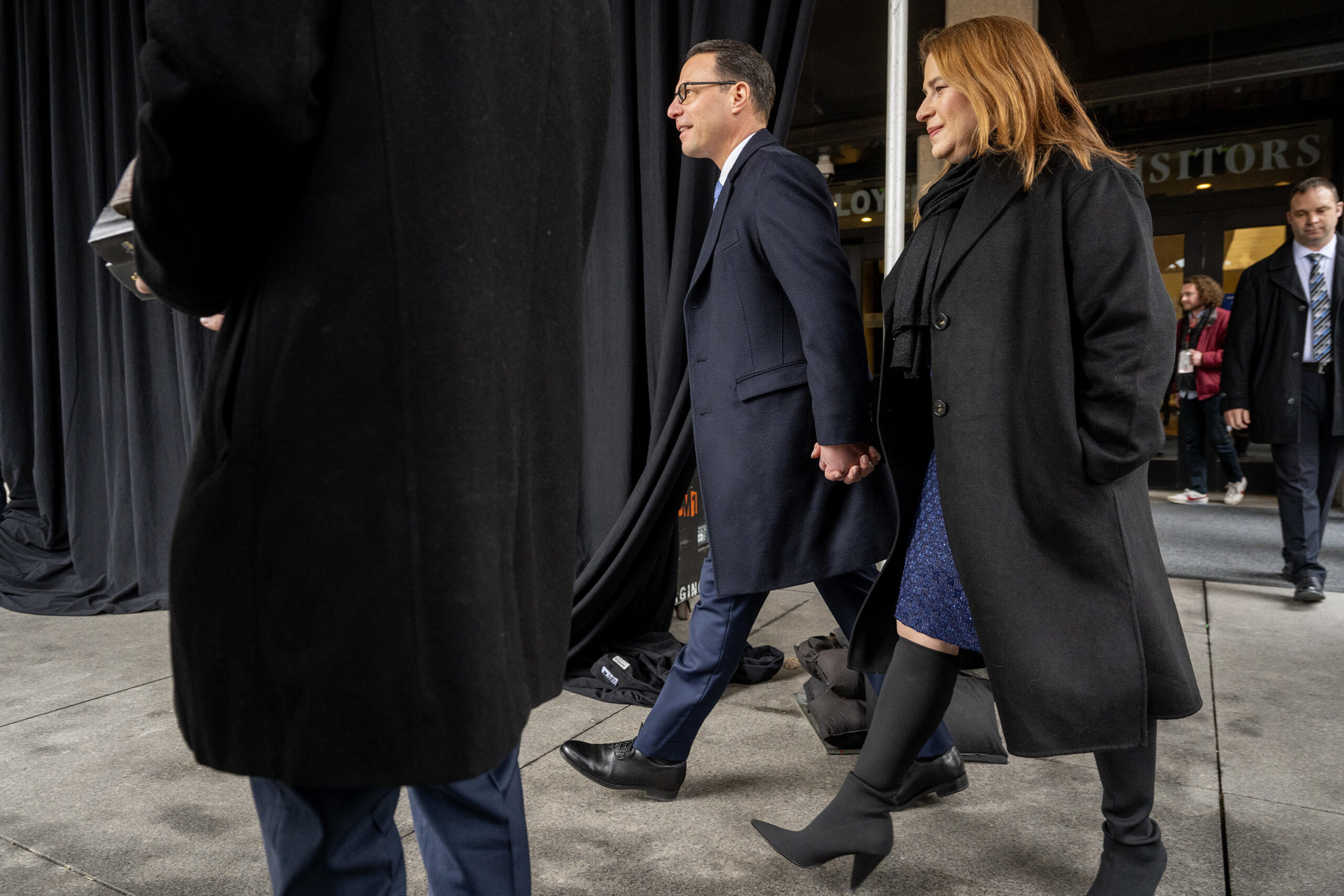
Josh Shapiro and his wife Lori leave the state Capitol in Harrisburg Tuesday, Jan. 17 2023, on his way to the stage to be sworn in as the 48th Governor of Pennsylvania.
The couple started dating in high school, before breaking up during college when they went to different universities in New York — he attended the University of Rochester, while she went to Colgate University. Shapiro writes that he quickly realized he missed her, and wrote her a letter in an effort to win her back.
“So I cracked my knuckles, and wrote my heart out. I was Shakespeare composing a sonnet. I was Taylor Swift before Taylor Swift. I was Lloyd Dobler in Say Anything, in a trench coat with the boom box over my head,” Shapiro writes. “I was getting the girl back.”
This earned Shapiro the title of “Mr. Lori” from her hall mates at Colgate. He did not win her back until years later, when the two reconnected in Washington after college, and quickly became engaged. The twomarried and had four children together, who each make frequent appearances throughout the book.
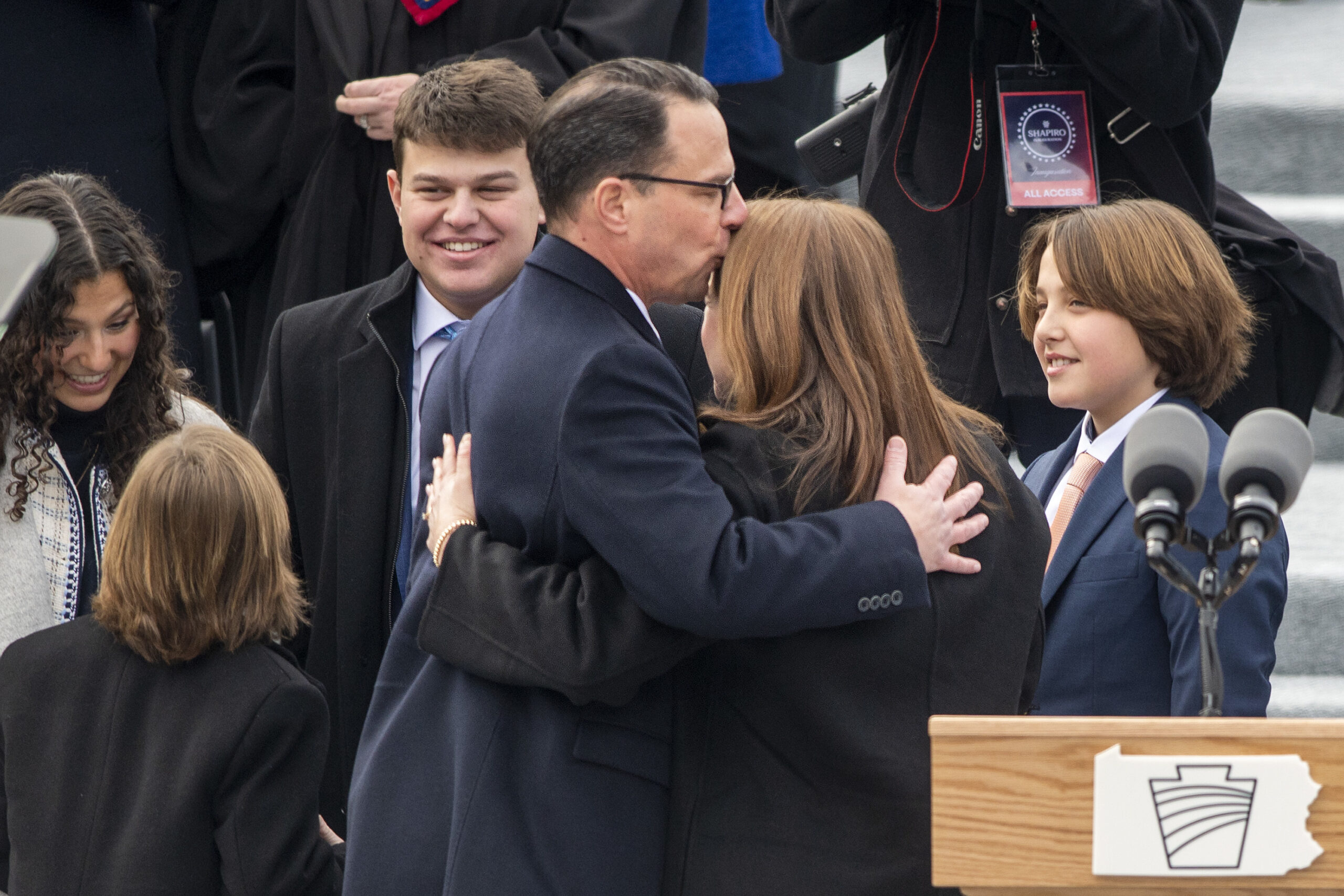
Surrounded by his four children, Gov. Josh Shapiro kisses his wife Lori after his is sworn in as the 48th Governor of Pennsylvania during inauguration ceremonies at the state Capitol in Harrisburg Tuesday, Jan. 17 2023.
Shapiro grapples with an early career move that kicked off his reputation as disloyal
Shapiro is not without regret for how some of his career moves and ambitions affected the people who helped him get where he is today, he writes.
Shapiro got his start in politics on the Hill under then-U.S. Rep. Joe Hoeffel, a Montgomery County Democrat. He quickly worked his way up to be Hoeffel’s chief of staff before returning to Abington Township to run for state representative.
But when Shapiro was done with frequent trips to Harrisburg and ready for his next rung on the ladder, Hoeffel was in the way. Shapiro had a plan to run for county commissioner and flip the board for the first time in more than 150 years — making Montco the first Philadelphia collar county to swing into Democratic control. Now all of the Philly suburban counties are controlled by Democrats, and Shapiro is credited for starting the trend. But Hoeffel was not a part of that calculation.
Shapiro writes that Hoeffel was “struggling politically.” He says he told him he would not run against him, but he also would not run with him.
“I knew that I couldn’t win with him, and I knew that it wasn’t the right thing for the party or the county, even if we could somehow eke out the victory,” Shapiro writes.
Hoeffel eventually decided not to run, and was quoted in The Inquirer in 2017 as saying that loyalty is not Shapiro’s “strong suit,” comments he has since stood by, in addition to praising Shapiro for his successes ever since.
“I’d hear about [Hoeffel] talking to the press or to people behind my back about how he thought I lacked loyalty, that I was someone who needed to be watched,” Shapiro writes. “It felt terrible, and of course, I never intended to hurt him in any way and I would never have run against him. I wanted the Democrats to have a shot, and I knew that I could get it done.”
Shapiro initially said antisemitism didn’t play into Kamala Harris’ running mate decision. Now he has more to say
In the days after Harris passed over Shapiro to be her running mate in favor of Minnesota Gov. Tim Walz, Shapiro said “antisemitism had no impact” on her decision.
Now, Shapiro questions whether he was unfairly scrutinized by Harris’ vetting team as the only Jewish person being considered as a finalist, including a moment when a top member of Harris’ camp asked him if he had “ever been an agent of the Israeli government.”
“I wondered whether these questions were being posed to just me — the only Jewish guy in the running — or if everyone who had not held a federal office was being grilled about Israel in the same way,” he writes.
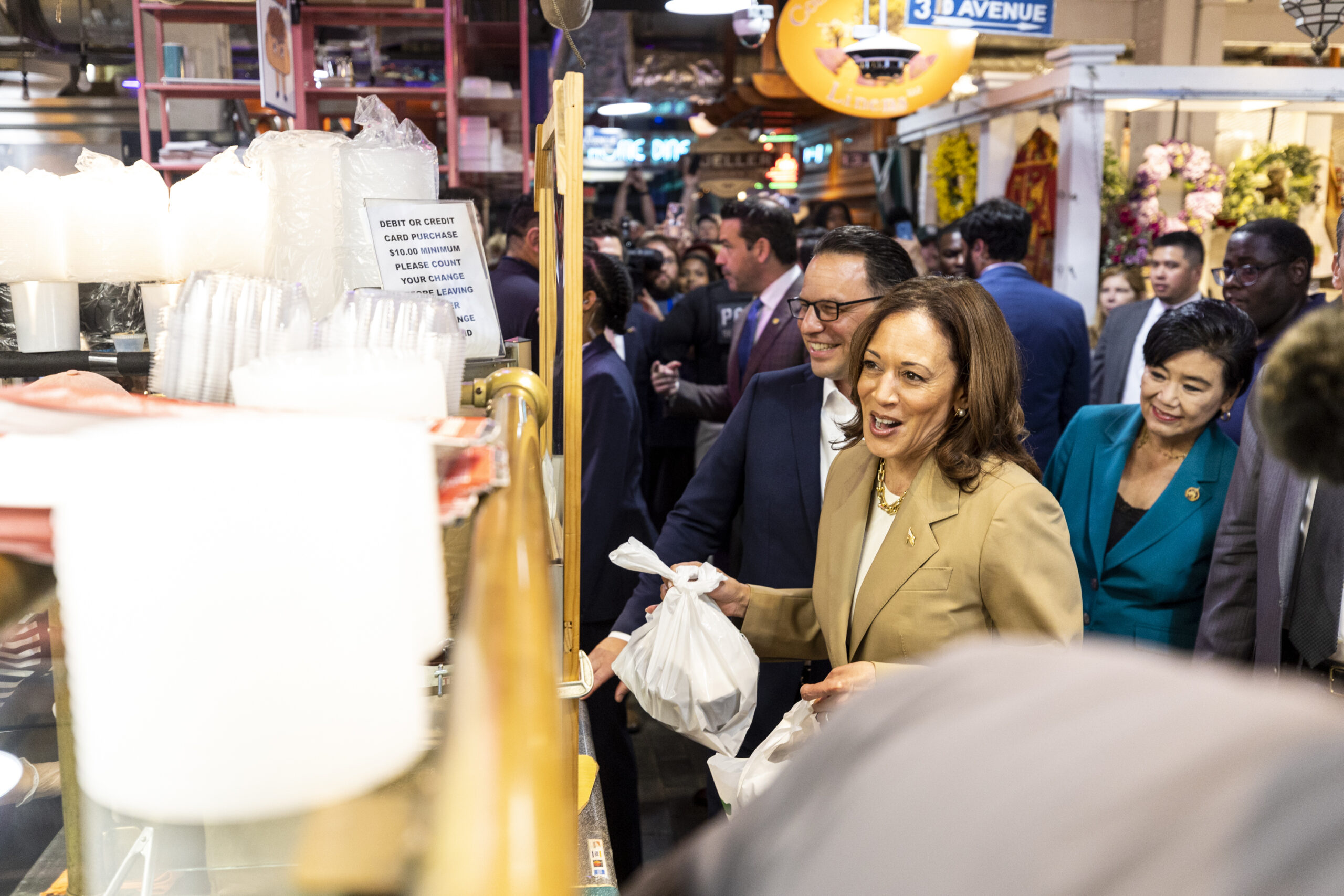
Vice President Kamala Harris visits Little Thai Market at Reading Terminal Market with Gov. Josh Shapiro after she spoke at the APIA Vote Presidential Town Hall at the Pennsylvania Convention Center in Philadelphia, Pa., on Saturday, July 13, 2024. The photo was taken eight days before President Joe Biden’s decision to exit the race.
He details his broader concerns with how he was treated during the process, including some perceived insults about his family’s lack of wealth or Lori Shapiro’s appearance.
Since Shapiro’s book was leaked to the media over the weekend, sources close to Walz confirmed to ABC News that the Minnesota governor was also asked whether he was an agent of a foreign government, due to his multiple trips to China.
Shapiro, for his part, has written about his time in Israel, including a high school program in which he completed service projects on a farm, on a fishery at a kibbutz, and at an Israeli army base. He once described himself in his college student newspaper as a “past volunteer in the Israeli army” — a characterization that circulated widely after it was reported by The Inquirer during the veepstakes.
Vereb had been along for the ride for Shapiro’s time in the state House as a fellow state representative from Montgomery County (though he was a Republican), as a top liaison to him in the attorney general’s office, and eventually a member of his cabinet in the governor’s office until his resignation in 2023.
New Jersey Gov. Mikie Sherrill was so excited to fulfill her promise of declaring a state of emergency on utility bills on her first day in office, she did it before finishing her inauguration speech.
“I’ve heard you, New Jersey — we are facing an affordability crisis, and you want costs to come down,” she said during her speech that followed her swearing-in. “And you want that to begin today.”
The first freezes utility rates in New Jersey, which she is able to do by directing the state Board of Public Utilities to provide credits to bill payers for increases. The board made a similar move over the summer under former Gov. Phil Murphy after significant bill increases. Those credits were funded with money from clean energy programs.
The public utilities board, known as the BPU, is a regulatory authority that oversees private utility companies in New Jersey and works on clean energy programs in the state. It is funded in part through a charge on utility bills.
BPU President Christine Guhl-Sadovy said in a statement that the board “looks forward to supporting the governor’s agenda to lower utility costs for New Jersey ratepayers while encouraging the development of new energy resources here in the Garden State.”
Sherrill also directed the public utilities board to consider pausing or modifying the schedule for proceedings in which utility companies seek rate increases — as much as the law allows — and called for a study into modernizing the current electricity distribution business model. She also called for the board to revise the Clean Energy Program for the upcoming FY 2026 budget.
Sherrill also signed an executive order on stage to increase power generation in the state as part of her effort to lower costs.
“This is just the beginning,” she said on stage.
“Not of my speech, of my work,” she joked.
Her second order rolls out efforts to make it easier and faster for companies to generate power in the state, particularly via solar and battery sources. She directs state agencies to pursue permitting reforms that can help speed up processes to get new energy sources up and running as part of this order.
She also calls on the New Jersey Department of Environmental Protection to expedite permitting processes for existing gas plants to expand capacity, run more efficiently, and reduce emissions.
In another request of the public utilities board, she asks officials to require electric utility companies to report on how much energy data centers request to assess “ghost loads,” which are forecasts for how much energy large projects may require. These predictions impact how much energy the regional grid operator PJM anticipates needing to handle, which can increase prices.
Sherrill has blamed PJM for high utility costs, and the regional grid operator has argued that it has simply responded to supply and demand issues as energy usage has drastically increased in recent years in part to the increasing demand for artificial intelligence.
The order also creates a Nuclear Power Task Force to support nuclear power generation.
“I heard the people of New Jersey loud and clear – these rate hikes are unacceptable – and as your governor, I will not stop fighting to lower costs and make New Jersey a more affordable place to live, work, and raise a family,” Sherrill said in a statement.
Online speculation about whether Maxey and Edgecombe liked each other started after a defensive miscommunication in the first quarter of Friday’s loss to Cleveland led to an open Donovan Mitchell three. Maxey and Edgecombe were caught on the bench having what appeared to be a heated conversation after the play.
But on Monday, after Maxey was named an All-Star starter, Edgecombe was the first person to reach out to him — telling reporters he set a 2 p.m. alarm just to make sure he found out right away whether Maxey had been named a starter so he could congratulate him.
Edgecombe woke up Maxey from his pregame nap trying to call him.
“I’m like, why is he calling me?” Maxey said pregame. “And I answer, and he’s screaming and showing me the TV. And I’m like, ‘OK.’ We chopped it up a little bit.”
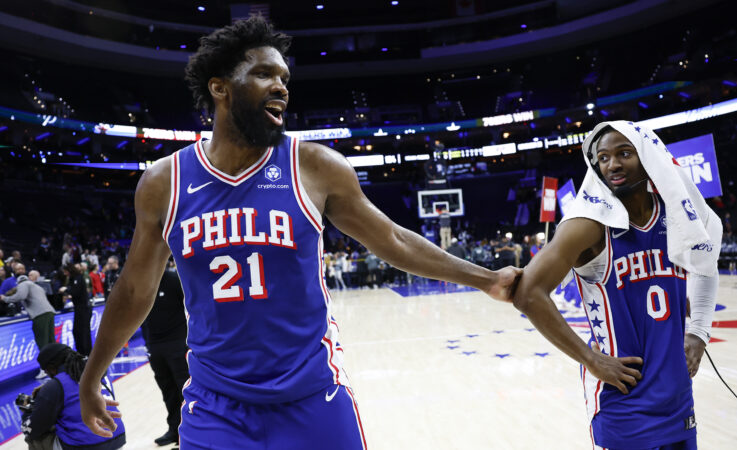
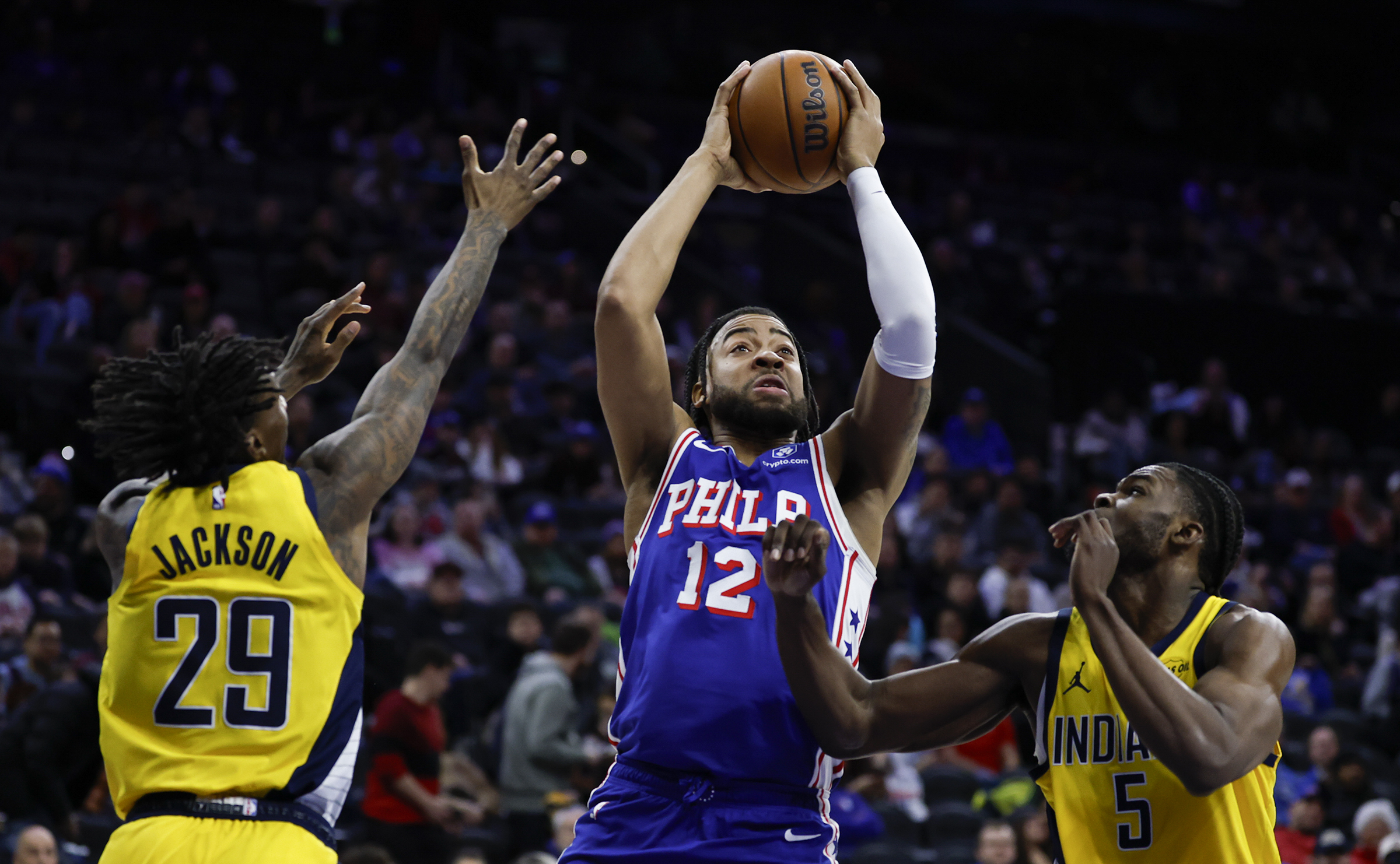
And postgame, the two Sixers guards were having fun after the 113-104 win over the Pacers.
I’m Jewish, and like most other Jews I know, I often wonder who else is. When I meet someone at a party, or see a new face on TV, I think: yes or no? It’s a game, and it’s all in good fun.
But when the government does it, it isn’t. It’s a dagger at our hearts.
That’s why so many people at the University of Pennsylvania — where I teach — are up in arms about the Trump administration’s effort to compel the university to identify Jewish students and employees. It’s part of an investigation of antisemitism on campus by the Equal Employment Opportunity Commission, which issued a subpoena demanding the names and contact information of members of Jewish-related student groups, staffers at the school’s Jewish studies program, and anyone who had filed an antisemitism complaint.
Fortunately, Penn said no. The EEOC sued the university back in November for refusing to comply with the subpoena. And last week, several groups at Penn filed their own motion in the case. “Compiling and turning over to the government ‘lists of Jews’ conjures a terrifying history,” they wrote.
Indeed, it does. Going back to the Middle Ages, state officials have tried to establish who is Jewish. And it never ends well.
In 1215, Pope Innocent III decreed that Jews must wear markers at all times that made them distinguishable from Christians. Two years later, in England, King Henry III ordered male Jews to wear a badge on the front of their outer garments.
In England, the badge was shaped like the tablets upon which Moses — according to the Old Testament — received the Ten Commandments. In France, it was a circle of red or yellow felt. Hungarian Jews had to wear red capes. And in German-speaking parts of Europe, Jews were required wear a cone-shaped Judenhut, or “Jew’s Hat.”
The goal of these rules wasn’t simply to identify Jews; it was to segregate, humiliate, and persecute them. Jews wearing badges were mocked by children and attacked by bandits. Badge laws also led to extortion: To receive exemptions from the laws, Jews had to pay large sums to the state.
In the so-called Jewish Emancipation era of the 18th and 19th centuries, when Jews finally received citizenship in the nations where they lived, badge laws disappeared. But they returned with a vengeance in the 1930s and 1940s, when the Nazis required Jews in Germany and the territories it conquered to wear yellow stars.
That helped facilitate their deportation and murder in concentration camps, where a new set of markers developed. Jews who were also political prisoners wore a red triangle, superimposed on a yellow one; gay Jews were identified by the pink triangle, which was later adopted by LGBTQ+ activists as a symbol of pride.
And Jewish camp prisoners often received tattooed numbers on their arms. Again, that was a way to degrade Jews as well as to identify them.
“My number is A-10572. That is what I was, they did not call us by our names,” recalled Holocaust survivor Lilly Ebert, whose TikTok video about the Auschwitz death camp went viral in 2021. “We were no longer humans. We were only a number, and we were treated like numbers.”
Since then, every state effort to count or list Jews has reflected disdain for them. Convinced that Jews at the Bureau of Labor Statistics were altering employment statistics to undermine him, President Richard Nixon ordered aides to find out how many BLS workers were Jewish. “The government is full of Jews,” Nixon fulminated in a taped 1971 White House conversation. “Most Jews are disloyal … You can’t trust the bastards. They turn on you.”
An aide scrutinized the BLS employees’ names — never a perfect way to figure who is Jewish — and concluded that 13 of 35 fit the “demographic criterion that was discussed,” as he delicately reported. Less than two months later, two Jewish senior officials were removed from their posts and demoted to less visible positions in the agency. That was “the last recorded act of official antisemitism by the United States government,” as political commentator Tim Noah wrote.
Forcing Penn to cough up a list of Jews would be the next one. It doesn’t matter that it comes as part of a Trump administration investigation of antisemitism. Frankly, I doubt a president who welcomed Holocaust denier Nick Fuentes to his home for dinner — and who still refuses to criticize him — cares very much about the safety of Jews on campus.
But even if he does, that’s no reason to count them. When the government does that, it isn’t fun anymore. It’s game over.
Major changes are coming to the Rittenhouse Hotel on Rittenhouse Square, as the Italian restaurant Scarpetta will leave the bilevel space next weekend after nearly a decade to set the stage for a posh new steakhouse called the Ruxton, from Baltimore-based Atlas Restaurant Group.
Alex Smith, Atlas’ president and chief executive, told The Inquirer that the Ruxton, a sibling of the location in Baltimore’s Harbor East, would open in spring 2027. This will be the second Philadelphia restaurant for Atlas, which opened the high-end Loch Bar at Broad and Spruce Streets in fall 2023.
A rendering of the second-floor dining room of the Ruxton at Rittenhouse Hotel.
But before renovations for the Ruxton begin, the Rittenhouse space will host a residency from up-and-coming chef RJ Smith, 21, who launched Ocho Supper Club last year in his Drexel University apartment to showcase Afro-Caribbean cuisine through a fine-dining lens.
RJ Smith, no relation to Atlas’ president, said he has scheduled the first seating for his eight-course tasting menus for Feb. 1 and plans to offer them through July 26; the schedule has not been formally set but includes Valentine’s Day.
RJ Smith, culinary student and executive chef of Ocho Supper Club.
Scarpetta, owned by LDV Hospitality, has set its final service for Jan. 31. Scarpetta opened in 2016, filling the space previously occupied by Smith & Wollensky, also a steakhouse. Lacroix, the Rittenhouse Hotel’s signature restaurant, is unaffected by the changes.
Construction is expected to start in late summer for the Ruxton, whose deal has been in the works for nearly a year. Alex Smith said the Ruxton will occupy more space at the Rittenhouse — allowing for a total of 220 seats, vs. Scarpetta’s 120.
The Ruxton, offering Rittenhouse Square views from its second floor, will have three private dining rooms and a 50-seat outdoor space on the deck. The restaurant’s entrance will be moved next to the hotel lobby, and there will also be an interior entrance through the hotel lobby.
Designer Patrick Sutton is channeling inspiration from the Jazz Age, with highlights including velvet upholstery, walnut wood millwork, and custom Murano-style glass chandeliers. Corporate chef Aaron Taylor will oversee the steak and seafood menu.
The Philadelphia location will be Atlas’ third Ruxton location; the second is due to open this fall in National Harbor in Maryland, outside of Washington, D.C.
“We love Philly,” Smith told The Inquirer, adding that Loch Bar’s numbers are strong. “It’s a great town. In some ways, it reminds me of Baltimore — just much bigger. And we’re planning on doing more in Philadelphia.” He said developer Carl Dranoff, his partner at Loch Bar, would be involved in the Ruxton.
Cole Hernandez, a Rittenhouse Hotel spokesperson, said that the Scarpetta space, in the short term, would also be used by Lacroix chef Eric Leveillee to host groups, do cooking and mixology classes, and other programming.
In addition, the hotel’s Library Bar continues to rework its cocktails in collaboration with James Beard Award winner Danny Childs. A fresh drinks menu will launch in February.
“Where we’re ultimately heading is a broader shift across the property,” Hernandez said. “The Philadelphia dining scene is changing — it’s more vibrant, more interesting, and less formal and stuffy. We’re evolving our concepts to be more relevant to today’s diner.
At Lacroix, service standards have been modified to allow for more approachable, 90-minute dinners and “more dynamic and social” brunches that include à la carte options.
A Philadelphia police officer opened fire on a man Monday night after the man critically injured another person in Hunting Park, police said. The man, police said, was not hit.
Officers were called about 8:30 p.m. to a Sunoco gas station in the 4100 block of North Broad Street for a report of a man with a gun, according to police Tuesday.
When they arrived, police said, the officers saw multiple men arguing. The men quickly left the gas station and walked toward the intersection of Broad and Jerome Streets, where the fight turned physical, police said.
A 29-year-old man drew a handgun and shot another man in the chest and groin. One of the officers fired at the alleged shooter, police said, but did not strike him.
The alleged shooter ran away, but the officer caught and arrested him in the 1300 block of Jerome Street, police said. Nearby, beneath a parked vehicle, officers found a 9mm handgun.
Paramedics took the victim to Temple University Hospital, where police said he was in critical condition Tuesday. His name was not released.
Police did not release the name of the alleged shooter, who had not yet been formally charged, they said.
The officer, a 36-year-old man with nine years on the police force, was not injured in the incident, police said. He has been placed on administrative duty pending an internal investigation, as per department policy when an officer discharges his gun.
Nick Nurse thought back to the 76ers’ preseason trip to Abu Dhabi, and how a multitude of injuries (again) forced him to cobble the rotation together for two exhibition games against the New York Knicks.
“I’d be pretty happy that we’re here right now,” the coach said of his former self late Monday.
“Here” is a 23-18 record at the regular season’s halfway point following a 113-104 home victory over the Indiana Pacers. Nurse acknowledged he is still irked by the handful of close games he believes the Sixers gave away. The roster, meanwhile, still feels like a work in progress after finally reaching full availability earlier this month.
But the Sixers are considered one of the NBA’s pleasant surprises, entering Tuesday in fifth place in the crowded Eastern Conference standings where 1½ games separate third and seventh.
“Probably would have taken this at the start of the season, for sure,” Nurse said. “And, hopefully, a couple more [health] dominoes can fall here as we go on.”
In that spirit, here is a collection of second-half goals for the Sixers’ rotation players.
Tyrese Maxey: Make the MVP ballot
When Maxey received “M-V-P!” chants at the free throw line during an early-season home game, he told Joel Embiid, “I don’t know how you do this.”
Maxey has been worthy of such serenading from spectators while making another significant leap in his sixth season. The 25-year-old point guard was named an All-Star starter Monday afternoon, as the top American vote-getter. That naturally makes him an All-NBA contender.
One step beyond those potential accolades? Getting onto MVP ballots, a race that could become more open if Nikola Jokić, the three-time winner of the sport’s top individual award and this season’s early favorite, falls under the 65-game eligibility threshold because of a recent knee injury. Maxey was seventh in the first ESPN straw poll, which surveys 100 eligible voters, released on Dec. 19.
For good reason. Maxey entered Tuesday ranked third in the NBA in scoring (30.2 points per game) while also setting career highs in assists (6.7 per game) and rebounds (4.4 per game). He is shooting 40% from three-point range and 47.5% from the floor, on 22.3 attempts per game as a multidimensional bucket-getter. He has become more of a defensive playmaker, averaging 2.1 steals per game — including a career-high eight in Monday’s win over the Pacers — and turning several into blazing finishes at the opposite end. And he is doing this while leading the league in minutes played, at 39.4 per game.
Some of these numbers could dip slightly if Embiid and Paul George can stay healthy, taking some of that load off the relentless Maxey. And a tough two-game stint against the Cavaliers — he went a combined 14-of-39 from the floor in consecutive losses — demonstrates he still faces a learning curve as the focal point of opposing defenses.
But Embiid was correct in nicknaming Maxey “The Franchise” years ago. If Maxey is the leader of a Sixers team that shifts from resurgent to legitimate East threat, he will need to get used to those chants.
Joel Embiid and Paul George: More dunks!
Following a Jan. 3 win at the New York Knicks, Embiid’s first dunk of the season was a popular topic. Nurse quipped that it occurring with a win secured in the final seconds “was a pretty cheap way of getting it … but at least we know he can still dunk.” When VJ Edgecombe learned that Embiid had not dunked since last season, the rookie’s reaction was “Oh my God.”
The celebration is not as much about the act itself, but the ongoing physical progress it signifies.
Ditto for Embiid more often stepping to center court for the opening tipoff. Or that he has played in 10 of 11 games since Dec. 30, including logging 40 minutes for the first time since the 2024 playoffs in a Jan. 5 overtime loss to Denver. During this stretch, he has averaged 27.4 points on 51.6% shooting with 7.6 rebounds, 4 assists, and noticeably improved elevation and mobility as a defender and rim protector.
And by the time the Sixers won in Toronto on Jan. 12, Embiid was throwing down one-handed dunks in traffic.
“I’ve made a lot of strides since the beginning of the season,” Embiid said Monday. “I’m back to, probably say, All-Star level and getting back to that All-NBA level and MVP level each and every day. Just got to keep it going.”
George, who battled numerous injuries during a disappointing first season in Philly, can relate. Though he has been most dangerous this season as a three-point shooter (37% on 6.3 attempts per game entering Tuesday), he said his body also feels (and looks) better as a versatile complementary player on both ends.
“Those small things,” George said. “It’s like stuff that I can check off like, ‘All right, I’m able to do this again. I’m able to dunk again. I’m able to explode again.’ So it’s just the small gains that just keep you going.”
Dominick Barlow and Jabari Walker: Secure an NBA standard contract
While sitting inside a restaurant during the Las Vegas Summer League, Sixers president of basketball operations Daryl Morey said he believed the front office had been savvy in leveraging two-way contracts to sign helpful players in Dominick Barlow and Jabari Walker.
Morey was more than correct. Barlow has been the Sixers’ breakout player, lauded for his knack for crashing the boards and cutting while averaging 8.2 points, 5.1 rebounds, and 1.3 assists as the starting power forward. Walker is a high-energy rebounder (3.4 in 12.9 minutes per game), and has played in 39 of the Sixers’ 41 games.
“Those two guys just go out and play hard,” Nurse said Monday, “and have a lot of fun just giving everything they have.”
Both have certainly outplayed their two-way status, which primarily is designed for young, developing players to split time between the NBA and G League. The Sixers will aim to maximize the NBA games Barlow and Walker still have available before converting either (or both) to a standard contract. Because of a quirk for teams that do not fill their entire 15-man roster (the Sixers had 14 players signed to standard contracts as of late Monday), Barlow and Walker have a combined six active games with the Sixers remaining.
“We kind of have that respect for each other,” Walker said recently. “… This is new to both of us, so we don’t let the two-way define us. We just know we’re both big pieces and we have similar styles sometimes with our energy. We talk about how we can be effective as a team, and how we can both bring more energy.”
The Feb. 5 trade deadline could present an opportunity to free up another full roster spot. Kelly Oubre Jr., Andre Drummond, Eric Gordon, and Kyle Lowry are on expiring contracts.
Andre Drummond and Adem Bona: Stay ready
That sports cliche is in the air throughout the Sixers’ roster, as Nurse experiments with various personnel combinations with a healthier group. It is most applicable to the two centers behind Embiid. The roles for Drummond and Bona have ranged from starter to backup to completely out of the rotation.
With Embiid now (seemingly) able to play more consistently, matchups, foul trouble, and other factors could determine when exactly Drummond or Bona see the floor.
Drummond appeared to be in the midst of a resurgent season but has looked more limited at times since a late-November knee injury. Bona’s early-season minutes were more sporadic before he recently regained the backup spot. There have been games when one player took the first-half stint and the other held that role in the second half.
Sixers center Adem Bona has shared the backup spot behind Joel Embiid with Andre Drummond.
“We’ve got to do it by feel,” Nurse said. “But I think they’re not alone in that. That’s what we’re doing [with multiple players] almost every night as coaches. … We’re always, every night, trying to figure out which guy fits that moment of the game. It’s really moment-to-moment. It’s just kind of the way it is.”
Nurse said last week that, in the games Embiid does not play, he would prefer to start Drummond and bring Bona off the bench because of the way opponents typically go smaller with their backup frontcourt players.
On last month’s holiday road trip, Nurse even tried Embiid and Bona on the floor together. Bona said that making that partnership effective is one of his primary goals moving forward.
VJ Edgecombe: Embrace the grind
At halftime of a Jan. 5 loss to the Denver Nuggets, Embiid asked Edgecombe if he was taking the day off.
Then the rookie turned another quiet start into a fabulous finish on both ends of the floor. He flashed his rare blend of athleticism and poise while scoring 17 points after the break, and finished with a career-high nine assists and a slew of impact defensive moments.
This feels like a key stretch for Edgecombe, who has already surpassed the total games he played during his one college season at Baylor — and entered Tuesday ranked eighth in the NBA in minutes (35.7). He acknowledged some early-season fatigue before a calf injury. Now, he is entering the NBA doldrums before the All-Star break and, after that, a playoff push.
After that night against Denver, Edgecombe connected on 5-of-6 three-point attempts in a Jan. 12 win at the Raptors. He has taken on more ballhandling responsibility. He has guarded All-NBA guard Donovan Mitchell. But he also took only five shots in that Friday loss to the Cavaliers.
“I was the first person that went up to him [after that game],” Maxey said of Edgecombe, “and told him, like, ‘Dude, you shooting five times in a basketball game is not going to cut it for us. You’ve got to be up to 10, 12. You’ve got to be aggressive.’ Man, that’s my dog. That’s my little brother.”
On the season, Edgecombe is averaging 15.6 points, 5.3 rebounds, 4.3 assists, and 1.5 steals. He must embrace the grind, because the Sixers are counting on his electric impact to persist into the spring.
Kelly Oubre Jr.: Recapture the early-season flow
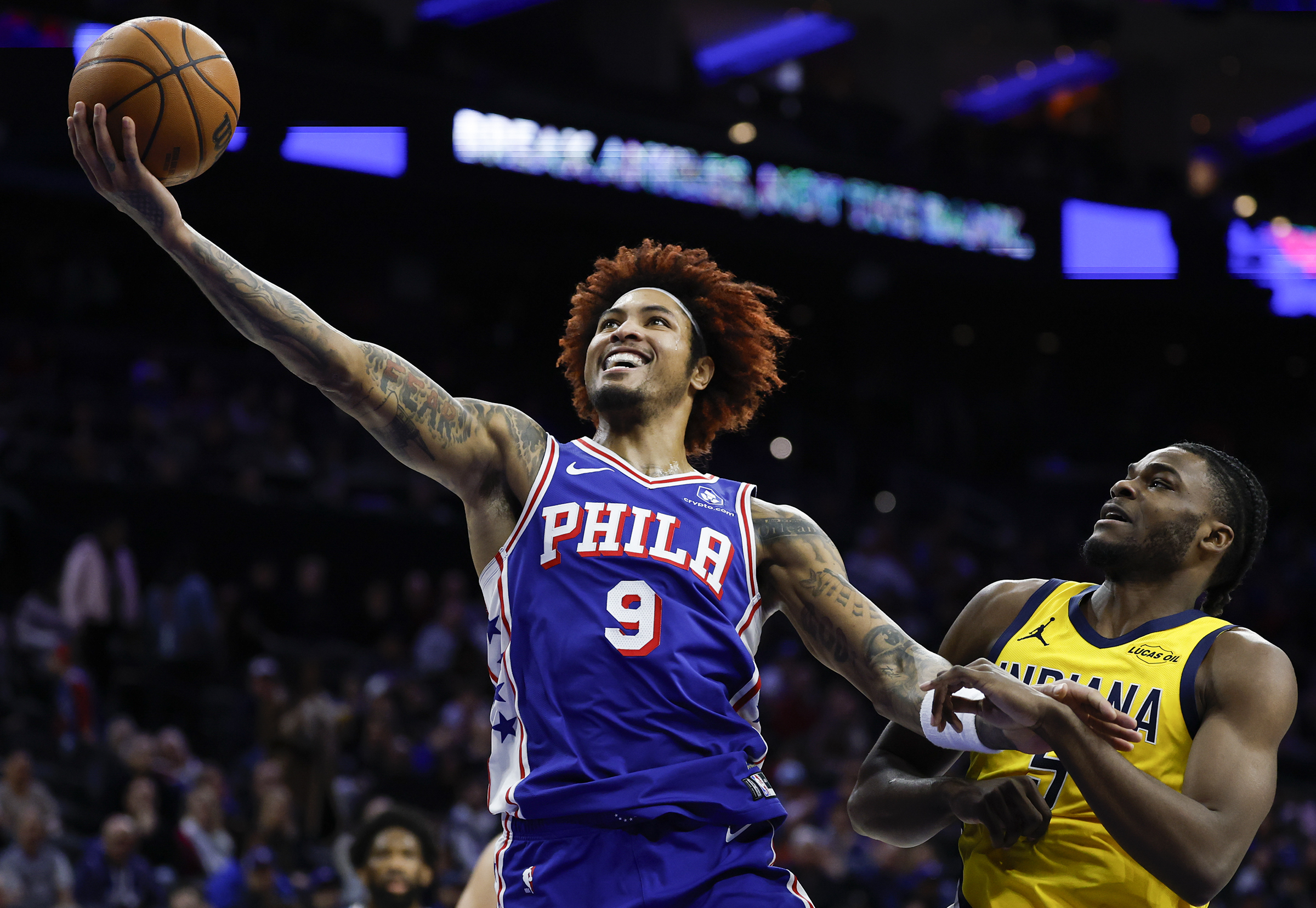
Oubre quickly got downhill for the Sixers’ first bucket of Monday’s victory, igniting an outing when he totaled 18 points and a season-high five assists.
He looked like the player Oubre was before a mid-November knee injury, when he arguably was putting together the best basketball of his career in his 11th NBA season. He was in more control with the ball in his hands, averaging 16.8 points on 49.7% shooting in 12 games. And he relished taking on challenging perimeter defensive assignments.
Sixers guard Kelly Oubre Jr. looked more like himself as he scored 18 points against the Pacers.
Oubre has been back for six games, initially with understandable rust. He has committed to allowing his defensive energy to ignite his offense. He gained some momentum in a Jan. 11 loss at Toronto (13 points, five rebounds, four steals, three blocks), and then put up 12 points as part of the closing lineup in Friday’s loss to Cleveland.
It will be critical for Oubre to maintain that patience and understanding with himself, rather than reverting to old habits.
“He’s done a good job of just kind of easing his way back in,” Maxey said of Oubre on Monday, “and I feel like letting the game come to him.”
Quentin Grimes: Make a Sixth Man of the Year push
Grimes was never going to be the high-volume scorer and lead ballhandler he was after the Sixers’ acquired him at last season’s trade deadline, then shifted into tank mode. But Grimes’ first full season in Philly has been spotty, at times.
After a December shooting slump, Grimes rediscovered his touch at the end of the Sixers’ holiday road trip. Since then, he has hit double figures in scoring in only two of the Sixers’ last six games. He entered Tuesday ranked sixth in that category among players with double-digit games played off the bench (14.2 points), while adding 4.1 rebounds, 3.3 assists, and a willingness to defend.
Grimes will often be in the closing lineup, where the Sixers can utilize their guard depth. But being that initial, consistent spark off the bench — which could lead to Sixth Man of the Year consideration — is another worthwhile goal.
One nugget: Grimes is now eligible to be traded, and has veto power on any proposed deal after signing his one-year qualifying agreement in October.
Trendon Watford and Jared McCain: Squeeze back into the rotation
Watford was regarded as a sneaky-good offseason signing because of his versatility as a “point” forward. Hamstring and thigh injuries have limited him to 20 games, though one was a triple-double against the Raptors.
Watford is beginning to crack the rotation minutes again, totaling four points, two rebounds, and two assists while setting the pace as an additional ballhandler on Friday against Cleveland.
He played another 12 minutes Monday against Indiana, with two points on 1-of-4 shooting.
“Being able to play a lot of positions and play with different lineups, I think I can do,” Watford said Saturday of that reintegration process. “I just try to keep building off of that. Obviously, the team has something going right now, so I’m just trying to integrate my way back into it with my style of play and my game. It’s a process, but it’s slowly getting there.”
Sixers forward Trendon Watford was considered a sneaky good offseason addition in free agency.
The opposite has happened for McCain, whose road back from knee and thumb surgeries has been choppy. His minutes have diminished as the Sixers’ roster returned to health, eventually falling out of the rotation Friday against Cleveland. The next day, he was assigned to the G League’s Delaware Blue Coats for the second time since his return. He was back in Philly in time for Monday’s matchup against Indiana, but he played only the final 47 seconds.
The former Rookie of the Year front-runner is shooting 35.4% from the floor, and has recently passed up some wide-open looks. His struggles even carried to the G League, where he went 5-of-18 from the floor (and had six turnovers) in the Blue Coats’ loss at the Noblesville Boom on Sunday.
“We’re just trying to get him some extended run,” Nurse said of McCain. “ … I don’t think he’s had much of a runway to play consistently.”