Crews are in the final stages of cleaning up the site where oil leaked into Ridley Creek after a tanker truck crashed near Media in September, according to municipal and county officials.
Ridley Creek Road will continue to have road closures from 9 a.m. to 2 p.m. until the work is finished.
Work should be completed next week, said Larry Bak, the county’s hazmat crew chief. Crews from Lewis Environmental have removed the contaminated soil and are refilling the site. Environmental consulting firm Aquaterra is overseeing the remediation work and testing.
A Cardinal USA truck carrying home heating oil crashed on Sept. 22 while traveling north on the Route 1 Bypass at the border of Upper Providence and Middletown Townships. The truck swerved across the highway and rolled an undetermined number of times, according to Upper Providence Fire Marshal Alan Mancill.
The truck came to rest with the cab hanging off the east side of an overpass and a gash in its side that spilled 1,000 to 2,000 gallons of oil onto the roadway and into Ridley Creek below, Mancill said.
The cause of the crash is unclear and Upper Providence police could not be reached for comment.
Remediation work continues on Ridley Creek Tuesday, Dec. 9, 2025, under the Route 1 overpass in Media, Delaware County where a tanker overturned spilling thousands of gallons of home heating oil in September.
“I sent half of my team up onto the bridge to work with the tank truck, and I sent the other half of my initial response down to the creek to get in front of it as it was going downstream,” Bak said. The crew put containment booms across the creek to halt the spread of oil.
Aqua’s Ridley Creek water treatment facility is about a mile and a half downstream from the site. Bak said the facility was quickly alerted to shut off its intake after the spill. It was reopened after the water was deemed safe, but the booms remain in place just in case.
“I believe the expression is ‘an overabundance of caution,’” Bak said.
The site of the crash posed a challenge to the cleanup crew, with oil contaminating a hillside as well as the creek and marshy area below the bridge. Crews used a special excavator with 35-foot arms.
“It had to reach out and down because it’s a fairly steep hill,” Bak said. “It’s not an insignificant height.”
To reach the contaminated areas, the crew also built a dam from the Ridley Creek Road side with pipes underneath to let the creek flow underneath. The dam will be removed after work is complete, Bak said.
Once the work is done, soil will continue to be monitored for two years.
This suburban content is produced with support from the Leslie Miller and Richard Worley Foundation and The Lenfest Institute for Journalism. Editorial content is created independently of the project donors. Gifts to support The Inquirer’s high-impact journalism can be made at inquirer.com/donate. A list of Lenfest Institute donors can be found at lenfestinstitute.org/supporters.
After a nearly six-year legal battle between artists, preservationists, and neighbors, the Old City building and its celebrated mosaic were demolished.
The former Painted Bride Art Center building, once home to world-renowned artist Isaiah Zagar’s 7,000-square-foot mirror-and-tile mosaic, has started to come down.
The demolition equipment and growing dust at 230 Vine St. closes the book on a yearslong saga over the distinctive Old City building’s future.
Founded in 1969 as a gallery on South Street, the Painted Bride helped transform Old City into an artists’ corner of Philadelphia when it moved to the neighborhood in the ‘80s.
story continues after advertisement
Decades later, Zagar’s mosaic, titled Skin of the Bride and wrapped around the exterior of the building, became a point of contention when the organization tried to sell the building in 2017. The debate led to a nearly six-year legal battle involving artists, real estate developers, city government officials, and neighbors.
As demolition of the celebrated building begins, take a look back at the complicated legal battles that led to its razing.
Using grants and donations for a down payment, the Painted Bride moved to 230 Vine St. from its initial digs in South Philadelphia. The former elevator factory in Old City spanned 15,000 square feet and sold for $300,000.
Alley Friends Architects, a local firm, drew up plans for the space, which included a 225-seat performance venue and galleries.
Artist Ruth McCann arrives with her paintings at the new Painted Bride at 230 Vine St. on December 2, 1982..James L. McGarrity / Staff Photographer
"There's never been an Academy of Music for people who weren't famous, and now Philadelphia has one. We've deserved this for many years. New York has a dozen such spaces,” said Keith Mason, the Bride’s program director at the time.
1991
Isaiah Zagar begins installing his mosaics
Zagar worked on the Bride’s distinctive mural for nine years.
“Isaiah woke up at 5 a.m. each morning and drove down to 230 Vine St.,” recalled his wife, Julia Zagar. “He dreamed of it as being his masterpiece and worked 10-12 hours a day until he collapsed with exhaustion.”
Artist Isaiah Zagar working on his giant mosaic at the Painted Bride Art Center on Vine Street in the 1990s.Courtesy of Philadelphia Magic Gardens
story continues after advertisement
November 2017
Vine Street property goes on the market
After 35 years on Vine Street, the Painted Bride announced the building would be sold. Executive director Laurel Raczka said the organization was not in financial distress but chose to ditch the building so the Bride could explore new ways to present the arts.
The following month, Raczka also noted the changing vibes of Old City: "We don't feel like we belong here anymore,” she told The Inquirer.
The entrance to the Painted Bride Art Center, covered in Zagar’s mosaics.Tom Gralish / Staff Photographer
Many in the arts community were perplexed. Performance artist Tim Miller, a founder of artistic spaces in New York City and Santa Monica, Calif., said, "Once [the Painted Bride] is gone, it will never be replaced. To discard it, to me, it feels reckless, unless it's the only way to survive."
March 2018
Painted Bride building is nominated for historic preservation
"The Painted Bride is one of his masterpieces," Smith said. "The building itself is a treasure."
Zagar, photographed for The Inquirer in the fall of 2017.Margo Reed / For The Inquirer
April 2018
Arts leaders beg the Bride to suspend sale plans
More than 30 of the city's most prominent artists, performers, and arts officials cosigned a three-page public letter calling for "a reexamination" of the Bride's situation and community-wide discussion about the organization's future.
Signers included: Joan Myers Brown, founder and executive artistic director of Philadanco; hip-hop dance sensation Rennie Harris; architect Cecil Baker; and Wilma Theater cofounder and director Blanka Zizka. The city’s chief cultural officer offered to facilitate a community conversation between the Bride’s leadership and local artists and art patrons.
The Bride’s leaders rebuffed the offer and said that they would continue to pursue "a sustainable business model."
June 2018
Historical designation passes the first hurdle
A committee of the Philadelphia Historical Commission unanimously agreed the Painted Bride building should be protected.
September 2018
Historical designation is denied
After a three-hour, public debate, Philadelphia’s Historical Commission voted 5-4 to reject designation, a move that opened the door for developers to acquire and demolish the building.
A few days earlier, Lantern Theater Company made a bid of over $2 million for the building, which would have preserved it as an arts space. The offer was rejected.
Lawyers for the Bride said that the law did not require approvals from the court but that the Painted Bride sought them nonetheless.
Architect and developer Shimi Zakin of Atrium Design Group poses with a sign on an interior mosaic in the Painted Bride Art Center building before closing on the sale.Courtesy of Shimi Zakin
The Bride’s petition stated that “given the history” of the building, the Bride “wishes to obtain approval of the sale from both the Pennsylvania Office of the Attorney General and the Philadelphia Orphans’ Court.”
August 2019
City allows townhouses
Philadelphia’s Department of Licenses and Inspections issued a zoning permit to allow Atrium Design Group to build 16 townhouses at the site.
September 2019
Court blocks the sale, citing ‘priceless’ mosaic facade
Philadelphia Orphans’ Court blocked the sale, citing the likely destruction of the Bride’s “priceless” mosaic facade. Judge Matthew D. Carrafiello said the sale would "all but ensure the destruction of what many individuals consider to be a true treasure.”
“It is the sale of its property, including the mosaic, that will result in the liquidity necessary for Painted Bride to continue to fulfill its charitable purpose,” wrote Judge J. Andrew Crompton.
January 2021
Neighborhood group opposes proposal that would save the mosaics
The Zoning Board of Adjustments approved Zakin’s proposal, paving the way for him to move forward with the apartment building.
Shortly after, neighborhood groups appealed the decision.
March 2022
Building officially sold for $3.85 million
Despite the looming appeals hearing, many involved with the Bride and supporters of preserving Zagar’s artwork believed the mural had been saved when the building was sold to Zakin.
A Philadelphia Common Pleas Court judge agreed with some neighbors that the mosaic in Old City could be preserved without allowing the developer to build taller and more densely than local zoning rules allow.
This rendering shows a potential design of the building proposed to replace the Painted Bride Art Center in Old City.Courtesy of Atrium Design Group
Emily Smith, executive director of Philadelphia’s Magic Gardens, which preserves and provides access to Zagar mosaics, said the planned destruction of the Painted Bride mosaic was a case of “NIMBY-ism at its most tragic.”
Over several weeks, the Magic Gardens Preservation Team used chisels, hammers, and small power tools to remove as much as they could from the facade. The mosaic was well-adhered to the brick, and this was a difficult process physically and emotionally. The crew was able to remove approximately 30% of the tiles for reuse in new mosaics.
Magic Gardens’ representatives attempt to save pieces of the iconic Zagar mosaic on all the exterior walls of the former Painted Bride before the building is demolished.Tom Gralish / Staff Photographer
September 2025
Demolition permit granted
Zakin received a demolition permit from the city and told The Inquirer that he plans to start demolition in late October. He said he anticipates that his building will be completed in about 2½ years.
Late November/Early December 2025
Demolition begins
Workers began to take down the interior of the building.
A digger works to demolish the inside of the former Painted Bride building on Dec. 8, 2025.Alejandro A. Alvarez / Staff Photographer
As the 2024 world silver medalist and the 2023 U.S. champion, South Jersey figure skater Isabeau Levito competes and performs across the country and the globe.
But this weekend, Levito, 18, has an easy commute to the show she is skating in.
American Gold Live! — Holiday Ice Spectacular will be at the Class of 1923 Ice Rink on Penn’s campus on Saturday and features 2026 Olympic hopefuls Levito, Ilia Malinin, and Alysa Liu. Brian Boitano, the 1988 Olympic champion, is hosting the show.
Alysa Liu, the 2025 world champion, won her first Grand Prix Final last weekend in Japan.
This weekend’s show is a particularly good opportunity for Levito.
“I was very happy to hear that it was in Philly when I was asked if I wanted to do the show,” said Levito, who lives and trains in Mount Laurel. “I don’t want to go to the airport.”
But she’s also eager to get up and go.
“I get a little antsy when I’m home for too long,” she said. “I’m used to every month or so I have a competition or something, having to travel.”
This year she had an unexpected break as the first alternate to last weekend’s Grand Prix Final in Japan.
“I’ve been home for, like, five weeks,” she said. “I don’t know what to do with myself.”
So she’s eager to perform. One of her numbers in the show will be this year’s short program, to a medley of music from Sophia Loren movies. (Her long program is to music from Cinema Paradiso. This season’s competitive programs are a nod to Italy, where the 2026 Winter Olympics will be in her mother’s hometown of Milan.)
“I haven’t competed since [the] beginning of November,” Levito said, ”so it’ll be kind a way to [get it out there]. But also, I like that program.”
She’ll also be skating a new holiday program to Jackie Evancho’s “Believe.”
Shows allow skaters to put aside the rules of competition and play up their favorite elements.
Liu, 20, of Oakland, Calif., enjoys executing spins that are not allowed in competition, doing very fast rotations, and trying new positions.
“We all have the same [spins] now,” Liu said, “because of the rules and how to get the levels. It’s so strange and we don’t really have as much creativity. There are so many other spins that we can do.”
Levito said she enjoys making the most out of her illusion spin, in which a skater alternates between spinning upright and with her head down toward the ice and a leg in the air. In shows, she’ll hold it for as long as she can, which would not be allowed in a competition. But it is a crowd pleaser.
“I remember Philly audiences being really into skating and really good,” Boitano said. “So I think it’s going to be fun. You’re going to see them unplugged and having a good time before they gear up to go to the Olympic trials” — the U.S. Figure Skating Championships — “in St. Louis and then to the Olympics in Milan.”
Ilia Malinin won the Grand Prix Final in Japan while successfully completing all seven quadruple jumps.
Malinin, 21, from Vienna, Va., known as the Quad God, competes in the most difficult program in skating today. He won his third Grand Prix Final in Japan last weekend while completing all seven quadruple jumps in his freestyle program.
For shows, though, he often skates something he choreographs for himself. He also likes to explore a different side to his skating.
“In shows, I really love to express myself more and be a little more creative and artsy with my programs,” Malinin said. “Whether that be cool, interesting choreography, or even some cool backflips or those kind of tricks.”
As for competition, Malinin is planning to maintain his difficulty throughout the season — and then maybe raise it even further.
He planned all seven quads last season, “but now I think I really want it to be something that I can repeat and do consistently, especially this at the Olympics. I think it would be another kind of record.”
“A lot of behind-the-scenes [planning and training] is definitely going to be the quints [quintuple jumps, which have never been done],” he said. “I think I want to get that done after the Olympics, for sure.”
For Levito, this year’s elements are set in stone. But she’ll be back after the Olympics and hopes to step up her game as well.
“I’m really excited for next season,” she said, “because I’m going to start finally working on things that I’ve really been wanting to work on, but I’m too scared to get injured.
“When I was 14, I was working on quad toe [loop]. I seriously had it, like I would land it in practice. But then I got a stress reaction in my shin before the Junior Grand Prix Final, and I couldn’t do the final.
“I already know I can do [the jump], so why can’t I do it now?”
Isabeau Levito is highlighting her mother’s native Italy in her programs this year.
Liu competed a triple axel and quadruple lutz when she was a young teenager. When COVID hit, she came to Newark, Del., to train, and she had the whole rink to herself.
“I loved Delaware,” she said. “That was my first break day in my life. Before that, I skated every single day. Delaware was this utopia for me. There was no coach. I would lay on the ice and blast the music.”
Liu retired from skating after the 2020 Olympics and went to college. Then she realized she missed it, so she came back last year with a new love for the sport and a new attitude. (She is on leave as a student at UCLA.)
“If [Alysa] learns a triple axel the day before the Olympics, she’ll land it in the Olympics,” Boitano said.
Liu said she probably would put it in her program that quickly.
“I’m not afraid of failure,” she said. “I invite failure. Skating is my parkour.”
“American Gold Live! — Holiday Ice Spectacular” is at 1 and 6 p.m. Saturday at the Penn Class of 1923 Ice Rink, 3130 Walnut St. Tickets: $96.62-$292.31. Information: americangoldlive.com.
High school basketball has begun already, with several stellar players and teams back in action.
This season, the area has two national-level girls’ basketball players, a pair of sisters who could be the best in the Philadelphia Catholic League, the nation’s No. 1 player in another sport, and a player who suffered a torn ACL two years ago and is now dunking the ball in practice.
Here are some of the area’s top girls’ basketball players to watch out for in the 2025-26 season.
Reginna Baker
Neumann Goretti, 5-foot-7 junior guard
Baker returns as the leading scorer for the defending Catholic League and PIAA Class 4A state champions. She averaged 15 points as a sophomore and will now be the face of the Saints, after Catholic League MVP Carryn Easley and Amya Scott graduated.
She has improved as a two-way player, and received scholarship offers from eight Division I schools. She will likely become a 1,000-point scorer as a junior and earn strong consideration for PCL MVP, alongside Archbishop Carroll’s Alexis and Kayla Eberz.
Carter showed great courage playing in the PIAA Class 5A state championship before going down with an injury. She scored 23 points in Archbishop Wood’s 45-37 loss to South Fayette. This will be Carter’s third school in three years — she played her freshman year at Penn Charter — and she is high on the list of every major college program in the country. She can score from anywhere on the court, and will run the point for Vinny Simpson’s Friends’ Central team this season.
ESPN #12 2027 PG Ryan Carter of FCHS is the BEST thing since sliced bread. Carter made some plays against Germantown Academy that are nearly impossible seem effortless‼️🔥 pic.twitter.com/xXjrKE1hl0
The daughter of Ben Davis, the former major leaguer who was the No. 2 overall pick in the 1995 MLB Draft, Riley Davis is the No. 1 lacrosse player in the country and is committed to Penn State for lacrosse. It is the reason why many schools backed off recruiting her for basketball. She is very athletic and a matchup problem. She has a height advantage over other guards, while being too fast for a center to stay with. She enters this season as one of the top scoring threats in the Inter-Ac League.
Penn State commit Riley Davis of Notre Dame, ranked as the top lacrosse player in the country, scored 15 points against Imhotep Charter, helping to secure a victory at home. pic.twitter.com/4rFbUYSiNP
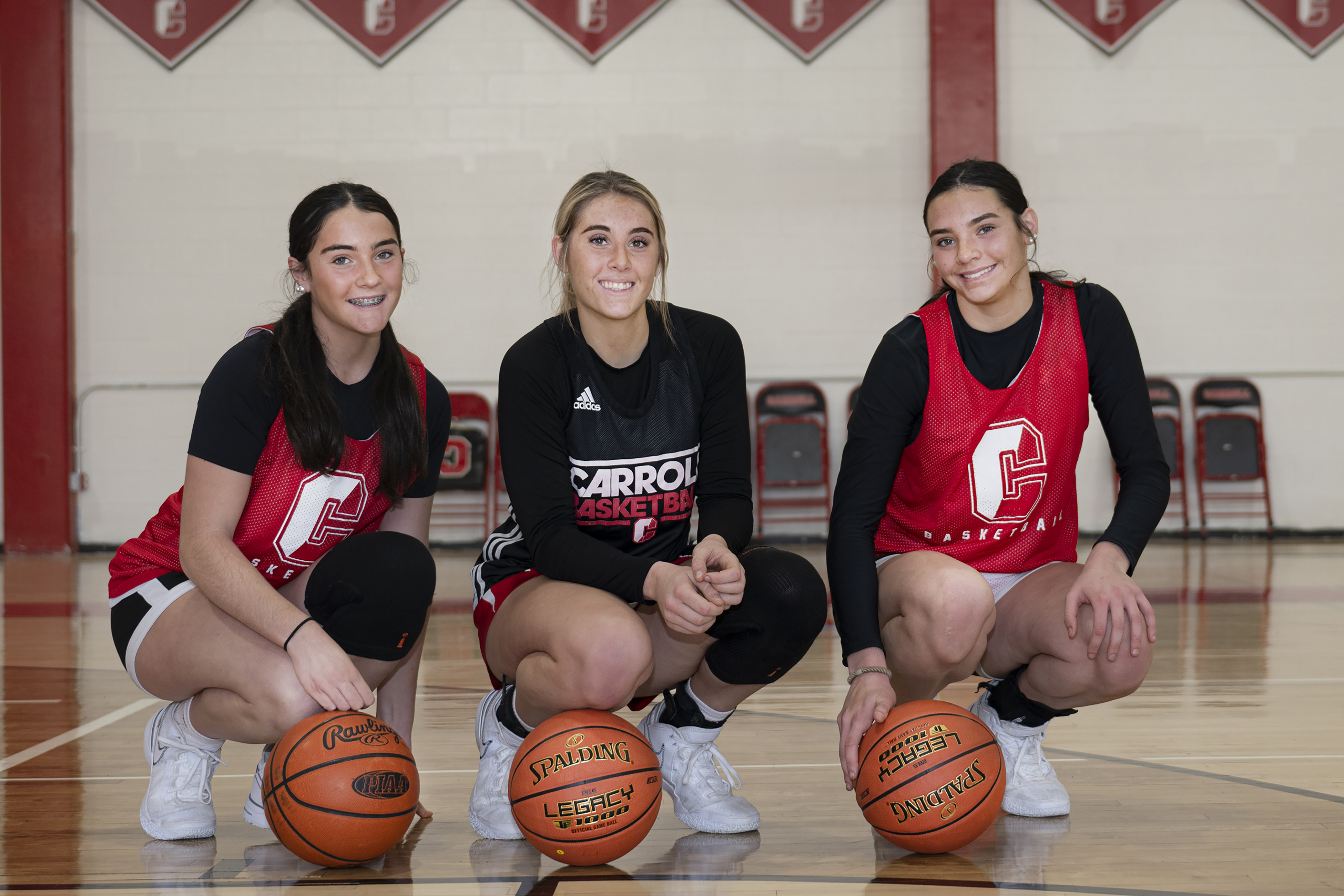
Like her parents, Alexis Eberz is planning to attend Villanova. The oldest daughter of former Villanova stars Eric Eberz and Michele Thornton, Alexis may be the best player in the Catholic League and is a strong candidate for PCL MVP.
One of her major challengers for that title lives under the same roof, her younger sister Kayla. Alexis is one of the most potent three-point shooters in the area and has become more aggressive driving to the lane. She won a state championship as a freshman and is looking to finish a great high school career with the triple crown of a Catholic League championship, a District 12 title, and a PIAA Class 6A crown.
Kayla Eberz can handle the ball, shoot from a distance, rebound, defend, and at times dominate games. Only a sophomore, Kayla is receiving interest from numerous programs across the country, including Villanova, Michigan, and Marquette. What makes her unique is that she can defend anyone on the court, from point guards to centers. By the time she is a senior, Eberz projects to be one of the best players in the PCL and one of the most sought-after recruits in the country. She is among the best in Pennsylvania right now.
Eberz sisters (from left) Kelsey, Alexis, and Kayla last December.
Jada Lynch
Westtown, 5-11 junior guard
Lynch is the spitting image of her mother, former U.S. Open champion and tennis Hall of Famer Kim Clijsters, but the basketball gene came from her father, Brian Lynch, who played for Villanova. Jada plays for the Belgium under-18 national team. She shoots well and can shoot beyond the college three-point stripe. She is versatile, deceptively quick, can rebound, and has the competitive gene from her parents. She is getting attention from Power 4 schools.
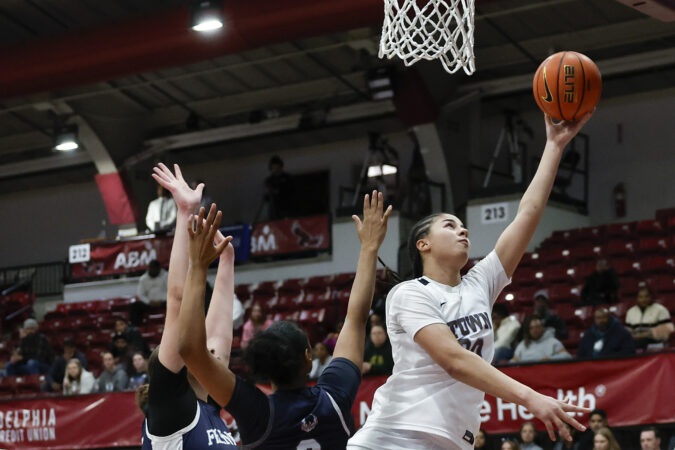
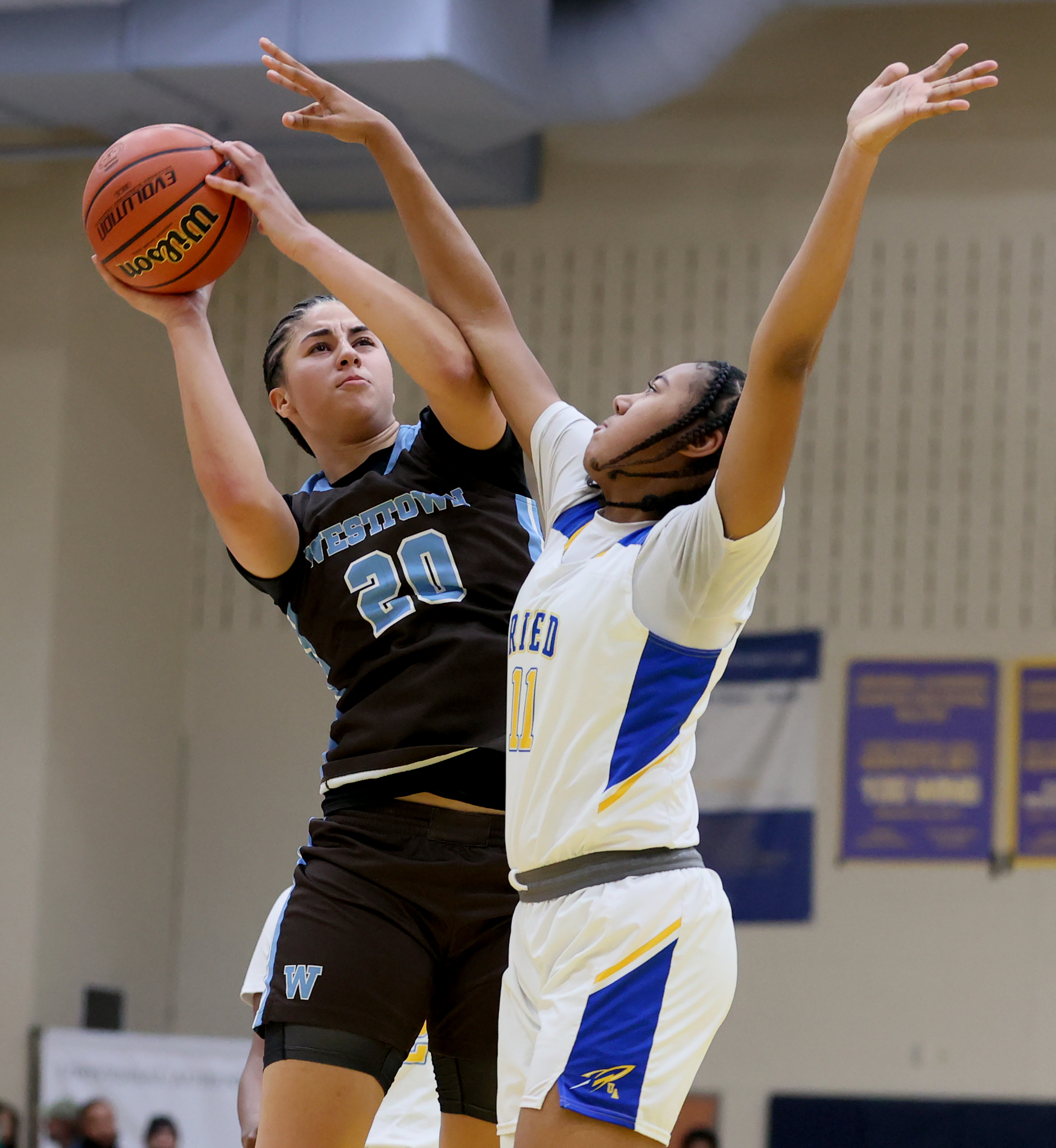
Palmer is the best player in Pennsylvania and one of the best players in the country. She’s been playing high school varsity basketball since she was in eighth grade. She will be able to go to any top-10 program in the country. She simply dominates games with her ballhandling, shooting, rebounding, high basketball IQ, and with the energy she brings.
She can finish left- or right-handed, and has added a more consistent perimeter game. She’s also a team player, making it a point to get her teammates involved. She plays with poise despite the constant attention she has had on her since she was a freshman.
Jordyn Palmer (left) of Westtown shoots over Nasiaah Russell of Universal Audenried Charter during a game on Nov. 30, 2024.
Nasiaah Russell
Audenried, 6-3 junior center/power forward
This should be Russell’s breakout year. With the graduation of Philadelphia’s all-time leading scorer Shayla Smith, who is now at Penn State, it will be up to Russell to lead the defending Public League champions. Russell has grown an inch and gotten stronger since last season, now able to dunk. A dominant shot blocker, Russell averaged nine points, seven rebounds, and two blocks as a sophomore. She has made a complete recovery from tearing an ACL in her right knee as a freshman in December 2023.
Small is an athletic 6-2 forward who can do everything. Her strength is her defense and creating turnovers. She started at Scranton High as a freshman and arrived at Friends’ Central as a sophomore, displaying her athletic versatility to play multiple positions, block shots, rebound, and alter shots.
She is considered one of the best players in the state, and is now teamed with one of the country’s best players in Carter.
Atlee Vanesko
Westtown, 6-foot senior combo guard
Vanesko is bound for Ohio State. She is a three-year captain at Westtown, the premier program in the area. She can shoot, and at 6-foot, she is not afraid to rebound and defend. She is a pass-first guard. She can also knock down an open three.
Eight years after the Philadelphia arts community learned it could lose the 7,000-square-foot mosaic that for decades wrapped around an Old City building, the structure’s current owner has started to demolish it.
The fate of the building was the subject of an almost six-year legal battle. Artists and preservationists wanted to save the building. Neighbors opposed a developer’s plans to preserve it.
That developer — architect and building owner Shimi Zakin of Atrium Design Group — had proposed constructing apartments above the mural with a design The Inquirer’s architecture critic called “a terrific work of architecture.”
Zakin received a permit from the city in September to tear down the building. He plans to replace it with 85 apartments and about 6,000 square feet of commercial space. The new building would be six stories and 65 feet tall.
A digger operator walking through inside of the former Painted Bride building, Old City Philadelphia, Monday, December 8, 2025.
Zakin did not respond to a request for comment about the start of demolition at the site. In September, he told The Inquirer: “We are moving forward with an amazing project at an amazing location.”
He estimated that his apartment building would take about 2½ years to complete.
For now, a black wooden fence surrounds the former Painted Bride building while demolition equipment tears out its insides, and the walls await their turn.
The giant, inflatable positivity rabbit got the boot from the Eagles locker room after less than a week, but its spirit lives on a few stalls away.
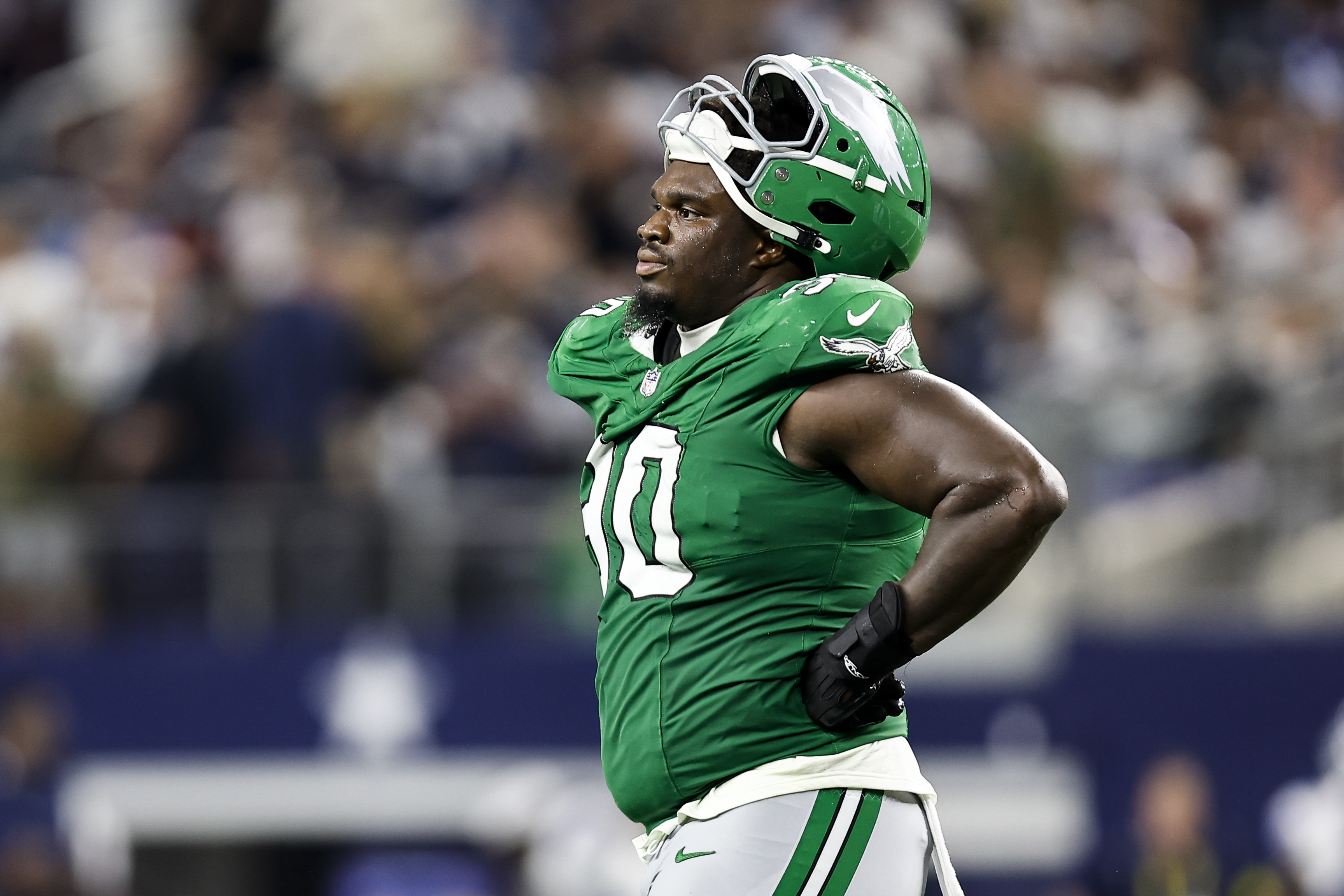
Jordan Davis, whom defensive line coach Clint Hurtt referred to on the latest episode of Hard Knocks as a “big ass [freaking] Care Bear,” couldn’t shake the perpetual smile on his face on Wednesday. His optimism, he explained, hasn’t wavered, even amid a three-game losing streak in which the offense hasn’t eclipsed more than 21 points.
Vic Fangio’s defense has been operating on a different wavelength. Since the bye week, the Eagles have conceded nine total touchdowns, tied for the second-fewest in the league among teams that have played five games in that span. Davis was brilliant Monday night in the loss to the Los Angeles Chargers, notching 1½ sacks, six pressures, and six stops, which Next Gen Stats defines as tackles that result in a successful play for the defense.
Jordan Davis has had a breakout year after receiving an offseason contract extension.
Last month after the Eagles’ narrow win over the Green Bay Packers, A.J. Brownexpressed his dismay about the defense putting a Band-Aid over the offense’s shortcomings too frequently. But the offense’s inconsistencies haven’t shaken the confidence of the defense, Davis explained Wednesday, four days before the Eagles’ Week 15 game against the Las Vegas Raiders.
“I know for me, personally, I’m never wavered by that stuff,” Davis said. “Offense is going to have their games. And I’m so deep into this faith in the offense that I have, that one day, hopefully very, very soon, it’s going to click. And when it does click, watch out. ’Cause we all know what we’re capable of. We all know that we’re capable of much more.
“We have to keep keeping the faith, because I feel like a lot of people are just kind of losing faith. And whether that’s y’all or whether that’s the fans, whatever. But me, I’m still 10 toes down for this team. I hope that we just go out there one game and we just put a 100 ball on them and we play a high level of defense. I‘m always telling them, I’m always confident. I always say before we walk out, go on the field for the game, I say, ‘Each and every [expletive] in this locker room, I have full faith in.’ Because I wouldn’t be playing this game at my purest confidence if I wasn’t confident in the team that I have behind me.”
Outside the locker room, that sense of confidence in the Eagles offense is waning. Jalen Hurts committed five turnovers (four interceptions, one fumble) in the loss to the Chargers. Brown and DeVonta Smith each had drops. Saquon Barkley had his second-longest rush of the season (a 52-yarder for a touchdown), but he also had his share of negative runs that have plagued him all season.
Still, Davis, the No. 13 overall pick for the Eagles in 2022 out of Georgia, remains a beacon of positivity inside the NovaCare Complex. He ought to understand the power of belief. Despite the slow start to Davis’ career, the Eagles picked up his fifth-year option in the offseason. Now, he is becoming the every-down defensive tackle the Eagles envisioned when they drafted him, stepping up while Jalen Carter has been dealing with shoulder injuries this season.
Davis is lending a bit of that sense of belief to his teammates on the other side of the ball, even if they might be lacking in it themselves.
“I’m grateful,” Davis said. “Because even though we’re not doing too hot on the offensive side, when you have somebody that they believe in you, they at least want to play hard for them. And if that’s all they give me, I’m cool with that. I’m cool with that. I just want them to feed off that energy, feed off that faithfulness that I have in them. I just want them to have that for themselves.”
He is consciously trying to keep the energy high despite the team’s misfortunes on the field. Davis cracks jokes when he can. He calls his teammates out when they aren’t smiling.
The offense’s struggles haven’t deflated him, nor has the external criticism, Davis explained. If anything, those factors have motivated him to play harder.
“I love the guys and it hurts my soul when I see all the talk and all the stuff going out here and just seeing everybody down and everybody kind of putting people down,” Davis said. “’Cause that’s not how I live. I live positively. But, two, these are my people you’re talking about.
“I see people talking negative about this stuff. I’m like, man, I really want to go to war for these guys, because man, these are my people you’re talking about. And I’m so confident in the things that they’re capable of doing.”
Injury report
The Eagles did not practice on Wednesday, so the injury report was an estimation. Carter (shoulders) and Lane Johnson (foot) were listed as would-be non-participants.
Johnson has missed the last three games, but the tackle was not put on injured reserve following the win over the Detroit Lions, indicating that he could return in less than four weeks.
Landon Dickerson (calf) was listed as limited. Zack Baun (hand) and Charley Hughlett (abdomen; injured reserve) were listed as full participants.
The Eagles are scheduled to practice for the first time this week on Thursday.
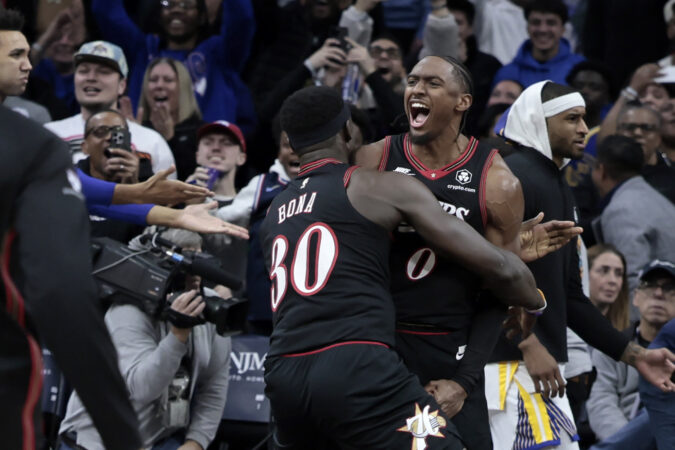
When Tyrese Maxey flew down the court for his game-saving block on the Golden State Warriors’ De’Anthony Melton last week, it was not only an impressive burst of speed.
“That’s conditioning, too,” Doc Rivers, the Milwaukee Bucks coach who formerly was with the 76ers, said while commending Maxey’s play the following day. “If you’re tired mentally or physically, you can’t make that play.”
Maxey insists that, a quarter of the way through this season, he is not fatigued. But perhaps no Sixer is savoring this light stretch in the schedule before Friday night’s game with visiting Indiana more than their star point guard.
Maxey entered Thursday leading the NBA in minutes played, averaging 39.9 in 23 games. That is three minutes greater than the next player with a comparable number of games logged (the Los Angeles Lakers’ Austin Reeves’ 36.9 minutes in 21).
Maxey’s recent workloads have included playing the entire second half and overtime of a Nov. 20 win at the Milwaukee Bucks, when he scored a career-high 54 points. In a Nov. 30 double-overtime loss to the Orlando Magic, he played more minutes (52) than there are in a typical NBA game (48).
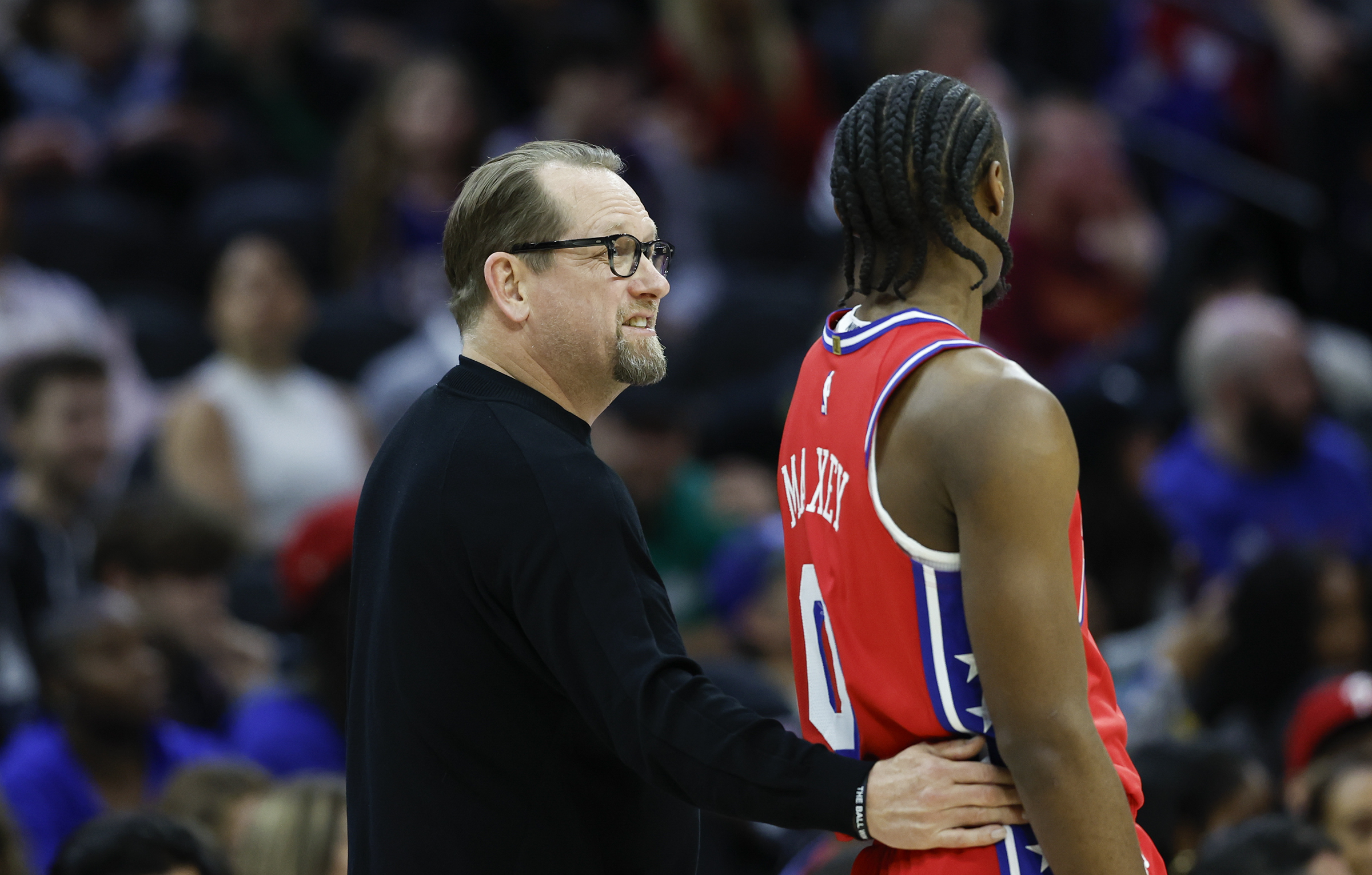
No NBA player has averaged 40 minutes or more per game since Monta Ellis with Golden State in 2010-11 (40.3). So conventional wisdom says this pace for Maxey is not sustainable for the 82-game grind. Sixers coach Nick Nurse hopes having the team’s four rotation guards healthy — and productive — will ease Maxey’s load moving forward.
Still, it has taken impressive physical fitness and mental fortitude for Maxey to pull this off for the season’s first seven weeks while playing at an All-NBA level. He entered Thursday ranked third in the league in scoring (31.5 points per game) and averaging a career-high 7.2 assists and 4.7 rebounds.
“He’s a warrior,” teammate Paul George said. “There’s no question about it. He’s a fighter. … [There’s] a leadership about him. And when he’s out there, I play for him. I do everything I can to make the game easier for him. He’s our guy. It’s inspiring. Me, as a vet, it’s inspiring for a guy to consistently do it — and to be efficient with all the minutes that he’s been playing.”
Nurse said Maxey’s relentless energy stems from him being “lost in the competitiveness” of the Sixers’ 13-10 start, that “it’s not like I’m sitting there saying, ‘Hey, you’ve got to come out.’ It’s the other way around. He doesn’t want to come out.”
It’s also a responsibility to which Maxey has become accustomed. Last season, he led the NBA at 37.7 minutes per game in 52 games. In 2023-24, he ranked second in the league in that category, with 37.5 minutes in 70 games.
Nurse’s top players racking up heavy minutes has also become a trademark of his coaching approach. Pascal Siakam, when he was a Toronto Raptor, led the NBA for two consecutive seasons, in 2021-23, while Fred VanVleet landed in the top five in both seasons. This season, fellow Sixers Kelly Oubre Jr. (34.8 minutes) and VJ Edgecombe (34.6) rank in the top 20, although their workloads have been diminished by injuries.
Though there may not appear to be a massive difference between 37 and 40 minutes on the court, they add up game after game. Especially when Maxey is so active in generating the Sixers’ offense with the ball in his hands, and he has become more of a defensive playmaker.
“He’s taken that challenge on a nightly basis, while being guarded by the best defender, usually,” George said Wednesday. “ … He’s doesn’t look for a night off, to go and sit in the corner and guard no one.”
Maxey, 25, credits sports performance consultant Alexander Reeser with building foundational offseason strength and conditioning programs that “[push] me to my max limit, every day.” Maxey also has gained a reputation for his early morning on-court workouts, and for sometimes clocking in for as many as three sessions per day.
Last season, Maxey added, was his first time “really locking in” on recovery, an effort to blend his present high performance with career longevity. Which means his routine between games in-season has become “very minimal work, for obvious reasons,” Nurse said.
Maxey said the goal of his individual sessions is not “running around” to get to his spots on the floor to shoot — or to execute elaborate dribble combinations — which expend more energy. Instead, he drills passing, touch layups, floaters, and jumpers from the midrange and beyond the arc.
“It’s the stuff you do after you do the move,” Maxey said. “Making sure it feels good.”
Added Nurse: “He’s maturing a little bit, to have the confidence to just understand he can roll [in games] without having to have a big day on the floor on the off days.”
Nurse has tinkered with when to rest Maxey, typically at the end of the first and/or third quarters or at the beginning of the second and/or fourth quarters. In that Nov. 20 game at Milwaukee, however, Maxey told Nurse, “Coach, let me go,” leading to him playing the final 29 minutes. Yet even within those lengthy on-court stretches, teammate Jared McCain has noticed Maxey going “straight to sit down” on the bench during timeouts.
“Give him his time to breathe and rest,” McCain said. “[It’s] definitely a responsibility … [that] all the guards take, and something we’ve got to help him with.”
Sixers coach Nick Nurse has started to lean on a three-guard lineup without Tyrese Maxey to give him much-needed time on the sideline.
The Sixers’ new-look offense, after all, has been built around its four rotation guards — Maxey, Edgecombe, McCain, and Quentin Grimes — who can score, push the pace, and pass in a variety of lineup combinations. But only recently did that full group reach full strength.
McCain got off to a rocky start after missing nearly a calendar year following knee and thumb surgeries, but now he looks like a threat to score from all three levels. Edgecombe, a hyper-athletic two-way player, missed three games with a calf injury. And, outside the backcourt, max players George and former MVP Joel Embiid remain limited after offseason knee surgeries.
“That’s kind of part of the reason we spread the floor out and we’re moving the ball a lot more,” Nurse said of those guard-heavy looks last week. “We’re trying to get them to play downhill and off the catch. We just haven’t quite got to it yet. There’s glimpses of it. …
“We’re just [spreading] them out, and they go back and forth and move the pieces a little bit and then, boom, one of them’s down the lane. I hope they make a good decision. They either take it forcibly to the rim, or they just kick it out to a shooter or start it all over again.”
Perhaps the start of the second quarter of Sunday’s 112-108 loss to the Lakers offered some encouragement, when the Sixers turned a tie game into an eight-point advantage while Maxey rested for nearly six minutes. But their latest poor third quarter followed, and then LeBron James’ shot-making buried the Sixers down the stretch.
That the vast majority of the Sixers’ games so far have been tight has also contributed to Maxey’s workload. They entered Wednesday having played the league’s third-most “clutch” games (16), which occurs when the score is within five points or less with five minutes remaining in the fourth quarter.
So when the Sixers staged a rare blowout win over the Washington Wizards last week — and Maxey logged a season-low 29 minutes — he chuckled when asked if he could immediately play another game.
“Yeah, I guess so,” he said.
Maxey followed that up by amassing 40 minutes against the Warriors and 37 at the Bucks on back-to-back nights. Then, another 39 against the Lakers.
After that game, how did Maxey plan to spend this lighter stretch in the schedule?
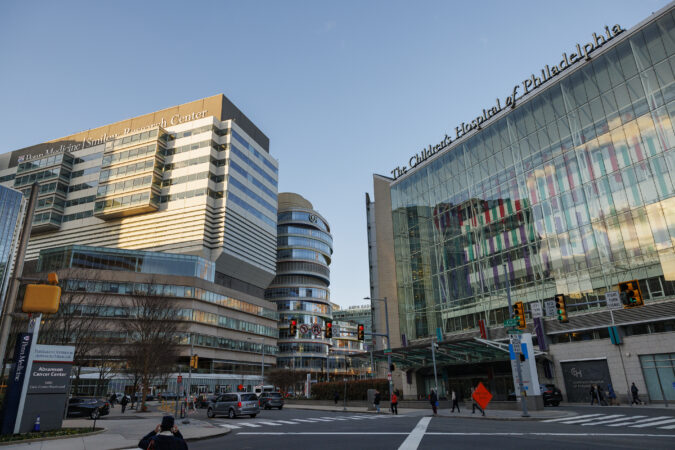
Children’s Hospital of Philadelphia was the most profitable nonprofit health system in Southeastern Pennsylvania during the three months that ended Sept. 30, according to an Inquirer review of financial filings.
CHOP reported $70 million in operating income in the first quarter of fiscal 2026, up from $67 million the same period a year ago. The nonprofit’s revenue climbed nearly 9% to $1.3 billion.
The biggest loss in percentage terms was at Redeemer Health, the region’s smallest health system and the only remaining operator with a single hospital. Redeemer had an $11.7 million operating loss on $103.4 million in quarterly revenue. That was an improvement over an $18.9 million loss last year.
Jefferson Health had the most patient revenue following its acquisition last year of Lehigh Valley Health Network. The 32-hospital system had $2.9 billion in patient revenue, $100 million more than the $2.8 billion at the University of Pennsylvania Health System, which has seven hospitals.
window.addEventListener(“message”,function(a){if(void 0!==a.data[“datawrapper-height”]){var e=document.querySelectorAll(“iframe”);for(var t in a.data[“datawrapper-height”])for(var r,i=0;r=e[i];i++)if(r.contentWindow===a.source){var d=a.data[“datawrapper-height”][t]+”px”;r.style.height=d}}});
Here’s a recap of selected systems’ results for September quarter:
Jefferson Health
Jefferson Health reported a $104 million operating loss, as its insurance business continued to drag down results. The loss included $19.4 million in restructuring charges for employee severance related to earlier job cuts and moves designed to make the system more efficient.
University of Pennsylvania Health System
University of Pennsylvania Health System had an operating gain of $109.3 million, up from $49.3 million in the same period a year ago. This year’s results include Doylestown Health, which Penn acquired April 1. Total revenue was $3.3 billion, up from $2.8 billion a year ago.
Temple University Health System
Temple University Health System’s loss in the quarter was $15 million, an improvement over a $17 million loss last year. Total revenue was $800 million, up 13% from $712.5 million a year ago. Outpatient revenue increased by nearly $62 million, much of it from the health system’s specialty and retail pharmacy business.
Lil’ Filmmakers, a Roxborough-based nonprofit, was supposed to have $170,000 in the bank.
The mission of helping young people become storytellers through film and media had caught the attention of major donors in 2025. The city awarded it a $28,000 anti-violence grant, and one of Michael Jordan’s charitable organizations issued a separate $35,000 grant. Funding should not have been a problem, according to CEO Janine Spruill, who started the program in 1999.
But on Aug. 27, neither she nor her fourstaffers, nor her summer program participants, had gotten paid by the Federation of Neighborhood Centers, the Philadelphia nonprofit that managed their money.
She remembers FNC staff telling her they had decided not to processpayroll because they were trying to “figure some things out.” Without specifics, Spruill walked away suspecting the worst.
“I went into a bit of a panic mode,” Spruill said, upset that she hadn’t even been given a heads-up. “I ended up crying my eyes out because I said, ‘Oh, my God, I raised all this money, and they’re telling me they don’t have it.’”
Other organizations that had contracts with FNC soon realized that they, too, were having issues accessing their funds. They reported overdue invoices, payroll issues, and spotty communication with FNC.
As the weeks turned into months, Spruill said, FNC would not let her access the money she had raised. She had to launch emergency fundraisers.
The announcement many of the groups dreaded arrived in November. FNC’s grant management services — known as a fiscal sponsorship program in the nonprofit world — would shut down Dec. 31.
“This choice does not come lightly,” said FNC’s announcement on its website. “It comes after years of carrying work that we believed in wholeheartedly — often beyond our capacity — because we care deeply about every project, every leader, and every community member who trusted us with their mission.”
FNC’s collapse, by its own admission, is a story of an organization that grew too quickly and let basic accounting principles go by the wayside. Demir Moore, the nonprofit’s new CEO as of Aug. 26 and a former Lil’ Filmmakers intern, insisted FNC’s collapse was due to a “lapse of management” and “absolutely not attributable to malfeasance or embezzlement.”
FNC spent itself into a deficit over the course of years, continuously using money belonging to one group to pay for another, according to Thaddeus Squire of Social Impact Commons, an organization aiding FNC as it winds down.
“That deficit started to become unrecoverable,” he said. “Money that was borrowed was not put back.”
Moore declined to say how much money FNC has or how many groups are affected by the end of the fiscal sponsorship program. FNC has about 50 groups on its rolls, he said, but some have not been active or have no funds with the nonprofit.
Still, it is unclear how the nonprofit was able to operate the way it did for years. Sorting out just how FNC’s fiscal sponsorship program unraveled is going to take time, Moore said, declining to comment on leadership turnover in the last year.
Attempts to reach past FNC leadership for insight on what transpired were unsuccessful.
And while Moore described a round-the-clock effort to sort out how much every group should have in its account, he would not say for certain whether groups would get all their funds back by the time FNC shuts down.
When the ‘safe approach’ loses control
When run right, a fiscal sponsor can be a boon to newer community groups that do not have a tax-exempt status. By contracting with fiscal sponsors, which are registered as 501c3s, these smaller groups can apply for grants.
Donors are left assured that a more established nonprofit is guiding the smaller or newer group, said Brian Mittendorf, the H.P. Wolfe Chair in Accounting at Ohio State University, who specializes in nonprofit accounting.
“Financial difficulties at fiscal sponsors are much less frequent just because their position … is typically an indicator that they have strong financial controls and other infrastructure in place,” he said, adding that signing with a fiscal sponsor is “often viewed as the safe approach.”
Fiscal sponsors can also be of much help to registered nonprofits that would rather focus on providing services than on managing administrative tasks.
In exchange for a fee, the sponsor signs on to manage and distribute grants, offer reports, and take on a range of tasks, such as payroll or legal questions, giving community groups peace of mind.
For Lil’ Filmmakers, the promise of back-office support led it to contract with FNC nearly a decade ago. Spruill said the monthly accounting report FNC sent her would sometimes require adjustments, but she cited no major issues until this year.
The first red flag came in March. Spruill said FNC did not pay the rent for Lil’ Filmmakers’ studio in Roxborough. FNC ultimately took care of the late fees and cut the rent check, so Spruill said she chalked it up as a one-time occurrence.
Teens at the Lil’ Filmmakers nonprofit learn the ins and outs of filmmaking.
What Spruill and other community group leaders could not see was an organization Moore said could not keep up with its own expansion. The nonprofit recorded a revenue of $774,000 in 2019 taxfilings, which peaked at $4.76 million in 2023.
A years-old message from then-CEO Jerry Tapley remained on the FNC website until this summer, touting more than 50 projects ranging from urban farming and the arts to animal rescue work. The organization’s work affected 250,000 people annually in “Philadelphia and beyond,” he wrote.
Moore said that as the nonprofit grew, FNC was not always collecting key documentation, such as receipts. Community groups were allowed to draw checks for funds they did not have, and balance statements given to groups were out of date or inaccurate.
When Moore stepped down as FNC board president and took over as CEO, the first thing he did, in an attempt to take stock of finances and accounts, was freeze outgoing payments.
While Moore described the move as a necessary first step, community groups struggled to pay for basic overhead, and some sought outside help. Soon, Philanthropy Network Greater Philadelphia and Social Impact Commons, an organization that supports fiscal sponsors, were working with FNC — but it was too late.
There did not appear to be any nefarious intent behind the mismanagement, Social Impact Commons’ Squire said, but FNC’s system allowed some projects to spend into the negative and for debt to snowball.
Social Impact Commons recommended FNC shut down its fiscal sponsorship program and “stop trying to catch up,” according to Squire.
Clarity may not come for at least several more weeks
Sharon Wilson, Lil’ Filmmakers’ attorney, said one of her biggest frustrations is what she finds to be a general lack of transparency as FNC winds down operations, despite her repeated requests for updates in writing.
“All of the information that was learned about FNC’s internal problems, and the fact they were failing other nonprofits other than Lil’ Filmmakers, was all gleaned outside of them,” she said.
The way Moore explains it, the reason FNC has not outright said all community groups would be made whole is that figuring out who is owed what will take at least several more weeks. He said FNC does have funds available, but until the reconciliation process is complete, “no final conclusions can be made about individual project balances or what each project’s final financial position will be.”
Polaroids from a community pet day at Lil’ Filmmakers Thursday, Dec. 4, 2025. The Roxborough based nonprofit and other community groups claim they have been unable to access their funds managed by FNC, which insists it’s not a case of embezzlement or financial malfeasance
For now, multiple third parties, including the city, are working to move the process along.
The Philadelphia Office of Public Safety, for example, said Lil’ Filmmakers and three other anti-violence grant recipients with awards managed by FNC are in different parts of the process. Together, the groups had roughly $380,000 in city-issued funds awarded, which the city said are largely accounted for.
Though the final spending report for Lil’ Filmmakers remains in dispute, it might be resolved by the end of the month, according to the city.
In the meantime, a public safety office spokesperson said staffers were working with organizations to help close their accounts with FNC and offering technical assistance to its grant recipients, including bookkeeping and fiscal sponsor matchmaking.
Still, the office said, there is not much it can do for other grants awarded by other donors.
Complicating moneymatters further, some organizations used a California-based fundraising platform called Flipcause to collect donations. Last month, California’s attorney general sent a cease-and-desist order to the company, ordering it to halt operations after more than a dozen nonprofits in the state accused Flipcause of withholding funds. The platform also faces a class-action lawsuit in federal court.
In all, Moore said, FNC organizations have about $100,000 being withheld by Flipcause; Lil’ Filmmakers is not one of them.
Moore did not rule out that some groups might have less in their accounts than they were initially told in their FNC financial statements because of accounting discrepancies.
Squire went a step further, adding that philanthropic fundraising would be necessary.
“We’re cautiously optimistic that despite a lot of genuine harm that’s been done, that we can at least get people sorted out and back on their feet in the next few months,” Squire said.
The goal, he said, is that each of the groups needing to be placed with a new fiscal sponsor to access their money will have a new one by the end of the first quarter of 2026.
The results of the internal audits will likely determine any legal recourse or investigations. For example, the Pennsylvania Bureau of Corporations and Charitable Organizations, part of the Department of State, can impose fines against charities and revoke their registrations if they are found to be violating the state laws that govern them.
But Spruill, her staff, and her teaching artists cannot afford to keep waiting.
Lil’ Filmmakers has launched another fundraising campaign, this time for $50,000, so programming can continue uninterrupted.
When speaking about the financial setback, Spruill remains defiant.
“We refuse to let this stop the stories that need to be told,” reads her plea to donors.
When Adam Sawyer and his wife, Marissa Tan, moved to Philadelphia in 2024 from Baltimore, they were attracted to Center City by its proximity towork and mass transit.
The couple figured if they sold their car, they could even afford to rent in one of the thousands of new, high-rise apartments that have been built across Center City over the last 10 years.
Tan had just gotten a new job with the Cooper University Hospital in Camden, and Adam needed access to 30th Street Station for work. They eventually settled on the PMC Property Group’s Riverwalk North at 23rd and Arch Streets and have been impressed by the city, its transit system, and life without a car.
Adam Sawyer and his wife, Marissa Tan, moved to Philadelphia in 2024 from Baltimore.
“One of the things I love about living in a city is that you’ll be walking down the street and there are five different events you didn’t even know about,” Sawyer said. “Festivals, farmers markets, just activity, people doing things. I love that Philadelphia has so much energy.”
In many ways Sawyer and Tan — who are both 35 — are representative of the people who have taken up residence in the new apartment buildings across Center City. Between Pine and Vine Streets, river to river, 3,500 new apartments have opened since 2023.
Center City District (CCD) set out to learn more about who is calling these apartments home, with a survey of more than two dozen buildings constructed since 2015.
Like Sawyer and Tan, the vast majority of respondents to CCD’s survey are under 45 (83%), more than half don’t own a car (55%), and close to half moved from outside the Philadelphia area (44%). Sawyer works remotely like 21% of respondents, and Tan works in healthcare like 32% of them.
window.addEventListener(“message”,function(a){if(void 0!==a.data[“datawrapper-height”]){var e=document.querySelectorAll(“iframe”);for(var t in a.data[“datawrapper-height”])for(var r,i=0;r=e[i];i++)if(r.contentWindow===a.source){var d=a.data[“datawrapper-height”][t]+”px”;r.style.height=d}}});
In a city where a fifth of all residents live in poverty, the respondents aren’t representative of the average Philadelphian in many ways. The buildings surveyed have an average rent of $2,645, well above the median of $1,387.
But the results show that there is a market for the kind of new buildings that are still being proposed. They alsohighlight that many people are attracted to the most central parts of Philadelphia because it offersmore density, walkability, and other urban characteristics that few other American cities can boast.
“People actively choose Philadelphia over other cities and metropolitan areas because we outperform them in some ways,” said Clint Randall, vice president of Economic Development with CCD, which is funded by downtown property owners and provides advocacy and services like additional security and cleaning downtown.
“The city spent so many decades shrinking,” Randall said. “When you see this entire skyline of high-rise apartment buildings emerge, it contradicts what longtime Philadelphians think they know about this place, which is that it does not grow or attract residents.”
Reversing reverse commuting
Center City District’s survey confirmed a longtime finding of the organization’s other research reports: People who live downtown are likely to work there or very close by.
In Philadelphia, reverse commuting is common, a testament to the fact that many private-sector employers have remained outside the city to avoid wage and business taxes. But among survey respondents, only 12% commuted to the suburbs for work compared to almost 40% citywide.
Over half of respondents work in either Center City or University City, and a similar proportion work in either healthcare (32%) or in the jobs more typically associated with office towers: “business, professional, or financial services” (27%). Twenty-one percent work from home.
“A lot of people are in medicine, in healthcare. I see a lot of scrubs,” said Kaz Rivera-Gorski, about her building One Cathedral Squareat 17th and Race Streets.
window.addEventListener(“message”,function(a){if(void 0!==a.data[“datawrapper-height”]){var e=document.querySelectorAll(“iframe”);for(var t in a.data[“datawrapper-height”])for(var r,i=0;r=e[i];i++)if(r.contentWindow===a.source){var d=a.data[“datawrapper-height”][t]+”px”;r.style.height=d}}});
“I would imagine there’s a good amount of people that work remotely, too,” said Rivera-Gorski, who is a management consultant who works from home. “I see people on their laptops in the shared spaces during the day.”
Seventy percentof respondents said their jobs are within walking, biking, or transit distance from their homes, while 80% of them said that owning a car was not necessary to enjoy daily life in Philadelphia.
That’s part of what attracted Sawyer and Tan, even though another part of Philadelphia’s allure was that it was closer to family in central and eastern Pennsylvania (the couple have a Zipcar membership).
“While I do drive, I really, really dislike driving,” Sawyer said. “I’ve lost people. Everybody has, to either accidents or crashes or DUIs. So we were open to selling our car and became more and more convinced it was a good idea.”
window.addEventListener(“message”,function(a){if(void 0!==a.data[“datawrapper-height”]){var e=document.querySelectorAll(“iframe”);for(var t in a.data[“datawrapper-height”])for(var r,i=0;r=e[i];i++)if(r.contentWindow===a.source){var d=a.data[“datawrapper-height”][t]+”px”;r.style.height=d}}});
Retaining out-of-towners
Randall said that he was surprised by the proportion of CCD’s respondents who reported having moved to Philadelphia from outside the region. (A recent Realtor.com report showed that Philadelphia switched from having mostly local interest in rental listings before the pandemic to mostly out-of-towners today.)
The survey also found that the majority of Center City dwellers planned to be living in Philadelphia inthree to five years, with 45% planning to continue renting and 16% hoping to buy.
“You hear about the transience of other places like D.C. or Boston, and it seems like people are here [in Philadelphia] and they intend to stay,” Randall said.
That is certainly the goal of Annika Verma, a student at Temple University who lives in the Logan Lofts in Callowhill.
“I am already calculating: Can I get an entry-level job? What salary would work for the rent in this area?” Verma said. “I would love to stay. The area seems ideal for me in terms of commuting or walking. Anything, everything is a 15-20 minute walk or bus ride away.”
Sawyer and Tan are hoping to stay in Philadelphia, too. They are currently searching Center City for a condo to buy. They may try to stay in their current Logan Square neighborhood for its proximity to the Schuylkill River Trail and 30th Street Station.
“We love it,” said Sawyer, who notes that they’ve lived in three cities in Texas, Cooperstown in New York, and Baltimore before this. “But our favorite place we’ve ever lived is here in Philadelphia.”