Tag: topic-link-auto

  • How delays and bankruptcy let a nursing home chain avoid paying settlements for injuries and deaths

    How delays and bankruptcy let a nursing home chain avoid paying settlements for injuries and deaths

    Nancy Hunt arrived at an emergency room from a Genesis HealthCare nursing home in Pennsylvania in such dreadful shape, including maggots infesting her gangrened foot, that the hospital called an elder abuse hotline and then the police, her son alleged in a lawsuit.

    Hunt died five days later. Her death certificate said the foot injury was a “significant” factor. Genesis denied wrongdoing but agreed to pay $3.5 million in a settlement Hunt’s son signed in August 2024.

    Yet Genesis hasn’t paid most of that debt, court records show. It may never have to.

    Once the nation’s largest nursing home chain, Genesis says it was spending $8 million a month defending and settling lawsuits over resident injuries and deaths in recent years. But the company is now poised to wipe the liability slate clean by seeking refuge in the most protective corner of the legal system for the nursing home industry: bankruptcy court.

    The Genesis case, one of 11 large senior care bankruptcies this year, illustrates how healthcare companies can dodge public and financial accountability for alleged negligence through delays, confidentiality clauses, and bankruptcy maneuvers, a KFF Health News investigation found.

    When it filed for bankruptcy in Dallas in July, Genesis estimated its total liability for nearly a thousand settled and pending lawsuits at $259 million. A KFF Health News review of the terms of 155 settlement agreements and corporate financial statements shows Genesis officials knew insolvency was possible yet included provisions in its settlement agreements allowing it to defer payment, often for a year or more.

    As a result, the company headquartered in Kennett Square paid nothing in 85 cases and only a portion in the other 70, according to civil court records and bankruptcy claims made available through people with access to them. It still owes $41 million of the $58 million it had agreed to pay in those cases, the records show.

    Nellie Betancourt, shown in a photo with her husband, Gabe, had planned a trip to Las Vegas before she fractured her hip at a Genesis HealthCare rehabilitation center — an injury the medical examiner’s report said led to her death. “When she went into that place, I said, ‘Well, she’s going to be taken care of for a few more days and I’ll take her home,’” Gabe says. (Adria Malcolm for KFF Health News)

    “It just feels like they killed my mom and got away with it,” said Vanessa Betancourt, whose mother, Nellie Betancourt, a retired nurse, fractured her hip at a Genesis home in Albuquerque, N.M. — an injury the medical examiner’s report said led to her death. Genesis agreed to a $650,000 settlement with Betancourt’s family in April under the condition it would not need to pay the first of seven installments for another year, according to the settlement document.

    Genesis denied wrongdoing in all lawsuits and settlements. In a written statement, the company did not answer questions about individual personal injury cases. The statement said Genesis remained “focused on delivering high-quality, compassionate care to our patients and residents without disruption” during bankruptcy.

    One lawsuit Genesis settled for nearly $1 million alleged nursing home managers ignored repeated warnings about a male resident’s behavior before he sexually assaulted a female Alzheimer’s patient, according to court records. In a case the company resolved for $500,000, a Genesis nursing home was accused of delaying the hospitalization of a resident who had vomited brown mucus. He died of a bowel obstruction. Genesis has paid nothing for either settlement, according to bankruptcy claims.

    Creditors, including families of the deceased, are expected to salvage a fraction of what they were promised, if anything. On Dec. 10, the company’s owners were scheduled to seek approval by the U.S. Bankruptcy Court for the Northern District of Texas to sell its nursing homes and other assets to its largest investor, a private equity firm. In court papers, lawyers for residents and other creditors say the complex plan will prevent them from pursuing Genesis’ new ownership and other companies they blame for the company’s collapse.

    John Anthony, a bankruptcy attorney representing 340 personal injury claims against Genesis, said, “They never had any intention to honor these deals.”

    Low ratings and fines

    During years of financial turmoil, Genesis has frequently struggled to provide top-notch care, federal records show. Using its five-star system, the Centers for Medicare & Medicaid Services rated 58% of homes affiliated with Genesis as below average or much below average. CMS has fined Genesis homes $10 million for violating federal health standards over the past three years.

    In 2022, Connecticut health regulators shuttered a Genesis home after two deaths and multiple violations. The company closed another Connecticut nursing home this year after residents twice were evacuated over safety concerns.

    In its Chapter 11 filing, Genesis said it cared for about 15,000 residents in 165 nursing homes and 10 assisted living facilities in 18 states. They are centered in Pennsylvania, West Virginia, New Mexico, New Hampshire, New Jersey, Maine, Alabama, Maryland, and North Carolina, according to the bankruptcy filing.

    The company said it owed $709 million in secured debt to lenders and the IRS. Under bankruptcy rules, those debts, backed by Genesis collateral, take precedence over the $1.6 billion in unsecured debt Genesis said it owes. Unsecured creditors include a pension fund; contractors that provided health services and equipment; Pennsylvania, New Mexico, and West Virginia for unpaid provider taxes; and former residents and their families who sued.

    Dangers in memory care

    Sandia Ridge Center, a Genesis home in Albuquerque, was repeatedly faulted by health regulators for not preventing sexual misbehavior in its memory care unit. In November 2021, CMS cited the home for lacking enough nurses to prevent sexual abuse among residents. An inspection report the following August identified more inappropriate sexual contact. Police were called to investigate sexual assault allegations in February and March of 2023, police reports show; neither resulted in criminal charges.

    Then in April 2023, a 61-year-old male resident with alcohol-related dementia sexually assaulted a female resident with Alzheimer’s in the dining room, according to a police report and an inspection report. When the resident screamed for him to stop and that he was hurting her, he responded “shut up bitch I know you like this,” according to a lawsuit brought on behalf of the woman, identified in court papers as R.S.

    Sandia Ridge management had been aware of the male resident’s behavioral issues for months, according to employee depositions in the case. Police had investigated a prior sexual assault allegation against him the previous year without bringing charges. In one deposition, a former activities assistant testified he hit her and twice pushed her into a bathroom while announcing, “I want to have sex with you.” When she reported him to a senior Genesis manager, she said in the deposition, the manager put his finger over his lips and said, “Shhh.”

    The activities worker testified that R.S. used to happily sing along with Elvis Presley songs. After the assault, the worker said, R.S. “don’t sing anymore.”

    Inspectors cited the home for failing to protect R.S. The same report said the home didn’t provide a therapist for another female resident who was being sexually harassed. Medicare fined Sandia Ridge Center $91,247. Genesis denied liability but settled R.S.’ lawsuit for $925,000 in May, according to the bankruptcy claim.

    “We just felt we have to hold them accountable,” R.S.’ daughter said in an interview, speaking on the condition that she and her mother not be identified, because of the nature of the assault. “Maybe I’m wrong, maybe I’m naive, but the only way to do that is to sue someone, right?”

    Genesis has not paid any of the settlement, according to the family’s claim filing.

    Growth and debt

    Genesis’ downfall can be traced to 2007, when affiliates of two private equity firms acquired the company in a $1.5 billion leveraged buyout, taking on substantial debt, according to its bankruptcy filing. Private equity also has been involved in other healthcare bankruptcies, including those of the HCR ManorCare nursing home chain, the prison healthcare contractor Corizon Health, and two for-profit hospital systems, Steward Health Care and Prospect Medical Holdings.

    In 2011, Genesis raised $2.4 billion by transferring substantially all its nursing home buildings and other real estate to Welltower, a publicly traded real estate investment trust, according to Genesis’ bankruptcy filing. Genesis then rented the buildings back from Welltower, which made leasing costs a significant expense.

    Genesis went on a nationwide buying spree. At its peak in 2016, it had grown to more than 500 nursing homes. In a court declaration, Louis Robichaux IV, a consultant overseeing Genesis’ bankruptcy restructuring, wrote that as the company expanded, it became harder to manage and “mired in corporate inefficiencies.” Robichaux wrote that Genesis’ financial woes were exacerbated by rapidly increasing labor costs and lawsuits, including some predating the COVID pandemic.

    Starting in 2021, Genesis avoided bankruptcy after receiving $100 million in loans from a private equity firm founded by Joel Landau, the owner of a Brooklyn-based nursing home chain, according to Robichaux’s filing.

    But Genesis continued to teeter on the edge of insolvency. In audited financial statements for 2022 and 2023 submitted to a California oversight agency, management and auditors said rent and debt obligations raised “substantial doubt about the company’s ability to continue as a going concern.”

    In a court filing, a committee appointed by the U.S. Trustee’s Office to represent the unsecured creditors in the bankruptcy accused Landau and Welltower of orchestrating a covert plan that allowed Welltower to keep getting its rents while Landau could run the company and “siphon value to himself.” The committee alleged their efforts forced the company into insolvency while “staffing levels and patient care declined precipitously.” Landau and Welltower did not respond to requests for comment.

    Drawn-out lawsuits

    Erin Pearson sued Genesis over the death of her father, James Sanderson, a retired mining company executive who died in 2018 after spending less than a month at Bear Canyon Rehabilitation Center in Albuquerque. In the memory care unit, Sanderson fell repeatedly, suffered medication errors made by nursing home staff, and developed a bowel obstruction and sepsis, according to the lawsuit, filed in 2019. Pearson’s lawyers said he was not hospitalized until eight days after nurses noticed he was vomiting brown mucus.

    After the judge rejected Genesis’ request to force Pearson into arbitration, Genesis appealed. It took 2½ years before an appeals court affirmed the original decision to let the case go forward in court, records show.

    This past May, more than five years after suing, Pearson reached a $500,000 settlement, with the first payment required by November, according to a copy of the agreement. Nothing was paid, according to the bankruptcy claim.

    “It was so drawn out and for so long,” Pearson said in an interview, calling Genesis’ bankruptcy “despicable.”

    Payouts postponed

    Jennifer Foote, an Albuquerque attorney who represents clients in multiple lawsuits against Genesis, including Pearson’s, said the company frequently filed appeals. “They did not usually win them on these issues,” she said, “and our sense was that they were doing it as a delay tactic.”

    Genesis started using installment payments around 2018, said Dusti Harvey, Foote’s law partner. “The payments wouldn’t start for several months out,” Harvey said. Foote said Genesis’ lawyers often wanted to time the payments to start the month the trial in the case was scheduled to occur.

    Families had to wait even when comparatively small amounts of money were involved, settlement agreements show. Genesis’ settlement agreements also included a confidentiality clause prohibiting discussion of the incidents.

    Genesis agreed to pay $42,000 in a November 2024 settlement, but the first payment was not due until nine months later. It was not paid, according to the bankruptcy claim.

    A $250,000 settlement signed in October 2023 did not start paying out until the following September. When Genesis declared bankruptcy — 21 months after the case was resolved — it still owed $100,000, according to the family’s claim.

    ‘We never found out the truth’

    Settling cases allowed Genesis to avoid the expense and publicity of a trial, at which details of how its nursing homes functioned might have been revealed. In October 2020, Margarett Johnson, a retired school bus driver, fell out of her wheelchair at a Genesis nursing home in Waldorf, Md., fracturing her jawbone, nose, and neck, according to a lawsuit brought by her family. Johnson was sent to a trauma center and placed on a ventilator. She died three months later, at age 76, from ventilator-associated pneumonia, the lawsuit said.

    “It looked like she was hit by a truck,” Angelina Harley, one of her daughters, said in an interview. “I knew my mom was not going to come home. I knew the Lord was not going to punish her more.”

    The company denied negligence and blamed the accident on Johnson’s jacket getting tangled in the wheel of her wheelchair, according to the lawsuit. Harley and her sister Angela Swann were dubious.

    “We never found out the truth,” Harley said. “They wanted to settle out of court.”

    The company denied liability but agreed to a $950,000 settlement in October 2024. It never paid the final $112,500 installment, according to a letter Johnson’s five children sent to the bankruptcy judge.

    “If you settle out of court, you know doggone well you did something wrong,” Harley said.

    Maddening judges

    By summer 2025, judges in some civil cases had run out of patience.

    Alma Brown, a retired daycare manager and accordion teacher living in a Genesis nursing home in Clovis, N.M., suffered falls, infections, bedsores, and other neglect that hastened her death in 2023, according to her estate’s lawsuit. In Santa Fe District Court, Judge Kathleen McGarry Ellenwood castigated Genesis after it failed to pay $2 million of the $3 million settlement to Brown’s estate or explain the delay.

    Genesis “obviously benefited by not having to go to trial,” McGarry Ellenwood said in one hearing, according to a court transcript. “They assure me that they’re not trying to renege on their contract, but it certainly seems like they haven’t lived up to what the bargain was.”

    Genesis declared bankruptcy the day McGarry Ellenwood announced she would impose more than $100,000 in fines, plus $10,000 more each day until the settlement was paid.

    In Pennsylvania, Greg Hunt petitioned a judge to punish Genesis after it stopped payments of the $3.5 million settlement after the death of his mother, Nancy, the resident with the gangrenous foot. She had spent eight months in 2019 at Brandywine Hall, a Genesis facility in West Chester that was later sold and renamed.

    In a filing with the Common Pleas Court of Montgomery County, Genesis admitted it was in arrears but asked the judge for more time, citing “unforeseen and exigent financial challenges.” Genesis said care for patients at its nursing homes would suffer if it had to pay immediately.

    Unswayed, Judge Richard Haaz in June ordered Genesis to pay up, along with punitive interest. But the bankruptcy court stayed that order. Genesis still owes $1.4 million of the $2 million it was supposed to pay, according to Hunt’s claim. (The rest of the $3.5 million settlement is supposed to be paid by an insurer in January 2026.) Ian Norris, Hunt’s lawyer, declined to comment, citing confidentiality provisions in the settlement.

    Court records indicate Genesis lawyers never disclosed in either case that it was preparing to declare bankruptcy.

    ‘Bankruptcy as a tool’

    In the first nine months of 2025, 10 other senior living companies with liabilities over $10 million entered Chapter 11 bankruptcy, according to Gibbins Advisors, a consulting firm.

    Hamid Rafatjoo, a bankruptcy lawyer representing nursing homes who is not involved in the Genesis bankruptcy case, said filings may increase as the industry has become costlier to run and class action lawsuits have become a fixture.

    “Nursing homes get sued all the time for everything,” Rafatjoo said. “A lot of operators wait too long to use bankruptcy as a tool.”

    On Dec. 1, Genesis announced the results of its auction, saying it had elected to sell its assets to a private equity firm controlled by Landau. In a court filing, Anthony, the attorney for the personal injury claimants, alleged the auction was stacked in Landau’s favor despite an “objectively better and higher competing bid” from another private equity investor that would have provided more money to creditors. Genesis said in its statement that Landau’s group had increased its bid during the auction.

    Sen. Elizabeth Warren (D-Mass.) and two other senators last month asked the U.S. Trustee’s Office to intervene in the case, out of concern that “individuals who already own or control Genesis are trying to sell it to themselves, wiping away legal and other creditor debts in the process.” Lawyers representing those in charge of the auction did not respond to a request for comment.

    Families of former Genesis residents said they fear the capacity to purge lawsuits through bankruptcy emboldens nursing homeowners who provide deficient care.

    “They can file bankruptcy again,” said Gabe Betancourt, whose wife, Nellie, died after her stay at Uptown Rehabilitation Center in Albuquerque. “And we’re the ones that will pay for it, with our memories, our lives.”

    KFF Health News is a national newsroom that produces in-depth journalism about health issues and is one of the core operating programs at KFF — the independent source for health policy research, polling, and journalism.


  • Plan to keep a Rocky statue at the top of the Art Museum steps moves forward

    Plan to keep a Rocky statue at the top of the Art Museum steps moves forward

    Keep punching, Rocky.

    Creative Philadelphia’s proposal to permanently install a Rocky statue at the top of the Philadelphia Art Museum’s famed steps is one step closer to reality following a Philadelphia Art Commission meeting Wednesday, though the plan fell short of receiving final approval following a mixed vote. Three commissioners voted to approve the concept, while one disapproved and two abstained.

    And, in perhaps bigger news to supporters, if the plan goes through, the screen-used statue that sits at the bottom of the Art Museum steps would be moved to the top thanks to what appears to be a change of heart from the Italian Stallion himself, Sylvester Stallone. Initially, the city planned to give the original statue back to Stallone, who gifted it to Philadelphia decades ago, and keep the other casting that now sits at the top of the Art Museum steps.

    “In response to the strong and heartfelt feedback from the public, Mr. Stallone has graciously decided that we will no longer move forward with the proposed statue swap,” chief cultural officer Valerie V. Gay said at Wednesday’s meeting. “This outcome reflects our shared commitment to listening deeply to the community and doing what is best for both the art and the people who cherish it.”

    Now, the city would keep the original, commissioned by Stallone for 1982’s Rocky III, while the second casting — reportedly purchased for about $403,000 at an auction in 2017 — would go back into the actor’s private collection. The second casting has been on (supposedly temporary) display at the top of the Art Museum’s iconic steps since last December, when Stallone lent it to the city for the inaugural RockyFest, which celebrates the Rocky franchise.

    What will happen, however, remained up in the air following Wednesday’s meeting. Commission members largely cited concerns over accessibility and feasibility with moving the Rocky statue to the top of the Art Museum steps, but ultimately approved the concept on the condition that Creative Philadelphia present further information before a future vote for final approval. The art commission is next slated to meet Jan. 14, members said Wednesday.

    The goal, Gay said, is to have only one Rocky statue at the Art Museum, and install another, as-yet-unannounced, city-owned statue at the bottom of the building’s steps where the original Rocky statue now stands.

    “It will not be Rocky,” Gay said. Philly, it should be noted, has a third Rocky statue at Philadelphia International Airport, which made its debut late last month in Terminal A-West.

    If approved, the plan would get underway next year. As part of “Rising Up: Rocky and the Making of Monuments,” an Art Museum exhibit slated to run from April to August, the original Rocky statue would be displayed inside the museum for the first time, while the loaner remains outside. At the conclusion of that exhibit, the original would be moved outside to the top of the Art Museum’s steps for its permanent installation, and the loaner would go back to Stallone, officials said Wednesday.

    Years of moves and debate

    Wednesday’s meeting marked yet another chapter in the Rocky statue’s controversial history in town. It arrived for the filming of Rocky III, but when the shoot wrapped in 1981, a permanent location had not been approved, causing it to be shipped back to Los Angeles. It ultimately came back and was temporarily exhibited again at the top of the Art Museum steps before being moved back and forth several times between that location and the Spectrum at the stadium complex in South Philly.

    Over the years, the statue has ignited public debate about whether it should be displayed at the Art Museum, and whether it is art in the first place. Still, it has been on display at the foot of the museum’s steps since 2006, where it has served as a draw for tourists and residents alike, attracting an estimated 4 million visitors per year, Creative Philadelphia officials said.

    Inquirer readers largely said in September that the statue temporarily installed at the top has overstayed its welcome, with about 46% of respondents to one poll saying no Rocky statue belongs at the top of the steps, but the one at the bottom should stay. Roughly 20% said the city should not have a Rocky statue at all.

    Gay, however, said Wednesday that the proposed permanent Rocky statue installation offers a chance to “allow art to bring our community together” and encourage visitors to the statue to take in the art on display inside the museum.

    “This is absolutely an amazing opportunity to expand our connection, our community’s connection, with art,” she said.

  • Pennsylvania Democrats are beginning their efforts to flip the state Senate in 2026 with this suburban Philly seat

    Pennsylvania Democrats are beginning their efforts to flip the state Senate in 2026 with this suburban Philly seat

    A Montgomery County Democratic Committee leader has set his sights on unseating a Republican state senator in the suburbs — part of a larger effort by Pennsylvania Democrats to flip the state Senate for the first time in 31 years.

    Chris Thomas, the former executive director of the Montgomery County Democratic Committee, who left his role at the end of November to run for Senate, launched his bid on Wednesday to challenge State Sen. Tracy Pennycuick, a first-term senator representing parts of Montgomery and Berks Counties.

    Thomas, 29, is also an Upper Frederick Township volunteer firefighter and taught in a Philadelphia public school for a year prior to his jump into politics. His campaign is focused on increasing public school funding, finding a new funding stream for mass transit, and making Pennsylvania more affordable for working people.

    Pa. state Rep. Tracy Pennycuick (R., Montgomery County). (Photo: Pa. House of Representatives)

    Thomas announced his campaign with dozens of endorsements from state and local elected officials, including five sitting senators from the Philadelphia suburbs. He also secured the endorsement of House Majority Leader Matt Bradford (D., Montgomery), another driving force behind the Democratic efforts to flip the state Senate in the 2026 midterm election in attempts to control all three branches of Pennsylvania’s government.

    Pennsylvania is one of few divided legislatures in the country, where Democrats hold a narrow majority in the state House, 102-101, and Republicans control the Senate, 27-23.

    Gov. Josh Shapiro, a Democrat, and House Democrats frequently butt heads with GOP Senate leaders. By flipping two seats next November, Democrats would tie the chamber 25-25 and Democratic Lt. Gov. Austin Davis would act as a tiebreaker. But Democrats are targeting four GOP-held seats, three of which are in the Philadelphia suburbs, in hopes of gaining control in the upper chamber for the first time in 31 years.

    The GOP-controlled state Senate has been a thorn in the side of Shapiro and House Democrats, as the more conservative members of the GOP Senate caucus have objected to most spending increases and rejected top Democratic priorities, like a long-term revenue source for mass transit. The state budget, passed in November, was 135 days late, requiring school districts, counties, and social service providers to take out loans or lay off staff to continue operating during the monthslong standoff.

    Mirroring national efforts to win control of congressional seats, Pennsylvania Democrats are targeting GOP-held districts that President Donald Trump won in 2024 but Shapiro carried in 2022. With Pennsylvania’s popular first-term governor and potential 2028 contender back at the top of the ticket — and a methodical, behind-the-scenes effort by Shapiro to orchestrate a decisive year for Democrats in 2026 — Democrats see it as possible this time around.

    Thomas’ first order of business if he is elected to Harrisburg and Democrats flip the chamber: electing Democratic floor leaders in the chamber.

    “No meaningful legislation moves in Harrisburg unless we fix who’s in charge, and right now Sen. Pennycuick is supporting a Senate leadership that’s failed working people,” Thomas said.

    Pennycuick said she “welcomes this campaign as an opportunity” to talk about the successes she has achieved while serving in the state Senate, such as her support for public education funding, reducing overreaching regulations, and her bipartisan proposal to create safeguards around artificial intelligence.

    Kofi Osei, a Towamencin Township supervisor and Democrat, has also announced his bid for Senate District 24, which stretches along the northwestern parts of Montgomery County and into parts of Berks County.

    The state Senate Democratic Campaign Committee does not endorse candidates in a primary election, and will support whoever wins the Democratic nomination in Pennsylvania’s May 19 primary. However, State Sen. Vincent Hughes (D., Philadelphia), who chairs the SDCC, said Thomas’ candidacy is “the right time and the right moment.”

    “I’m really excited about having a young person in there, generating young people and getting young people motivated,” Hughes added.

    The state Senate Republican Campaign Committee, meanwhile, is fundraising off Democrats’ efforts to flip the state’s upper chamber, warning voters that Democratic special interest group dollars are already pouring in.

    “State Democrats have made it clear their goal is to have a blue trifecta in Pennsylvania in 2026,” the SRCC wrote in a fundraising email Tuesday. “They know Senate Republicans are the last line of defense against Josh Shapiro and PA House Democrats far-left agenda.”

    Thomas was a public school teacher for one year at the Northeast Community Propel Academy, teaching seventh-grade math and science. He comes from a family of educators, he said, but quickly realized he needed to get more involved to improve the education system and government services to better serve these students. He made the jump to politics to try to make change.

    “I was sitting there, trying to feed my kids in the morning to make sure they had full stomachs to learn, having supplies to make sure they’re fully equipped for the day,” Thomas added. “I saw a system that wasn’t working for our students.”

    If elected, Thomas would be Pennsylvania’s youngest sitting state senator, and would join State Sen. Joe Picozzi (R., Philadelphia), 30, as part of a new generation of leaders hoping to shape the state’s future.

    “Our generation has grown up during economic crashes, school shootings, endless wars, and now we’re watching our parents and grandparents struggle to retire with dignity,” Thomas said.

  • Philly Council votes against Mayor Parker’s vision for her signature housing plan, signaling a win for progressives

    Philly Council votes against Mayor Parker’s vision for her signature housing plan, signaling a win for progressives

    For almost two years, Mayor Cherelle L. Parker has dominated Philadelphia City Hall with an unbending approach to negotiations.

    On Wednesday, City Council signaled those days may be over.

    During a combative hearing on legislation related to Parker’s signature housing initiative, Council President Kenyatta Johnson on Wednesday afternoon refused to allow a vote on an amendment brought by the Parker administration and instead advanced Council’s version of the proposal over the mayor’s objections.

    In a voice vote, Council’s Committee on Fiscal Stability and Intergovernmental Cooperation approved its own changes to the legislation — authorizing the city to take out $800 million in city bonds to fund Parker’s Housing Opportunities Made Easy, or H.O.M.E., initiative — without considering the mayor’s requested tweaks.

    Councilmembers Brian O’Neill, Anthony Phillips, and Curtis Jones Jr. signaled their support for Parker’s vision by voting against the measure, which now heads to the Council floor for a final passage vote or further amendments, either of which could come as soon as January.

    It is unclear how Johnson’s handling of H.O.M.E. will change the tight working relationship Parker and Johnson have maintained since both took office in January 2024. Wednesday’s vote marked their most contentious public disagreement during their tenures. Both officials still agree on many policy goals and have plenty to gain politically from maintaining their alliance.

    Philadelphia Mayor Cherelle L. Parker stands beside Council President Kenyatta Johnson (left) after finishing her budget address to City Council in Philadelphia City Hall on Thursday, March 13, 2025.

    The dispute between Parker and Council centers on income eligibility thresholds for two of the housing programs that will be funded by bond proceeds: the Basic Systems Repair Program (BSRP), which provides funding for needed home improvements to eligible owners who might be displaced by costly repairs, and the Adaptive Modification Program (AMP), which funds projects to improve mobility for permanently disabled renters and homeowners.

    Parker had structured the H.O.M.E. initiative with unusually high income cutoffs to make its programs more easily accessible to middle-class households, saying they are often left out of city assistance programs despite being crushed by rising costs.

    “The whole debate over income eligibility limits for BSRP and Adaptive Modifications is to make sure that we leave no working Philadelphian and no qualifying Philly rowhome owner excluded from these vital programs,” Parker said in a statement Wednesday. “If we don’t save Philly rowhomes, we’re going to become a city of used-to-be neighborhoods, blocks that used to be nice but now are showing signs of age and decline. I will not allow that to happen — not on my watch as Mayor of Philadelphia.”

    In a win for progressives, Council instead stuck to its plan of prioritizing lower-income Philadelphians.

    Councilmember Jamie Gauthier, who chairs the Committee on Housing, Neighborhood Development and the Homeless, said Wednesday’s vote sent the message “that Council takes its job seriously as a steward of taxpayer money in the city of Philadelphia, that we are not here to just rubber-stamp in a proposal, that we’re here to work together.”

    Change in fortunes for Parker

    Wednesday’s vote appears to mark the first instance of Parker’s hard-line negotiating tactics failing her since she took office. Even when she could not get negotiating counterparts to bend to her will in the past, Parker has largely prevailed.

    Last year, for instance, Council declined to vote on one of Parker’s school board nominees. But the nominee, incumbent board member Joyce Wilkerson, then pulled out a letter from Parker instructing her to remain on the board until the mayor names a replacement, which she still has not done.

    And in July, when the largest union for city workers went on strike to try to squeeze larger raises out of the administration, Parker stuck to her guns amid increasing pressure to fold as trash piled up across the city and 911 wait times grew longer. The union ultimately folded after an eight-day work stoppage with a new contract that closely aligned with Parker’s last offer before the strike began.

    But this time, Parker appears to be out of options to prevent Council from getting its way because she cannot veto another key piece of legislation to keep the housing initiative in motion that needs to pass before the city can issue the bonds. That measure — a resolution setting the first-year budget for H.O.M.E. that received preliminary approval in a Council committee last week — could see final approval as soon as Thursday.

    In a last-ditch effort to rally public support for her version of how the H.O.M.E. bonds should be spent, Parker on Sunday barnstormed across 10 Philadelphia churches.

    “We’ve got to take care of the people who are most in need, but we can’t penalize the people who are going to work every day, pay their taxes, contribute to the city, and they can’t benefit from home improvement programs,” she said.

    Mayor Cherelle L. Parker speaks to the crowd at The Church of Christian Compassion in the Cobbs Creek neighborhood of West Philadelphia on Sunday, Dec. 7, 2025. Parker visited 10 churches in Philadelphia on Sunday to share details about her H.O.M.E. housing plan.

    That maneuver did not appear to go over well with lawmakers, who likely did not appreciate the mayor encouraging their constituents to oppose Council’s version of the plan.

    Even before chief of staff Tiffany W. Thurman presented Parker’s amendment at Wednesday’s hearing, lawmakers sounded off, with Gauthier saying the administration was spreading “misinformation” and Councilmember Nicolas O’Rourke calling Parker’s approach “Trumpian.”

    “It was in response to misinformation being spread during that tour,” said Gauthier, who, along with fellow progressive Councilmember Rue Landau, led the charge to lower the income eligibility thresholds included in H.O.M.E.

    Gauthier noted that Council’s version of the bill still increases those thresholds beyond what is offered in existing programs.

    “Obviously, the mayor, all of us, have the right to go and talk to our constituents,” she said, “but we have to be operating from a fact-based perspective, and telling folks that the Council proposal excludes them is not factual.”

    No vote on Parker amendment

    The legislative process for approving the city bond issuance — the centerpiece of Parker’s H.O.M.E. initiative, which she first proposed in March — has been long and tortured.

    Council initially approved the bond authorization in June, but lawmakers at that time inserted a provision requiring the administration to get their approval for annual budget resolutions determining how the proceeds will be spent.

    Johnson delayed a vote on the first H.O.M.E. budget resolution for months before allowing it to be approved last week by the Committee of the Whole. But lawmakers made major changes over the mayor’s objections, including granting themselves the right to set income thresholds for the initiative’s programs.

    It was the first sign that Council was serious about enacting its own ideas even if Parker was not on board and, in Council’s view, would not negotiate. In a twist, lawmakers took their latest stand Wednesday at a time when the mayor’s team came to the table with a significant, albeit last-minute, counteroffer.

    Council’s changes to the eligibility requirements for BSRP and AMP would require 90% of the H.O.M.E. bond proceeds for those programs to be spent on households making 60% of Philadelphia’s area median income, which is about $71,640 for a family of four.

    Thurman on Tuesday proposed a compromise in which only 60% of bond money would be set aside for those households. She told lawmakers that Parker, in part, wants to ensure H.O.M.E. helps city workers, who are required to live in Philadelphia but often struggle to make ends meet on municipal salaries. (Parker pointed to the H.O.M.E. plan during the strike as evidence she backed city workers despite opposing higher wages.)

    Johnson responded that he hopes “one day our city workers are getting paid enough where they don’t have to sign up” for assistance programs.

    “You know as well as I do we agree,” Thurman replied, prompting Johnson to cut her off.

    “I’m not acknowledging you yet,” Johnson said, referring to a Council hearing procedure in which the chair must recognize speakers.

    Tiffany Thurman, Mayor Parker’s chief of staff, takes questions from Council members in 2024.

    Parker’s latest offer, which came months into the standoff over H.O.M.E., appears to have been too little, too late.

    Phillips — who voted for the Council budget resolution last week but said he has since changed his mind to support Parker’s vision — wanted to call up the administration’s amendment for a vote, he said in an interview.

    “This week I changed my mind because that’s where my mind really has been,” said Phillips, who represents the Northwest Philadelphia-based 9th District that Parker held when she was on Council. “The 9th District neighbors — they’ve made abundantly clear that our housing policy needs to reflect them. … They’re long-term homeowners, residents who are on fixed incomes, multigenerational families.”

    Under Council rules, only Johnson can call on members to put forward amendments in committee. But instead he blocked it, prompting Jones, Parker’s most vocal ally on Council, to protest.

    “We should do the right thing always, even in spite of its inconvenience and time,” Jones said during Council. “Resolutions and amendments need to be introduced so that they can get the light of day and be heard.”

    Johnson said he pushed through Council’s version because the mayor’s administration did not engage with him about its new proposal ahead of the meeting.

    “Just for the record … I had not officially seen any official amendment prior to this actual hearing,” Johnson said. “The administration just showed up.”

    Despite Wednesday’s vote, the fight over H.O.M.E. may not be over. Councilmember Mike Driscoll, a Parker ally who voted to advance the bond authorization, signaled there may be further changes.

    “I wanted to keep the HOME initiative process moving,” Driscoll said in a statement, “but still hope to influence a reasonable solution which includes program support for row home Philadelphians.”

  • A man and teen were killed during attempted sale of a Rolex in Germantown, police say

    A man and teen were killed during attempted sale of a Rolex in Germantown, police say

    A man and a teenager were killed Tuesday night in Germantown when, investigators believe, a meeting for the sale of a Rolex watch turned into a robbery, and a shootout erupted.

    Tyree Ware, 30, drove to the 500 block of West Queen Lane to sell a Rolex he had listed for sale online, police said. Quaneef Lee, 16, arrived with an acquaintance to purchase it, they said.

    Detectives believe Lee and the other male then attempted to rob Ware of the watch at gunpoint, according to a law enforcement source who spoke on the condition of anonymity to discuss an ongoing investigation.

    Ware also pulled a gun, the source said.

    When officers arrived, they found Ware lying in the street beside the open door of his silver Nissan Maxima. He had been shot multiple times. A 9mm handgun lay beside him.

    Officers found Lee on the ground behind the sedan, shot once in the chest.

    Ware and Lee were rushed to Temple University Hospital, where they died shortly after 5:30 p.m., police said.

    Officers recovered 11 bullet casings from the scene. Deputy Commissioner Frank Vanore said three guns were used in the shootout, but only one was recovered.

    The Rolex, Vanore said, was found inside Ware’s vehicle.

    Investigators are still working to identify the man who accompanied Lee and who may have killed Ware.

    A family member of Lee, when reached by phone Wednesday, declined to speak.

    The shooting comes as Philadelphia is on pace to record its lowest number of homicides in 60 years. Still, violence persists. Lee is one of at least 12 children shot and killed in the city this year.

  • Jason Kelce wants the Eagles to ditch their ‘hokey’ positivity rabbit, and more from ‘New Heights’

    Jason Kelce wants the Eagles to ditch their ‘hokey’ positivity rabbit, and more from ‘New Heights’

    As the Eagles’ losing streak stretched to three games, Jason Kelce chronicled what he called a “comedy of turnovers” on the latest episode of New Heights.

    But Kelce found little to laugh about when it came to the heartbreak of a 22-19 overtime loss to the Chargers on Monday night. He also pointed to what he believes hurt the Eagles most: the lack of an offensive identity — and maybe a bunny.

    Here’s what you may have missed from the podcast …

    The not-so-positive rabbit

    Last week, the Eagles debuted a holiday locker room decoration: an inflatable “positivity rabbit.”

    After NBC Sports Philadelphia reporter Ashlyn Sullivan attributed the rabbit to the Birds’ offensive line, podcast co-host Travis Kelce asked the former Eagles center if it had mysteriously appeared in the locker room before.

    Jason Kelce replied that this was a first for the Eagles — and he was not a fan.

    “There was a lot of negativity in Philadelphia before the game for an 8-4 team that’s first in their division and certainly looking like they’re going to be in the playoffs,” Kelce said. “I think the team was trying to make a statement that we’re all in on this together.

    “To be honest, I don’t really like the rabbit. It’s a little hokey. … It didn’t work. You have to ditch the rabbit.”

    A ‘gut-wrenching’ ending

    The Eagles were on the precipice of a comeback win in overtime against the Chargers. And not even an inflatable bunny could save them, as quarterback Jalen Hurts threw an interception in field-goal range that handed the Birds another preventable loss.

    Jason Kelce shared the fans’ disappointment in the costly turnover.

    “It was just a very frustrating game that ended in a very frustrating fashion,” he said. “We’re putting together a great drive, playing outstanding ball in overtime, driving the length of the field, and then the interception to lose.

    “It was just a gut-wrenching way to end that one. We needed to get some momentum back, and unfortunately, a very sloppy game again left the Eagles in another week of frustration.”

    Eagles offensive coordinator Kevin Patullo (left) chats with Jason Kelce before the game against the Los Angeles Chargers.

    Offense searches for answers

    Much of the blame for the Eagles’ latest loss landed on Hurts, who committed an uncharacteristic five turnovers.

    “It was a horrendous game of ball security,” Kelce said. “I know the last couple weeks have been rough for [Hurts]. This is one of the things he’s done well his whole career, taking care of the football. It’s unfortunately two out-of-character games from him and our team that have really cost us.”

    Kelce also shifted the criticism away from Hurts alone, despite the quarterback’s five turnovers, including the second-quarter play in which he threw an interception, recovered a fumble, then lost a fumble himself. Rather than a lack of talent, Kelce suggested the Birds offense is missing the strong team identity that helped it succeed in past years.

    “This offense has been so stagnant and struggled to get anything going the last couple weeks. … Offensively, [the Eagles] are looking for who they are,” Kelce said. “They’re looking for that identity. There’s so many good pieces … Throughout Jalen’s tenure, what lends itself to the best for this team is that we’ve got to attack the line of scrimmage with [Saquon Barkley], one of the best running backs in the game, and then take our shots down the field.”

    If the Eagles are still searching for an identity with just four games left in the season, they’re running out of time to find it.

  • Trump says the U.S. has seized an oil tanker off the coast of Venezuela

    Trump says the U.S. has seized an oil tanker off the coast of Venezuela

    President Donald Trump said Wednesday that the United States has seized an oil tanker off the coast of Venezuela as tensions mount with the government of President Nicolás Maduro.

    Using U.S. forces to seize an oil tanker is incredibly unusual and marks the Trump administration’s latest push to increase pressure on Maduro, who has been charged with narcoterrorism in the United States. The U.S. has built up the largest military presence in the region in decades and launched a series of deadly strikes on alleged drug-smuggling boats in the Caribbean Sea and eastern Pacific Ocean. The campaign is facing growing scrutiny from Congress.

    “We’ve just seized a tanker on the coast of Venezuela, a large tanker, very large, largest one ever seized, actually,” Trump told reporters at the White House, later adding that “it was seized for a very good reason.”

    Trump did not offer additional details. When asked what would happen to the oil aboard the tanker, Trump said, “Well, we keep it, I guess.”

    The seizure was led by the U.S. Coast Guard and supported by the Navy, according to a U.S. official who was not authorized to comment publicly and spoke on the condition of anonymity. The official added that the seizure was conducted under U.S. law enforcement authority.

    The Coast Guard members were taken to that ship by helicopter from the aircraft carrier USS Gerald R. Ford, the official said. The Ford is in the Caribbean Sea after arriving last month in a major show of force, joining a fleet of other warships that have been increasing pressure on Maduro.

    Video posted online by Attorney General Pam Bondi shows people fast-roping from one of the helicopters involved in the operation as it hovers just feet from the deck.

    The Coast Guard members can be seen in later shots of the video moving throughout the superstructure of the ship with their weapons drawn.

    Bondi wrote that “for multiple years, the oil tanker has been sanctioned by the United States due to its involvement in an illicit oil shipping network supporting foreign terrorist organizations.”

    Half of ship’s oil is tied to Cuban importer

    The U.S. official identified the seized tanker as the Skipper.

    The ship departed Venezuela around Dec. 2 with about 2 million barrels of heavy crude, roughly half of it belonging to a Cuban state-run oil importer, according to documents from the state-owned company Petróleos de Venezuela S.A., commonly known as PDVSA, that were provided on the condition of anonymity because the person did not have permission to share them.

    The Skipper was previously known as the M/T Adisa, according to ship tracking data. The Adisa was sanctioned by the U.S. in 2022 over accusations of belonging to a sophisticated network of shadow tankers that smuggled crude oil on behalf of Iran’s Revolutionary Guard and Lebanon’s Hezbollah militant group.

    The network was reportedly run by a Switzerland-based Ukrainian oil trader, the U.S. Treasury Departmeny said at the time.

    Hitting Venezuela’s sanctioned oil business

    Venezuela has the world’s largest proven oil reserves and produces about 1 million barrels a day. Locked out of global oil markets by U.S. sanctions, the state-owned oil company sells most of its output at a steep discount to refiners in China.

    The transactions usually involve a complex network of shadowy intermediaries, as sanctions have scared away more established traders. Many are shell companies, registered in jurisdictions known for secrecy. The buyers deploy so-called ghost tankers that hide their location and hand off their valuable cargoes in the middle of the ocean before they reach their final destination.

    Maduro did not address the seizure during a speech before a ruling-party organized demonstration in Caracas, Venezuela’s capital. But he told supporters that the country is “prepared to break the teeth of the North American empire if necessary.”

    Maduro, flanked by senior officials, said only the ruling party can “guarantee peace, stability, and the harmonious development of Venezuela, South America and the Caribbean.”

    During past negotiations, among the concessions the U.S. has made to Maduro was approval for oil giant Chevron Corp. to resume pumping and exporting Venezuelan oil. The corporation’s activities in the South American country resulted in a financial lifeline for Maduro’s government.

    Maduro has insisted the real purpose of the U.S. military operations is to force him from office.

    Democrat says move is about ‘regime change’

    Sen. Chris Van Hollen (D., Md.), a member of the Senate Foreign Relations Committee, said the U.S. seizing of the oil tanker cast doubt on the administration’s stated reasons for the military buildup and boat strikes in the region.

    “This shows that their whole cover story — that this is about interdicting drugs — is a big lie,” the senator said. “This is just one more piece of evidence that this is really about regime change — by force.”

    The seizure comes a day after the U.S. military flew a pair of fighter jets over the Gulf of Venezuela in what appeared to be the closest that warplanes had come to the South American country’s airspace. Trump has said land attacks are coming soon but has not offered more details.

    The Trump administration is facing increasing scrutiny from lawmakers over the boat-strike campaign, which has killed at least 87 people in 22 known strikes since early September, including a follow-up strike that killed two survivors clinging to the wreckage of a boat after the first hit.

    Some legal experts and Democrats say that action may have violated the laws governing the use of deadly military force.

    Lawmakers are demanding to get unedited video from the strikes, but Defense Secretary Pete Hegseth told congressional leaders Tuesday he was still weighing whether to release it. Hegseth provided a classified briefing for congressional leaders alongside Secretary of State Marco Rubio and CIA Director John Ratcliffe.

    It was not immediately clear Wednesday who owned the tanker or what national flag it was sailing under. The Coast Guard referred a request for comment to the White House.

  • Former Gov. Ed Rendell endorses State Sen. Sharif Street to succeed Rep. Dwight Evans in Congress

    Former Gov. Ed Rendell endorses State Sen. Sharif Street to succeed Rep. Dwight Evans in Congress

    Former Gov. Ed Rendell endorsed Democratic State Sen. Sharif Street in his bid to represent Philadelphia in Congress.

    In his endorsement, Rendell, who was Philadelphia’s mayor from 1992 to 2000, called Street someone with a track record of delivering for working families in Philadelphia.

    “With our nation in crisis, we need fighters like Sharif Street representing us in Congress,” Rendell said in a statement Wednesday.

    “I’ve known Sharif since he was a teenager, and he’s spent his entire career fighting for our community,” Rendell said, commending Street’s work as a state legislator to help implement Pennsylvania’s Affordable Care Act exchange, Pennie, and delivering money to programs that work to reduce gun violence.

    Street, a former chair of the state Democratic Party, has worked closely with Rendell on party business and fundraising in the past. The candidate’s father, former Mayor John F. Street, served as City Council president during Rendell’s mayorship before succeeding him in the office.

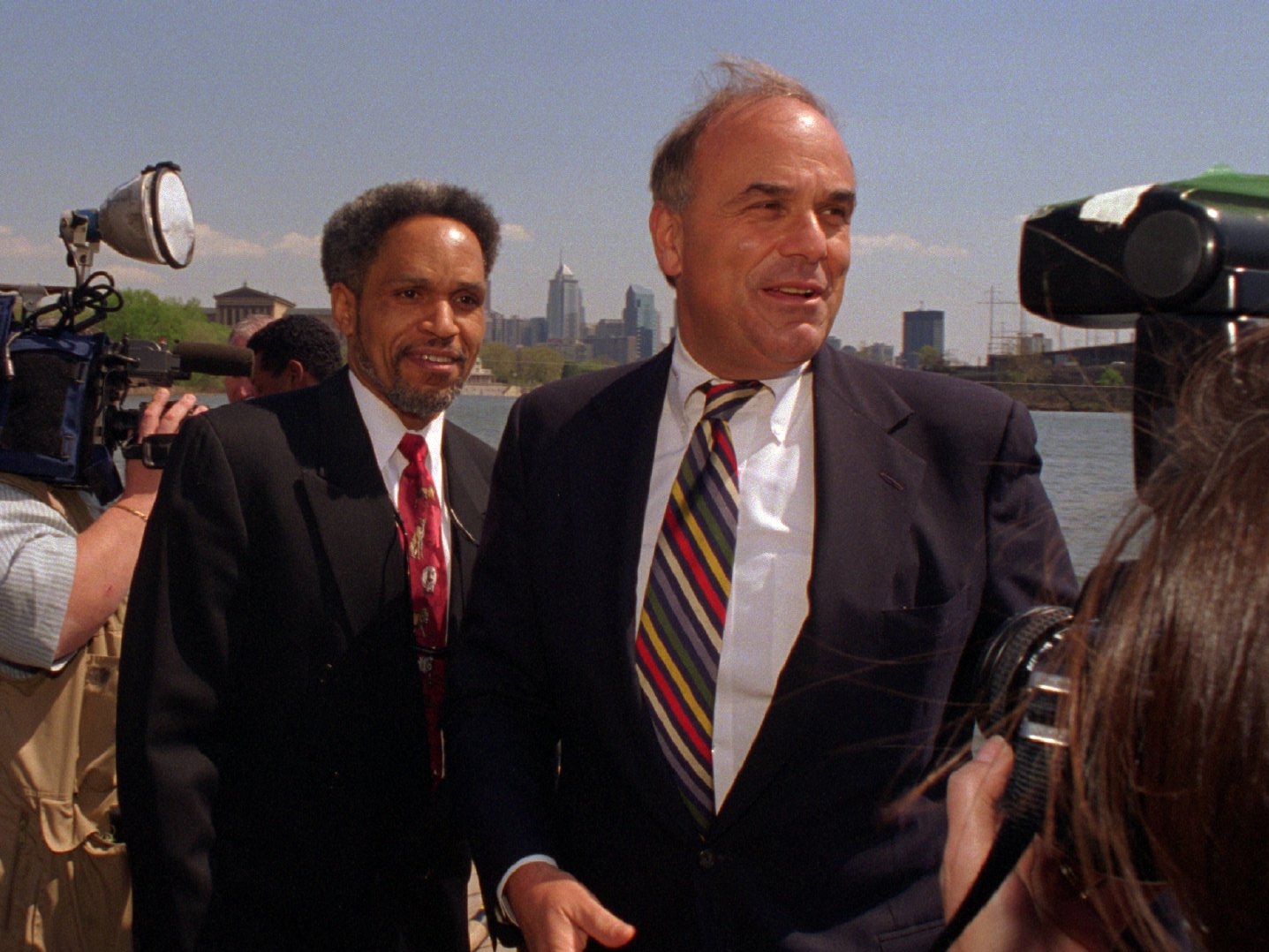
    John Street and Ed Rendell arrive for a 1994 news conference when Rendell was serving as mayor. Street went on to succeed Rendell as mayor after collaborating with him closely as City Council president.

    The endorsement comes as the race for the 3rd Congressional District heats up.

    U.S. Rep. Dwight Evans’ decision to retire has kicked off the city’s first competitive primary in more than a decade — with one of most Democratic-leaning districts in the country up for grabs.

    Evans endorsed Ala Stanford, a physician, founder of Philadelphia’s Black Doctors COVID-19 Consortium, and former regional director at the U.S. Department of Health.

    Two of Street’s Harrisburg colleagues, State Reps. Chris Rabb and Morgan Cephas, are also running, as is intensive-care physician Dave Oxman.

    A half dozen other hopefuls include Jahmiel Jackson, a West Philly native and recent University of Chicago graduate; Isaiah Martin, a 25-year-old real estate developer and executive director of Empowered CDC, which runs community programs in Southwest Philadelphia; Pablo McConnie-Saad, a Bella Vista resident and former U.S. Treasury Department adviser in the Biden administration; Temple University computer science professor Karl Morris; and former city employee Robin Toldens.

    Rendell’s endorsement further solidifies Street as the early Democratic establishment favorite in the race. Street also received endorsements from several city labor unions.

    “I’m honored to accept the endorsement of a leader like Governor Rendell,” Street said in a statement, calling the endorsement part of a “broad-based coalition — from labor unions to elected officials to community activists.”

    Street’s strength with the establishment could become a target in the race. At the first campaign forum, held last week, Rabb said he was running because Philadelphians needed a true progressive representing them, “not another establishment ally.”

    There has been no independent polling done in the race, but an internal poll from Street’s campaign, conducted by Democratic pollster Celinda Lake’s firm, showed him with a 5-percentage-point lead (22%) over Rabb (17%), with Stanford (11%), Cephas (7%), and Oxman (2%) behind them. The survey of 500 likely 2026 Democratic primary voters had a margin of error of plus or minus 4 percentage points.

    But the survey showed a plurality of voters, 36%, were undecided.

  • Israel reopens Jordan crossing as pressure builds to advance Gaza truce

    Israel reopens Jordan crossing as pressure builds to advance Gaza truce

    Trucks carrying goods from Jordan crossed into the West Bank for the first time in months on Wednesday, after Israel said it would reopen a key land bridge with its neighbor, including for aid and other cargo bound for the Gaza Strip.

    It was unclear whether the first trucks out of the gate were transporting humanitarian supplies or commercial items, but a spokesperson for COGAT, the branch of the Israeli Defense Ministry that controls aid flows to Gaza, confirmed that the crossing, known as Allenby, was open for the passage of aid.

    The move to restore Allenby as a transit point for relief comes as pressure builds on Israel to move a tenuous U.S.-backed ceasefire in Gaza into its second phase, and as the United Nations and other aid organizations have warned that nowhere near enough supplies are being allowed into the enclave to meet the needs of the Palestinian population, the majority of whom are displaced and living in makeshift shelters or tents.

    Under the ceasefire agreement between Israel and Hamas, Israeli authorities are supposed to allow at least 600 trucks of aid to enter Gaza each day. But the United Nations and other aid agencies say they continue to face bottlenecks and other restrictions, including delays and denials of cargo, custom clearance challenges and limited routes inside Gaza for transporting humanitarian goods.

    Israel closed the border in September after a Jordanian truck driver killed two Israeli soldiers at the crossing. An Israeli security official, speaking on the condition of anonymity because they were not authorized to speak to the press, said Jordanian truck drivers would undergo stricter screening processes and that a dedicated security force had been assigned to monitor the terminal.

    The reopening also coincided with a visit to Israel and Jordan by the U.S. ambassador to the U.N., Mike Waltz, who met on Monday with Israeli Prime Minister Benjamin Netanyahu. A statement from the U.S. mission to the U.N. said Waltz “welcomed Israel’s cooperation on expanding border crossings,” including Allenby. Waltz also met with Jordan’s King Abdullah on Sunday.

    In recent days, both Israeli and Hamas officials have said that there will be no discussion of moving to the second phase of President Donald Trump’s ceasefire plan until the first phase has been fully implemented. Both continue to point fingers at the other for not holding up their side of the deal. Israel has blamed Hamas for being slow to return the bodies of hostages, with one remaining in Gaza. Hamas has, in turn, pointed to the continued closure of border crossings for medical evacuations and aid and the daily fire that Israeli troops are carrying out in Gaza.

    But as pressure from the U.S. and other mediators to push the deal into the next phase grows, Netanyahu said Sunday that the transition could happen “very shortly” and announced he will meet with Trump on Dec. 29. A Hamas official also told the Associated Press on Sunday that the group is open to “freezing or storing” its weapons arsenal as part of the ceasefire.

    The second phase, which in theory would involve the disarmament of Hamas, withdrawal of Israeli troops from the territory, and the formation of an international force to maintain security, is likely to be far more complicated to achieve than even the first phase. Any delays in reaching that second phase leaves open the prospect of a status quo being established in Gaza in which Israel continues to occupy half of the enclave.

    One remaining step is the return of the remains of Ran Gvili, a 24-year-old Israeli police officer who was killed in Hamas’s Oct. 7, 2023, attack on Israel.

    “Without Gvili, Israel will not begin the talks over phase two,” said an Israeli official, speaking on the condition of anonymity because they were not authorized to speak to the press.

    U.N. agencies have reported an increase in aid that has been allowed into Gaza since the ceasefire came into effect, but say the levels are still far below what is needed for a population trying to recover from widespread malnutrition, famine and infectious diseases with a decimated health care system.

    Israel has allowed commercial operators and aid groups that bypass the U.N. system to scale up their operations more rapidly than other major relief organizations with long-running histories of assistance in Gaza. In particular, Israel has refused to allow UNRWA, the U.N. Relief and Works Agency for Palestinian refugees, to deliver aid, despite its sprawling infrastructure in Gaza and decades-long presence in the territory.

    “A shockingly high number” of children are still suffering from acute malnutrition, said Tess Ingram, a spokeswoman for UNICEF, the U.N. children’s agency, according to comments reported by Reuters.

    Ingram also told reporters on Tuesday that opening the Rafah crossing in southern Gaza, which links it with Egypt, could help bring down the number of children suffering from malnutrition. “We really need to see all types of aid come in, particularly nutritious food through commercial routes as well,” Ingram said.

    Israel said last week that it would reopen the crossing in the coming days, but only for the exit of Palestinians from Gaza.

    Millions of shelter items have also been stuck in Jordan, Egypt and Israel while awaiting Israeli approval to enter, a consortium of humanitarian organizations focused on providing shelter aid said in November.

    A severe winter storm landing in the region this week threatens 850,000 people sheltering in 761 displacement sites particularly vulnerable to flooding in the Gaza Strip, the U.N. Office for the Coordination of Humanitarian Affairs (OCHA) said. On Wednesday, there were reports of flooding in large parts of Gaza City, particularly low-lying areas.

    “The entire services system is unable able to rescue displaced people due to the heavy rain and flooding,” said Mahmoud Basal, a spokesman for Gaza Civil Defense, in a statement to reporters. “Rainwater has risen to more than one meter in some shelter centers.”

    The storm, dubbed Byron, has already hit Greece and Cyprus and is expected to bring as much as eight inches of rain to Israel and Gaza.

    “Low pressure fronts pose a major danger to displaced people and residents because of the destruction inflicted on the infrastructure,” Gaza municipality spokesman Hosni Mhanna told Al Araby TV on Wednesday.

  • EU enlargement chief: Ukraine’s membership ‘inevitable’

    EU enlargement chief: Ukraine’s membership ‘inevitable’

    KYIV, Ukraine — The European Union’s enlargement chief said Wednesday she is confident Hungary will not derail Ukraine’s path to membership, which she described as “inevitable.”

    “I’m not worried,” Commissioner Marta Kos told reporters while visiting a thermal power plant in Western Ukraine that was badly damaged by Russia’s campaign against civilian infrastructure. “I would be worried if there were real concerns.”

    “On EU membership of Ukraine — which is inevitable — I see this as a political anchor of security guarantees,” she said, noting that “There has never been a war on the territory of the European Union.”

    Ukraine hopes to join the bloc by the end of the decade and remains frustrated that its path to NATO membership looks uncertain.

    Kyiv applied for EU membership in 2022 shortly after Russia’s full-scale invasion. Now, Commissioner Kos is convening an informal meeting of European affairs ministers Thursday to prepare for the next stage of accession talks.

    Kos hinted that the process could move even faster, saying “The quicker the reforms which are needed will be done, the quicker the process can be.”

    Hungarian Prime Minister Viktor Orbán has opposed launching membership talks while the war continues. Yet, Kos dismissed his objections saying “We do not need Orbán to do the reforms which are necessary for Ukraine to become a member of the EU.”

    The Slovenian diplomat toured the heavily damaged power plant, where heavy machinery was blackened, control panels melted and a giant hole gaped in the roof of one of the main buildings.

    Andrii, a turbine operator on duty during a recent attack, described the chaos that followed.

    “The first thing you feel is a huge rush of adrenaline. There’s heavy smoke, loud noise, pressure — you can’t hear your colleagues,” he said. “Damaged equipment means escaping steam and high-temperature feedwater. At first it’s very difficult to orient yourself in the smoke.”

    Company officials asked that the plant’s location and the full names of employees not be published for security reasons.

    The thermal power plant is one of six operated by private utility DTEK that have sustained major damage from relentless Russian drone and missile attacks in recent weeks.

    Kos praised the resilience of power workers and Ukrainians in general.

    “There is no other more resistant nation in the world which I know than the Ukrainians,” she said, recalling Russian President Vladimir Putin’s expectation of a quick victory. “Putin said it would take one week. But here we are and it’s been nearly four years, so you are already the winners.”