Tag: topic-link-auto

  • This Philly school police officer was shot 11 times — and lived. Here’s what he wants you to know.

    This Philly school police officer was shot 11 times — and lived. Here’s what he wants you to know.

    Craig Romanczuk’s voice barely gets above a whisper these days.

    But speaking at all feels like a miracle, he said.

    Five months ago, the retired Philadelphia police officer, a Philadelphia School District safety officer of nearly 20 years, was shot 11 times while driving in a marked patrol car. He almost died.

    Life is crowded with medical appointments, surgeries and therapies now. But Romanczuk takes it in stride, with the kind of gruff and jovial banter born of his one-of-nine-kids-growing-up-in-Kensington roots and the near-death experience that still feels very close.

    After almost dying, “you appreciate your family, your brothers and your sisters,“ said Romanczuk, pausing. ”Even though they’re still jerks. Now you get a chance to tell them that they’re jerks and you still love them.”

    ‘Officer, can you help me?’

    It was two hours past midnight, a warm June evening, when Romanczuk wrapped up his patrol assignment, checking on a Kensington high school building just before 2 a.m.

    It was a night like many others — after graduating from North Catholic High School, Romanczuk joined the police force at 19, spending his career in the 3rd district, in South Philadelphia, and finishing it in the 19th, in West Philadelphia. After he retired in 2004, his sister encouraged him to take the school police officer test. He spent years as an officer in schools, then took a patrol job in 2017, driving around the city to check on school buildings between 10 p.m. and 8:30 a.m.

    On June 29, Romanczuk took Front Street to North Columbus Avenue on his way back to a district garage after the Kensington High School for the Creative and Performing Arts job. He was stopped for a red light near the Dave and Buster’s when a car pulled up to him.

    “The man said, ‘Officer, can you help me?’” Romanczuk remembered. A driver exhibiting road rage had been following the man since they were both driving on I-95, he told Romanczuk, who agreed to assist.

    District safety officers are not armed; Romanczuk said he planned “to say, ‘Yo guy, knock it off, go the other way.’“

    He opened his car door, stepping out onto the street. He didn’t even have time to say a word; bullets started flying immediately.

    Romanczuk was shot 11 times — in the shoulder, in the armpit, through the bicep. One bullet cut across his chest, striking the cell phone in his pocket. One pierced his neck, breaking his collarbone, damaging his Adams apple and his vocal cord. One exited out of the left side of his face, breaking his jawbone and taking nearly all of his upper teeth with it. One hit the side of his face, going through the roof of his mouth and coming out of his nose.

    He was wearing a bulletproof vest, but was still injured enough to nearly bleed out.

    “It isn’t like a movie,” said Romanczuk. “You feel the bullets break your bones, you feel them going through your body. That’s the pain I felt. I thought, ‘I hurt too much, I’m not going to live through this.’”

    Somehow, Romanczuk managed to get back into his car, an attempt to elude the shooter.

    “I put the car in drive and I felt more bullets hitting the car seat. I was thinking, ‘Why am I being shot? I didn’t do anything. He’s not mad at me,’” he said. “It’s like the Hallmark movie – you think of your kids. I thought, ‘Tell them that I love them.’”

    His car hit a tree. His last memory is staggering out of his patrol car.

    ‘This ain’t heaven’

    A Philadelphia Parking Authority tow truck sat across the street, its operator watching the whole scene unfold. The tow truck driver called 911 and a buddy of his who was a school police lieutenant. City police responded, ready to scoop Romanczuk and take him to the hospital, when a fire department paramedic unit drove by.

    The paramedics got Romanczuk to Jefferson. He remained unconscious for two weeks.

    When he eventually woke up, he thought he was dead.

    “I’m looking around, I’m on the ninth floor in a dark room. I said, well this ain’t heaven. This must be purgatory. A nurse leaned over and I went, ‘Lucifer?’ I went, ‘Where am I?’ He said, ‘Jefferson.’ I said, ‘is that hell?’”

    It turns out it wasn’t hell. Romanczuk remained in Jefferson until the end of July, then spent a month at Jefferson Moss-Magee Rehabilitation Hospital in Center City, astonishing staff with his progress. He received a hero’s send-off on his release.
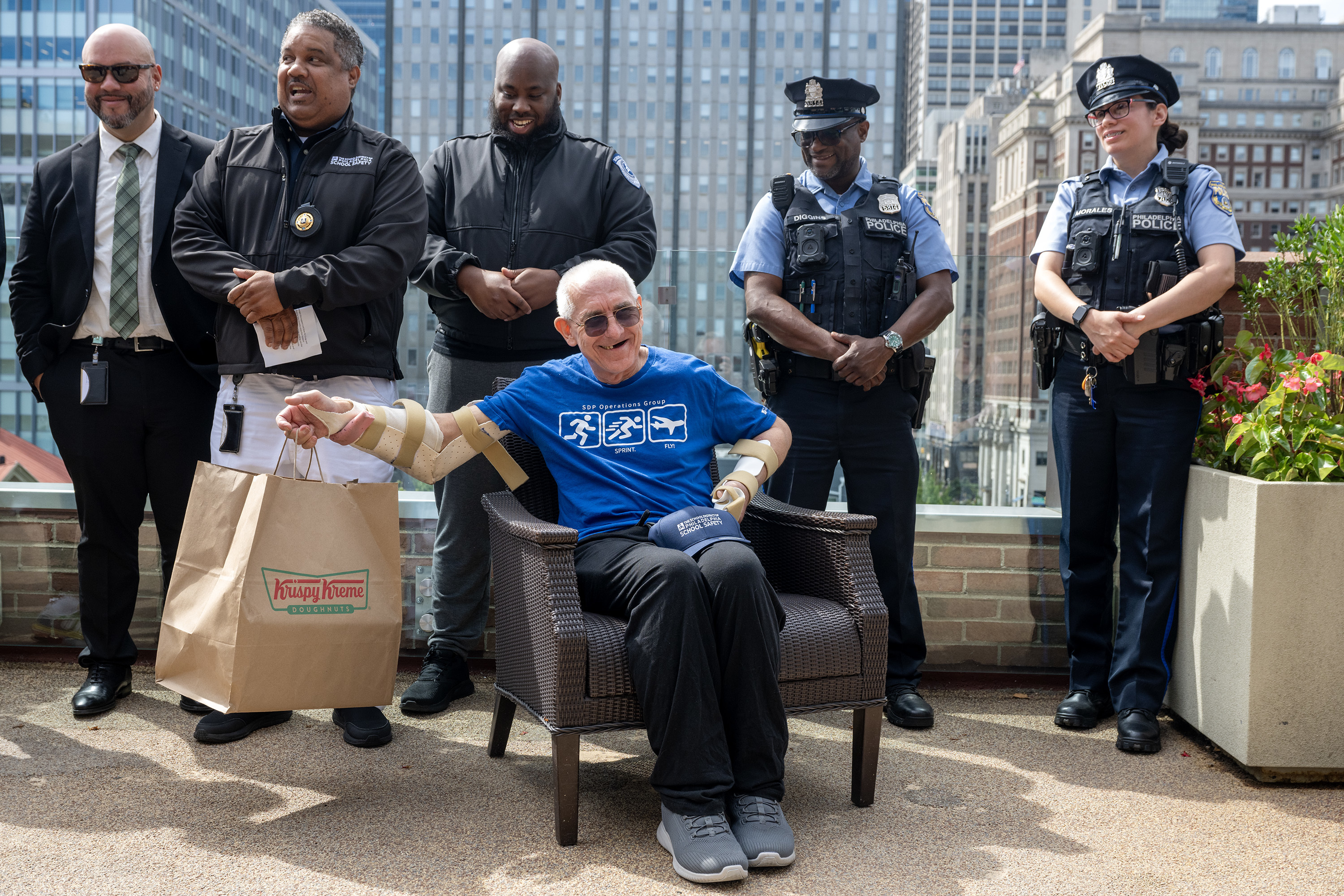
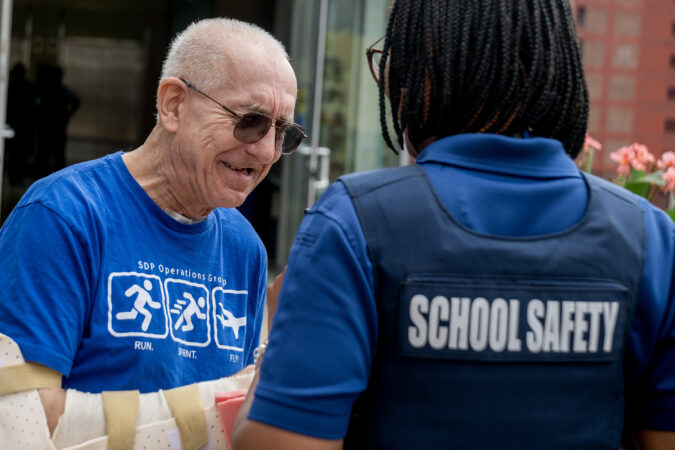
    School Safety Officer Craig Romanczuk displays the donuts brought by son Erik Romanczuk as he is celebrated by fellow safety officers, school district officials, his care team and hospital staff Thursday, Aug. 28, 2025 as he leaves Jefferson Moss-Magee Rehabilitation Hospital. Romanczuk has been undergoing since June, when he was shot 11 times after a road rage incident when he stopped to offer assistance while heading home following an assignment. Romanczuk served close to 30 years as a Philadelphia police officer before joining the district’s Office of School Safety almost 20 years ago. He has served both as a patrol officer and been assigned to schools. Erik is a Philadelphia police sergeant.

    Romanczuk is full of effusive praise for the staff at Jefferson. He’s not a hero, he said.

    “The doctors and God are,” he said. “I think God was working through the doctors. They were so skillful.”

    Politicians like to take credit for improving homicide rates, Romanczuk said.

    “But it’s not the politicians, it’s the doctors,” he said. “They’re so good at saving people.”

    ‘He will do this again’

    Romanczuk could not speak at all for weeks. Now that extensive therapy has allowed him to regain a quiet voice, he wants to use it.

    Ariza Giansteban is accused of attempted murder in connection with Romanczuk’s shooting. Romanczuk feels strongly that Giansteban, who remains in custody, should not be granted reduced bail.

    “I think he should spend the rest of his life in prison,” said Romanczuk. “I believe if they let him out, he will do this again somewhere.”

    Romanczuk worries that prosecutors leading the case against Giansteban and other alleged criminals do not think enough about the victims of violence.

    He will continue to show up at Giansteban’s court appearances when he can, Romanczuk said, to make his voice heard and remind people what he has suffered.

    And he’ll continue to be grateful for being around to crack jokes.

    Romanczuk is able to live alone at his house in the Northeast, “with my sister yelling at me, and my son,” he joked. (His son is also a city police officer.)

    Until the shooting, Romanczuk had no plans to retire, but his massive injuries forced his hand. The steady stream of visits from his colleagues and his family and friends buoyed him, he said.

    “I love my co-workers and my family,” he said, “and I got 20 more years to tell them so.”
  • In North Philly, Congreso de Latinos Unidos has spent five decades being ‘here for you’ | Philly Gives

    In North Philly, Congreso de Latinos Unidos has spent five decades being ‘here for you’ | Philly Gives

    The litany of horrors never stopped:

    For more than an hour, one domestic violence survivor after another stepped up to the microphone with tales of pain and resilience.

    “When people get close to me, I flinch because I’m afraid they are going to abuse me,” said one woman, speaking in Spanish, her words translated into English by a staffer at Congreso de Latinos Unidos, a nonprofit social services agency in North Philadelphia that provides help with housing, education, medical needs, workforce training, and after-school activities for youngsters.

    Congreso is celebrating its 48th year in operation, and for 30 of those years, it has maintained a program to support people dealing with, and trying to escape from, domestic violence.

    “I was never allowed to go outside. He would show up at my job,” the woman continued in a room decorated with purple balloons, the color symbolizing domestic violence. Each year, Congreso honors survivors and mourns, in a few moments of poignant silence, the people who lost their lives to domestic violence. Last year, in Pennsylvania, there were 102.

    “He would bruise my face so I couldn’t see my family. I worked in a nightclub, and he would drag me out … No one wanted to get involved,” she said.

    No one, until Congreso did and helped relocate her to a new home.

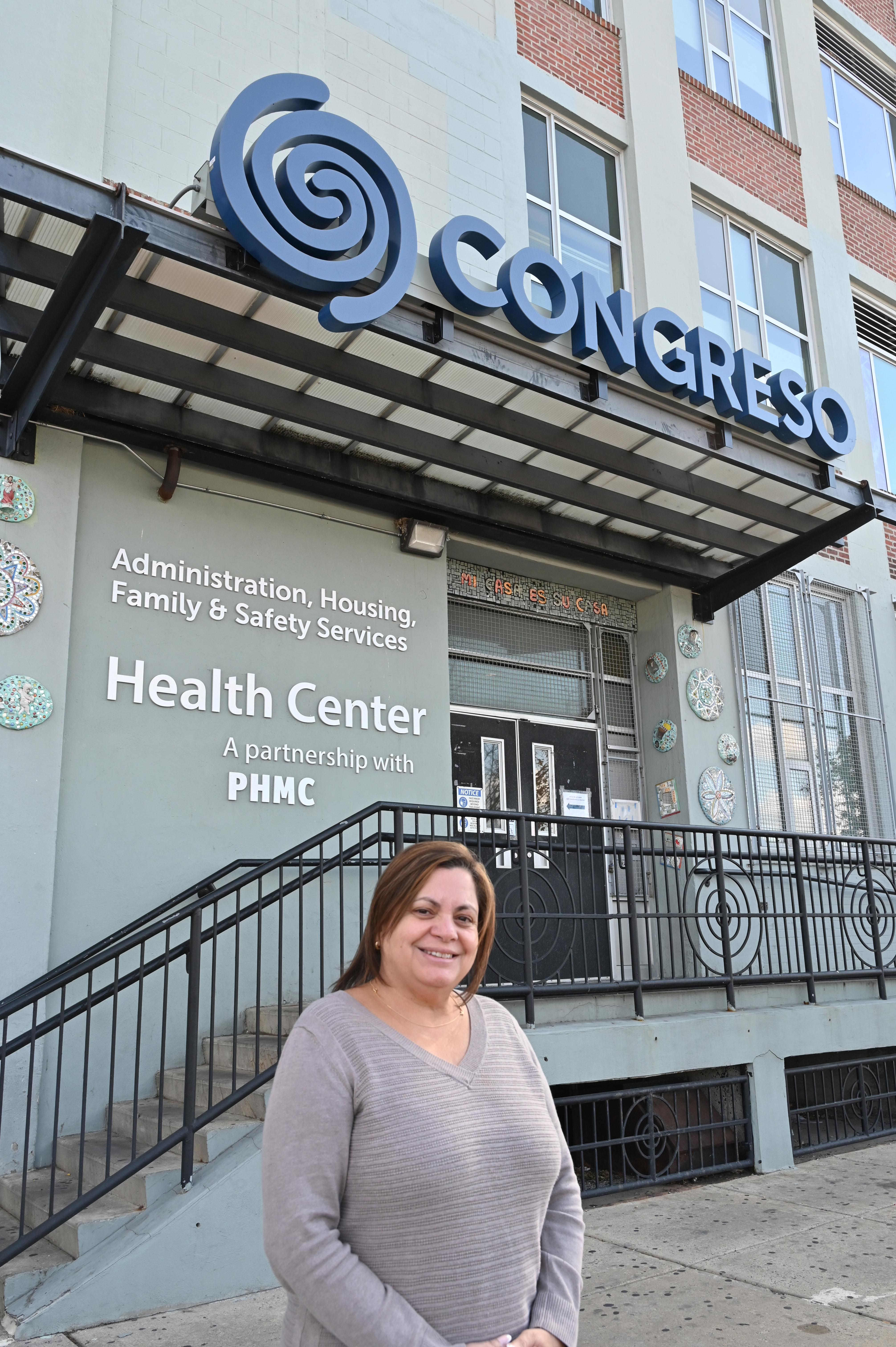
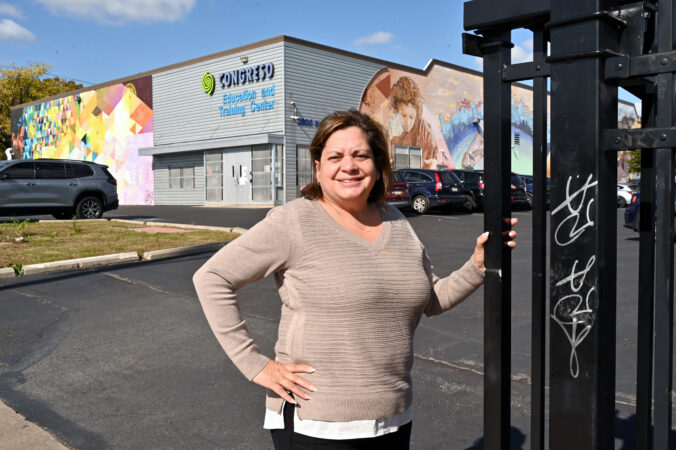
    Jannette Diaz, president and CEO of Congreso, outside the group’s offices in North Philadelphia.“We’re all feeling the crunch,” she said of recent funding challenges.

    “It takes a lot of courage to come up here and share your story,” Ramona Peralta, Congreso’s director of family wellness, said as the woman finished speaking. “We’re very proud of you, and we are here for you all the way.”

    In the main room, the mood vacillated between the heavy silence of shared pain and the cheerful clamoring of babies. Later, there was music, and before, a friendly lunch of rice with pork and chicken.

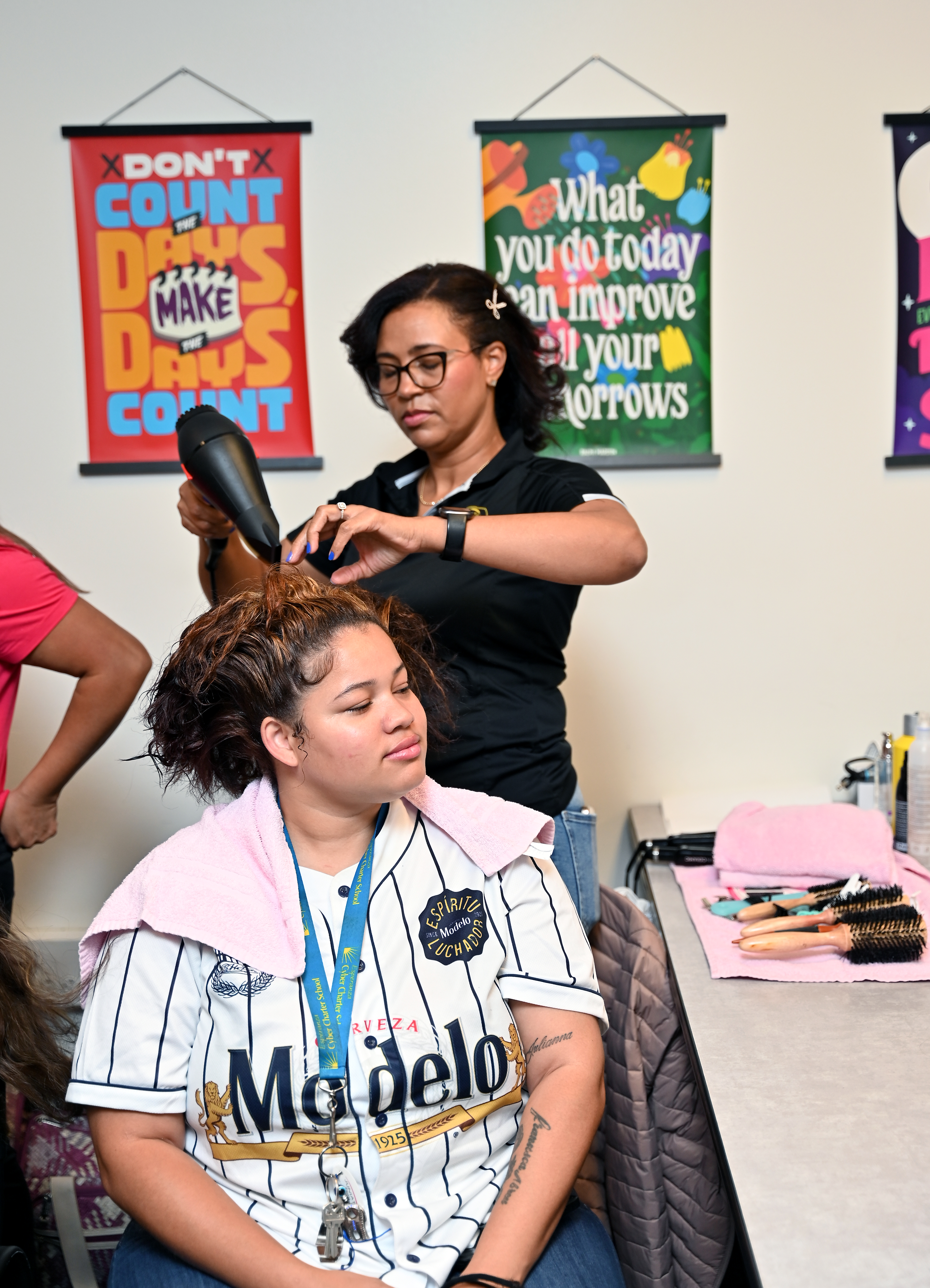
    Across the hall, members of the Asociación de Cosmetologas de Pennsylvania offered free hairstyling to the women who attended the celebration.

    Congreso, as part of its program to teach police, educators, social workers, and others to recognize signs of domestic abuse, had trained this group, as well, and because of the intimacy of their work, the stylists were uniquely positioned to do so. More than most, beauty salon operators could readily see the bruises hidden under hair and makeup. They could feel the cuts and scars on the scalp. And then there were the confidences confessed during shampoos and stylings.

    Wanda Gómez, of the Blessings of God beauty salon, styles Franyeimi Abreu’s hair at Congreso’s offices.

    Among the volunteers was Wanda Gómez, owner of the Blessings of God beauty salon in Northeast Philadelphia. “Thank God, I’m no longer in that situation,” she said, speaking through a translator. But because she survived domestic violence, she said she’s in a better position to help others. She tells them about Congreso.

    Elisa Zaro Doran, owner of Dominican Divas Beauty Salon in Olney, twisted a strand of hair around a curling iron as she styled Maria Rodriguez’s long, dark hair. Like Gómez, Doran survived domestic abuse. “The first time, when he hit me, we were having a lot of problems, so I thought it was normal,” Doran said.

    He’d even come into her beauty salon and hit her. “My clients would try to defend me,” she said. Eventually, when her son tried to protect her, she knew she had to take the necessary steps to get away and be safe — for herself and her children.

    Rodriguez was there yesterday to support her daughter, who survived domestic violence, but still lives in fear — which is the reason she would only agree to be interviewed if her name was not used. “He told me that it doesn’t matter how many years — he will come and burn down my house with me in it,” she said.

    Hairdresser Domaris Rodriguez shows her artistry on Raquel Mendez’s hair.

    Rodriguez’s daughter turned to Congreso for help after Thanksgiving a few years ago. Her oldest son told her that day that he would no longer live with her, because every night he dreamed of killing his father. He couldn’t stay and watch the beatings or watch his father, in a rage, destroy the furniture in their home.

    “I don’t know how many dining room tables I bought,” the daughter said.

    On that Thanksgiving, she told her husband he had to leave. It was the end of the relationship, but the beginning of a new nightmare. He followed her to work and even stood in the pharmacy, watching her as she managed the office.

    Counseling at Congreso helped her name her situation for what it was — abuse. “They made me see that I was in danger,” and that what she thought was normal was anything but. In group sessions, she learned a critical lesson: “I understood that I wasn’t the only one. They made me know it wasn’t my fault.”

    She’s still afraid to leave her home. “I’m going through anxiety, PTSD. It still affects me.”

    As she watched her mother get her hair styled, Rodriguez’s daughter hoped her mother would absorb a lesson from the stories she would hear. The daughter wanted her mother to understand the intergenerational legacy of abuse because she believes her mother also suffered from domestic violence.

    That abuse, Rodriguez’s daughter believes, impacted both her and her sister, whose abuser stopped hitting her only when he thought she was dead. She teaches her sister lessons learned from counseling at Congreso. Counseling includes helping women develop a safety plan.

    Rodriguez’s daughter brings her own little girl, 13, to Congreso’s counseling groups for children impacted by domestic violence. “I’m saving my sister’s life, and I’m saving my daughter’s life,” she said. As for her sons, “I’m not raising abusers,” as she reminds them to respect their girlfriends.

    Last month’s celebration in honor of the survivors of domestic abuse took center stage that day at Congreso, but Congreso’s programming benefits many more people in the community, 75% of whom are Latino, said Jannette Diaz, president and chief executive.

    Diaz grew up a few blocks from Congreso, and her father relied on the nonprofit for help with the family’s utility bills.

    These days, she spends time working on strengthening relationships with fellow nonprofit agencies and with Congreso’s friends in the donor community.

    “We’re all feeling the crunch,” Diaz said, describing a double whammy in mid-October of the state’s failure to pass a budget as the national government moved into another week of shutdown. Congreso gets much of its funding from government reimbursements for services provided.

    At Congreso, “we’re very mindful of our spending. So far, we’re continuing to provide services at 100%, but there’s only so much we can do, tapping into our reserves and our line of credit.”

    “Sometimes it’s heavy, but I’m also hopeful,” Diaz said, explaining that the twin state and federal budget crises required a sharper focus even as demand for services increases. Changes in Medicaid regulations may impact finances at Congreso’s health center, for example.

    But, she said, donors can be confident their dollars are being spent wisely.

    Why? Because as nonprofits come and go, Congreso has survived, thanks to providing trauma-informed and culturally responsive services that are informed by data to its clients, Diaz said.

    “We’ve been around for 48 years, and there’s a reason for that. And that is how we operate within our community,” she said. “We forge a trusting relationship, and we try our best to do what they need. It’s important that we make sure our programs have impact.”

    And that impact, Diaz said, goes beyond help given directly to clients. When Congreso assists a first-time home buyer in qualifying for and landing a mortgage, that homeowner becomes a Philadelphia taxpayer, benefiting the community.

    When someone like Gary DeJesus-Walker earns a CDL truck-driving license through Congreso’s workforce training program, he can go on to build a trucking business. Now he employs three people.

    “Congreso — they changed my life,” he said. “From trucking, I started two other companies.” With Congreso’s CDL program, “if you need a second chance, you can have one for the rest of your life. This is a way you can provide for and feed your family, forever.”

    The stories are an inspiration to Diaz.

    “Even in this season,” she said, “we can strategize and design services that our community needs. We’re not paralyzed by this crisis, and in terms of moving the needle forward, we’re progressing.”

    This article is part of a series about Philly Gives — a community fund to support nonprofits through end-of-year giving. To learn more about Philly Gives, including how to donate, visit phillygives.org.

    For more information about Philly Gives, including how to donate, visit phillygives.org.

    About Congreso de Latinos Unidos

    Mission: To enable individuals and families in predominantly Latino neighborhoods to achieve economic self-sufficiency and well-being.

    People served: 13,435 unique clients served in fiscal year 2025.

    Annual Spending: $30 million

    Point of Pride: Trademarked Primary Client Model that drives Congreso’s bilingual and bicultural approach to delivering services in a client-centered, data-informed, and culturally responsive way, whether a community member is receiving support in education, workforce development, housing, health, or family services.

    You can help: Become a monthly donor, a member of Congreso’s Corporate Advisory Council, or a volunteer in the Congreso Cares Program. Volunteers help with participating in program initiatives like Congreso’s free tax preparation, supporting program and agency events, and assisting with fundraising.

    Support: phillygives.org

    To get help:

    866-723-3014 (Philadelphia Domestic Violence Hotline)

    215-763-8870 (Congreso)

    What your Congreso donation can do

    • $25 can help provide food baskets to individuals living with HIV.
    • $50 can help cover past-due utility bills and prevent shutoffs for a family to stay safe in their home.
    • $100 covers an immunization visit at the Congreso Health Center for a child entering the school system.
    • $200 provides a new uniform or professional wardrobe for a community member entering the workforce.
    • $250 provides a semester of after-school programming for a high school student.
  • How these Philly-area consumers are spending $150 on all their holiday gifts

    How these Philly-area consumers are spending $150 on all their holiday gifts

    Kacii Hamer has no financial stress this holiday season.

    In past years, “holidays were always ‘give, give, give,’ and that’s what I always felt like I had to do,” said Hamer, a 33-year-old pre-K teacher and wedding photographer. Back then, “I couldn’t imagine thrifting gifts or DIYing gifts. You have that fear of ‘Oh my god, are these people going to judge me?’ or ‘Is this good enough?’”

    This year, however, Hamer is celebrating “Thriftmas,” a social-media trend where participants buy many of their holiday gifts secondhand.

    Between a family Pollyanna, a gift for her boyfriend, and a present for her goddaughter, she plans to spend no more than $150 total. For her goddaughter, she is sanding and repainting a $14 rocking horse that she got at the 2nd Ave. Thrift store in South Philadelphia.

    The thrift-focused holiday season will mark a fitting end to what Hamer calls her first “hardcore” low-buy year, one during which she cut out most nonessential spending.

    Hamer, who splits her time between the Philadelphia region and Scranton, was one of several low- and no-buyers whom The Inquirer talked with in April.

    The frugal challenge took off this year amid broader economic pressures, including continued inflation. Philly-area participants said they were trying to save money, pay off debt, reduce waste, and, in some cases, stop patronizing large retailers that don’t align with their values.

    Now as the holidays approach, some low- and no-buyers are making exceptions for gifts, or using some of their recent savings to fund their festivities.

    Others, however, are standing firm in their low-spending habits. They’re setting budgets, trimming their gift-recipient lists, or shopping secondhand.

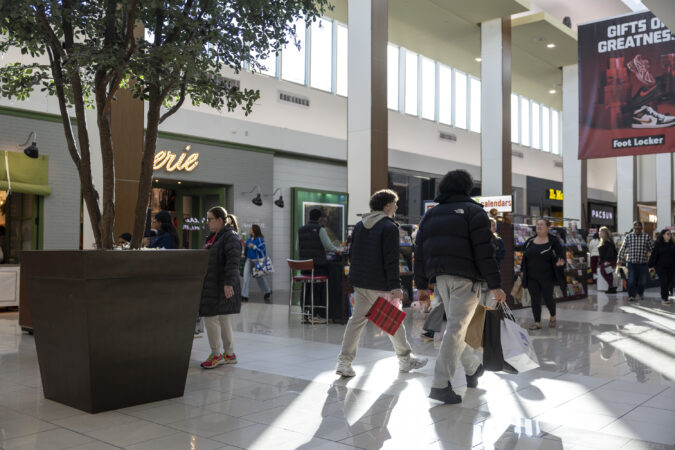
    Shoppers descend on the King of Prussia Mall on Black Friday in this 2022 file photo.

    This time of year, some local low-buyers said, it requires extra strength to resist consumerist pressures and go against the norm. Each U.S. adult is expected to spend about $628 on average on holiday gifts this year, according to the National Retail Federation, which anticipates overall holiday spending will surpass $1 trillion for the first time ever.

    At the same time, others say economic uncertainty has made for easier conversations about gifting.

    “I’m not under pressure to spend, and I think this year it’s actually easier to [cut back on gifts] than in years past,” said Mylena Sutton, 48, of Voorhees. “A lot of my friends are sensitive to what’s happening in the economy … you don’t have to explain.”

    Parents buying less for Christmas

    Some Philly-area parents have found that Santa can be thrifty, too.

    Heather Fertig, 38, of Fishtown, said about 80% of her toddler’s Christmas gifts will be secondhand. They’ll include a marble run, which she bought this week from a local thrift store, and a wooden train table, for which she remains on the hunt.

    Thanks to secondhand stores, Facebook marketplace, and neighborhood parent groups, Fertig, a stay-at-home mom, said she and her husband will likely spend about $150 in all.

    Her motivation is as much environmental as it is financial.

    After having her son, she realized, “Wow, there is so much waste,” Fertig said. “I kind of felt, previous to that, that there was a stigma around getting things secondhand.”

    But “it was never there,” she added. “It was this made-up thing that everything had to be brand-new to you.”

    Santa James Claus greets children at the Fashion District in this 2022 file photo. Some local parents have found Santa can cut back on spending, too.

    For young children, whose interests change so quickly, it makes even more sense to buy items secondhand, Fertig said. On Christmas morning, her 2-year-old doesn’t know the difference.

    “He’s just as happy as if I bought it straight from Walmart,” she said.

    In Montgomery County, Jenna Harris-Mosley said she takes a combo approach to gift-giving for her 5-year-old daughter, whose birthday is on New Year’s Eve.

    The 41-year-old bought some smaller, new gifts, including Shrek snow globes and Squishmallow stuffed toys, throughout the year to spread out spending.

    She plans to get other items secondhand, including one or two American Girl dolls for $20-$30 each. And she will set aside some money for experiences, such as an upcoming day trip to New York City for tea at the American Girl store — with the new-to-her doll, of course.

    Harris-Mosley said she took an especially intentional approach to spending this year after getting laid off from her job in tech sales in October. It has helped that she had already bought many of her daughter’s Christmas and birthday gifts when she found deals earlier in the year, she said.

    “I have things hidden in every corner of my house,” she said. And as for grown-ups “I don’t stress myself about holiday gifts,” figuring most adults in her life have the things they need — and can buy things they don’t.

    In Port Richmond, Rachel Dwyer is making homemade felt ornaments for the adults on her list, and getting two books for each child. The 34-year-old nanny has learned that too many toys and trinkets can be overwhelming for kids and parents.

    “It’s just a lot of clutter,” she said, “and a lot of junk.”

    People walk through the Shops at Liberty Place in this 2021 file photo.

    How to spend less on holiday gifts

    Seasoned low-buyers say it’s hard to cut back on spending. But once you get over the initial hurdle, they say, it’s freeing.

    “Push through the fear,” Hamer said. “It feels nice going into the holidays with such a positive attitude.”

    In South Jersey, Sutton has never been a big holiday gift-giver, saying she prefers to buy loved ones presents intentionally throughout the year.

    If others feel overwhelmed by their holiday gifts-to-buy list, she recommends they ask themselves: “Do you do these things because they have value for you? Or do you do these things because they are expected?”

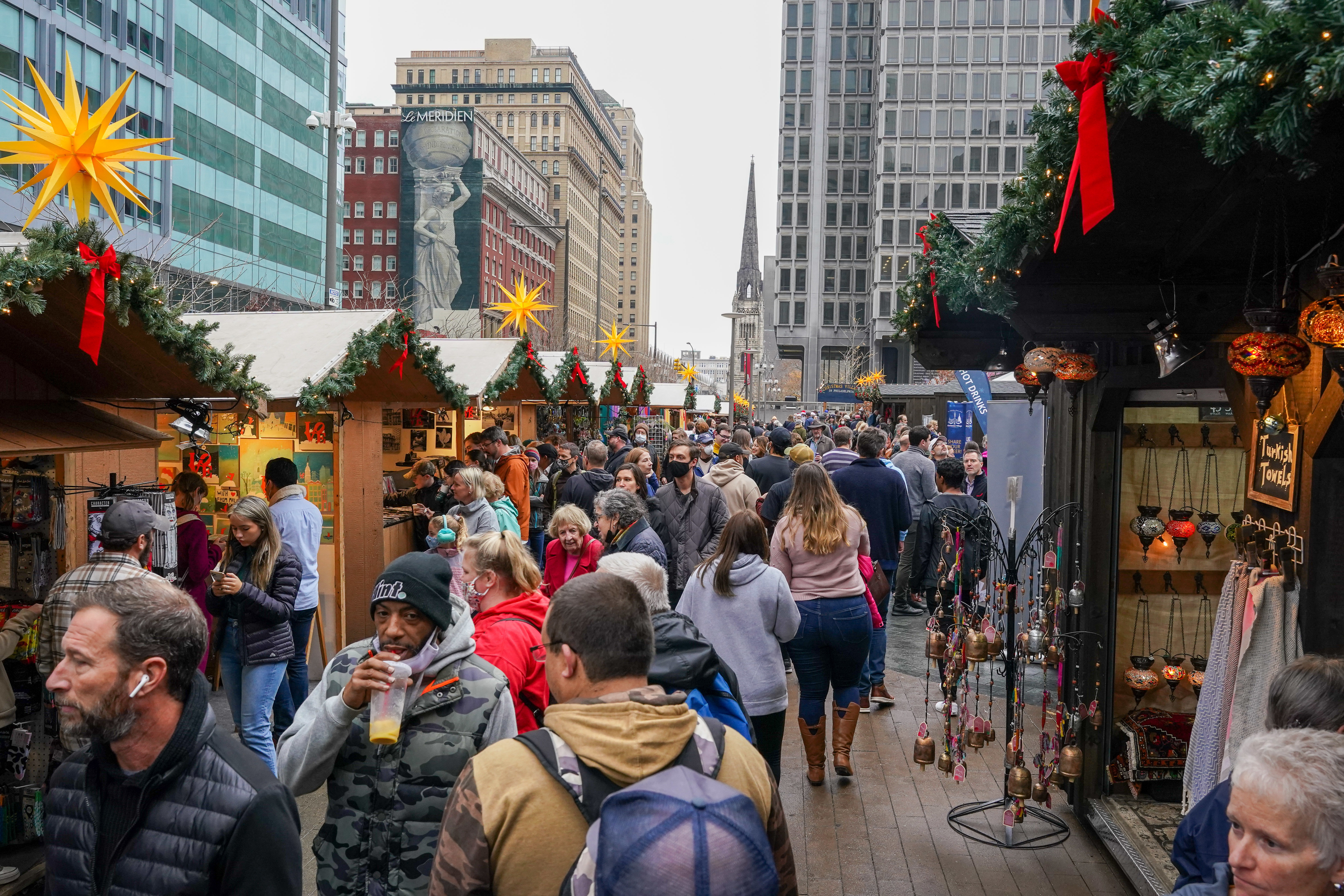
    People browse the Christmas Village at LOVE Park in this 2021 file photo.

    “Be brazen about it,” said Sutton, a consultant and leadership coach. That might mean telling people: “If you only get me a gift because you expect an exchange, don’t buy me one.”

    “People who have stayed away from thrifting should get back into it,” said Jen Benner, 34, of Conshohocken. “The thrift stores are jam-packed with very good stuff.”

    If you aren’t sure about buying secondhand, “start small. Start with a child’s gift or a truck or a train or something little,” Fertig said. “Work your way up to bigger items.”

    Benner, a real estate agent, keeps a running list on her phone of gift ideas that her loved ones mention throughout the year. This can save time and anxiety around the holidays, and reduce the urge to overspend.

    Remember, too, that the most meaningful gifts can be among the least expensive, Dwyer said. She recommends personalized, handmade gifts or framed photos, as well as gifts of time or skills, such as a babysitting session, a home-cooked meal, or a family-photo session.

  • Philadanco’s Winter Residency boasts of stunning revisions and a soaring premiere

    Philadanco’s Winter Residency boasts of stunning revisions and a soaring premiere

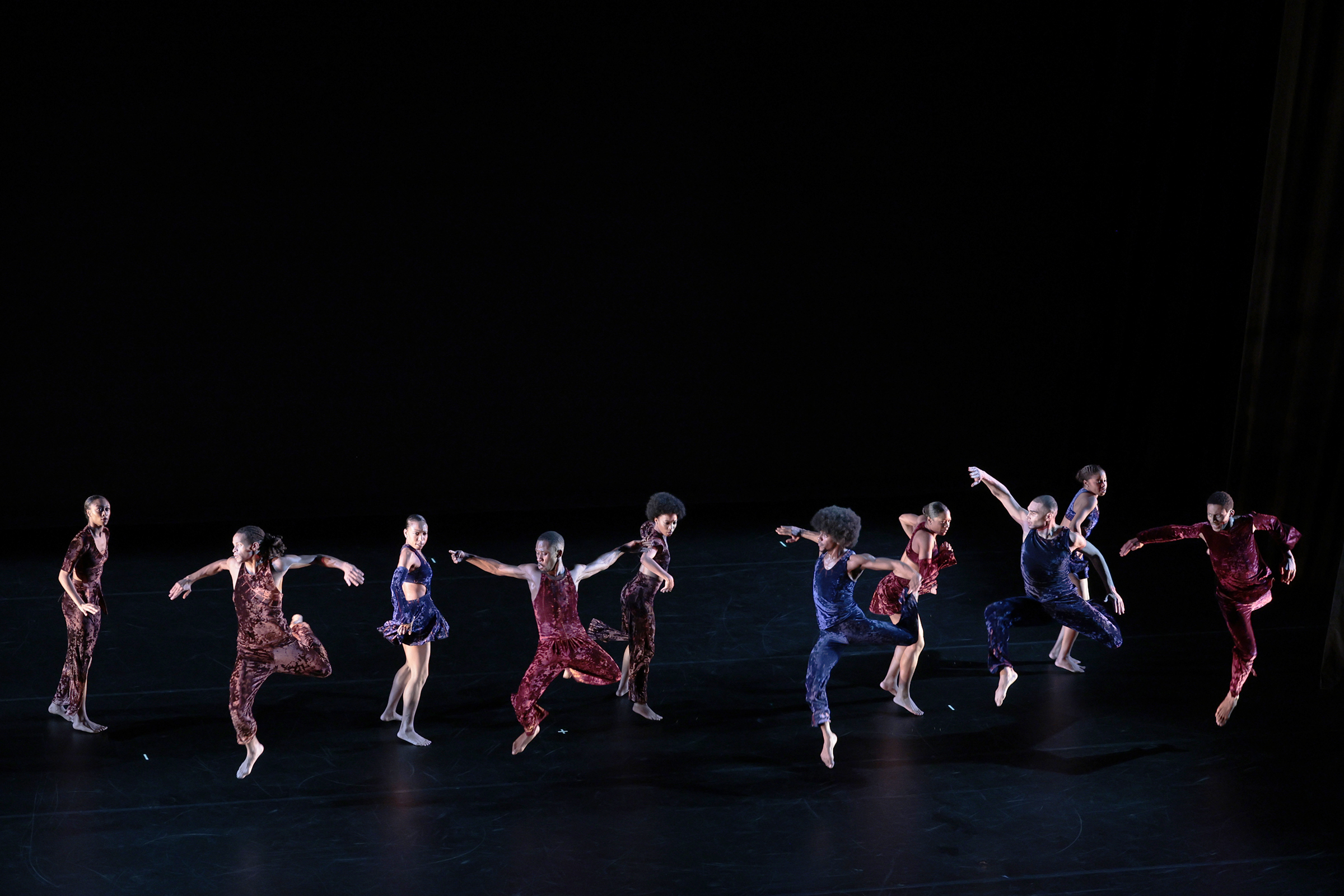
    Philadanco is currently celebrating its 25th anniversary in residence at the Kimmel Center’s Perelman Theater with a mixed bill that showcases the company’s extraordinarily skilled dancers in works by a quartet of award-winning choreographers.

    “Then and Now!,” as the program is called, includes revised productions of pieces by Donald Byrd and Tommie-Waheed Evans, plus a company premiere from Ronald K. Brown and a brand-new work by up-and-comer Juel D. Lane.

    Friday’s opening-night audience was large and enthusiastic, giving an extended ovation to Lane’s Heirborne, a pun on its theme of literal and metaphorical flight.

    In the printed program, Lane cites among his inspirations Bessie Coleman, the first Black woman to hold a pilot’s license, and Mae Jemison, the first African American female astronaut.

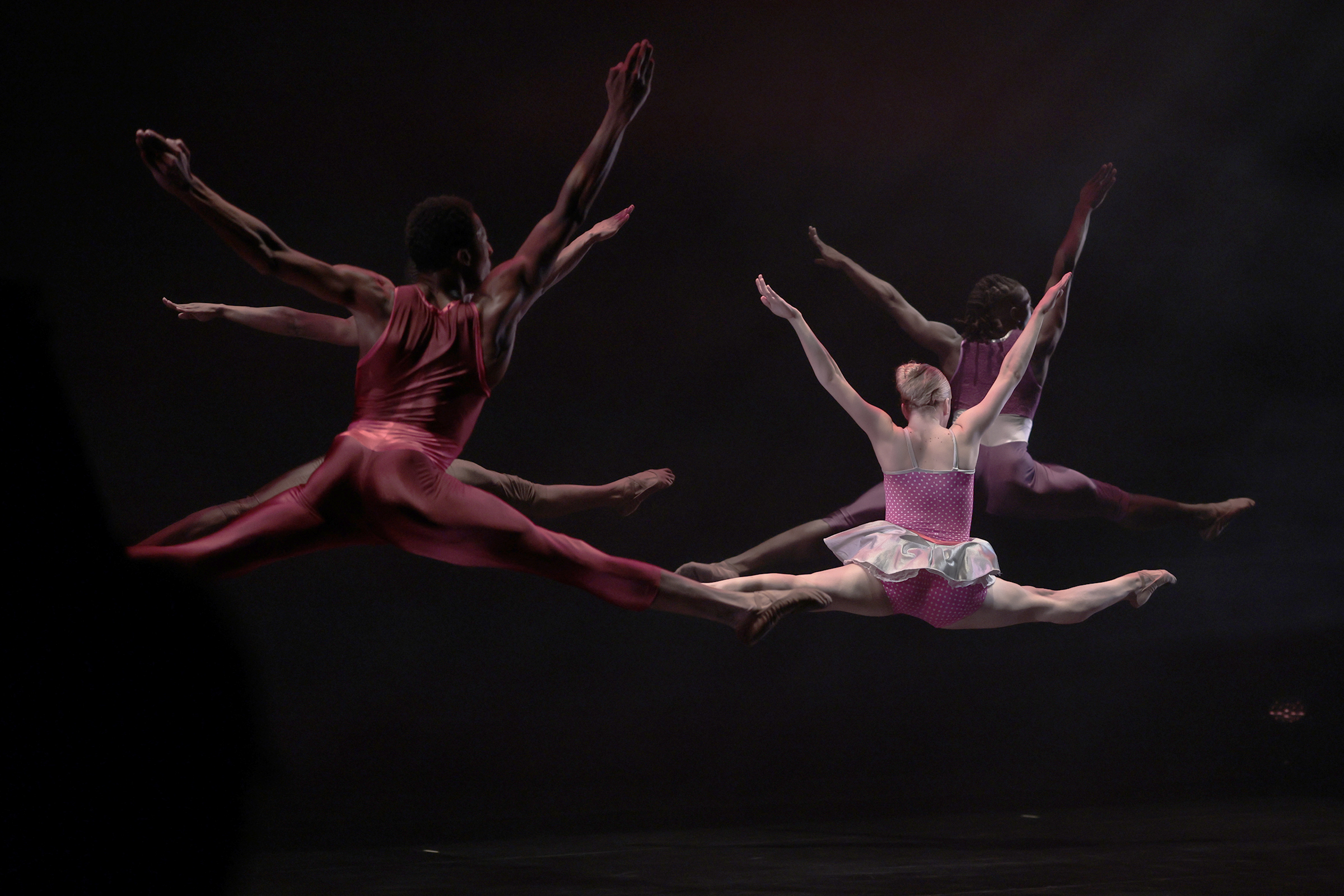
    While those specific sources weren’t clear to this viewer, the dancers’ outstretched arms, perfectly controlled suspensions, and quicksilver entrances and exits clearly evoked the sensation of flying.

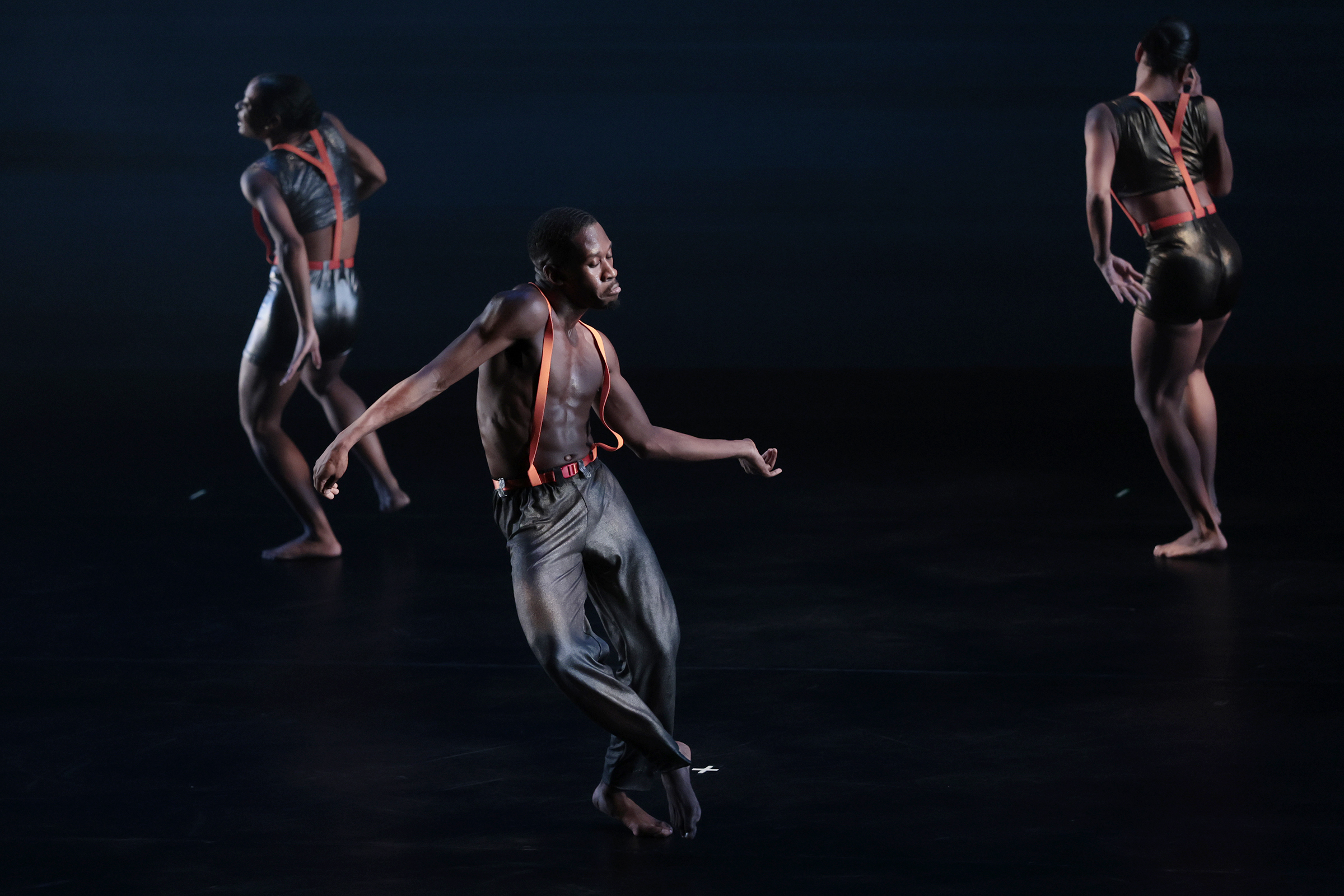
    Philadanco dancers during their Then & Now performance at the Kimmel Center’s Perelman Theater in Philadelphia on Saturday, Dec. 6, 2025.

    It is difficult to single out individuals in this — or, in fact, in any of the works on the program, which frequently had 10 dancers onstage at a time, performing in expert unison. But long-limbed Aliyah Clay began Heirborne with an exquisite solo, moving inside a dramatic shaft of light (designed by Nick Kolin). The piece ended on an even stronger — and unexpected — note when all eight dancers suddenly leaped forward, disappearing into the darkness.

    The music, for this and the other items on the bill, was recorded, favoring mixtures of rap, gospel, and jazz. For Heirborne, Atlanta native Lane chose pieces by several Georgia-based artists: RAHBI, Bryce Raburn, and Leo Ra Soul. Costume designer Anna-Alisa Belous dressed the women in shiny black shorts, a somewhat curious choice, and everyone wore neon-orange suspenders (a nod to airport safety equipment?).

    From Exotica Back to Us, Brown’s contribution to the program, was originally choreographed for Philadanco in 1999 and revised this year.

    Philadanco dancers during their Then & Now performance at the Kimmel Center’s Perelman Theater in Philadelphia on Saturday, Dec. 6, 2025.

    Not having seen the earlier version, I can’t comment on how the work has changed. However, its current iteration is stunning: from the richly colored and textured costumes by Wunmi Oliya (a British Nigerian singer, dancer, and fashion designer who also provides part of the score for this piece) to Brown’s seamless combination of traditional West African dance and percussion with his own, distinctive movement vocabulary.

    There is an obvious spiritual and emotional dimension to these short vignettes — as the dancers raise their arms, hide their faces in their hands, or kneel as though in prayer. This powerful effect is enhanced, at several points, by the outstanding work of dancer William E. Burden.

    Tommie-Waheed Evans created Withinverse… in 2018. In Friday’s “refreshed” version, dancer Kaylah Arielle embodies the deep emotions mentioned in the program. Sometimes she and her fellow dancers appear as supplicants, responding to sad, slow gospel music. Yet at other points they seem frantic, their bodies reflecting the heavy, insistent beat of electronic club music.

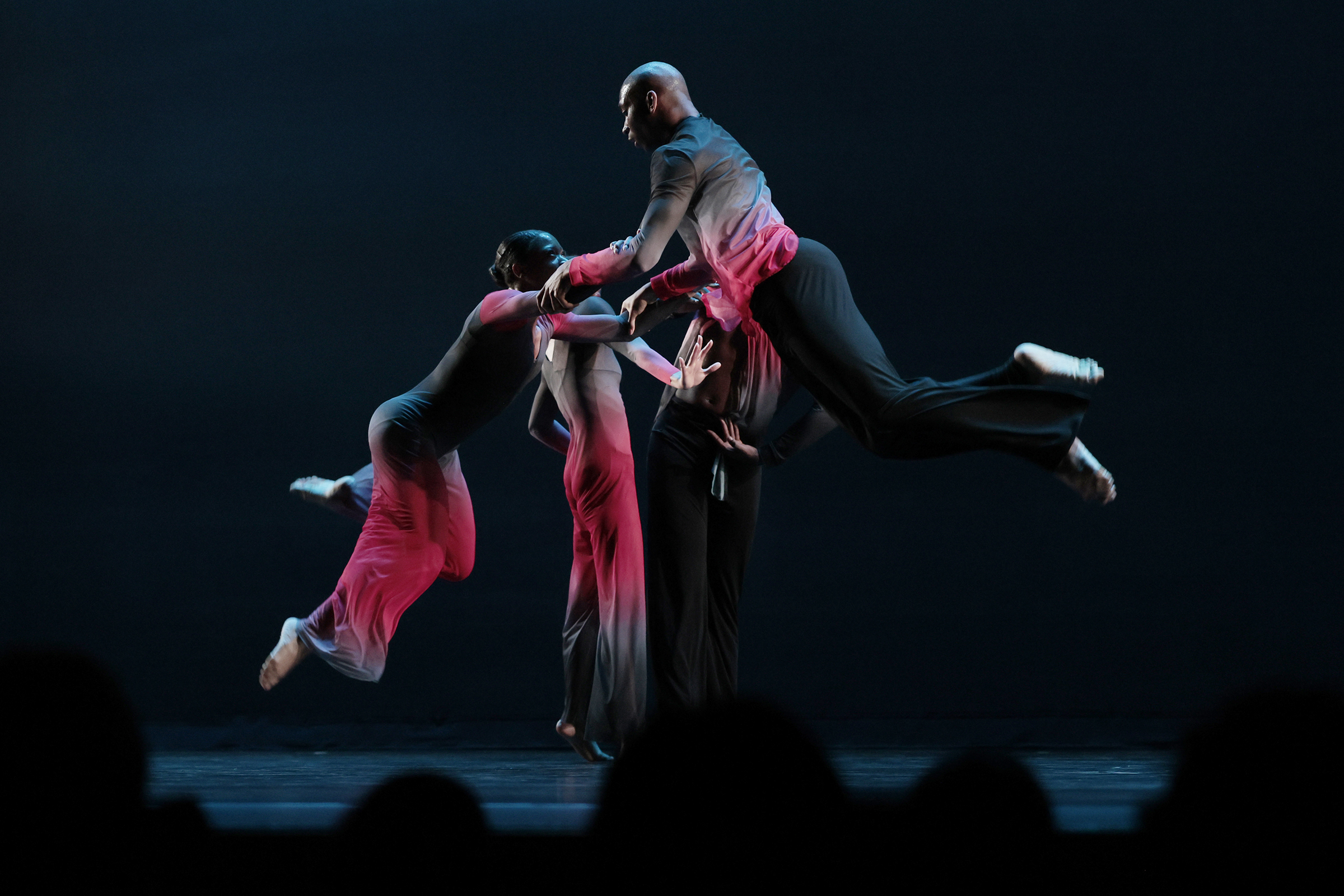
    Philadanco dancers during their Then & Now performance at the Kimmel Center’s Perelman Theater in Philadelphia on Saturday, Dec. 6, 2025.

    Evans has included a series of complicated and innovative lifts, which the dancers execute seemingly without effort. They are equally expert when performing challenging passages in unison.

    The evening begins with Everybody by Donald Byrd. Billed as a parody, it seems more like an uneasy hybrid than, say, the comedic works of Mark Morris or Les Ballets Trocadero de Monte Carlo.

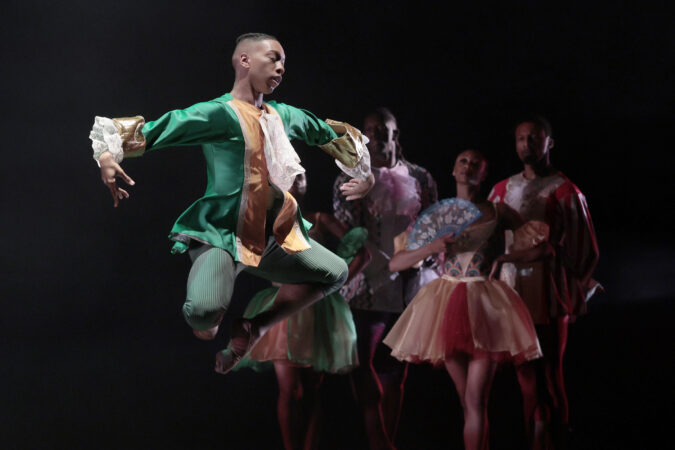
    This work contrasts a harpsichord piece by J.S. Bach with hip-hop music by Ruffhouse, and Natasha Guruleva’s costumes reveal foppish men (notably the statuesque Yasir Jones) dressed in ruffled tunics, while the women wear tutus. Yet everyone is barefoot, alternating between impeccable ballet technique and decidedly non-classical body language.

    Philadanco dancers during their Then & Now performance at the Kimmel Center’s Perelman Theater in Philadelphia on Saturday, Dec. 6, 2025.

    The comparison is amusing, and — as a classically trained flutist who, in his youth, spent six years studying with the celebrated ballerina Mia Slavenska — Byrd knows his way around both Baroque music and classical dance. He enjoys himself by inserting sly touches of physical humor, here and there, and excels at creating intricate and unusual partnering sequences for two or more individuals.

    In a brief pre-performance introduction, Tommie-Waheed Evans (who is also the company’s co-artistic director, along with Kim Bears Bailey) noted that Philadanco had just returned from a successful, multicity tour of Germany. This troupe, which the indomitable Joan Myers Brown established 55 years ago, has many reasons to be proud. But, next time, I hope that ’Danco will include the work of at least one female choreographer.

    Philadanco, “Then and Now!” through Dec. 7, Perelman Theater, 300 S. Broad St. Tickets $43-$63. 215-387-8200, ensembleartsphilly.org

  • ‘Lord of the Rings’ lands at the Philadelphia Orchestra, but the magic remained in the music

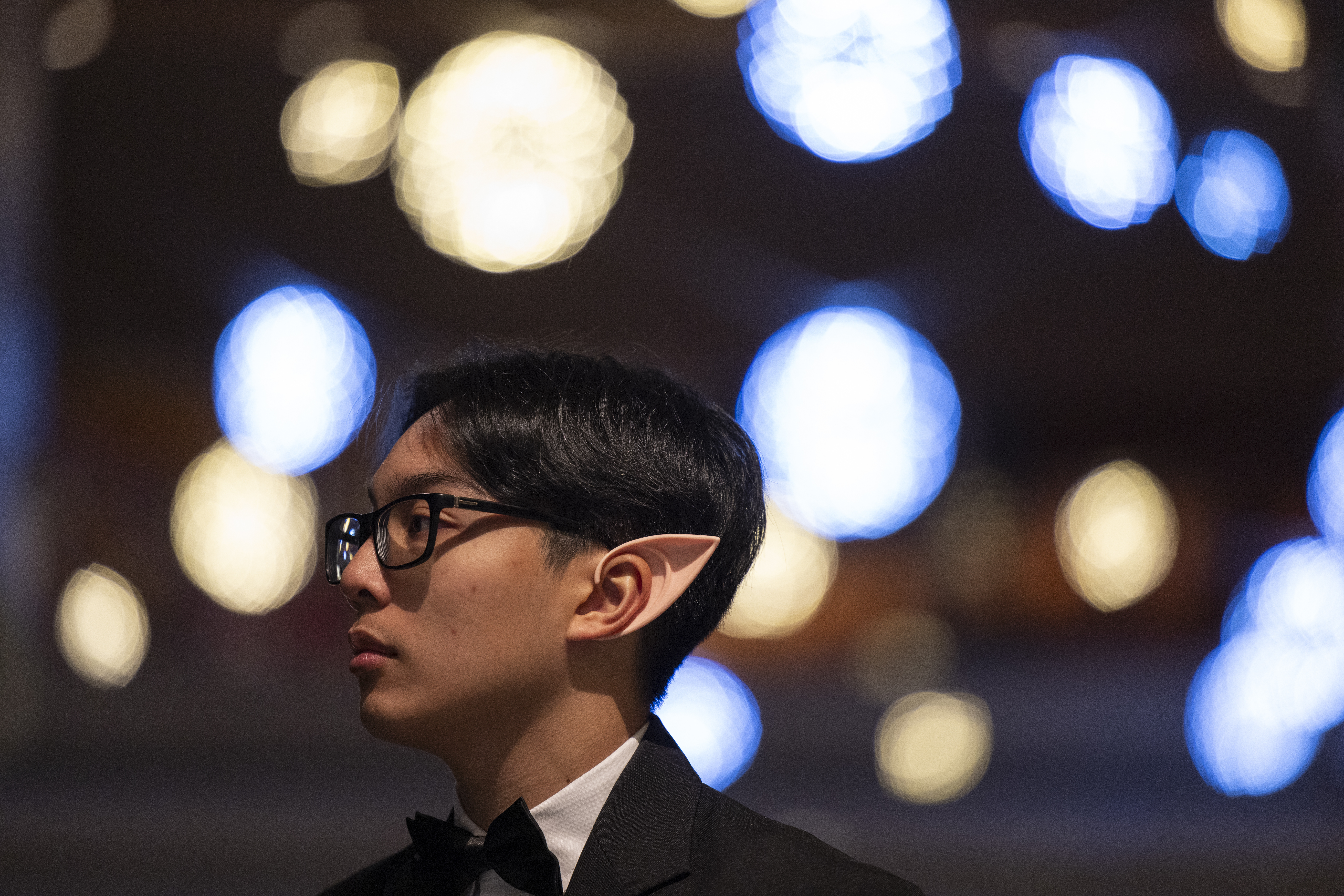
    It was the kind of night at the orchestra when any good hobbit could show up in a Bilbo Baggins waistcoat and feel right at home. Previously-human ushers had suddenly sprung elven ears. And the action on stage involved a twisty, unlikely tale of a magical gold ring whose purpose seemed to be to exploit the flaws and weaknesses of those who encounter it.

    The Philadelphia Orchestra’s presentation of The Lord of the Rings: The Fellowship of the Ring Friday night in Marian Anderson Hall was one of those cross-cultural experiences that ricocheted with surprising power. Two subcultures, each with its own specialized language — classical music, and the fandom around J. R. R Tolkien’s world of wizards, dwarfs and the dark forces — intensified the other.

    The Philadelphia Orchestra, Singing City and Philadelphia Boys Choir on stage in Marian Anderson Hall for ‘Lord of the Rings: The Fellowship of the Ring.’

    For anyone keeping score in the ongoing battle for younger audiences in classical music, Friday was a night when it seemed everyone in the hall was 31 years old and deeply engaged. Never at an orchestra performance have I heard the audience break in so many times with applause and hoots of approval.

    Of this happy synergy, the orchestra sold out all three performances, with tickets topping out at more than $250 a pop.

    Lead usher Ryan Viz, in elven ears, in the Kimmel Center lobby Friday night.

    Not all of the orchestra’s live-to-screen presentations have justified themselves musically, but here, Howard Shore’s score was a canvas both vast (about three hours of music) and colorful.

    If there’s a single label for Shore’s musical language, it’s Celtic Craggy — with notable excursions into the bellicose, sentimental, and moods more subtle. The great value of hearing a great orchestra live in dialogue with the screen is in the emotional epiphanies, moments where the music tells you something the dialogue and action alone can’t.

    The sound engineering on this night favored the music over the dialogue, and smartly so.

    Ian McKellen as Gandalf looms over members of Singing City Friday night in Marian Anderson Hall during a Philadelphia Orchestra live-to-screen presentation of ‘Lord of the Rings: The Fellowship of the Ring.’

    The other beautiful dynamic at play: You didn’t have to walk into the hall with any prior knowledge of classical music or Middle-earth nomenclature to feel the experience. This level of communication is simply embedded deep in being human.

    The definition of human becomes hazy in the 2001 installment of Peter Jackson’s film trilogy. But time and time again, the musical score honed in on the universal goodness and country-folk sincerity embodied in instruments. Two different soprano tin whistles (one in C, the other in D), whose very pitch and story-telling inflection were skillfully stretched by orchestra flutist Erica Peel. Hornist Jennifer Montone perfectly conveyed what it feels like to be a lonely leader in the Council of Elrond scene.

    The percussion section was a city in itself, conjuring folk sounds on the bodhrán drum, and the anvils of war (struck by musicians on, essentially, flat sheets of steel).

    Brian Johnson sits rapt with attention at the Philadelphia Orchestra’s live-to-screen presentation of ‘Lord of the Rings: The Fellowship of the Ring’ Friday night.

    Anvils? The quest for a magical ring? Dwarfs, warriors and flawed characters? Tolkien drew on some of the same sources as Wagner did in his Ring Cycle, and while Shore’s score might have a Wagnerian touch here or there, the larger influence was Carl Orff, whose Carmina Burana became the musical DNA of video games and car commercials.

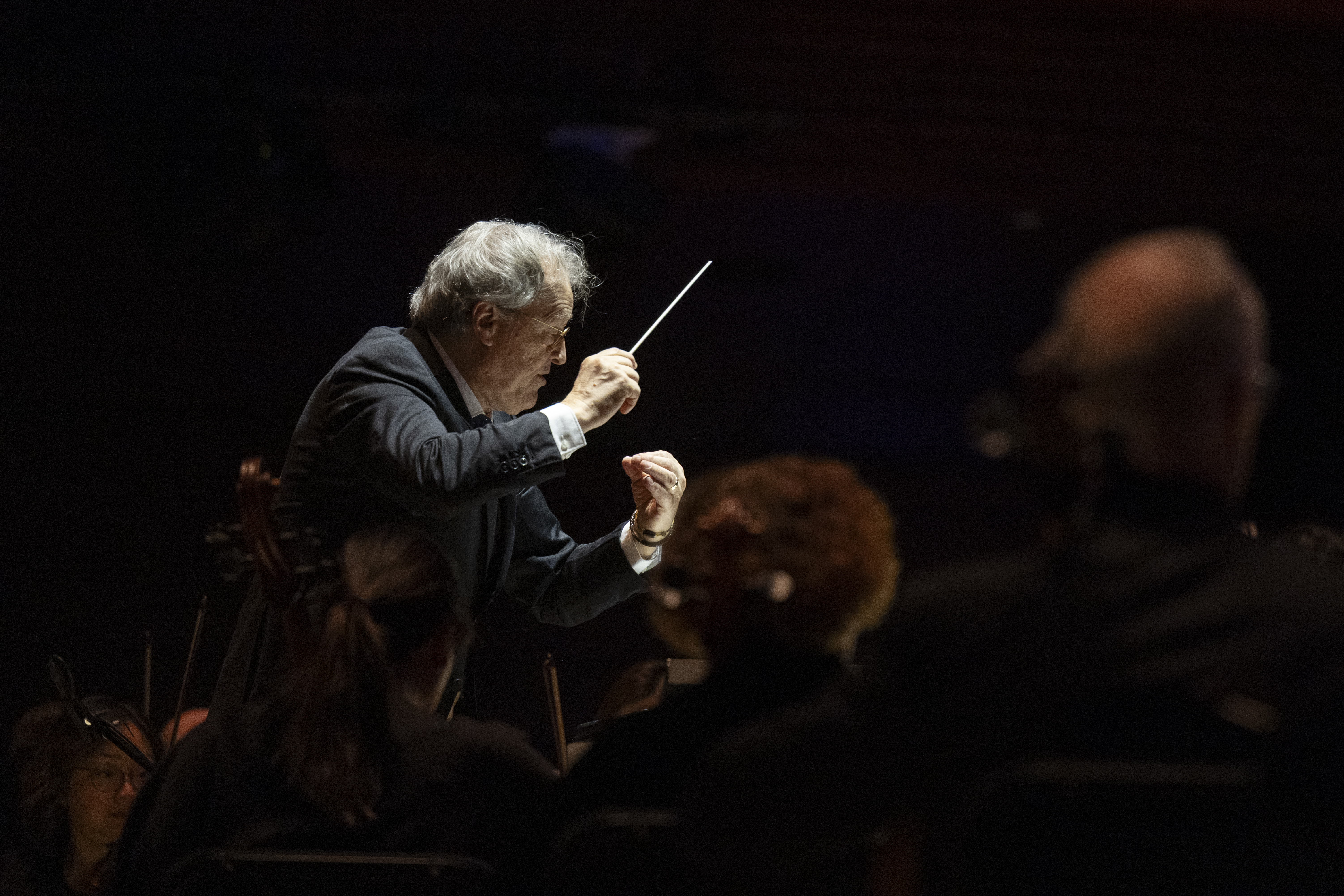
    Conductor Ludwig Wicki leading the Philadelphia Orchestra and other musical forces in Marian Anderson Hall.

    Colossal forces brought both precision and brutality, particularly in the repeating combination of driving percussion, screaming brass and blocs of choral sound amassed for battle. With Ludwig Wicki conducting, the Singing City Choir and Philadelphia Boys Choir — both quite strong — provided chaos and balm. Vocalist Kaitlyn Lusk and chorus were the gentle healing we needed to hear after Gandalf’s death.

    The good thing was, when you tired of watching yet another wave of fiendish Orcs getting clobbered, you could always turn your eyes to the stage, decode the instrumentation and imagine for yourself an entirely different narrative. This is the enduring promise of orchestral sound on any night at the orchestra.

    No additional magic needed.

  • Brazil and France headline the teams coming to Philadelphia for next year’s World Cup

    Brazil and France headline the teams coming to Philadelphia for next year’s World Cup

    Philadelphia will welcome two of the soccer world’s greatest powers, Brazil and France, for its slate of World Cup games next summer.

    Brazil, whose five men’s World Cup titles are the most of any nation, will play Haiti on June 19. That will fill the city’s streets with a vibrant mix of the Seleçao’s famed yellow-and-green kits, and Haiti’s diaspora from across the northeast United States.

    It will also mean an unofficial home game for Union midfielder Danley Jean Jacques, who helped Les Grenadiers reach their first men’s World Cup since 1974. He’ll get to play against superstars including Vinícius Júnior and Estêvão, who coincidentally played at the Linc last summer in the Club World Cup.

    Union midfielder Danley Jean Jacques (center) will get to play an unofficial home game when Haiti faces Brazil in Philadelphia.

    But that day will put Philadelphia in the middle of this World Cup’s political spotlight. Haiti is one of two teams in the field, along with Iran, whose citizens are currently banned from entering the United States because of political unrest in the tiny Caribbean nation. Anyone in an official delegation — players, coaches, team staff, etc. — will be fine, but whether fans will be able to travel here remains a huge question.

    Haiti was unable to host its World Cup qualifiers on home soil, and manager Sébastien Migné has never set foot in the country. When asked about that at Friday’s group draw, he told reporters: “It depends on Mr. Trump.”

    As President Donald Trump had just won the first edition of FIFA’s Peace Prize (with timing that perhaps wasn’t coincidental), Migné then offered a hope that “maybe he will continue with that [spirit], and he will open the possibility for the fans to come here.”

    France will play here on June 22 against the winner of the March intercontinental playoff bracket, which includes Bolivia, Suriname, and Iraq. That will bring one of the world’s absolute superstars, Kylian Mbappé, who led Les Bleus to the 2018 title and the 2022 final.

    Philadelphia will get to see France superstar Kylian Mbappé (right) in person during the World Cup.

    France’s squad is among the most loaded in the tournament. Mbappé is joined by reigning world player of the year Ousmane Dembélé and a fleet of outstanding youngsters: Bradley Barcola, Rayan Cherki, Desiré Doué, Hugo Ekitike, Michael Olise, and Warren Zaïre-Emery.

    Philadelphia’s slate begins on June 14 with Ivory Coast vs. Ecuador in Group E. Expect Ecuador to bring a huge crowd, all clad in the country’s yellow jerseys, — and star players in midfielders Moisés Caicedo (England’s Chelsea) and Kendry Paez (France’s Strasbourg, owned by Chelsea).

    Ivory Coast’s squad, led by midfielder Franck Kessie (Saudi Arabia’s Al-Ahli) and forward Amad Diallo (England’s Manchester United), will play two games in Philadelphia.

    Les Elephants’ second game here will be their group stage finale, June 25 vs. Curaçao — a Caribbean island making its World Cup debut.

    <iframe title="2026 World Cup Matches  in Philadelphia" aria-label="Table" id="datawrapper-chart-bFLzF" src="https://datawrapper.dwcdn.net/bFLzF/1/" scrolling="no" frameborder="0" style="width: 0; min-width: 100% !important; border: none;" height="632" data-external="1"></iframe><script type="text/javascript">window.addEventListener("message",function(a){if(void 0!==a.data["datawrapper-height"]){var e=document.querySelectorAll("iframe");for(var t in a.data["datawrapper-height"])for(var r,i=0;r=e[i];i++)if(r.contentWindow===a.source){var d=a.data["datawrapper-height"][t]+"px";r.style.height=d}}});</script>

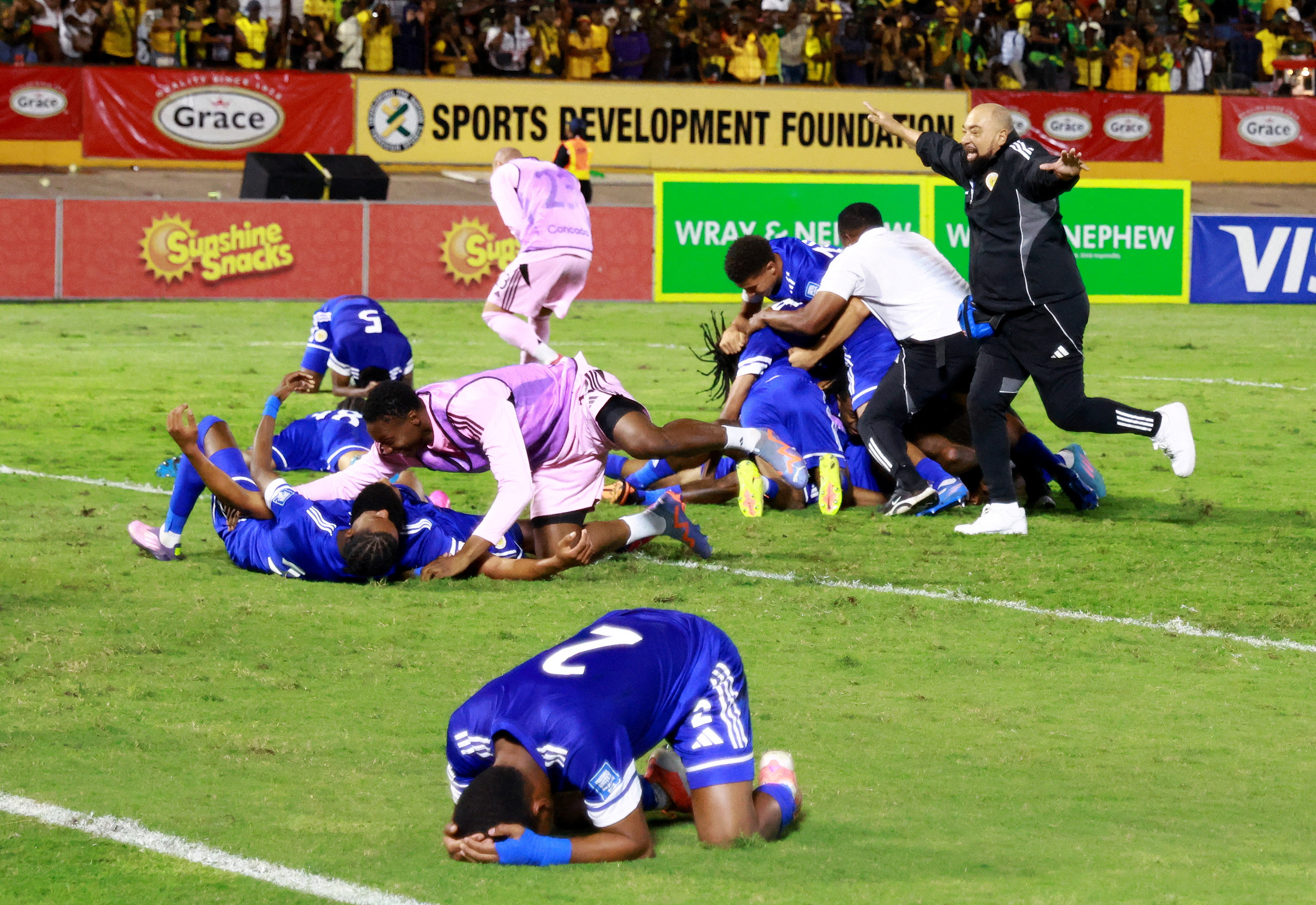
    The Blue Wave’s history as a Dutch colony led the governing body to recruit dual nationals in recent years, and that paid off this year by topping Jamaica in their World Cup qualifying group.

    This World Cup marked the first one where FIFA did not set games in venues at the moment of the draw. That caused a lot of consternation around the world.

    On Friday at the Kennedy Center’s Concert Hall, where the draw took place, The Inquirer overheard a FIFA staffer admit the truth about why that’s the case.

    Before the draw, stadiums were assigned games in groups, but not specific matches. That meant any given matchup could be in one of two stadiums. FIFA’s decision to not set the venue at the moment of the draw meant it could move a matchup with less-popular teams to the smaller of the two stadiums available for it, and not worry about unsold tickets.

    Curaçao’s celebrations at the final whistle of its tie in Jamaica last month that clinched World Cup qualification.

    Of course, there’s so much demand in the U.S. and worldwide that every game is expected to sell out. But a supposedly “lesser” game in a bigger stadium could give a chance to fans who don’t want to shell out thousands of dollars for tickets on FIFA’s in-house secondary market.

    There’s a chance Philadelphia could benefit from that in Curaçao-Ivory Coast and the city’s last group game, Croatia vs. Ghana on June 27. Croatia has one of the world’s all-time midfield maestros in Luka Modrić, and Ghana will also draw from West Philly and well beyond. But the teams’ fan bases aren’t big enough to fill the Linc on their own, so the odds might improve for local fans to get tickets.

    After that, the Linc will have a week to recover before the city’s last game in the tournament, a round of 16 contest on July 4. The round of 32 games that feed into that matchup include the winners of Group E and Group I, which means Philly could see France return to town to play Germany in one of Europe’s classics.

    Croatia’s Luka Modrić (right) is one of the soccer world’s most talented midfield creators.

    Beyond the matchups, fans will also have an eye on kickoff times amid the hot summer weather. The city’s first two games will have nighttime starts, including a late one for Brazil-Haiti. But the remaining four will all have late-afternoon kickoffs, including a 5 p.m. start time on July 4.

    As for the U.S. team, fans will be staying up late for two of its three group games. The June 12 opener vs. Paraguay in suburban Los Angeles is a 9 p.m., ET kickoff on a Friday, and the June 25 group stage finale against a European playoff winner will be a brutal (at least for East Coast fans) 10 p.m. start on a Thursday.

    The middle game, June 19 (also a Friday) against Australia, will be a 3 p.m. Eastern kickoff.

    2026 World Cup games in Philadelphia

    All games will be played at Lincoln Financial Field, which will be called Philadelphia Stadium during the tournament because FIFA bans the use of commercial sponsors’ names on stadiums during its senior World Cups.

    June 14: E3. Ivory Coast vs. E4. Ecuador, 7 p.m.

    June 19: C1. Brazil vs. C3. Haiti, 9 p.m.

    June 22: I1. France vs. I3. Bolivia, Suriname, or Iraq (an intercontinental playoff), 5 p.m.

    June 25: E2. Curaçao vs. E3. Ivory Coast, 4 p.m.

    June 27: L2. Croatia vs. L3. Ghana, 5 p.m.

    July 4: Round of 16 game, 5 p.m.

  • Drexel wrestling took a loss Friday night vs. top-ranked Penn State, but it was ‘incredible’ anyway

    Drexel wrestling took a loss Friday night vs. top-ranked Penn State, but it was ‘incredible’ anyway

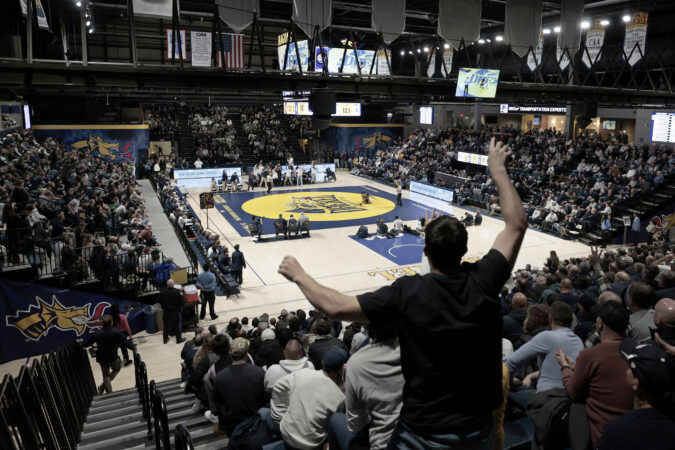
    After winning its fourth consecutive national championship at what then was the Wells Fargo Center last March, No. 1 Penn State returned to Philadelphia to face Drexel in a dual meet Friday night at a sold-out Daskalakis Athletic Center.

    While the Nittany Lions claimed a 43-3 win over the Dragons, both teams gained something else from the meet. It was an opportunity for Drexel to draw a crowd of 2,000-plus to the DAC. And it allowed Penn State to make an appearance in Philadelphia, where the Nittany Lions have a large alumni base. It also was an opportunity to play an in-state rival early in the schedule, which Penn State coach Cael Sanderson tries to do as frequently as he can.

    “We don’t have a lot of open spots in our schedule with our conference, but you try to wrestle with as many schools in Pennsylvania as you can,” Sanderson said.

    Jordan Soriano had the Dragons’ lone win in the 141-pound match. The senior claimed an 8-5 decision over Penn State’s Cael Nasdeo. The loss drops Drexel to 2-1 in duals this season, while Penn State improves to 2-0.

    Lions in the East

    Friday night’s match marked the end of a home-and-home series between Drexel and Penn State. The top-ranked Nittany Lions hosted the Dragons in State College, Pa., last season. The Dragons lost that dual, 41-3, with their lone match win belonging to Soriano.

    Friday’s dual meet was the first time Penn State has reappeared in Philadelphia since it won its 13th overall national title in March.

    “I think it’s fun,” Sanderson said. “It’s a different experience. A lot of the national tournaments are in the city, and it’s a little different kind of feel as far as getting around … I think it was good for us. We’ve got a lot of alumni from the area.”

    Penn State has fewer local connections on its roster, though. Of the 10 wrestlers who took to the mat on Friday for the Nittany Lions, none were from within 50 miles of Philadelphia. 11 of the athletes on Penn State’s roster are from the state, and a few hail from the collar counties, like Doylestown’s Tyler Kasak or Harleysville’s Sam Beckett.

    Sanderson said he does not usually recruit athletes within Philadelphia’s city limits, but that the Lehigh Valley and South Jersey typically are fertile recruiting grounds.

    “Usually, the wrestling isn’t huge in the city areas as much,” Sanderson said. “Wherever the best wrestlers are, that’s where we’re recruiting from. But when you can get kids from Pennsylvania, that’s obviously No. 1, just because we’re Penn State.”

    Old friends

    The opportunity to play an in-state rival in Philadelphia is one of the reasons the Nittany Lions made the trip to University City, but it also helps that Sanderson and Drexel coach Matt Azevedo are former teammates who overlapped for two seasons at Iowa State.

    Sanderson, who was undefeated in four seasons at Iowa State was on the 2000-01 and 2001-02 teams with Azevedo, who was a three-time NCAA qualifier two seasons at Arizona State and two with the Cyclones. Azevedo also was teammates with Sanderson’s older brother Cody, who is an associate head coach for the Nittany Lions.

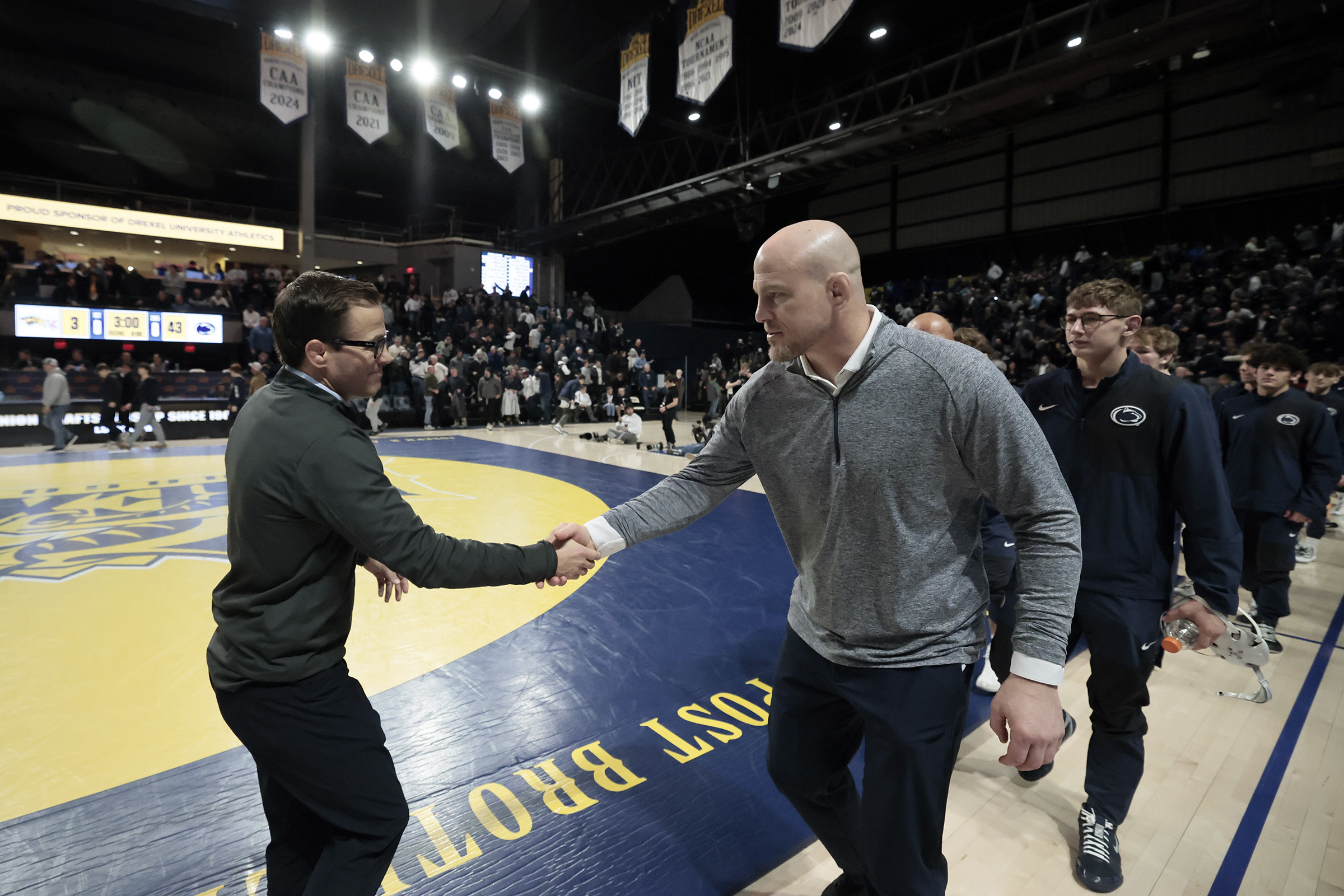
    Drexel coach Matt Azevedo (left) and Penn State coach Cael Sanderson were teammates in college.

    Azevedo said that even though he’s the older of the two head coaches, he looks up to Sanderson and what he’s accomplished in 16 seasons at Penn State.

    “Cael has always set a great example as a teammate and as a competitor,” Azevedo said. “We all marveled at what he could do, and now as a coach, he’s doing incredible things. Honestly, I watch from a distance, you know, try and learn and try to pick up things. They do an amazing job, and I’m happy for them.”

    Sanderson shared a mutual respect for his former college teammate, saying he’s cheering Azevedo’s squad on when they are not matching up head-to-head.

    “They’re in really good shape, and they’re tough,” Sanderson said. “They fought the whole time. They were challenging us in every position, so that’s kind of what we were expecting. We’d like to see them doing well moving forward. They were tough.”

    Packing the DAC

    Drexel announced Wednesday that its meet vs. Penn State was sold out. There appeared to be a few empty seats Friday night, but the crowd neared the DAC’s 2,509-seat capacity. It was a relatively split crowd, too; Penn State fans appeared to have a slight majority. The Nittany Lions are among the biggest draws in college wrestling, thanks to a run of success that includes 12 national titles since Sanderson took over in 2010.

    Azevedo said the opportunity to host Penn State was an opportunity to shine a spotlight on his own program. The Dragons are coming off their best Eastern Intercollegiate Wrestling Association finish in Azevedo’s tenure at the school, finishing the season 11-10 and second in the conference. Drexel sent three wrestlers to the NCAA championship as individual qualifiers last season.

    “When we can host a dual meet here at Drexel, and sell it out as a mid-major wrestling program, I think it says a lot,” Azevedo “It says a lot about our fan base, that our fans are excited to come out and watch us wrestle. Right, there’s a lot of Penn State fans here, but there were just as many Drexel fans.”

    Azevedo said while he knew putting Penn State on the schedule likely wouldn’t result in a nonconference dual win for the Dragons, he could not refuse an opportunity to host the Nittany Lions.

    “I feel fortunate to be able to create an environment like this for our guys to compete in,” Azevedo said. “It gets a lot of attention and eyeballs on our program. For me, it’s like, I can’t pass that up. You know it’s going to be tough, but this was an incredible event.”

  • Fire damages Atlantic City Boardwalk’s iconic Peanut World

    Fire damages Atlantic City Boardwalk’s iconic Peanut World

    A fire Friday tore through the Atlantic City Boardwalk’s Peanut World souvenir shop, according to authorities.

    Atlantic City firefighters battled the blaze that erupted about 4 p.m. at the business off Martin Luther King Boulevard. Heavy smoke billowed out onto the Boardwalk and damaged three other buildings, according to a news release.

    The businesses were closed, and no injuries were reported.

    While the buildings are salvageable, Peanut World’s interior will have to be rehabbed, according to city public safety spokesperson Matt Duffy. City officials will assess the damage next week, he said.

    “We have many buildings of historical significance here in Atlantic City and we really try to keep their integrity whenever possible,” Atlantic City Fire Chief Scott Evans said in a statement.

    Peanut World could not be reached by phone early Saturday.

    The cause of the fire is under investigation.

  • Roman Catholic makes football history with first state crown: ‘We were on a mission’

    Roman Catholic makes football history with first state crown: ‘We were on a mission’

    MECHANICSBURG, PA — Eyan Stead Jr. blamed himself. The Roman Catholic 5-foot-10, 180-pound senior two-way star carried it with him for months. It bothered him to the point where he lost sleep over the pass that glanced off his hands in last year’s state championship that would have been a touchdown.

    Stead also knew something else. He would get another chance. Fortunately, on Friday night, he did, against the same team, in the same stadium, in the same game.

    This time, Stead made it right, and was a big part in making Roman Catholic football history, catching a game-high nine passes for 102 yards and a touchdown in leading the Cahillites to their first PIAA state football championship, beating District 3 champion Bishop McDevitt, 28-6, in the Class 5A championship at Cumberland Valley High School.

    Late in last year’s state championship, won by McDevitt, 34-31, in overtime, Stead was wide open down the middle of the field when Roman quarterback Semaj Beals unfurled a bomb. It looked like Stead would run right under it when it bounced off his hands.

    The drop plagued Stead for a while.

    “Every day, every day after that game last year I thought about it,” admitted Stead, who’s bound for Temple. “I beat myself up over it. That stayed with me for two months after that game. I had to make it right. I started to stack days and prepare. I lost sleep over that play. I lost weight. I didn’t eat for two weeks. I didn’t start letting it go until late January. I put it on me. I let my team down, and it bothered me.

    “I believe in second chances. I believe in third chances, and when this chance came to play McDevitt again, in this game, I wasn’t going to let anyone down this time.”

    The state championship was the culmination of what Cahillites’ head coach Rick Prete had been building since he was named head coach in 2019. He built the program up from scratch, taking considerable time to take players to summer seven-on-seven camps, vanning them to various skills camps, and gradually building the talent of the program.

    “I have to process all of this,” Prete admitted. “It feels great being the first to do this. We’re going to celebrate on Saturday, and I may not feel one bump on the turnpike on the way home. I want to make sure I tip my cap to [McDevitt] coach [Jeff] Weachter and his team. I learned a lot from him.”

    Prete’s supreme find was Beals, who is heading to Akron and has thrown for over 12,000 yards as a four-year starter.

    Beals completed 18 of 26 for 231 yards and three touchdowns, getting Roman out to a big first-half lead before McDevitt scored.

    “I was on a mission, we were on a mission, and we were all motivated from what we went through losing last year,” Beals said. “I know Eyan went through. I know he blamed himself for the drop, but we were all to blame. And we all took it on ourselves this offseason to get back here and do something we felt we should have done last year — win the state championship. It feels great making history as the first Roman team to ever win a state title in football, but this is a brotherhood, and it’s something we all did together. No one was going to stop us this year.”

    Roman had the game won at halftime, holding a 21-0 lead. The Cahillites scored on three of their first five possessions, outgaining McDevitt, 197 to 120. The separation should have been more, with Roman only converting one of McDevitt’s three first-half turnovers into points.

    Beals scored on Roman’s first drive with a seven-yard run. Beals found Hanif Sheed on a short, seven-yard touchdown pass early in the second quarter for a 14-0 advantage. The score was created by a fumble recovery by Roman’s Julian Enoch at the McDevitt 33.

    Roman squandered a second-quarter interception by junior linebacker Walter Hudson, who brought the ball back to the McDevitt 22. But a fumble, which was recovered, pushed the Cahillites back to the 24, followed by an illegal shift flag that put the Cahillites in a fourth-and-13 at the McDevitt 25.

    Defensively, Hudson came spearing through to stop a McDevitt fourth-and-one at the Roman 46, which the Cahillites turned into a 40-yard touchdown pass from Beals to Ash Roberts to take a 21-0 lead with 1 minute, 53 seconds left in the first half. Hudson led all defenders with 11 tackles, which included four tackles for losses.

    “We had to stop the run, and we knew our defensive backs would stop their pass game,” Hudson said. “On the fourth-down play, I knew what they would do by watching film. I ran through the A-gap and I stopped it. On the interception, I dropped back in my zone, and I knew the ball would come to me. I tried to score, but everything started giving up. We didn’t do last year, and were determined this year to finish the job.”

    It was Stead who tacked on the last score, when Beals hit him with a short 1-yard pass with 1:16 left in the third quarter.

    “Eyan beat himself up over last year, but we made sure he knew we would not have been in that position without him,” Prete said. “He made sure. Eyan, he will always be our guy, and I keep saying it, he’s the best player in the state. He showed it tonight. I’ve been pounding that table for two years now how good Eyan Stead is. There is not a better football player in Pennsylvania than Eyan Stead.”

  • Paul George winds back clock with vintage performance against Bucks: ‘I feel like myself again’

    Paul George winds back clock with vintage performance against Bucks: ‘I feel like myself again’

    MILWAUKEE — Paul George approached Tyrese Maxey during the fourth quarter of Friday’s tightening matchup at the Bucks, and told the 76ers’ star point guard, “Don’t worry about it. I’m going to finish this for us.”

    George more than made good on his promise. His output in that final frame — six points, four rebounds, and two assists — helped push the Sixers to a 116-101 victory at Fiserv Forum. And the well-rounded overall performance (20 points, five rebounds, five assists in 29 minutes, 58 seconds) flashed that, following knee surgery and an injury-riddled first season as a Sixer, George might still have shades of the player who became a perennial All-Star and signed a max contract in the summer of 2024.

    “I feel like myself again,” George said from his locker after Friday’s victory. “I believe I’m not done yet. So it was great to kind of [have] everything kind of come back to me and it feel like it was natural. Muscle memory and my rhythm, timing, cadence, flow.”

    It was a crucial lift for the Sixers (13-9) on a night when Maxey was limited to a season-low 12 points, two weeks after dropping a career-high 54 on these Bucks. The Sixers also were without former MVP center Joel Embiid, who played in Thursday’s chaotic home victory over the Golden State Warriors but sat out the second night of the back-to-back with left knee injury recovery.

    George, meanwhile, did not play against the Warriors because of his own recovery path. He entered Friday’s fourth quarter with an already-sharp 14 points and three assists.

    The 6-foot-8 wing then began to initiate the Sixers’ offense, a role that typically falls on Maxey. The shift allowed George to be on his “A game,” he said, because of his adept playmaking and smooth shot-making while patiently reacting to the defense.

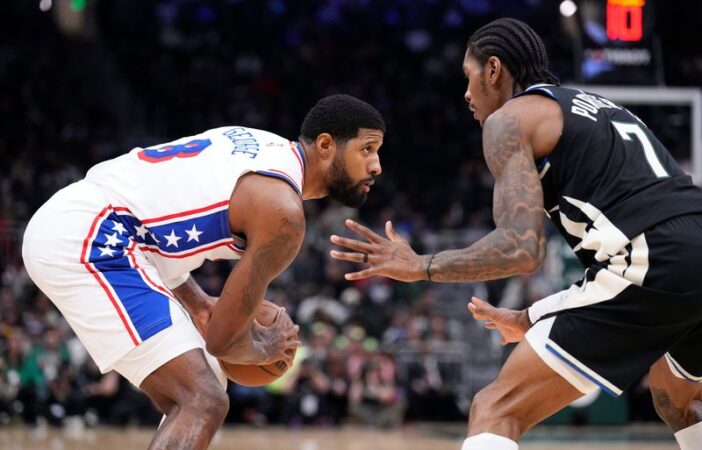
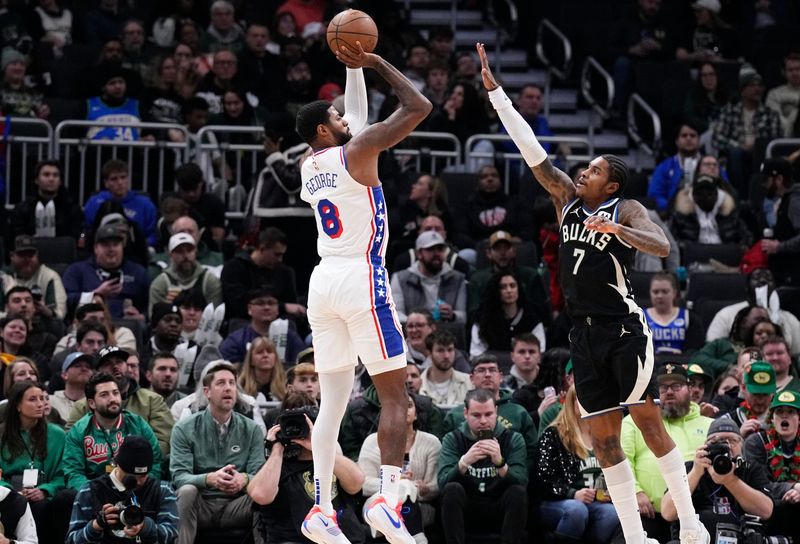
    Paul George puts up a shot against Milwaukee Bucks guard Kevin Porter Jr. (7) at Fiserv Forum on Friday.

    After multiple correct passing reads yielded missed shots by teammates, George took his defender off the dribble and rose up for a midrange jumper at the 6:18 mark. On the Sixers’ next possession, he nailed another pull-up to put the Sixers up by 14 points. About a minute later, George called for the ball, drew the foul on Kevin Porter Jr., and sank the two free throws.

    While holding off the Bucks’ attempted rally from 26 points down, George also got back in transition to help force a Bobby Portis whiff at the rim with 3:53 to play. He then secured a rebound that set up teammate VJ Edgecombe’s three-pointer to give the Sixers a 108-94 lead with 2:34 remaining.

    “Coach trusted me in that moment,” George said. “And [that was] me being able to respond to the moment.”

    George’s best game of the season was the result of his behind-the-scenes rehab work. That occurred amid outside criticism — “You’re getting old, and you’re washed, and you can’t do it anymore,” George mimicked Friday — that the 35-year-old said he needed to “drown out.”

    He also acknowledged the mental challenge of expecting his athleticism and body movements that have been reliable for years and those physical gifts suddenly dissipating. During his disappointing first season as a Sixer, George struggled to burst past defenders while averaging 16.2 points, 5.3 rebounds, and 4.3 assists in 41 games.

    “Outside looking in,” George said, “[fans] see us on the court and they’re like, ‘Yo, why aren’t you doing this?’ It’s just like, ‘My body can’t. I’m trying.’”

    George missed the Sixers’ first 12 games of 2025-26, before playing in seven of the team’s past 10 matchups.

    Following an efficient 14-point outing at the Brooklyn Nets on Nov. 28, George said that he and the Sixers’ staff had discovered the ideal way to fire up his left quadriceps muscle to support his knee. He then asked to play more minutes (28:02) in Sunday’s double-overtime home loss to the Atlanta Hawks, saying he feels like “the bird leaving the nest, getting to fly and flap my wings a little bit more.” But two days later, George felt “a little fatigued” while playing 17:43 in Tuesday’s home blowout vs. the Washington Wizards, a sign that these early games essentially are serving as his training camp.

    Sixers coach Nick Nurse reiterated earlier this week that George makes an instant impact as a versatile and communicative defender. His offensive flurries — including scoring the game’s first 11 points in the Nov. 20 overtime win in Milwaukee — also offered some promise. Now, when George drives to his left — when that lead leg must be strong and stable — he said he feels a mental “light popping back on, that I can start to trust it again.”

    Paul George makes a three-point basket against the Washington Wizards at Xfinity Mobile Arena on Dec. 2.

    George also still leans on his vast experience and knowledge of opponents, such as whose jump shot releases take longer and how to attack defensive switches. He has used that expertise to provide vocal mentorship to younger teammates like second-year center Adem Bona, who in Tuesday’s game against Washington missed a pass from George after sealing his defender.

    “I’m throwing that over the top, where he can just catch it and finish at the basket,” George said then. “Might be a little different. He’s not used to it. But just letting him know, ‘I see you, and I’m looking for that.’”

    It was poetic that, to help ignite George’s excellent fourth quarter, he lofted that style of pass to a cutting Bona for a dunk. And once George’s performance on both ends had all but officially propelled the Sixers double-digit victory, George and Maxey linked for their elaborate handshake as the veteran checked out for the final time.

    George had made good on his promise to his point guard. And he looked like vintage PG.

    “That’s what he’s here for,” Maxey said.