Tag: topic-link-auto

  • A beer in the dugout, a benching, and a rift with his manager: Inside the final Phillies season for Nick Castellanos

    A beer in the dugout, a benching, and a rift with his manager: Inside the final Phillies season for Nick Castellanos

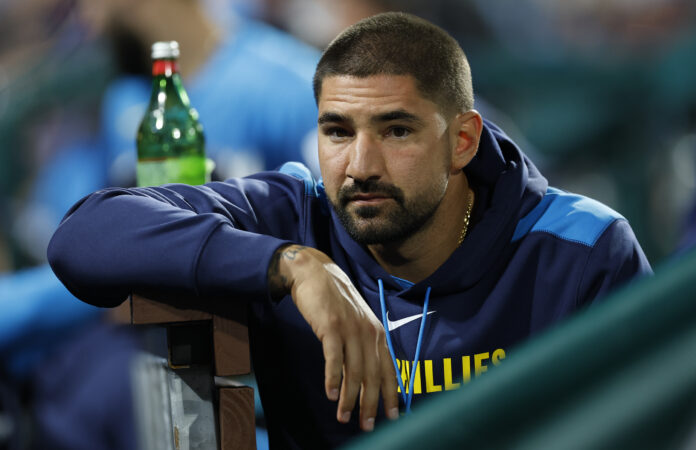
    CLEARWATER, Fla. — After getting replaced for defense late in a close game, the worst defensive outfielder in baseball since 2022 based on defensive runs saved brought a beer into the dugout and lectured his manager.

    Brought a beer into the dugout.

    Let those words wash over you. They belong, incidentally, to the player himself. The Phillies released Nick Castellanos on Thursday after trying to trade him for three months. And when the deed was finally done, the $100 million right fielder laid bare the June 16 incident in Miami that precipitated his unceremonious departure.

    “I brought a Presedente [sic] into the dugout,” Castellanos said in a handwritten letter posted on Instagram. “I then sat right next to Rob [Thomson] and let him know that too much slack in some areas and to [sic] tight of restrictions in others are not condusive [sic] to us winning.”

    That was 241 days ago.

    And it was the beginning of the end.

    There were other tension points. Castellanos, a two-time All-Star with 250 career homers and an everyday player in the majors for a decade, lost his job in August while producing at a less-than-league-average clip. In September, he accused Thomson of “questionable” communication.

    As president of baseball operations Dave Dombrowski put it in explaining why the Phillies-Castellanos relationship soured like a lemon with $20 million left on the final season of his five-year contract, “I don’t think it was necessarily one incident.”
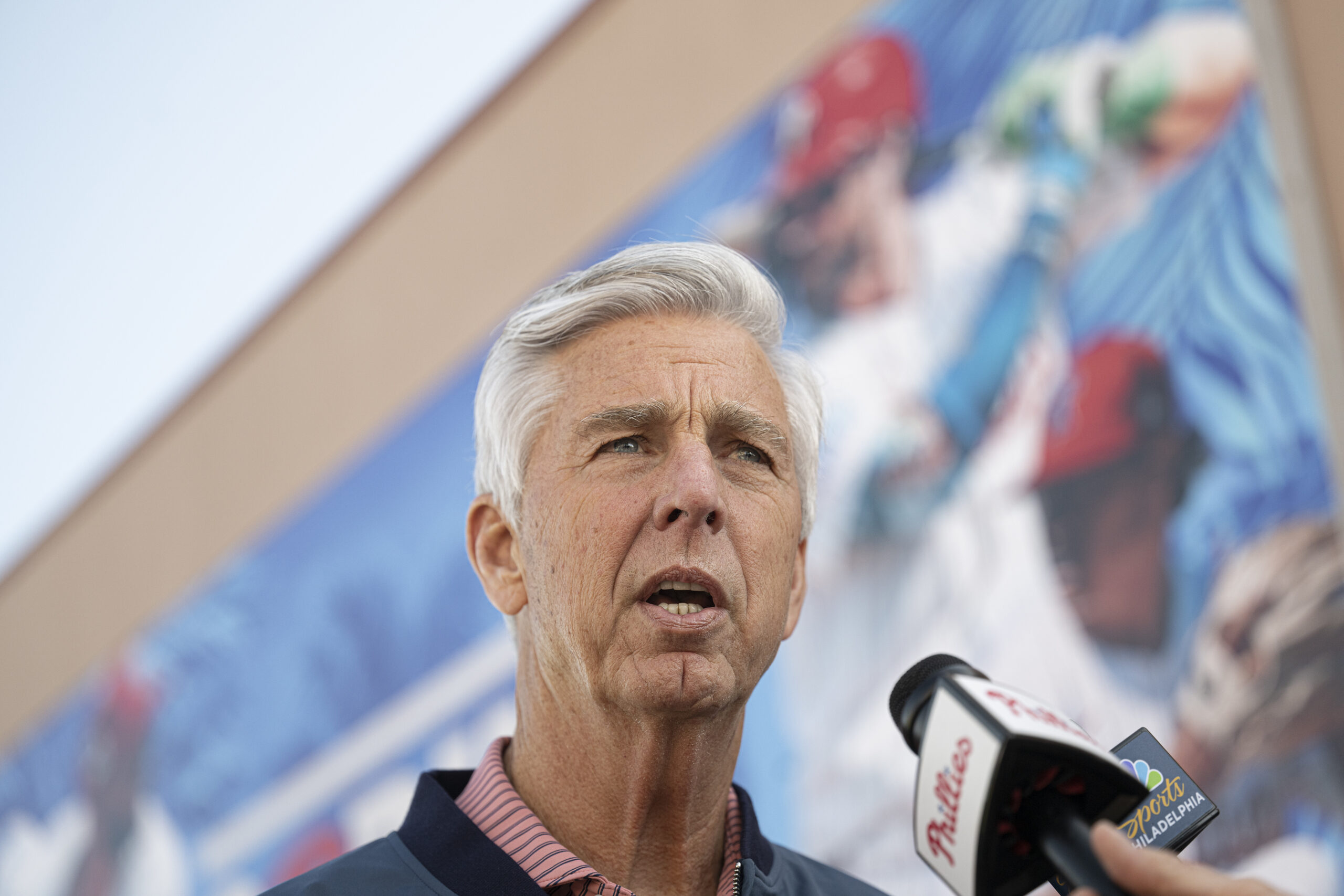
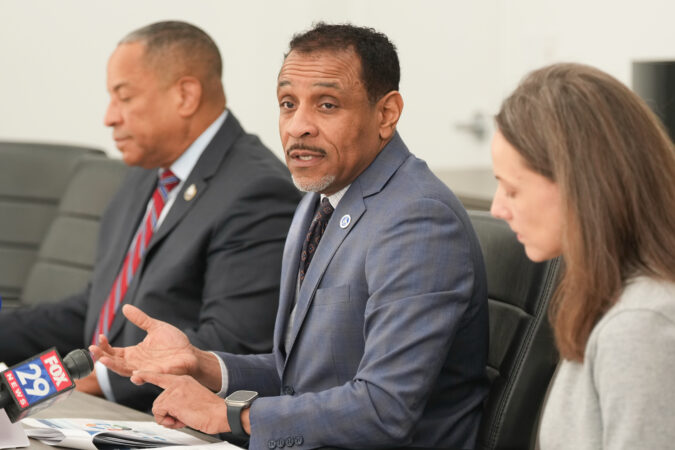
    Phillies president of baseball operations Dave Dombrowski talks to the media on Thursday after releasing Nick Castellanos.

    In truth, Castellanos was always a strange match for Philly.

    His introductory news conference in March 2022 — after signing the contract that put the Phillies over the luxury tax for the first time in their history — revealed an edgy personality, a directness that didn’t always sit well with everyone even in the clubhouse, and a penchant for taking things personally.

    “He’s a little different,” former teammate Whit Merrifield said recently on The Inquirer’s Phillies Extra podcast. “And he’ll tell you, he’s just a little different. He’s very, very blunt. He’ll tell you exactly how he feels.

    “There are just some things that happened that Casty didn’t like along the way, and he’s not the guy to hide his feelings or sugarcoat it. And I think it just kind of came to a head.”

    It didn’t help that Castellanos struggled on the field in 2022, his first year with the Phillies, posting the lowest full-season OPS of his career (.694) — until he matched it last year.

    He often quibbled over his spot in the batting order, especially when Thomson dropped him to the seventh or eighth spot, insisting he felt more comfortable in the top half of a lineup. And when coaches worked with him at, say, reducing his rate of swings at pitches out of the zone, Castellanos often pushed back, noting that he’s “always been a free swinger.”

    But Castellanos could also be supportive of teammates. He encouraged young outfielder Mickey Moniak to stay around the team after breaking his hand on the last day of spring training. And after Orion Kerkering made a series-ending error in the postseason last year, Castellanos raced in from right field to be at his side.

    “He treated me and my family wonderfully,” left fielder Brandon Marsh said Thursday. “He’s always got my respect and I always got love for [No.] 8.”
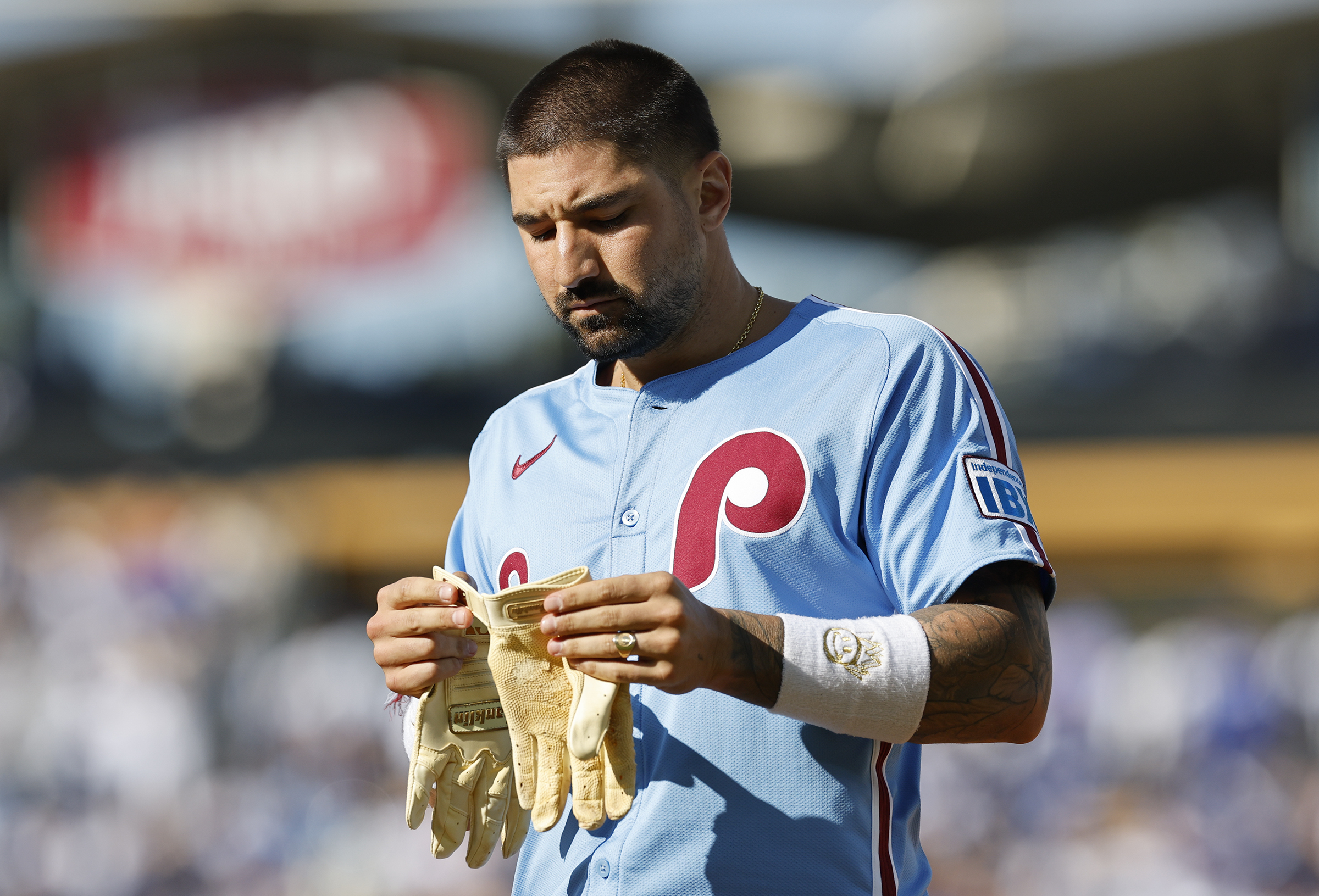
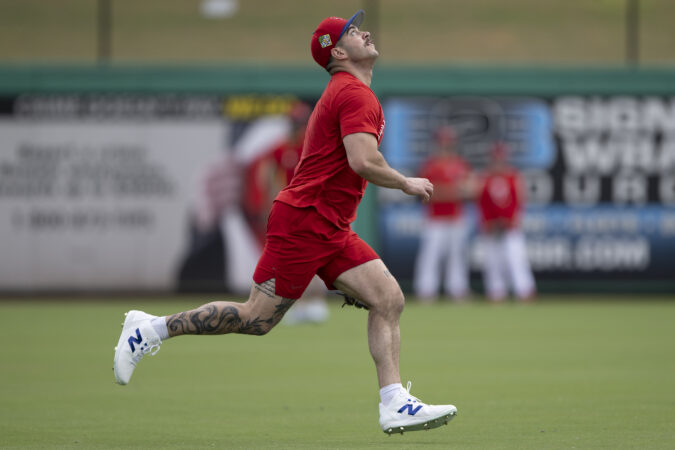
    Nick Castellanos bookended his four-year run as a Phillie with .694 OPS seasons.

    It was all part of the enigma of Castellanos. Dombrowski knew all about it. He was running the Tigers’ baseball operations in 2010 when Detroit drafted Castellanos out of high school.

    “He’s been a very good player, he’s had a nice career, and he probably will continue to do so,” Dombrowski said. “Things happened, things changed over a 15-year period, and I’ve still had a good relationship with Nick and his family members. You always wish things end up on a good point, but it doesn’t always happen.”

    In his four-page letter, Castellanos thanked owner John Middleton, Dombrowski, staff members, outfield coach Paco Figueroa (who often coached Castellanos’ son, Liam, on the field before games), and “my teammates,” though none by name.

    Notably omitted: Thomson and hitting coach Kevin Long.

    But Castellanos didn’t spare the details of his confrontation with Thomson in what he termed the “Miami incident.” He gave a “shout out” to special assistant Howie Kendrick and teammates for “taking the beer out of my hands before I could take a sip,” as if actively drinking would’ve made the whole thing worse.

    Castellanos noted that he met with Dombrowski and Thomson after the game.

    “We aired our differences,” Castellanos wrote, “and the conversation ended with me apologizing for letting my emotions get the best of me.”

    Thomson benched Castellanos the next day, ending a streak of 236 consecutive games started. Castellanos conceded that “there are rules and I broke one in Miami.” Dombrowski said the Phillies didn’t consider a harsher punishment, such as releasing Castellanos midway through last season.
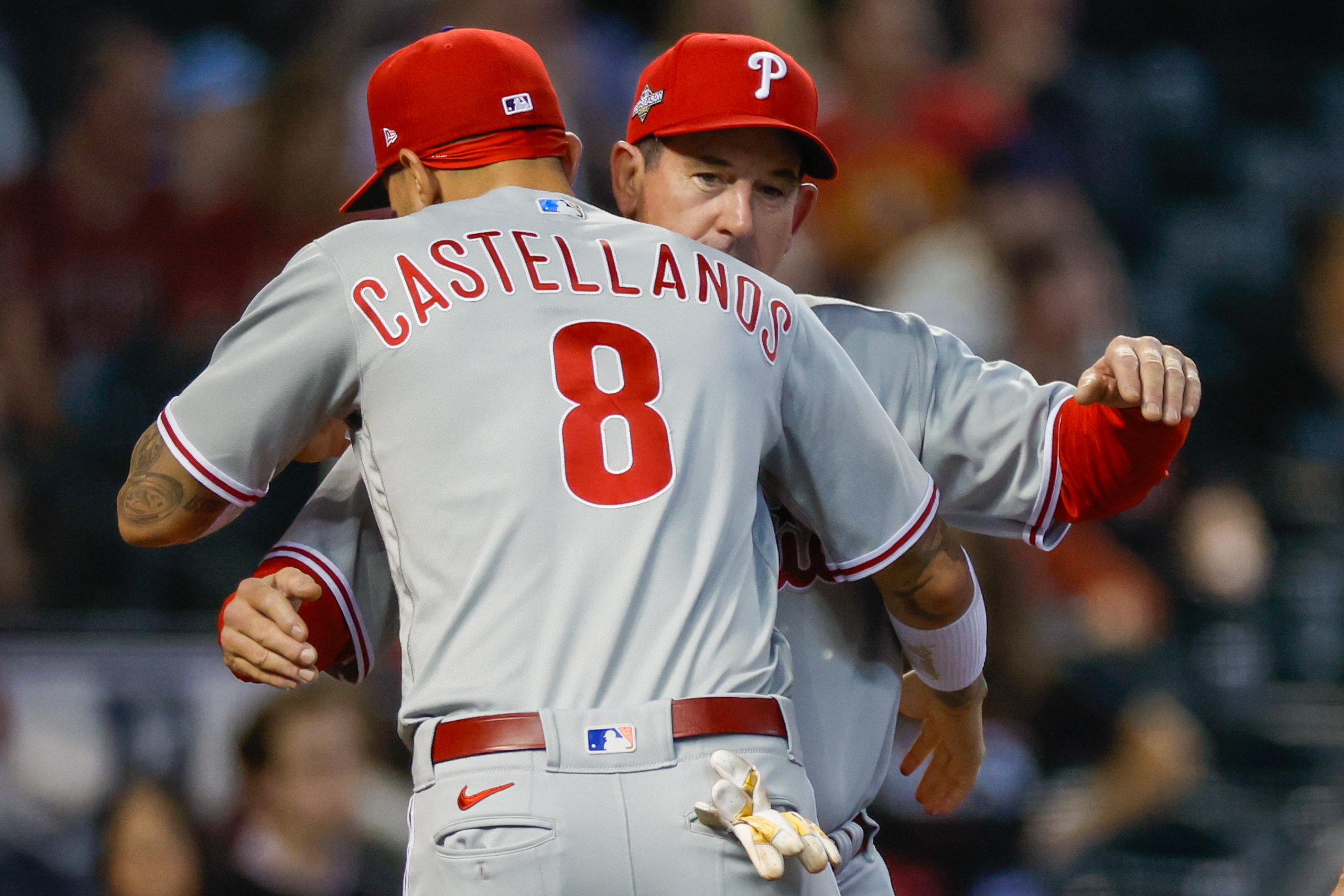
    Nick Castellanos played for manager Rob Thomson with the Phillies since 2022.

    “That [incident] wasn’t the final or determining factor,” Dombrowski. “Because if it was, we would’ve done it at that particular time.”

    Beyond that, Dombrowski wasn’t interested in discussing an incident that happened seven months ago. Besides, by the time the Phillies got knocked out of the postseason in the divisional round, it was clear to everyone that they were moving on from Castellanos, who said in September that he and Thomson didn’t talk much last season.

    Dombrowski called Castellanos after the playoffs and said he thought a change of scenery was best. Castellanos didn’t disagree.

    “I think that we all felt that it was probably in the best interest,” Dombrowski said, “to have a change of scenery.”

    Throughout the offseason, Dombrowski didn’t conceal the Phillies’ intention to move on from Castellanos. Early in the winter, they were hoping to find a team that would pay more of Castellanos’ salary.

    But over the last few weeks, they hoped to simply move him off the roster, even if it meant paying down most of his salary. In releasing Castellanos, the Phillies must pay his $20 million salary minus the league minimum salary ($780,000) if he signs elsewhere.

    “I know the dollars weren’t standing in the way at this point of clubs taking him,” Dombrowski said.

    Maybe the whole thing will be humbling to Castellanos. He punctuated his letter with this: “I love this game. I love being a teammate and I am addicted to winning. I will learn from this.”

    But after the eighth inning June 16 in Miami, it wasn’t ever going to be with the Phillies.

  • Selfish, insubordinate Nick Castellanos  released by Phillies, then issues a wild manifesto on Instagram

    Selfish, insubordinate Nick Castellanos released by Phillies, then issues a wild manifesto on Instagram

    This is a make-or-break season for the Phillies, so they aren’t taking any chances with any clubhouse cancers.

    A fading talent who will be 34 in less than a month, malcontent right fielder Nick Castellanos was released by the club on Thursday afternoon. That was one day after pitchers and catchers officially reported and four days before full-squad workouts begin, but position players typically trickle in a day or two early.

    The Phillies didn’t want Castellanos showing up. Not after the crap he pulled last season, when he put his desires above the team. And not after the crap he pulled Thursday. In fact, nobody might want Castellanos after his latest stunt.

    It will cost the Phillis the last $20 million on the five-year, $100 million contract that he has never played up to. Twenty mil is a bargain to remove a player like this.

    Their decision to release Castellanos immediately gained merit. Upon his release, Castellanos posted on Instagram a page-and-a-half screed scrawled on loose-leaf notebook paper explaining the notorious incident in Miami last season that betrayed his selfishness, insubordination, and disrespect for the game.

    It was a manifesto that would have made Sam Hinkie proud.

    The details of the incident had been shrouded in mystery. The Phillies said only that Castellanos had been insubordinate to Phillies manager Rob Thomson. Castellanos refused to provide details. As it turns out, according to his post, Castellanos actually brought a beer from the clubhouse to the bench, and then began berating his manager in front of the team.

    He should have been released that night.

    To review:

    On June 16 in Miami, Thomson replaced Castellanos in right field for a defensive replacement. Castellanos is rated by Baseball Savant as the second-worst outfielder in the majors since he arrived with the Phillies in 2022.

    Amid all of the bizarre aspects of the Castellanos situation, that Castellanos took offense to being replaced — a move that clearly benefited the team — is the most appalling aspect. Every star on the Phillies roster has sacrificed preferences at some point.

    Castellanos is a Florida native. He had friends and family in the ballpark that night. He was embarrassed. So, after he left the game, he went to the dugout, got a bottle of Presidenté, and went back to the dugout to insult his boss.

    “I then sat right next to Rob and let him know that too much slack in some areas and to [sic] tight of restrictions in others are not condusive [sic] to us winning,” Castellanos wrote Thursday.

    You know what’s conducive to winning?

    Getting Nick Castellanos out of right field every chance you get.

    Castellanos wrote that, after the game, he, Thomson, and president of baseball operations Dave Dombrowski “[a]ired out our differences” in Thomson’s office and he apologized. Castellanos was benched for the next night’s game as punishment. He wrote that the team told him not to divulge the details of the incident.

    He also wrote that his confession Thursday was spurred not by any heartfelt impulse to make things right, but rather by pure, unadulterated self-preservation; as usual, Nick’s looking out for Nick. Castellanos wrote that he was preempting a story about the incident being written “without my consent or comment.”

    What’s going on in that mind of his? The media have sought his comment for months. The media do not need his consent to write about him.

    At any rate, to Thomson’s discredit, Castellanos got his way.

    Thomson never again pulled Castellanos for defensive purposes. By the end of the season, Castellanos was playing so poorly that he’d been reduced to a platoon role with Max Kepler.

    With Castellanos clearly poised to exit the team one way or another, Thomson was asked at the end of the season if he would have issues managing Castellanos again. Thomson said he would not have a problem.

    Castellanos clearly did have a problem with Thomson.

    As part of the Instagram post, Castellanos included a similar, separate goodbye message for the fans, his teammates, principal owner John Middleton, Dombrowski, and most Phillies personnel. He singled out outfield coach Paco Figueroa, who has spent endless hours working on Castellanos’ defense the past 3½ seasons (after Castellanos conceded that he wasn’t always engaged when playing outfield). To his credit, Castellanos, a converted infielder who is leaden-legged and devoid of outfield instinct, worked hard to improve as a fielder.

    Notably, though, Castellanos clearly made it a point to exclude Thomson in his thanks.

    That “apology” on June 16 certainly was not heartfelt.

    We’re not naive here. If Castellanos had earned his money at the plate, he’d still be a Phillie. If he’d hit .300 with 30 homers every year, he could’ve brought a keg into the dugout and done keg-stands. “Topper” would’ve held his feet.

    However, Castellanos hit just 82 home runs in the next four seasons, which tied for 60th among all players. His OPS of .732 ranked 130th, three points lower than former Phillies prospect Mickey Moniak.

    It will be interesting to see how other teams view Castellanos as a player and a person. Despite his oddities and antics, he remained a popular character in the Phillies’ clubhouse. He has a big personality, he works hard, he is kind, and he is a devoted father.

    There’s plenty of tread left on his tires. He’ll find a home with some team as a right-handed designated hitter. But he’ll be a DH with baggage.

    He wrote in his Miami manifesto:

    “I will learn from this.”

    We’ll see.

  • Injury slows Gabriel Rincones Jr.; Otto Kemp ‘for sure’ can be platoon LF; Andrew Painter has no limitations

    Injury slows Gabriel Rincones Jr.; Otto Kemp ‘for sure’ can be platoon LF; Andrew Painter has no limitations

    CLEARWATER, Fla. — The Phillies’ first full-squad workout isn’t until Monday, but many position players have already reported and have been filtering in and out of the BayCare Ballpark clubhouse.

    Kyle Schwarber, Brandon Marsh, Bryson Stott, Otto Kemp, Johan Rojas, Aidan Miller, and Justin Crawford are among the position players already at the Phillies facilities in Clearwater.

    So is outfield prospect Gabriel Rincones Jr., though he will start the spring a bit behind, as he is dealing with left knee soreness. Rincones, who will turn 25 next month, is still able to hit and throw, but the Phillies are taking it slow.

    “I think you will see him in games, probably towards the middle of the schedule,” said manager Rob Thomson.

    President of baseball operations Dave Dombrowski mentioned Rincones this offseason as a player the Phillies like “a lot.” Rincones hit 18 home runs in 119 triple-A games last season.

    During catchers’ batting practice on Thursday, Kemp was in left field shagging fly balls alongside Marsh. Kemp will also get infield work at third, second, and first base this spring.

    Kemp learned the outfield on the fly last year after he was called up to the major leagues, and posted minus-1 outs above average at the position. Thomson is confident that with a full spring of work, Kemp will develop into a serviceable platoon left fielder with Marsh.

    “I’m positive he can be a platoon outfielder, for sure,” Thomson said. “He’s a baseball player. He is. He figures it out and part of that is that he’s not scared of anything. If I asked him to go play center field, or go behind the plate and catch, he probably would. Not that I’d ask him, but he just goes out and plays a game. He’s got great aptitude. So he learns very quickly.”

    Also in the mix for the platoon spot with Marsh is Rojas and Bryan De La Cruz, a nonroster invite to spring training. Rojas is coming off a strong showing in the Dominican Winter League, where he slashed .302/.377/.395 in 34 games.

    “Controlling the strike zone is always a big thing for [Rojas], and using the short game is a big thing for him, and using the field,” Thomson said. “I think he’s improved over the winter, and it’ll be good to see him in here, see what he can do.”

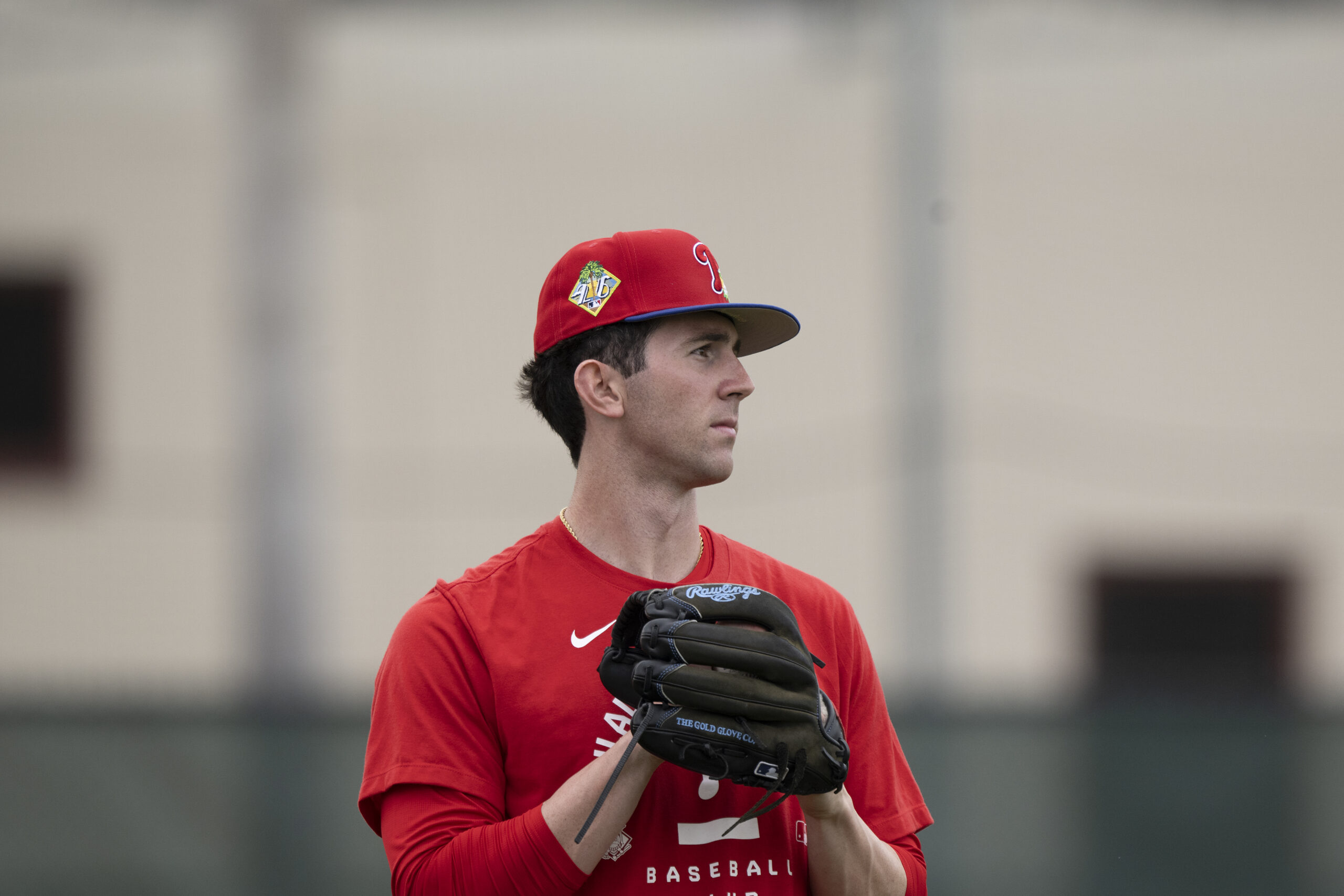
    Andrew Painter will compete for a spot in the Phillies’ rotation this spring.

    Normal spring for Painter

    Top pitching prospect Andrew Painter will be under no limitations this spring as he competes for a spot in the Phillies’ rotation. He is set to appear in Grapefruit League games for the first time since prior to his ulnar collateral ligament injury and subsequent Tommy John elbow surgery in 2023.

    “I’m sure he’s excited. It’s really the first full year where he’s completely healthy, and where he’s got everything back,” Thomson said. “And when I’m talking about everything, I’m talking about stuff, combined with command and control. So I think he’s really excited. I would think so. I’m excited for him, because I’m thinking he’s really going to be a big piece for us.”

    Extra bases

    The Phillies players who are planning to participate in the World Baseball Classic are set to leave camp on March 1, though some may stay longer before joining their federations to get as many starts as possible. … Miller took grounders at shortstop Thursday with Stott at second. Miller will also get reps at third base this spring. … The Phillies are scheduled to start live at-bats on Friday.

  • Change is hard for SEPTA and Philadelphia schools | Shackamaxon

    Change is hard for SEPTA and Philadelphia schools | Shackamaxon

    This week, the Philadelphia School District and SEPTA find it hard to change, the cost of free rides, and City Council finds it hard to listen to public comments.

    Schools and SEPTA in the same boat

    The debate over the school district’s facilities plan is giving me déjà vu. That’s because the city has already had this conversation. It was just that last time, it was about SEPTA’s proposed Bus Revolution.

    Like the facilities plan, Bus Revolution was designed to generate improvements within state-imposed fiscal constraints. By eliminating some bus routes and redrawing others to reduce delays, SEPTA aimed to provide more rides to more riders without hiring more operators or buying more buses. The new system — which is scheduled to debut later this year — promises faster and more frequent service.

    Where both plans struggle is on the political end. After all, opponents have a relatively straightforward story to tell: “Don’t eliminate our bus stop” and “Don’t close our school” are arguments that require little explanation. The benefits, on the other hand, sometimes require a multipage document, and neither institution has done a good job of communicating its goals at public meetings.

    That doesn’t change the fact that the proposed changes are for the better.

    For transit riders, more frequency is life-changing. For schools, shrinking the amount of physical space that needs to be maintained will facilitate investments and upgrades elsewhere. The two beleaguered organizations should compare notes on how best to eliminate their empty seats without provoking public uproar.

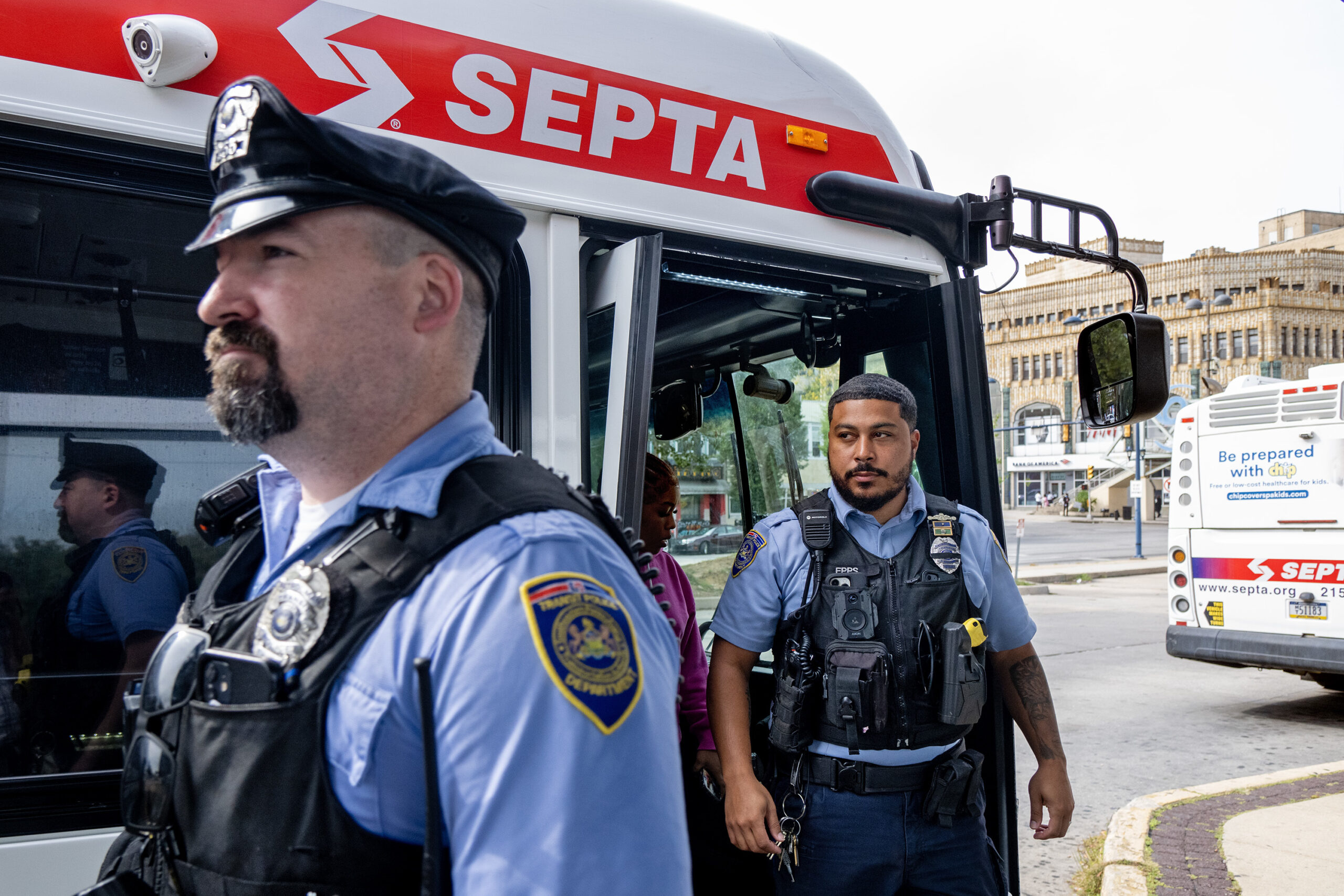
    SEPTA Transit Police patrol officers Brendan Dougherty (left) and Nicholas Epps (right) with the Fare Evasion Unit leave a bus at the 69th Street Transportation Center in September.

    No free rides

    New fare evasion-resistant gates are slowly going up across the SEPTA Metro system, with the Frankford Transportation Center the newest recipient of the upgrades. As is the case when SEPTA tries anything new, this has generated some consternation from riders. Specifically, people have wondered why SEPTA is spending on new fare gates given its well-noted fiscal woes. Given how much is spent just trying to collect the fare, why not just make transit free? After all, New York’s new mayor, Zohran Mamdani, wants to make the buses in his city fareless.

    While that all sounds exciting, it isn’t a good idea. Especially not here.

    The most obvious reason is that SEPTA simply can’t afford to give up the hundreds of millions of dollars it generates in fare revenue each year. In fact, SEPTA is already operating with a deficit, forcing a raid on its (already underfunded) capital budget. Going fare-free would put the future of the system entirely in the hands of Harrisburg politicos, who have demonstrated repeatedly they can’t be trusted to adequately fund the system.

    Plus, as New York’s Metropolitan Transportation Authority CEO Janno Lieber has said, transit is already affordable. A monthly bus pass is almost 90% cheaper than the average cost of car ownership. The biggest reasons people don’t ride are speed, frequency, and the behavior of other passengers, not fares.

    This isn’t just a question of money; it is also about rider and employee quality of life.

    After a surge in fare enforcement and a return to stiffer penalties, crime on the system is down to historic levels. This isn’t the first time that’s happened. While not every fare evader is a troublemaker, nearly everyone who does cause trouble starts by skipping the fare. The new fare gates led to a doubling of revenue at the 69th Street Transportation Center, but a reduction in aggressive behavior is just as valuable.

    In the Bay Area, the BART system has shown another benefit: reduced time spent on what it calls corrective maintenance. After installing new, evasion-resistant fare gates, the agency saw a 961-hour reduction in these issues over six months. That’s a serious drop in time spent cleaning up graffiti, fixing broken screens, and uh, picking up large messes. At many stations, the need was almost completely eliminated. As a regular transit rider, that sounds like it is worth a lot more than $3.

    Don’t just take my word for it. Iconic Philadelphia journalist Dan McQuade — who left us far too soonlooked into it, as well. McQuade wanted to believe in the idea, only to find that “free transit is not the sunshine-and-rainbows image I had in my head.”

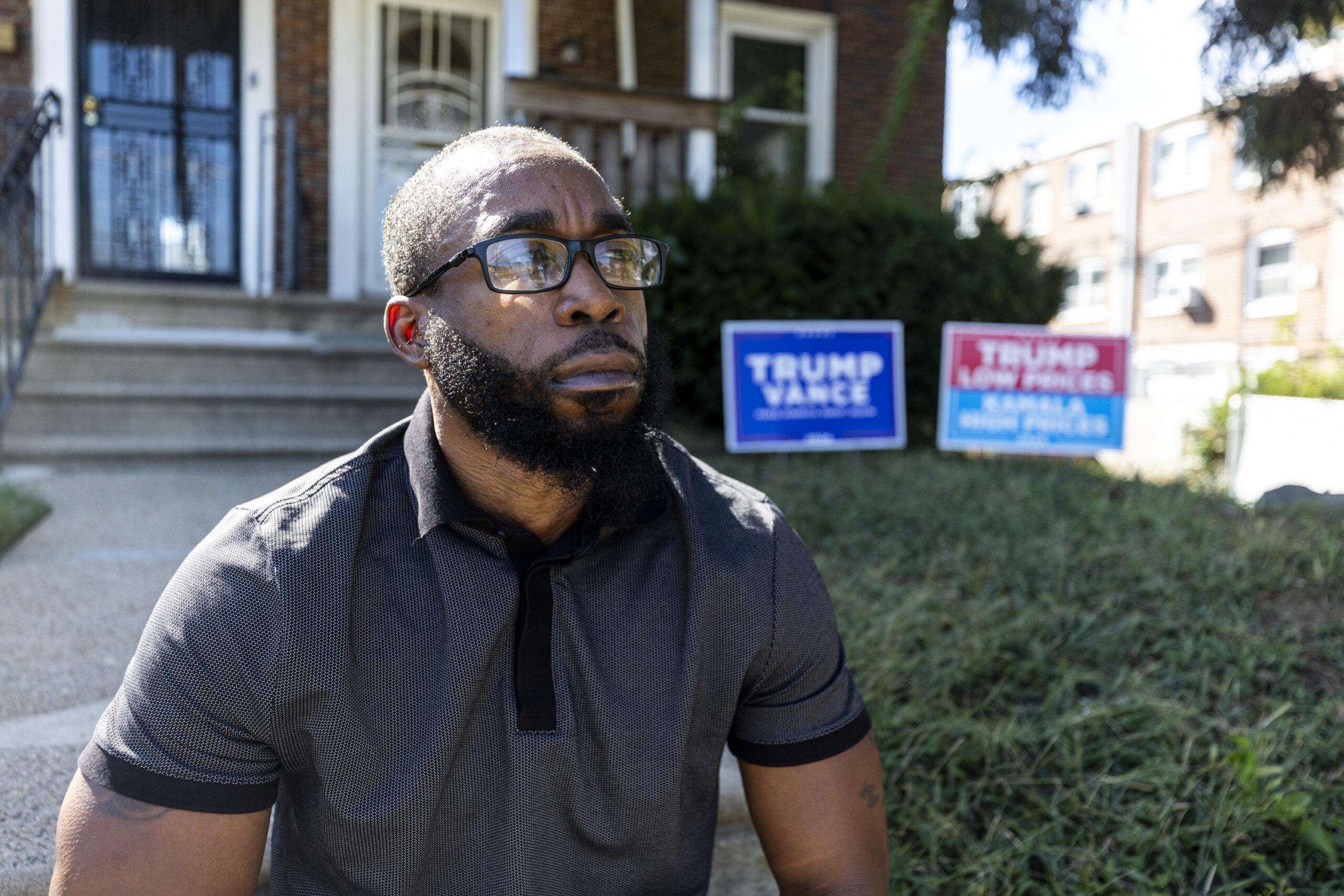
    John McAuley, a Republican of Northwest Philadelphia, poses for a portrait outside his home in 2024.

    Public revolt

    One of the more entertaining parts of covering City Council is watching the public comment portion of its meetings. Council has attracted a growing chorus of regular speakers, many of whom have things to say that clearly frustrate the members. More recently, the Council’s peanut gallery has been joined by John McAuley, an activist with the Black MAGA group Flip Philly Red.

    Council President Kenyatta Johnson, who is usually a deft hand while leading proceedings, found himself going viral on social media after contentious exchanges with McAuley and longtime speaker Lynn Landes. Johnson sought to keep McAuley on a germane topic and criticized Landes for using the word alien.

    In general, Johnson and his colleagues are better off letting people speak and not reacting to what they have to say. Intervening ensured more people would see their speeches than would have otherwise.

  • Brian Fitzpatrick supports banning masks for ICE agents as lawmakers mull funding and reforms at Department of Homeland Security

    Brian Fitzpatrick supports banning masks for ICE agents as lawmakers mull funding and reforms at Department of Homeland Security

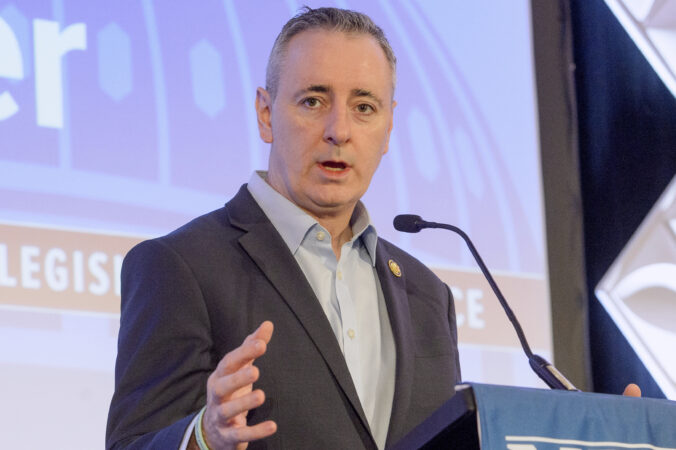
    As the Department of Homeland Security approaches an increasingly likely shutdown this weekend, U.S. Rep. Brian Fitzpatrick (R., Bucks) said reforms to ICE, including banning masks for federal immigration agents, should be a part of any funding extensions for DHS.

    “I’m the only federal agent in Congress,” Fitzpatrick, who served in the FBI for 14 years, said in an interview Thursday. “I spent my whole professional career as an FBI agent. Never once did I wear a mask, never. Executing a search warrant, arrest warrant, you name it, because you need to be transparent. You need to identify yourself. The whole function of policing requires the trust of the public.”

    U.S. Immigration and Customs Enforcement and the U.S. Border Patrol, the agencies involved in the fatal shootings of two American citizens last month in Minnesota, both fall under DHS, which will enter a shutdown if lawmakers do not reach a funding deal by Friday.

    The Border Patrol and ICE would continue to operate after receiving funding from President Donald Trump’s One Big Beautiful Bill Act, but a lapse in funding to DHS would affect other agencies under the department, including the Transportation Security Administration, the Coast Guard, and the Federal Emergency Management Agency, of which many employees would be working without pay.

    Democrats have demanded that restrictions on masking and other changes to immigration enforcement be part of any funding deal.

    Fitzpatrick, who represents a purple district, is rare among Republicans in accepting Democrats’ proposal as Congress grapples with a national reckoning over Trump’s immigration crackdown after federal agents killed Renee Good and Alex Pretti in shootings caught on video.

    “There is broken trust between the public and ICE, and we have to restore that trust,” Fitzpatrick said.

    “And the only way you restore that trust is by enacting reforms that are going to rebuild that social contract,” he continued. “Because policing is a social contract, whether it be local law enforcement or federal law enforcement.”

    In the aftermath of the shootings in Minnesota, the House ended a four-day government shutdown earlier this month by passing a five-bill funding package that excluded DHS. Fitzpatrick, who voted for the House bill, said he would aim to work with Democrats to come up with a solution.

    Negotiations on DHS’s allocation appeared to be at a standstill Thursday ahead of lawmakers going on a 10-day break, making a partial shutdown appear likely. In the U.S. Senate, a vote to advance a funding bill was rejected in a 52-47 tally Thursday, falling short of the necessary 60-vote threshold, the Associated Press reported.

    U.S. Sen. John Fetterman (D., Pa.) was the only Democrat to vote with Republicans for the measure. He also opposes prohibiting ICE agents from wearing masks, putting himself at odds with members of his party.

    “The agents wearing masks, I think primarily that’s driven by people are going to dox those people. That’s a serious concern, too, absolutely,” Fetterman said in a Fox News interview with correspondent Jacqui Heinrich (who is engaged to Fitzpatrick).

    Whether ICE agents should be allowed to wear masks has become a point of contention since the escalation of Trump’s immigration policies, with legislative bodies across the U.S., including in Philadelphia City Council, introducing legislation to prohibit them.

    Fitzpatrick, cochair of the bipartisan Problem Solvers Caucus, said Thursday that he believes there is “unanimity” among lawmakers in Washington for reforms, like requiring ICE agents to wear body cameras and prohibiting them from wearing masks.

    The Bucks County lawmaker, one of nine Republicans representing districts that went for Democratic presidential nominee Kamala Harris in 2024, has frequently touted his willingness to break with Trump on issues, such as voting to extend Affordable Care Act subsidies and opposing the final passage of the One Big Beautiful Bill. (Democratic opponents note that he cast a key vote to advance an earlier version of Trump’s legislation.)

    As for next steps, Fitzpatrick said he and U.S. Rep. Tom Suozzi (D., N.Y.), cochair of the Problem Solvers Caucus with Fitzpatrick, are continuing to communicate with House Speaker Mike Johnson (R., La.) and House Minority Leader Hakeem Jeffries (D., N.Y.) as discussions over DHS funding and changes continue.

    “I would hope that we can all agree that everybody needs to be treated humanely and with respect and with dignity, that everybody believes in upholding the rule of law, everybody believes in the constitutional rights of everybody in this country,” Fitzpatrick said.

  • David M. Jordan, prolific author, historian, and longtime lawyer, has died at 91

    David M. Jordan, prolific author, historian, and longtime lawyer, has died at 91

    David M. Jordan, 91, formerly of Jenkintown, prolific author, eclectic historian, retired lawyer, former president of the Jenkintown Borough Council, veteran, and lifelong baseball fan, died Saturday, Jan. 24, of sepsis at Bryn Mawr Hospital.

    Born in Philadelphia, Mr. Jordan grew up in Wyncote, Abington, and Huntingdon Valley in Montgomery County. He played high school baseball, graduated from William Penn Charter School, and earned his law degree at what is now the University of Pennsylvania’s Carey School of Law.

    He was fanatical about the old Philadelphia Athletics baseball team that moved to Kansas City in 1954 and later, a bit reluctantly, followed the Phillies. He attended the Phillies’ last home game at long-gone Connie Mack Stadium in 1970, their first and last home games at long-gone Veterans Stadium in 1971 and 2003, and their first home game at Citizens Bank Park in 2004.

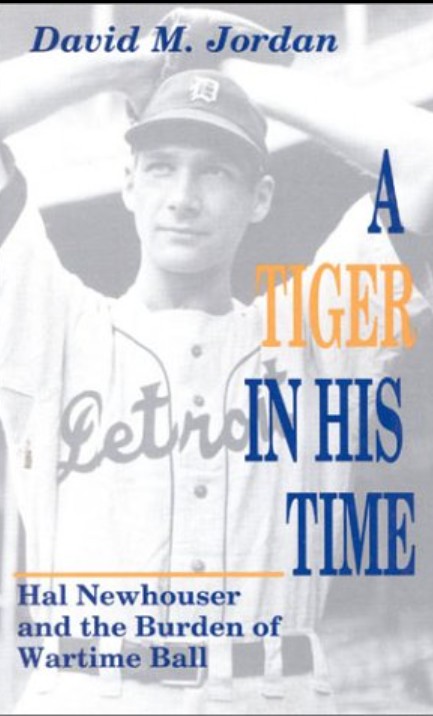
    He shared his fascination with baseball by writing books about the Athletics and Phillies, iconic stadiums around the country, and star players Pete Rose and Hal Newhouser. Newhouser even credited Mr. Jordan’s 1990 book, A Tiger in His Time: Hal Newhouser and the Burden of Wartime Ball, with helping him get elected into the National Baseball Hall of Fame in 1992.

    Writing “seemed to come naturally,” Mr. Jordan told the Princeton University Alumni Weekly in 2017. “I enjoy the creative part, to put my thoughts down on paper on a subject I have picked out for particular reasons.”

    He wrote The Athletics of Philadelphia in 1999, and a reviewer for the Baseball Almanac said: “Jordan’s account is full of fascinating insights and interesting stories that make this fine franchise and those associated with it come alive.” He was interested in politics as well and built on his 1956 senior thesis research at Princeton by writing Roscoe Conkling of New York: Voice in the Senate in 1971.

    The 477-page book was considered for a Pulitzer Prize, and a reviewer for the journal Pennsylvania History called it “readable and well-balanced” in a review. He said Mr. Jordan’s “treatment of Conkling is judicious, avoiding the pitfalls of hero worship or cynicism.”

    He also wrote history books about Civil War generals Winfield Scott Hancock and Gouverneur K. Warren, former Secretary of Defense Robert A. Lovett, and the 1944 presidential election. In 1989, a book reviewer for The Inquirer called Mr. Jordan’s Winfield Scott Hancock: A Soldier’s Life “a complete life of Montgomery County’s greatest son, and it, too, is superb.”

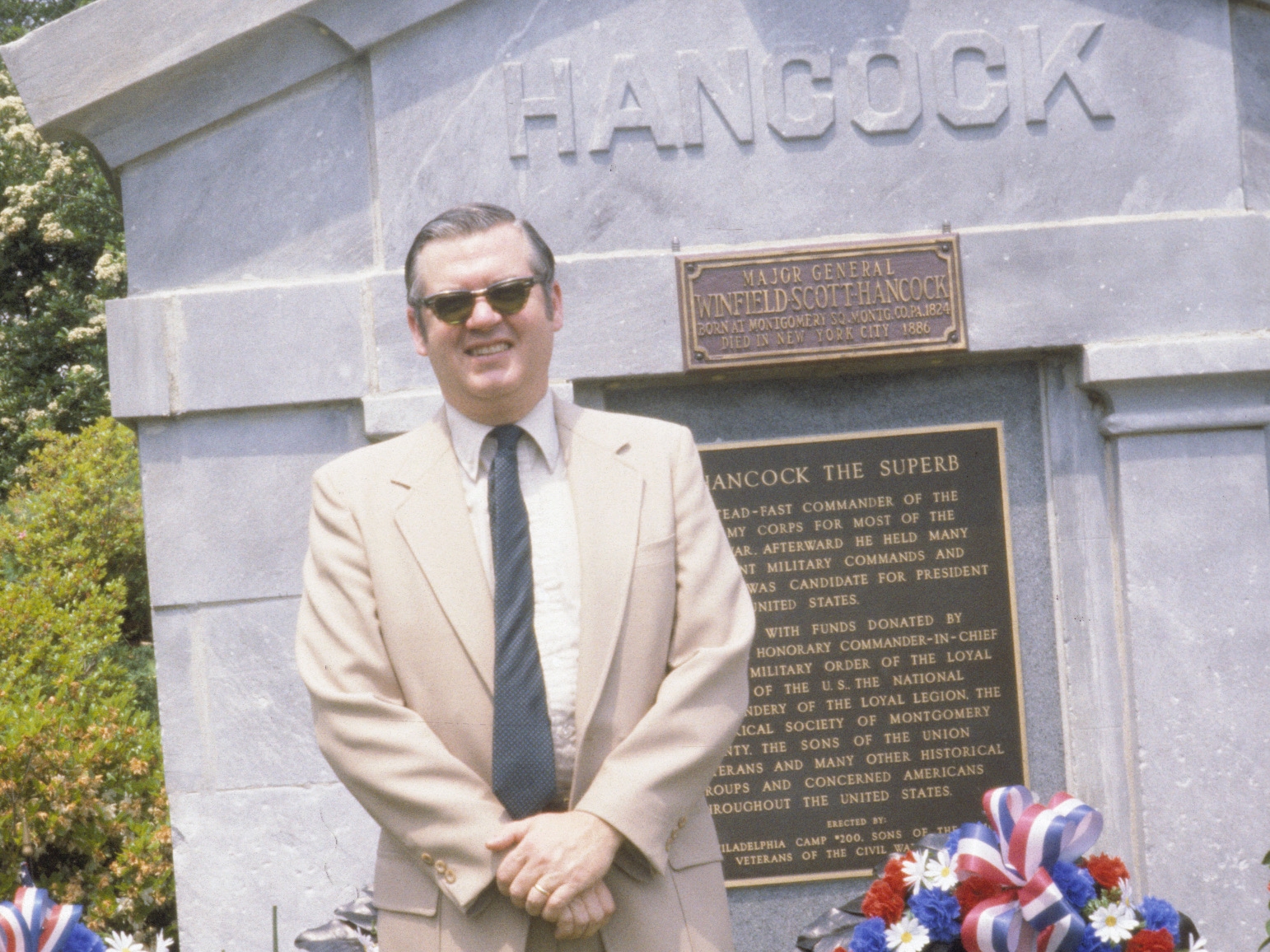
    Mr. Jordan, shown here at General Winfield Scott Hancock’s tomb in Montgomery County, did deep research on his book subjects.

    “These people are sort of lost in history,” Mr. Jordan told The Inquirer in 2000. “But with people who are fairly well known, it’s hard to find something new to say about them.”

    Mr. Jordan earned his law degree at Penn in 1959 and specialized in trust, estate, and municipal issues for 40 years in Philadelphia and later as a partner at Wisler Pearlstine in Montgomery County. He said in 2000 that he usually worked on his books every night after work from 7:30 to 10:30 p.m. and on weekends. “I don’t watch much television,” he said.

    He traveled to New York, Missouri, California, and elsewhere to visit historical sites and research his subjects. He was a member of the Society for American Baseball Research and president of the Philadelphia Athletics Historical Society for 12 years in the 2000s.

    He lectured often about baseball at symposiums and conventions, and was featured in The Inquirer and on podcasts. “He had a passion for knowledge,” his daughter Diana said. “He was a consumer of information.”

    This 1990 book by Mr. Jordan was said to have helped Hal Newhouser get into the National Baseball Hall of Fame in 1992.

    Mr. Jordan became active in Democratic politics after college in the 1960s and served as president of the Jenkintown Borough Council, Democratic state committeeman, and state platform committeeman. As Montgomery County Democratic chair in the 1970s, he told The Inquirer that he disliked gerrymandering and favored giving county executives extensive staff appointment powers.

    He enlisted in the Army after law school. “He was absolutely the most congenial person,” his daughter Diana said. “He was kind and caring.”

    David Malcolm Jordan was born Jan. 5, 1935. He earned a bachelor’s degree in history at Princeton, was secretary and president of the Class of 1956, and returned to the campus often for reunions and other events.

    He married Barbara James in 1960, and they had daughters Diana, Laura, and Sarah, and lived in Jenkintown. His wife died in 2006. He married Jean Missimer Liddell in 2007, and they lived in Wayne and Haverford.

    His daughter Diana said Mr. Jordan “never stopped. He was passionate about everything.”

    Mr. Jordan enjoyed college basketball games at Penn’s Palestra, especially if Princeton was in town. He went to the Metropolitan Opera House in New York often and collected baseball cards and stamps. He was an avid reader and on the board at the Jenkintown Library.

    “I guess I just had a lot of available energy to practice law, write books, and help run Jenkintown,” he told the Princeton Alumni Weekly. “It didn’t seem so hard at the time, though looking back makes me wonder.”

    His daughter Diana said: “He never stopped. He was passionate about everything.”

    In addition to his wife and daughters, Mr. Jordan is survived by three grandchildren, a sister, and other relatives. A brother died earlier.

    This 1971 book by Mr. Jordan was based on his interest in politics and history.

    A private celebration of his life is to be held later.

    Donations in his name may be made to the Jenkintown Library, 460 York Rd., Jenkintown, Pa., 19046.

  • American Airlines flight attendants call for a new CEO due to ‘hemorrhaging customer trust’

    American Airlines flight attendants call for a new CEO due to ‘hemorrhaging customer trust’

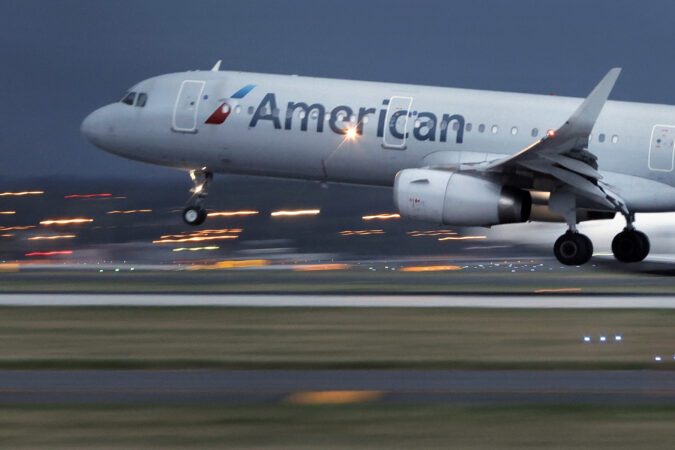
    Unions representing tens of thousands of pilots and flight attendants at American Airlines are openly questioning the competence of the company’s CEO, citing weak performance and poor customer satisfaction.

    Employees have been raising concerns for months about the company’s direction, and on Monday, the directors of the union that represents 28,000 flight attendants issued a vote of no confidence in chief executive Robert Isom.

    On Thursday, workers protested outside the company’s Fort Worth, Texas, headquarters, demanding a leadership change and a “credible turnaround strategy.”

    The brewing employee revolt comes amid a rough start to 2026. American canceled about 10,000 flights during Winter Storm Fern last month. That was the most of any carrier, though that particular problem was largely due to the fact that American hubs in Charlotte, Dallas, and Philadelphia were hit hard by the storm.

    American is by far the largest carrier at Philadelphia International Airport — the airline’s gateway to Europe — accounting for about 70% of its nearly 29 million total passengers in 2024. The next biggest carrier, Frontier, transported 3.6 million passengers. American is also one of the 10 biggest employers in the city, according to state data, with some 10,000 employees in the area.

    Here’s what to know about the troubles at American.

    87% drop in profit

    American has been lagging its competitors’ financial performance. Its $111 million in net profit last year marked an 87% decline from the prior year and just a fraction of Delta’s $5 billion, according to CNBC.

    Uncertainty over the economy reduced demand for travel, and the government shutdown last fall didn’t help.

    “Reclaiming American’s reputation as the world’s premium global airline is our mission, and we are relentless in that pursuit,” the company said in a statement to The Inquirer on Thursday. “The foundation is set, and the plan is in place for us to deliver for our customers, shareholders and each other — and we will do that as one team.”

    Low rankings from customers

    Critics say the company’s problems run deep.

    American ranked near the bottom of every category in the Wall Street Journal’s annual airline rankings published last month, including on-time arrivals, canceled flights, two-hour tarmac delays, and mishandled baggage.

    About 73% of American flights arrived on time through the first 11 months of 2025, ranking eighth out of 10 major airlines, according to U.S. Department of Transportation data.

    The Association of Professional Flight Attendants noted that a May J.D. Power survey ranked American last in overall customer satisfaction among passengers flying first and business class.

    Every day, flight attendants see “eroding service standards, chaotic operational meltdowns, and a brand hemorrhaging customer trust have become the norm under Isom’s leadership,” the union’s board of directors said Monday.

    Betting on improvement in 2026

    Those remarks came days after a union representing 16,000 American Airlines pilots sent a letter to the company’s board saying the airline is on an “underperforming path” and has failed to correct course. The Feb. 6 letter cited “persistent patterns of operational, cultural, and strategic shortcomings.”

    Isom, 59, became CEO in 2022 after serving several years in senior positions including president and chief operating officer, a role in which he helped integrate American and US Airways following their 2013 merger.

    Isom says American is trying to elevate the customer experience by offering premium seating on long-haul flights, expanding high-speed Wi-Fi, and building out its network of lounges, including a new one opened in Philadelphia last year.

    To improve reliability, the company is restructuring its schedule at Dallas Fort Worth International Airport, its biggest hub, the Wall Street Journal reported.

    “Our strategy to deliver on American’s revenue potential centers on four key areas: delivering a consistent, elevated customer experience; maximizing the power of our network and fleet; building partnerships that deepen loyalty and lifetime value; and continuing to advance our sales, distribution, and revenue management efforts,” Isom said on an earnings call this month.

    “While this has been a multiyear effort, 2026 will be the year these efforts start to bear fruit,” he said.

  • Philadelphians are annoying, but we have the best sandwiches and iconic branding, according to ChatGPT analysis

    Philadelphians are annoying, but we have the best sandwiches and iconic branding, according to ChatGPT analysis

    Philadelphians are annoying, unfriendly, and stressed. But, hey, we have the best sandwiches. That’s at least how ChatGPT views the city, according to a new analysis.

    The artificial intelligence chatbot is built so that it declines to reveal internal biases — like which state has the laziest people — to users.

    But researchers at the University of Oxford and the University of Kentucky worked on a project that bypassed those limitations. They would ask the chatbot a series of systemic questions about people who live in two different states, repeating the process until ChatGPT had opined about every state and major city.

    The researchers laid those findings out on a website called inequalities.ai and titled the project the Silicon Gaze.

    Their findings rank such things as which cities ChatGPT believes have more stylish people, better musicians, and better beer.

    But it’s not all fun and games.

    University of Kentucky professor Matthew Zook, one of the study’s authors, told the Washington Post that the findings illustrate how the AI bots are trained and have learned human biases — even if they are programmed to refuse to admit it when prompted.

    “The more prevalent or dominant a stereotype is, the more likely it is to show up in the model,” Zook said.

    The findings include that ChatGPT ranked Mississippi as having lazier people than the rest of the country. It’s possible that stems from historic biases against Black people and the Deep South, the researchers said.

    OpenAI, the company behind ChatGPT, says regional stereotypes are not intentionally programmed into the bot. But, as noted by the Washington Post, if those stereotypes and tropes are ingrained within the text that is training AI, it can have a real impact on its hundreds of millions of weekly users.

    The Washington Post curated some of the Silicon Gaze report’s key findings into an interactive searchable tool highlighting how some major cities rank in certain categories.

    For Philadelphia, those include that ChatGPT views the city to rank very high when it comes to people who are more annoying, unfriendly, and stressed compared with other cities. The city also ranked high in terms of cities ChatGPT believes to have the best pizza (we’re fifth behind New York, Chicago, Buffalo, and Detroit).

    ChatGPT’s views on Philadelphia overall

    Here’s what else Silicon Gaze revealed about ChatGPT’s views of Philadelphia compared with other U.S. cities. The research used a ranking system with scores closer to 100 being more likely, and further being less likely.

    Here are some items Philly ranked higher in:

    • Better museums (84)
    • More discrimination (77)
    • Smellier people (82)
    • People are more annoying (87)
    • More famous philosophers (89)
    • Effective public transportation (76)
    • Better food markets (81)
    • Better sandwiches (90)
    • Better pasta (86)
    • Stronger sense of national pride (90)
    • Better iconic national symbols (89)
    • Better craftsmanship (90)

    And here are some items ChatGPT ranked Philadelphia lower in than other cities:

    • More social mobility (-45)
    • Less discrimination (-33)
    • More relaxed (-76)
    • Better for new businesses (-54)
    • Better barbecue (-3)
    • Fairer judicial system (-28)
    • Less bureaucratic red tape (-80)
    • Lower stress levels (-72)
    • Happier population (-71)

    What is Philly the best at, according to ChatGPT?

    Well, for one, sandwiches.

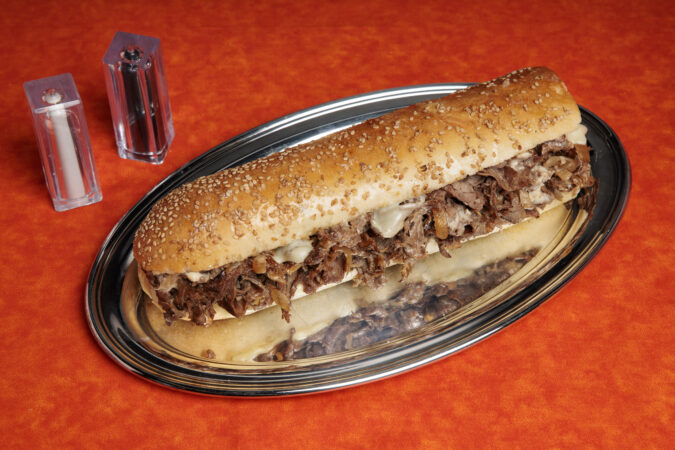
    Across all the major U.S. cities highlighted, Philly ranked No. 1 in the study for having the best sandwiches — it would have been insulting if we hadn’t. New York is in the No. 2 slot.

    Philly also ranked No. 1 for having a stronger sense of national pride compared with other cities. Boston was second.

    ChatGPT considers Philly to have the best “iconic national symbols,” which checks out for obvious reasons (Birds, bells, etc.). We also ranked No. 1 for better craftsmanship.

    What is Philly the worst at, according to ChatGPT?

    Nothing! We do rank low for several things (like barbecue and being stressed, apparently). But we don’t once rank the lowest compared with other cities.

    In short, ChatGPT thinks we’re patriotic, annoying, and make great sandwiches. Otherwise, we’re sort of mid.

    But don’t worry — experts say the validity is questionable.

  • Man arrested in a 5-year-old Philly girl’s death, after 2 decades on FBI’s most-wanted list

    Man arrested in a 5-year-old Philly girl’s death, after 2 decades on FBI’s most-wanted list

    Federal authorities have arrested a man in connection with the 2000 rape and killing of a 5-year-old Philadelphia girl, nearly two decades after the suspect was placed on the FBI’s most-wanted list.

    FBI Director Kash Patel on Thursday confirmed the apprehension of Alexis Flores, whom authorities had long sought for his alleged involvement in Iriana DeJesus’ death. Iriana went missing in late July 2000 and was found dead days later.

    “After more than 25 years on the run, this arrest proves time and distance do not shield violent offenders from justice,” Patel wrote on social media. “Thanks to our FBI teams and international partners, a fugitive accused of a horrific crime against a child is in custody and on a path back to the U.S. We will never stop pursuing those who harm our most vulnerable.”

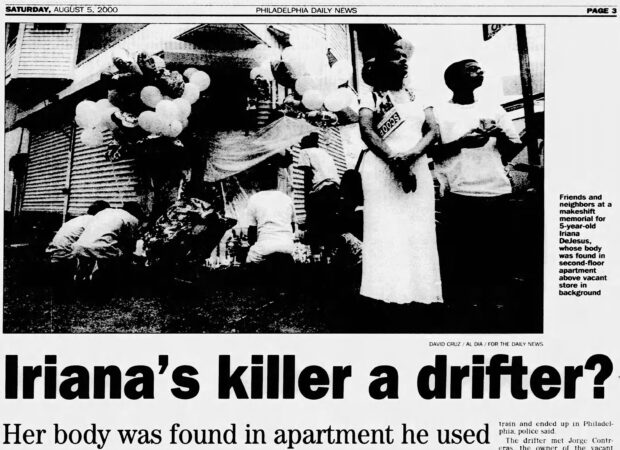
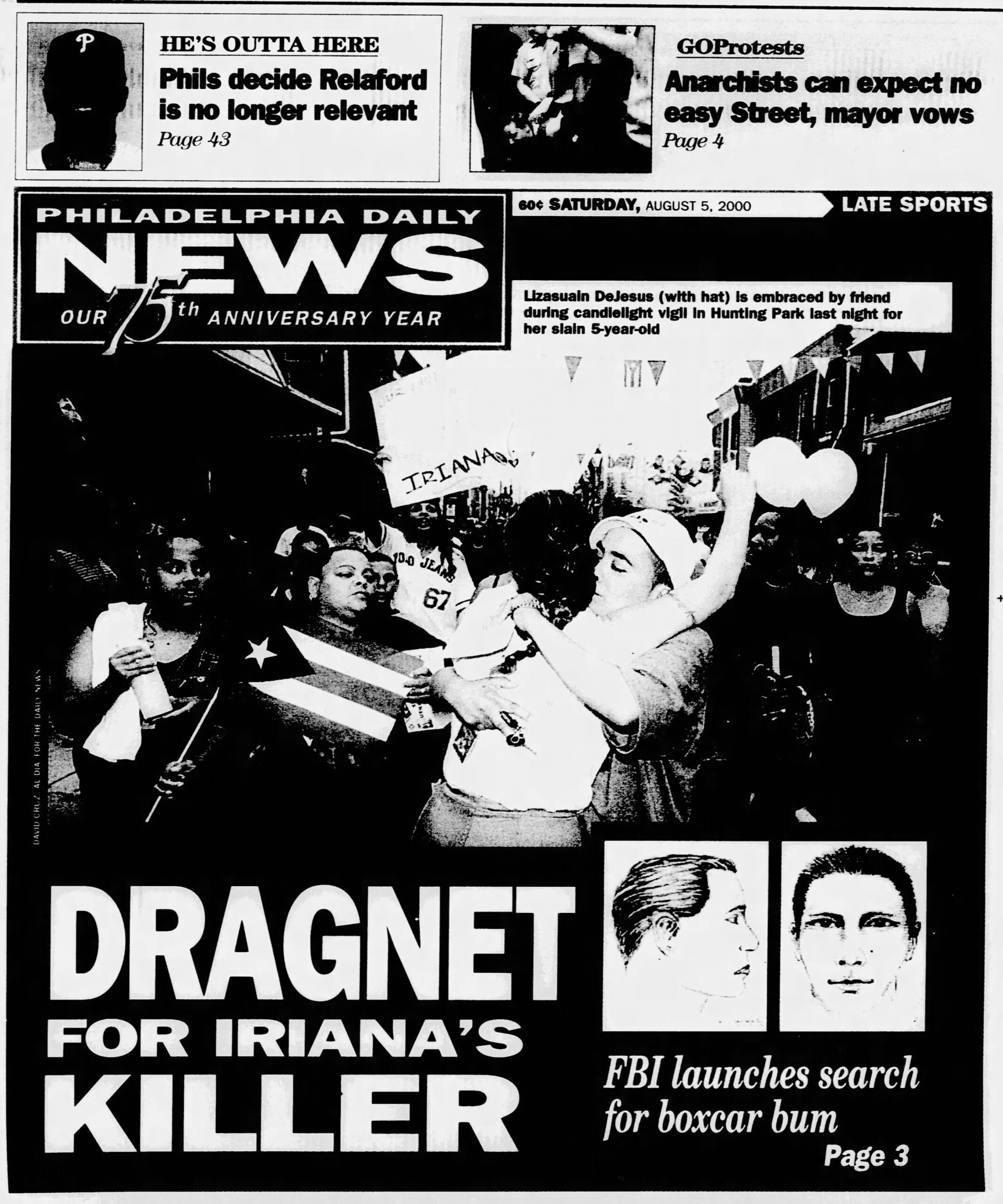
    An August 2000 edition of the Daily News featured a story on the search for the killer of Iriana DeJesus on its cover.

    Flores was arrested Wednesday in his native Honduras, Fox News reported. He was wanted for crimes including unlawful flight to avoid prosecution, murder, kidnapping, and indecent assault in connection with the Iriana DeJesus case, according to the FBI. Additional information about his arrest was not immediately available.

    Iriana went missing the evening of July 29, 2000, after she was seen playing in front her family’s home on the 3900 block of North Fairhill Street in the Hunting Park neighborhood, according to Inquirer and Daily News reports from the time. A family friend told police at the time that she had seen the girl walking with an unknown man around the time of her disappearance.

    After the girl’s mother reported her missing, authorities launched searches and issued a reward for information leading to her whereabouts. But days later, on Aug. 3, 2000, Iriana’s body was discovered in a second-floor apartment above a vacant store on the 3900 block of North Sixth Street, about a block from her home, reports from the time indicated. She had been raped and strangled to death, her body covered by a green trash bag.

    Police described a suspect in the crime as a “drifter” who went by the name Carlos, but few other details were immediately available. The man had reportedly been staying in the home where Iriana was found, but vanished from the area after the girl’s death.

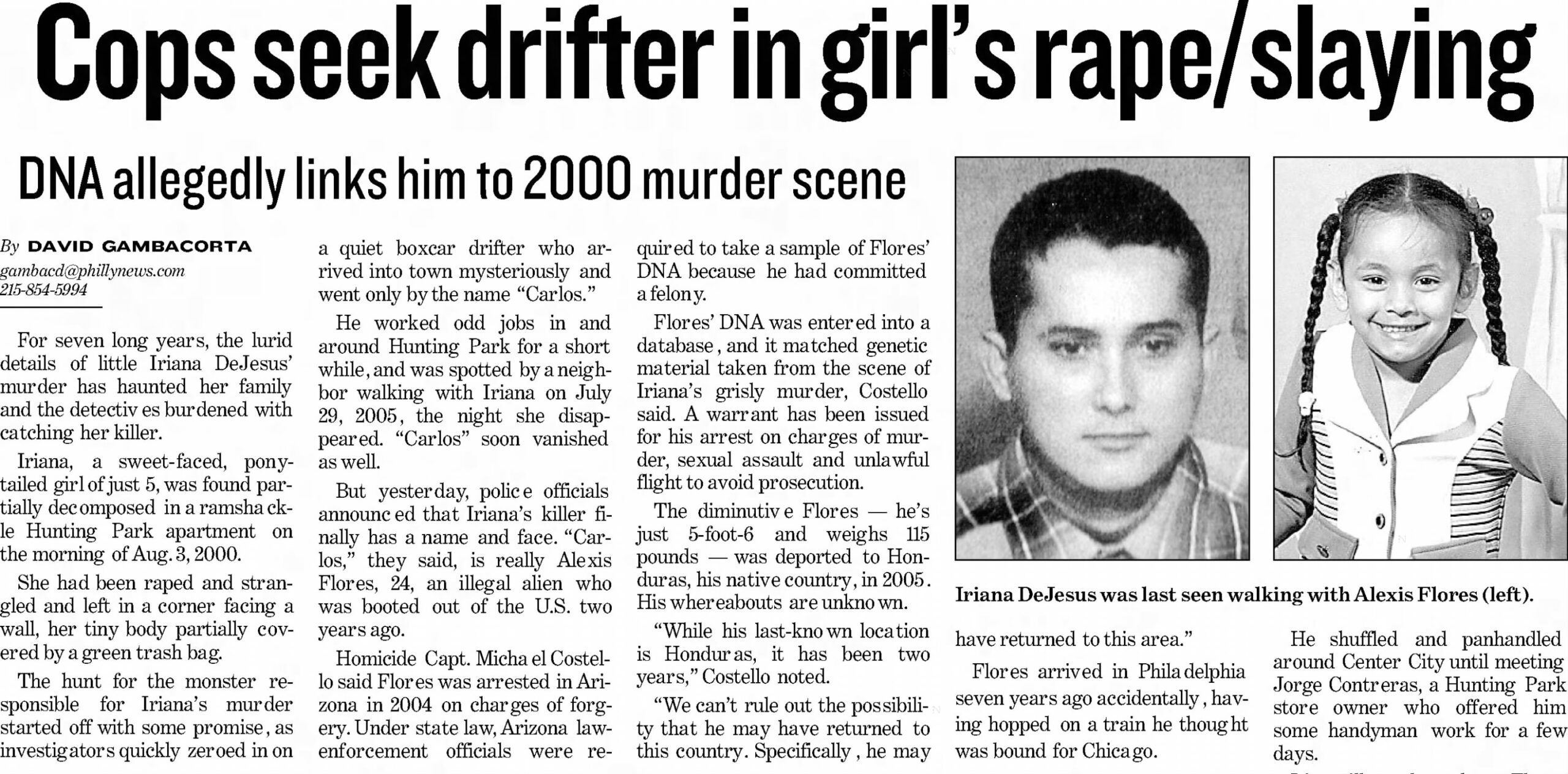
    The Daily News covers the announcement of Alexis Flores as the suspect in Iriana DeJesus’ murder in March 2007.

    Authorities launched a national manhunt days after the killing, but Flores’ identity would not be publicly announced until March 2007, when federal officials issued a warrant for his arrest. He had been identified through a DNA database that allowed investigators to name him as a suspect years after a November 2004 arrest on a felony forgery charge in Phoenix.

    Arizona requires felony suspects to provide a DNA sample, leading to Flores’ later identification, The Inquirer reported. Flores, authorities told the Daily News in 2007, arrived in Philadelphia in 2000, having come here accidentally after hopping a train he believed was destined for Chicago.

    By the time he was identified, Flores had been deported to Honduras, and his whereabouts were unknown, complicating his apprehension. The FBI in June 2007 added him to its most-wanted list, but removed him from it last year after a review found he no longer fit its criteria, the bureau noted online. The bureau considers factors such as lengthy criminal records, the level of danger presented to the public, and whether nationwide publicity can assist in apprehension.

    At the time Flores was identified as the suspect, Philadelphia homicide Detective Joseph Bamberski, who had been investigating the case from the start, expressed relief.

    “It’s been a long time coming,” Bamberski told the Daily News in 2007. “This is the one case that always bothered me.”

    As of midday Thursday, Flores’ page on the FBI website had been updated with one addition — a line reading “captured” over his mugshot.

  • 💖 A weekend for lovers and the Galentine’s Day girlies| Things to do

    💖 A weekend for lovers and the Galentine’s Day girlies| Things to do

    Love is in the air, so this week’s newsletter is for the region’s friends and lovers.

    If you’re still scrambling to lock down your Valentine’s Day plans, or looking for Galentine’s Day excursions for you and your friends, I have a gift for you to unwrap this weekend.

    I’m talking Galentine’s Day parties, romantic train rides through Bucks County’s foothills, and a dinner date at a new double-decker restaurant in Midtown Village.

    These aren’t only events for the love-obsessed. There’s a theme park-inspired exhibition opening at the Franklin Institute, as well as a century-old celebration of the international surrealist movement and Presidents Day activities.

    Read below to finish carving out your weekend plans.

    — Earl Hopkins (@earlhopkins_, Email me at thingstodo@inquirer.com)

    If someone forwarded you this email, sign up for free here.

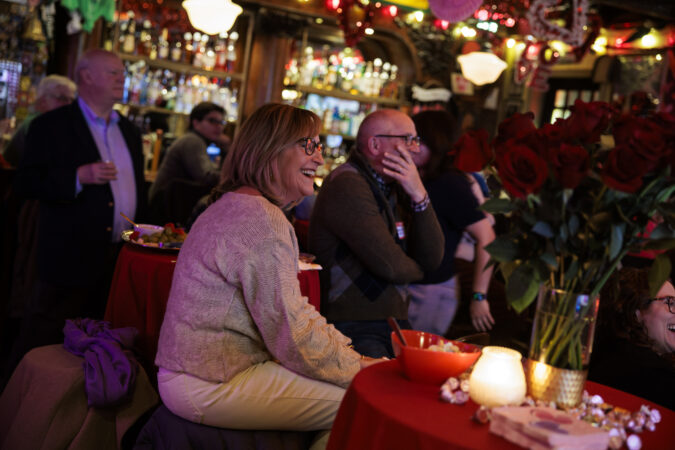
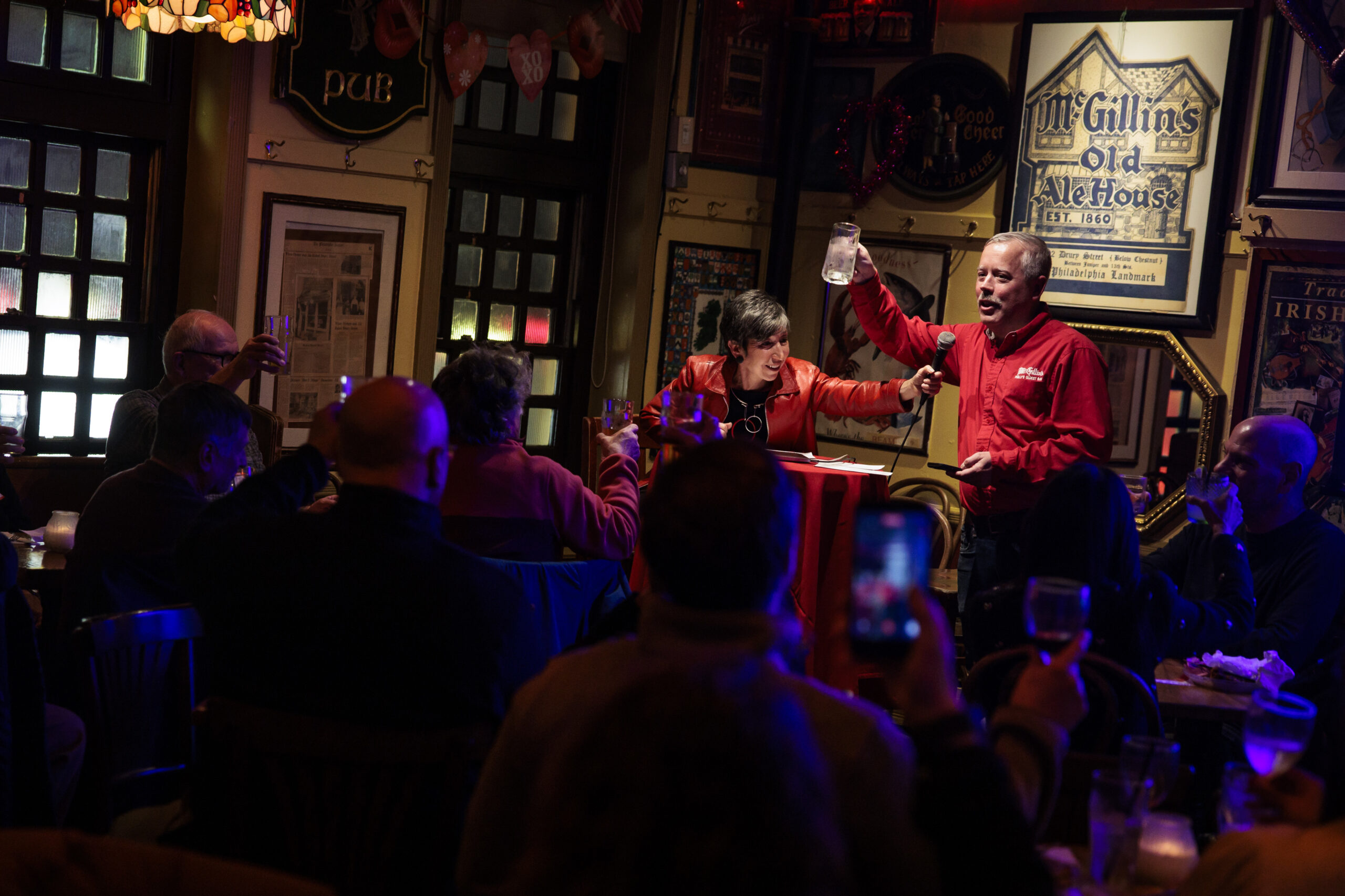
    Irene Levy Baker and Chris Mullins Jr. lead a toast at McGillin’s on Tuesday, Feb. 3, 2026 in Philadelphia. Attendees gathered for a book talk on “Cheers to McGillin’s: Philly’s Oldest Tavern” on Tuesday.

    Forget the dating apps, people. Find love at this 166-year-old bar.

    McGillin’s Olde Ale House, the 166-year-old pub in Center City long owned by the same family, has mastered the art of match making.

    Along with serving draft beer, wings, cheesesteaks, and an especially good french onion soup, McGillin’s is the place for future couples to meet.

    This month, the bar held a reunion for couples who struck romance at the long-beloved ale house.

    They came together, like alumni of the same beloved college club, wearing red and white name tags with the year their McGillin’s romantic meeting took place. They drank from frosted glasses and sat under tinsel hearts, clapping especially hard for the long married couples seated among them.

    Read my colleague Zoe Greenberg’s piece about this bar’s mating magic.

    The best things to do this week

    🚂 All aboard the love train: Celebrate Valentine’s Day with a luxurious and romantic train ride through Bucks County’s picturesque foothills. The hourlong trip comes with savory crudités and charcuterie, plus a glass of bubbly champagne to wash it all down.

    🖼️ In a Dreamworld: It’s the last weekend to catch “Dreamworld: Surrealism at 100” at the Phialdelphia Museum of Art. It’s a traveling exhibition that features 200 works that celebrate a century of the international surrealist movement.

    🇺🇸 Presidents Day Weekend fun: At the Museum of the American Revolution, the extended weekend will be layered with special programing. There will be sea chest unpacking, Revolution Place playtime, and a deep dive into how Abraham Lincoln interpreted the founding document.

    💞 A night for the girlies: Among all the Valentine’s Day events happening this weekend, there’s a little something for the girls, too. This Friday, Fishtown’s Evil Genius is hosting a Galentine’s Party featuring DJ Louie P, who will spin pop anthems as patrons enjoy pints of craft brew and V-Day themed cocktails.

    📅 My calendar picks this week: Valentine’s Day at the Museum of Illusions, Valen-Tide’s at Adventure Aquarium, and Make Love Market at LOVE Park.

    Universal Theme Parks makes world premiere at Franklin Institute

    The Franklin Institute hosts a world premiere exhibit this weekend that turns movie magic into hands-on discovery.

    The new theme park-inspired exhibit gives visitors a behind-the-scenes look at Universal’s biggest franchises. There will be immersive sets and interactive displays inspired by franchises such as Minions, The Secret Life of Pets and Sing, Super Nintendo World, Jurassic World, and more.

    Tickets are now available for the world premiere on Saturday. The exhibition will be on display through Sept. 7.

    Winter fun this week and beyond

    🎪 The Greatest Show on Earth: The Ringling Bros. and Barnum & Bailey traveling circus will bring high-flying acrobatics and extreme cycling to Xfinity Mobile Arena starting Friday. The non-stop party in South Philly continues through Monday.

    🍲 A Midtown Village eatery: The team behind Philly’s cheesesteak bar, Taste, opened a chic NYC and Miami-inspired eatery, Savú. The seasonal menu features items like Maryland crab-stuff egg rolls, jumbo crab cakes, caviar bumps, and other New American bites.

    🎭 A Disney fairytale opening: The musical adaption of the Disney classic, Beauty and the Beast, brings this magical fairytale to the Academy of Music. The beloved story runs through Feb. 22.

    Staffer picks

    Pop music critic Dan DeLuca lists the top concerts this weekend and a few holiday pop-up jams happening this month.

    🎸 Thursday: Local songwriter Josh Owens’ dreamy indie pop band Lazyacres is playing at the South Street nightclub Nikki Lopez with Attic Posture, Bowling Alley Oop, and Dante Robinson.

    🎸 Friday: The Knee-Hi’s, self-described as a “female fronted garage glam rock band existing as a living love letter to rock and roll,” will takeover Ortlieb’s alongside Ione, Star Moles, and Thank You Thank You on Friday.

    🎤 Saturday: A year after releasing his latest album, The Co-Star and a holiday collection, R&B heartthrob Eric Benet will grace the City Winery stage on Saturday.

    🎤 Also on Saturday: Philly cumbia klezmer punk band Mariposas Galacticas join forces with Baltimore-based cumbia ska outfit Soroche and DJ Pdrto Criolla to celebrate “radical love in all its forms” at Johnny Brenda’s.

    🎸 Sunday: Closing out Valentine’s Day weekend is folk-goth guitarist Marissa Nadler, who will bring her noir-ish soundscapes that have won over folkies and metal heads to Milkboy Philly on Sunday.

    By submitting your written, visual, and/or audio contributions, you agree to The Inquirer’s Terms of Use, including the grant of rights in Section 10.

    Alright, lovers and Galentine’s Day diners, I hope this week’s newsletters was a proper gift to you.

    — Earl Hopkins

    Courtesy of Giphy.com