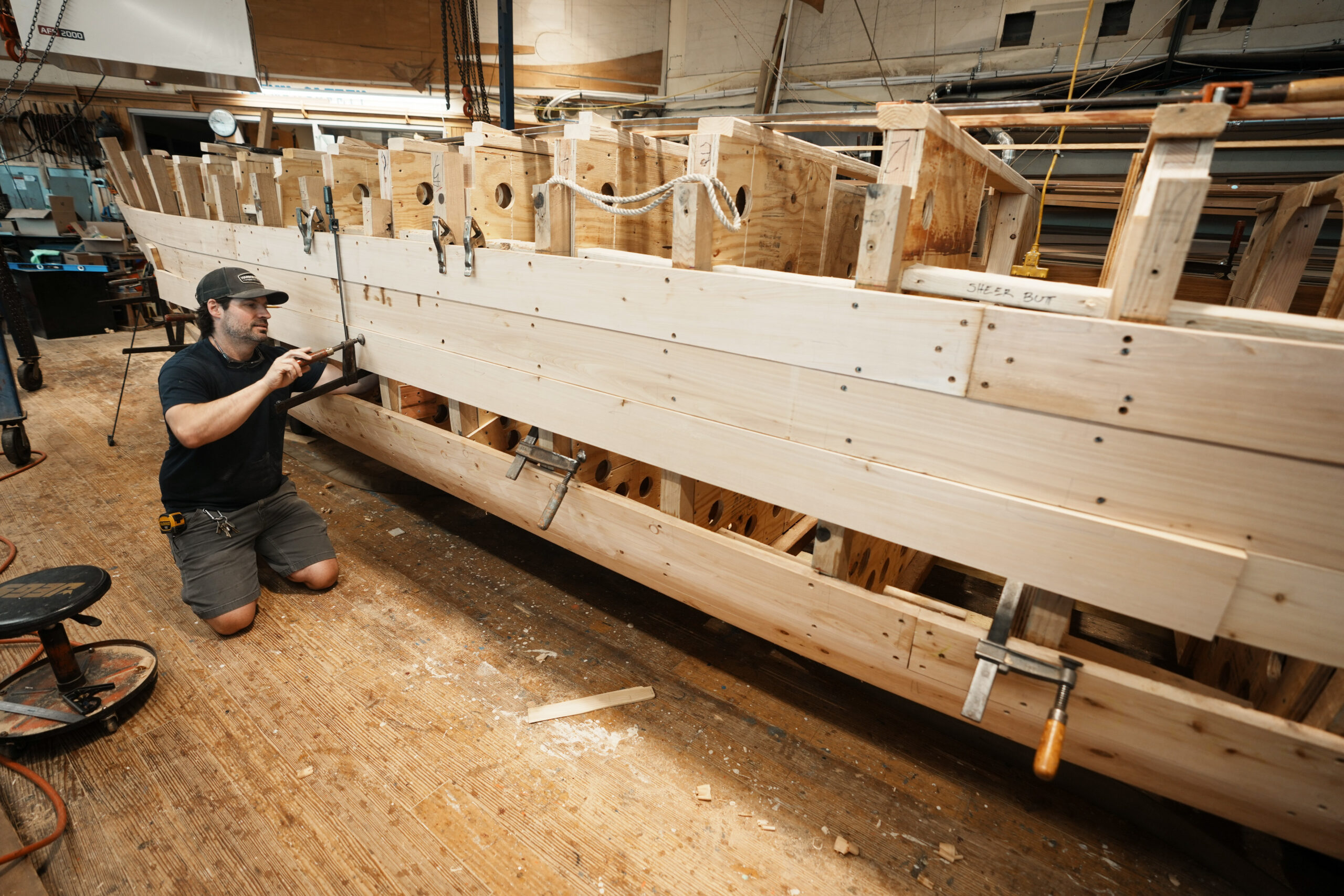
The floor of David Dormond’s workshop is scattered with wooden planks, shaving piles, and machines that scream “DO NOT TOUCH!” In the middle of it all sits a 40-foot-long, 3500-pound wooden boat that looks like it could hold an army.
That’s because it’s meant to. Well, sort of.
It’s a Durham boat, named because the design was used to transport iron from Durham Ironworks in Bucks County to Philadelphia. It is better known as being the model of boat George Washington used to cross the Delaware with his Patriot troops on Christmas in 1776.
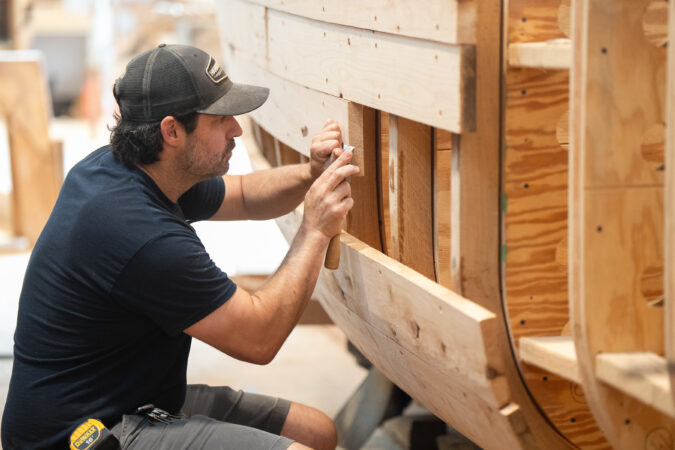
At the Independence Seaport Museum in Philadelphia, David Dormond is replicating the boat Washington used to cross the Delaware River, June 18, 2026.
“The moment Washington decided to use these boats to cross the Delaware and storm Trenton changed the tide of the [Revolutionary] War,” said Dormond, who is the director of the Seaport Boat Shop at the Independence Seaport Museum (ISM). “It was one of the pivotal points for the U.S. in gaining our freedom.”
Dormond and his team have built a full-scale replica of the Durham boat to be displayed in Washington Crossing Historic Park. Authenticity was at the forefront of its construction, with Dormond committed to making the boat as historically accurate as possible.
The wood for the replica was sourced locally, including cedar from Medford, N.J., and white oak for the framing from Reading.
David Dormond and his team have spent more than a year constructing the boat in the Seaport Boat Shop at the Independence Seaport Museum in Philadelphia.
“The reason we do that is to keep things just the same as they would’ve been in the 1700s,” Dormond said. “When they were building these boats, they weren’t bringing lumber in from across the country, they were using what they had available to them, so we follow in that tradition.”
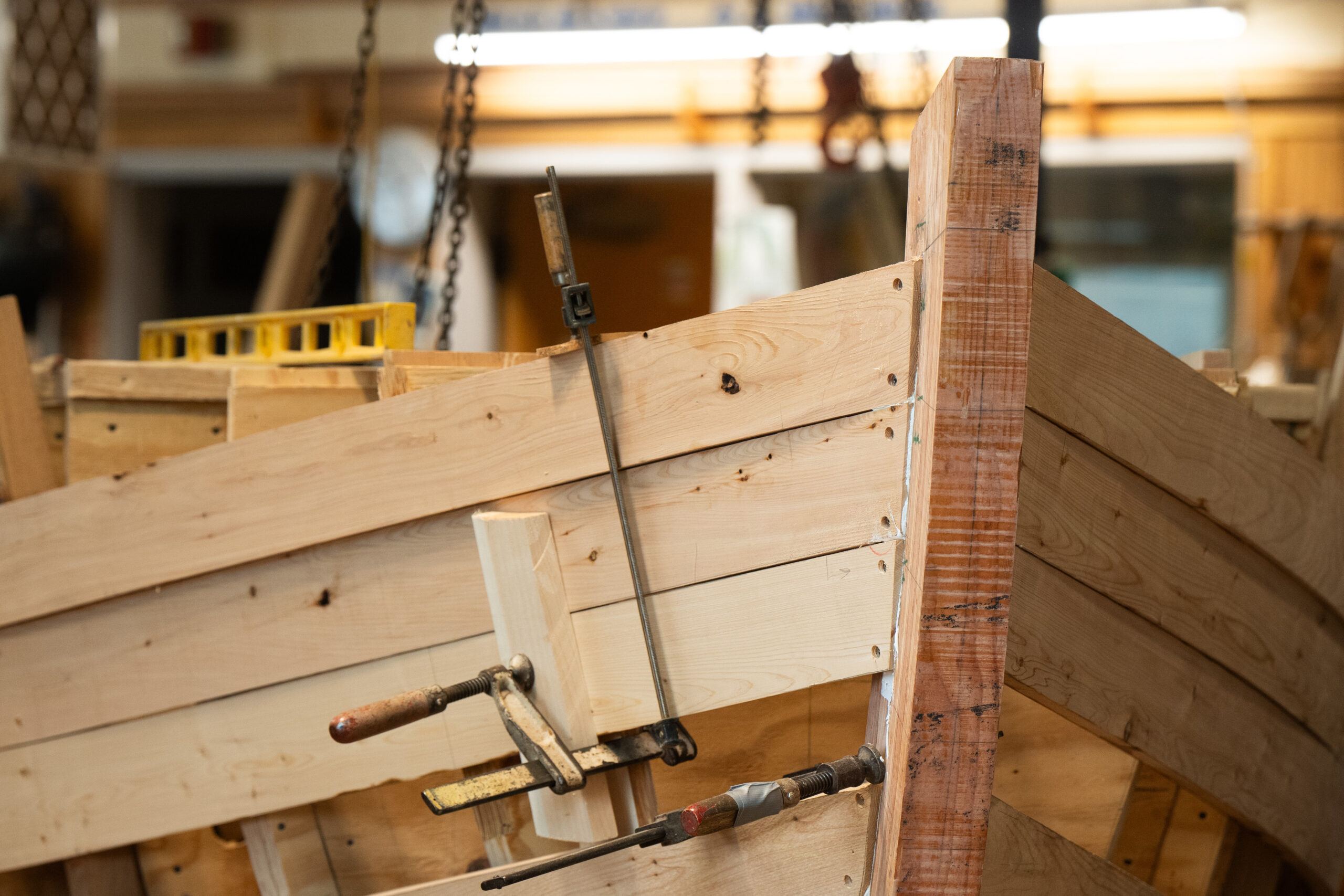
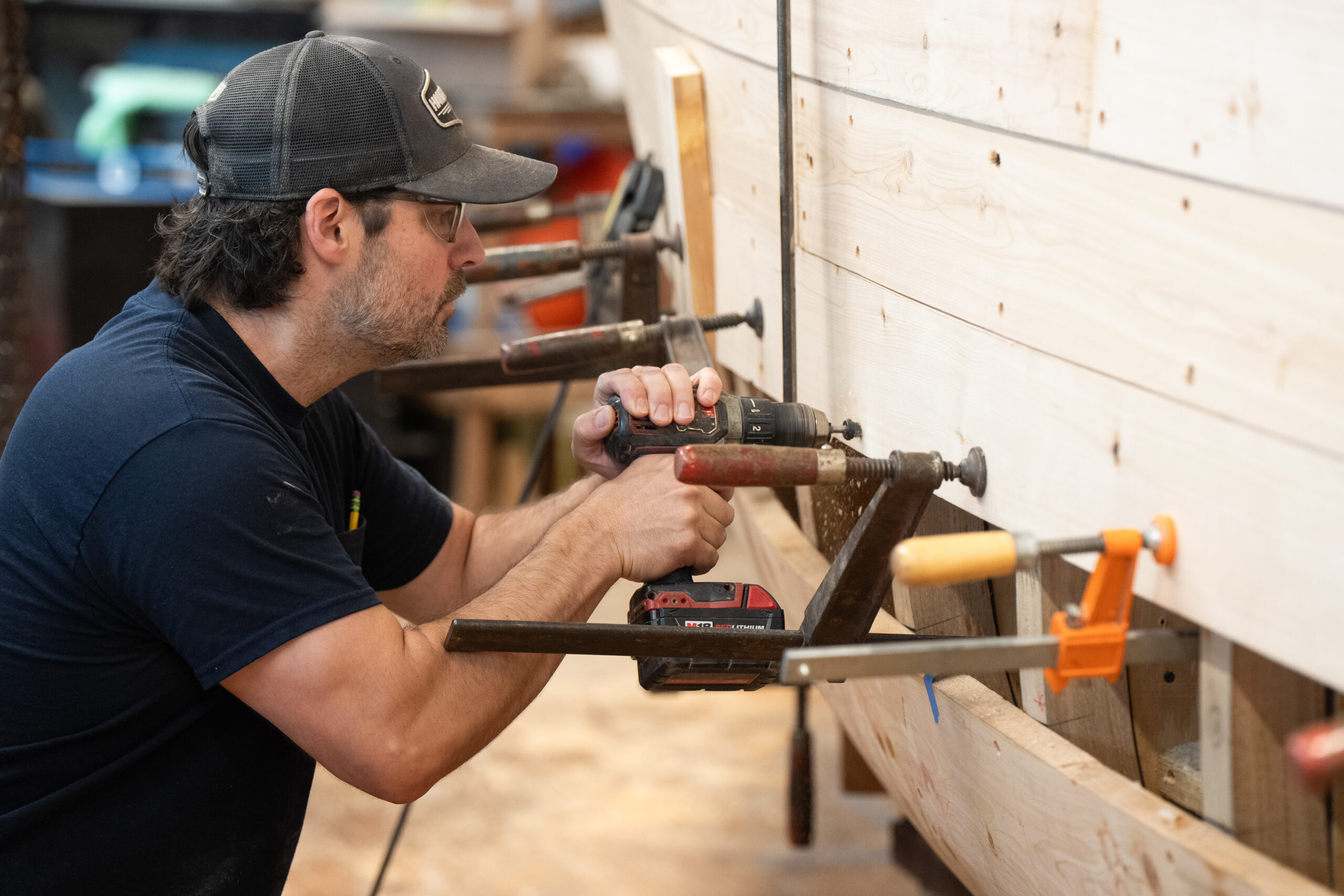
Nearly every part of the boat was handmade by Dormond and his team, down to the bolts holding the wood together. They steam-bent the frames and used 18th-century-style spokeshaves and batten strips to help shape the boat like they would have in Washington’s day.
But this boat, now on display in Washington Crossing Historic Park, isn’t just for viewing. Visitors will be able to board the ship and see how grand it was in height and length, but also how cramped the 8-feet-wide interior was for the 2,400 soldiers that crossed the Delaware.
Most of the boat was handmade, with emphasis on using 18th-century materials to make it as period-accurate as possible.
The park currently has four Durham boats that sit on the water and are used for historical reenactments. This new boat will be parked on land along the waterline, and will be the first that visitors can walk onto and interact with directly.
“We were talking about some of the things that people are interested in learning about when they come to the park, but that they can’t necessarily experience. [And] people often asked about the Durham boats,” said Jennifer Martin, director of Friends of Washington Crossing, who collaborated on the boat project with ISM.
Martin said civilian support played a vital role in the Revolutionary War, and part of that was boat-building.
“This was trade work. This is something that was passed on and learned,” she said. “I think that there’s an art to handcrafting things and getting people to understand that life was very different in the 18th century.”
At the Independence Seaport Museum in Philadelphia, David Dormond is replicating the boat Washington used to cross the Delaware River, June 18, 2026.
Planning for the build started two years ago, with full-time construction beginning in spring 2025. The plans were made by a designer in Maine in the 1960s; Dormond and his team modified them to be truer to what they know of boat-building processes of the 1700s.
Dormond has built boats at ISM for almost 13 years, and this one is “one of the bigger vessels that we’ve done,” he said. The shop cycles between larger construction projects and simpler boat restorations, commissioned by both institutions, like Washington Crossing, and private customers.
“It’s a part of our history, so it’s neat to bring back and share that with the public and create something that will be a landmark for visitors at the park for years to come.”
The Durham boat project is part of a larger revitalization of the riverside at Washington Crossing Historic Park for America’s 250th. This includes a new ADA-accessible trail complete with signs with original artwork that depicts the history being taught.
At the Independence Seaport Museum in Philadelphia, David Dormond is replicating the boat Washington used to cross the Delaware River, June 18, 2026.
The park has also invested greatly in a Williamsburg-style experience for the roughly 10,000 field trip students that visit every year. Activities such as hands-on butter churning, gardening, blacksmithing, woodwork, quill handwriting, and soldiers drills give visitors a glimpse into 18th-century living.
“When people come to the park, a lot of our programs are free,” Martin said. “We wanted to be really intentional with creating more of these living history, immersive learning opportunities that people could experience every day that they come to the park.”
Though the shop’s team has some finishing touches to make, the boat is currently on display at Washington Crossing Park, ready for visitors amid the nation’s 250th anniversary.
It will be officially completed and installed by the end of July. It will be posted in the park indefinitely, with Dormond and his team assisting with any maintenance needs to keep it preserved for many years, and visitors, to come.
The Durham boat is on display at Washington Crossing Historic Park, 1112 River Rd., Washington Crossing, Pa. washingtoncrossingpark.org
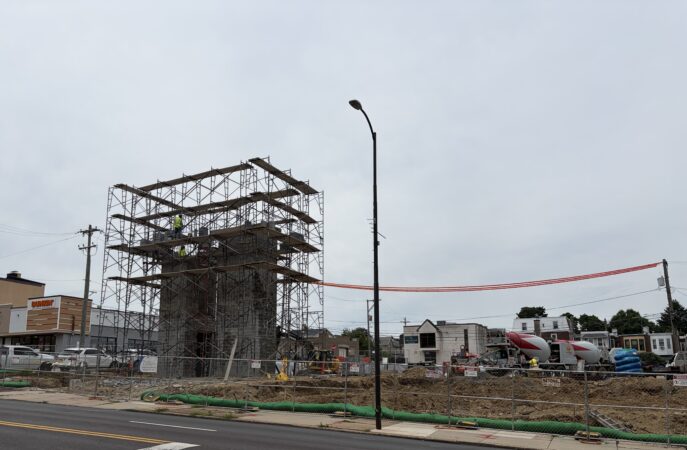
Construction is underway on a mixed-use apartment building facing York Road in Jenkintown.
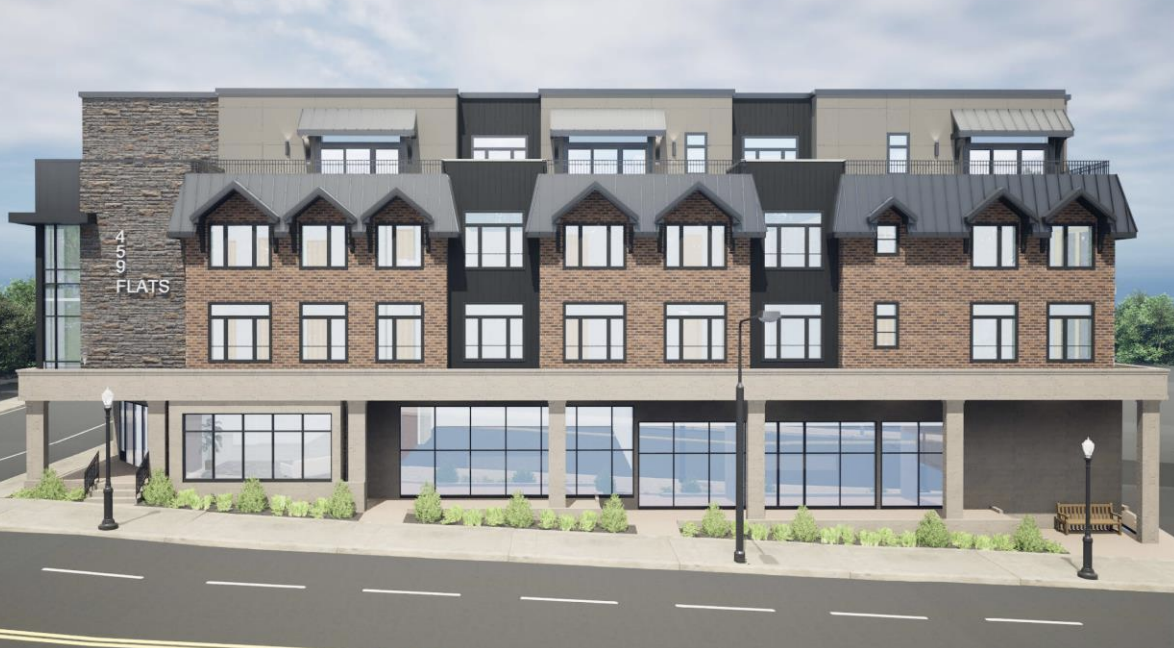
Plans for the new building, which will sit at the intersection of Route 611 and Cherry Street across from Dunkin’, include 40 apartments and a ground-floor commercial space.
The four-story structure also includes a parking garage with 48 spaces. Eight of those will be reserved for the retailer, developer and owner Vincent Celenza said.
Rendering of an apartment complex at Route 611 and Cherry Street in Jenkintown set to open next year.
Some Jenkintown residents have previously voiced concerns about parking permit arrangements for new apartments, arguing that charging for the spots encourages occupants to use free street parking instead.
But Jenkintown Borough Manager George Locke said he’s heard some argue that no-cost parking permits could present a different problem: “[An] owner might just work the cost of parking into all leases and that might negatively affect those who chose not to drive and use public transportation instead.”
Celenza said he hasn’t decided yet how to handle parking permits. “That was one of [the borough’s] concerns,” he said.
An older building on the site, Helweg Funeral Services Inc, was demolished earlier this month.
Celenza bought the land in 2022 from the trust of the Helweg family funeral home’s owner, Mary Welham Wurmstedt, according to property records.
Newspaper archives indicate the Helweg funeral home had operated on the property since at least the 1930s. Helweg’s has merged with another funeral home and is now located two miles down the street in Abington.
Celenza went through several rounds of planning with Jenkintown, which requested fewer apartments and a wider sidewalk on Cherry Street, Locke said. Celenza agreed to those requests in the final plan submitted last summer.
Construction is underway on a new 40-apartment complex and commercial space at Old York Road and Cherry Street in Jenkintown.
The developer will also add a small public area with two benches on a back corner of the property at Cherry and Johnson Streets.
The apartment complex, named 459 Flats, is set to open in June 2027, Celenza said.
Average rent for the apartments, which range from studios to two-bedroom units, will be about $2,400 per month.
This suburban content is produced with support from the Leslie Miller and Richard Worley Foundation and The Lenfest Institute for Journalism. Editorial content is created independently of the project donors. Gifts to support The Inquirer’s high-impact journalism can be made at inquirer.com/donate. A list of Lenfest Institute donors can be found at lenfestinstitute.org/supporters.
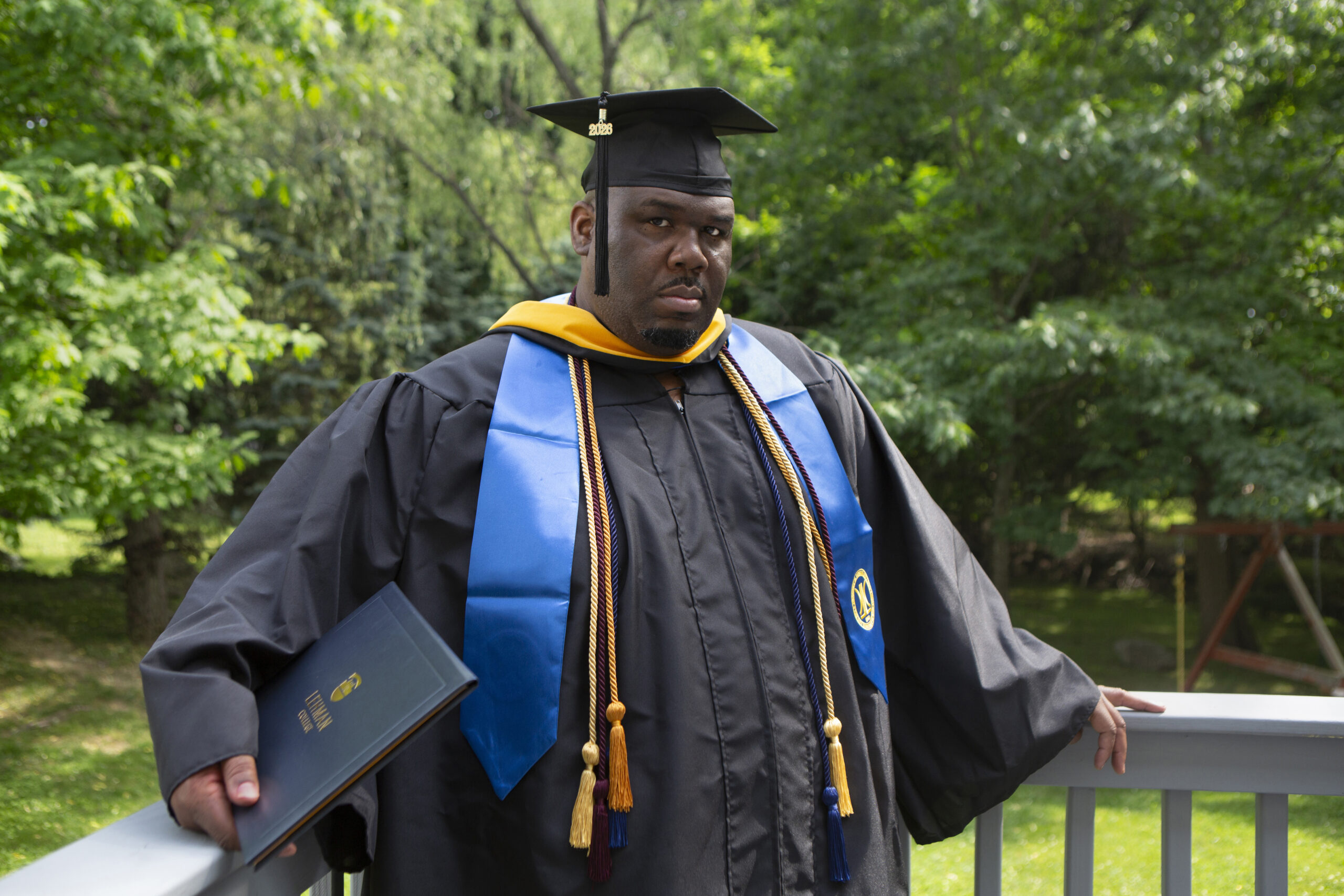
Benjamin Pinckney, 46, has dreamed of becoming a physician assistant since just after his 20th birthday.
He had been targeted by a drive-by shooter in Jacksonville, Fla., and hospitalized with two gunshot wounds. During his weeklong hospitalization, he said, a physician assistant changed the course of his life by visiting his hospital bed each day and warning him that Black men with gunshot wounds often end up paralyzed — or worse.
“I used to run the streets, you know, on the wrong sides of the track,” Pinckney said. “He made me promise that I would never come into his ER that way again. That was the last conversation we had, right before I was discharged.”
His goal since then has been to become a physician assistant. Pinckney, who spent most of his career working for New York City’s Department of Sanitation and as an Army Reserve medic, recently took a step toward achieving it. In May, he graduated with departmental honors from Lehman College with a Bachelor of Science degree.
After moving from New York to Prince George’s County, Md., he’d planned on applying for physician assistant school this year. But now, he’s worried his dream may be thwarted by new student loan rules.
Starting July 1, the amount of money graduate students will be allowed to borrow from the federal government will be capped. The new student loan limits are part of the GOP’s tax-and-spending legislation known as the One Big Beautiful Bill Act, which President Donald Trump signed into law last year.
The caps are intended to curb the cost of higher education and student loan debt, according to the Trump administration.
But critics widely agree the new limits are too low, especially for students allowed to borrow only $20,500 a year in federal loans due to the law’s controversial definition of a “professional degree.” On June 24, a federal judge temporarily blocked the Department of Education from enforcing that definition. Still, for many students, the new caps won’t cover the combined cost of tuition, housing, and living expenses.
This could leave hundreds of thousands of students who borrow money for graduate school each year at the mercy of private lenders with higher interest rates and fewer repayment options.
Some experts and students also worry that the limits will threaten efforts to diversify the healthcare workforce by deterring minorities and people from low-income households from applying to graduate programs. A drop in incoming students could worsen existing rural and primary care shortages, they argue.
Many politicians and loan experts have acknowledged that the cost of higher education needs to be addressed. But the new federal loan limits are “just not going to achieve that goal,” said Todd Pickard, president of the American Academy of Physician Associates, one of several organizations that have sued the Department of Education over the rules.
“It’d be like if you had a hangnail and I cut your whole arm off instead of just taking care of your hangnail,” Pickard said. “The treatment doesn’t match the problem.”
‘A rock and a hard place’
Students working toward what the law describes as “professional degrees” — including trainee doctors, dentists, pharmacists, and chiropractors — will be allowed to borrow up to $200,000 total, and no more than $50,000 a year.
Meanwhile, the median cost of attending a public medical school is nearly $300,000 over four years, while the median cost of a private medical school education exceeds $400,000, according to the Association of American Medical Colleges.
The caps were set even lower for those pursuing other “graduate” degrees, who face a $100,000 borrowing limit for federal loans over the course of their degree programs. The annual limit for this category of students is only $20,500. Students pursuing physical therapy, physician assistant, and nursing degrees were originally included in this group. But according to new guidance issued by the Department of Education on June 29, some of these students will at least temporarily be able to borrow up to the higher limit, according to The Associated Press.
The Department of Education, which has been sued by clinician trade groups and about two dozen states over the new rules, did not respond to questions for this article.
As the law was written, a physician assistant student who completed their degree within the average two to three years would not have been eligible to borrow the full $100,000. Meanwhile, physician assistants typically start their careers with an average debt of $112,000, meaning some could be forced to finance their education with higher-interest private loans.
“I feel like I’m between a rock and a hard place,” said Olivia Trull, 24, who is scheduled to begin the physician assistant program at Northwest University in Kirkland, Wash., this summer. The 28-month program costs $137,000, with about $62,000 in tuition and fees estimated for the first year, she said. That doesn’t include living expenses.
Before the court order, Trull said she qualified for the maximum annual allotment under the new rules of $20,500 in federal loans during her first year of graduate school. The balance would need to be financed through a private lender.
She anticipated she would need up to $100,000 in private loans to finance her graduate degree and would face loan payments of more than $3,000 a month when she was done.
“I have to actually sit down and have a conversation with myself,” Trull said, to consider “if I want to be drowning in debt for the next 10 years of my life.” One private bank offered her a loan with an interest rate of nearly 14%, she said.
Pinckney, who said he finished his undergraduate degree with about $10,000 in federal student loan debt, said some of his friends who have already applied for private student loans have been quoted interest rates as high as 13%. Meanwhile, interest rates for federal loans for graduate students, which are set annually, are currently about 8-9%. Federal loans also offer more flexible repayment options than private loans typically do.
In May, 25 states and the District of Columbia filed a federal lawsuit against the Department of Education over the new rules. The complaint described the law’s “professional degree” definition as “arbitrary and capricious.”
In a separate federal lawsuit filed in June, the American Academy of Physician Associates and the PA Education Association alleged that the new rules deny students the loan amounts needed to attend physician assistant schools. They argue that PA students should be able to access the higher loan limits available to students in medical school and other professional degree programs. (While “physician assistant” and “physician associate” typically refer to the same role, the AAPA adopted the title “physician associate” in 2021 because of “concern that ‘assistant’ does not reflect the important role of PAs in delivering high-quality healthcare to patients.”)
Meanwhile, Trump administration officials have contended the cost of graduate school is too high across the board. Education Secretary Linda McMahon, speaking before a House committee in May about the new limits, said, “It is our overall goal to bring down the cost of college and education.”
Indeed, some experts acknowledge that the new limits may be helpful in bringing down costs. The federal Grad PLUS loan program, established by Congress 20 years ago, did not cap the amount graduate students could borrow in federal loans. That program was eliminated in the One Big Beautiful Bill Act.
“There is considerable evidence that people borrowed more than they really needed to go to school,” said Sandy Baum, a higher education economist and a senior fellow at the Urban Institute.
Already, some graduate programs have lowered tuition prices, Baum said. In May, for example, the University of California-Irvine announced it would lower the cost of its MBA programs by tens of thousands of dollars to fall below the new federal lending thresholds.
And yet Baum doesn’t anticipate many other schools will follow suit.
“I don’t think we’re going to see some dramatic decline in prices,” she said. “I think some programs could close down because they can’t manage.”
‘Tears have been shed’
The new lending limits will also disproportionately affect Black students, Baum said, because they have historically borrowed more than white and Hispanic students.
For some students who borrowed money to finance their undergraduate degrees, the new limits will hit especially hard. Under the new rules, they will be subject to a lifetime limit of $257,000 in federal student loans.
“There will be students who can’t enroll,” Baum said.
Andrei Robu, 26, a medical student at the Medical University of South Carolina, leads the Financial Literacy Interest Group on the Charleston campus. He said many of his peers are worried that the lending limits will make the student body less diverse.
He is also concerned that, because the demand for acceptance into medical school is already so high, schools could prioritize entrance for students from wealthy backgrounds and “still fill up their classes.”
“That’s just not what we want in our physician workforce,” said Robu, who isn’t subject to the new rules as a current student. “We want to represent the population of the country at large.”
Jasmine Vasquez, 26, who has been accepted into the physician assistant program at South College in Atlanta, decided to defer her enrollment until 2027, partly to see if her financing options change. She is worried about taking on too much debt from a private bank.
“Tears have been shed multiple times,” said Vasquez, who is due to give birth in September. “It’s nothing that’s within my control.”
Betsy Mayotte, president of the Institute for Student Loan Advisors, expects the new rules will force some graduates into bankruptcy when they can’t afford to repay private loans.
First, though, she expects enrollment numbers to drop and some graduate programs to close because they can’t recruit enough students. Completion rates will also drop, she expects, as students run into federal loan limits partway through their degree programs.
Beyond that, she predicts healthcare graduates will seek jobs in high-paying specialties, exacerbating shortages in rural and underserved communities.
“They’re going to go where they can make the most money,” Mayotte said.
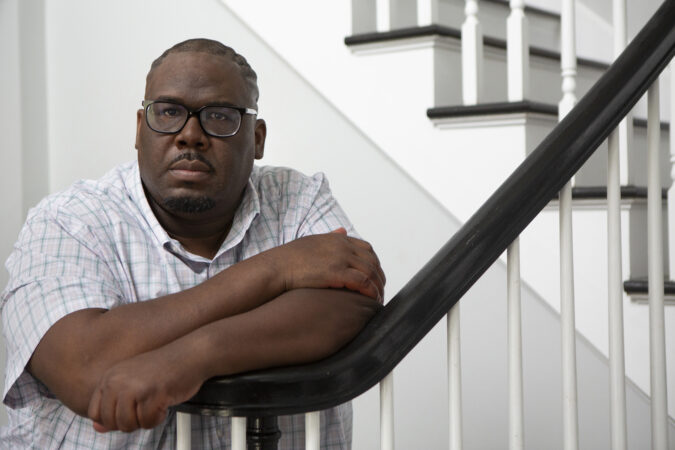
Benjamin Pinckney wants to go to graduate school to become a physician assistant. But he worries new federal student loan limits may force him to borrow money from a private bank at a higher interest rate. (Erica S. Lee for KFF Health News)
Pinckney said he is “not really sure” what the future holds. He paid for most of his undergraduate education by working while he was in school, but that’s typically not possible for full-time physician assistant students.
He has considered applying to a biomedical science graduate program instead, which he estimated would cost about $30,000 — an amount that’s “a lot more doable,” he said. It would allow him to potentially work in a lab or in pharmaceuticals, he said. It’s still aligned with medicine, he said, but it wouldn’t help him realize his goal of working with patients.
“Maybe this thing will blow over,” he said of the new federal loan limits. In the meantime, he’s holding out hope.
“If I can influence one person’s life, that would be my way of paying him forward for what he did,” he said, referring to the physician assistant who inspired him back in 1999. “It’s very hard to pivot from that dream.”
KFF Health News is a national newsroom that produces in-depth journalism about health issues and is one of the core operating programs at KFF — the independent source for health policy research, polling, and journalism.
The common wisdom that “There will never be an American pope” went up in white smoke on May 8, 2025, when Cardinal Robert Prevost, a boy from the South Side of Chicago and a graduate of Villanova University, was elected pontiff and took the name Leo XIV.
Now, on the eve of America’s Semiquincentennial, as if to underscore how much has changed, the American pope has been awarded the National Constitution Center’s Liberty Medal. Pope Leo accepted the award at the Vatican on April 30. On Friday, in a ceremony at the National Constitution Center on Independence Mall, the pontiff will address the audience live from the Vatican in a speech that will be livestreamed globally.
The medal, according to the center’s interim president and CEO, Vince Stango, will celebrate how “[i]n formal Vatican statements and public addresses, His Holiness has affirmed that peace cannot exist without freedom of religion, freedom of thought, and freedom of expression, principles that closely align with constitutional protections guaranteed by the First Amendment.”
One reason an American pope was long unthinkable is that American principles have not always aligned with Catholic principles. The proud American refusal to establish the Catholic Church as the national religion flew in the face of traditional Catholic teaching that the church should ensoul the body politic.
That was never going to happen in the United States, of course. Not even close. And so the question then became, from the Catholic point of view, what to say about the American model that included the First Amendment, with its coordinated guarantees of the “free exercise” of religion and the nonestablishment of religion by Congress.
Rome’s response has changed over time. In the late 1800s, Pope Leo XIII noted with approval the religious situation of Catholics in the United States, yet cautioned against the error that separation between the church and the civil power was to be the norm. By the 1950s, though, some Catholic thinkers were claiming the American model, in fact, stated the ideal, reasoning that the First Amendment guarantee of “free exercise” is necessary for a person to honor his God-imposed duties.
By now, even though the Second Vatican Council (1962-1965) stated that it was leaving the church’s traditional teaching “untouched,” the nonestablishment of religion and a legal guarantee of individual and group free exercise of religion, subject to just limitations for the common good, constitute the norm proposed by the Catholic Church to the world as we know it.
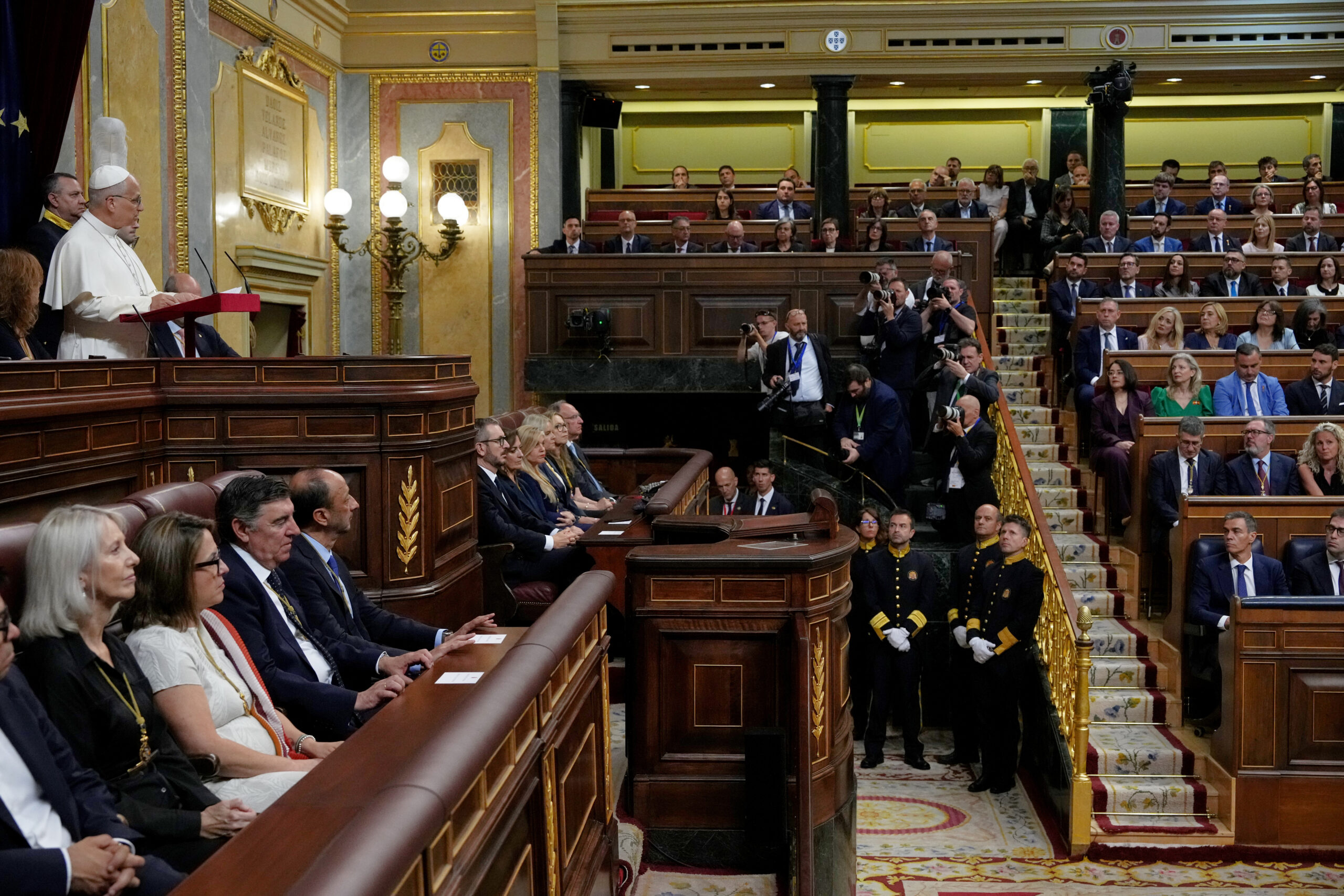
Pope Leo XIV speaks to members of the Spanish Parliament at the Congress of Deputies, in Madrid, on Monday, June 8.
In speaking to the Spanish Parliament on June 8, for example, Pope Leo insisted that laws must respect “freedom of thought, conscience and religion, a fundamental right that protects the most intimate sphere of the person. The freedom upon which the contemporary state is built, if it is authentic, recognizes the religious dimension of the human person.”
In the ceremony on Independence Mall on Friday, Pope Leo will address a nation in which, for the first time in its history, it is becoming socially acceptable to oppose the free exercise of religion for some people. Litigation that threatens to cancel people’s freedom to live according to their conscience becomes more common. The seal of confession, long protected in the United States, is under assault, and the threat is real. In his address to the Spanish Parliament, Pope Leo warned against the withdrawal of that protection, and the warning needs to be echoed in the United States.
It would be one of history’s great ironies for an American pope to call his country back to a principle that his church learned, in part, from America.
Religious liberty is not the only American principle on the American pope’s mind, as his message to the 2026 graduates of his alma mater makes clear. “This being the 250th anniversary of the United States of America, I would invite you to recall in a special way the guiding principles of the foundations of our nation: ‘We hold these truths to be self-evident: that all [people] are created equal; that they are endowed by our Creator with certain inalienable rights, and among those are Life, Liberty and the pursuit of happiness.’”
The principles of the First Amendment are to be cherished, but prior to those principles, the pope has reminded us, are the principles of the Declaration of Independence around which the nation was formed in 1776. And while the declaration does indeed attest to the nation’s commitment to the people’s Creator-given right to liberty, the outstanding principle of the declaration to which President Abraham Lincoln later found the nation “dedicated” since 1776 was that all people are “created equal.”
When Lincoln summoned the American nation to rededicate itself to the equality of all persons, he did so for good reason: Unless we are related to one another as equals, we are related to one another as fractions to wholes. The three-fifths clause of the original U.S. Constitution gave effect to slavery, a grievous injustice removed by the 13th Amendment in concert with the other Reconstruction amendments. These amendments constitutionalized the nation’s earlier commitment to our having been “created equal,” but not everyone is a believer in the equality of all people.
Today, Americans are divided over the declaration and, specifically, the claim that we are “created equal.” Human equality is said by some to be a self-evident lie, and even among those who pay it lip service, commitment to the basic equality of all people is undermined by identity politics, race-based priorities, and blood guilt.
Pope Leo, though, is not in doubt about the equality of all people. In his first encyclical, Magnifica Humanitas, he writes that we are equal in “ontological dignity, which is neither acquired nor earned, nor does it need to be justified.” This immutable and foundational equality is true of all people because we are, without exception, “created in the image and likeness of God.”
And this is another truth Americans need to reclaim.
In order to reclaim it, we need to understand that human equality was never meant to state something empirical or measurable about people. The equality declared by the declaration and celebrated by Lincoln, and fully constitutionalized by the Reconstruction amendments, depends on what is spiritual in a person, represented by the radical Christian judgment that underneath the obvious and often wonderful diversity of people lies a universal sameness in being created in the divine image.
When G.K. Chesterton was asked, “What is America?” he gave a characteristically smart answer that has been debated ever since: “America is a nation with the soul of a church. America is the only nation in the world founded on a creed. That creed is set forth with dogmatic and even theological lucidity in the Declaration of Independence.”
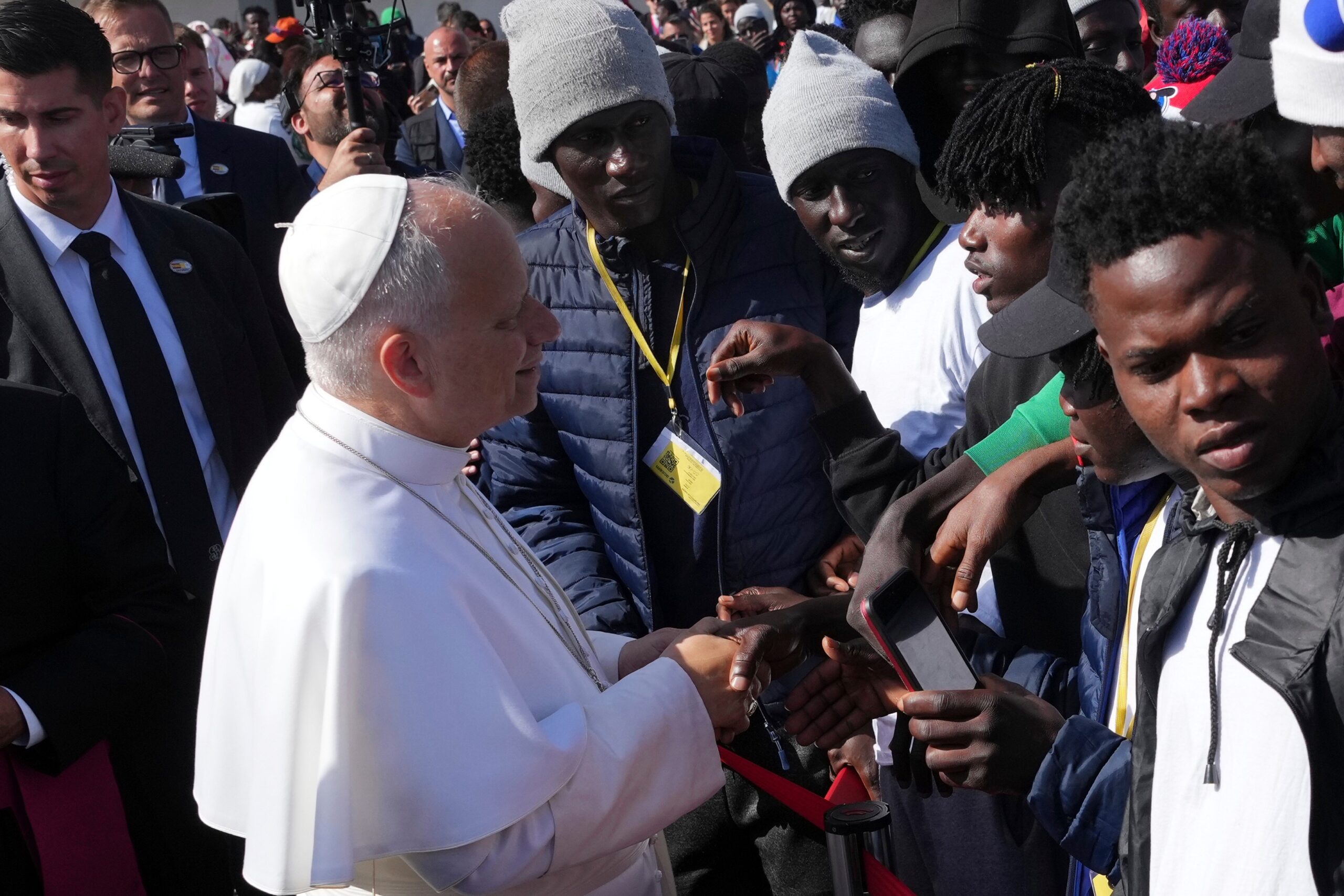
Pope Leo XIV meets migrants at the Las Raices center, in San Cristobal de la Laguna, Tenerife, Spain, June 12.
Robert Prevost, now Pope Leo, was formed, in part, in that “church” with its declarational creed. He was also, and first, formed in the Catholic Church, with its commitment to the universal equality of all people.
What the American pope can do now, in a way no other person on earth can, is to remind Americans that the equality to which their nation has been dedicated since 1776 depends on what Christianity has shown the world: that even the least, in worldly eyes, are equals in God’s eyes.
Patrick McKinley Brennan is the chair of Catholic legal studies and a constitutional law scholar at Villanova University.
The young woman with muscular dystrophy wanted a motorized scooter, but her health insurance would only cover a wheelchair.
So she went to Goodwill’s only medical equipment store in South Jersey, where she found a dozen scooters to choose from. She test drove one she liked and bought it at a steep discount.
“She burst into tears and said, `You have no idea what a difference this is going to make in my life,’” recalled Mark Boyd, Goodwill’s president and CEO.
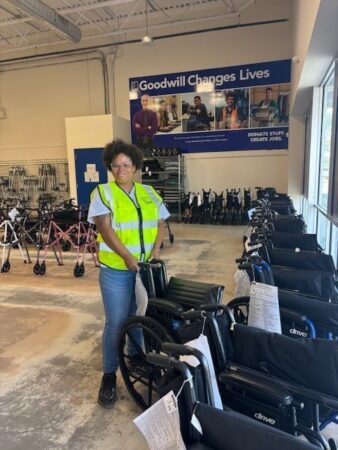
Goodwill Home Medical Equipment on Wednesday opened the region’s second location. The new store is located in Gloucester County, while its flagship, 16,000-square-foot retail store and warehouse is in Camden County.
Both sell sanitized and refurbished medical equipment, including power and manual wheelchairs, hospital beds, canes, walkers, and lift and shower chairs. The stores also offer unopened medical supplies, like adult diapers and colostomy bags.
“When people go to a Goodwill store, they don’t really know what they are looking for — they’re on a treasure hunt,” Boyd said. “But when you get sick or somebody in your family gets sick, all of the sudden you need a specific piece of equipment, and it can be quite daunting.”
The nonprofit thrift organization began offering used medical equipment at roughly one-third the retail price about 15 years ago, Boyd said.
“Financially, it’s a break-even operation, but it’s such a great service to the community,” he said, adding they cater to people with no or limited insurance, or high deductibles.
The new store on Mantua Pike in Woodbury Heights will be open Monday through Saturday from 9 a.m. to 6 p.m., and Sundays from 10 a.m. to 6 p.m. The location on Benigno Boulevard in Bellmawr is open Monday through Saturday from 9 a.m. to 3 p.m., and Sundays from 9 a.m. to 1 p.m.
The two South Jersey stores are the only Goodwill Home Medical Equipment retail locations in the country, according to spokesperson Juli Lundberg.
“The savings are so great that people do travel to us from New York City, the Philly burbs, and Jersey Shore,” Lundberg said. “We have had many other Goodwills across the country inquire about the concept.”
People can donate their medical equipment and unopened supplies at any Goodwill location in New Jersey and Pennsylvania. Donation sites and regular thrift stores can be found at https://www.goodwillhomemedical.org/store-locator. Goodwill staff also will pick up home medical equipment that is too large for a car, according to Lundberg.
This is the birthplace of democracy, and with it, comes the responsibilities that America’s founders left behind.
“The founders made clear that we have a real responsibility to do the work to constantly perfect our union,” Shapiro said in an interview this week, ahead of his speech before the ceremonial meeting of Congress, marking 250 years since the Declaration of Independence was signed in that same building. “And that the Congress of the United States has a unique responsibility in that to be a check on the executive branch.”
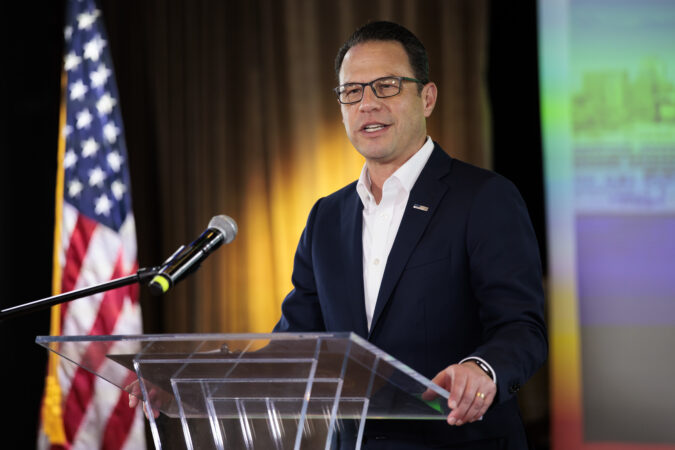
Those words come at a critical inflection point in America’s history, amid a tumultuous presidency, and as Shapiro is rumored to have aspirations of a White House bid in 2028. The first-term Democratic governor will appear before approximately 40 bipartisan members of Congress in Old City at the event convened by U.S. Rep. Brendan Boyle (D., Pa.), speaking to the lawmakers from across the country about their collective duty to the public. Shapiro will attend numerous other 250th celebrations across Philadelphia in the coming days, during which he said he plans to share his optimism for America’s future and deep concerns that President Donald Trump has led the nation astray from its founders’ design.
“I don’t think patriotism belongs to one party. I don’t think it should ever be partisan,” Shapiro said. “Unfortunately, Donald Trump routinely divides us, routinely injects partisanship into his definition of patriotism, and his actions, in many ways, are the opposite of patriotism.”
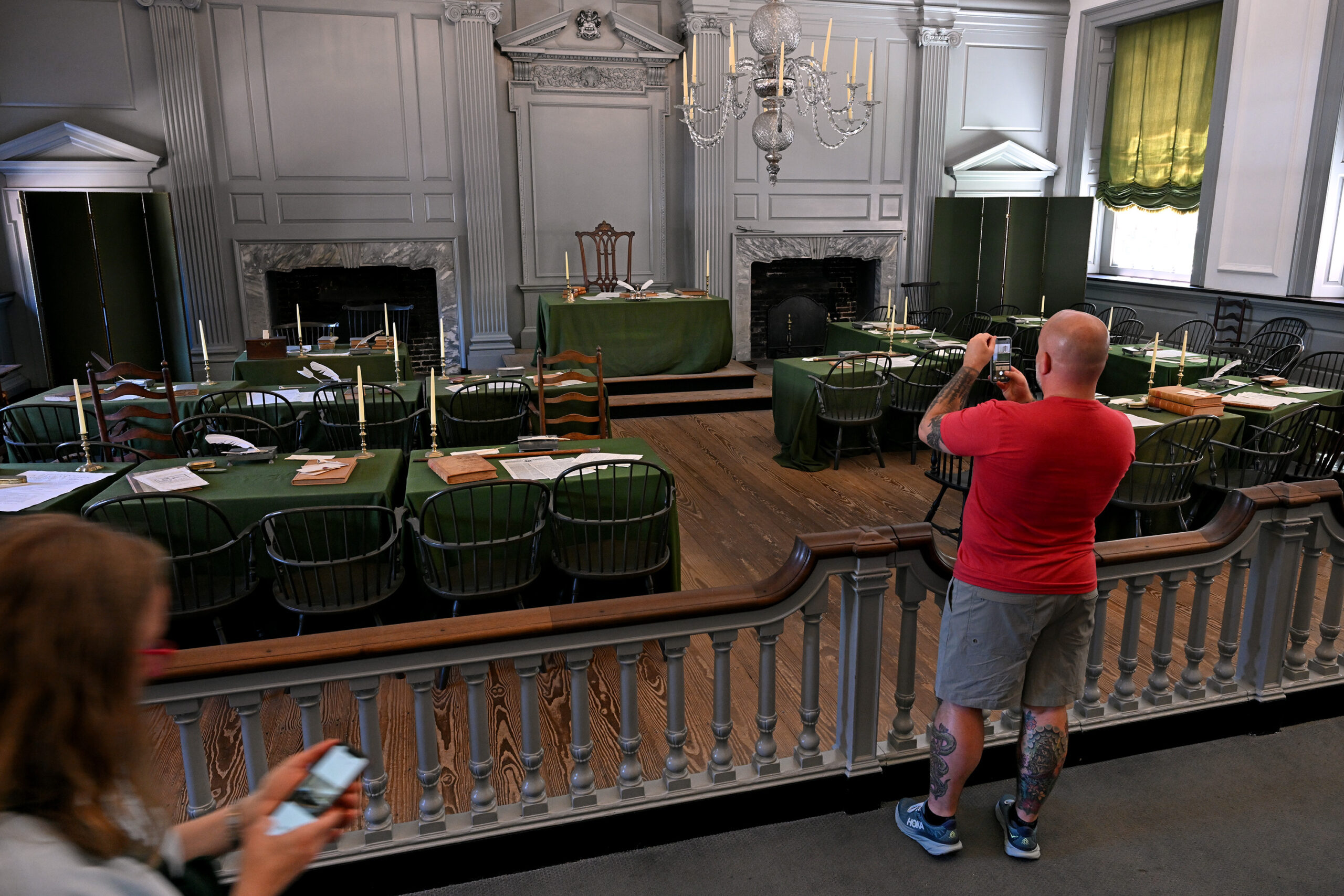
Assembly Room in Independence Hall (Pennsylvania State House) Monday, June 15, 2026. This is the exact space where the Second Continental Congress met and the Declaration of Independence was adopted.
As Trump plans to spend America’s 250th birthday hosting a politicalrally on the National Mall — with no plans to visit Philadelphia, the city where the nation was founded — Shapiro sees his own role as a unifier, and in direct contrast to Trump. As attention shifts to Philadelphia this weekend, he’ll appear on the national stage from sunup to sundown at events and on frequent TV hits — all with a home-turf advantage for his 2028 presidential prospects, as the governor of the nation’s quintessential swing state and also most important to the country’s founding.
“[Celebrating the 250th] allow the spotlight to shine on Shapiro, even though it’s not entirely about him,” said Alison Dagnes, a political-science professor at Shippensburg University. “Do I think that helps his ambitions? Sure.”
‘Direct contrast’
Sitting with Shapiro in his Harrisburg office earlier this week, it’s undeniable that he’s a history nerd — another reason why he was built for the moment.
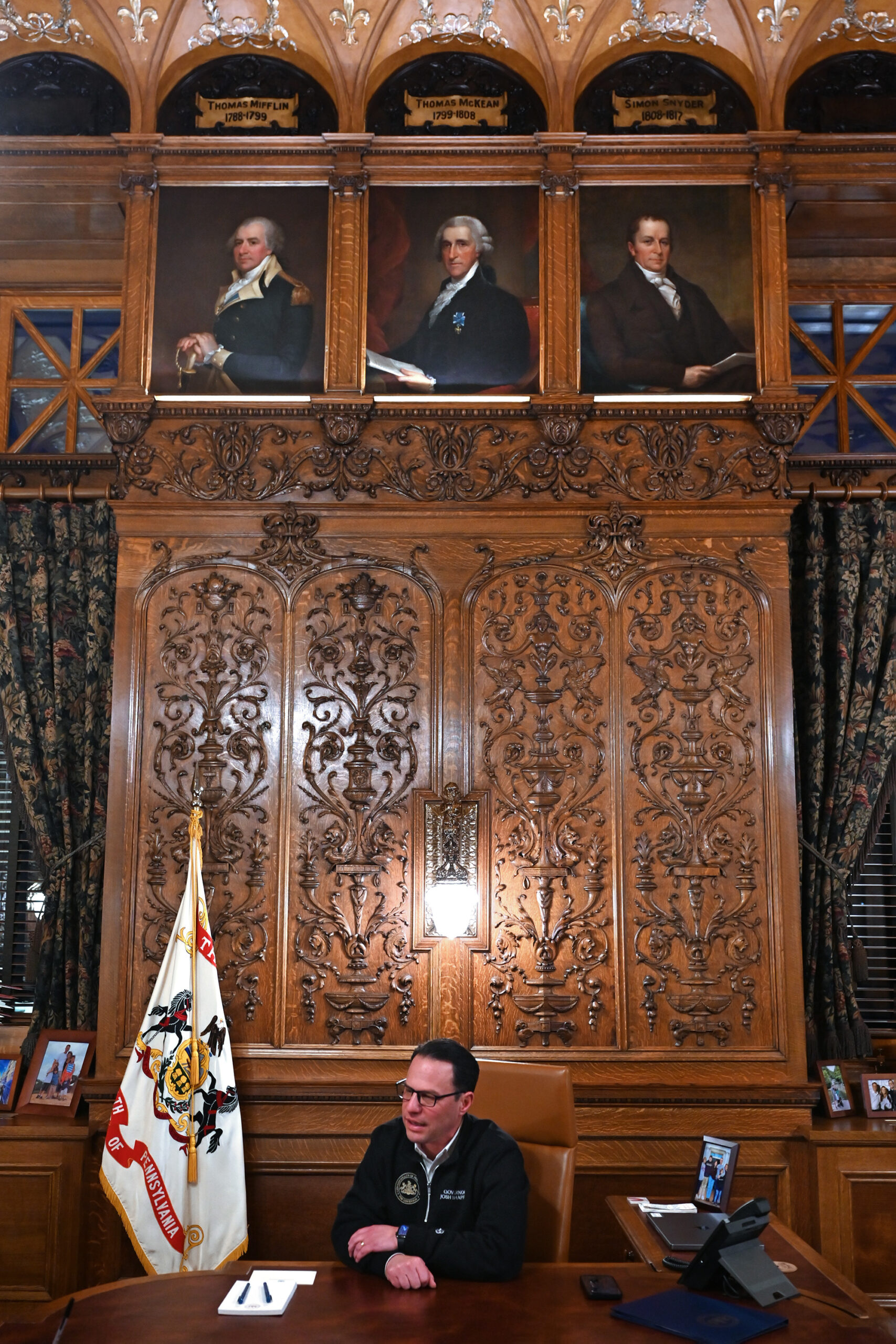
He casually quotes segments of The Federalist Papers, and references his favorite story about Benjamin Franklin‘s fixation on a half-sun on the back of George Washington’s chair during the 1787 Constitutional Convention, which Franklin remarked during the U.S. Constitution signing that “it is a rising and not setting sun.” Without having to look for its location, he points to his right to a portrait of Franklin, one of his predecessors as governor of Pennsylvania, hanging on his office wall. He notes lesser-known Pennsylvanians who played an important role inthe nation’s founding whom he plans to highlight over the coming days.
“You know, I hate to quote a guy not from Pennsylvania,” Shapiro said, returning to The Federalist Papers to recite James Madison’s concerns about giving an executive too much power.
Gov. Josh Shapiro in the Capitol in Harrisburg Feb. 21, 2023.
“If Madison were here today, he’d be really concerned about how one man has accumulated so much power and is wielding it in really dangerous ways, and I hope that at this 250-year mark we find our way back to that balance and back to the constraints on the people who lead our government,” he said.
Shapiro sees his leadership style as a “direct contrast” to Trump’s, especially at this moment.
“[Trump] restricts peoples’ freedom and liberties,” the governor added. “He whitewashes our history. That doesn’t further a sense of community, that doesn’t further patriotism. All that does is divide us, and I refuse to participate in that.”
But for the next few days, Shapiro said his approach to the 250th celebrations is to: “Celebrate America, find ways to bring people together, and to have some fun in the process.”
Fair games
Despite his overtures of political unity, Shapiro has faced accusations from Republicans in recent days for playing partisan games over Pennsylvania’s participation in Trump’s 16-day Great American State Fair. Shapiro, in addition to several other Democratic governors last week, announced that Pennsylvania would not take part in the fair due to his administration being unable to secure any state businesses to sponsor the exhibit. Staffing and sponsoring the exhibit on the state’s dime would have cost $700,000 that would be better spent on in-state 250th events, he said this week.
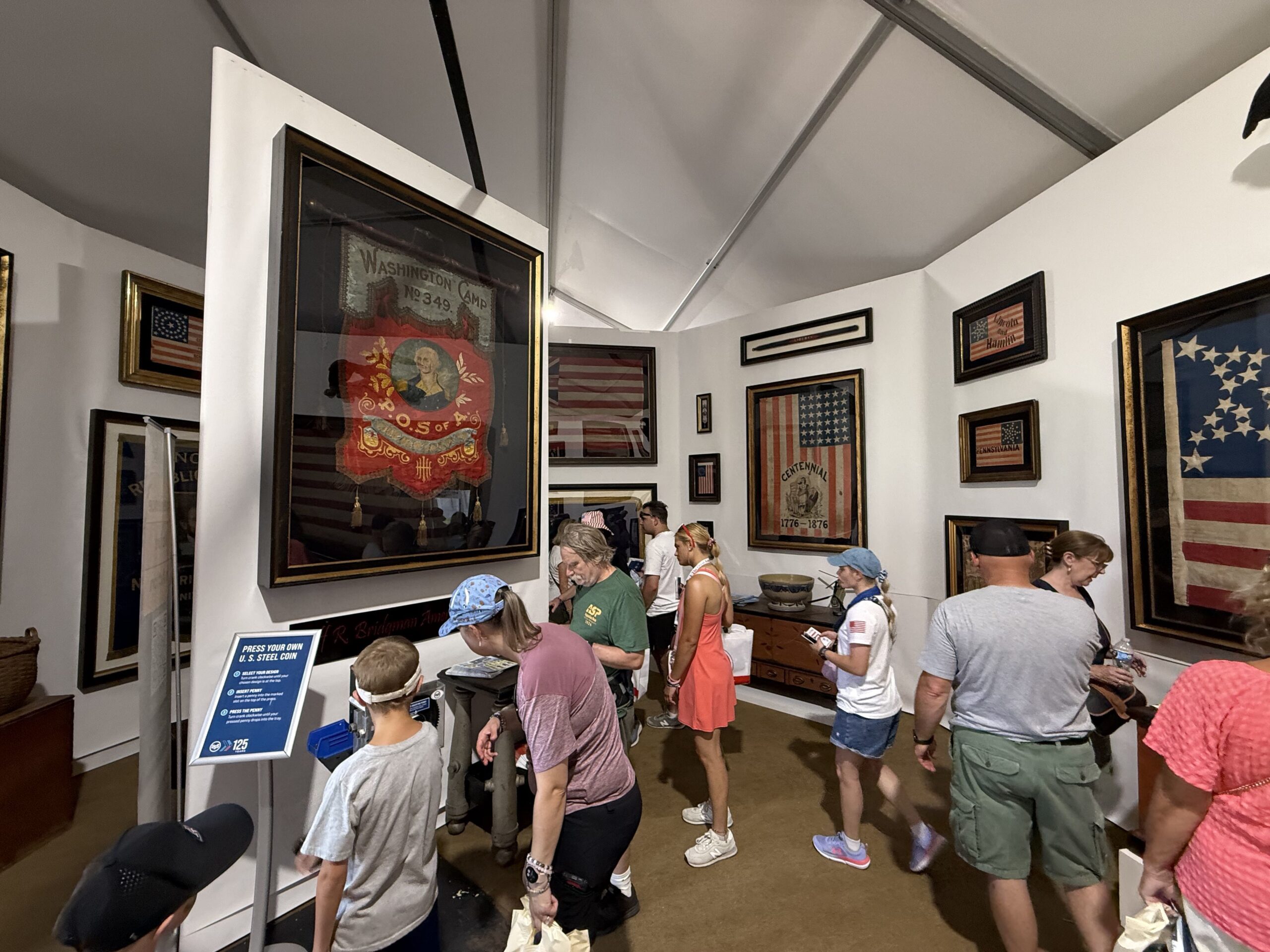
In the weekend that followed, Pennsylvania’s U.S. senators, Republican Dave McCormick and Democrat John Fetterman, made a push to fill the state’s empty exhibit. By Tuesday, it was filled with antique flags lent by a York County man, bags of potato chips from Snyder County, and a Christmas tree display from Fayette County, among other Pennsylvania-centric items.
Pennsylvania’s pavilion showcases state history and memorabilia at the Great American State Fair on June 30, 2026, in Washington, D.C.
Some of the businesses originally told Shapiro’s office they didn’t have enough time to participate. But when McCormick and Fetterman approached them with the idea to fill the empty pavilion, they joined in.
“They obviously had a change of heart at the last minute. That’s fine,” Shapiro said about the revived Pennsylvania pavilion.
State Treasurer Stacy Garrity — Shapiro’s Republican challenger for governor, who has aligned herself with Trump — in a statement called Shapiro the “only career politician who has politicized America 250.”
“Josh Shapiro put his political ambitions above his commonwealth and his nation when he pulled Pennsylvania out of the national celebration of our 250th birthday in a pitiful attempt to score cheap political points with the liberal wing of his party,” Garrity said.
Beyond the 250th
Shapiro’s strength as a politician has always been his ability to appear “harmonizing” and bringing people together, dating back to his days as a Montgomery County commissioner, Dagnes said.
A careful politician, Shapiro is known to stick to his message and has faced criticism from some fellow Democrats for his well-rehearsed statements.
When Shapiro delivers his messages of unity and freedom to a broader audience in the coming days, voters are likely toview them as authentic — one of the most important qualities to any presidential hopeful, she added.
“If [California Gov.] Gavin Newsom is the guy who’s gonna punch Trump in the face, then Shapiro is going to be the guy who’s like, ‘No, let me offer you an alternative,’” Dagnes said.
“It’s what he should be doing right now, because this is what America is about,” she added.
We knew that a list of 76 iconic Philadelphia foods would leave something out. It did. After hearing from readers — and revisiting a few of our own debates — we had to mention six items that deserve a place in the city’s culinary canon. They don’t replace the original 76; they just expand the conversation.
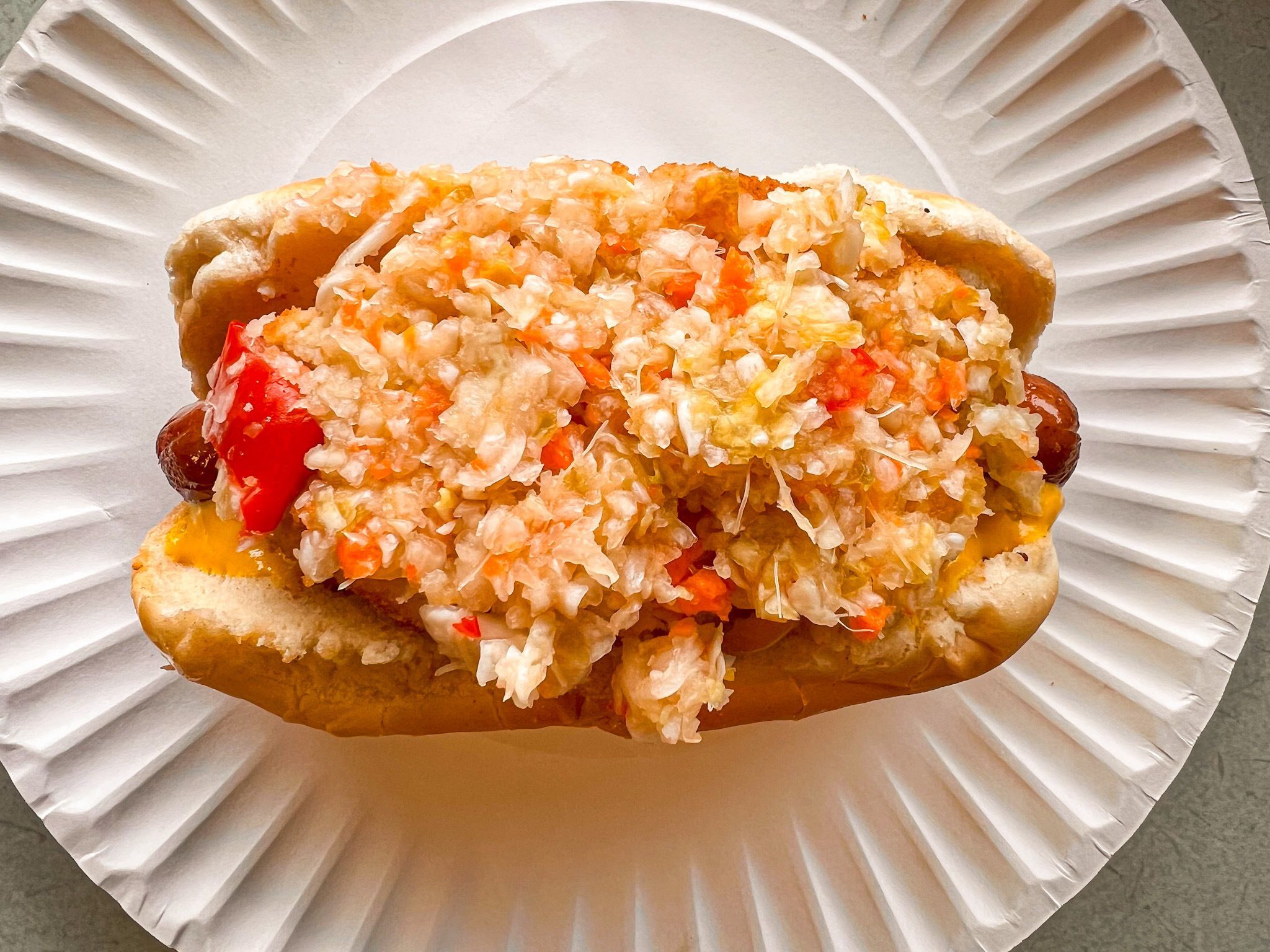
The ‘combo’: Hot dog and fishcake on a roll
The hot dog-fish cake combo topped with pepper hash at Lenny’s Hot Dogs in Feasterville.
Long before Philadelphia claimed the cheesesteak as its signature sandwich, another pairing drew a following: the hot dog and fishcake combo. Culinary historians generally agree that Abe Levis (rhymes with “crevice”) created it in 1895 by pressing a fried fish cake atop a grilled frank on the same bun at his luncheonette on Sixth Street near Lombard.
Instant surf-and-turf!
Levis also created Champ Cherry, the bright-red, cider-like soda that became the combo’s traditional companion. The Old Original Levis shop changed hands several times, spawned a few short-lived offshoots, and finally closed in 1992 under owner Elliott Hirsh, who later revived Levis as a store in Abington from 2012 to 2017 while marketing Champ Cherry in cans.
But tastes have changed and the brands are moribund, as Hirsh, now 80, acknowledged: “I’ve been actively trying to find someone that wants to take it over. And not even sell it. Just take it over. I’d hate to die and take it with me, but that’s what we’re going to do.”
The hot dog-fishcake combo, at least, survives. Just after World War II, Levis rival Lenny’s Hot Dogs also sold them from a stand nearby at Fifth and Passyunk.
Lenny’s secret sauce was the pepper hash — a sweet-and-sour relish of cabbage and bell peppers that cuts through the richness of the dish— created by owner Lenny Kravitz’s mother, Ida.
Kravitz expanded Lenny’s to several locations from Mount Airy to Margate, N.J. In the 1980s, he sold his final shop, at 6620 Castor Ave. in the Northeast, to Wayne Knapp. Kravitz died in 1998.
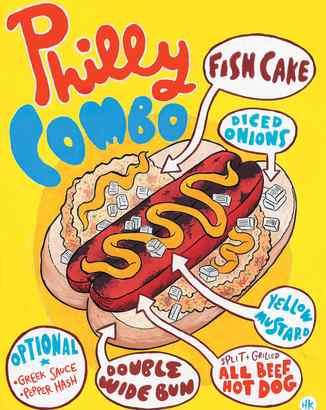
Hawk Krall’s illustration of the “surf ’n turf” Philly combo (fishcake and frank) was originally done for SeriousEats.com.
Knapp later relocated Lenny’s to Feasterville. That shop as well as Johnny Hot’s, John Danze Jr.’s truck stop on Delaware Avenue in Fishtown, are among the few standard-bearers of this classic. Be sure to add a squirt of yellow mustard and a smattering of diced onions, as illustrator Hawk Krall suggested in his 2009 poster print of the sandwich.
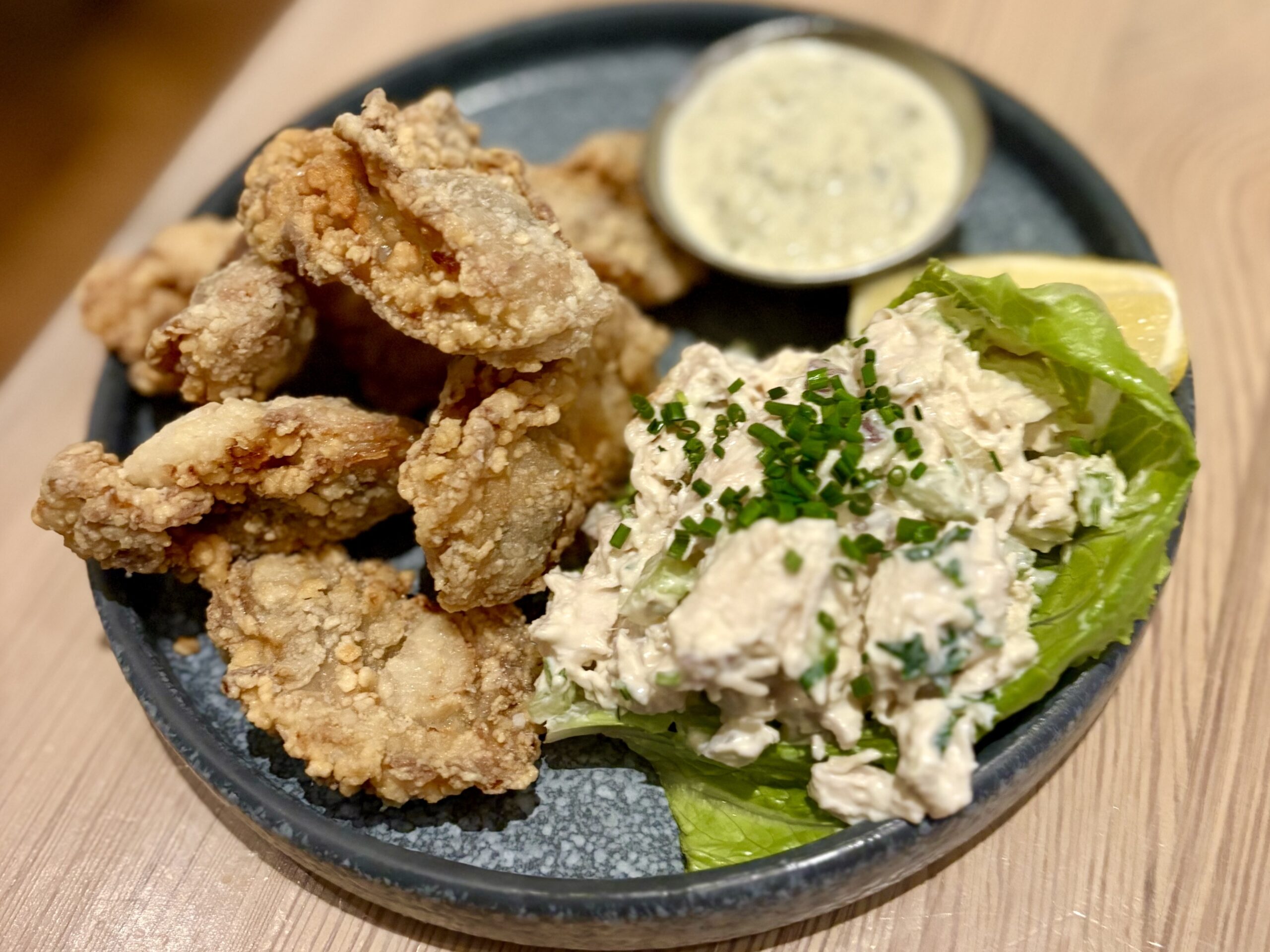
Chicken salad and oysters
Fried oysters with chicken salad from Oyster House.
As for another curious combo, only in Philadelphia would someone look at cool, creamy chicken salad and crunchy fried oysters and think, “Of course those belong together.”
The unlikely pairing has been a local specialty for well over a century, dating to the city’s grand oyster houses, hotels, and taverns in the late 1800s. One popular explanation of its origin holds that tavern keepers paired cheap, plentiful oysters with more expensive chicken to stretch a serving. Food historian William Woys Weaver has noted that Philadelphia’s finest hotels elevated the dish, serving chicken salad dressed with tarragon mayonnaise and encircled by crisp fried oysters. More humble versions turned up in neighborhood brew houses and lunch counters across the city.
Similar dishes appeared in New York, Baltimore, and Boston, and some historians believe that Philadelphia’s influential Black catering families helped popularize the combination. What is certain is that chicken salad and oysters were served at an organizing meeting of Philadelphia’s Union League in 1862.
The combo’s popularity has ebbed in recent years, and its primary home is now Oyster House near Rittenhouse Square, whose family ownership dates back nearly 80 years.
Crazy Richard’s Peanut Butter
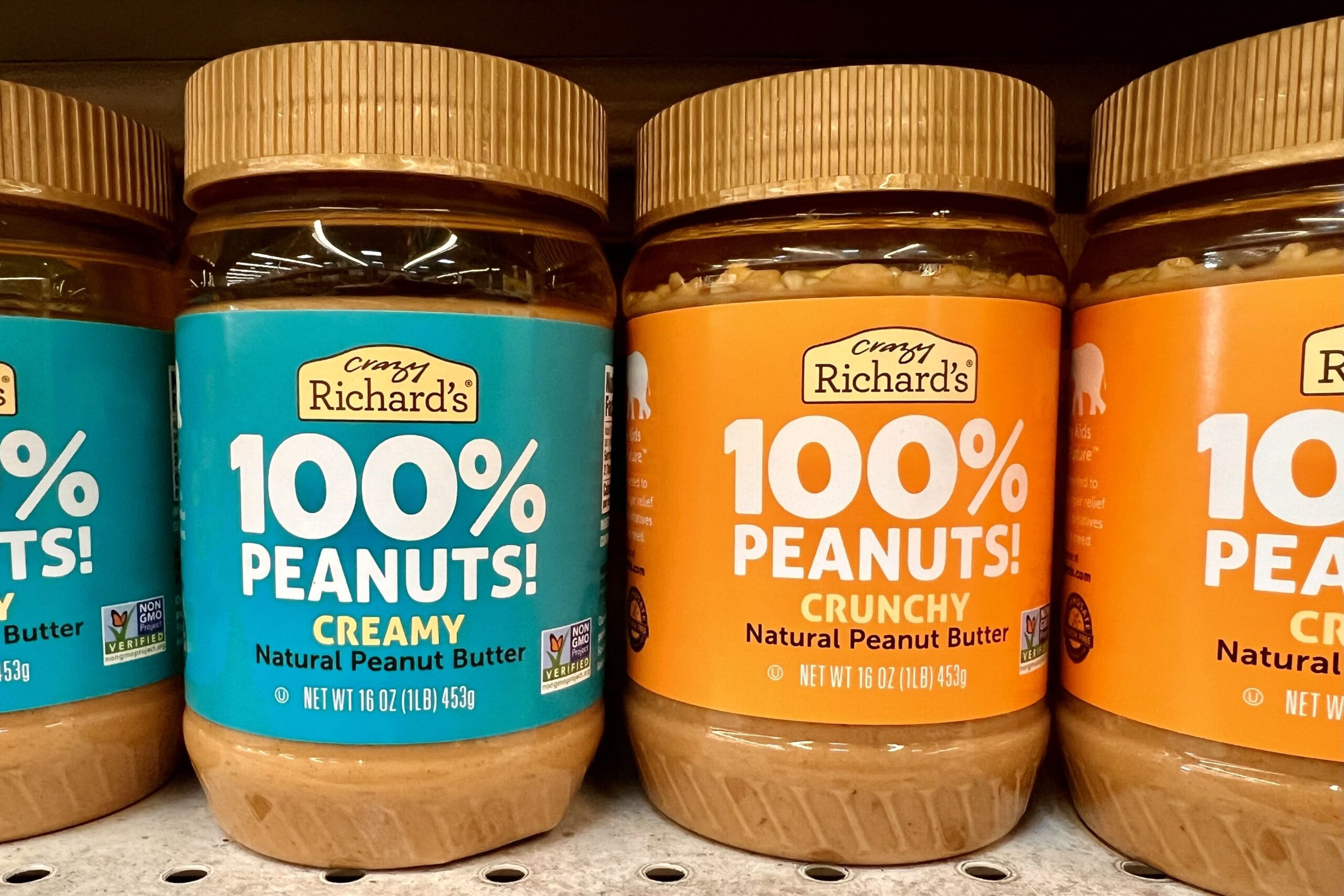
Crazy Richard’s Peanut Butter, founded in 1972, is still available on grocery shelves.
Life was all Skippy and Jif in the early 1970s when a Philadelphia music teacher decided to grind peanuts in his kitchen because he couldn’t find peanut butter that tasted the way he remembered.
Richard Marcus was a conductor, pianist, radio host, and founder of the Society Hill School of Music & Art. Frustrated by the sweetened, homogenized spreads that dominated grocery shelves, he bought five pounds of peanuts at Reading Terminal Market, roasted them, and blitzed them in his blender. The result was nothing more than peanuts — no sugar, salt, or oils.
Friends loved it. By 1972, they convinced him to package it. Marcus produced an initial run of about 144 jars, selling them through Philadelphia delis and health-food stores. He called it Crazy Richard’s, his wink to skeptics who thought he was nuts for marketing a peanut butter that separated naturally and required stirring.
Word of mouth did the rest. Marcus eventually gave up his music school to run the business full time, first contracting production in Conshohocken before opening plants in Pennsauken and later Bellmawr. At its peak under his ownership, Crazy Richard’s sold about 750,000 jars a year throughout the Mid-Atlantic and Northeast and by mail. Marcus insisted that there was no secret recipe: “It’s just ground peanuts.”
In 1991, Ohio’s Krema Nut Co. bought Crazy Richard’s and kept Marcus’ one-ingredient recipe intact. Today, 12 years after his death, the brand is sold nationwide. The “Crazy Richard” on the label is still the Philadelphia musician who proved that sometimes the simplest ideas stick.
Fishtown Iced Tea
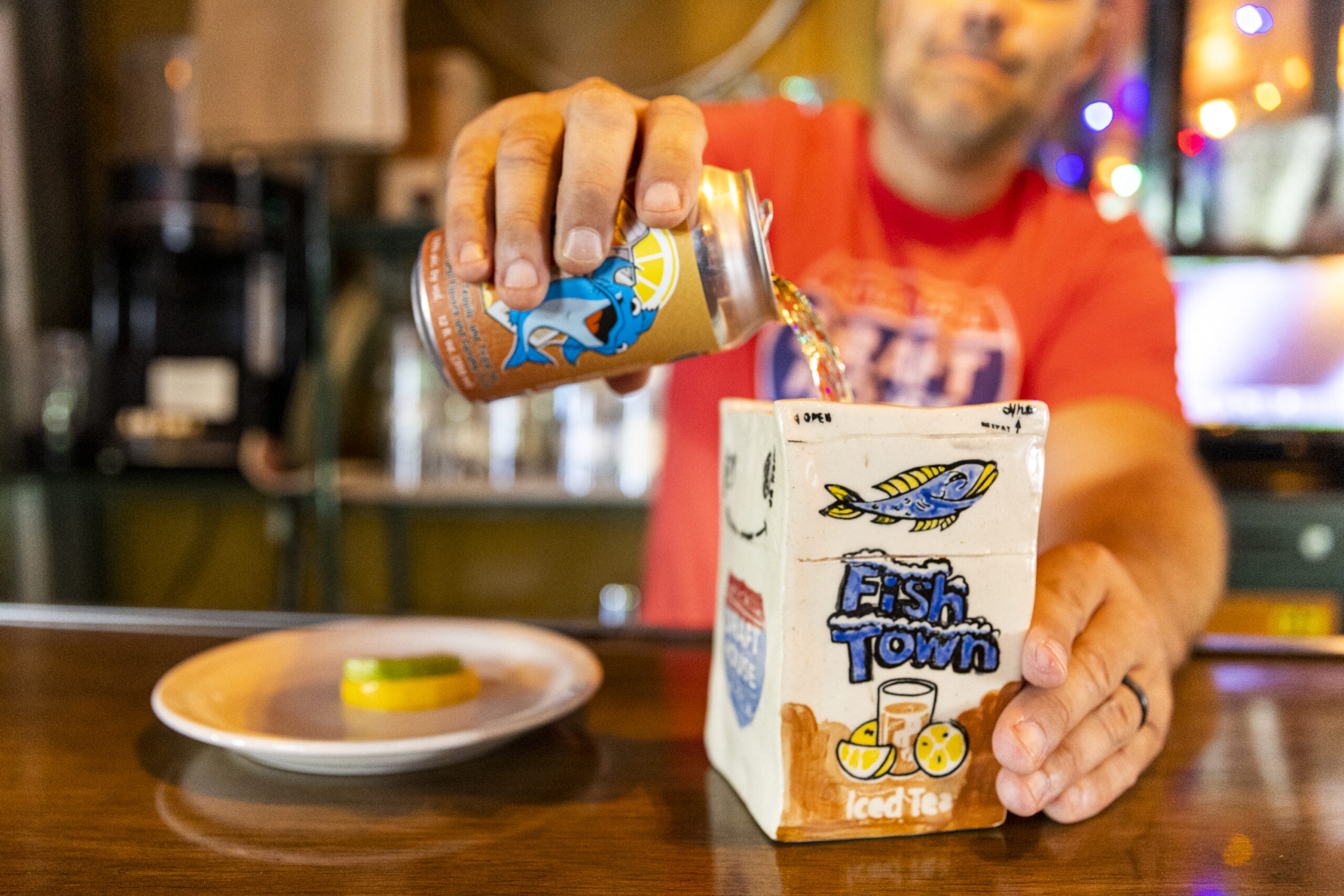
Canned Fishtown Iced Tea is poured by Interstate Drafthouse co-owner Mike McCloskey into a custom-made ceramic carton.
Long Island has its iced tea. Why shouldn’t Fishtown? Created in 2013 at Interstate Drafthouse on Palmer Street, Fishtown Iced Tea spikes a 16-ounce carton of Arctic Splash iced tea with a shot of Jim Beam bourbon, turning a childhood lunchbox staple into an adult version of the sugary, dangerously smooth cocktail. Its roots are distinctly regional. Besides milk, Lehigh Valley Dairy, Wawa, Swiss Farms, and Turkey Hill also sold iced tea in pint cartons that generations of Philadelphians grew up drinking.
During the pandemic, when Pennsylvania temporarily allowed to-go cocktails, Interstate sold enough Fishtown Iced Tea to keep the bar afloat. In 2022, the popularity inspired a canned version from Rectified Spirits, made with vodka, rum, tequila, and triple sec instead of bourbon.
In a twist, the ready-to-drink cocktail debuted just as Lehigh Valley discontinued Arctic Splash cartons, ending an era for the drink that inspired it.
Edamame dumplings from Buddakan
The edamame dumplings at Buddakan.
One of Buddakan’s signature dishes is the edamame dumpling, filled with mashed soybeans and served in a truffled Sauternes-shallot broth. Michael Schulson, then chef de cuisine at Stephen Starr’s Old City destination, came up with the idea in 2000 while developing the menu for Starr’s next project, Pod, whose opening in University City was six months away. “Every dish I made, Stephen would say, ‘We’re putting this on the menu at Buddakan,’” Schulson said. “I’d say, ‘What about Pod?’”
The original version was an edamame ravioli, featuring a yellow pasta wrapper in a caramelized Sauternes-shallot broth, transforming what was then an unfamiliar ingredient to many American diners — young Japanese soybeans — into one of Buddakan’s signature dishes. (It made it onto Pod’s menu, too.) When Buddakan New York opened in 2006 with Schulson leading the kitchen, the ravioli evolved into the translucent har gow-style dumpling that has since become its best-known form, before it later arrived on the menu in Philadelphia. It’s still a bestseller.
After leaving Starr, Schulson adapted the concept at his restaurant Sampan, serving edamame dumplings in a caramelized shallot and sake broth, and later at Double Knot with truffles.
Cheesesteak egg rolls
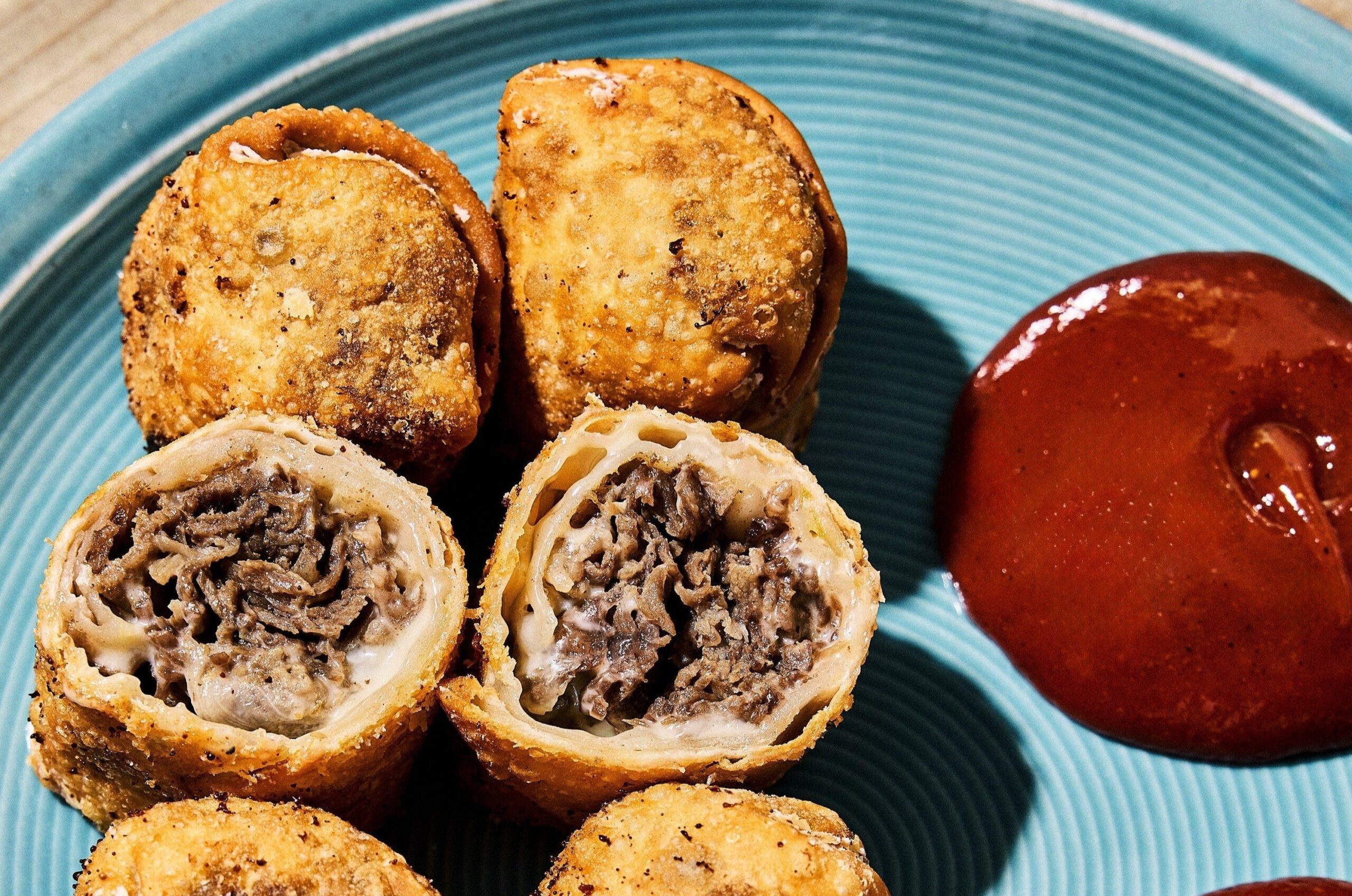
The cheesesteak egg roll from Continental Mid-town.
Stuff steak and cheese into an egg-roll wrapper, deep-fry it, and you’ve got one of Philadelphia’s signature mashups: the cheesesteak egg roll.
They’re everywhere now, from neighborhood pubs to white-tablecloth steakhouses, and go by “spring rolls” at some places, but their rise can be traced to two nearly simultaneous Philadelphia stories in the mid-1990s.
One unfolded at the old Four Seasons Hotel on the Parkway. Former chef David Jansen said that after preparing a banquet for the New York Rangers in 1994 or 1995, prep cook Mui Lim put leftover cheesesteak filling into spring roll wrappers and fried them as a snack for the kitchen crew. They went on the menu soon after at the hotel’s Swann Lounge. Today’s Four Seasons Philadelphia, now at the Comcast Technology Center, serves wagyu cheesesteak spring rolls with sweet-and-spicy pepper relish.
The other story played out in Old City, where the novelty became a menu staple at the Starr-owned Continental. In 1996, Starr hired Sam “Chef Sammy D” DeMarco to develop dishes for the year-old restaurant. DeMarco already served a Philly cheesesteak dumpling at First, his New York restaurant, but Starr wanted something original.
DeMarco turned the dumpling into a cheesesteak spring roll. “It was taking a classic, nostalgic American snack and presenting it in a fresh way,” said DeMarco, now executive chef at Bungalows Resort in Scottsdale, Ariz.
Like the old Buzz Aldrin cocktail, the roll became a classic. Starr said Continental Mid-town, near Rittenhouse Square, now sells 500 a week.
From the Continental, the idea spread rapidly. Davio’s owner Steve DiFillippo was joining staff for a preshift meal at his former Center City Philadelphia location shortly after it opened in 1999 when chef David Boyle served cheesesteak egg rolls that his wife had made at home. DiFillippo insisted that they be added to the bar menu, overruling managers who felt that they were too déclassé for a posh steakhouse. The Boston-based Davio’s turned the line into a frozen-food item, selling millions through supermarkets and QVC until rising beef prices during the pandemic made them impractical, DiFillippo said. They’re still on the restaurant menus in King of Prussia and elsewhere.
Though DiFillippo copyrighted the name “Philly Cheese Steak Spring Rolls” in 2002, “I’m not going to claim I invented anything,” he said. “But I was the first one to take them into stores and really commercialize them.”
Philadelphians sweated through Julys in the 1940s, brooding over World War II as temperatures averaged in the mid-to-upper 70s, including nighttime lows.
Today, as the city prepares to mark the nation’s 250th anniversary, they swelter under average July temperatures of around 80 degrees — and those nighttimes have gotten warmer.
Over the past 85 years, Julys in Philadelphia are running on average 4.4 degrees warmer than in 1940, based on an analysis of historical weather data. That translates to an increase of about 0.52 degrees per decade.
(function(){function e(){window.addEventListener(`message`,function(e){if(e.data[`datawrapper-height`]!==void 0){var t=document.querySelectorAll(`iframe`);for(var n in e.data[`datawrapper-height`])for(var r=0,i;i=t[r];r++)if(i.contentWindow===e.source){var a=e.data[`datawrapper-height`][n]+`px`;i.style.height=a}}})}e()})();
Nights are even toastier, showing a rise of 4.8 degrees over the same time period.
(function(){function e(){window.addEventListener(`message`,function(e){if(e.data[`datawrapper-height`]!==void 0){var t=document.querySelectorAll(`iframe`);for(var n in e.data[`datawrapper-height`])for(var r=0,i;i=t[r];r++)if(i.contentWindow===e.source){var a=e.data[`datawrapper-height`][n]+`px`;i.style.height=a}}})}e()})();
“Science shows that while summer heat is nothing new, climate change is pushing it beyond what we’ve experienced in the past,” Zachary Labe, a climate scientist at the nonprofit Climate Central, said in an email.
The Inquirer used 1940 as a base year in its analysis because it is the oldest year for consistent records at Philadelphia International Airport. The data from the National Oceanic and Atmospheric Administration’s Regional Climate Centers ends at July 2025.
The data does not include this July, which could set records.
105 degrees possible
The National Weather has issued an extreme heat warning with possible record highs starting Thursday and heading into the July 4 weekend.
And Philadelphia has declared a heat emergency, activating the city’s pioneering heat-response system.
High temperatures Thursday, Friday, and Independence Day are all forecast to top 100 degrees and threaten daily records. The current record highs for those dates are 103 degrees for Thursday, 104 for Friday, and 103 for the Fourth.
The record-warmest lows are 82, 77, and 79 for those days respectively, according to data from the National Weather Service’s Mount Holly office.
The weather service says dangerously hot conditions with heat index values between 100 and 110 degrees are expected each day. Very warm low temperatures in the mid-70s to the low 80s at night won’t offer much relief, the office noted.
When combined, multiple days of such high temperatures and humidity will exacerbate impacts, say those meteorologists. The hottest conditions are expected Thursday through Friday.
Climate change
Although it’s difficult to pin any single heat wave to climate change, the majority of climate scientists say the burning of fossil fuels has led to ever-increasing amounts of heat-trapping greenhouse gases in the atmosphere and transformed the climate.
The Princeton-based Climate Center says human activities have warmed the planet by about 1.2°C (2.2°F) above pre-industrial levels. The Princeton-based organization of scientists says that since 1970, July has warmed in 94% of the 243 U.S. cities it studied. Temperatures for the month have risen by 2.6 degrees on average.
“That includes hotter and more humid nights like those this week, which raise health risks because the body has less time to cool down and recover,” Labe said.
A big impact on cities
Excessive heat hits urban areas like Philadelphia hard, said Mathy Stanislaus, of the Philadelphia Climate Justice Collective.
The collective is a partnership of the Mantua Civic Association, SEAMAAC, Esperanza, Overbrook Environmental Education Center, and the Environmental Collaboratory at Drexel University. Stanislaus is vice provost and executive director of The Environmental Collaboratory.
In the most densely populated, least tree-lined parts of Philadelphia temperatures can soar 20 degrees higherthan in greener, wealthier neighborhoods, he notes.
That’s because of the heat island effect, which occurs when cities are significantly warmer than surroundingareas because of the lack of tree canopy combined with high concentrations of heat-absorbing pavement, dark roofs, and buildings.
It’s something many people in the suburbs, or wealthier areas, might not think about, Stanislaus said.
“I don’t think people realize the gravity of the circumstances for lower income urban communities who have an affordability crisis compounded by the heat crisis,” he said.
Stanislaus said some households in the city don’t have air-conditioning, and those that do can face a choice as to whether they should use it or not.
“Even if they have an AC, they may not be able to afford to actually run it,” he said.
According to a report by the collective, Philadelphia households overall on average spend about 6.7% of their income on energy, but that the burden is much higher for Black and Hispanic households. The poor conditions of many homes because of their age contribute to the strain.
Stanislaus says temperatures strain critical public and healthcare systems.
He credits Philadelphia for its array of cooling centers, pools, and spraygrounds. But, he said, many residents are notaware of them or lack transportation. He’d like to see more money devoted to public awareness during heat waves.
In addition, he said healthcare systems need more staff trained in heat-related care and education, as well as better tracking heat-related illnesses and deaths.
There has been one death attributed to heat so far this year, according to data from the Philadelphia Department of Public Health. In the past two decades, the biggest number of deaths came in 2011 and 11 with 35. But the city has upped its response measurably since then and the number of deaths has trended down.
Stanislaus believes heat-related deaths and illnesses are underreported.
“There’s an urgency to heat,” Stanislaus said. “We need to meet the moment.”
Legitimate movement occurred Wednesday, when the Sixers added Ariel Hukporti but rotation players Kelly Oubre Jr. and Quentin Grimes reportedly decided to join other teams.
It was a seismic win-now swing for new president of basketball operations Mike Gansey, banking on the Joel Embiid-Tyrese Maxey era rather than toggling between two timelines or fully pivoting into a rebuild around the Maxey-VJ Edgecombe backcourt. It also was an effort to keep up in an Eastern Conference that already boasts the NBA champion New York Knicks, along with revamped Miami Heat and Toronto Raptors teams that recently traded for Giannis Antetokounmpo and Kawhi Leonard, respectively.
After a dizzying Wednesday, here is a reset on where the Sixers’ roster stands.
Moving in
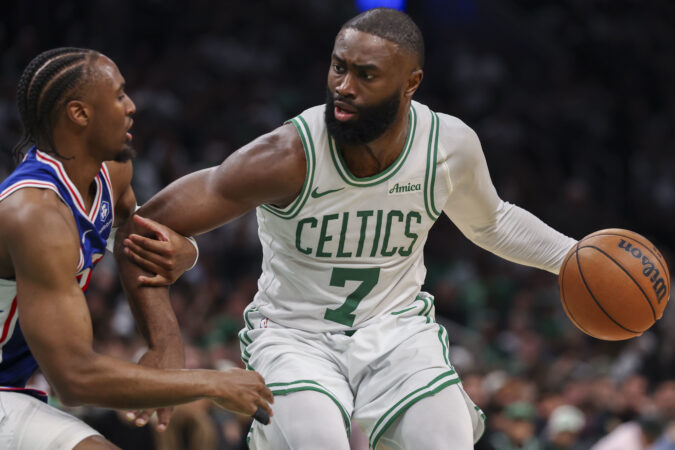
Jaylen Brown
A five-time All-Star and the 2024 NBA Finals MVP, Brown is an elite attacker and shotmaker along with a stout defender. He has demonstrated he can create a successful tandem with a fellow star and be the top scoring option when needed. Last season, he finished sixth in MVP voting, after averaging 28.7 points, 6.9 rebounds, and 5.1 assists to spearhead the Celtics’ surprising 56-win season to finish in second in the Eastern Conference.
After spending his first 10 NBA seasons cultivating a wing partnership with Jayson Tatum, it will be fascinating to track how the 6-foot-6, 230-pound Brown fits with the Sixers’ roster construction with Maxey and Edgecombe in the backcourt and Embiid (presumably) in the middle. Brown also is one of the NBA’s more outspoken personalities — even his comments on Twitch streams have caused past stirs — which will need to mesh within the Sixers’ locker room.
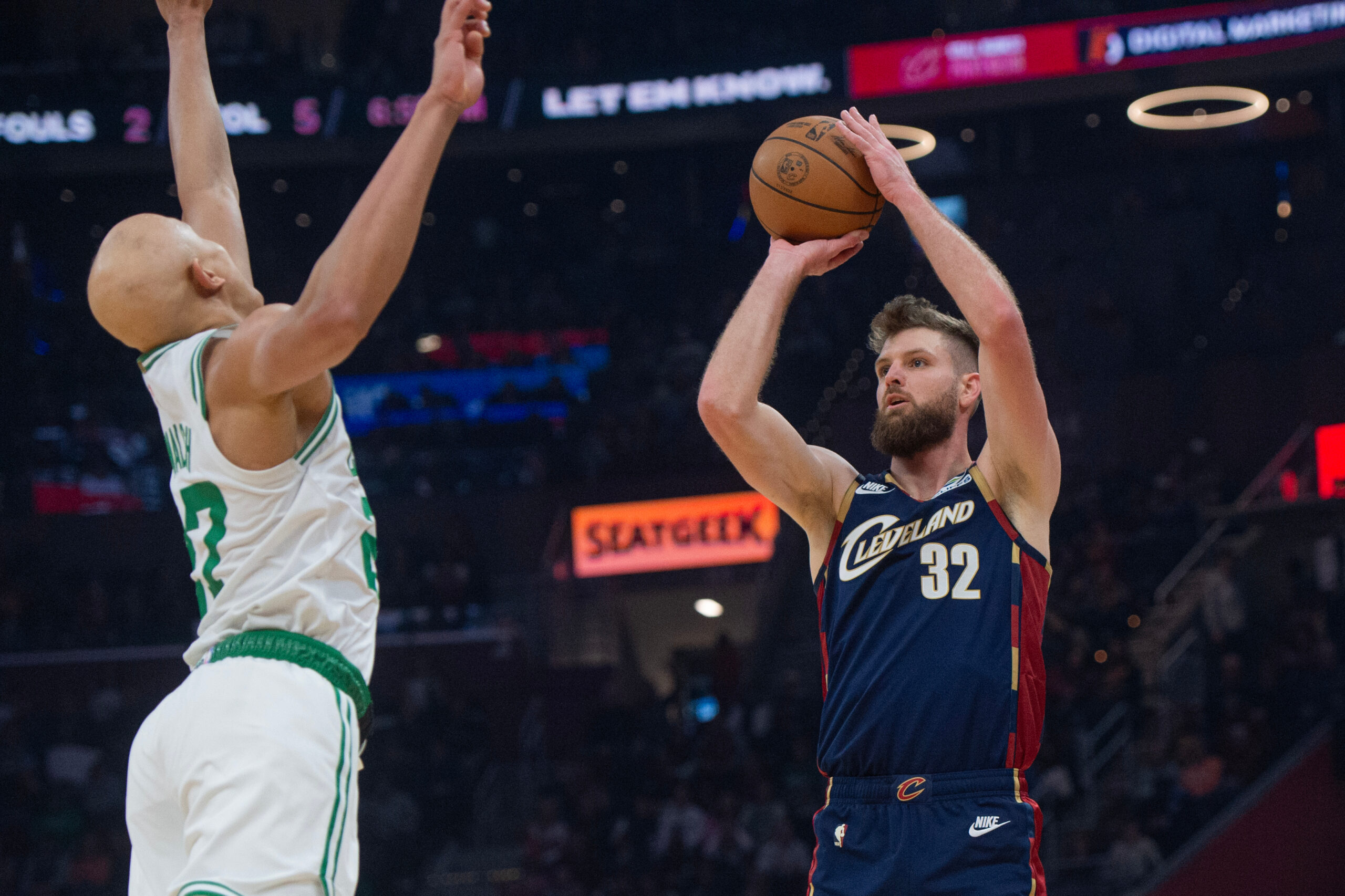
Dean Wade (32) is another strong on-ball defender that will bring size and versatility to the Sixers.
Dean Wade
Wade instantly projects into the other starting forward spot next to Brown. The 6-9, 225-pound Wade is another strong on-ball defender with size and versatility. The 29-year-old also averaged 4.2 rebounds in less than 23 minutes during the past two seasons, and is a career 36.7% three-point shooter.
The knock on Wade? Health. He has played in more than 60 games only once in his nine-year career.
Ariel Hukporti
Hukporti is the latest contender to become Embiid’s backup center. The 24-year-old was the third-team big man behind Karl-Anthony Towns and Mitchell Robinson on the Knicks’ title squad, and averaged less than 10 minutes across 79 games in his first two NBA seasons.
An athletic 7-footer, Hukporti offers more pure size than Adem Bona, though Bona might be more switchable defensively and capable of playing power forward next to Embiid. And it is a bit troubling that Hukporti has struggled in similar areas — too many fouls, not enough consistency — as Bona.
Perhaps an opportunity for increased playing time will kickstart Hukporti’s development — and productivity.
Moving out
Paul George
Once a perennial All-Star and splashy free-agency signing, George’s two seasons with the Sixers will go down as a disappointment. He sustained numerous injuries in 2024-25, and last season was suspended 25 games for violating the NBA’s anti-drug policy.
Though George was terrific on both ends of the floor down the stretch of the regular season — including in the Sixers’ rally to upset the Celtics in the playoffs’ first round — his contract had been considered difficult to trade because of his age and injury history.
Until Wednesday, that is.
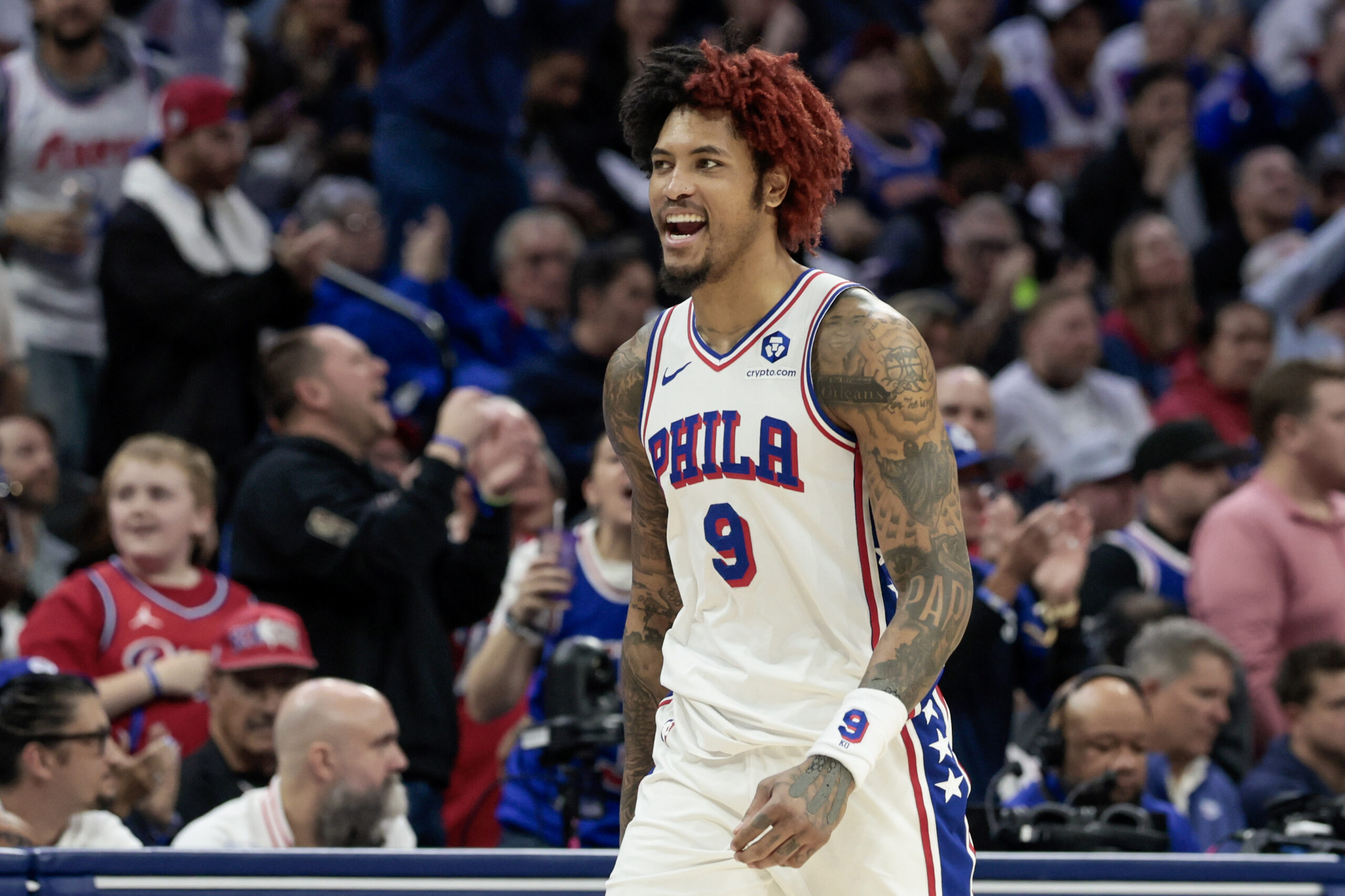
Kelly Oubre Jr., who played three seasons in Philly, will reportedly join the Indiana Pacers.
Kelly Oubre Jr.
Oubre’s three-year Sixers tenure, meanwhile, should be considered a success. He morphed from late-offseason addition on a veteran’s minimum contract, to starter who played with force and flair, to veteran who put together his most efficient season at age 30.
Before (and after?) the Brown blockbuster, it was puzzling that the Sixers decided not to match (or offer a similar deal) to the two years and “nearly” $17 million that ESPN reported Oubre agreed to with the Pacers. The Sixers held Oubre’s full Bird rights, which allows teams to re-sign their own free agents even if they are already over the salary cap.
It is possible Oubre wanted a change of scenery — Indiana, which made the 2025 NBA Finals, is expected to regain contender status once All-NBA point guard Tyrese Haliburton recovers from Achilles surgery — or that Gansey did not value Oubre as much as former lead executive Daryl Morey. But the most cynical observer could conclude that letting Oubre walk was a move to help stay under the luxury tax.
Grimes flashed his “attack mode” scoring punch and tenacious defense in spurts as a sixth man. But he shot a career-low 33.4% from three-point range last season, and, other than an excellent Game 5 performance on both ends in Boston, was not good enough during the playoffs for a Sixers second unit that desperately needed scoring production.
His departure means the Sixers likely will need immediate contribution from new draftee Labaron Philon Jr., whom many evaluators considered a first-round steal at 22nd overall.
Moves still to come
Final roster spot(s)
Swapping out George’s contract for Brown’s still creates a top-heavy cap sheet. The Sixers are now about $2 million under the luxury tax and $10 million below the first apron, where they are hard-capped. And assuming Hukporti’s salary comes out of the nontaxpayer midlevel exception, the Sixers still have $2.6 million from that to spend along with the $5.5 million biannual exception.
The Sixers could add two more players to reach 15 on the full-time roster, though they have often only carried 14 to stay under the luxury tax.
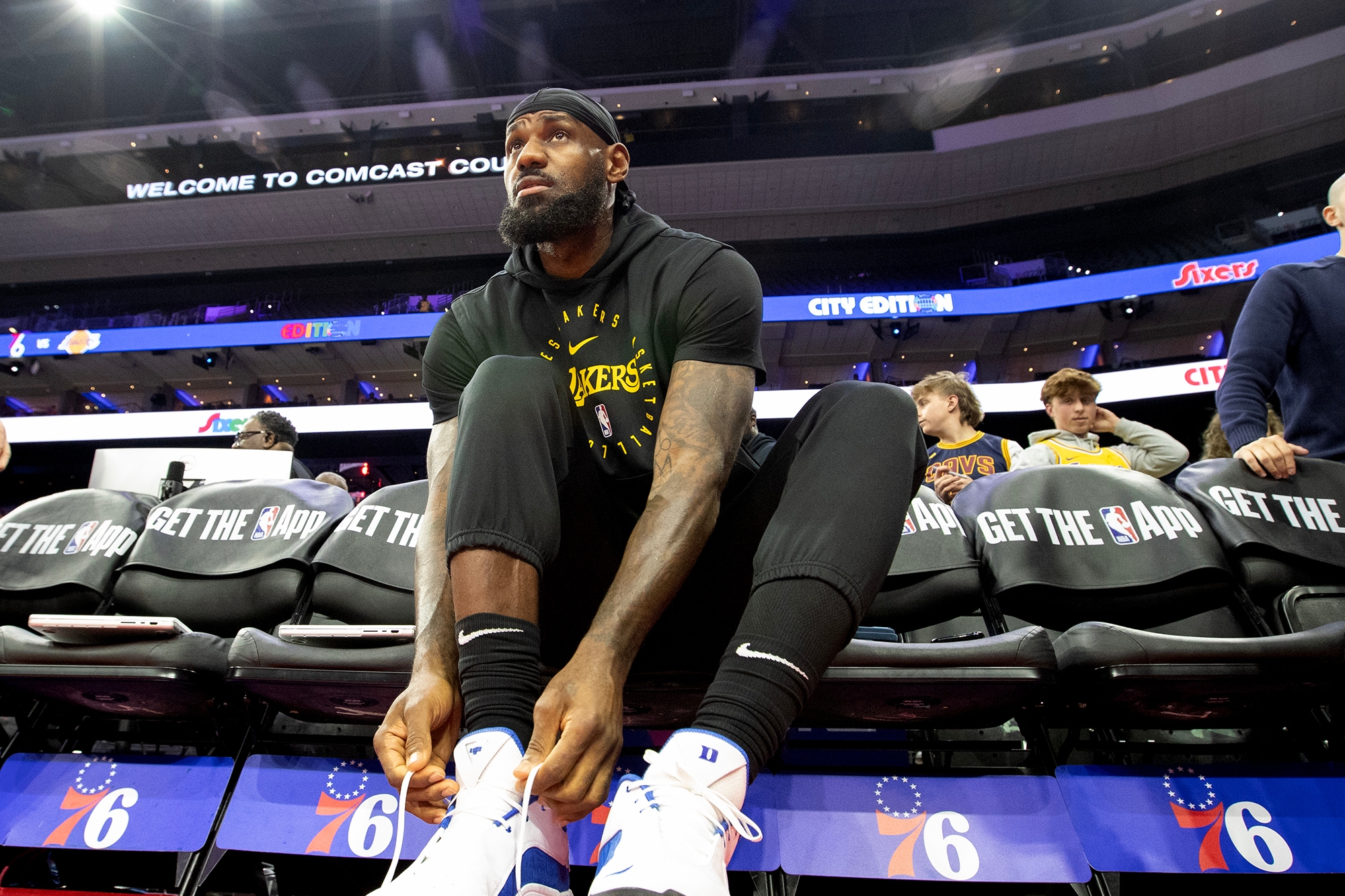
LeBron James is a free agent this summer. Could the Sixers’ recent moves interest the 21-time All-Star?
It is reasonable to expect that the Sixers will focus on adding one more guard — unless LeBron James wants to come to Philly, of course.
James’ agent, Rich Paul, told Max Kellerman during the pair’s Game Over podcast released Wednesday that he had spoken to between 12 and 14 teams about James. The Sixers would be silly not to be among that group that has reached out, or to join it after the addition of Brown. Gansey’s brother, Steven, also threw gas on the social media speculation when he posted a photo on X of Gansey and James as high-schoolers in Ohio and the eyeballs emoji.
Additionally, Bona’s $2.3 million salary for 2026-27 becomes guaranteed on July 7, while Jabari Walker and Dalen Terry’s deals become fully guaranteed Jan. 10. As of Wednesday night, unrestricted free agents Andre Drummond, Trendon Watford, and Kyle Lowry (who is expected to retire) had not committed to signing with any team.
Current depth chart
Point guard: Tyrese Maxey, Labaron Philon Jr.
Shooting guard: VJ Edgecombe, Dalen Terry
Small forward: Jaylen Brown, Justin Edwards
Power forward: Dean Wade, Dominick Barlow, Jabari Walker
Center: Joel Embiid, Adem Bona, Ariel Hukporti, Johni Broome
The word spread through the Veterans Stadium locker room: The Rolling Stones were at the bar across the street, and the Fury were invited.
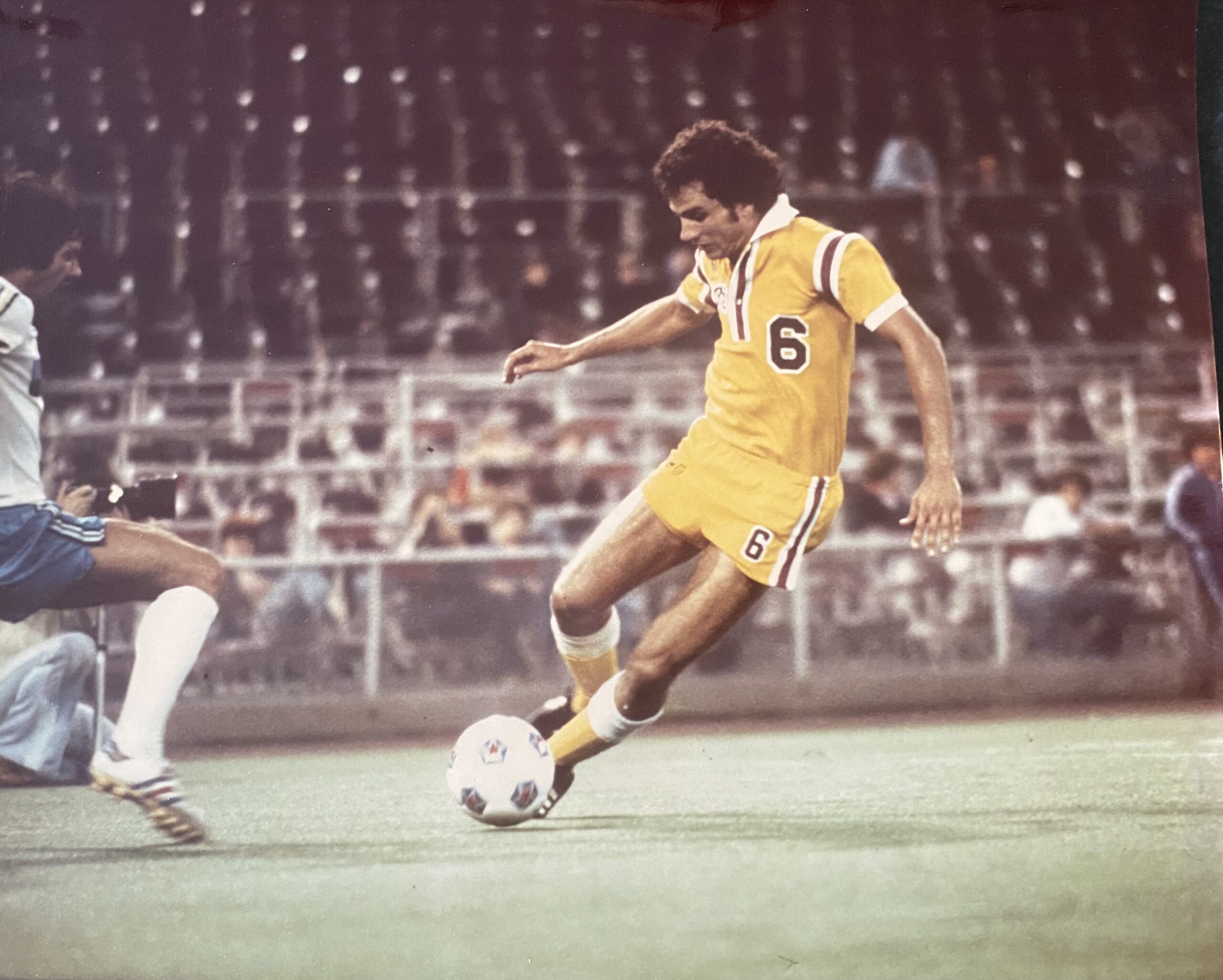
The Philadelphia Fury played on artificial turf that goalkeeper Bob Rigby said “might as well have been black rocks on Iwo Jima.” The crowds, Rich Reice said, often were so sparse that he could point to the people he knew in the stands. The players didn’t make much, the team lasted only three seasons, and the losses piled up.
The team’s publicist, Thom Meredith, said a few years ago on a podcast that the Fury — a North American Soccer League franchise that debuted in 1978 — were “a poster child for what not to do.”
But the players still had someone waiting for them at the back entrance of the Holiday Inn, opening the door and ushering them to where the Stones were hanging while a mob of fans were kept in the hotel lobby.
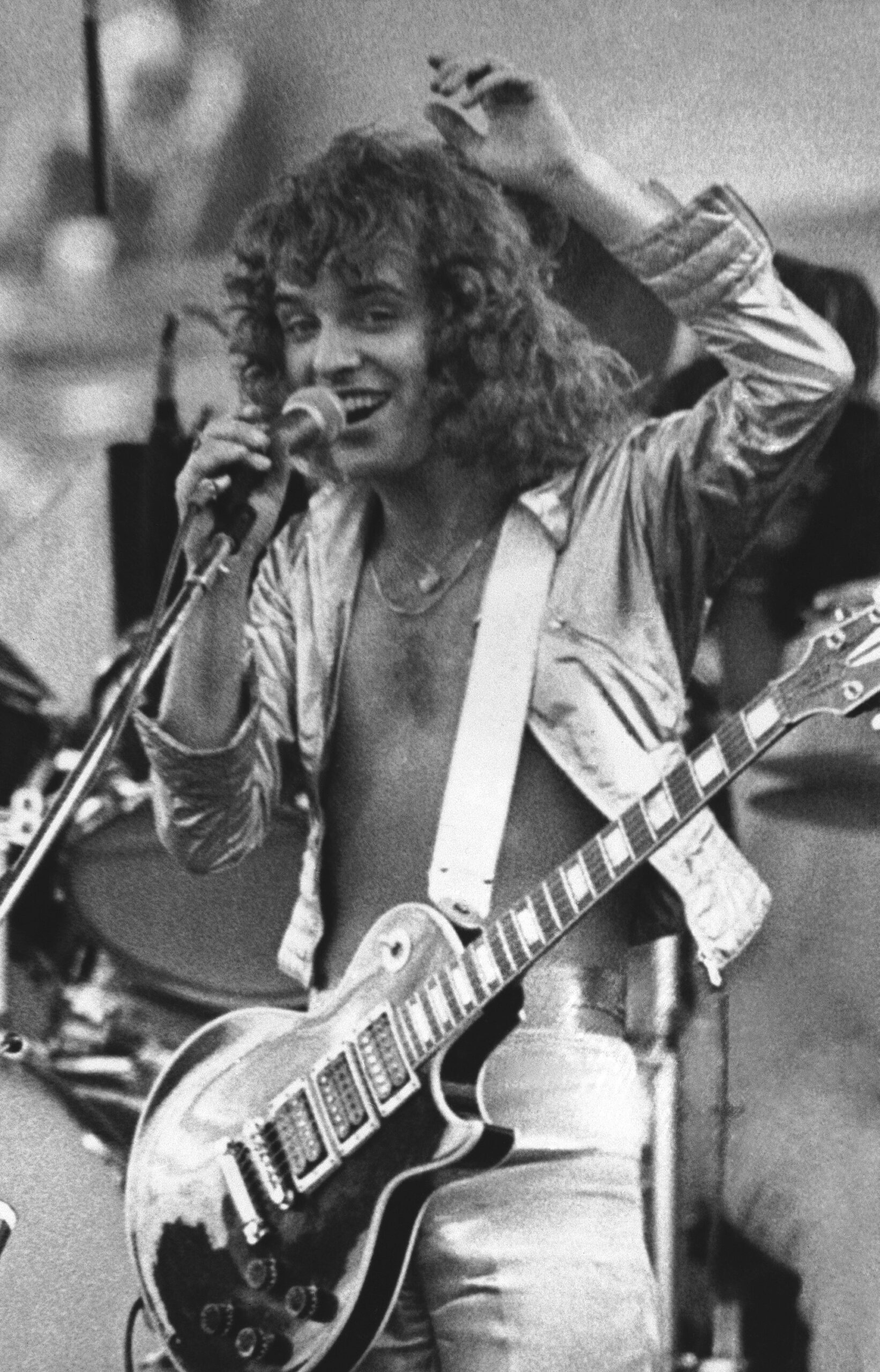
The Fury was owned by rock stars — Peter Frampton, Paul Simon, and Rick Wakeman of Yes had stakes — and rock executives like Stones manager Peter Rudge and music agent Frank Barsalona. They entered when the NASL was riding the momentum of Pelé, who had retired a season earlier.
But that wave faded, and the Fury struggled to grab Philly’s attention before moving to Montreal in 1980, leaving Philadelphia without a first-division men’s soccer team until the Union arrived in 2010.
“The Fury is a story in and of itself,” Rigby said. “Oh my God. Really. There’s aspects of it that are mind-boggling. It’s a fascinating tale.”
Peter Frampton, one of the owners of the Fury, performs during a concert at JFK Stadium in 1977.
The sport has been met this summer in Philadelphia with fanfare as the city hosts its sixth World Cup match on Saturday at Lincoln Financial Field. But the game still was a curiosity to most of the region in the 1970s. Philly had soccer hot spots — places like Kensington, Frankford, and Roxborough, along with ethnic clubs in Bucks County — surrounded by soccer deserts.
The Fury players grew up in those soccer neighborhoods, and that was enough to get them a drink with the Rolling Stones.
“They were just as excited to talk to you as you were excited to talk to them,” said former Fury player Bill Straub. “You were a professional soccer player, and they were wide-eyed. What’s it like to play professional soccer? It was nothing to us. It was just what we did.
“These rock stars all grew up wanting to be professional soccer players in the Premier League. And we were here, we wanted to be rock stars.”
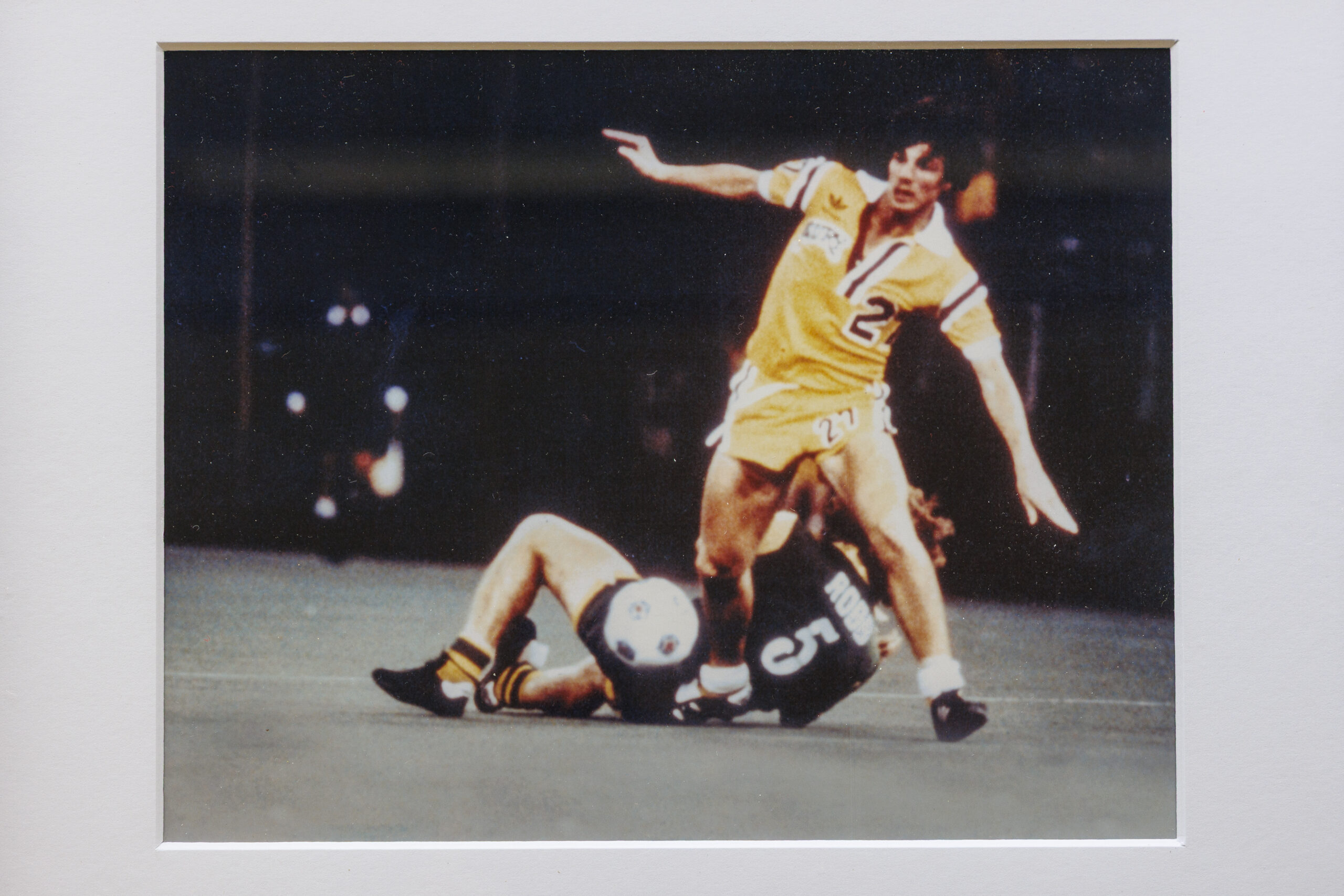
Kevin Murphy when he played for Philadelphia Fury. He now owns Varsity Pizza and Subs in Lawrenceville, N.J.
A mini-circus
Philadelphia had an NASL team for four seasons, but the Atoms flamed out shortly after winning an unlikely title in 1973 as an expansion team. The local owners sold the team in 1975 to a Mexico-based group that stocked the roster for a season with Mexican players. Interest dipped lower, and the team folded with $90,000 in unpaid bills.
The NASL returned to Philly a year later when the league added six expansion franchises. The Fury signed Irish midfielder Johnny Giles, 1966 World Cup champ Alan Ball, and former Chelsea forward Peter Osgood.
“They have books written about him,” former Fury player Brooks Cryder said. “The Wizard of Os, they used to call him. But it was a little soon for soccer in the United States.”
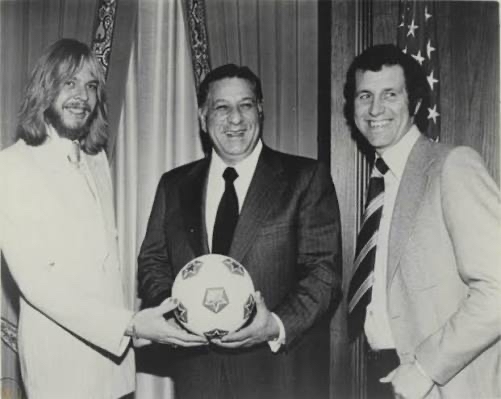
Rick Wakeman of Yes with Philadelphia mayor Frank Rizzo and Fury player Peter Osgood.
The real attractions were the stars in the crowd. An Amtrak train brought a cast of A-listers from New York for the season opener at the Vet. Gilda Radner, James Taylor, and Peter Wolf of the J. Geils Band joined owners Frampton, Simon, and Wakeman in a super box.
“It wasn’t the Cosmos with Pelé,” Straub said. “That was a real circus. But this was a mini-circus here in Philly because you never knew who was going to show up.”
The Fury drew 18,191 to their opener, but the crowds soon dwindled. The Fury averaged 8,075 fans in 1978 and had the league’s lowest attendance in the 1979 (5,624) and 1980 (4,465) seasons. They had cheerleaders, held free clinics at schools, and even tried to spice up their uniforms. Nothing worked. Veterans Stadium felt cavernous.
“It was tough because it seemed like everyone was far away from the actual field,” Dave MacWilliams said. “It was a different environment, for sure. I wanted it to succeed and do well, but it was tough.”
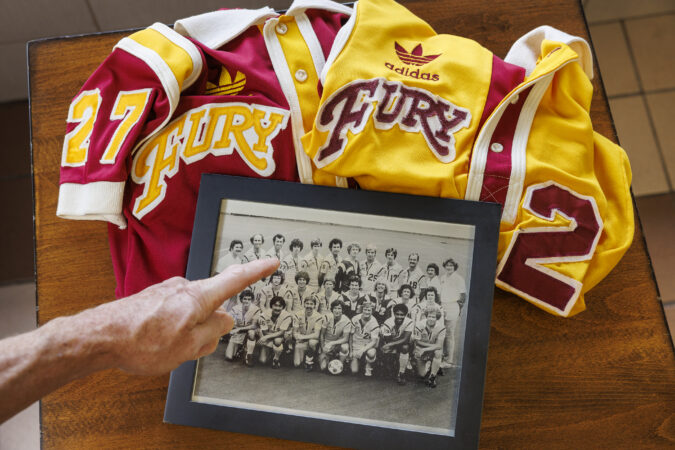
The team’s uniforms were designed by fashion designer Sal Cesarani after Ralph Lauren outfitted the Cosmos. Barsalona told The New York Times in 1978 that the Fury wanted their uniforms to have “a touch of show business and a lot of sex appeal.”
They were inspired by the wife of owner Larry Levine, who Barsalona said struggled to follow the play at a soccer game but enjoyed seeing “guys running around in what looked like their underwear.” Cesarini had simple instructions: the tighter, the better.
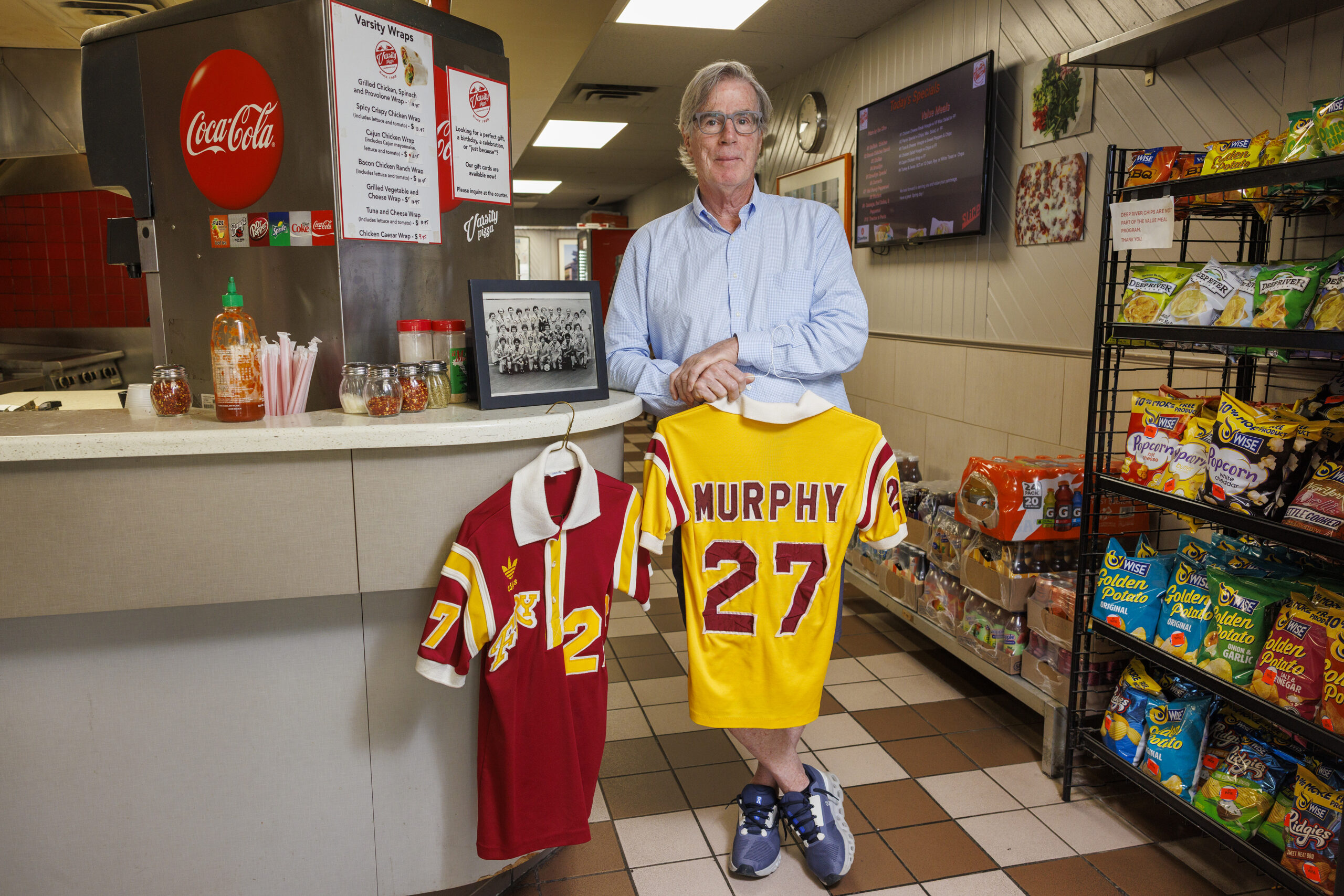
The burgundy and gold jerseys, which were made by Adidas, had a three-button collar and capped sleeves. The shorts were two inches shorter than the usual soccer shorts. It was as close to underwear as Cesarini could get.
“Looking back, they do show a lot of leg,” Reice said.
Kevin Murphy, shown at Varsity Pizza and Subs in Lawrenceville, N.J., displays his Fury jerseys from the 1970s.
The stars
Kevin Murphy was a senior at Pennington Prep near Trenton when a group of Fury decision-makers visited his home to meet his parents and ask if he was willing to turn pro. The new franchise planned to use its draft pick on Murphy as the NASL introduced a rule allowing teams to draft high schoolers.
Murphy was in, as Walt Chyzowych — “Philadelphia soccer royalty,” Murphy said — told him earlier that year that he had the skills to be a pro. A few months later, he sat in a suite at the Vet with Frampton to sign his contract.
“It was Frampton’s birthday,” Murphy said. “I thought, ‘Well, I probably made a good decision.’ That was pretty amazing.”
Pelé retired in 1977, but the NASL still was filled with some of the game’s biggest names. The Cosmos had Giorgio Chinaglia, Carlos Alberto, and Franz Beckenbauer. The Los Angeles Aztecs had George Best. Johan Cruyff played for the Washington Diplomats, Gerd Müller was with the Fort Lauderdale Strikers, and the Tampa Bay Rowdies had Oscar Fabiani and Rodney Marsh.
Bill Straub playing for the Fury at Veterans Stadium.
The foreign Fury players had great careers overseas but were past their primes and did not draw in Philly. They filled their roster with a cast of locals. Straub went to Germantown Academy, MacWilliams played on a cinder field in Kensington, and Bobby Smith was from Trenton. Rigby grew up in Ridley and was on the cover of Sports Illustrated. Cryder learned to play at a YMCA in Roxborough, and Pat Fidelia went to Rancocas Valley Regional High School.
“It was exciting because as American players we had a chance to play in a professional league,” Fidelia said. “But you knew sooner or later that it wasn’t going to last because we weren’t getting paid much at all. It was like we were amateur players in a professional league. My first contract was $20,000. They gave you a car and an apartment to share with two other players.”
The Fury could not match the star power of the other NASL squads, but they did have actual rock stars. The players could score tickets to any concert they wanted. They were backstage at JFK Stadium, in boxes at the Spectrum, and saw the Stones at a tiny theater in North Jersey.
“We would drive back and we’d say, ‘This is unbelievable. How are we in these places?’” said Straub, who was working at his family’s jewelry store while playing for the Fury.
The Fury played a charity game at Franklin Field with Wakeman and other members of Yes. Frampton, whose industry-shifting live album Frampton Comes Alive! was released in 1976, regularly popped into the locker room after games. And Murphy found himself backstage at Madison Square Garden standing with Dan Aykroyd before riding an elevator with Meat Loaf, Debbie Harry, and the Wailers.
“That was pretty good,” Murphy said. “It was more than pretty good. It was awesome.”
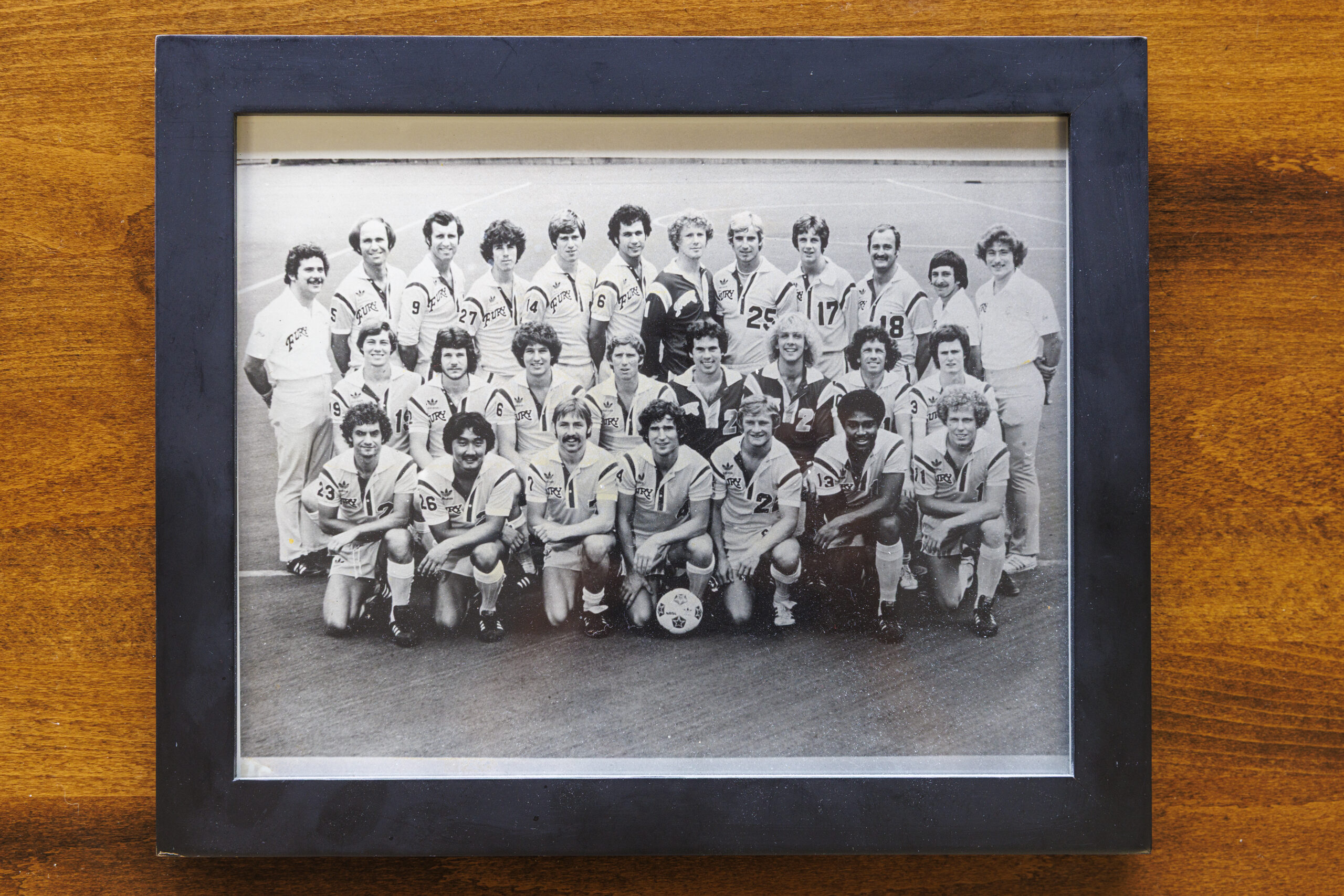
Kevin Murphy’s photograph of the Fury.
‘No sun. No sun.’
The Fury fired their first manager midway through the season, finished the year with a player-manager, and hired Marko Valok in 1979. The former Yugoslavian national team coach didn’t speak much English.
“I used a line from him for years on the kids I coached,” said Reice, who coached soccer at Neshaminy High School for 17 seasons. “If I took a bad shot at goal, he would say, ‘Reach, why you make present to goalie?’ He would be thinking in Yugoslavian and then it would come out in English.”
Rigby, the goalie for the Atoms’ title squad, returned to Philly during the 1979 season after being traded from the Aztecs. He was told by the Fury to join the team in Houston, but they said Rigby would be on the bench. That was good by Rigby, since he had not practiced in a week while his trade was finalized and spent his final night in L.A. at a going-away party with his Aztecs teammates at Best’s bar in Hermosa Beach.
And then Valok approached him in the locker room and asked through an interpreter if he was ready to go.
“I have no clothes and no intent to play,” Rigby said. “I’m literally not playing. I’m just coming in. Honest to God. I played a half. I’m thinking, ‘If this is the onus of coming back to Philadelphia, I probably made the biggest mistake of my life.’ But what was I supposed to say, ‘I’m not going to play’ in front of a new team?
“Then I’m sitting during the pregame meal, and Marko Valak stands in front of the team with a chalkboard for 45 minutes just drawing arrows all over the place. Speaks no English. I’m going, ‘I just left five guys who played in the World Cup final and the most tightly run team,’ and I’m like, ‘What is this?’”
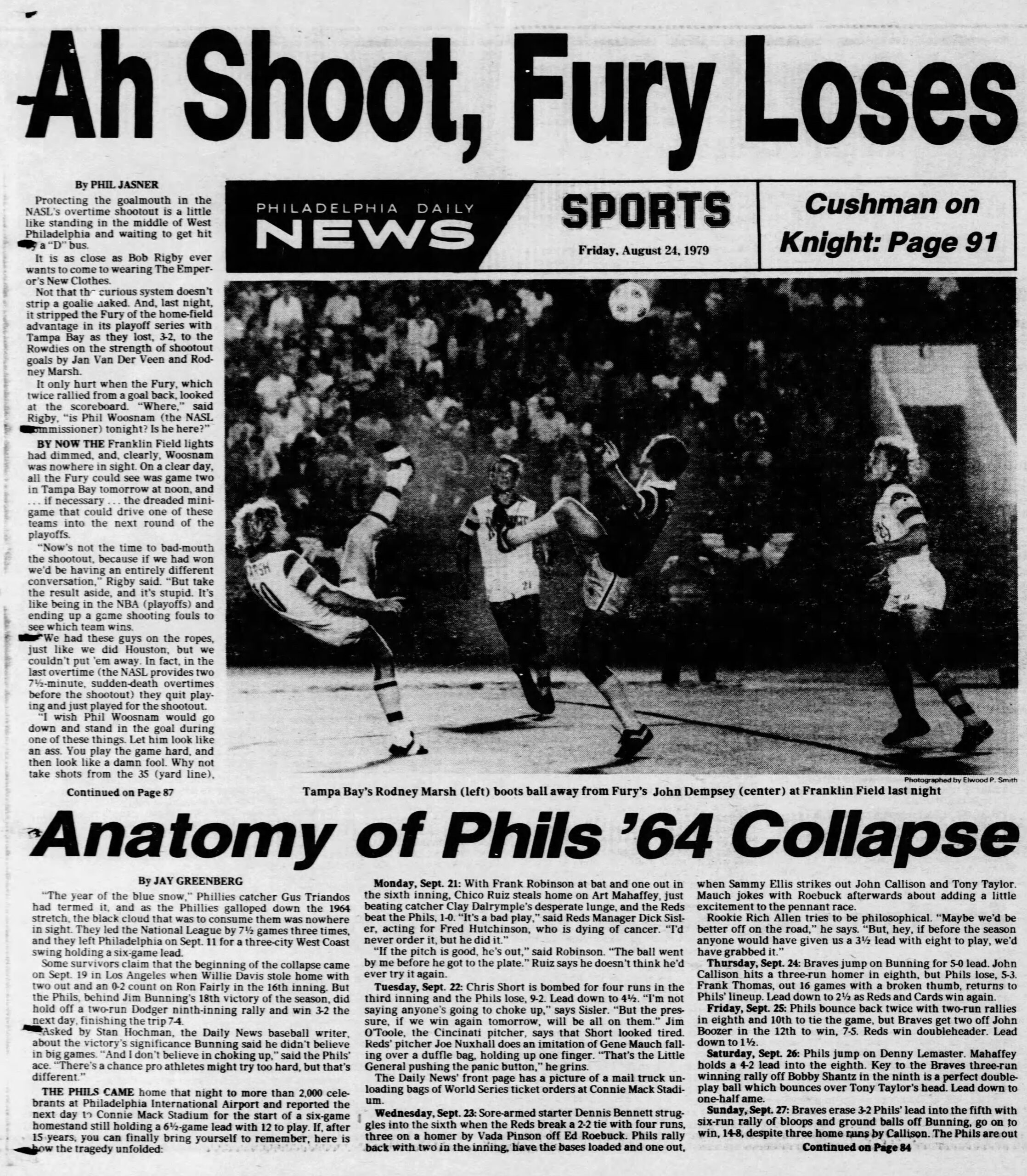
The Fury’s 1979 playoff game at Franklin Field against the Tampa Bay Rowdies headlined the back page of the next day’s Daily News.
Frank Worthington, a Fury forward from England, left the team that season when Valok had the team practice at the public fields in FDR Park instead of the Vet or JFK Stadium. He flew to Memphis, visited Graceland, and returned to the Fury after a few days.
The Fury advanced that season to the playoffs despite having a losing record and played the Houston Hurricane at the Astrodome. The team practiced at the stadium and then returned to their hotel. Valok told his players to stay inside — “No sun, no sun,” he said — and rest for the game.
“I look out the window when we get back, and Frank is laying out, reflecting himself with a sun blanket,” Reice said. “All of the energy is being zapped out of his body. Frank was a free spirit, to say the least.”
The Fury still had enough energy to win that game before falling in the next round to Tampa Bay. The franchise lasted one more season before soccer left Philadelphia again.
A cast of rock stars tried to make soccer happen in Philadelphia, but it proved to be too tall a task. Nearly 50 years later, the game has found its place in Philly. The Linc has been a happening this summer. If only the Holiday Inn — which was razed in 2019 — was still here to see it.