Throughout the season, coach Mark Ferrante has aimed for Villanova to play “complementary football.”
He saw that concept come to fruition in the final three minutes of Villanova’s 14-7 victory over host Lehigh last Saturday in the second round of the FCS playoffs.
It started with Lehigh going three-and-out late in the fourth quarter. On the next drive, Villanova freshman wide receiver Braden Reed scored a 28-yard touchdown. The energy transferred back to Villanova’s defense, as graduate defensive lineman Obinna Nwobodo forced a fumble in the red zone during Lehigh’s final possession.
“[Lehigh] shut us down for a good portion of the game, but our defense showed up,” said graduate quarterback Pat McQuaide. “Our defense picked us up when we were down and gave us short fields. We were fortunate that both our touchdowns came off of huge stops and turnovers. Those guys have been incredible all year.”
When graduate linebacker Shane Hartzell recovered the fumble, the Wildcats’ sideline erupted. It was ultimately the game-winning moment for Villanova as it escaped Lehigh.
“It’s not just the defense getting excited, the whole sideline is getting excited,” Ferrante said. “I think the team is doing a great job of playing together, playing for each other, and playing complementary football. That’s what needs to continue.”
No. 12 seed Villanova (11-2) looks to carry its momentum of a 10-game winning streak into its Football Championship Subdivision quarterfinal against fourth-seeded Tarleton State in Stephenville, Texas, on Saturday (noon, ESPN).
‘Let’s do this together’
Graduate players like Nwobodo and Hartzell form the backbone of Villanova’s defense, guiding the team through one of its most successful seasons in recent history.
Ferrante credited the team’s level-headed leadership with generating a thrilling finish against Lehigh.
“When we went into the locker room at halftime in past years, sometimes the defensive guys would complain about how we haven’t scored. But there was none of that,” Ferrante said. “There was no blame. There was no finger-pointing. It was all, ‘Let’s do this together and play a better second half collectively.’ Fortunately, we were able to do that.”
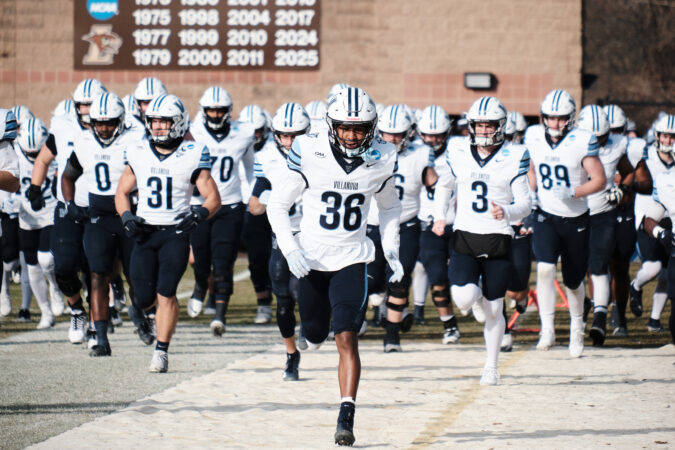
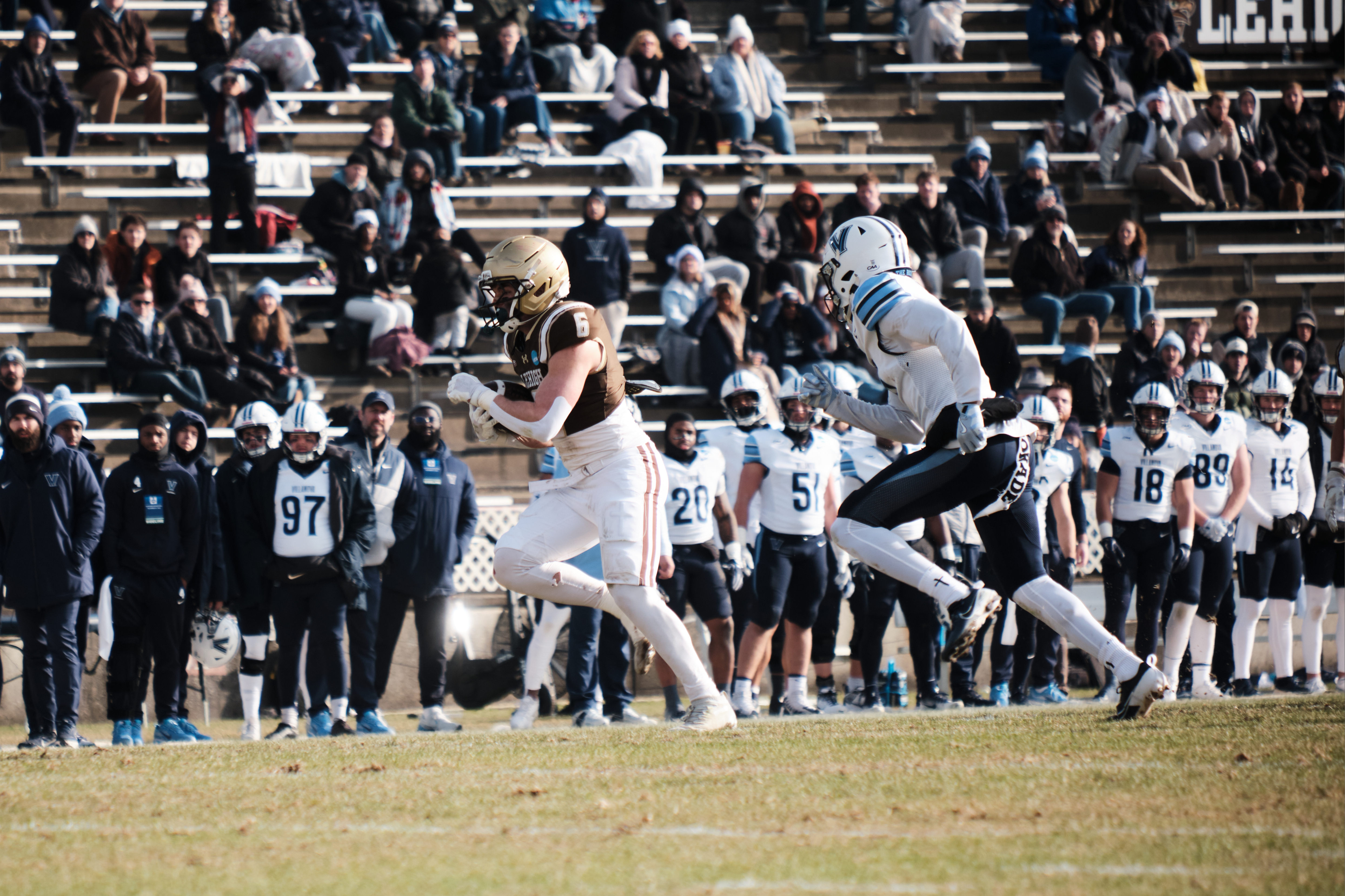
Villanova and Lehigh faced off in the second round of the FCS playoffs on Dec. 6.
Villanova’s defense relied on its veteran players early in the season, but the secondary is made up of primarily underclassmen. Heading deeper into the playoffs, Ferrante no longer sees the youth of the unit as a potential weakness.
“[The secondary] is where we’ve made some of the biggest growth this year, because that was what everyone was worried about,” Ferrante said. “They don’t lack confidence; they just lacked experience.”
Some of the graduate players spearheading the offense are newcomers this season.
McQuaide took over the starting position as a transfer from Nicholls State, and wide receiver Luke Colella, a Princeton transfer, is averaging a team-high 72.5 receiving yards a game.
“We have a good nucleus of guys who have been here for five or six years,” Ferrante said. “But [McQuaide and Colella] just add a different level of maturity. Even though they’re first-year guys with our program, they bring different perspectives because they’ve been somewhere else.”
Underdog mentality
The Wildcats enter their third game of the playoffs as the underdog.
In the first round, Villanova trounced Harvard, 52-7, despite some predictions saying the Crimson would win. The victory over Lehigh in Bethlehem, Pa., gave Villanova a further confidence boost.
“We’ve been an underdog every week so far,” McQuaide said. “So we kind of embrace it. It doesn’t really matter. Once the ball is kicked off on Saturday, it’s a four-quarter fight, and we’ll be ready to go.”
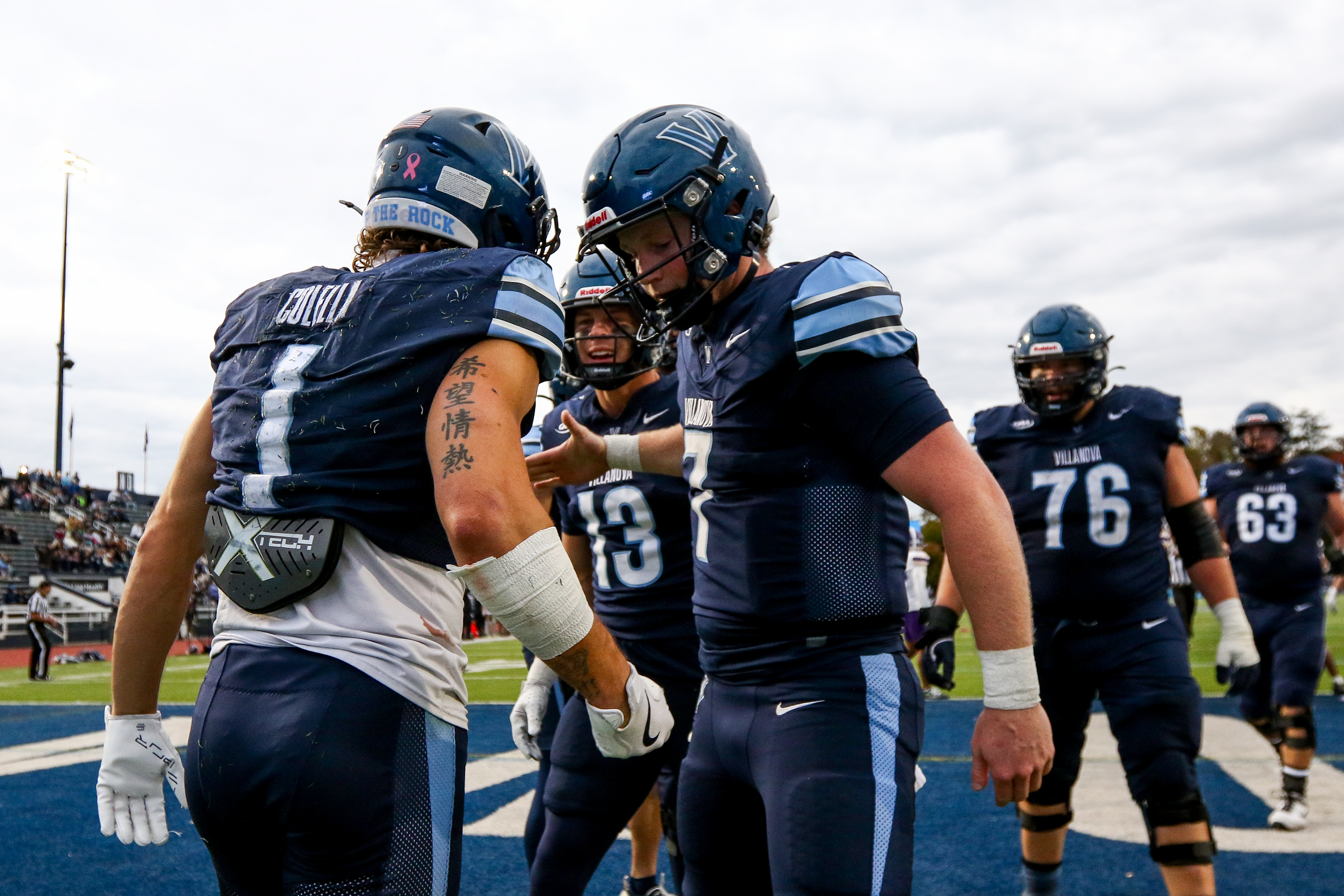
Villanova quarterback Pat McQuaide (7) celebrates with wide receiver Luke Colella (1) after scoring a touchdown against Albany on Oct. 25.
Villanova is up against its toughest challenge yet in Tarleton State (12-1), which has the most productive scoring offense in the nation, averaging 44.1 points per game.
“I don’t really see too many weaknesses in [Tarleton],” Ferrante said. “They score a lot of points, they play great defense, and they’re very opportunistic. They create a lot of turnovers.
“So I think what the keys to the game comes down to is who’s going to make the fewest mistakes, who’s going to hang on to the football, and not give the other team extra possessions.”
Taylor Swift is someone who can chill but will never be a chill person. Also, “All to Well,” the 10-minute version, tops the list of her favorite songs from her catalog.
These were among the many other revelations that Swift dropped during her first interview on Stephen Colbert’s The Late Show, Wednesday night.
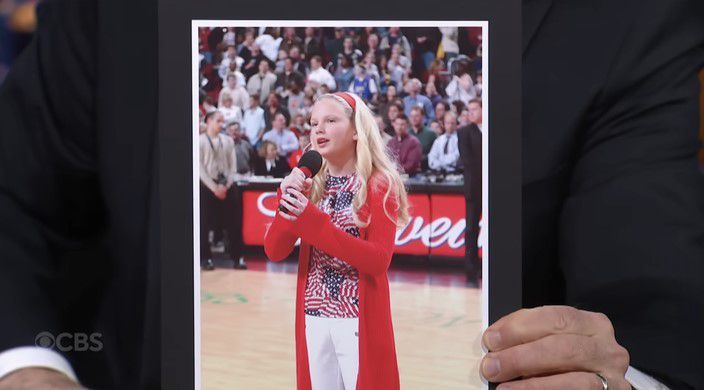
Philadelphia fans will most appreciate the 2001 flashback photograph of a tween Taylor singing the national anthem at a Sixers game in her very patriotic outfit: a red duster, an American flag top, and white pants.
On “The Late Show with Stephen Colbert,” Taylor Swift talks about her national anthem outfit: a red duster, white pants, and sparkly shirt for a performance of the national anthem at a Sixers game in 2001.
“You know when you are like 11 and you have that one outfit that you just know … goes so hard … when you just put this on and it’s like I’m sorry. I’m unstoppable today,” the Berks County native said on the talk show. She was dressed in a precariously fitting burgundy velvet mini with an off-the-shoulder Bardot neckline with winged sleeves giving early-Christmas-present energy to her fans.
Today, that unstoppable outfit for her is a sparkling Versace bodysuit, one of her many outfit changes on “The Eras Tour.”
“Anytime I put it on … I could be like coughing from a horrible virus. I could be aching,” Swift said. “When I put that on, I’m like, ‘This is popping.’ I’m doing it.”
The interview was light-hearted, fun, and thorough. Swift talked about her friendship with Stevie Nicks — we are jealous! — the excitement of her engagement to Kansas City Chiefs’ Travis Kelce, and the thrill of getting the master recordings of her first six albums back in May.
She had no idea of the impact of her tour on her fans until she learned they were passing out from joy.
Literally, passing out from joy.
“When I read articles that medical professionals are diagnosing fans who came to the Eras tour with post concert amnesia and joy blackouts, I was like, ‘Oh man, this is different,’” Swift said “The fans … People connecting to what we created made the Eras Tour what it was.”
For that, the Southwest Philadelphia woman was sentenced Friday to 10 to 20 years in state prison.
“I am not God. I can’t decide who lives and who dies,” Williams, 31, told Judge Kevin F. Kelly. “This is the biggest mistake of my life, and I hate myself for it.”
Williams pleaded guilty in August to third-degree murder and third-degree murder of an unborn child for fatally shooting Latoya Davis in the parking lot of a Wawa store in Collingdale last year.
At the time, Davis, 32, was six months pregnant, something Williams said she did not know when she pulled the trigger of her Ruger .380 handgun on that night in October 2024.
“Not a day goes by where I don’t cry my eyes out,” Williams said. “I am sorry for the Davis family for the pain I have caused. I took something so precious, and I’m embarrassed, ashamed, remorseful, shattered.”
Davis, who left behind two young daughters, was shot once in the back during the dispute, which prosecutors said began inside the Wawa and continued in the store’s parking lot, where the two women had parked next to each other.
Latoya Davis, a mother of two, was killed outside of a Wawa in Glenolden. Davis was six months pregnant at the time.
As Williams went to drive away, Davis continued to argue with her and, at one point, threw a beverage at her. In response, Williams shot her with the gun she was licensed to carry.
Williams’ attorney, Anna Hinchman, said a lifetime of trauma, including sexual abuse as a teen and violent domestic assaults by her ex-husband, left Williams with a severe case of PTSD that was triggered when Davis confronted her.
Assistant District Attorney Dan Kerley called the shooting a “senseless act of violence” and said that, despite Williams’ perception that she was defending herself, her actions forever ruined two families.
“It’s undisputed that Ms. Williams had a license to carry her gun, but that did not give her a license to kill,” he said. “It does not give you the ability to shoot someone during an argument.”
Still, Kerley credited Williams for remaining at the scene, performing CPR on the grievously wounded Davis, and cooperating with police.
Gabou Jean Pierre Toure, Davis’ longtime boyfriend and the father of her unborn son, said no amount of remorse or accountability can heal the pain he feels.
“I want to forgive you so bad. I’m trying to forgive you,” he said. “But I still feel this is a nightmare that I want to wake up from.”
Toure said he and Davis were soulmates, and were both eagerly awaiting the birth of their son after struggling with fertility issues. The two shared a birthday and celebrated together every year.
This year, he said, all he could do on that day was weep for his lost love.
“You are a mom. You can imagine how it feels to lose your child,” he said to Williams. “I hope you regret what you’ve done.”
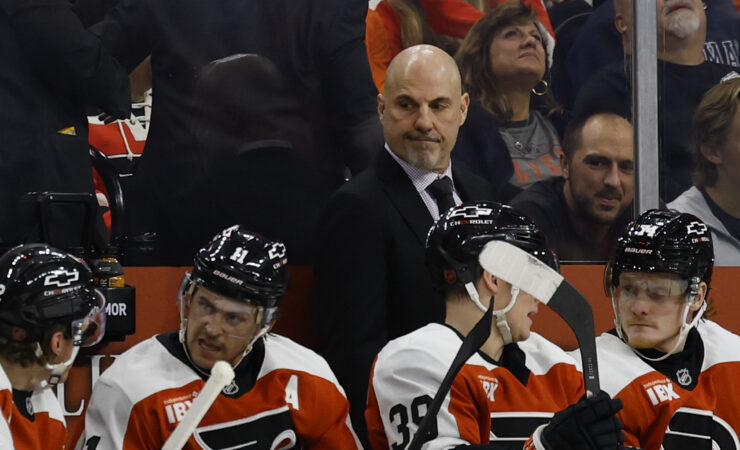
Rick Tocchet’s news conference after the Flyers’ 3-2 overtime loss to the Vegas Golden Knights on Thursday wasn’t short like his predecessor was known for — in fact, he told the team’s media relations staff he was OK to keep answering questions — but for the first time since becoming the Flyers’ head coach, he sounded very frustrated.
“I can name 10 guys that didn’t do anything,” he said during one of his answers. “You guys can write whatever story.”
Tocchet tried to remain positive as his squad hung with a perennial Stanley Cup contender at Xfinity Mobile Arena. But 29 games in, it’s clear the coach wants to see improvements and implementation of his systems.
Two reasons Tocchet wasn’t frustrated
Five-on-five
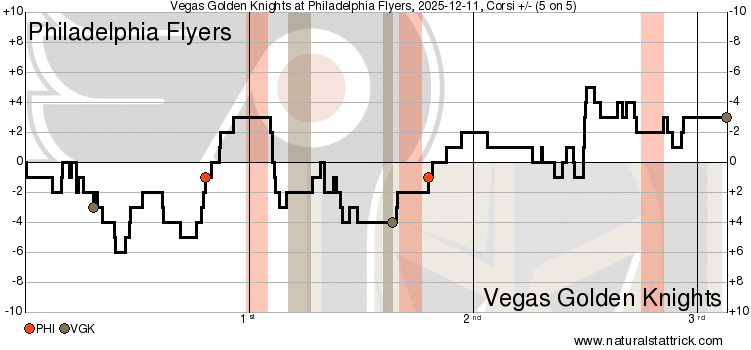
Tocchet did say he thought that Flyers played played a good game and executed the game plan at five-on-five — and they did.
According to Natural Stat Trick, the Flyers had 54.84% of the chances in the first period and 51.85% in the third period. Vegas had the advantage in the middle frame, but also by a slim margin of 52.17%.
The Flyers outshot the Golden Knights by one, and while they did allow two more high-danger chances to the opposition, the Flyers outscored Vegas 2-1.
The Flyers had a pretty even match-up with the highly-skilled and heavy Vegas Golden Knights as teams traded chances.
Four players he liked
For defenseman Noah Juulsen, the season started a little iffy, and there were questions about whether he was ready to play steady minutes after missing a considerable amount of time following sports hernia surgery in February.
But the rust has worn off, and he has become the perfect seventh defenseman — someone who can be inserted into the lineup and play well when there are injuries, as there has been since the start of the season with Rasmus Ristolainen, who is inching his way back from his own surgery.
On Thursday night, Juulsen was rewarded with his first goal in Philly, a tally that Tocchet, who coached him in Vancouver, too, called “a great shot.”
“I think when someone puts in the perfect spot, like [Christian Dvorak] did, and you pound it, it comes off pretty hot usually for most guys in the league,” Juulsen said of his one-timer from the left face-off circle.
Speaking of Dvorak, when asked about his response after his turnover led to the opening goal by Zach Whitecloud, Tocchet liked how he battled back.
“He was disappointed in that. We talked about that,” Tocchet said with a frustrating pause and sigh about the turnover just inside the Vegas blue line, “this morning. When there’s no speed, you’ve got to get it deep. … That’s responsible all year, something bad happens, and we come back.”
Carl Grundström, in his third game with the Flyers, was moved up in the lineup. By the third period, he was solidly on a line with Noah Cates and Bobby Brink.
“I liked his game,” Tocchet said of the Swede, who finished with a season high 12:41 and got an assist on Juulsen’s goal. “I thought he’d be better on that kind of matchup” against the Jack Eichel line or Mitch Marner, who Brink and Cates were assigned to for most of the night.
It says a lot when a kid playing in his second NHL game has his name brought up unprompted by the head coach. Tocchet said of Ty Murchison “for a young kid again, he looked poised out there.” And he did. Skating 13:41, he was on the ice for Zegras’ backdoor goal to tie the game at 1, and just 1:43 into the game, he laid a monster hit on Kaedan Korczak to set the tone.
“It’s a little disappointing how it ended, sour taste,” he said of the overtime winner by Mark Stone after Travis Konecny fanned on the puck and Eichel was able to maintain possession and find Stone backdoor.
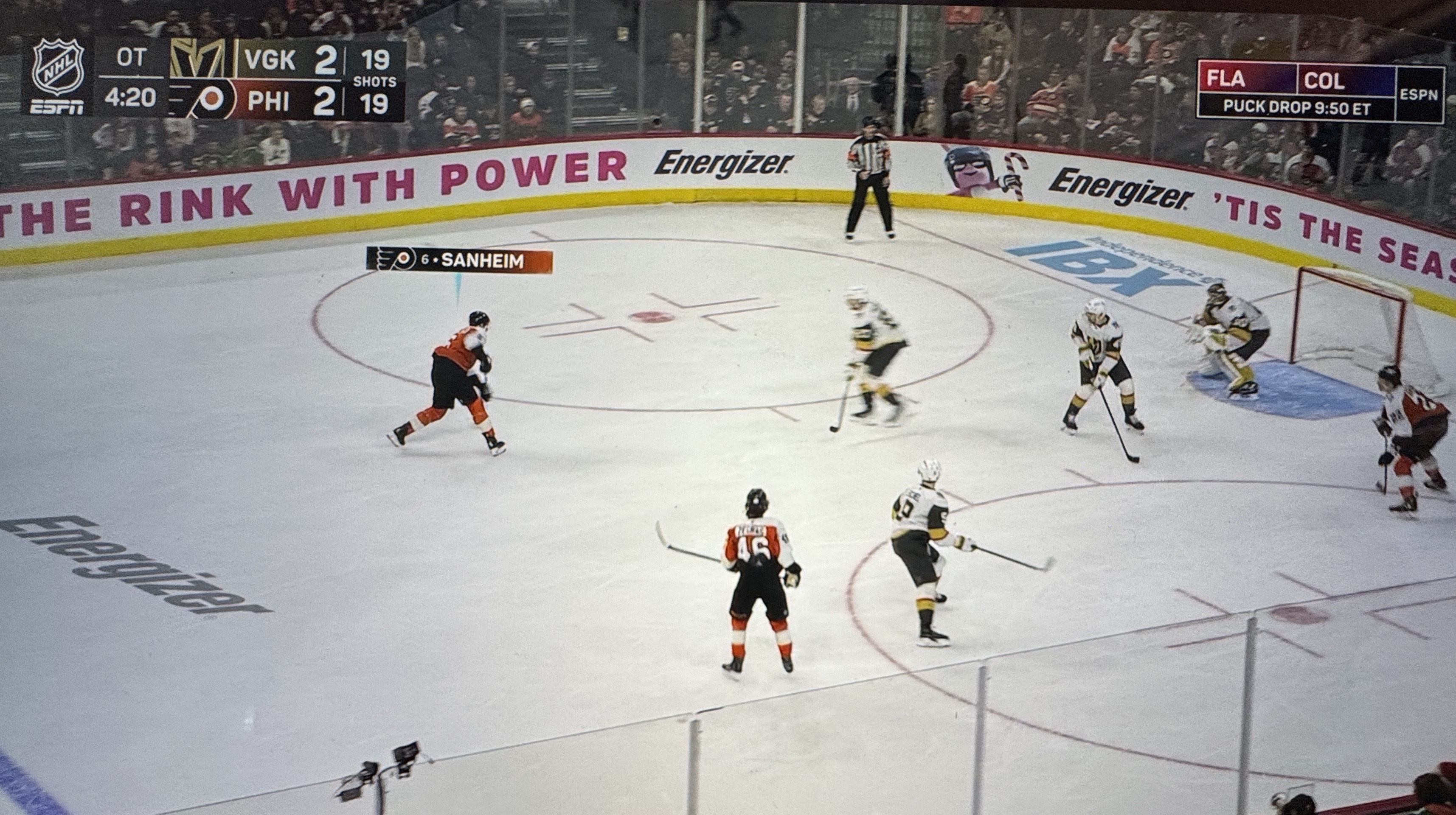
But Tocchet wasn’t happy with the overtime session as a whole. Despite having time in the offensive zone, the Flyers did not register a single shot across the extra session that lasted almost three minutes. Vegas had one blocked shot and two shots on goal.
“[Travis Sanheim] right in the middle of the ice and we pass it like, those are the things you just can’t do,” Tocchet said. “You’ve got to take the shot. It’s right there. He’s got a hell of a shot. We’re looking maybe too cute, I don’t know, but we’ve got to put our finger on it.”
The Flyers are 2-4 in overtime while knowing that, if the game gets there, a perfect 5-0 is on the horizon in the shootout. Asked if the Flyers weren’t playing aggressively enough because they know that if they get it to a shootout, there’s a good chance they win: “I don’t know, maybe in the subconscious of their mind, but not for us,” he said of the coaches.
Travis Sanheim had a lane and a screen on the goal, but opted to pass the puck to Christian Dvorak by the net. It looks like a good play when paused, but in reality, Dvorak was gliding back and did not get the puck until he was almost up against the boards leaving no angle to shoot.
The power play
“Did you see the first two power plays?” Tocchet retorted when asked about the change in the units in the third period that saw Cates and Brink on the top unit with Zegras, Konecny, and Jamie Drysdale, who made a return to the power play in the game.
Earlier in the night, that unit was Owen Tippett, Drysdale, Zegras, Konecny, and Michkov. Emil Andrae and Sanheim also saw power play time on the point with them across the night.
“What would you have done?” Tocchet added with a shrug and a “There you go.”
Tocchet did continue saying that he didn’t want to get negative because they had a good game, but it sure feels like the former NHLer hit a rite of passage as a Flyers coach.
As he said, “I know the coaches are a little frustrated because [we sound] like a broken record.”
So, is everyone else starting to have flashbacks, too?
The power play is 23rd in the NHL (17.9%). Through 29 games and 81 power-play opportunities, the Flyers have 14 goals. It’s not the fewest in the NHL — it’s the third fewest. (One positive is they are tied with the Carolina Hurricanes, whom they play in a home-and-home this weekend.)
The Flyers had three power plays on Thursday, but could muster only one shot on goal, three shots that missed the net, and two that were blocked. That’s six shot attempts across six minutes of action — or a lack of action.
Tocchet said the flanks, which are the players in the circles, aside from Zegras, struggled, and they weren’t getting shots from the middle of the ice. The coach is obviously frustrated that “we’ve practiced it, but for some reason when under pressure we kind of lose our bearings.”
And it has to be even more frustrating for the bench boss to watch Vegas score like that on one of their two power plays. After getting a shot from the middle of the ice by Pavel Dorofeyev, who put the puck on goal from just above the slot, Stone had two chances atop the crease, with the second going in for his first goal of the night.
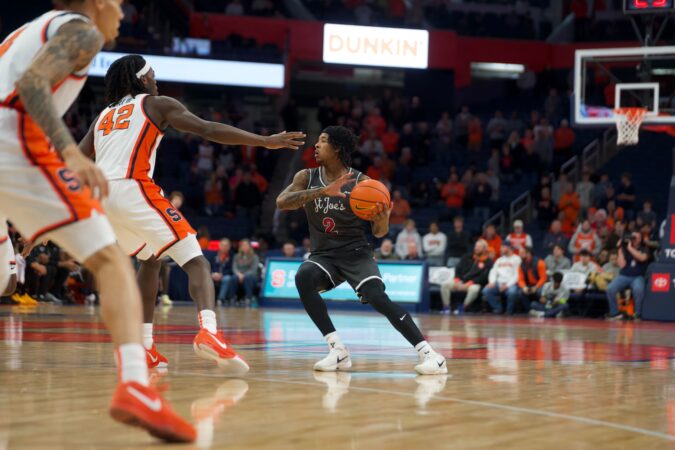
SYRACUSE, N.Y. — On a cold, snowy Thursday night, St. Joseph’s battled till the final minutes, but fell to Syracuse, 71-63.
“I think [Syracuse] is physical,” said St. Joe’s coach Steve Donahue. “They do a good job of making the game a grind. It takes a lot of energy to guard them for 30 seconds, and then it kind of takes the wind out of your sails to push it.”
Thursday marked the Hawks’ second game against an Atlantic Coast Conference team. They fell to Virginia Tech on Nov. 12.
Next up, St. Joe’s (6-4) will host Delaware State on Thursday in its first of three final non-conference games.
A tale of two first halves
A fastbreak layup from Deuce Jones II, who scored 12 of his game-high 18 points in the first half, extended the Hawks’ run to 7-0 and gave them a 14-7 lead at the 13:58 mark in the first half.
During those opening minutes, St. Joe’s made 6 of 9 shots from the field. Getting out in transition played a large part in the Hawks’ early success, but the final thirteen minutes of the half were a different story.
Justice with the rim rocker as the Hawks have climbed back to a point
The Hawks made 5 of 18 attempts throughout the rest of the first, while Syracuse put together a 12-4 run.
St. Joe’s finished the half shooting 11 of 27 from the field, making 3 of 16 three-pointers. Still, the Hawks entered halftime down 34-30.
Shooting woes
The Hawks entered Thursday tied for first in the NCAA in free-throw percentage (at 81.28%), while the Orange were shooting56.8%.
Syracuse had yet another poor shooting night at the line (15 of 28), but St. Joe’s was right there with them. The Hawks made 18 of 27 free-throws (66.7%), which tied their season-low against Penn.
“If we shot fouls like we’ve been shooting, we may have won this game,” Donahue said.
Meanwhile, three-point shooting has been an ongoing issue for St. Joe’s, who’s shooting 27.3%, which ranks last in the Atlantic 10.
The Hawks made just 5 of 26 attempts from deep on Thursday.
“I don’t think [our] strength is ever going to be our three-point shooting,” Donahue said. “However, I do think if we make good decisions around the basket and kick out, and we get more in rhythm and catch and shoot threes, I think we’ll hit a good share of ours.”
Clutch rebounding not enough
St. Joe’s dominated the glass.
The Hawks gave up just six offensive rebounds, which tied their lowest allowed this season. They also had 14 offensive rebounds, leading to 13 second-chance points, and grabbed 44 rebounds total.
Despite being within reach to reclaim the lead, the Hawks could not get over the hump.
Syracuse went on a 6-0 run twice in the second half, which looked to be the difference maker, and with under three-minutes remaining, the Orange opened their lead to 10 points.
If you’re feeling world-weary this holiday season, why not skip the homemade feast and take an easier, if more indulgent route? Dine-in or takeout. The options in the Philly area are plenty, from chopped liver to high-end sushi.
Here are 14 local options for Hanukkah, Christmas Day, and New Year’s Eve. Note that some restaurants have menus for more than one of these holidays.
Get Hanukkah doughnuts at High Street Bakery.
Hanukkah
Biederman’s Specialty Foods
Order a Hanukkah brunch board, complete with gelt, bagels, and all the fixings, for $150. Add a latkes package for $20 with caviar supplements for an additional $85 to $165. You can also opt for Christmas Eve brunch boards ($150 to $200). Pick up orders from Dec. 13 to 31.
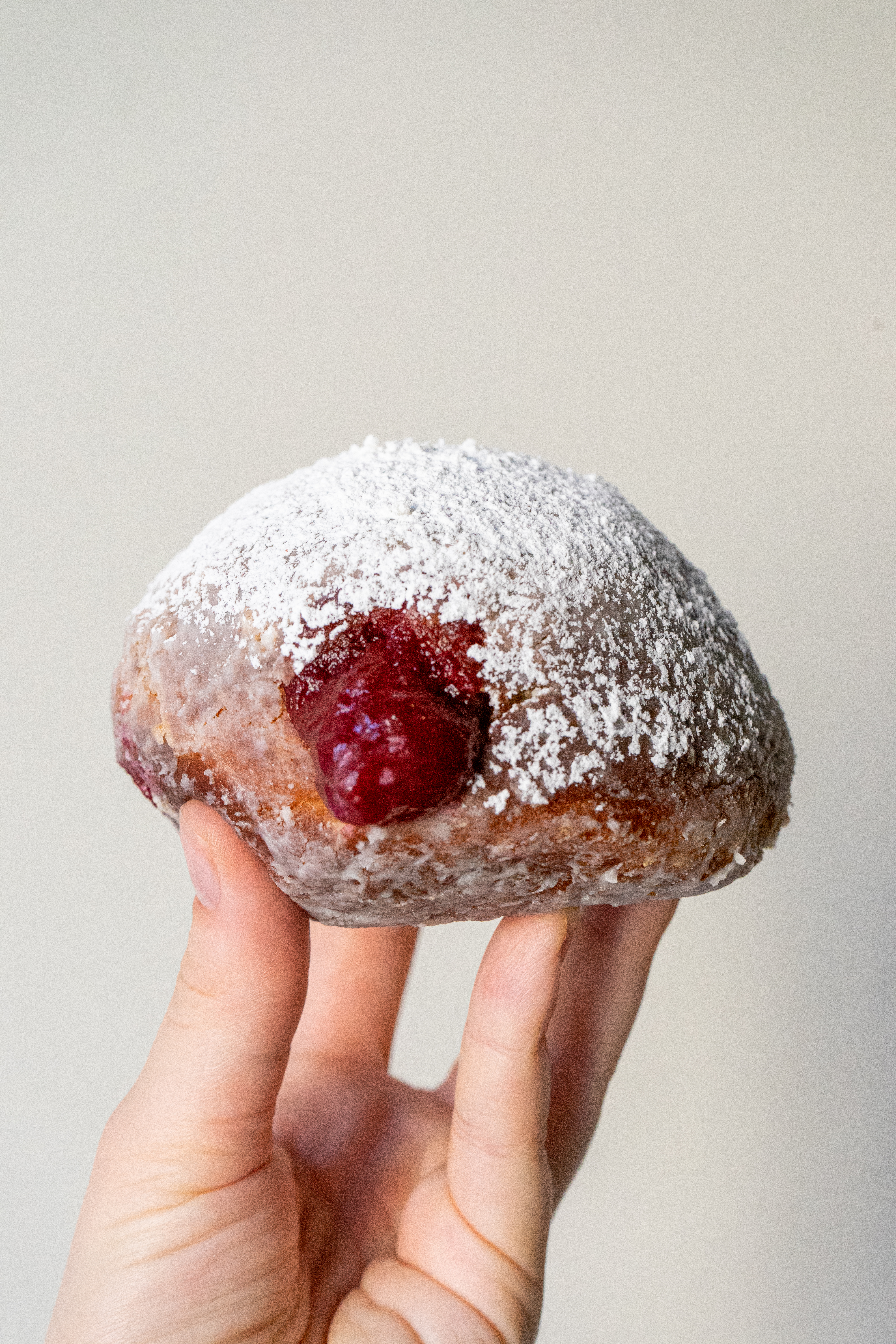
Get four-packs of sufganiyot (filled with either strawberry-pink peppercorn jam or chocolate-chestnut cream) for $24 this Hanukkah from High Street. Preorder online. Pickups run Saturday, Dec. 13, to Monday, Dec. 22, between noon and 4 p.m. The restaurant and bakery will also host a luxe, three-course New Year’s Eve supper in its private dining room. Tickets are $100, plus $50 for a wine pairing on OpenTable.
Also check out High Street’s Ever Eve holiday pop-up bar, open Saturdays in December from 6 to 10 p.m., for boozy hot chocolate and other holiday cocktails, plus bar bites like crispy fried oysters. Enjoy live jazz from Dave Brodie and a rotating lineup of local artisans, too. Walk-ins are welcome, but reservations are strongly encouraged to guarantee a spot.
Consider Famous 4th’s Hanukkah prix fixe takeaway or dine-in dinner. Order noshes of chopped liver, herb-roasted chicken, and braised beef brisket served with potato pancakes and challah stuffing, and desserts like assorted rugelach and sufganiyot. Expect $39 per person for dine-in and $155 per kit, which serves four people. The Hanukkah menu runs Dec. 13 to Jan. 2. Reserve online.
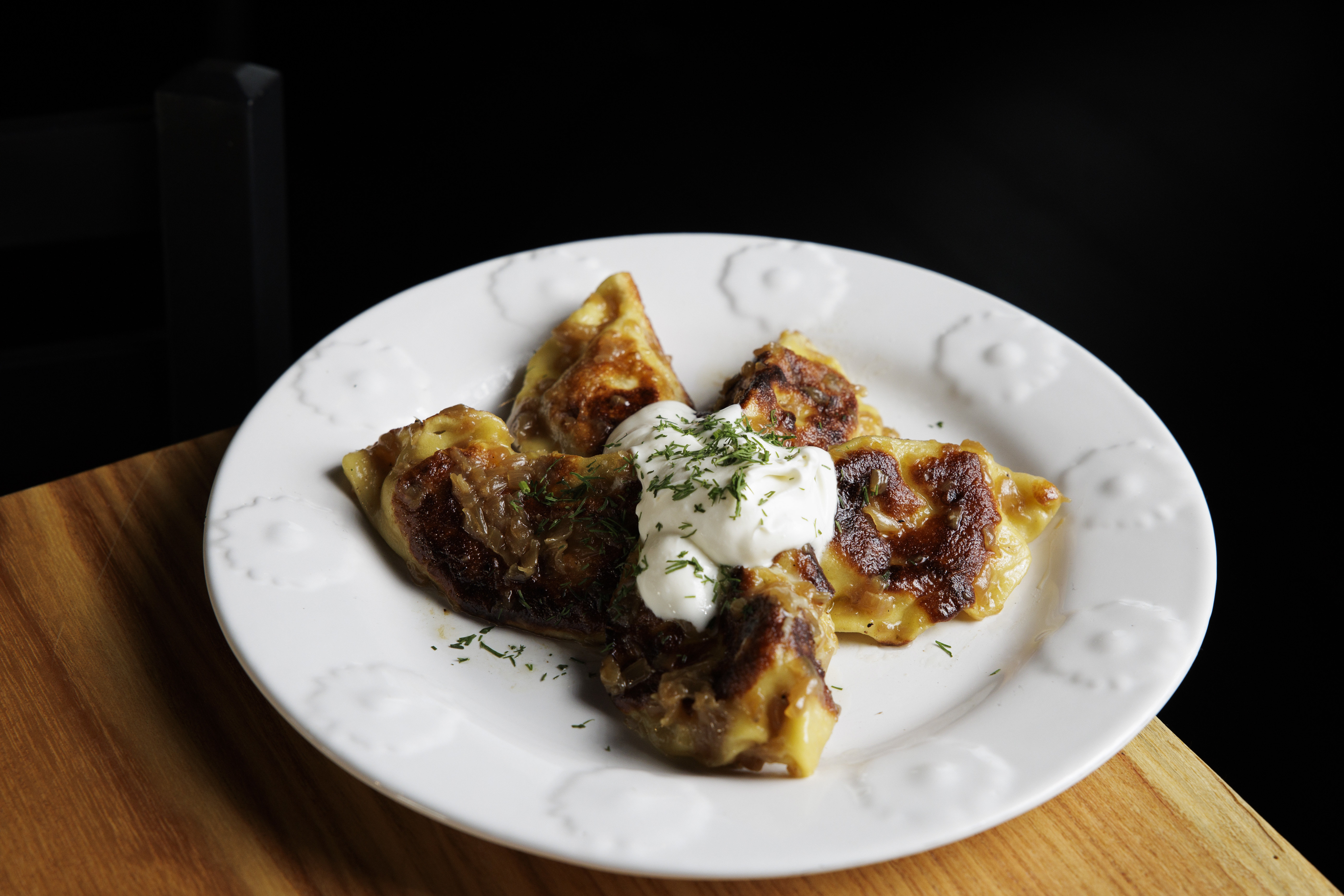
The pierogi ruskie at Little Walter’s in Philadelphia on Wednesday, Sept. 4, 2024.
Christmas Day
Urban Farmer
Inside the Logan Hotel, enjoy dine-in or takeout options for Christmas Eve and Christmas Day. On Dec. 24 and 25, specials include maple-glazed ham ($34) and rib-eye ($53), with a selection of sides and desserts. For takeout, pick up a holiday dinner on Christmas Eve or Day from noon to 2:30 p.m. The $280 package serves four to six people and includes a choice of maple-mustard-glazed ham or rib eye and three different pies.
The Northern Liberties Tex-Mex bar nods to tradition with its Christmas and New Year’s Eve dinner to-go packages ($110 to $300), which offer choices like rib-eye roast, brisket, and turkey. Scale your menu’s size for two to 10 people. Christmas orders must be picked up on Dec. 24, and New Year’s orders on Dec. 31. Purchase online.
The splashy new Rittenhouse sushi restaurant, which comes by way of Austin, is offering a holiday omakase at home special for takeout or delivery all month long. For $120, feast on 12 pieces nigiri, two makimono rolls, hama chili crudo, chicken karaage, Brussels sprouts, and house-made fried milk ice cream. Order online up to Dec. 30.
Recently opened next to the Cambria Hotel on South Broad Street, Kitchen + Kocktails will be open for regular dinner service on Christmas Eve. There are also plenty of takeout options: Consider a pan of candied yams, cornbread dressing, collard greens, and other sides for $79 to $115. Entrees include lamb chop, smoked turkey leg, catfish, and blackened salmon pans for $79 to $185, and desserts like peach cobbler and sweet potato pie are $79 each. Orders can be made online.
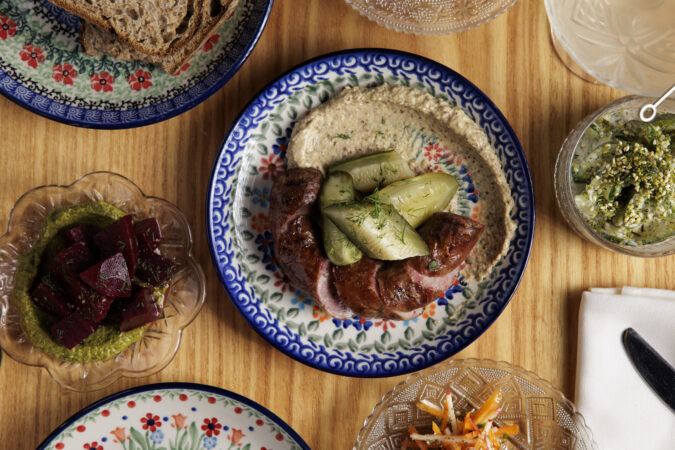
Chef Michael Brenfleck is serving handmade kielbasa, holiday breads and baked goods, pantry staples, and a selection of frozen pierogi this Christmas. On Dec. 20 and 21, pick up kielbasa at $10 per pound. Bakery options including babka and poppy seed rolls are priced at$12, while pantry items like ogórki konserwowe(pickles) and smalec (whipped lard with crunchy pork skin) will go for $8 each. A selection of frozen pierogi can be purchased for $25 per dozen. Orders can be placed via Toast.
Square 1682, located at 17th and Sansom Streets, is serving up a Christmas menu featuring squash soup, deviled eggs, lobster risotto, Thai fried red snapper, crème brûlée, and more. The three-course meal, including a side, will be offered from 4 to 8:30 p.m. on Dec. 24 and 25, and 5 to 10 p.m. on Dec. 26 and 27. Book on OpenTable.
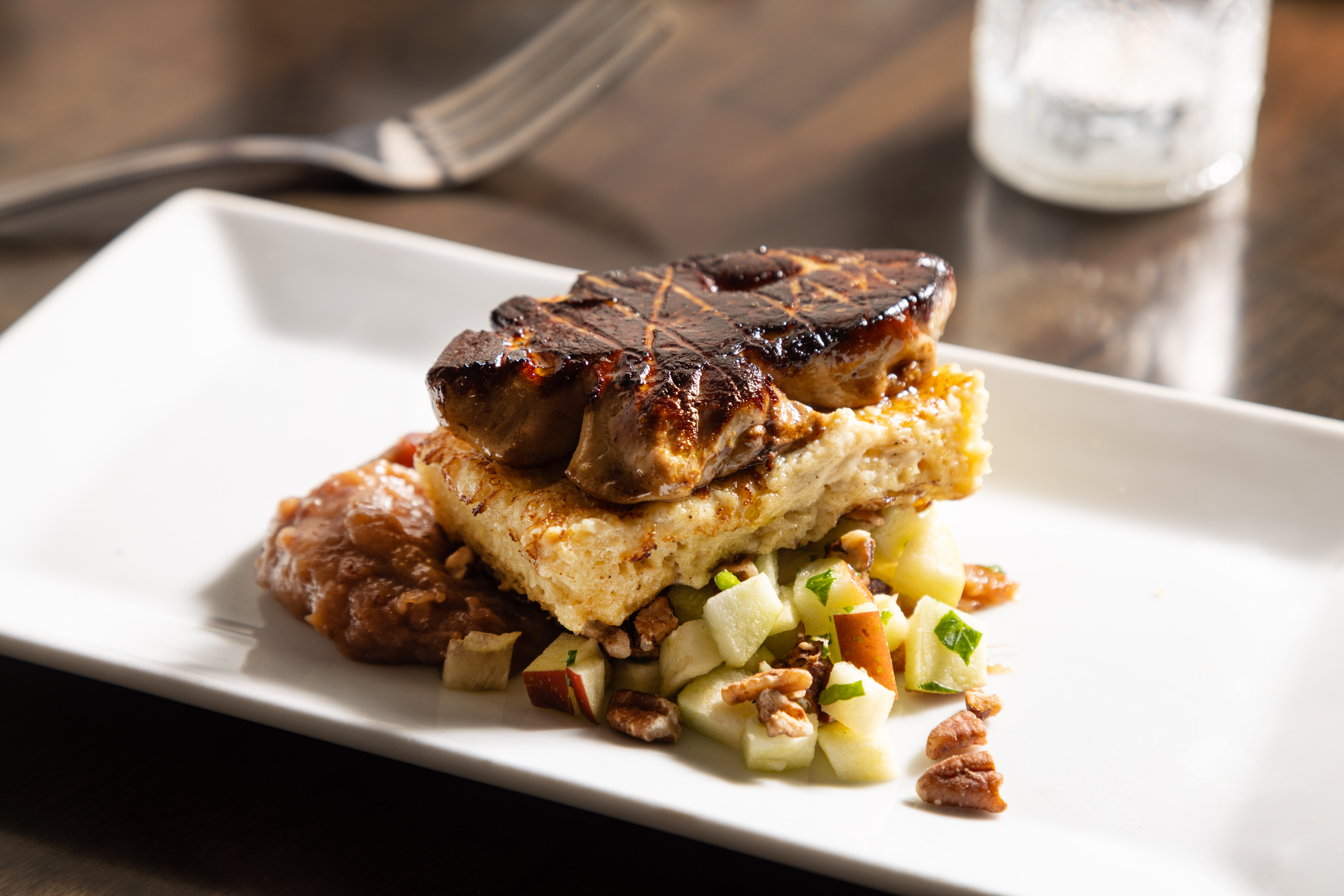
Enjoy seared foie gras at Fond this New Year’s Eve.
New Year’s Eve
Fond
Chefs Lee Styer and Jesse Prawlucki-Styer are ringing in New Year’s Eve with afive-course dinner for$135 per person. Takers will be in for a feast starting with a half-dozen oysters followed by grilled radicchio salad; tuna tartare; seared foie gras; scallops with braised fennel and endive; pork bellywith Okinawan sweet potato, escarole, and Dijon jus; and hazelnut chocolate mousse with vanilla tangerine, toffee cannoli, and sour cherry coulis. Reservations are encouraged at the Wallingford BYOB; book on Resy.
21 N. Providence Rd., Wallingford, 484-445-2108, fondbyob.com
Forsythia
Chef Chris Kearse’s Old City boîte is offering a four-course dinner for New Year’s Eve. The meal features fluke crudo, beef short rib, and mousse au chocolat noir for$150. Seatings will be from 4:45 to 9:45 p.m. Reserve a spot on Resy.
Ring in the new year at River Twice on East Passyunk with a seven-course tasting menu and a Champagne toast. The New Year’s Eve lineup includes raw aged beef seasoned with golden ossetra caviar and oyster emulsion, halibut from the gulf of Maine with shimeji mushrooms and shellfish gumbo, and more. Dinner is $150 per person at a table or $175 at the chefs counter, with optional beverage pairings available. Guests will also receive a complimentary glass of Champagne at midnight. Book a reservation on Resy for seatings from 5 to 10 p.m.
Ring in 2026 at Almyra’s New Year’s Eve dinner. For $95 per person, dig into mezzes like spanakopita manti and Wagyu dumplings, entrees like filet mignon kebab and chicken kofta, and assorted Greek desserts. NYE reservations can be made for seatings from 4 to 7 p.m. After 9:30 p.m., reservations are $95 per guest with a sparkling wine toast and DJ starting at 9 p.m. Book on Resy.
Get loose on New Year’s Eve: Instead of prix fixe menus, Mish Mish will serve whatever dishes chef Zev Flores feels during this “dinner party of your dreams.” There will be plenty of bottles of Champagne. Pick a seating between 5 to 8:45 p.m. and book on Resy.
There two ways to celebrate New Year’s Eve at Aqimero inside the lobby of the Ritz-Carlton. From 6 to 8 p.m., enjoy a curated four-course dinner with chilled seafood tower, caviar service, and lack of lamb by Chef Richard Sandoval. Optional wine or beverage pairings are available, too. After dessert, move directly into the New Year’s Eve celebration, from 8 p.m. to midnight, with no additional ticket. Or head directly into the holiday party, which features an open bar, appetizers and desserts, and live music by DJ Eddie Tully. There will be a champagne toast and a standout balloon drop at midnight. Tickets for dinner and party combo are $295 per guest, and party entry is $175 per guest. Book online.
In Kensington, Fleur’s is hosting a New Year’s Eve prix-fixe dinner featuring a six-course menu. Devour dry-aged hamachi crudo with golden Osetra caviar, grilled sweet potatoes with hazelnut, kombu-cured egg yolk, and black truffle, and lamb loin torchon. Dessert includes a dark chocolate mousse cake. There are two beverage pairings available, including a zero-proof beverage pairing, both with five drinks, plus a Champagne toast at midnight. Tickets are $125 per person; book on Resy.
Another Kensington restaurant is hosting a night of complimentary Champagne and caviar for New Year’s Eve. Emmett is offering a one-night only four-course menu with signature Emmett riffs: think venison tartar, grilled dorade, and winter citrus trifle. It’s $175 per person to reserve on OpenTable.
After a spring training workout in February, Kyle Schwarber contemplated the likelihood of the Phillies keeping most of the roster’s core intact through the end of the decade.
“I think we would love to all finish our careers together,” he said. “But who would want to come out and watch a bunch of 40-year-old dudes play baseball? Right?”
Well …
Schwarber will be only 37 when his newly minted five-year, $150 million contract expires in 2030. Bryce Harper will be 38 by then; Trea Turner and Aaron Nola 37; even Cristopher Sánchez will be 34. All will have no-trade rights, if they don’t already.
Maybe they will have World Series rings, too. In that case, the 42,000 fans who pack Citizens Bank Park on random weeknights in June won’t mind watching them ease into baseball old age together. Flags fly forever, you know.
But modern front offices obsess over long-term plans more than trying to win a championship one season at a time. Sustainability is their buzzword. Most whiz-kid general managers would look you in the eye and say that five-year contracts for 33-year-old designated hitters coming off 56-homer seasons are bad business. Don’t even get them started on multiyear deals for 35-year-old catchers who still play 130 games per year.
At 69, Dave Dombrowski is no kid. But five World Series appearances with four franchises and two titles make him a team-building wiz. And although he has hitched the Phillies’ hopes in 2026 and probably 2027 mostly to a handful of thirtysomething superstars, he outlined a second part of the plan that’s essential to success in 2028 and 2029, too.
President of baseball operations Dave Dombrowski is intent on incorporating more young players into the Phillies’ roster.
“I’ve said this all along, and I still believe this: We need to start working our young players into our [roster],” Dombrowski said this week at baseball’s winter meetings in the shadow of Disney World. “We have good young players, and we’ll be better for it. I do think that good organizations can blend young players with veterans.”
Look no further than the sport’s model organization.
Since 2023, the Dodgers have spent more than $1 billion on player salaries, including a record $415 million this year (calculated for the luxury tax, according to Cot’s Baseball Contracts). Yet they had 25 players make their major league debut, including center fielder Andy Pages, infielder Hyeseong Kim, and pitchers Bobby Miller, Gavin Stone, Emmet Sheehan, Jack Dreyer, Roki Sasaki, and World Series MVP Yoshinobu Yamamoto.
Conversely, the Phillies had 12 major league debuts in the last three seasons — fewer than any team, based on Fangraphs research — with setup reliever Orion Kerkering and reserve outfielder Johan Rojas having the most impact.
Dombrowski attributed the low graduation rate from the minor leagues to “a combination of factors,” including a veteran-laden roster that stayed mostly healthy relative to other teams and allowed few opportunities for call-ups.
But it will be different in 2026. It has to be.
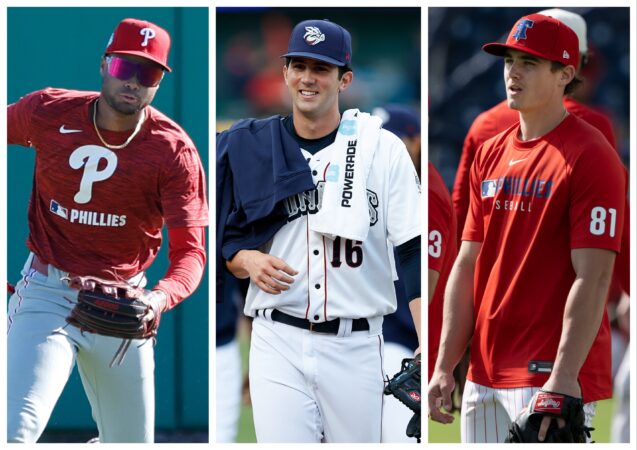
Because it’s one thing to reunite Schwarber — and probably free-agent catcher J.T. Realmuto, too — with Harper, Turner, Nola, Sánchez, and Zack Wheeler on one of the majors’ oldest rosters and take a few more whacks at an elusive championship. It’s quite another to realize that long-term success — beyond, say, 2027, when Wheeler intends to retire — is tied to how good Justin Crawford, Andrew Painter, and Aidan Miller end up being.
“We have some really exciting talent that’s going to be coming up, and you’re looking forward to whenever they can step foot in the big-league locker room,” Schwarber said. “You want to make them feel like they’re going to be welcomed right away and feel like there’s going to be a seamless transition for them.”
And even as the Phillies bring back the band, the maturation of their next core will be an equally important 2026 storyline.
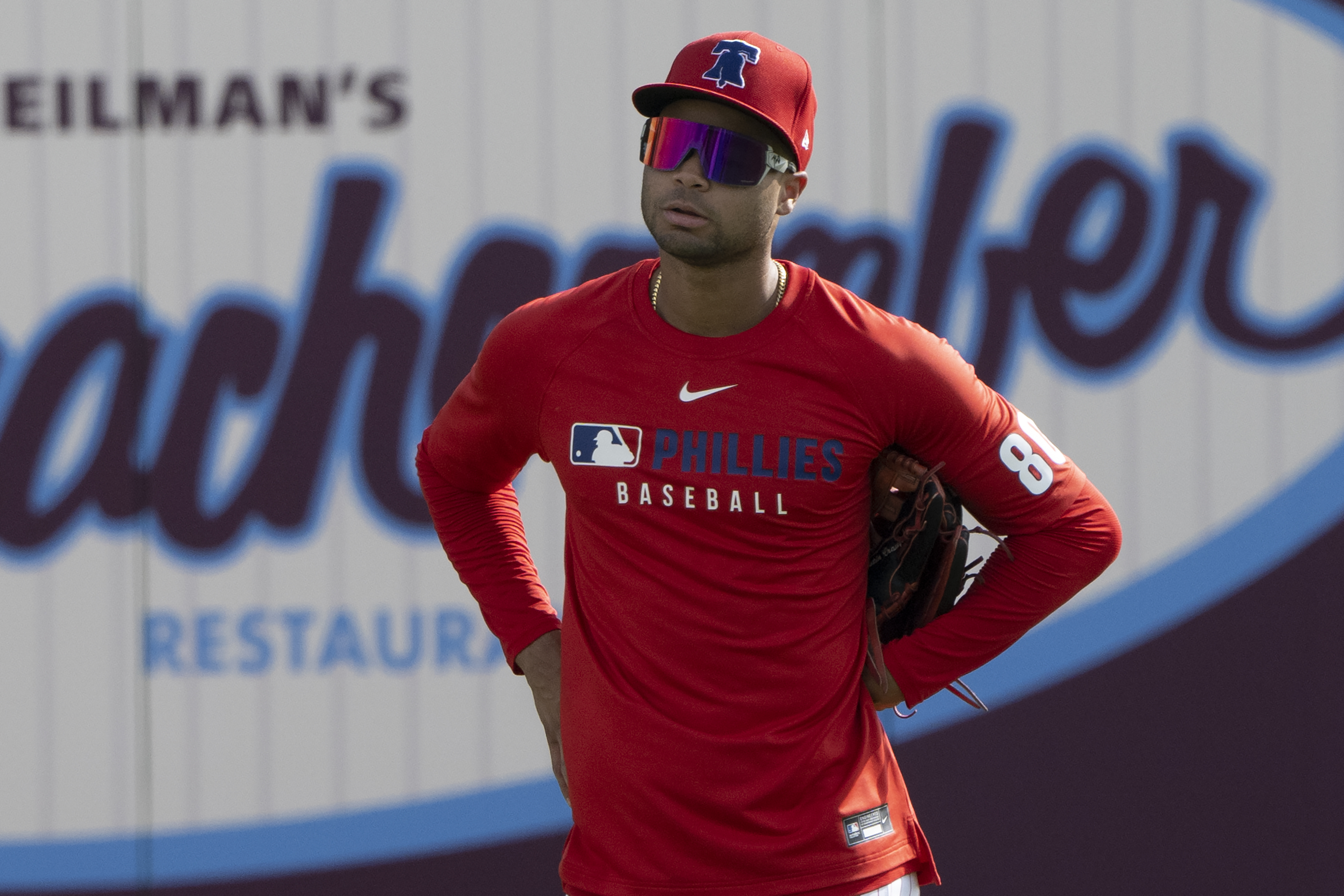
Top prospect Justin Crawford is expected to occupy a spot in the Phillies’ outfield on opening day.
A new ‘Daycare’
When the Phillies returned to the postseason in 2022, the lineup included three, sometimes four players who were 25 or younger: Alec Bohm, Bryson Stott, Brandon Marsh, and Matt Vierling.
Teammates and coaches dubbed them “Phillies Daycare.”
Although Bohm, Stott, and Marsh became solid contributors after Rob Thomson took over as manager (Vierling got traded to the Tigers for lefty reliever Gregory Soto), they’re mostly supporting actors rather than leading men in the Phillies’ ensemble. And as they outgrew their moniker — “They’re not the ‘Daycare’ anymore,” Harper finally declared last spring — there wasn’t another class coming behind them.
“Well, we traded quite a few players that could have been contributing members,” Dombrowski said, citing Vierling specifically. “We traded them for more veteran type of players to help us win at that particular time.”
Dombrowski also noted that five of the Phillies’ last six first-round picks — including Mick Abel (2020), Painter (2021), Crawford (2022), and Miller (2023) — were drafted out of high school, which typically means a longer path through the minors.
And when the Phillies did punch the accelerator and gave Painter a chance to make the team out of spring training as a 19-year-old in 2023, he tore a ligament in his right elbow, had Tommy John surgery, and missed two seasons.
The Phillies planned to call up Painter midway through this past season. But he struggled to regain his preinjury command, common for pitchers in the first year back from surgery. Painter stayed in triple A, and finished with a 5.40 ERA in 106⅔ innings.
“Honestly, some of the expectations we put on players is unfair,” minor league director Luke Murton told The Inquirer’s Phillies Extra podcast. “A guy that’s just coming back from Tommy John that pitched over 100 innings, was healthy, and at a level he’d never been at, I was very pleased, very satisfied.
“I think he accomplished a ton this year. Next year he’s looking forward to accomplishing more.”
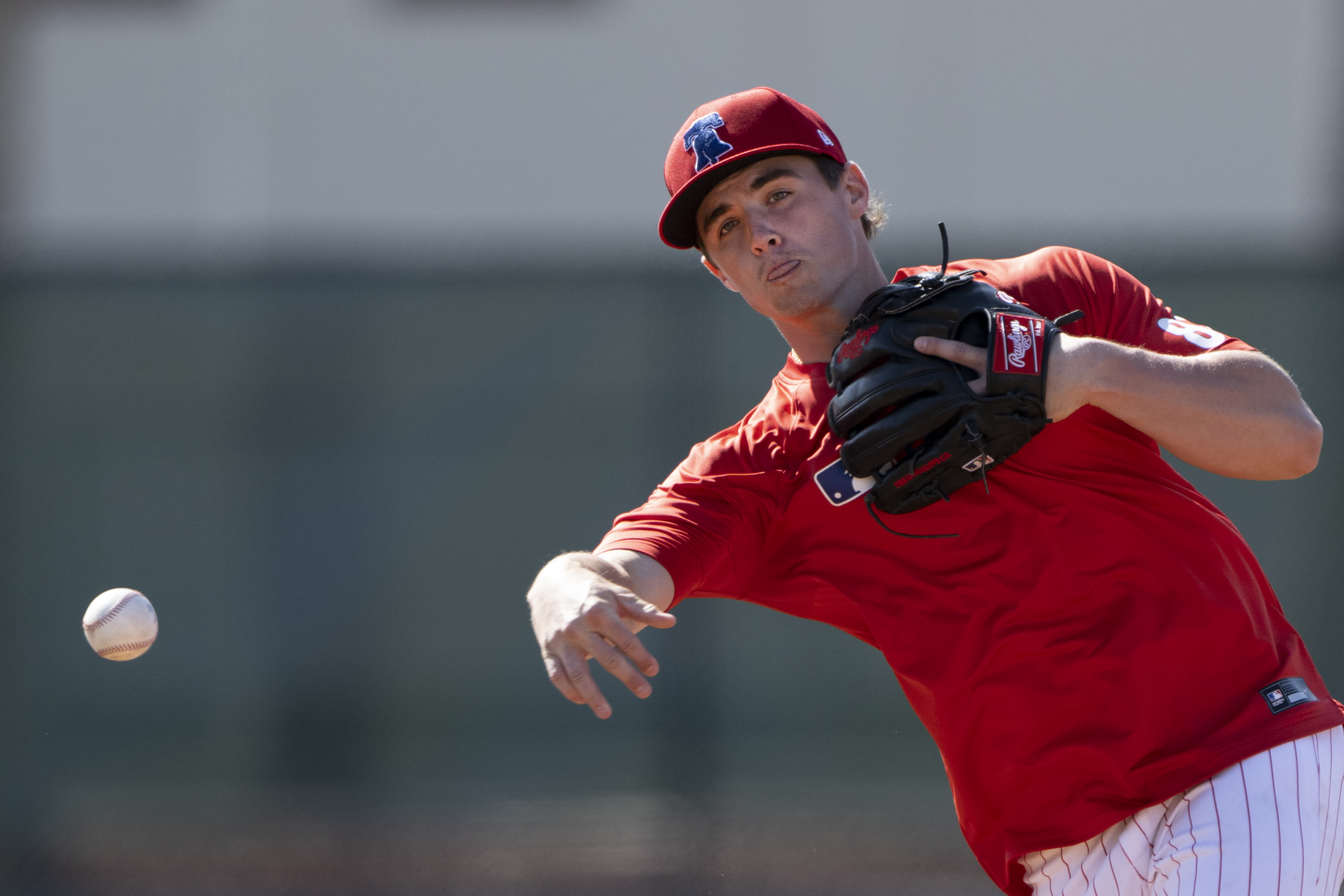
Painter stands a good chance to crack the season-opening rotation, especially if Wheeler needs more time after thoracic outlet decompression surgery. And the Phillies expect Painter’s long-awaited arrival in the majors to help lessen the anticipated loss of Ranger Suárez in free agency.
Dombrowski has all but guaranteed Crawford’s spot in the opening-day lineup, either in center field or left. The Phillies came close this summer to calling up the 21-year-old but elected to leave him in triple A to win a batting title, especially after acquiring veteran center fielder Harrison Bader at the trade deadline.
“I really believe that [Crawford] could have played for us at some point,” Dombrowski said. “But then you also do what you think is best for the player and for us in that time period. You’re trying to win a championship. And it didn’t hurt him to go out and continue to play [in triple A].
“But now, all of a sudden, you’re in a position where you’ve got Crawford and you’ve got Painter knocking on the door. Miller’s close; [outfielder Gabriel] Rincones is close. [Otto] Kemp came up for us last year, and we like Kemp a lot. There’s others that we like. It’s exciting.”
Also, necessary.
The Phillies could fast-track Aidan Miller to the majors in 2026 if he can make a smooth transition to third base.
‘Close your eyes and let ‘em play’
Including Schwarber’s new deal, the Phillies have roughly $285 million in 2026 payroll commitments, calculated for the luxury tax. Bringing back Realmuto would likely push the total past $300 million.
And still, there are holes in the outfield and bullpen.
The Phillies have explored trading from the major league roster to create payroll flexibility, according to sources. Moving Bohm, entering his free-agent walk year, would clear approximately $10.3 million based on MLB Trade Rumors’ salary arbitration projections.
In that case, the Phillies could look inward to find Bohm’s replacement at third base. One possibility: Kemp, who made his major league debut this year and has drawn effusive praise from Dombrowski throughout the offseason.
“He’s a good hitter. The ball jumps off his bat,” Dombrowski said. “He’s a threat when he comes to the plate. He can play different positions. And he’s a tough son of a gun. He’s a championship-type player. What he played through last year, injury-wise, I don’t think that there’s many people that would have done that.”
Indeed, Kemp continued to play despite fracturing his left kneecap in June and finished with eight homers and a 92 OPS-plus. He had knee surgery and a minor procedure on his left shoulder after the season. The Phillies expect him to be ready for spring training.
Before long, third base could belong to Miller. Murton said the touted 21-year-old shortstop will move to third in spring training. Miller spent the last week of the season in triple A and could return for only a pit stop after finishing with 14 homers, 59 stolen bases, and an .825 OPS between two levels.
Could he follow Crawford and Painter as a major league debutant in 2026?
“You never know,” Murton said. “He’s a very talented player. Don’t want to put too much on him too soon. He’ll be a big-league spring-training invite. You bring him in and see what we’ve got.”
The timing lines up. As Harper posts Instagram videos of his elective blood-oxygenation treatments, the Phillies can finally inject fresh blood into the roster, acclimatizing Crawford, Painter, and eventually Miller while the old guard is still elite and bearing most of the pressure.
“We just need them performing to their best abilities,” Schwarber said. “We don’t need anyone feeling like they need to step out and be Superman. We don’t need them worrying about, ‘How does Schwarber, how does Trea Turner, how does Bryce Harper, how does whoever think about what I’m doing?’”
Said Thomson: “I always think, when you bring a young guy up, close your eyes and let him play. No matter what happens, he gets two, three months, whatever you want to give him, and don’t even talk. Just let him go. The guys that we have at the upper level of our system are performers, and eventually they’re going to perform.”
It’s not just overdue. It’s imperative to keeping the Phillies’ roster from going stale.
Police are seeking a suspect wanted in connection with the killing of a 93-year-old man in the city’s Logan neighborhood last week, authorities said Friday.
The victim, Lafayette Dailey, was found dead in his home on the 4500 block of North 16th Street when medics were called there around 3 p.m. on Friday, Dec. 5.
Dailey had suffered a laceration to the chest and trauma in his head, police said. A medical examination found that he died from multiple stab wounds, and his death was ruled a homicide.
Investigators are now searching for 53-year-old Coy Thomas, who police say is considered a suspect in their homicide investigation. His last known address was on Ashmead Place in Germantown, police said.
They found Dailey’s wallet, keys, and vehicle missing from his home. They later found his car, a white Chrysler 300 sedan, several days after his death.
A department spokesperson declined to comment on the circumstances around the discovery of the car, citing an active investigation.
The department is urging anyone with information on Thomas’ whereabouts to Contact the homicide unit at 215-686-3334 verified or call its anonymous tip hotline, 215-686-TIPS (8477).
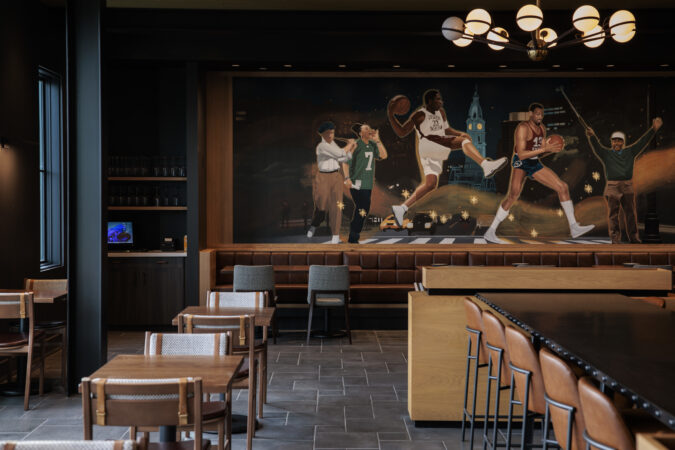
Little Horse Tavern — a full-service restaurant, bar, and event space named in honor of Charlie “Little Horse” Sifford, the Black golfer who led the integration of the PGA tournament in the 1960s — opens Monday. The Fitler Club and Strother Enterprises are overseeing it.
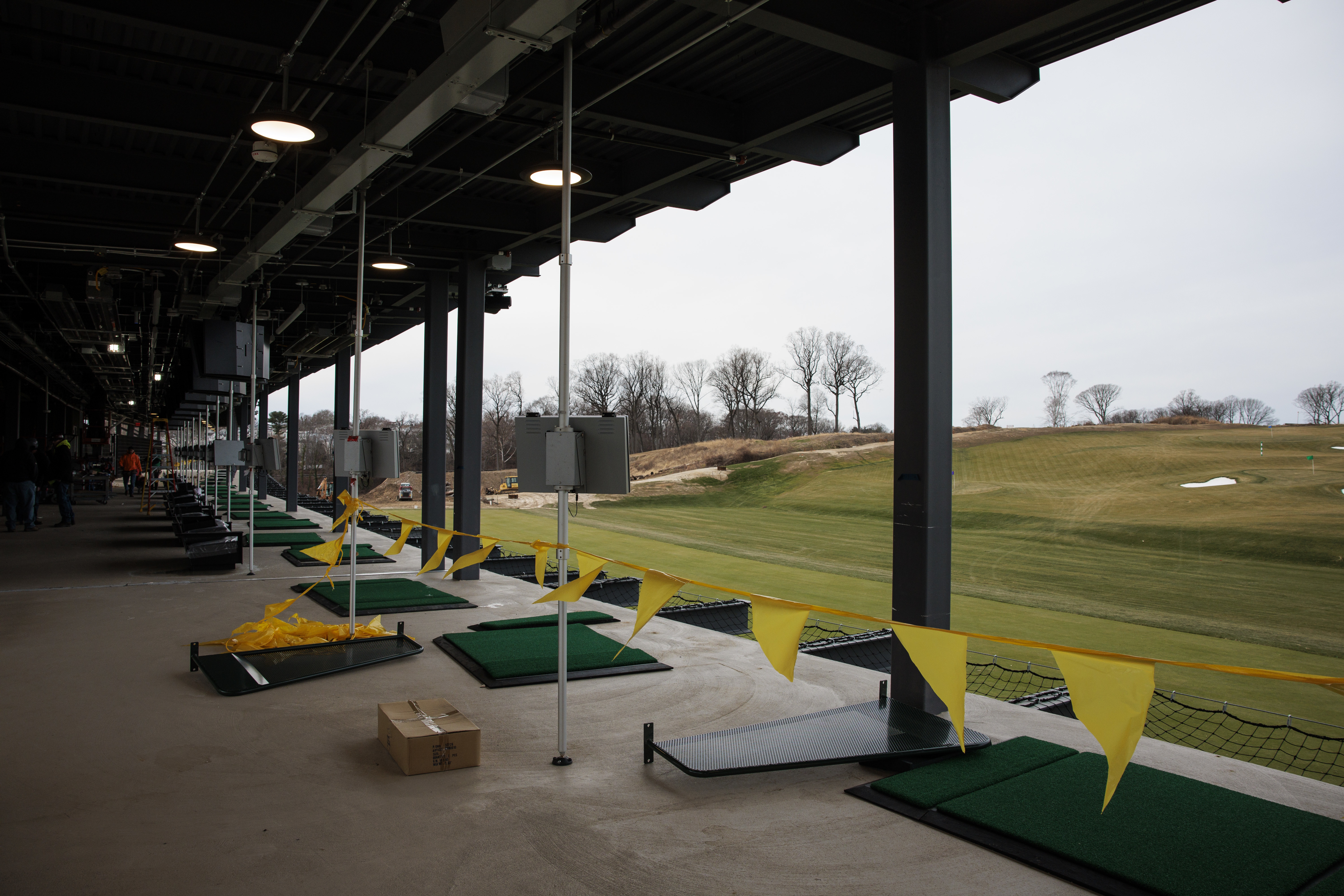
The tavern, in a new building on Lansdowne Avenue called the Lincoln Financial Center, is next to a heated, 68-bay driving range, similar to a Topgolf. (Buckets of balls start at $10.) Nearby is a nine-hole short course designed for beginners and families, and — expected to open in 2027 — the renovated 18-hole championship-level course known as the Olde Course.
All told, the $180 million effort aims to transform Cobbs Creek into a premier public golf destination. The club, founded in 1916, offered access to players when the game was largely off-limits to anyone but white men who could afford memberships at private clubs.
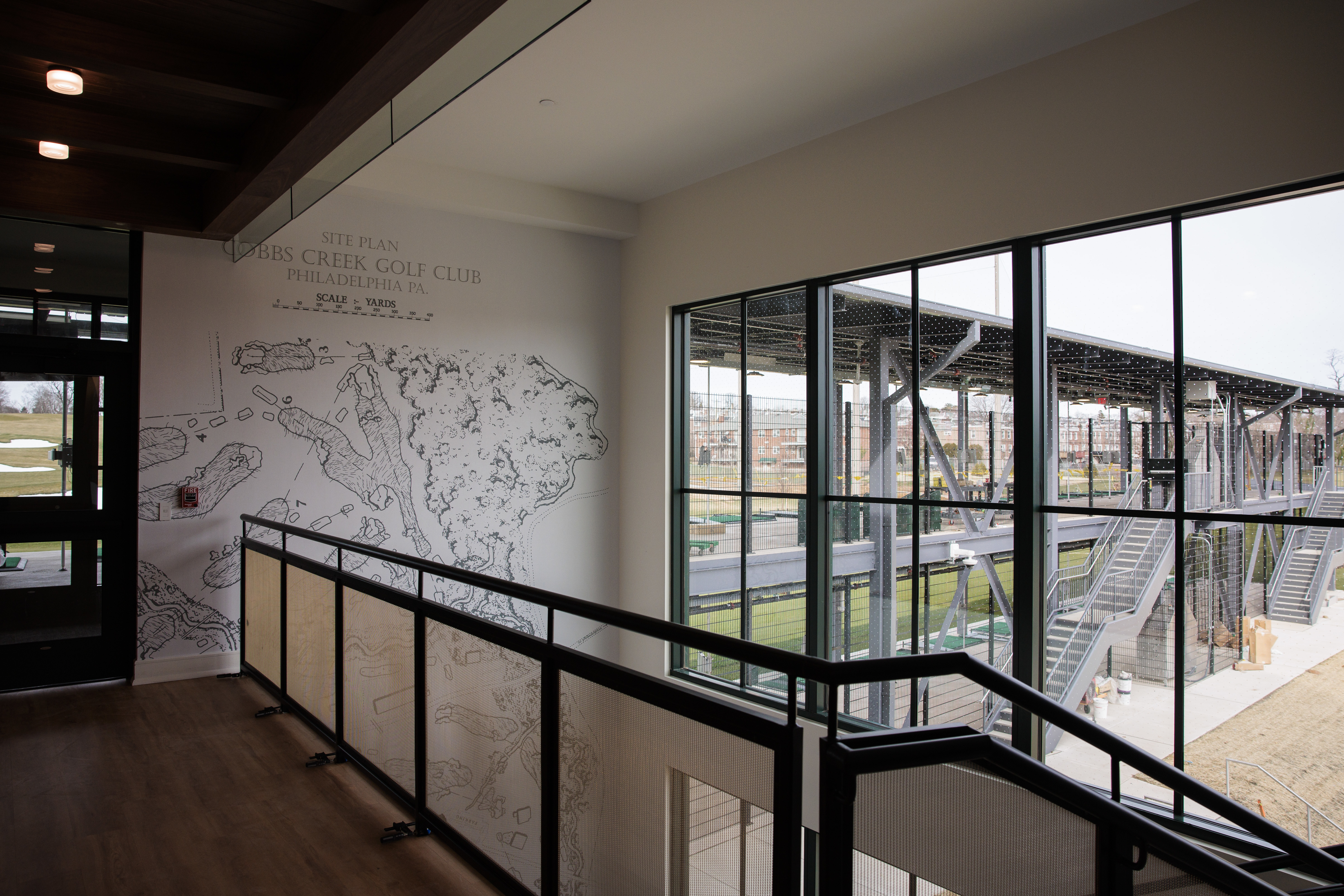
A map of Cobbs Creek Golf Course decorates a wall at Little Horse Tavern.
Cobbs Creek was Sifford’s home course in the 1950s. Sifford — who got his nickname because of the horse pendant he wore — went on to win two PGA Tour events and was inducted into the World Golf Hall of Fame in 2006; he died in 2015 at age 92.
The course fell into disrepair in the 2000s and was closed in 2020. Shortly after, “a group of people who loved Cobbs Creek started asking, ‘What if this could be Philadelphia’s Bethpage Black?’” said Fitler Club president Jacob Smith, referring to the celebrated public course on Long Island that hosted the 2025 Ryder Cup.
The driving range, seen in its pre-opening phase on Dec. 8, at Little Horse Tavern.
That idea grew into the Cobbs Creek Foundation, which raised money and secured partnerships with Troon, the large golf-management company, and the Tiger Woods Foundation, which operates the adjacent TGR Learning Lab, aimed at teaching the game to schoolchildren.
In addition to its public dining room and bar, there’s a private event space upstairs that can host up to 200 people.
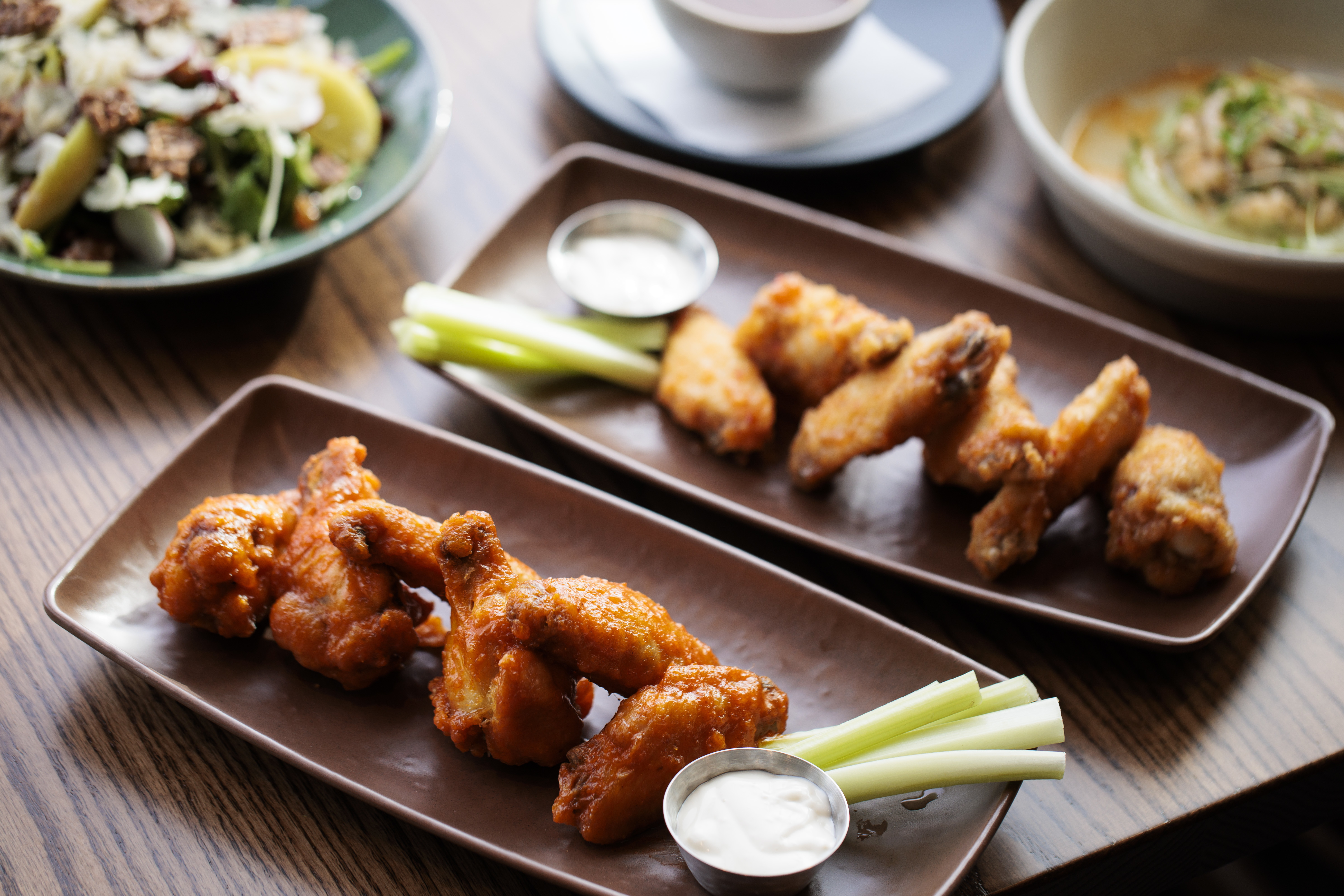
The Tavern Wings at Little Horse Tavern on Monday, Dec. 8, 2025 in Philadelphia. Little Horse Tavern serves as the main restaurant and bar at Cobbs Creek Golf Course. The restaurant, catering, and refreshment carts on the course are a collaboration between Fitler Club and Strother Enterprises.
Fitler manager Clancy Smith oversees the restaurant as food and beverage director. Chef Adam Carson is putting out a something-for-everyone mix in his all-day menu, which starts at noon.
There are tater tots, a basket of chicken tenders and onion rings, and wings (choice of six sauces). Sandwiches, accompanied by tots, onion rings, salad, or fries, include a double smash burger, turkey club, fried chicken, and truffle chicken salad.
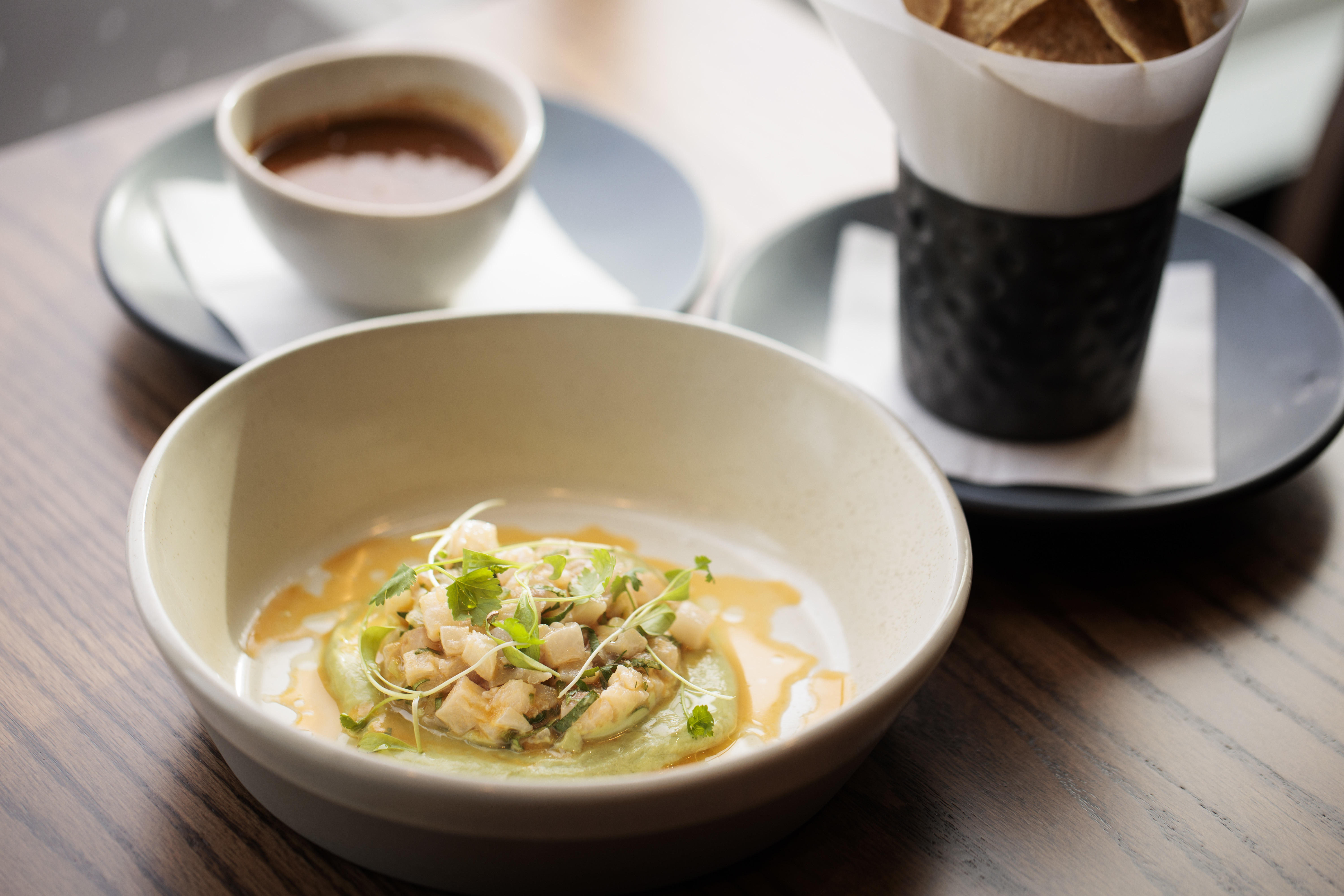
The ceviche at Little Horse Tavern on Monday, Dec. 8, 2025 in Philadelphia. Little Horse Tavern serves as the main restaurant and bar at Cobbs Creek Golf Course. The restaurant, catering, and refreshment carts on the course are a collaboration between Fitler Club and Strother Enterprises.
He’s also aiming a bit higher with esquites guacamole; huarache pizza; yellowfin tuna ceviche dressed in leche de tigre and avocado mousse; and a mixed green salad including fennel, radish, compressed apple, golden raisins, Cabot clothbound cheddar, sunflower brittle, and lemon vinaigrette. Top price is $20 for the cheesesteak. (Michael Franco, Fitler’s vice president of operations, says he expects to lower it to $18 once beef prices drop.)
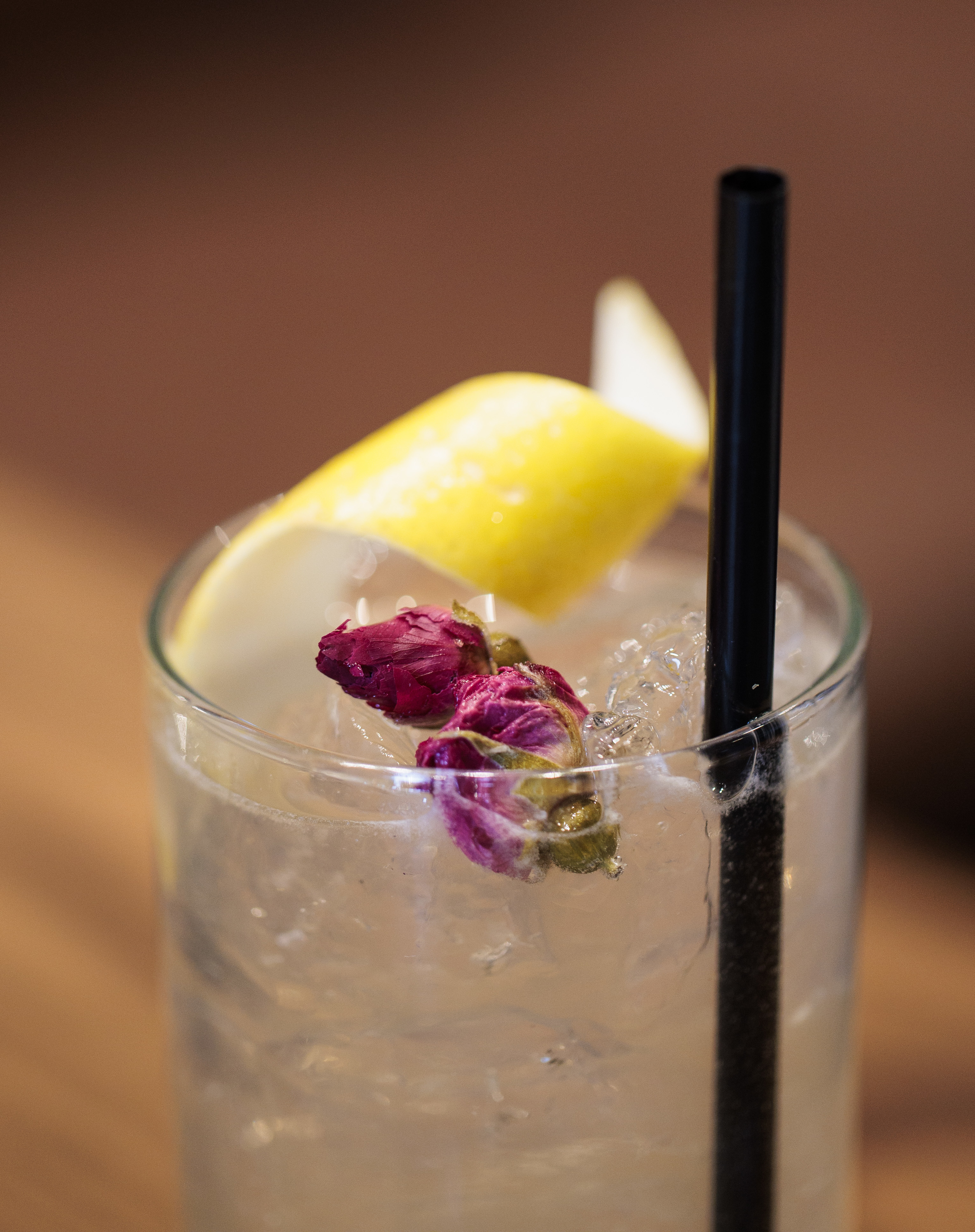
There’s a full bar, including beer, wine, and nine cocktails. Rose Is a Rose, named after Sifford’s wife, is a floral spritz featuring gin, honey, lemon, sparkling rose wine, and a dash of rose water, and it’s garnished with an expressed lemon twist and dehydrated rose buds.
The Rose is a Rose cocktail at Little Horse Tavern.
Fitler’s involvement grew out of its interest in projects with civic impact. Though best known as a members-only club in Center City, Fitler wants to expand its hospitality expertise beyond its walls.
“We look for opportunities where we can contribute something meaningful to the city,” said Smith, whose golf handicap is 13. “This was at the top of the list.”
At Little Horse Tavern (from left): Robert A. Strother, Cobbs Creek manager for Strother Enterprises; Natasha Strother Lassiter, chief strategy officer for Strother Enterprises; Clancy Smith, director of food and beverage; Michael Franco, vice president of operations for Fitler Club; and Jacob Smith, Fitler Club president.
For Strother Enterprises, a family-run food service company that began as a catering business in West Philadelphia, the connection is deeply personal. Robert A. Strother and Natasha Strother Lassiter are first cousins whose fathers — Ernest Strother and Robert Strother Jr. — worked as certified caddies at Cobbs Creek when they were teenagers.
“This was one of their first jobs,” Strother said. “They carried bags here all day, multiple rounds a day. Cobbs Creek was part of their upbringing.”
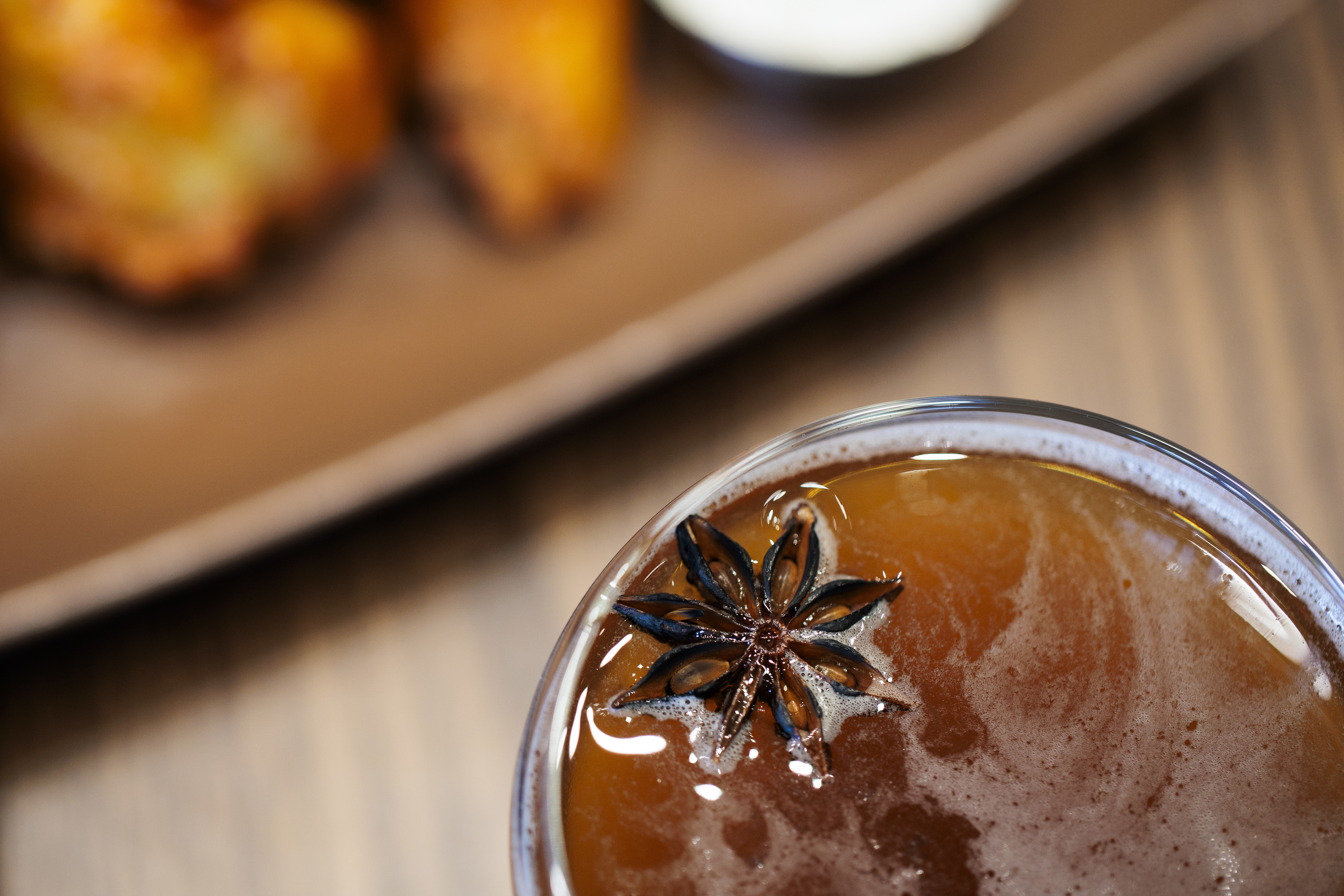
The Shotgun Start cocktail, garnished with absinthe-soaked, torched star anise, at Little Horse Tavern.
Lassiter said returning to the course as partners in its rebirth brings the family’s story full circle. “Being from West Philly, seeing this space restored, and being able to contribute to it in a meaningful way — it’s emotional,” she said. “This isn’t just another project for us.”
Strother manages day-to-day operations and oversees the after-school snack program at the TGR Learning Lab.
“This project isn’t just about hospitality,” Lassiter said. “It’s about community, education, and access.”
Little Horse Tavern, 7403 Lansdowne Ave., 267-900-3740, cobbscreekgolf.org. Initial hours: noon to 8 p.m. daily.
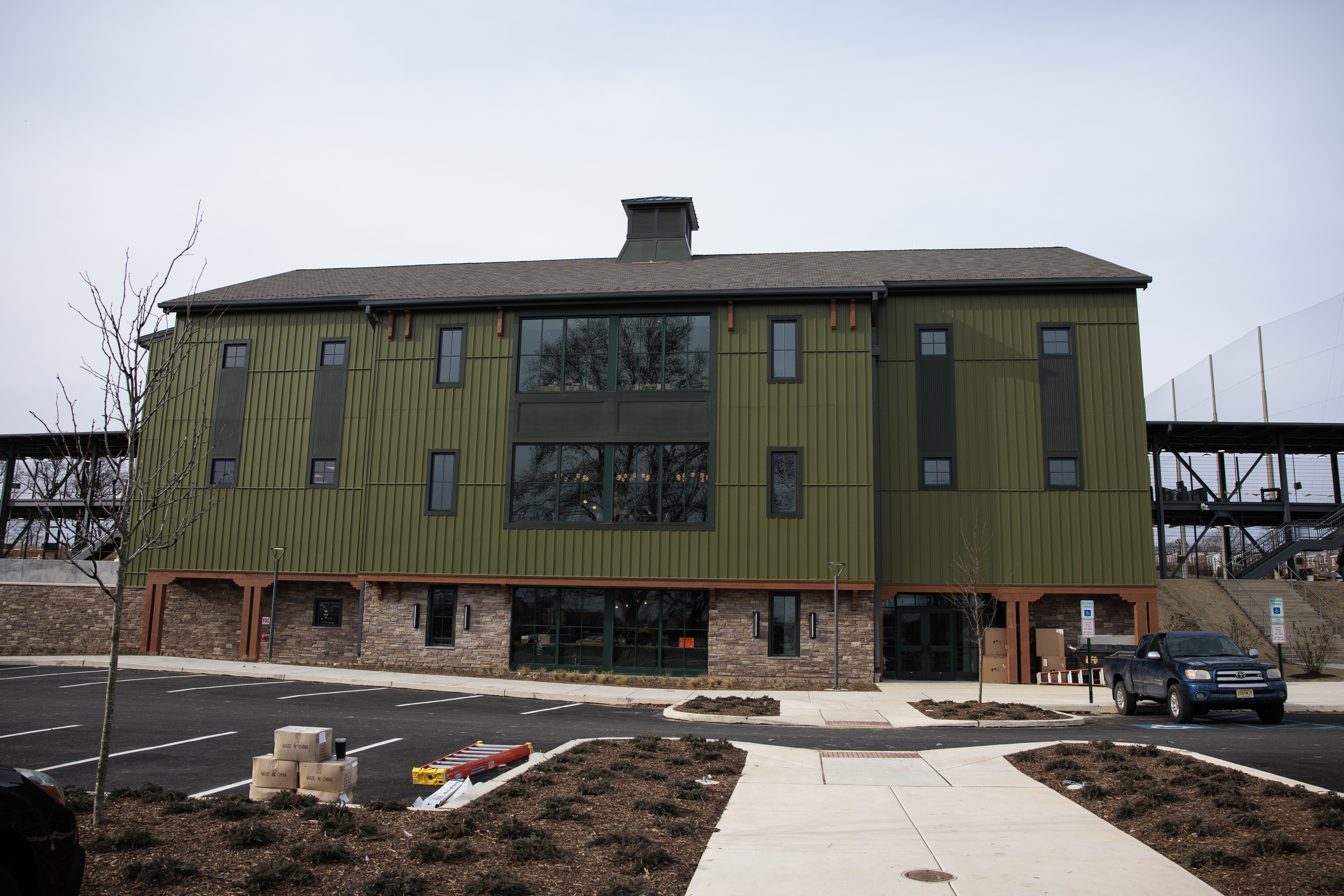
Little Horse Tavern, as seen from Lansdowne Avenue, on Dec. 8.
While you may be familiar with kombucha’s benefits for your gut, one brewer is determined to show that the beverage and its byproducts can also make for excellent skincare.
Phoenixville-based Olga Sorzano, 49, the owner and brewer behind decade-old Baba’s Brew as well as a chef and culinary instructor, has an expansive, multifaceted career — but all her varied interests are united by one thing: fermentation. Her newest venture is A Culture Factory, a line of kombucha-infused skincare products that ranges from toners and masks to scrubs and serums.
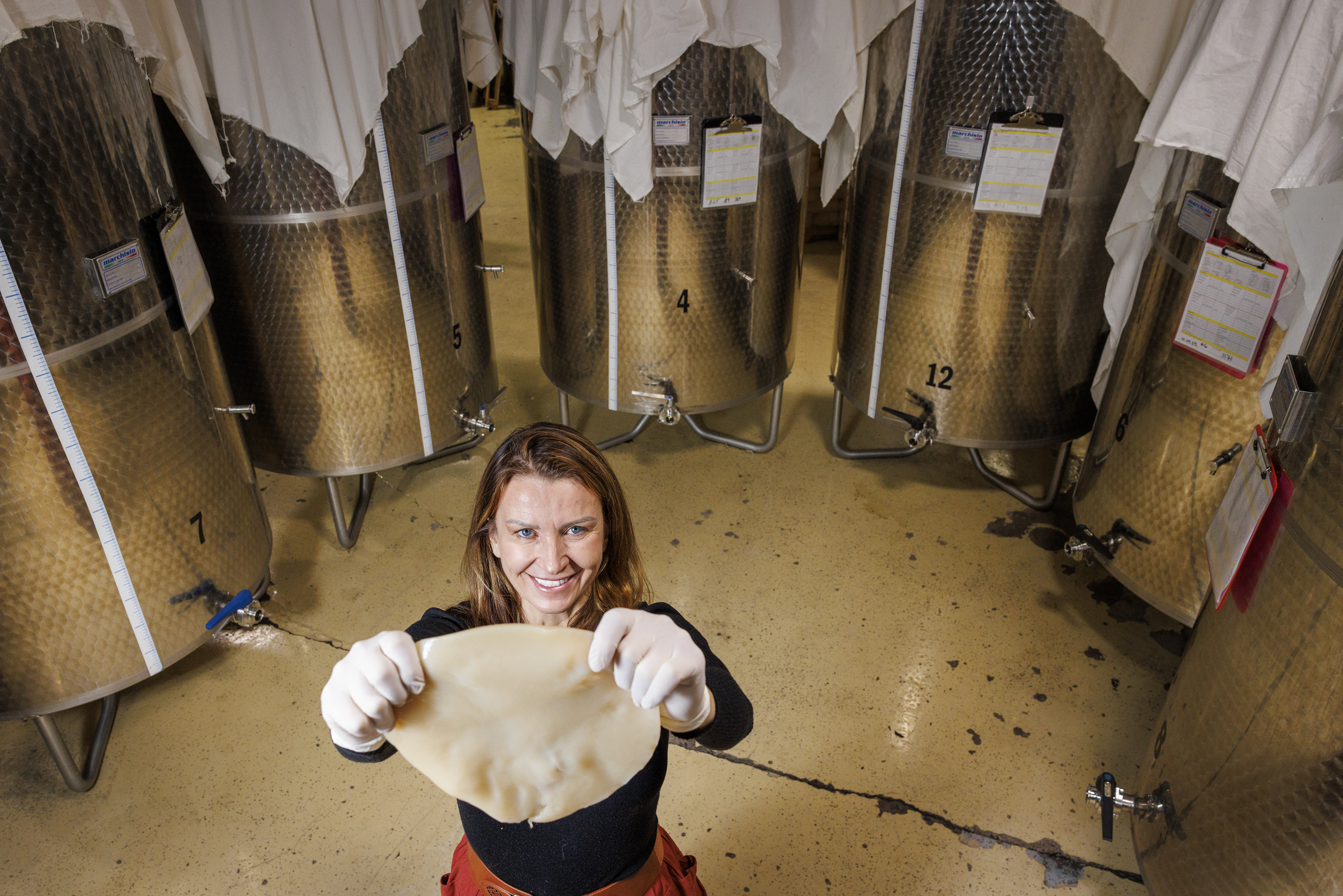
Olga Sorzano, owner of Baba’s Brew of Phoenixville, holding a scoby in the brewing room, Wednesday, December 10, 2025.
“Our skin is alive. Most skincare is like Wonder Bread, designed for shelf-stability, but what if it could be like a beautiful, artisanal loaf of sourdough, which is living and nourishing? It feeds you with a living culture,” said Sorzano.
“As a chef, I want to feed you. And I have a chef’s approach to the skin as well. My great-grandmother and grandmother didn’t have all these [store-bought] solutions. They had lard and they would put it on their elbows. And kombucha vinegar on their skin. If they had berries leftover from making jam, they’d mix it with yogurt for a face mask.”
Sorzano‘s kombucha company generates large amounts of scoby, or the mother culture used as a kombucha starter. “It’s loaded with all these enzymes and I was thinking, how awesome to use some surplus scoby and turn it into face masks.”
Many ingredients from Baba’s Brew — like turmeric, which Sorzano also ferments — make it into A Culture Factory’s products, too, along with tallow from Breakaway Farms in Mount Joy, which Sorzano renders, refines, and blends with green coffee oil for a bright yellow eye butter.
Paying tribute to Baba
“Baba” means grandmother in Russian. Sorzano’s kombucha company, in both its branding and its recipes, is an homage to her great-grandmother, who raised Sorzano in the town of Barnaul, Siberia (close to the Mongolian border) when she was very young.
“I would say, ‘Baba, my belly hurts,’ and she would say, ‘Have some kombucha.’ Or I would say, “My leg hurts,’ and she would also say, ‘Have some kombucha,’ ” said Sorzano with a laugh. She grew up thinking kombucha was everywhere, that everyone had access to it, and that it was a balm for all ills.
If Sorzano’s Baba made kombucha that over-fermented, “she would put it on her skin as a toner.” This was a beauty tip that has followed Sorzano her entire life, brewing as an idea for years until finally blooming into a business concept.
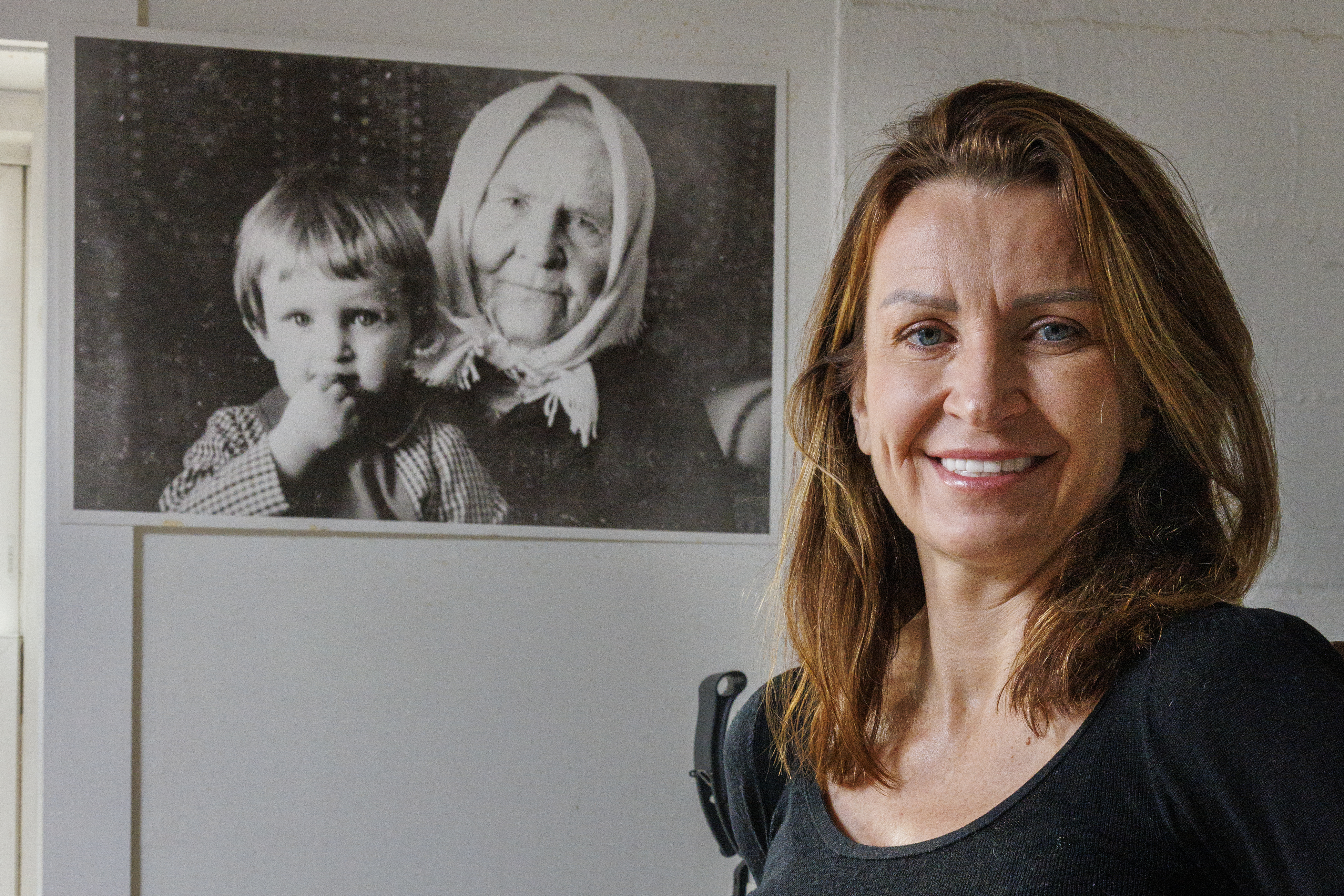
Olga Sorzano, owner of Baba’s Brew, Phoenixville, on Wednesday, December 10, 2025. She is shown in a portrait as a child with her great-grandmother.
Fermentation, and the patience it demands, has long been a part of Sorzano’s family. To survive the long, bitter winters, the women in Sorzano’s family fermented everything they grew in their garden. “When I tell people about my childhood, they think I grew up in the 1700s,” she joked. “We foraged, we would go on mushroom hunts, we’d have a big cabbage day where several families would get together, chop cabbage, and preserve it for the winter.”
Baba’s Brew uses organic, fair-trade tea and sugar as the base for its kombuchas, but otherwise all its ingredients are local, like plums from Frecon Farms, blueberries from Hamilton, N.J., and honey from Swarmbustin’ Honey. They also brew many one-off, seasonal kombuchas, with ingredients like black currants, which frequently show up on Sorzano’s doorstep, brought by small farmers.
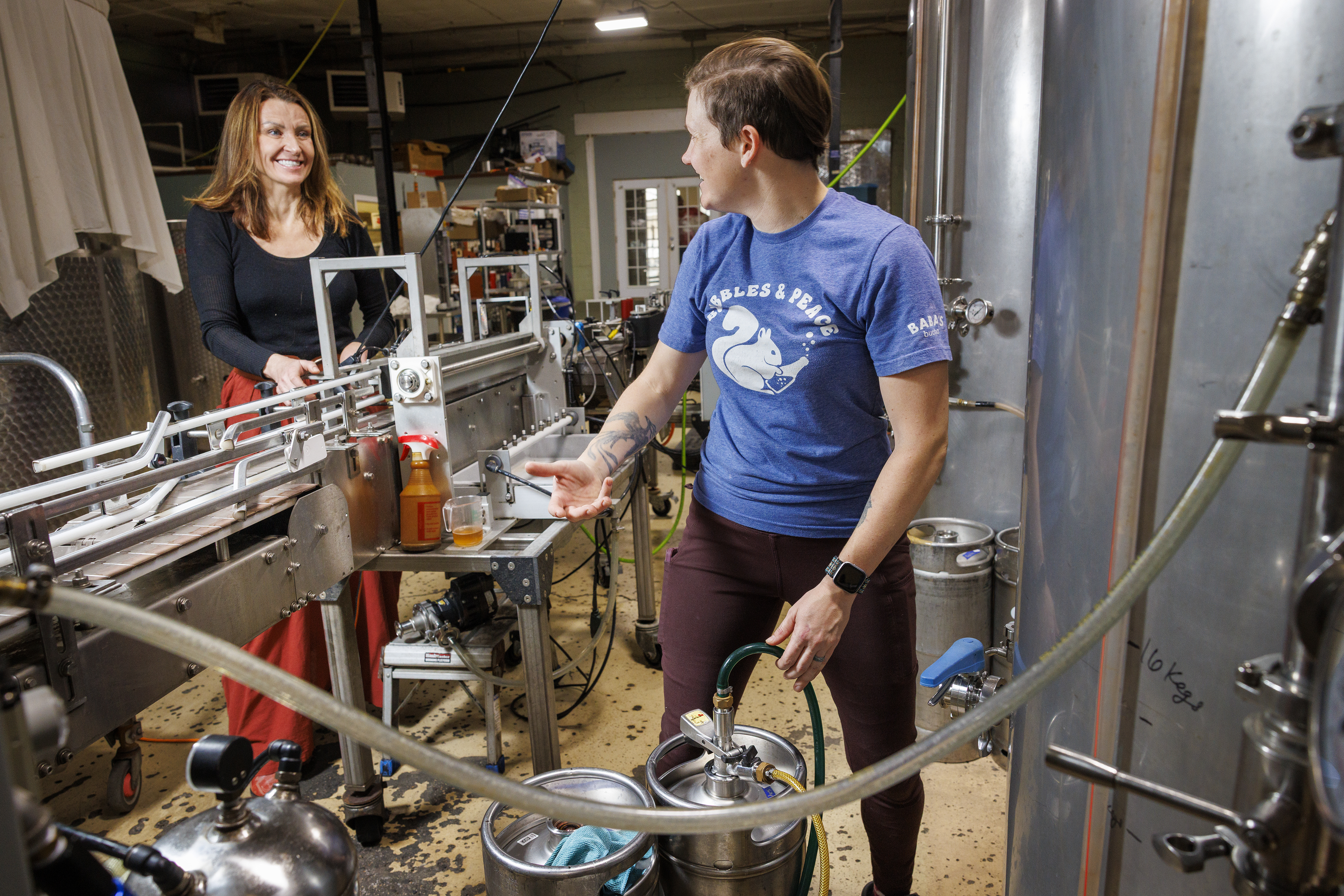
Olga Sorzano, owner of Baba’s Brew, with brewer Sarah Jagiela in the brewing room in Phoenixville on Wednesday, December 10, 2025.
Sorzano came to the U.S. in 2000 as an exchange student with Future Farmers of America after receiving a doctorate in veterinary medicine in Moscow. She worked on a dairy farm in Nebraska for a year, milking cows and doing other farm work, then moved to Florida, met her husband, and when he was offered a job in Philly, moved to the area. She enrolled at the Restaurant School at Walnut Hill College and applied her veterinary school-informed chemistry knowledge to cooking.
“I found cooking very easy, because to me, everything is about chemical reactions,” she said. Cooking eventually led to her opening Baba’s Brew, the spark of which was born at a fermentation festival, where she realized there was a community of people in the U.S. fermenting single ingredients, just as her Baba had. In a sense, she found her own culture, through cultures.
Olga Sorzano, owner of Baba’s Brew, in Phoenixville, Wednesday, December 10, 2025.
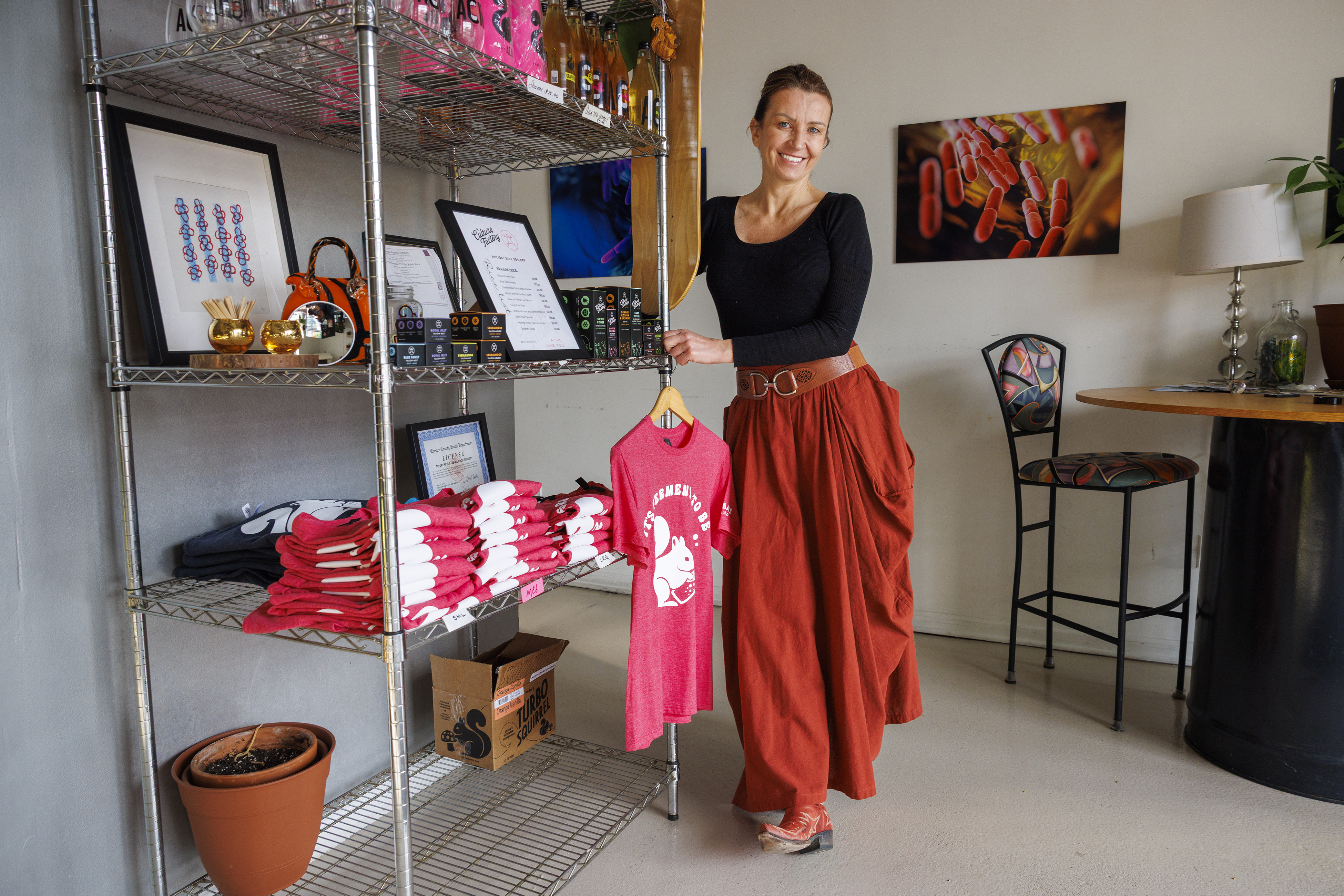
A Culture Factory skincare launched this month and shares its name with the tasting room where Sorzano hosts private events and teaches cooking and fermentation classes (such as making your own kimchi or mastering basic cooking skills). “It’s where I bring people in and teach them to cook but focus on techniques like how to season or layer flavors,” said Sorzano.
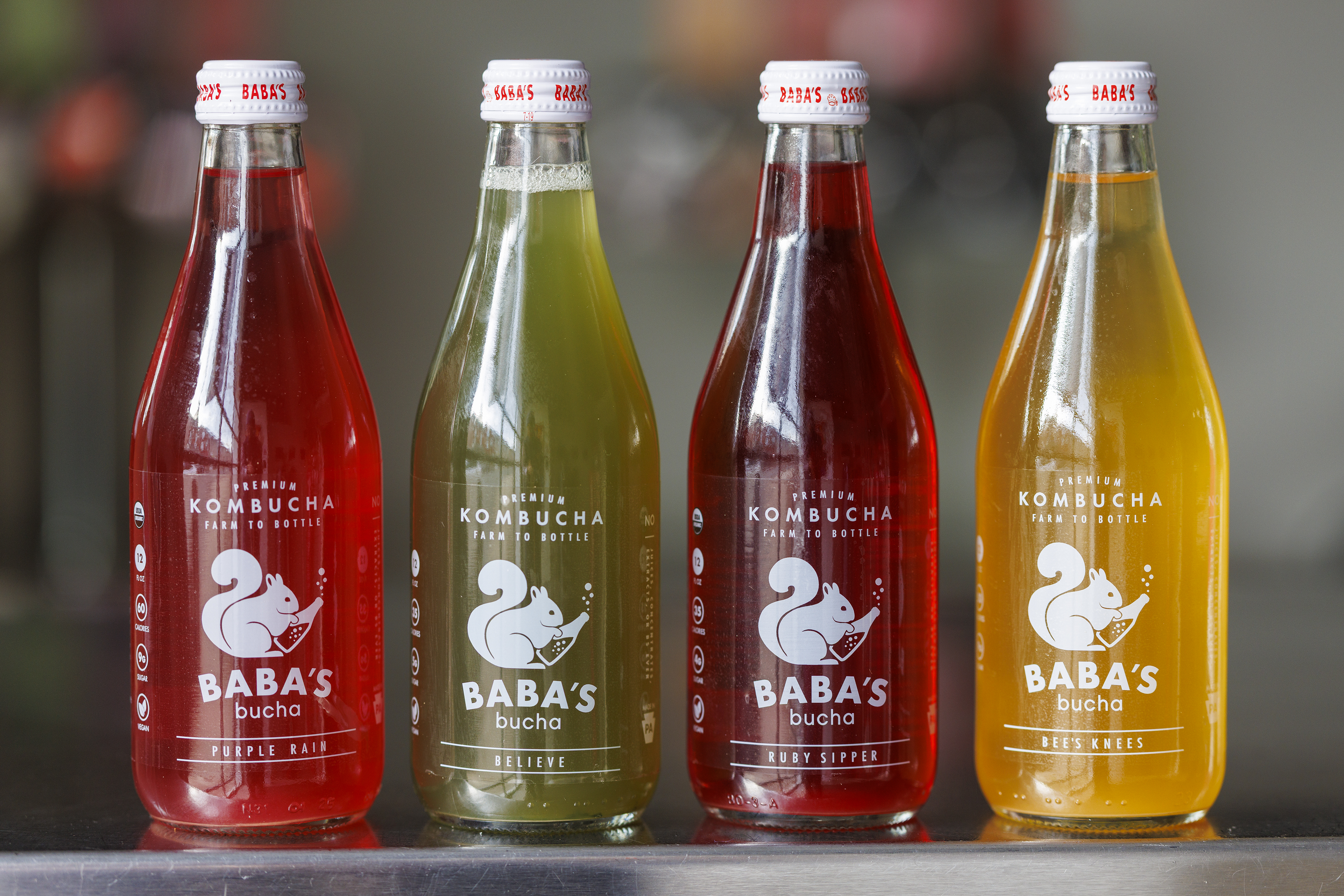
An assortment of kombucha beverage flavors by Baba’s Brews, a Phoenixville, company, Wednesday, December 10, 2025.
Like the notions of producing fermentation “mothers” and the actual mothers in Sorzano’s family who treated every ailment with kombucha, Sorzano’s life has been threaded with yet another motif: the squirrel. She constantly “squirrels” ingredients away to ferment them.
The logo for Baba’s Brew is a squirrel because “Baba’s nickname was Belka [the Russian word for ”squirrel”]. And when we moved into this brewery, we had a squirrel infestation and we had to call animal control to remove them from the attic. And when we moved to our farmhouse, we had a flying squirrel infestation. I safely captured and released all 18 of them,” said Sorzano, proudly.
The tasting room is adjacent to the now-squirrel-free brewery in which Baba’s Brew produces 4,000 liters of kombucha per week. There, along with Baba’s Brew’s eight kombuchas on tap, you can now purchase Sorzano’s handmade skincare products, as carefully and locally sourced as the fruit that goes into her kombuchas.