Tag: topic-link-auto

  • Mental health workers in Philadelphia unionize following changes in their workplace and patient care

    Mental health workers in Philadelphia unionize following changes in their workplace and patient care

    Mental health professionals at Rogers Behavioral Health in West Philadelphia have formed a union, citing increased workloads and business changes that diminished patient care.

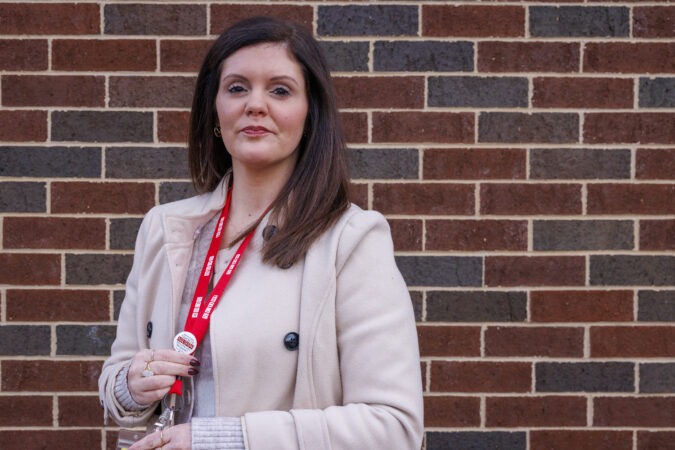
    The nonprofit mental healthcare provider last year transitioned from individual patient sessions to a group care model, said Tiffany Murphy, a licensed professional counselor and therapist at the facility. Some workers there were also moved from salaried to hourly positions then forced to reduce hours, their union has said.

    Some patients and workers have left amid the changes, says Murphy, estimating that 22 of her colleagues have quit in the past year.

    “A lot of us sort of put our jobs on the line by [unionizing], because we believe in the organization, but more so, we believe in our patients. We wanted to provide the best patient care that we possibly could for them,” said Murphy.

    The 19 West Philadelphia Rogers employees, including therapists and behavioral specialists, filed their petition last month to unionize with the National Union of Healthcare Workers. Rogers voluntarily recognized the union, according to NUHW, marking the union’s first unit in Pennsylvania.

    NUHW represents some 19,000 healthcare workers, primarily in California.

    Sal Rosselli, NUHW president emeritus, said the union is pleased that Rogers accepted the petition. “All too often, employers do the opposite and put together very anti-union campaigns, spending all kinds of patient care dollars to prevent their workers from organizing,” he said.

    The Philadelphia metro area, which also includes Camden and Wilmington, has the fifth-highest number of working therapists among U.S. metros, according to the Bureau of Labor Statistics. This region employs just over 500 therapists, with average salary of $79,510.

    A spokesperson for Rogers declined to comment on employees’ organizing efforts and remarks on workplace changes.

    Rogers provides addiction treatment and mental healthcare with facilities in 10 states. In Philadelphia, the nonprofit offers outpatient treatment and partial hospitalization, treating patients with depression, anxiety, and obsessive-compulsive disorder.

    In recent years, Rogers workers in California also unionized with NUHW. Their recently forged union contract includes caseload limits and a cap on how many newly admitted patients can be assigned to each therapist or nurse.

    Thousands of healthcare workers in the Philadelphia area have moved to unionize in recent years.

    Within the past few years, residents at Penn Medicine and the Rutgers University health system finalized their first contracts with their health systems, and attending doctors at ChristianaCare became the first group of post-training physicians in the region to unionize. Residents at Temple University Hospital, Thomas Jefferson University Hospitals, ChristianaCare, and Jefferson’s Einstein Healthcare Network also voted to unionize in early 2025. Residents at Children’s Hospital of Philadelphia narrowly voted against joining a union.

    The organizing push means that about 81% of the city’s resident physicians are unionized.

    What do workers want?

    When Murphy first started working at the Rogers facility in Philadelphia 4½ years ago, she said there was “a really good work-life balance.”

    At the time, clinicians had four patients per day, provided individualized care, and led group sessions. As the organization moved toward group counseling, she said, caseloads have grown, with up to 12 patients in each group.

    The organization hired behavioral specialists to support therapists, said Murphy, but “it was difficult to provide the patients with the care that they really needed and deserved with the new structure.”

    Some patients and staff left because of the new model, said Murphy.

    This year, some salaried workers were switched to hourly, and Rogers started sending workers home due to low patient demand, leaving the rest with larger workloads, according to the union. That meant some used paid time off to avoid going without pay, said Murphy.

    When Philadelphia Rogers employees heard their colleagues in California were unionizing, “That became a bit enticing to us,” said Murphy, noting the workplace had become challenging and sometimes “unbearable.”

    Now, she says, the union members want more manageable caseloads — or pay increases to account for the larger caseloads — and a return to the old pay model for those who were switched to hourly work.

    “We are unionizing to have a voice at work that will allow us to promote a healthier work-life balance as well as high-quality sustainable patient care,” therapist Sara Deichman said in a union news release.

    Where else have mental health workers unionized?

    The organizing in Philadelphia comes as the U.S. faces a shortage of mental healthcare professionals, and in the wake of a demand surge from the pandemic.

    “The industry is forcing fewer providers to care for more and more patients because the focus is on the bottom line,” said Rosselli.

    Staffing concerns plague the healthcare industry generally, said Rebecca Givan, an associate professor at Rutgers University’s School of Management and Labor Relations.

    “If the facility wants to hold down costs, it tries to keep staffing levels as low as possible,” said Givan. “In the case of mental health providers, it can be about shortening appointment times or increasing caseloads so that each provider has a very large number of cases or clients.”

    She says there’s not “a huge amount of union representation” in stand-alone behavioral health facilities, but some public hospitals are unionized.

    Private practice mental health workers can’t unionize because they’re self employed, Givan noted, but “one could argue that they might benefit from collectively negotiating, for example, with the insurance companies that determine their reimbursement rates.”

    NUHW is leading efforts to organize independent providers. The goal, Rosselli says, is to “establish an employer for them so that they can have leverage against insurance companies to increase pay and increase access to patient care issues.”

    The union has already done this in the home care industry in California, Rosselli noted.

    Staff reporter Aubrey Whelan contributed to this article.
  • These 20 Philadelphia neighborhoods will have painted Liberty Bell replicas for 2026

    These 20 Philadelphia neighborhoods will have painted Liberty Bell replicas for 2026

    Philly is getting ready to dress itself up — with Liberty Bells. Lots of Liberty Bells.

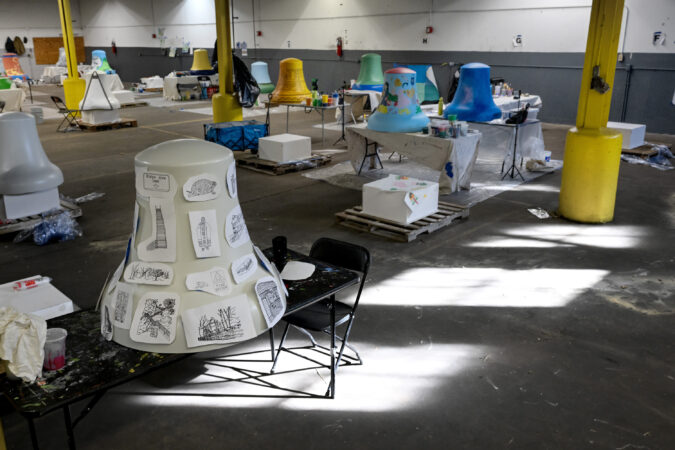
    Organizers of Philadelphia’s yearlong celebrations for America’s 250th anniversary in 2026 gathered in a frigid Philadelphia School District warehouse in Logan on Tuesday, offering a special preview of the 20 large replica Liberty Bells that will decorate Philly neighborhoods for the national milestone.

    Designed by 16 local artists selected through Mural Arts Philadelphia — and planned for commercial corridors and public parks everywhere from Chinatown and South Philly to West Philly and Wynnefield — the painted bells depict the histories, heroes, cultures, and traditions of Philly neighborhoods.

    As part of the state nonprofit America250PA’s “Bells Across PA” program, more than 100 painted bells will be installed across Pennsylvania throughout the national milestone, also known as the Semiquincentennial. Local planners and Mural Arts Philadelphia helped coordinate the Philly bells.

    “As Philadelphia’s own Liberty Bell served as inspiration for this statewide program, it makes sense that Philly would take it to the next level and bring these bells to as many neighborhoods as possible,” Mayor Cherelle L. Parker said in a statement. “We are a proud, diverse city of neighborhoods with many stories to tell.”

    Kathryn Ott Lovell, president and CEO of Philadelphia250, the city’s planning partner for the Semiquincentennial, said the bells are a key part of the local planners’ efforts to bring the party to every Philly neighborhood.

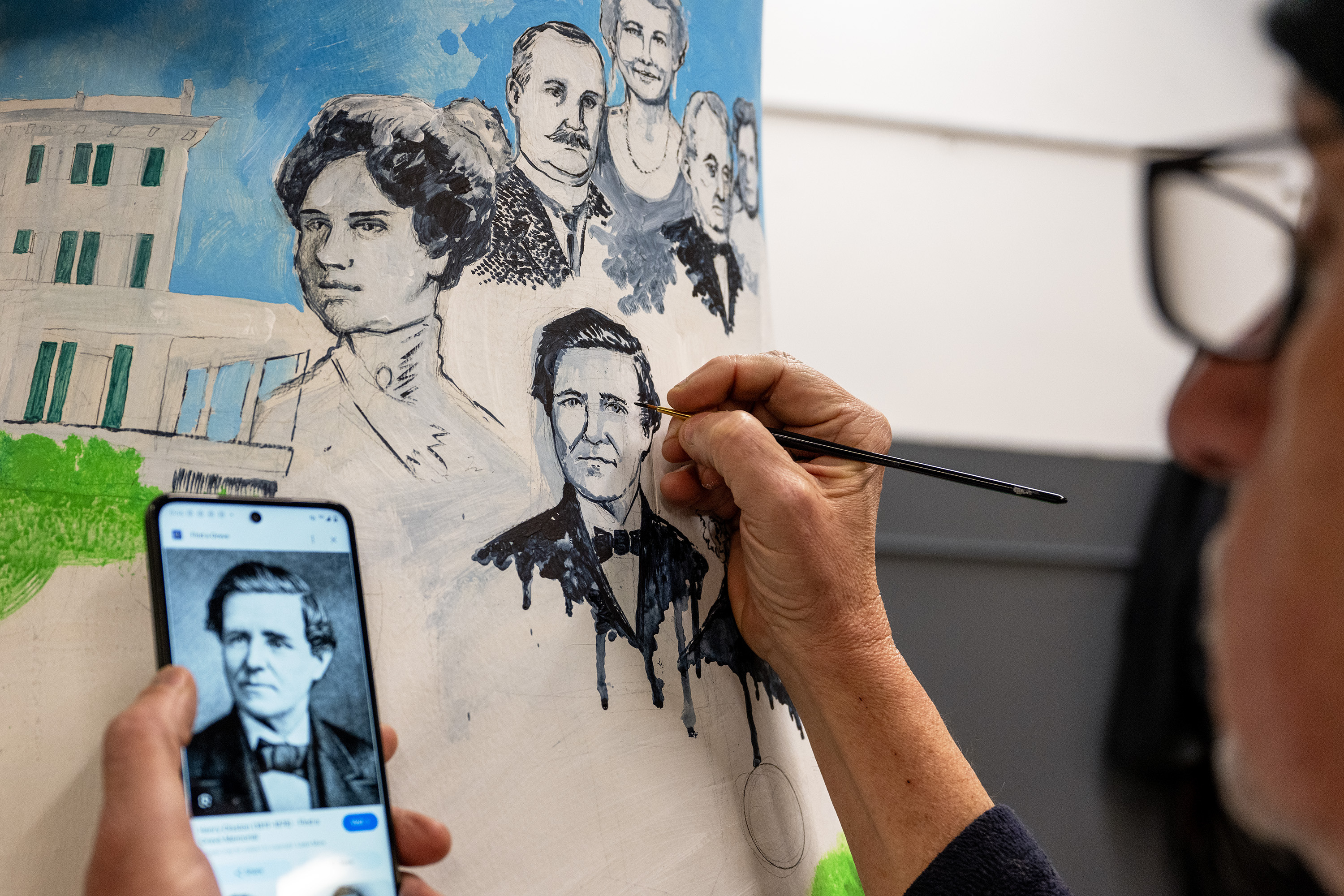
    Local artist Bob Dix paints a portrait of industrialist Henry Disston on his bell.

    “The personalities of the neighborhoods are coming out in the bells,” she said, adding that the completed bells will be dedicated in January, then installed in early spring, in time for Philly’s big-ticket events next summer, including six FIFA World Cup matches, the MLB All-Star Game, and a pumped-up Fourth of July concert.

    Planners released a full list of neighborhoods where the bells will be placed, but said exact locations will be announced in January. Each of the nearly 3-foot bells — which will be perched on heavy black pedestals — was designed in collaboration with community members, Ott Lovell said.

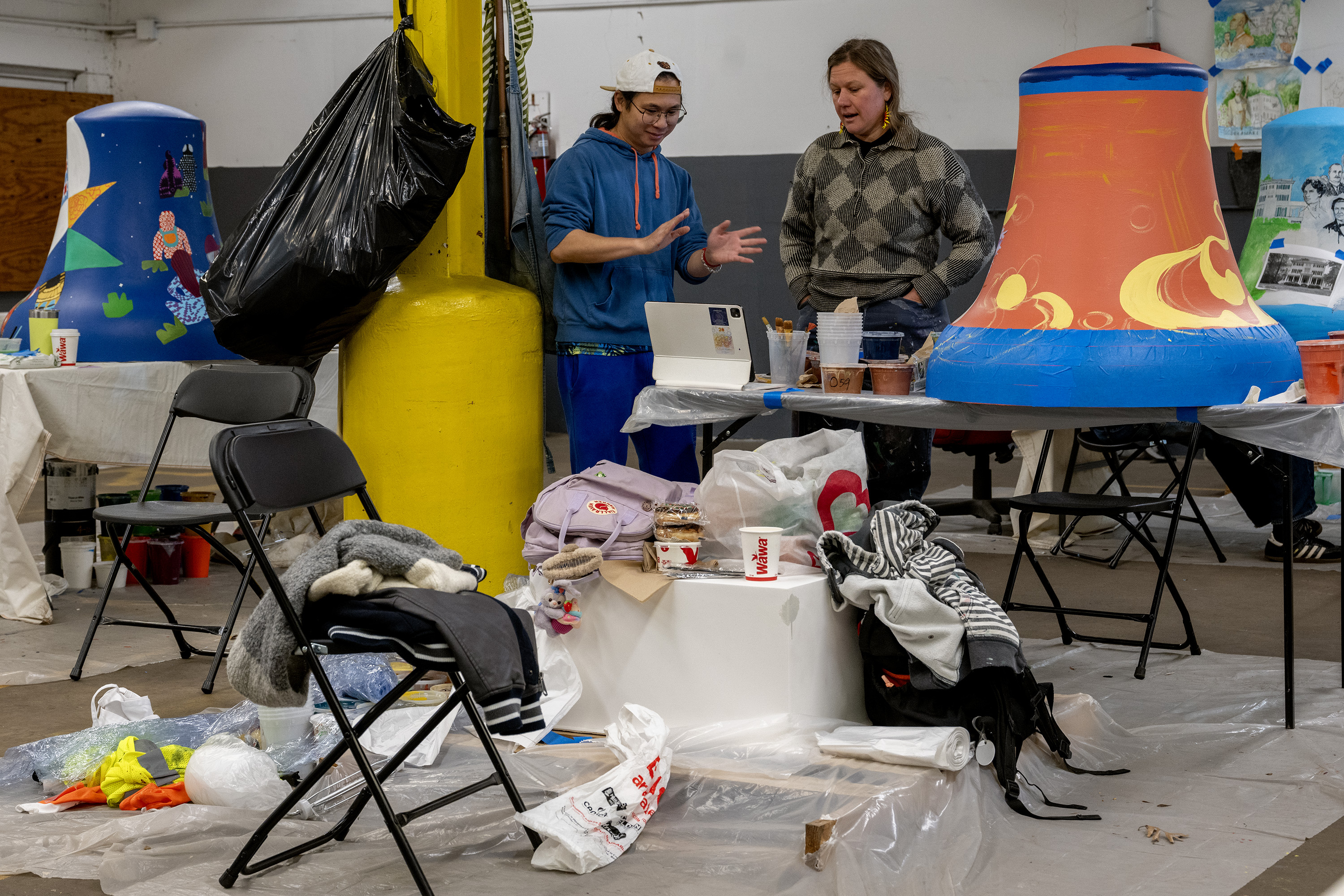
    Inside the massive, makeshift studio behind the Widener Memorial School on Tuesday, artists worked in the chill on their bells. Each bell told a different story of neighborhood pride.

    Chenlin Cai (left) talks with fellow artist Emily Busch (right) about his bell, showing her concepts on his tablet.

    Cindy Lozito, 33, a muralist and illustrator who lives in Bella Vista, didn’t have to look for inspiration for her bell on the Italian Market. She lives just a block away from Ninth Street and is a market regular.

    After talking with merchants, she strove to capture the market’s iconic sites, history, and diversity. Titled Always Open, her bell includes painted scenes of the market’s bustling produce stands and flickering fire barrels, the smiling faces of old-school merchants and newer immigrant vendors, and the joy of the street’s annual Procession of Saints and Day of the Dead festivities. Also, of course, the greased pole.
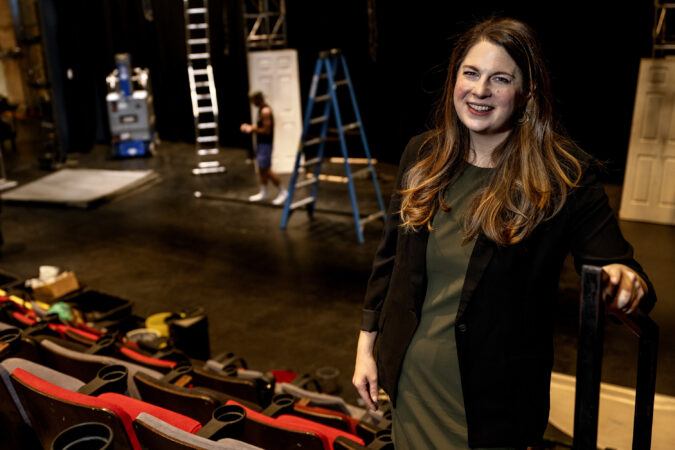
    “It’s a place where I can walk outside my house and get everything that I need, and also a place where people know your name and care about you,” she said, painting her bell.

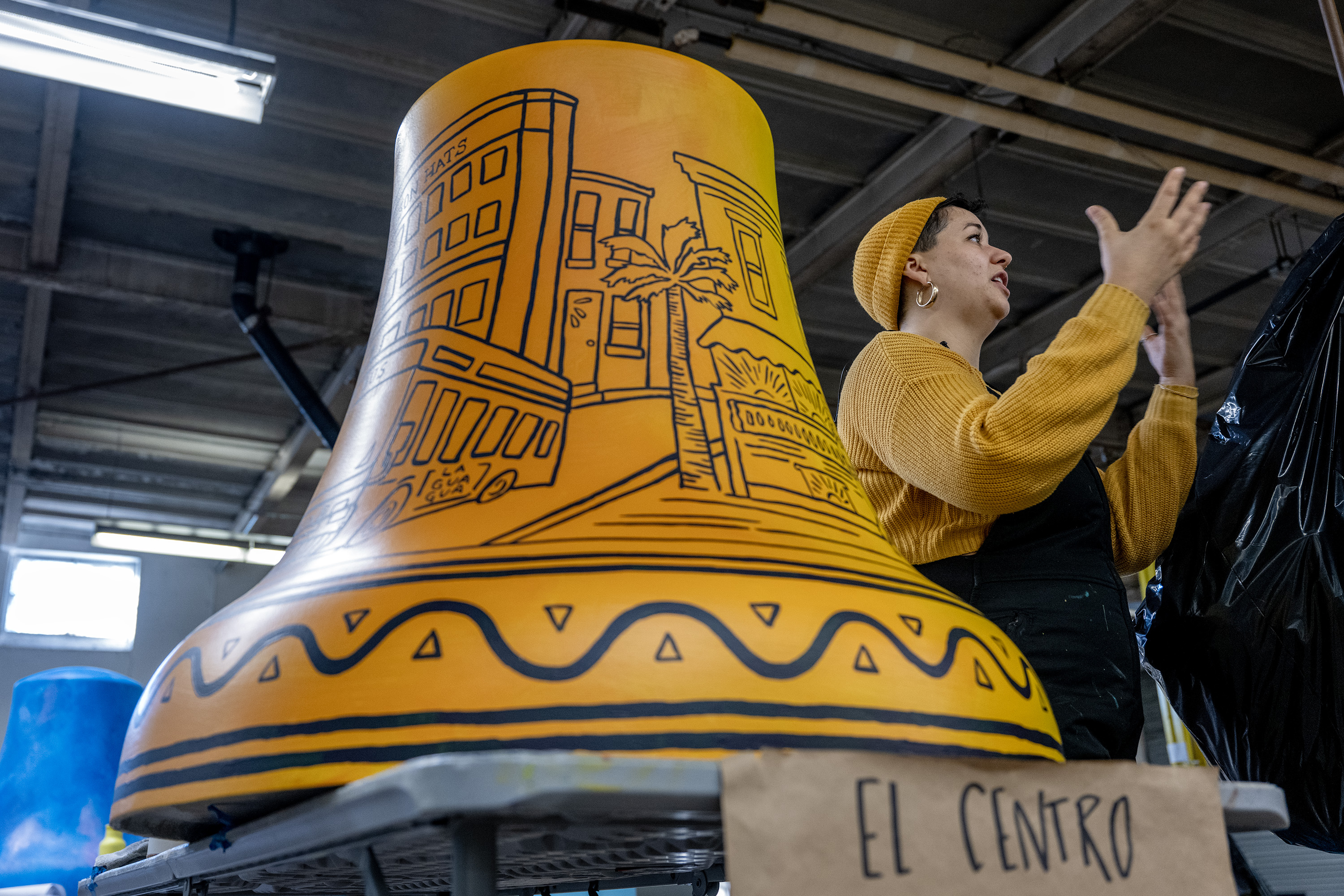
    For her bell on El Centro de Oro, artist and educator Symone Salib, 32, met twice with 30 community members from North Fifth Street and Lehigh Avenue, asking them for ideas.

    “From there, I had a very long list,” she said. “People really liked telling me what they wanted to see and what they did not.”

    Local artist Symone Salib talks with a visitor as she works on her bell.

    Titled The Golden Block, the striking yellow-and-black bell depicts the neighborhood’s historic Stetson Hats factory, the long-standing Latin music shop Centro Musical, and popular iron palm tree sculptures.

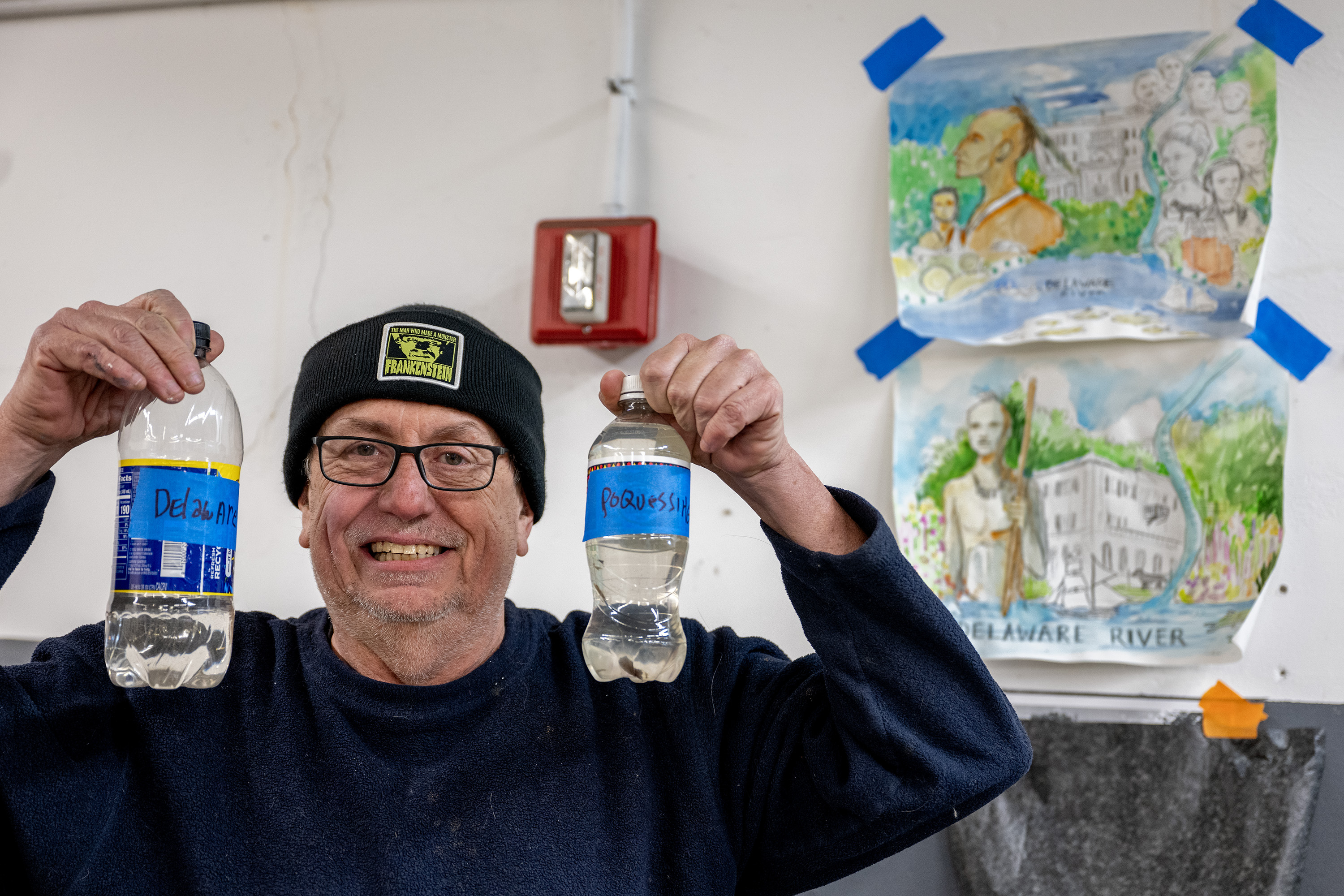
    To add that extra bit of authenticity to his bell depicting Glen Foerd, artist Bob Dix, 62, mixed his paints with water bottled from the Delaware River, near where the historic mansion and estate sits perched in Torresdale, overlooking the mouth of Poquessing Creek.

    “I like to incorporate the spirit of the area,” he said, dabbing his brush in the river water. “I think it’s important to bring in the natural materials.”

    Local artist Bob Dix displays waters he collected from the Delaware River and Poquessing Creek to use in his painting of one of 20 replica Liberty Bells representing different neighborhoods Tuesday, Dec. 9, 2025.

    Planners say they expect the bells to draw interest and curiosity similar to the painted donkeys that dotted Philadelphia neighborhoods during the 2016 Democratic National Convention.

    Ott Lovell said organizers will install the bells around March to protect them from the worst of the winter weather.

    “I don’t want any weather on them,” she said with a smile. “I want them looking perfect for 2026.”
    The bell locations

    • Chinatown

    • City Hall

    • El Centro de Oro

    • Fox Chase

    • Germantown

    • Hunting Park

    • Logan Square

    • Mayfair

    • Mount Airy

    • Ogontz

    • Olney

    • Parkside

    • Point Breeze

    • Roxborough

    • South Philadelphia

    • Southwest

    • Torresdale

    • University City

    • West Philadelphia

    • Wynnefield

  • A former Daily News sportswriter’s toy drive gives South Philly kids the ‘Christmas they deserve’

    A former Daily News sportswriter’s toy drive gives South Philly kids the ‘Christmas they deserve’

    The thought returns early every December as Ed Barkowitz asks himself why he still does it. He has organized a toy drive for 23 years, a task that feels more arduous each December. He’s 55 years old, teaches a college course, works with his family business, stays active as a freelance writer, and has to deal with the ever busy — and ever growing — holiday season.
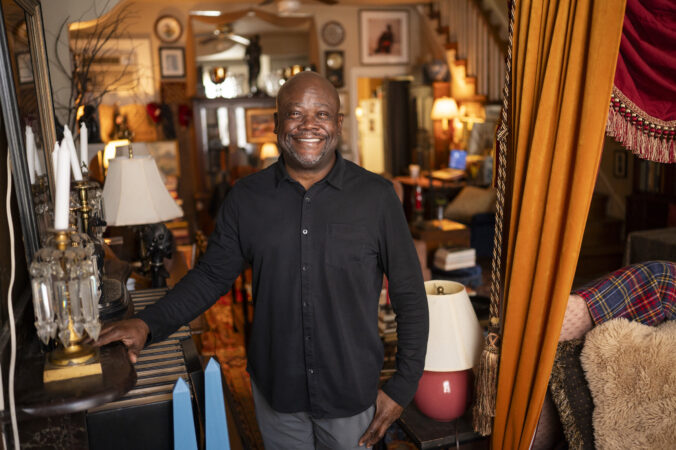
    “I’m thinking I must be nuts,” Barkowitz said.

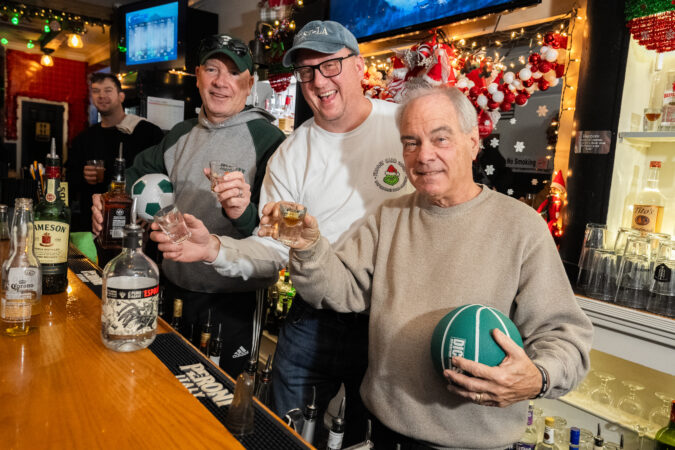
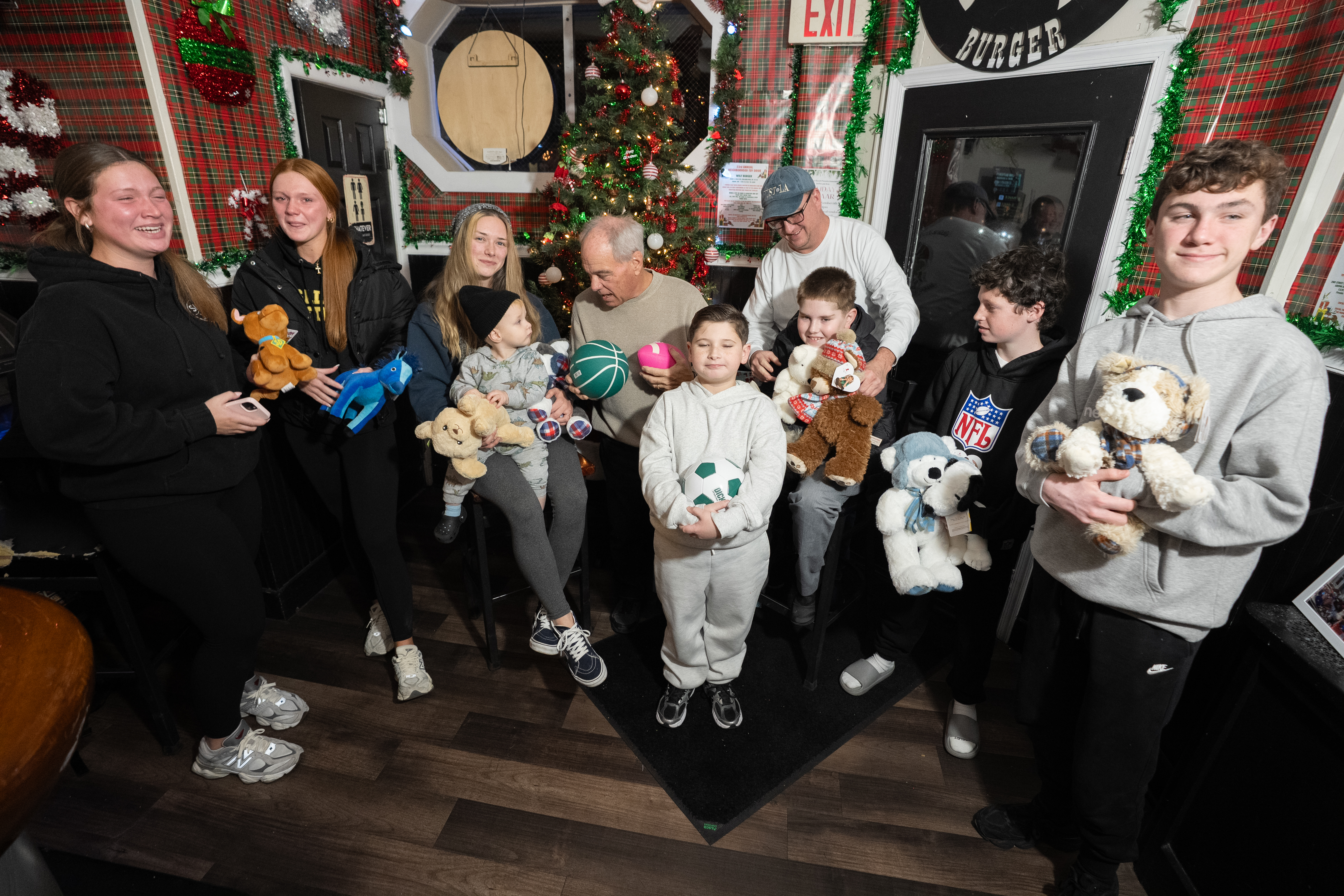
    But the donation boxes throughout his South Philadelphia neighborhood soon fill with toys. His friends — especially the ones he worked with for more than 30 years at the Daily News — soon pack a corner bar on a Friday night. And then he watches his nieces and nephews use the money collected to buy enough gifts for more than 50 South Philly families to have presents on Christmas morning.

    His tradition started on a whim one December when Barkowitz found himself behind the bar at Downey’s, the since-closed Irish pub on South Street. Barkowitz made $100 but didn’t feel right keeping the cash so close to Christmas. So he bought toys and dropped them into a donation box. A tradition was born.

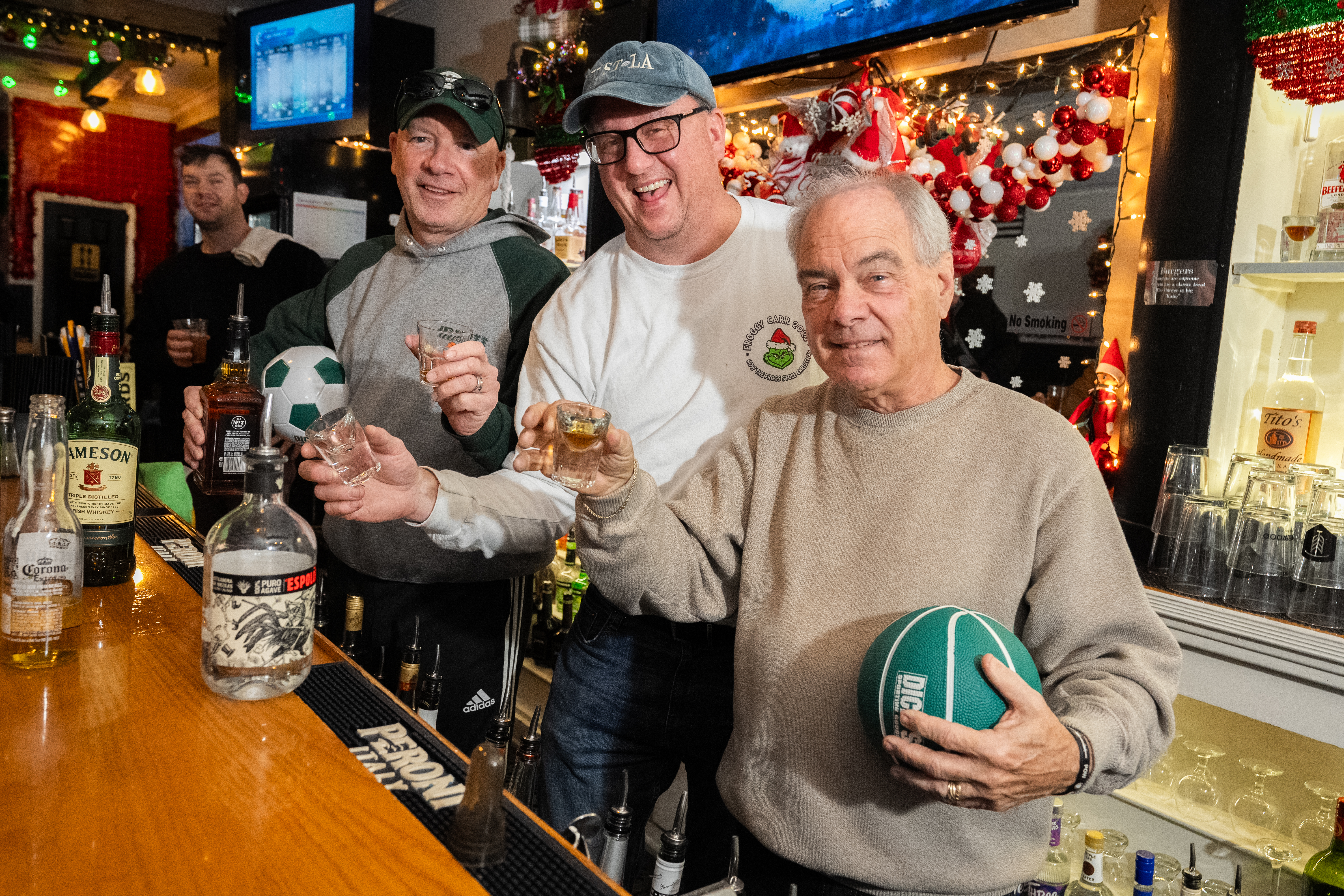
    Enjoying the festivities at Wolf Burger, from left: Emma O’Hara, Madden Wilson, Eden McLaughlin, Gabriel McLaughlin, Mike Kern, Luke Polchenko, Brian Burkhardt, Ed Barkowitz, Colin Pooler, and Carter Wilson.

    A year later, he held a fundraiser at Downey’s to raise money for a toy drive. It became a thing, a packed event every December where former Daily Newsers get together and tell old stories. Other people filter in — neighborhood guys, Big 5 basketball coaches, even Chase Utley once — and everyone knows that the tips are for the kids.

    It’s easy then for Barkowitz to remember why he still does it.

    “The parents come in to pick up the toys and they’re crying,” said Nicole Holt of Whitman Council, the neighborhood group that helps Barkowitz deliver the toys. “Or after Christmas, we’ll get phone calls because we made their kids cry and how appreciative everyone is. It’s like, ‘Oh my God, my kid had an unbelievable Christmas’ or ‘You made my daughter cry because you gave her this.’ We get thank-yous the whole month of January. It’s for the kids who deserve a Christmas but their parents can’t give them a Christmas.”

    A Daily News friendship

    Barkowitz’s father served in the Army with Frank Dougherty, who wrote for the Daily News under the byline the Phantom Rider.

    “He would break SEPTA’s [chops] when an escalator wasn’t working or service was bad,” Barkowitz said. “He was terrific.”

    The Phantom Rider helped Barkowitz get an entry-level gig on the paper’s news desk after he graduated from St. Joseph’s Prep. It didn’t take long for Barkowitz, who grew up at 4th and Porter, to find his way to the sports department.

    He became a valued utility player as he could create a graphic, write a headline, cover a Phillies game, and write 50 interesting things about an athlete you didn’t know were interesting.

    The People Paper with the back-page headlines had can’t-miss writers like Phil Jasner, Rich Hofmann, Dick Jerardi, Ted Silary, and Stan Hochman. They also had guys like Barkowitz, who could fill in anywhere.

    “You couldn’t have a better friend than Eddie,” said Pat McLoone, Barkowitz’s former sports editor. “I remember when we moved the offices to Center City, and you couldn’t walk down the block at lunchtime without someone stopping Eddie. He has his hands in everything. He’s just friends with everyone and so well-connected.”

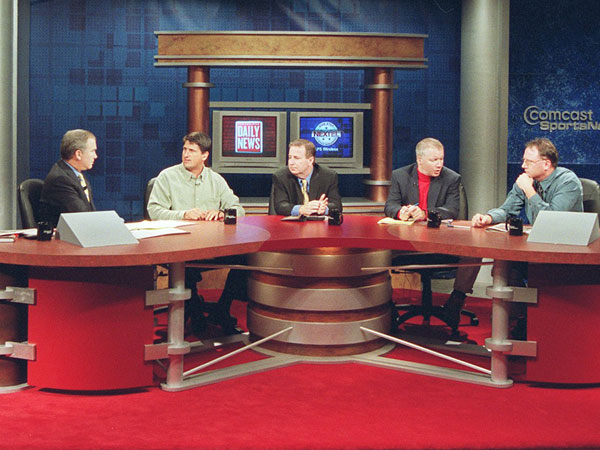
    The “Daily News Live” broadcast on Oct. 10, 2002. From left are Michael Barkann, Keith Jones, Dick Jerardi, Bob Cooney, and Ed Barkowitz.

    Barkowitz’s desk at Broad and Callowhill was next to Mike Kern, who covered college sports and has the Northeast Philly-est of Northeast Philly accents. Kern complained one Monday morning about his son’s T-ball team — “They friggin’ stink,” he said — and a friendship was born. “That’s my kind of guy,” Barkowitz thought.

    So it makes sense that Kern is behind the bar every December with Barkowitz, pouring Guinness for Jay Wright after they tell the coach he would be crushed for drinking red wine in an Irish spot. They became the perfect pair when the place was packed and the donations were flowing.

    “Eddie has a kind heart and soft spot for kids and this is his way of giving back,” McLoone said. “But it comes off as just another Friday night for him at a bar surrounded by people who know him.”

    ‘We did it again’

    The toy drive used to collect enough toys to fill a small pickup truck.

    “Now I have to use a 20-foot truck,” said Barkowitz, who freelances for The Inquirer.

    Barkowitz places boxes in South Philly bars and diners for people to drop in toys. More toys — even bikes — are brought to the bar on fundraiser night. The tips that night are used for more gifts, and everything is dropped off to Holt, who makes sure they get under the right trees.

    “Look, I’m a Northeast Philly person. But South Philly knows how to do some things,” Kern said. “They just know how. And this is one of those things. I’m not saying Northeast Philly or North Philly or West Philly [people] don’t. I’m sure there’s people in all these neighborhoods who are doing things for people. But I’m sure there’s a lot of families and kids who are touched by what Eddie does.”

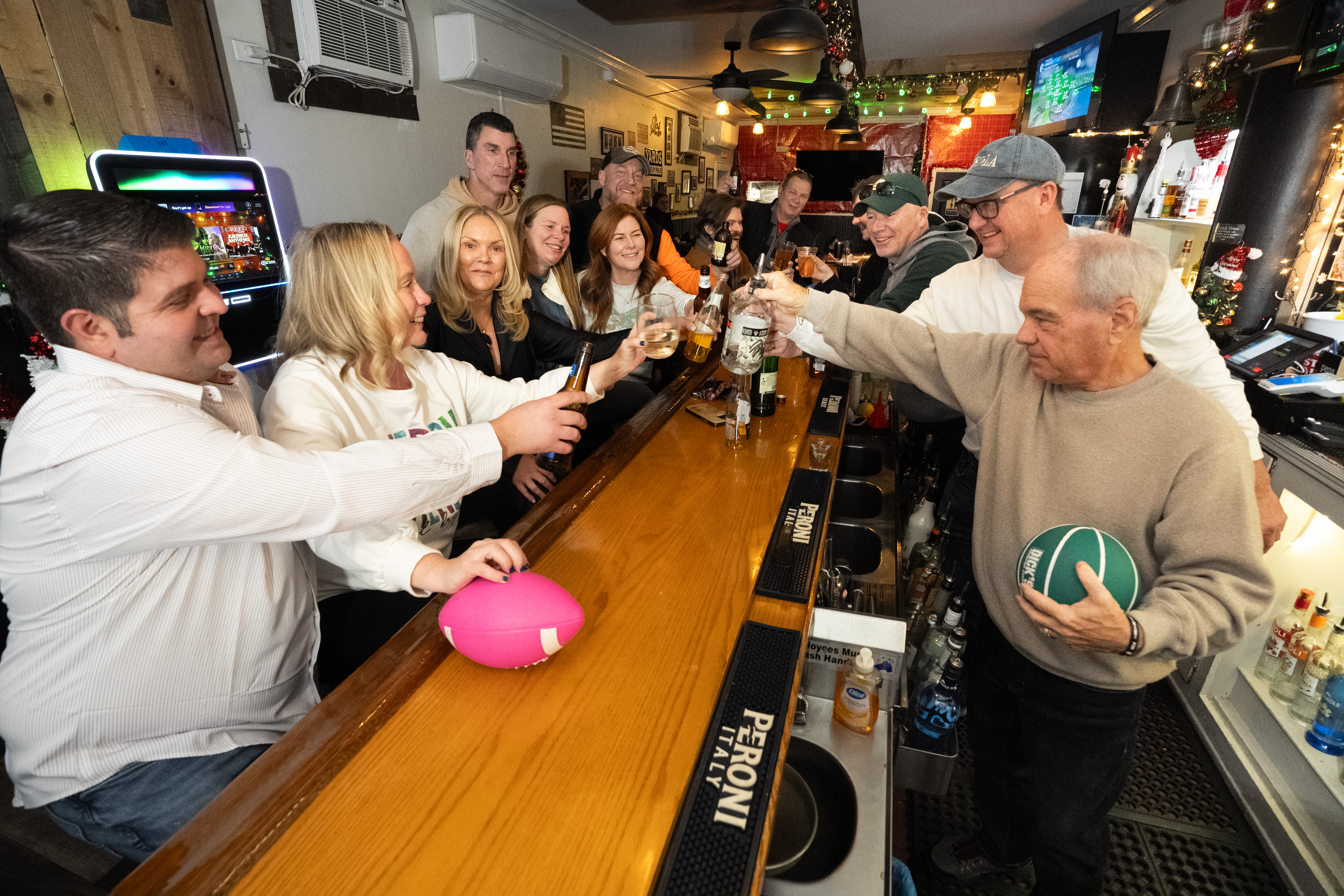
    Raising a toast at Wolf Burger, from left, are John Thomas, Jen Barkowitz, Amy Reilly, Russell Wilson, Leigh-Ann Wilson, Ashleigh Renzi, Chris Wray, Joe Ferretti, Bob Cooney, Ed Barkowitz, and Mike Kern.

    The toy drive was Barkowitz’s idea, but he takes little credit. He says Kern helps draw people to the bar, his girlfriend, Amy Reilly, keeps it churning by “doing the things that don’t show up in the box score,” and his nieces and nephews do the shopping before Holt takes it to the finish line.

    Barkowitz said he has plenty of “elves.” But none of this would have happened if he pocketed the money he earned years ago at Downey’s.

    “It’s a wonderful thing Eddie does, but he just does it so naturally,” McLoone said. “Kern with him is the perfect wingman. He has these Christmas balls hung around his neck. People are asking for drinks. Eddie knows his way around the bar, and Kern has no clue but he’s laughing through it and throwing out crazy lines. It’s one of those only-in-Philly things.”

    This year’s event is Friday at Wolf Burger at Front and Wolf Streets. The bar will be packed, and old stories will flow. Bob Cooney, another former Daily News scribe, will be behind the bar because Kern is on vacation.

    “It’s almost like one of those things that you can’t miss,” said the guy who is missing it. “I’ll never cease to be amazed by the generosity of people who come, give you a $20, and say, ‘Give me two beers.’ I go to give them the change and they say, ‘No, put it in the thing.’ That happens 50 times a night. People want something to feel good about.”

    The event is a chance to see people you may only see once a year.

    “It’s sort of like an annual Christmas party for the misfits, which is what we were,” Barkowitz said. “We were a tabloid littered with talent. We were always competing against The Inquirer, and we had a little bit of a bunker mentality. We didn’t have the resources, perhaps, but that worked in our favor. We didn’t get every story, but we never got outworked. We really enjoyed being that Island of Misfit Toys.”

    The best part comes at the end of the night when the bar is nearly empty. Barkowitz will sit at the bar and count the money collected. Another record year, he tells Kern. No longer does he need to ask himself why he still does it.

    “We sat there and looked at each other and said, ‘Man, we did it again,’” Kern said. “It’s just a great feeling that all of these people came out and gave stuff to people they didn’t know. Then two days later, Eddie sends the photo of his nieces and nephews with all the gifts. You sat there and you said, ‘You know what? That’s pretty cool.’ No kid should have a bad Christmas.”

  • What we know (and don’t) about the Eagles entering Week 15 vs. the Raiders

    What we know (and don’t) about the Eagles entering Week 15 vs. the Raiders

    The positivity bunny couldn’t save the Eagles offense on Monday night if it tried.

    Jalen Hurts threw a career-high four interceptions in the Eagles’ 22-19 overtime loss to the Los Angeles Chargers, extending their losing streak to three games. Just as it has for most of the season, the passing game continued to flounder, as Hurts completed just 21 of 40 passes (52.5%) for 240 yards.

    The game was somewhat reminiscent of Week 10 against the Green Bay Packers, in which the Eagles defense dominated its way to victory. This time around, though, the Eagles’ stellar play, especially against the pass (Justin Herbert completed a season-low 46.2% of his attempts), wasn’t enough to earn the Eagles the win.

    Is a get-well game finally on the way? On Sunday, the Eagles will face the 2-11 Las Vegas Raiders, who haven’t won a game since mid-October (over the 2-11 Tennessee Titans).

    Or are the Eagles walking into a 2023 Week 17 Arizona Cardinals-esque trap game? After all, since Week 9, the Eagles have scored only one more touchdown (eight) than the Raiders. Here’s what we know (and what we don’t) about the Eagles heading into Week 15:

    How will Jalen Hurts rebound from perhaps the worst outing of his NFL career?

    Slopfest continues

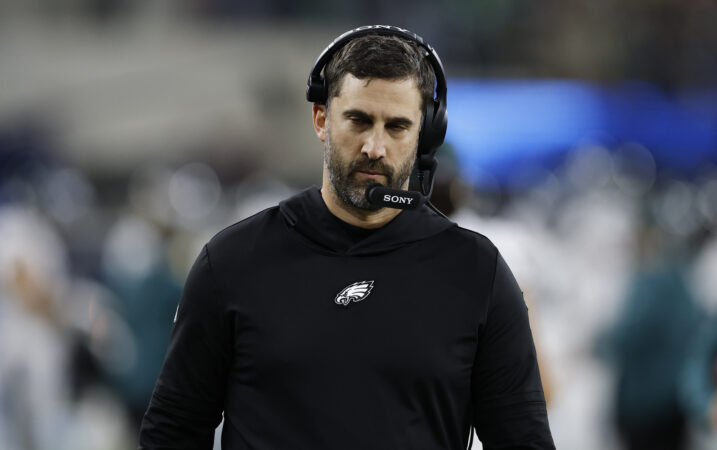
    After Monday night’s loss, Nick Sirianni described the Eagles’ five turnovers as being “uncharacteristic.”

    In the greater context of the season, yes, the Eagles’ turnovers indeed were uncharacteristic. Entering the game, the Eagles had given up the ball 13 times, tied for the fourth-lowest total in the league.

    But the turnovers have become characteristic of the Eagles over the last three weeks, a byproduct of their lack of attention to detail. They’ve coughed up the ball nine times, the worst total in a span of three games under Sirianni. Hurts has been responsible for seven of those turnovers, although it’s fair to point out that those mistakes aren’t always exclusively on him (especially his fourth-quarter interception on a pass deflected by A.J. Brown).

    For the first time since Week 8 against the New York Giants, the Eagles were not the more penalized team in a game (the Eagles had six penalties and the Chargers had seven). But the offense still found a way to lose the game because of its copious mistakes, even though the defense forced three turnovers and sacked Herbert seven times.

    Before the Eagles’ three-game losing streak, Sirianni spoke of the importance of winning the turnover battle. He said, “When you combine good talent with good detail and good fundamentals, that’s where you get some special things happening.” The Eagles have enough talent on offense, but the lack of fundamentals has been holding them back.

    If they can’t put it together, regardless of how they fare for the rest of the regular season, their playoff run won’t have much life.

    Old pal Kenny Pickett, who relieved Geno Smith last week, could get a shot against one of his former teams on Sunday.

    Geno goes down

    The blows keep on coming to the Eagles’ upcoming opposing quarterbacks.

    After facing Herbert, who played through a surgically repaired nonthrowing hand on Monday, the Eagles may not see Raiders quarterback Geno Smith on Sunday. The 35-year-old quarterback exited their Week 14 loss to the Broncos with an injury to his throwing shoulder after taking a hit in the third quarter. According to the NFL Network, Smith is unlikely to start on Sunday.

    With Smith sidelined last week, the Raiders turned to backup Kenny Pickett, who served in the same role with the Eagles in 2024. The Ocean Township, N.J., native fared well in relief of Smith, going 8 of 11 for 97 yards and a touchdown, but his efforts weren’t enough to help the Raiders pull off a comeback.

    The game marked Pickett’s first meaningful action with the Raiders, who acquired him from the Cleveland Browns in late August.

    Pete Carroll has not found the magic formula in his first season at the helm of the Raiders.

    Raiders coach Pete Carroll said postgame that Smith’s shoulder “locked up,” and initial tests indicated that he avoided damage. If Smith can play, Carroll suggested that he would go with his starter. Otherwise, Pickett will be ready for his first start since he was a member of the Eagles in Week 17 against the Dallas Cowboys while Hurts was in concussion protocol.

    With Smith at the helm this season, the Raiders offense has been one of the worst in the league, ranking 30th in expected points added per play (-0.22), a statistic that measures the average points an offense generates on a play.

    One of the passing game’s bright spots lately, though, has been Jack Bech, the second-round receiver out of TCU. His usage has increased over the last couple of weeks, culminating with a career-high 80.9% of the snaps against the Broncos. He caught all six of his targets for 50 yards.

    But the Raiders’ running game, headlined by sixth overall pick Ashton Jeanty, is worse than their passing game. The Raiders rank last in expected points added per rush at -.28. The next closest teams, the New Orleans Saints, the Tennessee Titans, and the Browns, are tied at -0.12. The offense’s dysfunction led to the firing of Raiders offensive coordinator Chip Kelly, the former Eagles head coach, in late November after the team started its season 2-9.

    If Vic Fangio’s defense can’t stop the Raiders offense, regardless of who starts at quarterback, the Eagles have a major problem on their hands. The group was stellar against the Chargers, despite the result, limiting Los Angeles to 1 of 3 in the red zone and 7 of 19 on third down.

    Meanwhile, Washington Commanders quarterback Jayden Daniels exited his first game back since Week 9 after reinjuring his left elbow. That’s a topic for next week.

    Can Saquon Barkley build on the positive signs of his Monday night performance?

    Run defense slide

    Despite the teamwide turmoil, the Raiders defense has been solid against the run for most of the season. Through the first 12 weeks, the Raiders had given up 1,137 rushing yards (94.8 per game), the 12th-lowest total in the NFL.

    The last two weeks have been a different story. The Raiders have conceded 344 rushing yards (172 per game), which is tied with the Arizona Cardinals for third-worst.

    Six ballcarriers contributed to the Broncos’ rushing total of 152 yards and two touchdowns on 31 carries. RJ Harvey, the Broncos’ rookie running back, led the way with 75 yards and a touchdown on 17 carries (4.4 yards per carry).

    Missed tackles have been an issue for defensive coordinator Patrick Graham’s unit. The Raiders have missed the third-most tackles in the NFL at 106, according to Pro Football Reference. Former Eagles inside linebacker Devin White is tied for second-most in the NFL with 18 missed tackles this season.

    But the Raiders still made plays against the run on Sunday. Four-time Pro Bowl defensive end Maxx Crosby set a new career high with 25 tackles for loss. According to Next Gen Stats, Crosby leads all defensive linemen with 52 run stops, 10 of which have come in the last two weeks.

    Despite the Eagles’ offensive struggles on Monday night, Saquon Barkley had some positive moments in the running game. He finished with 122 yards and a touchdown on 20 carries, good for his second-best output of the season and just the second time he has eclipsed 100 rushing yards.

    Barkley was particularly effective when Hurts handed the ball off from under center. His longest gain — a 52-yard touchdown run in the fourth quarter — came off a Tush Push fake when Hurts was lined up under center. If Barkley and his blockers can build on their latest performance, and if Lane Johnson returns this Sunday, the Eagles could have continued success on the ground against the Raiders.

    Could a big Britain Covey week be coming against the porous Raiders special teams?

    Special teams nightmare

    Kelly wasn’t the only coordinator who got the ax this season. The Raiders also fired special teams coordinator Tom McMahon in early November.

    The Raiders’ special teams unit is one of the weaker groups in the league. They have conceded two touchdowns on punt returns this year, most recently on Sunday when Denver’s Marvin Mims scored on a 48-yard return in the second quarter to break a 7-7 tie. The Raiders joined the Browns as one of two teams that have given up two touchdowns on punt returns this season.

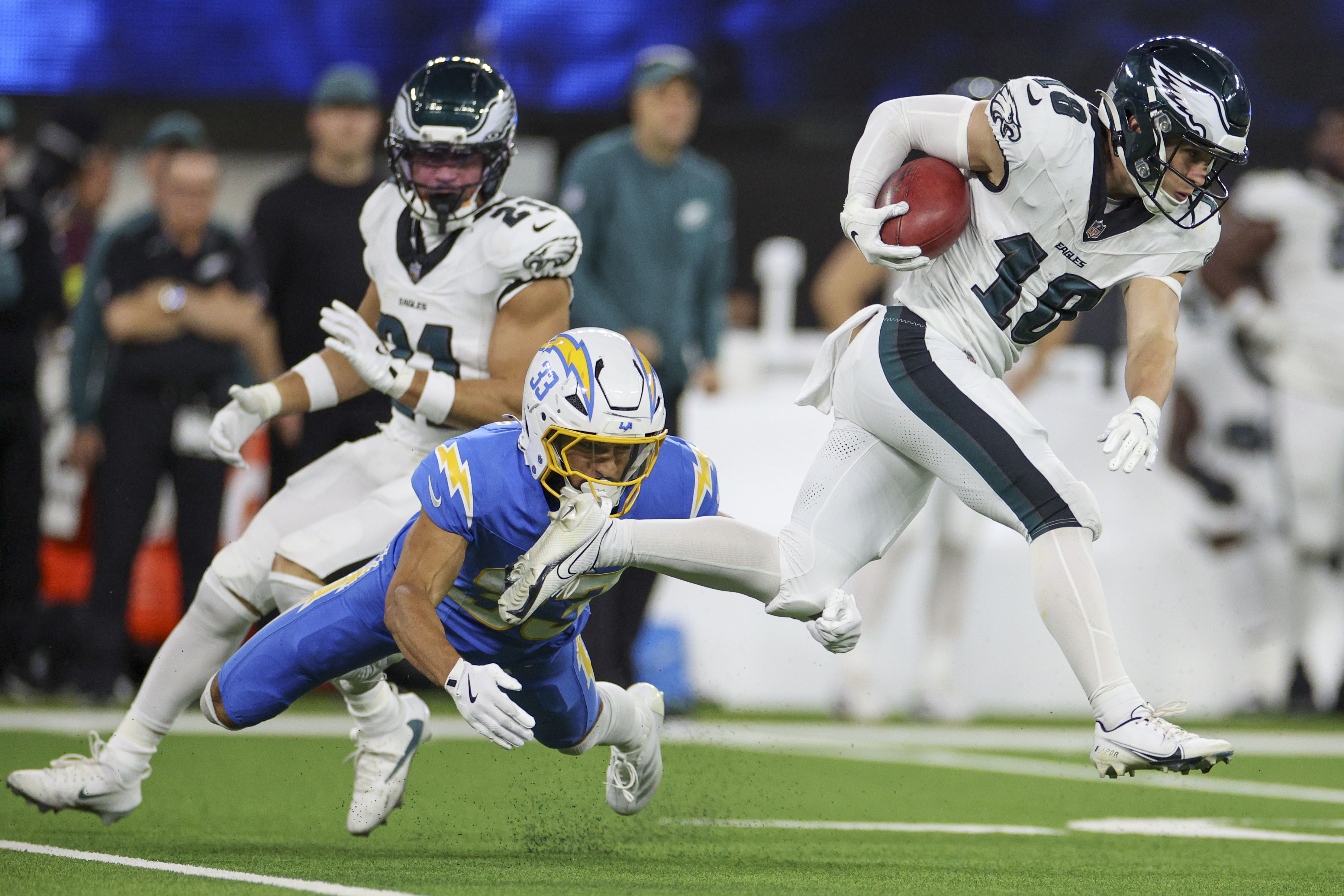
    Britain Covey could have an opportunity to take advantage of the Raiders’ shaky punt coverage. The 28-year-old return specialist has proved over the last two weeks why he should have been the Eagles’ punt returner to start the season.

    Covey averaged 18 yards per punt return against the Chargers. For reference, Xavier Gipson averaged 11.2 yards return during his stint as the Eagles’ punt returner and Jahan Dotson averaged 9.6. Covey is still seeking his first career touchdown on a punt return.

  • Baby KJ’s gene-editing treatment lands him on Nature’s top 10 list

    Baby KJ’s gene-editing treatment lands him on Nature’s top 10 list

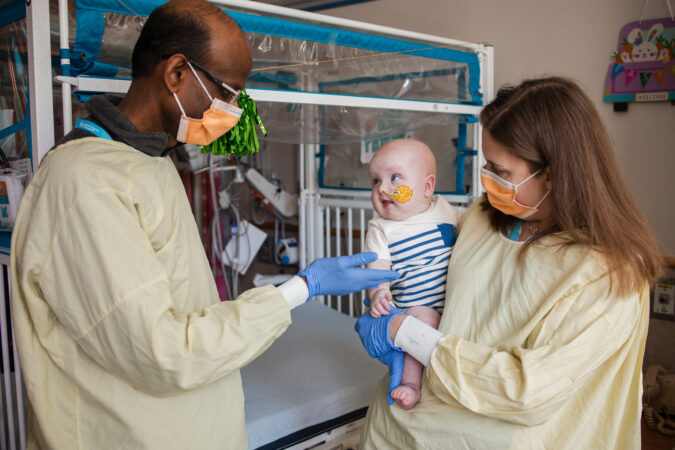
    A Philadelphia-area infant named Baby KJ made international headlines after doctors at Children’s Hospital of Philadelphia and Penn Medicine successfully treated his rare, life-threatening liver condition with a gene-editing drug earlier this year.

    Now back home with his family in Drexel Hill after more than 300 days in the hospital, KJ Muldoon has been named one of 10 people who helped shape medicine in 2025 by Nature, a British scientific journal.

    Nature’s 10 is rounded out by career scientists and public health champions, including a neurologist treating brain disorders, an entomologist unearthing new details about mosquito-borne illnesses, and a data researcher who drew attention to troubling patterns in research retractions. The publication honored Baby KJ as a “trailblazing baby.”

    KJ was born with a rare disorder that prevented his liver from processing protein. He was at risk of dangerous levels of ammonia, a byproduct of protein, building up in his bloodstream, traveling to his brain, and causing irreparable damage. The condition, called severe carbamoyl phosphate synthetase 1 (CPS1) deficiency, is deadly in more than half of cases.

    With few treatment options and limited time, KJ’s doctors proposed a novel treatment using experimental gene-editing technology: They would analyze KJ’s genetic profile to find the genetic mutation that prevented his body from producing a key enzyme that breaks down protein. Then they would infuse a medication laced with bits of genetic code to find the misspelling and fix it, dramatically improving his chances of recovery.

    Within six months, researchers at CHOP and Penn had developed a customized drug specifically for KJ using CRISPR, the buzzy shorthand for a scientific tool that works like a find-and-replace command. It is named after a stretch of genetic code utilized — clustered regularly interspaced short palindromic repeats.

    KJ received three doses of the medication, and in June, he returned home after 307 days in the hospital. He will need ongoing care, but doctors say the treatment has dramatically improved his liver function.

    “This is the future of medicine, a step toward using gene-editing for diseases for which there are few treatments,” Kiran Musunuru, director of the Penn Cardiovascular Institute’s Genetic and Epigenetic Origins of Disease Program and one of the lead doctors on KJ’s case, said during a call with reporters in May.

    Baby KJ’s treatment was a first-of-its-kind drug customized to a unique genetic mutation. It will never be used for another patient, but Philadelphia researchers believe the CRISPR framework could be used to customize drugs for other patients.

    Musunuru and Rebecca Ahrens-Nicklas, the director of CHOP’s Gene Therapy for Inherited Metabolic Disorders Frontier Program, are developing a new clinical trial to test the CRISPR framework for treating customized gene therapies for urea cycle disorders related to any one of seven genes.

    The mechanism will remain the same, but the injection each patient receives will be customized to target their unique genetic mutation.

    They are hopeful that their work will make bespoke treatments available to more people with rare diseases, Ahrens-Nicklas told Nature.

    “Everyone saw the possibility and thought, ‘Why isn’t this available for my child?’”

  • ⚾ More Schwarbombs | Sports Daily Newsletter

    ⚾ More Schwarbombs | Sports Daily Newsletter

    Kyle Schwarber is probably going to finish his career in a Phillies uniform.

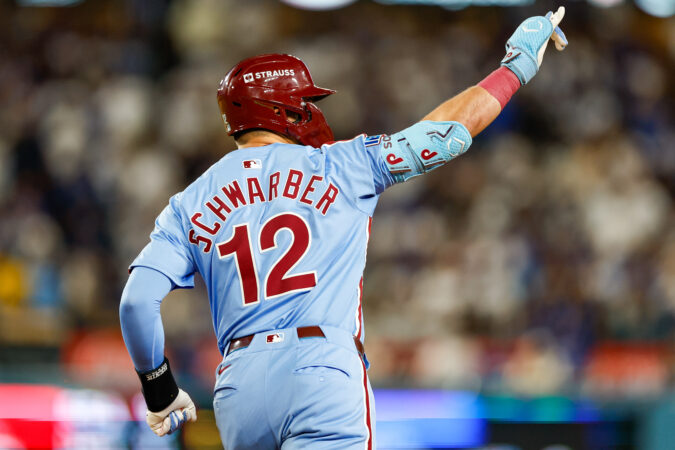
    The 32-year-old slugger agreed to a five-year, $150 million contract on Tuesday, fulfilling a priority that Phillies president of baseball operations Dave Dombrowski spoke about getting done in the fall.

    Schwarber hit 56 home runs — or as we like to say, Schwarbombs — this season to finish two shy of Ryan Howard’s franchise record, and he was runner-up for National League MVP.

    But did anyone really think the Phillies weren’t going to resign Schwarber?

    They could have gone in another direction, especially as Schwarber got offers this week. But the Phillies believe Schwarber is unrivaled, and it’s the right move to not make sweeping changes to their roster.

    The Phillies are optimistic about re-signing J.T. Realmuto and announced manager Rob Thomson’s contract extension through 2027.

    Thomson has led the Phillies to a .580 winning percentage since he was named the manager in 2022. He is the fourth manager in MLB history to reach the postseason in each of his first four full seasons at the helm and was a finalist for manager of the year in 2025.

    He doesn’t want to “go anyplace else whenever I’m done, because I love the people and I love the organization,” Thomson said.

    The perception is that the Phillies are merely bringing back the band.

    — Isabella DiAmore, @phillysport, sports.daily@inquirer.com.

    If someone forwarded you this email, sign up for free here.

    ❓What was your reaction to the Phillies re-signing Schwarber and Thomson’s extension? Email us back for a chance to be featured in the newsletter.

    Hurts’ low point

    Jalen Hurts turned the ball over five times Monday, including twice on the same play.

    Jalen Hurts threw a career-high four interceptions in the Eagles’ 22-19 overtime loss to the Chargers on Monday night, extending their losing streak to three games. The loss was not all on the sixth-year quarterback. However, it did expose his imperfections as a drop-back passer. He threw over and behind his intended targets, and made the wrong reads. The lowly Raiders offer a chance for the quarterback to get right this Sunday. Can he get the job done?

    While the Eagles are still sit in the driver’s seat in the NFC East, their losing streak has not been good for their position in the NFL power rankings. There seems to be one consistent theme across every media outlet that ranked the Eagles: They all agree that the Birds are in serious trouble.

    What we’re …

    🤔 Wondering: It appears Kevin Patullo is escaping the bulk of the blame — at least for one week. Here’s what the national media is saying about the Eagles after their loss to LA.

    📖 Learning: Heading into Week 15, the Eagles’ matchup with Las Vegas might feel like a get-well game. But the Raiders have been scoring at roughly the same pace as the Birds over the last six weeks.

    Murchison’s NHL debut

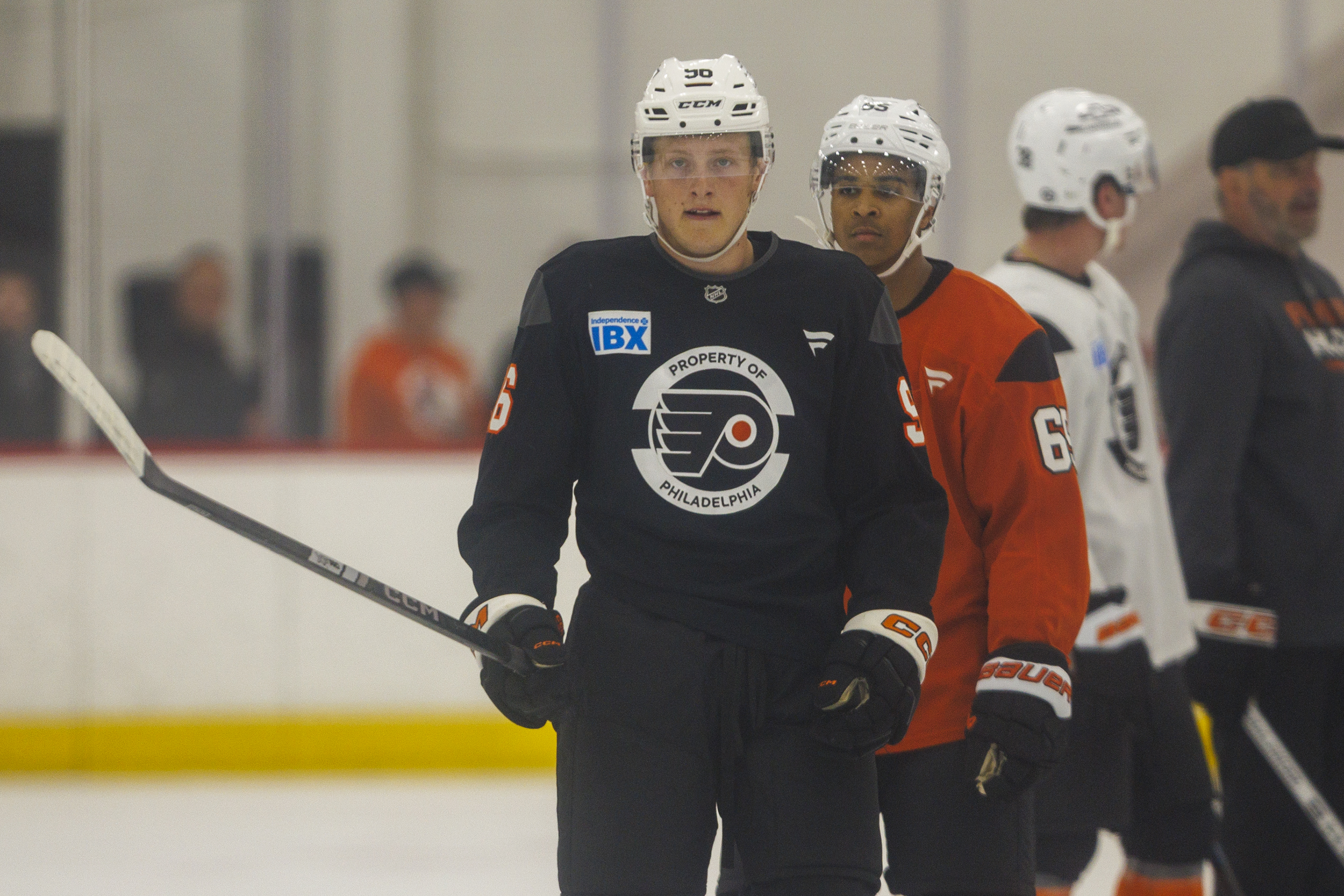
    Ty Murchison made his NHL debut on Tuesday against San Jose.

    During morning skate on Tuesday, Ty Murchison learned that he would be making his NHL debut later that night against the San Jose Sharks.

    The 22-year-old was a fifth-round pick by the Flyers in 2021 and was a star at Arizona State. Not many would have pegged the California native, who grew up playing roller hockey before pivoting to the ice, to be the first guy to take a rookie lap this season, but the 6-foot-2 defenseman has adjusted to the pro game. He got to live out his dream in front of his family and friends, who were in attendance at Xfinity Mobile Arena.

    Four different Flyers scored in a 4-1 win over the Sharks. Travis Konecny reached a career milestone, picking up his 500th career point with a goal and assist in the win.

    ‘Christmas they deserve’

    From left, former Daily news sportswriters Bob Cooney, Ed Barkowitz, and Mike Kern at Wolf Burger in South Philadelphia. The bar will host their annual Christmas fundraiser on Friday.

    Ed Barkowitz, a former Daily News sportswriter, has organized a toy drive for 23 years, a task that feels more arduous each December. He’s 55 years old, teaches a college course, works with his family business, stays active as a freelance writer, and has to deal with the ever busy — and ever growing — holiday season.

    But the donation boxes throughout his South Philadelphia neighborhood soon fill with toys. His friends — especially the ones he worked with for more than 30 years at the Daily News — will pack a corner bar on Friday night. And then he’ll watch his nieces and nephews use the money collected to buy enough gifts for more than 50 South Philly families to have presents on Christmas morning.

    Sports snapshot

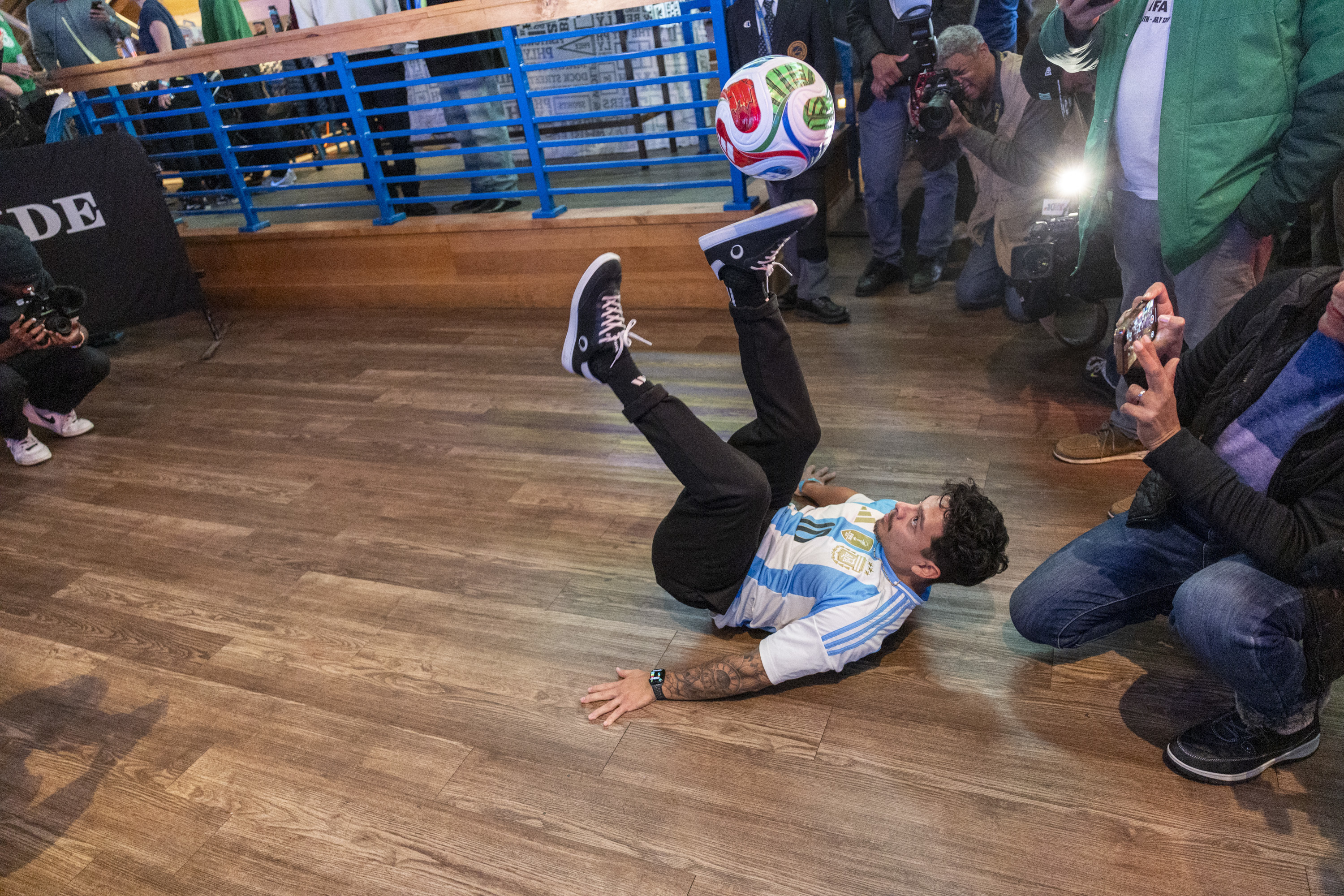
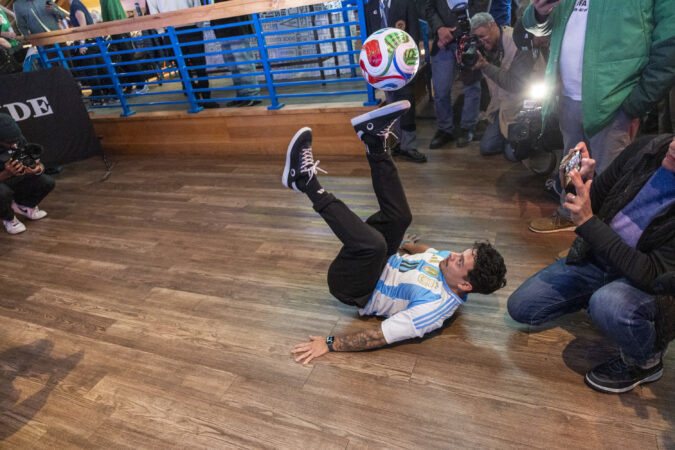
    Gabriel Luzbet of Harrison, N.J., doing some juggling and tricks with the soccer ball at the FIFA World Cup drawing at Stateside Live! on Dec. 5.

    David Murphy’s take

    The Phillies have locked up Kyle Schwarber for his age-33 to 37 seasons.

    Kyle Schwarber is a remarkable hitter on a number of different levels. His return to the Phillies was a given. There was a market for his services, and the Phillies would have been devastated to lose him. Of course, there are some risk. Over the last 15 years, only three players have had more than two seasons of 30-plus home runs between the ages of 33 and 37, but any judgment of the Phillies’ offseason will depend on what happens next, writes columnist David Murphy.

    🧠 Trivia time answer

    How many passing yards did Tom Brady have in the Patriots’ loss to Nick Foles and the Eagles in Super Bowl LII?

    D. 505 yards — Pete S. was first with the correct answer.

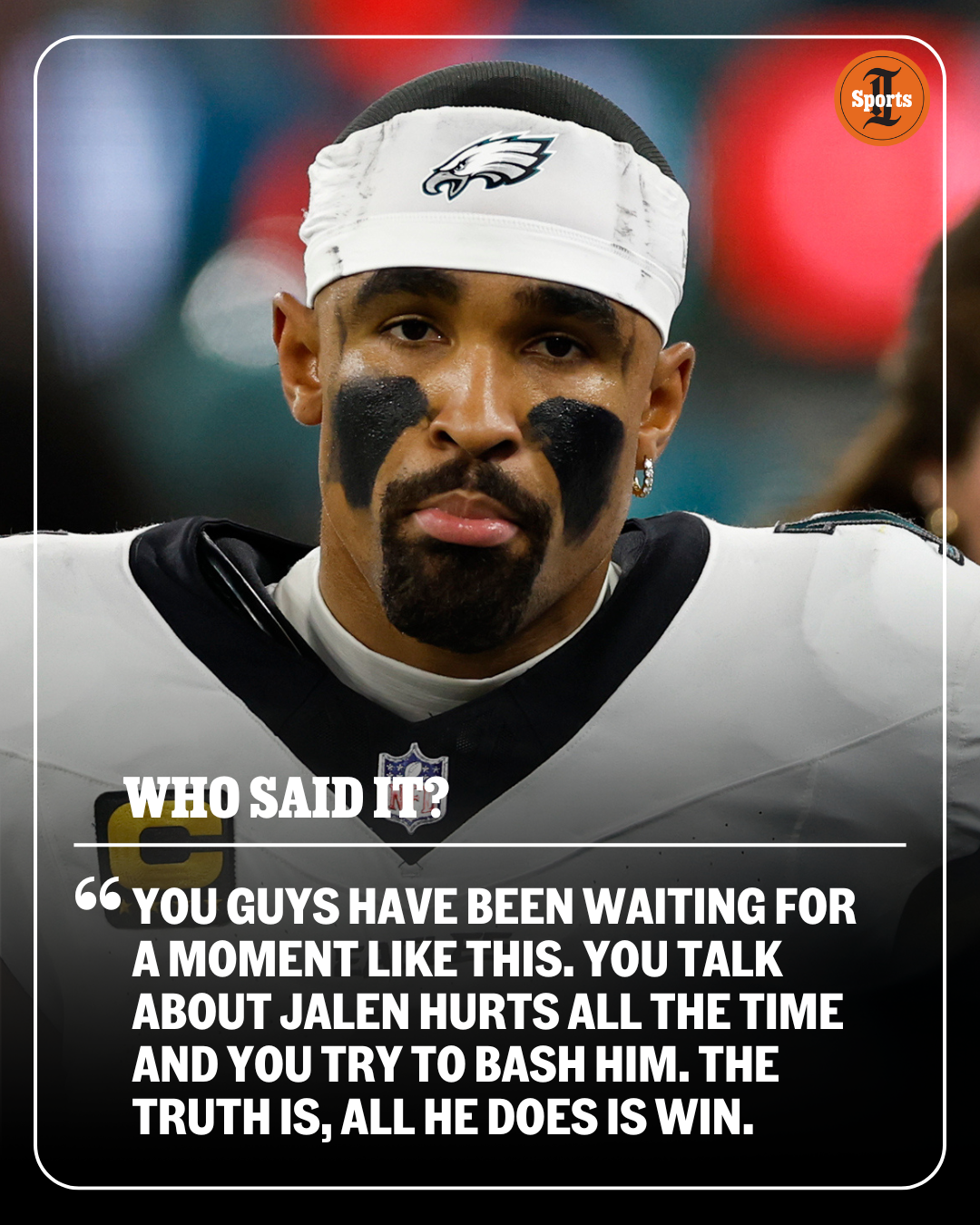
    Who said it?

    The national media, including a few former Eagles, had somethings to say about the team’s performance.

    While Jalen Hurts played the worst game of his career in the Eagles’ overtime loss to the Chargers, this former Eagles player wouldn’t put too much weight into it. Find out who said it here.

    What you’re saying about the Eagles’ loss

    We asked: Who is most at fault in this Eagles slump? Among your responses:

    I believe it’s a combination of whoever is calling the plays and Hurts poor play. The play selection seems easily predictable resulting in too many 3rd and longs in which the Eagles are extremely woesome. Hurts just seems off. High throws and appearing to not notice wide open receivers is very concerning. — Bob A.

    Jalen Hurts lost that game!! Joseph M.

    After last night’s game, there should be no question in anyone’s mind, that the main player who is at fault would be Carson Wentz 2.0! Don’t be surprised to see Howie move Hurts during the off season for almost nothing. And to think Howie gave the greatest kicker ever to play the game to the Chargers for nothing. 99 field goals out of 102 attempts is almost impossible. — Ronald R.

    Stubborn Nick Sirianni and unimaginative Kevin Patullo Sheldon W.

    Nick Sirianni argues a call during the second half against the Chargers on Monday.

    Well since they are still searching for an “identity ” (It’s December.) Got to be Sirianni. — Bill M.

    Lots of coaches and players to blame, but the one who always has to answer for the overall lack of team success is the leader. Sirianni is the head coach and winning and losing is ultimately his responsibility. “Heavy lies the crown.” Hurts is playing like a rookie, the play calling is awful, and the O line needs help. Maybe the Saints will fire Kellen and he can come back and run the offense. And maybe bringing back Kelce is not all that laughable. A trip to Santa Clara is looking more and more like a fading dream, but we fans will not give up. — Everett S.

    You’ve got to start with Patullo, because he’s really the only one doing a job he’s never done before. Sirianni, great record or no, for only seeing the silver lining and not the clouds. The OL, which doesn’t have the consistency it had last year and a couple of their best playing hurt. And Jalen, who just doesn’t seem to mesh with his tenth play-caller in 10 years. The schedule has been brutal, but two wins over the Daniels-less Commanders means they only need one other and they win the division. And then, who knows? Joel G.

    We compiled today’s newsletter using reporting from David Murphy, Scott Lauber, Lochlahn March, Jeff McLane, Jeff Neiburg, Olivia Reiner, Jackie Spiegel, Matt Breen, Gabriela Carroll, and Kerith Gabriel.

    By submitting your written, visual, and/or audio contributions, you agree to The Inquirer’s Terms of Use, including the grant of rights in Section 10.

    As always, thanks for reading. Kerith will be back in your inbox tomorrow, till then! — Bella

  • Villanova’s careless ballhandling, offensive struggles, and other takeaways from blowout loss to Michigan

    Villanova’s careless ballhandling, offensive struggles, and other takeaways from blowout loss to Michigan

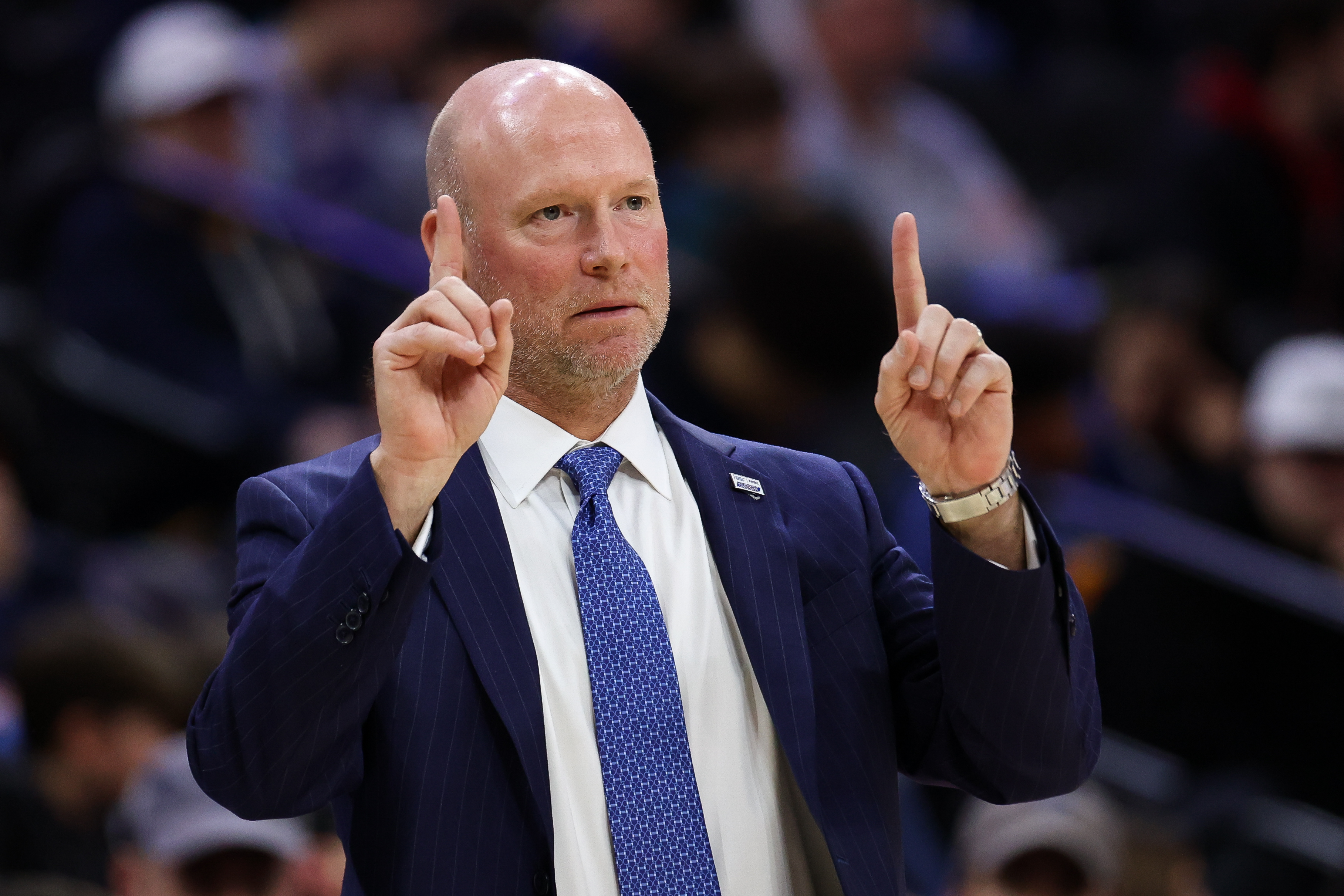
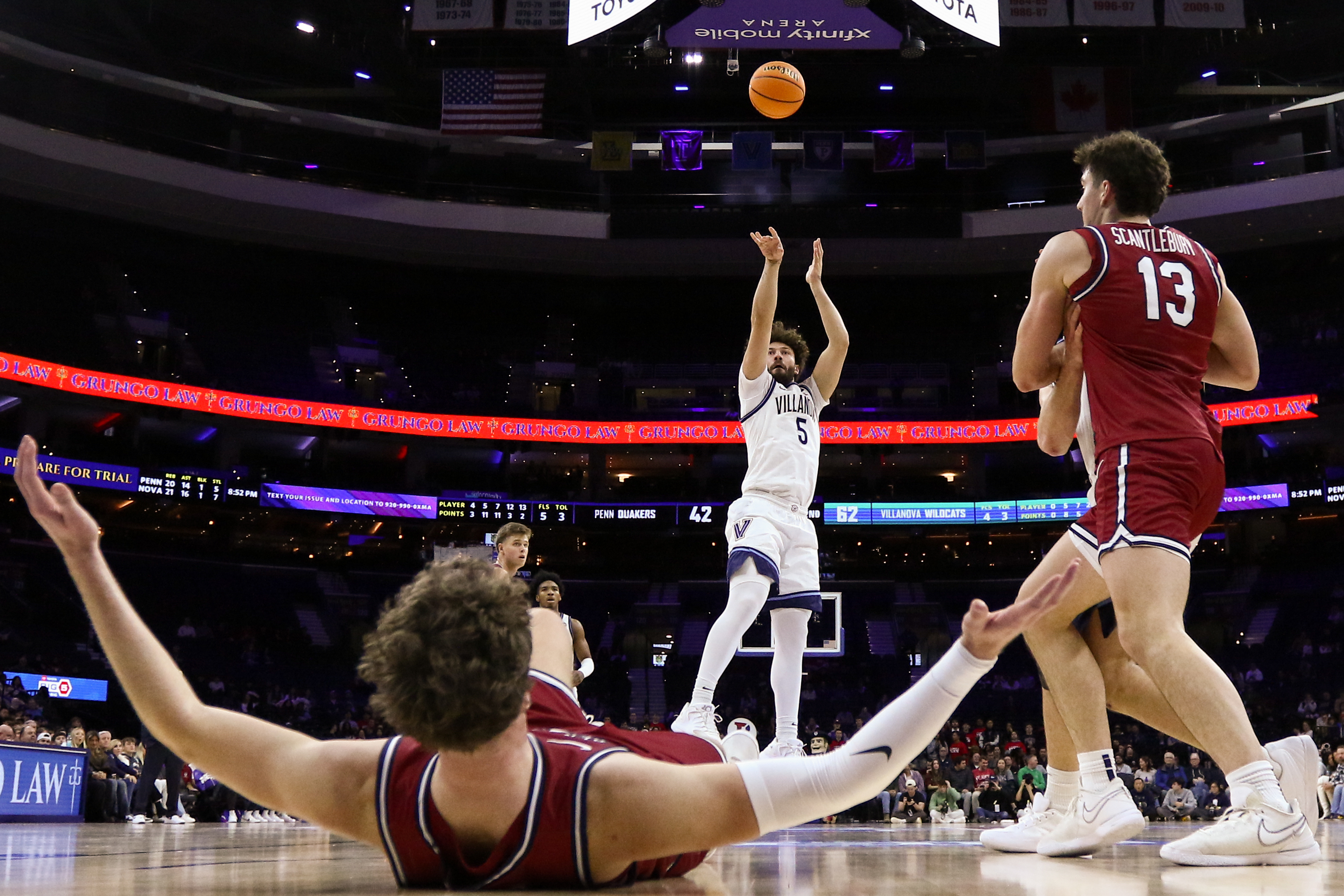
    Villanova‘s winning streak reached seven games Saturday when it blew out Penn in the Big 5 Classic championship game. A season-opening loss to nationally ranked BYU in Las Vegas preceded a stretch of games in which Kevin Willard’s Wildcats didn’t have any blips.

    They beat their next seven opponents by an average margin of 19.7 points, and at 7-1 entering this week even made it onto some Associated Press Top 25 voters’ ballots as they climbed to KenPom’s 35th-ranked team by adjusted efficiency. But those wins came against teams ranked 142nd or lower by KenPom metrics.

    The tuneups were over, and it was time for a test. Perhaps the biggest test of all: against No. 2 Michigan, a team that has been a buzz saw of sorts through the first five weeks of the college basketball season.

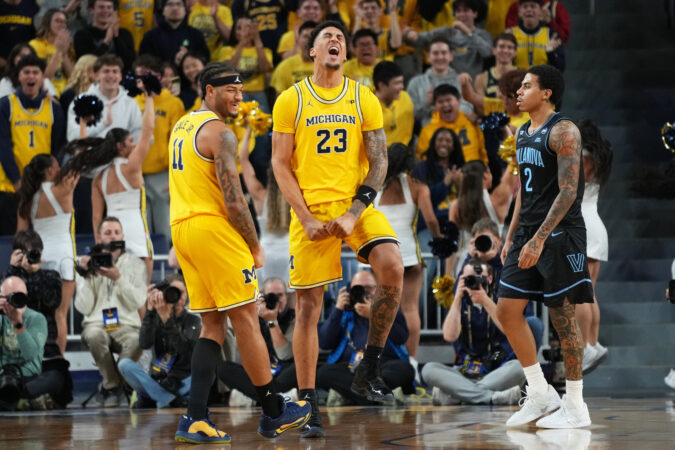
    Villanova learned that the hard way Tuesday night in Ann Arbor, Mich., where the Wildcats were run off the floor in an 89-61 loss.

    Here’s what we learned from Villanova’s step up in competition:

    First, the context

    Let’s get out of the way first how good Michigan is. The Wolverines are the No. 1 team at both of the main college hoops metrics sites, KenPom and Torvik. They ran through the Players Era tournament in Las Vegas a few weeks ago with wins of 40, 30, and 40 points over San Diego State, Auburn, and Gonzaga, the third-ranked team at KenPom and Torvik.

    Dusty May has his Michigan squad undefeated at 9-0.

    Then Michigan started Big Ten play Saturday with a 101-60 victory over Rutgers.

    Dusty May has built a team that will compete for a national title, and one that could be capable of making history along the way.

    Carelessness with the ball

    That being said, Villanova wasn’t nearly good enough, and it started right away with a deer-in-the-headlights start that enabled Michigan to pull away early.

    What you can’t do against the best defensive team in the country is give away possessions, and Villanova did that way too often.

    Freshman point guard Acaden Lewis had two turnovers in the first five minutes. Villanova watched as its best defensive possession ended with a Michigan offensive rebound and putback. Then came a lazy pass from Bryce Lindsay to Tafara Gapare that led to a runaway dunk by Yaxel Lendeborg that upped Michigan’s lead to 19-7.

    Willard called timeout, and the ensuing inbound resulted in a 10-second violation. Michigan scored at the other end on another second-chance basket and its lead was 21-7 with 13 minutes, 40 seconds to go in the first half.

    Kevin Willard’s Villanova squad turned the ball over 15 times against Michigan.

    Villanova turned it over 10 times in the first half, far too often to have a chance against this type of opponent, and 15 times overall. Six Wildcats each had two turnovers. Michigan had 15 offensive rebounds to Villanova’s six.

    Where’s the offense?

    Defense has been a problem for the Wildcats over the first five weeks of the season, even against some lighter competition. But offense hasn’t been very worrisome.

    Until Tuesday.

    Again, Michigan is the best defensive team in the country with its mixture of size, length, and athleticism, but Villanova is going to face some pretty good defenses in the Big East, and there were some concerning things Tuesday night.

    Michigan took Lewis and Lindsay out of the game. If not for the isolation skills of Devin Askew, it might have been 53-13 at halftime instead of 53-23. This was Lewis’ first real test since he was benched vs. BYU in the opener, and he wasn’t good enough at getting Villanova into its offense, though he got better as the game went on (and already was out of reach).

    The Wildcats got assists on 57.7% of their makes entering Tuesday. They had just six assists on 21 makes Tuesday (28.6%), and one of them came on a last-second three-pointer.

    Michigan, with its length, took away Villanova’s chances at the rim, and the Wildcats were forced to bomb away from three-point range, especially when they started trailing. They made just 10 of their 37 attempts.

    “You try to,” Willard told reporters Tuesday when asked if creating threes was the plan. “But it’s not easy against a very connected defensive team.

    “Everyone talks about their offense, but everything is predicated on their defense.”

    Rotation roulette

    Part of Villanova’s problems on offense came from issues that may pop up against better competition. Willard had to decide what he had tolerance for. Lewis and Lindsay were getting beaten defensively, but reserves Malachi Palmer and Gapare offered little help offensively.

    The second unit on the floor meant only Askew could be relied on for offense.

    Villanova’s Devin Askew led the team with 18 points against Michigan.

    Beyond that, it’s apparent that Willard doesn’t think backup big man Braden Pierce is ready to contribute. He’s Villanova’s only rotation 7-footer, and against a Michigan team that has 7-3 center Aday Mara, Pierce barely saw the floor. Neither did Temple transfer Zion Stanford, who logged just three minutes. Stanford only recently returned from an ankle injury, but he is playing just 5.8 minutes per game.

    The game got out of reach fast, but it still seems like Willard is trying to figure out his best mix of players, and that will be something to monitor moving forward.

    What’s next?

    Tuesday was the kind of game that doesn’t hurt when you lose and really helps when you win.

    Up next is the opposite. Villanova welcomes Pittsburgh to Finneran Pavilion on Saturday, and while the ACC school isn’t one of the cupcakes that have been on Villanova’s schedule to date, the 5-5 Panthers aren’t very good. Villanova will be expected to win, but it will be another chance to see the new-look Wildcats against a power-conference foe.

    From there, only a Dec. 19 trip to Milwaukee to face a solid Wisconsin team separates Villanova from its Big East opener on Dec. 23 at Seton Hall.

    The real games are underway, and the Wildcats took a big punch Tuesday.

  • When it comes to how the World Cup shook out, these are our picks of the early winners and losers

    When it comes to how the World Cup shook out, these are our picks of the early winners and losers

    We are a week removed from the FIFA World Cup draw, and in the aftermath, a proverbial ball is beginning to roll on several fronts. FIFA opened its latest presale ticket lottery on Thursday for fans to enter the random selection phase of the tournament, the latest chance to hope and wish your name will be called to purchase tickets — ones that might still be priced in the hundreds, if not thousands, of dollars by the time it’s your turn.

    These past few days have provided a greater opportunity to examine FIFA’s ways and which nations, cities, and fans benefited or flopped as next steps begin to trickle out.

    With that said, these are our picks for winners and losers post-draw.

    Wilson Velez, 36, of Northeast Philadelphia, Pa., (left), Edwin Martinez, 25, of Central Philadelphia, watched the FIFA World Cup draw at Stateside Live! on Friday.

    👍🏽 Philly getting Brazil, France, and Croatia

    For many fans, it’s going to be a breathing-into-a-brown-bag moment watching players like Brazil and Real Madrid’s Vinicús Jr., Croatian midfield maestro Luka Modric, and countless players on France’s squad, undoubtedly headlined by forward sensation Kylian Mbappé, chasing World Cup glory at Lincoln Financial Field. Especially when you consider the French are one of the early favorites to win next summer’s spectacle at +700, according to futures odds on FanDuel.

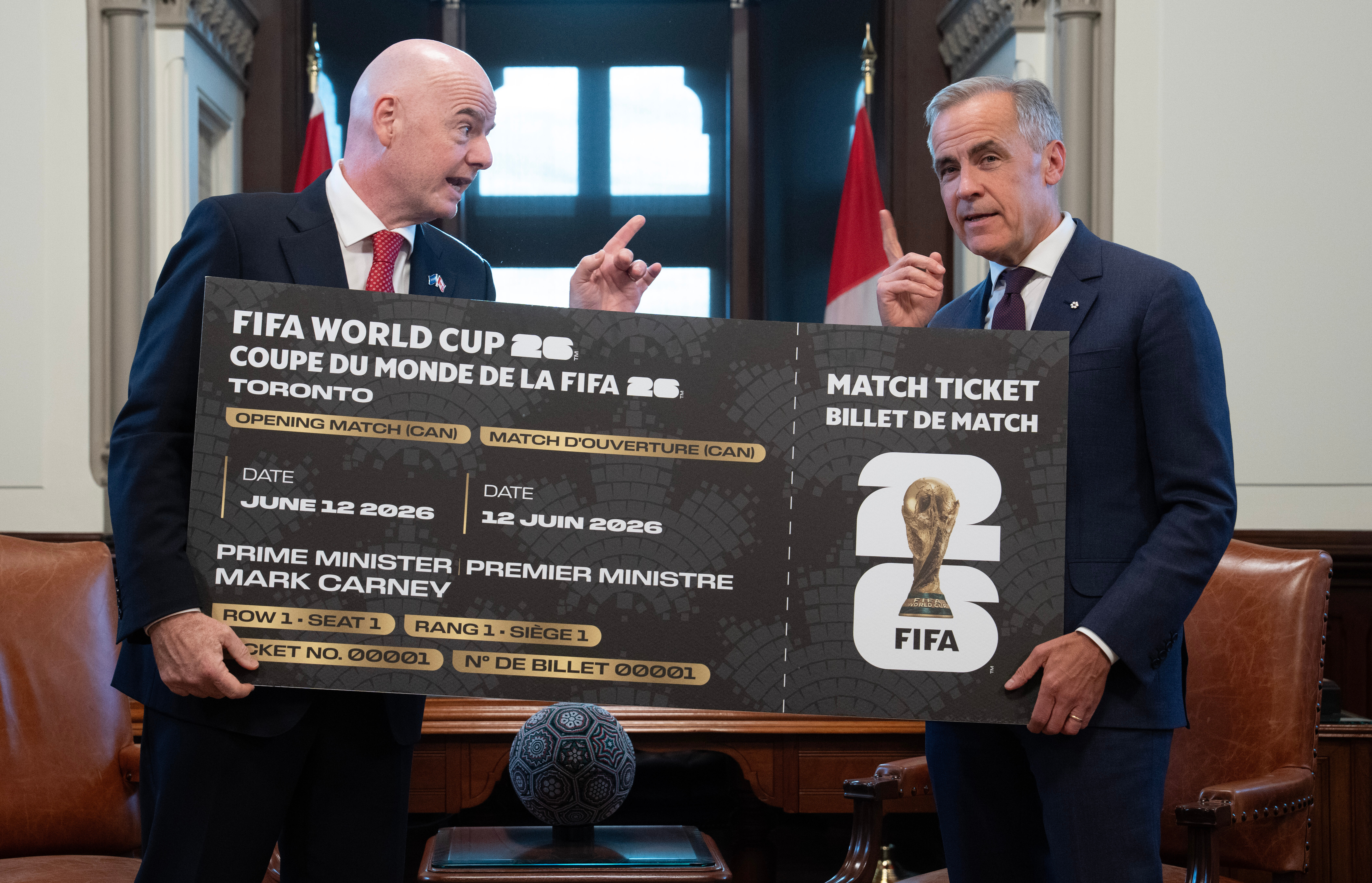
    Canadian Prime Minister Mark Carney (right) is presented with a novelty World Cup ticket by FIFA President Gianni Infantino in October.

    👎🏽 Dynamic pricing on tickets

    For some reason, it just seems counterintuitive for FIFA to stress its desire to grow the game — and then turn around and make the world’s biggest sporting event available only to those who still have expendable cash in this current economic climate.

    This is the first time in the history of the tournament that soccer’s governing body has opted to use dynamic pricing for tickets, and some of the early price tags to secure a seat, even during presale, are laughable. Now, some matchups could see prices fall slightly, but it’s the World Cup; demand will always be higher than supply, and that holds for the bulk of the 72 group-stage matches beginning June 11.

    MetLife Stadium was the center of the soccer universe this past summer hosting the semifinals and final of the Club World Cup. It’s on the big stage yet again as host of the World Cup final.

    👍🏽 The BIG apple

    It was already one thing that MetLife Stadium will be the center of the soccer universe next summer as host for the World Cup final. But after last Friday’s draw, it could be argued that the New York-New Jersey delegation hit the jackpot with the group-stage matches and nations coming to East Rutherford, N.J.

    First up, Brazil-Morocco (June 13, 8 p.m.), when Morocco is one of the hottest nations in the world, with its senior team just one place outside the Top 10 in FIFA’s latest world rankings. Additionally, MetLife will also host European giants Germany (June 25), England (June 27), and one of the most highly anticipated rematches in France-Senegal (June 16, 3 p.m.). The Senegalese defeated a star-studded French side in the 2002 World Cup, and it’s been the talk since this match got paired.

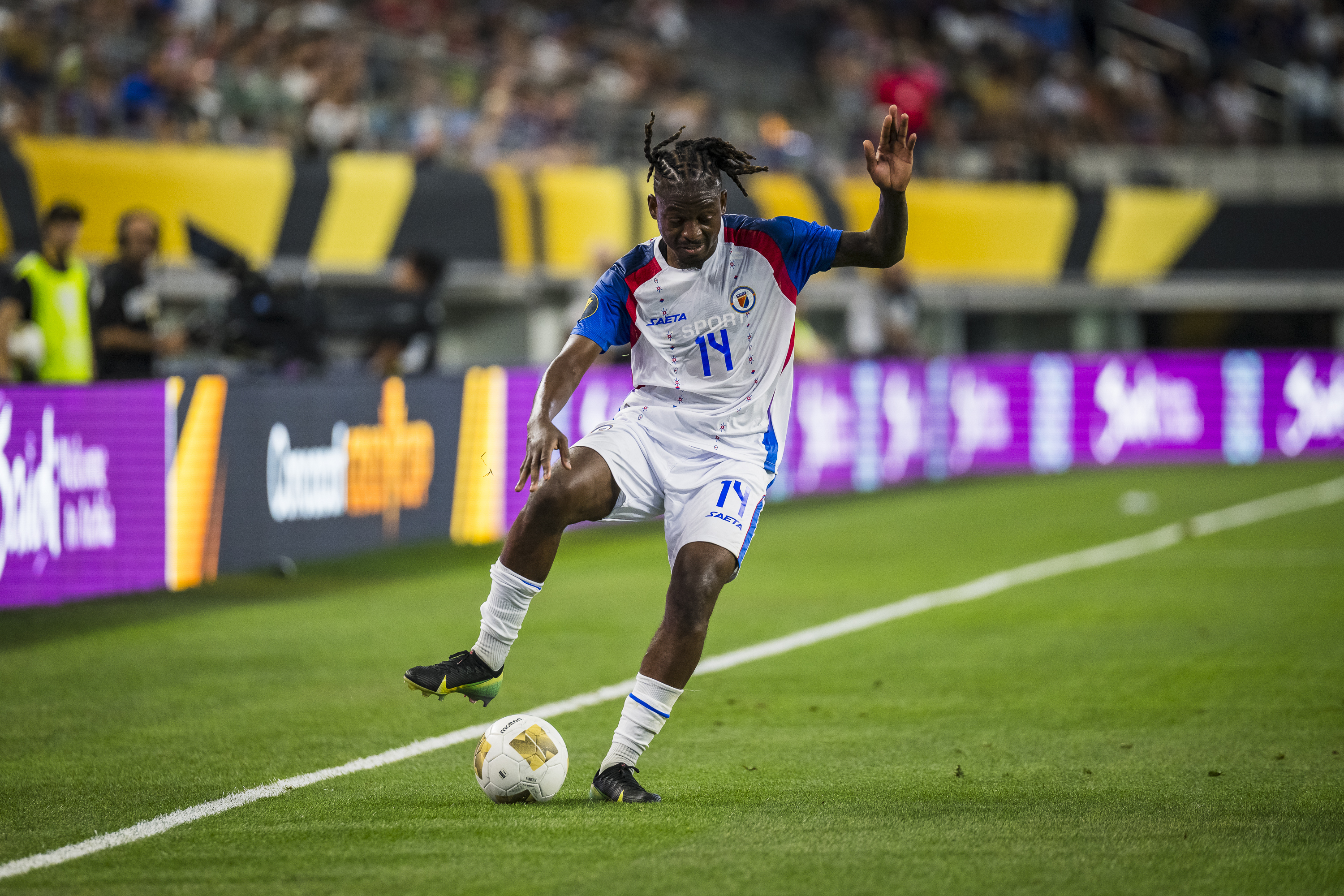
    Haiti’s Leverton Pierre controls the ball during a CONCACAF Gold Cup soccer match against the United States in June.

    👎🏽 Banned fans

    Some fans won’t be able to see their team play live in the United States due to immigration rules and restrictions. Nations like Iran and Haiti will find out just how strong their expat communities are here in the States, but both coaches wouldn’t mind a little diplomacy.

    “[President Donald Trump] is a peace prize winner,” Migné said after the event, alluding to the U.S. president winning FIFA’s inaugural Peace Prize award. “Maybe he will continue, and it will open the possibility for our fans to come here.”

    A fan of Ghana cheers prior to the start of the African Cup of Nations Group B soccer match between Mozambique and Ghana in Abidjan, Ivory Coast, in January 2024.

    👍🏽 African-Caribbean vibes come to Philly

    In addition to the big nations like France, Brazil, and Croatia, Philly will host matches featuring the Ivory Coast, Ghana, and Curaçao. Having matches here in Philly that feature the first two bode well for the city’s sizable West African population situated primarily in the West and Southwest sections of the city. They’re also among the top teams in Africa, with Ghana consistently fielding a strong national team, and the Ivory Coast, the defending AFCON champions, ran through qualifying without conceding a goal.

    As for Curaçao, the nation with the smallest population competing in the World Cup, despite making Jamaica’s road a bit harder by defeating them in November and forcing the Reggae Boyz into a three-team FIFA playoff in March, people will naturally root for the underdog in a city where the underdog mantra has been fully embraced.

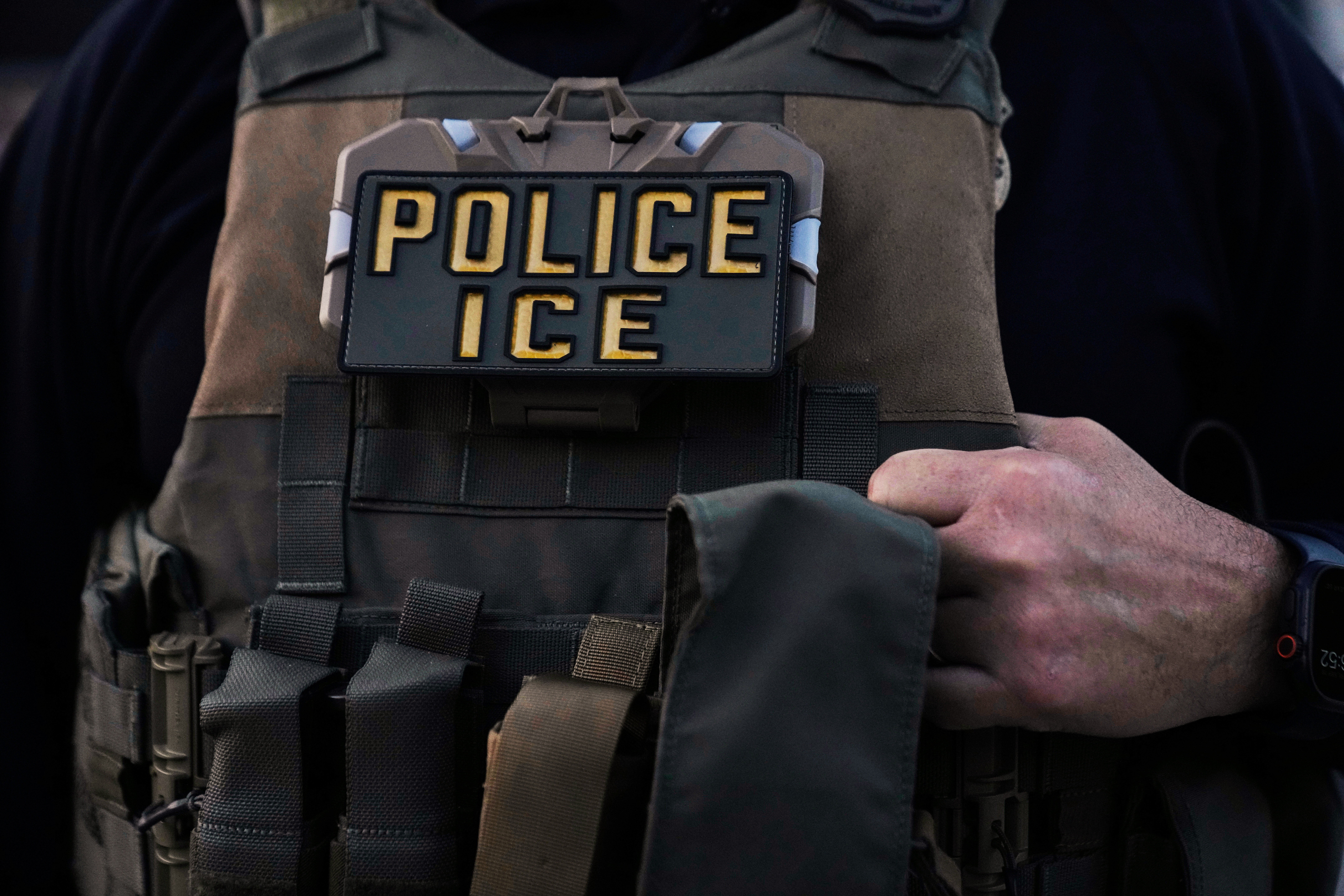
    The presence of Ice and Border Patrol agents at World Cup matches could be an issue for fans.

    👎🏽 ICE fears

    The Club World Cup served as a litmus test of how active U.S. immigration and customs enforcement and the U.S. Border Patrol would be in detaining fans attending the event, specifically in Philadelphia. Before that tournament, there were legitimate fears that ICE would be stationed outside arenas targeting fans.

    While there were instances, and still could be next year, for the most part, it wasn’t as large as some led people to believe. During the Club World Cup, FIFA president Gianni Infantino was explicitly asked in a room full of reporters if he had any concerns about the enforcement and harassment of fans, to which he replied: “I don’t have any concerns about anything … most important for us is to be able to guarantee safety for the fans who come to the game.”

    It’s important to know that a U.S. Customs and Border Protection spokesperson told The Inquirer via a statement in June that “U.S. Customs and Border Protection is committed to working with our local and federal partners … as we do with every major sporting event, including the Super Bowl. Our mission remains unchanged.”

    A rendering shared by FIFA of what Philadelphia’s 2026 World Cup fan fest site at Lemon Hill Park is expected to look like.

    👍🏽 Philly’s party HQ

    While planning for the next phase of the process is still forthcoming, the revival of the Lemon Hill Mansion and grounds in Brewerytown ahead of the World Cup is promising as FIFA will use the park and grounds as the Philadelphia chapter of its fan festival.

    A storied park with incredible views of the city will receive a much-needed facelift and serve as the side stage on matchdays for the six games scheduled to come through Philly. It’s steps from the larger Art Museum area and the Parkway, which will be a fun time to navigate for visitors from around the world, said Meg Kane, the host city executive for Philadelphia Soccer 2026, responsible for planning the event in the city. However, questions still remain on things like transportation, logistics, vendors, and more, but it’s December, so we’re just going to ride out on the excitement of what’s to come.

  • Philly Fringe Fest is the biggest it’s ever been. Now FringeArts will offer year-round programming in 2026.

    Philly Fringe Fest is the biggest it’s ever been. Now FringeArts will offer year-round programming in 2026.

    Philadelphia’s FringeArts will return to offering seasonal programming, in addition to its monthlong Fringe Festival, beginning with a Winter-Spring 2026 season, the organization announced this week.

    The legendary festival, known for experimental and boundary-pushing theater, previously offered year-round programming before the COVID-19 lockdown in 2020. In recent years, it has seen record-breaking audience growth, prompting producing director Nell Bang-Jensen to expand beyond the month of September.

    “I’m really proud to say [Fringe Festival 2025] was actually, numbers-wise, our most successful festival ever, which just feels like a light shining, in terms of arts organizations having a win right now,” said Bang-Jensen, who took the helm last year after serving as Theatre Horizon’s artistic director. “It’s an experience that can’t be replicated on a screen, and an experience that celebrates Philly, and I think people are really here for that.”

    The Philly Fringe is one of the largest festivals of its kind in the country. Based on the number of participating venues across the city, Bang-Jensen said, Philly Fringe ranks first ahead of other notable festivals in Rochester, N.Y., and Minneapolis.

    The 2025 Fringe Festival was the largest-ever produced in its 29-year history with 353 shows. More than 35,000 tickets were sold during the month of September, which was a record high, and saw a 17% increase in unique ticket buyers from last year, which “means it’s not just the same people buying more tickets,” said Bang-Jensen.

    She added that they have seen success in reaching younger audiences this year as well, with more than half of the audience composed of Millennials and Gen Z for the first time.

    For the Winter-Spring 2026 season, FringeArts will present four productions from local and international artists at its Old City venue, along with a monthly series of Scratch Nights that invite artists to present works in progress.

    Philadelphia artist Jenn Kidwell will stage her new work “we come to collect: a flirtation with capitalism” at FringeArts in January 2026.

    Jenn Kidwell, the Obie Award-winning cowriter behind The Underground Railroad Game, will stage the Philadelphia premiere of her new work, we come to collect: a flirtation with capitalism (Jan. 22-24), with ASL artist Brandon Kazen-Maddox. It’s an irreverent exploration of “the pigsty of American consumerism.”

    Frequent Fringe artist Lee Minora will bring back her solo show, Baby Everything (Feb. 26-28), for another run. The interactive performance follows a protagonist who doomscrolls through her anxieties about the state of the world. Minora “challenges us to see ourselves as others do, no matter how endearing or insufferable,” wrote Julie Zeglen in The Inquirer’s roundup of the best shows of Fringe Fest 2025.

    Japanese artist Hiroaki Umeda is globally renowned for combining choreography and dynamic digital staging. He’s presenting two shows on a U.S. tour as a double billing: Moving State 1 and the solo performance, assimilating (March 14-15).

    Lastly, FringeArts will stage Girl Dolls: An American Musical (May 8-17) from Philadelphia artists Jackie Soro and Pax Ressler, who’ve teamed up with the Bearded Ladies Cabaret for a production billed as “part tea party, part identity crisis.” They ask, “What does your favorite doll reveal about your childhood trauma?”

    In addition to year-round programming, FringeArts will launch an artist-in-residency program for fostering original works. The Albert M. Greenfield Residency at FringeArts — funded by the local foundation of the same name — will invite three individuals or artist groups to develop new theatrical productions. The inaugural 2026 recipients will be selected by a panel of Philadelphia creatives.

    Bang-Jensen said she’s grateful that Philly audiences have shown up for the “city of makers” every year and she hopes to continue expanding FringeArts’ reach.

    “As many arts organizations are actually feeling pressure in 2025 just based on the economic environment and the political environment to do work that’s a little more mainstream, we have this wide-open field to do more for people who like things off the beaten path,” said Bang-Jensen.

    Tickets for FringeArts’ Winter-Spring 2026 season go on sale to FringeArts members on Dec. 10 and the public on Dec. 12 at fringearts.com.

  • A North Philadelphia rowhouse filled to the brim with books

    A North Philadelphia rowhouse filled to the brim with books

    Before moving into his North Philadelphia home 13 years ago, Abel Tootle Jr. had rented small apartments, all under 800 square feet. He decided to make the leap to homeownership to pursue his passion for interior design and create a space that reflects his personal style.

    “The timing was perfect,” said Tootle. And so, he moved into his circa-1910, three-bedroom, 1,200-square-foot house. Becoming a homeowner meant full freedom in designing his space — and no more lugging clothes to the laundromat, a feature of which he is most appreciative, he said.

    His home’s look has been evolving since.

    “I truly believe a home is never done. I was given every opportunity to paint, carpet, and design as I wish; however, I did not make any structural changes at all,” Tootle said. “My focus remains on creating a very English-country-house feel with special attention to my culture and interests.”

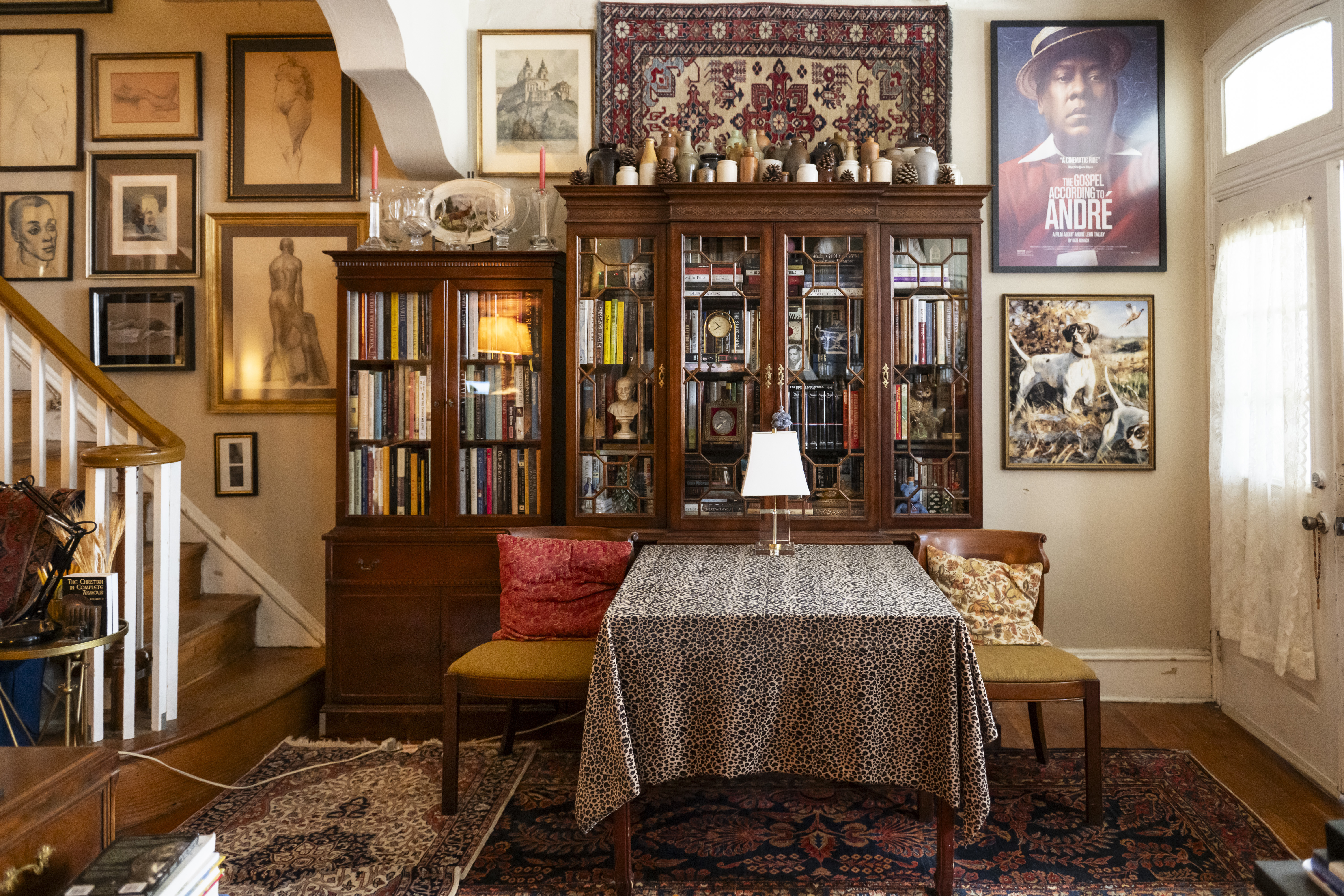
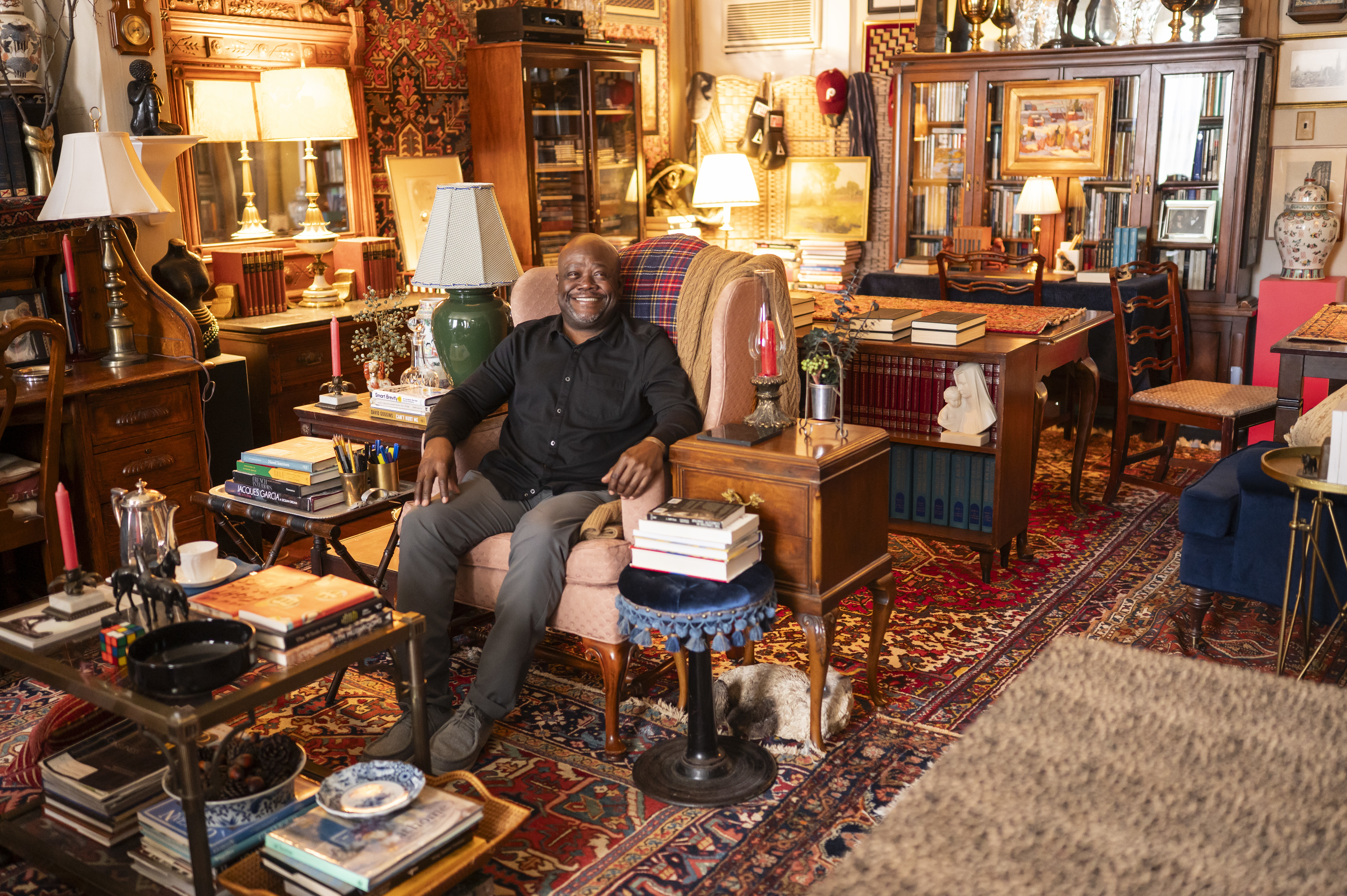
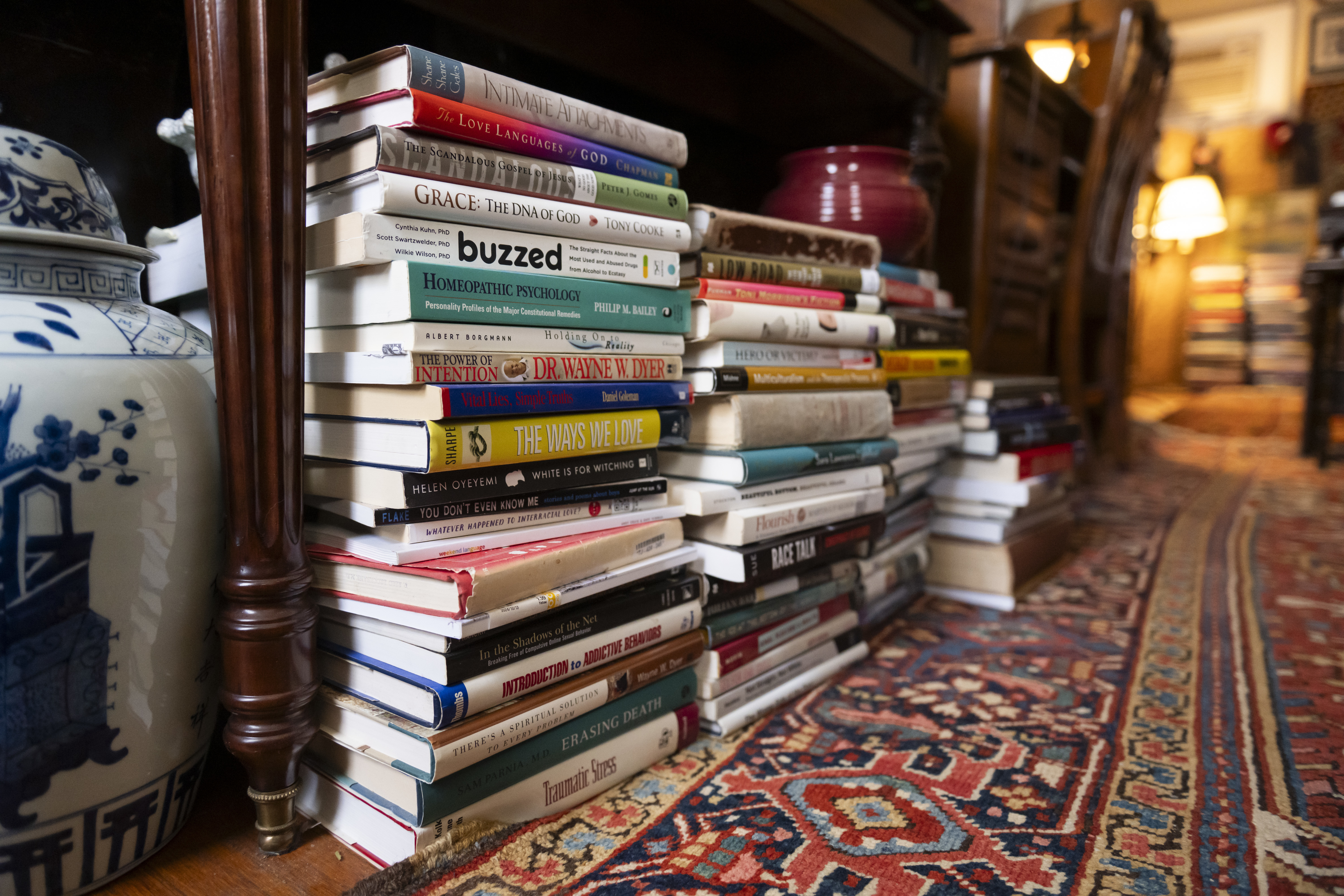
    He favorite design elements include books — there are dozens and dozens displayed throughout the home, not just on shelves but arranged intentionally on and under tables, and stacked in towers rising from the red-pine-hardwood floors — as well as antiques, colorful area rugs in various sizes, art, lighting, and mirrors.

    Colorful patterned rugs adorn not just the floors, but tabletops and walls as well. Tootle says his interior designs are “layered.”
    Books fill a glass-doored cabinet and art covers the wall at the foot of the stairs.
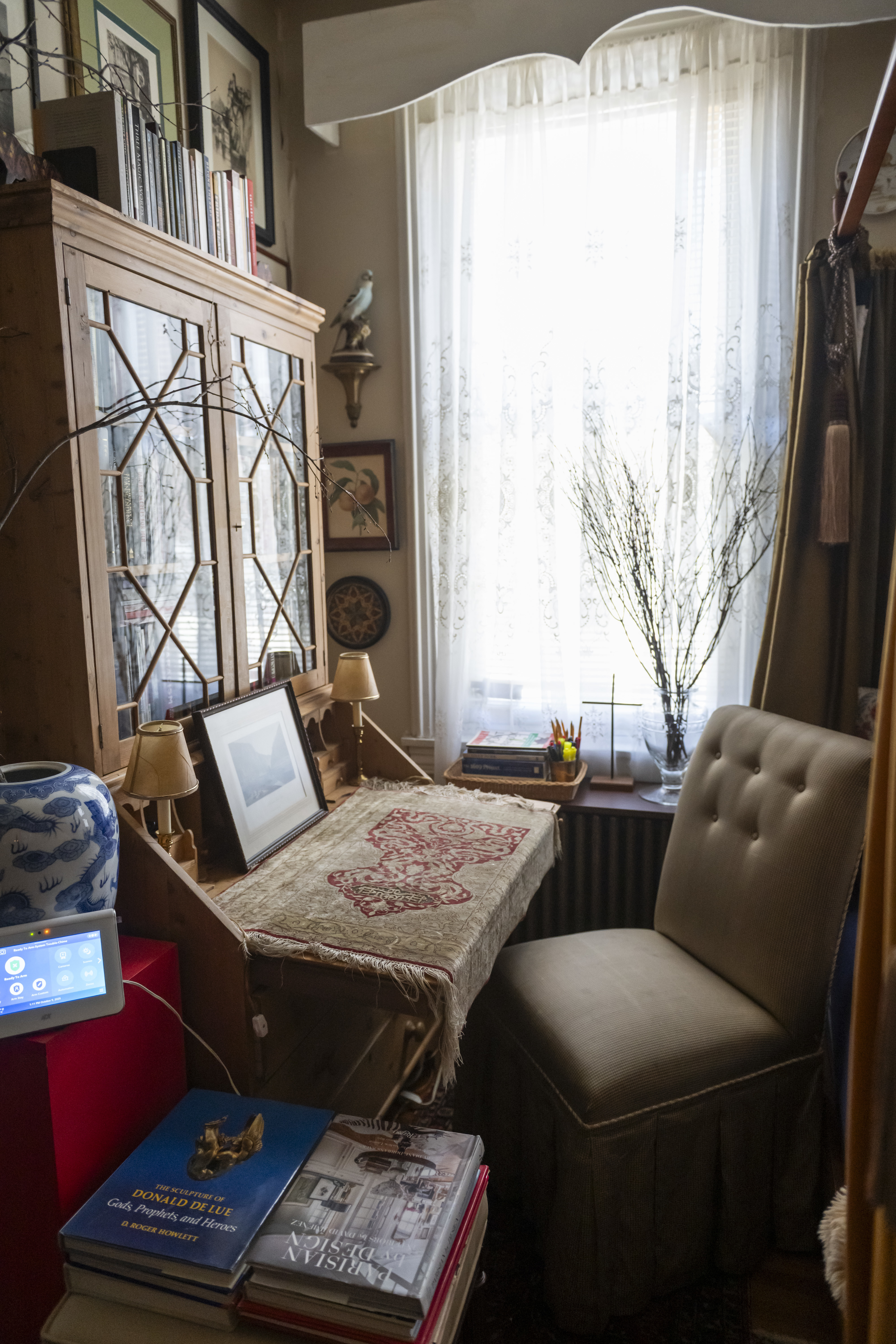
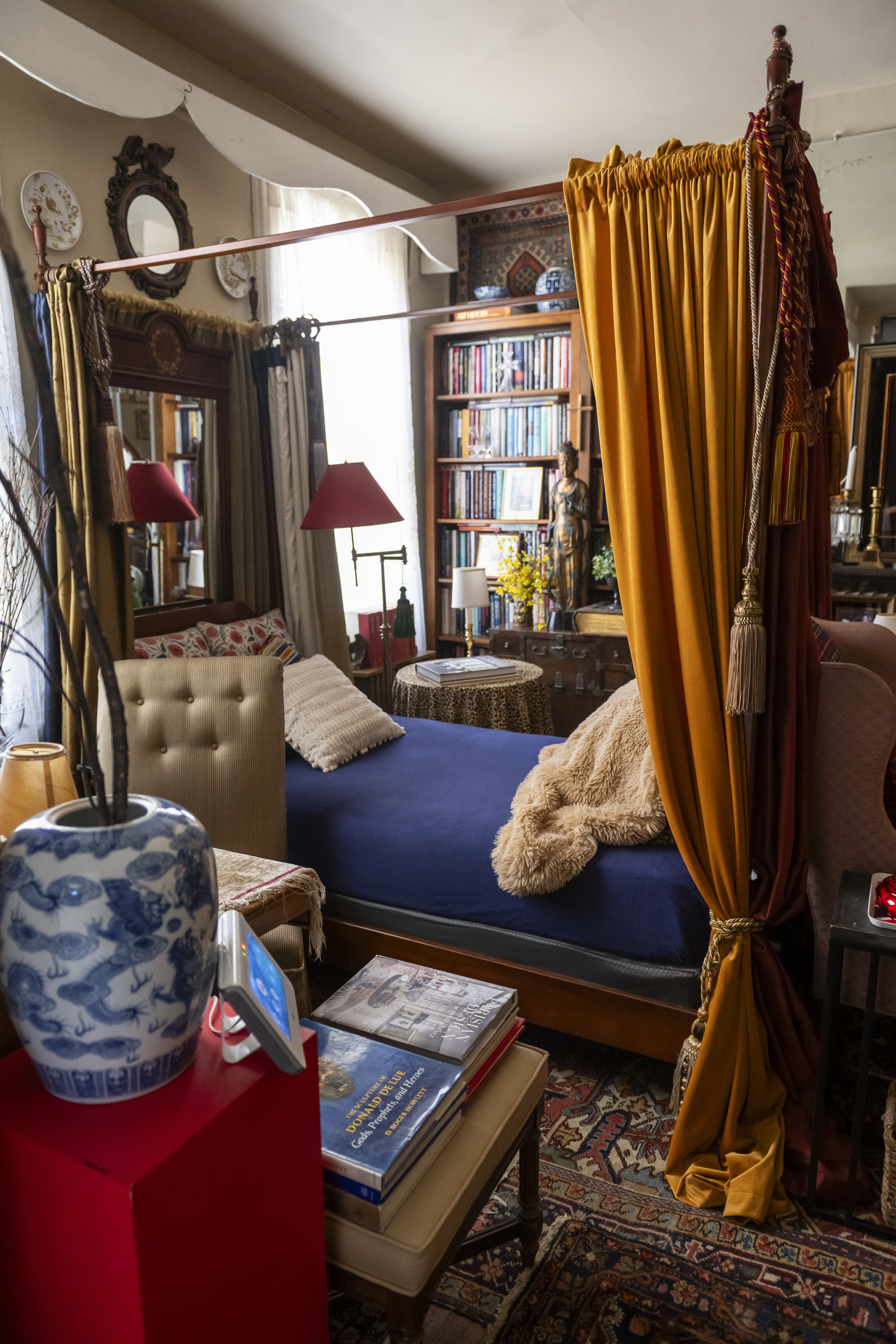
    A desk is topped with a book-filled cabinet, adjacent to the canopy bed.
    The canopy bed in Tootle’s double parlor room in his North Philadelphia home.

    Tootle was initially attracted to his home’s location because he worked at Girard Medical Center. The commute was 15 minutes by bicycle or a 30-minute walk.

    “I was raised not too far from my current address as a teenager; hence, I am very familiar with the neighborhood,” he noted. He also appreciates the sense of community, being minutes from Center City, and the architecture of the neighborhood.

    “The classic brick and stone rowhomes, the spacious interiors of the three-story houses, and the rich history of music, art, and civil rights,” Tootle said. “Shopping, arts, and eateries are other reasons I love where I live, and I especially love the many libraries and museums,” added Tootle.

    Tootle’s career is in social work and he has experience in psychotherapy, individual and group therapy, trauma counseling, grief counseling, and drug and alcohol counseling. In his spare time, he enjoys reading, antiquing, and going to the gym.

    Books are a central focus in his home — he estimates he owns about 3,000.

    Tootle sits in his double parlor surrounded by books and antiques.

    “My library is the culmination of 40-plus years of book collecting, trading, and selling. I have purchased books from bookstores, auctions, flea markets, libraries, thrift stores — anywhere books were sold,” he said.

    The bulk of the collection focuses on psychology, spirituality, history, art, and interior design, but it also includes poetry, fiction, and science. His favorite writers include James Baldwin, Toni Morrison, Peter Gomes, Ellen Langer, Carl Jung, and W.E.B. Du Bois, he said.

    “Essentially, I’d like to think my home references the three places I’ve always wanted to live in as a child: a library, a church, and an art gallery or museum — without the pretension,” said Tootle.

    Stacks of books overflow from the shelves and tables and onto the floor.
    Tootle’s S-rolltop desk is one of his most prized antiques.

    He’s especially fond of 19th-century antiques.

    “I am a sucker for antique lighting and furnishings of this period and have frequently found gems at auctions, estate sales, flea markets, thrift stores, and on the curbs of sidewalks,” he said.

    One special acquisition is an antique 60-inch-wide Tiger Oak S-rolltop desk, which he bought from a dealer in Bucks County. It was produced in the late Victorian Era, he said, in the 1890s.

    Tootle frequently tries different design layouts by rearranging furniture, changing lighting, and experimenting with colors, patterns, and textures.

    “My design ethos is very intentional and, hence, curatorial. I am a maximalist at heart,” continued Tootle. “My interiors are very layered.”

    Also, he’s planning on featuring more theatrical elements.

    “This includes incorporating more velvets, tassels, deep saturated colors, and sculpture — in the tradition of the late Renzo Mongiardino. Not as a copy, but inspiration,” he said.

    In the backyard, he wants to make a mixed-use space.

    The exterior of Tootle’s home.

    “I would like to have the soil paved over and start a container garden with trees, shrubs, herbs, and vegetables with a small round table accommodating two to four people,” said Tootle. “I rarely use it as it currently stands.”

    Is your house a Haven? Nominate your home by email (and send some digital photographs) at properties@inquirer.com.