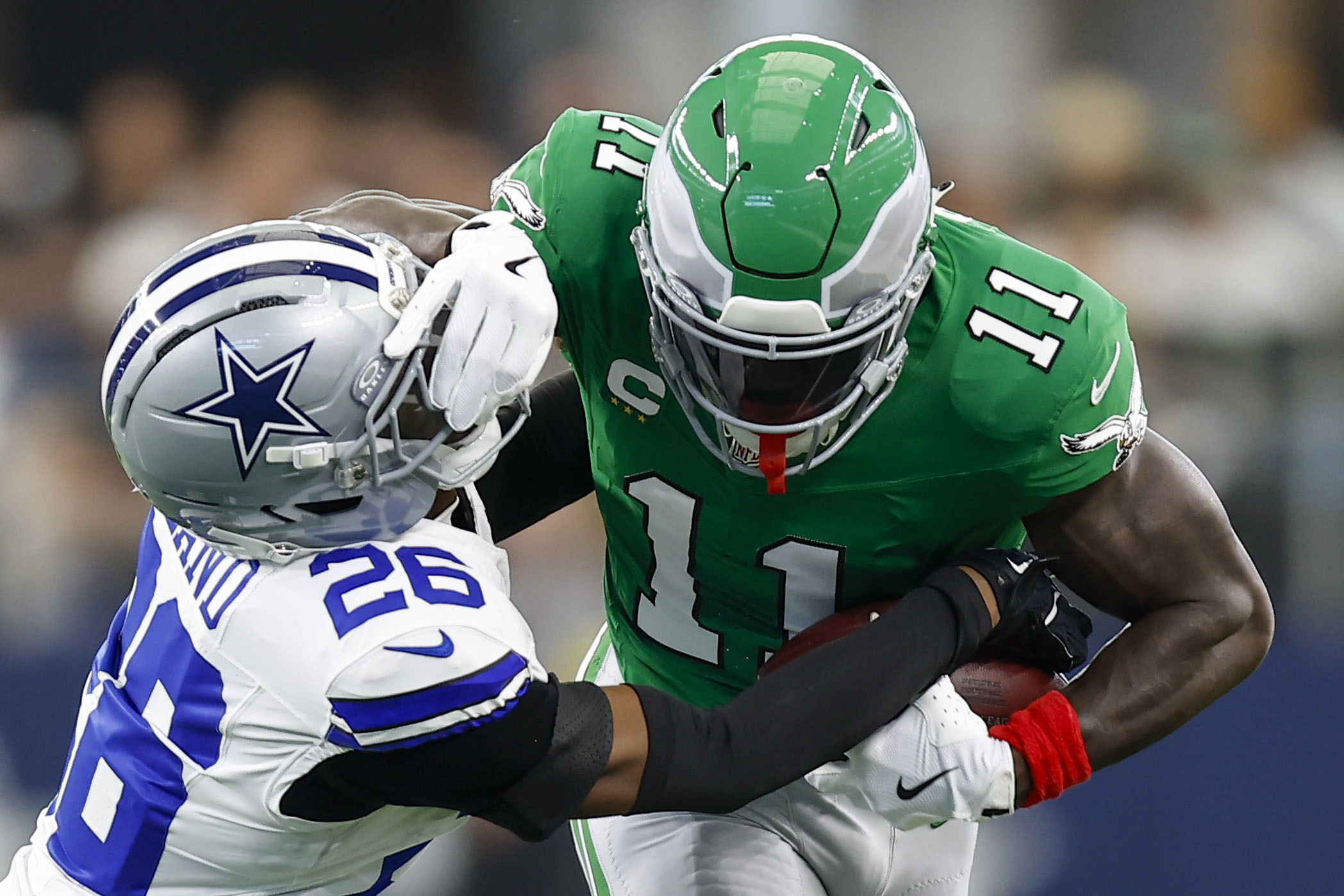
The Eagles blew a 21-0 lead at AT&T Stadium on Sunday, allowing the Dallas Cowboys to score 24 unanswered points and putting an end to the Birds’ four-game winning streak.
After the epic collapse, the Eagles face a short turnaround as they prepare to host the Chicago Bears on Black Friday. From the team’s chances this week to updates on yearly awards, here are the latest odds from two of the biggest sportsbooks …
Eagles-Bears odds
The Eagles and Bears last met during the 2022 season, a 25-20 road win for the Eagles.
This time around, the game will be in Philly as the Eagles attempt to bounce back from an embarrassing loss to their division rivals. Meanwhile, the Bears are heading into Friday’s game on a four-game winning streak, including their latest over the Pittsburgh Steelers on Sunday. Despite the divergent results, sportsbooks are favoring the Eagles, with the Birds opening Week 13 as seven-point favorites.
Despite the collapse against the Cowboys, the 8-3 Eagles still hold a big lead in the race to win the NFC East. However, Dallas did manage to slightly close the gap from last week. Meanwhile, Washington is 3-8 and its chances remain the same, and the New York Giants are out of the running.
The Rams and Eagles have been among the favorites to win the NFC for most of the season.
NFC odds
As a result of Sunday’s loss, the Eagles are no longer the favorites to win the conference at both sportsbooks. Instead, the Los Angeles Rams reclaimed the top spot with a 34-7 win over the Tampa Bay Buccaneers. Elsewhere, the San Francisco 49ers enter the top six.
Both sportsbooks have the Rams as the favorites to win the Super Bowl, with the Eagles as a close second. Meanwhile, the Buffalo Bills have completely fallen out of the top five after Thursday’s loss to the Houston Texans.
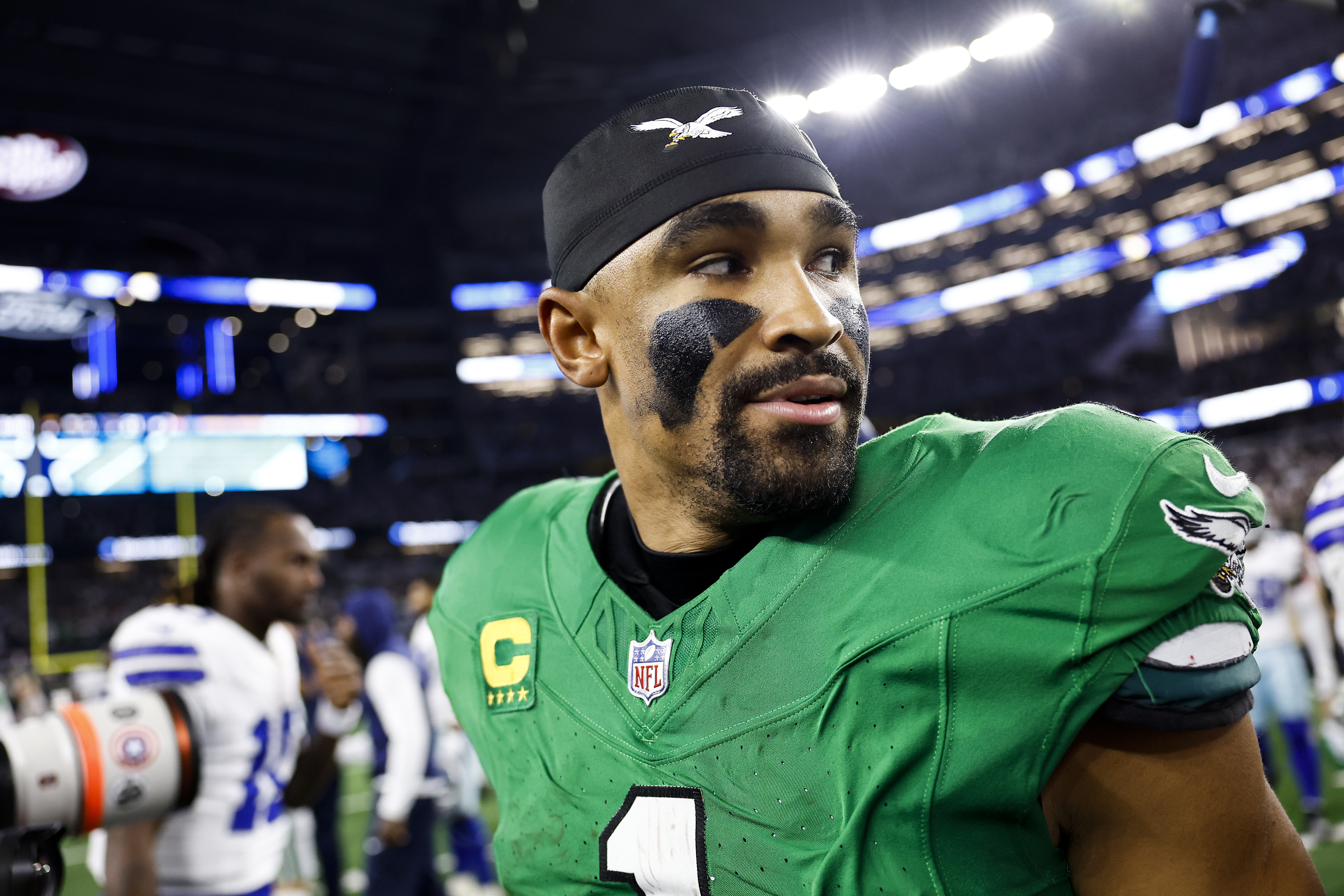
Eagles quarterback Jalen Hurts leaves the field after the Birds’ 24-21 loss to the Cowboys on Sunday.
MVP odds
Jalen Hurts’ MVP odds continue to fall after the latest loss. Drake Maye, Matthew Stafford, and Jonathan Taylor hold the top three spots in the race to MVP, but it appears to be a race between the two QBs at the moment.
After a Week 12 performance that featured one of his weakest outings — rushing for just 22 yards on 10 carries — Saquon Barkley continues to fall in the race for offensive player of the year. Meanwhile, Taylor and Jaxon Smith-Njigba remain the clear favorites.
It turned out that Matt Freese didn’t need to be the hero to oust his old team from the playoffs. Far more often Sunday night, the Union did it to themselves.
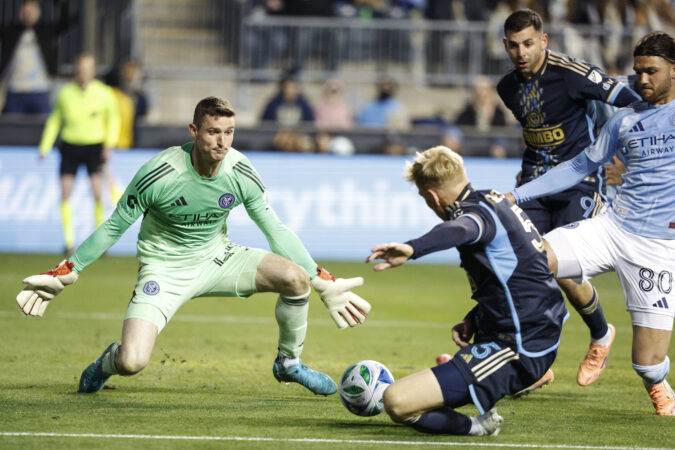
That was the feeling at the final whistle of the season as the Supporters’ Shield winners dropped a 1-0 decision to rival New York City FC in the Eastern Conference semifinals on Sunday night at Subaru Park.
Of all the game’s narratives — and there were almost as many as the fouls the teams bashed each other with — the Union looking so powerless was among the least expected. But far too often in the game, it felt like this team wasn’t going to score.
In the first half, the Union had four scoring chances, and at least two of them were only half-chances. The biggest what-if came in the 42nd minute, when Tai Baribo flicked a first-time shot from close range wide of the far post instead of trying to slam it nearer.
In the second half, the Union didn’t have a quality chance until the 73rd, when Danley Jean Jacques botched heading a cross from substitute Frankie Westfield, then Bruno Damiani whiffed on an acrobatic attempt at the loose ball.
For almost all the time until then, a New York squad, whose leading striker Alonso Martínez and key midfielder Andrés Perea were out injured, sat back and defended. That also wasn’t surprising, but the Union kept falling into the Pigeons’ traps. Play up the middle repeatedly fizzled out, and New York repelled almost all of the Union’s repeated crosses. When the Union tried shooting from range to try to break things up, all but one of the attempts were off-target.
“They had a team out there that was hungry, and for the first couple of moments of the game, we didn’t really match that,” Union manager Bradley Carnell said. “That’s on me. … Something just didn’t feel right, and we were a little bit slow to get into the game. Once we did, I thought we were very good.”
By the time Cavan Sullivan entered in the 83rd minute, it almost felt too late already. But even in the 15 total minutes he spent on the field — seven of regular time and eight of stoppage time — he was more creative than some of his teammates were all night.
But the end felt inevitable well before the final whistle. Westfield blazed over the bar from close (but offside) range in the 87th, and Freese went full-stretch to deny Milan Iloski in the 92nd. The Wayne native let out a big shout and a fist pump with that, finally releasing some of the emotions he’d kept pent-up with the U.S. national team.
The Union now turn to their offseason roster decisions, which are due to the league by Wednesday. Four players are out of contract, and eight have options on the table.
Any team expecting to make a deep run usually knows by this point what its decisions will be. The Union are no exception, even though sporting director Ernst Tanner has been on administrative leave since Wednesday. Most of the big calls were likely made before then.
But that doesn’t mean there will be smooth sailing. While the season’s end opens the door for a quick decision on Tanner, the odds of that happening feel slim. MLS has to finish its investigation, and there have been no hints about how long that will take.
If the league proves enough of the allegations of insensitive comments on many levels to move for Tanner’s dismissal, MLS and the Union will have to contend with however Tanner and his lawyers respond.
In the meantime, it looks as if the key decision-makers will be the trio of assistant sporting director Matt Ratajczak, scouting director Chris Zitterbart, and academy director Jon Scheer. All three know the way things work at the club plenty well, even if they don’t have Tanner’s name recognition or final-say power.
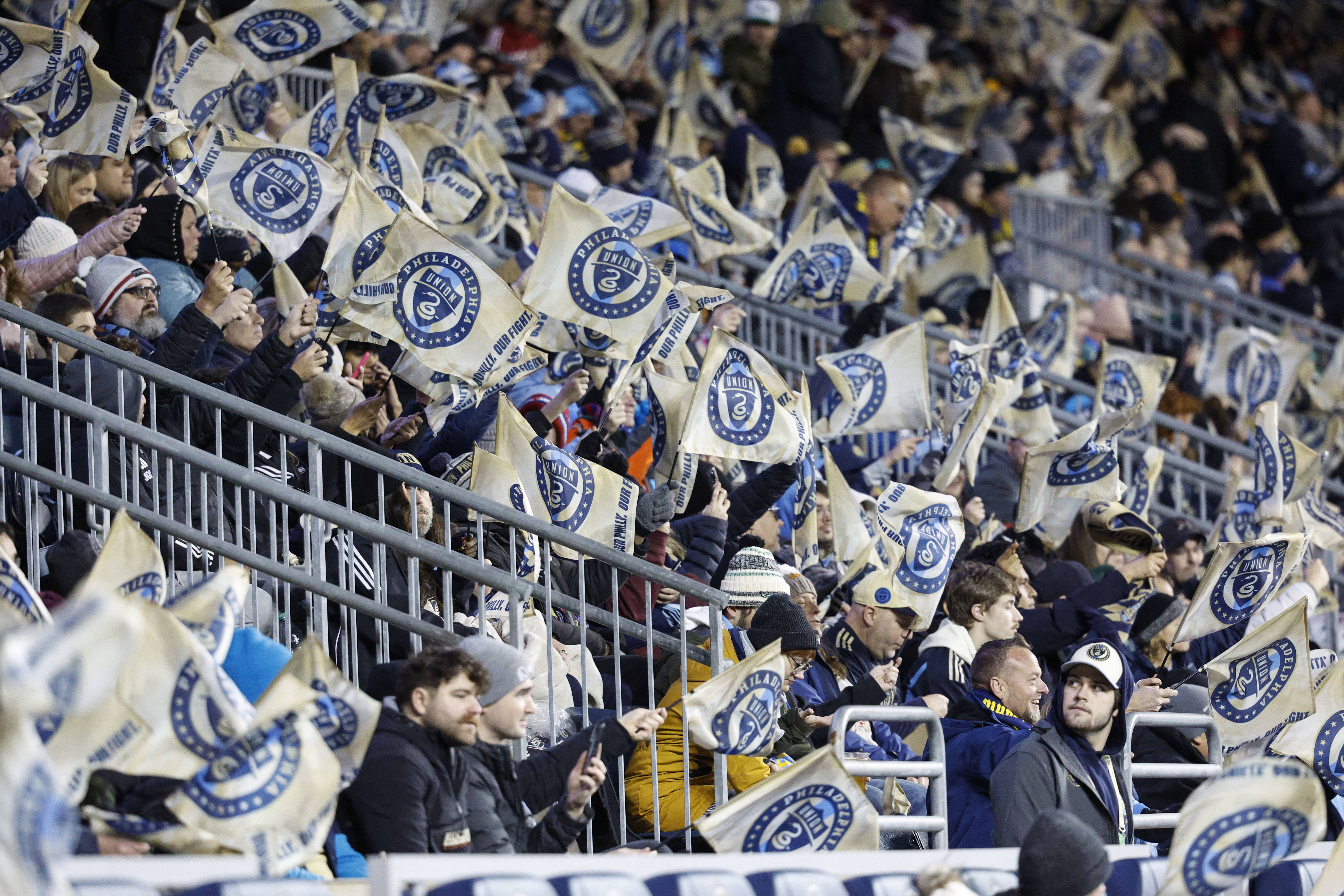
Union fans brought plenty of energy Sunday night, but they left the stadium disappointed.
The biggest decision that has already been made is releasing Mikael Uhre. He’s out of contract, and it’s been an open secret in Chester for weeks that he’s on his way out. Nor is it a secret in his native Denmark that Uhre has feelers out to clubs there including his previous home, Brøndby.
Uhre stood for a long spell on the field after the final whistle, at times with colleagues and at times alone. As he headed to the locker room, the fans left in the River End gave him a nice ovation.
“Let’s just say I’m keeping my options open,” he said. “I’m not saying I would never come back. I love it here — I love the people here, I love my teammates — so I would definitely not say no. But yeah, that’s not only up to me.”
The other players out of contract are Alejandro Bedoya, who will presumably first decide whether he wants to play another year; and two players deep on the bench, midfielder Ben Bender and third-string goalkeeper George Marks.
Eight players have options on the table: goalkeeper Oliver Semmle; defenders Nathan Harriel, Isaiah LeFlore, and Olwethu Makhanya; midfielders Nick Pariano and Indiana Vassilev; and forwards Tai Baribo and Chris Donovan.
Mikael Uhre stands on the field alone, knowing he has played his last game for the club.
Most of those decisions should be easy. Semmle, LeFlore, Pariano, and Donovan will almost certainly go, and the other four should get picked up. The quartet deserve new contracts, and who negotiates them will be a big question. At least taking the options allows for time to have those talks down the road.
Baribo will likely be the biggest challenge. He has earned a big raise and would love to stay in town for on-the-field and off-the-field reasons. But the Union might be wary of breaking the bank for him, and they’d be right. His skill set has limits.
Earlier this month, Israel’s Ynet news website reported that the Union offered Baribo a $2 million contract. That has yet to be confirmed anywhere else, but if it’s true, the view here is that Baribo (and his agent) would be wise to take it.
Sunday’s loss was not a failure of the Union’s system. They should have won the game since New York was shorthanded, and if they’d had the injured Quinn Sullivan, their odds would have gone way up. But the Supporters’ Shield trophy can’t be taken away from them, nor does losing at this point in the playoffs devalue it.
“On another night maybe it goes our way,” Carnell said. “But it just wasn’t meant to be. It gives us something to be hungry for down the line here starting in the new year, and that gives me motivation to come back and think we can do this thing one step further.”
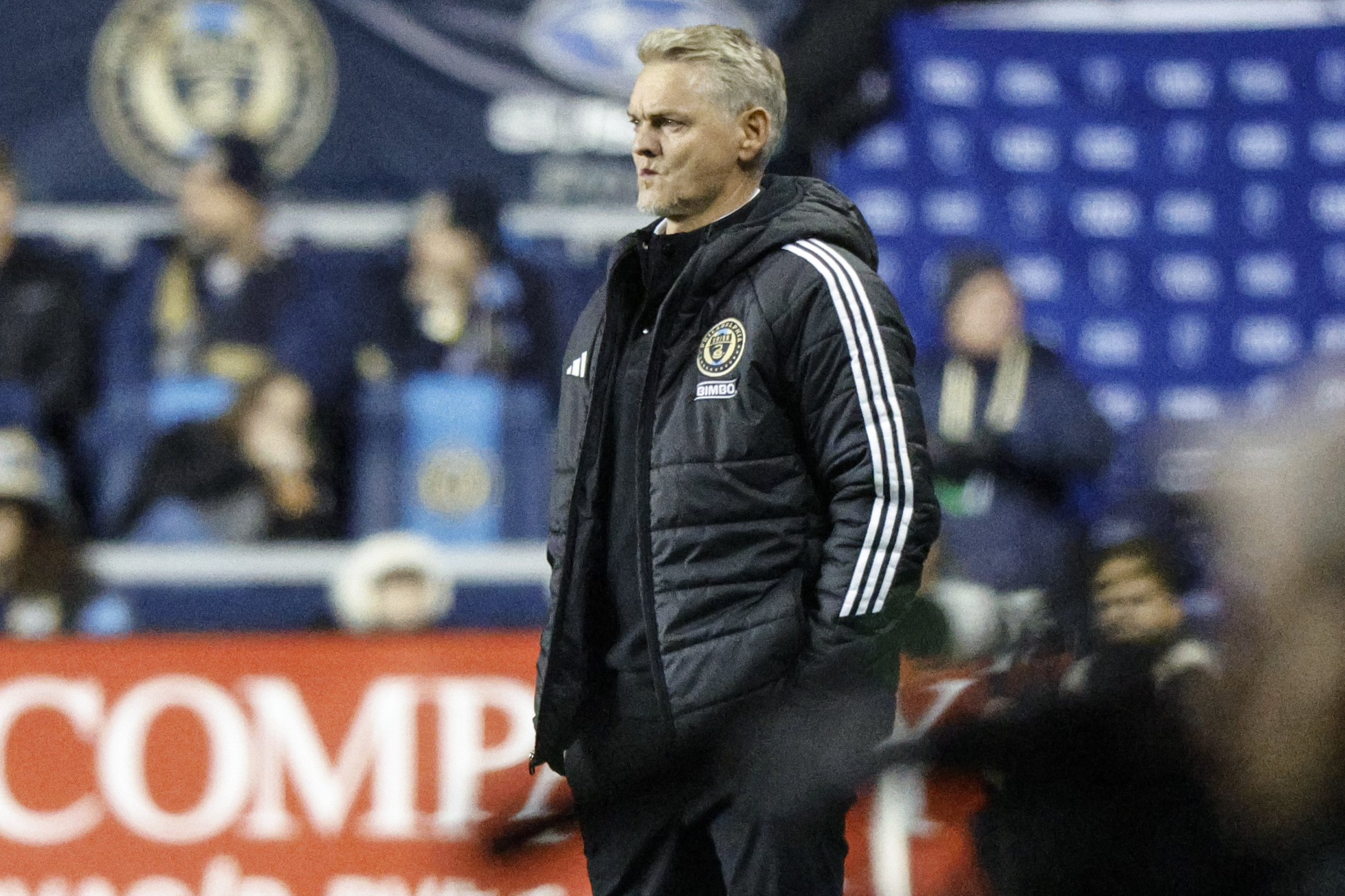
Union manager Bradley Carnell on the sideline Sunday night.
As the Union, the crowd, and the season headed off into the Sunday night darkness, some words from a few weeks ago came to mind.
They came from principal owner Jay Sugarman when he met with the national media in New York, just before the playoffs started. He wanted to drum up some positive attention for his team, and he succeeded.
But at one point, he said something that he knew might come back around on him: “We don’t rely so much on guys creating their own shot.”
It was once again the missing piece Sunday. The only players who have that skill are Cavan Sullivan and Iloski, and that’s not enough — even though Sullivan will be ready for a lot more playing time next year.
It’s especially missing at striker. Ezekiel Alladoh could be a big-time addition, but the evidence from his time in Denmark shows him to be stylistically similar to what this team already has in Baribo and Damiani.
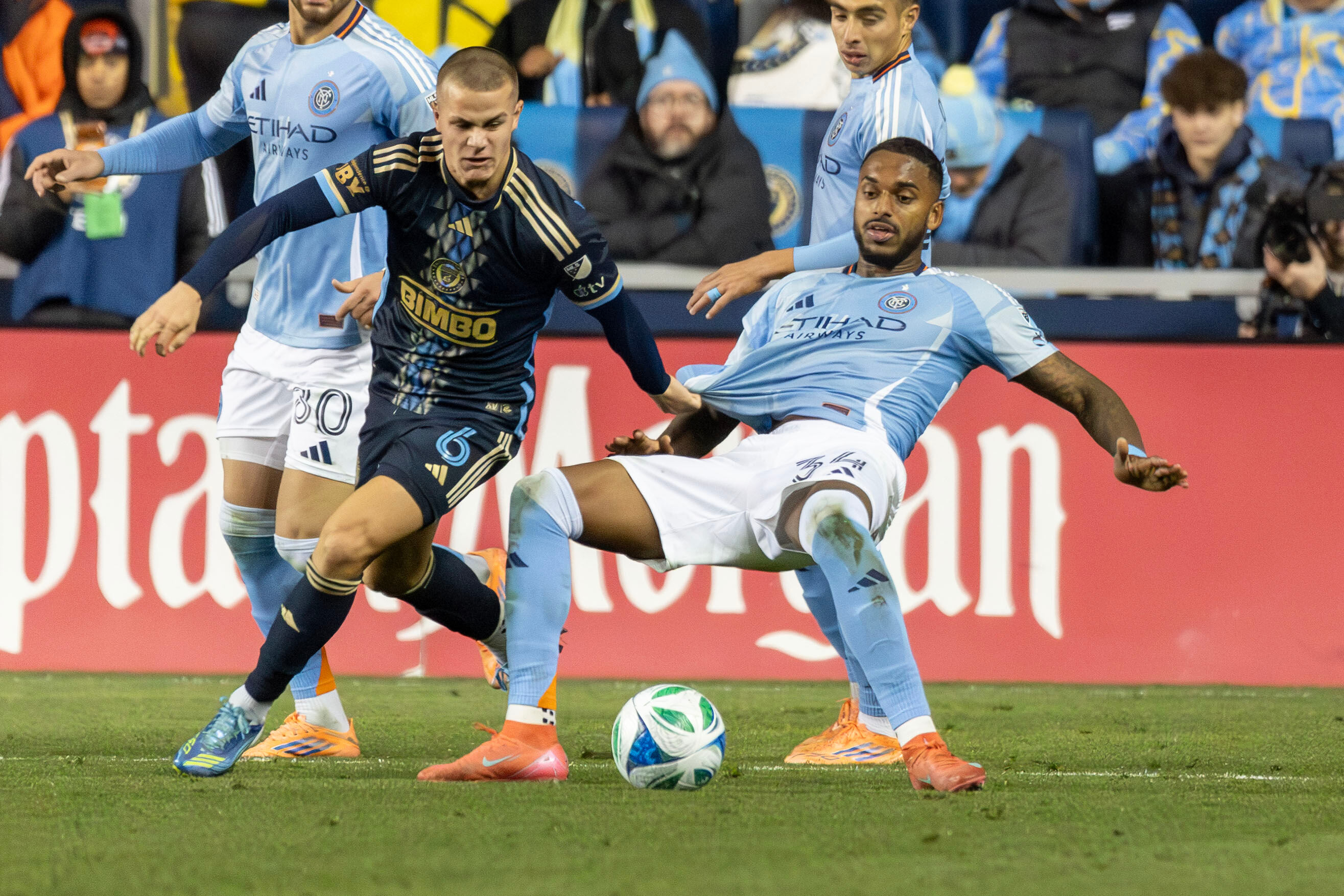
Cavan Sullivan (left) trying to get away from New York’s Raul Gustavo late in the game.
Then again, who will sign Alladoh if Tanner goes? That will put an even bigger question on the table for Sugarman and the rest of the Union’s ownership.
It will sit alongside the biggest question of all, one Carnell brought back into focus when he said that “the fairy tale came to an end tonight.”
A big-city team that has made the playoffs in seven of the last eight years and made deep runs in four of the last five — plus two deep Concacaf Champions Cup runs — shouldn’t have to frame a Shield-winning season as a fairy tale. The Union are legitimately one of the best teams in MLS. They should be again next year and should be treated as such.
But how to get over the biggest hump of all, to win an MLS Cup, is a question that can only be answered at the top of the organization.
That has been true since the beginning, and now it’s on to the 17th attempt.
There are few artists who can accomplish the impossible feat of a voluntary phone-free show.
The moment Dijon Duenas — dressed casually as if he’d stopped by a Fishtown bar to watch the Eagles game — walked on to the Met stage, Philadelphians packing the 3,500-seater venue remained captivated for the full two-hour show.
The Grammy-nominated American singer-songwriter, record producer, actor, and multi-instrumentalist, who goes by just his first name, made a stop at the Met Philadelphia on his 37-city tour on Sunday night.
The international tour, which began in October, comes after the release of Dijon’s second album, Baby, “a spectacular new vision of soul, pop, and R&B” in which his “surrealist, collagist approach to songwriting stretches the bounds of sound and feeling,” according to Pitchfork.
And altering those bounds of soul, pop, and R&B he did; performing 18 songs from new and past albums. With his nine-person band, fans watched a live jam session playing out as the artist expertly weaved together instrumentals and his voice to recreate the high production of his work live on stage.
Starting off on a “HIGHER!”note, Dijon began the show with the ecstatic and celebratory track. Audience members were up on their feet by the first beat, dancing, bopping their heads, and singing along until he concluded the show with a heart-wrenching encore performance of “Rodeo Clown.”
Philadelphia fans have waited four years to see Dijon back in the City of Brotherly Love, since he last stopped here in 2022 at the Union Transfer for two sold-out shows. The anticipation to see him was palatable from the mass of people buying merch and records before the show even began and the commitment to stay on their feet, phone-free throughout.
Since his debut album Absolutely dropped in 2021, Dijon has quickly made his mark. He regularly works with guitarist and songwriter Mk.gee. He teamed up with Bon Iver for single One Day, and helped produce Justin Bieber’s SWAG. He made a cameo on Paul Thomas Anderson’s One Battle After Another, and will be a musical guest on Saturday Night Live on Dec. 6. And he’s up for producer of the year for his work on Bieber’s album at the Grammys.
On Sunday, Dijon let all the small yet significant quirks of his production vibrate off the Met walls: euphoric swells in “Yamaha” offering vulnerable glimpses of joy and devotion, his trademark squawks and wails in “My Man” echoing deep emotions of resentment, and intentional pauses in “Talk Down” making space for his fans to belt out the lyrics to the crowd favorite Absolutely track.
The flashing flood lights on stage lit up the thousands of faces that remained transfixed and almost hypnotized by Dijon’s artistry. He finished his set with soulful, soft “Kindalove,” but cheers and hollers from the crowd for a full four minutes brought the singer back on stage for two raspy, raw encore performances of “Skin” and “Rodeo Clown,” both tracks that demonstrated the lengths he’ll go — even if it means shrieking until his voice gives out.
Watching the artist replicate his work live, for many in the audience walking out of the venue, was nothing short of — as critics have hailed his latest album — “transcendent.”
Center City was resilient this year, reporting slight increases in foot traffic and overall retail occupancy despite high-profile closures along Market Street.
About 84% of Center City storefronts were occupied as of October, up one percentage point from the same time last year, according to the Center City District’s annual survey of business owners. Occupancy has hovered around that point since at least 2023 and has yet to recover to its pre-pandemic level of 89% in 2019.
So far in 2025, an average of 343,540 people walked through Center City each day, an increase of more than 3% from last year, the survey found. Each section of Center City, from the beleaguered Market East to the thriving Rittenhouse Square area, saw at least a 1% bump in average daily foot traffic, according to the survey.
Some retail corridors, however, are looking more vibrant than others.
window.addEventListener(“message”,function(a){if(void 0!==a.data[“datawrapper-height”]){var e=document.querySelectorAll(“iframe”);for(var t in a.data[“datawrapper-height”])for(var r,i=0;r=e[i];i++)if(r.contentWindow===a.source){var d=a.data[“datawrapper-height”][t]+”px”;r.style.height=d}}});
Market Street continues to struggle on both sides of Broad Street.
As of October, the office-centric western side of Market had the lowest occupancy in Center City at 62%.
Market East, the future of which continues to be debated by city stakeholders, had a 72% occupancy rate. It has been impacted by a slew of recent closures, including Macy’s, Rite Aid, Iron Hill Brewery, and Giant Heirloom supermarket. The Center City District calculates occupancy rates by number of storefronts, not total square footage.
On Chestnut Street, the eastern and western sections have vastly different occupancies. The eastern side recorded a 71% occupancy rate in October, according to the survey, while 81% of stores on the western side were occupied.
Walnut Street continues to be the district’s shining star, with 86% occupancy in both the eastern and western sections, according to the survey. In the report, the Center City District highlighted several new additions, including the luxury women’s fashion company Aritzia and North America’s first Nike Jordan World of Flight store.
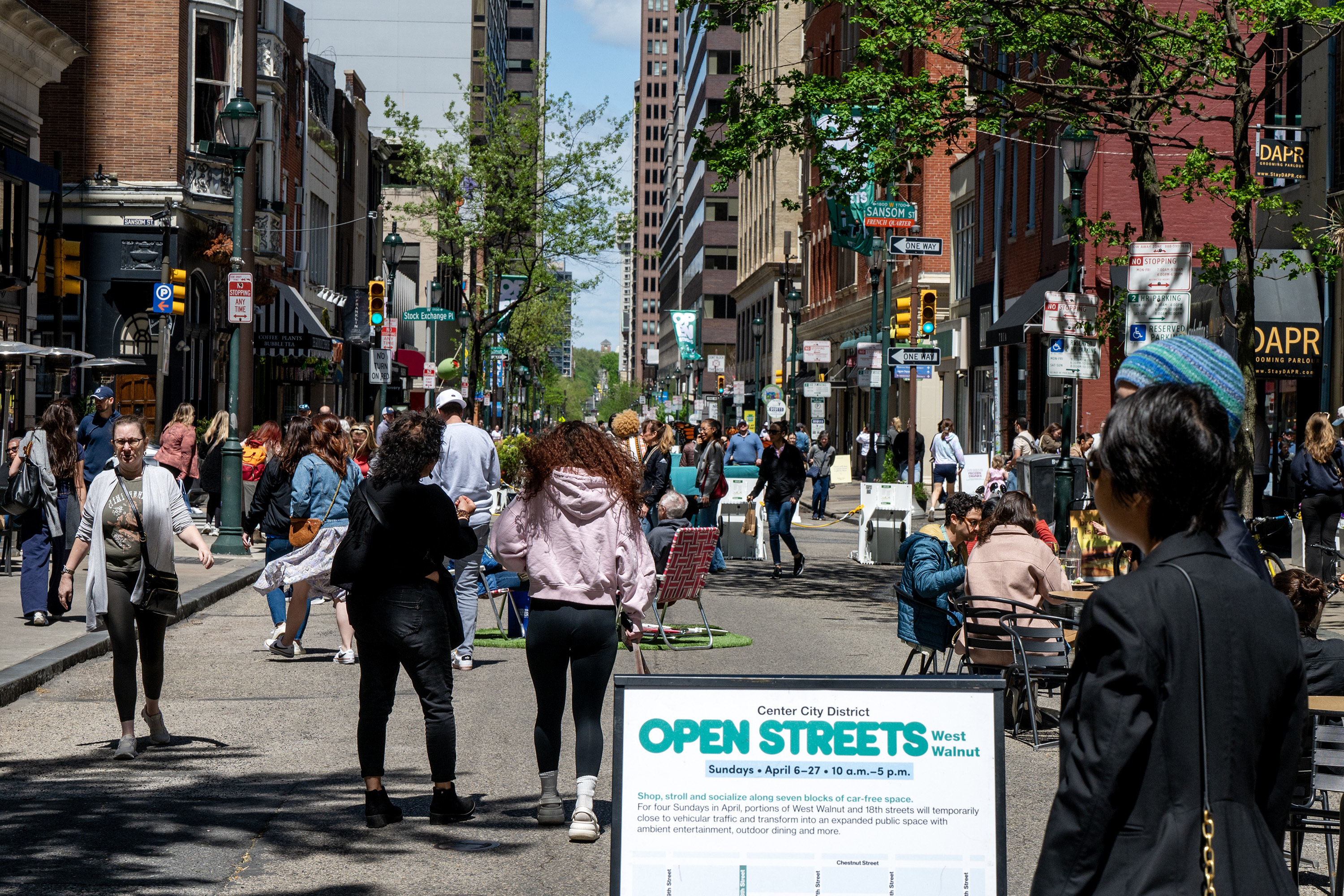
The report once again highlighted the success of the Open Streets program, during which roads are closed to car traffic and become pedestrian walkways for shopping and dining. There have been 21 Open Streets events since its inception in September 2024, with more planned for December and next year.
The events bring out more than 10,000 people on average, according to the report, and typically result in a 65% boost in businesses’ foot traffic and a 39% bump in sales volume.
An Open Streets in April. There have been 21 Open Streets events since its inception in September 2024, with more planned for December and next year.
Looking to the future, the district surveyed 700 Philadelphia renters to ask what types of retailers they’d like to see more of in Center City.
“Downtown residents seek convenient access to everyday goods, full-service grocery stores and home furnishing options — all within walking distance,” district executives wrote in the report, noting that these types of businesses could fill vacancies in office buildings or in the concourse around Suburban Station.
“CCD looks forward to convening office district stakeholders in 2026 to discuss a coordinated retail attraction strategy that could reposition the office district as a place to accommodate many of the retailers Center City is currently missing.”
Editor’s note: A previous version of this story included an incorrect comparison between 2025 and 2024 for occupancy on Market Street.
There are a lot of questions surrounding the Eagles after their collapse in Dallas on Sunday, their third loss of the year, and easily their worst.
Here’s what former players and media are saying about the game and where the Birds go from here …
Who deserves the blame?
The Eagles got off to a hot start on offense against the Cowboys, building an early 21-0 lead, and looking like an offense finding the form that had evaded it in previous matchups against Detroit and Green Bay.
But the Birds failed to score a single point after that, going scoreless over the game’s final 40-plus minutes and allowing the Cowboys to come all the way back to win the game, 24-21.
Former NFL quarterback Cam Newton said on First Take on Monday that, despite being extremely high on many of the Birds’ players, it’s concerning that there hasn’t been one game where the Eagles’ offense has truly put it all together and shown what they are seemingly capable of for 60 minutes.
“A team of that caliber, we don’t expect those things to happen to them,” Newton said. “The thing that’s alarming is, the first three drives you score, you come out with a bang, we impose our will. The last eight drives, nothing. The frustration stems from, when are the Philadelphia Eagles are going to put it together, all together?
“You’re starting to say, is it the offensive coordinator? Is it the quarterback? The players? That’s where my frustration comes in. When you have that much talent, and to not have one game — here we are in [Game] 11 — to not be able to say, they figured it out.”
"A team of [the Eagles'] caliber, we don't expect those things to happen." ✍️
So, how concerned should fans be about the state of Kevin Patullo’s offense right now? ESPN’s Dan Orlovsky says very.
“I’m very concerned about the offense, because it’s not good enough to beat good teams,” Orlovsky said. “It will not be good enough to beat a team like the Packers in the playoffs, the Rams in the playoffs, the Seattle Seahawks in the playoffs.
“They’re one-dimensional. They’re pass-only success when it comes to the offense’s ability. Their offensive line loses one-on-ones, they’re predictable in the run game, Saquon [Barkley] has not made people miss in space nearly as much as he was last year, and their routes — you can be predictable on offense if you’re creative with your route concepts. They’re not.”
.@danorlovsky7 says he is very concerned about the Eagles' offense 😳
Damien Woody and Rex Ryan agreed on Get Up that the Eagles’ offense was “elementary,” especially compared to more advanced NFL offenses like the Los Angeles Rams or even the Dallas Cowboys. In 2024, the Birds were able to crush teams up front with their offensive line, but Woody, a former NFL offensive lineman, said they can’t do that anymore.
“Their offensive line is nowhere near what it was in previous years,” Woody said.
Prior to Sunday’s game, Nick Foles discussed on his podcast what he sees as the biggest issues with the Eagles’ “superpowered” offense, which hasn’t been able to get into a good rhythm this year.
Dallas Cowboys cornerback Daron Bland defends A.J. Brown in the first quarter at AT&T Stadium on Sunday.
Foles, like Orlovsky, called out the Eagles’ route designs, which haven’t put A.J. Brown and DeVonta Smith in the best position to get open, which in turn prevents Barkley from finding the holes he found last year. The former Eagles quarterback told co-host Evan Moore that the Birds utilize “simplistic” route trees (or the combination of routes a player can run at a given time) that don’t create space for the players, forcing them to get open and make plays on their own.
“The great teams, those guys are wide-open. Even when I’m watching with [my wife] Tori, she’s like, ‘Why are these guys so wide-open?’” Foles explained. “And I’m like, ‘Well, it’s a complementary route to a deep route. … You need those downfield shots because it puts more pressure on the [defensive backs], it opens up more one-on-one matchups, but you’ve got to have complementary [routes], because then the DB can’t key and can’t guess.
“So the creativity is key as a play-caller, and calling the plays at the right time. … There’s just an art. And I don’t see that this year. I don’t think anyone sees it. Fans that are passionate Eagles fans — because I’ve been to Philly several times — and you hear, every time I run across Philly fans, ’Man, what do you think is going to happen with the offense? What’s going on? Is this Jalen [Hurts]?’ I’m like, ‘Listen, it’s a team thing. Kevin Patullo is probably a great dude, a great coach, but there’s an art to play-calling that not everyone has and it’s not showing up this year.
“They’re in more of a trajectory of the 2023 season … I would argue that they’re more on that trajectory than last year’s trend line, but at the same time, I do know that they have the players.”
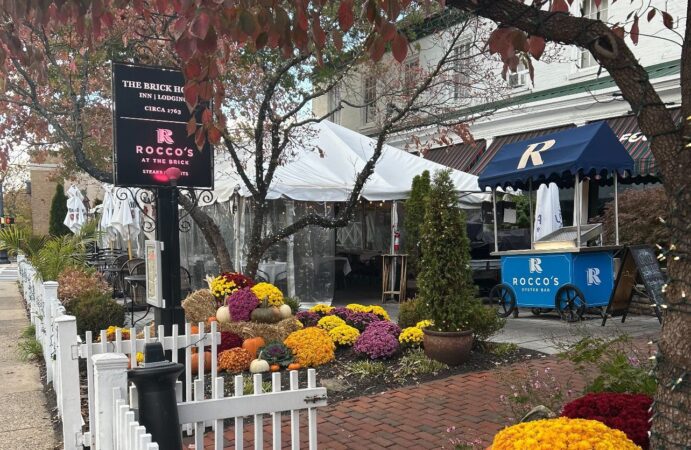
With hundreds of reservations on the books and the holidays approaching, Rocco’s at the Brick Hotel in Newtown, Bucks County, abruptly closed last weekend. The closure, which left about 50 employees out of work overnight, was not the restaurant’s decision, according to the owner.
The sudden closure was prompted by a dispute between the steakhouse’s ownership and the property’s landlord, who also controls the liquor license, said David Gelman, son of Rocco’s owner Marc Gelman.
David Gelman said that Rocco’s was forced out of business because the landlord, Verindar Kaur, had filed a change on Friday with the Pennsylvania Liquor Control Board to remove Rocco’s LLC, Marc Gelman’s corporation, from its liquor license.
The ability for Rocco’s to sell alcohol was part of the business’ operating agreement, in effect since the restaurant opened in January 2018. Kaur owns the liquor license while Marc Gelman operated the restaurant, paying her a fixed monthly fee and a percentage of proceeds in addition to what David Gelman described as “Center City-level” rent.
Contacted Sunday by email, Kaur said she was “unable to speak with anyone.” She did not reply to a follow-up email Monday.
David Gelman said his first inkling of imminent trouble was Thursday night, when Kaur emailed him and his father to say that she would terminate the agreement unless a new financial arrangement was reached by the following day. The PLCB confirmed to The Inquirer that on Friday, it received a notice that the license’s corporate structure and officer were being changed. This move nullified the management agreement, David Gelman said.
“This is not something we wanted to do,” Gelman said. “But we can’t operate without the liquor license [per the agreement]. There was no way to rectify the situation.”
Rocco’s last night was Saturday.
Gelman said that Kaur’s actions constituted a breach of both the lease and the management agreement and said his father planned to file a lawsuit seeking damages.
“There’s a clause in the lease that [operating a restaurant] is contingent on having a liquor license from her, so by interfering with that license, she’s breaching her own contract,” said Gelman, a lawyer.
The restaurant had “hundreds of reservations” on the books for Thanksgiving and corporate holiday parties, he said.
Gelman said the restaurant was informing customers that they could be accommodated at the Pub in Pennsauken and Library II in Voorhees, other steakhouses operated by the Gelman family in South Jersey. Those who hold Rocco’s gift cards can call Rocco’s number or contact it through the website for a refund.
Remaining inventory, including seafood, meat, and produce, was relocated to the Pub and Library II to prevent waste.
Rocco’s, named after the son of chef-partner Cole Caprioni, occupies the ground floor of the Brick Hotel, parts of which date to 1763.
Kaur previously operated the restaurant at the hotel, featured in 2016 on the Gordon Ramsay television show Hotel Hell, before Gelman’s company took over. On camera, Ramsay declared, “I want to shut this place down,” over cleanliness and customer-service issues.
“Ninety five percent of what was on the show did not happen that way,” Kaur told the website NewtownPANow.com in 2016, adding the producers drummed up drama for ratings.
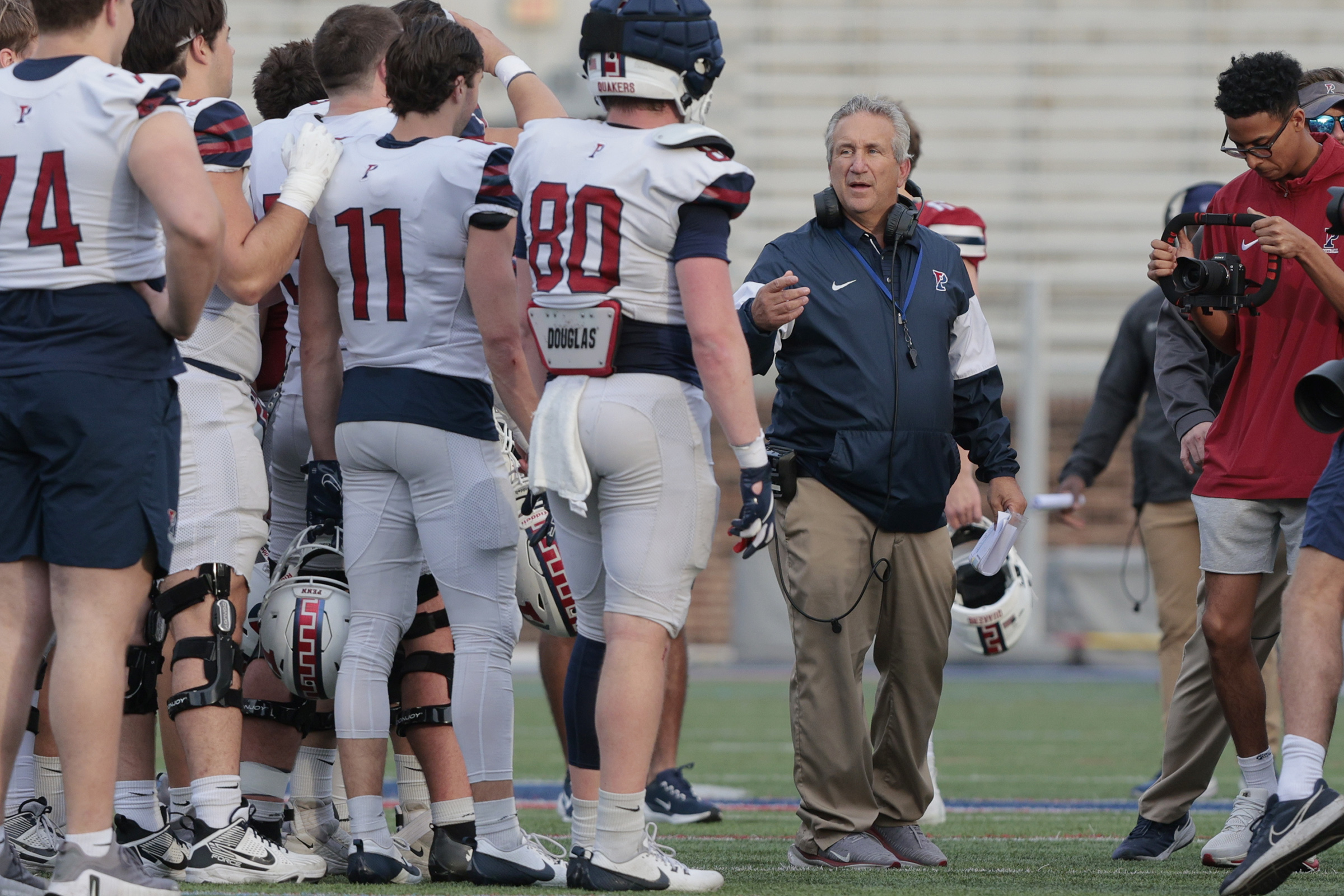
Ray Priore is stepping down as Penn’s football coach after 11 years, the university’s athletic department said Monday in a news release.
Priore spent 39 years with the Quakers’ program and finished with a 58-42 overall record, 37-32 in Ivy League play. After he was named head coach in 2015, Priore won back-to-back Ivy championships in 2015 and 2016 but went nine straight seasons without a share of the league title.
His last game was a 17-6 victory against archrival Princeton as Penn finished 6-4, 4-3 Ivy. A nationwide search for the Quakers’ next head coach will begin immediately.
“To say coaching at the University of Pennsylvania has been the honor of a lifetime is an understatement,” Priore said. “Penn has been my second home for 39 years, the last 11 of which I have had the privilege of serving as the head football coach. The end of this season marked my final game, and closing this chapter with a win is something I will carry with me forever. While it’s hard to step away from the program I hold so dear to my heart, I know this is the right time.”
During his tenure as head coach, Priore recruited 94 All-Ivy League honorees, 10 All-Americans, and three Ivy League Players of the Year: Tyler Drake in 2015, Joey Slackman in 2023, and Malachi Hosley in 2024.
Penn coach Ray Priore with the team during the annual spring football game at Franklin Field in April.
Priore had one player drafted by an NFL team — Justin Watson, now a wide receiver for the Houston Texans — while three other players signed free-agent contracts with teams in the league.
“I’m grateful for Ray’s leadership and service to Penn football and to generations of student-athletes, staff, and alumni,” Penn athletic director Alanna Wren said. “Few individuals have given more of themselves to this program. Ray’s integrity, mentorship, and deep commitment to the student-athlete experience have shaped Penn football in meaningful and lasting ways.”
Penn struggled in recent years, finishing with losing Ivy records in 2023 and 2024.
Priore began his Quakers career in 1987 as a linebackers coach and went on to fill several roles on the staff. He served as the team’s defensive backs coach and defensive coordinator from 1999 to 2014. Priore was a part of 12 Ivy League championships during his tenure with the coaching staff, as the Quakers won five titles between 2000 and 2010.
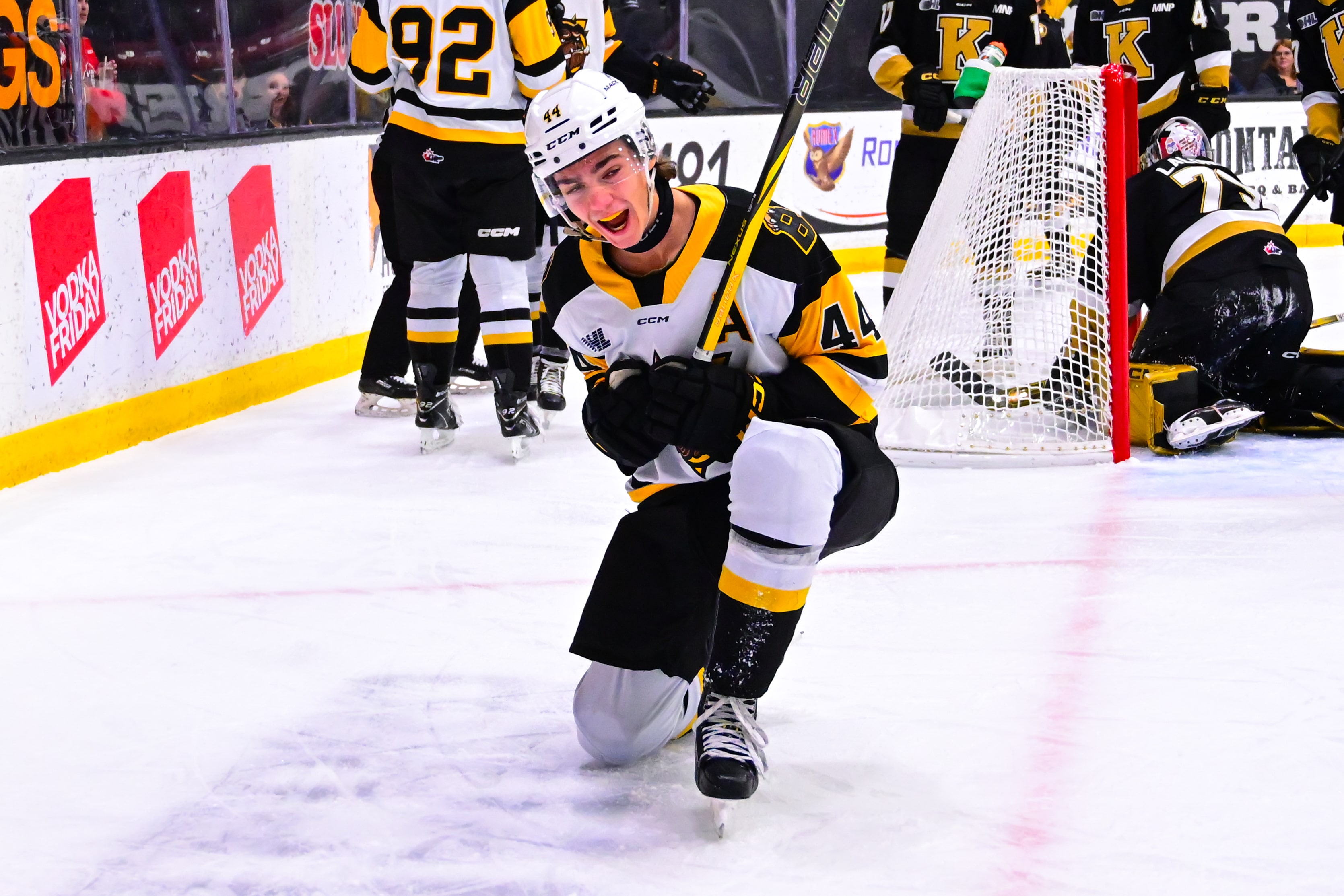
Jett Luchanko has been traded. Luchanko, the Flyers’ 2024 first-round pick and the co-captain for Guelph of the Ontario Hockey League, is on the move to the OHL’s Brantford Bulldogs. In exchange for Luchanko, Guelph will receive center Layne Gallacher and four future draft picks.
General Manager George Burnett has announced today that the club has traded forward Jett Luchanko to the Brantford Bulldogs in exchange for forward Layne Gallacher and picks.
The trade was expected after the Storm were awarded the 2027 Memorial Cup late last week. Guelph was willing to move Luchanko, one of its top players, to recoup assets that will help it build for next season, when the Storm will participate in the tournament as hosts.
The prestigious trophy, which was originally awarded by the Ontario Hockey Association in 1919, is awarded to the best team in Canadian junior hockey. The annual four-team tournament features the champions of the OHL, Western Hockey League, and the Quebec Maritimes Junior Hockey League, as well as that season’s host city’s team.
Kelowna, British Columbia, will host this year’s tournament, which will conclude right before the start of the NHL’s Scouting Combine in early June. There’s a good chance the Bulldogs will be there. Coached by Flyers general manager Danny Brière’s former Buffalo Sabres teammate Jay McKee, Brantford sits atop the OHL’s Eastern Conference and has yet to lose in regulation in 23 games (18-0-4-1).
Jake O’Brien, the No. 8 pick in June’s draft, will now be teammates with Jett Luchanko with the Brantford Bulldogs.
After breaking camp for the second straight season with the Flyers, Luchanko skated in four NHL games and did not register a point before being sent back to Guelph on Oct. 27. He has 17 points (two goals, 15 assists) in 11 games for the 11-11-2-0 Storm.
“He’s going to play in the NHL, there’s no doubt about that. Now, how high does he get? That’s really up to him, but it’s in there,” Brière said when Luchanko was sent down. “The speed alone is going to scare a lot of teams eventually — when he gets more comfortable, when he gets more assertive out there. The speed alone is probably his biggest asset. … From our end, we need patience.”
Luchanko, who turned 19 in August, was ineligible to play in the American Hockey League due to the longstanding NHL-CHL agreement, which prevents Canadian Hockey League players under 20 years old from going to the AHL. That rule will change next season when each team is expected to be granted at least one exemption.
With Luchanko unable to play in the AHL or the NCAA, a trade to Brantford will be viewed by many as the next best thing for his development, as he will play alongside better players and in more important games, including maybe the Memorial Cup.
The London, Ontario, native joins a stacked team led by Jake O’Brien, the No. 8 overall pick in the 2025 draft by the Seattle Kraken, and Adam Benák, a fourth-round selection by Minnesota this past summer. Those two rank first and second in the OHL in points, respectively. O’Brien, a playmaking center, was thought to be in consideration for the Flyers at No. 6 before the team landed on Porter Martone.
But how Luchanko will be deployed by McKee will be interesting. The focus for the center’s return to juniors was to get him ice time, and there’s only so much to go around.
“Very simple, we want him to play high minutes,” Brière said when Luchanko was sent down. “We liked what we’ve seen. He could have stayed here; he showed that he can play. But we want more than that for him in the long run.
“And we felt at this point it was time for him to start playing high minutes and more of an offensive role, get back to playing power play, killing penalties, facing the top opposition on the other team, on a nightly basis.”
With Guelph, he did have seven power-play assists, and one of his two goals was scored while shorthanded, but the Flyers want to see him shoot the puck more. He had 25 shots on goal across those 11 games with Guelph.
Skating with the Flyers, Luchanko averaged 8 minutes, 58 seconds of ice time, registering one shot on goal and a plus-minus of minus-3. He had just three shots on goal in five preseason games, and an NHL scout told The Inquirer in early October that Luchanko, who is listed at 6-foot, 190 pounds, doesn’t look NHL strong yet and needs to play a harder, more confident game.
“It’s a comfort thing. He just needs to feel comfortable,” Brière said. “I know how you feel as an 18- or 19-year-old. You’re coming in, you’re trying to please everybody around you. You’re on the ice with guys you’ve been watching on TV. You have a Travis Konecny beside you, obviously, you’re going to force a pass there. It’s human nature. That’s just how it is.
“It takes time, and hopefully he’s going to get out of that pretty soon. And we’ve seen him play in juniors. He can shoot the puck. He’s got a good shot. It’s just the confidence that he needs to do it here now.”
Luchanko is expected to also get a chance to work on his game at World Juniors. A Hockey Canada scout was at the game the day after he was sent down, hoping to see Luchanko; instead, he watched Ben Kindel of the Pittsburgh Penguins, who should be joining him in Minnesota when the tournament starts on Boxing Day.
When he is eventually named to the team, Luchanko will represent Canada for the second time at the tournament. He skated last year, averaging 12:22 of ice time across five games, scoring one goal, and while Brière thought “he performed great,” the Flyers were “disappointed” in the small role Canada gave Luchanko. This year, Dale Hunter, who just coached Flyers prospects Oliver Bonk and Denver Barkey to the Memorial Cup with London of the OHL, is the head coach for Canada.
More out-of-towners and fewer locals are searching for rental homes in the Philadelphia region, with New Yorkers leading the way. No word on whether they plan to become Eagles fans.
In an analysis of the country’s 50 largest metropolitan areas, Philadelphia had the second-largest drop in local rental demand since before the pandemic, as measured by listing views on Realtor.com.
In fall 2019, about 68% of the Philadelphia metro’s rental traffic on the website came from local residents. By this fall, that share had dropped to about 45%, according to a Realtor.com report published this month.
This fall, most of the Philadelphia metro’s out-of-town rental traffic — 48% — came from the New York metro, which includes some North Jersey cities. The share of listing views coming from the New York metro grew from almost 7% of all traffic before the pandemic to more than 25% this fall.
window.addEventListener(“message”,function(a){if(void 0!==a.data[“datawrapper-height”]){var e=document.querySelectorAll(“iframe”);for(var t in a.data[“datawrapper-height”])for(var r,i=0;r=e[i];i++)if(r.contentWindow===a.source){var d=a.data[“datawrapper-height”][t]+”px”;r.style.height=d}}});
In the Philadelphia region, the median asking rent for rentals with zero to two bedrooms was $1,743 in October, according to Realtor.com. The area’s affordability compared to New York and other large nearby metros attracts out-of-town renters. That’s also the case in such metros as San Francisco and Charlotte, N.C.
“Shifting affordability across regions is reshaping renter behavior, with a growing share of demand coming from outside local markets,” Danielle Hale, chief economist at Realtor.com, said in a statement.
“Data show that more renters are willing to look farther afield, in some cases to entirely new markets, for homes that better align with their budgets,” Hale said.
Although New York renters are among those eyeing the Philadelphia region, many are looking to stay put. The New York metro had the highest share of local rental demand this fall. About three in four online views for rentals in that metro came from inside the metro, about the same share as in 2019.
window.addEventListener(“message”,function(a){if(void 0!==a.data[“datawrapper-height”]){var e=document.querySelectorAll(“iframe”);for(var t in a.data[“datawrapper-height”])for(var r,i=0;r=e[i];i++)if(r.contentWindow===a.source){var d=a.data[“datawrapper-height”][t]+”px”;r.style.height=d}}});
Nationwide, the rental market has continued to cool, Hale said. From January to October of this year, the median asking rent stayed roughly flat, falling by 0.1%. Over the same period of 2024, the median asking rent increased by 1.1%.
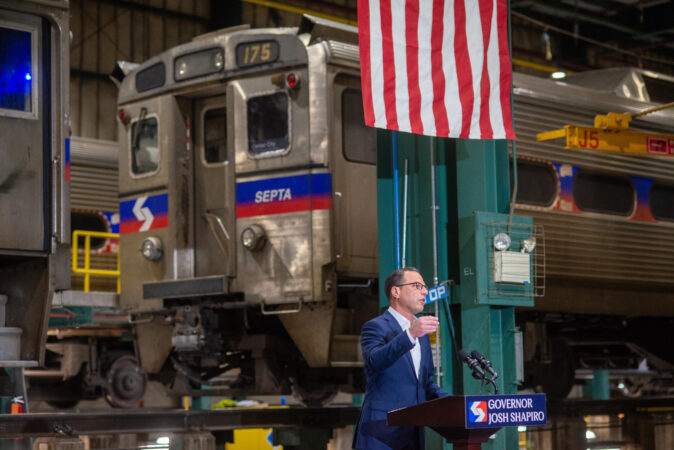
Earlier this month, the Federal Transit Administration ordered SEPTA to inspect its trolley power system after four incidents, including two times trolleys stalled in the Center City tunnel, requiring 415 passengers to be evacuated.
The budget impasse
Shapiro said he was forced to act for the second straight year because Senate Republicans wouldn’t support additional recurring funding for mass transit operations in the state budget.
“They’ve come up with a ton of excuses, but they haven’t come up with the funding,” Shapiro said.
After the governor decided in September that no budget agreement on transit funding was possible, PennDotallowed SEPTA to tap $394 million in state money allocated for future capital projects to pay for two yearsof operating expenses.
The transit agency was facing a $213 million recurring deficit in its operating budget.
Yet the problems with the rail cars and trolleys served to underscore the risks of using capital funds for day-to-day operations.
“A history of chronic underinvestment has led us to this point,” said Chester County Commissioner Marian D. Moskowitz, who is vice chair of SEPTA’s board.
She noted that SEPTA has a much smaller capital budget than other large transit agencies.
$95 million for electrical system upgrades, overhauled propulsion motors and more on the Silverliner IV train cars and the newer Silverliner V models.
$48.4 million to update the overhead catenary wires in the trolley tunnel, along with three new catenary-maintenance cars for the tunnel and along trolley lines, and on long Regional Rail lines.
$51.5 million to upgrade 13 escalators at SEPTA stations, install AI-powered inspection cameras to catch potential problems earlier, and technology improvements at SEPTA’s Control Center
$8 million to install replacement parts for Broad Street Line and Norristown High Speed Line cars.
“These funds are going to make a significant difference in our efforts to overcome the current crises,” SEPTA general manager Scott Sauer said, and to help avoid future ones.
He thanked the governor and pledged “a comprehensive effort to identify potential problems sooner before they grow and lead to delays, cancellations, or shutdowns.”
Shapiro had proposed an increase in the share of general sales-tax revenue devoted to transit subsidies over five years.
Leaders of the GOP-controlled Senate said the $1.5 billion price tag was too high and proposed shifting capital money to operating subsidies for the state’s transit systems and roads — an idea partially reflected in the Shapiro administration’s temporary solution.
“I am glad the Governor continues to take our advice and use existing resources to support public transit,” Senate Majority Leader Joe Pittman (R., Indiana) said in a statement.
“It’s unfortunate that just one year ago, he took $153 million of funding from critical [road] infrastructure projects to fund transit, neglecting the needs of those who use our roadways every single day,” Pittman said.
Republicans also argued that SEPTA had been mismanaged and needs change.
As the next state budget cycle nears, the debate is likely to continue.
“I want you to know I’m going to be a continue to be a governor who supports mass transit, who gives a damn about SEPTA, who cares about those 800,000 people that rely on SEPTA every single day,” Shapiro said.